Supertron1
Collection
7 items • Updated
How to use Surpem/Supertron1-4B with Transformers:
# Use a pipeline as a high-level helper
from transformers import pipeline
pipe = pipeline("text-generation", model="Surpem/Supertron1-4B")
messages = [
{"role": "user", "content": "Who are you?"},
]
pipe(messages) # Load model directly
from transformers import AutoTokenizer, AutoModelForCausalLM
tokenizer = AutoTokenizer.from_pretrained("Surpem/Supertron1-4B")
model = AutoModelForCausalLM.from_pretrained("Surpem/Supertron1-4B")
messages = [
{"role": "user", "content": "Who are you?"},
]
inputs = tokenizer.apply_chat_template(
messages,
add_generation_prompt=True,
tokenize=True,
return_dict=True,
return_tensors="pt",
).to(model.device)
outputs = model.generate(**inputs, max_new_tokens=40)
print(tokenizer.decode(outputs[0][inputs["input_ids"].shape[-1]:]))How to use Surpem/Supertron1-4B with vLLM:
# Install vLLM from pip:
pip install vllm
# Start the vLLM server:
vllm serve "Surpem/Supertron1-4B"
# Call the server using curl (OpenAI-compatible API):
curl -X POST "http://localhost:8000/v1/chat/completions" \
-H "Content-Type: application/json" \
--data '{
"model": "Surpem/Supertron1-4B",
"messages": [
{
"role": "user",
"content": "What is the capital of France?"
}
]
}'docker model run hf.co/Surpem/Supertron1-4B
How to use Surpem/Supertron1-4B with SGLang:
# Install SGLang from pip:
pip install sglang
# Start the SGLang server:
python3 -m sglang.launch_server \
--model-path "Surpem/Supertron1-4B" \
--host 0.0.0.0 \
--port 30000
# Call the server using curl (OpenAI-compatible API):
curl -X POST "http://localhost:30000/v1/chat/completions" \
-H "Content-Type: application/json" \
--data '{
"model": "Surpem/Supertron1-4B",
"messages": [
{
"role": "user",
"content": "What is the capital of France?"
}
]
}'docker run --gpus all \
--shm-size 32g \
-p 30000:30000 \
-v ~/.cache/huggingface:/root/.cache/huggingface \
--env "HF_TOKEN=<secret>" \
--ipc=host \
lmsysorg/sglang:latest \
python3 -m sglang.launch_server \
--model-path "Surpem/Supertron1-4B" \
--host 0.0.0.0 \
--port 30000
# Call the server using curl (OpenAI-compatible API):
curl -X POST "http://localhost:30000/v1/chat/completions" \
-H "Content-Type: application/json" \
--data '{
"model": "Surpem/Supertron1-4B",
"messages": [
{
"role": "user",
"content": "What is the capital of France?"
}
]
}'How to use Surpem/Supertron1-4B with Docker Model Runner:
docker model run hf.co/Surpem/Supertron1-4B
# Load model directly
from transformers import AutoTokenizer, AutoModelForCausalLM
tokenizer = AutoTokenizer.from_pretrained("Surpem/Supertron1-4B")
model = AutoModelForCausalLM.from_pretrained("Surpem/Supertron1-4B")
messages = [
{"role": "user", "content": "Who are you?"},
]
inputs = tokenizer.apply_chat_template(
messages,
add_generation_prompt=True,
tokenize=True,
return_dict=True,
return_tensors="pt",
).to(model.device)
outputs = model.generate(**inputs, max_new_tokens=40)
print(tokenizer.decode(outputs[0][inputs["input_ids"].shape[-1]:]))Supertron1-4B is an instruction-tuned language model built on top of Qwen3-4B. Designed to be a reliable, efficient daily driver, it delivers strong performance across math, coding, reasoning, and general conversation while remaining fast and lightweight enough to run on consumer hardware.
Supertron1-4B holds its own against models in the 4–8B class and surpasses Mistral 7B on all four core benchmarks despite having nearly half the parameters.
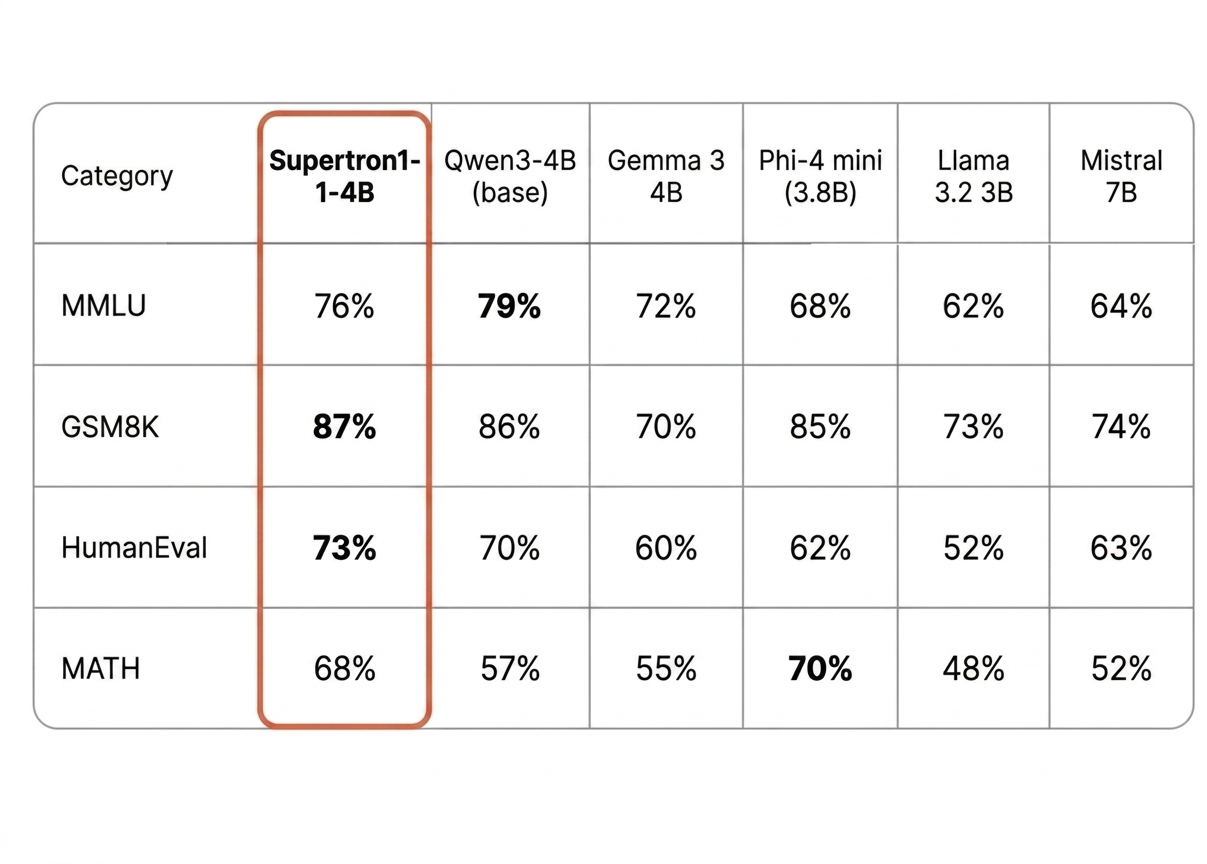
Key takeaways:
from transformers import AutoTokenizer, AutoModelForCausalLM
import torch
model_id = "surpem/supertron1-4b"
tokenizer = AutoTokenizer.from_pretrained(model_id)
model = AutoModelForCausalLM.from_pretrained(
model_id,
torch_dtype=torch.bfloat16,
device_map="auto"
)
messages = [
{"role": "user", "content": "Explain the difference between LoRA and full fine-tuning."}
]
text = tokenizer.apply_chat_template(messages, tokenize=False, add_generation_prompt=True)
inputs = tokenizer(text, return_tensors="pt").to(model.device)
outputs = model.generate(**inputs, max_new_tokens=512)
print(tokenizer.decode(outputs[0][inputs["input_ids"].shape[-1]:], skip_special_tokens=True))
@misc{surpem2026supertron1,
title={Supertron1-4B — Efficient Instruction-Tuned Language Model},
author={Surpem},
year={2026},
url={https://huggingface.co/surpem/supertron1-4b},
}
# Use a pipeline as a high-level helper from transformers import pipeline pipe = pipeline("text-generation", model="Surpem/Supertron1-4B") messages = [ {"role": "user", "content": "Who are you?"}, ] pipe(messages)