| ---
|
| library_name: transformers
|
| tags:
|
| - biology
|
| - protein-structure
|
| - esmfold2
|
| - multimodal-protein-model
|
| ---
|
|
|
| # FastPLMs ESMFold2
|
|
|
| FastPLMs ESMFold2 is a self-contained Hugging Face `AutoModel` wrapper for
|
| Biohub's ESMFold2, ESMFold2-Fast, and experimental ESMFold2 structure
|
| predictors. It vendors the released Biohub ESMFold2 model code, input builder,
|
| MSA helpers, and structure export utilities, while loading the PLM backbone
|
| through FastPLMs ESM++.
|
|
|
| ## Load With AutoModel
|
|
|
| ```python
|
| import torch
|
| from transformers import AutoModel
|
|
|
| model = AutoModel.from_pretrained(
|
| "Synthyra/ESMFold2-Fast",
|
| trust_remote_code=True,
|
| dtype=torch.float32,
|
| ).eval().cuda()
|
| ```
|
|
|
| Use `Synthyra/ESMFold2` for the full model, `Synthyra/ESMFold2-Fast` for the
|
| faster release variant, and the `Synthyra/ESMFold2-Experimental*` checkpoints
|
| for differentiable binder design and experimental critic ensembles.
|
| The folding trunk runs in fp32; the 6B FastPLMs ESM++ backbone is loaded in
|
| bf16 by default via `esmc_precision="bf16"` and uses the flex attention backend
|
| by default inside ESMFold2.
|
|
|
| ## Fold One Protein
|
|
|
| ```python
|
| sequence = "MKTLLILAVVAAALA"
|
|
|
| result = model.fold_protein(
|
| sequence,
|
| num_loops=3,
|
| num_sampling_steps=50,
|
| num_diffusion_samples=1,
|
| seed=0,
|
| )
|
|
|
| print(float(result.plddt.mean()))
|
| print(float(result.ptm))
|
| ```
|
|
|
| ## Experimental Test-Time Training
|
|
|
| TTT is disabled by default. Standard `fold_protein(...)`, `fold(...)`, raw tensor
|
| inference, and `state_dict()` keys are unchanged unless you explicitly pass
|
| `ttt=True` or call `fold_protein_ttt(...)`.
|
|
|
| The ESMFold2 TTT path is experimental and protein-only in v1. It trains local
|
| LoRA adapters only on `_esmc` with a masked language modeling objective. The
|
| folding trunk, confidence head, diffusion head, and structure input pipeline are
|
| frozen. TTT can improve difficult low-confidence folds, but it adds substantial
|
| test-time compute and can degrade already confident predictions.
|
|
|
| ```python
|
| result = model.fold_protein(
|
| "MSTNPKPQRKTKRNT",
|
| num_loops=1,
|
| num_sampling_steps=10,
|
| num_diffusion_samples=1,
|
| seed=0,
|
| ttt=True,
|
| ttt_config={
|
| "steps": 1,
|
| "ags": 1,
|
| "batch_size": 1,
|
| "lora_rank": 8,
|
| "lora_alpha": 32.0,
|
| },
|
| )
|
|
|
| print(result.ttt_metrics["losses"])
|
| print(result.ttt_metrics["step_plddts"])
|
| print(result.ttt_metrics["best_step"])
|
| ```
|
|
|
| `load_esmc=True` is required for TTT because the ESM++ MLM head is loaded lazily
|
| from `config.esmc_id`. If that pretrained MLM head cannot be loaded, TTT raises
|
| an assertion instead of silently using a random head.
|
|
|
| ## Save mmCIF or PDB
|
|
|
| ```python
|
| model.save_as_cif(result, "prediction.cif")
|
| model.save_as_pdb(result, "prediction.pdb")
|
|
|
| cif_text = model.result_to_cif(result)
|
| pdb_text = model.result_to_pdb(result)
|
| ```
|
|
|
| `result_to_cif` preserves the full `MolecularComplex`. `result_to_pdb` converts through Biohub's protein-only `ProteinComplex` representation, so use mmCIF for complexes with ligands or nucleic acids.
|
|
|
| ## Fold Complexes
|
|
|
| ```python
|
| types = model.input_types
|
|
|
| complex_input = types.StructurePredictionInput(
|
| sequences=[
|
| types.ProteinInput(id="A", sequence="MKTLLILAVVAAALA"),
|
| types.DNAInput(id="B", sequence="GATAGC"),
|
| types.LigandInput(id="L", ccd=["SAH"]),
|
| ]
|
| )
|
|
|
| result = model.fold(
|
| complex_input,
|
| num_loops=3,
|
| num_sampling_steps=50,
|
| num_diffusion_samples=1,
|
| seed=0,
|
| )
|
|
|
| model.save_as_cif(result, "complex_prediction.cif")
|
| ```
|
|
|
| ## Binder Design With FastPLMs ESMFold2
|
|
|
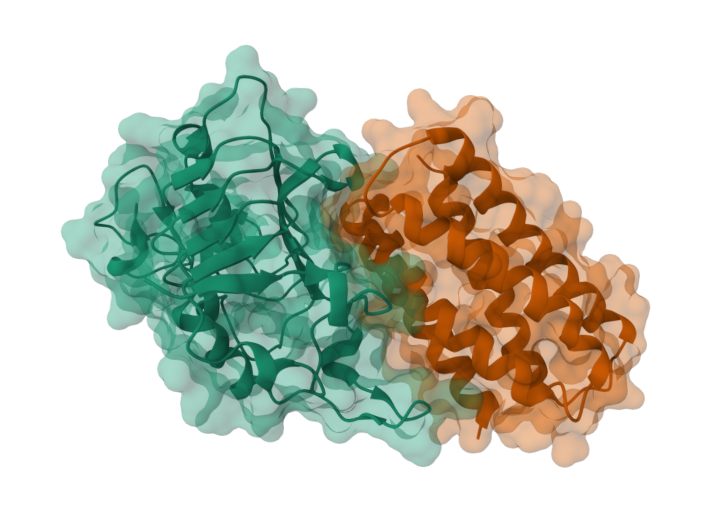
| FastPLMs includes a FastPLMs-only port of the Biohub ESMFold2 binder design
|
| tutorial at `cookbook/tutorials/binder_design_fastplms.py`. The workflow uses
|
| ESMFold2 experimental checkpoints for differentiable folding losses, ESM++ for
|
| sequence regularization, and ESMFold2 hero critics for final confidence scoring.
|
|
|
| 
|
|
|
| The optimizer follows the official strategy:
|
|
|
| 1. Optimize mutable `#` residues as continuous amino acid logits.
|
| 2. Suppress cysteine design by masking cysteine logits and gradients.
|
| 3. Backpropagate through ESMFold2 `res_type_soft` using intra-contact,
|
| inter-contact, and globularity losses from the distogram.
|
| 4. Add an ESM++ masked-LM pseudoperplexity regularizer on mutable binder
|
| residues.
|
| 5. Keep the late-trajectory sequence with the best iPTM.
|
| 6. Fold the selected sequence with the final critic ensemble and write
|
| `results.parquet`, `selection.parquet`, `trajectory.jsonl`,
|
| `best_sequences.fasta`, and per-critic PDB/CIF/logit files.
|
|
|
| Run the verified EGFR 128 amino acid de novo minibinder example:
|
|
|
| ```bash
|
| cd /home/ubuntu/FastPLMs
|
|
|
| sudo -n docker run --gpus all --rm \
|
| -v /home/ubuntu/FastPLMs:/app \
|
| -v /home/ubuntu/FastPLMs:/workspace \
|
| -v /home/ubuntu/.cache/huggingface:/workspace/.cache/huggingface \
|
| -w /workspace fastplms-esmfold2 \
|
| python /app/cookbook/tutorials/binder_design_fastplms.py \
|
| --backend local \
|
| --target-name egfr \
|
| --binder-sequence '################################################################################################################################' \
|
| --not-antibody \
|
| --steps 150 \
|
| --batch-size 1 \
|
| --seed 103 \
|
| --output-dir /workspace/campaign_egfr_len128_b1_s150_seed103_consensus_cli
|
| ```
|
|
|
| Verified result:
|
|
|
| | Metric | Value |
|
| | :--- | :--- |
|
| | Binder length | `128` |
|
| | Seed | `103` |
|
| | Steps | `150` |
|
| | Hero mean iPTM | `0.913870` |
|
| | Hero min iPTM | `0.904600` |
|
| | All four hero critics above 0.9 | `True` |
|
|
|
| Binder sequence:
|
|
|
| ```text
|
| SAVKHLLEIVKYLEEAIEKALEVDPVFLVPPAAEELLIAAKVIKELAKENPELIEVYELLMKAVKGLKKLVRSNDKEILREVIRLLRKAAKVIREILKNNPDLDPELRKALEELAKVLEEIAEVLEQQ
|
| ```
|
|
|
| See the full guide in [`docs/binder_design.md`](https://github.com/Synthyra/FastPLMs/blob/main/docs/binder_design.md)
|
| for Modal execution, official pI and selection scoring, per-critic metrics, and
|
| the tested cheaper step-count boundary.
|
|
|
| ## Use MSAs
|
|
|
| ```python
|
| types = model.input_types
|
|
|
| msa = types.MSA.from_a3m("query.a3m", max_sequences=128)
|
| input_with_msa = types.StructurePredictionInput(
|
| sequences=[
|
| types.ProteinInput(id="A", sequence=msa.query, msa=msa),
|
| ]
|
| )
|
|
|
| result = model.fold(input_with_msa, num_sampling_steps=50, seed=0)
|
| ```
|
|
|
| ## Raw Tensor Inference
|
|
|
| ```python
|
| features, chain_infos = model.prepare_structure_input(complex_input, seed=0)
|
|
|
| with torch.inference_mode():
|
| output = model(
|
| **features,
|
| num_loops=3,
|
| num_sampling_steps=50,
|
| num_diffusion_samples=1,
|
| )
|
|
|
| decoded = model.input_builder.decode(output, features, chain_infos)
|
| ```
|
|
|
| Set `load_esmc=False` when loading if you want to provide precomputed `lm_hidden_states` manually or run folding-trunk tests without loading the 6B ESM++ backbone:
|
|
|
| ```python
|
| model = AutoModel.from_pretrained(
|
| "Synthyra/ESMFold2-Fast",
|
| trust_remote_code=True,
|
| load_esmc=False,
|
| ).cuda().eval()
|
| ```
|
|
|
| For FP8 LM inference, install `transformer_engine.pytorch` in a CUDA
|
| environment with FP8-capable hardware and load the shared FastPLMs ESM++
|
| backbone with:
|
|
|
| ```python
|
| model = AutoModel.from_pretrained(
|
| "Synthyra/ESMFold2-Fast",
|
| trust_remote_code=True,
|
| esmc_precision="fp8",
|
| ).cuda().eval()
|
| ```
|
|
|
| FP8 is inference-only for the ESMFold2 LM backbone. TTT remains a bf16/fp32
|
| path.
|
|
|


