

File size: 10,574 Bytes
477ebb4 ed6867c 477ebb4 ed6867c 477ebb4 ed6867c 477ebb4 ed6867c 477ebb4 ed6867c 477ebb4 ed6867c 477ebb4 ed6867c 477ebb4 | 1 2 3 4 5 6 7 8 9 10 11 12 13 14 15 16 17 18 19 20 21 22 23 24 25 26 27 28 29 30 31 32 33 34 35 36 37 38 39 40 41 42 43 44 45 46 47 48 49 50 51 52 53 54 55 56 57 58 59 60 61 62 63 64 65 66 67 68 69 70 71 72 73 74 75 76 77 78 79 80 81 82 83 84 85 86 87 88 89 90 91 92 93 94 95 96 97 98 99 100 101 102 103 104 105 106 107 108 109 110 111 112 113 114 115 116 117 118 119 120 121 122 123 124 125 126 127 128 129 130 131 132 133 134 135 136 137 138 139 140 141 142 143 144 145 146 147 148 149 150 151 152 153 154 155 156 157 158 159 160 161 162 163 164 165 166 167 168 169 170 171 172 173 174 175 176 177 178 179 180 181 182 183 184 185 186 187 188 189 190 191 192 193 194 195 196 197 198 199 | ---
license: mit
pipeline_tag: image-to-image
tags:
- steppe
- latent-upscaler
- upscaler
- super-resolution
- comfyui
- flux
- flux2
- flux.2
- moss-image
- flow-matching
- distillation
base_model:
- black-forest-labs/FLUX.2-dev
- black-forest-labs/FLUX.2-klein-4B
- black-forest-labs/FLUX.2-klein-9B
- black-forest-labs/FLUX.2-klein-base-4B
- black-forest-labs/FLUX.2-klein-base-9B
- OpenMOSS-Team/MOSS-Image-SFT
- OpenMOSS-Team/MOSS-Image-Base
base_model_relation: adapter
---
# Steppe for FLUX.2 VAE latents
[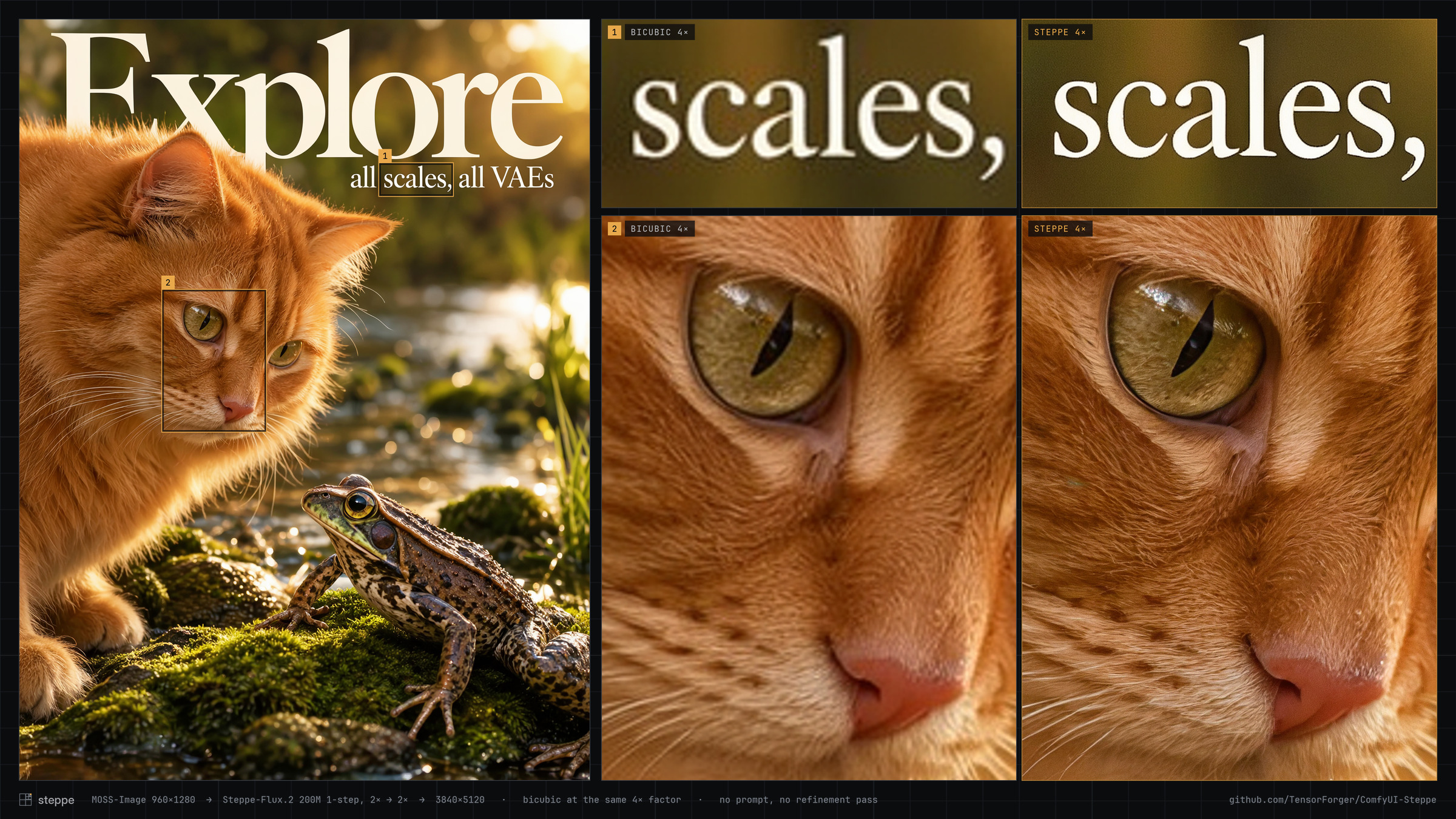](https://raw.githubusercontent.com/tensorforger/tensorforger/main/assets/steppe_flux2/flux2_compare_cat.png)
> ### 🧩 ComfyUI nodes: [ComfyUI-Steppe](https://github.com/TensorForger/ComfyUI-Steppe)
> Available in **ComfyUI-Manager**: search for "Steppe" and install (or `comfy node install steppe`).
> FLUX.2 support needs version 1.1.0 or newer. The nodes download these models on first use.
>
> [](https://github.com/TensorForger/ComfyUI-Steppe)
**Steppe** is a family of *generative latent upscalers*: small generative models trained only for upscaling,
which run directly on VAE latents. The upscaled latent is **decoded straight by the VAE**: no second sampling pass of
the base model, no hires fix, no prompt.
These models upscale latents of the **FLUX.2 VAE**, the latent space shared by FLUX.2 [dev], FLUX.2 [klein] and
MOSS-Image.
- **2x resolution** of images, e.g. 512 → 1024 or 1024 → 2048, and chained 2x → 2x.
- **One step**: ~40 ms model time for a 1024 px image with the default model (RTX 5090). Most of the time goes to the
VAE decode.
- **Close to the VAE limit**: patch FID 1.75 vs 8.12 for bicubic, -59% vs our earlier FLUX.2 upscaler.
- **Sharpness control** through the high frequency feature conditioning (hff).
Images only: unlike the Wan 2.1 models, there is no temporal (frame rate) upscaling.
## Use in ComfyUI
Install [ComfyUI-Steppe](https://github.com/TensorForger/ComfyUI-Steppe): search for "Steppe" in ComfyUI-Manager,
or run `comfy node install steppe`. The models download automatically on first use.
`KSampler → Steppe Upscale Latent → VAE Decode`
Select a `steppe_flux_2_*` model in **Load Steppe Upscaler** (the same loader lists the Wan 2.1 models). Leave
`steps` / `shift` at `0` for the recommended base model sampler (30 steps, shift 2).
To install the models manually, put the files into `ComfyUI/models/latent_upscale_models`.
## Gallery
[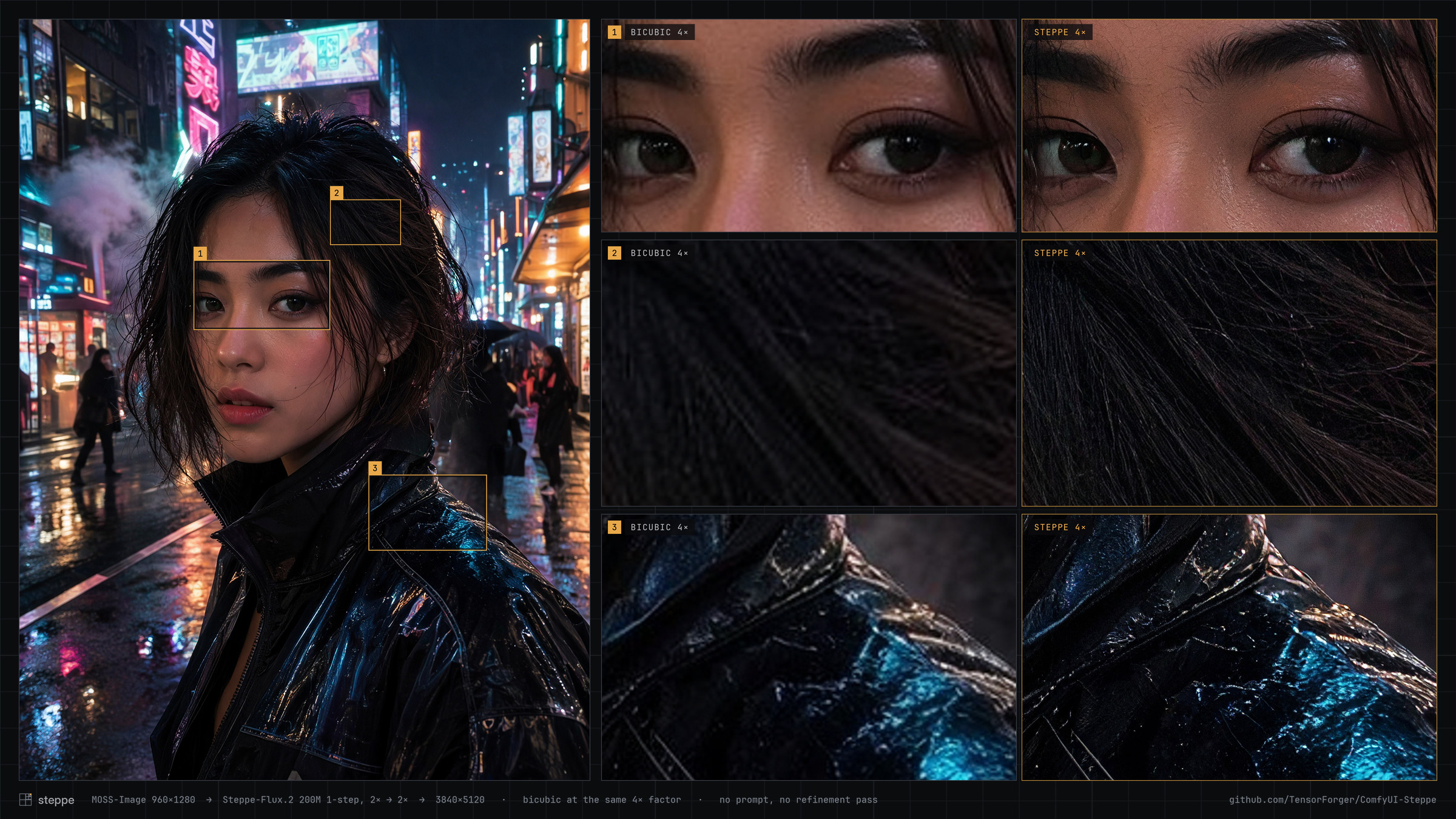](https://raw.githubusercontent.com/tensorforger/tensorforger/main/assets/steppe_flux2/flux2_compare_neon.png)
[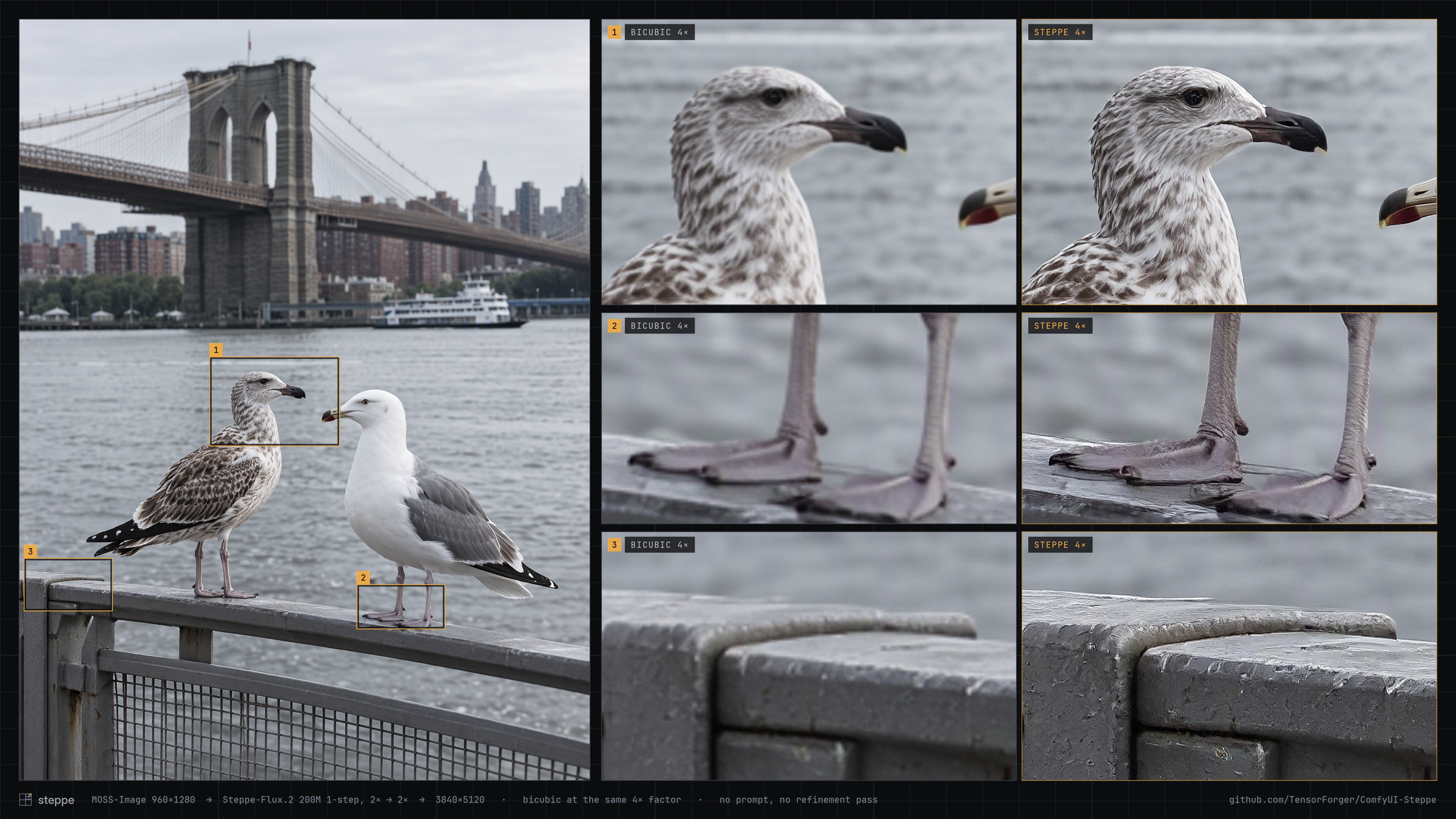](https://raw.githubusercontent.com/tensorforger/tensorforger/main/assets/steppe_flux2/flux2_compare_gulls.png)
[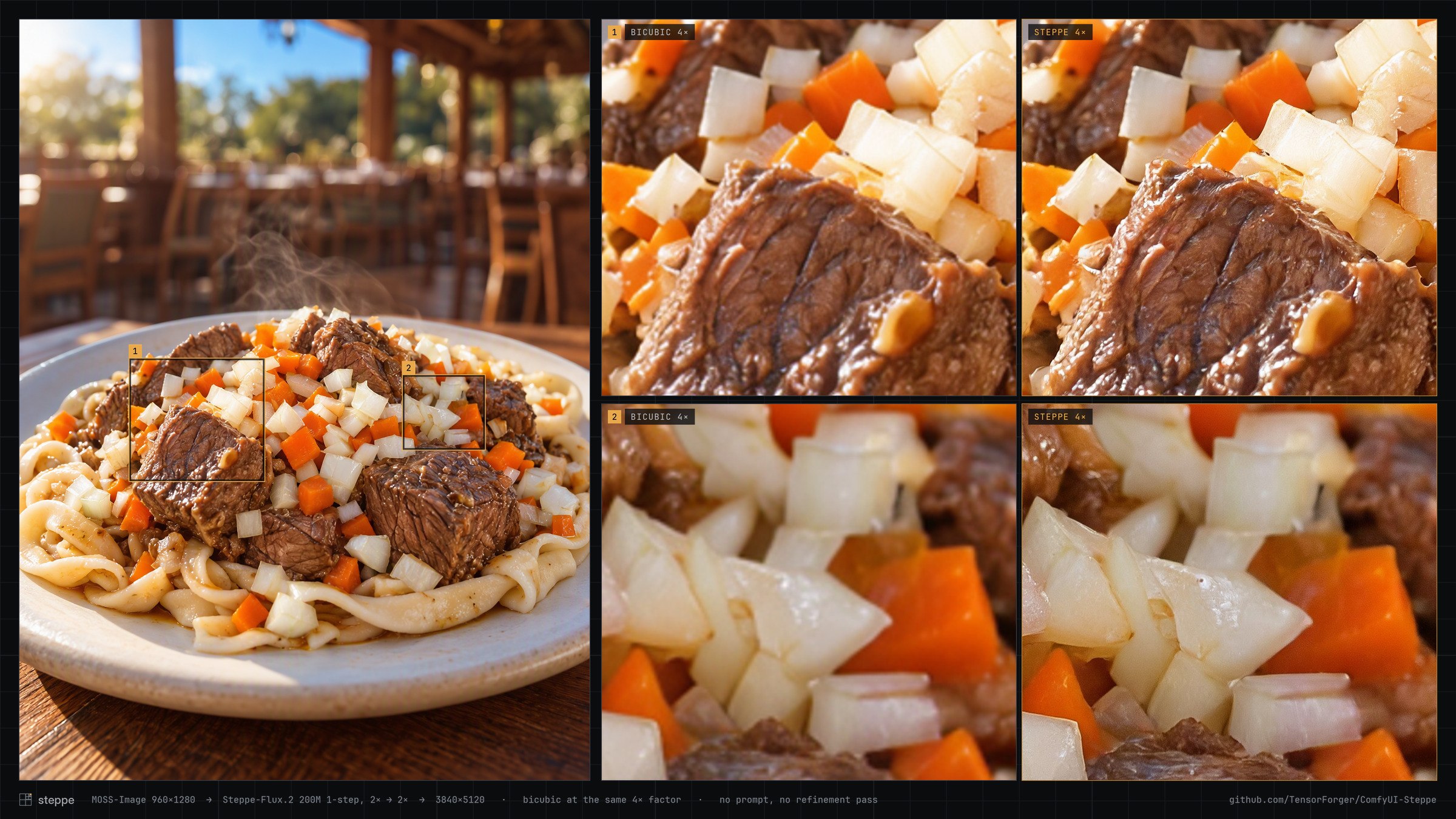](https://raw.githubusercontent.com/tensorforger/tensorforger/main/assets/steppe_flux2/flux2_compare_food.png)
All examples: MOSS-Image at 960x1280, Steppe-Flux.2 200M 1-step, chained 2x → 2x to 3840x5120, no prompt and no
refinement pass. Bicubic tiles are upscaled by the same 4x factor from the same input. Click an image for the full
resolution card.
## Files
| file | steps | parameters | use |
|---|---|---|---|
| [`steppe_flux_2_200M_1step.safetensors`](steppe_flux_2_200M_1step.safetensors) | 1 | 192M | **default**, 90% of use cases: the quality of the base model in one step |
| [`steppe_flux_2_200M_base.safetensors`](steppe_flux_2_200M_base.safetensors) | 1-200 (30) | 192M | most control and research: steps, CFG on hff; same quality as the 1-step model in general use |
| [`steppe_flux_2_20M_1step.safetensors`](steppe_flux_2_20M_1step.safetensors) | 1 | 20.2M | lite: 6x faster model pass, very large outputs, real time use; with a tiny decoder (TAEF2) the whole pipeline is ~19 ms |
All files are bfloat16 safetensors with the model configuration in the metadata. `config.json` is the catalog of this
repository (versions, recommended settings).
## Compatibility
| model | VAE | status |
|---|---|---|
| FLUX.2 [dev] | FLUX.2 VAE | native |
| FLUX.2 [klein] 4B / 9B (distilled and base) | FLUX.2 VAE | native |
| MOSS-Image (SFT and base) | FLUX.2 VAE (small decoder) | native |
| FLUX.2 small decoder, TAEF2 (madebyollin/taef2) | FLUX.2 VAE decoders | works, TAEF2 benchmarked |
| FLUX.1, Wan, Qwen-Image, SD3, SDXL, … | other VAEs | **not supported** here (Wan 2.1 VAE: [Steppe-Wan2.1](https://huggingface.co/TensorForger/Steppe-Wan2.1)) |
Tested in ComfyUI with FLUX.2 [klein] 4B (`flux2-vae`) and MOSS-Image (`flux2-vae_small`), single 2x and chained
2x → 2x. Both workflows are in
[ComfyUI-Steppe/example_workflows](https://github.com/TensorForger/ComfyUI-Steppe/tree/main/example_workflows).
## Settings
- **hff** (`0...1`, default 0.9): target amount of fine detail and sharpness. Off (`-1`) lets the model choose.
The values are absolute: an Immerkaer noise estimate, quantile-normalized on ReLAION photos. hff acts much more
strongly on these models than on the Wan 2.1 ones.
- **guidance**:
- 1-step models: a distilled guidance input, trained on 1-2, no extra cost. The default 1 (off) is safe and stable.
- Base model: classifier free guidance between the hff and the null hff; the cost is two passes per step.
- **Base model sampler**: 30 Euler steps, sigma shift 2, initial noise scale 1.0.
## Benchmark
[](https://raw.githubusercontent.com/tensorforger/tensorforger/main/assets/steppe_flux2/flux2_benchmark_plot.png)
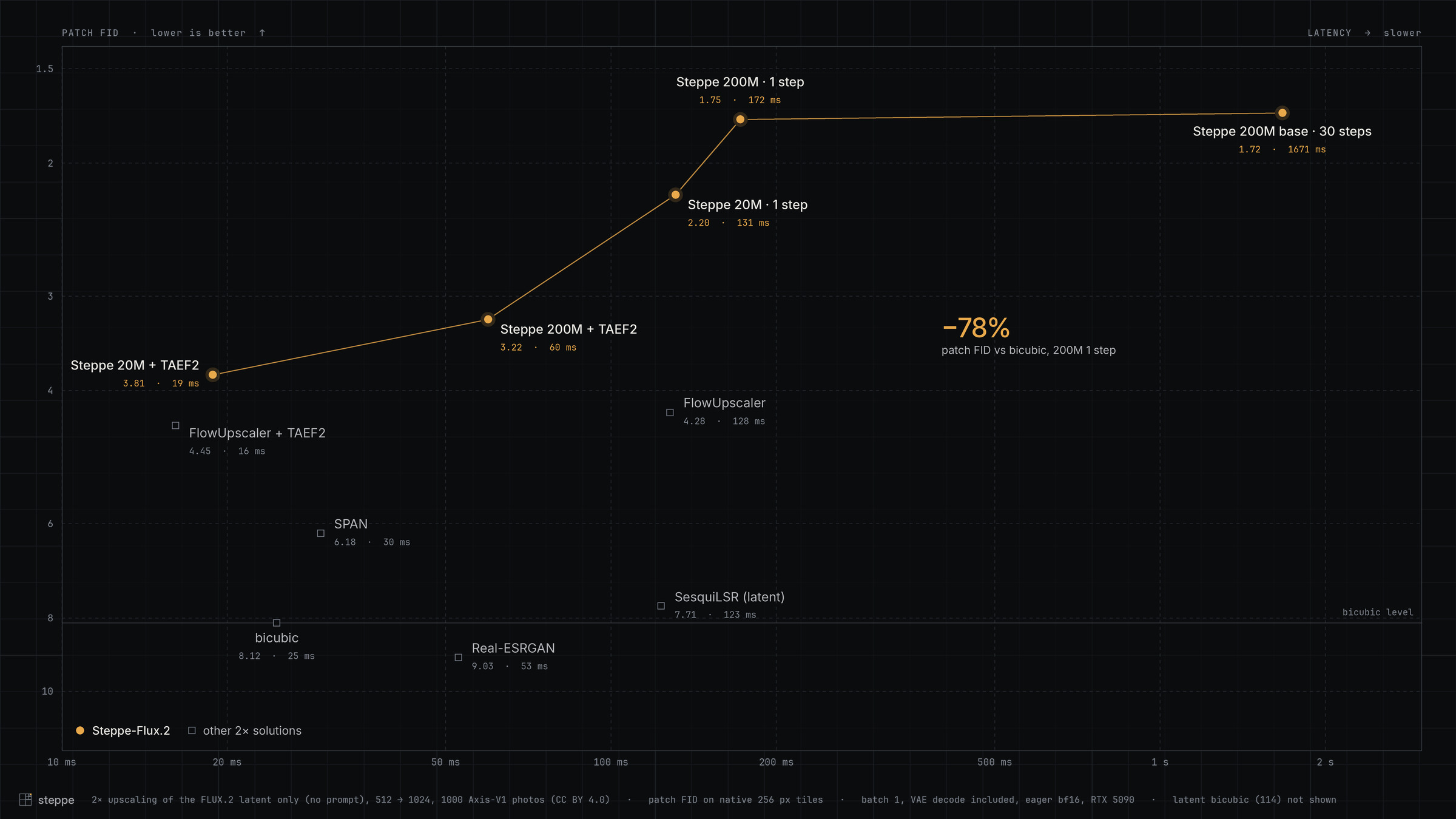
1000 photos (Axis-V1), 512 → 1024. Every solution gets only the FLUX.2 latent (no prompt, no hff). Patch FID on native
256 px tiles (lower is better); latency at batch 1, VAE decode included, RTX 5090, eager bfloat16.
| solution | patch FID | FID | latency | peak VRAM |
|---|---|---|---|---|
| Steppe 200M base, 30 steps | **1.72** | 1.95 | 1671 ms | 3.0 GB |
| Steppe 200M 1-step | 1.75 | 2.02 | 172 ms | 3.0 GB |
| Steppe 20M 1-step | 2.20 | 2.63 | 131 ms | 2.6 GB |
| Steppe 200M 1-step + TAEF2 decoder | 3.22 | 4.55 | 60 ms | 1.0 GB |
| Steppe 20M 1-step + TAEF2 decoder | 3.81 | 5.17 | 19 ms | 0.7 GB |
| FlowUpscaler (our previous FLUX.2 model) | 4.28 | 4.50 | 128 ms | 2.7 GB |
| SPAN 2x after decode | 6.18 | 3.67 | 30 ms | 0.8 GB |
| SesquiLSR FLUX.2 (latent, made for hires fix) | 7.71 | 7.26 | 124 ms | 2.6 GB |
| bicubic after decode | 8.12 | 1.77 | 25 ms | 0.8 GB |
| Real-ESRGAN x2 after decode | 9.03 | 7.99 | 53 ms | 0.8 GB |
The VAE reconstruction limit on this set is patch FID 0.71. Steppe stays close to the input: roundtrip color error
ΔE00 1.82 (bicubic 1.74). A FLUX.2 [klein] 9B LoRA upscaler (Hildegard, 4 steps, ~7 s per image) was compared on 30
images: it adds plausible detail but moves away from the input (ΔE00 3.8 at best vs 2.2 for Steppe on the same images).
Benchmark images: [Axis-V1](https://huggingface.co/datasets/refine-axis/axis-v1_1k) by refine-axis (CC BY 4.0), cropped.
## Python
```bash
pip install "steppe[standalone] @ git+https://github.com/TensorForger/ComfyUI-Steppe"
```
```python
from steppe import UpscaleSettings, load_upscaler
upscaler = load_upscaler("steppe_flux_2_200M_1step.safetensors")
upscaler.model.to("cuda")
# FLUX.2 latents as ComfyUI and the diffusers FLUX.2 pipelines use them: 2x2 packed and batch norm normalized,
# [B, 128, H / 16, W / 16]. From a bare AutoencoderKLFlux2: patchify the 32 channel latent 2x2 (channel order
# C, 2, 2) and normalize it with vae.bn.running_mean / sqrt(vae.bn.running_var + 1e-4).
upscaled = upscaler.upscale(
latents, UpscaleSettings(hff=0.9, guidance=1.0)
) # [B, 128, H / 8, W / 8]
```
## How it works
A window transformer runs on the full resolution latent grid (32 channels, 1/8 of the image). It uses DiT style
adaLN-zero blocks, shifted 8x8 window attention and QK-norm. A learned source encoder upsamples the input latent. The
model generates the normalized residual over the aligned low resolution latent with rectified flow, conditioned on the
noise level and the hff.
- **Base model**: 192M parameters, trained from scratch for 24 h on 7 RTX 5090s. Data: images from
[ReLAION-high-resolution](https://huggingface.co/datasets/laion/relaion-high-resolution) and 4KLSDB (1 : 1, large
crops, 512 → 1024 and 256 → 512). Training pairs are made by downscaling and encoding with the FLUX.2 VAE; 20% of the
inputs are corrupted (mostly JPEG) for robustness. No captions are used. hff dropout enables classifier free
guidance.
- **1-step model**: rectified flow distillation of the base model (teacher pairs generated online, ~35 min on 8 GPUs).
It keeps ~99% of the base model's gain over bicubic.
- **20M model**: the same architecture scaled down and trained from scratch for 6 h on pairs from the 1-step model
(~93% of its gain).
The architecture and recipe come from agent-driven autoresearch on FLUX.2 and Wan 2.1 latents (rounds of parallel
30 min training runs, judged by patch FID).
## Limitations
- Images only, no video and no frame rate upscaling.
- Small text and small background faces are where all upscalers fail. Steppe improves them less than textures and
edges, and the 20M model the least.
- The upscaling factor is fixed at 2x. For 4x, chain two upscales.
## License
MIT. Steppe works on latents of the FLUX.2 VAE (Apache-2.0, Black Forest Labs), see `NOTICE`. This repository
does not contain VAE or FLUX.2 model weights.
The ancestor of Steppe is [comfyui-flow-upscaler](https://github.com/tensorforger/comfyui-flow-upscaler) (FLUX.2).
```bibtex
@misc{steppe2026,
author = {TensorForger},
title = {Steppe: Generative Latent Upscalers},
year = {2026},
url = {https://huggingface.co/TensorForger/Steppe-Flux.2}
}
```
|