

import torch
from diffusers import DiffusionPipeline

# switch to "mps" for apple devices
pipe = DiffusionPipeline.from_pretrained("Wuli-art/MiniMax-H3-Turbo", dtype=torch.bfloat16, device_map="cuda")

prompt = "Astronaut in a jungle, cold color palette, muted colors, detailed, 8k"
image = pipe(prompt).images[0]MiniMax-H3-Turbo

Fixed-step MiniMax-H3 checkpoints for text-to-video with audio and first-frame-to-video with audio. This repository contains three variants:
turbo-4step/: four-step LoRA with fused video and audio output projections.turbo-8step/: eight denoising steps.turbo-6step/: six denoising steps.
The 6- and 8-step variants store a complete Diffusers-format transformer. The
4-step variant stores a compact adapter for the official transformer, including
a backbone LoRA and fused video/audio output projections. The demo downloads
the remaining components from MiniMaxAI/MiniMax-H3. The output is one MP4
containing H.264 video and AAC audio; no separate WAV is written.
Interactive Demo
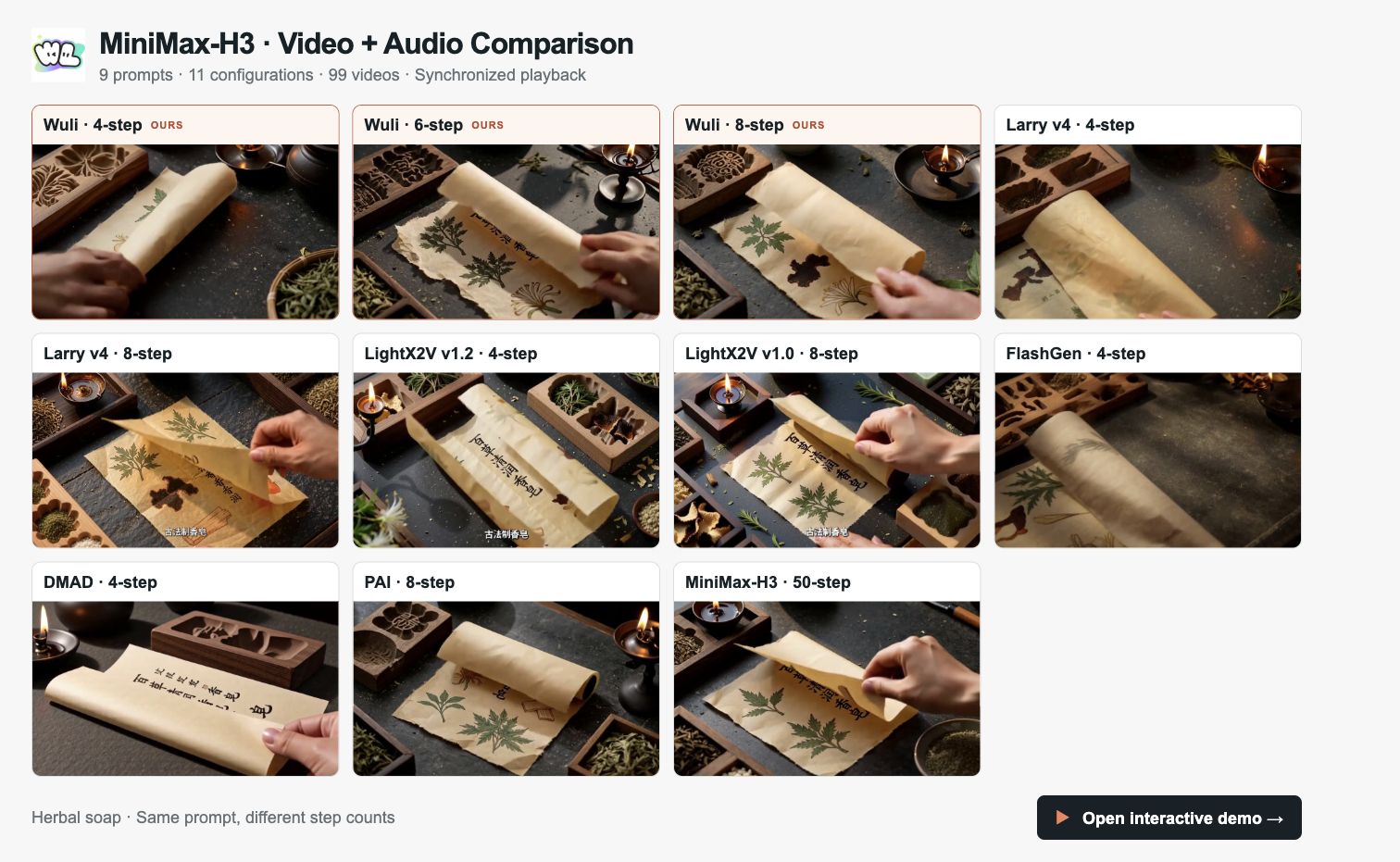
Explore the MiniMax-H3 video comparison demo →
Compare Wuli at 4, 6 and 8 steps with Larry v4, LightX2V, FlashGen, DMAD, PAI and the original MiniMax-H3 at 50 steps. The demo includes 9 prompts, 11 configurations and 99 videos, with synchronized playback, step-count filters, side-by-side comparisons and selectable audio.
ComfyUI
Use the MiniMax H3 Turbo ComfyUI node pack to generate video and audio with 4, 6, or 8 steps and save them together as one MP4.
1. Install the nodes
Use a local ComfyUI installation with CUDA-enabled PyTorch. Clone the node pack into ComfyUI/custom_nodes/ and install its dependencies with the same Python environment that runs ComfyUI:
cd /path/to/ComfyUI/custom_nodes
git clone https://github.com/wuli-art/MiniMax-H3-Turbo-ComfyUI.git
cd MiniMax-H3-Turbo-ComfyUI
python -m pip install -r requirements.txt
For Windows Portable, run the dependency command from the ComfyUI_windows_portable directory using its embedded Python:
.\python_embeded\python.exe -m pip install -r .\ComfyUI\custom_nodes\MiniMax-H3-Turbo-ComfyUI\requirements.txt
Restart ComfyUI. The node pack requires diffusers==0.40.0, transformers>=4.57.0, and peft>=0.17.0; its requirements.txt installs the required packages. When updating an existing installation, install the requirements again before restarting.
2. Load a workflow
Download a workflow JSON below and drag it into ComfyUI:
| Variant | Text-to-video workflow | Selection |
|---|---|---|
| 4 steps | t2va_4step.json | steps = 4 |
| 6 steps | t2va_8step.json | Change steps to 6 |
| 8 steps | t2va_8step.json | steps = 8 |
The workflows connect MiniMax H3 Turbo Generate to MiniMax H3 Turbo Save MP4. The default generation settings are seed = 42, num_frames = 124, height = 768, and width = 1344.
3. Generate a video with audio
- Select
stepsand enter your scene and desired sound inprompt. - Leave
model_rootempty for automatic downloads. Keepcomponents_rootset toMiniMaxAI/MiniMax-H3. - For text-to-video, leave
first_frameandlast_framedisconnected. - Run the workflow. The first run downloads and loads the selected Turbo weights and official components. The save node writes a 24 fps H.264/AAC MP4 to ComfyUI's output directory.
For frame-conditioned generation, use fl2va_4step.json or fl2va_8step.json. Select your image in Load Image and connect it to first_frame; connect a second Load Image node to last_frame when a final frame is also provided. For 6 steps, use the 8-step example and change steps to 6.
See the node pack README for installation and usage details, or open an issue for ComfyUI-specific problems.
Requirements
The demo was tested with Diffusers 0.40.0 and huggingface_hub 1.27.0. Install a CUDA-enabled PyTorch build compatible with your driver, then install the remaining packages. Only these two versions are pinned:
pip install "diffusers==0.40.0" "huggingface_hub==1.27.0" transformers accelerate peft safetensors av
The first run downloads the selected Turbo weights from
Wuli-art/MiniMax-H3-Turbo and the required base components from
MiniMaxAI/MiniMax-H3. The 4-step variant also uses the official transformer;
the 6- and 8-step variants replace it with their complete transformer.
Text-to-video with audio
python run_fl2va.py --steps 8 --prompt "A paper airplane glides through a bright classroom." --output output.mp4
Use --steps 4 to select the compact four-step adapter:
python run_fl2va.py --steps 4 --prompt "A paper airplane glides through a bright classroom." --output output.mp4
First-frame-to-video with audio
python run_fl2va.py --steps 6 --image first_frame.png --height 768 --width 1344 --prompt "The scene in the first frame comes to life." --output output.mp4
--steps selects turbo-4step/, turbo-6step/, or turbo-8step/; it
defaults to 8. Use --seed and --num-frames to control the request.
--last-image is available when a final frame is also provided. --height
and --width must be passed together when an exact canvas is needed.
--disable-cudnn is an optional workaround for systems reporting
CUDNN_STATUS_SUBLIBRARY_LOADING_FAILED; leave it off on normal installations.
With --model, pass a local turbo-6step/ or turbo-8step/ directory for
the full variants. For four steps, pass either the adapter safetensors file,
its containing turbo-4step/ directory, or the repository root containing
that directory.
ModelScope mirror
To use the private Wuli-Art/MiniMax-H3-Turbo mirror instead of downloading its transformer from Hugging Face, install modelscope_hub, authenticate, and download only the selected variant:
pip install modelscope_hub
ms-hub login
ms-hub download Wuli-Art/MiniMax-H3-Turbo --include "turbo-8step/*" --local-dir MiniMax-H3-Turbo
python run_fl2va.py --steps 8 --model MiniMax-H3-Turbo/turbo-8step --prompt "A paper airplane glides through a bright classroom." --output output.mp4
For four or six steps, replace 8 with 4 or 6 in the folder name and
--steps argument. The demo still downloads the other components from
MiniMaxAI/MiniMax-H3 on Hugging Face.
Acknowledgement
We thank Alibaba RTP-Compression Team, Alibaba Wuli Team, Bai Jiang, and Xiao Feng for their support and contributions.
- Downloads last month
- -
Model tree for Wuli-art/MiniMax-H3-Turbo
Base model
MiniMaxAI/MiniMax-H3