

Entropy-Valley
Collection
Training-free length selection for masked diffusion MT (EMNLP 2026). Code: github.com/Entropy-Valley/Entropy-Valley • 4 items • Updated
Official English→German LoRA adapter for Length-Adaptive Decoding for Masked Diffusion Machine Translation (EMNLP 2026 Main Conference). It turns GSAI-ML/LLaDA-8B-Base into a masked-diffusion MT system for En→De.
En→De is the paper's matched-scale check, not its headline direction. It is included as a typologically more distant test; the gains are smaller here and the paper documents why. See Limitations before deploying. For the strongly supported directions see En→Zh and Zh→En.
The adapter is not the method. Entropy-Valley (EV) is a training-free, decoding-time length selector, implemented in
ladit/decoding/length_adaptive.py. This adapter is the fixed backbone that EV decodes with — the same weights serve the length-oracle, fixed-ratio, and EV conditions. Only the canvas length handed to the decoder changes.
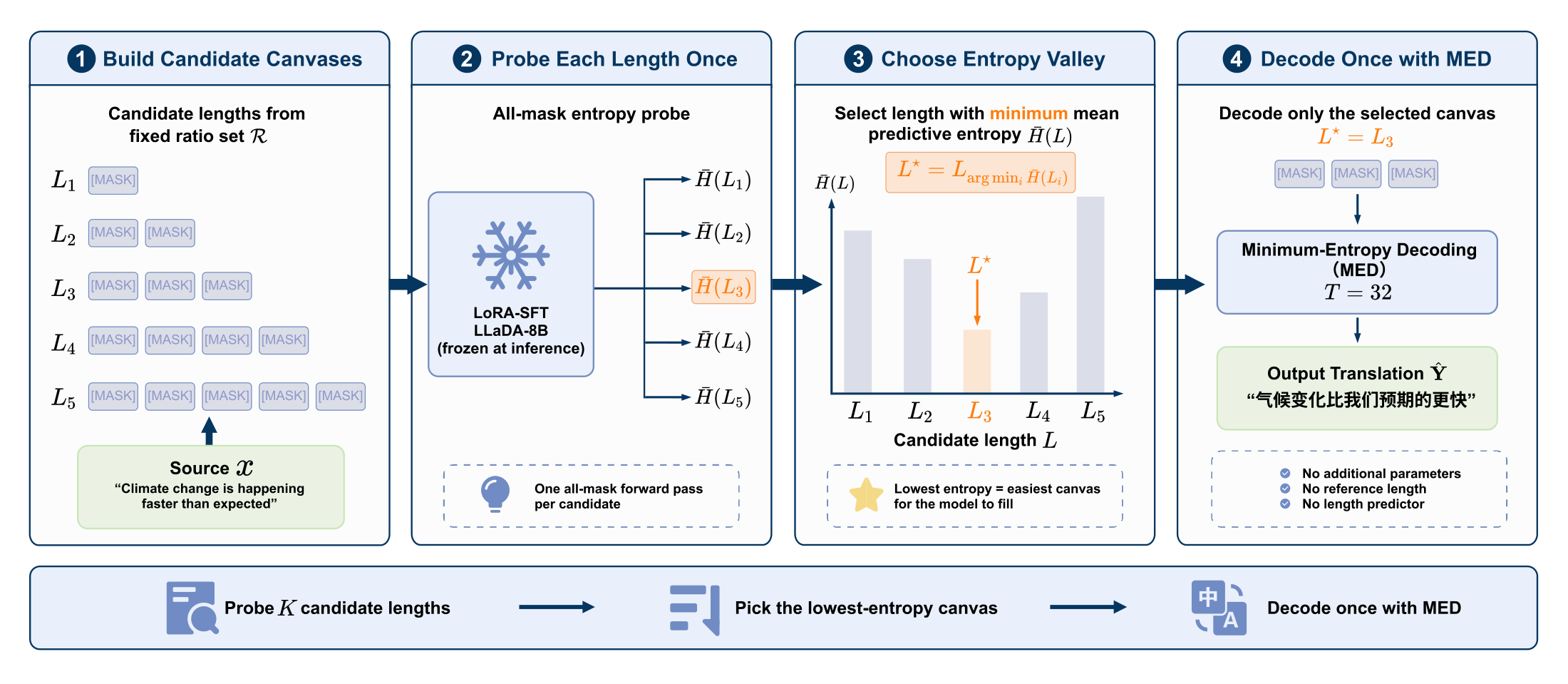
A masked diffusion LM fills a fixed-size canvas: it must be told how many target slots to produce before denoising begins, and there is no autoregressive EOS to stop it. EV asks the frozen backbone which canvas it is most prepared to fill — one all-mask forward pass per candidate length, scored by mean predictive entropy over the first $L-1$ slots (the last is reserved for EOS), then decode the minimum:
| Base model | GSAI-ML/LLaDA-8B-Base (8.02B, masked diffusion) |
| Adapter | LoRA r=64, α=128, dropout 0.05 on q/k/v/o_proj + ff_proj/up_proj/ff_out |
| Training data | 200k WMT19 de-en pairs (Entropy-Valley-Datasets, config ende), 3 epochs, bf16, 8×H20 |
| Decoding | MED schedule, $T{=}32$ steps, EOS truncation |
| EV candidate grid | $\mathcal{R} = {1.50, 1.60, 1.70, 1.80, 1.90}$, fixed for the direction |
| Prompt template | Translate English to German.\n\nEnglish: {src}\nGerman: |
WMT22 En→De ($N{=}2{,}037$), 32-step MED decoding, mean over three independent training runs.
| Length method | COMET-22 | sacreBLEU |
|---|---|---|
| Fixed ratio 1.8 | 0.7170 | 20.73 |
| Entropy-Valley | 0.7240 | 21.55 |
| Length oracle † | 0.7382 | 22.55 |
† Decodes at the reference target length — an upper bound, not a deployable method. EV closes 33.0% of the gap between the two.
Significance tests, cross-backbone results, and all ablations are in the paper. This repository releases one of the three training runs behind the means above.
git clone https://github.com/Entropy-Valley/Entropy-Valley.git && cd Entropy-Valley
pip install -e .
import torch
from transformers import AutoConfig, AutoModelForCausalLM, AutoTokenizer
from peft import PeftModel

from ladit.data.mt_dataset import set_lang_pair
from ladit.decoding.length_adaptive import entropy_valley_probe, set_mask_token_id as set_ev_mask
from ladit.decoding.translate import translate_single, set_mask_token_id as set_dec_mask

BASE, ADAPTER = "GSAI-ML/LLaDA-8B-Base", "YanZhanPKU/Entropy-Valley-LLaDA-8B-En2De"

tokenizer = AutoTokenizer.from_pretrained(BASE, trust_remote_code=True)
model = AutoModelForCausalLM.from_pretrained(BASE, trust_remote_code=True,
                                             torch_dtype=torch.bfloat16).to("cuda")
model = PeftModel.from_pretrained(model, ADAPTER).merge_and_unload().eval()

mask_tid = getattr(AutoConfig.from_pretrained(BASE, trust_remote_code=True), "mask_token_id", 126336)
set_ev_mask(mask_tid); set_dec_mask(mask_tid)
set_lang_pair("en-de")

src = "You can come back any time as our chat service window is open."
n_src = len(tokenizer.encode(src, add_special_tokens=False))
candidates = sorted({max(1, int(n_src * r)) + 1 for r in (1.50, 1.60, 1.70, 1.80, 1.90)})

L_star = entropy_valley_probe(model, tokenizer, src, candidates)["best_length"]
out = translate_single(model, tokenizer, src, target_length=L_star,
                       num_steps=32, schedule_name="med")
print(L_star, out["translation"])
Reproduce the full WMT22 evaluation (decodes all three length methods and scores BLEU + COMET-22):
python scripts/decode_eval.py \
    --model_path /path/to/LLaDA-8B-Base \
    --lora_path  YanZhanPKU/Entropy-Valley-LLaDA-8B-En2De \
    --input_file data/wmt22_ende_test.jsonl \
    --output_dir eval_results/ende_ev \
    --num_examples 2037 --num_steps 32 --schedule med \
    --methods "oracle,ratio_1.8,entropy_valley" \
    --candidate_ratios "1.50,1.60,1.70,1.80,1.90" \
    --lang_pair en-de --device cuda
The
1.50–1.90grid above is the protocol-aligned grid behind the reported numbers. Earlier pilot runs used a narrower grid — do not mix evaluation artifacts from the two when computing gap closure.
Read these before using this direction:
@inproceedings{zhan2026lengthadaptive,
  title         = {Length-Adaptive Decoding for Masked Diffusion Machine Translation},
  author        = {Zhan, Yan and Hou, Mengkai and Zhang, Wanting and Gao, Zhijun},
  booktitle     = {Proceedings of the 2026 Conference on Empirical Methods in Natural Language Processing (EMNLP)},
  year          = {2026},
  eprint        = {2608.22274},
  archivePrefix = {arXiv},
  primaryClass  = {cs.CL},
  url           = {https://arxiv.org/abs/2608.22274}
}
Adapter weights inherit the GSAI-ML/LLaDA-8B-Base base-model licence. Code is MIT.
Base model
GSAI-ML/LLaDA-8B-Base