


license: gpl-3.0
language:
  - en
  - ne
  - hi
  - vi
  - id
  - zh
pipeline_tag: text-to-speech
tags:
  - text-to-speech
  - tiny
  - microcontroller
  - esp32
  - wasm
  - piper
  - distillation
library_name: sanotts
sanoTTS — a tiny neural voice that runs anywhere
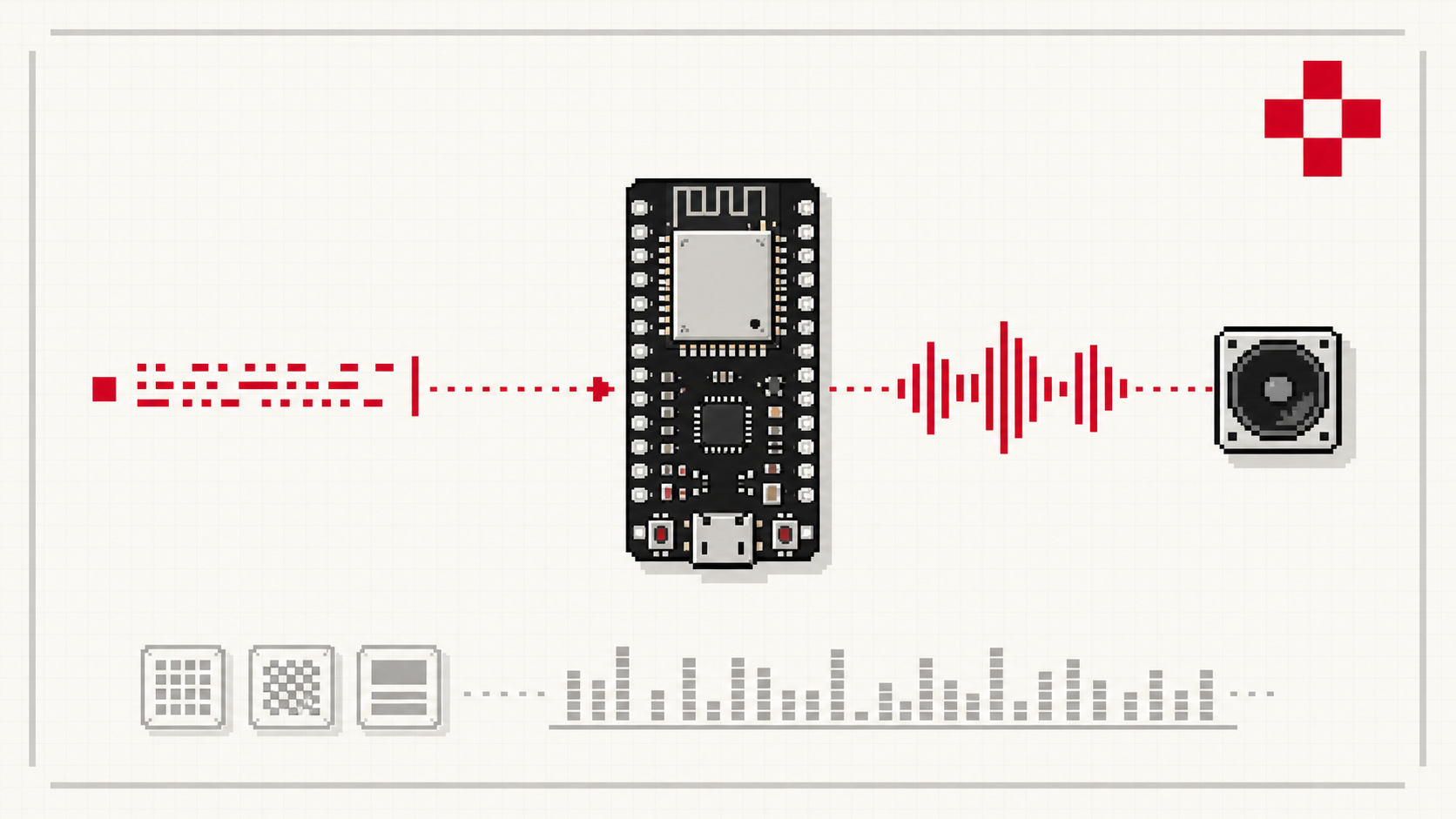
sano (सानो) — Nepali for "small." A family of tiny neural text-to-speech voices — 745k to 1.8M parameters — that run with no cloud and no NPU: real-time on a ~$3 ESP32-S3 (out a GPIO into an LM386 and a speaker), or live in the browser via WASM.
| Smallest neural TTS family known | 745k – 1.8M parameters |
| Runs real-time on a $3 microcontroller | ESP32-S3, out a GPIO into an LM386 |
| Runs in the browser | WebAssembly, no server |
| Per-voice footprint | under 4 MB, zero dependencies (espeak-ng phonemizer included) |
| Coverage | 9 voices across 6 languages — English, Nepali (नेपाली), Hindi (हिन्दी), Vietnamese (Tiếng Việt), Indonesian (Bahasa), Chinese (中文) |
| License | open source, GPL-3.0 |
Live demo: ampixa.github.io/sanoTTS — every voice synthesizes your text live in the browser, no server, no upload.
Samples
One clip per voice below (a second clip per voice is in this repo's
samples/ folder). "Package here" means this HF repo carries that voice's
raw fp16 weights; the three without one currently only ship through the
browser demo and the GitHub repo's
web/voices/ — their HF packages haven't been exported yet.
| Voice | Language | Params | SCOREQ | Package here | Sample |
|---|---|---|---|---|---|
| amy | English 🇺🇸 | 1.46 M | 4.13 | amy-en-1p46m/ |
|
| kristin | English 🇺🇸 | 1.40 M | 4.09 | kristin-en-1p4m/ |
|
| hfc | English 🇺🇸 | 1.83 M | 3.94 | hfc-en-1p8m/ |
|
| amy-small | English 🇺🇸 | 1.08 M | 3.70 | amy-en-1p1m/ |
|
| robot (on-device, int8) | English 🇺🇸 | 745 k | — | not packaged here (int8 MCU format, not fp16) | |
| Indonesian | Bahasa | 1.46 M | — | id-newstts-1p46m/ |
|
| Vietnamese | Tiếng Việt | 1.46 M | — | vi-vais1000-1p46m/ |
|
| Nepali | नेपाली | 1.47 M | — | not exported yet — see web/voices/nepali/ in the GitHub repo |
|
| Hindi | हिन्दी | 1.50 M | — | not exported yet — see web/voices/hindi/ in the GitHub repo |
|
| Chinese | 中文 | 1.50 M | — | not exported yet — see web/voices/chinese/ in the GitHub repo |
The "robot" row is the same 745k-parameter model that runs on the ESP32-S3 — bit-exact with the chip's own output. SCOREQ is only reported for the English voices, which share a common eval set; the other languages haven't been scored against a comparable reference yet.
Install & use
| Platform | Install | Then |
|---|---|---|
| Python | pip install sanotts |
sanotts say "Hello" --voice amy -o hello.wav |
| Web (npm) | npm install sanotts-web |
const tts = await SanoTTS.load(); await tts.synthesize('Hello', {voice:'amy'}) |
| Web (no build) | copy dist/ + voices/ |
see Deploy on your own site in the GitHub README |
| Arduino / PlatformIO | zip-install or lib_deps = https://github.com/Ampixa/sanoTTS.git |
arduino/README.md |
| Hugging Face | this repo | voice packages above, manifest.json + weights.fp16.bin per voice |
| Browser | nothing | ampixa.github.io/sanoTTS |
Pip voices: amy, amy-1p1m, amy-1p8m, kristin, hfc, vi, id —
fetched from the voices-v1 release
into ~/.cache/sanotts/. Pure numpy inference, no torch, no onnxruntime.
How it stacks up
Open small-scale TTS on an honest gate — a diverse 24-sentence set scored with the same no-reference suite (SCOREQ / UTMOS are naturalness predictors, DNSMOS-SIG is signal quality; higher is better). Parameter counts are inference-time and exclude the shared external G2P.
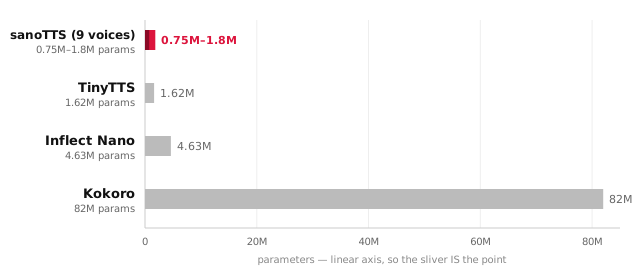
Kokoro is 45x larger than our largest voice, and 110x larger than our smallest. Shipped-file sizes: sanoTTS amy 2.8 MB fp16 and TinyTTS 3.5 MB fp16, both verified from the released files; Kokoro's ~330 MB fp32 is its widely cited public figure.
| System | Params | SCOREQ | UTMOS | DNS-SIG |
|---|---|---|---|---|
| sanoTTS (amy) | 1.46 M | 4.13 | 4.10 | 3.61 |
| TinyTTS | 1.62 M | 3.94 | 3.65 | 3.62 |
| Inflect Nano | 4.63 M | 3.81 | 3.65 | 3.58 |
| Kitten TTS nano | 15 M | 3.02 | 3.58 | 3.43 |
| reference (~15 M) | ~15 M | 4.71 | 4.47 | 3.65 |
| Kokoro | 82 M | 4.89 | 4.52 | 3.69 |
sanoTTS is the smallest model here and the best on naturalness
(SCOREQ and UTMOS) among everything up to 15M params — beating TinyTTS
while being smaller. On DNSMOS-SIG, TinyTTS edges us by 0.01 — no single
metric tells the whole story. It's the only one that runs a full neural
stack on a $3 MCU. The frontier only pulls ahead at ~15M-class models and
Kokoro (82M, 60x larger) — a gap we don't claim to close. Reproduce it with
tools/eval_mos_all.py + tools/eval_scorecard.py in the GitHub repo.
How it works
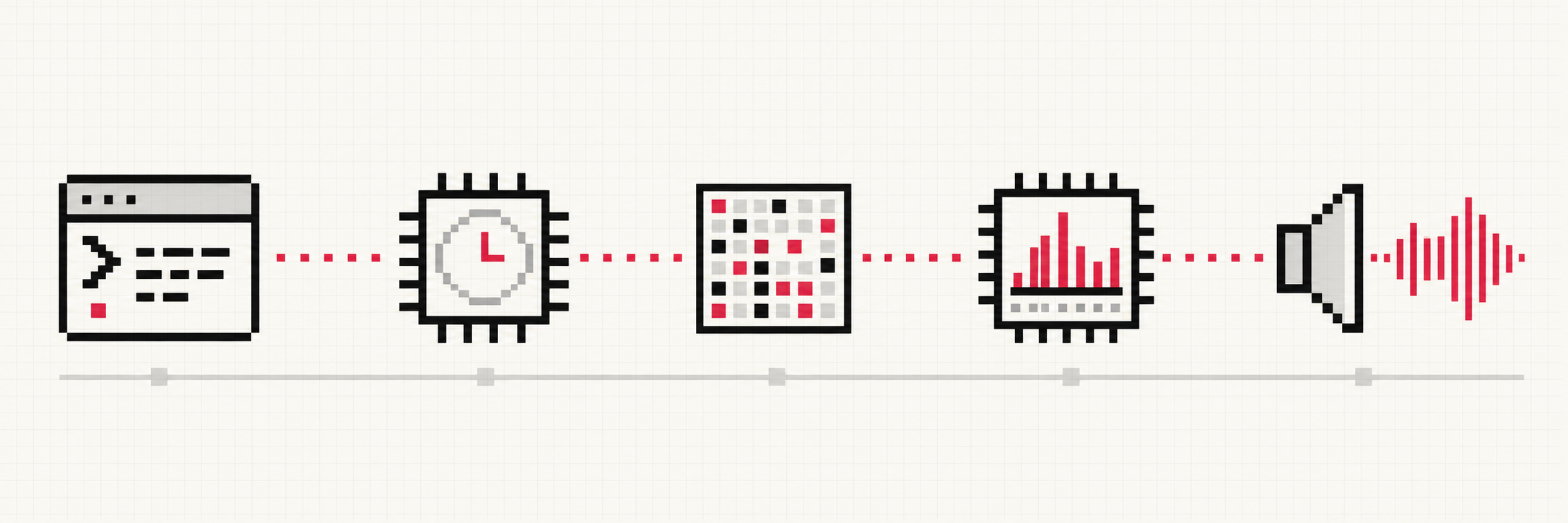
espeak-ng provides phoneme IDs; a duration model predicts timing; an
acoustic model predicts generator latents; a decoder renders 22 kHz audio.
The web voices (amy, kristin, hfc, and the other languages) use a compact
time-domain decoder running in fp32; the 745k on-device model instead uses
a quantized int8 iSTFT decoder, sized to fit and run in real time on the
ESP32-S3. All models are distilled from a Piper/VITS teacher — see
docs/distillation-recipe.md
in the GitHub repo for the full recipe.
Deploy
- ESP32-S3 talking device — a standalone WiFi dashboard: type text, the
board phonemizes (on-chip espeak-ng) and speaks. See
mcu/ports/esp32s3/. - Browser — the full stack in WASM, no server. ▶ Hear and synthesize
all 9 voices live; source in
web/. - Other MCUs — which chips can run it and how well:
docs/mcu-classes-and-porting.md.
Links
- Source, recipes, eval tooling: github.com/Ampixa/sanoTTS
- Live browser demo: ampixa.github.io/sanoTTS
- npm package: sanotts-web
- PyPI package: sanotts
License
GPLv3 — see LICENSE.
The pipeline builds on GPLv3 components (notably
espeak-ng for G2P, and
piper), so the project as a
whole is GPLv3.
Copyright (C) 2026 Ampixa.
Files here
Each voice directory is a self-contained fp16 package (weights.fp16.bin +
manifest.json + piper-phoneme-config.json + sibilant-injection
calibration where applicable), consumable by the sanotts Python package
and the portable C runtime. samples/ holds the audio clips embedded
above (mp3, one or two per voice + the on-device mcu-745k.mp3).