

Multi-Vector Retrievers
Collection
2 items • Updated • 4
answerai-colbert-small-v1 is a new, proof-of-concept model by Answer.AI, showing the strong performance multi-vector models with the new JaColBERTv2.5 training recipe and some extra tweaks can reach, even with just 33 million parameters.
While being MiniLM-sized, it outperforms all previous similarly-sized models on common benchmarks, and even outperforms much larger popular models such as e5-large-v2 or bge-base-en-v1.5.
For more information about this model or how it was trained, head over to the announcement blogpost.
This model was designed with the upcoming RAGatouille overhaul in mind. However, it's compatible with all recent ColBERT implementations!
This model can be used with Sentence Transformers as a multi-vector (ColBERT-style late interaction) retriever via the MultiVectorEncoder:
pip install "sentence-transformers>=6.0.0"
from sentence_transformers import MultiVectorEncoder
model = MultiVectorEncoder("answerdotai/answerai-colbert-small-v1")
query = "Which planet is known as the Red Planet?"
documents = [
"Venus is often called Earth's twin because of its similar size and proximity.",
"Mars, known for its reddish appearance, is often referred to as the Red Planet.",
"Jupiter, the largest planet in our solar system, has a prominent red spot.",
"Saturn, famous for its rings, is sometimes mistaken for the Red Planet.",
]
query_embeddings = model.encode_query(query)
document_embeddings = model.encode_document(documents)
print(query_embeddings.shape, document_embeddings[0].shape)
# (32, 96) (17, 96)
# MaxSim late-interaction scoring (higher is more relevant)
scores = model.similarity(query_embeddings, document_embeddings)
print(scores)
# tensor([[30.5692, 31.4895, 31.3029, 31.3072]])
If you're interested in using this model as a re-ranker (it vastly outperforms cross-encoders its size!), you can do so via the rerankers library:
pip install --upgrade rerankers[transformers]
from rerankers import Reranker
ranker = Reranker("answerdotai/answerai-colbert-small-v1", model_type='colbert')
docs = ['Hayao Miyazaki is a Japanese director, born on [...]', 'Walt Disney is an American author, director and [...]', ...]
query = 'Who directed spirited away?'
ranker.rank(query=query, docs=docs)
pip install --upgrade ragatouille
from ragatouille import RAGPretrainedModel
RAG = RAGPretrainedModel.from_pretrained("answerdotai/answerai-colbert-small-v1")
docs = ['Hayao Miyazaki is a Japanese director, born on [...]', 'Walt Disney is an American author, director and [...]', ...]
RAG.index(docs, index_name="ghibli")
query = 'Who directed spirited away?'
results = RAG.search(query)
pip install --upgrade colbert-ai
from colbert import Indexer
from colbert.infra import Run, RunConfig, ColBERTConfig
INDEX_NAME = "DEFINE_HERE"
if __name__ == "__main__":
config = ColBERTConfig(
doc_maxlen=512,
nbits=2
)
indexer = Indexer(
checkpoint="answerdotai/answerai-colbert-small-v1",
config=config,
)
docs = ['Hayao Miyazaki is a Japanese director, born on [...]', 'Walt Disney is an American author, director and [...]', ...]
indexer.index(name=INDEX_NAME, collection=docs)
from colbert import Searcher
from colbert.infra import Run, RunConfig, ColBERTConfig
INDEX_NAME = "THE_INDEX_YOU_CREATED"
k = 10
if __name__ == "__main__":
config = ColBERTConfig(
query_maxlen=32 # Adjust as needed, we recommend the nearest higher multiple of 16 to your query
)
searcher = Searcher(
index=index_name,
config=config
)
query = 'Who directed spirited away?'
results = searcher.search(query, k=k)
Finally, if you want to extract individula vectors, you can use the model this way:
from colbert.modeling.checkpoint import Checkpoint
ckpt = Checkpoint("answerdotai/answerai-colbert-small-v1", colbert_config=ColBERTConfig())
embedded_query = ckpt.queryFromText(["Who dubs Howl's in English?"], bsize=16)
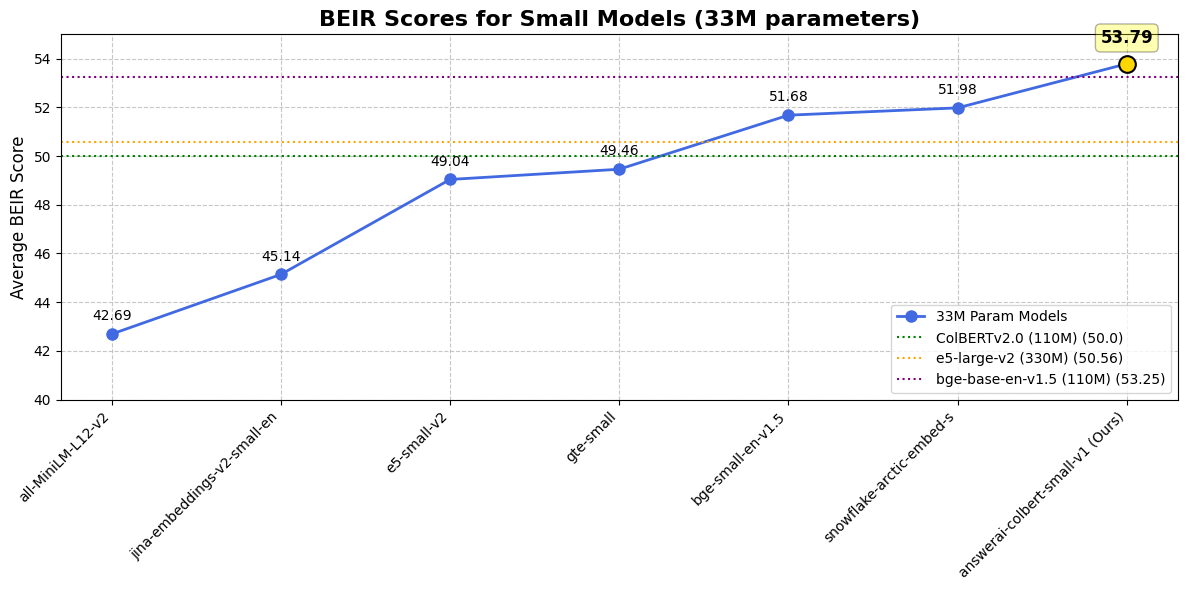
| Dataset / Model | answer-colbert-s | snowflake-s | bge-small-en | bge-base-en |
|---|---|---|---|---|
| Size | 33M (1x) | 33M (1x) | 33M (1x) | 109M (3.3x) |
| BEIR AVG | 53.79 | 51.99 | 51.68 | 53.25 |
| FiQA2018 | 41.15 | 40.65 | 40.34 | 40.65 |
| HotpotQA | 76.11 | 66.54 | 69.94 | 72.6 |
| MSMARCO | 43.5 | 40.23 | 40.83 | 41.35 |
| NQ | 59.1 | 50.9 | 50.18 | 54.15 |
| TRECCOVID | 84.59 | 80.12 | 75.9 | 78.07 |
| ArguAna | 50.09 | 57.59 | 59.55 | 63.61 |
| ClimateFEVER | 33.07 | 35.2 | 31.84 | 31.17 |
| CQADupstackRetrieval | 38.75 | 39.65 | 39.05 | 42.35 |
| DBPedia | 45.58 | 41.02 | 40.03 | 40.77 |
| FEVER | 90.96 | 87.13 | 86.64 | 86.29 |
| NFCorpus | 37.3 | 34.92 | 34.3 | 37.39 |
| QuoraRetrieval | 87.72 | 88.41 | 88.78 | 88.9 |
| SCIDOCS | 18.42 | 21.82 | 20.52 | 21.73 |
| SciFact | 74.77 | 72.22 | 71.28 | 74.04 |
| Touche2020 | 25.69 | 23.48 | 26.04 | 25.7 |
| Dataset / Model | answerai-colbert-small-v1 | ColBERTv2.0 |
|---|---|---|
| BEIR AVG | 53.79 | 50.02 |
| DBPedia | 45.58 | 44.6 |
| FiQA2018 | 41.15 | 35.6 |
| NQ | 59.1 | 56.2 |
| HotpotQA | 76.11 | 66.7 |
| NFCorpus | 37.3 | 33.8 |
| TRECCOVID | 84.59 | 73.3 |
| Touche2020 | 25.69 | 26.3 |
| ArguAna | 50.09 | 46.3 |
| ClimateFEVER | 33.07 | 17.6 |
| FEVER | 90.96 | 78.5 |
| QuoraRetrieval | 87.72 | 85.2 |
| SCIDOCS | 18.42 | 15.4 |
| SciFact | 74.77 | 69.3 |
We'll most likely eventually release a technical report. In the meantime, if you use this model or other models following the JaColBERTv2.5 recipe and would like to give us credit, please cite the JaColBERTv2.5 journal pre-print:
@article{clavie2024jacolbertv2,
title={JaColBERTv2.5: Optimising Multi-Vector Retrievers to Create State-of-the-Art Japanese Retrievers with Constrained Resources},
author={Clavi{\'e}, Benjamin},
journal={arXiv preprint arXiv:2407.20750},
year={2024}
}
from sentence_transformers import SentenceTransformer

model = SentenceTransformer("answerdotai/answerai-colbert-small-v1")

sentences = [
    "The weather is lovely today.",
    "It's so sunny outside!",
    "He drove to the stadium."
]
embeddings = model.encode(sentences)

similarities = model.similarity(embeddings, embeddings)
print(similarities.shape)
# [3, 3]