

Proving and Improving the Platonic Representation Hypothesis with JEPAs
Paper • 2610.39302 • Published • 77
Running DeepSeek Engram, H-Net Byte Routing, and Liquid AI (LFM2 / CfC) in 1.1 MB of Microcontroller Weights — Distilled from Qwen3-32B into Bit-Exact int8 C11/C++20 Firmware for an ESP32-S3 E-Reader
robertzhou.dev · GitHub Repository · Architecture · Benchmarks
I wanted three things on the Xteink X4 Pro e-ink reader I carry around (a dual-core 240 MHz ESP32-S3 microcontroller with 8 MB of PSRAM running a fork of CrossPoint Reader / PapyriX):
Shrinking a standard Transformer below 1 MB fails in all three places:
29% in Qwen3.5-0.8B, 19% in LFM2.5-350M). At 32,000 tokens and width 128, that table is 4.1 MB even at int8 (16.4 MB in fp32) before a single layer runs.15% repetition doom loops in small models before post-training; at < 1 MB, my token-by-token micro-decoder broke off mid-sentence on 51.2% of BookSum notes and invented proper nouns on 26.1%.Instead of cramming a standard Transformer into SRAM/PSRAM, I combined recent ideas from DeepSeek, Liquid AI, Cartesia / CMU, Meta, and Yann LeCun's JEPA line of work, distilled from Qwen3-32B and Qwen3-Embedding-0.6B on H200 and RTX PRO 6000 Blackwell GPUs across 14 controlled ablation arms.
The name Platonic-Engram-HNet comes from the three pieces of the encoder:
platonic-hnet.bin) that learns English and Chinese word boundaries directly from raw bytes—no tokenizer or vocabulary table in RAM. Following Labonne's on-device operator ranking (ShortConv < SWA < GDN < GLA < GQA), the backbone uses two Liquid AI LFM2 double-gated ShortConv blocks, one Grouped-Query Attention block, and a 2-loop weight-tied Ouro core.engram.bin, 4.2 MB, 65,536 FNV-1a hashed n-gram & bigram slots). Each word chunk costs a single $O(1)$ 64-byte SD slot read.SIGReg), InfoNCE, and Matryoshka Qwen3 distillation so matching English and Chinese concepts land on the same 128-d int8 vector.On top of that 95 KB encoder sit three tiny modules:
cspw.bin, 394 KB PSRAM): Built on four Liquid AI Closed-Form Continuous-Time (CfC) memory slots that decay with page distance ($2^{-\Delta p / \tau}$) behind a hard causal gate on your exact byte offset in the book.pe-writer.bin, 642 KB PSRAM + writer-clauses.bin, 1.0 MB SD): Inspired by Meta's Large Concept Models and Labonne's decoupled Top-$K$ KD + loop-rejecting DPO recipe. After DPO cut 3-gram repetition loops from 9.25% → 3.50% on validation, I locked the output grammar so a 3-step Ouro concept planner selects whole verified clauses from a 4,096-clause SD bank containing zero proper nouns.e-prop eligibility traces that adapt when you press manual refresh.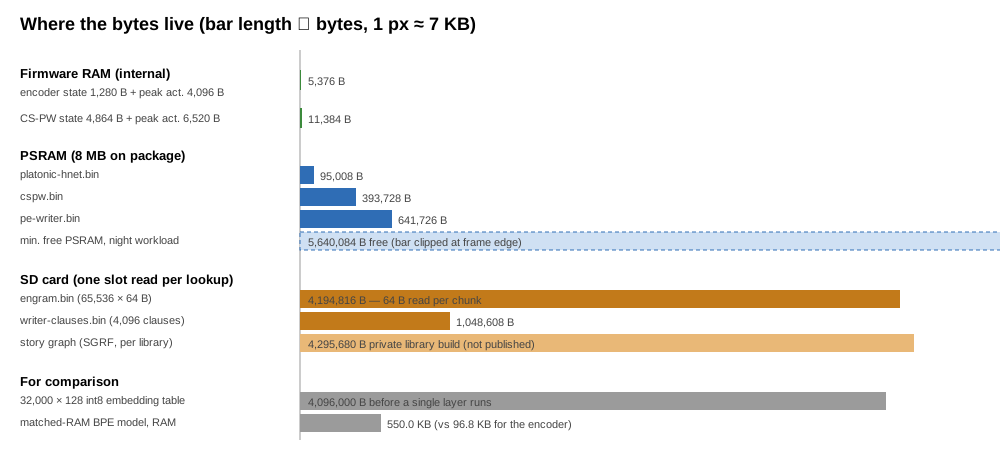
Every number below runs the exact int8 QAT graph that ships on the ESP32-S3. Full tables across all 14 ablation arms are in BENCHMARKS.md.
| Benchmark / Capability | This Stack (1.13 MB PSRAM weights) |
Matched-Budget Baseline | Reference / Upper Bound |
|---|---|---|---|
Word encoder RAM in firmware (platonic-hnet.bin + SD engram.bin) |
96.8 KB RAM (+ 4.2 MB on SD) | 550.0 KB RAM for matched fp32 BPE (5.7× larger) |
— |
| Chinese word segmentation F1 (SIGHAN05-PKU / MSR, UD-GSDSimp) | 0.394 / 0.402 / 0.431 | 0.322 / 0.307 / 0.371 (BPE) | LFM2-350M tok 0.488 · jieba 0.818 |
| English word-sense disambiguation (MCL-WiC en-en) | 57.7% (wins/ties 11 of 12 WiC/STS tasks vs BPE) | 52.3% (BPE) | MiniLM-L12 (235 MB) 69.3% |
| Language modeling bits/byte (WikiText-2 / PKU) | 3.4636 / 3.8351 (H-Net byte router only) · 3.5789 / 4.0487 (with Engram) |
3.4925 / 4.0200 (BPE) | LFM2-350M (700 MB) 1.5646 |
| Character recap spoiler leakage (BookSum, 9,169 queries) | 0.00% spoilers · 99.46% scene-order accuracy | 100.0% spoilers (same model without page-offset gate) | — |
| Margin writer broken sentences / fake names (4,226 tests across BookSum, NarrativeQA, CommonGen) | 0.00% broken · 0.0% fake names (clause-locked v2) | 51.2% broken · 26.1% fake names (token-by-token v1) | — |
| E-ink refresh gate accuracy (1,500 image episodes / 19 reading logs) | 99.9% (339-byte Liquid CfC · cuts flashes 25 → 8) |
Static ink-debt counter | — |
| PyTorch QAT → NumPy → C11 → ESP32-S3 C++20 parity | 0 bit mismatches (38,580 seg lines · 7,480 texts · 1,067 firmware tests) | 6.0 ms median C query on M1 · 5.64 MB free PSRAM on device |
— |
Where a 95 KB model still loses:
4 Chinese characters), it cannot emit the 214 SIGHAN05-PKU gold words that are 5+ characters long as a single span.71.3% term-level recall), but a 95 KB encoder cannot match a 235 MB transformer on full-sentence Tatoeba zh→en retrieval (3.0% R@1 vs 96.1% for multilingual MiniLM-L12).0% broken sentences and 0% invented names, but trails a static slot template on Sentence-BERT cosine similarity (44.17 vs 47.02 on BookSum).pip install numpy
python quickstart.py # (a) byte routing + int8 concepts, (b) spoiler-gated recap, (c) margin note
# parity checks need the GitHub repo (C compiler + firmware sources):
git clone https://github.com/bobzhou-source/platonic-engram-hnet && cd platonic-engram-hnet
python src/verify_c_parity.py # encoder + character memory: C11 vs NumPy vs Python (0 mismatches)
python src/verify_pe_writer_parity.py --require-firmware # writer: NumPy vs C++17 vs ESP32-S3 firmware kernel (0 mismatches)
File in weights/ |
Size | What it is |
|---|---|---|
platonic-hnet.bin |
95,008 B |
int8 H-Net byte router + LFM2 ShortConv + Ouro encoder (PSRAM) |
engram.bin |
4,194,816 B |
65,536-slot DeepSeek Engram hash table (SD card; public CC-CEDICT + Open English WordNet gloss build) |
cspw.bin |
393,728 B |
4-slot Liquid CfC character memory + pointer weaver (PSRAM) |
pe-writer.bin |
641,726 B |
Qwen3-32B distilled 3-step Ouro concept planner + clause selector (PSRAM) |
writer-clauses.bin |
1,048,608 B |
4,096 proper-noun-free English clauses (SD card) |
booksum-story-graph.idx |
1,441,280 B |
Public BookSum character timeline used by quickstart.py |
See ARCHITECTURE.md for the dataflow and integer math, BENCHMARKS.md for all 14 ablation arms and public benchmark tables, and LICENSE (MIT; dictionary glosses CC BY-SA 4.0 / CC BY 4.0; built for CrossPoint Reader / PapyriX / FreeInk on the Xteink X4 Pro).
All files are in weights/ and listed in weights/SHA256SUMS.
| File | Bytes | Lives in | What it is | sha256 |
|---|---|---|---|---|
platonic-hnet.bin |
95,008 | PSRAM | byte encoder and word router (94,976 int8 parameters) | 8477cd568bfd931c08ffb22588679e7e2d3589d4669b2eff8a76e5395a91b8bb |
engram.bin (public-gloss build) |
4,194,816 | SD card | 65,536 × 64-byte word slots: int8 meaning correction + short gloss | 8d6cac53f8f3038559ab71fa6e6aadc879eb9ef89cf66385cf225430615b228c |
cspw.bin |
393,728 | PSRAM | spoiler-free character memory | cbce25c6a4fa4b215993d54c7d88c731d34004f2756fba83a9f6b8e7468dcffd |
pe-writer.bin |
641,726 | PSRAM | clause-locked margin-note writer | 962f317e22b30b8efe03aa67e5d440d6199e11ec25d96c46c9bcac6582c6cfcc |
writer-clauses.bin |
1,048,608 | SD card | 4,096 lowercase clauses, 4–10 words, no proper nouns | 7b0e3612c81d81764096c57fc6f1046abdc2a72ce9786e039861121b72d81023 |
booksum-story-graph.idx |
1,441,280 | SD card | public BookSum character map: 439 characters, 5,517 events, 21 public-domain books | cf308bcee87035c81dc00920a9224f83a7984167d6b5f81bbcb7c3bce209ef36 |
Not published. The device also holds a character map (story-graph.idx, 4,295,680 B: 2,532 characters, 16,137 event glosses and 62 aliases) and a concept index (inbox-concepts.idx, 96,784 B: 504 records from 126 books), both built from my personal library.
Public-gloss engram.bin. The device build (sha256 2e7f1ec8…0be1) has 529 glosses derived from the private reading corpus, such as character and clan names. tools/build_public_engram.py rewrites only the 32-byte gloss column and keeps a gloss only when it is a verbatim public-dictionary entry: 4,903 from CC-CEDICT (matched by hash and first sense), 3,090 from Open English WordNet, and 4 hyphenated WordNet headwords. The other 529 are blanked. The header, hashes and int8 corrections are byte-identical (header_hash_delta_columns_identical: true in weights/engram.public-gloss.report.json), and the encoder never reads glosses, so its output matches the device build bit for bit.
kmfoda/booksum): 21 public-domain books (Project Gutenberg texts), with events taken from the BookSum chapter summaries.Code and weights are MIT, with two exceptions:
engram.bin. Adapted from CC-CEDICT (CC BY-SA 4.0, © CC-CEDICT contributors, MDBG) and Open English WordNet (CC BY 4.0, © the Open English WordNet team, derived from Princeton WordNet 3.1).booksum-story-graph.idx. Derived from BookSum (Kryściński et al., 2021). Its event glosses are fragments of BookSum's chapter summaries, which come from study-guide sites (e.g. SparkNotes, GradeSaver, CliffsNotes, Shmoop). Check BookSum's terms before redistributing.@software{zhou2026platonic_engram_hnet,
title = {Platonic-Engram-HNet: On-Device LLM and Concept Engine for the Xteink X4 Pro (ESP32-S3) in 1.1 MB of RAM},
author = {Zhou, Robert},
year = {2026},
url = {https://github.com/bobzhou-source/platonic-engram-hnet}
}