
Buckets:


Wav2Vec2



Overview
The Wav2Vec2 model was proposed in wav2vec 2.0: A Framework for Self-Supervised Learning of Speech Representations by Alexei Baevski, Henry Zhou, Abdelrahman Mohamed, Michael Auli.
The abstract from the paper is the following:
We show for the first time that learning powerful representations from speech audio alone followed by fine-tuning on transcribed speech can outperform the best semi-supervised methods while being conceptually simpler. wav2vec 2.0 masks the speech input in the latent space and solves a contrastive task defined over a quantization of the latent representations which are jointly learned. Experiments using all labeled data of Librispeech achieve 1.8/3.3 WER on the clean/other test sets. When lowering the amount of labeled data to one hour, wav2vec 2.0 outperforms the previous state of the art on the 100 hour subset while using 100 times less labeled data. Using just ten minutes of labeled data and pre-training on 53k hours of unlabeled data still achieves 4.8/8.2 WER. This demonstrates the feasibility of speech recognition with limited amounts of labeled data.
This model was contributed by patrickvonplaten.
Note: Meta (FAIR) released a new version of Wav2Vec2-BERT 2.0 - it's pretrained on 4.5M hours of audio. We especially recommend using it for fine-tuning tasks, e.g. as per this guide.
Usage tips
- Wav2Vec2 is a speech model that accepts a float array corresponding to the raw waveform of the speech signal.
- Wav2Vec2 model was trained using connectionist temporal classification (CTC) so the model output has to be decoded using Wav2Vec2CTCTokenizer.
Using Flash Attention 2
Flash Attention 2 is an faster, optimized version of the model.
Installation
First, check whether your hardware is compatible with Flash Attention 2. The latest list of compatible hardware can be found in the official documentation.
Next, install the latest version of Flash Attention 2:
pip install -U flash-attn --no-build-isolation
Usage
To load a model using Flash Attention 2, we can pass the argument attn_implementation="flash_attention_2" to .from_pretrained. We'll also load the model in half-precision (e.g. torch.float16), since it results in almost no degradation to audio quality but significantly lower memory usage and faster inference:
>>> from transformers import Wav2Vec2Model

model = Wav2Vec2Model.from_pretrained("facebook/wav2vec2-large-960h-lv60-self", dtype=torch.float16, attn_implementation="flash_attention_2").to(device)
...
Expected speedups
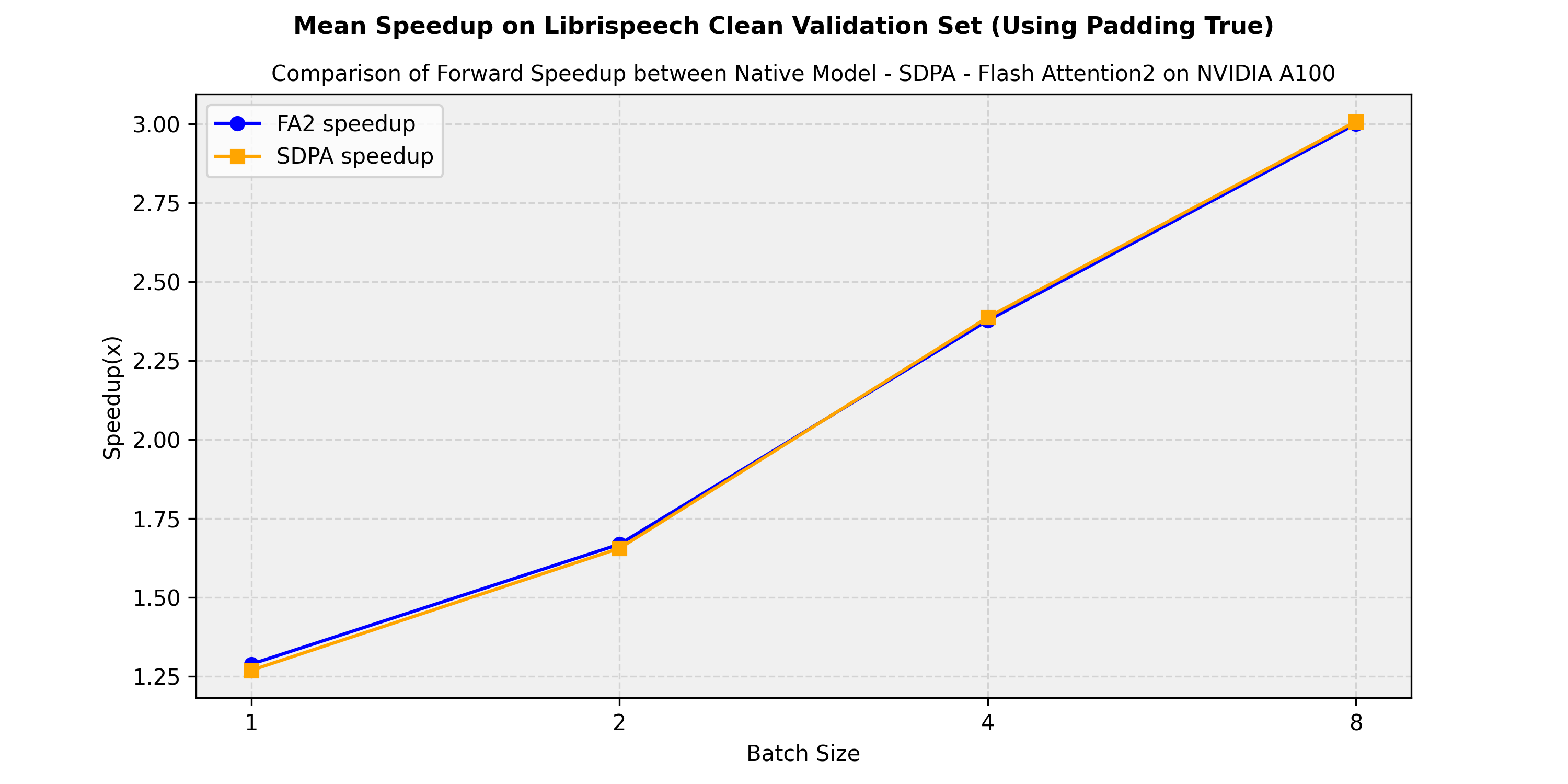
Below is an expected speedup diagram comparing the pure inference time between the native implementation in transformers of the facebook/wav2vec2-large-960h-lv60-self model and the flash-attention-2 and sdpa (scale-dot-product-attention) versions. . We show the average speedup obtained on the librispeech_asr clean validation split:
Resources
A list of official Hugging Face and community (indicated by 🌎) resources to help you get started with Wav2Vec2. If you're interested in submitting a resource to be included here, please feel free to open a Pull Request and we'll review it! The resource should ideally demonstrate something new instead of duplicating an existing resource.
- A notebook on how to leverage a pretrained Wav2Vec2 model for emotion classification. 🌎
- Wav2Vec2ForCTC is supported by this example script and notebook.
- Audio classification task guide
- A blog post on boosting Wav2Vec2 with n-grams in 🤗 Transformers.
- A blog post on how to finetune Wav2Vec2 for English ASR with 🤗 Transformers.
- A blog post on finetuning XLS-R for Multi-Lingual ASR with 🤗 Transformers.
- A notebook on how to create YouTube captions from any video by transcribing audio with Wav2Vec2. 🌎
- Wav2Vec2ForCTC is supported by a notebook on how to finetune a speech recognition model in English, and how to finetune a speech recognition model in any language.
- Automatic speech recognition task guide
🚀 Deploy
- A blog post on how to deploy Wav2Vec2 for Automatic Speech Recognition with Hugging Face's Transformers & Amazon SageMaker.
Wav2Vec2Config[[transformers.Wav2Vec2Config]]
class transformers.Wav2Vec2Configtransformers.Wav2Vec2Configint, optional, defaults to 32) --
Vocabulary size of the Wav2Vec2 model. Defines the number of different tokens that can be represented by
the inputs_ids passed when calling Wav2Vec2Model or TFWav2Vec2Model. Vocabulary size of the
model. Defines the different tokens that can be represented by the inputs_ids passed to the forward
method of Wav2Vec2Model.
- hidden_size (
int, optional, defaults to 768) -- Dimensionality of the encoder layers and the pooler layer. - num_hidden_layers (
int, optional, defaults to 12) -- Number of hidden layers in the Transformer encoder. - num_attention_heads (
int, optional, defaults to 12) -- Number of attention heads for each attention layer in the Transformer encoder. - intermediate_size (
int, optional, defaults to 3072) -- Dimensionality of the "intermediate" (i.e., feed-forward) layer in the Transformer encoder. - hidden_act (
strorfunction, optional, defaults to"gelu") -- The non-linear activation function (function or string) in the encoder and pooler. If string,"gelu","relu","selu"and"gelu_new"are supported. - hidden_dropout (
float, optional, defaults to 0.1) -- The dropout probability for all fully connected layers in the embeddings, encoder, and pooler. - activation_dropout (
float, optional, defaults to 0.1) -- The dropout ratio for activations inside the fully connected layer. - attention_dropout (
float, optional, defaults to 0.1) -- The dropout ratio for the attention probabilities. - final_dropout (
float, optional, defaults to 0.1) -- The dropout probability for the final projection layer of Wav2Vec2ForCTC. - layerdrop (
float, optional, defaults to 0.1) -- The LayerDrop probability. See the [LayerDrop paper](see https://huggingface.co/papers/1909.11556) for more details. - initializer_range (
float, optional, defaults to 0.02) -- The standard deviation of the truncated_normal_initializer for initializing all weight matrices. - layer_norm_eps (
float, optional, defaults to 1e-12) -- The epsilon used by the layer normalization layers. - feat_extract_norm (
str, optional, defaults to"group") -- The norm to be applied to 1D convolutional layers in feature encoder. One of"group"for group normalization of only the first 1D convolutional layer or"layer"for layer normalization of all 1D convolutional layers. - feat_proj_dropout (
float, optional, defaults to 0.0) -- The dropout probability for output of the feature encoder. - feat_extract_activation (
str,optional, defaults to"gelu") -- The non-linear activation function (function or string) in the 1D convolutional layers of the feature extractor. If string,"gelu","relu","selu"and"gelu_new"` are supported. - feat_quantizer_dropout (
float, optional, defaults to 0.0) -- The dropout probability for quantized feature encoder states. - conv_dim (
tuple[int]orlist[int], optional, defaults to(512, 512, 512, 512, 512, 512, 512)) -- A tuple of integers defining the number of input and output channels of each 1D convolutional layer in the feature encoder. The length of conv_dim defines the number of 1D convolutional layers. - conv_stride (
tuple[int]orlist[int], optional, defaults to(5, 2, 2, 2, 2, 2, 2)) -- A tuple of integers defining the stride of each 1D convolutional layer in the feature encoder. The length of conv_stride defines the number of convolutional layers and has to match the length of conv_dim. - conv_kernel (
tuple[int]orlist[int], optional, defaults to(10, 3, 3, 3, 3, 3, 3)) -- A tuple of integers defining the kernel size of each 1D convolutional layer in the feature encoder. The length of conv_kernel defines the number of convolutional layers and has to match the length of conv_dim. - conv_bias (
bool, optional, defaults toFalse) -- Whether the 1D convolutional layers have a bias. - num_conv_pos_embeddings (
int, optional, defaults to 128) -- Number of convolutional positional embeddings. Defines the kernel size of 1D convolutional positional embeddings layer. - num_conv_pos_embedding_groups (
int, optional, defaults to 16) -- Number of groups of 1D convolutional positional embeddings layer. - do_stable_layer_norm (
bool, optional, defaults toFalse) -- Whether to apply stable layer norm architecture of the Transformer encoder.do_stable_layer_norm is Truecorresponds to applying layer norm before the attention layer, whereasdo_stable_layer_norm is Falsecorresponds to applying layer norm after the attention layer. - apply_spec_augment (
bool, optional, defaults toTrue) -- Whether to apply SpecAugment data augmentation to the outputs of the feature encoder. For reference see SpecAugment: A Simple Data Augmentation Method for Automatic Speech Recognition. - mask_time_prob (
float, optional, defaults to 0.05) -- Percentage (between 0 and 1) of all feature vectors along the time axis which will be masked. The masking procedure generates ''mask_time_prob*len(time_axis)/mask_time_length'' independent masks over the axis. If reasoning from the probability of each feature vector to be chosen as the start of the vector span to be masked, mask_time_prob should beprob_vector_start*mask_time_length. Note that overlap may decrease the actual percentage of masked vectors. This is only relevant ifapply_spec_augment is True. - mask_time_length (
int, optional, defaults to 10) -- Length of vector span along the time axis. - mask_time_min_masks (
int, optional, defaults to 2), -- The minimum number of masks of lengthmask_feature_lengthgenerated along the time axis, each time step, irrespectively ofmask_feature_prob. Only relevant if ''mask_time_prob*len(time_axis)/mask_time_length < mask_time_min_masks'' - mask_feature_prob (
float, optional, defaults to 0.0) -- Percentage (between 0 and 1) of all feature vectors along the feature axis which will be masked. The masking procedure generates ''mask_feature_prob*len(feature_axis)/mask_time_length'' independent masks over the axis. If reasoning from the probability of each feature vector to be chosen as the start of the vector span to be masked, mask_feature_prob should beprob_vector_start*mask_feature_length. Note that overlap may decrease the actual percentage of masked vectors. This is only relevant ifapply_spec_augment is True. - mask_feature_length (
int, optional, defaults to 10) -- Length of vector span along the feature axis. - mask_feature_min_masks (
int, optional, defaults to 0), -- The minimum number of masks of lengthmask_feature_lengthgenerated along the feature axis, each time step, irrespectively ofmask_feature_prob. Only relevant if ''mask_feature_prob*len(feature_axis)/mask_feature_length < mask_feature_min_masks'' - num_codevectors_per_group (
int, optional, defaults to 320) -- Number of entries in each quantization codebook (group). - num_codevector_groups (
int, optional, defaults to 2) -- Number of codevector groups for product codevector quantization. - contrastive_logits_temperature (
float, optional, defaults to 0.1) -- The temperature kappa in the contrastive loss. - feat_quantizer_dropout (
float, optional, defaults to 0.0) -- The dropout probability for the output of the feature encoder that's used by the quantizer. - num_negatives (
int, optional, defaults to 100) -- Number of negative samples for the contrastive loss. - codevector_dim (
int, optional, defaults to 256) -- Dimensionality of the quantized feature vectors. - proj_codevector_dim (
int, optional, defaults to 256) -- Dimensionality of the final projection of both the quantized and the transformer features. - diversity_loss_weight (
int, optional, defaults to 0.1) -- The weight of the codebook diversity loss component. - ctc_loss_reduction (
str, optional, defaults to"sum") -- Specifies the reduction to apply to the output oftorch.nn.CTCLoss. Only relevant when training an instance of Wav2Vec2ForCTC. - ctc_zero_infinity (
bool, optional, defaults toFalse) -- Whether to zero infinite losses and the associated gradients oftorch.nn.CTCLoss. Infinite losses mainly occur when the inputs are too short to be aligned to the targets. Only relevant when training an instance of Wav2Vec2ForCTC. - use_weighted_layer_sum (
bool, optional, defaults toFalse) -- Whether to use a weighted average of layer outputs with learned weights. Only relevant when using an instance of Wav2Vec2ForSequenceClassification. - classifier_proj_size (
int, optional, defaults to 256) -- Dimensionality of the projection before token mean-pooling for classification. - tdnn_dim (
tuple[int]orlist[int], optional, defaults to(512, 512, 512, 512, 1500)) -- A tuple of integers defining the number of output channels of each 1D convolutional layer in the TDNN module of the XVector model. The length of tdnn_dim defines the number of TDNN layers. - tdnn_kernel (
tuple[int]orlist[int], optional, defaults to(5, 3, 3, 1, 1)) -- A tuple of integers defining the kernel size of each 1D convolutional layer in the TDNN module of the XVector model. The length of tdnn_kernel has to match the length of tdnn_dim. - tdnn_dilation (
tuple[int]orlist[int], optional, defaults to(1, 2, 3, 1, 1)) -- A tuple of integers defining the dilation factor of each 1D convolutional layer in TDNN module of the XVector model. The length of tdnn_dilation has to match the length of tdnn_dim. - xvector_output_dim (
int, optional, defaults to 512) -- Dimensionality of the XVector embedding vectors. - add_adapter (
bool, optional, defaults toFalse) -- Whether a convolutional network should be stacked on top of the Wav2Vec2 Encoder. Can be very useful for warm-starting Wav2Vec2 for SpeechEncoderDecoder models. - adapter_kernel_size (
int, optional, defaults to 3) -- Kernel size of the convolutional layers in the adapter network. Only relevant ifadd_adapter is True. - adapter_stride (
int, optional, defaults to 2) -- Stride of the convolutional layers in the adapter network. Only relevant ifadd_adapter is True. - num_adapter_layers (
int, optional, defaults to 3) -- Number of convolutional layers that should be used in the adapter network. Only relevant ifadd_adapter is True. - adapter_attn_dim (
int, optional) -- Dimension of the attention adapter weights to be used in each attention block. An example of a model using attention adapters is facebook/mms-1b-all. - output_hidden_size (
int, optional) -- Dimensionality of the encoder output layer. If not defined, this defaults to hidden-size. Only relevant ifadd_adapter is True.0
This is the configuration class to store the configuration of a Wav2Vec2Model. It is used to instantiate an Wav2Vec2 model according to the specified arguments, defining the model architecture. Instantiating a configuration with the defaults will yield a similar configuration to that of the Wav2Vec2 facebook/wav2vec2-base-960h architecture.
Configuration objects inherit from PreTrainedConfig and can be used to control the model outputs. Read the documentation from PreTrainedConfig for more information.
Example:
>>> from transformers import Wav2Vec2Config, Wav2Vec2Model

>>> # Initializing a Wav2Vec2 facebook/wav2vec2-base-960h style configuration
>>> configuration = Wav2Vec2Config()

>>> # Initializing a model (with random weights) from the facebook/wav2vec2-base-960h style configuration
>>> model = Wav2Vec2Model(configuration)

>>> # Accessing the model configuration
>>> configuration = model.config
Wav2Vec2CTCTokenizer[[transformers.Wav2Vec2CTCTokenizer]]
class transformers.Wav2Vec2CTCTokenizertransformers.Wav2Vec2CTCTokenizer'"}, {"name": "eos_token", "val": " = ''"}, {"name": "unk_token", "val": " = ''"}, {"name": "pad_token", "val": " = ''"}, {"name": "word_delimiter_token", "val": " = '|'"}, {"name": "replace_word_delimiter_char", "val": " = ' '"}, {"name": "do_lower_case", "val": " = False"}, {"name": "target_lang", "val": " = None"}, {"name": "**kwargs", "val": ""}]- vocab_file (str) --
File containing the vocabulary.
bos_token (
str, optional, defaults to"<s>") -- The beginning of sentence token.eos_token (
str, optional, defaults to"</s>") -- The end of sentence token.unk_token (
str, optional, defaults to"<unk>") -- The unknown token. A token that is not in the vocabulary cannot be converted to an ID and is set to be this token instead.pad_token (
str, optional, defaults to"<pad>") -- The token used for padding, for example when batching sequences of different lengths.word_delimiter_token (
str, optional, defaults to"|") -- The token used for defining the end of a word.do_lower_case (
bool, optional, defaults toFalse) -- Whether or not to accept lowercase input and lowercase the output when decoding.target_lang (
str, optional) -- A target language the tokenizer should set by default.target_langhas to be defined for multi-lingual, nested vocabulary such as facebook/mms-1b-all.**kwargs -- Additional keyword arguments passed along to PreTrainedTokenizer0
Constructs a Wav2Vec2CTC tokenizer.
This tokenizer inherits from PreTrainedTokenizer which contains some of the main methods. Users should refer to the superclass for more information regarding such methods.
calltransformers.Wav2Vec2CTCTokenizer.callstr, list[str], list[list[str]], optional) --
The sequence or batch of sequences to be encoded. Each sequence can be a string or a list of strings
(pretokenized string). If the sequences are provided as list of strings (pretokenized), you must set
is_split_into_words=True (to lift the ambiguity with a batch of sequences).
text_pair (
str,list[str],list[list[str]], optional) -- The sequence or batch of sequences to be encoded. Each sequence can be a string or a list of strings (pretokenized string). If the sequences are provided as list of strings (pretokenized), you must setis_split_into_words=True(to lift the ambiguity with a batch of sequences).text_target (
str,list[str],list[list[str]], optional) -- The sequence or batch of sequences to be encoded as target texts. Each sequence can be a string or a list of strings (pretokenized string). If the sequences are provided as list of strings (pretokenized), you must setis_split_into_words=True(to lift the ambiguity with a batch of sequences).text_pair_target (
str,list[str],list[list[str]], optional) -- The sequence or batch of sequences to be encoded as target texts. Each sequence can be a string or a list of strings (pretokenized string). If the sequences are provided as list of strings (pretokenized), you must setis_split_into_words=True(to lift the ambiguity with a batch of sequences).add_special_tokens (
bool, optional, defaults toTrue) -- Whether or not to add special tokens when encoding the sequences. This will use the underlyingPretrainedTokenizerBase.build_inputs_with_special_tokensfunction, which defines which tokens are automatically added to the input ids. This is useful if you want to addbosoreostokens automatically.padding (
bool,stror PaddingStrategy, optional, defaults toFalse) -- Activates and controls padding. Accepts the following values:Trueor'longest': Pad to the longest sequence in the batch (or no padding if only a single sequence is provided).'max_length': Pad to a maximum length specified with the argumentmax_lengthor to the maximum acceptable input length for the model if that argument is not provided.Falseor'do_not_pad'(default): No padding (i.e., can output a batch with sequences of different lengths).
truncation (
bool,stror TruncationStrategy, optional, defaults toFalse) -- Activates and controls truncation. Accepts the following values:Trueor'longest_first': Truncate to a maximum length specified with the argumentmax_lengthor to the maximum acceptable input length for the model if that argument is not provided. This will truncate token by token, removing a token from the longest sequence in the pair if a pair of sequences (or a batch of pairs) is provided.'only_first': Truncate to a maximum length specified with the argumentmax_lengthor to the maximum acceptable input length for the model if that argument is not provided. This will only truncate the first sequence of a pair if a pair of sequences (or a batch of pairs) is provided.'only_second': Truncate to a maximum length specified with the argumentmax_lengthor to the maximum acceptable input length for the model if that argument is not provided. This will only truncate the second sequence of a pair if a pair of sequences (or a batch of pairs) is provided.Falseor'do_not_truncate'(default): No truncation (i.e., can output batch with sequence lengths greater than the model maximum admissible input size).
max_length (
int, optional) -- Controls the maximum length to use by one of the truncation/padding parameters.If left unset or set to
None, this will use the predefined model maximum length if a maximum length is required by one of the truncation/padding parameters. If the model has no specific maximum input length (like XLNet) truncation/padding to a maximum length will be deactivated.stride (
int, optional, defaults to 0) -- If set to a number along withmax_length, the overflowing tokens returned whenreturn_overflowing_tokens=Truewill contain some tokens from the end of the truncated sequence returned to provide some overlap between truncated and overflowing sequences. The value of this argument defines the number of overlapping tokens.is_split_into_words (
bool, optional, defaults toFalse) -- Whether or not the input is already pre-tokenized (e.g., split into words). If set toTrue, the tokenizer assumes the input is already split into words (for instance, by splitting it on whitespace) which it will tokenize. This is useful for NER or token classification.pad_to_multiple_of (
int, optional) -- If set will pad the sequence to a multiple of the provided value. Requirespaddingto be activated. This is especially useful to enable the use of Tensor Cores on NVIDIA hardware with compute capability>= 7.5(Volta).padding_side (
str, optional) -- The side on which the model should have padding applied. Should be selected between ['right', 'left']. Default value is picked from the class attribute of the same name.return_tensors (
stror TensorType, optional) -- If set, will return tensors instead of list of python integers. Acceptable values are:'pt': Return PyTorchtorch.Tensorobjects.'np': Return Numpynp.ndarrayobjects.
return_token_type_ids (
bool, optional) -- Whether to return token type IDs. If left to the default, will return the token type IDs according to the specific tokenizer's default, defined by thereturn_outputsattribute.return_attention_mask (
bool, optional) -- Whether to return the attention mask. If left to the default, will return the attention mask according to the specific tokenizer's default, defined by thereturn_outputsattribute.return_overflowing_tokens (
bool, optional, defaults toFalse) -- Whether or not to return overflowing token sequences. If a pair of sequences of input ids (or a batch of pairs) is provided withtruncation_strategy = longest_firstorTrue, an error is raised instead of returning overflowing tokens.return_special_tokens_mask (
bool, optional, defaults toFalse) -- Whether or not to return special tokens mask information.return_offsets_mapping (
bool, optional, defaults toFalse) -- Whether or not to return(char_start, char_end)for each token.This is only available on fast tokenizers inheriting from PreTrainedTokenizerFast, if using Python's tokenizer, this method will raise
NotImplementedError.return_length (
bool, optional, defaults toFalse) -- Whether or not to return the lengths of the encoded inputs.verbose (
bool, optional, defaults toTrue) -- Whether or not to print more information and warnings.**kwargs -- passed to the
self.tokenize()method0BatchEncodingA BatchEncoding with the following fields:input_ids -- List of token ids to be fed to a model.
token_type_ids -- List of token type ids to be fed to a model (when
return_token_type_ids=Trueor if "token_type_ids" is inself.model_input_names).attention_mask -- List of indices specifying which tokens should be attended to by the model (when
return_attention_mask=Trueor if "attention_mask" is inself.model_input_names).overflowing_tokens -- List of overflowing tokens sequences (when a
max_lengthis specified andreturn_overflowing_tokens=True).num_truncated_tokens -- Number of tokens truncated (when a
max_lengthis specified andreturn_overflowing_tokens=True).special_tokens_mask -- List of 0s and 1s, with 1 specifying added special tokens and 0 specifying regular sequence tokens (when
add_special_tokens=Trueandreturn_special_tokens_mask=True).length -- The length of the inputs (when
return_length=True)
Main method to tokenize and prepare for the model one or several sequence(s) or one or several pair(s) of sequences.
save_vocabularytransformers.Wav2Vec2CTCTokenizer.save_vocabulary
decodetransformers.Wav2Vec2CTCTokenizer.decodeUnion[int, list[int], np.ndarray, torch.Tensor]) --
List of tokenized input ids. Can be obtained using the __call__ method.
skip_special_tokens (
bool, optional, defaults toFalse) -- Whether or not to remove special tokens in the decoding.clean_up_tokenization_spaces (
bool, optional) -- Whether or not to clean up the tokenization spaces.output_char_offsets (
bool, optional, defaults toFalse) -- Whether or not to output character offsets. Character offsets can be used in combination with the sampling rate and model downsampling rate to compute the time-stamps of transcribed characters.Please take a look at the example below to better understand how to make use of
output_char_offsets.output_word_offsets (
bool, optional, defaults toFalse) -- Whether or not to output word offsets. Word offsets can be used in combination with the sampling rate and model downsampling rate to compute the time-stamps of transcribed words.Please take a look at the example below to better understand how to make use of
output_word_offsets.kwargs (additional keyword arguments, optional) -- Will be passed to the underlying model specific decode method.0
strorWav2Vec2CTCTokenizerOutputThe list of decoded sentences. Will be aWav2Vec2CTCTokenizerOutputwhenoutput_char_offsets == Trueoroutput_word_offsets == True.
Converts a sequence of ids in a string, using the tokenizer and vocabulary with options to remove special tokens and clean up tokenization spaces.
Similar to doing self.convert_tokens_to_string(self.convert_ids_to_tokens(token_ids)).
Example:
>>> # Let's see how to retrieve time steps for a model
>>> from transformers import AutoTokenizer, AutoFeatureExtractor, AutoModelForCTC
>>> from datasets import load_dataset
>>> import datasets
>>> import torch

>>> # import model, feature extractor, tokenizer
>>> model = AutoModelForCTC.from_pretrained("facebook/wav2vec2-base-960h")
>>> tokenizer = AutoTokenizer.from_pretrained("facebook/wav2vec2-base-960h")
>>> feature_extractor = AutoFeatureExtractor.from_pretrained("facebook/wav2vec2-base-960h")

>>> # load first sample of English common_voice
>>> dataset = load_dataset("mozilla-foundation/common_voice_11_0", "en", split="train", streaming=True)
>>> dataset = dataset.cast_column("audio", datasets.Audio(sampling_rate=16_000))
>>> dataset_iter = iter(dataset)
>>> sample = next(dataset_iter)

>>> # forward sample through model to get greedily predicted transcription ids
>>> input_values = feature_extractor(sample["audio"]["array"], return_tensors="pt").input_values
>>> logits = model(input_values).logits[0]
>>> pred_ids = torch.argmax(logits, axis=-1)

>>> # retrieve word stamps (analogous commands for `output_char_offsets`)
>>> outputs = tokenizer.decode(pred_ids, output_word_offsets=True)
>>> # compute `time_offset` in seconds as product of downsampling ratio and sampling_rate
>>> time_offset = model.config.inputs_to_logits_ratio / feature_extractor.sampling_rate

>>> word_offsets = [
...     {
...         "word": d["word"],
...         "start_time": round(d["start_offset"] * time_offset, 2),
...         "end_time": round(d["end_offset"] * time_offset, 2),
...     }
...     for d in outputs.word_offsets
... ]
>>> # compare word offsets with audio `en_train_0/common_voice_en_19121553.mp3` online on the dataset viewer:
>>> # https://huggingface.co/datasets/mozilla-foundation/common_voice_11_0/viewer/en
>>> word_offsets[:3]
[{'word': 'THE', 'start_time': 0.7, 'end_time': 0.78}, {'word': 'TRICK', 'start_time': 0.88, 'end_time': 1.08}, {'word': 'APPEARS', 'start_time': 1.2, 'end_time': 1.64}]
batch_decodetransformers.Wav2Vec2CTCTokenizer.batch_decodeUnion[list[int], list[list[int]], np.ndarray, torch.Tensor]) --
List of tokenized input ids. Can be obtained using the __call__ method.
skip_special_tokens (
bool, optional, defaults toFalse) -- Whether or not to remove special tokens in the decoding.clean_up_tokenization_spaces (
bool, optional) -- Whether or not to clean up the tokenization spaces.output_char_offsets (
bool, optional, defaults toFalse) -- Whether or not to output character offsets. Character offsets can be used in combination with the sampling rate and model downsampling rate to compute the time-stamps of transcribed characters.Please take a look at the Example of decode() to better understand how to make use of
output_char_offsets. batch_decode() works the same way with batched output.output_word_offsets (
bool, optional, defaults toFalse) -- Whether or not to output word offsets. Word offsets can be used in combination with the sampling rate and model downsampling rate to compute the time-stamps of transcribed words.Please take a look at the Example of decode() to better understand how to make use of
output_word_offsets. batch_decode() works the same way with batched output.kwargs (additional keyword arguments, optional) -- Will be passed to the underlying model specific decode method.0
list[str]orWav2Vec2CTCTokenizerOutputThe list of decoded sentences. Will be aWav2Vec2CTCTokenizerOutputwhenoutput_char_offsets == Trueoroutput_word_offsets == True.
Convert a list of lists of token ids into a list of strings by calling decode.
set_target_langtransformers.Wav2Vec2CTCTokenizer.set_target_lang
Set the target language of a nested multi-lingual dictionary
Wav2Vec2FeatureExtractor[[transformers.Wav2Vec2FeatureExtractor]]
class transformers.Wav2Vec2FeatureExtractortransformers.Wav2Vec2FeatureExtractorint, optional, defaults to 1) --
The feature dimension of the extracted features.
sampling_rate (
int, optional, defaults to 16000) -- The sampling rate at which the audio files should be digitalized expressed in hertz (Hz).padding_value (
float, optional, defaults to 0.0) -- The value that is used to fill the padding values.do_normalize (
bool, optional, defaults toTrue) -- Whether or not to zero-mean unit-variance normalize the input. Normalizing can help to significantly improve the performance for some models, e.g., wav2vec2-lv60.return_attention_mask (
bool, optional, defaults toFalse) -- Whether or not call() should returnattention_mask.Wav2Vec2 models that have set
config.feat_extract_norm == "group", such as wav2vec2-base, have not been trained usingattention_mask. For such models,input_valuesshould simply be padded with 0 and noattention_maskshould be passed.For Wav2Vec2 models that have set
config.feat_extract_norm == "layer", such as wav2vec2-lv60,attention_maskshould be passed for batched inference.0
Constructs a Wav2Vec2 feature extractor.
This feature extractor inherits from SequenceFeatureExtractor which contains most of the main methods. Users should refer to this superclass for more information regarding those methods.
calltransformers.Wav2Vec2FeatureExtractor.callnp.ndarray, list[float], list[np.ndarray], list[list[float]]) --
The sequence or batch of sequences to be padded. Each sequence can be a numpy array, a list of float
values, a list of numpy arrays or a list of list of float values. Must be mono channel audio, not
stereo, i.e. single float per timestep.
padding (
bool,stror PaddingStrategy, optional, defaults toFalse) -- Select a strategy to pad the returned sequences (according to the model's padding side and padding index) among:Trueor'longest': Pad to the longest sequence in the batch (or no padding if only a single sequence if provided).'max_length': Pad to a maximum length specified with the argumentmax_lengthor to the maximum acceptable input length for the model if that argument is not provided.Falseor'do_not_pad'(default): No padding (i.e., can output a batch with sequences of different lengths).
max_length (
int, optional) -- Maximum length of the returned list and optionally padding length (see above).truncation (
bool) -- Activates truncation to cut input sequences longer than max_length to max_length.pad_to_multiple_of (
int, optional) -- If set will pad the sequence to a multiple of the provided value.This is especially useful to enable the use of Tensor Cores on NVIDIA hardware with compute capability
>= 7.5(Volta), or on TPUs which benefit from having sequence lengths be a multiple of 128.return_attention_mask (
bool, optional) -- Whether to return the attention mask. If left to the default, will return the attention mask according to the specific feature_extractor's default.Wav2Vec2 models that have set
config.feat_extract_norm == "group", such as wav2vec2-base, have not been trained usingattention_mask. For such models,input_valuesshould simply be padded with 0 and noattention_maskshould be passed.For Wav2Vec2 models that have set
config.feat_extract_norm == "layer", such as wav2vec2-lv60,attention_maskshould be passed for batched inference.return_tensors (
stror TensorType, optional) -- If set, will return tensors instead of list of python integers. Acceptable values are:'pt': Return PyTorchtorch.Tensorobjects.'np': Return Numpynp.ndarrayobjects.
sampling_rate (
int, optional) -- The sampling rate at which theraw_speechinput was sampled. It is strongly recommended to passsampling_rateat the forward call to prevent silent errors.padding_value (
float, optional, defaults to 0.0) --0
Main method to featurize and prepare for the model one or several sequence(s).
Wav2Vec2Processor[[transformers.Wav2Vec2Processor]]
class transformers.Wav2Vec2Processortransformers.Wav2Vec2ProcessorWav2Vec2FeatureExtractor) --
An instance of Wav2Vec2FeatureExtractor. The feature extractor is a required input.
- tokenizer (PreTrainedTokenizer) -- An instance of PreTrainedTokenizer. The tokenizer is a required input.0
Constructs a Wav2Vec2 processor which wraps a Wav2Vec2 feature extractor and a Wav2Vec2 CTC tokenizer into a single processor.
Wav2Vec2Processor offers all the functionalities of Wav2Vec2FeatureExtractor and PreTrainedTokenizer. See the docstring of call() and decode() for more information.
calltransformers.Wav2Vec2Processor.callnp.ndarray, torch.Tensor, List[np.ndarray], List[torch.Tensor], optional) --
An audio input is passed to Wav2Vec2FeatureExtractor.call().
- text (
str,List[str], optional) -- A text input is passed to PreTrainedTokenizer.call().0This method returns the results of eachcallmethod. If both are used, the output is a dictionary containing the results of both.
This method forwards all arguments to Wav2Vec2FeatureExtractor.call() and/or PreTrainedTokenizer.call() depending on the input modality and returns their outputs. If both modalities are passed, Wav2Vec2FeatureExtractor.call() and PreTrainedTokenizer.call() are called.
padtransformers.Wav2Vec2Processor.padinput_features argument is present, it is passed to Wav2Vec2FeatureExtractor.pad().
- labels --
When the
labelargument is present, it is passed to PreTrainedTokenizer.pad().0This method returns the results of eachpadmethod. If both are used, the output is a dictionary containing the results of both.
This method operates on batches of extracted features and/or tokenized text. It forwards all arguments to Wav2Vec2FeatureExtractor.pad() and/or PreTrainedTokenizer.pad() depending on the input modality and returns their outputs. If both modalities are passed, Wav2Vec2FeatureExtractor.pad() and PreTrainedTokenizer.pad() are called.
from_pretrainedtransformers.Wav2Vec2Processor.from_pretrained
save_pretrainedtransformers.Wav2Vec2Processor.save_pretrainedstr or os.PathLike) --
Directory where the feature extractor JSON file and the tokenizer files will be saved (directory will
be created if it does not exist).
- push_to_hub (
bool, optional, defaults toFalse) -- Whether or not to push your model to the Hugging Face model hub after saving it. You can specify the repository you want to push to withrepo_id(will default to the name ofsave_directoryin your namespace). - kwargs (
dict[str, Any], optional) -- Additional key word arguments passed along to the push_to_hub() method.0
Saves the attributes of this processor (feature extractor, tokenizer...) in the specified directory so that it can be reloaded using the from_pretrained() method.
This class method is simply calling save_pretrained() and save_pretrained(). Please refer to the docstrings of the methods above for more information.
batch_decodetransformers.Wav2Vec2Processor.batch_decode
This method forwards all its arguments to PreTrainedTokenizer's batch_decode(). Please refer to the docstring of this method for more information.
decodetransformers.Wav2Vec2Processor.decode
This method forwards all its arguments to PreTrainedTokenizer's decode(). Please refer to the docstring of this method for more information.
Wav2Vec2ProcessorWithLM[[transformers.Wav2Vec2ProcessorWithLM]]
class transformers.Wav2Vec2ProcessorWithLMtransformers.Wav2Vec2ProcessorWithLM
- tokenizer (Wav2Vec2CTCTokenizer) -- An instance of Wav2Vec2CTCTokenizer. The tokenizer is a required input.
- decoder (
pyctcdecode.BeamSearchDecoderCTC) -- An instance ofpyctcdecode.BeamSearchDecoderCTC. The decoder is a required input.0
Constructs a Wav2Vec2 processor which wraps a Wav2Vec2 feature extractor, a Wav2Vec2 CTC tokenizer and a decoder with language model support into a single processor for language model boosted speech recognition decoding.
calltransformers.Wav2Vec2ProcessorWithLM.call
When used in normal mode, this method forwards all its arguments to the feature extractor's
__call__() and returns its output. If used in the context
~Wav2Vec2ProcessorWithLM.as_target_processor this method forwards all its arguments to
Wav2Vec2CTCTokenizer's call(). Please refer to the docstring of the above two
methods for more information.
padtransformers.Wav2Vec2ProcessorWithLM.pad
When used in normal mode, this method forwards all its arguments to the feature extractor's
~FeatureExtractionMixin.pad and returns its output. If used in the context
~Wav2Vec2ProcessorWithLM.as_target_processor this method forwards all its arguments to
Wav2Vec2CTCTokenizer's pad(). Please refer to the docstring of the above two methods
for more information.
from_pretrainedtransformers.Wav2Vec2ProcessorWithLM.from_pretrainedstr or os.PathLike) --
This can be either:
- a string, the model id of a pretrained feature_extractor hosted inside a model repo on huggingface.co.
- a path to a directory containing a feature extractor file saved using the
save_pretrained() method, e.g.,
./my_model_directory/. - a path or url to a saved feature extractor JSON file, e.g.,
./my_model_directory/preprocessor_config.json. - **kwargs -- Additional keyword arguments passed along to both SequenceFeatureExtractor and PreTrainedTokenizer0
Instantiate a Wav2Vec2ProcessorWithLM from a pretrained Wav2Vec2 processor.
This class method is simply calling the feature extractor's
from_pretrained(), Wav2Vec2CTCTokenizer's
from_pretrained(), and
pyctcdecode.BeamSearchDecoderCTC.load_from_hf_hub.
Please refer to the docstrings of the methods above for more information.
save_pretrainedtransformers.Wav2Vec2ProcessorWithLM.save_pretrained
batch_decodetransformers.Wav2Vec2ProcessorWithLM.batch_decodenp.ndarray) --
The logits output vector of the model representing the log probabilities for each token.
pool (
multiprocessing.Pool, optional) -- An optional user-managed pool. If not set, one will be automatically created and closed. The pool should be instantiated afterWav2Vec2ProcessorWithLM. Otherwise, the LM won't be available to the pool's sub-processes.Currently, only pools created with a 'fork' context can be used. If a 'spawn' pool is passed, it will be ignored and sequential decoding will be used instead.
num_processes (
int, optional) -- Ifpoolis not set, number of processes on which the function should be parallelized over. Defaults to the number of available CPUs.beam_width (
int, optional) -- Maximum number of beams at each step in decoding. Defaults to pyctcdecode's DEFAULT_BEAM_WIDTH.beam_prune_logp (
int, optional) -- Beams that are much worse than best beam will be pruned Defaults to pyctcdecode's DEFAULT_PRUNE_LOGP.token_min_logp (
int, optional) -- Tokens below this logp are skipped unless they are argmax of frame Defaults to pyctcdecode's DEFAULT_MIN_TOKEN_LOGP.hotwords (
list[str], optional) -- List of words with extra importance, can be OOV for LMhotword_weight (
int, optional) -- Weight factor for hotword importance Defaults to pyctcdecode's DEFAULT_HOTWORD_WEIGHT.alpha (
float, optional) -- Weight for language model during shallow fusionbeta (
float, optional) -- Weight for length score adjustment of during scoringunk_score_offset (
float, optional) -- Amount of log score offset for unknown tokenslm_score_boundary (
bool, optional) -- Whether to have kenlm respect boundaries when scoringoutput_word_offsets (
bool, optional, defaults toFalse) -- Whether or not to output word offsets. Word offsets can be used in combination with the sampling rate and model downsampling rate to compute the time-stamps of transcribed words.n_best (
int, optional, defaults to1) -- Number of best hypotheses to return. Ifn_bestis greater than 1, the returnedtextwill be a list of lists of strings,logit_scorewill be a list of lists of floats, andlm_scorewill be a list of lists of floats, where the length of the outer list will correspond to the batch size and the length of the inner list will correspond to the number of returned hypotheses . The value should be >= 1.Please take a look at the Example of decode() to better understand how to make use of
output_word_offsets. batch_decode() works the same way with batched output.0
~models.wav2vec2.Wav2Vec2DecoderWithLMOutput.
Batch decode output logits to audio transcription with language model support.
This function makes use of Python's multiprocessing. Currently, multiprocessing is available only on Unix systems (see this issue).
If you are decoding multiple batches, consider creating a Pool and passing it to batch_decode. Otherwise,
batch_decode will be very slow since it will create a fresh Pool for each call. See usage example below.
Example: See Decoding multiple audios.
decodetransformers.Wav2Vec2ProcessorWithLM.decodenp.ndarray) --
The logits output vector of the model representing the log probabilities for each token.
beam_width (
int, optional) -- Maximum number of beams at each step in decoding. Defaults to pyctcdecode's DEFAULT_BEAM_WIDTH.beam_prune_logp (
int, optional) -- A threshold to prune beams with log-probs less than best_beam_logp + beam_prune_logp. The value should be <= 0. Defaults to pyctcdecode's DEFAULT_PRUNE_LOGP.token_min_logp (
int, optional) -- Tokens with log-probs below token_min_logp are skipped unless they are have the maximum log-prob for an utterance. Defaults to pyctcdecode's DEFAULT_MIN_TOKEN_LOGP.hotwords (
list[str], optional) -- List of words with extra importance which can be missing from the LM's vocabulary, e.g. ["huggingface"]hotword_weight (
int, optional) -- Weight multiplier that boosts hotword scores. Defaults to pyctcdecode's DEFAULT_HOTWORD_WEIGHT.alpha (
float, optional) -- Weight for language model during shallow fusionbeta (
float, optional) -- Weight for length score adjustment of during scoringunk_score_offset (
float, optional) -- Amount of log score offset for unknown tokenslm_score_boundary (
bool, optional) -- Whether to have kenlm respect boundaries when scoringoutput_word_offsets (
bool, optional, defaults toFalse) -- Whether or not to output word offsets. Word offsets can be used in combination with the sampling rate and model downsampling rate to compute the time-stamps of transcribed words.n_best (
int, optional, defaults to1) -- Number of best hypotheses to return. Ifn_bestis greater than 1, the returnedtextwill be a list of strings,logit_scorewill be a list of floats, andlm_scorewill be a list of floats, where the length of these lists will correspond to the number of returned hypotheses. The value should be >= 1.Please take a look at the example below to better understand how to make use of
output_word_offsets.0
~models.wav2vec2.Wav2Vec2DecoderWithLMOutput.
Decode output logits to audio transcription with language model support.
Example:
>>> # Let's see how to retrieve time steps for a model
>>> from transformers import AutoTokenizer, AutoProcessor, AutoModelForCTC
>>> from datasets import load_dataset
>>> import datasets
>>> import torch

>>> # import model, feature extractor, tokenizer
>>> model = AutoModelForCTC.from_pretrained("patrickvonplaten/wav2vec2-base-100h-with-lm")
>>> processor = AutoProcessor.from_pretrained("patrickvonplaten/wav2vec2-base-100h-with-lm")

>>> # load first sample of English common_voice
>>> dataset = load_dataset("mozilla-foundation/common_voice_11_0", "en", split="train", streaming=True)
>>> dataset = dataset.cast_column("audio", datasets.Audio(sampling_rate=16_000))
>>> dataset_iter = iter(dataset)
>>> sample = next(dataset_iter)

>>> # forward sample through model to get greedily predicted transcription ids
>>> input_values = processor(sample["audio"]["array"], return_tensors="pt").input_values
>>> with torch.no_grad():
...     logits = model(input_values).logits[0].cpu().numpy()

>>> # retrieve word stamps (analogous commands for `output_char_offsets`)
>>> outputs = processor.decode(logits, output_word_offsets=True)
>>> # compute `time_offset` in seconds as product of downsampling ratio and sampling_rate
>>> time_offset = model.config.inputs_to_logits_ratio / processor.feature_extractor.sampling_rate

>>> word_offsets = [
...     {
...         "word": d["word"],
...         "start_time": round(d["start_offset"] * time_offset, 2),
...         "end_time": round(d["end_offset"] * time_offset, 2),
...     }
...     for d in outputs.word_offsets
... ]
>>> # compare word offsets with audio `en_train_0/common_voice_en_19121553.mp3` online on the dataset viewer:
>>> # https://huggingface.co/datasets/mozilla-foundation/common_voice_11_0/viewer/en
>>> word_offsets[:4]
[{'word': 'THE', 'start_time': 0.68, 'end_time': 0.78}, {'word': 'TRACK', 'start_time': 0.88, 'end_time': 1.1}, {'word': 'APPEARS', 'start_time': 1.18, 'end_time': 1.66}, {'word': 'ON', 'start_time': 1.86, 'end_time': 1.92}]
Decoding multiple audios
If you are planning to decode multiple batches of audios, you should consider using batch_decode() and passing an instantiated multiprocessing.Pool.
Otherwise, batch_decode() performance will be slower than calling decode() for each audio individually, as it internally instantiates a new Pool for every call. See the example below:
>>> # Let's see how to use a user-managed pool for batch decoding multiple audios
>>> from multiprocessing import get_context
>>> from transformers import AutoTokenizer, AutoProcessor, AutoModelForCTC
from accelerate import Accelerator
>>> from datasets import load_dataset
>>> import datasets
>>> import torch

>>> device = Accelerator().device
>>> # import model, feature extractor, tokenizer
>>> model = AutoModelForCTC.from_pretrained("patrickvonplaten/wav2vec2-base-100h-with-lm").to(device)
>>> processor = AutoProcessor.from_pretrained("patrickvonplaten/wav2vec2-base-100h-with-lm")

>>> # load example dataset
>>> dataset = load_dataset("hf-internal-testing/librispeech_asr_dummy", "clean", split="validation")
>>> dataset = dataset.cast_column("audio", datasets.Audio(sampling_rate=16_000))


>>> def map_to_array(example):
...     example["speech"] = example["audio"]["array"]
...     return example


>>> # prepare speech data for batch inference
>>> dataset = dataset.map(map_to_array, remove_columns=["audio"])


>>> def map_to_pred(batch, pool):
...     device = Accelerator().device
...     inputs = processor(batch["speech"], sampling_rate=16_000, padding=True, return_tensors="pt")
...     inputs = {k: v.to(device) for k, v in inputs.items()}

...     with torch.no_grad():
...         logits = model(**inputs).logits

...     transcription = processor.batch_decode(logits.cpu().numpy(), pool).text
...     batch["transcription"] = transcription
...     return batch


>>> # note: pool should be instantiated *after* `Wav2Vec2ProcessorWithLM`.
>>> #       otherwise, the LM won't be available to the pool's sub-processes
>>> # select number of processes and batch_size based on number of CPU cores available and on dataset size
>>> with get_context("fork").Pool(processes=2) as pool:
...     result = dataset.map(
...         map_to_pred, batched=True, batch_size=2, fn_kwargs={"pool": pool}, remove_columns=["speech"]
...     )

>>> result["transcription"][:2]
['MISTER QUILTER IS THE APOSTLE OF THE MIDDLE CLASSES AND WE ARE GLAD TO WELCOME HIS GOSPEL', "NOR IS MISTER COULTER'S MANNER LESS INTERESTING THAN HIS MATTER"]
Wav2Vec2 specific outputs[[transformers.models.wav2vec2_with_lm.processing_wav2vec2_with_lm.Wav2Vec2DecoderWithLMOutput]]
class transformers.models.wav2vec2_with_lm.processing_wav2vec2_with_lm.Wav2Vec2DecoderWithLMOutputtransformers.models.wav2vec2_with_lm.processing_wav2vec2_with_lm.Wav2Vec2DecoderWithLMOutputstr or str) --
Decoded logits in text from. Usually the speech transcription.
- logit_score (list of
floatorfloat) -- Total logit score of the beams associated with produced text. - lm_score (list of
float) -- Fused lm_score of the beams associated with produced text. - word_offsets (list of
list[dict[str, Union[int, str]]]orlist[dict[str, Union[int, str]]]) -- Offsets of the decoded words. In combination with sampling rate and model downsampling rate word offsets can be used to compute time stamps for each word.0
Output type of Wav2Vec2DecoderWithLM, with transcription.
class transformers.modeling_outputs.Wav2Vec2BaseModelOutputtransformers.modeling_outputs.Wav2Vec2BaseModelOutputtorch.FloatTensor of shape (batch_size, sequence_length, hidden_size)) --
Sequence of hidden-states at the output of the last layer of the model.
extract_features (
torch.FloatTensorof shape(batch_size, sequence_length, conv_dim[-1])) -- Sequence of extracted feature vectors of the last convolutional layer of the model.hidden_states (
tuple(torch.FloatTensor), optional, returned whenoutput_hidden_states=Trueis passed or whenconfig.output_hidden_states=True) -- Tuple oftorch.FloatTensor(one for the output of the embeddings + one for the output of each layer) of shape(batch_size, sequence_length, hidden_size).Hidden-states of the model at the output of each layer plus the initial embedding outputs.
attentions (
tuple(torch.FloatTensor), optional, returned whenoutput_attentions=Trueis passed or whenconfig.output_attentions=True) -- Tuple oftorch.FloatTensor(one for each layer) of shape(batch_size, num_heads, sequence_length, sequence_length).Attentions weights after the attention softmax, used to compute the weighted average in the self-attention heads.0
Base class for models that have been trained with the Wav2Vec2 loss objective.
class transformers.models.wav2vec2.modeling_wav2vec2.Wav2Vec2ForPreTrainingOutputtransformers.models.wav2vec2.modeling_wav2vec2.Wav2Vec2ForPreTrainingOutput*optional*, returned when sample_negative_indices are passed, torch.FloatTensor of shape (1,)) --
Total loss as the sum of the contrastive loss (L_m) and the diversity loss (L_d) as stated in the official
paper.
projected_states (
torch.FloatTensorof shape(batch_size, sequence_length, config.proj_codevector_dim)) -- Hidden-states of the model projected to config.proj_codevector_dim that can be used to predict the masked projected quantized states.projected_quantized_states (
torch.FloatTensorof shape(batch_size, sequence_length, config.proj_codevector_dim)) -- Quantized extracted feature vectors projected to config.proj_codevector_dim representing the positive target vectors for contrastive loss.codevector_perplexity (
torch.FloatTensorof shape(1,)) -- The perplexity of the codevector distribution, used to measure the diversity of the codebook.hidden_states (
tuple[torch.FloatTensor], optional, returned whenoutput_hidden_states=Trueis passed or whenconfig.output_hidden_states=True) -- Tuple oftorch.FloatTensor(one for the output of the embeddings, if the model has an embedding layer, + one for the output of each layer) of shape(batch_size, sequence_length, hidden_size).Hidden-states of the model at the output of each layer plus the optional initial embedding outputs.
attentions (
tuple[torch.FloatTensor], optional, returned whenoutput_attentions=Trueis passed or whenconfig.output_attentions=True) -- Tuple oftorch.FloatTensor(one for each layer) of shape(batch_size, num_heads, sequence_length, sequence_length).Attentions weights after the attention softmax, used to compute the weighted average in the self-attention heads.
contrastive_loss (
*optional*, returned whensample_negative_indicesare passed,torch.FloatTensorof shape(1,)) -- The contrastive loss (L_m) as stated in the official paper.diversity_loss (
*optional*, returned whensample_negative_indicesare passed,torch.FloatTensorof shape(1,)) -- The diversity loss (L_d) as stated in the official paper.0
Output type of Wav2Vec2ForPreTraining, with potential hidden states and attentions.
Wav2Vec2Model[[transformers.Wav2Vec2Model]]
class transformers.Wav2Vec2Modeltransformers.Wav2Vec2Model
The bare Wav2Vec2 Model outputting raw hidden-states without any specific head on top.
This model inherits from PreTrainedModel. Check the superclass documentation for the generic methods the library implements for all its model (such as downloading or saving, resizing the input embeddings, pruning heads etc.)
This model is also a PyTorch torch.nn.Module subclass. Use it as a regular PyTorch Module and refer to the PyTorch documentation for all matter related to general usage and behavior.
forwardtransformers.Wav2Vec2Model.forwardtorch.Tensor of shape (batch_size, sequence_length), optional) --
Float values of input raw speech waveform. Values can be obtained by loading a .flac or .wav audio file
into an array of type list[float], a numpy.ndarray or a torch.Tensor, e.g. via the torchcodec library
(pip install torchcodec) or the soundfile library (pip install soundfile).
To prepare the array into input_values, the AutoProcessor should be used for padding and conversion
into a tensor of type torch.FloatTensor. See Wav2Vec2Processor.call() for details.
attention_mask (
torch.Tensorof shape(batch_size, sequence_length), optional) -- Mask to avoid performing attention on padding token indices. Mask values selected in[0, 1]:- 1 for tokens that are not masked,
- 0 for tokens that are masked.
mask_time_indices (
torch.BoolTensorof shape(batch_size, sequence_length), optional) -- Indices to mask extracted features for contrastive loss. When in training mode, model learns to predict masked extracted features in config.proj_codevector_dim space.output_attentions (
bool, optional) -- Whether or not to return the attentions tensors of all attention layers. Seeattentionsunder returned tensors for more detail.output_hidden_states (
bool, optional) -- Whether or not to return the hidden states of all layers. Seehidden_statesunder returned tensors for more detail.return_dict (
bool, optional) -- Whether or not to return a ModelOutput instead of a plain tuple.0transformers.modeling_outputs.Wav2Vec2BaseModelOutput ortuple(torch.FloatTensor)A transformers.modeling_outputs.Wav2Vec2BaseModelOutput or a tuple oftorch.FloatTensor(ifreturn_dict=Falseis passed or whenconfig.return_dict=False) comprising various elements depending on the configuration (Wav2Vec2Config) and inputs.last_hidden_state (
torch.FloatTensorof shape(batch_size, sequence_length, hidden_size)) -- Sequence of hidden-states at the output of the last layer of the model.extract_features (
torch.FloatTensorof shape(batch_size, sequence_length, conv_dim[-1])) -- Sequence of extracted feature vectors of the last convolutional layer of the model.hidden_states (
tuple(torch.FloatTensor), optional, returned whenoutput_hidden_states=Trueis passed or whenconfig.output_hidden_states=True) -- Tuple oftorch.FloatTensor(one for the output of the embeddings + one for the output of each layer) of shape(batch_size, sequence_length, hidden_size).Hidden-states of the model at the output of each layer plus the initial embedding outputs.
attentions (
tuple(torch.FloatTensor), optional, returned whenoutput_attentions=Trueis passed or whenconfig.output_attentions=True) -- Tuple oftorch.FloatTensor(one for each layer) of shape(batch_size, num_heads, sequence_length, sequence_length).Attentions weights after the attention softmax, used to compute the weighted average in the self-attention heads.
The Wav2Vec2Model forward method, overrides the __call__ special method.
Although the recipe for forward pass needs to be defined within this function, one should call the Module
instance afterwards instead of this since the former takes care of running the pre and post processing steps while
the latter silently ignores them.
Wav2Vec2ForCTC[[transformers.Wav2Vec2ForCTC]]
class transformers.Wav2Vec2ForCTCtransformers.Wav2Vec2ForCTC
- target_lang (
str, optional) -- Language id of adapter weights. Adapter weights are stored in the format adapter..safetensors or adapter..bin. Only relevant when using an instance of Wav2Vec2ForCTC with adapters. Uses 'eng' by default.0
Wav2Vec2 Model with a language modeling head on top for Connectionist Temporal Classification (CTC).
This model inherits from PreTrainedModel. Check the superclass documentation for the generic methods the library implements for all its model (such as downloading or saving, resizing the input embeddings, pruning heads etc.)
This model is also a PyTorch torch.nn.Module subclass. Use it as a regular PyTorch Module and refer to the PyTorch documentation for all matter related to general usage and behavior.
forwardtransformers.Wav2Vec2ForCTC.forwardtorch.Tensor of shape (batch_size, sequence_length), optional) --
Float values of input raw speech waveform. Values can be obtained by loading a .flac or .wav audio file
into an array of type list[float], a numpy.ndarray or a torch.Tensor, e.g. via the torchcodec library
(pip install torchcodec) or the soundfile library (pip install soundfile).
To prepare the array into input_values, the AutoProcessor should be used for padding and conversion
into a tensor of type torch.FloatTensor. See Wav2Vec2Processor.call() for details.
attention_mask (
torch.Tensorof shape(batch_size, sequence_length), optional) -- Mask to avoid performing attention on padding token indices. Mask values selected in[0, 1]:- 1 for tokens that are not masked,
- 0 for tokens that are masked.
output_attentions (
bool, optional) -- Whether or not to return the attentions tensors of all attention layers. Seeattentionsunder returned tensors for more detail.output_hidden_states (
bool, optional) -- Whether or not to return the hidden states of all layers. Seehidden_statesunder returned tensors for more detail.return_dict (
bool, optional) -- Whether or not to return a ModelOutput instead of a plain tuple.labels (
torch.LongTensorof shape(batch_size, target_length), optional) -- Labels for connectionist temporal classification. Note thattarget_lengthhas to be smaller or equal to the sequence length of the output logits. Indices are selected in[-100, 0, ..., config.vocab_size - 1]. All labels set to-100are ignored (masked), the loss is only computed for labels in[0, ..., config.vocab_size - 1].0transformers.modeling_outputs.CausalLMOutput ortuple(torch.FloatTensor)A transformers.modeling_outputs.CausalLMOutput or a tuple oftorch.FloatTensor(ifreturn_dict=Falseis passed or whenconfig.return_dict=False) comprising various elements depending on the configuration (Wav2Vec2Config) and inputs.loss (
torch.FloatTensorof shape(1,), optional, returned whenlabelsis provided) -- Language modeling loss (for next-token prediction).logits (
torch.FloatTensorof shape(batch_size, sequence_length, config.vocab_size)) -- Prediction scores of the language modeling head (scores for each vocabulary token before SoftMax).hidden_states (
tuple(torch.FloatTensor), optional, returned whenoutput_hidden_states=Trueis passed or whenconfig.output_hidden_states=True) -- Tuple oftorch.FloatTensor(one for the output of the embeddings, if the model has an embedding layer, + one for the output of each layer) of shape(batch_size, sequence_length, hidden_size).Hidden-states of the model at the output of each layer plus the optional initial embedding outputs.
attentions (
tuple(torch.FloatTensor), optional, returned whenoutput_attentions=Trueis passed or whenconfig.output_attentions=True) -- Tuple oftorch.FloatTensor(one for each layer) of shape(batch_size, num_heads, sequence_length, sequence_length).Attentions weights after the attention softmax, used to compute the weighted average in the self-attention heads.
The Wav2Vec2ForCTC forward method, overrides the __call__ special method.
Although the recipe for forward pass needs to be defined within this function, one should call the Module
instance afterwards instead of this since the former takes care of running the pre and post processing steps while
the latter silently ignores them.
Example:
>>> from transformers import AutoProcessor, Wav2Vec2ForCTC
>>> from datasets import load_dataset
>>> import torch

>>> dataset = load_dataset("hf-internal-testing/librispeech_asr_demo", "clean", split="validation")
>>> dataset = dataset.sort("id")
>>> sampling_rate = dataset.features["audio"].sampling_rate

>>> processor = AutoProcessor.from_pretrained("facebook/wav2vec2-base-960h")
>>> model = Wav2Vec2ForCTC.from_pretrained("facebook/wav2vec2-base-960h")

>>> # audio file is decoded on the fly
>>> inputs = processor(dataset[0]["audio"]["array"], sampling_rate=sampling_rate, return_tensors="pt")
>>> with torch.no_grad():
...     logits = model(**inputs).logits
>>> predicted_ids = torch.argmax(logits, dim=-1)

>>> # transcribe speech
>>> transcription = processor.batch_decode(predicted_ids)
>>> transcription[0]
...

>>> inputs["labels"] = processor(text=dataset[0]["text"], return_tensors="pt").input_ids

>>> # compute loss
>>> loss = model(**inputs).loss
>>> round(loss.item(), 2)
...
load_adaptertransformers.Wav2Vec2ForCTC.load_adapterstr) --
Has to be a language id of an existing adapter weight. Adapter weights are stored in the format
adapter..safetensors or adapter..bin
force_load (
bool, defaults toTrue) -- Whether the weights shall be loaded even iftarget_langmatchesself.target_lang.cache_dir (
Union[str, os.PathLike], optional) -- Path to a directory in which a downloaded pretrained model configuration should be cached if the standard cache should not be used.force_download (
bool, optional, defaults toFalse) -- Whether or not to force the (re-)download of the model weights and configuration files, overriding the cached versions if they exist.proxies (
dict[str, str], optional) -- A dictionary of proxy servers to use by protocol or endpoint, e.g.,{'http': 'foo.bar:3128', 'http://hostname': 'foo.bar:4012'}. The proxies are used on each request.local_files_only(
bool, optional, defaults toFalse) -- Whether or not to only look at local files (i.e., do not try to download the model).token (
strorbool, optional) -- The token to use as HTTP bearer authorization for remote files. IfTrue, or not specified, will use the token generated when runninghf auth login(stored in~/.huggingface).revision (
str, optional, defaults to"main") -- The specific model version to use. It can be a branch name, a tag name, or a commit id, since we use a git-based system for storing models and other artifacts on huggingface.co, sorevisioncan be any identifier allowed by git.To test a pull request you made on the Hub, you can pass
revision="refs/pr/<pr_number>".mirror (
str, optional) -- Mirror source to accelerate downloads in China. If you are from China and have an accessibility problem, you can set this option to resolve it. Note that we do not guarantee the timeliness or safety. Please refer to the mirror site for more information.0
Load a language adapter model from a pre-trained adapter model.
Activate the special "offline-mode" to use this method in a firewalled environment.
Examples:
>>> from transformers import Wav2Vec2ForCTC, AutoProcessor

>>> ckpt = "facebook/mms-1b-all"
>>> processor = AutoProcessor.from_pretrained(ckpt)
>>> model = Wav2Vec2ForCTC.from_pretrained(ckpt, target_lang="eng")
>>> # set specific language
>>> processor.tokenizer.set_target_lang("spa")
>>> model.load_adapter("spa")
Wav2Vec2ForSequenceClassification[[transformers.Wav2Vec2ForSequenceClassification]]
class transformers.Wav2Vec2ForSequenceClassificationtransformers.Wav2Vec2ForSequenceClassification
Wav2Vec2 Model with a sequence classification head on top (a linear layer over the pooled output) for tasks like SUPERB Keyword Spotting.
This model inherits from PreTrainedModel. Check the superclass documentation for the generic methods the library implements for all its model (such as downloading or saving, resizing the input embeddings, pruning heads etc.)
This model is also a PyTorch torch.nn.Module subclass. Use it as a regular PyTorch Module and refer to the PyTorch documentation for all matter related to general usage and behavior.
forwardtransformers.Wav2Vec2ForSequenceClassification.forwardtorch.FloatTensor of shape (batch_size, sequence_length)) --
Float values of input raw speech waveform. Values can be obtained by loading a .flac or .wav audio file
into an array of type list[float], a numpy.ndarray or a torch.Tensor, e.g. via the torchcodec library
(pip install torchcodec) or the soundfile library (pip install soundfile).
To prepare the array into input_values, the AutoProcessor should be used for padding and conversion
into a tensor of type torch.FloatTensor. See Wav2Vec2Processor.call() for details.
attention_mask (
torch.Tensorof shape(batch_size, sequence_length), optional) -- Mask to avoid performing attention on padding token indices. Mask values selected in[0, 1]:- 1 for tokens that are not masked,
- 0 for tokens that are masked.
output_attentions (
bool, optional) -- Whether or not to return the attentions tensors of all attention layers. Seeattentionsunder returned tensors for more detail.output_hidden_states (
bool, optional) -- Whether or not to return the hidden states of all layers. Seehidden_statesunder returned tensors for more detail.return_dict (
bool, optional) -- Whether or not to return a ModelOutput instead of a plain tuple.labels (
torch.LongTensorof shape(batch_size,), optional) -- Labels for computing the sequence classification/regression loss. Indices should be in[0, ..., config.num_labels - 1]. Ifconfig.num_labels == 1a regression loss is computed (Mean-Square loss), Ifconfig.num_labels > 1a classification loss is computed (Cross-Entropy).0transformers.modeling_outputs.SequenceClassifierOutput ortuple(torch.FloatTensor)A transformers.modeling_outputs.SequenceClassifierOutput or a tuple oftorch.FloatTensor(ifreturn_dict=Falseis passed or whenconfig.return_dict=False) comprising various elements depending on the configuration (Wav2Vec2Config) and inputs.loss (
torch.FloatTensorof shape(1,), optional, returned whenlabelsis provided) -- Classification (or regression if config.num_labels==1) loss.logits (
torch.FloatTensorof shape(batch_size, config.num_labels)) -- Classification (or regression if config.num_labels==1) scores (before SoftMax).hidden_states (
tuple(torch.FloatTensor), optional, returned whenoutput_hidden_states=Trueis passed or whenconfig.output_hidden_states=True) -- Tuple oftorch.FloatTensor(one for the output of the embeddings, if the model has an embedding layer, + one for the output of each layer) of shape(batch_size, sequence_length, hidden_size).Hidden-states of the model at the output of each layer plus the optional initial embedding outputs.
attentions (
tuple(torch.FloatTensor), optional, returned whenoutput_attentions=Trueis passed or whenconfig.output_attentions=True) -- Tuple oftorch.FloatTensor(one for each layer) of shape(batch_size, num_heads, sequence_length, sequence_length).Attentions weights after the attention softmax, used to compute the weighted average in the self-attention heads.
The Wav2Vec2ForSequenceClassification forward method, overrides the __call__ special method.
Although the recipe for forward pass needs to be defined within this function, one should call the Module
instance afterwards instead of this since the former takes care of running the pre and post processing steps while
the latter silently ignores them.
Example of single-label classification:
>>> import torch
>>> from transformers import AutoTokenizer, Wav2Vec2ForSequenceClassification

>>> tokenizer = AutoTokenizer.from_pretrained("facebook/wav2vec2-base-960h")
>>> model = Wav2Vec2ForSequenceClassification.from_pretrained("facebook/wav2vec2-base-960h")

>>> inputs = tokenizer("Hello, my dog is cute", return_tensors="pt")

>>> with torch.no_grad():
...     logits = model(**inputs).logits

>>> predicted_class_id = logits.argmax().item()
>>> model.config.id2label[predicted_class_id]
...

>>> # To train a model on `num_labels` classes, you can pass `num_labels=num_labels` to `.from_pretrained(...)`
>>> num_labels = len(model.config.id2label)
>>> model = Wav2Vec2ForSequenceClassification.from_pretrained("facebook/wav2vec2-base-960h", num_labels=num_labels)

>>> labels = torch.tensor([1])
>>> loss = model(**inputs, labels=labels).loss
>>> round(loss.item(), 2)
...
Example of multi-label classification:
>>> import torch
>>> from transformers import AutoTokenizer, Wav2Vec2ForSequenceClassification

>>> tokenizer = AutoTokenizer.from_pretrained("facebook/wav2vec2-base-960h")
>>> model = Wav2Vec2ForSequenceClassification.from_pretrained("facebook/wav2vec2-base-960h", problem_type="multi_label_classification")

>>> inputs = tokenizer("Hello, my dog is cute", return_tensors="pt")

>>> with torch.no_grad():
...     logits = model(**inputs).logits

>>> predicted_class_ids = torch.arange(0, logits.shape[-1])[torch.sigmoid(logits).squeeze(dim=0) > 0.5]

>>> # To train a model on `num_labels` classes, you can pass `num_labels=num_labels` to `.from_pretrained(...)`
>>> num_labels = len(model.config.id2label)
>>> model = Wav2Vec2ForSequenceClassification.from_pretrained(
...     "facebook/wav2vec2-base-960h", num_labels=num_labels, problem_type="multi_label_classification"
... )

>>> labels = torch.sum(
...     torch.nn.functional.one_hot(predicted_class_ids[None, :].clone(), num_classes=num_labels), dim=1
... ).to(torch.float)
>>> loss = model(**inputs, labels=labels).loss
Wav2Vec2ForAudioFrameClassification[[transformers.Wav2Vec2ForAudioFrameClassification]]
class transformers.Wav2Vec2ForAudioFrameClassificationtransformers.Wav2Vec2ForAudioFrameClassification
The Wav2Vec2 Model with a frame classification head on top for tasks like Speaker Diarization.
This model inherits from PreTrainedModel. Check the superclass documentation for the generic methods the library implements for all its model (such as downloading or saving, resizing the input embeddings, pruning heads etc.)
This model is also a PyTorch torch.nn.Module subclass. Use it as a regular PyTorch Module and refer to the PyTorch documentation for all matter related to general usage and behavior.
forwardtransformers.Wav2Vec2ForAudioFrameClassification.forwardtorch.FloatTensor of shape (batch_size, sequence_length)) --
Float values of input raw speech waveform. Values can be obtained by loading a .flac or .wav audio file
into an array of type list[float], a numpy.ndarray or a torch.Tensor, e.g. via the torchcodec library
(pip install torchcodec) or the soundfile library (pip install soundfile).
To prepare the array into input_values, the AutoProcessor should be used for padding and conversion
into a tensor of type torch.FloatTensor. See Wav2Vec2Processor.call() for details.
attention_mask (
torch.Tensorof shape(batch_size, sequence_length), optional) -- Mask to avoid performing attention on padding token indices. Mask values selected in[0, 1]:- 1 for tokens that are not masked,
- 0 for tokens that are masked.
labels (
torch.LongTensorof shape(batch_size,), optional) -- Labels for computing the sequence classification/regression loss. Indices should be in[0, ..., config.num_labels - 1]. Ifconfig.num_labels == 1a regression loss is computed (Mean-Square loss), Ifconfig.num_labels > 1a classification loss is computed (Cross-Entropy).output_attentions (
bool, optional) -- Whether or not to return the attentions tensors of all attention layers. Seeattentionsunder returned tensors for more detail.output_hidden_states (
bool, optional) -- Whether or not to return the hidden states of all layers. Seehidden_statesunder returned tensors for more detail.return_dict (
bool, optional) -- Whether or not to return a ModelOutput instead of a plain tuple.0transformers.modeling_outputs.TokenClassifierOutput ortuple(torch.FloatTensor)A transformers.modeling_outputs.TokenClassifierOutput or a tuple oftorch.FloatTensor(ifreturn_dict=Falseis passed or whenconfig.return_dict=False) comprising various elements depending on the configuration (Wav2Vec2Config) and inputs.loss (
torch.FloatTensorof shape(1,), optional, returned whenlabelsis provided) -- Classification loss.logits (
torch.FloatTensorof shape(batch_size, sequence_length, config.num_labels)) -- Classification scores (before SoftMax).hidden_states (
tuple(torch.FloatTensor), optional, returned whenoutput_hidden_states=Trueis passed or whenconfig.output_hidden_states=True) -- Tuple oftorch.FloatTensor(one for the output of the embeddings, if the model has an embedding layer, + one for the output of each layer) of shape(batch_size, sequence_length, hidden_size).Hidden-states of the model at the output of each layer plus the optional initial embedding outputs.
attentions (
tuple(torch.FloatTensor), optional, returned whenoutput_attentions=Trueis passed or whenconfig.output_attentions=True) -- Tuple oftorch.FloatTensor(one for each layer) of shape(batch_size, num_heads, sequence_length, sequence_length).Attentions weights after the attention softmax, used to compute the weighted average in the self-attention heads.
The Wav2Vec2ForAudioFrameClassification forward method, overrides the __call__ special method.
Although the recipe for forward pass needs to be defined within this function, one should call the Module
instance afterwards instead of this since the former takes care of running the pre and post processing steps while
the latter silently ignores them.
Example:
>>> from transformers import AutoFeatureExtractor, Wav2Vec2ForAudioFrameClassification
>>> from datasets import load_dataset
>>> import torch

>>> dataset = load_dataset("hf-internal-testing/librispeech_asr_demo", "clean", split="validation")
>>> dataset = dataset.sort("id")
>>> sampling_rate = dataset.features["audio"].sampling_rate

>>> feature_extractor = AutoFeatureExtractor.from_pretrained("facebook/wav2vec2-base-960h")
>>> model = Wav2Vec2ForAudioFrameClassification.from_pretrained("facebook/wav2vec2-base-960h")

>>> # audio file is decoded on the fly
>>> inputs = feature_extractor(dataset[0]["audio"]["array"], return_tensors="pt", sampling_rate=sampling_rate)
>>> with torch.no_grad():
...     logits = model(**inputs).logits

>>> probabilities = torch.sigmoid(logits[0])
>>> # labels is a one-hot array of shape (num_frames, num_speakers)
>>> labels = (probabilities > 0.5).long()
>>> labels[0].tolist()
...
Wav2Vec2ForXVector[[transformers.Wav2Vec2ForXVector]]
class transformers.Wav2Vec2ForXVectortransformers.Wav2Vec2ForXVector
Wav2Vec2 Model with an XVector feature extraction head on top for tasks like Speaker Verification.
This model inherits from PreTrainedModel. Check the superclass documentation for the generic methods the library implements for all its model (such as downloading or saving, resizing the input embeddings, pruning heads etc.)
This model is also a PyTorch torch.nn.Module subclass. Use it as a regular PyTorch Module and refer to the PyTorch documentation for all matter related to general usage and behavior.
forwardtransformers.Wav2Vec2ForXVector.forwardtorch.FloatTensor of shape (batch_size, sequence_length)) --
Float values of input raw speech waveform. Values can be obtained by loading a .flac or .wav audio file
into an array of type list[float], a numpy.ndarray or a torch.Tensor, e.g. via the torchcodec library
(pip install torchcodec) or the soundfile library (pip install soundfile).
To prepare the array into input_values, the AutoProcessor should be used for padding and conversion
into a tensor of type torch.FloatTensor. See Wav2Vec2Processor.call() for details.
attention_mask (
torch.Tensorof shape(batch_size, sequence_length), optional) -- Mask to avoid performing attention on padding token indices. Mask values selected in[0, 1]:- 1 for tokens that are not masked,
- 0 for tokens that are masked.
output_attentions (
bool, optional) -- Whether or not to return the attentions tensors of all attention layers. Seeattentionsunder returned tensors for more detail.output_hidden_states (
bool, optional) -- Whether or not to return the hidden states of all layers. Seehidden_statesunder returned tensors for more detail.return_dict (
bool, optional) -- Whether or not to return a ModelOutput instead of a plain tuple.labels (
torch.LongTensorof shape(batch_size,), optional) -- Labels for computing the sequence classification/regression loss. Indices should be in[0, ..., config.num_labels - 1]. Ifconfig.num_labels == 1a regression loss is computed (Mean-Square loss), Ifconfig.num_labels > 1a classification loss is computed (Cross-Entropy).0transformers.modeling_outputs.XVectorOutput ortuple(torch.FloatTensor)A transformers.modeling_outputs.XVectorOutput or a tuple oftorch.FloatTensor(ifreturn_dict=Falseis passed or whenconfig.return_dict=False) comprising various elements depending on the configuration (Wav2Vec2Config) and inputs.loss (
torch.FloatTensorof shape(1,), optional, returned whenlabelsis provided) -- Classification loss.logits (
torch.FloatTensorof shape(batch_size, config.xvector_output_dim)) -- Classification hidden states before AMSoftmax.embeddings (
torch.FloatTensorof shape(batch_size, config.xvector_output_dim)) -- Utterance embeddings used for vector similarity-based retrieval.hidden_states (
tuple(torch.FloatTensor), optional, returned whenoutput_hidden_states=Trueis passed or whenconfig.output_hidden_states=True) -- Tuple oftorch.FloatTensor(one for the output of the embeddings + one for the output of each layer) of shape(batch_size, sequence_length, hidden_size).Hidden-states of the model at the output of each layer plus the initial embedding outputs.
attentions (
tuple(torch.FloatTensor), optional, returned whenoutput_attentions=Trueis passed or whenconfig.output_attentions=True) -- Tuple oftorch.FloatTensor(one for each layer) of shape(batch_size, num_heads, sequence_length, sequence_length).Attentions weights after the attention softmax, used to compute the weighted average in the self-attention heads.
The Wav2Vec2ForXVector forward method, overrides the __call__ special method.
Although the recipe for forward pass needs to be defined within this function, one should call the Module
instance afterwards instead of this since the former takes care of running the pre and post processing steps while
the latter silently ignores them.
Example:
>>> from transformers import AutoFeatureExtractor, Wav2Vec2ForXVector
>>> from datasets import load_dataset
>>> import torch

>>> dataset = load_dataset("hf-internal-testing/librispeech_asr_demo", "clean", split="validation")
>>> dataset = dataset.sort("id")
>>> sampling_rate = dataset.features["audio"].sampling_rate

>>> feature_extractor = AutoFeatureExtractor.from_pretrained("facebook/wav2vec2-base-960h")
>>> model = Wav2Vec2ForXVector.from_pretrained("facebook/wav2vec2-base-960h")

>>> # audio file is decoded on the fly
>>> inputs = feature_extractor(
...     [d["array"] for d in dataset[:2]["audio"]], sampling_rate=sampling_rate, return_tensors="pt", padding=True
... )
>>> with torch.no_grad():
...     embeddings = model(**inputs).embeddings

>>> embeddings = torch.nn.functional.normalize(embeddings, dim=-1).cpu()

>>> # the resulting embeddings can be used for cosine similarity-based retrieval
>>> cosine_sim = torch.nn.CosineSimilarity(dim=-1)
>>> similarity = cosine_sim(embeddings[0], embeddings[1])
>>> threshold = 0.7  # the optimal threshold is dataset-dependent
>>> if similarity < threshold:
...     print("Speakers are not the same!")
>>> round(similarity.item(), 2)
...
Wav2Vec2ForPreTraining[[transformers.Wav2Vec2ForPreTraining]]
class transformers.Wav2Vec2ForPreTrainingtransformers.Wav2Vec2ForPreTraining
Wav2Vec2 Model with a quantizer and VQ head on top.
This model inherits from PreTrainedModel. Check the superclass documentation for the generic methods the library implements for all its model (such as downloading or saving, resizing the input embeddings, pruning heads etc.)
This model is also a PyTorch torch.nn.Module subclass. Use it as a regular PyTorch Module and refer to the PyTorch documentation for all matter related to general usage and behavior.
forwardtransformers.Wav2Vec2ForPreTraining.forwardtorch.Tensor of shape (batch_size, sequence_length), optional) --
Float values of input raw speech waveform. Values can be obtained by loading a .flac or .wav audio file
into an array of type list[float], a numpy.ndarray or a torch.Tensor, e.g. via the torchcodec library
(pip install torchcodec) or the soundfile library (pip install soundfile).
To prepare the array into input_values, the AutoProcessor should be used for padding and conversion
into a tensor of type torch.FloatTensor. See Wav2Vec2Processor.call() for details.
attention_mask (
torch.Tensorof shape(batch_size, sequence_length), optional) -- Mask to avoid performing attention on padding token indices. Mask values selected in[0, 1]:- 1 for tokens that are not masked,
- 0 for tokens that are masked.
mask_time_indices (
torch.BoolTensorof shape(batch_size, sequence_length), optional) -- Indices to mask extracted features for contrastive loss. When in training mode, model learns to predict masked extracted features in config.proj_codevector_dim space.sampled_negative_indices (
torch.BoolTensorof shape(batch_size, sequence_length, num_negatives), optional) -- Indices indicating which quantized target vectors are used as negative sampled vectors in contrastive loss. Required input for pre-training.output_attentions (
bool, optional) -- Whether or not to return the attentions tensors of all attention layers. Seeattentionsunder returned tensors for more detail.output_hidden_states (
bool, optional) -- Whether or not to return the hidden states of all layers. Seehidden_statesunder returned tensors for more detail.return_dict (
bool, optional) -- Whether or not to return a ModelOutput instead of a plain tuple.0transformers.models.wav2vec2.modeling_wav2vec2.Wav2Vec2ForPreTrainingOutput ortuple(torch.FloatTensor)A transformers.models.wav2vec2.modeling_wav2vec2.Wav2Vec2ForPreTrainingOutput or a tuple oftorch.FloatTensor(ifreturn_dict=Falseis passed or whenconfig.return_dict=False) comprising various elements depending on the configuration (Wav2Vec2Config) and inputs.loss (
*optional*, returned whensample_negative_indicesare passed,torch.FloatTensorof shape(1,)) -- Total loss as the sum of the contrastive loss (L_m) and the diversity loss (L_d) as stated in the official paper.projected_states (
torch.FloatTensorof shape(batch_size, sequence_length, config.proj_codevector_dim)) -- Hidden-states of the model projected to config.proj_codevector_dim that can be used to predict the masked projected quantized states.projected_quantized_states (
torch.FloatTensorof shape(batch_size, sequence_length, config.proj_codevector_dim)) -- Quantized extracted feature vectors projected to config.proj_codevector_dim representing the positive target vectors for contrastive loss.codevector_perplexity (
torch.FloatTensorof shape(1,)) -- The perplexity of the codevector distribution, used to measure the diversity of the codebook.hidden_states (
tuple[torch.FloatTensor], optional, returned whenoutput_hidden_states=Trueis passed or whenconfig.output_hidden_states=True) -- Tuple oftorch.FloatTensor(one for the output of the embeddings, if the model has an embedding layer, + one for the output of each layer) of shape(batch_size, sequence_length, hidden_size).Hidden-states of the model at the output of each layer plus the optional initial embedding outputs.
attentions (
tuple[torch.FloatTensor], optional, returned whenoutput_attentions=Trueis passed or whenconfig.output_attentions=True) -- Tuple oftorch.FloatTensor(one for each layer) of shape(batch_size, num_heads, sequence_length, sequence_length).Attentions weights after the attention softmax, used to compute the weighted average in the self-attention heads.
contrastive_loss (
*optional*, returned whensample_negative_indicesare passed,torch.FloatTensorof shape(1,)) -- The contrastive loss (L_m) as stated in the official paper.diversity_loss (
*optional*, returned whensample_negative_indicesare passed,torch.FloatTensorof shape(1,)) -- The diversity loss (L_d) as stated in the official paper. The Wav2Vec2ForPreTraining forward method, overrides the__call__special method.
Although the recipe for forward pass needs to be defined within this function, one should call the Module
instance afterwards instead of this since the former takes care of running the pre and post processing steps while
the latter silently ignores them.
Example:
>>> import torch
>>> from transformers import AutoFeatureExtractor, Wav2Vec2ForPreTraining
>>> from transformers.models.wav2vec2.modeling_wav2vec2 import _compute_mask_indices, _sample_negative_indices
>>> from datasets import load_dataset

>>> feature_extractor = AutoFeatureExtractor.from_pretrained("facebook/wav2vec2-base")
>>> model = Wav2Vec2ForPreTraining.from_pretrained("facebook/wav2vec2-base")

>>> ds = load_dataset("hf-internal-testing/librispeech_asr_dummy", "clean", split="validation")
>>> input_values = feature_extractor(ds[0]["audio"]["array"], return_tensors="pt").input_values  # Batch size 1

>>> # compute masked indices
>>> batch_size, raw_sequence_length = input_values.shape
>>> sequence_length = model._get_feat_extract_output_lengths(raw_sequence_length).item()
>>> mask_time_indices = _compute_mask_indices(
...     shape=(batch_size, sequence_length), mask_prob=0.2, mask_length=2
... )
>>> sampled_negative_indices = _sample_negative_indices(
...     features_shape=(batch_size, sequence_length),
...     num_negatives=model.config.num_negatives,
...     mask_time_indices=mask_time_indices,
... )
>>> mask_time_indices = torch.tensor(data=mask_time_indices, device=input_values.device, dtype=torch.long)
>>> sampled_negative_indices = torch.tensor(
...     data=sampled_negative_indices, device=input_values.device, dtype=torch.long
... )

>>> with torch.no_grad():
...     outputs = model(input_values, mask_time_indices=mask_time_indices)

>>> # compute cosine similarity between predicted (=projected_states) and target (=projected_quantized_states)
>>> cosine_sim = torch.cosine_similarity(outputs.projected_states, outputs.projected_quantized_states, dim=-1)

>>> # show that cosine similarity is much higher than random
>>> cosine_sim[mask_time_indices.to(torch.bool)].mean() > 0.5
tensor(True)

>>> # for contrastive loss training model should be put into train mode
>>> model = model.train()
>>> loss = model(
...     input_values, mask_time_indices=mask_time_indices, sampled_negative_indices=sampled_negative_indices
... ).loss
Xet Storage Details
- Size:
- 143 kB
- Xet hash:
- 5afe96654fdd400e3a399e5b176f667241d2f65f6eaed7398ed8fb508ccb3a0f
Xet efficiently stores files, intelligently splitting them into unique chunks and accelerating uploads and downloads. More info.