
Buckets:


ViTMatte

Overview
The ViTMatte model was proposed in Boosting Image Matting with Pretrained Plain Vision Transformers by Jingfeng Yao, Xinggang Wang, Shusheng Yang, Baoyuan Wang. ViTMatte leverages plain Vision Transformers for the task of image matting, which is the process of accurately estimating the foreground object in images and videos.
The abstract from the paper is the following:
Recently, plain vision Transformers (ViTs) have shown impressive performance on various computer vision tasks, thanks to their strong modeling capacity and large-scale pretraining. However, they have not yet conquered the problem of image matting. We hypothesize that image matting could also be boosted by ViTs and present a new efficient and robust ViT-based matting system, named ViTMatte. Our method utilizes (i) a hybrid attention mechanism combined with a convolution neck to help ViTs achieve an excellent performance-computation trade-off in matting tasks. (ii) Additionally, we introduce the detail capture module, which just consists of simple lightweight convolutions to complement the detailed information required by matting. To the best of our knowledge, ViTMatte is the first work to unleash the potential of ViT on image matting with concise adaptation. It inherits many superior properties from ViT to matting, including various pretraining strategies, concise architecture design, and flexible inference strategies. We evaluate ViTMatte on Composition-1k and Distinctions-646, the most commonly used benchmark for image matting, our method achieves state-of-the-art performance and outperforms prior matting works by a large margin.
This model was contributed by nielsr. The original code can be found here.
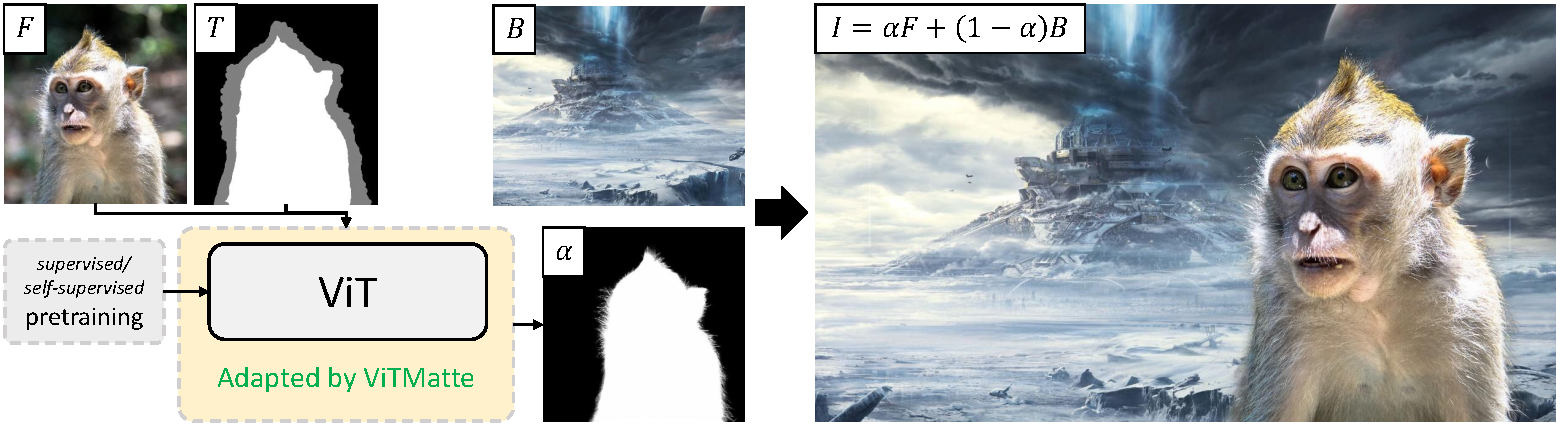
ViTMatte high-level overview. Taken from the original paper.
Resources
A list of official Hugging Face and community (indicated by 🌎) resources to help you get started with ViTMatte.
- A demo notebook regarding inference with VitMatteForImageMatting, including background replacement, can be found here.
The model expects both the image and trimap (concatenated) as input. Use ViTMatteImageProcessor for this purpose.
VitMatteConfig[[transformers.VitMatteConfig]]
class transformers.VitMatteConfigtransformers.VitMatteConfigPreTrainedConfig or dict, optional, defaults to VitDetConfig()) --
The configuration of the backbone model.
- backbone (
str, optional) -- Name of backbone to use whenbackbone_configisNone. Ifuse_pretrained_backboneisTrue, this will load the corresponding pretrained weights from the timm or transformers library. Ifuse_pretrained_backboneisFalse, this loads the backbone's config and uses that to initialize the backbone with random weights. - use_pretrained_backbone (
bool, optional, defaults toFalse) -- Whether to use pretrained weights for the backbone. - use_timm_backbone (
bool, optional, defaults toFalse) -- Whether to loadbackbonefrom the timm library. IfFalse, the backbone is loaded from the transformers library. - backbone_kwargs (
dict, optional) -- Keyword arguments to be passed to AutoBackbone when loading from a checkpoint e.g.{'out_indices': (0, 1, 2, 3)}. Cannot be specified ifbackbone_configis set. - hidden_size (
int, optional, defaults to 384) -- The number of input channels of the decoder. - batch_norm_eps (
float, optional, defaults to 1e-05) -- The epsilon used by the batch norm layers. - initializer_range (
float, optional, defaults to 0.02) -- The standard deviation of the truncated_normal_initializer for initializing all weight matrices. - convstream_hidden_sizes (
list[int], optional, defaults to[48, 96, 192]) -- The output channels of the ConvStream module. - fusion_hidden_sizes (
list[int], optional, defaults to[256, 128, 64, 32]) -- The output channels of the Fusion blocks.0
This is the configuration class to store the configuration of VitMatteForImageMatting. It is used to instantiate a ViTMatte model according to the specified arguments, defining the model architecture. Instantiating a configuration with the defaults will yield a similar configuration to that of the ViTMatte hustvl/vitmatte-small-composition-1k architecture.
Configuration objects inherit from PreTrainedConfig and can be used to control the model outputs. Read the documentation from PreTrainedConfig for more information.
Example:
>>> from transformers import VitMatteConfig, VitMatteForImageMatting

>>> # Initializing a ViTMatte hustvl/vitmatte-small-composition-1k style configuration
>>> configuration = VitMatteConfig()

>>> # Initializing a model (with random weights) from the hustvl/vitmatte-small-composition-1k style configuration
>>> model = VitMatteForImageMatting(configuration)

>>> # Accessing the model configuration
>>> configuration = model.config
VitMatteImageProcessor[[transformers.VitMatteImageProcessor]]
class transformers.VitMatteImageProcessortransformers.VitMatteImageProcessorbool, optional, defaults to True) --
Whether to rescale the image by the specified scale rescale_factor. Can be overridden by the do_rescale
parameter in the preprocess method.
- rescale_factor (
intorfloat, optional, defaults to1/255) -- Scale factor to use if rescaling the image. Can be overridden by therescale_factorparameter in thepreprocessmethod. - do_normalize (
bool, optional, defaults toTrue) -- Whether to normalize the image. Can be overridden by thedo_normalizeparameter in thepreprocessmethod. - image_mean (
floatorlist[float], optional, defaults toIMAGENET_STANDARD_MEAN) -- Mean to use if normalizing the image. This is a float or list of floats the length of the number of channels in the image. Can be overridden by theimage_meanparameter in thepreprocessmethod. - image_std (
floatorlist[float], optional, defaults toIMAGENET_STANDARD_STD) -- Standard deviation to use if normalizing the image. This is a float or list of floats the length of the number of channels in the image. Can be overridden by theimage_stdparameter in thepreprocessmethod. - do_pad (
bool, optional, defaults toTrue) -- Whether to pad the image to make the width and height divisible bysize_divisor. Can be overridden by thedo_padparameter in thepreprocessmethod. - size_divisor (
int, optional, defaults to 32) -- The width and height of the image will be padded to be divisible by this number.0
Constructs a ViTMatte image processor.
preprocesstransformers.VitMatteImageProcessor.preprocessImageInput) --
Image to preprocess. Expects a single or batch of images with pixel values ranging from 0 to 255. If
passing in images with pixel values between 0 and 1, set do_rescale=False.
- trimaps (
ImageInput) -- Trimap to preprocess. - do_rescale (
bool, optional, defaults toself.do_rescale) -- Whether to rescale the image values between [0 - 1]. - rescale_factor (
float, optional, defaults toself.rescale_factor) -- Rescale factor to rescale the image by ifdo_rescaleis set toTrue. - do_normalize (
bool, optional, defaults toself.do_normalize) -- Whether to normalize the image. - image_mean (
floatorlist[float], optional, defaults toself.image_mean) -- Image mean to use ifdo_normalizeis set toTrue. - image_std (
floatorlist[float], optional, defaults toself.image_std) -- Image standard deviation to use ifdo_normalizeis set toTrue. - do_pad (
bool, optional, defaults toself.do_pad) -- Whether to pad the image. - size_divisor (
int, optional, defaults toself.size_divisor) -- The size divisibility to pad the image to ifdo_padis set toTrue. - return_tensors (
strorTensorType, optional) -- The type of tensors to return. Can be one of:- Unset: Return a list of
np.ndarray. TensorType.PYTORCHor'pt': Return a batch of typetorch.Tensor.TensorType.NUMPYor'np': Return a batch of typenp.ndarray.
- Unset: Return a list of
- data_format (
ChannelDimensionorstr, optional, defaults toChannelDimension.FIRST) -- The channel dimension format for the output image. Can be one of:"channels_first"orChannelDimension.FIRST: image in (num_channels, height, width) format."channels_last"orChannelDimension.LAST: image in (height, width, num_channels) format.- Unset: Use the channel dimension format of the input image.
- input_data_format (
ChannelDimensionorstr, optional) -- The channel dimension format for the input image. If unset, the channel dimension format is inferred from the input image. Can be one of:"channels_first"orChannelDimension.FIRST: image in (num_channels, height, width) format."channels_last"orChannelDimension.LAST: image in (height, width, num_channels) format."none"orChannelDimension.NONE: image in (height, width) format.0
Preprocess an image or batch of images.
VitMatteImageProcessorFast[[transformers.VitMatteImageProcessorFast]]
class transformers.VitMatteImageProcessorFasttransformers.VitMatteImageProcessorFast
Constructs a fast Vitmatte image processor.
preprocesstransformers.VitMatteImageProcessorFast.preprocesslist) --
Image to preprocess. Expects a single or batch of images with pixel values ranging from 0 to 255. If
passing in images with pixel values between 0 and 1, set do_rescale=False.
- trimaps (
list) -- The trimaps to preprocess. - do_convert_rgb (
bool, optional) -- Whether to convert the image to RGB. - do_resize (
bool, optional) -- Whether to resize the image. - size (
Annotated[Union[int, list[int], tuple[int, ...], dict[str, int], NoneType], None]) -- Describes the maximum input dimensions to the model. - crop_size (
Annotated[Union[int, list[int], tuple[int, ...], dict[str, int], NoneType], None]) -- Size of the output image after applyingcenter_crop. - resample (
Annotated[Union[PILImageResampling, int, NoneType], None]) -- Resampling filter to use if resizing the image. This can be one of the enumPILImageResampling. Only has an effect ifdo_resizeis set toTrue. - do_rescale (
bool, optional) -- Whether to rescale the image. - rescale_factor (
float, optional) -- Rescale factor to rescale the image by ifdo_rescaleis set toTrue. - do_normalize (
bool, optional) -- Whether to normalize the image. - image_mean (
Union[float, list[float], tuple[float, ...], NoneType]) -- Image mean to use for normalization. Only has an effect ifdo_normalizeis set toTrue. - image_std (
Union[float, list[float], tuple[float, ...], NoneType]) -- Image standard deviation to use for normalization. Only has an effect ifdo_normalizeis set toTrue. - do_pad (
bool, optional) -- Whether to pad the image. Padding is done either to the largest size in the batch or to a fixed square size per image. The exact padding strategy depends on the model. - pad_size (
Annotated[Union[int, list[int], tuple[int, ...], dict[str, int], NoneType], None]) -- The size in{"height": int, "width" int}to pad the images to. Must be larger than any image size provided for preprocessing. Ifpad_sizeis not provided, images will be padded to the largest height and width in the batch. Applied only whendo_pad=True. - do_center_crop (
bool, optional) -- Whether to center crop the image. - data_format (
Union[str, ~image_utils.ChannelDimension, NoneType]) -- OnlyChannelDimension.FIRSTis supported. Added for compatibility with slow processors. - input_data_format (
Union[str, ~image_utils.ChannelDimension, NoneType]) -- The channel dimension format for the input image. If unset, the channel dimension format is inferred from the input image. Can be one of:"channels_first"orChannelDimension.FIRST: image in (num_channels, height, width) format."channels_last"orChannelDimension.LAST: image in (height, width, num_channels) format."none"orChannelDimension.NONE: image in (height, width) format.
- device (
Annotated[str, None], optional) -- The device to process the images on. If unset, the device is inferred from the input images. - return_tensors (
Annotated[Union[str, ~utils.generic.TensorType, NoneType], None]) -- Returns stacked tensors if set to `pt, otherwise returns a list of tensors. - disable_grouping (
bool, optional) -- Whether to disable grouping of images by size to process them individually and not in batches. If None, will be set to True if the images are on CPU, and False otherwise. This choice is based on empirical observations, as detailed here: https://github.com/huggingface/transformers/pull/38157 - size_divisor (
<class 'int'>.size_divisor) -- The size by which to make sure both the height and width can be divided.0<class 'transformers.image_processing_base.BatchFeature'>- data (dict) -- Dictionary of lists/arrays/tensors returned by the call method ('pixel_values', etc.). - tensor_type (
Union[None, str, TensorType], optional) -- You can give a tensor_type here to convert the lists of integers in PyTorch/Numpy Tensors at initialization.
VitMatteForImageMatting[[transformers.VitMatteForImageMatting]]
class transformers.VitMatteForImageMattingtransformers.VitMatteForImageMatting
ViTMatte framework leveraging any vision backbone e.g. for ADE20k, CityScapes.
This model inherits from PreTrainedModel. Check the superclass documentation for the generic methods the library implements for all its model (such as downloading or saving, resizing the input embeddings, pruning heads etc.)
This model is also a PyTorch torch.nn.Module subclass. Use it as a regular PyTorch Module and refer to the PyTorch documentation for all matter related to general usage and behavior.
forwardtransformers.VitMatteForImageMatting.forwardtorch.Tensor of shape (batch_size, num_channels, image_size, image_size), optional) --
The tensors corresponding to the input images. Pixel values can be obtained using
VitMatteImageProcessor. See VitMatteImageProcessor.call() for details (processor_class uses
VitMatteImageProcessor for processing images).
- output_attentions (
bool, optional) -- Whether or not to return the attentions tensors of all attention layers. Seeattentionsunder returned tensors for more detail. - output_hidden_states (
bool, optional) -- Whether or not to return the hidden states of all layers. Seehidden_statesunder returned tensors for more detail. - labels (
torch.LongTensorof shape(batch_size, height, width), optional) -- Ground truth image matting for computing the loss. - return_dict (
bool, optional) -- Whether or not to return a ModelOutput instead of a plain tuple.0 The VitMatteForImageMatting forward method, overrides the__call__special method.
Although the recipe for forward pass needs to be defined within this function, one should call the Module
instance afterwards instead of this since the former takes care of running the pre and post processing steps while
the latter silently ignores them.
Examples:
>>> from transformers import VitMatteImageProcessor, VitMatteForImageMatting
>>> import torch
>>> from PIL import Image
>>> from huggingface_hub import hf_hub_download

>>> processor = VitMatteImageProcessor.from_pretrained("hustvl/vitmatte-small-composition-1k")
>>> model = VitMatteForImageMatting.from_pretrained("hustvl/vitmatte-small-composition-1k")

>>> filepath = hf_hub_download(
...     repo_id="hf-internal-testing/image-matting-fixtures", filename="image.png", repo_type="dataset"
... )
>>> image = Image.open(filepath).convert("RGB")
>>> filepath = hf_hub_download(
...     repo_id="hf-internal-testing/image-matting-fixtures", filename="trimap.png", repo_type="dataset"
... )
>>> trimap = Image.open(filepath).convert("L")

>>> # prepare image + trimap for the model
>>> inputs = processor(images=image, trimaps=trimap, return_tensors="pt")

>>> with torch.no_grad():
...     alphas = model(**inputs).alphas
>>> print(alphas.shape)
torch.Size([1, 1, 640, 960])
Xet Storage Details
- Size:
- 24.7 kB
- Xet hash:
- 7dfbf88a0d19f82b5bedab225dbabdbae48c9a04d47c80e5bb61ac98b8db8392
Xet efficiently stores files, intelligently splitting them into unique chunks and accelerating uploads and downloads. More info.