
Buckets:


ViLT
Overview
The ViLT model was proposed in ViLT: Vision-and-Language Transformer Without Convolution or Region Supervision by Wonjae Kim, Bokyung Son, Ildoo Kim. ViLT incorporates text embeddings into a Vision Transformer (ViT), allowing it to have a minimal design for Vision-and-Language Pre-training (VLP).
The abstract from the paper is the following:
Vision-and-Language Pre-training (VLP) has improved performance on various joint vision-and-language downstream tasks. Current approaches to VLP heavily rely on image feature extraction processes, most of which involve region supervision (e.g., object detection) and the convolutional architecture (e.g., ResNet). Although disregarded in the literature, we find it problematic in terms of both (1) efficiency/speed, that simply extracting input features requires much more computation than the multimodal interaction steps; and (2) expressive power, as it is upper bounded to the expressive power of the visual embedder and its predefined visual vocabulary. In this paper, we present a minimal VLP model, Vision-and-Language Transformer (ViLT), monolithic in the sense that the processing of visual inputs is drastically simplified to just the same convolution-free manner that we process textual inputs. We show that ViLT is up to tens of times faster than previous VLP models, yet with competitive or better downstream task performance.
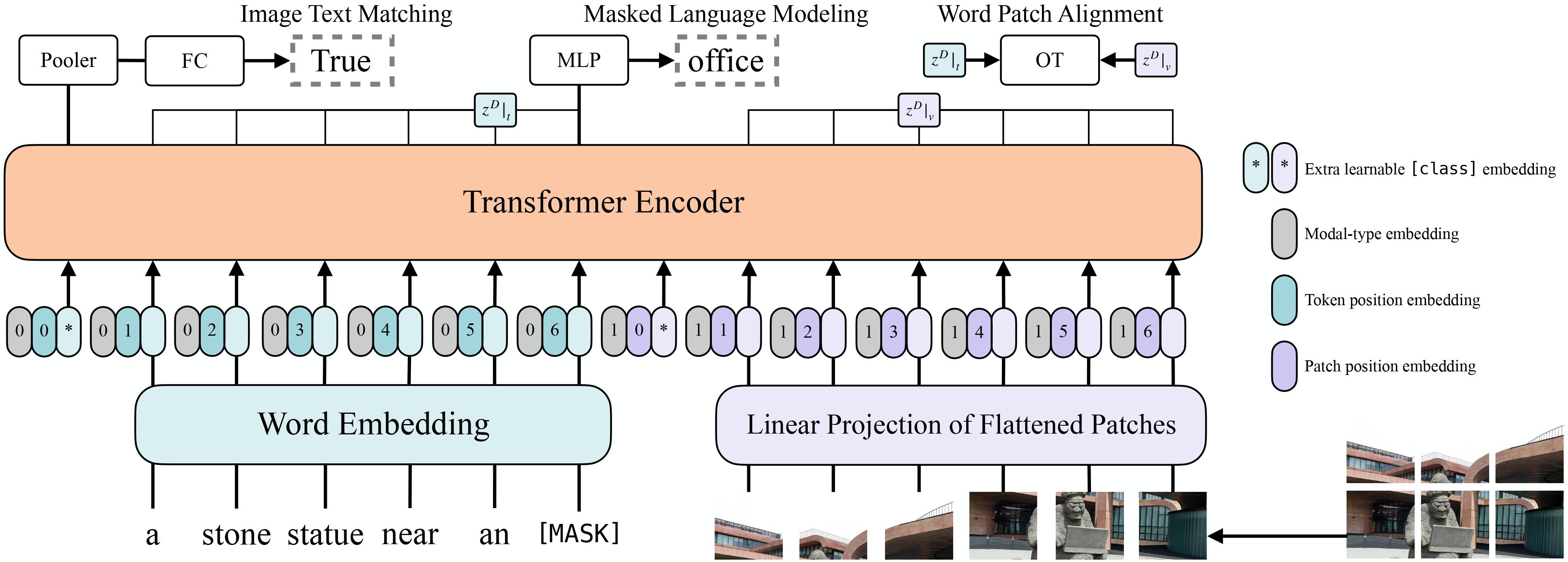
ViLT architecture. Taken from the original paper.
This model was contributed by nielsr. The original code can be found here.
Usage tips
- The quickest way to get started with ViLT is by checking the example notebooks (which showcase both inference and fine-tuning on custom data).
- ViLT is a model that takes both
pixel_valuesandinput_idsas input. One can use ViltProcessor to prepare data for the model. This processor wraps a image processor (for the image modality) and a tokenizer (for the language modality) into one. - ViLT is trained with images of various sizes: the authors resize the shorter edge of input images to 384 and limit the longer edge to
under 640 while preserving the aspect ratio. To make batching of images possible, the authors use a
pixel_maskthat indicates which pixel values are real and which are padding. ViltProcessor automatically creates this for you. - The design of ViLT is very similar to that of a standard Vision Transformer (ViT). The only difference is that the model includes additional embedding layers for the language modality.
ViltConfig[[transformers.ViltConfig]]
transformers.ViltConfig[[transformers.ViltConfig]]
This is the configuration class to store the configuration of a ViltModel. It is used to instantiate a Vilt model according to the specified arguments, defining the model architecture. Instantiating a configuration with the defaults will yield a similar configuration to that of the dandelin/vilt-b32-mlm
Configuration objects inherit from PreTrainedConfig and can be used to control the model outputs. Read the documentation from PreTrainedConfig for more information.
Example:
>>> from transformers import ViLTModel, ViLTConfig

>>> # Initializing a ViLT dandelin/vilt-b32-mlm style configuration
>>> configuration = ViLTConfig()

>>> # Initializing a model from the dandelin/vilt-b32-mlm style configuration
>>> model = ViLTModel(configuration)

>>> # Accessing the model configuration
>>> configuration = model.config
Parameters:
vocab_size (int, optional, defaults to 30522) : Vocabulary size of the model. Defines the number of different tokens that can be represented by the input_ids.
type_vocab_size (int, optional, defaults to 2) : The vocabulary size of the token_type_ids.
modality_type_vocab_size (int, optional, defaults to 2) : The vocabulary size of the modalities passed when calling ViltModel. This is used after concatenating the embeddings of the text and image modalities.
max_position_embeddings (int, optional, defaults to 40) : The maximum sequence length that this model might ever be used with.
hidden_size (int, optional, defaults to 768) : Dimension of the hidden representations.
num_hidden_layers (int, optional, defaults to 12) : Number of hidden layers in the Transformer decoder.
num_attention_heads (int, optional, defaults to 12) : Number of attention heads for each attention layer in the Transformer decoder.
intermediate_size (int, optional, defaults to 3072) : Dimension of the MLP representations.
hidden_act (str, optional, defaults to gelu) : The non-linear activation function (function or string) in the decoder. For example, "gelu", "relu", "silu", etc.
hidden_dropout_prob (Union[float, int], optional, defaults to 0.0) : The dropout probability for all fully connected layers in the embeddings, encoder, and pooler.
attention_probs_dropout_prob (Union[float, int], optional, defaults to 0.0) : The dropout ratio for the attention probabilities.
initializer_range (float, optional, defaults to 0.02) : The standard deviation of the truncated_normal_initializer for initializing all weight matrices.
layer_norm_eps (float, optional, defaults to 1e-12) : The epsilon used by the layer normalization layers.
image_size (Union[int, list[int], tuple[int, int]], optional, defaults to 384) : The size (resolution) of each image.
patch_size (Union[int, list[int], tuple[int, int]], optional, defaults to 32) : The size (resolution) of each patch.
num_channels (int, optional, defaults to 3) : The number of input channels.
qkv_bias (bool, optional, defaults to True) : Whether to add a bias to the queries, keys and values.
max_image_length (int, optional, defaults to -1) : The maximum number of patches to take as input for the Transformer encoder. If set to a positive integer, the encoder will sample max_image_length patches at maximum. If set to -1, will not be taken into account.
tie_word_embeddings (bool, optional, defaults to True) : Whether to tie weight embeddings according to model's tied_weights_keys mapping.
num_images (int, optional, defaults to -1) : The number of images to use for natural language visual reasoning. If set to a positive integer, will be used by ViltForImagesAndTextClassification for defining the classifier head.
pad_token_id (int, optional) : Token id used for padding in the vocabulary.
ViltImageProcessor[[transformers.ViltImageProcessor]]
transformers.ViltImageProcessor[[transformers.ViltImageProcessor]]
Constructs a ViltImageProcessor image processor.
preprocesstransformers.ViltImageProcessor.preprocesshttps://github.com/huggingface/transformers/blob/vr_36895/src/transformers/image_processing_utils.py#L382[{"name": "images", "val": ": typing.Union[ForwardRef('PIL.Image.Image'), numpy.ndarray, ForwardRef('torch.Tensor'), list['PIL.Image.Image'], list[numpy.ndarray], list['torch.Tensor']]"}, {"name": "*args", "val": ""}, {"name": "**kwargs", "val": ": typing_extensions.Unpack[transformers.processing_utils.ImagesKwargs]"}]- images (Union[PIL.Image.Image, numpy.ndarray, torch.Tensor, list[PIL.Image.Image], list[numpy.ndarray], list[torch.Tensor]]) --
Image to preprocess. Expects a single or batch of images with pixel values ranging from 0 to 255. If
passing in images with pixel values between 0 and 1, set do_rescale=False.
- return_tensors (
stror TensorType, optional) -- Returns stacked tensors if set to'pt', otherwise returns a list of tensors. - **kwargs (ImagesKwargs, optional) --
Additional image preprocessing options. Model-specific kwargs are listed above; see the TypedDict class
for the complete list of supported arguments.0
~image_processing_base.BatchFeature- data (dict) -- Dictionary of lists/arrays/tensors returned by the call method ('pixel_values', etc.). - tensor_type (
Union[None, str, TensorType], optional) -- You can give a tensor_type here to convert the lists of integers in PyTorch/Numpy Tensors at initialization.
Parameters:
- **kwargs (ImagesKwargs, optional) : Additional image preprocessing options. Model-specific kwargs are listed above; see the TypedDict class for the complete list of supported arguments.
Returns:
~image_processing_base.BatchFeature
- data (
dict) -- Dictionary of lists/arrays/tensors returned by the call method ('pixel_values', etc.). - tensor_type (
Union[None, str, TensorType], optional) -- You can give a tensor_type here to convert the lists of integers in PyTorch/Numpy Tensors at initialization.
ViltImageProcessorPil[[transformers.ViltImageProcessorPil]]
transformers.ViltImageProcessorPil[[transformers.ViltImageProcessorPil]]
Constructs a ViltImageProcessor image processor.
preprocesstransformers.ViltImageProcessorPil.preprocesshttps://github.com/huggingface/transformers/blob/vr_36895/src/transformers/image_processing_utils.py#L382[{"name": "images", "val": ": typing.Union[ForwardRef('PIL.Image.Image'), numpy.ndarray, ForwardRef('torch.Tensor'), list['PIL.Image.Image'], list[numpy.ndarray], list['torch.Tensor']]"}, {"name": "*args", "val": ""}, {"name": "**kwargs", "val": ": typing_extensions.Unpack[transformers.processing_utils.ImagesKwargs]"}]- images (Union[PIL.Image.Image, numpy.ndarray, torch.Tensor, list[PIL.Image.Image], list[numpy.ndarray], list[torch.Tensor]]) --
Image to preprocess. Expects a single or batch of images with pixel values ranging from 0 to 255. If
passing in images with pixel values between 0 and 1, set do_rescale=False.
- return_tensors (
stror TensorType, optional) -- Returns stacked tensors if set to'pt', otherwise returns a list of tensors. - **kwargs (ImagesKwargs, optional) --
Additional image preprocessing options. Model-specific kwargs are listed above; see the TypedDict class
for the complete list of supported arguments.0
~image_processing_base.BatchFeature- data (dict) -- Dictionary of lists/arrays/tensors returned by the call method ('pixel_values', etc.). - tensor_type (
Union[None, str, TensorType], optional) -- You can give a tensor_type here to convert the lists of integers in PyTorch/Numpy Tensors at initialization.
Parameters:
- **kwargs (ImagesKwargs, optional) : Additional image preprocessing options. Model-specific kwargs are listed above; see the TypedDict class for the complete list of supported arguments.
Returns:
~image_processing_base.BatchFeature
- data (
dict) -- Dictionary of lists/arrays/tensors returned by the call method ('pixel_values', etc.). - tensor_type (
Union[None, str, TensorType], optional) -- You can give a tensor_type here to convert the lists of integers in PyTorch/Numpy Tensors at initialization.
ViltProcessor[[transformers.ViltProcessor]]
transformers.ViltProcessor[[transformers.ViltProcessor]]
Constructs a ViltProcessor which wraps a image processor and a tokenizer into a single processor.
ViltProcessor offers all the functionalities of ViltImageProcessor and BertTokenizer. See the ~ViltImageProcessor and ~BertTokenizer for more information.
__call__transformers.ViltProcessor.__call__https://github.com/huggingface/transformers/blob/vr_36895/src/transformers/processing_utils.py#L631[{"name": "images", "val": ": typing.Union[ForwardRef('PIL.Image.Image'), numpy.ndarray, ForwardRef('torch.Tensor'), list['PIL.Image.Image'], list[numpy.ndarray], list['torch.Tensor'], NoneType] = None"}, {"name": "text", "val": ": str | list[str] | list[list[str]] | None = None"}, {"name": "videos", "val": ": typing.Union[list['PIL.Image.Image'], numpy.ndarray, ForwardRef('torch.Tensor'), list[numpy.ndarray], list['torch.Tensor'], list[list['PIL.Image.Image']], list[list[numpy.ndarray]], list[list['torch.Tensor']], transformers.video_utils.URL, list[transformers.video_utils.URL], list[list[transformers.video_utils.URL]], transformers.video_utils.Path, list[transformers.video_utils.Path], list[list[transformers.video_utils.Path]], NoneType] = None"}, {"name": "audio", "val": ": typing.Union[numpy.ndarray, ForwardRef('torch.Tensor'), collections.abc.Sequence[numpy.ndarray], collections.abc.Sequence['torch.Tensor'], NoneType] = None"}, {"name": "**kwargs", "val": ": typing_extensions.Unpack[transformers.processing_utils.ProcessingKwargs]"}]- images (PIL.Image.Image, np.ndarray, torch.Tensor, list[PIL.Image.Image], list[np.ndarray], list[torch.Tensor]) --
The image or batch of images to be prepared. Each image can be a PIL image, NumPy array or PyTorch
tensor. Both channels-first and channels-last formats are supported.
text (
TextInput,PreTokenizedInput,list[TextInput],list[PreTokenizedInput], optional) -- The sequence or batch of sequences to be encoded. Each sequence can be a string or a list of strings (pretokenized string). If the sequences are provided as list of strings (pretokenized), you must setis_split_into_words=True(to lift the ambiguity with a batch of sequences).videos (
np.ndarray,torch.Tensor,List[np.ndarray],List[torch.Tensor]) -- The video or batch of videos to be prepared. Each video can be a 4D NumPy array or PyTorch tensor, or a nested list of 3D frames. Both channels-first and channels-last formats are supported.audio (
np.ndarray,torch.Tensor,list[np.ndarray],list[torch.Tensor]) -- The audio or batch of audio to be prepared. Each audio can be a NumPy array or PyTorch tensor.return_tensors (
stror TensorType, optional) -- If set, will return tensors of a particular framework. Acceptable values are:'pt': Return PyTorchtorch.Tensorobjects.'np': Return NumPynp.ndarrayobjects.0BatchFeatureA BatchFeature object with processed inputs in a dict format.
Main method to prepare for model inputs. This method forwards the each modality argument to its own processor
along with kwargs. Please refer to the docstring of the each processor attributes for more information.
Parameters:
image_processor (ViltImageProcessor) : The image processor is a required input.
tokenizer (BertTokenizer) : The tokenizer is a required input.
Returns:
[BatchFeature](/docs/transformers/pr_36895/en/main_classes/feature_extractor#transformers.BatchFeature)
A BatchFeature object with processed inputs in a dict format.
ViltModel[[transformers.ViltModel]]
transformers.ViltModel[[transformers.ViltModel]]
The bare Vilt Model outputting raw hidden-states without any specific head on top.
This model inherits from PreTrainedModel. Check the superclass documentation for the generic methods the library implements for all its model (such as downloading or saving, resizing the input embeddings, pruning heads etc.)
This model is also a PyTorch torch.nn.Module subclass. Use it as a regular PyTorch Module and refer to the PyTorch documentation for all matter related to general usage and behavior.
forwardtransformers.ViltModel.forwardhttps://github.com/huggingface/transformers/blob/vr_36895/src/transformers/models/vilt/modeling_vilt.py#L538[{"name": "input_ids", "val": ": torch.LongTensor | None = None"}, {"name": "attention_mask", "val": ": torch.FloatTensor | None = None"}, {"name": "token_type_ids", "val": ": torch.LongTensor | None = None"}, {"name": "pixel_values", "val": ": torch.FloatTensor | None = None"}, {"name": "pixel_mask", "val": ": torch.LongTensor | None = None"}, {"name": "inputs_embeds", "val": ": torch.FloatTensor | None = None"}, {"name": "image_embeds", "val": ": torch.FloatTensor | None = None"}, {"name": "image_token_type_idx", "val": ": int | None = None"}, {"name": "output_attentions", "val": ": bool | None = None"}, {"name": "output_hidden_states", "val": ": bool | None = None"}, {"name": "return_dict", "val": ": bool | None = None"}, {"name": "**kwargs", "val": ""}]- input_ids (torch.LongTensor of shape (batch_size, sequence_length), optional) --
Indices of input sequence tokens in the vocabulary. Padding will be ignored by default.
Indices can be obtained using AutoTokenizer. See PreTrainedTokenizer.encode() and PreTrainedTokenizer.call() for details.
attention_mask (
torch.FloatTensorof shape(batch_size, sequence_length), optional) -- Mask to avoid performing attention on padding token indices. Mask values selected in[0, 1]:- 1 for tokens that are not masked,
- 0 for tokens that are masked.
token_type_ids (
torch.LongTensorof shape(batch_size, sequence_length), optional) -- Segment token indices to indicate first and second portions of the inputs. Indices are selected in[0, 1]:- 0 corresponds to a sentence A token,
- 1 corresponds to a sentence B token.
pixel_values (
torch.FloatTensorof shape(batch_size, num_channels, image_size, image_size), optional) -- The tensors corresponding to the input images. Pixel values can be obtained using ViltImageProcessor. SeeViltImageProcessor.__call__()for details (ViltProcessor uses ViltImageProcessor for processing images).pixel_mask (
torch.LongTensorof shape(batch_size, height, width), optional) -- Mask to avoid performing attention on padding pixel values. Mask values selected in[0, 1]:- 1 for pixels that are real (i.e. not masked),
- 0 for pixels that are padding (i.e. masked).
inputs_embeds (
torch.FloatTensorof shape(batch_size, sequence_length, hidden_size), optional) -- Optionally, instead of passinginput_idsyou can choose to directly pass an embedded representation. This is useful if you want more control over how to convertinput_idsindices into associated vectors than the model's internal embedding lookup matrix.image_embeds (
torch.FloatTensorof shape(batch_size, num_patches, hidden_size), optional) -- Optionally, instead of passingpixel_values, you can choose to directly pass an embedded representation. This is useful if you want more control over how to convertpixel_valuesinto patch embeddings.image_token_type_idx (
int, optional) --- The token type ids for images.
output_attentions (
bool, optional) -- Whether or not to return the attentions tensors of all attention layers. Seeattentionsunder returned tensors for more detail.output_hidden_states (
bool, optional) -- Whether or not to return the hidden states of all layers. Seehidden_statesunder returned tensors for more detail.return_dict (
bool, optional) -- Whether or not to return a ModelOutput instead of a plain tuple.0BaseModelOutputWithPooling ortuple(torch.FloatTensor)A BaseModelOutputWithPooling or a tuple oftorch.FloatTensor(ifreturn_dict=Falseis passed or whenconfig.return_dict=False) comprising various elements depending on the configuration (ViltConfig) and inputs. The ViltModel forward method, overrides the__call__special method.
Although the recipe for forward pass needs to be defined within this function, one should call the Module
instance afterwards instead of this since the former takes care of running the pre and post processing steps while
the latter silently ignores them.
last_hidden_state (
torch.FloatTensorof shape(batch_size, sequence_length, hidden_size)) -- Sequence of hidden-states at the output of the last layer of the model.pooler_output (
torch.FloatTensorof shape(batch_size, hidden_size)) -- Last layer hidden-state of the first token of the sequence (classification token) after further processing through the layers used for the auxiliary pretraining task. E.g. for BERT-family of models, this returns the classification token after processing through a linear layer and a tanh activation function. The linear layer weights are trained from the next sentence prediction (classification) objective during pretraining.hidden_states (
tuple(torch.FloatTensor), optional, returned whenoutput_hidden_states=Trueis passed or whenconfig.output_hidden_states=True) -- Tuple oftorch.FloatTensor(one for the output of the embeddings, if the model has an embedding layer, + one for the output of each layer) of shape(batch_size, sequence_length, hidden_size).Hidden-states of the model at the output of each layer plus the optional initial embedding outputs.
attentions (
tuple(torch.FloatTensor), optional, returned whenoutput_attentions=Trueis passed or whenconfig.output_attentions=True) -- Tuple oftorch.FloatTensor(one for each layer) of shape(batch_size, num_heads, sequence_length, sequence_length).Attentions weights after the attention softmax, used to compute the weighted average in the self-attention heads.
Examples:
>>> from transformers import ViltProcessor, ViltModel
>>> from PIL import Image
>>> import httpx
>>> from io import BytesIO

>>> # prepare image and text
>>> url = "http://images.cocodataset.org/val2017/000000039769.jpg"
>>> with httpx.stream("GET", url) as response:
...     image = Image.open(BytesIO(response.read()))
>>> text = "hello world"

>>> processor = ViltProcessor.from_pretrained("dandelin/vilt-b32-mlm")
>>> model = ViltModel.from_pretrained("dandelin/vilt-b32-mlm")

>>> inputs = processor(image, text, return_tensors="pt")
>>> outputs = model(**inputs)
>>> last_hidden_states = outputs.last_hidden_state
Parameters:
config (ViltModel) : Model configuration class with all the parameters of the model. Initializing with a config file does not load the weights associated with the model, only the configuration. Check out the from_pretrained() method to load the model weights.
add_pooling_layer (bool, optional, defaults to True) : Whether to add a pooling layer
Returns:
[BaseModelOutputWithPooling](/docs/transformers/pr_36895/en/main_classes/output#transformers.modeling_outputs.BaseModelOutputWithPooling) or tuple(torch.FloatTensor)``
A BaseModelOutputWithPooling or a tuple of
torch.FloatTensor (if return_dict=False is passed or when config.return_dict=False) comprising various
elements depending on the configuration (ViltConfig) and inputs.
ViltForMaskedLM[[transformers.ViltForMaskedLM]]
transformers.ViltForMaskedLM[[transformers.ViltForMaskedLM]]
ViLT Model with a language modeling head on top as done during pretraining.
This model inherits from PreTrainedModel. Check the superclass documentation for the generic methods the library implements for all its model (such as downloading or saving, resizing the input embeddings, pruning heads etc.)
This model is also a PyTorch torch.nn.Module subclass. Use it as a regular PyTorch Module and refer to the PyTorch documentation for all matter related to general usage and behavior.
forwardtransformers.ViltForMaskedLM.forwardhttps://github.com/huggingface/transformers/blob/vr_36895/src/transformers/models/vilt/modeling_vilt.py#L693[{"name": "input_ids", "val": ": torch.LongTensor | None = None"}, {"name": "attention_mask", "val": ": torch.FloatTensor | None = None"}, {"name": "token_type_ids", "val": ": torch.LongTensor | None = None"}, {"name": "pixel_values", "val": ": torch.FloatTensor | None = None"}, {"name": "pixel_mask", "val": ": torch.LongTensor | None = None"}, {"name": "inputs_embeds", "val": ": torch.FloatTensor | None = None"}, {"name": "image_embeds", "val": ": torch.FloatTensor | None = None"}, {"name": "labels", "val": ": torch.LongTensor | None = None"}, {"name": "output_attentions", "val": ": bool | None = None"}, {"name": "output_hidden_states", "val": ": bool | None = None"}, {"name": "return_dict", "val": ": bool | None = None"}, {"name": "**kwargs", "val": ""}]- input_ids (torch.LongTensor of shape (batch_size, sequence_length), optional) --
Indices of input sequence tokens in the vocabulary. Padding will be ignored by default.
Indices can be obtained using AutoTokenizer. See PreTrainedTokenizer.encode() and PreTrainedTokenizer.call() for details.
attention_mask (
torch.FloatTensorof shape(batch_size, sequence_length), optional) -- Mask to avoid performing attention on padding token indices. Mask values selected in[0, 1]:- 1 for tokens that are not masked,
- 0 for tokens that are masked.
token_type_ids (
torch.LongTensorof shape(batch_size, sequence_length), optional) -- Segment token indices to indicate first and second portions of the inputs. Indices are selected in[0, 1]:- 0 corresponds to a sentence A token,
- 1 corresponds to a sentence B token.
pixel_values (
torch.FloatTensorof shape(batch_size, num_channels, image_size, image_size), optional) -- The tensors corresponding to the input images. Pixel values can be obtained using ViltImageProcessor. SeeViltImageProcessor.__call__()for details (ViltProcessor uses ViltImageProcessor for processing images).pixel_mask (
torch.LongTensorof shape(batch_size, height, width), optional) -- Mask to avoid performing attention on padding pixel values. Mask values selected in[0, 1]:- 1 for pixels that are real (i.e. not masked),
- 0 for pixels that are padding (i.e. masked).
inputs_embeds (
torch.FloatTensorof shape(batch_size, sequence_length, hidden_size), optional) -- Optionally, instead of passinginput_idsyou can choose to directly pass an embedded representation. This is useful if you want more control over how to convertinput_idsindices into associated vectors than the model's internal embedding lookup matrix.image_embeds (
torch.FloatTensorof shape(batch_size, num_patches, hidden_size), optional) -- Optionally, instead of passingpixel_values, you can choose to directly pass an embedded representation. This is useful if you want more control over how to convertpixel_valuesinto patch embeddings.labels (
*torch.LongTensor*of shape (batch_size, sequence_length), optional) -- Labels for computing the masked language modeling loss. Indices should be in [-100, 0, ..., config.vocab_size] (see input_ids docstring) Tokens with indices set to -100 are ignored (masked), the loss is only computed for the tokens with labels in [0, ..., config.vocab_size]output_attentions (
bool, optional) -- Whether or not to return the attentions tensors of all attention layers. Seeattentionsunder returned tensors for more detail.output_hidden_states (
bool, optional) -- Whether or not to return the hidden states of all layers. Seehidden_statesunder returned tensors for more detail.return_dict (
bool, optional) -- Whether or not to return a ModelOutput instead of a plain tuple.0MaskedLMOutput ortuple(torch.FloatTensor)A MaskedLMOutput or a tuple oftorch.FloatTensor(ifreturn_dict=Falseis passed or whenconfig.return_dict=False) comprising various elements depending on the configuration (ViltConfig) and inputs. The ViltForMaskedLM forward method, overrides the__call__special method.
Although the recipe for forward pass needs to be defined within this function, one should call the Module
instance afterwards instead of this since the former takes care of running the pre and post processing steps while
the latter silently ignores them.
loss (
torch.FloatTensorof shape(1,), optional, returned whenlabelsis provided) -- Masked language modeling (MLM) loss.logits (
torch.FloatTensorof shape(batch_size, sequence_length, config.vocab_size)) -- Prediction scores of the language modeling head (scores for each vocabulary token before SoftMax).hidden_states (
tuple(torch.FloatTensor), optional, returned whenoutput_hidden_states=Trueis passed or whenconfig.output_hidden_states=True) -- Tuple oftorch.FloatTensor(one for the output of the embeddings, if the model has an embedding layer, + one for the output of each layer) of shape(batch_size, sequence_length, hidden_size).Hidden-states of the model at the output of each layer plus the optional initial embedding outputs.
attentions (
tuple(torch.FloatTensor), optional, returned whenoutput_attentions=Trueis passed or whenconfig.output_attentions=True) -- Tuple oftorch.FloatTensor(one for each layer) of shape(batch_size, num_heads, sequence_length, sequence_length).Attentions weights after the attention softmax, used to compute the weighted average in the self-attention heads.
Examples:
>>> from transformers import ViltProcessor, ViltForMaskedLM
>>> import httpx
>>> from io import BytesIO
>>> from PIL import Image
>>> import re
>>> import torch

>>> url = "http://images.cocodataset.org/val2017/000000039769.jpg"
>>> with httpx.stream("GET", url) as response:
...     image = Image.open(BytesIO(response.read()))
>>> text = "a bunch of [MASK] laying on a [MASK]."

>>> processor = ViltProcessor.from_pretrained("dandelin/vilt-b32-mlm")
>>> model = ViltForMaskedLM.from_pretrained("dandelin/vilt-b32-mlm")

>>> # prepare inputs
>>> encoding = processor(image, text, return_tensors="pt")

>>> # forward pass
>>> outputs = model(**encoding)

>>> tl = len(re.findall("\[MASK\]", text))
>>> inferred_token = [text]

>>> # gradually fill in the MASK tokens, one by one
>>> with torch.no_grad():
...     for i in range(tl):
...         encoded = processor.tokenizer(inferred_token)
...         input_ids = torch.tensor(encoded.input_ids)
...         encoded = encoded["input_ids"][0][1:-1]
...         outputs = model(input_ids=input_ids, pixel_values=encoding.pixel_values)
...         mlm_logits = outputs.logits[0]  # shape (seq_len, vocab_size)
...         # only take into account text features (minus CLS and SEP token)
...         mlm_logits = mlm_logits[1 : input_ids.shape[1] - 1, :]
...         mlm_values, mlm_ids = mlm_logits.softmax(dim=-1).max(dim=-1)
...         # only take into account text
...         mlm_values[torch.tensor(encoded) != 103] = 0
...         select = mlm_values.argmax().item()
...         encoded[select] = mlm_ids[select].item()
...         inferred_token = [processor.decode(encoded)]

>>> selected_token = ""
>>> encoded = processor.tokenizer(inferred_token)
>>> output = processor.decode(encoded.input_ids[0], skip_special_tokens=True)
>>> print(output)
a bunch of cats laying on a couch.
Parameters:
config (ViltForMaskedLM) : Model configuration class with all the parameters of the model. Initializing with a config file does not load the weights associated with the model, only the configuration. Check out the from_pretrained() method to load the model weights.
Returns:
[MaskedLMOutput](/docs/transformers/pr_36895/en/main_classes/output#transformers.modeling_outputs.MaskedLMOutput) or tuple(torch.FloatTensor)``
A MaskedLMOutput or a tuple of
torch.FloatTensor (if return_dict=False is passed or when config.return_dict=False) comprising various
elements depending on the configuration (ViltConfig) and inputs.
ViltForQuestionAnswering[[transformers.ViltForQuestionAnswering]]
transformers.ViltForQuestionAnswering[[transformers.ViltForQuestionAnswering]]
Vilt Model transformer with a classifier head on top (a linear layer on top of the final hidden state of the [CLS] token) for visual question answering, e.g. for VQAv2.
This model inherits from PreTrainedModel. Check the superclass documentation for the generic methods the library implements for all its model (such as downloading or saving, resizing the input embeddings, pruning heads etc.)
This model is also a PyTorch torch.nn.Module subclass. Use it as a regular PyTorch Module and refer to the PyTorch documentation for all matter related to general usage and behavior.
forwardtransformers.ViltForQuestionAnswering.forwardhttps://github.com/huggingface/transformers/blob/vr_36895/src/transformers/models/vilt/modeling_vilt.py#L863[{"name": "input_ids", "val": ": torch.LongTensor | None = None"}, {"name": "attention_mask", "val": ": torch.FloatTensor | None = None"}, {"name": "token_type_ids", "val": ": torch.LongTensor | None = None"}, {"name": "pixel_values", "val": ": torch.FloatTensor | None = None"}, {"name": "pixel_mask", "val": ": torch.LongTensor | None = None"}, {"name": "inputs_embeds", "val": ": torch.FloatTensor | None = None"}, {"name": "image_embeds", "val": ": torch.FloatTensor | None = None"}, {"name": "labels", "val": ": torch.LongTensor | None = None"}, {"name": "output_attentions", "val": ": bool | None = None"}, {"name": "output_hidden_states", "val": ": bool | None = None"}, {"name": "return_dict", "val": ": bool | None = None"}, {"name": "**kwargs", "val": ""}]- input_ids (torch.LongTensor of shape (batch_size, sequence_length), optional) --
Indices of input sequence tokens in the vocabulary. Padding will be ignored by default.
Indices can be obtained using AutoTokenizer. See PreTrainedTokenizer.encode() and PreTrainedTokenizer.call() for details.
attention_mask (
torch.FloatTensorof shape(batch_size, sequence_length), optional) -- Mask to avoid performing attention on padding token indices. Mask values selected in[0, 1]:- 1 for tokens that are not masked,
- 0 for tokens that are masked.
token_type_ids (
torch.LongTensorof shape(batch_size, sequence_length), optional) -- Segment token indices to indicate first and second portions of the inputs. Indices are selected in[0, 1]:- 0 corresponds to a sentence A token,
- 1 corresponds to a sentence B token.
pixel_values (
torch.FloatTensorof shape(batch_size, num_channels, image_size, image_size), optional) -- The tensors corresponding to the input images. Pixel values can be obtained using ViltImageProcessor. SeeViltImageProcessor.__call__()for details (ViltProcessor uses ViltImageProcessor for processing images).pixel_mask (
torch.LongTensorof shape(batch_size, height, width), optional) -- Mask to avoid performing attention on padding pixel values. Mask values selected in[0, 1]:- 1 for pixels that are real (i.e. not masked),
- 0 for pixels that are padding (i.e. masked).
inputs_embeds (
torch.FloatTensorof shape(batch_size, sequence_length, hidden_size), optional) -- Optionally, instead of passinginput_idsyou can choose to directly pass an embedded representation. This is useful if you want more control over how to convertinput_idsindices into associated vectors than the model's internal embedding lookup matrix.image_embeds (
torch.FloatTensorof shape(batch_size, num_patches, hidden_size), optional) -- Optionally, instead of passingpixel_values, you can choose to directly pass an embedded representation. This is useful if you want more control over how to convertpixel_valuesinto patch embeddings.labels (
torch.FloatTensorof shape(batch_size, num_labels), optional) -- Labels for computing the visual question answering loss. This tensor must be either a one-hot encoding of all answers that are applicable for a given example in the batch, or a soft encoding indicating which answers are applicable, where 1.0 is the highest score.output_attentions (
bool, optional) -- Whether or not to return the attentions tensors of all attention layers. Seeattentionsunder returned tensors for more detail.output_hidden_states (
bool, optional) -- Whether or not to return the hidden states of all layers. Seehidden_statesunder returned tensors for more detail.return_dict (
bool, optional) -- Whether or not to return a ModelOutput instead of a plain tuple.0SequenceClassifierOutput ortuple(torch.FloatTensor)A SequenceClassifierOutput or a tuple oftorch.FloatTensor(ifreturn_dict=Falseis passed or whenconfig.return_dict=False) comprising various elements depending on the configuration (ViltConfig) and inputs. The ViltForQuestionAnswering forward method, overrides the__call__special method.
Although the recipe for forward pass needs to be defined within this function, one should call the Module
instance afterwards instead of this since the former takes care of running the pre and post processing steps while
the latter silently ignores them.
loss (
torch.FloatTensorof shape(1,), optional, returned whenlabelsis provided) -- Classification (or regression if config.num_labels==1) loss.logits (
torch.FloatTensorof shape(batch_size, config.num_labels)) -- Classification (or regression if config.num_labels==1) scores (before SoftMax).hidden_states (
tuple(torch.FloatTensor), optional, returned whenoutput_hidden_states=Trueis passed or whenconfig.output_hidden_states=True) -- Tuple oftorch.FloatTensor(one for the output of the embeddings, if the model has an embedding layer, + one for the output of each layer) of shape(batch_size, sequence_length, hidden_size).Hidden-states of the model at the output of each layer plus the optional initial embedding outputs.
attentions (
tuple(torch.FloatTensor), optional, returned whenoutput_attentions=Trueis passed or whenconfig.output_attentions=True) -- Tuple oftorch.FloatTensor(one for each layer) of shape(batch_size, num_heads, sequence_length, sequence_length).Attentions weights after the attention softmax, used to compute the weighted average in the self-attention heads.
Examples:
>>> from transformers import ViltProcessor, ViltForQuestionAnswering
>>> import httpx
>>> from io import BytesIO
>>> from PIL import Image

>>> url = "http://images.cocodataset.org/val2017/000000039769.jpg"
>>> with httpx.stream("GET", url) as response:
...     image = Image.open(BytesIO(response.read()))
>>> text = "How many cats are there?"

>>> processor = ViltProcessor.from_pretrained("dandelin/vilt-b32-finetuned-vqa")
>>> model = ViltForQuestionAnswering.from_pretrained("dandelin/vilt-b32-finetuned-vqa")

>>> # prepare inputs
>>> encoding = processor(image, text, return_tensors="pt")

>>> # forward pass
>>> outputs = model(**encoding)
>>> logits = outputs.logits
>>> idx = logits.argmax(-1).item()
>>> print("Predicted answer:", model.config.id2label[idx])
Predicted answer: 2
Parameters:
config (ViltForQuestionAnswering) : Model configuration class with all the parameters of the model. Initializing with a config file does not load the weights associated with the model, only the configuration. Check out the from_pretrained() method to load the model weights.
Returns:
[SequenceClassifierOutput](/docs/transformers/pr_36895/en/main_classes/output#transformers.modeling_outputs.SequenceClassifierOutput) or tuple(torch.FloatTensor)``
A SequenceClassifierOutput or a tuple of
torch.FloatTensor (if return_dict=False is passed or when config.return_dict=False) comprising various
elements depending on the configuration (ViltConfig) and inputs.
ViltForImagesAndTextClassification[[transformers.ViltForImagesAndTextClassification]]
transformers.ViltForImagesAndTextClassification[[transformers.ViltForImagesAndTextClassification]]
Vilt Model transformer with a classifier head on top for natural language visual reasoning, e.g. NLVR2.
This model inherits from PreTrainedModel. Check the superclass documentation for the generic methods the library implements for all its model (such as downloading or saving, resizing the input embeddings, pruning heads etc.)
This model is also a PyTorch torch.nn.Module subclass. Use it as a regular PyTorch Module and refer to the PyTorch documentation for all matter related to general usage and behavior.
forwardtransformers.ViltForImagesAndTextClassification.forwardhttps://github.com/huggingface/transformers/blob/vr_36895/src/transformers/models/vilt/modeling_vilt.py#L1076[{"name": "input_ids", "val": ": torch.LongTensor | None = None"}, {"name": "attention_mask", "val": ": torch.FloatTensor | None = None"}, {"name": "token_type_ids", "val": ": torch.LongTensor | None = None"}, {"name": "pixel_values", "val": ": torch.FloatTensor | None = None"}, {"name": "pixel_mask", "val": ": torch.LongTensor | None = None"}, {"name": "inputs_embeds", "val": ": torch.FloatTensor | None = None"}, {"name": "image_embeds", "val": ": torch.FloatTensor | None = None"}, {"name": "labels", "val": ": torch.LongTensor | None = None"}, {"name": "output_attentions", "val": ": bool | None = None"}, {"name": "output_hidden_states", "val": ": bool | None = None"}, {"name": "return_dict", "val": ": bool | None = None"}, {"name": "**kwargs", "val": ""}]- input_ids (torch.LongTensor of shape (batch_size, sequence_length), optional) --
Indices of input sequence tokens in the vocabulary. Padding will be ignored by default.
Indices can be obtained using AutoTokenizer. See PreTrainedTokenizer.encode() and PreTrainedTokenizer.call() for details.
attention_mask (
torch.FloatTensorof shape(batch_size, sequence_length), optional) -- Mask to avoid performing attention on padding token indices. Mask values selected in[0, 1]:- 1 for tokens that are not masked,
- 0 for tokens that are masked.
token_type_ids (
torch.LongTensorof shape(batch_size, sequence_length), optional) -- Segment token indices to indicate first and second portions of the inputs. Indices are selected in[0, 1]:- 0 corresponds to a sentence A token,
- 1 corresponds to a sentence B token.
pixel_values (
torch.FloatTensorof shape(batch_size, num_channels, image_size, image_size), optional) -- The tensors corresponding to the input images. Pixel values can be obtained using ViltImageProcessor. SeeViltImageProcessor.__call__()for details (ViltProcessor uses ViltImageProcessor for processing images).pixel_mask (
torch.LongTensorof shape(batch_size, height, width), optional) -- Mask to avoid performing attention on padding pixel values. Mask values selected in[0, 1]:- 1 for pixels that are real (i.e. not masked),
- 0 for pixels that are padding (i.e. masked).
inputs_embeds (
torch.FloatTensorof shape(batch_size, sequence_length, hidden_size), optional) -- Optionally, instead of passinginput_idsyou can choose to directly pass an embedded representation. This is useful if you want more control over how to convertinput_idsindices into associated vectors than the model's internal embedding lookup matrix.image_embeds (
torch.FloatTensorof shape(batch_size, num_patches, hidden_size), optional) -- Optionally, instead of passingpixel_values, you can choose to directly pass an embedded representation. This is useful if you want more control over how to convertpixel_valuesinto patch embeddings.labels (
torch.LongTensorof shape(batch_size,), optional) -- Binary classification labels.output_attentions (
bool, optional) -- Whether or not to return the attentions tensors of all attention layers. Seeattentionsunder returned tensors for more detail.output_hidden_states (
bool, optional) -- Whether or not to return the hidden states of all layers. Seehidden_statesunder returned tensors for more detail.return_dict (
bool, optional) -- Whether or not to return a ModelOutput instead of a plain tuple.0ViltForImagesAndTextClassificationOutputortuple(torch.FloatTensor)AViltForImagesAndTextClassificationOutputor a tuple oftorch.FloatTensor(ifreturn_dict=Falseis passed or whenconfig.return_dict=False) comprising various elements depending on the configuration (ViltConfig) and inputs. The ViltForImagesAndTextClassification forward method, overrides the__call__special method.
Although the recipe for forward pass needs to be defined within this function, one should call the Module
instance afterwards instead of this since the former takes care of running the pre and post processing steps while
the latter silently ignores them.
loss (
torch.FloatTensorof shape(1,), optional, returned whenlabelsis provided) -- Classification (or regression if config.num_labels==1) loss.logits (
torch.FloatTensorof shape(batch_size, config.num_labels)) -- Classification (or regression if config.num_labels==1) scores (before SoftMax).hidden_states (
list[tuple(torch.FloatTensor)], optional, returned whenoutput_hidden_states=Trueis passed or whenconfig.output_hidden_states=True) -- List of tuples oftorch.FloatTensor(one for each image-text pair, each tuple containing the output of the embeddings + one for the output of each layer) of shape(batch_size, sequence_length, hidden_size). Hidden-states of the model at the output of each layer plus the initial embedding outputs.attentions (
list[tuple[torch.FloatTensor]], optional, returned whenoutput_attentions=Trueis passed or whenconfig.output_attentions=True) -- Tuple oftorch.FloatTensor(one for each layer) of shape(batch_size, num_heads, sequence_length, sequence_length).Attentions weights after the attention softmax, used to compute the weighted average in the self-attention heads.
Examples:
>>> from transformers import ViltProcessor, ViltForImagesAndTextClassification
>>> import httpx
>>> from io import BytesIO
>>> from PIL import Image

>>> url_1 = "https://lil.nlp.cornell.edu/nlvr/exs/ex0_0.jpg"
>>> with httpx.stream("GET", url_1) as response:
...     image_1 = Image.open(BytesIO(response.read()))

>>> url_2 = "https://lil.nlp.cornell.edu/nlvr/exs/ex0_1.jpg"
>>> with httpx.stream("GET", url_2) as response:
...     image_2 = Image.open(BytesIO(response.read()))

>>> text = "The left image contains twice the number of dogs as the right image."

>>> processor = ViltProcessor.from_pretrained("dandelin/vilt-b32-finetuned-nlvr2")
>>> model = ViltForImagesAndTextClassification.from_pretrained("dandelin/vilt-b32-finetuned-nlvr2")

>>> # prepare inputs
>>> encoding = processor([image_1, image_2], text, return_tensors="pt")

>>> # forward pass
>>> outputs = model(input_ids=encoding.input_ids, pixel_values=encoding.pixel_values.unsqueeze(0))
>>> logits = outputs.logits
>>> idx = logits.argmax(-1).item()
>>> print("Predicted answer:", model.config.id2label[idx])
Predicted answer: True
Parameters:
config (ViltForImagesAndTextClassification) : Model configuration class with all the parameters of the model. Initializing with a config file does not load the weights associated with the model, only the configuration. Check out the from_pretrained() method to load the model weights.
Returns:
ViltForImagesAndTextClassificationOutput` or `tuple(torch.FloatTensor)
A ViltForImagesAndTextClassificationOutput or a tuple of
torch.FloatTensor (if return_dict=False is passed or when config.return_dict=False) comprising various
elements depending on the configuration (ViltConfig) and inputs.
ViltForImageAndTextRetrieval[[transformers.ViltForImageAndTextRetrieval]]
transformers.ViltForImageAndTextRetrieval[[transformers.ViltForImageAndTextRetrieval]]
Vilt Model transformer with a classifier head on top (a linear layer on top of the final hidden state of the [CLS] token) for image-to-text or text-to-image retrieval, e.g. MSCOCO and F30K.
This model inherits from PreTrainedModel. Check the superclass documentation for the generic methods the library implements for all its model (such as downloading or saving, resizing the input embeddings, pruning heads etc.)
This model is also a PyTorch torch.nn.Module subclass. Use it as a regular PyTorch Module and refer to the PyTorch documentation for all matter related to general usage and behavior.
forwardtransformers.ViltForImageAndTextRetrieval.forwardhttps://github.com/huggingface/transformers/blob/vr_36895/src/transformers/models/vilt/modeling_vilt.py#L970[{"name": "input_ids", "val": ": torch.LongTensor | None = None"}, {"name": "attention_mask", "val": ": torch.FloatTensor | None = None"}, {"name": "token_type_ids", "val": ": torch.LongTensor | None = None"}, {"name": "pixel_values", "val": ": torch.FloatTensor | None = None"}, {"name": "pixel_mask", "val": ": torch.LongTensor | None = None"}, {"name": "inputs_embeds", "val": ": torch.FloatTensor | None = None"}, {"name": "image_embeds", "val": ": torch.FloatTensor | None = None"}, {"name": "labels", "val": ": torch.LongTensor | None = None"}, {"name": "output_attentions", "val": ": bool | None = None"}, {"name": "output_hidden_states", "val": ": bool | None = None"}, {"name": "return_dict", "val": ": bool | None = None"}, {"name": "**kwargs", "val": ""}]- input_ids (torch.LongTensor of shape (batch_size, sequence_length), optional) --
Indices of input sequence tokens in the vocabulary. Padding will be ignored by default.
Indices can be obtained using AutoTokenizer. See PreTrainedTokenizer.encode() and PreTrainedTokenizer.call() for details.
attention_mask (
torch.FloatTensorof shape(batch_size, sequence_length), optional) -- Mask to avoid performing attention on padding token indices. Mask values selected in[0, 1]:- 1 for tokens that are not masked,
- 0 for tokens that are masked.
token_type_ids (
torch.LongTensorof shape(batch_size, sequence_length), optional) -- Segment token indices to indicate first and second portions of the inputs. Indices are selected in[0, 1]:- 0 corresponds to a sentence A token,
- 1 corresponds to a sentence B token.
pixel_values (
torch.FloatTensorof shape(batch_size, num_channels, image_size, image_size), optional) -- The tensors corresponding to the input images. Pixel values can be obtained using ViltImageProcessor. SeeViltImageProcessor.__call__()for details (ViltProcessor uses ViltImageProcessor for processing images).pixel_mask (
torch.LongTensorof shape(batch_size, height, width), optional) -- Mask to avoid performing attention on padding pixel values. Mask values selected in[0, 1]:- 1 for pixels that are real (i.e. not masked),
- 0 for pixels that are padding (i.e. masked).
inputs_embeds (
torch.FloatTensorof shape(batch_size, sequence_length, hidden_size), optional) -- Optionally, instead of passinginput_idsyou can choose to directly pass an embedded representation. This is useful if you want more control over how to convertinput_idsindices into associated vectors than the model's internal embedding lookup matrix.image_embeds (
torch.FloatTensorof shape(batch_size, num_patches, hidden_size), optional) -- Optionally, instead of passingpixel_values, you can choose to directly pass an embedded representation. This is useful if you want more control over how to convertpixel_valuesinto patch embeddings.labels (
torch.LongTensorof shape(batch_size,), optional) -- Labels are currently not supported.output_attentions (
bool, optional) -- Whether or not to return the attentions tensors of all attention layers. Seeattentionsunder returned tensors for more detail.output_hidden_states (
bool, optional) -- Whether or not to return the hidden states of all layers. Seehidden_statesunder returned tensors for more detail.return_dict (
bool, optional) -- Whether or not to return a ModelOutput instead of a plain tuple.0SequenceClassifierOutput ortuple(torch.FloatTensor)A SequenceClassifierOutput or a tuple oftorch.FloatTensor(ifreturn_dict=Falseis passed or whenconfig.return_dict=False) comprising various elements depending on the configuration (ViltConfig) and inputs. The ViltForImageAndTextRetrieval forward method, overrides the__call__special method.
Although the recipe for forward pass needs to be defined within this function, one should call the Module
instance afterwards instead of this since the former takes care of running the pre and post processing steps while
the latter silently ignores them.
loss (
torch.FloatTensorof shape(1,), optional, returned whenlabelsis provided) -- Classification (or regression if config.num_labels==1) loss.logits (
torch.FloatTensorof shape(batch_size, config.num_labels)) -- Classification (or regression if config.num_labels==1) scores (before SoftMax).hidden_states (
tuple(torch.FloatTensor), optional, returned whenoutput_hidden_states=Trueis passed or whenconfig.output_hidden_states=True) -- Tuple oftorch.FloatTensor(one for the output of the embeddings, if the model has an embedding layer, + one for the output of each layer) of shape(batch_size, sequence_length, hidden_size).Hidden-states of the model at the output of each layer plus the optional initial embedding outputs.
attentions (
tuple(torch.FloatTensor), optional, returned whenoutput_attentions=Trueis passed or whenconfig.output_attentions=True) -- Tuple oftorch.FloatTensor(one for each layer) of shape(batch_size, num_heads, sequence_length, sequence_length).Attentions weights after the attention softmax, used to compute the weighted average in the self-attention heads.
Examples:
>>> from transformers import ViltProcessor, ViltForImageAndTextRetrieval
>>> import httpx
>>> from io import BytesIO
>>> from PIL import Image

>>> url = "http://images.cocodataset.org/val2017/000000039769.jpg"
>>> with httpx.stream("GET", url) as response:
...     image = Image.open(BytesIO(response.read()))
>>> texts = ["An image of two cats chilling on a couch", "A football player scoring a goal"]

>>> processor = ViltProcessor.from_pretrained("dandelin/vilt-b32-finetuned-coco")
>>> model = ViltForImageAndTextRetrieval.from_pretrained("dandelin/vilt-b32-finetuned-coco")

>>> # forward pass
>>> scores = dict()
>>> for text in texts:
...     # prepare inputs
...     encoding = processor(image, text, return_tensors="pt")
...     outputs = model(**encoding)
...     scores[text] = outputs.logits[0, :].item()
Parameters:
config (ViltForImageAndTextRetrieval) : Model configuration class with all the parameters of the model. Initializing with a config file does not load the weights associated with the model, only the configuration. Check out the from_pretrained() method to load the model weights.
Returns:
[SequenceClassifierOutput](/docs/transformers/pr_36895/en/main_classes/output#transformers.modeling_outputs.SequenceClassifierOutput) or tuple(torch.FloatTensor)``
A SequenceClassifierOutput or a tuple of
torch.FloatTensor (if return_dict=False is passed or when config.return_dict=False) comprising various
elements depending on the configuration (ViltConfig) and inputs.
ViltForTokenClassification[[transformers.ViltForTokenClassification]]
transformers.ViltForTokenClassification[[transformers.ViltForTokenClassification]]
The Vilt transformer with a token classification head on top (a linear layer on top of the hidden-states output) e.g. for Named-Entity-Recognition (NER) tasks.
This model inherits from PreTrainedModel. Check the superclass documentation for the generic methods the library implements for all its model (such as downloading or saving, resizing the input embeddings, pruning heads etc.)
This model is also a PyTorch torch.nn.Module subclass. Use it as a regular PyTorch Module and refer to the PyTorch documentation for all matter related to general usage and behavior.
forwardtransformers.ViltForTokenClassification.forwardhttps://github.com/huggingface/transformers/blob/vr_36895/src/transformers/models/vilt/modeling_vilt.py#L1212[{"name": "input_ids", "val": ": torch.LongTensor | None = None"}, {"name": "attention_mask", "val": ": torch.FloatTensor | None = None"}, {"name": "token_type_ids", "val": ": torch.LongTensor | None = None"}, {"name": "pixel_values", "val": ": torch.FloatTensor | None = None"}, {"name": "pixel_mask", "val": ": torch.LongTensor | None = None"}, {"name": "inputs_embeds", "val": ": torch.FloatTensor | None = None"}, {"name": "image_embeds", "val": ": torch.FloatTensor | None = None"}, {"name": "labels", "val": ": torch.LongTensor | None = None"}, {"name": "output_attentions", "val": ": bool | None = None"}, {"name": "output_hidden_states", "val": ": bool | None = None"}, {"name": "return_dict", "val": ": bool | None = None"}, {"name": "**kwargs", "val": ""}]- input_ids (torch.LongTensor of shape (batch_size, sequence_length), optional) --
Indices of input sequence tokens in the vocabulary. Padding will be ignored by default.
Indices can be obtained using AutoTokenizer. See PreTrainedTokenizer.encode() and PreTrainedTokenizer.call() for details.
attention_mask (
torch.FloatTensorof shape(batch_size, sequence_length), optional) -- Mask to avoid performing attention on padding token indices. Mask values selected in[0, 1]:- 1 for tokens that are not masked,
- 0 for tokens that are masked.
token_type_ids (
torch.LongTensorof shape(batch_size, sequence_length), optional) -- Segment token indices to indicate first and second portions of the inputs. Indices are selected in[0, 1]:- 0 corresponds to a sentence A token,
- 1 corresponds to a sentence B token.
pixel_values (
torch.FloatTensorof shape(batch_size, num_channels, image_size, image_size), optional) -- The tensors corresponding to the input images. Pixel values can be obtained using ViltImageProcessor. SeeViltImageProcessor.__call__()for details (ViltProcessor uses ViltImageProcessor for processing images).pixel_mask (
torch.LongTensorof shape(batch_size, height, width), optional) -- Mask to avoid performing attention on padding pixel values. Mask values selected in[0, 1]:- 1 for pixels that are real (i.e. not masked),
- 0 for pixels that are padding (i.e. masked).
inputs_embeds (
torch.FloatTensorof shape(batch_size, sequence_length, hidden_size), optional) -- Optionally, instead of passinginput_idsyou can choose to directly pass an embedded representation. This is useful if you want more control over how to convertinput_idsindices into associated vectors than the model's internal embedding lookup matrix.image_embeds (
torch.FloatTensorof shape(batch_size, num_patches, hidden_size), optional) -- Optionally, instead of passingpixel_values, you can choose to directly pass an embedded representation. This is useful if you want more control over how to convertpixel_valuesinto patch embeddings.labels (
torch.LongTensorof shape(batch_size, text_sequence_length), optional) -- Labels for computing the token classification loss. Indices should be in[0, ..., config.num_labels - 1].output_attentions (
bool, optional) -- Whether or not to return the attentions tensors of all attention layers. Seeattentionsunder returned tensors for more detail.output_hidden_states (
bool, optional) -- Whether or not to return the hidden states of all layers. Seehidden_statesunder returned tensors for more detail.return_dict (
bool, optional) -- Whether or not to return a ModelOutput instead of a plain tuple.0TokenClassifierOutput ortuple(torch.FloatTensor)A TokenClassifierOutput or a tuple oftorch.FloatTensor(ifreturn_dict=Falseis passed or whenconfig.return_dict=False) comprising various elements depending on the configuration (ViltConfig) and inputs. The ViltForTokenClassification forward method, overrides the__call__special method.
Although the recipe for forward pass needs to be defined within this function, one should call the Module
instance afterwards instead of this since the former takes care of running the pre and post processing steps while
the latter silently ignores them.
loss (
torch.FloatTensorof shape(1,), optional, returned whenlabelsis provided) -- Classification loss.logits (
torch.FloatTensorof shape(batch_size, sequence_length, config.num_labels)) -- Classification scores (before SoftMax).hidden_states (
tuple(torch.FloatTensor), optional, returned whenoutput_hidden_states=Trueis passed or whenconfig.output_hidden_states=True) -- Tuple oftorch.FloatTensor(one for the output of the embeddings, if the model has an embedding layer, + one for the output of each layer) of shape(batch_size, sequence_length, hidden_size).Hidden-states of the model at the output of each layer plus the optional initial embedding outputs.
attentions (
tuple(torch.FloatTensor), optional, returned whenoutput_attentions=Trueis passed or whenconfig.output_attentions=True) -- Tuple oftorch.FloatTensor(one for each layer) of shape(batch_size, num_heads, sequence_length, sequence_length).Attentions weights after the attention softmax, used to compute the weighted average in the self-attention heads.
Example:
>>> from transformers import AutoTokenizer, ViltForTokenClassification
>>> import torch

>>> tokenizer = AutoTokenizer.from_pretrained("dandelin/vilt-b32-mlm")
>>> model = ViltForTokenClassification.from_pretrained("dandelin/vilt-b32-mlm")

>>> inputs = tokenizer(
...     "HuggingFace is a company based in Paris and New York", add_special_tokens=False, return_tensors="pt"
... )

>>> with torch.no_grad():
...     logits = model(**inputs).logits

>>> predicted_token_class_ids = logits.argmax(-1)

>>> # Note that tokens are classified rather then input words which means that
>>> # there might be more predicted token classes than words.
>>> # Multiple token classes might account for the same word
>>> predicted_tokens_classes = [model.config.id2label[t.item()] for t in predicted_token_class_ids[0]]
>>> predicted_tokens_classes
...

>>> labels = predicted_token_class_ids
>>> loss = model(**inputs, labels=labels).loss
>>> round(loss.item(), 2)
...
Parameters:
config (ViltForTokenClassification) : Model configuration class with all the parameters of the model. Initializing with a config file does not load the weights associated with the model, only the configuration. Check out the from_pretrained() method to load the model weights.
Returns:
[TokenClassifierOutput](/docs/transformers/pr_36895/en/main_classes/output#transformers.modeling_outputs.TokenClassifierOutput) or tuple(torch.FloatTensor)``
A TokenClassifierOutput or a tuple of
torch.FloatTensor (if return_dict=False is passed or when config.return_dict=False) comprising various
elements depending on the configuration (ViltConfig) and inputs.
Xet Storage Details
- Size:
- 76.3 kB
- Xet hash:
- 5f737ba675f73a992f2ea11a1bb74e413ef52879d83ba3350227e75add70e122
Xet efficiently stores files, intelligently splitting them into unique chunks and accelerating uploads and downloads. More info.