
Buckets:


| # SAM | |
| ## Overview | |
| SAM (Segment Anything Model) was proposed in [Segment Anything](https://huggingface.co/papers/2304.02643) by Alexander Kirillov, Eric Mintun, Nikhila Ravi, Hanzi Mao, Chloe Rolland, Laura Gustafson, Tete Xiao, Spencer Whitehead, Alex Berg, Wan-Yen Lo, Piotr Dollar, Ross Girshick. | |
| The model can be used to predict segmentation masks of any object of interest given an input image. | |
| 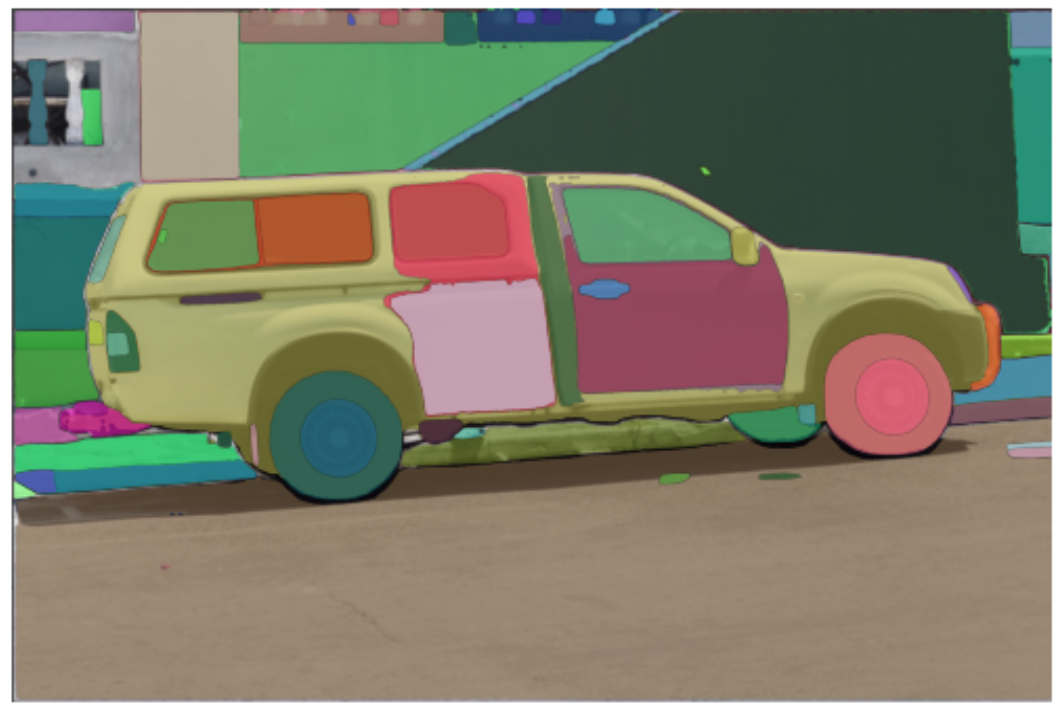 | |
| The abstract from the paper is the following: | |
| *We introduce the Segment Anything (SA) project: a new task, model, and dataset for image segmentation. Using our efficient model in a data collection loop, we built the largest segmentation dataset to date (by far), with over 1 billion masks on 11M licensed and privacy respecting images. The model is designed and trained to be promptable, so it can transfer zero-shot to new image distributions and tasks. We evaluate its capabilities on numerous tasks and find that its zero-shot performance is impressive -- often competitive with or even superior to prior fully supervised results. We are releasing the Segment Anything Model (SAM) and corresponding dataset (SA-1B) of 1B masks and 11M images at [https://segment-anything.com](https://segment-anything.com) to foster research into foundation models for computer vision.* | |
| Tips: | |
| - The model predicts binary masks that states the presence or not of the object of interest given an image. | |
| - The model predicts much better results if input 2D points and/or input bounding boxes are provided | |
| - You can prompt multiple points for the same image, and predict a single mask. | |
| - Fine-tuning the model is not supported yet | |
| - According to the paper, textual input should be also supported. However, at this time of writing this seems not to be supported according to [the official repository](https://github.com/facebookresearch/segment-anything/issues/4#issuecomment-1497626844). | |
| This model was contributed by [ybelkada](https://huggingface.co/ybelkada) and [ArthurZ](https://huggingface.co/ArthurZ). | |
| The original code can be found [here](https://github.com/facebookresearch/segment-anything). | |
| Below is an example on how to run mask generation given an image and a 2D point: | |
| ```python | |
| import requests | |
| import torch | |
| from PIL import Image | |
| from transformers import SamModel, SamProcessor | |
| model = SamModel.from_pretrained("facebook/sam-vit-huge", device_map="auto") | |
| processor = SamProcessor.from_pretrained("facebook/sam-vit-huge") | |
| img_url = "https://huggingface.co/ybelkada/segment-anything/resolve/main/assets/car.png" | |
| raw_image = Image.open(requests.get(img_url, stream=True).raw).convert("RGB") | |
| input_points = [[[450, 600]]] # 2D location of a window in the image | |
| inputs = processor(raw_image, input_points=input_points, return_tensors="pt").to(model.device) | |
| with torch.no_grad(): | |
| outputs = model(**inputs) | |
| masks = processor.image_processor.post_process_masks( | |
| outputs.pred_masks.cpu(), inputs["original_sizes"].cpu(), inputs["reshaped_input_sizes"].cpu() | |
| ) | |
| scores = outputs.iou_scores | |
| ``` | |
| You can also process your own masks alongside the input images in the processor to be passed to the model. | |
| ```python | |
| import requests | |
| import torch | |
| from PIL import Image | |
| from transformers import SamModel, SamProcessor | |
| model = SamModel.from_pretrained("facebook/sam-vit-huge", device_map="auto") | |
| processor = SamProcessor.from_pretrained("facebook/sam-vit-huge") | |
| img_url = "https://huggingface.co/ybelkada/segment-anything/resolve/main/assets/car.png" | |
| raw_image = Image.open(requests.get(img_url, stream=True).raw).convert("RGB") | |
| mask_url = "https://huggingface.co/ybelkada/segment-anything/resolve/main/assets/car.png" | |
| segmentation_map = Image.open(requests.get(mask_url, stream=True).raw).convert("1") | |
| input_points = [[[450, 600]]] # 2D location of a window in the image | |
| inputs = processor(raw_image, input_points=input_points, segmentation_maps=segmentation_map, return_tensors="pt").to(model.device) | |
| with torch.no_grad(): | |
| outputs = model(**inputs) | |
| masks = processor.image_processor.post_process_masks( | |
| outputs.pred_masks.cpu(), inputs["original_sizes"].cpu(), inputs["reshaped_input_sizes"].cpu() | |
| ) | |
| scores = outputs.iou_scores | |
| ``` | |
| ## Resources | |
| A list of official Hugging Face and community (indicated by 🌎) resources to help you get started with SAM. | |
| - [Demo notebook](https://github.com/huggingface/notebooks/blob/main/examples/segment_anything.ipynb) for using the model. | |
| - [Demo notebook](https://github.com/huggingface/notebooks/blob/main/examples/automatic_mask_generation.ipynb) for using the automatic mask generation pipeline. | |
| - [Demo notebook](https://github.com/NielsRogge/Transformers-Tutorials/blob/master/SAM/Run_inference_with_MedSAM_using_HuggingFace_Transformers.ipynb) for inference with MedSAM, a fine-tuned version of SAM on the medical domain. 🌎 | |
| - [Demo notebook](https://github.com/NielsRogge/Transformers-Tutorials/blob/master/SAM/Fine_tune_SAM_(segment_anything)_on_a_custom_dataset.ipynb) for fine-tuning the model on custom data. 🌎 | |
| ## SlimSAM | |
| SlimSAM, a pruned version of SAM, was proposed in [0.1% Data Makes Segment Anything Slim](https://huggingface.co/papers/2312.05284) by Zigeng Chen et al. SlimSAM reduces the size of the SAM models considerably while maintaining the same performance. | |
| Checkpoints can be found on the [hub](https://huggingface.co/models?other=slimsam), and they can be used as a drop-in replacement of SAM. | |
| ## Grounded SAM | |
| One can combine [Grounding DINO](grounding-dino) with SAM for text-based mask generation as introduced in [Grounded SAM: Assembling Open-World Models for Diverse Visual Tasks](https://huggingface.co/papers/2401.14159). You can refer to this [demo notebook](https://github.com/NielsRogge/Transformers-Tutorials/blob/master/Grounding%20DINO/GroundingDINO_with_Segment_Anything.ipynb) 🌍 for details. | |
| <img src="https://huggingface.co/datasets/huggingface/documentation-images/resolve/main/transformers/model_doc/grounded_sam.png" | |
| alt="drawing" width="900"/> | |
| Grounded SAM overview. Taken from the original repository. | |
| ## SamConfig[[transformers.SamConfig]] | |
| #### transformers.SamConfig[[transformers.SamConfig]] | |
| [Source](https://github.com/huggingface/transformers/blob/vr_39895/src/transformers/models/sam/configuration_sam.py#L144) | |
| This is the configuration class to store the configuration of a SamModel. It is used to instantiate a Sam | |
| model according to the specified arguments, defining the model architecture. Instantiating a configuration with the | |
| defaults will yield a similar configuration to that of the [facebook/sam-vit-huge](https://huggingface.co/facebook/sam-vit-huge) | |
| Configuration objects inherit from [PreTrainedConfig](/docs/transformers/pr_39895/en/main_classes/configuration#transformers.PreTrainedConfig) and can be used to control the model outputs. Read the | |
| documentation from [PreTrainedConfig](/docs/transformers/pr_39895/en/main_classes/configuration#transformers.PreTrainedConfig) for more information. | |
| Example: | |
| ```python | |
| >>> from transformers import ( | |
| ... SamVisionConfig, | |
| ... SamPromptEncoderConfig, | |
| ... SamMaskDecoderConfig, | |
| ... SamModel, | |
| ... ) | |
| >>> # Initializing a SamConfig with `"facebook/sam-vit-huge"` style configuration | |
| >>> configuration = SamConfig() | |
| >>> # Initializing a SamModel (with random weights) from the `"facebook/sam-vit-huge"` style configuration | |
| >>> model = SamModel(configuration) | |
| >>> # Accessing the model configuration | |
| >>> configuration = model.config | |
| >>> # We can also initialize a SamConfig from a SamVisionConfig, SamPromptEncoderConfig, and SamMaskDecoderConfig | |
| >>> # Initializing SAM vision, SAM Q-Former and language model configurations | |
| >>> vision_config = SamVisionConfig() | |
| >>> prompt_encoder_config = SamPromptEncoderConfig() | |
| >>> mask_decoder_config = SamMaskDecoderConfig() | |
| >>> config = SamConfig(vision_config, prompt_encoder_config, mask_decoder_config) | |
| ``` | |
| **Parameters:** | |
| vision_config (`Union[dict, ~configuration_utils.PreTrainedConfig]`, *optional*) : The config object or dictionary of the vision backbone. | |
| prompt_encoder_config (Union[`dict`, `SamPromptEncoderConfig`], *optional*) : Dictionary of configuration options used to initialize [SamPromptEncoderConfig](/docs/transformers/pr_39895/en/model_doc/sam#transformers.SamPromptEncoderConfig). | |
| mask_decoder_config (Union[`dict`, `SamMaskDecoderConfig`], *optional*) : Dictionary of configuration options used to initialize [SamMaskDecoderConfig](/docs/transformers/pr_39895/en/model_doc/sam#transformers.SamMaskDecoderConfig). | |
| initializer_range (`float`, *optional*, defaults to `0.02`) : The standard deviation of the truncated_normal_initializer for initializing all weight matrices. | |
| tie_word_embeddings (`bool`, *optional*, defaults to `True`) : Whether to tie weight embeddings according to model's `tied_weights_keys` mapping. | |
| ## SamVisionConfig[[transformers.SamVisionConfig]] | |
| #### transformers.SamVisionConfig[[transformers.SamVisionConfig]] | |
| [Source](https://github.com/huggingface/transformers/blob/vr_39895/src/transformers/models/sam/configuration_sam.py#L79) | |
| This is the configuration class to store the configuration of a SamModel. It is used to instantiate a Sam | |
| model according to the specified arguments, defining the model architecture. Instantiating a configuration with the | |
| defaults will yield a similar configuration to that of the [facebook/sam-vit-huge](https://huggingface.co/facebook/sam-vit-huge) | |
| Configuration objects inherit from [PreTrainedConfig](/docs/transformers/pr_39895/en/main_classes/configuration#transformers.PreTrainedConfig) and can be used to control the model outputs. Read the | |
| documentation from [PreTrainedConfig](/docs/transformers/pr_39895/en/main_classes/configuration#transformers.PreTrainedConfig) for more information. | |
| Example: | |
| ```python | |
| >>> from transformers import ( | |
| ... SamVisionConfig, | |
| ... SamVisionModel, | |
| ... ) | |
| >>> # Initializing a SamVisionConfig with `"facebook/sam-vit-huge"` style configuration | |
| >>> configuration = SamVisionConfig() | |
| >>> # Initializing a SamVisionModel (with random weights) from the `"facebook/sam-vit-huge"` style configuration | |
| >>> model = SamVisionModel(configuration) | |
| >>> # Accessing the model configuration | |
| >>> configuration = model.config | |
| ``` | |
| **Parameters:** | |
| hidden_size (`int`, *optional*, defaults to `768`) : Dimension of the hidden representations. | |
| output_channels (`int`, *optional*, defaults to 256) : Dimensionality of the output channels in the Patch Encoder. | |
| num_hidden_layers (`int`, *optional*, defaults to `12`) : Number of hidden layers in the Transformer decoder. | |
| num_attention_heads (`int`, *optional*, defaults to `12`) : Number of attention heads for each attention layer in the Transformer decoder. | |
| num_channels (`int`, *optional*, defaults to `3`) : The number of input channels. | |
| image_size (`Union[int, list[int], tuple[int, int]]`, *optional*, defaults to `1024`) : The size (resolution) of each image. | |
| patch_size (`Union[int, list[int], tuple[int, int]]`, *optional*, defaults to `16`) : The size (resolution) of each patch. | |
| hidden_act (`str`, *optional*, defaults to `gelu`) : The non-linear activation function (function or string) in the decoder. For example, `"gelu"`, `"relu"`, `"silu"`, etc. | |
| layer_norm_eps (`float`, *optional*, defaults to `1e-06`) : The epsilon used by the layer normalization layers. | |
| attention_dropout (`Union[float, int]`, *optional*, defaults to `0.0`) : The dropout ratio for the attention probabilities. | |
| initializer_range (`float`, *optional*, defaults to `1e-10`) : The standard deviation of the truncated_normal_initializer for initializing all weight matrices. | |
| qkv_bias (`bool`, *optional*, defaults to `True`) : Whether to add a bias to the queries, keys and values. | |
| mlp_ratio (`float`, *optional*, defaults to `4.0`) : Ratio of the MLP hidden dim to the embedding dim. | |
| use_abs_pos (`bool`, *optional*, defaults to `True`) : Whether to use absolute position embeddings. | |
| use_rel_pos (`bool`, *optional*, defaults to `True`) : Whether to use relative position embedding. | |
| window_size (`int`, *optional*, defaults to 14) : Window size for relative position. | |
| global_attn_indexes (`list[int]`, *optional*, defaults to `[2, 5, 8, 11]`) : The indexes of the global attention layers. | |
| num_pos_feats (`int`, *optional*, defaults to 128) : The dimensionality of the position embedding. | |
| mlp_dim (`int`, *optional*) : The dimensionality of the MLP layer in the Transformer encoder. If `None`, defaults to `mlp_ratio * hidden_size`. | |
| ## SamMaskDecoderConfig[[transformers.SamMaskDecoderConfig]] | |
| #### transformers.SamMaskDecoderConfig[[transformers.SamMaskDecoderConfig]] | |
| [Source](https://github.com/huggingface/transformers/blob/vr_39895/src/transformers/models/sam/configuration_sam.py#L49) | |
| This is the configuration class to store the configuration of a SamModel. It is used to instantiate a Sam | |
| model according to the specified arguments, defining the model architecture. Instantiating a configuration with the | |
| defaults will yield a similar configuration to that of the [facebook/sam-vit-huge](https://huggingface.co/facebook/sam-vit-huge) | |
| Configuration objects inherit from [PreTrainedConfig](/docs/transformers/pr_39895/en/main_classes/configuration#transformers.PreTrainedConfig) and can be used to control the model outputs. Read the | |
| documentation from [PreTrainedConfig](/docs/transformers/pr_39895/en/main_classes/configuration#transformers.PreTrainedConfig) for more information. | |
| **Parameters:** | |
| hidden_size (`int`, *optional*, defaults to `256`) : Dimension of the hidden representations. | |
| hidden_act (`str`, *optional*, defaults to `relu`) : The non-linear activation function (function or string) in the decoder. For example, `"gelu"`, `"relu"`, `"silu"`, etc. | |
| mlp_dim (`int`, *optional*, defaults to 2048) : Dimensionality of the "intermediate" (i.e., feed-forward) layer in the Transformer encoder. | |
| num_hidden_layers (`int`, *optional*, defaults to `2`) : Number of hidden layers in the Transformer decoder. | |
| num_attention_heads (`int`, *optional*, defaults to `8`) : Number of attention heads for each attention layer in the Transformer decoder. | |
| attention_downsample_rate (`int`, *optional*, defaults to 2) : The downsampling rate of the attention layer. | |
| num_multimask_outputs (`int`, *optional*, defaults to 3) : The number of outputs from the `SamMaskDecoder` module. In the Segment Anything paper, this is set to 3. | |
| iou_head_depth (`int`, *optional*, defaults to 3) : The number of layers in the IoU head module. | |
| iou_head_hidden_dim (`int`, *optional*, defaults to 256) : The dimensionality of the hidden states in the IoU head module. | |
| layer_norm_eps (`float`, *optional*, defaults to `1e-06`) : The epsilon used by the layer normalization layers. | |
| ## SamPromptEncoderConfig[[transformers.SamPromptEncoderConfig]] | |
| #### transformers.SamPromptEncoderConfig[[transformers.SamPromptEncoderConfig]] | |
| [Source](https://github.com/huggingface/transformers/blob/vr_39895/src/transformers/models/sam/configuration_sam.py#L24) | |
| This is the configuration class to store the configuration of a SamModel. It is used to instantiate a Sam | |
| model according to the specified arguments, defining the model architecture. Instantiating a configuration with the | |
| defaults will yield a similar configuration to that of the [facebook/sam-vit-huge](https://huggingface.co/facebook/sam-vit-huge) | |
| Configuration objects inherit from [PreTrainedConfig](/docs/transformers/pr_39895/en/main_classes/configuration#transformers.PreTrainedConfig) and can be used to control the model outputs. Read the | |
| documentation from [PreTrainedConfig](/docs/transformers/pr_39895/en/main_classes/configuration#transformers.PreTrainedConfig) for more information. | |
| **Parameters:** | |
| hidden_size (`int`, *optional*, defaults to `256`) : Dimension of the hidden representations. | |
| image_size (`Union[int, list[int], tuple[int, int]]`, *optional*, defaults to `1024`) : The size (resolution) of each image. | |
| patch_size (`Union[int, list[int], tuple[int, int]]`, *optional*, defaults to `16`) : The size (resolution) of each patch. | |
| mask_input_channels (`int`, *optional*, defaults to 16) : The number of channels to be fed to the `MaskDecoder` module. | |
| num_point_embeddings (`int`, *optional*, defaults to 4) : The number of point embeddings to be used. | |
| hidden_act (`str`, *optional*, defaults to `gelu`) : The non-linear activation function (function or string) in the decoder. For example, `"gelu"`, `"relu"`, `"silu"`, etc. | |
| layer_norm_eps (`float`, *optional*, defaults to `1e-06`) : The epsilon used by the layer normalization layers. | |
| ## SamProcessor[[transformers.SamProcessor]] | |
| #### transformers.SamProcessor[[transformers.SamProcessor]] | |
| [Source](https://github.com/huggingface/transformers/blob/vr_39895/src/transformers/models/sam/processing_sam.py#L82) | |
| Constructs a SamProcessor which wraps a image processor into a single processor. | |
| [SamProcessor](/docs/transformers/pr_39895/en/model_doc/sam#transformers.SamProcessor) offers all the functionalities of [SamImageProcessor](/docs/transformers/pr_39895/en/model_doc/sam#transformers.SamImageProcessor). See the | |
| [~SamImageProcessor](/docs/transformers/pr_39895/en/model_doc/sam#transformers.SamImageProcessor) for more information. | |
| __call__transformers.SamProcessor.__call__https://github.com/huggingface/transformers/blob/vr_39895/src/transformers/models/sam/processing_sam.py#L87[{"name": "images", "val": ": typing.Union[ForwardRef('PIL.Image.Image'), numpy.ndarray, ForwardRef('torch.Tensor'), list['PIL.Image.Image'], list[numpy.ndarray], list['torch.Tensor'], NoneType] = None"}, {"name": "text", "val": ": str | list[str] | list[list[str]] | None = None"}, {"name": "**kwargs", "val": ""}]- **images** (`Union[PIL.Image.Image, numpy.ndarray, torch.Tensor, list[PIL.Image.Image], list[numpy.ndarray], list[torch.Tensor]]`, *optional*) -- | |
| Image to preprocess. Expects a single or batch of images with pixel values ranging from 0 to 255. If | |
| passing in images with pixel values between 0 and 1, set `do_rescale=False`. | |
| - **text** (`Union[str, list[str], list[list[str]]]`, *optional*) -- | |
| The sequence or batch of sequences to be encoded. Each sequence can be a string or a list of strings | |
| (pretokenized string). If you pass a pretokenized input, set `is_split_into_words=True` to avoid ambiguity with batched inputs. | |
| - **return_tensors** (`str` or [TensorType](/docs/transformers/pr_39895/en/internal/file_utils#transformers.TensorType), *optional*) -- | |
| If set, will return tensors of a particular framework. Acceptable values are: | |
| - `'pt'`: Return PyTorch `torch.Tensor` objects. | |
| - `'np'`: Return NumPy `np.ndarray` objects.0`~tokenization_utils_base.BatchEncoding`- **data** (`dict`, *optional*) -- Dictionary of lists/arrays/tensors returned by the `__call__`/`encode_plus`/`batch_encode_plus` methods | |
| ('input_ids', 'attention_mask', etc.). | |
| - **encoding** (`tokenizers.Encoding` or `Sequence[tokenizers.Encoding]`, *optional*) -- If the tokenizer is a fast tokenizer which outputs additional information like mapping from word/character | |
| space to token space the `tokenizers.Encoding` instance or list of instance (for batches) hold this | |
| information. | |
| - **tensor_type** (`Union[None, str, TensorType]`, *optional*) -- You can give a tensor_type here to convert the lists of integers in PyTorch/Numpy Tensors at | |
| initialization. | |
| - **prepend_batch_axis** (`bool`, *optional*, defaults to `False`) -- Whether or not to add a batch axis when converting to tensors (see `tensor_type` above). Note that this | |
| parameter has an effect if the parameter `tensor_type` is set, *otherwise has no effect*. | |
| - **n_sequences** (`int`, *optional*) -- You can give a tensor_type here to convert the lists of integers in PyTorch/Numpy Tensors at | |
| initialization. | |
| **Parameters:** | |
| image_processor (`SamImageProcessor`) : The image processor is a required input. | |
| **Returns:** | |
| ``~tokenization_utils_base.BatchEncoding`` | |
| - **data** (`dict`, *optional*) -- Dictionary of lists/arrays/tensors returned by the `__call__`/`encode_plus`/`batch_encode_plus` methods | |
| ('input_ids', 'attention_mask', etc.). | |
| - **encoding** (`tokenizers.Encoding` or `Sequence[tokenizers.Encoding]`, *optional*) -- If the tokenizer is a fast tokenizer which outputs additional information like mapping from word/character | |
| space to token space the `tokenizers.Encoding` instance or list of instance (for batches) hold this | |
| information. | |
| - **tensor_type** (`Union[None, str, TensorType]`, *optional*) -- You can give a tensor_type here to convert the lists of integers in PyTorch/Numpy Tensors at | |
| initialization. | |
| - **prepend_batch_axis** (`bool`, *optional*, defaults to `False`) -- Whether or not to add a batch axis when converting to tensors (see `tensor_type` above). Note that this | |
| parameter has an effect if the parameter `tensor_type` is set, *otherwise has no effect*. | |
| - **n_sequences** (`int`, *optional*) -- You can give a tensor_type here to convert the lists of integers in PyTorch/Numpy Tensors at | |
| initialization. | |
| ## SamImageProcessor[[transformers.SamImageProcessor]] | |
| #### transformers.SamImageProcessor[[transformers.SamImageProcessor]] | |
| [Source](https://github.com/huggingface/transformers/blob/vr_39895/src/transformers/models/sam/image_processing_sam.py#L61) | |
| Constructs a SamImageProcessor image processor. | |
| preprocesstransformers.SamImageProcessor.preprocesshttps://github.com/huggingface/transformers/blob/vr_39895/src/transformers/models/sam/image_processing_sam.py#L79[{"name": "images", "val": ": typing.Union[ForwardRef('PIL.Image.Image'), numpy.ndarray, ForwardRef('torch.Tensor'), list['PIL.Image.Image'], list[numpy.ndarray], list['torch.Tensor']]"}, {"name": "segmentation_maps", "val": ": typing.Union[ForwardRef('PIL.Image.Image'), numpy.ndarray, ForwardRef('torch.Tensor'), list['PIL.Image.Image'], list[numpy.ndarray], list['torch.Tensor'], NoneType] = None"}, {"name": "**kwargs", "val": ": typing_extensions.Unpack[transformers.models.sam.image_processing_sam.SamImageProcessorKwargs]"}]- **images** (`Union[PIL.Image.Image, numpy.ndarray, torch.Tensor, list[PIL.Image.Image], list[numpy.ndarray], list[torch.Tensor]]`) -- | |
| Image to preprocess. Expects a single or batch of images with pixel values ranging from 0 to 255. If | |
| passing in images with pixel values between 0 and 1, set `do_rescale=False`. | |
| - **segmentation_maps** (`ImageInput`, *optional*) -- | |
| The segmentation maps to preprocess. | |
| - **mask_size** (`dict[str, *kwargs*, int]`, *optional*) -- | |
| The size `{"longest_edge": int}` to resize the segmentation maps to. | |
| - **mask_pad_size** (`dict[str, *kwargs*, int]`, *optional*) -- | |
| The size `{"height": int, "width": int}` to pad the segmentation maps to. Must be larger than any segmentation | |
| map size provided for preprocessing. | |
| - **return_tensors** (`str` or [TensorType](/docs/transformers/pr_39895/en/internal/file_utils#transformers.TensorType), *optional*) -- | |
| Returns stacked tensors if set to `'pt'`, otherwise returns a list of tensors. | |
| - ****kwargs** ([ImagesKwargs](/docs/transformers/pr_39895/en/main_classes/processors#transformers.ImagesKwargs), *optional*) -- | |
| Additional image preprocessing options. Model-specific kwargs are listed above; see the TypedDict class | |
| for the complete list of supported arguments.0`~image_processing_base.BatchFeature`- **data** (`dict`) -- Dictionary of lists/arrays/tensors returned by the __call__ method ('pixel_values', etc.). | |
| - **tensor_type** (`Union[None, str, TensorType]`, *optional*) -- You can give a tensor_type here to convert the lists of integers in PyTorch/Numpy Tensors at | |
| initialization. | |
| **Parameters:** | |
| mask_size (`dict[str, *kwargs*, int]`, *optional*) : The size `{"longest_edge": int}` to resize the segmentation maps to. | |
| mask_pad_size (`dict[str, *kwargs*, int]`, *optional*) : The size `{"height": int, "width": int}` to pad the segmentation maps to. Must be larger than any segmentation map size provided for preprocessing. | |
| - ****kwargs** ([ImagesKwargs](/docs/transformers/pr_39895/en/main_classes/processors#transformers.ImagesKwargs), *optional*) : Additional image preprocessing options. Model-specific kwargs are listed above; see the TypedDict class for the complete list of supported arguments. | |
| **Returns:** | |
| ``~image_processing_base.BatchFeature`` | |
| - **data** (`dict`) -- Dictionary of lists/arrays/tensors returned by the __call__ method ('pixel_values', etc.). | |
| - **tensor_type** (`Union[None, str, TensorType]`, *optional*) -- You can give a tensor_type here to convert the lists of integers in PyTorch/Numpy Tensors at | |
| initialization. | |
| ## SamImageProcessorPil[[transformers.SamImageProcessorPil]] | |
| #### transformers.SamImageProcessorPil[[transformers.SamImageProcessorPil]] | |
| [Source](https://github.com/huggingface/transformers/blob/vr_39895/src/transformers/models/sam/image_processing_pil_sam.py#L83) | |
| Constructs a SamImageProcessor image processor. | |
| preprocesstransformers.SamImageProcessorPil.preprocesshttps://github.com/huggingface/transformers/blob/vr_39895/src/transformers/models/sam/image_processing_pil_sam.py#L101[{"name": "images", "val": ": typing.Union[ForwardRef('PIL.Image.Image'), numpy.ndarray, ForwardRef('torch.Tensor'), list['PIL.Image.Image'], list[numpy.ndarray], list['torch.Tensor']]"}, {"name": "segmentation_maps", "val": ": typing.Union[ForwardRef('PIL.Image.Image'), numpy.ndarray, ForwardRef('torch.Tensor'), list['PIL.Image.Image'], list[numpy.ndarray], list['torch.Tensor'], NoneType] = None"}, {"name": "**kwargs", "val": ": typing_extensions.Unpack[transformers.models.sam.image_processing_pil_sam.SamImageProcessorKwargs]"}]- **images** (`Union[PIL.Image.Image, numpy.ndarray, torch.Tensor, list[PIL.Image.Image], list[numpy.ndarray], list[torch.Tensor]]`) -- | |
| Image to preprocess. Expects a single or batch of images with pixel values ranging from 0 to 255. If | |
| passing in images with pixel values between 0 and 1, set `do_rescale=False`. | |
| - **segmentation_maps** (`ImageInput`, *optional*) -- | |
| The segmentation maps to preprocess. | |
| - **mask_size** (`dict[str, *kwargs*, int]`, *optional*) -- | |
| The size `{"longest_edge": int}` to resize the segmentation maps to. | |
| - **mask_pad_size** (`dict[str, *kwargs*, int]`, *optional*) -- | |
| The size `{"height": int, "width": int}` to pad the segmentation maps to. Must be larger than any segmentation | |
| map size provided for preprocessing. | |
| - **return_tensors** (`str` or [TensorType](/docs/transformers/pr_39895/en/internal/file_utils#transformers.TensorType), *optional*) -- | |
| Returns stacked tensors if set to `'pt'`, otherwise returns a list of tensors. | |
| - ****kwargs** ([ImagesKwargs](/docs/transformers/pr_39895/en/main_classes/processors#transformers.ImagesKwargs), *optional*) -- | |
| Additional image preprocessing options. Model-specific kwargs are listed above; see the TypedDict class | |
| for the complete list of supported arguments.0`~image_processing_base.BatchFeature`- **data** (`dict`) -- Dictionary of lists/arrays/tensors returned by the __call__ method ('pixel_values', etc.). | |
| - **tensor_type** (`Union[None, str, TensorType]`, *optional*) -- You can give a tensor_type here to convert the lists of integers in PyTorch/Numpy Tensors at | |
| initialization. | |
| **Parameters:** | |
| mask_size (`dict[str, *kwargs*, int]`, *optional*) : The size `{"longest_edge": int}` to resize the segmentation maps to. | |
| mask_pad_size (`dict[str, *kwargs*, int]`, *optional*) : The size `{"height": int, "width": int}` to pad the segmentation maps to. Must be larger than any segmentation map size provided for preprocessing. | |
| - ****kwargs** ([ImagesKwargs](/docs/transformers/pr_39895/en/main_classes/processors#transformers.ImagesKwargs), *optional*) : Additional image preprocessing options. Model-specific kwargs are listed above; see the TypedDict class for the complete list of supported arguments. | |
| **Returns:** | |
| ``~image_processing_base.BatchFeature`` | |
| - **data** (`dict`) -- Dictionary of lists/arrays/tensors returned by the __call__ method ('pixel_values', etc.). | |
| - **tensor_type** (`Union[None, str, TensorType]`, *optional*) -- You can give a tensor_type here to convert the lists of integers in PyTorch/Numpy Tensors at | |
| initialization. | |
| ## SamVisionModel[[transformers.SamVisionModel]] | |
| #### transformers.SamVisionModel[[transformers.SamVisionModel]] | |
| [Source](https://github.com/huggingface/transformers/blob/vr_39895/src/transformers/models/sam/modeling_sam.py#L1080) | |
| The vision model from Sam without any head or projection on top. | |
| This model inherits from [PreTrainedModel](/docs/transformers/pr_39895/en/main_classes/model#transformers.PreTrainedModel). Check the superclass documentation for the generic methods the | |
| library implements for all its model (such as downloading or saving, resizing the input embeddings, pruning heads | |
| etc.) | |
| This model is also a PyTorch [torch.nn.Module](https://pytorch.org/docs/stable/nn.html#torch.nn.Module) subclass. | |
| Use it as a regular PyTorch Module and refer to the PyTorch documentation for all matter related to general usage | |
| and behavior. | |
| forwardtransformers.SamVisionModel.forwardhttps://github.com/huggingface/transformers/blob/vr_39895/src/transformers/models/sam/modeling_sam.py#L1092[{"name": "pixel_values", "val": ": torch.FloatTensor | None = None"}, {"name": "**kwargs", "val": ": typing_extensions.Unpack[transformers.utils.generic.TransformersKwargs]"}]- **pixel_values** (`torch.FloatTensor` of shape `(batch_size, num_channels, image_size, image_size)`, *optional*) -- | |
| The tensors corresponding to the input images. Pixel values can be obtained using | |
| [SamImageProcessor](/docs/transformers/pr_39895/en/model_doc/sam#transformers.SamImageProcessor). See `SamImageProcessor.__call__()` for details ([SamProcessor](/docs/transformers/pr_39895/en/model_doc/sam#transformers.SamProcessor) uses | |
| [SamImageProcessor](/docs/transformers/pr_39895/en/model_doc/sam#transformers.SamImageProcessor) for processing images).0`SamVisionEncoderOutput` or `tuple(torch.FloatTensor)`A `SamVisionEncoderOutput` or a tuple of | |
| `torch.FloatTensor` (if `return_dict=False` is passed or when `config.return_dict=False`) comprising various | |
| elements depending on the configuration ([SamConfig](/docs/transformers/pr_39895/en/model_doc/sam#transformers.SamConfig)) and inputs. | |
| The [SamVisionModel](/docs/transformers/pr_39895/en/model_doc/sam#transformers.SamVisionModel) forward method, overrides the `__call__` special method. | |
| Although the recipe for forward pass needs to be defined within this function, one should call the `Module` | |
| instance afterwards instead of this since the former takes care of running the pre and post processing steps while | |
| the latter silently ignores them. | |
| - **image_embeds** (`torch.FloatTensor` of shape `(batch_size, output_dim)` *optional* returned when model is initialized with `with_projection=True`) -- The image embeddings obtained by applying the projection layer to the pooler_output. | |
| - **last_hidden_state** (`torch.FloatTensor` of shape `(batch_size, sequence_length, hidden_size)`, *optional*) -- Sequence of hidden-states at the output of the last layer of the model. | |
| - **hidden_states** (`tuple[torch.FloatTensor, ...]`, *optional*, returned when `output_hidden_states=True` is passed or when `config.output_hidden_states=True`) -- Tuple of `torch.FloatTensor` (one for the output of the embeddings, if the model has an embedding layer, + | |
| one for the output of each layer) of shape `(batch_size, sequence_length, hidden_size)`. | |
| Hidden-states of the model at the output of each layer plus the optional initial embedding outputs. | |
| - **attentions** (`tuple[torch.FloatTensor, ...]`, *optional*, returned when `output_attentions=True` is passed or when `config.output_attentions=True`) -- Tuple of `torch.FloatTensor` (one for each layer) of shape `(batch_size, num_heads, sequence_length, | |
| sequence_length)`. | |
| Attentions weights after the attention softmax, used to compute the weighted average in the self-attention | |
| heads. | |
| **Parameters:** | |
| config ([SamVisionConfig](/docs/transformers/pr_39895/en/model_doc/sam#transformers.SamVisionConfig)) : Model configuration class with all the parameters of the model. Initializing with a config file does not load the weights associated with the model, only the configuration. Check out the [from_pretrained()](/docs/transformers/pr_39895/en/main_classes/model#transformers.PreTrainedModel.from_pretrained) method to load the model weights. | |
| **Returns:** | |
| ``SamVisionEncoderOutput` or `tuple(torch.FloatTensor)`` | |
| A `SamVisionEncoderOutput` or a tuple of | |
| `torch.FloatTensor` (if `return_dict=False` is passed or when `config.return_dict=False`) comprising various | |
| elements depending on the configuration ([SamConfig](/docs/transformers/pr_39895/en/model_doc/sam#transformers.SamConfig)) and inputs. | |
| ## SamModel[[transformers.SamModel]] | |
| #### transformers.SamModel[[transformers.SamModel]] | |
| [Source](https://github.com/huggingface/transformers/blob/vr_39895/src/transformers/models/sam/modeling_sam.py#L1107) | |
| Segment Anything Model (SAM) for generating segmentation masks, given an input image and | |
| input points and labels, boxes, or masks. | |
| This model inherits from [PreTrainedModel](/docs/transformers/pr_39895/en/main_classes/model#transformers.PreTrainedModel). Check the superclass documentation for the generic methods the | |
| library implements for all its model (such as downloading or saving, resizing the input embeddings, pruning heads | |
| etc.) | |
| This model is also a PyTorch [torch.nn.Module](https://pytorch.org/docs/stable/nn.html#torch.nn.Module) subclass. | |
| Use it as a regular PyTorch Module and refer to the PyTorch documentation for all matter related to general usage | |
| and behavior. | |
| forwardtransformers.SamModel.forwardhttps://github.com/huggingface/transformers/blob/vr_39895/src/transformers/models/sam/modeling_sam.py#L1190[{"name": "pixel_values", "val": ": torch.FloatTensor | None = None"}, {"name": "input_points", "val": ": torch.FloatTensor | None = None"}, {"name": "input_labels", "val": ": torch.LongTensor | None = None"}, {"name": "input_boxes", "val": ": torch.FloatTensor | None = None"}, {"name": "input_masks", "val": ": torch.LongTensor | None = None"}, {"name": "image_embeddings", "val": ": torch.FloatTensor | None = None"}, {"name": "multimask_output", "val": ": bool = True"}, {"name": "attention_similarity", "val": ": torch.FloatTensor | None = None"}, {"name": "target_embedding", "val": ": torch.FloatTensor | None = None"}, {"name": "**kwargs", "val": ": typing_extensions.Unpack[transformers.utils.generic.TransformersKwargs]"}]- **pixel_values** (`torch.FloatTensor` of shape `(batch_size, num_channels, image_size, image_size)`, *optional*) -- | |
| The tensors corresponding to the input images. Pixel values can be obtained using | |
| [SamImageProcessor](/docs/transformers/pr_39895/en/model_doc/sam#transformers.SamImageProcessor). See `SamImageProcessor.__call__()` for details ([SamProcessor](/docs/transformers/pr_39895/en/model_doc/sam#transformers.SamProcessor) uses | |
| [SamImageProcessor](/docs/transformers/pr_39895/en/model_doc/sam#transformers.SamImageProcessor) for processing images). | |
| - **input_points** (`torch.FloatTensor` of shape `(batch_size, num_points, 2)`) -- | |
| Input 2D spatial points, this is used by the prompt encoder to encode the prompt. Generally yields to much | |
| better results. The points can be obtained by passing a list of list of list to the processor that will | |
| create corresponding `torch` tensors of dimension 4. The first dimension is the image batch size, the | |
| second dimension is the point batch size (i.e. how many segmentation masks do we want the model to predict | |
| per input point), the third dimension is the number of points per segmentation mask (it is possible to pass | |
| multiple points for a single mask), and the last dimension is the x (vertical) and y (horizontal) | |
| coordinates of the point. If a different number of points is passed either for each image, or for each | |
| mask, the processor will create "PAD" points that will correspond to the (0, 0) coordinate, and the | |
| computation of the embedding will be skipped for these points using the labels. | |
| - **input_labels** (`torch.LongTensor` of shape `(batch_size, point_batch_size, num_points)`) -- | |
| Input labels for the points, this is used by the prompt encoder to encode the prompt. According to the | |
| official implementation, there are 3 types of labels | |
| - `1`: the point is a point that contains the object of interest | |
| - `0`: the point is a point that does not contain the object of interest | |
| - `-1`: the point corresponds to the background | |
| We added the label: | |
| - `-10`: the point is a padding point, thus should be ignored by the prompt encoder | |
| The padding labels should be automatically done by the processor. | |
| - **input_boxes** (`torch.FloatTensor` of shape `(batch_size, num_boxes, 4)`) -- | |
| Input boxes for the points, this is used by the prompt encoder to encode the prompt. Generally yields to | |
| much better generated masks. The boxes can be obtained by passing a list of list of list to the processor, | |
| that will generate a `torch` tensor, with each dimension corresponding respectively to the image batch | |
| size, the number of boxes per image and the coordinates of the top left and bottom right point of the box. | |
| In the order (`x1`, `y1`, `x2`, `y2`): | |
| - `x1`: the x coordinate of the top left point of the input box | |
| - `y1`: the y coordinate of the top left point of the input box | |
| - `x2`: the x coordinate of the bottom right point of the input box | |
| - `y2`: the y coordinate of the bottom right point of the input box | |
| - **input_masks** (`torch.FloatTensor` of shape `(batch_size, image_size, image_size)`) -- | |
| SAM model also accepts segmentation masks as input. The mask will be embedded by the prompt encoder to | |
| generate a corresponding embedding, that will be fed later on to the mask decoder. These masks needs to be | |
| manually fed by the user, and they need to be of shape (`batch_size`, `image_size`, `image_size`). | |
| - **image_embeddings** (`torch.FloatTensor` of shape `(batch_size, output_channels, window_size, window_size)`) -- | |
| Image embeddings, this is used by the mask decder to generate masks and iou scores. For more memory | |
| efficient computation, users can first retrieve the image embeddings using the `get_image_embeddings` | |
| method, and then feed them to the `forward` method instead of feeding the `pixel_values`. | |
| - **multimask_output** (`bool`, *optional*) -- | |
| In the original implementation and paper, the model always outputs 3 masks per image (or per point / per | |
| bounding box if relevant). However, it is possible to just output a single mask, that corresponds to the | |
| "best" mask, by specifying `multimask_output=False`. | |
| - **attention_similarity** (`torch.FloatTensor`, *optional*) -- | |
| Attention similarity tensor, to be provided to the mask decoder for target-guided attention in case the | |
| model is used for personalization as introduced in [PerSAM](https://huggingface.co/papers/2305.03048). | |
| - **target_embedding** (`torch.FloatTensor`, *optional*) -- | |
| Embedding of the target concept, to be provided to the mask decoder for target-semantic prompting in case | |
| the model is used for personalization as introduced in [PerSAM](https://huggingface.co/papers/2305.03048).0`SamImageSegmentationOutput` or `tuple(torch.FloatTensor)`A `SamImageSegmentationOutput` or a tuple of | |
| `torch.FloatTensor` (if `return_dict=False` is passed or when `config.return_dict=False`) comprising various | |
| elements depending on the configuration ([SamConfig](/docs/transformers/pr_39895/en/model_doc/sam#transformers.SamConfig)) and inputs. | |
| The [SamModel](/docs/transformers/pr_39895/en/model_doc/sam#transformers.SamModel) forward method, overrides the `__call__` special method. | |
| Although the recipe for forward pass needs to be defined within this function, one should call the `Module` | |
| instance afterwards instead of this since the former takes care of running the pre and post processing steps while | |
| the latter silently ignores them. | |
| - **iou_scores** (`torch.FloatTensor` of shape `(batch_size, num_masks)`) -- The iou scores of the predicted masks. | |
| - **pred_masks** (`torch.FloatTensor` of shape `(batch_size, num_masks, height, width)`) -- The predicted low resolutions masks. Needs to be post-processed by the processor | |
| - **vision_hidden_states** (`tuple(torch.FloatTensor)`, *optional*, returned when `output_hidden_states=True` is passed or when `config.output_hidden_states=True`) -- Tuple of `torch.FloatTensor` (one for the output of the embeddings, if the model has an embedding layer, + | |
| one for the output of each layer) of shape `(batch_size, sequence_length, hidden_size)`. | |
| Hidden-states of the vision model at the output of each layer plus the optional initial embedding outputs. | |
| - **vision_attentions** (`tuple(torch.FloatTensor)`, *optional*, returned when `output_attentions=True` is passed or when `config.output_attentions=True`) -- Tuple of `torch.FloatTensor` (one for each layer) of shape `(batch_size, num_heads, sequence_length, | |
| sequence_length)`. | |
| Attentions weights after the attention softmax, used to compute the weighted average in the self-attention | |
| heads. | |
| - **mask_decoder_attentions** (`tuple(torch.FloatTensor)`, *optional*, returned when `output_attentions=True` is passed or when `config.output_attentions=True`) -- Tuple of `torch.FloatTensor` (one for each layer) of shape `(batch_size, num_heads, sequence_length, | |
| sequence_length)`. | |
| Attentions weights after the attention softmax, used to compute the weighted average in the self-attention | |
| heads. | |
| Example: | |
| ```python | |
| >>> from PIL import Image | |
| >>> import httpx | |
| >>> from io import BytesIO | |
| >>> from transformers import AutoModel, AutoProcessor | |
| >>> model = AutoModel.from_pretrained("facebook/sam-vit-base") | |
| >>> processor = AutoProcessor.from_pretrained("facebook/sam-vit-base") | |
| >>> url = "https://huggingface.co/datasets/huggingface/documentation-images/resolve/main/transformers/model_doc/sam-car.png" | |
| >>> with httpx.stream("GET", url) as response: | |
| ... raw_image = Image.open(BytesIO(response.read())).convert("RGB") | |
| >>> input_points = [[[400, 650]]] # 2D location of a window on the car | |
| >>> inputs = processor(images=raw_image, input_points=input_points, return_tensors="pt") | |
| >>> # Get segmentation mask | |
| >>> outputs = model(**inputs) | |
| >>> # Postprocess masks | |
| >>> masks = processor.post_process_masks( | |
| ... outputs.pred_masks, inputs["original_sizes"], inputs["reshaped_input_sizes"] | |
| ... ) | |
| ``` | |
| **Parameters:** | |
| config ([SamConfig](/docs/transformers/pr_39895/en/model_doc/sam#transformers.SamConfig)) : Model configuration class with all the parameters of the model. Initializing with a config file does not load the weights associated with the model, only the configuration. Check out the [from_pretrained()](/docs/transformers/pr_39895/en/main_classes/model#transformers.PreTrainedModel.from_pretrained) method to load the model weights. | |
| **Returns:** | |
| ``SamImageSegmentationOutput` or `tuple(torch.FloatTensor)`` | |
| A `SamImageSegmentationOutput` or a tuple of | |
| `torch.FloatTensor` (if `return_dict=False` is passed or when `config.return_dict=False`) comprising various | |
| elements depending on the configuration ([SamConfig](/docs/transformers/pr_39895/en/model_doc/sam#transformers.SamConfig)) and inputs. | |
Xet Storage Details
- Size:
- 43.4 kB
- Xet hash:
- 54b324caf0e6a1e8d3d0eed7ff13593c553c7034e24ffea6dd3a24ab967dcbcb
·
Xet efficiently stores files, intelligently splitting them into unique chunks and accelerating uploads and downloads. More info.