
Buckets:

Title: Culture In a Frame: C3B as a Comic-Based Benchmark for Multimodal Culturally Awareness
URL Source: https://arxiv.org/html/2510.00041
Markdown Content: Yuchen Song 1, Andong Chen 1, Wenxin Zhu 1, Kehai Chen 2, Xuefeng Bai 2,
Muyun Yang 1, Tiejun Zhao 1
1 Harbin Institute of Technology, Harbin, China
2 Harbin Institute of Technology, Shenzhen, China
songyuchn@126.com, ands691119@gmail.com, 25S003048@stu.hit.edu.cn
{chenkehai, baixuefeng, yangmuyun, tjzhao}@hit.edu.cn
🌍 : https://c3b-benchmark.github.io/
Abstract
Cultural awareness capabilities has emerged as a critical capability for Multimodal Large Language Models (MLLMs). However, current benchmarks lack progressed difficulty in their task design and are deficient in cross-lingual tasks. Moreover, current benchmarks often use real-world images. Each real-world image typically contains one culture, making these benchmarks relatively easy for MLLMs. Based on this, we propose C 3 B (C omics C ross-C ultural B enchmark), a novel multicultural, multitask and multilingual cultural awareness capabilities benchmark. C 3 B comprises over 2000 images and over 18000 QA pairs, constructed on three tasks with progressed difficulties, from basic visual recognition to higher-level cultural conflict understanding, and finally to cultural content generation. We conducted evaluations on 11 open-source MLLMs, revealing a significant performance gap between MLLMs and human performance. The gap demonstrates that C 3 B poses substantial challenges for current MLLMs, encouraging future research to advance the cultural awareness capabilities of MLLMs.
1 Introduction

Figure 1: Comparison between C 3 B and previous culture awareness capability benchmarks. In comparison with existing benchmarks for cultural awareness capabilities, C 3 B is compatible with multicultural, multilingual, and multitask contexts, thereby facilitating a more thorough evaluation.
Multimodal Large Language Models (MLLMs) have become more and more important in many aspects of daily living, such as machine translation(Chen et al., 2025), image captioning(Anantha Ramakrishnan et al., 2025) and visual question answering(Huynh et al., 2025). Users who interact with these models often discover such a situation: current models perform well in a Western-centric culture context but perform badly in non-Western culture contexts(Singh et al., 2025, Nayak et al., 2024, AlKhamissi et al., 2024, Burda-Lassen et al., 2025, Naous et al., 2024). This imbalance shows that MLLMs need to improve cultural awareness capabilities which refers to capabilities of MLLMs to understand and process cultural contexts(Pawar et al., 2024).
Benchmarks are essential to build MLLMs with strong cultural awareness capabilities(Cohen and Howe, 1988, Reuel et al., 2024). While existing benchmarks have laid a foundational framework for evaluation, there remains room for improvement. From a multicultral perspective, existing benchmarks for evaluating cultural awareness capabilities of MLLMs mainly focus on real-world images(Arora et al., 2025, Romero et al., 2024, Xu et al., 2025). A single real-world image typically contains one culture, making these benchmarks relatively easy for MLLMs. From a multitask perspective, most of these benchmarks include one question per data sample, which makes it difficult to evaluate MLLMs across multiple dimensions. From a multilingual perspective, languages are carriers of cultural meaning (Kramsch, 2014). A concept may have no direct equivalent expression across languages. Therefore, adding multi-lingual tasks to benchmarks will introduce appropriate complexity, enabling us to evaluate MLLMs more comprehensively.
To address these issues, we propose C 3 B (C omics C ross-C ultural B enchmark), a novel multicultural, multitask and multilingual cultural awareness capabilities benchmark, containing 2220 images and 18789 QA pairs. In contrast to real-world images, we select comics as the primary medium in our benchmark. Comics differ from real-world images: they often depict a fictional scene. Real-world images often tied to the specific, singular cultural contexts of real-life scenarios, but fictional scenes in comics are free from such constraints. This enables comics to condense numerous cultures into a single frame, creating a more complex context, raising the bar for evaluation. C 3 B consists of 3 tasks that form a logical chain. Based on difficulty levels, these tasks progress from basic visual recognition to higher-level cultural conflict understanding, and finally to cultural content generation. This multitask arrangement enables a more comprehensive evaluation of MLLMs. In cultural generation task, C 3 B incorporates 5 languages (Japanese, Russian, Thai, English, and Spanish), reducing the limitations of previous monolingual benchmarks. The differences between C 3 B and previous cultural awareness capability benchmarks are presented in Figure 1.
In this study, we conduct a comprehensive evaluation of 11 open-source MLLMs on C 3 B. The results confirm the value of C 3 B, as they reveal a significant performance gap between MLLMs and human performance. Furthermore, the results provide critical insights into the current state of cultural awareness capabilities of MLLMs. Specifically, MLLMs should enhance their understanding of lesser-known cultures and their abilities to process cultural conflicts. Our contributions can be summarized as follows:
- 1.We propose C 3 B, a novel comic-centric, multicultural, multitask and multilingual cultural awareness capabilities benchmark.
- 2.C 3 B incorporates 3 tasks with escalating difficulty, evaluating cultural awareness capabilities of MLLMs comprehensively through progressively challenging tasks.
- 3.We benchmark 11 MLLMs with C 3 B, which presents an initial set of evaluations on this benchmark, establishing a baseline for future research on MLLMs with strong cultural awareness capabilities.
2 Related Work
2.1 Multimodal Large Language Models
Recent years have witnessed rapid advancements in Multimodal Large Language Models (MLLMs). The multimodal capabilities of MLLMs enable large language models to address a broader range of tasks(Caffagni et al., 2024). Models like BLIP-2 (Li et al., 2023), LLaVA (Liu et al., 2023b; 2024; a) and Qwen-VL(Bai et al., 2023) perform well in tasks such as visual question answering(Dong et al., 2024) and multimodal machine translation(Chen et al., 2025). Moreover, InternLM-XC2.5(Zhang et al., 2024) has good long-contextual input and output capabilities, which enables many advanced features, such as high resolution image understanding. Llama3.2 series models(Grattafiori et al., 2024) are optimized for many multimodal tasks, becoming baseline for many methods.
2.2 Multimodal Benchmark on Cultural Awareness Capabilities
Recent multimodal benchmarks on cultural awareness capabilities mainly focus on real-world images to evaluate MLLMs. Among various recent benchmarks(Romero et al., 2024, Burda-Lassen et al., 2025, Arora et al., 2025, Schneider et al., 2025, Yang et al., 2025), CVQA (Romero et al., 2024) adopts a multiple-choice format to evaluate the cultural awareness capabilities of MLLMs using real-world images. Notably, CVQA covers 30 languages, enabling evaluation from a multilingual perspective. CVQA relies on a single form of task, restricting its ability to comprehensively evaluate the cultural awareness capabilities of MLLMs across diverse interaction scenarios. CulturalVQA(Nayak et al., 2024) also evaluates MLLMs with real-world images, covering 11 countries in 2378 images. More recently, GIMMICK(Schneider et al., 2025) incorporates six tasks for evaluating the cultural awareness capabilities of MLLMs. The images included still exhibit relatively low cultural density. Overall, C 3 B integrates the advantages of these benchmarks, forming a multitask, multicultural, and multilingual benchmark.
2.3 Multimodal Benchmarks on Comics
Multimodal benchmarks centered on comics primarily focus on basic visual tasks. For Western-style comics, the eBDtheque dataset (Guérin et al., 2013) was the first publicly released comic dataset, featuring spatial and semantic annotations for 100 pages of Western comics. The COMICS dataset (Iyyer et al., 2017) includes over 1.2 million comic panels, offering resources for future research. For Japanese-style comics, Manga109 (Matsui et al., 2016) comprises 21,142 comics pages, with a primary focus on multimedia applications. More recently, CoMix (Vivoli et al., 2024) integrates comics and comicss into a new dataset but remains focused on visual tasks such as speaker identification and character naming.
Given the current landscape of multimodal benchmarks for cultural awareness capabilities and comics, we propose C 3 B. The differences between C 3 B and previous works are presented in Table 1. From the table, we observe that benchmarks for evaluating cultural awareness capabilities have not simultaneously integrated multicultural images, multitask settings, and multilingual tasks. Additionally, none of them incorporate progressive difficulty tiers. Regarding comic-centered datasets, most are not designed for cultural evaluation purposes.
Table 1: The difference between C 3 B and previous works. We analyze the works along three dimensions: whether the dataset is Multicultural for every image, Multitask for every data sample, Multilingual, whether its primary task is Cultural Awareness Capabilities and whether the tasks within have Progressed Difficulty.
Benchmarks Multicultural Multitask Multilingual Cultural Awareness Capabilities Progressed Difficulty CVQA(Romero et al., 2024)✗✗✔✔✗ MOSAIC-1.5k(Burda-Lassen et al., 2025)✗✗✗✔✗ CoMix(Vivoli et al., 2024)✔✗✗✗✗ eBDtheque(Guérin et al., 2013)✔✗✗✗✗ Manga109(Matsui et al., 2016)✔✗✗✗✗ CulturalVQA(Arora et al., 2025)✗✗✗✔✗ GIMMICK(Schneider et al., 2025)✔✔✗✔✗ C 3 B✔✔✔✔✔
3 C 3 B: Comics Cross-Cultural Understanding Benchmark
C 3 B is a novel comic-centric benchmark designed to comprehensively evaluate MLLMs’ cultural awareness capabilities. C 3 B features a multicultural diversity, a multitask setting and a multilingual coverage. To comprehensively evaluate MLLMs, C 3 B incorporates three tasks with increasing difficulty (detailed in Section 3.1). For data construction (detailed in Section 3.2), we design a multi-agent method to create culturally rich comics and their annotations, ensuring both efficiency and quality of images. In Section 3.3, some necessary statistics of C 3 B is presented. An overview of C 3 B is presented in Figure 2. Some data samples of C 3 B is presented in Appendix B.
3.1 Tasks
We design 3 tasks with escalating difficulty to evaluate different dimensions of cultural awareness capabilities of MLLMs. The first task, Culture-aware Object Extraction (Extraction@Culture), evaluates the visual recognition and basic cultural understanding capabilities of MLLMs. The second task, Cultural-conflict Object Detection (Conflict@Culture), focuses on evaluating their abilities to understand cultural conflicts. The third task, Culturally-aligned Content Generation (Generation@Culture), measures their multilingual generation capabilities when provided multimodal cultural contexts. The question template for each task is presented in Appendix A.
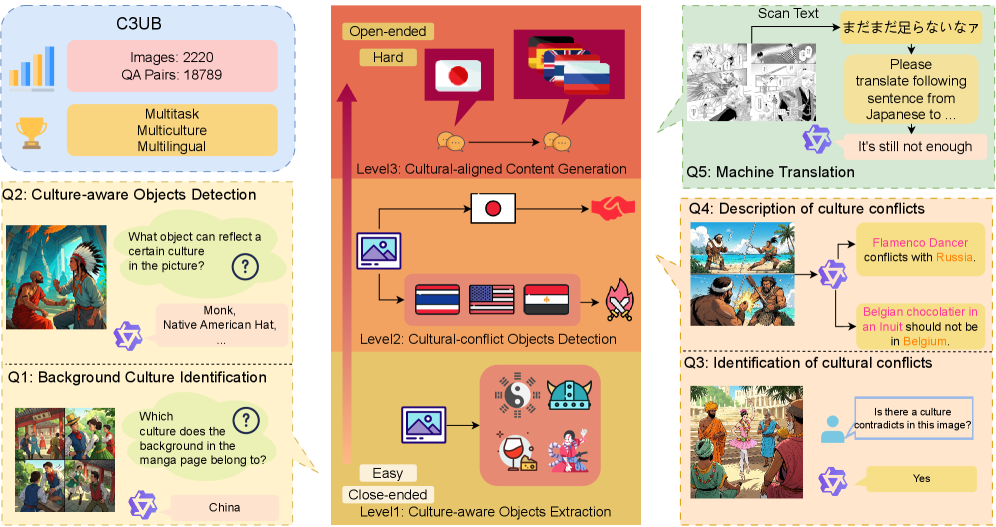
Figure 2: Overview of C 3 B. C 3 B evaluates MLLMs across three dimensions: Object Identification (foundational vision capability based on culture), Conflict Identification (cultural conflict understanding), and Culturally-aligned Content Generation (comprehensive cultural generation).
Culture-aware Objects Extraction (Extraction@Culture) This task requires the MLLM not only to identify objects within the image but also to understand whether or not the object is related to a specific cultural context. In this task, we set two questions:
- 1.Question 1 (Q1): Background Culture Identification We task MLLMs with identifying the background culture of comic pages. Multiple valid answers may exist for a single question.
- 2.Question 2 (Q2): Culture-aware Objects Detection In this question, MLLMs are required to identify all culturally representative objects in the image. We set up multiple options, with each option including several culturally representative objects. The MLLM needs to choose an option that contains exactly all the objects present in the image.
Cultural-conflict Objects Detection (Conflict@Culture) This task is designed to evaluate MLLMs’ capabilities in identifying culturally conflicts within comics. In this task, we also set two questions:
- 1.Question 3 (Q3): Identification of cultural conflicts In this question, MLLMs must determine whether there is cultural conflict in the presented image.
- 2.Question 4 (Q4): Description of culture conflicts When cultural conflict is detected, the MLLM is subsequently required to specify which objects of the answer to Q2 contradict the culture to the answer of Q1.
Culturally-aligned Content Generation (Generaion@Culture) This task is designed to evaluate the cultural generation capabilities of MLLMs. As for the specific task form, we select machine translation. We have set up translation tasks for the language pairs of Japanese-English (JA-EN), Japanese-Russian (JA-RU), Japanese-German (JA-DE), Japanese-Thai (JA-TH), and Japanese-Spanish (JA-ES). These language pairs roughly cover languages from various continents, enabling a comprehensive evaluation of the overall translation capabilities of MLLMs.
3.2 Construction of C 3 B
The construction process of C 3 B comprises two parts: image collection and annotation. An overview of the entire process is presented in Figure 3.
Image Collection For task Extraction@Culture and Conflict@Culture, we design a comic generation pipeline with the help of doubao APIs 1 1 1https://www.volcengine.com/. The pipeline consists of two key stages: (1) prompt generation to specify cultural conflict scenarios, followed by (2) image creation based on generated prompts. This process is illustrated in Figure 3a.
For the Generation@Culture task, we source images from Manga109(Matsui et al., 2016). We manually selected 1197 comics images that are closely related to culture and contain more culturally representative objects as well as cultural conflicts.
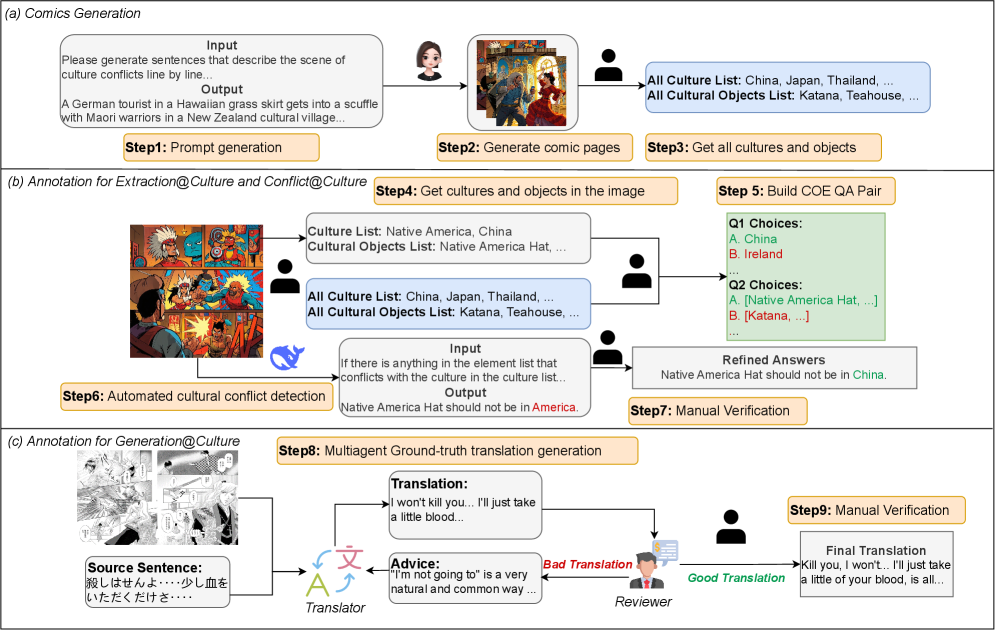
Figure 3: The construction process of C 3 B. The process contains 3 steps: Comics Generation, Annotation for Extraction@Culture and Conflict@Culture and Annotation for Generation@Culture.
Annotation Annotation for task Extraction@Culture and Conflict@Culture refers to the process of QA pairs creation (illustrated in Figure 3b). For task Extraction@Culture, we first manually compiled two lists: one containing all distinct cultures present in the comic pages, and the other listing all culturally representative objects. Next, we manually created QA pairs for each comic page. For Q1, we identified the cultures presented in a given image, then randomly selected additional cultures from the precompiled culture list to form a total of 5 options. For Q2, we first manually created a list of all culturally representative objects in the image, then generated 5 options by randomly modifying this list by either adding one object, deleting one object, or deleting two objects.
For task Conflict@Culture, we implemented an annotation pipeline consisting of two stages with the help of Deepseek-V3(DeepSeek-AI, 2024) (illustrated in Figure 3c). The prompt setting is presented in Appendix C.1. The details of the pipeline is:
- 1.Automated Cultural Conflict Detection: Given the background cultures and culturally representative objects in the comics page, Deepseek will analyze each object to identify if the object conflicts with one of the background cultures. After this, it will generate either a formatted conflict description or "No".
- 2.Manual Verification and Correction: We will manually inspect all generated results, focusing primarily on verifying whether the model misjudged the existence of conflicts. Subsequent to this, we will check if the generated formatted conflict descriptions contained formatting inconsistencies or culture-related inaccuracies. The examples of these two kinds of errors are presented in Appendix D.
For task Generation@Culture, annotation refers to the process of creating ground-truth translations. We design a multi-agent process to generate ground-truth translations, which involves two specialized agents: (1) a Translator responsible for generating translations, and (2) a Reviewer responsible for checking the translation based on the input sentence and giving suggestions. The Translator first provides a rough translation based on the extracted dialog from Manga109. If the Reviewer regards the translation as good translation, we will conduct manual verification to finalize the translation. Otherwise, the Reviewer will examine three specific types of potential errors: contextual inconsistencies, basic translation errors, and culture-related inaccuracies. The suggestions generated by the Reviewer are subsequently integrated into the prompt. The Translator will use it to produce a new translation. In the annotation process, we employed DeepSeek-V3 as the base model, with the prompt used presented in C.2.
3.3 Data Statistics
To ensure a comprehensive evaluation, C 3 B includes a total of 2,220 images and more than 18000 QA pairs. An overall statistics of C 3 B is presented in Table 4.

Figure 4: The cultures C 3 B covers are presented in a world map. Regions shaded in blue indicate that the culture is included in C 3 B.
Table 2: Statistics of C 3 B.
In task Extraction@Culture, there are 1023 images. Each image corresponds to one QA pair. In Q1, the number of correct numbers ranges from 1 to 5 among 5 candidate options. This variability increases the difficulty for MLLMs to process the task.
In task Conflict@Culture, the images used are the same as task Extraction@Culture, covering both Japanese comics and American comic styles. This design choice is intentional because the Extraction@Culture and Conflict@Culture tasks evaluate the visual signal processing capabilities of MLLMs. In these two tasks, introducing comics of different styles would make the process more complicated and challenging.
In task Generation@Culture, each QA pair consists of a source sentence and its ground-truth translation in 5 languages. All 16743 QA pairs cover 77 distinct cultures (visualized in Figure 4), enabling us to comprehensively benchmark the understanding different cultures of MLLMs.
4 C 3 B Evaluation on Existing LLMs
Models To evaluate performance of MLLMs on our C 3 B benchmark, we choose 11 open-source MLLMs. Specifically, we select SPHINX(Lin et al., 2023), Monkey(Li et al., 2024), MiniGPT-v2(Chen et al., 2023), mPLUG-Ow13(Ye et al., 2024), LLaVA family models(Liu et al., 2023b; 2024; a), InternLM-XC2.5(Zhang et al., 2024), Llama3.2(Grattafiori et al., 2024), Qwen2.5-VL(Bai et al., 2025) and InternVL2(Chen et al., 2024).
Metrics For task Extraction@Culture and Conflict@Culture, we use accuracy (ACC) as the evaluation metric. For Q4, because it is constructed based on models’ answers to Q1 and Q2, we have designed a composite ACC metric CACC:
CACC(Q 4)=a×ACC(Q 1)+b×ACC(Q 2)+c×ACC(Q 4)\text{CACC}(Q_{4})=a\times\text{ACC}(Q_{1})+b\times\text{ACC}(Q_{2})+c\times\text{ACC}(Q_{4})(1)
where a,b,c a,b,c represent preset weighting parameters, ACC(Q i)\text{ACC}(Q_{i}) denotes the accuracy score for Question i i. These weighting parameters quantify the respective contributions to the final evaluation. In our experiments, the values of a,b,c a,b,c are 0.3, 0.3 and 0.4. Q1 and Q2 contribute approximately equally to Q4, while Q4 should dominate. To simultaneously consider the contributions of the three tasks, we set the hyperparameters in this way.
For Generation@Culture, we adopt the conventional metric BLEU(Papineni et al., 2002), supplemented by COMET(Rei et al., 2022) and BLEURT(Sellam et al., 2020) to align with current standards in LLM-based translation research.
Evaluation Settings All evaluations were conducted on a Ubuntu server equipped with an H20-NVLink GPU featuring 96GB of memory. We adhered strictly to the official inference example codes provided by the respective model developers.
5 Experiment Results
5.1 Main Results for task Extraction@Culture and Conflict@Culture
Table 3: Main Results of task Extraction@Culture and Conflict@Culture in C3UB. For task Conflict@Culture, two types of accuracy metrics are used to evaluate model performance. Specifically, Q4 is constructed based on the answer of MLLM to Q1 and Q2. The calculation process of CACC of Q4 considers the answers to Q1 and Q2. In contrast, ACC refers to the accuracy of Q4 calculated without referencing answers to Q1 and Q2. The highest performance is marked in bold.
Table 3 presents the results for task Extraction@Culture and Conflict@Culture. Qwen2.5-VL demonstrates optimal performance, with Q1 outperforming the second-ranked models (InternLM-XC2.5, Llama3.2 and InternVL2) by 7.7 points and Q4 achieving a 1.6-point lead over the second-ranked model (Llama3.2). We also find that all models achieve extremely low ACC in Q4 due to the influence from Q1 and Q2.
As for task Extraction@Culture, in Q1, LLaVA-NeXT performs the worst, because it tends to describe the image rather than answer the question directly. We name this phenomenon as "Turn-a-deaf-ear" (shown in Appendix E.1). In Q2, Llama3.2 performs the best, exceeding average performance by 72.7%. In this task, LLaVA1.5-7B performs the worst, because it keeps answering "A". We name this failure pattern as "Take-a-shot-in-the-dark" and an example is shown in Appendix E.2.
As for task Conflict@Culture, in Q3, SPHINX performs the best, exceeding the second-ranked model (InternLM-XC2.5 and InternVL2) by 0.7 points. In Q4, we find that models from the LLaVA series yield considerably lower results. Specifically, both LLaVA1.5-7B and LLaVA-NeXT achieves 0.00 ACC. Through case study (detailed in Appendix E.3), we find that, LLaVA-NeXT persistently outputs "Nothing", indicating a lack of cultural conflict comprehension capability, while LLaVA1.5-7B cannot follow instructions properly, and we name this phenomenon as "stubbornness".
5.2 Main Results for task Generation@Culture
Table 4 shows the results for task Generation@Culture. The results show that Qwen-2.5-VL demonstrates the most robust multilingual capabilities, as it outperforms other models across all cultural generation tasks. In contrast, MiniGPT-v2 exhibits notably poor performance. Specifically, it achieves a BLEU score of 0 in most tasks. This underperformance can be attributed to the weak instruction-following ability, as presented in Appendix E.4. This error pattern might be caused by the poor understanding capability of comic pages. Additionally, LLaVA-NeXT tends to repeat the source sentence when handling the tasks except JA-EN. Among all tasks, the performance of all models in JA-TH is the poorest while they all perform the best in JA-EN tasks. These results indicate that the multilingual capabilities when given cultural contexts needs to be enhanced, and greater support for low-resource languages should also be strengthened.
Table 4: Main Result of task Generation@Culture. The result is presented in the format BLEU/COMET/BLEURT. The highest performance is marked in bold.
5.3 Impact for Q4 from Q1 and Q2
Table 5: Performance of Q4 when answers to Q1 and/or Q2 are omitted. Q1/Q2 Answer means that only Q1/Q2 answer is provided. Q1&Q2 Answer means both Q1 and Q2 answers are provided.
In C 3 B, answering Q4 requires models to correctly answer Q1 and Q2. To evaluate the influence of Q1 and Q2 on Q4, we first calculate the correlation coefficients (Formula 2) between Q1 and Q4 and between Q2 and Q4, which yielded values of 0.56 and 0.51, respectively. The result demonstrates that Q1 and Q2 exhibit a moderate correlations with Q4.
R(Q i,Q 4)=Cov(ACC(Q i),ACC(Q 4))Var(ACC(Q i))Var(ACC(Q 4))R(Q_{i},Q_{4})=\frac{\mathrm{Cov}(\text{ACC}(Q_{i}),\text{ACC}(Q_{4}))}{\sqrt{\text{Var}(\text{ACC}(Q_{i}))\text{Var}(\text{ACC}(Q_{4}))}}(2)
where R R represents the correlation coefficient between two questions, Cov refers to the covariance, Var refers to the variance, and ACC(Q i)\text{ACC}(Q_{i}) is the accuracy value of Question i i.
Moreover, we conducted an ablation study on Q1 and Q2. We added the answers to Q1/Q2 into the prompt template of Q4 to observe the impact on model performance. CACC represents the average performance of all 11 MLLMs, and the results are presented in Table 5. The results indicate that incorporating the Q1 answer into the Q4 prompt will enhance performance (+0.003), but adding the Q2 answer will not change the performance. The greatest performance boost is observed when both Q1 and Q2 answers are included (+0.533). Although Q1 and Q2 show moderate correlations with Q4 (0.56 and 0.51), the ablation results reveal only marginal improvement when adding Q1/Q2 answers. This suggests that the positive correlations mainly reflect an intrinsic consistency across related questions, while the direct prompt incorporation of Q1/Q2 answers is not always effectively leveraged by MLLMs.
5.4 Generated Comic Pages Analysis
To evaluate the cultural diversity in C 3 B, we developed the Culture Density Per Image (CDPI), Cultural Breadth Intensity (CBI) and Coverage Adjusted Density (CAD) across C 3 B and comparable cultural QA datasets. CBI directly integrates cultural density with cultural breadth, while CAD applies log-scaling to avoid excessive rewards from large culture lists. The CDPI, CBI and CAD of a dataset are: CDPI(D)=1|D|∑i=1 n CultureInImage(I i)\text{CDPI}(D)=\frac{1}{|D|}\sum_{i=1}^{n}\text{CultureInImage}(I_{i}), CBI(D)=CDPI(D)×N cultures\text{CBI}(D)=\text{CDPI}(D)\times N_{\text{cultures}} and CAD(D)=CDPI(D)×log 2(N cultures+1)\text{CAD}(D)=\text{CDPI}(D)\times\log_{2}(N_{\text{cultures}}+1). D D represents a complete image dataset, which is {I 1,I 2,⋯,I n}{I_{1},I_{2},\cdots,I_{n}}, CultureInImage(I i)\text{CultureInImage}(I_{i}) denotes the number of cultures in the image I i I_{i}, N cultures N_{\text{cultures}} refers to the number of cultures occurring in the dataset and |D||D| as the cardinality of D D, corresponding to the total number of images.
Table 6: Statistics of different culture-related datasets.
The results are presented in Table 6, indicating that C 3 B shows significantly higher cultural diversity compared to similar datasets. This highlights its improved ability to evaluate cultural awareness capabilities of MLLMs.
5.5 Scores of Different Culture
To examine how well MLLMs can recognize diverse cultures, we conducted a culture-specific evaluation of each model’s correctness to mono-culture QA task (Q1). The results, visualized in Figure 5, indicate that the performance of MLLMs differs substantially across cultural groups. In detail, representative cultures (e.g., Cambodia and Japan) are reliably identified by the models, while lesser-known cultures (e.g., Finnish and Somalia) exhibit notably higher error rates. The results show that the cultural awareness capabilities of MLLMs for lesser-known cultures should be enhanced.
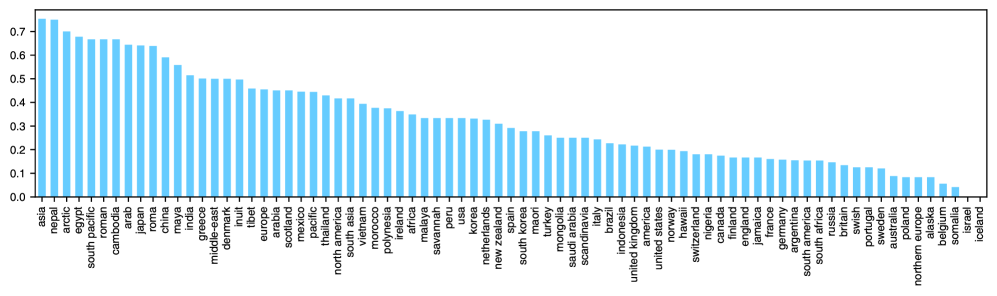
Figure 5: Scores of QA Pairs in different culture.
5.6 Human-Model Analysis
Table 7: Result of Human-Model Analysis. Q4 is constructed based on the answer of MLLM to Q1 and Q2. The calculation process of ACC of Q4 considers the answers to Q1 and Q2. In contrast, ACC refers to the accuracy of Q4 calculated without referencing models’ answers to Q1 and Q2.
To validate the effectiveness of C 3 B, we conducted a human evaluation (more detail in Appendix F). First, We categorized task difficulties based on the number of distinct cultures in each image: 1 (easy), 2/3 (medium), and 4/5 (hard). This tiered classification allows evaluation across different complexity levels. Next, we randomly selected 100 questions per tier. For each tier, we calculated two metrics: the average accuracy performance of human and MLLMs. The results are presented in Table 7.
We find that the human performance is significantly better than that of MLLMs, particularly in Q3, where the human performance achieves all 100% accuracy. Constrained by the performance in Q1 and Q2, the human ACC result is relatively low, yet it still exceeds the MLLMs’ performance. The results show that C 3 B is challenging for MLLMs and the cultural awareness capabilities of MLLMs need to be improved.
6 Conclusion
We propose C 3 B, a novel comic-based, multicultural, multitask, and multilingual cultural awareness capabilities benchmark. Applying comics as the core medium, we enable comprehensive evaluation of cultural awareness capabilities of MLLMs, with the dataset encompassing a large number of images, QA pairs, and cultural contexts. C 3 B contains three tasks with progressed difficulties, from basic visual recognition to higher-level cultural conflict understanding, and finally to cultural content generation. We benchmarked 11 open-source MLLMs on C 3 B, revealing a significant performance gap between MLLMs and human performance. Specifically, current MLLMs lack proficiency in understanding less well-known cultures and processing cultural conflicts, highlighting areas for improvement. We anticipate that C 3 B will serve as a critical tool to support and advance research on MLLMs’ cultural awareness capabilities.
References
- AlKhamissi et al. (2024) B.AlKhamissi, M.ElNokrashy, M.Alkhamissi, and M.Diab. Investigating cultural alignment of large language models. In L.-W. Ku, A.Martins, and V.Srikumar, editors, Proceedings of the 62nd Annual Meeting of the Association for Computational Linguistics (Volume 1: Long Papers), pages 12404–12422, Bangkok, Thailand, Aug. 2024. Association for Computational Linguistics. doi: 10.18653/v1/2024.acl-long.671. URL https://aclanthology.org/2024.acl-long.671/.
- Anantha Ramakrishnan et al. (2025) A.Anantha Ramakrishnan, A.A. Ramakrishnan, and D.Lee. RONA: Pragmatically diverse image captioning with coherence relations. In V.Padmakumar, K.Gero, T.Wambsganss, S.Sterman, T.-H. Huang, D.Zhou, and J.Chung, editors, Proceedings of the Fourth Workshop on Intelligent and Interactive Writing Assistants (In2Writing 2025), pages 74–86, Albuquerque, New Mexico, US, May 2025. Association for Computational Linguistics. ISBN 979-8-89176-239-8. doi: 10.18653/v1/2025.in2writing-1.8. URL https://aclanthology.org/2025.in2writing-1.8/.
- Arora et al. (2025) S.Arora, M.Karpinska, H.-T. Chen, I.Bhattacharjee, M.Iyyer, and E.Choi. CaLMQA: Exploring culturally specific long-form question answering across 23 languages. In W.Che, J.Nabende, E.Shutova, and M.T. Pilehvar, editors, Proceedings of the 63rd Annual Meeting of the Association for Computational Linguistics (Volume 1: Long Papers), pages 11772–11817, Vienna, Austria, July 2025. Association for Computational Linguistics. ISBN 979-8-89176-251-0. doi: 10.18653/v1/2025.acl-long.578. URL https://aclanthology.org/2025.acl-long.578/.
- Bai et al. (2023) J.Bai, S.Bai, S.Yang, S.Wang, S.Tan, P.Wang, J.Lin, C.Zhou, and J.Zhou. Qwen-vl: A versatile vision-language model for understanding, localization, text reading, and beyond. arXiv preprint arXiv:2308.12966, 2023.
- Bai et al. (2025) S.Bai, K.Chen, X.Liu, J.Wang, W.Ge, S.Song, K.Dang, P.Wang, S.Wang, J.Tang, H.Zhong, Y.Zhu, M.Yang, Z.Li, J.Wan, P.Wang, W.Ding, Z.Fu, Y.Xu, J.Ye, X.Zhang, T.Xie, Z.Cheng, H.Zhang, Z.Yang, H.Xu, and J.Lin. Qwen2.5-vl technical report. arXiv preprint arXiv:2502.13923, 2025.
- Burda-Lassen et al. (2025) O.Burda-Lassen, A.Chadha, S.Goswami, and V.Jain. How culturally aware are vision-language models?, 2025. URL https://arxiv.org/abs/2405.17475.
- Caffagni et al. (2024) D.Caffagni, F.Cocchi, L.Barsellotti, N.Moratelli, S.Sarto, L.Baraldi, L.Baraldi, M.Cornia, and R.Cucchiara. The revolution of multimodal large language models: A survey. In L.-W. Ku, A.Martins, and V.Srikumar, editors, Findings of the Association for Computational Linguistics: ACL 2024, pages 13590–13618, Bangkok, Thailand, Aug. 2024. Association for Computational Linguistics. doi: 10.18653/v1/2024.findings-acl.807. URL https://aclanthology.org/2024.findings-acl.807/.
- Chen et al. (2025) A.Chen, Y.Song, K.Chen, X.Bai, M.Yang, L.Nie, J.Liu, T.Zhao, and M.Zhang. Make imagination clearer! stable diffusion-based visual imagination for multimodal machine translation. In W.Che, J.Nabende, E.Shutova, and M.T. Pilehvar, editors, Proceedings of the 63rd Annual Meeting of the Association for Computational Linguistics (Volume 1: Long Papers), pages 26567–26583, Vienna, Austria, July 2025. Association for Computational Linguistics. ISBN 979-8-89176-251-0. doi: 10.18653/v1/2025.acl-long.1289. URL https://aclanthology.org/2025.acl-long.1289/.
- Chen et al. (2023) J.Chen, D.Zhu, X.Shen, X.Li, Z.Liu, P.Zhang, R.Krishnamoorthi, V.Chandra, Y.Xiong, and M.Elhoseiny. Minigpt-v2: large language model as a unified interface for vision-language multi-task learning, 2023. URL https://arxiv.org/abs/2310.09478.
- Chen et al. (2024) Z.Chen, J.Wu, W.Wang, W.Su, G.Chen, S.Xing, M.Zhong, Q.Zhang, X.Zhu, L.Lu, et al. Internvl: Scaling up vision foundation models and aligning for generic visual-linguistic tasks. In Proceedings of the IEEE/CVF Conference on Computer Vision and Pattern Recognition, pages 24185–24198, 2024.
- Cohen and Howe (1988) P.R. Cohen and A.E. Howe. How evaluation guides ai research: The message still counts more than the medium. AI Magazine, 9(4):35, Dec. 1988. doi: 10.1609/aimag.v9i4.952. URL https://ojs.aaai.org/aimagazine/index.php/aimagazine/article/view/952.
- DeepSeek-AI (2024) DeepSeek-AI. Deepseek-v3 technical report, 2024. URL https://arxiv.org/abs/2412.19437.
- DeepSeek-AI (2025) DeepSeek-AI. Deepseek-r1: Incentivizing reasoning capability in llms via reinforcement learning, 2025. URL https://arxiv.org/abs/2501.12948.
- Dong et al. (2024) R.Dong, C.Han, Y.Peng, Z.Qi, Z.Ge, J.Yang, L.Zhao, J.Sun, H.Zhou, H.Wei, X.Kong, X.Zhang, K.Ma, and L.Yi. DreamLLM: Synergistic multimodal comprehension and creation. In The Twelfth International Conference on Learning Representations, 2024. URL https://openreview.net/forum?id=y01KGvd9Bw.
- Grattafiori et al. (2024) A.Grattafiori, A.Dubey, A.Jauhri, A.Pandey, A.Kadian, A.Al-Dahle, A.Letman, A.Mathur, A.Schelten, A.Vaughan, A.Yang, A.Fan, A.Goyal, A.Hartshorn, A.Yang, A.Mitra, A.Sravankumar, A.Korenev, A.Hinsvark, A.Rao, A.Zhang, A.Rodriguez, A.Gregerson, A.Spataru, B.Roziere, B.Biron, B.Tang, B.Chern, C.Caucheteux, C.Nayak, C.Bi, C.Marra, C.McConnell, C.Keller, C.Touret, C.Wu, C.Wong, C.C. Ferrer, C.Nikolaidis, D.Allonsius, D.Song, D.Pintz, D.Livshits, D.Wyatt, D.Esiobu, D.Choudhary, D.Mahajan, D.Garcia-Olano, D.Perino, D.Hupkes, E.Lakomkin, E.AlBadawy, E.Lobanova, E.Dinan, E.M. Smith, F.Radenovic, F.Guzmán, F.Zhang, G.Synnaeve, G.Lee, G.L. Anderson, G.Thattai, G.Nail, G.Mialon, G.Pang, G.Cucurell, H.Nguyen, H.Korevaar, H.Xu, H.Touvron, I.Zarov, I.A. Ibarra, I.Kloumann, I.Misra, I.Evtimov, J.Zhang, J.Copet, J.Lee, J.Geffert, J.Vranes, J.Park, J.Mahadeokar, J.Shah, J.van der Linde, J.Billock, J.Hong, J.Lee, J.Fu, J.Chi, J.Huang, J.Liu, J.Wang, J.Yu, J.Bitton, J.Spisak, J.Park, J.Rocca, J.Johnstun, J.Saxe, J.Jia, K.V. Alwala, K.Prasad, K.Upasani, K.Plawiak, K.Li, K.Heafield, K.Stone, K.El-Arini, K.Iyer, K.Malik, K.Chiu, K.Bhalla, K.Lakhotia, L.Rantala-Yeary, L.van der Maaten, L.Chen, L.Tan, L.Jenkins, L.Martin, L.Madaan, L.Malo, L.Blecher, L.Landzaat, L.de Oliveira, M.Muzzi, M.Pasupuleti, M.Singh, M.Paluri, M.Kardas, M.Tsimpoukelli, M.Oldham, M.Rita, M.Pavlova, M.Kambadur, M.Lewis, M.Si, M.K. Singh, M.Hassan, N.Goyal, N.Torabi, N.Bashlykov, N.Bogoychev, N.Chatterji, N.Zhang, O.Duchenne, O.Çelebi, P.Alrassy, P.Zhang, P.Li, P.Vasic, P.Weng, P.Bhargava, P.Dubal, P.Krishnan, P.S. Koura, P.Xu, Q.He, Q.Dong, R.Srinivasan, R.Ganapathy, R.Calderer, R.S. Cabral, R.Stojnic, R.Raileanu, R.Maheswari, R.Girdhar, R.Patel, R.Sauvestre, R.Polidoro, R.Sumbaly, R.Taylor, R.Silva, R.Hou, R.Wang, S.Hosseini, S.Chennabasappa, S.Singh, S.Bell, S.S. Kim, S.Edunov, S.Nie, S.Narang, S.Raparthy, S.Shen, S.Wan, S.Bhosale, S.Zhang, S.Vandenhende, S.Batra, S.Whitman, S.Sootla, S.Collot, S.Gururangan, S.Borodinsky, T.Herman, T.Fowler, T.Sheasha, T.Georgiou, T.Scialom, T.Speckbacher, T.Mihaylov, T.Xiao, U.Karn, V.Goswami, V.Gupta, V.Ramanathan, V.Kerkez, V.Gonguet, V.Do, V.Vogeti, V.Albiero, V.Petrovic, W.Chu, W.Xiong, W.Fu, W.Meers, X.Martinet, X.Wang, X.Wang, X.E. Tan, X.Xia, X.Xie, X.Jia, X.Wang, Y.Goldschlag, Y.Gaur, Y.Babaei, Y.Wen, Y.Song, Y.Zhang, Y.Li, Y.Mao, Z.D. Coudert, Z.Yan, Z.Chen, Z.Papakipos, A.Singh, A.Srivastava, A.Jain, A.Kelsey, A.Shajnfeld, A.Gangidi, A.Victoria, A.Goldstand, A.Menon, A.Sharma, A.Boesenberg, A.Baevski, A.Feinstein, A.Kallet, A.Sangani, A.Teo, A.Yunus, A.Lupu, A.Alvarado, A.Caples, A.Gu, A.Ho, A.Poulton, A.Ryan, A.Ramchandani, A.Dong, A.Franco, A.Goyal, A.Saraf, A.Chowdhury, A.Gabriel, A.Bharambe, A.Eisenman, A.Yazdan, B.James, B.Maurer, B.Leonhardi, B.Huang, B.Loyd, B.D. Paola, B.Paranjape, B.Liu, B.Wu, B.Ni, B.Hancock, B.Wasti, B.Spence, B.Stojkovic, B.Gamido, B.Montalvo, C.Parker, C.Burton, C.Mejia, C.Liu, C.Wang, C.Kim, C.Zhou, C.Hu, C.-H. Chu, C.Cai, C.Tindal, C.Feichtenhofer, C.Gao, D.Civin, D.Beaty, D.Kreymer, D.Li, D.Adkins, D.Xu, D.Testuggine, D.David, D.Parikh, D.Liskovich, D.Foss, D.Wang, D.Le, D.Holland, E.Dowling, E.Jamil, E.Montgomery, E.Presani, E.Hahn, E.Wood, E.-T. Le, E.Brinkman, E.Arcaute, E.Dunbar, E.Smothers, F.Sun, F.Kreuk, F.Tian, F.Kokkinos, F.Ozgenel, F.Caggioni, F.Kanayet, F.Seide, G.M. Florez, G.Schwarz, G.Badeer, G.Swee, G.Halpern, G.Herman, G.Sizov, Guangyi, Zhang, G.Lakshminarayanan, H.Inan, H.Shojanazeri, H.Zou, H.Wang, H.Zha, H.Habeeb, H.Rudolph, H.Suk, H.Aspegren, H.Goldman, H.Zhan, I.Damlaj, I.Molybog, I.Tufanov, I.Leontiadis, I.-E. Veliche, I.Gat, J.Weissman, J.Geboski, J.Kohli, J.Lam, J.Asher, J.-B. Gaya, J.Marcus, J.Tang, J.Chan, J.Zhen, J.Reizenstein, J.Teboul, J.Zhong, J.Jin, J.Yang, J.Cummings, J.Carvill, J.Shepard, J.McPhie, J.Torres, J.Ginsburg, J.Wang, K.Wu, K.H. U, K.Saxena, K.Khandelwal, K.Zand, K.Matosich, K.Veeraraghavan, K.Michelena, K.Li, K.Jagadeesh, K.Huang, K.Chawla, K.Huang, L.Chen, L.Garg, L.A, L.Silva, L.Bell, L.Zhang, L.Guo, L.Yu, L.Moshkovich, L.Wehrstedt, M.Khabsa, M.Avalani, M.Bhatt, M.Mankus, M.Hasson, M.Lennie, M.Reso, M.Groshev, M.Naumov, M.Lathi, M.Keneally, M.Liu, M.L. Seltzer, M.Valko, M.Restrepo, M.Patel, M.Vyatskov, M.Samvelyan, M.Clark, M.Macey, M.Wang, M.J. Hermoso, M.Metanat, M.Rastegari, M.Bansal, N.Santhanam, N.Parks, N.White, N.Bawa, N.Singhal, N.Egebo, N.Usunier, N.Mehta, N.P. Laptev, N.Dong, N.Cheng, O.Chernoguz, O.Hart, O.Salpekar, O.Kalinli, P.Kent, P.Parekh, P.Saab, P.Balaji, P.Rittner, P.Bontrager, P.Roux, P.Dollar, P.Zvyagina, P.Ratanchandani, P.Yuvraj, Q.Liang, R.Alao, R.Rodriguez, R.Ayub, R.Murthy, R.Nayani, R.Mitra, R.Parthasarathy, R.Li, R.Hogan, R.Battey, R.Wang, R.Howes, R.Rinott, S.Mehta, S.Siby, S.J. Bondu, S.Datta, S.Chugh, S.Hunt, S.Dhillon, S.Sidorov, S.Pan, S.Mahajan, S.Verma, S.Yamamoto, S.Ramaswamy, S.Lindsay, S.Lindsay, S.Feng, S.Lin, S.C. Zha, S.Patil, S.Shankar, S.Zhang, S.Zhang, S.Wang, S.Agarwal, S.Sajuyigbe, S.Chintala, S.Max, S.Chen, S.Kehoe, S.Satterfield, S.Govindaprasad, S.Gupta, S.Deng, S.Cho, S.Virk, S.Subramanian, S.Choudhury, S.Goldman, T.Remez, T.Glaser, T.Best, T.Koehler, T.Robinson, T.Li, T.Zhang, T.Matthews, T.Chou, T.Shaked, V.Vontimitta, V.Ajayi, V.Montanez, V.Mohan, V.S. Kumar, V.Mangla, V.Ionescu, V.Poenaru, V.T. Mihailescu, V.Ivanov, W.Li, W.Wang, W.Jiang, W.Bouaziz, W.Constable, X.Tang, X.Wu, X.Wang, X.Wu, X.Gao, Y.Kleinman, Y.Chen, Y.Hu, Y.Jia, Y.Qi, Y.Li, Y.Zhang, Y.Zhang, Y.Adi, Y.Nam, Yu, Wang, Y.Zhao, Y.Hao, Y.Qian, Y.Li, Y.He, Z.Rait, Z.DeVito, Z.Rosnbrick, Z.Wen, Z.Yang, Z.Zhao, and Z.Ma. The llama 3 herd of models, 2024. URL https://arxiv.org/abs/2407.21783.
- Guérin et al. (2013) C.Guérin, C.Rigaud, A.Mercier, F.Ammar-Boudjelal, K.Bertet, A.Bouju, J.-C. Burie, G.Louis, J.-M. Ogier, and A.Revel. ebdtheque: a representative database of comics. In Proceedings of the 12th International Conference on Document Analysis and Recognition (ICDAR), pages 1145–1149, 2013.
- Huynh et al. (2025) N.D. Huynh, M.R. Bouadjenek, S.Aryal, I.Razzak, and H.Hacid. Visual question answering: from early developments to recent advances – a survey, 2025. URL https://arxiv.org/abs/2501.03939.
- Iyyer et al. (2017) M.Iyyer, V.Manjunatha, A.Guha, Y.Vyas, J.Boyd-Graber, H.Daumé, and L.Davis. The amazing mysteries of the gutter: Drawing inferences between panels in comic book narratives. In 2017 IEEE Conference on Computer Vision and Pattern Recognition (CVPR), pages 6478–6487, 2017. doi: 10.1109/CVPR.2017.686.
- Kramsch (2014) C.Kramsch. Language and culture. AILA Review, 27(1):30–55, 2014. ISSN 1461-0213. doi: https://doi.org/10.1075/aila.27.02kra. URL https://www.jbe-platform.com/content/journals/10.1075/aila.27.02kra.
- Li et al. (2023) J.Li, D.Li, S.Savarese, and S.Hoi. Blip-2: Bootstrapping language-image pre-training with frozen image encoders and large language models, 2023. URL https://arxiv.org/abs/2301.12597.
- Li et al. (2024) Z.Li, B.Yang, Q.Liu, Z.Ma, S.Zhang, J.Yang, Y.Sun, Y.Liu, and X.Bai. Monkey: Image resolution and text label are important things for large multi-modal models, 2024. URL https://arxiv.org/abs/2311.06607.
- Lin et al. (2023) Z.Lin, C.Liu, R.Zhang, P.Gao, L.Qiu, H.Xiao, H.Qiu, C.Lin, W.Shao, K.Chen, J.Han, S.Huang, Y.Zhang, X.He, H.Li, and Y.Qiao. Sphinx: The joint mixing of weights, tasks, and visual embeddings for multi-modal large language models, 2023. URL https://arxiv.org/abs/2311.07575.
- Liu et al. (2023a) H.Liu, C.Li, Y.Li, and Y.J. Lee. Improved baselines with visual instruction tuning, 2023a.
- Liu et al. (2023b) H.Liu, C.Li, Q.Wu, and Y.J. Lee. Visual instruction tuning, 2023b.
- Liu et al. (2024) H.Liu, C.Li, Y.Li, B.Li, Y.Zhang, S.Shen, and Y.J. Lee. Llava-next: Improved reasoning, ocr, and world knowledge, January 2024. URL https://llava-vl.github.io/blog/2024-01-30-llava-next/.
- Matsui et al. (2016) Y.Matsui, K.Ito, Y.Aramaki, A.Fujimoto, T.Ogawa, T.Yamasaki, and K.Aizawa. Sketch-based manga retrieval using manga109 dataset. Multimedia Tools and Applications, 76(20):21811–21838, Nov. 2016. ISSN 1573-7721. doi: 10.1007/s11042-016-4020-z. URL http://dx.doi.org/10.1007/s11042-016-4020-z.
- Naous et al. (2024) T.Naous, M.J. Ryan, A.Ritter, and W.Xu. Having beer after prayer? measuring cultural bias in large language models. In L.-W. Ku, A.Martins, and V.Srikumar, editors, Proceedings of the 62nd Annual Meeting of the Association for Computational Linguistics (Volume 1: Long Papers), pages 16366–16393, Bangkok, Thailand, Aug. 2024. Association for Computational Linguistics. doi: 10.18653/v1/2024.acl-long.862. URL https://aclanthology.org/2024.acl-long.862/.
- Nayak et al. (2024) S.Nayak, K.Jain, R.Awal, S.Reddy, S.V. Steenkiste, L.A. Hendricks, K.Stanczak, and A.Agrawal. Benchmarking vision language models for cultural understanding. In Y.Al-Onaizan, M.Bansal, and Y.-N. Chen, editors, Proceedings of the 2024 Conference on Empirical Methods in Natural Language Processing, pages 5769–5790, Miami, Florida, USA, Nov. 2024. Association for Computational Linguistics. doi: 10.18653/v1/2024.emnlp-main.329. URL https://aclanthology.org/2024.emnlp-main.329/.
- Papineni et al. (2002) K.Papineni, S.Roukos, T.Ward, and W.-J. Zhu. Bleu: a method for automatic evaluation of machine translation. In P.Isabelle, E.Charniak, and D.Lin, editors, Proceedings of the 40th Annual Meeting of the Association for Computational Linguistics, pages 311–318, Philadelphia, Pennsylvania, USA, July 2002. Association for Computational Linguistics. doi: 10.3115/1073083.1073135. URL https://aclanthology.org/P02-1040/.
- Pawar et al. (2024) S.Pawar, J.Park, J.Jin, A.Arora, J.Myung, S.Yadav, F.G. Haznitrama, I.Song, A.Oh, and I.Augenstein. Survey of cultural awareness in language models: Text and beyond, 2024. URL https://arxiv.org/abs/2411.00860.
- Rei et al. (2022) R.Rei, J.G. C.de Souza, D.Alves, C.Zerva, A.C. Farinha, T.Glushkova, A.Lavie, L.Coheur, and A.F.T. Martins. COMET-22: Unbabel-IST 2022 submission for the metrics shared task. In P.Koehn, L.Barrault, O.Bojar, F.Bougares, R.Chatterjee, M.R. Costa-jussà, C.Federmann, M.Fishel, A.Fraser, M.Freitag, Y.Graham, R.Grundkiewicz, P.Guzman, B.Haddow, M.Huck, A.Jimeno Yepes, T.Kocmi, A.Martins, M.Morishita, C.Monz, M.Nagata, T.Nakazawa, M.Negri, A.Névéol, M.Neves, M.Popel, M.Turchi, and M.Zampieri, editors, Proceedings of the Seventh Conference on Machine Translation (WMT), pages 578–585, Abu Dhabi, United Arab Emirates (Hybrid), Dec. 2022. Association for Computational Linguistics. URL https://aclanthology.org/2022.wmt-1.52/.
- Reuel et al. (2024) A.Reuel, A.Hardy, C.Smith, M.Lamparth, M.Hardy, and M.J. Kochenderfer. Betterbench: Assessing ai benchmarks, uncovering issues, and establishing best practices. In A.Globerson, L.Mackey, D.Belgrave, A.Fan, U.Paquet, J.Tomczak, and C.Zhang, editors, Advances in Neural Information Processing Systems, volume 37, pages 21763–21813. Curran Associates, Inc., 2024. URL https://proceedings.neurips.cc/paper_files/paper/2024/file/26889e8359e7ef8a7f5d77457364ca55-Paper-Datasets_and_Benchmarks_Track.pdf.
- Romero et al. (2024) D.Romero, C.Lyu, H.A. Wibowo, T.Lynn, I.Hamed, A.N. Kishore, A.Mandal, A.Dragonetti, A.Abzaliev, A.L. Tonja, B.F. Balcha, C.Whitehouse, C.Salamea, D.J. Velasco, D.I. Adelani, D.L. Meur, E.Villa-Cueva, F.Koto, F.Farooqui, F.Belcavello, G.Batnasan, G.Vallejo, G.Caulfield, G.Ivetta, H.Song, H.B. Ademtew, H.Maina, H.Lovenia, I.A. Azime, J.C.B. Cruz, J.Gala, J.Geng, J.-G. Ortiz-Barajas, J.Baek, J.Dunstan, L.A. Alemany, K.R.Y. Nagasinghe, L.Benotti, L.F. D’Haro, M.Viridiano, M.Estecha-Garitagoitia, M.C.B. Cabrera, M.Rodríguez-Cantelar, M.Jouitteau, M.Mihaylov, M.F.M. Imam, M.F. Adilazuarda, M.Gochoo, M.-E. Otgonbold, N.Etori, O.Niyomugisha, P.M. Silva, P.Chitale, R.Dabre, R.Chevi, R.Zhang, R.Diandaru, S.Cahyawijaya, S.Góngora, S.Jeong, S.Purkayastha, T.Kuribayashi, T.Clifford, T.Jayakumar, T.T. Torrent, T.Ehsan, V.Araujo, Y.Kementchedjhieva, Z.Burzo, Z.W. Lim, Z.X. Yong, O.Ignat, J.Nwatu, R.Mihalcea, T.Solorio, and A.F. Aji. Cvqa: Culturally-diverse multilingual visual question answering benchmark, 2024. URL https://arxiv.org/abs/2406.05967.
- Schneider et al. (2025) F.Schneider, C.Holtermann, C.Biemann, and A.Lauscher. GIMMICK: Globally inclusive multimodal multitask cultural knowledge benchmarking. In W.Che, J.Nabende, E.Shutova, and M.T. Pilehvar, editors, Findings of the Association for Computational Linguistics: ACL 2025, pages 9605–9668, Vienna, Austria, July 2025. Association for Computational Linguistics. ISBN 979-8-89176-256-5. doi: 10.18653/v1/2025.findings-acl.500. URL https://aclanthology.org/2025.findings-acl.500/.
- Sellam et al. (2020) T.Sellam, D.Das, and A.Parikh. BLEURT: Learning robust metrics for text generation. In D.Jurafsky, J.Chai, N.Schluter, and J.Tetreault, editors, Proceedings of the 58th Annual Meeting of the Association for Computational Linguistics, pages 7881–7892, Online, July 2020. Association for Computational Linguistics. doi: 10.18653/v1/2020.acl-main.704. URL https://aclanthology.org/2020.acl-main.704/.
- Singh et al. (2025) S.Singh, A.Romanou, C.Fourrier, D.I. Adelani, J.G. Ngui, D.Vila-Suero, P.Limkonchotiwat, K.Marchisio, W.Q. Leong, Y.Susanto, R.Ng, S.Longpre, S.Ruder, W.-Y. Ko, A.Bosselut, A.Oh, A.Martins, L.Choshen, D.Ippolito, E.Ferrante, M.Fadaee, B.Ermis, and S.Hooker. Global MMLU: Understanding and addressing cultural and linguistic biases in multilingual evaluation. In W.Che, J.Nabende, E.Shutova, and M.T. Pilehvar, editors, Proceedings of the 63rd Annual Meeting of the Association for Computational Linguistics (Volume 1: Long Papers), pages 18761–18799, Vienna, Austria, July 2025. Association for Computational Linguistics. ISBN 979-8-89176-251-0. doi: 10.18653/v1/2025.acl-long.919. URL https://aclanthology.org/2025.acl-long.919/.
- Vivoli et al. (2024) E.Vivoli, M.Bertini, and D.Karatzas. Comix: A comprehensive benchmark for multi-task comic understanding, 2024. URL https://arxiv.org/abs/2407.03550.
- Xu et al. (2025) P.Xu, Y.Wang, S.Zhang, X.Zhou, X.Li, Y.Yuan, F.Li, S.Zhou, X.Wang, Y.Zhang, and H.Zhao. Tcc-bench: Benchmarking the traditional chinese culture understanding capabilities of mllms, 2025. URL https://arxiv.org/abs/2505.11275.
- Yang et al. (2025) S.Yang, D.Zhang, J.Ren, Z.Xu, X.Zhang, Y.Song, H.Lin, and F.Xia. Cultural bias matters: A cross-cultural benchmark dataset and sentiment-enriched model for understanding multimodal metaphors. In W.Che, J.Nabende, E.Shutova, and M.T. Pilehvar, editors, Proceedings of the 63rd Annual Meeting of the Association for Computational Linguistics (Volume 1: Long Papers), pages 26301–26317, Vienna, Austria, July 2025. Association for Computational Linguistics. ISBN 979-8-89176-251-0. doi: 10.18653/v1/2025.acl-long.1275. URL https://aclanthology.org/2025.acl-long.1275/.
- Ye et al. (2024) J.Ye, H.Xu, H.Liu, A.Hu, M.Yan, Q.Qian, J.Zhang, F.Huang, and J.Zhou. mplug-owl3: Towards long image-sequence understanding in multi-modal large language models, 2024. URL https://arxiv.org/abs/2408.04840.
- Zhang et al. (2024) P.Zhang, X.Dong, Y.Zang, Y.Cao, R.Qian, L.Chen, Q.Guo, H.Duan, B.Wang, L.Ouyang, S.Zhang, W.Zhang, Y.Li, Y.Gao, P.Sun, X.Zhang, W.Li, J.Li, W.Wang, H.Yan, C.He, X.Zhang, K.Chen, J.Dai, Y.Qiao, D.Lin, and J.Wang. Internlm-xcomposer-2.5: A versatile large vision language model supporting long-contextual input and output, 2024. URL https://arxiv.org/abs/2407.03320.
Figure 6: A data sample of Extraction@Culture and Conflict@Culture.

Figure 7: A data sample of Generation@Culture. During each inference, a single source sentence and the comic page are input to the MLLM.
Appendix A Question Setting for Each task
A.1 Extraction@Culture
A.2 Conflict@Culture
where A 1 A_{1} refers to the list of cultures of the MLLM’s answer to Q1, and A 2 A_{2} refers to the list of cultural representative objects of the MLLM’s answer to Q2.
A.3 Generation@Culture
Appendix B Some Data Sample from C 3 B
B.1 Extraction@Culture and Conflict@Culture
An example of Extraction@Culture and Conflict@Culture is presented in Figure 6.
B.2 Generation@Culture
An example of Generation@Culture is presented in Figure 7.
Appendix C Prompt Setting for Data Collection and Annotation
C.1 Prompt Setting for QA Pair Creation of Conflict@Culture Task
Figure 8: The prompt setting for QA pair creation in Conflict@Culture Task.
In the prompt setting of Conflict@Culture (presented in Figure 8), l e l_{e} and l p l_{p} denote the list of culturally representative objects and culture of image annotated in task Extraction@Culture respectively.
C.2 Prompt Setting for Annotation in Generation@Culture
The model we apply in annotation in Generation@Culture for creating C 3 B is DeepSeek-R1(DeepSeek-AI, 2025). The prompt we use for Translator is presented in Figure 9. The prompt we use for Reviewer is presented in Figure 10. Upon receiving the review feedback, the prompt provided to the Translator is presented in Figure 11.
Figure 9: The prompt used for the Translator, where s s denotes the source sentence that is to be translated.
Figure 10: The prompt used for the Reviewer, where t t denotes the translation provided by the Translator.
Figure 11: The prompt used for the Translator once the review is provided, where a a denotes the review generated by the Reviewer.
Appendix D Examples of Errors In Manual Verification in Conflict@Culture
D.1 Formatting inconsistency
This type of error occurs when the format of the conflict descriptions generated by the models fails to conform to the format provided. An example is provided in Figure 12.
Figure 12: An example of formatting inconsistency. The format provided is shaded in blue, and the output with error doens’t follow it.
D.2 Culture-related Errors
This type of error occurs when the conflict descriptions generated by the models contains cultural errors. An example is provided in Figure 13.
Figure 13: An example of culture-related errors. In our example, Japanese katana should not be in the country except Japan.
Appendix E Case Study
During evaluation, we observed several unexpected behavioral patterns that led to suboptimal question-answering performance in MLLMs.
E.1 Error Cases in Q1
"Turn-a-deaf-ear": This behavioral pattern is particularly occurred in LLaVA-NeXT, where the model frequently defaulted to describing the image rather than direct question-answering when presented with clear instructions. We name this behavoir as "Turn-a-deaf-ear". An example is provided in Figure 14.
We assume that this behavioral pattern likely stems from the fine-tuning dataset’s compositional bias, which predominantly trains MLLMs for image description tasks rather than image-grounded question answering.
We need to mention that, in Q3, LLaVA-NeXT fails to predict the result properly due to the same reason as in Q1.
Figure 14: An example of "Turn-a-deaf-ear" is presented. The MLLM is asked to output the correct choices but it outputs the detail of the comics page instead.
E.2 Error Case in Q2
"Take-a-shot-in-the-dark": This behavioral pattern was particularly observed in LLaVA1.5-7B when the model attempted to answer Q2. For this question, the model exhibited a tendency to output "A" as the response.
We calculated the frequency that LLaVA1.5-7B outputs the choice "A" and the result is 78.4, which says that the model cannot understand the cultures properly and tends to output an answer.
E.3 Error Case in Q4
Keep answering "Nothing": This behavioral pattern is particularly occurred in LLaVA-NeXT, where the model always answering "Nothing", which shows a lack of cultural conflict comprehension capability. An example is presented in Figure 15.
Figure 15: An example of keeping answering nothing. MLLM keeps answering "nothing" instead of the description of cultural conflicts.
"Stubbornness": This behavioral pattern is particularly occurred in LLaVA-1.5-7B, where the model frequently defaulted to follow the instruction without thinking. We name this behavior as "Stubbornness". An example is provided in Figure 16.
Figure 16: An example of "Stubbornness" is presented. The MLLM fails to generate the required substitutions, leaving both the placeholder terms ’Something’ and ’Some Culture’ unmodified in its output.
E.4 Error Case In Q5
Poor instruction following capabilities of MiniGPT: For Question 5, our instruction to MLLMs was to directly output the translated sentence without including any redundant explanatory content. Nevertheless, MiniGPT tended to elaborate on how the translation was performed and also repeated the identical sentence a second time. An example is presented in Figure 17.
Figure 17: An example of poor instruction following capability of MiniGPT. Our instruction clearly required MiniGPT to directly output the target translations without additional content. Nevertheless, the model responded with redundant descriptive text (e.g., explaining the sentence type and emotional connotation) and duplicated translations for the identical Japanese input. Both issues indicate its failure to adhere to the constraint of instruction.
Appendix F Details on Human-Model Analysis
Regarding the human-model analysis, three undergraduate students volunteered to participate. Each question was answered separately, with a one-hour time limit per question, and was presented in the same format used for the MLLMs.
Xet Storage Details
- Size:
- 70.7 kB
- Xet hash:
- b1dce15d0aa254aaab600aa092c5b651fcf32533233d8458714a4b958e637aac
Xet efficiently stores files, intelligently splitting them into unique chunks and accelerating uploads and downloads. More info.