

EviBack: Search-Agent Reinforcement Learning via Evidence-Constrained Teacher Backoff
Paper • 2607.23955 • Published

*Equal Contribution, i†Corresponding Author






|

|

|
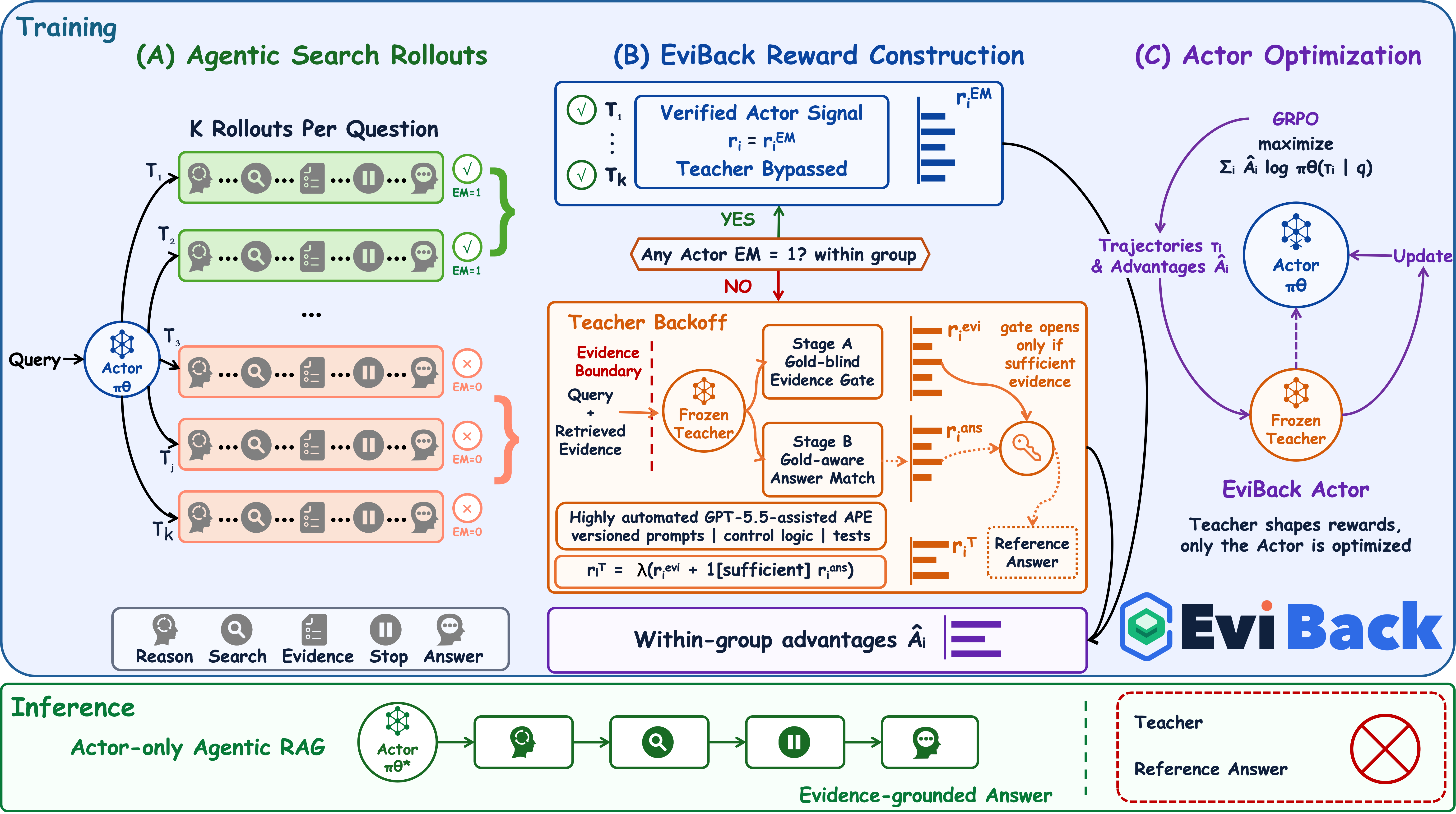
EviBack is a search-agent training framework with an Evidence-Constrained Teacher. It keeps inference Actor-only and uses the Teacher as a fallback when the Actor group receives no useful reward. The package provides the training, retrieval, evaluation, and environment components needed to reproduce the method. E2E-APE supplies the development-time prompt-engineering instructions used to freeze the Teacher prompt. it is not used during Actor inference.
.
├── src/
│   └── eviback/
│       ├── teacher/
│       │   └── Stage A, conditional Stage B, client, merge, provenance
│       ├── rewards/
│       │   └── Actor-first all-zero gate and paper reward
│       ├── training/
│       │   └── VERL adapter and post-normalization reference logic
│       ├── retrieval/
│       │   └── retriever client, optional server, public schema
│       ├── inference.py
│       │   └── iterative Actor-only search
│       ├── evaluation.py
│       │   └── aligned metrics and macro summaries
│       └── aggregate.py
│           └── paired bootstrap comparison
└── release/
    └── source freeze, environment, licenses, data decision, blockers
Choose one accelerator profile before installing:
| Profile | Runtime | Environment and requirements | Device argument |
|---|---|---|---|
| GPU | NVIDIA CUDA 12.4 | environment.yml, requirements-gpu.txt |
cuda |
| NPU | Ascend 910B + CANN | environment-npu.yml, requirements-npu.txt |
npu |
The full installation procedures are GPU installation and Ascend NPU installation. Do not install the CUDA and NPU runtime profiles into the same environment.
The pure reward, parser, mock Teacher, evaluation, and data JSONL paths need no GPU:
python -m venv .venv
. .venv/bin/activate
pip install -e '.[test,data]'
python -m pytest -q tests
python scripts/run_reward_smoke.py
For GPU formal training, use Python 3.11, a CUDA-compatible PyTorch build,
Transformers 4.57.6, vLLM 0.11.0, Ray, and a compatible VERL checkout. Apply
third_party/verl/group_postnorm.patch before training. For Ascend NPU formal
training, use the matched torch-npu and vllm-ascend stack described in
docs/install_npu.md. The complete historical environment is not yet
recovered; consult release/environment_snapshot.txt.
Obtain each upstream QA dataset under its own terms and arrange it as described
in datasets-examples/README.md. Build the frozen 5,100/3,500 splits:
python scripts/prepare_data.py \
  --raw-root /path/to/raw-datasets \
  --output-root artifacts/data \
  --format parquet

python scripts/prepare_data.py \
  --check-only \
  --manifest datasets-examples/manifests/train_5100.json
Sampling is a stable SHA-256 order after normalized-question deduplication. The manifests publish quotas, seeds, and the original derived-artifact hashes without redistributing the data.
Start a Search-R1-compatible dense retriever. Index, corpus, model, host, and port are explicit parameters:
bash scripts/start_retriever.sh \
  --index /path/to/e5_Flat.index \
  --corpus /path/to/docs.jsonl \
  --model intfloat/e5-base-v2 \
  --device cuda \
  --port 8000
Use --device cuda for NVIDIA GPUs or --device npu for Ascend NPUs.
Serve the training Teacher through an OpenAI-compatible chat-completions API,
then export its endpoint and model. API credentials, when needed, are read from
EVIBACK_TEACHER_API_KEY.
export EVIBACK_RETRIEVER_ENDPOINT=http://127.0.0.1:8000/retrieve
export EVIBACK_TEACHER_ENDPOINT=http://127.0.0.1:8001/v1/chat/completions
export EVIBACK_TEACHER_MODEL=your-glm-4.7-flash-revision
Start the formal VERL training job after installing VERL, applying the patch, and preparing the datasets and services:
bash scripts/train_actor.sh \
  --config configs/training/qwen3_1.7b.yaml
The entry point supports --model, --train-data, --eval-data,
--retriever-endpoint, --teacher-endpoint, --teacher-model, --output-dir,
--seed, --group-size, and --teacher-fallback-scale. Unknown arguments are
forwarded as VERL/Hydra overrides.
The formal 1.7B configuration freezes 5,100 examples, 79 steps, eight rollouts,
and seed 42. Model-scale and lambda matrices are documented in
configs/training/qwen3_scale_matrix.yaml. Hardware-specific batch sizes remain
explicit user overrides because they depend on the available accelerator.
References are joined only after inference. The evaluator rejects duplicate or
misaligned (data_source, index) keys and mismatched question text.
| Models | Download Link HuggingFace | Download Link ModelScope |
|---|---|---|
| QWen3-0.6B | 🤗 HuggingFace | 🔷 ModelScope |
| QWen3-1.7B | 🤗 HuggingFace | 🔷 ModelScope |
| QWen3-4B | 🤗 HuggingFace | 🔷 ModelScope |
bash scripts/run_evaluation.sh \
  --predictions artifacts/inference/evi_actor.jsonl \
  --references artifacts/data/eval_3500.jsonl \
  --output artifacts/evaluation/evi_actor.json \
  --model-checkpoint /path/to/actor-checkpoint \
  --retriever-revision your-index-revision
Reported metrics are legacy EM, token F1, valid-answer rate, mean search calls, duplicate-query rate, maximum-turn rate, single-hop macro, multi-hop macro, and paired bootstrap confidence intervals.
E2E-APE is the project's development-time prompt-engineering process, not a
runtime component. The public artifacts are the English prompt in
ape/controller_instructions.md, the Chinese prompt in
ape/controller_instructions_cn.md, and the English contract in
ape/contract_en.md. They describe sample construction, labeling, prompt
ablation, evaluation, and strategy selection for an agent/model to carry out.
The generated runner, scorer, ablation, and selection code is intentionally not
included. ape/prompts/frozen_policy.json records the selected prompt
identifiers, while ape/benchmark/ contains metadata and schema only; the raw
benchmark is not redistributed. See ape/README.md.
If you find our work useful for your research, please consider citing the paper :
@article{ma2026eviback,
title={Search-Agent Reinforcement Learning via Evidence-Constrained Teacher Backoff},
  author={Xiao Ma, Zhiquan Hu, Yi Wei, Chenchen Zhao, Yijun Chen, Jicheng Zhao, Yuming Li, Chuang Dai},
  year={2026},
  eprint={2607.23955},
  archivePrefix={arXiv},
  primaryClass={cs.AI}
}
The models in this repository are licensed under the Apache 2.0 License. We claim no rights over the your generated contents, granting you the freedom to use them while ensuring that your usage complies with the provisions of this license. You are fully accountable for your use of the models, which must not involve sharing any content that violates applicable laws, causes harm to individuals or groups, disseminates personal information intended for harm, spreads misinformation, or targets vulnerable populations.