| | --- |
| | library_name: transformers |
| | tags: [clarifai,FP8] |
| | --- |
| | |
| | # Qwen3-Coder-30B-A3B-Instruct |
| |
|
| | [Basemodel](https://huggingface.co/Qwen/Qwen3-30B-A3B-Instruct-2507) |
| |
|
| |  |
| |
|
| | Visit model playground at Clarifai https://clarifai.com/qwen/qwenCoder/models/Qwen3-Coder-30B-A3B-Instruct |
| |
|
| | ## Highlights |
| |
|
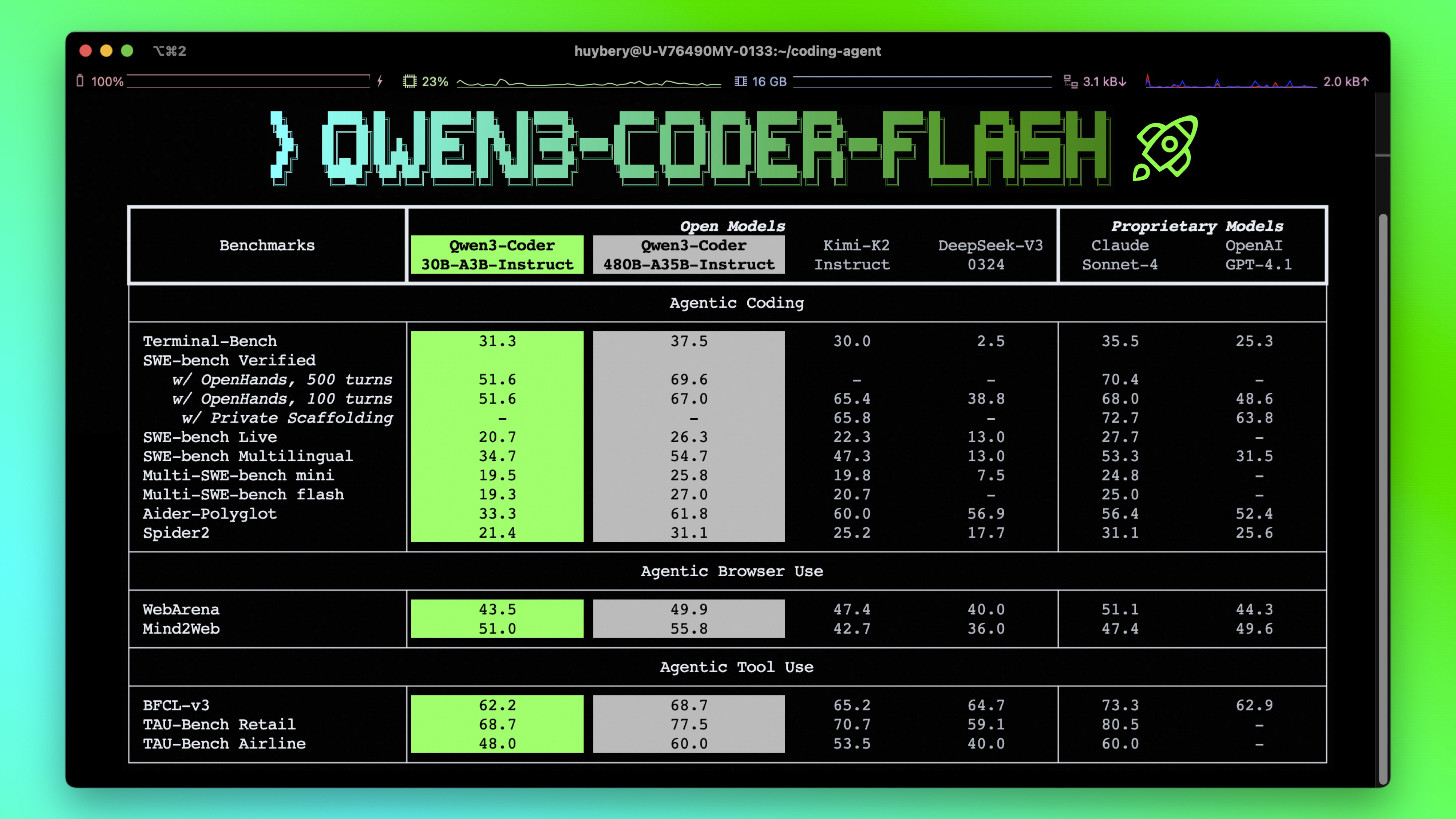
| | **Qwen3-Coder** is available in multiple sizes. Today, the **Qwen team** is excited to introduce **Qwen3-Coder-30B-A3B-Instruct**. This streamlined model maintains impressive performance and efficiency, featuring the following key enhancements: |
| |
|
| | - **Significant Performance** among open models on **Agentic Coding**, **Agentic Browser-Use**, and other foundational coding tasks. |
| | - **Long-context Capabilities** with native support for **256K** tokens, extendable up to **1M** tokens using Yarn, optimized for repository-scale understanding. |
| | - **Agentic Coding** supporting most platforms such as **Qwen Code**, **CLINE**, featuring a specially designed function call format. |
| |
|
| |  |
| |
|
| | ## Model Overview |
| |
|
| | **Qwen3-Coder-30B-A3B-Instruct** has the following features: |
| | - Type: Causal Language Models |
| | - Training Stage: Pretraining & Post-training |
| | - Number of Parameters: 30.5B in total and 3.3B activated |
| | - Number of Layers: 48 |
| | - Number of Attention Heads (GQA): 32 for Q and 4 for KV |
| | - Number of Experts: 128 |
| | - Number of Activated Experts: 8 |
| |
|
| | **NOTE: This model supports only non-thinking mode and does not generate ``<think></think>`` blocks in its output. Meanwhile, specifying `enable_thinking=False` is no longer required.** |
| | |
| | For more details, including benchmark evaluation, hardware requirements, and inference performance, please refer to the **Qwen team's** [blog](https://qwenlm.github.io/blog/qwen3-coder/), [GitHub](https://github.com/QwenLM/Qwen3-Coder), and [Documentation](https://qwen.readthedocs.io/en/latest/). |
| | |
| | ## Usage |
| | |
| | ### Using Clarifai's Python SDK |
| | |
| | ```python |
| | # Please run `pip install -U clarifai` before running this script |
| | |
| | from clarifai.client import Model |
| | |
| | model = Model(url="https://clarifai.com/qwen/qwenCoder/models/Qwen3-Coder-30B-A3B-Instruct", pat="your Clarifai PAT") |
| | prompt = "What's the future of AI?" |
| | |
| | # Clarifai style prediction method |
| | ## Stream |
| | generated_text = model.generate(prompt=prompt) |
| | for each in generated_text: |
| | print(each, end='', flush=True) |
| | ## Non stream |
| | generated_text = model.predict(prompt=prompt) |
| | print(generated_text) |
| | ``` |
| | |
| | ### Using OpenAI API |
| | |
| | ```python |
| | from openai import OpenAI |
| | |
| | model_id="qwen/qwenCoder/models/Qwen3-Coder-30B-A3B-Instruct" |
| | |
| | client = OpenAI( |
| | base_url="https://api.clarifai.com/v2/ext/openai/v1", |
| | api_key="Your Clarifai PAT", |
| | ) |
| | response = client.chat.completions.create( |
| | model=model_id, |
| | messages=[ |
| | {"role": "system", "content": "Talk like a Cat."}, |
| | { |
| | "role": "user", |
| | "content": "How do I check if a Python object is an instance of a class (streaming)?", |
| | }, |
| | ], |
| | temperature=0.7, |
| | stream=True, |
| | ) |
| | |
| | for each in response: |
| | if each.choices: |
| | text = each.choices[0].delta.content |
| | print(text, flush=False, end="") |
| | ``` |
| | |
| | ## Best Practices |
| | To achieve optimal performance, the Qwen team recommends the following settings: |
| | |
| | Sampling Parameters: |
| | |
| | * The Qwen team suggests using temperature=0.7, top_p=0.8, top_k=20, repetition_penalty=1.05. |
| | |
| | * Adequate Output Length: The Qwen team recommends using an output length of 65,536 tokens for most queries, which is adequate for instruct models. |
| | |
| | |
| | ### Citation |
| | |
| | If you find our work helpful, feel free to give us a cite. |
| | |
| | ``` |
| | @misc{qwen3technicalreport, |
| | title={Qwen3 Technical Report}, |
| | author={Qwen Team}, |
| | year={2025}, |
| | eprint={2505.09388}, |
| | archivePrefix={arXiv}, |
| | primaryClass={cs.CL}, |
| | url={https://arxiv.org/abs/2505.09388}, |
| | } |
| | ``` |