

30% Smaller, +3.5% Better
Qwen3.5-27B pruned by 30% and retrained for code through Experiential Plasticity.
3.07 → 2.96 perplexity · 2 cycles

Every claim on this card is verified
Trust: self-attested · 1 benchmark · 2 devices tested
ForgeAlloy chain of custody · Download alloy · Merkle-chained
Qwen3.5-27B with cryptographic provenance via the ForgeAlloy chain of custody.
Benchmarks
| Benchmark | Result | Verified |
|---|---|---|
| perplexity | 3.0 | Self-reported |
What Changed (Base → Forged)
| Base | Forged | Delta | |
|---|---|---|---|
| Perplexity (code) | 3.07 | 2.96 | -3.5% ✅ |
| Pruning | None | 30% heads (magnitude) | -30% params ✅ |
| Training | General | code, 500 steps | LR 2e-4, 2 cycles |
| Pipeline | prune → train → quant | 2 cycles |
Runs On
| Device | Format | Size | Speed |
|---|---|---|---|
| MacBook Pro 32GB | fp16 | — | Verified |
| RTX 3090 24GB | fp16 | — | Verified |
| MacBook Pro 32GB | fp16 | 8.0GB | Expected |
| MacBook Air 16GB | Q8_0 | ~4.0GB | Expected |
| MacBook Air 8GB | Q4_K_M | ~2.5GB | Expected |
| iPhone / Android | Q4_K_M | ~2.5GB | Expected |
Quick Start
from transformers import AutoModelForCausalLM, AutoTokenizer

model = AutoModelForCausalLM.from_pretrained("continuum-ai/qwen3.5-27b-code-forged-mlx-4bit",
    torch_dtype="auto", device_map="auto")
tokenizer = AutoTokenizer.from_pretrained("continuum-ai/qwen3.5-27b-code-forged-mlx-4bit")

inputs = tokenizer("def merge_sort(arr):", return_tensors="pt").to(model.device)
output = model.generate(**inputs, max_new_tokens=200)
print(tokenizer.decode(output[0], skip_special_tokens=True))
Methodology
Produced via head pruning, GGUF quantization. Full methodology, ablations, and per-stage rationale are in the methodology paper and the companion MODEL_METHODOLOGY.md in this repository. The pipeline ran as prune → train → quant over 2 cycles on MacBook Pro 32GB.
Chain of Custody
Scan the QR or verify online. Download the alloy file to verify independently.
| What | Proof |
|---|---|
| Model weights | sha256:deff5ceac01ef81d2e6082bd14ac51fdc... |
| Code that ran | sha256:derivation-tool-o... |
| Forged on | MacBook Pro 32GB, 2026-04-08 |
| Trust level | self-attested |
| Spec | ForgeAlloy — Rust/Python/TypeScript |
Make Your Own
Forged with Continuum — a distributed AI world that runs on your hardware.
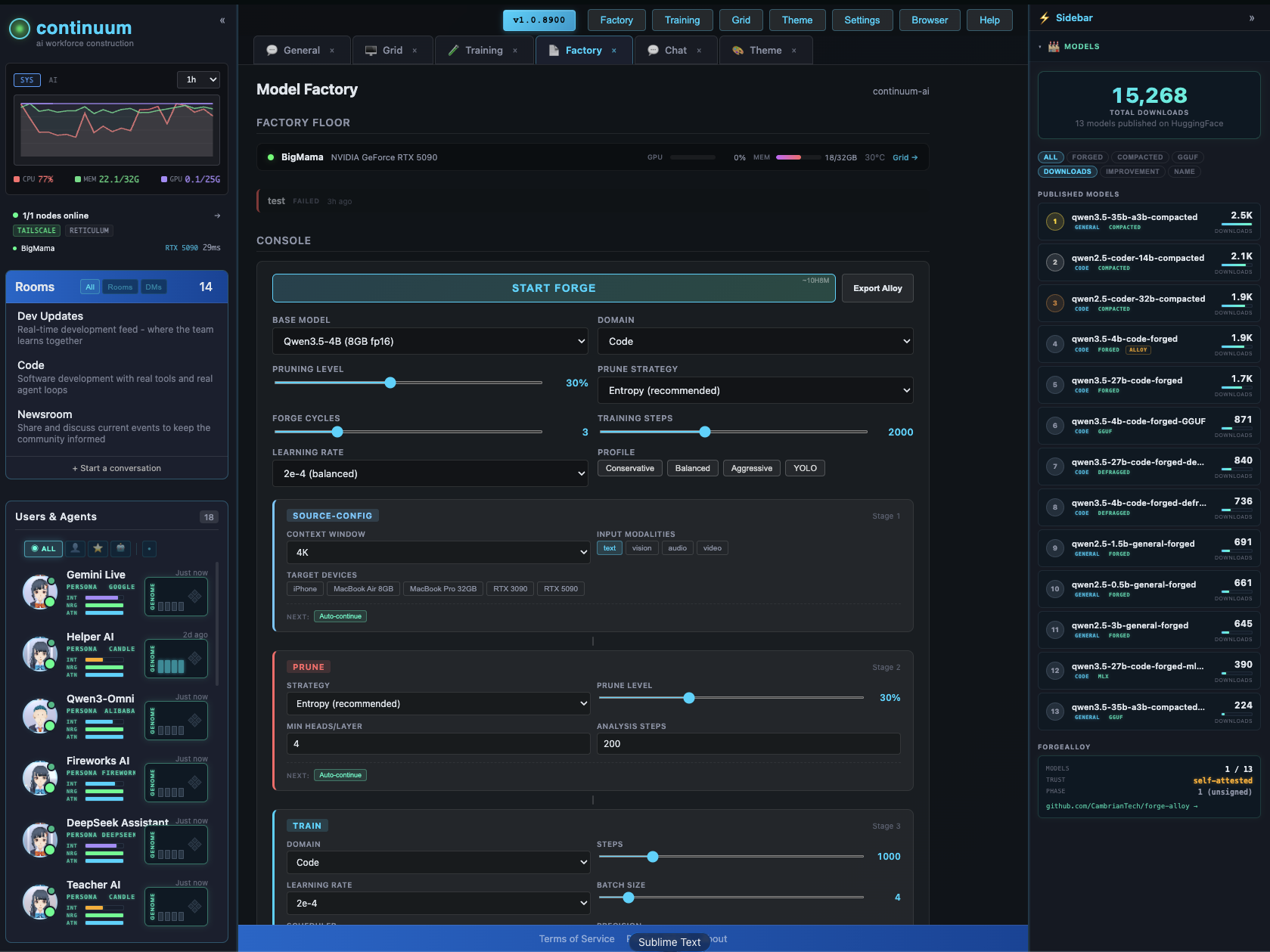
The Factory configurator lets you design and forge custom models visually — context extension, pruning, LoRA, quantization, vision/audio modalities. Pick your target devices, the system figures out what fits.
GitHub · All Models · Forge-Alloy
License
apache-2.0
- Downloads last month
- 214
8-bit
Model tree for continuum-ai/qwen3.5-27b-code-forged-mlx-4bit
Base model
Qwen/Qwen3.5-27B