

CSC-SQL
Collection
CSC-SQL: Corrective Self-Consistency in Text-to-SQL via Reinforcement Learning. github: https://github.com/CycloneBoy/csc_sql • 7 items • Updated
docker run --gpus all \
--shm-size 32g \
-p 30000:30000 \
-v ~/.cache/huggingface:/root/.cache/huggingface \
--env "HF_TOKEN=<secret>" \
--ipc=host \
lmsysorg/sglang:latest \
python3 -m sglang.launch_server \
--model-path "cycloneboy/CscSQL-Merge-Qwen2.5-Coder-7B-Instruct" \
--host 0.0.0.0 \
--port 30000# Call the server using curl (OpenAI-compatible API):
curl -X POST "http://localhost:30000/v1/chat/completions" \
-H "Content-Type: application/json" \
--data '{
"model": "cycloneboy/CscSQL-Merge-Qwen2.5-Coder-7B-Instruct",
"messages": [
{
"role": "user",
"content": "What is the capital of France?"
}
]
}'This repository contains the CscSQL-Grpo-Qwen2.5-Coder-7B-Instruct model, a key component of the CSC-SQL framework, as presented in the paper CSC-SQL: Corrective Self-Consistency in Text-to-SQL via Reinforcement Learning.
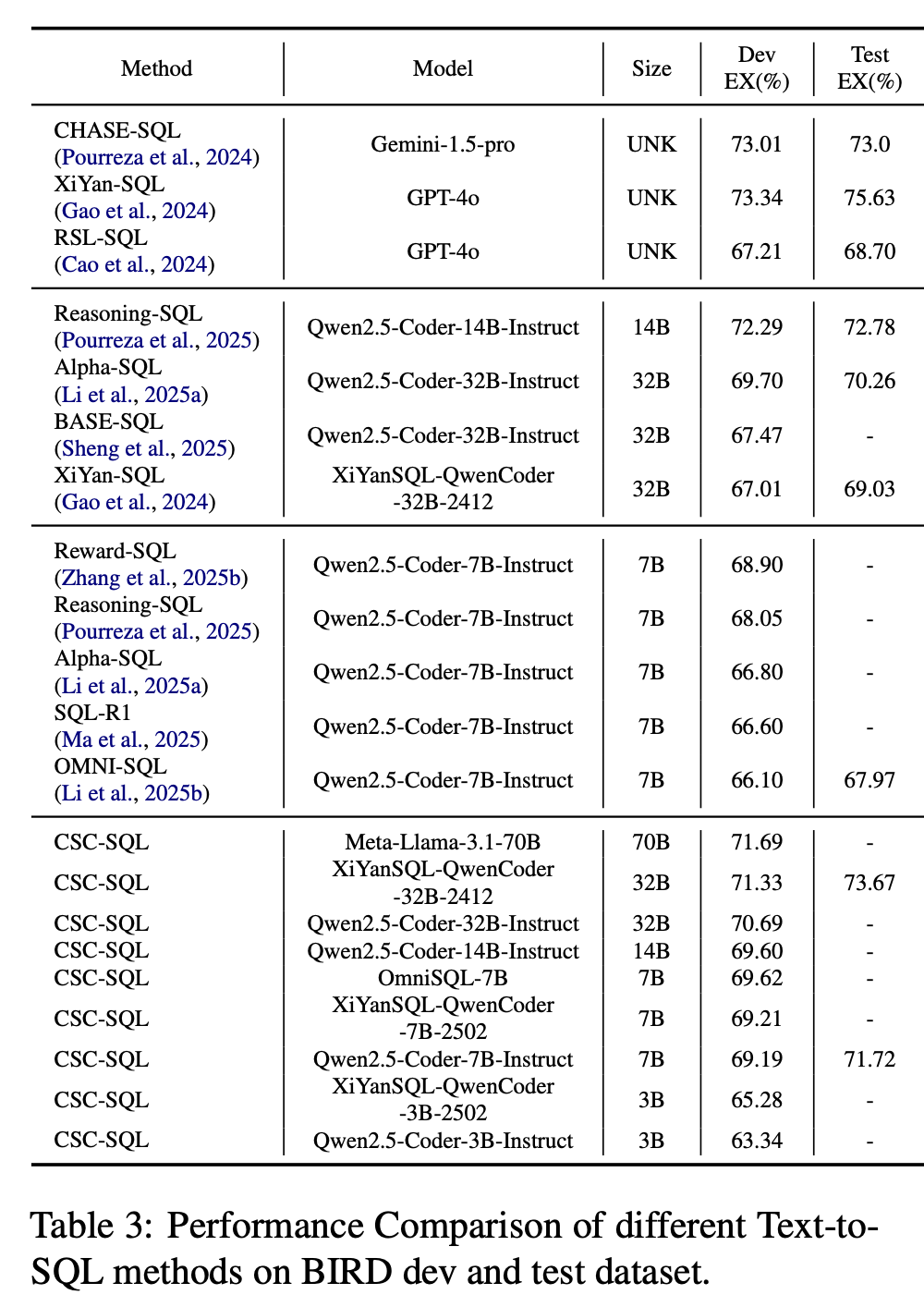
Large language models (LLMs) have demonstrated strong capabilities in translating natural language questions about relational databases into SQL queries. In particular, test-time scaling techniques such as Self-Consistency and Self-Correction can enhance SQL generation accuracy by increasing computational effort during inference. However, these methods have notable limitations: Self-Consistency may select suboptimal outputs despite majority votes, while Self-Correction typically addresses only syntactic errors. To leverage the strengths of both approaches, we propose CSC-SQL, a novel method that integrates Self-Consistency and Self-Correction. CSC-SQL selects the two most frequently occurring outputs from parallel sampling and feeds them into a merge revision model for correction. Additionally, we employ the Group Relative Policy Optimization (GRPO) algorithm to fine-tune both the SQL generation and revision models via reinforcement learning, significantly enhancing output quality. Experimental results confirm the effectiveness and generalizability of CSC-SQL. On the BIRD private test set, our 7B model achieves 71.72% execution accuracy, while the 32B model achieves 73.67%.
For more details, refer to the paper and the official GitHub repository.
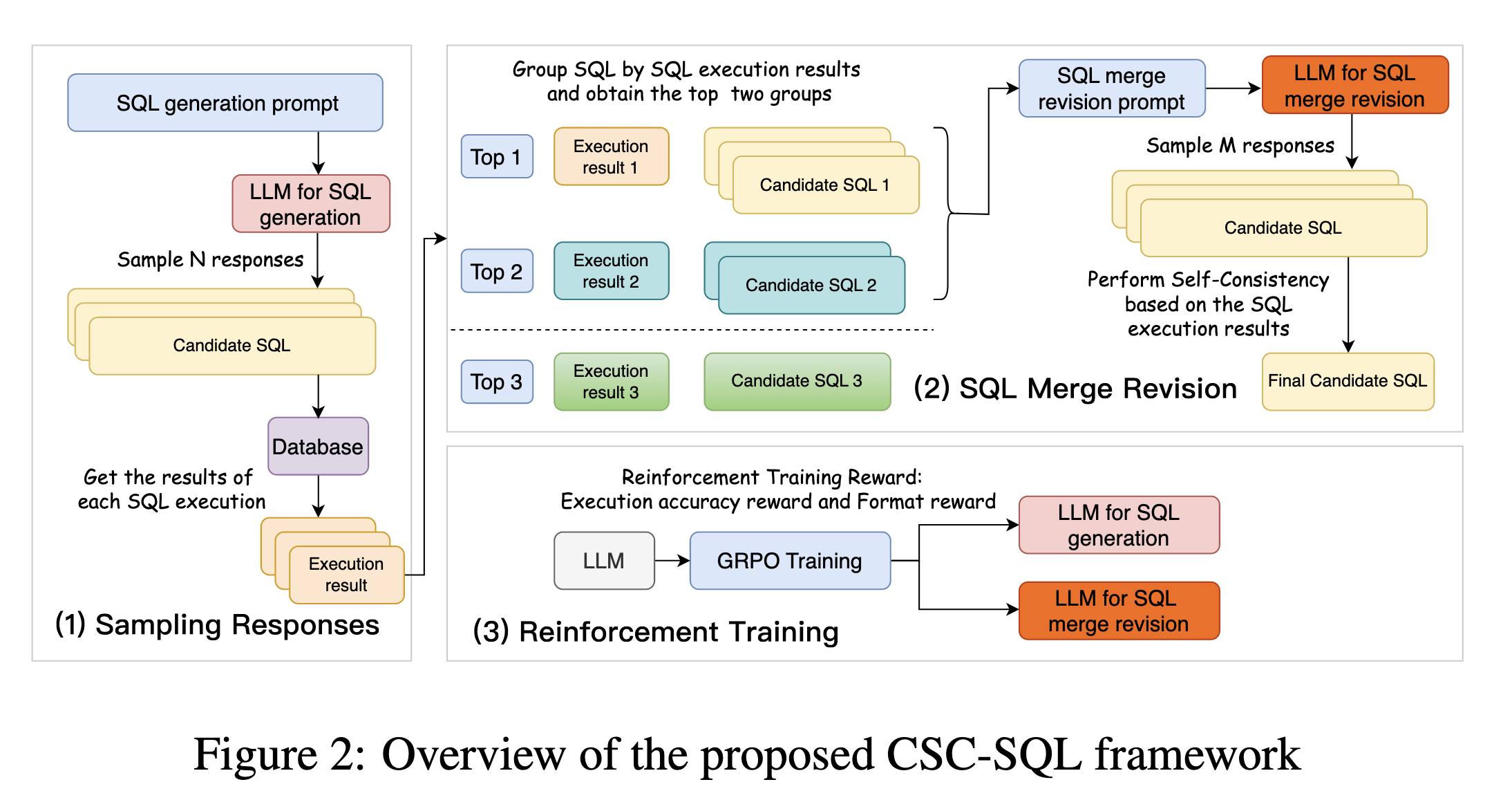
The official code repository for CSC-SQL is available on GitHub: https://github.com/CycloneBoy/csc_sql
Performance comparison of different Text-to-SQL methods on BIRD dev and test dataset:
This model is part of a collection of checkpoints related to CSC-SQL, also available on Hugging Face:
| Model | HuggingFace |
|---|---|
| CscSQL-Merge-Qwen2.5-Coder-3B-Instruct | 🤗 HuggingFace |
| CscSQL-Merge-Qwen2.5-Coder-7B-Instruct | 🤗 HuggingFace |
| CscSQL-Grpo-Qwen2.5-Coder-3B-Instruct | 🤗 HuggingFace |
| CscSQL-Grpo-XiYanSQL-QwenCoder-3B-2502 | 🤗 HuggingFace |
| CscSQL-Grpo-Qwen2.5-Coder-7B-Instruct | 🤗 HuggingFace |
| CscSQL-Grpo-XiYanSQL-QwenCoder-7B-2502 | 🤗 HuggingFace |
You can load this model using the transformers library. Here's a basic example for inference:
import torch
from transformers import AutoTokenizer, AutoModelForCausalLM, GenerationConfig
model_name = "cycloneboy/CscSQL-Grpo-Qwen2.5-Coder-7B-Instruct"
# Load model and tokenizer
tokenizer = AutoTokenizer.from_pretrained(model_name)
model = AutoModelForCausalLM.from_pretrained(
model_name,
torch_dtype=torch.bfloat16, # Or torch.float16 depending on your hardware
device_map="auto"
)
model.eval()
# Example prompt for text-to-SQL generation
# Note: The prompt format might need to align with the model's specific training
# and database schema format for optimal text-to-SQL performance.
prompt = "Translate the following question to SQL: 'What are the names of all employees?'"
# Encode the prompt
input_ids = tokenizer.encode(prompt, return_tensors="pt").to(model.device)
# Set generation configuration based on the model's generation_config.json
generation_config = GenerationConfig(
bos_token_id=tokenizer.bos_token_id,
eos_token_id=[tokenizer.eos_token_id, 151643], # Include <|endoftext|> as eos_token_id
pad_token_id=tokenizer.bos_token_id, # Or use tokenizer.pad_token_id if different
temperature=0.7,
max_new_tokens=512,
do_sample=True,
top_p=0.8,
repetition_penalty=1.1,
top_k=20,
)
# Generate SQL query
output_ids = model.generate(
input_ids,
generation_config=generation_config
)
# Decode the generated SQL
generated_sql = tokenizer.decode(output_ids[0], skip_special_tokens=True)
print(generated_sql)
# For detailed usage, including how to integrate with the full CSC-SQL framework
# for improved accuracy via reinforcement learning, please refer to the
# official GitHub repository: https://github.com/CycloneBoy/csc_sql
If you find this work helpful or inspiring, please feel free to cite it:
@misc{sheng2025cscsqlcorrectiveselfconsistencytexttosql,
title={CSC-SQL: Corrective Self-Consistency in Text-to-SQL via Reinforcement Learning},
author={Lei Sheng and Shuai-Shuai Xu},
year={2025},
eprint={2505.13271},
archivePrefix={arXiv},
primaryClass={cs.CL},
url={https://arxiv.org/abs/2505.13271},
}
Install from pip and serve model
# Install SGLang from pip: pip install sglang# Start the SGLang server: python3 -m sglang.launch_server \ --model-path "cycloneboy/CscSQL-Merge-Qwen2.5-Coder-7B-Instruct" \ --host 0.0.0.0 \ --port 30000# Call the server using curl (OpenAI-compatible API): curl -X POST "http://localhost:30000/v1/chat/completions" \ -H "Content-Type: application/json" \ --data '{ "model": "cycloneboy/CscSQL-Merge-Qwen2.5-Coder-7B-Instruct", "messages": [ { "role": "user", "content": "What is the capital of France?" } ] }'