


library_name: transformers
license: cc-by-nc-4.0
pipeline_tag: text-generation
tags:
  - text-to-sql
  - reinforcement-learning
SLM-SQL: An Exploration of Small Language Models for Text-to-SQL
Important Links
📖Paper | 💻GitHub | 🤗HuggingFace Collection | 🤖ModelScope Collection |
News
July 31, 2025: Upload model to modelscope and huggingface.July 30, 2025: Publish the paper to arxiv
Introduction
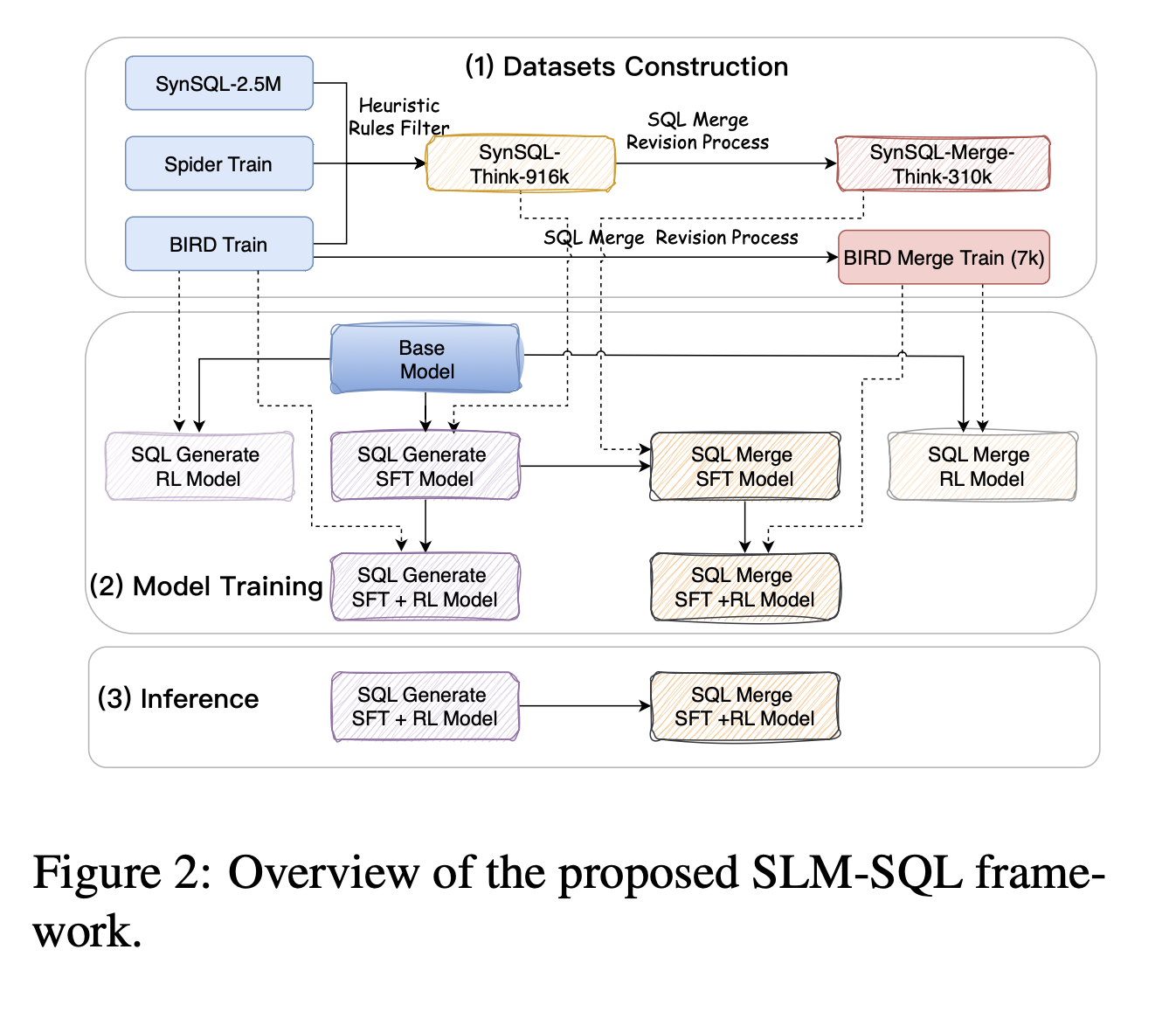
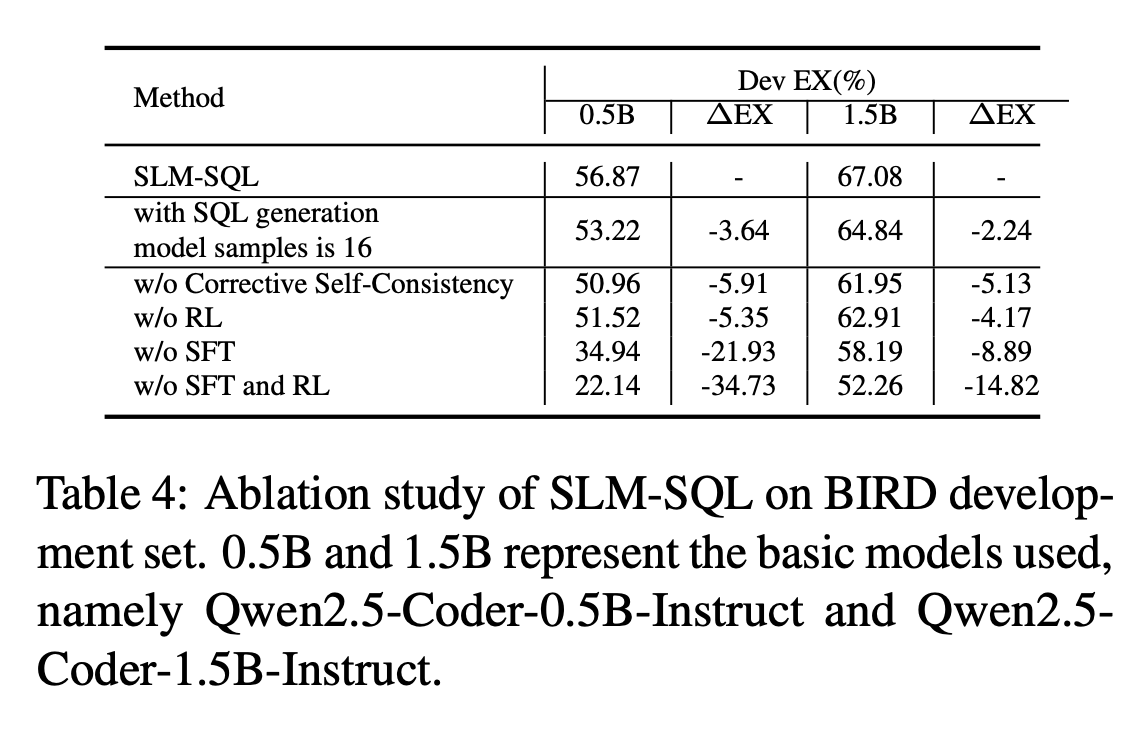
Large language models (LLMs) have demonstrated strong performance in translating natural language questions into SQL queries (Text-to-SQL). In contrast, small language models (SLMs) ranging from 0.5B to 1.5B parameters currently underperform on Text-to-SQL tasks due to their limited logical reasoning capabilities. However, SLMs offer inherent advantages in inference speed and suitability for edge deployment. To explore their potential in Text-to-SQL applications, we leverage recent advancements in post-training techniques. Specifically, we used the open-source SynSQL-2.5M dataset to construct two derived datasets: SynSQL-Think-916K for SQL generation and SynSQL-Merge-Think-310K for SQL merge revision. We then applied supervised fine-tuning and reinforcement learning-based post-training to the SLM, followed by inference using a corrective self-consistency approach. Experimental results validate the effectiveness and generalizability of our method, SLM-SQL. On the BIRD development set, the five evaluated models achieved an average improvement of 31.4 points. Notably, the 0.5B model reached 56.87% execution accuracy (EX), while the 1.5B model achieved 67.08% EX.
Framework
Main Results
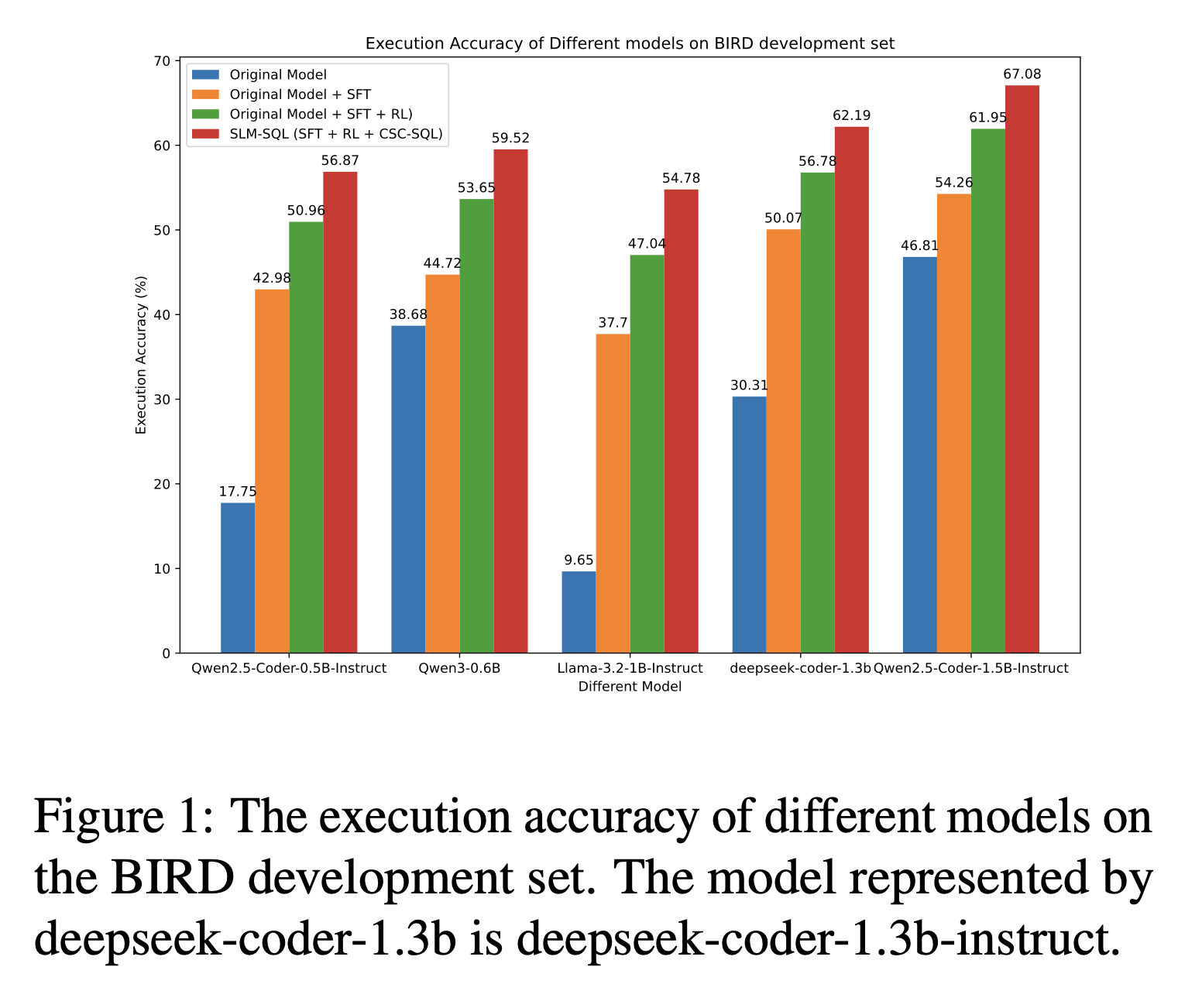
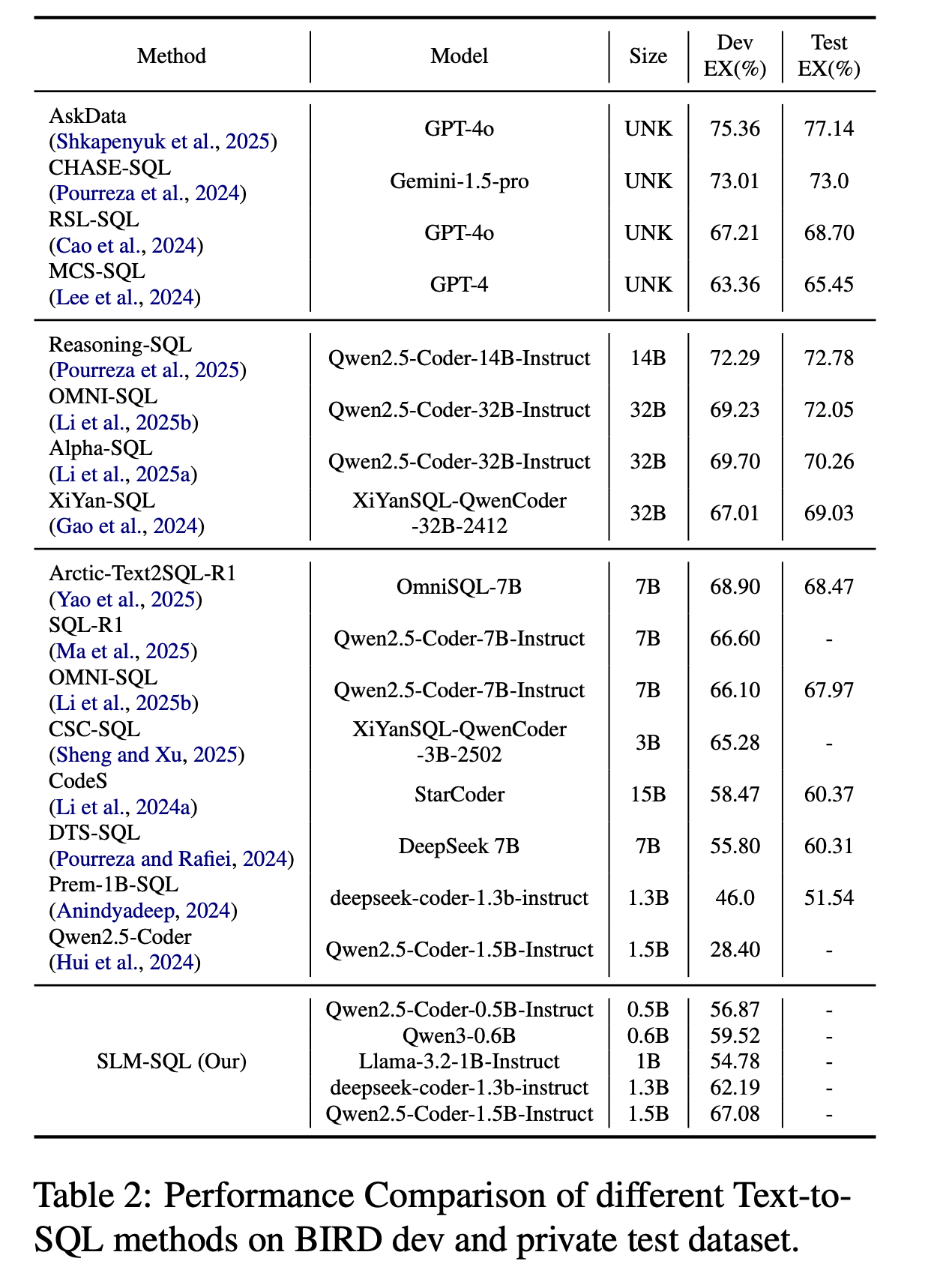
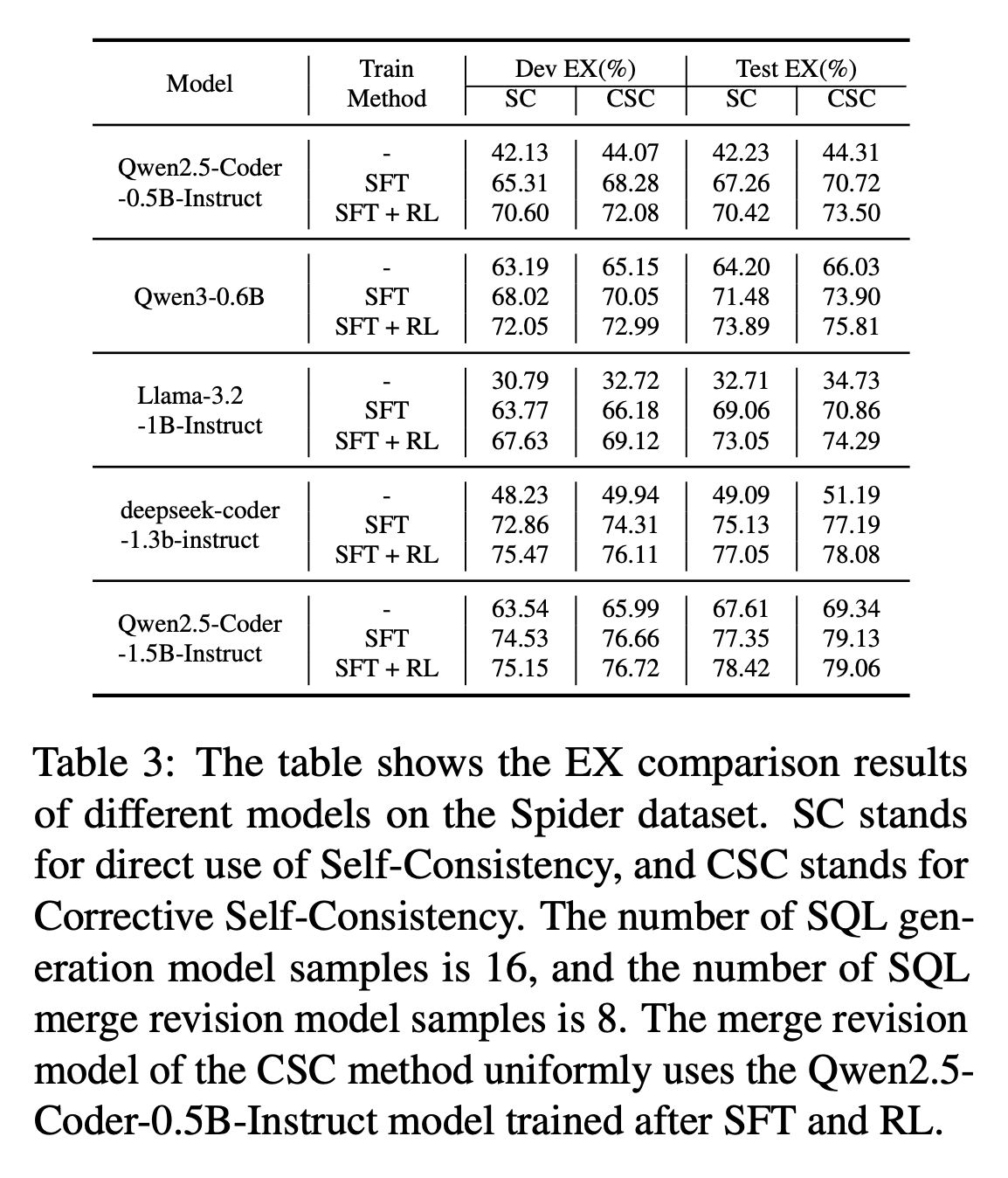
Performance Comparison of different Text-to-SQL methods on BIRD dev and test dataset.
Model
| Model | Base Model | Train Method | Modelscope | HuggingFace |
|---|---|---|---|---|
| SLM-SQL-Base-0.5B | Qwen2.5-Coder-0.5B-Instruct | SFT | 🤖 Modelscope | 🤗 HuggingFace |
| SLM-SQL-0.5B | Qwen2.5-Coder-0.5B-Instruct | SFT + GRPO | 🤖 Modelscope | 🤗 HuggingFace |
| CscSQL-Merge-Qwen2.5-Coder-0.5B-Instruct | Qwen2.5-Coder-0.5B-Instruct | SFT + GRPO | 🤖 Modelscope | 🤗 HuggingFace |
| SLM-SQL-Base-1.5B | Qwen2.5-Coder-1.5B-Instruct | SFT | 🤖 Modelscope | 🤗 HuggingFace |
| SLM-SQL-1.5B | Qwen2.5-Coder-1.5B-Instruct | SFT + GRPO | 🤖 Modelscope | 🤗 HuggingFace |
| CscSQL-Merge-Qwen2.5-Coder-1.5B-Instruct | Qwen2.5-Coder-1.5B-Instruct | SFT + GRPO | 🤖 Modelscope | 🤗 HuggingFace |
| SLM-SQL-Base-0.6B | Qwen3-0.6B | SFT | 🤖 Modelscope | 🤗 HuggingFace |
| SLM-SQL-0.6B | Qwen3-0.6B | SFT + GRPO | 🤖 Modelscope | 🤗 HuggingFace |
| SLM-SQL-Base-1.3B | deepseek-coder-1.3b-instruct | SFT | 🤖 Modelscope | 🤗 HuggingFace |
| SLM-SQL-1.3B | deepseek-coder-1.3b-instruct | SFT + GRPO | 🤖 Modelscope | 🤗 HuggingFace |
| SLM-SQL-Base-1B | Llama-3.2-1B-Instruct | SFT | 🤖 Modelscope | 🤗 HuggingFace |
Sample Usage
This model can be easily loaded and used with the transformers library. The following example demonstrates how to perform Text-to-SQL generation.
import torch
from transformers import AutoTokenizer, AutoModelForCausalLM

model_id = "cycloneboy/SLM-SQL-0.5B" # You can choose any of the models from the table above
tokenizer = AutoTokenizer.from_pretrained(model_id)
model = AutoModelForCausalLM.from_pretrained(
    model_id,
    torch_dtype=torch.bfloat16, # Use torch.bfloat16 as specified in the model's config
    device_map="auto" # Automatically maps the model to available devices (e.g., GPU)
)

# Example SQL schema (simplified for demonstration)
schema = """
CREATE TABLE employees (
    employee_id INT,
    first_name VARCHAR,
    last_name VARCHAR,
    department VARCHAR,
    salary INT
);
"""

# Natural language query
query = "Show me the first name and last name of employees in the 'Sales' department earning more than 50000."

# Construct the prompt using the model's chat template format
# The chat template automatically adds system/user tags if available.
messages = [
    {"role": "user", "content": f"Translate the following natural language query into SQL:\
Schema: {schema}\
Query: {query}"}
]
prompt_text = tokenizer.apply_chat_template(messages, tokenize=False, add_generation_prompt=True)

inputs = tokenizer(prompt_text, return_tensors="pt").to(model.device)

# Generate the SQL query
outputs = model.generate(**inputs, max_new_tokens=256, pad_token_id=tokenizer.eos_token_id)
generated_text = tokenizer.decode(outputs[0], skip_special_tokens=True)

# Extracting only the generated SQL part (assuming the model responds only with SQL after "### Response:")
# The model's chat template is `### Instruction:
...
### Response:
...<|EOT|>`
# We need to trim the input prompt and the <|EOT|> token.
if "### Response:" in generated_text:
    sql_start_index = generated_text.find("### Response:") + len("### Response:")
    generated_sql = generated_text[sql_start_index:].strip()
    if "<|EOT|>" in generated_sql:
        generated_sql = generated_sql.split("<|EOT|>")[0].strip()
else:
    generated_sql = generated_text # Fallback if response format is unexpected

print(generated_sql)

# Expected output (may vary slightly based on model's exact generation):
# SELECT first_name, last_name FROM employees WHERE department = 'Sales' AND salary > 50000;
Dataset
| Dataset | Modelscope | HuggingFace |
|---|---|---|
| SynsQL-Think-916k | 🤖 Modelscope | 🤗 HuggingFace |
| SynsQL-Merge-Think-310k | 🤖 Modelscope | 🤗 HuggingFace |
| bird train and dev dataset | 🤖 Modelscope | 🤗 HuggingFace |
TODO
- Release inference code
- Upload Model
- Release training code
- Fix bug
- Update doc
Thanks to the following projects
Citation
@misc{sheng2025slmsqlexplorationsmalllanguage,
      title={SLM-SQL: An Exploration of Small Language Models for Text-to-SQL},
      author={Lei Sheng and Shuai-Shuai Xu},
      year={2025},
      eprint={2507.22478},
      archivePrefix={arXiv},
      primaryClass={cs.CL},
      url={https://arxiv.org/abs/2507.22478},
}

@misc{sheng2025cscsqlcorrectiveselfconsistencytexttosql,
      title={CSC-SQL: Corrective Self-Consistency in Text-to-SQL via Reinforcement Learning},
      author={Lei Sheng and Shuai-Shuai Xu},
      year={2025},
      eprint={2505.13271},
      archivePrefix={arXiv},
      primaryClass={cs.CL},
      url={https://arxiv.org/abs/2505.13271},
}