

Add data for Canadian Mathematical Olympiad (CANADA MO)
#3
by
LxYxvv
- opened
This view is limited to 50 files because it contains too many changes.
See the raw diff here.
- CANADA_MO/download_script/download.py +91 -0
- CANADA_MO/md/en-2021CMO_solutions_en-1.md +172 -0
- CANADA_MO/md/en-cmo2022-solutions-en.md +227 -0
- CANADA_MO/md/en-cmo2023-solutions-en.md +169 -0
- CANADA_MO/md/en-cmo2024-solutions-en.md +146 -0
- CANADA_MO/md/en-exam1969.md +61 -0
- CANADA_MO/md/en-exam1970.md +67 -0
- CANADA_MO/md/en-exam1971.md +55 -0
- CANADA_MO/md/en-exam1972.md +54 -0
- CANADA_MO/md/en-exam1973.md +61 -0
- CANADA_MO/md/en-exam1974.md +102 -0
- CANADA_MO/md/en-exam1975.md +54 -0
- CANADA_MO/md/en-exam1976.md +49 -0
- CANADA_MO/md/en-exam1977.md +50 -0
- CANADA_MO/md/en-exam1978.md +43 -0
- CANADA_MO/md/en-exam1979.md +38 -0
- CANADA_MO/md/en-exam1980.md +20 -0
- CANADA_MO/md/en-exam1981.md +30 -0
- CANADA_MO/md/en-exam1982.md +30 -0
- CANADA_MO/md/en-exam1983.md +22 -0
- CANADA_MO/md/en-exam1984.md +34 -0
- CANADA_MO/md/en-exam1985.md +21 -0
- CANADA_MO/md/en-exam1986.md +22 -0
- CANADA_MO/md/en-exam1987.md +28 -0
- CANADA_MO/md/en-exam1988.md +21 -0
- CANADA_MO/md/en-exam1989.md +24 -0
- CANADA_MO/md/en-exam1990.md +51 -0
- CANADA_MO/md/en-exam1991.md +24 -0
- CANADA_MO/md/en-exam1992.md +34 -0
- CANADA_MO/md/en-exam1993.md +39 -0
- CANADA_MO/md/en-exam1994.md +26 -0
- CANADA_MO/md/en-exam1995.md +49 -0
- CANADA_MO/md/en-exam1996.md +36 -0
- CANADA_MO/md/en-exam1997.md +40 -0
- CANADA_MO/md/en-exam1998.md +30 -0
- CANADA_MO/md/en-exam1999.md +16 -0
- CANADA_MO/md/en-sol1994.md +353 -0
- CANADA_MO/md/en-sol1995.md +147 -0
- CANADA_MO/md/en-sol1996.md +233 -0
- CANADA_MO/md/en-sol1997.md +332 -0
- CANADA_MO/md/en-sol1998.md +460 -0
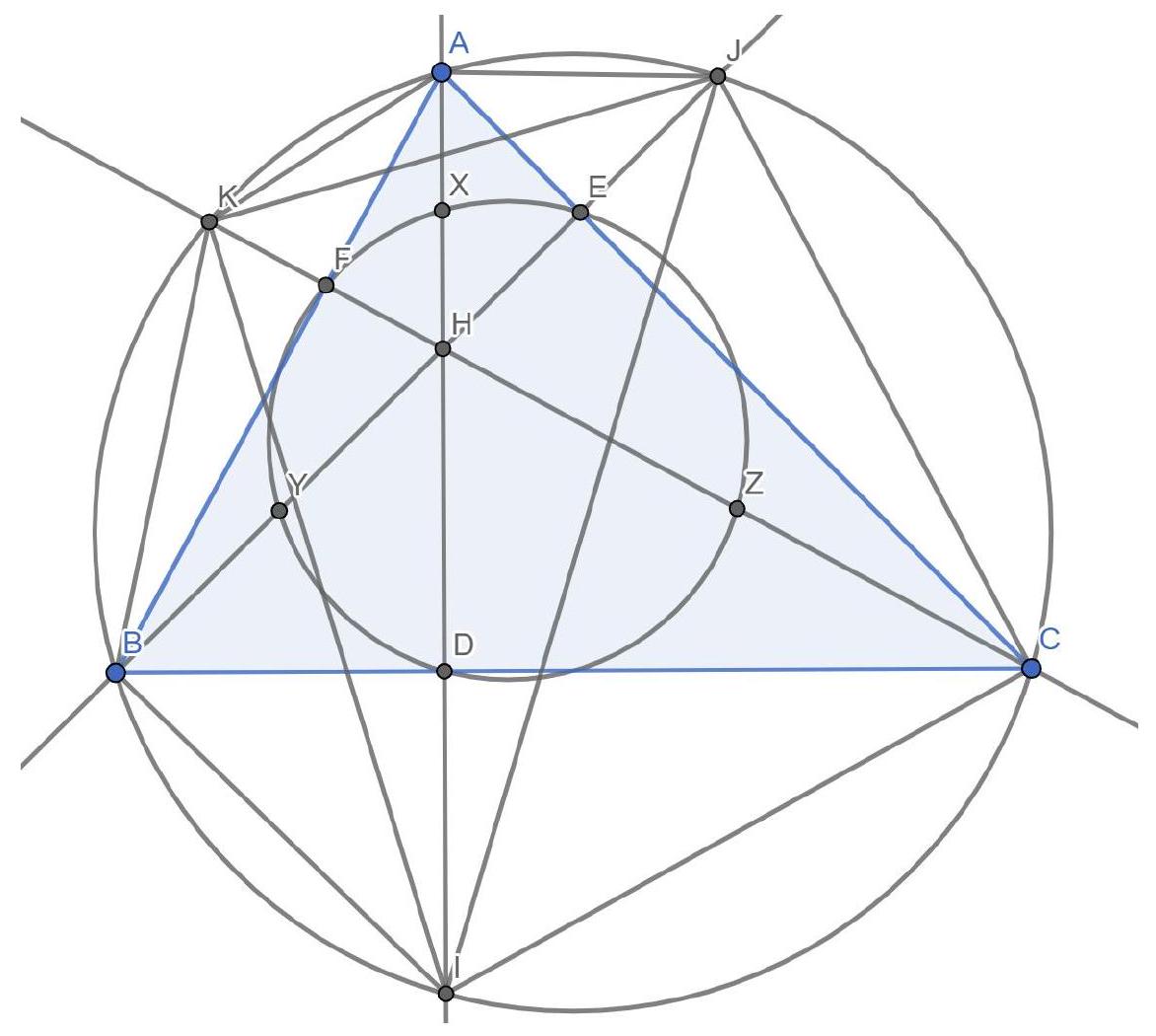
- CANADA_MO/md/en-sol1999.md +249 -0
- CANADA_MO/md/en-sol2000.md +129 -0
- CANADA_MO/md/en-sol2001.md +233 -0
- CANADA_MO/md/en-sol2002.md +274 -0
- CANADA_MO/md/en-sol2003.md +162 -0
- CANADA_MO/md/en-sol2004.md +179 -0
- CANADA_MO/md/en-sol2005.md +260 -0
- CANADA_MO/md/en-sol2006.md +266 -0
- CANADA_MO/md/en-sol2007.md +167 -0
CANADA_MO/download_script/download.py
ADDED
|
@@ -0,0 +1,91 @@
|
|
|
|
|
|
|
|
|
|
|
|
|
|
|
|
|
|
|
|
|
|
|
|
|
|
|
|
|
|
|
|
|
|
|
|
|
|
|
|
|
|
|
|
|
|
|
|
|
|
|
|
|
|
|
|
|
|
|
|
|
|
|
|
|
|
|
|
|
|
|
|
|
|
|
|
|
|
|
|
|
|
|
|
|
|
|
|
|
|
|
|
|
|
|
|
|
|
|
|
|
|
|
|
|
|
|
|
|
|
|
|
|
|
|
|
|
|
|
|
|
|
|
|
|
|
|
|
|
|
|
|
|
|
|
|
|
|
|
|
|
|
|
|
|
|
|
|
|
|
|
|
|
|
|
|
|
|
|
|
|
|
|
|
|
|
|
|
|
|
|
|
|
|
|
|
|
|
|
|
|
|
|
|
|
|
|
|
|
|
|
|
|
|
|
|
|
|
|
|
|
|
|
|
|
|
|
|
|
|
|
|
|
|
|
|
|
|
|
|
|
|
|
|
|
|
|
|
|
|
|
|
|
|
|
|
|
|
|
|
|
|
|
|
|
|
|
|
|
|
|
|
|
|
|
|
|
|
|
|
|
|
|
|
|
|
|
|
|
|
|
|
|
|
|
|
|
| 1 |
+
# -----------------------------------------------------------------------------
|
| 2 |
+
# Author: Jiawei Liu
|
| 3 |
+
# Date: 2024-11-22
|
| 4 |
+
# -----------------------------------------------------------------------------
|
| 5 |
+
'''
|
| 6 |
+
Download script for CANADA MO
|
| 7 |
+
|
| 8 |
+
Notes:
|
| 9 |
+
1. 1969-1993 no solution
|
| 10 |
+
2. 1994-1999 problem and solution are separated in two file
|
| 11 |
+
3. 2000+ problem and solution in the same file
|
| 12 |
+
|
| 13 |
+
To run:
|
| 14 |
+
`python CANADA_MO\download_script\download.py`
|
| 15 |
+
'''
|
| 16 |
+
|
| 17 |
+
import requests
|
| 18 |
+
from requests.adapters import HTTPAdapter
|
| 19 |
+
from tqdm import tqdm
|
| 20 |
+
from bs4 import BeautifulSoup
|
| 21 |
+
from urllib.parse import urljoin
|
| 22 |
+
from urllib3.util.retry import Retry
|
| 23 |
+
from pathlib import Path
|
| 24 |
+
|
| 25 |
+
|
| 26 |
+
def build_session(
|
| 27 |
+
max_retries: int = 3,
|
| 28 |
+
backoff_factor: int = 2,
|
| 29 |
+
session: requests.Session = None
|
| 30 |
+
) -> requests.Session:
|
| 31 |
+
"""
|
| 32 |
+
Build a requests session with retries
|
| 33 |
+
|
| 34 |
+
Args:
|
| 35 |
+
max_retries (int, optional): Number of retries. Defaults to 3.
|
| 36 |
+
backoff_factor (int, optional): Backoff factor. Defaults to 2.
|
| 37 |
+
session (requests.Session, optional): Session object. Defaults to None.
|
| 38 |
+
"""
|
| 39 |
+
session = session or requests.Session()
|
| 40 |
+
adapter = HTTPAdapter(max_retries=Retry(total=max_retries, backoff_factor=backoff_factor))
|
| 41 |
+
session.mount("http://", adapter)
|
| 42 |
+
session.mount("https://", adapter)
|
| 43 |
+
session.headers.update({
|
| 44 |
+
"User-Agent": "Mozilla/5.0 (Windows NT 10.0; Win64; x64) AppleWebKit/537.36 (KHTML, like Gecko) Chrome/58.0.3029.110 Safari/537.3"
|
| 45 |
+
})
|
| 46 |
+
|
| 47 |
+
return session
|
| 48 |
+
|
| 49 |
+
|
| 50 |
+
def main():
|
| 51 |
+
req_session = build_session()
|
| 52 |
+
base_url = "https://cms.math.ca/Competitions/CMO/"
|
| 53 |
+
|
| 54 |
+
output_dir = Path(__file__).parent.parent / "raw"
|
| 55 |
+
output_dir.mkdir(parents=True, exist_ok=True)
|
| 56 |
+
|
| 57 |
+
resp = req_session.get(base_url)
|
| 58 |
+
soup = BeautifulSoup(resp.text, "html.parser")
|
| 59 |
+
|
| 60 |
+
cmo_year_a_ele = soup.find_all("a", href=lambda t: "#cmo" in t)
|
| 61 |
+
|
| 62 |
+
for cy_a_ele in tqdm(cmo_year_a_ele):
|
| 63 |
+
year = cy_a_ele.get_text(strip=True)
|
| 64 |
+
|
| 65 |
+
# Get problem and solution link elements
|
| 66 |
+
pro_link_ele = cy_a_ele.parent.parent.select_one("td:nth-child(2)").find("a")
|
| 67 |
+
sol_link_ele = cy_a_ele.parent.parent.select_one("td:nth-child(3)").find("a")
|
| 68 |
+
|
| 69 |
+
donwload_urls = []
|
| 70 |
+
if sol_link_ele:
|
| 71 |
+
donwload_urls.append(sol_link_ele["href"])
|
| 72 |
+
else:
|
| 73 |
+
donwload_urls.append(pro_link_ele["href"])
|
| 74 |
+
|
| 75 |
+
# Year is between 1994 and 1999, download both problem and solution
|
| 76 |
+
if int(year) >= 1994 and int(year) <= 1999:
|
| 77 |
+
donwload_urls.append(pro_link_ele["href"])
|
| 78 |
+
|
| 79 |
+
for du in donwload_urls:
|
| 80 |
+
output_file = output_dir / f"en-{du.split('/')[-1]}"
|
| 81 |
+
|
| 82 |
+
# Skip if file already exists
|
| 83 |
+
if output_file.exists():
|
| 84 |
+
continue
|
| 85 |
+
|
| 86 |
+
pdf_resp = req_session.get(du)
|
| 87 |
+
output_file.write_bytes(pdf_resp.content)
|
| 88 |
+
|
| 89 |
+
|
| 90 |
+
if __name__ == "__main__":
|
| 91 |
+
main()
|
CANADA_MO/md/en-2021CMO_solutions_en-1.md
ADDED
|
@@ -0,0 +1,172 @@
|
|
|
|
|
|
|
|
|
|
|
|
|
|
|
|
|
|
|
|
|
|
|
|
|
|
|
|
|
|
|
|
|
|
|
|
|
|
|
|
|
|
|
|
|
|
|
|
|
|
|
|
|
|
|
|
|
|
|
|
|
|
|
|
|
|
|
|
|
|
|
|
|
|
|
|
|
|
|
|
|
|
|
|
|
|
|
|
|
|
|
|
|
|
|
|
|
|
|
|
|
|
|
|
|
|
|
|
|
|
|
|
|
|
|
|
|
|
|
|
|
|
|
|
|
|
|
|
|
|
|
|
|
|
|
|
|
|
|
|
|
|
|
|
|
|
|
|
|
|
|
|
|
|
|
|
|
|
|
|
|
|
|
|
|
|
|
|
|
|
|
|
|
|
|
|
|
|
|
|
|
|
|
|
|
|
|
|
|
|
|
|
|
|
|
|
|
|
|
|
|
|
|
|
|
|
|
|
|
|
|
|
|
|
|
|
|
|
|
|
|
|
|
|
|
|
|
|
|
|
|
|
|
|
|
|
|
|
|
|
|
|
|
|
|
|
|
|
|
|
|
|
|
|
|
|
|
|
|
|
|
|
|
|
|
|
|
|
|
|
|
|
|
|
|
|
|
|
|
|
|
|
|
|
|
|
|
|
|
|
|
|
|
|
|
|
|
|
|
|
|
|
|
|
|
|
|
|
|
|
|
|
|
|
|
|
|
|
|
|
|
|
|
|
|
|
|
|
|
|
|
|
|
|
|
|
|
|
|
|
|
|
|
|
|
|
|
|
|
|
|
|
|
|
|
|
|
|
|
|
|
|
|
|
|
|
|
|
|
|
|
|
|
|
|
|
|
|
|
|
|
|
|
|
|
|
|
|
|
|
|
|
|
|
|
|
|
|
|
|
|
|
|
|
|
|
|
|
|
|
|
|
|
|
|
|
|
|
|
|
|
|
|
|
|
|
|
|
|
|
|
|
|
|
|
|
|
|
|
|
|
|
|
|
|
|
|
|
|
|
|
|
|
|
|
|
|
|
|
|
|
|
|
|
|
|
|
|
|
|
|
|
|
|
|
|
|
|
|
|
|
|
|
|
|
|
|
|
|
|
|
|
|
|
|
|
|
|
|
|
|
|
|
|
|
|
|
|
|
|
|
|
|
|
|
|
|
|
|
|
| 1 |
+
# Canadian Mathematical Olympiad 2021
|
| 2 |
+
|
| 3 |
+
## Official Solutions
|
| 4 |
+
|
| 5 |
+
## A full list of our competition sponsors and partners is available online at https://cms.math.ca/competitions/competition-sponsors/
|
| 6 |
+
|
| 7 |
+
## Note: Each problem starts on a new page.
|
| 8 |
+
|
| 9 |
+
Problem No. 1.
|
| 10 |
+
|
| 11 |
+
Let $A B C D$ be a trapezoid with $A B$ parallel to $C D,|A B|>|C D|$, and equal edges $|A D|=|B C|$. Let $I$ be the center of the circle tangent to lines $A B, A C$ and $B D$, where $A$ and $I$ are on opposite sides of $B D$. Let $J$ be the center of the circle tangent to lines $C D, A C$ and $B D$, where $D$ and $J$ are on opposite sides of $A C$. Prove that $|I C|=|J B|$.
|
| 12 |
+
|
| 13 |
+
Solution. Let $\{P\}=A C \cap B D$ and let $\angle A P B=180-2 a$. Since $A B C D$ is an isosceles trapezoid, $A P B$ is an isosceles triangle. Therefore $\angle P B A=a$, which implies that $\angle P B I=90^{\circ}-a / 2$ since $I$ lies on the external bisector of $\angle P B A$. Since $I$ lies on the bisector of $\angle C P B$, it follows that $\angle B P I=a$ and hence that $I P B$ is isosceles with $|I P|=|P B|$. Similarly $J P C$ is isosceles with $|J P|=|P C|$. So, in the triangles $C P I$ and $B P J$ we have $P I \equiv P B$ and $P J \equiv C P$. Since $I$ and $J$ both lie on the internal bisector of $\angle B P C$, it follows that triangles $C P I$ and $B P J$ are congruent. Therefore $|I C|=|J B|$.
|
| 14 |
+
|
| 15 |
+
A competition of the Canadian Mathematical Society and supported by the Actuarial Profession.
|
| 16 |
+

|
| 17 |
+
|
| 18 |
+
Expertise. Insight. Solutions.
|
| 19 |
+
|
| 20 |
+
## Canadian Mathematical Olympiad 2021
|
| 21 |
+
|
| 22 |
+
## Problem No. 2.
|
| 23 |
+
|
| 24 |
+
Let $n \geq 2$ be some fixed positive integer and suppose that $a_{1}, a_{2}, \ldots, a_{n}$ are positive real numbers satisfying $a_{1}+a_{2}+\cdots+a_{n}=2^{n}-1$.
|
| 25 |
+
|
| 26 |
+
Find the minimum possible value of
|
| 27 |
+
|
| 28 |
+
$$
|
| 29 |
+
\frac{a_{1}}{1}+\frac{a_{2}}{1+a_{1}}+\frac{a_{3}}{1+a_{1}+a_{2}}+\cdots+\frac{a_{n}}{1+a_{1}+a_{2}+\cdots+a_{n-1}} .
|
| 30 |
+
$$
|
| 31 |
+
|
| 32 |
+
Solution. We claim the the minimum possible value of this expression is $n$. Observe that by AM-GM, we have that
|
| 33 |
+
|
| 34 |
+
$$
|
| 35 |
+
\begin{aligned}
|
| 36 |
+
\frac{a_{1}}{1}+ & \frac{a_{2}}{1+a_{1}}+\cdots+\frac{a_{n}}{1+a_{1}+a_{2}+\cdots+a_{n-1}} \\
|
| 37 |
+
& =\frac{1+a_{1}}{1}+\frac{1+a_{1}+a_{2}}{1+a_{1}}+\cdots+\frac{1+a_{1}+a_{2}+\cdots+a_{n}}{1+a_{1}+a_{2}+\cdots+a_{n-1}}-n \\
|
| 38 |
+
& \geq n \cdot \sqrt[n]{\frac{1+a_{1}}{1} \cdot \frac{1+a_{1}+a_{2}}{1+a_{1}} \cdots \frac{1+a_{1}+a_{2}+\cdots+a_{n}}{1+a_{1}+a_{2}+\cdots+a_{n-1}}}-n \\
|
| 39 |
+
& =n \cdot \sqrt[n]{1+a_{1}+a_{2}+\cdots+a_{n}}-n \\
|
| 40 |
+
& =2 n-n=n .
|
| 41 |
+
\end{aligned}
|
| 42 |
+
$$
|
| 43 |
+
|
| 44 |
+
Furthermore, equality is achieved when $a_{k}=2^{k-1}$ for each $1 \leq k \leq n$.
|
| 45 |
+
|
| 46 |
+
## Canadian Mathematical Olympiad 2021
|
| 47 |
+
|
| 48 |
+
## Problem No. 3.
|
| 49 |
+
|
| 50 |
+
At a dinner party there are $N$ hosts and $N$ guests, seated around a circular table, where $N \geq 4$. A pair of two guests will chat with one another if either there is at most one person seated between them or if there are exactly two people between them, at least one of whom is a host. Prove that no matter how the 2 N people are seated at the dinner party, at least $N$ pairs of guests will chat with one another.
|
| 51 |
+
|
| 52 |
+
Solution. Let a run refer to a maximal group of consecutive dinner party guests all of whom are the same type (host or guest). Suppose that there are exactly $k$ runs of hosts and $k$ runs of guests. Let $G_{i}$ and $H_{i}$ denote the number of runs of guests and hosts, respectively, of length exactly $i$. Furthermore, let $X$ denote the number of hosts surrounded by two runs of guests, both of length exactly 1 . We claim that the number of pairs of guests who chat is at least
|
| 53 |
+
|
| 54 |
+
$$
|
| 55 |
+
2 N-3 k+G_{1}+2 H_{1}+H_{2}-X
|
| 56 |
+
$$
|
| 57 |
+
|
| 58 |
+
The number of pairs of guests who chat with no host between them is at least the sum of $\max \{2 \ell-3,0\}$ over all guest run lengths $\ell$. This sum is at least $2 N-3 k+G_{1}$. The number of pairs of guests who chat with exactly two hosts between them is $H_{2}$. Furthermore, the number of pairs of guests who chat with exactly one host between them is at least $2 H_{1}-X$. This is because any host surrounded by two runs of guests causes at least two pairs of guests to chat unless these runs are both of length exactly 1 . This proves the claim. Now note that
|
| 59 |
+
|
| 60 |
+
$$
|
| 61 |
+
2 H_{1}+H_{2}+N \geq 3 k
|
| 62 |
+
$$
|
| 63 |
+
|
| 64 |
+
because each run of hosts contributes at least three to the left hand side. Furthermore, pairing each run counted in $X$ with the guest run of length 1 immediately following it in clockwise order shows that $G_{1} \geq X$. Combining these inequalities yields that $2 N-3 k+G_{1}+2 H_{1}+H_{2}-X \geq N$, completing the proof of the desired result.
|
| 65 |
+
|
| 66 |
+
## Canadian Mathematical Olympiad 2021
|
| 67 |
+
|
| 68 |
+
## Problem No. 4.
|
| 69 |
+
|
| 70 |
+
A function $f$ from the positive integers to the positive integers is called Canadian if it satisfies
|
| 71 |
+
|
| 72 |
+
$$
|
| 73 |
+
\operatorname{gcd}(f(f(x)), f(x+y))=\operatorname{gcd}(x, y)
|
| 74 |
+
$$
|
| 75 |
+
|
| 76 |
+
for all pairs of positive integers $x$ and $y$.
|
| 77 |
+
Find all positive integers $m$ such that $f(m)=m$ for all Canadian functions $f$.
|
| 78 |
+
|
| 79 |
+
Solution. Define an $m \in \mathbb{N}$ to be good if $f(m)=m$ for all such $f$. It will be shown that $m$ is good if and only if $m$ has two or more distinct prime divisors. Let $P(x, y)$ denote the assertion
|
| 80 |
+
|
| 81 |
+
$$
|
| 82 |
+
\operatorname{gcd}(f(f(x)), f(x+y))=\operatorname{gcd}(x, y)
|
| 83 |
+
$$
|
| 84 |
+
|
| 85 |
+
for a pair $x, y \in \mathbb{N}$. Let $x$ be a positive integer with two or more distinct prime divisors and let $p^{k}$ be largest power of one of these prime divisors such that $p^{k} \mid x$. If $x=p^{k} \cdot q$, then $p^{k}$ and $q$ are relatively prime and $x>p^{k}, q>1$. By $P(q, x-q)$,
|
| 86 |
+
|
| 87 |
+
$$
|
| 88 |
+
\operatorname{gcd}(f(f(q)), f(x-q+q))=\operatorname{gcd}(f(f(q)), f(x))=\operatorname{gcd}(q, x-q)=q
|
| 89 |
+
$$
|
| 90 |
+
|
| 91 |
+
which implies that $q \mid f(x)$. By $P\left(p^{k}, x-p^{k}\right)$,
|
| 92 |
+
|
| 93 |
+
$$
|
| 94 |
+
\operatorname{gcd}\left(f\left(f\left(p^{k}\right)\right), f\left(x-p^{k}+p^{k}\right)\right)=\operatorname{gcd}\left(f\left(f\left(p^{k}\right)\right), f(x)\right)=\operatorname{gcd}\left(p^{k}, x-p^{k}\right)=p^{k}
|
| 95 |
+
$$
|
| 96 |
+
|
| 97 |
+
which implies that $p^{k} \mid f(x)$. Since $p^{k}$ and $q$ are relatively prime, $x=p^{k} \cdot q$ divides $f(x)$, which implies that $f(x) \geq x$. Now assume for contradiction that $f(x)>x$. Let $y=f(x)-x>0$ and note that, by $P(x, y)$, it follows that
|
| 98 |
+
|
| 99 |
+
$$
|
| 100 |
+
f(f(x))=\operatorname{gcd}(f(f(x)), f(x+f(x)-x))=\operatorname{gcd}(x, f(x)-x)=\operatorname{gcd}(x, f(x)) .
|
| 101 |
+
$$
|
| 102 |
+
|
| 103 |
+
Therefore $f(f(x)) \mid x$ and $f(f(x)) \mid f(x)$. By $P(x, x)$, it follows that
|
| 104 |
+
|
| 105 |
+
$$
|
| 106 |
+
\operatorname{gcd}(f(f(x)), f(2 x))=\operatorname{gcd}(x, x)=x
|
| 107 |
+
$$
|
| 108 |
+
|
| 109 |
+
This implies that $x \mid f(f(x))$, which when combined with the above result, yields that $f(f(x))=x$. Since $x \mid f(x)$ and $x$ is divisible by at least two distinct prime numbers, $f(x)$ is also divisible by at least two distinct prime numbers. As shown previously, this implies that $f(x) \mid f(f(x))=x$, which is a contradiction since $f(x)>x$. Therefore $f(x)=x$ for all positive integers $x$ with two or more distinct prime divisors.
|
| 110 |
+
|
| 111 |
+
Now it will be shown that all $m \in \mathbb{N}$ such that either $m$ has one prime divisor or $m=1$ are not good. In either case, let $m=p^{k}$ where $k \geq 0$ and $p$ is a prime number and consider the function satisfying that $f\left(p^{k}\right)=p^{k+1}, f\left(p^{k+1}\right)=p^{k}$ and $f(x)=x$ for all $x \neq p^{k}, p^{k+1}$. Note that this function also satisfies that $f(f(x))=x$ for all positive integers $x$. If $x+y \neq p^{k}, p^{k+1}$, then $P(x, y)$ holds by the Euclidean
|
| 112 |
+
|
| 113 |
+
## Canadian Mathematical Olympiad 2021
|
| 114 |
+
|
| 115 |
+
algorithm since $f\left(f((x))=x\right.$ and $f(x+y)=x+y$. If $x+y=p^{k+1}$, then $P(x, y)$ is equivalent to $\operatorname{gcd}\left(x, p^{k}\right)=\operatorname{gcd}\left(x, p^{k+1}-x\right)=\operatorname{gcd}\left(x, p^{k+1}\right)$ for all $x<p^{k+1}$ which holds since the greatest power of $p$ that can divide $x$ is $p^{k}$. If $x+y=p^{k}$, then $P(x, y)$ is equivalent to $\operatorname{gcd}\left(x, p^{k+1}\right)=\operatorname{gcd}\left(x, p^{k}-x\right)=\operatorname{gcd}\left(x, p^{k}\right)$ for all $x<p^{k}$ which holds as shown above. Note that if $m=1$ then this case cannot occur. Since this function satisfies $P(x, y), m$ is good if and only if $m$ has two or more distinct prime divisors.
|
| 116 |
+
|
| 117 |
+
## Canadian Mathematical Olympiad 2021
|
| 118 |
+
|
| 119 |
+
## Problem No. 5.
|
| 120 |
+
|
| 121 |
+
Nina and Tadashi play the following game. Initially, a triple $(a, b, c)$ of nonnegative integers with $a+b+c=$ 2021 is written on a blackboard. Nina and Tadashi then take moves in turn, with Nina first. A player making a move chooses a positive integer $k$ and one of the three entries on the board; then the player increases the chosen entry by $k$ and decreases the other two entries by $k$. A player loses if, on their turn, some entry on the board becomes negative.
|
| 122 |
+
|
| 123 |
+
Find the number of initial triples $(a, b, c)$ for which Tadashi has a winning strategy.
|
| 124 |
+
|
| 125 |
+
Solution. The answer is $3^{\text {number of 1's in binary expansion of } 2021}=3^{8}=6561$.
|
| 126 |
+
Throughout this solution, we say two nonnegative integers overlap in the $2^{\ell}$ position if their binary representations both have a 1 in that position. We say that two nonnegative integers overlap if they overlap in some position. Our central claim is the following.
|
| 127 |
+
|
| 128 |
+
Claim 1. A triple $(x, y, z)$ is losing if and only if no two of $x, y, z$ overlap.
|
| 129 |
+
Let $d_{\ell}(a)$ denote the bit in the $2^{\ell}$ position of the binary representation of $a$. Let $\&$ denote the bitwise and operation: $x \& y$ is the number satisfying $d_{\ell}(x \& y)=d_{\ell}(x) d_{\ell}(y)$ for all $\ell$.
|
| 130 |
+
|
| 131 |
+
Lemma 1. Let $x, y, z$ be nonnegative integers, at least one pair of which overlaps. Define $x^{\prime}=(x+y) \&(x+$ $z)$ and $y^{\prime}, z^{\prime}$ cyclically. At least one of the inequalities $x<x^{\prime}, y<y^{\prime}, z<z^{\prime}$ holds.
|
| 132 |
+
|
| 133 |
+
Proof. Let $\ell$ be maximal such that two of $x, y, z$ overlap in the $2^{\ell}$ position. We case on how many of the additions $x+y, x+z, y+z$ involve a carry from the $2^{\ell}$ position to the $2^{\ell+1}$ position, and on the values of $d_{\ell+1}(x), d_{\ell+1}(y), d_{\ell+1}(z)$. Because at least two of $d_{\ell}(x), d_{\ell}(y), d_{\ell}(z)$ equal 1 , at least one of the additions $x+y, x+z, y+z$ involves a carry from the $2^{\ell}$ position.
|
| 134 |
+
|
| 135 |
+
## Case 1. One carry.
|
| 136 |
+
|
| 137 |
+
WLOG let $x+y$ be the addition with the carry. Then, $d_{\ell}(x)=d_{\ell}(y)=1$ and $d_{\ell}(z)=0$. Since $x, y, z$ do not overlap in any position left of the $2^{\ell}$ position, the binary representations of $z, z^{\prime}$ agree left of the $2^{\ell}$ position. As the additions $x+z$ and $y+z$ do not involve a carry from the $2^{\ell}$ position, we have $d_{\ell}(x+z)=d_{\ell}(y+z)=1$, and thus $d_{\ell}\left(z^{\prime}\right)=1$. Thus $z^{\prime}>z$, as desired.
|
| 138 |
+
|
| 139 |
+
Case 2. At least two carries: $x+y$ and $x+z$ carry and $d_{\ell+1}(y)=d_{\ell+1}(z)=0$, or cyclic equivalent. ( $y+z$ may or may not carry.)
|
| 140 |
+
|
| 141 |
+
Let $i$ be maximal such that $d_{\ell+1}(x)=\cdots=d_{\ell+i}(x)=1$ (possibly $i=0$ ). By maximality of $\ell, d_{\ell+1}(y)=$ $\cdots=d_{\ell+i}(y)=d_{\ell+1}(z)=\cdots=d_{\ell+i}(z)=0$. By maximality of $i, d_{\ell+i+1}(x)=0$.
|
| 142 |
+
|
| 143 |
+
If $d_{\ell+i+1}(y)=d_{\ell+i+1}(z)=0$, then $d_{\ell+i+1}(x+y)=d_{\ell+i+1}(x+z)=1$, so $d_{\ell+i+1}\left(x^{\prime}\right)=1$. The binary representations of $x$ and $x^{\prime}$ agree to the left of the $2^{\ell+i+1}$ position, so $x^{\prime}>x$.
|
| 144 |
+
|
| 145 |
+
## Canadian Mathematical Olympiad 2021
|
| 146 |
+
|
| 147 |
+
Otherwise, WLOG $d_{\ell+i+1}(y)=1$ and $d_{\ell+i+1}(z)=0$. (Note that, here we in fact have $i \geq 1$.) Then $d_{\ell+i+1}(y+z)=d_{\ell+i+1}(x+z)=1$, so $d_{\ell+i+1}\left(z^{\prime}\right)=1$. The binary representations of $z$ and $z^{\prime}$ agree to the left of the $2^{\ell+i+1}$ position, so $z^{\prime}>z$.
|
| 148 |
+
|
| 149 |
+
Case 3. At least two carries, and the condition in Case 2 does not occur.
|
| 150 |
+
WLOG let $x+y, x+z$ involve carries. Since the condition in Case 2 does not occur, $d_{\ell+1}(y)=1$ or $d_{\ell+1}(z)=1$. In either case, $d_{\ell+1}(x)=0$. WLOG $d_{\ell+1}(y)=1$ and $d_{\ell+1}(z)=0$.
|
| 151 |
+
Since the condition in Case 2 does not occur, $y+z$ does not involve a carry from the $2^{\ell}$ position. (Otherwise, $x+y$ and $y+z$ carry and $d_{\ell+1}(x)=d_{\ell+1}(z)=0$.) Then $d_{\ell+1}(x+z)=d_{\ell+1}(y+z)=1$, so $d_{\ell+1}\left(z^{\prime}\right)=1$. The binary representations of $z$ and $z^{\prime}$ agree to the left of the $2^{\ell+1}$ position, so $z^{\prime}>z$.
|
| 152 |
+
|
| 153 |
+
Proof of Claim 1. Proceed by strong induction on $x+y+z$. There is no base case.
|
| 154 |
+
Suppose by induction the claim holds for all $(x, y, z)$ with sum less than $N$. Consider a triple $(x, y, z)$ with $x+y+z=N$.
|
| 155 |
+
Suppose no two of $x, y, z$ overlap. If all moves from this position lead to positions with a negative coordinate, $(x, y, z)$ is a losing position, as claimed. Otherwise, the player increases or decreases all coordinates by $k$. Consider the smallest $m$ such that $d_{m}(k)=1$. The player's move will toggle each of $d_{m}(x), d_{m}(y), d_{m}(z)$. Since at most one of the original $d_{m}(x), d_{m}(y), d_{m}(z)$ is 1 , at least two of the new $d_{m}(x), d_{m}(y), d_{m}(z)$ will be 1 . So, two of the new $x, y, z$ overlap. By induction, the new $(x, y, z)$ is winning. Thus the original $(x, y, z)$ is losing, as claimed.
|
| 156 |
+
|
| 157 |
+
Conversely, suppose at least one pair of $x, y, z$ overlap. By Lemma 1, at least one of $x<x^{\prime}, y<y^{\prime}, z<z^{\prime}$ holds. WLOG $x<x^{\prime}$. Let the player to move choose $k=x^{\prime}-x$, decrease $y, z$ by $k$, and increase $x$ by $k$. The new coordinates are nonnegative, as
|
| 158 |
+
|
| 159 |
+
$$
|
| 160 |
+
y-k=x+y-x^{\prime} \geq 0
|
| 161 |
+
$$
|
| 162 |
+
|
| 163 |
+
because $x^{\prime} \leq x+y$, and similarly for the $z$ coordinate. Moreover, the binary representation of the new $x$ consists of the 1 's in the binary representations of both $x+y$ and $x+z$; the binary representation of the new $y$ consists of the 1 's in that of $x+y$ but not $x+z$; and the binary representation of the new $z$ consists of the 1's in that of $x+z$ but not $x+y$. So, no two of the new $x, y, z$ overlap. By induction, the new $(x, y, z)$ is losing. Thus the original $(x, y, z)$ is winning, as claimed.
|
| 164 |
+
|
| 165 |
+
We use Claim 1 to count the losing positions $(x, y, z)$ with
|
| 166 |
+
|
| 167 |
+
$$
|
| 168 |
+
x+y+z=2021=11111100101_{2}
|
| 169 |
+
$$
|
| 170 |
+
|
| 171 |
+
In each position where $d_{\ell}(2021)=0$, losing positions must have $d_{\ell}(x)=d_{\ell}(y)=d_{\ell}(z)=0$. In each position where $d_{\ell}(2021)=1$, the bit triplet $\left(d_{i}(x), d_{i}(y), d_{i}(z)\right)$ is one of $(1,0,0),(0,1,0),(0,0,1)$. This gives a count of $3^{8}=6561$.
|
| 172 |
+
|
CANADA_MO/md/en-cmo2022-solutions-en.md
ADDED
|
@@ -0,0 +1,227 @@
|
|
|
|
|
|
|
|
|
|
|
|
|
|
|
|
|
|
|
|
|
|
|
|
|
|
|
|
|
|
|
|
|
|
|
|
|
|
|
|
|
|
|
|
|
|
|
|
|
|
|
|
|
|
|
|
|
|
|
|
|
|
|
|
|
|
|
|
|
|
|
|
|
|
|
|
|
|
|
|
|
|
|
|
|
|
|
|
|
|
|
|
|
|
|
|
|
|
|
|
|
|
|
|
|
|
|
|
|
|
|
|
|
|
|
|
|
|
|
|
|
|
|
|
|
|
|
|
|
|
|
|
|
|
|
|
|
|
|
|
|
|
|
|
|
|
|
|
|
|
|
|
|
|
|
|
|
|
|
|
|
|
|
|
|
|
|
|
|
|
|
|
|
|
|
|
|
|
|
|
|
|
|
|
|
|
|
|
|
|
|
|
|
|
|
|
|
|
|
|
|
|
|
|
|
|
|
|
|
|
|
|
|
|
|
|
|
|
|
|
|
|
|
|
|
|
|
|
|
|
|
|
|
|
|
|
|
|
|
|
|
|
|
|
|
|
|
|
|
|
|
|
|
|
|
|
|
|
|
|
|
|
|
|
|
|
|
|
|
|
|
|
|
|
|
|
|
|
|
|
|
|
|
|
|
|
|
|
|
|
|
|
|
|
|
|
|
|
|
|
|
|
|
|
|
|
|
|
|
|
|
|
|
|
|
|
|
|
|
|
|
|
|
|
|
|
|
|
|
|
|
|
|
|
|
|
|
|
|
|
|
|
|
|
|
|
|
|
|
|
|
|
|
|
|
|
|
|
|
|
|
|
|
|
|
|
|
|
|
|
|
|
|
|
|
|
|
|
|
|
|
|
|
|
|
|
|
|
|
|
|
|
|
|
|
|
|
|
|
|
|
|
|
|
|
|
|
|
|
|
|
|
|
|
|
|
|
|
|
|
|
|
|
|
|
|
|
|
|
|
|
|
|
|
|
|
|
|
|
|
|
|
|
|
|
|
|
|
|
|
|
|
|
|
|
|
|
|
|
|
|
|
|
|
|
|
|
|
|
|
|
|
|
|
|
|
|
|
|
|
|
|
|
|
|
|
|
|
|
|
|
|
|
|
|
|
|
|
|
|
|
|
|
|
|
|
|
|
|
|
|
|
|
|
|
|
|
|
|
|
|
|
|
|
|
|
|
|
|
|
|
|
|
|
|
|
|
|
|
|
|
|
|
|
|
|
|
|
|
|
|
|
|
|
|
|
|
|
|
|
|
|
|
|
|
|
|
|
|
|
|
|
|
|
|
|
|
|
|
|
|
|
|
|
|
|
|
|
|
|
|
|
|
|
|
|
|
|
|
|
|
|
|
|
|
|
|
|
|
|
|
|
|
|
|
|
|
|
|
|
|
|
|
|
|
|
|
|
|
|
|
|
|
|
|
|
|
|
|
|
|
|
|
|
|
|
|
|
|
|
|
|
|
|
|
|
|
|
|
|
|
|
|
|
|
|
|
|
|
|
|
|
|
|
|
|
|
|
|
|
|
|
|
|
|
| 1 |
+
# The 2022 Canadian
|
| 2 |
+
|
| 3 |
+
## Mathematical Olympiad
|
| 4 |
+
|
| 5 |
+
## Official Solutions for CMO 2022
|
| 6 |
+
|
| 7 |
+
P1. Assume that real numbers $a$ and $b$ satisfy
|
| 8 |
+
|
| 9 |
+
$$
|
| 10 |
+
a b+\sqrt{a b+1}+\sqrt{a^{2}+b} \cdot \sqrt{b^{2}+a}=0
|
| 11 |
+
$$
|
| 12 |
+
|
| 13 |
+
Find, with proof, the value of
|
| 14 |
+
|
| 15 |
+
$$
|
| 16 |
+
a \sqrt{b^{2}+a}+b \sqrt{a^{2}+b}
|
| 17 |
+
$$
|
| 18 |
+
|
| 19 |
+
Solution. Let us rewrite the given equation as follows:
|
| 20 |
+
|
| 21 |
+
$$
|
| 22 |
+
a b+\sqrt{a^{2}+b} \sqrt{b^{2}+a}=-\sqrt{a b+1} .
|
| 23 |
+
$$
|
| 24 |
+
|
| 25 |
+
Squaring this gives us
|
| 26 |
+
|
| 27 |
+
$$
|
| 28 |
+
\begin{aligned}
|
| 29 |
+
a^{2} b^{2}+2 a b \sqrt{a^{2}+b} \sqrt{b^{2}+a}+\left(a^{2}+b\right)\left(b^{2}+a\right) & =a b+1 \\
|
| 30 |
+
\left(a^{2} b^{2}+a^{3}\right)+2 a b \sqrt{a^{2}+b} \sqrt{b^{2}+a}+\left(a^{2} b^{2}+b^{3}\right) & =1 \\
|
| 31 |
+
\left(a \sqrt{b^{2}+a}+b \sqrt{a^{2}+b}\right)^{2} & =1 \\
|
| 32 |
+
a \sqrt{b^{2}+a}+b \sqrt{a^{2}+b} & = \pm 1 .
|
| 33 |
+
\end{aligned}
|
| 34 |
+
$$
|
| 35 |
+
|
| 36 |
+
Next, we show that $a \sqrt{b^{2}+a}+b \sqrt{a^{2}+b}>0$. Note that
|
| 37 |
+
|
| 38 |
+
$$
|
| 39 |
+
a b=-\sqrt{a b+1}-\sqrt{a^{2}+b} \cdot \sqrt{b^{2}+a}<0
|
| 40 |
+
$$
|
| 41 |
+
|
| 42 |
+
so $a$ and $b$ have opposite signs. Without loss of generality, we may assume $a>0>b$. Then rewrite
|
| 43 |
+
|
| 44 |
+
$$
|
| 45 |
+
a \sqrt{b^{2}+a}+b \sqrt{a^{2}+b}=a\left(\sqrt{b^{2}+a}+b\right)-b\left(a-\sqrt{a^{2}+b}\right)
|
| 46 |
+
$$
|
| 47 |
+
|
| 48 |
+
and, since $\sqrt{b^{2}+a}+b$ and $a-\sqrt{a^{2}+b}$ are both positive, the expression above is positive. Therefore,
|
| 49 |
+
|
| 50 |
+
$$
|
| 51 |
+
a \sqrt{b^{2}+a}+b \sqrt{a^{2}+b}=1,
|
| 52 |
+
$$
|
| 53 |
+
|
| 54 |
+
and the proof is finished.
|
| 55 |
+
|
| 56 |
+
P2. Let $d(k)$ denote the number of positive integer divisors of $k$. For example, $d(6)=4$ since 6 has 4 positive divisors, namely, $1,2,3$, and 6 . Prove that for all positive integers $n$,
|
| 57 |
+
|
| 58 |
+
$$
|
| 59 |
+
d(1)+d(3)+d(5)+\cdots+d(2 n-1) \leq d(2)+d(4)+d(6)+\cdots+d(2 n)
|
| 60 |
+
$$
|
| 61 |
+
|
| 62 |
+
Solution. For any integer $k$ and set of integers $S$, let $f_{S}(k)$ be the number of multiples of $k$ in $S$. We can count the number of pairs $(k, s)$ with $k \in \mathbb{N}$ dividing $s \in S$ in two different ways, as follows:
|
| 63 |
+
|
| 64 |
+
- For each $s \in S$, there are $d(s)$ pairs that include $s$, one for each divisor of $s$.
|
| 65 |
+
- For each $k \in \mathbb{N}$, there are $f_{k}(S)$ pairs that include $k$, one for each multiple of $k$.
|
| 66 |
+
|
| 67 |
+
Therefore,
|
| 68 |
+
|
| 69 |
+
$$
|
| 70 |
+
\sum_{s \in S} d(s)=\sum_{k \in \mathbb{N}} f_{S}(k)
|
| 71 |
+
$$
|
| 72 |
+
|
| 73 |
+
Let
|
| 74 |
+
|
| 75 |
+
$$
|
| 76 |
+
O=\{1,3,5, \ldots, 2 n-1\} \quad \text { and } \quad E=\{2,4,6, \ldots, 2 n\}
|
| 77 |
+
$$
|
| 78 |
+
|
| 79 |
+
be the set of odd and, respectively, the set of even integers between 1 and $2 n$. It suffices to show that
|
| 80 |
+
|
| 81 |
+
$$
|
| 82 |
+
\sum_{k \in \mathbb{N}} f_{O}(k) \leq \sum_{k \in \mathbb{N}} f_{E}(k)
|
| 83 |
+
$$
|
| 84 |
+
|
| 85 |
+
Since the elements of $O$ only have odd divisors,
|
| 86 |
+
|
| 87 |
+
$$
|
| 88 |
+
\sum_{k \in \mathbb{N}} f_{O}(k)=\sum_{k \text { odd }} f_{O}(k)
|
| 89 |
+
$$
|
| 90 |
+
|
| 91 |
+
For any odd $k$, consider the multiples of $k$ between 1 and $2 n$. They form a sequence
|
| 92 |
+
|
| 93 |
+
$$
|
| 94 |
+
k, 2 k, 3 k, \ldots,\left\lfloor\frac{2 n}{k}\right\rfloor k
|
| 95 |
+
$$
|
| 96 |
+
|
| 97 |
+
alternating between odd and even terms. There are either an equal number of odd and even terms, or there is one more odd term than even terms. Therefore, we have the inequality
|
| 98 |
+
|
| 99 |
+
$$
|
| 100 |
+
f_{O}(k) \leq f_{E}(k)+1
|
| 101 |
+
$$
|
| 102 |
+
|
| 103 |
+
for all odd $k$. Combining this with the previous observations gives us the desired inequality:
|
| 104 |
+
|
| 105 |
+
$$
|
| 106 |
+
\begin{aligned}
|
| 107 |
+
\sum_{k \in \mathbb{N}} f_{O}(k) & =\sum_{k \text { odd }} f_{O}(k) \\
|
| 108 |
+
& \leq \sum_{k \text { odd }}\left(f_{E}(k)+1\right) \\
|
| 109 |
+
& =\sum_{k \text { odd }} f_{E}(k)+n \\
|
| 110 |
+
& =\sum_{k \text { odd }} f_{E}(k)+f_{E}(2) \\
|
| 111 |
+
& \leq \sum_{k \in \mathbb{N}} f_{E}(k)
|
| 112 |
+
\end{aligned}
|
| 113 |
+
$$
|
| 114 |
+
|
| 115 |
+
P3: Let $n \geq 2$ be an integer. Initially, the number 1 is written $n$ times on a board. Every minute, Vishal picks two numbers written on the board, say $a$ and $b$, erases them, and writes either $a+b$ or $\min \left\{a^{2}, b^{2}\right\}$. After $n-1$ minutes there is one number left on the board. Let the largest possible value for this final number be $f(n)$. Prove that
|
| 116 |
+
|
| 117 |
+
$$
|
| 118 |
+
2^{n / 3}<f(n) \leq 3^{n / 3}
|
| 119 |
+
$$
|
| 120 |
+
|
| 121 |
+
Solution. Clearly $f(n)$ is a strictly increasing function, as we can form $f(n-1)$ with $n-1$ ones, and add the final one. However, we can do better; assume Vishal generates $f(n)$ on the board. After $n-2$ minutes, there are two numbers left, say they were formed by $x$ ones and $y$ ones, where $x+y=n$. Clearly the numbers are at most $f(x), f(y)$ (and can be made to be equal to $f(x), f(y))$, and therefore we obtain
|
| 122 |
+
|
| 123 |
+
$$
|
| 124 |
+
f(n)=\max _{x+y=n, 1 \leq x \leq y \leq n-1}\left(\max \left(f(x)+f(y), f(x)^{2}\right)\right)
|
| 125 |
+
$$
|
| 126 |
+
|
| 127 |
+
where we used the fact that $f$ is increasing to get that $\min \left(f(x)^{2}, f(y)^{2}\right)=f(x)^{2}$ when $x \leq y$. In particular, $f(n+1) \geq f(n)+1$, and $f(2 n) \geq f(n)^{2}$ for all positive integers $n$.
|
| 128 |
+
|
| 129 |
+
Upper bound:
|
| 130 |
+
First proof of upper bound. We use induction. We can check that $f(n)=n$ for $n \leq 4$, and these all satisfy the bound $f(n)=n \leq 3^{n / 3}$. Assume it is true for all $m<n$ (some $n \geq 5$ ), and with $x, y$ as in equation ?? we have
|
| 131 |
+
|
| 132 |
+
$$
|
| 133 |
+
f(x)^{2} \leq f\left(\left\lfloor\frac{n}{2}\right\rfloor\right)^{2} \leq\left(3^{n / 6}\right)^{2}=3^{n / 3}
|
| 134 |
+
$$
|
| 135 |
+
|
| 136 |
+
as desired. It thus remains to show that $f(x)+f(y) \leq 3^{n / 3}$. By induction, it suffices to prove that
|
| 137 |
+
|
| 138 |
+
$$
|
| 139 |
+
3^{x / 3}+3^{y / 3} \leq 3^{(x+y) / 3}
|
| 140 |
+
$$
|
| 141 |
+
|
| 142 |
+
for $1 \leq x \leq y \leq n-1$ and $x+y=n$. This is equivalent to
|
| 143 |
+
|
| 144 |
+
$$
|
| 145 |
+
1+3^{(y-x) / 3} \leq 3^{y / 3}
|
| 146 |
+
$$
|
| 147 |
+
|
| 148 |
+
Let $w=3^{(y-x) / 3}$, and we require $3^{x / 3} w \geq w+1$. If $x \geq 2$, then this is true as $w \geq 1$, and if $x=1$ then $w=3^{(n-2) / 3} \geq 3$ and the result is still true. Thus all terms in equation ?? are at most $3^{n / 3}$, and so $f(n) \leq 3^{n / 3}$, and the upper bound is proven.
|
| 149 |
+
|
| 150 |
+
Second proof of upper bound. Consider a second game with the same rules but in which Vishal can replace $a$ and $b$ by either $a+b$ or $a b$. Let $g(n)$ be the largest possible value for this new game. Then $f(n) \leq g(n)$ because $\min \left\{a^{2}, b^{2}\right\} \leq a b$.
|
| 151 |
+
|
| 152 |
+
We can check $g(n)=n$ for $n \leq 4$, so $g(n) \leq 3^{n / 3}$ for these values. If $x$ and $y$ are both bigger than 1 , then $g(x)+g(y) \leq g(x) g(y)$. Therefore, for $n>4$, we have that
|
| 153 |
+
|
| 154 |
+
$$
|
| 155 |
+
g(n)=\max \left\{g(n-1)+1, \max _{1 \leq x \leq n-1} g(x) g(n-x)\right\}
|
| 156 |
+
$$
|
| 157 |
+
|
| 158 |
+
Now proceed similarly to the first proof. Assume $n>4$ and $g(m) \leq 3^{m / 3}$ for all $m<n$. If $1 \leq x \leq n-1$, then $g(x) g(n-x) \leq 3^{x / 3} 3^{(n-x) / 3}=3^{n / 3}$. And $g(n-1)+1 \leq 3^{(n-1) / 3}+1$, which is shown to be less than $3^{n / 3}$ in the first proof. It follows that $f(n) \leq g(n) \leq 3^{n / 3}$.
|
| 159 |
+
|
| 160 |
+
Lower bound:
|
| 161 |
+
First proof of lower bound. We begin with a lemma.
|
| 162 |
+
Lemma 1. Let $m$ be a nonnegative integer. Then
|
| 163 |
+
|
| 164 |
+
$$
|
| 165 |
+
f\left(2^{m}\right) \geq 2^{2^{m-1}} \quad \text { and } \quad f\left(3 \cdot 2^{m}\right) \geq 3^{2^{m}}
|
| 166 |
+
$$
|
| 167 |
+
|
| 168 |
+
Proof. We prove the lemma by induction. One can check that $f(n)=n$ for $n \leq 3$, which proves the lemma for $m=0$. For a general $m>0$, we get
|
| 169 |
+
|
| 170 |
+
$$
|
| 171 |
+
\begin{gathered}
|
| 172 |
+
f\left(2^{m}\right) \geq f\left(2^{m-1}\right)^{2} \geq\left(2^{2^{m-2}}\right)^{2}=2^{2^{m-1}} \\
|
| 173 |
+
f\left(3 \cdot 2^{m}\right) \geq f\left(3 \cdot 2^{m-1}\right)^{2} \geq\left(3^{2^{m-1}}\right)^{2}=3^{2^{m}}
|
| 174 |
+
\end{gathered}
|
| 175 |
+
$$
|
| 176 |
+
|
| 177 |
+
by induction, as required.
|
| 178 |
+
(This lemma can also be proved more constructively. Briefly, if $n=2^{m}$, then partition the 1 's on the board into $2^{m-1}$ pairs, and then add each pair to get $2^{m-1} 2^{\prime} \mathrm{s}\left(2=2^{2^{0}}\right)$; then multiply pairs of 2 's to get $2^{m-2} 4$ 's $\left(4=2^{2^{1}}\right)$; then multiply pairs of 4's to get $2^{m-3} 16$ 's $\left(16=2^{2^{2}}\right)$; and so on, until there are $2\left(=2^{1}\right)$ copies of $2^{2^{m-2}}$, which then gets replaced with $\left.\mathrm{a} 2^{2^{m-1}}\right)$. The process is similar for $n=3 \cdot 2^{m}$, except that the first step is to partition the 1 's into $2^{m}$ groups of 3 , and then use addition within each group to get $2^{m} 3$ 's on the board.)
|
| 179 |
+
|
| 180 |
+
Now assume $2^{x} \leq n<3 \cdot 2^{x-1}$ for some integer $x$. Then we have
|
| 181 |
+
|
| 182 |
+
$$
|
| 183 |
+
f(n) \geq f\left(2^{x}\right) \geq 2^{2^{x-1}}>2^{n / 3}
|
| 184 |
+
$$
|
| 185 |
+
|
| 186 |
+
as required. If no such $x$ exists, then there exists an integer $x$ such that $3 \cdot 2^{x-1} \leq n<2^{x+1}$. In this case, we have
|
| 187 |
+
|
| 188 |
+
$$
|
| 189 |
+
f(n) \geq f\left(3 \cdot 2^{x-1}\right) \geq 3^{2^{x-1}}>2^{2^{x+1} / 3}>2^{n / 3}
|
| 190 |
+
$$
|
| 191 |
+
|
| 192 |
+
where the second last inequality is equivalent to $2^{x-1} \log (3) \geq \frac{2^{x+1}}{3} \log (2)$, and by dividing out $2^{x}$ and clearing the denominator this is equivalent to $3 \log (3) \geq 4 \log 2$, which is true as $3^{3}=27>16=2^{4}$.
|
| 193 |
+
|
| 194 |
+
Second proof of lower bound. We shall prove the stronger result $f(n) \geq 2^{(n+1) / 3}$ for $n \geq 2$ by induction. One can check that $f(n)=n$ for $n=2,3,4$, which proves the result for these values. Assume that $n \geq 5$ and that $f(k) \geq 2^{(k+1) / 3}$ for all $k=2,3, \ldots, n-1$. Then
|
| 195 |
+
|
| 196 |
+
$$
|
| 197 |
+
\begin{array}{rlr}
|
| 198 |
+
f(n) & \geq f(\lfloor n / 2\rfloor)^{2} & \\
|
| 199 |
+
& \geq\left(2^{(\lfloor n / 2\rfloor+1) / 3}\right)^{2} \quad \quad \text { since }\left\lfloor\frac{n}{2}\right\rfloor \geq 2 \\
|
| 200 |
+
& =2^{(2\lfloor n / 2\rfloor+2) / 3} \quad \\
|
| 201 |
+
& \geq 2^{(n+1) / 3} \quad \text { since }\left\lfloor\frac{n}{2}\right\rfloor \geq \frac{n-1}{2} .
|
| 202 |
+
\end{array}
|
| 203 |
+
$$
|
| 204 |
+
|
| 205 |
+
The result follows by induction.
|
| 206 |
+
Remark 1. One can show that $f$ satisfies the recurrence $f(n)=n$ for $n=1,2, f(2 n)=f(n)^{2}$ for $n \geq 2$, and $f(2 n+1)=f(2 n)+1$ for $n \geq 1$. The upper bound in the problem is tight (equality holds for $n=3 \cdot 2^{x}$ ), but the lower bound is not.
|
| 207 |
+
|
| 208 |
+
P4. Let $n$ be a positive integer. A set of $n$ distinct lines divides the plane into various (possibly unbounded) regions. The set of lines is called "nice" if no three lines intersect at a single point. A "colouring" is an assignment of two colours to each region such that the first colour is from the set $\left\{A_{1}, A_{2}\right\}$, and the second colour is from the set $\left\{B_{1}, B_{2}, B_{3}\right\}$. Given a nice set of lines, we call it "colourable" if there exists a colouring such that
|
| 209 |
+
|
| 210 |
+
1. no colour is assigned to two regions that share an edge;
|
| 211 |
+
2. for each $i \in\{1,2\}$ and $j \in\{1,2,3\}$ there is at least one region that is assigned with both $A_{i}$ and $B_{j}$.
|
| 212 |
+
|
| 213 |
+
Determine all $n$ such that every nice configuration of $n$ lines is colourable.
|
| 214 |
+
Solution. The answer is $n \geq 5$. If $n \leq 4$, consider $n$ parallel lines. There are 6 total colour combinations required, and only $n+1 \leq 5$ total regions, hence the colouring is not possible.
|
| 215 |
+
|
| 216 |
+
Now, assume $n \geq 5$. Rotate the picture so that no line is horizontal, and orient each line so that the "forward" direction increases the $y$-value. In this way, each line divides the plane into a right and left hand side (with respect to this forward direction). Every region of the plane is on the right hand side of $k$ lines and on the left hand side of $n-k$ lines for some $0 \leq k \leq n$. Furthermore, there is a region for every $k$ : let $w$ be large enough so that $w$ is greater than the $y$-value of any intersection point of two lines. Consider the horizontal line $y=w$ : a point very far on the left of this line is left of every single line, and as we cross over all lines in the problem, we hit all values of $k$.
|
| 217 |
+
|
| 218 |
+
Finally, take a region that is on the right hand side of $k$ lines. Colour it $A_{1}$ if $k$ is odd, and $A_{2}$ if it is even. Similarly, colour it $B_{i}$ if $k \equiv i(\bmod 3)$. By the previous paragraph, there are regions for at least $k=0,1, \ldots, 5$, whence there is a region coloured $A_{i}$ and $B_{j}$ for all $(i, j)$. Furthermore, two regions that share an edge will be on the right hand side of $k$ and $k+1$ lines for some $k$. By construction, the $A_{i}$ and $B_{i}$ colours of the regions must differ, hence we have proven that the set of lines is colourable.
|
| 219 |
+
|
| 220 |
+
P5. Let $A B C D E$ be a convex pentagon such that the five vertices lie on a circle and the five sides are tangent to another circle inside the pentagon. There are $\binom{5}{3}=10$ triangles which can be formed by choosing 3 of the 5 vertices. For each of these 10 triangles, mark its incenter. Prove that these 10 incenters lie on two concentric circles.
|
| 221 |
+
|
| 222 |
+
Solution. Let $I$ be the incenter of pentagon $A B C D E$. Let $I_{A}$ denote the incenter of triangle $E A B$ and $I_{a}$ the incenter $D A C$. Define $I_{B}, I_{b}, I_{C}, I_{c}, I_{D}, I_{d}, I_{E}, I_{e}$ similarly.
|
| 223 |
+
|
| 224 |
+
We will first show that $I_{A} I_{B} I_{C} I_{D} I_{E}$ are concyclic. Let $\omega_{A}$ be the circle with center at the midpoint of arc $D E$ and passing through $D$ and $E$. Define $\omega_{B}, \omega_{C}, \omega_{D}, \omega_{E}$ similarly. It is well-known that the incenter of a triangle lies on such circles, in particular, $I_{A}$ lies on $\omega_{C}$ and $\omega_{D}$. So the radical axis of $\omega_{C}, \omega_{D}$ is the line $A I_{A}$. But this is just the angle bisector of $\angle E A B$, which $I$ also lies on. So $I$ is in fact the radical center of $\omega_{A}, \omega_{B}, \omega_{C}, \omega_{D}, \omega_{E}$ ! Inverting about $I$ swaps $I_{A}$ and $A$ and since $A B C D E$ are concyclic, $I_{A} I_{B} I_{C} I_{D} I_{E}$ are concyclic as well.
|
| 225 |
+
|
| 226 |
+
Let $O$ be the center of the circle $I_{A} I_{B} I_{C} I_{D} I_{E}$. We will now show that $O I_{a}=O I_{d}$ which finishes the problem as we can consider the cyclic versions of this equation to find that $O I_{a}=O I_{d}=O I_{b}=O I_{e}=O I_{c}$. Recall a well-known lemma: For any cyclic quadrilateral $W X Y Z$, the incenters of $X Y Z, Y Z W, Z W X, W X Y$ form a rectangle. Applying this lemma on $A B C D$, we see that $I_{B}, I_{C}, I_{a}, I_{d}$ form a rectangle in that order. Then the perpendicular bisector of $I_{B} I_{C}$ is exactly the perpendicular bisector of $I_{a} I_{d}$. Thus, $O$ is equidistant to $I_{a}$ and $I_{d}$ and we are done.
|
| 227 |
+
|
CANADA_MO/md/en-cmo2023-solutions-en.md
ADDED
|
@@ -0,0 +1,169 @@
|
|
|
|
|
|
|
|
|
|
|
|
|
|
|
|
|
|
|
|
|
|
|
|
|
|
|
|
|
|
|
|
|
|
|
|
|
|
|
|
|
|
|
|
|
|
|
|
|
|
|
|
|
|
|
|
|
|
|
|
|
|
|
|
|
|
|
|
|
|
|
|
|
|
|
|
|
|
|
|
|
|
|
|
|
|
|
|
|
|
|
|
|
|
|
|
|
|
|
|
|
|
|
|
|
|
|
|
|
|
|
|
|
|
|
|
|
|
|
|
|
|
|
|
|
|
|
|
|
|
|
|
|
|
|
|
|
|
|
|
|
|
|
|
|
|
|
|
|
|
|
|
|
|
|
|
|
|
|
|
|
|
|
|
|
|
|
|
|
|
|
|
|
|
|
|
|
|
|
|
|
|
|
|
|
|
|
|
|
|
|
|
|
|
|
|
|
|
|
|
|
|
|
|
|
|
|
|
|
|
|
|
|
|
|
|
|
|
|
|
|
|
|
|
|
|
|
|
|
|
|
|
|
|
|
|
|
|
|
|
|
|
|
|
|
|
|
|
|
|
|
|
|
|
|
|
|
|
|
|
|
|
|
|
|
|
|
|
|
|
|
|
|
|
|
|
|
|
|
|
|
|
|
|
|
|
|
|
|
|
|
|
|
|
|
|
|
|
|
|
|
|
|
|
|
|
|
|
|
|
|
|
|
|
|
|
|
|
|
|
|
|
|
|
|
|
|
|
|
|
|
|
|
|
|
|
|
|
|
|
|
|
|
|
|
|
|
|
|
|
|
|
|
|
|
|
|
|
|
|
|
|
|
|
|
|
|
|
|
|
|
|
|
|
|
|
|
|
|
|
|
|
|
|
|
|
|
|
|
|
|
|
|
|
|
|
|
|
|
|
|
|
|
|
|
|
|
|
|
|
|
|
|
|
|
|
|
|
|
|
|
|
|
|
|
|
|
|
|
|
|
|
|
|
|
|
|
|
|
|
|
|
|
|
|
|
|
|
|
|
|
|
|
|
|
|
|
|
|
|
|
|
|
|
|
|
|
|
|
|
|
|
|
|
|
|
|
|
|
|
|
|
|
|
|
|
|
|
|
|
|
|
|
|
|
|
|
|
|
|
|
|
|
|
|
|
|
|
|
|
|
| 1 |
+

|
| 2 |
+
|
| 3 |
+
# Official Solutions for CMO 2023
|
| 4 |
+
|
| 5 |
+
P1. William is thinking of an integer between 1 and 50, inclusive. Victor can choose a positive integer $m$ and ask William: "does $m$ divide your number?", to which William must answer truthfully. Victor continues asking these questions until he determines William's number. What is the minimum number of questions that Victor needs to guarantee this?
|
| 6 |
+
|
| 7 |
+
Solution. The minimum number is 15 questions.
|
| 8 |
+
First, we show that 14 or fewer questions is not enough to guarantee success. Suppose Victor asks at most 14 questions, and William responds with "no" to each question unless $m=$ 1. Note that these responses are consistent with the secret number being 1. But since there are 15 primes less than 50 , some prime $p$ was never chosen as $m$. That means the responses are also consistent with the secret number being $p$. Therefore, Victor cannot determine the number for sure because 1 and $p$ are both possible options.
|
| 9 |
+
|
| 10 |
+
Now we show that Victor can always determine the number with 15 questions. Let $N$ be William's secret number. First, Victor asks 4 questions, with $m=2,3,5,7$. We then case on William's responses.
|
| 11 |
+
|
| 12 |
+
Case 1. William answers " $n o$ " to all four questions.
|
| 13 |
+
$N$ can only be divisible by primes that are 11 or larger. This means $N$ cannot have multiple prime factors (otherwise $N \geq 11^{2}>50$ ), so either $N=1$ or $N$ is one of the 11 remaining primes less than 50 . Victor can then ask 11 questions with $m=11,13,17, \ldots, 47$, one for each of the remaining primes, to determine the value of $N$.
|
| 14 |
+
|
| 15 |
+
Case 2. William answers "yes" to $m=2$, and " $n o$ " to $m=3,5,7$.
|
| 16 |
+
There are only 11 possible values of $N$ that match these answers $(2,4,8,16,22,26,32$, 34, 38, 44, and 46). Victor can use his remaining 11 questions on each of these possibilities.
|
| 17 |
+
Case 3. William answers "yes" to $m=3$, and " $n o$ " to $m=2,5,7$.
|
| 18 |
+
There are 5 possible values of $N(3,9,27,33$, and 39). Similar to Case 2, Victor can ask about these 5 numbers to determine the value of $N$.
|
| 19 |
+
Case 4. William answers "yes" to multiple questions, or one "yes" to $m=5$ or $m=7$.
|
| 20 |
+
Let $k$ be the product of all $m$ 's that received a "yes" response. Since $N$ is divisible by each of these $m$ 's, $N$ must be divisible by $k$. Since $k \geq 5$, there are at most 10 multiples of $k$ between 1 and 50 . Victor can ask about each of these multiples of $k$ with his remaining questions.
|
| 21 |
+
|
| 22 |
+
P2. There are 20 students in a high school class, and each student has exactly three close friends in the class. Five of the students have bought tickets to an upcoming concert. If any student sees that at least two of their close friends have bought tickets, then they will buy a ticket too.
|
| 23 |
+
|
| 24 |
+
Is it possible that the entire class buys tickets to the concert?
|
| 25 |
+
(Assume that friendship is mutual; if student $A$ is close friends with student $B$, then $B$ is close friends with $A$.)
|
| 26 |
+
|
| 27 |
+
Solution 1. It is impossible for the whole class to buy tickets to the concert.
|
| 28 |
+
If two students $A$ and $B$ are close friends, and $A$ has bought a ticket to the concert while $B$ has not, then $A$ is enticing $B$. We call this pair $(A, B)$ an enticement.
|
| 29 |
+
|
| 30 |
+
In order for a student to change their mind and buy a ticket, they first be enticed by at least 2 of their 3 close friends. That means they can only entice at most 1 other friend. Therefore, the total number of enticements among the students decreases by 1 whenever a student changes their mind to buy a ticket.
|
| 31 |
+
|
| 32 |
+
Initially, the maximum number of enticements is 15 (each of the initial 5 students with tickets has 3 friends to entice). Assume, for the sake of contradiction, that the entire class ends up buying tickets. After the first 14 people buy tickets, the number of enticements is at most $15-14=1$. This is not enough to convince the last person to buy a ticket, since they need 2 enticements.
|
| 33 |
+
|
| 34 |
+
Therefore, it is impossible that the entire class buys tickets.
|
| 35 |
+
|
| 36 |
+
Solution 2. We shall use the term friendship to denote an unordered pair of students who are close friends. Since each of the 20 students is part of exactly 3 friendships, there are exactly 30 friendships in the class. (We could also represent friendships as edges in an undirected graph whose vertices are the 20 students.)
|
| 37 |
+
|
| 38 |
+
We say that a friendship is used if one of the students in that friendship buys a ticket after the original five buyers, and the other student already has a ticket at that time. Each time a ticket is purchased after the original five purchases, at least two friendships are used. Observe that no friendship gets used twice.
|
| 39 |
+
|
| 40 |
+
If all 20 students buy tickets, then three friendships are used when the last student buys a ticket. This would imply that the number of used friendships is at least $14 \times 2+3=31$, which is more than the number of friendships. This contradiction proves that it is not possible that the entire class buys tickets.
|
| 41 |
+
|
| 42 |
+
P3. An acute triangle is a triangle that has all angles less than $90^{\circ}$ ( $90^{\circ}$ is a Right Angle). Let $A B C$ be an acute triangle with altitudes $A D, B E$, and $C F$ meeting at $H$. The circle passing through points $D, E$, and $F$ meets $A D, B E$, and $C F$ again at $X, Y$, and $Z$ respectively. Prove the following inequality:
|
| 43 |
+
|
| 44 |
+
$$
|
| 45 |
+
\frac{A H}{D X}+\frac{B H}{E Y}+\frac{C H}{F Z} \geq 3
|
| 46 |
+
$$
|
| 47 |
+
|
| 48 |
+
Solution. Let the circumcircle of $A B C$ meet the altitudes $A D, B E$, and $C F$ again at $I, J$, and $K$ respectively.
|
| 49 |
+
|
| 50 |
+
|
| 51 |
+
Lemma (9-point circle). $I, J, K$ are the reflections of $H$ across $B C, C A, A B$. Moreover, $D, E, F, X, Y, Z$ are the midpoints of $H I, H J, H K, H A, H B, H C$.
|
| 52 |
+
|
| 53 |
+
Proof. Since $A B D E$ and $A B I C$ are cyclic, we see that
|
| 54 |
+
|
| 55 |
+
$$
|
| 56 |
+
\angle E B D=\angle E A D=\angle C A I=\angle C B I .
|
| 57 |
+
$$
|
| 58 |
+
|
| 59 |
+
Hence the lines $B I$ and $B H$ are reflections across $B C$. Similarly, $C H$ and $C I$ are reflections across $B C$, so $I$ is the reflection of $H$ across $B C$. The analogous claims for $J$ and $K$ follow. A $\times 2$ dilation from $H$ now establishes the result.
|
| 60 |
+
|
| 61 |
+
From this lemma, we get $A I=2 X D, B J=2 E Y$, and $C K=2 F Z$. Hence it is equivalent to showing that
|
| 62 |
+
|
| 63 |
+
$$
|
| 64 |
+
\frac{A H}{2 D X}+\frac{B H}{2 E Y}+\frac{C H}{2 F Z} \geq \frac{3}{2}
|
| 65 |
+
$$
|
| 66 |
+
|
| 67 |
+
which is in turn equivalent to
|
| 68 |
+
|
| 69 |
+
$$
|
| 70 |
+
\frac{A H}{A I}+\frac{B H}{B J}+\frac{C H}{C K} \geq \frac{3}{2} .
|
| 71 |
+
$$
|
| 72 |
+
|
| 73 |
+
Let $a=J K, b=K I$ and $c=I J$. Again by the lemma we find $A H=A K=A J$, so by Ptolemy's theorem on $A K I J$,
|
| 74 |
+
|
| 75 |
+
$$
|
| 76 |
+
A J \cdot K I+A K \cdot I J=A I \cdot J K
|
| 77 |
+
$$
|
| 78 |
+
|
| 79 |
+
Substituting and rearranging,
|
| 80 |
+
|
| 81 |
+
$$
|
| 82 |
+
\begin{aligned}
|
| 83 |
+
A H \cdot b+A H \cdot c & =A I \cdot a \\
|
| 84 |
+
A H \cdot(b+c) & =A I \cdot a \\
|
| 85 |
+
\frac{A H}{A I} & =\frac{a}{b+c} .
|
| 86 |
+
\end{aligned}
|
| 87 |
+
$$
|
| 88 |
+
|
| 89 |
+
Similarly,
|
| 90 |
+
|
| 91 |
+
$$
|
| 92 |
+
\frac{B H}{B J}=\frac{b}{c+a} \quad \text { and } \quad \frac{C H}{C K}=\frac{c}{a+b}
|
| 93 |
+
$$
|
| 94 |
+
|
| 95 |
+
Plugging these back into $\left(^{*}\right)$, the desired inequality is now
|
| 96 |
+
|
| 97 |
+
$$
|
| 98 |
+
\frac{a}{b+c}+\frac{b}{a+c}+\frac{c}{a+b} \geq \frac{3}{2} .
|
| 99 |
+
$$
|
| 100 |
+
|
| 101 |
+
This is known as Nesbitt's Inequality, which has many proofs. Below is one such proof.
|
| 102 |
+
Add 3 to both sides and rearrange:
|
| 103 |
+
|
| 104 |
+
$$
|
| 105 |
+
\begin{aligned}
|
| 106 |
+
\left(\frac{a}{b+c}+1\right)+\left(\frac{b}{c+a}+1\right)+\left(\frac{c}{a+b}+1\right) & \geq \frac{3}{2}+3 \\
|
| 107 |
+
\Longleftrightarrow \quad \frac{a+b+c}{b+c}+\frac{a+b+c}{c+a}+\frac{a+b+c}{a+b} & \geq \frac{9}{2} \\
|
| 108 |
+
\Longleftrightarrow \quad(a+b+c)\left(\frac{1}{b+c}+\frac{1}{c+a}+\frac{1}{a+b}\right) & \geq \frac{9}{2} \\
|
| 109 |
+
\Longleftrightarrow \quad & \frac{(b+c)+(c+a)+(a+b)}{3}
|
| 110 |
+
\end{aligned}
|
| 111 |
+
$$
|
| 112 |
+
|
| 113 |
+
which is true by the AM-HM inequality.
|
| 114 |
+
|
| 115 |
+
P4. Let $f(x)$ be a non-constant polynomial with integer coefficients such that $f(1) \neq 1$. For a positive integer $n$, define $\operatorname{divs}(n)$ to be the set of positive divisors of $n$.
|
| 116 |
+
|
| 117 |
+
A positive integer $m$ is $f$-cool if there exists a positive integer $n$ for which
|
| 118 |
+
|
| 119 |
+
$$
|
| 120 |
+
f[\operatorname{divs}(m)]=\operatorname{divs}(n)
|
| 121 |
+
$$
|
| 122 |
+
|
| 123 |
+
Prove that for any such $f$, there are finitely many $f$-cool integers.
|
| 124 |
+
(The notation $f[S]$ for some set $S$ denotes the set $\{f(s): s \in S\}$.)
|
| 125 |
+
Remark 1. The original problem statement was "For a fixed non-constant polynomial $f(x) \neq$ $x$, prove that there are finitely many composite $f$-cool integers." Note that this allows $f(1)=1$. Try this problem for an added challenge!
|
| 126 |
+
|
| 127 |
+
Solution. Assume for the sake of contradiction that there are infinitely many $f$-cool integers.
|
| 128 |
+
If $f(x)$ has a negative leading coefficient, then a sufficiently large $f$-cool integer $m$ will have $f(m)<0$. But this implies $m$ is not $f$-cool, contradiction.
|
| 129 |
+
|
| 130 |
+
Thus $f(x)$ has a positive leading coefficient, so we can pick an $N$ such that for all $m>N$,
|
| 131 |
+
|
| 132 |
+
$$
|
| 133 |
+
f(m)>\max (f(1), f(2), \ldots, f(m-1))
|
| 134 |
+
$$
|
| 135 |
+
|
| 136 |
+
This means $f(m)$ is the largest value in $f[\operatorname{divs}(m)]$, so if $m$ is $f$-cool with $f[\operatorname{divs}(m)]=\operatorname{divs}(n)$, then we must have $n=f(m)$, since $n$ is the largest value in $\operatorname{divs}(n)$. In other words,
|
| 137 |
+
|
| 138 |
+
$$
|
| 139 |
+
f[\operatorname{divs}(m)]=\operatorname{divs}(f(m))
|
| 140 |
+
$$
|
| 141 |
+
|
| 142 |
+
for all $f$-cool $m>N$.
|
| 143 |
+
For each of those $m$ 's, $1 \in \operatorname{divs}(f(m))$, so there must be a $k \in \operatorname{divs}(m)$ such that $f(k)=1$. Let $k_{1}, k_{2}, \ldots, k_{n}$ be the solutions to $f(x)=1$. Thus every $f$-cool $m>N$ is divisible by some $k \in\left\{k_{1}, k_{2}, \ldots, k_{n}\right\}$. Since there are infinitely many such $m$ 's and finitely many $k$ 's, by the Pigeonhole Principle there is some $k$ which divides infinitely many $f$-cool integers $m$. (Note that $k \neq 1$ since $f(1) \neq 1$.)
|
| 144 |
+
|
| 145 |
+
For all $f$-cool $m>N$ divisible by $k$, we have
|
| 146 |
+
|
| 147 |
+
$$
|
| 148 |
+
\left.f\left(\frac{m}{k}\right) \in f[\operatorname{divs}(m)]=\operatorname{divs}(f(m)) \Longrightarrow f\left(\frac{m}{k}\right) \right\rvert\, f(m) .
|
| 149 |
+
$$
|
| 150 |
+
|
| 151 |
+
Thus, $f(x) \mid f(k x)$ has infinitely many positive integer solutions. Let $d=\operatorname{deg}(f)$, and write
|
| 152 |
+
|
| 153 |
+
$$
|
| 154 |
+
\frac{f(k x)}{f(x)}=k^{d}+\frac{g(x)}{f(x)}
|
| 155 |
+
$$
|
| 156 |
+
|
| 157 |
+
for some $g(x) \in \mathbb{Z}[x]$ with $\operatorname{deg}(g)<d$. If $g(x) \neq 0$, then for sufficiently large $x$ we have $0<|g(x)|<f(x)$, since $\operatorname{deg}(f)>\operatorname{deg}(g)$. But then $\frac{f(k x)}{f(x)}-k^{d}=\frac{g(x)}{f(x)}$ cannot be an integer, which gives us the desired contradiction.
|
| 158 |
+
|
| 159 |
+
Therefore $g(x)=0$, so $f(k x)=k^{d} f(x)$, i.e. $f(x)=a x^{d}$ for some positive integer $a$. If $a=1$ then $f(1)=1$, a contradiction. But if $a>1$, then $f(x)=1$ has no integer solutions, another contradiction.
|
| 160 |
+
|
| 161 |
+
P5. A country with $n$ cities has some two-way roads connecting certain pairs of cities. Someone notices that if the country is split into two parts in any way, then there would be at most $k n$ roads between the two parts (where $k$ is a fixed positive integer). What is the largest integer $m$ (in terms of $n$ and $k$ ) such that there is guaranteed to be a set of $m$ cities, no two of which are directly connected by a road?
|
| 162 |
+
|
| 163 |
+
Solution. The answer is $m=\left\lceil\frac{n}{4 k}\right\rceil$
|
| 164 |
+
Call a collection of cities independent if no two cities in the collection are joined by a road. Let $r$ and $k$ be integers such that $n=4 k q+r$ where $1 \leq r \leq 4 k$.
|
| 165 |
+
|
| 166 |
+
First we show that $m \leq\left\lceil\frac{n}{4 k}\right\rceil=q+1$. Let $K_{i}$ denote a set of $i$ cities such that every pair of cities in $K_{i}$ is linked by a road. Consider a country containing $q$ copies of $K_{4 k}$ and one copy of $K_{r}$. An independent set of cities in this country contains at most one city from each $K_{4 k}$ or $K_{r}$ and therefore contains at most $q+1$ cities. Now note that any partition of the cities of the country into two new countries partitions each $K_{4 k}$ and $K_{r}$ into two sets. If $K_{i}$ where $i \leq 4 k$ is partitioned into two sets of cities of sizes $a$ and $b$, then the number of roads between the two sets is $a b \leq \frac{(a+b)^{2}}{4} \leq k i$. Summing this inequality over all copies of $K_{4 k}$ and $K_{r}$ yields that there are at most $k n$ roads between the two new countries. This implies that this particular country satisfies the given condition and it follows that $m \leq\left\lceil\frac{n}{4 k}\right\rceil$.
|
| 167 |
+
|
| 168 |
+
Now we show that any country satisfying the given condition has an independent set containing at least $\left\lceil\frac{n}{4 k}\right\rceil$ cities. Call a set of cities $i$-separable if it can be partitioned into $i$ disjoint independent sets of cities. Given a country satisfying the conditions, let $S$ be a largest set of cities in the country that is $2 k$-separable. We prove that $|S| \geq n / 2$. By definition of $S$, there exists a partition $A_{1}, A_{2}, \ldots, A_{2 k}$ of the cities in $S$ such that each $A_{i}$ is independent. Let $|S|=t$. Assume for contradiction that $t<\frac{n}{2}$. There are at most $k n$ roads between $S$ and the rest of the country, which by the pigeonhole principle implies that there is a city $u$ not in $S$ that is connected to at most $\frac{k n}{n-t}<2 k$ cities by road. Therefore $u$ is joined by a road to at most $2 k-1$ cities in $S$, and there must be an independent subset $A_{i}$ such that $u$ is not linked by a road to any city in $A_{i}$. Adding $u$ to $S$ maintains the fact that $S$ is $2 k$-separable but contradicts its maximality. Therefore it must follow that $t \geq \frac{n}{2}$. By the pigeonhole principle, one of the sets $A_{1}, A_{2}, \ldots, A_{2 k}$ must contain at least $\frac{t}{2 k} \geq \frac{n}{4 k}$ cities. This proves the claim and therefore $m=\left\lceil\frac{n}{4 k}\right\rceil$.
|
| 169 |
+
|
CANADA_MO/md/en-cmo2024-solutions-en.md
ADDED
|
@@ -0,0 +1,146 @@
|
|
|
|
|
|
|
|
|
|
|
|
|
|
|
|
|
|
|
|
|
|
|
|
|
|
|
|
|
|
|
|
|
|
|
|
|
|
|
|
|
|
|
|
|
|
|
|
|
|
|
|
|
|
|
|
|
|
|
|
|
|
|
|
|
|
|
|
|
|
|
|
|
|
|
|
|
|
|
|
|
|
|
|
|
|
|
|
|
|
|
|
|
|
|
|
|
|
|
|
|
|
|
|
|
|
|
|
|
|
|
|
|
|
|
|
|
|
|
|
|
|
|
|
|
|
|
|
|
|
|
|
|
|
|
|
|
|
|
|
|
|
|
|
|
|
|
|
|
|
|
|
|
|
|
|
|
|
|
|
|
|
|
|
|
|
|
|
|
|
|
|
|
|
|
|
|
|
|
|
|
|
|
|
|
|
|
|
|
|
|
|
|
|
|
|
|
|
|
|
|
|
|
|
|
|
|
|
|
|
|
|
|
|
|
|
|
|
|
|
|
|
|
|
|
|
|
|
|
|
|
|
|
|
|
|
|
|
|
|
|
|
|
|
|
|
|
|
|
|
|
|
|
|
|
|
|
|
|
|
|
|
|
|
|
|
|
|
|
|
|
|
|
|
|
|
|
|
|
|
|
|
|
|
|
|
|
|
|
|
|
|
|
|
|
|
|
|
|
|
|
|
|
|
|
|
|
|
|
|
|
|
|
|
|
|
|
|
|
|
|
|
|
|
|
|
|
|
|
|
|
|
|
|
|
|
|
|
|
|
|
|
|
|
|
|
|
|
|
|
|
|
|
|
|
|
|
|
|
|
|
|
|
|
|
|
|
|
|
|
|
|
|
|
|
|
|
|
|
|
|
|
|
|
|
|
|
|
|
|
|
|
|
|
|
|
|
|
|
|
|
|
|
|
|
|
|
|
|
|
|
|
|
|
|
|
|
|
|
|
|
|
|
|
|
|
|
|
|
|
|
|
|
|
|
|
|
|
|
|
|
|
| 1 |
+

|
| 2 |
+
|
| 3 |
+
# Official Solutions for CMO 2024
|
| 4 |
+
|
| 5 |
+
P1. Let $A B C$ be a triangle with incenter $I$. Suppose the reflection of $A B$ across $C I$ and the reflection of $A C$ across $B I$ intersect at a point $X$. Prove that $X I$ is perpendicular to $B C$.
|
| 6 |
+
(The incenter is the point where the three angle bisectors meet.)
|
| 7 |
+
|
| 8 |
+
Solution. Suppose the reflection of $A C$ across $B I$ intersects $B C$ at $E$. Define $F$ similarly for the reflection of $A B$ across $C I$. Also suppose $C I$ intersects $A B$ at $M$ and $B I$ intersects $A C$ at $N$. Since $C A$ and $C F=B C$ are reflections across $C I$, and so are $M A$ and $M F=X M$, we have that $A$ and $F$ are reflections across $C I$. Similarly $A$ and $E$ are reflections across $B I$. Thus $\angle X F C=\angle B A C=\angle X E B$ if $\angle B A C$ is acute (and $\angle X F C=\angle X E B=\pi-\angle B A C$, when $\angle B A C$ is obtuse), so $X F=X E$. Moreover we also find that $I F=I A=I E$ by the aforementioned reflection properties, so thus $X I$ is the perpendicular bisector of $E F$ and is hence perpendicular to $B C$.
|
| 9 |
+
|
| 10 |
+
P2. Jane writes down 2024 natural numbers around the perimeter of a circle. She wants the 2024 products of adjacent pairs of numbers to be exactly the set $\{1!, 2!, \ldots, 2024!\}$. Can she accomplish this?
|
| 11 |
+
|
| 12 |
+
Solution 1. Given any prime $p$ and positive integer $x$, let $v_{p}(x)$ denote the highest power of $p$ dividing $x$. We claim that Jane cannot write 2024 such numbers as that would imply that $1!\cdot 2!\cdots 2024$ ! is the square of the product of the 2024 numbers. Let $p$ be a prime and $k$ be a natural number such that $k<p, k p \leq 2024$, and $(k+1) p>2024$. Then note that
|
| 13 |
+
|
| 14 |
+
$$
|
| 15 |
+
v_{p}(1!\cdot 2!\cdots 2024!)=(2024-p+1)+(2024-2 p+1)+\ldots+(2024-k p+1)
|
| 16 |
+
$$
|
| 17 |
+
|
| 18 |
+
In particular, let $p$ be in $\left(\frac{2024}{4}, \frac{2024}{2}\right)$. By Bertrand's Postulate, such a prime $p$ exists (and $p$ must also be odd). Further, the corresponding $k$ is either 2 or 3 . Either way, $v_{p}(1!\cdot 2!\cdots 2024$ !) is odd from the above formula, and so $1!\cdot 2!\cdots 2024$ ! cannot be a perfect square.
|
| 19 |
+
|
| 20 |
+
Solution 2. As in the first solution, we prove $1!\cdot 2!\cdots 2024$ ! is not a perfect square. To do this, note that we can rewrite the product as $(1!)^{2} \cdot 2 \cdot(3!)^{2} \cdot 4 \cdots(2023!)^{2} \cdot 2024$ which is
|
| 21 |
+
|
| 22 |
+
$$
|
| 23 |
+
2 \cdot 4 \cdots 2024 \cdot(1!\cdot 3!\cdots 2023!)^{2}=1012!\cdot\left(2^{1012} \cdot 1!\cdot 3!\cdots 2023!\right)^{2}
|
| 24 |
+
$$
|
| 25 |
+
|
| 26 |
+
so it is sufficient to verify 1012 ! is not a perfect square. This can be verified by either noticing the prime 1009 only appears as a factor of 1012 ! once, or by evaluating $v_{2}(1012!)=1005$.
|
| 27 |
+
|
| 28 |
+
P3. Let $N$ be the number of positive integers with 10 digits $\overline{d_{9} d_{8} \cdots d_{1} d_{0}}$ in base 10 (where $0 \leq d_{i} \leq 9$ for all $i$ and $d_{9}>0$ ) such that the polynomial
|
| 29 |
+
|
| 30 |
+
$$
|
| 31 |
+
d_{9} x^{9}+d_{8} x^{8}+\cdots+d_{1} x+d_{0}
|
| 32 |
+
$$
|
| 33 |
+
|
| 34 |
+
is irreducible in $\mathbb{Q}$. Prove that $N$ is even.
|
| 35 |
+
(A polynomial is irreducible in $\mathbb{Q}$ if it cannot be factored into two non-constant polynomials with rational coefficients.)
|
| 36 |
+
|
| 37 |
+
Solution. Let $f(x)=d_{9} x^{9}+d_{8} x^{8}+\cdots+d_{1} x+d_{0}$. If $d_{0}=0$, then $f(x)$ is divisible by $x$ and thus reducible, so we may ignore all such polynomials. The remaining polynomials all have nonzero leading and constant coefficients.
|
| 38 |
+
|
| 39 |
+
For any polynomial $p(x)$ of degree $n$ with nonzero leading and constant coefficients, say $p(x)=a_{n} x^{n}+a_{n-1} x^{n-1}+\cdots+a_{1} x+a_{0}$, define $\bar{p}(x)$ to be the reversed polynomial $a_{0} x^{n}+$ $a_{1} x^{n-1}+\cdots+a_{n-1} x+a_{n}$. Observe that $\bar{p}(x)$ also has degree $n$ and furthermore, $\bar{p}(x)=$ $x^{n}\left(a_{0}+a_{1}\left(\frac{1}{x}\right)+\cdots+a_{n-1}\left(\frac{1}{x}\right)^{n-1}+a_{n}\left(\frac{1}{x}\right)^{n}\right)=x^{n} p\left(\frac{1}{x}\right)$.
|
| 40 |
+
Consider pairing each $f(x)$ with $\bar{f}(x)$ whenever $f(x) \neq \bar{f}(x)$. If $f(x)$ is reducible, it can be factored as $f(x)=g(x) h(x)$ where $\operatorname{deg} g, \operatorname{deg} h \geq 1$. Because the leading and constant coefficients of $f(x)$ are nonzero, so are the leading and constant coefficients of $g(x)$ and $h(x)$. Hence $\bar{g}(x)$ and $\bar{h}(x)$ are well defined with $\operatorname{deg} \bar{g}=\operatorname{deg} g \geq 1$ and $\operatorname{deg} \bar{h}=\operatorname{deg} h \geq 1$. Furthermore,
|
| 41 |
+
|
| 42 |
+
$$
|
| 43 |
+
\bar{f}(x)=x^{9} f\left(\frac{1}{x}\right)=x^{9} g\left(\frac{1}{x}\right) h\left(\frac{1}{x}\right)=\left(x^{\operatorname{deg} g} g\left(\frac{1}{x}\right)\right)\left(x^{\operatorname{deg} h} h\left(\frac{1}{x}\right)\right)=\bar{g}(x) \bar{h}(x)
|
| 44 |
+
$$
|
| 45 |
+
|
| 46 |
+
Thus $\bar{f}(x)=\bar{g}(x) \bar{h}(x)$ is a factorization of $\bar{f}(x)$ into two non-constant polynomials, so $\bar{f}(x)$ is also reducible. Therefore $f(x)$ is irreducible if and only if $\bar{f}(x)$ is irreducible, so considering each pair, there are an even number of irreducible polynomials with $f(x) \neq \bar{f}(x)$.
|
| 47 |
+
Finally, note that if $f(x)=\bar{f}(x)$, then $d_{i}=d_{9-i}$ for each $i$. In such a case, we have $f(-1)=$ $\left(d_{0}-d_{9}\right)+\left(d_{2}-d_{7}\right)+\left(d_{4}-d_{5}\right)+\left(d_{6}-d_{3}\right)+\left(d_{8}-d_{1}\right)=0$, so by the Factor Theorem, $(x+1)$ is a factor of $f(x)$. Therefore these remaining polynomials are all reducible.
|
| 48 |
+
|
| 49 |
+
P4. Centuries ago, the pirate Captain Blackboard buried a vast amount of treasure in a single cell of an $M \times N(2 \leq M, N)$ grid-structured island. You and your crew have reached the island and have brought special treasure detectors to find the cell with the treasure. For each detector, you can set it up to scan a specific subgrid $[a, b] \times[c, d]$ with $1 \leq a \leq b \leq M$ and $1 \leq c \leq d \leq N$. Running the detector will tell you whether the treasure is in the region or not, though it cannot say where in the region the treasure was detected. You plan on setting up $Q$ detectors, which may only be run simultaneously after all $Q$ detectors are ready. In terms of $M$ and $N$, what is the minimum $Q$ required to guarantee your crew can determine the location of Blackboard's legendary treasure?
|
| 50 |
+
|
| 51 |
+
Solution 1. Let $m=\left\lceil\frac{M}{2}\right\rceil$ and $n=\left\lceil\frac{N}{2}\right\rceil$. We claim that the minimal $Q$ is $m+n$. For the construction, start with $m$ detectors covering $[i, i+m-1] \times[1, N]$ for $1 \leq i \leq m$. For every pair of rows, there is a detector that covers one row but not the other, hence this determines the row of the treasure. Similarly, placing $n$ detectors covering $[1, M] \times[i, i+n-1]$ for $1 \leq i \leq n$ determines the column, and thus the location of the treasure.
|
| 52 |
+
|
| 53 |
+
For the bound, we require the following lemma.
|
| 54 |
+
Lemma. $A 1 \times k$ island requires at least $\left\lceil\frac{k}{2}\right\rceil$ detectors.
|
| 55 |
+
Proof. Consider the $k-1$ lines separating the cells. If one of these lines is not covered by any detector, then these cells are indistinguishable. Similarly, if neither of the vertical lines at the ends are covered, then the first and last cells are indistinguishable. In particular, at least $k$ vertical lines need to be covered by the detectors. A detector covers 2 vertical lines, giving the result.
|
| 56 |
+
|
| 57 |
+
In general, consider the first row. Since the cells are distinguishable, by the lemma there must be at least $n$ detectors that intersect it non-trivially (as in, cover between 1 and $N-1$ of the cells). The analogous result holds for the last row and the first/last columns, giving $2 m+2 n$ detectors, where a detector may be counted multiple times.
|
| 58 |
+
|
| 59 |
+
If a detector intersected at least three of these sets, say it intersected the first row and the first and last columns. Therefore it covers the entire width of the island, and does not actually distinguish any cells in the first row, contradiction.
|
| 60 |
+
|
| 61 |
+
Therefore each detector contributes to at most 2 of the above $2 m+2 n$ detectors, giving the final lower bound of $\frac{2 m+2 n}{2}=m+n$ detectors required, as desired.
|
| 62 |
+
|
| 63 |
+
Solution 2. The following alternative approach from CMO competitor Marvin Mao of Bergen County Academies is another full solution.
|
| 64 |
+
|
| 65 |
+
Take the same construction as in Solution 1. For the bound, consider the following sets:
|
| 66 |
+
|
| 67 |
+
- $S_{\mathrm{CR}}:=\{\{(1,1),(1, N)\},\{(M, 1),(M, N)\}\}$, i.e. the pairs of corners on the same row;
|
| 68 |
+
- $S_{\mathrm{CC}}:=\{\{(1,1),(M, 1)\},\{(1, N),(M, N)\}\}$, i.e. the pairs of corners on the same column;
|
| 69 |
+
- $S_{\mathrm{R}}:=\{\{(x, i),(x, i+1)\}: x \in\{1, M\}, 1 \leq i \leq N-1\}$, i.e. the pairs of adjacent edges on the first/last row;
|
| 70 |
+
- $S_{\mathrm{C}}:=\{\{(i, x),(i+1, x)\}: 1 \leq i \leq M-1, x \in\{1, N\}$, $\}$, i.e. the pairs of adjacent edges on the first/last column.
|
| 71 |
+
|
| 72 |
+
For each detector, we assign it a score $\left(x_{\mathrm{CR}}, x_{\mathrm{CC}}, x_{\mathrm{R}}, x_{\mathrm{C}}\right)$, where $x_{\mathrm{i}}$ is the number of pairs of cells in $S_{\mathrm{i}}$ for which the detector covers exactly one of the two cells. The possible scores of the detectors are as follows:
|
| 73 |
+
|
| 74 |
+
| What the detector hits | Score |
|
| 75 |
+
| :---: | :---: |
|
| 76 |
+
| No edges | $(0,0,0,0)$ |
|
| 77 |
+
| One edge, no corners | $(0,0,2,0)$ or $(0,0,0,2)$ |
|
| 78 |
+
| Two edges, no corners | $(0,0,4,0)$ or $(0,0,0,4)$ |
|
| 79 |
+
| One corner | $(1,1,1,1)$ |
|
| 80 |
+
| Two corners | $(2,0,2,0)$ or $(0,2,0,2)$ |
|
| 81 |
+
| $>2$ corners or edges | $(0,0,0,0)$ |
|
| 82 |
+
|
| 83 |
+
In order to determine the treasure, the total component-wise sum of scores of the detectors needs to be at least $(2,2,2 N-2,2 M-2)$, since we need to tell apart each of the pairs of cells. The sum of these components is $2 M+2 N$, and based on the analysis above, each detector adds a total component sum of at most 4 , giving at least $\left\lceil\frac{2 M+2 N}{4}\right\rceil=\left\lceil\frac{M+N}{2}\right\rceil$ detectors.
|
| 84 |
+
|
| 85 |
+
This is equal to $\left\lceil\frac{M}{2}\right\rceil+\left\lceil\frac{N}{2}\right\rceil$ except if both $M, N$ are odd. In this case, if there is at least one more detector, then we have the required bound, so assume otherwise. In particular, we must achieve exactly the score $(2,2,2 N-2,2 M-2)$, with each detector contributing 4 to the total component sum.
|
| 86 |
+
|
| 87 |
+
In particular, to fill out the first two components, we must either have two detectors scoring $(1,1,1,1)$, or two detectors scoring $(2,0,2,0)$ and $(0,2,0,2)$. This yields a total score of $(2,2,2,2)$, leaving us with achieving exactly $(0,0,2 N-4,2 M-4)$ from the rest. Since we cannot have a non-zero score in the first two entries and must have a total component sum of 4 , we can only use detectors scoring $(0,0,4,0)$ or $(0,0,0,4)$. But $2 N-4,2 M-4 \equiv 2$ $(\bmod 4)$, which is a contradiction.
|
| 88 |
+
Therefore all situations require at least $\left\lceil\frac{M}{2}\right\rceil+\left\lceil\frac{N}{2}\right\rceil$ detectors.
|
| 89 |
+
|
| 90 |
+
P5. Initially, three non-collinear points, $A, B$, and $C$, are marked on the plane. You have a pencil and a double-edged ruler of width 1. Using them, you may perform the following operations:
|
| 91 |
+
|
| 92 |
+
- Mark an arbitrary point in the plane.
|
| 93 |
+
- Mark an arbitrary point on an already drawn line.
|
| 94 |
+
- If two points $P_{1}$ and $P_{2}$ are marked, draw the line connecting $P_{1}$ and $P_{2}$.
|
| 95 |
+
- If two non-parallel lines $\ell_{1}$ and $\ell_{2}$ are drawn, mark the intersection of $\ell_{1}$ and $\ell_{2}$.
|
| 96 |
+
- If a line $\ell$ is drawn, draw a line parallel to $\ell$ that is at distance 1 away from $\ell$ (note that two such lines may be drawn).
|
| 97 |
+
|
| 98 |
+
Prove that it is possible to mark the orthocenter of $A B C$ using these operations.
|
| 99 |
+
|
| 100 |
+
## Solution 1.
|
| 101 |
+
|
| 102 |
+
Claim 1. It is possible to draw internal/external angle bisectors.
|
| 103 |
+
Proof. Let $A, B, C$ be marked. To bisect $\angle A B C$, draw the parallel line to $A B$ unit 1 away from it on the opposite side as $C$, and draw the parallel line to $B C$ unit 1 away from it on the opposite side as $A$. Let these lines intersect at $D$. Then $B D$ is the internal angle bisector of $\angle A B C$. We can construct external angle bisectors similarly by drawing the line on the same side as $A$ for the second line instead.
|
| 104 |
+
|
| 105 |
+
Corollary 2. It is possible to mark the incenters and excenters of a triangle $A B C$.
|
| 106 |
+
Proof. Draw in the internal/external bisectors of all three angles and intersect them.
|
| 107 |
+
Claim 3. It is possible to mark the midpoint of any segment $A B$.
|
| 108 |
+
Proof. Let $B$ and $C$ be marked. Draw an arbitrary point $A$ not on line $B C$. Draw a line parallel to $B C$ unit 1 away from it on the opposite side as $A$, and let this line intersect $A B$ at $D$ and $A C$ at $E$. Let $B E$ and $C D$ intersect at $F$, and let $A F$ intersect $B C$ at $M$. Then by Ceva's Theorem, $M$ is the midpoint of $B C$.
|
| 109 |
+
|
| 110 |
+
Corollary 4. It is possible to mark the centroid of $A B C$.
|
| 111 |
+
Proof. Draw the midpoint $D$ of $B C$ and the midpoint $E$ of $A C$, and intersect $A D$ with BE.
|
| 112 |
+
|
| 113 |
+
Claim 5. It is possible to draw the perpendicular bisector of any segment BC.
|
| 114 |
+
|
| 115 |
+
Proof. Let $B$ and $C$ be marked. Draw an arbitrary point $A$ not on line $B C$. Construct the incenter $I$ and $A$-excenter $I_{A}$ of $A B C$. Draw the midpoint $M$ of $B C$ and midpoint $N$ of $I I_{A}$. By the incenter-excenter lemma, $N$ is the midpoint of the $\operatorname{arc} \overparen{B C}$ not containing $A$, so $M N$ is the perpendicular bisector of $B C$.
|
| 116 |
+
|
| 117 |
+
Corollary 6. It is possible to mark the circumcenter of $A B C$.
|
| 118 |
+
Proof. Draw and intersect the perpendicular bisectors of $B C$ and $A C$.
|
| 119 |
+
|
| 120 |
+
Claim 7. Given two marked points $A$ and $B$, it is possible to mark the point $C$ such that $\overrightarrow{B C}=\frac{1}{2} \overrightarrow{A B}$.
|
| 121 |
+
|
| 122 |
+
Proof. Draw an arbitrary point $D$ not on line $A B$. Draw the midpoint $M$ of $A D$. Draw the midpoint $M_{1}$ of $B D$ and the midpoint $M_{2}$ of $M D$, and let $M_{1} M_{2}$ intersect $A B$ at $C$. Then $M_{1} M_{2} \| B M$ and $M M_{2}=\frac{1}{2} M D=\frac{1}{2} A M$, so $B C=\frac{1}{2} A B$.
|
| 123 |
+
|
| 124 |
+
Claim 8. Given two marked points $A$ and $B$ and any positive real number $k$ such that $2 k \in \mathbb{Z}$, it is possible to mark the point $C$ such that $\overrightarrow{B C}=k \overrightarrow{A B}$.
|
| 125 |
+
|
| 126 |
+
Proof. Note that by applying Claim 7 and marking the midpoint of $A B$, we can translate both $A$ and $B$ by $\frac{1}{2} \overrightarrow{A B}$. The claim now follows by applying this operation repeatedly.
|
| 127 |
+
|
| 128 |
+
To finish, take the given triangle $A B C$ and mark its circumcenter $O$ and centroid $G$. Note that its orthocenter $H$ satisfies that $\overrightarrow{G H}=2 \overrightarrow{O G}$, so applying Claim 8 to $k=2$ now finishes the problem.
|
| 129 |
+
|
| 130 |
+
Solution 2. Ming Yang of Brophy College Preparatory submitted the following short, elegant solution which also creates tools that are able to extend beyond the problem. This solution has been designated by the CMO as the Best Solution for 2024 and earns Ming Yang the Matthew Brennan Award this year.
|
| 131 |
+
|
| 132 |
+
Start with Claims 1-3 of solution 1, allowing us to draw internal/external angle bisectors, in/excentres, and midpoints. We add one more claim.
|
| 133 |
+
|
| 134 |
+
Claim 9. Given a point $P$ and a line $\ell_{1}$, it is possible to draw a line through $P$ parallel to $\ell_{1}$.
|
| 135 |
+
|
| 136 |
+
Proof. Draw the line $\ell_{2}$ on the opposite side of $\ell_{1}$ to $P$, a distance 1 away. Draw arbitrary lines $P A B$ and $P C D$ with $A, C \in \ell_{1}, B, D \in \ell_{2}$. Let $E$ be the midpoint of $A C$, let $F=P E \cap \ell_{2}$, and let $Q=B E \cap F C$.
|
| 137 |
+
|
| 138 |
+
Since $\triangle Q E C \sim \triangle Q B F$ and $\triangle P A E \sim \triangle P B F$, we have
|
| 139 |
+
|
| 140 |
+
$$
|
| 141 |
+
\frac{Q E}{Q B}=\frac{E C}{B F}=\frac{A E}{B F}=\frac{P A}{P B}
|
| 142 |
+
$$
|
| 143 |
+
|
| 144 |
+
so $\triangle B A E \sim \triangle B P Q$. In particular, $P Q$ is parallel to $A E$, as desired.
|
| 145 |
+
In triangle $\triangle A B C$, draw the incentre $I$ and $A$-excentre $I_{A}$. Draw the midpoints $D$ of $B C$ and $M$ of $I I_{A}$. By the incentre-excentre lemma, $M$ is on the perpendicular bisector of $B C$, so $M D$ is perpendicular to $B C$. Finally, using Claim 9, we can draw a line through $A$ that is perpendicular to $B C$. Repeat this for $B$ and $A C$, and their intersection is the orthocentre of $\triangle A B C$, as required.
|
| 146 |
+
|
CANADA_MO/md/en-exam1969.md
ADDED
|
@@ -0,0 +1,61 @@
|
|
|
|
|
|
|
|
|
|
|
|
|
|
|
|
|
|
|
|
|
|
|
|
|
|
|
|
|
|
|
|
|
|
|
|
|
|
|
|
|
|
|
|
|
|
|
|
|
|
|
|
|
|
|
|
|
|
|
|
|
|
|
|
|
|
|
|
|
|
|
|
|
|
|
|
|
|
|
|
|
|
|
|
|
|
|
|
|
|
|
|
|
|
|
|
|
|
|
|
|
|
|
|
|
|
|
|
|
|
|
|
|
|
|
|
|
|
|
|
|
|
|
|
|
|
|
|
|
|
|
|
|
|
|
|
|
|
|
|
|
|
|
|
|
|
|
|
|
|
|
|
|
|
|
|
|
|
|
|
|
|
|
|
|
|
|
|
|
|
|
|
|
|
|
|
|
|
|
|
|
|
|
|
|
|
|
| 1 |
+
# Canadian Mathematical Olympiad
|
| 2 |
+
|
| 3 |
+
## Problem 1
|
| 4 |
+
|
| 5 |
+
Show that if $a_{1} / b_{1}=a_{2} / b_{2}=a_{3} / b_{3}$ and $p_{1}, p_{2}, p_{3}$ are not all zero, then
|
| 6 |
+
|
| 7 |
+
$$
|
| 8 |
+
\left(\frac{a_{1}}{b_{1}}\right)^{n}=\frac{p_{1} a_{1}^{n}+p_{2} a_{2}^{n}+p_{3} a_{3}^{n}}{p_{1} b_{1}^{n}+p_{2} b_{2}^{n}+p_{3} b_{3}^{n}}
|
| 9 |
+
$$
|
| 10 |
+
|
| 11 |
+
for every positive integer $n$.
|
| 12 |
+
|
| 13 |
+
## PROBLEM 2
|
| 14 |
+
|
| 15 |
+
Determine which of the two numbers $\sqrt{c+1}-\sqrt{c}, \sqrt{c}-\sqrt{c-1}$ is greater for any $c \geq 1$.
|
| 16 |
+
|
| 17 |
+
## Problem 3
|
| 18 |
+
|
| 19 |
+
Let $c$ be the length of the hypotenuse of a right angle triangle whose other two sides have lengths $a$ and $b$. Prove that $a+b \leq \sqrt{2} c$. When does the equality hold?
|
| 20 |
+
|
| 21 |
+
Problem 4
|
| 22 |
+
Let $A B C$ be an equilateral triangle, and $P$ be an arbitrary point within the triangle. Perpendiculars $P D, P E, P F$ are drawn to the three sides of the triangle. Show that, no matter where $P$ is chosen,
|
| 23 |
+
|
| 24 |
+
$$
|
| 25 |
+
\frac{P D+P E+P F}{A B+B C+C A}=\frac{1}{2 \sqrt{3}}
|
| 26 |
+
$$
|
| 27 |
+
|
| 28 |
+
## PROBLEM 5
|
| 29 |
+
|
| 30 |
+
Let $A B C$ be a triangle with sides of lengths $a, b$ and $c$. Let the bisector of the angle $C$ cut $A B$ in $D$. Prove that the length of $C D$ is
|
| 31 |
+
|
| 32 |
+
$$
|
| 33 |
+
\frac{2 a b \cos \frac{C}{2}}{a+b}
|
| 34 |
+
$$
|
| 35 |
+
|
| 36 |
+
## PROBLEM 6
|
| 37 |
+
|
| 38 |
+
Find the sum of $1 \cdot 1!+2 \cdot 2!+3 \cdot 3!+\cdots+(n-1)(n-1)!+n \cdot n!$, where $n!=$ $n(n-1)(n-2) \cdots 2 \cdot 1$.
|
| 39 |
+
|
| 40 |
+
PROBLEM 7
|
| 41 |
+
Show that there are no integers $a, b, c$ for which $a^{2}+b^{2}-8 c=6$.
|
| 42 |
+
|
| 43 |
+
## Problem 8
|
| 44 |
+
|
| 45 |
+
Let $f$ be a function with the following properties:
|
| 46 |
+
|
| 47 |
+
1) $f(n)$ is defined for every positive integer $n$;
|
| 48 |
+
2) $f(n)$ is an integer;
|
| 49 |
+
3) $f(2)=2$;
|
| 50 |
+
4) $f(m n)=f(m) f(n)$ for all $m$ and $n$;
|
| 51 |
+
5) $f(m)>f(n)$ whenever $m>n$.
|
| 52 |
+
|
| 53 |
+
Prove that $f(n)=n$.
|
| 54 |
+
PROBLEM 9
|
| 55 |
+
Show that for any quadrilateral inscribed in a circle of radius 1 , the length of the shortest side is less than or equal to $\sqrt{2}$.
|
| 56 |
+
|
| 57 |
+
## PRoblem 10
|
| 58 |
+
|
| 59 |
+
Let $A B C$ be the right-angled isosceles triangle whose equal sides have length $1 . P$ is a point on the hypotenuse, and the feet of the perpendiculars from $P$ to the other sides are $Q$ and $R$. Consider the areas of the triangles $A P Q$ and $P B R$, and the area of the rectangle $Q C R P$. Prove that regardless of how $P$ is chosen, the largest of these three areas is at least $2 / 9$.
|
| 60 |
+

|
| 61 |
+
|
CANADA_MO/md/en-exam1970.md
ADDED
|
@@ -0,0 +1,67 @@
|
|
|
|
|
|
|
|
|
|
|
|
|
|
|
|
|
|
|
|
|
|
|
|
|
|
|
|
|
|
|
|
|
|
|
|
|
|
|
|
|
|
|
|
|
|
|
|
|
|
|
|
|
|
|
|
|
|
|
|
|
|
|
|
|
|
|
|
|
|
|
|
|
|
|
|
|
|
|
|
|
|
|
|
|
|
|
|
|
|
|
|
|
|
|
|
|
|
|
|
|
|
|
|
|
|
|
|
|
|
|
|
|
|
|
|
|
|
|
|
|
|
|
|
|
|
|
|
|
|
|
|
|
|
|
|
|
|
|
|
|
|
|
|
|
|
|
|
|
|
|
|
|
|
|
|
|
|
|
|
|
|
|
|
|
|
|
|
|
|
|
|
|
|
|
|
|
|
|
|
|
|
|
|
|
|
|
|
|
|
|
|
|
|
|
|
|
|
|
|
|
|
|
|
|
| 1 |
+
# Canadian Mathematical Olympiad
|
| 2 |
+
|
| 3 |
+
1970
|
| 4 |
+
|
| 5 |
+
## Problem 1
|
| 6 |
+
|
| 7 |
+
Find all number triples $(x, y, z)$ such that when any one of these numbers is added to the product of the other two, the result is 2 .
|
| 8 |
+
|
| 9 |
+
## Problem 2
|
| 10 |
+
|
| 11 |
+
Given a triangle $A B C$ with angle $A$ obtuse and with altitudes of length $h$ and $k$ as shown in the diagram, prove that $a+h \geq b+k$. Find under what conditions $a+h=b+k$.
|
| 12 |
+
|
| 13 |
+
## Problem 3
|
| 14 |
+
|
| 15 |
+
A set of balls is given. Each ball is coloured red or blue, and there is at least one of each colour. Each ball weighs either 1 pound or 2 pounds, and there is at least one of each weight. Prove that there are 2 balls having different weights and different colours.
|
| 16 |
+
|
| 17 |
+
## PROBLEM 4
|
| 18 |
+
|
| 19 |
+
a) Find all positive integers with initial digit 6 such that the integer formed by deleting this 6 is $1 / 25$ of the original integer.
|
| 20 |
+
b) Show that there is no integer such that deletion of the first digit produces a result which is $1 / 35$ of the original integer.
|
| 21 |
+
|
| 22 |
+
## Problem 5
|
| 23 |
+
|
| 24 |
+
A quadrilateral has one vertex on each side of a square of side-length 1. Show that the lengths $a, b, c$ and $d$ of the sides of the quadrilateral satisfy the inequalities
|
| 25 |
+
|
| 26 |
+
$$
|
| 27 |
+
2 \leq a^{2}+b^{2}+c^{2}+d^{2} \leq 4
|
| 28 |
+
$$
|
| 29 |
+
|
| 30 |
+
## Problem 6
|
| 31 |
+
|
| 32 |
+
Given three non-collinear points $A, B, C$, construct a circle with centre $C$ such that the tangents from $A$ and $B$ to the circle are parallel.
|
| 33 |
+
|
| 34 |
+
## PROBLEM 7
|
| 35 |
+
|
| 36 |
+
Show that from any five integers, not necessarily distinct, one can always choose three of these integers whose sum is divisible by 3.
|
| 37 |
+
|
| 38 |
+
## Problem 8
|
| 39 |
+
|
| 40 |
+
Consider all line segments of length 4 with one end-point on the line $y=x$ and the other end-point on the line $y=2 x$. Find the equation of the locus of the midpoints of these line segments.
|
| 41 |
+
|
| 42 |
+
## PROblem 9
|
| 43 |
+
|
| 44 |
+
Let $f(n)$ be the sum of the first $n$ terms of the sequence
|
| 45 |
+
|
| 46 |
+
$$
|
| 47 |
+
0,1,1,2,2,3,3,4,4,5,5,6,6, \ldots
|
| 48 |
+
$$
|
| 49 |
+
|
| 50 |
+
a) Give a formula for $f(n)$.
|
| 51 |
+
b) Prove that $f(s+t)-f(s-t)=s t$ where $s$ and $t$ are positive integers and $s>t$.
|
| 52 |
+
|
| 53 |
+
Problem 10
|
| 54 |
+
Given the polynomial
|
| 55 |
+
|
| 56 |
+
$$
|
| 57 |
+
f(x)=x^{n}+a_{1} x^{n-1}+a_{2} x^{n-2}+\cdots+a_{n-1} x+a_{n}
|
| 58 |
+
$$
|
| 59 |
+
|
| 60 |
+
with integral coefficients $a_{1}, a_{2}, \ldots, a_{n}$, and given also that there exist four distinct integers $a, b, c$ and $d$ such that
|
| 61 |
+
|
| 62 |
+
$$
|
| 63 |
+
f(a)=f(b)=f(c)=f(d)=5
|
| 64 |
+
$$
|
| 65 |
+
|
| 66 |
+
show that there is no integer $k$ such that $f(k)=8$.
|
| 67 |
+
|
CANADA_MO/md/en-exam1971.md
ADDED
|
@@ -0,0 +1,55 @@
|
|
|
|
|
|
|
|
|
|
|
|
|
|
|
|
|
|
|
|
|
|
|
|
|
|
|
|
|
|
|
|
|
|
|
|
|
|
|
|
|
|
|
|
|
|
|
|
|
|
|
|
|
|
|
|
|
|
|
|
|
|
|
|
|
|
|
|
|
|
|
|
|
|
|
|
|
|
|
|
|
|
|
|
|
|
|
|
|
|
|
|
|
|
|
|
|
|
|
|
|
|
|
|
|
|
|
|
|
|
|
|
|
|
|
|
|
|
|
|
|
|
|
|
|
|
|
|
|
|
|
|
|
|
|
|
|
|
|
|
|
|
|
|
|
|
|
|
|
|
|
|
|
|
|
|
|
|
|
|
|
|
|
|
|
|
|
|
|
| 1 |
+
# Canadian Mathematical Olympiad
|
| 2 |
+
|
| 3 |
+
## Problem 1
|
| 4 |
+
|
| 5 |
+
$D E B$ is a chord of a circle such that $D E=3$ and $E B=5$. Let $O$ be the centre of the circle. Join $O E$ and extend $O E$ to cut the circle at $C$. (See diagram). Given $E C=1$, find the radius of the circle.
|
| 6 |
+
|
| 7 |
+
## PROBLEM 2
|
| 8 |
+
|
| 9 |
+
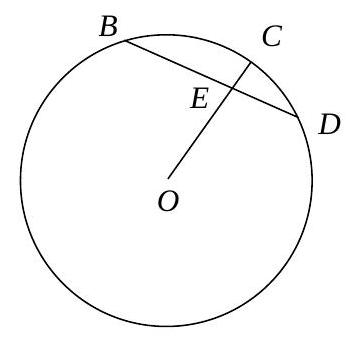
|
| 10 |
+
|
| 11 |
+
Let $x$ and $y$ be positive real numbers such that $x+y=1$. Show that
|
| 12 |
+
|
| 13 |
+
$$
|
| 14 |
+
\left(1+\frac{1}{x}\right)\left(1+\frac{1}{y}\right) \geq 9
|
| 15 |
+
$$
|
| 16 |
+
|
| 17 |
+
## PROblem 3
|
| 18 |
+
|
| 19 |
+
$A B C D$ is a quadrilateral with $A D=B C$. If $\angle A D C$ is greater than $\angle B C D$, prove that $A C>B D$.
|
| 20 |
+
|
| 21 |
+
## PROBLEM 4
|
| 22 |
+
|
| 23 |
+
Determine all real numbers $a$ such that the two polynomials $x^{2}+a x+1$ and $x^{2}+x+a$ have at least one root in common.
|
| 24 |
+
|
| 25 |
+
## Problem 5
|
| 26 |
+
|
| 27 |
+
Let
|
| 28 |
+
|
| 29 |
+
$$
|
| 30 |
+
p(x)=a_{0} x^{n}+a_{1} x^{n-1}+\cdots+a_{n-1} x+a_{n}
|
| 31 |
+
$$
|
| 32 |
+
|
| 33 |
+
where the coefficients $a_{i}$ are integers. If $p(0)$ and $p(1)$ are both odd, show that $p(x)$ has no integral roots.
|
| 34 |
+
|
| 35 |
+
## Problem 6
|
| 36 |
+
|
| 37 |
+
Show that, for all integers $n, n^{2}+2 n+12$ is not a multiple of 121 .
|
| 38 |
+
|
| 39 |
+
## PROBLEM 7
|
| 40 |
+
|
| 41 |
+
Let $n$ be a five digit number (whose first digit is non-zero) and let $m$ be the four digit number formed from $n$ by deleting its middle digit. Determine all $n$ such that $n / m$ is an integer.
|
| 42 |
+
|
| 43 |
+
## Problem 8
|
| 44 |
+
|
| 45 |
+
A regular pentagon is inscribed in a circle of radius $r . P$ is any point inside the pentagon. Perpendiculars are dropped from $P$ to the sides, or the sides produced, of the pentagon.
|
| 46 |
+
a) Prove that the sum of the lengths of these perpendiculars is constant.
|
| 47 |
+
b) Express this constant in terms of the radius $r$.
|
| 48 |
+
|
| 49 |
+
Problem 9
|
| 50 |
+
Two flag poles of heights $h$ and $k$ are situated $2 a$ units apart on a level surface. Find the set of all points on the surface which are so situated that the angles of elevation of the tops of the poles are equal.
|
| 51 |
+
|
| 52 |
+
## PROBLEM 10
|
| 53 |
+
|
| 54 |
+
Suppose that $n$ people each know exactly one piece of information, and all $n$ pieces are different. Every time person A phones person B, A tells B everything that A knows, while B tells A nothing. What is the minimum number of phone calls between pairs of people needed for everyone to know everything? Prove your answer is a minimum.
|
| 55 |
+
|
CANADA_MO/md/en-exam1972.md
ADDED
|
@@ -0,0 +1,54 @@
|
|
|
|
|
|
|
|
|
|
|
|
|
|
|
|
|
|
|
|
|
|
|
|
|
|
|
|
|
|
|
|
|
|
|
|
|
|
|
|
|
|
|
|
|
|
|
|
|
|
|
|
|
|
|
|
|
|
|
|
|
|
|
|
|
|
|
|
|
|
|
|
|
|
|
|
|
|
|
|
|
|
|
|
|
|
|
|
|
|
|
|
|
|
|
|
|
|
|
|
|
|
|
|
|
|
|
|
|
|
|
|
|
|
|
|
|
|
|
|
|
|
|
|
|
|
|
|
|
|
|
|
|
|
|
|
|
|
|
|
|
|
|
|
|
|
|
|
|
|
|
|
|
|
|
|
|
|
|
|
|
|
|
|
|
|
| 1 |
+
# Canadian Mathematical Olympiad
|
| 2 |
+
|
| 3 |
+
1972
|
| 4 |
+
|
| 5 |
+
## Problem 1
|
| 6 |
+
|
| 7 |
+
Given three distinct unit circles, each of which is tangent to the other two, find the radii of the circles which are tangent to all three circles.
|
| 8 |
+
|
| 9 |
+
## PROblem 2
|
| 10 |
+
|
| 11 |
+
Let $a_{1}, a_{2}, \ldots, a_{n}$ be non-negative real numbers. Define $M$ to be the sum of all products of pairs $a_{i} a_{j}(i<j)$, i.e.,
|
| 12 |
+
|
| 13 |
+
$$
|
| 14 |
+
M=a_{1}\left(a_{2}+a_{3}+\cdots+a_{n}\right)+a_{2}\left(a_{3}+a_{4}+\cdots+a_{n}\right)+\cdots+a_{n-1} a_{n}
|
| 15 |
+
$$
|
| 16 |
+
|
| 17 |
+
Prove that the square of at least one of the numbers $a_{1}, a_{2}, \ldots, a_{n}$ does not exceed $2 M / n(n-1)$.
|
| 18 |
+
|
| 19 |
+
## Problem 3
|
| 20 |
+
|
| 21 |
+
a) Prove that 10201 is composite in any base greater than 2.
|
| 22 |
+
b) Prove that 10101 is composite in any base.
|
| 23 |
+
|
| 24 |
+
## PROBLEM 4
|
| 25 |
+
|
| 26 |
+
Describe a construction of a quadrilateral $A B C D$ given:
|
| 27 |
+
(i) the lengths of all four sides;
|
| 28 |
+
(ii) that $A B$ and $C D$ are parallel;
|
| 29 |
+
(iii) that $B C$ and $D A$ do not intersect.
|
| 30 |
+
|
| 31 |
+
## PROBLEM 5
|
| 32 |
+
|
| 33 |
+
Prove that the equation $x^{3}+11^{3}=y^{3}$ has no solution in positive integers $x$ and $y$.
|
| 34 |
+
|
| 35 |
+
## PROblem 6
|
| 36 |
+
|
| 37 |
+
Let $a$ and $b$ be distinct real numbers. Prove that there exist integers $m$ and $n$ such that $a m+b n<0, b m+a n>0$.
|
| 38 |
+
|
| 39 |
+
## PROBLEM 7
|
| 40 |
+
|
| 41 |
+
a) Prove that the values of $x$ for which $x=\left(x^{2}+1\right) / 198$ lie between $1 / 198$ and 197.99494949 .
|
| 42 |
+
b) Use the result of a) to prove that $\sqrt{2}<1.41 \overline{421356}$.
|
| 43 |
+
c) Is it true that $\sqrt{2}<1.41421356$ ?
|
| 44 |
+
|
| 45 |
+
## Problem 8
|
| 46 |
+
|
| 47 |
+
During a certain election campaign, $p$ different kinds of promises are made by the various political parties $(p>0)$. While several parties may make the same promise, any two parties have at least one promise in common; no two parties have exactly the same set of promises. Prove that there are no more than $2^{p-1}$ parties.
|
| 48 |
+
|
| 49 |
+
Problem 9
|
| 50 |
+
Four distinct lines $L_{1}, L_{2}, L_{3}, L_{4}$ are given in the plane: $L_{1}$ and $L_{2}$ are respectively parallel to $L_{3}$ and $L_{4}$. Find the locus of a point moving so that the sum of its perpendicular distances from the four lines is constant.
|
| 51 |
+
|
| 52 |
+
Problem 10
|
| 53 |
+
What is the maximum number of terms in a geometric progression with common ratio greater than 1 whose entries all come from the set of integers between 100 and 1000 inclusive?
|
| 54 |
+
|
CANADA_MO/md/en-exam1973.md
ADDED
|
@@ -0,0 +1,61 @@
|
|
|
|
|
|
|
|
|
|
|
|
|
|
|
|
|
|
|
|
|
|
|
|
|
|
|
|
|
|
|
|
|
|
|
|
|
|
|
|
|
|
|
|
|
|
|
|
|
|
|
|
|
|
|
|
|
|
|
|
|
|
|
|
|
|
|
|
|
|
|
|
|
|
|
|
|
|
|
|
|
|
|
|
|
|
|
|
|
|
|
|
|
|
|
|
|
|
|
|
|
|
|
|
|
|
|
|
|
|
|
|
|
|
|
|
|
|
|
|
|
|
|
|
|
|
|
|
|
|
|
|
|
|
|
|
|
|
|
|
|
|
|
|
|
|
|
|
|
|
|
|
|
|
|
|
|
|
|
|
|
|
|
|
|
|
|
|
|
|
|
|
|
|
|
|
|
|
|
|
|
|
|
|
|
|
|
| 1 |
+
# Canadian Mathematical Olympiad
|
| 2 |
+
|
| 3 |
+
1973
|
| 4 |
+
|
| 5 |
+
## Problem 1
|
| 6 |
+
|
| 7 |
+
(i) Solve the simultaneous inequalities, $x<\frac{1}{4 x}$ and $x<0$; i.e., find a single inequality equivalent to the two given simultaneous inequalities.
|
| 8 |
+
(ii) What is the greatest integer which satisfies both inequalities $4 x+13<0$ and $x^{2}+3 x>16 ?$
|
| 9 |
+
(iii) Give a rational number between $11 / 24$ and $6 / 13$.
|
| 10 |
+
(iv) Express 100000 as a product of two integers neither of which is an integral multiple of 10.
|
| 11 |
+
(v) Without the use of logarithm tables evaluate
|
| 12 |
+
|
| 13 |
+
$$
|
| 14 |
+
\frac{1}{\log _{2} 36}+\frac{1}{\log _{3} 36}
|
| 15 |
+
$$
|
| 16 |
+
|
| 17 |
+
## PROBLEM 2
|
| 18 |
+
|
| 19 |
+
Find all the real numbers which satisfy the equation $|x+3|-|x-1|=x+1$. (Note: $|a|=a$ if $a \geq 0 ;|a|=-a$ if $a<0$.)
|
| 20 |
+
|
| 21 |
+
## Problem 3
|
| 22 |
+
|
| 23 |
+
Prove that if $p$ and $p+2$ are both prime integers greater than 3 , then 6 is a factor of $p+1$.
|
| 24 |
+
|
| 25 |
+
## PROBLEM 4
|
| 26 |
+
|
| 27 |
+
The figure shows a (convex) polygon with nine vertices. The six diagonals which have been drawn dissect the polygon into the seven triangles: $P_{0} P_{1} P_{3}, \quad P_{0} P_{3} P_{6}, \quad P_{0} P_{6} P_{7}, \quad P_{0} P_{7} P_{8}, \quad P_{1} P_{2} P_{3}$, $P_{3} P_{4} P_{6}, P_{4} P_{5} P_{6}$. In how many ways can these triangles be labelled with the names $\triangle_{1}, \triangle_{2}, \triangle_{3}$, $\triangle_{4}, \triangle_{5}, \triangle_{6}, \triangle_{7}$ so that $P_{i}$ is a vertex of triangle $\triangle_{i}$ for $i=1,2,3,4,5,6,7$ ? Justify your answer.
|
| 28 |
+
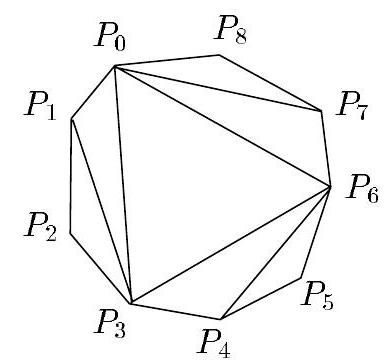
|
| 29 |
+
|
| 30 |
+
## PRoblem 5
|
| 31 |
+
|
| 32 |
+
For every positive integer $n$, let
|
| 33 |
+
|
| 34 |
+
$$
|
| 35 |
+
h(n)=1+\frac{1}{2}+\frac{1}{3}+\cdots+\frac{1}{n}
|
| 36 |
+
$$
|
| 37 |
+
|
| 38 |
+
For example, $h(1)=1, h(2)=1+\frac{1}{2}, h(3)=1+\frac{1}{2}+\frac{1}{3}$. Prove that for $n=2,3,4, \ldots$
|
| 39 |
+
|
| 40 |
+
$$
|
| 41 |
+
n+h(1)+h(2)+h(3)+\cdots+h(n-1)=n h(n)
|
| 42 |
+
$$
|
| 43 |
+
|
| 44 |
+
PROBLEM 6
|
| 45 |
+
If $A$ and $B$ are fixed points on a given circle not collinear with centre $O$ of the circle, and if $X Y$ is a variable diameter, find the locus of $P$ (the intersection of the line through $A$ and $X$ and the line through $B$ and $Y$ ).
|
| 46 |
+
|
| 47 |
+
## PROBLEM 7
|
| 48 |
+
|
| 49 |
+
Observe that
|
| 50 |
+
|
| 51 |
+
$$
|
| 52 |
+
\frac{1}{1}=\frac{1}{2}+\frac{1}{2} ; \quad \frac{1}{2}=\frac{1}{3}+\frac{1}{6} ; \quad \frac{1}{3}=\frac{1}{4}+\frac{1}{12} ; \quad \frac{1}{4}=\frac{1}{5}+\frac{1}{20}
|
| 53 |
+
$$
|
| 54 |
+
|
| 55 |
+
State a general law suggested by these examples, and prove it.
|
| 56 |
+
Prove that for any integer $n$ greater than 1 there exist positive integers $i$ and $j$ such that
|
| 57 |
+
|
| 58 |
+
$$
|
| 59 |
+
\frac{1}{n}=\frac{1}{i(i+1)}+\frac{1}{(i+1)(i+2)}+\frac{1}{(i+2)(i+3)}+\cdots+\frac{1}{j(j+1)}
|
| 60 |
+
$$
|
| 61 |
+
|
CANADA_MO/md/en-exam1974.md
ADDED
|
@@ -0,0 +1,102 @@
|
|
|
|
|
|
|
|
|
|
|
|
|
|
|
|
|
|
|
|
|
|
|
|
|
|
|
|
|
|
|
|
|
|
|
|
|
|
|
|
|
|
|
|
|
|
|
|
|
|
|
|
|
|
|
|
|
|
|
|
|
|
|
|
|
|
|
|
|
|
|
|
|
|
|
|
|
|
|
|
|
|
|
|
|
|
|
|
|
|
|
|
|
|
|
|
|
|
|
|
|
|
|
|
|
|
|
|
|
|
|
|
|
|
|
|
|
|
|
|
|
|
|
|
|
|
|
|
|
|
|
|
|
|
|
|
|
|
|
|
|
|
|
|
|
|
|
|
|
|
|
|
|
|
|
|
|
|
|
|
|
|
|
|
|
|
|
|
|
|
|
|
|
|
|
|
|
|
|
|
|
|
|
|
|
|
|
|
|
|
|
|
|
|
|
|
|
|
|
|
|
|
|
|
|
|
|
|
|
|
|
|
|
|
|
|
|
|
|
|
|
|
|
|
|
|
|
|
|
|
|
|
|
|
|
|
|
|
|
|
|
|
|
|
|
|
|
|
|
|
|
|
|
|
|
|
|
|
|
|
|
|
|
|
|
|
|
|
|
|
|
|
|
|
|
|
|
|
|
|
|
|
|
|
|
|
|
|
|
|
|
|
|
|
|
|
|
|
|
|
|
|
|
|
|
|
|
|
|
|
| 1 |
+
# Canadian Mathematical Olympiad
|
| 2 |
+
|
| 3 |
+
1974
|
| 4 |
+
|
| 5 |
+
## PART A
|
| 6 |
+
|
| 7 |
+
Problem 1
|
| 8 |
+
i) If $x=\left(1+\frac{1}{n}\right)^{n}$ and $y=\left(1+\frac{1}{n}\right)^{n+1}$, show that $y^{x}=x^{y}$.
|
| 9 |
+
ii) Show that, for all positive integers $n$,
|
| 10 |
+
|
| 11 |
+
$$
|
| 12 |
+
1^{2}-2^{2}+3^{2}-4^{2}+\cdots+(-1)^{n}(n-1)^{2}+(-1)^{n+1} n^{2}=(-1)^{n+1}(1+2+\cdots+n)
|
| 13 |
+
$$
|
| 14 |
+
|
| 15 |
+
## Problem 2
|
| 16 |
+
|
| 17 |
+
Let $A B C D$ be a rectangle with $B C=3 A B$. Show that if $P, Q$ are the points on side $B C$ with $B P=P Q=Q C$, then
|
| 18 |
+
|
| 19 |
+
$$
|
| 20 |
+
\angle D B C+\angle D P C=\angle D Q C .
|
| 21 |
+
$$
|
| 22 |
+
|
| 23 |
+
## PART B
|
| 24 |
+
|
| 25 |
+
## Problem 3
|
| 26 |
+
|
| 27 |
+
Let
|
| 28 |
+
|
| 29 |
+
$$
|
| 30 |
+
f(x)=a_{0}+a_{1} x+a_{2} x^{2}+\cdots+a_{n} x^{n}
|
| 31 |
+
$$
|
| 32 |
+
|
| 33 |
+
be a polynomial with coefficients satisfying the conditions:
|
| 34 |
+
|
| 35 |
+
$$
|
| 36 |
+
0 \leq a_{i} \leq a_{0}, \quad i=1,2, \ldots, n
|
| 37 |
+
$$
|
| 38 |
+
|
| 39 |
+
Let $b_{0}, b_{1}, \ldots, b_{2 n}$ be the coefficients of the polynomial
|
| 40 |
+
|
| 41 |
+
$$
|
| 42 |
+
\begin{aligned}
|
| 43 |
+
(f(x))^{2} & =\left(a_{0}+a_{1} x+a_{2} x^{2}+\cdots+a_{n} x^{n}\right)^{2} \\
|
| 44 |
+
& =b_{0}+b_{1} x+b_{2} x^{2}+\cdots+b_{n+1} x^{n+1}+\cdots+b_{2 n} x^{2 n}
|
| 45 |
+
\end{aligned}
|
| 46 |
+
$$
|
| 47 |
+
|
| 48 |
+
Prove that
|
| 49 |
+
|
| 50 |
+
$$
|
| 51 |
+
b_{n+1} \leq \frac{1}{2}(f(1))^{2}
|
| 52 |
+
$$
|
| 53 |
+
|
| 54 |
+
PROBLEM 4
|
| 55 |
+
Let $n$ be a fixed positive integer. To any choice of $n$ real numbers satisfying
|
| 56 |
+
|
| 57 |
+
$$
|
| 58 |
+
0 \leq x_{i} \leq 1, \quad i=1,2, \ldots, n
|
| 59 |
+
$$
|
| 60 |
+
|
| 61 |
+
there corresponds the sum
|
| 62 |
+
(*)
|
| 63 |
+
|
| 64 |
+
$$
|
| 65 |
+
\begin{aligned}
|
| 66 |
+
& \sum_{1 \leq i<j \leq n}\left|x_{i}-x_{j}\right| \\
|
| 67 |
+
& \qquad \begin{aligned}
|
| 68 |
+
= & \left|x_{1}-x_{2}\right|+\left|x_{1}-x_{3}\right|+\left|x_{1}-x_{4}\right|+\cdots+\left|x_{1}-x_{n-1}\right|+\left|x_{1}-x_{n}\right| \\
|
| 69 |
+
& \quad+\left|x_{2}-x_{3}\right|+\left|x_{2}-x_{4}\right|+\cdots+\left|x_{2}-x_{n-1}\right|+\left|x_{2}-x_{n}\right| \\
|
| 70 |
+
& \quad+\left|x_{3}-x_{4}\right|+\cdots+\left|x_{3}-x_{n-1}\right|+\left|x_{3}-x_{n}\right| \\
|
| 71 |
+
& \quad+\cdots+\left|x_{n-2}-x_{n-1}\right|+\left|x_{n-2}-x_{n}\right| \\
|
| 72 |
+
& \quad+\left|x_{n-1}-x_{n}\right| .
|
| 73 |
+
\end{aligned}
|
| 74 |
+
\end{aligned}
|
| 75 |
+
$$
|
| 76 |
+
|
| 77 |
+
Let $S(n)$ denote the largest possible value of the sum (*). Find $S(n)$.
|
| 78 |
+
|
| 79 |
+
## Problem 5
|
| 80 |
+
|
| 81 |
+
Given a circle with diameter $A B$ and a point $X$ on the circle different from $A$ and $B$, let $t_{a}, t_{b}$ and $t_{x}$ be the tangents to the circle at $A, B$ and $X$ respectively. Let $Z$ be the point where line $A X$ meets $t_{b}$ and $Y$ the point where line $B X$ meets $t_{a}$. Show that the three lines $Y Z, t_{x}$ and $A B$ are either concurrent (i.e., all pass through the same point) or parallel.
|
| 82 |
+
|
| 83 |
+
## Problem 6
|
| 84 |
+
|
| 85 |
+
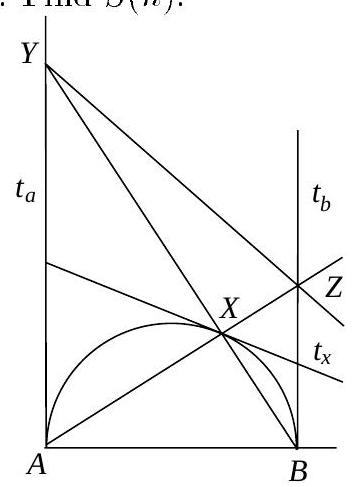
|
| 86 |
+
|
| 87 |
+
An unlimited supply of 8 -cent and 15 -cent stamps is available. Some amounts of postage cannot be made up exactly, e.g., 7 cents, 29 cents. What is the largest unattainable amount, i.e., the amount, say $n$, of postage which is unattainable while all amounts larger than $n$ are attainable? (Justify your answer.)
|
| 88 |
+
|
| 89 |
+
## PROBLEM 7
|
| 90 |
+
|
| 91 |
+
A bus route consists of a circular road of circumference 10 miles and a straight road of length 1 mile which runs from a terminus to the point $Q$ on the circular road (see diagram). It is served by two buses, each of which requires 20 minutes for the round trip. Bus No. 1, upon leaving the terminus, travels along the straight road, once around the circle clockwise and returns along the straight road to the terminus. Bus No. 2, reaching the terminus 10 minutes after Bus No. 1, has a similar route except that it proceeds counterclockwise
|
| 92 |
+
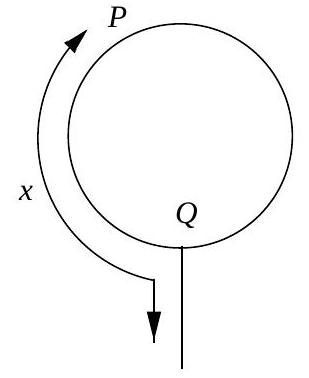
|
| 93 |
+
|
| 94 |
+
Terminus
|
| 95 |
+
around the circle. Both buses run continuously and do not wait at any point on the route except for a negligible amount of time to pick up and discharge passengers.
|
| 96 |
+
A man plans to wait at a point $P$ which is $x$ miles $(0 \leq x<12)$ from the terminus along the route of Bus No. 1 and travel to the terminus on one of the buses.
|
| 97 |
+
|
| 98 |
+
Assuming that he chooses to board that bus which will bring him to his destination at the earliest moment, there is a maximum time $w(x)$ that his journey (waiting plus travel time) could take.
|
| 99 |
+
Find $w(2)$; find $w(4)$.
|
| 100 |
+
For what value of $x$ will the time $w(x)$ be the longest?
|
| 101 |
+
Sketch a graph of $y=w(x)$ for $0 \leq x<12$.
|
| 102 |
+
|
CANADA_MO/md/en-exam1975.md
ADDED
|
@@ -0,0 +1,54 @@
|
|
|
|
|
|
|
|
|
|
|
|
|
|
|
|
|
|
|
|
|
|
|
|
|
|
|
|
|
|
|
|
|
|
|
|
|
|
|
|
|
|
|
|
|
|
|
|
|
|
|
|
|
|
|
|
|
|
|
|
|
|
|
|
|
|
|
|
|
|
|
|
|
|
|
|
|
|
|
|
|
|
|
|
|
|
|
|
|
|
|
|
|
|
|
|
|
|
|
|
|
|
|
|
|
|
|
|
|
|
|
|
|
|
|
|
|
|
|
|
|
|
|
|
|
|
|
|
|
|
|
|
|
|
|
|
|
|
|
|
|
|
|
|
|
|
|
|
|
|
|
|
|
|
|
|
|
|
|
|
|
|
|
|
|
|
| 1 |
+
# Canadian Mathematical Olympiad
|
| 2 |
+
|
| 3 |
+
1975
|
| 4 |
+
|
| 5 |
+
## Problem 1
|
| 6 |
+
|
| 7 |
+
Simplify
|
| 8 |
+
|
| 9 |
+
$$
|
| 10 |
+
\left(\frac{1 \cdot 2 \cdot 4+2 \cdot 4 \cdot 8+\cdots+n \cdot 2 n \cdot 4 n}{1 \cdot 3 \cdot 9+2 \cdot 6 \cdot 18+\cdots+n \cdot 3 n \cdot 9 n}\right)^{1 / 3}
|
| 11 |
+
$$
|
| 12 |
+
|
| 13 |
+
## Problem 2
|
| 14 |
+
|
| 15 |
+
A sequence of numbers $a_{1}, a_{2}, a_{3}, \ldots$ satisfies
|
| 16 |
+
(i) $a_{1}=\frac{1}{2}$,
|
| 17 |
+
(ii) $a_{1}+a_{2}+\cdots+a_{n}=n^{2} a_{n} \quad(n \geq 1)$.
|
| 18 |
+
|
| 19 |
+
Determine the value of $a_{n} \quad(n \geq 1)$.
|
| 20 |
+
|
| 21 |
+
## Problem 3
|
| 22 |
+
|
| 23 |
+
For each real number $r,[r]$ denotes the largest integer less than or equal to $r$, e.g., $[6]=6,[\pi]=3,[-1.5]=-2$. Indicate on the $(x, y)$-plane the set of all points $(x, y)$ for which $[x]^{2}+[y]^{2}=4$.
|
| 24 |
+
|
| 25 |
+
## Problem 4
|
| 26 |
+
|
| 27 |
+
For a positive number such as $3.27,3$ is referred to as the integral part of the number and .27 as the decimal part. Find a positive number such that its decimal part, its integral part, and the number itself form a geometric progression.
|
| 28 |
+
|
| 29 |
+
## Problem 5
|
| 30 |
+
|
| 31 |
+
$A, B, C, D$ are four "consecutive" points on the circumference of a circle and $P$, $Q, R, S$ are points on the circumference which are respectively the midpoints of the $\operatorname{arcs} A B, B C, C D, D A$. Prove that $P R$ is perpendicular to $Q S$.
|
| 32 |
+
|
| 33 |
+
## Problem 6
|
| 34 |
+
|
| 35 |
+
(i) 15 chairs are equally placed around a circular table on which are name cards for 15 guests. The guests fail to notice these cards until after they have sat down, and it turns out that no one is sitting in the correct seat. Prove that the table can be rotated so that at least two of the guests are simultaneously correctly seated.
|
| 36 |
+
(ii) Give an example of an arrangement in which just one of the 15 guests is correctly seated and for which no rotation correctly places more than one person.
|
| 37 |
+
|
| 38 |
+
## Problem 7
|
| 39 |
+
|
| 40 |
+
A function $f(x)$ is periodic if there is a positive number $p$ such that $f(x+p)=f(x)$ for all $x$. For example, $\sin x$ is periodic with period $2 \pi$. Is the function $\sin \left(x^{2}\right)$ periodic? Prove your assertion.
|
| 41 |
+
|
| 42 |
+
Problem 8
|
| 43 |
+
Let $k$ be a positive integer. Find all polynomials
|
| 44 |
+
|
| 45 |
+
$$
|
| 46 |
+
P(x)=a_{0}+a_{1} x+\cdots+a_{n} x^{n}
|
| 47 |
+
$$
|
| 48 |
+
|
| 49 |
+
where the $a_{i}$ are real, which satisfy the equation
|
| 50 |
+
|
| 51 |
+
$$
|
| 52 |
+
P(P(x))=\{P(x)\}^{k}
|
| 53 |
+
$$
|
| 54 |
+
|
CANADA_MO/md/en-exam1976.md
ADDED
|
@@ -0,0 +1,49 @@
|
|
|
|
|
|
|
|
|
|
|
|
|
|
|
|
|
|
|
|
|
|
|
|
|
|
|
|
|
|
|
|
|
|
|
|
|
|
|
|
|
|
|
|
|
|
|
|
|
|
|
|
|
|
|
|
|
|
|
|
|
|
|
|
|
|
|
|
|
|
|
|
|
|
|
|
|
|
|
|
|
|
|
|
|
|
|
|
|
|
|
|
|
|
|
|
|
|
|
|
|
|
|
|
|
|
|
|
|
|
|
|
|
|
|
|
|
|
|
|
|
|
|
|
|
|
|
|
|
|
|
|
|
|
|
|
|
|
|
|
|
|
|
|
|
|
|
|
|
|
|
| 1 |
+
# Canadian Mathematical Olympiad
|
| 2 |
+
|
| 3 |
+
1976
|
| 4 |
+
|
| 5 |
+
## Problem 1
|
| 6 |
+
|
| 7 |
+
Given four weights in geometric progression and an equal arm balance, show how to find the heaviest weight using the balance only twice.
|
| 8 |
+
|
| 9 |
+
## PROBLEM 2
|
| 10 |
+
|
| 11 |
+
Suppose
|
| 12 |
+
|
| 13 |
+
$$
|
| 14 |
+
n(n+1) a_{n+1}=n(n-1) a_{n}-(n-2) a_{n-1}
|
| 15 |
+
$$
|
| 16 |
+
|
| 17 |
+
for every positive integer $n \geq 1$.
|
| 18 |
+
Given that $a_{0}=1, a_{1}=2$, find
|
| 19 |
+
|
| 20 |
+
$$
|
| 21 |
+
\frac{a_{0}}{a_{1}}+\frac{a_{1}}{a_{2}}+\frac{a_{2}}{a_{3}}+\cdots+\frac{a_{50}}{a_{51}} .
|
| 22 |
+
$$
|
| 23 |
+
|
| 24 |
+
## PROBLEM 3
|
| 25 |
+
|
| 26 |
+
Two grade seven students were allowed to enter a chess tournament otherwise composed of grade eight students. Each contestant played once with each other contestant and received one point for a win, one half point for a tie and zero for a loss. The two grade seven students together gained a total of eight points and each grade eight student scored the same number of points as his classmates. How many students from grade eight participated in the chess tournament? Is the solution unique?
|
| 27 |
+
|
| 28 |
+
## Problem 4
|
| 29 |
+
|
| 30 |
+
Let $A B$ be a diameter of a circle, $C$ be any fixed point between $A$ and $B$ on this diameter, and $Q$ be a variable point on the circumference of the circle. Let $P$ be the point on the line determined by $Q$ and $C$ for which $\frac{A C}{C B}=\frac{Q C}{C P}$. Describe, with proof, the locus of the point $P$.
|
| 31 |
+
|
| 32 |
+
Problem 5
|
| 33 |
+
Prove that a positive integer is a sum of at least two consecutive positive integers if and only if it is not a power of two.
|
| 34 |
+
|
| 35 |
+
Problem 6
|
| 36 |
+
If $A, B, C, D$ are four points in space, such that
|
| 37 |
+
|
| 38 |
+
$$
|
| 39 |
+
\angle A B C=\angle B C D=\angle C D A=\angle D A B=\pi / 2
|
| 40 |
+
$$
|
| 41 |
+
|
| 42 |
+
prove that $A, B, C, D$ lie in a plane.
|
| 43 |
+
|
| 44 |
+
Problem 7
|
| 45 |
+
Let $P(x, y)$ be a polynomial in two variables $x, y$ such that $P(x, y)=P(y, x)$ for every $x, y$ (for example, the polynomial $x^{2}-2 x y+y^{2}$ satisfies this condition). Given that $(x-y)$ is a factor of $P(x, y)$, show that $(x-y)^{2}$ is a factor of $P(x, y)$.
|
| 46 |
+
|
| 47 |
+
PROblem 8
|
| 48 |
+
Each of the 36 line segments joining 9 distinct points on a circle is coloured either red or blue. Suppose that each triangle determined by 3 of the 9 points contains at least one red side. Prove that there are four points such that the 6 segments connecting them are all red.
|
| 49 |
+
|
CANADA_MO/md/en-exam1977.md
ADDED
|
@@ -0,0 +1,50 @@
|
|
|
|
|
|
|
|
|
|
|
|
|
|
|
|
|
|
|
|
|
|
|
|
|
|
|
|
|
|
|
|
|
|
|
|
|
|
|
|
|
|
|
|
|
|
|
|
|
|
|
|
|
|
|
|
|
|
|
|
|
|
|
|
|
|
|
|
|
|
|
|
|
|
|
|
|
|
|
|
|
|
|
|
|
|
|
|
|
|
|
|
|
|
|
|
|
|
|
|
|
|
|
|
|
|
|
|
|
|
|
|
|
|
|
|
|
|
|
|
|
|
|
|
|
|
|
|
|
|
|
|
|
|
|
|
|
|
|
|
|
|
|
|
|
|
|
|
|
|
|
|
|
|
| 1 |
+
# Canadian Mathematical Olympiad
|
| 2 |
+
|
| 3 |
+
## 1977
|
| 4 |
+
|
| 5 |
+
## Problem 1
|
| 6 |
+
|
| 7 |
+
If $f(x)=x^{2}+x$, prove that the equation $4 f(a)=f(b)$ has no solutions in positive integers $a$ and $b$.
|
| 8 |
+
|
| 9 |
+
## PROBLEM 2
|
| 10 |
+
|
| 11 |
+
Let $O$ be the centre of a circle and $A$ a fixed interior point of the circle different from $O$. Determine all points $P$ on the circumference of the circle such that the angle $O P A$ is a maximum.
|
| 12 |
+
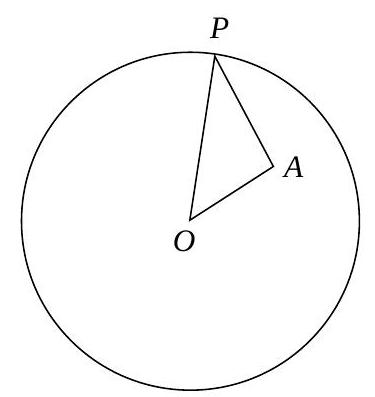
|
| 13 |
+
|
| 14 |
+
## Problem 3
|
| 15 |
+
|
| 16 |
+
$N$ is an integer whose representation in base $b$ is 777 . Find the smallest positive integer $b$ for which $N$ is the fourth power of an integer.
|
| 17 |
+
|
| 18 |
+
PROBLEM 4
|
| 19 |
+
Let
|
| 20 |
+
|
| 21 |
+
$$
|
| 22 |
+
p(x)=a_{n} x^{n}+a_{n-1} x^{n-1}+\cdots+a_{1} x+a_{0}
|
| 23 |
+
$$
|
| 24 |
+
|
| 25 |
+
and
|
| 26 |
+
|
| 27 |
+
$$
|
| 28 |
+
q(x)=b_{m} x^{m}+b_{m-1} x^{m-1}+\cdots+b_{1} x+b_{0}
|
| 29 |
+
$$
|
| 30 |
+
|
| 31 |
+
be two polynomials with integer coefficients. Suppose that all the coefficients of the product $p(x) \cdot q(x)$ are even but not all of them are divisible by 4 . Show that one of $p(x)$ and $q(x)$ has all even coefficients and the other has at least one odd coefficient.
|
| 32 |
+
|
| 33 |
+
## Problem 5
|
| 34 |
+
|
| 35 |
+
A right circular cone of base radius 1 cm and slant height 3 cm is given. $P$ is a point on the circumference of the base and the shortest path from $P$ around the cone and back to $P$ is drawn (see diagram). What is the minimum distance from
|
| 36 |
+
the vertex $V$ to this path?
|
| 37 |
+
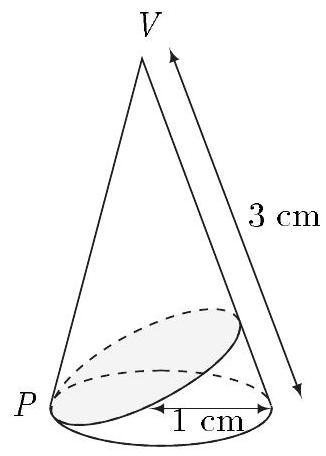
|
| 38 |
+
|
| 39 |
+
PROBLEM 6
|
| 40 |
+
Let $0<u<1$ and define
|
| 41 |
+
|
| 42 |
+
$$
|
| 43 |
+
u_{1}=1+u, \quad u_{2}=\frac{1}{u_{1}}+u, \quad \ldots, \quad u_{n+1}=\frac{1}{u_{n}}+u, \quad n \geq 1
|
| 44 |
+
$$
|
| 45 |
+
|
| 46 |
+
Show that $u_{n}>1$ for all values of $n=1,2,3, \ldots$.
|
| 47 |
+
Problem 7
|
| 48 |
+
A rectangular city is exactly $m$ blocks long and $n$ blocks wide (see diagram). A woman lives in the southwest corner of the city and works in the northeast corner. She walks to work each day but, on any given trip, she makes sure that her path does not include any intersection twice. Show that the number $f(m, n)$ of different paths she can take to work satisfies $f(m, n) \leq 2^{m n}$.
|
| 49 |
+
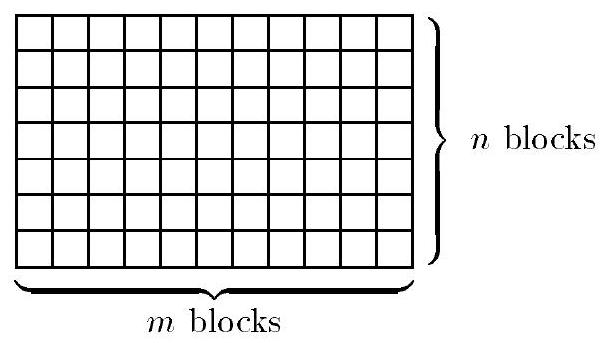
|
| 50 |
+
|
CANADA_MO/md/en-exam1978.md
ADDED
|
@@ -0,0 +1,43 @@
|
|
|
|
|
|
|
|
|
|
|
|
|
|
|
|
|
|
|
|
|
|
|
|
|
|
|
|
|
|
|
|
|
|
|
|
|
|
|
|
|
|
|
|
|
|
|
|
|
|
|
|
|
|
|
|
|
|
|
|
|
|
|
|
|
|
|
|
|
|
|
|
|
|
|
|
|
|
|
|
|
|
|
|
|
|
|
|
|
|
|
|
|
|
|
|
|
|
|
|
|
|
|
|
|
|
|
|
|
|
|
|
|
|
|
|
|
|
|
|
|
|
|
|
|
|
|
|
|
|
|
|
|
| 1 |
+
# Canadian Mathematical Olympiad
|
| 2 |
+
|
| 3 |
+
1978
|
| 4 |
+
|
| 5 |
+
## Problem 1
|
| 6 |
+
|
| 7 |
+
Let $n$ be an integer. If the tens digit of $n^{2}$ is 7 , what is the units digit of $n^{2}$ ?
|
| 8 |
+
|
| 9 |
+
## Problem 2
|
| 10 |
+
|
| 11 |
+
Find all pairs $a, b$ of positive integers satisfying the equation $2 a^{2}=3 b^{3}$.
|
| 12 |
+
|
| 13 |
+
## Problem 3
|
| 14 |
+
|
| 15 |
+
Determine the largest real number $z$ such that
|
| 16 |
+
|
| 17 |
+
$$
|
| 18 |
+
\begin{gathered}
|
| 19 |
+
x+y+z=5 \\
|
| 20 |
+
x y+y z+x z=3
|
| 21 |
+
\end{gathered}
|
| 22 |
+
$$
|
| 23 |
+
|
| 24 |
+
and $x, y$ are also real.
|
| 25 |
+
|
| 26 |
+
## Problem 4
|
| 27 |
+
|
| 28 |
+
The sides $A D$ and $B C$ of a convex quadrilateral $A B C D$ are extended to meet at $E$. Let $H$ and $G$ be the midpoints of $B D$ and $A C$, respectively. Find the ratio of the area of the triangle $E H G$ to that of the quadrilateral $A B C D$.
|
| 29 |
+
|
| 30 |
+
Problem 5
|
| 31 |
+
Eve and Odette play a game on a $3 \times 3$ checkerboard, with black checkers and white checkers. The rules are as follows:
|
| 32 |
+
I. They play alternately.
|
| 33 |
+
II. A turn consists of placing one checker on an unoccupied square of the board.
|
| 34 |
+
III. In her turn, a player may select either a white checker or a black checker and need not always use the same colour.
|
| 35 |
+
IV. When the board is full, Eve obtains one point for every row, column or diagonal that has an even number of black checkers, and Odette obtains one point for every row, column or diagonal that has an odd number of black checkers.
|
| 36 |
+
V. The player obtaining at least five of the eight points WINS.
|
| 37 |
+
(a) Is a $4-4$ tie possible? Explain.
|
| 38 |
+
(b) Describe a winning strategy for the girl who is first to play.
|
| 39 |
+
|
| 40 |
+
## Problem 6
|
| 41 |
+
|
| 42 |
+
Sketch the graph of $x^{3}+x y+y^{3}=3$.
|
| 43 |
+
|
CANADA_MO/md/en-exam1979.md
ADDED
|
@@ -0,0 +1,38 @@
|
|
|
|
|
|
|
|
|
|
|
|
|
|
|
|
|
|
|
|
|
|
|
|
|
|
|
|
|
|
|
|
|
|
|
|
|
|
|
|
|
|
|
|
|
|
|
|
|
|
|
|
|
|
|
|
|
|
|
|
|
|
|
|
|
|
|
|
|
|
|
|
|
|
|
|
|
|
|
|
|
|
|
|
|
|
|
|
|
|
|
|
|
|
|
|
|
|
|
|
|
|
|
|
|
|
|
|
|
|
|
|
|
|
|
|
|
|
| 1 |
+
# Canadian Mathematical Olympiad
|
| 2 |
+
|
| 3 |
+
1979
|
| 4 |
+
|
| 5 |
+
## Problem 1
|
| 6 |
+
|
| 7 |
+
Given: (i) $a, b>0$; (ii) $a, A_{1}, A_{2}, b$ is an arithmetic progression; (iii) $a, G_{1}, G_{2}, b$ is a geometric progression. Show that
|
| 8 |
+
|
| 9 |
+
$$
|
| 10 |
+
A_{1} A_{2} \geq G_{1} G_{2}
|
| 11 |
+
$$
|
| 12 |
+
|
| 13 |
+
PROblem 2
|
| 14 |
+
It is known in Euclidean geometry that the sum of the angles of a triangle is constant. Prove, however, that the sum of the dihedral angles of a tetrahedron is not constant.
|
| 15 |
+
|
| 16 |
+
Note. (i) A tetrahedron is a triangular pyramid, and (ii) a dihedral angle is the interior angle between a pair of faces.
|
| 17 |
+

|
| 18 |
+
|
| 19 |
+
## Problem 3
|
| 20 |
+
|
| 21 |
+
Let $a, b, c, d, e$ be integers such that $1 \leq a<b<c<d<e$. Prove that
|
| 22 |
+
|
| 23 |
+
$$
|
| 24 |
+
\frac{1}{[a, b]}+\frac{1}{[b, c]}+\frac{1}{[c, d]}+\frac{1}{[d, e]} \leq \frac{15}{16}
|
| 25 |
+
$$
|
| 26 |
+
|
| 27 |
+
where $[m, n]$ denotes the least common multiple of $m$ and $n(e . g .[4,6]=12)$.
|
| 28 |
+
Problem 4
|
| 29 |
+
A dog standing at the centre of a circular arena sees a rabbit at the wall. The rabbit runs around the wall and the dog pursues it along a unique path which is determined by running at the same speed and staying on the radial line joining the centre of the arena to the rabbit. Show that the dog overtakes the rabbit just as it reaches a point one-quarter of the way around the arena.
|
| 30 |
+
|
| 31 |
+
## Problem 5
|
| 32 |
+
|
| 33 |
+
A walk consists of a sequence of steps of length 1 taken in directions north, south, east or west. A walk is self-avoiding if it never passes through the same point twice. Let $f(n)$ denote the number of $n$-step self-avoiding walks which begin at the origin. Compute $f(1), f(2), f(3), f(4)$, and show that
|
| 34 |
+
|
| 35 |
+
$$
|
| 36 |
+
2^{n}<f(n) \leq 4 \cdot 3^{n-1}
|
| 37 |
+
$$
|
| 38 |
+
|
CANADA_MO/md/en-exam1980.md
ADDED
|
@@ -0,0 +1,20 @@
|
|
|
|
|
|
|
|
|
|
|
|
|
|
|
|
|
|
|
|
|
|
|
|
|
|
|
|
|
|
|
|
|
|
|
|
|
|
|
|
|
|
|
|
|
|
|
|
|
|
|
|
|
|
|
|
|
|
|
|
|
|
|
|
| 1 |
+
# Canadian Mathematical Olympiad
|
| 2 |
+
|
| 3 |
+
1980
|
| 4 |
+
|
| 5 |
+
## Problem 1
|
| 6 |
+
|
| 7 |
+
If $a 679 b$ is a five digit number (in base 10) which is divisible by 72 , determine $a$ and $b$.
|
| 8 |
+
|
| 9 |
+
PROblem 2
|
| 10 |
+
The numbers from 1 to 50 are printed on cards. The cards are shuffled and then laid out face up in 5 rows of 10 cards each. The cards in each row are rearranged to make them increase from left to right. The cards in each column are then rearranged to make them increase from top to bottom. In the final arrangement, do the cards in the rows still increase from left to right?
|
| 11 |
+
|
| 12 |
+
## Problem 3
|
| 13 |
+
|
| 14 |
+
Among all triangles having (i) a fixed angle $A$ and (ii) an inscribed circle of fixed radius $r$, determine which triangle has the least perimeter.
|
| 15 |
+
|
| 16 |
+
PROBLEM 4
|
| 17 |
+
A gambling student tosses a fair coin and scores one point for each head that turns up and two points for each tail. Prove that the probability of the student scoring exactly $n$ points is $\frac{1}{3}\left[2+\left(-\frac{1}{2}\right)^{n}\right]$.
|
| 18 |
+
Problem 5
|
| 19 |
+
A parallelepiped has the property that all cross sections which are parallel to any fixed face $F$, have the same perimeter as $F$. Determine whether or not any other polyhedron has this property.
|
| 20 |
+
|
CANADA_MO/md/en-exam1981.md
ADDED
|
@@ -0,0 +1,30 @@
|
|
|
|
|
|
|
|
|
|
|
|
|
|
|
|
|
|
|
|
|
|
|
|
|
|
|
|
|
|
|
|
|
|
|
|
|
|
|
|
|
|
|
|
|
|
|
|
|
|
|
|
|
|
|
|
|
|
|
|
|
|
|
|
|
|
|
|
|
|
|
|
|
|
|
|
|
|
|
|
|
|
|
|
|
|
|
|
|
|
|
|
|
|
| 1 |
+
# Canadian Mathematical Olympiad
|
| 2 |
+
|
| 3 |
+
1981
|
| 4 |
+
|
| 5 |
+
## Problem 1
|
| 6 |
+
|
| 7 |
+
For any real number $t$, denote by $[t]$ the greatest integer which is less than or equal to $t$. For example: $[8]=8,[\pi]=3$ and $[-5 / 2]=-3$. Show that the equation
|
| 8 |
+
|
| 9 |
+
$$
|
| 10 |
+
[x]+[2 x]+[4 x]+[8 x]+[16 x]+[32 x]=12345
|
| 11 |
+
$$
|
| 12 |
+
|
| 13 |
+
has no real solution.
|
| 14 |
+
|
| 15 |
+
## Problem 2
|
| 16 |
+
|
| 17 |
+
Given a circle of radius $r$ and a tangent line $\ell$ to the circle through a given point $P$ on the circle. From a variable point $R$ on the circle, a perpendicular $R Q$ is drawn to $\ell$ with $Q$ on $\ell$. Determine the maximum of the area of triangle $P Q R$.
|
| 18 |
+
|
| 19 |
+
## Problem 3
|
| 20 |
+
|
| 21 |
+
Given a finite collection of lines in a plane $P$, show that it is possible to draw an arbitrarily large circle in $P$ which does not meet any of them. On the other hand, show that it is possible to arrange an infinite sequence of lines (first line, second line, third line, etc.) in $P$ so that every circle in $P$ meets at least one of the lines. (A point is not considered to be a circle.)
|
| 22 |
+
|
| 23 |
+
## PROBLEM 4
|
| 24 |
+
|
| 25 |
+
$P(x)$ and $Q(x)$ are two polynomials that satisfy the identity $P(Q(x)) \equiv Q(P(x))$ for real numbers $x$. If the equation $P(x)=Q(x)$ has no real solution, show that the equation $P(P(x))=Q(Q(x))$ also has no real solution.
|
| 26 |
+
|
| 27 |
+
## Problem 5
|
| 28 |
+
|
| 29 |
+
Eleven theatrical groups participated in a festival. Each day, some of the groups were scheduled to perform while the remaining groups joined the general audience. At the conclusion of the festival, each group had seen, during its days off, at least one performance of every other group. At least how many days did the festival last?
|
| 30 |
+
|
CANADA_MO/md/en-exam1982.md
ADDED
|
@@ -0,0 +1,30 @@
|
|
|
|
|
|
|
|
|
|
|
|
|
|
|
|
|
|
|
|
|
|
|
|
|
|
|
|
|
|
|
|
|
|
|
|
|
|
|
|
|
|
|
|
|
|
|
|
|
|
|
|
|
|
|
|
|
|
|
|
|
|
|
|
|
|
|
|
|
|
|
|
|
|
|
|
|
|
|
|
|
|
|
|
|
|
|
|
|
|
|
|
|
|
| 1 |
+
# Canadian Mathematical Olympiad
|
| 2 |
+
|
| 3 |
+
## PROBLEM 1
|
| 4 |
+
|
| 5 |
+
In the diagram, $O B_{i}$ is parallel and equal in length to $A_{i} A_{i+1}$ for $i=1,2,3$ and $4\left(A_{5}=A_{1}\right)$. Show that the area of $B_{1} B_{2} B_{3} B_{4}$ is twice that of $A_{1} A_{2} A_{3} A_{4}$.
|
| 6 |
+
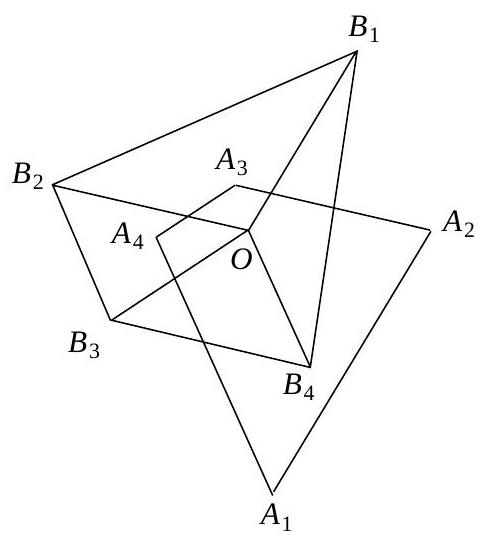
|
| 7 |
+
|
| 8 |
+
PROblem 2
|
| 9 |
+
If $a, b$ and $c$ are the roots of the equation $x^{3}-x^{2}-x-1=0$,
|
| 10 |
+
(i) show that $a, b$ and $c$ are distinct:
|
| 11 |
+
(ii) show that
|
| 12 |
+
|
| 13 |
+
$$
|
| 14 |
+
\frac{a^{1982}-b^{1982}}{a-b}+\frac{b^{1982}-c^{1982}}{b-c}+\frac{c^{1982}-a^{1982}}{c-a}
|
| 15 |
+
$$
|
| 16 |
+
|
| 17 |
+
is an integer.
|
| 18 |
+
|
| 19 |
+
## Problem 3
|
| 20 |
+
|
| 21 |
+
Let $R^{n}$ be the $n$-dimensional Euclidean space. Determine the smallest number $g(n)$ of points of a set in $R^{n}$ such that every point in $R^{n}$ is at irrational distance from at least one point in that set.
|
| 22 |
+
|
| 23 |
+
## PROBLEM 4
|
| 24 |
+
|
| 25 |
+
Let $p$ be a permutation of the set $S_{n}=\{1,2, \ldots, n\}$. An element $j \in S_{n}$ is called a fixed point of $p$ if $p(j)=j$. Let $f_{n}$ be the number of permutations having no fixed points, and $g_{n}$ be the number with exactly one fixed point. Show that $\left|f_{n}-g_{n}\right|=1$.
|
| 26 |
+
|
| 27 |
+
Problem 5
|
| 28 |
+
The altitudes of a tetrahedron $A B C D$ are extended externally to points $A^{\prime}, B^{\prime}$, $C^{\prime}$ and $D^{\prime}$ respectively, where $A A^{\prime}=k / h_{a}, B B^{\prime}=k / h_{b}, C C^{\prime}=k / h_{c}$ and $D D^{\prime}=$
|
| 29 |
+
$k / h_{d}$. Here, $k$ is a constant and $h_{a}$ denotes the length of the altitude of $A B C D$ from vertex $A$, etc. Prove that the centroid of the tetrahedron $A^{\prime} B^{\prime} C^{\prime} D^{\prime}$ coincides with the centroid of $A B C D$.
|
| 30 |
+
|
CANADA_MO/md/en-exam1983.md
ADDED
|
@@ -0,0 +1,22 @@
|
|
|
|
|
|
|
|
|
|
|
|
|
|
|
|
|
|
|
|
|
|
|
|
|
|
|
|
|
|
|
|
|
|
|
|
|
|
|
|
|
|
|
|
|
|
|
|
|
|
|
|
|
|
|
|
|
|
|
|
|
|
|
|
|
|
|
|
|
|
| 1 |
+
# Canadian Mathematical Olympiad
|
| 2 |
+
|
| 3 |
+
1983
|
| 4 |
+
|
| 5 |
+
## Problem 1
|
| 6 |
+
|
| 7 |
+
Find all positive integers $w, x, y$ and $z$ which satisfy $w!=x!+y!+z!$.
|
| 8 |
+
|
| 9 |
+
## Problem 2
|
| 10 |
+
|
| 11 |
+
For each real number $r$ let $T_{r}$ be the transformation of the plane that takes the point $(x, y)$ into the point $\left(2^{r} x, r 2^{r} x+2^{r} y\right)$. Let $F$ be the family of all such transformations i.e. $F=\left\{T_{r}: r\right.$ a real number $\}$. Find all curves $y=f(x)$ whose graphs remain unchanged by every transformation in $F$.
|
| 12 |
+
|
| 13 |
+
## PROBLEM 3
|
| 14 |
+
|
| 15 |
+
The area of a triangle is determined by the lengths of its sides. Is the volume of a tetrahedron determined by the areas of its faces?
|
| 16 |
+
|
| 17 |
+
Problem 4
|
| 18 |
+
Prove that for every prime number $p$, there are infinitely many positive integers $n$ such that $p$ divides $2^{n}-n$.
|
| 19 |
+
|
| 20 |
+
Problem 5
|
| 21 |
+
The geometric mean (G.M.) of a $k$ positive numbers $a_{1}, a_{2}, \ldots, a_{k}$ is defined to be the (positive) $k$-th root of their product. For example, the G.M. of $3,4,18$ is 6 . Show that the G.M. of a set $S$ of $n$ positive numbers is equal to the G.M. of the G.M.'s of all non-empty subsets of $S$.
|
| 22 |
+
|
CANADA_MO/md/en-exam1984.md
ADDED
|
@@ -0,0 +1,34 @@
|
|
|
|
|
|
|
|
|
|
|
|
|
|
|
|
|
|
|
|
|
|
|
|
|
|
|
|
|
|
|
|
|
|
|
|
|
|
|
|
|
|
|
|
|
|
|
|
|
|
|
|
|
|
|
|
|
|
|
|
|
|
|
|
|
|
|
|
|
|
|
|
|
|
|
|
|
|
|
|
|
|
|
|
|
|
|
|
|
|
|
|
|
|
|
|
|
|
|
|
|
|
|
|
|
|
| 1 |
+
# Canadian Mathematical Olympiad 1984
|
| 2 |
+
|
| 3 |
+
## PROBLEM 1
|
| 4 |
+
|
| 5 |
+
Prove that the sum of the squares of 1984 consecutive positive integers cannot be the square of an integer.
|
| 6 |
+
|
| 7 |
+
## Problem 2
|
| 8 |
+
|
| 9 |
+
Alice and Bob are in a hardware store. The store sells coloured sleeves that fit over keys to distinguish them. The following conversation takes place:
|
| 10 |
+
|
| 11 |
+
Alice: Are you going to cover your keys?
|
| 12 |
+
Bob: I would like to, but there are only 7 colours and I have 8 keys.
|
| 13 |
+
Alice: Yes, but you could always distinguish a key by noticing that the red key next to the green key was different from the red key next to the blue key.
|
| 14 |
+
Bob: You must be careful what you mean by "next to" or "three keys over from" since you can turn the key ring over and the keys are arranged in a circle.
|
| 15 |
+
Alice: Even so, you don't need 8 colours.
|
| 16 |
+
Problem: What is the smallest number of colours needed to distinguish $n$ keys if all the keys are to be covered.
|
| 17 |
+
|
| 18 |
+
## Problem 3
|
| 19 |
+
|
| 20 |
+
An integer is digitally divisible if
|
| 21 |
+
(a) none of its digits is zero;
|
| 22 |
+
(b) it is divisible by the sum of its digits (e.g., 322 is digitally divisible).
|
| 23 |
+
|
| 24 |
+
Show that there are infinitely many digitally divisible integers.
|
| 25 |
+
Problem 4
|
| 26 |
+
An acute-angled triangle has unit area. Show that there is a point inside the triangle whose distance from each of the vertices is at least $\frac{2}{\sqrt[4]{27}}$.
|
| 27 |
+
|
| 28 |
+
Problem 5
|
| 29 |
+
Given any 7 real numbers, prove that there are two of them, say $x$ and $y$, such that
|
| 30 |
+
|
| 31 |
+
$$
|
| 32 |
+
0 \leq \frac{x-y}{1+x y} \leq \frac{1}{\sqrt{3}}
|
| 33 |
+
$$
|
| 34 |
+
|
CANADA_MO/md/en-exam1985.md
ADDED
|
@@ -0,0 +1,21 @@
|
|
|
|
|
|
|
|
|
|
|
|
|
|
|
|
|
|
|
|
|
|
|
|
|
|
|
|
|
|
|
|
|
|
|
|
|
|
|
|
|
|
|
|
|
|
|
|
|
|
|
|
|
|
|
|
|
|
|
|
|
|
|
|
|
|
|
| 1 |
+
# Canadian Mathematical Olympiad
|
| 2 |
+
|
| 3 |
+
1985
|
| 4 |
+
|
| 5 |
+
## Problem 1
|
| 6 |
+
|
| 7 |
+
The lengths of the sides of a triangle are 6,8 and 10 units. Prove that there is exactly one straight line which simultaneously bisects the area and perimeter of the triangle.
|
| 8 |
+
|
| 9 |
+
Problem 2
|
| 10 |
+
Prove or disprove that there exists an integer which is doubled when the initial digit is transferred to the end.
|
| 11 |
+
|
| 12 |
+
## PROBLEM 3
|
| 13 |
+
|
| 14 |
+
Let $P_{1}$ and $P_{2}$ be regular polygons of 1985 sides and perimeters $x$ and $y$ respectively. Each side of $P_{1}$ is tangent to a given circle of circumference $c$ and this circle passes through each vertex of $P_{2}$. Prove $x+y \geq 2 c$. (You may assume that $\tan \theta \geq \theta$ for $\left.0 \leq \theta<\frac{\pi}{2}\right)$.
|
| 15 |
+
|
| 16 |
+
## Problem 4
|
| 17 |
+
|
| 18 |
+
Prove that $2^{n-1}$ divides $n$ ! if and only if $n=2^{k-1}$ for some positive integer $k$.
|
| 19 |
+
Problem 5
|
| 20 |
+
Let $1<x_{1}<2$ and, for $n=1,2, \ldots$, define $x_{n+1}=1+x_{n}-\frac{1}{2} x_{n}^{2}$. Prove that, for $n \geq 3,\left|x_{n}-\sqrt{2}\right|<2^{-n}$.
|
| 21 |
+
|
CANADA_MO/md/en-exam1986.md
ADDED
|
@@ -0,0 +1,22 @@
|
|
|
|
|
|
|
|
|
|
|
|
|
|
|
|
|
|
|
|
|
|
|
|
|
|
|
|
|
|
|
|
|
|
|
|
|
|
|
|
|
|
|
|
|
|
|
|
|
|
|
|
|
|
|
|
|
|
|
|
|
|
|
|
|
|
|
|
|
|
| 1 |
+
# Canadian Mathematical Olympiad 1986
|
| 2 |
+
|
| 3 |
+
## Problem 1
|
| 4 |
+
|
| 5 |
+
In the diagram line segments $A B$ and $C D$ are of length 1 while angles $A B C$ and $C B D$ are $90^{\circ}$ and $30^{\circ}$ respectively. Find $A C$.
|
| 6 |
+
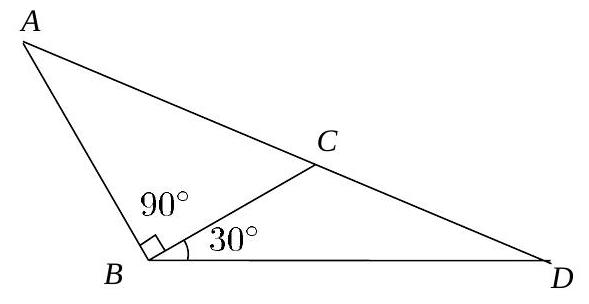
|
| 7 |
+
|
| 8 |
+
## PROBLEM 2
|
| 9 |
+
|
| 10 |
+
A Mathlon is a competition in which there are $M$ athletic events. Such a competition was held in which only $A, B$, and $C$ participated. In each event $p_{1}$ points were awarded for first place, $p_{2}$ for second and $p_{3}$ for third, where $p_{1}>p_{2}>p_{3}>0$ and $p_{1}, p_{2}, p_{3}$ are integers. The final score for $A$ was 22 , for $B$ was 9 and for $C$ was also 9. $B$ won the 100 metres. What is the value of $M$ and who was second in the high jump?
|
| 11 |
+
|
| 12 |
+
## Problem 3
|
| 13 |
+
|
| 14 |
+
A chord $S T$ of constant length slides around a semicircle with diameter $A B . M$ is the mid-point of $S T$ and $P$ is the foot of the perpendicular from $S$ to $A B$. Prove that angle $S P M$ is constant for all positions of $S T$.
|
| 15 |
+
|
| 16 |
+
## Problem 4
|
| 17 |
+
|
| 18 |
+
For positive integers $n$ and $k$, define $F(n, k)=\sum_{r=1}^{n} r^{2 k-1}$. Prove that $F(n, 1)$ divides $F(n, k)$.
|
| 19 |
+
|
| 20 |
+
Problem 5
|
| 21 |
+
Let $u_{1}, u_{2}, u_{3}, \ldots$ be a sequence of integers satisfying the recurrence relation $u_{n+2}=$ $u_{n+1}^{2}-u_{n}$. Suppose $u_{1}=39$ and $u_{2}=45$. Prove that 1986 divides infinitely many terms of the sequence.
|
| 22 |
+
|
CANADA_MO/md/en-exam1987.md
ADDED
|
@@ -0,0 +1,28 @@
|
|
|
|
|
|
|
|
|
|
|
|
|
|
|
|
|
|
|
|
|
|
|
|
|
|
|
|
|
|
|
|
|
|
|
|
|
|
|
|
|
|
|
|
|
|
|
|
|
|
|
|
|
|
|
|
|
|
|
|
|
|
|
|
|
|
|
|
|
|
|
|
|
|
|
|
|
|
|
|
|
|
|
|
|
|
|
|
| 1 |
+
# Canadian Mathematical Olympiad
|
| 2 |
+
|
| 3 |
+
1987
|
| 4 |
+
|
| 5 |
+
## Problem 1
|
| 6 |
+
|
| 7 |
+
Find all solutions of $a^{2}+b^{2}=n$ ! for positive integers $a, b, n$ with $a \leq b$ and $n<14$.
|
| 8 |
+
|
| 9 |
+
## Problem 2
|
| 10 |
+
|
| 11 |
+
The number 1987 can be written as a three digit number $x y z$ in some base $b$. If $x+y+z=1+9+8+7$, determine all possible values of $x, y, z, b$.
|
| 12 |
+
|
| 13 |
+
Problem 3
|
| 14 |
+
Suppose $A B C D$ is a parallelogram and $E$ is a point between $B$ and $C$ on the line $B C$. If the triangles $D E C, B E D$ and $B A D$ are isosceles what are the possible values for the angle $D A B$ ?
|
| 15 |
+
|
| 16 |
+
Problem 4
|
| 17 |
+
On a large, flat field $n$ people are positioned so that for each person the distances to all the other people are different. Each person holds a water pistol and at a given signal fires and hits the person who is closest. When $n$ is odd show that there is at least one person left dry. Is this always true when $n$ is even?
|
| 18 |
+
|
| 19 |
+
## Problem 5
|
| 20 |
+
|
| 21 |
+
For every positive integer $n$ show that
|
| 22 |
+
|
| 23 |
+
$$
|
| 24 |
+
[\sqrt{n}+\sqrt{n+1}]=[\sqrt{4 n+1}]=[\sqrt{4 n+2}]=[\sqrt{4 n+3}]
|
| 25 |
+
$$
|
| 26 |
+
|
| 27 |
+
where $[x]$ is the greatest integer less than or equal to $x$ (for example $[2.3]=2$, $[\pi]=3,[5]=5)$.
|
| 28 |
+
|
CANADA_MO/md/en-exam1988.md
ADDED
|
@@ -0,0 +1,21 @@
|
|
|
|
|
|
|
|
|
|
|
|
|
|
|
|
|
|
|
|
|
|
|
|
|
|
|
|
|
|
|
|
|
|
|
|
|
|
|
|
|
|
|
|
|
|
|
|
|
|
|
|
|
|
|
|
|
|
|
|
|
|
|
|
|
|
|
| 1 |
+
# Canadian Mathematical Olympiad 1988
|
| 2 |
+
|
| 3 |
+
## PROBLEM 1
|
| 4 |
+
|
| 5 |
+
For what values of $b$ do the equations: $1988 x^{2}+b x+8891=0$ and $8891 x^{2}+b x+$ $1988=0$ have a common root?
|
| 6 |
+
|
| 7 |
+
Problem 2
|
| 8 |
+
A house is in the shape of a triangle, perimeter $P$ metres and area $A$ square metres. The garden consists of all the land within 5 metres of the house. How much land do the garden and house together occupy?
|
| 9 |
+
|
| 10 |
+
## Problem 3
|
| 11 |
+
|
| 12 |
+
Suppose that $S$ is a finite set of at least five points in the plane; some are coloured red, the others are coloured blue. No subset of three or more similarly coloured points is collinear. Show that there is a triangle
|
| 13 |
+
(i) whose vertices are all the same colour, and
|
| 14 |
+
(ii) at least one side of the triangle does not contain a point of the opposite colour.
|
| 15 |
+
|
| 16 |
+
Problem 4
|
| 17 |
+
Let $x_{n+1}=4 x_{n}-x_{n-1}, x_{0}=0, x_{1}=1$, and $y_{n+1}=4 y_{n}-y_{n-1}, y_{0}=1, y_{1}=2$.
|
| 18 |
+
Show for all $n \geq 0$ that $y_{n}^{2}=3 x_{n}^{2}+1$.
|
| 19 |
+
Problem 5
|
| 20 |
+
Let $S=\left\{a_{1}, a_{2}, \ldots, a_{r}\right\}$ denote a sequence of integers. For each non-empty subsequence $A$ of $S$, we define $p(A)$ to be the product of all the integers in $A$. Let $m(S)$ be the arithmetic average of $p(A)$ over all non-empty subsets $A$ of $S$. If $m(S)=13$ and if $m\left(S \cup\left\{a_{r+1}\right\}\right)=49$ for some positive integer $a_{r+1}$, determine the values of $a_{1}, a_{2}, \ldots, a_{r}$ and $a_{r+1}$.
|
| 21 |
+
|
CANADA_MO/md/en-exam1989.md
ADDED
|
@@ -0,0 +1,24 @@
|
|
|
|
|
|
|
|
|
|
|
|
|
|
|
|
|
|
|
|
|
|
|
|
|
|
|
|
|
|
|
|
|
|
|
|
|
|
|
|
|
|
|
|
|
|
|
|
|
|
|
|
|
|
|
|
|
|
|
|
|
|
|
|
|
|
|
|
|
|
|
|
|
|
|
|
| 1 |
+
# Canadian Mathematical Olympiad
|
| 2 |
+
|
| 3 |
+
1989
|
| 4 |
+
|
| 5 |
+
## Problem 1
|
| 6 |
+
|
| 7 |
+
The integers $1,2, \ldots, n$ are placed in order so that each value is either strictly bigger than all the preceding values or is strictly smaller than all preceding values. In how many ways can this be done?
|
| 8 |
+
|
| 9 |
+
## PROBLEM 2
|
| 10 |
+
|
| 11 |
+
Let $A B C$ be a right angled triangle of area 1 . Let $A^{\prime} B^{\prime} C^{\prime}$ be the points obtained by reflecting $A, B, C$ respectively, in their opposite sides. Find the area of $\triangle A^{\prime} B^{\prime} C^{\prime}$.
|
| 12 |
+
|
| 13 |
+
## Problem 3
|
| 14 |
+
|
| 15 |
+
Define $\left\{a_{n}\right\}_{n=1}$ as follows: $a_{1}=1989^{1989} ; a_{n}, n>1$, is the sum of the digits of $a_{n-1}$. What is the value of $a_{5}$ ?
|
| 16 |
+
|
| 17 |
+
## Problem 4
|
| 18 |
+
|
| 19 |
+
There are 5 monkeys and 5 ladders and at the top of each ladder there is a banana. A number of ropes connect the ladders, each rope connects two ladders. No two ropes are attached to the same rung of the same ladder. Each monkey starts at the bottom of a different ladder. The monkeys climb up the ladders but each time they encounter a rope they climb along it to the ladder at the other end of the rope and then continue climbing upwards. Show that, no matter how many ropes there are, each monkey gets a banana.
|
| 20 |
+
|
| 21 |
+
## Problem 5
|
| 22 |
+
|
| 23 |
+
Given the numbers $1,2,2^{2}, \ldots, 2^{n-1}$. For a specific permutation $\sigma=X_{1}, X_{2}, \ldots, X_{n}$ of these numbers we define $S_{1}(\sigma)=X_{1}, S_{2}(\sigma)=X_{1}+X_{2}, S_{3}(\sigma)=X_{1}+X_{2}+X_{3}, \ldots$ and $Q(\sigma)=S_{1}(\sigma) S_{2}(\sigma) \cdots S_{n}(\sigma)$. Evaluate $\sum 1 / Q(\sigma)$ where the sum is taken over all possible permutations.
|
| 24 |
+
|
CANADA_MO/md/en-exam1990.md
ADDED
|
@@ -0,0 +1,51 @@
|
|
|
|
|
|
|
|
|
|
|
|
|
|
|
|
|
|
|
|
|
|
|
|
|
|
|
|
|
|
|
|
|
|
|
|
|
|
|
|
|
|
|
|
|
|
|
|
|
|
|
|
|
|
|
|
|
|
|
|
|
|
|
|
|
|
|
|
|
|
|
|
|
|
|
|
|
|
|
|
|
|
|
|
|
|
|
|
|
|
|
|
|
|
|
|
|
|
|
|
|
|
|
|
|
|
|
|
|
|
|
|
|
|
|
|
|
|
|
|
|
|
|
|
|
|
|
|
|
|
|
|
|
|
|
|
|
|
|
|
|
|
|
|
|
|
|
|
|
|
|
|
|
|
|
|
|
| 1 |
+
# Canadian Mathematical Olympiad <br> 1990
|
| 2 |
+
|
| 3 |
+
## PROBLEM 1
|
| 4 |
+
|
| 5 |
+
A competition involving $n \geq 2$ players was held over $k$ days. On each day, the players received scores of $1,2,3, \ldots, n$ points with no two players receiving the same score. At the end of the $k$ days, it was found that each player had exactly 26 points in total. Determine all pairs $(n, k)$ for which this is possible.
|
| 6 |
+
|
| 7 |
+
## Problem 2
|
| 8 |
+
|
| 9 |
+
A set of $\frac{1}{2} n(n+1)$ distinct numbers is arranged at random in a triangular array:
|
| 10 |
+
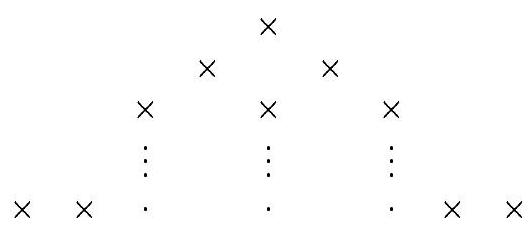
|
| 11 |
+
|
| 12 |
+
Let $M_{k}$ be the largest number in the $k$-th row from the top. Find the probability that
|
| 13 |
+
|
| 14 |
+
$$
|
| 15 |
+
M_{1}<M_{2}<M_{3}<\cdots<M_{n}
|
| 16 |
+
$$
|
| 17 |
+
|
| 18 |
+
## Problem 3
|
| 19 |
+
|
| 20 |
+
Let $A B C D$ be a convex quadrilateral inscribed in a circle, and let diagonals $A C$ and $B D$ meet at $X$. The perpendiculars from $X$ meet the sides $A B, B C, C D, D A$ at $A^{\prime}, B^{\prime}, C^{\prime}, D^{\prime}$ respectively. Prove that
|
| 21 |
+
|
| 22 |
+
$$
|
| 23 |
+
\left|A^{\prime} B^{\prime}\right|+\left|C^{\prime} D^{\prime}\right|=\left|A^{\prime} D^{\prime}\right|+\left|B^{\prime} C^{\prime}\right|
|
| 24 |
+
$$
|
| 25 |
+
|
| 26 |
+
( $\left|A^{\prime} B^{\prime}\right|$ is the length of line segment $A^{\prime} B^{\prime}$, etc.)
|
| 27 |
+
|
| 28 |
+
## Problem 4
|
| 29 |
+
|
| 30 |
+
A particle can travel at speeds up to 2 metres per second along the $x$-axis, and up to 1 metre per second elsewhere in the plane. Provide a labelled sketch of the region which can be reached within one second by the particle starting at the origin.
|
| 31 |
+
|
| 32 |
+
## Problem 5
|
| 33 |
+
|
| 34 |
+
Suppose that a function $f$ defined on the positive integers satisfies
|
| 35 |
+
|
| 36 |
+
$$
|
| 37 |
+
\begin{gathered}
|
| 38 |
+
f(1)=1, \quad f(2)=2 \\
|
| 39 |
+
f(n+2)=f(n+2-f(n+1))+f(n+1-f(n)) \quad(n \geq 1)
|
| 40 |
+
\end{gathered}
|
| 41 |
+
$$
|
| 42 |
+
|
| 43 |
+
(a) Show that
|
| 44 |
+
(i) $0 \leq f(n+1)-f(n) \leq 1$
|
| 45 |
+
(ii) if $f(n)$ is odd, then $f(n+1)=f(n)+1$.
|
| 46 |
+
(b) Determine, with justification, all values of $n$ for which
|
| 47 |
+
|
| 48 |
+
$$
|
| 49 |
+
f(n)=2^{10}+1
|
| 50 |
+
$$
|
| 51 |
+
|
CANADA_MO/md/en-exam1991.md
ADDED
|
@@ -0,0 +1,24 @@
|
|
|
|
|
|
|
|
|
|
|
|
|
|
|
|
|
|
|
|
|
|
|
|
|
|
|
|
|
|
|
|
|
|
|
|
|
|
|
|
|
|
|
|
|
|
|
|
|
|
|
|
|
|
|
|
|
|
|
|
|
|
|
|
|
|
|
|
|
|
|
|
|
|
|
|
| 1 |
+
# Canadian Mathematical Olympiad 1991
|
| 2 |
+
|
| 3 |
+
## Problem 1
|
| 4 |
+
|
| 5 |
+
Show that the equation $x^{2}+y^{5}=z^{3}$ has infinitely many solutions in integers $x, y$, $z$ for which $x y z \neq 0$.
|
| 6 |
+
|
| 7 |
+
## Problem 2
|
| 8 |
+
|
| 9 |
+
Let $n$ be a fixed positive integer. Find the sum of all positive integers with the following property: In base 2, it has exactly $2 n$ digits consisting of $n 1$ 's and $n 0$ 's. (The first digit cannot be 0.)
|
| 10 |
+
|
| 11 |
+
## PROBLEM 3
|
| 12 |
+
|
| 13 |
+
Let $C$ be a circle and $P$ a given point in the plane. Each line through $P$ which intersects $C$ determines a chord of $C$. Show that the midpoints of these chords lie on a circle.
|
| 14 |
+
|
| 15 |
+
## PROBLEM 4
|
| 16 |
+
|
| 17 |
+
Ten distinct numbers from the set $\{0,1,2, \ldots, 13,14\}$ are to be chosen to fill in the ten circles in the diagram. The absolute values of the differences of the two numbers joined by each segment must be different from the values for all other segments. Is it possible to do this? Justify your answer.
|
| 18 |
+
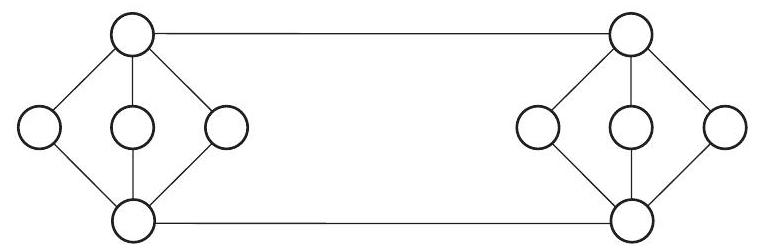
|
| 19 |
+
|
| 20 |
+
## PROBLEM 5
|
| 21 |
+
|
| 22 |
+
In the figure, the side length of the large equilateral triangle is 3 and $f(3)$, the number of parallelograms bounded by sides in the grid, is 15. For the general analogous situation, find a formula for $f(n)$, the number of parallelograms, for a triangle of side length $n$.
|
| 23 |
+
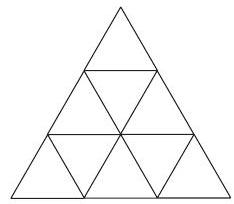
|
| 24 |
+
|
CANADA_MO/md/en-exam1992.md
ADDED
|
@@ -0,0 +1,34 @@
|
|
|
|
|
|
|
|
|
|
|
|
|
|
|
|
|
|
|
|
|
|
|
|
|
|
|
|
|
|
|
|
|
|
|
|
|
|
|
|
|
|
|
|
|
|
|
|
|
|
|
|
|
|
|
|
|
|
|
|
|
|
|
|
|
|
|
|
|
|
|
|
|
|
|
|
|
|
|
|
|
|
|
|
|
|
|
|
|
|
|
|
|
|
|
|
|
|
|
|
|
|
|
|
|
|
| 1 |
+
# Canadian Mathematical Olympiad
|
| 2 |
+
|
| 3 |
+
1992
|
| 4 |
+
|
| 5 |
+
## PROBLEM 1
|
| 6 |
+
|
| 7 |
+
Prove that the product of the first $n$ natural numbers is divisible by the sum of the first $n$ natural numbers if and only if $n+1$ is not an odd prime.
|
| 8 |
+
|
| 9 |
+
Problem 2
|
| 10 |
+
For $x, y, z \geq 0$, establish the inequality
|
| 11 |
+
|
| 12 |
+
$$
|
| 13 |
+
x(x-z)^{2}+y(y-z)^{2} \geq(x-z)(y-z)(x+y-z)
|
| 14 |
+
$$
|
| 15 |
+
|
| 16 |
+
and determine when equality holds.
|
| 17 |
+
|
| 18 |
+
## Problem 3
|
| 19 |
+
|
| 20 |
+
In the diagram, $A B C D$ is a square, with $U$ and $V$ interior points of the sides $A B$ and $C D$ respectively. Determine all the possible ways of selecting $U$ and $V$ so as to maximize the area of the quadrilateral $P U Q V$.
|
| 21 |
+
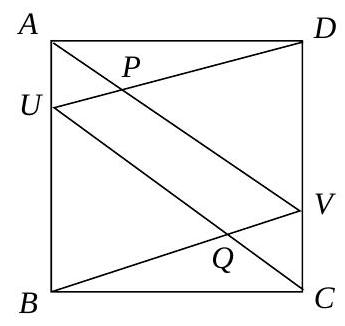
|
| 22 |
+
|
| 23 |
+
## PROBLEM 4
|
| 24 |
+
|
| 25 |
+
Solve the equation
|
| 26 |
+
|
| 27 |
+
$$
|
| 28 |
+
x^{2}+\frac{x^{2}}{(x+1)^{2}}=3
|
| 29 |
+
$$
|
| 30 |
+
|
| 31 |
+
## PROBLEM 5
|
| 32 |
+
|
| 33 |
+
A deck of $2 n+1$ cards consists of a joker and, for each number between 1 and $n$ inclusive, two cards marked with that number. The $2 n+1$ cards are placed in a row, with the joker in the middle. For each $k$ with $1 \leq k \leq n$, the two cards numbered $k$ have exactly $k-1$ cards between them. Determine all the values of $n$ not exceeding 10 for which this arrangement is possible. For which values of $n$ is it impossible?
|
| 34 |
+
|
CANADA_MO/md/en-exam1993.md
ADDED
|
@@ -0,0 +1,39 @@
|
|
|
|
|
|
|
|
|
|
|
|
|
|
|
|
|
|
|
|
|
|
|
|
|
|
|
|
|
|
|
|
|
|
|
|
|
|
|
|
|
|
|
|
|
|
|
|
|
|
|
|
|
|
|
|
|
|
|
|
|
|
|
|
|
|
|
|
|
|
|
|
|
|
|
|
|
|
|
|
|
|
|
|
|
|
|
|
|
|
|
|
|
|
|
|
|
|
|
|
|
|
|
|
|
|
|
|
|
|
|
|
|
|
|
|
|
|
|
|
|
| 1 |
+
# Canadian Mathematical Olympiad
|
| 2 |
+
|
| 3 |
+
1993
|
| 4 |
+
|
| 5 |
+
## Problem 1
|
| 6 |
+
|
| 7 |
+
Determine a triangle for which the three sides and an altitude are four consecutive integers and for which this altitude partitions the triangle into two right triangles with integer sides. Show that there is only one such triangle.
|
| 8 |
+
|
| 9 |
+
## PROBLEM 2
|
| 10 |
+
|
| 11 |
+
Show that the number $x$ is rational if and only if three distinct terms that form a geometric progression can be chosen from the sequence
|
| 12 |
+
|
| 13 |
+
$$
|
| 14 |
+
x, x+1, x+2, x+3, \ldots
|
| 15 |
+
$$
|
| 16 |
+
|
| 17 |
+
## PROBLEM 3
|
| 18 |
+
|
| 19 |
+
In triangle $A B C$, the medians to the sides $A B$ and $A C$ are perpendicular. Prove that $\cot B+\cot C \geq \frac{2}{3}$.
|
| 20 |
+
|
| 21 |
+
## PROBLEM 4
|
| 22 |
+
|
| 23 |
+
A number of schools took part in a tennis tournament. No two players from the same school played against each other. Every two players from different schools played exactly one match against each other. A match between two boys or between two girls was called a single and that between a boy and a girl was called a mixed single. The total number of boys differed from the total number of girls by at most 1 . The total number of singles differed from the total number of mixed singles by at most 1. At most how many schools were represented by an odd number of players?
|
| 24 |
+
|
| 25 |
+
## Problem 5
|
| 26 |
+
|
| 27 |
+
Let $y_{1}, y_{2}, y_{3}, \ldots$ be a sequence such that $y_{1}=1$ and, for $k>0$, is defined by the relationship:
|
| 28 |
+
|
| 29 |
+
$$
|
| 30 |
+
\begin{gathered}
|
| 31 |
+
y_{2 k}= \begin{cases}2 y_{k} & \text { if } k \text { is even } \\
|
| 32 |
+
2 y_{k}+1 & \text { if } k \text { is odd }\end{cases} \\
|
| 33 |
+
y_{2 k+1}= \begin{cases}2 y_{k} & \text { if } k \text { is odd } \\
|
| 34 |
+
2 y_{k}+1 & \text { if } k \text { is even }\end{cases}
|
| 35 |
+
\end{gathered}
|
| 36 |
+
$$
|
| 37 |
+
|
| 38 |
+
Show that the sequence $y_{1}, y_{2}, y_{3}, \ldots$ takes on every positive integer value exactly once.
|
| 39 |
+
|
CANADA_MO/md/en-exam1994.md
ADDED
|
@@ -0,0 +1,26 @@
|
|
|
|
|
|
|
|
|
|
|
|
|
|
|
|
|
|
|
|
|
|
|
|
|
|
|
|
|
|
|
|
|
|
|
|
|
|
|
|
|
|
|
|
|
|
|
|
|
|
|
|
|
|
|
|
|
|
|
|
|
|
|
|
|
|
|
|
|
|
|
|
|
|
|
|
|
|
|
|
|
|
| 1 |
+
# Canadian Mathematical Olympiad 1994
|
| 2 |
+
|
| 3 |
+
## Problem 1
|
| 4 |
+
|
| 5 |
+
Evaluate the sum
|
| 6 |
+
|
| 7 |
+
$$
|
| 8 |
+
\sum_{n=1}^{1994}(-1)^{n} \frac{n^{2}+n+1}{n!}
|
| 9 |
+
$$
|
| 10 |
+
|
| 11 |
+
## PROblem 2
|
| 12 |
+
|
| 13 |
+
Show that every positive integral power of $\sqrt{2}-1$ is of the form $\sqrt{m}-\sqrt{m-1}$ for some positive integer $m$. (e.g. $\left.(\sqrt{2}-1)^{2}=3-2 \sqrt{2}=\sqrt{9}-\sqrt{8}\right)$.
|
| 14 |
+
|
| 15 |
+
## PROBLEM 3
|
| 16 |
+
|
| 17 |
+
Twenty-five men sit around a circular table. Every hour there is a vote, and each must respond yes or no. Each man behaves as follows: on the $n^{\text {th }}$ vote, if his response is the same as the response of at least one of the two people he sits between, then he will respond the same way on the $(n+1)^{t h}$ vote as on the $n^{t h}$ vote; but if his response is different from that of both his neighbours on the $n$-th vote, then his response on the $(n+1)$-th vote will be different from his response on the $n^{t h}$ vote. Prove that, however everybody responded on the first vote, there will be a time after which nobody's response will ever change.
|
| 18 |
+
|
| 19 |
+
## Problem 4
|
| 20 |
+
|
| 21 |
+
Let $A B$ be a diameter of a circle $\Omega$ and $P$ be any point not on the line through $A$ and $B$. Suppose the line through $P$ and $A$ cuts $\Omega$ again in $U$, and the line through $P$ and $B$ cuts $\Omega$ again in $V$. (Note that in case of tangency $U$ may coincide with $A$ or $V$ may coincide with $B$. Also, if $P$ is on $\Omega$ then $P=U=V$.) Suppose that $|P U|=s|P A|$ and $|P V|=t|P B|$ for some nonnegative real numbers $s$ and $t$. Determine the cosine of the angle $A P B$ in terms of $s$ and $t$.
|
| 22 |
+
|
| 23 |
+
## Problem 5
|
| 24 |
+
|
| 25 |
+
Let $A B C$ be an acute angled triangle. Let $A D$ be the altitude on $B C$, and let $H$ be any interior point on $A D$. Lines $B H$ and $C H$, when extended, intersect $A C$ and $A B$ at $E$ and $F$, respectively. Prove that $\angle E D H=\angle F D H$.
|
| 26 |
+
|
CANADA_MO/md/en-exam1995.md
ADDED
|
@@ -0,0 +1,49 @@
|
|
|
|
|
|
|
|
|
|
|
|
|
|
|
|
|
|
|
|
|
|
|
|
|
|
|
|
|
|
|
|
|
|
|
|
|
|
|
|
|
|
|
|
|
|
|
|
|
|
|
|
|
|
|
|
|
|
|
|
|
|
|
|
|
|
|
|
|
|
|
|
|
|
|
|
|
|
|
|
|
|
|
|
|
|
|
|
|
|
|
|
|
|
|
|
|
|
|
|
|
|
|
|
|
|
|
|
|
|
|
|
|
|
|
|
|
|
|
|
|
|
|
|
|
|
|
|
|
|
|
|
|
|
|
|
|
|
|
|
|
|
|
|
|
|
|
|
|
|
|
| 1 |
+
# Canadian Mathematical Olympiad
|
| 2 |
+
|
| 3 |
+
1995
|
| 4 |
+
|
| 5 |
+
## Problem 1
|
| 6 |
+
|
| 7 |
+
Let $f(x)=\frac{9^{x}}{9^{x}+3}$. Evaluate the sum
|
| 8 |
+
|
| 9 |
+
$$
|
| 10 |
+
f\left(\frac{1}{1996}\right)+f\left(\frac{2}{1996}\right)+f\left(\frac{3}{1996}\right)+\cdots+f\left(\frac{1995}{1996}\right)
|
| 11 |
+
$$
|
| 12 |
+
|
| 13 |
+
## PROBLEM 2
|
| 14 |
+
|
| 15 |
+
Let $a, b$, and $c$ be positive real numbers. Prove that
|
| 16 |
+
|
| 17 |
+
$$
|
| 18 |
+
a^{a} b^{b} c^{c} \geq(a b c)^{\frac{a+b+c}{3}}
|
| 19 |
+
$$
|
| 20 |
+
|
| 21 |
+
## PROBLEM 3
|
| 22 |
+
|
| 23 |
+
Define a boomerang as a quadrilateral whose opposite sides do not intersect and one of whose internal angles is greater than 180 degrees. (See Figure displayed.) Let $C$ be a convex polygon having 5 sides. Suppose that the interior region of C is the union of $q$ quadrilaterals, none of whose interiors intersect one another. Also suppose that $b$ of these quadrilaterals are boomerangs. Show
|
| 24 |
+
|
| 25 |
+
that $q \geq b+\frac{s-2}{2}$.
|
| 26 |
+
|
| 27 |
+
Problem 4
|
| 28 |
+
Let $n$ be a fixed positive integer. Show that for only nonnegative integers $k$, the diophantine equation
|
| 29 |
+
|
| 30 |
+
$$
|
| 31 |
+
x_{1}^{3}+x_{2}^{3}+\cdots+x_{n}^{3}=y^{3 k+2}
|
| 32 |
+
$$
|
| 33 |
+
|
| 34 |
+
has infinitely many solutions in positive integers $x_{i}$ and $y$.
|
| 35 |
+
Problem 5
|
| 36 |
+
Suppose that $u$ is a real parameter with $0<u<1$. Define
|
| 37 |
+
|
| 38 |
+
$$
|
| 39 |
+
f(x)= \begin{cases}0 & \text { if } 0 \leq x \leq u \\ 1-(\sqrt{u x}+\sqrt{(1-u)(1-x)})^{2} & \text { if } u \leq x \leq 1\end{cases}
|
| 40 |
+
$$
|
| 41 |
+
|
| 42 |
+
and define the sequence $\left\{u_{n}\right\}$ recursively as follows:
|
| 43 |
+
|
| 44 |
+
$$
|
| 45 |
+
u_{1}=f(1), \text { and } u_{n}=f\left(u_{n-1}\right) \text { for all } n>1
|
| 46 |
+
$$
|
| 47 |
+
|
| 48 |
+
Show that there exists a positive ineger $k$ for which $u_{k}=0$.
|
| 49 |
+
|
CANADA_MO/md/en-exam1996.md
ADDED
|
@@ -0,0 +1,36 @@
|
|
|
|
|
|
|
|
|
|
|
|
|
|
|
|
|
|
|
|
|
|
|
|
|
|
|
|
|
|
|
|
|
|
|
|
|
|
|
|
|
|
|
|
|
|
|
|
|
|
|
|
|
|
|
|
|
|
|
|
|
|
|
|
|
|
|
|
|
|
|
|
|
|
|
|
|
|
|
|
|
|
|
|
|
|
|
|
|
|
|
|
|
|
|
|
|
|
|
|
|
|
|
|
|
|
|
|
|
|
|
|
| 1 |
+
# Canadian Mathematical Olympiad 1996
|
| 2 |
+
|
| 3 |
+
## Problem 1
|
| 4 |
+
|
| 5 |
+
If $\alpha, \beta, \gamma$ are the roots of $x^{3}-x-1=0$, compute
|
| 6 |
+
|
| 7 |
+
$$
|
| 8 |
+
\frac{1+\alpha}{1-\alpha}+\frac{1+\beta}{1-\beta}+\frac{1+\gamma}{1-\gamma}
|
| 9 |
+
$$
|
| 10 |
+
|
| 11 |
+
## PROBLEM 2
|
| 12 |
+
|
| 13 |
+
Find all real solutions to the following system of equations. Carefully justify your answer.
|
| 14 |
+
|
| 15 |
+
$$
|
| 16 |
+
\left\{\begin{array}{l}
|
| 17 |
+
\frac{4 x^{2}}{1+4 x^{2}}=y \\
|
| 18 |
+
\frac{4 y^{2}}{1+4 y^{2}}=z \\
|
| 19 |
+
\frac{4 z^{2}}{1+4 z^{2}}=x
|
| 20 |
+
\end{array}\right.
|
| 21 |
+
$$
|
| 22 |
+
|
| 23 |
+
PROBLEM 3
|
| 24 |
+
We denote an arbitrary permutation of the integers $1, \ldots, n$ by $a_{1}, \ldots, a_{n}$. Let $f(n)$ be the number of these permutations such that
|
| 25 |
+
(i) $a_{1}=1$;
|
| 26 |
+
(ii) $\left|a_{i}-a_{i+1}\right| \leq 2, \quad i=1, \ldots, n-1$.
|
| 27 |
+
|
| 28 |
+
Determine whether $f(1996)$ is divisible by 3 .
|
| 29 |
+
|
| 30 |
+
## PROblem 4
|
| 31 |
+
|
| 32 |
+
Let $\triangle A B C$ be an isosceles triangle with $A B=A C$. Suppose that the angle bisector of $\angle B$ meets $A C$ at $D$ and that $B C=B D+A D$. Determine $\angle A$.
|
| 33 |
+
|
| 34 |
+
Problem 5
|
| 35 |
+
Let $r_{1}, r_{2}, \ldots, r_{m}$ be a given set of $m$ positive rational numbers such that $\sum_{k=1}^{m} r_{k}=1$. Define the function $f$ by $f(n)=n-\sum_{k=1}^{m}\left[r_{k} n\right]$ for each positive integer n . Determine the minimum and maximum values of $f(n)$. Here $[x]$ denotes the greatest integer less than or equal to $x$
|
| 36 |
+
|
CANADA_MO/md/en-exam1997.md
ADDED
|
@@ -0,0 +1,40 @@
|
|
|
|
|
|
|
|
|
|
|
|
|
|
|
|
|
|
|
|
|
|
|
|
|
|
|
|
|
|
|
|
|
|
|
|
|
|
|
|
|
|
|
|
|
|
|
|
|
|
|
|
|
|
|
|
|
|
|
|
|
|
|
|
|
|
|
|
|
|
|
|
|
|
|
|
|
|
|
|
|
|
|
|
|
|
|
|
|
|
|
|
|
|
|
|
|
|
|
|
|
|
|
|
|
|
|
|
|
|
|
|
|
|
|
|
|
|
|
|
|
|
|
|
| 1 |
+
# Canadian Mathematical Olympiad
|
| 2 |
+
|
| 3 |
+
1997
|
| 4 |
+
|
| 5 |
+
## Problem 1
|
| 6 |
+
|
| 7 |
+
How many pairs of positive integers $x, y$ are there, with $x \leq y$, and such that $\operatorname{gcd}(x, y)=5!$ and $\operatorname{lcd}(x, y)=50$ !.
|
| 8 |
+
Note. $\operatorname{gcd}(x, y)$ denotes the greatest common divisor of $x$ and $y, \operatorname{lcd}(x, y)$ denotes the least common multiple of $x$ and $y$, and $n!=n \times(n-1) \times \cdots \times 2 \times 1$.
|
| 9 |
+
|
| 10 |
+
## Problem 2
|
| 11 |
+
|
| 12 |
+
The closed interval $A=[0,50]$ is the union of a finite number of closed intervals, each of length 1. Prove that some of the intervals can be removed so that those remaining are mutually disjoint and have total length $\geq 25$.
|
| 13 |
+
Note. For $a \leq b$, the closed interval $[a, b]:=\{x \in \mathbb{R}: a \leq x \leq b\}$ has length $b-a$; disjoint intervals have empty intersection.
|
| 14 |
+
|
| 15 |
+
## Problem 3
|
| 16 |
+
|
| 17 |
+
Prove that
|
| 18 |
+
|
| 19 |
+
$$
|
| 20 |
+
\frac{1}{1999}<\frac{1}{2} \cdot \frac{3}{4} \cdot \frac{5}{6} \cdots \frac{1997}{1998}<\frac{1}{44}
|
| 21 |
+
$$
|
| 22 |
+
|
| 23 |
+
## Problem 4
|
| 24 |
+
|
| 25 |
+
The point $O$ is situated inside the parallelogram $A B C D$ so that
|
| 26 |
+
|
| 27 |
+
$$
|
| 28 |
+
\angle A O B+\angle C O D=180^{\circ}
|
| 29 |
+
$$
|
| 30 |
+
|
| 31 |
+
Prove that $\angle O B C=\angle O D C$.
|
| 32 |
+
PROblem 5
|
| 33 |
+
Write the sum
|
| 34 |
+
|
| 35 |
+
$$
|
| 36 |
+
\sum_{k=0}^{n} \frac{(-1)^{k}\binom{n}{k}}{k^{3}+9 k^{2}+26 k+24}
|
| 37 |
+
$$
|
| 38 |
+
|
| 39 |
+
in the form $\frac{p(n)}{q(n)}$, where $p$ and $q$ are polynomials with integer coefficients.
|
| 40 |
+
|
CANADA_MO/md/en-exam1998.md
ADDED
|
@@ -0,0 +1,30 @@
|
|
|
|
|
|
|
|
|
|
|
|
|
|
|
|
|
|
|
|
|
|
|
|
|
|
|
|
|
|
|
|
|
|
|
|
|
|
|
|
|
|
|
|
|
|
|
|
|
|
|
|
|
|
|
|
|
|
|
|
|
|
|
|
|
|
|
|
|
|
|
|
|
|
|
|
|
|
|
|
|
|
|
|
|
|
|
|
|
|
|
|
|
|
| 1 |
+
# THE 1998 CANADIAN MATHEMATICAL OLYMPIAD
|
| 2 |
+
|
| 3 |
+
1. Determine the number of real solutions $a$ to the equation
|
| 4 |
+
|
| 5 |
+
$$
|
| 6 |
+
\left[\frac{1}{2} a\right]+\left[\frac{1}{3} a\right]+\left[\frac{1}{5} a\right]=a
|
| 7 |
+
$$
|
| 8 |
+
|
| 9 |
+
Here, if $x$ is a real number, then $[x]$ denotes the greatest integer that is less than or equal to $x$.
|
| 10 |
+
2. Find all real numbers $x$ such that
|
| 11 |
+
|
| 12 |
+
$$
|
| 13 |
+
x=\left(x-\frac{1}{x}\right)^{1 / 2}+\left(1-\frac{1}{x}\right)^{1 / 2}
|
| 14 |
+
$$
|
| 15 |
+
|
| 16 |
+
3. Let $n$ be a natural number such that $n \geq 2$. Show that
|
| 17 |
+
|
| 18 |
+
$$
|
| 19 |
+
\frac{1}{n+1}\left(1+\frac{1}{3}+\cdots+\frac{1}{2 n-1}\right)>\frac{1}{n}\left(\frac{1}{2}+\frac{1}{4}+\cdots+\frac{1}{2 n}\right) .
|
| 20 |
+
$$
|
| 21 |
+
|
| 22 |
+
4. Let $A B C$ be a triangle with $\angle B A C=40^{\circ}$ and $\angle A B C=60^{\circ}$. Let $D$ and $E$ be the points lying on the sides $A C$ and $A B$, respectively, such that $\angle C B D=40^{\circ}$ and $\angle B C E=70^{\circ}$. Let $F$ be the point of intersection of the lines $B D$ and $C E$. Show that the line $A F$ is perpendicular to the line $B C$.
|
| 23 |
+
5. Let $m$ be a positive integer. Define the sequence $a_{0}, a_{1}, a_{2}, \ldots$ by $a_{0}=0, a_{1}=m$, and $a_{n+1}=m^{2} a_{n}-a_{n-1}$ for $n=1,2,3, \ldots$. Prove that an ordered pair $(a, b)$ of non-negative integers, with $a \leq b$, gives a solution to the equation
|
| 24 |
+
|
| 25 |
+
$$
|
| 26 |
+
\frac{a^{2}+b^{2}}{a b+1}=m^{2}
|
| 27 |
+
$$
|
| 28 |
+
|
| 29 |
+
if and only if $(a, b)$ is of the form $\left(a_{n}, a_{n+1}\right)$ for some $n \geq 0$.
|
| 30 |
+
|
CANADA_MO/md/en-exam1999.md
ADDED
|
@@ -0,0 +1,16 @@
|
|
|
|
|
|
|
|
|
|
|
|
|
|
|
|
|
|
|
|
|
|
|
|
|
|
|
|
|
|
|
|
|
|
|
|
|
|
|
|
|
|
|
|
|
|
|
|
|
|
|
|
| 1 |
+
# THE 1999 CANADIAN MATHEMATICAL OLYMPIAD
|
| 2 |
+
|
| 3 |
+
1. Find all real solutions to the equation $4 x^{2}-40[x]+51=0$.
|
| 4 |
+
|
| 5 |
+
Here, if $x$ is a real number, then $[x]$ denotes the greatest integer that is less than or equal to $x$.
|
| 6 |
+
2. Let $A B C$ be an equilateral triangle of altitude 1 . A circle with radius 1 and center on the same side of $A B$ as $C$ rolls along the segment $A B$. Prove that the arc of the circle that is inside the triangle always has the same length.
|
| 7 |
+
3. Determine all positive integers $n$ with the property that $n=(d(n))^{2}$. Here $d(n)$ denotes the number of positive divisors of $n$.
|
| 8 |
+
4. Suppose $a_{1}, a_{2}, \ldots, a_{8}$ are eight distinct integers from $\{1,2, \ldots, 16,17\}$. Show that there is an integer $k>0$ such that the equation $a_{i}-a_{j}=k$ has at least three different solutions. Also, find a specific set of 7 distinct integers from $\{1,2, \ldots, 16,17\}$ such that the equation $a_{i}-a_{j}=k$ does not have three distinct solutions for any $k>0$.
|
| 9 |
+
5. Let $x, y$, and $z$ be non-negative real numbers satisfying $x+y+z=1$. Show that
|
| 10 |
+
|
| 11 |
+
$$
|
| 12 |
+
x^{2} y+y^{2} z+z^{2} x \leq \frac{4}{27}
|
| 13 |
+
$$
|
| 14 |
+
|
| 15 |
+
and find when equality occurs.
|
| 16 |
+
|
CANADA_MO/md/en-sol1994.md
ADDED
|
@@ -0,0 +1,353 @@
|
|
|
|
|
|
|
|
|
|
|
|
|
|
|
|
|
|
|
|
|
|
|
|
|
|
|
|
|
|
|
|
|
|
|
|
|
|
|
|
|
|
|
|
|
|
|
|
|
|
|
|
|
|
|
|
|
|
|
|
|
|
|
|
|
|
|
|
|
|
|
|
|
|
|
|
|
|
|
|
|
|
|
|
|
|
|
|
|
|
|
|
|
|
|
|
|
|
|
|
|
|
|
|
|
|
|
|
|
|
|
|
|
|
|
|
|
|
|
|
|
|
|
|
|
|
|
|
|
|
|
|
|
|
|
|
|
|
|
|
|
|
|
|
|
|
|
|
|
|
|
|
|
|
|
|
|
|
|
|
|
|
|
|
|
|
|
|
|
|
|
|
|
|
|
|
|
|
|
|
|
|
|
|
|
|
|
|
|
|
|
|
|
|
|
|
|
|
|
|
|
|
|
|
|
|
|
|
|
|
|
|
|
|
|
|
|
|
|
|
|
|
|
|
|
|
|
|
|
|
|
|
|
|
|
|
|
|
|
|
|
|
|
|
|
|
|
|
|
|
|
|
|
|
|
|
|
|
|
|
|
|
|
|
|
|
|
|
|
|
|
|
|
|
|
|
|
|
|
|
|
|
|
|
|
|
|
|
|
|
|
|
|
|
|
|
|
|
|
|
|
|
|
|
|
|
|
|
|
|
|
|
|
|
|
|
|
|
|
|
|
|
|
|
|
|
|
|
|
|
|
|
|
|
|
|
|
|
|
|
|
|
|
|
|
|
|
|
|
|
|
|
|
|
|
|
|
|
|
|
|
|
|
|
|
|
|
|
|
|
|
|
|
|
|
|
|
|
|
|
|
|
|
|
|
|
|
|
|
|
|
|
|
|
|
|
|
|
|
|
|
|
|
|
|
|
|
|
|
|
|
|
|
|
|
|
|
|
|
|
|
|
|
|
|
|
|
|
|
|
|
|
|
|
|
|
|
|
|
|
|
|
|
|
|
|
|
|
|
|
|
|
|
|
|
|
|
|
|
|
|
|
|
|
|
|
|
|
|
|
|
|
|
|
|
|
|
|
|
|
|
|
|
|
|
|
|
|
|
|
|
|
|
|
|
|
|
|
|
|
|
|
|
|
|
|
|
|
|
|
|
|
|
|
|
|
|
|
|
|
|
|
|
|
|
|
|
|
|
|
|
|
|
|
|
|
|
|
|
|
|
|
|
|
|
|
|
|
|
|
|
|
|
|
|
|
|
|
|
|
|
|
|
|
|
|
|
|
|
|
|
|
|
|
|
|
|
|
|
|
|
|
|
|
|
|
|
|
|
|
|
|
|
|
|
|
|
|
|
|
|
|
|
|
|
|
|
|
|
|
|
|
|
|
|
|
|
|
|
|
|
|
|
|
|
|
|
|
|
|
|
|
|
|
|
|
|
|
|
|
|
|
|
|
|
|
|
|
|
|
|
|
|
|
|
|
|
|
|
|
|
|
|
|
|
|
|
|
|
|
|
|
|
|
|
|
|
|
|
|
|
|
|
|
|
|
|
|
|
|
|
|
|
|
|
|
|
|
|
|
|
|
|
|
|
|
|
|
|
|
|
|
|
|
|
|
|
|
|
|
|
|
|
|
|
|
|
|
|
|
|
|
|
|
|
|
|
|
|
|
|
|
|
|
|
|
|
|
|
|
|
|
|
|
|
|
|
|
|
|
|
|
|
|
|
|
|
|
|
|
|
|
|
|
|
|
|
|
|
|
|
|
|
|
|
|
|
|
|
|
|
|
|
|
|
|
|
|
|
|
|
|
|
|
|
|
|
|
|
|
|
|
|
|
|
|
|
|
|
|
|
|
|
|
|
|
|
|
|
|
|
|
|
|
|
|
|
|
|
|
|
|
|
|
|
|
|
|
|
|
|
|
|
|
|
|
|
|
|
|
|
|
|
|
|
|
|
|
|
|
|
|
|
|
|
|
|
|
|
|
|
|
|
|
|
|
|
|
|
|
|
|
|
|
|
|
|
|
|
|
|
|
|
|
|
|
|
|
|
|
|
|
|
|
|
|
|
|
|
|
|
|
|
|
|
|
|
|
|
|
|
|
|
|
|
|
|
|
|
|
|
|
|
|
|
|
|
|
|
|
|
|
|
|
|
|
|
|
|
|
|
|
|
|
|
|
|
|
|
|
|
|
|
|
|
|
|
|
|
|
|
|
|
|
|
|
|
|
|
|
|
|
|
|
|
|
|
|
|
|
|
|
|
|
|
|
|
|
|
|
|
|
|
|
|
|
|
|
|
|
|
|
|
|
|
|
|
|
|
|
|
|
|
|
|
|
|
|
|
|
|
|
|
|
|
|
|
|
|
|
|
|
|
|
|
|
|
|
|
|
|
|
|
| 1 |
+
# SOLUTIONS
|
| 2 |
+
|
| 3 |
+
## QUESTION 1
|
| 4 |
+
|
| 5 |
+
## Solution 1.
|
| 6 |
+
|
| 7 |
+
Let $\mathcal{S}$ denote the given sum. Then
|
| 8 |
+
|
| 9 |
+
$$
|
| 10 |
+
\begin{aligned}
|
| 11 |
+
\mathcal{S} & =\sum_{n=1}^{1994}(-1)^{n}\left(\frac{n}{(n-1) !}+\frac{n+1}{n !}\right) \\
|
| 12 |
+
& =\sum_{n=0}^{1993}(-1)^{n+1} \frac{n+1}{n !}+\sum_{n=1}^{1994}(-1)^{n} \frac{n+1}{n !} \\
|
| 13 |
+
& =-1+\frac{1995}{1994 !}
|
| 14 |
+
\end{aligned}
|
| 15 |
+
$$
|
| 16 |
+
|
| 17 |
+
## Solution 2.
|
| 18 |
+
|
| 19 |
+
For positive integers $k$, define
|
| 20 |
+
|
| 21 |
+
$$
|
| 22 |
+
\mathcal{S}(k)=\sum_{n=1}^{k}(-1)^{n} \frac{n^{2}+n+1}{n !}
|
| 23 |
+
$$
|
| 24 |
+
|
| 25 |
+
We prove by induction on $k$ that
|
| 26 |
+
|
| 27 |
+
$$
|
| 28 |
+
\text { (*) } \quad \mathcal{S}(k)=-1+(-1)^{k} \frac{k+1}{k !}
|
| 29 |
+
$$
|
| 30 |
+
|
| 31 |
+
The given sum is the case when $k=1994$. For $k=1, \mathcal{S}(1)=-3=-1-\frac{2}{1 !}$. Suppose $\left({ }^{*}\right)$ holds for some $k \geq 1$, then
|
| 32 |
+
|
| 33 |
+
$$
|
| 34 |
+
\begin{aligned}
|
| 35 |
+
\mathcal{S}(k & +1)=\mathcal{S}(k)+(-1)^{k+1} \frac{(k+1)^{2}+(k+1)+1}{(k+1) !} \\
|
| 36 |
+
& =-1+(-1)^{k} \frac{k+1}{k !}+(-1)^{k+1}\left(\frac{k+1}{k !}+\frac{k+2}{(k+1) !}\right) \\
|
| 37 |
+
& =-1+(-1)^{k+1} \frac{k+2}{(k+1) !}
|
| 38 |
+
\end{aligned}
|
| 39 |
+
$$
|
| 40 |
+
|
| 41 |
+
completing the induction.
|
| 42 |
+
|
| 43 |
+
## QUESTION 2
|
| 44 |
+
|
| 45 |
+
## Solution 1.
|
| 46 |
+
|
| 47 |
+
Fix a positive integer $n$. Let $a=(\sqrt{2}-1)^{n}$ and $b=(\sqrt{2}+1)^{n}$. Then clearly $a b=1$. Let $c=(b+a) / 2$ and $d=(b-a) / 2$. If $n$ is even, $n=2 k$, then from the Binomial Theorem we get
|
| 48 |
+
|
| 49 |
+
$$
|
| 50 |
+
\begin{aligned}
|
| 51 |
+
c= & \frac{1}{2} \sum_{i=0}^{n}\left(\begin{array}{c}
|
| 52 |
+
n \\
|
| 53 |
+
i
|
| 54 |
+
\end{array}\right)\left(\sqrt{2}^{n-i}+(-1)^{i} \sqrt{2}^{n-i}\right) \\
|
| 55 |
+
& =\sum_{j=0}^{k}\left(\begin{array}{c}
|
| 56 |
+
2 k \\
|
| 57 |
+
2 j
|
| 58 |
+
\end{array}\right) \sqrt{2}^{2 k-2 j} \\
|
| 59 |
+
& =\sum_{j=0}^{k}\left(\begin{array}{c}
|
| 60 |
+
2 k \\
|
| 61 |
+
2 j
|
| 62 |
+
\end{array}\right) 2^{k-j}
|
| 63 |
+
\end{aligned}
|
| 64 |
+
$$
|
| 65 |
+
|
| 66 |
+
and
|
| 67 |
+
|
| 68 |
+
$$
|
| 69 |
+
\begin{aligned}
|
| 70 |
+
\frac{d}{\sqrt{2}} & =\frac{1}{\sqrt{2}} \sum_{i=0}^{n}\left(\begin{array}{c}
|
| 71 |
+
n \\
|
| 72 |
+
i
|
| 73 |
+
\end{array}\right)\left(\sqrt{2}^{n-i}-(-1)^{i} \sqrt{2}^{n-i}\right) \\
|
| 74 |
+
& =\frac{2}{\sqrt{2}} \sum_{j=0}^{k-1}\left(\begin{array}{c}
|
| 75 |
+
2 k \\
|
| 76 |
+
2 j+1
|
| 77 |
+
\end{array}\right) \sqrt{2}^{2 k-2 j-1} \\
|
| 78 |
+
& =\sum_{j=0}^{k-1}\left(\begin{array}{c}
|
| 79 |
+
2 k \\
|
| 80 |
+
2 j+1
|
| 81 |
+
\end{array}\right) 2^{k-j}
|
| 82 |
+
\end{aligned}
|
| 83 |
+
$$
|
| 84 |
+
|
| 85 |
+
showing that $c$ and $\frac{d}{\sqrt{2}}$ are both positive integers. Similarly, when $n$ is odd we see that $\frac{c}{\sqrt{2}}$ and $d$ are both positive integers. In either case, $c^{2}$ and $d^{2}$ are both integers. Notes that
|
| 86 |
+
|
| 87 |
+
$$
|
| 88 |
+
c^{2}-d^{2}=\frac{1}{4}\left((b+a)^{2}-(b-a)^{2}\right)=a b=1 .
|
| 89 |
+
$$
|
| 90 |
+
|
| 91 |
+
Hence if we let $m=c^{2}$, then $m-1=c^{2}-1=d^{2}$ and $a=c-d=\sqrt{m}-\sqrt{m-1}$.
|
| 92 |
+
|
| 93 |
+
## Solution 2.
|
| 94 |
+
|
| 95 |
+
Let $m$ and $n$ be positive integers. Observe that
|
| 96 |
+
|
| 97 |
+
$$
|
| 98 |
+
(\sqrt{2}-1)^{n}(\sqrt{2}+1)^{n}=1=(\sqrt{m}-\sqrt{m-1})(\sqrt{m}+\sqrt{m-1})
|
| 99 |
+
$$
|
| 100 |
+
|
| 101 |
+
and so
|
| 102 |
+
|
| 103 |
+
$$
|
| 104 |
+
\text { (*) } \quad(\sqrt{2}-1)^{n}=\sqrt{m}-\sqrt{m-1} \text { if and only if }(\sqrt{2}+1)^{n}=\sqrt{m}+\sqrt{m-1} \text {. }
|
| 105 |
+
$$
|
| 106 |
+
|
| 107 |
+
Assuming $m$ and $n$ satisfy (*), then adding the two equivalent equations we get $2 \sqrt{m}=$ $(\sqrt{2}-1)^{n}+(\sqrt{2}+1)^{n}$ whence:
|
| 108 |
+
|
| 109 |
+
$$
|
| 110 |
+
(* *) \quad m=\frac{1}{4}\left[(\sqrt{2}-1)^{2 n}+2+(\sqrt{2}+1)^{2 n}\right]
|
| 111 |
+
$$
|
| 112 |
+
|
| 113 |
+
Now we show that the steps above are reversible and that $m$ defined by $\left({ }^{* *}\right)$ is a positive integer. From $\left({ }^{* *}\right.$ ) one sees easily that
|
| 114 |
+
|
| 115 |
+
$$
|
| 116 |
+
\sqrt{m}=\frac{1}{2}\left[(\sqrt{2}-1)^{n}+(\sqrt{2}+1)^{n}\right] \text { and } \sqrt{m-1}=\frac{1}{2}\left[(\sqrt{2}+1)^{n}-(\sqrt{2}-1)^{n}\right]
|
| 117 |
+
$$
|
| 118 |
+
|
| 119 |
+
and so $\sqrt{m}-\sqrt{m-1}=(\sqrt{2}-1)^{n}$ as required. Finally, from the Binomial Theorem,
|
| 120 |
+
|
| 121 |
+
$$
|
| 122 |
+
\begin{aligned}
|
| 123 |
+
(\sqrt{2} & -1)^{2 n}+(\sqrt{2}+1)^{2 n}= \\
|
| 124 |
+
& =\sum_{k=0}^{2 n}\left(\begin{array}{c}
|
| 125 |
+
2 n \\
|
| 126 |
+
k
|
| 127 |
+
\end{array}\right)\left[(-1)^{k} 2^{(2 n-k) / 2}+2^{(2 n-k) / 2}\right] \\
|
| 128 |
+
& =\sum_{\ell=0}^{n}\left(\begin{array}{c}
|
| 129 |
+
2 n \\
|
| 130 |
+
2 \ell
|
| 131 |
+
\end{array}\right) 2^{n-\ell+1}
|
| 132 |
+
\end{aligned}
|
| 133 |
+
$$
|
| 134 |
+
|
| 135 |
+
which is congruent to 2 modulo 4 since $2^{n-\ell+1} \equiv 0(\bmod 4)$ for all $\ell=0,1,2, \cdots, n-1$. Therefore, $(\sqrt{2}-1)^{2 n}+2+(\sqrt{2}+1)^{2 n}$ is a multiple of 4 , as required.
|
| 136 |
+
|
| 137 |
+
## SOLUTIONS (Cont'd)
|
| 138 |
+
|
| 139 |
+
## Solution 3.
|
| 140 |
+
|
| 141 |
+
We show by induction that
|
| 142 |
+
|
| 143 |
+
$$
|
| 144 |
+
\text { (*) } \quad(\sqrt{2}-1)^{n}=\left\{\begin{array}{l}
|
| 145 |
+
a \sqrt{2}-b \text { where } 2 a^{2}=b^{2}+1 \text { if } n \text { is odd } \\
|
| 146 |
+
a-b \sqrt{2} \text { where } a^{2}=2 b^{2}+1 \text { if } n \text { is even }
|
| 147 |
+
\end{array}\right. \text {. }
|
| 148 |
+
$$
|
| 149 |
+
|
| 150 |
+
Thus $m=2 a^{2}$ when $n$ is odd and $m=a^{2}$ when $n$ is even and the problem is solved.
|
| 151 |
+
|
| 152 |
+
The induction is as follows:
|
| 153 |
+
|
| 154 |
+
$$
|
| 155 |
+
\begin{aligned}
|
| 156 |
+
& (\sqrt{2}-1)^{1}=1 \sqrt{2}-1 \text { where } 2\left(1^{2}\right)=1^{2}+1 \\
|
| 157 |
+
& (\sqrt{2}-1)^{2}=3-2 \sqrt{2} \text { where } 3^{2}=2\left(2^{2}\right)+1
|
| 158 |
+
\end{aligned}
|
| 159 |
+
$$
|
| 160 |
+
|
| 161 |
+
Assume (*) holds for some $n \geq 1, n$ odd. Then
|
| 162 |
+
|
| 163 |
+
$$
|
| 164 |
+
\begin{aligned}
|
| 165 |
+
(\sqrt{2} & -1)^{n+1} \\
|
| 166 |
+
& =(a \sqrt{2}-b)(\sqrt{2}-1) \text { where } 2 a^{2}=b^{2}+1 \\
|
| 167 |
+
& =(2 a+b)-(a+b) \sqrt{2} \\
|
| 168 |
+
& =A-B \sqrt{2} \text { where } A=2 a+b, B=a+b .
|
| 169 |
+
\end{aligned}
|
| 170 |
+
$$
|
| 171 |
+
|
| 172 |
+
Moreover, $A^{2}=2 a^{2}+4 a b+b^{2}+2 a^{2}=2 a^{2}+4 a b+2 b^{2}+1=2 B^{2}+1$.
|
| 173 |
+
|
| 174 |
+
Assume (*) holds for some $n \geq 2, n$ even. Then
|
| 175 |
+
|
| 176 |
+
$$
|
| 177 |
+
\begin{aligned}
|
| 178 |
+
(\sqrt{2} & -1)^{n+1} \\
|
| 179 |
+
& =(a-b \sqrt{2})(\sqrt{2}-1) \text { where } a^{2}=2 b^{2}+1 \\
|
| 180 |
+
& =(a+b) \sqrt{2}-(a+2 b) \\
|
| 181 |
+
& =A \sqrt{2}-B \text { where } A \approx a+b, B=a+2 b .
|
| 182 |
+
\end{aligned}
|
| 183 |
+
$$
|
| 184 |
+
|
| 185 |
+
Moreover, $2 A^{2}=2 a^{2}+4 a b+2 b^{2}=a^{2}+4 a b+4 b^{2}+a^{2}-2 b^{2}=B^{2}+1$.
|
| 186 |
+
|
| 187 |
+
## Solution 4.
|
| 188 |
+
|
| 189 |
+
From $(\sqrt{2}-1)^{1}=\sqrt{2}-1,(\sqrt{2}-1)^{2}=3-2 \sqrt{2},(\sqrt{2}-1)^{3}=5 \sqrt{2}-7,(\sqrt{2}-1)^{4}=17-12 \sqrt{2}$, etc, we conjecture that
|
| 190 |
+
|
| 191 |
+
$$
|
| 192 |
+
(*) \quad(\sqrt{2}-1)^{n}=s_{n} \sqrt{2}+t_{n}
|
| 193 |
+
$$
|
| 194 |
+
|
| 195 |
+
where $s_{1}=1, t_{1}=1, s_{n+1}=(-1)^{n}\left(\left|s_{n}\right|+\left|t_{n}\right|\right), t_{n+1}=(-1)^{n+1}\left(2\left|s_{n}\right|+\left|t_{n}\right|\right)$.
|
| 196 |
+
|
| 197 |
+
Note that $s_{n}$ is positive (negative) if $n$ is odd (even) and $t_{n}$ is negative (positive) if $n$ is odd (even).
|
| 198 |
+
|
| 199 |
+
We now show by induction that $\left(^{*}\right)$ holds and that each $s_{n} \sqrt{2}+t_{n}$ of the form $\sqrt{m}-\sqrt{m-1}$ for some $m$.
|
| 200 |
+
|
| 201 |
+
It is easily verified that $\left({ }^{*}\right)$ is correct for $n=1$ and 2 . Assume $\left({ }^{*}\right)$ holds for some $n \geq 2$. Then
|
| 202 |
+
|
| 203 |
+
$$
|
| 204 |
+
(\sqrt{2}-1)^{n+1}=\left(s_{n} \sqrt{2}+t_{n}\right)(\sqrt{2}-1)=\left(t_{n}-s_{n}\right) \sqrt{2}+\left(2 s_{n}-t_{n}\right)
|
| 205 |
+
$$
|
| 206 |
+
|
| 207 |
+
If $n$ is odd, then
|
| 208 |
+
|
| 209 |
+
$$
|
| 210 |
+
\begin{aligned}
|
| 211 |
+
& t_{n}-s_{n}=-\left(\left|t_{n}\right|+\left|s_{n}\right|\right)=s_{n+1} \\
|
| 212 |
+
& 2 s_{n}-t_{n}=2\left|s_{n}\right|+\left|t_{n}\right|=t_{n+1}
|
| 213 |
+
\end{aligned}
|
| 214 |
+
$$
|
| 215 |
+
|
| 216 |
+
If $n$ is even, then
|
| 217 |
+
|
| 218 |
+
$$
|
| 219 |
+
\begin{aligned}
|
| 220 |
+
& t_{n}-s_{n}=\left|t_{n}\right|+\left|s_{n}\right|=s_{n+1} \\
|
| 221 |
+
& 2 s_{n}-t_{n}=-2\left|s_{n}\right|-\left|t_{n}\right|=t_{n+1}
|
| 222 |
+
\end{aligned}
|
| 223 |
+
$$
|
| 224 |
+
|
| 225 |
+
We have shown that $\left(^{*}\right)$ is correct for all $n$.
|
| 226 |
+
|
| 227 |
+
Observe now that $\left(s_{n+1} \sqrt{2}\right)^{2}-t_{n+1}^{2}=2\left(s_{n}^{2}-2 s_{n} t_{n}+t_{n}^{2}\right)-\left(4 s_{n}^{2}-4 s_{n} t_{n}+t_{n}^{2}\right)=-2 s_{n}^{2}+t_{n}^{2}$ $=-\left(\left(s_{n} \sqrt{2}\right)^{2}-t_{n}^{2}\right)$. Since $\left(s_{1} \sqrt{2}\right)^{2}-t_{1}^{2}=1$, it follows that $\left(s_{n} \sqrt{2}\right)^{2}-t_{n}^{2}=(-1)^{n+1}$ for all $n$. To complete the proof it suffices to take $m=\left(s_{n} \sqrt{2}\right)^{2}, m-1=t_{n}^{2}$ when $n$ is odd and $m=t_{n}^{2}, m-1=\left(s_{n} \sqrt{2}\right)^{2}$ when $n$ is even.
|
| 228 |
+
|
| 229 |
+
## QUESTION 3
|
| 230 |
+
|
| 231 |
+
First observe that if two neighbours have the same response on the $n^{\text {th }}$ vote, then they both will respond the same way on the $(n+1)^{\text {th }}$ vote. Moreover, neither will ever change his response after the $n^{\text {th }}$ vote.
|
| 232 |
+
|
| 233 |
+
Let $A_{n}$ be the set of men who agree with at least one of their neighbours on the $n^{\text {th }}$ vote. The previous paragraph says that $A_{n} \subset A_{n+1}$ for every $n \geq 1$. Moreover, we will be done if we can show that $A_{n}$ contains all 25 men for some $n$.
|
| 234 |
+
|
| 235 |
+
Since there are an odd number of men at the table, it is not pssible that every man disagrees with both of his neighbours on the first vote. Therefore $A_{1}$ contains at least two men. And since $A_{n} \subset A_{n+1}$ for every $n$, there exists a $T<25$ such that $A_{T}=A_{T+1}$. Suppose that $A_{T}$ does not contain all 25 men; we shall use this to derive a contradiction. Since $A_{T}$ is not empty, there must exist two neighbours, whom we shall call $x$ and $y$, such that $x \in A_{T}$ and $y \notin A_{T}$. Since $x \in A_{T}$, he will respond the same way on the $T^{\text {th }}$ and $(T+1)^{\text {th }}$ votes. But $y \notin A_{T}$, so $y$ 's response on the $T^{\text {th }}$ vote differs from $x$ 's response. In fact, we know that $y$ disagrees with both of his neighbours on the $T^{\text {th }}$ vote, and so he will change his response on the $(T+1)^{t h}$ vote. Therefore, on the $(T+1)^{\text {th }}$ vote, $y$ responds the same way as does $x$. This implies that $y \in A_{T+1}$. But $y \notin A_{T}$, which contradicts the fact that $A_{T}=A_{T+1}$. Therefore we conclude that $A_{T}$ contains all 25 men, and we are done.
|
| 236 |
+
|
| 237 |
+
## QUESTION 4
|
| 238 |
+
|
| 239 |
+
There are three cases to be considered:
|
| 240 |
+
|
| 241 |
+
Case 1: If $P$ is outside $\Omega$ (see figures I, II, and III), then since $\angle A U B=\angle A V B=\pi / 2$, we have
|
| 242 |
+
|
| 243 |
+
$$
|
| 244 |
+
\cos (\angle A P B)=\frac{P U}{P B}=\frac{P V}{P A}=\sqrt{\frac{P U}{P A} \cdot \frac{P V}{P B}}=\sqrt{s t}
|
| 245 |
+
$$
|
| 246 |
+
|
| 247 |
+
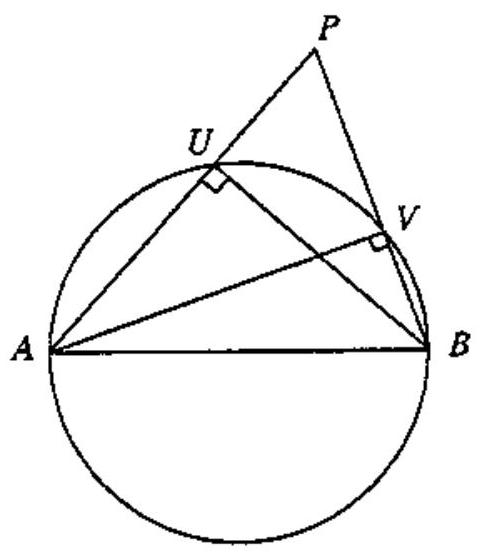
|
| 248 |
+
|
| 249 |
+
Figure I
|
| 250 |
+
|
| 251 |
+
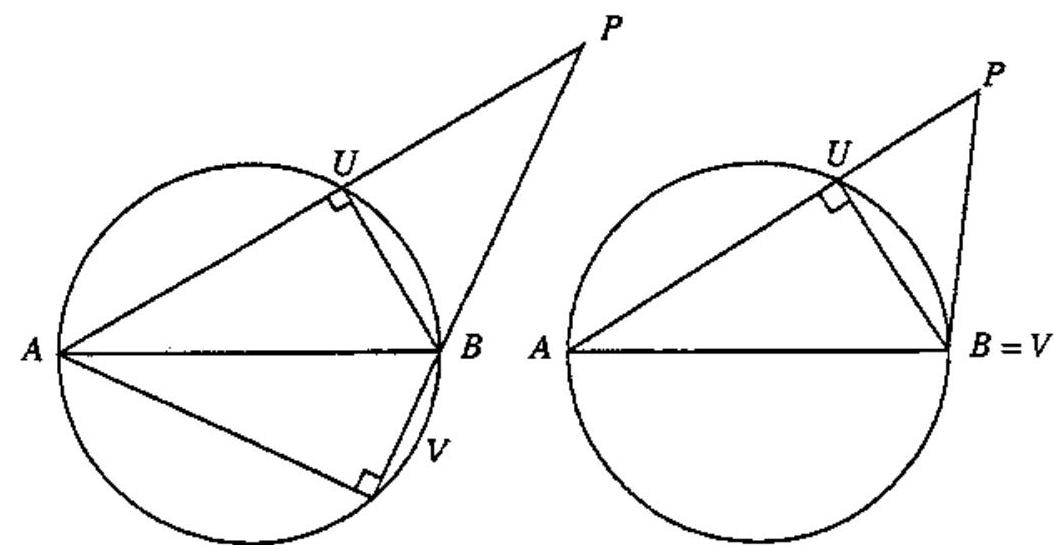
|
| 252 |
+
|
| 253 |
+
Figure II
|
| 254 |
+
Figure III
|
| 255 |
+
|
| 256 |
+
## SOLUTIONS (Cont'd)
|
| 257 |
+
|
| 258 |
+
Case 2: If $P$ is on $\Omega$ (see figure IV), then
|
| 259 |
+
|
| 260 |
+
$$
|
| 261 |
+
P=U=V \Rightarrow P U=P V=0 \Rightarrow s=t=0 \text {. }
|
| 262 |
+
$$
|
| 263 |
+
|
| 264 |
+
Since $\angle A P B=\pi / 2, \cos (\angle A P B)=0=\sqrt{s t}$ holds again.
|
| 265 |
+
|
| 266 |
+
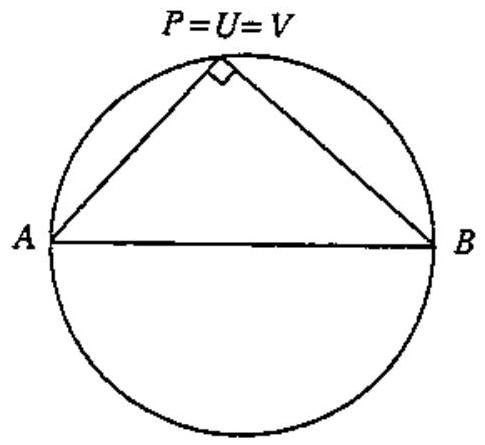
|
| 267 |
+
|
| 268 |
+
Figure IV
|
| 269 |
+
|
| 270 |
+
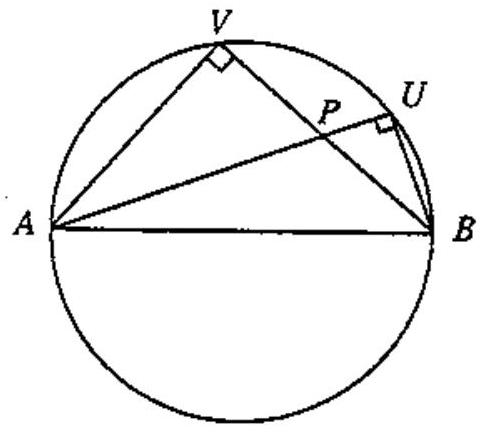
|
| 271 |
+
|
| 272 |
+
Figure $\mathrm{V}$
|
| 273 |
+
|
| 274 |
+
Case 3: If $P$ is inside $\Omega$ (figure $\mathrm{V}$ ), then
|
| 275 |
+
|
| 276 |
+
$$
|
| 277 |
+
\cos (\angle A P B)=\cos (\pi-\angle A P V)=-\cos (\angle A P V)=-\frac{P V}{P A}
|
| 278 |
+
$$
|
| 279 |
+
|
| 280 |
+
and
|
| 281 |
+
|
| 282 |
+
$$
|
| 283 |
+
\cos (\angle A P B)=\cos (\pi-\angle B P U)=-\cos (\angle B P U)=-\frac{P U}{P B}
|
| 284 |
+
$$
|
| 285 |
+
|
| 286 |
+
Therefore $\cos (\angle A P B)=-\sqrt{\frac{P U}{P A} \cdot \frac{P V}{P B}}=-\sqrt{s t}$.
|
| 287 |
+
|
| 288 |
+
## SOLUTIONS (Cont'd)
|
| 289 |
+
|
| 290 |
+
## QUESTION 5
|
| 291 |
+
|
| 292 |
+
## Solution 1.
|
| 293 |
+
|
| 294 |
+
100 degree angle grestion? bit haden?
|
| 295 |
+
|
| 296 |
+
From $A$ draw a lkine $\ell$ parallel to $B C$. Extend $D F$ and $D E$ to meet $\ell$ at $P$ and $Q$ respectively (See Figure I). Then from similar triangles, we have
|
| 297 |
+
|
| 298 |
+
$$
|
| 299 |
+
\frac{A P}{B D}=\frac{A F}{F B} \text { qne } \frac{A Q}{C D}=\frac{A E}{E C}
|
| 300 |
+
$$
|
| 301 |
+
|
| 302 |
+
or
|
| 303 |
+
|
| 304 |
+
$$
|
| 305 |
+
A P=\frac{A F}{F B} \cdot B D \text { and } A Q=\frac{A E}{E C} \cdot C D
|
| 306 |
+
$$
|
| 307 |
+
|
| 308 |
+
By Ceva's Theorem, $\frac{A F}{F B} \cdot \frac{B D}{D C} \cdot \frac{C E}{E A}=1$ and thus
|
| 309 |
+
|
| 310 |
+
$$
|
| 311 |
+
\frac{A F}{F B} \cdot B D=\frac{A E}{E C} \cdot C D
|
| 312 |
+
$$
|
| 313 |
+
|
| 314 |
+
From (1) and (2) we get $A P=A Q$ and hence $\triangle A D P \simeq \triangle A D Q$ from which $\angle E D H=$ $\angle F D H$ follows.
|
| 315 |
+
|
| 316 |
+
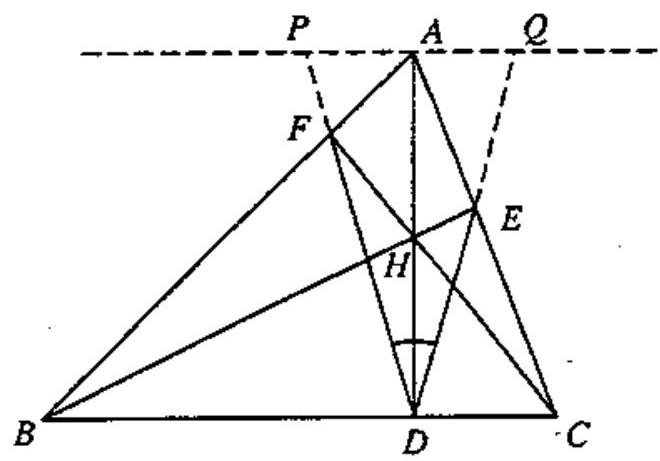
|
| 317 |
+
|
| 318 |
+
Figure I
|
| 319 |
+
|
| 320 |
+
## Solution 2.
|
| 321 |
+
|
| 322 |
+
Use cartesian coordinates, with $D$ at $(0,0), A=(0, a), B=(-b, 0), C=(c, 0)$. Let $H=(0, h), E=(u, v)$ and $F=(-r, s)$ where $a, b, c, h, u, v, r, s$ are all positive (See Figure II).
|
| 323 |
+
|
| 324 |
+
It clearly suffices to show that $\frac{v}{u}=\frac{s}{\tau}$. Since $E C$ and $A C$ have the same slope, we have $\frac{v}{u-c}=\frac{a}{-c}$. Similarly, since $E B$ and $H B$ have the same slope, $\frac{v}{u+b}=\frac{k}{b}$. Thus
|
| 325 |
+
|
| 326 |
+
$$
|
| 327 |
+
\frac{v}{a}=\frac{u-c}{-c}=\frac{-u}{c}+1
|
| 328 |
+
$$
|
| 329 |
+
|
| 330 |
+
and
|
| 331 |
+
|
| 332 |
+
$$
|
| 333 |
+
\frac{v}{h}=\frac{u+b}{b}=\frac{u}{b}+1
|
| 334 |
+
$$
|
| 335 |
+
|
| 336 |
+
(2)-(1) we get $v\left(\frac{1}{h}-\frac{1}{a}\right)=u\left(\frac{1}{b}+\frac{1}{c}\right)$ and thus
|
| 337 |
+
|
| 338 |
+
$$
|
| 339 |
+
\frac{v}{u}=\frac{\frac{1}{b}+\frac{1}{c}}{\frac{1}{h}-\frac{1}{a}}=\frac{a h(b+c)}{b c(a-h)} .
|
| 340 |
+
$$
|
| 341 |
+
|
| 342 |
+
With $u, v, b$ and $c$ replaced by $-r, s,-c$ and $-b$ respectively, we have, by a similar argument that
|
| 343 |
+
|
| 344 |
+
$$
|
| 345 |
+
\frac{s}{-r}=\frac{a h(-c-b)}{b c(a-h)} \text { or } \frac{s}{r}=\frac{a h(b+c)}{b c(a-h)} \text {. }
|
| 346 |
+
$$
|
| 347 |
+
|
| 348 |
+
Therefore, $\frac{v}{u}=\frac{s}{\tau}$ as desired.
|
| 349 |
+
|
| 350 |
+
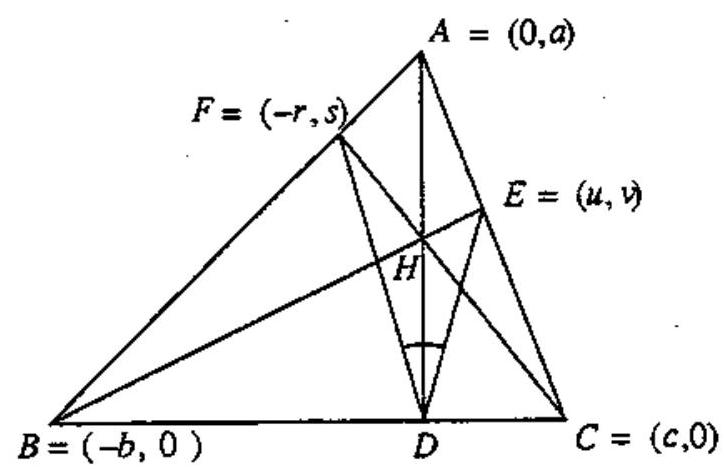
|
| 351 |
+
|
| 352 |
+
Figure II
|
| 353 |
+
|
CANADA_MO/md/en-sol1995.md
ADDED
|
@@ -0,0 +1,147 @@
|
|
|
|
|
|
|
|
|
|
|
|
|
|
|
|
|
|
|
|
|
|
|
|
|
|
|
|
|
|
|
|
|
|
|
|
|
|
|
|
|
|
|
|
|
|
|
|
|
|
|
|
|
|
|
|
|
|
|
|
|
|
|
|
|
|
|
|
|
|
|
|
|
|
|
|
|
|
|
|
|
|
|
|
|
|
|
|
|
|
|
|
|
|
|
|
|
|
|
|
|
|
|
|
|
|
|
|
|
|
|
|
|
|
|
|
|
|
|
|
|
|
|
|
|
|
|
|
|
|
|
|
|
|
|
|
|
|
|
|
|
|
|
|
|
|
|
|
|
|
|
|
|
|
|
|
|
|
|
|
|
|
|
|
|
|
|
|
|
|
|
|
|
|
|
|
|
|
|
|
|
|
|
|
|
|
|
|
|
|
|
|
|
|
|
|
|
|
|
|
|
|
|
|
|
|
|
|
|
|
|
|
|
|
|
|
|
|
|
|
|
|
|
|
|
|
|
|
|
|
|
|
|
|
|
|
|
|
|
|
|
|
|
|
|
|
|
|
|
|
|
|
|
|
|
|
|
|
|
|
|
|
|
|
|
|
|
|
|
|
|
|
|
|
|
|
|
|
|
|
|
|
|
|
|
|
|
|
|
|
|
|
|
|
|
|
|
|
|
|
|
|
|
|
|
|
|
|
|
|
|
|
|
|
|
|
|
|
|
|
|
|
|
|
|
|
|
|
|
|
|
|
|
|
|
|
|
|
|
|
|
|
|
|
|
|
|
|
|
|
|
|
|
|
|
|
|
|
|
|
|
|
|
|
|
|
|
|
|
|
|
|
|
|
|
|
|
|
|
|
|
|
|
|
|
|
|
|
|
|
|
|
|
|
|
|
|
|
|
|
|
|
|
|
|
|
|
|
|
|
|
|
|
|
|
|
|
|
|
|
|
|
|
|
|
|
|
|
|
|
|
|
|
|
|
|
|
|
|
|
|
|
|
|
|
| 1 |
+
# SOLUTIONS
|
| 2 |
+
|
| 3 |
+
## QUESTION 1
|
| 4 |
+
|
| 5 |
+
Solution
|
| 6 |
+
|
| 7 |
+
Note that
|
| 8 |
+
|
| 9 |
+
$$
|
| 10 |
+
f(1-x)=\frac{9^{1-x}}{9^{1-x}+3}=\frac{9}{9+3 \times 9^{x}}=\frac{3}{9^{x}+3},
|
| 11 |
+
$$
|
| 12 |
+
|
| 13 |
+
from which we get
|
| 14 |
+
|
| 15 |
+
$$
|
| 16 |
+
f(x)+f(1-x)=\frac{9^{x}}{9^{x}+3}+\frac{3}{9^{x}+3}=1 .
|
| 17 |
+
$$
|
| 18 |
+
|
| 19 |
+
Therefore,
|
| 20 |
+
|
| 21 |
+
$$
|
| 22 |
+
\begin{aligned}
|
| 23 |
+
& \sum_{k=1}^{1995} f\left(\frac{k}{1996}\right) \\
|
| 24 |
+
& \quad=\sum_{k=1}^{997}\left[f\left(\frac{k}{1996}\right)+f\left(\frac{1996-k}{1996}\right)\right]+f\left(\frac{998}{1996}\right) \\
|
| 25 |
+
& \quad=\sum_{k=1}^{997}\left[f\left(\frac{k}{1996}\right)+f\left(1-\frac{k}{1996}\right)\right]+f\left(\frac{1}{2}\right) \\
|
| 26 |
+
& \quad=997+\frac{3}{3+3}=997 \frac{1}{2} .
|
| 27 |
+
\end{aligned}
|
| 28 |
+
$$
|
| 29 |
+
|
| 30 |
+
## QUESTION 2
|
| 31 |
+
|
| 32 |
+
## Solution 1.
|
| 33 |
+
|
| 34 |
+
We prove equivalently that $a^{3 a} b^{3 b} c^{3 c} \geq(a b c)^{a+b+c}$. Due to complete symmetry in $a, b$ and $c$, we may assume, without loss of generality, that $a \geq b \geq c$. Then $a-b \geq 0, b-c \geq 0, a-c \geq 0$ and $\frac{a}{b} \geq 1, \frac{b}{c} \geq 1, \frac{a}{c} \geq 1$. Therefore,
|
| 35 |
+
|
| 36 |
+
$$
|
| 37 |
+
\frac{a^{3 a} b^{3 b} c^{3 c}}{(a b c)^{a+b+c}}=\left(\frac{a}{b}\right)^{a-b}\left(\frac{b}{c}\right)^{b-c}\left(\frac{a}{c}\right)^{a-c} \geq 1
|
| 38 |
+
$$
|
| 39 |
+
|
| 40 |
+
## Solution 2.
|
| 41 |
+
|
| 42 |
+
If we assign the weights $a, b, c$ to the numbers $a, b, c$, respectively, then by the wighted geometric-mean-harmonic-mean inequality followed by the arithmeticmean-geometric-mean inequality, we get
|
| 43 |
+
|
| 44 |
+
$$
|
| 45 |
+
\sqrt[a+b+c]{a^{a} b^{b} c^{c}} \geq \frac{a+b+c}{\frac{a}{a}+\frac{b}{b}+\frac{c}{c}}=\frac{a+b+c}{3} \geq \sqrt[3]{a b c}
|
| 46 |
+
$$
|
| 47 |
+
|
| 48 |
+
from which $a^{a} b^{b} c^{c} \geq(a b c)^{\frac{a+b+c}{3}}$ follows immediately.
|
| 49 |
+
|
| 50 |
+
## QUESTION 3
|
| 51 |
+
|
| 52 |
+
## Solution
|
| 53 |
+
|
| 54 |
+
For convenience, the interior angle in a boomerang which is greater than $180^{\circ}$ will be called a "reflex angle".
|
| 55 |
+
|
| 56 |
+
Clearly, there are $b$ reflex angles, each occurring in a different boomerang and each with the corresponding vertex in the interior of $C$. Angles around these vertices add up to $2 b \pi$. On the other hand, the sum of all the interior angles of $C$ is $(s-2) \pi$ and the sum of the interior angles of all the $q$ quadrilaterals is $2 \pi q$.
|
| 57 |
+
|
| 58 |
+
Therefore, $2 \pi q \geq 2 b \pi+(s-2) \pi$ from which $q \geq b+\frac{s-2}{2}$ follows.
|
| 59 |
+
|
| 60 |
+
## QUESTION 4
|
| 61 |
+
|
| 62 |
+
## Solution 1.
|
| 63 |
+
|
| 64 |
+
Since $1^{3}+2^{3}+\cdots+n^{3}=\left(\frac{n(n+1)}{2}\right)^{2}$, we see that when $k=0,\left(x_{1}, x_{2}, \cdots, x_{n} ; y\right)=$ $\left(1,2, \cdots, n ; \frac{n(n+1)}{2}\right)$ is a solution. To see that we can generate infinitely many solutions in general, set $c=\frac{n(n+1)}{2}$ and notice that for all positive integers $q$, we have:
|
| 65 |
+
|
| 66 |
+
$$
|
| 67 |
+
\begin{aligned}
|
| 68 |
+
& \left(c^{k} q^{3 k+2}\right)^{3}+\left(2 c^{k} q^{3 k+2}\right)^{3}+\cdots+\left(n c^{k} q^{3 k+2}\right)^{3} \\
|
| 69 |
+
& \quad=c^{3 k} q^{3(3 k+2)}\left(1^{3}+2^{3}+\cdots n^{3}\right) \\
|
| 70 |
+
& \quad=c^{3 k} q^{3(3 k+2)}\left(\frac{n(n+1)}{2}\right)^{2} \\
|
| 71 |
+
& \quad=c^{3 k+2} q^{3(3 k+2)}=\left(c q^{3}\right)^{3 k+2} .
|
| 72 |
+
\end{aligned}
|
| 73 |
+
$$
|
| 74 |
+
|
| 75 |
+
That is, $\left(x_{1}, x_{2}, \cdots, x_{n} ; y\right)=\left(c^{k} q^{3 k+2}, 2 c^{k} q^{3 k+2}, \cdots, n c^{k} q^{3 k+2} ; c q^{3}\right)$ is a solution. This completes the proof.
|
| 76 |
+
|
| 77 |
+
## Solution 2.
|
| 78 |
+
|
| 79 |
+
For any positive integer $q$, take $x_{1}=x_{2}=\cdots=x_{n}=n^{2 k+1} q^{3 k+2}, y=n^{2} q^{3}$. Then
|
| 80 |
+
|
| 81 |
+
$$
|
| 82 |
+
\sum_{i=1}^{n} x_{i}^{3}=n \cdot n^{6 k+3} \cdot q^{9 k+6}=\left(n^{2} q^{3}\right)^{3 k+2}=y^{3 k+2}
|
| 83 |
+
$$
|
| 84 |
+
|
| 85 |
+
## Solution 3.
|
| 86 |
+
|
| 87 |
+
If $n=1$, take $x_{1}=q^{3 k+2}, y=q^{3}$ as in solution 2. For $n>1$, we look for solutions of the form
|
| 88 |
+
|
| 89 |
+
$$
|
| 90 |
+
x_{1}=x_{2}=\cdots x_{n}=n^{p}, y=n^{q} .
|
| 91 |
+
$$
|
| 92 |
+
|
| 93 |
+
Then
|
| 94 |
+
|
| 95 |
+
$$
|
| 96 |
+
\sum_{i=1}^{n} x_{i}^{3}=y^{3 k+2} \Leftrightarrow n^{3 p+1}=n^{(3 k+2) q} \Leftrightarrow 3 p+1=(3 k+2) q \Leftrightarrow(3 k+2) q-3 p=1 .
|
| 97 |
+
$$
|
| 98 |
+
|
| 99 |
+
The last equation is satisfied if we take
|
| 100 |
+
|
| 101 |
+
$$
|
| 102 |
+
q=3 t+2 \text { and } p=(3 k+2) t+(2 k+1) \text { where } t
|
| 103 |
+
$$
|
| 104 |
+
|
| 105 |
+
is any nonnegative integer. Thus, infinetely many solutions in positive integers are given by
|
| 106 |
+
|
| 107 |
+
$$
|
| 108 |
+
x_{1}=x_{2}=\cdots x_{n}=n^{(3 k+2) t+(2 k+1)}, y=n^{3 t+2}
|
| 109 |
+
$$
|
| 110 |
+
|
| 111 |
+
## SOLUTIONS (Cont'd)
|
| 112 |
+
|
| 113 |
+
## QUESTION 5
|
| 114 |
+
|
| 115 |
+
## Solution
|
| 116 |
+
|
| 117 |
+
Note first that $u_{1}=1-u$. Since for all $x \in[u, 1], u \leq x$ and $1-x \leq 1-u$ we have
|
| 118 |
+
|
| 119 |
+
$$
|
| 120 |
+
\begin{aligned}
|
| 121 |
+
1- & (\sqrt{u x}+\sqrt{(1-u)(1-x)})^{2} \\
|
| 122 |
+
& =1-u x-(1-u)(1-x)-2 \sqrt{u x(1-u)(1-x)} \\
|
| 123 |
+
& =u+x-2 u x-2 \sqrt{u x(1-u)(1-x)} \\
|
| 124 |
+
& \leq u+x-2 u x-2 u(1-x)=x-u .
|
| 125 |
+
\end{aligned}
|
| 126 |
+
$$
|
| 127 |
+
|
| 128 |
+
Therefore,
|
| 129 |
+
|
| 130 |
+
$$
|
| 131 |
+
f(x)=0 \text { if } 0 \leq x \leq u
|
| 132 |
+
$$
|
| 133 |
+
|
| 134 |
+
and
|
| 135 |
+
|
| 136 |
+
$$
|
| 137 |
+
f(x) \leq x-u \text { if } u \leq x \leq 1
|
| 138 |
+
$$
|
| 139 |
+
|
| 140 |
+
From (2) we get $u_{2}=f\left(u_{1}\right) \leq u_{1}-u=1-2 u$ if $u_{1} \geq u$. An easy induction then yields
|
| 141 |
+
|
| 142 |
+
$$
|
| 143 |
+
u_{n+1}=f\left(u_{n}\right) \leq u_{n}-u \leq 1-(n+1) u \text { if } u_{i} \geq u \text { for all } i=1,2, \cdots, n
|
| 144 |
+
$$
|
| 145 |
+
|
| 146 |
+
Thus for sufficiently large $k$, we must have $u_{k-1}<u$ and then $u_{k}=f\left(u_{k-1}\right)=0$ by (1).
|
| 147 |
+
|
CANADA_MO/md/en-sol1996.md
ADDED
|
@@ -0,0 +1,233 @@
|
|
|
|
|
|
|
|
|
|
|
|
|
|
|
|
|
|
|
|
|
|
|
|
|
|
|
|
|
|
|
|
|
|
|
|
|
|
|
|
|
|
|
|
|
|
|
|
|
|
|
|
|
|
|
|
|
|
|
|
|
|
|
|
|
|
|
|
|
|
|
|
|
|
|
|
|
|
|
|
|
|
|
|
|
|
|
|
|
|
|
|
|
|
|
|
|
|
|
|
|
|
|
|
|
|
|
|
|
|
|
|
|
|
|
|
|
|
|
|
|
|
|
|
|
|
|
|
|
|
|
|
|
|
|
|
|
|
|
|
|
|
|
|
|
|
|
|
|
|
|
|
|
|
|
|
|
|
|
|
|
|
|
|
|
|
|
|
|
|
|
|
|
|
|
|
|
|
|
|
|
|
|
|
|
|
|
|
|
|
|
|
|
|
|
|
|
|
|
|
|
|
|
|
|
|
|
|
|
|
|
|
|
|
|
|
|
|
|
|
|
|
|
|
|
|
|
|
|
|
|
|
|
|
|
|
|
|
|
|
|
|
|
|
|
|
|
|
|
|
|
|
|
|
|
|
|
|
|
|
|
|
|
|
|
|
|
|
|
|
|
|
|
|
|
|
|
|
|
|
|
|
|
|
|
|
|
|
|
|
|
|
|
|
|
|
|
|
|
|
|
|
|
|
|
|
|
|
|
|
|
|
|
|
|
|
|
|
|
|
|
|
|
|
|
|
|
|
|
|
|
|
|
|
|
|
|
|
|
|
|
|
|
|
|
|
|
|
|
|
|
|
|
|
|
|
|
|
|
|
|
|
|
|
|
|
|
|
|
|
|
|
|
|
|
|
|
|
|
|
|
|
|
|
|
|
|
|
|
|
|
|
|
|
|
|
|
|
|
|
|
|
|
|
|
|
|
|
|
|
|
|
|
|
|
|
|
|
|
|
|
|
|
|
|
|
|
|
|
|
|
|
|
|
|
|
|
|
|
|
|
|
|
|
|
|
|
|
|
|
|
|
|
|
|
|
|
|
|
|
|
|
|
|
|
|
|
|
|
|
|
|
|
|
|
|
|
|
|
|
|
|
|
|
|
|
|
|
|
|
|
|
|
|
|
|
|
|
|
|
|
|
|
|
|
|
|
|
|
|
|
|
|
|
|
|
|
|
|
|
|
|
|
|
|
|
|
|
|
|
|
|
|
|
|
|
|
|
|
|
|
|
|
|
|
|
|
|
|
|
|
|
|
|
|
|
|
|
|
|
|
|
|
|
|
|
|
|
|
|
|
|
|
|
|
|
|
|
|
|
|
|
|
|
|
|
|
|
|
|
|
|
|
|
|
|
|
|
|
|
|
|
|
|
|
|
|
|
|
|
|
|
|
|
|
|
|
|
|
|
|
|
|
|
|
|
|
|
|
|
|
|
|
|
|
|
|
|
|
|
|
|
|
|
|
|
|
|
|
|
|
|
|
|
|
|
|
|
|
|
|
|
|
|
|
|
|
|
|
|
|
|
|
|
|
|
|
|
|
|
|
|
|
|
|
|
|
|
|
|
|
|
|
|
|
|
|
|
|
|
|
|
|
| 1 |
+
# CMO 1996 SOLUTIONS
|
| 2 |
+
|
| 3 |
+
## QUESTION 1
|
| 4 |
+
|
| 5 |
+
## Solution .
|
| 6 |
+
|
| 7 |
+
If $f(x)=x^{3}-x-1=(x-\alpha)(x-\beta)(x-\gamma)$ has roots $\alpha, \beta, \gamma$ standard results about roots of polynomials give $\alpha+\beta+\gamma=0, \alpha \beta+\alpha \gamma+\beta \gamma=-1$, and $\alpha \beta \gamma=1$.
|
| 8 |
+
|
| 9 |
+
Then
|
| 10 |
+
|
| 11 |
+
$$
|
| 12 |
+
S=\frac{1+\alpha}{1-\alpha}+\frac{1+\beta}{1-\beta}+\frac{1+\gamma}{1-\gamma}=\frac{N}{(1-\alpha)(1-\beta)(1-\gamma)}
|
| 13 |
+
$$
|
| 14 |
+
|
| 15 |
+
where the numerator simplifies to
|
| 16 |
+
|
| 17 |
+
$$
|
| 18 |
+
\begin{aligned}
|
| 19 |
+
N & =3-(\alpha+\beta+\gamma)-(\alpha \beta+\alpha \gamma+\beta \gamma)+3 \alpha \beta \gamma \\
|
| 20 |
+
& =3-(0)-(-1)+3(1) \\
|
| 21 |
+
& =7
|
| 22 |
+
\end{aligned}
|
| 23 |
+
$$
|
| 24 |
+
|
| 25 |
+
The denominator is $f(1)=-1$ so the required sum is -7 .
|
| 26 |
+
|
| 27 |
+
## QUESTION 2
|
| 28 |
+
|
| 29 |
+
## Solution 1.
|
| 30 |
+
|
| 31 |
+
For any $t, \quad 0 \leq 4 t^{2}<1+4 t^{2}$, so $0 \leq \frac{4 t^{2}}{1+4 t^{2}}<1$. Thus $x, y$ and $z$ must be non-negative and less than 1 .
|
| 32 |
+
|
| 33 |
+
Observe that if one of $x y$ or $z$ is 0 , then $x=y=z=0$.
|
| 34 |
+
|
| 35 |
+
If two of the variables are equal, say $x=y$, then the first equation becomes
|
| 36 |
+
|
| 37 |
+
$$
|
| 38 |
+
\frac{4 x^{2}}{1+4 x^{2}}=x
|
| 39 |
+
$$
|
| 40 |
+
|
| 41 |
+
This has the solution $x=0$, which gives $x=y=z=0$ and $x=\frac{1}{2}$ which gives $x=y=z=\frac{1}{2}$.
|
| 42 |
+
|
| 43 |
+
Finally, assume that $x, y$ and $z$ are non-zero and distinct. Without loss of generality we may assume that either $0<x<y<z<1$ or $0<x<z<y<1$. The two proofs are similar, so we do only the first case.
|
| 44 |
+
|
| 45 |
+
We will need the fact that $f(t)=\frac{4 t^{2}}{1+4 t^{2}}$ is increasing on the interval $(0,1)$.
|
| 46 |
+
|
| 47 |
+
To prove this, if $0<s<t<1$ then
|
| 48 |
+
|
| 49 |
+
$$
|
| 50 |
+
\begin{aligned}
|
| 51 |
+
f(t)-f(s) & =\frac{4 t^{2}}{1+4 t^{2}}-\frac{4 s^{2}}{1+4 s^{2}} \\
|
| 52 |
+
& =\frac{4 t^{2}-4 s^{2}}{\left(1+4 s^{2}\right)\left(1+4 t^{2}\right)}
|
| 53 |
+
\end{aligned}
|
| 54 |
+
$$
|
| 55 |
+
|
| 56 |
+
$$
|
| 57 |
+
>0 .
|
| 58 |
+
$$
|
| 59 |
+
|
| 60 |
+
So $0<x<y<z \Rightarrow f(x)=y<f(y)=z<f(z)=x$, a contradiction.
|
| 61 |
+
|
| 62 |
+
Hence $x=y=z=0$ and $x=y=z=\frac{1}{2}$ are the only real solutions.
|
| 63 |
+
|
| 64 |
+
## Solution 2.
|
| 65 |
+
|
| 66 |
+
Notice that $x, y$ and $z$ are non-negative. Adding the three equations gives
|
| 67 |
+
|
| 68 |
+
$$
|
| 69 |
+
x+y+z=\frac{4 z^{2}}{1+4 z^{2}}+\frac{4 x^{2}}{1+4 x^{2}}+\frac{4 y^{2}}{1+4 y^{2}} .
|
| 70 |
+
$$
|
| 71 |
+
|
| 72 |
+
This can be rearranged to give
|
| 73 |
+
|
| 74 |
+
$$
|
| 75 |
+
\frac{x(2 x-1)^{2}}{1+4 x^{2}}+\frac{y(2 y-1)^{2}}{1+4 y^{2}}+\frac{z(2 z-1)^{2}}{1+4 z^{2}}=0 .
|
| 76 |
+
$$
|
| 77 |
+
|
| 78 |
+
Since each term is non-negative, each term must be 0 , and hence each variable is either 0 or $\frac{1}{2}$. The original equations then show that $x=y=z=0$ and $x=y=z=\frac{1}{2}$ are the only two solutions.
|
| 79 |
+
|
| 80 |
+
## Solution 3.
|
| 81 |
+
|
| 82 |
+
Notice that $x, y$, and $z$ are non-negative. Multiply both sides of the inequality
|
| 83 |
+
|
| 84 |
+
$$
|
| 85 |
+
\frac{y}{1+4 y^{2}} \geq 0
|
| 86 |
+
$$
|
| 87 |
+
|
| 88 |
+
by $(2 y-1)^{2}$, and rearrange to obtain
|
| 89 |
+
|
| 90 |
+
$$
|
| 91 |
+
y-\frac{4 y^{2}}{1+4 y^{2}} \geq 0
|
| 92 |
+
$$
|
| 93 |
+
|
| 94 |
+
and hence that $y \geq z$. Similarly, $z \geq x$, and $x \geq y$. Hence, $x=y=z$ and, as in Solution 1, the two solutions follow.
|
| 95 |
+
|
| 96 |
+
## Solution 4.
|
| 97 |
+
|
| 98 |
+
As for solution 1 , note that $x=y=z=0$ is a solution and any other solution will have each of $x, y$ and $z$ positive.
|
| 99 |
+
|
| 100 |
+
The arithmetic-geometric mean inequality (or direct computation) shows that $\frac{1+4 x^{2}}{2} \geq \sqrt{1 \cdot 4 x^{2}}=2 x$ and hence $x \geq \frac{4 x^{2}}{1+4 x^{2}}=y$, with equality if and only if $1=4 x^{2}-$ that is, $x=\frac{1}{2}$. Similarly, $y \geq z$ with equality if and only if $y=\frac{1}{2}$ and $z \geq x$ with equality if and only if $z=\frac{1}{2}$. Adding $x \geq y, y \geq z$ and $z \geq x$ gives $x+y+x \geq x+y+z$. Thus equality must occur in each inequality, so $x=y=z=\frac{1}{2}$.
|
| 101 |
+
|
| 102 |
+
## QUESTION 3
|
| 103 |
+
|
| 104 |
+
## Solution.
|
| 105 |
+
|
| 106 |
+
Let $a_{1}, a_{2}, \ldots, a_{n}$ be a permutation of $1,2, \ldots, n$ with properties (i) and (ii).
|
| 107 |
+
|
| 108 |
+
A crucial observation, needed in Case II (b) is the following: If $a_{k}$ and $a_{k+1}$ are consecutive integers (i.e. $a_{k+1}=a_{k} \pm 1$ ), then the terms to the right of $a_{k+1}$ (also to the left of $a_{k}$ ) are either all less than both $a_{k}$ and $a_{k+1}$ or all greater than both $a_{k}$ and $a_{k+1}$.
|
| 109 |
+
|
| 110 |
+
Since $a_{1}=1$, by (ii) $a_{2}$ is either 2 or 3 .
|
| 111 |
+
|
| 112 |
+
CASE I: Suppose $a_{2}=2$. Then $a_{3}, a_{4}, \ldots, a_{n}$ is a permutation of $3,4, \ldots, n$. Thus $a_{2}, a_{3}, \ldots, a_{n}$ is a permutation of $2,3, \ldots, n$ with $a_{2}=2$ and property (ii). Clearly there are $f(n-1)$ such permutations.
|
| 113 |
+
|
| 114 |
+
CASE II: Suppose $a_{2}=3$.
|
| 115 |
+
|
| 116 |
+
(a) Suppose $a_{3}=2$. Then $a_{4}, a_{5}, \ldots, a_{n}$ is a permutation of $4,5, \ldots, n$ with $a_{4}=4$ and property (ii). There are $f(n-3)$ such permutations.
|
| 117 |
+
|
| 118 |
+
(b) Suppose $a_{3} \geq 4$. If $a_{k+1}$ is the first even number in the permutation then, because of (ii), $a_{1}, a_{2}, \ldots, a_{k}$ must be $1,3,5, \ldots, 2 k-1$ (in that order). Then $a_{k+1}$ is either $2 k$ or $2 k-2$, so that $a_{k}$ and $a_{k+1}$ are consecutive integers. Applying the crucial observation made above, we deduce that $a_{k+2}, \ldots, a_{n}$ are all either greater than or smaller than $a_{k}$ and $a_{k+1}$. But 2 must be to the right of $a_{k+1}$. Hence $a_{k+2}, \ldots, a_{n}$ are the even integers less than $a_{k+1}$. The only possibility then, is
|
| 119 |
+
|
| 120 |
+
$$
|
| 121 |
+
1,3,5, \ldots, a_{k-1}, a_{k}, \ldots, 6,4,2
|
| 122 |
+
$$
|
| 123 |
+
|
| 124 |
+
Cases I and II show that
|
| 125 |
+
|
| 126 |
+
$$
|
| 127 |
+
f(n)=f(n-1)+f(n-3)+1, \quad n \geq 4 .
|
| 128 |
+
$$
|
| 129 |
+
|
| 130 |
+
Calculating the first few values of $f(n)$ directly gives
|
| 131 |
+
|
| 132 |
+
$$
|
| 133 |
+
f(1)=1, f(2)=1, f(3)=2, f(4)=4, f(5)=6 \text {. }
|
| 134 |
+
$$
|
| 135 |
+
|
| 136 |
+
Calculating a few more $f(n)$ 's using $\left(^{*}\right)$ and mod 3 arithmetic, $f(1)=1, f(2)=1, f(3)=$ $2, f(4)=1, f(5)=0, f(6)=0, f(7)=2, f(8)=0, f(9)=1, f(10)=1, f(11)=2$. Since $f(1)=f(9), f(2)=f(10)$ and $f(3)=f(11) \bmod 3,\left({ }^{*}\right)$ shows that $f(a)=f(a \bmod 8), \bmod 3, a \geq$ 1 .
|
| 137 |
+
|
| 138 |
+
Hence $f(1996) \equiv f(4) \equiv 1(\bmod 3)$ so 3 does not divide $f(1996)$.
|
| 139 |
+
|
| 140 |
+
## QUESTION 4
|
| 141 |
+
|
| 142 |
+
## Solution 1.
|
| 143 |
+
|
| 144 |
+
Let $B E=B D$ with $E$ on $B C$, so that $A D=E C$ :
|
| 145 |
+
|
| 146 |
+
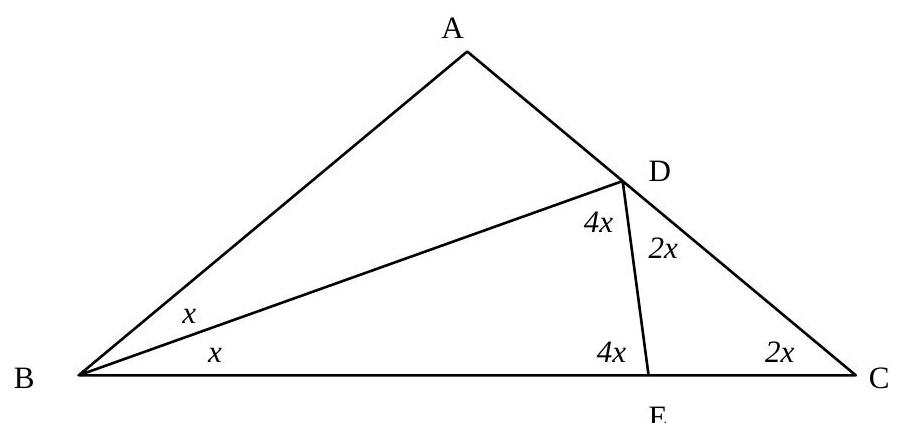
|
| 147 |
+
|
| 148 |
+
By a standard theorem, $\frac{A B}{C B}=\frac{A D}{D C} ; \quad$ so in
|
| 149 |
+
|
| 150 |
+
$\triangle C E D$ and $\triangle C A B$ we have a common angle and
|
| 151 |
+
|
| 152 |
+
$$
|
| 153 |
+
\frac{C E}{C D}=\frac{A D}{C D}=\frac{A B}{C B}=\frac{C A}{C B}
|
| 154 |
+
$$
|
| 155 |
+
|
| 156 |
+
Thus $\triangle C E D \sim \triangle C A B$, so that $\angle C D E=\angle D C E=\angle A B C=2 x$.
|
| 157 |
+
|
| 158 |
+
Hence $\angle B D E=\angle B E D=4 x$, whence $9 x=180^{\circ}$ so $x=20^{\circ}$.
|
| 159 |
+
|
| 160 |
+
Thus $\angle A=180^{\circ}-4 x=100^{\circ}$.
|
| 161 |
+
|
| 162 |
+
## Solution 2 .
|
| 163 |
+
|
| 164 |
+
Apply the law of sines to $\triangle A B D$ and $\triangle B D C$ to get
|
| 165 |
+
|
| 166 |
+
$$
|
| 167 |
+
\frac{A D}{B D}=\frac{\sin x}{\sin 4 x} \quad \text { and } \quad 1+\frac{A D}{B D}=\frac{B C}{B D}=\frac{\sin 3 x}{\sin 2 x} .
|
| 168 |
+
$$
|
| 169 |
+
|
| 170 |
+
Now massage the resulting trigonometric equation with standard identities to get
|
| 171 |
+
|
| 172 |
+
$$
|
| 173 |
+
\sin 2 x(\sin 4 x+\sin x)=\sin 2 x(\sin 5 x+\sin x) .
|
| 174 |
+
$$
|
| 175 |
+
|
| 176 |
+
Since $0<2 x<90^{\circ}$, we get
|
| 177 |
+
|
| 178 |
+
$$
|
| 179 |
+
5 x-90^{\circ}=90^{\circ}-4 x,
|
| 180 |
+
$$
|
| 181 |
+
|
| 182 |
+
so that $\angle A=100^{\circ}$.
|
| 183 |
+
|
| 184 |
+
## QUESTION 5
|
| 185 |
+
|
| 186 |
+
## Solution.
|
| 187 |
+
|
| 188 |
+
Let
|
| 189 |
+
|
| 190 |
+
$$
|
| 191 |
+
\begin{aligned}
|
| 192 |
+
f(n) & =n-\sum_{k=1}^{m}\left[r_{k} n\right] \\
|
| 193 |
+
& =n \sum_{k=1}^{m} r_{k}-\sum_{k=1}^{m}\left[r_{k} n\right] \\
|
| 194 |
+
& =\sum_{k=1}^{m}\left\{r_{k} n-\left[r_{k} n\right]\right\} .
|
| 195 |
+
\end{aligned}
|
| 196 |
+
$$
|
| 197 |
+
|
| 198 |
+
Now $0 \leq x-[x]<1$, and if $c$ is an integer, $(c+x)-[c+x]=x-[x]$.
|
| 199 |
+
|
| 200 |
+
Hence $0 \leq f(n)<\sum_{k=1}^{m} 1=m$. Because $f(n)$ is an integer, $0 \leq f(n) \leq m-1$.
|
| 201 |
+
|
| 202 |
+
To show that $f(n)$ can achieve these bounds for $n>0$, we assume that $r_{k}=\frac{a_{k}}{b_{k}}$ where $a_{k}, b_{k}$ are integers; $a_{k}<b_{k}$.
|
| 203 |
+
|
| 204 |
+
Then, if $n=b_{1} b_{2} \ldots b_{m},\left(r_{k} n\right)-\left[r_{k} n\right]=0, k=1,2, \ldots, m$ and thus $f(n)=0$.
|
| 205 |
+
|
| 206 |
+
Letting $n=b_{1} b_{2} \ldots b_{n}-1$, then
|
| 207 |
+
|
| 208 |
+
$$
|
| 209 |
+
\begin{aligned}
|
| 210 |
+
r_{k} n & =r_{k}\left(b_{1} b_{2} \ldots b_{m}-1\right) \\
|
| 211 |
+
& \left.=r_{k}\left\{\left(b_{1} b_{2} \ldots b_{m}-b_{k}\right)+b_{k}-1\right)\right\} \\
|
| 212 |
+
& =\text { integer }+r_{k}\left(b_{k}-1\right)
|
| 213 |
+
\end{aligned}
|
| 214 |
+
$$
|
| 215 |
+
|
| 216 |
+
This gives
|
| 217 |
+
|
| 218 |
+
$$
|
| 219 |
+
\begin{aligned}
|
| 220 |
+
r_{k} n-\left[r_{k} n\right] & =r_{k}\left(b_{k}-1\right)-\left[r_{k}\left(b_{k}-1\right)\right] \\
|
| 221 |
+
& =\frac{a_{k}}{b_{k}}\left(b_{k}-1\right)-\left[\frac{a_{k}}{b_{k}}\left(b_{k}-1\right)\right] \\
|
| 222 |
+
& =\left(a_{k}-\frac{a_{k}}{b_{k}}\right)-\left[a_{k}-\frac{a_{k}}{b_{k}}\right] \\
|
| 223 |
+
& =\left(a_{k}-\frac{a_{k}}{b_{k}}\right)-\left(a_{k}-1\right) \\
|
| 224 |
+
& =1-\frac{a_{k}}{b_{k}}=1-r_{k} .
|
| 225 |
+
\end{aligned}
|
| 226 |
+
$$
|
| 227 |
+
|
| 228 |
+
Hence
|
| 229 |
+
|
| 230 |
+
$$
|
| 231 |
+
f(n)=\sum_{k=1}^{m}\left(1-r_{k}\right)=m-1 .
|
| 232 |
+
$$
|
| 233 |
+
|
CANADA_MO/md/en-sol1997.md
ADDED
|
@@ -0,0 +1,332 @@
|
|
|
|
|
|
|
|
|
|
|
|
|
|
|
|
|
|
|
|
|
|
|
|
|
|
|
|
|
|
|
|
|
|
|
|
|
|
|
|
|
|
|
|
|
|
|
|
|
|
|
|
|
|
|
|
|
|
|
|
|
|
|
|
|
|
|
|
|
|
|
|
|
|
|
|
|
|
|
|
|
|
|
|
|
|
|
|
|
|
|
|
|
|
|
|
|
|
|
|
|
|
|
|
|
|
|
|
|
|
|
|
|
|
|
|
|
|
|
|
|
|
|
|
|
|
|
|
|
|
|
|
|
|
|
|
|
|
|
|
|
|
|
|
|
|
|
|
|
|
|
|
|
|
|
|
|
|
|
|
|
|
|
|
|
|
|
|
|
|
|
|
|
|
|
|
|
|
|
|
|
|
|
|
|
|
|
|
|
|
|
|
|
|
|
|
|
|
|
|
|
|
|
|
|
|
|
|
|
|
|
|
|
|
|
|
|
|
|
|
|
|
|
|
|
|
|
|
|
|
|
|
|
|
|
|
|
|
|
|
|
|
|
|
|
|
|
|
|
|
|
|
|
|
|
|
|
|
|
|
|
|
|
|
|
|
|
|
|
|
|
|
|
|
|
|
|
|
|
|
|
|
|
|
|
|
|
|
|
|
|
|
|
|
|
|
|
|
|
|
|
|
|
|
|
|
|
|
|
|
|
|
|
|
|
|
|
|
|
|
|
|
|
|
|
|
|
|
|
|
|
|
|
|
|
|
|
|
|
|
|
|
|
|
|
|
|
|
|
|
|
|
|
|
|
|
|
|
|
|
|
|
|
|
|
|
|
|
|
|
|
|
|
|
|
|
|
|
|
|
|
|
|
|
|
|
|
|
|
|
|
|
|
|
|
|
|
|
|
|
|
|
|
|
|
|
|
|
|
|
|
|
|
|
|
|
|
|
|
|
|
|
|
|
|
|
|
|
|
|
|
|
|
|
|
|
|
|
|
|
|
|
|
|
|
|
|
|
|
|
|
|
|
|
|
|
|
|
|
|
|
|
|
|
|
|
|
|
|
|
|
|
|
|
|
|
|
|
|
|
|
|
|
|
|
|
|
|
|
|
|
|
|
|
|
|
|
|
|
|
|
|
|
|
|
|
|
|
|
|
|
|
|
|
|
|
|
|
|
|
|
|
|
|
|
|
|
|
|
|
|
|
|
|
|
|
|
|
|
|
|
|
|
|
|
|
|
|
|
|
|
|
|
|
|
|
|
|
|
|
|
|
|
|
|
|
|
|
|
|
|
|
|
|
|
|
|
|
|
|
|
|
|
|
|
|
|
|
|
|
|
|
|
|
|
|
|
|
|
|
|
|
|
|
|
|
|
|
|
|
|
|
|
|
|
|
|
|
|
|
|
|
|
|
|
|
|
|
|
|
|
|
|
|
|
|
|
|
|
|
|
|
|
|
|
|
|
|
|
|
|
|
|
|
|
|
|
|
|
|
|
|
|
|
|
|
|
|
|
|
|
|
|
|
|
|
|
|
|
|
|
|
|
|
|
|
|
|
|
|
|
|
|
|
|
|
|
|
|
|
|
|
|
|
|
|
|
|
|
|
|
|
|
|
|
|
|
|
|
|
|
|
|
|
|
|
|
|
|
|
|
|
|
|
|
|
|
|
|
|
|
|
|
|
|
|
|
|
|
|
|
|
|
|
|
|
|
|
|
|
|
|
|
|
|
|
|
|
|
|
|
|
|
|
|
|
|
|
|
|
|
|
|
|
|
|
|
|
|
|
|
|
|
|
|
|
|
|
|
|
|
|
|
|
|
|
|
|
|
|
|
|
|
|
|
|
|
|
|
|
|
|
|
|
|
|
|
|
|
|
|
|
|
|
|
|
|
|
|
|
|
|
|
|
|
|
|
|
|
|
|
|
|
|
|
|
|
|
|
|
|
|
|
|
|
|
|
|
|
|
|
|
|
|
|
|
|
|
|
|
|
|
|
|
|
|
|
|
|
|
|
|
|
|
|
|
|
|
|
|
|
|
|
|
|
|
|
|
|
|
|
|
|
|
|
|
|
|
|
|
|
|
|
|
|
|
|
|
|
|
|
|
|
|
|
|
|
|
|
|
|
|
|
|
|
|
|
|
|
|
|
|
|
|
|
|
|
|
|
|
|
|
|
|
|
|
|
|
|
|
|
|
|
|
|
|
|
|
|
|
|
|
|
|
|
|
|
|
|
|
|
|
|
|
|
|
|
|
|
|
| 1 |
+
# 1997 SOLUTIONS
|
| 2 |
+
|
| 3 |
+
## Problem 1 - Deepee Khosla, Lisgar Collegiate Institute, Ottawa, ON
|
| 4 |
+
|
| 5 |
+
Let $p_{1}, \ldots, p_{12}$ denote, in increasing order, the primes from 7 to 47 . Then
|
| 6 |
+
|
| 7 |
+
$$
|
| 8 |
+
5 !=2^{3} \cdot 3^{1} \cdot 5^{1} \cdot p_{1}^{0} \cdot p_{2}^{0} \ldots p_{12}^{0}
|
| 9 |
+
$$
|
| 10 |
+
|
| 11 |
+
and
|
| 12 |
+
|
| 13 |
+
$$
|
| 14 |
+
50 !=2^{a_{1}} \cdot 3^{a_{2}} \cdot 5^{a_{3}} \cdot p_{1}^{b_{1}} \cdot p_{2}^{b_{2}} \ldots p_{12}^{b_{12}}
|
| 15 |
+
$$
|
| 16 |
+
|
| 17 |
+
Note that $2^{4}, 3^{2}, 5^{2}, p_{1}, \ldots, p_{12}$ all divide 50 !, so all its prime powers differ from those of 5 !
|
| 18 |
+
|
| 19 |
+
Since $x, y \mid 50$ !, they are of the form
|
| 20 |
+
|
| 21 |
+
$$
|
| 22 |
+
\begin{aligned}
|
| 23 |
+
& x=2^{n_{1}} \cdot 3^{n_{2}} \cdot \ldots p_{12}^{n_{15}} \\
|
| 24 |
+
& y=2^{m_{1}} \cdot 3^{m_{2}} \cdot \ldots p_{12}^{m_{15}} .
|
| 25 |
+
\end{aligned}
|
| 26 |
+
$$
|
| 27 |
+
|
| 28 |
+
Then $\max \left(n_{i}, m_{i}\right)$ is the $\mathrm{i}^{\text {th }}$ prime power in 50 !
|
| 29 |
+
|
| 30 |
+
and $\min \left(n_{i}, m_{i}\right)$ is the $\mathrm{i}^{\mathrm{t}}$ prime power in 5 !
|
| 31 |
+
|
| 32 |
+
Since, by the above note, the prime powers for $p_{12}$ and under differ in 5 ! and 50!, there are $2^{15}$ choices for $x$, only half of which will be less than $y$. (Since for each choice of $x, y$ is forced and either $x<y$ or $y<x$.) So the number of pairs is $2^{15} / 2=2^{14}$.
|
| 33 |
+
|
| 34 |
+
Problem 2 - Byung Kuy Chun, Harry Ainlay Composite High School, Edmonton, AB
|
| 35 |
+
|
| 36 |
+
Look at the first point of each given unit interval. This point uniquely defines the given unit interval.
|
| 37 |
+
|
| 38 |
+
Lemma. In any interval $[x, x+1)$ there must be at least one of these first points $(0 \leq x \leq 49)$.
|
| 39 |
+
|
| 40 |
+
Proof. Suppose the opposite. The last first point before $x$ must be $x-\varepsilon$ for some $\varepsilon>0$. The corresponding unit interval ends at $x-\varepsilon+1<x+1$. However, the next given unit interval cannot begin until at least $x+1$.
|
| 41 |
+
|
| 42 |
+
This implies that points $(x-\varepsilon+1, x+1)$ are not in set $A$, a contradiction.
|
| 43 |
+
|
| 44 |
+
$\therefore$ There must be a first point in $[x, x+1)$.
|
| 45 |
+
|
| 46 |
+
Note that for two first points in intervals $[x, x+1)$ and $[x+2, x+3)$ respectively, the corresponding unit intervals are disjoint since the intervals are in the range $[x, x+2)$ and $[x+2, x+4)$ respectively.
|
| 47 |
+
|
| 48 |
+
$\therefore$ We can choose a given unit interval that begins in each of
|
| 49 |
+
|
| 50 |
+
$$
|
| 51 |
+
[0,1)[2,3) \ldots[2 k, 2 k+1) \ldots[48,49)
|
| 52 |
+
$$
|
| 53 |
+
|
| 54 |
+
Since there are 25 of these intervals, we can find 25 points which correspond to 25 disjoint unit intervals.
|
| 55 |
+
|
| 56 |
+
## Problem 2 - Colin Percival, Burnaby Central Secondary School, Burnaby, BC
|
| 57 |
+
|
| 58 |
+
I prove the more general result, that if $[0,2 n]=\bigcup_{i} A_{i},\left|A_{i}\right|=1, A_{i}$ are intervals then $\exists a_{1} \ldots a_{n}$, such that $A_{a_{i}} \cap A_{a_{j}}=\emptyset$.
|
| 59 |
+
|
| 60 |
+
Let $0<\varepsilon \leq \frac{2}{n-1}$ and let $b_{i}=(i-1)(2+\varepsilon), i=1 \ldots n$. Then
|
| 61 |
+
|
| 62 |
+
$$
|
| 63 |
+
\min \left\{b_{i}\right\}=0, \max \left\{b_{i}\right\}=(n-1)(2+\varepsilon) \leq(n-1)\left(2+\frac{2}{n-1}\right)=(n-1)\left(\frac{2 n}{n-1}\right)=2 n \text {. }
|
| 64 |
+
$$
|
| 65 |
+
|
| 66 |
+
So all the $b_{i}$ are in $[0,2 n]$.
|
| 67 |
+
|
| 68 |
+
Let $a_{i}$ be such that $b_{i} \in A_{a_{i}}$. Since $\bigcup A_{i}=[0,2 n]$, this is possible.
|
| 69 |
+
|
| 70 |
+
Then since $\left(b_{i}-b_{j}\right)=(i-j)(2+\varepsilon) \geq 2+\varepsilon>2$, and the $A_{i}$ are intervals of length $1, \min A_{a_{i}}-$ $\max A_{a_{j}}>2-1-1=0$, so $A_{a_{i}} \bigcap A_{a_{j}}=\emptyset$.
|
| 71 |
+
|
| 72 |
+
Substituting $n=25$, we get the required result. Q.E.D.
|
| 73 |
+
|
| 74 |
+
Problem 3 - Mihaela Enachescu, Dawson College, Montréal, PQ
|
| 75 |
+
|
| 76 |
+
Let $P=\frac{1}{2} \cdot \frac{3}{4} \cdot \ldots \cdot \frac{1997}{1998}$. Then $\frac{1}{2}>\frac{1}{3}$ because $2<3, \frac{3}{4}>\frac{3}{5}$ because $4<5, \ldots$,
|
| 77 |
+
|
| 78 |
+
.. $\frac{1997}{1998}>\frac{1997}{1999}$ because $1998<1999$.
|
| 79 |
+
|
| 80 |
+
So
|
| 81 |
+
|
| 82 |
+
$P>\frac{1}{3} \cdot \frac{3}{5} \cdot \ldots \cdot \frac{1997}{1999}=\frac{1}{1999}$.
|
| 83 |
+
|
| 84 |
+
Also $\frac{1}{2}<\frac{2}{3}$ because $1 \cdot 3<2 \cdot 2, \frac{3}{4}<\frac{4}{5}$ because $3 \cdot 5<4 \cdot 4, \ldots$
|
| 85 |
+
|
| 86 |
+
$\frac{1997}{1998}<\frac{1998}{1999}$ because $1997 \cdot 1999=1998^{2}-1<1998^{2}$.
|
| 87 |
+
|
| 88 |
+
So $P<\frac{2}{3} \cdot \frac{4}{5} \cdot \ldots \cdot \frac{1998}{1999}=\underbrace{\left(\frac{2}{1} \cdot \frac{4}{3} \cdot \frac{6}{5} \cdot \ldots \cdot \frac{1998}{1997}\right)}_{\frac{1}{P}} \frac{1}{1999}$.
|
| 89 |
+
|
| 90 |
+
Hence $P^{2}<\frac{1}{1999}<\frac{1}{1936}=\frac{1}{44^{2}}$ and $P<\frac{1}{44}$.
|
| 91 |
+
|
| 92 |
+
Then (1) and (2) give $\frac{1}{1999}<P<\frac{1}{44}$ (q.e.d.)
|
| 93 |
+
|
| 94 |
+
Problem 4 - Joel Kamnitzer, Earl Haig Secondary School, North York, ON
|
| 95 |
+
|
| 96 |
+
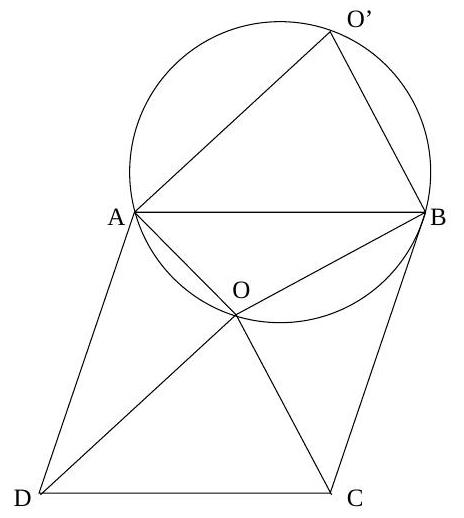
|
| 97 |
+
|
| 98 |
+
Consider a translation which maps $D$ to $A$. It will map $0 \rightarrow 0^{\prime}$ with $\overline{O O^{\prime}}=\overline{D A}$, and $C$ will be mapped to $B$ because $\overline{C B}=\overline{D A}$.
|
| 99 |
+
|
| 100 |
+
This translation keeps angles invariant, so $\angle A O^{\prime} B=\angle D O C=180^{\circ}-\angle A O B$.
|
| 101 |
+
|
| 102 |
+
$\therefore A O B O^{\prime}$ is a cyclic quadrilateral.
|
| 103 |
+
|
| 104 |
+
$\therefore \angle O D C=\angle O^{\prime} A B=\angle O^{\prime} O B$
|
| 105 |
+
|
| 106 |
+
but, since $O^{\prime} O$ is parallel to $B C$,
|
| 107 |
+
|
| 108 |
+
$$
|
| 109 |
+
\begin{aligned}
|
| 110 |
+
\angle O^{\prime} O B & =\angle O B C \\
|
| 111 |
+
\therefore \angle O D C & =\angle O B C .
|
| 112 |
+
\end{aligned}
|
| 113 |
+
$$
|
| 114 |
+
|
| 115 |
+
Problem 4 - Adrian Chan, Upper Canada College, Toronto, ON
|
| 116 |
+
|
| 117 |
+
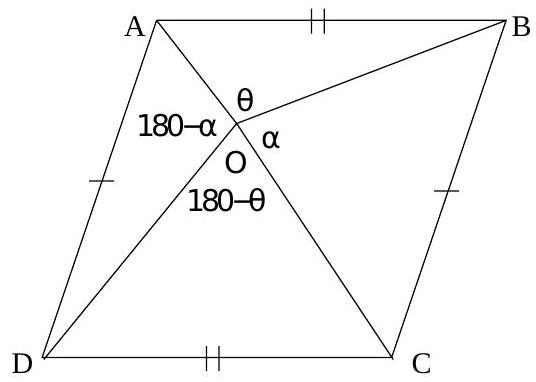
|
| 118 |
+
|
| 119 |
+
Let $\angle A O B=\theta$ and $\angle B O C=\alpha$. Then $\angle C O D=180^{\circ}-\theta$ and $\angle A O D=180^{\circ}-\alpha$.
|
| 120 |
+
|
| 121 |
+
Since $A B=C D$ (parallelogram) and $\sin \theta=\sin \left(180^{\circ}-\theta\right)$, the sine law on $\triangle O C D$ and $\triangle O A B$ gives
|
| 122 |
+
|
| 123 |
+
So
|
| 124 |
+
|
| 125 |
+
$$
|
| 126 |
+
\frac{\sin \angle C D O}{O C}=\frac{\sin \left(180^{\circ}-\theta\right)}{C D}=\frac{\sin \theta}{A B}=\frac{\sin \angle A B O}{O A}
|
| 127 |
+
$$
|
| 128 |
+
|
| 129 |
+
$$
|
| 130 |
+
\frac{O A}{O C}=\frac{\sin \angle A B O}{\sin \angle C D O}
|
| 131 |
+
$$
|
| 132 |
+
|
| 133 |
+
Similarily, the sine law on $\triangle O B C$ and $\triangle O A D$ gives
|
| 134 |
+
|
| 135 |
+
$$
|
| 136 |
+
\frac{\sin \angle C B O}{O C}=\frac{\sin \alpha}{B C}=\frac{\sin \left(180^{\circ}-\alpha\right)}{A D}=\frac{\sin \angle A D O}{O A}
|
| 137 |
+
$$
|
| 138 |
+
|
| 139 |
+
so
|
| 140 |
+
|
| 141 |
+
$$
|
| 142 |
+
\frac{O A}{O C}=\frac{\sin \angle A D O}{\sin \angle C B O}
|
| 143 |
+
$$
|
| 144 |
+
|
| 145 |
+
Equations (1) and (2) show that $\sin \angle A B O \cdot \sin \angle C B O=\sin \angle A D O \cdot \sin \angle C D O$ hence
|
| 146 |
+
|
| 147 |
+
$\frac{1}{2}[\cos (\angle A B O+\angle C B O)-\cos (\angle A B O-\angle C B O)]=\frac{1}{2}[\cos (\angle A D O+\angle C D O)-\cos (\angle A D O-\angle C D O)]$.
|
| 148 |
+
|
| 149 |
+
Since $\angle A D C=\angle A B C$ (parallelogram) and $\angle A D O+\angle C D O=\angle A D C$ and $\angle A B O+\angle C B O=$ $\angle A B C$ it follows that $\cos (\angle A B O-\angle C B O)=\cos (\angle A D O-\angle C D O)$.
|
| 150 |
+
|
| 151 |
+
There are two cases to consider.
|
| 152 |
+
|
| 153 |
+
Case (i): $\angle A B O-\angle C B O=\angle A D O-\angle C D O$.
|
| 154 |
+
|
| 155 |
+
Since $\angle A B O+\angle C B O=\angle A D O+\angle C D O$, subtracting gives $2 \angle C B O=2 \angle C D O$ so $\angle C B O=$ $\angle C D O$, and we are done.
|
| 156 |
+
|
| 157 |
+
Case (ii): $\angle A B O-\angle C B O=\angle C D O-\angle A D O$.
|
| 158 |
+
|
| 159 |
+
Since we know that $\angle A B O+\angle C B O=\angle C D O+\angle A D O$, adding gives $2 \angle A B O=2 \angle C D O$ so $\angle A B O=\angle C D O$ and $\angle C B O=\angle A D O$.
|
| 160 |
+
|
| 161 |
+
Substituting this into (1), it follows that $O A=O C$.
|
| 162 |
+
|
| 163 |
+
Also, $\angle A D O+\angle A B O=\angle C B O+\angle A B O=\angle A B C$.
|
| 164 |
+
|
| 165 |
+
Now, $\angle A B C=180^{\circ}-\angle B A D$ since $A B C D$ is a parallelogram.
|
| 166 |
+
|
| 167 |
+
Hence $\angle B A D+\angle A D O+\angle A B O=180^{\circ}$ so $\angle D O B=180^{\circ}$ and $D, O, B$ are collinear.
|
| 168 |
+
|
| 169 |
+
We now have the diagram
|
| 170 |
+
|
| 171 |
+
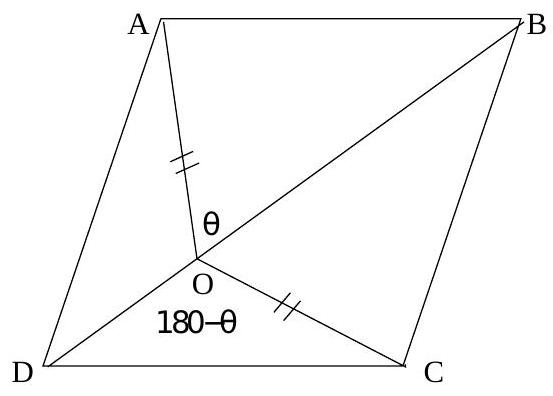
|
| 172 |
+
|
| 173 |
+
Then $\angle C O D+\angle B O C=180^{\circ}$, so $\angle B O C=\theta=\angle A O B$.
|
| 174 |
+
|
| 175 |
+
$\triangle A O B$ is congruent to $\triangle C O B$ (SAS, $O B$ is common, $\angle A O B=\angle C O B$ and $A O=C O$ ), so $\angle A B O=\angle C B O$. Since also $\angle A B O=\angle C D O$ we conclude that $\angle C B O=\angle C D O$.
|
| 176 |
+
|
| 177 |
+
Since it is true in both cases, then $\angle C B O=\angle C D O$.
|
| 178 |
+
|
| 179 |
+
Q.E.D.
|
| 180 |
+
|
| 181 |
+
Problem 5 - Sabin Cautis, Earl Haig Secondary School, North York, ON
|
| 182 |
+
|
| 183 |
+
We first note that
|
| 184 |
+
|
| 185 |
+
$$
|
| 186 |
+
k^{3}+9 k^{2}+26 k+24=(k+2)(k+3)(k+4) .
|
| 187 |
+
$$
|
| 188 |
+
|
| 189 |
+
Let $S(n)=\sum_{k=0}^{n} \frac{(-1)^{k}\left(\begin{array}{c}n \\ k\end{array}\right)}{k^{2}+9 k^{2}+26 k+24}$.
|
| 190 |
+
|
| 191 |
+
Then
|
| 192 |
+
|
| 193 |
+
$$
|
| 194 |
+
\begin{aligned}
|
| 195 |
+
S(n) & =\sum_{k=0}^{n} \frac{(-1)^{k} n !}{k !(n-k) !(k+2)(k+3)(k+4)} \\
|
| 196 |
+
& =\sum_{k=0}^{n}\left(\frac{(-1)^{k}(n+4) !}{(k+4) !(n-k) !}\right) \times\left(\frac{k+1}{(n+1)(n+2)(n+3)(n+4)}\right) .
|
| 197 |
+
\end{aligned}
|
| 198 |
+
$$
|
| 199 |
+
|
| 200 |
+
Let
|
| 201 |
+
|
| 202 |
+
$$
|
| 203 |
+
T(n)=(n+1)(n+2)(n+3)(n+4) S(n)=\sum_{k=0}^{n}\left((-1)^{k}\left(\begin{array}{c}
|
| 204 |
+
n+4 \\
|
| 205 |
+
k+4
|
| 206 |
+
\end{array}\right)(k+1)\right) .
|
| 207 |
+
$$
|
| 208 |
+
|
| 209 |
+
Now, for $n \geq 1$,
|
| 210 |
+
|
| 211 |
+
$$
|
| 212 |
+
\sum_{i=0}^{n}(-1)^{i}\left(\begin{array}{c}
|
| 213 |
+
n \\
|
| 214 |
+
i
|
| 215 |
+
\end{array}\right)=0
|
| 216 |
+
$$
|
| 217 |
+
|
| 218 |
+
since
|
| 219 |
+
|
| 220 |
+
$$
|
| 221 |
+
(1-1)^{n}=\left(\begin{array}{c}
|
| 222 |
+
n \\
|
| 223 |
+
0
|
| 224 |
+
\end{array}\right)-\left(\begin{array}{c}
|
| 225 |
+
n \\
|
| 226 |
+
1
|
| 227 |
+
\end{array}\right)+\left(\begin{array}{c}
|
| 228 |
+
n \\
|
| 229 |
+
2
|
| 230 |
+
\end{array}\right)+\ldots+(-1)^{n}\left(\begin{array}{c}
|
| 231 |
+
n \\
|
| 232 |
+
n
|
| 233 |
+
\end{array}\right)=0 .
|
| 234 |
+
$$
|
| 235 |
+
|
| 236 |
+
Also
|
| 237 |
+
|
| 238 |
+
$$
|
| 239 |
+
\begin{aligned}
|
| 240 |
+
\sum_{i=0}^{n}(-1)^{i}\left(\begin{array}{c}
|
| 241 |
+
n \\
|
| 242 |
+
i
|
| 243 |
+
\end{array}\right) i & =\sum_{i=1}^{n}(-1)^{i} \frac{i \cdot n !}{i ! \cdot(n-i) !}+(-1)^{0} \cdot \frac{0 \cdot n !}{0 ! \cdot n !} \\
|
| 244 |
+
& =\sum_{i=1}^{n}(-1)^{i} \frac{n !}{(i-1) !(n-i) !} \\
|
| 245 |
+
& =\sum_{i=1}^{n}(-1)^{i} n\left(\begin{array}{c}
|
| 246 |
+
n-1 \\
|
| 247 |
+
i-1
|
| 248 |
+
\end{array}\right) \\
|
| 249 |
+
& =n \sum_{i=1}^{n}(-1)^{i}\left(\begin{array}{c}
|
| 250 |
+
n-1 \\
|
| 251 |
+
i-1
|
| 252 |
+
\end{array}\right) \\
|
| 253 |
+
& =-n \sum_{i=1}^{n}(-1)^{i-1}\left(\begin{array}{c}
|
| 254 |
+
n-1 \\
|
| 255 |
+
i-1
|
| 256 |
+
\end{array}\right) .
|
| 257 |
+
\end{aligned}
|
| 258 |
+
$$
|
| 259 |
+
|
| 260 |
+
Substituting $j=i-1,\left({ }^{*}\right)$ shows that
|
| 261 |
+
|
| 262 |
+
$$
|
| 263 |
+
\sum_{i=0}^{n}(-1)^{i}\left(\begin{array}{c}
|
| 264 |
+
n \\
|
| 265 |
+
i
|
| 266 |
+
\end{array}\right) i=-n \sum_{j=0}^{n-1}(-1)^{j}\left(\begin{array}{c}
|
| 267 |
+
n-1 \\
|
| 268 |
+
j
|
| 269 |
+
\end{array}\right)=0
|
| 270 |
+
$$
|
| 271 |
+
|
| 272 |
+
Hence
|
| 273 |
+
|
| 274 |
+
$$
|
| 275 |
+
\begin{aligned}
|
| 276 |
+
T(n) & =\sum_{k=0}^{n}(-1)^{k}\left(\begin{array}{c}
|
| 277 |
+
n+4 \\
|
| 278 |
+
k+4
|
| 279 |
+
\end{array}\right)(k+1) \\
|
| 280 |
+
& =\sum_{k=0}^{n}(-1)^{k+4}\left(\begin{array}{c}
|
| 281 |
+
n+4 \\
|
| 282 |
+
k+4
|
| 283 |
+
\end{array}\right)(k+1) \\
|
| 284 |
+
& =\sum_{k=-4}^{n}(-1)^{k+4}\left(\begin{array}{c}
|
| 285 |
+
n+4 \\
|
| 286 |
+
k+4
|
| 287 |
+
\end{array}\right)(k+1)-\left(-3+2(n+4)-\left(\begin{array}{c}
|
| 288 |
+
n+4 \\
|
| 289 |
+
2
|
| 290 |
+
\end{array}\right)\right) .
|
| 291 |
+
\end{aligned}
|
| 292 |
+
$$
|
| 293 |
+
|
| 294 |
+
Substituting $j=k+4$,
|
| 295 |
+
|
| 296 |
+
$$
|
| 297 |
+
\begin{aligned}
|
| 298 |
+
& =\sum_{j=0}^{n+4}(-1)^{j}\left(\begin{array}{c}
|
| 299 |
+
n+4 \\
|
| 300 |
+
j
|
| 301 |
+
\end{array}\right)(j-3)-\left(2 n+8-3-\frac{(n+4)(n+3)}{2}\right) \\
|
| 302 |
+
& =\sum_{j=0}^{n+4}(-1)^{j}\left(\begin{array}{c}
|
| 303 |
+
n+4 \\
|
| 304 |
+
j
|
| 305 |
+
\end{array}\right) j-3 \sum_{j=0}^{n+4}(-1)^{j}\left(\begin{array}{c}
|
| 306 |
+
n+4 \\
|
| 307 |
+
j
|
| 308 |
+
\end{array}\right)-\frac{1}{2}\left(4 n+10-n^{2}-7 n-12\right)
|
| 309 |
+
\end{aligned}
|
| 310 |
+
$$
|
| 311 |
+
|
| 312 |
+
The first two terms are zero because of results $\left({ }^{*}\right)$ and $\left({ }^{* *}\right)$ so
|
| 313 |
+
|
| 314 |
+
$$
|
| 315 |
+
T(n)=\frac{n^{2}+3 n+2}{2} .
|
| 316 |
+
$$
|
| 317 |
+
|
| 318 |
+
Then
|
| 319 |
+
|
| 320 |
+
$$
|
| 321 |
+
\begin{aligned}
|
| 322 |
+
& S(n)=\frac{T(n)}{(n+1)(n+2)(n+3)(n+4)} \\
|
| 323 |
+
&=\frac{n^{2}+3 n+2}{2(n+1)(n+2)(n+3)(n+4)} \\
|
| 324 |
+
&=\frac{(n+1)(n+2)}{2(n+1)(n+2)(n+3)(n+4)} \\
|
| 325 |
+
&=\frac{1}{2(n+3)(n+4)} . \\
|
| 326 |
+
& \therefore \sum_{k=0}^{n} \frac{(-1)^{k}\left(\begin{array}{c}
|
| 327 |
+
n \\
|
| 328 |
+
k
|
| 329 |
+
\end{array}\right)}{k^{3}+9 k^{2}+26 k+24}=\frac{1}{2(n+3)(n+4)}
|
| 330 |
+
\end{aligned}
|
| 331 |
+
$$
|
| 332 |
+
|
CANADA_MO/md/en-sol1998.md
ADDED
|
@@ -0,0 +1,460 @@
|
|
|
|
|
|
|
|
|
|
|
|
|
|
|
|
|
|
|
|
|
|
|
|
|
|
|
|
|
|
|
|
|
|
|
|
|
|
|
|
|
|
|
|
|
|
|
|
|
|
|
|
|
|
|
|
|
|
|
|
|
|
|
|
|
|
|
|
|
|
|
|
|
|
|
|
|
|
|
|
|
|
|
|
|
|
|
|
|
|
|
|
|
|
|
|
|
|
|
|
|
|
|
|
|
|
|
|
|
|
|
|
|
|
|
|
|
|
|
|
|
|
|
|
|
|
|
|
|
|
|
|
|
|
|
|
|
|
|
|
|
|
|
|
|
|
|
|
|
|
|
|
|
|
|
|
|
|
|
|
|
|
|
|
|
|
|
|
|
|
|
|
|
|
|
|
|
|
|
|
|
|
|
|
|
|
|
|
|
|
|
|
|
|
|
|
|
|
|
|
|
|
|
|
|
|
|
|
|
|
|
|
|
|
|
|
|
|
|
|
|
|
|
|
|
|
|
|
|
|
|
|
|
|
|
|
|
|
|
|
|
|
|
|
|
|
|
|
|
|
|
|
|
|
|
|
|
|
|
|
|
|
|
|
|
|
|
|
|
|
|
|
|
|
|
|
|
|
|
|
|
|
|
|
|
|
|
|
|
|
|
|
|
|
|
|
|
|
|
|
|
|
|
|
|
|
|
|
|
|
|
|
|
|
|
|
|
|
|
|
|
|
|
|
|
|
|
|
|
|
|
|
|
|
|
|
|
|
|
|
|
|
|
|
|
|
|
|
|
|
|
|
|
|
|
|
|
|
|
|
|
|
|
|
|
|
|
|
|
|
|
|
|
|
|
|
|
|
|
|
|
|
|
|
|
|
|
|
|
|
|
|
|
|
|
|
|
|
|
|
|
|
|
|
|
|
|
|
|
|
|
|
|
|
|
|
|
|
|
|
|
|
|
|
|
|
|
|
|
|
|
|
|
|
|
|
|
|
|
|
|
|
|
|
|
|
|
|
|
|
|
|
|
|
|
|
|
|
|
|
|
|
|
|
|
|
|
|
|
|
|
|
|
|
|
|
|
|
|
|
|
|
|
|
|
|
|
|
|
|
|
|
|
|
|
|
|
|
|
|
|
|
|
|
|
|
|
|
|
|
|
|
|
|
|
|
|
|
|
|
|
|
|
|
|
|
|
|
|
|
|
|
|
|
|
|
|
|
|
|
|
|
|
|
|
|
|
|
|
|
|
|
|
|
|
|
|
|
|
|
|
|
|
|
|
|
|
|
|
|
|
|
|
|
|
|
|
|
|
|
|
|
|
|
|
|
|
|
|
|
|
|
|
|
|
|
|
|
|
|
|
|
|
|
|
|
|
|
|
|
|
|
|
|
|
|
|
|
|
|
|
|
|
|
|
|
|
|
|
|
|
|
|
|
|
|
|
|
|
|
|
|
|
|
|
|
|
|
|
|
|
|
|
|
|
|
|
|
|
|
|
|
|
|
|
|
|
|
|
|
|
|
|
|
|
|
|
|
|
|
|
|
|
|
|
|
|
|
|
|
|
|
|
|
|
|
|
|
|
|
|
|
|
|
|
|
|
|
|
|
|
|
|
|
|
|
|
|
|
|
|
|
|
|
|
|
|
|
|
|
|
|
|
|
|
|
|
|
|
|
|
|
|
|
|
|
|
|
|
|
|
|
|
|
|
|
|
|
|
|
|
|
|
|
|
|
|
|
|
|
|
|
|
|
|
|
|
|
|
|
|
|
|
|
|
|
|
|
|
|
|
|
|
|
|
|
|
|
|
|
|
|
|
|
|
|
|
|
|
|
|
|
|
|
|
|
|
|
|
|
|
|
|
|
|
|
|
|
|
|
|
|
|
|
|
|
|
|
|
|
|
|
|
|
|
|
|
|
|
|
|
|
|
|
|
|
|
|
|
|
|
|
|
|
|
|
|
|
|
|
|
|
|
|
|
|
|
|
|
|
|
|
|
|
|
|
|
|
|
|
|
|
|
|
|
|
|
|
|
|
|
|
|
|
|
|
|
|
|
|
|
|
|
|
|
|
|
|
|
|
|
|
|
|
|
|
|
|
|
|
|
|
|
|
|
|
|
|
|
|
|
|
|
|
|
|
|
|
|
|
|
|
|
|
|
|
|
|
|
|
|
|
|
|
|
|
|
|
|
|
|
|
|
|
|
|
|
|
|
|
|
|
|
|
|
|
|
|
|
|
|
|
|
|
|
|
|
|
|
|
|
|
|
|
|
|
|
|
|
|
|
|
|
|
|
|
|
|
|
|
|
|
|
|
|
|
|
|
|
|
|
|
|
|
|
|
|
|
|
|
|
|
|
|
|
|
|
|
|
|
|
|
|
|
|
|
|
|
|
|
|
|
|
|
|
|
|
|
|
|
|
|
|
|
|
|
|
|
|
|
|
|
|
|
|
|
|
|
|
|
|
|
|
|
|
|
|
|
|
|
|
|
|
|
|
|
|
|
|
|
|
|
|
|
|
|
|
|
|
|
|
|
|
|
|
|
|
|
|
|
|
|
|
|
|
|
|
|
|
|
|
|
|
|
|
|
|
|
|
|
|
|
|
|
|
|
|
|
|
|
|
|
|
|
|
|
|
|
|
|
|
|
|
|
|
|
|
|
|
|
|
|
|
|
|
|
|
|
|
|
|
|
|
|
|
|
|
|
|
|
|
|
|
|
|
|
|
|
|
|
|
|
|
|
|
|
|
|
|
|
|
|
|
|
|
|
|
|
|
|
|
|
|
|
|
|
|
|
|
|
|
|
|
|
|
|
|
|
|
|
|
|
|
|
|
|
|
|
|
|
|
|
|
|
|
|
|
|
|
|
|
|
|
|
|
|
|
|
|
|
|
|
|
|
|
|
|
|
|
|
|
|
|
|
|
|
|
|
|
|
|
|
|
|
|
|
|
|
|
|
|
|
|
|
|
|
|
|
|
|
|
|
|
|
|
|
|
|
|
|
|
|
|
|
|
|
|
|
|
|
|
|
|
|
|
|
|
|
|
|
|
|
|
|
|
|
|
|
|
|
|
|
|
|
|
|
|
|
|
|
|
|
|
|
|
|
|
|
|
|
|
|
|
|
| 1 |
+
# 1998 <br> SOLUTIONS
|
| 2 |
+
|
| 3 |
+
The solutions to the problems of the 1998 CMO presented below are taken from students papers.
|
| 4 |
+
|
| 5 |
+
Some minor editing has been done - unnecesary steps have been eliminated and some wording has been changed to make the proofs clearer. But for the most part, the proofs are as submitted.
|
| 6 |
+
|
| 7 |
+
## Solution to Problem 1 - David Arthur, Upper Canada College, Toronto, ON
|
| 8 |
+
|
| 9 |
+
Let $a=30 k+r$, where $k$ is an integer and $r$ is a real number between 0 and 29 inclusive.
|
| 10 |
+
|
| 11 |
+
Then $\left[\frac{1}{2} a\right]=\left[\frac{1}{2}(30 k+r)\right]=15 k+\left[\frac{r}{2}\right]$. Similarly $\left[\frac{1}{3} a\right]=10 k+\left[\frac{r}{3}\right]$ and $\left[\frac{1}{5} a\right]=6 k+\left[\frac{r}{5}\right]$.
|
| 12 |
+
|
| 13 |
+
Now, $\left[\frac{1}{2} a\right]+\left[\frac{1}{3} a\right]+\left[\frac{1}{5} a\right]=a$, so $\left(15 k+\left[\frac{r}{2}\right]\right)+\left(10 k+\left[\frac{r}{3}\right]\right)+\left(6 k+\left[\frac{r}{5}\right]\right)=30 k+r$ and hence $k=r-\left[\frac{r}{2}\right]-\left[\frac{r}{3}\right]-\left[\frac{r}{5}\right]$.
|
| 14 |
+
|
| 15 |
+
Clearly, $r$ has to be an integer, or $r-\left[\frac{r}{2}\right]-\left[\frac{r}{3}\right]-\left[\frac{r}{5}\right]$ will not be an integer, and therefore, cannot equal $k$.
|
| 16 |
+
|
| 17 |
+
On the other hand, if $r$ is an integer, then $r-\left[\frac{r}{2}\right]-\left[\frac{r}{3}\right]-\left[\frac{r}{5}\right]$ will also be an integer, giving exactly one solution for $k$.
|
| 18 |
+
|
| 19 |
+
For each $r(0 \leq r \leq 29), a=30 k+r$ will have a different remainder mod 30 , so no two different values of $r$ give the same result for $a$.
|
| 20 |
+
|
| 21 |
+
Since there are 30 possible values for $r(0,1,2, \ldots, 29)$, there are then 30 solutions for $a$.
|
| 22 |
+
|
| 23 |
+
Solution to Problem 2 - Jimmy Chui, Earl Haig S.S., North York, ON
|
| 24 |
+
|
| 25 |
+
Since $\left(x-\frac{1}{x}\right)^{1 / 2} \geq 0$ and $\left(1-\frac{1}{x}\right)^{1 / 2} \geq 0$, then $0 \leq\left(x-\frac{1}{x}\right)^{1 / 2}+\left(1-\frac{1}{x}\right)^{1 / 2}=x$.
|
| 26 |
+
|
| 27 |
+
Note that $x \neq 0$. Else, $\frac{1}{x}$ would not be defined so $x>0$.
|
| 28 |
+
|
| 29 |
+
Squaring both sides gives,
|
| 30 |
+
|
| 31 |
+
$$
|
| 32 |
+
\begin{aligned}
|
| 33 |
+
x^{2} & =\left(x-\frac{1}{x}\right)+\left(1-\frac{1}{x}\right)+2 \sqrt{\left(x-\frac{1}{x}\right)\left(1-\frac{1}{x}\right)} \\
|
| 34 |
+
x^{2} & =x+1-\frac{2}{x}+2 \sqrt{x-1-\frac{1}{x}+\frac{1}{x^{2}}} .
|
| 35 |
+
\end{aligned}
|
| 36 |
+
$$
|
| 37 |
+
|
| 38 |
+
Multiplying both sides by $x$ and rearranging, we get
|
| 39 |
+
|
| 40 |
+
$$
|
| 41 |
+
\begin{aligned}
|
| 42 |
+
x^{3}-x^{2}-x+2 & =2 \sqrt{x^{3}-x^{2}-x+1} \\
|
| 43 |
+
\left(x^{3}-x^{2}-x+1\right)-2 \sqrt{x^{3}-x^{2}-x+1}+1 & =0 \\
|
| 44 |
+
\left(\sqrt{x^{3}-x^{2}-x+1}-1\right)^{2} & =0 \\
|
| 45 |
+
\sqrt{x^{3}-x^{2}-x+1} & =1 \\
|
| 46 |
+
x^{3}-x^{2}-x+1 & =1 \\
|
| 47 |
+
x\left(x^{2}-x-1\right) & =0 \\
|
| 48 |
+
x^{2}-x-1 & =0 \quad \text { since } x \neq 0 .
|
| 49 |
+
\end{aligned}
|
| 50 |
+
$$
|
| 51 |
+
|
| 52 |
+
Thus $x=\frac{1 \pm \sqrt{5}}{2}$. We must check to see if these are indeed solutions.
|
| 53 |
+
|
| 54 |
+
Let $\alpha=\frac{1+\sqrt{5}}{2}, \beta=\frac{1-\sqrt{5}}{2}$. Note that $\alpha+\beta=1, \alpha \beta=-1$ and $\alpha>0>\beta$.
|
| 55 |
+
|
| 56 |
+
Since $\beta<0, \beta$ is not a solution.
|
| 57 |
+
|
| 58 |
+
Now, if $x=\alpha$, then
|
| 59 |
+
|
| 60 |
+
$$
|
| 61 |
+
\begin{aligned}
|
| 62 |
+
\left(\alpha-\frac{1}{\alpha}\right)^{1 / 2}+\left(1-\frac{1}{\alpha}\right)^{1 / 2} & =(\alpha+\beta)^{1 / 2}+(1+\beta)^{1 / 2} & & (\text { since } \alpha \beta--1) \\
|
| 63 |
+
& =1^{1 / 2}+\left(\beta^{2}\right)^{1 / 2} & & \left(\text { since } \alpha+\beta=1 \text { and } \beta^{2}=\beta+1\right) \\
|
| 64 |
+
& =1-\beta & & (\text { since } \beta<0) \\
|
| 65 |
+
& =\alpha & & (\text { since } \alpha+\beta=1) .
|
| 66 |
+
\end{aligned}
|
| 67 |
+
$$
|
| 68 |
+
|
| 69 |
+
So $x=\alpha$ is the unique solution to the equation.
|
| 70 |
+
|
| 71 |
+
Solution 1 to Problem 3 - Chen He, Columbia International Collegiate, Hamilton, ON
|
| 72 |
+
|
| 73 |
+
$$
|
| 74 |
+
1+\frac{1}{3}+\ldots+\frac{1}{2 n-1}=\frac{1}{2}+\frac{1}{2}+\frac{1}{3}+\frac{1}{5}+\ldots \frac{1}{2 n-1}
|
| 75 |
+
$$
|
| 76 |
+
|
| 77 |
+
Since
|
| 78 |
+
|
| 79 |
+
$$
|
| 80 |
+
\frac{1}{3}>\frac{1}{4}, \frac{1}{5}>\frac{1}{6}, \ldots, \frac{1}{2 n-1}>\frac{1}{2 n}
|
| 81 |
+
$$
|
| 82 |
+
|
| 83 |
+
(1) gives
|
| 84 |
+
|
| 85 |
+
$$
|
| 86 |
+
1+\frac{1}{3}+\ldots+\frac{1}{2 n-1}>\frac{1}{2}+\frac{1}{2}+\frac{1}{4}+\frac{1}{6}+\ldots+\frac{1}{2 n}=\frac{1}{2}+\left(\frac{1}{2}+\frac{1}{4}+\frac{1}{6}+\ldots+\frac{1}{2 n}\right) .
|
| 87 |
+
$$
|
| 88 |
+
|
| 89 |
+
Since
|
| 90 |
+
|
| 91 |
+
$$
|
| 92 |
+
\frac{1}{2}>\frac{1}{4}, \frac{1}{2}>\frac{1}{6}, \frac{1}{2}>\frac{1}{8}, \ldots, \frac{1}{2}>\frac{1}{2 n}
|
| 93 |
+
$$
|
| 94 |
+
|
| 95 |
+
then
|
| 96 |
+
|
| 97 |
+
$$
|
| 98 |
+
\frac{n}{2}=\underbrace{\frac{1}{2}+\frac{1}{2}+\frac{1}{2}+\ldots+\frac{1}{2}}_{n}>\frac{1}{2}+\frac{1}{4}+\frac{1}{6}+\ldots+\frac{1}{2 n}
|
| 99 |
+
$$
|
| 100 |
+
|
| 101 |
+
So
|
| 102 |
+
|
| 103 |
+
$$
|
| 104 |
+
\frac{1}{2}>\frac{1}{n}\left(\frac{1}{2}+\frac{1}{4}+\frac{1}{6}+\ldots+\frac{1}{2 n}\right) .
|
| 105 |
+
$$
|
| 106 |
+
|
| 107 |
+
Then (1), (2) and (3) show
|
| 108 |
+
|
| 109 |
+
$$
|
| 110 |
+
\begin{aligned}
|
| 111 |
+
1+\frac{1}{3}+\ldots+\frac{1}{2 n-1} & >\frac{1}{n}\left(\frac{1}{2}+\frac{1}{4}+\frac{1}{6}+\ldots+\frac{1}{2 n}\right)+\left(\frac{1}{2}+\frac{1}{4}+\frac{1}{6}+\ldots+\frac{1}{2 n}\right) \\
|
| 112 |
+
& =\left(1+\frac{1}{n}\right)\left(\frac{1}{2}+\frac{1}{4}+\ldots+\frac{1}{2 n}\right) \\
|
| 113 |
+
& =\frac{n+1}{n}\left(\frac{1}{2}+\frac{1}{4}+\ldots+\frac{1}{2 n}\right) .
|
| 114 |
+
\end{aligned}
|
| 115 |
+
$$
|
| 116 |
+
|
| 117 |
+
Therefore $\frac{1}{n+1}\left(1+\frac{1}{3}+\ldots+\frac{1}{2 n-1}\right)>\frac{1}{n}\left(\frac{1}{2}+\frac{1}{4}+\ldots+\frac{1}{2 n}\right)$ for all $n \in N$ and $n \geq 2$.
|
| 118 |
+
|
| 119 |
+
Solution 2 to Problem 3 - Yin Lei, Vincent Massey S.S., Windsor, ON
|
| 120 |
+
|
| 121 |
+
Since $n \geq 2, n(n+1) \geq 0$. Therefore the given inequality is equivalent to
|
| 122 |
+
|
| 123 |
+
$$
|
| 124 |
+
n\left(1+\frac{1}{3}+\ldots+\frac{1}{2 n-1}\right) \geq(n+1)\left(\frac{1}{2}+\frac{1}{4}+\ldots+\frac{1}{2 n}\right) .
|
| 125 |
+
$$
|
| 126 |
+
|
| 127 |
+
We shall use mathematical induction to prove this.
|
| 128 |
+
|
| 129 |
+
For $n=2$, obviously $\frac{1}{3}\left(1+\frac{1}{3}\right)=\frac{4}{9}>\frac{1}{2}\left(\frac{1}{2}+\frac{1}{4}\right)=\frac{3}{8}$.
|
| 130 |
+
|
| 131 |
+
Suppose that the inequality stands for $n=k$, i.e.
|
| 132 |
+
|
| 133 |
+
$$
|
| 134 |
+
k\left(1+\frac{1}{3}+\ldots+\frac{1}{2 k-1}\right)>(k+1)\left(\frac{1}{2}+\frac{1}{4}+\ldots+\frac{1}{2 k}\right) .
|
| 135 |
+
$$
|
| 136 |
+
|
| 137 |
+
Now we have to prove it for $n=k+1$.
|
| 138 |
+
|
| 139 |
+
We know
|
| 140 |
+
|
| 141 |
+
$$
|
| 142 |
+
\begin{aligned}
|
| 143 |
+
& \left(1+\frac{1}{3}+\ldots+\frac{1}{2 k-1}\right)-\left(\frac{1}{2}+\frac{1}{4}+\ldots+\frac{1}{2 k}\right) \\
|
| 144 |
+
& =\left(1-\frac{1}{2}\right)+\left(\frac{1}{3}-\frac{1}{4}\right)+\left(\frac{1}{5}-\frac{1}{6}\right)+\ldots+\left(\frac{1}{2 k-1}-\frac{1}{2 k}\right) \\
|
| 145 |
+
& =\frac{1}{1 \times 2}+\frac{1}{3 \times 4}+\frac{1}{5 \times 6}+\ldots+\frac{1}{(2 k-1)(2 k)} .
|
| 146 |
+
\end{aligned}
|
| 147 |
+
$$
|
| 148 |
+
|
| 149 |
+
Since
|
| 150 |
+
|
| 151 |
+
$$
|
| 152 |
+
1 \times 2<3 \times 4<5 \times 6<\ldots<(2 k-1)(2 k)<(2 k+1)(2 k+2)
|
| 153 |
+
$$
|
| 154 |
+
|
| 155 |
+
then
|
| 156 |
+
|
| 157 |
+
$$
|
| 158 |
+
\frac{1}{1 \times 2}+\frac{1}{3 \times 4}+\ldots+\frac{1}{(2 k-1)(2 k)}>\frac{k}{(2 k+1)(2 k+2)}
|
| 159 |
+
$$
|
| 160 |
+
|
| 161 |
+
hence
|
| 162 |
+
|
| 163 |
+
$$
|
| 164 |
+
1+\frac{1}{3}+\ldots+\frac{1}{2 k-1}>\frac{1}{2}+\frac{1}{4}+\ldots+\frac{1}{2 k}+\frac{k}{(2 k+1)(2 k+2)}
|
| 165 |
+
$$
|
| 166 |
+
|
| 167 |
+
Also
|
| 168 |
+
|
| 169 |
+
$$
|
| 170 |
+
\frac{k+1}{2 k+1}-\frac{k+2}{2 k+2}=\frac{2 k^{2}+2 k+2 k+2-2 k^{2}-4 k-k-2}{(2 k+1)(2 k+2)}=-\frac{k}{(2 k+1)(2 k+2)}
|
| 171 |
+
$$
|
| 172 |
+
|
| 173 |
+
therefore
|
| 174 |
+
|
| 175 |
+
$$
|
| 176 |
+
\frac{k+1}{2 k+1}=\frac{k+2}{2 k+2}-\frac{k}{(2 k+1)(2 k+2)}
|
| 177 |
+
$$
|
| 178 |
+
|
| 179 |
+
Adding 1, 2 and 3 :
|
| 180 |
+
|
| 181 |
+
$k\left(1+\frac{1}{3}+\ldots+\frac{1}{2 k-1}\right)+\left(1+\frac{1}{3}+\ldots+\frac{1}{2 k-1}\right)+\frac{k+1}{2 k+1}$
|
| 182 |
+
|
| 183 |
+
$>(k+1)\left(\frac{1}{2}+\frac{1}{4}+\ldots+\frac{1}{2 k}\right)+\left(\frac{1}{2}+\frac{1}{4}+\ldots+\frac{1}{2 k}\right)+\frac{k}{(2 k+1)(2 k+2)}+\frac{k+2}{2 k+2}-\frac{k}{(2 k+1)(2 k+2)}$
|
| 184 |
+
|
| 185 |
+
Rearrange both sides to get
|
| 186 |
+
|
| 187 |
+
$$
|
| 188 |
+
(k+1)\left(1+\frac{1}{3}+\ldots+\frac{1}{2 k+1}\right)>(k+2)\left(\frac{1}{2}+\frac{1}{4}+\ldots+\frac{1}{2 k+2}\right) .
|
| 189 |
+
$$
|
| 190 |
+
|
| 191 |
+
Proving the induction.
|
| 192 |
+
|
| 193 |
+
Solution 1 to Problem 4 - Keon Choi, A.Y. Jackson S.S., North York, ON
|
| 194 |
+
|
| 195 |
+
Suppose $H$ is the foot of the perpendicular line from $A$ to $B C$; construct equilateral $\triangle A B G$, with $C$ on $B G$. I will prove that if $F$ is the point where $A H$ meets $B D$, then $\angle F C B=70^{\circ}$. (Because that means $A H$, and the given lines $B D$ and $C E$ meet at one point and that proves the question.) Suppose $B D$ extended meets $A G$ at $I$.
|
| 196 |
+
|
| 197 |
+
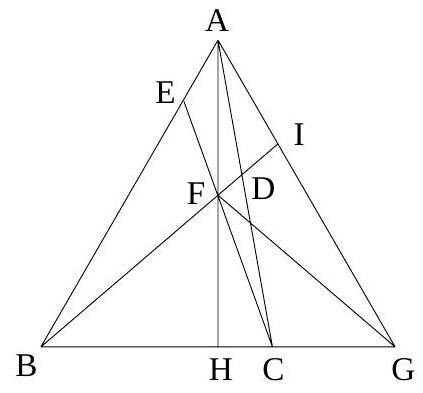
|
| 198 |
+
|
| 199 |
+
Now $B F=G F$ and $\angle F B G=\angle F G B=40^{\circ}$ so that $\angle I G F=20^{\circ}$. Also $\angle I F G=\angle F B G+\angle F G B=$ $80^{\circ}$, so that
|
| 200 |
+
|
| 201 |
+
$$
|
| 202 |
+
\begin{aligned}
|
| 203 |
+
\angle F I G & =180^{\circ}-\angle I F G-\angle I G F \\
|
| 204 |
+
& =180^{\circ}-80^{\circ}-20^{\circ} \\
|
| 205 |
+
& =80^{\circ} .
|
| 206 |
+
\end{aligned}
|
| 207 |
+
$$
|
| 208 |
+
|
| 209 |
+
Therefore $\triangle G I F$ is an isoceles triangle, so
|
| 210 |
+
|
| 211 |
+
$$
|
| 212 |
+
G I=G F=B F
|
| 213 |
+
$$
|
| 214 |
+
|
| 215 |
+
But $\triangle B G I$ and $\triangle A B C$ are congruent, since $B G=A B, \angle G B I=\angle B A C, \angle B G I=\angle A B C$.
|
| 216 |
+
|
| 217 |
+
Therefore
|
| 218 |
+
|
| 219 |
+
$$
|
| 220 |
+
G I=B C .
|
| 221 |
+
$$
|
| 222 |
+
|
| 223 |
+
From (1) and (2) we get
|
| 224 |
+
|
| 225 |
+
$$
|
| 226 |
+
B C=B F \text {. }
|
| 227 |
+
$$
|
| 228 |
+
|
| 229 |
+
So in $\triangle B C F$,
|
| 230 |
+
|
| 231 |
+
$$
|
| 232 |
+
\angle B C F=\frac{180^{\circ}-\angle F B C}{2}=\frac{180^{\circ}-40^{\circ}}{2}=70^{\circ} .
|
| 233 |
+
$$
|
| 234 |
+
|
| 235 |
+
Thus $\angle F C B=70^{\circ}$ and that proves that the given lines $C E$ and $B D$ and the perpendicular line $A H$ meet at one point.
|
| 236 |
+
|
| 237 |
+
Solution 2 to Problem 4 - Adrian Birka, Lakeshore Catholic H.S., Port Colborne, ON
|
| 238 |
+
|
| 239 |
+
First we prove the following lemma:
|
| 240 |
+
|
| 241 |
+
In $\triangle A B C, A A^{\prime}, B B^{\prime}, C C^{\prime}$ intersect if-f
|
| 242 |
+
|
| 243 |
+
$$
|
| 244 |
+
\frac{\sin \alpha_{1}}{\sin \alpha_{2}} \cdot \frac{\sin \beta_{1}}{\sin \beta_{2}} \cdot \frac{\sin \gamma_{1}}{\sin \gamma_{2}}=1
|
| 245 |
+
$$
|
| 246 |
+
|
| 247 |
+
where $\alpha_{1}, \alpha_{2}, \beta_{1}, \beta_{2}, \gamma_{1}, \gamma_{2}$ are as shown in the diagram just below.
|
| 248 |
+
|
| 249 |
+
(Editor: This is a known variant of Ceva's Theorem.)
|
| 250 |
+
|
| 251 |
+
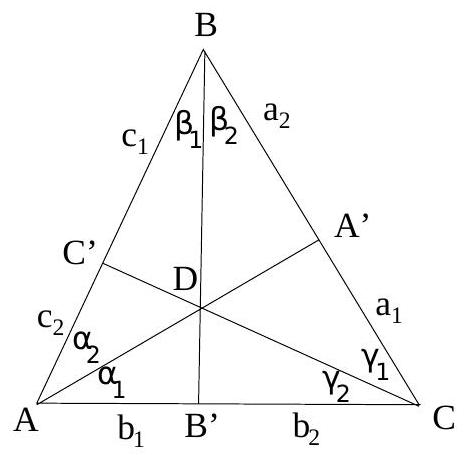
|
| 252 |
+
|
| 253 |
+
Proof: Let $\angle B B^{\prime} C=x$, then $\angle B B^{\prime} A=180^{\circ}-x$. Using the sine law in $\triangle B B^{\prime} C$ yields
|
| 254 |
+
|
| 255 |
+
$$
|
| 256 |
+
\frac{b_{2}}{\sin \beta_{2}}=\frac{a}{\sin x} .
|
| 257 |
+
$$
|
| 258 |
+
|
| 259 |
+
Similarly using the sine law in $\triangle B B^{\prime} A$ yields
|
| 260 |
+
|
| 261 |
+
$$
|
| 262 |
+
\frac{b_{1}}{\sin \beta_{1}}=\frac{c}{\sin \left(180^{\circ}-x\right)}=\frac{c}{\sin x} .
|
| 263 |
+
$$
|
| 264 |
+
|
| 265 |
+
Hence,
|
| 266 |
+
|
| 267 |
+
$$
|
| 268 |
+
b_{1}: b_{2}=\frac{c \sin \beta_{1}}{a \sin \beta_{2}}
|
| 269 |
+
$$
|
| 270 |
+
|
| 271 |
+
(from (1),(2)). (Editor: Do you recognize this when $\beta_{1}=\beta_{2}$ ?)
|
| 272 |
+
|
| 273 |
+
Similarly,
|
| 274 |
+
|
| 275 |
+
$$
|
| 276 |
+
a_{1}: a_{2}=\frac{b \sin \alpha_{1}}{c \sin \alpha_{2}}, \quad c_{1}: c_{2}=\frac{a \sin \gamma_{1}}{b \sin \gamma_{2}}
|
| 277 |
+
$$
|
| 278 |
+
|
| 279 |
+
By Ceva's theorem, the necessary and sufficient condition for $A A^{\prime}, B B^{\prime}, C C^{\prime}$ to intersect is: $\left(a_{1}: a_{2}\right) \cdot\left(b_{1}: b_{2}\right) \cdot\left(c_{1}: c_{2}\right)=1$. Using (3), (4) on this yields:
|
| 280 |
+
|
| 281 |
+
$$
|
| 282 |
+
\frac{b}{c} \cdot \frac{\sin \alpha_{1}}{\sin \alpha_{2}} \cdot \frac{a}{b} \cdot \frac{\sin \gamma_{1}}{\sin \gamma_{2}} \cdot \frac{c}{a} \cdot \frac{\sin \beta_{1}}{\sin \beta_{2}}=1
|
| 283 |
+
$$
|
| 284 |
+
|
| 285 |
+
$$
|
| 286 |
+
\frac{\sin \alpha_{1}}{\sin \alpha_{2}} \cdot \frac{\sin \beta_{1}}{\sin \beta_{2}} \cdot \frac{\sin \gamma_{1}}{\sin \gamma_{2}}=1
|
| 287 |
+
$$
|
| 288 |
+
|
| 289 |
+
This is just what we needed to show, therefore the lemma is proved.
|
| 290 |
+
|
| 291 |
+
Now, in our original question, give $\angle B A C=40^{\circ}, \angle A B C=60^{\circ}$. It follows that $\angle A C B=80^{\circ}$.
|
| 292 |
+
|
| 293 |
+
Since $\angle C B D=40^{\circ}, \angle A B D=\angle A B C-\angle D B C=20^{\circ}$. Similarly, $\angle E C A=20^{\circ}$.
|
| 294 |
+
|
| 295 |
+
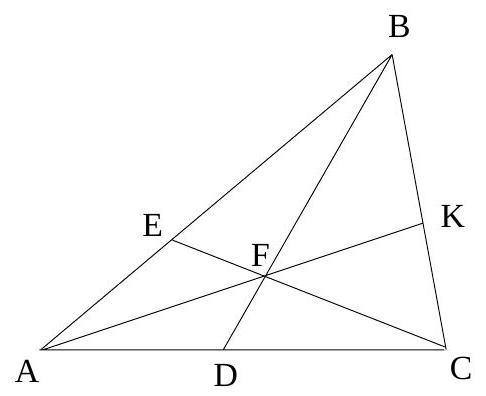
|
| 296 |
+
|
| 297 |
+
Now let us show that $\angle F A D=10^{\circ}$. Suppose otherwise. Let $F^{\prime}$ be such that $F, F^{\prime}$ are in the same side of $A C$ and $\angle D A F^{\prime}=10^{\circ}$. Then $\angle B A F^{\prime}=\angle B A C-\angle D A F^{\prime}=30^{\circ}$.
|
| 298 |
+
|
| 299 |
+
Thus
|
| 300 |
+
|
| 301 |
+
$$
|
| 302 |
+
\begin{aligned}
|
| 303 |
+
\frac{\sin \angle A B D}{\sin \angle D B C} \cdot \frac{\sin \angle B C E}{\sin \angle E C A} \cdot \frac{\sin \angle C A F^{\prime}}{\sin \angle F^{\prime} A B} & =\frac{\sin 20^{\circ}}{\sin 40^{\circ}} \cdot \frac{\sin 70^{\circ}}{\sin 10^{\circ}} \cdot \frac{\sin 10^{\circ}}{\sin 30^{\circ}} \\
|
| 304 |
+
& =\frac{\sin 20^{\circ}}{2 \sin 20^{\circ} \cos 20^{\circ}} \cdot \frac{\cos 20^{\circ}}{\sin 30^{\circ}} \\
|
| 305 |
+
& =\frac{1}{2 \sin 30^{\circ}}=1 .
|
| 306 |
+
\end{aligned}
|
| 307 |
+
$$
|
| 308 |
+
|
| 309 |
+
By the lemma above, $A F^{\prime}$ passes through $C E \cap B D=F$. Therefore $A F^{\prime}=A F$, and $\angle F A D=10^{\circ}$, contrary to assumption. Thus $\angle F A D$ must be $10^{\circ}$. Now let $A F \cap B C=K$. Since $\angle K A C=$ $10^{\circ}, \angle K C A=80^{\circ}$, it follows that $\angle A K C=90^{\circ}$. Therefore $A K \perp B C \Rightarrow A F \perp B C$ as needed.
|
| 310 |
+
|
| 311 |
+
Solution to Problem 5 - Adrian Chan, Upper Canada College, Toronto, ON
|
| 312 |
+
|
| 313 |
+
Let us first prove by induction that $\frac{a_{n}^{2}+a_{n+1}^{2}}{a_{n} \cdot a_{n+1}+1}=m^{2}$ for all $n \geq 0$.
|
| 314 |
+
|
| 315 |
+
Proof:
|
| 316 |
+
|
| 317 |
+
Base Case $(n=0): \frac{a_{0}^{2}+a_{1}^{2}}{a_{0} \cdot a_{1}+1}=\frac{0+m^{2}}{0+1}=m^{2}$.
|
| 318 |
+
|
| 319 |
+
Now, let us assume that it is true for $n=k, k \geq 0$. Then,
|
| 320 |
+
|
| 321 |
+
$$
|
| 322 |
+
\begin{aligned}
|
| 323 |
+
\frac{a_{k}^{2}+a_{k+1}^{2}}{a_{k} \cdot a_{k+1}+1} & =m^{2} \\
|
| 324 |
+
a_{k}^{2}+a_{k+1}^{2} & =m^{2} \cdot a_{k} \cdot a_{k+1}+m^{2} \\
|
| 325 |
+
a_{k+1}^{2}+m^{4} a_{k+1}^{2}-2 m^{2} \cdot a_{k} \cdot a_{k+1}+a_{k}^{2} & =m^{2}+m^{4} a_{k+1}^{2}-m^{2} \cdot a_{k} \cdot a_{k+1} \\
|
| 326 |
+
a_{k+1}^{2}+\left(m^{2} a_{k+1}-a_{k}\right)^{2} & =m^{2}+m^{2} a_{k+1}\left(m^{2} a_{k+1}-a_{k}\right) \\
|
| 327 |
+
a_{k+1}^{2}+a_{k+2}^{2} & =m^{2}+m^{2} \cdot a_{k+1} \cdot a_{k+2} .
|
| 328 |
+
\end{aligned}
|
| 329 |
+
$$
|
| 330 |
+
|
| 331 |
+
So $\frac{a_{k+1}^{2}+a_{k+2}^{2}}{a_{k+1} \cdot a_{k+2}+1}=m^{2}$,
|
| 332 |
+
|
| 333 |
+
proving the induction. Hence $\left(a_{n}, a_{n+1}\right)$ is a solution to $\frac{a^{2}+b^{2}}{a b+1}=m^{2}$ for all $n \geq 0$.
|
| 334 |
+
|
| 335 |
+
Now, consider the equation $\frac{a^{2}+b^{2}}{a b+1}=m^{2}$ and suppose $(a, b)=(x, y)$ is a solution with $0 \leq x \leq y$. Then
|
| 336 |
+
|
| 337 |
+
$$
|
| 338 |
+
\frac{x^{2}+y^{2}}{x y+1}=m^{2}
|
| 339 |
+
$$
|
| 340 |
+
|
| 341 |
+
If $x=0$ then it is easily seen that $y=m$, so $(x, y)=\left(a_{0}, a_{1}\right)$. Since we are given $x \geq 0$, suppose now that $x>0$.
|
| 342 |
+
|
| 343 |
+
Let us show that $y \leq m^{2} x$.
|
| 344 |
+
|
| 345 |
+
Proof by contradiction: Assume that $y>m^{2} x$. Then $y=m^{2} x+k$ where $k \geq 1$.
|
| 346 |
+
|
| 347 |
+
Substituting into (1) we get
|
| 348 |
+
|
| 349 |
+
$$
|
| 350 |
+
\begin{aligned}
|
| 351 |
+
\frac{x^{2}+\left(m^{2} x+k\right)^{2}}{(x)\left(m^{2} x+k\right)+1} & =m^{2} \\
|
| 352 |
+
x^{2}+m^{4} x^{2}+2 m^{2} x k+k^{2} & =m^{4} x^{2}+m^{2} k x+m^{2} \\
|
| 353 |
+
\left(x^{2}+k^{2}\right)+m^{2}(k x-1) & =0 .
|
| 354 |
+
\end{aligned}
|
| 355 |
+
$$
|
| 356 |
+
|
| 357 |
+
Now, $m^{2}(k x-1) \geq 0$ since $k x \geq 1$ and $x^{2}+k^{2} \geq x^{2}+1 \geq 1$ so $\left(x^{2}+k^{2}\right)+m^{2}(k x-1) \neq 0$.
|
| 358 |
+
|
| 359 |
+
Thus we have a contradiction, so $y \leq m^{2} x$ if $x>0$.
|
| 360 |
+
|
| 361 |
+
Now substitute $y=m^{2} x-x_{1}$, where $0 \leq x_{1}<m^{2} x$, into (1).
|
| 362 |
+
|
| 363 |
+
We have
|
| 364 |
+
|
| 365 |
+
$$
|
| 366 |
+
\begin{aligned}
|
| 367 |
+
\frac{x^{2}+\left(m^{2} x-x_{1}\right)^{2}}{x\left(m^{2} x-x_{1}\right)+1} & =m^{2} \\
|
| 368 |
+
x^{2}+m^{4} x^{2}-2 m^{2} x \cdot x_{1}+x_{1}^{2} & =m^{4} x^{2}-m^{2} x \cdot x_{1}+m^{2} \\
|
| 369 |
+
x^{2}+x_{1}^{2} & =m^{2}\left(x \cdot x_{1}+1\right) \\
|
| 370 |
+
\frac{x^{2}+x_{1}^{2}}{x \cdot x_{1}+1} & =m^{2} .
|
| 371 |
+
\end{aligned}
|
| 372 |
+
$$
|
| 373 |
+
|
| 374 |
+
If $x_{1}=0$, then $x^{2}=m^{2}$. Hence $x=m$ and $\left(x_{1}, x\right)=(0, m)=\left(a_{0}, a_{1}\right)$. But $y=m^{2} x-x_{1}=a_{2}$, so $(x, y)=\left(a_{1}, a_{2}\right)$. Thus suppose $x_{1}>0$.
|
| 375 |
+
|
| 376 |
+
Let us now show that $x_{1}<x$.
|
| 377 |
+
|
| 378 |
+
Proof by contradiction: Assume $x_{1} \geq x$.
|
| 379 |
+
|
| 380 |
+
Then $m^{2} x-y \geq x$ since $y=m^{2} x-x_{1}$, and $\left(\frac{x^{2}+y^{2}}{x y+1}\right) x-y \geq x$ since
|
| 381 |
+
|
| 382 |
+
$(x, y)$ is a solution to $\frac{a^{2}+b^{2}}{a b+1}=m^{2}$.
|
| 383 |
+
|
| 384 |
+
So $x^{3}+x y^{2} \geq x^{2} y+x y^{2}+x+y$, hence $x^{3} \geq x^{2} y+x+y$ which is a contradiction since $y \geq x>0$.
|
| 385 |
+
|
| 386 |
+
With the same proof that $y \leq m^{2} x$, we have $x \leq m^{2} x_{1}$. So the substitution $x=m^{2} x_{1}-x_{2}$ with $x_{2} \geq 0$ is valid.
|
| 387 |
+
|
| 388 |
+
Substituting $x=m^{2} x_{1}-x_{2}$ into (2) gives $\frac{x_{1}^{2}+x_{2}^{2}}{x_{1} \cdot x_{2}+1}=m^{2}$.
|
| 389 |
+
|
| 390 |
+
If $x_{2} \neq 0$, then we continue with the substitution $x_{i}=m_{x_{i+1}}^{2}-x_{i+2}\left({ }^{*}\right)$ until we get $\frac{x_{j}^{2}+x_{j+1}^{2}}{x_{j} \cdot x_{j+1}+1}=m^{2}$ and $x_{j+1}=0$. (The sequence $x_{i}$ is decreasing, nonnegative and integer.)
|
| 391 |
+
|
| 392 |
+
So, if $x_{j+1}=0$, then $x_{j}^{2}=m^{2}$ so $x_{j}=m$ and $\left(x_{j+1}, x_{j}\right)=(0, m)=\left(a_{0}, a_{1}\right)$.
|
| 393 |
+
|
| 394 |
+
Then $\left(x_{j}, x_{j-1}\right)=\left(a_{1}, a_{2}\right)$ since $x_{j-1}=m^{2} x_{j}-x_{j+1}\left(\right.$ from $\left.\left(^{*}\right)\right)$.
|
| 395 |
+
|
| 396 |
+
Continuing, we have $\left(x_{1}, x\right)=\left(a_{n-1}, a_{n}\right)$ for some $n$. Then $(x, y)=\left(a_{n}, a_{n+1}\right)$.
|
| 397 |
+
|
| 398 |
+
Hence $\frac{a^{2}+b^{2}}{a b+1}=m^{2}$ has solutions $(a, b)$ if and only if $(a, b)=\left(a_{n}, a_{n+1}\right)$ for some $n$.
|
| 399 |
+
|
| 400 |
+
## GRADERS' REPORT
|
| 401 |
+
|
| 402 |
+
Each question was worth a maximum of 7 marks. Every solution on every paper was graded by two different markers. If the two marks differed by more than one point, the solution was reconsidered until the difference resolved. If the two marks differed by one point, the average was used in computing the total score.
|
| 403 |
+
|
| 404 |
+
The various grades assigned each solution are displayed below, as a percentage.
|
| 405 |
+
|
| 406 |
+
| MARKS | $\# 1$ | $\# 2$ | $\# 3$ | $\# 4$ | $\# 5$ |
|
| 407 |
+
| :---: | ---: | ---: | ---: | ---: | ---: |
|
| 408 |
+
| 0 | 7.6 | 9.8 | 40.2 | 31.0 | 73.9 |
|
| 409 |
+
| 1 | 14.1 | 27.7 | 7.1 | 27.7 | 9.2 |
|
| 410 |
+
| 2 | 10.9 | 16.8 | 16.8 | 21.7 | 12.0 |
|
| 411 |
+
| 3 | 6.5 | 16.3 | 3.8 | 1.6 | 1.1 |
|
| 412 |
+
| 4 | 3.3 | 2.2 | 1.6 | 2.2 | 0.5 |
|
| 413 |
+
| 5 | 6.0 | 14.1 | 4.3 | 3.8 | 0.0 |
|
| 414 |
+
| 6 | 16.3 | 6.0 | 7.1 | 2.2 | 1.1 |
|
| 415 |
+
| 7 | 35.3 | 7.1 | 19.0 | 9.8 | 2.2 |
|
| 416 |
+
|
| 417 |
+
## PROBLEM 1
|
| 418 |
+
|
| 419 |
+
This question was well done. 47 students received 6 or 7 and only 6 students received no marks. Many students came up with a proof similar to David Arthur's proof. Another common approach was to find bounds for $a$ (either $0 \leq a<60$ or $0 \leq a<90$ ) and to then check which of these $a$ satisfy the equation.
|
| 420 |
+
|
| 421 |
+
## PROBLEM 2
|
| 422 |
+
|
| 423 |
+
Although most students attempted this problem, there were only 6 perfect solutions. A further 6 solutions earned a mark of $6 / 7$ and 13 solutions earned a mark of $5 / 7$.
|
| 424 |
+
|
| 425 |
+
The most common approach was to square both sides of the equation, rearrange the terms to isolate the radical, and to then square both sides again. This resulted in the polynomial $x^{6}-2 x^{5}-x^{4}+$ $2 x^{3}+x^{2}=0$. Many students were unable to factor this polynomial, and so earned only 2 or 3 points.
|
| 426 |
+
|
| 427 |
+
The polynomial has three distinct roots: $0, \frac{1+\sqrt{5}}{2}$, and $\frac{1-\sqrt{5}}{2}$. Most students recognized that 0 is extraneous. One point was deducted for not finding that $\frac{1-\sqrt{5}}{2}$ is extraneous, and a further point was deducted for not checking that $\frac{1+\sqrt{5}}{2}$ is a solution. (It's not obvious that the equation has any solutions.) Failing to check for extraneous roots is considered to be a major error. The graders should, perhaps, have deducted more points for this mistake.
|
| 428 |
+
|
| 429 |
+
The solution included here avoids the 6th degree polynomial, thus avoiding the difficult factoring.
|
| 430 |
+
|
| 431 |
+
However, the solutions must still be checked.
|
| 432 |
+
|
| 433 |
+
## PROBLEM 3
|
| 434 |
+
|
| 435 |
+
There were 17 perfect solutions and eleven more contestants earned either 5 or 6 points.
|
| 436 |
+
|
| 437 |
+
The most elegant solution uses two simple observations: that $1=\frac{1}{2}+\frac{1}{2}$ and that $\frac{1}{2}$ is greater than
|
| 438 |
+
|
| 439 |
+
the average of $\frac{1}{2}, \frac{1}{4}, \ldots, \frac{1}{2 n}$. A telescope argument also works, adding the first and last terms from each side, and so on. The key to a successful proof by induction is to be careful with algebra and to avoid the temptation to use inequalities. For example, many students used the induction hypothesis to deduce that
|
| 440 |
+
|
| 441 |
+
$$
|
| 442 |
+
\frac{1}{n+2}\left(1+\frac{1}{3}+\ldots+\frac{1}{2 n+1}\right)>\frac{n+1}{(n+2) n}\left(1+\frac{1}{2}+\ldots+\frac{1}{2 n}\right)+\frac{1}{(n+2)(2 n+1)}
|
| 443 |
+
$$
|
| 444 |
+
|
| 445 |
+
then used $\frac{n+1}{(n+2) n}>\frac{1}{n+1}$, which is too sloppy for a successful induction proof.
|
| 446 |
+
|
| 447 |
+
## PROBLEM 4
|
| 448 |
+
|
| 449 |
+
Many contestants attempted this question, though few got beyond labeling the most apparent angles. Nine students successfully completed the problem, while another six made a significant attempt.
|
| 450 |
+
|
| 451 |
+
Most of these efforts employed trigonometry or coordinates to set up a trigonometric equation for an unknown angle. This yields to an assault by identities. Adrian Birka produced a very clean solution of this nature.
|
| 452 |
+
|
| 453 |
+
Only Keon Choi managed to complete a (very pretty) synthetic solution. One other contestant made significant progress with the same idea.
|
| 454 |
+
|
| 455 |
+
## PROBLEM 5
|
| 456 |
+
|
| 457 |
+
Many students were successful in finding the expression for the terms of the sequence $\left\{a_{n}\right\}$ by a variety of methods: producing an explicit formula, by means of a generating function and as a sum of binomial coefficients involving parameter $m$. Unfortunately this does not help solving the problem. Nevertheless seventeen contestants were able to prove by induction that the terms of the sequence satisfy the required relation.
|
| 458 |
+
|
| 459 |
+
To prove the "only if" part one should employ the method of descent which technically is the same calculation as in the direct part of the problem. Three students succeeded in this, but only two obtained a complete solution by showing that the sequence constructed by descent is decreasing and must have $m$ and 0 as the last two terms.
|
| 460 |
+
|
CANADA_MO/md/en-sol1999.md
ADDED
|
@@ -0,0 +1,249 @@
|
|
|
|
|
|
|
|
|
|
|
|
|
|
|
|
|
|
|
|
|
|
|
|
|
|
|
|
|
|
|
|
|
|
|
|
|
|
|
|
|
|
|
|
|
|
|
|
|
|
|
|
|
|
|
|
|
|
|
|
|
|
|
|
|
|
|
|
|
|
|
|
|
|
|
|
|
|
|
|
|
|
|
|
|
|
|
|
|
|
|
|
|
|
|
|
|
|
|
|
|
|
|
|
|
|
|
|
|
|
|
|
|
|
|
|
|
|
|
|
|
|
|
|
|
|
|
|
|
|
|
|
|
|
|
|
|
|
|
|
|
|
|
|
|
|
|
|
|
|
|
|
|
|
|
|
|
|
|
|
|
|
|
|
|
|
|
|
|
|
|
|
|
|
|
|
|
|
|
|
|
|
|
|
|
|
|
|
|
|
|
|
|
|
|
|
|
|
|
|
|
|
|
|
|
|
|
|
|
|
|
|
|
|
|
|
|
|
|
|
|
|
|
|
|
|
|
|
|
|
|
|
|
|
|
|
|
|
|
|
|
|
|
|
|
|
|
|
|
|
|
|
|
|
|
|
|
|
|
|
|
|
|
|
|
|
|
|
|
|
|
|
|
|
|
|
|
|
|
|
|
|
|
|
|
|
|
|
|
|
|
|
|
|
|
|
|
|
|
|
|
|
|
|
|
|
|
|
|
|
|
|
|
|
|
|
|
|
|
|
|
|
|
|
|
|
|
|
|
|
|
|
|
|
|
|
|
|
|
|
|
|
|
|
|
|
|
|
|
|
|
|
|
|
|
|
|
|
|
|
|
|
|
|
|
|
|
|
|
|
|
|
|
|
|
|
|
|
|
|
|
|
|
|
|
|
|
|
|
|
|
|
|
|
|
|
|
|
|
|
|
|
|
|
|
|
|
|
|
|
|
|
|
|
|
|
|
|
|
|
|
|
|
|
|
|
|
|
|
|
|
|
|
|
|
|
|
|
|
|
|
|
|
|
|
|
|
|
|
|
|
|
|
|
|
|
|
|
|
|
|
|
|
|
|
|
|
|
|
|
|
|
|
|
|
|
|
|
|
|
|
|
|
|
|
|
|
|
|
|
|
|
|
|
|
|
|
|
|
|
|
|
|
|
|
|
|
|
|
|
|
|
|
|
|
|
|
|
|
|
|
|
|
|
|
|
|
|
|
|
|
|
|
|
|
|
|
|
|
|
|
|
|
|
|
|
|
|
|
|
|
|
|
|
|
|
|
|
|
|
|
|
|
|
|
|
|
|
|
|
|
|
|
|
|
|
|
|
|
|
|
|
|
|
|
|
|
|
|
|
|
|
|
|
|
|
|
|
|
|
|
|
|
|
|
|
|
|
|
|
|
|
|
|
|
|
|
|
|
|
|
|
|
|
|
|
|
|
|
|
|
|
|
|
|
|
|
|
|
|
|
|
|
|
|
|
|
|
|
|
|
|
|
|
|
|
|
|
|
|
|
|
|
|
|
|
|
|
|
|
|
|
|
|
|
|
|
|
|
|
|
|
|
|
|
|
|
|
|
|
|
|
|
|
|
|
|
|
|
|
|
|
|
|
|
|
|
|
|
|
|
|
|
|
|
|
|
|
|
|
|
|
|
|
|
|
|
|
|
|
|
|
|
|
|
|
|
|
|
|
|
|
|
|
|
|
|
|
|
|
|
| 1 |
+
# 1999 <br> SOLUTIONS
|
| 2 |
+
|
| 3 |
+
Most of the solutions to the problems of the 1999 CMO presented below are taken from students' papers. Some minor editing has been done - unnecessary steps have been eliminated and some wording has been changed to make the proofs clearer. But for the most part, the proofs are as submitted.
|
| 4 |
+
|
| 5 |
+
## Solution to Problem 1 - Adrian Chan, Upper Canada College, Toronto, ON
|
| 6 |
+
|
| 7 |
+
Rearranging the equation we get $4 x^{2}+51=40[x]$. It is known that $x \geq[x]>x-1$, so
|
| 8 |
+
|
| 9 |
+
$$
|
| 10 |
+
\begin{aligned}
|
| 11 |
+
4 x^{2}+51=40[x] & >40(x-1) \\
|
| 12 |
+
4 x^{2}-40 x+91 & >0 \\
|
| 13 |
+
(2 x-13)(2 x-7) & >0
|
| 14 |
+
\end{aligned}
|
| 15 |
+
$$
|
| 16 |
+
|
| 17 |
+
Hence $x>13 / 2$ or $x<7 / 2$. Also,
|
| 18 |
+
|
| 19 |
+
$$
|
| 20 |
+
\begin{aligned}
|
| 21 |
+
4 x^{2}+51=40[x] & \leq 40 x \\
|
| 22 |
+
4 x^{2}-40 x+51 & \leq 0 \\
|
| 23 |
+
(2 x-17)(2 x-3) & \leq 0
|
| 24 |
+
\end{aligned}
|
| 25 |
+
$$
|
| 26 |
+
|
| 27 |
+
Hence $3 / 2 \leq x \leq 17 / 2$. Combining these inequalities gives $3 / 2 \leq x<7 / 2$ or $13 / 2<x \leq 17 / 2$.
|
| 28 |
+
|
| 29 |
+
CASE 1: $3 / 2 \leq x<7 / 2$.
|
| 30 |
+
|
| 31 |
+
For this case, the possible values for $[x]$ are 1,2 and 3.
|
| 32 |
+
|
| 33 |
+
If $[x]=1$ then $4 x^{2}+51=40 \cdot 1$ so $4 x^{2}=-11$, which has no real solutions.
|
| 34 |
+
|
| 35 |
+
If $[x]=2$ then $4 x^{2}+51=40 \cdot 2$ so $4 x^{2}=29$ and $x=\frac{\sqrt{29}}{2}$. Notice that $\frac{\sqrt{16}}{2}<\frac{\sqrt{29}}{2}<\frac{\sqrt{36}}{2}$ so $2<x<3$ and $[x]=2$.
|
| 36 |
+
|
| 37 |
+
If $[x]=3$ then $4 x^{2}+51=40 \cdot 3$ and $x=\sqrt{69} / 2$. But $\frac{\sqrt{69}}{2}>\frac{\sqrt{64}}{2}=4$. So, this solution is rejected.
|
| 38 |
+
|
| 39 |
+
CASE 2: $13 / 2<x \leq 17 / 2$.
|
| 40 |
+
|
| 41 |
+
For this case, the possible values for $[x]$ are 6,7 and 8 .
|
| 42 |
+
|
| 43 |
+
If $[x]=6$ then $4 x^{2}+51=40 \cdot 6$ so $x=\frac{\sqrt{189}}{2}$. Notice that $\frac{\sqrt{144}}{2}<\frac{\sqrt{189}}{2}<\frac{\sqrt{196}}{2}$ so $6<x<7$ and $[x]=6$.
|
| 44 |
+
|
| 45 |
+
If $[x]=7$ then $4 x^{2}+51=40 \cdot 7$ so $x=\frac{\sqrt{229}}{2}$. Notice that $\frac{\sqrt{196}}{2}<\frac{\sqrt{229}}{2}<\frac{\sqrt{256}}{2}$ so $7<x<8$ and $[x]=7$.
|
| 46 |
+
|
| 47 |
+
If $[x]=8$ then $4 x^{2}+51=40 \cdot 8$ so $x=\frac{\sqrt{269}}{2}$. Notice that $\frac{\sqrt{256}}{2}<\frac{\sqrt{269}}{2}<\frac{\sqrt{324}}{2}$ so $8<x<9$ and $[x]=8$.
|
| 48 |
+
|
| 49 |
+
The solutions are $x=\frac{\sqrt{29}}{2}, \frac{\sqrt{189}}{2}, \frac{\sqrt{229}}{2}, \frac{\sqrt{269}}{2}$.
|
| 50 |
+
|
| 51 |
+
(Editor: Adrian then checks these four solutions.)
|
| 52 |
+
|
| 53 |
+
Solution 1 to Problem 2 - Keon Choi, A.Y. Jackson S.S., North York, ON
|
| 54 |
+
|
| 55 |
+
Let $D$ and $E$ be the intersections of $B C$ and extended $A C$ respectively with the circle.
|
| 56 |
+
|
| 57 |
+
Since $C O \| A B$ (because both the altitude and the radius are 1) $\angle B C O=60^{\circ}$ and therefore $\angle E C O=$ $180^{\circ}-\angle A C B-\angle B C 0=60^{\circ}$.
|
| 58 |
+
|
| 59 |
+
Since a circle is always symmetric in its diameter and line $C E$ is reflection of line $C B$ in $C O$, line segment $C E$ is reflection of line segment $C B$.
|
| 60 |
+
|
| 61 |
+
Therefore $C E=C D$.
|
| 62 |
+
|
| 63 |
+
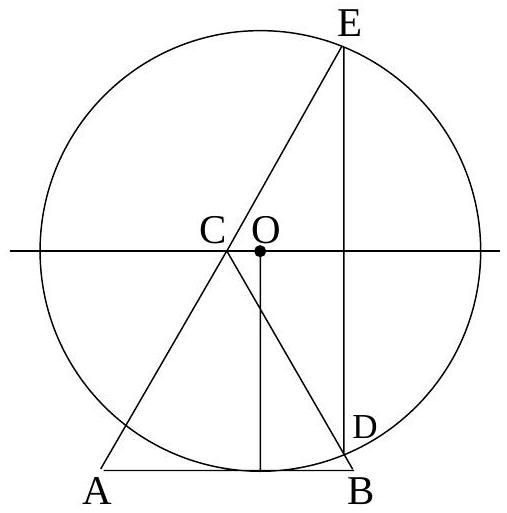
|
| 64 |
+
|
| 65 |
+
Therefore $\triangle C E D$ is an isosceles.
|
| 66 |
+
|
| 67 |
+
Therefore $\angle C E D=\angle C D E$ and $\angle C E D+\angle C D E=\angle A C B=60^{\circ}$.
|
| 68 |
+
|
| 69 |
+
$\angle C E D=30^{\circ}$ regardless of the position of centre 0 . Since $\angle C E D$ is also the angle subtended from the arc inside the triangle, if $C E D$ is constant, the arc length is also constant.
|
| 70 |
+
|
| 71 |
+
Editor's Note: This proof has had no editing.
|
| 72 |
+
|
| 73 |
+
Solution 2 to Problem 2 - Jimmy Chui, Earl Haig S.S., North York, ON
|
| 74 |
+
|
| 75 |
+
Place $C$ at the origin, point $A$ at $\left(\frac{1}{\sqrt{3}}, 1\right)$ and point $B$ at $\left(-\frac{1}{\sqrt{3}}, 1\right)$. Then $\triangle A B C$ is equilateral with altitude of length 1 .
|
| 76 |
+
|
| 77 |
+
Let $O$ be the center of the circle. Because the circle has radius 1 , and since it touches line $A B$, the locus of $O$ is on the line through $C$ parallel to $A B$ (since $C$ is length 1 away from $A B$ ), i.e., the locus of $O$ is on the $x$-axis.
|
| 78 |
+
|
| 79 |
+
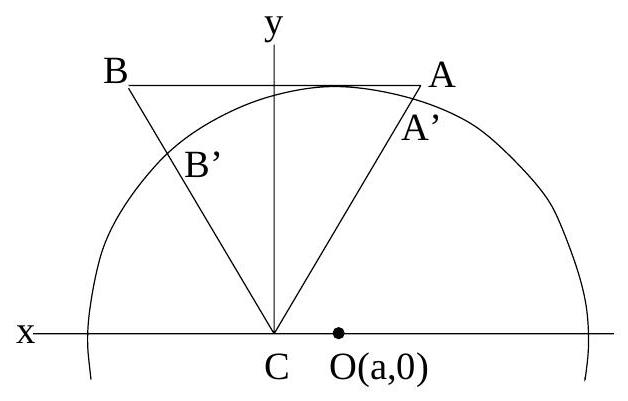
|
| 80 |
+
|
| 81 |
+
Let point $O$ be at $(a, 0)$. Then $-\frac{1}{\sqrt{3}} \leq a \leq \frac{1}{\sqrt{3}}$ since we have the restriction that the circle rolls along $A B$.
|
| 82 |
+
|
| 83 |
+
Now, let $A^{\prime}$ and $B^{\prime}$ be the intersection of the circle with $C A$ and $C B$ respectively. The equation of $C A$ is $y=\sqrt{3} x, 0 \leq x \leq \frac{1}{\sqrt{3}}$, of $C B$ is $y=-\sqrt{3} x,-\frac{1}{\sqrt{3}} \leq x \leq 0$, and of the circle is $(x-a)^{2}+y^{2}=1$.
|
| 84 |
+
|
| 85 |
+
We solve for $A^{\prime}$ by substituting $y=\sqrt{3} x$ into $(x-a)^{2}+y^{2}=1$ to get $x=\frac{a \pm \sqrt{4-3 a^{2}}}{4}$.
|
| 86 |
+
|
| 87 |
+
Visually, we can see that solutions represent the intersection of $A C$ extended and the circle, but we are only concerned with the greater $x$-value - this is the solution that is on $A C$, not on $A C$ extended. Therefore
|
| 88 |
+
|
| 89 |
+
$$
|
| 90 |
+
x=\frac{a+\sqrt{4-3 a^{2}}}{4}, \quad y=\sqrt{3}\left(\frac{a+\sqrt{4-3 a^{2}}}{4}\right) .
|
| 91 |
+
$$
|
| 92 |
+
|
| 93 |
+
Likewise we solve for $B^{\prime}$, but we take the lesser $x$-value to get
|
| 94 |
+
|
| 95 |
+
$$
|
| 96 |
+
x=\frac{a-\sqrt{4-3 a^{2}}}{4}, \quad y=-\sqrt{3}\left(\frac{a+\sqrt{4-3 a^{2}}}{4}\right) .
|
| 97 |
+
$$
|
| 98 |
+
|
| 99 |
+
Let us find the length of $A^{\prime} B^{\prime}$ :
|
| 100 |
+
|
| 101 |
+
$$
|
| 102 |
+
\begin{aligned}
|
| 103 |
+
\left|A^{\prime} B^{\prime}\right|^{2} & =\left(\frac{a+\sqrt{4-3 a^{2}}}{4}-\frac{a-\sqrt{4-3 a^{2}}}{4}\right)^{2}+\left(\left(\sqrt{3} \frac{a+\sqrt{4-3 a^{2}}}{4}\right)-\left(-\sqrt{3} \frac{a-\sqrt{4-3 a^{2}}}{4}\right)\right)^{2} \\
|
| 104 |
+
& =\frac{4-3 a^{2}}{4}+3 \frac{a^{2}}{4} \\
|
| 105 |
+
& =1
|
| 106 |
+
\end{aligned}
|
| 107 |
+
$$
|
| 108 |
+
|
| 109 |
+
which is independent of $a$.
|
| 110 |
+
|
| 111 |
+
Consider the points $0, A^{\prime}$ and $B^{\prime} . \triangle 0 A^{\prime} B^{\prime}$ is an equilateral triangle (because $A^{\prime} B^{\prime}=0 A^{\prime}=0 B^{\prime}=1$ ).
|
| 112 |
+
|
| 113 |
+
Therefore $\angle A^{\prime} 0 B^{\prime}=\frac{\pi}{3}$ and $\operatorname{arc} A^{\prime} B^{\prime}=\frac{\pi}{3}$, a constant.
|
| 114 |
+
|
| 115 |
+
Solution to Problem 3 - Masoud Kamgarpour, Carson S.S., North Vancouver, BC
|
| 116 |
+
|
| 117 |
+
Note that $n=1$ is a solution. For $n>1$ write $n$ in the form $n=P_{1}^{\alpha_{1}} P_{2}^{\alpha_{2}} \ldots P_{m}^{\alpha_{m}}$ where the $P_{i}$ 's, $1 \leq i \leq m$, are distinct prime numbers and $\alpha_{i}>0$. Since $d(n)$ is an integer, $n$ is a perfect square, so $\alpha_{i}=2 \beta_{i}$ for integers $\beta_{i}>0$.
|
| 118 |
+
|
| 119 |
+
Using the formula for the number of divisors of $n$,
|
| 120 |
+
|
| 121 |
+
$$
|
| 122 |
+
d(n)=\left(2 \beta_{1}+1\right)\left(2 \beta_{2}+1\right) \ldots\left(2 \beta_{m}+1\right)
|
| 123 |
+
$$
|
| 124 |
+
|
| 125 |
+
which is an odd number. Now because $d(n)$ is odd, $(d(n))^{2}$ is odd, therefore $n$ is odd as well, so $P_{i} \geq 3,1 \leq i \leq m$. We get
|
| 126 |
+
|
| 127 |
+
$$
|
| 128 |
+
P_{1}^{\alpha_{1}} \cdot P_{2}^{\alpha_{2}} \ldots P_{m}^{\alpha_{m}}=\left[\left(\alpha_{1}+1\right)\left(\alpha_{2}+1\right) \ldots\left(\alpha_{m}+1\right)\right]^{2}
|
| 129 |
+
$$
|
| 130 |
+
|
| 131 |
+
or using $\alpha_{i}=2 \beta_{i}$
|
| 132 |
+
|
| 133 |
+
$$
|
| 134 |
+
P_{1}^{\beta_{1}} P_{2}^{\beta_{2}} \ldots P_{m}^{\beta_{m}}=\left(2 \beta_{1}+1\right)\left(2 \beta_{2}+1\right) \ldots\left(2 \beta_{m}+1\right)
|
| 135 |
+
$$
|
| 136 |
+
|
| 137 |
+
Now we prove a lemma:
|
| 138 |
+
|
| 139 |
+
Lemma: $P^{t} \geq 2 t+1$ for positive integers $t$ and $P \geq 3$, with equality only when $\mathrm{P}=3$ and $\mathrm{t}=1$.
|
| 140 |
+
|
| 141 |
+
Proof: We use mathematical induction on $t$. The statement is true for $t=1$ because $P \geq 3$. Now suppose $P^{k} \geq 2 k+1, k \geq 1$; then we have
|
| 142 |
+
|
| 143 |
+
$$
|
| 144 |
+
P^{k+1}=P^{k} \cdot P \geq P^{k}(1+2)>P^{k}+2 \geq(2 k+1)+2=2(k+1)+1
|
| 145 |
+
$$
|
| 146 |
+
|
| 147 |
+
Thus $P^{t} \geq 2 t+1$ and equality occurs only when $P=3$ and $t=1$.
|
| 148 |
+
|
| 149 |
+
Let's say $n$ has a prime factor $P_{k}>3$; then (by the lemma) $P_{k}^{\beta_{k}}>2 \beta_{k}+1$ and we have $P_{1}^{\beta_{1}} \ldots P_{m}^{\beta_{m}}>$ $\left(2 \beta_{1}+1\right) \ldots\left(2 \beta_{m}+1\right)$, a contradiction.
|
| 150 |
+
|
| 151 |
+
Therefore, the only prime factor of $n$ is $P=3$ and we have $3^{\alpha}=2 \alpha+1$. By the lemma $\alpha=1$.
|
| 152 |
+
|
| 153 |
+
The only positive integer solutions are 1 and 9 .
|
| 154 |
+
|
| 155 |
+
## Solution 1 to Problem 4 - David Nicholson, Fenelon Falls S.S., Fenelon Falls, ON
|
| 156 |
+
|
| 157 |
+
Without loss of generality let $a_{1}<a_{2}<a_{3} \ldots<a_{8}$.
|
| 158 |
+
|
| 159 |
+
Assume that there is no such integer $k$. Let's just look at the seven differences $d_{i}=a_{i+1}-a_{i}$. Then amongst the $d_{i}$ there can be at most two $1 \mathrm{~s}$, two $2 \mathrm{~s}$, and two $3 \mathrm{~s}$, which totals to 12 .
|
| 160 |
+
|
| 161 |
+
Now $16=17-1 \geq a_{8}-a_{1}=d_{1}+d_{2}+\ldots+d_{7}$ so the seven differences must be $1,1,2,2,3,3,4$.
|
| 162 |
+
|
| 163 |
+
Now let's think of arranging the differences $1,1,2,2,3,3,4$. Note that the sum of consecutive differences is another difference. ( $\operatorname{Eg} d_{1}+d_{2}=a_{3}-a_{1}, d_{1}+d_{2}+d_{3}=a_{4}-a_{1}$ )
|
| 164 |
+
|
| 165 |
+
We can't place the two 1 s side by side because that will give us another difference of 2 . The $1 \mathrm{~s}$ can't be beside a 2 because then we have three 3s. They can't both be beside a 3 because then we have three $4 \mathrm{~s}$ ! So we must have either $1,4,-,-,-, 3,1$ or $1,4,1,3,-,-,-$ (or their reflections).
|
| 166 |
+
|
| 167 |
+
In either case we have a 3,1 giving a difference of 4 so we can't put the $2 \mathrm{~s}$ beside each other. Also we can't have 2,3,2 because then (with the 1,4) we will have three 5 s. So all cases give a contradiction. Therefore there will always be three differences equal.
|
| 168 |
+
|
| 169 |
+
A set of seven numbers satisfying the criteria are $\{1,2,4,7,11,16,17\}$. (Editor: There are many such sets)
|
| 170 |
+
|
| 171 |
+
## Solution 2 to Problem 4 - The CMO committee
|
| 172 |
+
|
| 173 |
+
Consider all the consecutive differences (ie, $d_{i}$ above) as well as the differences $b_{i}=a_{i+2}-a_{i}$, $i=$ $1 \ldots 6$. Then the sum of these thirteen differences is $2 \cdot\left(a_{8}-a_{1}\right)+\left(a_{7}-a_{2}\right) \leq 2(17-1)+(16-2)=46$. Now if no difference occurs more than twice, the smallest the sum of the thirteen differences can be is $2 \cdot(1+2+3+4+5+6)+7=49$, giving a contradiction.
|
| 174 |
+
|
| 175 |
+
## Solution 1 to Problem 5 - The CMO committee
|
| 176 |
+
|
| 177 |
+
Let $f(x, y, z)=x^{2} y+y^{2} z+z^{2} x$. We wish to determine where $f$ is maximal. Since $f$ is cyclic, without loss of generality we may assume that $x \geq y, z$. Since
|
| 178 |
+
|
| 179 |
+
$$
|
| 180 |
+
\begin{aligned}
|
| 181 |
+
f(x, y, z)-f(x, z, y) & =x^{2} y+y^{2} z+z^{2} x-x^{2} z-z^{2} y-y^{2} x \\
|
| 182 |
+
& =(y-z)(x-y)(x-z),
|
| 183 |
+
\end{aligned}
|
| 184 |
+
$$
|
| 185 |
+
|
| 186 |
+
we may also assume $y \geq z$. Then
|
| 187 |
+
|
| 188 |
+
$$
|
| 189 |
+
\begin{aligned}
|
| 190 |
+
f(x+z, y, 0)-f(x, y, z) & =(x+z)^{2} y-x^{2} y-y^{2} z-z^{2} x \\
|
| 191 |
+
& =z^{2} y+y z(x-y)+x z(y-z) \geq 0
|
| 192 |
+
\end{aligned}
|
| 193 |
+
$$
|
| 194 |
+
|
| 195 |
+
so we may now assume $z=0$. The rest follows from the arithmetic-geometric mean inequality:
|
| 196 |
+
|
| 197 |
+
$$
|
| 198 |
+
f(x, y, 0)=\frac{2 x^{2} y}{2} \leq \frac{1}{2}\left(\frac{x+x+2 y}{3}\right)^{3}=\frac{4}{27}
|
| 199 |
+
$$
|
| 200 |
+
|
| 201 |
+
Equality occurs when $x=2 y$, hence at $(x, y, z)=\left(\frac{2}{3}, \frac{1}{3}, 0\right)$. (As well as $\left(0, \frac{2}{3}, \frac{1}{3}\right)$ and $\left(\frac{1}{3}, 0, \frac{2}{3}\right)$.
|
| 202 |
+
|
| 203 |
+
## Solution 2 to Problem 5 - The CMO committee
|
| 204 |
+
|
| 205 |
+
With $\mathrm{f}$ as above, and $x \geq y, z$
|
| 206 |
+
|
| 207 |
+
$$
|
| 208 |
+
f\left(x+\frac{z}{2}, y+\frac{z}{2}, 0\right)-f(x, y, z)=y z(x-y)+\frac{x z}{2}(x-z)+\frac{z^{2} y}{4}+\frac{z^{3}}{8}
|
| 209 |
+
$$
|
| 210 |
+
|
| 211 |
+
so we may assume that $z=0$. The rest follows as for solution 1 .
|
| 212 |
+
|
| 213 |
+
## GRADERS' REPORT
|
| 214 |
+
|
| 215 |
+
Each question was worth a maximum of 7 marks. Every solution on every paper was graded by two different markers. If the two marks differed by more than one point, the solution was reconsidered until the difference resolved. If the two marks differed by one point, the average was used in computing the total score.
|
| 216 |
+
|
| 217 |
+
The various grades assigned to each solution are displayed below, as a percentage.
|
| 218 |
+
|
| 219 |
+
| MARKS | $\# 1$ | $\# 2$ | $\# 3$ | $\# 4$ | $\# 5$ |
|
| 220 |
+
| :---: | ---: | ---: | ---: | ---: | ---: |
|
| 221 |
+
| 0 | 7.6 | 45.6 | 18.4 | 38.6 | 51.3 |
|
| 222 |
+
| 1 | 13.9 | 15.8 | 43.0 | 0.0 | 32.3 |
|
| 223 |
+
| 2 | 12.0 | 12.7 | 15.2 | 41.8 | 13.9 |
|
| 224 |
+
| 3 | 5.7 | 2.5 | 5.1 | 7.6 | 2.5 |
|
| 225 |
+
| 4 | 4.4 | 1.3 | 8.9 | 4.4 | 0.0 |
|
| 226 |
+
| 5 | 8.9 | 2.5 | 3.2 | 5.7 | 1.3 |
|
| 227 |
+
| 6 | 8.9 | 0.0 | 1.3 | 1.9 | 0.0 |
|
| 228 |
+
| 7 | 39.9 | 20.9 | 6.3 | 1.3 | 0.0 |
|
| 229 |
+
|
| 230 |
+
PROBLEM 1 The aim of the question was to give the competitors an encouraging start (it was not a give away!). Over half of the students had good scores of 5,6 or 7 .
|
| 231 |
+
|
| 232 |
+
The general approach was to find bounds for $x$ and then to find the exact value for $x$ by substituting in the resulting possible values of $[x]$. Depending on how the bounds were determined, this meant checking 6 - 10 different cases.
|
| 233 |
+
|
| 234 |
+
Points were lost for not adequately verifying the bounds on $x$. For example, 2 points were deducted for assuming, without proof, that $4 x^{2}+51>40[x]$ for $x \geq 9$.
|
| 235 |
+
|
| 236 |
+
PROBLEM 2 Many competitors saw that the key here is to prove that the angle subtended by the arc at its centre is constant, namely $\pi / 3$. In all, 16 students managed a complete proof. Most attempted an analytic solution - indeed, the problem is nearly routine if one chooses coordinates wisely and later on notes that two such x-coordinates are roots of the same quadratic. A few students used trigonometry, namely the law of sines on a couple of useful triangles. Two students found essentially the same synthetic solution, which is very elegant.
|
| 237 |
+
|
| 238 |
+
PROBLEM 3 Most competitors determined by direct calculation that $n=1$ and $n=9$ are solutions. The difficulty was to show that these are the only solutions, which boils down to proving that $p^{k} \geq 2 k+1$ for all primes $p>2$ and all $k>0$ with equality only for $k=1$ and $p=3$. This can be done by induction or by calculus. Only 5 students obtained perfect marks.
|
| 239 |
+
|
| 240 |
+
## PROBLEM 4
|
| 241 |
+
|
| 242 |
+
Many students found a specific set of seven integers such that the equation did not have three different solutions. This earned two points. (One student found such a set with maximum value 14. A maximum value of 13 is not possible.)
|
| 243 |
+
|
| 244 |
+
Only eight competitors received high marks on the question $(5,6$, or 7 ), and only one student scored a perfect 7. All of the successful solvers considered differences of consecutive integers, showing that they must be $1,1,2,2,3,3$, and 4 , and then showed that every ordering of these differences led to at least three repetitions of the same value. Most competitors recognized that the $1 \mathrm{~s}$ could not be together, nor could they be beside a 2 . They then proceed by considering all such possible arrangements, which often resulted in close to a dozen cases (depending on how the the cases were handled.) David Nicholson was the most efficient at pruning the cases. (See Solution 1 to Problem 4.) Most students failed to consider one or two (easily dismissed) cases, hence lost 1 or 2 points.
|
| 245 |
+
|
| 246 |
+
A number of the contestants attempted to solve the problem by examining the odd-even character of the set of eight integers, counting how many of the differences were odd or even, and using the pigeon-hole principle. Although this approach looked promising, no one was able to handle the case that 3 of the integers were of one parity, and 5 were of the other parity.
|
| 247 |
+
|
| 248 |
+
PROBLEM 5 No students received full marks for this problem. One student received 5 marks for a proof that had minor errors. This proof was by Calculus. The committee was aware that the problem could be solved using Calculus but (erroneously) thought it unlikely high school students would attempt such a solution. Many students received 1 point for "guessing" that $\left(\frac{2}{3}, \frac{1}{3}, 0\right),\left(0, \frac{2}{3}, \frac{1}{3}\right)$ and $\left(\frac{1}{3}, 0, \frac{2}{3}\right)$ are where equality occurred. Some students received a further point for verifying the inequality on the boundary of the region.
|
| 249 |
+
|
CANADA_MO/md/en-sol2000.md
ADDED
|
@@ -0,0 +1,129 @@
|
|
|
|
|
|
|
|
|
|
|
|
|
|
|
|
|
|
|
|
|
|
|
|
|
|
|
|
|
|
|
|
|
|
|
|
|
|
|
|
|
|
|
|
|
|
|
|
|
|
|
|
|
|
|
|
|
|
|
|
|
|
|
|
|
|
|
|
|
|
|
|
|
|
|
|
|
|
|
|
|
|
|
|
|
|
|
|
|
|
|
|
|
|
|
|
|
|
|
|
|
|
|
|
|
|
|
|
|
|
|
|
|
|
|
|
|
|
|
|
|
|
|
|
|
|
|
|
|
|
|
|
|
|
|
|
|
|
|
|
|
|
|
|
|
|
|
|
|
|
|
|
|
|
|
|
|
|
|
|
|
|
|
|
|
|
|
|
|
|
|
|
|
|
|
|
|
|
|
|
|
|
|
|
|
|
|
|
|
|
|
|
|
|
|
|
|
|
|
|
|
|
|
|
|
|
|
|
|
|
|
|
|
|
|
|
|
|
|
|
|
|
|
|
|
|
|
|
|
|
|
|
|
|
|
|
|
|
|
|
|
|
|
|
|
|
|
|
|
|
|
|
|
|
|
|
|
|
|
|
|
|
|
|
|
|
|
|
|
|
|
|
|
|
|
|
|
|
|
|
|
|
|
|
|
|
|
|
|
|
|
|
|
|
|
|
|
|
|
|
|
|
|
|
|
|
|
|
|
|
|
|
|
|
|
|
|
|
|
|
|
|
|
|
|
|
|
|
|
|
|
|
|
|
|
|
|
|
|
|
|
|
|
|
|
|
|
|
|
|
|
|
|
|
|
|
|
|
|
|
|
|
|
|
|
|
|
|
|
|
|
|
|
|
|
|
|
|
|
|
|
|
|
|
|
|
|
|
|
|
|
| 1 |
+
# 2000 Canadian Mathematics Olympiad Solutions <br> Chair: Luis Goddyn, Simon Fraser University, goddyn@math.sfu.ca
|
| 2 |
+
|
| 3 |
+
The Year 2000 Canadian Mathematics Olympiad was written on Wednesday April 2, by 98 high school students across Canada. A correct and well presented solution to any of the five questions was awarded seven points. This year's exam was a somewhat harder than usual, with the mean score being 8.37 out of 35 . The top few scores were: 30, 28, 27, 22, 20, 20, 20. The first, second and third prizes are awarded to: Daniel Brox (Sentinel Secondary BC), David Arthur (Upper Canada College ON), and David Pritchard (Woburn Collegiate Institute ON).
|
| 4 |
+
|
| 5 |
+
1. At 12:00 noon, Anne, Beth and Carmen begin running laps around a circular track of length three hundred meters, all starting from the same point on the track. Each jogger maintains a constant speed in one of the two possible directions for an indefinite period of time. Show that if Anne's speed is different from the other two speeds, then at some later time Anne will be at least one hundred meters from each of the other runners. (Here, distance is measured along the shorter of the two arcs separating two runners.)
|
| 6 |
+
|
| 7 |
+
Comment: We were surprised by the difficulty of this question, having awarded an average grade of 1.43 out of 7 . We present two solutions; only the first appeared among the graded papers.
|
| 8 |
+
|
| 9 |
+
Solution 1: By rotating the frame of reference we may assume that Anne has speed zero, that Beth runs at least as fast as Carmen, and that Carmen's speed is positive. If Beth is no more than twice as fast as Carmen, then both are at least 100 meters from Anne when Carmen has run 100 meters. If Beth runs more that twice as fast as Carmen, then Beth runs a stretch of more than 200 meters during the time Carmen runs between 100 and 200 meters. Some part of this stretch lies more than 100 meters from Anne, at which time both Beth and Carmen are at least (in fact, more than) 100 meters away from Anne.
|
| 10 |
+
|
| 11 |
+
Solution 2: By rotating the frame of reference we may assume Anne's speed to equal zero, and that the other two runners have non-zero speed. We may assume that Beth is running at least as fast as Carmen. Suppose that it takes $t$ seconds for Beth to run 200 meters. Then at all times in the infinite set $T=\{t, 2 t, 4 t, 8 t, \ldots\}$, Beth is exactly 100 meters from Anne. At time $t$, Carmen has traveled exactly $d$ meters where $0<d \leq 200$. Let $k$ be the least integer such that $2^{k} d \geq 100$. Then $k \geq 0$ and $100 \leq 2^{k} d \leq 200$, so at time $2^{k} t \in T$ both Beth and Carmen are at least 100 meters from Anne.
|
| 12 |
+
|
| 13 |
+
2. A permutation of the integers $1901,1902, \ldots, 2000$ is a sequence $a_{1}, a_{2}, \ldots, a_{100}$ in which each of those integers appears exactly once. Given such a permutation, we form the sequence of partial sums
|
| 14 |
+
|
| 15 |
+
$$
|
| 16 |
+
s_{1}=a_{1}, \quad s_{2}=a_{1}+a_{2}, s_{3}=a_{1}+a_{2}+a_{3}, \ldots, s_{100}=a_{1}+a_{2}+\cdots+a_{100} .
|
| 17 |
+
$$
|
| 18 |
+
|
| 19 |
+
How many of these permutations will have no terms of the sequence $s_{1}, \ldots, s_{100}$ divisible by three?
|
| 20 |
+
|
| 21 |
+
Comment: This question was the easiest and most straight forward, with an average grade of 3.07.
|
| 22 |
+
|
| 23 |
+
Solution: Let $\{1901,1902, \ldots, 2000\}=R_{0} \cup R_{1} \cup R_{2}$ where each integer in $R_{i}$ is congruent to $i$ modulo 3. We note that $\left|R_{0}\right|=\left|R_{1}\right|=33$ and $\left|R_{2}\right|=34$. Each permutation $S=$ $\left(a_{1}, a_{2}, \ldots, a_{100}\right)$ can be uniquely specified by describing a sequence $S^{\prime}=\left(a_{1}^{\prime}, a_{2}^{\prime}, \ldots, a_{100}^{\prime}\right)$ of
|
| 24 |
+
residues modulo 3 (containing exactly 33 zeros, 33 ones and 34 twos), and three permutations (one each of $R_{0}, R_{1}$, and $R_{2}$ ). Note that the number of permutations of $R_{i}$ is exactly $\left|R_{i}\right| !=$ $1 \cdot 2 \cdots\left|R_{i}\right|$.
|
| 25 |
+
|
| 26 |
+
The condition on the partial sums of $S$ depends only on the sequence of residues $S^{\prime}$. In order to avoid a partial sum divisible by three, the subsequence formed by the 67 ones and twos in $S^{\prime}$ must equal either $1,1,2,1,2, \ldots, 1,2$ or $2,2,1,2,1, \ldots, 2,1$. Since $\left|R_{2}\right|=\left|R_{1}\right|+1$, only the second pattern is possible. The 33 zero entries in $S^{\prime}$ may appear anywhere among $a_{1}^{\prime}, a_{2}^{\prime}, \ldots, a_{100}^{\prime}$ provided that $a_{1}^{\prime} \neq 0$. There are $\left(\begin{array}{l}99 \\ 33\end{array}\right)=\frac{99 !}{33 ! 66 !}$ ways to choose which entries in $S^{\prime}$ equal zero. Thus there are exactly $\left(\begin{array}{c}99 \\ 33\end{array}\right)$ sequences $S^{\prime}$ whose partial sums are not divisible by three. Therefore the total number of permutations $S$ satisfying this requirement is exactly
|
| 27 |
+
|
| 28 |
+
$$
|
| 29 |
+
\left(\begin{array}{c}
|
| 30 |
+
99 \\
|
| 31 |
+
33
|
| 32 |
+
\end{array}\right) \cdot 33 ! \cdot 33 ! \cdot 34 !=\frac{99 ! \cdot 33 ! \cdot 34 !}{66 !} .
|
| 33 |
+
$$
|
| 34 |
+
|
| 35 |
+
Incidently, this number equals approximately $4.4 \cdot 10^{138}$.
|
| 36 |
+
|
| 37 |
+
3. Let $A=\left(a_{1}, a_{2}, \ldots, a_{2000}\right)$ be a sequence of integers each lying in the interval $[-1000,1000]$. Suppose that the entries in A sum to 1. Show that some nonempty subsequence of $A$ sums to zero.
|
| 38 |
+
|
| 39 |
+
Comment: This students found this question to be the most difficult, with an average grade of 0.51 , and only one perfect solution among 100 papers.
|
| 40 |
+
|
| 41 |
+
Solution: We may assume no entry of $A$ is zero, for otherwise we are done. We sort $A$ into a new list $B=\left(b_{1}, \ldots, b_{2000}\right)$ by selecting elements from $A$ one at a time in such a way that $b_{1}>0, b_{2}<0$ and, for each $i=2,3, \ldots, 2000$, the sign of $b_{i}$ is opposite to that of the partial sum
|
| 42 |
+
|
| 43 |
+
$$
|
| 44 |
+
s_{i-1}=b_{1}+b_{2}+\cdots+b_{i-1} .
|
| 45 |
+
$$
|
| 46 |
+
|
| 47 |
+
(We can assume that each $s_{i-i} \neq 0$ for otherwise we are done.) At each step of the selection process a candidate for $b_{i}$ is guaranteed to exist, since the condition $a_{1}+a_{2}+\cdots+a_{2000}=1$ implies that the sum of unselected entries in $A$ is either zero or has sign opposite to $s_{i-1}$.
|
| 48 |
+
|
| 49 |
+
From the way they were defined, each of $s_{1}, s_{2}, \ldots, s_{2000}$ is one of the 1999 nonzero integers in the interval $[-999,1000]$. By the Pigeon Hole Principle, $s_{j}=s_{k}$ for some $j, k$ satisfying $1 \leq j<k \leq 2000$. Thus $b_{j+1}+b_{j+2}+\cdots+b_{k}=0$ and we are done.
|
| 50 |
+
|
| 51 |
+
4. Let $A B C D$ be a convex quadrilateral with
|
| 52 |
+
|
| 53 |
+
$$
|
| 54 |
+
\begin{aligned}
|
| 55 |
+
\angle C B D & =2 \angle A D B, \\
|
| 56 |
+
\angle A B D & =2 \angle C D B \\
|
| 57 |
+
\text { and } \quad A B & =C B .
|
| 58 |
+
\end{aligned}
|
| 59 |
+
$$
|
| 60 |
+
|
| 61 |
+
Prove that $A D=C D$.
|
| 62 |
+
|
| 63 |
+
Comment: There are several different solutions to this, including some using purely trigonometric arguments (involving the law of sines and standard angle sum formulas). We present here two prettier geometric arguments (with diagrams). The first solution is perhaps the more attractive of the two. Average grade: 1.84 out of 7.
|
| 64 |
+
|
| 65 |
+
Solution 1 (from contestant Keon Choi): Extend DB to a point $P$ on the circle through $A$ and $C$ centered at $B$. Then $\angle C P D=\frac{1}{2} \angle C B D=\angle A D B$ and $\angle A P D=\frac{1}{2} \angle A B D=\angle C D B$,
|
| 66 |
+
so APCD is a parallelogram. Now PD bisects $A C$ so $B D$ is an angle bisector of isosceles triangle $A B C$. We have
|
| 67 |
+
|
| 68 |
+
$$
|
| 69 |
+
\angle A D B=\frac{1}{2} \angle C B D=\frac{1}{2} \angle A B D=\angle C D B
|
| 70 |
+
$$
|
| 71 |
+
|
| 72 |
+
so $D B$ is the angle bisector of $\angle A D C$. As $D B$ bisects the base of triangle $A D C$, this triangle must be isosceles and $A D=C D$.
|
| 73 |
+
|
| 74 |
+
Solution 2: Let the bisector of $\angle A B D$ meet $A D$ at $E$. Let the bisector of $\angle C B D$ meet $C D$ at $F$. Then $\angle F B D=\angle B D E$ and $\angle E B D=\angle B D F$, which imply $B E \| F D$ and $B F \| E D$. Thus $B E D F$ is a parallelogram whence
|
| 75 |
+
|
| 76 |
+
$$
|
| 77 |
+
B D \text { intersects } E F \text { at its midpoint } M \text {. }
|
| 78 |
+
$$
|
| 79 |
+
|
| 80 |
+
On the other hand since $B E$ is an angle bisector, we have $\frac{A B}{B D}=\frac{A E}{E D}$. Similarly we have $\frac{C B}{B D}=\frac{C F}{F D}$. By assumption $A B=C B$ so $\frac{A E}{E D}=\frac{C F}{F D}$ which implies $E F \| A C$. Thus $\triangle D E F$ and $\triangle D A C$ are similar, which implies by (1) that $B D$ intersects $A C$ at its midpoint $N$. Since $\triangle A B C$ is isosceles, this implies $A C \perp B D$. Thus $\triangle N A D$ and $\triangle N C D$ are right triangles with equal legs and hence are congruent. Thus $A D=C D$.
|
| 81 |
+
|
| 82 |
+
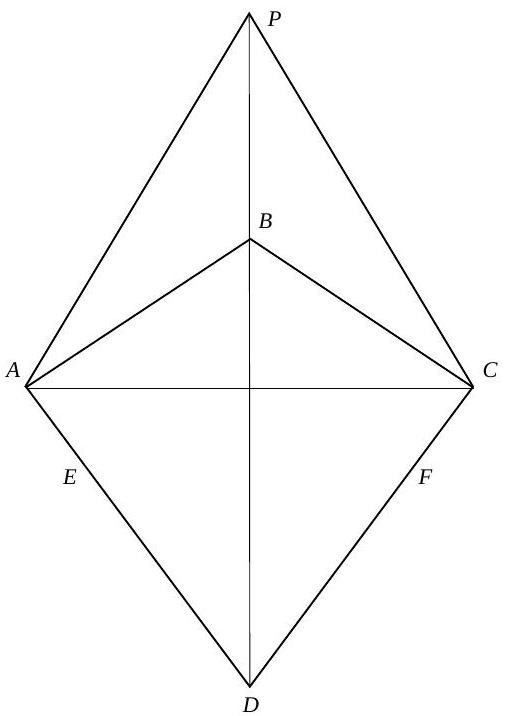
|
| 83 |
+
|
| 84 |
+
Diagram for Solution 1
|
| 85 |
+
|
| 86 |
+
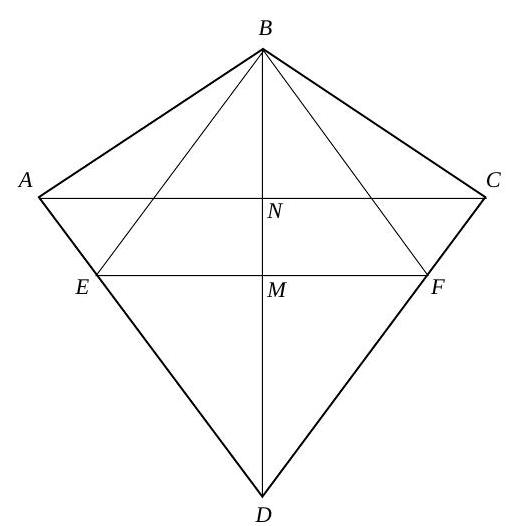
|
| 87 |
+
|
| 88 |
+
Diagram for Solution 2
|
| 89 |
+
|
| 90 |
+
5. Suppose that the real numbers $a_{1}, a_{2}, \ldots, a_{100}$ satisfy
|
| 91 |
+
|
| 92 |
+
$$
|
| 93 |
+
\begin{gathered}
|
| 94 |
+
a_{1} \geq a_{2} \geq \cdots \geq a_{100} \geq 0 \\
|
| 95 |
+
a_{1}+a_{2} \leq 100 \\
|
| 96 |
+
a_{3}+a_{4}+\cdots+a_{100} \leq 100
|
| 97 |
+
\end{gathered}
|
| 98 |
+
$$
|
| 99 |
+
|
| 100 |
+
Determine the maximum possible value of $a_{1}^{2}+a_{2}^{2}+\cdots+a_{100}^{2}$, and find all possible sequences $a_{1}, a_{2}, \ldots, a_{100}$ which achieve this maximum.
|
| 101 |
+
|
| 102 |
+
Comment: All of the correct solutions involved a sequence of adjustments to the variables, each of which increase $a_{1}^{2}+a_{2}^{2}+\cdots+a_{100}^{2}$ while satisfying the constraints, eventually arriving at the two optimal sequences: $100,0,0, \ldots, 0$ and $50,50,50,50,0,0, \ldots, 0$. We present here $a$ sharper proof, which might be arrived at after guessing that the optimal value is $100^{2}$. Average grade: 1.52 out of 7 .
|
| 103 |
+
|
| 104 |
+
Solution: We have $a_{1}+a_{2}+\cdots+a_{100} \leq 200$, so
|
| 105 |
+
|
| 106 |
+
$$
|
| 107 |
+
\begin{aligned}
|
| 108 |
+
a_{1}^{2}+a_{2}^{2}+\cdots+a_{100}^{2} & \leq\left(100-a_{2}\right)^{2}+a_{2}^{2}+a_{3}^{2}+\cdots+a_{100}^{2} \\
|
| 109 |
+
& =100^{2}-200 a_{2}+2 a_{2}^{2}+a_{3}^{2}+\cdots+a_{100}^{2} \\
|
| 110 |
+
& \leq 100^{2}-\left(a_{1}+a_{2}+\cdots+a_{100}\right) a_{2}+2 a_{2}^{2}+a_{3}^{2}+\cdots+a_{100}^{2} \\
|
| 111 |
+
& =100^{2}+\left(a_{2}^{2}-a_{1} a_{2}\right)+\left(a_{3}^{2}-a_{3} a_{2}\right)+\left(a_{4}^{2}-a_{4} a_{2}\right)+\cdots+\left(a_{100}^{2}-a_{100} a_{2}\right) \\
|
| 112 |
+
& =100^{2}+\left(a_{2}-a_{1}\right) a_{2}+\left(a_{3}-a_{2}\right) a_{3}+\left(a_{4}-a_{2}\right) a_{4}+\cdots+\left(a_{100}-a_{2}\right) a_{100}
|
| 113 |
+
\end{aligned}
|
| 114 |
+
$$
|
| 115 |
+
|
| 116 |
+
Since $a_{1} \geq a_{2} \geq \cdots \geq a_{100} \geq 0$, none of the terms $\left(a_{i}-a_{j}\right) a_{i}$ is positive. Thus $a_{1}^{2}+a_{2}^{2}+\cdots+$ $a_{100}^{2} \leq 10,000$ with equality holding if and only if
|
| 117 |
+
|
| 118 |
+
$$
|
| 119 |
+
a_{1}=100-a_{2} \quad \text { and } \quad a_{1}+a_{2}+\cdots+a_{100}=200
|
| 120 |
+
$$
|
| 121 |
+
|
| 122 |
+
and each of the products
|
| 123 |
+
|
| 124 |
+
$$
|
| 125 |
+
\left(a_{2}-a_{1}\right) a_{2}, \quad\left(a_{3}-a_{2}\right) a_{3}, \quad\left(a_{4}-a_{2}\right) a_{4}, \cdots,\left(a_{100}-a_{2}\right) a_{100}
|
| 126 |
+
$$
|
| 127 |
+
|
| 128 |
+
equals zero. Since $a_{1} \geq a_{2} \geq a_{3} \geq \cdots \geq a_{100} \geq 0$, the last condition holds if and only if for some $i \geq 1$ we have $a_{1}=a_{2}=\cdots=a_{i}$ and $a_{i+1}=\cdots=a_{100}=0$. If $i=1$, then we get the solution 100,0,0,.,0. If $i \geq 2$, then from $a_{1}+a_{2}=100$, we get that $i=4$ and the second optimal solution $50,50,50,50,0,0, \ldots, 0$.
|
| 129 |
+
|
CANADA_MO/md/en-sol2001.md
ADDED
|
@@ -0,0 +1,233 @@
|
|
|
|
|
|
|
|
|
|
|
|
|
|
|
|
|
|
|
|
|
|
|
|
|
|
|
|
|
|
|
|
|
|
|
|
|
|
|
|
|
|
|
|
|
|
|
|
|
|
|
|
|
|
|
|
|
|
|
|
|
|
|
|
|
|
|
|
|
|
|
|
|
|
|
|
|
|
|
|
|
|
|
|
|
|
|
|
|
|
|
|
|
|
|
|
|
|
|
|
|
|
|
|
|
|
|
|
|
|
|
|
|
|
|
|
|
|
|
|
|
|
|
|
|
|
|
|
|
|
|
|
|
|
|
|
|
|
|
|
|
|
|
|
|
|
|
|
|
|
|
|
|
|
|
|
|
|
|
|
|
|
|
|
|
|
|
|
|
|
|
|
|
|
|
|
|
|
|
|
|
|
|
|
|
|
|
|
|
|
|
|
|
|
|
|
|
|
|
|
|
|
|
|
|
|
|
|
|
|
|
|
|
|
|
|
|
|
|
|
|
|
|
|
|
|
|
|
|
|
|
|
|
|
|
|
|
|
|
|
|
|
|
|
|
|
|
|
|
|
|
|
|
|
|
|
|
|
|
|
|
|
|
|
|
|
|
|
|
|
|
|
|
|
|
|
|
|
|
|
|
|
|
|
|
|
|
|
|
|
|
|
|
|
|
|
|
|
|
|
|
|
|
|
|
|
|
|
|
|
|
|
|
|
|
|
|
|
|
|
|
|
|
|
|
|
|
|
|
|
|
|
|
|
|
|
|
|
|
|
|
|
|
|
|
|
|
|
|
|
|
|
|
|
|
|
|
|
|
|
|
|
|
|
|
|
|
|
|
|
|
|
|
|
|
|
|
|
|
|
|
|
|
|
|
|
|
|
|
|
|
|
|
|
|
|
|
|
|
|
|
|
|
|
|
|
|
|
|
|
|
|
|
|
|
|
|
|
|
|
|
|
|
|
|
|
|
|
|
|
|
|
|
|
|
|
|
|
|
|
|
|
|
|
|
|
|
|
|
|
|
|
|
|
|
|
|
|
|
|
|
|
|
|
|
|
|
|
|
|
|
|
|
|
|
|
|
|
|
|
|
|
|
|
|
|
|
|
|
|
|
|
|
|
|
|
|
|
|
|
|
|
|
|
|
|
|
|
|
|
|
|
|
|
|
|
|
|
|
|
|
|
|
|
|
|
|
|
|
|
|
|
|
|
|
|
|
|
|
|
|
|
|
|
|
|
|
|
|
|
|
|
|
|
|
|
|
|
|
|
|
|
|
|
|
|
|
|
|
|
|
|
|
|
|
|
|
|
|
|
|
|
|
|
|
|
|
|
|
|
|
|
|
|
|
|
|
|
|
|
|
|
|
|
|
|
|
|
|
|
|
|
|
|
|
|
|
|
|
|
|
|
|
|
|
|
|
|
|
|
|
|
|
|
|
|
|
|
|
|
|
|
|
|
|
|
|
|
|
|
|
|
|
|
|
|
|
|
|
|
|
|
|
|
|
|
|
|
|
|
|
|
|
|
|
|
|
|
|
|
|
|
|
|
|
|
|
|
|
|
|
|
|
|
|
|
|
|
|
|
|
|
|
| 1 |
+
# 2001 <br> SOLUTIONS
|
| 2 |
+
|
| 3 |
+
Several solutions are edited versions of solutions submitted by the contestants whose names appear in italics..
|
| 4 |
+
|
| 5 |
+
1. (Daniel Brox)
|
| 6 |
+
|
| 7 |
+
Let $R$ be Rachel's age, and let $J$ be Jimmy's age. Rachel's quadratic is
|
| 8 |
+
|
| 9 |
+
$$
|
| 10 |
+
a(x-R)(x-J)=a x^{2}-a(R+J) x+a R J .
|
| 11 |
+
$$
|
| 12 |
+
|
| 13 |
+
for some number $a$. We are given that the coefficient $a$ is an integer. The sum of the coefficients is
|
| 14 |
+
|
| 15 |
+
$$
|
| 16 |
+
a-a(R+J)+a R J=a(R-1)(J-1) .
|
| 17 |
+
$$
|
| 18 |
+
|
| 19 |
+
Since this is a prime number, two of the three integers $a, R-1, J-1$ multiply to 1 . We are given that $R>J>0$, so we must have that $a=1, J=2, R-1$ is prime, and the quadratic is
|
| 20 |
+
|
| 21 |
+
$$
|
| 22 |
+
(x-R)(x-2) \text {. }
|
| 23 |
+
$$
|
| 24 |
+
|
| 25 |
+
We are told that this quadratic takes the value $-55=-5 \cdot 11$ for some positive integer $x$. Since $R>2$, the first factor, $(x-R)$, must be the negative one. We have four cases:
|
| 26 |
+
|
| 27 |
+
$x-R=-55$ and $x-2=1$, which implies $x=3, R=58$.
|
| 28 |
+
|
| 29 |
+
$x-R=-11$ and $x-2=5$, which implies $x=7, R=18$.
|
| 30 |
+
|
| 31 |
+
$x-R=-5$ and $x-2=11$, which implies $x=13, R=18$.
|
| 32 |
+
|
| 33 |
+
$x-R=-1$ and $x-2=53$, which implies $x=57, R=58$.
|
| 34 |
+
|
| 35 |
+
Since $R-1$ is prime, the first and last cases are rejected, so $R=18$ and $J=2$.
|
| 36 |
+
|
| 37 |
+
## 2. (Lino Demasi)
|
| 38 |
+
|
| 39 |
+
After ten coin flips, the token finishes on the square numbered $2 k-10$, where $k$ is the number of heads obtained. Of the $2^{10}=1024$ possible results of ten coin flips, there are exactly $\left(\begin{array}{c}10 \\ k\end{array}\right)$ ways to obtain exactly $k$ heads, so the probability of finishing on the square labeled $2 k-10$ equals $\left(\begin{array}{c}10 \\ k\end{array}\right) / 1024$.
|
| 40 |
+
|
| 41 |
+
The probability of landing on a red square equals $c / 1024$ where $c$ is the sum of a selection of the numbers from the list
|
| 42 |
+
|
| 43 |
+
$$
|
| 44 |
+
\left(\begin{array}{c}
|
| 45 |
+
10 \\
|
| 46 |
+
0
|
| 47 |
+
\end{array}\right),\left(\begin{array}{c}
|
| 48 |
+
10 \\
|
| 49 |
+
1
|
| 50 |
+
\end{array}\right),\left(\begin{array}{c}
|
| 51 |
+
10 \\
|
| 52 |
+
2
|
| 53 |
+
\end{array}\right), \ldots,\left(\begin{array}{c}
|
| 54 |
+
10 \\
|
| 55 |
+
10
|
| 56 |
+
\end{array}\right)=1,10,45,120,210,252,210,120,45,10,1
|
| 57 |
+
$$
|
| 58 |
+
|
| 59 |
+
We are given that for some integers $a, b$ satisfying $a+b=2001$,
|
| 60 |
+
|
| 61 |
+
$$
|
| 62 |
+
a / b=c / 1024
|
| 63 |
+
$$
|
| 64 |
+
|
| 65 |
+
If we assume (as most contestants did!) that $a$ and $b$ are relatively prime, then the solution proceeds as follows. Since $0 \leq a / b \leq 1$ and $a+b=2001$, we have $1001 \leq b \leq 2001$. Also $b$ divides 1024 , so we have $b=1024$. Thus $a=c=2001-1024=977$. There is only one way to select terms from (1) so that the sum equals 977.
|
| 66 |
+
|
| 67 |
+
$$
|
| 68 |
+
977=10+10+45+120+120+210+210+252 .
|
| 69 |
+
$$
|
| 70 |
+
|
| 71 |
+
(This is easy to check, since the remaining terms in (1) must add to $1024-977=47$, and $47=45+1+1$ is the only possibility for this.)
|
| 72 |
+
|
| 73 |
+
In order to maximize $n$, we must colour the strip as follows. Odd numbered squares are red if positive, and white if negative. Since $252=\left(\begin{array}{c}10 \\ 5\end{array}\right)$ is in the sum, the square labeled $2 \cdot 5-10=0$ is red. For $k=0,1,2,3,4$, if $\left(\begin{array}{c}10 \\ k\end{array}\right)$ appears twice in the sum (2), then both $2 k-10$ and $10-2 k$ are coloured red. If $\left(\begin{array}{c}10 \\ k\end{array}\right)$ does not appear in the sum, then both $2 k-10$ and $10-2 k$ are coloured white. If $\left(\begin{array}{c}10 \\ k\end{array}\right)$ appears once in the sum, then $10-2 k$ is red and $2 k-10$ is white. Thus the maximum value of $n$ is obtained when the red squares are those numbered $\{1,3,5,7,9,-8,8,-4,4,-2,2,0,6\}$ giving $n=31$.
|
| 74 |
+
|
| 75 |
+
(Alternatively) If we do not assume $a$ and $b$ are relatively prime, then there are several more possibilities to consider. The greatest common divisor of $a$ and $b$ divides $a+b=2001$, so $\operatorname{gcd}(a, b)$ is one of
|
| 76 |
+
|
| 77 |
+
$$
|
| 78 |
+
1,3,23,29,3 \cdot 23,3 \cdot 29,23 \cdot 29,3 \cdot 23 \cdot 29
|
| 79 |
+
$$
|
| 80 |
+
|
| 81 |
+
Since $a / b=c / 1024$, dividing $b$ by $\operatorname{gcd}(a, b)$ results in a power of 2 . Thus the prime factorization of $b$ is one of the following, for some integer $k$.
|
| 82 |
+
|
| 83 |
+
$$
|
| 84 |
+
2^{k}, 3 \cdot 2^{k}, 23 \cdot 2^{k}, 29 \cdot 2^{k}, 69 \cdot 2^{k}, 87 \cdot 2^{k}, 667 \cdot 2^{k}, 2001
|
| 85 |
+
$$
|
| 86 |
+
|
| 87 |
+
Again we have $1001 \leq b \leq 2001$, so $b$ must be one of the following numbers.
|
| 88 |
+
|
| 89 |
+
$1024,3 \cdot 512=1536,23 \cdot 64=1472,29 \cdot 64=1856,69 \cdot 16=1104,87 \cdot 16=1392,667 \cdot 2=1334,2001$.
|
| 90 |
+
|
| 91 |
+
Thus $a / b=(2001-b) / b$ is one of the following fractions.
|
| 92 |
+
|
| 93 |
+
$$
|
| 94 |
+
\frac{977}{1024}, \frac{465}{1536}, \frac{529}{1472}, \frac{145}{1856}, \frac{897}{1104}, \frac{609}{1392}, \frac{667}{1334}, \frac{0}{2001}
|
| 95 |
+
$$
|
| 96 |
+
|
| 97 |
+
Thus $c=1024 a / b$ is one of the following integers.
|
| 98 |
+
|
| 99 |
+
$$
|
| 100 |
+
977,310,368,80,832,448,512,0 .
|
| 101 |
+
$$
|
| 102 |
+
|
| 103 |
+
After some (rather tedious) checking, one finds that only the following sums with terms from (1) can add to a possible value of $c$.
|
| 104 |
+
|
| 105 |
+
$$
|
| 106 |
+
\begin{aligned}
|
| 107 |
+
977 & =10+10+45+120+120+210+210+252 \\
|
| 108 |
+
310 & =10+45+45+210 \\
|
| 109 |
+
512 & =10+10+120+120+252 \\
|
| 110 |
+
512 & =1+1+45+45+210+210 \\
|
| 111 |
+
0 & =0 .
|
| 112 |
+
\end{aligned}
|
| 113 |
+
$$
|
| 114 |
+
|
| 115 |
+
Again only those terms appearing exactly once in a sum can affect maximum value of $n$. We make the following table.
|
| 116 |
+
|
| 117 |
+
| $c$ | Terms appearing once in sum | Corresponding red squares |
|
| 118 |
+
| :---: | :---: | :---: |
|
| 119 |
+
| 977 | $\{45,252\}$ | $\{6,0\}$ |
|
| 120 |
+
| 310 | $\{10,210\}$ | $\{8,2\}$ |
|
| 121 |
+
| 512 | $\{252\}$ | $\{0\}$ |
|
| 122 |
+
| 512 | $\emptyset$ | $\emptyset$ |
|
| 123 |
+
| 0 | $\emptyset$ | $\emptyset$ |
|
| 124 |
+
|
| 125 |
+
Evidently, the maximum possible value of $n$ is obtained when $c=310=\left(\begin{array}{c}10 \\ 2\end{array}\right)+\left(\begin{array}{c}10 \\ 6\end{array}\right)+\left(\begin{array}{c}10 \\ 8\end{array}\right)+\left(\begin{array}{c}10 \\ 9\end{array}\right)$, the red squares are $\{1,3,5,7,9,-6,6,2,8\}$, the probability of landing on a red square is $a / b=465 / 1536=310 / 1024=155 / 512$, and $n=35$.
|
| 126 |
+
|
| 127 |
+
## 3. Solution 1: (Daniel Brox)
|
| 128 |
+
|
| 129 |
+
Set $O$ be the centre of the circumcircle of $\triangle A B C$. Let the angle bisector of $\angle B A C$ meet this circumcircle at $R$. We have
|
| 130 |
+
|
| 131 |
+
$$
|
| 132 |
+
\angle B O R=2 \angle B A R=2 \angle C A R=\angle C O R
|
| 133 |
+
$$
|
| 134 |
+
|
| 135 |
+
Thus $B R=C R$ and $R$ lies on the perpendicular bisector of $B C$. Thus $R=P$ and $A B C P$ are concyclic. The points $X, Y, M$ are the bases of the three perpendiculars dropped from $P$ onto the sides of $\triangle A B C$. Thus by Simson's rule, $X, Y, M$ are collinear. Thus we have $M=Z$ and $B Z / Z C=B M / M C=1$.
|
| 136 |
+
|
| 137 |
+
Note: $X Y Z$ is called a Simson line, Wallace line or pedal line for $\triangle A B C$. To prove Simson's rule, we note that $B M P X$ are concyclic, as are $A Y P X$, thus
|
| 138 |
+
|
| 139 |
+
$$
|
| 140 |
+
\angle B X M=\angle B P M=90-\angle P B C=90-\angle P A C=\angle A P Y=\angle A X Y
|
| 141 |
+
$$
|
| 142 |
+
|
| 143 |
+
Solution 2: (Kenneth Ho)
|
| 144 |
+
|
| 145 |
+
Since $\angle P A X=\angle P A Y$ and $\angle P X A=\angle P Y A=90$, triangles $\triangle P A X$ and $\triangle P A Y$ are congruent, so $A X=A Y$ and $P X=P Y$. As $P$ is on the perpendicular bisector of $B C$, we have $P C=P B$. Thus $\triangle P Y C$ and $\triangle P X B$ are congruent right triangles, which implies $C Y=B X$. Since $X, Y$ and $Z$ are collinear, we have by Menelaus' Theorem
|
| 146 |
+
|
| 147 |
+
$$
|
| 148 |
+
\frac{A Y}{Y C} \frac{C Z}{Z B} \frac{B X}{X A}=-1
|
| 149 |
+
$$
|
| 150 |
+
|
| 151 |
+
Applying $A X=A Y$ and $C Y=B X$, this is equivalent to $B Z / Z C=1$.
|
| 152 |
+
|
| 153 |
+
4. We shall see that the only solution is $n=2$. First we show that if $n \neq 2$, then the table $T_{0}=\left[\begin{array}{c}1 \\ n-1\end{array}\right]$ can not be changed into a table containing two zeros. For $n=1$, this is very easy to see. Suppose $n \geq 3$. For any table $T=\left[\begin{array}{l}a \\ b\end{array}\right]$, let $d(T)$ be the quantity $b-a$ $(\bmod n-1)$. We shall show that neither of the two permitted moves can change the value of $d(T)$. If we subtract $n$ from both elements in $T$, then $b-a$ does not change. If we multiply the first row by $n$, then the element $a$ changes to $n a$, for a difference of $(n-1) a$, which is congruent to $0(\bmod n-1)$. Similarly, multiplying the second row by $n$ does not change $d(T)$. Since $d\left(T_{0}\right)=(n-1)-1 \equiv-1 \quad(\bmod n-1)$, we can never obtain the table with two zeros by starting with $T_{0}$, because $0-0$ is not congruent to -1 modulo $n-1$.
|
| 154 |
+
|
| 155 |
+
For $n=2$, and any table of positive integers, the following procedure will always result in a table of zeros. We shall begin by converting the first column into a column of zeros as follows.
|
| 156 |
+
|
| 157 |
+
We repeatedly subtract 2 from all entries in the first column until at least one of the entries equals either 1 or 2 . Now we repeat the following sequence of three steps:
|
| 158 |
+
|
| 159 |
+
(a) multiply by 2 all rows with 1 in the first column
|
| 160 |
+
|
| 161 |
+
(b) now multiply by 2 every row having a 2 in the first column (there is at least one such row)
|
| 162 |
+
|
| 163 |
+
(c) subtract 2 from all entries in the first column.
|
| 164 |
+
|
| 165 |
+
Each iteration of the three steps decreases the sum of those entries in the first column which are greater than 2. Thus the first column eventually consists entirely of ones and twos, at which time we apply (a) and (c) once again to obtain a column of zeros. We now repeat the
|
| 166 |
+
above procedure for each successive column of the table. The procedure does not affect any column which has already been set to zero, so we eventually obtain a table with all entries zero.
|
| 167 |
+
|
| 168 |
+
5. (Daniel Brox)
|
| 169 |
+
|
| 170 |
+
Let $\angle P_{1} P_{3} P_{2}=2 \alpha$. As $\triangle P_{1} P_{2} P_{3}$ is isosceles, we have that
|
| 171 |
+
|
| 172 |
+
$$
|
| 173 |
+
t=P_{1} P_{2}=2 \sin \alpha
|
| 174 |
+
$$
|
| 175 |
+
|
| 176 |
+
The line $P_{3} P_{4}$ is the perpendicular bisector of $P_{1} P_{2}$. Since $\triangle P_{2} P_{3} P_{4}$ is isosceles, we calculate its length,
|
| 177 |
+
|
| 178 |
+
$$
|
| 179 |
+
P_{3} P_{4}=\frac{P_{2} P_{3} / 2}{\cos \alpha}=\frac{1}{2 \cos \alpha} .
|
| 180 |
+
$$
|
| 181 |
+
|
| 182 |
+
As $P_{5}$ is the circumcentre of $\triangle P_{2} P_{3} P_{4}$, we have $\angle P_{3} P_{5} P_{4}=2 \angle P_{3} P_{2} P_{4}=2 \angle P_{2} P_{3} P_{4}=2 \alpha$. The isosceles triangle $\triangle P_{3} P_{4} P_{5}$ is therefore similar to $\triangle P_{1} P_{2} P_{3}$. As $P_{3} P_{4} \perp P_{1} P_{2}$, we have $\angle P_{1} P_{3} P_{5}=90$. Furthermore, the ratio $P_{3} P_{5}: P_{1} P_{3}$ equals $r$ where
|
| 183 |
+
|
| 184 |
+
$$
|
| 185 |
+
r=\frac{P_{3} P_{4}}{P_{1} P_{2}}=\frac{1}{(2 \sin \alpha)(2 \cos \alpha)}=\frac{1}{2 \sin (2 \alpha)}
|
| 186 |
+
$$
|
| 187 |
+
|
| 188 |
+
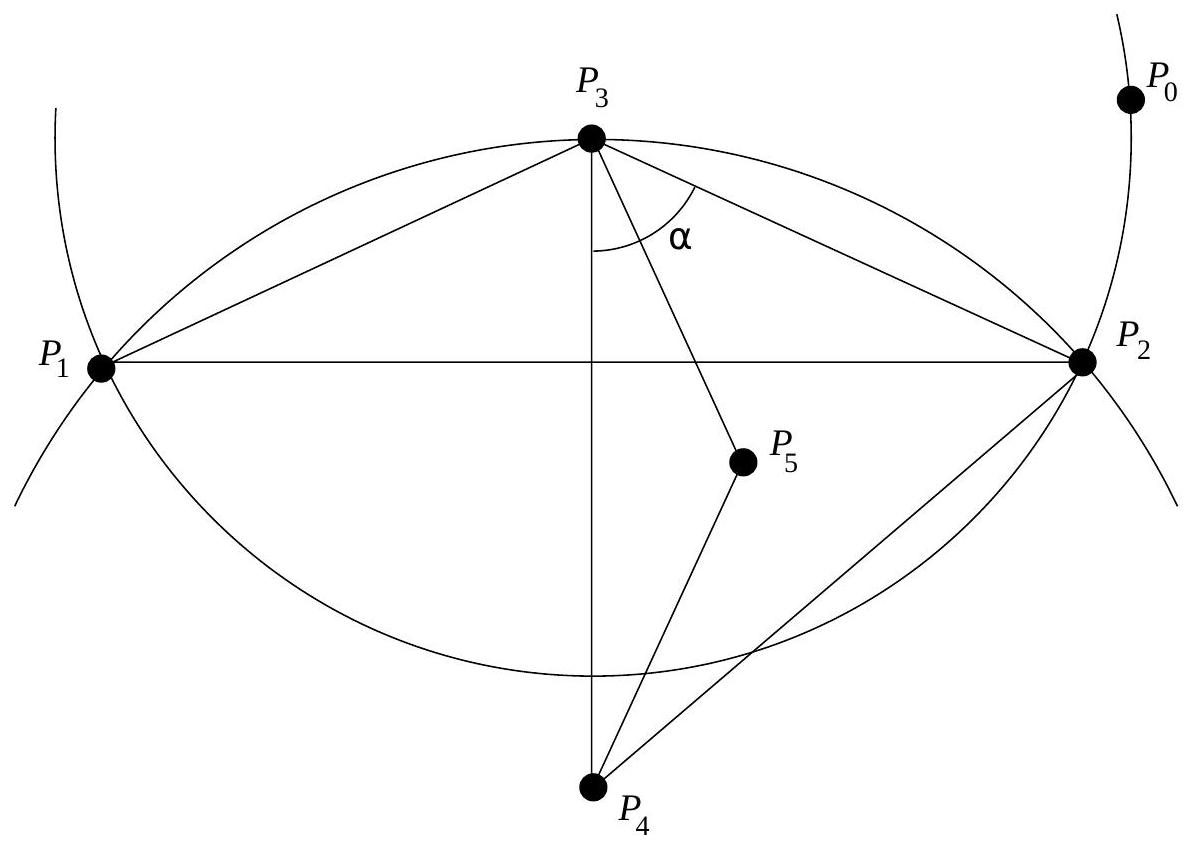
|
| 189 |
+
|
| 190 |
+
By the same argument, we see that each $\angle P_{i} P_{i+2} P_{i+4}$ is a right angle with $P_{i+2} P_{i+4}: P_{i} P_{i+2}=$ $r$. Thus the points $P_{1}, P_{3}, P_{5}, \ldots$ lie on a logarithmic spiral of ratio $r$ and period four as shown below. It follows that $P_{1}, P_{5}, P_{9}, \ldots$ are collinear, proving part (a).
|
| 191 |
+
|
| 192 |
+
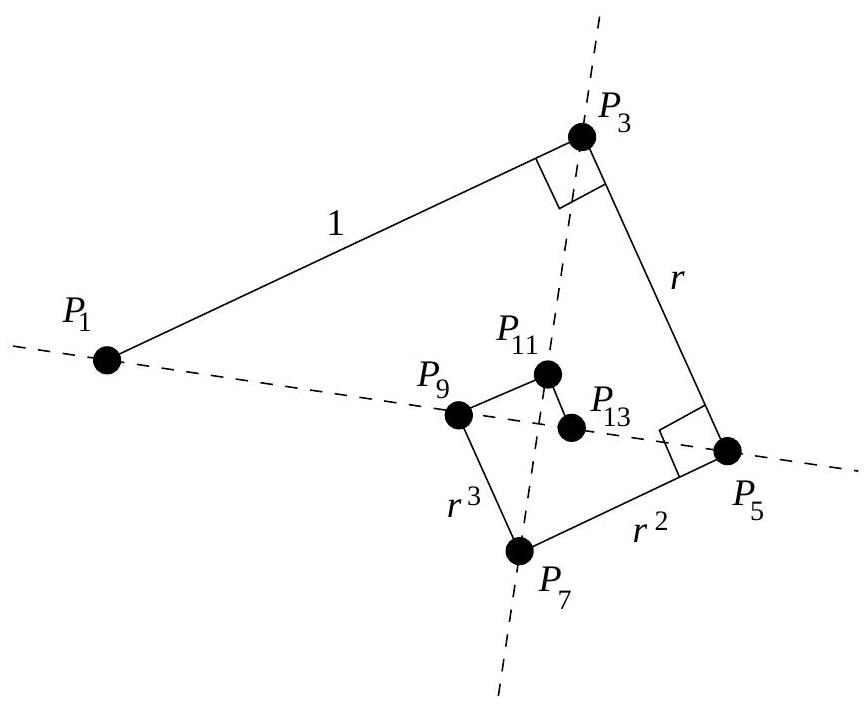
|
| 193 |
+
|
| 194 |
+
By the self-similarity of the spiral, we have that $P_{1} P_{1001}=r^{500} P_{1001} P_{2001}$, so
|
| 195 |
+
|
| 196 |
+
$$
|
| 197 |
+
\sqrt[500]{x / y}=1 / r=2 \sin (2 \alpha)
|
| 198 |
+
$$
|
| 199 |
+
|
| 200 |
+
This is an integer when $\sin (2 \alpha) \in\{0, \pm 1 / 2, \pm 1\}$. Since $0<\alpha<90$, this is equivalent to $\alpha \in\{15,45,75\}$. Thus $\sqrt[500]{x / y}$ is an integer exactly when $t$ belongs to the set $\{2 \sin 15,2 \sin 45,2 \sin 75\}$. This answers part (b).
|
| 201 |
+
|
| 202 |
+
## GRADERS' REPORT
|
| 203 |
+
|
| 204 |
+
Eighty four of the eighty five eligible students submitted an examination paper. Each paper contained proposed solutions the some or all of the five examination questions. Each correct and well presented solution was awarded seven marks for a maximum total score of 35 . The mean score was $10.8 / 35$. The top three scores were 28,27 , and 22 , thus special scrutiny was required to separate the top two papers.
|
| 205 |
+
|
| 206 |
+
Each solution was independently marked by two graders. If the two marks differed, then the solution was reconsidered until the difference was resolved. The top twenty papers were then carefully regraded by the chair to ensure that nothing was amiss.
|
| 207 |
+
|
| 208 |
+
The grade distribution and average mark for each question appears in the following table. For example, $13.1 \%$ of students were awarded 3 marks for question \#1.
|
| 209 |
+
|
| 210 |
+
| Marks | $\# 1$ | $\# 2$ | $\# 3$ | $\# 4$ | $\# 5$ |
|
| 211 |
+
| :---: | ---: | ---: | ---: | ---: | ---: |
|
| 212 |
+
| 0 | 10.7 | 11.9 | 45.2 | 60.7 | 90.5 |
|
| 213 |
+
| 1 | 8.3 | 8.3 | 26.2 | 10.7 | 3.6 |
|
| 214 |
+
| 2 | 8.3 | 6.0 | 4.8 | 8.3 | 1.2 |
|
| 215 |
+
| 3 | 13.1 | 9.5 | 3.6 | 9.5 | 1.2 |
|
| 216 |
+
| 4 | 10.7 | 17.9 | 0.0 | 4.8 | 1.2 |
|
| 217 |
+
| 5 | 9.5 | 32.1 | 3.6 | 2.4 | 2.4 |
|
| 218 |
+
| 6 | 20.2 | 13.1 | 0.0 | 1.2 | 0.0 |
|
| 219 |
+
| 7 | 19.0 | 1.2 | 16.7 | 2.4 | 0.0 |
|
| 220 |
+
| Ave. | 4.05 | 3.64 | 1.79 | 1.09 | .26 |
|
| 221 |
+
| Mark | | | | | |
|
| 222 |
+
|
| 223 |
+
PROBLEM 1 Ninety five percent of students found the correct solution, although a surprising number arrived at a solution through trial and error or by guessing and verifying a solution. Many assumed without proof that the leading coefficient equals one, which resulted in a two-point penalty. Another common error was not to consider all four possibilities for the pair $(x-R),(x-2)$.
|
| 224 |
+
|
| 225 |
+
PROBLEM 2 There was a flaw in question 2. The proposers intended that the integers $a, b$ be relatively prime. This was made explicit in an early draft, but somehow was lost with the ambiguous phrase "of the form $a / b$." Without this assumption, the problem is much more tedious to solve. Remarkably, one student (Lino Demasi) considered more (but not all) possible values for $\operatorname{gcd}(a, b)$ and obtained the correct solution $n=35$. All other students assumed implicitly (and in two cases, explicitly) that $\operatorname{gcd}(a, b)=1$. Solutions to both problems are presented in this publication.
|
| 226 |
+
|
| 227 |
+
PROBLEM 3 Most students either completely solved or were baffled by this basic geometry problem. There were at least four types of solutions: one trigonometric, one using basic geometry, and two which refer to standard theorems relating to the triangle. The first two tended to be lengthy or cumbersome, and the last two are presented here. There were complaints from some participants regarding the inaccurate angles appearing in the diagram supplied with the question. The inaccuracy was intensional, since the key observation $M=Z$ would have otherwise been given
|
| 228 |
+
away. Unfortunately, this caused some students to doubt their own proofs that $B Z: Z C=1$; as the ratio appears to be closer to 2 in the misleading diagram!
|
| 229 |
+
|
| 230 |
+
PROBLEM 4 This problem was left unanswered by about $60 \%$ of students. Several solutions consisted only of a proof that $n=1$ is not possible. About $25 \%$ described a procedure which works when $n=2$. Indeed the procedure for $n=2$ seems to be unique. About $10 \%$ proved that for no other value of $n$ was possible, and all of the proofs explicitly or implicitly involved considering residues modulo $n-1$.
|
| 231 |
+
|
| 232 |
+
PROBLEM 5 This problem proved to be very difficult. Only two students completely answered part (a), and no students correctly answered part (b). Of the students receiving more than 0 marks, only two were were not among the top 15 This suggests that the question effectively resolved the ranking of the strongest participants, which is arguably the purpose of Problem 5.
|
| 233 |
+
|
CANADA_MO/md/en-sol2002.md
ADDED
|
@@ -0,0 +1,274 @@
|
|
|
|
|
|
|
|
|
|
|
|
|
|
|
|
|
|
|
|
|
|
|
|
|
|
|
|
|
|
|
|
|
|
|
|
|
|
|
|
|
|
|
|
|
|
|
|
|
|
|
|
|
|
|
|
|
|
|
|
|
|
|
|
|
|
|
|
|
|
|
|
|
|
|
|
|
|
|
|
|
|
|
|
|
|
|
|
|
|
|
|
|
|
|
|
|
|
|
|
|
|
|
|
|
|
|
|
|
|
|
|
|
|
|
|
|
|
|
|
|
|
|
|
|
|
|
|
|
|
|
|
|
|
|
|
|
|
|
|
|
|
|
|
|
|
|
|
|
|
|
|
|
|
|
|
|
|
|
|
|
|
|
|
|
|
|
|
|
|
|
|
|
|
|
|
|
|
|
|
|
|
|
|
|
|
|
|
|
|
|
|
|
|
|
|
|
|
|
|
|
|
|
|
|
|
|
|
|
|
|
|
|
|
|
|
|
|
|
|
|
|
|
|
|
|
|
|
|
|
|
|
|
|
|
|
|
|
|
|
|
|
|
|
|
|
|
|
|
|
|
|
|
|
|
|
|
|
|
|
|
|
|
|
|
|
|
|
|
|
|
|
|
|
|
|
|
|
|
|
|
|
|
|
|
|
|
|
|
|
|
|
|
|
|
|
|
|
|
|
|
|
|
|
|
|
|
|
|
|
|
|
|
|
|
|
|
|
|
|
|
|
|
|
|
|
|
|
|
|
|
|
|
|
|
|
|
|
|
|
|
|
|
|
|
|
|
|
|
|
|
|
|
|
|
|
|
|
|
|
|
|
|
|
|
|
|
|
|
|
|
|
|
|
|
|
|
|
|
|
|
|
|
|
|
|
|
|
|
|
|
|
|
|
|
|
|
|
|
|
|
|
|
|
|
|
|
|
|
|
|
|
|
|
|
|
|
|
|
|
|
|
|
|
|
|
|
|
|
|
|
|
|
|
|
|
|
|
|
|
|
|
|
|
|
|
|
|
|
|
|
|
|
|
|
|
|
|
|
|
|
|
|
|
|
|
|
|
|
|
|
|
|
|
|
|
|
|
|
|
|
|
|
|
|
|
|
|
|
|
|
|
|
|
|
|
|
|
|
|
|
|
|
|
|
|
|
|
|
|
|
|
|
|
|
|
|
|
|
|
|
|
|
|
|
|
|
|
|
|
|
|
|
|
|
|
|
|
|
|
|
|
|
|
|
|
|
|
|
|
|
|
|
|
|
|
|
|
|
|
|
|
|
|
|
|
|
|
|
|
|
|
|
|
|
|
|
|
|
|
|
|
|
|
|
|
|
|
|
|
|
|
|
|
|
|
|
|
|
|
|
|
|
|
|
|
|
|
|
|
|
|
|
|
|
|
|
|
|
|
|
|
|
|
|
|
|
|
|
|
|
|
|
|
|
|
|
|
|
|
|
|
|
|
|
|
|
|
|
|
|
|
|
|
|
|
|
|
|
|
|
|
|
|
|
|
|
|
|
|
|
|
|
|
|
|
|
|
|
|
|
|
|
|
|
|
|
|
|
|
|
|
|
|
|
|
|
|
|
|
|
|
|
|
|
|
|
|
|
|
|
|
|
|
|
|
|
|
|
|
|
|
|
|
|
|
|
|
|
|
|
|
|
|
|
|
|
|
|
|
|
|
|
|
|
|
|
|
|
|
|
|
|
|
|
|
|
|
|
|
|
|
|
|
|
|
|
|
|
|
|
|
|
|
|
|
|
|
|
|
|
|
|
|
|
|
|
|
|
|
|
|
|
|
|
|
|
|
|
|
|
|
|
|
|
|
|
|
|
|
|
|
|
|
|
|
|
|
|
|
|
|
|
|
|
|
| 1 |
+
# 2002 Canadian Mathematical Olympiad Solutions
|
| 2 |
+
|
| 3 |
+
1. Let $S$ be a subset of $\{1,2, \ldots, 9\}$, such that the sums formed by adding each unordered pair of distinct numbers from $S$ are all different. For example, the subset $\{1,2,3,5\}$ has this property, but $\{1,2,3,4,5\}$ does not, since the pairs $\{1,4\}$ and $\{2,3\}$ have the same sum, namely 5 .
|
| 4 |
+
|
| 5 |
+
What is the maximum number of elements that $S$ can contain?
|
| 6 |
+
|
| 7 |
+
## Solution 1
|
| 8 |
+
|
| 9 |
+
It can be checked that all the sums of pairs for the set $\{1,2,3,5,8\}$ are different.
|
| 10 |
+
|
| 11 |
+
Suppose, for a contradiction, that $S$ is a subset of $\{1, \ldots, 9\}$ containing 6 elements such that all the sums of pairs are different. Now the smallest possible sum for two numbers from $S$ is $1+2=3$ and the largest possible sum is $8+9=17$. That gives 15 possible sums: $3, \ldots, 17$.
|
| 12 |
+
|
| 13 |
+
Also there are $\left(\begin{array}{l}6 \\ 2\end{array}\right)=15$ pairs from $S$. Thus, each of $3, \ldots, 17$ is the sum of exactly one pair. The only pair from $\{1, \ldots, 9\}$ that adds to 3 is $\{1,2\}$ and to 17 is $\{8,9\}$. Thus $1,2,8,9$ are in $S$. But then $1+9=2+8$, giving a contradiction. It follows that the maximum number of elements that $S$ can contain is 5 .
|
| 14 |
+
|
| 15 |
+
## Solution 2.
|
| 16 |
+
|
| 17 |
+
It can be checked that all the sums of pairs for the set $\{1,2,3,5,8\}$ are different.
|
| 18 |
+
|
| 19 |
+
Suppose, for a contradiction, that $S$ is a subset of $\{1, \ldots 9\}$ such that all the sums of pairs are different and that $a_{1}<a_{2}<\ldots<a_{6}$ are the members of $S$.
|
| 20 |
+
|
| 21 |
+
Since $a_{1}+a_{6} \neq a_{2}+a_{5}$, it follows that $a_{6}-a_{5} \neq a_{2}-a_{1}$. Similarly $a_{6}-a_{5} \neq a_{4}-a_{3}$ and $a_{4}-a_{3} \neq a_{2}-a_{1}$. These three differences must be distinct positive integers, so,
|
| 22 |
+
|
| 23 |
+
$$
|
| 24 |
+
\left(a_{6}-a_{5}\right)+\left(a_{4}-a_{3}\right)+\left(a_{2}-a_{1}\right) \geq 1+2+3=6 .
|
| 25 |
+
$$
|
| 26 |
+
|
| 27 |
+
Similarly $a_{3}-a_{2} \neq a_{5}-a_{4}$, so
|
| 28 |
+
|
| 29 |
+
$$
|
| 30 |
+
\left(a_{3}-a_{2}\right)+\left(a_{5}-a_{4}\right) \geq 1+2=3 .
|
| 31 |
+
$$
|
| 32 |
+
|
| 33 |
+
Adding the above 2 inequalities yields
|
| 34 |
+
|
| 35 |
+
$$
|
| 36 |
+
a_{6}-a_{5}+a_{5}-a_{4}+a_{4}-a_{3}+a_{3}-a_{2}+a_{2}-a_{1} \geq 6+3=9,
|
| 37 |
+
$$
|
| 38 |
+
|
| 39 |
+
and hence $a_{6}-a_{1} \geq 9$. This is impossible since the numbers in $S$ are between 1 and 9 .
|
| 40 |
+
|
| 41 |
+
2. Call a positive integer $n$ practical if every positive integer less than or equal to $n$ can be written as the sum of distinct divisors of $n$.
|
| 42 |
+
|
| 43 |
+
For example, the divisors of 6 are $\mathbf{1 , 2}, \mathbf{3}$, and $\mathbf{6}$. Since
|
| 44 |
+
|
| 45 |
+
$$
|
| 46 |
+
1=\mathbf{1}, \quad 2=\mathbf{2}, \quad 3=\mathbf{3}, \quad 4=\mathbf{1}+\mathbf{3}, \quad 5=\mathbf{2}+\mathbf{3}, \quad 6=\mathbf{6},
|
| 47 |
+
$$
|
| 48 |
+
|
| 49 |
+
we see that 6 is practical.
|
| 50 |
+
|
| 51 |
+
Prove that the product of two practical numbers is also practical.
|
| 52 |
+
|
| 53 |
+
## Solution
|
| 54 |
+
|
| 55 |
+
Let $p$ and $q$ be practical. For any $k \leq p q$, we can write
|
| 56 |
+
|
| 57 |
+
$$
|
| 58 |
+
k=a q+b \text { with } 0 \leq a \leq p, 0 \leq b<q .
|
| 59 |
+
$$
|
| 60 |
+
|
| 61 |
+
Since $p$ and $q$ are practical, we can write
|
| 62 |
+
|
| 63 |
+
$$
|
| 64 |
+
a=c_{1}+\ldots+c_{m}, \quad b=d_{1}+\ldots+d_{n}
|
| 65 |
+
$$
|
| 66 |
+
|
| 67 |
+
where the $c_{i}$ 's are distinct divisors of $p$ and the $d_{j}$ 's are distinct divisors of $q$. Now
|
| 68 |
+
|
| 69 |
+
$$
|
| 70 |
+
\begin{aligned}
|
| 71 |
+
k & =\left(c_{1}+\ldots+c_{m}\right) q+\left(d_{1}+\ldots+d_{n}\right) \\
|
| 72 |
+
& =c_{1} q+\ldots+c_{m} q+d_{1}+\ldots+d_{n} .
|
| 73 |
+
\end{aligned}
|
| 74 |
+
$$
|
| 75 |
+
|
| 76 |
+
Each of $c_{i} q$ and $d_{j}$ divides $p q$. Since $d_{j}<q \leq c_{i} q$ for any $i, j$, the $c_{i} q$ 's and $d_{j}$ 's are all distinct, and we conclude that $p q$ is practical.
|
| 77 |
+
|
| 78 |
+
3. Prove that for all positive real numbers $a, b$, and $c$,
|
| 79 |
+
|
| 80 |
+
$$
|
| 81 |
+
\frac{a^{3}}{b c}+\frac{b^{3}}{c a}+\frac{c^{3}}{a b} \geq a+b+c
|
| 82 |
+
$$
|
| 83 |
+
|
| 84 |
+
and determine when equality occurs.
|
| 85 |
+
|
| 86 |
+
Each of the inequalities used in the solutions below has the property that equality holds if and only if $a=b=c$. Thus equality holds for the given inequality if and only if $a=b=c$.
|
| 87 |
+
|
| 88 |
+
## Solution 1.
|
| 89 |
+
|
| 90 |
+
Note that $a^{4}+b^{4}+c^{4}=\frac{\left(a^{4}+b^{4}\right)}{2}+\frac{\left(b^{4}+c^{4}\right)}{2}+\frac{\left(c^{4}+a^{4}\right)}{2}$. Applying the arithmetic-geometric mean inequality to each term, we see that the right side is greater than or equal to
|
| 91 |
+
|
| 92 |
+
$$
|
| 93 |
+
a^{2} b^{2}+b^{2} c^{2}+c^{2} a^{2} \text {. }
|
| 94 |
+
$$
|
| 95 |
+
|
| 96 |
+
We can rewrite this as
|
| 97 |
+
|
| 98 |
+
$$
|
| 99 |
+
\frac{a^{2}\left(b^{2}+c^{2}\right)}{2}+\frac{b^{2}\left(c^{2}+a^{2}\right)}{2}+\frac{c^{2}\left(a^{2}+b^{2}\right)}{2} .
|
| 100 |
+
$$
|
| 101 |
+
|
| 102 |
+
Applying the arithmetic mean-geometric mean inequality again we obtain $a^{4}+b^{4}+c^{4} \geq$ $a^{2} b c+b^{2} c a+c^{2} a b$. Dividing both sides by $a b c$ (which is positive) the result follows.
|
| 103 |
+
|
| 104 |
+
## Solution 2.
|
| 105 |
+
|
| 106 |
+
Notice the inequality is homogeneous. That is, if $a, b, c$ are replaced by $k a, k b, k c, k>0$ we get the original inequality. Thus we can assume, without loss of generality, that $a b c=1$. Then
|
| 107 |
+
|
| 108 |
+
$$
|
| 109 |
+
\begin{aligned}
|
| 110 |
+
\frac{a^{3}}{b c}+\frac{b^{3}}{c a}+\frac{c^{3}}{a b} & =a b c\left(\frac{a^{3}}{b c}+\frac{b^{3}}{c a}+\frac{c^{3}}{a b}\right) \\
|
| 111 |
+
& =a^{4}+b^{4}+c^{4} .
|
| 112 |
+
\end{aligned}
|
| 113 |
+
$$
|
| 114 |
+
|
| 115 |
+
So we need prove that $a^{4}+b^{4}+c^{4} \geq a+b+c$.
|
| 116 |
+
|
| 117 |
+
By the Power Mean Inequality,
|
| 118 |
+
|
| 119 |
+
$$
|
| 120 |
+
\frac{a^{4}+b^{4}+c^{4}}{3} \geq\left(\frac{a+b+c}{3}\right)^{4}
|
| 121 |
+
$$
|
| 122 |
+
|
| 123 |
+
so $a^{4}+b^{4}+c^{4} \geq(a+b+c) \cdot \frac{(a+b+c)^{3}}{27}$.
|
| 124 |
+
|
| 125 |
+
By the arithmetic mean-geometric mean inequality, $\frac{a+b+c}{3} \geq \sqrt[3]{a b c}=1$, so $a+b+c \geq 3$.
|
| 126 |
+
|
| 127 |
+
Hence, $a^{4}+b^{4}+c^{4} \geq(a+b+c) \cdot \frac{(a+b+c)^{3}}{27} \geq(a+b+c) \frac{3^{3}}{27}=a+b+c$.
|
| 128 |
+
|
| 129 |
+
## Solution 3.
|
| 130 |
+
|
| 131 |
+
Rather than using the Power-Mean inequality to prove $a^{4}+b^{4}+c^{4} \geq a+b+c$ in Proof 2, the Cauchy-Schwartz-Bunjakovsky inequality can be used twice:
|
| 132 |
+
|
| 133 |
+
$$
|
| 134 |
+
\begin{aligned}
|
| 135 |
+
& \left(a^{4}+b^{4}+c^{4}\right)\left(1^{2}+1^{2}+1^{2}\right) \geq\left(a^{2}+b^{2}+c^{2}\right)^{2} \\
|
| 136 |
+
& \left(a^{2}+b^{2}+c^{2}\right)\left(1^{2}+1^{2}+1^{2}\right) \geq(a+b+c)^{2}
|
| 137 |
+
\end{aligned}
|
| 138 |
+
$$
|
| 139 |
+
|
| 140 |
+
So $\frac{a^{4}+b^{4}+c^{4}}{3} \geq \frac{\left(a^{2}+b^{2}+c^{2}\right)^{2}}{9} \geq \frac{(a+b+c)^{4}}{81}$. Continue as in Proof 2 .
|
| 141 |
+
|
| 142 |
+
4. Let $\Gamma$ be a circle with radius $r$. Let $A$ and $B$ be distinct points on $\Gamma$ such that $A B<\sqrt{3} r$. Let the circle with centre $B$ and radius $A B$ meet $\Gamma$ again at $C$. Let $P$ be the point inside $\Gamma$ such that triangle $A B P$ is equilateral. Finally, let $C P$ meet $\Gamma$ again at $Q$. Prove that $P Q=r$.
|
| 143 |
+
|
| 144 |
+
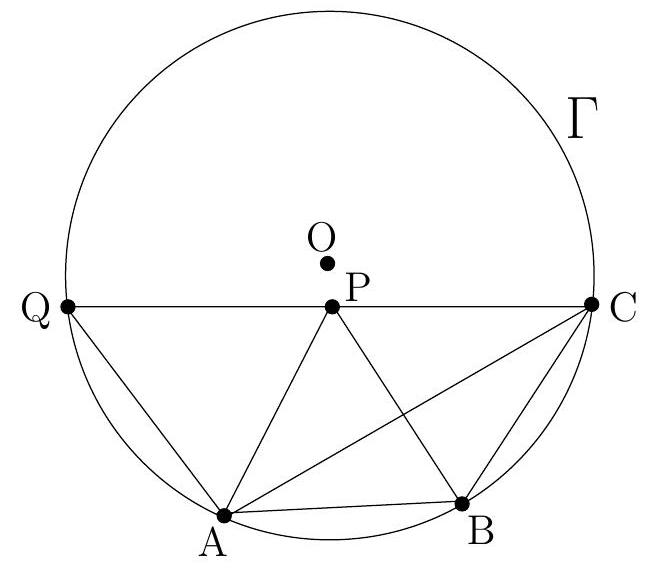
|
| 145 |
+
|
| 146 |
+
## Solution 1.
|
| 147 |
+
|
| 148 |
+
Let the center of $\Gamma$ be $O$, the radius $\mathrm{r}$. Since $B P=B C$, let $\theta=\measuredangle B P C=\measuredangle B C P$.
|
| 149 |
+
|
| 150 |
+
Quadrilateral $Q A B C$ is cyclic, so $\measuredangle B A Q=180^{\circ}-\theta$ and hence $\measuredangle P A Q=120^{\circ}-\theta$.
|
| 151 |
+
|
| 152 |
+
Also $\measuredangle A P Q=180^{\circ}-\measuredangle A P B-\measuredangle B P C=120^{\circ}-\theta$, so $P Q=A Q$ and $\measuredangle A Q P=2 \theta-60^{\circ}$.
|
| 153 |
+
|
| 154 |
+
Again because quadrilateral $Q A B C$ is cyclic, $\measuredangle A B C=180^{\circ}-\measuredangle A Q C=240^{\circ}-2 \theta$.
|
| 155 |
+
|
| 156 |
+
Triangles $O A B$ and $O C B$ are congruent, since $O A=O B=O C=r$ and $A B=B C$.
|
| 157 |
+
|
| 158 |
+
Thus $\measuredangle A B O=\measuredangle C B O=\frac{1}{2} \measuredangle A B C=120^{\circ}-\theta$.
|
| 159 |
+
|
| 160 |
+
We have now shown that in triangles $A Q P$ and $A O B, \measuredangle P A Q=\measuredangle B A O=\measuredangle A P Q=\measuredangle A B O$.
|
| 161 |
+
|
| 162 |
+
Also $A P=A B$, so $\triangle A Q P \cong \triangle A O B$. Hence $Q P=O B=r$.
|
| 163 |
+
|
| 164 |
+
## Solution 2.
|
| 165 |
+
|
| 166 |
+
Let the center of $\Gamma$ be $O$, the radius $r$. Since $A, P$ and $C$ lie on a circle centered at $B$, $60^{\circ}=\measuredangle A B P=2 \measuredangle A C P$, so $\measuredangle A C P=\measuredangle A C Q=30^{\circ}$.
|
| 167 |
+
|
| 168 |
+
Since $Q, A$, and $C$ lie on $\Gamma, \measuredangle Q O A=2 \measuredangle Q C A=60^{\circ}$.
|
| 169 |
+
|
| 170 |
+
So $Q A=r$ since if a chord of a circle subtends an angle of $60^{\circ}$ at the center, its length is the radius of the circle.
|
| 171 |
+
|
| 172 |
+
Now $B P=B C$, so $\measuredangle B P C=\measuredangle B C P=\measuredangle A C B+30^{\circ}$.
|
| 173 |
+
|
| 174 |
+
Thus $\measuredangle A P Q=180^{\circ}-\measuredangle A P B-\measuredangle B P C=90^{\circ}-\measuredangle A C B$.
|
| 175 |
+
|
| 176 |
+
Since $Q, A, B$ and $C$ lie on $\Gamma$ and $A B=B C, \measuredangle A Q P=\measuredangle A Q C=\measuredangle A Q B+\measuredangle B Q C=2 \measuredangle A C B$.
|
| 177 |
+
|
| 178 |
+
Finally, $\measuredangle Q A P=180-\measuredangle A Q P-\measuredangle A P Q=90-\measuredangle A C B$.
|
| 179 |
+
|
| 180 |
+
So $\measuredangle P A Q=\measuredangle A P Q$ hence $P Q=A Q=r$.
|
| 181 |
+
|
| 182 |
+
5. Let $\mathbb{N}=\{0,1,2, \ldots\}$. Determine all functions $f: \mathbb{N} \rightarrow \mathbb{N}$ such that
|
| 183 |
+
|
| 184 |
+
$$
|
| 185 |
+
x f(y)+y f(x)=(x+y) f\left(x^{2}+y^{2}\right)
|
| 186 |
+
$$
|
| 187 |
+
|
| 188 |
+
for all $x$ and $y$ in $\mathbb{N}$.
|
| 189 |
+
|
| 190 |
+
## Solution 1.
|
| 191 |
+
|
| 192 |
+
We claim that $f$ is a constant function. Suppose, for a contradiction, that there exist $x$ and $y$ with $f(x)<f(y)$; choose $x, y$ such that $f(y)-f(x)>0$ is minimal. Then
|
| 193 |
+
|
| 194 |
+
$$
|
| 195 |
+
f(x)=\frac{x f(x)+y f(x)}{x+y}<\frac{x f(y)+y f(x)}{x+y}<\frac{x f(y)+y f(y)}{x+y}=f(y)
|
| 196 |
+
$$
|
| 197 |
+
|
| 198 |
+
so $f(x)<f\left(x^{2}+y^{2}\right)<f(y)$ and $0<f\left(x^{2}+y^{2}\right)-f(x)<f(y)-f(x)$, contradicting the choice of $x$ and $y$. Thus, $f$ is a constant function. Since $f(0)$ is in $\mathbb{N}$, the constant must be from $\mathbb{N}$.
|
| 199 |
+
|
| 200 |
+
Also, for any $c$ in $\mathbb{N}, x c+y c=(x+y) c$ for all $x$ and $y$, so $f(x)=c, c \in \mathbb{N}$ are the solutions to the equation.
|
| 201 |
+
|
| 202 |
+
## Solution 2.
|
| 203 |
+
|
| 204 |
+
We claim $f$ is a constant function. Define $g(x)=f(x)-f(0)$. Then $g(0)=0, g(x) \geq-f(0)$ and
|
| 205 |
+
|
| 206 |
+
$$
|
| 207 |
+
x g(y)+y g(x)=(x+y) g\left(x^{2}+y^{2}\right)
|
| 208 |
+
$$
|
| 209 |
+
|
| 210 |
+
for all $x, y$ in $\mathbb{N}$.
|
| 211 |
+
|
| 212 |
+
Letting $y=0$ shows $g\left(x^{2}\right)=0$ (in particular, $g(1)=g(4)=0$ ), and letting $x=y=1$ shows $g(2)=0$. Also, if $x, y$ and $z$ in $\mathbb{N}$ satisfy $x^{2}+y^{2}=z^{2}$, then
|
| 213 |
+
|
| 214 |
+
$$
|
| 215 |
+
g(y)=-\frac{y}{x} g(x) .
|
| 216 |
+
$$
|
| 217 |
+
|
| 218 |
+
Letting $x=4$ and $y=3,(*)$ shows that $g(3)=0$.
|
| 219 |
+
|
| 220 |
+
For any even number $x=2 n>4$, let $y=n^{2}-1$. Then $y>x$ and $x^{2}+y^{2}=\left(n^{2}+1\right)^{2}$. For any odd number $x=2 n+1>3$, let $y=2(n+1) n$. Then $y>x$ and $x^{2}+y^{2}=\left((n+1)^{2}+n^{2}\right)^{2}$. Thus for every $x>4$ there is $y>x$ such that $(*)$ is satisfied.
|
| 221 |
+
|
| 222 |
+
Suppose for a contradiction, that there is $x>4$ with $g(x)>0$. Then we can construct a
|
| 223 |
+
|
| 224 |
+
sequence $x=x_{0}<x_{1}<x_{2}<\ldots$ where $g\left(x_{i+1}\right)=-\frac{x_{i+1}}{x_{i}} g\left(x_{i}\right)$. It follows that $\left|g\left(x_{i+1}\right)\right|>$ $\left|g\left(x_{i}\right)\right|$ and the signs of $g\left(x_{i}\right)$ alternate. Since $g(x)$ is always an integer, $\left|g\left(x_{i+1}\right)\right| \geq\left|g\left(x_{i}\right)\right|+1$. Thus for some sufficiently large value of $i, g\left(x_{i}\right)<-f(0)$, a contradiction.
|
| 225 |
+
|
| 226 |
+
As for Proof 1, we now conclude that the functions that satisfy the given functional equation are $f(x)=c, c \in \mathbb{N}$.
|
| 227 |
+
|
| 228 |
+
Solution 3. Suppose that $W$ is the set of nonnegative integers and that $f: W \rightarrow W$ satisfies:
|
| 229 |
+
|
| 230 |
+
$$
|
| 231 |
+
x f(y)+y f(x)=(x+y) f\left(x^{2}+y^{2}\right) .
|
| 232 |
+
$$
|
| 233 |
+
|
| 234 |
+
We will show that $f$ is a constant function.
|
| 235 |
+
|
| 236 |
+
Let $f(0)=k$, and set $S=\{x \mid f(x)=k\}$.
|
| 237 |
+
|
| 238 |
+
Letting $y=0$ in $(*)$ shows that $f\left(x^{2}\right)=k \quad \forall x>0$, and so
|
| 239 |
+
|
| 240 |
+
$$
|
| 241 |
+
x^{2} \in S \quad \forall x>0
|
| 242 |
+
$$
|
| 243 |
+
|
| 244 |
+
In particular, $1 \in S$.
|
| 245 |
+
|
| 246 |
+
Suppose $x^{2}+y^{2}=z^{2}$. Then $y f(x)+x f(y)=(x+y) f\left(z^{2}\right)=(x+y) k$. Thus,
|
| 247 |
+
|
| 248 |
+
$$
|
| 249 |
+
x \in S \quad \text { iff } \quad y \in S
|
| 250 |
+
$$
|
| 251 |
+
|
| 252 |
+
whenever $x^{2}+y^{2}$ is a perfect square.
|
| 253 |
+
|
| 254 |
+
For a contradiction, let $n$ be the smallest non-negative integer such that $f\left(2^{n}\right) \neq k$. By (l) $n$ must be odd, so $\frac{n-1}{2}$ is an integer. Now $\frac{n-1}{2}<n$ so $f\left(2^{\frac{n-1}{2}}\right)=k$. Letting $x=y=2^{\frac{n-1}{2}}$ in (*) shows $f\left(2^{n}\right)=k$, a contradiction. Thus every power of 2 is an element of $S$.
|
| 255 |
+
|
| 256 |
+
For each integer $n \geq 2$ define $p(n)$ to be the largest prime such that $p(n) \mid n$.
|
| 257 |
+
|
| 258 |
+
Claim: For any integer $n>1$ that is not a power of 2 , there exists a sequence of integers $x_{1}, x_{2}, \ldots, x_{r}$ such that the following conditions hold:
|
| 259 |
+
a) $x_{1}=n$.
|
| 260 |
+
b) $x_{i}^{2}+x_{i+1}^{2}$ is a perfect square for each $i=1,2,3, \ldots, r-1$.
|
| 261 |
+
c) $p\left(x_{1}\right) \geq p\left(x_{2}\right) \geq \ldots \geq p\left(x_{r}\right)=2$.
|
| 262 |
+
|
| 263 |
+
Proof: Since $n$ is not a power of $2, p(n)=p\left(x_{1}\right) \geq 3$. Let $p\left(x_{1}\right)=2 m+1$, so $n=x_{1}=$ $b(2 m+1)^{a}$, for some $a$ and $b$, where $p(b)<2 m+1$.
|
| 264 |
+
|
| 265 |
+
Case 1: $a=1$. Since $\left(2 m+1,2 m^{2}+2 m, 2 m^{2}+2 m+1\right)$ is a Pythagorean Triple, if $x_{2}=b\left(2 m^{2}+\right.$ $2 m)$, then $x_{1}^{2}+x_{2}^{2}=b^{2}\left(2 m^{2}+2 m+1\right)^{2}$ is a perfect square. Furthermore, $x_{2}=2 b m(m+1)$, and so $p\left(x_{2}\right)<2 m+1=p\left(x_{1}\right)$.
|
| 266 |
+
|
| 267 |
+
Case 2: $a>1$. If $n=x_{1}=(2 m+1)^{a} \cdot b$, let $x_{2}=(2 m+1)^{a-1} \cdot b \cdot\left(2 m^{2}+2 m\right), x_{3}=$ $(2 m+1)^{a-2} \cdot b \cdot\left(2 m^{2}+2 m\right)^{2}, \ldots, x_{a+1}=(2 m+1)^{0} \cdot b \cdot\left(2 m^{2}+2 m\right)^{a}=b \cdot 2^{a} m^{a}(m+1)^{a}$. Note that for $1 \leq i \leq a, x_{i}^{2}+x_{i+1}^{2}$ is a perfect square and also note that $p\left(x_{a+1}\right)<2 m+1=p\left(x_{1}\right)$.
|
| 268 |
+
|
| 269 |
+
If $x_{a+1}$ is not a power of 2 , we extend the sequence $x_{i}$ using the same procedure described above. We keep doing this until $p\left(x_{r}\right)=2$, for some integer $r$.
|
| 270 |
+
|
| 271 |
+
By (2), $x_{i} \in S$ iff $x_{i+1} \in S$ for $i=1,2,3, \ldots, r-1$. Thus, $n=x_{1} \in S$ iff $x_{r} \in S$. But $x_{r}$ is a power of 2 because $p\left(x_{r}\right)=2$, and we earlier proved that powers of 2 are in $\mathrm{S}$. Therefore, $n \in S$, proving the claim.
|
| 272 |
+
|
| 273 |
+
We have proven that every integer $n \geq 1$ is an element of $S$, and so we have proven that $f(n)=k=f(0)$, for each $n \geq 1$. Therefore, $f$ is constant, Q.E.D.
|
| 274 |
+
|
CANADA_MO/md/en-sol2003.md
ADDED
|
@@ -0,0 +1,162 @@
|
|
|
|
|
|
|
|
|
|
|
|
|
|
|
|
|
|
|
|
|
|
|
|
|
|
|
|
|
|
|
|
|
|
|
|
|
|
|
|
|
|
|
|
|
|
|
|
|
|
|
|
|
|
|
|
|
|
|
|
|
|
|
|
|
|
|
|
|
|
|
|
|
|
|
|
|
|
|
|
|
|
|
|
|
|
|
|
|
|
|
|
|
|
|
|
|
|
|
|
|
|
|
|
|
|
|
|
|
|
|
|
|
|
|
|
|
|
|
|
|
|
|
|
|
|
|
|
|
|
|
|
|
|
|
|
|
|
|
|
|
|
|
|
|
|
|
|
|
|
|
|
|
|
|
|
|
|
|
|
|
|
|
|
|
|
|
|
|
|
|
|
|
|
|
|
|
|
|
|
|
|
|
|
|
|
|
|
|
|
|
|
|
|
|
|
|
|
|
|
|
|
|
|
|
|
|
|
|
|
|
|
|
|
|
|
|
|
|
|
|
|
|
|
|
|
|
|
|
|
|
|
|
|
|
|
|
|
|
|
|
|
|
|
|
|
|
|
|
|
|
|
|
|
|
|
|
|
|
|
|
|
|
|
|
|
|
|
|
|
|
|
|
|
|
|
|
|
|
|
|
|
|
|
|
|
|
|
|
|
|
|
|
|
|
|
|
|
|
|
|
|
|
|
|
|
|
|
|
|
|
|
|
|
|
|
|
|
|
|
|
|
|
|
|
|
|
|
|
|
|
|
|
|
|
|
|
|
|
|
|
|
|
|
|
|
|
|
|
|
|
|
|
|
|
|
|
|
|
|
|
|
|
|
|
|
|
|
|
|
|
|
|
|
|
|
|
|
|
|
|
|
|
|
|
|
|
|
|
|
|
|
|
|
|
|
|
|
|
|
|
|
|
|
|
|
|
|
|
|
|
|
|
|
|
|
|
|
|
|
|
|
|
|
|
|
|
|
|
|
|
|
|
|
|
|
|
|
|
|
|
|
|
|
|
|
|
|
|
|
|
|
|
|
|
|
|
|
|
|
|
|
|
|
|
|
|
|
|
|
|
|
|
|
|
|
|
|
|
|
|
|
|
|
|
|
|
|
|
|
| 1 |
+
# Solutions to the $2003 \mathrm{CMO}$
|
| 2 |
+
|
| 3 |
+
written March 26, 2003
|
| 4 |
+
|
| 5 |
+
1. Consider a standard twelve-hour clock whose hour and minute hands move continuously. Let $m$ be an integer, with $1 \leq m \leq 720$. At precisely $m$ minutes after 12:00, the angle made by the hour hand and minute hand is exactly $1^{\circ}$. Determine all possible values of $m$.
|
| 6 |
+
|
| 7 |
+
## Solution
|
| 8 |
+
|
| 9 |
+
The minute hand makes a full revolution of $360^{\circ}$ every 60 minutes, so after $m$ minutes it has swept through $\frac{360}{60} m=6 m$ degrees. The hour hand makes a full revolution every 12 hours ( 720 minutes), so after $m$ minutes it has swept through $\frac{360}{720} m=m / 2$ degrees. Since both hands started in the same position at 12:00, the angle between the two hands will be $1^{\circ}$ if $6 m-m / 2= \pm 1+360 k$ for some integer $k$. Solving this equation we get
|
| 10 |
+
|
| 11 |
+
$$
|
| 12 |
+
m=\frac{720 k \pm 2}{11}=65 k+\frac{5 k \pm 2}{11}
|
| 13 |
+
$$
|
| 14 |
+
|
| 15 |
+
Since $1 \leq m \leq 720$, we have $1 \leq k \leq 11$. Since $m$ is an integer, $5 k \pm 2$ must be divisible by 11 , say $5 k \pm 2=11 q$. Then
|
| 16 |
+
|
| 17 |
+
$$
|
| 18 |
+
5 k=11 q \pm 2 \Rightarrow k=2 q+\frac{q \pm 2}{5}
|
| 19 |
+
$$
|
| 20 |
+
|
| 21 |
+
If is now clear that only $q=2$ and $q=3$ satisfy all the conditions. Thus $k=4$ or $k=7$ and substituting these values into the expression for $m$ we find that the only possible values of $m$ are 262 and 458 .
|
| 22 |
+
|
| 23 |
+
2. Find the last three digits of the number $2003^{2002^{2001}}$.
|
| 24 |
+
|
| 25 |
+
## Solution
|
| 26 |
+
|
| 27 |
+
We must find the remainder when $2003^{2002^{2001}}$ is divided by 1000 , which will be the same as the remainder when $3^{2002^{2001}}$ is divided by 1000 , since $2003 \equiv 3(\bmod 1000)$. To do this we will first find a positive integer $n$ such that $3^{n} \equiv 1(\bmod 1000)$ and then try to express $2002^{2001}$ in the form $n k+r$, so that
|
| 28 |
+
|
| 29 |
+
$$
|
| 30 |
+
2003^{2002^{2001}} \equiv 3^{n k+r} \equiv\left(3^{n}\right)^{k} \cdot 3^{r} \equiv 1^{k} \cdot 3^{r} \equiv 3^{r}(\bmod 1000)
|
| 31 |
+
$$
|
| 32 |
+
|
| 33 |
+
Since $3^{2}=10-1$, we can evaluate $3^{2 m}$ using the binomial theorem:
|
| 34 |
+
|
| 35 |
+
$$
|
| 36 |
+
3^{2 m}=(10-1)^{m}=(-1)^{m}+10 m(-1)^{m-1}+100 \frac{m(m-1)}{2}(-1)^{m-2}+\cdots+10^{m} .
|
| 37 |
+
$$
|
| 38 |
+
|
| 39 |
+
After the first 3 terms of this expansion, all remaining terms are divisible by 1000, so letting $m=2 q$, we have that
|
| 40 |
+
|
| 41 |
+
$$
|
| 42 |
+
3^{4 q} \equiv 1-20 q+100 q(2 q-1)(\bmod 1000)
|
| 43 |
+
$$
|
| 44 |
+
|
| 45 |
+
Using this, we can check that $3^{100} \equiv 1(\bmod 1000)$ and now we wish to find the remainder when $2002^{2001}$ is divided by 100 .
|
| 46 |
+
|
| 47 |
+
Now $2002^{2001} \equiv 2^{2001}(\bmod 100) \equiv 4 \cdot 2^{1999}(\bmod 4 \cdot 25)$, so we'll investigate powers of 2 modulo 25 . Noting that $2^{10}=1024 \equiv-1(\bmod 25)$, we have
|
| 48 |
+
|
| 49 |
+
$$
|
| 50 |
+
2^{1999}=\left(2^{10}\right)^{199} \cdot 2^{9} \equiv(-1)^{199} \cdot 512 \equiv-12 \equiv 13(\bmod 25) .
|
| 51 |
+
$$
|
| 52 |
+
|
| 53 |
+
Thus $2^{2001} \equiv 4 \cdot 13=52(\bmod 100)$. Therefore $2002^{2001}$ can be written in the form $100 k+52$ for some integer $k$, so
|
| 54 |
+
|
| 55 |
+
$$
|
| 56 |
+
2003^{2002^{2001}} \equiv 3^{52}(\bmod 1000) \equiv 1-20 \cdot 13+1300 \cdot 25 \equiv 241(\bmod 1000)
|
| 57 |
+
$$
|
| 58 |
+
|
| 59 |
+
using equation (1). So the last 3 digits of $2003^{2002^{2001}}$ are 241 .
|
| 60 |
+
|
| 61 |
+
3. Find all real positive solutions (if any) to
|
| 62 |
+
|
| 63 |
+
$$
|
| 64 |
+
\begin{gathered}
|
| 65 |
+
x^{3}+y^{3}+z^{3}=x+y+z, \text { and } \\
|
| 66 |
+
x^{2}+y^{2}+z^{2}=x y z .
|
| 67 |
+
\end{gathered}
|
| 68 |
+
$$
|
| 69 |
+
|
| 70 |
+
## Solution 1
|
| 71 |
+
|
| 72 |
+
Let $f(x, y, z)=\left(x^{3}-x\right)+\left(y^{3}-y\right)+\left(z^{3}-z\right)$. The first equation above is equivalent to $f(x, y, z)=0$. If $x, y, z \geq 1$, then $f(x, y, z) \geq 0$ with equality only if $x=y=z=1$. But if $x=y=z=1$, then the second equation is not satisfied. So in any solution to the system of equations, at least one of the variables is less than 1. Without loss of generality, suppose that $x<1$. Then
|
| 73 |
+
|
| 74 |
+
$$
|
| 75 |
+
x^{2}+y^{2}+z^{2}>y^{2}+z^{2} \geq 2 y z>y z>x y z .
|
| 76 |
+
$$
|
| 77 |
+
|
| 78 |
+
Therefore the system has no real positive solutions.
|
| 79 |
+
|
| 80 |
+
## Solution 2
|
| 81 |
+
|
| 82 |
+
We will show that the system has no real positive solution. Assume otherwise.
|
| 83 |
+
|
| 84 |
+
The second equation can be written $x^{2}-(y z) x+\left(y^{2}+z^{2}\right)$. Since this quadratic in $x$ has a real solution by hypothesis, its discrimant is nonnegative. Hence
|
| 85 |
+
|
| 86 |
+
$$
|
| 87 |
+
y^{2} z^{2}-4 y^{2}-4 z^{2} \geq 0
|
| 88 |
+
$$
|
| 89 |
+
|
| 90 |
+
Dividing through by $4 y^{2} z^{2}$ yields
|
| 91 |
+
|
| 92 |
+
$$
|
| 93 |
+
\frac{1}{4} \geq \frac{1}{y^{2}}+\frac{1}{z^{2}} \geq \frac{1}{y^{2}}
|
| 94 |
+
$$
|
| 95 |
+
|
| 96 |
+
Hence $y^{2} \geq 4$ and so $y \geq 2, y$ being positive. A similar argument yields $x, y, z \geq 2$. But the first equation can be written as
|
| 97 |
+
|
| 98 |
+
$$
|
| 99 |
+
x\left(x^{2}-1\right)+y\left(y^{2}-1\right)+z\left(z^{2}-1\right)=0
|
| 100 |
+
$$
|
| 101 |
+
|
| 102 |
+
contradicting $x, y, z \geq 2$. Hence, a real positive solution cannot exist.
|
| 103 |
+
|
| 104 |
+
## Solution 3
|
| 105 |
+
|
| 106 |
+
Applying the arithmetic-geometric mean inequality and the Power Mean Inequalities to $x, y, z$ we have
|
| 107 |
+
|
| 108 |
+
$$
|
| 109 |
+
\sqrt[3]{x y z} \leq \frac{x+y+z}{3} \leq \sqrt{\frac{x^{2}+y^{2}+z^{2}}{3}} \leq \sqrt[3]{\frac{x^{3}+y^{3}+z^{3}}{3}}
|
| 110 |
+
$$
|
| 111 |
+
|
| 112 |
+
Letting $S=x+y+z=x^{3}+y^{3}+z^{3}$ and $P=x y z=x^{2}+y^{2}+z^{2}$, this inequality can be written
|
| 113 |
+
|
| 114 |
+
$$
|
| 115 |
+
\sqrt[3]{P} \leq \frac{S}{3} \leq \sqrt{\frac{P}{3}} \leq \sqrt[3]{\frac{S}{3}}
|
| 116 |
+
$$
|
| 117 |
+
|
| 118 |
+
Now $\sqrt[3]{P} \leq \sqrt{\frac{P}{3}}$ implies $P^{2} \leq P^{3} / 27$, so $P \geq 27$. Also $\frac{S}{3} \leq \sqrt[3]{\frac{S}{3}}$ implies $S^{3} / 27 \leq S / 3$,
|
| 119 |
+
|
| 120 |
+
so $S \leq 3$. But then $\sqrt[3]{P} \geq 3$ and $\sqrt[3]{\frac{S}{3}} \leq 1$ which is inconsistent with $\sqrt[3]{P} \leq \sqrt[3]{\frac{S}{3}}$. Therefore the system cannot have a real positive solution.
|
| 121 |
+
|
| 122 |
+
4. Prove that when three circles share the same chord $A B$, every line through $A$ different from $A B$ determines the same ratio $X Y: Y Z$, where $X$ is an arbitrary point different from $B$ on the first circle while $Y$ and $Z$ are the points where $A X$ intersects the other two circles (labelled so that $Y$ is between $X$ and $Z$ ).
|
| 123 |
+
|
| 124 |
+
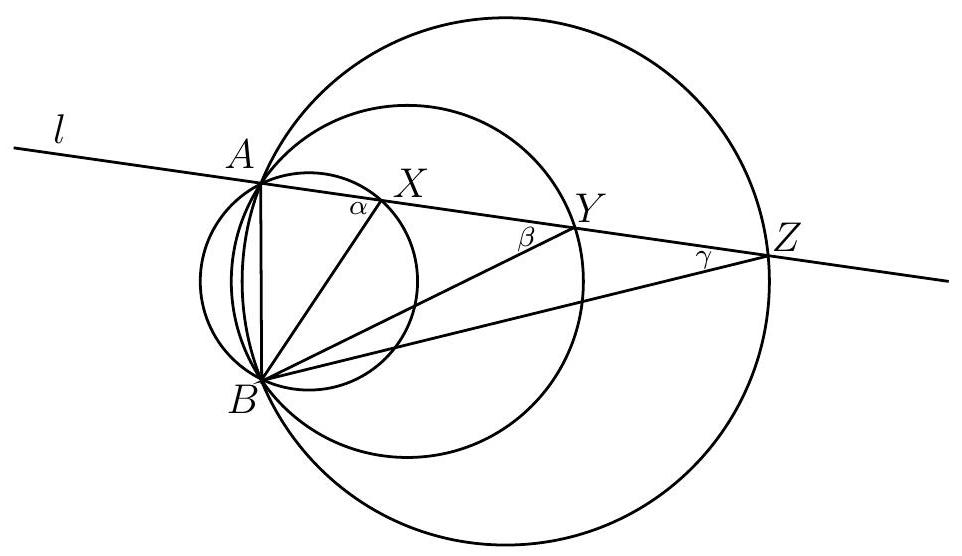
|
| 125 |
+
|
| 126 |
+
## Solution 1
|
| 127 |
+
|
| 128 |
+
Let $l$ be a line through $A$ different from $A B$ and join $B$ to $A, X, Y$ and $Z$ as in the above diagram. No matter how $l$ is chosen, the angles $A X B, A Y B$ and $A Z B$ always subtend the chord $A B$. For this reason the angles in the triangles $B X Y$ and $B X Z$ are the same for all such $l$. Thus the ratio $X Y: Y Z$ remains constant by similar triangles.
|
| 129 |
+
|
| 130 |
+
Note that this is true no matter how $X, Y$ and $Z$ lie in relation to $A$. Suppose $X, Y$ and $Z$ all lie on the same side of $A$ (as in the diagram) and that $\measuredangle A X B=\alpha, \measuredangle A Y B=\beta$ and $\measuredangle A Z B=\gamma$. Then $\measuredangle B X Y=180^{\circ}-\alpha, \measuredangle B Y X=\beta, \measuredangle B Y Z=180^{\circ}-\beta$ and $\measuredangle B Z Y=\gamma$. Now suppose $l$ is chosen so that $X$ is now on the opposite side of $A$ from $Y$ and $Z$. Now since $X$ is on the other side of the chord $A B, \measuredangle A X B=180^{\circ}-\alpha$, but it is still the case that $\measuredangle B X Y=180^{\circ}-\alpha$ and all other angles in the two pertinent triangles remain unchanged. If $l$ is chosen so that $X$ is identical with $A$, then $l$ is tangent to the first circle and it is still the case that $\measuredangle B X Y=180^{\circ}-\alpha$. All other cases can be checked in a similar manner.
|
| 131 |
+
|
| 132 |
+
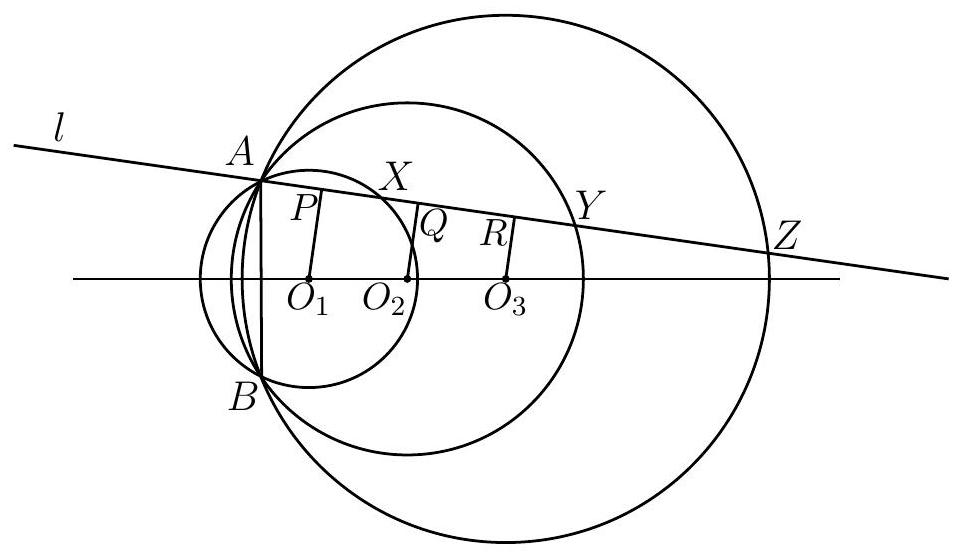
|
| 133 |
+
|
| 134 |
+
## Solution 2
|
| 135 |
+
|
| 136 |
+
Let $m$ be the perpendicular bisector of $A B$ and let $O_{1}, O_{2}, O_{3}$ be the centres of the three circles. Since $A B$ is a chord common to all three circles, $O_{1}, O_{2}, O_{3}$ all lie on $m$. Let $l$ be a line through $A$ different from $A B$ and suppose that $X, Y, Z$ all lie on the same side of $A B$, as in the above diagram. Let perpendiculars from $O_{1}, O_{2}, O_{3}$ meet $l$ at $P, Q, R$, respectively. Since a line through the centre of a circle bisects any chord,
|
| 137 |
+
|
| 138 |
+
$$
|
| 139 |
+
A X=2 A P, \quad A Y=2 A Q \quad \text { and } \quad A Z=2 A R
|
| 140 |
+
$$
|
| 141 |
+
|
| 142 |
+
Now
|
| 143 |
+
|
| 144 |
+
$$
|
| 145 |
+
X Y=A Y-A X=2(A Q-A P)=2 P Q \quad \text { and, similarly, } \quad Y Z=2 Q R \text {. }
|
| 146 |
+
$$
|
| 147 |
+
|
| 148 |
+
Therefore $X Y: Y Z=P Q: Q R$. But $O_{1} P\left\|O_{2} Q\right\| O_{3} R$, so $P Q: Q R=O_{1} O_{2}: O_{2} O_{3}$. Since the centres of the circles are fixed, the ratio $X Y: Y Z=O_{1} O_{2}: O_{2} O_{3}$ does not depend on the choice of $l$.
|
| 149 |
+
|
| 150 |
+
If $X, Y, Z$ do not all lie on the same side of $A B$, we can obtain the same result with a similar proof. For instance, if $X$ and $Y$ are opposite sides of $A B$, then we will have $X Y=A Y+A X$, but since in this case $P Q=A Q+A P$, it is still the case that $X Y=2 P Q$ and result still follows, etc.
|
| 151 |
+
|
| 152 |
+
5. Let $S$ be a set of $n$ points in the plane such that any two points of $S$ are at least 1 unit apart. Prove there is a subset $T$ of $S$ with at least $n / 7$ points such that any two points of $T$ are at least $\sqrt{3}$ units apart.
|
| 153 |
+
|
| 154 |
+
## Solution
|
| 155 |
+
|
| 156 |
+
We will construct the set $T$ in the following way: Assume the points of $S$ are in the $x y$-plane and let $P$ be a point in $S$ with maximum $y$-coordinate. This point $P$ will be a member of the set $T$ and now, from $S$, we will remove $P$ and all points in $S$ which are less than $\sqrt{3}$ units from $P$. From the remaining points we choose one with maximum $y$-coordinate to be a member of $T$ and remove from $S$ all points at distance less than $\sqrt{3}$ units from this new point. We continue in this way, until all the points of $S$ are exhausted. Clearly any two points in $T$ are at least $\sqrt{3}$ units apart. To show that $T$ has at least $n / 7$ points, we must prove that at each stage no more than 6 other points are removed along with $P$.
|
| 157 |
+
|
| 158 |
+
At a typical stage in this process, we've selected a point $P$ with maximum $y$-coordinate, so any points at distance less than $\sqrt{3}$ from $P$ must lie inside the semicircular region of radius $\sqrt{3}$ centred at $P$ shown in the first diagram below. Since points of $S$ are at least 1 unit apart, these points must lie outside (or on) the semicircle of radius 1. (So they lie in the shaded region of the first diagram.) Now divide this shaded region into 6 congruent regions $R_{1}, R_{2}, \ldots, R_{6}$ as shown in this diagram.
|
| 159 |
+
|
| 160 |
+
We will show that each of these regions contains at most one point of $S$. Since all 6 regions are congruent, consider one of them as depicted in the second diagram below. The distance between any two points in this shaded region must be less than the length of the line segment $A B$. The lengths of $P A$ and $P B$ are $\sqrt{3}$ and 1 , respectively, and angle $A P B=30^{\circ}$. If we construct a perpendicular from $B$ to $P A$ at $C$, then the length of $P C$ is $\cos 30^{\circ}=\sqrt{3} / 2$. Thus $B C$ is a perpendicular bisector of $P A$ and therefore $A B=P B=1$. So the distance between any two points in this region is less than 1. Therefore each of $R_{1}, \ldots, R_{6}$ can contain at most one point of $S$, which completes the proof.
|
| 161 |
+
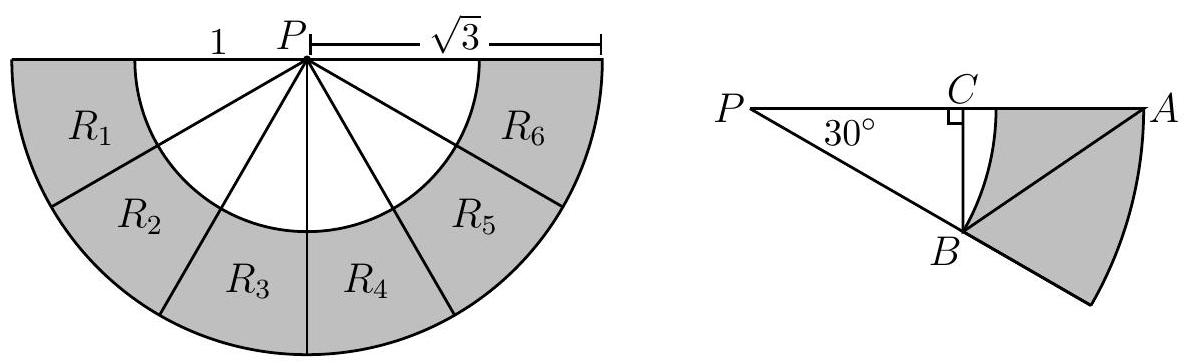
|
| 162 |
+
|
CANADA_MO/md/en-sol2004.md
ADDED
|
@@ -0,0 +1,179 @@
|
|
|
|
|
|
|
|
|
|
|
|
|
|
|
|
|
|
|
|
|
|
|
|
|
|
|
|
|
|
|
|
|
|
|
|
|
|
|
|
|
|
|
|
|
|
|
|
|
|
|
|
|
|
|
|
|
|
|
|
|
|
|
|
|
|
|
|
|
|
|
|
|
|
|
|
|
|
|
|
|
|
|
|
|
|
|
|
|
|
|
|
|
|
|
|
|
|
|
|
|
|
|
|
|
|
|
|
|
|
|
|
|
|
|
|
|
|
|
|
|
|
|
|
|
|
|
|
|
|
|
|
|
|
|
|
|
|
|
|
|
|
|
|
|
|
|
|
|
|
|
|
|
|
|
|
|
|
|
|
|
|
|
|
|
|
|
|
|
|
|
|
|
|
|
|
|
|
|
|
|
|
|
|
|
|
|
|
|
|
|
|
|
|
|
|
|
|
|
|
|
|
|
|
|
|
|
|
|
|
|
|
|
|
|
|
|
|
|
|
|
|
|
|
|
|
|
|
|
|
|
|
|
|
|
|
|
|
|
|
|
|
|
|
|
|
|
|
|
|
|
|
|
|
|
|
|
|
|
|
|
|
|
|
|
|
|
|
|
|
|
|
|
|
|
|
|
|
|
|
|
|
|
|
|
|
|
|
|
|
|
|
|
|
|
|
|
|
|
|
|
|
|
|
|
|
|
|
|
|
|
|
|
|
|
|
|
|
|
|
|
|
|
|
|
|
|
|
|
|
|
|
|
|
|
|
|
|
|
|
|
|
|
|
|
|
|
|
|
|
|
|
|
|
|
|
|
|
|
|
|
|
|
|
|
|
|
|
|
|
|
|
|
|
|
|
|
|
|
|
|
|
|
|
|
|
|
|
|
|
|
|
|
|
|
|
|
|
|
|
|
|
|
|
|
|
|
|
|
|
|
|
|
|
|
|
|
|
|
|
|
|
|
|
|
|
|
|
|
|
|
|
|
|
|
|
|
|
|
|
|
|
|
|
|
|
|
|
|
|
|
|
|
|
|
|
|
|
|
|
|
|
|
|
|
|
|
|
|
|
|
|
|
|
|
|
|
|
|
|
|
|
|
|
|
|
|
|
|
|
|
|
|
|
|
|
|
|
|
|
|
|
|
|
|
|
|
|
|
|
|
|
|
|
|
|
|
|
|
|
|
|
|
|
|
|
|
|
|
|
|
|
|
|
|
|
|
|
|
|
|
| 1 |
+
# Solutions to the $2004 \mathrm{CMO}$
|
| 2 |
+
|
| 3 |
+
written March 31, 2004
|
| 4 |
+
|
| 5 |
+
1. Find all ordered triples $(x, y, z)$ of real numbers which satisfy the following system of equations:
|
| 6 |
+
|
| 7 |
+
$$
|
| 8 |
+
\left\{\begin{array}{l}
|
| 9 |
+
x y=z-x-y \\
|
| 10 |
+
x z=y-x-z \\
|
| 11 |
+
y z=x-y-z
|
| 12 |
+
\end{array}\right.
|
| 13 |
+
$$
|
| 14 |
+
|
| 15 |
+
## Solution 1
|
| 16 |
+
|
| 17 |
+
Subtracting the second equation from the first gives $x y-x z=2 z-2 y$. Factoring $y-z$ from each side and rearranging gives
|
| 18 |
+
|
| 19 |
+
$$
|
| 20 |
+
(x+2)(y-z)=0
|
| 21 |
+
$$
|
| 22 |
+
|
| 23 |
+
so either $x=-2$ or $z=y$.
|
| 24 |
+
|
| 25 |
+
If $x=-2$, the first equation becomes $-2 y=z+2-y$, or $y+z=-2$. Substituting $x=-2, y+z=-2$ into the third equation gives $y z=-2-(-2)=0$. Hence either $y$ or $z$ is 0 , so if $x=-2$, the only solutions are $(-2,0,-2)$ and $(-2,-2,0)$.
|
| 26 |
+
|
| 27 |
+
If $z=y$ the first equation becomes $x y=-x$, or $x(y+1)=0$. If $x=0$ and $z=y$, the third equation becomes $y^{2}=-2 y$ which gives $y=0$ or $y=-2$. If $y=-1$ and $z=y=-1$, the third equation gives $x=-1$. So if $y=z$, the only solutions are $(0,0,0),(0,-2,-2)$ and $(-1,-1,-1)$.
|
| 28 |
+
|
| 29 |
+
In summary, there are 5 solutions: $(-2,0,-2),(-2,-2,0),(0,0,0),(0,-2,-2)$ and $(-1,-1,-1)$.
|
| 30 |
+
|
| 31 |
+
## Solution 2
|
| 32 |
+
|
| 33 |
+
Adding $x$ to both sides of the first equation gives
|
| 34 |
+
|
| 35 |
+
$$
|
| 36 |
+
x(y+1)=z-y=(z+1)-(y+1) \Rightarrow(x+1)(y+1)=z+1 .
|
| 37 |
+
$$
|
| 38 |
+
|
| 39 |
+
Similarly manipulating the other two equations and letting $a=x+1, b=y+1$, $c=z+1$, we can write the system in the following way.
|
| 40 |
+
|
| 41 |
+
$$
|
| 42 |
+
\left\{\begin{array}{l}
|
| 43 |
+
a b=c \\
|
| 44 |
+
a c=b \\
|
| 45 |
+
b c=a
|
| 46 |
+
\end{array}\right.
|
| 47 |
+
$$
|
| 48 |
+
|
| 49 |
+
If any one of $a, b, c$ is 0 , then it's clear that all three are 0 . So $(a, b, c)=(0,0,0)$ is one solution and now suppose that $a, b, c$ are all nonzero. Substituting $c=a b$ into the second and third equations gives $a^{2} b=b$ and $b^{2} a=a$, respectively. Hence $a^{2}=1$, $b^{2}=1$ (since $a, b$ nonzero). This gives 4 more solutions: $(a, b, c)=(1,1,1),(1,-1,-1)$, $(-1,1,-1)$ or $(-1,-1,1)$. Reexpressing in terms of $x, y, z$, we obtain the 5 ordered triples listed in Solution 1.
|
| 50 |
+
|
| 51 |
+
2. How many ways can 8 mutually non-attacking rooks be placed on the $9 \times 9$ chessboard (shown here) so that all 8 rooks are on squares of the same colour?
|
| 52 |
+
|
| 53 |
+
[Two rooks are said to be attacking each other if they are placed in the same row or column of the board.]
|
| 54 |
+
|
| 55 |
+
## Solution 1
|
| 56 |
+
|
| 57 |
+
We will first count the number of ways of placing 8 mutually non-attacking rooks on black squares and then count the number of ways of placing them on white squares. Suppose that the rows of the board have been numbered 1 to 9 from top to bottom.
|
| 58 |
+
|
| 59 |
+
First notice that a rook placed on a black square in an odd numbered row cannot attack a rook on a black square in an even numbered row. This effectively partitions the black squares into a $5 \times 5$ board and a $4 \times 4$ board (squares labelled $O$ and $E$ respectively, in the diagram at right) and rooks can be placed independently on these two boards. There are 5 ! ways to place 5 non-attacking rooks on the squares labelled $O$ and 4 ! ways to
|
| 60 |
+
|
| 61 |
+
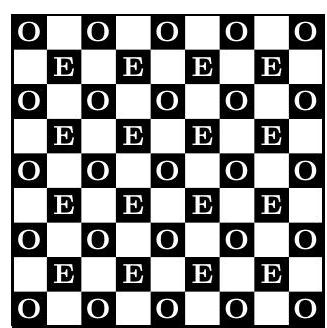
|
| 62 |
+
place 4 non-attacking rooks on the squares labelled $E$.
|
| 63 |
+
|
| 64 |
+
This gives 5!4! ways to place 9 mutually non-attacking rooks on black squares and removing any one of these 9 rooks gives one of the desired configurations. Thus there are $9 \cdot 5 ! 4$ ! ways to place 8 mutually non-attacking rooks on black squares.
|
| 65 |
+
|
| 66 |
+
Using very similar reasoning we can partition the white squares as shown in the diagram at right. The white squares are partitioned into two $5 \times 4$ boards such that no rook on a square marked $O$ can attack a rook on a square mark $E$. At most 4 non-attacking rooks can be placed on a $5 \times 4$ board and they can be placed in $5 \cdot 4 \cdot 3 \cdot 2=5$ ! ways. Thus there are $(5 !)^{2}$ ways to place 8 mutually non-attacking rooks on white squares.
|
| 67 |
+
|
| 68 |
+
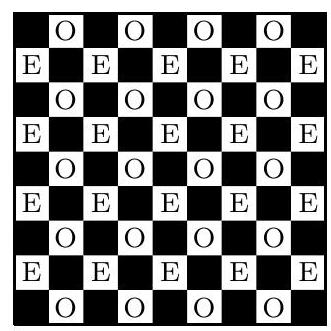
|
| 69 |
+
|
| 70 |
+
In total there are $9 \cdot 5 ! 4 !+(5 !)^{2}=(9+5) 5 ! 4 !=14 \cdot 5 ! 4 !=40320$ ways to place 8 mutually non-attacking rooks on squares of the same colour.
|
| 71 |
+
|
| 72 |
+
## Solution 2
|
| 73 |
+
|
| 74 |
+
Consider rooks on black squares first. We have 8 rooks and 9 rows, so exactly one row will be without rooks. There are two cases: either the empty row has 5 black squares or it has 4 black squares. By permutation these rows can be made either last or second last. In each case we'll count the possible number of ways of placing the rooks on the board as we proceed row by row.
|
| 75 |
+
|
| 76 |
+
In the first case we have 5 choices for the empty row, then we can place a rook on any of the black squares in row 1 ( 5 possibilities) and any of the black squares in row 2 (4 possibilities). When we attempt to place a rook in row 3, we must avoid the column containing the rook that was placed in row 1 , so we have 4 possibilities. Using similar reasoning, we can place the rook on any of 3 possible black squares in row 4 , etc. The total number of possibilities for the first case is $5 \cdot 5 \cdot 4 \cdot 4 \cdot 3 \cdot 3 \cdot 2 \cdot 2 \cdot 1=(5 !)^{2}$. In the second case, we have 4 choices for the empty row (but assume it's the second last row). We now place rooks as before and using similar logic, we get that the total number of possibilities for the second case is $4 \cdot 5 \cdot 4 \cdot 4 \cdot 3 \cdot 3 \cdot 2 \cdot 1 \cdot 1=4(5 ! 4 !)$.
|
| 77 |
+
|
| 78 |
+
Now, do the same for the white squares. If a row with 4 white squares is empty ( 5 ways to choose it), then the total number of possibilities is $(5 !)^{2}$. It's impossible to have a row with 5 white squares empty, so the total number of ways to place rooks is
|
| 79 |
+
|
| 80 |
+
$$
|
| 81 |
+
(5 !)^{2}+4(5 ! 4 !)+(5 !)^{2}=(5+4+5) 5 ! 4 !=14(5 ! 4 !)
|
| 82 |
+
$$
|
| 83 |
+
|
| 84 |
+
3. Let $A, B, C, D$ be four points on a circle (occurring in clockwise order), with $A B<A D$ and $B C>C D$. Let the bisector of angle $B A D$ meet the circle at $X$ and the bisector of angle $B C D$ meet the circle at $Y$. Consider the hexagon formed by these six points on the circle. If four of the six sides of the hexagon have equal length, prove that $B D$ must be a diameter of the circle.
|
| 85 |
+
|
| 86 |
+
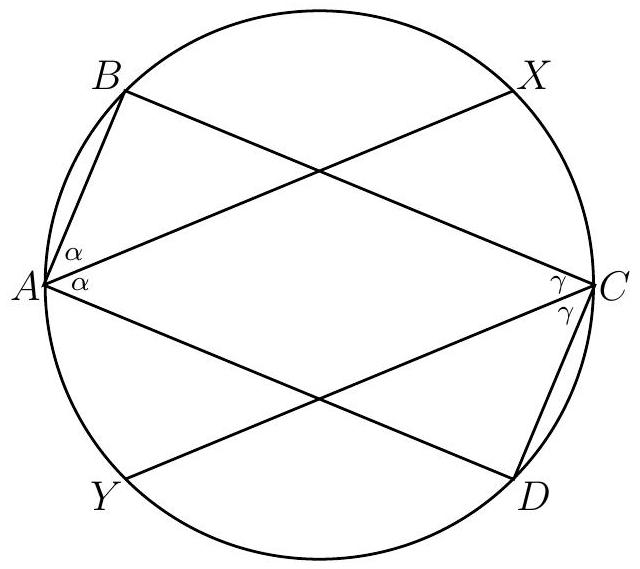
|
| 87 |
+
|
| 88 |
+
## Solution 1
|
| 89 |
+
|
| 90 |
+
We're given that $A B<A D$. Since $C Y$ bisects $\measuredangle B C D, B Y=Y D$, so $Y$ lies between $D$ and $A$ on the circle, as in the diagram above, and $D Y>Y A, D Y>A B$. Similar reasoning confirms that $X$ lies between $B$ and $C$ and $B X>X C, B X>C D$. So if $A B X C D Y$ has 4 equal sides, then it must be that $Y A=A B=X C=C D$.
|
| 91 |
+
|
| 92 |
+
Let $\measuredangle B A X=\measuredangle D A X=\alpha$ and let $\measuredangle B C Y=\measuredangle D C Y=\gamma$. Since $A B C D$ is cyclic, $\measuredangle A+\measuredangle C=180^{\circ}$, which implies that $\alpha+\gamma=90^{\circ}$. The fact that $Y A=A B=X C=C D$ means that the arc from $Y$ to $B$ (which is subtended by $\measuredangle Y C B$ ) is equal to the arc from $X$ to $D$ (which is subtended by $\measuredangle X A D$ ). Hence $\measuredangle Y C B=\measuredangle X A D$, so $\alpha=\gamma=45^{\circ}$. Finally, $B D$ is subtended by $\measuredangle B A D=2 \alpha=90^{\circ}$. Therefore $B D$ is a diameter of the circle.
|
| 93 |
+
|
| 94 |
+
## Solution 2
|
| 95 |
+
|
| 96 |
+
We're given that $A B<A D$. Since $C Y$ bisects $\measuredangle B C D, B Y=Y D$, so $Y$ lies between $D$ and $A$ on the circle, as in the diagram above, and $D Y>Y A, D Y>A B$. Similar reasoning confirms that $X$ lies between $B$ and $C$ and $B X>X C, B X>C D$. So if $A B X C D Y$ has 4 equal sides, then it must be that $Y A=A B=X C=C D$. This implies that the arc from $Y$ to $B$ is equal to the arc from $X$ to $D$ and hence that $Y B=X D$. Since $\measuredangle B A X=\measuredangle X A D, B X=X D$ and since $\measuredangle D C Y=\measuredangle Y C B$, $D Y=Y B$. Therefore $B X D Y$ is a square and its diagonal, $B D$, must be a diameter of the circle.
|
| 97 |
+
|
| 98 |
+
4. Let $p$ be an odd prime. Prove that
|
| 99 |
+
|
| 100 |
+
$$
|
| 101 |
+
\sum_{k=1}^{p-1} k^{2 p-1} \equiv \frac{p(p+1)}{2} \quad\left(\bmod p^{2}\right)
|
| 102 |
+
$$
|
| 103 |
+
|
| 104 |
+
[Note that $a \equiv b(\bmod m)$ means that $a-b$ is divisible by $m$.]
|
| 105 |
+
|
| 106 |
+
## Solution
|
| 107 |
+
|
| 108 |
+
Since $p-1$ is even, we can pair up the terms in the summation in the following way (first term with last, 2nd term with 2nd last, etc.):
|
| 109 |
+
|
| 110 |
+
$$
|
| 111 |
+
\sum_{k=1}^{p-1} k^{2 p-1}=\sum_{k=1}^{\frac{p-1}{2}}\left(k^{2 p-1}+(p-k)^{2 p-1}\right)
|
| 112 |
+
$$
|
| 113 |
+
|
| 114 |
+
Expanding $(p-k)^{2 p-1}$ with the binomial theorem, we get
|
| 115 |
+
|
| 116 |
+
$$
|
| 117 |
+
(p-k)^{2 p-1}=p^{2 p-1}-\cdots-\left(\begin{array}{c}
|
| 118 |
+
2 p-1 \\
|
| 119 |
+
2
|
| 120 |
+
\end{array}\right) p^{2} k^{2 p-3}+\left(\begin{array}{c}
|
| 121 |
+
2 p-1 \\
|
| 122 |
+
1
|
| 123 |
+
\end{array}\right) p k^{2 p-2}-k^{2 p-1},
|
| 124 |
+
$$
|
| 125 |
+
|
| 126 |
+
where every term on the right-hand side is divisible by $p^{2}$ except the last two. Therefore
|
| 127 |
+
|
| 128 |
+
$$
|
| 129 |
+
k^{2 p-1}+(p-k)^{2 p-1} \equiv k^{2 p-1}+\left(\begin{array}{c}
|
| 130 |
+
2 p-1 \\
|
| 131 |
+
1
|
| 132 |
+
\end{array}\right) p k^{2 p-2}-k^{2 p-1} \equiv(2 p-1) p k^{2 p-2}\left(\bmod p^{2}\right)
|
| 133 |
+
$$
|
| 134 |
+
|
| 135 |
+
For $1 \leq k<p, k$ is not divisible by $p$, so $k^{p-1} \equiv 1(\bmod p)$, by Fermat's Little Theorem. So $(2 p-1) k^{2 p-2} \equiv(2 p-1)\left(1^{2}\right) \equiv-1(\bmod p)$, say $(2 p-1) k^{2 p-2}=m p-1$ for some integer $m$. Then
|
| 136 |
+
|
| 137 |
+
$$
|
| 138 |
+
(2 p-1) p k^{2 p-2}=m p^{2}-p \equiv-p\left(\bmod p^{2}\right)
|
| 139 |
+
$$
|
| 140 |
+
|
| 141 |
+
Finally,
|
| 142 |
+
|
| 143 |
+
$$
|
| 144 |
+
\begin{aligned}
|
| 145 |
+
\sum_{k=1}^{p-1} k^{2 p-1} & \equiv \sum_{k=1}^{\frac{p-1}{2}}(-p) \equiv\left(\frac{p-1}{2}\right)(-p)\left(\bmod p^{2}\right) \\
|
| 146 |
+
& \equiv \frac{p-p^{2}}{2}+p^{2} \equiv \frac{p(p+1)}{2}\left(\bmod p^{2}\right) .
|
| 147 |
+
\end{aligned}
|
| 148 |
+
$$
|
| 149 |
+
|
| 150 |
+
5. Let $T$ be the set of all positive integer divisors of $2004^{100}$. What is the largest possible number of elements that a subset $S$ of $T$ can have if no element of $S$ is an integer multiple of any other element of $S$ ?
|
| 151 |
+
|
| 152 |
+
## Solution
|
| 153 |
+
|
| 154 |
+
Assume throughout that $a, b, c$ are nonnegative integers. Since the prime factorization of 2004 is $2004=2^{2} \cdot 3 \cdot 167$,
|
| 155 |
+
|
| 156 |
+
$$
|
| 157 |
+
T=\left\{2^{a} 3^{b} 167^{c} \mid 0 \leq a \leq 200,0 \leq b, c \leq 100\right\}
|
| 158 |
+
$$
|
| 159 |
+
|
| 160 |
+
Let
|
| 161 |
+
|
| 162 |
+
$$
|
| 163 |
+
S=\left\{2^{200-b-c} 3^{b} 167^{c} \mid 0 \leq b, c \leq 100\right\}
|
| 164 |
+
$$
|
| 165 |
+
|
| 166 |
+
For any $0 \leq b, c \leq 100$, we have $0 \leq 200-b-c \leq 200$, so $S$ is a subset of $T$. Since there are 101 possible values for $b$ and 101 possible values for $c, S$ contains $101^{2}$ elements. We will show that no element of $S$ is a multiple of another and that no larger subset of $T$ satisfies this condition.
|
| 167 |
+
|
| 168 |
+
Suppose $2^{200-b-c} 3^{b} 167^{c}$ is an integer multiple of $2^{200-j-k} 3^{j} 167^{k}$. Then
|
| 169 |
+
|
| 170 |
+
$$
|
| 171 |
+
200-b-c \geq 200-j-k, \quad b \geq j, \quad c \geq k
|
| 172 |
+
$$
|
| 173 |
+
|
| 174 |
+
But this first inequality implies $b+c \leq j+k$, which together with $b \geq j, c \geq k$ gives $b=j$ and $c=k$. Hence no element of $S$ is an integer multiple of another element of $S$.
|
| 175 |
+
|
| 176 |
+
Let $U$ be a subset of $T$ with more than $101^{2}$ elements. Since there are only $101^{2}$ distinct pairs $(b, c)$ with $0 \leq b, c \leq 100$, then (by the pigeonhole principle) $U$ must contain two elements $u_{1}=2^{a_{1}} 3^{b_{1}} 167^{c_{1}}$ and $u_{2}=2^{a_{2}} 3^{b_{2}} 167^{c_{2}}$, with $b_{1}=b_{2}$ and $c_{1}=c_{2}$, but $a_{1} \neq a_{2}$. If $a_{1}>a_{2}$, then $u_{1}$ is a multiple of $u_{2}$ and if $a_{1}<a_{2}$, then $u_{2}$ is a multiple of $u_{1}$. Hence $U$ does not satisfy the desired condition.
|
| 177 |
+
|
| 178 |
+
Therefore the largest possible number of elements that such a subset of $T$ can have is $101^{2}=10201$.
|
| 179 |
+
|
CANADA_MO/md/en-sol2005.md
ADDED
|
@@ -0,0 +1,260 @@
|
|
|
|
|
|
|
|
|
|
|
|
|
|
|
|
|
|
|
|
|
|
|
|
|
|
|
|
|
|
|
|
|
|
|
|
|
|
|
|
|
|
|
|
|
|
|
|
|
|
|
|
|
|
|
|
|
|
|
|
|
|
|
|
|
|
|
|
|
|
|
|
|
|
|
|
|
|
|
|
|
|
|
|
|
|
|
|
|
|
|
|
|
|
|
|
|
|
|
|
|
|
|
|
|
|
|
|
|
|
|
|
|
|
|
|
|
|
|
|
|
|
|
|
|
|
|
|
|
|
|
|
|
|
|
|
|
|
|
|
|
|
|
|
|
|
|
|
|
|
|
|
|
|
|
|
|
|
|
|
|
|
|
|
|
|
|
|
|
|
|
|
|
|
|
|
|
|
|
|
|
|
|
|
|
|
|
|
|
|
|
|
|
|
|
|
|
|
|
|
|
|
|
|
|
|
|
|
|
|
|
|
|
|
|
|
|
|
|
|
|
|
|
|
|
|
|
|
|
|
|
|
|
|
|
|
|
|
|
|
|
|
|
|
|
|
|
|
|
|
|
|
|
|
|
|
|
|
|
|
|
|
|
|
|
|
|
|
|
|
|
|
|
|
|
|
|
|
|
|
|
|
|
|
|
|
|
|
|
|
|
|
|
|
|
|
|
|
|
|
|
|
|
|
|
|
|
|
|
|
|
|
|
|
|
|
|
|
|
|
|
|
|
|
|
|
|
|
|
|
|
|
|
|
|
|
|
|
|
|
|
|
|
|
|
|
|
|
|
|
|
|
|
|
|
|
|
|
|
|
|
|
|
|
|
|
|
|
|
|
|
|
|
|
|
|
|
|
|
|
|
|
|
|
|
|
|
|
|
|
|
|
|
|
|
|
|
|
|
|
|
|
|
|
|
|
|
|
|
|
|
|
|
|
|
|
|
|
|
|
|
|
|
|
|
|
|
|
|
|
|
|
|
|
|
|
|
|
|
|
|
|
|
|
|
|
|
|
|
|
|
|
|
|
|
|
|
|
|
|
|
|
|
|
|
|
|
|
|
|
|
|
|
|
|
|
|
|
|
|
|
|
|
|
|
|
|
|
|
|
|
|
|
|
|
|
|
|
|
|
|
|
|
|
|
|
|
|
|
|
|
|
|
|
|
|
|
|
|
|
|
|
|
|
|
|
|
|
|
|
|
|
|
|
|
|
|
|
|
|
|
|
|
|
|
|
|
|
|
|
|
|
|
|
|
|
|
|
|
|
|
|
|
|
|
|
|
|
|
|
|
|
|
|
|
|
|
|
|
|
|
|
|
|
|
|
|
|
|
|
|
|
|
|
|
|
|
|
|
|
|
|
|
|
|
|
|
|
|
|
|
|
|
|
|
|
|
|
|
|
|
|
|
|
|
|
|
|
|
|
|
|
|
|
|
|
|
|
|
|
|
|
|
|
|
|
|
|
|
|
|
|
|
|
|
|
|
|
|
|
|
|
|
|
|
|
|
|
|
|
|
|
|
|
|
|
|
|
|
|
|
|
|
|
|
|
|
|
|
|
|
|
|
|
|
|
|
|
|
|
|
|
|
|
|
|
|
|
|
|
|
|
|
|
|
|
|
|
|
|
|
|
|
|
|
|
|
|
|
|
|
|
|
|
|
|
|
|
|
|
|
|
|
|
|
|
|
|
|
|
|
|
|
|
|
|
|
|
|
|
|
|
|
|
|
|
|
|
|
|
|
|
|
|
|
|
|
|
|
|
|
|
|
|
| 1 |
+
# Solutions to the 2005 CMO
|
| 2 |
+
|
| 3 |
+
written March 30, 2005
|
| 4 |
+
|
| 5 |
+
1. Consider an equilateral triangle of side length $n$, which is divided into unit triangles, as shown. Let $f(n)$ be the number of paths from the triangle in the top row to the middle triangle in the bottom row, such that adjacent triangles in our path share a common edge and the path never travels up (from a lower row to a higher row) or revisits a triangle. An example of one such path is illustrated below for $n=5$. Determine the value of $f(2005)$.
|
| 6 |
+
|
| 7 |
+
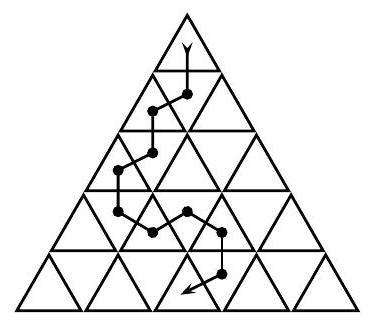
|
| 8 |
+
|
| 9 |
+
## Solution
|
| 10 |
+
|
| 11 |
+
We shall show that $f(n)=(n-1)$ !.
|
| 12 |
+
|
| 13 |
+
Label the horizontal line segments in the triangle $l_{1}, l_{2}, \ldots$ as in the diagram below. Since the path goes from the top triangle to a triangle in the bottom row and never travels up, the path must cross each of $l_{1}, l_{2}, \ldots, l_{n-1}$ exactly once. The diagonal lines in the triangle divide $l_{k}$ into $k$ unit line segments and the path must cross exactly one of these $k$ segments for each $k$. (In the diagram below, these line segments have been highlighted.) The path is completely determined by the set of $n-1$ line segments which are crossed. So as the path moves from the $k$ th row to the $(k+1)$ st row, there are $k$ possible line segments where the path could cross $l_{k}$. Since there are $1 \cdot 2 \cdot 3 \cdots(n-1)=(n-1)$ ! ways that the path could cross the $n-1$ horizontal lines, and each one corresponds to a unique path, we get $f(n)=(n-1)$ !.
|
| 14 |
+
|
| 15 |
+
Therefore $f(2005)=(2004)$ !.
|
| 16 |
+
|
| 17 |
+
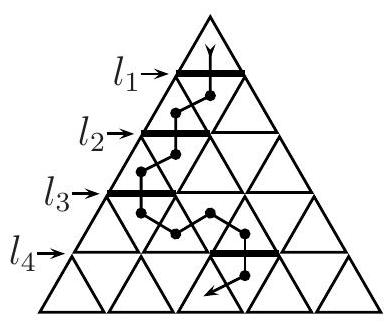
|
| 18 |
+
|
| 19 |
+
2. Let $(a, b, c)$ be a Pythagorean triple, i.e., a triplet of positive integers with $a^{2}+b^{2}=c^{2}$.
|
| 20 |
+
|
| 21 |
+
a) Prove that $(c / a+c / b)^{2}>8$.
|
| 22 |
+
|
| 23 |
+
b) Prove that there does not exist any integer $n$ for which we can find a Pythagorean triple $(a, b, c)$ satisfying $(c / a+c / b)^{2}=n$.
|
| 24 |
+
|
| 25 |
+
## a) Solution 1
|
| 26 |
+
|
| 27 |
+
Let $(a, b, c)$ be a Pythagorean triple. View $a, b$ as lengths of the legs of a right angled triangle with hypotenuse of length $c$; let $\theta$ be the angle determined by the sides with lengths $a$ and $c$. Then
|
| 28 |
+
|
| 29 |
+
$$
|
| 30 |
+
\begin{aligned}
|
| 31 |
+
\left(\frac{c}{a}+\frac{c}{b}\right)^{2} & =\left(\frac{1}{\cos \theta}+\frac{1}{\sin \theta}\right)^{2}=\frac{\sin ^{2} \theta+\cos ^{2} \theta+2 \sin \theta \cos \theta}{(\sin \theta \cos \theta)^{2}} \\
|
| 32 |
+
& =4\left(\frac{1+\sin 2 \theta}{\sin ^{2} 2 \theta}\right)=\frac{4}{\sin ^{2} 2 \theta}+\frac{4}{\sin 2 \theta}
|
| 33 |
+
\end{aligned}
|
| 34 |
+
$$
|
| 35 |
+
|
| 36 |
+
Note that because $0<\theta<90^{\circ}$, we have $0<\sin 2 \theta \leq 1$, with equality only if $\theta=45^{\circ}$. But then $a=b$ and we obtain $\sqrt{2}=c / a$, contradicting $a, c$ both being integers. Thus, $0<\sin 2 \theta<1$ which gives $(c / a+c / b)^{2}>8$.
|
| 37 |
+
|
| 38 |
+
## Solution 2
|
| 39 |
+
|
| 40 |
+
Defining $\theta$ as in Solution 1, we have $c / a+c / b=\sec \theta+\csc \theta$. By the AM-GM inequality, we have $(\sec \theta+\csc \theta) / 2 \geq \sqrt{\sec \theta \csc \theta}$. So
|
| 41 |
+
|
| 42 |
+
$$
|
| 43 |
+
c / a+c / b \geq \frac{2}{\sqrt{\sin \theta \cos \theta}}=\frac{2 \sqrt{2}}{\sqrt{\sin 2 \theta}} \geq 2 \sqrt{2}
|
| 44 |
+
$$
|
| 45 |
+
|
| 46 |
+
Since $a, b, c$ are integers, we have $c / a+c / b>2 \sqrt{2}$ which gives $(c / a+c / b)^{2}>8$.
|
| 47 |
+
|
| 48 |
+
## Solution 3
|
| 49 |
+
|
| 50 |
+
By simplifying and using the AM-GM inequality,
|
| 51 |
+
|
| 52 |
+
$$
|
| 53 |
+
\left(\frac{c}{a}+\frac{c}{b}\right)^{2}=c^{2}\left(\frac{a+b}{a b}\right)^{2}=\frac{\left(a^{2}+b^{2}\right)(a+b)^{2}}{a^{2} b^{2}} \geq \frac{2 \sqrt{a^{2} b^{2}}(2 \sqrt{a b})^{2}}{a^{2} b^{2}}=8
|
| 54 |
+
$$
|
| 55 |
+
|
| 56 |
+
with equality only if $a=b$. By using the same argument as in Solution $1, a$ cannot equal $b$ and the inequality is strict.
|
| 57 |
+
|
| 58 |
+
## Solution 4
|
| 59 |
+
|
| 60 |
+
$$
|
| 61 |
+
\begin{aligned}
|
| 62 |
+
\left(\frac{c}{a}+\frac{c}{b}\right)^{2} & =\frac{c^{2}}{a^{2}}+\frac{c^{2}}{b^{2}}+\frac{2 c^{2}}{a b}=1+\frac{b^{2}}{a^{2}}+\frac{a^{2}}{b^{2}}+1+\frac{2\left(a^{2}+b^{2}\right)}{a b} \\
|
| 63 |
+
& =2+\left(\frac{a}{b}-\frac{b}{a}\right)^{2}+2+\frac{2}{a b}\left((a-b)^{2}+2 a b\right) \\
|
| 64 |
+
& =4+\left(\frac{a}{b}-\frac{b}{a}\right)^{2}+\frac{2(a-b)^{2}}{a b}+4 \geq 8,
|
| 65 |
+
\end{aligned}
|
| 66 |
+
$$
|
| 67 |
+
|
| 68 |
+
with equality only if $a=b$, which (as argued previously) cannot occur.
|
| 69 |
+
|
| 70 |
+
## b) Solution 1
|
| 71 |
+
|
| 72 |
+
Since $c / a+c / b$ is rational, $(c / a+c / b)^{2}$ can only be an integer if $c / a+c / b$ is an integer. Suppose $c / a+c / b=m$. We may assume that $\operatorname{gcd}(a, b)=1$. (If not, divide the common factor from $(a, b, c)$, leaving $m$ unchanged.)
|
| 73 |
+
|
| 74 |
+
Since $c(a+b)=m a b$ and $\operatorname{gcd}(a, a+b)=1$, $a$ must divide $c$, say $c=a k$. This gives $a^{2}+b^{2}=a^{2} k^{2}$ which implies $b^{2}=\left(k^{2}-1\right) a^{2}$. But then $a$ divides $b$ contradicting the fact that $\operatorname{gcd}(a, b)=1$. Therefore $(c / a+c / b)^{2}$ is not equal to any integer $n$.
|
| 75 |
+
|
| 76 |
+
## Solution 2
|
| 77 |
+
|
| 78 |
+
We begin as in Solution 1, supposing that $c / a+c / b=m$ with $\operatorname{gcd}(a, b)=1$. Hence $a$ and $b$ are not both even. It is also the case that $a$ and $b$ are not both odd, for then $c^{2}=a^{2}+b^{2} \equiv 2(\bmod 4)$, and perfect squares are congruent to either 0 or 1 modulo 4. So one of $a, b$ is odd and the other is even. Therefore $c$ must be odd.
|
| 79 |
+
|
| 80 |
+
Now $c / a+c / b=m$ implies $c(a+b)=m a b$, which cannot be true because $c(a+b)$ is odd and mab is even.
|
| 81 |
+
|
| 82 |
+
3. Let $S$ be a set of $n \geq 3$ points in the interior of a circle.
|
| 83 |
+
|
| 84 |
+
a) Show that there are three distinct points $a, b, c \in S$ and three distinct points $A, B, C$ on the circle such that $a$ is (strictly) closer to $A$ than any other point in $S, b$ is closer to $B$ than any other point in $S$ and $c$ is closer to $C$ than any other point in $S$.
|
| 85 |
+
|
| 86 |
+
b) Show that for no value of $n$ can four such points in $S$ (and corresponding points on the circle) be guaranteed.
|
| 87 |
+
|
| 88 |
+
## Solution 1
|
| 89 |
+
|
| 90 |
+
a) Let $H$ be the smallest convex set of points in the plane which contains $S . \dagger$ Take 3 points $a, b, c \in S$ which lie on the boundary of $H$. (There must always be at least 3 (but not necessarily 4) such points.)
|
| 91 |
+
|
| 92 |
+
Since $a$ lies on the boundary of the convex region $H$, we can construct a chord $L$ such that no two points of $H$ lie on opposite sides of $L$. Of the two points where the perpendicular to $L$ at $a$ meets the circle, choose one which is on a side of $L$ not containing any points of $H$ and call this point $A$. Certainly $A$ is closer to $a$ than to any other point on $L$ or on the other side of $L$. Hence $A$ is closer to $a$ than to any other point of $S$. We can find the required points $B$ and $C$ in an analogous way and the proof is complete.
|
| 93 |
+
|
| 94 |
+
[Note that this argument still holds if all the points of $S$ lie on a line.]
|
| 95 |
+
|
| 96 |
+
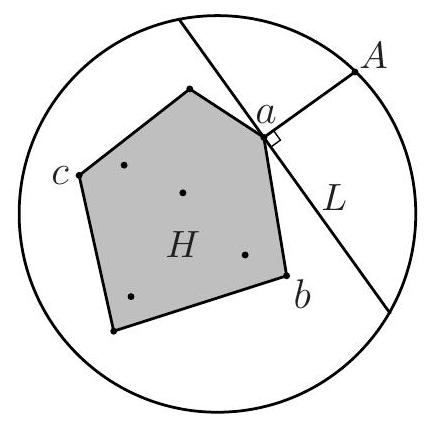
|
| 97 |
+
|
| 98 |
+
(a)
|
| 99 |
+
|
| 100 |
+
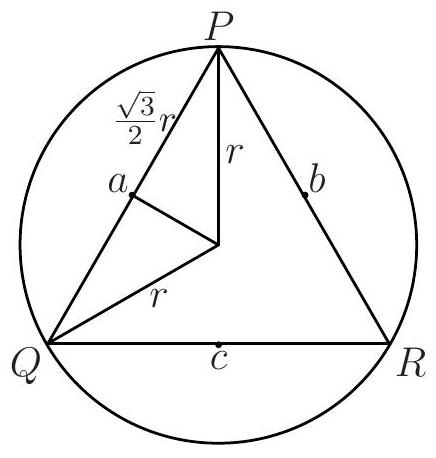
|
| 101 |
+
|
| 102 |
+
(b)
|
| 103 |
+
|
| 104 |
+
b) Let $P Q R$ be an equilateral triangle inscribed in the circle and let $a, b, c$ be midpoints of the three sides of $\triangle P Q R$. If $r$ is the radius of the circle, then every point on the circle is within $(\sqrt{3} / 2) r$ of one of $a, b$ or $c$. (See figure (b) above.) Now $\sqrt{3} / 2<9 / 10$, so if $S$ consists of $a, b, c$ and a cluster of points within $r / 10$ of the centre of the circle, then we cannot select 4 points from $S$ (and corresponding points on the circle) having the desired property.[^0]
|
| 105 |
+
|
| 106 |
+
## Solution 2
|
| 107 |
+
|
| 108 |
+
a) If all the points of $S$ lie on a line $L$, then choose any 3 of them to be $a, b, c$. Let $A$ be a point on the circle which meets the perpendicular to $L$ at $a$. Clearly $A$ is closer to $a$ than to any other point on $L$, and hence closer than other other point in $S$. We find $B$ and $C$ in an analogous way.
|
| 109 |
+
|
| 110 |
+
Otherwise, choose $a, b, c$ from $S$ so that the triangle formed by these points has maximal area. Construct the altitude from the side $b c$ to the point $a$ and extend this line until it meets the circle at $A$. We claim that $A$ is closer to $a$ than to any other point in $S$.
|
| 111 |
+
|
| 112 |
+
Suppose not. Let $x$ be a point in $S$ for which the distance from $A$ to $x$ is less than the distance from $A$ to $a$. Then the perpendicular distance from $x$ to the line $b c$ must be greater than the perpendicular distance from $a$ to the line $b c$. But then the triangle formed by the points $x, b, c$ has greater area than the triangle formed by $a, b, c$, contradicting the original choice of these 3 points. Therefore $A$ is closer to $a$ than to any other point in $S$.
|
| 113 |
+
|
| 114 |
+
The points $B$ and $C$ are found by constructing similar altitudes through $b$ and $c$, respectively.
|
| 115 |
+
|
| 116 |
+
b) See Solution 1.
|
| 117 |
+
|
| 118 |
+
4. Let $A B C$ be a triangle with circumradius $R$, perimeter $P$ and area $K$. Determine the maximum value of $K P / R^{3}$.
|
| 119 |
+
|
| 120 |
+
## Solution 1
|
| 121 |
+
|
| 122 |
+
Since similar triangles give the same value of $K P / R^{3}$, we can fix $R=1$ and maximize $K P$ over all triangles inscribed in the unit circle. Fix points $A$ and $B$ on the unit circle. The locus of points $C$ with a given perimeter $P$ is an ellipse that meets the circle in at most four points. The area $K$ is maximized (for a fixed $P$ ) when $C$ is chosen on the perpendicular bisector of $A B$, so we get a maximum value for $K P$ if $C$ is where the perpendicular bisector of $A B$ meets the circle. Thus the maximum value of $K P$ for a given $A B$ occurs when $A B C$ is an isosceles triangle. Repeating this argument with $B C$ fixed, we have that the maximum occurs when $A B C$ is an equilateral triangle.
|
| 123 |
+
|
| 124 |
+
Consider an equilateral triangle with side length $a$. It has $P=3 a$. It has height equal to $a \sqrt{3} / 2$ giving $K=a^{2} \sqrt{3} / 4$. ¿From the extended law of sines, $2 R=a / \sin (60)$ giving $R=a / \sqrt{3}$. Therefore the maximum value we seek is
|
| 125 |
+
|
| 126 |
+
$$
|
| 127 |
+
K P / R^{3}=\left(\frac{a^{2} \sqrt{3}}{4}\right)(3 a)\left(\frac{\sqrt{3}}{a}\right)^{3}=\frac{27}{4} .
|
| 128 |
+
$$
|
| 129 |
+
|
| 130 |
+
## Solution 2
|
| 131 |
+
|
| 132 |
+
From the extended law of sines, the lengths of the sides of the triangle are $2 R \sin A$, $2 R \sin B$ and $2 R \sin C$. So
|
| 133 |
+
|
| 134 |
+
$$
|
| 135 |
+
P=2 R(\sin A+\sin B+\sin C) \text { and } K=\frac{1}{2}(2 R \sin A)(2 R \sin B)(\sin C),
|
| 136 |
+
$$
|
| 137 |
+
|
| 138 |
+
giving
|
| 139 |
+
|
| 140 |
+
$$
|
| 141 |
+
\frac{K P}{R^{3}}=4 \sin A \sin B \sin C(\sin A+\sin B+\sin C)
|
| 142 |
+
$$
|
| 143 |
+
|
| 144 |
+
We wish to find the maximum value of this expression over all $A+B+C=180^{\circ}$. Using well-known identities for sums and products of sine functions, we can write
|
| 145 |
+
|
| 146 |
+
$$
|
| 147 |
+
\frac{K P}{R^{3}}=4 \sin A\left(\frac{\cos (B-C)}{2}-\frac{\cos (B+C)}{2}\right)\left(\sin A+2 \sin \left(\frac{B+C}{2}\right) \cos \left(\frac{B-C}{2}\right)\right) .
|
| 148 |
+
$$
|
| 149 |
+
|
| 150 |
+
If we first consider $A$ to be fixed, then $B+C$ is fixed also and this expression takes its maximum value when $\cos (B-C)$ and $\cos \left(\frac{B-C}{2}\right)$ equal 1 ; i.e. when $B=C$. In a similar way, one can show that for any fixed value of $B, K P / R^{3}$ is maximized when $A=C$. Therefore the maximum value of $K P / R^{3}$ occurs when $A=B=C=60^{\circ}$, and it is now an easy task to substitute this into the above expression to obtain the maximum value of $27 / 4$.
|
| 151 |
+
|
| 152 |
+
## Solution 3
|
| 153 |
+
|
| 154 |
+
As in Solution 2, we obtain
|
| 155 |
+
|
| 156 |
+
$$
|
| 157 |
+
\frac{K P}{R^{3}}=4 \sin A \sin B \sin C(\sin A+\sin B+\sin C)
|
| 158 |
+
$$
|
| 159 |
+
|
| 160 |
+
From the AM-GM inequality, we have
|
| 161 |
+
|
| 162 |
+
$$
|
| 163 |
+
\sin A \sin B \sin C \leq\left(\frac{\sin A+\sin B+\sin C}{3}\right)^{3},
|
| 164 |
+
$$
|
| 165 |
+
|
| 166 |
+
giving
|
| 167 |
+
|
| 168 |
+
$$
|
| 169 |
+
\frac{K P}{R^{3}} \leq \frac{4}{27}(\sin A+\sin B+\sin C)^{4}
|
| 170 |
+
$$
|
| 171 |
+
|
| 172 |
+
with equality when $\sin A=\sin B=\sin C$. Since the sine function is concave on the interval from 0 to $\pi$, Jensen's inequality gives
|
| 173 |
+
|
| 174 |
+
$$
|
| 175 |
+
\frac{\sin A+\sin B+\sin C}{3} \leq \sin \left(\frac{A+B+C}{3}\right)=\sin \frac{\pi}{3}=\frac{\sqrt{3}}{2} .
|
| 176 |
+
$$
|
| 177 |
+
|
| 178 |
+
Since equality occurs here when $\sin A=\sin B=\sin C$ also, we can conclude that the maximum value of $K P / R^{3}$ is $\frac{4}{27}\left(\frac{3 \sqrt{3}}{2}\right)^{4}=27 / 4$.
|
| 179 |
+
|
| 180 |
+
5. Let's say that an ordered triple of positive integers $(a, b, c)$ is $n$-powerful if $a \leq b \leq c$, $\operatorname{gcd}(a, b, c)=1$, and $a^{n}+b^{n}+c^{n}$ is divisible by $a+b+c$. For example, $(1,2,2)$ is 5 -powerful.
|
| 181 |
+
|
| 182 |
+
a) Determine all ordered triples (if any) which are $n$-powerful for all $n \geq 1$.
|
| 183 |
+
|
| 184 |
+
b) Determine all ordered triples (if any) which are 2004-powerful and 2005-powerful, but not 2007-powerful.
|
| 185 |
+
|
| 186 |
+
[Note that $\operatorname{gcd}(a, b, c)$ is the greatest common divisor of $a, b$ and $c$.]
|
| 187 |
+
|
| 188 |
+
## Solution 1
|
| 189 |
+
|
| 190 |
+
Let $T_{n}=a^{n}+b^{n}+c^{n}$ and consider the polynomial
|
| 191 |
+
|
| 192 |
+
$$
|
| 193 |
+
P(x)=(x-a)(x-b)(x-c)=x^{3}-(a+b+c) x^{2}+(a b+a c+b c) x-a b c .
|
| 194 |
+
$$
|
| 195 |
+
|
| 196 |
+
Since $P(a)=0$, we get $a^{3}=(a+b+c) a^{2}-(a b+a c+b c) a+a b c$ and multiplying both sides by $a^{n-3}$ we obtain $a^{n}=(a+b+c) a^{n-1}-(a b+a c+b c) a^{n-2}+(a b c) a^{n-3}$. Applying the same reasoning, we can obtain similar expressions for $b^{n}$ and $c^{n}$ and adding the three identities we get that $T_{n}$ satisfies the following 3 -term recurrence:
|
| 197 |
+
|
| 198 |
+
$$
|
| 199 |
+
T_{n}=(a+b+c) T_{n-1}-(a b+a c+b c) T_{n-2}+(a b c) T_{n-3} \text {, for all } n \geq 3
|
| 200 |
+
$$
|
| 201 |
+
|
| 202 |
+
¿From this we see that if $T_{n-2}$ and $T_{n-3}$ are divisible by $a+b+c$, then so is $T_{n}$. This immediately resolves part (b) - there are no ordered triples which are 2004-powerful and 2005-powerful, but not 2007-powerful-and reduces the number of cases to be considered in part (a): since all triples are 1-powerful, the recurrence implies that any ordered triple which is both 2 -powerful and 3 -powerful is $n$-powerful for all $n \geq 1$.
|
| 203 |
+
|
| 204 |
+
Putting $n=3$ in the recurrence, we have
|
| 205 |
+
|
| 206 |
+
$$
|
| 207 |
+
a^{3}+b^{3}+c^{3}=(a+b+c)\left(a^{2}+b^{2}+c^{2}\right)-(a b+a c+b c)(a+b+c)+3 a b c
|
| 208 |
+
$$
|
| 209 |
+
|
| 210 |
+
which implies that $(a, b, c)$ is 3 -powerful if and only if $3 a b c$ is divisible by $a+b+c$. Since
|
| 211 |
+
|
| 212 |
+
$$
|
| 213 |
+
a^{2}+b^{2}+c^{2}=(a+b+c)^{2}-2(a b+a c+b c),
|
| 214 |
+
$$
|
| 215 |
+
|
| 216 |
+
$(a, b, c)$ is 2 -powerful if and only if $2(a b+a c+b c)$ is divisible by $a+b+c$.
|
| 217 |
+
|
| 218 |
+
Suppose a prime $p \geq 5$ divides $a+b+c$. Then $p$ divides $a b c$. Since $\operatorname{gcd}(a, b, c)=1, p$ divides exactly one of $a, b$ or $c$; but then $p$ doesn't divide $2(a b+a c+b c)$.
|
| 219 |
+
|
| 220 |
+
Suppose $3^{2}$ divides $a+b+c$. Then 3 divides $a b c$, implying 3 divides exactly one of $a$, $b$ or $c$. But then 3 doesn't divide $2(a b+a c+b c)$.
|
| 221 |
+
|
| 222 |
+
Suppose $2^{2}$ divides $a+b+c$. Then 4 divides $a b c$. Since $\operatorname{gcd}(a, b, c)=1$, at most one of $a, b$ or $c$ is even, implying one of $a, b, c$ is divisible by 4 and the others are odd. But then $a b+a c+b c$ is odd and 4 doesn't divide $2(a b+a c+b c)$.
|
| 223 |
+
|
| 224 |
+
So if $(a, b, c)$ is 2 - and 3 -powerful, then $a+b+c$ is not divisible by 4 or 9 or any prime greater than 3. Since $a+b+c$ is at least $3, a+b+c$ is either 3 or 6 . It is now a simple matter to check the possibilities and conclude that the only triples which are $n$-powerful for all $n \geq 1$ are $(1,1,1)$ and $(1,1,4)$.
|
| 225 |
+
|
| 226 |
+
## Solution 2
|
| 227 |
+
|
| 228 |
+
Let $p$ be a prime. By Fermat's Little Theorem,
|
| 229 |
+
|
| 230 |
+
$$
|
| 231 |
+
a^{p-1} \equiv \begin{cases}1(\bmod p), & \text { if } p \text { doesn't divide } a \\ 0(\bmod p), & \text { if } p \text { divides } a\end{cases}
|
| 232 |
+
$$
|
| 233 |
+
|
| 234 |
+
Since $\operatorname{gcd}(a, b, c)=1$, we have that $a^{p-1}+b^{p-1}+c^{p-1} \equiv 1,2$ or $3(\bmod p)$. Therefore if $p$ is a prime divisor of $a^{p-1}+b^{p-1}+c^{p-1}$, then $p$ equals 2 or 3 . So if $(a, b, c)$ is $n$-powerful for all $n \geq 1$, then the only primes which can divide $a+b+c$ are 2 or 3 .
|
| 235 |
+
|
| 236 |
+
We can proceed in a similar fashion to show that $a+b+c$ is not divisible by 4 or 9 .
|
| 237 |
+
|
| 238 |
+
Since
|
| 239 |
+
|
| 240 |
+
$$
|
| 241 |
+
a^{2} \equiv \begin{cases}0(\bmod 4), & \text { if } p \text { is even; } \\ 1(\bmod 4), & \text { if } p \text { is odd }\end{cases}
|
| 242 |
+
$$
|
| 243 |
+
|
| 244 |
+
and $a, b, c$ aren't all even, we have that $a^{2}+b^{2}+c^{2} \equiv 1,2$ or $3(\bmod 4)$.
|
| 245 |
+
|
| 246 |
+
By expanding $(3 k)^{3},(3 k+1)^{3}$ and $(3 k+2)^{3}$, we find that $a^{3}$ is congruent to 0,1 or -1 modulo 9. Hence
|
| 247 |
+
|
| 248 |
+
$$
|
| 249 |
+
a^{6} \equiv \begin{cases}0(\bmod 9), & \text { if } 3 \text { divides } a ; \\ 1(\bmod 9), & \text { if } 3 \text { doesn't divide } a .\end{cases}
|
| 250 |
+
$$
|
| 251 |
+
|
| 252 |
+
Since $a, b, c$ aren't all divisible by 3 , we have that $a^{6}+b^{6}+c^{6} \equiv 1,2$ or $3(\bmod 9)$.
|
| 253 |
+
|
| 254 |
+
So $a^{2}+b^{2}+c^{2}$ is not divisible by 4 and $a^{6}+b^{6}+c^{6}$ is not divisible by 9 . Thus if $(a, b, c)$ is $n$-powerful for all $n \geq 1$, then $a+b+c$ is not divisible by 4 or 9 . Therefore $a+b+c$ is either 3 or 6 and checking all possibilities, we conclude that the only triples which are $n$-powerful for all $n \geq 1$ are $(1,1,1)$ and $(1,1,4)$.
|
| 255 |
+
|
| 256 |
+
See Solution 1 for the (b) part.
|
| 257 |
+
|
| 258 |
+
|
| 259 |
+
[^0]: ${ }^{\dagger}$ By the way, $H$ is called the convex hull of $S$. If the points of $S$ lie on a line, then $H$ will be the shortest line segment containing the points of $S$. Otherwise, $H$ is a polygon whose vertices are all elements of $S$ and such that all other points in $S$ lie inside or on this polygon.
|
| 260 |
+
|
CANADA_MO/md/en-sol2006.md
ADDED
|
@@ -0,0 +1,266 @@
|
|
|
|
|
|
|
|
|
|
|
|
|
|
|
|
|
|
|
|
|
|
|
|
|
|
|
|
|
|
|
|
|
|
|
|
|
|
|
|
|
|
|
|
|
|
|
|
|
|
|
|
|
|
|
|
|
|
|
|
|
|
|
|
|
|
|
|
|
|
|
|
|
|
|
|
|
|
|
|
|
|
|
|
|
|
|
|
|
|
|
|
|
|
|
|
|
|
|
|
|
|
|
|
|
|
|
|
|
|
|
|
|
|
|
|
|
|
|
|
|
|
|
|
|
|
|
|
|
|
|
|
|
|
|
|
|
|
|
|
|
|
|
|
|
|
|
|
|
|
|
|
|
|
|
|
|
|
|
|
|
|
|
|
|
|
|
|
|
|
|
|
|
|
|
|
|
|
|
|
|
|
|
|
|
|
|
|
|
|
|
|
|
|
|
|
|
|
|
|
|
|
|
|
|
|
|
|
|
|
|
|
|
|
|
|
|
|
|
|
|
|
|
|
|
|
|
|
|
|
|
|
|
|
|
|
|
|
|
|
|
|
|
|
|
|
|
|
|
|
|
|
|
|
|
|
|
|
|
|
|
|
|
|
|
|
|
|
|
|
|
|
|
|
|
|
|
|
|
|
|
|
|
|
|
|
|
|
|
|
|
|
|
|
|
|
|
|
|
|
|
|
|
|
|
|
|
|
|
|
|
|
|
|
|
|
|
|
|
|
|
|
|
|
|
|
|
|
|
|
|
|
|
|
|
|
|
|
|
|
|
|
|
|
|
|
|
|
|
|
|
|
|
|
|
|
|
|
|
|
|
|
|
|
|
|
|
|
|
|
|
|
|
|
|
|
|
|
|
|
|
|
|
|
|
|
|
|
|
|
|
|
|
|
|
|
|
|
|
|
|
|
|
|
|
|
|
|
|
|
|
|
|
|
|
|
|
|
|
|
|
|
|
|
|
|
|
|
|
|
|
|
|
|
|
|
|
|
|
|
|
|
|
|
|
|
|
|
|
|
|
|
|
|
|
|
|
|
|
|
|
|
|
|
|
|
|
|
|
|
|
|
|
|
|
|
|
|
|
|
|
|
|
|
|
|
|
|
|
|
|
|
|
|
|
|
|
|
|
|
|
|
|
|
|
|
|
|
|
|
|
|
|
|
|
|
|
|
|
|
|
|
|
|
|
|
|
|
|
|
|
|
|
|
|
|
|
|
|
|
|
|
|
|
|
|
|
|
|
|
|
|
|
|
|
|
|
|
|
|
|
|
|
|
|
|
|
|
|
|
|
|
|
|
|
|
|
|
|
|
|
|
|
|
|
|
|
|
|
|
|
|
|
|
|
|
|
|
|
|
|
|
|
|
|
|
|
|
|
|
|
|
|
|
|
|
|
|
|
|
|
|
|
|
|
|
|
|
|
|
|
|
|
|
|
|
|
|
|
|
|
|
|
|
|
|
|
|
|
|
|
|
|
|
|
|
|
|
|
|
|
|
|
|
|
|
|
|
|
|
|
|
|
|
|
|
|
|
|
|
|
|
|
|
|
|
|
|
|
|
|
|
|
|
|
|
|
|
|
|
|
|
|
|
|
|
|
|
|
|
|
|
|
|
|
|
|
|
|
|
|
|
|
|
|
|
|
|
|
|
|
|
|
|
|
|
|
|
|
|
|
|
|
|
|
|
|
|
|
|
|
|
|
|
|
|
|
|
|
|
|
|
|
|
|
|
|
|
|
|
|
|
|
|
|
|
|
|
|
|
|
|
|
|
|
|
|
|
|
|
|
|
|
|
|
|
|
|
|
|
|
|
| 1 |
+
# 38th Canadian Mathematical Olympiad
|
| 2 |
+
|
| 3 |
+
Wednesday, March 29, 2006
|
| 4 |
+
|
| 5 |
+
Solutions to the 2006 CMO paper
|
| 6 |
+
|
| 7 |
+
1. Let $f(n, k)$ be the number of ways of distributing $k$ candies to $n$ children so that each child receives at most 2 candies. For example, if $n=3$, then $f(3,7)=0, f(3,6)=1$ and $f(3,4)=6$.
|
| 8 |
+
|
| 9 |
+
Determine the value of
|
| 10 |
+
|
| 11 |
+
$$
|
| 12 |
+
f(2006,1)+f(2006,4)+f(2006,7)+\cdots+f(2006,1000)+f(2006,1003) .
|
| 13 |
+
$$
|
| 14 |
+
|
| 15 |
+
Comment. Unfortunately, there was an error in the statement of this problem. It was intended that the sum should continue to $f(2006,4012)$.
|
| 16 |
+
|
| 17 |
+
Solution 1. The number of ways of distributing $k$ candies to 2006 children is equal to the number of ways of distributing 0 to a particular child and $k$ to the rest, plus the number of ways of distributing 1 to the particular child and $k-1$ to the rest, plus the number of ways of distributing 2 to the particular child and $k-2$ to the rest. Thus $f(2006, k)=$ $f(2005, k)+f(2005, k-1)+f(2005, k-2)$, so that the required sum is
|
| 18 |
+
|
| 19 |
+
$$
|
| 20 |
+
1+\sum_{k=1}^{1003} f(2005, k)
|
| 21 |
+
$$
|
| 22 |
+
|
| 23 |
+
In evaluating $f(n, k)$, suppose that there are $r$ children who receive 2 candies; these $r$ children can be chosen in $\left(\begin{array}{l}n \\ r\end{array}\right)$ ways. Then there are $k-2 r$ candies from which at most one is given to each of $n-r$ children. Hence
|
| 24 |
+
|
| 25 |
+
$$
|
| 26 |
+
f(n, k)=\sum_{r=0}^{\lfloor k / 2\rfloor}\left(\begin{array}{l}
|
| 27 |
+
n \\
|
| 28 |
+
r
|
| 29 |
+
\end{array}\right)\left(\begin{array}{c}
|
| 30 |
+
n-r \\
|
| 31 |
+
k-2 r
|
| 32 |
+
\end{array}\right)=\sum_{r=0}^{\infty}\left(\begin{array}{l}
|
| 33 |
+
n \\
|
| 34 |
+
r
|
| 35 |
+
\end{array}\right)\left(\begin{array}{c}
|
| 36 |
+
n-r \\
|
| 37 |
+
k-2 r
|
| 38 |
+
\end{array}\right)
|
| 39 |
+
$$
|
| 40 |
+
|
| 41 |
+
with $\left(\begin{array}{l}x \\ y\end{array}\right)=0$ when $x<y$ and when $y<0$. The answer is
|
| 42 |
+
|
| 43 |
+
$$
|
| 44 |
+
\sum_{k=0}^{1003} \sum_{r=0}^{\infty}\left(\begin{array}{c}
|
| 45 |
+
2005 \\
|
| 46 |
+
r
|
| 47 |
+
\end{array}\right)\left(\begin{array}{c}
|
| 48 |
+
2005-r \\
|
| 49 |
+
k-2 r
|
| 50 |
+
\end{array}\right)=\sum_{r=0}^{\infty}\left(\begin{array}{c}
|
| 51 |
+
2005 \\
|
| 52 |
+
r
|
| 53 |
+
\end{array}\right) \sum_{k=0}^{1003}\left(\begin{array}{c}
|
| 54 |
+
2005-r \\
|
| 55 |
+
k-2 r
|
| 56 |
+
\end{array}\right)
|
| 57 |
+
$$
|
| 58 |
+
|
| 59 |
+
Solution 2. The desired number is the sum of the coefficients of the terms of degree not exceeding 1003 in the expansion of $\left(1+x+x^{2}\right)^{2005}$, which is equal to the coefficient of $x^{1003}$ in the expansion of
|
| 60 |
+
|
| 61 |
+
$$
|
| 62 |
+
\begin{aligned}
|
| 63 |
+
\left(1+x+x^{2}\right)^{2005}\left(1+x+\cdots+x^{1003}\right) & =\left[\left(1-x^{3}\right)^{2005}(1-x)^{-2005}\right]\left(1-x^{1004}\right)(1-x)^{-1} \\
|
| 64 |
+
& =\left(1-x^{3}\right)^{2005}(1-x)^{-2006}-\left(1-x^{3}\right)^{2005}(1-x)^{-2006} x^{1004}
|
| 65 |
+
\end{aligned}
|
| 66 |
+
$$
|
| 67 |
+
|
| 68 |
+
Since the degree of every term in the expansion of the second member on the right exceeds 1003, we are looking for the coefficient of $x^{1003}$ in the expansion of the first member:
|
| 69 |
+
|
| 70 |
+
$$
|
| 71 |
+
\left(1-x^{3}\right)^{2005}(1-x)^{-2006}=\sum_{i=0}^{2005}(-1)^{i}\left(\begin{array}{c}
|
| 72 |
+
2005 \\
|
| 73 |
+
i
|
| 74 |
+
\end{array}\right) x^{3 i} \sum_{j=0}^{\infty}(-1)^{j}\left(\begin{array}{c}
|
| 75 |
+
-2006 \\
|
| 76 |
+
j
|
| 77 |
+
\end{array}\right) x^{j}
|
| 78 |
+
$$
|
| 79 |
+
|
| 80 |
+
$$
|
| 81 |
+
\begin{aligned}
|
| 82 |
+
& =\sum_{i=0}^{2005} \sum_{j=0}^{\infty}(-1)^{i}\left(\begin{array}{c}
|
| 83 |
+
2005 \\
|
| 84 |
+
i
|
| 85 |
+
\end{array}\right)\left(\begin{array}{c}
|
| 86 |
+
2005+j \\
|
| 87 |
+
j
|
| 88 |
+
\end{array}\right) x^{3 i+j} \\
|
| 89 |
+
& =\sum_{k=0}^{\infty}\left(\sum_{i=1}^{2005}(-1)^{i}\left(\begin{array}{c}
|
| 90 |
+
2005 \\
|
| 91 |
+
i
|
| 92 |
+
\end{array}\right)\left(\begin{array}{c}
|
| 93 |
+
2005+k-3 i \\
|
| 94 |
+
2005
|
| 95 |
+
\end{array}\right)\right) x^{k} .
|
| 96 |
+
\end{aligned}
|
| 97 |
+
$$
|
| 98 |
+
|
| 99 |
+
The desired number is
|
| 100 |
+
|
| 101 |
+
$$
|
| 102 |
+
\sum_{i=1}^{334}(-1)^{i}\left(\begin{array}{c}
|
| 103 |
+
2005 \\
|
| 104 |
+
i
|
| 105 |
+
\end{array}\right)\left(\begin{array}{c}
|
| 106 |
+
3008-3 i \\
|
| 107 |
+
2005
|
| 108 |
+
\end{array}\right)=\sum_{i=1}^{334}(-1)^{i} \frac{(3008-3 i) !}{i !(2005-i) !(1003-3 i) !} .
|
| 109 |
+
$$
|
| 110 |
+
|
| 111 |
+
(Note that $\left(\begin{array}{c}3008-3 i \\ 2005\end{array}\right)=0$ when $i \geq 335$.)
|
| 112 |
+
|
| 113 |
+
2. Let $A B C$ be an acute-angled triangle. Inscribe a rectangle $D E F G$ in this triangle so that $D$ is on $A B, E$ is on $A C$ and both $F$ and $G$ are on $B C$. Describe the locus of (i.e., the curve occupied by) the intersections of the diagonals of all possible rectangles $D E F G$.
|
| 114 |
+
|
| 115 |
+
Solution. The locus is the line segment joining the midpoint $M$ of $B C$ to the midpoint $K$ of the altitude $A H$. Note that a segment $D E$ with $D$ on $A B$ and $E$ on $A C$ determines an inscribed rectangle; the midpoint $F$ of $D E$ lies on the median $A M$, while the midpoint of the perpendicular from $F$ to $B C$ is the centre of the rectangle. This lies on the median $M K$ of the triangle $A M H$.
|
| 116 |
+
|
| 117 |
+
Conversely, any point $P$ on $M K$ is the centre of a rectangle with base along $B C$ whose height is double the distance from $K$ to $B C$.
|
| 118 |
+
|
| 119 |
+
3. In a rectangular array of nonnegative real numbers with $m$ rows and $n$ columns, each row and each column contains at least one positive element. Moreover, if a row and a column intersect in a positive element, then the sums of their elements are the same. Prove that $m=n$.
|
| 120 |
+
|
| 121 |
+
Solution 1. Consider first the case where all the rows have the same positive sum $s$; this covers the particular situation in which $m=1$. Then each column, sharing a positive element with some row, must also have the sum $s$. Then the sum of all the entries in the matrix is $m s=n s$, whence $m=n$.
|
| 122 |
+
|
| 123 |
+
We prove the general case by induction on $m$. The case $m=1$ is already covered. Suppose that we have an $m \times n$ array not all of whose rows have the same sum. Let $r<m$ of the rows have the sum $s$, and each of the of the other rows have a different sum. Then every column sharing a positive entry with one of these rows must also have sum $s$, and these are the only columns with the sum $s$. Suppose there are $c$ columns with sum $s$. The situation is essentially unchanged if we permute the rows and then the column so that the first $r$ rows have the sum $s$ and the first $c$ columns have the sum $s$. Since all the entries of the first $r$ rows not in the first $c$ columns and in the first $c$ columns not in the first $r$ rows must be 0 , we can partition the array into a $r \times c$ array in which all rows and columns have sum $s$ and which satisfies the hypothesis of the problem, two rectangular arrays of zeros in the upper right and lower left and a rectangular $(m-r) \times(n-c)$ array in the lower right that satisfies the conditions of the problem. By the induction hypothesis, we see that $r=c$ and so $m=n$.
|
| 124 |
+
|
| 125 |
+
Solution 2. [Y. Zhao] Let the term in the $i$ th row and the $j$ th column of the array be denoted by $a_{i j}$, and let $S=\{(i, j)$ : $\left.a_{i j}>0\right\}$. Suppose that $r_{i}$ is the sum of the $i$ th row and $c_{j}$ the sum of the $j$ th column. Then $r_{i}=c_{j}$ whenever $(i, j) \in S$. Then we have that
|
| 126 |
+
|
| 127 |
+
$$
|
| 128 |
+
\sum\left\{\frac{a_{i j}}{r_{i}}:(i, j) \in S\right\}=\sum\left\{\frac{a_{i j}}{c_{j}}:(i, j) \in S\right\}
|
| 129 |
+
$$
|
| 130 |
+
|
| 131 |
+
We evaluate the sums on either side independently.
|
| 132 |
+
|
| 133 |
+
$$
|
| 134 |
+
\begin{aligned}
|
| 135 |
+
& \sum\left\{\frac{a_{i j}}{r_{i}}:(i, j) \in S\right\}=\sum\left\{\frac{a_{i j}}{r_{i}}: 1 \leq i \leq m, 1 \leq j \leq n\right\}=\sum_{i=1}^{m} \frac{1}{r_{i}} \sum_{j=1}^{n} a_{i j}=\sum_{i=1}^{m}\left(\frac{1}{r_{i}}\right) r_{i}=\sum_{i=1}^{m} 1=m . \\
|
| 136 |
+
& \sum\left\{\frac{a_{i j}}{c_{j}}:(i, j) \in S\right\}=\sum\left\{\frac{a_{i j}}{c_{j}}: 1 \leq i \leq m, 1 \leq j \leq n\right\}=\sum_{j=1}^{n} \frac{1}{c_{j}} \sum_{i=1}^{m} a_{i j}=\sum_{j=1}^{n}\left(\frac{1}{c_{j}}\right) c_{j}=\sum_{j=1}^{n} 1=n .
|
| 137 |
+
\end{aligned}
|
| 138 |
+
$$
|
| 139 |
+
|
| 140 |
+
Hence $m=n$.
|
| 141 |
+
|
| 142 |
+
Comment. The second solution can be made cleaner and more elegant by defining $u_{i j}=a_{i j} / r_{i}$ for all $(i, j)$. When $a_{i j}=0$, then $u_{i j}=0$. When $a_{i j}>0$, then, by hypothesis, $u_{i j}=a_{i j} / c_{j}$, a relation that in fact holds for all $(i, j)$. We find that
|
| 143 |
+
|
| 144 |
+
$$
|
| 145 |
+
\sum_{j=1}^{n} u_{i j}=1 \quad \text { and } \quad \sum_{i=1}^{n} u_{i j}=1
|
| 146 |
+
$$
|
| 147 |
+
|
| 148 |
+
for $1 \leq i \leq m$ and $1 \leq j \leq n$, so that $\left(u_{i j}\right)$ is an $m \times n$ array whose row sums and column sums are all equal to 1 . Hence
|
| 149 |
+
|
| 150 |
+
$$
|
| 151 |
+
m=\sum_{i=1}^{m}\left(\sum_{j=1}^{n} u_{i j}\right)=\sum\left\{u_{i j}: 1 \leq i \leq m, 1 \leq j \leq n\right\}=\sum_{j=1}^{n}\left(\sum_{i=1}^{m} u_{i j}\right)=n
|
| 152 |
+
$$
|
| 153 |
+
|
| 154 |
+
(being the sum of all the entries in the array).
|
| 155 |
+
|
| 156 |
+
4. Consider a round-robin tournament with $2 n+1$ teams, where each team plays each other team exactly once. We say that three teams $X, Y$ and $Z$, form a cycle triplet if $X$ beats $Y, Y$ beats $Z$, and $Z$ beats $X$. There are no ties.
|
| 157 |
+
|
| 158 |
+
(a) Determine the minimum number of cycle triplets possible.
|
| 159 |
+
|
| 160 |
+
(b) Determine the maximum number of cycle triplets possible.
|
| 161 |
+
|
| 162 |
+
Solution 1. (a) The minimum is 0 , which is achieved by a tournament in which team $T_{i}$ beats $T_{j}$ if and only if $i>j$.
|
| 163 |
+
|
| 164 |
+
(b) Any set of three teams constitutes either a cycle triplet or a "dominated triplet" in which one team beats the other two; let there be $c$ of the former and $d$ of the latter. Then $c+d=\left(\begin{array}{c}2 n+1 \\ 3\end{array}\right)$. Suppose that team $T_{i}$ beats $x_{i}$ other teams; then it is the winning team in exactly $\left(\begin{array}{c}x_{i} \\ 2\end{array}\right)$ dominated triples. Observe that $\sum_{i=1}^{2 n+1} x_{i}=\left(\begin{array}{c}2 n+1 \\ 2\end{array}\right)$, the total number of games. Hence
|
| 165 |
+
|
| 166 |
+
$$
|
| 167 |
+
d=\sum_{i=1}^{2 n+1}\left(\begin{array}{c}
|
| 168 |
+
x_{i} \\
|
| 169 |
+
2
|
| 170 |
+
\end{array}\right)=\frac{1}{2} \sum_{i=1}^{2 n+1} x_{i}^{2}-\frac{1}{2}\left(\begin{array}{c}
|
| 171 |
+
2 n+1 \\
|
| 172 |
+
2
|
| 173 |
+
\end{array}\right)
|
| 174 |
+
$$
|
| 175 |
+
|
| 176 |
+
By the Cauchy-Schwarz Inequality, $(2 n+1) \sum_{i=1}^{2 n+1} x_{i}^{2} \geq\left(\sum_{i=1}^{2 n+1} x_{i}\right)^{2}=n^{2}(2 n+1)^{2}$, whence
|
| 177 |
+
|
| 178 |
+
$$
|
| 179 |
+
c=\left(\begin{array}{c}
|
| 180 |
+
2 n+1 \\
|
| 181 |
+
3
|
| 182 |
+
\end{array}\right)-\sum_{i=1}^{2 n+1}\left(\begin{array}{c}
|
| 183 |
+
x_{i} \\
|
| 184 |
+
2
|
| 185 |
+
\end{array}\right) \leq\left(\begin{array}{c}
|
| 186 |
+
2 n+1 \\
|
| 187 |
+
3
|
| 188 |
+
\end{array}\right)-\frac{n^{2}(2 n+1)}{2}+\frac{1}{2}\left(\begin{array}{c}
|
| 189 |
+
2 n+1 \\
|
| 190 |
+
2
|
| 191 |
+
\end{array}\right)=\frac{n(n+1)(2 n+1)}{6} .
|
| 192 |
+
$$
|
| 193 |
+
|
| 194 |
+
To realize the upper bound, let the teams be $T_{1}=T_{2 n+2}, T_{2}=T_{2 n+3}$. $\cdots, T_{i}=T_{2 n+1+i}, \cdots, T_{2 n+1}=T_{4 n+2}$. For each $i$, let team $T_{i}$ beat $T_{i+1}, T_{i+2}, \cdots, T_{i+n}$ and lose to $T_{i+n+1}, \cdots, T_{i+2 n}$. We need to check that this is a consistent assignment of wins and losses, since the result for each pair of teams is defined twice. This can be seen by noting that $(2 n+1+i)-(i+j)=2 n+1-j \geq n+1$ for $1 \leq j \leq n$. The cycle triplets are $\left(T_{i}, T_{i+j}, T_{i+j+k}\right)$ where $1 \leq j \leq n$ and $(2 n+1+i)-(i+j+k) \leq n$, i.e., when $1 \leq j \leq n$ and $n+1-j \leq k \leq n$. For each $i$, this counts $1+2+\cdots+n=\frac{1}{2} n(n+1)$ cycle triplets. When we range over all $i$, each cycle triplet gets counted three times, so the number of cycle triplets is
|
| 195 |
+
|
| 196 |
+
$$
|
| 197 |
+
\frac{2 n+1}{3}\left(\frac{n(n+1)}{2}\right)=\frac{n(n+1)(2 n+1)}{6} .
|
| 198 |
+
$$
|
| 199 |
+
|
| 200 |
+
Solution 2. [S. Eastwood] (b) Let $t$ be the number of cycle triplets and $u$ be the number of ordered triplets of teams $(X, Y, Z)$ where $X$ beats $Y$ and $Y$ beats $Z$. Each cycle triplet generates three ordered triplets while other triplets generate exactly one. The total number of triplets is
|
| 201 |
+
|
| 202 |
+
$$
|
| 203 |
+
\left(\begin{array}{c}
|
| 204 |
+
2 n+1 \\
|
| 205 |
+
3
|
| 206 |
+
\end{array}\right)=\frac{n\left(4 n^{2}-1\right)}{3} .
|
| 207 |
+
$$
|
| 208 |
+
|
| 209 |
+
The number of triples that are not cycle is
|
| 210 |
+
|
| 211 |
+
$$
|
| 212 |
+
\frac{n\left(4 n^{2}-1\right)}{3}-t
|
| 213 |
+
$$
|
| 214 |
+
|
| 215 |
+
Hence
|
| 216 |
+
|
| 217 |
+
$$
|
| 218 |
+
u=3 t+\left(\frac{n\left(4 n^{2}-1\right)}{3}-t\right) \Longrightarrow
|
| 219 |
+
$$
|
| 220 |
+
|
| 221 |
+
$$
|
| 222 |
+
t=\frac{3 u-n\left(4 n^{2}-1\right)}{6}=\frac{u-(2 n+1) n^{2}}{2}+\frac{n(n+1)(2 n+1)}{6}
|
| 223 |
+
$$
|
| 224 |
+
|
| 225 |
+
If team $Y$ beats $a$ teams and loses to $b$ teams, then the number of ordered triples with $Y$ as the central element is $a b$. Since $a+b=2 n$, by the Arithmetic-Geometric Means Inequality, we have that $a b \leq n 2$. Hence $u \leq(2 n+1) n 2$, so that
|
| 226 |
+
|
| 227 |
+
$$
|
| 228 |
+
t \leq \frac{n(n+1)(2 n+1)}{6}
|
| 229 |
+
$$
|
| 230 |
+
|
| 231 |
+
The maximum is attainable when $u=(2 n+1) n 2$, which can occur when we arrange all the teams in a circle with each team beating exactly the $n$ teams in the clockwise direction.
|
| 232 |
+
|
| 233 |
+
Comment. Interestingly enough, the maximum is $\sum_{i=1}^{n} i^{2}$; is there a nice argument that gives the answer in this form?
|
| 234 |
+
|
| 235 |
+
5. The vertices of a right triangle $A B C$ inscribed in a circle divide the circumference into three arcs. The right angle is at $A$, so that the opposite $\operatorname{arc} B C$ is a semicircle while $\operatorname{arc} A B$ and $\operatorname{arc} A C$ are supplementary. To each of the three arcs, we draw a tangent such that its point of tangency is the midpoint of that portion of the tangent intercepted by the extended lines $A B$ and $A C$. More precisely, the point $D$ on $\operatorname{arc} B C$ is the midpoint of the segment joining the points $D^{\prime}$ and $D^{\prime \prime}$ where the tangent at $D$ intersects the extended lines $A B$ and $A C$. Similarly for $E$ on arc $A C$ and $F$ on arc $A B$.
|
| 236 |
+
|
| 237 |
+
Prove that triangle $D E F$ is equilateral.
|
| 238 |
+
|
| 239 |
+
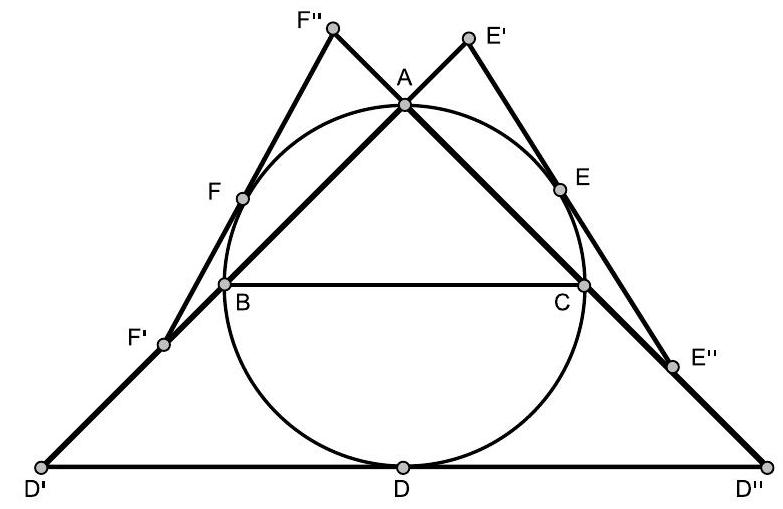
|
| 240 |
+
|
| 241 |
+
Solution 1. A prime indicates where a tangent meets $A B$ and a double prime where it meets $A C$. It is given that $D D^{\prime}=D D^{\prime \prime}, E E^{\prime}=E E^{\prime \prime}$ and $F F^{\prime}=F F^{\prime \prime}$. It is required to show that arc $E F$ is a third of the circumference as is arc $D B F$.
|
| 242 |
+
|
| 243 |
+
$A F$ is the median to the hypotenuse of right triangle $A F^{\prime} F^{\prime \prime}$, so that $F F^{\prime}=F A$ and therefore
|
| 244 |
+
|
| 245 |
+
$$
|
| 246 |
+
\operatorname{arc} A F=2 \angle F^{\prime \prime} F A=2\left(\angle F F^{\prime} A+\angle F A F^{\prime}\right)=4 \angle F A F^{\prime}=4 \angle F A B=2 \text { arc } B F \text {, }
|
| 247 |
+
$$
|
| 248 |
+
|
| 249 |
+
whence $\operatorname{arc} F A=(2 / 3)$ arc $B F A$. Similarly, arc $A E=(2 / 3)$ arc $A E C$. Therefore, $\operatorname{arc} F E$ is $2 / 3$ of the semicircle, or $1 / 3$ of the circumference as desired.
|
| 250 |
+
|
| 251 |
+
As for arc $D B F$, arc $B D=2 \angle B A D=\angle B A D+\angle B D^{\prime} D=\angle A D D^{\prime \prime}=(1 / 2)$ arc $A C D$. But, arc $B F=(1 / 2)$ arc $A F$, so arc $D B F=(1 / 2)$ arc $F A E D$. That is, arc $D B F$ is $1 / 3$ the circumference and the proof is complete.
|
| 252 |
+
|
| 253 |
+
Solution 2. Since $A E^{\prime} E^{\prime \prime}$ is a right triangle, $A E=E E^{\prime}=E E^{\prime \prime}$ so that $\angle C A E=\angle C E^{\prime \prime} E$. Also $A D=D^{\prime} D=D D^{\prime \prime}$, so that $\angle C D D^{\prime \prime}=\angle C A D=\angle C D^{\prime \prime} D$. As $E A D C$ is a concyclic quadrilateral,
|
| 254 |
+
|
| 255 |
+
$$
|
| 256 |
+
\begin{aligned}
|
| 257 |
+
180^{\circ} & =\angle E A D+\angle E C D \\
|
| 258 |
+
& =\angle D A C+\angle C A E+\angle E C A+\angle A C D \\
|
| 259 |
+
& =\angle D A C+\angle C A E+\angle C E E^{\prime \prime}+\angle C E^{\prime \prime} E+\angle C D D^{\prime \prime}+\angle C D^{\prime \prime} D \\
|
| 260 |
+
& =\angle D A C+\angle C A E+\angle C A E+\angle C A E+\angle C A D+\angle C A D \\
|
| 261 |
+
& =3(\angle D A C+\angle D A E)=3(\angle D A E)
|
| 262 |
+
\end{aligned}
|
| 263 |
+
$$
|
| 264 |
+
|
| 265 |
+
Hence $\angle D F E=\angle D A E=60^{\circ}$. Similarly, $\angle D E F=60^{\circ}$. It follows that triangle $D E F$ is equilateral.
|
| 266 |
+
|
CANADA_MO/md/en-sol2007.md
ADDED
|
@@ -0,0 +1,167 @@
|
|
|
|
|
|
|
|
|
|
|
|
|
|
|
|
|
|
|
|
|
|
|
|
|
|
|
|
|
|
|
|
|
|
|
|
|
|
|
|
|
|
|
|
|
|
|
|
|
|
|
|
|
|
|
|
|
|
|
|
|
|
|
|
|
|
|
|
|
|
|
|
|
|
|
|
|
|
|
|
|
|
|
|
|
|
|
|
|
|
|
|
|
|
|
|
|
|
|
|
|
|
|
|
|
|
|
|
|
|
|
|
|
|
|
|
|
|
|
|
|
|
|
|
|
|
|
|
|
|
|
|
|
|
|
|
|
|
|
|
|
|
|
|
|
|
|
|
|
|
|
|
|
|
|
|
|
|
|
|
|
|
|
|
|
|
|
|
|
|
|
|
|
|
|
|
|
|
|
|
|
|
|
|
|
|
|
|
|
|
|
|
|
|
|
|
|
|
|
|
|
|
|
|
|
|
|
|
|
|
|
|
|
|
|
|
|
|
|
|
|
|
|
|
|
|
|
|
|
|
|
|
|
|
|
|
|
|
|
|
|
|
|
|
|
|
|
|
|
|
|
|
|
|
|
|
|
|
|
|
|
|
|
|
|
|
|
|
|
|
|
|
|
|
|
|
|
|
|
|
|
|
|
|
|
|
|
|
|
|
|
|
|
|
|
|
|
|
|
|
|
|
|
|
|
|
|
|
|
|
|
|
|
|
|
|
|
|
|
|
|
|
|
|
|
|
|
|
|
|
|
|
|
|
|
|
|
|
|
|
|
|
|
|
|
|
|
|
|
|
|
|
|
|
|
|
|
|
|
|
|
|
|
|
|
|
|
|
|
|
|
|
|
|
|
|
|
|
|
|
|
|
|
|
|
|
|
|
|
|
|
|
|
|
|
|
|
|
|
|
|
|
|
|
|
|
|
|
|
|
|
|
|
|
|
|
|
|
|
|
|
|
|
|
|
|
|
|
|
|
|
|
|
|
|
|
|
|
|
|
|
|
|
|
|
|
|
|
|
|
|
|
|
|
|
|
|
|
|
|
|
|
|
|
|
|
|
|
|
|
|
|
|
|
|
|
|
|
|
|
|
|
|
|
|
|
|
|
|
|
|
|
|
|
|
|
|
|
|
|
|
|
|
|
|
| 1 |
+
# 39th Canadian Mathematical Olympiad
|
| 2 |
+
|
| 3 |
+
Wednesday, March 28, 2007
|
| 4 |
+
|
| 5 |
+

|
| 6 |
+
|
| 7 |
+
## Solutions to the 2007 CMO paper
|
| 8 |
+
|
| 9 |
+
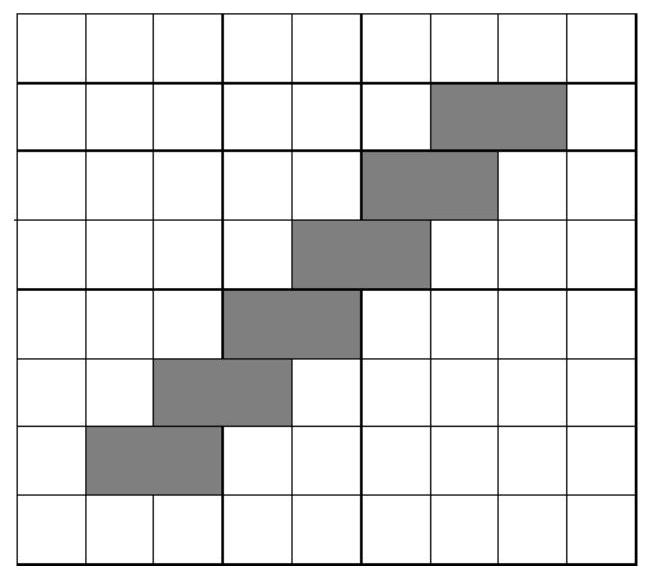
|
| 10 |
+
|
| 11 |
+
Solution to 1. Identify five subsets $A, B, C, D, E$ of the board, where $C$ consists of the squares occupied by the six dominos already placed, $B$ is the upper right corner, $D$ is the lower left corner, $A$ consists of the squares above and to the left of those in $B \cup C \cup D$ and $E$ consists of the squares below and to the right of those in $B \cup C \cup D$. The board can be coloured checkerboard fashion so that $A$ has 13 black and 16 white squares, $B$ a single white square, $E 16$ black and 13 white squares and $D$ a single black square. Each domino beyond the original six must lie either entirely in $A \cup B \cup D$ or $C \cup B \cup D$, either of which contains at most 14 dominos. Thus, altogether, we cannot have more that $2 \times 14+6=34$ dominos. This is achievable, by placing 14 dominos in $A \cup D$ and 14 in $E \cup B$.
|
| 12 |
+
|
| 13 |
+
Solution to 2. If the triangles are isosceles, then they must be congruent and the desired ratio is 1 . For, if they share equal side lengths, at least one of these side lengths on one triangle corresponds to the same length on the other. And if they share unequal side lengths, then either equal sides correspond or unequal sides correspond in both directions and the ratio is 1. This falls within the bounds.
|
| 14 |
+
|
| 15 |
+
Let the triangles be scalene. It is not possible for the same length to be an extreme length (largest or smallest) of both triangles. Therefore, we must have a situation in which the corresponding side lengths of the two triangles are $(x, y, z)$ and $(y, z, u)$ with $x<y<z$ and $y<z<u$. We are given that $y / x=z / y=u / z=r>1$. Thus, $y=r x$ and $z=r y=r^{2} x$. From the triangle inequality $z<x+y$, we have that $r^{2}<1+r$. Since $r^{2}-r-1<0$ and $r>1,1<r<\frac{1}{2}(\sqrt{5}+1)$. The ratio of the dimensions from the smaller to the larger triangle is $1 / r$ which satisfies $\frac{1}{2}(\sqrt{5}-1)<1 / r<1$. The result follows.
|
| 16 |
+
|
| 17 |
+
Solution to 3. (a) Let $f(x)=x^{2}+4$. Then
|
| 18 |
+
|
| 19 |
+
$$
|
| 20 |
+
\begin{aligned}
|
| 21 |
+
f(x y)+f(y-x)-f(y+x)= & \left(x^{2} y^{2}+4\right)+(y-x)^{2}+4-(y+x)^{2}-4 \\
|
| 22 |
+
& =(x y)^{2}-4 x y+4=(x y-2)^{2} \geq 0 .
|
| 23 |
+
\end{aligned}
|
| 24 |
+
$$
|
| 25 |
+
|
| 26 |
+
Thus, $f(x)=x^{2}+4$ satisfies the condition.
|
| 27 |
+
|
| 28 |
+
(b) Consider $(x, y)$ for which $x y=x+y$. Rewriting this as $(x-1)(y-1)=1$, we find that this has the general solution $(x, y)=\left(1+t^{-1}, 1+t\right)$, for $t \neq 0$. Plugging this into the inequality, we get that $f\left(t-t^{-1}\right) \geq 0$ for all $t \neq 0$. For arbitrary real
|
| 29 |
+
$u$, the equation $t-t^{-1}=u$ leads to the quadratic $t^{2}-u t-1=0$ which has a positive discriminant and so a real solution. Hence $f(u) \geq 0$ for each real $u$.
|
| 30 |
+
|
| 31 |
+
Comment. The substitution $v=y-x, u=y+x$ whose inverse is $x=\frac{1}{2}(u-v), y=\frac{1}{2}(u+v)$ renders the condition as $f\left(\frac{1}{4}\left(u^{2}-v^{2}\right)\right)+f(v) \geq f(u)$. The same strategy as in the foregoing solution leads to the choice $u=2+\sqrt{v^{2}+4}$ and $f(v) \geq 0$ for all $v$.
|
| 32 |
+
|
| 33 |
+
Solution to 4 (b). It is straightforward to verify that $a * 1=1$ for $a \neq 1$, so that once 1 is included in the list, it can never by removed and so the list terminates with the single value 1 .
|
| 34 |
+
|
| 35 |
+
Solution to 4 (a). There are several ways of approaching (a). It is important to verify that the set $\{x: 0<x<1\}$ is closed under the operation $*$ so that it is always defined.
|
| 36 |
+
|
| 37 |
+
If $0<a, b<1$, then
|
| 38 |
+
|
| 39 |
+
$$
|
| 40 |
+
0<\frac{a+b-2 a b}{1-a b}<1 \text {. }
|
| 41 |
+
$$
|
| 42 |
+
|
| 43 |
+
The left inequality follows from
|
| 44 |
+
|
| 45 |
+
and the right from
|
| 46 |
+
|
| 47 |
+
$$
|
| 48 |
+
a+b-2 a b=a(1-b)+b(1-a)>0
|
| 49 |
+
$$
|
| 50 |
+
|
| 51 |
+
$$
|
| 52 |
+
1-\frac{a+b-2 a b}{1-a b}=\frac{(1-a)(1-b)}{1-a b}>0 .
|
| 53 |
+
$$
|
| 54 |
+
|
| 55 |
+
Hence, it will never happen that a set of numbers will contain a pair of reciprocals, and the operation can always be performed.
|
| 56 |
+
|
| 57 |
+
Solution 1. It can be shown by induction that any two numbers in any of the sets arise from disjoint subsets of $S$.
|
| 58 |
+
|
| 59 |
+
Use an induction argument on the number of entries that one starts with. At each stage the number of entries is reduced by one. If we start with $n$ numbers, the final result is
|
| 60 |
+
|
| 61 |
+
$$
|
| 62 |
+
\frac{\sigma_{1}-2 \sigma_{2}+3 \sigma_{3}-\cdots+(-1)^{n-1} n \sigma_{n}}{1-\sigma_{2}+2 \sigma_{3}-3 \sigma_{4}+\cdots+(-1)^{n-1}(n-1) \sigma_{n}}
|
| 63 |
+
$$
|
| 64 |
+
|
| 65 |
+
where $\sigma_{i}$ is the symmetric sum of all $\left(\begin{array}{c}n \\ i\end{array}\right) i$-fold products of the $n$ elements $x_{i}$ in the list.
|
| 66 |
+
|
| 67 |
+
Solution 2. Define
|
| 68 |
+
|
| 69 |
+
$$
|
| 70 |
+
a * b=\frac{a+b-2 a b}{1-a b} .
|
| 71 |
+
$$
|
| 72 |
+
|
| 73 |
+
This operation is commutative and also associative:
|
| 74 |
+
|
| 75 |
+
$$
|
| 76 |
+
a *(b * c)=(a * b) * c=\frac{a+b+c-2(a b+b c+c a)+3 a b c}{1-(a b+b c+c a)+2 a b c} .
|
| 77 |
+
$$
|
| 78 |
+
|
| 79 |
+
Since the final result amounts to a $*-$ product of elements of $S$ with some arrangement of brackets, the result follows.
|
| 80 |
+
|
| 81 |
+
Solution 3. Let $\phi(x)=x /(1-x)$ for $0<x<1$. This is a one-one function from the open interval $(0,1)$ to the half line $(0, \infty)$. For any numbers $a, b \in S$, we have that
|
| 82 |
+
|
| 83 |
+
$$
|
| 84 |
+
\begin{aligned}
|
| 85 |
+
\phi\left(\frac{a+b-2 a b}{1-a b}\right) & =\frac{a+b-2 a b}{(1-a b)-(a+b-2 a b)}=\frac{a+b-2 a b}{1-a-b+a b} \\
|
| 86 |
+
& =\frac{a}{1-a}+\frac{b}{1-b}=\phi(a)+\phi(b)
|
| 87 |
+
\end{aligned}
|
| 88 |
+
$$
|
| 89 |
+
|
| 90 |
+
Let $T=\{\phi(s): s \in S\}$. Then replacing $a, b$ in $S$ as indicated corresponds to replacing $\phi(a)$ and $\phi(b)$ in $T$ by $\phi(a)+\phi(b)$ to get a new pair of sets related by $\phi$. The final result is the inverse under $\phi$ of $\sum\{\phi(s): s \in S\}$. that
|
| 91 |
+
|
| 92 |
+
Solution 4. Let $f(x)=(1-x)^{-1}$ be defined for positive $x$ unequal to 1 . Then $f(x)>1$ if and only if $0<x<1$. Observe
|
| 93 |
+
|
| 94 |
+
$$
|
| 95 |
+
f(x * y)=\frac{1-x y}{1-x-y+x y}=\frac{1}{1-x}+\frac{1}{1-y}-1 .
|
| 96 |
+
$$
|
| 97 |
+
|
| 98 |
+
If $f(x)>1$ and $f(y)>1$, then also $f(x * y)>1$. It follows that if $x$ and $y$ lie in the open interval $(0,1)$, so does $x * y$. We also note that $f(x)$ is a one-one function.
|
| 99 |
+
|
| 100 |
+
To each list $L$, we associate the function $g(L)$ defined by
|
| 101 |
+
|
| 102 |
+
$$
|
| 103 |
+
g(L)=\sum\{f(x): x \in L\}
|
| 104 |
+
$$
|
| 105 |
+
|
| 106 |
+
Let $L_{n}$ be the given list, and let the subsequent lists be $L_{n-1}, L_{n-2}, \cdots, L_{1}$, where $L_{i}$ has $i$ elements. Since $f(x * y)=$ $f(x)+f(y)-1, g\left(L_{i}\right)=g\left(L_{n}\right)-(n-i)$ regardless of the choice that creates each list from its predecessors. Hence $g\left(L_{1}\right)=g\left(L_{n}\right)-(n-1)$ is fixed. However, $g\left(L_{1}\right)=f(a)$ for some number $a$ with $0<a<1$. Hence $a=f^{-1}\left(g\left(L_{n}\right)-(n-1)\right)$ is fixed.
|
| 107 |
+
|
| 108 |
+
Solution to 5 (a). Let $I$ be the incentre of triangle $A B C$. Since the quadrilateral $A E I F$ has right angles at $E$ and $F$, it is concyclic, so that $\Gamma_{1}$ passes through $I$. Similarly, $\Gamma_{2}$ and $\Gamma_{3}$ pass through $I$, and (a) follows.
|
| 109 |
+
|
| 110 |
+
Solution to $5(b)$. Let $\omega$ and $I$ denote the incircle and incentre of triangle $A B C$, respectively. Observe that, since $A I$ bisects the angle $F A E$ and $A F=A E$, then $A I$ right bisects the segment $F E$. Similarly, $B I$ right bisects $D F$ and $C I$ right bisects $D E$.
|
| 111 |
+
|
| 112 |
+
We invert the diagram through $\omega$. Under this inversion, let the image of $A$ be $A^{\prime}$, etc. Note that the centre $I$ of inversion is collinear with any point and its image under the inversion. Under this inversion, the image of $\Gamma_{1}$ is $E F$, which makes $A^{\prime}$ the midpoint of $E F$. Similarly, $B^{\prime}$ is the midpoint of $D F$ and $C^{\prime}$ is the midpoint of $D E$. Hence, $\Gamma^{\prime}$, the image of $\Gamma$ under this inversion, is the circumcircle of triangle $A^{\prime} B^{\prime} C^{\prime}$, which implies that $\Gamma^{\prime}$ is the nine-point circle of triangle $D E F$.
|
| 113 |
+
|
| 114 |
+
Since $P$ is the intersection of $\Gamma$ and $\Gamma_{1}$ other than $A, P^{\prime}$ is the intersection of $\Gamma^{\prime}$ and $E F$ other than $A^{\prime}$, which means that $P^{\prime}$ is the foot of the altitude from $D$ to $E F$. Similarly, $Q^{\prime}$ is the foot of the altitude from $E$ to $D F$ and $R^{\prime}$ is the foot of the altitude from $F$ to $D E$.
|
| 115 |
+
|
| 116 |
+
Now, let $X, Y$ and $Z$ be the midpoints of $\operatorname{arcs} B C, A C$ and $A B$ on $\Gamma$ respectively. We claim that $X$ lies on $P D$.
|
| 117 |
+
|
| 118 |
+
Let $X^{\prime}$ be the image of $X$ under the inversion, so $I, X$ and $X^{\prime}$ are collinear. But $X$ is the midpoint of $\operatorname{arc} B C$, so $A$, $A^{\prime}, I, X^{\prime}$ and $X$ are collinear. The image of line $P D$ is the circumcircle of triangle $P^{\prime} I D$, so to prove that $X$ lies on $P D$, it suffices to prove that points $P^{\prime}, I, X^{\prime}$ and $D$ are concyclic.
|
| 119 |
+
|
| 120 |
+
We know that $B^{\prime}$ is the midpoint of $D F, C^{\prime}$ is the midpoint of $D E$ and $P^{\prime}$ is the foot of the altitude from $D$ to $E F$. Hence, $D$ is the reflection of $P^{\prime}$ in $B^{\prime} C^{\prime}$.
|
| 121 |
+
|
| 122 |
+
Since $I A^{\prime} \perp E F, I B^{\prime} \perp D F$ and $I C^{\prime} \perp D E, I$ is the orthocentre of triangle $A^{\prime} B^{\prime} C^{\prime}$. So, $X^{\prime}$ is the intersection of the altitude from $A^{\prime}$ to $B^{\prime} C^{\prime}$ with the circumcircle of triangle $A^{\prime} B^{\prime} C^{\prime}$. From a wellknown fact, $X^{\prime}$ is the reflection of $I$ in $B^{\prime} C^{\prime}$. This means that $B^{\prime} C^{\prime}$ is the perpendicular bisector of both $P^{\prime} D$ and $I X^{\prime}$, so that the points $P^{\prime}, I, X^{\prime}$ and $D$ are concyclic.
|
| 123 |
+
|
| 124 |
+
Hence, $X$ lies on $P D$. Similarly, $Y$ lies on $Q E$ and $Z$ lies on $R F$. Thus, to prove that $P D, Q E$ and $R F$ are concurrent, it suffices to prove that $D X, E Y$ and $F Z$ are concurrent.
|
| 125 |
+
|
| 126 |
+
To show this, consider tangents to $\Gamma$ at $X, Y$ and $Z$. These are parallel to $B C, A C$ and $A B$, respectively. Hence, the triangle $\Delta$ that these tangents define is homothetic to the triangle $A B C$. Let $S$ be the centre of homothety. Then the homothety taking triangle $A B C$ to $\Delta$ takes $\omega$ to $\Gamma$, and so takes $D$ to $X, E$ to $Y$ and $F$ to $Z$. Hence $D X, E Y$ and $F Z$ concur at $S$.
|
| 127 |
+
|
| 128 |
+
Comment. The solution uses the following result: Suppose $A B C$ is a triangle with orthocentre $H$ and that $A H$ intersects $B C$ at $P$ and the circumcircle of $A B C$ at $D$. Then $H P=P D$. The proof is straightforward: Let $B H$ meet $A C$ at $Q$. Note that $A D \perp B C$ and $B Q \perp A C$. Since $\angle A C B=\angle A D B$,
|
| 129 |
+
|
| 130 |
+
$$
|
| 131 |
+
\angle H B C=\angle Q B C=90^{\circ}-\angle Q C B=90^{\circ}-\angle A C B=90^{\circ}-\angle A D B=\angle D B P \text {, }
|
| 132 |
+
$$
|
| 133 |
+
|
| 134 |
+
from which follows the congruence of triangle $H B P$ and $D B P$ and equality of $H P$ and $P D$.
|
| 135 |
+
|
| 136 |
+
Solution 2. (a) Let $\Gamma_{2}$ and $\Gamma_{3}$ intersect at $J$. Then $B D J F$ and $C D J E$ are concyclic. We have that
|
| 137 |
+
|
| 138 |
+
$$
|
| 139 |
+
\begin{aligned}
|
| 140 |
+
\angle F J E & =360^{\circ}-(\angle D J F+\angle D J E) \\
|
| 141 |
+
= & 360^{\circ}-\left(180^{\circ}-\angle A B C+180^{\circ}-\angle A C B\right) \\
|
| 142 |
+
= & \angle A B C+\angle A C B=180^{\circ}-\angle F A E .
|
| 143 |
+
\end{aligned}
|
| 144 |
+
$$
|
| 145 |
+
|
| 146 |
+
Hence $A F J E$ is concyclic and so the circumcircles of $A E F, B D F$ and $C E D$ pass through $J$.
|
| 147 |
+
|
| 148 |
+
(b) [Y. Li] Join RE, RD, RA and RB. In $\Gamma_{3}, \angle E R D=\angle E C D=\angle A C B$ and $\angle R E C=\angle R D C$. In $\Gamma, \angle A R B=\angle A C B$. Hence, $\angle E R D=\angle A R B \Longrightarrow \angle A R E=\angle B R D$. Also,
|
| 149 |
+
|
| 150 |
+
$$
|
| 151 |
+
\angle A E R=180^{\circ}-\angle R E C=180^{\circ}-\angle R D C=\angle B D R \text {. }
|
| 152 |
+
$$
|
| 153 |
+
|
| 154 |
+
Therefore, triangle $A R E$ and $B R D$ are similar, and $A R: B R=A E: B D=A F: B F$. If follows that $R F$ bisects angle $A R B$, so that $R F$ passes through the midpoint of minor arc $A B$ on $\Gamma$. Similarly, $P D$ and $Q E$ are respective bisectors of angles $B P C$ and $C Q A$ and pass through the midpoints of the minor $\operatorname{arc} B C$ and $C A$ on $\gamma .$.
|
| 155 |
+
|
| 156 |
+
Let $O$ be the centre of circle $\Gamma$, and $U, V, W$ be the respective midpoints of the minor arc $B C, C A, A B$ on this circle, so that $P U$ contains $D, Q V$ contains $E$ and $R W$ contains $F$. It is required to prove that $D U, E V$ and $F W$ are concurrent.
|
| 157 |
+
|
| 158 |
+
Since $I D$ and $O U$ are perpendicular to $B C, I D \| O U$. Similarly, $I E \| O V$ and $I F \| O W$. Since $|I D|=|I E|=|I F|=r$ (the inradius) and $|O U|=|O V|=|O W|=R$ (the circumradius), a translation $\overrightarrow{I O}$ followed by a dilatation of factor $R / r$ takes triangle $D E F$ to triangle $U V W$, so that these triangles are similar with corresponding sides parallel.
|
| 159 |
+
|
| 160 |
+
Suppose that $E V$ and $F W$ intersect at $K$ and that $D U$ and $F W$ intersect at $L$. Taking account of the similarity of the triangles $K E F$ and $K V W, L D F$ and $L U W, D E F$ and $U V W$, we have that
|
| 161 |
+
|
| 162 |
+
$$
|
| 163 |
+
K F: F W=E F: V W=D F: U W=L F: L W,
|
| 164 |
+
$$
|
| 165 |
+
|
| 166 |
+
so that $K=L$ and the lines $D U, E V$ and $F W$ intersect in a common point $K$, as desired.
|
| 167 |
+
|