

Add data for BalticWay Mathematical Contests
#5
by
LxYxvv
- opened
This view is limited to 50 files because it contains too many changes.
See the raw diff here.
- BalticWay/download_script/download.py +81 -0
- BalticWay/md/en-bw00sol.md +388 -0
- BalticWay/md/en-bw01sol.md +358 -0
- BalticWay/md/en-bw02sol.md +794 -0
- BalticWay/md/en-bw03sol.md +339 -0
- BalticWay/md/en-bw04sol.md +344 -0
- BalticWay/md/en-bw05sol.md +422 -0
- BalticWay/md/en-bw06sol.md +325 -0
- BalticWay/md/en-bw07sol.md +269 -0
- BalticWay/md/en-bw08sol.md +431 -0
- BalticWay/md/en-bw09eng.md +85 -0
- BalticWay/md/en-bw10sol.md +460 -0
- BalticWay/md/en-bw11sol.md +412 -0
- BalticWay/md/en-bw12sol.md +689 -0
- BalticWay/md/en-bw13sol.md +597 -0
- BalticWay/md/en-bw14sol.md +663 -0
- BalticWay/md/en-bw15sol.md +856 -0
- BalticWay/md/en-bw16sol.md +375 -0
- BalticWay/md/en-bw17sol.md +571 -0
- BalticWay/md/en-bw18sol.md +441 -0
- BalticWay/md/en-bw19eng.md +97 -0
- BalticWay/md/en-bw20sol.md +770 -0
- BalticWay/md/en-bw21sol.md +805 -0
- BalticWay/md/en-bw22eng.md +93 -0
- BalticWay/md/en-bw23sol.md +767 -0
- BalticWay/md/en-bw24sol.md +652 -0
- BalticWay/md/en-bw90sol.md +164 -0
- BalticWay/md/en-bw91sol.md +173 -0
- BalticWay/md/en-bw92sol.md +195 -0
- BalticWay/md/en-bw93sol.md +251 -0
- BalticWay/md/en-bw94sol.md +308 -0
- BalticWay/md/en-bw95sol.md +227 -0
- BalticWay/md/en-bw96sol.md +262 -0
- BalticWay/md/en-bw97sol.md +409 -0
- BalticWay/md/en-bw98sol.md +468 -0
- BalticWay/md/en-bw99sol.md +500 -0
- BalticWay/raw/en-bw00sol.pdf +3 -0
- BalticWay/raw/en-bw01sol.pdf +3 -0
- BalticWay/raw/en-bw02sol.pdf +3 -0
- BalticWay/raw/en-bw03sol.pdf +3 -0
- BalticWay/raw/en-bw04sol.pdf +3 -0
- BalticWay/raw/en-bw05sol.pdf +3 -0
- BalticWay/raw/en-bw06sol.pdf +3 -0
- BalticWay/raw/en-bw07sol.pdf +3 -0
- BalticWay/raw/en-bw08sol.pdf +3 -0
- BalticWay/raw/en-bw09eng.pdf +3 -0
- BalticWay/raw/en-bw10sol.pdf +3 -0
- BalticWay/raw/en-bw11sol.pdf +3 -0
- BalticWay/raw/en-bw12sol.pdf +3 -0
- BalticWay/raw/en-bw13sol.pdf +3 -0
BalticWay/download_script/download.py
ADDED
|
@@ -0,0 +1,81 @@
|
|
|
|
|
|
|
|
|
|
|
|
|
|
|
|
|
|
|
|
|
|
|
|
|
|
|
|
|
|
|
|
|
|
|
|
|
|
|
|
|
|
|
|
|
|
|
|
|
|
|
|
|
|
|
|
|
|
|
|
|
|
|
|
|
|
|
|
|
|
|
|
|
|
|
|
|
|
|
|
|
|
|
|
|
|
|
|
|
|
|
|
|
|
|
|
|
|
|
|
|
|
|
|
|
|
|
|
|
|
|
|
|
|
|
|
|
|
|
|
|
|
|
|
|
|
|
|
|
|
|
|
|
|
|
|
|
|
|
|
|
|
|
|
|
|
|
|
|
|
|
|
|
|
|
|
|
|
|
|
|
|
|
|
|
|
|
|
|
|
|
|
|
|
|
|
|
|
|
|
|
|
|
|
|
|
|
|
|
|
|
|
|
|
|
|
|
|
|
|
|
|
|
|
|
|
|
|
|
|
|
|
|
|
|
|
|
|
|
|
|
|
|
|
|
|
|
|
|
|
|
|
|
|
|
|
|
|
|
|
|
|
|
|
|
|
|
| 1 |
+
# -----------------------------------------------------------------------------
|
| 2 |
+
# Author: Jiawei Liu
|
| 3 |
+
# Date: 2024-11-22
|
| 4 |
+
# -----------------------------------------------------------------------------
|
| 5 |
+
'''
|
| 6 |
+
To run:
|
| 7 |
+
`python BalticWay/download_script/download.py`
|
| 8 |
+
'''
|
| 9 |
+
|
| 10 |
+
import requests
|
| 11 |
+
from requests.adapters import HTTPAdapter
|
| 12 |
+
from tqdm import tqdm
|
| 13 |
+
from bs4 import BeautifulSoup
|
| 14 |
+
from urllib.parse import urljoin
|
| 15 |
+
from urllib3.util.retry import Retry
|
| 16 |
+
from pathlib import Path
|
| 17 |
+
|
| 18 |
+
|
| 19 |
+
def build_session(
|
| 20 |
+
max_retries: int = 3,
|
| 21 |
+
backoff_factor: int = 2,
|
| 22 |
+
session: requests.Session = None
|
| 23 |
+
) -> requests.Session:
|
| 24 |
+
"""
|
| 25 |
+
Build a requests session with retries
|
| 26 |
+
|
| 27 |
+
Args:
|
| 28 |
+
max_retries (int, optional): Number of retries. Defaults to 3.
|
| 29 |
+
backoff_factor (int, optional): Backoff factor. Defaults to 2.
|
| 30 |
+
session (requests.Session, optional): Session object. Defaults to None.
|
| 31 |
+
"""
|
| 32 |
+
session = session or requests.Session()
|
| 33 |
+
adapter = HTTPAdapter(max_retries=Retry(total=max_retries, backoff_factor=backoff_factor))
|
| 34 |
+
session.mount("http://", adapter)
|
| 35 |
+
session.mount("https://", adapter)
|
| 36 |
+
session.headers.update({
|
| 37 |
+
"User-Agent": "Mozilla/5.0 (Windows NT 10.0; Win64; x64) AppleWebKit/537.36 (KHTML, like Gecko) Chrome/58.0.3029.110 Safari/537.3"
|
| 38 |
+
})
|
| 39 |
+
|
| 40 |
+
return session
|
| 41 |
+
|
| 42 |
+
|
| 43 |
+
def main():
|
| 44 |
+
base_url = "https://www.math.olympiaadid.ut.ee/eng/html/?id=bw"
|
| 45 |
+
|
| 46 |
+
output_dir = Path(__file__).parent.parent / "raw"
|
| 47 |
+
output_dir.mkdir(parents=True, exist_ok=True)
|
| 48 |
+
|
| 49 |
+
req_session = build_session()
|
| 50 |
+
|
| 51 |
+
resp = req_session.get(base_url)
|
| 52 |
+
soup = BeautifulSoup(resp.text, "html.parser")
|
| 53 |
+
|
| 54 |
+
year_list_eles = soup.find("td", class_="leht").find_all("a", class_="siseviit")
|
| 55 |
+
|
| 56 |
+
for year_ele in tqdm(year_list_eles):
|
| 57 |
+
problem_with_solution_link_ele = year_ele.find(lambda tag: tag.name == "a" and "solutions:" in tag.parent.text.lower())
|
| 58 |
+
problem_link_ele = year_ele.find(lambda tag: tag.name == "a" and "problems:" in tag.parent.text.lower())
|
| 59 |
+
|
| 60 |
+
if problem_with_solution_link_ele:
|
| 61 |
+
pdf_url = urljoin(base_url, problem_with_solution_link_ele["href"])
|
| 62 |
+
elif problem_link_ele:
|
| 63 |
+
pdf_url = urljoin(base_url, problem_link_ele["href"])
|
| 64 |
+
else:
|
| 65 |
+
continue
|
| 66 |
+
|
| 67 |
+
output_file = output_dir / f"en-{pdf_url.split('/')[-1]}"
|
| 68 |
+
if output_file.exists():
|
| 69 |
+
continue
|
| 70 |
+
|
| 71 |
+
resp = req_session.get(pdf_url)
|
| 72 |
+
|
| 73 |
+
if resp.status_code != 200:
|
| 74 |
+
print(f"Failed to download {pdf_url}")
|
| 75 |
+
continue
|
| 76 |
+
|
| 77 |
+
output_file.write_bytes(resp.content)
|
| 78 |
+
|
| 79 |
+
|
| 80 |
+
if __name__ == "__main__":
|
| 81 |
+
main()
|
BalticWay/md/en-bw00sol.md
ADDED
|
@@ -0,0 +1,388 @@
|
|
|
|
|
|
|
|
|
|
|
|
|
|
|
|
|
|
|
|
|
|
|
|
|
|
|
|
|
|
|
|
|
|
|
|
|
|
|
|
|
|
|
|
|
|
|
|
|
|
|
|
|
|
|
|
|
|
|
|
|
|
|
|
|
|
|
|
|
|
|
|
|
|
|
|
|
|
|
|
|
|
|
|
|
|
|
|
|
|
|
|
|
|
|
|
|
|
|
|
|
|
|
|
|
|
|
|
|
|
|
|
|
|
|
|
|
|
|
|
|
|
|
|
|
|
|
|
|
|
|
|
|
|
|
|
|
|
|
|
|
|
|
|
|
|
|
|
|
|
|
|
|
|
|
|
|
|
|
|
|
|
|
|
|
|
|
|
|
|
|
|
|
|
|
|
|
|
|
|
|
|
|
|
|
|
|
|
|
|
|
|
|
|
|
|
|
|
|
|
|
|
|
|
|
|
|
|
|
|
|
|
|
|
|
|
|
|
|
|
|
|
|
|
|
|
|
|
|
|
|
|
|
|
|
|
|
|
|
|
|
|
|
|
|
|
|
|
|
|
|
|
|
|
|
|
|
|
|
|
|
|
|
|
|
|
|
|
|
|
|
|
|
|
|
|
|
|
|
|
|
|
|
|
|
|
|
|
|
|
|
|
|
|
|
|
|
|
|
|
|
|
|
|
|
|
|
|
|
|
|
|
|
|
|
|
|
|
|
|
|
|
|
|
|
|
|
|
|
|
|
|
|
|
|
|
|
|
|
|
|
|
|
|
|
|
|
|
|
|
|
|
|
|
|
|
|
|
|
|
|
|
|
|
|
|
|
|
|
|
|
|
|
|
|
|
|
|
|
|
|
|
|
|
|
|
|
|
|
|
|
|
|
|
|
|
|
|
|
|
|
|
|
|
|
|
|
|
|
|
|
|
|
|
|
|
|
|
|
|
|
|
|
|
|
|
|
|
|
|
|
|
|
|
|
|
|
|
|
|
|
|
|
|
|
|
|
|
|
|
|
|
|
|
|
|
|
|
|
|
|
|
|
|
|
|
|
|
|
|
|
|
|
|
|
|
|
|
|
|
|
|
|
|
|
|
|
|
|
|
|
|
|
|
|
|
|
|
|
|
|
|
|
|
|
|
|
|
|
|
|
|
|
|
|
|
|
|
|
|
|
|
|
|
|
|
|
|
|
|
|
|
|
|
|
|
|
|
|
|
|
|
|
|
|
|
|
|
|
|
|
|
|
|
|
|
|
|
|
|
|
|
|
|
|
|
|
|
|
|
|
|
|
|
|
|
|
|
|
|
|
|
|
|
|
|
|
|
|
|
|
|
|
|
|
|
|
|
|
|
|
|
|
|
|
|
|
|
|
|
|
|
|
|
|
|
|
|
|
|
|
|
|
|
|
|
|
|
|
|
|
|
|
|
|
|
|
|
|
|
|
|
|
|
|
|
|
|
|
|
|
|
|
|
|
|
|
|
|
|
|
|
|
|
|
|
|
|
|
|
|
|
|
|
|
|
|
|
|
|
|
|
|
|
|
|
|
|
|
|
|
|
|
|
|
|
|
|
|
|
|
|
|
|
|
|
|
|
|
|
|
|
|
|
|
|
|
|
|
|
|
|
|
|
|
|
|
|
|
|
|
|
|
|
|
|
|
|
|
|
|
|
|
|
|
|
|
|
|
|
|
|
|
|
|
|
|
|
|
|
|
|
|
|
|
|
|
|
|
|
|
|
|
|
|
|
|
|
|
|
|
|
|
|
|
|
|
|
|
|
|
|
|
|
|
|
|
|
|
|
|
|
|
|
|
|
|
|
|
|
|
|
|
|
|
|
|
|
|
|
|
|
|
|
|
|
|
|
|
|
|
|
|
|
|
|
|
|
|
|
|
|
|
|
|
|
|
|
|
|
|
|
|
|
|
|
|
|
|
|
|
|
|
|
|
|
|
|
|
|
|
|
|
|
|
|
|
|
|
|
|
|
|
|
|
|
|
|
|
|
|
|
|
|
|
|
|
|
|
|
|
|
|
|
|
|
|
|
|
|
|
|
|
|
|
|
|
|
|
|
|
|
|
|
|
|
|
|
|
|
|
|
|
|
|
|
|
|
|
|
|
|
|
|
|
|
|
|
|
|
|
|
|
|
|
|
|
|
|
|
|
|
|
|
|
|
|
|
|
|
|
|
|
|
|
|
|
|
|
|
|
|
|
|
|
|
|
|
|
|
|
|
|
|
|
|
|
|
|
|
|
|
|
|
|
|
|
|
|
|
|
|
|
|
|
|
|
|
|
|
|
|
|
|
|
|
|
|
|
|
|
|
|
|
|
|
|
|
|
|
|
|
|
|
|
|
|
|
|
|
|
|
|
|
|
|
|
|
|
|
|
|
|
|
|
|
|
|
|
|
|
|
|
|
|
|
|
|
|
|
|
|
|
|
|
|
|
|
|
|
|
|
|
|
|
|
|
|
|
|
|
|
|
|
|
|
|
|
|
|
|
|
|
|
|
|
|
|
|
|
|
|
|
|
|
|
|
|
|
|
|
|
|
|
|
|
|
|
|
|
|
|
|
|
|
|
|
|
|
|
|
|
|
|
|
|
|
|
|
|
|
|
|
|
|
|
|
|
| 1 |
+
# Baltic Way 2000
|
| 2 |
+
|
| 3 |
+
## Oslo, November 4, 2000
|
| 4 |
+
|
| 5 |
+
## Problems
|
| 6 |
+
|
| 7 |
+
1. Let $K$ be a point inside the triangle $A B C$. Let $M$ and $N$ be points such that $M$ and $K$ are on opposite sides of the line $A B$, and $N$ and $K$ are on opposite sides of the line $B C$. Assume that
|
| 8 |
+
|
| 9 |
+
$$
|
| 10 |
+
\angle M A B=\angle M B A=\angle N B C=\angle N C B=\angle K A C=\angle K C A .
|
| 11 |
+
$$
|
| 12 |
+
|
| 13 |
+
Show that $M B N K$ is a parallelogram.
|
| 14 |
+
|
| 15 |
+
2. Given an isosceles triangle $A B C$ with $\angle A=90^{\circ}$. Let $M$ be the midpoint of $A B$. The line passing through $A$ and perpendicular to $C M$ intersects the side $B C$ at $P$. Prove that $\angle A M C=\angle B M P$.
|
| 16 |
+
3. Given a triangle $A B C$ with $\angle A=90^{\circ}$ and $|A B| \neq|A C|$. The points $D, E, F$ lie on the sides $B C, C A, A B$, respectively, in such a way that $A F D E$ is a square. Prove that the line $B C$, the line $F E$ and the line tangent at the point $A$ to the circumcircle of the triangle $A B C$ intersect in one point.
|
| 17 |
+
4. Given a triangle $A B C$ with $\angle A=120^{\circ}$. The points $K$ and $L$ lie on the sides $A B$ and $A C$, respectively. Let $B K P$ and $C L Q$ be equilateral triangles constructed outside the triangle $A B C$. Prove that
|
| 18 |
+
|
| 19 |
+
$$
|
| 20 |
+
|P Q| \geqslant \frac{\sqrt{3}}{2} \cdot(|A B|+|A C|) .
|
| 21 |
+
$$
|
| 22 |
+
|
| 23 |
+
5. Let $A B C$ be a triangle such that $\frac{|B C|}{|A B|-|B C|}=\frac{|A B|+|B C|}{|A C|}$. Determine the ratio $\angle A: \angle C$.
|
| 24 |
+
6. Fredek runs a private hotel. He claims that whenever $n \geqslant 3$ guests visit the hotel, it is possible to select two guests who have equally many acquaintances among the other guests, and who also have a common acquaintance or a common unknown among the guests. For which values of $n$ is Fredek right?
|
| 25 |
+
|
| 26 |
+
(Acquaintance is a symmetric relation.)
|
| 27 |
+
|
| 28 |
+
7. In a $40 \times 50$ array of control buttons, each button has two states: $\mathrm{ON}$ and OFF. By touching a button, its state and the states of all buttons in the same row and in the same column are switched. Prove that the array of control buttons may be altered from the all-OFF state to the all-ON state by touching buttons successively, and determine the least number of touches needed to do so.
|
| 29 |
+
8. Fourteen friends met at a party. One of them, Fredek, wanted to go to bed early. He said goodbye to 10 of his friends, forgot about the remaining 3 , and went to bed. After a while he returned to the party, said goodbye to 10 of his friends (not necessarily the same as before), and went to bed. Later Fredek came back a number of times, each time saying goodbye to exactly 10 of his friends, and then went back to bed. As soon as he had said goodbye to each of his friends at least once, he did not come back again. In the morning Fredek realised that he had said goodbye a different number of times to each of his thirteen friends! What is the smallest possible number of times that Fredek returned to the party?
|
| 30 |
+
9. There is a frog jumping on a $2 k \times 2 k$ chessboard, composed of unit squares. The frog's jumps are of length $\sqrt{1+k^{2}}$ and they carry the frog from the center of a square to the center of another square. Some $m$ squares of the board are marked with an $x$, and all the squares into which the frog can jump from an $x$ 'd square (whether they carry an $x$ or not) are marked with an $\circ$. There are $n \circ$ 'd squares. Prove that $n \geqslant m$.
|
| 31 |
+
10. Two positive integers are written on the blackboard. Initially, one of them is 2000 and the other is smaller than 2000. If the arithmetic mean $m$ of the two numbers on the blackboard is an integer, the following operation is allowed: one of the two numbers is erased and replaced by $m$. Prove that this operation cannot be performed more than ten times. Give an example where the operation can be performed ten times.
|
| 32 |
+
11. A sequence of positive integers $a_{1}, a_{2}, \ldots$ is such that for each $m$ and $n$ the following holds: if $m$ is a divisor of $n$ and $m<n$, then $a_{m}$ is a divisor of $a_{n}$ and $a_{m}<a_{n}$. Find the least possible value of $a_{2000}$.
|
| 33 |
+
12. Let $x_{1}, x_{2}, \ldots, x_{n}$ be positive integers such that no one of them is an initial fragment of any other (for example, 12 is an initial fragment of $\underline{12}, \underline{12} 5$ and
|
| 34 |
+
|
| 35 |
+
12405). Prove that
|
| 36 |
+
|
| 37 |
+
$$
|
| 38 |
+
\frac{1}{x_{1}}+\frac{1}{x_{2}}+\cdots+\frac{1}{x_{n}}<3
|
| 39 |
+
$$
|
| 40 |
+
|
| 41 |
+
13. Let $a_{1}, a_{2}, \ldots, a_{n}$ be an arithmetic progression of integers such that $i$ divides $a_{i}$ for $i=1,2, \ldots, n-1$ and $n$ does not divide $a_{n}$. Prove that $n$ is a power of a prime.
|
| 42 |
+
14. Find all positive integers $n$ such that $n$ is equal to 100 times the number of positive divisors of $n$.
|
| 43 |
+
15. Let $n$ be a positive integer not divisible by 2 or 3 . Prove that for all integers $k$, the number $(k+1)^{n}-k^{n}-1$ is divisible by $k^{2}+k+1$.
|
| 44 |
+
16. Prove that for all positive real numbers $a, b, c$ we have
|
| 45 |
+
|
| 46 |
+
$$
|
| 47 |
+
\sqrt{a^{2}-a b+b^{2}}+\sqrt{b^{2}-b c+c^{2}} \geqslant \sqrt{a^{2}+a c+c^{2}} .
|
| 48 |
+
$$
|
| 49 |
+
|
| 50 |
+
17. Find all real solutions to the following system of equations:
|
| 51 |
+
|
| 52 |
+
$$
|
| 53 |
+
\left\{\begin{aligned}
|
| 54 |
+
x+y+z+t & =5 \\
|
| 55 |
+
x y+y z+z t+t x & =4 \\
|
| 56 |
+
x y z+y z t+z t x+t x y & =3 \\
|
| 57 |
+
x y z t & =-1
|
| 58 |
+
\end{aligned}\right.
|
| 59 |
+
$$
|
| 60 |
+
|
| 61 |
+
18. Determine all positive real numbers $x$ and $y$ satisfying the equation
|
| 62 |
+
|
| 63 |
+
$$
|
| 64 |
+
x+y+\frac{1}{x}+\frac{1}{y}+4=2 \cdot(\sqrt{2 x+1}+\sqrt{2 y+1}) .
|
| 65 |
+
$$
|
| 66 |
+
|
| 67 |
+
19. Let $t \geqslant \frac{1}{2}$ be a real number and $n$ a positive integer. Prove that
|
| 68 |
+
|
| 69 |
+
$$
|
| 70 |
+
t^{2 n} \geqslant(t-1)^{2 n}+(2 t-1)^{n}
|
| 71 |
+
$$
|
| 72 |
+
|
| 73 |
+
20. For every positive integer $n$, let
|
| 74 |
+
|
| 75 |
+
$$
|
| 76 |
+
x_{n}=\frac{(2 n+1) \cdot(2 n+3) \cdots \cdots \cdot(4 n-1) \cdot(4 n+1)}{2 n \cdot(2 n+2) \cdots \cdots \cdot(4 n-2) \cdot 4 n}
|
| 77 |
+
$$
|
| 78 |
+
|
| 79 |
+
Prove that $\frac{1}{4 n}<x_{n}-\sqrt{2}<\frac{2}{n}$.
|
| 80 |
+
|
| 81 |
+
## Solutions
|
| 82 |
+
|
| 83 |
+
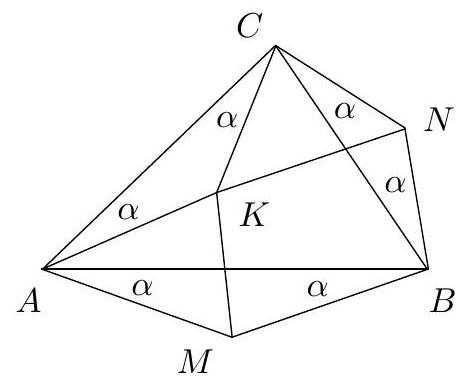
1. Denote $\angle M A B=\angle M B A=\cdots=\alpha$. Then
|
| 84 |
+
|
| 85 |
+
$$
|
| 86 |
+
\angle M A K=\alpha+(\angle B A C-\alpha)=\angle B A C,
|
| 87 |
+
$$
|
| 88 |
+
|
| 89 |
+
$\frac{|A M|}{|A B|}=\frac{1}{2 \cos \alpha}$ and $\frac{|A K|}{|A C|}=\frac{1}{2 \cos \alpha}$ (see Figure 1). Hence the triangles $M A K$ and $B A C$ are similar, implying $|M K|=\frac{|B C|}{2 \cos \alpha}$. Since $|B N|=\frac{|B C|}{2 \cos \alpha}$, we have $|M K|=|B N|$. Similarly we can show that $|B M|=|N K|$, and the result follows.
|
| 90 |
+
|
| 91 |
+
|
| 92 |
+
|
| 93 |
+
Figure 1
|
| 94 |
+
|
| 95 |
+
|
| 96 |
+
|
| 97 |
+
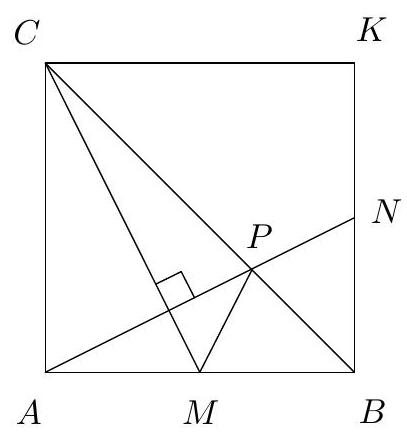
Figure 2
|
| 98 |
+
|
| 99 |
+
2. Choose the point $K$ such that $A B K C$ is a square. Let $N$ be the point of intersection of $A P$ and $B K$ (see Figure 2). Since the lines $A N$ and $C M$ are perpendicular, $N$ is the midpoint of $B K$. Moreover, triangles $A M C$ and $B N A$ are congruent, which gives
|
| 100 |
+
|
| 101 |
+
$$
|
| 102 |
+
\angle A M C=\angle B N A
|
| 103 |
+
$$
|
| 104 |
+
|
| 105 |
+
Since $|B M|=|B N|$ and $\angle M B P=\angle N B P$, it follows that triangles $M B P$ and $N B P$ are congruent. This implies that
|
| 106 |
+
|
| 107 |
+
$$
|
| 108 |
+
\angle B M P=\angle B N P
|
| 109 |
+
$$
|
| 110 |
+
|
| 111 |
+
Combining (1) ja (2) yields the required equality.
|
| 112 |
+
|
| 113 |
+
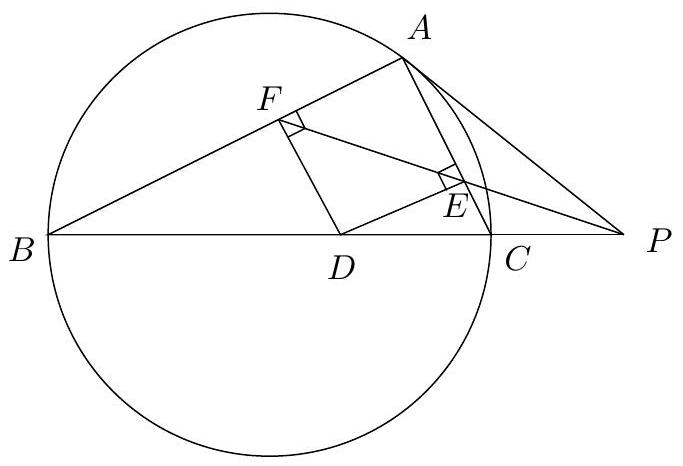
3. Let $B C$ and $F E$ meet at $P$ (see Figure 3 ). It suffices to show that the line $A P$ is tangent to the circumcircle of the triangle $A B C$.
|
| 114 |
+
|
| 115 |
+
|
| 116 |
+
|
| 117 |
+
Figure 3
|
| 118 |
+
|
| 119 |
+
Since $F E$ is the axis of symmetry of the square $A F D E$, we have $\angle A P E=\angle B P F$. Moreover, $\angle A E P=135^{\circ}=\angle B F P$. Hence triangles $A P E$ and $B P F$ are similar, and $\angle C A P=\angle A B C$, i.e. the line $A P$ is tangent to the circumcircle of $A B C$.
|
| 120 |
+
|
| 121 |
+
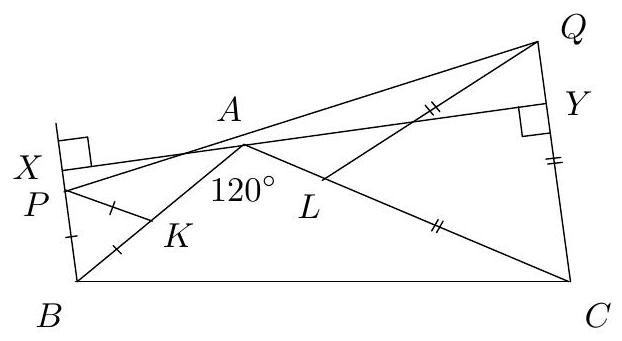
4. Since $\angle A B C+\angle A C B=60^{\circ}$, the lines $B P$ and $C Q$ are parallel. Let $X$ and $Y$ be the feet of perpendiculars from $A$ to $B P$ and $C Q$, respectively (see Figure 4). Then $|A X|=\frac{\sqrt{3}}{2}|A B|$ and $|A Y|=\frac{\sqrt{3}}{2}|A C|$. Since the points $X, A$ and $Y$ are collinear, we get
|
| 122 |
+
|
| 123 |
+
$$
|
| 124 |
+
|P Q| \geqslant|X Y|=\frac{\sqrt{3}}{2}(|A B|+|A C|)
|
| 125 |
+
$$
|
| 126 |
+
|
| 127 |
+
|
| 128 |
+
|
| 129 |
+
Figure 4
|
| 130 |
+
|
| 131 |
+
5. Answer: $1: 2$.
|
| 132 |
+
|
| 133 |
+
Denote $|B C|=a,|A C|=b,|A B|=c$. The condition $\frac{a}{c-a}=\frac{c+a}{b}$ implies $c^{2}=a^{2}+a b$ and
|
| 134 |
+
|
| 135 |
+
$$
|
| 136 |
+
\frac{c}{a+b}=\frac{a}{c} .
|
| 137 |
+
$$
|
| 138 |
+
|
| 139 |
+
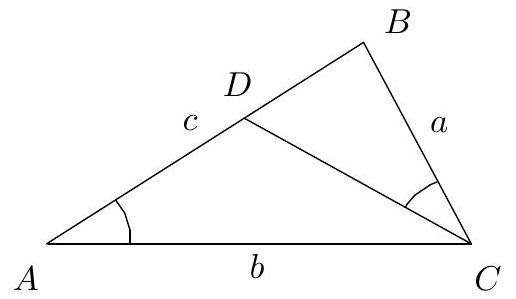
Let $D$ be a point on $A B$ such that $|B D|=\frac{a}{a+b} \cdot c$ (see Figure 5). Then
|
| 140 |
+
|
| 141 |
+
$$
|
| 142 |
+
\frac{|B D|}{|B C|}=\frac{c}{a+b}=\frac{a}{c}=\frac{|B C|}{|B A|}
|
| 143 |
+
$$
|
| 144 |
+
|
| 145 |
+
so triangles $B C D$ and $B A C$ are similar, implying $\angle B C D=\angle B A C$. Also, $\frac{|A C|}{|B C|}=\frac{|A D|}{|B D|}$ yields $\frac{|B C|}{|B D|}=\frac{|A C|}{|A D|}$, and hence by the bisector theorem $C D$ is the bisector of $\angle B C A$. So the ratio asked for is $1: 2$.
|
| 146 |
+
|
| 147 |
+
|
| 148 |
+
|
| 149 |
+
Figure 5
|
| 150 |
+
|
| 151 |
+
6. Answer: Fredek is right for all $n \neq 4$.
|
| 152 |
+
|
| 153 |
+
Suppose that any two guests of Fredek having the same number of acquaintances have neither a common acquaintance nor a common unknown. From the set $\mathcal{K}$ of Fredek's guests choose any two guests $A$ and $B$ having the same number of acquaintances (the existence of such two guests follows from the pigeonhole principle). It then follows from our assumption that $A$ and $B$ have both either $\frac{1}{2} n$ or $\frac{1}{2} n-1$ acquaintances in $\mathcal{K}$, depending on whether $A$ and $B$ are acquainted or not. This proves in particular that for any odd $n$ Fredek is right.
|
| 154 |
+
|
| 155 |
+
Assume now that $n$ is even, and $n \geqslant 6$. Choose from $\mathcal{K} \backslash\{A, B\}$ two
|
| 156 |
+
guests $C, D$ with the same number of acquaintances in $\mathcal{K} \backslash\{A, B\}$. Since every guest in $\mathcal{K} \backslash\{A, B\}$ is acquaintance either with $A$ or with $B$ but not with both, $C$ and $D$ have the same number of acquaintances in $\mathcal{K}$, which implies that they both have either $\frac{1}{2} n$ or $\frac{1}{2} n-1$ acquaintances in $\mathcal{K}$.
|
| 157 |
+
|
| 158 |
+
Finally, choose from $\mathcal{K} \backslash\{A, B, C, D\}$ two guests $E, F$ with the same number of acquaintances in $\mathcal{K} \backslash\{A, B, C, D\}$ (this is possible as $n \geqslant 6$ ). Since every guest in $\mathcal{K} \backslash\{A, B, C, D\}$ has exactly two acquaintances in the set $\{A, B, C, D\}$, the guests $E$ and $F$ have the same number of acquaintances in $\mathcal{K}$, which means that they both have either $\frac{1}{2} n$ or $\frac{1}{2} n-1$ acquaintances in $\mathcal{K}$. Thus at least four people among $A, B, C, D, E, F$ have the same number of acquaintances in $\mathcal{K}$. Select any three of these four guests - then one of these three is either a common acquaintance or a common unknown for the other two.
|
| 159 |
+
|
| 160 |
+
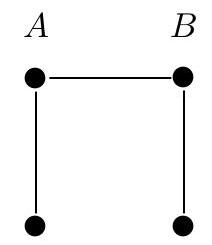
For $n=4$ Fredek is not right. The diagram on Figure 6 gives the counterexample (where points indicate guests and lines show acquaintances).
|
| 161 |
+
|
| 162 |
+
|
| 163 |
+
|
| 164 |
+
Figure 6
|
| 165 |
+
|
| 166 |
+
7. Answer: 2000 .
|
| 167 |
+
|
| 168 |
+
Altering the state from all-OFF to all-ON requires that the state of each button is changed an odd number of times. This is achieved by touching each button once. We prove that the desired result cannot be achieved if some button is never touched. In order to turn this button ON, the total number of touches of the other buttons in its row and column must be odd. Hence either the other buttons in its row or in its column - say, in its row - must be touched an odd number of times altogether. In order to change the state of each of these (odd number of) buttons an odd number of times, the total number of touches of all the other buttons on the panel (i.e. outside of the selected row) must be even. But then we have an even
|
| 169 |
+
total number of state changes for the (odd number of) other buttons in the selected column, whereas an odd number is required to alter the state of all these buttons. Hence the minimal number of touches is $40 \cdot 50=2000$.
|
| 170 |
+
|
| 171 |
+
8. Answer: Fredek returned at least 32 times.
|
| 172 |
+
|
| 173 |
+
Assume Fredek returned $k$ times, i.e. he was saying good-bye $k+1$ times to his friends. There exists a friend of Fredek, call him $X_{13}$, about whom Fredek forgot $k$ times in a row, starting from the very first time - otherwise Fredek would have come back less than $k$ times.
|
| 174 |
+
|
| 175 |
+
Consider the remaining friends of Fredek: $X_{1}, X_{2}, \ldots, X_{12}$. Assume that Fredek forgot $x_{j}$ times about each friend $X_{j}$. Since Fredek forgot a different number of times about each of his friends, so we can assume w.l.o.g. that $x_{j} \geqslant j-1$ for $j=1,2, \ldots, 12$. Since $X_{13}$ was forgotten by Fredek $k$ times, and since Fredek forgot about exactly three of his friends each time, we have
|
| 176 |
+
|
| 177 |
+
$$
|
| 178 |
+
\begin{aligned}
|
| 179 |
+
3(k+1) & =x_{1}+x_{2}+x_{3}+\ldots+x_{12}+k \geqslant \\
|
| 180 |
+
& \geqslant 0+1+2+3+\ldots+11+k= \\
|
| 181 |
+
& =66+k .
|
| 182 |
+
\end{aligned}
|
| 183 |
+
$$
|
| 184 |
+
|
| 185 |
+
Therefore $2 k \geqslant 63$, which gives $k \geqslant 32$.
|
| 186 |
+
|
| 187 |
+
It is possible that Fredek returned 32 times, i.e. he was saying good-bye 33 times to his friends. The following table shows this. The $i$-th column displays the three friends Fredek forgot while saying good-bye for the $i$-th time (i.e. before his $i$-th return). For simplicity we write $j$ in place of $X_{j}$.
|
| 188 |
+
|
| 189 |
+
$$
|
| 190 |
+
\begin{aligned}
|
| 191 |
+
& 13 \ldots .131313 \ldots .1313 \ldots .131313131313131311
|
| 192 |
+
\end{aligned}
|
| 193 |
+
$$
|
| 194 |
+
|
| 195 |
+

|
| 196 |
+
|
| 197 |
+

|
| 198 |
+
|
| 199 |
+
9. Label the squares by pairs of integers $(i, j)$ where $1 \leqslant i, j \leqslant 2 k$. Let $L$ be the set of all such pairs. Define a function $f: L \rightarrow L$ by
|
| 200 |
+
|
| 201 |
+
$$
|
| 202 |
+
f(i, j)= \begin{cases}(i+1, j+k) & \text { for } i \text { odd and } j \leqslant k \\ (i-1, j+k) & \text { for } i \text { even and } j \leqslant k, \\ (i+1, j-k) & \text { for } i \text { odd and } j>k, \\ (i-1, j-k) & \text { for } i \text { even and } j>k\end{cases}
|
| 203 |
+
$$
|
| 204 |
+
|
| 205 |
+
It is easy to see that $f$ is one-to-one. Let $X \subset L$ be the set of $\times^{\prime} \mathrm{d}$ squares and $O \subset L$ the set of o'd squares. Since the distance from $(i, j)$ to
|
| 206 |
+
$(i \pm 1, j \pm k)$ is $\sqrt{1+k^{2}}$, we have $f(i, j) \in O$ for every $(i, j) \in X$. Now, since $f$ is one-to-one, the number of elements in $f(S)$ is the same as the number of elements in $S$. As $f(X) \subset O$, the number of elements in $X$ is at most the number of elements in $O$, or $m \leqslant n$.
|
| 207 |
+
|
| 208 |
+
10. Each time the operation is performed, the difference between the two numbers on the blackboard will become one half of its previous value (regardless of which number was erased). The mean value of two integers is an integer if and only if their difference is an even number. Suppose the initial numbers were $a=2000$ and $b$. It follows that the operation can be performed $n$ times if and only if $a-b$ is of the form $2^{n} u$. This shows that $n \leqslant 10$ since $2^{11}>2000$. Choosing $b=976$ so that $a-b=1024=2^{10}$, the operation can be performed 10 times.
|
| 209 |
+
11. Answer: 128.
|
| 210 |
+
|
| 211 |
+
Let $d$ denote the least possible value of $a_{2000}$. We shall prove that $d=128$.
|
| 212 |
+
|
| 213 |
+
Clearly the sequence defined by $a_{1}=1$ and $a_{n}=2^{\alpha_{1}+\alpha_{2}+\cdots+\alpha_{k}}$ for $n=p_{1}^{\alpha_{1}} p_{2}^{\alpha_{2}} \cdots \cdots p_{k}^{\alpha_{k}}$ has the required property. Since $2000=2^{4} \cdot 5^{3}$, we have $a_{2000}=2^{4+3}=128$ and therefore $d \leqslant 128$.
|
| 214 |
+
|
| 215 |
+
Note that in the sequence $1<5<25<125<250<500<1000<2000$ each term is divisible by the previous one. As $a_{1} \geqslant 1$ it follows that
|
| 216 |
+
|
| 217 |
+
$$
|
| 218 |
+
a_{2000} \geqslant 2 \cdot a_{1000} \geqslant 2^{2} \cdot a_{500} \geqslant 2^{3} \cdot a_{250} \geqslant \ldots \geqslant 2^{7} \cdot a_{1} \geqslant 2^{7}=128 .
|
| 219 |
+
$$
|
| 220 |
+
|
| 221 |
+
12. Let $\left\{y_{1}, \ldots, y_{k}\right\} \subset\left\{x_{1}, \ldots, x_{n}\right\}$ be a subset of numbers with the maximal number of digits, and differing from one another only by their last digits: $y_{1}=\overline{y \alpha_{1}}, y_{2}=\overline{y \alpha_{2}}, \ldots, y_{k}=\overline{y \alpha_{k}}$ (here $\overline{y \alpha_{i}}$ denotes the number consisting of $y$ as its initial fragment and $\alpha_{i}$ as its last digit). Then we have
|
| 222 |
+
|
| 223 |
+
$$
|
| 224 |
+
\frac{1}{y_{1}}+\ldots+\frac{1}{y_{k}} \leqslant \frac{1}{\overline{y 0}}+\ldots+\frac{1}{\overline{y 9}}<10 \cdot \frac{1}{\overline{y 0}}=\frac{1}{y}
|
| 225 |
+
$$
|
| 226 |
+
|
| 227 |
+
Let's replace all numbers $y_{1}, y_{2}, \ldots, y_{k}$ by a single $y$ in the set $\left\{x_{1}, \ldots, x_{n}\right\}$. Then the obtained set of numbers still has the property mentioned in the statement of the problem, and the sum of their reciprocals does not decrease. Continuing to reduce the given set of numbers in the same way, we finally obtain
|
| 228 |
+
|
| 229 |
+
$$
|
| 230 |
+
\frac{1}{x_{1}}+\frac{1}{x_{2}}+\cdots+\frac{1}{x_{n}} \leqslant \frac{1}{1}+\frac{1}{2}+\ldots+\frac{1}{9}<3
|
| 231 |
+
$$
|
| 232 |
+
|
| 233 |
+
13. Assume $a_{i}=k+d i$ for $i=1,2, \ldots, n$. Then $k$ is a multiple of every $i \in\{1,2, \ldots, n-1\}$ but not a multiple of $n$. If $n=a b$ with $a, b>1$ and $\operatorname{gcd}(a, b)=1$, then $k$ is divisible by both $a$ and $b$, but not by $n$, which is a contradiction. Hence, $n$ has only one prime factor.
|
| 234 |
+
14. Answer: 2000 is the only such integer.
|
| 235 |
+
|
| 236 |
+
Let $d(n)$ denote the number of positive divisors of $n$ and $p \triangleright n$ denote the exponent of the prime $p$ in the canonical representation of $n$. Let $\delta(n)=\frac{n}{d(n)}$. Using this notation, the problem reformulates as follows: Find all positive integers $n$ such that $\delta(n)=100$.
|
| 237 |
+
|
| 238 |
+
Lemma: Let $n$ be an integer and $m$ its proper divisor. Then $\delta(m) \leqslant \delta(n)$ and the equality holds if and only if $m$ is odd and $n=2 m$.
|
| 239 |
+
|
| 240 |
+
Proof. Let $n=m p$ for a prime $p$. By the well-known formula
|
| 241 |
+
|
| 242 |
+
$$
|
| 243 |
+
d(n)=\prod_{p}(1+p \triangleright n)
|
| 244 |
+
$$
|
| 245 |
+
|
| 246 |
+
we have
|
| 247 |
+
|
| 248 |
+
$$
|
| 249 |
+
\frac{\delta(n)}{\delta(m)}=\frac{n}{m} \cdot \frac{d(m)}{d(n)}=p \cdot \frac{1+p \triangleright m}{1+p \triangleright n}=p \cdot \frac{p \triangleright n}{1+p \triangleright n} \geqslant 2 \cdot \frac{1}{2}=1,
|
| 250 |
+
$$
|
| 251 |
+
|
| 252 |
+
hence $\delta(m) \leqslant \delta(n)$. It is also clear that equality holds if and only if $p=2$ and $p \triangleright n=1$, i.e. $m$ is odd and $n=2 m$.
|
| 253 |
+
|
| 254 |
+
For the general case $n=m s$ where $s>1$ is an arbitrary positive integer, represent $s$ as a product of primes. By elementary induction on the number of factors in the representation we prove $\delta(m) \leqslant \delta(n)$. The equality can hold only if all factors are equal to 2 and the number $m$ as well as any intermediate result of multiplying it by these factors is odd, i.e. the representation of $s$ consists of a single prime 2, which gives $n=2 m$. This proves the lemma.
|
| 255 |
+
|
| 256 |
+
Now assume that $\delta(n)=100$ for some $n$, i.e. $n=100 \cdot d(n)=2^{2} \cdot 5^{2} \cdot d(n)$. In the following, we estimate the exponents of primes in the canonical representation of $n$, using the fact that 100 is a divisor of $n$.
|
| 257 |
+
|
| 258 |
+
(1) Observe that $\delta\left(2^{7} \cdot 5^{2}\right)=\frac{2^{5} \cdot 100}{8 \cdot 3}=\frac{3200}{24}>100$. Hence $2 \triangleright n \leqslant 6$, since otherwise $2^{7} \cdot 5^{2}$ divides $n$ and, by the lemma, $\delta(n)>100$.
|
| 259 |
+
|
| 260 |
+
(2) Observe that $\delta\left(2^{2} \cdot 5^{4}\right)=\frac{5^{2} \cdot 100}{3 \cdot 5}=\frac{2500}{15}>100$. Hence $5 \triangleright n \leqslant 3$, since otherwise $2^{2} \cdot 5^{4}$ divides $n$ and, by the lemma, $\delta(n)>100$.
|
| 261 |
+
|
| 262 |
+
(3) Observe that $\delta\left(2^{2} \cdot 5^{2} \cdot 3^{4}\right)=\frac{3^{4} \cdot 100}{3 \cdot 3 \cdot 5}=\frac{8100}{45}>100$. Hence $3 \triangleright n \leqslant 3$, since otherwise $2^{2} \cdot 5^{2} \cdot 3^{4}$ divides $n$ and, by the lemma, $\delta(n)>100$.
|
| 263 |
+
|
| 264 |
+
(4) Take a prime $q>5$ and an integer $k \geqslant 4$. Then
|
| 265 |
+
|
| 266 |
+
$$
|
| 267 |
+
\begin{aligned}
|
| 268 |
+
\delta\left(2^{2} \cdot 5^{2} \cdot q^{k}\right) & =\frac{2^{2} \cdot 5^{2} \cdot q^{k}}{d\left(2^{2} \cdot 5^{2} \cdot q^{k}\right)}=\frac{2^{2} \cdot 5^{2} \cdot q^{k}}{d\left(2^{2} \cdot 5^{2} \cdot 3^{k}\right)}>\frac{2^{2} \cdot 5^{2} \cdot 3^{k}}{d\left(2^{2} \cdot 5^{2} \cdot 3^{k}\right)}= \\
|
| 269 |
+
& =\delta\left(2^{2} \cdot 5^{2} \cdot 3^{k}\right)>100 .
|
| 270 |
+
\end{aligned}
|
| 271 |
+
$$
|
| 272 |
+
|
| 273 |
+
Hence, similarly to the previous cases, we get $q \triangleright n \leqslant 3$.
|
| 274 |
+
|
| 275 |
+
(5) If a prime $q>7$ divides $n$, then $q$ divides $d(n)$. Thus $q$ divides $1+p \triangleright n$ for some prime $p$. But this is impossible because, as the previous cases showed, $p \triangleright n \leqslant 6$ for all $p$. So $n$ is not divisible by primes greater than 7 .
|
| 276 |
+
|
| 277 |
+
(6) If 7 divides $n$, then 7 divides $d(n)$ and hence divides $1+p \triangleright n$ for some prime $p$. By (1)-(4), this implies $p=2$ and $2 \triangleright n=6$. At the same time, if $2 \triangleright n=6$, then 7 divides $d(n)$ and $n$. So 7 divides $n$ if and only if $2 \triangleright n=6$. Since $\delta\left(2^{6} \cdot 5^{2} \cdot 7\right)=\frac{2^{4} \cdot 7 \cdot 100}{7 \cdot 3 \cdot 2}=\frac{11200}{42}>100$, both of these conditions cannot hold simultaneously. So $n$ is not divisible by 7 and $2 \triangleright n \leqslant 5$.
|
| 278 |
+
|
| 279 |
+
(7) If $5 \triangleright n=3$, then 5 divides $d(n)$ and hence divides $1+p \triangleright n$ for some prime $p$. By (1)-(4), this implies $p=2$ and $2 \triangleright n=4$. At the same time, if $2 \triangleright n=4$, then 5 divides $d(n), 5^{3}$ divides $n$ and, by (2), $5 \triangleright n=3$. So $5 \triangleright n=3$ if and only if $2 \triangleright n=4$. Since $\delta\left(2^{4} \cdot 5^{3}\right)=\frac{2^{2} \cdot 5 \cdot 100}{5 \cdot 4}=100$, we find that $n=2^{4} \cdot 5^{3}=2000$ satisfies the required condition. On the other hand, if $2 \triangleright n=4$ and $5 \triangleright n=3$ for some $n \neq 2000$, then $n=2000 s$ for some $s>1$ and, by the lemma, $\delta(n)>100$.
|
| 280 |
+
|
| 281 |
+
(8) The case $5 \triangleright n=2$ has remained. By (7), we have $2 \triangleright n \neq 4$, so $2 \triangleright n \in\{2,3,5\}$. The condition $5 \triangleright n=2$ implies that 3 divides $d(n)$ and $n$, thus $3 \triangleright n \in\{1,2,3\}$. If $2 \triangleright n=3$, then $d(n)$ is divisible by 2 but not by 4 . At the same time $2 \triangleright n=3$ implies $3+1=4$ divides $d(n)$, a contradiction. Thus $2 \triangleright n \in\{2,5\}$, and $3^{2}$ divides $d(n)$ and $n$, i.e.
|
| 282 |
+
$3 \triangleright n \in\{2,3\}$. Now $3 \triangleright n=2$ would imply that $3^{3}$ divides $d(n)$ and $n$, a contradiction; on the other hand $3 \triangleright n=3$ would imply $3 \triangleright d(n)=2$ and hence $3 \triangleright n=2$, a contradiction.
|
| 283 |
+
|
| 284 |
+
15. Note that $n$ must be congruent to 1 or 5 modulo 6 , and proceed by induction on $\lfloor n / 6\rfloor$. It can easily be checked that the assertion holds for $n \in\{1,5\}$. Let $n>6$, and put $t=k^{2}+k+1$. The claim follows by:
|
| 285 |
+
|
| 286 |
+
$$
|
| 287 |
+
\begin{aligned}
|
| 288 |
+
(k+1)^{n}-k^{n}-1 & =(t+k)(k+1)^{n-2}-(t-(k+1)) k^{n-2}-1 \\
|
| 289 |
+
& \equiv k(k+1)^{n-2}+(k+1) k^{n-2}-1 \\
|
| 290 |
+
& \equiv(t-1)\left((k+1)^{n-3}+k^{n-3}\right)-1 \\
|
| 291 |
+
& \equiv-(k+1)^{n-3}-k^{n-3}-1 \\
|
| 292 |
+
& \equiv-(t+k)(k+1)^{n-5}-(t-(k+1)) k^{n-5}-1 \\
|
| 293 |
+
& \equiv-k(k+1)^{n-5}+(k+1) k^{n-5}-1 \\
|
| 294 |
+
& \equiv-(t-1)\left((k+1)^{n-6}-k^{n-6}\right)-1 \\
|
| 295 |
+
& \equiv(k+1)^{n-6}-k^{n-6}-1(\bmod t) .
|
| 296 |
+
\end{aligned}
|
| 297 |
+
$$
|
| 298 |
+
|
| 299 |
+
Alternative solution. Let $P(k)=(k+1)^{n}-k^{n}-1$, and let $\omega_{1}, \omega_{2}$ be the two roots of the quadratic polynomial $k^{2}+k+1$. The problem is then equivalent to showing that $P\left(\omega_{1}\right)=P\left(\omega_{2}\right)=0$ when $\operatorname{gcd}(n, 6)=1$, which is easy to check.
|
| 300 |
+
|
| 301 |
+
|
| 302 |
+
|
| 303 |
+
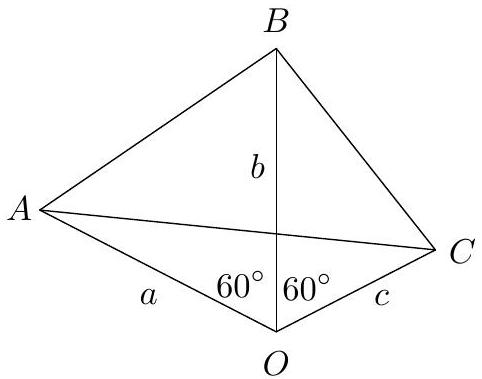
Figure 7
|
| 304 |
+
|
| 305 |
+
16. If $|O A|=a,|O B|=b,|O C|=c$ (see Figure 7), then the inequality follows from $|A C| \leqslant|A B|+|B C|$ by applying the cosine theorem to triangles $A O B$,
|
| 306 |
+
$B O C$ and $A O C$. The same argument holds if the quadrangle $O A B C$ is concave.
|
| 307 |
+
17. Answer: $x=\frac{1 \pm \sqrt{2}}{2}, y=2, z=\frac{1 \mp \sqrt{2}}{2}, t=2$ or $x=2, y=\frac{1 \pm \sqrt{2}}{2}$, $z=2, t=\frac{1 \mp \sqrt{2}}{2}$.
|
| 308 |
+
|
| 309 |
+
Let $A=x+z$ and $B=y+t$. Then the system of equations is equivalent to
|
| 310 |
+
|
| 311 |
+
$$
|
| 312 |
+
\left\{\begin{aligned}
|
| 313 |
+
A+B & =5 \\
|
| 314 |
+
A B & =4 \\
|
| 315 |
+
B x z+A y t & =3 \\
|
| 316 |
+
(B x z) \cdot(A y t) & =-4 .
|
| 317 |
+
\end{aligned}\right.
|
| 318 |
+
$$
|
| 319 |
+
|
| 320 |
+
The first two of these equations imply $\{A, B\}=\{1,4\}$ and the last two give $\{B x z, A y t\}=\{-1,4\}$. Once $A=x+z, B=y+t, B x z$ and Ayt are known, it is easy to find the corresponding values of $x, y, z$ and $t$. The solutions are shown in the following table.
|
| 321 |
+
|
| 322 |
+
| $A$ | $B$ | Bxz | Ayt | $x, z$ | $y, t$ |
|
| 323 |
+
| :---: | :---: | :---: | :---: | :---: | :---: |
|
| 324 |
+
| 1 | 4 | -1 | 4 | $\frac{1 \pm \sqrt{2}}{2}$ | 2 |
|
| 325 |
+
| 1 | 4 | 4 | -1 | - | - |
|
| 326 |
+
| 4 | 1 | -1 | 4 | - | - |
|
| 327 |
+
| 4 | 1 | 4 | -1 | 2 | $\frac{1 \pm \sqrt{2}}{2}$ |
|
| 328 |
+
|
| 329 |
+
18. Answer: $x=y=1+\sqrt{2}$.
|
| 330 |
+
|
| 331 |
+
Note that
|
| 332 |
+
|
| 333 |
+
$$
|
| 334 |
+
x+\frac{1}{x}+2-2 \sqrt{2 x+1}=\frac{x^{2}+2 x+1-2 x \sqrt{2 x+1}}{x}=\frac{1}{x}(x-\sqrt{2 x+1})^{2} .
|
| 335 |
+
$$
|
| 336 |
+
|
| 337 |
+
Hence the original equation can be rewritten as
|
| 338 |
+
|
| 339 |
+
$$
|
| 340 |
+
\frac{1}{x}(x-\sqrt{2 x+1})^{2}+\frac{1}{y}(y-\sqrt{2 y+1})^{2}=0 .
|
| 341 |
+
$$
|
| 342 |
+
|
| 343 |
+
For $x, y>0$ this gives $x-\sqrt{2 x+1}=0$ and $y-\sqrt{2 y+1}$. It follows that the only solution is $x=y=1+\sqrt{2}$.
|
| 344 |
+
|
| 345 |
+
19. Use induction. For $n=1$ the inequality reads $t^{2} \geqslant(t-1)^{2}+(2 t-1)$ which is obviously true. To prove the induction step it suffices to show that
|
| 346 |
+
|
| 347 |
+
$$
|
| 348 |
+
t^{2}(t-1)^{2 n}+t^{2}(2 t-1)^{n} \geqslant(t-1)^{2 n+2}+(2 t-1)^{n+1}
|
| 349 |
+
$$
|
| 350 |
+
|
| 351 |
+
This easily follows from $t^{2} \geqslant(t-1)^{2}$ (which is true for $t \geqslant \frac{1}{2}$ ) and $t^{2} \geqslant 2 t-1$ (which is true for any real $t$ ).
|
| 352 |
+
|
| 353 |
+
Alternative solution. Note that
|
| 354 |
+
|
| 355 |
+
$$
|
| 356 |
+
t^{2 n}=\left(t^{2}\right)^{n}=\left((t-1)^{2}+(2 t-1)\right)^{n} .
|
| 357 |
+
$$
|
| 358 |
+
|
| 359 |
+
Applying the binomial formula to the right-hand side we obtain a sum containing both summands of the right-hand side of the given equality and other summands each of which is clearly non-negative.
|
| 360 |
+
|
| 361 |
+
20. Squaring both sides of the given equality and applying $x(x+2) \leqslant(x+1)^{2}$ to the numerator of the obtained fraction and cancelling we have
|
| 362 |
+
|
| 363 |
+
$$
|
| 364 |
+
x_{n}^{2} \leqslant \frac{(2 n+1) \cdot(4 n+1)}{(2 n)^{2}}<2+\frac{2}{n} .
|
| 365 |
+
$$
|
| 366 |
+
|
| 367 |
+
Similarly (applying $x(x+2) \leqslant(x+1)^{2}$ to the denominator and cancelling) we get
|
| 368 |
+
|
| 369 |
+
$$
|
| 370 |
+
x_{n}^{2} \geqslant \frac{(4 n+1)^{2}}{2 n \cdot 4 n}>2+\frac{1}{n}
|
| 371 |
+
$$
|
| 372 |
+
|
| 373 |
+
Hence
|
| 374 |
+
|
| 375 |
+
$$
|
| 376 |
+
\frac{1}{n}<x_{n}^{2}-2<\frac{2}{n}
|
| 377 |
+
$$
|
| 378 |
+
|
| 379 |
+
and
|
| 380 |
+
|
| 381 |
+
$$
|
| 382 |
+
\frac{1}{n\left(x_{n}+\sqrt{2}\right)}<x_{n}-\sqrt{2}<\frac{2}{n\left(x_{n}+\sqrt{2}\right)} .
|
| 383 |
+
$$
|
| 384 |
+
|
| 385 |
+
From the first chain of inequalities we get $x_{n}>\sqrt{2}$ and $x_{n}<2$. The result then follows from the second chain of inequalities.
|
| 386 |
+
|
| 387 |
+
Comment. These inequalities can easily be improved. For example, the inequalities in the solution involving $x_{n}^{2}$ can immediately be replaced by $\frac{3}{2 n}<x_{n}^{2}-2<\frac{2}{n}$.
|
| 388 |
+
|
BalticWay/md/en-bw01sol.md
ADDED
|
@@ -0,0 +1,358 @@
|
|
|
|
|
|
|
|
|
|
|
|
|
|
|
|
|
|
|
|
|
|
|
|
|
|
|
|
|
|
|
|
|
|
|
|
|
|
|
|
|
|
|
|
|
|
|
|
|
|
|
|
|
|
|
|
|
|
|
|
|
|
|
|
|
|
|
|
|
|
|
|
|
|
|
|
|
|
|
|
|
|
|
|
|
|
|
|
|
|
|
|
|
|
|
|
|
|
|
|
|
|
|
|
|
|
|
|
|
|
|
|
|
|
|
|
|
|
|
|
|
|
|
|
|
|
|
|
|
|
|
|
|
|
|
|
|
|
|
|
|
|
|
|
|
|
|
|
|
|
|
|
|
|
|
|
|
|
|
|
|
|
|
|
|
|
|
|
|
|
|
|
|
|
|
|
|
|
|
|
|
|
|
|
|
|
|
|
|
|
|
|
|
|
|
|
|
|
|
|
|
|
|
|
|
|
|
|
|
|
|
|
|
|
|
|
|
|
|
|
|
|
|
|
|
|
|
|
|
|
|
|
|
|
|
|
|
|
|
|
|
|
|
|
|
|
|
|
|
|
|
|
|
|
|
|
|
|
|
|
|
|
|
|
|
|
|
|
|
|
|
|
|
|
|
|
|
|
|
|
|
|
|
|
|
|
|
|
|
|
|
|
|
|
|
|
|
|
|
|
|
|
|
|
|
|
|
|
|
|
|
|
|
|
|
|
|
|
|
|
|
|
|
|
|
|
|
|
|
|
|
|
|
|
|
|
|
|
|
|
|
|
|
|
|
|
|
|
|
|
|
|
|
|
|
|
|
|
|
|
|
|
|
|
|
|
|
|
|
|
|
|
|
|
|
|
|
|
|
|
|
|
|
|
|
|
|
|
|
|
|
|
|
|
|
|
|
|
|
|
|
|
|
|
|
|
|
|
|
|
|
|
|
|
|
|
|
|
|
|
|
|
|
|
|
|
|
|
|
|
|
|
|
|
|
|
|
|
|
|
|
|
|
|
|
|
|
|
|
|
|
|
|
|
|
|
|
|
|
|
|
|
|
|
|
|
|
|
|
|
|
|
|
|
|
|
|
|
|
|
|
|
|
|
|
|
|
|
|
|
|
|
|
|
|
|
|
|
|
|
|
|
|
|
|
|
|
|
|
|
|
|
|
|
|
|
|
|
|
|
|
|
|
|
|
|
|
|
|
|
|
|
|
|
|
|
|
|
|
|
|
|
|
|
|
|
|
|
|
|
|
|
|
|
|
|
|
|
|
|
|
|
|
|
|
|
|
|
|
|
|
|
|
|
|
|
|
|
|
|
|
|
|
|
|
|
|
|
|
|
|
|
|
|
|
|
|
|
|
|
|
|
|
|
|
|
|
|
|
|
|
|
|
|
|
|
|
|
|
|
|
|
|
|
|
|
|
|
|
|
|
|
|
|
|
|
|
|
|
|
|
|
|
|
|
|
|
|
|
|
|
|
|
|
|
|
|
|
|
|
|
|
|
|
|
|
|
|
|
|
|
|
|
|
|
|
|
|
|
|
|
|
|
|
|
|
|
|
|
|
|
|
|
|
|
|
|
|
|
|
|
|
|
|
|
|
|
|
|
|
|
|
|
|
|
|
|
|
|
|
|
|
|
|
|
|
|
|
|
|
|
|
|
|
|
|
|
|
|
|
|
|
|
|
|
|
|
|
|
|
|
|
|
|
|
|
|
|
|
|
|
|
|
|
|
|
|
|
|
|
|
|
|
|
|
|
|
|
|
|
|
|
|
|
|
|
|
|
|
|
|
|
|
|
|
|
|
|
|
|
|
|
|
|
|
|
|
|
|
|
|
|
|
|
|
|
|
|
|
|
|
|
|
|
|
|
|
|
|
|
|
|
|
|
|
|
|
|
|
|
|
|
|
|
|
|
|
|
|
|
|
|
|
|
|
|
|
|
|
|
|
|
|
|
|
|
|
|
|
|
|
|
|
|
|
|
|
|
|
|
|
|
|
|
|
|
|
|
|
|
|
|
|
|
|
|
|
|
|
|
|
|
|
|
|
|
|
|
|
|
|
|
|
|
|
|
|
|
|
|
|
|
|
|
|
|
|
|
|
|
|
|
|
|
|
|
|
|
|
|
|
|
|
|
|
|
|
|
|
|
|
|
|
|
|
|
|
|
|
|
|
|
|
|
|
|
|
|
|
|
|
|
|
|
|
|
|
|
|
|
|
|
|
|
|
|
|
|
|
|
|
|
|
|
|
|
|
|
|
|
|
|
|
|
|
|
|
|
|
|
|
|
|
|
|
|
|
|
|
|
|
|
|
|
|
|
|
|
|
|
|
|
|
|
|
|
|
|
|
|
|
|
|
|
|
|
|
|
|
|
|
|
|
|
|
|
|
|
|
|
|
|
|
|
|
|
|
|
|
|
|
|
|
|
|
|
|
|
| 1 |
+
# Baltic Way 2001
|
| 2 |
+
|
| 3 |
+
## Hamburg, November 4, 2001
|
| 4 |
+
|
| 5 |
+
## Problems
|
| 6 |
+
|
| 7 |
+
1. A set of 8 problems was prepared for an examination. Each student was given 3 of them. No two students received more than one common problem. What is the largest possible number of students?
|
| 8 |
+
2. Let $n \geqslant 2$ be a positive integer. Find whether there exist $n$ pairwise nonintersecting nonempty subsets of $\{1,2,3, \ldots\}$ such that each positive integer can be expressed in a unique way as a sum of at most $n$ integers, all from different subsets.
|
| 9 |
+
3. The numbers $1,2, \ldots, 49$ are placed in a $7 \times 7$ array, and the sum of the numbers in each row and in each column is computed. Some of these 14 sums are odd while others are even. Let $A$ denote the sum of all the odd sums and $B$ the sum of all even sums. Is it possible that the numbers were placed in the array in such a way that $A=B$ ?
|
| 10 |
+
4. Let $p$ and $q$ be two different primes. Prove that
|
| 11 |
+
|
| 12 |
+
$$
|
| 13 |
+
\left\lfloor\frac{p}{q}\right\rfloor+\left\lfloor\frac{2 p}{q}\right\rfloor+\left\lfloor\frac{3 p}{q}\right\rfloor+\ldots+\left\lfloor\frac{(q-1) p}{q}\right\rfloor=\frac{1}{2}(p-1)(q-1) .
|
| 14 |
+
$$
|
| 15 |
+
|
| 16 |
+
(Here $\lfloor x\rfloor$ denotes the largest integer not greater than $x$.)
|
| 17 |
+
|
| 18 |
+
5. Let 2001 given points on a circle be colored either red or green. In one step all points are recolored simultaneously in the following way: If both direct neighbors of a point $P$ have the same color as $P$, then the color of $P$ remains unchanged, otherwise $P$ obtains the other color. Starting with the first coloring $F_{1}$, we obtain the colorings $F_{2}, F_{3}, \ldots$ after several recoloring steps. Prove that there is a number $n_{0} \leqslant 1000$ such that $F_{n_{0}}=F_{n_{0}+2}$. Is the assertion also true if 1000 is replaced by 999 ?
|
| 19 |
+
6. The points $A, B, C, D, E$ lie on the circle $c$ in this order and satisfy $A B \| E C$ and $A C \| E D$. The line tangent to the circle $c$ at $E$ meets the line $A B$ at $P$. The lines $B D$ and $E C$ meet at $Q$. Prove that $|A C|=|P Q|$.
|
| 20 |
+
7. Given a parallelogram $A B C D$. A circle passing through $A$ meets the line segments $A B, A C$ and $A D$ at inner points $M, K, N$, respectively. Prove that
|
| 21 |
+
|
| 22 |
+
$$
|
| 23 |
+
|A B| \cdot|A M|+|A D| \cdot|A N|=|A K| \cdot|A C| .
|
| 24 |
+
$$
|
| 25 |
+
|
| 26 |
+
8. Let $A B C D$ be a convex quadrilateral, and let $N$ be the midpoint of $B C$. Suppose further that $\angle A N D=135^{\circ}$. Prove that
|
| 27 |
+
|
| 28 |
+
$$
|
| 29 |
+
|A B|+|C D|+\frac{1}{\sqrt{2}} \cdot|B C| \geqslant|A D|
|
| 30 |
+
$$
|
| 31 |
+
|
| 32 |
+
9. Given a rhombus $A B C D$, find the locus of the points $P$ lying inside the rhombus and satisfying $\angle A P D+\angle B P C=180^{\circ}$.
|
| 33 |
+
10. In a triangle $A B C$, the bisector of $\angle B A C$ meets the side $B C$ at the point $D$. Knowing that $|B D| \cdot|C D|=|A D|^{2}$ and $\angle A D B=45^{\circ}$, determine the angles of triangle $A B C$.
|
| 34 |
+
11. The real-valued function $f$ is defined for all positive integers. For any integers $a>1, b>1$ with $d=\operatorname{gcd}(a, b)$, we have
|
| 35 |
+
|
| 36 |
+
$$
|
| 37 |
+
f(a b)=f(d) \cdot\left(f\left(\frac{a}{d}\right)+f\left(\frac{b}{d}\right)\right),
|
| 38 |
+
$$
|
| 39 |
+
|
| 40 |
+
Determine all possible values of $f(2001)$.
|
| 41 |
+
|
| 42 |
+
12. Let $a_{1}, a_{2}, \ldots, a_{n}$ be positive real numbers such that $\sum_{i=1}^{n} a_{i}^{3}=3$ and $\sum_{i=1}^{n} a_{i}^{5}=5$. Prove that $\sum_{i=1}^{n} a_{i}>\frac{3}{2}$.
|
| 43 |
+
13. Let $a_{0}, a_{1}, a_{2}, \ldots$ be a sequence of real numbers satisfying $a_{0}=1$ and $a_{n}=a_{\lfloor 7 n / 9\rfloor}+a_{\lfloor n / 9\rfloor}$ for $n=1,2, \ldots$ Prove that there exists a positive integer $k$ with $a_{k}<\frac{k}{2001 !}$.
|
| 44 |
+
|
| 45 |
+
(Here $\lfloor x\rfloor$ denotes the largest integer not greater than $x$.)
|
| 46 |
+
|
| 47 |
+
14. There are $2 n$ cards. On each card some real number $x, 1 \leqslant x \leqslant 2$, is written (there can be different numbers on different cards). Prove that
|
| 48 |
+
the cards can be divided into two heaps with sums $s_{1}$ and $s_{2}$ so that $\frac{n}{n+1} \leqslant \frac{s_{1}}{s_{2}} \leqslant 1$.
|
| 49 |
+
15. Let $a_{0}, a_{1}, a_{2}, \ldots$ be a sequence of positive real numbers satisfying $i \cdot a_{i}^{2} \geqslant(i+1) \cdot a_{i-1} a_{i+1}$ for $i=1,2, \ldots$ Furthermore, let $x$ and $y$ be positive reals, and let $b_{i}=x a_{i}+y a_{i-1}$ for $i=1,2, \ldots$ Prove that the inequality $i \cdot b_{i}^{2}>(i+1) \cdot b_{i-1} b_{i+1}$ holds for all integers $i \geqslant 2$.
|
| 50 |
+
16. Let $f$ be a real-valued function defined on the positive integers satisfying the following condition: For all $n>1$ there exists a prime divisor $p$ of $n$ such that
|
| 51 |
+
|
| 52 |
+
$$
|
| 53 |
+
f(n)=f\left(\frac{n}{p}\right)-f(p)
|
| 54 |
+
$$
|
| 55 |
+
|
| 56 |
+
Given that $f(2001)=1$, what is the value of $f(2002)$ ?
|
| 57 |
+
|
| 58 |
+
17. Let $n$ be a positive integer. Prove that at least $2^{n-1}+n$ numbers can be chosen from the set $\left\{1,2,3, \ldots, 2^{n}\right\}$ such that for any two different chosen numbers $x$ and $y, x+y$ is not a divisor of $x \cdot y$.
|
| 59 |
+
18. Let $a$ be an odd integer. Prove that $a^{2^{n}}+2^{2^{n}}$ and $a^{2^{m}}+2^{2^{m}}$ are relatively prime for all positive integers $n$ and $m$ with $n \neq m$.
|
| 60 |
+
19. What is the smallest positive odd integer having the same number of positive divisors as 360 ?
|
| 61 |
+
20. From a sequence of integers $(a, b, c, d)$ each of the sequences
|
| 62 |
+
|
| 63 |
+
$$
|
| 64 |
+
(c, d, a, b),(b, a, d, c),(a+n c, b+n d, c, d),(a+n b, b, c+n d, d),
|
| 65 |
+
$$
|
| 66 |
+
|
| 67 |
+
for arbitrary integer $n$ can be obtained by one step. Is it possible to obtain $(3,4,5,7)$ from $(1,2,3,4)$ through a sequence of such steps?
|
| 68 |
+
|
| 69 |
+
## Solutions
|
| 70 |
+
|
| 71 |
+
1. Answer: 8 .
|
| 72 |
+
|
| 73 |
+
Denote the problems by $A, B, C, D, E, F, G, H$, then 8 possible problem sets are $A B C, A D E, A F G, B D G, B F H, C D H, C E F, E G H$. Hence, there could be 8 students.
|
| 74 |
+
|
| 75 |
+
Suppose that some problem (e.g., $A$ ) was given to 4 students. Then each of these 4 students should receive 2 different "supplementary" problems, and there should be at least 9 problems - a contradiction. Therefore each problem was given to at most 3 students, and there were at most $8 \cdot 3=24$ "awardings" of problems. As each student was "awarded" 3 problems, there were at most 8 students.
|
| 76 |
+
|
| 77 |
+
2. Answer: yes.
|
| 78 |
+
|
| 79 |
+
Let $A_{1}$ be the set of positive integers whose only non-zero digits may be the 1 -st, the $(n+1)$-st, the $(2 n+1)$-st etc. from the end; $A_{2}$ be the set of positive integers whose only non-zero digits may be the 2 -nd, the $(n+2)$ nd, the $(2 n+2)$-nd etc. from the end, and so on. The sets $A_{1}, A_{2}, \ldots, A_{n}$ have the required property.
|
| 80 |
+
|
| 81 |
+
Remark. This problem is quite similar to problem 18 from Baltic Way 1997.
|
| 82 |
+
|
| 83 |
+
3. Answer: no.
|
| 84 |
+
|
| 85 |
+
If this were possible, then $2 \cdot(1+\ldots+49)=A+B=2 B$. But $B$ is even since it is the sum of even numbers, whereas $1+\ldots+49=25 \cdot 49$ is odd. This is a contradiction.
|
| 86 |
+
|
| 87 |
+
4. The line $y=\frac{p}{q} x$ contains the diagonal of the rectangle with vertices $(0,0)$, $(q, 0),(q, p)$ and $(0, p)$ and passes through no points with integer coordinates in the interior of that rectangle. For $k=1,2, \ldots, q-1$ the summand $\left\lfloor\frac{k p}{q}\right\rfloor$ counts the number of interior points of the rectangle lying below the diagonal $y=\frac{p}{q} x$ and having $x$-coordinate equal to $k$. Therefore the sum in consideration counts all interior points with integer coordinates below the diagonal, which is exactly half the number of all points with integer coordinates in the interior of the rectangle, i.e. $\frac{1}{2} \cdot(p-1)(q-1)$.
|
| 88 |
+
|
| 89 |
+
Remark. The integers $p$ and $q$ need not be primes: in the solution we only used the fact that they are coprime.
|
| 90 |
+
|
| 91 |
+
5. Answer: no.
|
| 92 |
+
|
| 93 |
+
Let the points be denoted by $1,2, \ldots, 2001$ such that $i, j$ are neighbors if $|i-j|=1$ or $\{i, j\}=\{1,2001\}$. We say that $k$ points form a monochromatic segment of length $k$ if the points are consecutive on the circle and if
|
| 94 |
+
they all have the same color. For a coloring $F$ let $d(F)$ be the maximum length of a monochromatic segment. Note that $d\left(F_{n}\right)>1$ for all $n$ since 2001 is odd. If $d\left(F_{1}\right)=2001$ then all points have the same color, hence $F_{1}=F_{2}=F_{3}=\ldots$ and we can choose $n_{0}=1$. Thus, let $1<d\left(F_{1}\right)<2001$. Below we shall prove the following implications:
|
| 95 |
+
|
| 96 |
+
If $3<d\left(F_{n}\right)<2001$, then $d\left(F_{n+1}\right)=d\left(F_{n}\right)-2 ;$
|
| 97 |
+
|
| 98 |
+
If $d\left(F_{n}\right)=3$, then $d\left(F_{n+1}\right)=2$;
|
| 99 |
+
|
| 100 |
+
If $d\left(F_{n}\right)=2$, then $d\left(F_{n+1}\right)=d\left(F_{n}\right)$ and $F_{n+2}=F_{n}$;
|
| 101 |
+
|
| 102 |
+
From (1) and (2) it follows that $d\left(F_{1000}\right) \leqslant 2$, hence by (3) we have $F_{1000}=F_{1002}$. Moreover, if $F_{1}$ is the coloring where 1 is colored red and all other points are colored green, then $d\left(F_{1}\right)=2000$ and thus $d\left(F_{1}\right)>d\left(F_{2}\right)>\ldots>d\left(F_{1000}\right)=2$ which shows that, for all $n<1000, F_{n} \neq F_{n+2}$ and thus 1000 cannot be replaced by 999 .
|
| 103 |
+
|
| 104 |
+
It remains to prove (1)-(3). Let $(i+1, \ldots, i+k)$ be a longest monochromatic segment for $F_{n}$ (considering the labels of the points modulo 2001). Then $(i+2, \ldots, i+k-1)$ is a monochromatic segment for $F_{n+1}$ and thus $d\left(F_{n+1}\right) \geqslant d\left(F_{n}\right)-2$. Moreover, if $(i+1, \ldots, i+k)$ is a longest monochromatic segment for $F_{n+1}$ where $k \geqslant 3$, then $(i, \ldots, i+k+1)$ is a monochromatic segment for $F_{n}$. From this and $F_{n+1}>1$ the implications (1) and (2) clearly follow. For proof of (3) note that if $d\left(F_{n}\right) \leqslant 2$ then $F_{n+1}$ is obtained from $F_{n}$ by changing the colour of all points.
|
| 105 |
+
|
| 106 |
+
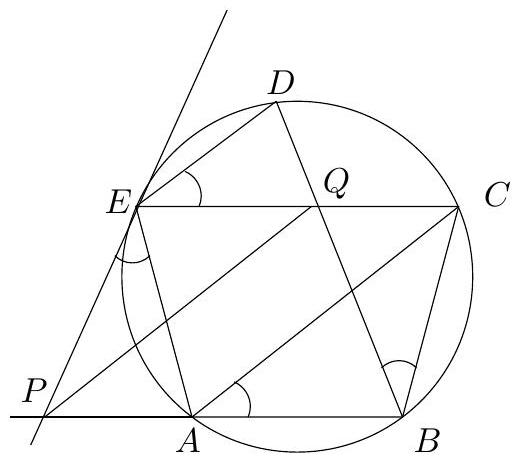
|
| 107 |
+
|
| 108 |
+
Figure 1
|
| 109 |
+
|
| 110 |
+
6. The arcs $B C$ and $A E$ are of equal length (see Figure 1). Also, since
|
| 111 |
+
$A B \| E C$ and $E D \| A C$, we have $\angle C A B=\angle D E C$ and the $\operatorname{arcs} D C$ and $B C$ are of equal length. Since $P E$ is tangent to $c$ and $|A E|=|D C|$, then $\angle P E A=\angle D B C=\angle Q B C$. As $A B C D$ is inscribed in $c$, we have $\angle Q C B=180^{\circ}-\angle E A B=\angle P A E$. Also, $A B C D$ is an isosceles trapezium, whence $|A E|=|B C|$. So the triangles $A P E$ and $C Q B$ are congruent, and $|Q C|=|P A|$. Now $P A C Q$ is a quadrilateral with a pair of opposite sides equal and parallel. So $P A C Q$ is a parallelogram, and $|P Q|=|A C|$.
|
| 112 |
+
7. Let $X$ be the point on segment $A C$ such that $\angle A D X=\angle A K N$, then
|
| 113 |
+
|
| 114 |
+
$$
|
| 115 |
+
\angle A X D=\angle A N K=180^{\circ}-\angle A M K
|
| 116 |
+
$$
|
| 117 |
+
|
| 118 |
+
(see Figure 2). Triangles $N A K$ and $X A D$ are similar, having two pairs of equal angles, hence $|A X|=\frac{|A N| \cdot|A D|}{|A K|}$. Since triangles $M A K$ and $X C D$ are also similar, we have $|C X|=\frac{|A M| \cdot|C D|}{|A K|}=\frac{|A M| \cdot|A B|}{|A K|}$ and
|
| 119 |
+
|
| 120 |
+
$$
|
| 121 |
+
|A M| \cdot|A B|+|A N| \cdot|A D|=(|A X|+|C X|) \cdot|A K|=|A C| \cdot|A K| \text {. }
|
| 122 |
+
$$
|
| 123 |
+
|
| 124 |
+
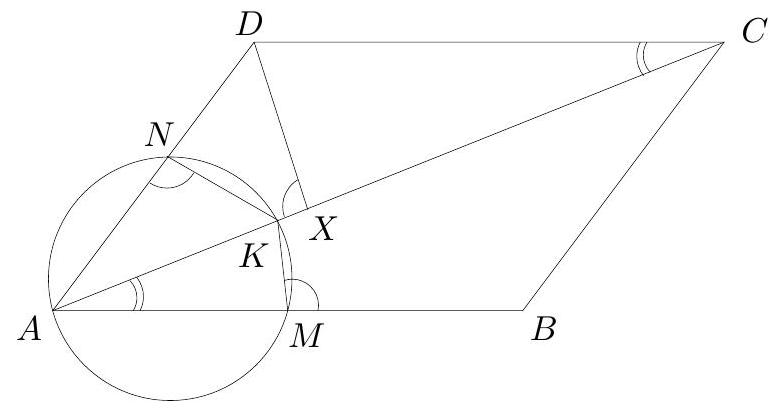
|
| 125 |
+
|
| 126 |
+
Figure 2
|
| 127 |
+
|
| 128 |
+
8. Let $X$ be the point symmetric to $B$ with respect to $A N$, and let $Y$ be the point symmetric to $C$ with respect to $D N$ (see Figure 3 ). Then
|
| 129 |
+
|
| 130 |
+
$$
|
| 131 |
+
\angle X N Y=180^{\circ}-2 \cdot\left(180^{\circ}-135^{\circ}\right)=90^{\circ}
|
| 132 |
+
$$
|
| 133 |
+
|
| 134 |
+
and $|N X|=|N Y|=\frac{|B C|}{2}$. Therefore, $|X Y|=\frac{|B C|}{\sqrt{2}}$. Moreover, we have
|
| 135 |
+
|
| 136 |
+
$$
|
| 137 |
+
\begin{aligned}
|
| 138 |
+
& |A X|=|A B| \text { and }|D Y|=|D C| \text {. Consequently, } \\
|
| 139 |
+
& \qquad|A D| \leqslant|A X|+|X Y|+|Y D|=|A B|+\frac{|B C|}{\sqrt{2}}+|D C| .
|
| 140 |
+
\end{aligned}
|
| 141 |
+
$$
|
| 142 |
+
|
| 143 |
+
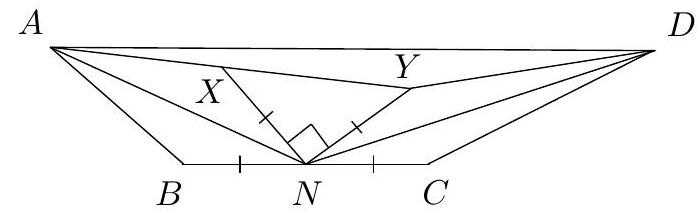
|
| 144 |
+
|
| 145 |
+
Figure 3
|
| 146 |
+
|
| 147 |
+
9. Answer: the locus of the points $P$ is the union of the diagonals $A C$ and $B D$.
|
| 148 |
+
|
| 149 |
+
Let $Q$ be a point such that $P Q C D$ is a parallelogram (see Figure 4). Then $A B Q P$ is also a parallelogram. From the equality $\angle A P D+\angle B P C=180^{\circ}$ it follows that $\angle B Q C+\angle B P C=180^{\circ}$, so the points $B, Q, C, P$ lie on a common circle. Therefore, $\angle P B C=\angle P Q C=\angle P D C$, and since $|B C|=|C D|$, we obtain that $\angle C P B=\angle C P D$ or $\angle C P B+\angle C P D=180^{\circ}$. Hence, the point $P$ lies on the segment $A C$ or on the segment $B D$.
|
| 150 |
+
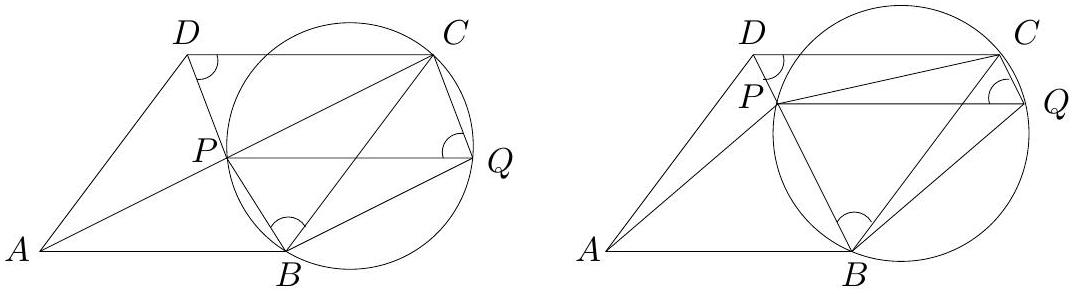
|
| 151 |
+
|
| 152 |
+
Figure 4
|
| 153 |
+
|
| 154 |
+
Conversely, any point $P$ lying on the diagonal $A C$ satisfies the equation $\angle B P C=\angle D P C$. Therefore, $\angle A P D+\angle B P C=180^{\circ}$. Analogously, we show that the last equation holds if the point $P$ lies on the diagonal $B D$.
|
| 155 |
+
|
| 156 |
+
10. Answer: $\angle B A C=60^{\circ}, \angle A B C=105^{\circ}$ and $\angle A C B=15^{\circ}$.
|
| 157 |
+
|
| 158 |
+
Suppose the line $A D$ meets the circumcircle of triangle $A B C$ at $A$ and $E$ (see Figure 5). Let $M$ be the midpoint of $B C$ and $O$ the circumcentre of triangle $A B C$. Since the arcs $B E$ and $E C$ are equal, then the points $O$, $M, E$ are collinear and $O E$ is perpendicular to $B C$. From the equality
|
| 159 |
+
$\angle C D E=\angle A D B=45^{\circ}$ it follows that $\angle A E O=45^{\circ}$. Since $|A O|=|E O|$, we have $\angle A O E=90^{\circ}$ and $A O \| D M$.
|
| 160 |
+
|
| 161 |
+
From the equality $|B D| \cdot|C D|=|A D|^{2}$ we obtain $|A D|=|D E|$, which implies that $|O M|=|M E|$. Therefore $|B O|=|B E|$ and also $|B O|=|E O|$. Hence the triangle $B O E$ is equilateral. This gives $\angle B A E=30^{\circ}$, so $\angle B A C=60^{\circ}$. Summing up the angles of the triangle $A B D$ we obtain $\angle A B C=105^{\circ}$ and from this $\angle A C B=15^{\circ}$.
|
| 162 |
+
|
| 163 |
+
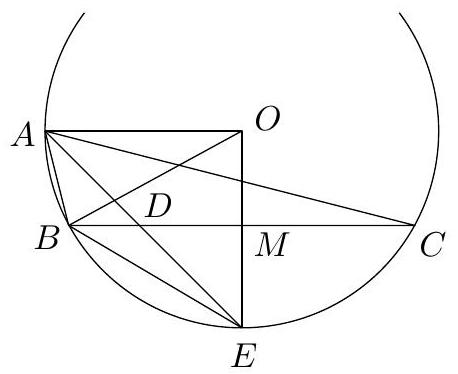
|
| 164 |
+
|
| 165 |
+
Figure 5
|
| 166 |
+
|
| 167 |
+
11. Answer: 0 and $\frac{1}{2}$.
|
| 168 |
+
|
| 169 |
+
Obviously the constant functions $f(n)=0$ and $f(n)=\frac{1}{2}$ provide solutions.
|
| 170 |
+
|
| 171 |
+
We show that there are no other solutions. Assume $f(2001) \neq 0$. Since $2001=3 \cdot 667$ and $\operatorname{gcd}(3,667)=1$, then
|
| 172 |
+
|
| 173 |
+
$$
|
| 174 |
+
f(2001)=f(1) \cdot(f(3)+f(667)),
|
| 175 |
+
$$
|
| 176 |
+
|
| 177 |
+
and $f(1) \neq 0$. Since $\operatorname{gcd}(2001,2001)=2001$ then
|
| 178 |
+
|
| 179 |
+
$$
|
| 180 |
+
f\left(2001^{2}\right)=f(2001)(2 \cdot f(1)) \neq 0 .
|
| 181 |
+
$$
|
| 182 |
+
|
| 183 |
+
Also $\operatorname{gcd}\left(2001,2001^{3}\right)=2001$, so
|
| 184 |
+
|
| 185 |
+
$$
|
| 186 |
+
f\left(2001^{4}\right)=f(2001) \cdot\left(f(1)+f\left(2001^{2}\right)\right)=f(1) f(2001)(1+2 f(2001))
|
| 187 |
+
$$
|
| 188 |
+
|
| 189 |
+
On the other hand, $\operatorname{gcd}\left(2001^{2}, 2001^{2}\right)=2001^{2}$ and
|
| 190 |
+
|
| 191 |
+
$$
|
| 192 |
+
f\left(2001^{4}\right)=f\left(2001^{2}\right) \cdot(f(1)+f(1))=2 f(1) f\left(2001^{2}\right)=4 f(1)^{2} f(2001) .
|
| 193 |
+
$$
|
| 194 |
+
|
| 195 |
+
So $4 f(1)=1+2 f(2001)$ and $f(2001)=2 f(1)-\frac{1}{2}$. Exactly the same
|
| 196 |
+
argument starting from $f\left(2001^{2}\right) \neq 0$ instead of $f(2001)$ shows that $f\left(2001^{2}\right)=2 f(1)-\frac{1}{2}$. So
|
| 197 |
+
|
| 198 |
+
$$
|
| 199 |
+
2 f(1)-\frac{1}{2}=2 f(1)\left(2 f(1)-\frac{1}{2}\right) \text {. }
|
| 200 |
+
$$
|
| 201 |
+
|
| 202 |
+
Since $2 f(1)-\frac{1}{2}=f(2001) \neq 0$, we have $f(1)=\frac{1}{2}$, which implies $f(2001)=2 f(1)-\frac{1}{2}=\frac{1}{2}$.
|
| 203 |
+
|
| 204 |
+
12. By Hölder's inequality,
|
| 205 |
+
|
| 206 |
+
$$
|
| 207 |
+
\sum_{i=1}^{n} a^{3}=\sum_{i=1}^{n}\left(a_{i} \cdot a_{i}^{2}\right) \leqslant\left(\sum_{i=1}^{n} a_{i}^{5 / 3}\right)^{3 / 5} \cdot\left(\sum_{i=1}^{n}\left(a_{i}^{2}\right)^{5 / 2}\right)^{2 / 5} .
|
| 208 |
+
$$
|
| 209 |
+
|
| 210 |
+
We will show that
|
| 211 |
+
|
| 212 |
+
$$
|
| 213 |
+
\sum_{i=1}^{n} a_{i}^{5 / 3} \leqslant\left(\sum_{i=1}^{n} a_{i}\right)^{5 / 3}
|
| 214 |
+
$$
|
| 215 |
+
|
| 216 |
+
Let $S=\sum_{i=1}^{n} a_{i}$, then (4) is equivalent to
|
| 217 |
+
|
| 218 |
+
$$
|
| 219 |
+
\sum_{i=1}^{n}\left(\frac{a_{i}}{S}\right)^{5 / 3} \leqslant 1=\sum_{i=1}^{n} \frac{a_{i}}{S}
|
| 220 |
+
$$
|
| 221 |
+
|
| 222 |
+
which holds since $0<\frac{a_{i}}{S} \leqslant 1$ and $\frac{5}{3}>1$ yield $\left(\frac{a_{i}}{S}\right)^{5 / 3} \leqslant \frac{a_{i}}{S}$. So,
|
| 223 |
+
|
| 224 |
+
$$
|
| 225 |
+
\sum_{i=1}^{n} a_{i}^{3} \leqslant\left(\sum_{i=1}^{n} a_{i}\right) \cdot\left(\sum_{i=1}^{n} a_{i}^{5}\right)^{2 / 5}
|
| 226 |
+
$$
|
| 227 |
+
|
| 228 |
+
which gives $\sum_{i=1}^{n} a_{i} \geqslant \frac{3}{5^{2 / 5}}>\frac{3}{2}$, since $2^{5}>5^{2}$ and hence $2>5^{2 / 5}$.
|
| 229 |
+
|
| 230 |
+
13. Consider the equation
|
| 231 |
+
|
| 232 |
+
$$
|
| 233 |
+
\left(\frac{7}{9}\right)^{x}+\left(\frac{1}{9}\right)^{x}=1 .
|
| 234 |
+
$$
|
| 235 |
+
|
| 236 |
+
It has a root $\frac{1}{2}<\alpha<1$, because $\sqrt{\frac{7}{9}}+\sqrt{\frac{1}{9}}=\frac{\sqrt{7}+1}{3}>1$ and $\frac{7}{9}+\frac{1}{9}<1$. We will prove that $a_{n} \leqslant M \cdot n^{\alpha}$ for some $M>0-$ since $\frac{n^{\alpha}}{n}$ will be arbitrarily small for large enough $n$, the claim follows from this immediately. We choose $M$ so that the inequality $a_{n} \leqslant M \cdot n^{\alpha}$ holds for $1 \leqslant n \leqslant 8$; since for $n \geqslant 9$ we have $1<[7 n / 9]<n$ and $1 \leqslant[n / 9]<n$, it follows by induction that
|
| 237 |
+
|
| 238 |
+
$$
|
| 239 |
+
\begin{aligned}
|
| 240 |
+
a_{n} & =a_{[7 n / 9]}+a_{[n / 9]} \leqslant M \cdot\left[\frac{7 n}{9}\right]^{\alpha}+M \cdot\left[\frac{n}{9}\right]^{\alpha} \leqslant \\
|
| 241 |
+
& \leqslant M \cdot\left(\frac{7 n}{9}\right)^{\alpha}+M \cdot\left(\frac{n}{9}\right)^{\alpha}=M \cdot n^{\alpha} \cdot\left(\left(\frac{7}{9}\right)^{\alpha}+\left(\frac{1}{9}\right)^{\alpha}\right)=M \cdot n^{\alpha} .
|
| 242 |
+
\end{aligned}
|
| 243 |
+
$$
|
| 244 |
+
|
| 245 |
+
14. Let the numbers be $x_{1} \leqslant x_{2} \leqslant \ldots \leqslant x_{2 n-1} \leqslant x_{2 n}$. We will show that the choice $s_{1}=x_{1}+x_{3}+x_{5}+\cdots+x_{2 n-1}$ and $s_{2}=x_{2}+x_{4}+\cdots+x_{2 n}$ solves the problem. Indeed, the inequality $\frac{s_{1}}{s_{2}} \leqslant 1$ is obvious and we have
|
| 246 |
+
|
| 247 |
+
$$
|
| 248 |
+
\begin{aligned}
|
| 249 |
+
\frac{s_{1}}{s_{2}} & =\frac{x_{1}+x_{3}+x_{5}+\ldots+x_{2 n-1}}{x_{2}+x_{4}+x_{6}+\ldots+x_{2 n}}=\frac{\left(x_{3}+x_{5}+\ldots+x_{2 n-1}\right)+x_{1}}{\left(x_{2}+x_{4}+\ldots+x_{2 n-2}\right)+x_{2 n}} \geqslant \\
|
| 250 |
+
& \geqslant \frac{\left(x_{3}+x_{5}+\ldots+x_{2 n-1}\right)+1}{\left(x_{2}+x_{4}+\ldots+x_{2 n-2}\right)+2} \geqslant \frac{\left(x_{2}+x_{4}+\ldots+x_{2 n-2}\right)+1}{\left(x_{2}+x_{4}+\ldots+x_{2 n-2}\right)+2}= \\
|
| 251 |
+
& =1-\frac{1}{\left(x_{2}+x_{4}+\ldots+x_{2 n-2}\right)+2} \geqslant 1-\frac{1}{(n-1)+2}=\frac{n}{n+1} .
|
| 252 |
+
\end{aligned}
|
| 253 |
+
$$
|
| 254 |
+
|
| 255 |
+
15. Let $i \geqslant 2$. We are given the inequalities
|
| 256 |
+
|
| 257 |
+
$$
|
| 258 |
+
(i-1) \cdot a_{i-1}^{2} \geqslant i \cdot a_{i} a_{i-2}
|
| 259 |
+
$$
|
| 260 |
+
|
| 261 |
+
and
|
| 262 |
+
|
| 263 |
+
$$
|
| 264 |
+
i \cdot a_{i}^{2} \geqslant(i+1) \cdot a_{i+1} a_{i-1} .
|
| 265 |
+
$$
|
| 266 |
+
|
| 267 |
+
Multiplying both sides of (6) by $x^{2}$, we obtain
|
| 268 |
+
|
| 269 |
+
$$
|
| 270 |
+
i \cdot x^{2} \cdot a_{i}^{2} \geqslant(i+1) \cdot x^{2} \cdot a_{i+1} a_{i-1}
|
| 271 |
+
$$
|
| 272 |
+
|
| 273 |
+
By (5),
|
| 274 |
+
|
| 275 |
+
$$
|
| 276 |
+
\frac{a_{i-1}^{2}}{a_{i} a_{i-2}} \geqslant \frac{i}{i-1}=1+\frac{1}{i-1}>1+\frac{1}{i}=\frac{i+1}{i}
|
| 277 |
+
$$
|
| 278 |
+
|
| 279 |
+
which implies
|
| 280 |
+
|
| 281 |
+
$$
|
| 282 |
+
i \cdot y^{2} \cdot a_{i-1}^{2}>(i+1) \cdot y^{2} \cdot a_{i} a_{i-2} .
|
| 283 |
+
$$
|
| 284 |
+
|
| 285 |
+
Multiplying (5) and (6), and dividing both sides of the resulting inequality by $i a_{i} a_{i-1}$, we get
|
| 286 |
+
|
| 287 |
+
$$
|
| 288 |
+
(i-1) \cdot a_{i} a_{i-1} \geqslant(i+1) \cdot a_{i+1} a_{i-2} .
|
| 289 |
+
$$
|
| 290 |
+
|
| 291 |
+
Adding $(i+1) a_{i} a_{i-1}$ to both sides of the last inequality and multiplying both sides of the resulting inequality by $x y$ gives
|
| 292 |
+
|
| 293 |
+
$$
|
| 294 |
+
i \cdot 2 x y \cdot a_{i} a_{i-1} \geqslant(i+1) \cdot x y \cdot\left(a_{i+1} a_{i-2}+a_{i} a_{i-1}\right) .
|
| 295 |
+
$$
|
| 296 |
+
|
| 297 |
+
Finally, adding up (7), (8) and (9) results in
|
| 298 |
+
|
| 299 |
+
$$
|
| 300 |
+
i \cdot\left(x a_{i}+y a_{i-1}\right)^{2}>(i+1) \cdot\left(x a_{i+1}+y a_{i}\right)\left(x a_{i-1}+y a_{i-2}\right)
|
| 301 |
+
$$
|
| 302 |
+
|
| 303 |
+
which is equivalent to the claim.
|
| 304 |
+
|
| 305 |
+
16. Answer: 2.
|
| 306 |
+
|
| 307 |
+
For any prime $p$ we have $f(p)=f(1)-f(p)$ and thus $f(p)=\frac{f(1)}{2}$. If $n$ is a product of two primes $p$ and $q$, then $f(n)=f(p)-f(q)$ or $f(n)=f(q)-f(p)$, so $f(n)=0$. By the same reasoning we find that if $n$ is a product of three primes, then there is a prime $p$ such that
|
| 308 |
+
|
| 309 |
+
$$
|
| 310 |
+
f(n)=f\left(\frac{n}{p}\right)-f(p)=-f(p)=-\frac{f(1)}{2} .
|
| 311 |
+
$$
|
| 312 |
+
|
| 313 |
+
By simple induction we can show that if $n$ is the product of $k$ primes, then $f(n)=(2-k) \cdot \frac{f(1)}{2}$. In particular, $f(2001)=f(3 \cdot 23 \cdot 29)=1$ so $f(1)=-2$. Therefore, $f(2002)=f(2 \cdot 7 \cdot 11 \cdot 13)=-f(1)=2$.
|
| 314 |
+
|
| 315 |
+
17. We choose the numbers $1,3,5, \ldots, 2^{n}-1$ and $2,4,8,16, \ldots, 2^{n}$, i.e. all odd numbers and all powers of 2 . Consider the three possible cases.
|
| 316 |
+
|
| 317 |
+
(1) If $x=2 a-1$ and $y=2 b-1$, then $x+y=(2 a-1)+(2 b-1)=2(a+b-1)$ is even and does not divide $x y=(2 a-1)(2 b-1)$ which is odd.
|
| 318 |
+
|
| 319 |
+
(2) If $x=2^{k}$ and $y=2^{m}$ where $k<m$, then $x+y=2^{k}\left(2^{m-k}+1\right)$ has an odd divisor greater than 1 and hence does not divide $x y=2^{a+b}$.
|
| 320 |
+
|
| 321 |
+
(3) If $x=2^{k}$ and $y=2 b-1$, then $x+y=2^{k}+(2 b-1)>(2 b-1)$ is odd and hence does not divide $x y=2^{k}(2 b-1)$ which has $2 b-1$ as its largest odd divisor.
|
| 322 |
+
|
| 323 |
+
18. Rewriting $a^{2^{n}}+2^{2^{n}}=a^{2^{n}}-2^{2^{n}}+2 \cdot 2^{2^{n}}$ and making repeated use of the identity
|
| 324 |
+
|
| 325 |
+
$$
|
| 326 |
+
a^{2^{n}}-2^{2^{n}}=\left(a^{2^{n-1}}-2^{2^{n-1}}\right) \cdot\left(a^{2^{n-1}}+2^{2^{n-1}}\right)
|
| 327 |
+
$$
|
| 328 |
+
|
| 329 |
+
we get
|
| 330 |
+
|
| 331 |
+
$$
|
| 332 |
+
\begin{gathered}
|
| 333 |
+
a^{2^{n}}+2^{2^{n}}=\left(a^{2^{n-1}}+2^{2^{n-1}}\right) \cdot\left(a^{2^{n-2}}+2^{2^{n-2}}\right) \cdot \ldots \cdot\left(a^{2^{m}}+2^{2^{m}}\right) \cdot \ldots \\
|
| 334 |
+
\ldots \cdot\left(a^{2}+2^{2}\right) \cdot(a+2) \cdot(a-2)+2 \cdot 2^{2^{n}}
|
| 335 |
+
\end{gathered}
|
| 336 |
+
$$
|
| 337 |
+
|
| 338 |
+
For $n>m$, assume that $a^{2^{n}}+2^{2^{n}}$ and $a^{2^{m}}+2^{2^{m}}$ have a common divisor $d>1$. Then an odd integer $d$ divides $2 \cdot 2^{2^{n}}$, a contradiction.
|
| 339 |
+
|
| 340 |
+
19. Answer: 31185 .
|
| 341 |
+
|
| 342 |
+
An integer with the prime factorization $p_{1}^{r_{1}} \cdot p_{2}^{r_{2}} \cdot \ldots \cdot p_{k}^{r_{k}}$ (where $p_{1}, p_{2}, \ldots$, $p_{k}$ are distinct primes) has precisely $\left(r_{1}+1\right) \cdot\left(r_{2}+1\right) \cdot \ldots \cdot\left(r_{k}+1\right)$ distinct positive divisors. Since $360=2^{3} \cdot 3^{2} \cdot 5$, it follows that 360 has $4 \cdot 3 \cdot 2=24$ positive divisors. Since $24=3 \cdot 2 \cdot 2 \cdot 2$, it is easy to check that the smallest odd number with 24 positive divisors is $3^{2} \cdot 5 \cdot 7 \cdot 11=31185$.
|
| 343 |
+
|
| 344 |
+
20. Answer: no.
|
| 345 |
+
|
| 346 |
+
Under all transformations $(a, b, c, d) \rightarrow\left(a^{\prime}, b^{\prime}, c^{\prime}, d^{\prime}\right)$ allowed in the problem we have $|a d-b c|=\left|a^{\prime} d^{\prime}-b^{\prime} c^{\prime}\right|$, but $|1 \cdot 4-2 \cdot 3|=2 \neq 1=|3 \cdot 7-4 \cdot 5|$.
|
| 347 |
+
|
| 348 |
+
Remark. The transformations allowed in the problem are in fact the elementary transformations of the determinant
|
| 349 |
+
|
| 350 |
+
$$
|
| 351 |
+
\left|\begin{array}{ll}
|
| 352 |
+
a & b \\
|
| 353 |
+
c & d
|
| 354 |
+
\end{array}\right|
|
| 355 |
+
$$
|
| 356 |
+
|
| 357 |
+
and the invariant $|a d-b c|$ is the absolute value of the determinant which is preserved under these transformations.
|
| 358 |
+
|
BalticWay/md/en-bw02sol.md
ADDED
|
@@ -0,0 +1,794 @@
|
|
|
|
|
|
|
|
|
|
|
|
|
|
|
|
|
|
|
|
|
|
|
|
|
|
|
|
|
|
|
|
|
|
|
|
|
|
|
|
|
|
|
|
|
|
|
|
|
|
|
|
|
|
|
|
|
|
|
|
|
|
|
|
|
|
|
|
|
|
|
|
|
|
|
|
|
|
|
|
|
|
|
|
|
|
|
|
|
|
|
|
|
|
|
|
|
|
|
|
|
|
|
|
|
|
|
|
|
|
|
|
|
|
|
|
|
|
|
|
|
|
|
|
|
|
|
|
|
|
|
|
|
|
|
|
|
|
|
|
|
|
|
|
|
|
|
|
|
|
|
|
|
|
|
|
|
|
|
|
|
|
|
|
|
|
|
|
|
|
|
|
|
|
|
|
|
|
|
|
|
|
|
|
|
|
|
|
|
|
|
|
|
|
|
|
|
|
|
|
|
|
|
|
|
|
|
|
|
|
|
|
|
|
|
|
|
|
|
|
|
|
|
|
|
|
|
|
|
|
|
|
|
|
|
|
|
|
|
|
|
|
|
|
|
|
|
|
|
|
|
|
|
|
|
|
|
|
|
|
|
|
|
|
|
|
|
|
|
|
|
|
|
|
|
|
|
|
|
|
|
|
|
|
|
|
|
|
|
|
|
|
|
|
|
|
|
|
|
|
|
|
|
|
|
|
|
|
|
|
|
|
|
|
|
|
|
|
|
|
|
|
|
|
|
|
|
|
|
|
|
|
|
|
|
|
|
|
|
|
|
|
|
|
|
|
|
|
|
|
|
|
|
|
|
|
|
|
|
|
|
|
|
|
|
|
|
|
|
|
|
|
|
|
|
|
|
|
|
|
|
|
|
|
|
|
|
|
|
|
|
|
|
|
|
|
|
|
|
|
|
|
|
|
|
|
|
|
|
|
|
|
|
|
|
|
|
|
|
|
|
|
|
|
|
|
|
|
|
|
|
|
|
|
|
|
|
|
|
|
|
|
|
|
|
|
|
|
|
|
|
|
|
|
|
|
|
|
|
|
|
|
|
|
|
|
|
|
|
|
|
|
|
|
|
|
|
|
|
|
|
|
|
|
|
|
|
|
|
|
|
|
|
|
|
|
|
|
|
|
|
|
|
|
|
|
|
|
|
|
|
|
|
|
|
|
|
|
|
|
|
|
|
|
|
|
|
|
|
|
|
|
|
|
|
|
|
|
|
|
|
|
|
|
|
|
|
|
|
|
|
|
|
|
|
|
|
|
|
|
|
|
|
|
|
|
|
|
|
|
|
|
|
|
|
|
|
|
|
|
|
|
|
|
|
|
|
|
|
|
|
|
|
|
|
|
|
|
|
|
|
|
|
|
|
|
|
|
|
|
|
|
|
|
|
|
|
|
|
|
|
|
|
|
|
|
|
|
|
|
|
|
|
|
|
|
|
|
|
|
|
|
|
|
|
|
|
|
|
|
|
|
|
|
|
|
|
|
|
|
|
|
|
|
|
|
|
|
|
|
|
|
|
|
|
|
|
|
|
|
|
|
|
|
|
|
|
|
|
|
|
|
|
|
|
|
|
|
|
|
|
|
|
|
|
|
|
|
|
|
|
|
|
|
|
|
|
|
|
|
|
|
|
|
|
|
|
|
|
|
|
|
|
|
|
|
|
|
|
|
|
|
|
|
|
|
|
|
|
|
|
|
|
|
|
|
|
|
|
|
|
|
|
|
|
|
|
|
|
|
|
|
|
|
|
|
|
|
|
|
|
|
|
|
|
|
|
|
|
|
|
|
|
|
|
|
|
|
|
|
|
|
|
|
|
|
|
|
|
|
|
|
|
|
|
|
|
|
|
|
|
|
|
|
|
|
|
|
|
|
|
|
|
|
|
|
|
|
|
|
|
|
|
|
|
|
|
|
|
|
|
|
|
|
|
|
|
|
|
|
|
|
|
|
|
|
|
|
|
|
|
|
|
|
|
|
|
|
|
|
|
|
|
|
|
|
|
|
|
|
|
|
|
|
|
|
|
|
|
|
|
|
|
|
|
|
|
|
|
|
|
|
|
|
|
|
|
|
|
|
|
|
|
|
|
|
|
|
|
|
|
|
|
|
|
|
|
|
|
|
|
|
|
|
|
|
|
|
|
|
|
|
|
|
|
|
|
|
|
|
|
|
|
|
|
|
|
|
|
|
|
|
|
|
|
|
|
|
|
|
|
|
|
|
|
|
|
|
|
|
|
|
|
|
|
|
|
|
|
|
|
|
|
|
|
|
|
|
|
|
|
|
|
|
|
|
|
|
|
|
|
|
|
|
|
|
|
|
|
|
|
|
|
|
|
|
|
|
|
|
|
|
|
|
|
|
|
|
|
|
|
|
|
|
|
|
|
|
|
|
|
|
|
|
|
|
|
|
|
|
|
|
|
|
|
|
|
|
|
|
|
|
|
|
|
|
|
|
|
|
|
|
|
|
|
|
|
|
|
|
|
|
|
|
|
|
|
|
|
|
|
|
|
|
|
|
|
|
|
|
|
|
|
|
|
|
|
|
|
|
|
|
|
|
|
|
|
|
|
|
|
|
|
|
|
|
|
|
|
|
|
|
|
|
|
|
|
|
|
|
|
|
|
|
|
|
|
|
|
|
|
|
|
|
|
|
|
|
|
|
|
|
|
|
|
|
|
|
|
|
|
|
|
|
|
|
|
|
|
|
|
|
|
|
|
|
|
|
|
|
|
|
|
|
|
|
|
|
|
|
|
|
|
|
|
|
|
|
|
|
|
|
|
|
|
|
|
|
|
|
|
|
|
|
|
|
|
|
|
|
|
|
|
|
|
|
|
|
|
|
|
|
|
|
|
|
|
|
|
|
|
|
|
|
|
|
|
|
|
|
|
|
|
|
|
|
|
|
|
|
|
|
|
|
|
|
|
|
|
|
|
|
|
|
|
|
|
|
|
|
|
|
|
|
|
|
|
|
|
|
|
|
|
|
|
|
|
|
|
|
|
|
|
|
|
|
|
|
|
|
|
|
|
|
|
|
|
|
|
|
|
|
|
|
|
|
|
|
|
|
|
|
|
|
|
|
|
|
|
|
|
|
|
|
|
|
|
|
|
|
|
|
|
|
|
|
|
|
|
|
|
|
|
|
|
|
|
|
|
|
|
|
|
|
|
|
|
|
|
|
|
|
|
|
|
|
|
|
|
|
|
|
|
|
|
|
|
|
|
|
|
|
|
|
|
|
|
|
|
|
|
|
|
|
|
|
|
|
|
|
|
|
|
|
|
|
|
|
|
|
|
|
|
|
|
|
|
|
|
|
|
|
|
|
|
|
|
|
|
|
|
|
|
|
|
|
|
|
|
|
|
|
|
|
|
|
|
|
|
|
|
|
|
|
|
|
|
|
|
|
|
|
|
|
|
|
|
|
|
|
|
|
|
|
|
|
|
|
|
|
|
|
|
|
|
|
|
|
|
|
|
|
|
|
|
|
|
|
|
|
|
|
|
|
|
|
|
|
|
|
|
|
|
|
|
|
|
|
|
|
|
|
|
|
|
|
|
|
|
|
|
|
|
|
|
|
|
|
|
|
|
|
|
|
|
|
|
|
|
|
|
|
|
|
|
|
|
|
|
|
|
|
|
|
|
|
|
|
|
|
|
|
|
|
|
|
|
|
|
|
|
|
|
|
|
|
|
|
|
|
|
|
|
|
|
|
|
|
|
|
|
|
|
|
|
|
|
|
|
|
|
|
|
|
|
|
|
|
|
|
|
|
|
|
|
|
|
|
|
|
|
|
|
|
|
|
|
|
|
|
|
|
|
|
|
|
|
|
|
|
|
|
|
|
|
|
|
|
|
|
|
|
|
|
|
|
|
|
|
|
|
|
|
|
|
|
|
|
|
|
|
|
|
|
|
|
|
|
|
|
|
|
|
|
|
|
|
|
|
|
|
|
|
|
|
|
|
|
|
|
|
|
|
|
|
|
|
|
|
|
|
|
|
|
|
|
|
|
|
|
|
|
|
|
|
|
|
|
|
|
|
|
|
|
|
|
|
|
|
|
|
|
|
|
|
|
|
|
|
|
|
|
|
|
|
|
|
|
|
|
|
|
|
|
|
|
|
|
|
|
|
|
|
|
|
|
|
|
|
|
|
|
|
|
|
|
|
|
|
|
|
|
|
|
|
|
|
|
|
|
|
|
|
|
|
|
|
|
|
|
|
|
|
|
|
|
|
|
|
|
|
|
|
|
|
|
|
|
|
|
|
|
|
|
|
|
|
|
|
|
|
|
|
|
|
|
|
|
|
|
|
|
|
|
|
|
|
|
|
|
|
|
|
|
|
|
|
|
|
|
|
|
|
|
|
|
|
|
|
|
|
|
|
|
|
|
|
|
|
|
|
|
|
|
|
|
|
|
|
|
|
|
|
|
|
|
|
|
|
|
|
|
|
|
|
|
|
|
|
|
|
|
|
|
|
|
|
|
|
|
|
|
|
|
|
|
|
|
|
|
|
|
|
|
|
|
|
|
|
|
|
|
|
|
|
|
|
|
|
|
|
|
|
|
|
|
|
|
|
|
|
|
|
|
|
|
|
|
|
|
|
|
|
|
|
|
|
|
|
|
|
|
|
|
|
|
|
|
|
|
|
|
|
|
|
|
|
|
|
|
|
|
|
|
|
|
|
|
|
|
|
|
|
|
|
|
|
|
|
|
|
|
|
|
|
|
|
|
|
|
|
|
|
|
|
|
|
|
|
|
|
|
|
|
|
|
|
|
|
|
|
|
|
|
|
|
|
|
|
|
|
|
|
|
|
|
|
|
|
|
|
|
|
|
|
|
|
|
|
|
|
|
|
|
|
|
|
|
|
|
|
|
|
|
|
|
|
|
|
|
|
|
|
|
|
|
|
|
|
|
|
|
|
|
|
|
|
|
|
|
|
|
|
|
|
|
|
|
|
|
|
|
|
|
|
|
|
|
|
|
|
|
|
|
|
|
|
|
|
|
|
|
|
|
|
|
|
|
|
|
|
|
|
|
|
|
|
|
|
|
|
|
|
|
|
|
|
|
|
|
|
|
|
|
|
|
|
|
|
|
|
|
|
|
|
|
|
|
|
|
|
|
|
|
|
|
|
|
|
|
|
|
|
|
|
|
|
|
|
|
|
|
|
|
|
|
|
|
|
|
|
|
|
|
|
|
|
|
|
|
|
|
|
|
|
|
|
|
|
|
|
|
|
|
|
|
|
|
|
|
|
|
|
|
|
|
|
|
|
|
|
|
|
|
|
|
|
|
|
|
|
|
|
|
|
|
|
|
|
|
|
|
|
|
|
|
|
|
|
|
|
|
|
|
|
|
|
|
|
|
|
|
|
|
|
|
| 1 |
+
# Baltic Way 2002 mathematical team contest
|
| 2 |
+
|
| 3 |
+
## Tartu, November 2, 2002
|
| 4 |
+
|
| 5 |
+
## Problems and solutions
|
| 6 |
+
|
| 7 |
+
1. Solve the system of equations
|
| 8 |
+
|
| 9 |
+
$$
|
| 10 |
+
\left\{\begin{array}{l}
|
| 11 |
+
a^{3}+3 a b^{2}+3 a c^{2}-6 a b c=1 \\
|
| 12 |
+
b^{3}+3 b a^{2}+3 b c^{2}-6 a b c=1 \\
|
| 13 |
+
c^{3}+3 c a^{2}+3 c b^{2}-6 a b c=1
|
| 14 |
+
\end{array}\right.
|
| 15 |
+
$$
|
| 16 |
+
|
| 17 |
+
in real numbers.
|
| 18 |
+
|
| 19 |
+
Answer: $a=1, b=1, c=1$.
|
| 20 |
+
|
| 21 |
+
Solution. Denoting the left hand sides of the given equations as $A, B$ and $C$, the following equalities can easily be seen to hold:
|
| 22 |
+
|
| 23 |
+
$$
|
| 24 |
+
\begin{aligned}
|
| 25 |
+
-A+B+C & =(-a+b+c)^{3} \\
|
| 26 |
+
A-B+C & =(a-b+c)^{3} \\
|
| 27 |
+
A+B-C & =(a+b-c)^{3} .
|
| 28 |
+
\end{aligned}
|
| 29 |
+
$$
|
| 30 |
+
|
| 31 |
+
Hence, the system of equations given in the problem is equivalent to the following one:
|
| 32 |
+
|
| 33 |
+
$$
|
| 34 |
+
\left\{\begin{array}{c}
|
| 35 |
+
(-a+b+c)^{3}=1 \\
|
| 36 |
+
(a-b+c)^{3}=1 \\
|
| 37 |
+
(a+b-c)^{3}=1
|
| 38 |
+
\end{array}\right.
|
| 39 |
+
$$
|
| 40 |
+
|
| 41 |
+
which gives
|
| 42 |
+
|
| 43 |
+
$$
|
| 44 |
+
\left\{\begin{array}{c}
|
| 45 |
+
-a+b+c=1 \\
|
| 46 |
+
a-b+c=1 \\
|
| 47 |
+
a+b-c=1
|
| 48 |
+
\end{array} .\right.
|
| 49 |
+
$$
|
| 50 |
+
|
| 51 |
+
The unique solution of this system is $(a, b, c)=(1,1,1)$.
|
| 52 |
+
|
| 53 |
+
2. Let $a, b, c, d$ be real numbers such that
|
| 54 |
+
|
| 55 |
+
$$
|
| 56 |
+
\begin{aligned}
|
| 57 |
+
a+b+c+d & =-2 \\
|
| 58 |
+
a b+a c+a d+b c+b d+c d & =0
|
| 59 |
+
\end{aligned}
|
| 60 |
+
$$
|
| 61 |
+
|
| 62 |
+
Prove that at least one of the numbers $a, b, c, d$ is not greater than -1 .
|
| 63 |
+
|
| 64 |
+
Solution. We can assume that $a$ is the least among $a, b, c, d$ (or one of the least, if some of them are equal), there are $n>0$ negative numbers among $a, b, c, d$, and the sum of the positive ones is $x$.
|
| 65 |
+
|
| 66 |
+
Then we obtain
|
| 67 |
+
|
| 68 |
+
$$
|
| 69 |
+
-2=a+b+c+d \geqslant n a+x .
|
| 70 |
+
$$
|
| 71 |
+
|
| 72 |
+
Squaring we get
|
| 73 |
+
|
| 74 |
+
$$
|
| 75 |
+
4=a^{2}+b^{2}+c^{2}+d^{2}
|
| 76 |
+
$$
|
| 77 |
+
|
| 78 |
+
which implies
|
| 79 |
+
|
| 80 |
+
$$
|
| 81 |
+
4 \leqslant n \cdot a^{2}+x^{2}
|
| 82 |
+
$$
|
| 83 |
+
|
| 84 |
+
as the square of the sum of positive numbers is not less than the sum of their squares.
|
| 85 |
+
|
| 86 |
+
Combining inequalities (1) and (2) we obtain
|
| 87 |
+
|
| 88 |
+
$$
|
| 89 |
+
\begin{aligned}
|
| 90 |
+
n a^{2}+(n a+2)^{2} & \geqslant 4, \\
|
| 91 |
+
n a^{2}+n^{2} a^{2}+4 n a & \geqslant 0, \\
|
| 92 |
+
a^{2}+n a^{2}+4 a & \geqslant 0 .
|
| 93 |
+
\end{aligned}
|
| 94 |
+
$$
|
| 95 |
+
|
| 96 |
+
As $n \leqslant 3$ (if all the numbers are negative, the second condition of the problem cannot be satisfied), we obtain from the last inequality that
|
| 97 |
+
|
| 98 |
+
$$
|
| 99 |
+
\begin{aligned}
|
| 100 |
+
& 4 a^{2}+4 a \geqslant 0, \\
|
| 101 |
+
& a(a+1) \geqslant 0 .
|
| 102 |
+
\end{aligned}
|
| 103 |
+
$$
|
| 104 |
+
|
| 105 |
+
As $a<0$ it follows that $a \leqslant-1$.
|
| 106 |
+
|
| 107 |
+
Alternative solution. Assume that $a, b, c, d>-1$. Denoting $A=a+1, B=b+1, C=c+1, D=d+1$ we have $A, B, C, D>0$. Then the first equation gives
|
| 108 |
+
|
| 109 |
+
$$
|
| 110 |
+
A+B+C+D=2 \text {. }
|
| 111 |
+
$$
|
| 112 |
+
|
| 113 |
+
We also have
|
| 114 |
+
|
| 115 |
+
$$
|
| 116 |
+
a b=(A-1)(B-1)=A B-A-B+1 .
|
| 117 |
+
$$
|
| 118 |
+
|
| 119 |
+
Adding 5 similar terms to the last one we get from the second equation
|
| 120 |
+
|
| 121 |
+
$$
|
| 122 |
+
A B+A C+A D+B C+B D+C D-3(A+B+C+D)+6=0 .
|
| 123 |
+
$$
|
| 124 |
+
|
| 125 |
+
In view of (3) this implies
|
| 126 |
+
|
| 127 |
+
$$
|
| 128 |
+
A B+A C+A D+B C+B D+C D=0,
|
| 129 |
+
$$
|
| 130 |
+
|
| 131 |
+
a contradiction as all the unknowns $A, B, C, D$ were supposed to be positive.
|
| 132 |
+
|
| 133 |
+
Another solution. Assume that the conditions of the problem hold:
|
| 134 |
+
|
| 135 |
+
$$
|
| 136 |
+
\begin{aligned}
|
| 137 |
+
a+b+c+d & =-2 \\
|
| 138 |
+
a b+a c+a d+b c+b d+c d & =0 .
|
| 139 |
+
\end{aligned}
|
| 140 |
+
$$
|
| 141 |
+
|
| 142 |
+
Suppose that
|
| 143 |
+
|
| 144 |
+
$$
|
| 145 |
+
a, b, c, d>-1 \text {. }
|
| 146 |
+
$$
|
| 147 |
+
|
| 148 |
+
If all of $a, b, c, d$ were negative, then (5) could not be satisfied, so at most three of them are negative. If two or less of them were negative, then (6) would imply that the sum of negative numbers, and hence also the sum $a+b+c+d$, is greater than $2 \cdot(-1)=-2$, which contradicts (4). So exactly three of $a, b, c, d$ are negative and one is nonnegative. Let $d$ be the nonnegative one. Then $d=-2-(a+b+c)<-2-(-1-1-1)=1$. Obviously $|a|,|b|,|c|,|d|<1$. Squaring (4) and subtracting 2 times (5), we get
|
| 149 |
+
|
| 150 |
+
$$
|
| 151 |
+
a^{2}+b^{2}+c^{2}+d^{2}=4,
|
| 152 |
+
$$
|
| 153 |
+
|
| 154 |
+
but
|
| 155 |
+
|
| 156 |
+
$$
|
| 157 |
+
a^{2}+b^{2}+c^{2}+d^{2}=|a|^{2}+|b|^{2}+|c|^{2}+|d|^{2}<4,
|
| 158 |
+
$$
|
| 159 |
+
|
| 160 |
+
a contradiction.
|
| 161 |
+
|
| 162 |
+
3. Find all sequences $a_{0} \leqslant a_{1} \leqslant a_{2} \leqslant \ldots$ of real numbers such that
|
| 163 |
+
|
| 164 |
+
$$
|
| 165 |
+
a_{m^{2}+n^{2}}=a_{m}^{2}+a_{n}^{2}
|
| 166 |
+
$$
|
| 167 |
+
|
| 168 |
+
for all integers $m, n \geqslant 0$.
|
| 169 |
+
|
| 170 |
+
Answer: $a_{n} \equiv 0, a_{n} \equiv \frac{1}{2}$ and $a_{n}=n$.
|
| 171 |
+
|
| 172 |
+
Solution. Denoting $f(n)=a_{n}$ we have
|
| 173 |
+
|
| 174 |
+
$$
|
| 175 |
+
f\left(m^{2}+n^{2}\right)=f^{2}(m)+f^{2}(n) .
|
| 176 |
+
$$
|
| 177 |
+
|
| 178 |
+
Substituting $m=n=0$ into (7) we get $f(0)=2 f^{2}(0)$, hence either $f(0)=\frac{1}{2}$ or $f(0)=0$. We consider these cases separately.
|
| 179 |
+
|
| 180 |
+
(1) If $f(0)=\frac{1}{2}$ then substituting $m=1$ and $n=0$ into (7) we obtain $f(1)=f^{2}(1)+\frac{1}{4}$, whence $\left(f(1)-\frac{1}{2}\right)^{2}=0$ and $f(1)=\frac{1}{2}$. Now,
|
| 181 |
+
|
| 182 |
+
$$
|
| 183 |
+
\begin{aligned}
|
| 184 |
+
& f(2)=f\left(1^{2}+1^{2}\right)=2 f^{2}(1)=\frac{1}{2}, \\
|
| 185 |
+
& f(8)=f\left(2^{2}+2^{2}\right)=2 f^{2}(2)=\frac{1}{2},
|
| 186 |
+
\end{aligned}
|
| 187 |
+
$$
|
| 188 |
+
|
| 189 |
+
etc, implying that $f\left(2^{i}\right)=\frac{1}{2}$ for arbitrarily large natural $i$ and, due to monotonity, $f(n)=\frac{1}{2}$ for every natural $n$.
|
| 190 |
+
|
| 191 |
+
(2) If $f(0)=0$ then by substituting $m=1, n=0$ into (7) we obtain $f(1)=f^{2}(1)$ and hence, $f(1)=0$ or $f(1)=1$. This gives two subcases.
|
| 192 |
+
|
| 193 |
+
(2a) If $f(0)=0$ and $f(1)=0$ then by the same technique as above we see that $f\left(2^{i}\right)=0$ for arbitrarily large natural $i$ and, due to monotonity, $f(n)=0$ for every natural $n$.
|
| 194 |
+
|
| 195 |
+
(2b) If $f(0)=0$ and $f(1)=1$ then we compute
|
| 196 |
+
|
| 197 |
+
$$
|
| 198 |
+
\begin{aligned}
|
| 199 |
+
& f(2)=f\left(1^{2}+1^{2}\right)=2 f^{2}(1)=2, \\
|
| 200 |
+
& f(4)=f\left(2^{2}+0^{2}\right)=f^{2}(2)=4, \\
|
| 201 |
+
& f(5)=f\left(2^{2}+1^{2}\right)=f^{2}(2)+f^{2}(1)=5 .
|
| 202 |
+
\end{aligned}
|
| 203 |
+
$$
|
| 204 |
+
|
| 205 |
+
Now,
|
| 206 |
+
|
| 207 |
+
$$
|
| 208 |
+
f^{2}(3)+f^{2}(4)=f(25)=f^{2}(5)+f^{2}(0)=25,
|
| 209 |
+
$$
|
| 210 |
+
|
| 211 |
+
hence $f^{2}(3)=25-16=9$ and $f(3)=3$. Further,
|
| 212 |
+
|
| 213 |
+
$$
|
| 214 |
+
\begin{aligned}
|
| 215 |
+
f(8) & =f\left(2^{2}+2^{2}\right)=2 f^{2}(2)=8 \\
|
| 216 |
+
f(9) & =f\left(3^{2}+0^{2}\right)=f^{2}(3)=9 \\
|
| 217 |
+
f(10) & =f\left(3^{2}+1^{2}\right)=f^{2}(3)+f^{2}(1)=10
|
| 218 |
+
\end{aligned}
|
| 219 |
+
$$
|
| 220 |
+
|
| 221 |
+
From the equalities
|
| 222 |
+
|
| 223 |
+
$$
|
| 224 |
+
\begin{aligned}
|
| 225 |
+
& f^{2}(6)+f^{2}(8)=f^{2}(10)+f^{2}(0), \\
|
| 226 |
+
& f^{2}(7)+f^{2}(1)=f^{2}(5)+f^{2}(5)
|
| 227 |
+
\end{aligned}
|
| 228 |
+
$$
|
| 229 |
+
|
| 230 |
+
we also conclude that $f(6)=6$ and $f(7)=7$. It remains to note that
|
| 231 |
+
|
| 232 |
+
$$
|
| 233 |
+
\begin{aligned}
|
| 234 |
+
& (2 k+1)^{2}+(k-2)^{2}=(2 k-1)^{2}+(k+2)^{2}, \\
|
| 235 |
+
& (2 k+2)^{2}+(k-4)^{2}=(2 k-2)^{2}+(k+4)^{2}
|
| 236 |
+
\end{aligned}
|
| 237 |
+
$$
|
| 238 |
+
|
| 239 |
+
and by induction it follows that $f(n)=n$ for every natural $n$.
|
| 240 |
+
|
| 241 |
+
4. Let $n$ be a positive integer. Prove that
|
| 242 |
+
|
| 243 |
+
$$
|
| 244 |
+
\sum_{i=1}^{n} x_{i}\left(1-x_{i}\right)^{2} \leqslant\left(1-\frac{1}{n}\right)^{2}
|
| 245 |
+
$$
|
| 246 |
+
|
| 247 |
+
for all nonnegative real numbers $x_{1}, x_{2}, \ldots, x_{n}$ such that $x_{1}+x_{2}+\cdots+x_{n}=1$.
|
| 248 |
+
|
| 249 |
+
Solution. Expanding the expressions at both sides we obtain the equivalent inequality
|
| 250 |
+
|
| 251 |
+
$$
|
| 252 |
+
-\sum_{i} x_{i}^{3}+2 \sum_{i} x_{i}^{2}-\frac{2}{n}+\frac{1}{n^{2}} \geqslant 0
|
| 253 |
+
$$
|
| 254 |
+
|
| 255 |
+
It is easy to check that the left hand side is equal to
|
| 256 |
+
|
| 257 |
+
$$
|
| 258 |
+
\sum_{i}\left(2-\frac{2}{n}-x_{i}\right)\left(x_{i}-\frac{1}{n}\right)^{2}
|
| 259 |
+
$$
|
| 260 |
+
|
| 261 |
+
and hence is nonnegative.
|
| 262 |
+
|
| 263 |
+
Alternative solution. First note that for $n=1$ the required condition holds trivially, and for $n=2$ we have
|
| 264 |
+
|
| 265 |
+
$$
|
| 266 |
+
x(1-x)^{2}+(1-x) x^{2}=x(1-x) \leqslant\left(\frac{x+(1-x)}{2}\right)^{2}=\frac{1}{4}=\left(1-\frac{1}{2}\right)^{2} .
|
| 267 |
+
$$
|
| 268 |
+
|
| 269 |
+
So we may further consider the case $n \geqslant 3$.
|
| 270 |
+
|
| 271 |
+
Assume first that for each index $i$ the inequality $x_{i}<\frac{2}{3}$ holds. Let $f(x)=x(1-x)^{2}=x-2 x^{2}+x^{3}$, then $f^{\prime \prime}(x)=6 x-4$. Hence, the function $f$ is concave in the interval $\left[0, \frac{2}{3}\right]$. Thus, from Jensen's inequality we have
|
| 272 |
+
|
| 273 |
+
$$
|
| 274 |
+
\begin{aligned}
|
| 275 |
+
\sum_{i=1}^{n} x_{i}\left(1-x_{i}\right)^{2} & =\sum_{i=1}^{n} f\left(x_{i}\right) \leqslant n \cdot f\left(\frac{x_{1}+\ldots+x_{n}}{n}\right)=n \cdot f\left(\frac{1}{n}\right)= \\
|
| 276 |
+
& =n \cdot \frac{1}{n}\left(1-\frac{1}{n}\right)^{2}=\left(1-\frac{1}{n}\right)^{2} .
|
| 277 |
+
\end{aligned}
|
| 278 |
+
$$
|
| 279 |
+
|
| 280 |
+
If some $x_{i} \geqslant \frac{2}{3}$ then we have
|
| 281 |
+
|
| 282 |
+
$$
|
| 283 |
+
x_{i}\left(1-x_{i}\right)^{2} \leqslant 1 \cdot\left(1-\frac{2}{3}\right)^{2}=\frac{1}{9}
|
| 284 |
+
$$
|
| 285 |
+
|
| 286 |
+
For the rest of the terms we have
|
| 287 |
+
|
| 288 |
+
$$
|
| 289 |
+
\sum_{j \neq i} x_{j}\left(1-x_{j}\right)^{2} \leqslant \sum_{j \neq i} x_{j}=1-x_{i} \leqslant \frac{1}{3}
|
| 290 |
+
$$
|
| 291 |
+
|
| 292 |
+
Hence,
|
| 293 |
+
|
| 294 |
+
$$
|
| 295 |
+
\sum_{i=1}^{n} x_{i}\left(1-x_{i}\right)^{2} \leqslant \frac{1}{9}+\frac{1}{3}=\frac{4}{9} \leqslant\left(1-\frac{1}{n}\right)^{2}
|
| 296 |
+
$$
|
| 297 |
+
|
| 298 |
+
as $n \geqslant 3$.
|
| 299 |
+
|
| 300 |
+
5. Find all pairs $(a, b)$ of positive rational numbers such that
|
| 301 |
+
|
| 302 |
+
$$
|
| 303 |
+
\sqrt{a}+\sqrt{b}=\sqrt{2+\sqrt{3}} .
|
| 304 |
+
$$
|
| 305 |
+
|
| 306 |
+
Answer: $(a, b)=\left(\frac{1}{2}, \frac{3}{2}\right)$ or $(a, b)=\left(\frac{3}{2}, \frac{1}{2}\right)$.
|
| 307 |
+
|
| 308 |
+
Solution. Squaring both sides of the equation gives
|
| 309 |
+
|
| 310 |
+
$$
|
| 311 |
+
a+b+2 \sqrt{a b}=2+\sqrt{3}
|
| 312 |
+
$$
|
| 313 |
+
|
| 314 |
+
so $2 \sqrt{a b}=r+\sqrt{3}$ for some rational number $r$. Squaring both sides of this gives $4 a b=r^{2}+3+2 r \sqrt{3}$, so $2 r \sqrt{3}$ is rational, which implies $r=0$. Hence $a b=3 / 4$ and substituting this into (8) gives $a+b=2$. Solving for $a$ and $b$ gives $(a, b)=\left(\frac{1}{2}, \frac{3}{2}\right)$ or $(a, b)=\left(\frac{3}{2}, \frac{1}{2}\right)$.
|
| 315 |
+
|
| 316 |
+
6. The following solitaire game is played on an $m \times n$ rectangular board, $m, n \geqslant 2$, divided into unit squares. First, a rook is placed on some square. At each move, the rook can be moved an arbitrary number of squares horizontally or vertically, with the extra condition that each move has to be made in the $90^{\circ}$ clockwise direction compared to the previous one (e.g. after a move to the left, the next one has to be done upwards, the next one to the right etc). For which values of $m$ and $n$ is it possible that the rook visits every square of the board exactly once and returns to the first square? (The rook is considered to visit only those squares it stops on, and not the ones it steps over.)
|
| 317 |
+
|
| 318 |
+
Answer: $m, n \equiv 0 \bmod 2$.
|
| 319 |
+
|
| 320 |
+
Solution. First, consider any row that is not the row where the rook starts from. The rook has to visit all the squares of that row exactly once, and on its tour around the board, every time it visits this row, exactly two squares get visited. Hence, $m$ must be even; a similar argument for the columns shows that $n$ must also be even.
|
| 321 |
+
|
| 322 |
+
It remains to prove that for any even $m$ and $n$ such a tour is possible. We will show it by an inductionlike argument. Labelling the squares with pairs of integers $(i, j)$, where $1 \leqslant i \leqslant m$ and $1 \leqslant j \leqslant n$, we start moving from the square $(m / 2+1,1)$ and first cover all the squares of the top and bottom rows in the order shown in the figure below, except for the squares $(m / 2-1, n)$ and $(m / 2+1, n)$; note that we finish on the square $(m / 2-1,1)$.
|
| 323 |
+
|
| 324 |
+
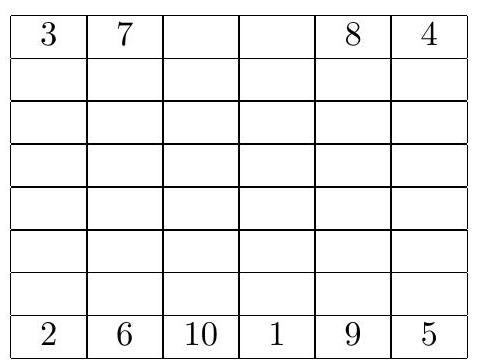
|
| 325 |
+
|
| 326 |
+
The next square to visit will be $(m / 2-1, n-1)$ and now we will cover the rows numbered 2 and $n-1$, except for the two middle squares in row 2 . Continuing in this way we can visit all the squares except for the two middle squares in every second row (note that here we need the assumption that $m$ and $n$ are even):
|
| 327 |
+
|
| 328 |
+
| 3 | 7 | | | 8 | 4 |
|
| 329 |
+
| :---: | :---: | :---: | :---: | :---: | :---: |
|
| 330 |
+
| 15 | 19 | 11 | 20 | 16 | 12 |
|
| 331 |
+
| 23 | 27 | | | 28 | 24 |
|
| 332 |
+
| 35 | 39 | 31 | 40 | 36 | 32 |
|
| 333 |
+
| 34 | 38 | | | 37 | 33 |
|
| 334 |
+
| 22 | 26 | 30 | 21 | 29 | 25 |
|
| 335 |
+
| 14 | 18 | | | 17 | 13 |
|
| 336 |
+
| 2 | 6 | 10 | 1 | 9 | 5 |
|
| 337 |
+
|
| 338 |
+
The rest of the squares can be visited easily:
|
| 339 |
+
|
| 340 |
+
| 3 | 7 | 47 | 48 | 8 | 4 |
|
| 341 |
+
| :---: | :---: | :---: | :---: | :---: | :---: |
|
| 342 |
+
| 15 | 19 | 11 | 20 | 16 | 12 |
|
| 343 |
+
| 23 | 27 | 43 | 44 | 28 | 24 |
|
| 344 |
+
| 35 | 39 | 31 | 40 | 36 | 32 |
|
| 345 |
+
| 34 | 38 | 42 | 41 | 37 | 33 |
|
| 346 |
+
| 22 | 26 | 30 | 21 | 29 | 25 |
|
| 347 |
+
| 14 | 18 | 46 | 45 | 17 | 13 |
|
| 348 |
+
| 2 | 6 | 10 | 1 | 9 | 5 |
|
| 349 |
+
|
| 350 |
+
7. We draw $n$ convex quadrilaterals in the plane. They divide the plane into regions (one of the regions is infinite). Determine the maximal possible number of these regions.
|
| 351 |
+
|
| 352 |
+
Answer: The maximal number of regions is $4 n^{2}-4 n+2$.
|
| 353 |
+
|
| 354 |
+
Solution. One quadrilateral produces two regions. Suppose we have drawn $k$ quadrilaterals $Q_{1}, \ldots, Q_{k}$ and produced $a_{k}$ regions. We draw another quadrilateral $Q_{k+1}$ and try to evaluate the number of regions $a_{k+1}$ now produced. Our task is to make $a_{k+1}$ as large as possible. Note that in a maximal configuration, no vertex of any $Q_{i}$ can be located on the edge of another quadrilateral as otherwise we could move this vertex a little bit to produce an extra region.
|
| 355 |
+
|
| 356 |
+
Because of this fact and the convexity of the $Q_{j}$ 's, any one of the four sides of $Q_{k+1}$ meets at most two sides of any $Q_{j}$. So the sides of $Q_{k+1}$ are divided into at most $2 k+1$ segments, each of which potentially grows the number of regions by one (being part of the common boundary of two parts, one of which is counted in $a_{k}$ ).
|
| 357 |
+
|
| 358 |
+
But if a side of $Q_{k+1}$ intersects the boundary of each $Q_{j}, 1 \leqslant j \leqslant k$ twice, then its endpoints (vertices of $Q_{k+1}$ ) are in the region outside of all the $Q_{j}$-s, and the the segments meeting at such a vertex are on the boundary of a single new part (recall that it makes no sense to put vertices on edges of another quadrilaterals). This means that $a_{k+1}-a_{k} \leqslant 4(2 k+1)-4=8 k$. By considering squares inscribed in a circle one easily sees that the situation where $a_{k+1}-a_{k}=8 k$ can be reached.
|
| 359 |
+
|
| 360 |
+
It remains to determine the expression for the maximal $a_{k}$. Since the difference $a_{k+1}-a_{k}$ is linear in $k, a_{k}$ is a quadratic polynomial in $k$, and $a_{0}=2$. So $a_{k}=A k^{2}+B k+2$. We have $8 k=a_{k+1}-a_{k}=A(2 k+1)+B$ for all $k$. This implies $A=4, B=-4$, and $a_{n}=4 n^{2}-4 n+2$.
|
| 361 |
+
|
| 362 |
+
8. Let $P$ be a set of $n \geqslant 3$ points in the plane, no three of which are on a line. How many possibilities are there to choose a set $T$ of $\left(\begin{array}{c}n-1 \\ 2\end{array}\right)$ triangles, whose vertices are all in $P$, such that each triangle in $T$ has a side that is not a side of any other triangle in $T$ ?
|
| 363 |
+
|
| 364 |
+
Answer: There is one possibility for $n=3$ and $n$ possibilities for $n \geqslant 4$.
|
| 365 |
+
|
| 366 |
+
Solution. For a fixed point $x \in P$, let $T_{x}$ be the set of all triangles with vertices in $P$ which have $x$ as a vertex. Clearly, $\left|T_{x}\right|=\left(\begin{array}{c}n-1 \\ 2\end{array}\right)$, and each triangle in $T_{x}$ has a side which is not a side of any other triangle in $T_{x}$. For any $x, y \in P$ such that $x \neq y$, we have $T_{x} \neq T_{y}$ if and only if $n \geqslant 4$. We will show that any possible set $T$ is equal to $T_{x}$ for some $x \in P$, i.e. that the answer is 1 for $n=3$ and $n$ for $n \geqslant 4$.
|
| 367 |
+
|
| 368 |
+
Let
|
| 369 |
+
|
| 370 |
+
$$
|
| 371 |
+
T=\left\{t_{i}: i=1,2, \ldots,\left(\begin{array}{c}
|
| 372 |
+
n-1 \\
|
| 373 |
+
2
|
| 374 |
+
\end{array}\right)\right\}, \quad S=\left\{s_{i}: i=1,2, \ldots,\left(\begin{array}{c}
|
| 375 |
+
n-1 \\
|
| 376 |
+
2
|
| 377 |
+
\end{array}\right)\right\}
|
| 378 |
+
$$
|
| 379 |
+
|
| 380 |
+
such that $T$ is a set of triangles whose vertices are all in $P$, and $s_{i}$ is a side of $t_{i}$ but not of any $t_{j}$, $j \neq i$. Furthermore, let $C$ be the collection of all the $\left(\begin{array}{l}n \\ 3\end{array}\right)$ triangles whose vertices are in $P$. Note that
|
| 381 |
+
|
| 382 |
+
$$
|
| 383 |
+
|C \backslash T|=\left(\begin{array}{c}
|
| 384 |
+
n \\
|
| 385 |
+
3
|
| 386 |
+
\end{array}\right)-\left(\begin{array}{c}
|
| 387 |
+
n-1 \\
|
| 388 |
+
2
|
| 389 |
+
\end{array}\right)=\left(\begin{array}{c}
|
| 390 |
+
n-1 \\
|
| 391 |
+
3
|
| 392 |
+
\end{array}\right)
|
| 393 |
+
$$
|
| 394 |
+
|
| 395 |
+
Let $m$ be the number of pairs $(s, t)$ such that $s \in S$ is a side of $t \in C \backslash T$. Since every $s \in S$ is a side of exactly $n-3$ triangles from $C \backslash T$, we have
|
| 396 |
+
|
| 397 |
+
$$
|
| 398 |
+
m=|S| \cdot(n-3)=\left(\begin{array}{c}
|
| 399 |
+
n-1 \\
|
| 400 |
+
2
|
| 401 |
+
\end{array}\right) \cdot(n-3)=3 \cdot\left(\begin{array}{c}
|
| 402 |
+
n-1 \\
|
| 403 |
+
3
|
| 404 |
+
\end{array}\right)=3 \cdot|C \backslash T|
|
| 405 |
+
$$
|
| 406 |
+
|
| 407 |
+
On the other hand, every $t \in C \backslash T$ has at most three sides from $S$. By the above equality, for every $t \in C \backslash T$, all its sides must be in $S$.
|
| 408 |
+
|
| 409 |
+
Assume that for $p \in P$ there is a side $s \in S$ such that $p$ is an endpoint of $s$. Then $p$ is also a vertex of each of the $n-3$ triangles in $C \backslash T$ which have $s$ as a side. Consequently, $p$ is an endpoint of $n-2$ sides in $S$. Since every side in $S$ has exactly 2 endpoints, the number of points $p \in P$ which occur as a vertex of some $s \in S$ is
|
| 410 |
+
|
| 411 |
+
$$
|
| 412 |
+
\frac{2 \cdot|S|}{n-2}=\frac{2}{n-2} \cdot\left(\begin{array}{c}
|
| 413 |
+
n-1 \\
|
| 414 |
+
2
|
| 415 |
+
\end{array}\right)=n-1
|
| 416 |
+
$$
|
| 417 |
+
|
| 418 |
+
Consequently, there is an $x \in P$ which is not an endpoint of any $s \in S$, and hence $T$ must be equal to $T_{x}$.
|
| 419 |
+
|
| 420 |
+
9. Two magicians show the following trick. The first magician goes out of the room. The second magician takes a deck of 100 cards labelled by numbers $1,2, \ldots, 100$ and asks three spectators to choose in turn one card each. The second magician sees what card each spectator has taken. Then he adds one more card from the rest of the deck. Spectators shuffle these 4 cards, call the first magician and give him these 4 cards. The first magician looks at the 4 cards and "guesses" what card was chosen by the first spectator, what card by the second and what card by the third. Prove that the magicians can perform this trick.
|
| 421 |
+
|
| 422 |
+
Solution. We will identify ourselves with the second magician. Then we need to choose a card in such a manner that another magician will be able to understand which of the 4 cards we have chosen and what information it gives about the order of the other cards. We will reach these two goals independently.
|
| 423 |
+
|
| 424 |
+
Let $a, b, c$ be remainders of the labels of the spectators' three cards modulo 5 . There are three possible cases.
|
| 425 |
+
|
| 426 |
+
1) All the three remainders coincide. Then choose a card with a remainder not equal to the remainder of spectators' cards. Denote this remainder $d$.
|
| 427 |
+
|
| 428 |
+
Note that we now have 2 different remainders, one of them in 3 copies (this will be used by the first magician to distinguish betwwen the three cases). To determine which of the cards is chosen by us is now a simple exercise in division by 5 . But we must also encode the ordering of the spectators' cards. These cards have a natural ordering by their labels, and they are also ordered by their belonging to the spectators. Thus, we have to encode a permutation of 3 elements. There are 6 permutations of 3 elements, let us enumerate them somehow. Then, if we want to inform the first magician that spectators form a permutation number $k$ with respect to the natural ordering, we choose the card number $5 k+d$.
|
| 429 |
+
|
| 430 |
+
2) The remainders $a, b, c$ are pairwise different. Then it is clear that exactly one of the following possibilities takes place:
|
| 431 |
+
|
| 432 |
+
$$
|
| 433 |
+
\text { either }|b-a|=|a-c| \text {, or }|a-b|=|b-c| \text {, or } \quad|a-c|=|c-b|
|
| 434 |
+
$$
|
| 435 |
+
|
| 436 |
+
(the equalities are considered modulo 5). It is not hard to prove it by a case study, but one could also imagine choosing three vertices of a regular pentagon - these vertices always form an isosceles, but not an equilateral triangle.
|
| 437 |
+
|
| 438 |
+
Each of these possibilities has one of the remainders distinguished from the other two remainders (these distinguished remainders are $a, b, c$, respectively). Now, choose a card from the rest of the deck having the distinguished remainder modulo 5. Hence, we have three different remainders, one of them distinguished by (9) and presented in two copies. Let $d$ be the distinguished remainder and $s=5 m+d$ be the spectator's card with this remainder.
|
| 439 |
+
|
| 440 |
+
Now we have to choose a card $r$ with the remainder $d$ such that the first magician would be able to understand which of the cards $s$ and $r$ was chosen by us and what permutation of spectators it implies. This can be done easily: if we want to inform the first magician that spectators form a permutation number $k$ with respect to the natural ordering, we choose the card number $s+5 k(\bmod 100)$.
|
| 441 |
+
|
| 442 |
+
The decoding procedure is easy: if we have two numbers $p$ and $q$ that have the same remainder modulo 5 , calculate $p-q(\bmod 100)$ and $q-p(\bmod 100)$. If $p-q(\bmod 100)>q-p(\bmod 100)$ then $r=q$ is our card and $s=p$ is the spectator's card. (The case $p-q(\bmod 100)=q-p(\bmod 100)$ is impossible since the sum of these numbers is equal to 100 , and one of them is not greater than $6 \cdot 5=30$.)
|
| 443 |
+
|
| 444 |
+
3) Two remainders (say, $a$ and $b$ ) coincide. Let us choose a card with the remainder $d=(a+c) / 2 \bmod 5$. Then $|a-d|=|d-c| \bmod 5$, so the remainder $d$ is distinguished by (9). Hence we have three different remainders, one of them distinguished by (9) and one of the non-distinguished remainders presented in two copies. The first magician will easily determine our card, and the rule to choose the card in order to enable him also determine the order of spectators is similar to the one in the 1-st case.
|
| 445 |
+
|
| 446 |
+
Alternative solution. This solution gives a non-constructive proof that the trick is possible. For this, we need to show there is an injective mapping from the set of ordered triples to the set of unordered quadruples that additionally respects inclusion.
|
| 447 |
+
|
| 448 |
+
To prove that the desired mapping exists, let's consides a bipartite graph such that the set of ordered triples $T$ and the set of unordered quadruples $Q$ form the two disjoint sets of vertices and there is an edge between a triple and a quadruple if and only if the triple is a subset of the quadruple.
|
| 449 |
+
|
| 450 |
+
For each triple $t \in T$, we can add any of the remaining 97 cards to it, and thus we have 97 different quadruples connected to each triple in the graph. Conversely, for each quadruple $q \in Q$, we can remove any of the 4 cards from it, and reorder the remaining 3 cards in $3 !=6$ different ways, and thus we have 24 different triples connected to each quadruple in the graph.
|
| 451 |
+
|
| 452 |
+
According to the Hall's theorem, a bipartite graph $G=(T, Q, E)$ has a perfect matching if and only if for each subset $T^{\prime} \subseteq T$ the set of neighbours of $T^{\prime}$, denoted $N\left(T^{\prime}\right)$, satisfies $\left|N\left(T^{\prime}\right)\right| \geqslant\left|T^{\prime}\right|$.
|
| 453 |
+
|
| 454 |
+
To prove that this condition holds for our graph, consider any subset $T^{\prime} \subseteq T$. Because we have 97 quadruples for each triple, and there can be at most 24 copies of each of them in the multiset of neighbours, we have $\left|N\left(T^{\prime}\right)\right| \geqslant \frac{97}{24}\left|T^{\prime}\right|>4\left|T^{\prime}\right|$, which is even much more than we need.
|
| 455 |
+
|
| 456 |
+
Thus, the desired mapping is guaranteed to exist.
|
| 457 |
+
|
| 458 |
+
Another solution. Let the three chosen numbers be $\left(x_{1}, x_{2}, x_{3}\right)$. At least one of the sets $\{1,2, \ldots, 24\}$, $\{25,26, \ldots, 48\},\{49,50, \ldots, 72\}$ and $\{73,74, \ldots, 96\}$ should contain none of $x_{1}, x_{2}$ and $x_{3}$, let $S$ be such set. Next we split $S$ into 6 parts: $S=S_{1} \cup S_{2} \cup \ldots \cup S_{6}$ so that 4 first elements of $S$ are in $S_{1}$, four next in $S_{2}$, etc. Now we choose $i \in\{1,2, \ldots, 6\}$ corresponding to the order of numbers $x_{1}, x_{2}$ and $x_{3}$ (if $x_{1}<x_{2}<x_{3}$ then $i=1$, if $x_{1}<x_{3}<x_{2}$ then $i=2, \ldots$,if $x_{3}<x_{2}<x_{1}$ then $i=6$ ). At last let $j$ be the number of elements in $\left\{x_{1}, x_{2}, x_{3}\right\}$ that are greater than elements of $S$ (note that any $x_{k}$, $k \in\{1,2,3\}$, is either greater or smaller than all the elements of $S$ ). Now we choose $x_{4} \in S_{i}$ so that $x_{1}+x_{2}+x_{3}+x_{4} \equiv j \bmod 4$ and add the card number $x_{4}$ to those three cards.
|
| 459 |
+
|
| 460 |
+
Decoding of $\{a, b, c, d\}$ is straightforward. We first put the numbers into increasing order and then calculate $a+b+c+d \bmod 4$ showing the added card. The added card belongs to some $S_{i}(i \in\{1,2, \ldots, 6\})$ for some $S$ and $i$ shows us the initial ordering of cards.
|
| 461 |
+
|
| 462 |
+
10. Let $N$ be a positive integer. Two persons play the following game. The first player writes a list of positive integers not greater than 25 , not necessarily different, such that their sum is at least 200 . The second player wins if he can select some of these numbers so that their sum $S$ satisfies the condition $200-N \leqslant S \leqslant 200+N$. What is the smallest value of $N$ for which the second player has a winning strategy?
|
| 463 |
+
|
| 464 |
+
Answer: $N=11$.
|
| 465 |
+
|
| 466 |
+
Solution. If $N=11$, then the second player can simply remove numbers from the list, starting with the smallest number, until the sum of the remaining numbers is less than 212. If the last number removed was not 24 or 25 , then the sum of the remaining numbers is at least $212-23=189$. If the last number removed was 24 or 25 , then only 24 -s and 25 -s remain, and there must be exactly 8 of them since their sum must be less than 212 and not less than $212-24=188$. Hence their sum $S$ satisfies $8 \cdot 24=192 \leqslant S \leqslant 8 \cdot 25=200$. In any case the second player wins.
|
| 467 |
+
|
| 468 |
+
On the other hand, if $N \leqslant 10$, then the first player can write 25 two times and 23 seven times. Then the sum of all numbers is 211 , but if at least one number is removed, then the sum of the remaining ones is at most 188 - so the second player cannot win.
|
| 469 |
+
|
| 470 |
+
11. Let $n$ be a positive integer. Consider $n$ points in the plane such that no three of them are collinear and no two of the distances between them are equal. One by one, we connect each point to the two points nearest to it by line segments (if there are already other line segments drawn to this point, we do not erase these). Prove that there is no point from which line segments will be drawn to more than 11 points.
|
| 471 |
+
|
| 472 |
+
Solution. Suppose there exists a point $A$ such that $A$ is connected to twelve points. Then there exist three points $B, C$ and $D$ such that $\angle B A C \leqslant 60^{\circ}, \angle B A D \leqslant 60^{\circ}$ and $\angle C A D \leqslant 60^{\circ}$.
|
| 473 |
+
|
| 474 |
+
We can assume that $|A D|>|A B|$ and $|A D|>|A C|$. By the cosine law we have
|
| 475 |
+
|
| 476 |
+
$$
|
| 477 |
+
\begin{aligned}
|
| 478 |
+
|B D|^{2} & =|A D|^{2}+|A B|^{2}-2|A D \| A B| \cos \angle B A D \\
|
| 479 |
+
& <|A D|^{2}+|A B|^{2}-2|A B|^{2} \cos \angle B A D \\
|
| 480 |
+
& =|A D|^{2}+|A B|^{2}(1-2 \cos \angle B A D) \\
|
| 481 |
+
& \leqslant|A D|^{2}
|
| 482 |
+
\end{aligned}
|
| 483 |
+
$$
|
| 484 |
+
|
| 485 |
+
since $1 \leqslant 2 \cos (\angle B A D)$. Hence $|B D|<|A D|$. Similarly we get $|C D|<|A D|$. Hence $A$ and $D$ should not be connected which is a contradiction.
|
| 486 |
+
|
| 487 |
+
Comment. It would be interesting to know whether 11 can be achieved or the actual bound is lower.
|
| 488 |
+
|
| 489 |
+
12. A set $S$ of four distinct points is given in the plane. It is known that for any point $X \in S$ the remaining points can be denoted by $Y, Z$ and $W$ so that
|
| 490 |
+
|
| 491 |
+
$$
|
| 492 |
+
|X Y|=|X Z|+|X W| .
|
| 493 |
+
$$
|
| 494 |
+
|
| 495 |
+
Prove that all the four points lie on a line.
|
| 496 |
+
|
| 497 |
+
Solution. Let $S=\{A, B, C, D\}$ and let $A B$ be the longest of the six segments formed by these four points (if there are several longest segments, choose any of them). If we choose $X=A$ then we must also choose $Y=B$. Indeed, if we would, for example, choose $Y=C$, we should have $|A C|=|A B|+|A D|$ contradicting the maximality of $A B$. Hence we get
|
| 498 |
+
|
| 499 |
+
$$
|
| 500 |
+
|A B|=|A C|+|A D| \text {. }
|
| 501 |
+
$$
|
| 502 |
+
|
| 503 |
+
Similarly, choosing $X=B$ we must choose $Y=A$ and we obtain
|
| 504 |
+
|
| 505 |
+
$$
|
| 506 |
+
|A B|=|B C|+|B D| \text {. }
|
| 507 |
+
$$
|
| 508 |
+
|
| 509 |
+
On the other hand, from the triangle inequality we know that
|
| 510 |
+
|
| 511 |
+
$$
|
| 512 |
+
\begin{aligned}
|
| 513 |
+
& |A B| \leqslant|A C|+|B C|, \\
|
| 514 |
+
& |A B| \leqslant|A D|+|B D|,
|
| 515 |
+
\end{aligned}
|
| 516 |
+
$$
|
| 517 |
+
|
| 518 |
+
where at least one of the inequalities is strict if all the four points are not on the same line. Hence, adding the two last inequalities we get
|
| 519 |
+
|
| 520 |
+
$$
|
| 521 |
+
2|A B|<|A C|+|B C|+|A D|+|B D| .
|
| 522 |
+
$$
|
| 523 |
+
|
| 524 |
+
On the other hand, adding (10) and (11) we get
|
| 525 |
+
|
| 526 |
+
$$
|
| 527 |
+
2|A B|=|A C|+|A D|+|B C|+|B D|,
|
| 528 |
+
$$
|
| 529 |
+
|
| 530 |
+
a contradiction.
|
| 531 |
+
|
| 532 |
+
13. Let $A B C$ be an acute triangle with $\angle B A C>\angle B C A$, and let $D$ be a point on side $A C$ such that $|A B|=|B D|$. Furthermore, let $F$ be a point on the circumcircle of triangle $A B C$ such that line $F D$ is perpendicular to side $B C$ and points $F, B$ lie on different sides of line $A C$. Prove that line $F B$ is perpendicular to side $A C$.
|
| 533 |
+
|
| 534 |
+
Solution. Let $E$ be the other point on the circumcircle of triangle $A B C$ such that $|A B|=|E B|$. Let $D^{\prime}$ be the point of intersection of side $A C$ and the line perpendicular to side $B C$, passing through $E$. Then $\angle E C B=\angle B C A$ and the triangle $E C D^{\prime}$ is isosceles. As $E D^{\prime} \perp B C$, the triangle $B E D^{\prime}$ is also isosceles and $|B E|=\left|B D^{\prime}\right|$ implying $D=D^{\prime}$. Hence, the points $E, D, F$ lie on one line. We now have
|
| 535 |
+
|
| 536 |
+
$$
|
| 537 |
+
\angle E F B+\angle F D A=\angle B C A+\angle E D C=90^{\circ} .
|
| 538 |
+
$$
|
| 539 |
+
|
| 540 |
+
The required result now follows.
|
| 541 |
+
|
| 542 |
+
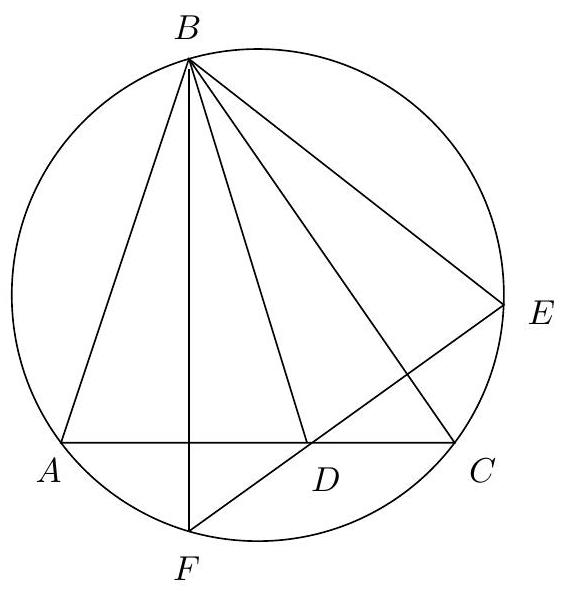
|
| 543 |
+
|
| 544 |
+
14. Let $L, M$ and $N$ be points on sides $A C, A B$ and $B C$ of triangle $A B C$, respectively, such that $B L$ is the bisector of angle $A B C$ and segments $A N, B L$ and $C M$ have a common point. Prove that if $\angle A L B=\angle M N B$ then $\angle L N M=90^{\circ}$.
|
| 545 |
+
|
| 546 |
+
Solution. Let $P$ be the intersection point of lines $M N$ and $A C$. Then $\angle P L B=\angle P N B$ and the quadrangle $P L N B$ is cyclic. Let $\omega$ be its circumcircle. It is sufficient to prove that $P L$ is a diameter of $\omega$.
|
| 547 |
+
|
| 548 |
+
Let $Q$ denote the second intersection point of the line $A B$ and $\omega$. Then $\angle P Q B=\angle P L B$ and
|
| 549 |
+
|
| 550 |
+
$$
|
| 551 |
+
\angle Q P L=\angle Q B L=\angle L B N=\angle L P N
|
| 552 |
+
$$
|
| 553 |
+
|
| 554 |
+
and the triangles $P A Q$ and $B A L$ are similar. Therefore,
|
| 555 |
+
|
| 556 |
+
$$
|
| 557 |
+
\frac{|P Q|}{|P A|}=\frac{|B L|}{|B A|}
|
| 558 |
+
$$
|
| 559 |
+
|
| 560 |
+
We see that the line $P L$ is a bisector of the inscribed angle $N P Q$. Now in order to prove that $P L$ is a diameter of $\omega$ it is sufficient to check that $|P N|=|P Q|$.
|
| 561 |
+
|
| 562 |
+
The triangles $N P C$ and $L B C$ are similar, hence
|
| 563 |
+
|
| 564 |
+
$$
|
| 565 |
+
\frac{|P N|}{|P C|}=\frac{|B L|}{|B C|}
|
| 566 |
+
$$
|
| 567 |
+
|
| 568 |
+
Note also that
|
| 569 |
+
|
| 570 |
+
$$
|
| 571 |
+
\frac{|A B|}{|B C|}=\frac{|A L|}{|C L|}
|
| 572 |
+
$$
|
| 573 |
+
|
| 574 |
+
by the properties of a bisector. Combining (12), (13) and (14) we have
|
| 575 |
+
|
| 576 |
+
$$
|
| 577 |
+
\frac{|P N|}{|P Q|}=\frac{|A L|}{|A P|} \cdot \frac{|C P|}{|C L|}
|
| 578 |
+
$$
|
| 579 |
+
|
| 580 |
+
We want to prove that the left hand side of this equality equals 1 . This follows from the fact that the quadruple of points $(P, A, L, C)$ is harmonic, as can be proven using standard methods (e.g. considering the quadrilateral $M B N S$, where $S=M C \cap A N$ ).
|
| 581 |
+
|
| 582 |
+
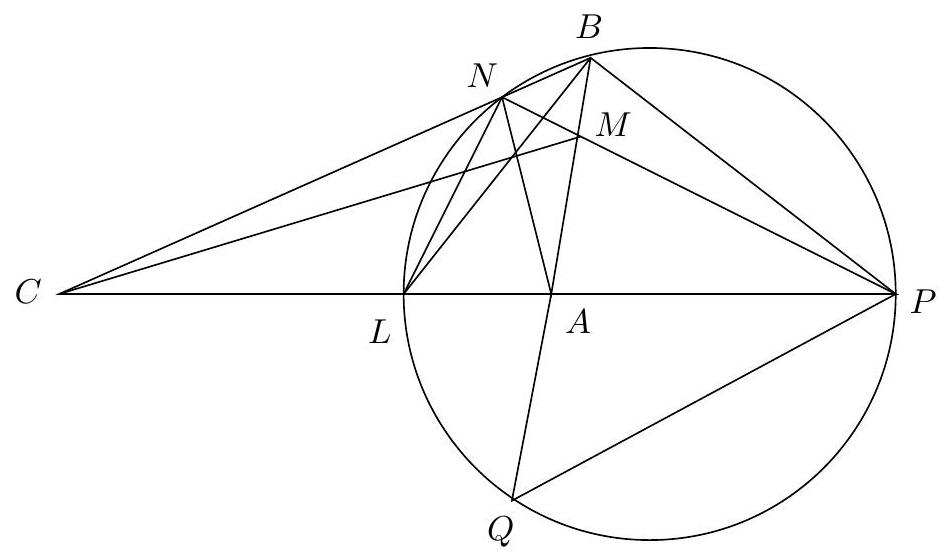
|
| 583 |
+
|
| 584 |
+
15. A spider and a fly are sitting on a cube. The fly wants to maximize the shortest path to the spider along the surface of the cube. Is it necessarily best for the fly to be at the point opposite to the spider? ("Opposite" means "symmetric with respect to the center of the cube".)
|
| 585 |
+
|
| 586 |
+
Answer: no.
|
| 587 |
+
|
| 588 |
+
Solution. Suppose that the side of the cube is 1 and the spider sits at the middle of one of the edges. Then the shortest path to the middle of the opposite edge has length 2 . However, if the fly goes to a point on this edge at distance $s$ from the middle, then the length of the shortest path is
|
| 589 |
+
|
| 590 |
+
$$
|
| 591 |
+
\min \left(\sqrt{4+s^{2}}, \sqrt{\frac{9}{4}+\left(\frac{3}{2}-s\right)^{2}}\right) .
|
| 592 |
+
$$
|
| 593 |
+
|
| 594 |
+
If $0<s<(3-\sqrt{7}) / 2$ then this expression is greater than 2 .
|
| 595 |
+
|
| 596 |
+
16. Find all nonnegative integers $m$ such that
|
| 597 |
+
|
| 598 |
+
$$
|
| 599 |
+
a_{m}=\left(2^{2 m+1}\right)^{2}+1
|
| 600 |
+
$$
|
| 601 |
+
|
| 602 |
+
is divisible by at most two different primes.
|
| 603 |
+
|
| 604 |
+
Answer: $m=0,1,2$ are the only solutions.
|
| 605 |
+
|
| 606 |
+
Solution. Obviously $m=0,1,2$ are solutions as $a_{0}=5, a_{1}=65=5 \cdot 13$, and $a_{2}=1025=25 \cdot 41$. We show that these are the only solutions.
|
| 607 |
+
|
| 608 |
+
Assume that $m \geqslant 3$ and that $a_{m}$ contains at most two different prime factors. Clearly, $a_{m}=4^{2 m+1}+1$ is divisible by 5 , and
|
| 609 |
+
|
| 610 |
+
$$
|
| 611 |
+
a_{m}=\left(2^{2 m+1}+2^{m+1}+1\right) \cdot\left(2^{2 m+1}-2^{m+1}+1\right) \text {. }
|
| 612 |
+
$$
|
| 613 |
+
|
| 614 |
+
The two above factors are relatively prime as they are both odd and their difference is a power of 2 . Since both factors are larger than 1 , one of them must be a power of 5 . Hence,
|
| 615 |
+
|
| 616 |
+
$$
|
| 617 |
+
2^{m+1} \cdot\left(2^{m} \pm 1\right)=5^{t}-1=(5-1) \cdot\left(1+5+\cdots+5^{t-1}\right)
|
| 618 |
+
$$
|
| 619 |
+
|
| 620 |
+
for some positive integer $t$, where $\pm$ reads as either plus or minus. For odd $t$ the right hand side is not divisible by 8 , contradicting $m \geqslant 3$. Therefore, $t$ must be even and
|
| 621 |
+
|
| 622 |
+
$$
|
| 623 |
+
2^{m+1} \cdot\left(2^{m} \pm 1\right)=\left(5^{t / 2}-1\right) \cdot\left(5^{t / 2}+1\right) .
|
| 624 |
+
$$
|
| 625 |
+
|
| 626 |
+
Clearly, $5^{t / 2}+1 \equiv 2(\bmod 4)$. Consequently, $5^{t / 2}-1=2^{m} \cdot k$ for some odd $k$, and $5^{t / 2}+1=2^{m} \cdot k+2$ divides $2\left(2^{m} \pm 1\right)$, i.e.
|
| 627 |
+
|
| 628 |
+
$$
|
| 629 |
+
2^{m-1} \cdot k+1 \mid 2^{m} \pm 1 .
|
| 630 |
+
$$
|
| 631 |
+
|
| 632 |
+
This implies $k=1$, finally leading to a contradiction since
|
| 633 |
+
|
| 634 |
+
$$
|
| 635 |
+
2^{m-1}+1<2^{m} \pm 1<2\left(2^{m-1}+1\right)
|
| 636 |
+
$$
|
| 637 |
+
|
| 638 |
+
for $m \geqslant 3$.
|
| 639 |
+
|
| 640 |
+
17. Show that the sequence
|
| 641 |
+
|
| 642 |
+
$$
|
| 643 |
+
\left(\begin{array}{l}
|
| 644 |
+
2002 \\
|
| 645 |
+
2002
|
| 646 |
+
\end{array}\right),\left(\begin{array}{c}
|
| 647 |
+
2003 \\
|
| 648 |
+
2002
|
| 649 |
+
\end{array}\right),\left(\begin{array}{l}
|
| 650 |
+
2004 \\
|
| 651 |
+
2002
|
| 652 |
+
\end{array}\right), \ldots
|
| 653 |
+
$$
|
| 654 |
+
|
| 655 |
+
considered modulo 2002, is periodic.
|
| 656 |
+
|
| 657 |
+
Solution. Define
|
| 658 |
+
|
| 659 |
+
$$
|
| 660 |
+
x_{n}^{k}=\left(\begin{array}{l}
|
| 661 |
+
n \\
|
| 662 |
+
k
|
| 663 |
+
\end{array}\right)
|
| 664 |
+
$$
|
| 665 |
+
|
| 666 |
+
and note that
|
| 667 |
+
|
| 668 |
+
$$
|
| 669 |
+
x_{n+1}^{k}-x_{n}^{k}=\left(\begin{array}{c}
|
| 670 |
+
n+1 \\
|
| 671 |
+
k
|
| 672 |
+
\end{array}\right)-\left(\begin{array}{l}
|
| 673 |
+
n \\
|
| 674 |
+
k
|
| 675 |
+
\end{array}\right)=\left(\begin{array}{c}
|
| 676 |
+
n \\
|
| 677 |
+
k-1
|
| 678 |
+
\end{array}\right)=x_{n}^{k-1}
|
| 679 |
+
$$
|
| 680 |
+
|
| 681 |
+
Let $m$ be any positive integer. We will prove by induction on $k$ that the sequence $\left\{x_{n}^{k}\right\}_{n=k}^{\infty}$ is periodic modulo $m$. For $k=1$ it is obvious that $x_{n}^{k}=n$ is periodic modulo $m$ with period $m$. Therefore it will suffice to show that the following is true: the sequence $\left\{x_{n}\right\}$ is periodic modulo $m$ if its difference sequence, $d_{n}=x_{n+1}-x_{n}$, is periodic modulo $m$.
|
| 682 |
+
|
| 683 |
+
Furthermore, if $t$ then the period of $\left\{x_{n}\right\}$ is equal to $h t$ where $h$ is the smallest positive integer such that $h\left(x_{t}-x_{0}\right) \equiv 0$ modulo $m$.
|
| 684 |
+
|
| 685 |
+
Indeed, let $t$ be the period of $\left\{d_{n}\right\}$ and $h$ be the smallest positive integer such that $h\left(x_{t}-x_{0}\right) \equiv 0$ modulo $m$. Then
|
| 686 |
+
|
| 687 |
+
$$
|
| 688 |
+
\begin{aligned}
|
| 689 |
+
x_{n+h t} & =x_{0}+\sum_{j=0}^{n+h t-1} d_{j}=x_{0}+\sum_{j=0}^{n-1} d_{j}+h\left(\sum_{j=0}^{t-1} d_{j}\right)= \\
|
| 690 |
+
& =x_{n}+h\left(x_{t}-x_{0}\right) \equiv x_{n}(\bmod m)
|
| 691 |
+
\end{aligned}
|
| 692 |
+
$$
|
| 693 |
+
|
| 694 |
+
for all $n$, so the sequence $\left\{x_{n}\right\}$ is in fact periodic modulo $m$ (with a period dividing $h t$ ).
|
| 695 |
+
|
| 696 |
+
18. Find all integers $n>1$ such that any prime divisor of $n^{6}-1$ is a divisor of $\left(n^{3}-1\right)\left(n^{2}-1\right)$.
|
| 697 |
+
|
| 698 |
+
Solution. Clearly $n=2$ is such an integer. We will show that there are no others.
|
| 699 |
+
|
| 700 |
+
Consider the equality
|
| 701 |
+
|
| 702 |
+
$$
|
| 703 |
+
n^{6}-1=\left(n^{2}-n+1\right)(n+1)\left(n^{3}-1\right) \text {. }
|
| 704 |
+
$$
|
| 705 |
+
|
| 706 |
+
The integer $n^{2}-n+1=n(n-1)+1$ clearly has an odd divisor $p$. Then $p \mid n^{3}+1$. Therefore, $p$ does not divide $n^{3}-1$ and consequently $p \mid n^{2}-1$. This implies that $p$ divides $\left(n^{3}+1\right)+\left(n^{2}-1\right)=n^{2}(n+1)$. As $p$ does not divide $n$, we obtain $p \mid n+1$. Also, $p \mid\left(n^{2}-1\right)-\left(n^{2}-n+1\right)=n-2$. From $p \mid n+1$ and $p \mid n-2$ it follows that $p=3$, so $n^{2}-n+1=3^{r}$ for some positive integer $r$.
|
| 707 |
+
|
| 708 |
+
The discriminant of the quadratic $n^{2}-n+\left(1-3^{r}\right)$ must be a square of an integer, hence
|
| 709 |
+
|
| 710 |
+
$$
|
| 711 |
+
1-4\left(1-3^{r}\right)=3\left(4 \cdot 3^{r-1}-1\right)
|
| 712 |
+
$$
|
| 713 |
+
|
| 714 |
+
must be a squareof an integer. Since for $r \geqslant 2$ the number $4 \cdot 3^{r-1}-1$ is not divisible by 3 , this is possible only if $r=1$. So $n^{2}-n-2=0$ and $n=2$.
|
| 715 |
+
|
| 716 |
+
19. Let $n$ be a positive integer. Prove that the equation
|
| 717 |
+
|
| 718 |
+
$$
|
| 719 |
+
x+y+\frac{1}{x}+\frac{1}{y}=3 n
|
| 720 |
+
$$
|
| 721 |
+
|
| 722 |
+
does not have solutions in positive rational numbers.
|
| 723 |
+
|
| 724 |
+
Solution. Suppose $x=\frac{p}{q}$ and $y=\frac{r}{s}$ satisfy the given equation, where $p, q, r, s$ are positive integers and $\operatorname{gcd}(p, q)=1, \operatorname{gcd}(r, s)=1$. We have
|
| 725 |
+
|
| 726 |
+
$$
|
| 727 |
+
\frac{p}{q}+\frac{r}{s}+\frac{q}{p}+\frac{s}{r}=3 n
|
| 728 |
+
$$
|
| 729 |
+
|
| 730 |
+
or
|
| 731 |
+
|
| 732 |
+
$$
|
| 733 |
+
\left(p^{2}+q^{2}\right) r s+\left(r^{2}+s^{2}\right) p q=3 n p q r s,
|
| 734 |
+
$$
|
| 735 |
+
|
| 736 |
+
so $r s \mid\left(r^{2}+s^{2}\right) p q$. Since $\operatorname{gcd}(r, s)=1$, we have $\operatorname{gcd}\left(r^{2}+s^{2}, r s\right)=1$ and $r s \mid p q$. Analogously $p q \mid r s$, so $r s=p q$ and hence there are either two or zero integers divisible by 3 among $p, q, r, s$. Now we have
|
| 737 |
+
|
| 738 |
+
$$
|
| 739 |
+
\begin{aligned}
|
| 740 |
+
\left(p^{2}+q^{2}\right) r s+\left(r^{2}+s^{2}\right) r s & =3 n(r s)^{2} \\
|
| 741 |
+
p^{2}+q^{2}+r^{2}+s^{2} & =3 n r s,
|
| 742 |
+
\end{aligned}
|
| 743 |
+
$$
|
| 744 |
+
|
| 745 |
+
but $3 n r s \equiv 0(\bmod 3)$ and $p^{2}+q^{2}+r^{2}+s^{2}$ is congruent to either 1 or 2 modulo 3 , a contradiction.
|
| 746 |
+
|
| 747 |
+
20. Does there exist an infinite non-constant arithmetic progression, each term of which is of the form $a^{b}$, where $a$ and $b$ are positive integers with $b \geqslant 2$ ?
|
| 748 |
+
|
| 749 |
+
Answer: no.
|
| 750 |
+
|
| 751 |
+
Solution. For an arithmetic progression $a_{1}, a_{2}, \ldots$ with difference $d$ the following holds:
|
| 752 |
+
|
| 753 |
+
$$
|
| 754 |
+
\begin{aligned}
|
| 755 |
+
S_{n} & =\frac{1}{a_{1}}+\frac{1}{a_{2}}+\ldots+\frac{1}{a_{n+1}}=\frac{1}{a_{1}}+\frac{1}{a_{1}+d}+\ldots+\frac{1}{a_{1}+n d} \geqslant \\
|
| 756 |
+
& \geqslant \frac{1}{m}\left(\frac{1}{1}+\frac{1}{2}+\ldots+\frac{1}{n+1}\right),
|
| 757 |
+
\end{aligned}
|
| 758 |
+
$$
|
| 759 |
+
|
| 760 |
+
where $m=\max \left(a_{1}, d\right)$. Therefore $S_{n}$ tends to infinity when $n$ increases.
|
| 761 |
+
|
| 762 |
+
On the other hand, the sum of reciprocals of the powers of a natural number $x \neq 1$ is
|
| 763 |
+
|
| 764 |
+
$$
|
| 765 |
+
\frac{1}{x^{2}}+\frac{1}{x^{3}}+\ldots=\frac{\frac{1}{x^{2}}}{1-\frac{1}{x}}=\frac{1}{x(x-1)}
|
| 766 |
+
$$
|
| 767 |
+
|
| 768 |
+
Hence, the sum of reciprocals of the terms of the progression required in the problem cannot exceed
|
| 769 |
+
|
| 770 |
+
$$
|
| 771 |
+
\frac{1}{1}+\frac{1}{1 \cdot 2}+\frac{1}{2 \cdot 3}+\ldots=1+\left(\frac{1}{1}-\frac{1}{2}+\frac{1}{2}-\frac{1}{3}+\ldots\right)=2
|
| 772 |
+
$$
|
| 773 |
+
|
| 774 |
+
a contradiction.
|
| 775 |
+
|
| 776 |
+
Alternative solution. Let $a_{k}=a_{0}+d k, k=0,1, \ldots$ Choose a prime number $p>d$ and set $k^{\prime} \equiv\left(p-a_{0}\right) d^{-1} \bmod p^{2}$. Then $a_{k^{\prime}}=a_{0}+k^{\prime} d \equiv p \bmod p^{2}$ and hence, $a_{k^{\prime}}$ can not be a power of a natural number.
|
| 777 |
+
|
| 778 |
+
Another solution. There can be at most $\lfloor\sqrt{n}\rfloor$ squares in the set $\{1,2, \ldots, n\}$, at most $\lfloor\sqrt[3]{n}\rfloor$ cubes in the same set, etc. The greatest power that can occur in the set $\{1,2, \ldots, n\}$ is $\left\lfloor\log _{2} n\right\rfloor$ and thus there are no more than
|
| 779 |
+
|
| 780 |
+
$$
|
| 781 |
+
\lfloor\sqrt{n}\rfloor+\lfloor\sqrt[3]{n}\rfloor+\ldots+\left\lfloor\left\lfloor\log _{2} \sqrt[n]{n}\right\rfloor\right.
|
| 782 |
+
$$
|
| 783 |
+
|
| 784 |
+
powers among the numbers $1,2, \ldots, n$. Now we can estimate this sum above:
|
| 785 |
+
|
| 786 |
+
$$
|
| 787 |
+
\begin{aligned}
|
| 788 |
+
\lfloor\sqrt{n}\rfloor+\lfloor\sqrt[3]{n}\rfloor+\ldots+\left\lfloor\left\lfloor\log _{2} \sqrt[n\rfloor\right]{n}\right\rfloor & \leqslant\lfloor\sqrt{n}\rfloor\left(\left\lfloor\log _{2} n\right\rfloor-1\right)< \\
|
| 789 |
+
& <\lfloor\sqrt{n}\rfloor \cdot\left\lfloor\log _{2} n\right\rfloor=o(n)
|
| 790 |
+
\end{aligned}
|
| 791 |
+
$$
|
| 792 |
+
|
| 793 |
+
This means that every arithmetic progression grows faster than the share of powers.
|
| 794 |
+
|
BalticWay/md/en-bw03sol.md
ADDED
|
@@ -0,0 +1,339 @@
|
|
|
|
|
|
|
|
|
|
|
|
|
|
|
|
|
|
|
|
|
|
|
|
|
|
|
|
|
|
|
|
|
|
|
|
|
|
|
|
|
|
|
|
|
|
|
|
|
|
|
|
|
|
|
|
|
|
|
|
|
|
|
|
|
|
|
|
|
|
|
|
|
|
|
|
|
|
|
|
|
|
|
|
|
|
|
|
|
|
|
|
|
|
|
|
|
|
|
|
|
|
|
|
|
|
|
|
|
|
|
|
|
|
|
|
|
|
|
|
|
|
|
|
|
|
|
|
|
|
|
|
|
|
|
|
|
|
|
|
|
|
|
|
|
|
|
|
|
|
|
|
|
|
|
|
|
|
|
|
|
|
|
|
|
|
|
|
|
|
|
|
|
|
|
|
|
|
|
|
|
|
|
|
|
|
|
|
|
|
|
|
|
|
|
|
|
|
|
|
|
|
|
|
|
|
|
|
|
|
|
|
|
|
|
|
|
|
|
|
|
|
|
|
|
|
|
|
|
|
|
|
|
|
|
|
|
|
|
|
|
|
|
|
|
|
|
|
|
|
|
|
|
|
|
|
|
|
|
|
|
|
|
|
|
|
|
|
|
|
|
|
|
|
|
|
|
|
|
|
|
|
|
|
|
|
|
|
|
|
|
|
|
|
|
|
|
|
|
|
|
|
|
|
|
|
|
|
|
|
|
|
|
|
|
|
|
|
|
|
|
|
|
|
|
|
|
|
|
|
|
|
|
|
|
|
|
|
|
|
|
|
|
|
|
|
|
|
|
|
|
|
|
|
|
|
|
|
|
|
|
|
|
|
|
|
|
|
|
|
|
|
|
|
|
|
|
|
|
|
|
|
|
|
|
|
|
|
|
|
|
|
|
|
|
|
|
|
|
|
|
|
|
|
|
|
|
|
|
|
|
|
|
|
|
|
|
|
|
|
|
|
|
|
|
|
|
|
|
|
|
|
|
|
|
|
|
|
|
|
|
|
|
|
|
|
|
|
|
|
|
|
|
|
|
|
|
|
|
|
|
|
|
|
|
|
|
|
|
|
|
|
|
|
|
|
|
|
|
|
|
|
|
|
|
|
|
|
|
|
|
|
|
|
|
|
|
|
|
|
|
|
|
|
|
|
|
|
|
|
|
|
|
|
|
|
|
|
|
|
|
|
|
|
|
|
|
|
|
|
|
|
|
|
|
|
|
|
|
|
|
|
|
|
|
|
|
|
|
|
|
|
|
|
|
|
|
|
|
|
|
|
|
|
|
|
|
|
|
|
|
|
|
|
|
|
|
|
|
|
|
|
|
|
|
|
|
|
|
|
|
|
|
|
|
|
|
|
|
|
|
|
|
|
|
|
|
|
|
|
|
|
|
|
|
|
|
|
|
|
|
|
|
|
|
|
|
|
|
|
|
|
|
|
|
|
|
|
|
|
|
|
|
|
|
|
|
|
|
|
|
|
|
|
|
|
|
|
|
|
|
|
|
|
|
|
|
|
|
|
|
|
|
|
|
|
|
|
|
|
|
|
|
|
|
|
|
|
|
|
|
|
|
|
|
|
|
|
|
|
|
|
|
|
|
|
|
|
|
|
|
|
|
|
|
|
|
|
|
|
|
|
|
|
|
|
|
|
|
|
|
|
|
|
|
|
|
|
|
|
|
|
|
|
|
|
|
|
|
|
|
|
|
|
|
|
|
|
|
|
|
|
|
|
|
|
|
|
|
|
|
|
|
|
|
|
|
|
|
|
|
|
|
|
|
|
|
|
|
|
|
|
|
|
|
|
|
|
|
|
|
|
|
|
|
|
|
|
|
|
|
|
|
|
|
|
|
|
|
|
|
|
|
|
|
|
|
|
|
|
|
|
|
|
|
|
|
|
|
|
|
|
|
|
|
|
|
|
|
|
|
|
|
|
|
|
|
|
|
|
|
|
|
|
|
|
|
|
|
|
|
|
|
|
|
|
|
|
|
|
|
|
|
|
|
|
|
|
|
|
|
|
|
|
|
|
|
|
|
|
|
|
|
|
|
|
|
|
|
|
|
|
|
|
|
|
|
|
|
|
|
|
|
|
|
|
|
|
|
|
|
|
|
|
|
|
|
|
|
|
|
|
|
|
|
|
|
|
|
|
|
|
|
|
|
|
|
|
|
|
|
|
|
|
|
|
|
|
|
|
|
|
|
|
|
|
|
|
|
|
|
|
|
|
|
|
|
|
|
|
|
|
|
|
|
|
|
|
|
|
|
|
|
|
|
|
|
|
|
|
|
|
|
|
|
|
|
|
|
|
|
| 1 |
+
# Baltic Way 2003
|
| 2 |
+
|
| 3 |
+
Riga, November 2, 2003
|
| 4 |
+
|
| 5 |
+
## Problems and solutions
|
| 6 |
+
|
| 7 |
+
1. Let $\mathbb{Q}_{+}$be the set of positive rational numbers. Find all functions $f: \mathbb{Q}_{+} \rightarrow \mathbb{Q}_{+}$which for all $x \in \mathbb{Q}_{+}$fulfil
|
| 8 |
+
|
| 9 |
+
(1) $f\left(\frac{1}{x}\right)=f(x)$
|
| 10 |
+
|
| 11 |
+
(2) $\left(1+\frac{1}{x}\right) f(x)=f(x+1)$
|
| 12 |
+
|
| 13 |
+
Solution: Set $g(x)=\frac{f(x)}{f(1)}$. Function $g$ fulfils (1), (2) and $g(1)=1$. First we prove that if $g$ exists then it is unique. We prove that $g$ is uniquely defined on $x=\frac{p}{q}$ by induction on $\max (p, q)$. If $\max (p, q)=1$ then $x=1$ and $g(1)=1$. If $p=q$ then $x=1$ and $g(x)$ is unique. If $p \neq q$ then we can assume (according to (1)) that $p>q$. From (2) we get $g\left(\frac{p}{q}\right)=\left(1+\frac{q}{p-q}\right) g\left(\frac{p-q}{q}\right)$. The induction assumption and $\max (p, q)>\max (p-q, q) \geq 1$ now give that $g\left(\frac{p}{q}\right)$ is unique.
|
| 14 |
+
|
| 15 |
+
Define the function $g$ by $g\left(\frac{p}{q}\right)=p q$ where $p$ and $q$ are chosen such that $\operatorname{gcd}(p, q)=1$. It is easily seen that $g$ fulfils (1), (2) and $g(1)=1$. All functions fulfilling (1) and (2) are therefore $f\left(\frac{p}{q}\right)=a p q$, where $\operatorname{gcd}(p, q)=1$ and $a \in \mathbb{Q}_{+}$.
|
| 16 |
+
|
| 17 |
+
2. Prove that any real solution of
|
| 18 |
+
|
| 19 |
+
$$
|
| 20 |
+
x^{3}+p x+q=0
|
| 21 |
+
$$
|
| 22 |
+
|
| 23 |
+
satisfies the inequality $4 q x \leq p^{2}$.
|
| 24 |
+
|
| 25 |
+
Solution: Let $x_{0}$ be a root of the qubic, then $x^{3}+p x+q=\left(x-x_{0}\right)\left(x^{2}+a x+b\right)=$ $x^{3}+\left(a-x_{0}\right) x^{2}+\left(b-a x_{0}\right) x-b x_{0}$. So $a=x_{0}, p=b-a x_{0}=b-x_{0}^{2},-q=b x_{0}$. Hence $p^{2}=b^{2}-2 b x_{0}^{2}+x_{0}^{4}$. Also $4 x_{0} q=-4 x_{0}^{2} b$. So $p^{2}-4 x_{0} q=b^{2}+2 b x_{0}^{2}+x_{0}^{4}=\left(b+x_{0}^{2}\right)^{2} \geq 0$.
|
| 26 |
+
|
| 27 |
+
Solution 2: As the equation $x_{0} x^{2}+p x+q=0$ has a root $\left(x=x_{0}\right)$, we must have $D \geq 0 \Leftrightarrow p^{2}-4 q x_{0} \geq 0$. (Also the equation $x^{2}+p x+q x_{0}=0$ having the root $x=x_{0}^{2}$ can be considered.)
|
| 28 |
+
|
| 29 |
+
3. Let $x, y$ and $z$ be positive real numbers such that $x y z=1$. Prove that
|
| 30 |
+
|
| 31 |
+
$$
|
| 32 |
+
(1+x)(1+y)(1+z) \geq 2\left(1+\sqrt[3]{\frac{y}{x}}+\sqrt[3]{\frac{z}{y}}+\sqrt[3]{\frac{x}{z}}\right)
|
| 33 |
+
$$
|
| 34 |
+
|
| 35 |
+
Solution: Put $a=b x, b=c y$ and $c=a z$. The given inequality then takes the form
|
| 36 |
+
|
| 37 |
+
$$
|
| 38 |
+
\begin{aligned}
|
| 39 |
+
\left(1+\frac{a}{b}\right)\left(1+\frac{b}{c}\right)\left(1+\frac{c}{a}\right) & \geq 2\left(1+\sqrt[3]{\frac{b^{2}}{a c}}+\sqrt[3]{\frac{c^{2}}{a b}}+\sqrt[3]{\frac{a^{2}}{b c}}\right) \\
|
| 40 |
+
& =2\left(1+\frac{a+b+c}{3 \sqrt[3]{a b c}}\right) .
|
| 41 |
+
\end{aligned}
|
| 42 |
+
$$
|
| 43 |
+
|
| 44 |
+
By the AM-GM inequality we have
|
| 45 |
+
|
| 46 |
+
$$
|
| 47 |
+
\begin{aligned}
|
| 48 |
+
\left(1+\frac{a}{b}\right)\left(1+\frac{b}{c}\right)\left(1+\frac{c}{a}\right) & =\frac{a+b+c}{a}+\frac{a+b+c}{b}+\frac{a+b+c}{c}-1 \\
|
| 49 |
+
& \geq 3\left(\frac{a+b+c}{\sqrt[3]{a b c}}\right)-1 \geq 2 \frac{a+b+c}{\sqrt[3]{a b c}}+3-1=2\left(1+\frac{a+b+c}{\sqrt[3]{a b c}}\right) .
|
| 50 |
+
\end{aligned}
|
| 51 |
+
$$
|
| 52 |
+
|
| 53 |
+
Solution 2: Expanding the left side we obtain
|
| 54 |
+
|
| 55 |
+
$$
|
| 56 |
+
x+y+z+\frac{1}{x}+\frac{1}{y}+\frac{1}{z} \geq 2\left(\sqrt[3]{\frac{y}{x}}+\sqrt[3]{\frac{z}{y}}+\sqrt[3]{\frac{x}{z}}\right)
|
| 57 |
+
$$
|
| 58 |
+
|
| 59 |
+
As $\sqrt[3]{\frac{y}{x}} \leq \frac{1}{3}\left(y+\frac{1}{x}+1\right)$ etc., it suffices to prove that
|
| 60 |
+
|
| 61 |
+
$$
|
| 62 |
+
x+y+z+\frac{1}{x}+\frac{1}{y}+\frac{1}{z} \geq \frac{2}{3}\left(x+y+z+\frac{1}{x}+\frac{1}{y}+\frac{1}{z}\right)+2
|
| 63 |
+
$$
|
| 64 |
+
|
| 65 |
+
which follows from $a+\frac{1}{a} \geq 2$.
|
| 66 |
+
|
| 67 |
+
4. Let $a, b, c$ be positive real numbers. Prove that
|
| 68 |
+
|
| 69 |
+
$$
|
| 70 |
+
\frac{2 a}{a^{2}+b c}+\frac{2 b}{b^{2}+c a}+\frac{2 c}{c^{2}+a b} \leq \frac{a}{b c}+\frac{b}{c a}+\frac{c}{a b} .
|
| 71 |
+
$$
|
| 72 |
+
|
| 73 |
+
Solution: First we prove that
|
| 74 |
+
|
| 75 |
+
$$
|
| 76 |
+
\frac{2 a}{a^{2}+b c} \leq \frac{1}{2}\left(\frac{1}{b}+\frac{1}{c}\right)
|
| 77 |
+
$$
|
| 78 |
+
|
| 79 |
+
which is equivalent to $0 \leq b(a-c)^{2}+c(a-b)^{2}$, and therefore holds true. Now we turn to the inequality
|
| 80 |
+
|
| 81 |
+
$$
|
| 82 |
+
\frac{1}{b}+\frac{1}{c} \leq \frac{1}{2}\left(\frac{2 a}{b c}+\frac{b}{c a}+\frac{c}{a b}\right),
|
| 83 |
+
$$
|
| 84 |
+
|
| 85 |
+
which by multiplying by $2 a b c$ is seen to be equivalent to $0 \leq(a-b)^{2}+(a-c)^{2}$. Hence we have proved that
|
| 86 |
+
|
| 87 |
+
Analogously we have
|
| 88 |
+
|
| 89 |
+
$$
|
| 90 |
+
\frac{2 a}{a^{2}+b c} \leq \frac{1}{4}\left(\frac{2 a}{b c}+\frac{b}{c a}+\frac{c}{a b}\right) .
|
| 91 |
+
$$
|
| 92 |
+
|
| 93 |
+
$$
|
| 94 |
+
\begin{aligned}
|
| 95 |
+
\frac{2 b}{b^{2}+c a} & \leq \frac{1}{4}\left(\frac{2 b}{c a}+\frac{c}{a b}+\frac{a}{b c}\right) \\
|
| 96 |
+
\frac{2 c}{c^{2}+a b} & \leq \frac{1}{4}\left(\frac{2 c}{a b}+\frac{a}{b c}+\frac{b}{c a}\right)
|
| 97 |
+
\end{aligned}
|
| 98 |
+
$$
|
| 99 |
+
|
| 100 |
+
and it suffices to sum the above three inequalities.
|
| 101 |
+
|
| 102 |
+
Solution 2: As $a^{2}+b c \geq 2 a \sqrt{b c}$ etc., it is sufficient to prove that
|
| 103 |
+
|
| 104 |
+
$$
|
| 105 |
+
\frac{1}{\sqrt{b c}}+\frac{1}{\sqrt{a c}}+\frac{1}{\sqrt{a b}} \leq \frac{a}{b c}+\frac{b}{c a}+\frac{c}{a b}
|
| 106 |
+
$$
|
| 107 |
+
|
| 108 |
+
which can be obtained by "inserting" $\frac{1}{a}+\frac{1}{b}+\frac{1}{c}$ between the left side and the right side.
|
| 109 |
+
|
| 110 |
+
5. A sequence $\left(a_{n}\right)$ is defined as follows: $a_{1}=\sqrt{2}, a_{2}=2$, and $a_{n+1}=a_{n} a_{n-1}^{2}$ for $n \geq 2$. Prove that for every $n \geq 1$ we have
|
| 111 |
+
|
| 112 |
+
$$
|
| 113 |
+
\left(1+a_{1}\right)\left(1+a_{2}\right) \cdots\left(1+a_{n}\right)<(2+\sqrt{2}) a_{1} a_{2} \cdots a_{n} .
|
| 114 |
+
$$
|
| 115 |
+
|
| 116 |
+
Solution: First we prove inductively that for $n \geq 1, a_{n}=2^{2^{n-2}}$. We have $a_{1}=2^{2^{-1}}$, $a_{2}=2^{2^{0}}$ and
|
| 117 |
+
|
| 118 |
+
$$
|
| 119 |
+
a_{n+1}=2^{2^{n-2}} \cdot\left(2^{2^{n-3}}\right)^{2}=2^{2^{n-2}} \cdot 2^{2^{n-2}}=2^{2^{n-1}} .
|
| 120 |
+
$$
|
| 121 |
+
|
| 122 |
+
Since $1+a_{1}=1+\sqrt{2}$, we must prove, that
|
| 123 |
+
|
| 124 |
+
$$
|
| 125 |
+
\left(1+a_{2}\right)\left(1+a_{3}\right) \cdots\left(1+a_{n}\right)<2 a_{2} a_{3} \cdots a_{n} .
|
| 126 |
+
$$
|
| 127 |
+
|
| 128 |
+
The right-hand side is equal to
|
| 129 |
+
|
| 130 |
+
$$
|
| 131 |
+
2^{1+2^{0}+2^{1}+\cdots+2^{n-2}}=2^{2^{n-1}}
|
| 132 |
+
$$
|
| 133 |
+
|
| 134 |
+
and the left-hand side
|
| 135 |
+
|
| 136 |
+
$$
|
| 137 |
+
\begin{aligned}
|
| 138 |
+
\left(1+2^{2^{0}}\right) & \left(1+2^{2^{1}}\right) \cdots\left(1+2^{2^{n-2}}\right) \\
|
| 139 |
+
& =1+2^{2^{0}}+2^{2^{1}}+2^{2^{0}+2^{1}}+2^{2^{2}}+\cdots+2^{2^{0}+2^{1}+\cdots+2^{n-2}} \\
|
| 140 |
+
& =1+2+2^{2}+2^{3}+\cdots+2^{2^{n-1}-1} \\
|
| 141 |
+
& =2^{2^{n-1}}-1 .
|
| 142 |
+
\end{aligned}
|
| 143 |
+
$$
|
| 144 |
+
|
| 145 |
+
The proof is complete.
|
| 146 |
+
|
| 147 |
+
6. Let $n \geq 2$ and $d \geq 1$ be integers with $d \mid n$, and let $x_{1}, x_{2}, \ldots, x_{n}$ be real numbers such that $x_{1}+x_{2}+\cdots+x_{n}=0$. Prove that there are at least $\left(\begin{array}{l}n-1 \\ d-1\end{array}\right)$ choices of $d$ indices $1 \leq i_{1}<i_{2}<\cdots<i_{d} \leq n$ such that $x_{i_{1}}+x_{i_{2}}+\cdots+x_{i_{d}} \geq 0$.
|
| 148 |
+
|
| 149 |
+
Solution: Put $m=n / d$ and $[n]=\{1,2, \ldots, n\}$, and consider all partitions $[n]=A_{1} \cup$ $A_{2} \cup \cdots \cup A_{m}$ of $[n]$ into $d$-element subsets $A_{i}, i=1,2, \ldots, m$. The number of such partitions is denoted by $t$. Clearly, there are exactly $\left(\begin{array}{l}n \\ d\end{array}\right) d$-element subsets of $[n]$ each of which occurs in the same number of partitions. Hence, every $A \subseteq[n]$ with $|A|=d$ occurs in exactly $s:=t m /\left(\begin{array}{l}n \\ d\end{array}\right)$ partitions. On the other hand, every partition contains at least one $d$-element set $A$ such that $\sum_{i \in A} x_{i} \geq 0$. Consequently, the total number of sets with this property is at least $t / s=\left(\begin{array}{l}n \\ d\end{array}\right) / m=\frac{d}{n}\left(\begin{array}{l}n \\ d\end{array}\right)=\left(\begin{array}{l}n-1 \\ d-1\end{array}\right)$.
|
| 150 |
+
|
| 151 |
+
7. Let $X$ be a subset of $\{1,2,3, \ldots, 10000\}$ with the following property: If $a, b \in X, a \neq b$, then $a \cdot b \notin X$. What is the maximal number of elements in $X$ ?
|
| 152 |
+
|
| 153 |
+
Answer: 9901.
|
| 154 |
+
|
| 155 |
+
Solution: If $X=\{100,101,102, \ldots, 9999,10000\}$, then for any two selected $a$ and $b, a \neq b$, $a \cdot b \geq 100 \cdot 101>10000$, so $a \cdot b \notin X$. So $X$ may have 9901 elements.
|
| 156 |
+
|
| 157 |
+
Suppose that $x_{1}<x_{2}<\cdots<x_{k}$ are all elements of $X$ that are less than 100. If there are none of them, no more than 9901 numbers can be in the set $X$. Otherwise, if $x_{1}=1$ no other number can be in the set $X$, so suppose $x_{1}>1$ and consider the pairs
|
| 158 |
+
|
| 159 |
+
$$
|
| 160 |
+
\begin{gathered}
|
| 161 |
+
200-x_{1},\left(200-x_{1}\right) \cdot x_{1} \\
|
| 162 |
+
200-x_{2},\left(200-x_{2}\right) \cdot x_{2} \\
|
| 163 |
+
\vdots \\
|
| 164 |
+
200-x_{k},\left(200-x_{k}\right) \cdot x_{k}
|
| 165 |
+
\end{gathered}
|
| 166 |
+
$$
|
| 167 |
+
|
| 168 |
+
Clearly $x_{1}<x_{2}<\cdots<x_{k}<100<200-x_{k}<200-x_{k-1}<\cdots<200-x_{2}<$ $200-x_{1}<200<\left(200-x_{1}\right) \cdot x_{1}<\left(200-x_{2}\right) \cdot x_{2}<\cdots<\left(200-x_{k}\right) \cdot x_{k}$. So all numbers in these pairs are different and greater than 100. So at most one from each pair is in the set $X$. Therefore, there are at least $k$ numbers greater than 100 and $99-k$ numbers less than 100 that are not in the set $X$, together at least 99 numbers out of 10000 not being in the set $X$.
|
| 169 |
+
|
| 170 |
+
8. There are 2003 pieces of candy on a table. Two players alternately make moves. A move consists of eating one candy or half of the candies on the table (the "lesser half" if there is an odd number of candies); at least one candy must be eaten at each move. The loser is the one who eats the last candy. Which player - the first or the second - has a winning strategy?
|
| 171 |
+
|
| 172 |
+
Answer: The second.
|
| 173 |
+
|
| 174 |
+
Solution: Let us prove inductively that for $2 n$ pieces of candy the first player has a winning strategy. For $n=1$ it is obvious. Suppose it is true for $2 n$ pieces, and let's consider $2 n+2$ pieces. If for $2 n+1$ pieces the second is the winner, then the first eats 1 piece and becomes the second in the game starting with $2 n+1$ pieces. So suppose that for $2 n+1$ pieces the first is the winner. His winning move for $2 n+1$ is not eating 1 piece (according to the inductive assumption). So his winning move is to eat $n$ pieces, leaving the second with $n+1$ pieces, when the second must lose. But the first can leave the second with $n+1$ pieces from the starting position with $2 n+2$ pieces, eating $n+1$ pieces; so $2 n+2$ is a winning position for the first.
|
| 175 |
+
|
| 176 |
+
Now if there are 2003 pieces of candy on the table, the first must eat either 1 or 1001 candies, leaving an even number of candies on the table. So the second player will be the first player in a game with even number of candies and therefore has a winning strategy.
|
| 177 |
+
|
| 178 |
+
In general, if there is an odd number $N$ of candies, write $N=2^{m} r+1$, where $r$ is odd. Then the first player wins if $m$ is even, and the second player wins if $m$ is odd: At each move, the player must avoid leaving the other with an even number of candies, so he must eat half of the candies. But this means that the number of candies descend as $2^{m} r+1,2^{m-1} r+1, \ldots, 2 r+1, r+1$, and eventually there is an even number of candies.
|
| 179 |
+
|
| 180 |
+
9. It is known that $n$ is a positive integer, $n \leq 144$. Ten questions of type "Is $n$ smaller than a?" are allowed. Answers are given with a delay: The answer to the $i$ 'th question is given only after the $(i+1)$ 'st question is asked, $i=1,2, \ldots, 9$. The answer to the tenth question is given immediately after it is asked. Find a strategy for identifying $n$.
|
| 181 |
+
|
| 182 |
+
Solution: Let the Fibonacci numbers be denoted $F_{0}=1, F_{1}=2, F_{2}=3$ etc. Then $F_{10}=144$. We will prove by induction on $k$ that using $k$ questions subject to the conditions of the problem, it is possible to determine any positive integer $n \leq F_{k}$. First, for $k=0$ it is trivial, since without asking we know that $n=1$. For $k=1$, we simply ask if $n$ is smaller than 2. For $k=2$, we ask if $n$ is smaller than 3 and if $n$ is smaller than 2; from the two answers we can determine $n$.
|
| 183 |
+
|
| 184 |
+
Now, in general, our first two questions will always be "Is $n$ smaller than $F_{k-1}+1$ ?" and "Is $n$ smaller than $F_{k-2}+1$ ". We then receive the answer to the first question. As long as we receive affirmative answers to the $i-1$ 'st question, the $i+1$ 'st question will be "Is $n$ smaller than $F_{k-(i+1)}+1$ ?". If at any point, say after asking the $j$ 'th question, we receive a negative answer to the $j-1$ 'st question, we then know that $F_{k-(j-1)}+1 \leq n \leq F_{k-(j-2)}$, so $n$ is one of $F_{k-(j-2)}-F_{k-(j-1)}=F_{k-j}$ consecutive integers, and by induction we may determine $n$ using the remaining $k-j$ questions. Otherwise, we receive affirmative answers to all the questions, the last being "Is $n$ smaller than $F_{k-k}+1=2$ ?"; so $n=1$ in that case.
|
| 185 |
+
|
| 186 |
+
10. A lattice point in the plane is a point whose coordinates are both integral. The centroid of four points $\left(x_{i}, y_{i}\right), i=1,2,3,4$, is the point $\left(\frac{x_{1}+x_{2}+x_{3}+x_{4}}{4}, \frac{y_{1}+y_{2}+y_{3}+y_{4}}{4}\right)$. Let $n$ be the largest natural number with the following property: There are $n$ distinct lattice points in the plane such that the centroid of any four of them is not a lattice point. Prove that $n=12$.
|
| 187 |
+
|
| 188 |
+
Solution: To prove $n \geq 12$, we have to show that there are 12 lattice points $\left(x_{i}, y_{i}\right)$, $i=1,2, \ldots, 12$, such that no four determine a lattice point centroid. This is guaranteed if we just choose the points such that $x_{i} \equiv 0(\bmod 4)$ for $i=1, \ldots, 6, x_{i} \equiv 1(\bmod 4)$ for
|
| 189 |
+
$i=7, \ldots, 12, y_{i} \equiv 0(\bmod 4)$ for $i=1,2,3,10,11,12, y_{i} \equiv 1(\bmod 4)$ for $i=4, \ldots, 9$.
|
| 190 |
+
|
| 191 |
+
Now let $P_{i}, i=1,2, \ldots, 13$, be lattice points. We have to show that some four of them determine a lattice point centroid. First observe that, by the Pigeonhole Principle, among any five of the points we find two such that their $x$-coordinates as well as their $y$-coordinates have the same parity. Consequently, among any five of the points there are two whose midpoint is a lattice point. Iterated application of this observation implies that among the 13 points in question we find five disjoint pairs of points whose midpoint is a lattice point. Among these five midpoints we again find two, say $M$ and $M^{\prime}$, such that their midpoint $C$ is a lattice point. Finally, if $M$ and $M^{\prime}$ are the midpoints of $P_{i} P_{j}$ and $P_{k} P_{\ell}$, respectively, $\{i, j, k, \ell\} \subseteq\{1,2, \ldots, 13\}$, then $C$ is the centroid of $P_{i}, P_{j}, P_{k}, P_{\ell}$.
|
| 192 |
+
|
| 193 |
+
11. Is it possible to select 1000 points in a plane so that at least 6000 distances between two of them are equal?
|
| 194 |
+
|
| 195 |
+
Answer: Yes.
|
| 196 |
+
|
| 197 |
+
Solution: Let's start with configuration of 4 points and 5 distances equal to $d$, like in this figure:
|
| 198 |
+
|
| 199 |
+
$(\alpha)$
|
| 200 |
+
|
| 201 |
+
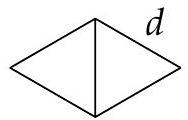
|
| 202 |
+
|
| 203 |
+
Now take $(\alpha)$ and two copies of it obtainable by parallel shifts along vectors $\vec{a}$ and $\vec{b},|\vec{a}|=|\vec{b}|=d$ and $\angle(\vec{a}, \vec{b})=60^{\circ}$. Vectors $\vec{a}$ and $\vec{b}$ should be chosen so that no two vertices of $(\alpha)$ and of the two copies coincide. We get $3 \cdot 4=12$ points and $3 \cdot 5+12=27$ distances. Proceeding in the same way, we get gradually
|
| 204 |
+
|
| 205 |
+
- $3 \cdot 12=36$ points and $3 \cdot 27+36=117$ distances;
|
| 206 |
+
- $3 \cdot 36=108$ points and $3 \cdot 117+108=459$ distances;
|
| 207 |
+
- $3 \cdot 108=324$ points and $3 \cdot 459+324=1701$ distances;
|
| 208 |
+
- $3 \cdot 324=972$ points and $3 \cdot 1701+972=6075$ distances.
|
| 209 |
+
|
| 210 |
+
12. Let $A B C D$ be a square. Let $M$ be an inner point on side $B C$ and $N$ be an inner point on side $C D$ with $\angle M A N=45^{\circ}$. Prove that the circumcentre of $A M N$ lies on $A C$.
|
| 211 |
+
|
| 212 |
+
Solution: Draw a circle $\omega$ through $M, C, N$; let it intersect $A C$ at $O$. We claim that $O$ is the circumcentre of $A M N$.
|
| 213 |
+
|
| 214 |
+
Clearly $\angle M O N=180^{\circ}-\angle M C N=90^{\circ}$. If the radius of $\omega$ is $R$, then $O M=$ $2 R \sin 45^{\circ}=R \sqrt{2}$; similarly $O N=R \sqrt{2}$. Hence we get that $O M=O N$. Then the circle with centre $O$ and radius $R \sqrt{2}$ will pass through $A$, since $\angle M A N=\frac{1}{2} \angle M O N$.
|
| 215 |
+
|
| 216 |
+
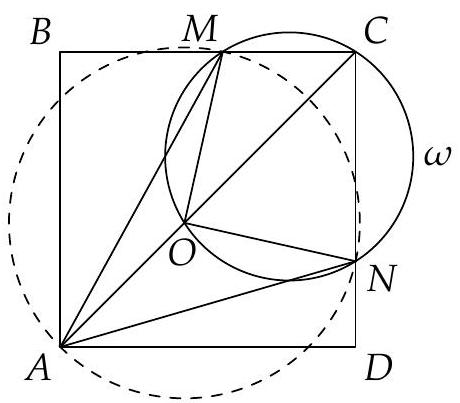
|
| 217 |
+
|
| 218 |
+
13. Let $A B C D$ be a rectangle and $B C=2 \cdot A B$. Let $E$ be the midpoint of $B C$ and $P$ an arbitrary inner point of $A D$. Let $F$ and $G$ be the feet of perpendiculars drawn correspondingly from $A$ to $B P$ and from $D$ to $C P$. Prove that the points $E, F, P, G$ are concyclic.
|
| 219 |
+
|
| 220 |
+
Solution: From rectangular triangle $B A P$ we have $B P \cdot B F=A B^{2}=B E^{2}$. Therefore the circumference through $F$ and $P$ touching the line $B C$ between $B$ and $C$ touches it at $E$.
|
| 221 |
+
|
| 222 |
+
Analogously, the circumference through $P$ and $G$ touching the line $B C$ between $B$ and $C$ touches it at $E$. But there is only one circumference touching $B C$ at $E$ and passing through $P$.
|
| 223 |
+
|
| 224 |
+
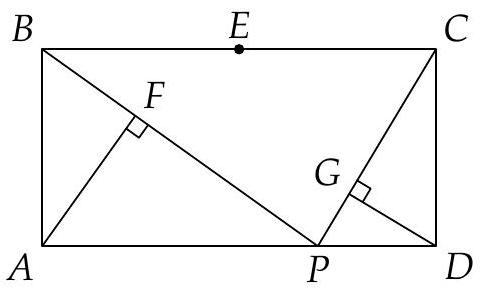
|
| 225 |
+
|
| 226 |
+
14. Let $A B C$ be an arbitrary triangle and $A M B, B N C, C K A$ regular triangles outward of $A B C$. Through the midpoint of $M N$ a perpendicular to $A C$ is constructed; similarly through the midpoints of $N K$ resp. KM perpendiculars to $A B$ resp. $B C$ are constructed. Prove that these three perpendiculars intersect at the same point.
|
| 227 |
+
|
| 228 |
+
Solution: Let $O$ be the midpoint of $M N$, and let $E$ and $F$ be the midpoints of $A B$ and $B C$, respectively. As triangle $M B C$ transforms into triangle $A B N$ when rotated $60^{\circ}$ around $B$ we get $M C=A N$ (it is also a well-known fact). Considering now the quadrangles $A M B N$ and $C M B N$ we get $O E=O F$ (from Eiler's formula $a^{2}+b^{2}+c^{2}+d^{2}=e^{2}+f^{2}+4 \cdot P Q^{2}$ or otherwise). As $E F \| A C$ we get from this that the perpendicular to $A C$ through $O$ passes through the circumcentre of $E F G$, as it is the perpendicular bisector of $E F$. The same holds for the other two perpendiculars.
|
| 229 |
+
|
| 230 |
+
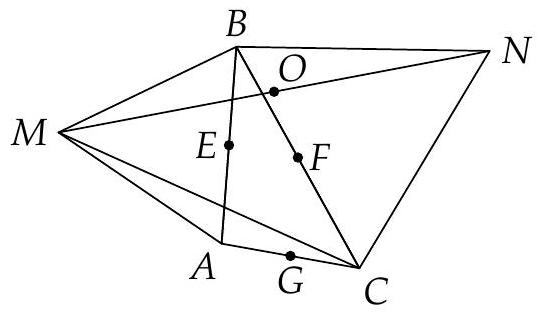
|
| 231 |
+
|
| 232 |
+
First solution
|
| 233 |
+
|
| 234 |
+
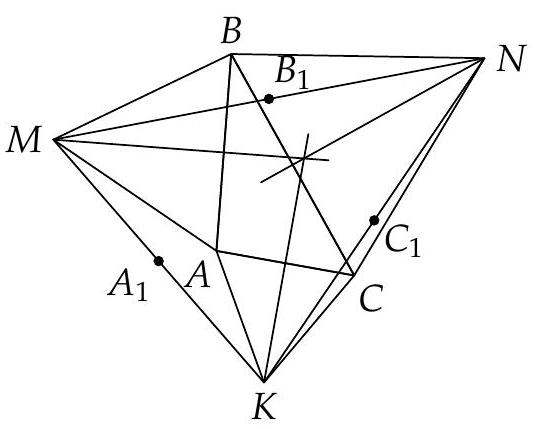
|
| 235 |
+
|
| 236 |
+
Second solution
|
| 237 |
+
|
| 238 |
+
Solution 2: Let us denote the midpoints of the segments $M N, N K, K M$ by $B_{1}, C_{1}, A_{1}$, respectively. It is easy to see that triangle $A_{1} B_{1} C_{1}$ is homothetic to triangle $N K M$ via the homothety centered at the intersection of the medians of triangle $N M K$ and dilation $-\frac{1}{2}$. The perpendiculars through $M, N, K$ to $A B, B C, C A$, respectively, are also the perpendicular bisectors of these sides, so they intersect in the circumcentre of triangle $A B C$. The desired result follows now from the homothety, and we find that that the common point of intersection is the circumcentre of the image of triangle $A B C$ under the homothety; that is, the circumcentre of the triangle with vertices the midpoints of the sides $A B, B C, C A$.
|
| 239 |
+
|
| 240 |
+
15. Let $P$ be the intersection point of the diagonals $A C$ and $B D$ in a cyclic quadrilateral. $A$ circle through $P$ touches the side $C D$ in the midpoint $M$ of this side and intersects the segments $B D$ and $A C$ in the points $Q$ and $R$, respectively. Let $S$ be a point on the segment $B D$ such that $B S=D Q$. The parallel to $A B$ through $S$ intersects $A C$ at $T$. Prove that $A T=R C$.
|
| 241 |
+
|
| 242 |
+
Solution: With reference to the figure below we have $C R \cdot C P=D Q \cdot D P=C M^{2}=D M^{2}$, which is equivalent to $R C=\frac{D Q \cdot D P}{C P}$. We also have $\frac{A T}{B S}=\frac{A P}{B P}=\frac{A T}{D Q}$, so $A T=\frac{A P \cdot D Q}{B P}$. Since $A B C D$ is cyclic the result now comes from the fact that $D P \cdot B P=A P \cdot C P$ (due to a well-known theorem).
|
| 243 |
+
|
| 244 |
+
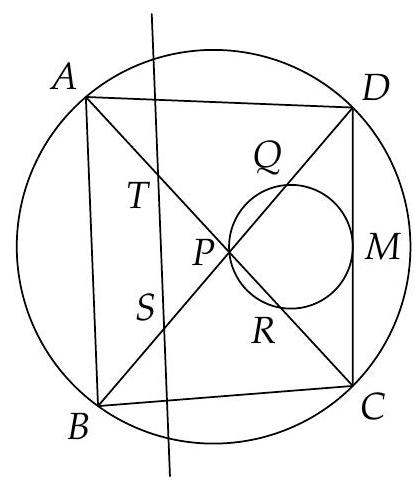
|
| 245 |
+
|
| 246 |
+
16. Find all pairs of positive integers $(a, b)$ such that $a-b$ is a prime and $a b$ is a perfect square. Answer: Pairs $(a, b)=\left(\left(\frac{p+1}{2}\right)^{2},\left(\frac{p-1}{2}\right)^{2}\right)$, where $p$ is a prime greater than 2 .
|
| 247 |
+
|
| 248 |
+
Solution: Let $p$ be a prime such that $a-b=p$ and let $a b=k^{2}$. Insert $a=b+p$ in the equation $a b=k^{2}$. Then
|
| 249 |
+
|
| 250 |
+
$$
|
| 251 |
+
k^{2}=(b+p) b=\left(b+\frac{p}{2}\right)^{2}-\frac{p^{2}}{4}
|
| 252 |
+
$$
|
| 253 |
+
|
| 254 |
+
which is equivalent to
|
| 255 |
+
|
| 256 |
+
$$
|
| 257 |
+
p^{2}=(2 b+p)^{2}-4 k^{2}=(2 b+p+2 k)(2 b+p-2 k) .
|
| 258 |
+
$$
|
| 259 |
+
|
| 260 |
+
Since $2 b+p+2 k>2 b+p-2 k$ and $p$ is a prime, we conclude $2 b+p+2 k=p^{2}$ and $2 b+p-2 k=1$. By adding these equations we get $2 b+p=\frac{p^{2}+1}{2}$ and then $b=\left(\frac{p-1}{2}\right)^{2}$, so $a=b+p=\left(\frac{p+1}{2}\right)^{2}$. By checking we conclude that all the solutions are $(a, b)=\left(\left(\frac{p+1}{2}\right)^{2},\left(\frac{p-1}{2}\right)^{2}\right)$ with $p$ a prime greater than 2 .
|
| 261 |
+
|
| 262 |
+
Solution 2: Let $p$ be a prime such that $a-b=p$ and let $a b=k^{2}$. We have $(b+p) b=k^{2}$, so $\operatorname{gcd}(b, b+p)=\operatorname{gcd}(b, p)$ is equal either to 1 or $p$. If $\operatorname{gcd}(b, b+p)=p$, let $b=b_{1} p$. Then $p^{2} b_{1}\left(b_{1}+1\right)=k^{2}, b_{1}\left(b_{1}+1\right)=m^{2}$, but this equation has no solutions.
|
| 263 |
+
|
| 264 |
+
Hence $\operatorname{gcd}(b, b+p)=1$, and
|
| 265 |
+
|
| 266 |
+
$$
|
| 267 |
+
b=u^{2} \quad b+p=v^{2}
|
| 268 |
+
$$
|
| 269 |
+
|
| 270 |
+
so that $p=v^{2}-u^{2}=(v+u)(v-u)$. This in turn implies that $v-u=1$ and $v+u=p$, from which we finally obtain $a=\left(\frac{p+1}{2}\right)^{2}, b=\left(\frac{p-1}{2}\right)^{2}$, where $p$ must be an odd prime.
|
| 271 |
+
|
| 272 |
+
17. All the positive divisors of a positive integer $n$ are stored into an array in increasing order. Mary has to write a program which decides for an arbitrarily chosen divisor $d>1$ whether it is a prime. Let $n$ have $k$ divisors not greater than $d$. Mary claims that it suffices to check divisibility of $d$ by the first $\lceil k / 2\rceil$ divisors of $n$ : If a divisor of $d$ greater than 1 is found among them, then $d$ is composite, otherwise d is prime. Is Mary right?
|
| 273 |
+
|
| 274 |
+
Answer: Yes, Mary is right.
|
| 275 |
+
|
| 276 |
+
Solution: Let $d>1$ be a divisor of $n$. Suppose Mary's program outputs "composite" for $d$. That means it has found a divisor of $d$ greater than 1 . Since $d>1$, the array contains at least 2 divisors of $d$, namely 1 and $d$. Thus Mary's program does not check divisibility of $d$ by $d$ (the first half gets complete before reaching $d$ ) which means that the divisor found lays strictly between 1 and $d$. Hence $d$ is composite indeed.
|
| 277 |
+
|
| 278 |
+
Suppose now $d$ being composite. Let $p$ be its smallest prime divisor; then $\frac{d}{p} \geq p$ or, equivalently, $d \geq p^{2}$. As $p$ is a divisor of $n$, it occurs in the array. Let $a_{1}, \ldots, a_{k}$ all divisors of $n$ smaller than $p$. Then $p a_{1}, \ldots, p a_{k}$ are less than $p^{2}$ and hence less than $d$.
|
| 279 |
+
|
| 280 |
+
As $a_{1}, \ldots, a_{k}$ are all relatively prime with $p$, all the numbers $p a_{1}, \ldots, p a_{k}$ divide $n$. The numbers $a_{1}, \ldots, a_{k}, p a_{1}, \ldots, p a_{k}$ are pairwise different by construction. Thus there are at least $2 k+1$ divisors of $n$ not greater than $d$. So Mary's program checks divisibility of $d$ by at least $k+1$ smallest divisors of $n$, among which it finds $p$, and outputs "composite".
|
| 281 |
+
|
| 282 |
+
18. Every integer is coloured with exactly one of the colours BLUE, GREEN, RED, YELLOW. Can this be done in such a way that if $a, b, c, d$ are not all 0 and have the same colour, then $3 a-2 b \neq 2 c-3 d$ ?
|
| 283 |
+
|
| 284 |
+
Answer: Yes.
|
| 285 |
+
|
| 286 |
+
Solution: A colouring with the required property can be defined as follows. For a non-zero integer $k$ let $k^{*}$ be the integer uniquely defined by $k=5^{m} \cdot k^{*}$, where $m$ is a nonnegative integer and $5 \nmid k^{*}$. We also define $0^{*}=0$. Two non-zero integers $k_{1}, k_{2}$ receive the same colour if and only if $k_{1}^{*} \equiv k_{2}^{*}(\bmod 5)$; we assign 0 any colour.
|
| 287 |
+
|
| 288 |
+
Assume $a, b, c, d$ has the same colour and that $3 a-2 b=2 c-3 d$, which we rewrite as $3 a-2 b-2 c+3 d=0$. Dividing both sides by the largest power of 5 which simultaneously divides $a, b, c, d$ (this makes sense since not all of $a, b, c, d$ are 0 ), we obtain
|
| 289 |
+
|
| 290 |
+
$$
|
| 291 |
+
3 \cdot 5^{A} \cdot a^{*}-2 \cdot 5^{B} \cdot b^{*}-2 \cdot 5^{C} \cdot c^{*}+3 \cdot 5^{D} \cdot d^{*}=0,
|
| 292 |
+
$$
|
| 293 |
+
|
| 294 |
+
where $A, B, C, D$ are nonnegative integers at least one of which is equal to 0 . The above equality implies
|
| 295 |
+
|
| 296 |
+
$$
|
| 297 |
+
3\left(5^{A} \cdot a^{*}+5^{B} \cdot b^{*}+5^{C} \cdot c^{*}+5^{D} \cdot d^{*}\right) \equiv 0 \quad(\bmod 5) .
|
| 298 |
+
$$
|
| 299 |
+
|
| 300 |
+
Assume $a, b, c, d$ are all non-zero. Then $a^{*} \equiv b^{*} \equiv c^{*} \equiv d^{*} \not \equiv 0(\bmod 5)$. This implies
|
| 301 |
+
|
| 302 |
+
$$
|
| 303 |
+
5^{A}+5^{B}+5^{C}+5^{D} \equiv 0 \quad(\bmod 5)
|
| 304 |
+
$$
|
| 305 |
+
|
| 306 |
+
which is impossible since at least one of the numbers $A, B, C, D$ is equal to 0 . If one or more of $a, b, c, d$ are 0 , we simply omit the corresponding terms from (1), and the same conclusion holds.
|
| 307 |
+
|
| 308 |
+
19. Let $a$ and $b$ be positive integers. Prove that if $a^{3}+b^{3}$ is the square of an integer, then $a+b$ is not a product of two different prime numbers.
|
| 309 |
+
|
| 310 |
+
Solution: Suppose $a+b=p q$, where $p \neq q$ are two prime numbers. We may assume that $p \neq 3$. Since
|
| 311 |
+
|
| 312 |
+
$$
|
| 313 |
+
a^{3}+b^{3}=(a+b)\left(a^{2}-a b+b^{2}\right)
|
| 314 |
+
$$
|
| 315 |
+
|
| 316 |
+
is a square, the number $a^{2}-a b+b^{2}=(a+b)^{2}-3 a b$ must be divisible by $p$ and $q$, whence $3 a b$ must be divisible by $p$ and $q$. But $p \neq 3$, so $p \mid a$ or $p \mid b$; but $p \mid a+b$, so $p \mid a$ and $p \mid b$. Write $a=p k, b=p \ell$ for some integers $k, \ell$. Notice that $q=3$, since otherwise, repeating the above argument, we would have $q|a, q| b$ and $a+b>p q)$. So we have
|
| 317 |
+
|
| 318 |
+
$$
|
| 319 |
+
3 p=a+b=p(k+\ell)
|
| 320 |
+
$$
|
| 321 |
+
|
| 322 |
+
and we conclude that $a=p, b=2 p$ or $a=2 p, b=p$. Then $a^{3}+b^{3}=9 p^{3}$ is obviously not a square, a contradiction.
|
| 323 |
+
|
| 324 |
+
20. Let $n$ be a positive integer such that the sum of all the positive divisors of $n$ (except $n$ ) plus the number of these divisors is equal to $n$. Prove that $n=2 m^{2}$ for some integer $m$.
|
| 325 |
+
|
| 326 |
+
Solution: Let $t_{1}<t_{2}<\cdots<t_{s}$ be all positive odd divisors of $n$, and let $2^{k}$ be the maximal power of 2 that divides $n$. Then the full list of divisors of $n$ is the following:
|
| 327 |
+
|
| 328 |
+
$$
|
| 329 |
+
t_{1}, \ldots, t_{s}, 2 t_{1}, \ldots, 2 t_{s}, \ldots, 2^{k} t_{1}, \ldots, 2^{k} t_{s} .
|
| 330 |
+
$$
|
| 331 |
+
|
| 332 |
+
Hence,
|
| 333 |
+
|
| 334 |
+
$$
|
| 335 |
+
2 n=\left(2^{k+1}-1\right)\left(t_{1}+t_{2}+\cdots+t_{s}\right)+(k+1) s-1 .
|
| 336 |
+
$$
|
| 337 |
+
|
| 338 |
+
The right-hand side can be even only if both $k$ and $s$ are odd. In this case the number $n / 2^{k}$ has an odd number of divisors and therefore it is equal to a perfect square $r^{2}$. Writing $k=2 a+1$, we have $n=2^{k} r^{2}=2\left(2^{a} r\right)^{2}$.
|
| 339 |
+
|
BalticWay/md/en-bw04sol.md
ADDED
|
@@ -0,0 +1,344 @@
|
|
|
|
|
|
|
|
|
|
|
|
|
|
|
|
|
|
|
|
|
|
|
|
|
|
|
|
|
|
|
|
|
|
|
|
|
|
|
|
|
|
|
|
|
|
|
|
|
|
|
|
|
|
|
|
|
|
|
|
|
|
|
|
|
|
|
|
|
|
|
|
|
|
|
|
|
|
|
|
|
|
|
|
|
|
|
|
|
|
|
|
|
|
|
|
|
|
|
|
|
|
|
|
|
|
|
|
|
|
|
|
|
|
|
|
|
|
|
|
|
|
|
|
|
|
|
|
|
|
|
|
|
|
|
|
|
|
|
|
|
|
|
|
|
|
|
|
|
|
|
|
|
|
|
|
|
|
|
|
|
|
|
|
|
|
|
|
|
|
|
|
|
|
|
|
|
|
|
|
|
|
|
|
|
|
|
|
|
|
|
|
|
|
|
|
|
|
|
|
|
|
|
|
|
|
|
|
|
|
|
|
|
|
|
|
|
|
|
|
|
|
|
|
|
|
|
|
|
|
|
|
|
|
|
|
|
|
|
|
|
|
|
|
|
|
|
|
|
|
|
|
|
|
|
|
|
|
|
|
|
|
|
|
|
|
|
|
|
|
|
|
|
|
|
|
|
|
|
|
|
|
|
|
|
|
|
|
|
|
|
|
|
|
|
|
|
|
|
|
|
|
|
|
|
|
|
|
|
|
|
|
|
|
|
|
|
|
|
|
|
|
|
|
|
|
|
|
|
|
|
|
|
|
|
|
|
|
|
|
|
|
|
|
|
|
|
|
|
|
|
|
|
|
|
|
|
|
|
|
|
|
|
|
|
|
|
|
|
|
|
|
|
|
|
|
|
|
|
|
|
|
|
|
|
|
|
|
|
|
|
|
|
|
|
|
|
|
|
|
|
|
|
|
|
|
|
|
|
|
|
|
|
|
|
|
|
|
|
|
|
|
|
|
|
|
|
|
|
|
|
|
|
|
|
|
|
|
|
|
|
|
|
|
|
|
|
|
|
|
|
|
|
|
|
|
|
|
|
|
|
|
|
|
|
|
|
|
|
|
|
|
|
|
|
|
|
|
|
|
|
|
|
|
|
|
|
|
|
|
|
|
|
|
|
|
|
|
|
|
|
|
|
|
|
|
|
|
|
|
|
|
|
|
|
|
|
|
|
|
|
|
|
|
|
|
|
|
|
|
|
|
|
|
|
|
|
|
|
|
|
|
|
|
|
|
|
|
|
|
|
|
|
|
|
|
|
|
|
|
|
|
|
|
|
|
|
|
|
|
|
|
|
|
|
|
|
|
|
|
|
|
|
|
|
|
|
|
|
|
|
|
|
|
|
|
|
|
|
|
|
|
|
|
|
|
|
|
|
|
|
|
|
|
|
|
|
|
|
|
|
|
|
|
|
|
|
|
|
|
|
|
|
|
|
|
|
|
|
|
|
|
|
|
|
|
|
|
|
|
|
|
|
|
|
|
|
|
|
|
|
|
|
|
|
|
|
|
|
|
|
|
|
|
|
|
|
|
|
|
|
|
|
|
|
|
|
|
|
|
|
|
|
|
|
|
|
|
|
|
|
|
|
|
|
|
|
|
|
|
|
|
|
|
|
|
|
|
|
|
|
|
|
|
|
|
|
|
|
|
|
|
|
|
|
|
|
|
|
|
|
|
|
|
|
|
|
|
|
|
|
|
|
|
|
|
|
|
|
|
|
|
|
|
|
|
|
|
|
|
|
|
|
|
|
|
|
|
|
|
|
|
|
|
|
|
|
|
|
|
|
|
|
|
|
|
|
|
|
|
|
|
|
|
|
|
|
|
|
|
|
|
|
|
|
|
|
|
|
|
|
|
|
|
|
|
|
|
|
|
|
|
|
|
|
|
|
|
|
|
|
|
|
|
|
|
|
|
|
|
|
|
|
|
|
|
|
|
|
|
|
|
|
|
|
|
|
|
|
|
|
|
|
|
|
|
|
|
|
|
|
|
|
|
|
|
|
|
|
|
|
|
|
|
|
|
|
|
|
|
|
|
|
|
|
|
|
|
|
|
|
|
|
|
|
|
|
|
|
|
|
|
|
|
|
|
|
|
|
|
|
|
|
|
|
|
|
|
|
|
|
|
|
|
|
|
|
|
|
|
|
|
|
|
|
|
|
|
|
|
|
|
|
|
|
|
|
|
|
|
|
|
|
|
|
|
|
|
|
|
|
|
|
|
|
|
|
|
|
|
|
|
|
|
|
|
|
|
|
|
|
|
|
|
|
|
|
|
|
|
|
|
|
|
|
|
|
|
|
|
|
|
|
|
|
|
|
|
|
|
|
|
|
|
|
|
| 1 |
+
# Baltic Way 2004 <br> Vilnius, November 7, 2004
|
| 2 |
+
|
| 3 |
+
## Problems and solutions
|
| 4 |
+
|
| 5 |
+
1. Given a sequence $a_{1}, a_{2}, a_{3}, \ldots$ of non-negative real numbers satisfying the conditions
|
| 6 |
+
|
| 7 |
+
(1) $a_{n}+a_{2 n} \geq 3 n$
|
| 8 |
+
|
| 9 |
+
(2) $a_{n+1}+n \leq 2 \sqrt{a_{n} \cdot(n+1)}$
|
| 10 |
+
|
| 11 |
+
for all indices $n=1,2 \ldots$
|
| 12 |
+
|
| 13 |
+
(a) Prove that the inequality $a_{n} \geq n$ holds for every $n \in \mathbb{N}$.
|
| 14 |
+
|
| 15 |
+
(b) Give an example of such a sequence.
|
| 16 |
+
|
| 17 |
+
Solution: (a) Note that the inequality
|
| 18 |
+
|
| 19 |
+
$$
|
| 20 |
+
\frac{a_{n+1}+n}{2} \geq \sqrt{a_{n+1} \cdot n}
|
| 21 |
+
$$
|
| 22 |
+
|
| 23 |
+
holds, which together with the second condition of the problem gives
|
| 24 |
+
|
| 25 |
+
$$
|
| 26 |
+
\sqrt{a_{n+1} \cdot n} \leq \sqrt{a_{n} \cdot(n+1)}
|
| 27 |
+
$$
|
| 28 |
+
|
| 29 |
+
This inequality simplifies to
|
| 30 |
+
|
| 31 |
+
$$
|
| 32 |
+
\frac{a_{n+1}}{a_{n}} \leq \frac{n+1}{n}
|
| 33 |
+
$$
|
| 34 |
+
|
| 35 |
+
Now, using the last inequality for the index $n$ replaced by $n, n+1, \ldots, 2 n-1$ and multiplying the results, we obtain
|
| 36 |
+
|
| 37 |
+
$$
|
| 38 |
+
\frac{a_{2 n}}{a_{n}} \leq \frac{2 n}{n}=2
|
| 39 |
+
$$
|
| 40 |
+
|
| 41 |
+
or $2 a_{n} \geq a_{2 n}$. Taking into account the first condition of the problem, we have
|
| 42 |
+
|
| 43 |
+
$$
|
| 44 |
+
3 a_{n}=a_{n}+2 a_{n} \geq a_{n}+a_{2 n} \geq 3 n
|
| 45 |
+
$$
|
| 46 |
+
|
| 47 |
+
which implies $a_{n} \geq n$. (b) The sequence defined by $a_{n}=n+1$ satisfies all the conditions of the problem.
|
| 48 |
+
|
| 49 |
+
2. Let $P(x)$ be a polynomial with non-negative coefficients. Prove that if $P\left(\frac{1}{x}\right) P(x) \geq 1$ for $x=1$, then the same inequality holds for each positive $x$.
|
| 50 |
+
|
| 51 |
+
Solution: For $x>0$ we have $P(x)>0$ (because at least one coefficient is non-zero). From the given condition we have $(P(1))^{2} \geq 1$. Further, let's denote $P(x)=a_{n} x^{n}+a_{n-1} x^{n-1}+$ $\cdots+a_{0}$. Then
|
| 52 |
+
|
| 53 |
+
$$
|
| 54 |
+
\begin{aligned}
|
| 55 |
+
P(x) P\left(\frac{1}{x}\right) & =\left(a_{n} x^{n}+\cdots+a_{0}\right)\left(a_{n} x^{-n}+\cdots+a_{0}\right) \\
|
| 56 |
+
& =\sum_{i=0}^{n} a_{i}^{2}+\sum_{i=1}^{n} \sum_{j=0}^{i-1}\left(a_{i-j} a_{j}\right)\left(x^{i}+x^{-i}\right) \\
|
| 57 |
+
& \geq \sum_{i=0}^{n} a_{i}^{2}+2 \sum_{i>j} a_{i} a_{j} \\
|
| 58 |
+
& =(P(1))^{2} \geq 1 .
|
| 59 |
+
\end{aligned}
|
| 60 |
+
$$
|
| 61 |
+
|
| 62 |
+
3. Let $p, q, r$ be positive real numbers and $n \in \mathbb{N}$. Show that if $p q r=1$, then
|
| 63 |
+
|
| 64 |
+
$$
|
| 65 |
+
\frac{1}{p^{n}+q^{n}+1}+\frac{1}{q^{n}+r^{n}+1}+\frac{1}{r^{n}+p^{n}+1} \leq 1
|
| 66 |
+
$$
|
| 67 |
+
|
| 68 |
+
Solution: The key idea is to deal with the case $n=3$. Put $a=p^{n / 3}, b=q^{n / 3}$, and $c=r^{n / 3}$, so $a b c=(p q r)^{n / 3}=1$ and
|
| 69 |
+
|
| 70 |
+
$$
|
| 71 |
+
\frac{1}{p^{n}+q^{n}+1}+\frac{1}{q^{n}+r^{n}+1}+\frac{1}{r^{n}+p^{n}+1}=\frac{1}{a^{3}+b^{3}+1}+\frac{1}{b^{3}+c^{3}+1}+\frac{1}{c^{3}+a^{3}+1} .
|
| 72 |
+
$$
|
| 73 |
+
|
| 74 |
+
Now
|
| 75 |
+
|
| 76 |
+
$$
|
| 77 |
+
\frac{1}{a^{3}+b^{3}+1}=\frac{1}{(a+b)\left(a^{2}-a b+b^{2}\right)+1}=\frac{1}{(a+b)\left((a-b)^{2}+a b\right)+1} \leq \frac{1}{(a+b) a b+1} .
|
| 78 |
+
$$
|
| 79 |
+
|
| 80 |
+
Since $a b=c^{-1}$,
|
| 81 |
+
|
| 82 |
+
$$
|
| 83 |
+
\frac{1}{a^{3}+b^{3}+1} \leq \frac{1}{(a+b) a b+1}=\frac{c}{a+b+c}
|
| 84 |
+
$$
|
| 85 |
+
|
| 86 |
+
Similarly we obtain
|
| 87 |
+
|
| 88 |
+
$$
|
| 89 |
+
\frac{1}{b^{3}+c^{3}+1} \leq \frac{a}{a+b+c} \quad \text { and } \quad \frac{1}{c^{3}+a^{3}+1} \leq \frac{b}{a+b+c}
|
| 90 |
+
$$
|
| 91 |
+
|
| 92 |
+
Hence
|
| 93 |
+
|
| 94 |
+
$$
|
| 95 |
+
\frac{1}{a^{3}+b^{3}+1}+\frac{1}{b^{3}+c^{3}+1}+\frac{1}{c^{3}+a^{3}+1} \leq \frac{c}{a+b+c}+\frac{a}{a+b+c}+\frac{b}{a+b+c}=1,
|
| 96 |
+
$$
|
| 97 |
+
|
| 98 |
+
which was to be shown.
|
| 99 |
+
|
| 100 |
+
4. Let $x_{1}, x_{2}, \ldots, x_{n}$ be real numbers with arithmetic mean $X$. Prove that there is a positive integer $K$ such that the arithmetic mean of each of the lists $\left\{x_{1}, x_{2}, \ldots, x_{K}\right\},\left\{x_{2}, x_{3}, \ldots, x_{K}\right\}$, $\ldots,\left\{x_{K-1}, x_{K}\right\},\left\{x_{K}\right\}$ is not greater than $X$.
|
| 101 |
+
|
| 102 |
+
Solution: Suppose the conclusion is false. This means that for every $K \in\{1,2, \ldots, n\}$, there exists a $k \leq K$ such that the arithmetic mean of $x_{k}, x_{k+1}, \ldots, x_{K}$ exceeds $X$. We now define a decreasing sequence $b_{1} \geq a_{1}>a_{1}-1=b_{2} \geq a_{2}>\cdots$ as follows: Put $b_{1}=n$, and for each $i$, let $a_{i}$ be the largest largest $k \leq b_{i}$ such that the arithmetic mean of $x_{a_{i}}, \ldots, x_{b_{i}}$ exceeds $X$; then put $b_{i+1}=a_{i}-1$ and repeat. Clearly for some $m, a_{m}=1$. Now, by construction, each of the sets $\left\{x_{a_{m}}, \ldots, x_{b_{m}}\right\},\left\{x_{a_{m-1}}, \ldots, x_{b_{m-1}}\right\}, \ldots,\left\{x_{a_{1}}, \ldots, x_{b_{1}}\right\}$ has arithmetic mean strictly greater than $X$, but then the union $\left\{x_{1}, x_{2}, \ldots, x_{n}\right\}$ of these sets has arithmetic mean strictly greater than $X$; a contradiction.
|
| 103 |
+
|
| 104 |
+
5. Determine the range of the function $f$ defined for integers $k$ by
|
| 105 |
+
|
| 106 |
+
$$
|
| 107 |
+
f(k)=(k)_{3}+(2 k)_{5}+(3 k)_{7}-6 k
|
| 108 |
+
$$
|
| 109 |
+
|
| 110 |
+
where $(k)_{2 n+1}$ denotes the multiple of $2 n+1$ closest to $k$.
|
| 111 |
+
|
| 112 |
+
Solution: For odd $n$ we have
|
| 113 |
+
|
| 114 |
+
$$
|
| 115 |
+
(k)_{n}=k+\frac{n-1}{2}-\left[k+\frac{n-1}{2}\right]_{n^{\prime}}
|
| 116 |
+
$$
|
| 117 |
+
|
| 118 |
+
where $[m]_{n}$ denotes the principal remainder of $m$ modulo $n$. Hence we get
|
| 119 |
+
|
| 120 |
+
$$
|
| 121 |
+
f(k)=6-[k+1]_{3}-[2 k+2]_{5}-[3 k+3]_{7}
|
| 122 |
+
$$
|
| 123 |
+
|
| 124 |
+
The condition that the principal remainders take the values $a, b$ and $c$, respectively, may be written
|
| 125 |
+
|
| 126 |
+
$$
|
| 127 |
+
\begin{aligned}
|
| 128 |
+
k+1 \equiv a & (\bmod 3) \\
|
| 129 |
+
2 k+2 \equiv b & (\bmod 5) \\
|
| 130 |
+
3 k+3 & \equiv c \quad(\bmod 7)
|
| 131 |
+
\end{aligned}
|
| 132 |
+
$$
|
| 133 |
+
|
| 134 |
+
or
|
| 135 |
+
|
| 136 |
+
$$
|
| 137 |
+
\begin{aligned}
|
| 138 |
+
& k \equiv a-1 \quad(\bmod 3) \\
|
| 139 |
+
& k \equiv-2 b-1 \quad(\bmod 5) \\
|
| 140 |
+
& k \equiv-2 c-1 \quad(\bmod 7)
|
| 141 |
+
\end{aligned}
|
| 142 |
+
$$
|
| 143 |
+
|
| 144 |
+
By the Chinese Remainder Theorem, these congruences have a solution for any set of $a, b, c$. Hence $f$ takes all the integer values between $6-2-4-6=-6$ and $6-0-0-0=$ 6. (In fact, this proof also shows that $f$ is periodic with period $3 \cdot 5 \cdot 7=105$.)
|
| 145 |
+
|
| 146 |
+
6. A positive integer is written on each of the six faces of a cube. For each vertex of the cube we compute the product of the numbers on the three adjacent faces. The sum of these products is 1001. What is the sum of the six numbers on the faces?
|
| 147 |
+
|
| 148 |
+
Solution: Let the numbers on the faces be $a_{1}, a_{2}, b_{1}, b_{2}, c_{1}, c_{2}$, placed so that $a_{1}$ and $a_{2}$ are on opposite faces etc. Then the sum of the eight products is equal to
|
| 149 |
+
|
| 150 |
+
$$
|
| 151 |
+
\left(a_{1}+a_{2}\right)\left(b_{1}+b_{2}\right)\left(c_{1}+c_{2}\right)=1001=7 \cdot 11 \cdot 13 .
|
| 152 |
+
$$
|
| 153 |
+
|
| 154 |
+
Hence the sum of the numbers on the faces is $a_{1}+a_{2}+b_{1}+b_{2}+c_{1}+c_{2}=7+11+13=$ 31.
|
| 155 |
+
|
| 156 |
+
7. Find all sets $X$ consisting of at least two positive integers such that for every pair $m, n \in X$, where $n>m$, there exists $k \in X$ such that $n=m k^{2}$.
|
| 157 |
+
|
| 158 |
+
Answer: The sets $\left\{m, m^{3}\right\}$, where $m>1$.
|
| 159 |
+
|
| 160 |
+
Solution: Let $X$ be a set satisfying the condition of the problem and let $n>m$ be the two smallest elements in the set $X$. There has to exist a $k \in X$ so that $n=m k^{2}$, but as $m \leq k \leq n$, either $k=n$ or $k=m$. The first case gives $m=n=1$, a contradiction; the second case implies $n=m^{3}$ with $m>1$.
|
| 161 |
+
|
| 162 |
+
Suppose there exists a third smallest element $q \in X$. Then there also exists $k_{0} \in X$, such that $q=m k_{0}^{2}$. We have $q>k_{0} \geq m$, but $k_{0}=m$ would imply $q=n$, thus $k_{0}=n=m^{3}$ and $q=m^{7}$. Now for $q$ and $n$ there has to exist $k_{1} \in X$ such that $q=n k_{1}^{2}$, which gives $k_{1}=m^{2}$. Since $m^{2} \notin X$, we have a contradiction.
|
| 163 |
+
|
| 164 |
+
Thus we see that the only possible sets are those of the form $\left\{m, m^{3}\right\}$ with $m>1$, and these are easily seen to satisfy the conditions of the problem.
|
| 165 |
+
|
| 166 |
+
8. Let $f$ be a non-constant polynomial with integer coefficients. Prove that there is an integer $n$ such that $f(n)$ has at least 2004 distinct prime factors.
|
| 167 |
+
|
| 168 |
+
Solution: Suppose the contrary. Choose an integer $n_{0}$ so that $f\left(n_{0}\right)$ has the highest number of prime factors. By translating the polynomial we may assume $n_{0}=0$. Setting $k=f(0)$, we have $f\left(w k^{2}\right) \equiv k\left(\bmod k^{2}\right)$, or $f\left(w k^{2}\right)=a k^{2}+k=(a k+1) k$. Since $\operatorname{gcd}(a k+1, k)=1$ and $k$ alone achieves the highest number of prime factors of $f$, we must have $a k+1= \pm 1$. This cannot happen for every $w$ since $f$ is non-constant, so we have a contradiction.
|
| 169 |
+
|
| 170 |
+
9. $A$ set $S$ of $n-1$ natural numbers is given ( $n \geq 3$ ). There exists at least two elements in this set whose difference is not divisible by $n$. Prove that it is possible to choose a non-empty subset of $S$ so that the sum of its elements is divisible by $n$.
|
| 171 |
+
|
| 172 |
+
Solution: Suppose to the contrary that there exists a set $X=\left\{a_{1}, a_{2}, \ldots, a_{n-1}\right\}$ violating the statement of the problem, and let $a_{n-2} \not \equiv a_{n-1}(\bmod n)$. Denote $S_{i}=a_{1}+a_{2}+$ $\cdots+a_{i}, i=1, \ldots, n-1$. The conditions of the problem imply that all the numbers $S_{i}$ must give different remainders when divided by $n$. Indeed, if for some $j<k$ we had $S_{j} \equiv S_{k}(\bmod n)$, then $a_{j+1}+a_{j+2}+\cdots+a_{k}=S_{k}-S_{j} \equiv 0(\bmod n)$. Consider now the sum $S^{\prime}=S_{n-3}+a_{n-1}$. We see that $S^{\prime}$ can not be congruent to any of the sums $S_{i}$ (for $i \neq n-2$ the above argument works and for $i=n-2$ we use the assumption $a_{n-2} \not \equiv a_{n-1}$ $(\bmod n))$. Thus we have $n$ sums that give pairwise different remainders when divided by $n$, consequently one of them has to give the remainder 0 , a contradiction.
|
| 173 |
+
|
| 174 |
+
10. Is there an infinite sequence of prime numbers $p_{1}, p_{2}, \ldots$ such that $\left|p_{n+1}-2 p_{n}\right|=1$ for each $n \in \mathbb{N}$ ?
|
| 175 |
+
|
| 176 |
+
Answer: No, there is no such sequence.
|
| 177 |
+
|
| 178 |
+
Solution: Suppose the contrary. Clearly $p_{3}>3$. There are two possibilities: If $p_{3} \equiv 1$ $(\bmod 3)$ then necessarily $p_{4}=2 p_{3}-1\left(\right.$ otherwise $\left.p_{4} \equiv 0(\bmod 3)\right)$, so $p_{4} \equiv 1(\bmod 3)$. Analogously $p_{5}=2 p_{4}-1, p_{6}=2 p_{5}-1$ etc. By an easy induction we have
|
| 179 |
+
|
| 180 |
+
$$
|
| 181 |
+
p_{n+1}-1=2^{n-2}\left(p_{3}-1\right), \quad n=3,4,5, \ldots
|
| 182 |
+
$$
|
| 183 |
+
|
| 184 |
+
If we set $n=p_{3}+1$ we have $p_{p_{3}+2}-1=2^{p_{3}-1}\left(p_{3}-1\right)$, from which
|
| 185 |
+
|
| 186 |
+
$$
|
| 187 |
+
p_{p_{3}+2} \equiv 1+1 \cdot\left(p_{3}-1\right)=p_{3} \equiv 0 \quad\left(\bmod p_{3}\right)
|
| 188 |
+
$$
|
| 189 |
+
|
| 190 |
+
a contradiction. The case $p_{3} \equiv 2(\bmod 3)$ is treated analogously.
|
| 191 |
+
|
| 192 |
+
11. An $m \times n$ table is given, in each cell of which a number +1 or -1 is written. It is known that initially exactly one -1 is in the table, all the other numbers being +1 . During a move, it is allowed to choose any cell containing -1 , replace this -1 by 0 , and simultaneously multiply all the numbers in the neighboring cells by -1 (we say that two cells are neighboring if they have a common side). Find all $(m, n)$ for which using such moves one can obtain the table containing zeroes only, regardless of the cell in which the initial -1 stands.
|
| 193 |
+
|
| 194 |
+
Answer: Those $(m, n)$ for which at least one of $m, n$ is odd.
|
| 195 |
+
|
| 196 |
+
Solution: Let us erase a unit segment which is the common side of any two cells in which two zeroes appear. If the final table consists of zeroes only, all the unit segments (except those which belong to the boundary of the table) are erased. We must erase a total of
|
| 197 |
+
|
| 198 |
+
$$
|
| 199 |
+
m(n-1)+n(m-1)=2 m n-m-n
|
| 200 |
+
$$
|
| 201 |
+
|
| 202 |
+
such unit segments.
|
| 203 |
+
|
| 204 |
+
On the other hand, in order to obtain 0 in a cell with initial +1 one must first obtain -1 in this cell, that is, the sign of the number in this cell must change an odd number of times (namely, 1 or 3 ). Hence, any cell with -1 (except the initial one) has an odd number of neighboring zeroes. So, any time we replace -1 by 0 we erase an odd number of unit segments. That is, the total number of unit segments is congruent modulo 2 to the initial number of +1 's in the table. Therefore $2 m n-m-n \equiv m n-1$ $(\bmod 2)$, implying that $(m-1)(n-1) \equiv 0(\bmod 2)$, so at least one of $m, n$ is odd.
|
| 205 |
+
|
| 206 |
+
It remains to show that if, for example, $n$ is odd, we can obtain a zero table. First, if -1 is in the $i^{\prime}$ th row, we may easily make the $i^{\prime}$ th row contain only zeroes, while its one or two neighboring rows contain only -1 's. Next, in any row containing only -1 's, we first change the -1 in the odd-numbered columns (that is, the columns $1,3, \ldots, n$ ) to zeroes, resulting in a row consisting of alternating 0 and -1 (since the -1 's in the
|
| 207 |
+
even-numbered columns have been changed two times), and we then easily obtain an entire row of zeroes. The effect of this on the next neighboring row is to create a new row of -1 's, while the original row is clearly unchanged. In this way we finally obtain a zero table.
|
| 208 |
+
|
| 209 |
+
12. There are $2 n$ different numbers in a row. By one move we can interchange any two numbers or interchange any three numbers cyclically (choose $a, b, c$ and place a instead of $b, b$ instead of $c$ and $c$ instead of $a$ ). What is the minimal number of moves that is always sufficient to arrange the numbers in increasing order?
|
| 210 |
+
|
| 211 |
+
Solution: If a number $y$ occupies the place where $x$ should be at the end, we draw an arrow $x \rightarrow y$. Clearly at the beginning all numbers are arranged in several cycles: Loops
|
| 212 |
+
|
| 213 |
+
$\bullet \bullet$, binary cycles $\bullet \rightleftarrows \bullet$ and "long" cycles $\bullet_{\nwarrow}^{\nearrow} \succeq \bullet$ (at least three numbers). Our aim is to obtain $2 n$ loops.
|
| 214 |
+
|
| 215 |
+
Clearly each binary cycle can be rearranged into two loops by one move. If there is a long cycle with a fragment $\cdots \rightarrow a \rightarrow b \rightarrow c \rightarrow \cdots$, interchange $a, b, c$ cyclically so that at least two loops, $a \oslash, b \oslash$, appear. By each of these moves, the number of loops increase by 2 , so at most $n$ moves are needed.
|
| 216 |
+
|
| 217 |
+
On the other hand, by checking all possible ways the two or three numbers can be distributed among disjoint cycles, it is easy to see that each of the allowed moves increases the number of disjoint cycles by at most two. Hence if the initial situation is one single loop, at least $n$ moves are needed.
|
| 218 |
+
|
| 219 |
+
13. The 25 member states of the European Union set up a committee with the following rules: (1) the committee should meet daily; (2) at each meeting, at least one member state should be represented; (3) at any two different meetings, a different set of member states should be represented; and (4) at the $n$ 'th meeting, for every $k<n$, the set of states represented should include at least one state that was represented at the k'th meeting. For how many days can the committee have its meetings?
|
| 220 |
+
|
| 221 |
+
Answer: At most $2^{24}=16777216$ days.
|
| 222 |
+
|
| 223 |
+
Solution: If one member is always represented, rules 2 and 4 will be fulfilled. There are $2^{24}$ different subsets of the remaining 24 members, so there can be at least $2^{24}$ meetings. Rule 3 forbids complementary sets at two different meetings, so the maximal number of meetings cannot exceed $\frac{1}{2} \cdot 2^{25}=2^{24}$. So the maximal number of meetings for the committee is exactly $2^{24}=16777216$.
|
| 224 |
+
|
| 225 |
+
14. We say that a pile is a set of four or more nuts. Two persons play the following game. They start with one pile of $n \geq 4$ nuts. During a move a player takes one of the piles that they have and split it into two non-empty subsets (these sets are not necessarily piles, they can contain an arbitrary number of nuts). If the player cannot move, he loses. For which values of $n$ does the first player have a winning strategy?
|
| 226 |
+
|
| 227 |
+
Answer: The first player has a winning strategy when $n \equiv 0,1,2(\bmod 4)$; otherwise the second player has a winning strategy.
|
| 228 |
+
|
| 229 |
+
Solution: Let $n=4 k+r$, where $0 \leq r \leq 3$. We will prove the above answer by induction on $k$; clearly it holds for $k=1$. We are also going to need the following useful fact:
|
| 230 |
+
|
| 231 |
+
If at some point there are exactly two piles with $4 s+1$ and $4 t+1$ nuts, $s+t \leq k$, then the second player to move from that point wins.
|
| 232 |
+
|
| 233 |
+
This holds vacuously when $k=1$.
|
| 234 |
+
|
| 235 |
+
Now assume that we know the answer when the starting pile consists of at most $4 k-1$ nuts, and that the useful fact holds for $s+t \leq k$. We will prove the answer is
|
| 236 |
+
correct for $4 k, 4 k+1,4 k+2$ and $4 k+3$, and that the useful fact holds for $s+t \leq k+1$. For the sake of bookkeeping, we will refer to the first player as A and the second player as B.
|
| 237 |
+
|
| 238 |
+
If the pile consists of $4 k, 4 k+1$ or $4 k+2$ nuts, A simply makes one pile consisting of $4 k-1$ nuts, and another consisting of 1,2 or 3 nuts, respectively. This makes $A$ the second player in a game starting with $4 k-1 \equiv 3(\bmod 4)$ nuts, so A wins.
|
| 239 |
+
|
| 240 |
+
Now assume the pile contains $4 k+3$ nuts. A can split the pile in two ways: Either as $(4 p+1,4 q+2)$ or $(4 p, 4 q+3)$. In the former case, if either $p$ or $q$ is $0, \mathrm{~B}$ wins by the above paragraph. Otherwise, $\mathrm{B}$ removes one nut from the $4 q+2$ pile, making B the second player in a game where we may apply the useful fact (since $p+q=k$ ), so B wins. If A splits the original pile as $(4 p, 4 q+3)$, B removes one nut from the $4 p$ pile, so the situation is two piles with $4(p-1)+3$ and $4 q+3$ nuts. Then $\mathrm{B}$ can use the winning strategy for the second player just described on each pile seperately, ultimately making B the winner.
|
| 241 |
+
|
| 242 |
+
It remains to prove the useful fact when $s+t=k+1$. Due to symmetry, there are two possibilities for the first move: Assume the first player moves $(4 s+1,4 t+1) \rightarrow$ $(4 s+1,4 p, 4 q+1)$. The second player then splits the middle pile into $(4 p-1,1)$, so the situation is $(4 s+1,4 q+1,4 p-1)$. Since the second player has a winning strategy both when the initial situtation is $(4 s+1,4 q+1)$ and when it is $4 p-1$, he wins (this also holds when $p=1$ ).
|
| 243 |
+
|
| 244 |
+
Now assume the first player makes the move $(4 s+1,4 t+1) \rightarrow(4 s+1,4 p+2,4 q+3)$. If $p=0$, the second player splits the third pile as $4 q+3=(4 q+1)+2$ and wins by the useful fact. If $p>0$, the second player splits the second pile as $4 p+2=(4 p+1)+1$, and wins because he wins in each of the situations $(4 s+1,4 p+1)$ and $4 q+3$.
|
| 245 |
+
|
| 246 |
+
15. A circle is divided into 13 segments, numbered consecutively from 1 to 13. Five fleas called $A, B, C, D$ and $E$ are sitting in the segments 1,2,3,4 and 5. A flea is allowed to jump to an empty segment five positions away in either direction around the circle. Only one flea jumps at the same time, and two fleas cannot be in the same segment. After some jumps, the fleas are back in the segments 1,2,3,4,5, but possibly in some other order than they started. Which orders are possible?
|
| 247 |
+
|
| 248 |
+
Solution: Write the numbers from 1 to 13 in the order $\mathbf{1}, 6,11, \mathbf{3}, 8,13,5,10,2,7,12,4$, 9. Then each time a flea jumps it moves between two adjacent numbers or between the first and the last number in this row. Since a flea can never move past another flea, the possible permutations are
|
| 249 |
+
|
| 250 |
+
| 3 | 5 | 2 | 4 | | 1 | 2 | 3 | 4 |
|
| 251 |
+
| :---: | :---: | :---: | :---: | :---: | :---: | :---: | :---: | :---: |
|
| 252 |
+
| C | $\mathrm{E}$ | B | $\mathrm{D}$ | | A | B | C | D |
|
| 253 |
+
| A | C | $\mathrm{E}$ | B | | $\mathrm{D}$ | $\mathrm{E}$ | A | B |
|
| 254 |
+
| D | A | C | E | or equivalently | B | C | $\mathrm{D}$ | E |
|
| 255 |
+
| B | $\mathrm{D}$ | A | C | | $\mathrm{E}$ | A | B | C |
|
| 256 |
+
| C E | B | $\mathrm{D}$ | A | | C | $\mathrm{D}$ | $\mathrm{E}$ | A |
|
| 257 |
+
|
| 258 |
+
that is, exactly the cyclic permutations of the original order.
|
| 259 |
+
|
| 260 |
+
16. Through a point $P$ exterior to a given circle pass a secant and a tangent to the circle. The secant intersects the circle at $A$ and $B$, and the tangent touches the circle at $C$ on the same side of the diameter thorugh $P$ as $A$ and $B$. The projection of $C$ on the diameter is $Q$. Prove that $Q C$ bisects $\angle A Q B$.
|
| 261 |
+
|
| 262 |
+
Solution: Denoting the centre of the circle by $O$, we have $O Q \cdot O P=O A^{2}=O B^{2}$. Hence $\triangle O A Q \sim \triangle O P A$ and $\triangle O B Q \sim \triangle O P B$. Since $\triangle A O B$ is isosceles, we have
|
| 263 |
+
$\angle O A P+\angle O B P=180^{\circ}$, and therefore
|
| 264 |
+
|
| 265 |
+
$$
|
| 266 |
+
\begin{aligned}
|
| 267 |
+
\angle A Q P+\angle B Q P & =\angle A O P+\angle O A Q+\angle B O P+\angle O B Q \\
|
| 268 |
+
& =\angle A O P+\angle O P A+\angle B O P+\angle O P B \\
|
| 269 |
+
& =180^{\circ}-\angle O A P+180^{\circ}-\angle O B P \\
|
| 270 |
+
& =180^{\circ} .
|
| 271 |
+
\end{aligned}
|
| 272 |
+
$$
|
| 273 |
+
|
| 274 |
+
Thus $Q C$, being perpendicular to $Q P$, bisects $\angle A Q B$.
|
| 275 |
+
|
| 276 |
+
17. Consider a rectangle with side lengths 3 and 4 , and pick an arbitrary inner point on each side. Let $x, y, z$ and $u$ denote the side lengths of the quadrilateral spanned by these points. Prove that $25 \leq x^{2}+y^{2}+z^{2}+u^{2} \leq 50$.
|
| 277 |
+
|
| 278 |
+
Solution: Let $a, b, c$ and $d$ be the distances of the chosen points from the midpoints of the sides of the rectangle (with $a$ and $c$ on the sides of length 3). Then
|
| 279 |
+
|
| 280 |
+
$$
|
| 281 |
+
\begin{aligned}
|
| 282 |
+
x^{2}+y^{2}+z^{2}+u^{2}= & \left(\frac{3}{2}+a\right)^{2}+\left(\frac{3}{2}-a\right)^{2}+\left(\frac{3}{2}+c\right)^{2}+\left(\frac{3}{2}-c\right)^{2} \\
|
| 283 |
+
& +(2+b)^{2}+(2-b)^{2}+(2+d)^{2}+(2-d)^{2} \\
|
| 284 |
+
= & 4 \cdot\left(\frac{3}{2}\right)^{2}+4 \cdot 2^{2}+2\left(a^{2}+b^{2}+c^{2}+d^{2}\right) \\
|
| 285 |
+
= & 25+2\left(a^{2}+b^{2}+c^{2}+d^{2}\right) .
|
| 286 |
+
\end{aligned}
|
| 287 |
+
$$
|
| 288 |
+
|
| 289 |
+
Since $0 \leq a^{2}, c^{2} \leq(3 / 2)^{2}, 0 \leq b^{2}, d^{2} \leq 2^{2}$, the desired inequalities follow.
|
| 290 |
+
|
| 291 |
+
18. A ray emanating from the vertex $A$ of the triangle $A B C$ intersects the side $B C$ at $X$ and the circumcircle of $A B C$ at $Y$. Prove that $\frac{1}{A X}+\frac{1}{X Y} \geq \frac{4}{B C}$.
|
| 292 |
+
|
| 293 |
+
Solution: From the GM-HM inequality we have
|
| 294 |
+
|
| 295 |
+
$$
|
| 296 |
+
\frac{1}{A X}+\frac{1}{X Y} \geq \frac{2}{\sqrt{A X \cdot X Y}}
|
| 297 |
+
$$
|
| 298 |
+
|
| 299 |
+
As $B C$ and $A Y$ are chords intersecting at $X$ we have $A X \cdot X Y=B X \cdot X C$. Therefore (1) transforms into
|
| 300 |
+
|
| 301 |
+
$$
|
| 302 |
+
\frac{1}{A X}+\frac{1}{X Y} \geq \frac{2}{\sqrt{B X \cdot X C}}
|
| 303 |
+
$$
|
| 304 |
+
|
| 305 |
+
We also have
|
| 306 |
+
|
| 307 |
+
$$
|
| 308 |
+
\sqrt{B X \cdot X C} \leq \frac{B X+X C}{2}=\frac{B C}{2}
|
| 309 |
+
$$
|
| 310 |
+
|
| 311 |
+
so from (2) the result follows.
|
| 312 |
+
|
| 313 |
+
19. $D$ is the midpoint of the side $B C$ of the given triangle $A B C . M$ is a point on the side $B C$ such that $\angle B A M=\angle D A C$. $L$ is the second intersection point of the circumcircle of the triangle $C A M$ with the side $A B . K$ is the second intersection point of the circumcircle of the triangle $B A M$ with the side $A C$. Prove that $K L \| B C$.
|
| 314 |
+
|
| 315 |
+
Solution: It is sufficient to prove that $C K: L B=A C: A B$.
|
| 316 |
+
|
| 317 |
+
The triangles $A B C$ and $M K C$ are similar beacuse they have common angle $C$ and $\angle C M K=180^{\circ}-\angle B M K=\angle K A B$ (the latter equality is due to the observation that $\angle B M K$ and $\angle K A B$ are the opposite angles in the insecribed quadrilateral $A K M B$ ).
|
| 318 |
+
|
| 319 |
+
By analogous reasoning the triangles $A B C$ and $M B L$ are similar. Therefore the triangles $M K C$ and $M B L$ are also similar and we have
|
| 320 |
+
|
| 321 |
+
$$
|
| 322 |
+
\frac{C K}{L B}=\frac{K M}{B M}=\frac{\frac{A M \sin K A M}{\sin A K M}}{\frac{A M \sin M A B}{\sin M B A}}=\frac{\sin K A M}{\sin M A B}=\frac{\sin D A B}{\sin D A C}=\frac{\frac{B D \sin B D A}{A B}}{\frac{C D \sin C D A}{A C}}=\frac{A C}{A B} .
|
| 323 |
+
$$
|
| 324 |
+
|
| 325 |
+
The second equality is due to the sinus theorem for triangles $A K M$ and $A B M$; the third is due to the equality $\angle A K M=180^{\circ}-\angle M B A$ in the inscribed quadrilateral $A K M B$; the fourth is due to the definition of the point $M$; and the fifth is due to the sinus theorem for triangles $A C D$ and $A B D$.
|
| 326 |
+
|
| 327 |
+
20. Three circular arcs $w_{1}, w_{2}, w_{3}$ with common endpoints $A$ and $B$ are on the same side of the line $A B ; w_{2}$ lies between $w_{1}$ and $w_{3}$. Two rays emanating from $B$ intersect these arcs at $M_{1}, M_{2}, M_{3}$ and $K_{1}, K_{2}, K_{3}$, respectively. Prove that $\frac{M_{1} M_{2}}{M_{2} M_{3}}=\frac{K_{1} K_{2}}{K_{2} K_{3}}$.
|
| 328 |
+
|
| 329 |
+
Solution: From inscribed angles we have $\angle A K_{1} B=\angle A M_{1} B$ and $\angle A K_{2} B=\angle A M_{2} B$. From this it follows that $\triangle A K_{1} K_{2} \sim \triangle A M_{1} M_{2}$, so
|
| 330 |
+
|
| 331 |
+
$$
|
| 332 |
+
\frac{K_{1} K_{2}}{M_{1} M_{2}}=\frac{A K_{2}}{A M_{2}}
|
| 333 |
+
$$
|
| 334 |
+
|
| 335 |
+
Similarly $\triangle A K_{2} K_{3} \sim \triangle A M_{2} M_{3}$, so
|
| 336 |
+
|
| 337 |
+
$$
|
| 338 |
+
\frac{K_{2} K_{3}}{M_{2} M_{3}}=\frac{A K_{2}}{A M_{2}}
|
| 339 |
+
$$
|
| 340 |
+
|
| 341 |
+
From these equations we get $\frac{K_{1} K_{2}}{M_{1} M_{2}}=\frac{K_{2} K_{3}}{M_{2} M_{3}}$, from which the desired property follows.
|
| 342 |
+
|
| 343 |
+
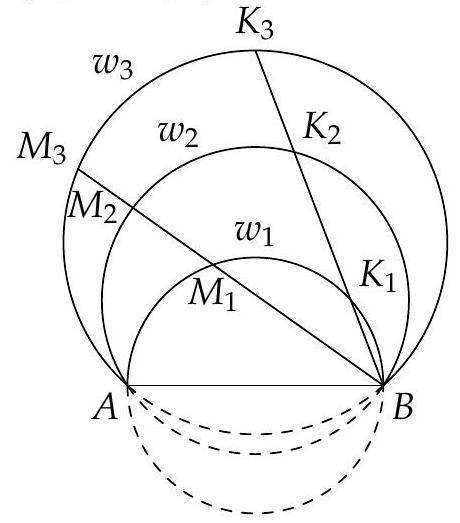
|
| 344 |
+
|
BalticWay/md/en-bw05sol.md
ADDED
|
@@ -0,0 +1,422 @@
|
|
|
|
|
|
|
|
|
|
|
|
|
|
|
|
|
|
|
|
|
|
|
|
|
|
|
|
|
|
|
|
|
|
|
|
|
|
|
|
|
|
|
|
|
|
|
|
|
|
|
|
|
|
|
|
|
|
|
|
|
|
|
|
|
|
|
|
|
|
|
|
|
|
|
|
|
|
|
|
|
|
|
|
|
|
|
|
|
|
|
|
|
|
|
|
|
|
|
|
|
|
|
|
|
|
|
|
|
|
|
|
|
|
|
|
|
|
|
|
|
|
|
|
|
|
|
|
|
|
|
|
|
|
|
|
|
|
|
|
|
|
|
|
|
|
|
|
|
|
|
|
|
|
|
|
|
|
|
|
|
|
|
|
|
|
|
|
|
|
|
|
|
|
|
|
|
|
|
|
|
|
|
|
|
|
|
|
|
|
|
|
|
|
|
|
|
|
|
|
|
|
|
|
|
|
|
|
|
|
|
|
|
|
|
|
|
|
|
|
|
|
|
|
|
|
|
|
|
|
|
|
|
|
|
|
|
|
|
|
|
|
|
|
|
|
|
|
|
|
|
|
|
|
|
|
|
|
|
|
|
|
|
|
|
|
|
|
|
|
|
|
|
|
|
|
|
|
|
|
|
|
|
|
|
|
|
|
|
|
|
|
|
|
|
|
|
|
|
|
|
|
|
|
|
|
|
|
|
|
|
|
|
|
|
|
|
|
|
|
|
|
|
|
|
|
|
|
|
|
|
|
|
|
|
|
|
|
|
|
|
|
|
|
|
|
|
|
|
|
|
|
|
|
|
|
|
|
|
|
|
|
|
|
|
|
|
|
|
|
|
|
|
|
|
|
|
|
|
|
|
|
|
|
|
|
|
|
|
|
|
|
|
|
|
|
|
|
|
|
|
|
|
|
|
|
|
|
|
|
|
|
|
|
|
|
|
|
|
|
|
|
|
|
|
|
|
|
|
|
|
|
|
|
|
|
|
|
|
|
|
|
|
|
|
|
|
|
|
|
|
|
|
|
|
|
|
|
|
|
|
|
|
|
|
|
|
|
|
|
|
|
|
|
|
|
|
|
|
|
|
|
|
|
|
|
|
|
|
|
|
|
|
|
|
|
|
|
|
|
|
|
|
|
|
|
|
|
|
|
|
|
|
|
|
|
|
|
|
|
|
|
|
|
|
|
|
|
|
|
|
|
|
|
|
|
|
|
|
|
|
|
|
|
|
|
|
|
|
|
|
|
|
|
|
|
|
|
|
|
|
|
|
|
|
|
|
|
|
|
|
|
|
|
|
|
|
|
|
|
|
|
|
|
|
|
|
|
|
|
|
|
|
|
|
|
|
|
|
|
|
|
|
|
|
|
|
|
|
|
|
|
|
|
|
|
|
|
|
|
|
|
|
|
|
|
|
|
|
|
|
|
|
|
|
|
|
|
|
|
|
|
|
|
|
|
|
|
|
|
|
|
|
|
|
|
|
|
|
|
|
|
|
|
|
|
|
|
|
|
|
|
|
|
|
|
|
|
|
|
|
|
|
|
|
|
|
|
|
|
|
|
|
|
|
|
|
|
|
|
|
|
|
|
|
|
|
|
|
|
|
|
|
|
|
|
|
|
|
|
|
|
|
|
|
|
|
|
|
|
|
|
|
|
|
|
|
|
|
|
|
|
|
|
|
|
|
|
|
|
|
|
|
|
|
|
|
|
|
|
|
|
|
|
|
|
|
|
|
|
|
|
|
|
|
|
|
|
|
|
|
|
|
|
|
|
|
|
|
|
|
|
|
|
|
|
|
|
|
|
|
|
|
|
|
|
|
|
|
|
|
|
|
|
|
|
|
|
|
|
|
|
|
|
|
|
|
|
|
|
|
|
|
|
|
|
|
|
|
|
|
|
|
|
|
|
|
|
|
|
|
|
|
|
|
|
|
|
|
|
|
|
|
|
|
|
|
|
|
|
|
|
|
|
|
|
|
|
|
|
|
|
|
|
|
|
|
|
|
|
|
|
|
|
|
|
|
|
|
|
|
|
|
|
|
|
|
|
|
|
|
|
|
|
|
|
|
|
|
|
|
|
|
|
|
|
|
|
|
|
|
|
|
|
|
|
|
|
|
|
|
|
|
|
|
|
|
|
|
|
|
|
|
|
|
|
|
|
|
|
|
|
|
|
|
|
|
|
|
|
|
|
|
|
|
|
|
|
|
|
|
|
|
|
|
|
|
|
|
|
|
|
|
|
|
|
|
|
|
|
|
|
|
|
|
|
|
|
|
|
|
|
|
|
|
|
|
|
|
|
|
|
|
|
|
|
|
|
|
|
|
|
|
|
|
|
|
|
|
|
|
|
|
|
|
|
|
|
|
|
|
|
|
|
|
|
|
|
|
|
|
|
|
|
|
|
|
|
|
|
|
|
|
|
|
|
|
|
|
|
|
|
|
|
|
|
|
|
|
|
|
|
|
|
|
|
|
|
|
|
|
|
|
|
|
|
|
|
|
|
|
|
|
|
|
|
|
|
|
|
|
|
|
|
|
|
|
|
|
|
|
|
|
|
|
|
|
|
|
|
|
|
|
|
|
|
|
|
|
|
|
|
|
|
|
|
|
|
|
|
|
|
|
|
|
|
|
|
|
|
|
|
|
|
|
|
|
|
|
|
|
|
|
|
|
|
|
|
|
|
|
|
|
|
|
|
|
|
|
|
|
|
|
|
|
|
|
|
|
|
|
|
|
|
|
|
|
|
|
|
|
|
|
|
|
|
|
|
|
|
|
|
|
|
|
|
|
|
|
|
|
|
|
|
|
|
|
|
|
|
|
|
|
|
|
|
|
|
|
|
|
|
|
|
|
|
|
|
|
|
| 1 |
+
# Baltic Way 2005
|
| 2 |
+
|
| 3 |
+
Stockholm, November 5, 2005
|
| 4 |
+
|
| 5 |
+
## Problems and solutions
|
| 6 |
+
|
| 7 |
+
1. Let $a_{0}$ be a positive integer. Define the sequence $a_{n}, n \geq 0$, as follows: If
|
| 8 |
+
|
| 9 |
+
$$
|
| 10 |
+
a_{n}=\sum_{i=0}^{j} c_{i} 10^{i}
|
| 11 |
+
$$
|
| 12 |
+
|
| 13 |
+
where $c_{i}$ are integers with $0 \leq c_{i} \leq 9$, then
|
| 14 |
+
|
| 15 |
+
$$
|
| 16 |
+
a_{n+1}=c_{0}^{2005}+c_{1}^{2005}+\cdots+c_{j}^{2005} .
|
| 17 |
+
$$
|
| 18 |
+
|
| 19 |
+
Is it possible to choose $a_{0}$ so that all the terms in the sequence are distinct?
|
| 20 |
+
|
| 21 |
+
Answer: No, the sequence must contain two equal terms.
|
| 22 |
+
|
| 23 |
+
Solution: It is clear that there exists a smallest positive integer $k$ such that
|
| 24 |
+
|
| 25 |
+
$$
|
| 26 |
+
10^{k}>(k+1) \cdot 9^{2005} .
|
| 27 |
+
$$
|
| 28 |
+
|
| 29 |
+
We will show that there exists a positive integer $N$ such that $a_{n}$ consists of less than $k+1$ decimal digits for all $n \geq N$. Let $a_{i}$ be a positive integer which consists of exactly $j+1$ digits, that is,
|
| 30 |
+
|
| 31 |
+
$$
|
| 32 |
+
10^{j} \leq a_{i}<10^{j+1} .
|
| 33 |
+
$$
|
| 34 |
+
|
| 35 |
+
We need to prove two statements:
|
| 36 |
+
|
| 37 |
+
- $a_{i+1}$ has less than $k+1$ digits if $j<k$; and
|
| 38 |
+
- $a_{i}>a_{i+1}$ if $j \geq k$.
|
| 39 |
+
|
| 40 |
+
To prove the first statement, notice that
|
| 41 |
+
|
| 42 |
+
$$
|
| 43 |
+
a_{i+1} \leq(j+1) \cdot 9^{2005}<(k+1) \cdot 9^{2005}<10^{k}
|
| 44 |
+
$$
|
| 45 |
+
|
| 46 |
+
and hence $a_{i+1}$ consists of less than $k+1$ digits. To prove the second statement, notice that $a_{i}$ consists of $j+1$ digits, none of which exceeds 9 . Hence $a_{i+1} \leq(j+1) \cdot 9^{2005}$ and because $j \geq k$, we get $a_{i} \geq 10^{j}>(j+1) \cdot 9^{2005} \geq a_{i+1}$, which proves the second statement. It is now easy to derive the result from this statement. Assume that $a_{0}$ consists of $k+1$ or more digits (otherwise we are done, because then it follows inductively that all terms of the sequence consist of less than $k+1$ digits, by the first statement). Then the sequence starts with a strictly decreasing segment $a_{0}>a_{1}>a_{2}>\cdots$ by the second statement, so for some index $N$ the number $a_{N}$ has less than $k+1$ digits. Then, by the first statement, each number $a_{n}$ with $n \geq N$ consists of at most $k$ digits. By the Pigeonhole Principle, there are two different indices $n, m \geq N$ such that $a_{n}=a_{m}$.
|
| 47 |
+
|
| 48 |
+
2. Let $\alpha, \beta$ and $\gamma$ be three angles with $0 \leq \alpha, \beta, \gamma<90^{\circ}$ and $\sin \alpha+\sin \beta+\sin \gamma=1$. Show that
|
| 49 |
+
|
| 50 |
+
$$
|
| 51 |
+
\tan ^{2} \alpha+\tan ^{2} \beta+\tan ^{2} \gamma \geq \frac{3}{8}
|
| 52 |
+
$$
|
| 53 |
+
|
| 54 |
+
Solution: Since $\tan ^{2} x=1 / \cos ^{2} x-1$, the inequality to be proved is equivalent to
|
| 55 |
+
|
| 56 |
+
$$
|
| 57 |
+
\frac{1}{\cos ^{2} \alpha}+\frac{1}{\cos ^{2} \beta}+\frac{1}{\cos ^{2} \gamma} \geq \frac{27}{8}
|
| 58 |
+
$$
|
| 59 |
+
|
| 60 |
+
The AM-HM inequality implies
|
| 61 |
+
|
| 62 |
+
$$
|
| 63 |
+
\begin{aligned}
|
| 64 |
+
\frac{3}{\frac{1}{\cos ^{2} \alpha}+\frac{1}{\cos ^{2} \beta}+\frac{1}{\cos ^{2} \gamma}} & \leq \frac{\cos ^{2} \alpha+\cos ^{2} \beta+\cos ^{2} \gamma}{3} \\
|
| 65 |
+
& =\frac{3-\left(\sin ^{2} \alpha+\sin ^{2} \beta+\sin ^{2} \gamma\right)}{3} \\
|
| 66 |
+
& \leq 1-\left(\frac{\sin \alpha+\sin \beta+\sin \gamma}{3}\right)^{2} \\
|
| 67 |
+
& =\frac{8}{9}
|
| 68 |
+
\end{aligned}
|
| 69 |
+
$$
|
| 70 |
+
|
| 71 |
+
and the result follows.
|
| 72 |
+
|
| 73 |
+
3. Consider the sequence $a_{k}$ defined by $a_{1}=1, a_{2}=\frac{1}{2}$,
|
| 74 |
+
|
| 75 |
+
$$
|
| 76 |
+
a_{k+2}=a_{k}+\frac{1}{2} a_{k+1}+\frac{1}{4 a_{k} a_{k+1}} \quad \text { for } k \geq 1
|
| 77 |
+
$$
|
| 78 |
+
|
| 79 |
+
Prove that
|
| 80 |
+
|
| 81 |
+
$$
|
| 82 |
+
\frac{1}{a_{1} a_{3}}+\frac{1}{a_{2} a_{4}}+\frac{1}{a_{3} a_{5}}+\cdots+\frac{1}{a_{98} a_{100}}<4
|
| 83 |
+
$$
|
| 84 |
+
|
| 85 |
+
Solution: Note that
|
| 86 |
+
|
| 87 |
+
$$
|
| 88 |
+
\frac{1}{a_{k} a_{k+2}}<\frac{2}{a_{k} a_{k+1}}-\frac{2}{a_{k+1} a_{k+2}}
|
| 89 |
+
$$
|
| 90 |
+
|
| 91 |
+
because this inequality is equivalent to the inequality
|
| 92 |
+
|
| 93 |
+
$$
|
| 94 |
+
a_{k+2}>a_{k}+\frac{1}{2} a_{k+1}
|
| 95 |
+
$$
|
| 96 |
+
|
| 97 |
+
which is evident for the given sequence. Now we have
|
| 98 |
+
|
| 99 |
+
$$
|
| 100 |
+
\begin{aligned}
|
| 101 |
+
\frac{1}{a_{1} a_{3}}+\frac{1}{a_{2} a_{4}} & +\frac{1}{a_{3} a_{5}}+\cdots+\frac{1}{a_{98} a_{100}} \\
|
| 102 |
+
& <\frac{2}{a_{1} a_{2}}-\frac{2}{a_{2} a_{3}}+\frac{2}{a_{2} a_{3}}-\frac{2}{a_{3} a_{4}}+\cdots \\
|
| 103 |
+
& <\frac{2}{a_{1} a_{2}}=4
|
| 104 |
+
\end{aligned}
|
| 105 |
+
$$
|
| 106 |
+
|
| 107 |
+
4. Find three different polynomials $P(x)$ with real coefficients such that $P\left(x^{2}+1\right)=P(x)^{2}+1$ for all real $x$.
|
| 108 |
+
|
| 109 |
+
Answer: For example, $P(x)=x, P(x)=x^{2}+1$ and $P(x)=x^{4}+2 x^{2}+2$.
|
| 110 |
+
|
| 111 |
+
Solution: Let $Q(x)=x^{2}+1$. Then the equation that $P$ must satisfy can be written $P(Q(x))=Q(P(x))$, and it is clear that this will be satisfied for $P(x)=x, P(x)=Q(x)$ and $P(x)=Q(Q(x))$.
|
| 112 |
+
|
| 113 |
+
Solution 2: For all reals $x$ we have $P(x)^{2}+1=P\left(x^{2}+1\right)=P(-x)^{2}+1$ and consequently, $(P(x)+P(-x))(P(x)-P(-x))=0$. Now one of the three cases holds:
|
| 114 |
+
|
| 115 |
+
(a) If both $P(x)+P(-x)$ and $P(x)-P(-x)$ are not identically 0 , then they are nonconstant polynomials and have a finite numbers of roots, so this case cannot hold.
|
| 116 |
+
(b) If $P(x)+P(-x)$ is identically 0 then obviously, $P(0)=0$. Consider the infinite sequence of integers $a_{0}=0$ and $a_{n+1}=a_{n}^{2}+1$. By induction it is easy to see that $P\left(a_{n}\right)=a_{n}$ for all non-negative integers $n$. Also, $Q(x)=x$ has that property, so $P(x)-Q(x)$ is a polynomial with infinitely many roots, whence $P(x)=x$.
|
| 117 |
+
|
| 118 |
+
(c) If $P(x)-P(-x)$ is identically 0 then
|
| 119 |
+
|
| 120 |
+
$$
|
| 121 |
+
P(x)=x^{2 n}+b_{n-1} x^{2 n-2}+\cdots+b_{1} x^{2}+b_{0}
|
| 122 |
+
$$
|
| 123 |
+
|
| 124 |
+
for some integer $n$ since $P(x)$ is even and it is easy to see that the coefficient of $x^{2 n}$ must be 1 . Putting $n=1$ and $n=2$ yield the solutions $P(x)=x^{2}+1$ and $P(x)=x^{4}+2 x^{2}+2$.
|
| 125 |
+
|
| 126 |
+
Remark: For $n=3$ there is no solution, whereas for $n=4$ there is the unique solution $P(x)=x^{8}+6 x^{6}+8 x^{4}+8 x^{2}+5$.
|
| 127 |
+
|
| 128 |
+
5. Let $a, b, c$ be positive real numbers with $a b c=1$. Prove that
|
| 129 |
+
|
| 130 |
+
$$
|
| 131 |
+
\frac{a}{a^{2}+2}+\frac{b}{b^{2}+2}+\frac{c}{c^{2}+2} \leq 1
|
| 132 |
+
$$
|
| 133 |
+
|
| 134 |
+
Solution: For any positive real $x$ we have $x^{2}+1 \geq 2 x$. Hence
|
| 135 |
+
|
| 136 |
+
$$
|
| 137 |
+
\begin{aligned}
|
| 138 |
+
\frac{a}{a^{2}+2}+\frac{b}{b^{2}+2}+\frac{c}{c^{2}+2} & \leq \frac{a}{2 a+1}+\frac{b}{2 b+1}+\frac{c}{2 c+1} \\
|
| 139 |
+
& =\frac{1}{2+1 / a}+\frac{1}{2+1 / b}+\frac{1}{2+1 / c}=: R .
|
| 140 |
+
\end{aligned}
|
| 141 |
+
$$
|
| 142 |
+
|
| 143 |
+
$R \leq 1$ is equivalent to
|
| 144 |
+
|
| 145 |
+
$$
|
| 146 |
+
\left(2+\frac{1}{b}\right)\left(2+\frac{1}{c}\right)+\left(2+\frac{1}{a}\right)\left(2+\frac{1}{c}\right)+\left(2+\frac{1}{a}\right)\left(2+\frac{1}{b}\right) \leq\left(2+\frac{1}{a}\right)\left(2+\frac{1}{b}\right)\left(2+\frac{1}{c}\right)
|
| 147 |
+
$$
|
| 148 |
+
|
| 149 |
+
and to $4 \leq \frac{1}{a b}+\frac{1}{a c}+\frac{1}{b c}+\frac{1}{a b c}$. By $a b c=1$ and by the AM-GM inequality
|
| 150 |
+
|
| 151 |
+
$$
|
| 152 |
+
\frac{1}{a b}+\frac{1}{a c}+\frac{1}{b c} \geq 3 \sqrt[3]{\left(\frac{1}{a b c}\right)^{2}}=3
|
| 153 |
+
$$
|
| 154 |
+
|
| 155 |
+
the last inequality follows. Equality appears exactly when $a=b=c=1$.
|
| 156 |
+
|
| 157 |
+
6. Let $K$ and $N$ be positive integers with $1 \leq K \leq N$. A deck of $N$ different playing cards is shuffled by repeating the operation of reversing the order of the $K$ topmost cards and moving these to the bottom of the deck. Prove that the deck will be back in its initial order after a number of operations not greater than $4 \cdot N^{2} / K^{2}$.
|
| 158 |
+
|
| 159 |
+
Solution: Let $N=q \cdot K+r, 0 \leq r<K$, and let us number the cards $1,2, \ldots, N$, starting from the one at the bottom of the deck. First we find out how the cards $1,2, \ldots K$ are moving in the deck.
|
| 160 |
+
|
| 161 |
+
If $i \leq r$ then the card $i$ is moving along the cycle
|
| 162 |
+
|
| 163 |
+
$$
|
| 164 |
+
\begin{aligned}
|
| 165 |
+
& i \rightarrow K+i \rightarrow 2 K+i \rightarrow \cdots \rightarrow q K+i \rightarrow(r+1-i) \rightarrow \\
|
| 166 |
+
& K+(r+1-i) \rightarrow \cdots \rightarrow q K+(r+1-i),
|
| 167 |
+
\end{aligned}
|
| 168 |
+
$$
|
| 169 |
+
|
| 170 |
+
because $N-K<q K+i \leq N$ and $N-K<q K+(r+1-i) \leq N$. The length of this cycle is $2 q+2$. In the special case of $i=r+i-1$, it actually consists of two smaller cycles of length $q+1$.
|
| 171 |
+
|
| 172 |
+
If $r<i \leq K$ then the card $i$ is moving along the cycle
|
| 173 |
+
|
| 174 |
+
$$
|
| 175 |
+
\begin{aligned}
|
| 176 |
+
i \rightarrow K+i \rightarrow 2 K+i \rightarrow & \cdots \rightarrow(q-1) K+i \rightarrow \\
|
| 177 |
+
& K+r+1-i \rightarrow K+(K+r+1-i) \rightarrow \\
|
| 178 |
+
& 2 K+(K+r+1-i) \rightarrow \cdots \rightarrow(q-1) K+(K+r+1-i),
|
| 179 |
+
\end{aligned}
|
| 180 |
+
$$
|
| 181 |
+
|
| 182 |
+
because $N-K<(q-1) K+i \leq N$ and $N-K<(q-1) K+(K+r+1-i) \leq N$. The length of this cycle is $2 q$. In the special case of $i=K+r+1-i$, it actually consists of two smaller cycles of length $q$.
|
| 183 |
+
|
| 184 |
+
Since these cycles cover all the numbers $1, \ldots, N$, we can say that every card returns to its initial position after either $2 q+2$ or $2 q$ operations. Therefore, all the cards are simultaneously at their initial position after at most $\operatorname{lcm}(2 q+2,2 q)=2 \operatorname{lcm}(q+1, q)=$ $2 q(q+1)$ operations. Finally,
|
| 185 |
+
|
| 186 |
+
$$
|
| 187 |
+
2 q(q+1) \leq(2 q)^{2}=4 q^{2} \leq 4\left(\frac{N}{K}\right)^{2}
|
| 188 |
+
$$
|
| 189 |
+
|
| 190 |
+
which concludes the proof.
|
| 191 |
+
|
| 192 |
+
7. A rectangular array has $n$ rows and six columns, where $n>2$. In each cell there is written either 0 or 1 . All rows in the array are different from each other. For each pair of rows $\left(x_{1}, x_{2}, \ldots, x_{6}\right)$ and $\left(y_{1}, y_{2}, \ldots, y_{6}\right)$, the row $\left(x_{1} y_{1}, x_{2} y_{2}, \ldots, x_{6} y_{6}\right)$ can also be found in the array. Prove that there is a column in which at least half of the entries are zeroes.
|
| 193 |
+
|
| 194 |
+
Solution: Clearly there must be rows with some zeroes. Consider the case when there is a row with just one zero; we can assume it is $(0,1,1,1,1,1)$. Then for each row $\left(1, x_{2}, x_{3}, x_{4}, x_{5}, x_{6}\right)$ there is also a row $\left(0, x_{2}, x_{3}, x_{4}, x_{5}, x_{6}\right)$; the conclusion follows. Consider the case when there is a row with just two zeroes; we can assume it is $(0,0,1,1,1,1)$. Let $n_{i j}$ be the number of rows with first two elements $i, j$. As in the first case $n_{00} \geq n_{11}$. Let $n_{01} \geq n_{10}$; the other subcase is analogous. Now there are $n_{00}+n_{01}$ zeroes in the first column and $n_{10}+n_{11}$ ones in the first column; the conclusion follows. Consider now the case when each row contains at least three zeroes (except $(1,1,1,1,1,1$ ), if such a row exists). Let us prove that it is impossible that each such row contains exactly three zeroes. Assume the opposite. As $n>2$ there are at least two rows with zeroes; they are different, so their product contains at least four zeroes, a contradiction. So there are more then $3(n-1)$ zeroes in the array; so in some column there are more than $(n-1) / 2$ zeroes; so there are at least $n / 2$ zeroes.
|
| 195 |
+
|
| 196 |
+
8. Consider a grid of $25 \times 25$ unit squares. Draw with a red pen contours of squares of any size on the grid. What is the minimal number of squares we must draw in order to colour all the lines of the grid?
|
| 197 |
+
|
| 198 |
+
Answer: 48 squares.
|
| 199 |
+
|
| 200 |
+
Solution: Consider a diagonal of the square grid. For any grid vertex $A$ on this diagonal denote by $C$ the farthest endpoint of this diagonal. Let the square with the diagonal $A C$ be red. Thus, we have defined the set of 48 red squares (24 for each diagonal). It is clear that if we draw all these squares, all the lines in the grid will turn red.
|
| 201 |
+
|
| 202 |
+
In order to show that 48 is the minimum, consider all grid segments of length 1 that have exactly one endpoint on the border of the grid. Every horizontal and every vertical line that cuts the grid into two parts determines two such segments. So we have $4 \cdot 24=96$ segments. It is evident that every red square can contain at most two of these segments.
|
| 203 |
+
|
| 204 |
+
9. A rectangle is divided into $200 \times 3$ unit squares. Prove that the number of ways of splitting this rectangle into rectangles of size $1 \times 2$ is divisible by 3 .
|
| 205 |
+
|
| 206 |
+
Solution: Let us denote the number of ways to split some figure into dominos by a small picture of this figure with a sign \#. For example, $\# \boxplus=2$.
|
| 207 |
+
|
| 208 |
+
Let $N_{n}=\#$ ( $n$ rows) and $\gamma_{n}=\#$ ( $n-2$ full rows and one row with two cells).
|
| 209 |
+
|
| 210 |
+
We are going to find a recurrence relation for the numbers $N_{n}$.
|
| 211 |
+
|
| 212 |
+
Observe that
|
| 213 |
+
|
| 214 |
+

|
| 215 |
+
|
| 216 |
+
We can generalize our observations by writing the equalities
|
| 217 |
+
|
| 218 |
+
$$
|
| 219 |
+
\begin{aligned}
|
| 220 |
+
N_{n} & =2 \gamma_{n}+N_{n-2}, \\
|
| 221 |
+
2 \gamma_{n-2} & =N_{n-2}-N_{n-4}, \\
|
| 222 |
+
2 \gamma_{n} & =2 \gamma_{n-2}+2 N_{n-2} .
|
| 223 |
+
\end{aligned}
|
| 224 |
+
$$
|
| 225 |
+
|
| 226 |
+
If we sum up these equalities we obtain the desired recurrence
|
| 227 |
+
|
| 228 |
+
$$
|
| 229 |
+
N_{n}=4 N_{n-2}-N_{n-4}
|
| 230 |
+
$$
|
| 231 |
+
|
| 232 |
+
It is easy to find that $N_{2}=3, N_{4}=11$. Now by the recurrence relation it is trivial to check that $N_{6 k+2} \equiv 0(\bmod 3)$.
|
| 233 |
+
|
| 234 |
+
10. Let $m=30030=2 \cdot 3 \cdot 5 \cdot 7 \cdot 11 \cdot 13$ and let $M$ be the set of its positive divisors which have exactly two prime factors. Determine the minimal integer $n$ with the following property: for any choice of numbers from $M$, there exist three numbers $a, b, c$ among them satisfying $a \cdot b \cdot c=m$.
|
| 235 |
+
|
| 236 |
+
Answer: $n=11$.
|
| 237 |
+
|
| 238 |
+
Solution: Taking the 10 divisors without the prime 13 shows that $n \geq 11$. Consider the following partition of the 15 divisors into five groups of three each with the property that the product of the numbers in every group equals $m$.
|
| 239 |
+
|
| 240 |
+
$$
|
| 241 |
+
\begin{array}{ll}
|
| 242 |
+
\{2 \cdot 3,5 \cdot 13,7 \cdot 11\}, & \{2 \cdot 5,3 \cdot 7,11 \cdot 13\}, \\
|
| 243 |
+
\{2 \cdot 11,3 \cdot 5,7 \cdot 13\}, & \{2 \cdot 13,3 \cdot 11,5 \cdot 7\} .
|
| 244 |
+
\end{array}
|
| 245 |
+
$$
|
| 246 |
+
|
| 247 |
+
If $n=11$, there is a group from which we take all three numbers, that is, their product equals $m$.
|
| 248 |
+
|
| 249 |
+
11. Let the points $D$ and $E$ lie on the sides $B C$ and $A C$, respectively, of the triangle $A B C$, satisfying $B D=A E$. The line joining the circumcentres of the triangles $A D C$ and $B E C$ meets the lines $A C$ and $B C$ at $K$ and $L$, respectively. Prove that $K C=L C$.
|
| 250 |
+
|
| 251 |
+
Solution: Assume that the circumcircles of triangles $A D C$ and $B E C$ meet at $C$ and $P$. The problem is to show that the line $K L$ makes equal angles with the lines $A C$ and $B C$. Since the line joining the circumcentres of triangles $A D C$ and $B E C$ is perpendicular to the line $C P$, it suffices to show that $C P$ is the angle-bisector of $\angle A C B$.
|
| 252 |
+
|
| 253 |
+
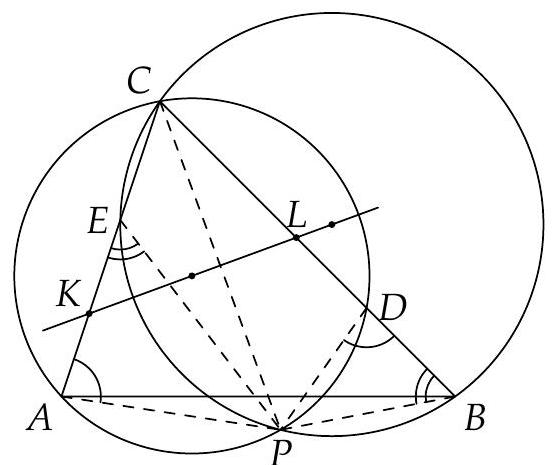
|
| 254 |
+
|
| 255 |
+
Since the points $A, P, D, C$ are concyclic, we obtain $\angle E A P=\angle B D P$. Analogously, we have $\angle A E P=\angle D B P$. These two equalities together with $A E=B D$ imply that triangles $A P E$ and $D P B$ are congruent. This means that the distance from $P$ to $A C$ is equal to the distance from $P$ to $B C$, and thus $C P$ is the angle-bisector of $\angle A C B$, as desired.
|
| 256 |
+
|
| 257 |
+
12. Let $A B C D$ be a convex quadrilateral such that $B C=A D$. Let $M$ and $N$ be the midpoints of $A B$ and $C D$, respectively. The lines $A D$ and $B C$ meet the line $M N$ at $P$ and $Q$, respectively. Prove that $C Q=D P$.
|
| 258 |
+
|
| 259 |
+
Solution: Let $A^{\prime}, B^{\prime}, C^{\prime}, D^{\prime}$ be the feet of the perpendiculars from $A, B, C, D$, respectively, onto the line $M N$. Then
|
| 260 |
+
|
| 261 |
+
$$
|
| 262 |
+
A A^{\prime}=B B^{\prime} \quad \text { and } \quad C C^{\prime}=D D^{\prime} \text {. }
|
| 263 |
+
$$
|
| 264 |
+
|
| 265 |
+
Denote by $X, Y$ the feet of the perpendiculars from $C, D$ onto the lines $B B^{\prime}, A A^{\prime}$, respectively. We infer from the above equalities that $A Y=B X$. Since also $B C=A D$, the right-angled triangles $B X C$ and $A Y D$ are congruent. This shows that
|
| 266 |
+
|
| 267 |
+
$$
|
| 268 |
+
\angle C^{\prime} C Q=\angle B^{\prime} B Q=\angle A^{\prime} A P=\angle D^{\prime} D P .
|
| 269 |
+
$$
|
| 270 |
+
|
| 271 |
+
Therefore, since $C C^{\prime}=D D^{\prime}$, the triangles $C C^{\prime} Q$ and $D D^{\prime} P$ are congruent. Thus $C Q=$ $D P$.
|
| 272 |
+
|
| 273 |
+
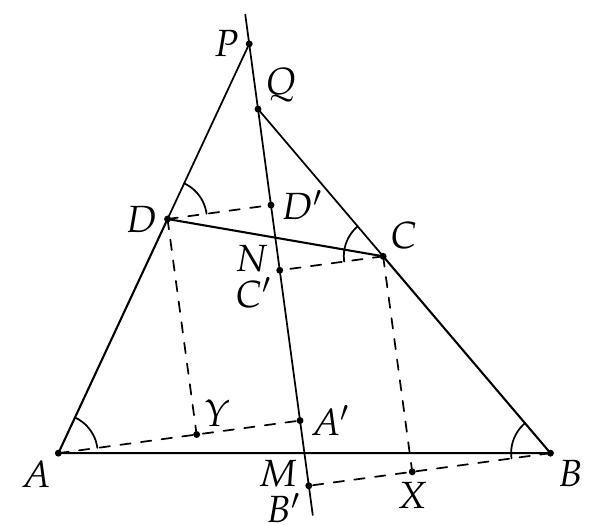
|
| 274 |
+
|
| 275 |
+
13. What is the smallest number of circles of radius $\sqrt{2}$ that are needed to cover a rectangle
|
| 276 |
+
|
| 277 |
+
(a) of size $6 \times 3$ ?
|
| 278 |
+
|
| 279 |
+
(b) of size $5 \times 3$ ?
|
| 280 |
+
|
| 281 |
+
Answer: (a) Six circles, (b) five circles.
|
| 282 |
+
|
| 283 |
+
Solution: (a) Consider the four corners and the two midpoints of the sides of length 6 . The distance between any two of these six points is 3 or more, so one circle cannot cover two of these points, and at least six circles are needed.
|
| 284 |
+
|
| 285 |
+
On the other hand one circle will cover a $2 \times 2$ square, and it is easy to see that six such squares can cover the rectangle.
|
| 286 |
+
|
| 287 |
+
(b) Consider the four corners and the centre of the rectangle. The minimum distance between any two of these points is the distance between the centre and one of the corners, which is $\sqrt{34} / 2$. This is greater than the diameter of the circle $(\sqrt{34 / 4}>\sqrt{32 / 4})$, so one circle cannot cover two of these points, and at least five circles are needed.
|
| 288 |
+
|
| 289 |
+
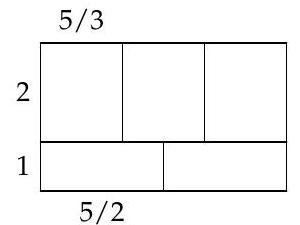
|
| 290 |
+
|
| 291 |
+
Partition the rectangle into three rectangles of size $5 / 3 \times 2$ and two rectangles of size $5 / 2 \times 1$ as shown on the right. It is easy to check that each has a diagonal of length less than $2 \sqrt{2}$, so five circles can cover the five small rectangles and hence the $5 \times 3$ rectangle.
|
| 292 |
+
|
| 293 |
+
14. Let the medians of the triangle $A B C$ meet at $M$. Let $D$ and $E$ be different points on the line $B C$ such that $D C=C E=A B$, and let $P$ and $Q$ be points on the segments $B D$ and $B E$, respectively, such that $2 B P=P D$ and $2 B Q=Q E$. Determine $\angle P M Q$.
|
| 294 |
+
|
| 295 |
+
Answer: $\angle P M Q=90^{\circ}$.
|
| 296 |
+
|
| 297 |
+
Solution: Draw the parallelogram $A B C A^{\prime}$, with $A A^{\prime} \| B C$. Then $M$ lies on $B A^{\prime}$, and $B M=\frac{1}{3} B A^{\prime}$. So $M$ is on the homothetic image (centre $B$, dilation $1 / 3$ ) of the circle with centre $C$ and radius $A B$, which meets $B C$ at $D$ and $E$. The image meets $B C$ at $P$ and $Q$. So $\angle P M Q=90^{\circ}$.
|
| 298 |
+
|
| 299 |
+
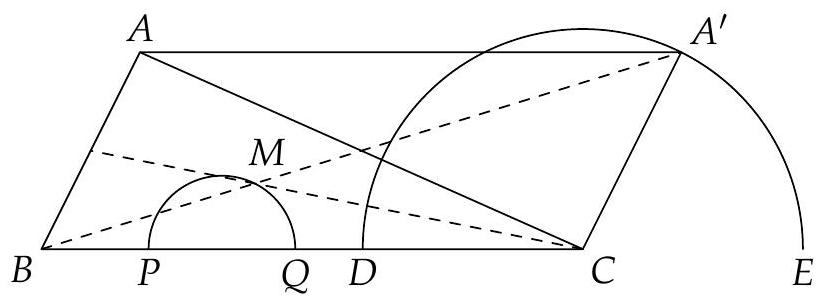
|
| 300 |
+
|
| 301 |
+
15. Let the lines $e$ and $f$ be perpendicular and intersect each other at $O$. Let $A$ and $B$ lie on $e$ and $C$ and $D$ lie on $f$, such that all the five points $A, B, C, D$ and $O$ are distinct. Let the lines $b$ and $d$ pass through $B$ and $D$ respectively, perpendicularly to $A C$; let the lines $a$ and $c$ pass through $A$ and $C$ respectively, perpendicularly to $B D$. Let $a$ and $b$ intersect $a t X$ and $c$ and $d$ intersect at $Y$. Prove that $X Y$ passes through $O$.
|
| 302 |
+
|
| 303 |
+
Solution: Let $A_{1}$ be the intersection of $a$ with $B D, B_{1}$ the intersection of $b$ with $A C, C_{1}$ the intersection of $c$ with $B D$ and $D_{1}$ the intersection of $d$ with $A C$. It follows easily by the given right angles that the following three sets each are concyclic:
|
| 304 |
+
|
| 305 |
+
- $A, A_{1}, D, D_{1}, O$ lie on a circle $w_{1}$ with diameter $A D$.
|
| 306 |
+
- $B, B_{1}, C, C 1, O$ lie on a circle $w_{2}$ with diameter $B C$.
|
| 307 |
+
- $C, C_{1}, D, D_{1}$ lie on a circle $w_{3}$ with diameter $D C$.
|
| 308 |
+
|
| 309 |
+
We see that $O$ lies on the radical axis of $w_{1}$ and $w_{2}$. Also, $Y$ lies on the radical axis of $w_{1}$ and $w_{3}$, and on the radical axis of $w_{2}$ and $w_{3}$, so $Y$ is the radical centre of $w_{1}, w_{2}$ and $w_{3}$, so it lies on the radical axis of $w_{1}$ and $w_{2}$. Analogously we prove that $X$ lies on the radical axis of $w_{1}$ and $w_{2}$.
|
| 310 |
+
|
| 311 |
+
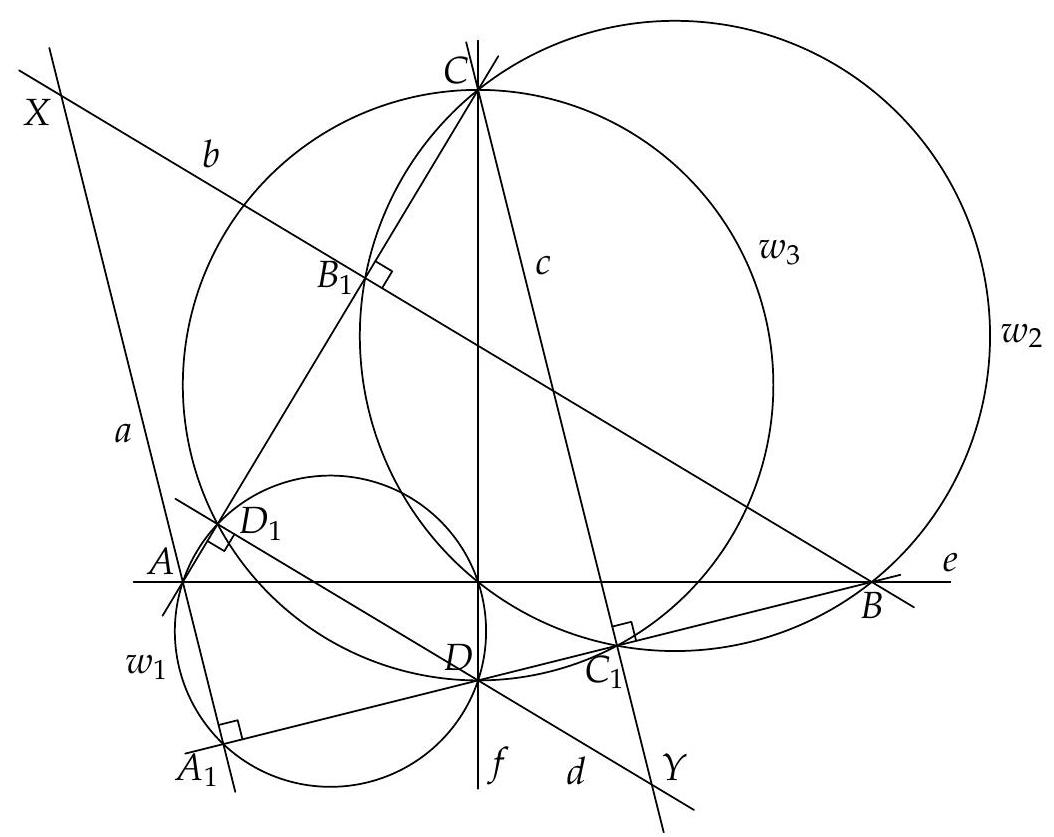
|
| 312 |
+
|
| 313 |
+
16. Let $p$ be a prime number and let $n$ be a positive integer. Let $q$ be a positive divisor of $(n+1)^{p}-n^{p}$. Show that $q-1$ is divisible by $p$.
|
| 314 |
+
|
| 315 |
+
Solution: It is sufficient to show the statement for $q$ prime. We need to prove that
|
| 316 |
+
|
| 317 |
+
$$
|
| 318 |
+
(n+1)^{p} \equiv n^{p} \quad(\bmod q) \Longrightarrow q \equiv 1 \quad(\bmod p) .
|
| 319 |
+
$$
|
| 320 |
+
|
| 321 |
+
It is obvious that $\operatorname{gcd}(n, q)=\operatorname{gcd}(n+1, q)=1$ (as $n$ and $n+1$ cannot be divisible by $q$ simultaneously). Hence there exists a positive integer $m$ such that $m n \equiv 1(\bmod q)$. In fact, $m$ is just the multiplicative inverse of $n(\bmod q)$. Take $s=m(n+1)$. It is easy to see that
|
| 322 |
+
|
| 323 |
+
$$
|
| 324 |
+
s^{p} \equiv 1 \quad(\bmod q)
|
| 325 |
+
$$
|
| 326 |
+
|
| 327 |
+
Let $t$ be the smallest positive integer which satisfies $s^{t} \equiv 1(\bmod q)(t$ is the order of $s(\bmod q)$ ). One can easily prove that $t$ divides $p$. Indeed, write $p=a t+b$ where $0 \leq b<t$. Then
|
| 328 |
+
|
| 329 |
+
$$
|
| 330 |
+
1 \equiv s^{p} \equiv s^{a t+b} \equiv\left(s^{t}\right)^{a} \cdot s^{b} \equiv s^{b} \quad(\bmod q) .
|
| 331 |
+
$$
|
| 332 |
+
|
| 333 |
+
By the definition of $t$, we must have $b=0$. Hence $t$ divides $p$. This means that $t=1$ or $t=p$. However, $t=1$ is easily seen to give a contradiction since then we would have
|
| 334 |
+
|
| 335 |
+
$$
|
| 336 |
+
m(n+1) \equiv 1 \quad(\bmod q) \quad \text { or } \quad n+1 \equiv n \quad(\bmod q)
|
| 337 |
+
$$
|
| 338 |
+
|
| 339 |
+
Therefore $t=p$, and $p$ is the order of $s(\bmod q)$. By Fermat's little theorem,
|
| 340 |
+
|
| 341 |
+
$$
|
| 342 |
+
s^{q-1} \equiv 1 \quad(\bmod q)
|
| 343 |
+
$$
|
| 344 |
+
|
| 345 |
+
Since $p$ is the order of $s(\bmod q)$, we have that $p$ divides $q-1$, and we are done.
|
| 346 |
+
|
| 347 |
+
17. A sequence $\left(x_{n}\right), n \geq 0$, is defined as follows: $x_{0}=a, x_{1}=2$ and $x_{n}=2 x_{n-1} x_{n-2}-$ $x_{n-1}-x_{n-2}+1$ for $n>1$. Find all integers a such that $2 x_{3 n}-1$ is a perfect square for all $n \geq 1$.
|
| 348 |
+
|
| 349 |
+
Answer: $a=\frac{(2 m-1)^{2}+1}{2}$ where $m$ is an arbitrary positive integer.
|
| 350 |
+
|
| 351 |
+
Solution: Let $y_{n}=2 x_{n}-1$. Then
|
| 352 |
+
|
| 353 |
+
$$
|
| 354 |
+
\begin{aligned}
|
| 355 |
+
y_{n} & =2\left(2 x_{n-1} x_{n-2}-x_{n-1}-x_{n-2}+1\right)-1 \\
|
| 356 |
+
& =4 x_{n-1} x_{n-2}-2 x_{n-1}-2 x_{n-2}+1 \\
|
| 357 |
+
& =\left(2 x_{n-1}-1\right)\left(2 x_{n-2}-1\right)=y_{n-1} y_{n-2}
|
| 358 |
+
\end{aligned}
|
| 359 |
+
$$
|
| 360 |
+
|
| 361 |
+
when $n>1$. Notice that $y_{n+3}=y_{n+2} y_{n+1}=y_{n+1}^{2} y_{n}$. We see that $y_{n+3}$ is a perfect square if and only if $y_{n}$ is a perfect square. Hence $y_{3 n}$ is a perfect square for all $n \geq 1$ exactly when $y_{0}$ is a perfect square. Since $y_{0}=2 a-1$, the result is obtained when $a=\frac{(2 m-1)^{2}+1}{2}$ for all positive integers $m$.
|
| 362 |
+
|
| 363 |
+
18. Let $x$ and $y$ be positive integers and assume that $z=4 x y /(x+y)$ is an odd integer. Prove that at least one divisor of $z$ can be expressed in the form $4 n-1$ where $n$ is a positive integer.
|
| 364 |
+
|
| 365 |
+
Solution: Let $x=2^{s} x_{1}$ and $y=2^{t} y_{1}$ where $x_{1}$ and $y_{1}$ are odd integers. Without loss of generality we can assume that $s \geq t$. We have
|
| 366 |
+
|
| 367 |
+
$$
|
| 368 |
+
z=\frac{2^{s+t+2} x_{1} y_{1}}{2^{t}\left(2^{s-t} x_{1}+y_{1}\right)}=\frac{2^{s+2} x_{1} y_{1}}{2^{s-t} x_{1}+y_{1}}
|
| 369 |
+
$$
|
| 370 |
+
|
| 371 |
+
If $s \neq t$, then the denominator is odd and therefore $z$ is even. So we have $s=t$ and $z=2^{s+2} x_{1} y_{1} /\left(x_{1}+y_{1}\right)$. Let $x_{1}=d x_{2}, y_{1}=d y_{2}$ with $\operatorname{gcd}\left(x_{2}, y_{2}\right)=1$. So $z=$ $2^{s+2} d x_{2} y_{2} /\left(x_{2}+y_{2}\right)$. As $z$ is odd, it must be that $x_{2}+y_{2}$ is divisible by $2^{s+2} \geq 4$, so $x_{2}+y_{2}$ is divisible by 4 . As $x_{2}$ and $y_{2}$ are odd integers, one of them, say $x_{2}$ is congruent to 3 modulo 4. But $\operatorname{gcd}\left(x_{2}, x_{2}+y_{2}\right)=1$, so $x_{2}$ is a divisor of $z$.
|
| 372 |
+
|
| 373 |
+
19. Is it possible to find 2005 different positive square numbers such that their sum is also a square number?
|
| 374 |
+
|
| 375 |
+
Answer: Yes, it is possible.
|
| 376 |
+
|
| 377 |
+
Solution: Start with a simple Pythagorian identity such as $3^{2}+4^{2}=5^{2}$. Multiply it by $5^{2}$
|
| 378 |
+
|
| 379 |
+
$$
|
| 380 |
+
3^{2} \cdot 5^{2}+4^{2} \cdot 5^{2}=5^{2} \cdot 5^{2}
|
| 381 |
+
$$
|
| 382 |
+
|
| 383 |
+
and insert the identity for the first
|
| 384 |
+
|
| 385 |
+
$$
|
| 386 |
+
3^{2} \cdot\left(3^{2}+4^{2}\right)+4^{2} \cdot 5^{2}=5^{2} \cdot 5^{2}
|
| 387 |
+
$$
|
| 388 |
+
|
| 389 |
+
which gives
|
| 390 |
+
|
| 391 |
+
$$
|
| 392 |
+
3^{2} \cdot 3^{2}+3^{2} \cdot 4^{2}+4^{2} \cdot 5^{2}=5^{2} \cdot 5^{2} .
|
| 393 |
+
$$
|
| 394 |
+
|
| 395 |
+
Multiply again by $5^{2}$
|
| 396 |
+
|
| 397 |
+
$$
|
| 398 |
+
3^{2} \cdot 3^{2} \cdot 5^{2}+3^{2} \cdot 4^{2} \cdot 5^{2}+4^{2} \cdot 5^{2} \cdot 5^{2}=5^{2} \cdot 5^{2} \cdot 5^{2}
|
| 399 |
+
$$
|
| 400 |
+
|
| 401 |
+
and split the first term
|
| 402 |
+
|
| 403 |
+
$$
|
| 404 |
+
3^{2} \cdot 3^{2} \cdot\left(3^{2}+4^{2}\right)+3^{2} \cdot 4^{2} \cdot 5^{2}+4^{2} \cdot 5^{2} \cdot 5^{2}=5^{2} \cdot 5^{2} \cdot 5^{2}
|
| 405 |
+
$$
|
| 406 |
+
|
| 407 |
+
that is
|
| 408 |
+
|
| 409 |
+
$$
|
| 410 |
+
3^{2} \cdot 3^{2} \cdot 3^{2}+3^{2} \cdot 3^{2} \cdot 4^{2}+3^{2} \cdot 4^{2} \cdot 5^{2}+4^{2} \cdot 5^{2} \cdot 5^{2}=5^{2} \cdot 5^{2} \cdot 5^{2} .
|
| 411 |
+
$$
|
| 412 |
+
|
| 413 |
+
This (multiplying by $5^{2}$ and splitting the first term) can be repeated as often as needed, each time increasing the number of terms by one.
|
| 414 |
+
|
| 415 |
+
Clearly, each term is a square number and the terms are strictly increasing from left to right.
|
| 416 |
+
|
| 417 |
+
20. Find all positive integers $n=p_{1} p_{2} \cdots p_{k}$ which divide $\left(p_{1}+1\right)\left(p_{2}+1\right) \cdots\left(p_{k}+1\right)$, where $p_{1} p_{2} \cdots p_{k}$ is the factorization of $n$ into prime factors (not necessarily distinct).
|
| 418 |
+
|
| 419 |
+
Answer: All numbers $2^{r} 3^{s}$ where $r$ and $s$ are non-negative integers and $s \leq r \leq 2 s$.
|
| 420 |
+
|
| 421 |
+
Solution: Let $m=\left(p_{1}+1\right)\left(p_{2}+1\right) \cdots\left(p_{k}+1\right)$. We may assume that $p_{k}$ is the largest prime factor. If $p_{k}>3$ then $p_{k}$ cannot divide $m$, because if $p_{k}$ divides $m$ it is a prime factor of $p_{i}+1$ for some $i$, but if $p_{i}=2$ then $p_{i}+1<p_{k}$, and otherwise $p_{i}+1$ is an even number with factors 2 and $\frac{1}{2}\left(p_{i}+1\right)$ which are both strictly smaller than $p_{k}$. Thus the only primes that can divide $n$ are 2 and 3 , so we can write $n=2^{r} 3^{s}$. Then $m=3^{r} 4^{s}=2^{2 s} 3^{r}$ which is divisible by $n$ if and only if $s \leq r \leq 2 s$.
|
| 422 |
+
|
BalticWay/md/en-bw06sol.md
ADDED
|
@@ -0,0 +1,325 @@
|
|
|
|
|
|
|
|
|
|
|
|
|
|
|
|
|
|
|
|
|
|
|
|
|
|
|
|
|
|
|
|
|
|
|
|
|
|
|
|
|
|
|
|
|
|
|
|
|
|
|
|
|
|
|
|
|
|
|
|
|
|
|
|
|
|
|
|
|
|
|
|
|
|
|
|
|
|
|
|
|
|
|
|
|
|
|
|
|
|
|
|
|
|
|
|
|
|
|
|
|
|
|
|
|
|
|
|
|
|
|
|
|
|
|
|
|
|
|
|
|
|
|
|
|
|
|
|
|
|
|
|
|
|
|
|
|
|
|
|
|
|
|
|
|
|
|
|
|
|
|
|
|
|
|
|
|
|
|
|
|
|
|
|
|
|
|
|
|
|
|
|
|
|
|
|
|
|
|
|
|
|
|
|
|
|
|
|
|
|
|
|
|
|
|
|
|
|
|
|
|
|
|
|
|
|
|
|
|
|
|
|
|
|
|
|
|
|
|
|
|
|
|
|
|
|
|
|
|
|
|
|
|
|
|
|
|
|
|
|
|
|
|
|
|
|
|
|
|
|
|
|
|
|
|
|
|
|
|
|
|
|
|
|
|
|
|
|
|
|
|
|
|
|
|
|
|
|
|
|
|
|
|
|
|
|
|
|
|
|
|
|
|
|
|
|
|
|
|
|
|
|
|
|
|
|
|
|
|
|
|
|
|
|
|
|
|
|
|
|
|
|
|
|
|
|
|
|
|
|
|
|
|
|
|
|
|
|
|
|
|
|
|
|
|
|
|
|
|
|
|
|
|
|
|
|
|
|
|
|
|
|
|
|
|
|
|
|
|
|
|
|
|
|
|
|
|
|
|
|
|
|
|
|
|
|
|
|
|
|
|
|
|
|
|
|
|
|
|
|
|
|
|
|
|
|
|
|
|
|
|
|
|
|
|
|
|
|
|
|
|
|
|
|
|
|
|
|
|
|
|
|
|
|
|
|
|
|
|
|
|
|
|
|
|
|
|
|
|
|
|
|
|
|
|
|
|
|
|
|
|
|
|
|
|
|
|
|
|
|
|
|
|
|
|
|
|
|
|
|
|
|
|
|
|
|
|
|
|
|
|
|
|
|
|
|
|
|
|
|
|
|
|
|
|
|
|
|
|
|
|
|
|
|
|
|
|
|
|
|
|
|
|
|
|
|
|
|
|
|
|
|
|
|
|
|
|
|
|
|
|
|
|
|
|
|
|
|
|
|
|
|
|
|
|
|
|
|
|
|
|
|
|
|
|
|
|
|
|
|
|
|
|
|
|
|
|
|
|
|
|
|
|
|
|
|
|
|
|
|
|
|
|
|
|
|
|
|
|
|
|
|
|
|
|
|
|
|
|
|
|
|
|
|
|
|
|
|
|
|
|
|
|
|
|
|
|
|
|
|
|
|
|
|
|
|
|
|
|
|
|
|
|
|
|
|
|
|
|
|
|
|
|
|
|
|
|
|
|
|
|
|
|
|
|
|
|
|
|
|
|
|
|
|
|
|
|
|
|
|
|
|
|
|
|
|
|
|
|
|
|
|
|
|
|
|
|
|
|
|
|
|
|
|
|
|
|
|
|
|
|
|
|
|
|
|
|
|
|
|
|
|
|
|
|
|
|
|
|
|
|
|
|
|
|
|
|
|
|
|
|
|
|
|
|
|
|
|
|
|
|
|
|
|
|
|
|
|
|
|
|
|
|
|
|
|
|
|
|
|
|
|
|
|
|
|
|
|
|
|
|
|
|
|
|
|
|
|
|
|
|
|
|
|
|
|
|
|
|
|
|
|
|
|
|
|
|
|
|
|
|
|
|
|
|
|
|
|
|
|
|
|
|
|
|
|
|
|
|
|
|
|
|
|
|
|
|
|
|
|
|
|
|
|
|
|
|
|
|
|
|
|
|
|
|
|
|
|
|
|
|
|
|
|
|
|
|
|
|
|
|
|
|
|
|
|
|
|
|
|
|
|
|
|
|
|
|
|
|
|
|
|
|
|
|
|
|
|
|
|
|
|
|
|
|
|
|
|
|
|
|
|
|
|
|
|
|
|
|
|
|
|
|
|
|
|
|
|
|
|
|
|
|
|
|
|
|
|
|
|
|
|
|
|
|
|
|
|
|
|
|
|
|
|
|
|
|
|
|
|
|
|
|
|
|
|
|
|
|
|
|
|
|
|
|
|
|
|
|
| 1 |
+
# Baltic Way 2006 <br> Turku, November 3, 2006
|
| 2 |
+
|
| 3 |
+
## Problems and solutions
|
| 4 |
+
|
| 5 |
+
1. For a sequence $a_{1}, a_{2}, a_{3}, \ldots$ of real numbers it is known that
|
| 6 |
+
|
| 7 |
+
$$
|
| 8 |
+
a_{n}=a_{n-1}+a_{n+2} \quad \text { for } n=2,3,4, \ldots
|
| 9 |
+
$$
|
| 10 |
+
|
| 11 |
+
What is the largest number of its consecutive elements that can all be positive?
|
| 12 |
+
|
| 13 |
+
Answer: 5.
|
| 14 |
+
|
| 15 |
+
Solution: The initial segment of the sequence could be $1 ; 2 ; 3 ; 1 ; 1 ;-2 ; 0$. Clearly it is enough to consider only initial segments. For each sequence the first 6 elements are $a_{1} ; a_{2}$; $a_{3} ; a_{2}-a_{1} ; a_{3}-a_{2} ; a_{2}-a_{1}-a_{3}$. As we see, $a_{1}+a_{5}+a_{6}=a_{1}+\left(a_{3}-a_{2}\right)+\left(a_{2}-a_{1}-a_{3}\right)=$ 0 . So all the elements $a_{1}, a_{5}, a_{6}$ can not be positive simultaneously.
|
| 16 |
+
|
| 17 |
+
2. Suppose that the real numbers $a_{i} \in[-2,17], i=1,2, \ldots, 59$, satisfy $a_{1}+a_{2}+\cdots+a_{59}=0$. Prove that
|
| 18 |
+
|
| 19 |
+
$$
|
| 20 |
+
a_{1}^{2}+a_{2}^{2}+\cdots+a_{59}^{2} \leq 2006 .
|
| 21 |
+
$$
|
| 22 |
+
|
| 23 |
+
Solution: For convenience denote $m=-2$ and $M=17$. Then
|
| 24 |
+
|
| 25 |
+
$$
|
| 26 |
+
\left(a_{i}-\frac{m+M}{2}\right)^{2} \leq\left(\frac{M-m}{2}\right)^{2},
|
| 27 |
+
$$
|
| 28 |
+
|
| 29 |
+
because $m \leq a_{i} \leq M$. So we have
|
| 30 |
+
|
| 31 |
+
$$
|
| 32 |
+
\begin{aligned}
|
| 33 |
+
\sum_{i=1}^{59}\left(a_{i}-\frac{m+M}{2}\right)^{2} & =\sum_{i} a_{i}^{2}+59 \cdot\left(\frac{m+M}{2}\right)^{2}-(m+M) \sum_{i} a_{i} \\
|
| 34 |
+
& \leq 59 \cdot\left(\frac{M-m}{2}\right)^{2},
|
| 35 |
+
\end{aligned}
|
| 36 |
+
$$
|
| 37 |
+
|
| 38 |
+
and thus
|
| 39 |
+
|
| 40 |
+
$$
|
| 41 |
+
\sum_{i} a_{i}^{2} \leq 59 \cdot\left(\left(\frac{M-m}{2}\right)^{2}-\left(\frac{m+M}{2}\right)^{2}\right)=-59 \cdot m \cdot M=2006 .
|
| 42 |
+
$$
|
| 43 |
+
|
| 44 |
+
3. Prove that for every polynomial $P(x)$ with real coefficients there exist a positive integer $m$ and polynomials $P_{1}(x), P_{2}(x), \ldots, P_{m}(x)$ with real coefficients such that
|
| 45 |
+
|
| 46 |
+
$$
|
| 47 |
+
P(x)=\left(P_{1}(x)\right)^{3}+\left(P_{2}(x)\right)^{3}+\cdots+\left(P_{m}(x)\right)^{3} .
|
| 48 |
+
$$
|
| 49 |
+
|
| 50 |
+
Solution: We will prove by induction on the degree of $P(x)$ that all polynomials can be represented as a sum of cubes. This is clear for constant polynomials. Now we proceed to the inductive step. It is sufficient to show that if $P(x)$ is a polynomial of degree $n$, then there exist polynomials $Q_{1}(x), Q_{2}(x), \ldots, Q_{r}(x)$ such that the polynomial
|
| 51 |
+
|
| 52 |
+
$$
|
| 53 |
+
P(x)-\left(Q_{1}(x)\right)^{3}-\left(Q_{2}(x)\right)^{3}-\cdots-\left(Q_{r}(x)\right)^{3}
|
| 54 |
+
$$
|
| 55 |
+
|
| 56 |
+
has degree at most $n-1$. Assume that the coefficient of $x^{n}$ in $P(x)$ is equal to $c$. We consider three cases: If $n=3 k$, we put $r=1, Q_{1}(x)=\sqrt[3]{c} x^{k}$; if $n=3 k+1$ we put $r=3$,
|
| 57 |
+
|
| 58 |
+
$$
|
| 59 |
+
Q_{1}(x)=\sqrt[3]{\frac{c}{6}} x^{k}(x-1), \quad Q_{2}(x)=\sqrt[3]{\frac{c}{6}} x^{k}(x+1), \quad Q_{3}(x)=-\sqrt[3]{\frac{c}{3}} x^{k+1}
|
| 60 |
+
$$
|
| 61 |
+
|
| 62 |
+
and if $n=3 k+2$ we put $r=2$ and
|
| 63 |
+
|
| 64 |
+
$$
|
| 65 |
+
Q_{1}(x)=\sqrt[3]{\frac{c}{3}} x^{k}(x+1), \quad Q_{2}(x)=-\sqrt[3]{\frac{c}{3}} x^{k+1}
|
| 66 |
+
$$
|
| 67 |
+
|
| 68 |
+
This completes the induction.
|
| 69 |
+
|
| 70 |
+
4. Let $a, b, c, d, e, f$ be non-negative real numbers satisfying $a+b+c+d+e+f=6$. Find the maximal possible value of
|
| 71 |
+
|
| 72 |
+
$$
|
| 73 |
+
a b c+b c d+c d e+d e f+e f a+f a b
|
| 74 |
+
$$
|
| 75 |
+
|
| 76 |
+
and determine all 6-tuples $(a, b, c, d, e, f)$ for which this maximal value is achieved.
|
| 77 |
+
|
| 78 |
+
Answer: 8 .
|
| 79 |
+
|
| 80 |
+
Solution: If we set $a=b=c=2, d=e=f=0$, then the given expression is equal to 8 . We will show that this is the maximal value. Applying the inequality between arithmetic and geometric mean we obtain
|
| 81 |
+
|
| 82 |
+
$$
|
| 83 |
+
\begin{aligned}
|
| 84 |
+
8 & =\left(\frac{(a+d)+(b+e)+(c+f)}{3}\right)^{3} \geq(a+d)(b+e)(c+f) \\
|
| 85 |
+
& =(a b c+b c d+c d e+d e f+e f a+f a b)+(a c e+b d f),
|
| 86 |
+
\end{aligned}
|
| 87 |
+
$$
|
| 88 |
+
|
| 89 |
+
so we see that $a b c+b c d+c d e+d e f+e f a+f a b \leq 8$ and the maximal value 8 is achieved when $a+d=b+e=c+f$ (and then the common value is 2 because $a+b+c+d+$ $e+f=6)$ and $a c e=b d f=0$, which can be written as $(a, b, c, d, e, f)=(a, b, c, 2-a, 2-$ $b, 2-c)$ with $a c(2-b)=b(2-a)(2-c)=0$. From this it follows that $(a, b, c)$ must have one of the forms $(0,0, t),(0, t, 2),(t, 2,2),(2,2, t),(2, t, 0)$ or $(t, 0,0)$. Therefore the maximum is achieved for the 6 -tuples $(a, b, c, d, e, f)=(0,0, t, 2,2,2-t)$, where $0 \leq t \leq 2$, and its cyclic permutations.
|
| 90 |
+
|
| 91 |
+
5. An occasionally unreliable professor has devoted his last book to a certain binary operation $*$. When this operation is applied to any two integers, the result is again an integer. The operation is known to satisfy the following axioms:
|
| 92 |
+
|
| 93 |
+
(a) $x *(x * y)=y$ for all $x, y \in \mathbb{Z}$;
|
| 94 |
+
|
| 95 |
+
(b) $(x * y) * y=x$ for all $x, y \in \mathbb{Z}$.
|
| 96 |
+
|
| 97 |
+
The professor claims in his book that
|
| 98 |
+
|
| 99 |
+
(C1) the operation $*$ is commutative: $x * y=y * x$ for all $x, y \in \mathbb{Z}$.
|
| 100 |
+
|
| 101 |
+
(C2) the operation $*$ is associative: $(x * y) * z=x *(y * z)$ for all $x, y, z \in \mathbb{Z}$.
|
| 102 |
+
|
| 103 |
+
Which of these claims follow from the stated axioms?
|
| 104 |
+
|
| 105 |
+
Answer: (C1) is true; (C2) is false.
|
| 106 |
+
|
| 107 |
+
Solution: Write $(x, y, z)$ for $x * y=z$. So the axioms can be formulated as
|
| 108 |
+
|
| 109 |
+
$$
|
| 110 |
+
\begin{aligned}
|
| 111 |
+
& (x, y, z) \Longrightarrow(x, z, y) \\
|
| 112 |
+
& (x, y, z) \Longrightarrow(z, y, x) .
|
| 113 |
+
\end{aligned}
|
| 114 |
+
$$
|
| 115 |
+
|
| 116 |
+
(C1) is proved by the sequence $(x, y, z) \xrightarrow{(2)}(z, y, x) \xrightarrow{(1)}(z, x, y) \xrightarrow{(2)}(y, x, z)$.
|
| 117 |
+
|
| 118 |
+
A counterexample for (C2) is the operation $x * y=-(x+y)$.
|
| 119 |
+
|
| 120 |
+
6. Determine the maximal size of a set of positive integers with the following properties:
|
| 121 |
+
|
| 122 |
+
(1) The integers consist of digits from the set $\{1,2,3,4,5,6\}$.
|
| 123 |
+
|
| 124 |
+
(2) No digit occurs more than once in the same integer.
|
| 125 |
+
|
| 126 |
+
(3) The digits in each integer are in increasing order.
|
| 127 |
+
|
| 128 |
+
(4) Any two integers have at least one digit in common (possibly at different positions).
|
| 129 |
+
|
| 130 |
+
(5) There is no digit which appears in all the integers.
|
| 131 |
+
|
| 132 |
+
Answer: 32.
|
| 133 |
+
|
| 134 |
+
Solution: Associate with any $a_{i}$ the set $M_{i}$ of its digits. By (??), (??) and (??) the numbers are uniquely determined by their associated subsets of $\{1,2, \ldots, 6\}$. By (??) the sets are intersecting. Partition the 64 subsets of $\{1,2, \ldots, 6\}$ into 32 pairs of complementary sets $(X,\{1,2, \ldots, 6\}-X)$. Obviously, at most one of the two sets in such a pair can be a $M_{i}$, since the two sets are non-intersecting. Hence, $n \leq 32$. Consider the 22 subsets with at least four elements and the 10 subsets with three elements containing 1 . Hence, $n=32$. 7. A photographer took some pictures at a party with 10 people. Each of the 45 possible pairs of people appears together on exactly one photo, and each photo depicts two or three people. What is the smallest possible number of photos taken?
|
| 135 |
+
|
| 136 |
+
Answer: 19.
|
| 137 |
+
|
| 138 |
+
Solution: Let $x$ be the number of triplet photos (depicting three people, that is, three pairs) and let $y$ be the number of pair photos (depicting two people, that is, one pair). Then $3 x+y=45$.
|
| 139 |
+
|
| 140 |
+
Each person appears with nine other people, and since 9 is odd, each person appears on at least one pair photo. Thus $y \geq 5$, so that $x \leq 13$. The total number of photos is $x+y=45-2 x \geq 45-2 \cdot 13=19$.
|
| 141 |
+
|
| 142 |
+
On the other hand, 19 photos will suffice. We number the persons $0,1, \ldots, 9$, and will proceed to specify 13 triplet photos. We start with making triplets without common pairs of the persons $1-8$ :
|
| 143 |
+
|
| 144 |
+
$$
|
| 145 |
+
123,345,567,781
|
| 146 |
+
$$
|
| 147 |
+
|
| 148 |
+
Think of the persons 1-8 as arranged in order around a circle. Then the persons in each triplet above are separated by at most one person. Next we make triplets containing 0 , avoiding previously mentioned pairs by combining 0 with two people among the persons $1-8$ separated by two persons:
|
| 149 |
+
|
| 150 |
+
$$
|
| 151 |
+
014,085,027,036
|
| 152 |
+
$$
|
| 153 |
+
|
| 154 |
+
Then we make triplets containing 9, again avoiding previously mentioned pairs by combining 9 with the other four possibilities of two people among 1-8 being separated by two persons:
|
| 155 |
+
|
| 156 |
+
$$
|
| 157 |
+
916,925,938,947
|
| 158 |
+
$$
|
| 159 |
+
|
| 160 |
+
Finally, we make our last triplet, again by combining people from 1-8: 246 . Here 2 and 4 , and 4 and 6 , are separated by one person, but those pairs were not accounted for in the first list, whereas 2 and 6 are separated by three persons, and have not been paired before. We now have 13 photos of 39 pairs. The remaining 6 pairs appear on 6 pair photos.
|
| 161 |
+
|
| 162 |
+
Remark: This problem is equivalent to asking how many complete 3-graphs can be packed (without common edges) into a complete 10-graph.
|
| 163 |
+
|
| 164 |
+
8. The director has found out that six conspiracies have been set up in his department, each of them involving exactly three persons. Prove that the director can split the department in two laboratories so that none of the conspirative groups is entirely in the same laboratory.
|
| 165 |
+
|
| 166 |
+
Solution: Let the department consist of $n$ persons. Clearly $n>4$ (because $\left(\begin{array}{l}4 \\ 3\end{array}\right)<6$ ). If $n=5$, take three persons who do not make a conspiracy and put them in one laboratory, the other two in another. If $n=6$, note that $\left(\begin{array}{l}6 \\ 3\end{array}\right)=20$, so we can find a three-person set such that neither it nor its complement is a conspiracy; this set will form one laboratory. If $n \geq 7$, use induction. We have $\left(\begin{array}{l}n \\ 2\end{array}\right) \geq\left(\begin{array}{l}7 \\ 2\end{array}\right)=21>6 \cdot 3$, so there are two persons $A$ and $B$ who are not together in any conspiracy. Replace $A$ and $B$ by a new person $A B$ and use the inductive hypothesis; then replace $A B$ by initial persons $A$ and $B$.
|
| 167 |
+
|
| 168 |
+
9. To every vertex of a regular pentagon a real number is assigned. We may perform the following operation repeatedly: we choose two adjacent vertices of the pentagon and replace each of the two numbers assigned to these vertices by their arithmetic mean. Is it always possible to obtain the position in which all five numbers are zeroes, given that in the initial position the sum of all five numbers is equal to zero?
|
| 169 |
+
|
| 170 |
+
Answer: No.
|
| 171 |
+
|
| 172 |
+
Solution: We will show that starting from the numbers $-\frac{1}{5},-\frac{1}{5},-\frac{1}{5},-\frac{1}{5}, \frac{4}{5}$ we cannot get five zeroes. By adding $\frac{1}{5}$ to all vertices we see that our task is equivalent to showing that beginning from numbers $0,0,0,0,1$ and performing the same operations we can never get five numbers $\frac{1}{5}$. This we prove by noticing that in the initial position all the numbers are "binary rational" - that is, of the form $\frac{k}{2^{m}}$, where $k$ is an integer and $m$ is a non-negative integer - and an arithmetic mean of two binary rationals is also such a number, while the number $\frac{1}{5}$ is not of such form.
|
| 173 |
+
|
| 174 |
+
10. 162 pluses and 144 minuses are placed in a $30 \times 30$ table in such a way that each row and each column contains at most 17 signs. (No cell contains more than one sign.) For every plus we count the number of minuses in its row and for every minus we count the number of pluses in its column. Find the maximum of the sum of these numbers.
|
| 175 |
+
|
| 176 |
+
Answer: $1296=72 \cdot 18$.
|
| 177 |
+
|
| 178 |
+
Solution: In the statement of the problem there are two kinds of numbers: "horizontal" (that has been counted for pluses) and "vertical" (for minuses). We will show that the sum of numbers of each type reaches its maximum on the same configuration.
|
| 179 |
+
|
| 180 |
+
We restrict our attention to the horizontal numbers only. Consider an arbitrary row. Let it contains $p$ pluses and $m$ minuses, $m+p \leq 17$. Then the sum that has been counted for pluses in this row is equal to $m p$. Let us redistribute this sum between all signs in the row. More precisely, let us write the number $m p /(m+p)$ in every nonempty cell in the row. Now the whole "horizontal" sum equals to the sum of all 306 written numbers.
|
| 181 |
+
|
| 182 |
+
Now let us find the maximal possible contribution of each sign in this sum. That is, we ask about maximum of the expression $f(m, p)=m p /(m+p)$ where $m+p \leq 17$. Remark that $f(m, p)$ is an increasing function of $m$. Therefore if $m+p<17$ then increasing of $m$ will also increase the value of $f(m, p)$. Now if $m+p=17$ then $f(m, p)=m(17-m) / 17$ and, obviously, it has maximum $72 / 17$ when $m=8$ or $m=9$.
|
| 183 |
+
|
| 184 |
+
So all the 306 summands in the horizontal sum will be maximal if we find a configuration in which every non-empty row contains 9 pluses and 8 minuses. The similar statement holds for the vertical sum. In order to obtain the desired configuration take a square $18 \times 18$ and draw pluses on 9 generalized diagonals and minuses on 8 other generalized diagonals (the 18th generalized diagonal remains empty).
|
| 185 |
+
|
| 186 |
+
11. The altitudes of a triangle are 12,15 and 20. What is the area of the triangle?
|
| 187 |
+
|
| 188 |
+
Answer: 150.
|
| 189 |
+
|
| 190 |
+
Solution: Denote the sides of the triangle by $a, b$ and $c$ and its altitudes by $h_{a}, h_{b}$ and $h_{c}$. Then we know that $h_{a}=12, h_{b}=15$ and $h_{c}=20$. By the well known relation $a: b=h_{b}: h_{a}$ it follows $b=\frac{h_{a}}{h_{b}} a=\frac{12}{15} a=\frac{4}{5} a$. Analogously, $c=\frac{h_{a}}{h_{c}} a=\frac{12}{20} a=\frac{3}{5} a$. Thus half of the triangle's circumference is $s=\frac{1}{2}(a+b+c)=\frac{1}{2}\left(a+\frac{4}{5} a+\frac{3}{5} a\right)=\frac{6}{5} a$. For the area $\Delta$ of the triangle we have $\Delta=\frac{1}{2} a h_{a}=\frac{1}{2} a 12=6 a$, and also by the well known Heron formula $\Delta=\sqrt{s(s-a)(s-b)(s-c)}=\sqrt{\frac{6}{5} a \cdot \frac{1}{5} a \cdot \frac{2}{5} a \cdot \frac{3}{5} a}=\sqrt{\frac{6^{2}}{5^{4}} a^{4}}=\frac{6}{25} a^{2}$. Hence, $6 a=\frac{6}{25} a^{2}$, and we get $a=25(b=20, c=15)$ and consequently $\Delta=150$.
|
| 191 |
+
|
| 192 |
+
12. Let $A B C$ be a triangle, let $B_{1}$ be the midpoint of the side $A B$ and $C_{1}$ the midpoint of the side $A C$. Let $P$ be the point of intersection, other than $A$, of the circumscribed circles around the triangles $A B C_{1}$ and $A B_{1} C$. Let $P_{1}$ be the point of intersection, other than $A$, of the line $A P$ with the circumscribed circle around the triangle $A B_{1} C_{1}$. Prove that $2 A P=3 A P_{1}$.
|
| 193 |
+
|
| 194 |
+
Solution: Since $\angle P B B_{1}=\angle P B A=180^{\circ}-\angle P C_{1} A=\angle P C_{1} C$ and $\angle P C C_{1}=\angle P C A=$ $180^{\circ}-\angle P B_{1} A=\angle P B_{1} B$ it follows that $\triangle P B B_{1}$ is similar to $\triangle P C_{1} C$. Let $B_{2}$ and $C_{2}$ be the midpoints of $B B_{1}$ and $C C_{1}$ respectively. It follows that $\angle B P B_{2}=\angle C_{1} P C_{2}$ and hence $\angle B_{2} P C_{2}=\angle B P C_{1}=180^{\circ}-\angle B A C$, which implies that $A B_{2} P C_{2}$ lie on a circle. By similarity it is now clear that $A P / A P_{1}=A B_{2} / A B_{1}=A C_{2} / A C_{1}=3 / 2$.
|
| 195 |
+
|
| 196 |
+

|
| 197 |
+
|
| 198 |
+
13. In a triangle $A B C$, points $D, E$ lie on sides $A B, A C$ respectively. The lines $B E$ and $C D$ intersect at $F$. Prove that if
|
| 199 |
+
|
| 200 |
+
$$
|
| 201 |
+
B C^{2}=B D \cdot B A+C E \cdot C A,
|
| 202 |
+
$$
|
| 203 |
+
|
| 204 |
+
then the points $A, D, F, E$ lie on a circle.
|
| 205 |
+
|
| 206 |
+
Solution: Let $G$ be a point on the segment $B C$ determined by the condition $B G \cdot B C=$ $B D \cdot B A$. (Such a point exists because $B D \cdot B A<B C^{2}$.) Then the points $A, D, G, C$ lie on a circle. Moreover, we have
|
| 207 |
+
|
| 208 |
+
$$
|
| 209 |
+
C E \cdot C A=B C^{2}-B D \cdot B A=B C \cdot(B G+C G)-B C \cdot B G=C B \cdot C G,
|
| 210 |
+
$$
|
| 211 |
+
|
| 212 |
+
hence the points $A, B, G, E$ lie on a circle as well. Therefore
|
| 213 |
+
|
| 214 |
+
$$
|
| 215 |
+
\angle D A G=\angle D C G, \quad \angle E A G=\angle E B G,
|
| 216 |
+
$$
|
| 217 |
+
|
| 218 |
+
which implies that
|
| 219 |
+
|
| 220 |
+
$$
|
| 221 |
+
\begin{aligned}
|
| 222 |
+
\angle D A E+\angle D F E & =\angle D A G+\angle E A G+\angle B F C \\
|
| 223 |
+
& =\angle D C G+\angle E B G+\angle B F C .
|
| 224 |
+
\end{aligned}
|
| 225 |
+
$$
|
| 226 |
+
|
| 227 |
+
But the sum on the right side is the sum of angles in $\triangle B F C$. Thus $\angle D A E+\angle D F E=180^{\circ}$, and the desired result follows.
|
| 228 |
+
|
| 229 |
+
14. There are 2006 points marked on the surface of a sphere. Prove that the surface can be cut into 2006 congruent pieces so that each piece contains exactly one of these points inside it.
|
| 230 |
+
|
| 231 |
+
Solution: Choose a North Pole and a South Pole so that no two points are on the same parallel and no point coincides with either pole. Draw parallels through each point. Divide each of these parallels into 2006 equal arcs so that no point is the endpoint of any arc. In the sequel, "to connect two points" means to draw the smallest arc of the great circle passing through these points. Denote the points of division by $A_{i, j}$, where $i$ is the number of the parallel counting from North to South $(i=1,2, \ldots, 2006)$, and $A_{i, 1}, A_{i, 2}, \ldots, A_{i, 2006}$ are the points of division on the $i$ 'th parallel, where the numbering is chosen such that the marked point on the $i^{\prime}$ th parallel lies between $A_{i, i}$ and $A_{i, i+1}$.
|
| 232 |
+
|
| 233 |
+
Consider the lines connecting gradually
|
| 234 |
+
|
| 235 |
+
$$
|
| 236 |
+
\begin{gathered}
|
| 237 |
+
N-A_{1,1}-A_{2,1}-A_{3,1}-\cdots-A_{2006,1}-S \\
|
| 238 |
+
N-A_{1,2}-A_{2,2}-A_{3,2}-\cdots-A_{2006,2}-S \\
|
| 239 |
+
\vdots \\
|
| 240 |
+
N-A_{1,2006}-A_{2,2006}-A_{3,2006}-\cdots-A_{2006,2006}-S
|
| 241 |
+
\end{gathered}
|
| 242 |
+
$$
|
| 243 |
+
|
| 244 |
+
These lines divide the surface of the sphere into 2006 parts which are congruent by rotation; each part contains one of the given points.
|
| 245 |
+
|
| 246 |
+
15. Let the medians of the triangle $A B C$ intersect at the point $M$. A line $t$ through $M$ intersects the circumcircle of $A B C$ at $X$ and $Y$ so that $A$ and $C$ lie on the same side of $t$. Prove that $B X \cdot B Y=A X \cdot A Y+C X \cdot C Y$.
|
| 247 |
+
|
| 248 |
+
Solution: Let us start with a lemma: If the diagonals of an inscribed quadrilateral $A B C D$ intersect at $O$, then $\frac{A B \cdot B C}{A D \cdot D C}=\frac{B O}{O D}$. Indeed,
|
| 249 |
+
|
| 250 |
+
$$
|
| 251 |
+
\frac{A B \cdot B C}{A D \cdot D C}=\frac{\frac{1}{2} A B \cdot B C \cdot \sin B}{\frac{1}{2} A D \cdot D C \cdot \sin D}=\frac{\operatorname{area}(A B C)}{\operatorname{area}(A D C)}=\frac{h_{1}}{h_{2}}=\frac{B O}{O D}
|
| 252 |
+
$$
|
| 253 |
+
|
| 254 |
+
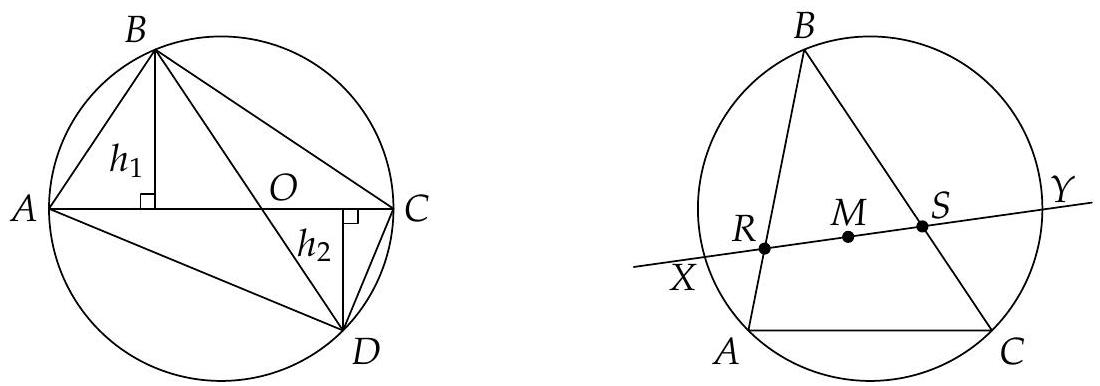
|
| 255 |
+
|
| 256 |
+
Now we have (from the lemma) $\frac{A X \cdot A Y}{B X \cdot B Y}=\frac{A R}{R B}$ and $\frac{C X \cdot C Y}{B X \cdot B Y}=\frac{C S}{S B}$, so we have to prove $\frac{A R}{R B}+\frac{C S}{S B}=1$.
|
| 257 |
+
|
| 258 |
+
Suppose at first that the line $R S$ is not parallel to $A C$. Let $R S$ intersect $A C$ at $K$ and the line parallel to $A C$ through $B$ at $L$. So $\frac{A R}{R B}=\frac{A K}{B L}$ and $\frac{C S}{S B}=\frac{C K}{B L}$; we must prove that $A K+C K=B L$. But $A K+C K=2 K B_{1}$, and $B L=\frac{B M}{M B_{1}} \cdot K B_{1}=2 K B_{1}$, completing the proof.
|
| 259 |
+
|
| 260 |
+
|
| 261 |
+
|
| 262 |
+
If $R S \| A C$, the conclusion is trivial.
|
| 263 |
+
|
| 264 |
+
16. Are there four distinct positive integers such that adding the product of any two of them to 2006 yields a perfect square?
|
| 265 |
+
|
| 266 |
+
Answer: No, there are no such integers.
|
| 267 |
+
|
| 268 |
+
Solution: Suppose there are such integers. Let us consider the situation modulo 4 . Then each square is 0 or 1 . But $2006 \equiv 2(\bmod 4)$. So the product of each two supposed numbers must be $2(\bmod 4)$ or $3(\bmod 4)$. From this it follows that there are at least three odd numbers (because the product of two even numbers is $0(\bmod 4)$ ). Two of these odd numbers are congruent modulo 4 , so their product is $1(\bmod 4)$, which is a contradiction.
|
| 269 |
+
|
| 270 |
+
17. Determine all positive integers $n$ such that $3^{n}+1$ is divisible by $n^{2}$.
|
| 271 |
+
|
| 272 |
+
Answer: Only $n=1$ satisfies the given condition.
|
| 273 |
+
|
| 274 |
+
Solution: First observe that if $n^{2} \mid 3^{n}+1$, then $n$ must be odd, because if $n$ is even, then $3^{n}$ is a square of an odd integer, hence $3^{n}+1 \equiv 1+1=2(\bmod 4)$, so $3^{n}+1$ cannot be divisible by $n^{2}$ which is a multiple of 4 .
|
| 275 |
+
|
| 276 |
+
Assume that for some $n>1$ we have $n^{2} \mid 3^{n}+1$. Let $p$ be the smallest prime divisor of $n$. We have shown that $p>2$. It is also clear that $p \neq 3$, since $3^{n}+1$ is never divisible by 3. Therefore $p \geq 5$. We have $p \mid 3^{n}+1$, so also $p \mid 3^{2 n}-1$. Let $k$ be the smallest positive integer such that $p \mid 3^{k}-1$. Then we have $k \mid 2 n$, but also $k \mid p-1$ by Fermat's theorem. The numbers $3^{1}-1,3^{2}-1$ do not have prime divisors other than 2 , so $p \geq 5$ implies $k \geq 3$. This means that $\operatorname{gcd}(2 n, p-1) \geq k \geq 3$, and therefore $\operatorname{gcd}(n, p-1)>1$, which contradicts the fact that $p$ is the smallest prime divisor of $n$. This completes the proof.
|
| 277 |
+
|
| 278 |
+
18. For a positive integer $n$ let $a_{n}$ denote the last digit of $n^{\left(n^{n}\right)}$. Prove that the sequence $\left(a_{n}\right)$ is periodic and determine the length of the minimal period.
|
| 279 |
+
|
| 280 |
+
Solution: Let $b_{n}$ and $c_{n}$ denote the last digit of $n$ and $n^{n}$, respectively. Obviously, if $b_{n}=0,1,5,6$, then $c_{n}=0,1,5,6$ and $a_{n}=0,1,5,6$, respectively.
|
| 281 |
+
|
| 282 |
+
If $b_{n}=9$, then $n^{n} \equiv 1(\bmod 2)$ and consequently $a_{n}=9$. If $b_{n}=4$, then $n^{n} \equiv 0$ $(\bmod 2)$ and consequently $a_{n}=6$.
|
| 283 |
+
|
| 284 |
+
If $b_{n}=2,3,7$, or 8 , then the last digits of $n^{m}$ run through the periods: $2-4-8-6$, $3-9-7-1,7-9-3-1$ or $8-4-2-6$, respectively. If $b_{n}=2$ or $b_{n}=8$, then $n^{n} \equiv 0$ $(\bmod 4)$ and $a_{n}=6$.
|
| 285 |
+
|
| 286 |
+
In the remaining cases $b_{n}=3$ or $b_{n}=7$, if $n \equiv \pm 1(\bmod 4)$, then so is $n^{n}$.
|
| 287 |
+
|
| 288 |
+
If $b_{n}=3$, then $n \equiv 3(\bmod 20)$ or $n \equiv 13(\bmod 20)$ and $n^{n} \equiv 7(\bmod 20)$ or $n^{n} \equiv 13$ $(\bmod 20)$, so $a_{n}=7$ or $a_{n}=3$, respectively.
|
| 289 |
+
|
| 290 |
+
If $b_{n}=7$, then $n \equiv 7(\bmod 20)$ or $n \equiv 17(\bmod 20)$ and $n^{n} \equiv 3(\bmod 20)$ or $n^{n} \equiv 17$ $(\bmod 20)$, so $a_{n}=3$ or $a_{n}=7$, respectively.
|
| 291 |
+
|
| 292 |
+
Finally, we conclude that the sequence $\left(a_{n}\right)$ has the following period of length 20:
|
| 293 |
+
|
| 294 |
+
$$
|
| 295 |
+
1-6-7-6-5-6-3-6-9-0-1-6-3-6-5-6-7-6-9-0
|
| 296 |
+
$$
|
| 297 |
+
|
| 298 |
+
19. Does there exist a sequence $a_{1}, a_{2}, a_{3}, \ldots$ of positive integers such that the sum of every $n$ consecutive elements is divisible by $n^{2}$ for every positive integer $n$ ?
|
| 299 |
+
|
| 300 |
+
Answer: Yes. One such sequence begins 1, 3, 5, 55, 561, 851, 63253, 110055,...
|
| 301 |
+
|
| 302 |
+
Solution: We will show that whenever we have positive integers $a_{1}, \ldots, a_{k}$ such that $n^{2} \mid a_{i+1}+\cdots+a_{i+n}$ for every $n \leq k$ and $i \leq k-n$, then it is possible to choose $a_{k+1}$ such that $n^{2} \mid a_{i+1}+\cdots+a_{i+n}$ for every $n \leq k+1$ and $i \leq k+1-n$. This directly implies the positive answer to the problem because we can start constructing the sequence from any single positive integer.
|
| 303 |
+
|
| 304 |
+
To obtain the necessary property, it is sufficient for $a_{k+1}$ to satisfy
|
| 305 |
+
|
| 306 |
+
$$
|
| 307 |
+
a_{k+1} \equiv-\left(a_{k-n+2}+\cdots+a_{k}\right) \quad\left(\bmod n^{2}\right)
|
| 308 |
+
$$
|
| 309 |
+
|
| 310 |
+
for every $n \leq k+1$. This is a system of $k+1$ congruences.
|
| 311 |
+
|
| 312 |
+
Note first that, for any prime $p$ and positive integer $l$ such that $p^{l} \leq k+1$, if the congruence with module $p^{2 l}$ is satisfied then also the congruence with module $p^{2(l-1)}$ is satisfied. To see this, group the last $p^{l}$ elements of $a_{1}, \ldots, a_{k+1}$ into $p$ groups of $p^{l-1}$ consecutive elements. By choice of $a_{1}, \ldots, a_{k}$, the sums computed for the first $p-1$ groups are all divisible by $p^{2(l-1)}$. By assumption, the sum of the elements in all $p$ groups is divisible by $p^{2 l}$. Hence the sum of the remaining $p^{l-1}$ elements, that is $a_{k-p^{l-1}+2}+\cdots+a_{k+1}$, is divisible by $p^{2(l-1)}$.
|
| 313 |
+
|
| 314 |
+
Secondly, note that, for any relatively prime positive integers $c, d$ such that $c d \leq k+1$, if the congruences both with module $c^{2}$ and module $d^{2}$ hold then also the congruence with module $(c d)^{2}$ holds. To see this, group the last $c d$ elements of $a_{1}, \ldots, a_{k+1}$ into $d$ groups of $c$ consecutive elements, as well as into $c$ groups of $d$ consecutive elements. Using the choice of $a_{1}, \ldots, a_{k}$ and the assumption together, we get that the sum of the last $c d$ elements of $a_{1}, \ldots, a_{k+1}$ is divisible by both $c^{2}$ and $d^{2}$. Hence this sum is divisible by $(c d)^{2}$.
|
| 315 |
+
|
| 316 |
+
The two observations let us reject all congruences except for the ones with module being the square of a prime power $p^{l}$ such that $p^{l+1}>k+1$. The resulting system has pairwise relatively prime modules and hence possesses a solution by the Chinese Remainder Theorem.
|
| 317 |
+
|
| 318 |
+
20. A 12-digit positive integer consisting only of digits 1,5 and 9 is divisible by 37. Prove that the sum of its digits is not equal to 76.
|
| 319 |
+
|
| 320 |
+
Solution: Let $N$ be the initial number. Assume that its digit sum is equal to 76 .
|
| 321 |
+
|
| 322 |
+
The key observation is that $3 \cdot 37=111$, and therefore $27 \cdot 37=999$. Thus we have a divisibility test similar to the one for divisibility by 9: for $x=a_{n} 10^{3 n}+a_{n-1} 10^{3(n-1)}+$ $\cdots+a_{1} 10^{3}+a_{0}$, we have $x \equiv a_{n}+a_{n-1}+\cdots+a_{0}(\bmod 37)$. In other words, if we take the digits of $x$ in groups of three and sum these groups, we obtain a number congruent to $x$ modulo 37 .
|
| 323 |
+
|
| 324 |
+
The observation also implies that $A=11111111111$ is divisible by 37 . Therefore the number $N-A$ is divisible by 37 , and since it consists of the digits 0,4 and 8 , it is divisible by 4 . The sum of the digits of $N-A$ equals $76-12=64$. Therefore the number $\frac{1}{4}(N-A)$ contains only the digits $0,1,2$; it is divisible by 37 ; and its digits sum to 16 . Applying our divisibility test to this number, we sum four three-digit groups consisting of the digits $0,1,2$ only. No digits will be carried, and each digit of the sum $S$ is at most 8 . Also $S$ is divisible by 37 , and its digits sum up to 16 . Since $S \equiv 16 \equiv 1(\bmod 3)$ and $37 \equiv 1(\bmod 3)$, we have $S / 37 \equiv 1(\bmod 3)$. Therefore $S=37(3 k+1)$, that is, $S$ is one of $037,148,259,370,481,592,703,814,925$; but each of these either contains the digit 9 or does not have a digit sum of 16 .
|
| 325 |
+
|
BalticWay/md/en-bw07sol.md
ADDED
|
@@ -0,0 +1,269 @@
|
|
|
|
|
|
|
|
|
|
|
|
|
|
|
|
|
|
|
|
|
|
|
|
|
|
|
|
|
|
|
|
|
|
|
|
|
|
|
|
|
|
|
|
|
|
|
|
|
|
|
|
|
|
|
|
|
|
|
|
|
|
|
|
|
|
|
|
|
|
|
|
|
|
|
|
|
|
|
|
|
|
|
|
|
|
|
|
|
|
|
|
|
|
|
|
|
|
|
|
|
|
|
|
|
|
|
|
|
|
|
|
|
|
|
|
|
|
|
|
|
|
|
|
|
|
|
|
|
|
|
|
|
|
|
|
|
|
|
|
|
|
|
|
|
|
|
|
|
|
|
|
|
|
|
|
|
|
|
|
|
|
|
|
|
|
|
|
|
|
|
|
|
|
|
|
|
|
|
|
|
|
|
|
|
|
|
|
|
|
|
|
|
|
|
|
|
|
|
|
|
|
|
|
|
|
|
|
|
|
|
|
|
|
|
|
|
|
|
|
|
|
|
|
|
|
|
|
|
|
|
|
|
|
|
|
|
|
|
|
|
|
|
|
|
|
|
|
|
|
|
|
|
|
|
|
|
|
|
|
|
|
|
|
|
|
|
|
|
|
|
|
|
|
|
|
|
|
|
|
|
|
|
|
|
|
|
|
|
|
|
|
|
|
|
|
|
|
|
|
|
|
|
|
|
|
|
|
|
|
|
|
|
|
|
|
|
|
|
|
|
|
|
|
|
|
|
|
|
|
|
|
|
|
|
|
|
|
|
|
|
|
|
|
|
|
|
|
|
|
|
|
|
|
|
|
|
|
|
|
|
|
|
|
|
|
|
|
|
|
|
|
|
|
|
|
|
|
|
|
|
|
|
|
|
|
|
|
|
|
|
|
|
|
|
|
|
|
|
|
|
|
|
|
|
|
|
|
|
|
|
|
|
|
|
|
|
|
|
|
|
|
|
|
|
|
|
|
|
|
|
|
|
|
|
|
|
|
|
|
|
|
|
|
|
|
|
|
|
|
|
|
|
|
|
|
|
|
|
|
|
|
|
|
|
|
|
|
|
|
|
|
|
|
|
|
|
|
|
|
|
|
|
|
|
|
|
|
|
|
|
|
|
|
|
|
|
|
|
|
|
|
|
|
|
|
|
|
|
|
|
|
|
|
|
|
|
|
|
|
|
|
|
|
|
|
|
|
|
|
|
|
|
|
|
|
|
|
|
|
|
|
|
|
|
|
|
|
|
|
|
|
|
|
|
|
|
|
|
|
|
|
|
|
|
|
|
|
|
|
|
|
|
|
|
|
|
|
|
|
|
|
|
|
|
|
|
|
|
|
|
|
|
|
|
|
|
|
|
|
|
|
|
|
|
|
|
|
|
|
|
|
|
|
|
|
|
|
|
|
|
|
|
|
|
|
|
|
|
|
|
|
|
|
|
|
|
|
|
|
|
|
|
|
|
|
|
|
|
|
|
|
|
|
|
|
|
|
|
|
|
|
|
|
|
|
|
|
|
|
|
|
|
|
|
|
|
|
|
|
|
|
|
|
|
|
|
|
|
|
|
|
|
|
|
|
|
|
|
|
|
|
|
|
|
|
|
|
|
|
|
|
|
|
|
|
|
|
|
|
|
|
|
|
|
|
|
|
|
|
|
|
|
|
|
|
|
|
|
|
|
|
|
|
|
|
|
|
|
|
|
|
|
|
|
|
|
|
|
|
|
|
|
|
|
|
|
|
|
|
|
|
|
|
|
|
|
|
|
|
|
|
|
|
|
|
|
|
|
|
|
|
|
|
|
|
|
|
|
|
|
|
|
|
|
|
|
|
|
|
|
| 1 |
+
# Suggested solutions
|
| 2 |
+
|
| 3 |
+
1. We first prove the lemma that if $x_{1}>\cdots>x_{2 n}$ then the grouping
|
| 4 |
+
|
| 5 |
+
$$
|
| 6 |
+
\left\{\left\{x_{1}, x_{2}\right\}, \ldots,\left\{x_{2 n-1}, x_{2 n}\right\}\right\}
|
| 7 |
+
$$
|
| 8 |
+
|
| 9 |
+
gives the largest sum of products of pairs of these numbers.
|
| 10 |
+
|
| 11 |
+
Let $a$ be the largest and $b$ the second largest among the numbers $x_{i}$. Consider a grouping of these numbers into pairs such that $a$ is paired with some $c$, and $b$ is paired with some $d$, where $c \neq b$. Then $a \neq d$ (otherwise $a$ would be together with $b$ ). Furthermore, $b>c$ since otherwise the choice of $b$ implies $a=c$ or $b=c$ which are both excluded. Now
|
| 12 |
+
|
| 13 |
+
$$
|
| 14 |
+
\begin{aligned}
|
| 15 |
+
a b+c d & =a c+a(b-c)+b d-(b-c) d \\
|
| 16 |
+
& =a c+b d+(a-d)(b-c)>a c+b d
|
| 17 |
+
\end{aligned}
|
| 18 |
+
$$
|
| 19 |
+
|
| 20 |
+
that is, replacing the pairs $\{a, c\}$ and $\{b, d\}$ by the pairs $\{a, b\}$ and $\{c, d\}$ makes the sum larger. If the two largest numbers are paired already, we can do the same to the remaining numbers. So whenever the grouping is different from (1), the sum of the products of pairs can be made larger.
|
| 21 |
+
|
| 22 |
+
Now it suffices to prove that $a_{n}=\frac{1}{1} \cdot \frac{1}{2}+\cdots+\frac{1}{2 n-1} \cdot \frac{1}{2 n}<1$. We have
|
| 23 |
+
|
| 24 |
+
$$
|
| 25 |
+
\begin{aligned}
|
| 26 |
+
a_{n} & =\frac{1}{1 \cdot 2}+\frac{1}{3 \cdot 4}+\cdots+\frac{1}{(2 n-1) \cdot(2 n)} \\
|
| 27 |
+
& =\frac{2-1}{1 \cdot 2}+\frac{4-3}{3 \cdot 4}+\cdots+\frac{2 n-(2 n-1)}{(2 n-1) \cdot(2 n)} \\
|
| 28 |
+
& =\left(\frac{1}{1}-\frac{1}{2}\right)+\left(\frac{1}{3}-\frac{1}{4}\right)+\cdots+\left(\frac{1}{2 n-1}-\frac{1}{2 n}\right) \\
|
| 29 |
+
& \leq\left(\frac{1}{1}-\frac{1}{2}\right)+\left(\frac{1}{2}-\frac{1}{3}\right)+\left(\frac{1}{3}-\frac{1}{4}\right)+\cdots+\left(\frac{1}{2 n-1}+\frac{1}{2 n}\right) \\
|
| 30 |
+
& =1-\frac{1}{2 n} \\
|
| 31 |
+
& <1 .
|
| 32 |
+
\end{aligned}
|
| 33 |
+
$$
|
| 34 |
+
|
| 35 |
+
2. Assume that such an exact sequence exists. Then by induction we must have $a_{2 k}^{2}=a_{2 k-2}^{2}+a_{4 k-2} a_{2}=$ $a_{2 k-2}^{2}=0$.
|
| 36 |
+
|
| 37 |
+
Next we prove by induction that $a_{2 n+1}=(-1)^{n}$. We have $a_{3}=a_{2}^{2}-a_{1}^{2}=-1$ and
|
| 38 |
+
|
| 39 |
+
$$
|
| 40 |
+
\begin{aligned}
|
| 41 |
+
& a_{4 k+1}=a_{2 k+1}^{2}-a_{2 k}^{2}=1, \\
|
| 42 |
+
& a_{4 k+3}=a_{2 k+2}^{2}-a_{2 k+1}^{2}=-1,
|
| 43 |
+
\end{aligned}
|
| 44 |
+
$$
|
| 45 |
+
|
| 46 |
+
when $k \geq 1$. This shows that if such a sequence exists, necessarily $a_{2007}=-1$.
|
| 47 |
+
|
| 48 |
+
It remains to show that the sequence defined by $a_{n}=0$ for $n$ even, $a_{n}=1$ when $n \equiv 1(\bmod 4)$ and $a_{n}=-1$ when $n \equiv 3(\bmod 4)$ is exact:
|
| 49 |
+
|
| 50 |
+
If $n$ and $m$ have the same parity, then $n-m$ and $n+m$ are both even, and then clearly $a_{n}^{2}-a_{m}^{2}=0=$ $a_{n-m} a_{n+m}$.
|
| 51 |
+
|
| 52 |
+
If $n$ is odd and $m$ is even, $n-m \equiv n+m(\bmod 4)$, so $a_{n}^{2}-a_{m}^{2}=1=a_{n-m} a_{n+m}$, since both factors are either -1 or +1 .
|
| 53 |
+
|
| 54 |
+
Finally, if $n$ is even and $m$ is odd, $n-m \not \equiv n+m(\bmod 4)$, so $a_{n}^{2}-a_{m}^{2}=-1=a_{n-m} a_{n+m}$, since exactly one factor is -1 and one factor is +1 .
|
| 55 |
+
|
| 56 |
+
3. Consider the polynomial $P(x)=G(x)-F(x)$. It has degree at most $2 n+1$. By the condition (1) we have $P(x) \geq 0$ for all real $x$. By the condition (2) the numbers $x_{1}, x_{2}, \ldots, x_{n}$ are roots of $P$. Since $P$ is non-negative, each of these roots must have even multiplicity, and therefore $P$ must be divisible by $\left(x-x_{i}\right)^{2}$ for $i=1,2, \ldots, n$. In other words,
|
| 57 |
+
|
| 58 |
+
$$
|
| 59 |
+
P(x)=Q(x)\left(x-x_{1}\right)^{2}\left(x-x_{2}\right)^{2} \cdots\left(x-x_{n}\right)^{2}
|
| 60 |
+
$$
|
| 61 |
+
|
| 62 |
+
for some polynomial $Q$. Calculating degrees we see that $\operatorname{deg} Q=\operatorname{deg} P-2 n \leq 1$. On the other hand, we have $Q(x) \geq 0$ for all real $x$. This can be possible only if $Q$ is constant. Hence
|
| 63 |
+
|
| 64 |
+
$$
|
| 65 |
+
G(x)-F(x)=a\left(x-x_{1}\right)^{2}\left(x-x_{2}\right)^{2} \cdots\left(x-x_{n}\right)^{2}
|
| 66 |
+
$$
|
| 67 |
+
|
| 68 |
+
for some real constant $a \geq 0$. Similarly we prove that
|
| 69 |
+
|
| 70 |
+
$$
|
| 71 |
+
H(x)-F(x)=b\left(x-x_{1}\right)^{2}\left(x-x_{2}\right)^{2} \cdots\left(x-x_{n}\right)^{2}
|
| 72 |
+
$$
|
| 73 |
+
|
| 74 |
+
for some $b \geq 0$. Now we compute that
|
| 75 |
+
|
| 76 |
+
$$
|
| 77 |
+
F(x)+H(x)-2 G(x)=(b-2 a)\left(x-x_{1}\right)^{2}\left(x-x_{2}\right)^{2} \cdots\left(x-x_{n}\right)^{2} .
|
| 78 |
+
$$
|
| 79 |
+
|
| 80 |
+
By the assumption (3) the above number is equal to 0 for some value of $x=x_{0}$ different from $x_{1}, x_{2}, \ldots$, $x_{n}$. Looking at the right-hand side we see that this forces $b-2 a=0$, so the expression becomes identically zero. In other words, we have $F(x)+H(x)-2 G(x)=0$ for all real $x$, which is what we wanted.
|
| 81 |
+
|
| 82 |
+
4. Rewrite the two factors on the left-hand side:
|
| 83 |
+
|
| 84 |
+
$$
|
| 85 |
+
\begin{aligned}
|
| 86 |
+
2 S+n & =\left(a_{1}+a_{2}+\cdots+a_{n}\right)+\left(a_{2}+a_{3}+\cdots a_{1}\right)+1+\cdots+1 \\
|
| 87 |
+
2 S+a_{1} a_{2}+a_{2} a_{3}+\cdots+a_{n} a_{1} & =\left(a_{2}+a_{3}+\cdots+a_{1}\right)+\left(a_{1}+a_{2}+\cdots a_{n}\right)+a_{1} a_{2}+a_{2} a_{3}+\cdots+a_{n} a_{1}
|
| 88 |
+
\end{aligned}
|
| 89 |
+
$$
|
| 90 |
+
|
| 91 |
+
Applying the Cauchy-Schwarz inequality to the $3 n$-vectors
|
| 92 |
+
|
| 93 |
+
$$
|
| 94 |
+
\left(\sqrt{a_{1}}, \ldots, \sqrt{a_{n}}, \sqrt{a_{2}}, \ldots, \sqrt{a_{1}}, 1, \ldots, 1\right) \quad \text { and } \quad\left(\sqrt{a_{2}}, \ldots, \sqrt{a_{1}}, \sqrt{a_{1}}, \ldots \sqrt{a_{n}}, \sqrt{a_{1} a_{2}}, \ldots, \sqrt{a_{n} a_{1}}\right)
|
| 95 |
+
$$
|
| 96 |
+
|
| 97 |
+
we obtain
|
| 98 |
+
|
| 99 |
+
$$
|
| 100 |
+
(2 S+n)\left(2 S+a_{1} a_{2}+a_{2} a_{3}+\cdots a_{n} a_{1}\right) \geq\left(3 \sum_{i=1}^{n} \sqrt{a_{i} a_{i+1}}\right)^{2}
|
| 101 |
+
$$
|
| 102 |
+
|
| 103 |
+
with $a_{n+1}=a_{1}$.
|
| 104 |
+
|
| 105 |
+
5. Set $y=1$ in the first equation. This gives $f(x)=f(x) f(-1)-f(x)+f(1)$, that is, $f(x)(2-f(-1))=f(1)$. Since $f$ is not constant, we must have $f(-1)=2$ and $f(1)=0$. Substituting $-x$ instead of $x$ and $y=-1$ in the first equation gives $f(x)=f(-x) f(1)-f(-x)+f(-1)=-f(-x)+2$. If we let $g(x)=1-f(x)$, this means that $g$ is an odd function.
|
| 106 |
+
|
| 107 |
+
Rewriting the first equation in terms of $g$ gives
|
| 108 |
+
|
| 109 |
+
$$
|
| 110 |
+
\begin{aligned}
|
| 111 |
+
g(x y) & =1-f(x y)=1-((1-g(x))(1-g(-y))-(1-g(x))+(1-g(y))) \\
|
| 112 |
+
& =-g(x) g(-y)+g(-y)+g(y)=g(x) g(y)
|
| 113 |
+
\end{aligned}
|
| 114 |
+
$$
|
| 115 |
+
|
| 116 |
+
Now the second equation gives (since $g(1)=-g(-1)=1$ )
|
| 117 |
+
|
| 118 |
+
$$
|
| 119 |
+
1-g(1-g(x))=\frac{1}{1-g(1 / x)}=\frac{1}{1-1 / g(x)}=\frac{g(x)}{g(x)-1}
|
| 120 |
+
$$
|
| 121 |
+
|
| 122 |
+
that is,
|
| 123 |
+
|
| 124 |
+
$$
|
| 125 |
+
g(1-g(x))=\frac{1}{1-g(x)}
|
| 126 |
+
$$
|
| 127 |
+
|
| 128 |
+
Since $f$ takes all values except $1, g$ takes all values except 0 . By setting $y=1-g(x)$ it follows that $g(y)=1 / y$ for all $y \neq 0$, that is, $f(x)=1-g(x)=1-1 / x$.
|
| 129 |
+
|
| 130 |
+
It is easily verified that this function satisfies the conditions of the problem.
|
| 131 |
+
|
| 132 |
+
6. First note that, whenever the numbers are not ordered ascendingly, there exists a pair $(i, j)$ (not necessarily in the list) such that $1 \leq i<j \leq n$ and the $i$ th number is exactly 1 greater than the $j$ th number. For proving it, let $i$ be the least number such that the $i$ th number is not $i$; then the permutation starts with $1, \ldots, i-1$. Thus the $i$ th number is greater than $i$; let it be $k$. As $k-1 \geq i$, the number $k-1$ does not occur at positions 1 to $i$ in the permutation. Let $j$ be the position of $k-1$. Then $(i, j)$ meets the required condition.
|
| 133 |
+
|
| 134 |
+
Suppose Freddy chooses such a pair $(i, j)$ on his first move. Obviously, the interchange of the $i$ th and the $j$ th element does not affect the greater/smaller relationships between elements at other positions. It also does not affect the greater/smaller relationship between the number at either the $i$ th or the $j$ th position and numbers at other positions since the number at any other position is either greater than both numbers interchanged or smaller than both of them. Consequently, the only greater/smaller relationship that changed is between the $i$ th and the $j$ th position. Hence, after Freddy has completed the action first time, the list consists of precisely those pairs $(i, j)$ which would have been there if he started the whole process from the new permutation.
|
| 135 |
+
|
| 136 |
+
Using this as the loop invariant, one easily deduces that when the pairs in the list are all gone then the numbers are ordered increasingly.
|
| 137 |
+
|
| 138 |
+
7. The regular triangle with side length $n$ can be divided into $n^{2}$ regular triangles with side length 1 having sides parallel with the original triangle. It is clear that every squiggle must cover exactly six of these smaller triangles. Thus we get that $6 \mid n^{2}$, which implies that $6 \mid n$.
|
| 139 |
+
|
| 140 |
+
Assume now that $n$ is divisible by 6 , but not with 12 , i.e. $n=12 k+6$ for some non-negative integer $k$. Colour the large triangle in a "triangular chessboard" fashion with black triangles on the boundary so that no adjacent triangles have the same colour. Then each squiggle covers either two or four black triangles. The total number of black triangles is then
|
| 141 |
+
|
| 142 |
+
$$
|
| 143 |
+
n+(n-1)+\cdots+1=\frac{(12 k+7)(12 k+6)}{2}=(12 k+7)(6 k+3)
|
| 144 |
+
$$
|
| 145 |
+
|
| 146 |
+
which is an odd number and hence a covering is impossible to achieve.
|
| 147 |
+
|
| 148 |
+
It remains to prove that when $12 \mid n$ the required division is possible. It is enough to give an example for $n=12$, since triangles with side length $12 m$ can be composed of these for any integer $m$. A suitable construction is shown in the figure below.
|
| 149 |
+
|
| 150 |
+
|
| 151 |
+
|
| 152 |
+
8. We may associate with each five-element subset of $\{1,2, \ldots, n\}$ a sequence $a_{1}, a_{2}, \ldots, a_{n}$ such that exactly five of the $a_{i} \mathrm{~s}$ are ones and the rest are zeros. In particular, the non-isolated five-element sets correspond to sequences, where two of the ones are adjacent and three other ones are adjacent. The number of such sequences can be computed by considering the number of sequences $b_{1}, b_{2}, \ldots, b_{n-3}$, where one of the $b_{i} \mathrm{~s}$ is 2 , one is 3 , and the rest are zeroes. The number of such sequences is $(n-3)(n-4)$. But here sequences with $b_{i}=2, b_{i+1}=3$ and $b_{i}=3$ and $b_{i+1}=2$ correspond to the same subset (having all the elements consecutive). This means that subsets with all the numbers consecutive have been counted twice. The number of such subsets equals $n-4$. So the total number of non-isolated subsets is $(n-3)(n-4)-(n-4)=(n-4)^{2}$.
|
| 153 |
+
9. Let $a$ be any member of the society and $A$ the board consisting of the candidates chosen by $a$. If everybody is happy with $A$, we are too. Otherwise there is a member $b$ such that the board $B$ consisting of all his candidates has an empty intersection with A. Let's divide $A=A_{1} \cup A_{2}$ and $B=B_{1} \cup B_{2}$, each of $A_{1}, A_{2}$, $B_{1}, B_{2}$ consisting of five persons. We claim that at least one of the boards $A_{1} \cup B_{1}, A_{1} \cup B_{2}, A_{2} \cup B_{1}$, $A_{2} \cup B_{2}$ will make everybody happy. Suppose, on the contrary, that $x_{1}$ isn't happy with $A_{1} \cup B_{1}, x_{2}$ isn't happy with $A_{1} \cup B_{2}, x_{3}$ isn't happy with $A_{2} \cup B_{1}$, and $x_{4}$ isn't happy with $A_{2} \cup B_{2}$. Notice that some $x_{i} \mathrm{~s}$ may coincide. It's easy to check that there isn't a board consisting of two persons making all the members $a, b, x_{1}, x_{2}, x_{3}, x_{4}$ happy - a contradiction.
|
| 154 |
+
10. No, it is not possible.
|
| 155 |
+
|
| 156 |
+
To prove this, note first that for any choice of 16 cells in the $18 \times 18$ table there exists a $2 \times 2$ square containing exactly one of these cells. Indeed, there are more rows in the table than the chosen cells, so we can choose two neighboring rows $R_{1}, R_{2}$ such that $R_{1}$ contains none of the chosen cells and $R_{2}$ contains some of them (but not the whole row, since there are 18 cells in this row and only 16 chosen cells). Thus there are two neighbouring cells $A, B$ in the row $R_{2}$, of which exactly one is chosen. Take also two cells $C, D$ in the row $R_{1}$ in the same columns as $A, B$. Then the numbers $A, B, C, D$ form a $2 \times 2$ square, in which exactly one of the cells is among the chosen cells.
|
| 157 |
+
|
| 158 |
+
Thus if the answer to the problem is positive, it is in particular possible to have exactly one black cell in some $2 \times 2$ square. However, it is not hard to see that changing colours of all cells in one column or all cells in one row in the whole table does not change the parity of the number of black cells in this $2 \times 2$ square (it either remains the same if there were two cells of opposite colour in the chosen column or row, or changes by 2 if these two cells had the same colour). Initially every $2 \times 2$ square contains an even number of black cells (namely, zero). Hence it is not possible to have exactly one black cell in any such square after a series of operations.
|
| 159 |
+
|
| 160 |
+
11. If $P$ is the circumcentre then $Q$ is the intersection different from $A$ of the circumcircle and the bisector of $\angle B A C$. If triangle $A^{\prime} B^{\prime} C^{\prime}$ is obtained from triangle $A B C$ by a $90^{\circ}$ rotation in the direction $A C B$ then the oriented segment $E B$ and hence $R Q$ has the same direction as the oriented segment $A^{\prime} C^{\prime}$, and $C F$ and hence $R S$ has the same direction as $A^{\prime} B^{\prime}$. The bisector of $\angle Q R S$ is then parallel to or coincident with the bisector of $\angle C^{\prime} A^{\prime} B^{\prime}$ and hence perpendicular to the bisector of $\angle C A B$. Since $R Q=R S$, the line $Q S$ is then parallel to or coincident with the bisector, and since $Q$ lies on the bisector, $S$ then does so as well.
|
| 161 |
+
|
| 162 |
+
Let $T$ be the point such that $P Q R T$ is a parallelogram. Since $P T=Q R$ and $T R=P Q$, the segments $P T$ and $T R$ are both equal to the circumradius of triangle $A B C$. Furthermore, $P T$ has the same direction as $Q R$ and hence $B E$, end $T R$ has the same direction as $P Q$ and hence $A D$. From an argument analogous to that above (interchange $A$ and $Q$ with $B$ and $T$, respectively) it then follows that $S$ lies on the bisector of $\angle C B A$. Thus $S$ is the incentre of triangle $A B C$.
|
| 163 |
+
|
| 164 |
+
Alternative solution: Let $O$ and $I$ denote the circumcentre and incentre, respectively, of triangle $A B C$. Let the bisectors of $\angle B A C, \angle A B C$ and $\angle A C B$ intersect the circumcircle again at $K, L$ and $M$, respectively. Then $\overrightarrow{O K}=\overrightarrow{P Q}, \overrightarrow{O L}=\overrightarrow{Q R}$ and $\overrightarrow{O M}=\overrightarrow{R S}$, so we must prove $\overrightarrow{O K}+\overrightarrow{O L}+\overrightarrow{O M}=\overrightarrow{O I}$. Without loss of generality assume $\angle A B C \geq \angle A C B$. From $\angle(\overrightarrow{O A}, \overrightarrow{O L})=\angle A B C$ and $\angle(\overrightarrow{O A}, \overrightarrow{O M})=\angle A C B$ we get $\angle(\overrightarrow{O A}, \overrightarrow{O L}+\overrightarrow{O M})=(\angle A B C-\angle A C B) / 2$, whence $\angle(\overrightarrow{O A}, \overrightarrow{O L}+\overrightarrow{O M})+\angle(\overrightarrow{O K}, \overrightarrow{O L}+\overrightarrow{O M})=$ $2 \times(\angle A B C-\angle A C B) / 2+2 \times \angle A C B+\angle B A C=\pi$. Thus we have $\overrightarrow{O L}+\overrightarrow{O M} \| \overrightarrow{A K}$, so if $\overrightarrow{O K}+\overrightarrow{O L}+\overrightarrow{O M}=\overrightarrow{O X}$, the point $X$ lies on the bisector of $\angle B A C$. Similarly $X$ lies on the bisector of $\angle A B C$, so $X=I$.
|
| 165 |
+
|
| 166 |
+
12. Triangles $A M X$ and $C M Y$ are similar: $\angle M X A=\angle M Y C=90^{\circ}$ and $\angle M A X=\angle M C Y$ as inscribed angles. Therefore there exists a spiral homothety $H$ that brings $X$ to $A$ and $Y$ to $C$ : Its centre is $M$, its angle is $\angle X M A=\angle Y M C$, and its coefficient is $\frac{A M}{M X}=\frac{C M}{M Y}$. By the definition $\overrightarrow{M N}=\frac{1}{2}(\overrightarrow{M X}+\overrightarrow{M Y})$ and $\overrightarrow{M K}=\frac{1}{2}(\overrightarrow{M A}+\overrightarrow{M C})$. As $H$ is a linear transformation we get $H(\overrightarrow{M N})=\frac{1}{2}(H(\overrightarrow{M X})+H(\overrightarrow{M Y}))=$ $\frac{1}{2}(\overrightarrow{M A}+\overrightarrow{M C})=\overrightarrow{M K}$, from which the desired follows.
|
| 167 |
+
13. If all the lines are parallel to each other, choose some plane perpendicular to them. Then the points may be chosen to be the intersections of the lines with this plane.
|
| 168 |
+
|
| 169 |
+
Otherwise, denote the acute or right angle between $t_{i}$ and $t_{i+1}$ by $\alpha_{i}, i=1, \ldots, k-1$, and the acute or right angle between $t_{k}$ and $t_{1}$ by $\alpha_{k}$. At least one of these angles is not 0 , so $\cos \alpha_{1} \cos \alpha_{2} \cdots \cos \alpha_{k}<1$.
|
| 170 |
+
|
| 171 |
+
Clearly, $P_{i}, i=2, \ldots, k$, is determined by a choice of $P_{1}$, so let $P_{k+1}$ be the projection of $P_{k}$ on $t_{1}$. We must prove that $P_{1}$ may be chosen such that $P_{1}$ and $P_{k+1}$ coincide.
|
| 172 |
+
|
| 173 |
+
If $P_{1}$ moves along $t_{1}$ with constant speed $v$, then $P_{k+1}$ moves along $t_{1}$ with constant speed $v \cdot \cos \alpha_{1}$. $\cos \alpha_{2} \cdots \cos \alpha_{k}<v$. Hence at some moment $P_{1}$ and $P_{k+1}$ coincide.
|
| 174 |
+
|
| 175 |
+
14. The triangle $D E B$ is right-angled $\left(\angle D E B=90^{\circ}\right)$. Hence if the line $E F$ passes through the midpoint of the hypotenuse $B D$, we must have $\angle F E B=\angle D B E$. On the other hand, the lines $B E$ and $D C$ are parallel and we have $\angle D B E=\angle C D B$. Thus $\angle F E B=\angle C D B$. But since $\angle A E B=\angle A F B=90^{\circ}$, the points $A, E, F, B$ lie on a circle and $\angle F E B=\angle F A B=\angle C A B$. Hence we see that $\angle C D B=\angle C A B$, and the assertion follows.
|
| 176 |
+
|
| 177 |
+
|
| 178 |
+
|
| 179 |
+
15. Let $B_{1}=D$, and similarly let the incircle touch the sides $A B$ and $B C$ at the points $C_{1}$ and $A_{1}$, respectively. Let the second circle touch the ray $B C$ at the point $M$. Let $x=B_{1} C, y=A B_{1}$. Obviously, $A_{1} M=C_{1} A=$ $A B_{1}=y$ and $A_{1} C=B_{1} C=x$. Hence
|
| 180 |
+
|
| 181 |
+
$$
|
| 182 |
+
C M=A_{1} M-A_{1} C=y-x .
|
| 183 |
+
$$
|
| 184 |
+
|
| 185 |
+
On the other hand, $C M$ is a tangent and $C A$ is a secant to the second circle. Therefore, by powers with respect to this circle,
|
| 186 |
+
|
| 187 |
+
$$
|
| 188 |
+
C M^{2}=C B_{1} \cdot C A=x(x+y)
|
| 189 |
+
$$
|
| 190 |
+
|
| 191 |
+
So we have the equation
|
| 192 |
+
|
| 193 |
+
$$
|
| 194 |
+
(y-x)^{2}=x(x+y) \text {. }
|
| 195 |
+
$$
|
| 196 |
+
|
| 197 |
+
From this equation, we get $y / x=3$.
|
| 198 |
+
|
| 199 |
+
16. Let $a=\frac{m}{k}$ and $b=\frac{n}{k}$ where $k$ is the least positive common denominator of $a$ and $b$. Then $k, m, n$ are relatively prime, otherwise we could obtain a smaller positive common denominator by dividing them all by their greatest common divisor.
|
| 200 |
+
|
| 201 |
+
By the conditions of the problem, $s=\frac{m+n}{k}=\frac{m^{2}+n^{2}}{k^{2}}$, giving
|
| 202 |
+
|
| 203 |
+
$$
|
| 204 |
+
(m+n) k=m^{2}+n^{2}
|
| 205 |
+
$$
|
| 206 |
+
|
| 207 |
+
This representation shows that each prime that divides both $k$ and $m$ divides also $n$ and therefore would be a common divisor of $k, m, n$. Analogous consideration can be made about primes dividing both $k$ and $n$. Thus there cannot be such primes, i.e., $\operatorname{gcd}(k, m)=\operatorname{gcd}(k, n)=1$.
|
| 208 |
+
|
| 209 |
+
As the denominator in the representation of $s$ as an irreducible fraction obviously divides $k$, it suffices to prove that $\operatorname{gcd}(k, 6)=1$. For that, we prove that $3 \nmid k$ and $2 \nmid k$.
|
| 210 |
+
|
| 211 |
+
Suppose that $3 \mid k$. Then $3 \nmid m$ and $3 \nmid n$, giving $m^{2} \equiv n^{2} \equiv 1(\bmod 3)$. Hence the left-hand side of equation (2) is divisible by 3 while the right-hand side is not, a contradiction.
|
| 212 |
+
|
| 213 |
+
Suppose that $2 \mid k$. Then $2 \nmid m$ and $2 \nmid n$, giving both $2 \mid m+n$ and $m^{2} \equiv n^{2} \equiv 1(\bmod 4)$. Hence the left-hand side of equation (2) is divisible by 4 while the right-hand side is not, a contradiction.
|
| 214 |
+
|
| 215 |
+
17. If we denote $x=d x_{1}, y=d y_{1}, z=d z_{1}$, we get that
|
| 216 |
+
|
| 217 |
+
$$
|
| 218 |
+
\begin{aligned}
|
| 219 |
+
S & =\frac{x+1}{y}+\frac{y+1}{z}+\frac{z+1}{x} \\
|
| 220 |
+
& =\frac{d^{3}\left(x_{1} y_{1}^{2}+y_{1} z_{1}^{2}+z_{1} x_{1}^{2}\right)+d^{2}\left(x_{1} y_{1}+y_{1} z_{1}+z_{1} x_{1}\right)}{d^{3} x_{1} y_{1} z_{1}} .
|
| 221 |
+
\end{aligned}
|
| 222 |
+
$$
|
| 223 |
+
|
| 224 |
+
As $S$ is an integer $d$ is a divisor of $x_{1} y_{1}+y_{1} z_{1}+z_{1} x_{1}$. Therefore $d \leq \frac{x y+y z+z x}{d^{2}}$, from which the desired follows.
|
| 225 |
+
|
| 226 |
+
18. No. Indeed, if integers $x, y, z, t$ satisfy $x^{2}+y^{2}-3 z^{2}-3 t^{2}=0$, then $x^{2}+y^{2}$ is a multiple of 3 . But squares are congruent to 0 or 1 modulo 3 , so this is possible only if both $x, y$ are divisible by 3 . Then the number $x^{2}+y^{2}=3\left(z^{2}+t^{2}\right)$ is divisible by 9 , the number $z^{2}+t^{2}$ is divisible by 3 , and analogously we see that $z$, $t$ are divisible by 3 . Hence any integer solution to the equation $x^{2}+y^{2}-3 z^{2}-3 t^{2}=0$ has all variables divisible by 3 , and since the equation is homogeneous, this implies $x=y=z=t=0$.
|
| 227 |
+
19. There exist infinitely many nice numbers, so we can find a nice number with at least $10 k+1$ digits in its decimal representation. Let $c_{1}, c_{2}, \ldots, c_{10 k+1}$ be consecutive digits of this nice number.
|
| 228 |
+
|
| 229 |
+
By the definition of a nice number, the following two numbers are divisible by $r$ :
|
| 230 |
+
|
| 231 |
+
$$
|
| 232 |
+
\begin{aligned}
|
| 233 |
+
a & =10^{k-1} c_{1}+10^{k-2} c_{2}+\cdots+10 c_{k-1}+c_{k} \\
|
| 234 |
+
b & =10^{k-1} c_{2}+10^{k-2} c_{3}+\cdots+10 c_{k}+c_{k+1}
|
| 235 |
+
\end{aligned}
|
| 236 |
+
$$
|
| 237 |
+
|
| 238 |
+
It follows that the number
|
| 239 |
+
|
| 240 |
+
$$
|
| 241 |
+
10 a-b=10^{k} c_{1}-c_{k+1}
|
| 242 |
+
$$
|
| 243 |
+
|
| 244 |
+
is divisible by $r$ as well. If we denote $d_{i}=c_{i k+1}(i=0,1, \ldots, 10)$, then by similar calculations we obtain the divisibilities
|
| 245 |
+
|
| 246 |
+
$$
|
| 247 |
+
r \mid 10^{k} d_{i}-d_{i+1} \quad \text { for } i=0,1, \ldots, 9
|
| 248 |
+
$$
|
| 249 |
+
|
| 250 |
+
Observe that $d_{0}, d_{1}, \ldots, d_{10}$ is a sequence of 11 digits, so some of them must be equal. Consequently, there exist indices $0 \leq i<j \leq 10$ such that the digits $d_{i}, d_{i+1}, \ldots, d_{j-1}$ are pairwise different and $d_{i}=d_{j}$. Therefore using (3) we see that the number
|
| 251 |
+
|
| 252 |
+
$$
|
| 253 |
+
\begin{aligned}
|
| 254 |
+
\left(10^{k} d_{i}\right. & \left.-d_{i+1}\right)+\left(10^{k} d_{i+1}-d_{i+2}\right)+\cdots+\left(10^{k} d_{j-1}-d_{j}\right) \\
|
| 255 |
+
& =\left(10^{k} d_{i}-d_{i+1}\right)+\left(10^{k} d_{i+1}-d_{i+2}\right)+\cdots+\left(10^{k} d_{j-1}-d_{i}\right) \\
|
| 256 |
+
& =\left(10^{k}-1\right)\left(d_{i}+d_{i+1}+\cdots+d_{j-1}\right)
|
| 257 |
+
\end{aligned}
|
| 258 |
+
$$
|
| 259 |
+
|
| 260 |
+
is divisible by $r$. But the factor $d_{i}+d_{i+1}+\cdots+d_{j-1}$ is a sum of distinct digits, so it does not exceed $0+1+2+\cdots+9=45$. Hence this factor is relatively prime to $r$. This proves that the $k$-digit number $10^{k}-1$ is divisible by $r$, and it is therefore a nice number.
|
| 261 |
+
|
| 262 |
+
20. It it is sufficient to check that for any prime $p$ the maximal power of $p$ that divides $a b$ equals $p^{3 m}$.
|
| 263 |
+
|
| 264 |
+
Let $p^{k}$ be a maximal power of $p$ that divides $a$, and $p^{\ell}$ be a maximal power of $p$ that divides $b$.
|
| 265 |
+
|
| 266 |
+
(1) If $k=\ell$ then $a^{3}+b^{3}+a b$ is divisible by at most $p^{2 k}$, and $a b(a-b)$ is divisible by at least $p^{3 k}$. Therefore, this case is impossible.
|
| 267 |
+
|
| 268 |
+
(2) If $k>\ell$ then $a b(a-b)$ is divisible by at least $p^{k+2 \ell}$. The three summands in the first number is divisible by $p^{3 k}, p^{3 \ell}$ and $p^{k+\ell}$. Since $3 \ell$ and $k+\ell$ are less than $k+2 \ell$, the divisibility of the given numbers is possible if and only if $k+\ell=3 \ell$ (in this case the sum $b^{3}+a b$ could be divisible by a power of $p$ greater than $\left.p^{k+\ell}\right)$. Therefore, we have $k=2 \ell$, and hence the maximal power of $p$ that divides $a b$ is $p^{3 \ell}$.
|
| 269 |
+
|
BalticWay/md/en-bw08sol.md
ADDED
|
@@ -0,0 +1,431 @@
|
|
|
|
|
|
|
|
|
|
|
|
|
|
|
|
|
|
|
|
|
|
|
|
|
|
|
|
|
|
|
|
|
|
|
|
|
|
|
|
|
|
|
|
|
|
|
|
|
|
|
|
|
|
|
|
|
|
|
|
|
|
|
|
|
|
|
|
|
|
|
|
|
|
|
|
|
|
|
|
|
|
|
|
|
|
|
|
|
|
|
|
|
|
|
|
|
|
|
|
|
|
|
|
|
|
|
|
|
|
|
|
|
|
|
|
|
|
|
|
|
|
|
|
|
|
|
|
|
|
|
|
|
|
|
|
|
|
|
|
|
|
|
|
|
|
|
|
|
|
|
|
|
|
|
|
|
|
|
|
|
|
|
|
|
|
|
|
|
|
|
|
|
|
|
|
|
|
|
|
|
|
|
|
|
|
|
|
|
|
|
|
|
|
|
|
|
|
|
|
|
|
|
|
|
|
|
|
|
|
|
|
|
|
|
|
|
|
|
|
|
|
|
|
|
|
|
|
|
|
|
|
|
|
|
|
|
|
|
|
|
|
|
|
|
|
|
|
|
|
|
|
|
|
|
|
|
|
|
|
|
|
|
|
|
|
|
|
|
|
|
|
|
|
|
|
|
|
|
|
|
|
|
|
|
|
|
|
|
|
|
|
|
|
|
|
|
|
|
|
|
|
|
|
|
|
|
|
|
|
|
|
|
|
|
|
|
|
|
|
|
|
|
|
|
|
|
|
|
|
|
|
|
|
|
|
|
|
|
|
|
|
|
|
|
|
|
|
|
|
|
|
|
|
|
|
|
|
|
|
|
|
|
|
|
|
|
|
|
|
|
|
|
|
|
|
|
|
|
|
|
|
|
|
|
|
|
|
|
|
|
|
|
|
|
|
|
|
|
|
|
|
|
|
|
|
|
|
|
|
|
|
|
|
|
|
|
|
|
|
|
|
|
|
|
|
|
|
|
|
|
|
|
|
|
|
|
|
|
|
|
|
|
|
|
|
|
|
|
|
|
|
|
|
|
|
|
|
|
|
|
|
|
|
|
|
|
|
|
|
|
|
|
|
|
|
|
|
|
|
|
|
|
|
|
|
|
|
|
|
|
|
|
|
|
|
|
|
|
|
|
|
|
|
|
|
|
|
|
|
|
|
|
|
|
|
|
|
|
|
|
|
|
|
|
|
|
|
|
|
|
|
|
|
|
|
|
|
|
|
|
|
|
|
|
|
|
|
|
|
|
|
|
|
|
|
|
|
|
|
|
|
|
|
|
|
|
|
|
|
|
|
|
|
|
|
|
|
|
|
|
|
|
|
|
|
|
|
|
|
|
|
|
|
|
|
|
|
|
|
|
|
|
|
|
|
|
|
|
|
|
|
|
|
|
|
|
|
|
|
|
|
|
|
|
|
|
|
|
|
|
|
|
|
|
|
|
|
|
|
|
|
|
|
|
|
|
|
|
|
|
|
|
|
|
|
|
|
|
|
|
|
|
|
|
|
|
|
|
|
|
|
|
|
|
|
|
|
|
|
|
|
|
|
|
|
|
|
|
|
|
|
|
|
|
|
|
|
|
|
|
|
|
|
|
|
|
|
|
|
|
|
|
|
|
|
|
|
|
|
|
|
|
|
|
|
|
|
|
|
|
|
|
|
|
|
|
|
|
|
|
|
|
|
|
|
|
|
|
|
|
|
|
|
|
|
|
|
|
|
|
|
|
|
|
|
|
|
|
|
|
|
|
|
|
|
|
|
|
|
|
|
|
|
|
|
|
|
|
|
|
|
|
|
|
|
|
|
|
|
|
|
|
|
|
|
|
|
|
|
|
|
|
|
|
|
|
|
|
|
|
|
|
|
|
|
|
|
|
|
|
|
|
|
|
|
|
|
|
|
|
|
|
|
|
|
|
|
|
|
|
|
|
|
|
|
|
|
|
|
|
|
|
|
|
|
|
|
|
|
|
|
|
|
|
|
|
|
|
|
|
|
|
|
|
|
|
|
|
|
|
|
|
|
|
|
|
|
|
|
|
|
|
|
|
|
|
|
|
|
|
|
|
|
|
|
|
|
|
|
|
|
|
|
|
|
|
|
|
|
|
|
|
|
|
|
|
|
|
|
|
|
|
|
|
|
|
|
|
|
|
|
|
|
|
|
|
|
|
|
|
|
|
|
|
|
|
|
|
|
|
|
|
|
|
|
|
|
|
|
|
|
|
|
|
|
|
|
|
|
|
|
|
|
|
|
|
|
|
|
|
|
|
|
|
|
|
|
|
|
|
|
|
|
|
|
|
|
|
|
|
|
|
|
|
|
|
|
|
|
|
|
|
|
|
|
|
|
|
|
|
|
|
|
|
|
|
|
|
|
|
|
|
|
|
|
|
|
|
|
|
|
|
|
|
|
|
|
|
|
|
|
|
|
|
|
|
|
|
|
|
|
|
|
|
|
|
|
|
|
|
|
|
|
|
|
|
|
|
|
|
|
|
|
|
|
|
|
|
|
|
|
|
|
|
|
|
|
|
|
|
|
|
|
|
|
|
|
|
|
|
|
|
|
|
|
|
|
|
|
|
|
|
|
|
|
|
|
|
|
|
|
|
|
|
|
|
|
|
|
|
|
|
|
|
|
|
|
|
|
|
|
|
|
|
|
|
|
|
|
|
|
|
|
|
|
|
|
|
|
|
|
|
|
|
|
|
|
|
|
|
|
|
|
|
|
|
|
|
|
|
|
|
|
|
|
|
|
|
|
|
|
|
|
|
|
|
|
|
|
|
|
|
|
|
|
|
|
|
|
|
|
|
|
|
|
|
|
|
|
|
|
|
|
|
|
|
|
|
|
|
|
|
|
|
|
|
|
|
|
|
|
|
|
|
|
|
|
|
|
|
|
|
|
|
|
|
|
|
|
|
|
|
|
|
|
|
| 1 |
+
# Baltic Way 2008
|
| 2 |
+
|
| 3 |
+
Gdańsk, November 8, 2008
|
| 4 |
+
|
| 5 |
+
## Problems and solutions
|
| 6 |
+
|
| 7 |
+
Problem 1. Determine all polynomials $p(x)$ with real coefficients such that
|
| 8 |
+
|
| 9 |
+
$$
|
| 10 |
+
p\left((x+1)^{3}\right)=(p(x)+1)^{3}
|
| 11 |
+
$$
|
| 12 |
+
|
| 13 |
+
and
|
| 14 |
+
|
| 15 |
+
$$
|
| 16 |
+
p(0)=0
|
| 17 |
+
$$
|
| 18 |
+
|
| 19 |
+
Answer: $p(x)=x$.
|
| 20 |
+
|
| 21 |
+
Solution: Consider the sequence defined by
|
| 22 |
+
|
| 23 |
+
$$
|
| 24 |
+
\left\{\begin{array}{l}
|
| 25 |
+
a_{0}=0 \\
|
| 26 |
+
a_{n+1}=\left(a_{n}+1\right)^{3}
|
| 27 |
+
\end{array}\right.
|
| 28 |
+
$$
|
| 29 |
+
|
| 30 |
+
It follows inductively that $p\left(a_{n}\right)=a_{n}$. Since the polynomials $p$ and $x$ agree on infinitely many points, they must be equal, so $p(x)=x$.
|
| 31 |
+
|
| 32 |
+
Problem 2. Prove that if the real numbers $a, b$ and $c$ satisfy $a^{2}+b^{2}+c^{2}=3$ then
|
| 33 |
+
|
| 34 |
+
$$
|
| 35 |
+
\frac{a^{2}}{2+b+c^{2}}+\frac{b^{2}}{2+c+a^{2}}+\frac{c^{2}}{2+a+b^{2}} \geq \frac{(a+b+c)^{2}}{12} .
|
| 36 |
+
$$
|
| 37 |
+
|
| 38 |
+
When does equality hold?
|
| 39 |
+
|
| 40 |
+
Solution: Let $2+b+c^{2}=u, 2+c+a^{2}=v, 2+a+b^{2}=w$. We note that it follows from $a^{2}+b^{2}+c^{2}=3$ that $a, b, c \geq-\sqrt{3}>-2$. Therefore, $u, v$ and $w$ are positive. From the Cauchy-Schwartz inequality we get then
|
| 41 |
+
|
| 42 |
+
$$
|
| 43 |
+
\begin{aligned}
|
| 44 |
+
(a+b+c)^{2} & =\left(\frac{a}{\sqrt{u}} \sqrt{u}+\frac{b}{\sqrt{v}} \sqrt{v}+\frac{c}{\sqrt{w}} \sqrt{w}\right)^{2} \\
|
| 45 |
+
& \leq\left(\frac{a^{2}}{u}+\frac{b^{2}}{v}+\frac{c^{2}}{w}\right)(u+v+w) .
|
| 46 |
+
\end{aligned}
|
| 47 |
+
$$
|
| 48 |
+
|
| 49 |
+
Here,
|
| 50 |
+
|
| 51 |
+
$$
|
| 52 |
+
u+v+w=6+a+b+c+a^{2}+b^{2}+c^{2}=9+a+b+c .
|
| 53 |
+
$$
|
| 54 |
+
|
| 55 |
+
Invoking once more the Cauchy-Schwartz inequality, we get
|
| 56 |
+
|
| 57 |
+
$$
|
| 58 |
+
(a+b+c)^{2}=(a \cdot 1+b \cdot 1+c \cdot 1)^{2} \leq\left(a^{2}+b^{2}+c^{2}\right)(1+1+1)=9,
|
| 59 |
+
$$
|
| 60 |
+
|
| 61 |
+
whence $a+b+c \leq 3$ and $u+v+w \leq 12$. The proposed inequality follows.
|
| 62 |
+
|
| 63 |
+
In the second application above of the Cauchy-Schwartz inequality, equality requires $a=b=c$. If this is satified, $u+v+w=12$, which is equivalent to $a+b+c=3$, requires $a=b=c=1$. It is seen by a direct check that equality holds in the proposed inequality in this case.
|
| 64 |
+
|
| 65 |
+
Problem 3. Does there exist an angle $\alpha \in(0, \pi / 2)$ such that $\sin \alpha, \cos \alpha, \tan \alpha$ and $\cot \alpha$, taken in some order, are consecutive terms of an arithmetic progression?
|
| 66 |
+
|
| 67 |
+
Answer: No.
|
| 68 |
+
|
| 69 |
+
Solution: Suppose that there is an $x$ such that $0<x<\frac{\pi}{2}$ and $\sin x, \cos x, \tan x, \cot x$ in some order are consecutive terms of an arithmetic progression.
|
| 70 |
+
|
| 71 |
+
Suppose $x \leq \frac{\pi}{4}$. Then $\sin x \leq \sin \frac{\pi}{4}=\cos \frac{\pi}{4} \leq \cos x<1 \leq \cot x$ and $\sin x<\frac{\sin x}{\cos x}=\tan x \leq 1 \leq \cot x$, hence $\sin x$ is the least and $\cot x$ is the greatest among the four terms. Thereby, $\sin x<\cot x$, therefore equalities do not occur.
|
| 72 |
+
|
| 73 |
+
Independently on whether the order of terms is $\sin x<\tan x<\cos x<\cot x$ or $\sin x<\cos x<\tan x<\cot x$, we have $\cos x-\sin x=\cot x-\tan x$. As
|
| 74 |
+
|
| 75 |
+
$$
|
| 76 |
+
\cot x-\tan x=\frac{\cos x}{\sin x}-\frac{\sin x}{\cos x}=\frac{\cos ^{2} x-\sin ^{2} x}{\cos x \sin x}=\frac{(\cos x-\sin x)(\cos x+\sin x)}{\cos x \sin x},
|
| 77 |
+
$$
|
| 78 |
+
|
| 79 |
+
we obtain $\cos x-\sin x=\frac{(\cos x-\sin x)(\cos x+\sin x)}{\cos x \sin x}$. As $\cos x>\sin x$, we can reduce by $\cos x-\sin x$ and get
|
| 80 |
+
|
| 81 |
+
$$
|
| 82 |
+
1=\frac{\cos x+\sin x}{\cos x \sin x}=\frac{1}{\sin x}+\frac{1}{\cos x} .
|
| 83 |
+
$$
|
| 84 |
+
|
| 85 |
+
But $0<\sin x<1$ and $0<\cos x<1$, hence $\frac{1}{\sin x}$ and $\frac{1}{\cos x}$ are greater than 1 and their sum cannot equal 1 , a contradiction.
|
| 86 |
+
|
| 87 |
+
If $x>\frac{\pi}{4}$ then $0<\frac{\pi}{2}-x<\frac{\pi}{4}$. As the sine, cosine, tangent and cotangent of $\frac{\pi}{2}-x$ are equal to the sine, cosine, tangent and cotangent of $x$ in some order, the contradiction carries over to this case, too.
|
| 88 |
+
|
| 89 |
+
Solution 2: The case $x \leq \frac{\pi}{4}$ can also be handled as follows. Consider two cases according to the order of the intermediate two terms.
|
| 90 |
+
|
| 91 |
+
If the order is $\sin x<\tan x<\cos x<\cot x$ then using AM-GM gives
|
| 92 |
+
|
| 93 |
+
$$
|
| 94 |
+
\cos x=\frac{\tan x+\cot x}{2}>\sqrt{\tan x \cdot \cot x}=\sqrt{1}=1
|
| 95 |
+
$$
|
| 96 |
+
|
| 97 |
+
which is impossible.
|
| 98 |
+
|
| 99 |
+
Suppose the other case, $\sin x<\cos x<\tan x<\cot x$. From equalities
|
| 100 |
+
|
| 101 |
+
$$
|
| 102 |
+
\frac{\sin x+\tan x}{2}=\cos x \quad \text { and } \quad \frac{\cos x+\cot x}{2}=\tan x
|
| 103 |
+
$$
|
| 104 |
+
|
| 105 |
+
one gets
|
| 106 |
+
|
| 107 |
+
$$
|
| 108 |
+
\begin{aligned}
|
| 109 |
+
& \tan x(\cos x+1)=2 \cos x \\
|
| 110 |
+
& \cot x(\sin x+1)=2 \tan x,
|
| 111 |
+
\end{aligned}
|
| 112 |
+
$$
|
| 113 |
+
|
| 114 |
+
respectively. By multiplying the corresponding sides, one obtains $(\cos x+1)(\sin x+1)=4 \sin x$, leading to $\cos x \sin x+\cos x+1=3 \sin x$. On the other hand, using $\cos x>\sin x$ and AM-GM gives
|
| 115 |
+
|
| 116 |
+
$$
|
| 117 |
+
\cos x \sin x+\cos x+1>\sin ^{2} x+\sin x+1 \geq 2 \sin x+\sin x=3 \sin x
|
| 118 |
+
$$
|
| 119 |
+
|
| 120 |
+
a contradiction.
|
| 121 |
+
|
| 122 |
+
Problem 4. The polynomial $P$ has integer coefficients and $P(x)=5$ for five different integers $x$. Show that there is no integer $x$ such that $-6 \leq P(x) \leq 4$ or $6 \leq P(x) \leq 16$.
|
| 123 |
+
|
| 124 |
+
Solution: Assume $P\left(x_{k}\right)=5$ for different integers $x_{1}, x_{2}, \ldots, x_{5}$. Then
|
| 125 |
+
|
| 126 |
+
$$
|
| 127 |
+
P(x)-5=\prod_{k=1}^{5}\left(x-x_{k}\right) Q(x)
|
| 128 |
+
$$
|
| 129 |
+
|
| 130 |
+
where $Q$ is a polynomial with integral coefficients. Assume $n$ satisfies the condition in the problem. Then $|n-5| \leq 11$. If $P\left(x_{0}\right)=n$ for some integer $x_{0}$, then $n-5$ is a product of six non-zero integers, five of which are different. The smallest possible absolute value of a product of five different non-zero integers is $1^{2} \cdot 2^{2} \cdot 3=12$.
|
| 131 |
+
|
| 132 |
+
Problem 5. Suppose that Romeo and Juliet each have a regular tetrahedron to the vertices of which some positive real numbers are assigned. They associate each edge of their tetrahedra with the product of the two numbers assigned to its end points. Then they write on each face of their tetrahedra the sum of the three numbers associated to its three edges. The four numbers written on the faces of Romeo's tetrahedron turn out to coincide with the four numbers written on Juliet's tetrahedron. Does it follow that the four numbers assigned to the vertices of Romeo's tetrahedron are identical to the four numbers assigned to the vertices of Juliet's tetrahedron?
|
| 133 |
+
|
| 134 |
+
Answer: Yes.
|
| 135 |
+
|
| 136 |
+
Solution: Let us prove that this conclusion can in fact be drawn. For this purpose we denote the numbers assigned to the vertices of Romeo's tetrahedron by $r_{1}, r_{2}, r_{3}, r_{4}$ and the numbers assigned to the vertices of Juliette's tetrahedron by $j_{1}, j_{2}, j_{3}, j_{4}$ in such a way that
|
| 137 |
+
|
| 138 |
+
$$
|
| 139 |
+
\begin{aligned}
|
| 140 |
+
& r_{2} r_{3}+r_{3} r_{4}+r_{4} r_{2}=j_{2} j_{3}+j_{3} j_{4}+j_{4} j_{2} \\
|
| 141 |
+
& r_{1} r_{3}+r_{3} r_{4}+r_{4} r_{1}=j_{1} j_{3}+j_{3} j_{4}+j_{4} j_{1} \\
|
| 142 |
+
& r_{1} r_{2}+r_{2} r_{4}+r_{4} r_{1}=j_{1} j_{2}+j_{2} j_{4}+j_{4} j_{1} \\
|
| 143 |
+
& r_{1} r_{2}+r_{2} r_{3}+r_{3} r_{1}=j_{1} j_{2}+j_{2} j_{3}+j_{3} j_{1}
|
| 144 |
+
\end{aligned}
|
| 145 |
+
$$
|
| 146 |
+
|
| 147 |
+
We intend to show that $r_{1}=j_{1}, r_{2}=j_{2}, r_{3}=j_{3}$ and $r_{4}=j_{4}$, which clearly suffices to establish our claim. Now let
|
| 148 |
+
|
| 149 |
+
$$
|
| 150 |
+
R=\left\{i \mid r_{i}>j_{i}\right\}
|
| 151 |
+
$$
|
| 152 |
+
|
| 153 |
+
denote the set indices where Romeo's corresponding number is larger and define similarly
|
| 154 |
+
|
| 155 |
+
$$
|
| 156 |
+
J=\left\{i \mid r_{i}<j_{i}\right\}
|
| 157 |
+
$$
|
| 158 |
+
|
| 159 |
+
If we had $|R|>2$, then w.l.o.g. $\{1,2,3\} \subseteq R$, which easily contradicted (4). Therefore $|R| \leq 2$, so let us suppose for the moment that $|R|=2$. Then w.l.o.g. $R=\{1,2\}$, i.e. $r_{1}>j_{1}, r_{2}>j_{2}, r_{3} \leq j_{3}, r_{4} \leq j_{4}$. It follows that $r_{1} r_{2}-r_{3} r_{4}>j_{1} j_{2}-j_{3} j_{4}$, but (1) + (2) - (3) - (4) actually tells us that both sides of this strict inequality are equal. This contradiction yields $|R| \leq 1$ and replacing the roles Romeo and Juliet played in the argument just performed we similarly infer $|J| \leq 1$. For these reasons at least two of the four desired equalities hold, say $r_{1}=1_{1}$ and $r_{2}=j_{2}$. Now using (3) and (4) we easily get $r_{3}=j_{3}$ and $r_{4}=j_{4}$ as well.
|
| 160 |
+
|
| 161 |
+
Problem 6. Find all finite sets of positive integers with at least two elements such that for any two numbers $a, b(a>b)$ belonging to the set, the number $\frac{b^{2}}{a-b}$ belongs to the set, too.
|
| 162 |
+
|
| 163 |
+
Answer: $X=\{a, 2 a\}$, where $a$ is an arbitrary nonnegative integer.
|
| 164 |
+
|
| 165 |
+
Solution: Let $X$ be a set we seek for, and $a$ be its minimal element. For each other element $b$ we have $\frac{a^{2}}{b-a} \geq a$, hence $b \leq 2 a$. Therefore all the elements of $X$ belong to the interval $[a, 2 a]$. So the quotient of any two elements of $X$ is at most 2 .
|
| 166 |
+
|
| 167 |
+
Now consider two biggest elements $d$ and $c, c<d$. Since $d \leq 2 c$ we conclude that $\frac{c^{2}}{d-c} \geq c$. Hence $\frac{c^{2}}{d-c}=d$ or $\frac{c^{2}}{d-c}=c$. The first case is impossible because we obtain an equality $(c / d)^{2}+(c / d)-1=0$, which implies that $c / d$ is irrational. Therefore we have the second case and $c^{2}=d c-c^{2}$, i.e. $c=d / 2$. Thus the set $X$ could contain only one element except $d$, and this element should be equal to $d / 2$. It is clear that all these sets satisfy the condition of the problem.
|
| 168 |
+
|
| 169 |
+
Problem 7. How many pairs $(m, n)$ of positive integers with $m<n$ fulfill the equation
|
| 170 |
+
|
| 171 |
+
$$
|
| 172 |
+
\frac{3}{2008}=\frac{1}{m}+\frac{1}{n} ?
|
| 173 |
+
$$
|
| 174 |
+
|
| 175 |
+
## Answer: 5.
|
| 176 |
+
|
| 177 |
+
Solution: Let $d$ be the greatest common divisor of $m$ and $n$, and let $m=d x$ and $n=d y$. Then the equation is equivalent to
|
| 178 |
+
|
| 179 |
+
$$
|
| 180 |
+
3 d x y=2008(x+y) \text {. }
|
| 181 |
+
$$
|
| 182 |
+
|
| 183 |
+
The numbers $x$ and $y$ are relatively prime and have no common divisors with $x+y$ and hence they are both divisors of 2008. Notice that $2008=8 \cdot 251$ and 251 is a prime. Then $x$ and $y$ fulfil:
|
| 184 |
+
|
| 185 |
+
1) They are both divisors of 2008 .
|
| 186 |
+
2) Only one of them can be even.
|
| 187 |
+
3) The number 251 can only divide none or one of them.
|
| 188 |
+
4) $x<y$.
|
| 189 |
+
|
| 190 |
+
That gives the following possibilities of $(x, y)$ :
|
| 191 |
+
|
| 192 |
+
$$
|
| 193 |
+
(1,2),(1,4),(1,8),(1,251),(1,2 \cdot 251),(1,4 \cdot 251),(1,8 \cdot 251),(2,251),(4,251),(8,251) \text {. }
|
| 194 |
+
$$
|
| 195 |
+
|
| 196 |
+
The number 3 does not divide 2008 and hence 3 divides $x+y$. That shortens the list down to
|
| 197 |
+
|
| 198 |
+
$$
|
| 199 |
+
(1,2),(1,8),(1,251),(1,4 \cdot 251),(4,251) \text {. }
|
| 200 |
+
$$
|
| 201 |
+
|
| 202 |
+
For every pair $(x, y)$ in the list determine the number $d=\frac{2008}{x y} \cdot \frac{x+y}{3}$. It is seen that $x y$ divides 2008 for all $(x, y)$ in the list and hence $d$ is an integer. Hence exactly 5 solutions exist to the equation.
|
| 203 |
+
|
| 204 |
+
Problem 8. Consider a set $A$ of positive integers such that the least element of $A$ equals 1001 and the product of all elements of $A$ is a perfect square. What is the least possible value of the greatest element of $A$ ?
|
| 205 |
+
|
| 206 |
+
Answer: 1040.
|
| 207 |
+
|
| 208 |
+
Solution: We first prove that max $A$ has to be at least 1040 .
|
| 209 |
+
|
| 210 |
+
As $1001=13 \cdot 77$ and $13 \nmid 77$, the set $A$ must contain a multiple of 13 that is greater than $13 \cdot 77$. Consider the following cases:
|
| 211 |
+
|
| 212 |
+
- $13 \cdot 78 \in$. But $13 \cdot 78=13^{2} \cdot 6$, hence $A$ must also contain some greater multiple of 13 .
|
| 213 |
+
- $13 \cdot 79 \in A$. As 79 is a prime, $A$ must contain another multiple of 79 , which is greater than 1040 as $14 \cdot 79>1040$ and $12 \cdot 79<1001$.
|
| 214 |
+
- $13 \cdot k \in A$ for $k \geq 80$. As $13 \cdot k \geq 13 \cdot 80=1040$, we are done.
|
| 215 |
+
|
| 216 |
+
Now take $A=\{1001,1008,1012,1035,1040\}$. The prime factorizations are $1001=7 \cdot 11 \cdot 13,1008=7 \cdot 2^{4} \cdot 3^{2}$, $1012=2^{2} \cdot 11 \cdot 23,1035=5 \cdot 3^{2} \cdot 23,1040=2^{4} \cdot 5 \cdot 13$. The sum of exponents of each prime occurring in these representations is even. Thus the product of elements of $A$ is a perfect square.
|
| 217 |
+
|
| 218 |
+
Problem 9. Suppose that the positive integers $a$ and $b$ satisfy the equation
|
| 219 |
+
|
| 220 |
+
$$
|
| 221 |
+
a^{b}-b^{a}=1008 .
|
| 222 |
+
$$
|
| 223 |
+
|
| 224 |
+
Prove that $a$ and $b$ are congruent modulo 1008.
|
| 225 |
+
|
| 226 |
+
Solution: Observe that $1008=2^{4} \cdot 3^{2} \cdot 7$. First we show that $a$ and $b$ cannot both be even. For suppose the largest of them were equal to $2 x$ and the smallest of them equal to $2 y$, where $x \geq y \geq 1$. Then
|
| 227 |
+
|
| 228 |
+
$$
|
| 229 |
+
\pm 1008=(2 x)^{2 y}-(2 y)^{2 x}
|
| 230 |
+
$$
|
| 231 |
+
|
| 232 |
+
so that $2^{2 y}$ divides 1008 . It follows that $y \leq 2$. If $y=2$, then $\pm 1008=(2 x)^{4}-4^{2 x}$, and
|
| 233 |
+
|
| 234 |
+
$$
|
| 235 |
+
\pm 63=x^{4}-4^{2 x-2}=\left(x^{2}+4^{x-1}\right)\left(x^{2}-4^{x-1}\right) \text {. }
|
| 236 |
+
$$
|
| 237 |
+
|
| 238 |
+
But $x^{2}-4^{x-1}$ is easily seen never to divide 63; already at $x=4$ it is too large. Suppose that $y=1$. Then $\pm 1008=(2 x)^{2}-2^{2 x}$, and
|
| 239 |
+
|
| 240 |
+
$$
|
| 241 |
+
\pm 252=x^{2}-2^{2 x-2}=\left(x+2^{x-1}\right)\left(x-2^{x-1}\right) .
|
| 242 |
+
$$
|
| 243 |
+
|
| 244 |
+
This equation has no solutions. Clearly $x$ must be even. $x=2,4,6,8$ do not work, and when $x \geq 10$, then $x+2^{x-1}>252$.
|
| 245 |
+
|
| 246 |
+
We see that $a$ and $b$ cannot both be even, so they must both be odd. They cannot both be divisible by 3 , for then $1008=a^{b}-b^{a}$ would be divisible by 27 ; therefore neither of them is. Likewise, none of them is divisible by 7 .
|
| 247 |
+
|
| 248 |
+
Everything will now follow from repeated use of the following fact, where $\varphi$ denotes Euler's totient function:
|
| 249 |
+
|
| 250 |
+
If $n \mid 1008, a$ and $b$ are relatively prime to both $n$ and $\varphi(n)$, and $a \equiv b \bmod \varphi(n)$, then also $a \equiv b \bmod n$.
|
| 251 |
+
|
| 252 |
+
To prove the fact, use Euler's Totient Theorem: $a^{\varphi(n)} \equiv b^{\varphi(n)} \equiv 1 \bmod n$. From $a \equiv b \equiv d \bmod \varphi(n)$, we get
|
| 253 |
+
|
| 254 |
+
$$
|
| 255 |
+
0 \equiv 1008=a^{b}-b^{a} \equiv a^{d}-b^{d} \bmod n,
|
| 256 |
+
$$
|
| 257 |
+
|
| 258 |
+
and since $d$ is invertible modulo $\varphi(n)$, we may deduce that $a \equiv b \bmod n$.
|
| 259 |
+
|
| 260 |
+
Now begin with $a \equiv b \equiv 1 \bmod 2$. From $\varphi(4)=2, \varphi(8)=4$ and $\varphi(16)=8$, we get congruence of $a$ and $b$ modulo 4, 8 and 16 in turn. We established that $a$ and $b$ are not divisible by 3 . Since $\varphi(3)=2$, we get $a \equiv b$ $\bmod 3$, then from $\varphi(9)=6$, deduce $a \equiv b \bmod 9$. Finally, since $a$ and $b$ are not divisible by 7 , and $\varphi(7)=6$, infer $a \equiv b \bmod 7$.
|
| 261 |
+
|
| 262 |
+
Consequently, $a \equiv b \bmod 1008$. We remark that the equation possesses at least one solution, namely $1009^{1}-1^{1009}=1008$. It is unknown whether there exist others.
|
| 263 |
+
|
| 264 |
+
Problem 10. For a positive integer $n$, let $S(n)$ denote the sum of its digits. Find the largest possible value of the expression $\frac{S(n)}{S(16 n)}$.
|
| 265 |
+
|
| 266 |
+
## Answer: 13
|
| 267 |
+
|
| 268 |
+
Solution: It is obvious that $S(a b) \leq S(a) S(b)$ for all positive integers $a$ and $b$. From here we get
|
| 269 |
+
|
| 270 |
+
$$
|
| 271 |
+
S(n)=S(n \cdot 10000)=S(16 n \cdot 625) \leq S(16 n) \cdot 13 \text {; }
|
| 272 |
+
$$
|
| 273 |
+
|
| 274 |
+
so we get $\frac{S(n)}{S(16 n)} \leq 13$.
|
| 275 |
+
|
| 276 |
+
For $n=625$ we have an equality. So the largest value is 13 .
|
| 277 |
+
|
| 278 |
+
Problem 11. Consider a subset $A$ of 84 elements of the set $\{1,2, \ldots, 169\}$ such that no two elements in the set add up to 169 . Show that $A$ contains a perfect square.
|
| 279 |
+
|
| 280 |
+
Solution: If $169 \in A$, we are done. If not, then
|
| 281 |
+
|
| 282 |
+
$$
|
| 283 |
+
A \subset \bigcup_{k=1}^{84}\{k, 169-k\}
|
| 284 |
+
$$
|
| 285 |
+
|
| 286 |
+
Since the sum of the numbers in each of the sets in the union is 169, each set contains at most one element of $A$; on the other hand, as $A$ has 84 elements, each set in the union contains exactly one element of $A$. So there is an $a \in A$ such that $a \in\{25,144\}$. $a$ is a perfect square.
|
| 287 |
+
|
| 288 |
+
Problem 12. In a school class with $3 n$ children, any two children make a common present to exactly one other child. Prove that for all odd $n$ it is possible that the following holds:
|
| 289 |
+
|
| 290 |
+
For any three children $A, B$ and $C$ in the class, if $A$ and $B$ make a present to $C$ then $A$ and $C$ make a present to $B$.
|
| 291 |
+
|
| 292 |
+
Solution: Assume there exists a set $\mathscr{S}$ of sets of three children such that any set of two children is a subset of exactly one member of $\mathscr{S}$, and assume that the children $A$ and $B$ make a common present to $C$ if and only if $\{A, B, C\} \in \mathscr{S}$. Then it is true that any two children $A$ and $B$ make a common present to exactly one other child $C$, namely the unique child such that $\{A, B, C\} \in \mathscr{S}$. Because $\{A, B, C\}=\{A, C, B\}$ it is also true that if $A$ and $B$ make a present to $C$ then $A$ and $C$ make a present to $B$. We shall construct such a set $\mathscr{S}$.
|
| 293 |
+
|
| 294 |
+
Let $A_{1}, \ldots, A_{n}, B_{1}, \ldots B_{n}, C_{1}, \ldots, C_{n}$ be the children, and let the following sets belong to $\mathscr{S}$. (1) $\left\{A_{i}, B_{i}, C_{i}\right\}$ for $1 \leq i \leq n$. (2) $\left\{A_{i}, A_{j}, B_{k}\right\},\left\{B_{i}, B_{j}, C_{k}\right\}$ and $\left\{C_{i}, C_{j}, A_{k}\right\}$ for $1 \leq i<j \leq n, 1 \leq k \leq n$ and $i+j \equiv 2 k(\bmod n)$. We note that because $n$ is odd, the congruence $i+j \equiv 2 k(\bmod n)$ has a unique solution with respect to $k$ in the interval $1 \leq k \leq n$. Hence for $1 \leq i<j \leq n$ the set $\left\{A_{i}, A_{j}\right\}$ is a subset of a unique set $\left\{A_{i}, A_{j}, B_{k}\right\} \in \mathscr{S}$, and similarly the sets $\left\{B_{i}, B_{j}\right\}$ and $\left\{C_{i}, C_{j}\right\}$. The relations $i+j \equiv 2 i(\bmod n)$ and $i+j \equiv 2 j(\bmod n)$ both imply $i \equiv j(\bmod n)$, which contradicts $1 \leq i<j \leq n$. Hence for $1 \leq i \leq n$, the set $\left\{A_{i}, B_{i}, C_{i}\right\}$ is the only set in $\mathscr{S}$ of which any of the sets $\left\{A_{i}, B_{i}\right\}\left\{A_{i}, C_{i}\right\}$ and $\left\{B_{i}, C_{i}\right\}$ is a subset. For $i \neq k$, the relations $i+j \equiv 2 k$ $(\bmod n)$ and $1 \leq j \leq n$ determine $j$ uniquely, and we have $i \neq j$ because otherwise $i+j \equiv 2 k(\bmod n)$ implies $i \equiv k(\bmod n)$, which contradicts $i \neq k$. Thus $\left\{A_{i}, B_{k}\right\}$ is a subset of the unique set $\left\{A_{i}, A_{j}, B_{k}\right\} \in \mathscr{S}$. Similarly $\left\{B_{i}, C_{k}\right\}$ and $\left\{A_{i}, C_{k}\right\}$. Altogether, each set of two children is thus a subset of a unique set in $\mathscr{S}$.
|
| 295 |
+
|
| 296 |
+
Problem 13. For an upcoming international mathematics contest, the participating countries were asked to choose from nine combinatorics problems. Given how hard it usually is to agree, nobody was surprised that the following happened:
|
| 297 |
+
|
| 298 |
+
- Every country voted for exactly three problems.
|
| 299 |
+
- Any two countries voted for different sets of problems.
|
| 300 |
+
- Given any three countries, there was a problem none of them voted for.
|
| 301 |
+
|
| 302 |
+
Find the maximal possible number of participating countries.
|
| 303 |
+
|
| 304 |
+
## Answer: 56
|
| 305 |
+
|
| 306 |
+
Solution: Certainly, the 56 three-element subsets of the set $\{1,2, \ldots, 8\}$ would do. Now we prove that 56 is the maximum. Assume we have a maximal configuration. Let $Y$ be the family of the three-element subsets, which were chosen by the participating countries and $N$ be the family of the three-element subsets, which were not chosen by the participating countries. Then $|Y|+|N|=\left(\begin{array}{l}9 \\ 3\end{array}\right)=84$. Consider an $x \in Y$. There are $\left(\begin{array}{l}6 \\ 3\end{array}\right)=20$ three-element subsets disjoint to $x$, which can be partitioned into 10 pairs of complementary subsets. At least one of the two sets of those pairs of complementary sets have to belong to $N$, otherwise these two together with $x$ have the whole sets as union, i.e., three countries would have voted for all problems. Therefore, to any $x \in Y$ there are associated at least 10 sets of $N$. On the other hand, a set $y \in N$ can be associated not more than to 20 sets, since there are exactly 20 disjoint sets to $y$. Together we have $10 \cdot|Y| \leq 20 \cdot|N|$ and
|
| 307 |
+
|
| 308 |
+
$$
|
| 309 |
+
|Y|=\frac{2}{3}|Y|+\frac{1}{3}|Y| \leq \frac{2}{3}|Y|+\frac{2}{3}|N|=\frac{2}{3}(|Y|+|N|)=\frac{2}{3} \cdot 84=56 .
|
| 310 |
+
$$
|
| 311 |
+
|
| 312 |
+
Remark: The set of the 84 three-element subsets can be partitioned into 28 triples of pairwise disjoint sets. From any of those triples at most two can be chosen. The partition is not obvious, but possible.
|
| 313 |
+
|
| 314 |
+
Problem 14. Is it possible to build a $4 \times 4 \times 4$ cube from blocks of the following shape consisting of 4 unit cubes?
|
| 315 |
+
|
| 316 |
+
|
| 317 |
+
|
| 318 |
+
Answer: Yes.
|
| 319 |
+
|
| 320 |
+
Solution: It is possible to put two blocks together to form a new block that covers an area of shape
|
| 321 |
+
|
| 322 |
+
|
| 323 |
+
|
| 324 |
+
whereby the part marked with crosses has two layers.
|
| 325 |
+
|
| 326 |
+
From two such new blocks, one can build figure
|
| 327 |
+
|
| 328 |
+
|
| 329 |
+
|
| 330 |
+
Taking two such figures, turning one of them upside down and rotating 90 degrees, leads to a $4 \times 4 \times 2$ block. Finally, two such blocks together form the desired cube.
|
| 331 |
+
|
| 332 |
+
Problem 15. Some $1 \times 2$ dominoes, each covering two adjacent unit squares, are placed on a board of size $n \times n$ so that no two of them touch (not even at a corner). Given that the total area covered by the dominoes is 2008 , find the least possible value of $n$.
|
| 333 |
+
|
| 334 |
+
Answer: 77
|
| 335 |
+
|
| 336 |
+
Solution: Following the pattern from the figure, we have space for
|
| 337 |
+
|
| 338 |
+
$$
|
| 339 |
+
6+18+30+\ldots+150=\frac{156 \cdot 13}{2}=1014
|
| 340 |
+
$$
|
| 341 |
+
|
| 342 |
+
dominoes, giving the area $2028>2008$.
|
| 343 |
+
|
| 344 |
+
|
| 345 |
+
|
| 346 |
+
The square $76 \times 76$ is not enough. If it was, consider the "circumferences" of the 1004 dominoes of size $2 \times 3$, see figure; they should fit inside $77 \times 77$ square without overlapping. But $6 \cdot 1004=6024>5929=77 \cdot 77$.
|
| 347 |
+
|
| 348 |
+
|
| 349 |
+
|
| 350 |
+
Problem 16. Let $A B C D$ be a parallelogram. The circle with diameter $A C$ intersects the line $B D$ at points $P$ and $Q$. The perpendicular to the line $A C$ passing through the point $C$ intersects the lines $A B$ and $A D$ at points $X$ and $Y$, respectively. Prove that the points $P, Q, X$ and $Y$ lie on the same circle.
|
| 351 |
+
|
| 352 |
+
Solution: If the lines $B D$ and $X Y$ are parallel the statement is trivial. Let $M$ be the intersection point of $B D$ and $X Y$.
|
| 353 |
+
|
| 354 |
+
By Intercept Theorem $M B / M D=M C / M Y$ and $M B / M D=M X / M C$, hence $M C^{2}=M X \cdot M Y$. By the circle property $M C^{2}=M P \cdot M Q$ (line $M C$ is tangent and line $M P$ is secant to the circle). Therefore we have $M X \cdot M Y=M P \cdot M Q$ and the quadrilateral $P Q Y X$ is inscribed.
|
| 355 |
+
|
| 356 |
+
Problem 17. Assume that $a, b, c$ and $d$ are the sides of a quadrilateral inscribed in a given circle. Prove that the product $(a b+c d)(a c+b d)(a d+b c)$ acquires its maximum when the quadrilateral is a square.
|
| 357 |
+
|
| 358 |
+
Solution: Let $A B C D$ be the quadrilateral, and let $A B=a, B C=b, C D=c, A D=d, A C=e, B D=f$. Ptolemy's Theorem gives $a c+b d=e f$. Since the area of triangle $A B C$ is $a b e / 4 R$, where $R$ is the circumradius, and similarly the area of triangle $A C D$, the product $(a b+c d) e$ equals $4 R$ times the area of quadrilateral $A B C D$. Similarly, this is also the value of the product $f(a d+b c)$, so $(a b+c d)(a c+b d)(a d+b c)$ is maximal when the quadrilateral has maximal area. Since the area of the quadrilateral is equal to $\frac{1}{2} e f \sin u$, where $u$ is one of the angles between the diagonals $A C$ and $B D$, it is maximal when all the factors of the product $d e \sin u$ are maximal. The diagonals $d$ and $e$ are maximal when they are diagonals of the circle, and $\sin u$ is maximal when $u=90^{\circ}$. Thus, $(a b+c d)(a c+b d)(a d+b c)$ is maximal when $A B C D$ is a square.
|
| 359 |
+
|
| 360 |
+
Problem 18. Let $A B$ be a diameter of a circle $S$, and let $L$ be the tangent at $A$. Furthermore, let $c$ be a fixed, positive real, and consider all pairs of points $X$ and $Y$ lying on $L$, on opposite sides of $A$, such that $|A X| \cdot|A Y|=c$. The lines $B X$ and $B Y$ intersect $S$ at points $P$ and $Q$, respectively. Show that all the lines $P Q$ pass through a common point.
|
| 361 |
+
|
| 362 |
+
Solution: Let $S$ be the unit circle in the $x y$-plane with origin $O$, put $A=(1,0), B=(-1,0)$, take $L$ as the line $x=1$, and suppose $X=(1,2 p)$ and $Y=(1,-2 q)$, where $p$ and $q$ are positive real numbers with $p q=\frac{c}{4}$. If $\alpha=\angle A B P$ and $\beta=\angle A B Q$, then $\tan \alpha=p$ and $\tan \beta=q$.
|
| 363 |
+
|
| 364 |
+
Let $P Q$ intersect the $x$-axis in the point $R$. By the Inscribed Angle Theorem, $\angle R O P=2 \alpha$ and $\angle R O Q=2 \beta$. The triangle $O P Q$ is isosceles, from which $\angle O P Q=\angle O Q P=90^{\circ}-\alpha-\beta$, and $\angle O R P=90^{\circ}-\alpha+\beta$. The Law of Sines gives
|
| 365 |
+
|
| 366 |
+
$$
|
| 367 |
+
\frac{O R}{\sin \angle O P R}=\frac{O P}{\sin \angle O R P}
|
| 368 |
+
$$
|
| 369 |
+
|
| 370 |
+
which implies
|
| 371 |
+
|
| 372 |
+
$$
|
| 373 |
+
\begin{aligned}
|
| 374 |
+
O R & =\frac{\sin \angle O P R}{\sin \angle O R P}=\frac{\sin \left(90^{\circ}-\alpha-\beta\right)}{\sin \left(90^{\circ}-\alpha+\beta\right)}=\frac{\cos (\alpha+\beta)}{\cos (\alpha-\beta)} \\
|
| 375 |
+
& =\frac{\cos \alpha \cos \beta-\sin \alpha \sin \beta}{\cos \alpha \cos \beta+\sin \alpha \sin \beta}=\frac{1-\tan \alpha \tan \beta}{1+\tan \alpha \tan \beta} \\
|
| 376 |
+
& =\frac{1-p q}{1+p q}=\frac{1-\frac{c}{4}}{1+\frac{c}{4}}=\frac{4-c}{4+c} .
|
| 377 |
+
\end{aligned}
|
| 378 |
+
$$
|
| 379 |
+
|
| 380 |
+
Hence the point $R$ lies on all lines $P Q$.
|
| 381 |
+
|
| 382 |
+
Solution 2: Perform an inversion in the point $B$. Since angles are preserved under inversion, the problem transforms into the following: Let $S$ be a line, let the circle $L$ be tangent to it at point $A$, with $\infty$ as the diametrically opposite point. Consider all points $X$ and $Y$ lying on $L$, on opposite sides of $A$, such that if $\alpha=\angle A B X$ and $\beta=\angle A B Y$, then $\tan \alpha \tan \beta=\frac{c}{4}$. The lines $X \infty$ and $Y \infty$ will intersect $S$ in points $P$ and $Q$, respectively. Show that all the circles $P Q \infty$ will pass through a common point.
|
| 383 |
+
|
| 384 |
+
To prove this, draw the line through $A$ and $\infty$, and define $R$ as the point lying on this line, opposite to $\infty$, and at distance $\frac{c r}{2}$ from $A$, where $r$ is the radius of $L$. Since
|
| 385 |
+
|
| 386 |
+
$$
|
| 387 |
+
\tan \alpha=\frac{|A P|}{2 r}, \quad \tan \beta=\frac{|A Q|}{2 r},
|
| 388 |
+
$$
|
| 389 |
+
|
| 390 |
+
we have
|
| 391 |
+
|
| 392 |
+
$$
|
| 393 |
+
\frac{c}{4}=\tan \alpha \tan \beta=\frac{|A P||A Q|}{4 r^{2}}
|
| 394 |
+
$$
|
| 395 |
+
|
| 396 |
+
so that $|A P|=\frac{c r^{2}}{|A Q|}$, whence
|
| 397 |
+
|
| 398 |
+
$$
|
| 399 |
+
\tan \angle \infty R P=\frac{|A P|}{|A R|}=\frac{\frac{c r^{2}}{|A Q|}}{\frac{c r}{2}}=\frac{2 r}{|A Q|}=\tan \angle \infty Q P
|
| 400 |
+
$$
|
| 401 |
+
|
| 402 |
+
Consequently, $\infty, P, Q$, and $R$ are concyclic.
|
| 403 |
+
|
| 404 |
+
Problem 19. In a circle of diameter 1, some chords are drawn. The sum of their lengths is greater than 19. Prove that there is a diameter intersecting at least 7 chords.
|
| 405 |
+
|
| 406 |
+
Solution: For each hord consider the smallest arc subtended by it and the symmetric image of this arc accordingly to the center. The sum of lengths of all these arcs is more than $19 \cdot 2=38$. As $\frac{38}{\pi \cdot 1}>12$, there is a point on the circumference belonging to $>\frac{12}{2}$ original arcs, so it belongs to $\geq 7$ original arcs. We can take a diameter containing this point.
|
| 407 |
+
|
| 408 |
+
Problem 20. Let $M$ be a point on $B C$ and $N$ be a point on $A B$ such that $A M$ and $C N$ are angle bisectors of the triangle $A B C$. Given that
|
| 409 |
+
|
| 410 |
+
$$
|
| 411 |
+
\frac{\angle B N M}{\angle M N C}=\frac{\angle B M N}{\angle N M A}
|
| 412 |
+
$$
|
| 413 |
+
|
| 414 |
+
prove that the triangle $A B C$ is isosceles.
|
| 415 |
+
|
| 416 |
+
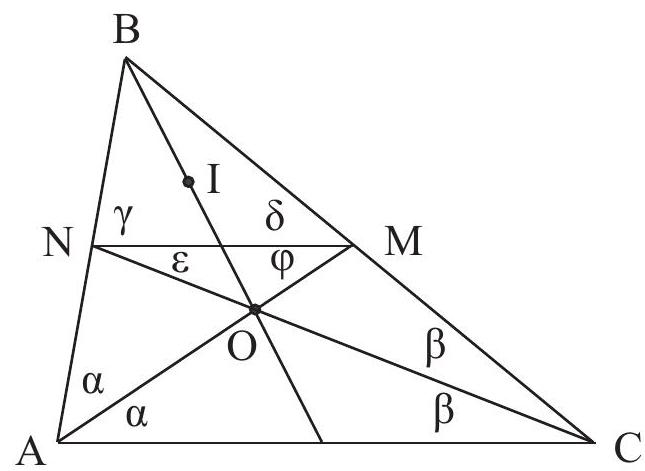
|
| 417 |
+
|
| 418 |
+
Solution: Let $O$ and $I$ be the incentres of $A B C$ and $N B M$, respectively; denote angles as in the figure. We get
|
| 419 |
+
|
| 420 |
+
$$
|
| 421 |
+
\alpha+\beta=\varepsilon+\varphi, \quad \gamma+\delta=2 \alpha+2 \beta, \quad \gamma=k \cdot \varepsilon, \quad \delta=k \cdot \varphi
|
| 422 |
+
$$
|
| 423 |
+
|
| 424 |
+
From here we get $k=2$. Therefore $\triangle N I M=\triangle N O M$, so $I O \perp N M$. In the triangle $N B M$ the bisector coincides with the altitude, so $B N=B M$. So we get
|
| 425 |
+
|
| 426 |
+
$$
|
| 427 |
+
\frac{A B \cdot B C}{A C+B C}=\frac{B C \cdot A B}{A B+A C}
|
| 428 |
+
$$
|
| 429 |
+
|
| 430 |
+
and $A B=B C$.
|
| 431 |
+
|
BalticWay/md/en-bw09eng.md
ADDED
|
@@ -0,0 +1,85 @@
|
|
|
|
|
|
|
|
|
|
|
|
|
|
|
|
|
|
|
|
|
|
|
|
|
|
|
|
|
|
|
|
|
|
|
|
|
|
|
|
|
|
|
|
|
|
|
|
|
|
|
|
|
|
|
|
|
|
|
|
|
|
|
|
|
|
|
|
|
|
|
|
|
|
|
|
|
|
|
|
|
|
|
|
|
|
|
|
|
|
|
|
|
|
|
|
|
|
|
|
|
|
|
|
|
|
|
|
|
|
|
|
|
|
|
|
|
|
|
|
|
|
|
|
|
|
|
|
|
|
|
|
|
|
|
|
|
|
|
|
|
|
|
|
|
|
|
|
|
|
|
|
|
|
|
|
|
|
|
|
|
|
|
|
|
|
|
|
|
|
|
|
|
|
|
|
|
|
|
|
|
|
|
|
|
|
|
|
|
|
|
|
|
|
|
|
|
|
|
|
|
|
|
|
|
|
|
|
|
|
|
|
|
|
|
|
|
|
|
|
|
|
|
|
|
|
|
|
|
|
|
|
|
|
|
|
|
|
|
|
|
|
|
|
|
|
|
|
|
|
|
|
|
|
|
|
|
|
|
| 1 |
+
Time allowed: $4 \frac{1}{2}$ hours.
|
| 2 |
+
Questions may be asked during the first 30 minutes.
|
| 3 |
+
|
| 4 |
+
Problem 1. A polynomial $p(x)$ of degree $n \geq 2$ has exactly $n$ real roots, counted with multiplicity. We know that the coefficient of $x^{n}$ is 1 , all the roots are less than or equal to 1 , and $p(2)=3^{n}$. What values can $p(1)$ take?
|
| 5 |
+
Problem 2. Let $a_{1}, a_{2}, \ldots, a_{100}$ be nonnegative integers satisfying the inequality
|
| 6 |
+
|
| 7 |
+
$$
|
| 8 |
+
\begin{aligned}
|
| 9 |
+
a_{1} \cdot\left(a_{1}-1\right) \cdot \ldots \cdot\left(a_{1}-20\right)+a_{2} & \cdot\left(a_{2}-1\right) \cdot \ldots \cdot\left(a_{2}-20\right)+ \\
|
| 10 |
+
& \ldots+a_{100} \cdot\left(a_{100}-1\right) \cdot \ldots \cdot\left(a_{100}-20\right) \leq 100 \cdot 99 \cdot 98 \cdot \ldots \cdot 79
|
| 11 |
+
\end{aligned}
|
| 12 |
+
$$
|
| 13 |
+
|
| 14 |
+
Prove that $a_{1}+a_{2}+\ldots+a_{100} \leq 9900$.
|
| 15 |
+
Problem 3. Let $n$ be a given positive integer. Show that we can choose numbers $c_{k} \in\{-1,1\}$ $(1 \leq k \leq n)$ such that
|
| 16 |
+
|
| 17 |
+
$$
|
| 18 |
+
0 \leq \sum_{k=1}^{n} c_{k} \cdot k^{2} \leq 4
|
| 19 |
+
$$
|
| 20 |
+
|
| 21 |
+
Problem 4. Determine all integers $n>1$ for which the inequality
|
| 22 |
+
|
| 23 |
+
$$
|
| 24 |
+
x_{1}^{2}+x_{2}^{2}+\ldots+x_{n}^{2} \geq\left(x_{1}+x_{2}+\ldots+x_{n-1}\right) x_{n}
|
| 25 |
+
$$
|
| 26 |
+
|
| 27 |
+
holds for all real $x_{1}, x_{2}, \ldots, x_{n}$.
|
| 28 |
+
Problem 5. Let $f_{0}=f_{1}=1$ and $f_{i+2}=f_{i+1}+f_{i}(i \geq 0)$. Find all real solutions of the equation
|
| 29 |
+
|
| 30 |
+
$$
|
| 31 |
+
x^{2010}=f_{2009} \cdot x+f_{2008}
|
| 32 |
+
$$
|
| 33 |
+
|
| 34 |
+
Problem 6. Let $a$ and $b$ be integers such that the equation $x^{3}-a x^{2}-b=0$ has three integer roots. Prove that $b=d k^{2}$, where $d$ and $k$ are integers and $d$ divides $a$.
|
| 35 |
+
Problem 7. Suppose that for a prime number $p$ and integers $a, b, c$ the following holds:
|
| 36 |
+
|
| 37 |
+
$$
|
| 38 |
+
6|p+1, \quad p| a+b+c, \quad p \mid a^{4}+b^{4}+c^{4}
|
| 39 |
+
$$
|
| 40 |
+
|
| 41 |
+
Prove that $p \mid a, b, c$.
|
| 42 |
+
Problem 8. Determine all positive integers $n$ for which there exists a partition of the set
|
| 43 |
+
|
| 44 |
+
$$
|
| 45 |
+
\{n, n+1, n+2, \ldots, n+8\}
|
| 46 |
+
$$
|
| 47 |
+
|
| 48 |
+
into two subsets such that the product of all elements of the first subset is equal to the product of all elements of the second subset.
|
| 49 |
+
Problem 9. Determine all positive integers $n$ for which $2^{n+1}-n^{2}$ is a prime number.
|
| 50 |
+
Problem 10. Let $d(k)$ denote the number of positive divisors of a positive integer $k$. Prove that there exist infinitely many positive integers $M$ that cannot be written as
|
| 51 |
+
|
| 52 |
+
$$
|
| 53 |
+
M=\left(\frac{2 \sqrt{n}}{d(n)}\right)^{2}
|
| 54 |
+
$$
|
| 55 |
+
|
| 56 |
+
for any positive integer $n$.
|
| 57 |
+
|
| 58 |
+
Problem 11. Let $M$ be the midpoint of the side $A C$ of a triangle $A B C$, and let $K$ be a point on the ray $B A$ beyond $A$. The line $K M$ intersects the side $B C$ at the point $L . P$ is the point on the segment $B M$ such that $P M$ is the bisector of the angle $L P K$. The line $\ell$ passes through $A$ and is parallel to $B M$. Prove that the projection of the point $M$ onto the line $\ell$ belongs to the line $P K$.
|
| 59 |
+
Problem 12. In a quadrilateral $A B C D$ we have $A B \| C D$ and $A B=2 C D$. A line $\ell$ is perpendicular to $C D$ and contains the point $C$. The circle with centre $D$ and radius $D A$ intersects the line $\ell$ at points $P$ and $Q$. Prove that $A P \perp B Q$.
|
| 60 |
+
Problem 13. The point $H$ is the orthocentre of a triangle $A B C$, and the segments $A D, B E$, $C F$ are its altitudes. The points $I_{1}, I_{2}, I_{3}$ are the incentres of the triangles $E H F, F H D, D H E$, respectively. Prove that the lines $A I_{1}, B I_{2}, C I_{3}$ intersect at a single point.
|
| 61 |
+
|
| 62 |
+
Problem 14. For which $n \geq 2$ is it possible to find $n$ pairwise non-similar triangles $A_{1}, A_{2}, \ldots, A_{n}$ such that each of them can be divided into $n$ pairwise non-similar triangles, each of them similar to one of $A_{1}, A_{2}, \ldots, A_{n}$ ?
|
| 63 |
+
|
| 64 |
+
Problem 15. A unit square is cut into $m$ quadrilaterals $Q_{1}, \ldots, Q_{m}$. For each $i=1, \ldots, m$ let $S_{i}$ be the sum of the squares of the four sides of $Q_{i}$. Prove that
|
| 65 |
+
|
| 66 |
+
$$
|
| 67 |
+
S_{1}+\ldots+S_{m} \geq 4
|
| 68 |
+
$$
|
| 69 |
+
|
| 70 |
+
Problem 16. A $n$-trønder walk is a walk starting at $(0,0)$, ending at $(2 n, 0)$ with no self intersection and not leaving the first quadrant, where every step is one of the vectors $(1,1),(1,-1)$ or $(-1,1)$.
|
| 71 |
+
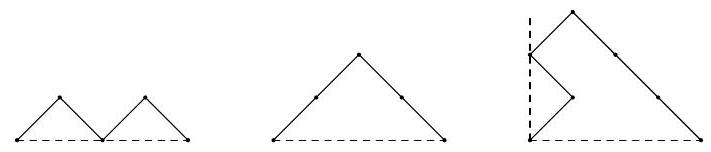
|
| 72 |
+
(The figure shows the possible 2-trønder walks.)
|
| 73 |
+
|
| 74 |
+
Find the number of $n$-trønder walks.
|
| 75 |
+
Problem 17. Find the largest integer $n$ for which there exist $n$ different integers such that none of them are divisible by either of 7,11 , and 13 , but the sum of any two of them is divisible by at least one of 7,11 , and 13.
|
| 76 |
+
|
| 77 |
+
Problem 18. Let $n>2$ be an integer. In a country there are $n$ cities and every two of them are connected by a direct road. Each road is assigned an integer from the set $\{1,2, \ldots, m\}$ (different roads may be assigned the same number). The priority of a city is the sum of the numbers assigned to roads which lead to it. Find the smallest $m$ for which it is possible that all cities have a different priority.
|
| 78 |
+
|
| 79 |
+
Problem 19. In a party of eight persons, each pair of persons either know each other or do not know each other. Each person knows exactly three of the others. Determine whether the following two conditions can be satisfied simultaneously:
|
| 80 |
+
|
| 81 |
+
- for any three persons, at least two do not know each other;
|
| 82 |
+
- for any four persons there are at least two who know each other.
|
| 83 |
+
|
| 84 |
+
Problem 20. In the future city Baltic Way there are sixteen hospitals. Every night exactly four of them must be on duty for emergencies. Is it possible to arrange the schedule in such a way that after twenty nights every pair of hospitals have been on common duty exactly once?
|
| 85 |
+
|
BalticWay/md/en-bw10sol.md
ADDED
|
@@ -0,0 +1,460 @@
|
|
|
|
|
|
|
|
|
|
|
|
|
|
|
|
|
|
|
|
|
|
|
|
|
|
|
|
|
|
|
|
|
|
|
|
|
|
|
|
|
|
|
|
|
|
|
|
|
|
|
|
|
|
|
|
|
|
|
|
|
|
|
|
|
|
|
|
|
|
|
|
|
|
|
|
|
|
|
|
|
|
|
|
|
|
|
|
|
|
|
|
|
|
|
|
|
|
|
|
|
|
|
|
|
|
|
|
|
|
|
|
|
|
|
|
|
|
|
|
|
|
|
|
|
|
|
|
|
|
|
|
|
|
|
|
|
|
|
|
|
|
|
|
|
|
|
|
|
|
|
|
|
|
|
|
|
|
|
|
|
|
|
|
|
|
|
|
|
|
|
|
|
|
|
|
|
|
|
|
|
|
|
|
|
|
|
|
|
|
|
|
|
|
|
|
|
|
|
|
|
|
|
|
|
|
|
|
|
|
|
|
|
|
|
|
|
|
|
|
|
|
|
|
|
|
|
|
|
|
|
|
|
|
|
|
|
|
|
|
|
|
|
|
|
|
|
|
|
|
|
|
|
|
|
|
|
|
|
|
|
|
|
|
|
|
|
|
|
|
|
|
|
|
|
|
|
|
|
|
|
|
|
|
|
|
|
|
|
|
|
|
|
|
|
|
|
|
|
|
|
|
|
|
|
|
|
|
|
|
|
|
|
|
|
|
|
|
|
|
|
|
|
|
|
|
|
|
|
|
|
|
|
|
|
|
|
|
|
|
|
|
|
|
|
|
|
|
|
|
|
|
|
|
|
|
|
|
|
|
|
|
|
|
|
|
|
|
|
|
|
|
|
|
|
|
|
|
|
|
|
|
|
|
|
|
|
|
|
|
|
|
|
|
|
|
|
|
|
|
|
|
|
|
|
|
|
|
|
|
|
|
|
|
|
|
|
|
|
|
|
|
|
|
|
|
|
|
|
|
|
|
|
|
|
|
|
|
|
|
|
|
|
|
|
|
|
|
|
|
|
|
|
|
|
|
|
|
|
|
|
|
|
|
|
|
|
|
|
|
|
|
|
|
|
|
|
|
|
|
|
|
|
|
|
|
|
|
|
|
|
|
|
|
|
|
|
|
|
|
|
|
|
|
|
|
|
|
|
|
|
|
|
|
|
|
|
|
|
|
|
|
|
|
|
|
|
|
|
|
|
|
|
|
|
|
|
|
|
|
|
|
|
|
|
|
|
|
|
|
|
|
|
|
|
|
|
|
|
|
|
|
|
|
|
|
|
|
|
|
|
|
|
|
|
|
|
|
|
|
|
|
|
|
|
|
|
|
|
|
|
|
|
|
|
|
|
|
|
|
|
|
|
|
|
|
|
|
|
|
|
|
|
|
|
|
|
|
|
|
|
|
|
|
|
|
|
|
|
|
|
|
|
|
|
|
|
|
|
|
|
|
|
|
|
|
|
|
|
|
|
|
|
|
|
|
|
|
|
|
|
|
|
|
|
|
|
|
|
|
|
|
|
|
|
|
|
|
|
|
|
|
|
|
|
|
|
|
|
|
|
|
|
|
|
|
|
|
|
|
|
|
|
|
|
|
|
|
|
|
|
|
|
|
|
|
|
|
|
|
|
|
|
|
|
|
|
|
|
|
|
|
|
|
|
|
|
|
|
|
|
|
|
|
|
|
|
|
|
|
|
|
|
|
|
|
|
|
|
|
|
|
|
|
|
|
|
|
|
|
|
|
|
|
|
|
|
|
|
|
|
|
|
|
|
|
|
|
|
|
|
|
|
|
|
|
|
|
|
|
|
|
|
|
|
|
|
|
|
|
|
|
|
|
|
|
|
|
|
|
|
|
|
|
|
|
|
|
|
|
|
|
|
|
|
|
|
|
|
|
|
|
|
|
|
|
|
|
|
|
|
|
|
|
|
|
|
|
|
|
|
|
|
|
|
|
|
|
|
|
|
|
|
|
|
|
|
|
|
|
|
|
|
|
|
|
|
|
|
|
|
|
|
|
|
|
|
|
|
|
|
|
|
|
|
|
|
|
|
|
|
|
|
|
|
|
|
|
|
|
|
|
|
|
|
|
|
|
|
|
|
|
|
|
|
|
|
|
|
|
|
|
|
|
|
|
|
|
|
|
|
|
|
|
|
|
|
|
|
|
|
|
|
|
|
|
|
|
|
|
|
|
|
|
|
|
|
|
|
|
|
|
|
|
|
|
|
|
|
|
|
|
|
|
|
|
|
|
|
|
|
|
|
|
|
|
|
|
|
|
|
|
|
|
|
|
|
|
|
|
|
|
|
|
|
|
|
|
|
|
|
|
|
|
|
|
|
|
|
|
|
|
|
|
|
|
|
|
|
|
|
|
|
|
|
|
|
|
|
|
|
|
|
|
|
|
|
|
|
|
|
|
|
|
|
|
|
|
|
|
|
|
|
|
|
|
|
|
|
|
|
|
|
|
|
|
|
|
|
|
|
|
|
|
|
|
|
|
|
|
|
|
|
|
|
|
|
|
|
|
|
|
|
|
|
|
|
|
|
|
|
|
|
|
|
|
|
|
|
|
|
|
|
|
|
|
|
|
|
|
|
|
|
|
|
|
|
|
|
|
|
|
|
|
|
|
|
|
|
|
|
|
|
|
|
|
|
|
|
|
|
|
|
|
|
|
|
|
|
|
|
|
|
|
|
|
|
|
|
|
|
|
|
|
|
|
|
|
|
|
|
|
|
|
|
|
|
|
|
|
|
|
|
|
|
|
|
|
|
|
|
|
|
|
|
|
|
|
|
|
|
|
|
|
|
|
|
|
|
|
|
|
|
|
|
|
|
|
|
|
|
|
|
|
|
|
|
|
|
|
|
|
|
|
|
|
|
|
|
|
|
|
|
|
|
|
|
|
|
|
|
|
|
|
|
|
|
|
|
|
|
|
|
|
|
|
|
|
|
|
|
|
|
|
|
|
|
|
|
|
|
|
|
|
|
|
|
|
|
|
|
|
|
|
|
|
|
|
|
|
|
|
|
|
|
|
|
|
|
|
|
|
|
|
|
|
|
|
|
|
|
|
|
|
|
|
|
|
|
|
|
|
|
|
|
|
|
|
|
|
|
|
|
|
| 1 |
+
# BALTIC WAY 2010 - SOLUTIONS
|
| 2 |
+
|
| 3 |
+
REYKJAVIK, NOVEMBER 6TH 2010
|
| 4 |
+
|
| 5 |
+
Time allowed: $4 \frac{1}{2}$ hours.
|
| 6 |
+
|
| 7 |
+
Questions may be asked during the first 30 minutes.
|
| 8 |
+
|
| 9 |
+
The only tools allowed are a ruler and a compass.
|
| 10 |
+
|
| 11 |
+
Each problem is worth 5 points.
|
| 12 |
+
|
| 13 |
+
Problem 1. Find all quadruples of real numbers $(a, b, c, d)$ satisfying the system of equations
|
| 14 |
+
|
| 15 |
+
$$
|
| 16 |
+
\left\{\begin{array}{l}
|
| 17 |
+
(b+c+d)^{2010}=3 a \\
|
| 18 |
+
(a+c+d)^{2010}=3 b \\
|
| 19 |
+
(a+b+d)^{2010}=3 c \\
|
| 20 |
+
(a+b+c)^{2010}=3 d
|
| 21 |
+
\end{array}\right.
|
| 22 |
+
$$
|
| 23 |
+
|
| 24 |
+
Solution. There are two solutions: $(0,0,0,0)$ and $\left(\frac{1}{3}, \frac{1}{3}, \frac{1}{3}, \frac{1}{3}\right)$.
|
| 25 |
+
|
| 26 |
+
If $(a, b, c, d)$ satisfies the equations, then we may as well assume $a \leq b \leq c \leq d$. These are non-negative because an even power of a real number is always non-negative. It follows that
|
| 27 |
+
|
| 28 |
+
$$
|
| 29 |
+
b+c+d \geq a+c+d \geq a+b+d \geq a+b+c
|
| 30 |
+
$$
|
| 31 |
+
|
| 32 |
+
and since $x \mapsto x^{2010}$ is increasing for $x \geq 0$ we have that
|
| 33 |
+
|
| 34 |
+
$$
|
| 35 |
+
3 a=(b+c+d)^{2010} \geq(a+c+d)^{2010} \geq(a+b+d)^{2010} \geq(a+b+c)^{2010}=3 d
|
| 36 |
+
$$
|
| 37 |
+
|
| 38 |
+
We conclude that $a=b=c=d$ and all the equations take the form $(3 a)^{2010}=3 a$, so $a=0$ or $3 a=1$. Finally, it is clear that $a=b=c=d=0$ and $a=b=c=d=\frac{1}{3}$ solve the system.
|
| 39 |
+
|
| 40 |
+
Problem 2. Let $x$ be a real number such that $0<x<\frac{\pi}{2}$. Prove that
|
| 41 |
+
|
| 42 |
+
$$
|
| 43 |
+
\cos ^{2}(x) \cot (x)+\sin ^{2}(x) \tan (x) \geq 1 \text {. }
|
| 44 |
+
$$
|
| 45 |
+
|
| 46 |
+
Solution. The geometric-arithmetic inequality gives
|
| 47 |
+
|
| 48 |
+
$$
|
| 49 |
+
\cos x \sin x \leq \frac{\cos ^{2} x+\sin ^{2} x}{2}=\frac{1}{2} .
|
| 50 |
+
$$
|
| 51 |
+
|
| 52 |
+
It follows that
|
| 53 |
+
|
| 54 |
+
$$
|
| 55 |
+
1=\left(\cos ^{2} x+\sin ^{2} x\right)^{2}=\cos ^{4} x+\sin ^{4} x+2 \cos ^{2} x \sin ^{2} x \leq \cos ^{4} x+\sin ^{4} x+\frac{1}{2}
|
| 56 |
+
$$
|
| 57 |
+
|
| 58 |
+
so
|
| 59 |
+
|
| 60 |
+
$$
|
| 61 |
+
\cos ^{4} x+\sin ^{4} x \geq \frac{1}{2} \geq \cos x \sin x .
|
| 62 |
+
$$
|
| 63 |
+
|
| 64 |
+
The required inequality follows.
|
| 65 |
+
|
| 66 |
+
Problem 3. Let $x_{1}, x_{2}, \ldots, x_{n}(n \geq 2)$ be real numbers greater than 1 . Suppose that $\left|x_{i}-x_{i+1}\right|<1$ for $i=1,2, \ldots, n-1$. Prove that
|
| 67 |
+
|
| 68 |
+
$$
|
| 69 |
+
\frac{x_{1}}{x_{2}}+\frac{x_{2}}{x_{3}}+\ldots+\frac{x_{n-1}}{x_{n}}+\frac{x_{n}}{x_{1}}<2 n-1
|
| 70 |
+
$$
|
| 71 |
+
|
| 72 |
+
Solution. The proof is by induction on $n$.
|
| 73 |
+
|
| 74 |
+
We establish first the base case $n=2$. Suppose that $x_{1}>1, x_{2}>1,\left|x_{1}-x_{2}\right|<1$ and moreover $x_{1} \leq x_{2}$. Then
|
| 75 |
+
|
| 76 |
+
$$
|
| 77 |
+
\frac{x_{1}}{x_{2}}+\frac{x_{2}}{x_{1}} \leq 1+\frac{x_{2}}{x_{1}}<1+\frac{x_{1}+1}{x_{1}}=2+\frac{1}{x_{1}}<2+1=2 \cdot 2-1 .
|
| 78 |
+
$$
|
| 79 |
+
|
| 80 |
+
Now we proceed to the inductive step, and assume that the numbers $x_{1}, x_{2}, \ldots, x_{n}, x_{n+1}>1$ are given such that $\left|x_{i}-x_{i+1}\right|<1$ for $i=1,2, \ldots, n-1, n$. Let
|
| 81 |
+
|
| 82 |
+
$$
|
| 83 |
+
S=\frac{x_{1}}{x_{2}}+\frac{x_{2}}{x_{3}}+\ldots+\frac{x_{n-1}}{x_{n}}+\frac{x_{n}}{x_{1}}, \quad S^{\prime}=\frac{x_{1}}{x_{2}}+\frac{x_{2}}{x_{3}}+\ldots+\frac{x_{n-1}}{x_{n}}+\frac{x_{n}}{x_{n+1}}+\frac{x_{n+1}}{x_{1}}
|
| 84 |
+
$$
|
| 85 |
+
|
| 86 |
+
The inductive assumption is that $S<2 n-1$ and the goal is that $S^{\prime}<2 n+1$. From the above relations involving $S$ and $S^{\prime}$ we see that it suffices to prove the inequality
|
| 87 |
+
|
| 88 |
+
$$
|
| 89 |
+
\frac{x_{n}}{x_{n+1}}+\frac{x_{n+1}-x_{n}}{x_{1}} \leq 2
|
| 90 |
+
$$
|
| 91 |
+
|
| 92 |
+
We consider two cases. If $x_{n} \leq x_{n+1}$, then using the conditions $x_{1}>1$ and $x_{n+1}-x_{n}<1$ we obtain
|
| 93 |
+
|
| 94 |
+
$$
|
| 95 |
+
\frac{x_{n}}{x_{n+1}}+\frac{x_{n+1}-x_{n}}{x_{1}} \leq 1+\frac{x_{n+1}-x_{n}}{x_{1}}<1+\frac{1}{x_{1}}<2,
|
| 96 |
+
$$
|
| 97 |
+
|
| 98 |
+
and if $x_{n}>x_{n+1}$, then using the conditions $x_{n}<x_{n+1}+1$ and $x_{n+1}>1$ we get
|
| 99 |
+
|
| 100 |
+
$$
|
| 101 |
+
\frac{x_{n}}{x_{n+1}}+\frac{x_{n+1}-x_{n}}{x_{1}}<\frac{x_{n}}{x_{n+1}}<\frac{x_{n+1}+1}{x_{n+1}}=1+\frac{1}{x_{n+1}}<1+1=2 .
|
| 102 |
+
$$
|
| 103 |
+
|
| 104 |
+
The induction is now complete.
|
| 105 |
+
|
| 106 |
+
Problem 4. Find all polynomials $P(x)$ with real coefficients such that
|
| 107 |
+
|
| 108 |
+
$$
|
| 109 |
+
(x-2010) P(x+67)=x P(x)
|
| 110 |
+
$$
|
| 111 |
+
|
| 112 |
+
for every integer $x$.
|
| 113 |
+
|
| 114 |
+
Solution. Taking $x=0$ in the given equality leads to $-2010 P(67)=0$, implying $P(67)=0$. Whenever $i$ is an integer such that $1 \leq i<30$ and $P(i \cdot 67)=0$, taking $x=i \cdot 67$ leads to $(i \cdot 67-2010) P((i+1) \cdot 67)=0$; as $i \cdot 67<2010$ for $i<30$, this implies $P((i+1) \cdot 67)=0$. Thus, by induction, $P(i \cdot 67)=0$ for all $i=1,2, \ldots, 30$. Hence
|
| 115 |
+
|
| 116 |
+
$$
|
| 117 |
+
P(x) \equiv(x-67)(x-2 \cdot 67) \ldots(x-30 \cdot 67) Q(x)
|
| 118 |
+
$$
|
| 119 |
+
|
| 120 |
+
where $Q(x)$ is another polynomial.
|
| 121 |
+
|
| 122 |
+
Substituting this expression for $P$ in the original equality, one obtains
|
| 123 |
+
|
| 124 |
+
$$
|
| 125 |
+
(x-2010) \cdot x(x-67) \ldots(x-29 \cdot 67) Q(x+67)=x(x-67)(x-2 \cdot 67) \ldots(x-30 \cdot 67) Q(x)
|
| 126 |
+
$$
|
| 127 |
+
|
| 128 |
+
which is equivalent to
|
| 129 |
+
|
| 130 |
+
$$
|
| 131 |
+
x(x-67)(x-2 \cdot 67) \ldots(x-30 \cdot 67)(Q(x+67)-Q(x))=0 .
|
| 132 |
+
$$
|
| 133 |
+
|
| 134 |
+
By conditions of the problem, this holds for every integer $x$. Hence there are infinitely many roots of polynomial $Q(x+67)-Q(x)$, implying that $Q(x+67)-Q(x) \equiv 0$. Let $c=Q(0)$; then $Q(i \cdot 67)=c$ for every integer $i$ by easy induction. Thus polynomial $Q(x)-c$ has infinitely many roots whence $Q(x) \equiv c$.
|
| 135 |
+
|
| 136 |
+
Consequently, $P(x)=c(x-67)(x-2 \cdot 67) \ldots(x-30 \cdot 67)$ for some real number $c$. As equation (1) shows, all such polynomials fit.
|
| 137 |
+
|
| 138 |
+
Problem 5. Let $\mathbb{R}$ denote the set of real numbers. Find all functions $f: \mathbb{R} \rightarrow \mathbb{R}$ such that
|
| 139 |
+
|
| 140 |
+
$$
|
| 141 |
+
f\left(x^{2}\right)+f(x y)=f(x) f(y)+y f(x)+x f(x+y)
|
| 142 |
+
$$
|
| 143 |
+
|
| 144 |
+
for all $x, y \in \mathbb{R}$.
|
| 145 |
+
|
| 146 |
+
Solution. Setting $x=0$ in the equation we get $f(0) f(y)=(2-y) f(0)$. If $f(0) \neq 0$, then $f(y)=2-y$ and it is easy to verify that this is a solution to the equation.
|
| 147 |
+
|
| 148 |
+
Now assume $f(0)=0$. Setting $y=0$ in the equation we get $f\left(x^{2}\right)=x f(x)$. Interchanging $x$ and $y$ and subtracting from the original equation we get
|
| 149 |
+
|
| 150 |
+
$$
|
| 151 |
+
x f(x)-y f(y)=y f(x)-x f(y)+(x-y) f(x+y)
|
| 152 |
+
$$
|
| 153 |
+
|
| 154 |
+
or equivalently
|
| 155 |
+
|
| 156 |
+
$$
|
| 157 |
+
(x-y)(f(x)+f(y))=(x-y) f(x+y) \text {. }
|
| 158 |
+
$$
|
| 159 |
+
|
| 160 |
+
For $x \neq y$ we therefore have $f(x+y)=f(x)+f(y)$. Since $f(0)=0$ this clearly also holds for $x=0$, and for $x=y \neq 0$ we have
|
| 161 |
+
|
| 162 |
+
$$
|
| 163 |
+
f(2 x)=f\left(\frac{x}{3}\right)+f\left(\frac{5 x}{3}\right)=f\left(\frac{x}{3}\right)+f\left(\frac{2 x}{3}\right)+f(x)=f(x)+f(x) .
|
| 164 |
+
$$
|
| 165 |
+
|
| 166 |
+
Setting $x=y$ in the original equation, using $f\left(x^{2}\right)=x f(x)$ and $f(2 x)=2 f(x)$ we get
|
| 167 |
+
|
| 168 |
+
$$
|
| 169 |
+
0=f(x)^{2}+x f(x)=f(x)(f(x)+x) .
|
| 170 |
+
$$
|
| 171 |
+
|
| 172 |
+
So for each $x$, either $f(x)=0$ or $f(x)=-x$. But then
|
| 173 |
+
|
| 174 |
+
$$
|
| 175 |
+
f(x)+f(y)=f(x+y)= \begin{cases}0 & \text { or } \\ -(x+y)\end{cases}
|
| 176 |
+
$$
|
| 177 |
+
|
| 178 |
+
and we conclude that $f(x)=-x$ if and only if $f(y)=-y$ when $x, y \neq 0$. We therefore have either $f(x)=-x$ for all $x$ or $f(x)=0$ for all $x$. It is easy to verify that both are solutions to the original equation.
|
| 179 |
+
|
| 180 |
+
Problem 6. An $n \times n$ board is coloured in $n$ colours such that the main diagonal (from top-left to bottom-right) is coloured in the first colour; the two adjacent diagonals are coloured in the second colour; the two next diagonals (one from above and one from below) are coloured in the third colour, etc.; the two corners (top-right and bottom-left) are coloured in the $n$-th colour. It happens that it is possible to place on the board $n$ rooks, no two attacking each other and such that no two rooks stand on cells of the same colour. Prove that $n \equiv 0(\bmod 4)$ or $n \equiv 1$ $(\bmod 4)$.
|
| 181 |
+
|
| 182 |
+
Solution. Use the usual coordinate system for which the cells of the main diagonal have coordinates $(k, k)$, where $k=1, \ldots, n$. Let $(k, f(k))$ be the coordinates of the $k$-th rook. Then by color restrictions for rooks we have
|
| 183 |
+
|
| 184 |
+
$$
|
| 185 |
+
\sum_{k=1}^{n}(f(k)-k)^{2}=\sum_{i=0}^{n-1} i^{2}=\frac{n(n-1)(2 n-1)}{6} .
|
| 186 |
+
$$
|
| 187 |
+
|
| 188 |
+
Since the rooks are non-attacking we have
|
| 189 |
+
|
| 190 |
+
$$
|
| 191 |
+
\sum_{k=1}^{n}(f(k))^{2}=\sum_{i=1}^{n} i^{2}=\frac{n(n+1)(2 n+1)}{6} .
|
| 192 |
+
$$
|
| 193 |
+
|
| 194 |
+
By subtracting these equalities we obtain
|
| 195 |
+
|
| 196 |
+
$$
|
| 197 |
+
\sum_{k=1}^{n} k f(k)=\frac{n\left(2 n^{2}+9 n+1\right)}{12}
|
| 198 |
+
$$
|
| 199 |
+
|
| 200 |
+
Now it is trivial to check that the last number is integer if and only if $n \equiv 0$ or $1(\bmod 4)$.
|
| 201 |
+
|
| 202 |
+
Problem 7. There are some cities in a country; one of them is the capital. For any two cities $A$ and $B$ there is a direct flight from $A$ to $B$ and a direct flight from $B$ to $A$, both having the same price. Suppose that all round trips with exactly one landing in every city have the same total cost. Prove that all round trips that miss the capital and with exactly one landing in every remaining city cost the same.
|
| 203 |
+
|
| 204 |
+
Solution. Let $C$ be the capital and $C_{1}, C_{2}, \ldots, C_{n}$ be the remaining cities. Denote by $d(x, y)$ the price of the connection between the cities $x$ and $y$, and let $\sigma$ be the total price of a round trip going exactly once through each city.
|
| 205 |
+
|
| 206 |
+
Now consider a round trip missing the capital and visiting every other city exactly once; let $s$ be the total price of that trip. Suppose $C_{i}$ and $C_{j}$ are two consecutive cities on the route. Replacing the flight $C_{i} \rightarrow C_{j}$ by two flights: from $C_{i}$ to the capital and from the capital to $C_{j}$, we get a round trip through all cities, with total price $\sigma$. It follows that $\sigma=s+d\left(C, C_{i}\right)+d\left(C, C_{j}\right)-$ $d\left(C_{i}, C_{j}\right)$, so it remains to show that the quantity $\alpha(i, j)=d\left(C, C_{i}\right)+d\left(C, C_{j}\right)-d\left(C_{i}, C_{j}\right)$ is the same for all 2-element subsets $\{i, j\} \subset\{1,2, \ldots, n\}$.
|
| 207 |
+
|
| 208 |
+
For this purpose, note that $\alpha(i, j)=\alpha(i, k)$ whenever $i, j, k$ are three distinct indices; indeed, this equality is equivalent to $d\left(C_{j}, C\right)+d\left(C, C_{i}\right)+d\left(C_{i}, C_{k}\right)=d\left(C_{j}, C_{i}\right)+d\left(C_{i}, C\right)+d\left(C, C_{k}\right)$, which is true by considering any trip from $C_{k}$ to $C_{j}$ going through all cities except $C$ and $C_{i}$ exactly once and completing this trip to a round trip in two ways: $C_{j} \rightarrow C \rightarrow C_{i} \rightarrow C_{k}$ and $C_{j} \rightarrow C_{i} \rightarrow C \rightarrow C_{k}$. Therefore the values of $\alpha$ coincide on any pair of 2-element sets sharing a common element. But then clearly $\alpha(i, j)=\alpha\left(i, j^{\prime}\right)=\alpha\left(i^{\prime}, j^{\prime}\right)$ for all indices $i, j, i^{\prime}, j^{\prime}$ with $i \neq j, i^{\prime} \neq j^{\prime}$, and the solution is complete.
|
| 209 |
+
|
| 210 |
+
Problem 8. In a club with 30 members, every member initially had a hat. One day each member sent his hat to a different member (a member could have received more than one hat). Prove that there exists a group of 10 members such that no one in the group has received a hat from another one in the group.
|
| 211 |
+
|
| 212 |
+
Solution. Let $S$ be the given group of 30 people. Consider all subsets $A \subset S$ such that no member of $A$ received a hat from a member of $A$. Among such subsets, let $T$ be a subset of maximal cardinality. The assertion of the problem is that $|T| \geq 10$.
|
| 213 |
+
|
| 214 |
+
Let $U \subset S$ consist of all people that have received a hat from a person belonging to $T$. Now consider any member $x \in S \backslash(T \cup U)$. Since $x \notin U$, no member of $T$ sent his hat to $x$. It follows that no member of $T$ sent a hat to a person from $T \cup\{x\}$. But the maximality of $T$ implies that some person from $T \cup\{x\}$ sent his hat to a person from the same subset. This means that $x$ sent his hat to a person from $T$. Consequently, all members of the subset $S \backslash(T \cup U)$ sent their hats to people in $T$. In particular, $S \backslash(T \cup U)$ has the property described in the beginning. The maximality of $T$ gives $|S \backslash(T \cup U)| \leq|T|$. Finally, we obviously have $|U| \leq|T|$, so
|
| 215 |
+
|
| 216 |
+
$$
|
| 217 |
+
|T| \geq|S \backslash(T \cup U)|=|S|-|T|-|U| \geq|S|-2|T|,
|
| 218 |
+
$$
|
| 219 |
+
|
| 220 |
+
or $|T| \geq \frac{1}{3}|S|=10$, as desired.
|
| 221 |
+
|
| 222 |
+
Problem 9. There is a pile of 1000 matches. Two players each take turns and can take 1 to 5 matches. It is also allowed at most 10 times during the whole game to take 6 matches, for example 7 exceptional moves can be done by the first player and 3 moves by the second and then no more exceptional moves are allowed. Whoever takes the last match wins. Determine which player has a winning strategy.
|
| 223 |
+
|
| 224 |
+
Solution. The second player wins.
|
| 225 |
+
|
| 226 |
+
Let $r$ be the number of the remaining exceptional moves in the current position (at the beginning of the game $r=10$ and $r$ decreases during the game). The winning strategy of the
|
| 227 |
+
second player is the following. After his move the number of matches in the pile must have the form $6 n+r$, where $n>r$, or $7 n$, where $n \leq r$ (observe that $6 n+r=7 n$ for $n=r$ ).
|
| 228 |
+
|
| 229 |
+
At the beginning of the game the initial number of matches $1000=6 \cdot 165+10$ agrees with this strategy.
|
| 230 |
+
|
| 231 |
+
What happens during two consecutive moves?
|
| 232 |
+
|
| 233 |
+
Consider the case $n>r$ first. If the first player takes $k=1,2, \ldots 5$ matches (and hence $r$ is not changing during his move) then the second player takes $6-k$ matches. So players take 6 matches together and the pile contains now $6(n-1)+r$ matches.
|
| 234 |
+
|
| 235 |
+
If the first player takes 6 matches, then $r$ decreases by 1 . The second player takes 1 match. After his turn the pile contains $6(n-1)+(r-1)$ matches as he wish.
|
| 236 |
+
|
| 237 |
+
Now consider the case $n \leq r$. In this situation we have much enough exceptional moves, and we may assume that now each move the players can take up to 6 matches. Then if the first player takes $k$ matches, the second player takes $7-k$ matches.
|
| 238 |
+
|
| 239 |
+
Problem 10. Let $n$ be an integer with $n \geq 3$. Consider all dissections of a convex $n$-gon into triangles by $n-3$ non-intersecting diagonals, and all colourings of the triangles with black and white so that triangles with a common side are always of a different colour. Find the least possible number of black triangles.
|
| 240 |
+
|
| 241 |
+
Solution 1. The answer is $\left\lfloor\frac{n-1}{3}\right\rfloor$.
|
| 242 |
+
|
| 243 |
+
Let $f(n)$ denote the minimum number of black triangles in an $n$-gon. It is clear that $f(3)=0$ and that $f(n)$ is at least 1 for $n=4,5,6$. It is easy to see that for $n=4,5,6$ there is a coloring with only one black triangle, so $f(n)=1$ for $n=4,5,6$.
|
| 244 |
+
|
| 245 |
+
First we prove by induction that $f(n) \leq\left\lfloor\frac{n-1}{3}\right\rfloor$. The case for $n=3,4,5$ has already been established. Given an $(n+3)$-gon, draw a diagonal that splits it into an $n$-gon and a 5 -gon. Color the $n$-gon with at most $\left\lfloor\frac{n-1}{3}\right\rfloor$ black triangles. We can then color the 5 -gon compatibly with only one black triangle so $f(n+3) \leq\left\lfloor\frac{n-1}{3}\right\rfloor+1=\left\lfloor\frac{n+3-1}{3}\right\rfloor$.
|
| 246 |
+
|
| 247 |
+
Now we prove by induction that $f(n) \geq\left\lfloor\frac{n-1}{3}\right\rfloor$. The case for $n=3,4,5$ has already been established. Given an $(n+3)$-gon, we color it with $f(n+3)$ black triangles and pick one of the black triangles. It separates theree polygons from the $(n+3)$-gon, say an $(a+1)$-gon, $(b+1)$-gon and a $(c+1)$-gon such that $n+3=a+b+c$. We write $r_{m}$ for the remainder of the integer $m$ when divided by 3 . Then
|
| 248 |
+
|
| 249 |
+
$$
|
| 250 |
+
\begin{aligned}
|
| 251 |
+
f(n+3) & \geq f(a+1)+f(b+1)+f(c+1)+1 \\
|
| 252 |
+
& \geq\left\lfloor\frac{a}{3}\right\rfloor+\left\lfloor\frac{b}{3}\right\rfloor+\left\lfloor\frac{c}{3}\right\rfloor+1 \\
|
| 253 |
+
& =\frac{a-r_{a}}{3}+\frac{b-r_{b}}{3}+\frac{c-r_{c}}{3}+1 \\
|
| 254 |
+
& =\frac{n+3-1-r_{n}}{3}+\frac{4+r_{n}-\left(r_{a}+r_{b}+r_{c}\right)}{3} \\
|
| 255 |
+
& =\left\lfloor\frac{n+3-1}{3}\right\rfloor+\frac{4+r_{n}-\left(r_{a}+r_{b}+r_{c}\right)}{3} .
|
| 256 |
+
\end{aligned}
|
| 257 |
+
$$
|
| 258 |
+
|
| 259 |
+
Since $0 \leq r_{n}, r_{a}, r_{b}, r_{c} \leq 2$, we have that $4+r_{n}-\left(r_{a}+r_{b}+r_{c}\right) \geq 4+0-6=-2$. But since this number is divisible by 3 , it is in fact $\geq 0$. This completes the induction.
|
| 260 |
+
|
| 261 |
+
Solution 2. Call two triangles neighbours if they have a common side. Let the dissections of convex $n$-gons together with appropriate colourings be called $n$-colourings.
|
| 262 |
+
|
| 263 |
+
Observe that all triangles of an arbitrary $n$-colouring can be listed, starting with an arbitrary triangle and always continuing the list by a triangle that is a neighbour to some triangle already
|
| 264 |
+
in the list. Indeed, suppose that some triangle $\Delta$ is missing from the list. Choose a point $A$ inside a triangle in the list, as well as a point $D$ inside $\Delta$. By convexity, the line segment $A D$ is entirely inside the polygon. As the vertices of the triangles are vertices of the polygon, $A D$ crosses the sides of the triangles only outside their vertices. Hence any consecutive triangles that $A D$ passes through are neighbours. The first triangle that ray $A D$ visits and that is not in the list is one that the list can be continued with.
|
| 265 |
+
|
| 266 |
+
Consider such a list of all triangles that starts with a white triangle. Each triangle has at most three neighbours and each black triangle has at least one neighbour occurring in the list before it. Thus at most two neighbours of any black triangle are following it in the list. Each white triangle except for the first one is a neighbour of some triangle preceding it in the list, and according to the construction, that triangle is black. Hence among all triangles except for the first one, there are at most twice as many white triangles as there are black triangles. Altogether, this means $w \leq 2 b+1$ where $b$ and $w$ are the numbers of black and white triangles in the construction, respectively. Observe that this formula holds also if there are no white triangles.
|
| 267 |
+
|
| 268 |
+
Hence there are at most $3 b+1$ triangles altogether, i.e., $n-2 \leq 3 b+1$. In integers, this implies $b \geq\left\lceil\frac{n}{3}\right\rceil-1$ which is equivalent to $b \geq\left\lfloor\frac{n-1}{3}\right\rfloor$.
|
| 269 |
+
|
| 270 |
+
This number of black triangles can be achieved as follows. Number all vertices of the polygon by 0 through $n-1$.
|
| 271 |
+
|
| 272 |
+
If $n=3 k, k \in \mathbb{N}^{+}$, then draw diagonals $(0,3 i-1),(3 i-1,3 i+1),(3 i+1,0)$ for all $i=1, \ldots, k-1$. Colour black every triangle whose vertices are $0,3 i-1$ and $3 i+1$ for some $i=1, \ldots, k-1$.
|
| 273 |
+
|
| 274 |
+
If $n=3 k-1$ or $n=3 k-2$ then take a described $3 k$-colouring and cut out 1 or 2 white triangles, respectively (e.g., triangles with vertices $0,1,2$ and $0, n-1, n-2$ ).
|
| 275 |
+
|
| 276 |
+
Problem 11. Let $A B C D$ be a square and let $S$ be the point of intersection of its diagonals $A C$ and $B D$. Two circles $k, k^{\prime}$ go through $A, C$ and $B, D$; respectively. Furthermore, $k$ and $k^{\prime}$ intersect in exactly two different points $P$ and $Q$. Prove that $S$ lies on $P Q$.
|
| 277 |
+
|
| 278 |
+
Solution. It is clear that $P Q$ is the radical axis of $k$ and $k^{\prime}$. The power of $S$ with respect to $k$ is $-|A S| \cdot|C S|$ and the power of $S$ with respect to $k^{\prime}$ is $-|B S| \cdot|D S|$. Because $A B C D$ is a square, these two numbers are clearly the same. Thus, $S$ has the same power with respect to $k$ and $k^{\prime}$ and lies on the radical axis $P Q$ of $k$ and $k^{\prime}$.
|
| 279 |
+
|
| 280 |
+
Problem 12. Let $A B C D$ be a convex quadrilateral with precisely one pair of parallel sides.
|
| 281 |
+
|
| 282 |
+
a) Show that the lengths of its sides $A B, B C, C D, D A$ (in this order) do not form an arithmetic progression.
|
| 283 |
+
|
| 284 |
+
b) Show that there is such a quadrilateral for which the lengths of its sides $A B, B C, C D$, $D A$ form an arithmetic progression after the order of the lengths is changed.
|
| 285 |
+
|
| 286 |
+
Solution. Assume that the lengths of the sides form an arithmetic progression with the first term $a$ and the difference $d$. Suppose that sides $A B$ and $C D$ are parallel, $|A B|>|C D|$ and let $E$ be a point on $A B$ such that $|B E|=|C D|$. Then $|D E|=|C B|$ as opposite sides of a parallelogram, so $|A D|$ and $|D E|$ are two non-consequent terms of the arithmetic progression and $|A D|-|D E|= \pm 2 d$. Further, $|A E|=|A B|-|D C|=2 d$. We get a contradiction to the triangle inequality $|A E|>|| A D|-| D E \mid$.
|
| 287 |
+
|
| 288 |
+
We take a triangle with sides $3,3,2$ and add a parallelogram with sides 1 and 2 on the side of length 2 to obtain a trapezoid. Then the lengths of the sides are 1, 2, 4, 3 .
|
| 289 |
+
|
| 290 |
+
Problem 13. In an acute triangle $A B C$, the segment $C D$ is an altitude and $H$ is the orthocentre. Given that the circumcentre of the triangle lies on the line containing the bisector of the angle $D H B$, determine all possible values of $\angle C A B$.
|
| 291 |
+
|
| 292 |
+
Solution. The value is $\angle C A B=60^{\circ}$.
|
| 293 |
+
|
| 294 |
+
Denote by $\ell$ the line containing the angle bisector of $D H B$, and let $E$ be the point where the ray $C D \rightarrow$ intersects the circumcircle of the triangle $A B C$ again. The rays $H D \rightarrow$ and $H B \rightarrow$ are symmetric with respect to $\ell$ by the definition of $\ell$. On the other hand, if the circumcenter of $A B C$ lies on $\ell$, then the circumcircle is symmetric with respect to $\ell$. It follows that the intersections of the rays $H D^{\rightarrow}$ and $H B^{\rightarrow}$ with the circle, which are $E$ and $B$, are symmetric with respect to $\ell$. Moreover, since $H \in \ell$, we conclude that $H E=H B$.
|
| 295 |
+
|
| 296 |
+
However, as $E$ lies on the circumcircle of $A B C$, we have
|
| 297 |
+
|
| 298 |
+
$$
|
| 299 |
+
\angle A B E=\angle A C E=90^{\circ}-\angle C A B=\angle H B A .
|
| 300 |
+
$$
|
| 301 |
+
|
| 302 |
+
This proves that the points $H$ and $E$ are symmetric with respect to the line $A B$. Thus $H B=E B$ and the triangle $B H E$ is equilateral. Finally, $\angle C A B=\angle C E B=60^{\circ}$.
|
| 303 |
+
|
| 304 |
+
Obviously the value $\angle C A B=60^{\circ}$ is attained for an equilateral triangle $A B C$.
|
| 305 |
+
|
| 306 |
+
Problem 14. Assume that all angles of a triangle $A B C$ are acute. Let $D$ and $E$ be points on the sides $A C$ and $B C$ of the triangle such that $A, B, D$, and $E$ lie on the same circle. Further suppose the circle through $D, E$, and $C$ intersects the side $A B$ in two points $X$ and $Y$. Show that the midpoint of $X Y$ is the foot of the altitude from $C$ to $A B$.
|
| 307 |
+
|
| 308 |
+
Solution. We write the power of the point $A$ with respect to the circle $\gamma$ trough $D, E$, and $C$ :
|
| 309 |
+
|
| 310 |
+
$$
|
| 311 |
+
|A X||A Y|=|A D \| A C|=|A C|^{2}-|A C||C D| .
|
| 312 |
+
$$
|
| 313 |
+
|
| 314 |
+
Similarly, if we calculate the power of $B$ with respect to $\gamma$ we get
|
| 315 |
+
|
| 316 |
+
$$
|
| 317 |
+
|B X||B Y|=|B C|^{2}-|B C||C E| \text {. }
|
| 318 |
+
$$
|
| 319 |
+
|
| 320 |
+
We have also that $|A C||C D|=|B C||C E|$, the power of the point $C$ with respect to the circle through $A, B, D$, and $E$. Further if $M$ is the middle point of $X Y$ then
|
| 321 |
+
|
| 322 |
+
$$
|
| 323 |
+
|A X||A Y|=|A M|^{2}-|X M|^{2} \quad \text { and } \quad|B X||B Y|=|B M|^{2}-|X M|^{2} \text {. }
|
| 324 |
+
$$
|
| 325 |
+
|
| 326 |
+
Combining the four displayed identities we get
|
| 327 |
+
|
| 328 |
+
$$
|
| 329 |
+
|A M|^{2}-|B M|^{2}=|A C|^{2}-|B C|^{2} .
|
| 330 |
+
$$
|
| 331 |
+
|
| 332 |
+
By the theorem of Pythagoras the same holds for the point $H$ on $A B$ such that $C H$ is the altitude of the triangle $A B C$. Then since $H$ lies on the side $A B$ we get
|
| 333 |
+
|
| 334 |
+
$|A B|(|A M|-|B M|)=|A M|^{2}-|B M|^{2}=|A C|^{2}-|B C|^{2}=|A H|^{2}-|B H|^{2}=|A B|(|A H|-|B H|)$.
|
| 335 |
+
|
| 336 |
+
We conclude that $M=H$.
|
| 337 |
+
|
| 338 |
+
Problem 15. The points $M$ and $N$ are chosen on the angle bisector $A L$ of a triangle $A B C$ such that $\angle A B M=\angle A C N=23^{\circ} . X$ is a point inside the triangle such that $B X=C X$ and $\angle B X C=2 \angle B M L$. Find $\angle M X N$.
|
| 339 |
+
|
| 340 |
+
Solution. Answer: $\angle M X N=2 \angle A B M=46^{\circ}$.
|
| 341 |
+
|
| 342 |
+
Let $\angle B A C=2 \alpha$. The triangles $A B M$ and $A C N$ are similar, therefore $\angle C N L=\angle B M L=$ $\alpha+23^{\circ}$. Let $K$ be the midpoint of the arc $B C$ of the circumcircle of the triangle $A B C$. Then $K$ belongs to the the line $A L$ and $\angle K B C=\alpha$. Both $X$ and $K$ belong to the perpendicular bisector of the segment $B C$, hence $\angle B X K=\frac{1}{2} \angle B X C=\angle B M L$, so the quadrilateral $B M X K$ is inscribed. Then
|
| 343 |
+
|
| 344 |
+
$$
|
| 345 |
+
\angle X M N=\angle X B K=\angle X B C+\angle K B C=\left(90^{\circ}-\angle B M L\right)+\alpha=90^{\circ}-(\angle B M L-\alpha)=67^{\circ} .
|
| 346 |
+
$$
|
| 347 |
+
|
| 348 |
+
Analogously we have $\angle C X K=\frac{1}{2} \angle B X C=\angle C N L$, therefore the quadrilateral $C X N K$ is inscribed also and $\angle X N M=\angle X C K=67^{\circ}$. Thus, the triangle $M X N$ is equilateral and
|
| 349 |
+
$\angle M X N=180^{\circ}-2 \cdot 67^{\circ}=46^{\circ}$.
|
| 350 |
+
|
| 351 |
+
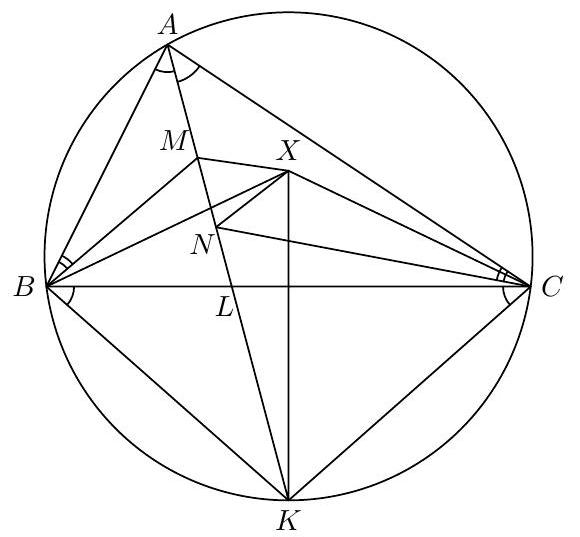
|
| 352 |
+
|
| 353 |
+
Problem 16. For a positive integer $k$, let $d(k)$ denote the number of divisors of $k$ (e.g. $d(12)=6$ ) and let $s(k)$ denote the digit sum of $k$ (e.g. $s(12)=3$ ). A positive integer $n$ is said to be amusing if there exists a positive integer $k$ such that $d(k)=s(k)=n$. What is the smallest amusing odd integer greater than 1 ?
|
| 354 |
+
|
| 355 |
+
Solution. The answer is 9 . For every $k$ we have $s(k) \equiv k(\bmod 9)$. Calculating remainders modulo 9 we have the following table
|
| 356 |
+
|
| 357 |
+
| $m$ | 0 | 1 | 2 | 3 | 4 | 5 | 6 | 7 | 8 |
|
| 358 |
+
| :---: | :---: | :---: | :---: | :---: | :---: | :---: | :---: | :---: | :---: |
|
| 359 |
+
| $m^{2}$ | 0 | 1 | 4 | 0 | 7 | 7 | 0 | 4 | 1 |
|
| 360 |
+
| $m^{6}$ | 0 | 1 | 1 | 0 | 1 | 1 | 0 | 1 | 1 |
|
| 361 |
+
|
| 362 |
+
If $d(k)=3$, then $k=p^{2}$ with $p$ a prime, but $p^{2} \equiv 3(\bmod 9)$ is impossible. This shows that 3 is not an amusing number. If $d(k)=5$, then $k=p^{4}$ with $p$ a prime, but $p^{4} \equiv 5(\bmod 9)$ is impossible. This shows that 5 is not an amusing number. If $d(k)=7$, then $k=p^{6}$ with $p$ a prime, but $p^{6} \equiv 7(\bmod 9)$ is impossible. This shows that 7 is not an amusing number. To see that 9 is amusing, note that $d(36)=s(36)=9$.
|
| 363 |
+
|
| 364 |
+
Problem 17. Find all positive integers $n$ such that the decimal representation of $n^{2}$ consists of odd digits only.
|
| 365 |
+
|
| 366 |
+
Solution. The only such numbers are $n=1$ and $n=3$.
|
| 367 |
+
|
| 368 |
+
If $n$ is even, then so is the last digit of $n^{2}$. If $n$ is odd and divisible by 5 , then $n=10 k+5$ for some integer $k \geq 0$ and the second-to-last digit of $n^{2}=(10 k+5)^{2}=100 k^{2}+100 k+25$ equals 2 .
|
| 369 |
+
|
| 370 |
+
Thus we may restrict ourselves to numbers of the form $n=10 k \pm m$, where $m \in\{1,3\}$. Then
|
| 371 |
+
|
| 372 |
+
$$
|
| 373 |
+
n^{2}=(10 k \pm m)^{2}=100 k^{2} \pm 20 k m+m^{2}=20 k(5 k \pm m)+m^{2}
|
| 374 |
+
$$
|
| 375 |
+
|
| 376 |
+
and since $m^{2} \in\{1,9\}$, the second-to-last digit of $n^{2}$ is even unless the number $20 k(5 k-m)$ is equal to zero. We therefore have $n^{2}=m^{2}$ so $n=1$ or $n=3$. These numbers indeed satisfy the required condition.
|
| 377 |
+
|
| 378 |
+
Problem 18. Let $p$ be a prime number. For each $k, 1 \leq k \leq p-1$, there exists a unique integer denoted by $k^{-1}$ such that $1 \leq k^{-1} \leq p-1$ and $k^{-1} \cdot k \equiv 1(\bmod p)$. Prove that the sequence
|
| 379 |
+
|
| 380 |
+
$$
|
| 381 |
+
1^{-1}, \quad 1^{-1}+2^{-1}, \quad 1^{-1}+2^{-1}+3^{-1}, \quad \ldots, \quad 1^{-1}+2^{-1}+\cdots+(p-1)^{-1}
|
| 382 |
+
$$
|
| 383 |
+
|
| 384 |
+
(addition modulo $p$ ) contains at most $(p+1) / 2$ distinct elements.
|
| 385 |
+
|
| 386 |
+
Solution. Calculating modulo $p$ we have that $(p-k) k^{-1}=-1$ so $(p-k)^{-1}=-k^{-1}$. If $p$ is odd, we set $m=\frac{p-1}{2}$ and it follows that
|
| 387 |
+
|
| 388 |
+
$$
|
| 389 |
+
\sum_{k=1}^{p-1} k^{-1}=\sum_{k=1}^{m}\left(k^{-1}+(p-k)^{-1}\right)=0
|
| 390 |
+
$$
|
| 391 |
+
|
| 392 |
+
For $\ell$ such that $m<\ell<p-1$ we calculate the $\ell$-th term in the sequence
|
| 393 |
+
|
| 394 |
+
$$
|
| 395 |
+
\sum_{k=1}^{\ell} k^{-1}=\sum_{k=1}^{\ell} k^{-1}-\sum_{k=1}^{p-1} k^{-1}=-\sum_{k=\ell+1}^{p-1} k^{-1}=-\sum_{k=1}^{p-\ell-1}(p-k)^{-1}=\sum_{k=1}^{p-\ell-1} k^{-1}
|
| 396 |
+
$$
|
| 397 |
+
|
| 398 |
+
and see that it is equal to one of the first $m-1$ terms in the sequence. We conclude that there are at most $m+1=\frac{p+1}{2}$ distinct terms in the sequence (the first $m$ and the last one).
|
| 399 |
+
|
| 400 |
+
If $p$ is the even prime 2 , then the sequence contains only one term 1 , and $1<(2+1) / 2$.
|
| 401 |
+
|
| 402 |
+
Problem 19. For which $k$ do there exist $k$ pairwise distinct primes $p_{1}, p_{2}, \ldots, p_{k}$ such that
|
| 403 |
+
|
| 404 |
+
$$
|
| 405 |
+
p_{1}^{2}+p_{2}^{2}+\cdots+p_{k}^{2}=2010 ?
|
| 406 |
+
$$
|
| 407 |
+
|
| 408 |
+
Solution. We show that it is possible only if $k=7$.
|
| 409 |
+
|
| 410 |
+
The 15 smallest prime squares are:
|
| 411 |
+
|
| 412 |
+
$$
|
| 413 |
+
4,9,25,49,121,169,289,361,529,841,961,1369,1681,1849,2209
|
| 414 |
+
$$
|
| 415 |
+
|
| 416 |
+
Since $2209>2010$ we see that $k \leq 14$.
|
| 417 |
+
|
| 418 |
+
Now we note that $p^{2} \equiv 1 \bmod 8$ if $p$ is an odd prime. We also have that $2010 \equiv 2 \bmod 8$. If all the primes are odd, then writing the original equation modulo 8 we get
|
| 419 |
+
|
| 420 |
+
$$
|
| 421 |
+
k \cdot 1 \equiv 2 \bmod 8
|
| 422 |
+
$$
|
| 423 |
+
|
| 424 |
+
so either $k=2$ or $k=10$.
|
| 425 |
+
|
| 426 |
+
$k=2:$ As $2010 \equiv 0 \bmod 3$ and $x^{2} \equiv 0$ or $x^{2} \equiv 1 \bmod 3$ we conclude that $p_{1} \equiv p_{2} \equiv 0$ mod 3. But that is impossible.
|
| 427 |
+
|
| 428 |
+
$k=10$ : The sum of first 10 odd prime squares is already greater than $2010(961+841+$ $529+\cdots>2010)$ so this is impossible.
|
| 429 |
+
|
| 430 |
+
Now we consider the case when one of the primes is 2 . Then the original equation modulo 8 takes the form
|
| 431 |
+
|
| 432 |
+
$$
|
| 433 |
+
4+(k-1) \cdot 1 \equiv 2 \quad \bmod 8
|
| 434 |
+
$$
|
| 435 |
+
|
| 436 |
+
so $k \equiv 7 \bmod 8$ and therefore $k=7$.
|
| 437 |
+
|
| 438 |
+
For $k=7$ there are 4 possible solutions:
|
| 439 |
+
|
| 440 |
+
$$
|
| 441 |
+
\begin{aligned}
|
| 442 |
+
4+9+49+169+289+529+961 & =2010 \\
|
| 443 |
+
4+9+25+121+361+529+961 & =2010 \\
|
| 444 |
+
4+9+25+49+121+841+961 & =2010 \\
|
| 445 |
+
4+9+49+121+169+289+1369 & =2010
|
| 446 |
+
\end{aligned}
|
| 447 |
+
$$
|
| 448 |
+
|
| 449 |
+
Finding them should not be too hard. We are already asuming that 4 is included. Considerations modulo 3 show that 9 must also be included. The square 1681 together with the 6 smallest prime squares gives a sum already greater than 2010 , so only prime squares up to $37^{2}=1369$ can be considered. If 25 is included, then for the remaining 4 prime squares considerations modulo 10 one can see that 3 out of 4 prime squares from $\{121,361,841,961\}$ have to be used and two of four cases are successful. If 25 is not included, then for the remaining 5 places again from considerations modulo 10 one can see, that 4 of them will be from the set $\{49,169,289,529,1369\}$ and two out of five cases are successful.
|
| 450 |
+
|
| 451 |
+
Problem 20. Determine all positive integers $n$ for which there exists an infinite subset $A$ of the set $\mathbb{N}$ of positive integers such that for all pairwise distinct $a_{1}, \ldots, a_{n} \in A$ the numbers $a_{1}+\cdots+a_{n}$ and $a_{1} \cdots a_{n}$ are coprime.
|
| 452 |
+
|
| 453 |
+
Solution. For $n=1$ the statement is obviously false. We assert that it is true for all $n>1$.
|
| 454 |
+
|
| 455 |
+
We first consider the sequence $x_{0}, x_{1}, \ldots$ of positive integers which is recursively defined by $x_{0}=n$ and $x_{k+1}=\left(x_{0}+\cdots+x_{k}\right) !+1$ for $k \geq 0$. We claim that the set $A:=\left\{x_{k} \mid k \geq 1\right\}$ satisfies the condition.
|
| 456 |
+
|
| 457 |
+
Suppose the contrary that there exist $1 \leq i_{1}<\cdots<i_{n}$ such that $x_{i_{1}}+\cdots+x_{i_{n}}$ and $x_{i_{1}} \cdots x_{i_{n}}$ have a common prime factor $p$. Then there exist a $j \in\{1, \ldots, n\}$ such that $p \mid x_{i_{j}}$. From the definition of the sequence $\left(x_{1}, x_{2}, \ldots\right)$ we get $x_{k} \equiv 1(\bmod p)$ for every integer $k>i_{j}$. This implies $p \mid x_{i_{1}}+\ldots x_{i_{j-1}}+n-j=: S$. Because of $S>0$ and $S \leq x_{0}+\cdots+x_{i_{j}-1}$ we have $p \mid\left(x_{0}+\cdots+x_{i_{j}-1}\right) !=x_{i_{j}}-1$ which contradicts $p \mid x_{i_{j}}$.
|
| 458 |
+
|
| 459 |
+
Thus, for every pairwise distinct $a_{1}, \ldots, a_{n} \in A$ the numbers $a_{1}+\cdots+a_{n}$ and $a_{1} \cdots a_{n}$ are indeed coprime.
|
| 460 |
+
|
BalticWay/md/en-bw11sol.md
ADDED
|
@@ -0,0 +1,412 @@
|
|
|
|
|
|
|
|
|
|
|
|
|
|
|
|
|
|
|
|
|
|
|
|
|
|
|
|
|
|
|
|
|
|
|
|
|
|
|
|
|
|
|
|
|
|
|
|
|
|
|
|
|
|
|
|
|
|
|
|
|
|
|
|
|
|
|
|
|
|
|
|
|
|
|
|
|
|
|
|
|
|
|
|
|
|
|
|
|
|
|
|
|
|
|
|
|
|
|
|
|
|
|
|
|
|
|
|
|
|
|
|
|
|
|
|
|
|
|
|
|
|
|
|
|
|
|
|
|
|
|
|
|
|
|
|
|
|
|
|
|
|
|
|
|
|
|
|
|
|
|
|
|
|
|
|
|
|
|
|
|
|
|
|
|
|
|
|
|
|
|
|
|
|
|
|
|
|
|
|
|
|
|
|
|
|
|
|
|
|
|
|
|
|
|
|
|
|
|
|
|
|
|
|
|
|
|
|
|
|
|
|
|
|
|
|
|
|
|
|
|
|
|
|
|
|
|
|
|
|
|
|
|
|
|
|
|
|
|
|
|
|
|
|
|
|
|
|
|
|
|
|
|
|
|
|
|
|
|
|
|
|
|
|
|
|
|
|
|
|
|
|
|
|
|
|
|
|
|
|
|
|
|
|
|
|
|
|
|
|
|
|
|
|
|
|
|
|
|
|
|
|
|
|
|
|
|
|
|
|
|
|
|
|
|
|
|
|
|
|
|
|
|
|
|
|
|
|
|
|
|
|
|
|
|
|
|
|
|
|
|
|
|
|
|
|
|
|
|
|
|
|
|
|
|
|
|
|
|
|
|
|
|
|
|
|
|
|
|
|
|
|
|
|
|
|
|
|
|
|
|
|
|
|
|
|
|
|
|
|
|
|
|
|
|
|
|
|
|
|
|
|
|
|
|
|
|
|
|
|
|
|
|
|
|
|
|
|
|
|
|
|
|
|
|
|
|
|
|
|
|
|
|
|
|
|
|
|
|
|
|
|
|
|
|
|
|
|
|
|
|
|
|
|
|
|
|
|
|
|
|
|
|
|
|
|
|
|
|
|
|
|
|
|
|
|
|
|
|
|
|
|
|
|
|
|
|
|
|
|
|
|
|
|
|
|
|
|
|
|
|
|
|
|
|
|
|
|
|
|
|
|
|
|
|
|
|
|
|
|
|
|
|
|
|
|
|
|
|
|
|
|
|
|
|
|
|
|
|
|
|
|
|
|
|
|
|
|
|
|
|
|
|
|
|
|
|
|
|
|
|
|
|
|
|
|
|
|
|
|
|
|
|
|
|
|
|
|
|
|
|
|
|
|
|
|
|
|
|
|
|
|
|
|
|
|
|
|
|
|
|
|
|
|
|
|
|
|
|
|
|
|
|
|
|
|
|
|
|
|
|
|
|
|
|
|
|
|
|
|
|
|
|
|
|
|
|
|
|
|
|
|
|
|
|
|
|
|
|
|
|
|
|
|
|
|
|
|
|
|
|
|
|
|
|
|
|
|
|
|
|
|
|
|
|
|
|
|
|
|
|
|
|
|
|
|
|
|
|
|
|
|
|
|
|
|
|
|
|
|
|
|
|
|
|
|
|
|
|
|
|
|
|
|
|
|
|
|
|
|
|
|
|
|
|
|
|
|
|
|
|
|
|
|
|
|
|
|
|
|
|
|
|
|
|
|
|
|
|
|
|
|
|
|
|
|
|
|
|
|
|
|
|
|
|
|
|
|
|
|
|
|
|
|
|
|
|
|
|
|
|
|
|
|
|
|
|
|
|
|
|
|
|
|
|
|
|
|
|
|
|
|
|
|
|
|
|
|
|
|
|
|
|
|
|
|
|
|
|
|
|
|
|
|
|
|
|
|
|
|
|
|
|
|
|
|
|
|
|
|
|
|
|
|
|
|
|
|
|
|
|
|
|
|
|
|
|
|
|
|
|
|
|
|
|
|
|
|
|
|
|
|
|
|
|
|
|
|
|
|
|
|
|
|
|
|
|
|
|
|
|
|
|
|
|
|
|
|
|
|
|
|
|
|
|
|
|
|
|
|
|
|
|
|
|
|
|
|
|
|
|
|
|
|
|
|
|
|
|
|
|
|
|
|
|
|
|
|
|
|
|
|
|
|
|
|
|
|
|
|
|
|
|
|
|
|
|
|
|
|
|
|
|
|
|
|
|
|
|
|
|
|
|
|
|
|
|
|
|
|
|
|
|
|
|
|
|
|
|
|
|
|
|
|
|
|
|
|
|
|
|
|
|
|
|
|
|
|
|
|
|
|
|
|
|
|
|
|
|
|
|
|
|
|
|
|
|
|
|
|
|
|
|
|
|
|
|
|
|
|
|
|
|
|
|
|
|
|
|
|
|
|
|
|
|
|
|
|
|
|
|
|
|
|
|
|
|
|
|
|
|
|
|
|
|
|
|
|
|
|
|
|
|
|
|
|
|
|
|
|
|
|
|
|
|
|
|
|
|
|
|
|
|
|
|
|
|
|
|
|
|
|
|
|
|
|
|
|
|
|
|
|
|
|
|
|
|
|
|
|
|
|
|
|
|
|
|
|
|
|
|
|
|
|
|
|
|
|
|
|
|
|
|
|
|
|
|
|
|
|
|
|
|
|
|
|
|
|
|
|
|
|
|
|
|
|
|
|
|
|
|
|
|
|
|
|
|
|
|
|
|
|
|
|
|
|
|
|
|
|
|
|
|
|
|
|
|
|
|
|
|
|
|
|
|
|
|
|
|
|
|
|
|
|
|
|
|
|
|
|
|
|
|
|
|
|
|
|
|
|
| 1 |
+
# Algebra
|
| 2 |
+
|
| 3 |
+
## A-1 DEN
|
| 4 |
+
|
| 5 |
+
The real numbers $x_{1}, \ldots, x_{2011}$ satisfy
|
| 6 |
+
|
| 7 |
+
$$
|
| 8 |
+
x_{1}+x_{2}=2 x_{1}^{\prime}, \quad x_{2}+x_{3}=2 x_{2}^{\prime}, \quad \ldots, \quad x_{2011}+x_{1}=2 x_{2011}^{\prime}
|
| 9 |
+
$$
|
| 10 |
+
|
| 11 |
+
where $x_{1}^{\prime}, x_{2}^{\prime}, \ldots, x_{2011}^{\prime}$ is a permutation of $x_{1}, x_{2}, \ldots, x_{2011}$. Prove that $x_{1}=x_{2}=\cdots=x_{2011}$.
|
| 12 |
+
|
| 13 |
+
Solution 1 For convenience we call $x_{2011}$ also $x_{0}$. Let $k$ be the largest of the numbers $x_{1}, \ldots, x_{2011}$, and consider an equation $x_{n-1}+x_{n}=2 k$, where $1 \leq n \leq 2011$. Hence we get $2 \max \left(x_{n-1}, x_{n}\right) \geq x_{n-1}+x_{n}=2 k$, so either $x_{n-1}$ or $x_{n}$, say $x_{n-1}$, satisfies $x_{n-1} \geq k$. Since also $x_{n-1} \leq k$, we then have $x_{n-1}=k$, and then also $x_{n}=2 k-x_{n-1}=2 k-k=k$. That is, in such an equation both variables on the left equal $k$. Now let $\mathcal{E}$ be the set of such equations, and let $\mathcal{S}$ be the set of subscripts on the left of these equations. From $x_{n}=k \forall n \in \mathcal{S}$ we get $|\mathcal{S}| \leq|\mathcal{E}|$. On the other hand, since the total number of appearances of these subscripts is $2|\mathcal{E}|$ and each subscript appears on the left in no more than two equations, we have $2|\mathcal{E}| \leq 2|\mathcal{S}|$. Thus $2|\mathcal{E}|=2|\mathcal{S}|$, so for each $n \in \mathcal{S}$ the set $\mathcal{E}$ contains both equations with the subscript $n$ on the left. Now assume $1 \in \mathcal{S}$ without loss of generality. Then the equation $x_{1}+x_{2}=2 k$ belongs to $\mathcal{E}$, so $2 \in \mathcal{S}$. Continuing in this way we find that all subscripts belong to $\mathcal{S}$, so $x_{1}=x_{2}=\cdots=x_{2011}=k$.
|
| 14 |
+
|
| 15 |
+
Solution 2 Again we call $x_{2011}$ also $x_{0}$. Taking the square on both sides of all the equations and adding the results, we get
|
| 16 |
+
|
| 17 |
+
$$
|
| 18 |
+
\sum_{n=1}^{2011}\left(x_{n-1}+x_{n}\right)^{2}=4 \sum_{n=1}^{2011} x_{n}^{\prime 2}=4 \sum_{n=1}^{2011} x_{n}^{2}
|
| 19 |
+
$$
|
| 20 |
+
|
| 21 |
+
which can be transformed with some algebra into
|
| 22 |
+
|
| 23 |
+
$$
|
| 24 |
+
\sum_{n=1}^{2011}\left(x_{n-1}-x_{n}\right)^{2}=0
|
| 25 |
+
$$
|
| 26 |
+
|
| 27 |
+
Hence the assertion follows.
|
| 28 |
+
|
| 29 |
+
## A-2 NOR
|
| 30 |
+
|
| 31 |
+
Let $f: \mathbb{Z} \rightarrow \mathbb{Z}$ be a function such that, for all integers $x$ and $y$, the following holds:
|
| 32 |
+
|
| 33 |
+
$$
|
| 34 |
+
f(f(x)-y)=f(y)-f(f(x)) .
|
| 35 |
+
$$
|
| 36 |
+
|
| 37 |
+
Show that $f$ is bounded, i.e. that there is a constant $C$ such that
|
| 38 |
+
|
| 39 |
+
$$
|
| 40 |
+
-C<f(x)<C
|
| 41 |
+
$$
|
| 42 |
+
|
| 43 |
+
for all integers $x$.
|
| 44 |
+
|
| 45 |
+
First, setting $y=f(x)$ one obtains $f(0)=0$. Secondly $y=0$ yields $f(f(x))=0$ for all $x$, thus
|
| 46 |
+
|
| 47 |
+
$$
|
| 48 |
+
f(f(x)-y)=f(y) .
|
| 49 |
+
$$
|
| 50 |
+
|
| 51 |
+
Setting $x=0$ yields $f(-y)=f(y)$, and finally $y:=-z$ yields
|
| 52 |
+
|
| 53 |
+
$$
|
| 54 |
+
f(f(x)+z)=f(-z)=f(z) .
|
| 55 |
+
$$
|
| 56 |
+
|
| 57 |
+
If $f(x)=0$ for all $x$, then $f$ is obviously bounded. If on the other hand there exists an $x_{0}$ such that $f\left(x_{0}\right) \neq 0$, then, with $x=x_{0}$, the last equality gives that $f$ is periodic with period $\left|f\left(x_{0}\right)\right|$, and thus $f$ must be bounded.
|
| 58 |
+
|
| 59 |
+
## A-3 NOR
|
| 60 |
+
|
| 61 |
+
A sequence $a_{1}, a_{2}, a_{3}, \ldots$ of non-negative integers is such that $a_{n+1}$ is the last digit of $a_{n}^{n}+a_{n-1}$ for all $n>2$. Is it always true that for some $n_{0}$ the sequence $a_{n_{0}}, a_{n_{0}+1}, a_{n_{0}+2}, \ldots$ is periodic?
|
| 62 |
+
|
| 63 |
+
Since for $n>2$, we actually consider the sequence $\bmod 10$, and $\varphi(10)=4$, we have that the recursive formula itself has a period of 4 . Furthermore, the subsequent terms of the sequence are uniquely determined by two consecutive terms. Therefore if there exist integers $n_{0}>2$ and $k>0$ such that $a_{n_{0}}=a_{n_{0}+4 k}$ and $a_{n_{0}+1}=a_{n_{0}+4 k+1}$, then the sequence is periodic from $a_{n_{0}}$ on with period $4 k$. Consider the pairs $\left(a_{2+4 j}, a_{3+4 j}\right)$ for $0 \leq j \leq 100$. Since there are at most 100 possible different amongst these, there have to exist $0 \leq j_{1}<j_{2} \leq 100$ such that $a_{2+4 j_{1}}=a_{2+4 j_{2}}$ and $a_{3+4 j_{1}}=a_{3+4 j_{2}}$. Choosing $n_{0}:=2+4 j_{1}$ we are done.
|
| 64 |
+
|
| 65 |
+
Remark: Note, that if $a_{1}, a_{2}$ both are between 0 and 9 , then the recursion is invertible and the sequence can be extended to the left. By invertibility it then follows that the original sequence is actually periodic with the choice $n_{0}=1$. Similar arguments show, that in general, $n_{0}$ can be chosen to be 3 .
|
| 66 |
+
|
| 67 |
+
## A-4 RUS
|
| 68 |
+
|
| 69 |
+
Let $a, b, c, d$ be non-negative reals such that $a+b+c+d=4$. Prove the inequality
|
| 70 |
+
|
| 71 |
+
$$
|
| 72 |
+
\frac{a}{a^{3}+8}+\frac{b}{b^{3}+8}+\frac{c}{c^{3}+8}+\frac{d}{d^{3}+8} \leq \frac{4}{9}
|
| 73 |
+
$$
|
| 74 |
+
|
| 75 |
+
By the means inequality we have $a^{3}+2=a^{3}+1+1 \geq 3 \sqrt[3]{a^{3} \cdot 1 \cdot 1}=3 a$. Therefore it is sufficient to prove the inequality
|
| 76 |
+
|
| 77 |
+
$$
|
| 78 |
+
\frac{a}{3 a+6}+\frac{b}{3 b+6}+\frac{c}{3 c+6}+\frac{d}{3 d+6} \leq \frac{4}{9} .
|
| 79 |
+
$$
|
| 80 |
+
|
| 81 |
+
We can write the last inequality in the form
|
| 82 |
+
|
| 83 |
+
$$
|
| 84 |
+
\frac{1}{a+2}+\frac{1}{b+2}+\frac{1}{c+2}+\frac{1}{d+2} \geq \frac{4}{3} .
|
| 85 |
+
$$
|
| 86 |
+
|
| 87 |
+
Now it follows by the harmonic and arithmetic means inequality:
|
| 88 |
+
|
| 89 |
+
$\frac{1}{4}\left(\frac{1}{a+2}+\frac{1}{b+2}+\frac{1}{c+2}+\frac{1}{d+2}\right) \geq \frac{4}{(a+2)+(b+2)+(c+2)+(d+2)}=\frac{4}{4+2+2+2+2}=\frac{1}{3}$.
|
| 90 |
+
|
| 91 |
+
## A-5 SAF
|
| 92 |
+
|
| 93 |
+
Let $f: \mathbb{R} \rightarrow \mathbb{R}$ be a function such that
|
| 94 |
+
|
| 95 |
+
$$
|
| 96 |
+
f(f(x))=x^{2}-x+1
|
| 97 |
+
$$
|
| 98 |
+
|
| 99 |
+
for all real numbers $x$. Determine $f(0)$.
|
| 100 |
+
|
| 101 |
+
Let $f(0)=a$ and $f(1)=b$.
|
| 102 |
+
|
| 103 |
+
Then $f(f(0))=f(a)$.
|
| 104 |
+
|
| 105 |
+
But $f(f(0))=0^{2}-0+1=1$. So $f(a)=1$.
|
| 106 |
+
|
| 107 |
+
Also $f(f(1))=f(b)$.
|
| 108 |
+
|
| 109 |
+
But $f(f(1))=1^{2}-1+1=1$. So $f(b)=1$.
|
| 110 |
+
|
| 111 |
+
From (1), $f(f(a))=f(1)$.
|
| 112 |
+
|
| 113 |
+
But $f(f(a))=a^{2}-a+1$. So $a^{2}-a+1=b$.
|
| 114 |
+
|
| 115 |
+
From (2), $f(f(b))=f(1)$, giving $b^{2}-b+1=b$. So $b=1$.
|
| 116 |
+
|
| 117 |
+
Putting $b=1$ in (3) gives $a=0$ or 1 .
|
| 118 |
+
|
| 119 |
+
But $a=0 \Rightarrow f(0)=0 \Rightarrow f(f(0))=0$, contradicting (1).
|
| 120 |
+
|
| 121 |
+
So $a=1$, i.e. $f(0)=1$.
|
| 122 |
+
|
| 123 |
+
## Combinatorics
|
| 124 |
+
|
| 125 |
+
## C-1 FIN
|
| 126 |
+
|
| 127 |
+
Let $n$ be a positive integer. Prove that the number of lines which go through the origin and precisely one other point with integer coordinates $(x, y), 0 \leq x, y \leq n$, is at least $\frac{n^{2}}{4}$.
|
| 128 |
+
|
| 129 |
+
Let $n^{\prime}=[n / 2]$ be the largest integer satisfying $n^{\prime} \leq n / 2$. We solve the problem with $n^{2}-3 n^{\prime 2}$ instead of $n^{2} / 4$, which is exactly what we are supposed to do if $n$ is even and slighly better than our original goal if $n$ is odd.
|
| 130 |
+
|
| 131 |
+
A point is called relevant if both of its coordinates are integers between 1 and $n$, inclusively. A relevant point is called tiny if both of its coordinates are at most $n^{\prime}$ and large otherwise. Note that there are $n^{2}$ tiny points. A line through the origin is called vicious if contains at least two relevant points.
|
| 132 |
+
|
| 133 |
+
Consider any vicious line $\ell$. Suppose that $\ell$ passes through exactly $k$ vicious points and that $P=(x, y)$ is that one among them that is closest to the origin. Defining $P_{i}=(x \cdot i, y \cdot i)$ for all integers $i$, the relevant points on $\ell$ are $P_{1}, P_{2}, \ldots, P_{k}$. Since $k \geq 2$, it follows that $P=P_{1}$ itself is tiny. Now let $k^{\prime}$ denote that positive integer for which $P_{1}, P_{2}, \ldots, P_{k^{\prime}}$ are the tiny points on $\ell$, whereas $P_{k^{\prime}+1}, \ldots, P_{k}$ are the large points on $\ell$. Since $P_{k^{\prime}+1}$ is not tiny, the point $P_{2\left(k^{\prime}+1\right)}$ cannot be relevant, for which reason $k \leq 2 k^{\prime}+1$; in particular, it follows that $k \leq 3 k^{\prime}$.
|
| 134 |
+
|
| 135 |
+
Summing the inequality just obtained over all vicious lines, we learn that the number of all relevant points lying on vicious lines is at most three times the number of all tiny points, i.e. at most $3 n^{\prime 2}$. Thus there are at least $n^{2}-3 n^{2}$ relevant points not belonging to any vicious line. As expained in the beginning, this solves the problem.
|
| 136 |
+
|
| 137 |
+
## C-2 GER
|
| 138 |
+
|
| 139 |
+
Let $T$ denote the 15-element set $\{10 a+b: a, b \in \mathbb{Z}, 1 \leq a<b \leq 6\}$. Let $S$ be a subset of $T$ in which all six digits $1,2, \ldots, 6$ appear and in which no three elements together use all these six digits. Determine the largest possible size of $S$.
|
| 140 |
+
|
| 141 |
+
Consider the numbers of $T$, which contain 1 or 2 . Certainly, no 3 of them can contain all 6 digits and all 6 digits appear. Hence $n \geq 9$.
|
| 142 |
+
|
| 143 |
+
Consider the partitions:
|
| 144 |
+
|
| 145 |
+
$$
|
| 146 |
+
\begin{gathered}
|
| 147 |
+
12,36,45, \\
|
| 148 |
+
13,24,56, \\
|
| 149 |
+
14,26,35, \\
|
| 150 |
+
15,23,46, \\
|
| 151 |
+
16,25,34 .
|
| 152 |
+
\end{gathered}
|
| 153 |
+
$$
|
| 154 |
+
|
| 155 |
+
Since every row is a partition of $\{1,2, \ldots, 6\}$, it contains all 6 digits, $S$ can contain at most two numbers of each of the 5 rows, i.e. $n \leq 10$.
|
| 156 |
+
|
| 157 |
+
Now we will prove that $n=9$ is the correct number. Therefore we assume that $n=10$ and will exclude this case by contradiction. Certainly, there is a digit, say 1, which does not appear at least twice (otherwise at most 3 numbers are missing in $S$ ) and at most 4 times (otherwise this digit does not appear in the members of $S$ at all). Obviously, every row of the above set of partitions contains exactly 2 members of $S$. W.l.o.g. assume that $12,13 \notin S$ and $16 \in S$. Then consider the following partitions, where bold-faced numbers are members of $S$ and numbers in italics are not:
|
| 158 |
+
|
| 159 |
+
$$
|
| 160 |
+
\begin{gathered}
|
| 161 |
+
12, \mathbf{3 6}, \mathbf{4 5}, \\
|
| 162 |
+
13, \mathbf{2 4}, \mathbf{5 6}, \\
|
| 163 |
+
14,26,35, \\
|
| 164 |
+
15,23,46, \\
|
| 165 |
+
\mathbf{1 6 ,} 25,34 .
|
| 166 |
+
\end{gathered}
|
| 167 |
+
$$
|
| 168 |
+
|
| 169 |
+
By $16,45 \in S$ it follows $23 \notin S$ and by $24,36 \in S$ it follows $15 \notin S$. Now $S$ is missing at least 2 members $(15,23)$ of the partition $15,23,46$, which is a contradiction.
|
| 170 |
+
|
| 171 |
+
## C-3 GER
|
| 172 |
+
|
| 173 |
+
In Greifswald there are three schools called $A, B$ and $C$, each of which is attended by at least one student. Among any three students, one from $A$, one from $B$ and one from $C$, there are two knowing each other and two not knowing each other. Prove that at least one of the following holds:
|
| 174 |
+
|
| 175 |
+
- Some student from $A$ knows all students from $B$.
|
| 176 |
+
- Some student from $B$ knows all students from $C$.
|
| 177 |
+
- Some student from $C$ knows all students from $A$.
|
| 178 |
+
|
| 179 |
+
Assume the contrary and let $a$ be a student from $A$ knowing as many students from $B$ as possible. As $a$ does not know all students from $B$, there is a student $b$ from $B$ not known to $a$. Similarly, we may pick a student $c$ from $C$ not known to $b$ and then a student $a^{\prime}$ from $A$ not known to $c$. Applying the assumption to the sets of students $\{a, b, c\}$ and $\left\{a^{\prime}, b, c\right\}$, we learn that $a$ and $c$ know each other other, and so do $a^{\prime}$ and $b$. As $b$ knows $a^{\prime}$ but not $a$, we have $a \neq a^{\prime}$. Moreover, the maximality condition imposed on $a$ tells us that some student $b^{\prime}$ from $B$ is known to $a$ but not to $a^{\prime}$. Now if $b^{\prime}$ and $c$ knew each other, then any two students from $\left\{a, b^{\prime}, c\right\}$ would know one another, which is not possible. Thus $b^{\prime}$ and $c$ do not know each other, but this means that no two students from $\left\{a^{\prime}, b^{\prime}, c\right\}$ know one another, which is likewise impossible. Thereby the problem is solved.
|
| 180 |
+
|
| 181 |
+
## C-4 GER
|
| 182 |
+
|
| 183 |
+
Given a rectangular grid, split into $m \times n$ squares, a colouring of the squares in two colours (black and white) is called valid if it satisfies the following conditions:
|
| 184 |
+
|
| 185 |
+
- All squares touching the border of the grid are coloured black.
|
| 186 |
+
- No four squares forming a $2 \times 2$-square are coloured in the same colour.
|
| 187 |
+
- No four squares forming a $2 \times 2$-square are coloured in such a way that only diagonally touching squares have the same colour.
|
| 188 |
+
|
| 189 |
+
Which grid sizes $m \times n$ (with $m, n \geq 3$ ) have a valid colouring?
|
| 190 |
+
|
| 191 |
+
There exist a valid colouring iff $n$ or $m$ is odd.
|
| 192 |
+
|
| 193 |
+
Proof. If, without loss of generality, the number of rows is odd, colour every second row black, as well as the boundary, and all other squares white. It is easy to check that this coloring is valid.
|
| 194 |
+
|
| 195 |
+
If both $n$ and $m$ are even, there is no valid coloring. To prove this, consider the following graph $G$ : The vertices are the squares, and edges are drawn between two diagonally adjacent squares $A$ and $B$ iff the two other squares touching both $A$ and $B$ at a side have the same color.
|
| 196 |
+
|
| 197 |
+
This graph of a valid coloring has the following properties:
|
| 198 |
+
|
| 199 |
+
- The corner squares have degree 1.
|
| 200 |
+
- Squares at a side of the grid have degree 0 or 2 .
|
| 201 |
+
- Squares in the middle have degree 0,2 or 4 .
|
| 202 |
+
- The "forbidden patterns" are equivalent to the statement that no two edges of the graph are intersecting.
|
| 203 |
+
- If you put a checkboard pattern on the grid, no edge connects squares of different colours.
|
| 204 |
+
- Hence, if $m$ and $n$ are even, the corner squares sharing a side of the grid are in different connected components of the graph.
|
| 205 |
+
- Since the sum of degrees in each connected component is even, the opposing corner-squares have to be in the same connected component.
|
| 206 |
+
- Hence, there is a path from each corner to the opposing one.
|
| 207 |
+
|
| 208 |
+
But those two paths can not exist without intersecting, thus some forbidden pattern exists always, i.e. there is no valid colouring.
|
| 209 |
+
|
| 210 |
+
## C-5 RUS
|
| 211 |
+
|
| 212 |
+
Two persons play the following game with integers. The initial number is $2011^{2011}$. The players move in turns. Each move consists of subtraction of an integer between 1 and 2010 inclusive, or division by 2011, rounding down to the closest integer when necessary. The player who first obtains a non-positive integer wins. Which player has a winning strategy?
|
| 213 |
+
|
| 214 |
+
Answer: the second player wins.
|
| 215 |
+
|
| 216 |
+
Though the problem is taken from the recent article (A.Guo. Winning strategies for aperiodic subtraction games // arXiv: 1108.1239v2), it could be known for the smaller numbers, say, for 2 instead of 2011.
|
| 217 |
+
|
| 218 |
+
The initial numbers $N$ for which the second player has a winning strategy are those ones that have odd numbers of trailing 0's in base 2011 (i.e. if the biggest power of 2011 that divides $N$ is odd). The main difficulty of the problem is to invent this answer. The proof is trivial: each move of the first player makes this biggest power to be even, and after that the second player can make this power odd by a suitable move.
|
| 219 |
+
|
| 220 |
+
## G-1 FIN
|
| 221 |
+
|
| 222 |
+
## Geometry
|
| 223 |
+
|
| 224 |
+
Let $A B$ and $C D$ be two diameters of the circle $\mathcal{C}$. For an arbitrary point $P$ on $\mathcal{C}$, let $R$ and $S$ be the feet of the perpendiculars from $P$ to $A B$ and $C D$, respectively. Show that the length of $R S$ is independent of the choice of $P$.
|
| 225 |
+
|
| 226 |
+
Solution. Let $O$ be the centre of $\mathcal{C}$. Then $P, R, S$, and $O$ are points on a circle $\mathcal{C}^{\prime}$ with diameter $O P$, equal to the radius of $\mathcal{C}$. The segment $R S$ is a chord in this circle subtending the angle $B O D$ or a supplementary angle. Since the angle as well as radius of $\mathcal{C}^{\prime}$ are independent of $P$, so is $R S$.
|
| 227 |
+
|
| 228 |
+
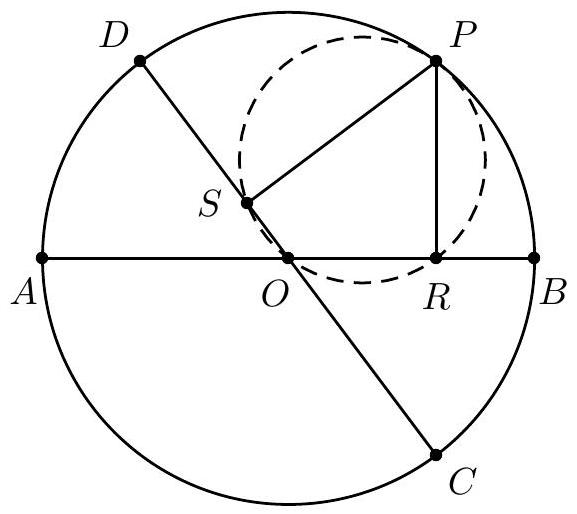
|
| 229 |
+
|
| 230 |
+
## G-2 DEN
|
| 231 |
+
|
| 232 |
+
Let $P$ be a point inside a square $A B C D$ such that $P A: P B: P C$ is $1: 2: 3$. Determine the angle $\angle B P A$.
|
| 233 |
+
|
| 234 |
+
First Solution. Rotate the triangle $A B P$ by $90^{\circ}$ around $B$ such that $A$ goes to $C$ and $P$ is mapped to a new point $Q$. Then $\angle P B Q=\angle P B C+\angle C B Q=\angle P B C+\angle A B P=90^{\circ}$. Hence the triangle $P B Q$ is an isosceles right-angled triangle, and $\angle B Q P=45^{\circ}$. By Pythagoras $P Q^{2}=2 P B^{2}=8 A P^{2}$. Since $C Q^{2}+P Q^{2}=A P^{2}+8 A P^{2}=9 A P^{2}=P C^{2}$, by the converse Pythagoras $P Q C$ is a right-angled triangle, and hence
|
| 235 |
+
|
| 236 |
+
$$
|
| 237 |
+
\angle B P A=\angle B Q C=\angle B Q P+\angle P Q C=45^{\circ}+90^{\circ}=135^{\circ} .
|
| 238 |
+
$$
|
| 239 |
+
|
| 240 |
+

|
| 241 |
+
|
| 242 |
+
Second Solution. Let $X$ and $Y$ be the feet of the perpendiculars drawn from $A$ and $C$ to $P B$. Put $x=A X$ and $y=X P$. Suppose without loss of generality that $P A=1, P B=2$, and $P C=3$. Since the right angled triangles $A B X$ and $B C Y$ are congruent, we have $B Y=x$ and $C Y=2+y$. Applying Pythagoras' Theorem to the triangles $A P X$ and $P Y C$, we get
|
| 243 |
+
|
| 244 |
+
$$
|
| 245 |
+
x^{2}+y^{2}=1 \quad \text { and } \quad(2-x)^{2}+(2+y)^{2}=9 \text {. }
|
| 246 |
+
$$
|
| 247 |
+
|
| 248 |
+
Substituting the former equation into the latter, we infer $x=y$, which in turn discloses $\angle B P A=135^{\circ}$.
|
| 249 |
+
|
| 250 |
+
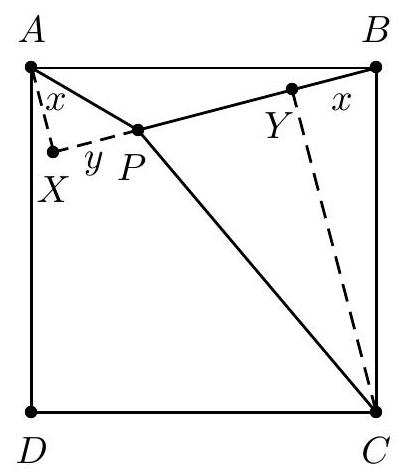
|
| 251 |
+
|
| 252 |
+
## G-3 DEN
|
| 253 |
+
|
| 254 |
+
Let $E$ be an interior point of the convex quadrilateral $A B C D$. Construct triangles $\triangle A B F$, $\triangle B C G, \triangle C D H$ and $\triangle D A I$ on the outside of the quadrilateral such that the similarities $\triangle A B F \sim \triangle D C E, \triangle B C G \sim \triangle A D E, \triangle C D H \sim \triangle B A E$ and $\triangle D A I \sim \triangle C B E$ hold. Let $P$, $Q, R$ and $S$ be the projections of $E$ on the lines $A B, B C, C D$ and $D A$, respectively. Prove that if the quadrilateral $P Q R S$ is cyclic, then
|
| 255 |
+
|
| 256 |
+
$$
|
| 257 |
+
E F \cdot C D=E G \cdot D A=E H \cdot A B=E I \cdot B C .
|
| 258 |
+
$$
|
| 259 |
+
|
| 260 |
+
Solution. We consider oriented angles modulo $180^{\circ}$. From the cyclic quadrilaterals $A P E S$, $B Q E P, P Q R S, C R E Q, D S E R$ and $\triangle D C E \sim \triangle A B F$ we get
|
| 261 |
+
|
| 262 |
+
$$
|
| 263 |
+
\begin{aligned}
|
| 264 |
+
\angle A E B & =\angle E A B+\angle A B E=\angle E S P+\angle P Q E \\
|
| 265 |
+
& =\angle E S R+\angle R S P+\angle P Q R+\angle R Q E \\
|
| 266 |
+
& =\angle E S R+\angle R Q E=\angle E D C+\angle D C E \\
|
| 267 |
+
& =\angle D E C=\angle A F B,
|
| 268 |
+
\end{aligned}
|
| 269 |
+
$$
|
| 270 |
+
|
| 271 |
+
so the quadrilateral $A E B F$ is cyclic. By Ptolemy we then have
|
| 272 |
+
|
| 273 |
+
$$
|
| 274 |
+
E F \cdot A B=A E \cdot B F+B E \cdot A F .
|
| 275 |
+
$$
|
| 276 |
+
|
| 277 |
+
This transforms by $A B: B F: A F=D C: C E: D E$ into
|
| 278 |
+
|
| 279 |
+
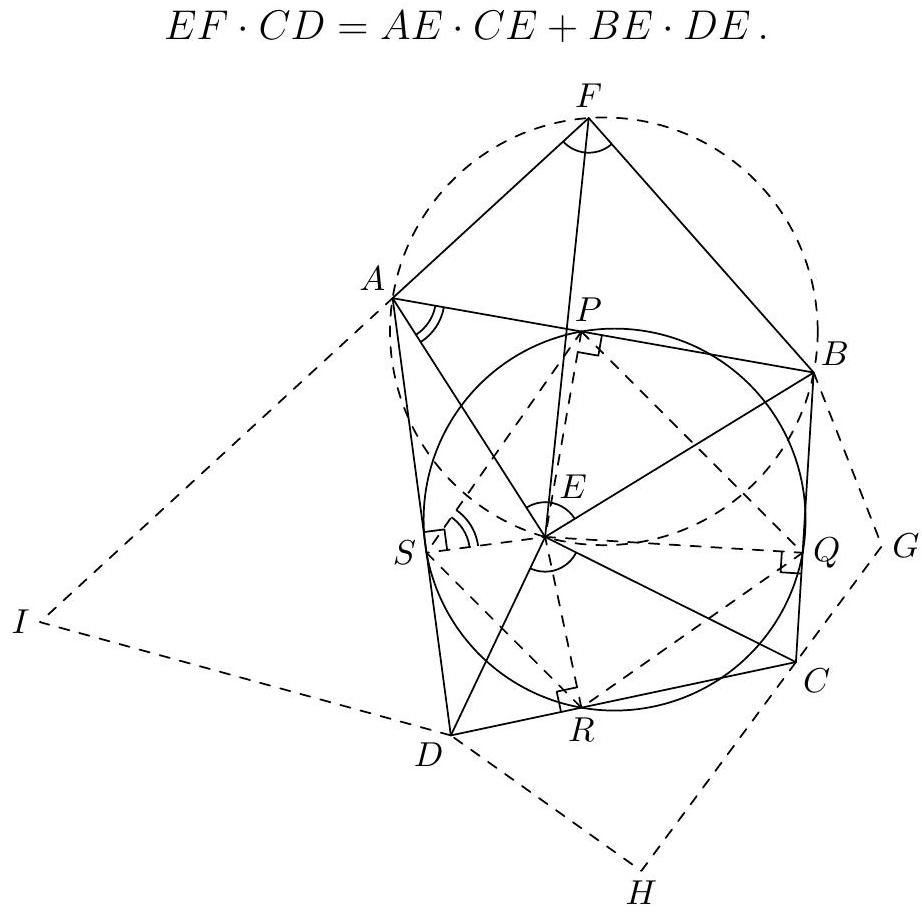
|
| 280 |
+
|
| 281 |
+
Since the expression on the right of this equation is invariant under cyclic permutation of the vertices of the quadrilateral $A B C D$, the asserted equation follows immediately.
|
| 282 |
+
|
| 283 |
+
## G-4 POL
|
| 284 |
+
|
| 285 |
+
The incircle of a triangle $A B C$ touches the sides $B C, C A, A B$ at $D, E, F$, respectively. Let $G$ be a point on the incircle such that $F G$ is a diameter. The lines $E G$ and $F D$ intersect at $H$. Prove that $C H \| A B$.
|
| 286 |
+
|
| 287 |
+
Solution. We work in the opposite direction. Suppose that $H^{\prime}$ is the point where $D F$ intersect the line through $C$ parallel to $A B$. We need to show that $H^{\prime}=H$. For this purpose it suffices to prove that $E, G, H^{\prime}$ are collinear, which reduces to showing that if $G^{\prime} \neq E$ is the common point of $E H^{\prime}$ and the incircle, then $G^{\prime}=G$.
|
| 288 |
+
|
| 289 |
+
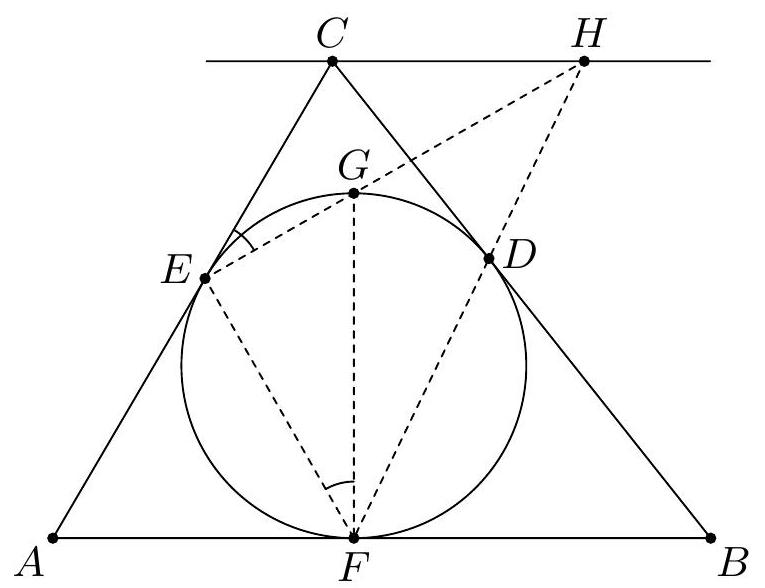
|
| 290 |
+
|
| 291 |
+
Note that $H^{\prime}$ and $B$ lie on the same side of $A C$. Hence $C H^{\prime} \| A B$ gives $\angle A C H^{\prime}=180^{\circ}-\angle B A C$. Also, some homothety with center $D$ maps the segment $B F$ to the segment $C H^{\prime}$. Thus the equality $B D=B F$ implies that $C H^{\prime}=C D=C E$, i.e. the triangle $E C H^{\prime}$ is isosceles and
|
| 292 |
+
|
| 293 |
+
$$
|
| 294 |
+
\angle H^{\prime} E C=\frac{1}{2}\left(180^{\circ}-\angle E C H^{\prime}\right)=\frac{1}{2} \angle B A C .
|
| 295 |
+
$$
|
| 296 |
+
|
| 297 |
+
But $G^{\prime}$ and $H^{\prime}$ lie on the same side of $A C$, so $\angle G^{\prime} E C=\angle H^{\prime} E C$ and consequently
|
| 298 |
+
|
| 299 |
+
$$
|
| 300 |
+
\angle G^{\prime} F E=\angle G^{\prime} E C=\angle H^{\prime} E C=\frac{1}{2} \angle B A C
|
| 301 |
+
$$
|
| 302 |
+
|
| 303 |
+
so that
|
| 304 |
+
|
| 305 |
+
$$
|
| 306 |
+
\angle G^{\prime} F A=\angle G^{\prime} F E+\angle E F A=\frac{1}{2} \angle B A C+\frac{1}{2}\left(180^{\circ}-\angle F A E\right)=90^{\circ} .
|
| 307 |
+
$$
|
| 308 |
+
|
| 309 |
+
Hence $F G^{\prime}$ is a diameter of the incircle and the desired equality $G^{\prime}=G$ follows.
|
| 310 |
+
|
| 311 |
+
Remark. A similar proof also works in the forward direction: one may compute $\angle E H D=$ $\frac{1}{2} \angle A C B$. Hence $H$ lies on the circle centred at $C$ that passes through $D$ and $E$. Consequently the triangle $E H C$ is isosceles, wherefore
|
| 312 |
+
|
| 313 |
+
$$
|
| 314 |
+
\angle E C H=180^{\circ}-2 \angle G E C=180^{\circ}-\angle B A C .
|
| 315 |
+
$$
|
| 316 |
+
|
| 317 |
+
Thus the lines $A B$ and $C H$ are indeed parallel.
|
| 318 |
+
|
| 319 |
+
## G-5 POL
|
| 320 |
+
|
| 321 |
+
Let $A B C D$ be a convex quadrilateral such that $\angle A D B=\angle B D C$. Suppose that a point $E$ on the side $A D$ satisfies the equality
|
| 322 |
+
|
| 323 |
+
$$
|
| 324 |
+
A E \cdot E D+B E^{2}=C D \cdot A E .
|
| 325 |
+
$$
|
| 326 |
+
|
| 327 |
+
Show that $\angle E B A=\angle D C B$.
|
| 328 |
+
|
| 329 |
+
Solution. Let $F$ be the point symmetric to $E$ with respect to the line $D B$. Then the equality $\angle A D B=\angle B D C$ shows that $F$ lies on the line $D C$, on the same side of $D$ as $C$. Moreover, we have $A E \cdot E D<C D \cdot A E$, or $F D=E D<C D$, so in fact $F$ lies on the segment $D C$.
|
| 330 |
+
|
| 331 |
+
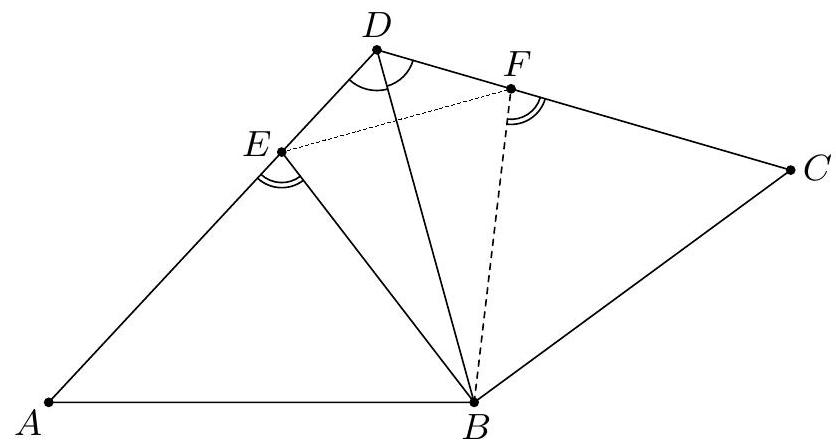
|
| 332 |
+
|
| 333 |
+
Note now that triangles $D E B$ and $D F B$ are congruent (symmetric with respect to the line $D B)$, so $\angle A E B=\angle B F C$. Also, we have
|
| 334 |
+
|
| 335 |
+
$$
|
| 336 |
+
B E^{2}=C D \cdot A E-A E \cdot E D=A E \cdot(C D-E D)=A E \cdot(C D-F D)=A E \cdot C F
|
| 337 |
+
$$
|
| 338 |
+
|
| 339 |
+
Therefore
|
| 340 |
+
|
| 341 |
+
$$
|
| 342 |
+
\frac{B E}{A E}=\frac{C F}{B E}=\frac{C F}{B F}
|
| 343 |
+
$$
|
| 344 |
+
|
| 345 |
+
This shows that the triangles $B E A$ and $C F B$ are similar, which gives $\angle E B A=\angle F C B=$ $\angle D C B$, as desired.
|
| 346 |
+
|
| 347 |
+
## Number Theory
|
| 348 |
+
|
| 349 |
+
## N-1 DEN
|
| 350 |
+
|
| 351 |
+
Let $a$ be any integer. Define the sequence $x_{0}, x_{1}, \ldots$ by $x_{0}=a, x_{1}=3$ and
|
| 352 |
+
|
| 353 |
+
$$
|
| 354 |
+
x_{n}=2 x_{n-1}-4 x_{n-2}+3 \text { for all } n>1 \text {. }
|
| 355 |
+
$$
|
| 356 |
+
|
| 357 |
+
Determine the largest integer $k_{a}$ for which there exists a prime $p$ such that $p^{k_{a}}$ divides $x_{2011}-1$.
|
| 358 |
+
|
| 359 |
+
Let $y_{n}=x_{n}-1$. Hence
|
| 360 |
+
|
| 361 |
+
$y_{n}=x_{n}-1=2\left(y_{n-1}+1\right)-4\left(y_{n-2}+1\right)+3-1=2 y_{n-1}-4 y_{n-2}=2\left(2 y_{n-2}-4 y_{n-3}\right)-4 y_{n-2}=-8 y_{n-3}$
|
| 362 |
+
|
| 363 |
+
for all $n>2$. Hence
|
| 364 |
+
|
| 365 |
+
$$
|
| 366 |
+
x_{2011}-1=y_{2011}=-8 y_{2008}=\cdots=(-8)^{670} y_{1}=2^{2011}
|
| 367 |
+
$$
|
| 368 |
+
|
| 369 |
+
Hence $k=2011$.
|
| 370 |
+
|
| 371 |
+
## N-2 DEN
|
| 372 |
+
|
| 373 |
+
Determine all positive integers $d$ such that whenever $d$ divides a positive integer $n, d$ will also divide any integer obtained by rearranging the digits of $n$.
|
| 374 |
+
|
| 375 |
+
Answer: $d=1, d=3$ or $d=9$. It is known that 1,3 and 9 have the given property. Assume that $d$ is a $k$ digit number such that whenever $d$ divides an integer $n, d$ will also divide any integer $m$ having the same digits as $n$. Then there exists a $k+2$ digit number $10 a_{1} a_{2} \ldots a_{k}$ which is divisible by $d$. Hence $a_{1} a_{2} \cdots a_{k} 10$ and $a_{1} a_{2} \cdots a_{k} 01$ are also divisible by $d$. Since $a_{1} a_{2} \cdots a_{k} 10-a_{1} a_{2} \cdots a_{k} 01=9, d$ divides 9 , and hence $d=1, d=3$ or $d=9$ as stated.
|
| 376 |
+
|
| 377 |
+
## N-3 GER
|
| 378 |
+
|
| 379 |
+
Determine all pairs $(p, q)$ of primes for which both $p^{2}+q^{3}$ and $q^{2}+p^{3}$ are perfect squares.
|
| 380 |
+
|
| 381 |
+
Answer. There is only one such pair, namely $(p, q)=(3,3)$.
|
| 382 |
+
|
| 383 |
+
Proof. Let the pair $(p, q)$ be as described in the statement of the problem.
|
| 384 |
+
|
| 385 |
+
1.) First we show that $p \neq 2$. Otherwise, there would exist a prime $q$ for which $q^{2}+8$ and $q^{3}+4$ are perfect squares. Because of $q^{2}<q^{2}+8$, the second condition gives $(q+1)^{2} \leqslant q^{2}+8$ and hence $q \leqslant 3$. But for $q=2$ or $q=3$ the expression $q^{3}+4$ fails to be a perfect square. Hence indeed $p \neq 2$ and due to symmetry we also have $q \neq 2$.
|
| 386 |
+
|
| 387 |
+
2.) Next we consider the special case $p=q$. Then $p^{2}(p+1)$ is a perfect square, for which reason there exists an integer $n$ satisfying $p=n^{2}-1=(n+1)(n-1)$. Since $p$ is prime, this factorization yields $n=2$ and thus $p=3$. This completes the discussion of the case $p=q$.
|
| 388 |
+
|
| 389 |
+
3.) So from now on we may suppose that $p$ and $q$ are distinct odd primes. Let $a$ be a positive integer such that $p^{2}+q^{3}=a^{2}$, i.e. $q^{3}=(a+p)(a-p)$. If both factors $a+p$ and $a-p$ were divisible by $q$, then so were their difference $2 p$, which is absurd. So by uniqueness of prime factorization we have $a+p=q^{3}$ and $a-p=1$. Subtracting these equations we learn $q^{3}=2 p+1$. Due to symmetry we also have $p^{3}=2 q+1$. Now if $p<q$, then $q^{3}=2 p+1<2 q+1=p^{3}$, which gives a contradiction, and the case $q<p$ is excluded similarly.
|
| 390 |
+
|
| 391 |
+
Thereby the problem is solved.
|
| 392 |
+
|
| 393 |
+
## N-4 FIN
|
| 394 |
+
|
| 395 |
+
Let $p \neq 3$ be a prime number. Show that there is a non-constant arithmetic sequence of positive integers $x_{1}, x_{2}, \ldots, x_{p}$ such that the product of the terms of the sequence is a cube.
|
| 396 |
+
|
| 397 |
+
Let $a_{1}, a_{2}, \ldots, a_{p}$ be any arithmetic sequence of positive integers and let $P$ be the product of the terms of this sequence. For any $n$, the sequence $P^{n} a_{1}, P^{n} a_{2}, \ldots, P^{n} a_{p}$ is also arithmetic, and the product of terms is $P^{n p+1}$. Now either $p \equiv 1 \bmod 3$ or $p \equiv-1 \bmod 3$. In the former case, $2 p+1=3 q$ for some $q$ and in the latter case, $1 p+1=3 q$ for some $q$. So we can choose either $x_{i}=P^{2} a_{i}$ or $x_{i}=P a_{i}$ to obtain the sequence we are looking for.
|
| 398 |
+
|
| 399 |
+
## N-5 POL
|
| 400 |
+
|
| 401 |
+
An integer $n \geq 1$ is called balanced if it has an even number of distinct prime divisors. Prove that there exist infinitely many positive integers $n$ such that there are exactly two balanced numbers among $n, n+1, n+2$ and $n+3$.
|
| 402 |
+
|
| 403 |
+
We argue by contradiction. Choose $N$ so large that no $n \geq N$ obeys this property. Now we partition all integers $\geq N$ into maximal blocks of consecutive numbers which are either all balanced or not. We delete the first block from the following considerations, now starting from $N^{\prime}>N$. Clearly, by assumption, there cannot meet two blocks with length $\geq 2$. It is also impossible that there meet two blocks of length 1 (remember that we deleted the first block). Thus all balanced or all unbalanced blocks have length 1. All other blocks have length 3, at least.
|
| 404 |
+
|
| 405 |
+
Case 1: All unbalanced blocks have length 1.
|
| 406 |
+
|
| 407 |
+
We take an unbalanced number $u>2 N^{\prime}+3$ with $u \equiv 1(\bmod 4)$ (for instance $u=p^{2}$ for an odd prime $p$ ). Since all balanced blocks have length $\geq 3, u-3, u-1$, and $u+1$ must be balanced. This implies that $(u-3) / 2$ is unbalanced, $(u-1) / 2$ is balanced, and $(u+1) / 2$ is again unbalanced. Thus $\{(u-1) / 2\}$ is an balanced block of length 1 - contradiction.
|
| 408 |
+
|
| 409 |
+
Case 2: All balanced blocks have length 1.
|
| 410 |
+
|
| 411 |
+
Now we take a balanced number $b>2 N^{\prime}+3$ with $b \equiv 1(\bmod 4)\left(\right.$ for instance $b=p^{2} q^{2}$ for distinct odd primes $p, q)$. By similar arguments, $(b-3) / 2$ is balanced, $(b-1) / 2$ is unbalanced, and $(b+1) / 2$ is again balanced. Now the balanced block $\{(b-1) / 2\}$ gives the desired contradiction.
|
| 412 |
+
|
BalticWay/md/en-bw12sol.md
ADDED
|
@@ -0,0 +1,689 @@
|
|
|
|
|
|
|
|
|
|
|
|
|
|
|
|
|
|
|
|
|
|
|
|
|
|
|
|
|
|
|
|
|
|
|
|
|
|
|
|
|
|
|
|
|
|
|
|
|
|
|
|
|
|
|
|
|
|
|
|
|
|
|
|
|
|
|
|
|
|
|
|
|
|
|
|
|
|
|
|
|
|
|
|
|
|
|
|
|
|
|
|
|
|
|
|
|
|
|
|
|
|
|
|
|
|
|
|
|
|
|
|
|
|
|
|
|
|
|
|
|
|
|
|
|
|
|
|
|
|
|
|
|
|
|
|
|
|
|
|
|
|
|
|
|
|
|
|
|
|
|
|
|
|
|
|
|
|
|
|
|
|
|
|
|
|
|
|
|
|
|
|
|
|
|
|
|
|
|
|
|
|
|
|
|
|
|
|
|
|
|
|
|
|
|
|
|
|
|
|
|
|
|
|
|
|
|
|
|
|
|
|
|
|
|
|
|
|
|
|
|
|
|
|
|
|
|
|
|
|
|
|
|
|
|
|
|
|
|
|
|
|
|
|
|
|
|
|
|
|
|
|
|
|
|
|
|
|
|
|
|
|
|
|
|
|
|
|
|
|
|
|
|
|
|
|
|
|
|
|
|
|
|
|
|
|
|
|
|
|
|
|
|
|
|
|
|
|
|
|
|
|
|
|
|
|
|
|
|
|
|
|
|
|
|
|
|
|
|
|
|
|
|
|
|
|
|
|
|
|
|
|
|
|
|
|
|
|
|
|
|
|
|
|
|
|
|
|
|
|
|
|
|
|
|
|
|
|
|
|
|
|
|
|
|
|
|
|
|
|
|
|
|
|
|
|
|
|
|
|
|
|
|
|
|
|
|
|
|
|
|
|
|
|
|
|
|
|
|
|
|
|
|
|
|
|
|
|
|
|
|
|
|
|
|
|
|
|
|
|
|
|
|
|
|
|
|
|
|
|
|
|
|
|
|
|
|
|
|
|
|
|
|
|
|
|
|
|
|
|
|
|
|
|
|
|
|
|
|
|
|
|
|
|
|
|
|
|
|
|
|
|
|
|
|
|
|
|
|
|
|
|
|
|
|
|
|
|
|
|
|
|
|
|
|
|
|
|
|
|
|
|
|
|
|
|
|
|
|
|
|
|
|
|
|
|
|
|
|
|
|
|
|
|
|
|
|
|
|
|
|
|
|
|
|
|
|
|
|
|
|
|
|
|
|
|
|
|
|
|
|
|
|
|
|
|
|
|
|
|
|
|
|
|
|
|
|
|
|
|
|
|
|
|
|
|
|
|
|
|
|
|
|
|
|
|
|
|
|
|
|
|
|
|
|
|
|
|
|
|
|
|
|
|
|
|
|
|
|
|
|
|
|
|
|
|
|
|
|
|
|
|
|
|
|
|
|
|
|
|
|
|
|
|
|
|
|
|
|
|
|
|
|
|
|
|
|
|
|
|
|
|
|
|
|
|
|
|
|
|
|
|
|
|
|
|
|
|
|
|
|
|
|
|
|
|
|
|
|
|
|
|
|
|
|
|
|
|
|
|
|
|
|
|
|
|
|
|
|
|
|
|
|
|
|
|
|
|
|
|
|
|
|
|
|
|
|
|
|
|
|
|
|
|
|
|
|
|
|
|
|
|
|
|
|
|
|
|
|
|
|
|
|
|
|
|
|
|
|
|
|
|
|
|
|
|
|
|
|
|
|
|
|
|
|
|
|
|
|
|
|
|
|
|
|
|
|
|
|
|
|
|
|
|
|
|
|
|
|
|
|
|
|
|
|
|
|
|
|
|
|
|
|
|
|
|
|
|
|
|
|
|
|
|
|
|
|
|
|
|
|
|
|
|
|
|
|
|
|
|
|
|
|
|
|
|
|
|
|
|
|
|
|
|
|
|
|
|
|
|
|
|
|
|
|
|
|
|
|
|
|
|
|
|
|
|
|
|
|
|
|
|
|
|
|
|
|
|
|
|
|
|
|
|
|
|
|
|
|
|
|
|
|
|
|
|
|
|
|
|
|
|
|
|
|
|
|
|
|
|
|
|
|
|
|
|
|
|
|
|
|
|
|
|
|
|
|
|
|
|
|
|
|
|
|
|
|
|
|
|
|
|
|
|
|
|
|
|
|
|
|
|
|
|
|
|
|
|
|
|
|
|
|
|
|
|
|
|
|
|
|
|
|
|
|
|
|
|
|
|
|
|
|
|
|
|
|
|
|
|
|
|
|
|
|
|
|
|
|
|
|
|
|
|
|
|
|
|
|
|
|
|
|
|
|
|
|
|
|
|
|
|
|
|
|
|
|
|
|
|
|
|
|
|
|
|
|
|
|
|
|
|
|
|
|
|
|
|
|
|
|
|
|
|
|
|
|
|
|
|
|
|
|
|
|
|
|
|
|
|
|
|
|
|
|
|
|
|
|
|
|
|
|
|
|
|
|
|
|
|
|
|
|
|
|
|
|
|
|
|
|
|
|
|
|
|
|
|
|
|
|
|
|
|
|
|
|
|
|
|
|
|
|
|
|
|
|
|
|
|
|
|
|
|
|
|
|
|
|
|
|
|
|
|
|
|
|
|
|
|
|
|
|
|
|
|
|
|
|
|
|
|
|
|
|
|
|
|
|
|
|
|
|
|
|
|
|
|
|
|
|
|
|
|
|
|
|
|
|
|
|
|
|
|
|
|
|
|
|
|
|
|
|
|
|
|
|
|
|
|
|
|
|
|
|
|
|
|
|
|
|
|
|
|
|
|
|
|
|
|
|
|
|
|
|
|
|
|
|
|
|
|
|
|
|
|
|
|
|
|
|
|
|
|
|
|
|
|
|
|
|
|
|
|
|
|
|
|
|
|
|
|
|
|
|
|
|
|
|
|
|
|
|
|
|
|
|
|
|
|
|
|
|
|
|
|
|
|
|
|
|
|
|
|
|
|
|
|
|
|
|
|
|
|
|
|
|
|
|
|
|
|
|
|
|
|
|
|
|
|
|
|
|
|
|
|
|
|
|
|
|
|
|
|
|
|
|
|
|
|
|
|
|
|
|
|
|
|
|
|
|
|
|
|
|
|
|
|
|
|
|
|
|
|
|
|
|
|
|
|
|
|
|
|
|
|
|
|
|
|
|
|
|
|
|
|
|
|
|
|
|
|
|
|
|
|
|
|
|
|
|
|
|
|
|
|
|
|
|
|
|
|
|
|
|
|
|
|
|
|
|
|
|
|
|
|
|
|
|
|
|
|
|
|
|
|
|
|
|
|
|
|
|
|
|
|
|
|
|
|
|
|
|
|
|
|
|
|
|
|
|
|
|
|
|
|
|
|
|
|
|
|
|
|
|
|
|
|
|
|
|
|
|
|
|
|
|
|
|
|
|
|
|
|
|
|
|
|
|
|
|
|
|
|
|
|
|
|
|
|
|
|
|
|
|
|
|
|
|
|
|
|
|
|
|
|
|
|
|
|
|
|
|
|
|
|
|
|
|
|
|
|
|
|
|
|
|
|
|
|
|
|
|
|
|
|
|
|
|
|
|
|
|
|
|
|
|
|
|
|
|
|
|
|
|
|
|
|
|
|
|
|
|
|
|
|
|
|
|
|
|
|
|
|
|
|
|
|
|
|
|
|
|
|
|
|
|
|
|
|
|
|
|
|
|
|
|
|
|
|
|
|
|
|
|
|
|
|
|
|
|
|
|
|
|
|
|
|
|
|
|
|
|
|
|
|
|
|
|
|
|
|
|
|
|
|
|
|
|
|
|
|
|
|
|
|
|
|
|
|
|
|
|
|
|
|
|
|
|
|
|
|
|
|
|
|
|
|
|
|
|
|
|
|
|
|
|
|
|
|
|
|
|
|
|
|
|
|
|
|
|
|
|
|
|
|
|
|
|
|
|
|
|
|
|
|
|
|
|
|
|
|
|
|
|
|
|
|
|
|
|
|
|
|
|
|
|
|
|
|
|
|
|
|
|
|
|
|
|
|
|
|
|
|
|
|
|
|
|
|
|
|
|
|
|
|
|
|
|
|
|
|
|
|
|
|
|
|
|
|
|
|
|
|
|
|
|
|
|
|
|
|
|
|
|
|
|
|
|
|
|
|
|
|
|
|
|
|
|
|
|
|
|
|
|
|
|
|
|
|
|
|
|
|
|
|
|
|
|
|
|
|
|
|
|
|
|
|
|
|
|
|
|
|
|
|
|
|
|
|
|
|
|
|
|
|
|
|
|
|
|
|
|
|
|
|
|
|
|
|
|
|
|
|
|
|
|
|
|
|
|
|
|
|
|
|
|
|
|
|
|
|
|
|
|
|
|
|
|
|
|
|
|
|
|
|
|
|
|
|
|
|
|
|
|
|
|
|
|
|
|
|
|
|
|
|
|
|
|
|
|
|
|
|
|
|
|
|
|
|
|
|
|
|
|
|
|
|
|
|
|
|
|
|
|
|
|
|
|
|
|
|
|
|
|
|
|
|
|
|
|
|
|
|
|
|
|
|
|
|
|
|
|
|
|
|
|
|
|
|
|
|
|
|
|
|
|
|
|
|
|
|
|
|
|
|
|
|
|
|
|
|
|
|
|
|
|
|
|
|
|
|
|
|
|
|
|
|
|
|
|
|
|
|
|
|
|
|
|
|
|
|
|
|
|
|
|
|
|
|
|
| 1 |
+
# Problems and Solutions
|
| 2 |
+
|
| 3 |
+
## Problem 1 -SPB-
|
| 4 |
+
|
| 5 |
+
The numbers from 1 to 360 are partitioned into 9 subsets of consecutive integers and the sums of the numbers in each subset are arranged in the cells of a $3 \times 3$ square. Is it possible that the square turns out to be a magic square?
|
| 6 |
+
|
| 7 |
+
Remark: A magic square is a square in which the sums of the numbers in each row, in each column and in both diagonals are all equal.
|
| 8 |
+
|
| 9 |
+
Answer: Yes.
|
| 10 |
+
|
| 11 |
+
Solution 1. If the numbers $a_{1}, a_{2}, \ldots, a_{9}$ form a $3 \times 3$ magic square, then the numbers $a_{1}+d, a_{2}+d, \ldots, a_{9}+d$ form a $3 \times 3$ magic square, too. Hence it is sufficient to divide all the numbers into parts with equal numbers of elements: i.e. from $40 k+1$ to $40(k+1), k=0,1, \ldots, 8$. Then we need to arrange the least numbers of these parts (i.e. the numbers $1,41,81, \ldots, 321$ ) in the form of a magic square (we omit here an example, it is similar to the magic square with numbers 1 , $2, \ldots, 9)$. After that all other numbers $1+s, 41+s, \ldots, 321+s$ will also form a magic square $(s=1, \ldots, 39)$, and so do the whole sums.
|
| 12 |
+
|
| 13 |
+
Solution 2. Distribute the numbers into nine parts $40 k+1,40 k+2, \ldots, 40 k+40$, $k=0,2, \ldots, 8$. Note that the sums of these parts form an arithmetic progression: the sums are $(40 k+1+40 k+40) \cdot 20=1600 k+820, k=0,1, \ldots, 8$. It remains to construct a magic square of the numbers of the progression $820,2420, \ldots, 13620$ as follows. Start from an initial magic square with $0,1, \ldots, 8$ (or similar), multiply all members by 1600 (this is again a magic square) and add 820 to every member (again a magic square).
|
| 14 |
+
|
| 15 |
+
## Problem 2 -FIN-
|
| 16 |
+
|
| 17 |
+
Let $a, b, c$ be real numbers. Prove that
|
| 18 |
+
|
| 19 |
+
$$
|
| 20 |
+
a b+b c+c a+\max \{|a-b|,|b-c|,|c-a|\} \leq 1+\frac{1}{3}(a+b+c)^{2} .
|
| 21 |
+
$$
|
| 22 |
+
|
| 23 |
+
Solution 1. We may assume $a \leq b \leq c$, whence $\max \{|a-b|,|b-c|,|c-a|\}=c-a$. The initial inequality is equivalent to
|
| 24 |
+
|
| 25 |
+
$$
|
| 26 |
+
c-a \leq 1+\frac{1}{3}\left(a^{2}+b^{2}+c^{2}-a b-b c-a c\right)
|
| 27 |
+
$$
|
| 28 |
+
|
| 29 |
+
which in turn is equivalent to
|
| 30 |
+
|
| 31 |
+
$$
|
| 32 |
+
c-a \leq 1+\frac{1}{6}\left((a-c)^{2}+(b-c)^{2}+(a-b)^{2}\right) .
|
| 33 |
+
$$
|
| 34 |
+
|
| 35 |
+
Since $\sqrt{\frac{(c-b)^{2}+(b-a)^{2}}{2}} \geq \frac{c-a}{2}$, we have
|
| 36 |
+
|
| 37 |
+
$$
|
| 38 |
+
(a-c)^{2}+(b-c)^{2}+(a-b)^{2} \geq \frac{3}{2}(c-a)^{2}
|
| 39 |
+
$$
|
| 40 |
+
|
| 41 |
+
and hence
|
| 42 |
+
|
| 43 |
+
$$
|
| 44 |
+
1+\frac{1}{6}\left((a-c)^{2}+(b-c)^{2}+(a-b)^{2}\right) \geq 1+\frac{1}{4}(c-a)^{2} \geq c-a
|
| 45 |
+
$$
|
| 46 |
+
|
| 47 |
+
as desired.
|
| 48 |
+
|
| 49 |
+
Solution 2. Assume $a \leq b \leq c$. By the well-known inequality $x y+y z+z x \leq$ $x^{2}+y^{2}+z^{2}$ (it can be shown by $2 x y \leq x^{2}+y^{2}$, etc., and adding all three such inequalities) we have
|
| 50 |
+
|
| 51 |
+
$$
|
| 52 |
+
\begin{gathered}
|
| 53 |
+
a b+b c+c a-a+c-1=(a+1) b+b(c-1)+(a+1)(c-1) \leq(a+1)^{2}+b^{2}+(c-1)^{2} \\
|
| 54 |
+
\quad=a^{2}+b^{2}+c^{2}+2(a-c+1)=(a+b+c)^{2}-2(a b+b c+c a+c-a-1)
|
| 55 |
+
\end{gathered}
|
| 56 |
+
$$
|
| 57 |
+
|
| 58 |
+
or
|
| 59 |
+
|
| 60 |
+
$$
|
| 61 |
+
a b+b c+c a+c-a \leq 1+\frac{1}{3}(a+b+c)^{2} .
|
| 62 |
+
$$
|
| 63 |
+
|
| 64 |
+
Solution 3. Assume $a \leq b \leq c$ and take $c=a+x, b=a+y$, where $x \geq y \geq 0$. The inequality $3(a b+b c+c a+c-a-1) \leq(a+b+c)^{2}$ then reduces to
|
| 65 |
+
|
| 66 |
+
$$
|
| 67 |
+
x^{2}-x y+y^{2}+3 \geq 3 x \text {. }
|
| 68 |
+
$$
|
| 69 |
+
|
| 70 |
+
The latter inequality is equivalent to the inequality
|
| 71 |
+
|
| 72 |
+
$$
|
| 73 |
+
\left(\frac{x}{2}-y\right)^{2}+\frac{3}{4} x^{2}-3 x+3 \geq 0
|
| 74 |
+
$$
|
| 75 |
+
|
| 76 |
+
which in turn is equivalent to the inequality
|
| 77 |
+
|
| 78 |
+
$$
|
| 79 |
+
\frac{4}{3}\left(\frac{x}{2}-y\right)^{2}+(x-2)^{2} \geq 0
|
| 80 |
+
$$
|
| 81 |
+
|
| 82 |
+
Remark 1. The inequality $x^{2}-3 x-x y+y^{2}+3 \geq 0$ can also be proven by noticing that the discriminant of the LHS, $(y+3)^{2}-4\left(y^{2}+3\right)=-3(y-1)^{2}$, is non-positive. Since the quadratic polynomial in $x$ has positive leading coefficient, its all values are non-negative.
|
| 83 |
+
|
| 84 |
+
Remark 2. Another way to prove the inequality $x^{2}-3 x-x y+y^{2}+3 \geq 0$ is, by AM-GM, the following:
|
| 85 |
+
|
| 86 |
+
$$
|
| 87 |
+
\begin{aligned}
|
| 88 |
+
& 3 x+x y=\sqrt{(\sqrt{2} x)^{2}\left(\frac{3}{\sqrt{2}}+\frac{y}{\sqrt{2}}\right)^{2}} \leq \frac{(\sqrt{2} x)^{2}+\left(\frac{3}{\sqrt{2}}+\frac{y}{\sqrt{2}}\right)^{2}}{2} \\
|
| 89 |
+
&= x^{2}+\frac{9}{4}+\frac{3}{2} y+\frac{y^{2}}{4}=3+x^{2}+y^{2}-\frac{3}{4}(y-1)^{2} \leq 3+x^{2}+y^{2} .
|
| 90 |
+
\end{aligned}
|
| 91 |
+
$$
|
| 92 |
+
|
| 93 |
+
Solution 4. Assume $a \leq b \leq c$ and take $a=b-k, c=b+l$, where $k, l \geq 0$. The inequality $3(a b+b c+c a+c-a-1) \leq(a+b+c)^{2}$ then reduces to
|
| 94 |
+
|
| 95 |
+
$$
|
| 96 |
+
k^{2}+l^{2}+k l-3 l-3 k+3 \geq 0 .
|
| 97 |
+
$$
|
| 98 |
+
|
| 99 |
+
This is equivalent to
|
| 100 |
+
|
| 101 |
+
$$
|
| 102 |
+
(k-1)^{2}+(l-1)^{2}+(k-1)(l-1) \geq 0,
|
| 103 |
+
$$
|
| 104 |
+
|
| 105 |
+
which holds, since $x^{2}+y^{2}+x y \geq 0$ for all real numbers $x, y$.
|
| 106 |
+
|
| 107 |
+
Remark. The inequality $k^{2}+l^{2}+k l-3 l-3 k+3 \geq 0$ can also be proven by separating perfect squares as
|
| 108 |
+
|
| 109 |
+
$$
|
| 110 |
+
\frac{1}{4}(k-l)^{2}+\frac{3}{4}(k+l)^{2}-3 \cdot(k+l)+3 \geq 0
|
| 111 |
+
$$
|
| 112 |
+
|
| 113 |
+
which is in turn similar to
|
| 114 |
+
|
| 115 |
+
$$
|
| 116 |
+
(k-l)^{2}+3(k+l-2)^{2} \geq 0 .
|
| 117 |
+
$$
|
| 118 |
+
|
| 119 |
+
Solution 5. Assume $a \leq b \leq c$. Expand the inequality $3(a b+b c+c a+c-a-1) \leq$ $(a+b+c)^{2}$ fully to obtain $a^{2}+b^{2}+c^{2}-a b-a c-b c+3 a-3 c+3 \geq 0$. Now fix $\alpha \in \mathbb{R}$ and consider the set
|
| 120 |
+
|
| 121 |
+
$$
|
| 122 |
+
\gamma=\left\{(a, b, c): a^{2}+b^{2}+c^{2}-a b-a c-b c+3 a-3 c+3+\alpha=0\right\} .
|
| 123 |
+
$$
|
| 124 |
+
|
| 125 |
+
Note that $\gamma$ is a quadric. Its invariants are
|
| 126 |
+
|
| 127 |
+
$\delta=\left|\begin{array}{ccc}1 & -\frac{1}{2} & -\frac{1}{2} \\ -\frac{1}{2} & 1 & -\frac{1}{2} \\ -\frac{1}{2} & -\frac{1}{2} & 1\end{array}\right|=0, \quad \Delta=\left|\begin{array}{cccc}1 & -\frac{1}{2} & -\frac{1}{2} & \frac{3}{2} \\ -\frac{1}{2} & 1 & -\frac{1}{2} & 0 \\ -\frac{1}{2} & -\frac{1}{2} & 1 & -\frac{3}{2} \\ \frac{3}{2} & 0 & -\frac{3}{2} & 3+\alpha\end{array}\right|=0, \quad S=3 \cdot\left|\begin{array}{cc}1 & -\frac{1}{2} \\ -\frac{1}{2} & 1\end{array}\right|=\frac{9}{4}$,
|
| 128 |
+
|
| 129 |
+
and
|
| 130 |
+
|
| 131 |
+
$$
|
| 132 |
+
K=\left|\begin{array}{ccc}
|
| 133 |
+
1 & -\frac{1}{2} & \frac{3}{2} \\
|
| 134 |
+
-\frac{1}{2} & 1 & 0 \\
|
| 135 |
+
\frac{3}{2} & 0 & 3+\alpha
|
| 136 |
+
\end{array}\right|+\left|\begin{array}{ccc}
|
| 137 |
+
1 & -\frac{1}{2} & \frac{3}{2} \\
|
| 138 |
+
-\frac{1}{2} & 1 & -\frac{3}{2} \\
|
| 139 |
+
\frac{3}{2} & -\frac{3}{2} & 3+\alpha
|
| 140 |
+
\end{array}\right|+\left|\begin{array}{ccc}
|
| 141 |
+
1 & -\frac{1}{2} & 0 \\
|
| 142 |
+
-\frac{1}{2} & 1 & -\frac{3}{2} \\
|
| 143 |
+
0 & -\frac{3}{2} & 3+\alpha
|
| 144 |
+
\end{array}\right|=\frac{9 \alpha}{4} .
|
| 145 |
+
$$
|
| 146 |
+
|
| 147 |
+
In the case $\alpha>0$, it is known from the theory of quadrics that the surface $\gamma$ is an imaginary elliptic cylinder $(\delta=\Delta=0, S>0$, and $K>0)$ and therefore contains no real points. Hence the condition $a^{2}+b^{2}+c^{2}-a b-a c-b c+3 a-3 c+3+\alpha=0$ implies that $\alpha \leq 0$, therefore
|
| 148 |
+
|
| 149 |
+
$$
|
| 150 |
+
a^{2}+b^{2}+c^{2}-a b-a c-b c+3 a-3 c+3=-\alpha \geq 0
|
| 151 |
+
$$
|
| 152 |
+
|
| 153 |
+
as desired.
|
| 154 |
+
|
| 155 |
+
Solution 6. We start as in Solution 5: construct the quadric
|
| 156 |
+
|
| 157 |
+
$$
|
| 158 |
+
\gamma=\left\{(a, b, c): a^{2}+b^{2}+c^{2}-a b-a c-b c+3 a-3 c+3+\alpha=0\right\} .
|
| 159 |
+
$$
|
| 160 |
+
|
| 161 |
+
Now note that the substitution
|
| 162 |
+
|
| 163 |
+
$$
|
| 164 |
+
\left\{\begin{array}{l}
|
| 165 |
+
a=2 x-y+2 z \\
|
| 166 |
+
b=2 y+2 z \\
|
| 167 |
+
c=-2 x-y+2 z
|
| 168 |
+
\end{array}\right.
|
| 169 |
+
$$
|
| 170 |
+
|
| 171 |
+
gives (in the new coordinate system)
|
| 172 |
+
|
| 173 |
+
$$
|
| 174 |
+
\gamma=\left\{(x, y, z): 12 x^{2}+9 y^{2}+12 x+3+\alpha=0\right\} .
|
| 175 |
+
$$
|
| 176 |
+
|
| 177 |
+
(The columns of the coefficient matrix $C=\left(\begin{array}{ccc}2 & -1 & 2 \\ 0 & 2 & 2 \\ -2 & -1 & 2\end{array}\right)$ of the substitution are in fact the orthogonalized eigenvectors of $\left(\begin{array}{ccc}1 & -\frac{1}{2} & -\frac{1}{2} \\ -\frac{1}{2} & 1 & -\frac{1}{2} \\ -\frac{1}{2} & -\frac{1}{2} & 1\end{array}\right)$.) Since
|
| 178 |
+
|
| 179 |
+
$$
|
| 180 |
+
12 x^{2}+9 y^{2}+12 x+3+\alpha=3(2 x+1)^{2}+9 y^{2}+\alpha
|
| 181 |
+
$$
|
| 182 |
+
|
| 183 |
+
it is clear that in the case $\alpha>0$, the set $\gamma$ is void.
|
| 184 |
+
|
| 185 |
+
Remark 1. Solutions 5 and 6 are presented here for instructive purposes only.
|
| 186 |
+
|
| 187 |
+
Remark 2. Solutions 3, 4, and 6 suggest also general substitutions in the initial equation that directly leave the inequality in the form of sum of squares. Let these substitutions be mentioned here.
|
| 188 |
+
|
| 189 |
+
- Solution 3 suggests $T=\frac{a-2 b+c}{2}, U=c-a-2$, and reduces the original inequality to $\frac{4}{3} T^{2}+U^{2} \geq 0$;
|
| 190 |
+
- solution 4 together with its remark suggests $T=2 b-a-c, U=c-a-2$, and reduces the original inequality to $T^{2}+3 U^{2} \geq 0$;
|
| 191 |
+
- solution 6 suggests $U=\frac{a-c}{2}+1, T=\frac{-a+2 b-c}{6}$, and reduces the original inequality to $3 U^{2}+9 T^{2} \geq 0$.
|
| 192 |
+
|
| 193 |
+
Hence, up to scaling, all these three solutions are essentially the same.
|
| 194 |
+
|
| 195 |
+
## Problem 3 DEN-
|
| 196 |
+
|
| 197 |
+
a) Show that the equation
|
| 198 |
+
|
| 199 |
+
$$
|
| 200 |
+
\lfloor x\rfloor\left(x^{2}+1\right)=x^{3},
|
| 201 |
+
$$
|
| 202 |
+
|
| 203 |
+
where $\lfloor x\rfloor$ denotes the largest integer not larger than $x$, has exactly one real solution in each interval between consecutive positive integers.
|
| 204 |
+
|
| 205 |
+
b) Show that none of the positive real solutions of this equation is rational.
|
| 206 |
+
|
| 207 |
+
Solution. a) Let $k=\lfloor x\rfloor$ and $y=x-k$. Then the equation becomes
|
| 208 |
+
|
| 209 |
+
$$
|
| 210 |
+
k\left((k+y)^{2}+1\right)=(k+y)^{3},
|
| 211 |
+
$$
|
| 212 |
+
|
| 213 |
+
which reduces to
|
| 214 |
+
|
| 215 |
+
$$
|
| 216 |
+
y(k+y)^{2}=k \text {. }
|
| 217 |
+
$$
|
| 218 |
+
|
| 219 |
+
The function $f(y)=y(k+y)^{2}$ is strictly increasing in $[0,1]$ and continuous in the same interval. As $f(0)=0<k$ and $f(1)=(k+1)^{2}>k$, there exists exactly one $y_{0} \in(0,1)$ such that $f\left(y_{0}\right)=k$.
|
| 220 |
+
|
| 221 |
+
b) The equation (1) has no positive integral solutions. Assume that $x=k+y$ is rational and let $x=n / d$, where $n$ and $d$ are relatively prime positive integers. The given equation then becomes
|
| 222 |
+
|
| 223 |
+
$$
|
| 224 |
+
\frac{k\left(n^{2}+d^{2}\right)}{d^{2}}=\frac{n^{3}}{d^{3}}
|
| 225 |
+
$$
|
| 226 |
+
|
| 227 |
+
or
|
| 228 |
+
|
| 229 |
+
$$
|
| 230 |
+
d k\left(n^{2}+d^{2}\right)=n^{3} .
|
| 231 |
+
$$
|
| 232 |
+
|
| 233 |
+
Since $x$ is not an integer, $d$ has at least one prime divisor. It follows from the last equation that this prime divisor also divides $n$, a contradiction.
|
| 234 |
+
|
| 235 |
+
Remark. In a), one can also consider the function $g(y)=y(k+y)^{2}-k$, perhaps expand it, and, using its derivative in $(0,1)$, prove that $g$ is strictly increasing in $[0,1]$.
|
| 236 |
+
|
| 237 |
+
## Problem 4 POL-
|
| 238 |
+
|
| 239 |
+
Prove that for infinitely many pairs $(a, b)$ of integers the equation
|
| 240 |
+
|
| 241 |
+
$$
|
| 242 |
+
x^{2012}=a x+b
|
| 243 |
+
$$
|
| 244 |
+
|
| 245 |
+
has among its solutions two distinct real numbers whose product is 1 .
|
| 246 |
+
|
| 247 |
+
Solution 1. Observe first that for any integer $m>2$ the quadratic polynomial $x^{2}-m x+1$ has two distinct positive roots whose product equals 1 .
|
| 248 |
+
|
| 249 |
+
Moreover, for any integer $m>2$ there exists a pair of integers $\left(a_{m}, b_{m}\right)$ such that the polynomial $x^{2012}-a_{m} x-b_{m}$ is divisible by the polynomial $x^{2}-m x+1$. Indeed, dividing the monomial $x^{2012}$ by the monic polynomial $x^{2}-m x+1$ we get a remainder $R_{m}(x)$ which is a polynomial with integer coefficients and degree at most 1. Thus $R_{m}(x)=a_{m} x+b_{m}$ for some integers $a_{m}$ and $b_{m}$, which clearly meet our demand.
|
| 250 |
+
|
| 251 |
+
Now, for a fixed $m>2$, any root of the polynomial $x^{2}-m x+1$ is also a root of the polynomial $x^{2012}-a_{m} x-b_{m}$. Therefore the set of solutions of the equation $x^{2012}=a_{m} x+b_{m}$ contains the two distinct roots of the polynomial $x^{2}-m x+1$, whose product is equal to 1 . This means that the pair $(a, b)=\left(a_{m}, b_{m}\right)$ has the required property.
|
| 252 |
+
|
| 253 |
+
It remains to show that when $m$ ranges over all integers greater than 2 , we get infinitely many distinct pairs $\left(a_{m}, b_{m}\right)$. To this end, note that for $m_{1} \neq m_{2}$ the roots of the polynomial $x^{2}-m_{1} x+1$ are distinct from the roots of the polynomial $x^{2}-m_{2} x+1$, since a common root of them would be a root of their difference $\left(m_{2}-m_{1}\right) x$, and so it would be equal to zero, which is not a root of any $x^{2}-m x+1$. As the polynomial $x^{2012}-a x-b$ has at most 2012 distinct roots, it is divisible by $x^{2}-m x+1$ for at most 1006 values of $m$. Hence the same pair $\left(a_{m}, b_{m}\right)$ can be obtained for at most 1006 values of $m$, which concludes the proof.
|
| 254 |
+
|
| 255 |
+
Solution 2. Observe first that for any integer $c>2$ the equations $x=x-0$ and $x^{2}=c x-1$ have two common distinct positive solutions whose product equals 1 . Let those solutions be $x_{1}$ and $x_{2}$.
|
| 256 |
+
|
| 257 |
+
Define a sequence $\left(f_{n}\right)$ by $f_{0}=0, f_{1}=1$, and $f_{n+2}=c f_{n+1}-f_{n}, n \geq 0$. Suppose that $x_{1}$ and $x_{2}$ are also common solutions of the equations $x^{n}=f_{n} x-f_{n-1}$ and $x^{n+1}=f_{n+1} x-f_{n}$, then the following equalities hold for $x=x_{1}$ and $x=x_{2}$ :
|
| 258 |
+
|
| 259 |
+
$$
|
| 260 |
+
\begin{aligned}
|
| 261 |
+
& x^{n+2}-f_{n+2} x+f_{n+1}=x^{n+2}-\left(c f_{n+1}-f_{n}\right) x+\left(c f_{n}-f_{n-1}\right) \\
|
| 262 |
+
= & x^{n+2}-c\left(f_{n+1} x-f_{n}\right)+\left(f_{n} x-f_{n-1}\right)=x^{n+2}-c x^{n+1}+x^{n}=x^{n}\left(x^{2}-c x+1\right)=0,
|
| 263 |
+
\end{aligned}
|
| 264 |
+
$$
|
| 265 |
+
|
| 266 |
+
which shows that $x_{1}$ and $x_{2}$ are solutions of $x^{n+2}=f_{n+2} x-f_{n+1}$ as well.
|
| 267 |
+
|
| 268 |
+
Now note that for different integers $c$, all corresponding members of the sequences $\left(f_{n}\right)$ are different. At first note that these sequences $\left(f_{n}\right)$ are strictly increasing: by inductive argument we have
|
| 269 |
+
|
| 270 |
+
$$
|
| 271 |
+
f_{n+2}-f_{n+1}=(c-1) f_{n+1}-f_{n}>f_{n+1}-f_{n}>0 .
|
| 272 |
+
$$
|
| 273 |
+
|
| 274 |
+
This also shows that all members are positive.
|
| 275 |
+
|
| 276 |
+
Now, let us have integers $c$ and $c^{\prime}$ with $c^{\prime} \geq c+1>3$ and let the corresponding sequences be $\left(f_{n}\right)$ and $\left(f_{n}^{\prime}\right)$. Then again by induction
|
| 277 |
+
|
| 278 |
+
$f_{n+2}^{\prime} \geq(c+1) f_{n+1}^{\prime}-f_{n}^{\prime}=c f_{n+1}^{\prime}+\left(f_{n+1}^{\prime}-f_{n}^{\prime}\right)>c f_{n+1}^{\prime}>c f_{n+1}>c f_{n+1}-f_{n}=f_{n+2}$.
|
| 279 |
+
|
| 280 |
+
We have shown that for all integers $c>2$, the respective pairs $\left(f_{2012},-f_{2011}\right)$ are different, as desired.
|
| 281 |
+
|
| 282 |
+
Solution 3. Consider any even integer $2 c>2$. The roots of $x^{2}-2 c x+1$ are $c \pm \sqrt{c^{2}-1}$ and their product is 1 . Now consider the expansion
|
| 283 |
+
|
| 284 |
+
$$
|
| 285 |
+
\left(c+\sqrt{c^{2}-1}\right)^{2012}=\alpha+\beta \sqrt{c^{2}-1}=\beta\left(c+\sqrt{c^{2}-1}\right)+(\alpha-\beta c)
|
| 286 |
+
$$
|
| 287 |
+
|
| 288 |
+
where $\alpha$ and $\beta$ are some integers. Denote $a=\beta$ and $b=\alpha-\beta c$, then $c+\sqrt{c^{2}-1}$ is a solution of $x^{2012}=a x+b$.
|
| 289 |
+
|
| 290 |
+
Simple calculation shows that
|
| 291 |
+
|
| 292 |
+
$$
|
| 293 |
+
\left(c-\sqrt{c^{2}-1}\right)^{2012}=\alpha-\beta \sqrt{c^{2}-1}=\beta\left(c-\sqrt{c^{2}-1}\right)+(\alpha-\beta c),
|
| 294 |
+
$$
|
| 295 |
+
|
| 296 |
+
yielding that also $c-\sqrt{c^{2}-1}$ is a solution of $x^{2012}=a x+b$.
|
| 297 |
+
|
| 298 |
+
To complete the proof, it remains to point out that $a=\beta \geq 2012 \cdot c^{2011}$ which means that the number $a$ can be chosen arbitrarily large.
|
| 299 |
+
|
| 300 |
+
Solution 4. Note that the function $f:(1, \infty) \rightarrow \mathbb{R}, f(x)=x+x^{-1}$, is strictly increasing (it can be easily shown by derivative) and achieves all values of $(2, \infty)$. Hence let us have an arbitrary integer $c>2$ where $c=\lambda+\lambda^{-1}$ for some real $\lambda>1$.
|
| 301 |
+
|
| 302 |
+
Define
|
| 303 |
+
|
| 304 |
+
$$
|
| 305 |
+
a=\frac{\lambda^{2012}-\lambda^{-2012}}{\lambda-\lambda^{-1}}, \quad b=\frac{-\lambda^{2011}+\lambda^{-2011}}{\lambda-\lambda^{-1}} .
|
| 306 |
+
$$
|
| 307 |
+
|
| 308 |
+
Then it is easy to verify that $\lambda$ and $\lambda^{-1}$ are solutions of $x^{2012}=a x+b$.
|
| 309 |
+
|
| 310 |
+
Note that $a$ and $b$ are integers. Indeed: for any positive integer $k$, we have
|
| 311 |
+
|
| 312 |
+
$$
|
| 313 |
+
\lambda^{k}-\left(\lambda^{-1}\right)^{k}=\left(\lambda-\lambda^{-1}\right) \cdot\left(\lambda^{k-1}+\lambda^{k-2} \cdot \lambda^{-1}+\ldots+\lambda \cdot\left(\lambda^{-1}\right)^{k-2}+\left(\lambda^{-1}\right)^{k-1}\right),
|
| 314 |
+
$$
|
| 315 |
+
|
| 316 |
+
where the rightmost factor is a symmetric polynomial with integral coefficients in two variables and therefore can be expressed as a polynomial with integral coefficients in symmetric fundamental polynomials $\lambda+\lambda^{-1}$ and $\lambda \cdot \lambda^{-1}=1$, hence is an integer.
|
| 317 |
+
|
| 318 |
+
If there were only a finite number of integer pairs $(a, b)$ for which $x^{2012}-a x-b$ has two distinct roots whose product is 1 , the number of all such roots would also be finite. This would be a contradiction since by the construction above, there are infinitely many such numbers $\lambda$ for which $\lambda+\lambda^{-1} \in\{3,4, \ldots\}$ and that $\lambda, \lambda^{-1}$ are roots of some $x^{2012}-a x-b$ where $a, b$ are integers.
|
| 319 |
+
|
| 320 |
+
## Problem 5 EST-
|
| 321 |
+
|
| 322 |
+
Find all functions $f: \mathbb{R} \rightarrow \mathbb{R}$ for which
|
| 323 |
+
|
| 324 |
+
$$
|
| 325 |
+
f(x+y)=f(x-y)+f(f(1-x y))
|
| 326 |
+
$$
|
| 327 |
+
|
| 328 |
+
holds for all real numbers $x$ and $y$.
|
| 329 |
+
|
| 330 |
+
Answer: $f(x) \equiv 0$.
|
| 331 |
+
|
| 332 |
+
Solution. Substituting $y=0$ gives $f(x)=f(x)+f(f(1))$, hence $f(f(1))=0$. Using this after substituting $x=0$ into the original equation gives $f(y)=f(-y)$ for all $y$, i.e., $f$ is even.
|
| 333 |
+
|
| 334 |
+
Substituting $x=1$ into the original equation gives $f(1+y)=f(1-y)+$ $f(f(1-y))$. By $f$ being even, also $f(-1-y)=f(1-y)+f(f(1-y))$. Hence $f(f(1-y))=f(1-y-2)-f(1-y)$. As $1-y$ covers all real values, one can conclude that
|
| 335 |
+
|
| 336 |
+
$$
|
| 337 |
+
f(f(z))=f(z-2)-f(z)
|
| 338 |
+
$$
|
| 339 |
+
|
| 340 |
+
for all real numbers $z$.
|
| 341 |
+
|
| 342 |
+
Substituting $-z$ for $z$ into (4) and simplifying the terms by using that $f$ is even, one obtains $f(f(z))=f(z+2)-f(z)$. Together with (4), this implies
|
| 343 |
+
|
| 344 |
+
$$
|
| 345 |
+
f(z+2)=f(z-2)
|
| 346 |
+
$$
|
| 347 |
+
|
| 348 |
+
for all real numbers $z$.
|
| 349 |
+
|
| 350 |
+
Now taking $y=2$ in the original equation followed by applying (5) leads to $f(f(1-2 x))=0$ for all real $x$. As $1-2 x$ covers all real values, one can conclude that
|
| 351 |
+
|
| 352 |
+
$$
|
| 353 |
+
f(f(z))=0
|
| 354 |
+
$$
|
| 355 |
+
|
| 356 |
+
for all real numbers $z$. Thus the original equation reduces to
|
| 357 |
+
|
| 358 |
+
$$
|
| 359 |
+
f(x+y)=f(x-y) .
|
| 360 |
+
$$
|
| 361 |
+
|
| 362 |
+
Taking $x=y$ here gives $f(2 x)=f(0)$, i.e., $f$ is constant, as $2 x$ covers all real numbers. As 0 must be among the values of $f$ by (6), $f(x) \equiv 0$ is the only possibility.
|
| 363 |
+
|
| 364 |
+
## Problem 6 -SPB-
|
| 365 |
+
|
| 366 |
+
There are 2012 lamps arranged on a table. Two persons play the following game. In each move the player flips the switch of one lamp, but he must never get back an arrangement of the lit lamps that has already been on the table. A player who cannot move loses. Which player has a winning strategy?
|
| 367 |
+
|
| 368 |
+
Answer: the first player has a winning strategy.
|
| 369 |
+
|
| 370 |
+
Solution 1. The first player can pick one lamp and keep switching it on and off during the whole game. The second player cannot switch this particular lamp, he always has to switch some other lamp so that the arrangement of the other lamps becomes different from any that has already been on the table. So the first player always has a move, and the second player eventually runs out of the possible moves.
|
| 371 |
+
|
| 372 |
+
Solution 2. Note that the parity of the lit lamps changes with each move. So all the possible states can be divided into two disjoint sets, one with odd number of of the lamps lit and the other with even number of the lamps lit. We get a bipartite graph where the vertices are the states and two states are connected with an edge if it is possible to get from one state to another by switching one lamp off or on.
|
| 373 |
+
|
| 374 |
+
We want to use Hall's marriage theorem to get a perfect matching of the states. The assumption of the theorem is the following: for every subset A of the states in one set there is at least as many neighboring states in the second set. Let the number of states in $A$ be $n$, and let $B$ be the set of neighboring states of $A$, containing $m$ states. Since each state in $A$ has exactly 2012 neighbors and all these neighbors belong to the set $B$, there are exactly $2012 n$ edges between $A$ and $B$. Since each state in $B$ has exactly 2012 neighbors (some of them may not belong to $A$ ), there is at most $2012 m$ edges between $A$ and $B$. Hence $2012 n \leq 2012 m$, or $n \leq m$, i.e. the assumption of the theorem is satisfied.
|
| 375 |
+
|
| 376 |
+
Now the Hall's theorem states that there is a perfect matching. On every move the first player has to switch the lamp which changes the state into it's partner in the perfect matching. Any lamp the second player can switch results in a state whose partner has not been used yet, so the first player always has a move, and the secod player eventually loses.
|
| 377 |
+
|
| 378 |
+
## Problem 7 SPB-
|
| 379 |
+
|
| 380 |
+
On a $2012 \times 2012$ board, some cells on the top-right to bottom-left diagonal are marked. None of the marked cells is in a corner. Integers are written in each cell of this board in the following way. All the numbers in the cells along the upper and the left sides of the board are 1's. All the numbers in the marked cells are 0's. Each of the other cells contains a number that is equal to the sum of its upper neighbour and its left neighbour. Prove that the number in the bottom right corner is not divisible by 2011 .
|
| 381 |
+
|
| 382 |
+
Solution 1. Let a peg go on the board, stepping from a cell to the neighbor cell right or below. Then the number in the bottom right corner of the board is equal to the number of paths of the peg from the top left corner to the bottom right corner, which do not visit the marked cells.
|
| 383 |
+
|
| 384 |
+
The total number of paths (including those that pass through the marked cells) equals $\left(\begin{array}{l}4022 \\ 2011\end{array}\right)$; this number is not divisible by 2011, because 2011 is a prime number. The number of paths that pass through the $k$-th cell of the diagonal equals $\left(\begin{array}{c}2011 \\ k\end{array}\right)^{2}$, because in order to visit this cell starting from the corner the peg should make 2011 steps, $k$ of which are horizontal, and others are vertical; and after the visit it also should make 2011 steps, $k$ of which is vertical. Since $k \neq 0,2011$ (because the marked cells are not in the corner) this number is divisible by 2011.
|
| 385 |
+
|
| 386 |
+
So the number in the low right corner equals the difference of the number that is not divisible by 2011 and several numbers that are divisible by 2011 .
|
| 387 |
+
|
| 388 |
+
Solution 2. Turning the board $45^{\circ}$ so that the upper left corner is on the top we notice that the numbers written on the board constitute the Pascal's triangle. If there were no marked cells on the board, then the number on the bottom cell
|
| 389 |
+
would be $\left(\begin{array}{l}4022 \\ 2011\end{array}\right)$, which is not divisible by 2011. All the cells on the diagonal that is
|
| 390 |
+
|
| 391 |
+
now horizontal, would be of the form $\left(\begin{array}{c}2011 \\ k\end{array}\right)$; all of them, except the numbers in the corners, would be divisible by 2011. If we substitute the numbers on the diagonal with their remainders modulo 2011, then all the numbers on the diagonal are 0's, independent of whether they were marked or not, except in the corners there are 1 's. After this change all numbers below the diagonal get substituted with their remainders modulo 2011. All the numbers below the diagonal are now 0's, except along the sides are 1's and in the bottom corner there is 2 . Hence the remainder of the number written in the bottom corner modulo 2012 is 2 .
|
| 392 |
+
|
| 393 |
+
## Problem 8 SPB-
|
| 394 |
+
|
| 395 |
+
A directed graph does not contain directed cycles. The number of edges in any directed path does not exceed 99. Prove that it is possible to colour the edges of the graph in 2 colours so that the number of edges in any single-coloured directed path in the graph will not exceed 9 .
|
| 396 |
+
|
| 397 |
+
Solution. Label each vertex by the number from 0 to 99 , that is equal to the length of the longest directed path that ends in this vertex. Then every edge goes from a vertex with a smaller label to a vertex with a larger label. Now colour this edge in red if the digit of tens in the larger label is greater than the digit of tens in the smaller label. Otherwise colour this edge in blue. Since the number of tens is the same in all vertices on a blue path, the length of the path cannot exceed 9 . Since the number of tens is different in all vertices on a red path, the length of the path also cannot exceed 9 .
|
| 398 |
+
|
| 399 |
+
## Problem 9 -DEN-
|
| 400 |
+
|
| 401 |
+
Zeroes are written in all cells of a $5 \times 5$ board. We can take an arbitrary cell and increase by 1 the number in this cell and all cells having a common side with it. Is it possible to obtain the number 2012 in all cells simultaneously?
|
| 402 |
+
|
| 403 |
+
Answer: No.
|
| 404 |
+
|
| 405 |
+
Solution 1. Let $a_{(i, j)}$ be the number written in the cell in the row $i$ and column $j$. To prove that it is not possible to get 2012 written in each cell, we choose a factor $c_{(i, j)}$ for each cell, such that
|
| 406 |
+
|
| 407 |
+
$$
|
| 408 |
+
S=\sum_{1 \leq i, j \leq 5} c_{(i, j)} \cdot a_{(i, j)}
|
| 409 |
+
$$
|
| 410 |
+
|
| 411 |
+
increases by the same number each time a cell is chosen. If we choose the factors $c_{(i, j)}$ as shown in Figure 1, then $S$ increases by 22 each time a cell is chosen. Hence $S$ is divisible by 22 at all times. The sum of all the $c_{(i, j)}$ is 138 , hence if 2012 is written in each cell, then
|
| 412 |
+
|
| 413 |
+
$$
|
| 414 |
+
S=138 \cdot 2012=2^{3} \cdot 3 \cdot 23 \cdot 503
|
| 415 |
+
$$
|
| 416 |
+
|
| 417 |
+
which cannot be reached, since it is not divisible by 22 .
|
| 418 |
+
|
| 419 |
+
Solution 2. Divide all cells into six disjoint sets as follows: the set $A$ consists of all corner cells, the set $B$ consists of all cells, having a common side with the corner cells, the set $C$ consists of all diagonal neighbors of the corner cells, the set $D$ consists of all middle cells of the sides of the board, the set $E$ consists of all cells having a common side with the center cell, and the set $F$ has only the center cell in it. Suppose we choose $a$ times a cell from the set $A, b$ times from the set $B$ etc. Suppose that after a number of steps we get the number $s$ written in each cell. Since only the cells from the sets $A$ and $B$ contribute to the numbers written in the cells of the set $A$ and each choice from these sets contributes exactly 1 to the sum of the numbers written in the cells of the set $A$, we have $a+b=4 s$. Similarly, considering the sum of the numbers written in the cells of the set $B$, we see that choosing a cell from the set $A$ contributes 2 to the sum, choosing a cell from the set $B$ contributes 1, a cell from $C$ contributes 2 and a cell from $D$ contributes 2, hence $2 a+b+2 c+2 d=8 s$. Continuing, we get $b+c+2 e=4 s, b+d+e=4 s$, $2 c+d+e+4 f=4 s$, and $e+f=s$. Eliminating $a, b, d, e$, and $f$ from these equations we get $11 c=4 s$. This is only possible if $s$ is divisible by 11 . Since 2012 is not divisible by 11, it is not possible to get 2012 written in each cell.
|
| 420 |
+
|
| 421 |
+
Remark. For every positive $s$ divisible by 11 it is possible to get $s$ written in each cell. For $s=11$ Figure 2 shows how many times one has to choose each cell. If $s$ is larger than 11 , we can simply repeat these steps as many times as needed. The same figure can also be used for choosing factors as in Solution 1.
|
| 422 |
+
|
| 423 |
+
## Problem 10 -DEN-
|
| 424 |
+
|
| 425 |
+
Two players $A$ and $B$ play the following game. Before the game starts, $A$ chooses 1000 not necessarily different odd primes, and then $B$ chooses half of them and writes them on a blackboard. In each turn a player chooses a positive integer $n$, erases some primes $p_{1}, p_{2}, \ldots, p_{n}$ from the blackboard and writes all the prime factors of $p_{1} p_{2} \ldots p_{n}-2$ instead (if a prime occurs several times in the prime factorization of $p_{1} p_{2} \ldots p_{n}-2$, it is written as many times as it occurs). Player $A$ starts, and the player whose move leaves the blackboard empty loses the game. Prove that one of the two players has a winning strategy and determine who.
|
| 426 |
+
|
| 427 |
+
Remark: Since 1 has no prime factors, erasing a single 3 is a legal move.
|
| 428 |
+
|
| 429 |
+
Solution. Player $A$ has a winning strategy.
|
| 430 |
+
|
| 431 |
+
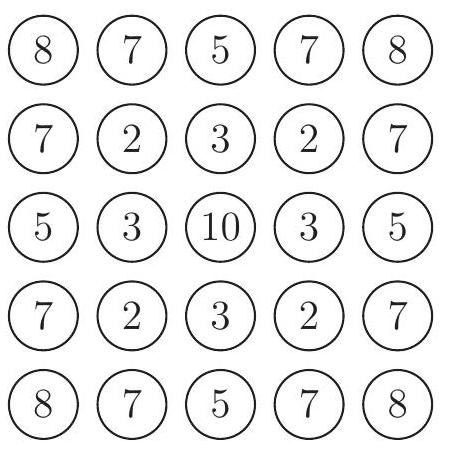
|
| 432 |
+
|
| 433 |
+
Figure 1
|
| 434 |
+
|
| 435 |
+
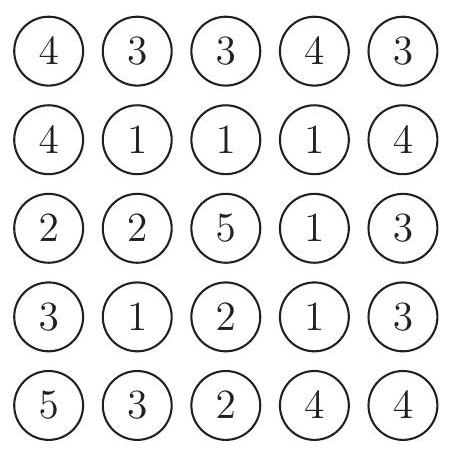
|
| 436 |
+
|
| 437 |
+
Figure 2
|
| 438 |
+
|
| 439 |
+
Let player $A$ choose 1000 primes all congruent to 1 modulo 4 . Then there are 500 primes congruent to 1 modulo 4 when the game begins. Let $P$ denote the parity of the number of primes congruent to 3 modulo 4 on the blackboard. When the game starts, $P$ is even. Remember that the number of primes congruent to 3 modulo 4 in the prime factorization of a number is even if the number is congruent to 1 modulo 4, and odd if the number is congruent to 3 modulo 4 . In each turn the parity of $P$ changes, because the number of primes congruent to 3 modulo 4 among $p_{1}, p_{2}, \ldots$, $p_{n}$ and in the prime factorization of $p_{1} p_{2} \ldots p_{n}-2$ is of different parity. Hence $P$ is odd after each of $A$ 's turns and even after each of $B$ 's turns, so $A$ cannot lose. Since the product of all the primes on the blackboard decreases with each turn, the game eventually ends, hence $A$ wins.
|
| 440 |
+
|
| 441 |
+
## Problem 11 SPB-
|
| 442 |
+
|
| 443 |
+
Let $A B C$ be a triangle with $\angle A=60^{\circ}$. The point $T$ lies inside the triangle in such a way that $\angle A T B=\angle B T C=\angle C T A=120^{\circ}$. Let $M$ be the midpoint of $B C$. Prove that $T A+T B+T C=2 A M$.
|
| 444 |
+
|
| 445 |
+
Solution 1. Rotate the triangle $A B C$ by $60^{\circ}$ around the point $A$ (Figure 3). Let $T^{\prime}$ and $C^{\prime}$ be the images of $T$ and $C$, respectively. Then the triangle $A T T^{\prime}$ is equilateral and $\angle A T^{\prime} C^{\prime}=120^{\circ}$, meaning that $B, T, T^{\prime}, C^{\prime}$ are collinear and $T A+T B+T C=B C^{\prime}$. Let $A^{\prime}$ be a point such that $A B A^{\prime} C$ is a parallelogram. Then $2 A M=A A^{\prime}$. It remains to observe that the triangles $B A C^{\prime}$ and $A B A^{\prime}$ are equal, since $B A$ is common, $\angle B A C^{\prime}=120^{\circ}=\angle A^{\prime} B A$, and $A C^{\prime}=B A^{\prime}$.
|
| 446 |
+
|
| 447 |
+
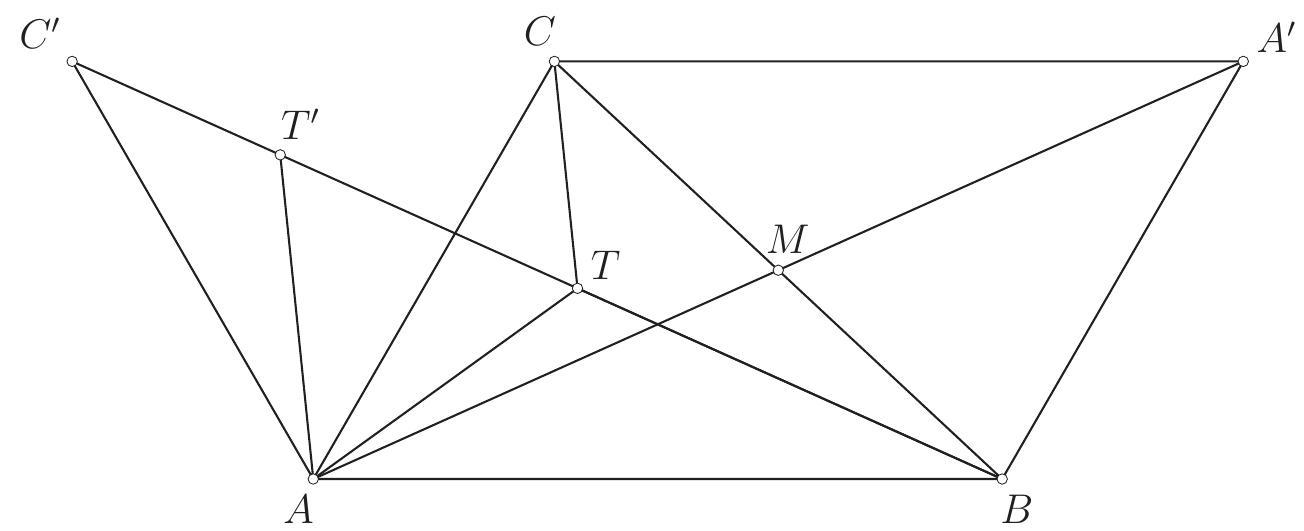
|
| 448 |
+
|
| 449 |
+
Figure 3
|
| 450 |
+
|
| 451 |
+
Remark. The rotation used here is the same as that used in finding a point $P$ in the triangle such that the total distance from the three vertices of the triangle to $P$ is the minimum possible (Fermat point); this is exactly the point $T$ in the problem.
|
| 452 |
+
|
| 453 |
+
Solution 2. Let $A^{\prime}$ be a point such that $A B A^{\prime} C$ is a parallelogram. Since $\angle B A^{\prime} C=60^{\circ}$ and $\angle B T C=120^{\circ}$, the point $T$ lies on the circumcircle of $A^{\prime} B C$. Let $X$ be the second intersection point of $A T$ with this circumcircle and let $Y$ be the midpoint of $A^{\prime} X$. The triangle $B C X$ is equilateral, since $\angle B X C=\angle B A^{\prime} C=60^{\circ}$ and $\angle B C X=\angle B T X=180^{\circ}-\angle B T A=60^{\circ}$. Therefore $T B+T C=T X$. So it is sufficient to show that $A X=A A^{\prime}$.
|
| 454 |
+
|
| 455 |
+
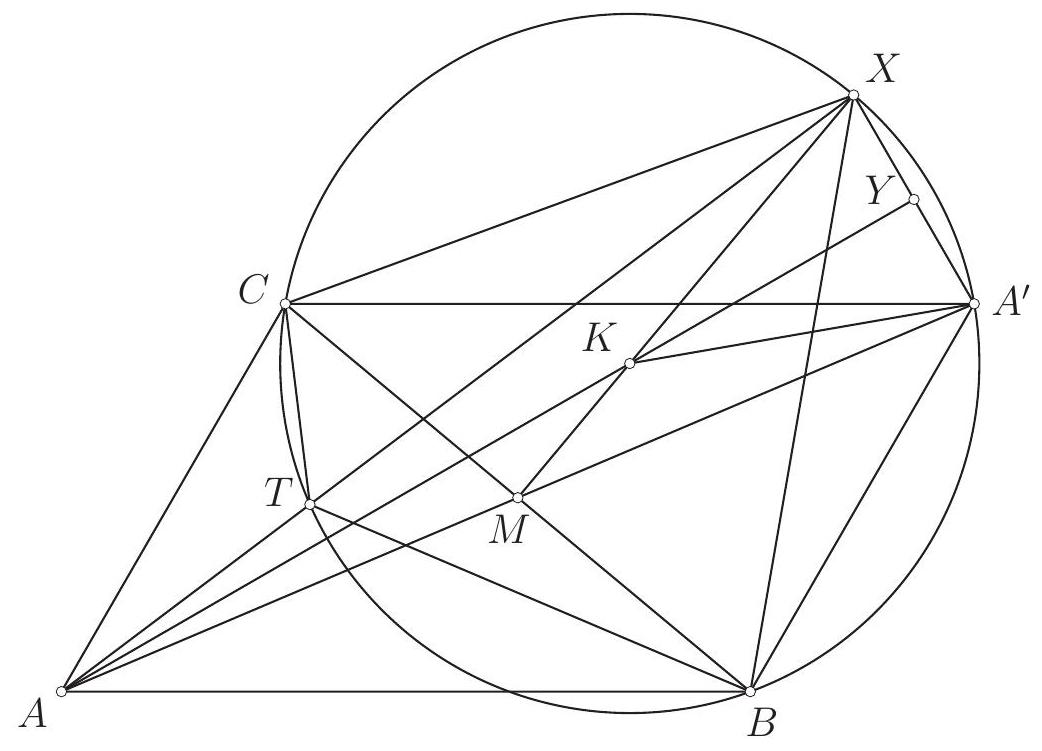
|
| 456 |
+
|
| 457 |
+
Figure 4
|
| 458 |
+
|
| 459 |
+
Let $K$ be the intersection point of the medians of $B C X$. Since $X M$ is a median for both $B C X$ and $A A^{\prime} X$, it follows that $K$ is also the intersection point of the medians of $A A^{\prime} X$. Thus $K$ lies on the median $A Y$. Since the triangle $K A^{\prime} X$ is equilateral, we have $K Y \perp A^{\prime} X$, so $A Y$ is both the height and the median of $A A^{\prime} X$.
|
| 460 |
+
|
| 461 |
+
Consequently, $T A+T B+T C=A X=A A^{\prime}=2 A M$.
|
| 462 |
+
|
| 463 |
+
Solution 3. Let $A^{\prime}$ be a point such that $A B A^{\prime} C$ is a parallelogram (Figure 5). Use notations $A B=c, A C=b, 2 A M=A A^{\prime}=d, T A=x, T B=y, T C=z$. From $\angle A B T=60^{\circ}-\angle B A T=\angle C A T=60^{\circ}-\angle A C T$ one gets $\triangle A B T \sim \triangle C A T$. So $y: x=c: b$, and we have totally $\triangle A B T \sim \triangle C A T \sim \triangle A^{\prime} A B$, giving $x=b \cdot \frac{c}{d}=c \cdot \frac{b}{d}$, $y=c \cdot \frac{c}{d}, z=b \cdot \frac{b}{d}$. By applying the law of cosines in triangle $A^{\prime} A B$, we finally get
|
| 464 |
+
|
| 465 |
+
$$
|
| 466 |
+
x+y+z=\frac{b c+c^{2}+b^{2}}{d}=\frac{d^{2}}{d}=d .
|
| 467 |
+
$$
|
| 468 |
+
|
| 469 |
+
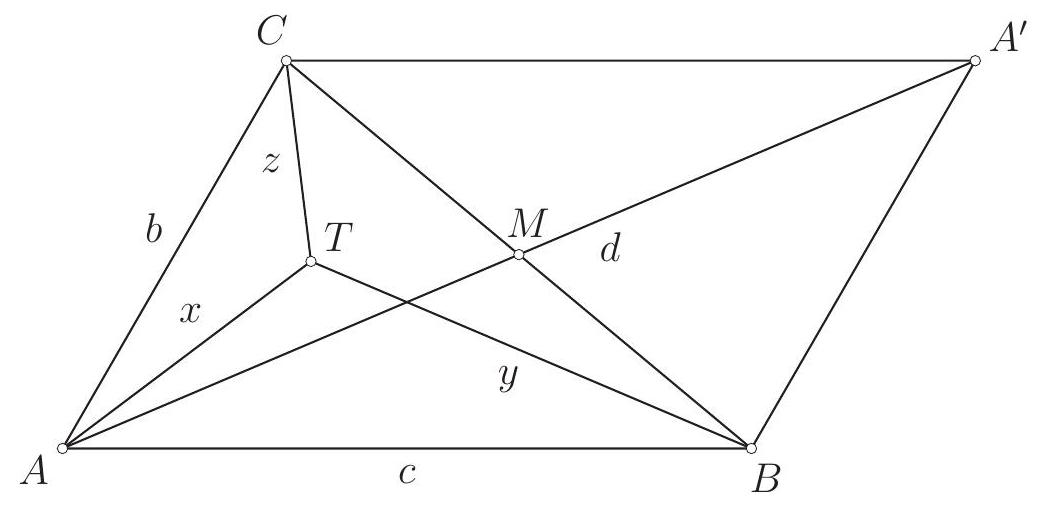
|
| 470 |
+
|
| 471 |
+
Figure 5
|
| 472 |
+
|
| 473 |
+
## Problem 12 -DEN-
|
| 474 |
+
|
| 475 |
+
Let $P_{0}, P_{1}, \ldots, P_{8}=P_{0}$ be successive points on a circle and $Q$ be a point inside the polygon $P_{0} P_{1} \ldots P_{7}$ such that $\angle P_{i-1} Q P_{i}=45^{\circ}$ for $i=1, \ldots, 8$. Prove that the sum
|
| 476 |
+
|
| 477 |
+
$$
|
| 478 |
+
\sum_{i=1}^{8} P_{i-1} P_{i}{ }^{2}
|
| 479 |
+
$$
|
| 480 |
+
|
| 481 |
+
is minimal if and only if $Q$ is the centre of the circle.
|
| 482 |
+
|
| 483 |
+
Solution. By the cosine law we have (Figure 6)
|
| 484 |
+
|
| 485 |
+
$$
|
| 486 |
+
P_{i-1} P_{i}^{2}=Q P_{i-1}^{2}+Q P_{i}^{2}-\sqrt{2} \cdot Q P_{i-1} \cdot Q P_{i} .
|
| 487 |
+
$$
|
| 488 |
+
|
| 489 |
+
Hence, using the AM-GM inequality,
|
| 490 |
+
|
| 491 |
+
$$
|
| 492 |
+
\sum_{i=1}^{8} P_{i-1} P_{i}^{2}=\sum_{i=1}^{8}\left(2 \cdot Q P_{i}^{2}-\sqrt{2} \cdot Q P_{i-1} \cdot Q P_{i}\right) \geq(2-\sqrt{2}) \sum_{i=1}^{8} Q P_{i}^{2}
|
| 493 |
+
$$
|
| 494 |
+
|
| 495 |
+
The equality holds if and only if all distances $Q P_{i}$ are equally large, i.e. $Q$ is the centre of the circle. So it remains to show that the sum in the last expression is independent of $Q$. Indeed, by the Pythagorean theorem,
|
| 496 |
+
|
| 497 |
+
$$
|
| 498 |
+
\sum_{i=1}^{8} Q P_{i}^{2}=\left(P_{0} P_{2}^{2}+P_{4} P_{6}^{2}\right)+\left(P_{1} P_{3}^{2}+P_{5} P_{7}^{2}\right)=2 d^{2}
|
| 499 |
+
$$
|
| 500 |
+
|
| 501 |
+
where $d$ is the diameter of the circle. The last equality follows form the fact that $P_{0} P_{2} P_{4} P_{6}$ is a cyclic quadrilateral with perpendicular diagonals, so $P_{0} P_{2}{ }^{2}+P_{4} P_{6}{ }^{2}=$ $d^{2}$.
|
| 502 |
+
|
| 503 |
+
Remark. The sum $\sum_{i=1}^{8} Q P_{i}{ }^{2}=\sum_{i=1}^{4} Q P_{2 i-1}{ }^{2}+\sum_{i=1}^{4} Q P_{2 i}{ }^{2}$ can also be computed easily using coordinates, e.g. expressing each term by the coordinates of $Q$.
|
| 504 |
+
|
| 505 |
+
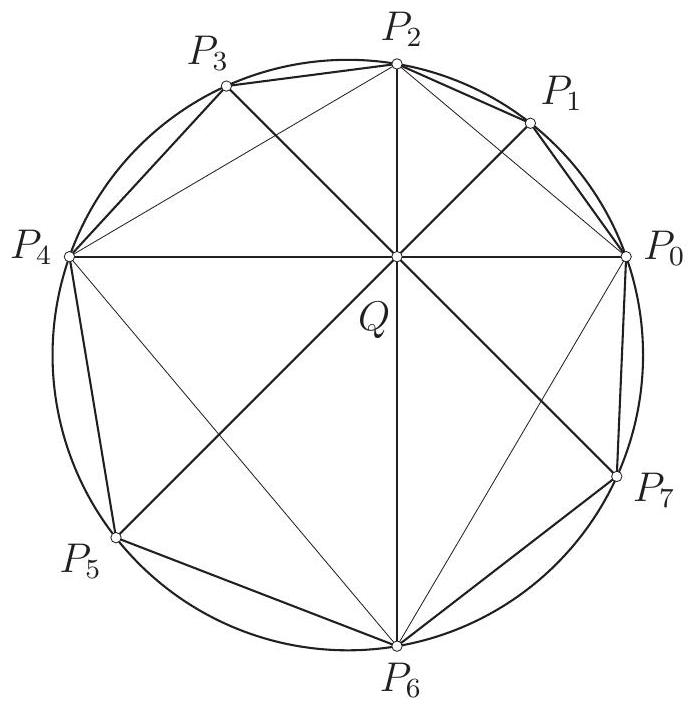
|
| 506 |
+
|
| 507 |
+
Figure 6
|
| 508 |
+
|
| 509 |
+
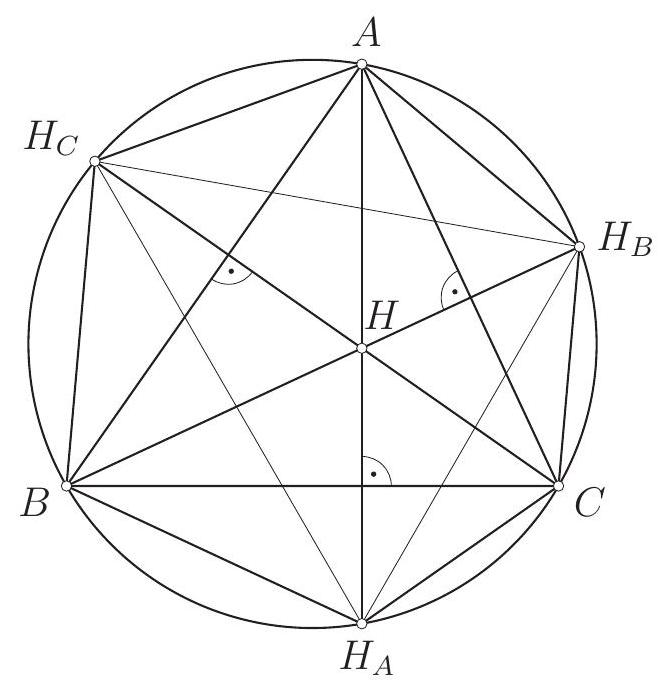
|
| 510 |
+
|
| 511 |
+
Figure 7
|
| 512 |
+
|
| 513 |
+
## Problem 13 NOR-
|
| 514 |
+
|
| 515 |
+
Let $A B C$ be an acute triangle, and let $H$ be its orthocentre. Denote by $H_{A}, H_{B}$ and $H_{C}$ the second intersection of the circumcircle with the altitudes from $A, B$ and $C$ respectively. Prove that the area of $\triangle H_{A} H_{B} H_{C}$ does not exceed the area of $\triangle A B C$.
|
| 516 |
+
|
| 517 |
+
Solution 1. We know that the points $H_{A}, H_{B}$ and $H_{C}$ are in fact the reflection of $H$ on the sides (Figure 7). Since $A B C$ is acute (i.e. $H$ lies in the interior of $A B C$ ), we have $S_{A H_{C} B H_{A} C H_{B}}=2 S_{A B C}$. We thus have to show that $2 S_{H_{A} H_{B} H_{C}} \leq S_{A H_{C} B H_{A} C H_{B}}$, which is equivalent to
|
| 518 |
+
|
| 519 |
+
$$
|
| 520 |
+
S_{H_{A} H_{B} H_{C}} \leq S_{H_{A} C H_{B}}+S_{H_{B} A H_{C}}+S_{H_{C} B H_{A}}
|
| 521 |
+
$$
|
| 522 |
+
|
| 523 |
+
Notice that the triangles on the RHS are isosceles (e.g. $H_{A} C=H C=H_{B} C$ ). If now for example $\angle H_{A} H_{B} H_{C} \geq 90^{\circ}$, then obviously already $S_{H_{A} H_{B} H_{C}} \leq S_{H_{A} B H_{C}}$. It may therefore be supposed that $H_{A} H_{B} H_{C}$ is acute-angled. Denote by $M$ its orthocentre, which then lies inside the triangle. Denote by $M_{A}, M_{B}$ and $M_{C}$ the reflections of the orthocentre on the sides $H_{B} H_{C}, H_{C} H_{A}$ and $H_{A} H_{B}$, respectively. These lie on the circumcircle, and therefore we have $S_{H_{B} M_{A} H_{C}} \leq S_{H_{B} A H_{C}}, S_{H_{C} M_{B} H_{A}} \leq S_{H_{C} B H_{A}}$ and $S_{H_{A} M_{C} H_{B}} \leq S_{H_{A} C H_{B}}$. Since
|
| 524 |
+
|
| 525 |
+
$$
|
| 526 |
+
S_{H_{A} H_{B} H_{C}}=S_{H_{B} M_{A} H_{C}}+S_{H_{C} M_{B} H_{A}}+S_{H_{A} M_{C} H_{B}},
|
| 527 |
+
$$
|
| 528 |
+
|
| 529 |
+
we arrive to the required result.
|
| 530 |
+
|
| 531 |
+
Solution 2. Let the angles of $A B C$ be denoted by $\alpha, \beta$ and $\gamma$, the radius of the circumcircle by $R$. Then
|
| 532 |
+
|
| 533 |
+
$$
|
| 534 |
+
S_{A B C}=2 R^{2} \sin \alpha \sin \beta \sin \gamma
|
| 535 |
+
$$
|
| 536 |
+
|
| 537 |
+
By peripheric angles we get
|
| 538 |
+
|
| 539 |
+
$$
|
| 540 |
+
\angle H_{A} H_{B} H_{C}=\angle H_{A} H_{B} B+\angle B H_{B} H_{C}=\angle H_{A} A B+\angle B C H_{C}=180^{\circ}-2 \beta,
|
| 541 |
+
$$
|
| 542 |
+
|
| 543 |
+
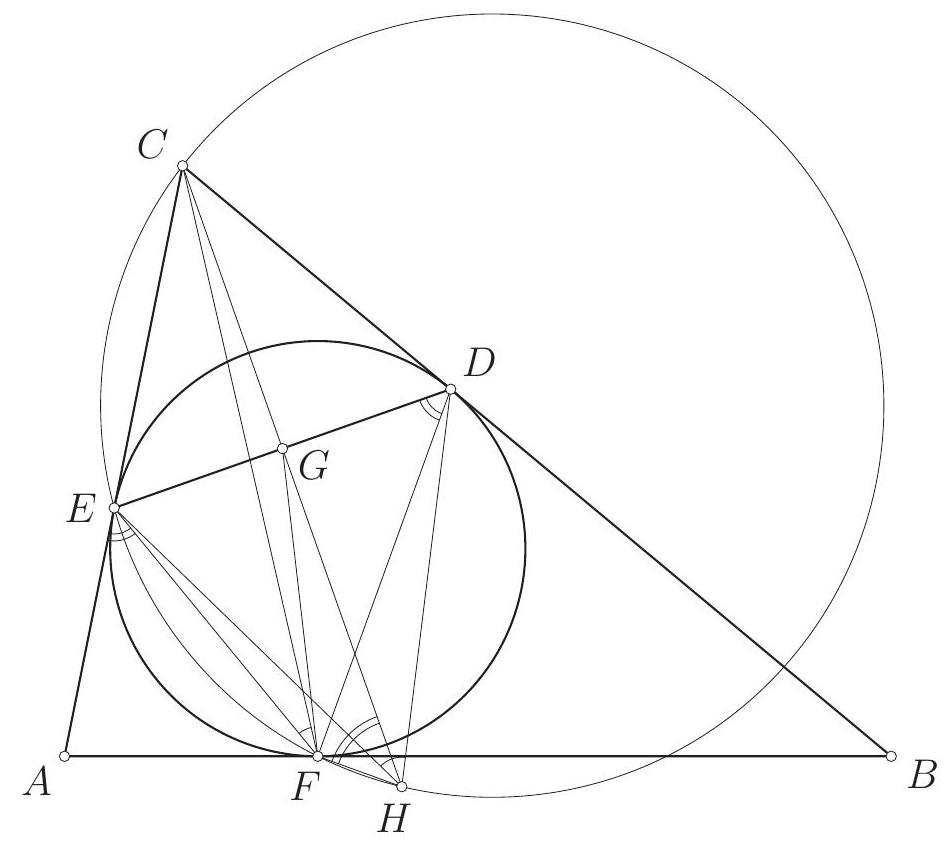
|
| 544 |
+
|
| 545 |
+
Figure 8
|
| 546 |
+
|
| 547 |
+
and correspondingly $\angle H_{B} H_{C} H_{A}=180^{\circ}-2 \gamma$ and $\angle H_{C} H_{A} H_{B}=180^{\circ}-2 \alpha$. Thus
|
| 548 |
+
|
| 549 |
+
$$
|
| 550 |
+
\begin{aligned}
|
| 551 |
+
& S_{H_{A} H_{B} H_{C}}=2 R^{2} \sin \left(180^{\circ}-2 \beta\right) \sin (\left.180^{\circ}-2 \gamma\right) \sin \left(180^{\circ}-2 \alpha\right) \\
|
| 552 |
+
&=2 R^{2} \sin (2 \beta) \sin (2 \gamma) \sin (2 \alpha)=8 S_{A B C} \cos \alpha \cos \beta \cos \gamma \\
|
| 553 |
+
& \leq 8 S_{A B C}\left(\frac{\cos \alpha+\cos \beta+\cos \gamma}{3}\right)^{3} \leq S_{A B C}
|
| 554 |
+
\end{aligned}
|
| 555 |
+
$$
|
| 556 |
+
|
| 557 |
+
where the last inequality follows from Jensen's inequality for the cosine function.
|
| 558 |
+
|
| 559 |
+
Remark. There are also other solutions that combine the ideas appearing in Solutions 1 and 2 in different way.
|
| 560 |
+
|
| 561 |
+
## Problem 14 -POL-
|
| 562 |
+
|
| 563 |
+
Given a triangle $A B C$, let its incircle touch the sides $B C, C A, A B$ at $D, E, F$, respectively. Let $G$ be the midpoint of the segment $D E$. Prove that $\angle E F C=$ $\angle G F D$.
|
| 564 |
+
|
| 565 |
+
Solution 1. Let $\omega$ be the circumcircle of the triangle $C E F$ and let $H$ be the second point of intersection of the circle $\omega$ with the line $C G$ (Figure 8). Assume also, without loss of generality, that $A C<B C$. (If $A C=B C$, the whole problem becomes trivial due to symmetry.) Then the points $G, H, B$ lie on the same side of the line $C F$ and the vertex $A$ lies on the opposite side. The points $E, F, H, C$ lie on the circle $\omega$ while the points $E$ and $D$ are symmetric with respect to the line $\mathrm{CH}$. Hence
|
| 566 |
+
|
| 567 |
+
$$
|
| 568 |
+
\angle E F C=\angle E H C=\angle C H D .
|
| 569 |
+
$$
|
| 570 |
+
|
| 571 |
+
The line $A C$ is tangent to the incircle of $A B C$ at $E$, so we have $\angle G D F=$ $\angle E D F=\angle A E F=180^{\circ}-\angle C E F$. Now, using the circle $\omega$, we see that $\angle C E F=$
|
| 572 |
+
|
| 573 |
+
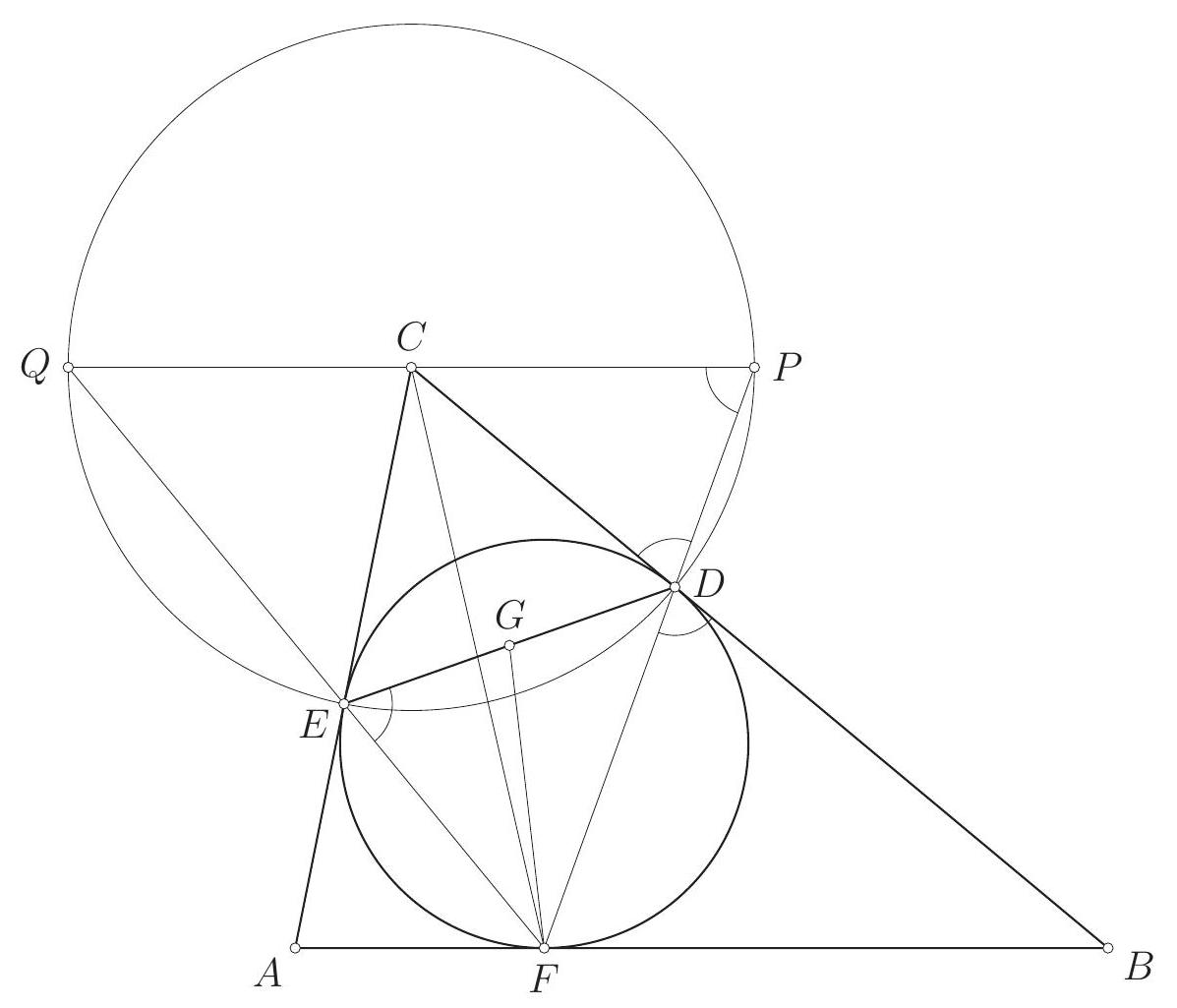
|
| 574 |
+
|
| 575 |
+
Figure 9
|
| 576 |
+
|
| 577 |
+
$180^{\circ}-\angle C H F=180^{\circ}-\angle G H F$. Combining the above relations we conclude that $\angle G D F=\angle G H F$, so that the points $G, F, H, D$ lie on a circle. Therefore $\angle C H D=$ $\angle G H D=\angle G F D$, which together with $(*)$ proves the assertion of the problem.
|
| 578 |
+
|
| 579 |
+
Remark. This problem is trivial for those who rely on the following known result: a symmedian through one of the vertices of a triangle passes through the point of intersection of the tangents to the circumcircle at the other two vertices (http://www. cut-the-knot.org/Curriculum/Geometry/Symmedian.shtml\#explanation). Applying this result to triangle $D E F$ and the symmedian through $F$ gives that the symmedian coincides with $F C$. Now use the definition of symmedian.
|
| 580 |
+
|
| 581 |
+
Solution 2. We show that the ray from a triangle vertex $F$ though the intersection $C$ of the tangents to the circumcircle at the two other vertices $D$ and $E$ is the symmedian of triangle $D F E$ : Let the circle with centre $C$ and radius $C D=C E$ meet the rays $F D$ and $F E$ again in $P$ and $Q$ (Figure 9$)$. Then
|
| 582 |
+
|
| 583 |
+
$$
|
| 584 |
+
\angle D P C=\angle P D C=\angle F D B=\angle F E D=180^{\circ}-\angle Q E D=\angle Q P D,
|
| 585 |
+
$$
|
| 586 |
+
|
| 587 |
+
whence $P, C, Q$ are collinear. Thus $P Q$ is a diameter of circle $D E Q P$. Triangles $F D E$ and $F Q P$ are similar and have a common angle at $F$. Consequently, the desired result follows since $G$ is the midpoint of $D E$ and $C$ is the midpoint of $Q P$.
|
| 588 |
+
|
| 589 |
+
## Problem 15 -LAT-
|
| 590 |
+
|
| 591 |
+
The circumcentre $O$ of a given cyclic quadrilateral $A B C D$ lies inside the quadrilateral but not on the diagonal $A C$. The diagonals of the quadrilateral intersect at $I$.
|
| 592 |
+
|
| 593 |
+
The circumcircle of the triangle $A O I$ meets the sides $A D$ and $A B$ at points $P$ and $Q$, respectively; the circumcircle of the triangle $C O I$ meets the sides $C B$ and $C D$ at points $R$ and $S$, respectively. Prove that $P Q R S$ is a parallelogram.
|
| 594 |
+
|
| 595 |
+
Solution. Assume w.l.o.g. that angle $A B C$ is obtuse (otherwise switch $B$ and $D$, Figure 10). As $A, I, O$ and $P$ are concyclic, we get $\angle Q A I=\angle Q O I$; similarly $\angle R C I=\angle R O I$. Hence
|
| 596 |
+
|
| 597 |
+
$$
|
| 598 |
+
\begin{aligned}
|
| 599 |
+
\angle Q O R=\angle Q O I+\angle R O I=\angle Q A I+\angle R C I & =\angle B A C+\angle B C A \\
|
| 600 |
+
& =180^{\circ}-\angle A B C=180^{\circ}-\angle Q B R .
|
| 601 |
+
\end{aligned}
|
| 602 |
+
$$
|
| 603 |
+
|
| 604 |
+
It follows that points $Q, O, R$ and $B$ are concyclic.
|
| 605 |
+
|
| 606 |
+
Furthermore, $\angle P A I=180^{\circ}-\angle P O I$ and $\angle S C I=180^{\circ}-\angle S O I$ imply
|
| 607 |
+
|
| 608 |
+
$$
|
| 609 |
+
\begin{aligned}
|
| 610 |
+
\angle P O S=360^{\circ}-\angle P O I-\angle S O I=\angle P A I+\angle S C I & =\angle D A C+\angle D C A \\
|
| 611 |
+
& =180^{\circ}-\angle A D C=180^{\circ}-\angle P D S .
|
| 612 |
+
\end{aligned}
|
| 613 |
+
$$
|
| 614 |
+
|
| 615 |
+
Hence also points $P, O, S$ and $D$ are concyclic.
|
| 616 |
+
|
| 617 |
+
As $O$ is the circumcentre of $A B C D$, we have $A O=O B$ and $\angle B A O=\angle O B A$. These are inscribed angles in circumcircles of $A P Q$ and $B Q R$, respectively, and both of them are based on the same chord $O Q$. Therefore the radii of these two circumcircles are equal. Similarly, the radii of circumcircles of $B Q R, C R S$ and $D S P$ are also equal.
|
| 618 |
+
|
| 619 |
+
As $\angle Q A P=\angle B A D=180^{\circ}-\angle B C D=180^{\circ}-\angle R C S$ and radii of the circumcircles of $A Q O P$ and $O R C S$ are equal, the chords $Q P$ and $R S$ have equal lengths; similarly also $Q R$ and $P S$ have equal lengths. Thus $P Q R S$ is a parallelogram.
|
| 620 |
+
|
| 621 |
+
Remark. In the case of $O$ lying in the diagonal $A C$, the necessary triangles $A O I$ and $C O I$ are degenerate and have no circumcircle. The statement of the problem still holds if the circumcentre of $A B C D$ does not lie inside the quadrilateral (Figure 11) and even if the circumcircles of $A O I$ and $C O I$ meet prolongations of sides.
|
| 622 |
+
|
| 623 |
+
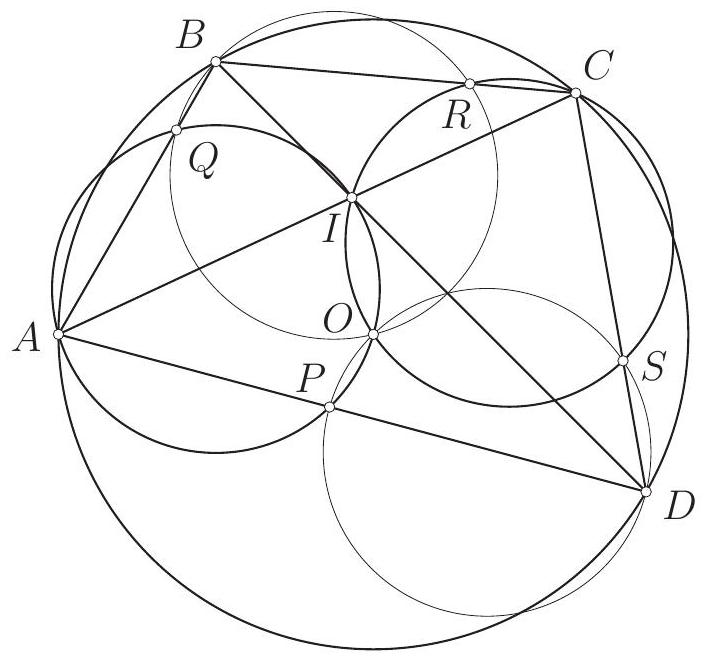
|
| 624 |
+
|
| 625 |
+
Figure 10
|
| 626 |
+
|
| 627 |
+
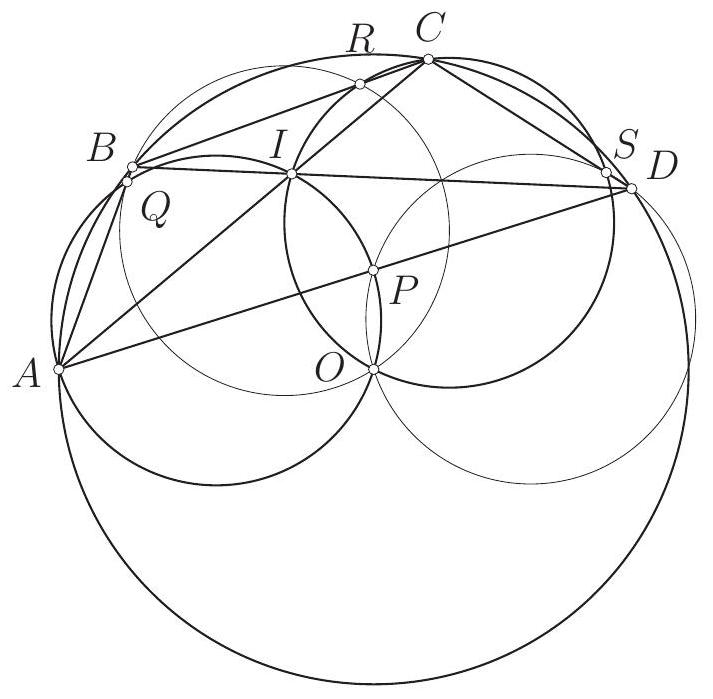
|
| 628 |
+
|
| 629 |
+
Figure 11
|
| 630 |
+
|
| 631 |
+
## Problem 16 -FIN-
|
| 632 |
+
|
| 633 |
+
Let $n, m$ and $k$ be positive integers satisfying $(n-1) n(n+1)=m^{k}$. Prove that $k=1$.
|
| 634 |
+
|
| 635 |
+
Solution. Since $\operatorname{gcd}(n,(n-1)(n+1))=1$, if $(n-1) n(n+1)$ is a $k$-th power for $k \geq 1$, then $n$ and $(n-1)(n+1)=n^{2}-1$ must be $k$-th powers as well. Then $n=m_{1}^{k}$ and $n^{2}-1=m_{2}^{k}=\left(m_{1}^{2}\right)^{k}-1$. But the difference of two positive $k$-th powers can never be 1 , if $k>1$. So $k=1$.
|
| 636 |
+
|
| 637 |
+
## Problem 17 -DEN-
|
| 638 |
+
|
| 639 |
+
Let $d(n)$ denote the number of positive divisors of $n$. Find all triples $(n, k, p)$, where $n$ and $k$ are positive integers and $p$ is a prime number, such that
|
| 640 |
+
|
| 641 |
+
$$
|
| 642 |
+
n^{d(n)}-1=p^{k} .
|
| 643 |
+
$$
|
| 644 |
+
|
| 645 |
+
Solution. Note first that $n^{d(n)}$ is always a square: if $d(n)$ is an even number this is clear; but $d(n)$ is odd exactly if $n$ is a square, and then its power $n^{d(n)}$ is also a square.
|
| 646 |
+
|
| 647 |
+
Let $n^{d(n)}=m^{2}, m>0$. Then
|
| 648 |
+
|
| 649 |
+
$$
|
| 650 |
+
(m+1)(m-1)=m^{2}-1=n^{d(n)}-1=p^{k} .
|
| 651 |
+
$$
|
| 652 |
+
|
| 653 |
+
There is no solution for $m=1$. If $m=2$, we get $(n, k, p)=(2,1,3)$. If $m>2$, we have $m-1, m+1>1$ and because both factors divide $p^{k}$, they are both powers of $p$. The only possibility is $m-1=2, m+1=4$. Hence $m=3$ and $n^{d(n)}=m^{2}=9$. This leads to the solution $(n, k, p)=(3,3,2)$. So the only solutions are $(n, k, p)=(2,1,3)$ and $(n, k, p)=(3,3,2)$.
|
| 654 |
+
|
| 655 |
+
## Problem 18 NOR-
|
| 656 |
+
|
| 657 |
+
Find all triples $(a, b, c)$ of integers satisfying $a^{2}+b^{2}+c^{2}=20122012$.
|
| 658 |
+
|
| 659 |
+
Solution. First consider the equation modulo 4. Since a square can only be congruent to 0 or 1 modulo 4, and 20122012 is divisible by 4, we can conclude that all of $a, b$ and $c$ have to be even. Substituting $a=2 a_{1}, b=2 b_{1}, c=2 c_{1}$ the equation turns into $a_{1}^{2}+b_{1}^{2}+c_{1}^{2}=5030503$.
|
| 660 |
+
|
| 661 |
+
If we now consider the remaining equation modulo 8 , we can see that the right side is congruent to 7, whilst the only quadratic residues modulo 8 are 0,1 and 4 , and hence the left hand side can never be congruent to 7 .
|
| 662 |
+
|
| 663 |
+
We therefore conclude that the original equation has no integer solutions.
|
| 664 |
+
|
| 665 |
+
## Problem 19 POL-
|
| 666 |
+
|
| 667 |
+
Show that $n^{n}+(n+1)^{n+1}$ is composite for infinitely many positive integers $n$.
|
| 668 |
+
|
| 669 |
+
Solution. We will show that for any positive integer $n \equiv 4(\bmod 6)$ the number $n^{n}+(n+1)^{n+1}$ is divisible by 3 and hence composite. Indeed, for any such $n$ we have $n \equiv 1(\bmod 3)$ and hence $n^{n}+(n+1)^{n+1} \equiv 1^{n}+2^{n+1}=1+2^{n+1}(\bmod 3)$. Moreover, the exponent $n+1$ is odd, which implies that $2^{n+1} \equiv 2(\bmod 3)$. It follows that $n^{n}+(n+1)^{n+1} \equiv 1+2 \equiv 0(\bmod 3)$, as claimed.
|
| 670 |
+
|
| 671 |
+
## Problem 20 -LAT-
|
| 672 |
+
|
| 673 |
+
Find all integer solutions of the equation $2 x^{6}+y^{7}=11$.
|
| 674 |
+
|
| 675 |
+
Solution. There are no solutions. The hardest part of the problem is to determine a modulus $m$ that would yield a contradiction. There should be few sixth and seventh powers modulo $m$, hence, a natural choice is $6 \cdot 7+1=43$. Luckily, it is a prime.
|
| 676 |
+
|
| 677 |
+
Now, just write out sixth powers $(0,1,4,11,16,21,35,41)$ and seventh powers $(0,1,6,7,36,37,42)$ modulo 43 , and see that they can't be combined to give 11. Indeed,
|
| 678 |
+
|
| 679 |
+
$$
|
| 680 |
+
\begin{aligned}
|
| 681 |
+
2 x^{6} \bmod 43 & \in\{0,2,8,22,27,32,39,42\}, \\
|
| 682 |
+
11-y^{7} \bmod 43 & \in\{4,5,10,11,12,17,18\},
|
| 683 |
+
\end{aligned}
|
| 684 |
+
$$
|
| 685 |
+
|
| 686 |
+
and these sets do not intersect.
|
| 687 |
+
|
| 688 |
+
Remark. To find the sixth and seventh powers modulo 43, we can note that 3 is a primitive root modulo 43. So the nonzero sixth powers are exactly the powers of $3^{6} \equiv 41 \equiv-2$ and the nonzero seventh powers are the powers of $3^{7} \equiv 37 \equiv-6$ $(\bmod 43)$.
|
| 689 |
+
|
BalticWay/md/en-bw13sol.md
ADDED
|
@@ -0,0 +1,597 @@
|
|
|
|
|
|
|
|
|
|
|
|
|
|
|
|
|
|
|
|
|
|
|
|
|
|
|
|
|
|
|
|
|
|
|
|
|
|
|
|
|
|
|
|
|
|
|
|
|
|
|
|
|
|
|
|
|
|
|
|
|
|
|
|
|
|
|
|
|
|
|
|
|
|
|
|
|
|
|
|
|
|
|
|
|
|
|
|
|
|
|
|
|
|
|
|
|
|
|
|
|
|
|
|
|
|
|
|
|
|
|
|
|
|
|
|
|
|
|
|
|
|
|
|
|
|
|
|
|
|
|
|
|
|
|
|
|
|
|
|
|
|
|
|
|
|
|
|
|
|
|
|
|
|
|
|
|
|
|
|
|
|
|
|
|
|
|
|
|
|
|
|
|
|
|
|
|
|
|
|
|
|
|
|
|
|
|
|
|
|
|
|
|
|
|
|
|
|
|
|
|
|
|
|
|
|
|
|
|
|
|
|
|
|
|
|
|
|
|
|
|
|
|
|
|
|
|
|
|
|
|
|
|
|
|
|
|
|
|
|
|
|
|
|
|
|
|
|
|
|
|
|
|
|
|
|
|
|
|
|
|
|
|
|
|
|
|
|
|
|
|
|
|
|
|
|
|
|
|
|
|
|
|
|
|
|
|
|
|
|
|
|
|
|
|
|
|
|
|
|
|
|
|
|
|
|
|
|
|
|
|
|
|
|
|
|
|
|
|
|
|
|
|
|
|
|
|
|
|
|
|
|
|
|
|
|
|
|
|
|
|
|
|
|
|
|
|
|
|
|
|
|
|
|
|
|
|
|
|
|
|
|
|
|
|
|
|
|
|
|
|
|
|
|
|
|
|
|
|
|
|
|
|
|
|
|
|
|
|
|
|
|
|
|
|
|
|
|
|
|
|
|
|
|
|
|
|
|
|
|
|
|
|
|
|
|
|
|
|
|
|
|
|
|
|
|
|
|
|
|
|
|
|
|
|
|
|
|
|
|
|
|
|
|
|
|
|
|
|
|
|
|
|
|
|
|
|
|
|
|
|
|
|
|
|
|
|
|
|
|
|
|
|
|
|
|
|
|
|
|
|
|
|
|
|
|
|
|
|
|
|
|
|
|
|
|
|
|
|
|
|
|
|
|
|
|
|
|
|
|
|
|
|
|
|
|
|
|
|
|
|
|
|
|
|
|
|
|
|
|
|
|
|
|
|
|
|
|
|
|
|
|
|
|
|
|
|
|
|
|
|
|
|
|
|
|
|
|
|
|
|
|
|
|
|
|
|
|
|
|
|
|
|
|
|
|
|
|
|
|
|
|
|
|
|
|
|
|
|
|
|
|
|
|
|
|
|
|
|
|
|
|
|
|
|
|
|
|
|
|
|
|
|
|
|
|
|
|
|
|
|
|
|
|
|
|
|
|
|
|
|
|
|
|
|
|
|
|
|
|
|
|
|
|
|
|
|
|
|
|
|
|
|
|
|
|
|
|
|
|
|
|
|
|
|
|
|
|
|
|
|
|
|
|
|
|
|
|
|
|
|
|
|
|
|
|
|
|
|
|
|
|
|
|
|
|
|
|
|
|
|
|
|
|
|
|
|
|
|
|
|
|
|
|
|
|
|
|
|
|
|
|
|
|
|
|
|
|
|
|
|
|
|
|
|
|
|
|
|
|
|
|
|
|
|
|
|
|
|
|
|
|
|
|
|
|
|
|
|
|
|
|
|
|
|
|
|
|
|
|
|
|
|
|
|
|
|
|
|
|
|
|
|
|
|
|
|
|
|
|
|
|
|
|
|
|
|
|
|
|
|
|
|
|
|
|
|
|
|
|
|
|
|
|
|
|
|
|
|
|
|
|
|
|
|
|
|
|
|
|
|
|
|
|
|
|
|
|
|
|
|
|
|
|
|
|
|
|
|
|
|
|
|
|
|
|
|
|
|
|
|
|
|
|
|
|
|
|
|
|
|
|
|
|
|
|
|
|
|
|
|
|
|
|
|
|
|
|
|
|
|
|
|
|
|
|
|
|
|
|
|
|
|
|
|
|
|
|
|
|
|
|
|
|
|
|
|
|
|
|
|
|
|
|
|
|
|
|
|
|
|
|
|
|
|
|
|
|
|
|
|
|
|
|
|
|
|
|
|
|
|
|
|
|
|
|
|
|
|
|
|
|
|
|
|
|
|
|
|
|
|
|
|
|
|
|
|
|
|
|
|
|
|
|
|
|
|
|
|
|
|
|
|
|
|
|
|
|
|
|
|
|
|
|
|
|
|
|
|
|
|
|
|
|
|
|
|
|
|
|
|
|
|
|
|
|
|
|
|
|
|
|
|
|
|
|
|
|
|
|
|
|
|
|
|
|
|
|
|
|
|
|
|
|
|
|
|
|
|
|
|
|
|
|
|
|
|
|
|
|
|
|
|
|
|
|
|
|
|
|
|
|
|
|
|
|
|
|
|
|
|
|
|
|
|
|
|
|
|
|
|
|
|
|
|
|
|
|
|
|
|
|
|
|
|
|
|
|
|
|
|
|
|
|
|
|
|
|
|
|
|
|
|
|
|
|
|
|
|
|
|
|
|
|
|
|
|
|
|
|
|
|
|
|
|
|
|
|
|
|
|
|
|
|
|
|
|
|
|
|
|
|
|
|
|
|
|
|
|
|
|
|
|
|
|
|
|
|
|
|
|
|
|
|
|
|
|
|
|
|
|
|
|
|
|
|
|
|
|
|
|
|
|
|
|
|
|
|
|
|
|
|
|
|
|
|
|
|
|
|
|
|
|
|
|
|
|
|
|
|
|
|
|
|
|
|
|
|
|
|
|
|
|
|
|
|
|
|
|
|
|
|
|
|
|
|
|
|
|
|
|
|
|
|
|
|
|
|
|
|
|
|
|
|
|
|
|
|
|
|
|
|
|
|
|
|
|
|
|
|
|
|
|
|
|
|
|
|
|
|
|
|
|
|
|
|
|
|
|
|
|
|
|
|
|
|
|
|
|
|
|
|
|
|
|
|
|
|
|
|
|
|
|
|
|
|
|
|
|
|
|
|
|
|
|
|
|
|
|
|
|
|
|
|
|
|
|
|
|
|
|
|
|
|
|
|
|
|
|
|
|
|
|
|
|
|
|
|
|
|
|
|
|
|
|
|
|
|
|
|
|
|
|
|
|
|
|
|
|
|
|
|
|
|
|
|
|
|
|
|
|
|
|
|
|
|
|
|
|
|
|
|
|
|
|
|
|
|
|
|
|
|
|
|
|
|
|
|
|
|
|
|
|
|
|
|
|
|
|
|
|
|
|
|
|
|
|
|
|
|
|
|
|
|
|
|
|
|
|
|
|
|
|
|
|
|
|
|
|
|
|
|
|
|
|
|
|
|
|
|
|
|
|
|
|
|
|
|
|
|
|
|
|
|
|
|
|
|
|
|
|
|
|
|
|
|
|
|
|
|
|
|
|
|
|
|
|
|
|
|
|
|
|
|
|
|
|
|
|
|
|
|
|
|
|
|
|
|
|
|
|
|
|
|
|
|
|
|
|
|
|
|
|
|
|
|
|
|
|
|
|
|
|
|
|
|
|
|
|
|
|
|
|
|
|
|
|
|
|
|
|
|
|
|
|
|
|
|
|
|
|
|
|
|
|
|
|
|
|
|
|
|
|
|
|
|
|
|
|
|
|
|
|
|
|
|
|
|
|
|
|
|
|
|
|
|
|
|
|
|
|
|
|
|
|
|
|
|
|
|
|
|
|
|
|
|
|
|
|
|
|
|
|
|
|
|
|
|
|
|
|
|
|
|
|
|
|
|
|
|
|
|
|
|
|
|
|
|
|
|
|
|
|
|
|
|
|
|
|
|
|
|
|
|
|
|
|
|
|
|
|
|
|
|
|
|
|
|
|
|
|
|
|
|
|
|
|
|
|
|
|
|
|
|
|
|
|
|
|
|
|
|
|
|
|
|
|
|
|
|
|
|
|
|
|
|
|
|
|
|
|
|
|
|
|
|
|
|
|
|
|
|
|
|
|
|
|
|
|
|
|
|
|
|
|
| 1 |
+
# Baltic Way 2013
|
| 2 |
+
|
| 3 |
+
Riga, Latvia
|
| 4 |
+
|
| 5 |
+

|
| 6 |
+
|
| 7 |
+
Problems and solutions
|
| 8 |
+
|
| 9 |
+
## Problem 1
|
| 10 |
+
|
| 11 |
+
Let $n$ be a positive integer. Assume that $n$ numbers are to be chosen from the table
|
| 12 |
+
|
| 13 |
+
$$
|
| 14 |
+
\begin{array}{cccc}
|
| 15 |
+
0 & 1 & \cdots & n-1 \\
|
| 16 |
+
n & n+1 & \cdots & 2 n-1 \\
|
| 17 |
+
\vdots & \vdots & \ddots & \vdots \\
|
| 18 |
+
(n-1) n & (n-1) n+1 & \cdots & n^{2}-1
|
| 19 |
+
\end{array}
|
| 20 |
+
$$
|
| 21 |
+
|
| 22 |
+
with no two of them from the same row or the same column. Find the maximal value of the product of these $n$ numbers.
|
| 23 |
+
|
| 24 |
+
## Solution
|
| 25 |
+
|
| 26 |
+
The product is $R(\sigma)=\prod_{i=0}^{n-1}(n i+\sigma(i))$, for some permutation $\sigma:\{0,1, \ldots, n-1\} \rightarrow\{0,1, \ldots, n-1\}$. Let $\sigma$ be such that $R(\sigma)$ is maximal. We may assume that all the multipliers $n i+\sigma(i)$ are positive, because otherwise the product is zero, that is the smallest possible.
|
| 27 |
+
Assume further that $\sigma(a)>\sigma(b)$ for some $a>b$. Let a permutation $\tau$ be defined by
|
| 28 |
+
|
| 29 |
+
$$
|
| 30 |
+
\tau(i)= \begin{cases}\sigma(b), & i=a \\ \sigma(a), & i=b \\ \sigma(i), & \text { otherwise }\end{cases}
|
| 31 |
+
$$
|
| 32 |
+
|
| 33 |
+
We have
|
| 34 |
+
|
| 35 |
+
$$
|
| 36 |
+
\frac{R(\tau)}{R(\sigma)}=\frac{(n a+\tau(a))(n b+\tau(b))}{(n a+\sigma(a))(n b+\sigma(b))}=\frac{(n a+\sigma(b))(n b+\sigma(a))}{(n a+\sigma(a))(n b+\sigma(b))}>1
|
| 37 |
+
$$
|
| 38 |
+
|
| 39 |
+
as
|
| 40 |
+
$(n a+\sigma(b))(n b+\sigma(a))-(n a+\sigma(a))(n b+\sigma(b))=n(a \sigma(a)+b \sigma(b)-a \sigma(b)-b \sigma(a))=n(a-b)(\sigma(a)-\sigma(b))>0$.
|
| 41 |
+
This is a contradiction with the maximality of $R(\sigma)$, hence, $\sigma$ has to satisfy $\sigma(a)<\sigma(b)$ for all $a>b$. Thus, $\sigma(i)=n-1-i$ for all $i$, and
|
| 42 |
+
|
| 43 |
+
$$
|
| 44 |
+
R(\sigma)=\prod_{i=0}^{n-1}(n i+n-1-i)=\prod_{i=0}^{n-1}(i+1)(n-1)=(n-1)^{n} n!
|
| 45 |
+
$$
|
| 46 |
+
|
| 47 |
+
## Problem 2
|
| 48 |
+
|
| 49 |
+
Let $k$ and $n$ be positive integers and let $x_{1}, x_{2}, \ldots, x_{k}, y_{1}, y_{2}, \ldots, y_{n}$ be distinct integers. A polynomial $P$ with integer coefficients satisfies
|
| 50 |
+
|
| 51 |
+
$$
|
| 52 |
+
P\left(x_{1}\right)=P\left(x_{2}\right)=\ldots=P\left(x_{k}\right)=54
|
| 53 |
+
$$
|
| 54 |
+
|
| 55 |
+
and
|
| 56 |
+
|
| 57 |
+
$$
|
| 58 |
+
P\left(y_{1}\right)=P\left(y_{2}\right)=\ldots=P\left(y_{n}\right)=2013 .
|
| 59 |
+
$$
|
| 60 |
+
|
| 61 |
+
Determine the maximal value of $k n$.
|
| 62 |
+
|
| 63 |
+
## Solution
|
| 64 |
+
|
| 65 |
+
Letting $Q(x)=P(x)-54$, we see that $Q$ has $k$ zeroes at $x_{1}, \ldots, x_{k}$, while $Q\left(y_{i}\right)=1959$ for $i=1, \ldots, n$. We notice that $1959=3 \cdot 653$, and an easy check shows that 653 is a prime number. As
|
| 66 |
+
|
| 67 |
+
$$
|
| 68 |
+
Q(x)=\prod_{j=1}^{k}\left(x-x_{j}\right) S(x)
|
| 69 |
+
$$
|
| 70 |
+
|
| 71 |
+
and $S(x)$ is a polynomial with integer coefficients, we have
|
| 72 |
+
|
| 73 |
+
$$
|
| 74 |
+
Q\left(y_{i}\right)=\prod_{j=1}^{k}\left(y_{i}-x_{j}\right) S\left(x_{j}\right)=1959 .
|
| 75 |
+
$$
|
| 76 |
+
|
| 77 |
+
Now all numbers $a_{i}=y_{i}-x_{1}$ have to be in the set $\{ \pm 1, \pm 3, \pm 653, \pm 1959\}$. Clearly, $n$ can be at most 4 , and if $n=4$, then two of the $a_{i}$ 's are $\pm 1$, one has absolute value 3 and the fourth one has absolute value 653 . Assuming $a_{1}=1, a_{2}=-1, x_{1}$ has to be the average of $y_{1}$ and $y_{2}$. Let $\left|y_{3}-x_{1}\right|=3$. If $k \geq 2$, then $x_{2} \neq x_{1}$, and the set of numbers $b_{i}=y_{i}-x_{2}$ has the same properties as the $a_{i}$ 's. Then $x_{2}$ is the average of, say $y_{2}$ and $y_{3}$ or $y_{3}$ and $y_{1}$. In either case $\left|y_{4}-x_{2}\right| \neq 653$. So if $k \geq 2$, then $n \leq 3$. In a quite similar fashion one shows that $k \geq 3$ implies $n \leq 2$.
|
| 78 |
+
The polynomial $P(x)=653 x^{2}\left(x^{2}-4\right)+2013$ shows the $n k=6$ indeed is possible.
|
| 79 |
+
|
| 80 |
+
## Problem 3
|
| 81 |
+
|
| 82 |
+
Let $\mathbb{R}$ denote the set of real numbers. Find all functions $f: \mathbb{R} \rightarrow \mathbb{R}$ such that
|
| 83 |
+
|
| 84 |
+
$$
|
| 85 |
+
f(x f(y)+y)+f(-f(x))=f(y f(x)-y)+y \quad \text { for all } x, y \in \mathbb{R}
|
| 86 |
+
$$
|
| 87 |
+
|
| 88 |
+
## Solution
|
| 89 |
+
|
| 90 |
+
Let $f(0)=c$. We make the following substitutions in the initial equation:
|
| 91 |
+
|
| 92 |
+
1) $x=0, y=0 \Longrightarrow f(0)+f(-c)=f(0) \Longrightarrow f(-c)=0$.
|
| 93 |
+
2) $x=0, y=-c \Longrightarrow f(-c)+f(-c)=f\left(c-c^{2}\right)-c \Longrightarrow f\left(c-c^{2}\right)=c$.
|
| 94 |
+
3) $x=-c, y=-c \Longrightarrow f(-c)+f(0)=f(c)-c \Longrightarrow f(c)=2 c$.
|
| 95 |
+
4) $x=0, y=c \Longrightarrow f(c)+f(-c)=f\left(c^{2}-c\right)+c \Longrightarrow f\left(c^{2}-c\right)=c$.
|
| 96 |
+
5) $x=-c, y=c^{2}-c \Longrightarrow f(-c)+f(0)=f\left(c-c^{2}\right)+c^{2}-c \Longrightarrow c=c^{2} \Longrightarrow c=0$ or 1 .
|
| 97 |
+
|
| 98 |
+
Suppose that $c=0$. Let $f(-1)=d+1$. We make the following substitutions in the initial equation:
|
| 99 |
+
|
| 100 |
+
1) $x=0 \Longrightarrow f(y)+f(0)=f(-y)+y \Longrightarrow y-f(y)=-f(-y)$ for any $y \in \mathbb{R}$.
|
| 101 |
+
2) $y=0 \Longrightarrow f(0)+f(-f(x))=f(0) \Longrightarrow f(-f(x))=0$ for any $x \in \mathbb{R}$.
|
| 102 |
+
3) $x=-1 \Longrightarrow f(y-f(y))+0=f(d y)+y \Longrightarrow f(d y)=-y+f(-f(-y))=-y$ for any $y \in \mathbb{R}$.
|
| 103 |
+
|
| 104 |
+
Thus, for any $x \in \mathbb{R}$ we have $f(x)=f(-f(d x))=0$. However, this function does not satisfy the initial equation. Suppose that $c=1$. We take $x=0$ in the initial equation:
|
| 105 |
+
|
| 106 |
+
$$
|
| 107 |
+
f(y)+f(-c)=f(0)+y \Longrightarrow f(y)=y+1
|
| 108 |
+
$$
|
| 109 |
+
|
| 110 |
+
for any $y \in \mathbb{R}$. The function satisfies the initial equation.
|
| 111 |
+
Answer: $\quad f(x) \equiv x+1$.
|
| 112 |
+
|
| 113 |
+
## Problem 4
|
| 114 |
+
|
| 115 |
+
Prove that the following inequality holds for all positive real numbers $x, y, z$ :
|
| 116 |
+
|
| 117 |
+
$$
|
| 118 |
+
\frac{x^{3}}{y^{2}+z^{2}}+\frac{y^{3}}{z^{2}+x^{2}}+\frac{z^{3}}{x^{2}+y^{2}} \geq \frac{x+y+z}{2}
|
| 119 |
+
$$
|
| 120 |
+
|
| 121 |
+
## Solution
|
| 122 |
+
|
| 123 |
+
The inequality is symmetric, so we may assume $x \leq y \leq z$. Then we have
|
| 124 |
+
|
| 125 |
+
$$
|
| 126 |
+
x^{3} \leq y^{3} \leq z^{3} \quad \text { and } \quad \frac{1}{y^{2}+z^{2}} \leq \frac{1}{x^{2}+z^{2}} \leq \frac{1}{x^{2}+y^{2}}
|
| 127 |
+
$$
|
| 128 |
+
|
| 129 |
+
Therefore, by the rearrangement inequality we have:
|
| 130 |
+
|
| 131 |
+
$$
|
| 132 |
+
\begin{gathered}
|
| 133 |
+
\frac{x^{3}}{y^{2}+z^{2}}+\frac{y^{3}}{x^{2}+z^{2}}+\frac{z^{3}}{x^{2}+y^{2}} \geq \frac{y^{3}}{y^{2}+z^{2}}+\frac{z^{3}}{x^{2}+z^{2}}+\frac{x^{3}}{x^{2}+y^{2}} \\
|
| 134 |
+
\frac{x^{3}}{y^{2}+z^{2}}+\frac{y^{3}}{x^{2}+z^{2}}+\frac{z^{3}}{x^{2}+y^{2}} \geq \frac{z^{3}}{y^{2}+z^{2}}+\frac{x^{3}}{x^{2}+z^{2}}+\frac{y^{3}}{x^{2}+y^{2}} \\
|
| 135 |
+
\frac{x^{3}}{y^{2}+z^{2}}+\frac{y^{3}}{x^{2}+z^{2}}+\frac{z^{3}}{x^{2}+y^{2}} \geq \frac{1}{2}\left(\frac{y^{3}+z^{3}}{y^{2}+z^{2}}+\frac{x^{3}+z^{3}}{x^{2}+z^{2}}+\frac{x^{3}+y^{3}}{x^{2}+y^{2}}\right)
|
| 136 |
+
\end{gathered}
|
| 137 |
+
$$
|
| 138 |
+
|
| 139 |
+
What's more, by the rearrangement inequality we have:
|
| 140 |
+
|
| 141 |
+
$$
|
| 142 |
+
\begin{gathered}
|
| 143 |
+
x^{3}+y^{3} \geq x y^{2}+x^{2} y \\
|
| 144 |
+
2 x^{3}+2 y^{3} \geq\left(x^{2}+y^{2}\right)(x+y) \\
|
| 145 |
+
\frac{x^{3}+y^{3}}{x^{2}+y^{2}} \geq \frac{x+y}{2}
|
| 146 |
+
\end{gathered}
|
| 147 |
+
$$
|
| 148 |
+
|
| 149 |
+
Applying it to the previous inequality we obtain:
|
| 150 |
+
|
| 151 |
+
$$
|
| 152 |
+
\frac{x^{3}}{y^{2}+z^{2}}+\frac{y^{3}}{x^{2}+z^{2}}+\frac{z^{3}}{x^{2}+y^{2}} \geq \frac{1}{2}\left(\frac{y+z}{2}+\frac{x+z}{2}+\frac{x+y}{2}\right)
|
| 153 |
+
$$
|
| 154 |
+
|
| 155 |
+
Which is the thesis.
|
| 156 |
+
|
| 157 |
+
## Problem 5
|
| 158 |
+
|
| 159 |
+
Numbers 0 and 2013 are written at two opposite vertices of a cube. Some real numbers are to be written at the remaining 6 vertices of the cube. On each edge of the cube the difference between the numbers at its endpoints is written. When is the sum of squares of the numbers written on the edges minimal?
|
| 160 |
+
|
| 161 |
+
## Solution 1
|
| 162 |
+
|
| 163 |
+
Answer:
|
| 164 |
+
|
| 165 |
+
$$
|
| 166 |
+
\left\{x_{1}, \ldots, x_{6}\right\}=\left\{\frac{2 \cdot 2013}{5}, \frac{2 \cdot 2013}{5}, \frac{2 \cdot 2013}{5}, \frac{3 \cdot 2013}{5}, \frac{3 \cdot 2013}{5}, \frac{3 \cdot 2013}{5}\right\}
|
| 167 |
+
$$
|
| 168 |
+
|
| 169 |
+
The function
|
| 170 |
+
|
| 171 |
+
$$
|
| 172 |
+
(x-a)^{2}+(x-b)^{2}+(x-c)^{2}
|
| 173 |
+
$$
|
| 174 |
+
|
| 175 |
+
attains its minimum when $x=\frac{a+b+c}{3}$. Let's call the vertices of the cube adjacent, if they are connected with an edge. If $S$ is minimal then numbers $x_{1} \ldots, x_{6}$ are such that any of them is the arithmetic mean of the numbers written on adjacent vertices (otherwise, S can be made smaller). This gives us 6 equalities:
|
| 176 |
+
|
| 177 |
+
$$
|
| 178 |
+
\left\{\begin{array}{l}
|
| 179 |
+
x_{1}=\frac{x_{4}+x_{5}}{3} \\
|
| 180 |
+
x_{2}=\frac{x_{4}+x_{6}}{3} \\
|
| 181 |
+
x_{3}=\frac{x_{5}+x_{6}}{3} \\
|
| 182 |
+
x_{4}=\frac{x_{1}+x_{2}+2013}{3} \\
|
| 183 |
+
x_{5}=\frac{x_{1}+x_{3}+2013}{3} \\
|
| 184 |
+
x_{6}=\frac{x_{2}+x_{3}+2013}{3}
|
| 185 |
+
\end{array}\right.
|
| 186 |
+
$$
|
| 187 |
+
|
| 188 |
+
Here $x_{1}, x_{2}, x_{3}$ are written on vertices that are adjacent to the vertex that contains 0 . By solving this system we get the answer.
|
| 189 |
+
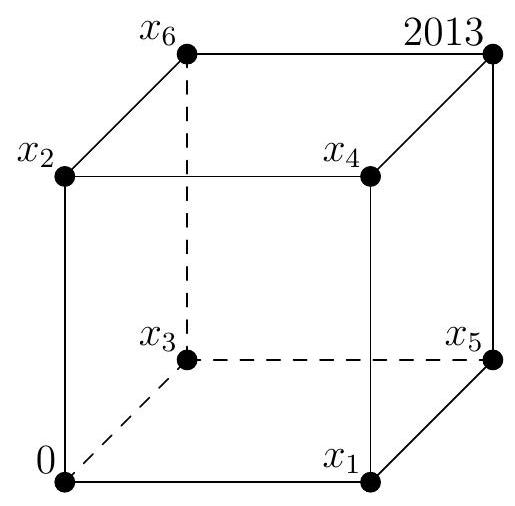
|
| 190 |
+
|
| 191 |
+
## Solution 2
|
| 192 |
+
|
| 193 |
+
$$
|
| 194 |
+
\begin{gathered}
|
| 195 |
+
S=\left(x_{1}^{2}+x_{2}^{2}+x_{3}^{2}+\left(x_{4}-x_{1}\right)^{2}+\left(x_{4}-x_{2}\right)^{2}+\left(x_{5}-x_{1}\right)^{2}+\left(x_{5}-x_{3}\right)^{2}+\right. \\
|
| 196 |
+
\left(x_{6}-x_{2}\right)^{2}+\left(x_{6}-x_{3}\right)^{2}+\left(2013-x_{4}\right)^{2}+\left(2013-x_{5}\right)^{2}+\left(2013-x_{6}\right)^{2}= \\
|
| 197 |
+
=\left(\frac{1}{2} x_{1}^{2}+\left(x_{4}-x_{1}\right)^{2}+\frac{1}{2}\left(2013-x_{4}\right)^{2}\right)+\left(\frac{1}{2} x_{1}^{2}+\left(x_{5}-x_{1}\right)^{2}+\frac{1}{2}\left(2013-x_{5}\right)^{2}\right)+ \\
|
| 198 |
+
+\left(\frac{1}{2} x_{2}^{2}+\left(x_{4}-x_{2}\right)^{2}+\frac{1}{2}\left(2013-x_{4}\right)^{2}\right)+\left(\frac{1}{2} x_{2}^{2}+\left(x_{6}-x_{2}\right)^{2}+\frac{1}{2}\left(2013-x_{6}\right)^{2}\right)+ \\
|
| 199 |
+
+\left(\frac{1}{2} x_{3}^{2}+\left(x_{5}-x_{3}\right)^{2}+\frac{1}{2}\left(2013-x_{5}\right)^{2}\right)+\left(\frac{1}{2} x_{3}^{2}+\left(x_{6}-x_{3}\right)^{2}+\frac{1}{2}\left(2013-x_{6}\right)^{2}\right)
|
| 200 |
+
\end{gathered}
|
| 201 |
+
$$
|
| 202 |
+
|
| 203 |
+
Consider the expression
|
| 204 |
+
|
| 205 |
+
$$
|
| 206 |
+
\begin{aligned}
|
| 207 |
+
S_{1} & =\left(\frac{1}{2} x_{1}^{2}+\left(x_{4}-x_{1}\right)^{2}+\frac{1}{2}\left(2013-x_{4}\right)^{2}\right)= \\
|
| 208 |
+
& =\left(\frac{x_{1}}{2}\right)^{2}+\left(\frac{x_{1}}{2}\right)^{2}+\left(x_{4}-x_{1}\right)^{2}+\left(\frac{2013-x_{4}}{2}\right)^{2}+\left(\frac{2013-x_{4}}{2}\right)^{2}
|
| 209 |
+
\end{aligned}
|
| 210 |
+
$$
|
| 211 |
+
|
| 212 |
+
and note that
|
| 213 |
+
|
| 214 |
+
$$
|
| 215 |
+
\left(\frac{x_{1}}{2}\right)+\left(\frac{x_{1}}{2}\right)+\left(x_{4}-x_{1}\right)+\left(\frac{2013-x_{4}}{2}\right)+\left(\frac{2013-x_{4}}{2}\right)=2013
|
| 216 |
+
$$
|
| 217 |
+
|
| 218 |
+
If the sum of 5 numbers is fixed, then the sum of their squares is minimal if all of them are equal. It follows that:
|
| 219 |
+
|
| 220 |
+
$$
|
| 221 |
+
\frac{x_{1}}{2}=x_{4}-x_{1}=\frac{2013-x_{4}}{2}
|
| 222 |
+
$$
|
| 223 |
+
|
| 224 |
+
from where we get $x_{1}=2 \cdot 2013 / 5$ and $x_{4}=3 \cdot 2013 / 5$. Values for $x_{2}, x_{3}, x_{5}, x_{6}$ can be obtained similarly.
|
| 225 |
+
|
| 226 |
+
## Problem 6
|
| 227 |
+
|
| 228 |
+
Santa Claus has at least $n$ gifts for $n$ children. For $i \in\{1,2, \ldots, n\}$, the $i$-th child considers $x_{i}>0$ of these items to be desirable. Assume that
|
| 229 |
+
|
| 230 |
+
$$
|
| 231 |
+
\frac{1}{x_{1}}+\ldots+\frac{1}{x_{n}} \leq 1
|
| 232 |
+
$$
|
| 233 |
+
|
| 234 |
+
Prove that Santa Claus can give each child a gift that this child likes.
|
| 235 |
+
|
| 236 |
+
## Solution
|
| 237 |
+
|
| 238 |
+
Evidently the age of the children is immaterial, so we may suppose
|
| 239 |
+
|
| 240 |
+
$$
|
| 241 |
+
1 \leq x_{1} \leq x_{2} \leq \ldots \leq x_{n}
|
| 242 |
+
$$
|
| 243 |
+
|
| 244 |
+
Let us now consider the following procedure. First the oldest child chooses its favourite present and keeps it, then the second oldest child chooses its favourite remaining present, and so it goes on until either the presents are distributed in the expected way or some unlucky child is forced to take a present it does not like.
|
| 245 |
+
Let us assume, for the sake of a contradiction, that the latter happens, say to the $k$-th oldest child, where $1 \leq k \leq n$. Since the oldest child likes at least one of the items Santa Claus has, we must have $k \geq 2$. Moreover, at the moment the $k$-th child is to make its decision, only $k-1$ items are gone so far, which means that $x_{k} \leq k-1$.
|
| 246 |
+
For this reason, we have
|
| 247 |
+
|
| 248 |
+
$$
|
| 249 |
+
\frac{1}{x_{1}}+\ldots+\frac{1}{x_{k}} \geq \underbrace{\frac{1}{k-1}+\ldots+\frac{1}{k-1}}_{k}=\frac{k}{k-1}>1
|
| 250 |
+
$$
|
| 251 |
+
|
| 252 |
+
contrary to our assumption. This proves that the procedure considered above always leads to a distribution of the presents to the children of the desired kind, whereby the problem is solved.
|
| 253 |
+
|
| 254 |
+
## Problem 7
|
| 255 |
+
|
| 256 |
+
A positive integer is written on a blackboard. Players $A$ and $B$ play the following game: in each move one has to choose a divisor $m$ of the number $n$ written on the blackboard for which $1<m<n$ and replace $n$ with $n-m$. Player $A$ makes the first move, players move alternately. The player who can't make a move loses the game. For which starting numbers is there a winning strategy for player $B$ ?
|
| 257 |
+
|
| 258 |
+
## Solution
|
| 259 |
+
|
| 260 |
+
Firstly note that for a given $n$ exactly one player has a winning strategy. We'll show by induction that $B$ has a winning strategy if $n$ is odd.
|
| 261 |
+
First step of the induction is clear. Assume $n$ is odd and $B$ has a winning strategy for all odd integers smaller than $n$. If player $A$ can't make a move, $B$ wins. In other case, $A$ chooses a divisor $m$. Note that $m \mid n-m$ and $m<n-m$, because $m \leq \frac{n}{3}$ as $n$ is odd. Therefore $B$ may choose $m$ (in particular can make a move) and pass a number $n-2 m$ to player $A$. The number is odd and smaller than $n$, so the thesis is correct by induction.
|
| 262 |
+
Now, let $n$ be even, but not a power of 2 . In that case $n$ has an odd divisor greater than one. Player $A$ may choose an odd divisor and pass an odd integer to player $B$. Then we have a situation where $B$ starts with an odd integer, so $A$ has a winning strategy.
|
| 263 |
+
Consider now $n=2^{k}$ for positive integer $k$. Once again we'll prove it by induction. Thesis: for odd $k$ player $B$ has a winning strategy and for even $k$ player $A$ has a winning strategy. Base: for $k=1$ player $B$ has a winning strategy as $A$ can't make the first move. For $k=2$ player $A$ may win, passing 2 to player $B$. The step of the induction is split to two parts:
|
| 264 |
+
|
| 265 |
+
- Assume $A$ has a winning strategy for $2^{k}$, then player $B$ has one for $2^{k+1}$. Let $n=2^{k+1}$. Player $A$ has to choose a divisor $2^{l}$ for $1 \leq l \leq k$. If he chooses $2^{k}$, he passes $n-2^{k}=2^{k}$ to player $B$. By induction player $B$ has a winning strategy. If $A$ chooses a smaller divisor, passes an even integer, which is not a power of 2 as $2^{k}<n-2^{l}<n=2^{k+1}$. We have already proved that the starting player (in that case $B$ ) has a winning strategy for such number.
|
| 266 |
+
- Assume $B$ has a winning strategy for $2^{k}$, then player $A$ has one for $2^{k+1}$. Let $n=2^{k+1}$. It is sufficient for player $A$ to choose a divisor $2^{k}$, then he passes number $2^{k}$ to $B$. By induction second player (in this case $A$ ) has a winning strategy.
|
| 267 |
+
|
| 268 |
+
To sum up: player $B$ has a winning strategy for odd $n$ and for $n=2 \cdot 4^{k}$ for non-negative integer $k$.
|
| 269 |
+
|
| 270 |
+
## Problem 8
|
| 271 |
+
|
| 272 |
+
There are $n$ rooms in a sauna, each has unlimited capacity. No room may be attended by a female and a male simultaneously. Moreover, males want to share a room only with males that they don't know and females want to share a room only with females that they know. Find the biggest number $k$ such that any $k$ couples can visit the sauna at the same time, given that two males know each other if and only if their wives know each other.
|
| 273 |
+
|
| 274 |
+
## Solution
|
| 275 |
+
|
| 276 |
+
First we'll show it by induction that it is possible for $n-1$ couples to visit the sauna at the same time. The base of induction is clear.
|
| 277 |
+
Assume that $n-2$ couples may be placed in $n-1$ rooms. Take an additional couple. Let $k$ be the number of couples that they know and $m$ be the number of rooms taken by males.
|
| 278 |
+
If $m>k$, there is a room with males that aren't known by the additional guy. Then he may enter the room and his wife may enter an empty room ( $n$-th room).
|
| 279 |
+
If $m \leq k$ we have $n-2-k<n-1-m$. There are $n-2-k$ females that the additional woman doesn't know and $n-1-m$ rooms taken by females (or empty). It means, that there is a room taken only by females (maybe $0)$ that the additional woman know, so she may join them. The additional man may enter the $n$-th room.
|
| 280 |
+
Now we only have to show that it is the biggest number. For $n$ couples that don't know each other, men need to be placed in different rooms, so they need $n$ rooms. Then there is no place for women.
|
| 281 |
+
|
| 282 |
+
## Problem 9
|
| 283 |
+
|
| 284 |
+
In a country there are 2014 airports, no three of them lying on a line. Two airports are connected by a direct flight if and only if the line passing through them divides the country in two parts, each with 1006 airports in it. Show that there are no two airports such that one can travel from the first to the second, visiting each of the 2014 airports exactly once.
|
| 285 |
+
|
| 286 |
+
## Solution
|
| 287 |
+
|
| 288 |
+
Denote airports as points on the plane. Each airport that is a vertex of the convex hull of these points has only one direct flight. (When we rotate the line that passes through such point the numbers of other points in the half-planes change monotonically.) If an airport has only one direct flight then it can be only the starting point or the endpoint of the journey that visits all 2014 airports. The convex hull contains at least 3 vertices, so there are at least three airports that has only one direct flight. It means that such a journey is impossible.
|
| 289 |
+
|
| 290 |
+
## Problem 10
|
| 291 |
+
|
| 292 |
+
A white equilateral triangle is split into $n^{2}$ equal smaller triangles by lines that are parallel to the sides of the triangle. Denote a line of triangles to be all triangles that are placed between two adjacent parallel lines that form the grid. In particular, a triangle in a corner is also considered to be a line of triangles.
|
| 293 |
+
We are to paint all triangles black by a sequence of operations of the following kind: choose a line of triangles that contains at least one white triangle and paint this line black (a possible situation with $n=6$ after four operations is shown in Figure 1; arrows show possible next operations in this situation). Find the smallest and largest possible number of operations.
|
| 294 |
+
|
| 295 |
+
## Solution
|
| 296 |
+
|
| 297 |
+
Answer: The smallest possible number of operations is $n$ and the largest possible number of operations is $3 n-2$.
|
| 298 |
+
If all the operations are done with lines parallel to one side of the triangle, then the game will end after $n$ operations. Let's show by induction that the number of operations cannot be smaller. The basis for the induction, $n=1$, is evident, assume that for $n=k$ at least $k$ operations are necessary. For $n=k+1$ there will be an operation that colors the bottom right corner triangle, we can assume that it is done, coloring all the
|
| 299 |
+
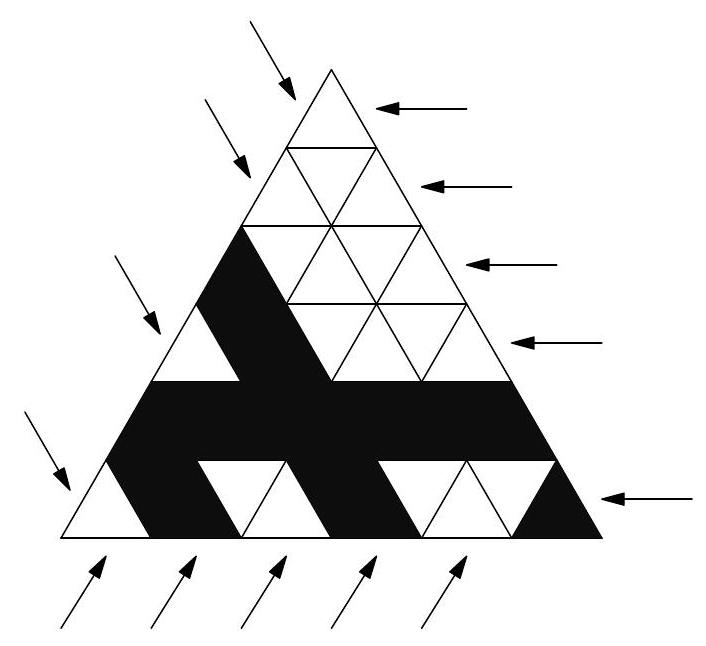
|
| 300 |
+
|
| 301 |
+
Figure 1
|
| 302 |
+
bottom line of the triangle (it can only increase the number of black squares). Order of operations is irrelevant, if we do this operation as the first one then a white triangle with $n=k$ remains for which at least $k$ operations are needed.
|
| 303 |
+
Now let's show that it is possible to do $3 n-2$ operations. If $n=1$ then it is evident. Assume that we have proved it for $n=k$. For $n=k+1$ we start with three operations $\mathrm{A}, \mathrm{B}$ and C coloring two rightmost corners and the rightmost line. We have used 3 operations and reduced the field to the situation when $n=k$ (Fig. 2).
|
| 304 |
+
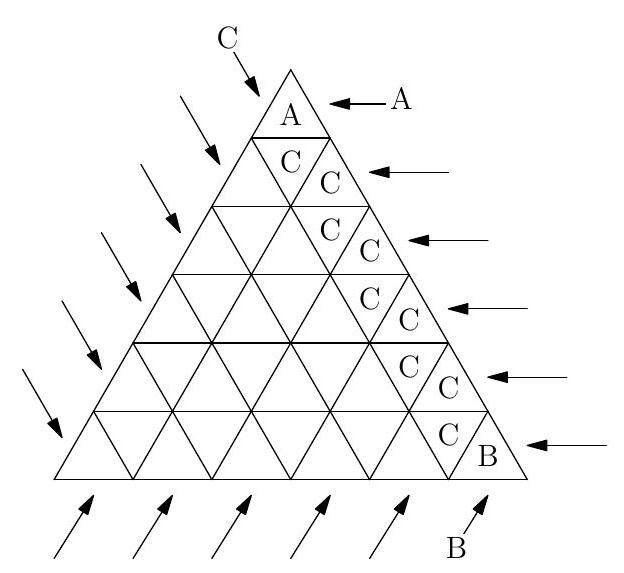
|
| 305 |
+
|
| 306 |
+
Figure 2
|
| 307 |
+
At last we show that there cannot be more than $3 n-2$ operations. If all $n$ lines parallel to one side of the triangle are colored then the whole triangle is colored black. Therefore the number of operations made before the last operation cannot be greater than $3(n-1)$, which gives the total number of operations not greater than $3 n-2$.
|
| 308 |
+
|
| 309 |
+
## Problem 11
|
| 310 |
+
|
| 311 |
+
In an acute triangle $A B C$ with $A C>A B$, let $D$ be the projection of $A$ on $B C$, and let $E$ and $F$ be the projections of $D$ on $A B$ and $A C$, respectively. Let $G$ be the intersection point of the lines $A D$ and $E F$. Let $H$ be the second intersection point of the line $A D$ and the circumcircle of triangle $A B C$. Prove that
|
| 312 |
+
|
| 313 |
+
$$
|
| 314 |
+
A G \cdot A H=A D^{2}
|
| 315 |
+
$$
|
| 316 |
+
|
| 317 |
+
## Solution 1
|
| 318 |
+
|
| 319 |
+

|
| 320 |
+
|
| 321 |
+
From similar right triangles we get
|
| 322 |
+
|
| 323 |
+
$$
|
| 324 |
+
\frac{B E}{A E}=\frac{\frac{B D}{A D} E D}{\frac{A D}{B D} E D}=\left(\frac{B D}{A D}\right)^{2}
|
| 325 |
+
$$
|
| 326 |
+
|
| 327 |
+
and analogously
|
| 328 |
+
|
| 329 |
+
$$
|
| 330 |
+
\frac{C F}{A F}=\left(\frac{C D}{A D}\right)^{2}
|
| 331 |
+
$$
|
| 332 |
+
|
| 333 |
+
Now, because $A C>A B$, the lines $B C$ and $E F$ intersect in a point $X$ on the extension of segment $B C$ beyond $B$. Menelaus' theorem gives
|
| 334 |
+
|
| 335 |
+
$$
|
| 336 |
+
B X \frac{C F}{A F}=C X \frac{B E}{A E}, \quad C X \frac{D G}{A G}=D X \frac{C F}{A F}, \quad D X \frac{B E}{A E}=B X \frac{D G}{A G}
|
| 337 |
+
$$
|
| 338 |
+
|
| 339 |
+
Adding these relations and rerranging terms we arrive at
|
| 340 |
+
|
| 341 |
+
$$
|
| 342 |
+
B C \frac{D G}{A G}=B D \frac{C F}{A F}+C D \frac{B E}{A E}=B C \frac{B D \cdot C D}{A D^{2}}=B C \frac{A D \cdot H D}{A D^{2}}=B C \frac{H D}{A D}
|
| 343 |
+
$$
|
| 344 |
+
|
| 345 |
+
whence
|
| 346 |
+
|
| 347 |
+
$$
|
| 348 |
+
\frac{D G}{A G}=\frac{H D}{A D}
|
| 349 |
+
$$
|
| 350 |
+
|
| 351 |
+
Hence follows
|
| 352 |
+
|
| 353 |
+
$$
|
| 354 |
+
\frac{A D}{A G}=\frac{A G+D G}{A G}=\frac{A D+H D}{A D}=\frac{A H}{A D}
|
| 355 |
+
$$
|
| 356 |
+
|
| 357 |
+
which is equivalent to the problem's assertion.
|
| 358 |
+
|
| 359 |
+
## Solution 2
|
| 360 |
+
|
| 361 |
+
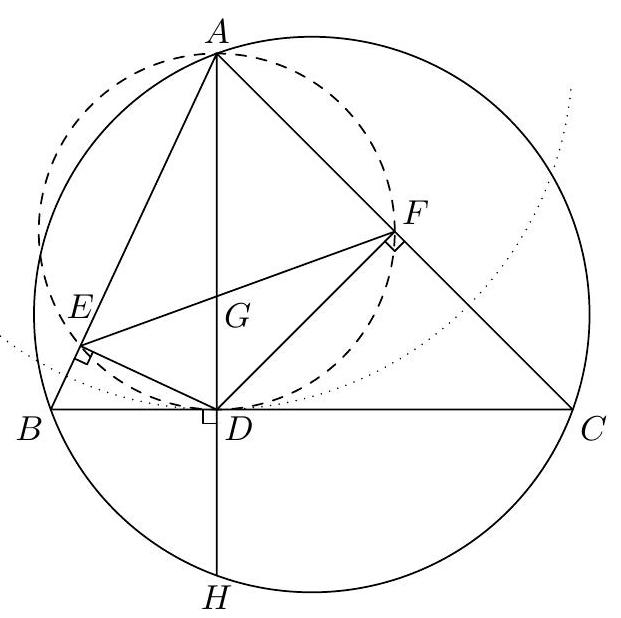
|
| 362 |
+
|
| 363 |
+
Inversion in the circle with centre $A$ and radius $A D$ maps the line $B C$ and the circle with diameter $A D$, passing through $E$ and $F$, therefore $B$ and $E$ and $C$ and $F$, therefore the circumcircle and the line $E F$ and therefore $H$ and $G$ onto one another. Hence the assertion follows.
|
| 364 |
+
|
| 365 |
+
## Solution 3
|
| 366 |
+
|
| 367 |
+
Since $\angle A E D$ and $\angle A F D$ are right angles, $A F D E$ is cyclic. Then
|
| 368 |
+
|
| 369 |
+
$$
|
| 370 |
+
\angle A E F=\angle A D F
|
| 371 |
+
$$
|
| 372 |
+
|
| 373 |
+
Segment $D F$ is an altitude in a right triangle $A D C$, so
|
| 374 |
+
|
| 375 |
+
$$
|
| 376 |
+
\angle A D F=\angle A C D
|
| 377 |
+
$$
|
| 378 |
+
|
| 379 |
+
and
|
| 380 |
+
|
| 381 |
+
$$
|
| 382 |
+
\angle A C D=\angle A H B
|
| 383 |
+
$$
|
| 384 |
+
|
| 385 |
+
as angles inscribed in the circumcircle of $\triangle A B C$. Thus $\angle A E F=\angle A H B$, and $B E G H$ is cyclic. Then by the power of the point
|
| 386 |
+
|
| 387 |
+
$$
|
| 388 |
+
A E \cdot A B=A G \cdot A H
|
| 389 |
+
$$
|
| 390 |
+
|
| 391 |
+
On the other hand, since $D E$ is an altitude in a right triangle $A D B$,
|
| 392 |
+
|
| 393 |
+
$$
|
| 394 |
+
A E \cdot A B=A D^{2}
|
| 395 |
+
$$
|
| 396 |
+
|
| 397 |
+
It follows that $A G \cdot A H=A D^{2}$, and the result follows.
|
| 398 |
+
|
| 399 |
+
## Problem 12
|
| 400 |
+
|
| 401 |
+
A trapezoid $A B C D$ with bases $A B$ and $C D$ is such that the circumcircle of the triangle $B C D$ intersects the line $A D$ in a point $E$, distinct from $A$ and $D$. Prove that the circumcircle of the triangle $A B E$ is tangent to the line $B C$.
|
| 402 |
+
|
| 403 |
+
## Solution 1
|
| 404 |
+
|
| 405 |
+

|
| 406 |
+
|
| 407 |
+
If point $E$ lies on the segment $A D$ it is sufficient to prove $\angle C B E=\angle B A E$. It is true, since both angles are equal to $180^{\circ}-\angle A D C$. If point $D$ lies on the segment $A E$ we have $\angle C B E=\angle C D E=\angle B A E$, which proves the thesis. In the end, if point $A$ lies on the segment $D E$ we have $180^{\circ}-\angle C B E=\angle C D E=\angle B A E$.
|
| 408 |
+
|
| 409 |
+
## Solution 2
|
| 410 |
+
|
| 411 |
+
By $\measuredangle$ denote a directed angle modulo $\pi$. Since $A B C D$ is a trapezoid, $\measuredangle B A E=\measuredangle C D E$, and since $B C D E$ is cyclic, $\measuredangle C D E=\measuredangle C B E$. Hence $\measuredangle B A E=\measuredangle C B E$, and the result follows.
|
| 412 |
+
|
| 413 |
+
## Problem 13
|
| 414 |
+
|
| 415 |
+
All faces of a tetrahedron are right-angled triangles. It is known that three of its edges have the same length $s$. Find the volume of the tetrahedron.
|
| 416 |
+
|
| 417 |
+
## Solution
|
| 418 |
+
|
| 419 |
+
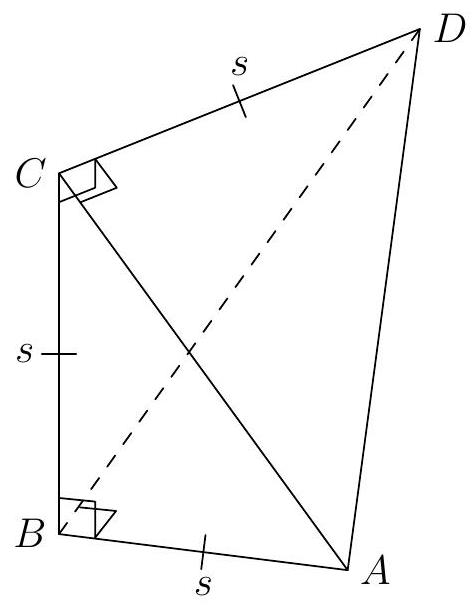
|
| 420 |
+
|
| 421 |
+
The three equal edges clearly cannot bound a face by themselves, for then this triangle would be equilateral and not right-angled. Nor can they be incident to the same vertex, for then the opposite face would again be equilateral.
|
| 422 |
+
Hence we may name the tetrahedron $A B C D$ in such a way that $A B=B C=C D=s$. The angles $\angle A B C$ and $\angle B C D$ must then be right, and $A C=B D=s \sqrt{2}$. Suppose that $\angle A D C$ is right. Then by the Pythagorean theorem applied to $A C D$, we find $A D=s$. The reverse of the Pythagorean theorem applied to $A B D$, we see that $\angle D A B$ is right too. The quadrilateral $A B C D$ then has four right angles, and so must be a square.
|
| 423 |
+
From this contradiction, we conclude that $\angle A D C$ is not right. Since we already know that $A C>C D, \angle C A D$ cannot be right either, and the right angle of $A C D$ must be $\angle A C D$. The Pythagorean theorem gives $A D=s \sqrt{3}$. From the reverse of the Pythagorean theorem, we may now conclude that $\angle A B D$ is right. Consequently, $A B$ is perpendicular to $B C D$, and the volume of the tetrahedron may be simply calculated as
|
| 424 |
+
|
| 425 |
+
$$
|
| 426 |
+
\frac{A B \cdot B C \cdot C D}{6}=\frac{s^{3}}{6}
|
| 427 |
+
$$
|
| 428 |
+
|
| 429 |
+
## Problem 14
|
| 430 |
+
|
| 431 |
+
Circles $\alpha$ and $\beta$ of the same radius intersect in two points, one of which is $P$. Denote by $A$ and $B$, respectively, the points diametrically opposite to $P$ on each of $\alpha$ and $\beta$. A third circle of the same radius passes through $P$ and intersects $\alpha$ and $\beta$ in the points $X$ and $Y$, respectively.
|
| 432 |
+
Show that the line $X Y$ is parallel to the line $A B$.
|
| 433 |
+
|
| 434 |
+
## Solution
|
| 435 |
+
|
| 436 |
+
Let $M$ be the third circle, and denote by $Z$ the point on $M$ diametrically opposite to $P$.
|
| 437 |
+
Since $\angle A X P=\angle P X Z=90^{\circ}$, the three points $A, X, Z$ are collinear. Likewise, the three points $B, Y, Z$ are collinear. Point $P$ is equidistant to the three vertices of triangle $A B Z$, for $P A=P B=P Z$ is the common diameter of the circles. Therefore $P$ is the circumcentre of $A B Z$, which means the perpendiculars $P X$ and $P Y$ bisect the sides $A Z$ and $B Z$. Ergo, $X$ and $Y$ are midpoints on $A Z$ and $B Z$, which leads to the desired conclusion $X Y \| A B$.
|
| 438 |
+
|
| 439 |
+
Remark. Note that $A$ and $Z$ are symmetric with respect to $P X$, thus we immediately obtain $A X=X Z$, and similarly $B Y=Y Z$.
|
| 440 |
+
|
| 441 |
+
## Problem 15
|
| 442 |
+
|
| 443 |
+
Four circles in a plane have a common center. Their radii form a strictly increasing arithmetic progression. Prove that there is no square with each vertex lying on a different circle.
|
| 444 |
+
|
| 445 |
+
## Solution
|
| 446 |
+
|
| 447 |
+
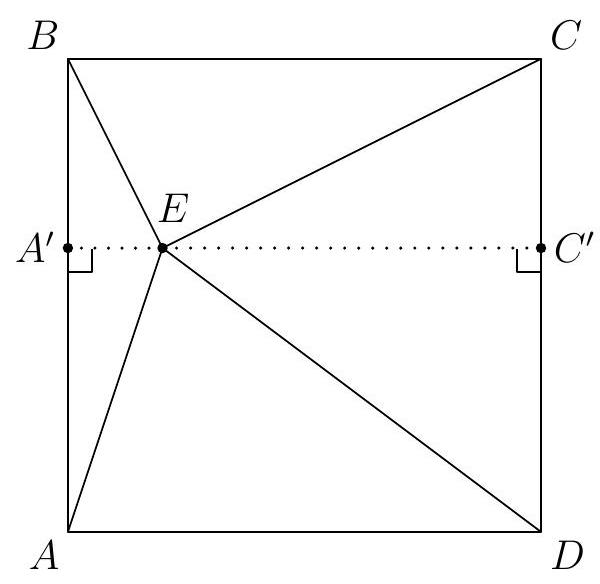
|
| 448 |
+
|
| 449 |
+
First we prove the following lemma:
|
| 450 |
+
Lemma 1. If $A B C D$ is a square then for arbitrary point $E$
|
| 451 |
+
|
| 452 |
+
$$
|
| 453 |
+
E A^{2}+E C^{2}=E B^{2}+E D^{2}
|
| 454 |
+
$$
|
| 455 |
+
|
| 456 |
+
Proof. Let $A^{\prime}, C^{\prime}$ be projections of $E$ on sides $A B$, and $C D$ respectively. Then
|
| 457 |
+
|
| 458 |
+
$$
|
| 459 |
+
\begin{aligned}
|
| 460 |
+
& E A^{2}+E C^{2}=\left(E A^{\prime 2}+A A^{\prime 2}\right)+\left(E C^{\prime 2}+C C^{\prime 2}\right) \\
|
| 461 |
+
& E B^{2}+E D^{2}=\left(E A^{\prime 2}+A^{\prime} B^{2}\right)+\left(E C^{\prime 2}+C^{\prime} D^{2}\right)
|
| 462 |
+
\end{aligned}
|
| 463 |
+
$$
|
| 464 |
+
|
| 465 |
+
As $A^{\prime} B=C C^{\prime}$ and $A A^{\prime}=C^{\prime} D$ then $E A^{2}+E C^{2}=E B^{2}+E D^{2}$. Note that $E$ does not have to be inside the square, it is true for arbitrary point.
|
| 466 |
+
|
| 467 |
+
Now let $O$ be the common center of circles and $A B C D$ be a square with each vertex lying on a different circle, assume that $A$ lies on the largest circle. If $a$ is the radius of the smallest circle and $p$ is the difference of the arithmetic progression then the radii of the circles are $a, a+p, a+2 p$ and $a+3 p$, these are also distances from $O$ to the vertices of the square $A B C D, O A=a+3 p$. Consider the expression $O A^{2}+O C^{2}-O B^{2}-O D^{2}$. Its smallest possible value is attained when $O C=a$, therefore
|
| 468 |
+
|
| 469 |
+
$$
|
| 470 |
+
O A^{2}+O C^{2}-O B^{2}-O D^{2} \geq(a+3 p)^{2}+a^{2}-(a+p)^{2}-(a+2 p)^{2}=4 p^{2}>0
|
| 471 |
+
$$
|
| 472 |
+
|
| 473 |
+
what contradicts the lemma.
|
| 474 |
+
|
| 475 |
+
## Problem 16
|
| 476 |
+
|
| 477 |
+
We call a positive integer $n$ delightful if there exists an integer $k, 1<k<n$, such that
|
| 478 |
+
|
| 479 |
+
$$
|
| 480 |
+
1+2+\cdots+(k-1)=(k+1)+(k+2)+\cdots+n
|
| 481 |
+
$$
|
| 482 |
+
|
| 483 |
+
Does there exist a delightful number $N$ satisfying the inequalities
|
| 484 |
+
|
| 485 |
+
$$
|
| 486 |
+
2013^{2013}<\frac{N}{2013^{2013}}<2013^{2013}+4 ?
|
| 487 |
+
$$
|
| 488 |
+
|
| 489 |
+
## Solution
|
| 490 |
+
|
| 491 |
+
Consider a delightful number $n$. Then there exists an integer $x, 1<x<n$ satisfying
|
| 492 |
+
|
| 493 |
+
$$
|
| 494 |
+
\begin{gathered}
|
| 495 |
+
\sum_{i=1}^{x-1} i=\sum_{i=x+1}^{n} i=\sum_{i=1}^{n} i-\sum_{i=1}^{x} i \\
|
| 496 |
+
x^{2}=x+2 \cdot \frac{(x-1) x}{2}=x+2 \sum_{i=1}^{x-1} i=\sum_{i=1}^{x-1} i+\sum_{i=1}^{x} i=\sum_{i=1}^{n} i=\frac{n(n+1)}{2} .
|
| 497 |
+
\end{gathered}
|
| 498 |
+
$$
|
| 499 |
+
|
| 500 |
+
Now $n$ and $n+1$ are relatively prime so one of them is divisible by 2 and the other one must then be a perfect, odd square, as $x^{2}$ is on the LHS. Now consider the inequality
|
| 501 |
+
|
| 502 |
+
$$
|
| 503 |
+
\left(2013^{2013}\right)^{2}<n<\left(2013^{2013}\right)^{2}+4 \cdot 2013^{2013}=\left(2013^{2013}+2\right)^{2}-4
|
| 504 |
+
$$
|
| 505 |
+
|
| 506 |
+
The only perfect square in this interval is clearly $\left(2013^{2013}+1\right)^{2}$ which is even. Therefore neither $n$ nor $n+1$ can be an odd, perfect square. Hence no delightful number $N$ satisfy the condition.
|
| 507 |
+
|
| 508 |
+
## Problem 17
|
| 509 |
+
|
| 510 |
+
Let $c$ and $n>c$ be positive integers. Mary's teacher writes $n$ positive integers on a blackboard. Is it true that for all $n$ and $c$ Mary can always label the numbers written by the teacher by $a_{1}, \ldots, a_{n}$ in such an order that the cyclic product $\left(a_{1}-a_{2}\right) \cdot\left(a_{2}-a_{3}\right) \cdot \ldots \cdot\left(a_{n-1}-a_{n}\right) \cdot\left(a_{n}-a_{1}\right)$ would be congruent to either 0 or $c$ modulo $n$ ?
|
| 511 |
+
|
| 512 |
+
## Solution
|
| 513 |
+
|
| 514 |
+
Answer: Yes.
|
| 515 |
+
Solution: If some two of these $n$ integers are congruent modulo $n$ then Mary can choose them consecutively and obtain a product divisible by $n$. Hence we may assume in the rest that these $n$ integers written by the teacher are pairwise incongruent modulo $n$. This means that they cover all residues modulo $n$. If $n$ is composite then Mary can find integers $k$ and $l$ such that $n=k l$ and $2 \leq k \leq l \leq n-2$. Let Mary denote $a_{1}, a_{2}, a_{3}, a_{4}$ such that $a_{1} \equiv k, a_{2} \equiv 0, a_{3} \equiv l+1$ and $a_{4} \equiv 1$. The remaining numbers can be denoted in arbitrary order. The product is divisible by $n$ as the product of the first and the third factor is $(k-0) \cdot((l+1)-1)=k l=n$. If $n$ is prime then the numbers $c i$, where $i=0,1, \ldots, n-1$, cover all residues modulo $n$. Let Mary denote the numbers in such a way that $a_{i} \equiv c(n-i)$ for every $i=1, \ldots, n$. Then every factor in the product is congruent to $c$ modulo $n$, meaning that the product is congruent to $c^{n}$ modulo $n$. But $c^{n} \equiv c$ by Fermat's theorem, and Mary has done.
|
| 516 |
+
|
| 517 |
+
## Problem 18
|
| 518 |
+
|
| 519 |
+
Find all pairs $(x, y)$ of integers such that $y^{3}-1=x^{4}+x^{2}$.
|
| 520 |
+
|
| 521 |
+
## Solution
|
| 522 |
+
|
| 523 |
+
If $x=0$, we get a solution $(x, y)=(0,1)$. This solution will turn out to be the only one. If $(x, y)$ is a solution then $(-x, y)$ also is a solution therefore we can assume that $x \geq 1$. We add 1 to both sides and factor: $y^{3}=x^{4}+x^{2}+1=\left(x^{2}+x+1\right)\left(x^{2}-x+1\right)$. We show that the factors $x^{2}+x+1$ and $x^{2}-x+1$ are co-prime. Assume that a prime $p$ divides both of them. Then $p \mid x^{2}+x+1-\left(x^{2}-x+1\right)=2 x$. Since $x^{2}+x+1$ is always odd, $p \mid x$. But then $p$ does not divide $x^{2}+x+1$, a contradiction. Since $x^{2}+x+1$ and $x^{2}-x+1$ have no prime factors in common and their product is a cube, both of them are cubes by a consequence of the fundamental theorem of arithmetic. Therefore, $x^{2}+x+1=a^{3}$ and $x^{2}-x+1=b^{3}$ for some non-negative integers $a$ and $b$.
|
| 524 |
+
|
| 525 |
+
As $x \geq 1$ the first equation implies that $a>x^{\frac{2}{3}}$. But since clearly $b<a$ we get
|
| 526 |
+
|
| 527 |
+
$$
|
| 528 |
+
x^{2}-x+1=b^{3} \leq(a-1)^{3}=a^{3}-3 a^{2}+3 a-1 \leq a^{3}-3 a^{2}+3 a \leq a^{3}-2 a^{2}=x^{2}+x+1-2 a^{2}<x^{2}+x+1-2 x^{\frac{4}{3}}
|
| 529 |
+
$$
|
| 530 |
+
|
| 531 |
+
when $2 a^{2} \leq 3 a^{2}-3 a$, i.e. $a^{2} \geq 3 a$ which holds for $a \geq 3$. Clearly $a=2$ is impossible and $a=1$ means $x=0$. We got $x^{2}-x+1<x^{2}+x+1-2 x^{\frac{4}{3}}$ which means $0 \leq 2 x-2 x^{\frac{4}{3}}$. Hence $x=1$, but then 3 would be a cube, a contradiction.
|
| 532 |
+
|
| 533 |
+
Remark. There are many ways to guess the factorization $x^{4}+x^{2}+1=\left(x^{2}+x+1\right)\left(x^{2}-x+1\right)$. Writing $x^{4}+x+1=\left(x^{2}+1\right)^{2}-x^{2}$ we immediately obtain it. Another way to see it is to write $p(x)=x^{4}+x^{2}+1$ and notice that $p(0)=1 \cdot 1, p(1)=3 \cdot 1, p(2)=7 \cdot 3$, so there probably is a quadratic factor $q(x)$ for which $q(0)=1, q(1)=3, q(2)=7$ (clearly, there cannot be linear factors). It is easy to see then that $q(x)=x^{2}+x+1$ and the factorization can be completed with the long division. One more way is to write $x^{4}+x^{2}+1=$ $\left(x^{2}+a x+b\right)\left(x^{2}+c x+d\right)$ and compare the coefficients.
|
| 534 |
+
It is well-known that if $s$ and $t$ are co-prime integers whose product is a perfect $k$ th power, then $s$ and $t$ both are perfect $k$ th powers. The proof goes like this. Let $a=p_{1}^{\alpha_{1}} \ldots p_{h}^{\alpha_{h}}, b=q_{1}^{\beta_{1}} \ldots q_{\ell}^{\beta_{\ell}}$ and $x=r_{1}^{\gamma_{1}} \ldots r_{m}^{\gamma_{m}}$ be the prime factorizations of $a, b$ and $x$. In the prime factorization of $x^{k}$, every exponent is divisible by $k$, so the same must hold for the factorization of $s t$. But $s$ and $t$ are co-prime, so the exponents of primes in $s$ and $t$ must be divisible by $k$. Therefore $s$ and $t$ are perfect $k$ th powers.
|
| 535 |
+
|
| 536 |
+
## Problem 19
|
| 537 |
+
|
| 538 |
+
Let $a_{0}$ be a positive integer and $a_{n}=5 a_{n-1}+4$, for all $n \geq 1$. Can $a_{0}$ be chosen so that $a_{54}$ is a multiple of 2013?
|
| 539 |
+
|
| 540 |
+
## Solution 1
|
| 541 |
+
|
| 542 |
+
Let $x_{n}=\frac{a_{n}}{5^{n}}$. Then $x_{0}=a$ and $5^{n} x_{n}=a_{n}=5 a_{n-1}+4=5^{n} x_{n-1}+4$. So $x_{n}=x_{n-1}+\frac{4}{5^{n}}$. By induction,
|
| 543 |
+
|
| 544 |
+
$$
|
| 545 |
+
x_{n}=x_{0}+\left(\frac{4}{5}+\frac{4}{5^{2}}+\cdots+\frac{4}{5^{n}}\right)=a+\frac{4}{5}\left(1+\frac{1}{5}+\cdots+\frac{1}{5^{n-1}}\right)=a+\frac{4}{5} \cdot \frac{1-\frac{1}{5^{n}}}{1-\frac{1}{5}}=a+1-\frac{1}{5^{n}}
|
| 546 |
+
$$
|
| 547 |
+
|
| 548 |
+
So $a_{n}=5^{n} x_{n}=5^{n}(a+1)-1$. Now 2013 and $5^{n}$ are relatively prime. So there is a $b, 0<b<2013$, also relatively prime to 2013 , such that $5^{54}=2013 c+b$. To have 2013 as a factor of $a_{54}$, it suffices to find an integer $y$ such that $(a+1) b-1=2013 y$. But this is a linear Diophantine equation in $a+1$ and $y$; it has an infinite family of solutions, among them such that $a+1 \geq 2$.
|
| 549 |
+
|
| 550 |
+
## Solution 2
|
| 551 |
+
|
| 552 |
+
Denote $f(x)=5 x+4$, this function is a bijection for residues modulo 2013, and it has an inverse $g(x)=$ $1208 x+1207$. One can easily check that $f(g(x)) \equiv g(f(x)) \equiv x(\bmod 2013)$.
|
| 553 |
+
Denote $f^{0}(x)=x$ and $f^{n+1}(x)=f\left(f^{n}(x)\right)$, in other words $f^{n}(x)$ is an $n$-fold application of $f$ to $x$. Take $a_{0}=g^{54}(0)$, clearly $a_{0}>0$ and
|
| 554 |
+
|
| 555 |
+
$$
|
| 556 |
+
a_{54}=f^{54}\left(a_{0}\right)=f^{54}\left(g^{54}(0)\right) \equiv 0 \quad(\bmod 2013)
|
| 557 |
+
$$
|
| 558 |
+
|
| 559 |
+
## Problem 20
|
| 560 |
+
|
| 561 |
+
Find all polynomials $f$ with non-negative integer coefficients such that for all primes $p$ and positive integers $n$ there exist a prime $q$ and a positive integer $m$ such that $f\left(p^{n}\right)=q^{m}$.
|
| 562 |
+
|
| 563 |
+
## Solution
|
| 564 |
+
|
| 565 |
+
Notice that among the constant polynomials the only solutions are $P(t)=q^{m}$ where $q$ is a prime and $m$ a positive integer. Assume that
|
| 566 |
+
|
| 567 |
+
$$
|
| 568 |
+
P(t)=a_{k} t^{k}+\cdots a_{0}
|
| 569 |
+
$$
|
| 570 |
+
|
| 571 |
+
where $a_{k} \neq 0$ and $a_{0}, a_{1}, \ldots, a_{k}$ are non-negative integers, is a polynomial that fullfills the conditions.
|
| 572 |
+
First consider the case $a_{0} \neq 1$. Since $a_{0}$ is a non-negative integer different from 1 , there exists a prime $p$ such that $p$ divides $a_{0}$, and hence $p$ divides $P\left(p^{n}\right)$ for all $n$. Thus $P\left(p^{n}\right)$ is a power of $p$ for all positive integers $n$. If there exists a $k^{\prime}<k$ such that $a_{k^{\prime}} \neq 0$, then for sufficiently large $n$ we have
|
| 573 |
+
|
| 574 |
+
$$
|
| 575 |
+
\left(p^{n}\right)^{k}>a_{k-1}\left(p^{n}\right)^{k-1}+\cdots+a_{0}>0
|
| 576 |
+
$$
|
| 577 |
+
|
| 578 |
+
and hence $P\left(p^{n}\right) \not \equiv 0\left(\bmod p^{n k}\right)$, but this contradicts $P\left(p^{n}\right)=p^{m}$ for some integer $m$ since obviously $P\left(p^{n}\right)>$ $p^{n k}$ and therefore $m$ must be greater than $n k$. We conclude that in this case $P(t)=a_{k} t^{k}$, and it is easy to see that only $a_{k}=1$ is a possibility.
|
| 579 |
+
Now consider the case $a_{0}=1$. Let $Q(t)=P(P(t))$. Now $Q$ must as well as $P$ satisfy the conditions. Since $Q(0)=P(P(0))=P(1)>1$ and $Q$ is not constant, we know from the previous that $Q(t)=t^{k}$, which contradicts that $Q(0)>1$. Hence there are no solutions in this case.
|
| 580 |
+
Thus all polynomials that satisfy the conditions are $P(t)=t^{m}$ where $m$ is a positive integer, and $P(t)=q^{m}$ where $q$ is a prime and $m$ is a positive integer.
|
| 581 |
+
|
| 582 |
+
## The 20 contest problems were submitted by 9 countries:
|
| 583 |
+
|
| 584 |
+
| Country | | Proposed problems | | |
|
| 585 |
+
| :--- | :--- | :---: | :--- | :--- |
|
| 586 |
+
| Denmark | 1 | 11 | 16 | 20 |
|
| 587 |
+
| Estonia | 17 | | | |
|
| 588 |
+
| Finland | 2 | 18 | 19 | |
|
| 589 |
+
| Germany | 6 | | | |
|
| 590 |
+
| Lithuania | 3 | | | |
|
| 591 |
+
| Latvia | 5 | 10 | 15 | |
|
| 592 |
+
| Poland | 4 | 7 | 8 | |
|
| 593 |
+
| St. Petersburg | 9 | | | |
|
| 594 |
+
| Sweden | 13 | 14 | | |
|
| 595 |
+
|
| 596 |
+
The solution 2 of the problem 19 originate from the contest paper of the Germany team. Some solutions have been added by coordinators.
|
| 597 |
+
|
BalticWay/md/en-bw14sol.md
ADDED
|
@@ -0,0 +1,663 @@
|
|
|
|
|
|
|
|
|
|
|
|
|
|
|
|
|
|
|
|
|
|
|
|
|
|
|
|
|
|
|
|
|
|
|
|
|
|
|
|
|
|
|
|
|
|
|
|
|
|
|
|
|
|
|
|
|
|
|
|
|
|
|
|
|
|
|
|
|
|
|
|
|
|
|
|
|
|
|
|
|
|
|
|
|
|
|
|
|
|
|
|
|
|
|
|
|
|
|
|
|
|
|
|
|
|
|
|
|
|
|
|
|
|
|
|
|
|
|
|
|
|
|
|
|
|
|
|
|
|
|
|
|
|
|
|
|
|
|
|
|
|
|
|
|
|
|
|
|
|
|
|
|
|
|
|
|
|
|
|
|
|
|
|
|
|
|
|
|
|
|
|
|
|
|
|
|
|
|
|
|
|
|
|
|
|
|
|
|
|
|
|
|
|
|
|
|
|
|
|
|
|
|
|
|
|
|
|
|
|
|
|
|
|
|
|
|
|
|
|
|
|
|
|
|
|
|
|
|
|
|
|
|
|
|
|
|
|
|
|
|
|
|
|
|
|
|
|
|
|
|
|
|
|
|
|
|
|
|
|
|
|
|
|
|
|
|
|
|
|
|
|
|
|
|
|
|
|
|
|
|
|
|
|
|
|
|
|
|
|
|
|
|
|
|
|
|
|
|
|
|
|
|
|
|
|
|
|
|
|
|
|
|
|
|
|
|
|
|
|
|
|
|
|
|
|
|
|
|
|
|
|
|
|
|
|
|
|
|
|
|
|
|
|
|
|
|
|
|
|
|
|
|
|
|
|
|
|
|
|
|
|
|
|
|
|
|
|
|
|
|
|
|
|
|
|
|
|
|
|
|
|
|
|
|
|
|
|
|
|
|
|
|
|
|
|
|
|
|
|
|
|
|
|
|
|
|
|
|
|
|
|
|
|
|
|
|
|
|
|
|
|
|
|
|
|
|
|
|
|
|
|
|
|
|
|
|
|
|
|
|
|
|
|
|
|
|
|
|
|
|
|
|
|
|
|
|
|
|
|
|
|
|
|
|
|
|
|
|
|
|
|
|
|
|
|
|
|
|
|
|
|
|
|
|
|
|
|
|
|
|
|
|
|
|
|
|
|
|
|
|
|
|
|
|
|
|
|
|
|
|
|
|
|
|
|
|
|
|
|
|
|
|
|
|
|
|
|
|
|
|
|
|
|
|
|
|
|
|
|
|
|
|
|
|
|
|
|
|
|
|
|
|
|
|
|
|
|
|
|
|
|
|
|
|
|
|
|
|
|
|
|
|
|
|
|
|
|
|
|
|
|
|
|
|
|
|
|
|
|
|
|
|
|
|
|
|
|
|
|
|
|
|
|
|
|
|
|
|
|
|
|
|
|
|
|
|
|
|
|
|
|
|
|
|
|
|
|
|
|
|
|
|
|
|
|
|
|
|
|
|
|
|
|
|
|
|
|
|
|
|
|
|
|
|
|
|
|
|
|
|
|
|
|
|
|
|
|
|
|
|
|
|
|
|
|
|
|
|
|
|
|
|
|
|
|
|
|
|
|
|
|
|
|
|
|
|
|
|
|
|
|
|
|
|
|
|
|
|
|
|
|
|
|
|
|
|
|
|
|
|
|
|
|
|
|
|
|
|
|
|
|
|
|
|
|
|
|
|
|
|
|
|
|
|
|
|
|
|
|
|
|
|
|
|
|
|
|
|
|
|
|
|
|
|
|
|
|
|
|
|
|
|
|
|
|
|
|
|
|
|
|
|
|
|
|
|
|
|
|
|
|
|
|
|
|
|
|
|
|
|
|
|
|
|
|
|
|
|
|
|
|
|
|
|
|
|
|
|
|
|
|
|
|
|
|
|
|
|
|
|
|
|
|
|
|
|
|
|
|
|
|
|
|
|
|
|
|
|
|
|
|
|
|
|
|
|
|
|
|
|
|
|
|
|
|
|
|
|
|
|
|
|
|
|
|
|
|
|
|
|
|
|
|
|
|
|
|
|
|
|
|
|
|
|
|
|
|
|
|
|
|
|
|
|
|
|
|
|
|
|
|
|
|
|
|
|
|
|
|
|
|
|
|
|
|
|
|
|
|
|
|
|
|
|
|
|
|
|
|
|
|
|
|
|
|
|
|
|
|
|
|
|
|
|
|
|
|
|
|
|
|
|
|
|
|
|
|
|
|
|
|
|
|
|
|
|
|
|
|
|
|
|
|
|
|
|
|
|
|
|
|
|
|
|
|
|
|
|
|
|
|
|
|
|
|
|
|
|
|
|
|
|
|
|
|
|
|
|
|
|
|
|
|
|
|
|
|
|
|
|
|
|
|
|
|
|
|
|
|
|
|
|
|
|
|
|
|
|
|
|
|
|
|
|
|
|
|
|
|
|
|
|
|
|
|
|
|
|
|
|
|
|
|
|
|
|
|
|
|
|
|
|
|
|
|
|
|
|
|
|
|
|
|
|
|
|
|
|
|
|
|
|
|
|
|
|
|
|
|
|
|
|
|
|
|
|
|
|
|
|
|
|
|
|
|
|
|
|
|
|
|
|
|
|
|
|
|
|
|
|
|
|
|
|
|
|
|
|
|
|
|
|
|
|
|
|
|
|
|
|
|
|
|
|
|
|
|
|
|
|
|
|
|
|
|
|
|
|
|
|
|
|
|
|
|
|
|
|
|
|
|
|
|
|
|
|
|
|
|
|
|
|
|
|
|
|
|
|
|
|
|
|
|
|
|
|
|
|
|
|
|
|
|
|
|
|
|
|
|
|
|
|
|
|
|
|
|
|
|
|
|
|
|
|
|
|
|
|
|
|
|
|
|
|
|
|
|
|
|
|
|
|
|
|
|
|
|
|
|
|
|
|
|
|
|
|
|
|
|
|
|
|
|
|
|
|
|
|
|
|
|
|
|
|
|
|
|
|
|
|
|
|
|
|
|
|
|
|
|
|
|
|
|
|
|
|
|
|
|
|
|
|
|
|
|
|
|
|
|
|
|
|
|
|
|
|
|
|
|
|
|
|
|
|
|
|
|
|
|
|
|
|
|
|
|
|
|
|
|
|
|
|
|
|
|
|
|
|
|
|
|
|
|
|
|
|
|
|
|
|
|
|
|
|
|
|
|
|
|
|
|
|
|
|
|
|
|
|
|
|
|
|
|
|
|
|
|
|
|
|
|
|
|
|
|
|
|
|
|
|
|
|
|
|
|
|
|
|
|
|
|
|
|
|
|
|
|
|
|
|
|
|
|
|
|
|
|
|
|
|
|
|
|
|
|
|
|
|
|
|
|
|
|
|
|
|
|
|
|
|
|
|
|
|
|
|
|
|
|
|
|
|
|
|
|
|
|
|
|
|
|
|
|
|
|
|
|
|
|
|
|
|
|
|
|
|
|
|
|
|
|
|
|
|
|
|
|
|
|
|
|
|
|
|
|
|
|
|
|
|
|
|
|
|
|
|
|
|
|
|
|
|
|
|
|
|
|
|
|
|
|
|
|
|
|
|
|
|
|
|
|
|
|
|
|
|
|
|
|
|
|
|
|
|
|
|
|
|
|
|
|
|
|
|
|
|
|
|
|
|
|
|
|
|
|
|
|
|
|
|
|
|
|
|
|
|
|
|
|
|
|
|
|
|
|
|
|
|
|
|
|
|
|
|
|
|
|
|
|
|
|
|
|
|
|
|
|
|
|
|
|
|
|
|
|
|
|
|
|
|
|
|
|
|
|
|
|
|
|
|
|
|
|
|
|
|
|
|
|
|
|
|
|
|
|
|
|
|
|
|
|
|
|
|
|
|
|
|
|
|
|
|
|
|
|
|
|
|
|
|
|
|
|
|
|
|
|
|
|
|
|
|
|
|
|
|
|
|
|
|
|
|
|
|
|
|
|
|
|
|
|
|
|
|
|
|
|
|
|
|
|
|
|
|
|
|
|
|
|
|
|
|
|
|
|
|
|
|
|
|
|
|
|
|
|
|
|
|
|
|
|
|
|
|
|
|
|
|
|
|
|
|
|
|
|
|
|
|
|
|
|
|
|
|
|
|
|
|
|
|
|
|
|
|
|
|
|
|
|
|
|
|
|
|
|
|
|
|
|
|
|
|
|
|
|
|
|
|
|
|
|
|
|
|
|
|
|
|
|
|
|
|
|
|
|
|
|
|
|
|
|
|
|
|
|
|
|
|
|
|
|
|
|
|
|
|
|
|
|
|
|
|
|
|
|
|
|
|
|
|
|
|
|
|
|
|
|
|
|
|
|
|
|
|
|
|
|
|
|
|
|
|
|
|
|
|
|
|
|
|
|
|
|
|
|
|
|
|
|
|
|
|
|
|
|
|
|
|
|
|
|
|
|
|
|
|
|
|
|
|
|
|
|
|
|
|
|
|
|
|
|
|
|
|
|
|
|
|
|
|
|
|
|
|
|
|
|
|
|
|
|
|
|
|
|
|
|
|
|
|
|
|
|
|
|
|
|
|
|
|
|
|
| 1 |
+
# Contents
|
| 2 |
+
|
| 3 |
+
Problems . . . . . . . . . . . . . . . . . . . . . . . . . . . . 2
|
| 4 |
+
|
| 5 |
+
Solutions . . . . . . . . . . . . . . . . . . . . . . . . . . . . 6
|
| 6 |
+
|
| 7 |
+
## Problems
|
| 8 |
+
|
| 9 |
+
## Problem 1
|
| 10 |
+
|
| 11 |
+
Show that
|
| 12 |
+
|
| 13 |
+
$$
|
| 14 |
+
\cos \left(56^{\circ}\right) \cdot \cos \left(2 \cdot 56^{\circ}\right) \cdot \cos \left(2^{2} \cdot 56^{\circ}\right) \cdot \ldots \cdot \cos \left(2^{23} \cdot 56^{\circ}\right)=\frac{1}{2^{24}}
|
| 15 |
+
$$
|
| 16 |
+
|
| 17 |
+
## Problem 2
|
| 18 |
+
|
| 19 |
+
Let $a_{0}, a_{1}, \ldots, a_{N}$ be real numbers satisfying $a_{0}=a_{N}=0$ and
|
| 20 |
+
|
| 21 |
+
$$
|
| 22 |
+
a_{i+1}-2 a_{i}+a_{i-1}=a_{i}^{2}
|
| 23 |
+
$$
|
| 24 |
+
|
| 25 |
+
for $i=1,2, \ldots, N-1$. Prove that $a_{i} \leqslant 0$ for $i=1,2, \ldots, N-1$.
|
| 26 |
+
|
| 27 |
+
## Problem 3
|
| 28 |
+
|
| 29 |
+
Positive real numbers $a, b, c$ satisfy $\frac{1}{a}+\frac{1}{b}+\frac{1}{c}=3$. Prove the inequality
|
| 30 |
+
|
| 31 |
+
$$
|
| 32 |
+
\frac{1}{\sqrt{a^{3}+b}}+\frac{1}{\sqrt{b^{3}+c}}+\frac{1}{\sqrt{c^{3}+a}} \leqslant \frac{3}{\sqrt{2}} .
|
| 33 |
+
$$
|
| 34 |
+
|
| 35 |
+
## Problem 4
|
| 36 |
+
|
| 37 |
+
Find all functions $f$ defined on all real numbers and taking real values such that
|
| 38 |
+
|
| 39 |
+
$$
|
| 40 |
+
f(f(y))+f(x-y)=f(x f(y)-x)
|
| 41 |
+
$$
|
| 42 |
+
|
| 43 |
+
for all real numbers $x, y$.
|
| 44 |
+
|
| 45 |
+
## Problem 5
|
| 46 |
+
|
| 47 |
+
Given positive real numbers $a, b, c, d$ that satisfy equalities
|
| 48 |
+
|
| 49 |
+
$$
|
| 50 |
+
a^{2}+d^{2}-a d=b^{2}+c^{2}+b c \quad \text { and } \quad a^{2}+b^{2}=c^{2}+d^{2}
|
| 51 |
+
$$
|
| 52 |
+
|
| 53 |
+
find all possible values of the expression $\frac{a b+c d}{a d+b c}$.
|
| 54 |
+
|
| 55 |
+
## Problem 6
|
| 56 |
+
|
| 57 |
+
In how many ways can we paint 16 seats in a row, each red or green, in such a way that the number of consecutive seats painted in the same colour is always odd?
|
| 58 |
+
|
| 59 |
+
## Problem 7
|
| 60 |
+
|
| 61 |
+
Let $p_{1}, p_{2}, \ldots, p_{30}$ be a permutation of the numbers $1,2, \ldots, 30$. For how many permutations does the equality $\sum_{k=1}^{30}\left|p_{k}-k\right|=450$ hold?
|
| 62 |
+
|
| 63 |
+
## Problem 8
|
| 64 |
+
|
| 65 |
+
Albert and Betty are playing the following game. There are 100 blue balls in a red bowl and 100 red balls in a blue bowl. In each turn a player must make one of the following moves:
|
| 66 |
+
|
| 67 |
+
a) Take two red balls from the blue bowl and put them in the red bowl.
|
| 68 |
+
|
| 69 |
+
b) Take two blue balls from the red bowl and put them in the blue bowl.
|
| 70 |
+
|
| 71 |
+
c) Take two balls of different colors from one bowl and throw the balls away.
|
| 72 |
+
|
| 73 |
+
They take alternate turns and Albert starts. The player who first takes the last red ball from the blue bowl or the last blue ball from the red bowl wins. Determine who has a winning strategy.
|
| 74 |
+
|
| 75 |
+
## Problem 9
|
| 76 |
+
|
| 77 |
+
What is the least possible number of cells that can be marked on an $n \times n$ board such that for each $m>\frac{n}{2}$ both diagonals of any $m \times m$ sub-board contain a marked cell?
|
| 78 |
+
|
| 79 |
+
## Problem 10
|
| 80 |
+
|
| 81 |
+
In a country there are 100 airports. Super-Air operates direct flights between some pairs of airports (in both directions). The traffic of an airport is the number of airports it has a direct Super-Air connection with. A new company, Concur-Air, establishes a direct flight between two airports if and only if the sum of their traffics is at least 100. It turns out that there exists a round-trip of Concur-Air flights that lands in every airport exactly once. Show that then there also exists a round-trip of Super-Air flights that lands in every airport exactly once.
|
| 82 |
+
|
| 83 |
+
## Problem 11
|
| 84 |
+
|
| 85 |
+
Let $\Gamma$ be the circumcircle of an acute triangle $A B C$. The perpendicular to $A B$ from $C$ meets $A B$ at $D$ and $\Gamma$ again at $E$. The bisector of angle $C$ meets $A B$ at $F$ and $\Gamma$ again at $G$. The line $G D$ meets $\Gamma$ again at $H$ and the line $H F$ meets $\Gamma$ again at $I$. Prove that $A I=E B$.
|
| 86 |
+
|
| 87 |
+
## Problem 12
|
| 88 |
+
|
| 89 |
+
Triangle $A B C$ is given. Let $M$ be the midpoint of the segment $A B$ and $T$ be the midpoint of the arc $B C$ not containing $A$ of the circumcircle of $A B C$. The point $K$ inside the triangle $A B C$ is such that $M A T K$ is an isosceles trapezoid with $A T \| M K$. Show that $A K=K C$.
|
| 90 |
+
|
| 91 |
+
## Problem 13
|
| 92 |
+
|
| 93 |
+
Let $A B C D$ be a square inscribed in a circle $\omega$ and let $P$ be a point on the shorter arc $A B$ of $\omega$. Let $C P \cap B D=R$ and $D P \cap A C=S$. Show that triangles $A R B$ and $D S R$ have equal areas.
|
| 94 |
+
|
| 95 |
+
## Problem 14
|
| 96 |
+
|
| 97 |
+
Let $A B C D$ be a convex quadrilateral such that the line $B D$ bisects the angle $A B C$. The circumcircle of triangle $A B C$ intersects the sides $A D$ and $C D$ in the points $P$ and $Q$, respectively. The line through $D$ and parallel to $A C$ intersects the lines $B C$ and $B A$ at the points $R$ and $S$, respectively. Prove that the points $P, Q, R$ and $S$ lie on a common circle.
|
| 98 |
+
|
| 99 |
+
## Problem 15
|
| 100 |
+
|
| 101 |
+
The sum of the angles $A$ and $C$ of a convex quadrilateral $A B C D$ is less than $180^{\circ}$. Prove that
|
| 102 |
+
|
| 103 |
+
$$
|
| 104 |
+
A B \cdot C D+A D \cdot B C<A C(A B+A D) .
|
| 105 |
+
$$
|
| 106 |
+
|
| 107 |
+
## Problem 16
|
| 108 |
+
|
| 109 |
+
Determine whether $712 !+1$ is a prime number.
|
| 110 |
+
|
| 111 |
+
## Problem 17
|
| 112 |
+
|
| 113 |
+
Do there exist pairwise distinct rational numbers $x, y$ and $z$ such that
|
| 114 |
+
|
| 115 |
+
$$
|
| 116 |
+
\frac{1}{(x-y)^{2}}+\frac{1}{(y-z)^{2}}+\frac{1}{(z-x)^{2}}=2014 ?
|
| 117 |
+
$$
|
| 118 |
+
|
| 119 |
+
## Problem 18
|
| 120 |
+
|
| 121 |
+
Let $p$ be a prime number, and let $n$ be a positive integer. Find the number of quadruples $\left(a_{1}, a_{2}, a_{3}, a_{4}\right)$ with $a_{i} \in\left\{0,1, \ldots, p^{n}-1\right\}$ for $i=1,2,3,4$ such that
|
| 122 |
+
|
| 123 |
+
$$
|
| 124 |
+
p^{n} \mid\left(a_{1} a_{2}+a_{3} a_{4}+1\right) .
|
| 125 |
+
$$
|
| 126 |
+
|
| 127 |
+
## Problem 19
|
| 128 |
+
|
| 129 |
+
Let $m$ and $n$ be relatively prime positive integers. Determine all possible values of
|
| 130 |
+
|
| 131 |
+
$$
|
| 132 |
+
\operatorname{gcd}\left(2^{m}-2^{n}, 2^{m^{2}+m n+n^{2}}-1\right)
|
| 133 |
+
$$
|
| 134 |
+
|
| 135 |
+
## Problem 20
|
| 136 |
+
|
| 137 |
+
Consider a sequence of positive integers $a_{1}, a_{2}, a_{3}, \ldots$ such that for $k \geqslant 2$ we have
|
| 138 |
+
|
| 139 |
+
$$
|
| 140 |
+
a_{k+1}=\frac{a_{k}+a_{k-1}}{2015^{i}}
|
| 141 |
+
$$
|
| 142 |
+
|
| 143 |
+
where $2015^{i}$ is the maximal power of 2015 that divides $a_{k}+a_{k-1}$. Prove that if this sequence is periodic then its period is divisible by 3 .
|
| 144 |
+
|
| 145 |
+
## Solutions
|
| 146 |
+
|
| 147 |
+
## Problem 1
|
| 148 |
+
|
| 149 |
+
Show that
|
| 150 |
+
|
| 151 |
+
$$
|
| 152 |
+
\cos \left(56^{\circ}\right) \cdot \cos \left(2 \cdot 56^{\circ}\right) \cdot \cos \left(2^{2} \cdot 56^{\circ}\right) \cdot \ldots \cdot \cos \left(2^{23} \cdot 56^{\circ}\right)=\frac{1}{2^{24}}
|
| 153 |
+
$$
|
| 154 |
+
|
| 155 |
+
Solution. We start by rewriting the expression as follows:
|
| 156 |
+
|
| 157 |
+
$\cos \left(56^{\circ}\right) \cdot \cos \left(2 \cdot 56^{\circ}\right) \cdot \ldots \cdot \cos \left(2^{23} \cdot 56^{\circ}\right)=\frac{\sin \left(56^{\circ}\right) \cdot \cos \left(56^{\circ}\right) \cdot \cos \left(2 \cdot 56^{\circ}\right) \cdot \ldots \cdot \cos \left(2^{23} \cdot 56^{\circ}\right)}{\sin \left(56^{\circ}\right)}$
|
| 158 |
+
|
| 159 |
+
Now, by applying the double-angle formula $\sin (x) \cos (x)=\sin (2 x) / 2$ to $x=56^{\circ}$, we obtain
|
| 160 |
+
|
| 161 |
+
$$
|
| 162 |
+
\begin{gathered}
|
| 163 |
+
\frac{\sin \left(56^{\circ}\right) \cdot \cos \left(56^{\circ}\right) \cdot \cos \left(2 \cdot 56^{\circ}\right) \cdot \ldots \cdot \cos \left(2^{23} \cdot 56^{\circ}\right)}{\sin \left(56^{\circ}\right)} \\
|
| 164 |
+
=\frac{\sin \left(2 \cdot 56^{\circ}\right) \cdot \cos \left(2 \cdot 56^{\circ}\right) \cdot \ldots \cdot \cos \left(2^{23} \cdot 56^{\circ}\right)}{2 \cdot \sin \left(56^{\circ}\right)} .
|
| 165 |
+
\end{gathered}
|
| 166 |
+
$$
|
| 167 |
+
|
| 168 |
+
Similarly, by applying the double-angle formula 24 times, we get
|
| 169 |
+
|
| 170 |
+
$$
|
| 171 |
+
\cos \left(56^{\circ}\right) \cdot \cos \left(2 \cdot 56^{\circ}\right) \cdot \ldots \cdot \cos \left(2^{23} \cdot 56^{\circ}\right)=\frac{\sin \left(2^{24} \cdot 56^{\circ}\right)}{2^{24} \cdot \sin \left(56^{\circ}\right)}
|
| 172 |
+
$$
|
| 173 |
+
|
| 174 |
+
It remains to prove that $\sin \left(2^{24} \cdot 56^{\circ}\right)=\sin \left(56^{\circ}\right)$. If we can show that
|
| 175 |
+
|
| 176 |
+
$$
|
| 177 |
+
2^{24} \cdot 56=360 \cdot k+56
|
| 178 |
+
$$
|
| 179 |
+
|
| 180 |
+
for some integer $k$, then the desired equality follows by the periodicity of the sine function. Note that
|
| 181 |
+
|
| 182 |
+
$$
|
| 183 |
+
k=\frac{2^{24} \cdot 56-56}{360}=7 \cdot \frac{2^{24}-1}{45} .
|
| 184 |
+
$$
|
| 185 |
+
|
| 186 |
+
Since $\varphi(45)=24$, the Euler theorem implies that $k$ is indeed an integer, as claimed.
|
| 187 |
+
|
| 188 |
+
## Problem 2
|
| 189 |
+
|
| 190 |
+
Let $a_{0}, a_{1}, \ldots, a_{N}$ be real numbers satisfying $a_{0}=a_{N}=0$ and
|
| 191 |
+
|
| 192 |
+
$$
|
| 193 |
+
a_{i+1}-2 a_{i}+a_{i-1}=a_{i}^{2}
|
| 194 |
+
$$
|
| 195 |
+
|
| 196 |
+
for $i=1,2, \ldots, N-1$. Prove that $a_{i} \leqslant 0$ for $i=1,2, \ldots, N-1$.
|
| 197 |
+
|
| 198 |
+
Solution. Assume the contrary. Then, there is an index $i$ for which $a_{i}=\max _{0 \leqslant j \leqslant N} a_{j}$ and $a_{i}>0$. This $i$ cannot be equal to 0 or $N$, since $a_{0}=a_{N}=0$. Thus, from $a_{i} \geqslant a_{i-1}$ and $a_{i} \geqslant a_{i+1}$ we obtain $0<a_{i}^{2}=\left(a_{i+1}-a_{i}\right)+\left(a_{i-1}-a_{i}\right) \leqslant 0$, which is a contradiction.
|
| 199 |
+
|
| 200 |
+
## Problem 3
|
| 201 |
+
|
| 202 |
+
Positive real numbers $a, b, c$ satisfy $\frac{1}{a}+\frac{1}{b}+\frac{1}{c}=3$. Prove the inequality
|
| 203 |
+
|
| 204 |
+
$$
|
| 205 |
+
\frac{1}{\sqrt{a^{3}+b}}+\frac{1}{\sqrt{b^{3}+c}}+\frac{1}{\sqrt{c^{3}+a}} \leqslant \frac{3}{\sqrt{2}} .
|
| 206 |
+
$$
|
| 207 |
+
|
| 208 |
+
Solution. Applying several AM-GM inequalities (and using $1 / a+1 / b+1 / c=3$ ) we obtain
|
| 209 |
+
|
| 210 |
+
$$
|
| 211 |
+
\begin{aligned}
|
| 212 |
+
\frac{1}{\sqrt{a^{3}+b}}+\frac{1}{\sqrt{b^{3}+c}}+\frac{1}{\sqrt{c^{3}+a}} & \leqslant \frac{1}{\sqrt{2 a \sqrt{a b}}}+\frac{1}{\sqrt{2 b \sqrt{b c}}}+\frac{1}{\sqrt{2 c \sqrt{c a}}} \\
|
| 213 |
+
& =\frac{1}{\sqrt{2}}\left(\frac{\sqrt{a \sqrt{a b}}}{a \sqrt{a b}}+\frac{\sqrt{b \sqrt{b c}}}{b \sqrt{b c}}+\frac{\sqrt{c \sqrt{c a}}}{c \sqrt{c a}}\right) \\
|
| 214 |
+
& \leqslant \frac{1}{2 \sqrt{2}}\left(\frac{a+\sqrt{a b}}{a \sqrt{a b}}+\frac{b+\sqrt{b c}}{b \sqrt{b c}}+\frac{c+\sqrt{c a}}{c \sqrt{c a}}\right) \\
|
| 215 |
+
& =\frac{1}{2 \sqrt{2}}\left(3+\frac{1}{\sqrt{a b}}+\frac{1}{\sqrt{b c}}+\frac{1}{\sqrt{c a}}\right) \\
|
| 216 |
+
& =\frac{1}{2 \sqrt{2}}\left(3+\frac{\sqrt{a b}}{a b}+\frac{\sqrt{b c}}{b c}+\frac{\sqrt{c a}}{c a}\right) \\
|
| 217 |
+
& \leqslant \frac{1}{2 \sqrt{2}}\left(3+\frac{a+b}{2 a b}+\frac{b+c}{2 b c}+\frac{c+a}{2 a c}\right) \\
|
| 218 |
+
& =\frac{1}{2 \sqrt{2}}(3+3)=\frac{3}{\sqrt{2}} .
|
| 219 |
+
\end{aligned}
|
| 220 |
+
$$
|
| 221 |
+
|
| 222 |
+
## Problem 4
|
| 223 |
+
|
| 224 |
+
Find all functions $f$ defined on all real numbers and taking real values such that
|
| 225 |
+
|
| 226 |
+
$$
|
| 227 |
+
f(f(y))+f(x-y)=f(x f(y)-x)
|
| 228 |
+
$$
|
| 229 |
+
|
| 230 |
+
for all real numbers $x, y$.
|
| 231 |
+
|
| 232 |
+
Answer: $f(x)=0$.
|
| 233 |
+
|
| 234 |
+
Solution. Substituting $x=y=0$ into the original equality gives $f(f(0))+f(0)=f(0)$, implying
|
| 235 |
+
|
| 236 |
+
$$
|
| 237 |
+
f(f(0))=0
|
| 238 |
+
$$
|
| 239 |
+
|
| 240 |
+
Selecting $x=\frac{f(0)}{2}$ and $y=f(0)$ in the original equality gives
|
| 241 |
+
|
| 242 |
+
$$
|
| 243 |
+
f(f(f(0)))+f\left(-\frac{f(0)}{2}\right)=f\left(\frac{f(0)}{2} \cdot f(f(0))-\frac{f(0)}{2}\right) .
|
| 244 |
+
$$
|
| 245 |
+
|
| 246 |
+
Applying (1) here leads to $f(0)+f\left(-\frac{f(0)}{2}\right)=f\left(-\frac{f(0)}{2}\right)$ which yields
|
| 247 |
+
|
| 248 |
+
$$
|
| 249 |
+
f(0)=0
|
| 250 |
+
$$
|
| 251 |
+
|
| 252 |
+
Substituting $y=0$ into the original equation we obtain $f(f(0))+f(x)=f(x f(0)-x)$, which in the light of (2) reduces to
|
| 253 |
+
|
| 254 |
+
$$
|
| 255 |
+
f(x)=f(-x)
|
| 256 |
+
$$
|
| 257 |
+
|
| 258 |
+
for all $x$. Finally, let us substitute $x=0$ into the original equation. In the light of (2) and (3), we obtain $f(f(y))+f(y)=0$, i. e.,
|
| 259 |
+
|
| 260 |
+
$$
|
| 261 |
+
f(f(y))=-f(y)
|
| 262 |
+
$$
|
| 263 |
+
|
| 264 |
+
for all real numbers $y$. Now, for each real $y$, we have
|
| 265 |
+
|
| 266 |
+
$$
|
| 267 |
+
\begin{aligned}
|
| 268 |
+
& f(y)=-f(f(y)) \quad(\text { by }(4)) \\
|
| 269 |
+
& =f(f(f(y))) \quad(\text { by (4)) } \\
|
| 270 |
+
& =f(-f(y)) \quad(\text { by }(4)) \\
|
| 271 |
+
& =f(f(y)) \quad \text { (by (3)) } \\
|
| 272 |
+
& =-f(y), \quad(\text { by (4)) }
|
| 273 |
+
\end{aligned}
|
| 274 |
+
$$
|
| 275 |
+
|
| 276 |
+
so that $f(y)=0$.
|
| 277 |
+
|
| 278 |
+
## Problem 5
|
| 279 |
+
|
| 280 |
+
Given positive real numbers $a, b, c, d$ that satisfy equalities
|
| 281 |
+
|
| 282 |
+
$$
|
| 283 |
+
a^{2}+d^{2}-a d=b^{2}+c^{2}+b c \quad \text { and } \quad a^{2}+b^{2}=c^{2}+d^{2}
|
| 284 |
+
$$
|
| 285 |
+
|
| 286 |
+
find all possible values of the expression $\frac{a b+c d}{a d+b c}$.
|
| 287 |
+
|
| 288 |
+
Answer: $\frac{\sqrt{3}}{2}$.
|
| 289 |
+
|
| 290 |
+
Solution 1. Let $A_{1} B C_{1}$ be a triangle with $A_{1} B=b, B C_{1}=c$ and $\angle A_{1} B C_{1}=120^{\circ}$, and let $C_{2} D A_{2}$ be another triangle with $C_{2} D=d, D A_{2}=a$ and $\angle C_{2} D A_{2}=60^{\circ}$. By the law of cosines and the assumption $a^{2}+d^{2}-a d=b^{2}+c^{2}+b c$, we have $A_{1} C_{1}=A_{2} C_{2}$. Thus, the two triangles can be put together to form a quadrilateral $A B C D$ with $A B=b$, $B C=c, C D=d, D A=a$ and $\angle A B C=120^{\circ}, \angle C D A=60^{\circ}$. Then $\angle D A B+\angle B C D=$ $360^{\circ}-(\angle A B C+\angle C D A)=180^{\circ}$.
|
| 291 |
+
|
| 292 |
+
Suppose that $\angle D A B>90^{\circ}$. Then $\angle B C D<90^{\circ}$, whence $a^{2}+b^{2}<B D^{2}<c^{2}+d^{2}$, contradicting the assumption $a^{2}+b^{2}=c^{2}+d^{2}$. By symmetry, $\angle D A B<90^{\circ}$ also leads to a contradiction. Hence, $\angle D A B=\angle B C D=90^{\circ}$. Now, let us calculate the area of $A B C D$ in two ways: on one hand, it equals $\frac{1}{2} a d \sin 60^{\circ}+\frac{1}{2} b c \sin 120^{\circ}$ or $\frac{\sqrt{3}}{4}(a d+b c)$. On the other hand, it equals $\frac{1}{2} a b+\frac{1}{2} c d$ or $\frac{1}{2}(a b+c d)$. Consequently,
|
| 293 |
+
|
| 294 |
+
$$
|
| 295 |
+
\frac{a b+c d}{a d+b c}=\frac{\frac{\sqrt{3}}{4}}{\frac{1}{2}}=\frac{\sqrt{3}}{2}
|
| 296 |
+
$$
|
| 297 |
+
|
| 298 |
+
Solution 2. Setting $T^{2}=a^{2}+b^{2}=c^{2}+d^{2}$, where $T>0$, we can write
|
| 299 |
+
|
| 300 |
+
$$
|
| 301 |
+
a=T \sin \alpha, \quad b=T \cos \alpha, \quad c=T \sin \beta, \quad d=T \cos \beta
|
| 302 |
+
$$
|
| 303 |
+
|
| 304 |
+
for some $\alpha, \beta \in(0, \pi / 2)$. With this notation, the first equality gives
|
| 305 |
+
|
| 306 |
+
$$
|
| 307 |
+
\sin ^{2} \alpha+\cos ^{2} \beta-\sin \alpha \cos \beta=\sin ^{2} \beta+\cos ^{2} \alpha+\cos \alpha \sin \beta .
|
| 308 |
+
$$
|
| 309 |
+
|
| 310 |
+
Hence, $\cos (2 \beta)-\cos (2 \alpha)=\sin (\alpha+\beta)$. Since $\cos (2 \beta)-\cos (2 \alpha)=2 \sin (\alpha-\beta) \sin (\alpha+\beta)$ and $\sin (\alpha+\beta) \neq 0$, this yields $\sin (\alpha-\beta)=1 / 2$. Thus, in view of $\alpha-\beta \in(-\pi / 2, \pi / 2)$ we deduce that $\cos (\alpha-\beta)=\sqrt{1-\sin ^{2}(\alpha-\beta)}=\sqrt{3} / 2$.
|
| 311 |
+
|
| 312 |
+
Now, observing that $a b+c d=\frac{T^{2}}{2}(\sin (2 \alpha)+\sin (2 \beta))=T^{2} \sin (\alpha+\beta) \cos (\alpha-\beta)$ and $a d+b c=T^{2} \sin (\alpha+\beta)$, we obtain $(a b+c d) /(a d+b c)=\cos (\alpha-\beta)=\sqrt{3} / 2$.
|
| 313 |
+
|
| 314 |
+
## Problem 6
|
| 315 |
+
|
| 316 |
+
In how many ways can we paint 16 seats in a row, each red or green, in such a way that the number of consecutive seats painted in the same colour is always odd?
|
| 317 |
+
|
| 318 |
+
Answer: 1974.
|
| 319 |
+
|
| 320 |
+
Solution. Let $g_{k}, r_{k}$ be the numbers of possible odd paintings of $k$ seats such that the first seat is painted green or red, respectively. Obviously, $g_{k}=r_{k}$ for any $k$. Note that $g_{k}=r_{k-1}+g_{k-2}=g_{k-1}+g_{k-2}$, since $r_{k-1}$ is the number of odd paintings with first seat green and second seat red and $g_{k-2}$ is the number of odd paintings with first and second seats green. Moreover, $g_{1}=g_{2}=1$, so $g_{k}$ is the $k$ th element of the Fibonacci sequence. Hence, the number of ways to paint $n$ seats in a row is $g_{n}+r_{n}=2 f_{n}$. Inserting $n=16$ we obtain $2 f_{16}=2 \cdot 987=1974$.
|
| 321 |
+
|
| 322 |
+
## Problem 7
|
| 323 |
+
|
| 324 |
+
Let $p_{1}, p_{2}, \ldots, p_{30}$ be a permutation of the numbers $1,2, \ldots, 30$. For how many permutations does the equality $\sum_{k=1}^{30}\left|p_{k}-k\right|=450$ hold?
|
| 325 |
+
|
| 326 |
+
Answer: $(15 !)^{2}$.
|
| 327 |
+
|
| 328 |
+
Solution. Let us define pairs $\left(a_{i}, b_{i}\right)$ such that $\left\{a_{i}, b_{i}\right\}=\left\{p_{i}, i\right\}$ and $a_{i} \geqslant b_{i}$. Then for every $i=1, \ldots, 30$ we have $\left|p_{i}-i\right|=a_{i}-b_{i}$ and
|
| 329 |
+
|
| 330 |
+
$$
|
| 331 |
+
\sum_{i=1}^{30}\left|p_{i}-i\right|=\sum_{i=1}^{30}\left(a_{i}-b_{i}\right)=\sum_{i=1}^{30} a_{i}-\sum_{i=1}^{30} b_{i}
|
| 332 |
+
$$
|
| 333 |
+
|
| 334 |
+
It is clear that the sum $\sum_{i=1}^{30} a_{i}-\sum_{i=1}^{30} b_{i}$ is maximal when
|
| 335 |
+
|
| 336 |
+
$$
|
| 337 |
+
\left\{a_{1}, a_{2}, \ldots, a_{30}\right\}=\{16,17, \ldots, 30\} \quad \text { and } \quad\left\{b_{1}, b_{2}, \ldots, b_{30}\right\}=\{1,2, \ldots, 15\}
|
| 338 |
+
$$
|
| 339 |
+
|
| 340 |
+
where exactly two $a_{i}$ 's and two $b_{j}$ 's are equal, and the maximal value equals
|
| 341 |
+
|
| 342 |
+
$$
|
| 343 |
+
2(16+\cdots+30-1-\cdots-15)=450 .
|
| 344 |
+
$$
|
| 345 |
+
|
| 346 |
+
The number of such permutations is $(15 !)^{2}$.
|
| 347 |
+
|
| 348 |
+
## Problem 8
|
| 349 |
+
|
| 350 |
+
Albert and Betty are playing the following game. There are 100 blue balls in a red bowl and 100 red balls in a blue bowl. In each turn a player must make one of the following moves:
|
| 351 |
+
|
| 352 |
+
a) Take two red balls from the blue bowl and put them in the red bowl.
|
| 353 |
+
|
| 354 |
+
b) Take two blue balls from the red bowl and put them in the blue bowl.
|
| 355 |
+
|
| 356 |
+
c) Take two balls of different colors from one bowl and throw the balls away.
|
| 357 |
+
|
| 358 |
+
They take alternate turns and Albert starts. The player who first takes the last red ball from the blue bowl or the last blue ball from the red bowl wins. Determine who has a winning strategy.
|
| 359 |
+
|
| 360 |
+
Answer: Betty has a winning strategy.
|
| 361 |
+
|
| 362 |
+
Solution. Betty follows the following strategy. If Albert makes move a), then Betty makes move b) and vice verse. If Albert makes move c) from one bowl, Betty makes move c) from the other bowl. The only exception of this rule is that if Betty can make a winning move, that is, a move where she removes the last blue ball from the red bowl, or the last red ball from the blue bowl, then she makes her winning move.
|
| 363 |
+
|
| 364 |
+
Firstly, we prove that it is possible to follow this strategy. Let
|
| 365 |
+
|
| 366 |
+
$$
|
| 367 |
+
\begin{aligned}
|
| 368 |
+
& b=(\# \text { red balls in the blue bowl, } \# \text { blue balls in the blue bowl }), \\
|
| 369 |
+
& r=(\# \text { blue balls in the red bowl, } \# \text { red balls in the red bowl }) .
|
| 370 |
+
\end{aligned}
|
| 371 |
+
$$
|
| 372 |
+
|
| 373 |
+
At the beginning $b=r=(100,0)$. If $b=r$ and Albert takes a move a), then it must be possible for Betty to take a move b) and again leave a situation with $b=r$ to Albert. The same happens when Albert takes a move b). If $b=r$ and Albert takes a move c) from one bowl, then it is possible for Betty to take a move c) from the other bowl and again leave a situation with $b=r$. Thus, by following this strategy, Betty always leaves to Albert a situation with $b=r$ if she is not taking a winning move. Notice that there is one situation from which no legal move is possible, that is, $b=r=(1,0)$, but this could not happen, because the number of balls in a bowl is always even. (It is either increased or decreased by 2 , or doesn't change.)
|
| 374 |
+
|
| 375 |
+
Now, we will prove that, by using this strategy, Betty wins. Assume that at some point Albert wins, that is, he takes a winning move. Since, before his move, we have $b=r$, the situation was either $b=r=(1, s), s \geqslant 1$, or $b=r=(2, t), t \geqslant 0$. But that means that either $b$ or $r$ was either $\left(1, s^{\prime}\right), s^{\prime} \geqslant 1$ (because $1+s^{\prime}$ is even), or $\left(2, t^{\prime}\right), t^{\prime} \geqslant 0$,
|
| 376 |
+
before Betty made her last move. This is a contradiction with Betty's strategy, because in this situation Betty would have taken a winning move, and the game would have stopped. Hence, Betty always wins.
|
| 377 |
+
|
| 378 |
+
## Problem 9
|
| 379 |
+
|
| 380 |
+
What is the least possible number of cells that can be marked on an $n \times n$ board such that for each $m>\frac{n}{2}$ both diagonals of any $m \times m$ sub-board contain a marked cell?
|
| 381 |
+
|
| 382 |
+
## Answer: $n$.
|
| 383 |
+
|
| 384 |
+
Solution. For any $n$ it is possible to set $n$ marks on the board and get the desired property, if they are simply put on every cell in row number $\left\lceil\frac{n}{2}\right\rceil$. We now show that $n$ is also the minimum amount of marks needed.
|
| 385 |
+
|
| 386 |
+
If $n$ is odd, then there are $2 n$ series of diagonal cells of length $>\frac{n}{2}$ and both end cells on the edge of the board, and, since every mark on the board can at most lie on two of these diagonals, it is necessary to set at least $n$ marks to have a mark on every one of them.
|
| 387 |
+
|
| 388 |
+
If $n$ is even, then there are $2 n-2$ series of diagonal cells of length $>\frac{n}{2}$ and both end cells on the edge of the board. We call one of these diagonals even if every coordinate $(x, y)$ on it satisfies $2 \mid x-y$ and odd else. It can be easily seen that this is well defined. Now, by symmetry, the number of odd and even diagonals is the same, so there are exactly $n-1$ of each of them. Any mark set on the board can at most sit on two diagonals and these two have to be of the same kind. Thus, we will need at least $\frac{n}{2}$ marks for the even diagonals, since there are $n-1$ of them and $2 \nmid n-1$, and, similarly, we need at least $\frac{n}{2}$ marks for the the odd diagonals. So we need at least $\frac{n}{2}+\frac{n}{2}=n$ marks to get the desired property.
|
| 389 |
+
|
| 390 |
+
## Problem 10
|
| 391 |
+
|
| 392 |
+
In a country there are 100 airports. Super-Air operates direct flights between some pairs of airports (in both directions). The traffic of an airport is the number of airports it has a direct Super-Air connection with. A new company, Concur-Air, establishes a direct flight between two airports if and only if the sum of their traffics is at least 100. It turns out that there exists a round-trip of Concur-Air flights that lands in every airport exactly once. Show that then there also exists a round-trip of Super-Air flights that lands in every airport exactly once.
|
| 393 |
+
|
| 394 |
+
Solution. Let $G$ and $G^{\prime}$ be two graphs corresponding to the flights of Super-Air and Concur-Air, respectively. Then the traffic of an airport is simply the degree of a corresponding vertex, and the assertion means that the graph $G$ has a Hamiltonian cycle.
|
| 395 |
+
|
| 396 |
+
Lemma. Let a graph $H$ has 100 vertices and contains a Hamiltonian path (not cycle) that starts at the vertex $A$ and ends in $B$. If the sum of degrees of vertices $A$ and $B$ is at least 100, then the graph $H$ contains a Hamiltonian cycle.
|
| 397 |
+
|
| 398 |
+
Proof. Put $N=\operatorname{deg} A$. Then $\operatorname{deg} B \geqslant 100-N$. Let us enumarate the vertices along the Hamiltonian path: $C_{1}=A, C_{2}, \ldots, C_{100}=B$. Let $C_{p}, C_{q}, C_{r}, \ldots$ be the $N$ vertices which are connected directly to $A$. Consider $N$ preceding vertices: $C_{p-1}, C_{q-1}, C_{r-1}, \ldots$ Since the remaining part of the graph $H$ contains $100-N$ vertices (including $B$ ) and $\operatorname{deg} B \geqslant 100-N$, we conclude that at least one vertex under consideration, say $C_{r-1}$, is connected directly to $B$. Then
|
| 399 |
+
|
| 400 |
+
$$
|
| 401 |
+
A=C_{1} \rightarrow C_{2} \rightarrow \cdots \rightarrow C_{r-1} \rightarrow B=C_{100} \rightarrow C_{99} \rightarrow \cdots \rightarrow C_{r} \rightarrow A
|
| 402 |
+
$$
|
| 403 |
+
|
| 404 |
+
is a Hamiltonian cycle.
|
| 405 |
+
|
| 406 |
+
Now, let us solve the problem. Assume that the graph $G$ contains no Hamiltonian cycle. Consider arbitrary two vertices $A$ and $B$ not connected by an edge in the graph $G$ but connected in $G^{\prime}$. The latter means that $\operatorname{deg} A+\operatorname{deg} B \geqslant 100$ in the graph $G$. Let us add the edge $A B$ to the graph $G$. By the lemma, there was no Hamiltonian path from $A$ to $B$ in the graph $G$. Therefore, the graph $G$ still does not contain a Hamiltonian cycle after adding this new edge. By repeating this operation, we will obtain that all the vertices connected by an edge in the graph $G^{\prime}$ are also connected in the graph $G$ and at the same time the graph $G$ has no Hamiltonian cycle (in contrast to $G^{\prime}$ ). This is a contradiction.
|
| 407 |
+
|
| 408 |
+
## Problem 11
|
| 409 |
+
|
| 410 |
+
Let $\Gamma$ be the circumcircle of an acute triangle $A B C$. The perpendicular to $A B$ from $C$ meets $A B$ at $D$ and $\Gamma$ again at $E$. The bisector of angle $C$ meets $A B$ at $F$ and $\Gamma$ again at $G$. The line $G D$ meets $\Gamma$ again at $H$ and the line $H F$ meets $\Gamma$ again at $I$. Prove that $A I=E B$.
|
| 411 |
+
|
| 412 |
+
Solution. Since $C G$ bisects $\angle A C B$, we have $\angle A H G=\angle A C G=\angle G C B$. Thus, from the triangle $A D H$ we find that $\angle H D B=\angle H A B+\angle A H G=\angle H C B+\angle G C B=\angle G C H$. It follows that a pair of opposite angles in the quadrilateral $C F D H$ are supplementary, whence $C F D H$ is a cyclic quadrilateral. Thus, $\angle G C E=\angle F C D=\angle F H D=\angle I H G=$ $\angle I C G$. In view of $\angle A C G=\angle G C B$ we obtain $\angle A C I=\angle E C B$, which implies $A I=E B$.
|
| 413 |
+
|
| 414 |
+
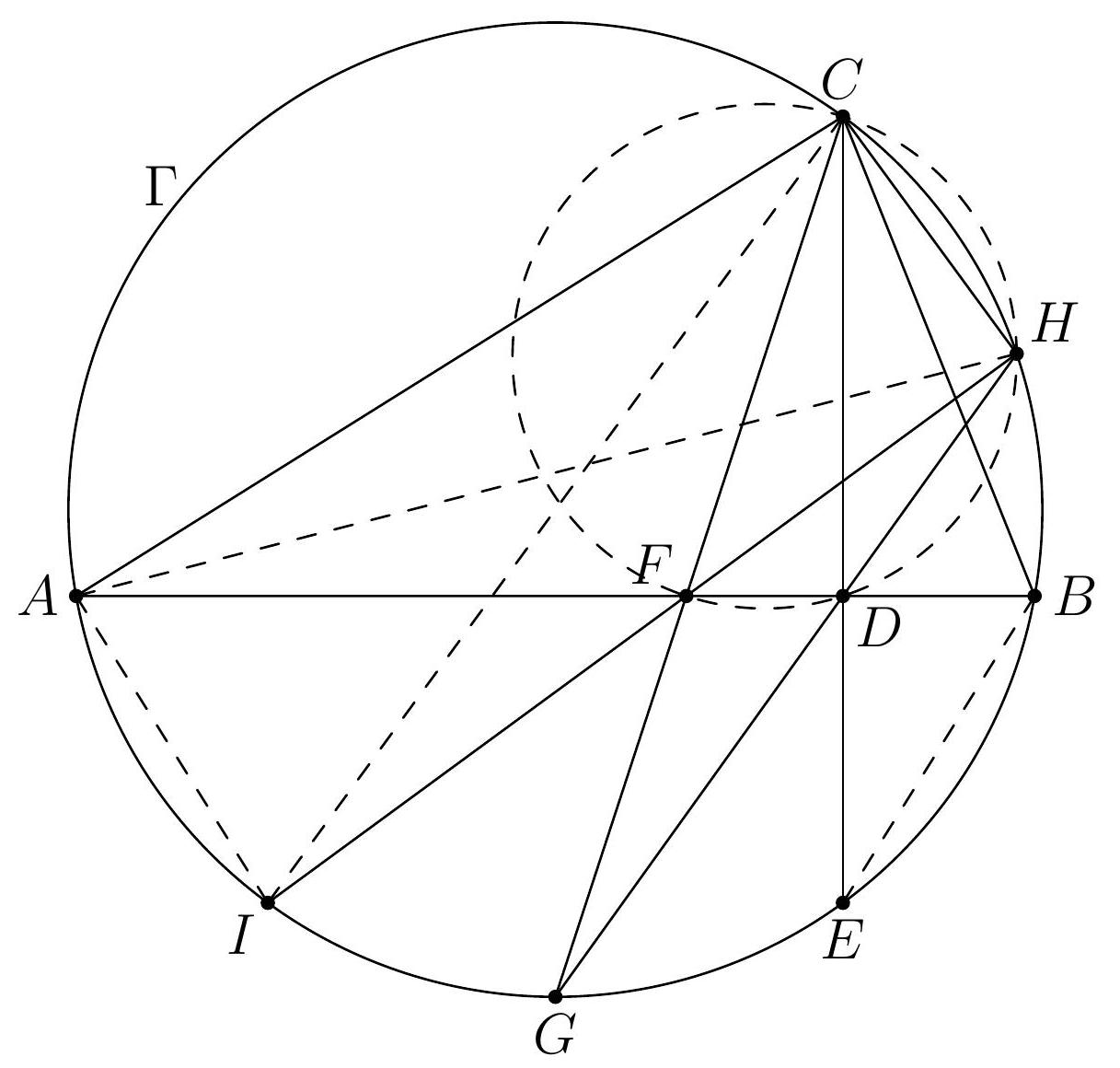
|
| 415 |
+
|
| 416 |
+
## Problem 12
|
| 417 |
+
|
| 418 |
+
Triangle $A B C$ is given. Let $M$ be the midpoint of the segment $A B$ and $T$ be the midpoint of the arc $B C$ not containing $A$ of the circumcircle of $A B C$. The point $K$ inside the triangle $A B C$ is such that $M A T K$ is an isosceles trapezoid with $A T \| M K$. Show that $A K=K C$.
|
| 419 |
+
|
| 420 |
+
Solution. Assume that $T K$ intersects the circumcircle of $A B C$ at the point $S$ (where $S \neq T)$. Then $\angle A B S=\angle A T S=\angle B A T$, so $A S B T$ is a trapezoid. Hence, $M K\|A T\| S B$ and $M$ is the midpoint of $A B$. Thus, $K$ is the midpoint of $T S$. From $\angle T A C=\angle B A T=$ $\angle A T S$ we see that $A C T S$ is an inscribed trapezoid, so it is isosceles. Thus, $A K=K C$, since $K$ is the midpoint of $T S$.
|
| 421 |
+
|
| 422 |
+
## Problem 13
|
| 423 |
+
|
| 424 |
+
Let $A B C D$ be a square inscribed in a circle $\omega$ and let $P$ be a point on the shorter arc $A B$ of $\omega$. Let $C P \cap B D=R$ and $D P \cap A C=S$. Show that triangles $A R B$ and $D S R$ have equal areas.
|
| 425 |
+
|
| 426 |
+
Solution. Let $T=P C \cap A B$. Then $\angle B T C=90^{\circ}-\angle P C B=90^{\circ}-\angle P D B=90^{\circ}-$ $\angle S B D=\angle B S C$, thus the points $B, S, T, C$ are concyclic. Hence $\angle T S C=90^{\circ}$, and, therefore, $T S \| B D$. It follows that
|
| 427 |
+
|
| 428 |
+
$$
|
| 429 |
+
[D S R]=[D T R]=[D T B]-[T B R]=[C T B]-[T B R]=[C R B]=[A R B]
|
| 430 |
+
$$
|
| 431 |
+
|
| 432 |
+
where $[\Delta]$ denotes the area of a triangle $\Delta$.
|
| 433 |
+
|
| 434 |
+
## Problem 14
|
| 435 |
+
|
| 436 |
+
Let $A B C D$ be a convex quadrilateral such that the line $B D$ bisects the angle $A B C$. The circumcircle of triangle $A B C$ intersects the sides $A D$ and $C D$ in the points $P$ and $Q$, respectively. The line through $D$ and parallel to $A C$ intersects the lines $B C$ and $B A$ at the points $R$ and $S$, respectively. Prove that the points $P, Q, R$ and $S$ lie on a common circle.
|
| 437 |
+
|
| 438 |
+
Solution 1. Since $\angle S D P=\angle C A P=\angle R B P$, the quadrilateral $B R D P$ is cyclic (see Figure 1). Similarly, the quadrilateral $B S D Q$ is cyclic. Let $X$ be the second intersection point of the segment $B D$ with the circumcircle of the triangle $A B C$. Then
|
| 439 |
+
|
| 440 |
+
$$
|
| 441 |
+
\angle A X B=\angle A C B=\angle D R B,
|
| 442 |
+
$$
|
| 443 |
+
|
| 444 |
+
and, moreover, $\angle A B X=\angle D B R$. It means that triangles $A B X$ and $D B R$ are similar. Thus
|
| 445 |
+
|
| 446 |
+
$$
|
| 447 |
+
\angle R P B=\angle R D B=\angle X A B=\angle X P B,
|
| 448 |
+
$$
|
| 449 |
+
|
| 450 |
+
which implies that the points $R, X$ and $P$ are collinear. Analogously, we can show that the points $S, X$ and $Q$ are collinear.
|
| 451 |
+
|
| 452 |
+
Thus, we obtain $R X \cdot X P=D X \cdot X B=S X \cdot X Q$, which proves that the points $P$, $Q, R$ and $S$ lie on a common circle.
|
| 453 |
+
|
| 454 |
+
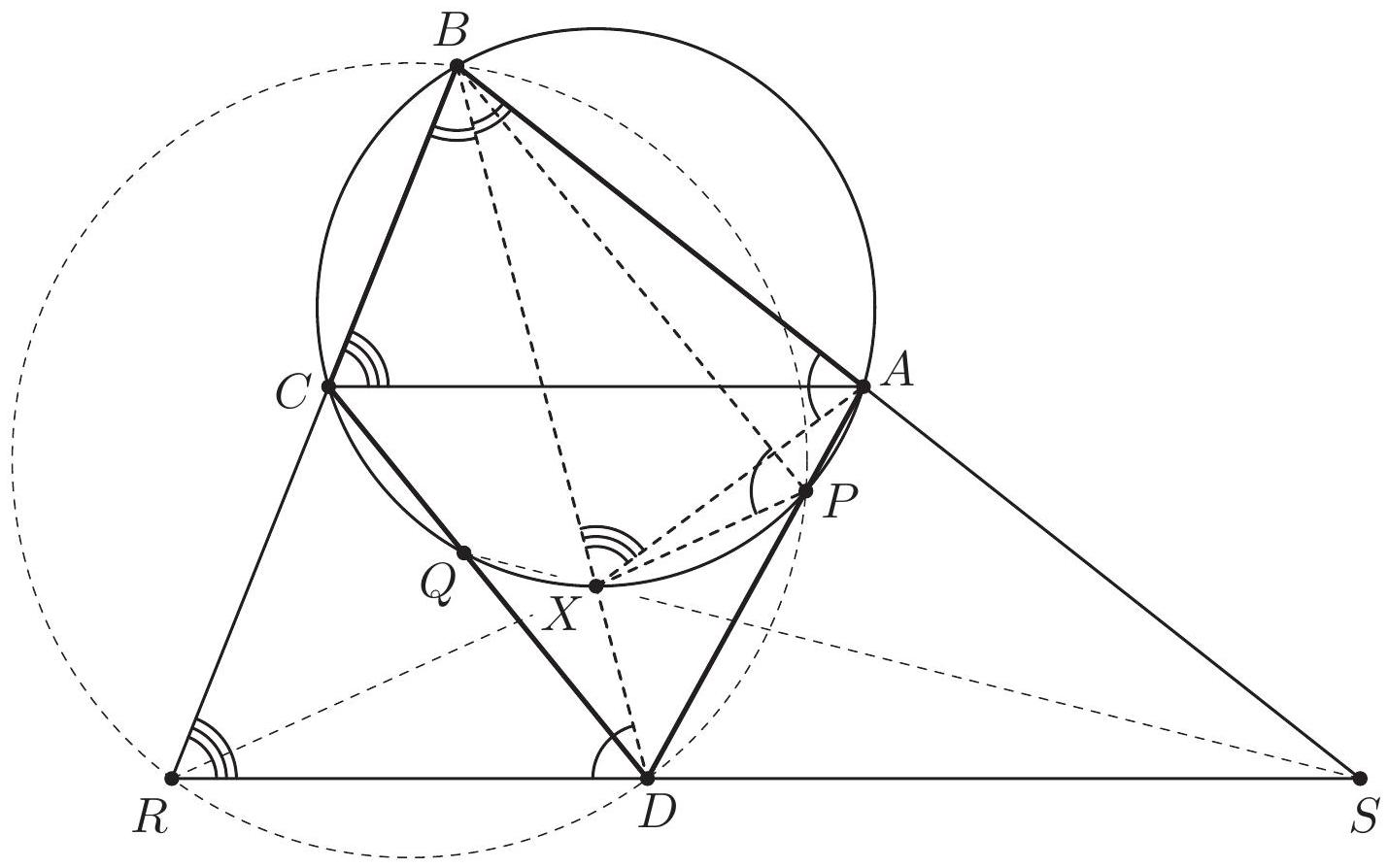
|
| 455 |
+
|
| 456 |
+
Figure 1
|
| 457 |
+
|
| 458 |
+
Solution 2. If $A B=B C$, then the points $R$ and $S$ are symmetric to each other with respect to the line $B D$. Similarly, the points $P$ and $Q$ are symmetric to each other with respect to the line $B D$. Therefore, $R S P Q$ is an isosceles trapezoid, so the claim follows.
|
| 459 |
+
|
| 460 |
+
Assume that $A B \neq B C$. Denote by $\omega$ the circumcircle of the triangle $A B C$ (see Figure 2). Since the lines $A C$ and $S R$ are parallel, the dilation with center $B$, which takes $A$ to $S$, also takes $C$ to $R$ and the circle $\omega$ to the circumcircle $\omega_{1}$ of $B S R$. This implies that $\omega$ and $\omega_{1}$ are tangent at $B$.
|
| 461 |
+
|
| 462 |
+
Note that $\angle R D Q=\angle D C A=\angle D P Q$, which means that the circumcircle $\omega_{2}$ of the triangle $P Q D$ is tangent to the line $R S$ at $D$.
|
| 463 |
+
|
| 464 |
+
Denote by $K$ the intersection point of the line $R S$ with the common tangent to $\omega$ and $\omega_{1}$ at $B$. Then we have
|
| 465 |
+
|
| 466 |
+
$$
|
| 467 |
+
\angle K B D=\angle K B R+\angle C B D=\angle D S B+\angle S B D=\angle K D B,
|
| 468 |
+
$$
|
| 469 |
+
|
| 470 |
+
which implies that $K D=K B$. Therefore, the powers of the point $K$ with respect to the circles $\omega$ and $\omega_{2}$ are equal, so $K$ lies on their radical axis. This implies that the points $K, P$ and $Q$ are collinear. Finally, we obtain
|
| 471 |
+
|
| 472 |
+
$$
|
| 473 |
+
K R \cdot K S=K B^{2}=K D^{2}=K P \cdot K Q,
|
| 474 |
+
$$
|
| 475 |
+
|
| 476 |
+
which shows that the points $P, Q, R$ and $S$ lie on a common circle.
|
| 477 |
+
|
| 478 |
+

|
| 479 |
+
|
| 480 |
+
Figure 2
|
| 481 |
+
|
| 482 |
+
Solution 3. Denote by $X^{\prime}$ the image of the point $X$ under some fixed inversion with center $B$. At the beginning of Solution 2 we noticed that the circumcircles of the triangles $A B C$ and $S B R$ are tangent at the point $B$. Therefore, the images of these two circles
|
| 483 |
+
under the considered inversion become two parallel lines $A^{\prime} C^{\prime}$ and $S^{\prime} R^{\prime}$ (see Figure 3).
|
| 484 |
+
|
| 485 |
+
Since $D$ lies on the line $R S$ and also on the angle bisector of the angle $A B C$, the point $D^{\prime}$ lies on the circumcircle of the triangle $B R^{\prime} S^{\prime}$ and also on the angle bisector of the angle $A^{\prime} B C^{\prime}$. Since the point $P$, other than $A$, is the intersection point of the line $A D$ and the circumcircle of the triangle $A B C$, the point $P^{\prime}$, other than $A^{\prime}$, is the intersection point of the circumcircle of the triangle $B A^{\prime} D^{\prime}$ and the line $A^{\prime} C^{\prime}$. Similarly, the point $Q^{\prime}$ is the intersection point of the circumcircle of the triangle $B C^{\prime} D^{\prime}$ and the line $A^{\prime} C^{\prime}$.
|
| 486 |
+
|
| 487 |
+
Therefore, we obtain
|
| 488 |
+
|
| 489 |
+
$$
|
| 490 |
+
\angle D^{\prime} Q^{\prime} P^{\prime}=\angle C^{\prime} B D^{\prime}=\angle A^{\prime} B D^{\prime}=\angle D^{\prime} P^{\prime} Q^{\prime}
|
| 491 |
+
$$
|
| 492 |
+
|
| 493 |
+
and
|
| 494 |
+
|
| 495 |
+
$$
|
| 496 |
+
\angle D^{\prime} R^{\prime} S^{\prime}=\angle D^{\prime} B S^{\prime}=\angle R^{\prime} B D^{\prime}=\angle R^{\prime} S^{\prime} D^{\prime} .
|
| 497 |
+
$$
|
| 498 |
+
|
| 499 |
+
This implies that the points $P^{\prime}$ and $S^{\prime}$ are symmetric to the points $Q^{\prime}$ and $R^{\prime}$ with respect to the line passing through $D^{\prime}$ and perpendicular to the lines $A^{\prime} C^{\prime}$ and $S^{\prime} R^{\prime}$. Thus $P^{\prime} S^{\prime} R^{\prime} Q^{\prime}$ is an isosceles trapezoid, so the points $P^{\prime}, S^{\prime}, R^{\prime}$ and $Q^{\prime}$ lie on a common circle. Therefore, the points $P, Q, R$ and $S$ also lie on a common circle.
|
| 500 |
+
|
| 501 |
+
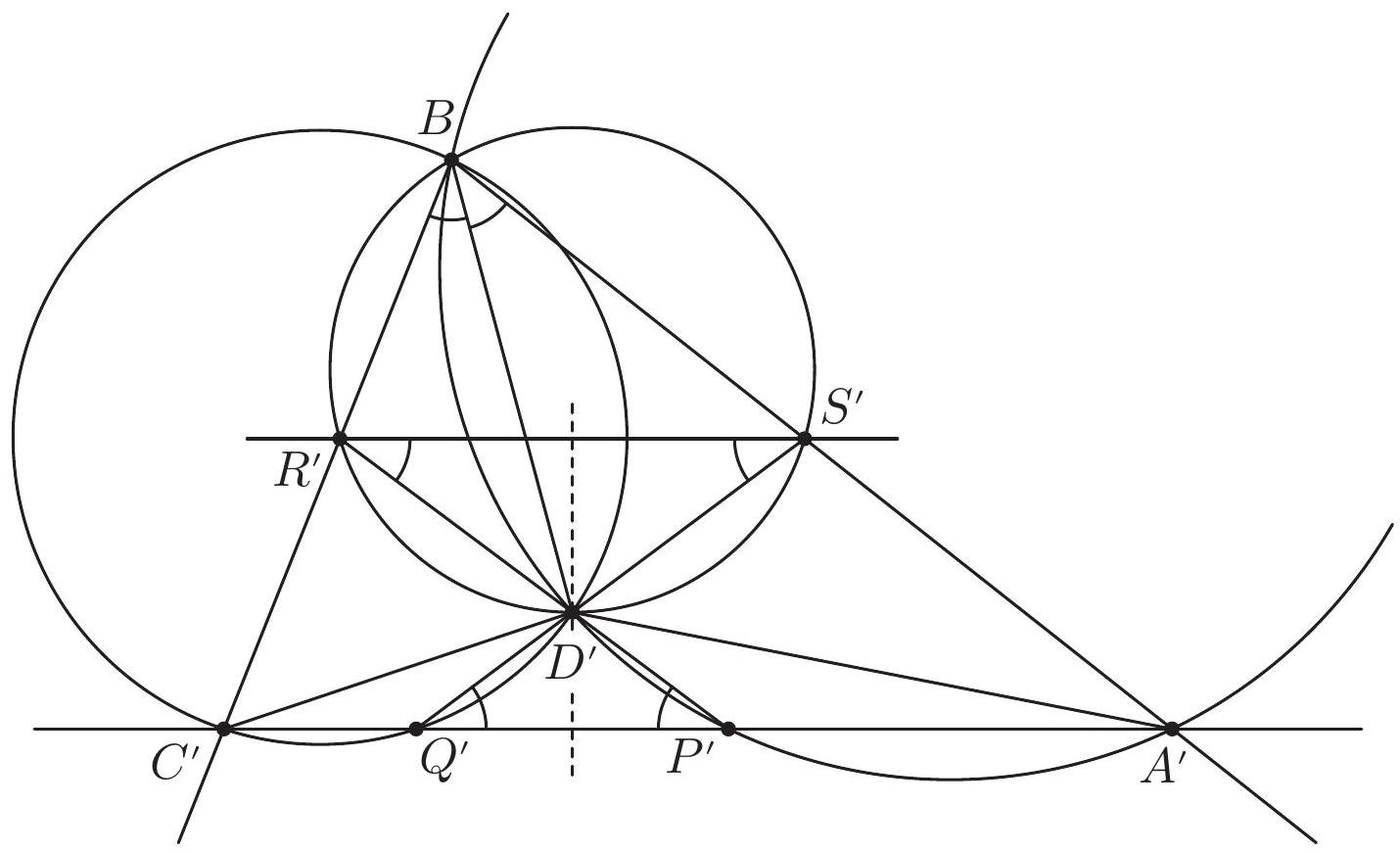
|
| 502 |
+
|
| 503 |
+
Figure 3
|
| 504 |
+
|
| 505 |
+
## Problem 15
|
| 506 |
+
|
| 507 |
+
The sum of the angles $A$ and $C$ of a convex quadrilateral $A B C D$ is less than $180^{\circ}$. Prove that
|
| 508 |
+
|
| 509 |
+
$$
|
| 510 |
+
A B \cdot C D+A D \cdot B C<A C(A B+A D)
|
| 511 |
+
$$
|
| 512 |
+
|
| 513 |
+
Solution 1. Let $\omega$ be the circumcircle $A B D$. Then the point $C$ is outside this circle, but inside the angle $B A D$. Let us ppply the inversion with the center $A$ and radius 1 . This inversion maps the circle $\omega$ to the line $\omega^{\prime}=B^{\prime} D^{\prime}$, where $B^{\prime}$ and $D^{\prime}$ are images of $B$ and $D$. The point $C$ goes to the point $C^{\prime}$ inside the triangle $A B^{\prime} D^{\prime}$. Therefore, $B^{\prime} C^{\prime}+C^{\prime} D^{\prime}<A B^{\prime}+A D^{\prime}$. Now, due to inversion properties, we have
|
| 514 |
+
|
| 515 |
+
$$
|
| 516 |
+
B^{\prime} C^{\prime}=\frac{B C}{A B \cdot A C}, \quad C^{\prime} D^{\prime}=\frac{C D}{A C \cdot A D}, \quad A B^{\prime}=\frac{1}{A B}, \quad A D^{\prime}=\frac{1}{A D} .
|
| 517 |
+
$$
|
| 518 |
+
|
| 519 |
+
Hence
|
| 520 |
+
|
| 521 |
+
$$
|
| 522 |
+
\frac{B C}{A B \cdot A C}+\frac{C D}{A C \cdot A D}<\frac{1}{A B}+\frac{1}{A D}
|
| 523 |
+
$$
|
| 524 |
+
|
| 525 |
+
Multiplying by $A B \cdot A C \cdot A D$, we obtain the desired inequality.
|
| 526 |
+
|
| 527 |
+
Solution 2. Consider an inscribed quadrilateral $A^{\prime} B^{\prime} C^{\prime} D^{\prime}$ with sides of the same lengths as $A B C D$ (such a quadrilateral exists, because we can draw these 4 sides in a big circle and afterwards continuously decrease its radius). Then $\angle B^{\prime}+\angle D^{\prime}=180^{\circ}<\angle B+\angle D$. Therefore, $\angle B^{\prime}<\angle B$ or $\angle D^{\prime}<\angle D$ and hence $A^{\prime} C^{\prime}<A C$, by the cosine theorem.
|
| 528 |
+
|
| 529 |
+
So the inequality under consideration for $A^{\prime} B^{\prime} C^{\prime} D^{\prime}$ is stronger than that for $A B C D$. However, the inequality for $A^{\prime} B^{\prime} C^{\prime} D^{\prime}$ follows immediately from Ptolemy's theorem.
|
| 530 |
+
|
| 531 |
+
## Problem 16
|
| 532 |
+
|
| 533 |
+
Determine whether $712 !+1$ is a prime number.
|
| 534 |
+
|
| 535 |
+
Answer: It is composite.
|
| 536 |
+
|
| 537 |
+
Solution. We will show that 719 is a prime factor of given number (evidently, $719<$ $712 !+1$ ). All congruences are considered modulo 719 . By Wilson's theorem, $718 ! \equiv-1$. Furthermore,
|
| 538 |
+
|
| 539 |
+
$$
|
| 540 |
+
713 \cdot 714 \cdot 715 \cdot 716 \cdot 717 \cdot 718 \equiv(-6)(-5)(-4)(-3)(-2)(-1) \equiv 720 \equiv 1 .
|
| 541 |
+
$$
|
| 542 |
+
|
| 543 |
+
Hence $712 ! \equiv-1$, which means that $712 !+1$ is divisible by 719 .
|
| 544 |
+
|
| 545 |
+
We remark that 719 is the smallest prime greater then 712 , so 719 is the smallest prime divisor of $712 !+1$.
|
| 546 |
+
|
| 547 |
+
## Problem 17
|
| 548 |
+
|
| 549 |
+
Do there exist pairwise distinct rational numbers $x, y$ and $z$ such that
|
| 550 |
+
|
| 551 |
+
$$
|
| 552 |
+
\frac{1}{(x-y)^{2}}+\frac{1}{(y-z)^{2}}+\frac{1}{(z-x)^{2}}=2014 ?
|
| 553 |
+
$$
|
| 554 |
+
|
| 555 |
+
Answer: No.
|
| 556 |
+
|
| 557 |
+
Solution. Put $a=x-y$ and $b=y-z$. Then
|
| 558 |
+
|
| 559 |
+
$$
|
| 560 |
+
\begin{aligned}
|
| 561 |
+
\frac{1}{(x-y)^{2}}+\frac{1}{(y-z)^{2}}+\frac{1}{(z-x)^{2}} & =\frac{1}{a^{2}}+\frac{1}{b^{2}}+\frac{1}{(a+b)^{2}} \\
|
| 562 |
+
& =\frac{b^{2}(a+b)^{2}+a^{2}(a+b)^{2}+a^{2} b^{2}}{a^{2} b^{2}(a+b)^{2}} \\
|
| 563 |
+
& =\left(\frac{a^{2}+b^{2}+a b}{a b(a+b)}\right)^{2} .
|
| 564 |
+
\end{aligned}
|
| 565 |
+
$$
|
| 566 |
+
|
| 567 |
+
On the other hand, 2014 is not a square of a rational number. Hence, such numbers $x, y, z$ do not exist.
|
| 568 |
+
|
| 569 |
+
## Problem 18
|
| 570 |
+
|
| 571 |
+
Let $p$ be a prime number, and let $n$ be a positive integer. Find the number of quadruples $\left(a_{1}, a_{2}, a_{3}, a_{4}\right)$ with $a_{i} \in\left\{0,1, \ldots, p^{n}-1\right\}$ for $i=1,2,3,4$ such that
|
| 572 |
+
|
| 573 |
+
$$
|
| 574 |
+
p^{n} \mid\left(a_{1} a_{2}+a_{3} a_{4}+1\right) .
|
| 575 |
+
$$
|
| 576 |
+
|
| 577 |
+
Answer: $p^{3 n}-p^{3 n-2}$.
|
| 578 |
+
|
| 579 |
+
Solution. We have $p^{n}-p^{n-1}$ choices for $a_{1}$ such that $p \nmid a_{1}$. In this case for any of the $p^{n} \cdot p^{n}$ choices of $a_{3}$ and $a_{4}$, there is a unique choice of $a_{2}$, namely,
|
| 580 |
+
|
| 581 |
+
$$
|
| 582 |
+
a_{2} \equiv a_{1}^{-1}\left(-1-a_{3} a_{4}\right) \quad \bmod p^{n}
|
| 583 |
+
$$
|
| 584 |
+
|
| 585 |
+
This gives $p^{2 n}\left(p^{n}-p^{n-1}\right)=p^{3 n-1}(p-1)$ of quadruples.
|
| 586 |
+
|
| 587 |
+
If $p \mid a_{1}$ then we obviously have $p \nmid a_{3}$, since otherwise the condition
|
| 588 |
+
|
| 589 |
+
$$
|
| 590 |
+
p^{n} \mid\left(a_{1} a_{2}+a_{3} a_{4}+1\right)
|
| 591 |
+
$$
|
| 592 |
+
|
| 593 |
+
is violated. Now, if $p \mid a_{1}, p \nmid a_{3}$, for any choice of $a_{2}$ there is a unique choice of $a_{4}$, namely,
|
| 594 |
+
|
| 595 |
+
$$
|
| 596 |
+
a_{4} \equiv a_{3}^{-1}\left(-1-a_{1} a_{2}\right) \quad \bmod p^{n}
|
| 597 |
+
$$
|
| 598 |
+
|
| 599 |
+
Thus, for these $p^{n-1}$ choices of $a_{1}$ and $p^{n}-p^{n-1}$ choices of $a_{3}$, we have for each of the $p^{n}$ choices of $a_{2}$ a unique $a_{4}$. So in this case there are $p^{n-1}\left(p^{n}-p^{n-1}\right) p^{n}=p^{3 n-2}(p-1)$ of quadruples.
|
| 600 |
+
|
| 601 |
+
Thus, the total number of quadruples is
|
| 602 |
+
|
| 603 |
+
$$
|
| 604 |
+
p^{3 n-1}(p-1)+p^{3 n-2}(p-1)=p^{3 n}-p^{3 n-2} \text {. }
|
| 605 |
+
$$
|
| 606 |
+
|
| 607 |
+
## Problem 19
|
| 608 |
+
|
| 609 |
+
Let $m$ and $n$ be relatively prime positive integers. Determine all possible values of
|
| 610 |
+
|
| 611 |
+
$$
|
| 612 |
+
\operatorname{gcd}\left(2^{m}-2^{n}, 2^{m^{2}+m n+n^{2}}-1\right) .
|
| 613 |
+
$$
|
| 614 |
+
|
| 615 |
+
Answer: 1 and 7 .
|
| 616 |
+
|
| 617 |
+
Solution. Without restriction of generality we may assume that $m \geqslant n$. It is well known that
|
| 618 |
+
|
| 619 |
+
$$
|
| 620 |
+
\operatorname{gcd}\left(2^{p}-1,2^{q}-1\right)=2^{\operatorname{gcd}(p, q)}-1,
|
| 621 |
+
$$
|
| 622 |
+
|
| 623 |
+
SO
|
| 624 |
+
|
| 625 |
+
$$
|
| 626 |
+
\begin{aligned}
|
| 627 |
+
\operatorname{gcd}\left(2^{m}-2^{n}, 2^{m^{2}+m n+n^{2}}-1\right) & =\operatorname{gcd}\left(2^{m-n}-1,2^{m^{2}+m n+n^{2}}-1\right) \\
|
| 628 |
+
& =2^{\operatorname{gcd}\left(m-n, m^{2}+m n+n^{2}\right)}-1 .
|
| 629 |
+
\end{aligned}
|
| 630 |
+
$$
|
| 631 |
+
|
| 632 |
+
Let $d \geqslant 1$ be a divisor of $m-n$. Clearly, $\operatorname{gcd}(m, d)=1$, since $m$ and $n$ are relatively prime. Assume that $d$ also divides $m^{2}+m n+n^{2}$. Then $d$ divides $3 m^{2}$. In view of $\operatorname{gcd}(m, d)=1$ the only choices for $d$ are $d=1$ and $d=3$. Hence $\operatorname{gcd}\left(m-n, m^{2}+m n+n^{2}\right)$ is either 1 or 3 . Consequently, $\operatorname{gcd}\left(2^{m}-2^{n}, 2^{m^{2}+m n+n^{2}}-1\right)$ may only assume the values $2^{1}-1=1$ and $2^{3}-1=7$.
|
| 633 |
+
|
| 634 |
+
Both values are attainable, since $m=2, n=1$ gives
|
| 635 |
+
|
| 636 |
+
$$
|
| 637 |
+
\operatorname{gcd}\left(2^{2}-2^{1}, 2^{2^{2}+2 \cdot 1+1^{2}}-1\right)=\operatorname{gcd}\left(2,2^{7}-1\right)=1
|
| 638 |
+
$$
|
| 639 |
+
|
| 640 |
+
whereas $m=1, n=1$ gives
|
| 641 |
+
|
| 642 |
+
$$
|
| 643 |
+
\operatorname{gcd}\left(2^{1}-2^{1}, 2^{1^{2}+1 \cdot 1+1^{2}}-1\right)=\operatorname{gcd}\left(0,2^{3}-1\right)=7
|
| 644 |
+
$$
|
| 645 |
+
|
| 646 |
+
## Problem 20
|
| 647 |
+
|
| 648 |
+
Consider a sequence of positive integers $a_{1}, a_{2}, a_{3}, \ldots$ such that for $k \geqslant 2$ we have
|
| 649 |
+
|
| 650 |
+
$$
|
| 651 |
+
a_{k+1}=\frac{a_{k}+a_{k-1}}{2015^{i}}
|
| 652 |
+
$$
|
| 653 |
+
|
| 654 |
+
where $2015^{i}$ is the maximal power of 2015 that divides $a_{k}+a_{k-1}$. Prove that if this sequence is periodic then its period is divisible by 3 .
|
| 655 |
+
|
| 656 |
+
Solution. If all the numbers in the sequence are even, then we can divide each element of the sequence by the maximal possible power of 2 . In this way we obtain a new sequence of integers which is determined by the same recurrence formula and has the same period, but now it contains an odd number. Consider this new sequence modulo 2. Since the number 2015 is odd, it has no influence to the calculations modulo 2 , so we may think that modulo 2 this sequence is given by the Fibonacci recurrence $a_{k+1} \equiv a_{k}+a_{k-1}$ with $a_{j} \equiv 1$ $(\bmod 2)$ for at least one $j$. Then it has the following form $\ldots, 1,1,0,1,1,0,1,1,0, \ldots$ (with period 3 modulo 2), so that the length of the original period of our sequence (if it is periodic!) must be divisible by 3 .
|
| 657 |
+
|
| 658 |
+
Remark. It is not known whether a periodic sequence of integers satisfying the recurrence condition of this problem exists. The solution of such a problem is apparently completely out of reach. See, e.g., the recent preprint
|
| 659 |
+
|
| 660 |
+
Brandon Avila and Tanya Khovanova, Free Fibonacci sequences, 2014, preprint at http://arxiv.org/pdf/1403.4614v1.pdf
|
| 661 |
+
|
| 662 |
+
for more information. (The problem given at the olympiad is Lemma 28 of this paper, where 2015 can be replaced by any odd integer greater than 1.)
|
| 663 |
+
|
BalticWay/md/en-bw15sol.md
ADDED
|
@@ -0,0 +1,856 @@
|
|
|
|
|
|
|
|
|
|
|
|
|
|
|
|
|
|
|
|
|
|
|
|
|
|
|
|
|
|
|
|
|
|
|
|
|
|
|
|
|
|
|
|
|
|
|
|
|
|
|
|
|
|
|
|
|
|
|
|
|
|
|
|
|
|
|
|
|
|
|
|
|
|
|
|
|
|
|
|
|
|
|
|
|
|
|
|
|
|
|
|
|
|
|
|
|
|
|
|
|
|
|
|
|
|
|
|
|
|
|
|
|
|
|
|
|
|
|
|
|
|
|
|
|
|
|
|
|
|
|
|
|
|
|
|
|
|
|
|
|
|
|
|
|
|
|
|
|
|
|
|
|
|
|
|
|
|
|
|
|
|
|
|
|
|
|
|
|
|
|
|
|
|
|
|
|
|
|
|
|
|
|
|
|
|
|
|
|
|
|
|
|
|
|
|
|
|
|
|
|
|
|
|
|
|
|
|
|
|
|
|
|
|
|
|
|
|
|
|
|
|
|
|
|
|
|
|
|
|
|
|
|
|
|
|
|
|
|
|
|
|
|
|
|
|
|
|
|
|
|
|
|
|
|
|
|
|
|
|
|
|
|
|
|
|
|
|
|
|
|
|
|
|
|
|
|
|
|
|
|
|
|
|
|
|
|
|
|
|
|
|
|
|
|
|
|
|
|
|
|
|
|
|
|
|
|
|
|
|
|
|
|
|
|
|
|
|
|
|
|
|
|
|
|
|
|
|
|
|
|
|
|
|
|
|
|
|
|
|
|
|
|
|
|
|
|
|
|
|
|
|
|
|
|
|
|
|
|
|
|
|
|
|
|
|
|
|
|
|
|
|
|
|
|
|
|
|
|
|
|
|
|
|
|
|
|
|
|
|
|
|
|
|
|
|
|
|
|
|
|
|
|
|
|
|
|
|
|
|
|
|
|
|
|
|
|
|
|
|
|
|
|
|
|
|
|
|
|
|
|
|
|
|
|
|
|
|
|
|
|
|
|
|
|
|
|
|
|
|
|
|
|
|
|
|
|
|
|
|
|
|
|
|
|
|
|
|
|
|
|
|
|
|
|
|
|
|
|
|
|
|
|
|
|
|
|
|
|
|
|
|
|
|
|
|
|
|
|
|
|
|
|
|
|
|
|
|
|
|
|
|
|
|
|
|
|
|
|
|
|
|
|
|
|
|
|
|
|
|
|
|
|
|
|
|
|
|
|
|
|
|
|
|
|
|
|
|
|
|
|
|
|
|
|
|
|
|
|
|
|
|
|
|
|
|
|
|
|
|
|
|
|
|
|
|
|
|
|
|
|
|
|
|
|
|
|
|
|
|
|
|
|
|
|
|
|
|
|
|
|
|
|
|
|
|
|
|
|
|
|
|
|
|
|
|
|
|
|
|
|
|
|
|
|
|
|
|
|
|
|
|
|
|
|
|
|
|
|
|
|
|
|
|
|
|
|
|
|
|
|
|
|
|
|
|
|
|
|
|
|
|
|
|
|
|
|
|
|
|
|
|
|
|
|
|
|
|
|
|
|
|
|
|
|
|
|
|
|
|
|
|
|
|
|
|
|
|
|
|
|
|
|
|
|
|
|
|
|
|
|
|
|
|
|
|
|
|
|
|
|
|
|
|
|
|
|
|
|
|
|
|
|
|
|
|
|
|
|
|
|
|
|
|
|
|
|
|
|
|
|
|
|
|
|
|
|
|
|
|
|
|
|
|
|
|
|
|
|
|
|
|
|
|
|
|
|
|
|
|
|
|
|
|
|
|
|
|
|
|
|
|
|
|
|
|
|
|
|
|
|
|
|
|
|
|
|
|
|
|
|
|
|
|
|
|
|
|
|
|
|
|
|
|
|
|
|
|
|
|
|
|
|
|
|
|
|
|
|
|
|
|
|
|
|
|
|
|
|
|
|
|
|
|
|
|
|
|
|
|
|
|
|
|
|
|
|
|
|
|
|
|
|
|
|
|
|
|
|
|
|
|
|
|
|
|
|
|
|
|
|
|
|
|
|
|
|
|
|
|
|
|
|
|
|
|
|
|
|
|
|
|
|
|
|
|
|
|
|
|
|
|
|
|
|
|
|
|
|
|
|
|
|
|
|
|
|
|
|
|
|
|
|
|
|
|
|
|
|
|
|
|
|
|
|
|
|
|
|
|
|
|
|
|
|
|
|
|
|
|
|
|
|
|
|
|
|
|
|
|
|
|
|
|
|
|
|
|
|
|
|
|
|
|
|
|
|
|
|
|
|
|
|
|
|
|
|
|
|
|
|
|
|
|
|
|
|
|
|
|
|
|
|
|
|
|
|
|
|
|
|
|
|
|
|
|
|
|
|
|
|
|
|
|
|
|
|
|
|
|
|
|
|
|
|
|
|
|
|
|
|
|
|
|
|
|
|
|
|
|
|
|
|
|
|
|
|
|
|
|
|
|
|
|
|
|
|
|
|
|
|
|
|
|
|
|
|
|
|
|
|
|
|
|
|
|
|
|
|
|
|
|
|
|
|
|
|
|
|
|
|
|
|
|
|
|
|
|
|
|
|
|
|
|
|
|
|
|
|
|
|
|
|
|
|
|
|
|
|
|
|
|
|
|
|
|
|
|
|
|
|
|
|
|
|
|
|
|
|
|
|
|
|
|
|
|
|
|
|
|
|
|
|
|
|
|
|
|
|
|
|
|
|
|
|
|
|
|
|
|
|
|
|
|
|
|
|
|
|
|
|
|
|
|
|
|
|
|
|
|
|
|
|
|
|
|
|
|
|
|
|
|
|
|
|
|
|
|
|
|
|
|
|
|
|
|
|
|
|
|
|
|
|
|
|
|
|
|
|
|
|
|
|
|
|
|
|
|
|
|
|
|
|
|
|
|
|
|
|
|
|
|
|
|
|
|
|
|
|
|
|
|
|
|
|
|
|
|
|
|
|
|
|
|
|
|
|
|
|
|
|
|
|
|
|
|
|
|
|
|
|
|
|
|
|
|
|
|
|
|
|
|
|
|
|
|
|
|
|
|
|
|
|
|
|
|
|
|
|
|
|
|
|
|
|
|
|
|
|
|
|
|
|
|
|
|
|
|
|
|
|
|
|
|
|
|
|
|
|
|
|
|
|
|
|
|
|
|
|
|
|
|
|
|
|
|
|
|
|
|
|
|
|
|
|
|
|
|
|
|
|
|
|
|
|
|
|
|
|
|
|
|
|
|
|
|
|
|
|
|
|
|
|
|
|
|
|
|
|
|
|
|
|
|
|
|
|
|
|
|
|
|
|
|
|
|
|
|
|
|
|
|
|
|
|
|
|
|
|
|
|
|
|
|
|
|
|
|
|
|
|
|
|
|
|
|
|
|
|
|
|
|
|
|
|
|
|
|
|
|
|
|
|
|
|
|
|
|
|
|
|
|
|
|
|
|
|
|
|
|
|
|
|
|
|
|
|
|
|
|
|
|
|
|
|
|
|
|
|
|
|
|
|
|
|
|
|
|
|
|
|
|
|
|
|
|
|
|
|
|
|
|
|
|
|
|
|
|
|
|
|
|
|
|
|
|
|
|
|
|
|
|
|
|
|
|
|
|
|
|
|
|
|
|
|
|
|
|
|
|
|
|
|
|
|
|
|
|
|
|
|
|
|
|
|
|
|
|
|
|
|
|
|
|
|
|
|
|
|
|
|
|
|
|
|
|
|
|
|
|
|
|
|
|
|
|
|
|
|
|
|
|
|
|
|
|
|
|
|
|
|
|
|
|
|
|
|
|
|
|
|
|
|
|
|
|
|
|
|
|
|
|
|
|
|
|
|
|
|
|
|
|
|
|
|
|
|
|
|
|
|
|
|
|
|
|
|
|
|
|
|
|
|
|
|
|
|
|
|
|
|
|
|
|
|
|
|
|
|
|
|
|
|
|
|
|
|
|
|
|
|
|
|
|
|
|
|
|
|
|
|
|
|
|
|
|
|
|
|
|
|
|
|
|
|
|
|
|
|
|
|
|
|
|
|
|
|
|
|
|
|
|
|
|
|
|
|
|
|
|
|
|
|
|
|
|
|
|
|
|
|
|
|
|
|
|
|
|
|
|
|
|
|
|
|
|
|
|
|
|
|
|
|
|
|
|
|
|
|
|
|
|
|
|
|
|
|
|
|
|
|
|
|
|
|
|
|
|
|
|
|
|
|
|
|
|
|
|
|
|
|
|
|
|
|
|
|
|
|
|
|
|
|
|
|
|
|
|
|
|
|
|
|
|
|
|
|
|
|
|
|
|
|
|
|
|
|
|
|
|
|
|
|
|
|
|
|
|
|
|
|
|
|
|
|
|
|
|
|
|
|
|
|
|
|
|
|
|
|
|
|
|
|
|
|
|
|
|
|
|
|
|
|
|
|
|
|
|
|
|
|
|
|
|
|
|
|
|
|
|
|
|
|
|
|
|
|
|
|
|
|
|
|
|
|
|
|
|
|
|
|
|
|
|
|
|
|
|
|
|
|
|
|
|
|
|
|
|
|
|
|
|
|
|
|
|
|
|
|
|
|
|
|
|
|
|
|
|
|
|
|
|
|
|
|
|
|
|
|
|
|
|
|
|
|
|
|
|
|
|
|
|
|
|
|
|
|
|
|
|
|
|
|
|
|
|
|
|
|
|
|
|
|
|
|
|
|
|
|
|
|
|
|
|
|
|
|
|
|
|
|
|
|
|
|
|
|
|
|
|
|
|
|
|
|
|
|
|
|
|
|
|
|
|
|
|
|
|
|
|
|
|
|
|
|
|
|
|
|
|
|
|
|
|
|
|
|
|
|
|
|
|
|
|
|
|
|
|
|
|
|
|
|
|
|
|
|
|
|
|
|
|
|
|
|
|
|
|
|
|
|
|
|
|
|
|
|
|
|
|
|
|
|
|
|
|
|
|
|
|
|
|
|
|
|
|
|
|
|
|
|
|
|
|
|
|
|
|
|
|
|
|
|
|
|
|
|
|
|
|
|
|
|
|
|
|
|
|
|
|
|
|
|
|
|
|
|
|
|
|
|
|
|
|
|
|
|
|
|
|
|
|
|
|
|
|
|
|
|
|
|
|
|
|
|
|
|
|
|
|
|
|
|
|
|
|
|
|
|
|
|
|
|
|
|
|
|
|
|
|
|
|
|
|
|
|
|
|
|
|
|
|
|
|
|
|
|
|
|
|
|
|
|
|
|
|
|
|
|
|
|
|
|
|
|
|
|
|
|
|
|
|
|
|
|
|
|
|
|
|
|
|
|
|
|
|
|
|
|
|
|
|
|
|
|
|
|
|
|
|
|
|
|
|
|
|
|
|
|
|
|
|
|
|
|
|
|
|
|
|
|
|
|
|
|
|
|
|
|
|
|
|
|
|
|
|
|
|
|
|
|
|
|
|
|
|
|
|
|
|
|
|
|
|
|
|
|
|
|
|
|
|
|
|
|
|
|
|
|
|
|
|
|
|
|
|
|
|
|
|
|
|
|
|
|
|
|
|
|
|
|
|
|
|
|
|
|
|
|
|
|
|
|
|
|
|
|
|
|
|
|
|
|
|
|
|
|
|
|
|
|
|
|
|
|
|
|
|
|
|
|
|
|
|
|
|
|
|
|
|
|
|
|
|
|
|
|
|
|
|
|
|
|
|
|
|
|
|
|
|
|
|
|
|
|
|
|
|
|
|
|
|
|
|
|
|
|
|
|
|
|
|
|
|
|
|
|
|
|
|
|
|
|
|
|
|
|
|
|
|
|
|
|
|
|
|
|
|
|
|
|
|
|
|
|
|
|
|
|
|
|
|
| 1 |
+
BALTIC WAY 2015
|
| 2 |
+
|
| 3 |
+
Problems and Solutions
|
| 4 |
+
|
| 5 |
+
|
| 6 |
+
|
| 7 |
+
# Problem 1.
|
| 8 |
+
|
| 9 |
+
For $n \geq 2$, an equilateral triangle is divided into $n^{2}$ congruent smaller equilateral triangles. Determine all ways in which real numbers can be assigned to the $\frac{(n+1)(n+2)}{2}$ vertices so that three such numbers sum to zero whenever the three vertices form a triangle with edges parallel to the sides of the big triangle.
|
| 10 |
+
|
| 11 |
+
Solution. We label the vertices (and the corresponding real numbers) as follows.
|
| 12 |
+
|
| 13 |
+
|
| 14 |
+
For $n=2$, we see that
|
| 15 |
+
|
| 16 |
+
$$
|
| 17 |
+
a_{2}+a_{4}+a_{5}=0=a_{2}+a_{3}+a_{5}
|
| 18 |
+
$$
|
| 19 |
+
|
| 20 |
+
which shows that $a_{3}=a_{4}$ and similarly $a_{1}=a_{5}$ and $a_{2}=a_{6}$. Now the only additional requirement is $a_{1}+a_{2}+a_{3}=0$, so that all solutions are of the following form, for any $x, y$ and $z$ with $x+y+z=0$ :
|
| 21 |
+

|
| 22 |
+
|
| 23 |
+
For $n=3$, observe that $a_{1}=a_{7}=a_{10}$ since they all equal $a_{5}$. Since also $a_{1}+a_{7}+a_{10}=0$, they all equal zero. By considering the top triangle, we get $x=a_{2}=-a_{3}$ and this uniquely determines the rest. It is easily checked that, for any real $x$, this is actually a solution:
|
| 24 |
+
|
| 25 |
+
|
| 26 |
+
For $n \geq 3$ we can apply the same argument as above for any collection of 10 vertices. Any vertex not on the sides of the big triangle has to equal zero, since it is the centre of such a collection of 10 vertices. Any vertex $a$ on the sides of the big triangle forms some parallelogram similar to $a_{4}, a_{2}, a_{5}, a_{8}$, where the point opposite $a$ is in the interior of the big triangle. Since such opposite numbers are equal, all $a_{i}$ have to be zero in this case.
|
| 27 |
+
|
| 28 |
+
## Problem 2.
|
| 29 |
+
|
| 30 |
+
Let $n$ be a positive integer and let $a_{1}, \ldots, a_{n}$ be real numbers satisfying $0 \leq a_{i} \leq 1$ for $i=1, \ldots, n$. Prove the inequality
|
| 31 |
+
|
| 32 |
+
$$
|
| 33 |
+
\left(1-a_{1}^{n}\right)\left(1-a_{2}^{n}\right) \cdots\left(1-a_{n}^{n}\right) \leq\left(1-a_{1} a_{2} \cdots a_{n}\right)^{n} .
|
| 34 |
+
$$
|
| 35 |
+
|
| 36 |
+
Solution. The numbers $1-a_{i}^{n}$ are positive by assumption. AM-GM gives
|
| 37 |
+
|
| 38 |
+
$$
|
| 39 |
+
\begin{aligned}
|
| 40 |
+
\left(1-a_{1}^{n}\right)\left(1-a_{2}^{n}\right) \cdots\left(1-a_{n}^{n}\right) & \leq\left(\frac{\left(1-a_{1}^{n}\right)+\left(1-a_{2}^{n}\right)+\cdots+\left(1-a_{n}^{n}\right)}{n}\right)^{n} \\
|
| 41 |
+
& =\left(1-\frac{a_{1}^{n}+\cdots+a_{n}^{n}}{n}\right)^{n} .
|
| 42 |
+
\end{aligned}
|
| 43 |
+
$$
|
| 44 |
+
|
| 45 |
+
By applying AM-GM again we obtain
|
| 46 |
+
|
| 47 |
+
$$
|
| 48 |
+
a_{1} a_{2} \cdots a_{n} \leq \frac{a_{1}^{n}+\cdots+a_{n}^{n}}{n} \Rightarrow\left(1-\frac{a_{1}^{n}+\cdots+a_{n}^{n}}{n}\right)^{n} \leq\left(1-a_{1} a_{2} \cdots a_{n}\right)^{n}
|
| 49 |
+
$$
|
| 50 |
+
|
| 51 |
+
and hence the desired inequality.
|
| 52 |
+
|
| 53 |
+
Remark. It is possible to use Jensen's inequality applied to $f(x)=\log \left(1-e^{x}\right)$.
|
| 54 |
+
|
| 55 |
+
## Problem 3.
|
| 56 |
+
|
| 57 |
+
Let $n>1$ be an integer. Find all non-constant real polynomials $P(x)$ satisfying, for any real $x$, the identity
|
| 58 |
+
|
| 59 |
+
$$
|
| 60 |
+
P(x) P\left(x^{2}\right) P\left(x^{3}\right) \cdots P\left(x^{n}\right)=P\left(x^{\frac{n(n+1)}{2}}\right) .
|
| 61 |
+
$$
|
| 62 |
+
|
| 63 |
+
Solution. Answer: $P(x)=x^{m}$ if $n$ is even; $P(x)= \pm x^{m}$ if $n$ is odd.
|
| 64 |
+
|
| 65 |
+
Consider first the case of a monomial $P(x)=a x^{m}$ with $a \neq 0$. Then
|
| 66 |
+
|
| 67 |
+
$$
|
| 68 |
+
a x^{\frac{m n(n+1)}{2}}=P\left(x^{\frac{n(n+1)}{2}}\right)=P(x) P\left(x^{2}\right) P\left(x^{3}\right) \cdots P\left(x^{n}\right)=a x^{m} \cdot a x^{2 m} \cdots a x^{n m}=a^{n} x^{\frac{m n(n+1)}{2}}
|
| 69 |
+
$$
|
| 70 |
+
|
| 71 |
+
implies $a^{n}=a$. Thus, $a=1$ when $n$ is even and $a= \pm 1$ when $n$ is odd. Obviously these polynomials satisfy the desired equality.
|
| 72 |
+
|
| 73 |
+
Suppose now that $P$ is not a monomial. Write $P(x)=a x^{m}+Q(x)$, where $Q$ is non-zero polynomial with $\operatorname{deg} Q=k<m$. We have
|
| 74 |
+
|
| 75 |
+
$$
|
| 76 |
+
\begin{aligned}
|
| 77 |
+
a x^{\frac{m n(n+1)}{2}}+Q & \left(x^{\frac{n(n+1)}{2}}\right)=P\left(x^{\frac{n(n+1)}{2}}\right) \\
|
| 78 |
+
& =P(x) P\left(x^{2}\right) P\left(x^{3}\right) \cdots P\left(x^{n}\right)=\left(a x^{m}+Q(x)\right)\left(a x^{2 m}+Q\left(x^{2}\right)\right) \cdots\left(a x^{n m}+Q\left(x^{n}\right)\right) .
|
| 79 |
+
\end{aligned}
|
| 80 |
+
$$
|
| 81 |
+
|
| 82 |
+
The highest degree of a monomial, on both sides of the equality, is $\frac{m n(n+1)}{2}$. The second highest degree in the right-hand side is
|
| 83 |
+
|
| 84 |
+
$$
|
| 85 |
+
2 m+3 m+\cdots+n m+k=\frac{m(n+2)(n-1)}{2}+k
|
| 86 |
+
$$
|
| 87 |
+
|
| 88 |
+
while in the left-hand side it is $\frac{k n(n+1)}{2}$. Thus
|
| 89 |
+
|
| 90 |
+
$$
|
| 91 |
+
\frac{m(n+2)(n-1)}{2}+k=\frac{k n(n+1)}{2}
|
| 92 |
+
$$
|
| 93 |
+
|
| 94 |
+
which leads to
|
| 95 |
+
|
| 96 |
+
$$
|
| 97 |
+
(m-k)(n+2)(n-1)=0
|
| 98 |
+
$$
|
| 99 |
+
|
| 100 |
+
and so $m=k$, contradicting the assumption that $m>k$. Consequently, no polynomial of the form $a x^{m}+Q(x)$ fulfils the given condition.
|
| 101 |
+
|
| 102 |
+
## Problem 4.
|
| 103 |
+
|
| 104 |
+
A family wears clothes of three colours: red, blue and green, with a separate, identical laundry bin for each colour. At the beginning of the first week, all bins are empty. Each week, the family generates a total of $10 \mathrm{~kg}$ of laundry (the proportion of each colour is subject to variation). The laundry is sorted by colour and placed in the bins. Next, the heaviest bin (only one of them, if there are several that are heaviest) is emptied and its contents washed. What is the minimal possible storing capacity required of the laundry bins in order for them never to overflow?
|
| 105 |
+
|
| 106 |
+
## Solution. Answer: $25 \mathrm{~kg}$.
|
| 107 |
+
|
| 108 |
+
Each week, the accumulation of laundry increases the total amount by $K=10$, after which the washing decreases it by at least one third, because, by the pigeon-hole principle, the bin with the most laundry must contain at least a third of the total. Hence the amount of laundry post-wash after the $n$th week is bounded above by the sequence $a_{n+1}=\frac{2}{3}\left(a_{n}+K\right)$ with $a_{0}=0$, which is clearly bounded above by $2 K$. The total amount of laundry is less than $2 K$ post-wash and $3 K$ pre-wash.
|
| 109 |
+
|
| 110 |
+
Now suppose pre-wash state $(a, b, c)$ precedes post-wash state $(a, b, 0)$, which precedes pre-wash state $\left(a^{\prime}, b^{\prime}, c^{\prime}\right)$. The relations $a \leq c$ and $a^{\prime} \leq a+K$ lead to
|
| 111 |
+
|
| 112 |
+
$$
|
| 113 |
+
3 K>a+b+c \geq 2 a \geq 2\left(a^{\prime}-K\right)
|
| 114 |
+
$$
|
| 115 |
+
|
| 116 |
+
and similarly for $b^{\prime}$, whence $a^{\prime}, b^{\prime}<\frac{5}{2} K$. Since also $c^{\prime} \leq K$, a pre-wash bin, and a fortiori a post-wash bin, always contains less than $\frac{5}{2} K$.
|
| 117 |
+
|
| 118 |
+
Consider now the following scenario. For a start, we keep packing the three bins equally full before washing. Initialising at $(0,0,0)$, the first week will end at $\left(\frac{1}{3} K, \frac{1}{3} K, \frac{1}{3} K\right)$ pre-wash and $\left(\frac{1}{3} K, \frac{1}{3} K, 0\right)$ post-wash, the second week at $\left(\frac{5}{9} K, \frac{5}{9} K, \frac{5}{9} K\right)$ pre-wash and $\left(\frac{5}{9} K, \frac{5}{9} K, 0\right)$ post-wash, \&c. Following this scheme, we can get arbitrarily close to the state $(K, K, 0)$ after washing. Supposing this accomplished, placing $\frac{1}{2} K \mathrm{~kg}$ of laundry in each of the non-empty bins leaves us in a state close to $\left(\frac{3}{2} K, \frac{3}{2} K, 0\right)$ pre-wash and $\left(\frac{3}{2} K, 0,0\right)$ post-wash. Finally, the next week's worth of laundry is directed solely to the single non-empty bin. It may thus contain any amount of laundry below $\frac{5}{2} K \mathrm{~kg}$.
|
| 119 |
+
|
| 120 |
+
## Problem 5.
|
| 121 |
+
|
| 122 |
+
Find all functions $f: \mathbf{R} \rightarrow \mathbf{R}$ satisfying the equation
|
| 123 |
+
|
| 124 |
+
$$
|
| 125 |
+
|x| f(y)+y f(x)=f(x y)+f\left(x^{2}\right)+f(f(y))
|
| 126 |
+
$$
|
| 127 |
+
|
| 128 |
+
for all real numbers $x$ and $y$.
|
| 129 |
+
|
| 130 |
+
Solution. Answer: all functions $f(x)=c(|x|-x)$, where $c \geq 0$.
|
| 131 |
+
|
| 132 |
+
Choosing $x=y=0$, we find
|
| 133 |
+
|
| 134 |
+
$$
|
| 135 |
+
f(f(0))=-2 f(0)
|
| 136 |
+
$$
|
| 137 |
+
|
| 138 |
+
Denote $a=f(0)$, so that $f(a)=-2 a$, and choose $y=0$ in the initial equation:
|
| 139 |
+
|
| 140 |
+
$$
|
| 141 |
+
a|x|=a+f\left(x^{2}\right)+f(a)=a+f\left(x^{2}\right)-2 a \quad \Rightarrow \quad f\left(x^{2}\right)=a(|x|+1)
|
| 142 |
+
$$
|
| 143 |
+
|
| 144 |
+
In particular, $f(1)=2 a$. Choose $(x, y)=\left(z^{2}, 1\right)$ in the initial equation:
|
| 145 |
+
|
| 146 |
+
$$
|
| 147 |
+
\begin{aligned}
|
| 148 |
+
& z^{2} f(1)+f\left(z^{2}\right)=f\left(z^{2}\right)+f\left(z^{4}\right)+f(f(1)) \\
|
| 149 |
+
\Rightarrow & 2 a z^{2}=z^{2} f(1)=f\left(z^{4}\right)+f(f(1))=a\left(z^{2}+1\right)+f(2 a) \\
|
| 150 |
+
\Rightarrow & a z^{2}=a+f(2 a)
|
| 151 |
+
\end{aligned}
|
| 152 |
+
$$
|
| 153 |
+
|
| 154 |
+
The right-hand side is constant, while the left-hand side is a quadratic function in $z$, which can only happen if $a=0$. (Choose $z=1$ and then $z=0$.)
|
| 155 |
+
|
| 156 |
+
We now conclude that $f\left(x^{2}\right)=0$, and so $f(x)=0$ for all non-negative $x$. In particular, $f(0)=0$. Choosing $x=0$ in the initial equation, we find $f(f(y))=0$ for all $y$. Simplifying the original equation and swapping $x$ and $y$ leads to
|
| 157 |
+
|
| 158 |
+
$$
|
| 159 |
+
|x| f(y)+y f(x)=f(x y)=|y| f(x)+x f(y) .
|
| 160 |
+
$$
|
| 161 |
+
|
| 162 |
+
Choose $y=-1$ and put $c=\frac{f(-1)}{2}$ :
|
| 163 |
+
|
| 164 |
+
$$
|
| 165 |
+
|x| f(-1)-f(x)=f(x)+x f(-1) \Rightarrow f(x)=\frac{f(-1)}{2}(|x|-x)=c(|x|-x) \text {. }
|
| 166 |
+
$$
|
| 167 |
+
|
| 168 |
+
One easily verifies that these functions satisfy the functional equation for any parameter $c \geq 0$.
|
| 169 |
+
|
| 170 |
+
## Problem 6.
|
| 171 |
+
|
| 172 |
+
Two players take alternate turns in the following game. At the outset there are two piles, containing 10,000 and 20,000 tokens, respectively. A move consists of removing any positive number of tokens from a single pile or removing $x>0$ tokens from one pile and $y>0$ tokens from the other, where $x+y$ is divisible by 2015. The player who cannot make a move loses. Which player has a winning strategy?
|
| 173 |
+
|
| 174 |
+
Solution. The first player wins.
|
| 175 |
+
|
| 176 |
+
He should present his opponent with one of the following positions:
|
| 177 |
+
|
| 178 |
+
$$
|
| 179 |
+
(0,0), \quad(1,1), \quad(2,2), \quad \ldots, \quad(2014,2014) .
|
| 180 |
+
$$
|
| 181 |
+
|
| 182 |
+
All these positions have different total numbers of tokens modulo 2015. Therefore, if the game starts from two piles of arbitrary sizes, it is possible to obtain one of these positions just by the first move. In our case
|
| 183 |
+
|
| 184 |
+
$$
|
| 185 |
+
10,000+20,000 \equiv 1790 \bmod 2015,
|
| 186 |
+
$$
|
| 187 |
+
|
| 188 |
+
and the first player can leave to his opponent the position $(895,895)$.
|
| 189 |
+
|
| 190 |
+
Now the second type of move can no longer be carried out. If the second player removes $n$ tokens from one pile, the first player may always respond be removing $n$ tokens from the other pile.
|
| 191 |
+
|
| 192 |
+
## Problem 7.
|
| 193 |
+
|
| 194 |
+
There are 100 members in a ladies' club. Each lady has had tea (in private) with exactly 56 of the other members of the club. The Board, consisting of the 50 most distinguished ladies, have all had tea with one another. Prove that the entire club may be split into two groups in such a way that, within each group, any lady has had tea with any other.
|
| 195 |
+
|
| 196 |
+
Solution. Each lady in the Board has had tea with 49 ladies within the Board, and 7 ladies without. Each lady not in the Board has had tea with at most 49 ladies not in the Board, and at least 7 ladies in the Board. Comparing these two observations, we conclude that each lady not in the Board has had tea with exactly 49 ladies not in the Board and exactly 7 ladies in the Board. Hence the club may be split into Board members and non-members.
|
| 197 |
+
|
| 198 |
+
## Problem 8.
|
| 199 |
+
|
| 200 |
+
With inspiration drawn from the rectilinear network of streets in New York, the Manhattan distance between two points $(a, b)$ and $(c, d)$ in the plane is defined to be
|
| 201 |
+
|
| 202 |
+
$$
|
| 203 |
+
|a-c|+|b-d| \text {. }
|
| 204 |
+
$$
|
| 205 |
+
|
| 206 |
+
Suppose only two distinct Manhattan distances occur between all pairs of distinct points of some point set. What is the maximal number of points in such a set?
|
| 207 |
+
|
| 208 |
+
Solution. Answer: nine.
|
| 209 |
+
|
| 210 |
+
Let
|
| 211 |
+
|
| 212 |
+
$$
|
| 213 |
+
\left\{\left(x_{1}, y_{1}\right), \ldots,\left(x_{m}, y_{m}\right)\right\}, \quad \text { where } \quad x_{1} \leq \cdots \leq x_{m}
|
| 214 |
+
$$
|
| 215 |
+
|
| 216 |
+
be the set, and suppose $m \geq 10$.
|
| 217 |
+
|
| 218 |
+
A special case of the Erdős-Szekeres Theorem asserts that a real sequence of length $n^{2}+1$ contains a monotonic subsequence of length $n+1$. (Proof: Given a sequence $a_{1} \ldots, a_{n^{2}+1}$, let $p_{i}$ denote the length of the longest increasing subsequence ending with $a_{i}$, and $q_{i}$ the length of the longest decreasing subsequence ending with $a_{i}$. If $i<j$ and $a_{i} \leq a_{j}$, then $p_{i}<p_{j}$. If $a_{i} \geq a_{j}$, then $q_{i}<q_{j}$. Hence all $n^{2}+1$ pairs $\left(p_{i}, q_{i}\right)$ are distinct. If all of them were to satisfy $1 \leq p_{i}, q_{i} \leq n$, it would violate the Pigeon-Hole Principle.)
|
| 219 |
+
|
| 220 |
+
Applied to the sequence $y_{1}, \ldots, y_{m}$, this will produce a subsequence
|
| 221 |
+
|
| 222 |
+
$$
|
| 223 |
+
y_{i} \leq y_{j} \leq y_{k} \leq y_{l} \quad \text { or } \quad y_{i} \geq y_{j} \geq y_{k} \geq y_{l}
|
| 224 |
+
$$
|
| 225 |
+
|
| 226 |
+
One of the shortest paths from $\left(x_{i}, y_{i}\right)$ to $\left(x_{l}, y_{l}\right)$ will pass through first $\left(x_{j}, y_{j}\right)$ and then $\left(x_{k}, y_{k}\right)$. At least three distinct Manhattan distances will occur.
|
| 227 |
+
|
| 228 |
+
Conversely, among the nine points
|
| 229 |
+
|
| 230 |
+
$$
|
| 231 |
+
(0,0), \quad( \pm 1, \pm 1), \quad( \pm 2,0), \quad(0, \pm 2),
|
| 232 |
+
$$
|
| 233 |
+
|
| 234 |
+
only the Manhattan distances 2 and 4 occur.
|
| 235 |
+
|
| 236 |
+
## Problem 9.
|
| 237 |
+
|
| 238 |
+
Let $n>2$ be an integer. A deck contains $\frac{n(n-1)}{2}$ cards, numbered
|
| 239 |
+
|
| 240 |
+
$$
|
| 241 |
+
1,2,3, \ldots, \frac{n(n-1)}{2}
|
| 242 |
+
$$
|
| 243 |
+
|
| 244 |
+
Two cards form a magic pair if their numbers are consecutive, or if their numbers are 1 and $\frac{n(n-1)}{2}$.
|
| 245 |
+
|
| 246 |
+
For which $n$ is it possible to distribute the cards into $n$ stacks in such a manner that, among the cards in any two stacks, there is exactly one magic pair?
|
| 247 |
+
|
| 248 |
+
## Solution 1. Answer: for all odd $n$.
|
| 249 |
+
|
| 250 |
+
First assume a stack contains two cards that form a magic pair; say cards number $i$ and $i+1$. Among the cards in this stack and the stack with card number $i+2$ (they might be identical), there are two magic pairs - a contradiction. Hence no stack contains a magic pair.
|
| 251 |
+
|
| 252 |
+
Each card forms a magic pair with exactly two other cards. Hence if $n$ is even, each stack must contain at least $\left\lceil\frac{n-1}{2}\right\rceil=\frac{n}{2}$ cards, since there are $n-1$ other stacks. But then we need at least $n \frac{n}{2}>\frac{n(n-1)}{2}$ cards - a contradiction.
|
| 253 |
+
|
| 254 |
+
In the odd case we distribute the cards like this: Let $a_{1}, a_{2}, \ldots, a_{n}$ be the $n$ stacks and let $n=2 m+1$. Card number 1 is put into stack $a_{1}$. If card number $k m+i$, for $i=1,2, \ldots, m$, is put into stack $a_{j}$, then card number $k m+i+1$ is put into stack number $a_{j+i}$, where the indices are calculated modulo $n$.
|
| 255 |
+
|
| 256 |
+
There are
|
| 257 |
+
|
| 258 |
+
$$
|
| 259 |
+
\frac{n(n-1)}{2}=\frac{(2 m+1)(2 m)}{2}=m(2 m+1)
|
| 260 |
+
$$
|
| 261 |
+
|
| 262 |
+
cards. If we look at all the card numbers of the form $k m+1$, there are exactly $n=2 m+1$ of these, and we claim that there is exactly one in each stack. Card number 1 is in stack $a_{1}$, and card number $k m+1$ is in stack
|
| 263 |
+
|
| 264 |
+
$$
|
| 265 |
+
a_{1+k(1+2+3+\cdots+m)}
|
| 266 |
+
$$
|
| 267 |
+
|
| 268 |
+
Since
|
| 269 |
+
|
| 270 |
+
$$
|
| 271 |
+
1+2+3+\cdots+m=\frac{m(m+1)}{2}
|
| 272 |
+
$$
|
| 273 |
+
|
| 274 |
+
and $\operatorname{gcd}\left(2 m+1, \frac{m(m+1)}{2}\right)=1$, all the indices
|
| 275 |
+
|
| 276 |
+
$$
|
| 277 |
+
1+k(1+2+3+\cdots+m), \quad k=0,1,2, \ldots, 2 m
|
| 278 |
+
$$
|
| 279 |
+
|
| 280 |
+
are different modulo $n=2 m+1$. In the same way we see that each stack contains exactly one of the $2 m+1$ cards with the numbers $k m+i$ for a given $i=2,3, \ldots, m$.
|
| 281 |
+
|
| 282 |
+
Now look at two different stacks $a_{v}$ and $a_{u}$. Then, without loss of generality, we may assume that $u=v+i$ for some $i=1,2, \ldots, m$ (again we consider the index modulo $n=2 m+1$ ). Since there is a card in stack $a_{v}$ with number $k m+i$, the card $k m+i+1$ is in stack $a_{v+i}=a_{u}$. Hence among the cards in any two stacks there is at least one magic pair. Since there is the same number of pairs of stacks as of magic pairs, there must be exactly one magic pair among the cards of any two stacks.
|
| 283 |
+
|
| 284 |
+
Solution 2 (found by Saint Petersburg). For the case of $n$ odd, consider the complete graph on the vertices $1, \ldots, n$ with $\frac{n(n-1)}{2}$ edges. The degree of each vertex is $n-1$, which is even, hence an Euler cycle $v_{1} v_{2} \cdots v_{\frac{n(n-1)}{2}} v_{1}$ exists. Place card number $i$ into stack number $v_{i}$. The magic pairs correspond to edges in the cycle.
|
| 285 |
+
|
| 286 |
+
## Problem 10.
|
| 287 |
+
|
| 288 |
+
A subset $S$ of $\{1,2, \ldots, n\}$ is called balanced if for every $a \in S$ there exists some $b \in S, b \neq a$, such that $\frac{a+b}{2} \in S$ as well.
|
| 289 |
+
|
| 290 |
+
(a) Let $k>1$ be an integer and let $n=2^{k}$. Show that every subset $S$ of $\{1,2, \ldots, n\}$ with $|S|>\frac{3 n}{4}$ is balanced.
|
| 291 |
+
|
| 292 |
+
(b) Does there exist an $n=2^{k}$, with $k>1$ an integer, for which every subset $S$ of $\{1,2, \ldots, n\}$ with $|S|>\frac{2 n}{3}$ is balanced?
|
| 293 |
+
|
| 294 |
+
Solution of part (a). Let $m=n-|S|$, thus $m<\frac{n}{4}$ and (as $n$ is a multiple of 4 ) $m \leq \frac{n}{4}-1$. Let $a \in S$. There are $\frac{n}{2}-1$ elements in $\{1,2, \ldots, n\}$ distinct from $a$ and with the same parity as $a$. At most $m$ of those elements are not in $S$, hence at least $\frac{n}{2}-1-m \geq \frac{n}{4}$ of them are in $S$. For each such $b$, the number $\frac{a+b}{2}$ is an integer, and all of these at least $\frac{n}{4}$ numbers are distinct. But at most $m<\frac{n}{4}$ of them are not in $S$, so at least one is a member of $S$. Hence $S$ is balanced.
|
| 295 |
+
|
| 296 |
+
Solution 1 of part (b). For convenience we work with $\{0,1, \ldots, n-1\}$ rather than $\{1,2, \ldots, n\}$; this does not change the problem. We show that one can always find an unbalanced subset containing more than $\frac{2 n}{3}$ elements.
|
| 297 |
+
|
| 298 |
+
Let $\operatorname{ord}_{2}(i)$ denote the number of factors 2 occurring in the prime factorisation of $i$. We set
|
| 299 |
+
|
| 300 |
+
$$
|
| 301 |
+
T_{j}=\left\{i \in\{1,2, \ldots, n-1\} \mid \operatorname{ord}_{2}(i)=j\right\}
|
| 302 |
+
$$
|
| 303 |
+
|
| 304 |
+
Then we choose
|
| 305 |
+
|
| 306 |
+
$$
|
| 307 |
+
S=\{0,1,2, \ldots, n-1\} \backslash\left(T_{1} \cup T_{3} \cup \cdots \cup T_{l}\right), \quad \text { where } l= \begin{cases}k-1 & \text { if } k \text { even } \\ k-2 & \text { if } k \text { odd. }\end{cases}
|
| 308 |
+
$$
|
| 309 |
+
|
| 310 |
+
Observe that $\left|T_{j}\right|=\frac{n}{2^{j+1}}$, so
|
| 311 |
+
|
| 312 |
+
$$
|
| 313 |
+
|S|=n-\left(\frac{n}{4}+\frac{n}{16}+\cdots+\frac{n}{2^{l+1}}\right)=n-n \cdot \frac{\frac{1}{4}-\frac{1}{2^{l+3}}}{1-\frac{1}{4}}>n-\frac{n}{3}=\frac{2 n}{3} .
|
| 314 |
+
$$
|
| 315 |
+
|
| 316 |
+
We show that $S$ is not balanced. Take $a=0 \in S$, and consider a $0 \neq b \in S$. If $b$ is odd, then $\frac{0+b}{2}$ is not integral. If $b$ is even, then $b \in T_{2} \cup T_{4} \cup \cdots$, so $\frac{b}{2} \in T_{1} \cup T_{3} \cup \cdots$, hence $\frac{b}{2} \notin S$. Thus $S$ is not balanced.
|
| 317 |
+
|
| 318 |
+
Solution 2 of part (b). We define the sets
|
| 319 |
+
|
| 320 |
+
$$
|
| 321 |
+
A_{j}=\left\{2^{j-1}+1,2^{j-1}+2, \ldots, 2^{j}\right\}
|
| 322 |
+
$$
|
| 323 |
+
|
| 324 |
+
and set
|
| 325 |
+
|
| 326 |
+
$$
|
| 327 |
+
S=A_{k} \cup A_{k-2} \cup \cdots \cup A_{l} \cup\{1\}, \quad \text { where } l= \begin{cases}2 & \text { if } k \text { even }, \\ 1 & \text { if } k \text { odd. }\end{cases}
|
| 328 |
+
$$
|
| 329 |
+
|
| 330 |
+
Note that $A_{j} \subseteq\{1,2, \ldots, n\}$ whenever $j \leq k$, and that $\left|A_{j}\right|=2^{j-1}$. We find
|
| 331 |
+
|
| 332 |
+
$$
|
| 333 |
+
|S|=2^{k-1}+2^{k-3}+\cdots+2^{l-1}+1=\frac{2^{l-1}-2^{k+1}}{1-4}+1=-\frac{2^{l-1}}{3}+\frac{2 n}{3}+1>\frac{2 n}{3} .
|
| 334 |
+
$$
|
| 335 |
+
|
| 336 |
+
We show that $S$ is not balanced. Take $a=1 \in S$, and consider a $1 \neq b \in S$. Then $b \in A_{j}$ for some $j$. If $b$ is even, then $\frac{1+b}{2}$ is not integral. If $b$ is odd, then also $1+b \in A_{j}$, so $\frac{1+b}{2} \in A_{j-1}$ and does not lie in $S$. Thus $S$ is not balanced.
|
| 337 |
+
|
| 338 |
+
Solution 3 of part (b). Let us introduce the concept of lonely element as an $a \in S$ for which there does not exist a $b \in S$, distinct from $a$, such that $\frac{a+b}{2} \in S$.
|
| 339 |
+
|
| 340 |
+
We will construct an unbalanced set $S$ with $|S|>\frac{2 n}{3}$ for all $k$. For $n=4$ we can use $S=\{1,2,4\}$ (all elements are lonely), and for $n=8$ we can use $S=\{1,2,3,5,6,7\}$ (2 and 6 are lonely).
|
| 341 |
+
|
| 342 |
+
We now construct an unbalanced set $S \subseteq\{1,2, \ldots, 4 n\}$, given an unbalanced set $T \subseteq\{1,2, \ldots, n\}$ with $|T|>\frac{2 n}{3}$. Take
|
| 343 |
+
|
| 344 |
+
$$
|
| 345 |
+
S=\{i \in\{1,2, \ldots, 4 n\} \mid i \equiv 1 \bmod 2\} \cup\{4 t-2 \mid t \in T\}
|
| 346 |
+
$$
|
| 347 |
+
|
| 348 |
+
Then
|
| 349 |
+
|
| 350 |
+
$$
|
| 351 |
+
|S|=2 n+|T|>2 n+\frac{2 n}{3}=\frac{8 n}{3}=\frac{2 \cdot 4 n}{3} .
|
| 352 |
+
$$
|
| 353 |
+
|
| 354 |
+
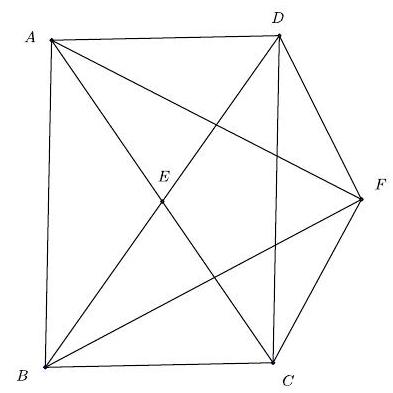
|
| 355 |
+
|
| 356 |
+
Figure 1: Problem 11.
|
| 357 |
+
|
| 358 |
+
Supposing $a \in T$ is lonely, we will show that $4 a-2 \in S$ is lonely. Indeed, suppose $4 a-2 \neq b \in S$ with
|
| 359 |
+
|
| 360 |
+
$$
|
| 361 |
+
\frac{4 a-2+b}{2}=2 a-1+\frac{b}{2} \in S .
|
| 362 |
+
$$
|
| 363 |
+
|
| 364 |
+
Then $b$ must be even, so $b=4 t-2$ for some $a \neq t \in T$. But then
|
| 365 |
+
|
| 366 |
+
$$
|
| 367 |
+
\frac{4 a-2+4 t-2}{2}=4 \frac{a+t}{2}-2
|
| 368 |
+
$$
|
| 369 |
+
|
| 370 |
+
again an even element. However, as $a$ is lonely we know that $\frac{a+t}{2} \notin T$, and hence $4 \frac{a+t}{2}-2 \notin S$. We conclude that $4 a-2$ is lonely in $S$.
|
| 371 |
+
|
| 372 |
+
Thus $S$ is an unbalanced set, and by induction we can find an unbalanced set of size exceeding $\frac{2 n}{3}$ for all $k>1$.
|
| 373 |
+
|
| 374 |
+
## Problem 11.
|
| 375 |
+
|
| 376 |
+
The diagonals of the parallelogram $A B C D$ intersect at $E$. The bisectors of $\angle D A E$ and $\angle E B C$ intersect at $F$. Assume that $E C F D$ is a parallelogram. Determine the ratio $A B: A D$.
|
| 377 |
+
|
| 378 |
+
Solution. Since $E C F D$ is a parallelogram, we have $E D \| C F$ and $\angle C F B=\angle E B F=\angle F B C(B F$ bisects $\angle D B C$ ). So $C F B$ is an isosceles triangle and $B C=C F=E D$ (ECFD is a parallelogram). In a similar manner, $E C=A D$. But since $A B C D$ is a parallelogram, $A D=B C$, whence $E C=E D$. So the diagonals of $A B C D$ are equal, which means that $A B C D$ is in fact a rectangle. Also, the triangles $E D A$ and $E B C$ are equilateral, and so $A B$ is twice the altitude of $E D A$, or $A B=\sqrt{3} \cdot A D$.
|
| 379 |
+
|
| 380 |
+
## Problem 12.
|
| 381 |
+
|
| 382 |
+
A circle passes through vertex $B$ of the triangle $A B C$, intersects its sides $A B$ and $B C$ at points $K$ and $L$, respectively, and touches the side $A C$ at its midpoint $M$. The point $N$ on the $\operatorname{arc} B L$ (which does not contain $K)$ is such that $\angle L K N=\angle A C B$. Find $\angle B A C$ given that the triangle $C K N$ is equilateral.
|
| 383 |
+
|
| 384 |
+
Solution. Answer: $\angle B A C=75^{\circ}$.
|
| 385 |
+
|
| 386 |
+
Since $\angle A C B=\angle L K N=\angle L B N$, the lines $A C$ and $B N$ are parallel. Hence $A C N B$ is a trapezium. Moreover, $A C N B$ is an isosceles trapezium, because the segment $A C$ touches the circle $s$ in the midpoint (and so the trapezium is symmetrical with respect to the perpendicular bisectors of $B N$ ).
|
| 387 |
+
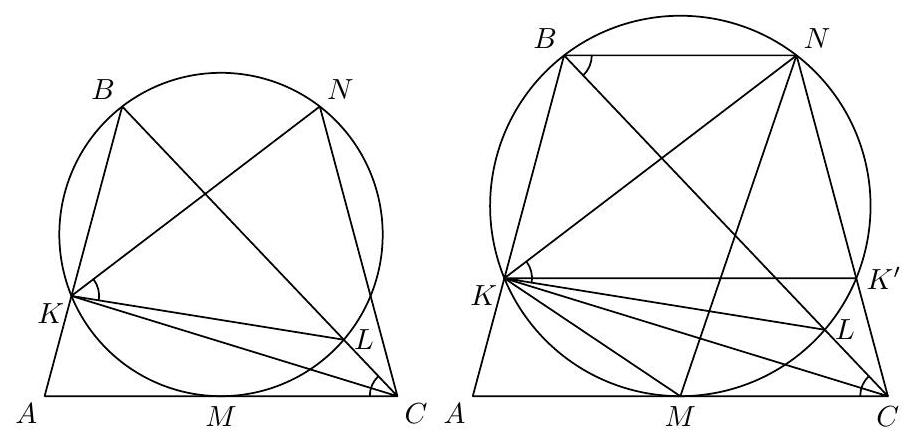
|
| 388 |
+
|
| 389 |
+
Figure 2: Problem 12.
|
| 390 |
+
|
| 391 |
+
Denote by $K^{\prime}$ the intersection point of $s$ and $C N$. Then the line $K K^{\prime}$ is parallel to the bases of the trapezium. Hence $M$ is the midpoint of $\operatorname{arc} K K^{\prime}$ and the line $N M$ is an angle bisector of the equilateral triangle $K N C$.
|
| 392 |
+
|
| 393 |
+
Thus we obtain that $M C=M K$. Therefore the length of median $K M$ of the triangle $A K C$ equals $\frac{1}{2} A C$; hence $\angle A K C=90^{\circ}$. We have
|
| 394 |
+
|
| 395 |
+
$$
|
| 396 |
+
2 \angle A=\angle K A C+\angle A C N=\angle K A C+\angle A C K+\angle K C N=90^{\circ}+60^{\circ}=150^{\circ} \text {, }
|
| 397 |
+
$$
|
| 398 |
+
|
| 399 |
+
and so $\angle A=75^{\circ}$.
|
| 400 |
+
|
| 401 |
+
## Problem 13.
|
| 402 |
+
|
| 403 |
+
Let $D$ be the footpoint of the altitude from $B$ in the triangle $A B C$, where $A B=1$. The incentre of triangle $B C D$ coincides with the centroid of triangle $A B C$. Find the lengths of $A C$ and $B C$.
|
| 404 |
+
|
| 405 |
+
Solution. Answer: $A C=B C=\sqrt{\frac{5}{2}}$.
|
| 406 |
+
|
| 407 |
+
The centroid of $A B C$ lies on the median $C C^{\prime}$. It will also, by the assumption, lie on the angle bisector through $C$. Since the median and the angle bisector coincide, $A B C$ is isosceles with $A C=$ $B C=a$.
|
| 408 |
+
|
| 409 |
+
Furthermore, the centroid lies on the median $B B^{\prime}$ and the bisector of $\angle D B C$, again by hypothesis. By the Angle Bisector Theorem,
|
| 410 |
+
|
| 411 |
+
$$
|
| 412 |
+
\frac{B^{\prime} D}{B D}=\frac{B^{\prime} C}{B C}=\frac{a / 2}{a}=\frac{1}{2}
|
| 413 |
+
$$
|
| 414 |
+
|
| 415 |
+
The triangles $A B D \sim A C C^{\prime}$ since they have equal angles, whence
|
| 416 |
+
|
| 417 |
+
$$
|
| 418 |
+
\frac{1}{a}=\frac{A B}{A C}=\frac{A D}{A C^{\prime}}=\frac{a / 2-B^{\prime} D}{1 / 2}=a-B D
|
| 419 |
+
$$
|
| 420 |
+
|
| 421 |
+
Using the fact that the length of the altitude $C C^{\prime}$ is $\sqrt{a^{2}-\frac{1}{4}}$, this leads to
|
| 422 |
+
|
| 423 |
+
$$
|
| 424 |
+
a^{2}-1=a B D=2|A B C|=\sqrt{a^{2}-\frac{1}{4}},
|
| 425 |
+
$$
|
| 426 |
+
|
| 427 |
+
or, equivalently,
|
| 428 |
+
|
| 429 |
+
$$
|
| 430 |
+
a^{2}-1=\sqrt{a^{2}-\frac{1}{4}}
|
| 431 |
+
$$
|
| 432 |
+
|
| 433 |
+
Clearly, $a>1$, and the only solution is $a=\sqrt{\frac{5}{2}}$.
|
| 434 |
+
|
| 435 |
+
## Problem 14.
|
| 436 |
+
|
| 437 |
+
In the non-isosceles triangle $A B C$ the altitude from $A$ meets side $B C$ in $D$. Let $M$ be the midpoint of $B C$ and let $N$ be the reflection of $M$ in $D$. The circumcircle of the triangle $A M N$ intersects the side $A B$ in $P \neq A$ and the side $A C$ in $Q \neq A$. Prove that $A N, B Q$ and $C P$ are concurrent.
|
| 438 |
+
|
| 439 |
+
Solution 1. Without loss of generality, we assume the order of the points on $B C$ to be $B, M, D, N$, $C$. This implies that $P$ is on the segment $A B$ and $Q$ is on the segment $A C$.
|
| 440 |
+
|
| 441 |
+
Since $D$ is the midpoint of $M N$ and $A D$ is perpendicular to $M N$, the line $A D$ is the perpendicular bisector of $M N$, which contains the circumcentre of $\triangle A M N$. As $A$ is on the perpendicular bisector of $M N$, we have $|A M|=|A N|$. We now have $\angle A P M=\angle A Q N$. Therefore
|
| 442 |
+
|
| 443 |
+
$$
|
| 444 |
+
\angle C Q N=180^{\circ}-\angle A Q N=180^{\circ}-\angle A P M=\angle B P M \text {. }
|
| 445 |
+
$$
|
| 446 |
+
|
| 447 |
+
Furthermore, as $N M P Q$ is cyclic, we have
|
| 448 |
+
|
| 449 |
+
$$
|
| 450 |
+
\angle N Q P=180^{\circ}-\angle N M P=\angle B M P \text {. }
|
| 451 |
+
$$
|
| 452 |
+
|
| 453 |
+
Hence
|
| 454 |
+
|
| 455 |
+
$$
|
| 456 |
+
\angle A Q P=180^{\circ}-\angle C Q N-\angle N Q P=180^{\circ}-\angle B P M-\angle B M P=\angle P B M=\angle A B C .
|
| 457 |
+
$$
|
| 458 |
+
|
| 459 |
+
Similarly,
|
| 460 |
+
|
| 461 |
+
$$
|
| 462 |
+
\angle A P Q=\angle B C A \text {. }
|
| 463 |
+
$$
|
| 464 |
+
|
| 465 |
+
Now we have $\triangle A P Q \sim \triangle A C B$. So
|
| 466 |
+
|
| 467 |
+
$$
|
| 468 |
+
\frac{|A P|}{|A Q|}=\frac{|A C|}{|A B|}
|
| 469 |
+
$$
|
| 470 |
+
|
| 471 |
+
Furthermore, $\angle M A B=\angle M A P=\angle M N P=\angle B N P$, so $\triangle B M A \sim \triangle B P N$, and hence
|
| 472 |
+
|
| 473 |
+
$$
|
| 474 |
+
\frac{|B N|}{|B P|}=\frac{|B A|}{|B M|}
|
| 475 |
+
$$
|
| 476 |
+
|
| 477 |
+
We also have $\angle C A M=\angle Q A M=180^{\circ}-\angle Q N M=\angle Q N C$. This implies $\triangle C M A \sim \triangle C Q N$, so
|
| 478 |
+
|
| 479 |
+
$$
|
| 480 |
+
\frac{|C Q|}{|C N|}=\frac{|C M|}{|C A|}
|
| 481 |
+
$$
|
| 482 |
+
|
| 483 |
+
Putting everything together, we find
|
| 484 |
+
|
| 485 |
+
$$
|
| 486 |
+
\frac{|B N|}{|B P|} \cdot \frac{|C Q|}{|C N|} \cdot \frac{|A P|}{|A Q|}=\frac{|B A|}{|B M|} \cdot \frac{|C M|}{|C A|} \cdot \frac{|A C|}{|A B|}
|
| 487 |
+
$$
|
| 488 |
+
|
| 489 |
+
As $|B M|=|C M|$, the right-hand side is equal to 1 . This means that
|
| 490 |
+
|
| 491 |
+
$$
|
| 492 |
+
\frac{|B N|}{|N C|} \cdot \frac{|C Q|}{|Q A|} \cdot \frac{|A P|}{|P B|}=1
|
| 493 |
+
$$
|
| 494 |
+
|
| 495 |
+
With Ceva's theorem we can conclude that $A N, B Q$ and $C P$ are concurrent.
|
| 496 |
+
|
| 497 |
+
Solution 2. We consider the same configuration as in Solution 1. Let $K$ be the second intersection of $A D$ with the circumcircle of $\triangle A M N$. Since $D$ is the midpoint of $M N$ and $A D$ is perpendicular to $M N$, the line $A D$ is the perpendicular bisector of $M N$, which contains the circumcentre of $\triangle A M N$. So $A K$ is a diameter of this circumcircle. Now we have $\angle B P K=90^{\circ}=\angle B D K$, so $B P D K$ is a cyclic quadrilateral. Also, $A, M, N, K, P$ and $Q$ are concyclic. Using both circles, we find
|
| 498 |
+
|
| 499 |
+
$$
|
| 500 |
+
180^{\circ}-\angle C Q P=\angle A Q P=\angle A K P=\angle D K P=\angle D B P=\angle C B P .
|
| 501 |
+
$$
|
| 502 |
+
|
| 503 |
+
This implies that $B P Q C$ is cyclic as well. Using the power theorem we find $A P \cdot A B=A Q \cdot A C$, with directed lengths. Also, $B N \cdot B M=B P \cdot B A$ and $C N \cdot C M=C Q \cdot C A$. Hence
|
| 504 |
+
|
| 505 |
+
$$
|
| 506 |
+
A P \cdot A B \cdot B N \cdot B M \cdot C Q \cdot C A=A Q \cdot A C \cdot B P \cdot B A \cdot C N \cdot C M
|
| 507 |
+
$$
|
| 508 |
+
|
| 509 |
+
Changing the signs of all six lengths on the right-hand side and replacing $M C$ by $B M$, we find
|
| 510 |
+
|
| 511 |
+
$$
|
| 512 |
+
A P \cdot A B \cdot B N \cdot B M \cdot C Q \cdot C A=Q A \cdot C A \cdot P B \cdot A B \cdot N C \cdot B M
|
| 513 |
+
$$
|
| 514 |
+
|
| 515 |
+
Cleaning this up, we have
|
| 516 |
+
|
| 517 |
+
$$
|
| 518 |
+
A P \cdot B N \cdot C Q=Q A \cdot P B \cdot N C,
|
| 519 |
+
$$
|
| 520 |
+
|
| 521 |
+
implying
|
| 522 |
+
|
| 523 |
+
$$
|
| 524 |
+
\frac{B N}{N C} \cdot \frac{C Q}{Q A} \cdot \frac{A P}{P B}=1
|
| 525 |
+
$$
|
| 526 |
+
|
| 527 |
+
With Ceva's theorem we can conclude that $A N, B Q$ and $C P$ are concurrent.
|
| 528 |
+
|
| 529 |
+
## Problem 15.
|
| 530 |
+
|
| 531 |
+
In triangle $A B C$, the interior and exterior angle bisectors of $\angle B A C$ intersect the line $B C$ in $D$ and $E$, respectively. Let $F$ be the second point of intersection of the line $A D$ with the circumcircle of the triangle $A B C$. Let $O$ be the circumcentre of the triangle $A B C$ and let $D^{\prime}$ be the reflection of $D$ in $O$. Prove that $\angle D^{\prime} F E=90^{\circ}$.
|
| 532 |
+
|
| 533 |
+
Solution 1. Note that $A B \neq A C$, since otherwise the exterior angle bisector of $\angle B A C$ would be parallel to $B C$. So assume without loss of generality that $A B<A C$. Let $M$ be the midpoint of $B C$ and let $F^{\prime}$ the reflection of $F$ in $O$, which is also the second intersection of the line $A E$ with the circumcircle of $\triangle A B C$. We now have
|
| 534 |
+
|
| 535 |
+
$$
|
| 536 |
+
\angle D^{\prime} F O=\angle O F^{\prime} D \text {. }
|
| 537 |
+
$$
|
| 538 |
+
|
| 539 |
+
Since $\angle D M F^{\prime}=90^{\circ}=\angle D A F^{\prime}$, the quadrilateral $M D A F^{\prime}$ is cyclic, thus
|
| 540 |
+
|
| 541 |
+
$$
|
| 542 |
+
\angle O F^{\prime} D=\angle M F^{\prime} D=\angle M A D \text {. }
|
| 543 |
+
$$
|
| 544 |
+
|
| 545 |
+
Furthermore, $\angle F M E=90^{\circ}=\angle F A E$, so $F M A E$ is cyclic as well. This implies that
|
| 546 |
+
|
| 547 |
+
$$
|
| 548 |
+
\angle M A D=\angle M A F=\angle M E F .
|
| 549 |
+
$$
|
| 550 |
+
|
| 551 |
+
Combining these three equalities we find that $\angle D^{\prime} F O=\angle M E F$, thus
|
| 552 |
+
|
| 553 |
+
$$
|
| 554 |
+
\angle D^{\prime} F E=\angle D^{\prime} F O+\angle O F E=\angle M E F+\angle M F E=180^{\circ}-\angle E M F=90^{\circ} .
|
| 555 |
+
$$
|
| 556 |
+
|
| 557 |
+
Solution 2. Again, assume $A B<A C$ and define $F^{\prime}$ as in the previous solution. Let $G$ be the intersection of the lines $D F^{\prime}$ and $E F$.
|
| 558 |
+
|
| 559 |
+
We can easily see that $F A$ is perpendicular to $E F^{\prime}$, and $B C$ to $F F^{\prime}$. Now, in triangle $\triangle E F F^{\prime}$, we have that $F D$ and $E D$ are altitudes, so $D$ is the orthocentre of this triangle. Now, $F^{\prime} D$ is an altitude
|
| 560 |
+
|
| 561 |
+
as well and we find that $F^{\prime} G$ is perpendicular to $E F$. Since $F F^{\prime}$ is a diameter of the circumcircle of $\triangle A B C, G$ must lie on this circle as well.
|
| 562 |
+
|
| 563 |
+
We now find
|
| 564 |
+
|
| 565 |
+
$$
|
| 566 |
+
\angle E F A=\angle G F A=\angle G F^{\prime} A=\angle D F^{\prime} A \text {. }
|
| 567 |
+
$$
|
| 568 |
+
|
| 569 |
+
Also, $\angle D F^{\prime} F=\angle D^{\prime} F F^{\prime}$. This implies that
|
| 570 |
+
|
| 571 |
+
$$
|
| 572 |
+
\angle D^{\prime} F E=\angle D^{\prime} F F^{\prime}+\angle F^{\prime} F A+\angle A F E=\angle D F^{\prime} F+\angle F^{\prime} F A+\angle A F^{\prime} D=\angle F^{\prime} F A+\angle A F^{\prime} F \text {. }
|
| 573 |
+
$$
|
| 574 |
+
|
| 575 |
+
Now, in triangle $\triangle A F F^{\prime}$ we have
|
| 576 |
+
|
| 577 |
+
$$
|
| 578 |
+
\angle F^{\prime} F A+\angle A F^{\prime} F=180^{\circ}-\angle F A F^{\prime}=90^{\circ},
|
| 579 |
+
$$
|
| 580 |
+
|
| 581 |
+
as required.
|
| 582 |
+
|
| 583 |
+
Solution 3. Again, assume $A B<A C$. We first consider the case $\angle B A C=90^{\circ}$. Define $F^{\prime}$ as in the previous solution. Now $O$ and $D^{\prime}$ lie on $B C$, so $\triangle D^{\prime} F O$ and $\triangle D F O$ are mirror images with respect to $F F^{\prime}$, while $\triangle O F E$ and $\triangle O F^{\prime} E$ are mirror images with respect to $B C$. We find that
|
| 584 |
+
|
| 585 |
+
$$
|
| 586 |
+
\angle D^{\prime} F E=\angle D^{\prime} F O+\angle O F E=\angle D F O+\angle O F^{\prime} E=\angle A F F^{\prime}+\angle F F^{\prime} A=180^{\circ}-\angle F A F^{\prime}=90^{\circ} .
|
| 587 |
+
$$
|
| 588 |
+
|
| 589 |
+
Now assume that $\angle B A C \neq 90^{\circ}$. We consider the configuration where $\angle B A C<90^{\circ}$. Let $M$, $N$ and $L$ be the midpoints of the line segments $B C, D E$ and $D F$, respectively. Note that $N$ is the circumcentre of $\triangle A D E$, so we find
|
| 590 |
+
|
| 591 |
+
$$
|
| 592 |
+
\begin{aligned}
|
| 593 |
+
\angle N A F=\angle N A D=\angle N D A & =\angle D A C+\angle A C D \\
|
| 594 |
+
& =\frac{1}{2} \angle A+\angle A C D=\angle B A F+\angle A C D=\angle B C F+\angle A C D=\angle A C F .
|
| 595 |
+
\end{aligned}
|
| 596 |
+
$$
|
| 597 |
+
|
| 598 |
+
Hence $N A$ is tangent to the circumcircle of $\triangle A B C$, thus $N A \perp O A$. Furthermore, we have $N M \perp$ $O M$, so $A O M N$ is cyclic with $O N$ as diameter. Now, since $L$ is the circumcentre of $\triangle D M F$, we find
|
| 599 |
+
|
| 600 |
+
$$
|
| 601 |
+
\angle L M N=\angle L M D=\angle L D M=\angle A D N=\angle D A N=\angle L A N
|
| 602 |
+
$$
|
| 603 |
+
|
| 604 |
+
so $A N L M$ is cyclic. Combining this with what we found before, we now conclude that $A O M L N$ is cyclic with $O N$ as diameter, thus $\angle O L N=90^{\circ}$. Using a dilation with centre $D$ and factor 2 we now can conclude $\angle D^{\prime} F E=\angle O L N=90^{\circ}$.
|
| 605 |
+
|
| 606 |
+
In case $\angle B A C>90^{\circ}$, the proof is similar (the cyclic quadrilateral will this time be $A M O N$ ).
|
| 607 |
+
|
| 608 |
+
Solution 4. We consider the configuration where $C, D, B$ and $E$ are on the line $B C$ in that order. The other configuration can be solved analogously. Let $P$ and $R$ be the feet of the perpendiculars from $D^{\prime}$ and $O$ to the line $A D$, respectively, and let $Q$ and $S$ be the feet of the perpendiculars from $D^{\prime}$ and $O$ to the line $C D$, respectively. Since $D^{\prime}$ is the reflection of $D$ with respect to $O$, we have $P R=R D$. Since we also have $O A=O F$ and therefore $R A=R F$, we obtain $A D=P F$. Similarly, $C D=B Q$. By Pythagoras's theorem,
|
| 609 |
+
|
| 610 |
+
$$
|
| 611 |
+
D^{\prime} F^{2}=D^{\prime} P^{2}+P F^{2}=4 O R^{2}+A D^{2}=4 O A^{2}-4 A R^{2}+A D^{2}=4 O A^{2}-A F^{2}+A D^{2}
|
| 612 |
+
$$
|
| 613 |
+
|
| 614 |
+
and
|
| 615 |
+
|
| 616 |
+
$$
|
| 617 |
+
D^{\prime} E^{2}=D^{\prime} Q^{2}+E Q^{2}=4 O S^{2}+E Q^{2}=4 O B^{2}-4 B S^{2}+E Q^{2}=4 O B^{2}-B C^{2}+(E B+C D)^{2} .
|
| 618 |
+
$$
|
| 619 |
+
|
| 620 |
+
And since $\angle E A F=90^{\circ}$ we have
|
| 621 |
+
|
| 622 |
+
$$
|
| 623 |
+
E F^{2}=A E^{2}+A F^{2} .
|
| 624 |
+
$$
|
| 625 |
+
|
| 626 |
+
As $O A=O B$, we conclude that
|
| 627 |
+
|
| 628 |
+
$$
|
| 629 |
+
\begin{array}{r}
|
| 630 |
+
D^{\prime} F^{2}+E F^{2}-D^{\prime} E^{2}=\left(4 O A^{2}-A F^{2}+A D^{2}\right)+\left(A E^{2}+A F^{2}\right)-\left(4 O B^{2}-B C^{2}+(E B+C D)^{2}\right) \\
|
| 631 |
+
=A E^{2}+A D^{2}+B C^{2}-(E B+C D)^{2}
|
| 632 |
+
\end{array}
|
| 633 |
+
$$
|
| 634 |
+
|
| 635 |
+
By Pythagoras's theorem again, we obtain $A E^{2}+A D^{2}=E D^{2}$, and hence
|
| 636 |
+
|
| 637 |
+
$$
|
| 638 |
+
D^{\prime} F^{2}+E F^{2}-D^{\prime} E^{2}=E D^{2}+B C^{2}-(E B+C D)^{2} .
|
| 639 |
+
$$
|
| 640 |
+
|
| 641 |
+
We have
|
| 642 |
+
|
| 643 |
+
$$
|
| 644 |
+
\begin{aligned}
|
| 645 |
+
E D^{2}+B C^{2} & =(E B+B D)^{2}+(B D+C D)^{2} \\
|
| 646 |
+
& =E B^{2}+B D^{2}+2 \cdot E B \cdot B D+B D^{2}+C D^{2}+2 \cdot B D \cdot C D \\
|
| 647 |
+
& =E B^{2}+C D^{2}+2 \cdot B D \cdot(E B+B D+C D) \\
|
| 648 |
+
& =E B^{2}+C D^{2}+2 \cdot B D \cdot E C .
|
| 649 |
+
\end{aligned}
|
| 650 |
+
$$
|
| 651 |
+
|
| 652 |
+
By the internal and external bisector theorems, we have
|
| 653 |
+
|
| 654 |
+
$$
|
| 655 |
+
\frac{B D}{C D}=\frac{B A}{C A}=\frac{B E}{C E},
|
| 656 |
+
$$
|
| 657 |
+
|
| 658 |
+
hence
|
| 659 |
+
|
| 660 |
+
$$
|
| 661 |
+
E D^{2}+B C^{2}=E B^{2}+C D^{2}+2 \cdot C D \cdot B E=(E B+C D)^{2} .
|
| 662 |
+
$$
|
| 663 |
+
|
| 664 |
+
So
|
| 665 |
+
|
| 666 |
+
$$
|
| 667 |
+
D^{\prime} F^{2}+E F^{2}-D^{\prime} E^{2}=0,
|
| 668 |
+
$$
|
| 669 |
+
|
| 670 |
+
which implies that $\angle D^{\prime} F E=90^{\circ}$.
|
| 671 |
+
|
| 672 |
+
## Problem 16.
|
| 673 |
+
|
| 674 |
+
Denote by $P(n)$ the greatest prime divisor of $n$. Find all integers $n \geq 2$ for which
|
| 675 |
+
|
| 676 |
+
$$
|
| 677 |
+
P(n)+\lfloor\sqrt{n}\rfloor=P(n+1)+\lfloor\sqrt{n+1}\rfloor .
|
| 678 |
+
$$
|
| 679 |
+
|
| 680 |
+
(Note: $\lfloor x\rfloor$ denotes the greatest integer less than or equal to $x$.)
|
| 681 |
+
|
| 682 |
+
Solution. Answer: The equality holds only for $n=3$.
|
| 683 |
+
|
| 684 |
+
It is easy to see that $P(n) \neq P(n+1)$. Therefore we need also that $\lfloor\sqrt{n}\rfloor \neq\lfloor\sqrt{n+1}\rfloor$ in order for equality to hold. This is only possible if $n+1$ is a perfect square. In this case,
|
| 685 |
+
|
| 686 |
+
$$
|
| 687 |
+
\lfloor\sqrt{n}\rfloor+1=\lfloor\sqrt{n+1}\rfloor
|
| 688 |
+
$$
|
| 689 |
+
|
| 690 |
+
and hence $P(n)=P(n+1)+1$. As both $P(n)$ and $P(n+1)$ are primes, it must be that $P(n)=3$ and $P(n+1)=2$.
|
| 691 |
+
|
| 692 |
+
It follows that $n=3^{a}$ and $n+1=2^{b}$, and we are required to solve the equation $3^{a}=2^{b}-1$. Calculating modulo 3 , we find that $b$ is even. Put $b=2 c$ :
|
| 693 |
+
|
| 694 |
+
$$
|
| 695 |
+
3^{a}=\left(2^{c}-1\right)\left(2^{c}+1\right) .
|
| 696 |
+
$$
|
| 697 |
+
|
| 698 |
+
As both factors cannot be divisible by 3 (their difference is 2 ), $2^{c}-1=1$. From this we get $c=1$, which leads to $n=3$.
|
| 699 |
+
|
| 700 |
+
## Problem 17.
|
| 701 |
+
|
| 702 |
+
Find all positive integers $n$ for which $n^{n-1}-1$ is divisible by $2^{2015}$, but not by $2^{2016}$.
|
| 703 |
+
|
| 704 |
+
Solution. Since $n$ must be odd, write $n=2^{d} u+1$, where $u, d \in \mathbf{N}$ and $u$ is odd. Now
|
| 705 |
+
|
| 706 |
+
$$
|
| 707 |
+
n^{n-1}-1=\left(n^{2^{d}}-1\right)(\underbrace{n^{2^{d} \cdot(u-1)}+\cdots+n^{2^{d} \cdot 1}+1}_{u}),
|
| 708 |
+
$$
|
| 709 |
+
|
| 710 |
+
and hence $2^{2015} \|\left(n^{n-1}-1\right)$ iff $2^{2015} \|\left(n^{2^{d}}-1\right)$. (The notation $p^{k} \| m$ denotes that $p^{k} \mid m$ and $p^{k+1} \nmid m$.)
|
| 711 |
+
|
| 712 |
+
We factorise once more:
|
| 713 |
+
|
| 714 |
+
$$
|
| 715 |
+
\begin{aligned}
|
| 716 |
+
n^{2^{d}}-1 & =(n-1)(n+1) \underbrace{\left(n^{2}+1\right) \cdots\left(n^{2^{d-1}}+1\right)}_{d-1} \\
|
| 717 |
+
& =2^{d} u \cdot 2\left(2^{d-1} u+1\right) \underbrace{\left(n^{2}+1\right) \cdots\left(n^{2^{d-1}}+1\right)}_{d-1} .
|
| 718 |
+
\end{aligned}
|
| 719 |
+
$$
|
| 720 |
+
|
| 721 |
+
If $k \geq 1$, then $2 \| n^{2^{k}}+1$, and so from the above
|
| 722 |
+
|
| 723 |
+
$$
|
| 724 |
+
2^{2 d} \| 2^{d} u \cdot 2 \cdot \underbrace{\left(n^{2}+1\right) \cdots\left(n^{2^{d-1}}+1\right)}_{d-1} \quad \text { and } \quad 2^{2015-2 d} \|\left(2^{d-1} u+1\right)
|
| 725 |
+
$$
|
| 726 |
+
|
| 727 |
+
It is easy to see that this is the case exactly when $d=1$ and $u=2^{2013} v-1$, where $v$ is odd.
|
| 728 |
+
|
| 729 |
+
Hence the required numbers are those of the form
|
| 730 |
+
|
| 731 |
+
$$
|
| 732 |
+
n=2\left(2^{2013} v-1\right)+1=2^{2014} v-1
|
| 733 |
+
$$
|
| 734 |
+
|
| 735 |
+
for $v$ a positive odd number.
|
| 736 |
+
|
| 737 |
+
## Problem 18.
|
| 738 |
+
|
| 739 |
+
Let $f(x)=x^{n}+a_{n-1} x^{n-1}+\cdots+a_{0}$ be a polynomial of degree $n \geq 1$ with $n$ (not necessarily distinct) integer roots. Assume that there exist distinct primes $p_{0}, p_{1}, \ldots, p_{n-1}$ such that $a_{i}>1$ is a power of $p_{i}$, for all $i=0, \ldots, n-1$. Find all possible values of $n$.
|
| 740 |
+
|
| 741 |
+
Solution. Obviously all the roots have to be negative by the positivity of the coefficients. If at least two of the roots are unequal to -1 , then both of them have to be powers of $p_{0}$. Now Vieta's formulæ yield $p_{0} \mid a_{1}$, which is a contradiction. Thus we can factor $f$ as
|
| 742 |
+
|
| 743 |
+
$$
|
| 744 |
+
f(x)=\left(x+a_{0}\right)(x+1)^{n-1}
|
| 745 |
+
$$
|
| 746 |
+
|
| 747 |
+
Expanding yields
|
| 748 |
+
|
| 749 |
+
$$
|
| 750 |
+
a_{2}=\left(\begin{array}{c}
|
| 751 |
+
n-1 \\
|
| 752 |
+
1
|
| 753 |
+
\end{array}\right)+a_{0}\left(\begin{array}{c}
|
| 754 |
+
n-1 \\
|
| 755 |
+
2
|
| 756 |
+
\end{array}\right) \quad \text { and } \quad a_{n-2}=a_{0}\left(\begin{array}{l}
|
| 757 |
+
n-1 \\
|
| 758 |
+
n-2
|
| 759 |
+
\end{array}\right)+\left(\begin{array}{l}
|
| 760 |
+
n-1 \\
|
| 761 |
+
n-3
|
| 762 |
+
\end{array}\right)
|
| 763 |
+
$$
|
| 764 |
+
|
| 765 |
+
If $n \geq 5$, we see that $2 \neq n-2$ and so the two coefficients above are relatively prime, being powers of two distinct primes. However, depending on the parity of $n$, we have that $a_{2}$ and $a_{n-2}$ are both divisible by $n-1$ or $\frac{n-1}{2}$, which is a contradiction.
|
| 766 |
+
|
| 767 |
+
For $n=1,2,3,4$, the following polynomials meet the requirements:
|
| 768 |
+
|
| 769 |
+
$$
|
| 770 |
+
\begin{aligned}
|
| 771 |
+
& f_{1}(x)=x+2 \\
|
| 772 |
+
& f_{2}(x)=(x+2)(x+1)=x^{2}+3 x+2 \\
|
| 773 |
+
& f_{3}(x)=(x+3)(x+1)^{2}=x^{3}+5 x^{2}+7 x+3 \\
|
| 774 |
+
& f_{4}(x)=(x+2)(x+1)^{3}=x^{4}+5 x^{3}+9 x^{2}+7 x+2
|
| 775 |
+
\end{aligned}
|
| 776 |
+
$$
|
| 777 |
+
|
| 778 |
+
## Problem 19.
|
| 779 |
+
|
| 780 |
+
Three pairwise distinct positive integers $a, b, c$, with $\operatorname{gcd}(a, b, c)=1$, satisfy
|
| 781 |
+
|
| 782 |
+
$$
|
| 783 |
+
a\left|(b-c)^{2}, \quad b\right|(c-a)^{2} \quad \text { and } \quad c \mid(a-b)^{2} \text {. }
|
| 784 |
+
$$
|
| 785 |
+
|
| 786 |
+
Prove that there does not exist a non-degenerate triangle with side lengths $a, b, c$.
|
| 787 |
+
|
| 788 |
+
Solution. First observe that these numbers are pairwise coprime. Indeed, if, say, $a$ and $b$ are divisible by a prime $p$, then $p$ divides $b$, which divides $(a-c)^{2}$; hence $p$ divides $a-c$, and therefore $p$ divides $c$. Thus, $p$ is a common divisor of these three numbers, a contradiction.
|
| 789 |
+
|
| 790 |
+
Now consider the number
|
| 791 |
+
|
| 792 |
+
$$
|
| 793 |
+
M=2 a b+2 b c+2 a c-a^{2}-b^{2}-c^{2} .
|
| 794 |
+
$$
|
| 795 |
+
|
| 796 |
+
It is clear from the problem condition that $M$ is divisible by $a, b, c$, and therefore $M$ is divisible by $a b c$.
|
| 797 |
+
|
| 798 |
+
Assume that a triangle with sides $a, b, c$ exists. Then $a<b+c$, and so $a^{2}<a b+a c$. Analogously, we have $b^{2}<b c+b a$ and $c^{2}<c a+c b$. Summing these three inequalities leads to $M>0$, and hence $M \geq a b c$.
|
| 799 |
+
|
| 800 |
+
On the other hand,
|
| 801 |
+
|
| 802 |
+
$$
|
| 803 |
+
a^{2}+b^{2}+c^{2}>a b+b c+a c
|
| 804 |
+
$$
|
| 805 |
+
|
| 806 |
+
and therefore $M<a b+b c+a c$. Supposing, with no loss of generality, $a>b>c$, we must have $M<3 a b$. Taking into account the inequality $M \geq a b c$, we conclude that $c=1$ or $c=2$ are the only possibilities.
|
| 807 |
+
|
| 808 |
+
For $c=1$ we have $b<a<b+1$ (the first inequality is our assumption, the second is the triangle inequality), a contradiction.
|
| 809 |
+
|
| 810 |
+
For $c=2$ we have $b<a<b+2$, i.e. $a=b+1$. But then $1=(a-b)^{2}$ is not divisible by $c=2$.
|
| 811 |
+
|
| 812 |
+
## Problem 20.
|
| 813 |
+
|
| 814 |
+
For any integer $n \geq 2$, we define $A_{n}$ to be the number of positive integers $m$ with the following property: the distance from $n$ to the nearest non-negative multiple of $m$ is equal to the distance from $n^{3}$ to the nearest non-negative multiple of $m$. Find all integers $n \geq 2$ for which $A_{n}$ is odd.
|
| 815 |
+
|
| 816 |
+
(Note: The distance between two integers $a$ and $b$ is defined as $|a-b|$.)
|
| 817 |
+
|
| 818 |
+
Solution. For an integer $m$ we consider the distance $d$ from $n$ to the nearest multiple of $m$. Then $m \mid n \pm d$, which means $n \equiv \pm d \bmod m$. So if, for some $m$, the distance from $n$ to the nearest multiple of $m$ is equal to the distance from $n^{3}$ to the nearest multiple of $m$, then $n \equiv \pm n^{3} \bmod m$.
|
| 819 |
+
|
| 820 |
+
On the other hand, if $n \equiv \pm n^{3} \bmod m$, then there exists a $0 \leq d \leq \frac{1}{2} m$ such that $n \equiv \pm d \bmod m$ and $n^{3} \equiv \pm d \bmod m$, so the distance from $n$ to the nearest multiple of $m$ is equal to the distance from $n^{3}$ to the nearest multiple of $m$.
|
| 821 |
+
|
| 822 |
+
We conclude that we need to count the number of positive integers $m$ such that $n \equiv \pm n^{3} \bmod m$, or, equivalently, $m \mid n^{3}-n$ or $m \mid n^{3}+n$. That is,
|
| 823 |
+
|
| 824 |
+
$$
|
| 825 |
+
\begin{aligned}
|
| 826 |
+
& A_{n}=\mid\left\{m \in \mathbf{Z}^{+}|m| n^{3}-n \text { or } m \mid n^{3}+n\right\} \mid \\
|
| 827 |
+
& =\left|\left\{m \in \mathbf{Z}^{+}|m| n^{3}-n\right\}\right|+\left|\left\{m \in \mathbf{Z}^{+}|m| n^{3}+n\right\}\right|-\mid\left\{m \in \mathbf{Z}^{+}|m| n^{3}-n \text { and } m \mid n^{3}+n\right\} \mid \\
|
| 828 |
+
& =\left|\left\{m \in \mathbf{Z}^{+}|m| n^{3}-n\right\}\right|+\left|\left\{m \in \mathbf{Z}^{+}|m| n^{3}+n\right\}\right|-\left|\left\{m \in \mathbf{Z}^{+}|m| \operatorname{gcd}\left(n^{3}-n, n^{3}+n\right)\right\}\right| \\
|
| 829 |
+
& =\tau\left(n^{3}-n\right)+\tau\left(n^{3}+n\right)-\tau\left(\operatorname{gcd}\left(n^{3}-n, n^{3}+n\right)\right),
|
| 830 |
+
\end{aligned}
|
| 831 |
+
$$
|
| 832 |
+
|
| 833 |
+
where $\tau(k)$ denotes the number of (positive) divisors of a positive integer $k$.
|
| 834 |
+
|
| 835 |
+
Recall that $\tau(k)$ is odd if and only if $k$ is a square. Furthermore, we have
|
| 836 |
+
|
| 837 |
+
$$
|
| 838 |
+
\operatorname{gcd}\left(n, n^{2} \pm 1\right)=1
|
| 839 |
+
$$
|
| 840 |
+
|
| 841 |
+
So if $n^{3} \pm n$ were a square, then both $n$ and $n^{2} \pm 1$ would be squares. But $n^{2} \pm 1$ is not a square, since $n \geq 2$ and the only consecutive squares are 0,1 . Hence neither $n^{3}-n$ nor $n^{3}+n$ is a square, so the first two terms $\tau\left(n^{3}-n\right)$ and $\tau\left(n^{3}+n\right)$ are both even. Hence $A_{n}$ is odd if and only if $\operatorname{gcd}\left(n^{3}-n, n^{3}+n\right)$ is a square.
|
| 842 |
+
|
| 843 |
+
We have
|
| 844 |
+
|
| 845 |
+
$$
|
| 846 |
+
\operatorname{gcd}\left(n^{2}-1, n^{2}+1\right)=\operatorname{gcd}\left(n^{2}-1,2\right)= \begin{cases}1 & \text { if } n \text { even } \\ 2 & \text { if } n \text { odd }\end{cases}
|
| 847 |
+
$$
|
| 848 |
+
|
| 849 |
+
Hence,
|
| 850 |
+
|
| 851 |
+
$$
|
| 852 |
+
\operatorname{gcd}\left(n^{3}-n, n^{3}+n\right)= \begin{cases}n & \text { if } n \text { even } \\ 2 n & \text { if } n \text { odd }\end{cases}
|
| 853 |
+
$$
|
| 854 |
+
|
| 855 |
+
Note that $2 n$ for $n$ odd is never a square, since it has exactly one factor of 2 . We conclude that $A_{n}$ is odd if and only if $n$ is an even square.
|
| 856 |
+
|
BalticWay/md/en-bw16sol.md
ADDED
|
@@ -0,0 +1,375 @@
|
|
|
|
|
|
|
|
|
|
|
|
|
|
|
|
|
|
|
|
|
|
|
|
|
|
|
|
|
|
|
|
|
|
|
|
|
|
|
|
|
|
|
|
|
|
|
|
|
|
|
|
|
|
|
|
|
|
|
|
|
|
|
|
|
|
|
|
|
|
|
|
|
|
|
|
|
|
|
|
|
|
|
|
|
|
|
|
|
|
|
|
|
|
|
|
|
|
|
|
|
|
|
|
|
|
|
|
|
|
|
|
|
|
|
|
|
|
|
|
|
|
|
|
|
|
|
|
|
|
|
|
|
|
|
|
|
|
|
|
|
|
|
|
|
|
|
|
|
|
|
|
|
|
|
|
|
|
|
|
|
|
|
|
|
|
|
|
|
|
|
|
|
|
|
|
|
|
|
|
|
|
|
|
|
|
|
|
|
|
|
|
|
|
|
|
|
|
|
|
|
|
|
|
|
|
|
|
|
|
|
|
|
|
|
|
|
|
|
|
|
|
|
|
|
|
|
|
|
|
|
|
|
|
|
|
|
|
|
|
|
|
|
|
|
|
|
|
|
|
|
|
|
|
|
|
|
|
|
|
|
|
|
|
|
|
|
|
|
|
|
|
|
|
|
|
|
|
|
|
|
|
|
|
|
|
|
|
|
|
|
|
|
|
|
|
|
|
|
|
|
|
|
|
|
|
|
|
|
|
|
|
|
|
|
|
|
|
|
|
|
|
|
|
|
|
|
|
|
|
|
|
|
|
|
|
|
|
|
|
|
|
|
|
|
|
|
|
|
|
|
|
|
|
|
|
|
|
|
|
|
|
|
|
|
|
|
|
|
|
|
|
|
|
|
|
|
|
|
|
|
|
|
|
|
|
|
|
|
|
|
|
|
|
|
|
|
|
|
|
|
|
|
|
|
|
|
|
|
|
|
|
|
|
|
|
|
|
|
|
|
|
|
|
|
|
|
|
|
|
|
|
|
|
|
|
|
|
|
|
|
|
|
|
|
|
|
|
|
|
|
|
|
|
|
|
|
|
|
|
|
|
|
|
|
|
|
|
|
|
|
|
|
|
|
|
|
|
|
|
|
|
|
|
|
|
|
|
|
|
|
|
|
|
|
|
|
|
|
|
|
|
|
|
|
|
|
|
|
|
|
|
|
|
|
|
|
|
|
|
|
|
|
|
|
|
|
|
|
|
|
|
|
|
|
|
|
|
|
|
|
|
|
|
|
|
|
|
|
|
|
|
|
|
|
|
|
|
|
|
|
|
|
|
|
|
|
|
|
|
|
|
|
|
|
|
|
|
|
|
|
|
|
|
|
|
|
|
|
|
|
|
|
|
|
|
|
|
|
|
|
|
|
|
|
|
|
|
|
|
|
|
|
|
|
|
|
|
|
|
|
|
|
|
|
|
|
|
|
|
|
|
|
|
|
|
|
|
|
|
|
|
|
|
|
|
|
|
|
|
|
|
|
|
|
|
|
|
|
|
|
|
|
|
|
|
|
|
|
|
|
|
|
|
|
|
|
|
|
|
|
|
|
|
|
|
|
|
|
|
|
|
|
|
|
|
|
|
|
|
|
|
|
|
|
|
|
|
|
|
|
|
|
|
|
|
|
|
|
|
|
|
|
|
|
|
|
|
|
|
|
|
|
|
|
|
|
|
|
|
|
|
|
|
|
|
|
|
|
|
|
|
|
|
|
|
|
|
|
|
|
|
|
|
|
|
|
|
|
|
|
|
|
|
|
|
|
|
|
|
|
|
|
|
|
|
|
|
|
|
|
|
|
|
|
|
|
|
|
|
|
|
|
|
|
|
|
|
|
|
|
|
|
|
|
|
|
|
|
|
|
|
|
|
|
|
|
|
|
|
|
|
|
|
|
|
|
|
|
|
|
|
|
|
|
|
|
|
|
|
|
|
|
|
|
|
|
|
|
|
|
|
|
|
|
|
|
|
|
|
|
|
|
|
|
|
|
|
|
|
|
|
|
|
|
|
|
|
|
|
|
|
|
|
|
|
|
|
|
|
|
|
|
|
|
|
|
|
|
|
|
|
|
|
|
|
|
|
|
|
|
|
|
|
|
|
|
|
|
|
|
|
|
|
|
|
|
|
|
|
|
|
|
|
|
|
|
|
|
|
|
|
|
|
|
|
|
|
|
|
|
|
|
|
|
|
|
|
|
|
|
|
|
|
|
|
|
|
|
|
|
|
|
|
|
|
|
|
|
|
|
|
|
|
|
|
|
|
|
|
|
|
|
|
|
|
|
|
|
|
|
|
|
|
|
|
|
|
|
|
|
|
|
|
|
|
|
|
|
|
|
|
|
|
|
|
|
|
|
|
|
|
|
|
|
|
|
|
|
|
|
|
|
|
|
|
|
|
|
|
|
|
|
|
|
|
|
|
|
|
|
|
|
|
|
|
|
|
|
|
|
|
|
|
|
|
|
|
|
|
|
|
|
|
|
|
|
|
|
|
|
|
|
|
|
|
|
|
|
|
|
|
|
|
|
|
|
|
|
|
|
|
|
|
|
|
|
|
|
| 1 |
+
# Baltic Way 2016 - Solutions
|
| 2 |
+
|
| 3 |
+
1. Find all pairs of primes $(p, q)$ such that
|
| 4 |
+
|
| 5 |
+
$$
|
| 6 |
+
p^{3}-q^{5}=(p+q)^{2} .
|
| 7 |
+
$$
|
| 8 |
+
|
| 9 |
+
Solution. Assume first that neither of the numbers equals 3. Then, if $p \equiv q \bmod 3$, the left hand side is divisible by 3 , but the right hand side is not. But if $p \equiv-q \bmod 3$, the left hand side is not divisible by 3 , while the right hand side is. So this is not possible.
|
| 10 |
+
|
| 11 |
+
If $p=3$, then $q^{5}<27$, which is impossible. Therefore $q=3$, and the equation turns into $p^{3}-243=(p+3)^{2}$ or
|
| 12 |
+
|
| 13 |
+
$$
|
| 14 |
+
p\left(p^{2}-p-6\right)=252=7 \cdot 36 \text {. }
|
| 15 |
+
$$
|
| 16 |
+
|
| 17 |
+
As $p>3$ then $p^{2}-p-6$ is positive and increases with $p$. So the equation has at most one solution. It is easy to see that $p=7$ is the one and $(7,3)$ is a solution to the given equation.
|
| 18 |
+
|
| 19 |
+
2. Prove or disprove the following hypotheses.
|
| 20 |
+
|
| 21 |
+
a) For all $k \geq 2$, each sequence of $k$ consecutive positive integers contains a number that is not divisible by any prime number less than $k$.
|
| 22 |
+
|
| 23 |
+
b) For all $k \geq 2$, each sequence of $k$ consecutive positive integers contains a number that is relatively prime to all other members of the sequence.
|
| 24 |
+
|
| 25 |
+
Solution. We give a counterexample to both claims. So neither of them is true.
|
| 26 |
+
|
| 27 |
+
For a), a counterexample is the sequence $(2,3,4,5,6,7,8,9)$ of eight consecutive integers all of which are divisible by some prime less than 8 .
|
| 28 |
+
|
| 29 |
+
To construct a counterexample to b), we notice that by the Chinese Remainder Theorem, there exists an integer $x$ such that $x \equiv 0 \bmod 2, x \equiv 0 \bmod 5, x \equiv 0 \bmod 11, x \equiv 2 \bmod 3$, $x \equiv 5 \bmod 7$ and $x \equiv 10 \bmod 13$. The last three of these congruences mean that $x+16$ is a multiple of 3,7 , and 13 . Now consider the sequence $(x, x+1, \ldots, x+16)$ of 17 consequtive integers. Of these all numbers $x+2 k, 0 \leq k \leq 8$, are even and so have a common factor with some other. Of the remaining, $x+1, x+7$ and $x+13$ are divisible by $3, x+3$ is a multiple of 13 as is $x+16, x+5$ is divisible by 5 as $x, x+9$ is a multiple of 7 as $x+2$, $x+11$ a multiple of 11 as is $x$, and finally $x+15$ is a multiple of 5 as is $x$.
|
| 30 |
+
|
| 31 |
+
Remark. The counterexample given to either hypothesis is the shortest possible. The only counterexamples of length 8 to the first hypothesis are those where numbers give remainders $2,3, \ldots, 9 ; 3,4, \ldots, 10 ;-2,-3, \ldots,-9 ;$ or $-3,-4, \ldots,-10$ modulo 210 . The only counterexamples of length 17 to the second hypothesis are those where the numbers give remainders $2184,2185, \ldots, 2200$ or $-2184,-2185, \ldots,-2200$ modulo 30030.
|
| 32 |
+
|
| 33 |
+
3. For which integers $n=1, \ldots, 6$ does the equation
|
| 34 |
+
|
| 35 |
+
$$
|
| 36 |
+
a^{n}+b^{n}=c^{n}+n
|
| 37 |
+
$$
|
| 38 |
+
|
| 39 |
+
have a solution in integers?
|
| 40 |
+
|
| 41 |
+
Solution. A solution clearly exists for $n=1,2,3$ :
|
| 42 |
+
|
| 43 |
+
$$
|
| 44 |
+
1^{1}+0^{1}=0^{1}+1, \quad 1^{2}+1^{2}=0^{2}+2, \quad 1^{3}+1^{3}=(-1)^{3}+3 .
|
| 45 |
+
$$
|
| 46 |
+
|
| 47 |
+
We show that for $n=4,5,6$ there is no solution.
|
| 48 |
+
|
| 49 |
+
For $n=4$, the equation $a^{4}+b^{4}=c^{4}+4$ may be considered modulo 8 . Since each fourth power $x^{4} \equiv 0,1 \bmod 8$, the expression $a^{4}+b^{4}-c^{4}$ can never be congruent to 4 .
|
| 50 |
+
|
| 51 |
+
For $n=5$, consider the equation $a^{5}+b^{5}=c^{5}+5$ modulo 11 . As $x^{5} \equiv 0$ or $\equiv \pm 1 \bmod 11$ (This can be seen by Fermat's Little Theorem or by direct computation), $a^{5}+b^{5}-c^{5}$ cannot be congruent to 5 .
|
| 52 |
+
|
| 53 |
+
The case $n=6$ is similarly dismissed by considering the equation modulo 13 .
|
| 54 |
+
|
| 55 |
+
4. Let $n$ be a positive integer and let $a, b, c, d$ be integers such that $n \mid a+b+c+d$ and $n \mid a^{2}+b^{2}+c^{2}+d^{2}$. Show that
|
| 56 |
+
|
| 57 |
+
$$
|
| 58 |
+
n \mid a^{4}+b^{4}+c^{4}+d^{4}+4 a b c d .
|
| 59 |
+
$$
|
| 60 |
+
|
| 61 |
+
Solution 1. Consider the polynomial
|
| 62 |
+
|
| 63 |
+
$$
|
| 64 |
+
w(x)=(x-a)(x-b)(x-c)(x-d)=x^{4}+A x^{3}+B x^{2}+C x+D .
|
| 65 |
+
$$
|
| 66 |
+
|
| 67 |
+
It is clear that $w(a)=w(b)=w(c)=w(d)=0$. By adding these values we get
|
| 68 |
+
|
| 69 |
+
$$
|
| 70 |
+
\begin{gathered}
|
| 71 |
+
w(a)+w(b)+w(c)+w(d)=a^{4}+b^{4}+c^{4}+d^{4}+A\left(a^{3}+b^{3}+c^{3}+d^{3}\right)+ \\
|
| 72 |
+
+B\left(a^{2}+b^{2}+c^{2}+d^{2}\right)+C(a+b+c+d)+4 D=0 .
|
| 73 |
+
\end{gathered}
|
| 74 |
+
$$
|
| 75 |
+
|
| 76 |
+
Hence
|
| 77 |
+
|
| 78 |
+
$$
|
| 79 |
+
\begin{gathered}
|
| 80 |
+
a^{4}+b^{4}+c^{4}+d^{4}+4 D \\
|
| 81 |
+
=-A\left(a^{3}+b^{3}+c^{3}+d^{3}\right)-B\left(a^{2}+b^{2}+c^{2}+d^{2}\right)-C(a+b+c+d) .
|
| 82 |
+
\end{gathered}
|
| 83 |
+
$$
|
| 84 |
+
|
| 85 |
+
Using Vieta's formulas, we can see that $D=a b c d$ and $-A=a+b+c+d$. Therefore the right hand side of the equation above is divisible by $n$, and so is the left hand side.
|
| 86 |
+
|
| 87 |
+
Solution 2. Since the numbers $(a+b+c+d)\left(a^{3}+b^{3}+c^{3}+d^{3}\right),\left(a^{2}+b^{2}+c^{2}+d^{2}\right)(a b+$ $a c+a d+b c+b d+c d)$ and $(a+b+c+d)(a b c+a c d+a b d+b c d)$ are divisible by $n$, then so is the number
|
| 88 |
+
|
| 89 |
+
$$
|
| 90 |
+
\begin{gathered}
|
| 91 |
+
(a+b+c+d)\left(a^{3}+b^{3}+c^{3}+d^{3}\right)-\left(a^{2}+b^{2}+c^{2}+d^{2}\right)(a b+a c+a d+b c+b d+c d)+ \\
|
| 92 |
+
+(a+b+c+d)(a b c+a c d+a b d+b c d)=a^{4}+b^{4}+c^{4}+d^{4}+4 a b c d .
|
| 93 |
+
\end{gathered}
|
| 94 |
+
$$
|
| 95 |
+
|
| 96 |
+
(Heiki Niglas, Estonia)
|
| 97 |
+
|
| 98 |
+
5. Let $p>3$ be a prime such that $p \equiv 3(\bmod 4)$. Given a positive integer $a_{0}$, define the sequence $a_{0}, a_{1}, \ldots$ of integers by $a_{n}=a_{n-1}^{2^{n}}$ for all $n=1,2, \ldots$ Prove that it is possible to choose $a_{0}$ such that the subsequence $a_{N}, a_{N+1}, a_{N+2}, \ldots$ is not constant modulo $p$ for any positive integer $N$.
|
| 99 |
+
|
| 100 |
+
Solution. Let $p$ be a prime with residue 3 modulo 4 and $p>3$. Then $p-1=u \cdot 2$ where $u>1$ is odd. Choose $a_{0}=2$. The order of 2 modulo $p$ (that is, the smallest positive integer $t$ such that $\left.2^{t} \equiv 1 \bmod p\right)$ is a divisor of $\phi(p)=p-1=u \cdot 2$, but not a divisor of 2 since $1<2^{2}<p$. Hence the order of 2 modulo $p$ is not a power of 2 . By definition we see that $a_{n}=a_{0}^{2^{1+2+\cdots+n}}$. Since the order of $a_{0}=2$ modulo $p$ is not a power of 2 , we know that $a_{n} \not \equiv 1 \quad(\bmod p)$ for all $n=1,2,3, \ldots$ We proof the statement by contradiction. Assume there exists a positive integer $N$ such that $a_{n} \equiv a_{N}(\bmod p)$ for all $n \geq N$. Let $d>1$ be the order of $a_{N}$ modulo $p$. Then $a_{N} \equiv a_{n} \equiv a_{n+1}=a_{n}^{2^{n+1}} \equiv a_{N}^{2^{n+1}} \quad(\bmod p)$, and hence $a_{N}^{2^{n+1}-1} \equiv 1 \quad(\bmod p)$ for all $n \geq N$. Now $d$ divides $2^{n+1}-1$ for all $n \geq N$, but this is a contradiction since
|
| 101 |
+
|
| 102 |
+
$\operatorname{gcd}\left(2^{n+1}-1,2^{n+2}-1\right)=\operatorname{gcd}\left(2^{n+1}-1,2^{n+2}-1-2\left(2^{n+1}-1\right)\right)=\operatorname{gcd}\left(2^{n+1}-1,1\right)=1$.
|
| 103 |
+
|
| 104 |
+
Hence there does not exist such an $N$.
|
| 105 |
+
|
| 106 |
+
6. The set $\{1,2, \ldots, 10\}$ is partitioned into three subsets $A, B$ and $C$. For each subset the sum of its elements, the product of its elements and the sum of the digits of all its elements are calculated. Is it possible that $A$ alone has the largest sum of elements, $B$ alone has the largest product of elements, and $C$ alone has the largest sum of digits?
|
| 107 |
+
|
| 108 |
+
Solution. It is indeed possible. Choose $A=\{1,9,10\}, B=\{3,7,8\}, C=\{2,4,5,6\}$. Then the sum of elements in $A, B$ and $C$, respectively, is 20,18 and 17 , the sum of digits 11, 18 and 17, while the product of elements is 90,168 and 240.
|
| 109 |
+
|
| 110 |
+
7. Find all positive integers $n$ for which
|
| 111 |
+
|
| 112 |
+
$$
|
| 113 |
+
3 x^{n}+n(x+2)-3 \geq n x^{2}
|
| 114 |
+
$$
|
| 115 |
+
|
| 116 |
+
holds for all real numbers $x$.
|
| 117 |
+
|
| 118 |
+
Solution. We show that the inequality holds for even $n$ and only for them.
|
| 119 |
+
|
| 120 |
+
If $n$ is odd, the for $x=-1$ the left hand side of the inequality equals $n-6$ while the right hand side is $n$. So the inequality is not true for $x=-1$ for any odd $n$. So now assume that $n$ is even. Since $|x| \geq x$, it is enough to prove $3 x^{n}+2 n-3 \geq n x^{2}+n|x|$ for all $x$ or equivalently that $3 x^{n}+(2 n-3) \geq n x^{2}+n x$ for $x \geq 0$. Now the AGM-inequality gives
|
| 121 |
+
|
| 122 |
+
$$
|
| 123 |
+
2 x^{n}+(n-2)=x^{n}+x^{n}+1+\cdots+1 \geq n\left(x^{n} \cdot x^{n} \cdot 1^{n-2}\right)^{\frac{1}{n}}=n x^{2} \text {, }
|
| 124 |
+
$$
|
| 125 |
+
|
| 126 |
+
and similarly
|
| 127 |
+
|
| 128 |
+
$$
|
| 129 |
+
x^{n}+(n-1) \geq n\left(x^{n} \cdot 1^{n-1}\right)^{\frac{1}{n}}=n x \text {. }
|
| 130 |
+
$$
|
| 131 |
+
|
| 132 |
+
Adding (1) and (2) yields the claim.
|
| 133 |
+
|
| 134 |
+
8. Find all real numbers a for which there exists a non-constant function $f: \mathbb{R} \rightarrow \mathbb{R}$ satisfying the following two equations for all $x \in \mathbb{R}$ :
|
| 135 |
+
i) $\quad f(a x)=a^{2} f(x)$ and
|
| 136 |
+
|
| 137 |
+
ii) $f(f(x))=a f(x)$.
|
| 138 |
+
|
| 139 |
+
Solution. The conditions of the problem give two representations for $f(f(f(x)))$ :
|
| 140 |
+
|
| 141 |
+
$$
|
| 142 |
+
f(f(f(x)))=a f(f(x))=a^{2} f(x)
|
| 143 |
+
$$
|
| 144 |
+
|
| 145 |
+
and
|
| 146 |
+
|
| 147 |
+
$$
|
| 148 |
+
f(f(f(x)))=f(a f(x))=a^{2} f(f(x))=a^{3} f(x) .
|
| 149 |
+
$$
|
| 150 |
+
|
| 151 |
+
So $a^{2} f(x)=a^{3} f(x)$ for all $x$, and if there is an $x$ such that $f(x) \neq 0$, the $a=0$ or $a=1$. Otherwise $f$ is the constant function $f(x)=0$ for all $x$. If $a=1$, the function $f(x)=x$ satisfies the conditions. For $a=0$, one possible solution is the function $f$,
|
| 152 |
+
|
| 153 |
+
$$
|
| 154 |
+
f(x)=\left\{\begin{array}{ll}
|
| 155 |
+
1 & \text { for } x<0 \\
|
| 156 |
+
0 & \text { for } x \geq 0
|
| 157 |
+
\end{array} .\right.
|
| 158 |
+
$$
|
| 159 |
+
|
| 160 |
+
9. Find all quadruples $(a, b, c, d)$ of real numbers that simultaneously satisfy the following equations:
|
| 161 |
+
|
| 162 |
+
$$
|
| 163 |
+
\left\{\begin{aligned}
|
| 164 |
+
a^{3}+c^{3} & =2 \\
|
| 165 |
+
a^{2} b+c^{2} d & =0 \\
|
| 166 |
+
b^{3}+d^{3} & =1 \\
|
| 167 |
+
a b^{2}+c d^{2} & =-6
|
| 168 |
+
\end{aligned}\right.
|
| 169 |
+
$$
|
| 170 |
+
|
| 171 |
+
Solution 1. Consider the polynomial $P(x)=(a x+b)^{3}+(c x+d)^{3}=\left(a^{3}+b^{3}\right) x^{3}+3\left(a^{2} b+\right.$ $\left.c^{2} d\right) x^{2}+3\left(a b^{2}+c d^{2}\right) x+b^{3}+d^{3}$. By the conditions of the problem, $P(x)=2 x^{3}-18 x+1$. Clearly $P(0)>0, P(1)<0$ and $P(3)>0$. Thus $P$ has three distinct zeroes. But $P(x)=0$ implies $a x+b=-(c x+d)$ or $(a+c) x+b+d=0$. This equation has only one solution, unless $a=-c$ and $b=-d$. But since the conditions of the problem do not allow this, we infer that the system of equations in the problem has no solution.
|
| 172 |
+
|
| 173 |
+
Solution 2. If $0 \in\{a, b\}$, then one easily gets that $0 \in\{c, d\}$, which contradicts the equation $a b^{2}+c d^{2}=-6$. Similarly, if $0 \in\{c, d\}$, then $0 \in\{a, b\}$ and this contradicts $a b^{2}+c d^{2}=-6$ again. Hence $a, b, c, d \neq 0$.
|
| 174 |
+
|
| 175 |
+
Let the four equations in the problem be (i), (ii), (iii) and (iv), respectively. Then $(i)+3(i i)+3(i i i)+(i v)$ will give
|
| 176 |
+
|
| 177 |
+
$$
|
| 178 |
+
(a+b)^{3}+(c+d)^{3}=-15 .
|
| 179 |
+
$$
|
| 180 |
+
|
| 181 |
+
According to the equation (ii), $b$ and $d$ have different sign, and similarly (iv) yields that $a$ and $c$ have different sign.
|
| 182 |
+
|
| 183 |
+
First, consider the case $a>0, b>0$. Then $c<0$ and $d<0$. By $(i)$, we have $a>-c$ (i.e. $|a|>|c|)$ and (iii) gives $b>-d$. Hence $a+b>-(c+d)$ and so $(a+b)^{3}>-(c+d)^{3}$, thus $(a+b)^{3}+(c+d)^{3}>0$ which contradicts (1).
|
| 184 |
+
|
| 185 |
+
Next, consider the case $a>0, b<0$. Then $c<0$ and $d>0$. By $(i)$, we have $a>-c$ and by (iii), $d>-b$ (i.e. $b>-d$ ). Thus $a+b>-(c+d)$ and hence $(a+b)^{3}+(c+d)^{3}>0$ which contradicts (1).
|
| 186 |
+
|
| 187 |
+
The case $a<0, b<0$ leads to $c>0, d>0$. By (i), we have $c>-a$ and by (iii) $d>-b$. So $c+d>-(a+b)$ and hence $(c+d)^{3}+(a+b)^{3}>0$ which contradicts (1) again.
|
| 188 |
+
|
| 189 |
+
Finally, consider the case $a<0, b>0$. Then $c>0$ and $d<0$. By (i), $c>-a$ and by (iii) $b>-d$ which gives $c+d>-(a+b)$ and hence $(c+d)^{3}+(a+b)^{3}>0$ contradicting (1).
|
| 190 |
+
|
| 191 |
+
Hence there is no real solution to this system of equations. (Heiki Niglas)
|
| 192 |
+
|
| 193 |
+
Solution 3. As in Solution 2, we conclude that $a, b, c, d \neq 0$. The equation $a^{2} b+c^{2} d=0$ yields $a= \pm \sqrt{\frac{-d}{b}} c$. On the other hand, we have $a^{3}+c^{3}=2$ and $a b^{2}+c d^{2}=-6<0$ which implies that $\min \{a, c\}<0<\max \{a, c\}$ and thus $a=-\sqrt{\frac{-d}{b}} c$.
|
| 194 |
+
|
| 195 |
+
Let $x=-\sqrt{\frac{-d}{b}}$. Then $a=x c$ and so
|
| 196 |
+
|
| 197 |
+
$$
|
| 198 |
+
2=a^{3}+c^{3}=c^{3}\left(1+x^{3}\right) .
|
| 199 |
+
$$
|
| 200 |
+
|
| 201 |
+
Also $-6=a b^{2}+c d^{2}=c x b^{2}+c d^{2}$, which, using (2), gives
|
| 202 |
+
|
| 203 |
+
$$
|
| 204 |
+
\left(x b^{2}+d^{2}\right)^{3}=\frac{-6^{3}}{c^{3}}=-108\left(x^{3}+1\right) \text {. }
|
| 205 |
+
$$
|
| 206 |
+
|
| 207 |
+
Thus
|
| 208 |
+
|
| 209 |
+
$$
|
| 210 |
+
-108\left(1+x^{3}\right)=\left(d^{2}\left(x \frac{b^{2}}{d^{2}}+1\right)\right)^{3}=d^{6}\left(\frac{1}{x^{3}}+1\right)^{3}=d^{6}\left(\frac{1+x^{3}}{x^{3}}\right)^{3} .
|
| 211 |
+
$$
|
| 212 |
+
|
| 213 |
+
If $x^{3}+1=0$, then $x=-1$ and hence $a=-c$, which contradicts $a^{3}+c^{3}=2$. So $x^{3}+1 \neq 0$ and (3) gives
|
| 214 |
+
|
| 215 |
+
$$
|
| 216 |
+
d^{6}\left(1+x^{3}\right)^{2}=-108 x^{9} .
|
| 217 |
+
$$
|
| 218 |
+
|
| 219 |
+
Now note that
|
| 220 |
+
|
| 221 |
+
$$
|
| 222 |
+
x^{3}=\left(-\sqrt{\frac{-d}{b}}\right)^{3}=-\sqrt{\frac{-d^{3}}{b^{3}}}=-\sqrt{\frac{b^{3}-1}{b^{3}}}
|
| 223 |
+
$$
|
| 224 |
+
|
| 225 |
+
and hence (4) yields that
|
| 226 |
+
|
| 227 |
+
$$
|
| 228 |
+
\left(b^{3}-1\right)^{2}\left(1-\sqrt{\frac{b^{3}-1}{b^{3}}}\right)^{2}=108\left(\sqrt{\frac{b^{3}-1}{b^{3}}}\right)^{3} .
|
| 229 |
+
$$
|
| 230 |
+
|
| 231 |
+
Let $y=\sqrt{\frac{b^{3}-1}{b^{3}}}$. Then $b^{3}=\frac{1}{1-y^{2}}$ and so (5) implies
|
| 232 |
+
|
| 233 |
+
$$
|
| 234 |
+
\left(\frac{1}{1-y^{2}}-1\right)^{2}\left(1-y^{2}\right)^{2}=108 y^{3}
|
| 235 |
+
$$
|
| 236 |
+
|
| 237 |
+
i.e.
|
| 238 |
+
|
| 239 |
+
$$
|
| 240 |
+
\frac{y^{4}}{\left(1-y^{2}\right)^{2}}(1-y)^{2}=108 y^{3}
|
| 241 |
+
$$
|
| 242 |
+
|
| 243 |
+
If $y=0$, then $b=1$ and so $d=0$, a contradiction. So
|
| 244 |
+
|
| 245 |
+
$$
|
| 246 |
+
y(1-y)^{2}=108(1-y)^{2}(1+y)^{2}
|
| 247 |
+
$$
|
| 248 |
+
|
| 249 |
+
Clearly $y \neq 1$ and hence $y=108+108 y^{2}+216 y$, or $108 y^{2}+215 y+108=0$. The last equation has no real solutions and thus the initial system of equations has no real solutions.
|
| 250 |
+
|
| 251 |
+
Remark 1. Note that this solution worked because RHS of $a^{2} b+c^{2} d=0$ is zero. If instead it was, e.g., $a^{2} b+c^{2} d=0.1$ then this solution would not work out, but the first solution still would.
|
| 252 |
+
|
| 253 |
+
Remark 2. The advantage of this solution is that solving the last equation $108 y^{2}+$ $215 y+108=0$ one can find complex solutions of this system of equations. (Heiki Niglas)
|
| 254 |
+
|
| 255 |
+
10. Let $a_{0,1}, a_{0,2}, \ldots, a_{0,2016}$ be positive real numbers. For $n \geq 0$ and $1 \leq k<2016$ set
|
| 256 |
+
|
| 257 |
+
$$
|
| 258 |
+
a_{n+1, k}=a_{n, k}+\frac{1}{2 a_{n, k+1}} \quad \text { and } \quad a_{n+1,2016}=a_{n, 2016}+\frac{1}{2 a_{n, 1}} .
|
| 259 |
+
$$
|
| 260 |
+
|
| 261 |
+
Show that $\max _{1 \leq k \leq 2016} a_{2016, k}>44$.
|
| 262 |
+
|
| 263 |
+
Solution. We prove
|
| 264 |
+
|
| 265 |
+
$$
|
| 266 |
+
m_{n}^{2} \geq n
|
| 267 |
+
$$
|
| 268 |
+
|
| 269 |
+
for all $n$. The claim then follows from $44^{2}=1936<2016$. To prove (1), first notice that the inequality certainly holds for $n=0$. Assume (1) is true for $n$. There is a $k$ such that $a_{n, k}=m_{n}$. Also $a_{n, k+1} \leq m_{n}$ (or if $k=2016, a_{n, 1} \leq m_{n}$ ). Now (assuming $k<2016$ )
|
| 270 |
+
|
| 271 |
+
$$
|
| 272 |
+
a_{n+1, k}^{2}=\left(m_{n}+\frac{1}{2 a_{n, k+1}}\right)^{2}=m_{n}^{2}+\frac{m_{n}}{a_{n, k+1}}+\frac{1}{4 a_{n, k+1}^{2}}>n+1 .
|
| 273 |
+
$$
|
| 274 |
+
|
| 275 |
+
Since $m_{n+1}^{2} \geq a_{n+1, k}^{2}$, we are done.
|
| 276 |
+
|
| 277 |
+
11. The set $A$ consists of 2016 positive integers. All prime divisors of these numbers are smaller than 30. Prove that there are four distinct numbers $a, b, c$ and $d$ in $A$ such that abcd is a perfect square.
|
| 278 |
+
|
| 279 |
+
Solution. There are ten prime numbers $\leq 29$. Let us denote them as $p_{1}, p_{2}, \ldots, p_{10}$. To each number $n$ in $A$ we can assign a 10 -element sequence $\left(n_{1}, n_{2}, \ldots, n_{10}\right)$ such that $n_{i}=1$ $p_{i}$ has an odd exponent in the prime factorization of $n$, and $n_{i}=0$ otherwise. Two numbers to which identical sequences are assigned, multiply to a perfect square. There are only 1024 different 10-element $\{0,1\}$-sequences so there exist some two numbers $a$ and $b$ with identical sequencies, and after removing these from $A$ certainly two other numbers $c$ and $d$ with identical sequencies remain. These $a, b, c$ and $d$ satisfy the condition of the problem.
|
| 280 |
+
|
| 281 |
+
12. Does there exist a hexagon (not necessarily convex) with side lengths 1, 2, 3, 4, 5, 6 (not necessarily in this order) that can be tiled with a) 31 b) 32 equilateral triangles with side length 1 ?
|
| 282 |
+
|
| 283 |
+
Solution. The adjoining figure shows that question a) can be answered positively.
|
| 284 |
+
|
| 285 |
+
For a negative answer to b), we show that the number of triangles has to be odd. Assume there are $x$ triangles in the triangulation. They hav altogether $3 x$ sides. Of these, $1+2+3+4+6=21$ are on the perimeter of the hexagon. The remaining $3 x-21$ sides are in the interior, and they touch each other pairwise. So $3 x-21$ has to be even, which is only possible, if $x$ is odd.
|
| 286 |
+
|
| 287 |
+
13. Let $n$ numbers all equal to 1 be written on a blackboard. A move consists of replacing two numbers on
|
| 288 |
+
|
| 289 |
+
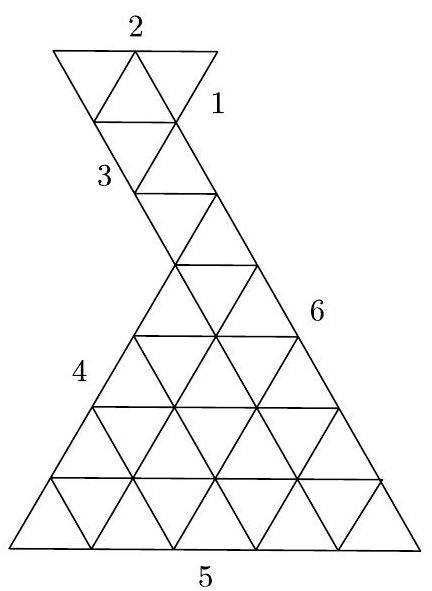
|
| 290 |
+
the board with two copies of their sum. It happens that after $h$ moves all $n$ numbers on the blackboard are equal to $m$. Prove that $h \leq \frac{1}{2} n \log _{2} m$.
|
| 291 |
+
|
| 292 |
+
Solution. Let the product of the numbers after the $k$-th move be $a_{k}$. Suppose the numbers involved in a move were $a$ and $b$. By the arithmetic-geometric mean inequality, $(a+b)(a+b) \geq 4 a b$. Therefore, regardless of the choice of the numbers in the move, $a_{k} \geq 4 a_{k-1}$, and since $a_{0}=1, a_{h}=m^{n}$, we have $m^{n} \geq 4^{h}=2^{2 h}$ and $h \leq \frac{1}{2} n \log _{2} m$.
|
| 293 |
+
|
| 294 |
+
14. A cube consists of $4^{3}$ unit cubes each containing an integer. At each move, you choose a unit cube and increase by 1 all the integers in the neighbouring cubes having a face in common with the chosen cube. Is it possible to reach a position where all the $4^{3}$ integers are divisible by 3 , no matter what the starting position is?
|
| 295 |
+
|
| 296 |
+
Solution. Two unit cubes with a common face are called neighbours. Colour the cubes either black or white in such a way that two neighbours always have different colours. Notice that the integers in the white cubes only change when a black cube is chosen. Now recolour the white cubes that have exactly 4 neighbours and make them green. If we look at a random black cube it has either 0,3 or 6 white neighbours. Hence if we look at the sum of the integers in the white cubes, it changes by 0,3 or 6 in each turn. From this it follows that if this sum is not divisible by 3 at the beginning, it will never be, and none of the integers in the white cubes is divisible by 3 at any state.
|
| 297 |
+
|
| 298 |
+
15. The Baltic Sea has 2016 harbours. There are two-way ferry connections between some of them. It is impossible to make a sequence of direct voyages $C_{1}-C_{2}-\cdots-C_{1062}$ where all the harbours $C_{1}, \ldots, C_{1062}$ are distinct. Prove that there exist two disjoint sets $A$ and $B$ of 477 harbours each, such that there is no harbour in $A$ with a direct ferry connection to a harbour in $B$.
|
| 299 |
+
|
| 300 |
+
Solution. Let $V$ be the set of all harbours. Take any harbour $C_{1}$ and set $U=V \backslash\left\{C_{1}\right\}$, $W=\emptyset$. If there is a ferry connection from $C$ to another harbour, say $C_{2}$ in $V$, consider the route $C_{1} C_{2}$ and remove $C_{2}$ from $U$. Extend it as long as possible. Since there is no route of length 1061, So we have a route from $C_{1}$ to some $C_{k}, k \leq 1061$, and no connection from $C_{k}$ to a harbor not already included in the route exists. There are at least $2016-1062$ harbours in $U$. Now we move $C_{k}$ from $U$ to $W$ and try to extend the route from $C_{k-1}$ onwards. The extension again terminates at some harbor, which we then move from $U$ to $W$. If no connection from $C_{1}$ to any harbour exists, we move $C_{1}$ to $W$ and start the process again from some other harbour. This algorithm produces two sets of harbours, $W$ and $U$, between which there are no direct connections. During the process, the number of harbours in $U$ always decreases by 1 and the number of harbours in $W$ increases by 1 . So at some point the number of harbours is the same, and it then is at least $\frac{1}{2}(2016-1062)=477$. By removing, if necessary, some harbours fron $U$ and $W$ we get sets of exactly 477 harbours.
|
| 301 |
+
|
| 302 |
+
16. In triangle $A B C$, the points $D$ and $E$ are the intersections of the angular bisectors from $C$ and $B$ with the sides $A B$ and $A C$, respectively. Points $F$ and $G$ on the extensions of $A B$ and $A C$ beyond $B$ and $C$, respectively, satisfy $B F=C G=B C$. Prove that $F G \| D E$.
|
| 303 |
+
|
| 304 |
+
Solution. Since $B E$ and $C D$ are angle bisectors,
|
| 305 |
+
|
| 306 |
+
$$
|
| 307 |
+
\frac{A D}{A B}=\frac{A C}{A C+B C}, \quad \frac{A E}{A C}=\frac{A B}{A B+B C} .
|
| 308 |
+
$$
|
| 309 |
+
|
| 310 |
+
So
|
| 311 |
+
|
| 312 |
+
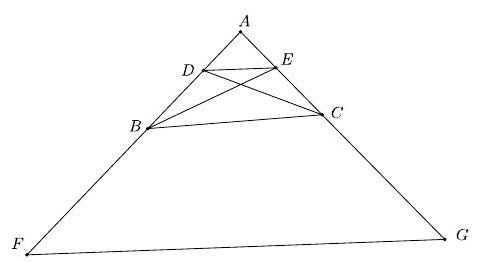
|
| 313 |
+
|
| 314 |
+
$$
|
| 315 |
+
\frac{A D}{A F}=\frac{A D}{A B} \cdot \frac{A B}{A F}=\frac{A C \cdot A B}{(A C+B C)(A B+B C)}
|
| 316 |
+
$$
|
| 317 |
+
|
| 318 |
+
and
|
| 319 |
+
|
| 320 |
+
$$
|
| 321 |
+
\frac{A E}{A G}=\frac{A E}{A C} \cdot \frac{A C}{A G}=\frac{A B \cdot A C}{(A B+A C)(A C+B C)}
|
| 322 |
+
$$
|
| 323 |
+
|
| 324 |
+
Since $\frac{A D}{A F}=\frac{A E}{A G}, D E$ and $F G$ are parallel.
|
| 325 |
+
|
| 326 |
+
17. Let $A B C D$ be a convex quadrilateral with $A B=A D$. Let $T$ be a point on the diagonal $A C$ such that $\angle A B T+\angle A D T=\angle B C D$. Prove that $A T+A C \geq A B+A D$.
|
| 327 |
+
|
| 328 |
+
Solution. On the segment $A C$, consider the unique point $T^{\prime}$ such that $A T^{\prime} \cdot A C=A B^{2}$. The triangles $A B C$ and $A T^{\prime} B$ are similar: they have the angle at $A$ common, and $A T^{\prime}: A B=A B: A C$. So $\angle A B T^{\prime}=\angle A C B$. Analogously, $\angle A D T^{\prime}=\angle A C D$. So $\angle A B T^{\prime}+\angle A D T^{\prime}=\angle B C D$. But $A B T^{\prime}+A D T^{\prime}$ increases strictly monotonously, as $T^{\prime}$ moves from $A$ towards $C$ on $A C$. The assumption on $T$ implies that $T^{\prime}=T$. So, by the arithmetic-geometric mean inequality,
|
| 329 |
+
|
| 330 |
+
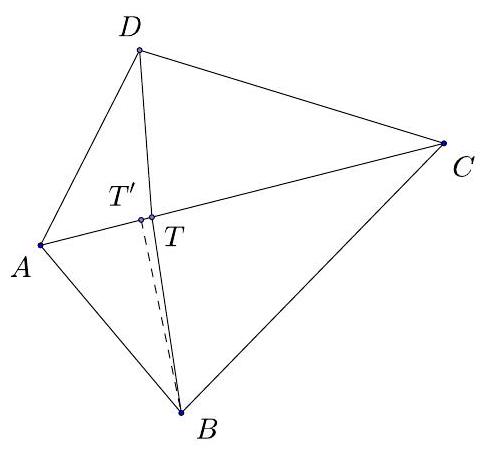
|
| 331 |
+
|
| 332 |
+
$$
|
| 333 |
+
A B+A D=2 A B=2 \sqrt{A T \cdot A C} \leq A T+A C .
|
| 334 |
+
$$
|
| 335 |
+
|
| 336 |
+
18. Let $A B C D$ be a parallelogram such that $\angle B A D=60^{\circ}$. Let $K$ and $L$ be the midpoints of $B C$ and $C D$, respectively. Assuming that $A B K L$ is a cyclic quadrilateral, find $\angle A B D$.
|
| 337 |
+
|
| 338 |
+
Solution. Let $\angle B A L=\alpha$. Since $A B K L$ is cyclic, $\angle K K C=\alpha$. Because $L K \| D B$ and $A B \| D C$, we further have $\angle D B C=\alpha$ and $\angle A D B=\alpha$. Let $B D$ and $A L$ intersect at $P$. The triangles $A B P$ and $D B A$ have two equal angles, and hence $A B P \sim D B A$. So
|
| 339 |
+
|
| 340 |
+
$$
|
| 341 |
+
\frac{A B}{D B}=\frac{B P}{A B}
|
| 342 |
+
$$
|
| 343 |
+
|
| 344 |
+
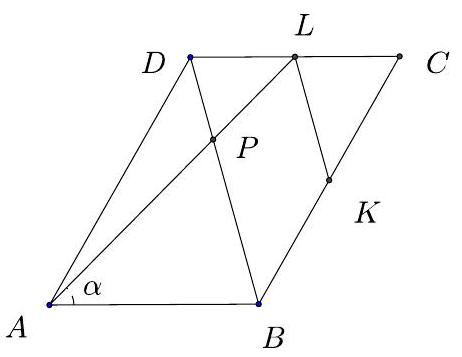
|
| 345 |
+
|
| 346 |
+
The triangles $A B P$ and $L D P$ are clearly similar with similarity ratio $2: 1$. Hence $B P=$ $\frac{2}{3} D B$. Inserting this into (1) we get
|
| 347 |
+
|
| 348 |
+
$$
|
| 349 |
+
A B=\sqrt{\frac{2}{3}} \cdot D B
|
| 350 |
+
$$
|
| 351 |
+
|
| 352 |
+
The sine theorem applied to $A B D$ (recall that $\angle D A B=60^{\circ}$ ) immediately gives
|
| 353 |
+
|
| 354 |
+
$$
|
| 355 |
+
\sin \alpha=\frac{A B}{B D} \sin 60^{\circ}=\sqrt{\frac{2}{3}} \cdot \frac{\sqrt{3}}{2}=\frac{\sqrt{2}}{2}=\sin 45^{\circ} .
|
| 356 |
+
$$
|
| 357 |
+
|
| 358 |
+
So $\angle A B D=180^{\circ}-60^{\circ}-45^{\circ}=75^{\circ}$.
|
| 359 |
+
|
| 360 |
+
19. Consider triangles in the plane where each vertex has integer coordinates. Such a triangle can be legally transformed by moving one vertex parallel to the opposite side to a different point with integer coordinates. Show that if two triangles have the same area, then there exists a series of legal transformations that transforms one to the other.
|
| 361 |
+
|
| 362 |
+
Solution. We will first show that any such triangle can be transformed to a special triangle whose vertices are at $(0,0),(0,1)$ and $(n, 0)$. Since every transformation preserves the triangle's area, triangles with the same area will have the same value for $n$.
|
| 363 |
+
|
| 364 |
+
Define th $y$-span of a triangle to be the difference between the largest and the smallest $y$ coordinate of its vertices. First we show that a triangle with a $y$-span greater than one can be transformed to a triangle with a strictly lower $y$-span.
|
| 365 |
+
|
| 366 |
+
Assume $A$ has the highest and $C$ the lowest $y$ coordinate of $A B C$. Shifting $C$ to $C^{\prime}$ by the vector $\overrightarrow{B A}$ results in the new triangle $A B C^{\prime}$ where $C^{\prime}$ has larger $y$ coordinate than $C$ baut lower than $A$, and $C^{\prime}$ has integer coordinates. If $A C$ is parallel to the $x$-axis, a horizontal shift of $B$ can be made to transform $A B C$ into $A B^{\prime} C$ where $B^{\prime} C$ is vertical, and then $A$ can be vertically shifted so that the $y$ coordinate of $A$ is between those of $B^{\prime}$ and $C$. Then the $y$-span of $A B^{\prime} C$ can be reduced in the manner described above. Continuing the process, one necessarily arrives at a triangle with $y$-span equal to 1 . Such a triangle then necessarily has one side, say $A C$, horizontal. A legal horizontal move can take $B$ to the a position $B^{\prime}$ where $A B^{\prime}$ is horizontal and $C$ has the highest $x$-coordinate. If $B^{\prime}$ is above $A C$, perform a vertical and a horizontal legal move to take $B^{\prime}$ to the origin; the result is a special triangle. If $B^{\prime}$ is below $A C$, legal transformation again can bring $B^{\prime}$ to the origin, and a final horizontal transformation of one vertex produces the desired special triangle.
|
| 367 |
+
|
| 368 |
+
The inverse of a legal transformation is again a legal transformation. Hence any two triangles having vertices with integer coordinates and same area can be legally transformed into each other via a special triangle.
|
| 369 |
+
|
| 370 |
+
20. Let $A B C D$ be a cyclic quadrilateral with $A B$ and $C D$ not parallel. Let $M$ be the midpoint of $C D$. Let $P$ be a point inside $A B C D$ such that $P A=P B=C M$. Prove that $A B, C D$ and the perpendicular bisector of $M P$ are concurrent.
|
| 371 |
+
|
| 372 |
+
Solution. Let $\omega$ be the circumcircle of $A B C D$. Let $A B$ and $C D$ intersect at $X$. Let $\omega_{1}$ and $\omega_{2}$ be the circles with centers $P$ and $M$ and with equal radius $P B=M C=r$. The power of $X$ with respect to $\omega$ and $\omega_{1}$ equals $X A \cdot X B$ and with respect to $\omega$ and $\omega_{2} X D \cdot X C$. The latter power also equals $(X M+$ $r)(X M-r)=X M^{2}-r^{2}$. Analogously, the first power is $X P^{2}-r^{2}$. But since $X A \cdot X B=X D \cdot X C$, we must have $X M^{2}=X P^{2}$ or $X M=X P . X$ indeed is on the perpendicular bisector of $P M$, and we are done.
|
| 373 |
+
|
| 374 |
+
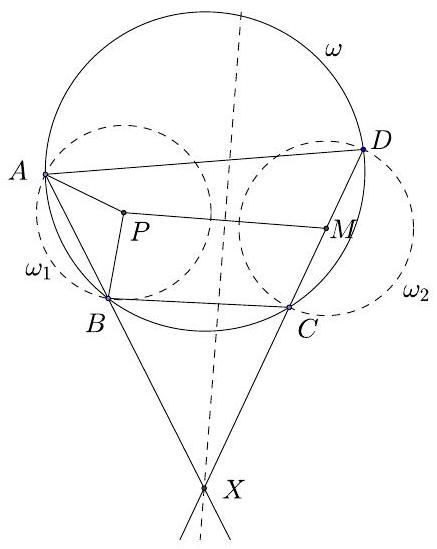
|
| 375 |
+
|
BalticWay/md/en-bw17sol.md
ADDED
|
@@ -0,0 +1,571 @@
|
|
|
|
|
|
|
|
|
|
|
|
|
|
|
|
|
|
|
|
|
|
|
|
|
|
|
|
|
|
|
|
|
|
|
|
|
|
|
|
|
|
|
|
|
|
|
|
|
|
|
|
|
|
|
|
|
|
|
|
|
|
|
|
|
|
|
|
|
|
|
|
|
|
|
|
|
|
|
|
|
|
|
|
|
|
|
|
|
|
|
|
|
|
|
|
|
|
|
|
|
|
|
|
|
|
|
|
|
|
|
|
|
|
|
|
|
|
|
|
|
|
|
|
|
|
|
|
|
|
|
|
|
|
|
|
|
|
|
|
|
|
|
|
|
|
|
|
|
|
|
|
|
|
|
|
|
|
|
|
|
|
|
|
|
|
|
|
|
|
|
|
|
|
|
|
|
|
|
|
|
|
|
|
|
|
|
|
|
|
|
|
|
|
|
|
|
|
|
|
|
|
|
|
|
|
|
|
|
|
|
|
|
|
|
|
|
|
|
|
|
|
|
|
|
|
|
|
|
|
|
|
|
|
|
|
|
|
|
|
|
|
|
|
|
|
|
|
|
|
|
|
|
|
|
|
|
|
|
|
|
|
|
|
|
|
|
|
|
|
|
|
|
|
|
|
|
|
|
|
|
|
|
|
|
|
|
|
|
|
|
|
|
|
|
|
|
|
|
|
|
|
|
|
|
|
|
|
|
|
|
|
|
|
|
|
|
|
|
|
|
|
|
|
|
|
|
|
|
|
|
|
|
|
|
|
|
|
|
|
|
|
|
|
|
|
|
|
|
|
|
|
|
|
|
|
|
|
|
|
|
|
|
|
|
|
|
|
|
|
|
|
|
|
|
|
|
|
|
|
|
|
|
|
|
|
|
|
|
|
|
|
|
|
|
|
|
|
|
|
|
|
|
|
|
|
|
|
|
|
|
|
|
|
|
|
|
|
|
|
|
|
|
|
|
|
|
|
|
|
|
|
|
|
|
|
|
|
|
|
|
|
|
|
|
|
|
|
|
|
|
|
|
|
|
|
|
|
|
|
|
|
|
|
|
|
|
|
|
|
|
|
|
|
|
|
|
|
|
|
|
|
|
|
|
|
|
|
|
|
|
|
|
|
|
|
|
|
|
|
|
|
|
|
|
|
|
|
|
|
|
|
|
|
|
|
|
|
|
|
|
|
|
|
|
|
|
|
|
|
|
|
|
|
|
|
|
|
|
|
|
|
|
|
|
|
|
|
|
|
|
|
|
|
|
|
|
|
|
|
|
|
|
|
|
|
|
|
|
|
|
|
|
|
|
|
|
|
|
|
|
|
|
|
|
|
|
|
|
|
|
|
|
|
|
|
|
|
|
|
|
|
|
|
|
|
|
|
|
|
|
|
|
|
|
|
|
|
|
|
|
|
|
|
|
|
|
|
|
|
|
|
|
|
|
|
|
|
|
|
|
|
|
|
|
|
|
|
|
|
|
|
|
|
|
|
|
|
|
|
|
|
|
|
|
|
|
|
|
|
|
|
|
|
|
|
|
|
|
|
|
|
|
|
|
|
|
|
|
|
|
|
|
|
|
|
|
|
|
|
|
|
|
|
|
|
|
|
|
|
|
|
|
|
|
|
|
|
|
|
|
|
|
|
|
|
|
|
|
|
|
|
|
|
|
|
|
|
|
|
|
|
|
|
|
|
|
|
|
|
|
|
|
|
|
|
|
|
|
|
|
|
|
|
|
|
|
|
|
|
|
|
|
|
|
|
|
|
|
|
|
|
|
|
|
|
|
|
|
|
|
|
|
|
|
|
|
|
|
|
|
|
|
|
|
|
|
|
|
|
|
|
|
|
|
|
|
|
|
|
|
|
|
|
|
|
|
|
|
|
|
|
|
|
|
|
|
|
|
|
|
|
|
|
|
|
|
|
|
|
|
|
|
|
|
|
|
|
|
|
|
|
|
|
|
|
|
|
|
|
|
|
|
|
|
|
|
|
|
|
|
|
|
|
|
|
|
|
|
|
|
|
|
|
|
|
|
|
|
|
|
|
|
|
|
|
|
|
|
|
|
|
|
|
|
|
|
|
|
|
|
|
|
|
|
|
|
|
|
|
|
|
|
|
|
|
|
|
|
|
|
|
|
|
|
|
|
|
|
|
|
|
|
|
|
|
|
|
|
|
|
|
|
|
|
|
|
|
|
|
|
|
|
|
|
|
|
|
|
|
|
|
|
|
|
|
|
|
|
|
|
|
|
|
|
|
|
|
|
|
|
|
|
|
|
|
|
|
|
|
|
|
|
|
|
|
|
|
|
|
|
|
|
|
|
|
|
|
|
|
|
|
|
|
|
|
|
|
|
|
|
|
|
|
|
|
|
|
|
|
|
|
|
|
|
|
|
|
|
|
|
|
|
|
|
|
|
|
|
|
|
|
|
|
|
|
|
|
|
|
|
|
|
|
|
|
|
|
|
|
|
|
|
|
|
|
|
|
|
|
|
|
|
|
|
|
|
|
|
|
|
|
|
|
|
|
|
|
|
|
|
|
|
|
|
|
|
|
|
|
|
|
|
|
|
|
|
|
|
|
|
|
|
|
|
|
|
|
|
|
|
|
|
|
|
|
|
|
|
|
|
|
|
|
|
|
|
|
|
|
|
|
|
|
|
|
|
|
|
|
|
|
|
|
|
|
|
|
|
|
|
|
|
|
|
|
|
|
|
|
|
|
|
|
|
|
|
|
|
|
|
|
|
|
|
|
|
|
|
|
|
|
|
|
|
|
|
|
|
|
|
|
|
|
|
|
|
|
|
|
|
|
|
|
|
|
|
|
|
|
|
|
|
|
|
|
|
|
|
|
|
|
|
|
|
|
|
|
|
|
|
|
|
|
|
|
|
|
|
|
|
|
|
|
|
|
|
|
|
|
|
|
|
|
|
|
|
|
|
|
|
|
|
|
|
|
|
|
|
|
|
|
|
|
|
|
|
|
|
|
|
|
|
|
|
|
|
|
|
|
|
|
|
|
|
|
|
|
|
|
|
|
|
|
|
|
|
|
|
|
|
|
|
|
|
|
|
|
|
|
|
|
|
|
|
|
|
|
|
|
|
|
|
|
|
|
|
|
|
|
|
|
|
|
|
|
|
|
|
|
|
|
|
|
|
|
|
|
|
|
|
|
|
|
|
|
|
|
|
|
|
|
|
|
|
|
|
|
|
|
|
|
|
|
|
|
|
|
|
|
|
|
|
|
|
|
|
|
|
|
|
|
|
|
|
|
|
|
|
|
|
|
|
|
|
|
|
|
|
|
|
|
|
|
|
|
|
|
|
|
|
|
|
|
|
|
|
|
|
|
|
|
|
|
|
|
|
|
|
|
|
|
|
|
|
|
|
|
|
|
|
|
|
|
|
|
|
|
|
|
|
|
|
|
|
|
|
|
|
|
|
|
|
|
|
|
|
|
|
|
|
|
|
|
|
|
|
|
|
|
|
|
|
|
|
|
|
|
|
|
|
|
|
|
|
|
|
|
|
|
|
|
|
|
|
|
|
|
|
|
|
|
|
|
|
|
|
|
|
|
|
|
|
|
|
|
|
|
|
|
|
|
|
|
|
|
|
|
|
|
|
|
|
|
|
|
|
|
|
|
|
|
|
|
|
|
|
|
|
|
|
|
|
|
|
|
|
|
|
|
|
|
|
|
|
|
|
|
|
|
|
|
|
|
|
|
|
|
|
|
|
|
|
|
|
|
|
|
|
|
|
|
|
|
|
|
|
|
|
|
|
|
|
|
|
|
|
|
|
|
|
|
|
|
|
|
|
|
|
|
|
|
|
|
|
|
|
|
|
|
|
|
|
|
|
|
|
|
|
|
|
|
|
|
|
|
|
| 1 |
+
# Baltic Way 2017
|
| 2 |
+
|
| 3 |
+
Sorø, November 11th, 2017
|
| 4 |
+
|
| 5 |
+
## Problems and solutions
|
| 6 |
+
|
| 7 |
+
Problem 1. Let $a_{0}, a_{1}, a_{2}, \ldots$ be an infinite sequence of real numbers satisfying $\frac{a_{n-1}+a_{n+1}}{2} \geq a_{n}$ for all positive integers $n$. Show that
|
| 8 |
+
|
| 9 |
+
$$
|
| 10 |
+
\frac{a_{0}+a_{n+1}}{2} \geq \frac{a_{1}+a_{2}+\ldots+a_{n}}{n}
|
| 11 |
+
$$
|
| 12 |
+
|
| 13 |
+
holds for all positive integers $n$.
|
| 14 |
+
|
| 15 |
+
## Solution
|
| 16 |
+
|
| 17 |
+
From the inequality $\frac{a_{n-1}+a_{n+1}}{2} \geq a_{n}$ we get $a_{n+1}-a_{n} \geq a_{n}-a_{n-1}$. Inductively this yields that $a_{l+1}-a_{l} \geq a_{k+1}-a_{k}$ for any positive integers $l>k$, which rewrites as
|
| 18 |
+
|
| 19 |
+
$$
|
| 20 |
+
a_{l+1}+a_{k} \geq a_{l}+a_{k+1}
|
| 21 |
+
$$
|
| 22 |
+
|
| 23 |
+
Now fix $n$ and define $b_{m}=a_{m}+a_{n+1-m}$ for $m=0, \ldots n+1$. For $m<\frac{n}{2}$, we can apply the above for $(l, k)=(n-m, m)$ yielding
|
| 24 |
+
|
| 25 |
+
$$
|
| 26 |
+
b_{m}=a_{n+1-m}+a_{m} \geq a_{n-m}+a_{m+1}=b_{m+1}
|
| 27 |
+
$$
|
| 28 |
+
|
| 29 |
+
Also by symmetry $b_{m}=b_{n+1-m}$. Thus
|
| 30 |
+
|
| 31 |
+
$$
|
| 32 |
+
b_{0}=\max _{m=0, \ldots, n+1} b_{m} \geq \max _{m=1, \ldots, n} b_{m} \geq \frac{b_{1}+\cdots+b_{n}}{n}
|
| 33 |
+
$$
|
| 34 |
+
|
| 35 |
+
substituting back yields the desired inequality.
|
| 36 |
+
|
| 37 |
+
Problem 2. Does there exist a finite set of real numbers such that their sum equals 2 , the sum of their squares equals 3 , the sum of their cubes equals 4 and the sum of their ninth powers equals 10 ?
|
| 38 |
+
|
| 39 |
+
## Solution
|
| 40 |
+
|
| 41 |
+
Answer: no.
|
| 42 |
+
|
| 43 |
+
Assume that such a set of numbers $\left\{a_{1}, \ldots, a_{n}\right\}$ exists. Summing up the inequalities
|
| 44 |
+
|
| 45 |
+
$$
|
| 46 |
+
2 a_{i}^{3} \leq a_{i}^{2}+a_{i}^{4}
|
| 47 |
+
$$
|
| 48 |
+
|
| 49 |
+
for all $i$ we obtain the inequality $8 \leq 8$. Therefore all the inequalities are in fact equalities. This is possible for the cases $a_{i}=0$ or $a_{i}=1$ only, but the elements of a set are all different.
|
| 50 |
+
|
| 51 |
+
(Remark: Even if the $a_{i}$ 's are allowed to be equal it is clear that only 0's or only l's do not satisfy the problem conditions.)
|
| 52 |
+
|
| 53 |
+
Problem 3. Positive integers $x_{1}, \ldots, x_{m}$ (not necessarily distinct) are written on a blackboard. It is known that each of the numbers $F_{1}, \ldots, F_{2018}$ can be represented as a sum of one or more of the numbers on the blackboard. What is the smallest possible value of $m$ ?
|
| 54 |
+
|
| 55 |
+
(Here $F_{1}, \ldots, F_{2018}$ are the first 2018 Fibonacci numbers: $F_{1}=F_{2}=1, F_{k+1}=F_{k}+F_{k-1}$ for $k>1$.)
|
| 56 |
+
|
| 57 |
+
## Solution
|
| 58 |
+
|
| 59 |
+
Answer: the minimal value for $m$ is 1009 .
|
| 60 |
+
|
| 61 |
+
Construction: Define $x_{i}=F_{2 i-1}$. This works since $F_{2 k}=F_{1}+F_{3}+\ldots+F_{2 k-1}$, for all $k$, which can easily be proved by induction. Minimality: Again by induction we get that $F_{k+2}=1+F_{1}+F_{2}+\ldots+F_{k}$, for all $k$, which means that
|
| 62 |
+
|
| 63 |
+
$$
|
| 64 |
+
F_{k+2}>F_{1}+F_{2}+\ldots+F_{k} .
|
| 65 |
+
$$
|
| 66 |
+
|
| 67 |
+
Consider the numbers that have been used for the representing the first $k$ Fibonacci numbers. Then the sum of these $x_{i}$ 's is less than $F_{k+2}$ due to $(*)$. Thus, at least one additional number is required to deal with $F_{k+2}$. This establishes the lower bound $m \leq 1009$.
|
| 68 |
+
|
| 69 |
+
Problem 4. A linear form in $k$ variables is an expression of the form $P\left(x_{1}, \ldots, x_{k}\right)=a_{1} x_{1}+\ldots+a_{k} x_{k}$ with real constants $a_{1}, \ldots, a_{k}$. Prove that there exist a positive integer $n$ and linear forms $P_{1}, \ldots, P_{n}$ in 2017 variables such that the equation
|
| 70 |
+
|
| 71 |
+
$$
|
| 72 |
+
x_{1} \cdot x_{2} \cdot \ldots \cdot x_{2017}=P_{1}\left(x_{1}, \ldots, x_{2017}\right)^{2017}+\ldots+P_{n}\left(x_{1}, \ldots, x_{2017}\right)^{2017}
|
| 73 |
+
$$
|
| 74 |
+
|
| 75 |
+
holds for all real numbers $x_{1}, \ldots, x_{2017}$.
|
| 76 |
+
|
| 77 |
+
## Solution
|
| 78 |
+
|
| 79 |
+
Solution 1: For every $\varepsilon=\left(\varepsilon_{1}, \ldots, \varepsilon_{n}\right) \in\{ \pm 1\}^{2017}$ let
|
| 80 |
+
|
| 81 |
+
$$
|
| 82 |
+
P_{\varepsilon}\left(X_{1}, \ldots, X_{2017}\right)=\varepsilon_{1} X_{1}+\cdots+\varepsilon_{2017} X_{2017}
|
| 83 |
+
$$
|
| 84 |
+
|
| 85 |
+
and $\beta_{\varepsilon}=\varepsilon_{1} \cdots \varepsilon_{2017}$. Consider
|
| 86 |
+
|
| 87 |
+
$$
|
| 88 |
+
\begin{aligned}
|
| 89 |
+
g\left(X_{1}, \ldots, X_{k}\right) & :=\sum_{\varepsilon}\left(\beta_{\varepsilon} P_{\varepsilon}\left(X_{1}, \ldots, X_{2017}\right)\right)^{2017} \\
|
| 90 |
+
& =\sum_{\varepsilon_{1}, \ldots, \varepsilon_{2017}} \varepsilon_{1} \cdots \varepsilon_{2017}\left(\varepsilon_{1} X_{1}+\cdots+\varepsilon_{2017} X_{2017}\right)^{2017}
|
| 91 |
+
\end{aligned}
|
| 92 |
+
$$
|
| 93 |
+
|
| 94 |
+
If we choose $X_{1}=0$, then every combination $\left(\varepsilon_{2} X_{2}+\cdots+\varepsilon_{2017} X_{2017}\right)^{2017}$ occurs exactly twice and with opposite signs in the above sum. Hence, $g\left(0, X_{2}, \ldots, X_{2017}\right) \equiv 0$. The analogous statements are true for all other variables. Consequently, $g$ is divisible by $X_{1} \ldots X_{2017}$, and thereby of the form $c X_{1} \ldots X_{2017}$ for some real constant $c$. If $c \neq 0$, then both sides can be divided by $c$, and we obtain a representation with $n=2^{2017}$ linear forms.
|
| 95 |
+
|
| 96 |
+
With $X_{1}=\cdots=X_{2017}=1$ we get
|
| 97 |
+
|
| 98 |
+
$$
|
| 99 |
+
\begin{aligned}
|
| 100 |
+
c & =\sum_{\varepsilon} \varepsilon_{1} \cdot \ldots \cdot \varepsilon_{2017}\left(\varepsilon_{1}+\ldots+\varepsilon_{2017}\right)^{2017} \\
|
| 101 |
+
& =\sum_{\varepsilon} \sum_{\substack{k_{1}, \ldots, k_{2017} \\
|
| 102 |
+
k_{1}+\ldots+k_{2017}=2017}}\left(\begin{array}{c}
|
| 103 |
+
2017 \\
|
| 104 |
+
k_{1}, \ldots, k_{2017}
|
| 105 |
+
\end{array}\right) \varepsilon_{1}^{k_{1}+1} \cdot \ldots \cdot \varepsilon_{2017}^{k_{2017}+1}
|
| 106 |
+
\end{aligned}
|
| 107 |
+
$$
|
| 108 |
+
|
| 109 |
+
The part of the sum with $k_{1}$ even is zero since
|
| 110 |
+
|
| 111 |
+
$$
|
| 112 |
+
\sum_{\substack{k_{1} \text { even,.,.,k } \\
|
| 113 |
+
k_{1}+\ldots+k_{2017}=2017}}\left(\begin{array}{c}
|
| 114 |
+
2017 \\
|
| 115 |
+
k_{1}, \ldots, k_{2017}
|
| 116 |
+
\end{array}\right)\left(\sum_{\varepsilon, \varepsilon_{1}=1} \varepsilon_{2}^{k_{2}+1} \cdot \ldots \cdot \varepsilon_{2017}^{k_{2017}+1}+\sum_{\varepsilon, \varepsilon_{1}=-1}(-1)^{k_{1}+1} \cdot \ldots \cdot \varepsilon_{2017}^{k_{2017}+1}\right)=0
|
| 117 |
+
$$
|
| 118 |
+
|
| 119 |
+
Now we may consider the part of the sum with $k_{1}$ odd. Similarly the part of this new sum with $k_{2}$ even equals 0 . Doing this for all the variables we get
|
| 120 |
+
|
| 121 |
+
$$
|
| 122 |
+
c=\sum_{\varepsilon=1} \sum_{\substack{k_{1} \text { odd, }, \ldots, k_{2017} \text { odd } \\
|
| 123 |
+
k_{1}+\ldots+k_{2017}=2017}}\left(\begin{array}{c}
|
| 124 |
+
2017 \\
|
| 125 |
+
k_{1}, \ldots, k_{2017}
|
| 126 |
+
\end{array}\right)=2^{2017}\left(\begin{array}{c}
|
| 127 |
+
2017 \\
|
| 128 |
+
1, \ldots, 1
|
| 129 |
+
\end{array}\right)=2^{2017} \cdot 2017 ! \neq 0
|
| 130 |
+
$$
|
| 131 |
+
|
| 132 |
+
forms.
|
| 133 |
+
|
| 134 |
+
Finally, we can even merge the two forms with opposite choices of the signs to obtain a representation with $2^{2016}$ linear
|
| 135 |
+
|
| 136 |
+
Solution 2: We show by induction that for every integer $k \geq 1$ there exist an $n=n_{k}$, real numbers $\lambda_{1}, \ldots, \lambda_{n_{k}}$ and linear forms $P_{k, 1}, \ldots, P_{k, n_{k}}$ in $k$ variables such that
|
| 137 |
+
|
| 138 |
+
$$
|
| 139 |
+
x_{1} \ldots x_{k}=\lambda_{1} P_{k, 1}\left(x_{1}, \ldots, x_{k}\right)^{k}+\cdots+\lambda_{n_{k}} P_{k, n_{k}}\left(x_{1}, \ldots, x_{k}\right)^{k} .
|
| 140 |
+
$$
|
| 141 |
+
|
| 142 |
+
For $k=1$ we can choose $n=n_{1}=1$ and $P_{1,1}\left(x_{1}\right)=x_{1}$. Now for the induction step, we observe that
|
| 143 |
+
|
| 144 |
+
$$
|
| 145 |
+
x_{1} \ldots x_{k} y=\lambda_{1} P_{k, 1}\left(x_{1}, \ldots, x_{k}\right)^{k} y+\cdots+\lambda_{k} P_{k, n_{k}}\left(x_{1}, \ldots, x_{k}\right)^{k} y
|
| 146 |
+
$$
|
| 147 |
+
|
| 148 |
+
Thus it suffices to write $X^{k} Y$ as a linear combination of $(k+1)$-th powers of linear forms in $X$ and $Y$. The set-up
|
| 149 |
+
|
| 150 |
+
$$
|
| 151 |
+
X^{k} Y=\sum_{i=1}^{m} \alpha_{i}\left(X+\beta_{i} Y\right)^{k+1}
|
| 152 |
+
$$
|
| 153 |
+
|
| 154 |
+
leads to the equations $\sum_{i} \alpha_{i} \beta_{i}=\frac{1}{k+1}$ and $\sum_{i} \alpha_{i} \beta_{i}^{d}=0$ for $d=0,2,3, \ldots, k+1$. Choosing $m=k+2$ and distinct values for the $\beta_{i}$ 's, this becomes a system of $k+2$ linear equations in the $k+2$ variables $\alpha_{i}$. If the system had no solution, then the lefthand sides of the equations would be linearly dependent. On the other hand, given $c_{j}, j=0,1, \ldots, k+1$ with $\sum_{j} c_{j} \beta_{i}^{j}=0$ for all $i$, the polynomial $P(x)=\sum_{j} c_{j} x^{j}$ has degree at most $k+1$ and the $k+2$ distinct zeros $b_{1}, \ldots, b_{k+2}$ and, hence, is the zero polynomial. Consequently, the system has a solution, and we can choose $n_{k+1}=(k+2) n_{k}$ and the induction is complete.
|
| 155 |
+
|
| 156 |
+
The above gives us
|
| 157 |
+
|
| 158 |
+
$$
|
| 159 |
+
\begin{aligned}
|
| 160 |
+
x_{1} \ldots x_{2017} & =\lambda_{1} P_{2017,1}\left(x_{1}, \ldots, x_{2017}\right)^{2017}+\cdots+\lambda_{n_{2017}} P_{2017, n_{2017}}\left(x_{1}, \ldots, x_{2017}\right)^{2017} \\
|
| 161 |
+
& =\left(\lambda_{1}^{1 / 2017} P_{2017,1}\left(x_{1}, \ldots, x_{2017}\right)\right)^{2017}+\cdots+\left(\lambda_{n_{2017}}^{1 / 2017} P_{2017, n_{2017}}\left(x_{1}, \ldots, x_{2017}\right)\right)^{2017},
|
| 162 |
+
\end{aligned}
|
| 163 |
+
$$
|
| 164 |
+
|
| 165 |
+
as wanted.
|
| 166 |
+
|
| 167 |
+
Remark: Of course, the consistency of the system of linear equations also follows by the fact that the determinant of the coefficient matrix does not vanish as it is of Vandermonde's type.
|
| 168 |
+
|
| 169 |
+
Problem 5. Find all functions $f: \mathbb{R} \rightarrow \mathbb{R}$ such that
|
| 170 |
+
|
| 171 |
+
$$
|
| 172 |
+
f\left(x^{2} y\right)=f(x y)+y f(f(x)+y)
|
| 173 |
+
$$
|
| 174 |
+
|
| 175 |
+
for all real numbers $x$ and $y$.
|
| 176 |
+
|
| 177 |
+
## Solution
|
| 178 |
+
|
| 179 |
+
Answer: $f(y)=0$.
|
| 180 |
+
|
| 181 |
+
By substituting $x=0$ into the original equation we obtain $f(0)=f(0)+y f(f(0)+y)$, which after simplifying yields $y f(f(0)+$ $y)=0$. This has to hold for every $y$.
|
| 182 |
+
|
| 183 |
+
Now let's substitute $y=-f(0)$. We get that $-(f(0))^{2}=0$, which gives us $f(0)=0$.
|
| 184 |
+
|
| 185 |
+
By plugging the last result into $y f(f(0)+y)=0$ we now get that $y f(y)=0$.
|
| 186 |
+
|
| 187 |
+
Therefore if $y \neq 0$ then $f(y)=0$.
|
| 188 |
+
|
| 189 |
+
Altogether we have shown that $f(y)=0$ for every $y$ is the only possible solution, and it clearly is a solution.
|
| 190 |
+
|
| 191 |
+
Problem 6. Fifteen stones are placed on a $4 \times 4$ board, one in each cell, the remaining cell being empty. Whenever two stones are on neighbouring cells (having a common side), one may jump over the other to the opposite neighbouring cell, provided this cell is empty. The stone jumped over is removed from the board.
|
| 192 |
+
|
| 193 |
+

|
| 194 |
+
|
| 195 |
+
For which initial positions of the empty cell is it possible to end up with exactly one stone on the board?
|
| 196 |
+
|
| 197 |
+
## Solution
|
| 198 |
+
|
| 199 |
+
There are three types of cells on the board: corner cells, edge cells and centre cells. Colour the cells in three distinct colours as follows.
|
| 200 |
+
|
| 201 |
+
$$
|
| 202 |
+
\begin{array}{|c|c|c|c|}
|
| 203 |
+
\hline \mathrm{A} & \mathrm{B} & \mathrm{C} & \mathrm{A} \\
|
| 204 |
+
\hline \mathrm{B} & \mathrm{C} & \mathrm{A} & \mathrm{B} \\
|
| 205 |
+
\hline \mathrm{C} & \mathrm{A} & \mathrm{B} & \mathrm{C} \\
|
| 206 |
+
\hline \mathrm{A} & \mathrm{B} & \mathrm{C} & \mathrm{A} \\
|
| 207 |
+
\hline
|
| 208 |
+
\end{array}
|
| 209 |
+
$$
|
| 210 |
+
|
| 211 |
+
Suppose there are initially $a, b, c$ stones on cells of colours A, B, C, respectively. With each move, one of these numbers will increase by 1 , while the other two will decrease by 1 . Because there are fourteen moves altogether, the game must end with $a, b, c$ of the same parity as they originally had. There are $6,5,5$ cells of each colour on the board, so if the game should end with a single stone remaining, the game must begin with
|
| 212 |
+
|
| 213 |
+
$$
|
| 214 |
+
a=6, b=5, c=4 \quad \text { or } \quad a=6, b=4, c=5 \text {. }
|
| 215 |
+
$$
|
| 216 |
+
|
| 217 |
+
The empty slot should thus have colour B or C. This excludes the corner cells and two of the centre cells. However, by symmetry (changing the colouring), the two remaining centre cells will also be excluded. Hence the empty space at the beginning must be at an edge cell. That the game is indeed winnable in this case can be seen from the sequence of moves here:
|
| 218 |
+
|
| 219 |
+
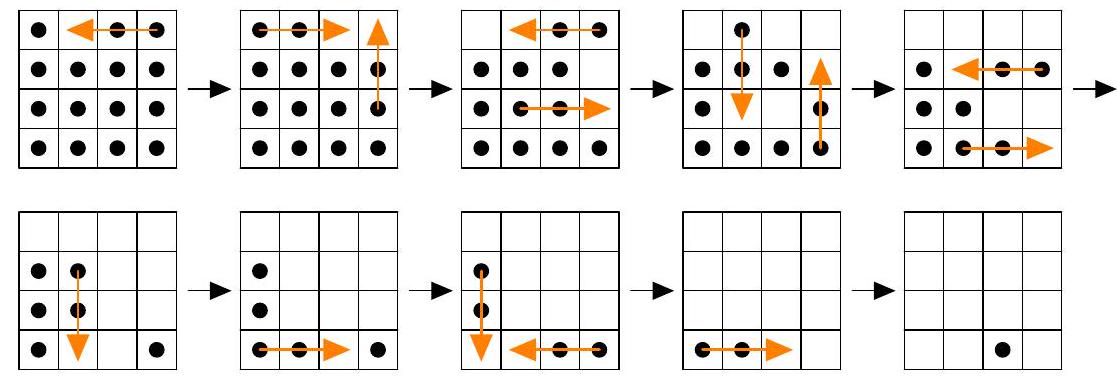
|
| 220 |
+
|
| 221 |
+
Problem 7. Each edge of a complete graph on 30 vertices is coloured either red or blue. It is allowed to choose a nonmonochromatic triangle and change the colour of the two edges of the same colour to make the triangle monochromatic. Prove that by using this operation repeatedly it is possible to make the entire graph monochromatic.
|
| 222 |
+
|
| 223 |
+
(A complete graph is a graph where any two vertices are connected by an edge.)
|
| 224 |
+
|
| 225 |
+
## Solution
|
| 226 |
+
|
| 227 |
+
The total number of edges is odd. Assume without loss of generality that the number of blue edges is odd, and the number of red edges is even. It is clear that the parity of the number of edges of each colour does not change by the operations.
|
| 228 |
+
|
| 229 |
+
Consider a graph with maximal number of blue edges that can be obtained by these operations. Suppose that not all of its edges are blue. Then it contains at least two red edges. Because of maximality, it is not possible to have a triangle with exactæy two red edges.
|
| 230 |
+
|
| 231 |
+
Case 1. It contains two red edges $A B$ and $B C$ sharing a common vertex. Then edge $A C$ is coloured in red, too. If there exists a vertex $D$ such that the edges $D A, D B, D C$ are not of the same colour, then wlog we can assume that $D A$ is red and $D B$ is blue, but then we have a triangle $A B D$ with exactly two red edges, a contradiction.
|
| 232 |
+
|
| 233 |
+
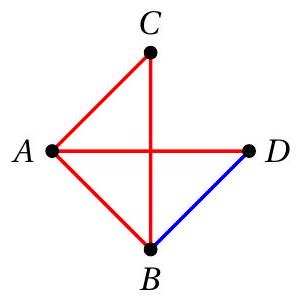
|
| 234 |
+
|
| 235 |
+
If some vertex $D$ is connected to $A, B$ and $C$ with blue edges, then perform the operation on the triangles $B C D, A B D$, $A C D$, and the number of blue edges increases, a contradiction.
|
| 236 |
+

|
| 237 |
+
|
| 238 |
+
Otherwise all the vertices are connected to $A, B$ and $C$ with red edges. Due to parity we have at least one blue edge. If $X$ and $Y$ are connected by a blue edge, then perform the operation on $A X Y$, and the number of blue edges increases, a contradiction.
|
| 239 |
+
|
| 240 |
+
Case 2. Every two red edges have no common vertex. Let $A B$ and $C D$ be red edges. Perform the operation in the triangles $A B D, B C D, A B D$. The number of blue edges increases.
|
| 241 |
+

|
| 242 |
+
|
| 243 |
+
Problem 8. A chess knight has injured his leg and is limping. He alternates between a normal move and a short move where he moves to any diagonally neighbouring cell.
|
| 244 |
+
|
| 245 |
+
|
| 246 |
+
|
| 247 |
+
Normal move
|
| 248 |
+
|
| 249 |
+
|
| 250 |
+
|
| 251 |
+
Short move
|
| 252 |
+
|
| 253 |
+
The limping knight moves on a $5 \times 6$ cell chessboard starting with a normal move. What is the largest number of moves he can make if he is starting from a cell of his own choice and is not allowed to visit any cell (including the initial cell) more than once?
|
| 254 |
+
|
| 255 |
+
## Solution
|
| 256 |
+
|
| 257 |
+
Answer: 25 moves.
|
| 258 |
+
|
| 259 |
+
Let us enumerate the rows of the chessboard with numbers 1 to 5 . We will consider only the short moves. Each short move connects two cells from rows of different parity and no two short moves has a common cell. Therefore there can be at most 12 short moves as there are just 12 cells in the rows of even parity (second and fourth). It means that the maximal number of moves is 12 short +13 normal $=25$ moves.
|
| 260 |
+
|
| 261 |
+
The figure shows that 25 moves indeed can be made.
|
| 262 |
+
|
| 263 |
+
| 19 | 5 | 7 | 9 | 11 | |
|
| 264 |
+
| :---: | :---: | :---: | :---: | :---: | :---: |
|
| 265 |
+
| 4 | 18 | 20 | 6 | 8 | 10 |
|
| 266 |
+
| | 2 | | 21 | 26 | 12 |
|
| 267 |
+
| 17 | 3 | 24 | 15 | 13 | 22 |
|
| 268 |
+
| 2 | 16 | 14 | 25 | 23 | |
|
| 269 |
+
|
| 270 |
+
Problem 9. A positive integer $n$ is Danish if a regular hexagon can be partitioned into $n$ congruent polygons. Prove that there are infinitely many positive integers $n$ such that both $n$ and $2^{n}+n$ are Danish.
|
| 271 |
+
|
| 272 |
+
## Solution
|
| 273 |
+
|
| 274 |
+
At first we note that $n=3 k$ is danish for any positive integer $k$, because a hexagon can be cut in 3 equal parallelograms each of which can afterwards be cut in $k$ equal parallelograms (Fig 1).
|
| 275 |
+
|
| 276 |
+
Furthermore a hexagon can be cut into two equal trapezoids (Fig. 2) each of which can afterwards be cut into 4 equal trapezoids of the same shape (Fig. 3) and so on. Therefore any number of the form $n=2 \cdot 4^{k}$ is also danish.
|
| 277 |
+
|
| 278 |
+
|
| 279 |
+
|
| 280 |
+
Figure 1
|
| 281 |
+
|
| 282 |
+
|
| 283 |
+
|
| 284 |
+
Figure 2
|
| 285 |
+
|
| 286 |
+
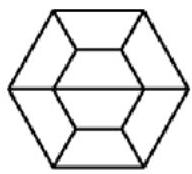
|
| 287 |
+
|
| 288 |
+
Figure 3
|
| 289 |
+
|
| 290 |
+
If we take any danish number $n=2 \cdot 4^{k}$ of the second type, then
|
| 291 |
+
|
| 292 |
+
$$
|
| 293 |
+
2^{n}+n=2^{2 \cdot 4^{k}}+2 \cdot 4^{k} \equiv 1+2 \equiv 0(\bmod 3)
|
| 294 |
+
$$
|
| 295 |
+
|
| 296 |
+
showing that $2^{n}+n$ is also a danish number.
|
| 297 |
+
|
| 298 |
+
Problem 10. Maker and Breaker are building a wall. Maker has a supply of green cubical building blocks, and Breaker has a supply of red ones, all of the same size. On the ground, a row of $m$ squares has been marked in chalk as place-holders. Maker and Breaker now take turns in placing a block either directly on one of these squares, or on top of another block already in place, in such a way that the height of each column never exceeds $n$. Maker places the first block.
|
| 299 |
+
|
| 300 |
+
Maker bets that he can form a green row, i.e. all $m$ blocks at a certain height are green. Breaker bets that he can prevent Maker from achieving this. Determine all pairs $(m, n)$ of positive integers for which Maker can make sure he wins the bet.
|
| 301 |
+
|
| 302 |
+
## Solution
|
| 303 |
+
|
| 304 |
+
Answer: Maker has a winning strategy if $m>1$ and $n>1$ are both odd, or if $m=1$.
|
| 305 |
+
|
| 306 |
+
Let us refer to the positions of the blocks in the wall by coordinates $(x, y)$ where $x \in\{0,1, \ldots, m-1\}$ refers to the column and $y \in\{0,1, \ldots, n-1\}$ to the height of the block. Consider the different cases according to the parity of the parameters. In addition, there are some exceptional trivial cases.
|
| 307 |
+
|
| 308 |
+
1) If $m=1$, then Maker trivially wins by the first move.
|
| 309 |
+
2) If $m>1$, but $n=1$, then Breaker obviously can break the only row.
|
| 310 |
+
3) Suppose $m$ is even. Then Breaker has a defensive strategy based on the horizontal reflection, i.e. if Maker places a block in $(x, y)$, then Breaker places a block in $(m-1-x, y)$. Note that this move is always available for Breaker, because $m$ is even. It is clear that this reflection strategy breaks all the green rows.
|
| 311 |
+
4) Suppose then $n$ is even but $m>1$ is odd. Then Breaker has the same defensive stra-tegy as above based on the horizontal reflection, with one modification: Whenever Maker places a block in the middle column, Breaker does too. Since $n$ is even, this middle column does not influence the rest of the construction. Hence this reflection strategy breaks all the green rows as above.
|
| 312 |
+
5) Suppose both $m$ and $n$ are odd, $m>1$ and $n>1$. Maker's strategy is the following: Maker starts with $(0,0)$. Maker pairs the positions $(2 i-1,0)$ and $(2 i, 0), i=1,2, \ldots, \frac{m-1}{2}$, so that if Breaker places a red block in one of the positions, Maker places a green block in the other position; otherwise Maker does not use the bottom row. Maker's reply to Breaker's $(x, y)$ with $y>0$ is $(x, y+1)$. This strategy builds a green row at the height 2 .
|
| 313 |
+
|
| 314 |
+
Problem 11. Let $H$ and $I$ be the orthocentre and incentre, respectively, of an acute angled triangle $A B C$. The circumcircle of the triangle $B C I$ intersects the segment $A B$ at the point $P$ different from $B$. Let $K$ be the projection of $H$ onto $A I$ and $Q$ the reflection of $P$ in $K$. Show that $B, H$ and $Q$ are collinear.
|
| 315 |
+
|
| 316 |
+
## Solution
|
| 317 |
+
|
| 318 |
+
Solution 1: Let $H^{\prime}$ be the reflection of $H$ in $K$. The reflection about the point $K$ sends $Q$ to $P$, and the line $B H$ to the line through $H^{\prime}$ and orthogonal to $A C$. The reflection about the line $A I$ sends $P$ to $C$, and the line through $H^{\prime}$ orthogonal to $A C$ to the line through $H$ orthogonal to $A B$, but this is just $B H$. Since composition of the two reflections sends $B, H$ and $Q$ to the same line, it follows that $B, H$ and $Q$ are collinear.
|
| 319 |
+
|
| 320 |
+
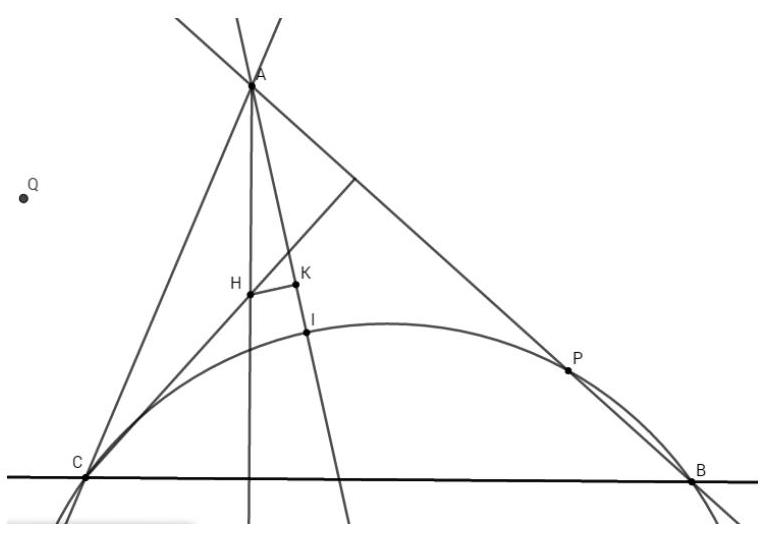
|
| 321 |
+
|
| 322 |
+
Solution 2: Let $\alpha=\frac{1}{2} \angle B A C, \beta=\frac{1}{2} \angle C B A$, and $\gamma=\frac{1}{2} \angle A C B$. Clearly then $\alpha+\beta+\gamma=90^{\circ}$, which yields $\angle B I C=180^{\circ}-\beta-\gamma=$ $90^{\circ}+\alpha$. From this we get $\angle C P A=180^{\circ}-\angle B P C=180^{\circ}-\angle B I C=90^{\circ}-\alpha$, so triangle $A P C$ is isosceles.
|
| 323 |
+
|
| 324 |
+
Now since $A I$ is the anglebisector of $\angle P A C$ it must also be the perpendicular bisector of $C P$. Hence $C K=P K=Q K$ so triangle $K C Q$ is isosceles. Additionally $A I$ bisects $P Q$ so $A I$ is the midline of triangle $P C Q$ parallel to $C Q$. Since $K H$ is perpendicular to $A I$, it is also perpendicular to $C Q$, so we may then conclude by symmetry that $H C Q$ is also isosceles. Moreover $\angle Q C A=\angle I A C=\alpha$, and $\angle A C H=90^{\circ}-2 \alpha$, so $\angle Q C H=\alpha+90^{\circ}-2 \alpha=90^{\circ}-\alpha$, which means that triangles $H C Q$ and $A P C$ are similar. In particular we have $\angle C H Q=2 \alpha$. Since also
|
| 325 |
+
|
| 326 |
+
$$
|
| 327 |
+
180^{\circ}-\angle B H C=\angle H C B+\angle C B H=90^{\circ}-2 \beta+90^{\circ}-2 \gamma=2 \alpha
|
| 328 |
+
$$
|
| 329 |
+
|
| 330 |
+
it follows that $B, H$, and $Q$ are collinear.
|
| 331 |
+
|
| 332 |
+
To prove that $Q$ always lies outside of triangle $A B C$ one could do the following: Since $P$ lies on $A B$, angle $C$ is larger than angle $B$ in triangle $A B C$. Thus angle $A D B$ is obtuse, where $D$ is the intersection point between $A I$ and $B C$. As $Q C$ and $A I$ are parallel, angle $Q C B$ is obtuse. Thus $Q$ lies outside of triangle $A B C$.
|
| 333 |
+
|
| 334 |
+
Problem 12. Line $\ell$ touches circle $S_{1}$ in the point $X$ and circle $S_{2}$ in the point $Y$. We draw a line $m$ which is parallel to $\ell$ and intersects $S_{1}$ in a point $P$ and $S_{2}$ in a point $Q$. Prove that the ratio $X P / Y Q$ does not depend on the choice of $m$.
|
| 335 |
+
|
| 336 |
+
## Solution
|
| 337 |
+
|
| 338 |
+
Let $T$ be the second intersection point of $P Q$ and $S_{1}$ and $R$ be the second intersection point of $P Q$ and $S_{2}$. Let $\angle P X T=\alpha$, $\angle R Y Q=\beta$. It is evident that $P X=X T, R Y=Y Q$. Calculate the ratio area ${ }_{P X T} /$ area $_{R Y Q}$ by two different ways. First,
|
| 339 |
+
|
| 340 |
+
$$
|
| 341 |
+
\frac{\operatorname{area}_{P X T}}{\operatorname{area}_{R Y Q}}=\frac{X P^{2} \sin \alpha}{Y Q^{2} \sin \beta}
|
| 342 |
+
$$
|
| 343 |
+
|
| 344 |
+
Second,
|
| 345 |
+
|
| 346 |
+
Equating these expressions we obtain
|
| 347 |
+
|
| 348 |
+
$$
|
| 349 |
+
\frac{\operatorname{area}_{P X T}}{\operatorname{area}_{R Y Q}}=\frac{P T}{R Q}=\frac{2 R_{1} \sin \alpha}{2 R_{2} \sin \beta}
|
| 350 |
+
$$
|
| 351 |
+
|
| 352 |
+
$$
|
| 353 |
+
\frac{X P}{Y Q}=\sqrt{\frac{R_{1}}{R_{2}}}
|
| 354 |
+
$$
|
| 355 |
+
|
| 356 |
+
Problem 13. Let $A B C$ be a triangle in which $\angle A B C=60^{\circ}$. Let $I$ and $O$ be the incentre and circumcentre of $A B C$, respectively. Let $M$ be the midpoint of the arc $B C$ of the circumcircle of $A B C$, which does not contain the point $A$. Determine $\angle B A C$ given that $M B=O I$.
|
| 357 |
+
|
| 358 |
+
## Solution
|
| 359 |
+
|
| 360 |
+
Since $\angle A B C=60^{\circ}$, we have $\angle A I C=\angle A O C=120^{\circ}$. Let $I^{\prime}, O^{\prime}$ be the points symmetric to $I, O$ with respect to $A C$, respectively. Then $I^{\prime}$ and $O^{\prime}$ lie on the circumcircle of $A B C$. Since $O^{\prime} I^{\prime}=O I=M B$, the angles determined by arcs $O^{\prime} I^{\prime}$ and $M B$ are equal. It follows that $\angle M A B=\angle I^{\prime} A O^{\prime}$.
|
| 361 |
+
|
| 362 |
+
Now, denoting $\angle B A C=\alpha$, we have
|
| 363 |
+
|
| 364 |
+
$$
|
| 365 |
+
\angle I^{\prime} A O^{\prime}=\angle I A O=|\angle I A C-\angle O A C|=\left|\frac{\alpha}{2}-30^{\circ}\right|
|
| 366 |
+
$$
|
| 367 |
+
|
| 368 |
+
It follows that $\frac{\alpha}{2}=\angle M A B=\angle I^{\prime} A O^{\prime}=\left|\frac{\alpha}{2}-30^{\circ}\right|$, i.e. $\alpha=30^{\circ}$.
|
| 369 |
+
|
| 370 |
+
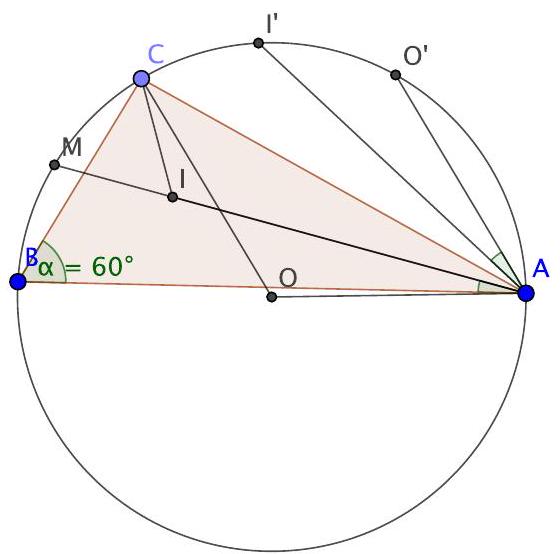
|
| 371 |
+
|
| 372 |
+
Problem 14. Let $P$ be a point inside the acute angle $\angle B A C$. Suppose that $\angle A B P=\angle A C P=90^{\circ}$. The points $D$ and $E$ are on the segments $B A$ and $C A$, respectively, such that $B D=B P$ and $C P=C E$. The points $F$ and $G$ are on the segments $A C$ and $A B$, respectively, such that $D F$ is perpendicular to $A B$ and $E G$ is perpendicular to $A C$. Show that $P F=P G$.
|
| 373 |
+
|
| 374 |
+
## Solution
|
| 375 |
+
|
| 376 |
+
As $\triangle P B D$ is an isosceles right triangle $\angle G D P=\angle B D P=45^{\circ}$. Similarly $\angle P E C=45^{\circ}$, and thus $\angle P E G=45^{\circ}$. Therefore $P G D E$ is cyclic. As $\angle G D F$ and $\angle G E F$ are right $E F G D$ is cyclic. Therefore $D G P F E$ is a cyclic pentagon. Therefore $\angle G F P=\angle G E P=45^{\circ}$. Similarly $\angle F G P=45^{\circ}$. Therefore $\triangle F P G$ is a (right) isosceles triangle.
|
| 377 |
+
|
| 378 |
+
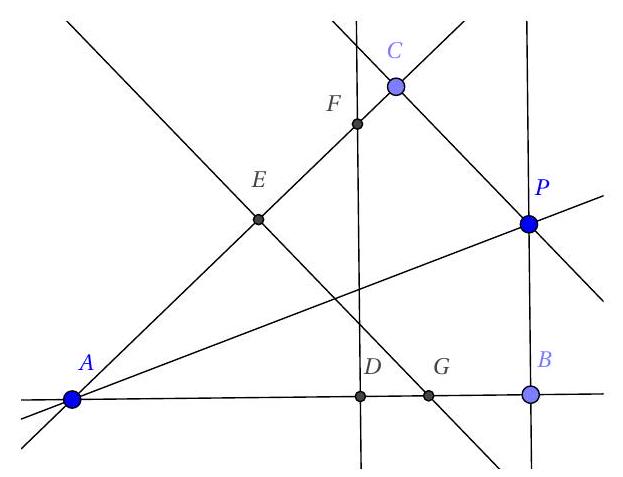
|
| 379 |
+
|
| 380 |
+
Remark: It can be shown given two intersecting lines $l$ and $m$, not perpendicular to one another and an point $P$. there exist unique points $F$ and $G$ on $l$ and $m$ respectively such that $\triangle F P G$ is an right isosceles triangle using similar constructions to above.
|
| 381 |
+
|
| 382 |
+
Problem 15. Let $n \geq 3$ be an integer. What is the largest possible number of interior angles greater than $180^{\circ}$ in an $n$-gon in the plane, given that the $n$-gon does not intersect itself and all its sides have the same length?
|
| 383 |
+
|
| 384 |
+
## Solution
|
| 385 |
+
|
| 386 |
+
Answer: 0 if $n=3,4$ and $n-3$ for $n \geq 5$.
|
| 387 |
+
|
| 388 |
+
If $n=3,4$ then any such $n$-gon is a triangle, resp. a rhombus, therefore the answer is 0 .
|
| 389 |
+
|
| 390 |
+
If $n=5$ then consider a triangle with side lengths 2,2,1. Now move the vertex between sides of length 2 towards the opposite side by 0.0000001 units. Consider the triangle as a closed physical chain of links of length 1 that are aluminium tubes and through them is a closed rubber string. So deform the chain on a level surface so that links of the chain move towards the inside of the triangle, by fixing the vertices of the triangle to the surface. Geometrically, the links which are on sides of length 2 are now distinct chords of a large circle, attached to each other by their endpoints.
|
| 391 |
+
|
| 392 |
+
If $n>5$ then first consider a triangle of integer sides lengths, with sides of as equal lengths as possible, so that the sum of side lengths is $n$. Imagine a closed aluminium chain on a rubber string, as in the previous case. Now move two of the vertices of the triangle towards the third one be 0.00000001 units each. Again consider the chain on a level surface and deform it so that its links move towards the interior of the triangle. Geometrically each side of a triangle is deformed into consecutive equal-length chords of a large circle with centre far away from the original triangle.
|
| 393 |
+
|
| 394 |
+
For $n \geq 5$ this gives an example of $n-3$ interior angles of more than $180^{\circ}$.
|
| 395 |
+
|
| 396 |
+
To see that $n-2$ or more such angles is not possible, note than the sum of interior angles of any $n$-gon (that does not cut itself) is equal to $(n-2) 180^{\circ}$, but already the sum of the 'large' angles would be greater than that if there were at least $n-2$ of 'large' angles of size greater than $180^{\circ}$.
|
| 397 |
+
|
| 398 |
+
Problem 16. Is it possible for any group of people to choose a positive integer $N$ and assign a positive integer to each person in the group such that the product of two persons' numbers is divisible by $N$ if and only if they are friends?
|
| 399 |
+
|
| 400 |
+
## Solution
|
| 401 |
+
|
| 402 |
+
Answer: Yes, this is always possible.
|
| 403 |
+
|
| 404 |
+
Consider a graph with a vertex for each person in the group. For each pair of friends we join the corresponding vertices by a red edge. If a pair are not friends, we join their vertices with a blue edge.
|
| 405 |
+
|
| 406 |
+
Let us label blue edges with different primes $p_{1}, \ldots, p_{k}$. To a vertex $A$ we assign the number $n(A)=\frac{P^{2}}{P(A)}$, where $P=$ $p_{1} p_{2} \ldots p_{k}$, and $P(A)$ is the product of the primes on all blue edges starting from $A$ (for the empty set the product of all its elements equals 1). Now take $N=P^{3}$.
|
| 407 |
+
|
| 408 |
+
Let us check that all conditions are satisfied. If vertices $A$ and $B$ are connected by a red edge, then $P(A)$ and $P(B)$ are coprime, hence $P(A) P(B) \mid P$ and $P^{3} \left\lvert\, n(A) n(B)=\frac{P^{4}}{P(A) P(B)}\right.$. If vertices $A$ and $B$ are connected by a blue edge labelled with a prime $q$, then $q^{2}$ divides neither $n(A)$ nor $n(B)$. Hence $q^{3}$ does not divide $n(A) n(B)$.
|
| 409 |
+
|
| 410 |
+
Problem 17. Determine whether the equation
|
| 411 |
+
|
| 412 |
+
$$
|
| 413 |
+
x^{4}+y^{3}=z !+7
|
| 414 |
+
$$
|
| 415 |
+
|
| 416 |
+
has an infinite number of solutions in positive integers.
|
| 417 |
+
|
| 418 |
+
## Solution
|
| 419 |
+
|
| 420 |
+
We consider the equation modulo 13 since both 3 and 4 divides $12=13-1$. Now $x^{4} \bmod 13 \in\{0,1,3,9\}$ and $y^{3} \bmod 13 \in$ $\{0,1,5,8,12\}$. We can verify that $x^{4}+y^{3} \not \equiv 7 \bmod 13$. However $z !+7 \equiv 7 \bmod 13$ if $z \geq 13$, what leads to a conclusion that this equation has no solutions with $z \geq 13$, what proves that it has finite number of solutions.
|
| 421 |
+
|
| 422 |
+
Problem 18. Let $p>3$ be a prime and let $a_{1}, a_{2}, \ldots, a_{\frac{p-1}{2}}$ be a permutation of $1,2, \ldots, \frac{p-1}{2}$. For which $p$ is it always possible to determine the sequence $a_{1}, a_{2}, \ldots, a_{\frac{p-1}{2}}$ if for all $i, j \in\left\{1,2, \ldots, \frac{p-1}{2}\right\}$ with $i \neq j$ the residue of $a_{i} a_{j}$ modulo $p$ is known?
|
| 423 |
+
|
| 424 |
+
## Solution
|
| 425 |
+
|
| 426 |
+
Answer: For all primes $p>5$.
|
| 427 |
+
|
| 428 |
+
When $p=5$ it is clear that it is not possible to determine $a_{1}$ and $a_{2}$ from the residue of $a_{1} a_{2}$ modulo 5 .
|
| 429 |
+
|
| 430 |
+
Assume that $p>5$. Now $\frac{p-1}{2} \geq 3$. For all $i \in\left\{1,2, \ldots, \frac{p-1}{2}\right\}$ it is possible to choose $j, k \in\left\{1,2, \ldots, \frac{p-1}{2}\right\}$ such that $i, j$ and $k$ are different. Thus we know
|
| 431 |
+
|
| 432 |
+
$$
|
| 433 |
+
a_{i}^{2} \equiv\left(a_{i} a_{j}\right)\left(a_{i} a_{k}\right)\left(a_{j} a_{k}\right)^{-1}(\bmod p) .
|
| 434 |
+
$$
|
| 435 |
+
|
| 436 |
+
The equation $x^{2} \equiv a(\bmod p)$ has exactly one solution in $\left\{1,2, \ldots, \frac{p-1}{2}\right\}$, and hence it is possible to determine $a_{i}$ for all $i$.
|
| 437 |
+
|
| 438 |
+
Problem 19. For an integer $n \geq 1$ let $a(n)$ denote the total number of carries which arise when adding 2017 and $n \cdot 2017$. The first few values are given by $a(1)=1, a(2)=1, a(3)=0$, which can be seen from the following:
|
| 439 |
+
|
| 440 |
+
| 001 | 001 | 000 |
|
| 441 |
+
| :---: | :---: | :---: |
|
| 442 |
+
| 2017 | 4034 | 6051 |
|
| 443 |
+
| +2017 | +2017 | +2017 |
|
| 444 |
+
| $=4034$ | $=6051$ | $=8068$ |
|
| 445 |
+
|
| 446 |
+
Prove that
|
| 447 |
+
|
| 448 |
+
$$
|
| 449 |
+
a(1)+a(2)+\ldots+a\left(10^{2017}-2\right)+a\left(10^{2017}-1\right)=10 \cdot \frac{10^{2017}-1}{9}
|
| 450 |
+
$$
|
| 451 |
+
|
| 452 |
+
## Solution
|
| 453 |
+
|
| 454 |
+
Solution 1: Let $k(m)$ be the residue of $m$ when divided by $10^{k}$. There is a carry at the digit representing $10^{k}$ exactly when $k(2017)+k(n \cdot 2017)>10^{k}$. Thus the number of 10-, 100-, 1000- and 10000-carries are, respectively,
|
| 455 |
+
|
| 456 |
+
$$
|
| 457 |
+
\left\lfloor\frac{7 \cdot 10^{2017}}{10}\right\rfloor,\left\lfloor\frac{17 \cdot 10^{2017}}{100}\right\rfloor,\left\lfloor\frac{17 \cdot 10^{2017}}{1000}\right\rfloor,\left\lfloor\frac{2017 \cdot 10^{2017}}{10000}\right\rfloor
|
| 458 |
+
$$
|
| 459 |
+
|
| 460 |
+
and similarly for the rest of the carries. Thus
|
| 461 |
+
|
| 462 |
+
$$
|
| 463 |
+
\begin{aligned}
|
| 464 |
+
\sum_{n=1}^{10^{2017}-1} a(n) & =7 \cdot 10^{2016}+17 \cdot 10^{2015}+\ldots+2017+201+20+2 \\
|
| 465 |
+
& =(2+0+1+7) \cdot 10^{2016}+(2+0+1+7) \cdot 10^{2015}+\ldots+(2+0+1+7)=10 \cdot \frac{10^{2017}-1}{9}
|
| 466 |
+
\end{aligned}
|
| 467 |
+
$$
|
| 468 |
+
|
| 469 |
+
Solution 2: Let $s(n)$ denote the digit sum of $n$. Then we claim the following.
|
| 470 |
+
|
| 471 |
+
Lemma. We have
|
| 472 |
+
|
| 473 |
+
$$
|
| 474 |
+
s(n+m)=s(n)+s(m)-9 a(n, m)
|
| 475 |
+
$$
|
| 476 |
+
|
| 477 |
+
where $a(n, m)$ denotes the total number of carries, which arises when adding $n$ and $m$.
|
| 478 |
+
|
| 479 |
+
Proof: We proceed by induction on the maximal number of digits $k$ of $n$ and $m$.
|
| 480 |
+
|
| 481 |
+
If both $n$ and $m$ are single digit numbers then we have just two cases. If $n+m<10$, then we have no carries and clearly $s(n+m)=n+m=s(n)+s(m)$. If on the other hand $n+m=10+k \geq 10$, then
|
| 482 |
+
|
| 483 |
+
$$
|
| 484 |
+
s(n+m)=1+k=1+(n+m-10)=s(n)+s(m)-9
|
| 485 |
+
$$
|
| 486 |
+
|
| 487 |
+
Assume that the claim holds for all pair with at most $k$ digits each. Let $n=n_{1}+a \cdot 10^{k+1}$ and $m=m_{1}+b \cdot 10^{k+1}$ where $n_{1}$ og $m_{1}$ are at most $k$ digit numbers. If there is no carry at the $k+1$ th digit, then $a(n, m)=a\left(n_{1}, m_{1}\right)$ and thus
|
| 488 |
+
|
| 489 |
+
$$
|
| 490 |
+
\begin{gathered}
|
| 491 |
+
s(n+m)=s\left(n_{1}+m_{1}\right)+a+b \\
|
| 492 |
+
=s\left(n_{1}\right)+a+s\left(m_{1}\right)+b-9 a\left(n_{1}, m_{1}\right)=s(n)+s(m)-9 a(n, m)
|
| 493 |
+
\end{gathered}
|
| 494 |
+
$$
|
| 495 |
+
|
| 496 |
+
If there is a carry then $a(n, m)=1+a\left(n_{1}, m_{1}\right)$ and thus
|
| 497 |
+
|
| 498 |
+
$$
|
| 499 |
+
s(n+m)=s\left(n_{1}+m_{1}\right)+a+b-9
|
| 500 |
+
$$
|
| 501 |
+
|
| 502 |
+
$$
|
| 503 |
+
=s\left(n_{1}\right)+a+s\left(m_{1}\right)+b-9\left(a\left(n_{1}, m_{1}\right)+1\right)=s(n)+s(m)-9 a(n, m)
|
| 504 |
+
$$
|
| 505 |
+
|
| 506 |
+
This finishes the induction and we are done.
|
| 507 |
+
|
| 508 |
+
Now observe that $s\left(2017 \cdot 10^{2017}\right)=2+1+7=10$. We now use (1) a total of $10^{2017}-1$ times which yields
|
| 509 |
+
|
| 510 |
+
$$
|
| 511 |
+
\begin{aligned}
|
| 512 |
+
10 & =s\left(2017 \cdot 10^{2017}\right)=s\left(2017 \cdot\left(10^{2017}-1\right)+2017\right) \\
|
| 513 |
+
& =s\left(2017 \cdot\left(10^{2017}-1\right)\right)+s(2017)-9 \cdot a\left(10^{2017}-1\right) \\
|
| 514 |
+
& \vdots \\
|
| 515 |
+
& =s(2017)+s(2017) \cdot\left(10^{2017}-1\right)-9 \cdot \sum_{n=1}^{10^{2017}-1} a(n) \\
|
| 516 |
+
& =10 \cdot 10^{2017}-9 \cdot \sum_{n=1}^{10^{2017}-1} a(n)
|
| 517 |
+
\end{aligned}
|
| 518 |
+
$$
|
| 519 |
+
|
| 520 |
+
Thus we arrive at
|
| 521 |
+
|
| 522 |
+
$$
|
| 523 |
+
\sum_{n=1}^{10^{2017}-1} a(n)=10 \cdot \frac{10^{2017}-1}{9}
|
| 524 |
+
$$
|
| 525 |
+
|
| 526 |
+
Problem 20. Let $S$ be the set of all ordered pairs $(a, b)$ of integers with $0<2 a<2 b<2017$ such that $a^{2}+b^{2}$ is a multiple of 2017. Prove that
|
| 527 |
+
|
| 528 |
+
$$
|
| 529 |
+
\sum_{(a, b) \in S} a=\frac{1}{2} \sum_{(a, b) \in S} b
|
| 530 |
+
$$
|
| 531 |
+
|
| 532 |
+
## Solution
|
| 533 |
+
|
| 534 |
+
Let $A=\{a:(a, b) \in S\}$ and $B=\{b:(a, b) \in S\}$. The claim is equivalent to
|
| 535 |
+
|
| 536 |
+
$$
|
| 537 |
+
2 \sum_{a \in A} a=\sum_{b \in B} b
|
| 538 |
+
$$
|
| 539 |
+
|
| 540 |
+
Assume that for some $x, y, z \in\{1,2, \ldots, 1008\}$ both, $x^{2}+y^{2}$ and $x^{2}+z^{2}$, are multiples of 2017. By
|
| 541 |
+
|
| 542 |
+
$$
|
| 543 |
+
\left(x^{2}+y^{2}\right)-\left(x^{2}+z^{2}\right)=y^{2}-z^{2}=(y+z)(y-z) \equiv 0(\bmod 2017),
|
| 544 |
+
$$
|
| 545 |
+
|
| 546 |
+
$0<y+z<2017$ and the fact that 2017 is a prime number, it follows that $y=z$. Hence, $A$ and $B$ are disjoint, and there is a bijection $f: A \mapsto B$ such that for any $a \in A$ and $b \in B$ the pair $(a, b)$ is in $S$ if and only if $b=f(a)$.
|
| 547 |
+
|
| 548 |
+
We show that the mapping $g$ defined by $g(a)=f(a)-a$ for $a \in A$ is a bijection from $A$ to $A$. Then (2) follows by
|
| 549 |
+
|
| 550 |
+
$$
|
| 551 |
+
\sum_{a \in A} a=\sum_{a \in A} g(a)=\sum_{a \in A} f(a)-\sum_{a \in A} a=\sum_{b \in B} b-\sum_{a \in A} a
|
| 552 |
+
$$
|
| 553 |
+
|
| 554 |
+
Let $a \in A$, and let $h(a)=\min \{a+f(a), 2017-(a+f(a))\}$. Then $0<2 h(a)<2017$ and, by the definition of $g, 0<2 g(a)<$ 2017. Furthermore,
|
| 555 |
+
|
| 556 |
+
$$
|
| 557 |
+
g(a)^{2}+h(a)^{2} \equiv(a-f(a))^{2}+(a+f(a))^{2} \equiv 2\left(a^{2}+f(a)^{2}\right) \equiv 0(\bmod 2017) .
|
| 558 |
+
$$
|
| 559 |
+
|
| 560 |
+
If $a+f(a) \leq 1008$, then $g(a)=f(a)-a<f(a)+a=h(a)$. If $a+f(a)>1008$, then $g(a)=f(a)-a<(f(a)-a)+(2017-2 f(a))=$ $2017-(a+f(a))=h(a)$. Consequently, $g(a) \in A$ with $f(g(a))=h(a)$.
|
| 561 |
+
|
| 562 |
+
It remains to show that $g$ is injective. Assume that $g\left(a_{1}\right)=g\left(a_{2}\right)$ for some $a_{1}, a_{2} \in A$, i.e.,
|
| 563 |
+
|
| 564 |
+
$$
|
| 565 |
+
b_{1}-a_{1}=b_{2}-a_{2},
|
| 566 |
+
$$
|
| 567 |
+
|
| 568 |
+
where $b_{i}=f\left(a_{i}\right)$ for $i=1,2$. Clearly, we also have $h\left(a_{1}\right)=h\left(a_{2}\right)$ then. If $h\left(a_{1}\right)=a_{1}+b_{1}$ and $h\left(a_{2}\right)=a_{2}+b_{2}$, then subtracting (3) from $a_{1}+b_{1}=a_{2}+b_{2}$ gives $a_{1}=a_{2}$. Similarly, if $h_{1}\left(a_{1}\right)=2017-\left(a_{1}+b_{1}\right)$ and $h_{2}=2017-\left(a_{2}+b_{2}\right)$, then we obtain $a_{1}=a_{2}$. Finally, if $h\left(a_{1}\right)=a_{1}+b_{1}$ and $h_{2}=2017-\left(a_{2}+b_{2}\right)$, then $2\left(a_{1}+b_{2}\right)=2017$, a contradiction.
|
| 569 |
+
|
| 570 |
+
Remark: The proof as given above obviously works for any prime congruent to 1 modulo 4 in the place of 2017. With a little more effort, one can show that the statement is true for any positive odd $n$ (vacuously, if $n$ has a prime factor congruent to 3 modulo 4).
|
| 571 |
+
|
BalticWay/md/en-bw18sol.md
ADDED
|
@@ -0,0 +1,441 @@
|
|
|
|
|
|
|
|
|
|
|
|
|
|
|
|
|
|
|
|
|
|
|
|
|
|
|
|
|
|
|
|
|
|
|
|
|
|
|
|
|
|
|
|
|
|
|
|
|
|
|
|
|
|
|
|
|
|
|
|
|
|
|
|
|
|
|
|
|
|
|
|
|
|
|
|
|
|
|
|
|
|
|
|
|
|
|
|
|
|
|
|
|
|
|
|
|
|
|
|
|
|
|
|
|
|
|
|
|
|
|
|
|
|
|
|
|
|
|
|
|
|
|
|
|
|
|
|
|
|
|
|
|
|
|
|
|
|
|
|
|
|
|
|
|
|
|
|
|
|
|
|
|
|
|
|
|
|
|
|
|
|
|
|
|
|
|
|
|
|
|
|
|
|
|
|
|
|
|
|
|
|
|
|
|
|
|
|
|
|
|
|
|
|
|
|
|
|
|
|
|
|
|
|
|
|
|
|
|
|
|
|
|
|
|
|
|
|
|
|
|
|
|
|
|
|
|
|
|
|
|
|
|
|
|
|
|
|
|
|
|
|
|
|
|
|
|
|
|
|
|
|
|
|
|
|
|
|
|
|
|
|
|
|
|
|
|
|
|
|
|
|
|
|
|
|
|
|
|
|
|
|
|
|
|
|
|
|
|
|
|
|
|
|
|
|
|
|
|
|
|
|
|
|
|
|
|
|
|
|
|
|
|
|
|
|
|
|
|
|
|
|
|
|
|
|
|
|
|
|
|
|
|
|
|
|
|
|
|
|
|
|
|
|
|
|
|
|
|
|
|
|
|
|
|
|
|
|
|
|
|
|
|
|
|
|
|
|
|
|
|
|
|
|
|
|
|
|
|
|
|
|
|
|
|
|
|
|
|
|
|
|
|
|
|
|
|
|
|
|
|
|
|
|
|
|
|
|
|
|
|
|
|
|
|
|
|
|
|
|
|
|
|
|
|
|
|
|
|
|
|
|
|
|
|
|
|
|
|
|
|
|
|
|
|
|
|
|
|
|
|
|
|
|
|
|
|
|
|
|
|
|
|
|
|
|
|
|
|
|
|
|
|
|
|
|
|
|
|
|
|
|
|
|
|
|
|
|
|
|
|
|
|
|
|
|
|
|
|
|
|
|
|
|
|
|
|
|
|
|
|
|
|
|
|
|
|
|
|
|
|
|
|
|
|
|
|
|
|
|
|
|
|
|
|
|
|
|
|
|
|
|
|
|
|
|
|
|
|
|
|
|
|
|
|
|
|
|
|
|
|
|
|
|
|
|
|
|
|
|
|
|
|
|
|
|
|
|
|
|
|
|
|
|
|
|
|
|
|
|
|
|
|
|
|
|
|
|
|
|
|
|
|
|
|
|
|
|
|
|
|
|
|
|
|
|
|
|
|
|
|
|
|
|
|
|
|
|
|
|
|
|
|
|
|
|
|
|
|
|
|
|
|
|
|
|
|
|
|
|
|
|
|
|
|
|
|
|
|
|
|
|
|
|
|
|
|
|
|
|
|
|
|
|
|
|
|
|
|
|
|
|
|
|
|
|
|
|
|
|
|
|
|
|
|
|
|
|
|
|
|
|
|
|
|
|
|
|
|
|
|
|
|
|
|
|
|
|
|
|
|
|
|
|
|
|
|
|
|
|
|
|
|
|
|
|
|
|
|
|
|
|
|
|
|
|
|
|
|
|
|
|
|
|
|
|
|
|
|
|
|
|
|
|
|
|
|
|
|
|
|
|
|
|
|
|
|
|
|
|
|
|
|
|
|
|
|
|
|
|
|
|
|
|
|
|
|
|
|
|
|
|
|
|
|
|
|
|
|
|
|
|
|
|
|
|
|
|
|
|
|
|
|
|
|
|
|
|
|
|
|
|
|
|
|
|
|
|
|
|
|
|
|
|
|
|
|
|
|
|
|
|
|
|
|
|
|
|
|
|
|
|
|
|
|
|
|
|
|
|
|
|
|
|
|
|
|
|
|
|
|
|
|
|
|
|
|
|
|
|
|
|
|
|
|
|
|
|
|
|
|
|
|
|
|
|
|
|
|
|
|
|
|
|
|
|
|
|
|
|
|
|
|
|
|
|
|
|
|
|
|
|
|
|
|
|
|
|
|
|
|
|
|
|
|
|
|
|
|
|
|
|
|
|
|
|
|
|
|
|
|
|
|
|
|
|
|
|
|
|
|
|
|
|
|
|
|
|
|
|
|
|
|
|
|
|
|
|
|
|
|
|
|
|
|
|
|
|
|
|
|
|
|
|
|
|
|
|
|
|
|
|
|
|
|
|
|
|
|
|
|
|
|
|
|
|
|
|
|
|
|
|
|
|
|
|
|
|
|
|
|
|
|
|
|
|
|
|
|
|
|
|
|
|
|
|
|
|
|
|
|
|
|
|
|
|
|
|
|
|
|
|
|
|
|
|
|
|
|
|
|
|
|
|
|
|
|
|
|
|
|
|
|
|
|
|
|
|
|
|
|
|
|
|
|
|
|
|
|
|
|
|
|
|
|
|
|
|
|
|
|
|
|
|
|
|
|
|
|
|
|
|
|
|
|
|
|
|
|
|
|
|
|
|
|
|
|
|
|
|
|
|
|
|
|
|
|
|
|
|
|
|
|
|
|
|
|
|
|
|
|
|
|
|
|
|
|
|
|
|
|
|
|
|
|
|
|
|
|
|
|
|
|
|
|
|
|
|
|
|
|
|
|
|
|
|
|
|
|
|
|
|
|
|
|
|
|
|
|
|
|
|
|
|
|
|
|
|
|
|
|
|
|
|
|
|
|
|
|
|
|
|
|
|
|
|
|
|
|
|
|
|
|
|
|
|
|
|
|
|
|
|
|
|
|
|
|
|
|
|
|
|
|
|
|
|
|
|
|
|
|
|
|
|
|
|
|
|
|
|
|
|
|
|
|
|
|
|
|
|
|
|
|
|
|
|
|
|
|
|
|
|
|
|
|
|
|
|
|
|
|
|
|
|
|
|
|
| 1 |
+
# 1 Algebra
|
| 2 |
+
|
| 3 |
+
1. A finite collection of positive real numbers (not necessarily distinct) is balanced if each number is less than the sum of the others. Find all $m \geq 3$ such that every balanced finite collection of $m$ numbers can be split into three parts with the property that the sum of the numbers in each part is less than the sum of the numbers in the two other parts.
|
| 4 |
+
|
| 5 |
+
## Solution.
|
| 6 |
+
|
| 7 |
+
Answer: The partition is always possible precisely when $m \neq 4$.
|
| 8 |
+
|
| 9 |
+
For $m=3$ it is trivially possible, and for $m=4$ the four equal numbers $g, g, g, g$ provide a counter-example. Henceforth, we assume $m \geq 5$.
|
| 10 |
+
|
| 11 |
+
Among all possible partitions $A \sqcup B \sqcup C=\{1, \ldots, m\}$ such that
|
| 12 |
+
|
| 13 |
+
$$
|
| 14 |
+
S_{A} \leq S_{B} \leq S_{C},
|
| 15 |
+
$$
|
| 16 |
+
|
| 17 |
+
select one for which the difference $S_{C}-S_{A}$ is minimal. If there are several such, select one so as to maximise the number of elements in $C$. We will show that $S_{C}<S_{A}+S_{B}$, which is clearly sufficient.
|
| 18 |
+
|
| 19 |
+
If $C$ consists of a single element, this number is by assumption less than the sum of the remaining ones, hence $S_{C}<S_{A}+S_{B}$ holds true.
|
| 20 |
+
|
| 21 |
+
Suppose now $C$ contains at least two elements, and let $g_{c}$ be a minimal number indexed by a $c \in C$. We have the inequality
|
| 22 |
+
|
| 23 |
+
$$
|
| 24 |
+
S_{C}-S_{A} \leq g_{c} \leq \frac{1}{2} S_{C}
|
| 25 |
+
$$
|
| 26 |
+
|
| 27 |
+
The first is by the minimality of $S_{C}-S_{A}$, the second by the minimality of $g_{c}$. These two inequalities together yield
|
| 28 |
+
|
| 29 |
+
$$
|
| 30 |
+
S_{A}+S_{B} \geq 2 S_{A} \geq 2\left(S_{C}-g_{c}\right) \geq S_{C}
|
| 31 |
+
$$
|
| 32 |
+
|
| 33 |
+
If either of these inequalities is strict, we are finished.
|
| 34 |
+
|
| 35 |
+
Hence suppose all inequalities are in fact equalities, so that
|
| 36 |
+
|
| 37 |
+
$$
|
| 38 |
+
S_{A}=S_{B}=\frac{1}{2} S_{C}=g_{c}
|
| 39 |
+
$$
|
| 40 |
+
|
| 41 |
+
It follows that $C=\{c, d\}$, where $g_{d}=g_{c}$. If $A$ contained more than one element, we could increase the number of elements in $C$ by creating instead a partition
|
| 42 |
+
|
| 43 |
+
$$
|
| 44 |
+
\{1, \ldots, m\}=\{c\} \sqcup B \sqcup(A \cup\{d\}),
|
| 45 |
+
$$
|
| 46 |
+
|
| 47 |
+
resulting in the same sums. A similar procedure applies to $B$. Consequently, $A$ and $B$ must be singleton sets, whence
|
| 48 |
+
|
| 49 |
+
$$
|
| 50 |
+
m=|A|+|B|+|C|=4 \text {. }
|
| 51 |
+
$$
|
| 52 |
+
|
| 53 |
+
2. A $100 \times 100$ table is given. For each $k, 1 \leq k \leq 100$, the $k$-th row of the table contains the numbers $1,2, \ldots, k$ in increasing order (from left to right) but not necessarily in consecutive cells; the remaining $100-k$ cells are filled with zeroes. Prove that there exist two columns such that the sum of the numbers in one of the columns is at least 19 times as large as the sum of the numbers in the other column.
|
| 54 |
+
|
| 55 |
+
## Solution.
|
| 56 |
+
|
| 57 |
+
Observe that the sum of numbers in the first column is at most $1 \cdot 100=100$, the sum in the first and second columns is at most $1 \cdot 100+2 \cdot 99$, the sum in the first, second and third columns is at most $1 \cdot 100+2 \cdot 99+3 \cdot 98$, etc. But the sum of all nonzero numbers equals $\sum_{i=1}^{100} i(101-i)$, therefore the sum in the columns from $31^{\text {th }}$ to $100^{\text {th }}$ is at least
|
| 58 |
+
|
| 59 |
+
$$
|
| 60 |
+
\sum_{i=31}^{100} i(101-i)=\sum_{i=1}^{70} i(101-i)=101 \sum_{i=1}^{70} i-\sum_{i=1}^{70} i^{2}=35 \cdot 71(101-141 / 3)=70 \cdot 27 \cdot 71 .
|
| 61 |
+
$$
|
| 62 |
+
|
| 63 |
+
Therefore one of these columns has a sum at least $27 \cdot 71=1917$. Therefore the ratio of sums in this column and in the first one is more that 19.
|
| 64 |
+
|
| 65 |
+
3. Let $a, b, c, d$ be positive real numbers such that $a b c d=1$. Prove the inequality
|
| 66 |
+
|
| 67 |
+
$$
|
| 68 |
+
\frac{1}{\sqrt{a+2 b+3 c+10}}+\frac{1}{\sqrt{b+2 c+3 d+10}}+\frac{1}{\sqrt{c+2 d+3 a+10}}+\frac{1}{\sqrt{d+2 a+3 b+10}} \leq 1 .
|
| 69 |
+
$$
|
| 70 |
+
|
| 71 |
+
Solution.
|
| 72 |
+
|
| 73 |
+
Let $x, y, z, t$ be positive numbers such that $a=x^{4}, b=y^{4}, c=z^{4}, d=t^{4}$.
|
| 74 |
+
|
| 75 |
+
By AM-GM ineguality $x^{4}+y^{4}+z^{4}+1 \geq 4 x y z, y^{4}+z^{4}+1+1 \geq 4 y z$ and $z^{4}+1+1+1 \geq 4 z$. Therefore we have the following estimation for the first fraction
|
| 76 |
+
|
| 77 |
+
$$
|
| 78 |
+
\frac{1}{\sqrt{x^{4}+2 y^{4}+3 z^{4}+10}} \leq \frac{1}{\sqrt{4 x y z+4 y z+4 z+4}}=\frac{1}{2 \sqrt{x y z+y z+z+1}} .
|
| 79 |
+
$$
|
| 80 |
+
|
| 81 |
+
Transform analogous estimations for the other fractions:
|
| 82 |
+
|
| 83 |
+
$$
|
| 84 |
+
\begin{aligned}
|
| 85 |
+
& \frac{1}{\sqrt{b+2 c+3 d+10}} \leq \frac{1}{2 \sqrt{y z t+z t+t+1}}=\frac{1}{2 \sqrt{t} \sqrt{y z+z+1+x y z}}=\frac{\sqrt{x y z}}{2 \sqrt{x y z+y z+z+1}} \\
|
| 86 |
+
& \frac{1}{\sqrt{c+2 d+3 a+10}} \leq \frac{1}{2 \sqrt{z t x+t x+x+1}}=\frac{\sqrt{y z}}{2 \sqrt{t x} \sqrt{z+1+x y z+y z}}=\frac{1}{2 \sqrt{x y z+y z+z+1}} \\
|
| 87 |
+
& \frac{1}{\sqrt{d+2 a+3 b+10}} \leq \frac{1}{2 \sqrt{t x y+x y+y+1}}=\frac{\sqrt{z}}{2 \sqrt{t x y} \sqrt{1+x y z+y z+z}}=\frac{1}{2 \sqrt{x y z+y z+z+1}}
|
| 88 |
+
\end{aligned}
|
| 89 |
+
$$
|
| 90 |
+
|
| 91 |
+
Thus, the sum does not exceed
|
| 92 |
+
|
| 93 |
+
$$
|
| 94 |
+
\frac{1+\sqrt{x y z}+\sqrt{y z}+\sqrt{z}}{2 \sqrt{x y z+y z+z+1}} .
|
| 95 |
+
$$
|
| 96 |
+
|
| 97 |
+
It remains to apply inequality $\sqrt{\alpha}+\sqrt{\beta}+\sqrt{\gamma}+\sqrt{\delta} \leq 2 \sqrt{\alpha+\beta+\gamma+\delta}$, which can be easily proven by taking squares or derived from inequality between arithmetical and quadratic means.
|
| 98 |
+
|
| 99 |
+
4. Find all functions $f:[0,+\infty) \rightarrow[0,+\infty)$, such that for any positive integer $n$ and for any non-negative real numbers $x_{1}, \ldots, x_{n}$
|
| 100 |
+
|
| 101 |
+
$$
|
| 102 |
+
f\left(x_{1}^{2}+\cdots+x_{n}^{2}\right)=f\left(x_{1}\right)^{2}+\cdots+f\left(x_{n}\right)^{2} .
|
| 103 |
+
$$
|
| 104 |
+
|
| 105 |
+
## Solution.
|
| 106 |
+
|
| 107 |
+
Answer: the functions $f(x)=0$ and $f(x)=x$.
|
| 108 |
+
|
| 109 |
+
A first observation is that
|
| 110 |
+
|
| 111 |
+
$$
|
| 112 |
+
f(1)=f\left(1^{2}\right)=f(1)^{2}
|
| 113 |
+
$$
|
| 114 |
+
|
| 115 |
+
so that $f(1)$ is either 0 or 1 .
|
| 116 |
+
|
| 117 |
+
Assume first that $f(1)=0$. For each positive integer $n$, we find
|
| 118 |
+
|
| 119 |
+
$$
|
| 120 |
+
f(n)=f\left(n \cdot 1^{2}\right)=n f(1)^{2}=0 .
|
| 121 |
+
$$
|
| 122 |
+
|
| 123 |
+
Given an arbitrary $x$, find $y$ so that $x^{2}+y^{2}$ becomes a positive integer $n$. Then
|
| 124 |
+
|
| 125 |
+
$$
|
| 126 |
+
f(x)^{2}+f(y)^{2}=f\left(x^{2}+y^{2}\right)=f(n)=0 .
|
| 127 |
+
$$
|
| 128 |
+
|
| 129 |
+
Consequently, $f(x)=0$ for all $x$.
|
| 130 |
+
|
| 131 |
+
Now assume $f(1)=1$. We shall prove that $f(x)=x$ for all $x$. For each positive integer $n$, we find
|
| 132 |
+
|
| 133 |
+
$$
|
| 134 |
+
f(n)=f\left(n \cdot 1^{2}\right)=n f(1)^{2}=n .
|
| 135 |
+
$$
|
| 136 |
+
|
| 137 |
+
For a non-negative rational number $\frac{p}{q}$, we find
|
| 138 |
+
|
| 139 |
+
$$
|
| 140 |
+
p^{2}=f\left(p^{2}\right)=f\left(q^{2} \cdot\left(\frac{p}{q}\right)^{2}\right)=q^{2} f\left(\frac{p}{q}\right)^{2}
|
| 141 |
+
$$
|
| 142 |
+
|
| 143 |
+
hence $f(x)=x$ also for rational numbers.
|
| 144 |
+
|
| 145 |
+
Finally, let $x$ be an irrational number. Select a rational number $\frac{p}{q}>x$. Choosing $y$ so that $x^{2}+y^{2}=\frac{p^{2}}{q^{2}}$, we deduce
|
| 146 |
+
|
| 147 |
+
$$
|
| 148 |
+
\frac{p^{2}}{q^{2}}=f\left(\frac{p^{2}}{q^{2}}\right)=f\left(x^{2}+y^{2}\right)=f(x)^{2}+f(y)^{2} \geq f(x)^{2}
|
| 149 |
+
$$
|
| 150 |
+
|
| 151 |
+
hence $f(x) \leq \frac{p}{q}$. Next, select a (positive) rational number $\frac{r}{s}<\sqrt{x}$, i.e. $\frac{r^{2}}{s^{2}}<x$. Choosing $z$ so that $\frac{r^{2}}{s^{2}}+z^{2}=x$, we deduce
|
| 152 |
+
|
| 153 |
+
$$
|
| 154 |
+
f(x)=f\left(\frac{r^{2}}{s^{2}}+z^{2}\right)=f\left(\frac{r}{s}\right)^{2}+f(z)^{2}=\frac{r^{2}}{s^{2}}+f(z)^{2} \geq \frac{r^{2}}{s^{2}}
|
| 155 |
+
$$
|
| 156 |
+
|
| 157 |
+
hence $f(x) \geq \frac{r^{2}}{s^{2}}$. Together, these two bounds for $f(x)$ imply $f(x)=x$, and we are finished.
|
| 158 |
+
|
| 159 |
+
Remark of the Problem committee. The main part of this solution is the proof of well known fact that if an additive function is non negative (for non negative arguments) then it is linear.
|
| 160 |
+
|
| 161 |
+
5. A polynomial $f(x)$ with real coefficients is called generating, if for each polynomial $\varphi(x)$ with real coefficients there exist a positive integer $k$ and polynomials $g_{1}(x), \ldots, g_{k}(x)$ with real coefficients such that
|
| 162 |
+
|
| 163 |
+
$$
|
| 164 |
+
\varphi(x)=f\left(g_{1}(x)\right)+\cdots+f\left(g_{k}(x)\right) .
|
| 165 |
+
$$
|
| 166 |
+
|
| 167 |
+
Find all generating polynomials.
|
| 168 |
+
|
| 169 |
+
Solution.
|
| 170 |
+
|
| 171 |
+
Answer: the generating polynomials are exactly the polynomials of odd degree.
|
| 172 |
+
|
| 173 |
+
Take an arbitrary polynomial $f$. We call a polynomial good if it can pe represented as $\sum f\left(g_{i}(x)\right)$ for some polynomials $g_{i}$. It is clear that the sum of good polynomials is good, and if $\phi$ is a good polynomial then each polynomial of the form $\phi(g(x))$ is good also. Therefore for the proof that $f$ is generating it is sufficient to show that $x$ is good polynomial. Consider two cases.
|
| 174 |
+
|
| 175 |
+
1) Let the degree $n$ of $f$ is odd. Check that $x$ is good polynomial. Observe that by substitutions of the form $f(u x)$ we can obtain a good polynomial $\phi_{n}$ of degree $n$ with leading coefficient 1 , and a good polynomial $\psi_{n}$ of degree $n$ with leading coefficient -1 (because $n$ is odd). Then for each $a$ a polynomial $\phi_{n}(x+a)+\psi_{n}(x)$ is good. It is clear that its coefficient of $x^{n}$ equals 0 ; moreover, by choosing appropriate $a$ we can obtain a good polynomial $\phi_{n-1}$ of degree $n-1$ with leading coefficient 1 , and a good polynomial $\psi_{n-1}$ with leading coefficient -1 . Continuing in this way we will obtain a good poynomial $\phi_{1}(x)=x+c$. Then $\phi_{1}(x-c)=x$ is also good.
|
| 176 |
+
2) Let the degree $n$ of $f$ is even. Prove that $f(x)$ is not generating. It follows from the observation that the degree of every good polynomial is even in this case. Indeed, the degree of each polynomial $f\left(g_{i}\right)$ is even and the leading coefficient has the same sign as the leading coefficient of $f$. Therefore the degree of polynomial $\sum f\left(g_{i}(x)\right)$ is even.
|
| 177 |
+
|
| 178 |
+
## 2 Combinatorics
|
| 179 |
+
|
| 180 |
+
6. Let $n$ be a positive integer. Elfie the Elf travels in $\mathbb{R}^{3}$. She starts at the origin: $(0,0,0)$. In each turn she can teleport to any point with integer coordinates which lies at distance exactly $\sqrt{n}$ from her current location. However, teleportation is a complicated procedure. Elfie starts off normal but she turns strange with her first teleportation. Next time she teleports she becomes normal again, then strange again... etc.
|
| 181 |
+
|
| 182 |
+
For which $n$ can Elfie travel to any given point with integer coordinates and be normal when she gets there?
|
| 183 |
+
|
| 184 |
+
## Solution.
|
| 185 |
+
|
| 186 |
+
Answer: there are no such $n$.
|
| 187 |
+
|
| 188 |
+
We colour all the points in $\mathbb{Z}^{3}$ white and black: The point $(x, y, z)$ is colored white if $x+y+z \equiv_{2} 0$ and black if if $x+y+z \equiv_{2} 1$.
|
| 189 |
+
|
| 190 |
+
After the first move Elfie is at a point $(a, b, c)$ where $a^{2}+b^{2}+c^{2}=n$. Thus, $a+b+c \equiv_{2}$ $a^{2}+b^{2}+c^{2}=n$.
|
| 191 |
+
|
| 192 |
+
Now, if $n$ is even then $(a, b, c)$ is white. Thus, in that case Elfie only jumps between white points.
|
| 193 |
+
|
| 194 |
+
On the other hand, if $n$ is odd, then $(a, b, c)$ is certainly black. And one can easily see that Elfie alternates between black and white squares after each move. But since Elfie is normal after even number of moves, and is then on a white point, she can never reach any black point being normal. Thus, there no $n$ such that Elfie can travel to any given point and be normal when she gets there.
|
| 195 |
+
|
| 196 |
+
7. On a $16 \times 16$ torus as shown all 512 edges are colored red or blue. A coloring is good if every vertex is an endpoint of an even number of red edges. A move consists of switching the color of each of the 4 edges of an arbitrary cell. What is the largest number of good colorings such that none of them can be converted to another by a sequence of moves?
|
| 197 |
+
|
| 198 |
+
## Solution.
|
| 199 |
+
|
| 200 |
+
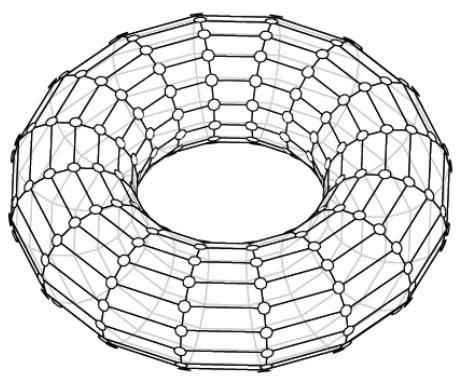
|
| 201 |
+
|
| 202 |
+
Answer: 4. Representatives of the equivalence classes are: all blue, all blue with one longitudinal red ring, all blue with one transversal red ring, all blue with one longitudinal and one transversal red ring.
|
| 203 |
+
|
| 204 |
+
First, show that these four classes are non equivalent. Consider any ring transversal or longitudinal and count the number of red edges going out from vertices of this ring in the same halftorus. This number can not be changed mod 2.
|
| 205 |
+
|
| 206 |
+
Now we show that each configuration can be transformed to one of these four classes. We suggest two independent reasoning.
|
| 207 |
+
|
| 208 |
+
Scanning of the square.
|
| 209 |
+
|
| 210 |
+
Cut the torus up in a square $16 \times 16$. In order to restore the initial torus we will identify the opposite sides of the square, but we will do it in the end of solution. Now we will work with the square. It is clear that during all recolorings each vertex of torus has even red degree. The same is true for the degrees of the inner vertices of the $16 \times 16$ square when we deal with it instead of the torus.
|
| 211 |
+
|
| 212 |
+
Scan all cells of this square one by one from left to right and from bottom to top. For convenience we may think that in each moment the scanned area is colored grey. First we take bottom left corner cell ( $a 1$ in chess notations) and color it grey. Then we consider the next cell ( $b 1$ in chess notations) color it grey and if the edge between the cells $a 1$ and $b 1$ is red, change the colors of the cell $b 1$ edges.
|
| 213 |
+
|
| 214 |
+
We obtain a grey area with no red edges in its interior. After that when we scan each new cell we append this cell to the grey figure and if it is necessary change the colors of edges of the new cell to make the color of all new edges in the grey area blue.
|
| 215 |
+
|
| 216 |
+
The latter is always possible because the new cell have either one common edge with the grey figure (as in the case " $a 1-b 1$ " above) or two common edges. For example let grey figure consist of the first row of the square and $a 2$ cell. When we append the cell $b 2$ to the grey figure two edges of its lower left corner vertex already belong to the grey figure, they are blue. Therefore the other two edges $a 2-b 2$ and $b 1-b 2$ have the same color and we can make them both blue (if they are not) by recoloring the edges of cell $b 2$.
|
| 217 |
+
|
| 218 |
+
So by doing that with all cells of the square we obtain $16 \times 16$ square with blue edges inside it. Now its time to recall that the sides of the square should be identified, and the red degree of each vertex of torus is even. It follows that the whole (identified) vertical sides of the square are either red or blue, and the same for horizontal sides.
|
| 219 |
+
|
| 220 |
+
Deformations of red loops (sketch).
|
| 221 |
+
|
| 222 |
+
To see that any configuration can be made into one of the above four configurations it is most clear to cut the torus up in a square with opposite edges identified.
|
| 223 |
+
|
| 224 |
+
Since the red degree of each vertex is even we can always find a loop consisting of red edges only. Now, suppose that one can make a (simple) red loop that does not cross the boundary of the square. We can change the color of this loop by changing one by one the colors of unit squares inside it. In the remaining configuration every vertex is still an endpoint of an even number of red edges and we can repeat the operation. So by doing that to every red loop we are left with a configuration where one can not make red loops that do not intersect the boundary. Second, any red loop left that passes through more than one boundary vertex can be deformed into a loop containing only one boundary vertex. Finally, any two loops crossing the same side of the square can be removed by changing colors of all unit squares between these loops. Thus, we are left with only the four possibilities mentioned.
|
| 225 |
+
|
| 226 |
+
8. A graph has $N$ vertices. An invisible hare sits in one of the vertices. A group of hunters tries to kill the hare. In each move all of them shoot simultaneously: each hunter shoots at a single vertex, they choose the target vertices cooperatively. If the hare was in one of the target vertices during a shoot, the hunt is finished. Otherwise the hare can stay in its vertex or jump to one of the neighboring vertices.
|
| 227 |
+
|
| 228 |
+
The hunters know an algorithm that allows them to kill the hare in at most $N$ ! moves. Prove that then there exists an algorithm that allows them to kill the hare in at most $2^{N}$ moves.
|
| 229 |
+
|
| 230 |
+
## Solution.
|
| 231 |
+
|
| 232 |
+
Let hunters apply optimal (fastest) algorithm. Let say that a vertex has a smell of a hare, if there exists an initial vertex and a sequence of moves of the hare for which the hare is still alive and now occupies this vertex. After every shoot mark the set of all the vertices that have a smell of a hare. In the beginning all the vertices of the graph have a smell of hare, and after finish of hunting this set is empty. The idea is that in optimal strategy these sets can not repeat!
|
| 233 |
+
|
| 234 |
+
Indeed, the hunting does not imply feedback, the hunters' shoots do not depend on hare's moves because the hunters try to foresee all possible moves of hare. So if a set of vertices $A$ appears after the k-th shoot and once again after the $m$-th shoot, then then the strategy is not optimal because all shoots form $k$-th to $(m-1)$-th can be omitted with the same result of hunting.
|
| 235 |
+
|
| 236 |
+
Since it is possible to mark at most $2^{N}$ sets the hunting will finish in at most $2^{N}-1$ shoots.
|
| 237 |
+
|
| 238 |
+
9. Olga and Sasha play a game on an infinite hexagonal grid. They take turns in placing a stone on a free hexagon of their choice. Olga starts the game. Just before the 2018th stone is placed, a new rule comes into play. A stone may now be placed only on those free hexagons having at least two occupied neighbors.
|
| 239 |
+
|
| 240 |
+
A player loses when she or he either is unable to make a move, or has filled a pattern of the rhomboid shape as shown (rotated in any possible way). Determine which player, if any, possesses a winning strategy.
|
| 241 |
+
|
| 242 |
+
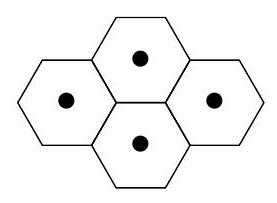
|
| 243 |
+
|
| 244 |
+
## Solution.
|
| 245 |
+
|
| 246 |
+
Answer: Olga has a winning strategy.
|
| 247 |
+
|
| 248 |
+
The game cannot go on forever. Draw a large hexagon enclosing all 2017 counters in play after the 2017th move, as in Figure ??. While it will be possible to place future counters in the hexagonal frame at distance 1 from the shaded part (i.e. immediately surrounding it), where $D$ and $E$ are located, it will be impossible to reach cells at distance 2 from the shaded part, where $F$ is located. Indeed, in order to place a counter at $F$, first counters must be placed on cells $D$ and $E$.
|
| 249 |
+
|
| 250 |
+
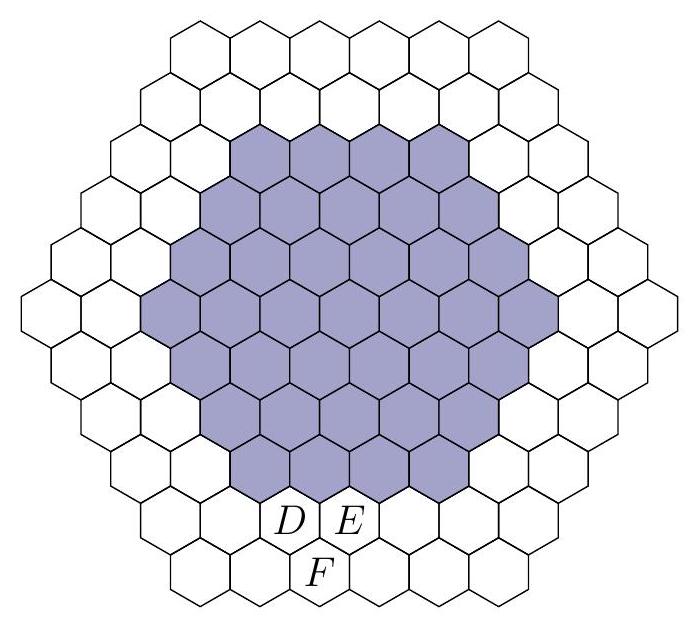
|
| 251 |
+
|
| 252 |
+
Figure 1: A large shaded hexagon enclosing all 2017 counters in play after the 2017th move.
|
| 253 |
+
|
| 254 |
+
Assume that the cells $E_{1}, E_{2}, \ldots, E_{n}$ to the right of $E$ contain counters, but the next cell to the right is $E_{n+1}$ and it is empty. Observe that the counter on $E_{n-1}$ has been placed before the counter on $E_{n}$, because otherwise the forbidden rhombus is formed by the cells $E_{n-1}, E_{n}$ and two ancestors of $E_{n}$ in the previous row. By analogous reasoning considering the moment of placing the counter on $E_{n-1}$ one can prove that the counter on $E_{n-2}$ has been placed before the counter on $E_{n-1}$, etc. Thus we conclude that the counter on $D$ has been placed before the counter on $E$. But changing the direction of our reasoning to the left we similarly conclude that counter on $E$ has been placed before the counter on $D$. A contradiction.
|
| 255 |
+
|
| 256 |
+
Now, let Olga place her first counter in any hexagon $H$, and then respond to each of Sasha's successive moves by symmetry, choosing to place her counter on the reflexion in $H$ of his chosen hexagon (in other words, diametrically opposite to his with respect to $H$ ). It is clear that the gameplay will be completely symmetrical after each of Olga's moves. Hence she may respond, even under the additional rule, to any move Sasha might make. It is also evident that she will never complete a forbidden rhombus if Sasha did not already do so before. Hence Olga is always certain to have a legal move at her disposal, and so will eventually win.
|
| 257 |
+
|
| 258 |
+
10. The integers from 1 to $n$ are written, one on each of $n$ cards. The first player removes one card. Then the second player removes two cards with consecutive integers. After that the first player removes three cards with consecutive integers. Finally, the second player removes four cards with consecutive integers. What is the smallest value of $n$ for which the second player can ensure that he completes both his moves?
|
| 259 |
+
|
| 260 |
+
Solution.
|
| 261 |
+
|
| 262 |
+
Answer: $n=14$.
|
| 263 |
+
|
| 264 |
+
At first, let's show that for $n=13$ the first player can ensure that after his second move no 4 consecutive numbers are left. In the first move he can erase number 4 and in the second move he can ensure that numbers 8,9 and 10 are erased. No interval of length 4 is left.
|
| 265 |
+
|
| 266 |
+
If $n=14$ the second player can use the following strategy. Let the first player erase number $k$ in his first move, because of symmetry assume that that $k \leq 7$. If $k \geq 5$ then the second player can erase $k+1$ and $k+2$ and there are two intervals left of length at least 4: 1.. $(k-1)$ and $(k+3) . .14$, but the first player can destroy at most one of them. But if $k \leq 4$, then the second player can erase numbers 9 and 10 in his first move and again there are two intervals left of length at least 4: $(k+1) . .8$ and 11..14.
|
| 267 |
+
|
| 268 |
+
## 3 Geometry
|
| 269 |
+
|
| 270 |
+
11. The points $A, B, C, D$ lie, in this order, on a circle $\omega$, where $A D$ is a diameter of $\omega$. Furthermore, $A B=B C=a$ and $C D=c$ for some relatively prime integers $a$ and $c$. Show that if the diameter $d$ of $\omega$ is also an integer, then either $d$ or $2 d$ is a perfect square.
|
| 271 |
+
|
| 272 |
+
## Solution.
|
| 273 |
+
|
| 274 |
+
By Pythagoras, the lengths of the diagonals of quadrangle $A B C D$ are $\sqrt{d^{2}-a^{2}}$ and $\sqrt{d^{2}-c^{2}}$. Applying Ptolemaios' Theorem to the quadrilateral $A B C D$ gives
|
| 275 |
+
|
| 276 |
+
$$
|
| 277 |
+
\sqrt{d^{2}-a^{2}} \cdot \sqrt{d^{2}-c^{2}}=a b+a c,
|
| 278 |
+
$$
|
| 279 |
+
|
| 280 |
+
which after squaring and simplifying becomes
|
| 281 |
+
|
| 282 |
+
$$
|
| 283 |
+
d^{3}-\left(2 a^{2}+c^{2}\right) d-2 a^{2} c=0 .
|
| 284 |
+
$$
|
| 285 |
+
|
| 286 |
+
Then $d=-c$ is a root of this equation, hence, $c+d$ is a positive factor of the left-hand side. Hence, the remaining factor (which is quadratic in $d$ ) must vanish, and we obtain $d^{2}=c d+2 a^{2}$. Let $e=2 d-c$. The number $c^{2}+8 a^{2}=(2 d-c)^{2}=e^{2}$ is a square, and it follows that $8 a^{2}=e^{2}-c^{2}$. If $e$ and $c$ both were even, then by $8 \mid\left(e^{2}-c^{2}\right)$ we also have $16 \mid\left(e^{2}-c^{2}\right)=8 a^{2}$ which implies $2 \mid a$, a contradiction to the fact that $a$ and $c$ are relatively prime. Hence, $e$ and $c$ both must be odd. Moreover, $e$ and $c$ are obviously relatively prime. Consequently, the factors on the right-hand side of $2 a^{2}=\frac{e-c}{2} \cdot \frac{e+c}{2}$ are relatively prime. It follows that $d=\frac{e+c}{2}$ is a perfect square or twice a perfect square.
|
| 287 |
+
|
| 288 |
+
12. The altitudes $B B_{1}$ and $C C_{1}$ of an acute triangle $A B C$ intersect in point $H$. Let $B_{2}$ and $C_{2}$ be points on the segments $B H$ and $C H$, respectively, such that $B B_{2}=B_{1} H$ and $C C_{2}=C_{1} H$. The circumcircle of the triangle $B_{2} H C_{2}$ intersects the circumcircle of the triangle $A B C$ in points $D$ and $E$. Prove that the triangle $D E H$ is right-angled.
|
| 289 |
+
|
| 290 |
+
## Solution.
|
| 291 |
+
|
| 292 |
+
Despite of the logical symmetry of the picture the right angle in triangle $\triangle D E H$ is not $H$ but either $D$ or $E$.
|
| 293 |
+
|
| 294 |
+
Denote by $w$ the circumcircle of the triangle $\mathrm{B}_{2} \mathrm{HC}_{2}$. Midperpendicular to the segment $\mathrm{C}_{2} \mathrm{H}$ is also the midperpendicular to $C C_{1}$ therefore it passes through the midpoint $X$ of side $B C$. By the similar reasoning the midperpendicular to $B_{2} H$ passes through $X$. Therefore $X$ is the center of the circle $w$.
|
| 295 |
+
|
| 296 |
+
It is well known that the point which is symmetrical to the orthocenter $H$ with respect to the side $B C$ belongs to the circumcircle of the triangle $A B C$. The distance from this point to $X$ equals $X H$ due to symmetry, hence this point belongs $w$, therefore it coincides with $D$ or $E$, without loss of generality with $D$. Thus $D H \perp B C$.
|
| 297 |
+
|
| 298 |
+
Finally, the centers of $w$ and circumcircle $(A B C)$ belong to the midperpendicular of $B C$, therefore their common chord $D E$ is parallel $B C$. Thus $\angle H D E=90^{\circ}$.
|
| 299 |
+
|
| 300 |
+
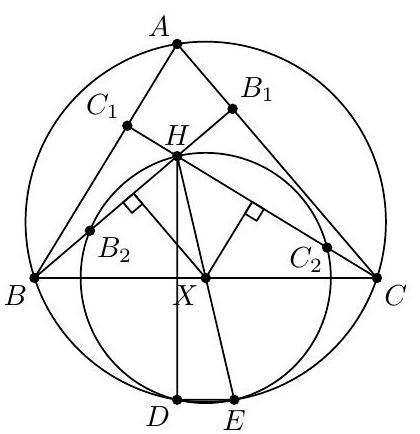
|
| 301 |
+
|
| 302 |
+
13. The bisector of the angle $A$ of a triangle $A B C$ intersects $B C$ in a point $D$ and intersects the circumcircle of the triangle $A B C$ in a point $E$. Let $K, L, M$ and $N$ be the midpoints of the segments $A B, B D, C D$ and $A C$, respectively. Let $P$ be the circumcenter of the triangle $E K L$, and $Q$ be the circumcenter of the triangle $E M N$. Prove that $\angle P E Q=\angle B A C$.
|
| 303 |
+
|
| 304 |
+
## Solution.
|
| 305 |
+
|
| 306 |
+
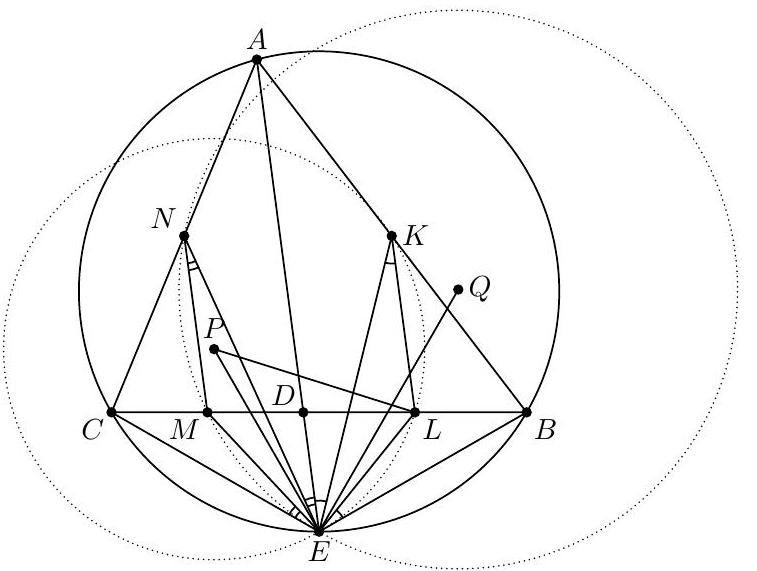
|
| 307 |
+
|
| 308 |
+
Triangles $A E B$ and $B E D$ are similar since $\angle B A E=\angle E A C=\angle D B E$. Hence $\angle A E K=$ $\angle B E L$ as the angles between a median and a side in similar triangles. Denote these angles by $\varphi$. Then $\angle E K L=\varphi$ since $K L$ is a midline of $\triangle A B D$. Analogously, let $\psi=\angle A E N=\angle C E M=$ $\angle E N M$. And let $\beta=\angle A B C, \gamma=\angle A C B$.
|
| 309 |
+
|
| 310 |
+
The triangle $P E L$ is isosceles, therefore $\angle P E L=90^{\circ}-\frac{1}{2} \angle E P L=90^{\circ}-\angle E K L=90^{\circ}-\varphi$ and
|
| 311 |
+
|
| 312 |
+
$$
|
| 313 |
+
\angle P E A=\angle P E L-\angle A E L=\angle P E L-(\angle A E B-\angle B E L)=90^{\circ}-\varphi-(\gamma-\varphi)=90^{\circ}-\gamma .
|
| 314 |
+
$$
|
| 315 |
+
|
| 316 |
+
Analogously $\angle Q E A=90^{\circ}-\beta$.
|
| 317 |
+
|
| 318 |
+
Thus $\angle P E Q=\angle P E A+\angle Q E A=180^{\circ}-\beta-\gamma=\angle B A C$.
|
| 319 |
+
|
| 320 |
+
14. A quadrilateral $A B C D$ is circumscribed about a circle $\omega$. The intersection point of $\omega$ and the diagonal $A C$, closest to $A$, is $E$. The point $F$ is diametrically opposite to the point $E$ on the circle $\omega$. The tangent to $\omega$ at the point $F$ intersects lines $A B$ and $B C$ in points $A_{1}$ and $C_{1}$, and lines $A D$ and $C D$ in points $A_{2}$ and $C_{2}$, respectively. Prove that $A_{1} C_{1}=A_{2} C_{2}$.
|
| 321 |
+
|
| 322 |
+
## Solution.
|
| 323 |
+
|
| 324 |
+
Denote by $X$ the intersection point of the lines $A_{1} A_{2}$ and $A C$. Prove that $X$ is a contact point of escribed circle of $\triangle A A_{1} A_{2}$ with side $A_{1} A_{2}$. Indeed, consider a homothety with center $A$ which maps incircle $\omega$ of $\triangle A A_{1} A_{2}$ to its escribed circle. This homothety maps the line that is tangent to $\omega$ in point $E$ to the parallel line which is tangent to the escribed circle, i.e. to the line $A_{1} A_{2}$. Therefore the point $E$ maps to the point $X$, hence $A_{1} A_{2}$ is tangent to the escribed circle of $\triangle A A_{1} A_{2}$ in the point $X$.
|
| 325 |
+
|
| 326 |
+
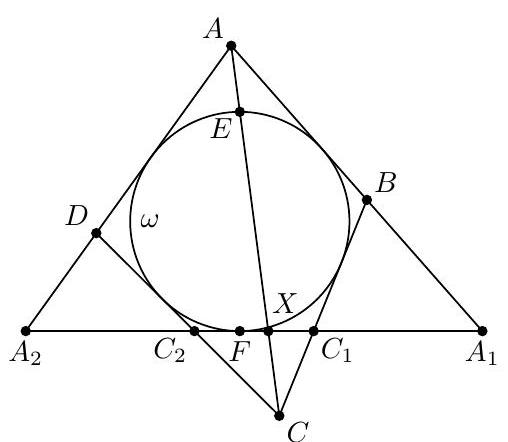
|
| 327 |
+
|
| 328 |
+
One can similarly prove that $X$ is a tangent point of the line c $C_{1} C_{2}$ and incircle of $\triangle C_{1} C C_{2}$.
|
| 329 |
+
|
| 330 |
+
From the first statement we conclude that $A_{1} X=F A_{2}$, and from the second one that $C_{1} X=$ $F C_{2}$. It remains to subtract the second equality from the first one.
|
| 331 |
+
|
| 332 |
+
15. Two circles in the plane do not intersect and do not lie inside each other. We choose diameters $A_{1} B_{1}$ and $A_{2} B_{2}$ of these circles such that the segments $A_{1} A_{2}$ and $B_{1} B_{2}$ intersect. Let $A$ and $B$ be the midpoints of the segments $A_{1} A_{2}$ and $B_{1} B_{2}$, and $C$ be the intersection point of these segments. Prove that the orthocenter of the triangle $A B C$ belongs to a fixed line that does not depend on the choice of the diameters.
|
| 333 |
+
|
| 334 |
+
Solution.
|
| 335 |
+
|
| 336 |
+
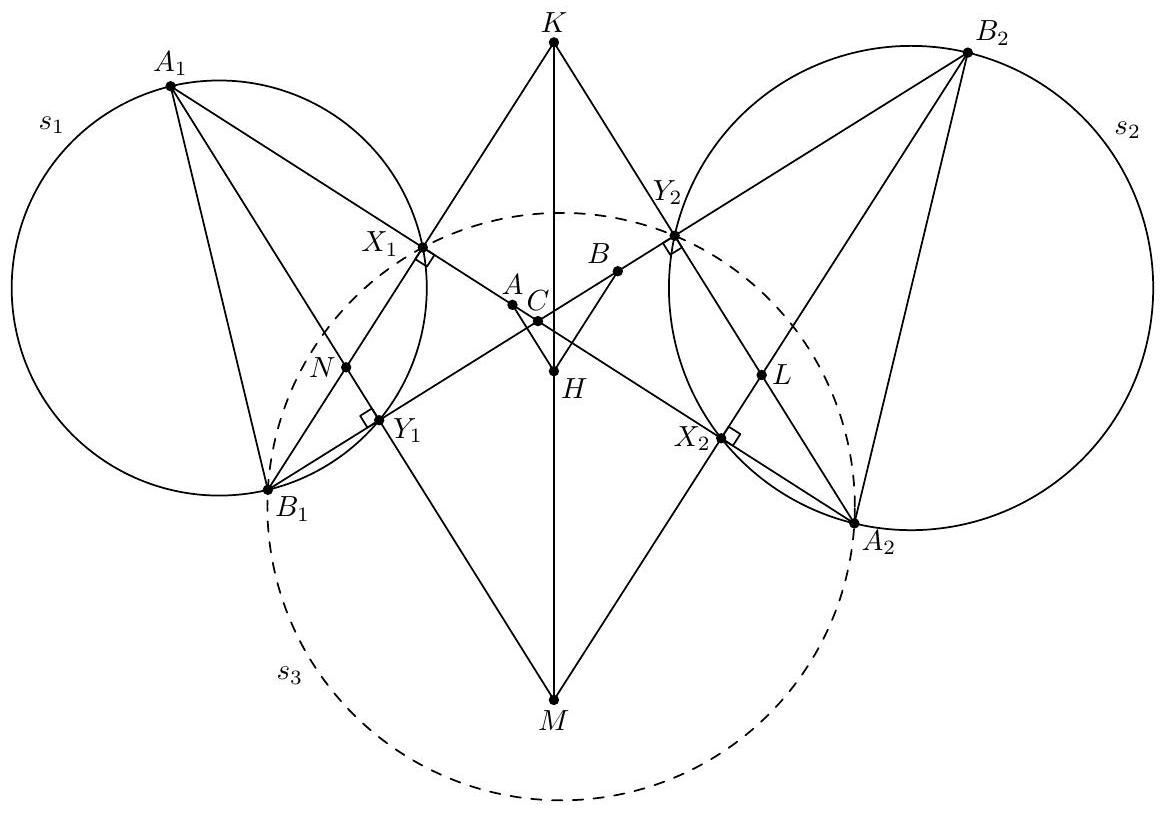
|
| 337 |
+
|
| 338 |
+
Prove that the orthocenter $H$ of $\triangle A B C$ belongs to their radical axe.
|
| 339 |
+
|
| 340 |
+
Denote the circles by $s_{1}$ и $s_{2}$. Let the line $A_{1} A_{2}$ intrersect circles $s_{1}$ and $s_{2}$ second time in points $X_{1}$ and $X_{2}$ respectively, and the line $B_{1} B_{2}$ intrersect the circles second time in points $Y_{1}$ and $Y_{2}$.
|
| 341 |
+
|
| 342 |
+
The lines $A_{1} Y_{1}$ and $A_{2} Y_{2}$ are parallel (because both of them are orthogonal to $B_{1} B_{2}$ ), analogously $B_{1} X_{1}$ and $B_{2} X_{2}$ are parallel. Hence these four lines form a parallelogram $K L M N$ (see fig.). It is clear that perpendiculars from the point $A$ to the line $B C$ and from the point $B$ to the line $A C$ lay on the midlines of this parallelogram. Therefore $H$ is the center of parallelogram $K L M N$ and coincide with the midpoint of segment $K M$.
|
| 343 |
+
|
| 344 |
+
In order to prove that $H$ lays on the radical axe of $s_{1}$ and $s_{2}$ it is sufficient to show that both points $K$ and $M$ belong to that radical axe.
|
| 345 |
+
|
| 346 |
+
The points $X_{1}$ and $Y_{2}$ lay on the circle $s_{3}$ with diameter $B_{1} A_{2}$. The line $B_{1} X_{1}$ is radical axe of $s_{1}$ and $s_{3}$, and the line $A_{2} Y_{2}$ is radical axe of $s_{2}$ and $s_{3}$. Therefore $k$ is radical center of these three circles and hence $K$ lays on the radical axe of $s_{1}$ and $s_{2}$. Analogously $M$ lays on the radical axe of $s_{1}$ and $s_{2}$.
|
| 347 |
+
|
| 348 |
+
## 4 Number Theory
|
| 349 |
+
|
| 350 |
+
16. Let $p$ be an odd prime. Find all positive integers $n$ for which $\sqrt{n^{2}-n p}$ is a positive integer.
|
| 351 |
+
|
| 352 |
+
Solution.
|
| 353 |
+
|
| 354 |
+
Answer: $n=\left(\frac{p+1}{2}\right)^{2}$.
|
| 355 |
+
|
| 356 |
+
Assume that $\sqrt{n^{2}-p n}=m$ is a positive integer. Then $n^{2}-p n-m^{2}=0$, and hence
|
| 357 |
+
|
| 358 |
+
$$
|
| 359 |
+
n=\frac{p \pm \sqrt{p^{2}+4 m^{2}}}{2}
|
| 360 |
+
$$
|
| 361 |
+
|
| 362 |
+
Now $p^{2}+4 m^{2}=k^{2}$ for some positive integer $k$, and $n=\frac{p+k}{2}$ since $k>p$. Thus $p^{2}=(k+2 m)(k-2 m)$, and since $p$ is prime we get $p^{2}=k+2 m$ and $k-2 m=1$. Hence $k=\frac{p^{2}+1}{2}$ and
|
| 363 |
+
|
| 364 |
+
$$
|
| 365 |
+
n=\frac{p+\frac{p^{2}+1}{2}}{2}=\left(\frac{p+1}{2}\right)^{2}
|
| 366 |
+
$$
|
| 367 |
+
|
| 368 |
+
is the only possible value of $n$. In this case we have
|
| 369 |
+
|
| 370 |
+
$$
|
| 371 |
+
\sqrt{n^{2}-p n}=\sqrt{\left(\frac{p+1}{2}\right)^{4}-p\left(\frac{p+1}{2}\right)^{2}}=\frac{p+1}{2} \sqrt{\left(\frac{p^{2}+1}{2}\right)^{2}-p}=\frac{p+1}{2} \cdot \frac{p-1}{2} .
|
| 372 |
+
$$
|
| 373 |
+
|
| 374 |
+
17. Prove that for any positive integers $p, q$ such that $\sqrt{11}>\frac{p}{q}$, the following inequality holds:
|
| 375 |
+
|
| 376 |
+
$$
|
| 377 |
+
\sqrt{11}-\frac{p}{q}>\frac{1}{2 p q}
|
| 378 |
+
$$
|
| 379 |
+
|
| 380 |
+
Solution.
|
| 381 |
+
|
| 382 |
+
We can assume that $p$ and $q$ are coprime, and since both sides of first inequality are positive, we can change it to $11 q^{2}>p^{2}$. The same way we can change second inequality:
|
| 383 |
+
|
| 384 |
+
$$
|
| 385 |
+
11 p^{2} q^{2}>p^{4}+p^{2}+\frac{1}{4}
|
| 386 |
+
$$
|
| 387 |
+
|
| 388 |
+
To see this one holds, we will prove stronger one:
|
| 389 |
+
|
| 390 |
+
$$
|
| 391 |
+
11 p^{2} q^{2} \geq p^{4}+2 p^{2} \text {. }
|
| 392 |
+
$$
|
| 393 |
+
|
| 394 |
+
Indeed, dividing this inequality by $p^{2}$ we get $11 q^{2} \geq p^{2}+2$, and since we already know that $11 q^{2}>p^{2}$ we only have to see, that $11 q^{2}$ can't be equal to $p^{2}+1$. Since we know that the only reminders of squares $(\bmod 11)$ are $0,1,3,4,5$ and $9, p^{2}+1$ can't be divisible by 11 , and therefore $11 q^{2} \neq p^{2}+1$.
|
| 395 |
+
|
| 396 |
+
18. Let $n \geq 3$ be an integer such that $4 n+1$ is a prime number. Prove that $4 n+1$ divides $n^{2 n}-1$.
|
| 397 |
+
|
| 398 |
+
Solution.
|
| 399 |
+
|
| 400 |
+
Since $p:=4 n+1$ is a prime number, each non-zero remainder modulo $p$ possesses a unique multiplicative inverse. Since $-4 \cdot n \equiv 1 \bmod p$, we have $n \equiv(-4)^{-1} \bmod p$, from which we deduce that $n \equiv-\left(2^{-1}\right)^{2}$. Consequently,
|
| 401 |
+
|
| 402 |
+
$$
|
| 403 |
+
n^{2 n}-1 \equiv\left(-\left(2^{-1}\right)^{2}\right)^{2 n}-1 \equiv\left(2^{-1}\right)^{4 n}-1 \equiv 0 \bmod p
|
| 404 |
+
$$
|
| 405 |
+
|
| 406 |
+
by Fermat's Little Theorem.
|
| 407 |
+
|
| 408 |
+
19. An infinite set $B$ consisting of positive integers has the following property. For each $a, b \in B$ with $a>b$ the number $\frac{a-b}{(a, b)}$ belongs to $B$. Prove that $B$ contains all positive integers. Here $(a, b)$ is the greatest common divisor of numbers $a$ and $b$.
|
| 409 |
+
|
| 410 |
+
Solution.
|
| 411 |
+
|
| 412 |
+
If $d$ is g.c.d. of all the numbers in set $B$, let $A=\{b / d: b \in B\}$. Then for each $a, b \in A(a>b)$ we have
|
| 413 |
+
|
| 414 |
+
$$
|
| 415 |
+
\frac{a-b}{d(a, b)} \in A
|
| 416 |
+
$$
|
| 417 |
+
|
| 418 |
+
Observe that g.c.d of the set $A$ equals 1 , therefore we can find a finite subset $A_{1} \in A$ for which the $\operatorname{gcd} A_{1}=1$. We may think that the sum of elements of $A_{1}$ is minimal possible. Choose numbers $a, b \in A_{1}(a>b)$ and replace $a$ in the set $A_{1}$ with $\frac{a-b}{d(a, b)}$. The g.c.d. of the obtained set equals 1 . But the sum of numbers decreases by this operations that contradicts minimality of $A_{1}$.
|
| 419 |
+
|
| 420 |
+
Thus, $A_{1}=\{1\}$. Therefore all the numbers in the set $A$ have residue 1 modulo $d$. Take an arbitrary $a=k d+1 \in A$ and $b=1$. Then $k \in A$ by $(*)$ and hence $k=d s+1$. But $(k, k d+1)=1$, therefore $\frac{k d+1-d s-1}{d}=k-s=(d-1) s+1 \in A$, so $s$ is divisible by $d$. But $s \in A$, therefore $s-1$ is also divisible by $d$, hence $d=1$ (that means that $B=A$ ). Thus we have checked that if $a=k d+1=k+1 \in A$ then $a-1=k \in A$. Then all non-negative integers belong to $A$ because it is infinite.
|
| 421 |
+
|
| 422 |
+
20. Find all the triples of positive integers $(a, b, c)$ for which the number
|
| 423 |
+
|
| 424 |
+
$$
|
| 425 |
+
\frac{(a+b)^{4}}{c}+\frac{(b+c)^{4}}{a}+\frac{(c+a)^{4}}{b}
|
| 426 |
+
$$
|
| 427 |
+
|
| 428 |
+
is an integer and $a+b+c$ is a prime.
|
| 429 |
+
|
| 430 |
+
## Solution.
|
| 431 |
+
|
| 432 |
+
Answer $(1,1,1),(1,2,2),(2,3,6)$.
|
| 433 |
+
|
| 434 |
+
Let $p=a+b+c$, then $a+b=p-c, b+c=p-a, c+a=p-b$ and
|
| 435 |
+
|
| 436 |
+
$$
|
| 437 |
+
\frac{(p-c)^{4}}{c}+\frac{(p-a)^{4}}{a}+\frac{(p-b)^{4}}{b}
|
| 438 |
+
$$
|
| 439 |
+
|
| 440 |
+
is a non-negative integer. By expanding brackets we obtain that the number $p^{4}\left(\frac{1}{a}+\frac{1}{b}+\frac{1}{c}\right)$ is integer, too. But the numbers $a, b, c$ are not divisible by $p$, therefore the number $\frac{1}{a}+\frac{1}{b}+\frac{1}{c}$ is (non negative) integer. That is possible for the triples $(1,1,1),(1,2,2),(2,3,6)$ only.
|
| 441 |
+
|
BalticWay/md/en-bw19eng.md
ADDED
|
@@ -0,0 +1,97 @@
|
|
|
|
|
|
|
|
|
|
|
|
|
|
|
|
|
|
|
|
|
|
|
|
|
|
|
|
|
|
|
|
|
|
|
|
|
|
|
|
|
|
|
|
|
|
|
|
|
|
|
|
|
|
|
|
|
|
|
|
|
|
|
|
|
|
|
|
|
|
|
|
|
|
|
|
|
|
|
|
|
|
|
|
|
|
|
|
|
|
|
|
|
|
|
|
|
|
|
|
|
|
|
|
|
|
|
|
|
|
|
|
|
|
|
|
|
|
|
|
|
|
|
|
|
|
|
|
|
|
|
|
|
|
|
|
|
|
|
|
|
|
|
|
|
|
|
|
|
|
|
|
|
|
|
|
|
|
|
|
|
|
|
|
|
|
|
|
|
|
|
|
|
|
|
|
|
|
|
|
|
|
|
|
|
|
|
|
|
|
|
|
|
|
|
|
|
|
|
|
|
|
|
|
|
|
|
|
|
|
|
|
|
|
|
|
|
|
|
|
|
|
|
|
|
|
|
|
|
|
|
|
|
|
|
|
|
|
|
|
|
|
|
|
|
|
|
|
|
|
|
|
|
|
|
|
|
|
|
|
|
|
|
|
|
|
|
|
|
|
|
|
|
|
|
|
|
|
|
|
|
|
|
|
|
|
|
|
|
|
|
|
|
|
|
| 1 |
+
Problem 1. For all non-negative real numbers $x, y, z$ with $x \geq y$, prove the inequality
|
| 2 |
+
|
| 3 |
+
$$
|
| 4 |
+
\frac{x^{3}-y^{3}+z^{3}+1}{6} \geq(x-y) \sqrt{x y z}
|
| 5 |
+
$$
|
| 6 |
+
|
| 7 |
+
Problem 2. Let $\left(F_{n}\right)$ be the sequence defined recursively by $F_{1}=F_{2}=1$ and $F_{n+1}=F_{n}+F_{n-1}$ for $n \geq 2$. Find all pairs of positive integers $(x, y)$ such that
|
| 8 |
+
|
| 9 |
+
$$
|
| 10 |
+
5 F_{x}-3 F_{y}=1
|
| 11 |
+
$$
|
| 12 |
+
|
| 13 |
+
Problem 3. Find all functions $f: \mathbb{R} \rightarrow \mathbb{R}$ such that
|
| 14 |
+
|
| 15 |
+
$$
|
| 16 |
+
f\left(x f(y)-y^{2}\right)=(y+1) f(x-y)
|
| 17 |
+
$$
|
| 18 |
+
|
| 19 |
+
holds for all $x, y \in \mathbb{R}$.
|
| 20 |
+
Problem 4. Determine all integers $n$ for which there exist an integer $k \geq 2$ and positive integers $x_{1}, x_{2}, \ldots, x_{k}$ so that
|
| 21 |
+
|
| 22 |
+
$$
|
| 23 |
+
x_{1} x_{2}+x_{2} x_{3}+\ldots+x_{k-1} x_{k}=n \quad \text { and } \quad x_{1}+x_{2}+\ldots+x_{k}=2019
|
| 24 |
+
$$
|
| 25 |
+
|
| 26 |
+
Problem 5. The $2 m$ numbers
|
| 27 |
+
|
| 28 |
+
$$
|
| 29 |
+
1 \cdot 2,2 \cdot 3,3 \cdot 4, \ldots, 2 m(2 m+1)
|
| 30 |
+
$$
|
| 31 |
+
|
| 32 |
+
are written on a blackboard, where $m \geq 2$ is an integer. A move consists of choosing three numbers $a, b, c$, erasing them from the board and writing the single number
|
| 33 |
+
|
| 34 |
+
$$
|
| 35 |
+
\frac{a b c}{a b+b c+c a} .
|
| 36 |
+
$$
|
| 37 |
+
|
| 38 |
+
After $m-1$ such moves, only two numbers will remain on the blackboard. Supposing one of these is $\frac{4}{3}$, show that the other is larger than 4.
|
| 39 |
+
|
| 40 |
+
Problem 6. Alice and Bob play the following game. They write the expressions $x+y, x-y, x^{2}+x y+y^{2}$ and $x^{2}-x y+y^{2}$ each on a separate card. The four cards are shuffled and placed face down on a table. One of the cards is turned over, revealing the expression written on it, after which Alice chooses any two of the four cards, and gives the other two to Bob. All cards are then revealed. Now Alice picks one of the variables $x$ and $y$, assigns a real value to it, and tells Bob what value she assigned and to which variable. Then Bob assigns a real value to the other variable.
|
| 41 |
+
|
| 42 |
+
Finally, they both evaluate the product of the expressions on their two cards. Whoever gets the larger result, wins. Which player, if any, has a winning strategy?
|
| 43 |
+
|
| 44 |
+
Problem 7. Find the smallest integer $k \geq 2$ such that for every partition of the set $\{2,3, \ldots, k\}$ into two parts, at least one of these parts contains (not necessarily distinct) numbers $a, b$ and $c$ with $a b=c$.
|
| 45 |
+
|
| 46 |
+
Problem 8. There are 2019 cities in the country of Balticwayland. Some pairs of cities are connected by non-intersecting bidirectional roads, each road connecting exactly 2 cities. It is known that for every pair of cities $A$ and $B$ it is possible to drive from $A$ to $B$ using at most 2 roads. There are 62 cops trying to catch a robber. The cops and robber all know each others' locations at all times. Each night, the robber can choose to stay in her current city or move to a neighbouring city via a direct road. Each day, each cop has the same choice of staying or moving, and they coordinate their actions. The robber is caught if she is in the same city as a cop at any time. Prove that the cops can always catch the robber.
|
| 47 |
+
|
| 48 |
+
Problem 9. For a positive integer $n$, consider all nonincreasing functions $f:\{1, \ldots, n\} \rightarrow\{1, \ldots, n\}$. Some of them have a fixed point (i.e. a $c$ such that $f(c)=c$ ), some do not. Determine the difference between the sizes of the two sets of functions.
|
| 49 |
+
|
| 50 |
+
Remark. A function $f$ is nonincreasing if $f(x) \geq f(y)$ holds for all $x \leq y$.
|
| 51 |
+
Problem 10. There are 2019 points given in the plane. A child wants to draw $k$ (closed) discs in such a manner, that for any two distinct points there exists a disc that contains exactly one of these two points. What is the minimal $k$, such that for any initial configuration of points it is possible to draw $k$ discs with the above property?
|
| 52 |
+
|
| 53 |
+
Problem 11. Let $A B C$ be a triangle with $A B=A C$. Let $M$ be the midpoint of $B C$. Let the circles with diameters $A C$ and $B M$ intersect at points $M$ and $P$. Let $M P$ intersect $A B$ at $Q$. Let $R$ be a point on $A P$ such that $Q R \| B P$. Prove that $C P$ bisects $\angle R C B$.
|
| 54 |
+
|
| 55 |
+
Problem 12. Let $A B C$ be a triangle and $H$ its orthocenter. Let $D$ be a point lying on the segment $A C$ and let $E$ be the point on the line $B C$ such that $B C \perp D E$. Prove that $E H \perp B D$ if and only if $B D$ bisects $A E$.
|
| 56 |
+
|
| 57 |
+
Problem 13. Let $A B C D E F$ be a convex hexagon in which $A B=A F, B C=C D, D E=E F$ and $\angle A B C=$ $\angle E F A=90^{\circ}$. Prove that $A D \perp C E$.
|
| 58 |
+
|
| 59 |
+
Problem 14. Let $A B C$ be a triangle with $\angle A B C=90^{\circ}$, and let $H$ be the foot of the altitude from $B$. The points $M$ and $N$ are the midpoints of the segments $A H$ and $C H$, respectively. Let $P$ and $Q$ be the second points of intersection of the circumcircle of the triangle $A B C$ with the lines $B M$ and $B N$, respectively. The segments $A Q$ and $C P$ intersect at the point $R$. Prove that the line $B R$ passes through the midpoint of the segment $M N$.
|
| 60 |
+
|
| 61 |
+
Problem 15. Let $n \geq 4$, and consider a (not necessarily convex) polygon $P_{1} P_{2} \ldots P_{n}$ in the plane. Suppose that, for each $P_{k}$, there is a unique vertex $Q_{k} \neq P_{k}$ among $P_{1}, \ldots, P_{n}$ that lies closest to it. The polygon is then said to be hostile if $Q_{k} \neq P_{k \pm 1}$ for all $k$ (where $P_{0}=P_{n}, P_{n+1}=P_{1}$ ).
|
| 62 |
+
(a) Prove that no hostile polygon is convex.
|
| 63 |
+
(b) Find all $n \geq 4$ for which there exists a hostile $n$-gon.
|
| 64 |
+
|
| 65 |
+
Problem 16. For a positive integer $N$, let $f(N)$ be the number of ordered pairs of positive integers $(a, b)$ such that the number
|
| 66 |
+
|
| 67 |
+
$$
|
| 68 |
+
\frac{a b}{a+b}
|
| 69 |
+
$$
|
| 70 |
+
|
| 71 |
+
is a divisor of $N$. Prove that $f(N)$ is always a perfect square.
|
| 72 |
+
Problem 17. Let $p$ be an odd prime. Show that for every integer $c$, there exists an integer $a$ such that
|
| 73 |
+
|
| 74 |
+
$$
|
| 75 |
+
a^{\frac{p+1}{2}}+(a+c)^{\frac{p+1}{2}} \equiv c \quad(\bmod p) .
|
| 76 |
+
$$
|
| 77 |
+
|
| 78 |
+
Problem 18. Let $a, b$, and $c$ be odd positive integers such that $a$ is not a perfect square and
|
| 79 |
+
|
| 80 |
+
$$
|
| 81 |
+
a^{2}+a+1=3\left(b^{2}+b+1\right)\left(c^{2}+c+1\right) \text {. }
|
| 82 |
+
$$
|
| 83 |
+
|
| 84 |
+
Prove that at least one of the numbers $b^{2}+b+1$ and $c^{2}+c+1$ is composite.
|
| 85 |
+
Problem 19. Prove that the equation $7^{x}=1+y^{2}+z^{2}$ has no solutions over positive integers.
|
| 86 |
+
Problem 20. Let us consider a polynomial $P(x)$ with integer coefficients satisfying
|
| 87 |
+
|
| 88 |
+
$$
|
| 89 |
+
P(-1)=-4, \quad P(-3)=-40, \quad \text { and } \quad P(-5)=-156 .
|
| 90 |
+
$$
|
| 91 |
+
|
| 92 |
+
What is the largest possible number of integers $x$ satisfying
|
| 93 |
+
|
| 94 |
+
$$
|
| 95 |
+
P(P(x))=x^{2} ?
|
| 96 |
+
$$
|
| 97 |
+
|
BalticWay/md/en-bw20sol.md
ADDED
|
@@ -0,0 +1,770 @@
|
|
|
|
|
|
|
|
|
|
|
|
|
|
|
|
|
|
|
|
|
|
|
|
|
|
|
|
|
|
|
|
|
|
|
|
|
|
|
|
|
|
|
|
|
|
|
|
|
|
|
|
|
|
|
|
|
|
|
|
|
|
|
|
|
|
|
|
|
|
|
|
|
|
|
|
|
|
|
|
|
|
|
|
|
|
|
|
|
|
|
|
|
|
|
|
|
|
|
|
|
|
|
|
|
|
|
|
|
|
|
|
|
|
|
|
|
|
|
|
|
|
|
|
|
|
|
|
|
|
|
|
|
|
|
|
|
|
|
|
|
|
|
|
|
|
|
|
|
|
|
|
|
|
|
|
|
|
|
|
|
|
|
|
|
|
|
|
|
|
|
|
|
|
|
|
|
|
|
|
|
|
|
|
|
|
|
|
|
|
|
|
|
|
|
|
|
|
|
|
|
|
|
|
|
|
|
|
|
|
|
|
|
|
|
|
|
|
|
|
|
|
|
|
|
|
|
|
|
|
|
|
|
|
|
|
|
|
|
|
|
|
|
|
|
|
|
|
|
|
|
|
|
|
|
|
|
|
|
|
|
|
|
|
|
|
|
|
|
|
|
|
|
|
|
|
|
|
|
|
|
|
|
|
|
|
|
|
|
|
|
|
|
|
|
|
|
|
|
|
|
|
|
|
|
|
|
|
|
|
|
|
|
|
|
|
|
|
|
|
|
|
|
|
|
|
|
|
|
|
|
|
|
|
|
|
|
|
|
|
|
|
|
|
|
|
|
|
|
|
|
|
|
|
|
|
|
|
|
|
|
|
|
|
|
|
|
|
|
|
|
|
|
|
|
|
|
|
|
|
|
|
|
|
|
|
|
|
|
|
|
|
|
|
|
|
|
|
|
|
|
|
|
|
|
|
|
|
|
|
|
|
|
|
|
|
|
|
|
|
|
|
|
|
|
|
|
|
|
|
|
|
|
|
|
|
|
|
|
|
|
|
|
|
|
|
|
|
|
|
|
|
|
|
|
|
|
|
|
|
|
|
|
|
|
|
|
|
|
|
|
|
|
|
|
|
|
|
|
|
|
|
|
|
|
|
|
|
|
|
|
|
|
|
|
|
|
|
|
|
|
|
|
|
|
|
|
|
|
|
|
|
|
|
|
|
|
|
|
|
|
|
|
|
|
|
|
|
|
|
|
|
|
|
|
|
|
|
|
|
|
|
|
|
|
|
|
|
|
|
|
|
|
|
|
|
|
|
|
|
|
|
|
|
|
|
|
|
|
|
|
|
|
|
|
|
|
|
|
|
|
|
|
|
|
|
|
|
|
|
|
|
|
|
|
|
|
|
|
|
|
|
|
|
|
|
|
|
|
|
|
|
|
|
|
|
|
|
|
|
|
|
|
|
|
|
|
|
|
|
|
|
|
|
|
|
|
|
|
|
|
|
|
|
|
|
|
|
|
|
|
|
|
|
|
|
|
|
|
|
|
|
|
|
|
|
|
|
|
|
|
|
|
|
|
|
|
|
|
|
|
|
|
|
|
|
|
|
|
|
|
|
|
|
|
|
|
|
|
|
|
|
|
|
|
|
|
|
|
|
|
|
|
|
|
|
|
|
|
|
|
|
|
|
|
|
|
|
|
|
|
|
|
|
|
|
|
|
|
|
|
|
|
|
|
|
|
|
|
|
|
|
|
|
|
|
|
|
|
|
|
|
|
|
|
|
|
|
|
|
|
|
|
|
|
|
|
|
|
|
|
|
|
|
|
|
|
|
|
|
|
|
|
|
|
|
|
|
|
|
|
|
|
|
|
|
|
|
|
|
|
|
|
|
|
|
|
|
|
|
|
|
|
|
|
|
|
|
|
|
|
|
|
|
|
|
|
|
|
|
|
|
|
|
|
|
|
|
|
|
|
|
|
|
|
|
|
|
|
|
|
|
|
|
|
|
|
|
|
|
|
|
|
|
|
|
|
|
|
|
|
|
|
|
|
|
|
|
|
|
|
|
|
|
|
|
|
|
|
|
|
|
|
|
|
|
|
|
|
|
|
|
|
|
|
|
|
|
|
|
|
|
|
|
|
|
|
|
|
|
|
|
|
|
|
|
|
|
|
|
|
|
|
|
|
|
|
|
|
|
|
|
|
|
|
|
|
|
|
|
|
|
|
|
|
|
|
|
|
|
|
|
|
|
|
|
|
|
|
|
|
|
|
|
|
|
|
|
|
|
|
|
|
|
|
|
|
|
|
|
|
|
|
|
|
|
|
|
|
|
|
|
|
|
|
|
|
|
|
|
|
|
|
|
|
|
|
|
|
|
|
|
|
|
|
|
|
|
|
|
|
|
|
|
|
|
|
|
|
|
|
|
|
|
|
|
|
|
|
|
|
|
|
|
|
|
|
|
|
|
|
|
|
|
|
|
|
|
|
|
|
|
|
|
|
|
|
|
|
|
|
|
|
|
|
|
|
|
|
|
|
|
|
|
|
|
|
|
|
|
|
|
|
|
|
|
|
|
|
|
|
|
|
|
|
|
|
|
|
|
|
|
|
|
|
|
|
|
|
|
|
|
|
|
|
|
|
|
|
|
|
|
|
|
|
|
|
|
|
|
|
|
|
|
|
|
|
|
|
|
|
|
|
|
|
|
|
|
|
|
|
|
|
|
|
|
|
|
|
|
|
|
|
|
|
|
|
|
|
|
|
|
|
|
|
|
|
|
|
|
|
|
|
|
|
|
|
|
|
|
|
|
|
|
|
|
|
|
|
|
|
|
|
|
|
|
|
|
|
|
|
|
|
|
|
|
|
|
|
|
|
|
|
|
|
|
|
|
|
|
|
|
|
|
|
|
|
|
|
|
|
|
|
|
|
|
|
|
|
|
|
|
|
|
|
|
|
|
|
|
|
|
|
|
|
|
|
|
|
|
|
|
|
|
|
|
|
|
|
|
|
|
|
|
|
|
|
|
|
|
|
|
|
|
|
|
|
|
|
|
|
|
|
|
|
|
|
|
|
|
|
|
|
|
|
|
|
|
|
|
|
|
|
|
|
|
|
|
|
|
|
|
|
|
|
|
|
|
|
|
|
|
|
|
|
|
|
|
|
|
|
|
|
|
|
|
|
|
|
|
|
|
|
|
|
|
|
|
|
|
|
|
|
|
|
|
|
|
|
|
|
|
|
|
|
|
|
|
|
|
|
|
|
|
|
|
|
|
|
|
|
|
|
|
|
|
|
|
|
|
|
|
|
|
|
|
|
|
|
|
|
|
|
|
|
|
|
|
|
|
|
|
|
|
|
|
|
|
|
|
|
|
|
|
|
|
|
|
|
|
|
|
|
|
|
|
|
|
|
|
|
|
|
|
|
|
|
|
|
|
|
|
|
|
|
|
|
|
|
|
|
|
|
|
|
|
|
|
|
|
|
|
|
|
|
|
|
|
|
|
|
|
|
|
|
|
|
|
|
|
|
|
|
|
|
|
|
|
|
|
|
|
|
|
|
|
|
|
|
|
|
|
|
|
|
|
|
|
|
|
|
|
|
|
|
|
|
|
|
|
|
|
|
|
|
|
|
|
|
|
|
|
|
|
|
|
|
|
|
|
|
|
|
|
|
|
|
|
|
|
|
|
|
|
|
|
|
|
|
|
|
|
|
|
|
|
|
|
|
|
|
|
|
|
|
|
|
|
|
|
|
|
|
|
|
|
|
|
|
|
|
|
|
|
|
|
|
|
|
|
|
|
|
|
|
|
|
|
|
|
|
|
|
|
|
|
|
|
|
|
|
|
|
|
|
|
|
|
|
|
|
|
|
|
|
|
|
|
|
|
|
|
|
|
|
|
|
|
|
|
|
|
|
|
|
|
|
|
|
|
|
|
|
|
|
|
|
|
|
|
|
|
|
|
|
|
|
|
|
|
|
|
|
|
|
|
|
|
|
|
|
|
|
|
|
|
|
|
|
|
|
|
|
|
|
|
|
|
|
|
|
|
|
|
|
|
|
|
|
|
|
|
|
|
|
|
|
|
|
|
|
|
|
|
|
|
|
|
|
|
|
|
|
|
|
|
|
|
|
|
|
|
|
|
|
|
|
|
|
|
|
|
|
|
|
|
|
|
|
|
|
|
|
|
|
|
|
|
|
|
|
|
|
|
|
|
|
|
|
|
|
|
|
|
|
|
|
|
|
|
|
|
|
|
|
|
|
|
|
|
|
|
|
|
|
|
|
|
|
|
|
|
|
|
|
|
|
|
|
|
|
|
|
|
|
|
|
|
|
|
|
|
|
|
|
|
|
|
|
|
|
|
|
|
|
|
|
|
|
|
|
|
|
|
|
|
|
|
|
|
|
|
|
|
|
|
|
|
|
|
|
|
|
|
|
|
|
|
|
|
|
|
|
|
|
|
|
|
|
|
|
|
|
|
|
|
|
|
|
|
|
|
|
|
|
|
|
|
|
|
|
|
|
|
|
|
|
|
|
|
|
|
|
|
|
|
|
|
|
|
|
|
|
|
|
|
|
|
|
|
|
|
|
|
|
|
|
|
|
|
|
|
|
|
|
|
|
|
|
|
|
|
|
|
|
|
|
|
|
|
|
|
|
|
|
|
|
|
|
|
|
|
|
|
|
|
|
|
|
|
|
|
|
|
|
|
|
|
|
|
|
|
|
|
|
|
|
|
|
|
|
|
|
|
|
|
|
|
|
|
|
|
|
|
|
|
|
|
|
|
|
|
|
|
|
|
|
|
|
|
|
|
|
|
|
|
|
|
|
|
|
|
|
|
|
|
|
|
|
|
|
|
|
|
|
|
|
|
|
|
|
|
|
|
|
|
|
|
|
|
|
|
|
|
|
|
|
|
|
|
|
|
|
|
|
|
|
|
|
|
|
|
|
|
|
|
|
|
|
|
|
|
|
|
|
|
|
|
|
|
|
|
|
|
|
|
|
|
|
|
|
|
|
|
|
|
|
|
|
|
|
|
|
|
|
|
|
|
|
|
|
|
|
|
|
|
|
|
|
|
|
|
|
|
|
|
|
|
|
|
|
|
|
|
|
|
|
|
|
|
|
|
|
|
|
|
|
|
|
|
|
|
|
|
|
|
|
|
|
|
|
|
|
|
|
|
|
|
|
|
|
|
|
|
|
|
|
|
|
|
|
|
|
|
|
|
|
|
|
|
|
|
|
|
|
|
|
|
|
|
|
|
|
|
| 1 |
+
# Baltic Way 2020
|
| 2 |
+
|
| 3 |
+
## Official solutions
|
| 4 |
+
|
| 5 |
+
Problem 1. Let $a_{0}>0$ be a real number, and let
|
| 6 |
+
|
| 7 |
+
$$
|
| 8 |
+
a_{n}=\frac{a_{n-1}}{\sqrt{1+2020 \cdot a_{n-1}^{2}}}, \quad \text { for } n=1,2, \ldots, 2020
|
| 9 |
+
$$
|
| 10 |
+
|
| 11 |
+
Show that $a_{2020}<\frac{1}{2020}$.
|
| 12 |
+
|
| 13 |
+
Solution.
|
| 14 |
+
|
| 15 |
+
Let $b_{n}=\frac{1}{a_{n}^{2}}$. Then $b_{0}=\frac{1}{a_{0}^{2}}$ and
|
| 16 |
+
|
| 17 |
+
$$
|
| 18 |
+
b_{n}=\frac{1+2020 \cdot a_{n-1}^{2}}{a_{n-1}^{2}}=b_{n-1}\left(1+2020 \cdot \frac{1}{b_{n-1}}\right)=b_{n-1}+2020 .
|
| 19 |
+
$$
|
| 20 |
+
|
| 21 |
+
Hence $b_{2020}=b_{0}+2020^{2}=\frac{1}{a_{0}^{2}}+2020^{2}$ and $a_{2020}^{2}=\frac{1}{\frac{1}{a_{0}^{2}}+2020^{2}}<\frac{1}{2020^{2}}$ which shows that $a_{2020}<\frac{1}{2020}$.
|
| 22 |
+
|
| 23 |
+
Problem 2. Let $a, b, c$ be positive real numbers such that $a b c=1$. Prove that
|
| 24 |
+
|
| 25 |
+
$$
|
| 26 |
+
\frac{1}{a \sqrt{c^{2}+1}}+\frac{1}{b \sqrt{a^{2}+1}}+\frac{1}{c \sqrt{b^{2}+1}}>2 .
|
| 27 |
+
$$
|
| 28 |
+
|
| 29 |
+
Solution.
|
| 30 |
+
|
| 31 |
+
Denote $a=\frac{x}{y}, b=\frac{y}{z}, c=\frac{z}{x}$. Then
|
| 32 |
+
|
| 33 |
+
$$
|
| 34 |
+
\frac{1}{a \sqrt{c^{2}+1}}=\frac{1}{\frac{x}{y} \sqrt{\frac{z^{2}}{x^{2}}+1}}=\frac{y}{\sqrt{z^{2}+x^{2}}} \geqslant \frac{2 y^{2}}{x^{2}+y^{2}+z^{2}}
|
| 35 |
+
$$
|
| 36 |
+
|
| 37 |
+
where the last inequality follows from the AM-GM inequality
|
| 38 |
+
|
| 39 |
+
$$
|
| 40 |
+
y \sqrt{x^{2}+z^{2}} \leqslant \frac{y^{2}+\left(x^{2}+z^{2}\right)}{2} .
|
| 41 |
+
$$
|
| 42 |
+
|
| 43 |
+
If we do the same estimation also for the two other terms of the original inequality then we get
|
| 44 |
+
|
| 45 |
+
$$
|
| 46 |
+
\frac{1}{a \sqrt{c^{2}+1}}+\frac{1}{b \sqrt{a^{2}}+1}+\frac{1}{c \sqrt{b^{2}+1}} \geqslant \frac{2 y^{2}}{x^{2}+y^{2}+z^{2}}+\frac{2 z^{2}}{x^{2}+y^{2}+z^{2}}+\frac{2 x^{2}}{x^{2}+y^{2}+z^{2}}=2 .
|
| 47 |
+
$$
|
| 48 |
+
|
| 49 |
+
Equality holds only if $y^{2}=x^{2}+z^{2}, z^{2}=x^{2}+y^{2}$ and $x^{2}=y^{2}+z^{2}$ what is impossible.
|
| 50 |
+
|
| 51 |
+
Problem 3. A real sequence $\left(a_{n}\right)_{n=0}^{\infty}$ is defined recursively by $a_{0}=2$ and the recursion formula
|
| 52 |
+
|
| 53 |
+
$$
|
| 54 |
+
a_{n}= \begin{cases}a_{n-1}^{2} & \text { if } a_{n-1}<\sqrt{3} \\ \frac{a_{n-1}^{2}}{3} & \text { if } a_{n-1} \geqslant \sqrt{3}\end{cases}
|
| 55 |
+
$$
|
| 56 |
+
|
| 57 |
+
Another real sequence $\left(b_{n}\right)_{n=1}^{\infty}$ is defined in terms of the first by the formula
|
| 58 |
+
|
| 59 |
+
$$
|
| 60 |
+
b_{n}= \begin{cases}0 & \text { if } a_{n-1}<\sqrt{3} \\ \frac{1}{2^{n}} & \text { if } a_{n-1} \geqslant \sqrt{3}\end{cases}
|
| 61 |
+
$$
|
| 62 |
+
|
| 63 |
+
valid for each $n \geqslant 1$. Prove that
|
| 64 |
+
|
| 65 |
+
$$
|
| 66 |
+
b_{1}+b_{2}+\cdots+b_{2020}<\frac{2}{3}
|
| 67 |
+
$$
|
| 68 |
+
|
| 69 |
+
Solution.
|
| 70 |
+
|
| 71 |
+
The first step is to prove, using induction, the formula
|
| 72 |
+
|
| 73 |
+
$$
|
| 74 |
+
a_{n}=\frac{2^{2^{n}}}{3^{2^{n}\left(b_{1}+b_{2}+\cdots+b_{n}\right)}} .
|
| 75 |
+
$$
|
| 76 |
+
|
| 77 |
+
The base case $n=0$ is trivial. Assume the formula is valid for $a_{n-1}$, that is,
|
| 78 |
+
|
| 79 |
+
$$
|
| 80 |
+
a_{n-1}=\frac{2^{2^{n-1}}}{3^{2^{n-1}\left(b_{1}+b_{2}+\cdots+b_{n-1}\right)}} .
|
| 81 |
+
$$
|
| 82 |
+
|
| 83 |
+
If now $a_{n-1}<\sqrt{3}$, then $b_{n}=0$, and so
|
| 84 |
+
|
| 85 |
+
$$
|
| 86 |
+
a_{n}=a_{n-1}^{2}=\frac{2^{2^{n}}}{3^{2^{n}\left(b_{1}+b_{2}+\cdots+b_{n-1}\right)}}=\frac{2^{2^{n}}}{3^{2^{n}\left(b_{1}+b_{2}+\cdots+b_{n-1}+b_{n}\right)}}
|
| 87 |
+
$$
|
| 88 |
+
|
| 89 |
+
whereas if $a_{n-1} \geqslant \sqrt{3}$, then $b_{n}=\frac{1}{2^{n}}$, and so
|
| 90 |
+
|
| 91 |
+
$$
|
| 92 |
+
a_{n}=\frac{a_{n-1}^{2}}{3}=\frac{2^{2^{n}}}{3^{2^{n}\left(b_{1}+b_{2}+\cdots+b_{n-1}\right)+1}}=\frac{2^{2^{n}}}{3^{2^{n}\left(b_{1}+b_{2}+\cdots+b_{n-1}+b_{n}\right)}} .
|
| 93 |
+
$$
|
| 94 |
+
|
| 95 |
+
This completes the induction.
|
| 96 |
+
|
| 97 |
+
Next, we inductively establish the inequality $a_{n} \geqslant 1$. The base case $n=0$ is again trivial. Suppose $a_{n-1} \geqslant 1$. If $a_{n-1}<\sqrt{3}$, then
|
| 98 |
+
|
| 99 |
+
$$
|
| 100 |
+
a_{n}=a_{n-1}^{2} \geqslant 1^{2}=1,
|
| 101 |
+
$$
|
| 102 |
+
|
| 103 |
+
whereas if $a_{n-1} \geqslant \sqrt{3}$, then
|
| 104 |
+
|
| 105 |
+
$$
|
| 106 |
+
a_{n}=\frac{a_{n-1}^{2}}{3} \geqslant \frac{(\sqrt{3})^{2}}{3}=1
|
| 107 |
+
$$
|
| 108 |
+
|
| 109 |
+
and the induction is complete.
|
| 110 |
+
|
| 111 |
+
From
|
| 112 |
+
|
| 113 |
+
$$
|
| 114 |
+
1 \leqslant a_{n}=\frac{2^{2^{n}}}{3^{2^{n}\left(b_{1}+b_{2}+\cdots+b_{n}\right)}}=\left(\frac{2}{3^{b_{1}+b_{2}+\cdots+b_{n}}}\right)^{2^{n}},
|
| 115 |
+
$$
|
| 116 |
+
|
| 117 |
+
we may then draw the conclusion
|
| 118 |
+
|
| 119 |
+
$$
|
| 120 |
+
3^{b_{1}+b_{2}+\cdots+b_{n}} \leqslant 2 .
|
| 121 |
+
$$
|
| 122 |
+
|
| 123 |
+
Since $3^{2 / 3}>2$ (and the function $x \mapsto 3^{x}$ is strictly increasing), we must have
|
| 124 |
+
|
| 125 |
+
$$
|
| 126 |
+
b_{1}+b_{2}+\cdots+b_{n}<\frac{2}{3}
|
| 127 |
+
$$
|
| 128 |
+
|
| 129 |
+
for all $n$, and we are finished.
|
| 130 |
+
|
| 131 |
+
Remark. Using only slightly more work, it may be proved that
|
| 132 |
+
|
| 133 |
+
$$
|
| 134 |
+
1 \leqslant a_{n}=\frac{2^{2^{n}}}{3^{2^{n}\left(b_{1}+b_{2}+\cdots+b_{n}\right)}}<3
|
| 135 |
+
$$
|
| 136 |
+
|
| 137 |
+
which entails
|
| 138 |
+
|
| 139 |
+
$$
|
| 140 |
+
1^{\frac{1}{2^{n}}} \leqslant \frac{2}{3^{b_{1}+b_{2}+\cdots+b_{n}}}<3^{\frac{1}{2^{n}}}
|
| 141 |
+
$$
|
| 142 |
+
|
| 143 |
+
for all $n$, hence
|
| 144 |
+
|
| 145 |
+
$$
|
| 146 |
+
3^{b_{1}+b_{2}+\cdots}=2 \text {. }
|
| 147 |
+
$$
|
| 148 |
+
|
| 149 |
+
The problem thus provides an algorithm for calculating
|
| 150 |
+
|
| 151 |
+
$$
|
| 152 |
+
b_{1}+b_{2}+\cdots=\log _{3} 2 \approx 0.63
|
| 153 |
+
$$
|
| 154 |
+
|
| 155 |
+
in binary.
|
| 156 |
+
|
| 157 |
+
Problem 4. Find all functions $f: \mathbb{R} \rightarrow \mathbb{R}$ so that
|
| 158 |
+
|
| 159 |
+
$$
|
| 160 |
+
f(f(x)+x+y)=f(x+y)+y f(y)
|
| 161 |
+
$$
|
| 162 |
+
|
| 163 |
+
for all real numbers $x, y$.
|
| 164 |
+
|
| 165 |
+
Solution 1.
|
| 166 |
+
|
| 167 |
+
Answer: $f(x)=0$ for all $x$.
|
| 168 |
+
|
| 169 |
+
We first notice that if there exists a number $\alpha$ so that $f(\alpha)=0$, then $f(\alpha+y)=$ $f(f(\alpha)+\alpha+y)=f(\alpha+y)+y f(y)$ for all real $y$. Hence $y f(y)=0$ for all $y$, meaning that $f(y)=0$ for all $y \neq 0$. We are therefore done if we can show that $f(0)=0$, as then $f(x)=0$ for all $x$, which is a solution.
|
| 170 |
+
|
| 171 |
+
Substituting $y=0$ in the equation yields that:
|
| 172 |
+
|
| 173 |
+
$$
|
| 174 |
+
f(f(x)+x)=f(x) \quad \forall x
|
| 175 |
+
$$
|
| 176 |
+
|
| 177 |
+
Substituting $y=f(x)$ in the equation yields that:
|
| 178 |
+
|
| 179 |
+
$$
|
| 180 |
+
f(f(x)+x+f(x))=f(x+f(x))+f(x) f(f(x))
|
| 181 |
+
$$
|
| 182 |
+
|
| 183 |
+
Let $z=x+f(x)$. Then:
|
| 184 |
+
|
| 185 |
+
$$
|
| 186 |
+
\begin{aligned}
|
| 187 |
+
f(x) & =f(x+f(x))=f(z)=f(f(z)+z) \\
|
| 188 |
+
& =f(f(x+f(x))+x+f(x)) \\
|
| 189 |
+
& =f(f(x)+x+f(x)) \\
|
| 190 |
+
& =f(x+f(x))+f(x) f(f(x)) \\
|
| 191 |
+
& =f(x)+f(x) f(f(x))
|
| 192 |
+
\end{aligned}
|
| 193 |
+
$$
|
| 194 |
+
|
| 195 |
+
Hence $f(x) f(f(x))=0$ for all $x$. Letting $x=0$ in (1), we get that $f(f(0))=f(0)$, which means that $f(0)^{2}=f(0) f(f(0))=0$. But then we must have $f(0)=0$.
|
| 196 |
+
|
| 197 |
+
## Solution 2.
|
| 198 |
+
|
| 199 |
+
Substitute $x=0$ and $y=-1$. We obtain $f(f(0)-1)=f(-1)+(-1) \cdot f(-1)=0$.
|
| 200 |
+
|
| 201 |
+
Substitute $x=f(0)-1$. Then $f(x)=0$ and therefore $f(f(x)+x+y)$ and $f(x+y)$ cancel out. We obtain $0=y f(y)$ for all $y$. It follows that if $y \neq 0$ then $f(y)=0$.
|
| 202 |
+
|
| 203 |
+
Now, substitute $x=y=0$. We obtain $f(f(0))=f(0)$. Substituting $y=f(0)$ to $0=y f(y)$ yields $f(0) f(f(0))=0$, which means $f(0)^{2}=0$, and finally $f(0)=0$.
|
| 204 |
+
|
| 205 |
+
Therefore $f(x)=0$ for all $x$, which clearly satisfies the equation.
|
| 206 |
+
|
| 207 |
+
Problem 5. Find all real numbers $x, y, z$ so that
|
| 208 |
+
|
| 209 |
+
$$
|
| 210 |
+
\begin{aligned}
|
| 211 |
+
x^{2} y+y^{2} z+z^{2} & =0 \\
|
| 212 |
+
z^{3}+z^{2} y+z y^{3}+x^{2} y & =\frac{1}{4}\left(x^{4}+y^{4}\right)
|
| 213 |
+
\end{aligned}
|
| 214 |
+
$$
|
| 215 |
+
|
| 216 |
+
Solution.
|
| 217 |
+
|
| 218 |
+
Answer: $x=y=z=0$.
|
| 219 |
+
|
| 220 |
+
$y=0 \Longrightarrow z^{2}=0 \Longrightarrow z=0 \Longrightarrow \frac{1}{4} x^{4}=0 \Longrightarrow x=0 . x=y=z=0$ is a solution, so assume that $y \neq 0$. Then $z=0 \Longrightarrow x^{2} y=0 \Longrightarrow x=0 \Longrightarrow \frac{1}{4} y^{4}=0$, which is a contradiction. Hence $z \neq 0$. Now we solve the quadratic (first) equation w.r.t. $x, y$, and $z$.
|
| 221 |
+
|
| 222 |
+
$$
|
| 223 |
+
\begin{aligned}
|
| 224 |
+
& x= \pm \frac{\sqrt{-4 y^{3} z-4 y z^{2}}}{2 y} \\
|
| 225 |
+
& y=\frac{-x^{2} \pm \sqrt{x^{4}-4 z^{3}}}{2 z} \\
|
| 226 |
+
& z=\frac{-y^{2} \pm \sqrt{y^{4}-4 x^{2} y}}{2}
|
| 227 |
+
\end{aligned}
|
| 228 |
+
$$
|
| 229 |
+
|
| 230 |
+
The discriminants must be non-negative.
|
| 231 |
+
|
| 232 |
+
$$
|
| 233 |
+
\begin{gathered}
|
| 234 |
+
-4 y^{3} z-4 y z^{2} \geqslant 0 \\
|
| 235 |
+
x^{4}-4 z^{3} \geqslant 0 \\
|
| 236 |
+
y^{4}-4 x^{2} y \geqslant 0
|
| 237 |
+
\end{gathered}
|
| 238 |
+
$$
|
| 239 |
+
|
| 240 |
+
Adding the inequalities we get
|
| 241 |
+
|
| 242 |
+
$$
|
| 243 |
+
\begin{gathered}
|
| 244 |
+
y^{4}-4 x^{2} y+x^{4}-4 z^{3}-4 y^{3} z-4 y z^{2} \geqslant 0 \\
|
| 245 |
+
\frac{1}{4}\left(x^{4}+y^{4}\right) \geqslant z^{3}+z^{2} y+z y^{3}+x^{2} y
|
| 246 |
+
\end{gathered}
|
| 247 |
+
$$
|
| 248 |
+
|
| 249 |
+
But equation 2 says that $\frac{1}{4}\left(x^{4}+y^{4}\right)=z^{3}+z^{2} y+z y^{3}+x^{2} y$. This is only possible if all of the inequalities are in fact equalities, so we have
|
| 250 |
+
|
| 251 |
+
$$
|
| 252 |
+
\begin{gathered}
|
| 253 |
+
-4 y^{3} z-4 y z^{2}=0 \\
|
| 254 |
+
x^{4}-4 z^{3}=0 \\
|
| 255 |
+
y^{4}-4 x^{2} y=0
|
| 256 |
+
\end{gathered}
|
| 257 |
+
$$
|
| 258 |
+
|
| 259 |
+
This means that $x= \pm \frac{\sqrt{0}}{2 y}=0 \Longrightarrow y=\frac{-0^{2} \pm \sqrt{0}}{2 z}=0$, which is a contradiction. Hence the only solution is $x=y=z=0$.
|
| 260 |
+
|
| 261 |
+
Problem 6. Let $n>2$ be a given positive integer. There are $n$ guests at Georg's bachelor party and each guest is friends with at least one other guest. Georg organizes a party game among the guests. Each guest receives a jug of water such that there are no two guests with the same amount of water in their jugs. All guests now proceed simultaneously as follows. Every guest takes one cup for each of his friends at the party and distributes all the water from his jug evenly in the cups. He then passes a cup to each of his friends. Each guest having received a cup of water from each of his friends pours the water he has received into his jug. What is the smallest possible number of guests that do not have the same amount of water as they started with?
|
| 262 |
+
|
| 263 |
+
Solution.
|
| 264 |
+
|
| 265 |
+
Answer: 2 .
|
| 266 |
+
|
| 267 |
+
If there are guests $1,2, \ldots, n$ and guest $i$ is friends with guest $i-1$ and $i+1$ modulo $n$ (e.g. guest 1 and guest $n$ are friends). Then if guest $i$ has $i$ amount of water in their jug at the start of the game, then only guest 1 and $n$ end up with a different amount of water than they started with.
|
| 268 |
+
|
| 269 |
+
To show that there always will be at least two guests with a different amount of water at the end of the game than they started with, let $x_{i}$ and $d_{i}$ be the amount of water and number of friends, respectively, that guest $i$ has. Define $z_{v}=x_{v} / d_{v}$ and assume without loss of generality that the friendship graph of the party is connected. Since every friend has at least one friend, there must exist two guests $a$ and $b$ at the party with the same number of friends by the pigeonhole principle. They must satisfy $z_{a} \neq z_{b}$. Thus, the sets
|
| 270 |
+
|
| 271 |
+
$$
|
| 272 |
+
S=\left\{c \mid z_{c}=\min _{d} z_{d}\right\} \text { and } T=\left\{c \mid z_{c}=\max _{d} z_{d}\right\}
|
| 273 |
+
$$
|
| 274 |
+
|
| 275 |
+
are non-empty and disjoint. Since we assumed the friendship graph to be connected, there exists a guest $c \in S$ that has a friend $d$ not in $S$. Let $F$ be the friends of $c$ at the party. Then the amount of water in $c$ 's cup at the end of the game is
|
| 276 |
+
|
| 277 |
+
$$
|
| 278 |
+
\sum_{f \in F} z_{f} \geqslant z_{d}+\left(d_{c}-1\right) z_{c}>d_{c} \cdot z_{c}=x_{c}
|
| 279 |
+
$$
|
| 280 |
+
|
| 281 |
+
Thus, $c$ ends up with a different amount of water at the end of the game. Similarly, there is a guest in $T$ that ends up with a different amount of water at the end of the game than what they started with.
|
| 282 |
+
|
| 283 |
+
Problem 7. A mason has bricks with dimensions $2 \times 5 \times 8$ and other bricks with dimensions $2 \times 3 \times 7$. She also has a box with dimensions $10 \times 11 \times 14$. The bricks and the box are all rectangular parallelepipeds. The mason wants to pack bricks into the box filling its entire volume and with no bricks sticking out. Find all possible values of the total number of bricks that she can pack.
|
| 284 |
+
|
| 285 |
+
Solution.
|
| 286 |
+
|
| 287 |
+
Answer: 24.
|
| 288 |
+
|
| 289 |
+
Let the number of $2 \times 5 \times 8$ bricks in the box be $x$, and the number of $2 \times 3 \times 7$ bricks $y$. We must figure out the sum $x+y$. The volume of the box is divisible by 7 , and so is the volume of any $2 \times 3 \times 7$ brick. The volume of a $2 \times 5 \times 8$ brick is not divisible by 7 , which means that $x$ must be divisible by 7 .
|
| 290 |
+
|
| 291 |
+
The volume of the box is $10 \cdot 11 \cdot 14$. The volume of the $2 \times 5 \times 8$ bricks in the box is $x \cdot 2 \cdot 5 \cdot 8=80 x$. Since this volume cannot exceed the volume of the box, we must have
|
| 292 |
+
|
| 293 |
+
$$
|
| 294 |
+
x \leqslant \frac{10 \cdot 11 \cdot 14}{80}=\frac{11 \cdot 7}{4}=\frac{77}{4}<20 .
|
| 295 |
+
$$
|
| 296 |
+
|
| 297 |
+
Since $x$ was divisible by 7 , and certainly nonnegative, we conclude that $x$ must be 0,7 or 14 . Let us explore each of these possibilities separately.
|
| 298 |
+
|
| 299 |
+
If we had $x=0$, then the volume of the $2 \times 3 \times 7$ bricks, which is $y \cdot 2 \cdot 3 \cdot 7$, would be equal to the volume of the box, which is $10 \cdot 11 \cdot 14$. However, this is not possible since the volume of the $2 \times 3 \times 7$ bricks is divisible by three whereas the volume of the box is not. Thus $x$ must be 7 or 14 .
|
| 300 |
+
|
| 301 |
+
If we had $x=7$, then equating the total volume of the bricks with the volume of the box would give
|
| 302 |
+
|
| 303 |
+
$$
|
| 304 |
+
7 \cdot 2 \cdot 5 \cdot 8+y \cdot 2 \cdot 3 \cdot 7=10 \cdot 11 \cdot 14
|
| 305 |
+
$$
|
| 306 |
+
|
| 307 |
+
so that
|
| 308 |
+
|
| 309 |
+
$$
|
| 310 |
+
y \cdot 2 \cdot 3 \cdot 7=10 \cdot 11 \cdot 14-7 \cdot 2 \cdot 5 \cdot 8=1540-560=980 .
|
| 311 |
+
$$
|
| 312 |
+
|
| 313 |
+
However, again the left-hand side, the volume of the $2 \times 3 \times 7$ bricks, is divisible by three, whereas the right-hand side, 980, is not. Thus we cannot have have $x=7$ either, and the only possibility is $x=14$.
|
| 314 |
+
|
| 315 |
+
Since $x=14$, equating the volumes of the bricks and the box gives
|
| 316 |
+
|
| 317 |
+
$$
|
| 318 |
+
14 \cdot 2 \cdot 5 \cdot 8+y \cdot 2 \cdot 3 \cdot 7=10 \cdot 11 \cdot 14
|
| 319 |
+
$$
|
| 320 |
+
|
| 321 |
+
which in turn leads to
|
| 322 |
+
|
| 323 |
+
$$
|
| 324 |
+
y \cdot 2 \cdot 3 \cdot 7=10 \cdot 11 \cdot 14-14 \cdot 2 \cdot 5 \cdot 8=1540-1120=420
|
| 325 |
+
$$
|
| 326 |
+
|
| 327 |
+
so that
|
| 328 |
+
|
| 329 |
+
$$
|
| 330 |
+
y=\frac{420}{2 \cdot 3 \cdot 7}=\frac{420}{42}=10
|
| 331 |
+
$$
|
| 332 |
+
|
| 333 |
+
Thus the number of bricks in the box can only be $14+10=24$. Finally, for completeness, let us observe that 14 bricks with dimensions $2 \times 5 \times 8$ can be used to fill a volume with dimensions $10 \times 8 \times 14$, and 10 bricks with dimensions $2 \times 3 \times 7$ can be used to fill a volume with dimensions $10 \times 3 \times 14$, so that these 24 bricks can indeed be packed in the box.
|
| 334 |
+
|
| 335 |
+
Problem 8. Let $n$ be a given positive integer. A restaurant offers a choice of $n$ starters, $n$ main dishes, $n$ desserts and $n$ wines. A merry company dines at the restaurant, with each guest choosing a starter, a main dish, a dessert and a wine. No two people place exactly the same order. It turns out that there is no collection of $n$ guests such that their orders coincide in three of these aspects, but in the fourth one they all differ. (For example, there are no $n$ people that order exactly the same three courses of food, but $n$ different wines.) What is the maximal number of guests?
|
| 336 |
+
|
| 337 |
+
## Solution.
|
| 338 |
+
|
| 339 |
+
Answer: The maximal number of guests is $n^{4}-n^{3}$.
|
| 340 |
+
|
| 341 |
+
The possible menus are represented by quadruples
|
| 342 |
+
|
| 343 |
+
$$
|
| 344 |
+
(a, b, c, d), \quad 1 \leqslant a, b, c, d \leqslant n .
|
| 345 |
+
$$
|
| 346 |
+
|
| 347 |
+
Let us count those menus satisfying
|
| 348 |
+
|
| 349 |
+
$$
|
| 350 |
+
a+b+c+d \not \equiv 0 \quad(\bmod n)
|
| 351 |
+
$$
|
| 352 |
+
|
| 353 |
+
The numbers $a, b, c$ may be chosen arbitrarily ( $n$ choices for each), and then $d$ is required to satisfy only $d \not \equiv-a-b-c$. Hence there are
|
| 354 |
+
|
| 355 |
+
$$
|
| 356 |
+
n^{3}(n-1)=n^{4}-n^{3}
|
| 357 |
+
$$
|
| 358 |
+
|
| 359 |
+
such menus.
|
| 360 |
+
|
| 361 |
+
If there are $n^{4}-n^{3}$ guests, and they have chosen precisely the $n^{4}-n^{3}$ menus satisfying $a+b+c+d \not \equiv 0(\bmod n)$, we claim that the condition of the problem is fulfilled. So suppose there is a collection of $n$ people whose orders coincide in three aspects, but differ in the fourth. With no loss of generality, we may assume they have ordered exactly the same food, but $n$ different wines. This means they all have the same value of $a, b$ and $c$, but their values of $d$ are distinct. A contradiction arises since, given $a, b$ and $c$, there are only $n-1$ values available for $d$.
|
| 362 |
+
|
| 363 |
+
We now show that for $n^{4}-n^{3}+1$ guests (or more), it is impossible to obtain the situation stipulated in the problem. The $n^{3}$ sets
|
| 364 |
+
|
| 365 |
+
$$
|
| 366 |
+
M_{a, b, c}=\{(a, b, c, d) \mid 1 \leqslant d \leqslant n\}, \quad 1 \leqslant a, b, c \leqslant n
|
| 367 |
+
$$
|
| 368 |
+
|
| 369 |
+
form a partition of the set of possible menus, totalling $n^{4}$. When the number of guests is at least $n^{4}-n^{3}+1$, there are at most $n^{3}-1$ unselected menus. Therefore, there exists a set $M_{a, b, c}$ which contains no unselected menus. That is, all the $n$ menus in $M_{a, b, c}$ have been selected, and the condition of the problem is violated.
|
| 370 |
+
|
| 371 |
+
Problem 9. Each vertex $v$ and each edge $e$ of a graph $G$ are assigned numbers $f(v) \in\{1,2\}$ and $f(e) \in\{1,2,3\}$, respectively. Let $S(v)$ be the sum of numbers assigned to the edges incident to $v$ plus the number $f(v)$. We say that an assignment $f$ is cool if $S(u) \neq S(v)$ for every pair $(u, v)$ of adjacent (i.e. connected by an edge) vertices in $G$. Prove that for every graph there exists a cool assignment.
|
| 372 |
+
|
| 373 |
+
## Solution.
|
| 374 |
+
|
| 375 |
+
Let $v_{1}, v_{2}, \ldots, v_{n}$ be any ordering of the vertices of $G$. Initially each vertex assigned number 1 , and each edge assigned number 2. One may imagine that there is a chip lying on each vertex, while two chips are lying on each edge. We are going to refine this assignment so as to get a cool one by performing the following greedy procedure. To explain what we do in the $i$ th step, denote by $x_{1}, x_{2}, \ldots, x_{k}$ denote all neighbours of $v_{i}$ with lower index, and let $e_{j}=v_{i} x_{j}$, with $j=1,2, \ldots, k$, denote the corresponding backward edges. For each edge $e_{j}$ we have two possibilities:
|
| 376 |
+
|
| 377 |
+
(a) if there is only one chip on $x_{j}$, then we may move one chip from $e_{j}$ to $x_{j}$ or do nothing;
|
| 378 |
+
|
| 379 |
+
(b) if there are two chips on $x_{j}$ we may move one chip from $x_{j}$ to $e_{j}$ or do nothing.
|
| 380 |
+
|
| 381 |
+
Notice that none of the sums $S\left(x_{j}\right)$ may change as a result of such action. Also, any action on each edge may change the total sum for $v_{i}$ just by one. Hence there are $k+1$ possible values for $S\left(v_{i}\right)$. So, at least one combination of chips gives a sum which is different from each of $S\left(x_{j}\right)$. We fix this combination and go to the next step.
|
| 382 |
+
|
| 383 |
+
To see that this algorithm ends in a desired configuration, note the following:
|
| 384 |
+
|
| 385 |
+
- by the definition of the steps, no vertex value ever leaves the set $\{1,2\}$;
|
| 386 |
+
- each edge $v_{m} v_{i}$ with $m<i$ is only considered at step $i$, so its value may change only once, staying in $2+\{-1,0,+1\}=\{1,2,3\}$;
|
| 387 |
+
- $S\left(v_{i}\right)$ can only change in the $i$-th step, when it is made to differ from all $S\left(v_{m}\right)$ with $m<i$ and $v_{m} v_{i}$ being an edge - hence all neighbouring pairs of values $S(\cdot)$ will end up being different.
|
| 388 |
+
|
| 389 |
+
Problem 10. Alice and Bob are playing hide and seek. Initially, Bob chooses a secret fixed point $B$ in the unit square. Then Alice chooses a sequence of points $P_{0}, P_{1}, \ldots, P_{N}$ in the plane. After choosing $P_{k}$ (but before choosing $P_{k+1}$ ) for $k \geqslant 1$, Bob tells "warmer" if $P_{k}$ is closer to $B$ than $P_{k-1}$, otherwise he says "colder". After Alice has chosen $P_{N}$ and heard Bob's answer, Alice chooses a final point $A$. Alice wins if the distance $A B$ is at most $\frac{1}{2020}$, otherwise Bob wins. Show that if $N=18$, Alice cannot guarantee a win.
|
| 390 |
+
|
| 391 |
+
## Solution.
|
| 392 |
+
|
| 393 |
+
Let $S_{0}$ be the set of all points in the square, and for each $1 \leqslant k \leqslant N$, let $S_{k}$ be the set of possible points $B$ consistent with everything Bob has said. For each $k$, we then have that $S_{k}$ is the disjoint union of the two possible values $S_{k+1}$ can take for each of Bob's possible answers. Hence once of these must have area $\leqslant \frac{\left|S_{k+1}\right|}{2}$, and the other must have area $\geqslant \frac{\left|S_{k+1}\right|}{2}$. Suppose now that Alice always receives the answer resulting in the greater half. After receiving $N$ answers, then, $\left|S_{N}\right| \geqslant \frac{1}{2^{N}}$. If Alice has a winning strategy, there must be a point $A$ in $S_{N}$ so that the circle of radius $\frac{1}{2020}$ centered at $A$ contains $S_{N}$. Hence $\frac{\pi}{2020^{2}} \geqslant \frac{1}{2^{N}}$. It therefore suffices to show that this inequality does not hold for $N=18$. This follows from the estimates $\pi \leqslant 2^{2}$ and $2020>1024=2^{10}$, meaning that $\frac{\pi}{2020^{2}}>\frac{2^{2}}{2^{20}}=\frac{1}{2^{18}}$.
|
| 394 |
+
|
| 395 |
+
Comment. In fact, it also holds for $N=20$, but this requires some more estimation work to show by hand. Also, there is a winning strategy for $N=22$, where the square is dissected into right isosceles triangles of successively smaller sizes. This can evidently always be done exactly by choosing $P_{k}$ outside the square. It also seems possible to do this for $P_{k}$ restricted to the interior of the square, but is harder to write up precisely.
|
| 396 |
+
|
| 397 |
+
Problem 11. Let $A B C$ be a triangle with $A B>A C$. The internal angle bisector of $\angle B A C$ intersects the side $B C$ at $D$. The circles with diameters $B D$ and $C D$ intersect the circumcircle of $\triangle A B C$ a second time at $P \neq B$ and $Q \neq C$, respectively. The lines $P Q$ and $B C$ intersect at $X$. Prove that $A X$ is tangent to the circumcircle of $\triangle A B C$.
|
| 398 |
+
|
| 399 |
+
## Solution 1.
|
| 400 |
+
|
| 401 |
+
The key observation is that the circumcircle of $\triangle D P Q$ is tangent to $B C$. This can be proved by angle chasing:
|
| 402 |
+
|
| 403 |
+
$$
|
| 404 |
+
\begin{aligned}
|
| 405 |
+
\measuredangle B D P & =90^{\circ}-\measuredangle P B D=90^{\circ}-\measuredangle P B C=90^{\circ}-\left(180^{\circ}-\measuredangle C Q P\right) \\
|
| 406 |
+
& =\measuredangle C Q P-90^{\circ}=\measuredangle D Q P .
|
| 407 |
+
\end{aligned}
|
| 408 |
+
$$
|
| 409 |
+
|
| 410 |
+
Now let the tangent to the circumcircle of $\triangle A B C$ at $A$ intersect $B C$ at $Y$. It is well-known (and easy to show) that $Y A=Y D$. This implies that $Y$ lies on the radical axis of the circumcircles of $\triangle A B C$ and $\triangle P D Q$, which is the line $P Q$. Thus $Y \equiv X$, and the claim follows.
|
| 411 |
+
|
| 412 |
+
Solution 2.
|
| 413 |
+
|
| 414 |
+
Apply an inversion with center $D$. Let $A^{\prime}$ denote the image of point $A$, etc. Then $\measuredangle C^{\prime} B^{\prime} A^{\prime}=$ $\measuredangle D B^{\prime} A^{\prime}=\measuredangle B A D=\measuredangle D A C=\measuredangle A^{\prime} C^{\prime} D=\measuredangle A^{\prime} C^{\prime} B^{\prime}$, which means that the triangle $\triangle A^{\prime} B^{\prime} C^{\prime}$ is isosceles at $A^{\prime}$. The images of the circles with diameters $B D$ and $C D$ are the lines perpendicular to $B^{\prime} C^{\prime}$ through $B^{\prime}$ and $C^{\prime}$, respectively, and $P^{\prime}, Q^{\prime}$ are the second intersections of these lines with the circumcircle of $\triangle A^{\prime} B^{\prime} C^{\prime}$.
|
| 415 |
+
|
| 416 |
+
Now let $\rho$ denote the reflection with respect to the perpendicular bisector of $B^{\prime} C^{\prime}$. By symmetry, $\rho$ maps the circumcircle of $\triangle A^{\prime} B^{\prime} C^{\prime}$ to itself and swaps $B^{\prime}, C^{\prime}$, thus it follows that $\rho$ swaps $P^{\prime}$ and $Q^{\prime}$. The point $X^{\prime}$ is the second intersection of the circumcircle of $\triangle D P^{\prime} Q^{\prime}$ with $B^{\prime} C^{\prime}$. Since $\rho$ maps the line $B^{\prime} C^{\prime}$ to itself, this implies that $\rho$ swaps $D$ and $X^{\prime}$. By symmetry, this yields that the circumcircles of $\triangle A^{\prime} B^{\prime} C^{\prime}$ and $\triangle A^{\prime} D X^{\prime}$ are tangent at $A^{\prime}$, which is what we needed to show.
|
| 417 |
+
|
| 418 |
+
## Solution 3.
|
| 419 |
+
|
| 420 |
+
Define $Y$ as in the first solution. Since $Y D^{2}=Y A^{2}=Y B \cdot Y C$, it follows that the inversion with center $Y$ and radius $Y D$ swaps $B$ and $C$. Since inversion preserves angles, this implies that the circles with diameters $B D$ and $C D$ are mapped to each other. Moreover, the circumcircle of $\triangle A B C$ is mapped to itself. This implies that $P$ and $Q$ are swapped under the inversion, and therefore $P, Q, Y$ are collinear.
|
| 421 |
+
|
| 422 |
+
Problem 12. Let $A B C$ be a triangle with circumcircle $\omega$. The internal angle bisectors of $\angle A B C$ and $\angle A C B$ intersect $\omega$ at $X \neq B$ and $Y \neq C$, respectively. Let $K$ be a point on $C X$ such that $\angle K A C=90^{\circ}$. Similarly, let $L$ be a point on $B Y$ such that $\angle L A B=90^{\circ}$. Let $S$ be the midpoint of $\operatorname{arc} C A B$ of $\omega$. Prove that $S K=S L$.
|
| 423 |
+
|
| 424 |
+
Solution 1.
|
| 425 |
+
|
| 426 |
+
W.l.o.g. let $A B<A C$. We will prove that triangles $K X S$ and $S Y L$ are congruent by SAS, which will finish the proof.
|
| 427 |
+
|
| 428 |
+
As $B X$ and $C Y$ are angle bisectors, we obtain:
|
| 429 |
+
|
| 430 |
+
$$
|
| 431 |
+
\frac{1}{2} C \overparen{A} B=C \overparen{X} S=\overparen{C X}+\overparen{X S}=\frac{1}{2} C \overparen{X} A+\overparen{X S}
|
| 432 |
+
$$
|
| 433 |
+
|
| 434 |
+
This implies $\widehat{X S}=\frac{1}{2} A \widehat{Y} B=\widehat{Y B}$ and therefore $S X=Y B$. Note that $B Y=Y A$, hence $Y$ is the midpoint of the hypotenuse $B L$ in $\triangle A B L$. Thus $S X=Y B=Y L$. Similarly, we get $S Y=X K$.
|
| 435 |
+
|
| 436 |
+
Finally, as $S$ is the midpoint of $\operatorname{arc} C \widehat{A} B$, we obtain $\angle S X C=\angle B Y S$, thus $\angle K X S=\angle S Y L$, finishing the proof of congruency.
|
| 437 |
+
|
| 438 |
+
Solution 2.
|
| 439 |
+
|
| 440 |
+
Let $I$ be the incenter of $\triangle A B C$. It is well-known that $A Y=B Y=I Y$ and $A X=C X=I X$. By Thales, this implies that $Y$ is the midpoint of $B L$ and $X$ is the midpoint of $C K$. In particular, $I Y=L Y$ and $I X=K X$.
|
| 441 |
+
|
| 442 |
+
Next, observe that $\measuredangle S Y L=180^{\circ}-\measuredangle B Y S=\measuredangle S C B=\measuredangle C B S=\measuredangle C Y S=\measuredangle I Y S$, which means that $S Y$ is the angle bisector of $\angle I Y L$. Since $I Y=L Y$, this implies that $I S=L S$. Analogously, we can show that $I S=K S$, which completes the proof.
|
| 443 |
+
|
| 444 |
+
Problem 13. Let $A B C$ be an acute triangle with circumcircle $\omega$. Let $\ell$ be the tangent line to $\omega$ at $A$. Let $X$ and $Y$ be the projections of $B$ onto lines $\ell$ and $A C$, respectively. Let $H$ be the orthocenter of $B X Y$. Let $C H$ intersect $\ell$ at $D$. Prove that $B A$ bisects angle $C B D$.
|
| 445 |
+
|
| 446 |
+
## Solution 1.
|
| 447 |
+
|
| 448 |
+
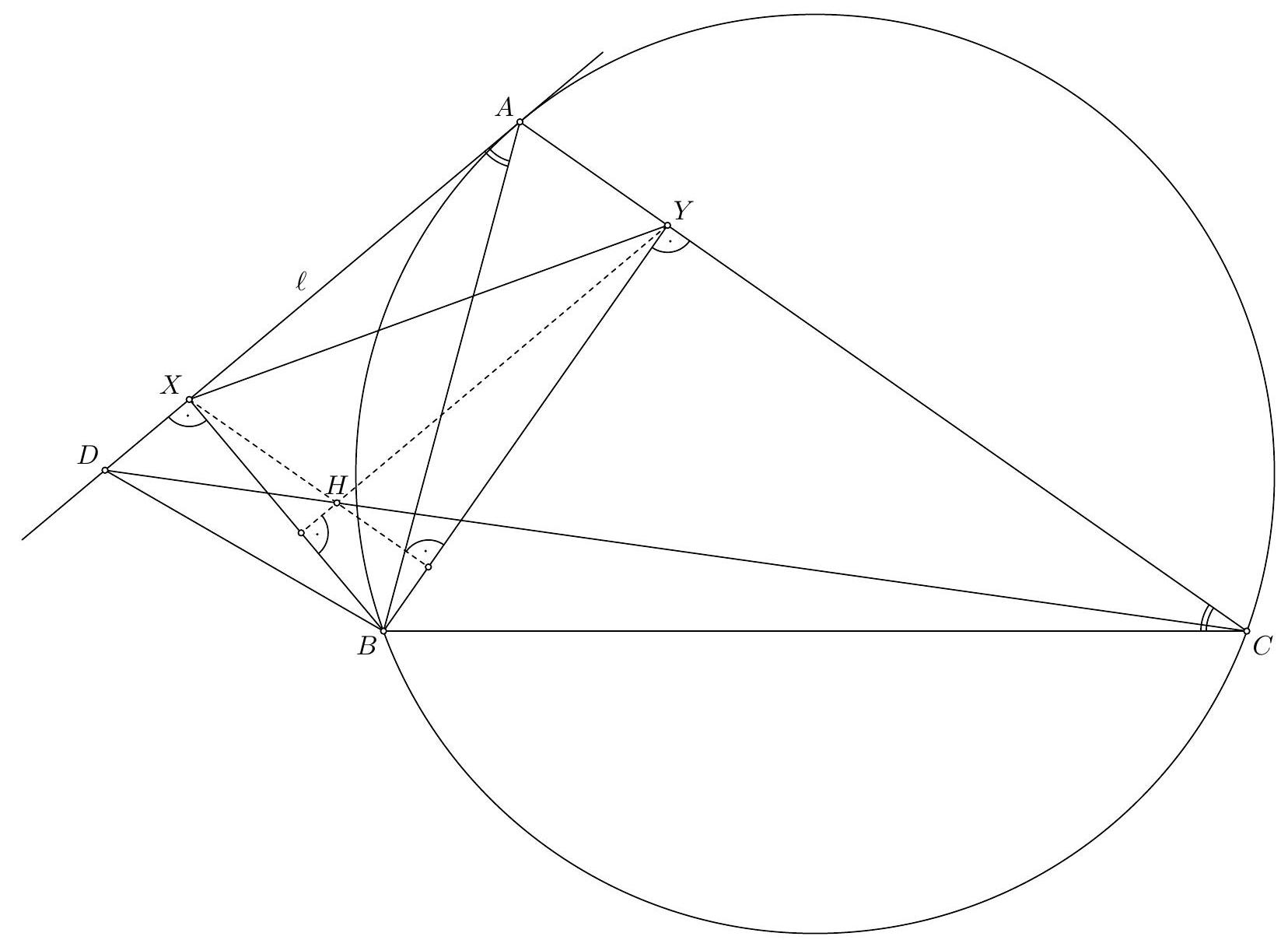
|
| 449 |
+
|
| 450 |
+
Note that $X H \perp B Y \perp A C$ and $Y H \perp B X \perp A D$. Therefore $X H \| A C$ and $Y H \| A D$. It follows that
|
| 451 |
+
|
| 452 |
+
$$
|
| 453 |
+
\frac{A D}{A X}=\frac{C D}{C H}=\frac{C A}{C Y} \Longrightarrow \frac{A D}{C A}=\frac{A X}{C Y}=\frac{A B \cos \angle X A B}{C B \cos \angle Y C B}
|
| 454 |
+
$$
|
| 455 |
+
|
| 456 |
+
Since $\ell$ is tangent to $\omega$, we have $\angle X A B=\angle Y C B$. Thus the cosines in the equality above cancel out and we obtain
|
| 457 |
+
|
| 458 |
+
$$
|
| 459 |
+
\frac{A D}{C A}=\frac{A B}{C B}
|
| 460 |
+
$$
|
| 461 |
+
|
| 462 |
+
This, along with $\angle D A B=\angle A C B$, proves that $\triangle D A B \sim \triangle A C B$ by SAS. Therefore $\angle C B A=$ $\angle A B D$. This shows that $B A$ bisects angle $C B D$.
|
| 463 |
+
|
| 464 |
+
## Solution 2.
|
| 465 |
+
|
| 466 |
+
Let $D^{\prime}$ be a point on $\ell$ such that $\angle C B A=\angle A B D^{\prime}$. Let $Z$ and $T$ be projections of $A$ onto $B C$ and $B D^{\prime}$, respectively. Note that the circle with diameter $A B$ passes through $X, Y, Z, T$. By Pascal's theorem for hexagon $A X Z B T Y$, points $D^{\prime}, C$, and $H^{\prime}:=X Z \cap T Y$ are collinear.
|
| 467 |
+
|
| 468 |
+
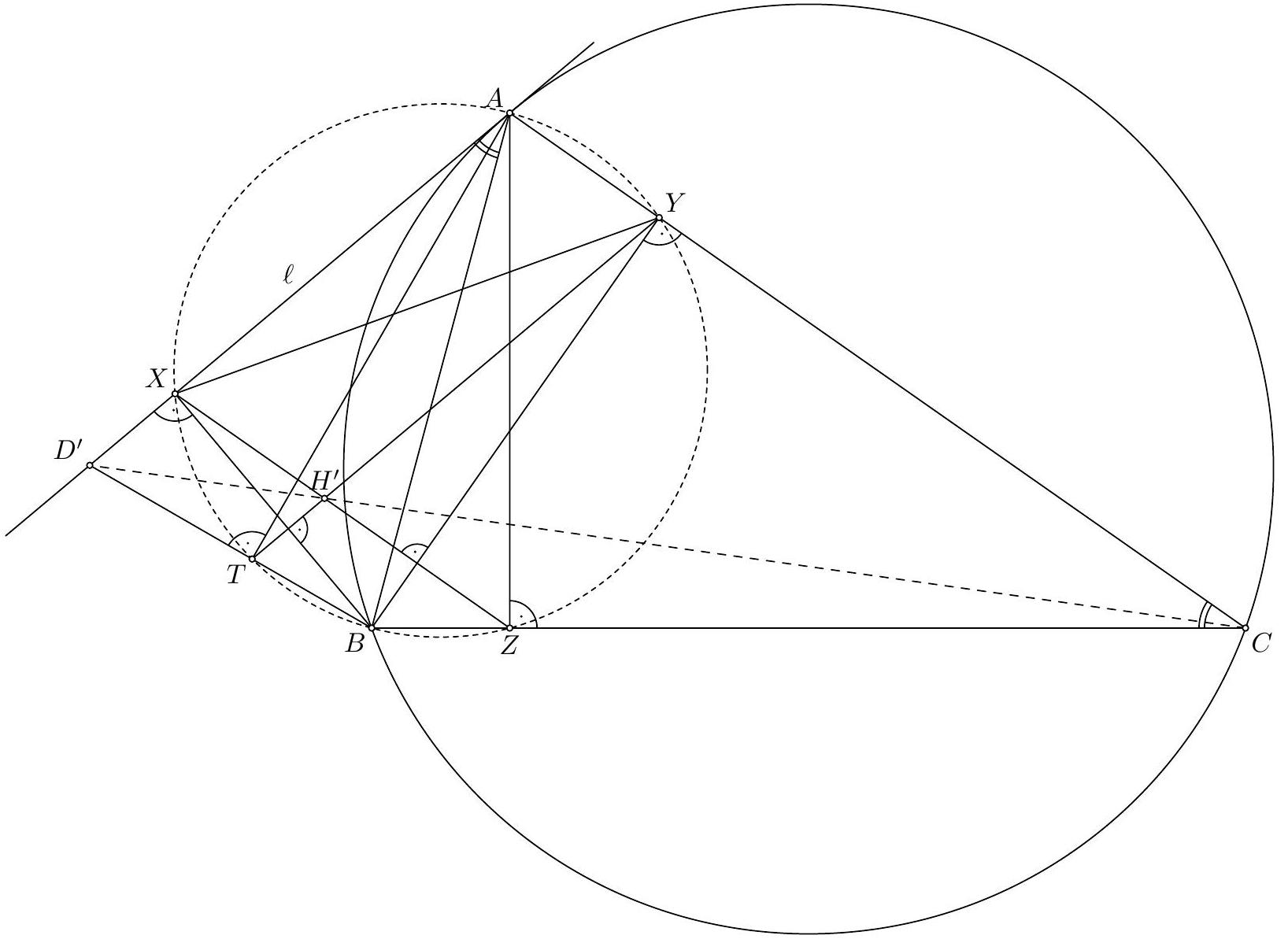
|
| 469 |
+
|
| 470 |
+
We have
|
| 471 |
+
|
| 472 |
+
$$
|
| 473 |
+
\angle X Z B=\angle X A B=\angle C A B=90^{\circ}-\angle Z B Y
|
| 474 |
+
$$
|
| 475 |
+
|
| 476 |
+
which shows that $X Z \perp B Y$.
|
| 477 |
+
|
| 478 |
+
By definition of $D^{\prime}$,
|
| 479 |
+
|
| 480 |
+
$$
|
| 481 |
+
\angle B D^{\prime} A=180^{\circ}-\angle D^{\prime} A B-\angle A B D^{\prime}=180^{\circ}-\angle A C B-\angle C B A=\angle B A C .
|
| 482 |
+
$$
|
| 483 |
+
|
| 484 |
+
Therefore
|
| 485 |
+
|
| 486 |
+
$$
|
| 487 |
+
\angle D^{\prime} A T=90^{\circ}-\angle T D^{\prime} A=90^{\circ}-\angle B A C,
|
| 488 |
+
$$
|
| 489 |
+
|
| 490 |
+
hence
|
| 491 |
+
|
| 492 |
+
$$
|
| 493 |
+
\angle X Y T+\angle B X Y=\angle X A T+\angle B A Y=90^{\circ}-\angle B A C+\angle B A C=90^{\circ} .
|
| 494 |
+
$$
|
| 495 |
+
|
| 496 |
+
This shows that $Y T \perp B X$.
|
| 497 |
+
|
| 498 |
+
Since $X Z \perp B Y$ and $Y T \perp B X$, it follows that $H^{\prime}$ is the orthocenter of $B X Y$, i.e. $H^{\prime}=H$. Since $D^{\prime}, C, H^{\prime}$ are collinear and $D^{\prime}$ lies on $\ell$, it follows that $D^{\prime}=D$. Therefore $\angle A B D=\angle C B A$ and we are done.
|
| 499 |
+
|
| 500 |
+
Problem 14. An acute triangle $A B C$ is given and let $H$ be its orthocenter. Let $\omega$ be the circle through $B, C$ and $H$, and let $\Gamma$ be the circle with diameter $A H$. Let $X \neq H$ be the other intersection point of $\omega$ and $\Gamma$, and let $\gamma$ be the reflection of $\Gamma$ over $A X$.
|
| 501 |
+
|
| 502 |
+
Suppose $\gamma$ and $\omega$ intersect again at $Y \neq X$, and line $A H$ and $\omega$ intersect again at $Z \neq H$. Show that the circle through $A, Y, Z$ passes through the midpoint of segment $B C$.
|
| 503 |
+
|
| 504 |
+
## Solution.
|
| 505 |
+
|
| 506 |
+
Let $M$ be the midpoint of $B C$. We first show that $X$ lies on $A M$. Consider $A^{\prime}$, the reflection of $A$ across $M$. As $A B A^{\prime} C$ is a parallelogram, we have that $\angle B A^{\prime} C=\angle B A C=180^{\circ}-\angle B H C$, which in turn gives us that $A^{\prime}$ lies on $\omega$. Now $\angle H B A^{\prime}=\angle H B C+\angle C B A^{\prime}=\angle H B C+\angle A C B=$ $90^{\circ}$. Hence $H A$ is a diameter of $\omega$. In particular we must have $\angle H X A^{\prime}=90^{\circ}$. Consequently $\angle A X A^{\prime}=\angle A X H+\angle H X A^{\prime}=90^{\circ}+90^{\circ}=180^{\circ}$, i.e. $A, X, A^{\prime}$ are collinear. But $A, M, A^{\prime}$ collinear by definition, hence $X$ lies on the $A$-median.
|
| 507 |
+
|
| 508 |
+
Now it suffices to show that $\angle A Y Z=\angle A M Z$. We note the two following facts:
|
| 509 |
+
|
| 510 |
+
- $\angle A H X=\angle A Y X$, since $\omega$ and $\Gamma$ have the same radius and the two angles span the same chord $A X$.
|
| 511 |
+
- $\omega$ is the reflection of the circumcircle of $A B C$ across $B C$. That gives us that $Z$ is the reflection of $A$ across $D$, the feet of the $A$-altitude to $B C$.
|
| 512 |
+
|
| 513 |
+
Hence we can write: $\angle A Y Z=\angle A Y X+\angle X Y Z=\angle A H X+\left(180^{\circ}-\angle X H Z\right)=2 \angle A H X=$ $2 \angle A M D=\angle A M Z$, which is what we wanted.
|
| 514 |
+
|
| 515 |
+
Problem 15. On a plane, Bob chooses 3 points $A_{0}, B_{0}, C_{0}$ (not necessarily distinct) such that $A_{0} B_{0}+B_{0} C_{0}+C_{0} A_{0}=1$. Then he chooses points $A_{1}, B_{1}, C_{1}$ (not necessarily distinct) in such a way that $A_{1} B_{1}=A_{0} B_{0}$ and $B_{1} C_{1}=B_{0} C_{0}$. Next he chooses points $A_{2}, B_{2}, C_{2}$ as a permutation of points $A_{1}, B_{1}, C_{1}$. Finally, Bob chooses points $A_{3}, B_{3}, C_{3}$ (not necessarily distinct) in such a way that $A_{3} B_{3}=A_{2} B_{2}$ and $B_{3} C_{3}=B_{2} C_{2}$. What are the smallest and the greatest possible values of $A_{3} B_{3}+B_{3} C_{3}+C_{3} A_{3}$ Bob can obtain?
|
| 516 |
+
|
| 517 |
+
## Solution.
|
| 518 |
+
|
| 519 |
+
Answer: $\frac{1}{3}$ and 3 .
|
| 520 |
+
|
| 521 |
+
Denote the lengths $A_{0} B_{0}, B_{0} C_{0}, C_{0} A_{0}$ by $x, y, z$ in non-increasing order. Similarly, denote the lengths $A_{1} B_{1}, B_{1} C_{1}, C_{1} A_{1}$ by $x^{\prime}, y^{\prime}, z^{\prime}$ in non-increasing order, and the lengths $A_{3} B_{3}, B_{3} C_{3}$, $C_{3} A_{3}$ by $x^{\prime \prime}, y^{\prime \prime}, z^{\prime \prime}$ in non-increasing order. (As permuting the points does not change the distances, we do not need a separate vector for $A_{2} B_{2}, B_{2} C_{2}, C_{2} A_{2}$.) Then we have $x+y+z=1$, $y+z \geqslant x, y^{\prime}+z^{\prime} \geqslant x^{\prime}, y^{\prime \prime}+z^{\prime \prime} \geqslant x^{\prime \prime}$. By construction, triples $(x, y, z)$ and $\left(x^{\prime}, y^{\prime}, z^{\prime}\right)$ have two values in common (but not necessarily at corresponding places), similarly $\left(x^{\prime}, y^{\prime}, z^{\prime}\right)$ and $\left(x^{\prime \prime}, y^{\prime \prime}, z^{\prime \prime}\right)$ have two values in common.
|
| 522 |
+
|
| 523 |
+
Using these observations, calculate:
|
| 524 |
+
|
| 525 |
+
$$
|
| 526 |
+
\begin{aligned}
|
| 527 |
+
x^{\prime \prime}+y^{\prime \prime}+z^{\prime \prime} & \leqslant 2\left(y^{\prime \prime}+z^{\prime \prime}\right) \leqslant 2\left(x^{\prime}+y^{\prime}\right) \leqslant 2\left(y^{\prime}+y^{\prime}+z^{\prime}\right) \\
|
| 528 |
+
& \leqslant 2(x+x+y) \leqslant 6 x \leqslant 3(x+y+z)=3 .
|
| 529 |
+
\end{aligned}
|
| 530 |
+
$$
|
| 531 |
+
|
| 532 |
+
We can achieve the value 3 as follows. Let $A_{0} B_{0}=\frac{1}{2}$ and $C_{0}=A_{0}$. Let $A_{1}=A_{0}$, $B_{1}=B_{0}$ and $\overrightarrow{B_{1} C_{1}}=-\overrightarrow{B_{0} C_{0}}$. Let $A_{2}=A_{1}$ and $B_{2}=C_{1}, C_{2}=B_{1}$. Finally, let $A_{3}=A_{2}$, $B_{3}=B_{2}$ and $\overrightarrow{B_{3} C_{3}}=-\overrightarrow{B_{2} C_{2}}$. By construction, $A_{3} B_{3}=1, B_{3} C_{3}=\frac{1}{2}$ and $C_{3} A_{3}=\frac{3}{2}$, so $A_{3} B_{3}+B_{3} C_{3}+C_{3} A_{3}=3$.
|
| 533 |
+
|
| 534 |
+
This establishes the upper bound. For the lower bound, note that all steps are reversible and the 3-step process itself is symmetric. By scaling, we can also make the initial configuration to satisfy the conditions of the problem. Hence all processes satisfying the conditions of the problem and achieving a final value $t$ are in one-to-one correspondence with processes satisfying the conditions of the problem and achieving the final value $\frac{1}{t}$. This shows that the lower bound is $\frac{1}{3}$.
|
| 535 |
+
|
| 536 |
+
Problem 16. Richard and Kaarel are taking turns to choose numbers from the set $\{1, \ldots, p-1\}$ where $p>3$ is a prime. Richard is the first one to choose. A number which has been chosen by one of the players cannot be chosen again by either of the players. Every number chosen by Richard is multiplied with the next number chosen by Kaarel. Kaarel wins the game if at any moment after his turn the sum of all of the products calculated so far is divisible by $p$. Richard wins if this does not happen, i.e. the players run out of numbers before any of the sums is divisible by $p$. Can either of the players guarantee their victory regardless of their opponent's moves and if so, which one?
|
| 537 |
+
|
| 538 |
+
## Solution 1.
|
| 539 |
+
|
| 540 |
+
Answer: Yes, Kaarel.
|
| 541 |
+
|
| 542 |
+
Let us split the numbers in the set to the following pairs: $(1, p-1),(2, p-2), \ldots,\left(\frac{p-1}{2}, \frac{p+1}{2}\right)$. If Richard chooses some number $a$, then let Kaarel choose the other number from the pair i.e. $p-a$. This forces Richard to choose a number from a pair in which both of the numbers have not been chosen yet and hence Kaarel can make his desired move. The residues modulo $p$ of the products are of the form $-a^{2}$. The residue of the sum of all the products is congruent to $-\left(1^{2}+2^{2}+\ldots+\left(\frac{p-1}{2}\right)^{2}\right)$. For every natural number $n$, we have $1^{2}+2^{2}+\ldots+n^{2}=\frac{n(n+1)(2 n+1)}{6}$, therefore $1^{2}+2^{2}+\ldots+\left(\frac{p-1}{2}\right)^{2}=\frac{(p-1) p(p+1)}{24}$. This must be an integer and as $p$ and 24 are coprime, $\frac{(p-1) p(p+1)}{24}$ must be divisible by $p$. Therefore, when the last number is chosen from the set, the sum of the products is divisible by $p$.
|
| 543 |
+
|
| 544 |
+
Solution 2.
|
| 545 |
+
|
| 546 |
+
If Richard initially chooses some number $x$, then Kaarel chooses $p-x$ as above (distinct from $x$ as $p$ is odd). Since $p-1>2$, there are still numbers left, so the game continues.
|
| 547 |
+
|
| 548 |
+
If next Richard chooses $y$ as his second number, then Kaarel wins by choosing the unique number $1 \leqslant a \leqslant p-1$ congruent to $x^{2} \cdot y^{-1}$ modulo $p$. In order for Kaarel's second move to be legal, we must confirm that $a$ is different from $x,-x$ and $y$ modulo $p$.
|
| 549 |
+
|
| 550 |
+
If $a \equiv x(\bmod p)$, then $y \equiv x(\bmod p)$ contradicting Richards second move. If $a \equiv-x$ $(\bmod p)$, then $y \equiv-x(\bmod p)$ also contradicting Richards second move. Finally, if $a \equiv y$ $(\bmod p)$, then $x^{2} \equiv y^{2}(\bmod p)$ implying $y \equiv \pm x(\bmod p)$ with the same contradictions once more.
|
| 551 |
+
|
| 552 |
+
We conclude that $a$ is distinct from the previous numbers, and $x \cdot(p-x)+y \cdot a \equiv 0(\bmod p)$, so Kaarel wins.
|
| 553 |
+
|
| 554 |
+
Problem 17. For a prime number $p$ and a positive integer $n$, denote by $f(p, n)$ the largest integer $k$ such that $p^{k} \mid n$ !. Let $p$ be a given prime number and let $m$ and $c$ be given positive integers. Prove that there exist infinitely many positive integers $n$ such that $f(p, n) \equiv c$ $(\bmod m)$.
|
| 555 |
+
|
| 556 |
+
Solution 1.
|
| 557 |
+
|
| 558 |
+
We start by noting that
|
| 559 |
+
|
| 560 |
+
$$
|
| 561 |
+
f(p, n)=\left\lfloor\frac{n}{p}\right\rfloor+\left\lfloor\frac{n}{p^{2}}\right\rfloor+\left\lfloor\frac{n}{p^{3}}\right\rfloor+\ldots
|
| 562 |
+
$$
|
| 563 |
+
|
| 564 |
+
which is the well-known Legendre Formula. Now, if we choose
|
| 565 |
+
|
| 566 |
+
$$
|
| 567 |
+
n=p^{a_{1}}+p^{a_{2}}+\cdots+p^{a_{k}}
|
| 568 |
+
$$
|
| 569 |
+
|
| 570 |
+
for positive integers $a_{1}>a_{2}>\cdots>a_{k}$ to be determined, this formula immediately shows that
|
| 571 |
+
|
| 572 |
+
$$
|
| 573 |
+
\begin{aligned}
|
| 574 |
+
f(p, n) & =\left(p^{a_{1}-1}+p^{a_{1}-2}+\cdots+p+1\right)+\left(p^{a_{2}-1}+p^{a_{2}-2}+\cdots+p+1\right)+\ldots \\
|
| 575 |
+
& =\frac{p^{a_{1}}-1}{p-1}+\frac{p^{a_{2}}-1}{p-1}+\ldots
|
| 576 |
+
\end{aligned}
|
| 577 |
+
$$
|
| 578 |
+
|
| 579 |
+
We thus consider the numbers $\left(p^{a}-1\right) /(p-1)$. If we can show that there is a residue class $C$ $(\bmod m)$ which is coprime to $m$ occuring infinitely often among these numbers, we will be done since we can choose $a_{1}, \ldots, a_{k}$ with $k C \equiv c(\bmod m)$ arbitrarily among these numbers. Now, how to find such a number $C$ ?
|
| 580 |
+
|
| 581 |
+
To this end, write $m=p^{t} \cdot m^{\prime}$ with $p \nmid m^{\prime}$. Since $p^{a}$ is certainly periodic modulo $m^{\prime} \cdot(p-1)$, the sequence $\left(p^{a}-1\right) /(p-1)$ is periodic modulo $m^{\prime}$ with some period $d$ and hence for $a \equiv 1(\bmod d)$, the numbers are always $1\left(\bmod m^{\prime}\right)$. Moreover, for $a \geq t$, all the numbers are equal to $\left(p^{t}-1\right) /(p-1)$ modulo $p^{t}$ and hence by the Chinese Remainder Theorem, all the numbers $\left(p^{a}-1\right) /(p-1)$ for $a \geq t$ and $a \equiv 1(\bmod d)$ are in the same residue class $C$ $(\bmod m)$, with $C$ coprime to $m$, as desired.
|
| 582 |
+
|
| 583 |
+
## Solution 2.
|
| 584 |
+
|
| 585 |
+
We denote $v_{p}(n)$ for the largest power of $p$ dividing $n$.
|
| 586 |
+
|
| 587 |
+
We start with a lemma.
|
| 588 |
+
|
| 589 |
+
Lemma. For any prime $q$ and modulus $m^{\prime}$ not divisible by $q$, there exists infinitely many powers $q^{n}$ of $q$ such that $v_{p}\left(q^{n} !\right) \equiv 1\left(\bmod m^{\prime}\right)$.
|
| 590 |
+
|
| 591 |
+
Proof. Define $a_{k}=v_{q}\left(q^{k} !\right)$. We then have $a_{k+1}=q a_{k}+1$. This sequence is eventually periodic modulo $m^{\prime}$. It must actually be periodic starting from 0 , as $a_{i} \equiv a_{i+T}\left(\bmod m^{\prime}\right)$ implies $q a_{i-1} \equiv q a_{i+T-1}\left(\bmod m^{\prime}\right)$ and therefore $a_{i-1} \equiv a_{i+T-1}\left(\bmod m^{\prime}\right)$, since $q \nmid m^{\prime}$. Thus, for infinitely many $n$ we have $a_{n} \equiv a_{1}=1\left(\bmod m^{\prime}\right)$.
|
| 592 |
+
|
| 593 |
+
We now turn to solving the problem. Write $m=p^{t} m^{\prime}$, where $p \nmid m^{\prime}$. The sequence $v_{p}(p !), v_{p}\left(p^{2} !\right), v_{p}\left(p^{3} !\right), \ldots$ is eventually constant modulo $p^{t}$. Denote this constant by $C$. Since $p \nmid C$, by the Chinese remainder theorem there exists a positive integer $s$ such that $C s \equiv c$ $\left(\bmod p^{t}\right)$ and $s \equiv c\left(\bmod m^{\prime}\right)$. Now, choose
|
| 594 |
+
|
| 595 |
+
$$
|
| 596 |
+
n=p^{b_{1}}+p^{b_{2}}+\ldots+p^{b_{s}}
|
| 597 |
+
$$
|
| 598 |
+
|
| 599 |
+
where $b_{i}$ are distinct positive integers such that $v_{p}\left(p_{i}^{b} !\right) \equiv 1\left(\bmod m^{\prime}\right)($ possible by the lemma) and large enough such that $v_{p}\left(p_{i}^{b} !\right) \equiv C\left(\bmod p^{t}\right)$. We have
|
| 600 |
+
|
| 601 |
+
$$
|
| 602 |
+
v_{p}(n !)=v_{p}\left(p_{1}^{b} !\right)+\ldots+v_{p}\left(p^{b_{s}} !\right) \equiv C s \equiv c \quad\left(\bmod p^{t}\right)
|
| 603 |
+
$$
|
| 604 |
+
|
| 605 |
+
and
|
| 606 |
+
|
| 607 |
+
$$
|
| 608 |
+
v_{p}(n !)=v_{p}\left(p_{1}^{b} !\right)+\ldots+v_{p}\left(p^{b_{s}} !\right) \equiv s \equiv c \quad\left(\bmod m^{\prime}\right)
|
| 609 |
+
$$
|
| 610 |
+
|
| 611 |
+
which proves $v_{p}(n !) \equiv c(\bmod m)$. Since there are infinitely many of possible choices $n$, we are done.
|
| 612 |
+
|
| 613 |
+
Comment. IMO shortlist 2007 N7 asks to prove that for given $d$ and primes $p_{1}, \ldots, p_{k}$ there exists infinitely many integers $n$ such that $d \mid v_{p_{i}}(n !)$ for all $i$. While the IMO shortlist problem is of similar flavor, it would seem that it is more difficult than the problem above, and the methods are a bit different. (There is no clear way to use prime powers in the IMO SL problem similarly to the solution above.)
|
| 614 |
+
|
| 615 |
+
Comment. As a vast generalization of the problem above and the IMO shortlist problem, one could ask whether the following holds: For any modulus $m$ and distinct primes $p_{1}, \ldots, p_{k}$, the function
|
| 616 |
+
|
| 617 |
+
$$
|
| 618 |
+
n \rightarrow\left(v_{p_{1}}(n !) \quad(\bmod m), v_{p_{2}}(n !) \quad(\bmod m), \ldots, v_{p_{k}}(n !) \quad(\bmod m)\right)
|
| 619 |
+
$$
|
| 620 |
+
|
| 621 |
+
(viewed as a function $\mathbb{Z}_{+} \rightarrow\left(\mathbb{Z}_{m}\right)^{k}$ ) is equidistributed. The author of the problem believes this generalization to hold, but he has no proof.
|
| 622 |
+
|
| 623 |
+
Problem 18. Let $n \geqslant 1$ be a positive integer. We say that an integer $k$ is a fan of $n$ if $0 \leqslant k \leqslant n-1$ and there exist integers $x, y, z \in \mathbb{Z}$ such that
|
| 624 |
+
|
| 625 |
+
$$
|
| 626 |
+
\begin{aligned}
|
| 627 |
+
x^{2}+y^{2}+z^{2} & \equiv 0 \quad(\bmod n) ; \\
|
| 628 |
+
x y z & \equiv k \quad(\bmod n) .
|
| 629 |
+
\end{aligned}
|
| 630 |
+
$$
|
| 631 |
+
|
| 632 |
+
Let $f(n)$ be the number of fans of $n$. Determine $f(2020)$.
|
| 633 |
+
|
| 634 |
+
Solution.
|
| 635 |
+
|
| 636 |
+
Answer: $f(2020)=f(4) \cdot f(5) \cdot f(101)=1 \cdot 1 \cdot 101=101$.
|
| 637 |
+
|
| 638 |
+
To prove our claim we show that $f$ is multiplicative, that is, $f(r s)=f(r) f(s)$ for coprime numbers $r, s \in \mathbb{N}$, and that
|
| 639 |
+
|
| 640 |
+
(i) $f(4)=1$,
|
| 641 |
+
|
| 642 |
+
(ii) $f(5)=1$,
|
| 643 |
+
|
| 644 |
+
(iii) $f(101)=101$.
|
| 645 |
+
|
| 646 |
+
The multiplicative property follows from the Chinese Remainder Theorem.
|
| 647 |
+
|
| 648 |
+
(i) Integers $x, y$ and $z$ satisfy $x^{2}+y^{2}+z^{2} \equiv 0 \bmod 4$ if and only if they are all even. In this case $x y z \equiv 0 \bmod 4$. Hence 0 is the only fan of 4 .
|
| 649 |
+
|
| 650 |
+
(ii) Integers $x, y$ and $z$ satisfy $x^{2}+y^{2}+z^{2} \equiv 0 \bmod 5$ if and only if at least one of them is divisible by 5 . In this case $x y z \equiv 0 \bmod 5$. Hence 5 is the only fan of 5 .
|
| 651 |
+
|
| 652 |
+
(iii) We have $9^{2}+4^{2}+2^{2}=81+16+4=101$. Hence $(9 x)^{2}+(4 x)^{2}+(2 x)^{2}$ is divisible by 101 for every integer $x$. Hence the residue of $9 x \cdot 4 x \cdot 2 x=72 x^{3}$ upon division by 101 is a fan of 101 for every $x \in \mathbb{Z}$. If we substitute $x=t^{67}$, then $x^{3}=t^{201} \equiv t \bmod 101$. Since 72 is coprime to 101 , the number $72 x^{3} \equiv 72 t$ can take any residue modulo 101 .
|
| 653 |
+
|
| 654 |
+
Note: In general for $p \not \equiv 1(\bmod 3)$, we have $f(p)=p$ as soon as we have at least one non-zero fan.
|
| 655 |
+
|
| 656 |
+
Problem 19. Denote by $d(n)$ the number of positive divisors of a positive integer $n$. Prove that there are infinitely many positive integers $n$ such that $|\sqrt{3} \cdot d(n)|$ divides $n$.
|
| 657 |
+
|
| 658 |
+
Solution 1.
|
| 659 |
+
|
| 660 |
+
Note that $\lfloor\sqrt{3} \cdot 8\rfloor=13$. Therefore all numbers with 8 divisors that are divisible by 13 satisfy the condition. There are infinitely many of those, for example, all numbers in the form $13 p^{3}$, where $p$ is a prime different from 13 .
|
| 661 |
+
|
| 662 |
+
## Solution 2.
|
| 663 |
+
|
| 664 |
+
Based on the solution by the Finnish team: Instead of finding infinitely many solutions with $d(n)=2^{3}$, we prove that every power $2^{k}, k \geqslant 0$, has at least one solution with $d(n)=2^{k}$.
|
| 665 |
+
|
| 666 |
+
Let $k \geqslant 0$ be given, and let $p_{1}, p_{2}, \ldots$ be the sequence of all prime numbers. We then write the prime factorization of $\left\lfloor 2^{k} \sqrt{3}\right\rfloor$ as
|
| 667 |
+
|
| 668 |
+
$$
|
| 669 |
+
\left\lfloor 2^{k} \sqrt{3}\right\rfloor=\prod_{i=1}^{\infty} p_{i}^{b_{i}}
|
| 670 |
+
$$
|
| 671 |
+
|
| 672 |
+
with $b_{i} \geqslant 0$ and only finitely many $b_{i}$ different from 0 .
|
| 673 |
+
|
| 674 |
+
Since $\sqrt{3}<2$, we have
|
| 675 |
+
|
| 676 |
+
$$
|
| 677 |
+
2^{k+1}>\left\lfloor 2^{k} \sqrt{3}\right\rfloor=\prod_{i=1}^{\infty} p_{i}^{b_{i}} \geqslant \prod_{i=1}^{\infty} 2^{b_{i}}=2^{\sum_{i=1}^{\infty} b_{i}}
|
| 678 |
+
$$
|
| 679 |
+
|
| 680 |
+
and from this we conclude $\sum_{i=1}^{\infty} b_{i} \leqslant k$. We know that $m+1 \leqslant 2^{m}$ for any integer $m \geqslant 0$, and this brings us a further estimate
|
| 681 |
+
|
| 682 |
+
$$
|
| 683 |
+
\sum_{i=1}^{\infty}\left\lceil\log _{2}\left(b_{i}+1\right)\right\rceil \leqslant \sum_{i=1}^{\infty} b_{i} \leqslant k
|
| 684 |
+
$$
|
| 685 |
+
|
| 686 |
+
By increasing values if necessary, we can choose a sequence of non-negative integers $a_{1}, a_{2}, \ldots$ such that $a_{i} \geqslant\left\lceil\log _{2}\left(b_{i}+1\right)\right\rceil$ for all $i$, and $\sum_{i=1}^{\infty} a_{i}=k$. [Editor's note: In fact, unless $\sum_{i=1}^{\infty}\left\lceil\log _{2}\left(b_{i}+1\right)\right\rceil=k$ already, we have an infinite choice of such sequences - each leading to a distinct $n$ with the required properties.] We now define
|
| 687 |
+
|
| 688 |
+
$$
|
| 689 |
+
n=\prod_{i=1}^{\infty} p_{i}^{2^{a_{i}}-1}
|
| 690 |
+
$$
|
| 691 |
+
|
| 692 |
+
which is a valid product since all but finitely many $a_{i}$ are equal to zero. By construction we have $2^{a_{i}}-1 \geqslant b_{i}$ for all $i$, so $\left\lfloor 2^{k} \sqrt{3}\right\rfloor$ divides $n$. Finally, the number of divisors in $n$ can be calculated as
|
| 693 |
+
|
| 694 |
+
$$
|
| 695 |
+
d(n)=\prod_{i=1}^{\infty}\left(\left(2^{a_{i}}-1\right)+1\right)=\prod_{i=1}^{\infty} 2^{a_{i}}=2^{\sum_{i=1}^{\infty} a_{i}}=2^{k}
|
| 696 |
+
$$
|
| 697 |
+
|
| 698 |
+
so $n$ satisfies that $\lfloor d(n) \sqrt{3}\rfloor=\left\lfloor 2^{k} \sqrt{3}\right\rfloor$ divides $n$.
|
| 699 |
+
|
| 700 |
+
Solution 3.
|
| 701 |
+
|
| 702 |
+
Based on the solution by the Norwegian team: In this third solution, instead of letting $d(n)$ be a power of 2 , we prove that there a infinitely many solutions with $n=2^{k}$.
|
| 703 |
+
|
| 704 |
+
Consider the sequence $a_{i}=\lfloor i \sqrt{3}\rfloor$ for $i \geqslant 1$. If $k \geqslant 3$, then $(k+1) \sqrt{3}<2(k+1) \leqslant 2^{k}$. Consequently, whenever $a_{k+1}=2^{m}$ and $k \geqslant 3$, we get
|
| 705 |
+
|
| 706 |
+
$$
|
| 707 |
+
\left\lfloor d\left(2^{k}\right) \sqrt{3}\right\rfloor=\lfloor(k+1) \sqrt{3}\rfloor=a_{k+1}=2^{m} \mid 2^{k}
|
| 708 |
+
$$
|
| 709 |
+
|
| 710 |
+
so $n=2^{k}$ satisfies the properties of the problem. It is therefore sufficient to prove that the integer sequence $a_{i}=\lfloor i \sqrt{3}\rfloor$ contains infinitely many powers of 2 . Since $\sqrt{3}>1$, the sequence is strictly increasing, and since $\sqrt{3}<2$, we have
|
| 711 |
+
|
| 712 |
+
$$
|
| 713 |
+
a_{i+1}-a_{i}=\lfloor(i+1) \sqrt{3}\rfloor-\lfloor i \sqrt{3}\rfloor<(i+1) \sqrt{3}-(i \sqrt{3}-1)=\sqrt{3}+1<3 .
|
| 714 |
+
$$
|
| 715 |
+
|
| 716 |
+
Hence the sequence jump by at most 2 at each step.
|
| 717 |
+
|
| 718 |
+
Suppose for contradiction that the sequence constains only finitely many powers of two, say the largest is $2^{N}$. Then for every $m>N$ we can find a unique index $k$ such that $a_{k}=2^{m}-1$ and $a_{k+1}=2^{m}+1$.
|
| 719 |
+
|
| 720 |
+
Define $d_{i}=i \sqrt{3}-a_{i}$ to be the fractional part for each $i$, so that $0 \leqslant d_{i}<1$. For $k$ as above we then have
|
| 721 |
+
|
| 722 |
+
$$
|
| 723 |
+
\begin{aligned}
|
| 724 |
+
k \sqrt{3}-\left(2^{m}-1\right) & =d_{k} \geqslant 0, \\
|
| 725 |
+
(k+1) \sqrt{3}-\left(2^{m}+1\right) & =d_{k+1} \geqslant 0, \\
|
| 726 |
+
\text { and thus }(2 k+1) \sqrt{3}-2^{m+1} & =d_{k}+d_{k+1} \geqslant 0
|
| 727 |
+
\end{aligned}
|
| 728 |
+
$$
|
| 729 |
+
|
| 730 |
+
If $d_{k}+d_{k+1}<1$, we would have $a_{2 k+1}=2^{m+1}$ contrary to our assumptions, hence $1 \leqslant d_{k}+d_{k+1}<2$ and consequently $a_{2 k+1}=2^{m+1}+1$ and $a_{2 k}=2^{m+1}-1$.
|
| 731 |
+
|
| 732 |
+
Since $a_{2 k}=2^{m+1}-1$, we have a recursive expression for $d_{2 k}$ as well:
|
| 733 |
+
|
| 734 |
+
$$
|
| 735 |
+
d_{2 k}=2 k \sqrt{3}-\left(2^{m+1}-1\right)=2\left(d_{k}+2^{m}-1\right)-\left(2^{m+1}-1\right)=2 d_{k}-1 .
|
| 736 |
+
$$
|
| 737 |
+
|
| 738 |
+
We can now repeat the process with $2 k$ and $2 k+1$ in place of $k$ and $k+1$ in order to prove the following statements by induction for all $j \geqslant 0$ :
|
| 739 |
+
|
| 740 |
+
- $a_{2^{j} k}=2^{m+j}-1$ and $a_{2^{j} k+1}=2^{m+j}+1$
|
| 741 |
+
- $d_{2^{j} k}=2^{j} d_{k}-\left(2^{j}-1\right)=2^{j}\left(d_{k}-1\right)+1$
|
| 742 |
+
|
| 743 |
+
Finally, since $d_{k}-1<0$, the second property implies that $d_{2 j k}$ tends to $-\infty$ as $j$ tends to $\infty$. This clearly contradicts that $d_{2^{j} k} \geqslant 0$ for all $k$ and $j$, hence we conclude that the sequence $a_{i}$ contains infinitely many powers of 2 as required.
|
| 744 |
+
|
| 745 |
+
Problem 20. Let $A$ and $B$ be sets of positive integers with $|A| \geq 2$ and $|B| \geq 2$. Let $S$ be a set consisting of $|A|+|B|-1$ numbers of the form $a b$ where $a \in A$ and $b \in B$. Prove that there exist pairwise distinct $x, y, z \in S$ such that $x$ is a divisor of $y z$.
|
| 746 |
+
|
| 747 |
+
Solution 1.
|
| 748 |
+
|
| 749 |
+
We use induction on $k=|A|+|B|-1$.
|
| 750 |
+
|
| 751 |
+
For $k=3$ we have $|A|=|B|=2$. Let $A=\{x, y\}, B=\{z, t\}$. Then $S$ consists of three numbers from the set $\{x z, y z, x t, y t\}$. Relabelling the elements of $A$ and $B$ if necessary, we can assume without loss of generality that the missing number is $y t$. Then $x z, x t, y z \in S$ and $x z \mid x t \cdot y z$ which concludes the base case of induction.
|
| 752 |
+
|
| 753 |
+
For the inductive step, suppose the thesis holds for some $k-1 \geq 3$. Since $k=|A|+|B|-1 \geq$ 4, we have that $\max (|A|,|B|) \geq 3$, WLOG assume $|B| \geq 3$. Since the set $S$ consists of $k=|A|+|B|-1>|A|$ elements, by pigeonhole principle there exists a number $x \in A$ which appears as the first of the two factors of at least two elements of $S$. So, there exist $y, z \in B$ with $x y, x z \in S$. If there exists $t \in A \backslash\{x\}$ such that $t y \in S$ and $t y \neq x z$, then we are done because $x y \mid x z \cdot t y$. If there exists no such $t$ then apply the inductive hypothesis to the sets $A$, $B \backslash\{y\}$ and $S \backslash\{x y\}$ - note here that every element of $S \backslash\{x y\}$ still has the form $a b$ for $a \in A$ and $b \in B \backslash\{y\}$.
|
| 754 |
+
|
| 755 |
+
Solution 2.
|
| 756 |
+
|
| 757 |
+
Based on the solution by the Latvian team: We construct a bipartite graph $G$ where the elements of $A$ form one class of vertices, and the elements of $B$ form the other class of vertices. For each element $s \in S$ write $s=a b$ with $a \in A$ and $b \in B$ then put a single edge between $a$ and $b$ in $G$ (if $s$ decomposes as $a b$ in multiple ways, only place an edge for one of these decompositions). Now suppose $G$ has a path of length 3, i.e.
|
| 758 |
+
|
| 759 |
+

|
| 760 |
+
|
| 761 |
+
then $x \mid y z$ and since each element of $S$ only labels one edge, $x, y$ and $z$ are distinct. It is thus sufficient to show that if $|A|,|B| \geqslant 2$ and $|S|=|A|+|B|-1$, then $G$ has a path of length 3 . We shall prove the contrapositive statement: If $|S|=|A|+|B|-1$ and $G$ has no path of length 3 , then $|A|=1$ or $|B|=1$.
|
| 762 |
+
|
| 763 |
+
Suppose $G$ is bipartite and has no path of length 3, then in particular $G$ has no cycles, so $G$ is a forest (a collection of trees). The number of trees in a forest can be calculated as
|
| 764 |
+
|
| 765 |
+
$$
|
| 766 |
+
\# \text { vertices }-\# \text { edges }=(|A|+|B|)-(|A|+|B|-1)=1
|
| 767 |
+
$$
|
| 768 |
+
|
| 769 |
+
hence $G$ is a single tree. If $G$ is a tree and has not path of length 3, then $G$ has to be a star graph. A bipartite star graph necessarily has the central vertex in one class and all the leaves in the other class, hence either $|A|=1$ or $|B|=1$ as required.
|
| 770 |
+
|
BalticWay/md/en-bw21sol.md
ADDED
|
@@ -0,0 +1,805 @@
|
|
|
|
|
|
|
|
|
|
|
|
|
|
|
|
|
|
|
|
|
|
|
|
|
|
|
|
|
|
|
|
|
|
|
|
|
|
|
|
|
|
|
|
|
|
|
|
|
|
|
|
|
|
|
|
|
|
|
|
|
|
|
|
|
|
|
|
|
|
|
|
|
|
|
|
|
|
|
|
|
|
|
|
|
|
|
|
|
|
|
|
|
|
|
|
|
|
|
|
|
|
|
|
|
|
|
|
|
|
|
|
|
|
|
|
|
|
|
|
|
|
|
|
|
|
|
|
|
|
|
|
|
|
|
|
|
|
|
|
|
|
|
|
|
|
|
|
|
|
|
|
|
|
|
|
|
|
|
|
|
|
|
|
|
|
|
|
|
|
|
|
|
|
|
|
|
|
|
|
|
|
|
|
|
|
|
|
|
|
|
|
|
|
|
|
|
|
|
|
|
|
|
|
|
|
|
|
|
|
|
|
|
|
|
|
|
|
|
|
|
|
|
|
|
|
|
|
|
|
|
|
|
|
|
|
|
|
|
|
|
|
|
|
|
|
|
|
|
|
|
|
|
|
|
|
|
|
|
|
|
|
|
|
|
|
|
|
|
|
|
|
|
|
|
|
|
|
|
|
|
|
|
|
|
|
|
|
|
|
|
|
|
|
|
|
|
|
|
|
|
|
|
|
|
|
|
|
|
|
|
|
|
|
|
|
|
|
|
|
|
|
|
|
|
|
|
|
|
|
|
|
|
|
|
|
|
|
|
|
|
|
|
|
|
|
|
|
|
|
|
|
|
|
|
|
|
|
|
|
|
|
|
|
|
|
|
|
|
|
|
|
|
|
|
|
|
|
|
|
|
|
|
|
|
|
|
|
|
|
|
|
|
|
|
|
|
|
|
|
|
|
|
|
|
|
|
|
|
|
|
|
|
|
|
|
|
|
|
|
|
|
|
|
|
|
|
|
|
|
|
|
|
|
|
|
|
|
|
|
|
|
|
|
|
|
|
|
|
|
|
|
|
|
|
|
|
|
|
|
|
|
|
|
|
|
|
|
|
|
|
|
|
|
|
|
|
|
|
|
|
|
|
|
|
|
|
|
|
|
|
|
|
|
|
|
|
|
|
|
|
|
|
|
|
|
|
|
|
|
|
|
|
|
|
|
|
|
|
|
|
|
|
|
|
|
|
|
|
|
|
|
|
|
|
|
|
|
|
|
|
|
|
|
|
|
|
|
|
|
|
|
|
|
|
|
|
|
|
|
|
|
|
|
|
|
|
|
|
|
|
|
|
|
|
|
|
|
|
|
|
|
|
|
|
|
|
|
|
|
|
|
|
|
|
|
|
|
|
|
|
|
|
|
|
|
|
|
|
|
|
|
|
|
|
|
|
|
|
|
|
|
|
|
|
|
|
|
|
|
|
|
|
|
|
|
|
|
|
|
|
|
|
|
|
|
|
|
|
|
|
|
|
|
|
|
|
|
|
|
|
|
|
|
|
|
|
|
|
|
|
|
|
|
|
|
|
|
|
|
|
|
|
|
|
|
|
|
|
|
|
|
|
|
|
|
|
|
|
|
|
|
|
|
|
|
|
|
|
|
|
|
|
|
|
|
|
|
|
|
|
|
|
|
|
|
|
|
|
|
|
|
|
|
|
|
|
|
|
|
|
|
|
|
|
|
|
|
|
|
|
|
|
|
|
|
|
|
|
|
|
|
|
|
|
|
|
|
|
|
|
|
|
|
|
|
|
|
|
|
|
|
|
|
|
|
|
|
|
|
|
|
|
|
|
|
|
|
|
|
|
|
|
|
|
|
|
|
|
|
|
|
|
|
|
|
|
|
|
|
|
|
|
|
|
|
|
|
|
|
|
|
|
|
|
|
|
|
|
|
|
|
|
|
|
|
|
|
|
|
|
|
|
|
|
|
|
|
|
|
|
|
|
|
|
|
|
|
|
|
|
|
|
|
|
|
|
|
|
|
|
|
|
|
|
|
|
|
|
|
|
|
|
|
|
|
|
|
|
|
|
|
|
|
|
|
|
|
|
|
|
|
|
|
|
|
|
|
|
|
|
|
|
|
|
|
|
|
|
|
|
|
|
|
|
|
|
|
|
|
|
|
|
|
|
|
|
|
|
|
|
|
|
|
|
|
|
|
|
|
|
|
|
|
|
|
|
|
|
|
|
|
|
|
|
|
|
|
|
|
|
|
|
|
|
|
|
|
|
|
|
|
|
|
|
|
|
|
|
|
|
|
|
|
|
|
|
|
|
|
|
|
|
|
|
|
|
|
|
|
|
|
|
|
|
|
|
|
|
|
|
|
|
|
|
|
|
|
|
|
|
|
|
|
|
|
|
|
|
|
|
|
|
|
|
|
|
|
|
|
|
|
|
|
|
|
|
|
|
|
|
|
|
|
|
|
|
|
|
|
|
|
|
|
|
|
|
|
|
|
|
|
|
|
|
|
|
|
|
|
|
|
|
|
|
|
|
|
|
|
|
|
|
|
|
|
|
|
|
|
|
|
|
|
|
|
|
|
|
|
|
|
|
|
|
|
|
|
|
|
|
|
|
|
|
|
|
|
|
|
|
|
|
|
|
|
|
|
|
|
|
|
|
|
|
|
|
|
|
|
|
|
|
|
|
|
|
|
|
|
|
|
|
|
|
|
|
|
|
|
|
|
|
|
|
|
|
|
|
|
|
|
|
|
|
|
|
|
|
|
|
|
|
|
|
|
|
|
|
|
|
|
|
|
|
|
|
|
|
|
|
|
|
|
|
|
|
|
|
|
|
|
|
|
|
|
|
|
|
|
|
|
|
|
|
|
|
|
|
|
|
|
|
|
|
|
|
|
|
|
|
|
|
|
|
|
|
|
|
|
|
|
|
|
|
|
|
|
|
|
|
|
|
|
|
|
|
|
|
|
|
|
|
|
|
|
|
|
|
|
|
|
|
|
|
|
|
|
|
|
|
|
|
|
|
|
|
|
|
|
|
|
|
|
|
|
|
|
|
|
|
|
|
|
|
|
|
|
|
|
|
|
|
|
|
|
|
|
|
|
|
|
|
|
|
|
|
|
|
|
|
|
|
|
|
|
|
|
|
|
|
|
|
|
|
|
|
|
|
|
|
|
|
|
|
|
|
|
|
|
|
|
|
|
|
|
|
|
|
|
|
|
|
|
|
|
|
|
|
|
|
|
|
|
|
|
|
|
|
|
|
|
|
|
|
|
|
|
|
|
|
|
|
|
|
|
|
|
|
|
|
|
|
|
|
|
|
|
|
|
|
|
|
|
|
|
|
|
|
|
|
|
|
|
|
|
|
|
|
|
|
|
|
|
|
|
|
|
|
|
|
|
|
|
|
|
|
|
|
|
|
|
|
|
|
|
|
|
|
|
|
|
|
|
|
|
|
|
|
|
|
|
|
|
|
|
|
|
|
|
|
|
|
|
|
|
|
|
|
|
|
|
|
|
|
|
|
|
|
|
|
|
|
|
|
|
|
|
|
|
|
|
|
|
|
|
|
|
|
|
|
|
|
|
|
|
|
|
|
|
|
|
|
|
|
|
|
|
|
|
|
|
|
|
|
|
|
|
|
|
|
|
|
|
|
|
|
|
|
|
|
|
|
|
|
|
|
|
|
|
|
|
|
|
|
|
|
|
|
|
|
|
|
|
|
|
|
|
|
|
|
|
|
|
|
|
|
|
|
|
|
|
|
|
|
|
|
|
|
|
|
|
|
|
|
|
|
|
|
|
|
|
|
|
|
|
|
|
|
|
|
|
|
|
|
|
|
|
|
|
|
|
|
|
|
|
|
|
|
|
|
|
|
|
|
|
|
|
|
|
|
|
|
|
|
|
|
|
|
|
|
|
|
|
|
|
|
|
|
|
|
|
|
|
|
|
|
|
|
|
|
|
|
|
|
|
|
|
|
|
|
|
|
|
|
|
|
|
|
|
|
|
|
|
|
|
|
|
|
|
|
|
|
|
|
|
|
|
|
|
|
|
|
|
|
|
|
|
|
|
|
|
|
|
|
|
|
|
|
|
|
|
|
|
|
|
|
|
|
|
|
|
|
|
|
|
|
|
|
|
|
|
|
|
|
|
|
|
|
|
|
|
|
|
|
|
|
|
|
|
|
|
|
|
|
|
|
|
|
|
|
|
|
|
|
|
|
|
|
|
|
|
|
|
|
|
|
|
|
|
|
|
|
|
|
|
|
|
|
|
|
|
|
|
|
|
|
|
|
|
|
|
|
|
|
|
|
|
|
|
|
|
|
|
|
|
|
|
|
|
|
|
|
|
|
|
|
|
|
|
|
|
|
|
|
|
|
|
|
|
|
|
|
|
|
|
|
|
|
|
|
|
|
|
|
|
|
|
|
|
|
|
|
|
|
|
|
|
|
|
|
|
|
|
|
|
|
|
|
|
|
|
|
|
|
|
|
|
|
|
|
|
|
|
|
|
|
|
|
|
|
|
|
|
|
|
|
|
|
|
|
|
|
|
|
|
|
|
|
|
|
|
|
|
|
|
|
|
|
|
|
|
|
|
|
|
|
|
|
|
|
|
|
|
|
|
|
|
|
|
|
|
|
|
|
|
|
|
|
|
|
|
|
|
|
|
|
|
|
|
|
|
|
|
|
|
|
|
|
|
|
|
|
|
|
|
|
|
|
|
|
|
|
|
|
|
|
|
|
|
|
|
|
|
|
|
|
|
|
|
|
|
|
|
|
|
|
|
|
|
|
|
|
|
|
|
|
|
|
|
|
|
|
|
|
|
|
|
|
|
|
|
|
|
|
|
|
|
|
|
|
|
|
|
|
|
|
|
|
|
|
|
|
|
|
|
|
|
|
|
|
|
|
|
|
|
|
|
|
|
|
|
|
|
|
|
|
|
|
|
|
|
|
|
|
|
|
|
|
|
|
|
|
|
|
|
|
|
|
|
|
|
|
|
|
|
|
|
|
|
|
|
|
|
|
|
|
|
|
|
|
|
|
|
|
|
|
|
|
|
|
|
|
|
|
|
|
|
|
|
|
|
|
|
|
|
|
|
|
|
|
|
|
|
|
|
|
|
|
|
|
|
|
|
|
|
|
|
|
|
|
|
|
|
|
|
|
|
|
|
|
|
|
|
|
|
|
|
|
|
|
|
|
|
|
|
|
|
|
|
|
|
|
|
|
|
|
|
|
|
|
|
|
|
|
|
|
|
|
|
|
|
|
|
|
|
|
|
|
|
|
|
|
|
|
|
|
|
|
|
|
|
|
|
|
|
|
|
|
|
|
|
|
|
|
|
|
|
|
|
|
|
|
|
|
|
|
|
|
|
|
|
|
|
|
|
|
|
|
|
|
|
|
|
|
|
|
|
|
|
|
|
|
|
|
|
|
|
|
|
|
|
|
|
|
|
|
|
|
|
|
|
|
|
|
|
|
|
|
| 1 |
+
# Baltic Way
|
| 2 |
+
|
| 3 |
+
Problem 1. Let $n$ be a positive integer. Find all functions $f: \mathbb{R} \rightarrow \mathbb{R}$ that satisfy the equation
|
| 4 |
+
|
| 5 |
+
$$
|
| 6 |
+
(f(x))^{n} f(x+y)=(f(x))^{n+1}+x^{n} f(y)
|
| 7 |
+
$$
|
| 8 |
+
|
| 9 |
+
for all $x, y \in \mathbb{R}$.
|
| 10 |
+
|
| 11 |
+
Solution. The functions we are looking for are $f: \mathbb{R} \rightarrow \mathbb{R}, f(x)=0$ and $f: \mathbb{R} \rightarrow \mathbb{R}, f(x)=x$. For $n$ even $f: \mathbb{R} \rightarrow \mathbb{R}, f(x)=-x$ is also a solution.
|
| 12 |
+
|
| 13 |
+
Throughout the solution, $P\left(x_{0}, y_{0}\right)$ will denote the substitution of $x_{0}$ and $y_{0}$ for $x$ and $y$, respectively, in the given equation.
|
| 14 |
+
|
| 15 |
+
$P(x, 0)$ for $x \neq 0$ gives
|
| 16 |
+
|
| 17 |
+
$$
|
| 18 |
+
f(x)^{n+1}=f(x)^{n+1}+x^{n} f(0)
|
| 19 |
+
$$
|
| 20 |
+
|
| 21 |
+
and therefore
|
| 22 |
+
|
| 23 |
+
$$
|
| 24 |
+
f(0)=\frac{f(x)^{n+1}-f(x)^{n+1}}{x^{n}}=0 .
|
| 25 |
+
$$
|
| 26 |
+
|
| 27 |
+
$P(x,-x)$ for $x \neq 0$ gives
|
| 28 |
+
|
| 29 |
+
$$
|
| 30 |
+
0=f(x)^{n} f(0)=f(x)^{n+1}+x^{n} f(-x)
|
| 31 |
+
$$
|
| 32 |
+
|
| 33 |
+
and therefore
|
| 34 |
+
|
| 35 |
+
$$
|
| 36 |
+
f(-x)=-\frac{f(x)^{n+1}}{x^{n}}
|
| 37 |
+
$$
|
| 38 |
+
|
| 39 |
+
Applying this identity twice, we get
|
| 40 |
+
|
| 41 |
+
$$
|
| 42 |
+
f(x)=f(-(-x))=-\frac{f(-x)^{n+1}}{(-x)^{n}}=-\frac{\left(-\frac{f(x)^{n+1}}{x^{n}}\right)^{n+1}}{(-x)^{n}}=\frac{f(x)^{n^{2}+2 n+1}}{x^{n^{2}+2 n}}
|
| 43 |
+
$$
|
| 44 |
+
|
| 45 |
+
which after rearranging yields
|
| 46 |
+
|
| 47 |
+
$$
|
| 48 |
+
f(x)\left(x^{n^{2}+2 n}-f(x)^{n^{2}+2 n}\right)=0 .
|
| 49 |
+
$$
|
| 50 |
+
|
| 51 |
+
If there exists an $a \neq 0$ for which $f(a)=0$, then $P(a, y)$ yields
|
| 52 |
+
|
| 53 |
+
$$
|
| 54 |
+
0=a^{n} f(y)
|
| 55 |
+
$$
|
| 56 |
+
|
| 57 |
+
which means that $f(y)=0$ for all $y \in \mathbb{R}$. This is a solution to the equation for all $n$.
|
| 58 |
+
|
| 59 |
+
If instead $f(x) \neq 0$ for all $x \neq 0$, then we have
|
| 60 |
+
|
| 61 |
+
$$
|
| 62 |
+
x^{n^{2}+2 n}=f(x)^{n^{2}+2 n} .
|
| 63 |
+
$$
|
| 64 |
+
|
| 65 |
+
If $n$ is odd, then so is $n(n+2)=\left(n^{2}+2 n\right)$, meaning $f(x)=x$ for all $x \in \mathbb{R}$. This is a solution to the equation.
|
| 66 |
+
|
| 67 |
+
## Baltic Way
|
| 68 |
+
|
| 69 |
+
If $n$ is even, then so is $n(n+2)=\left(n^{2}+2 n\right)$, meaning $f(x)= \pm x$ for all $x \in \mathbb{R}$. Both $f(x)=x$ and $f(x)=-x$ are solutions to the equation. In all other cases there must exist $x, y \neq 0$ such that $f(x)=x$ and $f(y)=-y$. Then $P(x, y)$ yields
|
| 70 |
+
|
| 71 |
+
$$
|
| 72 |
+
x^{n} f(x+y)=x^{n+1}-x^{n} y
|
| 73 |
+
$$
|
| 74 |
+
|
| 75 |
+
which after dividing by $x^{n} \neq 0$ yields
|
| 76 |
+
|
| 77 |
+
$$
|
| 78 |
+
f(x+y)=x-y .
|
| 79 |
+
$$
|
| 80 |
+
|
| 81 |
+
Since $(f(x))^{2}=x^{2}$ for all $x \in \mathbb{R}$, we have $(x+y)^{2}=(x-y)^{2}$. That is $4 x y=0$ which is impossible as $x, y \neq 0$.
|
| 82 |
+
|
| 83 |
+
There are therefore no more solutions to the equation.
|
| 84 |
+
|
| 85 |
+
Problem 2. Let $a, b, c$ be the side lengths of a triangle. Prove that
|
| 86 |
+
|
| 87 |
+
$$
|
| 88 |
+
\sqrt[3]{\left(a^{2}+b c\right)\left(b^{2}+c a\right)\left(c^{2}+a b\right)}>\frac{a^{2}+b^{2}+c^{2}}{2} .
|
| 89 |
+
$$
|
| 90 |
+
|
| 91 |
+
Solution. We claim that
|
| 92 |
+
|
| 93 |
+
$$
|
| 94 |
+
a^{2}+b c>\frac{a^{2}+b^{2}+c^{2}}{2}
|
| 95 |
+
$$
|
| 96 |
+
|
| 97 |
+
which will finish the proof. Note that the claimed inequality is equivalent to
|
| 98 |
+
|
| 99 |
+
$$
|
| 100 |
+
\begin{aligned}
|
| 101 |
+
a^{2}+b c>\frac{a^{2}+b^{2}+c^{2}}{2} & \Longleftrightarrow 2 a^{2}+2 b c>a^{2}+b^{2}+c^{2} \\
|
| 102 |
+
& \Longleftrightarrow a^{2}>(b-c)^{2} \Longleftrightarrow a>|b-c|,
|
| 103 |
+
\end{aligned}
|
| 104 |
+
$$
|
| 105 |
+
|
| 106 |
+
which holds due to the assumption of $a, b, c$ being side lengths of a triangle.
|
| 107 |
+
|
| 108 |
+
Problem 3. Determine all infinite sequences $\left(a_{1}, a_{2}, \ldots\right)$ of positive integers satisfying
|
| 109 |
+
|
| 110 |
+
$$
|
| 111 |
+
a_{n+1}^{2}=1+(n+2021) a_{n}
|
| 112 |
+
$$
|
| 113 |
+
|
| 114 |
+
for all $n \geq 1$.
|
| 115 |
+
|
| 116 |
+

|
| 117 |
+
|
| 118 |
+
BALTIC WAY
|
| 119 |
+
|
| 120 |
+
REYKJAVÍK$\cdot$ 2021
|
| 121 |
+
|
| 122 |
+
## Baltic Way
|
| 123 |
+
|
| 124 |
+
Reykjavík, November 11th - 15th
|
| 125 |
+
Solutions
|
| 126 |
+
|
| 127 |
+
Solution. Clearly $\left(a_{n}\right)_{n=1}^{\infty}=(n+2019)_{n=1}^{\infty}$ is a solution. We claim that it is the only one. Assume $\left(a_{n}\right)_{n=1}^{\infty}$ is a solution. Let $\left(b_{n}\right)_{n=1}^{\infty}=\left(a_{n}-n\right)_{n=1}^{\infty}$. We claim:
|
| 128 |
+
|
| 129 |
+
1) If $b_{n}<2019$, then $2019>b_{n+1}>b_{n}$.
|
| 130 |
+
2) If $b_{n}>2019$, then $2019<b_{n+1}<b_{n}$.
|
| 131 |
+
|
| 132 |
+
It is clear that these claims imply that $b_{n}=2019$ for all $n$.
|
| 133 |
+
|
| 134 |
+
Let us prove the claims:
|
| 135 |
+
|
| 136 |
+
1) Clearly $a_{n}<n+2019$ implies that $a_{n+1}<(n+1)+2019$ which already proves one part of the inequality. Suppose that $b_{n+1} \leq b_{n}$. Then
|
| 137 |
+
|
| 138 |
+
$$
|
| 139 |
+
\left(n+1+b_{n}\right)^{2} \geq a_{n+1}^{2}=1+(n+2021)\left(n+b_{n}\right) .
|
| 140 |
+
$$
|
| 141 |
+
|
| 142 |
+
Expanding gives
|
| 143 |
+
|
| 144 |
+
$$
|
| 145 |
+
\left(n+b_{n}\right)\left(b_{n}-2019\right) \geq 0
|
| 146 |
+
$$
|
| 147 |
+
|
| 148 |
+
which shows that $b_{n} \geq 2019$ contradicting our assumption.
|
| 149 |
+
|
| 150 |
+
2) It follows in exactly the same way, by just reversing all the inequality signs.
|
| 151 |
+
|
| 152 |
+
Problem 4. Let $\Gamma$ be a circle in the plane and $S$ be a point on $\Gamma$. Mario and Luigi drive around the circle $\Gamma$ with their go-karts. They both start at $S$ at the same time. They both drive for exactly 6 minutes at constant speed counterclockwise around the track. During these 6 minutes, Luigi makes exactly one lap around $\Gamma$ while Mario, who is three times as fast, makes three laps.
|
| 153 |
+
|
| 154 |
+
While Mario and Luigi drive their go-karts, Princess Daisy positions herself such that she is always exactly in the middle of the chord between them. When she reaches a point she has already visited, she marks it with a banana.
|
| 155 |
+
|
| 156 |
+
How many points in the plane, apart from $S$, are marked with a banana by the end of the race?
|
| 157 |
+
|
| 158 |
+
Solution 1. Without loss of generality, we assume that $\Gamma$ is the unit circle and $S=(1,0)$. Three points are marked with bananas:
|
| 159 |
+
|
| 160 |
+
(i) After 45 seconds, Luigi has passed through an arc with a subtended angle of $45^{\circ}$ and is at the point $\left(\sqrt{2} / 2, \sqrt{2} / 2\right.$ ), whereas Mario has passed through an arc with a subtended angle of $135^{\circ}$ and is at the point $(-\sqrt{2} / 2, \sqrt{2} / 2)$. Therefore Daisy is at the point $(0, \sqrt{2} / 2)$ after 45 seconds. After 135 seconds, Mario and Luigi's positions are exactly the other way round, so the princess is again at the point $(0, \sqrt{2} / 2)$ and puts a banana there.
|
| 161 |
+
|
| 162 |
+
## Baltic Way
|
| 163 |
+
|
| 164 |
+
Reykjavík, November 11th - 15th
|
| 165 |
+
|
| 166 |
+
Solutions
|
| 167 |
+
|
| 168 |
+
(ii) Similarly, after 225 seconds and after 315 seconds, Princess Daisy is at the point $(0,-\sqrt{2} / 2)$ and puts a banana there.
|
| 169 |
+
|
| 170 |
+
(iii) After 90 seconds, Luigi is at $(0,1)$ and Mario at $(0,-1)$, so that Daisy is at the origin of the plane. After 270 seconds, Mario and Luigi's positions are exactly the other way round, hence Princess Daisy drops a banana at the point $(0,0)$.
|
| 171 |
+
|
| 172 |
+
We claim that no other point in the plane, apart from these three points and $S$, is marked with a banana. Let $t_{1}$ and $t_{2}$ be two different times when Daisy is at the same place. For $n \in\{1,2\}$ we write Luigis position at time $t_{n}$ as a complex number $z_{n}=\exp \left(i x_{n}\right)$ with $\left.x_{n} \in\right] 0,2 \pi[$. At this time, Mario is located at $z_{i}^{3}$ and Daisy at $\left(z_{i}^{3}+z_{i}\right) / 2$. According to our assumption we have $\left(z_{1}^{3}+z_{1}\right) / 2=\left(z_{2}^{3}+z_{2}\right) / 2$ or, equivalently, $\left(z_{1}-z_{2}\right)\left(z_{1}^{2}+z_{1} z_{2}+z_{2}^{2}+1\right)=0$. We have $z_{1} \neq z_{2}$, so that we must have $z_{1}^{2}+z_{1} z_{2}+z_{2}^{2}=-1$.
|
| 173 |
+
|
| 174 |
+
We proceed with an observation of the structure of $\Gamma$ as a set of complex numbers. Suppose that $z \in \Gamma \backslash\{S\}$. Then $z+1+z^{-1} \in \Gamma$ if and only if $z \in\{i,-1,-i\}$. For a proof of the observation note that $z+1+z^{-1}=z+1+\bar{z}$ is a real number for every $z \in \mathbb{C}$ with norm $|z|=1$. So it lies on the unit circle if and only if it is equal to 1 , in which case the real part of $z$ is equal to 0 , or it is equal to -1 , in which case the real part of $z$ is equal to -1 . We apply the observation to the number $z=z_{1} / z_{2}$, which satisfies the premise since $z+1+\bar{z}=-\overline{z_{1}} \cdot \overline{z_{2}} \in \Gamma$. Therefore, one of the following cases must occur.
|
| 175 |
+
|
| 176 |
+
(i) We have $z= \pm i$, that is, $z_{1}= \pm i z_{2}$. Without loss of generality we may assume $z_{2}=i z_{1}$. It follows that $-1=z_{1}^{2}+z_{1} z_{2}+z_{2}^{2}=i z_{1}^{2}$, so that $z_{1}=\exp (i \pi / 4)$ or $z_{1}=\exp (5 i \pi / 4)$. In the former case $\left(z_{1}, z_{2}\right)=(\exp (i \pi / 4), \exp (3 i \pi / 4))$, which matches case (1) above. In the latter case $\left(z_{1}, z_{2}\right)=(\exp (5 i \pi / 4), \exp (7 i \pi / 4))$, which matches case (2) above.
|
| 177 |
+
|
| 178 |
+
(ii) We have $z=-1$, that is, $z_{2}=-z_{1}$. It follows that $-1=z_{1}^{2}+z_{1} z_{2}+z_{2}^{2}=z_{1}^{2}$, so that $z_{1}=i$ or $z_{1}=-i$. This matches case (3) above.
|
| 179 |
+
|
| 180 |
+
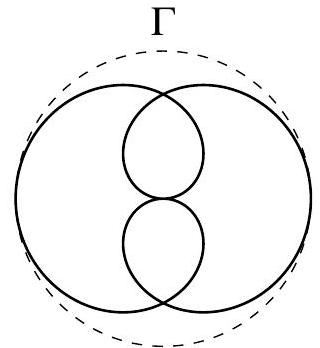
|
| 181 |
+
|
| 182 |
+
Depiction of the path Daisy takes
|
| 183 |
+
|
| 184 |
+
## Baltic Way
|
| 185 |
+
|
| 186 |
+
Reykjavík, November 11th - 15th
|
| 187 |
+
|
| 188 |
+
Solutions
|
| 189 |
+
|
| 190 |
+
Solution 2. We represent the position of Luigi and Mario by $(t, 3 t)(\bmod 1)$, so when Luigi is at angle $t \cdot 2 \pi$, Mario is at angle $3 t \cdot 2 \pi$.
|
| 191 |
+
|
| 192 |
+
A chord (if it is not the diameter is determined by its midpoint. Therefore Daisy revisit a location only if
|
| 193 |
+
|
| 194 |
+
$$
|
| 195 |
+
(x, 3 x) \equiv(3 y, y) \quad(\bmod 1)
|
| 196 |
+
$$
|
| 197 |
+
|
| 198 |
+
for different value of $x, y(\bmod 1)$. By inspection, the three locations are visited twice.
|
| 199 |
+
|
| 200 |
+
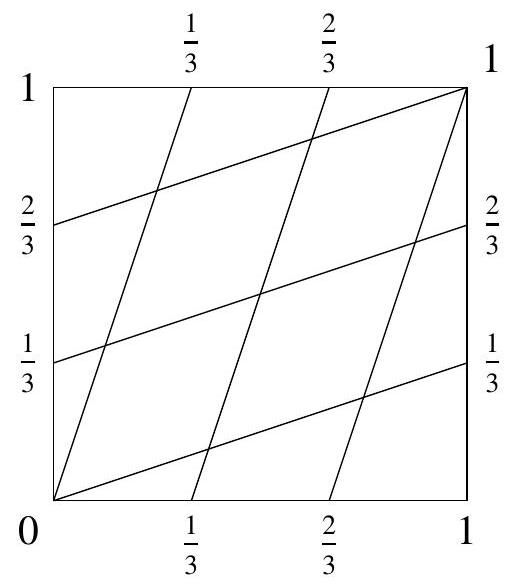
|
| 201 |
+
|
| 202 |
+
Problem 5. Let $x, y \in \mathbb{R}$ be such that $x=y(3-y)^{2}$ and $y=x(3-x)^{2}$. Find all possible values of $x+y$.
|
| 203 |
+
|
| 204 |
+
Solution 1. The set $\{0,3,4,5,8\}$ contains all possible values for $x+y$.
|
| 205 |
+
|
| 206 |
+
A pair $(x, x) \in \mathbb{R}^{2}$ satisfies the equations if and only if $x=x(3-x)^{2}$, and it is easy to see that this cubic equation has the solution set $\{0,2,4\}$. These pairs give us 0,4 and 8 as possible values for $x+y$.
|
| 207 |
+
|
| 208 |
+
Assuming $x \neq y$ let $s$ be the sum $x+y$ and $p$ be the product $x y$. Subtracting the first equation from the second and cancelling out the term $x-y$ we get
|
| 209 |
+
|
| 210 |
+
$$
|
| 211 |
+
p=s^{2}-6 s+10 \text {. }
|
| 212 |
+
$$
|
| 213 |
+
|
| 214 |
+
Adding the two equations gives
|
| 215 |
+
|
| 216 |
+
$$
|
| 217 |
+
0=s\left(s^{2}-3 p\right)-6\left(s^{2}-2 p\right)+8 s .
|
| 218 |
+
$$
|
| 219 |
+
|
| 220 |
+
Together the equations give
|
| 221 |
+
|
| 222 |
+
$$
|
| 223 |
+
0=s^{3}-12 s^{2}+47 s-60=(s-3)(s-4)(s-5) \text {. }
|
| 224 |
+
$$
|
| 225 |
+
|
| 226 |
+
## Baltic Way
|
| 227 |
+
|
| 228 |
+
Reykjavík, November 11th - 15th
|
| 229 |
+
|
| 230 |
+
Solutions
|
| 231 |
+
|
| 232 |
+
The only possible values for $x+y$ when $x \neq y$ are therefore 3,4 and 5 . We have already seen that $x+y=4$ has a solution $x=y=2$.
|
| 233 |
+
|
| 234 |
+
Next we investigate the case $x+y=3$. Here we can simplify the given equations as $x=y x^{2}$ and $y=x y^{2}$. The number $x$ cannot be zero in this case, since otherwise $y$ and $k$ would also be zero. We can conclude that $x y=1$. The equations $x+y=3$ and $x y=1$, according to Vieta's Theorem, imply that $x$ and $y$ are the solutions of the equation $\lambda^{2}-3 \lambda+1=0$. Hence
|
| 235 |
+
|
| 236 |
+
$$
|
| 237 |
+
(x, y)=\left(\frac{3+\sqrt{5}}{2}, \frac{3-\sqrt{5}}{2}\right) \quad \text { or } \quad(x, y)=\left(\frac{3-\sqrt{5}}{2}, \frac{3+\sqrt{5}}{2}\right)
|
| 238 |
+
$$
|
| 239 |
+
|
| 240 |
+
and it is easy to verify that both pairs satisfy the equations. These pairs give us 3 as a possible value for $x+y$.
|
| 241 |
+
|
| 242 |
+
A simple calculation shows that if a pair $(x, y) \in \mathbb{R}^{2}$ satisfy the equations, then the pair (4-x,4-y) is solution to the equations. From the pairs we have just found, we can therefore construct pairs of solutions
|
| 243 |
+
|
| 244 |
+
$$
|
| 245 |
+
(x, y)=\left(\frac{5-\sqrt{5}}{2}, \frac{5+\sqrt{5}}{2}\right) \text { and }(x, y)=\left(\frac{5+\sqrt{5}}{2}, \frac{5-\sqrt{5}}{2}\right),
|
| 246 |
+
$$
|
| 247 |
+
|
| 248 |
+
which give us 5 as a possible value for $x+y$.
|
| 249 |
+
|
| 250 |
+
Solution 2. Let $f(x)=x(3-x)^{2}$. It is easy to check that if $x<0$ then $f(x)<x$. In particular $f(f(x))<f(x)<x$ in this case, so that the pair $(x, f(x))$ cannot be a solution. Similarly, $f(x)>x$ if $x>4$, so the pair $(x, f(x))$ cannot be a solution in this case either.
|
| 251 |
+
|
| 252 |
+
Suppose that $(x, y) \in \mathbb{R}^{2}$ is a solution. According to the previous remark $x \in[0,4]$, and similarly, $y \in[0,4]$. Hence we may write $x=2+2 r$ and $y=2+2 s$ with $r, s \in[-1,1]$. After substitution and simplification, the equation $x=y(3-y)^{2}$ transforms into the equation $r=4 s^{3}-3 s$. Recall the trigonometric identities for threefold angles. If $s=\cos (\alpha)$ for some $\alpha \in \mathbb{R}$, then $r=4 \cos ^{3}(\alpha)-$ $3 \cos (\alpha)=\cos (3 \alpha)$. In the same way $s=4 r^{3}-3 r=\cos (9 \alpha)$.
|
| 253 |
+
|
| 254 |
+
We can deduce that $9 \alpha=2 \pi m+\alpha$ or $9 \alpha=2 \pi l-\alpha$ for some integers $m$ and $l$. In the former case we have $8 \alpha=2 \pi m$, so that $m \in\{0,1,2,3,4\}$, and the corresponding possible pairs of solutions can be found in Figure 1. In the former case we have $10 \alpha=2 \pi l$, so that $l \in\{0,1,2,3,4,5\}$, where $l=0$ and $l=5$ result in angles that we have already considered in the first case. We consider the other options in Figure 2 taking into account the well-known identities $\cos (\pi / 5)=(1+\sqrt{5}) / 4$ and $\cos (3 \pi / 5)=(1-\sqrt{5}) / 4$.
|
| 255 |
+
|
| 256 |
+
## Baltic Way
|
| 257 |
+
|
| 258 |
+
Reykjavík, November 11th - 15th
|
| 259 |
+
|
| 260 |
+
Solutions
|
| 261 |
+
|
| 262 |
+
| $m$ | $8 \alpha$ | $\alpha$ | $r$ | $s$ | $x$ | $y$ | $x+y$ |
|
| 263 |
+
| :---: | :---: | :---: | :---: | :---: | :---: | :---: | :---: |
|
| 264 |
+
| 0 | 0 | 0 | 1 | 1 | 4 | 4 | 8 |
|
| 265 |
+
| 1 | $2 \pi$ | $\pi / 4$ | $\sqrt{2} / 2$ | $-\sqrt{2} / 2$ | $2+\sqrt{2}$ | $2-\sqrt{2}$ | 4 |
|
| 266 |
+
| 2 | $4 \pi$ | $\pi / 2$ | 0 | 0 | 2 | 2 | 4 |
|
| 267 |
+
| 3 | $6 \pi$ | $3 \pi / 4$ | $-\sqrt{2} / 2$ | $\sqrt{2} / 2$ | $2-\sqrt{2}$ | $2+\sqrt{2}$ | 4 |
|
| 268 |
+
| 4 | $8 \pi$ | $\pi$ | -1 | -1 | 0 | 0 | 0 |
|
| 269 |
+
|
| 270 |
+
Figure 1: Pairs of solutions and their sums
|
| 271 |
+
|
| 272 |
+
| $l$ | $10 \alpha$ | $\alpha$ | $r$ | $s$ | $x$ | $y$ | $x+y$ |
|
| 273 |
+
| :---: | :---: | :---: | :---: | :---: | :---: | :---: | :---: |
|
| 274 |
+
| 1 | $2 \pi$ | $\pi / 5$ | $(1+\sqrt{5}) / 4$ | $(1-\sqrt{5}) / 4$ | $(5+\sqrt{5}) / 2$ | $(5-\sqrt{5}) / 2$ | 5 |
|
| 275 |
+
| 2 | $4 \pi$ | $2 \pi / 5$ | $(-1+\sqrt{5}) / 4$ | $(-1-\sqrt{5}) / 4$ | $(3+\sqrt{5}) / 2$ | $(3-\sqrt{5}) / 2$ | 3 |
|
| 276 |
+
| 3 | $6 \pi$ | $3 \pi / 5$ | $(1-\sqrt{5}) / 4$ | $(1+\sqrt{5}) / 4$ | $(5-\sqrt{5}) / 2$ | $(5+\sqrt{5}) / 2$ | 5 |
|
| 277 |
+
| 4 | $8 \pi$ | $4 \pi / 5$ | $(-1-\sqrt{5}) / 4$ | $(-1+\sqrt{5}) / 4$ | $(3-\sqrt{5}) / 2$ | $(3+\sqrt{5}) / 2$ | 3 |
|
| 278 |
+
|
| 279 |
+
Figure 2: Pairs of solutions and their sums
|
| 280 |
+
|
| 281 |
+
Problem 6. Let $n$ be a positive integer and $t$ be a non-zero real number. Let $a_{1}, a_{2}, \ldots, a_{2 n-1}$ be real numbers (not necessarily distinct). Prove that there exist distinct indices $i_{1}, i_{2}, \ldots, i_{n}$ such that, for all $1 \leq k, l \leq n$, we have $a_{i_{k}}-a_{i_{l}} \neq t$.
|
| 282 |
+
|
| 283 |
+
Solution. Let $G=(V, E)$ be a graph with vertex set $V=\{1,2, \ldots, 2 n-1\}$ and edge set $E=$ $\left\{\{i, j\}:\left|a_{i}-a_{j}\right|=t\right\}$.
|
| 284 |
+
|
| 285 |
+
Note that $G$ has no odd cycles. Indeed, if $j_{1}, \ldots, j_{2 k+1}$ is a cycle, then for all $\ell=1,3,5, \ldots, 2 k-1$ the number $a_{j_{\ell}}$ differs from $a_{j_{\ell+2}}$ by $2 t$ or 0 . Hence $a_{j_{1}}$ differs from $a_{j_{2 k+1}}$ by an even multiple of $t$. Therefore there is no edge between $j_{1}$ and $j_{2 k+1}$ contradicting the assumption that $j_{1}, \ldots, j_{2 k+1}$ is a cycle.
|
| 286 |
+
|
| 287 |
+
Since $G$ has no odd cycles, it is bipartite. Therefore $V$ can be split into two disjoint sets $V_{1}, V_{2}$ such that there is no edge between any two vertices of $V_{1}$ and there are no edges between any two vertices in $V_{2}$. Since $V$ has $2 n-1$ elements, one of the sets $V_{1}, V_{2}$ has at least $n$ elements. Without loss of generality assume that $V_{1}$ has at least $n$ elements. Then for $k=1,2, \ldots, n$ simply define $i_{k}$ to be the $k$-th least element of $V_{1}$.
|
| 288 |
+
|
| 289 |
+
Problem 7. Let $n>2$ be an integer. Anna, Edda and Magni play a game on a hexagonal board tiled with regular hexagons, with $n$ tiles on each side. The figure shows a board with 5 tiles on each side. The central tile is marked.
|
| 290 |
+
|
| 291 |
+
## Baltic Way
|
| 292 |
+
|
| 293 |
+
Reykjavík, November 11th - 15th
|
| 294 |
+
|
| 295 |
+
Solutions
|
| 296 |
+
|
| 297 |
+
The game begins with a stone on a tile in one corner of the board. Edda and Magni are on the same team, playing against Anna, and they win if the stone is on the central tile at the end of any player's turn. Anna, Edda and Magni take turns moving the stone: Anna begins, then Edda and then Magni, and so on.
|
| 298 |
+
|
| 299 |
+
The rules for each player's turn are:
|
| 300 |
+
|
| 301 |
+
- Anna has to move the stone to an adjacent tile, in any direction.
|
| 302 |
+
|
| 303 |
+
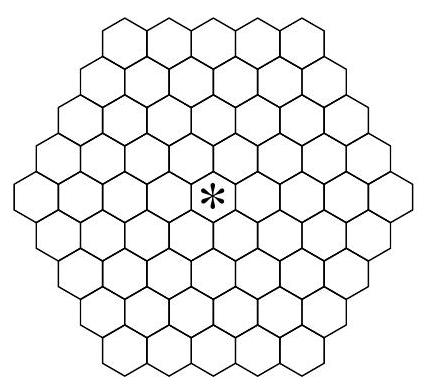
|
| 304 |
+
|
| 305 |
+
- Edda has to move the stone straight by two tiles in any of the 6 possible directions.
|
| 306 |
+
- Magni has a choice of passing his turn, or moving the stone straight by three tiles in any of the 6 possible directions.
|
| 307 |
+
|
| 308 |
+
Find all $n$ for which Edda and Magni have a winning strategy.
|
| 309 |
+
|
| 310 |
+
Solution. We colour the board in three colours in such a way that no neighbouring tiles are of the same colour. We can give each hexagon a coordinate using $\overrightarrow{e_{1}}=(1,0)$ and $\overrightarrow{e_{2}}=\left(\cos \left(120^{\circ}, \sin \left(120^{\circ}\right)\right)=\right.$ $\left(\frac{-1}{2}, \frac{\sqrt{3}}{2}\right)$ as basis. Let the central tile be the origin. Then each hexagon has center at $a \cdot \overrightarrow{e_{1}}+b \cdot \overrightarrow{e_{2}},(a, b) \in$ $\mathbb{Z}^{2}$. The tuple $(a, b)$ is the coordinate for a given hexagon its neighbours are $(a+1, b),(a+1, b+1)$, $(a, b+1),(a-1, b),(a-1, b-1)$ and $(a, b-1)$. We colour the hexagon with coordinates $(a, b)$ with colour number $(a+b)(\bmod 3)$. It is clear that neighbouring hexagons do not share a colour. (In fact this is the only three colouring of a hexagonal tiling). See figure 3 .
|
| 311 |
+
|
| 312 |
+
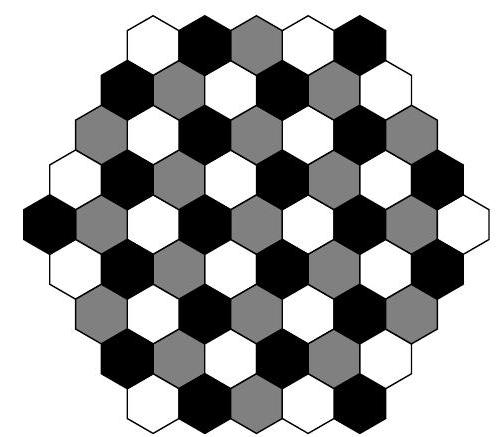
|
| 313 |
+
|
| 314 |
+
Figure 3: Three colouring of the hexagonal tiling for 5 hexagons on each side
|
| 315 |
+
|
| 316 |
+
We see that if $n \equiv 1(\bmod 3)$, the stone begins in a tile in the same colour as the central tile, let that colour be grey. By regarding a few cases, we see that whatever Anna does, Edda and Magni can end
|
| 317 |
+
|
| 318 |
+

|
| 319 |
+
|
| 320 |
+
BALTIC WAY
|
| 321 |
+
|
| 322 |
+
REYKJAVÍK$\cdot$ 2021
|
| 323 |
+
|
| 324 |
+
## Baltic Way
|
| 325 |
+
|
| 326 |
+
Reykjavík, November 11th - 15th
|
| 327 |
+
Solutions
|
| 328 |
+
|
| 329 |
+
their turns by getting the stone to a prescribed grey tile of the closest grey tiles. Therefore they can get the stone to the central tile.
|
| 330 |
+
|
| 331 |
+
If $n \not \equiv 1(\bmod 3)$, the stone does not begin on the same grey colour as the central tile. Say the stone begins on a white tile, and say the third colour is black. Anna can always move the stone to a grey tile that is not on the same horizontal/diagonal line as the central tile. Then Anna moves the stone to a white or black tile. After Magni moves the stone is still again on a white/black tile. Anna can continue this indefinitely, with the stone never reaching the central tile.
|
| 332 |
+
|
| 333 |
+
Problem 8. We are given a collection of $2^{2^{k}}$ coins, where $k$ is a non-negative integer. Exactly one coin is fake. We have an unlimited number of service dogs. One dog is sick but we do not know which one. A test consists of three steps: select some coins from the collection of all coins; choose a service dog; the dog smells all of the selected coins at once. A healthy dog will bark if and only if the fake coin is amongst them. Whether the sick dog will bark or not is random.
|
| 334 |
+
|
| 335 |
+
Devise a strategy to find the fake coin, using at most $2^{k}+k+2$ tests, and prove that it works.
|
| 336 |
+
|
| 337 |
+
Solution. Number the coins by $2^{k}$-digit binary numbers from $\overbrace{00 \ldots 0}^{\text {length } 2^{k}}$ to $\overbrace{11 \ldots 1}^{\text {length } 2^{k}}$. Let $A_{i}$ be the set of coins which have 0 in $i$-th position of the binary number. The first $2^{k}$ tests we perform with the help of $2^{k}$ different dogs. In the $i$-th test we determine whether the set $A_{i}$ contains the fake coin. With out loss of generality we may assume that the dogs determined that all the digits in the number of the fake coin are 0 's. Due to the possible presence of the sick dog in these tests, it means in fact that the binary number of the fake coin contains at most one 1 .
|
| 338 |
+
|
| 339 |
+
$$
|
| 340 |
+
\text { length } 2^{k}
|
| 341 |
+
$$
|
| 342 |
+
|
| 343 |
+
In the next test we let a new dog determine whether the coin $00 \ldots 0$ is genuine. If the new dog barks then the coin is really fake, for otherwise two dogs had given us a false answer. If the new dog does not bark we find a dog we have not used before to test the suspected coin.
|
| 344 |
+
|
| 345 |
+
(i) If the last two dogs disagree one of them must be sick and hence the first $k$ dogs must be healthy. length $2^{k}$
|
| 346 |
+
|
| 347 |
+
In this case the coin $\overbrace{00 \ldots 0}$ is the fake one.
|
| 348 |
+
|
| 349 |
+
(ii) If the last two dogs agree (by not barking) it follows that both of them are healthy. The reason is that if one of the last two dogs was sick and did not bark, it would mean that the first $k$ dogs were length $2^{k}$
|
| 350 |
+
|
| 351 |
+
healthy, implying that the coin $00 \ldots 0$ is fake, but then the other of the last two dogs is healthy and did not bark at the fake coin, a contradiction.
|
| 352 |
+
|
| 353 |
+

|
| 354 |
+
|
| 355 |
+
## Baltic Way
|
| 356 |
+
|
| 357 |
+
Reykjavík, November 11th - 15th
|
| 358 |
+
Solutions
|
| 359 |
+
|
| 360 |
+
Therefore one of the first $2^{k}$ dogs gave a wrong verdict. In this case we have $2^{k}$ possible candidates for the fake coin. We can find the fake coin using the last dog and $k$ tests using binary search.
|
| 361 |
+
|
| 362 |
+
It follows that no more than $2^{k}+k+2$ tests are needed.
|
| 363 |
+
|
| 364 |
+
Problem 9. We are given 2021 points on a plane, no three of which are collinear. Among any 5 of these points, at least 4 lie on the same circle. Is it necessarily true that at least 2020 of the points lie on the same circle?
|
| 365 |
+
|
| 366 |
+
Solution. The answer is positive.
|
| 367 |
+
|
| 368 |
+
Let us first prove a lemma that if 4 points $A, B, C, D$ all lie on circle $\Gamma$ and some two points $X, Y$ do not lie on $\Gamma$, then these 6 points are pairs of intersections of three circles, circle $\Gamma$ and two other circles. Indeed, according to the problem statement there are 4 points among $A, B, C, X, Y$ which are concyclic. These 4 points must include points $X$ and $Y$ because if one of them is not, then the other one must lie on $\Gamma$. Without loss of generality, take $A, B, X, Y$ to lie on the same circle. Similarly for points $A, C, D, X, Y$ there must be 4 points which are concyclic. Analogously, they must include points $X$ and $Y$. Point $A$ cannot be one of them because two circles cannot have more than two common points. Therefore, points $C, D, X, Y$ are concyclic which proves the lemma.
|
| 369 |
+
|
| 370 |
+
Let us first solve the problem for the case for which there exist 5 points which lie on one circle $\Gamma$. Label these points $A, B, C, D, E$. Let us assume that there exists two points which do not lie on $\Gamma$, label them $X$ and $Y$. According to the previously proven lemma, points $A, B, C, D, X, Y$ must be the pairwise intersections of 3 circles. Without loss of generality, let the intersections of $\Gamma$ with one of the other circles be $A$ and $B$ and with the other circle $C$ and $D$. Similarly, $A, B, C, E, X, Y$ must be the pairwise intersections of three circles one of which is $\Gamma$. This is not possible as none of the points $A, B, C$ lies on the circumcircle of triangle $E X Y$. This contradiction shows that at most 1 point can lie outside circle $\Gamma$, i.e. at least 2020 points lie on circle $\Gamma$.
|
| 371 |
+
|
| 372 |
+
It remains to look at the case for which no 5 points lie on the same circle. Let $A, B, C, D, E$ be arbitrary 5 points. Without loss of generality, let $A, B, C, D$ be concyclic and $E$ a point not on this circle. According to the lemma, for every other point $F$ and points $A, B, C, D, E$, the 6 points are the intersections of circle $\Gamma$ and some two other circles. But in total, there are 3 such points because one of the two circles must go through $E$ and some 2 points out of $A, B, C, D$, while the other circle must go through point $E$ and the other two points out of $A, B, C, D$. There are only three partitions of $A, B, C, D$ into two sets. There is a contradiction, as there are $2021>5+3$ points in total.
|
| 373 |
+
|
| 374 |
+
Problem 10. John has a string of paper where $n$ real numbers $a_{i} \in[0,1]$, for all $i \in\{1, \ldots, n\}$, are written in a row. Show that for any given $k<n$, he can cut the string of paper into $k$ non-empty pieces, between adjacent numbers, in such a way that the sum of the numbers on each piece does not differ from any other sum by more than 1 .
|
| 375 |
+
|
| 376 |
+
## Baltic Way
|
| 377 |
+
|
| 378 |
+
Reykjavík, November 11th - 15th
|
| 379 |
+
|
| 380 |
+
Solutions
|
| 381 |
+
|
| 382 |
+
Solution 1. Denote the sums on each piece by
|
| 383 |
+
|
| 384 |
+
$$
|
| 385 |
+
\begin{aligned}
|
| 386 |
+
& S_{1}=a_{1}+a_{2}+\ldots+a_{m_{1}}, \\
|
| 387 |
+
& S_{2}=a_{m_{1}+1}+a_{m_{1}+2}+\ldots+a_{m_{2}}, \\
|
| 388 |
+
& \quad \ldots \\
|
| 389 |
+
& S_{k}=a_{m_{k-1}+1}+\ldots+a_{m_{k}} .
|
| 390 |
+
\end{aligned}
|
| 391 |
+
$$
|
| 392 |
+
|
| 393 |
+
By abuse of notation $S_{i}$ will both denote the set of numbers enclosed by cuts and its sum, the meaning of which must be determined by the context.
|
| 394 |
+
|
| 395 |
+
We will start the following algorithm. During this algorithm we will move some elements to the neighbouring piece and construct new sequence of pieces $S^{\star}=\left(S_{1}^{\star}, S_{2}^{\star}, \ldots, S_{k}^{\star}\right)$. Empty pieces may appear, but we will consider that case in the end.
|
| 396 |
+
|
| 397 |
+
(1) Find $p \leq k$ such that $S_{p}$ is the piece with the maximum sum of elements.
|
| 398 |
+
|
| 399 |
+
(2) If $S_{p} \leq \min \left(S_{1}, \ldots, S_{k}\right)+1$ we are done.
|
| 400 |
+
|
| 401 |
+
(3) If $S_{p}>\min \left(S_{1}, \ldots, S_{k}\right)+1$, let $S_{q}$ be the pieces with minimum sum of elements nearest to $S_{p}$ (ties broken arbitrarily) and let $S_{h}$ be the next pieces to $S_{q}$ between $S_{p}$ and $S_{q}$ (it is non empty by the choice of $S_{q}$ ). Then either $p<q$ and then $h=q-1$ and we define $S^{\star}$ by moving the last element from $S_{h}=S_{q-1}$ to $S_{q}$, or $q<p$, and then $h=q+1$ and $S^{\star}$ is obtained by moving the first element of $S_{h}=S_{q+1}$ to $S_{q}$. If $p=h$ then set $S=S^{\star}$ and go to step (1). If $p \neq h$ then set $S=S^{\star}$ and proceed to step (2).
|
| 402 |
+
|
| 403 |
+
Note that in step (3) each number $S_{i}^{\star}$ is at most $S_{p}$ and no new piece with sum $S_{p}$ is created. Indeed, $S_{h}^{\star}<S_{h} \leq S_{p}$, and for some $j$ we have $S_{q}^{\star}=S_{q}+a_{j}<S_{p}$ since $a_{j} \in[0,1]$ and $S_{p}>$ $\min \left(S_{1}, \ldots, S_{k}\right)+1$. It is clear also that $\max \left(S_{1}, \ldots, S_{k}\right)$ does not increase during the algorithm.
|
| 404 |
+
|
| 405 |
+
Note also that in step (3) the pieces $S_{h}$ may become empty. Then, in the next iteration of the algorithm, $q=h$ will be chosen since $\min \left(S_{1}, \ldots, S_{k}\right)=S_{h}=0$ and in step (3) $S_{h}^{\star}$ will become non empty (but one of its neighbours may become empty, etc.).
|
| 406 |
+
|
| 407 |
+
Claim: In the algorithm above, Step (3) is repeated at most $k n$ times with $S_{p}$ being the same maximal pieces in $S^{\star}$ and in $S$.
|
| 408 |
+
|
| 409 |
+
Proof. Let $s_{i}$ be the number of elements in $i$-th pieces. Then the number
|
| 410 |
+
|
| 411 |
+
$$
|
| 412 |
+
\sum_{i=1}^{k}|i-p| s_{i}
|
| 413 |
+
$$
|
| 414 |
+
|
| 415 |
+
takes positive integral values and is always less than $k n$. It is clear that this number decreases during the algorithm.
|
| 416 |
+
|
| 417 |
+
## Baltic Way
|
| 418 |
+
|
| 419 |
+
Thus after at most $k n$ iteration of (3), the algorithm decreases the value of $S_{p}$ and so goes to (1). Consequently it decreases either the number of pieces with maximal sums or $\max \left(S_{1}, \ldots, S_{k}\right)$. As there are only finitely many ways to split the sum onto pieces, the algorithm eventually terminates at (2).
|
| 420 |
+
|
| 421 |
+
When the algorithm teminates, we are left with a sequence $S=\left(S_{1}, S_{2}, \ldots, S_{k}\right)$ where the piece $S_{p}$ with maximum sum is such that $S_{p} \leq \min \left(S_{1}, \ldots, S_{k}\right)+1$. If there is an empty piece $S_{h}$ in the sequence, then the sum of any piece is in $[0,1]$. We can for any empty piece create a cut in any place between numbers where there was not previously a cut, and discard the empty pieces. This is possible since the cuts are $k \leq n-1$, and $n-1$ is the number of places in between numbers. This operation will only possibly decrease the maximum sum, and still all sums will be in $[0,1]$, so all conditions are satisfied.
|
| 422 |
+
|
| 423 |
+
Solution 2. This problem can be solved by finding a certain graph having a directed path of length $k$. For real $x$ let $\left(V_{x}, E_{x}\right)$ be a directed graph having vertices $V_{x}=\{0,1, \ldots, n\}$. If $i, j \in V_{x}$ we have a directed edge $(i, j) \in V_{x}$ iff $i \leq j$ and $\sum_{l=i+1}^{j} \in[x, x+1]$.
|
| 424 |
+
|
| 425 |
+
Suppose that for some $x \in \mathbb{R}$ there exist such a graph $\left(V_{x}, E_{x}\right)$ such that there exist a path of length $k$ from vertex 0 to vertex $n$. Let $0=v_{0}, v_{1}, \ldots, v_{k}=n$ be an path of length $k$. If we cut the paper string between numbers $v_{i}$ and $v_{i}+1$ for $i \in\{1, \ldots, k-1\}$ we have that the sum of the $i$-th part is $a_{v_{i-1}+1}+\ldots+a_{v_{i}} \in[x, x+1]$. In particular the sum of the number of each piece does not differ from the sum of any other piece by more than 1 .
|
| 426 |
+
|
| 427 |
+
It is therefore evident that the statement of the problem is equivalent to the existence of a real $x$ such that there exists a path of length $k$ form vertex 0 to vertex $n$ in graph $\left(E_{x}, V_{x}\right)$.
|
| 428 |
+
|
| 429 |
+
For a real $x$ let $s_{x}$ be the least vertex in $\left(V_{x}, E_{x}\right)$ such that there exists a path of length $k$ from 0 to $s_{x}$ and let $t_{x}$ be the greatest, provided that such a path exists. It is not difficult to prove (by induction on $k$ ) that for each vertex $v \in E_{x}$ such that $s_{x} \leq v \leq t_{x}$ there exists a path of length $k$ for 0 to $v$.
|
| 430 |
+
|
| 431 |
+
Start with $x=0$. As $x$ increases both $s_{x}$ and $t_{x}$ increase. As there are only finitely many different sums formed by taking a subset of the $a_{i}$-s it follows that the graph $\left(V_{x}, E_{x}\right)$ changes at discrete values of $x$. It is not hard to see that if the graph makes one change between reals $x_{1}<x_{2}$ and $s_{x_{1}}, s_{x_{2}}, t_{x_{1}}, t_{x_{2}}$ exist then $s_{x_{1}} \leq s_{x_{2}} \leq t_{x_{1}} \leq t_{x_{2}}$.
|
| 432 |
+
|
| 433 |
+
For $s=\sum_{i=1}^{n} a_{i}+1$ it is clear that there $\left(V_{s}, E_{s}\right)$ has no edges. It is not hard to see that as $x$ increases we will eventually find a value for $x$ such that $\left(V_{x}, E_{x}\right)$ has a path of length $k$ for 0 to $n$ as desired.
|
| 434 |
+
|
| 435 |
+
Problem 11. A point $P$ lies inside a triangle $A B C$. The points $K$ and $L$ are the projections of $P$ onto $A B$ and $A C$, respectively. The point $M$ lies on the line $B C$ so that $K M=L M$, and the point $P^{\prime}$ is symmetric to $P$ with respect to $M$. Prove that $\angle B A P=\angle P^{\prime} A C$.
|
| 436 |
+
|
| 437 |
+
## Baltic Way
|
| 438 |
+
|
| 439 |
+
Reykjavík, November 11th - 15th
|
| 440 |
+
|
| 441 |
+
Solutions
|
| 442 |
+
|
| 443 |
+
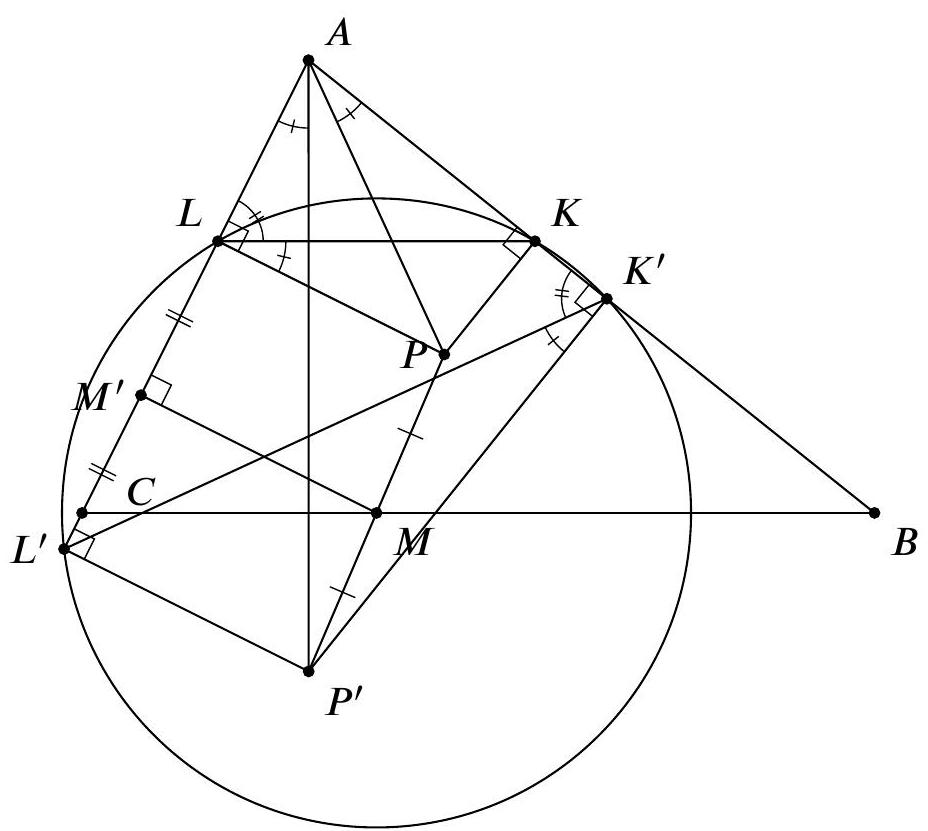
|
| 444 |
+
|
| 445 |
+
Figure 4
|
| 446 |
+
|
| 447 |
+
Solution. For points $X, Y, Z, X \neq Y$ and $Z \neq Y$ let rot $X Y Z$ denote the rotation that takes rotates line $X Y$ to line $Z Y$ modulo half turns. We consider two rotations equivalent one of them is a composition of some translation and the other rotation. It is clear that this is indeed an equivalence relation (as the Euclidean plane is Desarguean).
|
| 448 |
+
|
| 449 |
+
Let $K^{\prime}$ and $L^{\prime}$ be the projections of $P^{\prime}$ onto $A B$ and $A C$ respectively, as in figure 4 . Let $\ell$ be the perpendicular line to line $A B$ passing through $M$. From symmetries it follows that $L^{\prime}$ is the refection of $L$ over $\ell$. In particular segments $M L$ and $M L^{\prime}$ are congruent. Similarly segments $M K$ and $M K^{\prime}$ are congruent. It follows that $M$ is a center of circle passing through $L, K, L^{\prime}$ and $K^{\prime}$.
|
| 450 |
+
|
| 451 |
+
As line $P L$ is perpendicular to line $A C$ and line $P K$ is perpendicular to line $A B$ it follows that quadrilateral $A K P L$ is cyclic. Similarly quadrilateral $A K^{\prime} P L^{\prime}$ is also cyclic.
|
| 452 |
+
|
| 453 |
+
From the theorem on inscribed angles in cyclic quadrilaterals it follows that
|
| 454 |
+
|
| 455 |
+
$$
|
| 456 |
+
\begin{gathered}
|
| 457 |
+
\operatorname{rot} B A P \equiv \operatorname{rot} K A P \equiv \operatorname{rot} K L P, \\
|
| 458 |
+
\operatorname{rot} P^{\prime} A C \equiv \operatorname{rot} P^{\prime} A L \equiv \operatorname{rot} P^{\prime} K^{\prime} L \quad \text { and } \\
|
| 459 |
+
\operatorname{rot} K L L^{\prime} \equiv \operatorname{rot} K K^{\prime} L^{\prime}
|
| 460 |
+
\end{gathered}
|
| 461 |
+
$$
|
| 462 |
+
|
| 463 |
+
As $\angle P L L^{\prime}$ and $\angle K K^{\prime} P^{\prime}$ are right it follows that $\operatorname{rot} P L L^{\prime} \equiv \operatorname{rot} K K^{\prime} P^{\prime}$ modulo half turns. Now $\operatorname{rot} K L L^{\prime} \equiv \operatorname{rot} K L P+\operatorname{rot} P L L^{\prime} \quad$ and $\quad \operatorname{rot} K K^{\prime} L^{\prime} \equiv \operatorname{rot} P^{\prime} K^{\prime} L+\operatorname{rot} K K^{\prime} P$
|
| 464 |
+
|
| 465 |
+
## Baltic Way
|
| 466 |
+
|
| 467 |
+
Reykjavík, November 11th - 15th
|
| 468 |
+
|
| 469 |
+
Solutions
|
| 470 |
+
|
| 471 |
+
and $\operatorname{rot} K L L^{\prime} \equiv \operatorname{rot} K K^{\prime} L^{\prime}$ so we decuce that $\operatorname{rot} K L P \equiv \operatorname{rot} P^{\prime} K^{\prime} L$.
|
| 472 |
+
|
| 473 |
+
Putting everything together gives
|
| 474 |
+
|
| 475 |
+
$$
|
| 476 |
+
\operatorname{rot} B A P \equiv \operatorname{rot} P^{\prime} A L^{\prime}
|
| 477 |
+
$$
|
| 478 |
+
|
| 479 |
+
which gives the desired result.
|
| 480 |
+
|
| 481 |
+
Remark. This method can be applied to prove the existence of isogonal conjugates in triangles.
|
| 482 |
+
|
| 483 |
+
Problem 12. Let $I$ be the incentre of a triangle $A B C$. Let $F$ and $G$ be the projections of $A$ onto the lines $B I$ and $C I$, respectively. Rays $A F$ and $A G$ intersect the circumcircles of the triangles $C F I$ and $B G I$ for the second time at points $K$ and $L$, respectively. Prove that the line $A I$ bisects the segment $K L$.
|
| 484 |
+
|
| 485 |
+
Solution. Since $\angle I F K=90^{\circ}$, then $I K$ is the diameter of the circumcircle of $C F I$, hence also $\angle I C K=90^{\circ}$. Similarly is $I L$ the diameter of the circumcircle of $B G I$ and $\angle I B L=90^{\circ}$. Therefore are the lines $C K$ and $G L$ parallel, also $B L$ and $F K$ are parallel.
|
| 486 |
+
|
| 487 |
+
Let the lines $C K$ and $B L$ intersect at $D$, as seen in figure 5. From the above we get that $D K A L$ is a parallelogram. Note that $D$ is the excenter with respect to the vertex $A$ of the triangle $A B C$, since the lines $B L$ and $C K$ are perpendicular to the corresponding internal angle bisectors. The excenter lies on the internal angle bisector $A I$, hence $A I$ bisects the diagonal $K L$.
|
| 488 |
+
|
| 489 |
+
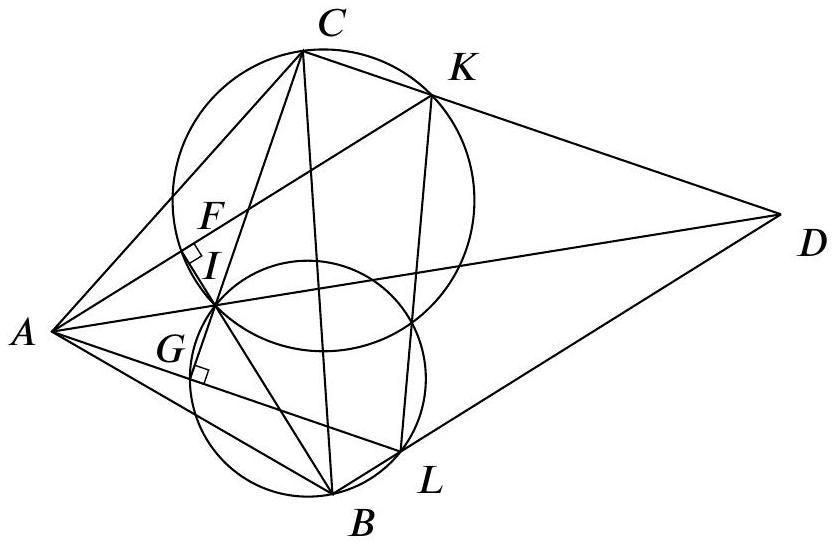
|
| 490 |
+
|
| 491 |
+
Figure 5
|
| 492 |
+
|
| 493 |
+
## Baltic Way
|
| 494 |
+
|
| 495 |
+
Problem 13. Let $D$ be the foot of the $A$-altitude of an acute triangle $A B C$. The internal bisector of the angle $D A C$ intersects $B C$ at $K$. Let $L$ be the projection of $K$ onto $A C$. Let $M$ be the intersection point of $B L$ and $A D$. Let $P$ be the intersection point of $M C$ and $D L$. Prove that $P K \perp A B$.
|
| 496 |
+
|
| 497 |
+
Solution 1. Let $X$ be a point on $B C$ such that $L X \perp A B$, as seen in figure 6. It is enough to prove that
|
| 498 |
+
|
| 499 |
+
because then $P K \| L X$ and $L X \perp A B$.
|
| 500 |
+
|
| 501 |
+
$$
|
| 502 |
+
\frac{D P}{P L}=\frac{D K}{K X}
|
| 503 |
+
$$
|
| 504 |
+
|
| 505 |
+
Applying Menelaos for triangle $B D L$ and transversal $M P C$ we get
|
| 506 |
+
|
| 507 |
+
$$
|
| 508 |
+
\frac{D P}{P L} \cdot \frac{L M}{M B} \cdot \frac{B C}{C D}=1
|
| 509 |
+
$$
|
| 510 |
+
|
| 511 |
+
and Menelaus for triangle $B L C$ and transversal $A M D$ gives
|
| 512 |
+
|
| 513 |
+
$$
|
| 514 |
+
\frac{B M}{M L} \cdot \frac{L A}{A C} \cdot \frac{C D}{D B}=1
|
| 515 |
+
$$
|
| 516 |
+
|
| 517 |
+
Multiplying these two equalities yields
|
| 518 |
+
|
| 519 |
+
$$
|
| 520 |
+
\frac{D P \cdot B C \cdot A L}{P L \cdot B D \cdot A C}=1
|
| 521 |
+
$$
|
| 522 |
+
|
| 523 |
+
Note, however, that $A L=A D=A C \sin \gamma, B D=A B \cos \beta$, and, by the sine rule, $\frac{A B}{B C}=\frac{\sin \gamma}{\sin \alpha}$, where $\alpha=\angle B A C, \beta=\angle C B A$ and $\gamma=\angle A C B$. Therefore
|
| 524 |
+
|
| 525 |
+
$$
|
| 526 |
+
\frac{D P}{P L}=\frac{B D \cdot A C}{B C \cdot A L}=\frac{A B \cos \beta \cdot A C}{B C \cdot A C \sin \gamma}=\frac{\sin \gamma \cos \beta}{\sin \alpha \sin \gamma}=\frac{\cos \beta}{\sin \alpha} .
|
| 527 |
+
$$
|
| 528 |
+
|
| 529 |
+
On the other hand, since $D K=K L, \angle K L X=\pi-\alpha$, and $\angle L X K=\frac{\pi}{2}-\beta$, we have by the sine rule
|
| 530 |
+
|
| 531 |
+
$$
|
| 532 |
+
\frac{D K}{K X}=\frac{L K}{K X}=\frac{\sin \left(\frac{\pi}{2}-\beta\right)}{\sin (\pi-\alpha)}=\frac{\cos \beta}{\sin \alpha} .
|
| 533 |
+
$$
|
| 534 |
+
|
| 535 |
+
Therefore
|
| 536 |
+
|
| 537 |
+
$$
|
| 538 |
+
\frac{D P}{P L}=\frac{\cos \beta}{\sin \alpha}=\frac{D K}{K X}
|
| 539 |
+
$$
|
| 540 |
+
|
| 541 |
+
which finishes the proof.
|
| 542 |
+
|
| 543 |
+
## Baltic Way
|
| 544 |
+
|
| 545 |
+
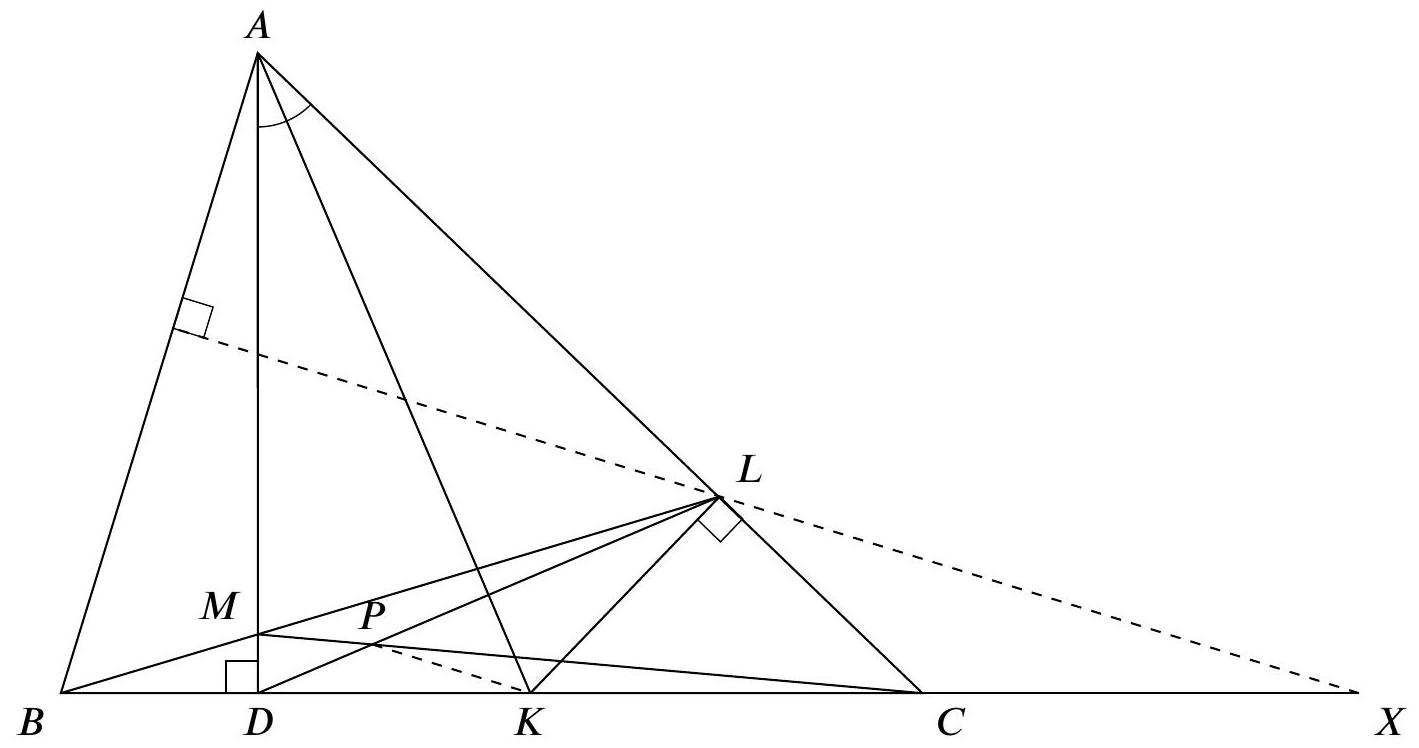
|
| 546 |
+
|
| 547 |
+
Figure 6
|
| 548 |
+
|
| 549 |
+
Solution 2. Let $\omega$ be the circle with center $K$ an radius $K D$, as in figure 7. Then $\omega$ is tangent to $A D$ and $A L$. Let $B C$ intersect $\omega$ at $D$ and $Q$. Let $B M$ intersect $\omega$ at $L$ and $R$. Let $Q P$ intersect $B L$ at $S$.
|
| 550 |
+
|
| 551 |
+
Cross-ratio chasing gives, through the projections $B L \rightarrow D$-pencil $\rightarrow \omega \rightarrow L$-pencil $\rightarrow B C \rightarrow P-$ pencil $\rightarrow B L$,
|
| 552 |
+
|
| 553 |
+
$$
|
| 554 |
+
\begin{aligned}
|
| 555 |
+
(L, R ; M, B) & =(D L, D R ; D M, D B)=(L, R ; D, Q)=(L C, L B ; L D, L Q) \\
|
| 556 |
+
& =(C, B ; D, Q)=(P C, P B ; P D, P Q)=(M, B ; L, S)=(L, S ; M, B),
|
| 557 |
+
\end{aligned}
|
| 558 |
+
$$
|
| 559 |
+
|
| 560 |
+
therefore $R=S$.
|
| 561 |
+
|
| 562 |
+
It is clear now that $P$ lies on the polar lines of both $A$ and $B$ with respect to $\omega$, therefore $A B$ is the polar line of $P$. This implies that $P K \perp A B$.
|
| 563 |
+
|
| 564 |
+
Problem 14. Let $A B C$ be a triangle with circumcircle $\Gamma$ and circumcentre $O$. Denote by $M$ the midpoint of $B C$. The point $D$ is the reflection of $A$ over $B C$, and the point $E$ is the intersection of $\Gamma$ and the ray $M D$. Let $S$ be the circumcentre of the triangle $A D E$. Prove that the points $A, E, M, O$, and $S$ lie on the same circle.
|
| 565 |
+
|
| 566 |
+
Solution. First we prove that $A, M, E, S$ are concyclic. Note that $B C$ is the perpendicular bisector of $A D$, so $S$ lies on $B C$. Let $X$ be the intersection of $A D$ and $B C$ as in figure 8 . Then, using directed
|
| 567 |
+
|
| 568 |
+
## Baltic Way
|
| 569 |
+
|
| 570 |
+
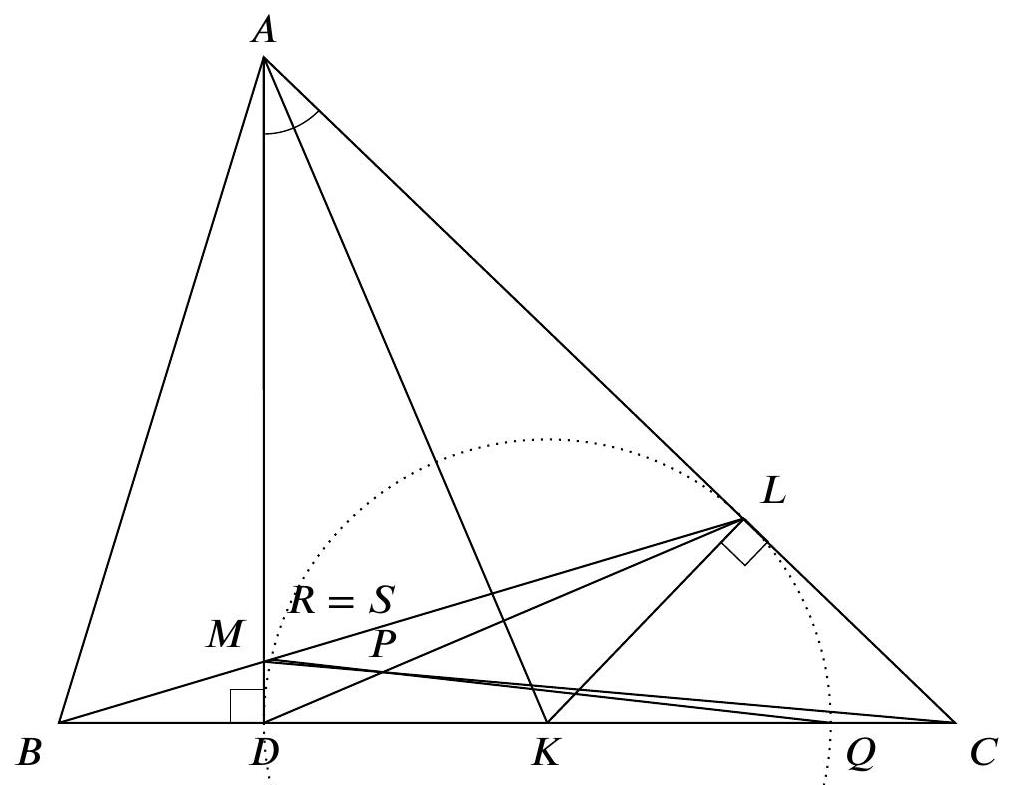
|
| 571 |
+
|
| 572 |
+
Figure 7
|
| 573 |
+
|
| 574 |
+
## Baltic Way
|
| 575 |
+
|
| 576 |
+
Reykjavík, November 11th - 15th
|
| 577 |
+
|
| 578 |
+
Solutions
|
| 579 |
+
|
| 580 |
+
angles,
|
| 581 |
+
|
| 582 |
+
$$
|
| 583 |
+
\begin{aligned}
|
| 584 |
+
\angle E M S & =\angle D M X \\
|
| 585 |
+
& =90^{\circ}-\angle X D M \\
|
| 586 |
+
& =90^{\circ}-\angle A D E \\
|
| 587 |
+
& =\angle S E A \\
|
| 588 |
+
& =\angle E A S,
|
| 589 |
+
\end{aligned}
|
| 590 |
+
$$
|
| 591 |
+
|
| 592 |
+
so $A M E S$ is cyclic as claimed.
|
| 593 |
+
|
| 594 |
+
Now we prove that $A, M, E, O$ are concyclic. Let $F$ be the reflection of $D$ over $M$. Then $F$ lies on the same side of $B C$ as $A$ and satisfies $F C B \cong D B C \cong A B C$, so $F$ must be the point such that $A F C B$ is an isosceles trapezoid. In particular, $F$ lies on $\Gamma$. Consequently,
|
| 595 |
+
|
| 596 |
+
$$
|
| 597 |
+
\angle O A E=90^{\circ}-\angle E F A=90^{\circ}-\angle E M B=\angle O M B+\angle B M E=\angle O M E \text {, }
|
| 598 |
+
$$
|
| 599 |
+
|
| 600 |
+
so $A M E O$ is also cyclic as claimed.
|
| 601 |
+
|
| 602 |
+
Thus $A, E, M, O, S$ are concyclic, as desired.
|
| 603 |
+
|
| 604 |
+
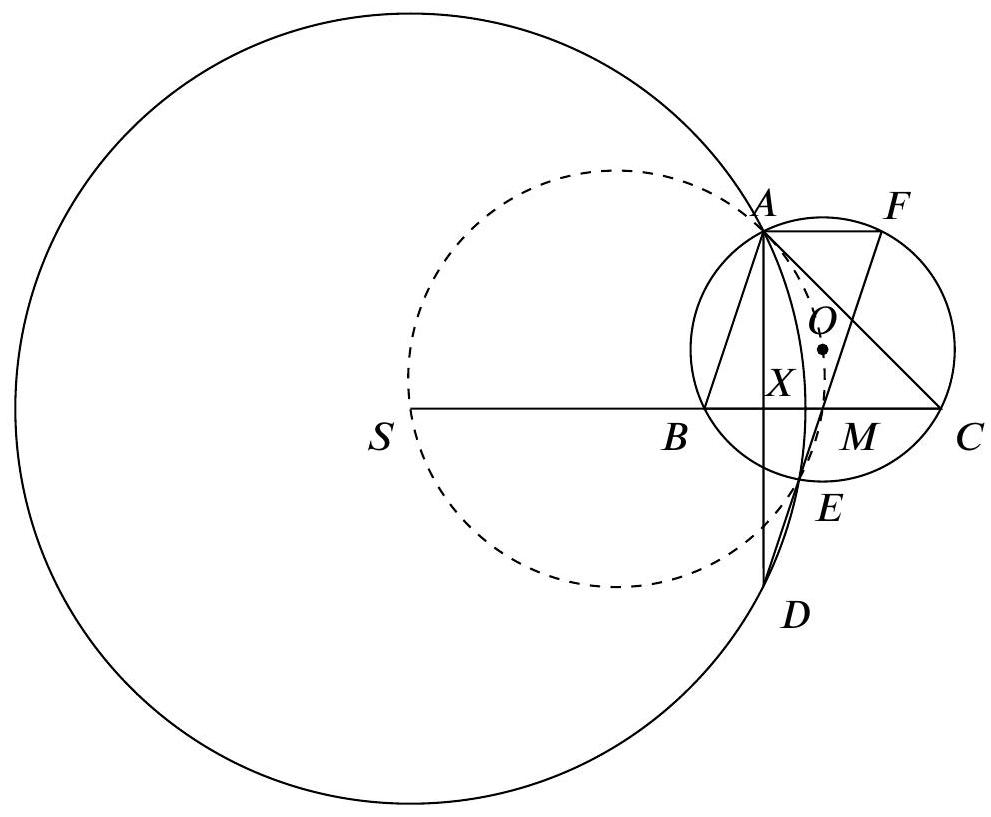
|
| 605 |
+
|
| 606 |
+
Figure 8
|
| 607 |
+
|
| 608 |
+
## Baltic Way
|
| 609 |
+
|
| 610 |
+
Problem 15. For which positive integers $n \geq 4$ does there exist a convex $n$-gon with side lengths $1,2, \ldots, n$ (in some order) and with all of its sides tangent to the same circle?
|
| 611 |
+
|
| 612 |
+
Solution. It exists if $n=4 k$ or $n=4 k+1$ where $k$ is a positive integer.
|
| 613 |
+
|
| 614 |
+
Let us consider $n$-gon $P_{1} P_{2} \ldots P_{n}$. Tangent points of the inscribed circle divide each of its sides in two segments. Lengths of these segments that has a common vertex $P_{i}$ are equal. Denote the length of tangent segments that originate at point $P_{i}$ by $A_{i}$. It means that side lengths of the $n$-gon can be expressed as $P_{i} P_{i+1}=A_{i}+A_{i+1}$ for all $i=1,2, \ldots, n$ where we consider points cyclically $\left(P_{n+1}=P_{1}\right.$ and $A_{n+1}=A_{1}$ ).
|
| 615 |
+
|
| 616 |
+
We can show that the converse is true as well. That is, if we can find $n$ positive real numbers $A_{i}$, $i=1,2, \ldots, n$ such that the sequence $\left(A_{1}+A_{2}, A_{2}+A_{3}, \ldots, A_{n}+A_{1}\right)$ is a permutation of $(1,2, \ldots, n)$ then there is a circumscribed polygon $P_{1} P_{2} \ldots P_{n}$ with side lengths $1,2, \ldots, n$.
|
| 617 |
+
|
| 618 |
+
To show this we start with a circle of arbitrary radius $R$ and construct points $P_{1}, P_{2}, \ldots, P_{n}$ outside this circle so that the length of the tangent segments from $P_{i}$ to the circle are of length $A_{i}$ and the "right" tangent segment from $P_{i}$ touches the circle at the same point as the "left" tangent segment from $P_{i-1}$.
|
| 619 |
+
|
| 620 |
+
Now we almost have the $n$-gon except that possibly the "right" tangent point of $P_{1}$ does not match the "left" touching point of $P_{n}$. This can be easily fixed by adjusting the radius $R$ of the circle, using continuity.
|
| 621 |
+
|
| 622 |
+
Now we solve the problem by considering 4 cases:
|
| 623 |
+
|
| 624 |
+
(i) First let's consider the case when $n=4 k$. In this case such circumscribed $n$-gon exists. The $4 k$ segments $A_{i}$ can be of lengths
|
| 625 |
+
|
| 626 |
+
$$
|
| 627 |
+
\begin{array}{r}
|
| 628 |
+
A_{1}=\frac{1}{2}, A_{2}=\frac{1}{2}, A_{3}=\frac{3}{2}, A_{4}=\frac{3}{2}, \ldots, A_{2 k-1}=\frac{2 k-1}{2}, A_{2 k}=\frac{2 k-1}{2}, \\
|
| 629 |
+
A_{2 k+1}=\frac{2 k+1}{2}, A_{2 k+2}=\frac{6 k-1}{2}, A_{2 k+3}=\frac{2 k-1}{2}, A_{2 k+4}=\frac{6 k-3}{2}, \ldots, \\
|
| 630 |
+
A_{4 k-1}=\frac{3}{2}, A_{4 k}=\frac{4 k+1}{2} .
|
| 631 |
+
\end{array}
|
| 632 |
+
$$
|
| 633 |
+
|
| 634 |
+
One can see that the values of the sums of the consecutive elements $A_{1}+A_{2}, A_{2}+A_{3}, \ldots, A_{4 k-1}+$ $A_{4 k}, A_{4 k}+A_{4 k+1}$ are exactly $1,2, \ldots, 2 k, 4 k, 4 k-1, \ldots, 2 k+1$, respectively.
|
| 635 |
+
|
| 636 |
+
(ii) In the case $n=4 k+1$ the construction is similar, we can choose $4 k+1$ segments of length
|
| 637 |
+
|
| 638 |
+
$$
|
| 639 |
+
\begin{aligned}
|
| 640 |
+
& A_{1}=\frac{1}{2}, \quad A_{2}=\frac{1}{2}, \quad A_{3}=\frac{5}{2}, \quad A_{4}=\frac{5}{2}, \ldots, \\
|
| 641 |
+
& A_{2 k+1}=\frac{4 k+1}{2}, \quad A_{2 k+2}=\frac{4 k+1}{2}, \quad A_{2 k+3}=\frac{4 k-1}{2}, \\
|
| 642 |
+
& A_{2 k+4}=\frac{4 k-3}{2}, \quad A_{2 k+5}=\frac{4 k-5}{2}, \quad \ldots, A_{4 k+1}=\frac{3}{2}
|
| 643 |
+
\end{aligned}
|
| 644 |
+
$$
|
| 645 |
+
|
| 646 |
+
## Baltic Way
|
| 647 |
+
|
| 648 |
+
In this case the values of the sums of consecutive elements $A_{1}+A_{2}, A_{2}+A_{3}, \ldots, A_{4 k-1}+A_{4 k}$, $A_{4 k}+A_{4 k+1}$ are $1,3,5, \ldots, 4 k+1,4 k, 4 k-2, \ldots, 2$, respectively.
|
| 649 |
+
|
| 650 |
+
(iii) In case when $n=4 k+2$ such a polygon does not exist. To prove this we note that in case if the number of the sides of the circumscribed polygon is even then the sum of the odd numbered sides is equal to the sum of the even numbered sides. It is evident as two segments of equal length that originate from the same vertex contribute to different sums. But the total sum of the side lengths is an odd number what means that it is impossible to split the sides on two parts with equal sum of lengths.
|
| 651 |
+
|
| 652 |
+
(iv) In case $n=4 k+3$ such a polygon also does not exist. In this case we can express $A_{1}$ as
|
| 653 |
+
|
| 654 |
+
$$
|
| 655 |
+
\begin{aligned}
|
| 656 |
+
A_{1} & =\left(A_{1}+A_{2}+\ldots+A_{n}\right)-\left(A_{2}+A_{3}\right)-\left(A_{4}+A_{5}\right)-\ldots-\left(A_{4 k+2}+A_{4 k+3}\right)= \\
|
| 657 |
+
& =\frac{P_{1} P_{2}+P_{2} P_{3}+\cdots+P_{4 k+3} P_{1}}{2}-P_{2} P_{3}-P_{4} P_{5}-\ldots-P_{4 k+2} P_{4 k+3}
|
| 658 |
+
\end{aligned}
|
| 659 |
+
$$
|
| 660 |
+
|
| 661 |
+
As the sum of the length of the sides is an even number then we conclude that $A_{1}$ is a positive integer. The same is true for all $A_{2}, A_{3}, \ldots$ as well. But now we have a contradiction as the side of length 1 cannot be split in two parts, each of which has positive integer length.
|
| 662 |
+
|
| 663 |
+
Problem 16. Show that no non-zero integers $a, b, x, y$ satisfy
|
| 664 |
+
|
| 665 |
+
$$
|
| 666 |
+
\left\{\begin{array}{l}
|
| 667 |
+
a x-b y=16, \\
|
| 668 |
+
a y+b x=1 .
|
| 669 |
+
\end{array}\right.
|
| 670 |
+
$$
|
| 671 |
+
|
| 672 |
+
Solution. If we use the Diophantus sum of squares equality
|
| 673 |
+
|
| 674 |
+
$$
|
| 675 |
+
(a x-b y)^{2}+(a y+b x)^{2}=\left(a^{2}+b^{2}\right)\left(x^{2}+y^{2}\right)
|
| 676 |
+
$$
|
| 677 |
+
|
| 678 |
+
then we can see that for a system
|
| 679 |
+
|
| 680 |
+
$$
|
| 681 |
+
\left\{\begin{array}{l}
|
| 682 |
+
a x-b y=s \\
|
| 683 |
+
a y+b x=t
|
| 684 |
+
\end{array}\right.
|
| 685 |
+
$$
|
| 686 |
+
|
| 687 |
+
to have a solution in positive integers the number $s^{2}+t^{2}$ must be a composite number.
|
| 688 |
+
|
| 689 |
+
The number corresponding to the equation, $16^{2}+1^{2}=257$, is a prime number. This shows that no solution can exist in non-zero integers, as it would give a factorisation of the prime with each factor $>1$.
|
| 690 |
+
|
| 691 |
+

|
| 692 |
+
|
| 693 |
+
## Baltic Way
|
| 694 |
+
|
| 695 |
+
Reykjavík, November 11th - 15th
|
| 696 |
+
Solutions
|
| 697 |
+
|
| 698 |
+
Remark. Note that $(a+b i)(x+y i)=(a x-b y)+(a y+b x) i$. Finding a solution to the system of equations is therefore equivalent to finding a factorization of $s+t i$ in Gaussian integers $\mathbb{Z}[i]$ with non-negative real and imaginary component. It is known that the Gaussian integers form a Euclidean domain and hence a unique factorization domain. The form for primes in $\mathbb{Z}[i]$ has been thoroughly studied.
|
| 699 |
+
|
| 700 |
+
Problem 17. Distinct positive integers $a, b, c, d$ satisfy
|
| 701 |
+
|
| 702 |
+
$$
|
| 703 |
+
\left\{\begin{array}{l}
|
| 704 |
+
a \mid b^{2}+c^{2}+d^{2}, \\
|
| 705 |
+
b \mid a^{2}+c^{2}+d^{2}, \\
|
| 706 |
+
c \mid a^{2}+b^{2}+d^{2}, \\
|
| 707 |
+
d \mid a^{2}+b^{2}+c^{2},
|
| 708 |
+
\end{array}\right.
|
| 709 |
+
$$
|
| 710 |
+
|
| 711 |
+
and none of them is larger than the product of the three others. What is the largest possible number of primes among them?
|
| 712 |
+
|
| 713 |
+
Solution. At first we note that the given condition is equivalent to $a, b, c, d \mid a^{2}+b^{2}+c^{2}+d^{2}$.
|
| 714 |
+
|
| 715 |
+
It is possible that three of the given numbers are primes, for example for $a=2, b=3, c=13$ and $d=26$. In this case $2^{2}+3^{2}+13^{2}+26^{2}=13 \cdot 66$ which is divisible by all four given numbers. Furthermore we will show that it is impossible that all four of them are primes.
|
| 716 |
+
|
| 717 |
+
Let us assume that $a, b, c$ and $d$ are primes. As the sum $a^{2}+b^{2}+c^{2}+d^{2}$ is divisible by each of them then it is divisible also by their product $a b c d$. If one of the primes is equal to 2 , then we obtain a contradiction: the sum of four squares is odd, but its divisor $a b c d$ is even. Therefore all four primes are odd, and $a^{2}+b^{2}+c^{2}+d^{2}=0(\bmod 4)$. Hence $a^{2}+b^{2}+c^{2}+d^{2}$ is divisible by $4 a b c d$ which leads to a contradiction as it is easy to see that $a^{2}+b^{2}+c^{2}+d^{2}<4 a b c d$. Indeed, this is equivalent to
|
| 718 |
+
|
| 719 |
+
$$
|
| 720 |
+
\frac{a}{b c d}+\frac{b}{a c d}+\frac{c}{a b d}+\frac{d}{a b c}<4
|
| 721 |
+
$$
|
| 722 |
+
|
| 723 |
+
which is true as none of the numbers exceed the product of three three other and equality can hold only for the largest of the four.
|
| 724 |
+
|
| 725 |
+
Problem 18. Find all integer triples $(a, b, c)$ satisfying the equation
|
| 726 |
+
|
| 727 |
+
$$
|
| 728 |
+
5 a^{2}+9 b^{2}=13 c^{2}
|
| 729 |
+
$$
|
| 730 |
+
|
| 731 |
+
## Baltic Way
|
| 732 |
+
|
| 733 |
+
Solutions
|
| 734 |
+
|
| 735 |
+
Solution. Observe that $(a, b, c)=(0,0,0)$ is a solution. Assume that the equation has a solution $\left(a_{0}, b_{0}, c_{0}\right) \neq(0,0,0)$. Let $d=\operatorname{gcd}\left(a_{0}, b_{0}, c_{0}\right)>0$. Let $(a, b, c)=\left(a_{0} / d, b_{0} / d, c_{0} / d\right)$. Then $\operatorname{gcd}(a, b, c)$ $=1$. From $5 a_{0}{ }^{2}+9 b_{0}{ }^{2}=13 c_{0}{ }^{2}$ it follows that:
|
| 736 |
+
|
| 737 |
+
$$
|
| 738 |
+
5 a^{2}+9 b^{2}=5\left(\frac{a_{0}}{d}\right)^{2}+9\left(\frac{b_{0}}{d}\right)^{2}=\frac{5 a_{0}{ }^{2}+9 b_{0}{ }^{2}}{d^{2}}=\frac{13 c_{0}{ }^{2}}{d^{2}}=13\left(\frac{c_{0}}{d}\right)^{2}=13 c^{2}
|
| 739 |
+
$$
|
| 740 |
+
|
| 741 |
+
hence $(a, b, c)$ is also a solution.
|
| 742 |
+
|
| 743 |
+
As $\left(a_{0}, b_{0}, c_{0}\right) \neq(0,0,0)$ it follows that $(a, b, c) \neq(0,0,0)$. Consider the equation modulo 5. It follows that $4 b^{2} \equiv 5 a^{2}+9 b^{2}=13 c^{2} \equiv 3 c^{2}(\bmod 5)$, that is $4 b^{2} \equiv 3 c^{2}(\bmod 5)$. Multiplying by 4 gives:
|
| 744 |
+
|
| 745 |
+
$$
|
| 746 |
+
b^{2} \equiv 16 b^{2}=4 \cdot 4 b^{2} \equiv 4 \cdot 3 c^{2}=12 c^{2} \equiv 2 \cdot c^{2} \quad(\bmod 5)
|
| 747 |
+
$$
|
| 748 |
+
|
| 749 |
+
If $5 \mid c$ then $2 c^{2} \equiv 2 \cdot 0^{2}=0(\bmod 5)$ and therefore $a^{2} \equiv 0(\bmod 5)$, that is $5 \mid b^{2}$. As 5 is prime it follows that $5 \mid b$. Hence 5 divides $b$ and $c$. It follows that $5^{2} \mid 13 c^{2}-9 b^{2}=5 a^{2}$. Consequently 5 divides $a^{2}$. As 5 is prime, $5 \mid a$. This means that 5 divides $a, b$ and $c$ contradicting the fact that $\operatorname{gcd}(a, b, c)=1$. We conclude that $5 \mid c$ does not hold.
|
| 750 |
+
|
| 751 |
+
As $5 \mid c$ does not hold and 5 is a prime it follows that $c$ and 5 are relative prime. Therefore there exists $x \in \mathbb{Z}$ such that $c \cdot x \equiv 1(\bmod 5)$. Multiplying by $x^{2}$ gives:
|
| 752 |
+
|
| 753 |
+
$$
|
| 754 |
+
(b \cdot x)^{2}=b^{2} \cdot x^{2} \equiv 2 \cdot c^{2} \cdot x^{2}=2 \cdot(c \cdot x)^{2} \equiv 2 \cdot 1^{2}=2
|
| 755 |
+
$$
|
| 756 |
+
|
| 757 |
+
That is $y^{2} \equiv 2(\bmod 5)$ where $y=b \cdot x$. As $y^{2} \equiv 2(\bmod 5)$ it follows that $y$ and 5 are relative prime. By Fermat's little theorem it follows that $y^{4} \equiv 1(\bmod 5)$. Hence:
|
| 758 |
+
|
| 759 |
+
$$
|
| 760 |
+
1 \equiv y^{4}=\left(y^{2}\right)^{2} \equiv 2^{2}=4 \quad(\bmod 5)
|
| 761 |
+
$$
|
| 762 |
+
|
| 763 |
+
but $1 \not \equiv 4(\bmod 5)$ so we have a contradiction. We conclude that the equation $5 a^{2}+9 b^{2}=13 c^{2}$ has no solution besides the solution $(a, b, c)=(0,0,0)$.
|
| 764 |
+
|
| 765 |
+
Problem 19. Find all polynomials $p$ with integer coefficients such that the number $p(a)-p(b)$ is divisible by $a+b$ for all integers $a, b$, provided that $a+b \neq 0$.
|
| 766 |
+
|
| 767 |
+
Solution. The polynomials we are looking for are those whose every odd-degree term has zero coefficient.
|
| 768 |
+
|
| 769 |
+
Let $P(x)=P_{0}(x)+P_{1}(x)$, where $P_{0}$ and $P_{1}$ are polynomials whose all non-zero terms have either even or odd degree, respectively.
|
| 770 |
+
|
| 771 |
+
Then we can write $P_{0}(x)=Q\left(x^{2}\right)$, where polynomial $Q$ is obtained from polynomial $P_{0}$ by dividing degrees of all non-zero terms by 2 . Now, for any integers $a, b$ the number $P_{0}(a)-P_{0}(b)=Q\left(a^{2}\right)-Q\left(b^{2}\right)$
|
| 772 |
+
|
| 773 |
+

|
| 774 |
+
|
| 775 |
+
BALTIC WAY
|
| 776 |
+
|
| 777 |
+
REYKJAVÍK$\cdot$ 2021
|
| 778 |
+
|
| 779 |
+
## Baltic Way
|
| 780 |
+
|
| 781 |
+
Reykjavík, November 11th - 15th
|
| 782 |
+
Solutions
|
| 783 |
+
|
| 784 |
+
is divisible by $a^{2}-b^{2}$, and hence also by $a+b$. Thus, if every odd-degree term of $P$ has zero coefficient, then the condition of the problem is satisfied.
|
| 785 |
+
|
| 786 |
+
On the other hand, if polynomial $P$ satisfies the condition of the problem, then also $P-P_{0}=P_{1}$ must satisfy it. Note that for every real $x, P_{1}(-x)=-P_{1}(x)$, i.e. $P_{1}$ is an odd function. By substituting $b$ by $-b$ in the condition of the problem we obtain that $a-b \mid P_{1}(a)+P_{1}(b)$ holds for any distinct integers $a$ and $b$. Since also $a-b \mid P_{1}(a)-P_{1}(b)$, then for any integers $a$, $b$ we have $a-b \mid 2 P_{1}(a)$. But for any $a$ there exists such $b$ that $|a-b|>2 P_{1}(a)$. From this we conclude that $P_{1}(a)=0$ for any integer $a$. Altogether we have $P=P_{0}$, i.e. coefficients of all odd-degree terms are zero.
|
| 787 |
+
|
| 788 |
+
Problem 20. Let $n \geq 2$ be an integer. Given numbers $a_{1}, a_{2}, \ldots, a_{n} \in\{1,2,3, \ldots, 2 n\}$ such that $\operatorname{lcm}\left(a_{i}, a_{j}\right)>2 n$ for all $1 \leq i<j \leq n$, prove that
|
| 789 |
+
|
| 790 |
+
$$
|
| 791 |
+
a_{1} a_{2} \cdots a_{n} \mid(n+1)(n+2) \cdots(2 n-1)(2 n) .
|
| 792 |
+
$$
|
| 793 |
+
|
| 794 |
+
Solution. For every $i=1,2, \ldots, n$ let $b_{i}=\max \left\{k \cdot a_{i} \mid k \in \mathbb{Z}, k \cdot a_{i} \leq 2 n\right\}$, that is $b_{i}$ is the greatest multiple of $a_{i}$ in $\{1,2, \ldots, 2 n\}$. It is clear that $b_{i} \in\{n+1, n+2, \ldots, 2 n\}$ because if $b_{i} \leq n$ then $2 b_{i} \leq 2 n$ is a greater multiple of $a_{i}$.
|
| 795 |
+
|
| 796 |
+
If $1 \leq i<j \leq n$ then $a_{i}+b_{j}$ because else $b_{j} \leq 2 n$ would be a common multiple of $a_{i}$ and $a_{j}$ smaller than their least common multiple $\operatorname{lcm}\left(a_{i}, a_{j}\right)>2 n$. In particular $b_{i} \neq b_{j}$. It follows that the map $\{1,2, \ldots, n\} \rightarrow\{n+1, n+2, \ldots, 2 n\}, i \mapsto b_{i}$ is injective. As both sets $\{1,2, \ldots, n\}$ and $\{n+1, n+2, \ldots, 2 n\}$ have the same finite cardinality it follows that the map is also a surjection and hence a bijection. In particular $b_{1} b_{2} \cdots b_{n}=(n+1)(n+2) \cdots(2 n)$ by associativity and commutativity.
|
| 797 |
+
|
| 798 |
+
As each $a_{i} \mid b_{i}$ it follows that
|
| 799 |
+
|
| 800 |
+
$$
|
| 801 |
+
a_{1} a_{2} \cdots a_{n} \mid b_{1} b_{2} \cdots b_{n}=(n+1)(n+2) \cdots(2 n)
|
| 802 |
+
$$
|
| 803 |
+
|
| 804 |
+
as desired.
|
| 805 |
+
|
BalticWay/md/en-bw22eng.md
ADDED
|
@@ -0,0 +1,93 @@
|
|
|
|
|
|
|
|
|
|
|
|
|
|
|
|
|
|
|
|
|
|
|
|
|
|
|
|
|
|
|
|
|
|
|
|
|
|
|
|
|
|
|
|
|
|
|
|
|
|
|
|
|
|
|
|
|
|
|
|
|
|
|
|
|
|
|
|
|
|
|
|
|
|
|
|
|
|
|
|
|
|
|
|
|
|
|
|
|
|
|
|
|
|
|
|
|
|
|
|
|
|
|
|
|
|
|
|
|
|
|
|
|
|
|
|
|
|
|
|
|
|
|
|
|
|
|
|
|
|
|
|
|
|
|
|
|
|
|
|
|
|
|
|
|
|
|
|
|
|
|
|
|
|
|
|
|
|
|
|
|
|
|
|
|
|
|
|
|
|
|
|
|
|
|
|
|
|
|
|
|
|
|
|
|
|
|
|
|
|
|
|
|
|
|
|
|
|
|
|
|
|
|
|
|
|
|
|
|
|
|
|
|
|
|
|
|
|
|
|
|
|
|
|
|
|
|
|
|
|
|
|
|
|
|
|
|
|
|
|
|
|
|
|
|
|
|
|
|
|
|
|
|
|
|
|
|
|
|
|
|
|
|
|
|
|
|
|
|
|
|
|
|
|
|
|
|
|
|
|
|
|
|
| 1 |
+
# Baltic Way
|
| 2 |
+
|
| 3 |
+
Time allowed: 4 hours and 30 minutes.
|
| 4 |
+
During the first 30 minutes, questions may be asked.
|
| 5 |
+
Tools for writing and drawing are the only ones allowed.
|
| 6 |
+
Problem 1. Let $\mathbb{R}^{+}$denote the set of positive real numbers. Assume that $f: \mathbb{R}^{+} \rightarrow \mathbb{R}^{+}$is a function satisfying the equations
|
| 7 |
+
|
| 8 |
+
$$
|
| 9 |
+
f\left(x^{3}\right)=f(x)^{3} \text { and } f(2 x)=f(x)
|
| 10 |
+
$$
|
| 11 |
+
|
| 12 |
+
for all $x \in \mathbb{R}^{+}$. Find all possible values of $f(\sqrt[2022]{2})$.
|
| 13 |
+
Problem 2. We define a sequence of natural numbers by the initial values $a_{0}=a_{1}=a_{2}=1$ and the recursion
|
| 14 |
+
|
| 15 |
+
$$
|
| 16 |
+
a_{n}=\left\lfloor\frac{n}{a_{n-1} a_{n-2} a_{n-3}}\right\rfloor
|
| 17 |
+
$$
|
| 18 |
+
|
| 19 |
+
for all $n \geq 3$. Find the value of $a_{2022}$.
|
| 20 |
+
Problem 3. We call a two-variable polynomial $P(x, y)$ secretly one-variable, if there exist polynomials $Q(x)$ and $R(x, y)$ such that $\operatorname{deg}(Q) \geq 2$ and $P(x, y)=Q(R(x, y))$ (e.g. $x^{2}+1$ and $x^{2} y^{2}+1$ are secretly one-variable, but $x y+1$ is not).
|
| 21 |
+
|
| 22 |
+
Prove or disprove the following statement: If $P(x, y)$ is a polynomial such that both $P(x, y)$ and $P(x, y)+1$ can be written as the product of two non-constant polynomials, then $P$ is secretly one-variable.
|
| 23 |
+
|
| 24 |
+
Note: All polynomials are assumed to have real coefficients.
|
| 25 |
+
Problem 4. The positive real numbers $x, y$ and $z$ satisfy $x y+y z+z x=1$. Prove that
|
| 26 |
+
|
| 27 |
+
$$
|
| 28 |
+
2\left(x^{2}+y^{2}+z^{2}\right)+\frac{4}{3}\left(\frac{1}{x^{2}+1}+\frac{1}{y^{2}+1}+\frac{1}{z^{2}+1}\right) \geq 5
|
| 29 |
+
$$
|
| 30 |
+
|
| 31 |
+
Problem 5. Let $\mathbb{R}$ denote the set of real numbers. Determine all functions $f: \mathbb{R} \rightarrow \mathbb{R}$ such that $f(0)+1=f(1)$, and for any real numbers $x$ and $y$,
|
| 32 |
+
|
| 33 |
+
$$
|
| 34 |
+
f(x y-x)+f(x+f(y))=y f(x)+3 .
|
| 35 |
+
$$
|
| 36 |
+
|
| 37 |
+
Problem 6. Mattis is hosting a badminton tournament for 40 players on 20 courts numbered from 1 to 20. The players are distributed with 2 players on each court. In each round a winner is determined on each court. Afterwards, the player who lost on court 1, and the player who won on court 20 stay in place. For the remaining 38 players, the winner on court $i$ moves to court $i+1$ and the loser moves to court $i-1$. The tournament continues until every player has played every other player at least once. What is the minimal number of rounds the tournament can last?
|
| 38 |
+
|
| 39 |
+
Problem 7. The writer Arthur has $n \geq 1$ co-authors who write books with him. Each book has a list of authors including Arthur himself. No two books have the same set of authors. At a party with all his co-author, each co-author writes on a note how many books they remember having written with Arthur. Inspecting the numbers on the notes, they discover that the numbers written down are the first $n$ Fibonacci numbers (defined by $F_{1}=F_{2}=1$ and $F_{k+2}=F_{k+1}+F_{k}$ ). For which $n$ is it possible that none of the co-authors had a lapse of memory?
|
| 40 |
+
|
| 41 |
+
## Baltic Way
|
| 42 |
+
|
| 43 |
+
Problem 8. For a natural number $n \geq 3$, we draw $n-3$ internal diagonals in a non self-intersecting, but not necessarily convex, $n$-gon, cutting the $n$-gon into $n-2$ triangles. It is known that the value (in degrees) of any angle in any of these triangles is a natural number and no two of these angle values are equal. What is the largest possible value of $n$ ?
|
| 44 |
+
|
| 45 |
+
Problem 9. Five elders are sitting around a large bonfire. They know that Oluf will put a hat of one of four colours (red, green, blue or yellow) on each elder's head, and after a short time for silent reflection each elder will have to write down one of the four colours on a piece of paper. Each elder will only be able to see the colour of their two neighbours' hats, not that of their own nor that of the remaining two elders' hats, and they also cannot communicate after Oluf starts putting the hats on.
|
| 46 |
+
|
| 47 |
+
Show that the elders can devise a strategy ahead of time so that at most two elders will end up writing down the colour of their own hat.
|
| 48 |
+
|
| 49 |
+
Problem 10. A natural number $a$ is said to be contained in the natural number $b$ if it is possible to obtain $a$ by erasing some digits from $b$ (in their decimal representations). For example, 123 is contained in 901523, but not contained in 3412.
|
| 50 |
+
|
| 51 |
+
Does there exist an infinite set of natural numbers such that no number in the set is contained in any other number from the set?
|
| 52 |
+
|
| 53 |
+
Problem 11. Let $A B C$ be a triangle with circumcircle $\Gamma$ and circumcentre $O$. The circle with centre on the line $A B$ and passing through the points $A$ and $O$ intersects $\Gamma$ again in $D$. Similarly, the circle with centre on the line $A C$ and passing through the points $A$ and $O$ intersects $\Gamma$ again in $E$. Prove that $B D$ is parallel with $C E$.
|
| 54 |
+
|
| 55 |
+
Problem 12. An acute-angled triangle $A B C$ has altitudes $A D, B E$ and $C F$ (where $D, E$ and $F$ lie on the sides $B C, C A$ and $A B$, respectively). Let $Q$ be an interior point of the segment $A D$, and let the circumcircles of the triangles $Q D F$ and $Q D E$ meet the line $B C$ again at points $X$ and $Y$, respectively. Prove that $B X=C Y$.
|
| 56 |
+
|
| 57 |
+
Problem 13. Let $A B C D$ be a cyclic quadrilateral with $A B<B C$ and $A D<D C$. Let $E$ and $F$ be points on the sides $B C$ and $C D$, respectively, such that $A B=B E$ and $A D=D F$. Let further $M$ denote the midpoint of the segment $E F$. Prove that $\angle B M D=90^{\circ}$.
|
| 58 |
+
|
| 59 |
+
Problem 14. Let $\Gamma$ denote the circumcircle and $O$ the circumcentre of the acute-angled triangle $A B C$, and let $M$ be the midpoint of the segment $B C$.
|
| 60 |
+
|
| 61 |
+
Let $T$ be the second intersection point of $\Gamma$ and the line $A M$, and $D$ the second intersection point of $\Gamma$ and the altitude from $A$. Let further $X$ be the intersection point of the lines $D T$ and $B C$. Let $P$ be the circumcentre of the triangle $X D M$. Prove that the circumcircle of the triangle $O P D$ passes through the midpoint of $X D$.
|
| 62 |
+
|
| 63 |
+
Problem 15. Let $\Omega$ be a circle, and $B \neq C$ two fixed points on $\Omega$. Given a third point $A$ on $\Omega$, let $X$ and $Y$ denote the feet of the altitudes from $B$ and $C$, respectively, in the triangle $A B C$. Prove that there exists a circle $\Gamma$ such that $X Y$ is tangent to $\Gamma$ regardless of the choice of the point $A$.
|
| 64 |
+
|
| 65 |
+
Problem 16. Let $\mathbb{Z}^{+}$denote the set of positive integers. Find all functions $f: \mathbb{Z}^{+} \rightarrow \mathbb{Z}^{+}$satisfying the condition
|
| 66 |
+
|
| 67 |
+
$$
|
| 68 |
+
f(a)+f(b) \mid(a+b)^{2}
|
| 69 |
+
$$
|
| 70 |
+
|
| 71 |
+
for all $a, b \in \mathbb{Z}^{+}$.
|
| 72 |
+
|
| 73 |
+
Problem 17. Let $n$ be a positive integer such that the sum of its positive divisors is at least $2022 n$. Prove that $n$ has at least 2022 distinct prime factors.
|
| 74 |
+
|
| 75 |
+
## Baltic Way
|
| 76 |
+
|
| 77 |
+
Problem 18. Find all pairs $(a, b)$ of positive integers such that $a \leq b$ and
|
| 78 |
+
|
| 79 |
+
$$
|
| 80 |
+
\operatorname{gcd}(x, a) \operatorname{gcd}(x, b)=\operatorname{gcd}(x, 20) \operatorname{gcd}(x, 22)
|
| 81 |
+
$$
|
| 82 |
+
|
| 83 |
+
holds for every positive integer $x$.
|
| 84 |
+
Problem 19. Find all triples $(x, y, z)$ of nonnegative integers such that
|
| 85 |
+
|
| 86 |
+
$$
|
| 87 |
+
x^{5}+x^{4}+1=3^{y} 7^{z} .
|
| 88 |
+
$$
|
| 89 |
+
|
| 90 |
+
Problem 20. Ingrid and Erik are playing a game. For a given odd prime $p$, the numbers $1,2,3, \ldots, p-1$ are written on a blackboard. The players take turns making moves with Ingrid starting. A move consists of one of the players crossing out a number on the board that has not yet been crossed out. If the product of all currently crossed out numbers is $1(\bmod p)$ after the move, the player whose move it was receives one point, otherwise zero points are awarded. The game ends after all numbers have been crossed out.
|
| 91 |
+
|
| 92 |
+
The player who has received the most points by the end of the game wins. If both players have the same score, the game ends in a draw. For each $p$, determine which player (if any) has a winning strategy.
|
| 93 |
+
|
BalticWay/md/en-bw23sol.md
ADDED
|
@@ -0,0 +1,767 @@
|
|
|
|
|
|
|
|
|
|
|
|
|
|
|
|
|
|
|
|
|
|
|
|
|
|
|
|
|
|
|
|
|
|
|
|
|
|
|
|
|
|
|
|
|
|
|
|
|
|
|
|
|
|
|
|
|
|
|
|
|
|
|
|
|
|
|
|
|
|
|
|
|
|
|
|
|
|
|
|
|
|
|
|
|
|
|
|
|
|
|
|
|
|
|
|
|
|
|
|
|
|
|
|
|
|
|
|
|
|
|
|
|
|
|
|
|
|
|
|
|
|
|
|
|
|
|
|
|
|
|
|
|
|
|
|
|
|
|
|
|
|
|
|
|
|
|
|
|
|
|
|
|
|
|
|
|
|
|
|
|
|
|
|
|
|
|
|
|
|
|
|
|
|
|
|
|
|
|
|
|
|
|
|
|
|
|
|
|
|
|
|
|
|
|
|
|
|
|
|
|
|
|
|
|
|
|
|
|
|
|
|
|
|
|
|
|
|
|
|
|
|
|
|
|
|
|
|
|
|
|
|
|
|
|
|
|
|
|
|
|
|
|
|
|
|
|
|
|
|
|
|
|
|
|
|
|
|
|
|
|
|
|
|
|
|
|
|
|
|
|
|
|
|
|
|
|
|
|
|
|
|
|
|
|
|
|
|
|
|
|
|
|
|
|
|
|
|
|
|
|
|
|
|
|
|
|
|
|
|
|
|
|
|
|
|
|
|
|
|
|
|
|
|
|
|
|
|
|
|
|
|
|
|
|
|
|
|
|
|
|
|
|
|
|
|
|
|
|
|
|
|
|
|
|
|
|
|
|
|
|
|
|
|
|
|
|
|
|
|
|
|
|
|
|
|
|
|
|
|
|
|
|
|
|
|
|
|
|
|
|
|
|
|
|
|
|
|
|
|
|
|
|
|
|
|
|
|
|
|
|
|
|
|
|
|
|
|
|
|
|
|
|
|
|
|
|
|
|
|
|
|
|
|
|
|
|
|
|
|
|
|
|
|
|
|
|
|
|
|
|
|
|
|
|
|
|
|
|
|
|
|
|
|
|
|
|
|
|
|
|
|
|
|
|
|
|
|
|
|
|
|
|
|
|
|
|
|
|
|
|
|
|
|
|
|
|
|
|
|
|
|
|
|
|
|
|
|
|
|
|
|
|
|
|
|
|
|
|
|
|
|
|
|
|
|
|
|
|
|
|
|
|
|
|
|
|
|
|
|
|
|
|
|
|
|
|
|
|
|
|
|
|
|
|
|
|
|
|
|
|
|
|
|
|
|
|
|
|
|
|
|
|
|
|
|
|
|
|
|
|
|
|
|
|
|
|
|
|
|
|
|
|
|
|
|
|
|
|
|
|
|
|
|
|
|
|
|
|
|
|
|
|
|
|
|
|
|
|
|
|
|
|
|
|
|
|
|
|
|
|
|
|
|
|
|
|
|
|
|
|
|
|
|
|
|
|
|
|
|
|
|
|
|
|
|
|
|
|
|
|
|
|
|
|
|
|
|
|
|
|
|
|
|
|
|
|
|
|
|
|
|
|
|
|
|
|
|
|
|
|
|
|
|
|
|
|
|
|
|
|
|
|
|
|
|
|
|
|
|
|
|
|
|
|
|
|
|
|
|
|
|
|
|
|
|
|
|
|
|
|
|
|
|
|
|
|
|
|
|
|
|
|
|
|
|
|
|
|
|
|
|
|
|
|
|
|
|
|
|
|
|
|
|
|
|
|
|
|
|
|
|
|
|
|
|
|
|
|
|
|
|
|
|
|
|
|
|
|
|
|
|
|
|
|
|
|
|
|
|
|
|
|
|
|
|
|
|
|
|
|
|
|
|
|
|
|
|
|
|
|
|
|
|
|
|
|
|
|
|
|
|
|
|
|
|
|
|
|
|
|
|
|
|
|
|
|
|
|
|
|
|
|
|
|
|
|
|
|
|
|
|
|
|
|
|
|
|
|
|
|
|
|
|
|
|
|
|
|
|
|
|
|
|
|
|
|
|
|
|
|
|
|
|
|
|
|
|
|
|
|
|
|
|
|
|
|
|
|
|
|
|
|
|
|
|
|
|
|
|
|
|
|
|
|
|
|
|
|
|
|
|
|
|
|
|
|
|
|
|
|
|
|
|
|
|
|
|
|
|
|
|
|
|
|
|
|
|
|
|
|
|
|
|
|
|
|
|
|
|
|
|
|
|
|
|
|
|
|
|
|
|
|
|
|
|
|
|
|
|
|
|
|
|
|
|
|
|
|
|
|
|
|
|
|
|
|
|
|
|
|
|
|
|
|
|
|
|
|
|
|
|
|
|
|
|
|
|
|
|
|
|
|
|
|
|
|
|
|
|
|
|
|
|
|
|
|
|
|
|
|
|
|
|
|
|
|
|
|
|
|
|
|
|
|
|
|
|
|
|
|
|
|
|
|
|
|
|
|
|
|
|
|
|
|
|
|
|
|
|
|
|
|
|
|
|
|
|
|
|
|
|
|
|
|
|
|
|
|
|
|
|
|
|
|
|
|
|
|
|
|
|
|
|
|
|
|
|
|
|
|
|
|
|
|
|
|
|
|
|
|
|
|
|
|
|
|
|
|
|
|
|
|
|
|
|
|
|
|
|
|
|
|
|
|
|
|
|
|
|
|
|
|
|
|
|
|
|
|
|
|
|
|
|
|
|
|
|
|
|
|
|
|
|
|
|
|
|
|
|
|
|
|
|
|
|
|
|
|
|
|
|
|
|
|
|
|
|
|
|
|
|
|
|
|
|
|
|
|
|
|
|
|
|
|
|
|
|
|
|
|
|
|
|
|
|
|
|
|
|
|
|
|
|
|
|
|
|
|
|
|
|
|
|
|
|
|
|
|
|
|
|
|
|
|
|
|
|
|
|
|
|
|
|
|
|
|
|
|
|
|
|
|
|
|
|
|
|
|
|
|
|
|
|
|
|
|
|
|
|
|
|
|
|
|
|
|
|
|
|
|
|
|
|
|
|
|
|
|
|
|
|
|
|
|
|
|
|
|
|
|
|
|
|
|
|
|
|
|
|
|
|
|
|
|
|
|
|
|
|
|
|
|
|
|
|
|
|
|
|
|
|
|
|
|
|
|
|
|
|
|
|
|
|
|
|
|
|
|
|
|
|
|
|
|
|
|
|
|
|
|
|
|
|
|
|
|
|
|
|
|
|
|
|
|
|
|
|
|
|
|
|
|
|
|
|
|
|
|
|
|
|
|
|
|
|
|
|
|
|
|
|
|
|
|
|
|
|
|
|
|
|
|
|
|
|
|
|
|
|
|
|
|
|
|
|
|
|
|
|
|
|
|
|
|
|
|
|
|
|
|
|
|
|
|
|
|
|
|
|
|
|
|
|
|
|
|
|
|
|
|
|
|
|
|
|
|
|
|
|
|
|
|
|
|
|
|
|
|
|
|
|
|
|
|
|
|
|
|
|
|
|
|
|
|
|
|
|
|
|
|
|
|
|
|
|
|
|
|
|
|
|
|
|
|
|
|
|
|
|
|
|
|
|
|
|
|
|
|
|
|
|
|
|
|
|
|
|
|
|
|
|
|
|
|
|
|
|
|
|
|
|
|
|
|
|
|
|
|
|
|
|
|
|
|
|
|
|
|
|
|
|
|
|
|
|
|
|
|
|
|
|
|
|
|
|
|
|
|
|
|
|
|
|
|
|
|
|
|
|
|
|
|
|
|
|
|
|
|
|
|
|
|
|
|
|
|
|
|
|
|
|
|
|
|
|
|
|
|
|
|
|
|
|
|
|
|
|
|
|
|
|
|
|
|
|
|
|
|
|
|
|
|
|
|
|
|
|
|
|
|
|
|
|
|
|
|
|
|
|
|
|
|
|
|
|
|
|
|
|
|
|
|
|
|
|
|
|
|
|
|
|
|
|
|
|
|
|
|
|
|
|
|
|
|
|
|
|
|
|
|
|
|
|
|
|
|
|
|
|
|
|
|
|
|
|
|
|
|
|
|
|
|
|
|
|
|
|
|
|
|
|
|
|
|
|
|
|
|
|
|
|
|
|
|
|
|
|
|
|
|
|
|
|
|
|
|
|
|
|
|
|
|
|
|
|
|
|
|
|
|
|
|
|
|
|
|
|
|
|
|
|
|
|
|
|
|
|
|
|
|
|
|
|
|
|
|
|
|
|
|
|
|
|
|
|
|
|
|
|
|
|
|
|
|
|
|
|
|
|
|
|
|
|
|
|
|
|
|
|
|
|
|
|
|
|
|
|
|
|
|
|
|
|
|
|
|
|
|
|
|
|
|
|
|
|
|
|
|
|
|
|
|
|
|
|
|
|
|
|
|
|
|
|
|
|
|
|
|
|
|
|
|
|
|
|
|
|
|
|
|
|
|
|
|
|
|
|
|
|
|
|
|
|
|
|
|
|
|
|
|
|
|
|
|
|
|
|
|
|
|
|
|
|
|
|
|
|
|
|
|
|
|
|
|
|
|
|
|
|
|
|
|
|
|
|
|
|
|
|
|
|
|
|
|
|
|
|
|
|
|
|
|
|
|
|
|
|
|
|
|
|
|
|
|
|
|
|
|
|
|
|
|
|
|
|
|
|
|
|
|
|
|
|
|
|
|
|
|
|
|
|
|
|
|
|
|
|
|
|
|
|
|
|
|
|
|
|
|
|
|
|
|
|
|
|
|
|
|
|
|
|
|
|
|
|
|
|
|
|
|
|
|
|
|
|
|
|
|
|
|
|
|
|
|
|
|
|
|
|
|
|
|
|
|
|
|
|
|
|
|
|
|
|
|
|
|
|
|
|
|
|
|
|
|
|
|
|
|
|
|
|
|
|
|
|
|
|
|
|
|
|
|
|
|
|
|
|
|
|
|
|
|
|
|
|
|
|
|
|
|
|
|
|
|
|
|
|
|
|
|
|
|
|
|
|
|
|
|
|
|
|
|
|
|
|
|
|
|
|
|
|
|
|
|
|
|
|
|
|
|
|
|
|
|
|
|
|
|
|
|
|
|
|
|
|
|
|
|
|
|
|
|
|
|
|
|
|
|
|
|
|
|
|
|
|
|
|
|
|
|
|
|
|
|
|
|
|
|
|
|
|
|
|
|
|
|
|
|
|
|
|
|
|
|
|
|
|
|
|
|
|
|
|
|
|
|
|
|
|
|
|
|
|
|
|
|
|
|
|
|
|
|
|
|
| 1 |
+
# Contest Problems and Preliminary Solutions
|
| 2 |
+
|
| 3 |
+

|
| 4 |
+
|
| 5 |
+
Problem 1: Find all strictly increasing sequences $1=a_{1}<a_{2}<a_{3}<\cdots$ of positive integers satisfying
|
| 6 |
+
|
| 7 |
+
$$
|
| 8 |
+
3\left(a_{1}+a_{2}+\cdots+a_{n}\right)=a_{n+1}+a_{n+2}+\cdots+a_{2 n}
|
| 9 |
+
$$
|
| 10 |
+
|
| 11 |
+
for all positive integers $n$.
|
| 12 |
+
|
| 13 |
+
Solution: The strictly increasing sequence $\left(a_{n}\right)$ with $a_{n}=2 n-1$ for all $n \in \mathbb{Z}^{+}$ satisfies $a_{1}=1$ and solves the given equation, since $1+3+\cdots+(2 n-1)=n^{2}$ and $(2 n+1)+(2 n+3)+\cdots+(4 n-1)=(2 n)^{2}-n^{2}=3 n^{2}$ for all $n \in \mathbb{Z}^{+}$.
|
| 14 |
+
|
| 15 |
+
We claim that no other sequence is suitable. Let $\left(b_{n}\right)$ be a sequence that meets all requirements of the problem.
|
| 16 |
+
|
| 17 |
+
Let $k \in \mathbb{Z}^{+}$. Note that the given equation for $k$ and $k+1$ implies
|
| 18 |
+
|
| 19 |
+
$$
|
| 20 |
+
\begin{aligned}
|
| 21 |
+
& 3 \cdot \sum_{l=1}^{k} b_{\ell}=\sum_{l=k+1}^{2 k} b \ell \\
|
| 22 |
+
& 3 \cdot \sum_{l=1}^{k+1} b_{\ell}=\sum_{l=k+2}^{2 k+2} b_{\ell} ;
|
| 23 |
+
\end{aligned}
|
| 24 |
+
$$
|
| 25 |
+
|
| 26 |
+
the difference of the two equations yields $3 b_{k+1}=-b_{k+1}+b_{2 k+1}+b_{2 k+2}$. In other words, the equation
|
| 27 |
+
|
| 28 |
+
$$
|
| 29 |
+
4 b_{k+1}=b_{2 k+1}+b_{2 k+2}
|
| 30 |
+
$$
|
| 31 |
+
|
| 32 |
+
holds for all $k \in \mathbb{Z}^{+}$.
|
| 33 |
+
|
| 34 |
+
Equation $(*)$ implies that the numbers $b_{2 k+1}$ and $b_{2 k+2}$ have the same parity for every $k \in \mathbb{Z}^{+}$. Since $\left(b_{n}\right)$ is strictly increasing, we can deduce that $b_{2 k+2} \geq b_{2 k+1}+2$. Shifting indices we also obtain $4 b_{k+2}=b_{2 k+3}+b_{2 k+4}$ from equation $\left(^{*}\right)$. Note that $b_{2 k+3} \geq b_{2 k+2}+1 \geq b_{2 k+1}+3$. Similarly, since $b_{2 k+3}$ and $b_{2 k+4}$ must have the same parity, $b_{2 k+4} \geq b_{2 k+3}+2 \geq b_{2 k+2}+3$, so that
|
| 35 |
+
|
| 36 |
+
$$
|
| 37 |
+
\begin{aligned}
|
| 38 |
+
4 b_{k+2} & =b_{2 k+3}+b_{2 k+4} \\
|
| 39 |
+
& \geq\left(b_{2 k+1}+3\right)+\left(b_{2 k+2}+3\right) \\
|
| 40 |
+
& =4 b_{k+1}+6
|
| 41 |
+
\end{aligned}
|
| 42 |
+
$$
|
| 43 |
+
|
| 44 |
+
We can conclude that
|
| 45 |
+
|
| 46 |
+
$$
|
| 47 |
+
b_{k+2} \geq b_{k+1}+2 \text { for all } k \in \mathbb{Z}^{+}
|
| 48 |
+
$$
|
| 49 |
+
|
| 50 |
+
Now we are ready to show that $f(n)=2 n-1$ for all $n \in \mathbb{Z}^{+}$. More precisely, we use strong induction to show that $f(2 k-1)=4 k-3$ and $f(2 k)=4 k-1$ for all $k \in \mathbb{Z}^{+}$. The claim implies $f(n)=2 n-1$ for all $n \in \mathbb{Z}^{+}$.
|
| 51 |
+
|
| 52 |
+
For the start of the induction, note that we have $f(1)=1$ by definition; the given condition for $n=1$ implies $f(2)=3 f(1)=3$. Hence, the equations $f(2 k-1)=4 k-3$ and $f(2 k)=4 k-1$ are true for $k=1$.
|
| 53 |
+
|
| 54 |
+
For the induction step, let $k \geq 1$ and assume that $f(2 l-1)=4 l-3$ and $f(2 l)=4 l-1$ for all $l \in\{1, \ldots, k\}$. We want to show that $f(2 k+1)=4 k+1$ and $f(2 k+2)=$ $4 k+3$.
|
| 55 |
+
|
| 56 |
+
Since $k+1 \leq 2 k$ the induction hypothesis implies $f(k+1)=2 k+1$. Equation $(*)$ implies $f(2 k+1)+f(2 k+2)=8 k+4$. By induction hypothesis $f(2 k)=4 k-1$, so that by virtue of inequality $\left({ }^{* *}\right)$ we have $f(2 k+1) \geq 4 k+1$ and $f(2 k+2) \geq 4 k+3$. Since the sum of the two function values is $8 k+4$, we must have $f(2 k+1)=4 k+1$ and $f(2 k+2)=4 k+3$.
|
| 57 |
+
|
| 58 |
+
Problem 2: Let $a_{1}, a_{2}, \ldots, a_{2023}$ be positive real numbers with
|
| 59 |
+
|
| 60 |
+
$$
|
| 61 |
+
a_{1}+a_{2}^{2}+a_{3}^{3}+\cdots+a_{2023}^{2023}=2023
|
| 62 |
+
$$
|
| 63 |
+
|
| 64 |
+
Show that
|
| 65 |
+
|
| 66 |
+
$$
|
| 67 |
+
a_{1}^{2023}+a_{2}^{2022}+\cdots+a_{2022}^{2}+a_{2023}>1+\frac{1}{2023} .
|
| 68 |
+
$$
|
| 69 |
+
|
| 70 |
+
Solution: Let us prove that conversely, the condition
|
| 71 |
+
|
| 72 |
+
$$
|
| 73 |
+
a_{1}^{2023}+a_{2}^{2022}+\cdots+a_{2023} \leq 1+\frac{1}{2023}
|
| 74 |
+
$$
|
| 75 |
+
|
| 76 |
+
implies that
|
| 77 |
+
|
| 78 |
+
$$
|
| 79 |
+
S:=a_{1}+a_{2}^{2}+\cdots+a_{2023}^{2023}<2023 .
|
| 80 |
+
$$
|
| 81 |
+
|
| 82 |
+
This is trivial if all $a_{i}$ are less than 1 . So suppose that there is an $i$ with $a_{i} \geq 1$, clearly it is unique and $a_{i}<1+\frac{1}{2023}$. Then we have
|
| 83 |
+
|
| 84 |
+
$$
|
| 85 |
+
\begin{aligned}
|
| 86 |
+
a_{i}^{i} & <\left(1+\frac{1}{2023}\right)^{2023}=1+\sum_{k=1}^{2023} \frac{1}{k !} \cdot \frac{2023}{2023} \cdot \frac{2022}{2023} \ldots \cdot \frac{2023-k+1}{2023} \\
|
| 87 |
+
& <1+\sum_{k=1}^{2023} \frac{1}{k !} \leq 1+\sum_{k=0}^{2022} \frac{1}{2^{k}}<3, \\
|
| 88 |
+
\sum_{\substack{k=1, k \neq i}}^{1011} a_{k}^{k} & \leq 1011 \text { and } \sum_{\substack{k=1012, k \neq i}}^{2023} a_{k}^{k} \leq \sum_{\substack{k=1012, k \neq i}}^{2023} a_{k}^{2024-k}<\frac{1}{2023} .
|
| 89 |
+
\end{aligned}
|
| 90 |
+
$$
|
| 91 |
+
|
| 92 |
+
Hence we have
|
| 93 |
+
|
| 94 |
+
$$
|
| 95 |
+
S=a_{i}^{i}+\sum_{\substack{k=1, k \neq i}}^{1011} a_{k}^{k}+\sum_{\substack{k=1012, k \neq i}}^{2023} a_{k}^{k}<3+1011+\frac{1}{2023}<2023
|
| 96 |
+
$$
|
| 97 |
+
|
| 98 |
+
Remark: While the estimates might seem crude, the resulting bound is not so far away from the truth: If we replace 2023 by $n$ and the bound by $1+c_{n}$, then our argument shows that $c_{n} \geq \frac{1}{n}$, at least for large $n$, while the optimal bound has $c_{n} \asymp \frac{\log n}{n}$ (as in fact a slightly more careful version of our argument immediately shows!).
|
| 99 |
+
|
| 100 |
+
Problem 3: Denote a set of equations in the real numbers with variables $x_{1}, x_{2}, x_{3} \in \mathbb{R}$ Flensburgian if there exists an $i \in\{1,2,3\}$ such that every solution of the set of equations where all the variables are pairwise different, satisfies $x_{i}>x_{j}$ for all $j \neq i$.
|
| 101 |
+
|
| 102 |
+
Determine for which positive integers $n \geq 2$, the following set of two equations
|
| 103 |
+
|
| 104 |
+
$$
|
| 105 |
+
a^{n}+b=a \text { and } c^{n+1}+b^{2}=a b
|
| 106 |
+
$$
|
| 107 |
+
|
| 108 |
+
in the three real variables $a, b, c$ is Flensburgian.
|
| 109 |
+
|
| 110 |
+
Solution: The set of equations given in the problem statement is Flensburgian precisely when $n$ is even.
|
| 111 |
+
|
| 112 |
+
To see that it is not Flensburgian when $n \geq 3$ is odd, notice that if $(a, b, c)$ satisfies the set of equations then so does $(-a,-b,-c)$. Hence, if there exists a single solution to the set of equation where all the variables are different then the set of equations cannot be Flensburgian. This is in fact the case, e.g., consider $(a, b, c)=$ $\left(\frac{1}{2}, \frac{2^{n-1}-1}{2^{n}},\left(\frac{2^{n-1}-1}{2^{2 n}}\right)^{\frac{1}{n+1}}\right)$.
|
| 113 |
+
|
| 114 |
+
The rest of the solution is dedicated to prove that the set of equations is indeed Flensburgian when $n$ is even.
|
| 115 |
+
|
| 116 |
+
The first equation yields $b=a-a^{n} \leq a$, since $a^{n} \geq 0$ when $n$ is even. The inequality is strict whenever $a \neq 0$ and the case $a=0$ implies $b=0$, i.e. $a=b$, which we can disregard. Substituting the relation $b=a-a^{n}$ into the second equation yields
|
| 117 |
+
|
| 118 |
+
$$
|
| 119 |
+
\begin{aligned}
|
| 120 |
+
& 0=c^{n+1}+\left(a-a^{n}\right)^{2}-a\left(a-a^{n}\right)=c^{n+1}+a^{2 n}-a^{n+1}, \text { i.e. } \\
|
| 121 |
+
& c^{n+1}=a^{n+1}-a^{2 n}<a^{n+1}
|
| 122 |
+
\end{aligned}
|
| 123 |
+
$$
|
| 124 |
+
|
| 125 |
+
since we can disregard $a=0$ and $2 n$ is even. Since $n+1$ is odd, the polynomial $x^{n+1}$ is strictly increasing, implying that $c<a$. Hence, when $n$ is even, all solutions of the set of equations where $a, b, c$ are pairwise different satisfy $a>b$ and $a>c$.
|
| 126 |
+
|
| 127 |
+
Problem 4: Determine all functions $f: \mathbb{R} \rightarrow \mathbb{R}$ that satisfy
|
| 128 |
+
|
| 129 |
+
$$
|
| 130 |
+
f(f(x)+y)+x f(y)=f(x y+y)+f(x)
|
| 131 |
+
$$
|
| 132 |
+
|
| 133 |
+
for all real numbers $x$ and $y$.
|
| 134 |
+
|
| 135 |
+
Solution: Let $P(x, y)$ denote the assertion of the given functional equation.
|
| 136 |
+
|
| 137 |
+
Claim 1: $f(0)=0$.
|
| 138 |
+
|
| 139 |
+
Proof. Note that $P(0, y)$ and $P(x, 0)$ gives us the following:
|
| 140 |
+
|
| 141 |
+
$$
|
| 142 |
+
\begin{aligned}
|
| 143 |
+
f(y+f(0)) & =f(y)+f(0) \\
|
| 144 |
+
f(f(x))+x f(0) & =f(0)+f(x) .
|
| 145 |
+
\end{aligned}
|
| 146 |
+
$$
|
| 147 |
+
|
| 148 |
+
Consider the first expression. Plugging $y=-f(0)$ in it yields
|
| 149 |
+
|
| 150 |
+
$$
|
| 151 |
+
f(-f(0)+f(0))=f(-f(0))+f(0) \text {, i.e. } f(-f(0))=0 \text {. }
|
| 152 |
+
$$
|
| 153 |
+
|
| 154 |
+
If we denote $-f(0)=a$, then we have $f(a)=0$. Plugging $x=a$ in the second expression gives us:
|
| 155 |
+
|
| 156 |
+
$$
|
| 157 |
+
f(f(a))+a f(0)=f(0)+f(a) \text {, i.e. } a f(0)=0 \text {. }
|
| 158 |
+
$$
|
| 159 |
+
|
| 160 |
+
This either means that $a=0$, i.e. $f(0)=0$ or $f(0)=0$. In both cases the claim is proved.
|
| 161 |
+
|
| 162 |
+
Since $f(0)=0$, the expression $P(x, 0)$ becomes
|
| 163 |
+
|
| 164 |
+
$$
|
| 165 |
+
f(f(x))=f(x) .
|
| 166 |
+
$$
|
| 167 |
+
|
| 168 |
+
Claim 2: $f(1)=1$ or $f(x)=0$ for all real numbers $x$.
|
| 169 |
+
|
| 170 |
+
Proof. Consider $P(x, 1)$ :
|
| 171 |
+
|
| 172 |
+
$$
|
| 173 |
+
f(f(x)+1)+x f(1)=f(x+1)+f(x) .
|
| 174 |
+
$$
|
| 175 |
+
|
| 176 |
+
Replacing $x$ by $f(x)$ and using $(*)$ leads to:
|
| 177 |
+
|
| 178 |
+
$$
|
| 179 |
+
\begin{aligned}
|
| 180 |
+
f(f(f(x))+1)+f(x) f(1) & =f(f(x)+1)+f(f(x)) \\
|
| 181 |
+
f(f(x)+1)+f(x) f(1) & =f(f(x)+1)+f(x) \\
|
| 182 |
+
f(x) f(1) & =f(x) .
|
| 183 |
+
\end{aligned}
|
| 184 |
+
$$
|
| 185 |
+
|
| 186 |
+
Suppose that there does not exist such $b$ that $f(b) \neq 0$, then $f(x)=0$ for all real numbers $x$. Otherwise $f(b) f(1)=f(b)$ implies $f(1)=1$ as desired.
|
| 187 |
+
|
| 188 |
+
Claim 3: If $f(1)=1$ and $f(a)=0$, then $a=0$.
|
| 189 |
+
|
| 190 |
+
Proof. Suppose $f(a)=0$ for some real number $a$. Then $P(a, 1)$ gives us
|
| 191 |
+
|
| 192 |
+
$$
|
| 193 |
+
\begin{aligned}
|
| 194 |
+
f(f(a)+1)+a f(1) & =f(a+1)+f(a) \\
|
| 195 |
+
f(1)+a=f(a+1) & =a+1
|
| 196 |
+
\end{aligned}
|
| 197 |
+
$$
|
| 198 |
+
|
| 199 |
+
On the other hand $P(1, a)$ leads us to the following:
|
| 200 |
+
|
| 201 |
+
$$
|
| 202 |
+
\begin{aligned}
|
| 203 |
+
f(f(1)+a)+f(a) & =f(2 a)+f(1) \\
|
| 204 |
+
f(a+1) & =f(2 a)+1 \\
|
| 205 |
+
a+1 & =f(2 a)+1 \\
|
| 206 |
+
f(2 a) & =a .
|
| 207 |
+
\end{aligned}
|
| 208 |
+
$$
|
| 209 |
+
|
| 210 |
+
Taking $f$ from both sides in the last relation and using $(*)$ leads to:
|
| 211 |
+
|
| 212 |
+
$$
|
| 213 |
+
0=f(a)=f(f(2 a))=f(2 a)=a .
|
| 214 |
+
$$
|
| 215 |
+
|
| 216 |
+
This proves the claim.
|
| 217 |
+
|
| 218 |
+
To finish the problem, consider $P(x, x-f(x))$ :
|
| 219 |
+
|
| 220 |
+
$$
|
| 221 |
+
x f(x-f(x))=f((x-f(x)) \cdot(x+1)) .
|
| 222 |
+
$$
|
| 223 |
+
|
| 224 |
+
Setting $x=-1$ gives us
|
| 225 |
+
|
| 226 |
+
$$
|
| 227 |
+
-f(-1-f(-1))=f((-1-f(-1)) \cdot 0)=f(0)=0 .
|
| 228 |
+
$$
|
| 229 |
+
|
| 230 |
+
From Claim 3 for $f \not \equiv 0$ we obtain that $-1-f(-1)=0$ implies $f(-1)=-1$. Now looking at $P(-1, y)$ and replacing $y$ by $y+1$, we get that
|
| 231 |
+
|
| 232 |
+
$$
|
| 233 |
+
f(y-1)=f(y)-1 \text { implies } f(y+1)=f(y)+1 \text {. }
|
| 234 |
+
$$
|
| 235 |
+
|
| 236 |
+
On the other hand, $P(x, 1)$, the previous relation and $\left(^{*}\right)$ give us the following:
|
| 237 |
+
|
| 238 |
+
$$
|
| 239 |
+
\begin{aligned}
|
| 240 |
+
f(f(x)+1)+x & =f(x+1)+f(x) \\
|
| 241 |
+
f(f(x))+1+x & =f(x)+1+f(x) \\
|
| 242 |
+
f(x)+x & =2 f(x) \\
|
| 243 |
+
f(x) & =x .
|
| 244 |
+
\end{aligned}
|
| 245 |
+
$$
|
| 246 |
+
|
| 247 |
+
Thus, the only possible functions that satisfy the given relation are $f(x)=x$ and $f(x)=0$. It is easy to check that they indeed solve the functional equation.
|
| 248 |
+
|
| 249 |
+
Problem 5: Find the smallest positive real number $\alpha$, such that
|
| 250 |
+
|
| 251 |
+
$$
|
| 252 |
+
\frac{x+y}{2} \geq \alpha \sqrt{x y}+(1-\alpha) \sqrt{\frac{x^{2}+y^{2}}{2}}
|
| 253 |
+
$$
|
| 254 |
+
|
| 255 |
+
for all positive real numbers $x$ and $y$.
|
| 256 |
+
|
| 257 |
+
Solution: Let us prove that $\alpha=\frac{1}{2}$ works. Then the following inequality should hold for all positive real numbers $x$ and $y$ :
|
| 258 |
+
|
| 259 |
+
$$
|
| 260 |
+
\begin{aligned}
|
| 261 |
+
& \frac{x+y}{2} \geq \frac{1}{2} \sqrt{x y}+\frac{1}{2} \sqrt{\frac{x^{2}+y^{2}}{2}} \\
|
| 262 |
+
\Longleftrightarrow & (x+y)^{2} \geq x y+\frac{x^{2}+y^{2}}{2}+2 \sqrt{x y \cdot \frac{x^{2}+y^{2}}{2}} \\
|
| 263 |
+
\Longleftrightarrow & (x+y)^{2} \geq 4 \sqrt{x y \cdot \frac{x^{2}+y^{2}}{2}} \\
|
| 264 |
+
\Longleftrightarrow & (x+y)^{4} \geq 8 x y\left(x^{2}+y^{2}\right) \\
|
| 265 |
+
\Longleftrightarrow & (x-y)^{4} \geq 0
|
| 266 |
+
\end{aligned}
|
| 267 |
+
$$
|
| 268 |
+
|
| 269 |
+
which is true, so we showed that $\alpha=\frac{1}{2}$ actually works.
|
| 270 |
+
|
| 271 |
+
Now it remains to show that $\alpha \geq \frac{1}{2}$. Let's consider $x=1+\varepsilon$ and $y=1-\varepsilon$ where $\varepsilon<1$. Then the inequality becomes
|
| 272 |
+
|
| 273 |
+
$$
|
| 274 |
+
1 \geq \alpha \sqrt{1-\varepsilon^{2}}+(1-\alpha) \sqrt{1+\varepsilon^{2}} \text {, i.e. } \alpha \geq \frac{\sqrt{1+\varepsilon^{2}}-1}{\sqrt{1+\varepsilon^{2}}-\sqrt{1-\varepsilon^{2}}} \text {. }
|
| 275 |
+
$$
|
| 276 |
+
|
| 277 |
+
Notice that
|
| 278 |
+
|
| 279 |
+
$$
|
| 280 |
+
\begin{aligned}
|
| 281 |
+
& \frac{\sqrt{1+\varepsilon^{2}}-1}{\sqrt{1+\varepsilon^{2}}-\sqrt{1-\varepsilon^{2}}} \\
|
| 282 |
+
= & \frac{\left(\sqrt{1+\varepsilon^{2}}-1\right)\left(\sqrt{1+\varepsilon^{2}}+1\right)\left(\sqrt{1+\varepsilon^{2}}+\sqrt{1-\varepsilon^{2}}\right)}{\left(\sqrt{1+\varepsilon^{2}}-\sqrt{1-\varepsilon^{2}}\right)\left(\sqrt{1+\varepsilon^{2}}+\sqrt{1-\varepsilon^{2}}\right)\left(\sqrt{1+\varepsilon^{2}}+1\right)} \\
|
| 283 |
+
= & \frac{\varepsilon^{2}\left(\sqrt{1+\varepsilon^{2}}+\sqrt{1-\varepsilon^{2}}\right)}{2 \varepsilon^{2}\left(\sqrt{1+\varepsilon^{2}}+1\right)}=\frac{\sqrt{1+\varepsilon^{2}}+1-1+\sqrt{1-\varepsilon^{2}}}{2\left(\sqrt{1+\varepsilon^{2}}+1\right)} \\
|
| 284 |
+
= & \frac{1}{2}-\frac{1-\sqrt{1-\varepsilon^{2}}}{2\left(\sqrt{1+\varepsilon^{2}}+1\right)}=\frac{1}{2}-\frac{\left(1-\sqrt{1-\varepsilon^{2}}\right)\left(1+\sqrt{1-\varepsilon^{2}}\right)}{2\left(\sqrt{1+\varepsilon^{2}}+1\right)\left(1+\sqrt{1-\varepsilon^{2}}\right)} \\
|
| 285 |
+
= & \frac{1}{2}-\frac{\varepsilon^{2}}{2\left(\sqrt{1+\varepsilon^{2}}+1\right)\left(1+\sqrt{1-\varepsilon^{2}}\right)}>\frac{1}{2}-\frac{\varepsilon^{2}}{4 \cdot(1+\sqrt{2})} .
|
| 286 |
+
\end{aligned}
|
| 287 |
+
$$
|
| 288 |
+
|
| 289 |
+
As $\varepsilon$ can be arbitrarily small this expression can get arbitrarily close to $\frac{1}{2}$. This means that $\alpha<\frac{1}{2}$ cannot hold, as desired.
|
| 290 |
+
|
| 291 |
+
Problem 6: Let $n$ be a positive integer. Each cell of an $n \times n$ table is coloured in one of $k$ colours where every colour is used at least once. Two different colours $A$ and $B$ are said to touch each other, if there exists a cell coloured in $A$ sharing a side with a cell coloured in $B$. The table is coloured in such a way that each colour touches at most 2 other colours. What is the maximal value of $k$ in terms of $n$ ?
|
| 292 |
+
|
| 293 |
+
Solution: $k=2 n-1$ when $n \neq 2$ and $k=4$ when $n=2$.
|
| 294 |
+
|
| 295 |
+
$k=2 n-1$ is possible by colouring diagonally as shown in the figure below and when $n=2, k=4$ is possible by colouring each cell in a unique colour.
|
| 296 |
+
|
| 297 |
+
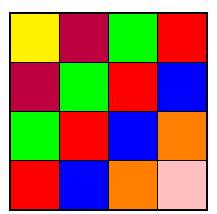
|
| 298 |
+
|
| 299 |
+
We consider the graph, where each node represents a colour and two nodes are linked, if the colours they represent touch. This graph is connected and since each colour touches at most 2 colours every node has at most degree 2 . This means that the graph is either one long chain or one big cycle.
|
| 300 |
+
|
| 301 |
+
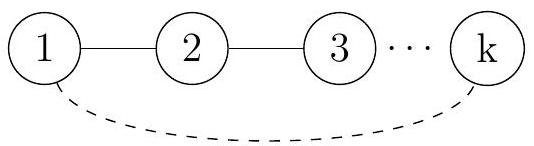
|
| 302 |
+
|
| 303 |
+
We now look at the case when $n$ is odd. Consider the cell in the center of the table. From this cell we can get to any other cell by passing through at most $n-1$ cells. Therefore from the node representing this cell, we can get to any node through at most $n-1$ edges. But if the graph has $2 n$ or more nodes, then for every node there is a node which is more than $n-1$ edges away. So we must have $k \leq 2 n-1$ for all odd $n$.
|
| 304 |
+
|
| 305 |
+
When $n$ is even we consider the 4 center cells. If they all have a different colour, then they form a 4-cycle in the graph, meaning the graph has only 4 nodes. If two of the center cells have the same colour, then from this colour you will be able to get to all other cells passing thorugh at most $n-1$ cells. By same the arguments as in the odd case, we get $k \leq \max (2 n-1,4)$ for even $n$.
|
| 306 |
+
|
| 307 |
+
So overall we have $k \leq 2 n-1$ for $n \neq 2$ and $k \leq 4$ for $n=2$ as desired.
|
| 308 |
+
|
| 309 |
+
Problem 7: A robot moves in the plane in a straight line, but every one meter it turns $90^{\circ}$ to the right or to the left. At some point it reaches its starting point without having visited any other point more than once, and stops immediately. What are the possible path lengths of the robot?
|
| 310 |
+
|
| 311 |
+
Solution: Let us define the coordinates system with unit length of one meter, point of origin in the starting point and vertical-horizontal axes. W.l.o.g. assume that the first move was east and the path had length of $n$. Then each odd move changed $x$ coordinate of the robot by 1 and each even move changed $y$ coordinate by 1 .
|
| 312 |
+
|
| 313 |
+
At the end of the day both coordinates were equal to zero again, so there had to be even number of odd and even number of even moves. That implies that only $n$ divisible by 4 can fulfill the conditions.
|
| 314 |
+
|
| 315 |
+
For $n=4$ we have a square path. For $n=8$ we had 4 changes of $x$ coordinate and 4 changes of $y$, so the whole path was inside some $2 \times 2$ square. Unfortunately that's not possible without reaching some point twice.
|
| 316 |
+
|
| 317 |
+
Now, we will prove that all $n>8$ divisible by 4 are good. For $n=12$ there is a path in shape of "+" with first 4 moves like $(\rightarrow, \uparrow, \rightarrow, \uparrow)$. Now we can change the middle $(\uparrow, \rightarrow)$ sequence by $(\downarrow, \rightarrow, \uparrow, \rightarrow, \uparrow, \leftarrow)$. Thanks to this change the robot explored new territory south-east from the one before explored. We got +4 of length of the path. There we can do it again and again, reaching any length of $4 k+8$ for all $k \in \mathbb{Z}^{+}$.
|
| 318 |
+
|
| 319 |
+
Problem 8: In the city of Flensburg there is a single, infinitely long, street with houses numbered 2, 3, .. The police in Flensburg is trying to catch a thief who every night moves from the house where she is currently hiding to one of its neighbouring houses.
|
| 320 |
+
|
| 321 |
+
To taunt the local law enforcement the thief reveals every morning the highest prime divisor of the number of the house she has moved to.
|
| 322 |
+
|
| 323 |
+
Every Sunday afternoon the police searches a single house, and they catch the thief if they search the house she is currently occupying. Does the police have a strategy to catch the thief in finite time?
|
| 324 |
+
|
| 325 |
+
Solution: We will prove that the police are always able to catch the thief in finite time.
|
| 326 |
+
|
| 327 |
+
Let $h_{i}$ denote the house the thief stays at the $i$-th night and $p_{i}$ denote the greatest prime divisor of $h_{i}$.
|
| 328 |
+
|
| 329 |
+
The police knows that she stays at different neighbouring houses every night, so $h_{i+1}-h_{i}=1$ for all non-negative integers $i$. Let us assume that the police are given the address of the thief's first two hiding spots, then we will prove by induction that the police can determine $h_{i}$ precisely except being unable to distinguish between houses numbered 2 and 4.
|
| 330 |
+
|
| 331 |
+
Assume the police knows $h_{i-2}$ and $h_{i-1}$, then they known that $h_{i}=h_{i-2}$ or $h_{i}=$ $2 h_{i-1}-h_{i-2}$. In the first case they will receive $p_{i}=p_{i-2}$ and in the latter case they will receive $p_{i}$ as the biggest prime divisor of $2 h_{i-1}-h_{i-2}$. Assume that they are unable to distinguish between these two cases, i.e., that $p_{i}=p_{i-2}$, which implies
|
| 332 |
+
|
| 333 |
+
$$
|
| 334 |
+
p_{i-2} \mid 2 h_{i-1}-h_{i-2} \text {, i.e. } p_{i-2} \mid 2 h_{i-1} \text {, i.e. } p_{i-2} \mid 2 \text {, i.e. } p_{i-2}=2
|
| 335 |
+
$$
|
| 336 |
+
|
| 337 |
+
since $h_{i-1}-h_{i-2}=1$ implies $\operatorname{gcd}\left(h_{i-1}, h_{i-1}\right)=1$. Moreover, since $p_{i}=p_{i-2}=2$ are the biggest prime divisors of $h_{i}=2 h_{i-1}-h_{i-2}$ and $h_{i-2}$ they must both be powers of 2 . However, the only powers of two with a difference of exactly 2 are 2 and 4 . Hence $\left\{h_{i-2}, 2 h_{i-1}-h_{i-2}\right\}=\{2,4\}$, i.e. $h_{i-1}=\frac{2+4}{2}=3$.
|
| 338 |
+
|
| 339 |
+
Thus, either the police will with certainty be able to determine $h_{i}$ or $h_{i-1}=3$, in which case $h_{i}$ may equal either 2 or 4 . To complete the inductive step we observe that the police are always able to determine the parity of $h_{j}$, since it changes every day. Thus, in the future if the police know that $h_{j} \in[2,4]$, then they can either determine $h_{j}=3$ or $h_{j} \in\{2,4\}$. However, the only way for the thief to leave the interval $[2,4]$ is to go to house number 5 , in which case the police will be alerted by receiving $p_{j}=5$, and they can again with certainty determine $h_{j}=5$ and $h_{j-1}=4$ preserving our inductive hypothesis.
|
| 340 |
+
|
| 341 |
+
To summarize, if the police knows both $h_{0}$ and $h_{1}$, then they can always determine $h_{i}$ with certainty until $h_{i-1}=3$. After this point they will with known the two last hiding places of the thief if she leaves the interval $[2,4]$, restoring the inductive hypothesis, or otherwise, if she never leaves $[2,4]$ be able to determine his position, up to confusion about 2 and 4 using the parity of the day.
|
| 342 |
+
|
| 343 |
+
Now, to catch the thief in finite time, they may methodically try to guess all viable pairs of $\left(h_{0}, h_{1}\right)$, i.e $h_{0}, h_{1} \in \mathbb{N}_{\geq 2}$ and $h_{0}-h_{1}=1$, of which there are countably many.
|
| 344 |
+
|
| 345 |
+
For each viable starting position, let us consider either the immediate Sunday or the one after that, since each week has an odd amount of days, we are certain that exactly one of these days gives us that the thief is hiding in an odd house (given our assumption on his starting position). Thus, due to our inductive hypothesis, we can precisely determine where the thief will be, and search this house.
|
| 346 |
+
|
| 347 |
+
If the thief is hiding in that house, the police wins, and if not, they will with certainty know that their guess of starting positions was incorrect, and move onto the next guess. By the above argument, each guess of initial starting positions requires at most two weeks, meaning that the police will catch the thief in finite time.
|
| 348 |
+
|
| 349 |
+
Remark: Note that if a week contained an even number of days then the police would not be able to guarantee that they would be able to catch the thief, if the thief moves between houses number 3 and $\{2,4\}$.
|
| 350 |
+
|
| 351 |
+
Problem 9: Determine if there exists a triangle that can be cut into 101 congruent triangles.
|
| 352 |
+
|
| 353 |
+
Solution: Answer: Yes, there is.
|
| 354 |
+
|
| 355 |
+
Choose an arbitrary positive integer $m$ and draw a height in the right triangle with ratio of legs $1: m$. This height cuts the triangle in two similar triangles with similarity coefficient $m$. The largest of them can further be cut into $m^{2}$ smaller equal triangles by splitting all sides in $m$ equal parts and connecting corresponding points with parallel lines. Thus a triangle can be split into $m^{2}+1$ equal triangles.
|
| 356 |
+
|
| 357 |
+
The figure shows this for $m=4$, but in our problem we must take $m=10$.
|
| 358 |
+
|
| 359 |
+
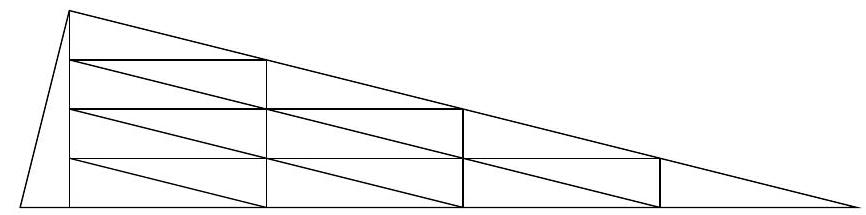
|
| 360 |
+
|
| 361 |
+
Problem 10: On a circle, $n \geq 3$ points are marked. Each marked point is coloured red, green or blue. In one step, one can erase two neighbouring marked points of different colours and mark a new point between the locations of the erased points with the third colour. In a final state, all marked points have the same colour which is called the colour of the final state. Find all $n$ for which there exists an initial state of $n$ marked points with one missing colour, from which one can reach a final state of any of the three colours by applying a suitable sequence of steps.
|
| 362 |
+
|
| 363 |
+
Solution: Answer: All even numbers $n$ greater than 2 .
|
| 364 |
+
|
| 365 |
+
We show first that required initial states are impossible for odd $n$. Note that if one colour is missing then the numbers of marked points of existing two colours have different parities, i.e., the difference of these numbers is odd. Each step keeps the parity of the difference of the numbers of marked points of these two colours unchanged. Hence in every intermediate state and also in the final state, one of these two colours is represented. Consequently, a final state of the third colour is impossible.
|
| 366 |
+
|
| 367 |
+
For every even number $n>2$, an initial state with 2 consecutive points marked with one colour and $n-2$ points marked with another colour satisfies the conditions of the problem. Indeed, if $n>4$ then with two symmetric steps, one can reach a similar state where the number of points marked with the more popular colour is 2 less. Hence it suffices to solve the case $n=4$. In this case, making one step leads to a state with 3 marked points, all with different colours. In order to obtain a final state of any given colour, one can replace points of the other two colours with a new point of the given colour. This completes the solution.
|
| 368 |
+
|
| 369 |
+
## 2nd Solution:
|
| 370 |
+
|
| 371 |
+
Definition: Call a configuration colourful, if the final state may have any of the three colours.
|
| 372 |
+
|
| 373 |
+
The case of $n$ being odd is excluded as in the first solution, so let $n>2$ be even. To construct colourful configurations, we consider linear configurations, i.e. one where the points are placed on a line instead of a circle. There is only difference to the circular situaton: We may not choose the two end points for the replacement step. So it suffices to construct linear colourful configurations.
|
| 374 |
+
|
| 375 |
+
We start by providing explicit examples for $n=4$ and $n=6$ (with the bold letters being replaced):
|
| 376 |
+
|
| 377 |
+
$$
|
| 378 |
+
\begin{aligned}
|
| 379 |
+
& \mathbf{R G} R G \rightarrow B \mathbf{R G} \rightarrow B B \\
|
| 380 |
+
& R \mathbf{G R} G \rightarrow R \mathbf{B G} \rightarrow R R \\
|
| 381 |
+
& R \mathbf{G R} G \rightarrow \mathbf{R B} G \rightarrow G G \\
|
| 382 |
+
& \mathbf{R G} R R G R \rightarrow B R R \mathbf{G R} \rightarrow B R \mathbf{R B} \rightarrow B \mathbf{R G} \rightarrow B B \\
|
| 383 |
+
& R \mathbf{G R} R G R \rightarrow R B \mathbf{R G} R \rightarrow \mathbf{R B} B R \rightarrow \mathbf{G B} R \rightarrow R R \\
|
| 384 |
+
& R \mathbf{G R} R G R \rightarrow R B \mathbf{R G} R \rightarrow \mathbf{R B} B R \rightarrow G \mathbf{B R} \rightarrow G G .
|
| 385 |
+
\end{aligned}
|
| 386 |
+
$$
|
| 387 |
+
|
| 388 |
+
Next observe that the concatenation of several linear colourful configurations is again colourful: Indeed, each part can be transformed into the desired colour independently. So the building blocks for $n=4$ and $n=6$ can produce colourful configurations of any even length.
|
| 389 |
+
|
| 390 |
+
Actually one can prove a lot more about colourful configurations:
|
| 391 |
+
|
| 392 |
+
Proposition: Denote the number of red resp. green resp. blue points in the initial state by $R$ resp. $G$ resp. $B$. A circular configuration is colourful if and only if
|
| 393 |
+
|
| 394 |
+
$$
|
| 395 |
+
R \equiv G \equiv B \quad(\bmod 2)
|
| 396 |
+
$$
|
| 397 |
+
|
| 398 |
+
and it contains at least two colours.
|
| 399 |
+
|
| 400 |
+
Proof. We have already seen in the solution above that $R-G \bmod 2, G-B \bmod 2$ and $B-R$ mod 2 are invariants. Moreover it is obvious that we need at least two colours to be able to do anything. So the conditions are necessary.
|
| 401 |
+
|
| 402 |
+
We prove that they are sufficient: For $n=3$ the conditions require $R=G=B=1$ and the configuration indeed colourful. We continue by induction for $n>3$ : As $n>3$, there is at least one colour with more than one point, so assume wlog. $R>1$. Having at least two colours, we can find a pair of two different colours, one of which is red. Assume w.l.o.g. that the other is green. As a first step replace these two points. The resulting configuration has $R-1$ red, $G-1$ green and $B+1$ blue points, so it satisfies $R-1=G-1=B+1 \bmod 2$. Moreover due to $R>1$ is has at least one red and one blue point. So by induction the configuration is colourful, and hence so was our original state.
|
| 403 |
+
|
| 404 |
+
This classification of colourful configuration, has some nice consequences:
|
| 405 |
+
|
| 406 |
+
Proposition: If a circular configuration is colourful, then so is any permutation of its points.
|
| 407 |
+
|
| 408 |
+
Proof. Immediate.
|
| 409 |
+
|
| 410 |
+
Problem 11: $\quad$ Let $A B C$ be a triangle and let $J$ be the centre of the $A$-excircle. The reflection of $J$ in $B C$ is $K$. The points $E$ and $F$ are on $B J$ and $C J$, respectively, such that $\angle E A B=\angle C A F=90^{\circ}$. Prove that $\angle F K E+\angle F J E=$ $180^{\circ}$.
|
| 411 |
+
|
| 412 |
+
Remark: The $A$-excircle is the circle that touches the side $B C$ and the extensions of $A C$ and $A B$.
|
| 413 |
+
|
| 414 |
+
Solution:
|
| 415 |
+
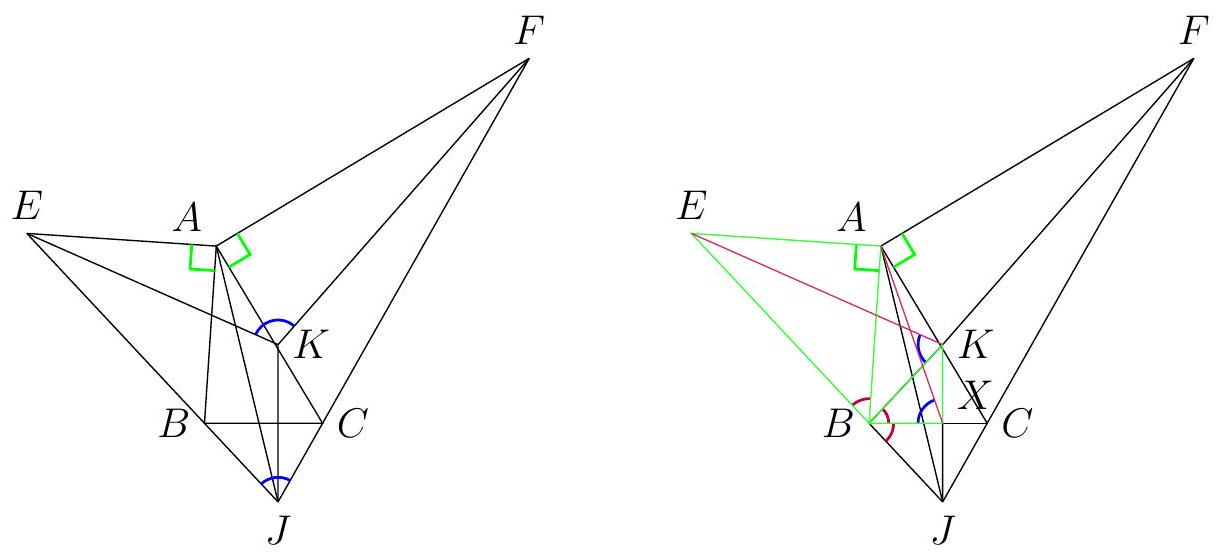
|
| 416 |
+
|
| 417 |
+
Let $J K$ intersect $B C$ at $X$. We will prove a key claim:
|
| 418 |
+
|
| 419 |
+
Claim: $B E K$ is similar to $B A X$.
|
| 420 |
+
|
| 421 |
+
Proof. Note that $\angle E A B=90^{\circ}=\angle K X B$. Also, since $B J$ bisects $\angle C B A$, we get $\angle A B E=\angle J B X=\angle X B K$. Hence $E B A \sim K B X$. From that, we see that the spiral similarity that sends the line segment $E A$ to $K X$ has centre $B$. So the spiral similarity that sends the line segment $E K$ to $A X$ has centre $B$. Thus $B E K \sim B A X$.
|
| 422 |
+
|
| 423 |
+
In a similar manner, we get $C F K$ is similar to $C A X$.
|
| 424 |
+
|
| 425 |
+
Now, using the similar triangles and the fact that $K$ and $J$ are symmetric in $B C$, we have
|
| 426 |
+
|
| 427 |
+
$$
|
| 428 |
+
\begin{aligned}
|
| 429 |
+
\angle F K E+\angle F J E & =\angle F K E+\angle B K C \\
|
| 430 |
+
& =360^{\circ}-\angle E K B-\angle C K F \\
|
| 431 |
+
& =360^{\circ}-\angle A X B-\angle C X A \\
|
| 432 |
+
& =360^{\circ}-180^{\circ} \\
|
| 433 |
+
& =180^{\circ}
|
| 434 |
+
\end{aligned}
|
| 435 |
+
$$
|
| 436 |
+
|
| 437 |
+
as desired.
|
| 438 |
+
|
| 439 |
+
Problem 12: Let $A B C$ be an acute triangle with $A B>A C$. The internal angle bisector of $\angle B A C$ intersects $B C$ at $D$. Let $O$ be the circumcentre of $A B C$. Let $A O$ intersect the segment $B C$ at $E$. Let $J$ be the incentre of $A E D$. Prove that if $\angle A D O=45^{\circ}$ then $O J=J D$.
|
| 440 |
+
|
| 441 |
+
Solution: Let $\alpha=\angle B A C, \beta=\angle C B A, \gamma=\angle A C B$. We have
|
| 442 |
+
|
| 443 |
+
$$
|
| 444 |
+
\begin{aligned}
|
| 445 |
+
\angle D J A & =90^{\circ}+\frac{1}{2} \angle D E A=90^{\circ}+\frac{1}{2}(\angle E B A+\angle B A E) \\
|
| 446 |
+
& =90^{\circ}+\frac{1}{2}\left(\beta+90^{\circ}-\gamma\right)=135^{\circ}+\frac{\beta}{2}-\frac{\gamma}{2}
|
| 447 |
+
\end{aligned}
|
| 448 |
+
$$
|
| 449 |
+
|
| 450 |
+
and
|
| 451 |
+
|
| 452 |
+
$$
|
| 453 |
+
\begin{aligned}
|
| 454 |
+
\angle D O A & =180^{\circ}-\angle O A D-\angle A D O=180^{\circ}-(\angle O A C-\angle D A C)-45^{\circ} \\
|
| 455 |
+
& =135^{\circ}-\left(90^{\circ}-\beta-\frac{\alpha}{2}\right)=135^{\circ}-\left(\frac{1}{2}(\alpha+\beta+\gamma)-\beta-\frac{\alpha}{2}\right) \\
|
| 456 |
+
& =135^{\circ}+\frac{\beta}{2}-\frac{\gamma}{2} .
|
| 457 |
+
\end{aligned}
|
| 458 |
+
$$
|
| 459 |
+
|
| 460 |
+
Therefore, $\angle D J A=\angle D O A$, hence quadrilateral $A D J O$ is cyclic. Since $A J$ is the bisector of $\angle O A D$, the $\operatorname{arcs} O J$ and $J D$ are equal. Hence $O J=J D$.
|
| 461 |
+
|
| 462 |
+
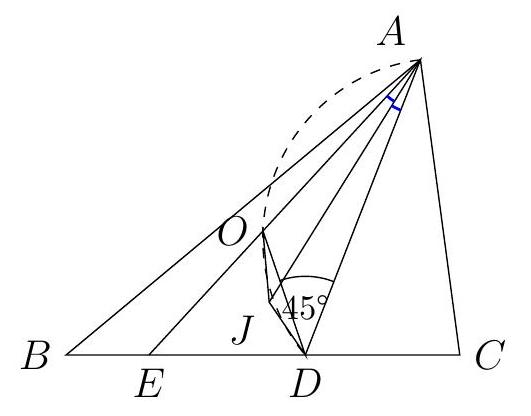
|
| 463 |
+
|
| 464 |
+
## B ALTIC
|
| 465 |
+
|
| 466 |
+
Problem 13: Let $A B C$ be an acute triangle with $A B<A C$ and incentre $I$. Let $D$ be the projection of $I$ onto $B C$. Let $H$ be the orthocentre of $A B C$. Given $\angle I D H=\angle C B A-\angle A C B$, prove that $A H=2 \cdot I D$.
|
| 467 |
+
|
| 468 |
+
Solution: Let $H^{\prime}$ be the reflection of $H$ in $B C$. It is well-known (and easy to prove) that $H^{\prime}$ lies on the circumcircle of $A B C$. Let $O$ be the circumcentre of $A B C$. We have
|
| 469 |
+
|
| 470 |
+
$$
|
| 471 |
+
\begin{aligned}
|
| 472 |
+
\angle O H^{\prime} A & =\angle H A O=\angle B A C-\angle B A H-\angle O A C \\
|
| 473 |
+
& =\angle B A C-2\left(90^{\circ}-\angle C B A\right)=\angle C B A-\angle A C B \\
|
| 474 |
+
& =\angle I D H=\angle H^{\prime} H D=\angle D H^{\prime} A,
|
| 475 |
+
\end{aligned}
|
| 476 |
+
$$
|
| 477 |
+
|
| 478 |
+
hence $O, D, H^{\prime}$ are collinear. Also note that $\angle H A O=\angle H^{\prime} H D$ implies that $A O \| H D$.
|
| 479 |
+
|
| 480 |
+
Let $M$ be the midpoint of $B C$. Let $E$ be the reflection of $D$ in $M$. We have
|
| 481 |
+
|
| 482 |
+
$$
|
| 483 |
+
\angle M O E=\angle D O M=\angle O H^{\prime} A=\angle H A O \text {. }
|
| 484 |
+
$$
|
| 485 |
+
|
| 486 |
+
Since $O M \| A H$, the above equality gives that $A, O, E$ are collinear.
|
| 487 |
+
|
| 488 |
+
Let $D^{\prime}$ be the reflection of $D$ in $I$. It is well-known (and easy to prove) that $D^{\prime}$ lies on $A E$. Since $A H \| O M$ and $A D^{\prime} \| H D$, quadrilateral $A H D D^{\prime}$ is a parallelogram. Therefore $A H=D D^{\prime}=2 \cdot I D$.
|
| 489 |
+
|
| 490 |
+
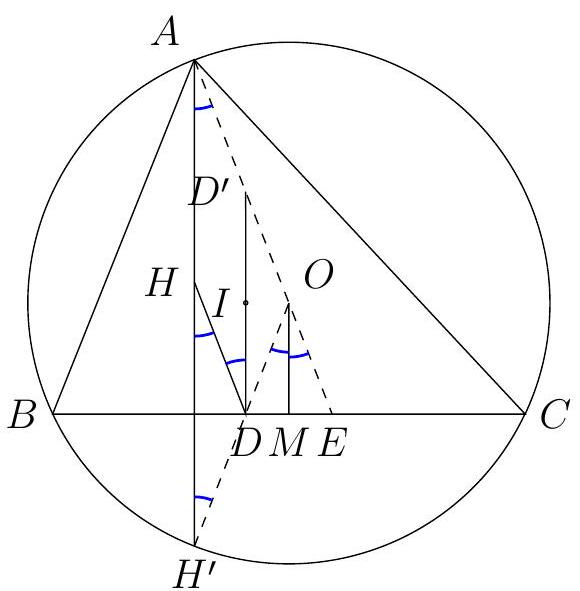
|
| 491 |
+
|
| 492 |
+
Problem 14: Let $A B C$ be a triangle with centroid $G$. Let $D, E$ and $F$ be the circumcentres of $B C G, C A G$ and $A B G$, respectively. Let $X$ be the intersection of the perpendiculars from $E$ to $A B$ and from $F$ to $A C$. Prove that $D X$ bisects the segment $E F$.
|
| 493 |
+
|
| 494 |
+
## Solution:
|
| 495 |
+
|
| 496 |
+
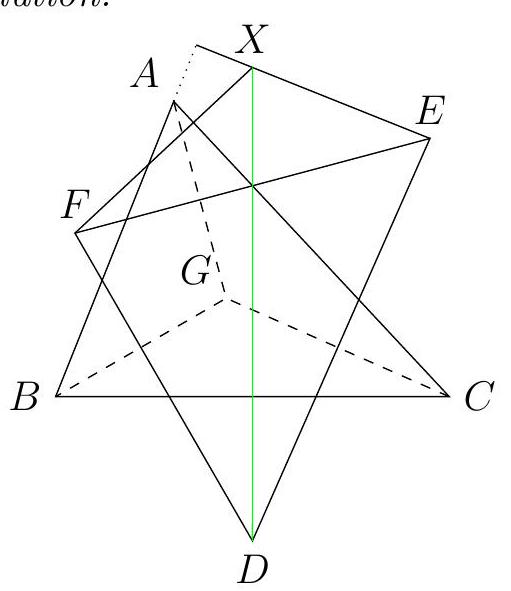
|
| 497 |
+
|
| 498 |
+
In all three solutions we will prove that the $D$ median coincides with the perpendicular bisector of the segment $B C$. Thus the solutions con- sist of two parts, proving that $X$ lies on the perpendicular bisector of $\mathrm{BC}$ and proving that the midpoint of $E F$ lies on the perpendicular bisector of $B C$.
|
| 499 |
+
|
| 500 |
+
The two parts may be completed independently, and in the three solutions below we demonstrate different approaches to both parts, though one can create valid solutions combining either first part with either second part.
|
| 501 |
+
|
| 502 |
+
Let $\omega_{B}, \omega_{C}$ denote the circumcircles of triangles $A B G$ and $A C G$ respectively, and the points $Y$ and $Z$ the second intersection of the line through $B$ parallel to $A C$ and $\omega_{B}$ and the second intersection of the line through $C$ parallel to $A B$ and $\omega_{C}$.
|
| 503 |
+
|
| 504 |
+
The lines $B Y$ and $C Z$ thus intersects at $A^{\prime}$, the reflection of $A$ across the midpoint of $B C$, and in particular on the $A$-median. Using Power of a Point from $A^{\prime}$ with respect to the circles $\omega_{B}$ and $\omega_{C}$ we obtain $A^{\prime} B \cdot A^{\prime} Y=A^{\prime} A \cdot A^{\prime} G=A^{\prime} C \cdot A^{\prime} E$ implying from the converse of Power of a Point that the quadrilateral $Y B C Z$ is cyclic. The perpendicular bisector of $B Y$ is orthogonal to $B Y \| A C$ and passes through $F$ and thus $X$ as well. Similarly, the perpendicular bisector of $C Z$ passes through $Z$. Hence $X$ is the centre of circle $(Y B C Z)$ and thus on the perpendicular bisector of the line $B C$.
|
| 505 |
+
|
| 506 |
+
Let $M$ and $N$ denote the midpoints of $B C$ and $E F$, respectively. To prove that $N$ lies on the perpendicular bisector of $B C$, let $V$ and $W$ denote the second intersections of $\omega_{B}$ and $\omega_{C}$ with the line $B C$, respectively.
|
| 507 |
+
|
| 508 |
+
From Power of a Point from $M$ with respect to $\omega_{B}$ and $\omega_{C}$ we obtain $M V \cdot M B=$ $M G \cdot M A=W M \cdot C M$, i.e. $M V=W M$, so $M$ is the midpoint of the segment $V W$. Let $E^{\prime}, N^{\prime}, F^{\prime}$ denote the projections of $E, N$ and $F$ onto $B C$ respectively. Since $N$ is the midpoint of $E F, N^{\prime}$ will be the midpoint of $E^{\prime} F^{\prime}$.
|
| 509 |
+
|
| 510 |
+
Moreover, from the fact that $E$ and $F$ are the centres of $\omega_{B}$ and $\omega_{C}$ we get that $E^{\prime}$ and $F^{\prime}$ are the midpoints of $B V$ and $W C$, and hence $M$ is the midpoint $E^{\prime} F^{\prime}$ as well, implying $N^{\prime}=M$ and that $N$ is on the perpendicular bisector of $B C$.
|
| 511 |
+
2nd Solution: Let $G^{\prime}$ denote the reflection of $G$ across the midpoint of $B C$. We begin by proving that triangles $A B C$ and $D F E$ are orthological, with orthology centres $G^{\prime}$ and $X$.
|
| 512 |
+
|
| 513 |
+
Observe that $G^{\prime}$ is on the $A$-median and thus $A G^{\prime} \perp E F$. Furthermore, quadrilateral $B G C G^{\prime}$ is a parellelogram and hence $B G^{\prime} \| C G \perp D E$ and $C G^{\prime} \| B G \perp D F$. Hence, $G^{\prime}$ is the first orthology centre of $A B C$ and $D F E$.
|
| 514 |
+
|
| 515 |
+
Thus, by the property of orthologoical triangle, the second orthology centre must exists, which is defined as the common intersection of the normal from $D$ to $B C$, $E$ to $A B$ and $F$ to $A C$, i.e. the point $X$. Since $D$ is on the perpendicular bisector of $B C$, by virtue of being the circumcentre of triangle $B G C$, and $X D \perp B C$ so must point $X$.
|
| 516 |
+
|
| 517 |
+
Moreover, let $O$ denote the circumcentre of triangle $A B C$. Then $E O \perp A C \perp$ $F X$ implies $E O \| F X$ and $F O \perp A B \perp E X$ implies $F O \| E X$, meaning that quadrilateral $F O E X$ is a parallelogram. Hence, the midpoint of $E F$ lies on the line $\overline{X O D}$ i.e. the perpendicular bisector of segment $B C$.
|
| 518 |
+
|
| 519 |
+
3rd Solution: Let $M$ be the midpoint of $B C$. Let $N$ be the intersection of $E F$ and $D M$. We claim that $N$ is the midpoint of $E F$.
|
| 520 |
+
|
| 521 |
+
Namely, we have $D E N \sim C G M$ because corresponding pairs of sides are orthogonal. Similarly, $D F N \sim B G M$. Hence
|
| 522 |
+
|
| 523 |
+
$$
|
| 524 |
+
\frac{E N}{N D}=\frac{G M}{M C}=\frac{G M}{M B}=\frac{F N}{N D}
|
| 525 |
+
$$
|
| 526 |
+
|
| 527 |
+
proving that $E N=F N$, as desired.
|
| 528 |
+
|
| 529 |
+
Next, let $X^{\prime}$ resp. $X^{\prime \prime}$ denote the intersection of $D N$ with the perpendicular from $E$ to $A B$ resp. the perpendicular from $F$ to $A C$. Just as above we have $E N X^{\prime} \sim A M B$ and $F N X^{\prime \prime} \sim A M C$, thus
|
| 530 |
+
|
| 531 |
+
$$
|
| 532 |
+
\frac{X^{\prime} N}{N E}=\frac{B M}{M A}=\frac{C M}{M A}=\frac{X^{\prime \prime} N}{N F}
|
| 533 |
+
$$
|
| 534 |
+
|
| 535 |
+
Since $N$ is the midpoint of $E F$, we get $X^{\prime} N=X^{\prime \prime} N$, hence $X^{\prime}=X^{\prime \prime}$ for orientation reasons (note that by the above similarities, $X^{\prime}$ and $X^{\prime \prime}$ must lie on the same side of $E F$ ).
|
| 536 |
+
|
| 537 |
+
This shows that $X=X^{\prime}=X^{\prime \prime}$ lies on $D N$.
|
| 538 |
+
|
| 539 |
+
Remark: That the medians of triangle $D E F$ coincide with the perpendicular bisectors of triangle $A B C$ implies that the centroid of $D E F$ coincides with the circumcentre of $A B C$. It is possible to ask for this in the problem instead, but then the problem becomes significantly easier, only requiring the second part of the first solution.
|
| 540 |
+
|
| 541 |
+
Problem 15: Let $\omega_{1}$ and $\omega_{2}$ be circles with no common points, such that neither circle lies inside the other. Points $M$ and $N$ are chosen on the circles $\omega_{1}$ and $\omega_{2}$, respectively, such that the tangent to the circle $\omega_{1}$ at $M$ and the tangent to the circle $\omega_{2}$ at $N$ intersect at $P$ and such that $P M N$ is an isosceles triangle with $P M=P N$. The circles $\omega_{1}$ and $\omega_{2}$ meet the segment $M N$ again at $A$ and $B$, respectively. The line $P A$ meets the circle $\omega_{1}$ again at $C$ and the line $P B$ meets the circle $\omega_{2}$ again at $D$. Prove that $\angle B C N=\angle A D M$.
|
| 542 |
+
|
| 543 |
+
Solution:
|
| 544 |
+
|
| 545 |
+
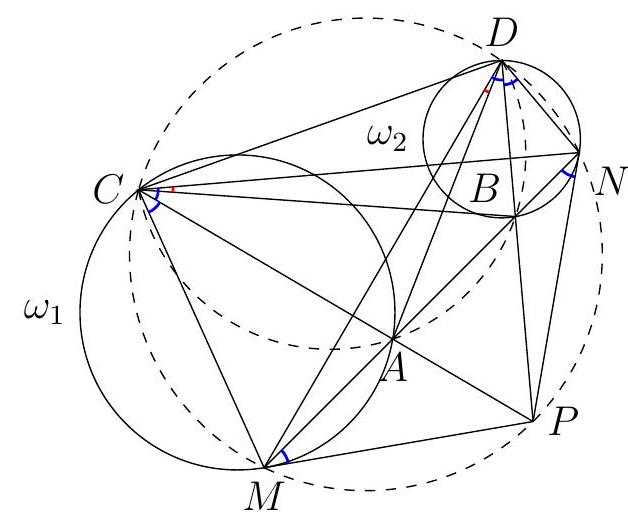
|
| 546 |
+
|
| 547 |
+
Since $M P N$ is an isosceles triangle, we have $\angle P M A=\angle P M N=\angle M N P=\angle B N P$. By tangent and chord theorem, $\angle M C A=$ $\angle P M A=\angle B N P=\angle B D N$.
|
| 548 |
+
|
| 549 |
+
Since $\angle M C P=\angle M N P$, the quadrilateral $C M P N$ is cyclic. Analogously, from $\angle P D N=\angle P M N$, we get that $N D M P$ is cyclic. Since $C$ and $D$ both lie on the circumcircle of $N P M$, points $P, N, M, C$ and $D$ are concyclic.
|
| 550 |
+
|
| 551 |
+
From inscribed angles subtending arcs with the same length, we get that $\angle M D P=$ $\angle M C P=\angle M N P=\angle P D N=\angle P M N=\angle P C N$.
|
| 552 |
+
|
| 553 |
+
The power of $P$ with respect to $\omega_{1}$ gives us that $P M^{2}=P A \cdot P C$. The power of $P$ with respect to $\omega_{2}$ gives us that $P N^{2}=P B \cdot P D$. Since $P M=P N$, the powers of $P$ with respect to $\omega_{1}$ and $\omega_{2}$ are equal ( $P$ lies on the radical axis). Hence, $P A \cdot P C=P B \cdot P D$, which implies that $A B D C$ is cyclic. From inscribed angles subtending the $\operatorname{arc} A B$, we get that $\angle A C B=\angle A D B$.
|
| 554 |
+
|
| 555 |
+
Hence, $\angle B C N=\angle A C N-\angle A C B=\angle M D B-\angle A D B=\angle M D A$.
|
| 556 |
+
|
| 557 |
+
2nd Solution: Since $M P N$ is an isosceles triangle, we have $\angle P M A=\angle P M N=$ $\angle M N P=\angle B N P$. By tangent and chord theorem, $\angle M C A=\angle P M A=\angle B N P=$ $\angle B D N$.
|
| 558 |
+
|
| 559 |
+
Since $\angle M C P=\angle M N P$, the quadrilateral $M P N C$ is cyclic, which means that $P$ lies on the circumcircle of $M N C$. Since $M P N$ is isosceles, the perpendicular bisector of $M N$ passes through $P$. Since the intersection point of the angle bisector and the perpendicular bisector of the opposite side of the triangle lies on the circumcircle, it follows that $C P$ bisects angle $\angle M C N$. Hence, $\angle M C P=\angle P C N$. Analogously, since $\angle P D N=\angle P M N$, it follows that $N D M P$ is cyclic and the circumcircle of $M N D$, the perpendicular bisector of $M N$ and the angle bisector of $\angle M D N$ meet at $P$. Hence, $\angle M D P=\angle P D N=\angle M C P=\angle P C N$.
|
| 560 |
+
|
| 561 |
+
Now we continue as in the previous solution.
|
| 562 |
+
|
| 563 |
+
## BALTIC
|
| 564 |
+
|
| 565 |
+
Problem 16: Prove that there exist nonconstant polynomials $f$ and $g$ with integer coefficients such that, for infinitely many primes $p$, there are no integers $x$ and $y$ with $p \mid f(x)-g(y)$.
|
| 566 |
+
|
| 567 |
+
Solution: We take $f(x)=\left(x^{2}+1\right)^{2}$ and $g(y)=-\left(y^{2}+1\right)^{2}$ and prove for all $p \equiv 3(\bmod 4)$ that $f(x) \equiv g(y)(\bmod p)$ has no solution. Famously, there are infinitely many primes congruent to 3 modulo 4 .
|
| 568 |
+
|
| 569 |
+
Recall the fact that if $p \equiv 3(\bmod 4)$ then the only solution to $a^{2}+b^{2} \equiv 0(\bmod p)$ is $a \equiv b \equiv 0(\bmod p)$. Hence, for $f(x) \equiv g(y)(\bmod p)$ to hold, we need
|
| 570 |
+
|
| 571 |
+
$$
|
| 572 |
+
\left(x^{2}+1\right)^{2}+\left(y^{2}+1\right)^{2} \equiv 0 \quad(\bmod p)
|
| 573 |
+
$$
|
| 574 |
+
|
| 575 |
+
and thus
|
| 576 |
+
|
| 577 |
+
$$
|
| 578 |
+
x^{2}+1 \equiv y^{2}+1 \equiv 0 \quad(\bmod p)
|
| 579 |
+
$$
|
| 580 |
+
|
| 581 |
+
which is impossible for $p \equiv 3(\bmod 4)$.
|
| 582 |
+
|
| 583 |
+
Problem 17: Let $S(m)$ be the sum of the digits of the positive integer $m$. Find all pairs $(a, b)$ of positive integers such that $S\left(a^{b+1}\right)=a^{b}$.
|
| 584 |
+
|
| 585 |
+
Solution: Answer: $(a, b) \in\left\{(1, b) \mid b \in \mathbb{Z}^{+}\right\} \cup\{(3,2),(9,1)\}$.
|
| 586 |
+
|
| 587 |
+
Let $k$ denote the number of digits of $a$. Then $10^{k-1} \leq a<10^{k}$ and, therefore, $10^{(k-1) b} \leq a^{b}$ and $a^{b+1}<10^{k(b+1)}$. Of course, the digits are at most 9, so $S\left(a^{b+1}\right) \leq 9 \cdot k(b+1)$. We get
|
| 588 |
+
|
| 589 |
+
$$
|
| 590 |
+
10^{(k-1) b} \leq a^{b}=S\left(a^{b+1}\right) \leq 9 \cdot k(b+1) \text {, i.e. } 10^{(k-1) b} \leq 9 \cdot k(b+1)
|
| 591 |
+
$$
|
| 592 |
+
|
| 593 |
+
Let us consider the case where $k \geq 2$. Then $k \leq 2(k-1)$ and note that $b+1 \leq 2 b$ as $b \geq 1$. Put $(k-1) b=: x$, then $k(b+1) \leq 4(k-1) b=4 x$. So $10^{x} \leq 36 x$. It is obvious that the only solutions in nonnegative integers to this inequality are $x=0$ and $x=1$. Indeed, for $x \geq 2$, the left hand side grows faster. Therefore, either $k=1$ or $k=2$ and $b=1$.
|
| 594 |
+
|
| 595 |
+
Now we have only two cases left.
|
| 596 |
+
|
| 597 |
+
Case 1: $b=1$ and $k=2$. We are left with the equation $S\left(a^{2}\right)=a$, for $10 \leq a<100$. Then $a^{2}<10^{4}$, so $a=S\left(a^{2}\right) \leq 9 \cdot 4=36$.
|
| 598 |
+
|
| 599 |
+
Moreover, taking into account the fact that the sum of digits does not change the number modulo $9, a^{2} \equiv a(\bmod 9)$, i.e., $a(a-1) \equiv 0(\bmod 9)$, therefore $a \equiv 0(\bmod 9)$ or $a \equiv 1(\bmod 9)$. So now we are left only with numbers $a \in$ $\{10,18,19,27,28,36\}$, which we can easily check by substitution and see that there are no solutions.
|
| 600 |
+
|
| 601 |
+
Case 2: $k=1$. In the same way, looking modulo 9, we get that $a^{b+1} \equiv a^{b}(\bmod 9)$ implies $a^{b}(a-1) \equiv 0(\bmod 9)$. Therefore either $a=1$ or $a$ is divisible by 3 . $a=1$ is an obvious solution with all $b \in \mathbb{Z}^{+}$.
|
| 602 |
+
|
| 603 |
+
Otherwise, $a \in\{3,6,9\}$. But then $a^{b+1}<10^{b+1}$ and $S\left(a^{b+1}\right) \leq 9(b+1)$. Therefore, $3^{b} \leq a^{b}=S\left(a^{b+1}\right) \leq 9(b+1)$. But from $3^{b} \leq 9(b+1)$, we can conclude $b \leq 3$. Indeed, for $b \geq 4$, the left hand side increases faster. So we are left with $a \in\{3,6,9\}$ and $b \leq 3$. We check all these cases to determine that only $(a, b)=(3,2)$ or $(a, b)=(9,1)$ are solutions.
|
| 604 |
+
|
| 605 |
+
Problem 18: Let $p>7$ be a prime number and let $A$ be a subset of $\{0,1, \ldots, p-1\}$ consisting of at least $\frac{p-1}{2}$ elements. Show that for each integer $r$, there exist (not necessarily distinct) numbers $a, b, c, d \in A$ such that
|
| 606 |
+
|
| 607 |
+
$$
|
| 608 |
+
a b-c d \equiv r \quad(\bmod p)
|
| 609 |
+
$$
|
| 610 |
+
|
| 611 |
+
Solution: Let $P$ be the set of residues modulo of possible products $a b$, for $a, b \in A$. Clearly, we have $|P| \geq \frac{p-1}{2}$, since we get $|A|$ different products by fixing an arbitrary $0 \neq a \in A$ and let run $b$ through $A$. If $|P| \geq \frac{p+1}{2}$, then $|r+P| \geq \frac{p+1}{2}$, too. Hence, $|P|+|r+P| \geq p+1>p$, so, by the Pigeonhole Principle, $P$ and $r+P$ must have an element in common. In other words, there are $p_{1}, p_{2}$ with $p_{1} \equiv r+p_{2}(\bmod p)$ and hence $p_{1}-p_{2} \equiv r(\bmod p)$, which gives a solution of the desired shape from the definition of $P$. So the only remaining case is that of $|P|=|A|=\frac{p-1}{2}$.
|
| 612 |
+
|
| 613 |
+
Multiplying all elements of $A$ with the same constant and reducing modulo $p$, if necessary, we may assume w.l.o.g. that $1 \in A$. Then $A \subseteq P$ and hence $A=P$. This means that the product of each two non-zero elements of $A$ is an element of $A$, too. Furthermore, for a fixed $0 \neq a \in A$ the products $a b$ all differ modulolo $p$. (It follows, that for every $0 \neq a \in A$ there is a $b \in A$ with $a b \equiv 1(\bmod p)$. Hence, the non-zero elements of $A$ form a group.) Thus, if we denote $A^{\star}:=A \backslash\{0\}$, for a fixed non-zero $a \in A$ we have
|
| 614 |
+
|
| 615 |
+
$$
|
| 616 |
+
\prod_{b \in A^{\star}} b \equiv \prod_{b \in A^{\star}}(a b)=a^{\left|A^{\star}\right|} \cdot \prod_{b \in A^{\star}} b(\bmod p) .
|
| 617 |
+
$$
|
| 618 |
+
|
| 619 |
+
Hence $a^{\left|A^{\star}\right|} \equiv 1(\bmod p)$.
|
| 620 |
+
|
| 621 |
+
If $0 \in A$ we have $\left|A^{\star}\right|=\frac{p-3}{2}$. So $a^{p-3}=a^{2 \mid A^{\star}} \equiv 1(\bmod p)$. But from Fermat's little theorem we know $a^{p-1} \equiv 1(\bmod p)$, hence $a^{2} \equiv 1(\bmod p)$ and $a \equiv \pm 1(\bmod p)$. We get $\frac{p-3}{2}=\left|A^{\star}\right| \leq 2$. This is impossible for $p>7$.
|
| 622 |
+
|
| 623 |
+
Consequently, $0 \notin A$ and we have $A^{\star}=A$.
|
| 624 |
+
|
| 625 |
+
We now use the well-known fact that for every prime $p$ there exists a primitive root, that is an integer $0<q<p$ where the residues modulo $p$ of the powers $q^{1}, q^{2}$, $\ldots, q^{p-1}$ are (in some order) $1,2, \ldots, p-1$. That is, we can write every non-zero element $a \in A$ as $q^{i}$ with some $1 \leq i \leq p-1$.
|
| 626 |
+
|
| 627 |
+
If $A$ is not the set of quadratic residues modulo $p$, that is the set of residues of $q^{2 \cdot 1}$, $q^{2 \cdot 2}, \ldots, q^{2 \cdot \frac{p-1}{2}}$, then it would contain two elements with consequtive exponents, say $q^{i}$ and $q^{i+1}$. But then we have $q^{(i+1)-i}=q \in A$ and, therefore, all powers of $q$. This contradicts $|A|=\frac{p-1}{2}<p-1$. Hence $A$ exactly the set of the quadratic residues modulo $p$.
|
| 628 |
+
|
| 629 |
+
Replacing $r$ by $r+p$, if necessary, one may assume $r$ to be odd. Then we can put $b:=d:=1 \in A$, as well as
|
| 630 |
+
|
| 631 |
+
$$
|
| 632 |
+
a \equiv\left(\frac{r+1}{2}\right)^{2} \quad(\bmod p) \quad \text { and } \quad c \equiv\left(\frac{r-1}{2}\right)^{2} \quad(\bmod p) \text {. }
|
| 633 |
+
$$
|
| 634 |
+
|
| 635 |
+
Then $a, c \in A$, too. This yields
|
| 636 |
+
|
| 637 |
+
$$
|
| 638 |
+
a d-b c \equiv a-c \equiv\left(\frac{r+1}{2}\right)^{2}-\left(\frac{r-1}{2}\right)^{2} \equiv r \quad(\bmod p)
|
| 639 |
+
$$
|
| 640 |
+
|
| 641 |
+
as required.
|
| 642 |
+
|
| 643 |
+
Remark: This solution avoids using knowledge from basic group theory. But clearly, with this, it could be stated in a shorter way.
|
| 644 |
+
|
| 645 |
+
Probably the result is also very far from being sharp and the $\frac{p-1}{2}$ can be replaced by something even smaller. Determining the sharp bound (or even its order of magnitude) here is most likely a very difficult problem.
|
| 646 |
+
|
| 647 |
+
Problem 19: Show that the sum of the digits of $2^{2^{2 \cdot 2023}}$ is greater than 2023 .
|
| 648 |
+
|
| 649 |
+
Solution: We will prove the more general statement that, for every positive integer $n$, the sum of decimal digits of $2^{2^{2 n}}$ is greater than $n$.
|
| 650 |
+
|
| 651 |
+
Let $m=2^{2 n}=4^{n}$, so that we need to consider the digits of $2^{m}$. It will suffice to prove that at least $n$ of these digits are different from 0 , since the last digit is at least 2 .
|
| 652 |
+
|
| 653 |
+
Let $0=e_{0}<e_{1}<\cdots<e_{k}$ be the positions of non-zero digits, so that $2^{m}=\sum_{i=0}^{k} d_{i} \cdot 10^{e_{i}}$ with $1 \leq d_{i} \leq 9$. Considering this number modulo $10^{e_{j}}$, for some $0<j \leq k$, the residue $\sum_{i=0}^{j-1} d_{i} \cdot 10^{e_{i}}$ is a multiple of $2^{e_{j}}$, hence at least $2^{e_{j}}$, but on the other hand it is bounded by $10^{e_{j-1}+1}$.
|
| 654 |
+
|
| 655 |
+
It follows that $2^{e_{j}}<10^{e_{j-1}+1}<16^{e_{j-1}+1}$, and hence $e_{j}<4\left(e_{j-1}+1\right)$. With $e_{0}=4^{0}-1$ and $e_{j} \leq 4\left(e_{j-1}+1\right)-1$, it follows that $e_{j} \leq 4^{j}-1$, for all $0 \leq j \leq k$. In particular, $e_{k} \leq 4^{k}-1$ and hence
|
| 656 |
+
|
| 657 |
+
$$
|
| 658 |
+
2^{m}=\sum_{i=0}^{k} d_{i} \cdot 10^{e_{i}}<10^{4^{k}}<16^{4^{k}}=2^{4 \cdot 4^{k}}=2^{4^{k+1}}
|
| 659 |
+
$$
|
| 660 |
+
|
| 661 |
+
which yields $4^{n}=m<4^{k+1}$, i.e., $n-1<k$. In other words, $2^{m}$ has $k \geq n$ non-zero decimal digits, as claimed.
|
| 662 |
+
|
| 663 |
+
Problem 20: Let $n$ be a positive integer. A German set in an $n \times n$ square grid is a set of $n$ cells which contains exactly one cell in each row and column. Given a labelling of the cells with the integers from 1 to $n^{2}$ using each integer exactly once, we say that an integer is a German product if it is the product of the labels of the cells in a German set.
|
| 664 |
+
|
| 665 |
+
(a) Let $n=8$. Determine whether there exists a labelling of an $8 \times 8$ grid such that the following condition is fulfilled: The difference of any two German products is always divisible by 65 .
|
| 666 |
+
|
| 667 |
+
(b) Let $n=10$. Determine whether there exists a labelling of a $10 \times 10$ grid such that the following condition is fulfilled: The difference of any two German products is always divisible by 101.
|
| 668 |
+
|
| 669 |
+
## Solution:
|
| 670 |
+
|
| 671 |
+
(a) No, there is no such labelling.
|
| 672 |
+
|
| 673 |
+
On the contrary, we show that for every labelling there exist two German products whose difference is not divisible by 65 . Suppose that an $8 \times 8$ square grid is labelled with the numbers $1,2, \ldots, 64$ such that no number is used twice.
|
| 674 |
+
|
| 675 |
+
We can construct a German product that is divisible by 13 by choosing a German set that includes the cell with the label 13 and seven others in different rows and columns, but otherwise arbitrarily.
|
| 676 |
+
|
| 677 |
+
We can construct a German product that is not divisible by 13 as follows. Notice that only four labels are divisible by 13, namely $13,26,39$, and 52 . These four labels are located in at most four rows; we denote the index set of these rows $R \subseteq[1,8]$. Similarly, there are at least four columns that do not contain any of these four labels; we denote the index set of these columns $C \subseteq[1,8]$. Since $R \leq C$ it is possible to choose cells of a German set from rows $R$ using only columns from $C$. The remaining cells are chosen from the remaining rows accordingly to the definition, but otherwise arbitrarily. The resulting German product is not divisible by 13 since the German set avoids the cells whose labels are divisible by 13 .
|
| 678 |
+
|
| 679 |
+
The difference of the two German products is not divisible by 13, since one German product is divisible by 13 whereas the other one is not. Hence the difference is not divisible by 65 .
|
| 680 |
+
(b) Yes, there is such a labelling.
|
| 681 |
+
|
| 682 |
+
For $k \in[0,99]$ we define $a_{k}=2^{k}(\bmod 101)$; in other words, $a_{k}$ is the remainder of $2^{k}$ when divided by 101. Note that $a_{k} \neq 0$ since no power of 2 is divisible by 101 . Hence $1 \leq a_{k} \leq 100$ for all $k \in[0,99]$.
|
| 683 |
+
|
| 684 |
+
We label the cells of the square grid with the numbers $a_{k}$ as follows:
|
| 685 |
+
|
| 686 |
+
| $a_{0}$ | $a_{1}$ | $a_{2}$ | $\cdots$ | $a_{9}$ |
|
| 687 |
+
| :---: | :---: | :---: | :---: | :---: |
|
| 688 |
+
| $a_{10}$ | $a_{11}$ | $a_{12}$ | $\cdots$ | $a_{19}$ |
|
| 689 |
+
| $a_{20}$ | $a_{21}$ | $a_{22}$ | $\cdots$ | $a_{29}$ |
|
| 690 |
+
| $\vdots$ | $\vdots$ | $\vdots$ | $\ddots$ | $\vdots$ |
|
| 691 |
+
| $a_{90}$ | $a_{91}$ | $a_{92}$ | $\cdots$ | $a_{99}$ |
|
| 692 |
+
|
| 693 |
+
More precisely, if we label the rows and columns of the chessboard by $\{0,1,2, \ldots, 9\}$, then the cell with coordinates $(i, j)$ gets the label $a_{10 i+j}$.
|
| 694 |
+
|
| 695 |
+
Note that $a_{10 i+j} \equiv 2^{10 i+j}(\bmod 101)$ and that $2^{10 i+j}=\left(2^{10}\right)^{i} \cdot 2^{j}$. Hence for this labelling any rook product is congruent to
|
| 696 |
+
|
| 697 |
+
$$
|
| 698 |
+
\left(2^{10}\right)^{0+1+2+\ldots+9} \cdot 2^{0+1+2+\ldots+9}
|
| 699 |
+
$$
|
| 700 |
+
|
| 701 |
+
modulo 101. Hence the difference of any two German products is divisible by 101 for this labelling.
|
| 702 |
+
|
| 703 |
+
It remains to show that the $a_{k}$ are pairwise different. (In more elaborate language, we would say that 2 is a primitive root modulo 101.) To do this, we denote by $s$ the smallest positive integer such that $2^{s} \equiv 1(\bmod 101)$. Using long division, we may write $100=q s+r$ with non-negative integers $q$ and $r$ such that $0 \leq r \leq s-1$. By virtue of Fermat's little theorem we have
|
| 704 |
+
|
| 705 |
+
$$
|
| 706 |
+
1 \equiv 2^{100} \equiv 2^{q s+r} \equiv\left(2^{s}\right)^{q} \cdot 2^{r} \equiv 1^{q} \cdot 2^{r} \equiv 2^{r} \quad(\bmod 101) .
|
| 707 |
+
$$
|
| 708 |
+
|
| 709 |
+
Since $r<s$ and $s$ is the smallest positive integer with $2^{s} \equiv 1(\bmod 101)$, we must have $r=0$. In other words, 100 is divisible by $s$; in other words, $s$ is a divisor of 100 .
|
| 710 |
+
|
| 711 |
+
We claim that $s=100$. If this was not the case, we would have $s \mid 20$ or $s \mid 50$, which implies that $2^{20} \equiv 1(\bmod 101)$ or $2^{50} \equiv 1(\bmod 101)$. However $2^{10}=1024 \equiv 14(\bmod 101)$, so that $2^{20} \equiv 14^{2} \equiv 196 \equiv-6 \not \equiv 1(\bmod 101)$ and $2^{50} \equiv\left(2^{20}\right)^{2} \cdot 2^{10} \equiv(-6)^{2} \cdot 14 \equiv 504 \equiv-1$ 丰 $1(\bmod 101)$.
|
| 712 |
+
|
| 713 |
+
Now assume that $k, \ell \in[0,99]$ are positive integers with $k>\ell$ and $a_{k}=a_{\ell}$. Then we have $2^{k} \equiv 2^{\ell}(\bmod 101)$ and $0 \equiv 2^{k}-2^{\ell} \equiv 2^{\ell} \cdot\left(2^{k-\ell}-1\right)(\bmod 101)$. Since $2^{\ell}$ and 101 are coprime, it follows that $2^{k-\ell}-1 \equiv 0(\bmod 101)$ and $2^{k-\ell} \equiv 1(\bmod 101)$. This cannot be true, since $k-\ell \in[1,99]$, but $s=100$ is the smallest positive integer with $2^{s} \equiv 1(\bmod 101)$. Hence $a_{k} \neq a_{\ell}$.
|
| 714 |
+
|
| 715 |
+
We conclude that the numbers $a_{k}$ with $k \in[0,99]$ are a hundred pairwise different numbers from the set $[1,100]$, hence they are a permutation of the set $[1,100]$ as it was required.
|
| 716 |
+
2nd Solution:
|
| 717 |
+
|
| 718 |
+
Definition: Let $p$ be a prime. Consider an $n \times n$ square grid of elements $a_{i, j} \in \mathbb{F}_{p}^{*}$ (for $i, j=1, \ldots, n$ ), which are not necessarily distinct. We call it rooky, if all its German products are equal as elements in $\mathbb{F}_{p}^{*}$.
|
| 719 |
+
|
| 720 |
+
We will provide a classification of all rooky square grids. Of course, most of this is not necessary when writing down a solution to the given problem, but it may still be interesting...
|
| 721 |
+
|
| 722 |
+
Lemma: A square grid is rooky if and only if for all $i, j, k, \ell$ :
|
| 723 |
+
|
| 724 |
+
$$
|
| 725 |
+
a_{i, j} \cdot a_{k, \ell}=a_{i, \ell} \cdot a_{k, j}
|
| 726 |
+
$$
|
| 727 |
+
|
| 728 |
+
Proof. If we swap the rows of two cells in a German set and keep their columns, it turns one valid German set into another. When comparing their German products, we can ignore all $n-2$ labels of cells that were not moved. The remaining values are $a_{i, j} \cdot a_{k, \ell}$ resp. $a_{i, \ell} \cdot a_{k, j}$ for certain $i, j, k, \ell$. This gives equality (1) for rooky square grids.
|
| 729 |
+
|
| 730 |
+
Conversely assume that (1) holds. Then we have to compare two arbitrary German products. But they can transformed into each other by a sequence of several swaps of two cells. Due to (1) the German product does not change at any of these steps, so the rook products of the original configurations are the same as well.
|
| 731 |
+
|
| 732 |
+
Lemma: A rooky square grid is uniquely determined by the elements of its first row and first column.
|
| 733 |
+
|
| 734 |
+
Proof. Indeed the previous lemma implies that
|
| 735 |
+
|
| 736 |
+
$$
|
| 737 |
+
a_{i, j} \cdot a_{1,1}=a_{i, 1} \cdot a_{1, j}
|
| 738 |
+
$$
|
| 739 |
+
|
| 740 |
+
which determines $a_{i, j}$ uniquely because $a_{1,1}$ is a unit.
|
| 741 |
+
|
| 742 |
+
One can actually prove directly that the square grid obtained that way is rooky, but it is simpler to continue directly to
|
| 743 |
+
|
| 744 |
+
Proposition: Let $\lambda_{i} \in \mathbb{F}_{p}^{*}(i=1, \ldots, n)$ and $\mu_{j} \in \mathbb{F}_{p}^{*}(j=1, \ldots, n)$ arbitrary elements. Then the square grid with
|
| 745 |
+
|
| 746 |
+
$$
|
| 747 |
+
a_{i, j}=\lambda_{i} \cdot \mu_{j}
|
| 748 |
+
$$
|
| 749 |
+
|
| 750 |
+
is rooky. Moreover any rooky square grid can be obtained this way.
|
| 751 |
+
|
| 752 |
+
Proof. The square grid with $a_{i, j}=\lambda_{i} \cdot \mu_{j}$ is rooky, because any German product has the value
|
| 753 |
+
|
| 754 |
+
$$
|
| 755 |
+
\prod_{i} \lambda_{i} \cdot \prod_{j} \mu_{j} .
|
| 756 |
+
$$
|
| 757 |
+
|
| 758 |
+
## B ALTIC <br> Way <br> FLENSBURG 2023
|
| 759 |
+
|
| 760 |
+
Let us prove the converse: By the previous lemma, it suffices to find $\lambda_{i} \mathrm{~s}$ and $\mu_{j} \mathrm{~s}$ that recreate the values of the first row and column. For this simply set $\lambda_{i}=a_{i, 1}$ and $\mu_{j}=\frac{a_{1, j}}{a_{1,1}}$.
|
| 761 |
+
|
| 762 |
+
Proposition: For any prime $p>n^{2}$, there exists a rooky square grid with only distinct elements.
|
| 763 |
+
|
| 764 |
+
Proof. Choose any primitive root $\alpha \in \mathbb{F}_{p}^{*}$. Then set $\lambda_{i}=\alpha^{i-1}, \mu_{j}=\alpha^{n \cdot(j-1)}$ and $a_{i, j}=\lambda_{i} \cdot \mu_{j}=\alpha^{i-1+n \cdot(j-1)}$. This provides indeed a rooky square grid. The values in the square are $\alpha^{0}, \alpha^{1}, \ldots, \alpha^{n^{2}-1}$. As we have chosen a primitive root, these are all distinct.
|
| 765 |
+
|
| 766 |
+
For $n=10, p=101$ and $\alpha=2$, this reproduces exactly the construction given in the previous solution.
|
| 767 |
+
|
BalticWay/md/en-bw24sol.md
ADDED
|
@@ -0,0 +1,652 @@
|
|
|
|
|
|
|
|
|
|
|
|
|
|
|
|
|
|
|
|
|
|
|
|
|
|
|
|
|
|
|
|
|
|
|
|
|
|
|
|
|
|
|
|
|
|
|
|
|
|
|
|
|
|
|
|
|
|
|
|
|
|
|
|
|
|
|
|
|
|
|
|
|
|
|
|
|
|
|
|
|
|
|
|
|
|
|
|
|
|
|
|
|
|
|
|
|
|
|
|
|
|
|
|
|
|
|
|
|
|
|
|
|
|
|
|
|
|
|
|
|
|
|
|
|
|
|
|
|
|
|
|
|
|
|
|
|
|
|
|
|
|
|
|
|
|
|
|
|
|
|
|
|
|
|
|
|
|
|
|
|
|
|
|
|
|
|
|
|
|
|
|
|
|
|
|
|
|
|
|
|
|
|
|
|
|
|
|
|
|
|
|
|
|
|
|
|
|
|
|
|
|
|
|
|
|
|
|
|
|
|
|
|
|
|
|
|
|
|
|
|
|
|
|
|
|
|
|
|
|
|
|
|
|
|
|
|
|
|
|
|
|
|
|
|
|
|
|
|
|
|
|
|
|
|
|
|
|
|
|
|
|
|
|
|
|
|
|
|
|
|
|
|
|
|
|
|
|
|
|
|
|
|
|
|
|
|
|
|
|
|
|
|
|
|
|
|
|
|
|
|
|
|
|
|
|
|
|
|
|
|
|
|
|
|
|
|
|
|
|
|
|
|
|
|
|
|
|
|
|
|
|
|
|
|
|
|
|
|
|
|
|
|
|
|
|
|
|
|
|
|
|
|
|
|
|
|
|
|
|
|
|
|
|
|
|
|
|
|
|
|
|
|
|
|
|
|
|
|
|
|
|
|
|
|
|
|
|
|
|
|
|
|
|
|
|
|
|
|
|
|
|
|
|
|
|
|
|
|
|
|
|
|
|
|
|
|
|
|
|
|
|
|
|
|
|
|
|
|
|
|
|
|
|
|
|
|
|
|
|
|
|
|
|
|
|
|
|
|
|
|
|
|
|
|
|
|
|
|
|
|
|
|
|
|
|
|
|
|
|
|
|
|
|
|
|
|
|
|
|
|
|
|
|
|
|
|
|
|
|
|
|
|
|
|
|
|
|
|
|
|
|
|
|
|
|
|
|
|
|
|
|
|
|
|
|
|
|
|
|
|
|
|
|
|
|
|
|
|
|
|
|
|
|
|
|
|
|
|
|
|
|
|
|
|
|
|
|
|
|
|
|
|
|
|
|
|
|
|
|
|
|
|
|
|
|
|
|
|
|
|
|
|
|
|
|
|
|
|
|
|
|
|
|
|
|
|
|
|
|
|
|
|
|
|
|
|
|
|
|
|
|
|
|
|
|
|
|
|
|
|
|
|
|
|
|
|
|
|
|
|
|
|
|
|
|
|
|
|
|
|
|
|
|
|
|
|
|
|
|
|
|
|
|
|
|
|
|
|
|
|
|
|
|
|
|
|
|
|
|
|
|
|
|
|
|
|
|
|
|
|
|
|
|
|
|
|
|
|
|
|
|
|
|
|
|
|
|
|
|
|
|
|
|
|
|
|
|
|
|
|
|
|
|
|
|
|
|
|
|
|
|
|
|
|
|
|
|
|
|
|
|
|
|
|
|
|
|
|
|
|
|
|
|
|
|
|
|
|
|
|
|
|
|
|
|
|
|
|
|
|
|
|
|
|
|
|
|
|
|
|
|
|
|
|
|
|
|
|
|
|
|
|
|
|
|
|
|
|
|
|
|
|
|
|
|
|
|
|
|
|
|
|
|
|
|
|
|
|
|
|
|
|
|
|
|
|
|
|
|
|
|
|
|
|
|
|
|
|
|
|
|
|
|
|
|
|
|
|
|
|
|
|
|
|
|
|
|
|
|
|
|
|
|
|
|
|
|
|
|
|
|
|
|
|
|
|
|
|
|
|
|
|
|
|
|
|
|
|
|
|
|
|
|
|
|
|
|
|
|
|
|
|
|
|
|
|
|
|
|
|
|
|
|
|
|
|
|
|
|
|
|
|
|
|
|
|
|
|
|
|
|
|
|
|
|
|
|
|
|
|
|
|
|
|
|
|
|
|
|
|
|
|
|
|
|
|
|
|
|
|
|
|
|
|
|
|
|
|
|
|
|
|
|
|
|
|
|
|
|
|
|
|
|
|
|
|
|
|
|
|
|
|
|
|
|
|
|
|
|
|
|
|
|
|
|
|
|
|
|
|
|
|
|
|
|
|
|
|
|
|
|
|
|
|
|
|
|
|
|
|
|
|
|
|
|
|
|
|
|
|
|
|
|
|
|
|
|
|
|
|
|
|
|
|
|
|
|
|
|
|
|
|
|
|
|
|
|
|
|
|
|
|
|
|
|
|
|
|
|
|
|
|
|
|
|
|
|
|
|
|
|
|
|
|
|
|
|
|
|
|
|
|
|
|
|
|
|
|
|
|
|
|
|
|
|
|
|
|
|
|
|
|
|
|
|
|
|
|
|
|
|
|
|
|
|
|
|
|
|
|
|
|
|
|
|
|
|
|
|
|
|
|
|
|
|
|
|
|
|
|
|
|
|
|
|
|
|
|
|
|
|
|
|
|
|
|
|
|
|
|
|
|
|
|
|
|
|
|
|
|
|
|
|
|
|
|
|
|
|
|
|
|
|
|
|
|
|
|
|
|
|
|
|
|
|
|
|
|
|
|
|
|
|
|
|
|
|
|
|
|
|
|
|
|
|
|
|
|
|
|
|
|
|
|
|
|
|
|
|
|
|
|
|
|
|
|
|
|
|
|
|
|
|
|
|
|
|
|
|
|
|
|
|
|
|
|
|
|
|
|
|
|
|
|
|
|
|
|
|
|
|
|
|
|
|
|
|
|
|
|
|
|
|
|
|
|
|
|
|
|
|
|
|
|
|
|
|
|
|
|
|
|
|
|
|
|
|
|
|
|
|
|
|
|
|
|
|
|
|
|
|
|
|
|
|
|
|
|
|
|
|
|
|
|
|
|
|
|
|
|
|
|
|
|
|
|
|
|
|
|
|
|
|
|
|
|
|
|
|
|
|
|
|
|
|
|
|
|
|
|
|
|
|
|
|
|
|
|
|
|
|
|
|
|
|
|
|
|
|
|
|
|
|
|
|
|
|
|
|
|
|
|
|
|
|
|
|
|
|
|
|
|
|
|
|
|
|
|
|
|
|
|
|
|
|
|
|
|
|
|
|
|
|
|
|
|
|
|
|
|
|
|
|
|
|
|
|
|
|
|
|
|
|
|
|
|
|
|
|
|
|
|
|
|
|
|
|
|
|
|
|
|
|
|
|
|
|
|
|
|
|
|
|
|
|
|
|
|
|
|
|
|
|
|
|
|
|
|
|
|
|
|
|
|
|
|
|
|
|
|
|
|
|
|
|
|
|
|
|
|
|
|
|
|
|
|
|
|
|
|
|
|
|
|
|
|
|
|
|
|
|
|
|
|
|
|
|
|
|
|
|
|
|
|
|
|
|
|
|
|
|
|
|
|
|
|
|
|
|
|
|
|
|
|
|
|
|
|
|
|
|
|
|
|
|
|
|
|
|
|
|
|
|
|
|
|
|
|
|
|
|
|
|
|
|
|
|
|
|
|
|
|
|
|
|
|
|
|
|
|
|
|
|
|
|
|
|
|
|
|
|
|
|
|
|
|
|
|
|
|
|
|
|
|
|
|
|
|
|
|
|
|
|
|
|
|
|
|
|
|
|
|
|
|
|
|
|
|
|
|
|
|
|
|
|
|
|
|
|
|
|
|
|
|
|
|
|
|
|
|
|
|
|
|
|
|
|
|
|
|
|
|
|
|
|
|
|
|
|
|
|
|
|
|
|
|
|
|
|
|
|
|
|
|
|
|
|
|
|
|
|
|
|
|
|
|
|
|
|
|
|
|
|
|
|
|
|
|
|
|
|
|
|
|
|
|
|
|
|
|
|
|
|
|
|
|
|
|
|
|
|
|
|
|
|
|
|
|
|
|
|
|
|
|
|
|
|
|
|
|
|
|
|
|
|
|
|
|
|
|
|
|
|
|
|
|
|
|
|
|
|
|
|
|
|
|
|
|
|
|
|
|
|
|
|
|
|
|
|
|
|
|
|
|
|
|
|
|
|
|
|
|
|
|
|
|
|
|
|
|
|
|
|
|
|
|
|
|
|
|
|
|
|
|
|
|
|
|
|
|
|
|
|
|
|
|
|
|
|
|
|
|
|
|
|
|
|
|
|
|
|
|
|
|
|
|
|
|
|
|
|
|
|
|
|
|
|
|
|
|
|
|
|
|
|
|
|
|
|
|
|
|
|
|
|
|
|
|
|
|
|
|
|
|
|
|
|
|
|
|
|
|
|
|
|
|
|
|
|
|
|
|
|
|
|
|
|
|
|
| 1 |
+
1. Let $\alpha$ be a non-zero real number. Find all functions $f: \mathbb{R} \rightarrow \mathbb{R}$ such that
|
| 2 |
+
|
| 3 |
+
$$
|
| 4 |
+
x f(x+y)=(x+\alpha y) f(x)+x f(y)
|
| 5 |
+
$$
|
| 6 |
+
|
| 7 |
+
for all $x, y \in \mathbb{R}$.
|
| 8 |
+
Answer: $f(x)=c x^{2}$ for any real constant $c$ if $\alpha=2 ; f(x)=0$ otherwise.
|
| 9 |
+
Solution 1: Let $P(x, y)$ denote the assertion of the given functional equation. Note that $P(1,0)$ is $f(1)=f(1)+f(0)$ which implies
|
| 10 |
+
|
| 11 |
+
$$
|
| 12 |
+
f(0)=0
|
| 13 |
+
$$
|
| 14 |
+
|
| 15 |
+
Applying this result to $P(x,-x)$ and $P(-x, x)$ where $x \neq 0$ we get:
|
| 16 |
+
|
| 17 |
+
$$
|
| 18 |
+
\begin{aligned}
|
| 19 |
+
& 0=(1-\alpha) x f(x)+x f(-x) \\
|
| 20 |
+
& 0=(\alpha-1) x f(-x)-x f(x)
|
| 21 |
+
\end{aligned}
|
| 22 |
+
$$
|
| 23 |
+
|
| 24 |
+
By adding (1) and (2) and simplifying, we get $0=\alpha x f(-x)-\alpha x f(x)$ which implies
|
| 25 |
+
|
| 26 |
+
$$
|
| 27 |
+
f(x)=f(-x)
|
| 28 |
+
$$
|
| 29 |
+
|
| 30 |
+
for all $x \neq 0$. Since $f(0)=0=f(-0)$, we can conclude that $f$ is even. Therefore (1) simplifies to
|
| 31 |
+
|
| 32 |
+
$$
|
| 33 |
+
0=x f(x)(2-\alpha)
|
| 34 |
+
$$
|
| 35 |
+
|
| 36 |
+
which implies that if $\alpha \neq 2$ then $f(x)=0$ for all $x \in \mathbb{R}$. It is easy to check that this function works. Now let us consider the case $\alpha=2$. The initial functional equation becomes
|
| 37 |
+
|
| 38 |
+
$$
|
| 39 |
+
x f(x+y)=(x+2 y) f(x)+x f(y)
|
| 40 |
+
$$
|
| 41 |
+
|
| 42 |
+
which can be rewritten as
|
| 43 |
+
|
| 44 |
+
$$
|
| 45 |
+
x f(x+y)-(x+y) f(x)=y f(x)+x f(y)
|
| 46 |
+
$$
|
| 47 |
+
|
| 48 |
+
Note that the right hand side is symmetric with respect to $x$ and $y$. From this we can deduce that $x f(x+y)-(x+y) f(x)=y f(x+y)-(x+y) f(y)$ where factorizing yields
|
| 49 |
+
|
| 50 |
+
$$
|
| 51 |
+
(x-y) f(x+y)=(x+y)(f(x)-f(y)) .
|
| 52 |
+
$$
|
| 53 |
+
|
| 54 |
+
By replacing $y$ with $-y$ and using the fact that $f$ is even, we get
|
| 55 |
+
|
| 56 |
+
$$
|
| 57 |
+
(x+y) f(x-y)=(x-y)(f(x)-f(y))
|
| 58 |
+
$$
|
| 59 |
+
|
| 60 |
+
Taking $x=\frac{z+1}{2}$ and $y=\frac{z-1}{2}$ in both (3) and 4, we get
|
| 61 |
+
|
| 62 |
+
$$
|
| 63 |
+
\begin{aligned}
|
| 64 |
+
f(z) & =z\left(f\left(\frac{z+1}{2}\right)-f\left(\frac{z-1}{2}\right)\right) \\
|
| 65 |
+
z f(1) & =f\left(\frac{z+1}{2}\right)-f\left(\frac{z-1}{2}\right)
|
| 66 |
+
\end{aligned}
|
| 67 |
+
$$
|
| 68 |
+
|
| 69 |
+
respectively. Equations (5) and (6) together yield $f(z)=z \cdot z f(1)=z^{2} f(1)$ which must hold for all $z \in \mathbb{R}$.
|
| 70 |
+
|
| 71 |
+
Thus, the only possible functions that satisfy the given relation for $\alpha=2$ are $f(x)=c x^{2}$ for some real constant $c$. It is easy to check that they indeed work.
|
| 72 |
+
|
| 73 |
+
Solution 2: Multiplying the given equation by $y$ gives
|
| 74 |
+
|
| 75 |
+
$$
|
| 76 |
+
x y f(x+y)=(x+\alpha y) y f(x)+x y f(y)
|
| 77 |
+
$$
|
| 78 |
+
|
| 79 |
+
which is equivalent to
|
| 80 |
+
|
| 81 |
+
$$
|
| 82 |
+
x y(f(x+y)-f(x)-f(y))=\alpha y^{2} f(x)
|
| 83 |
+
$$
|
| 84 |
+
|
| 85 |
+
The left-hand side of this equation is symmetric in $x$ and $y$. Hence the right-hand side must also stay the same if we swap $x$ and $y$, i.e.,
|
| 86 |
+
|
| 87 |
+
$$
|
| 88 |
+
\alpha y^{2} f(x)=\alpha x^{2} f(y)
|
| 89 |
+
$$
|
| 90 |
+
|
| 91 |
+
As $\alpha \neq 0$, this implies
|
| 92 |
+
|
| 93 |
+
$$
|
| 94 |
+
y^{2} f(x)=x^{2} f(y)
|
| 95 |
+
$$
|
| 96 |
+
|
| 97 |
+
Setting $y=1$ in this equation immediately gives $f(x)=c x^{2}$ where $c=f(1)$. Plugging $f(x)=c x^{2}$ into the original equation gives
|
| 98 |
+
|
| 99 |
+
$$
|
| 100 |
+
c x(x+y)^{2}=c(x+\alpha y) x^{2}+c x y^{2}
|
| 101 |
+
$$
|
| 102 |
+
|
| 103 |
+
where terms can be rearranged to obtain
|
| 104 |
+
|
| 105 |
+
$$
|
| 106 |
+
c x(x+y)^{2}=c x\left(x^{2}+\alpha x y+y^{2}\right)
|
| 107 |
+
$$
|
| 108 |
+
|
| 109 |
+
If $c=0$ then (7) is satisfied. Hence for every $\alpha$, the function $f(x)=0$ is a solution. If $c \neq 0$ then (7) is satisfied if and only if $\alpha=2$. Hence in the case $\alpha=2$, all functions $f(x)=c x^{2}$ (where $c \neq 0$ ) are also solutions.
|
| 110 |
+
2. Let $\mathbb{R}^{+}$be the set of all positive real numbers. Find all functions $f: \mathbb{R}^{+} \rightarrow \mathbb{R}^{+}$such that
|
| 111 |
+
|
| 112 |
+
$$
|
| 113 |
+
\frac{f(a)}{1+a+c a}+\frac{f(b)}{1+b+a b}+\frac{f(c)}{1+c+b c}=1
|
| 114 |
+
$$
|
| 115 |
+
|
| 116 |
+
for all $a, b, c \in \mathbb{R}^{+}$that satisfy $a b c=1$.
|
| 117 |
+
Answer: $f(x)=k x+1-k$ where $k$ is any real number such that $0 \leq k \leq 1$.
|
| 118 |
+
Solution: Note that $\frac{1}{1+a+c a}=b c \cdot \frac{1}{1+c+b c}$ since $a b c=1$. Similarly,
|
| 119 |
+
|
| 120 |
+
$$
|
| 121 |
+
\frac{1}{1+b+a b}=a c \cdot \frac{1}{1+a+c a}=c \cdot \frac{1}{1+c+b c}
|
| 122 |
+
$$
|
| 123 |
+
|
| 124 |
+
So the initial equality becomes $\frac{b c f(a)+c f(b)+f(c)}{1+c+b c}=1$ which yields
|
| 125 |
+
|
| 126 |
+
$$
|
| 127 |
+
b c f\left(\frac{1}{b c}\right)+c f(b)+f(c)=1+c+b c
|
| 128 |
+
$$
|
| 129 |
+
|
| 130 |
+
Taking $a=b=c=1$ in (8) gives $f(1)+f(1)+f(1)=3$ which implies $f(1)=1$. Using this fact after substituting $c=1$ into 8 yields $b f\left(\frac{1}{b}\right)+f(b)=1+b$, so $b f\left(\frac{1}{b}\right)=1+b-f(b)$ for all $b \in \mathbb{R}^{+}$. Applying this in (8) gives $1+b c-f(b c)+c f(b)+f(c)=1+c+b c$, so
|
| 131 |
+
|
| 132 |
+
$$
|
| 133 |
+
c f(b)+f(c)=c+f(b c)
|
| 134 |
+
$$
|
| 135 |
+
|
| 136 |
+
Swapping $b$ and $c$ here gives
|
| 137 |
+
|
| 138 |
+
$$
|
| 139 |
+
b f(c)+f(b)=b+f(b c)
|
| 140 |
+
$$
|
| 141 |
+
|
| 142 |
+
Subtracting the last equality from the second last one and rearranging the terms gives
|
| 143 |
+
|
| 144 |
+
$$
|
| 145 |
+
c f(b)-f(b)+f(c)-b f(c)=c-b
|
| 146 |
+
$$
|
| 147 |
+
|
| 148 |
+
Substituting $c=2$ into (9) gives $f(b)+f(2)-b f(2)=2-b$, so $f(b)=b(f(2)-1)+2-f(2)$. Denoting $f(2)-1=k$, we get $f(b)=k b+1-k$ for all $b \in \mathbb{R}^{+}$.
|
| 149 |
+
Note that if $k<0$, then for large enough $b$ the value of $f(b)$ would become negative. If $k>1$, then for small enough $b$ the value of $f(b)$ would become negative. Therefore $k \in[0,1]$. After substituting $f(x)=k x+1-k$ into 8e can see that it is satisfied. Hence this function satisfies the original equality for all $a, b, c \in \mathbb{R}^{+}$such that $a b c=1$.
|
| 150 |
+
3. Positive real numbers $a_{1}, a_{2}, \ldots, a_{2024}$ are written on the blackboard. A move consists of choosing two numbers $x$ and $y$ on the blackboard, erasing them and writing the number $\frac{x^{2}+6 x y+y^{2}}{x+y}$ on the blackboard. After 2023 moves, only one number $c$ will remain on the blackboard. Prove that
|
| 151 |
+
|
| 152 |
+
$$
|
| 153 |
+
c<2024\left(a_{1}+a_{2}+\ldots+a_{2024}\right)
|
| 154 |
+
$$
|
| 155 |
+
|
| 156 |
+
Solution: Note that by GM-HM we have
|
| 157 |
+
|
| 158 |
+
$$
|
| 159 |
+
\frac{x^{2}+6 x y+y^{2}}{x+y}=x+y+\frac{4 x y}{x+y}=x+y+2 \cdot \frac{2}{\frac{1}{x}+\frac{1}{y}} \leq x+y+2 \sqrt{x y}=(\sqrt{x}+\sqrt{y})^{2}
|
| 160 |
+
$$
|
| 161 |
+
|
| 162 |
+
which means that
|
| 163 |
+
|
| 164 |
+
$$
|
| 165 |
+
\sqrt{\frac{x^{2}+6 x y+y^{2}}{x+y}} \leq \sqrt{x}+\sqrt{y}
|
| 166 |
+
$$
|
| 167 |
+
|
| 168 |
+
Therefore after each move the sum of square roots of all numbers on the blackboard decreases or stays the same. This implies that
|
| 169 |
+
|
| 170 |
+
$$
|
| 171 |
+
\sqrt{c} \leq \sqrt{a_{1}}+\sqrt{a_{2}}+\ldots+\sqrt{a_{2024}}
|
| 172 |
+
$$
|
| 173 |
+
|
| 174 |
+
By QM-AM we have
|
| 175 |
+
|
| 176 |
+
$$
|
| 177 |
+
\sqrt{a_{1}}+\sqrt{a_{2}}+\ldots+\sqrt{a_{2024}} \leq 2024 \sqrt{\frac{a_{1}+a_{2}+\ldots+a_{2024}}{2024}}
|
| 178 |
+
$$
|
| 179 |
+
|
| 180 |
+
Hence $c \leq 2024\left(a_{1}+a_{2}+\ldots+a_{2024}\right)$.
|
| 181 |
+
It remains to show that the equality cannot hold. Suppose, for the sake of contradiction, that
|
| 182 |
+
|
| 183 |
+
$$
|
| 184 |
+
c=2024\left(a_{1}+a_{2}+\ldots+a_{2024}\right)
|
| 185 |
+
$$
|
| 186 |
+
|
| 187 |
+
For this to occur, all the inequalities used must be equalities. Note that the last equality holds if and only if $a_{1}=a_{2}=\cdots=a_{2024}$. Also to reach the equality we must have $x=y$ at each move, so that the sum of square roots of all numbers on the blackboard stays the same all the time. So the square root of the number occurring 2024 times on the blackboard in the beginning is $\frac{\sqrt{c}}{2024}$, and choosing two copies of any number $x$ with square root $\sqrt{x}$ yields a number with square root $2 \sqrt{x}$ after the move. Hence the square root of any number occurring on the blackboard during the process must be of the form $\frac{\sqrt{c}}{2024} \cdot 2^{k}$ for a natural number $k$. But the square root of the number in the blackboard in the end is $\sqrt{c}$ which is not of this form since 2024 is not a power of 2 . The contradiction shows that the equality cannot be achieved and we are done.
|
| 188 |
+
4. Find the largest real number $\alpha$ such that, for all non-negative real numbers $x, y$ and $z$, the following inequality holds:
|
| 189 |
+
|
| 190 |
+
$$
|
| 191 |
+
(x+y+z)^{3}+\alpha\left(x^{2} z+y^{2} x+z^{2} y\right) \geq \alpha\left(x^{2} y+y^{2} z+z^{2} x\right) .
|
| 192 |
+
$$
|
| 193 |
+
|
| 194 |
+
Answer: $6 \sqrt{3}$.
|
| 195 |
+
Solution: Without loss of generality, $x$ is the largest amongst the three variables. By moving $\alpha\left(x^{2} z+y^{2} x+z^{2} y\right)$ to the right-hand side and factoring, we get the equivalent inequality
|
| 196 |
+
|
| 197 |
+
$$
|
| 198 |
+
(x+y+z)^{3} \geq \alpha(x-y)(x-z)(y-z)
|
| 199 |
+
$$
|
| 200 |
+
|
| 201 |
+
If $z>y$, then the right-hand side is non-positive, so we can assume $x \geq y \geq z$.
|
| 202 |
+
Note that
|
| 203 |
+
|
| 204 |
+
$$
|
| 205 |
+
\begin{aligned}
|
| 206 |
+
x+y+z & \geq x+y-2 z \\
|
| 207 |
+
& =\frac{1}{\sqrt{3}}(x-y)+\left(1-\frac{1}{\sqrt{3}}\right)(x-z)+\left(1+\frac{1}{\sqrt{3}}\right)(y-z) \\
|
| 208 |
+
& \geq 3 \sqrt[3]{\frac{2}{3 \sqrt{3}}(x-y)(x-z)(y-z)} .
|
| 209 |
+
\end{aligned}
|
| 210 |
+
$$
|
| 211 |
+
|
| 212 |
+
Cubing both sides gives $(x+y+z)^{3} \geq 6 \sqrt{3}(x-y)(x-z)(y-z)$. The equality holds when $z=0$ and $x=y(2+\sqrt{3})$. So $\alpha=6 \sqrt{3}$.
|
| 213 |
+
5. Find all positive real numbers $\lambda$ such that every sequence $a_{1}, a_{2}, \ldots$ of positive real numbers satisfying
|
| 214 |
+
|
| 215 |
+
$$
|
| 216 |
+
a_{n+1}=\lambda \cdot \frac{a_{1}+a_{2}+\ldots+a_{n}}{n}
|
| 217 |
+
$$
|
| 218 |
+
|
| 219 |
+
for all $n \geq 2024^{2024}$ is bounded.
|
| 220 |
+
Remark: A sequence $a_{1}, a_{2}, \ldots$ of positive real numbers is bounded if there exists a real number $M$ such that $a_{i}<M$ for all $i=1,2, \ldots$
|
| 221 |
+
Answer: All positive real numbers $\lambda \leq 1$.
|
| 222 |
+
Solution: First we will show that for all $\lambda>1$ every such sequence is unbounded. Note that $a_{n}=\lambda \cdot \frac{a_{1}+a_{2}+\ldots+a_{n-1}}{n-1}$ implies
|
| 223 |
+
|
| 224 |
+
$$
|
| 225 |
+
\frac{a_{n}(n-1)}{\lambda}=a_{1}+a_{2}+\ldots+a_{n-1}
|
| 226 |
+
$$
|
| 227 |
+
|
| 228 |
+
for all $n>2024^{2024}$. Therefore
|
| 229 |
+
|
| 230 |
+
$$
|
| 231 |
+
\begin{aligned}
|
| 232 |
+
a_{n+1} & =\lambda \cdot \frac{a_{1}+a_{2}+\ldots+a_{n}}{n} \\
|
| 233 |
+
& =\lambda\left(\frac{a_{1}+a_{2}+\ldots+a_{n-1}}{n}+\frac{a_{n}}{n}\right) \\
|
| 234 |
+
& =\lambda\left(\frac{a_{n}(n-1)}{\lambda n}+\frac{a_{n}}{n}\right) \\
|
| 235 |
+
& =a_{n}\left(\frac{n-1}{n}+\frac{\lambda}{n}\right) \\
|
| 236 |
+
& =a_{n}\left(1+\frac{\lambda-1}{n}\right)
|
| 237 |
+
\end{aligned}
|
| 238 |
+
$$
|
| 239 |
+
|
| 240 |
+
Hence for all $n>2024^{2024}$ and positive integers $k$ we have
|
| 241 |
+
|
| 242 |
+
$$
|
| 243 |
+
a_{n+k}=a_{n} \cdot\left(1+\frac{\lambda-1}{n}\right)\left(1+\frac{\lambda-1}{n+1}\right) \ldots\left(1+\frac{\lambda-1}{n+k-1}\right) .
|
| 244 |
+
$$
|
| 245 |
+
|
| 246 |
+
This implies that
|
| 247 |
+
|
| 248 |
+
$$
|
| 249 |
+
\begin{aligned}
|
| 250 |
+
\frac{a_{n+k}}{a_{n}} & =\left(1+\frac{\lambda-1}{n}\right)\left(1+\frac{\lambda-1}{n+1}\right) \ldots\left(1+\frac{\lambda-1}{n+k-1}\right) \\
|
| 251 |
+
& >\frac{\lambda-1}{n}+\frac{\lambda-1}{n+1}+\ldots+\frac{\lambda-1}{n+k-1} \\
|
| 252 |
+
& =(\lambda-1) \cdot\left(\frac{1}{n}+\frac{1}{n+1}+\ldots+\frac{1}{n+k-1}\right) .
|
| 253 |
+
\end{aligned}
|
| 254 |
+
$$
|
| 255 |
+
|
| 256 |
+
As the sequence $\left(1+\frac{1}{2}+\frac{1}{3}+\ldots+\frac{1}{m}\right)_{m \geq 1}$ is unbounded and $\lambda-1>0$, the ratio $\frac{a_{n+k}}{a_{n}}$ is unbounded, implying that the sequence $\left(a_{n}\right)_{n \geq 1}$ is also unbounded.
|
| 257 |
+
Now it remains to show that for all $\lambda \leq 1$ every such sequence is bounded. To this end, define $M=\max \left(a_{1}, a_{2}, \ldots, a_{20242024}\right)$. We will show by induction on $n$ that $a_{n} \leq M$ for all $n$. This holds trivially for $n=1,2, \ldots, 2024^{2024}$. For the induction step, assume the desired inequality for some $n \geq 2024^{2024}$ and note that
|
| 258 |
+
|
| 259 |
+
$$
|
| 260 |
+
a_{n+1}=\lambda \cdot \frac{a_{1}+a_{2}+\ldots+a_{n}}{n} \leq \frac{a_{1}+a_{2}+\ldots+a_{n}}{n} \leq \max \left(a_{1}, a_{2}, \ldots, a_{n}\right)=M
|
| 261 |
+
$$
|
| 262 |
+
|
| 263 |
+
The required result follows.
|
| 264 |
+
6. A labyrinth is a system of 2024 caves and 2023 non-intersecting (bidirectional) corridors, each of which connects exactly two caves, where each pair of caves is connected through some sequence of corridors. Initially, Erik is standing in a corridor connecting some two caves. In a move, he can walk through one of the caves to another corridor that connects that cave to a third cave. However, when doing so, the corridor he was just in will magically disappear and get replaced by a new one connecting the end of his new corridor to the beginning of his old one (i.e., if Erik was in a corridor connecting caves $a$ and $b$ and he walked through cave $b$ into a corridor that connects caves $b$ and $c$, then the corridor between caves $a$ and $b$ will disappear and a new corridor between caves $a$ and $c$ will appear).
|
| 265 |
+
|
| 266 |
+
Since Erik likes designing labyrinths and has a specific layout in mind for his next one, he is wondering whether he can transform the labyrinth into that layout using these moves. Prove that this is in fact possible, regardless of the original layout and his starting position there.
|
| 267 |
+
Solution: Throughout the solution, we denote a corridor directly connecting caves $a$ and $b$ by $a b$.
|
| 268 |
+
First we show that Erik can reverse his moves. Indeed, consider three caves $a, b, c$ such that $a b$ and $b c$ are corridors, and assume that Erik stands in the corridor $a b$. He can then perform the moves $a b \rightarrow b c \rightarrow c a \rightarrow a b$ in succession (Fig. 1\} note that after each move, the edge he is about to walk to in the sequence has just appeared as a consequence of his last move). But this will take him back to where he started as well as make sure that the layout of the labyrinth has not changed. Hence after performing the first move, he can "undo" it by performing the remaining two moves in this sequence.
|
| 269 |
+
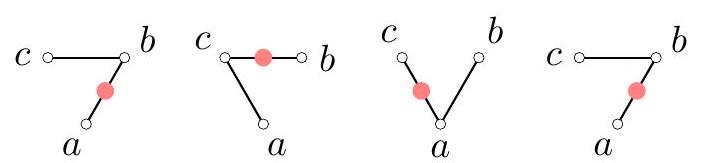
|
| 270 |
+
|
| 271 |
+
Figure 1
|
| 272 |
+
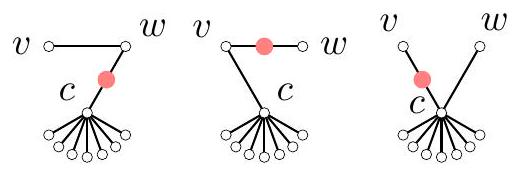
|
| 273 |
+
|
| 274 |
+
Figure 2
|
| 275 |
+
|
| 276 |
+
This means that it is enough to show that Erik can turn any layout into the star shape (i.e., a layout with one central cave that all the remaining caves are directly connected to), since if he can get from any layout to the star shape he can also get from the star shape to any layout. Let us prove this by induction on the number $n$ of caves.
|
| 277 |
+
|
| 278 |
+
For $n=3$, any allowed layout has the star shape, so let us assume $n \geq 4$. It is easy to see that there has to exist at least two caves, each of which being connected to only one other cave. These caves cannot be directly connected to each other (otherwise they could not be connected to other caves). Hence one of these two caves, say $v$, is such that Erik is not initially standing in the only corridor adjacent to it. By the induction hypothesis, Erik can then perform some sequence of moves that will transform the labyrinth excluding $v$ into the star shape with $n-1$ caves. Let the central cave of the star be $c$ and assume that Erik is standing in the corridor $c w$. We have to consider three cases for how $v$ is connected to other caves:
|
| 279 |
+
|
| 280 |
+
- The cave $v$ is directly connected to $c$. In this case we already have the star shape with $n$ caves, and so we are done.
|
| 281 |
+
- The cave $v$ is directly connected to $w$. In this case Erik can make the moves $c w \rightarrow w v \rightarrow v c$ (Fig. 2). Then the resulting layout has the star shape.
|
| 282 |
+
- The cave $v$ is directly connected to some other non-central cave $u$. In this case Erik can make the moves
|
| 283 |
+
|
| 284 |
+
$$
|
| 285 |
+
w c \rightarrow c u \rightarrow u w \rightarrow u v \rightarrow v w \rightarrow w c \rightarrow w u \rightarrow u c
|
| 286 |
+
$$
|
| 287 |
+
|
| 288 |
+
(Fig. 3). Then the resulting layout has the star shape.
|
| 289 |
+
In all cases, we have shown that we can turn the labyrinth into the star shape. So we are done by induction.
|
| 290 |
+

|
| 291 |
+
|
| 292 |
+
Figure 3
|
| 293 |
+
|
| 294 |
+
A $45 \times 45$ grid has had the central unit square removed. For which positive integers $n$ is it possible to cut the remaining area into $1 \times n$ and $n \times 1$ rectangles?
|
| 295 |
+
Answer: 1, 2, 11, 22, 23.
|
| 296 |
+
Solution: Clearly, any $n$ that works must be a divisor of the number $45^{2}-1=2024$ of unit squares. Furthermore, it must not be greater than 45 , or else we cannot fit any $1 \times n$ rectangles in the grid. This leaves the options $n=1, n=2, n=4, n=8, n=11, n=22, n=23$ and $n=44$. Note that any divisor $d$ of a length $n$ that works also works, since we can just divide each of the $1 \times n$ and $n \times 1$ pieces into $1 \times d$ and $d \times 1$ pieces.
|
| 297 |
+
|
| 298 |
+
For $n=22$, we can cover the grid as in Fig. 4. By the above, this shows that $n=1, n=2$ and $n=11$ all work.
|
| 299 |
+
|
| 300 |
+
For $n=23$, we can cover the grid as in Fig. 5 .
|
| 301 |
+
|
| 302 |
+
|
| 303 |
+
Figure 4
|
| 304 |
+
|
| 305 |
+
|
| 306 |
+
Figure 5
|
| 307 |
+
|
| 308 |
+
The remaining possibilities are $n=4, n=8$ and $n=44$. All of these are divisible by 4 , and hence if any of them work $n=4$ would also have to work. However, $n=4$ does not work. Indeed, color gray all rows with row numbers congruent to 1 or 2 modulo 4 (Fig. 6). Then any $1 \times 4$ or $4 \times 1$ piece will cover an even number of gray squares. But there is an odd number of gray squares in total, since the number of gray rows is odd, as well as the length of any row, and the center square is white as it is in row 23 . So it is impossible to cover all of them.
|
| 309 |
+
|
| 310 |
+
Consequently, $n=1,2,11,22,23$ are the only values that work.
|
| 311 |
+
|
| 312 |
+
|
| 313 |
+
Figure 6
|
| 314 |
+
8. Let $a, b, n$ be positive integers such that $a+b \leq n^{2}$. Alice and Bob play a game on an (initially uncoloured) $n \times n$ grid as follows:
|
| 315 |
+
|
| 316 |
+
- First, Alice paints $a$ cells green.
|
| 317 |
+
- Then, Bob paints $b$ other (i.e. uncoloured) cells blue.
|
| 318 |
+
|
| 319 |
+
Alice wins if she can find a path of non-blue cells starting with the bottom left cell and ending with the top right cell (where a path is a sequence of cells such that any two consecutive ones have a common side), otherwise Bob wins. Determine, in terms of $a, b$ and $n$, who has a winning strategy. Answer: If $a \geq \min (2 b, 2 n-1)$, Alice wins, otherwise Bob wins.
|
| 320 |
+

|
| 321 |
+
|
| 322 |
+
Figure 7
|
| 323 |
+

|
| 324 |
+
|
| 325 |
+
Figure 8
|
| 326 |
+
|
| 327 |
+
Solution: If $a \geq 2 n-1$, Alice can win, for example by painting all the cells in the leftmost column and the topmost row green, ensuring that there will be a green path (Fig. 77).
|
| 328 |
+
If $2 n-1>a \geq 2 b$, Alice can also win. Indeed, note that $n>b$, so Alice can make sure to color (at least) the bottommost $b$ cells in the leftmost column and the rightmost $b$ cells in the topmost row green. There are now $b+1$ disjoint paths from some green square in the leftmost column to some green square in the topmost row (Fig. 8d), so there is no way for Bob to block all of the paths.
|
| 329 |
+
If however $a<\min (2 b, 2 n-1)$, Bob wins. Indeed, note that $\min (2 b, 2 n-1)$ is the number of all descending diagonals of length at most $b$. Hence after Alice has made her move, there must still be some of these diagonals with no green cells in it. Bob can color all cells in it blue and win.
|
| 330 |
+
Hence Alice wins iff $a \geq \min (2 b, 2 n-1)$.
|
| 331 |
+
9. Let $S$ be a finite set. For a positive integer $n$, we say that a function $f: S \rightarrow S$ is an $n$-th power if there exists some function $g: S \rightarrow S$ such that
|
| 332 |
+
|
| 333 |
+
$$
|
| 334 |
+
f(x)=\underbrace{g(g(\ldots g(x) \ldots))}_{g \text { applied } n \text { times }}
|
| 335 |
+
$$
|
| 336 |
+
|
| 337 |
+
for each $x \in S$.
|
| 338 |
+
Suppose that a function $f: S \rightarrow S$ is an $n$-th power for each positive integer $n$. Is it necessarily true that $f(f(x))=f(x)$ for each $x \in S$ ?
|
| 339 |
+
Answer: Yes.
|
| 340 |
+
Solution 1: Since $S$ is finite, there is a finite set of all functions $\left\{g_{1}, g_{2}, \ldots, g_{k}\right\}$ from $S$ to itself. Consider a function $F$ that assigns to each positive integer $n$ one of these functions such that $f$ is the $n$-th power of the function $F(n)$. So $F$ induces a partition of the set of all positive integers into sets $P_{i}$ consisting of all the integers $n$ such that $F(n)=g_{i}$.
|
| 341 |
+
For any positive integer $N$, consider the complete graph $K_{N}$ on $N$ vertices labeled 1 through $N$. We will colour the edges of $K_{N}$ in $k$ colours $C_{1}, C_{2}, \ldots, C_{k}$ according to the partition in the following way: If $|x-y|$ lies in $P_{i}$, colour the edge between $x$ and $y$ in the colour $C_{i}$. By Ramsey's theorem we can take $N$ to be large enough that there is a monochromatic triangle in $K_{N}$. This means that there are three integers $x, y$ and $z$ and an index $i$ for which $|x-y|,|y-z|,|z-x| \in P_{i}$. Hence there are three integers $a, b, c \in P_{i}$ such that $a+b=c$.
|
| 342 |
+
Therefore, some function $g_{i}: S \rightarrow S$ satisfies $f(x)=g_{i}^{a}(x)=g_{i}^{b}(x)=g_{i}^{a+b}(x)$ for each $x \in S$. Hence, $f(f(x))=g_{i}^{a}\left(g_{i}^{b}(x)\right)=g_{i}^{a+b}(x)=f(x)$ for each $x \in S$.
|
| 343 |
+
Remark: The fact that there is an index $i$ for which $P_{i}$ contains three integers $a, b, c$ such that $a+b=c$ is known as Schur's theorem.
|
| 344 |
+
Solution 2: Pick $x \in S$ arbitrarily and denote $y=f(x)$. We need to prove that $f(y)=y$. Let $n=|S|$ and consider the function $g: S \rightarrow S$ such that $f=g^{n!}$. As we must have $g^{n!}(x)=y$, the element $y$ must occur among the first $n$ terms of the sequence $x, g(x), g^{2}(x), \ldots$, i.e., $g^{k}(x)=y$ for
|
| 345 |
+
some $k<n$. So $g^{n!-k}(y)=y$, or putting it otherwise, $g^{n!-k-1}(g(y))=y$. Like before, we obtain that $y$ must occur among the first $n$ terms of the sequence $g(y), g^{2}(y), \ldots$, i.e., $g^{l}(y)=y$ for some $l \leq n$. So certainly $g^{n!}(y)=y$ as $l \mid n$ !. This proves the claim.
|
| 346 |
+
10. A frog is located on a unit square of an infinite grid oriented according to the cardinal directions. The frog makes moves consisting of jumping either one or two squares in the direction it is facing, and then turning according to the following rules:
|
| 347 |
+
(i) If the frog jumps one square, it then turns $90^{\circ}$ to the right;
|
| 348 |
+
(ii) If the frog jumps two squares, it then turns $90^{\circ}$ to the left.
|
| 349 |
+
|
| 350 |
+
Is it possible for the frog to reach the square exactly 2024 squares north of the initial square after some finite number of moves if it is initially facing:
|
| 351 |
+
(a) North;
|
| 352 |
+
(b) East?
|
| 353 |
+
|
| 354 |
+
Answer: (a) No; (b) Yes.
|
| 355 |
+
|
| 356 |
+
## Solution:
|
| 357 |
+
|
| 358 |
+
(a) We color the grid with 5 colors so that the color of a square is determined by the expression $2 x+y$ modulo 5 , where $(x, y)$ are the coordinates of the square (we assume that the side length of the square is 1 ; see Fig. 9). Without loss of generality, let the color of the target square be 0 , and let the frog be there facing in the positive $y$-direction. Before the move that brought the frog to this position, it must have been either on a square of color 1 , facing in the positive $x$ direction, or on a square of color 2 , facing in the negative $x$-direction. In either case, one move earlier, the frog must have been either on a square of color 3 , facing in the negative $y$-direction, or on a square of color 0 , facing in the positive $y$-direction. If at some point the frog was on a square of color 3 , facing in the negative $y$-direction, then before the move that brought it there, it must have been either on a square of color 1 , facing in the positive $x$-direction, or on a square of color 2 , facing in the negative $x$-direction. This exhausts all possible cases, showing that throughout the entire process, the frog could only be in one of the following four positions:
|
| 359 |
+
|
| 360 |
+
- On a square of color 0 , facing in the positive $y$-direction;
|
| 361 |
+
- On a square of color 1 , facing in the positive $x$-direction;
|
| 362 |
+
- On a square of color 2 , facing in the negative $x$-direction;
|
| 363 |
+
- On a square of color 3 , facing in the negative $y$-direction.
|
| 364 |
+
|
| 365 |
+
Based on this, we examine all possibilities:
|
| 366 |
+
|
| 367 |
+
| | | | | | | | | | | | | |
|
| 368 |
+
| :--- | :--- | :--- | :--- | :--- | :--- | :--- | :--- | :--- | :--- | :--- | :--- | :--- |
|
| 369 |
+
| | 0 | 2 | 4 | 1 | 3 | 0 | 2 | 4 | 1 | 3 | 0 | |
|
| 370 |
+
| | 4 | 1 | 3 | 0 | 2 | 4 | 1 | 3 | 0 | 2 | 4 | |
|
| 371 |
+
| | 3 | 0 | 2 | 4 | 1 | 3 | 0 | 2 | 4 | 1 | 3 | |
|
| 372 |
+
| | 2 | 4 | 1 | 3 | 0 | 2 | 4 | 1 | 3 | 0 | 2 | |
|
| 373 |
+
| | 1 | 3 | 0 | 2 | 4 | 1 | 3 | 0 | 2 | 4 | 1 | |
|
| 374 |
+
| | 0 | 2 | 4 | 1 | 3 | 0 | 2 | 4 | 1 | 3 | 0 | |
|
| 375 |
+
| | 4 | 1 | 3 | 0 | 2 | 4 | 1 | 3 | 0 | 2 | 4 | |
|
| 376 |
+
| | 3 | 0 | 2 | 4 | 1 | 3 | 0 | 2 | 4 | 1 | 3 | |
|
| 377 |
+
| | 2 | 4 | 1 | 3 | 0 | 2 | 4 | 1 | 3 | 0 | 2 | |
|
| 378 |
+
| | 1 | 3 | 0 | 2 | 4 | 1 | 3 | 0 | 2 | 4 | 1 | |
|
| 379 |
+
| | 0 | 2 | 4 | 1 | 3 | 0 | 2 | 4 | 1 | 3 | 0 | |
|
| 380 |
+
| | | | | | | | | | | | | |
|
| 381 |
+
|
| 382 |
+
Figure 9
|
| 383 |
+
|
| 384 |
+
|
| 385 |
+
Figure 10
|
| 386 |
+
|
| 387 |
+
- If the positive $y$-direction corresponds to north, then the color of the initial square is 1 , and the frog must have been facing in the positive $x$-direction, that is, east.
|
| 388 |
+
- If the positive $y$-direction corresponds to east, then the color of the initial square is 3 , and the frog must have been facing in the negative $y$-direction, that is, west.
|
| 389 |
+
- If the positive $y$-direction corresponds to west, then the color of the initial square is 2 , and the frog must have been facing in the negative $x$-direction, that is, south.
|
| 390 |
+
- If the positive $y$-direction corresponds to south, then the color of the initial square is 4 , from which the frog could not reach the target square at all.
|
| 391 |
+
This demonstrates that if the frog reaches the target square, it cannot have been facing north at the initial square.
|
| 392 |
+
(b) Let the frog at some point face east. Then it can make the following moves: east 2 squares, north 2 squares, west 1 square, north 2 squares, west 1 square, north 1 square (Fig. 10). This way, the frog has moved a total of 5 squares north, and after these moves, it is again facing east. Therefore, by repeating this sequence of moves 405 times, the frog can reach a point 2025 squares north of the initial square. By omitting the last move, the frog reaches exactly the square that is 2024 squares north of the initial square.
|
| 393 |
+
|
| 394 |
+
Remark: Similarly to the solution of part (b), one can show that the frog can reach the desired square also after making its first move to the south or to the west.
|
| 395 |
+
|
| 396 |
+
Let $A B C D$ be a cyclic quadrilateral with circumcentre $O$ and with $A C$ perpendicular to $B D$. Points $X$ and $Y$ lie on the circumcircle of the triangle $B O D$ such that $\angle A X O=\angle C Y O=90^{\circ}$. Let $M$ be the midpoint of $A C$. Prove that $B D$ is tangent to the circumcircle of the triangle $M X Y$.
|
| 397 |
+
Solution: Denote the circumradius of $A B C D$ by $r$ and the circumcircle of triangle $B O D$ by $\omega$. Let $T=A C \cap B D$, let $O T$ meet $\omega$ again at $S$, and let $O E$ be a diameter of $\omega$ (Fig. 11). We see that $A C \| O E$ as $A C \perp B D$ and $B D \perp O E$. Furthermore, note that
|
| 398 |
+
|
| 399 |
+
$$
|
| 400 |
+
\measuredangle D S T=\measuredangle D S O=\measuredangle D B O=\measuredangle O D B=\measuredangle O D T
|
| 401 |
+
$$
|
| 402 |
+
|
| 403 |
+
so $O D$ is tangent to the circumcircle of the triangle $D S T$ and thus $O T \cdot O S=O D^{2}=r^{2}$.
|
| 404 |
+
|
| 405 |
+
|
| 406 |
+
Figure 11
|
| 407 |
+
|
| 408 |
+
We find $\angle A X O=90^{\circ}=\angle O X E$ so $A, X, E$ are collinear. Since also $\angle A M O=90^{\circ}$, points $A$, $O, X, M$ are concyclic. Next, we can see that points $A, X, T, S$ are concyclic since $\measuredangle X A T=$ $\measuredangle E A C=\measuredangle A E O=\measuredangle X E O=\measuredangle X S O=\measuredangle X S T$. Moreover, $A O$ is tangent to this circle as $O T \cdot O S=r^{2}=O A^{2}$. Hence $\measuredangle M T X=\measuredangle A T X=\measuredangle O A X=\measuredangle O M X$, so $O M$ is tangent to the circumcircle of triangle $X M T$ at $M$.
|
| 409 |
+
By interchanging the roles of $A$ and $C$ and the roles of $X$ and $Y$, we can similarly prove that $O M$ is also tangent to the circumcircle of triangle $Y M T$ at $M$. But then these two circles must coincide. Now $O M \perp A C$ implies that $M T$ is a diameter of this one circle, and $A C \perp B D$ implies that $B D$ is tangent to it. The desired result follows.
|
| 410 |
+
12. Let $A B C$ be an acute triangle with circumcircle $\omega$ such that $A B<A C$. Let $M$ be the midpoint of the arc $B C$ of $\omega$ containing the point $A$, and let $X \neq M$ be the other point on $\omega$ such that $A X=A M$. Points $E$ and $F$ are chosen on sides $A C$ and $A B$ of the triangle $A B C$, respectively, such that $E X=E C$ and $F X=F B$. Prove that $A E=A F$.
|
| 411 |
+
Solution 1: Triangles $X F B$ and $X E C$ are isosceles (Fig. 12). Note that $X$ lies on the shorter arc $A B$ of $\omega$ since otherwise the perpendicular bisector of $B X$ could not intersect side $A B$. Hence $\angle X B F=\angle X B A=\angle X C A=\angle X C E$ which implies that triangles $X F B$ and $X E C$ are similar. Therefore $\angle X F A=\angle X E A$. Hence $A E F X$ is a cyclic quadrilateral.
|
| 412 |
+
Let $X F$ intersect $\omega$ again at $X^{\prime} \neq X$ (Fig. 13). By $\angle B X X^{\prime}=\angle B X F=\angle X B F=\angle X B A$, arcs $B X^{\prime}$ and $A X$ of $\omega$ are equal, i.e. $B X^{\prime}=A X$. Since $A X=A M$, it follows that $B X^{\prime}=A M$. So $A B X^{\prime} M$ is an isosceles trapezoid which implies also $A X^{\prime}=B M$, i.e. arcs $A X^{\prime}$ and $B M$ of $\omega$ are equal. Therefore
|
| 413 |
+
|
| 414 |
+
$$
|
| 415 |
+
\angle A E F=180^{\circ}-\angle A X F=180^{\circ}-\angle A X X^{\prime}=180^{\circ}-\angle M A B=\angle M C B .
|
| 416 |
+
$$
|
| 417 |
+
|
| 418 |
+
By considering the second intersection point of $X E$ with $\omega$, we can analgously prove the equality $\angle E F A=\angle C B M$. Since arcs $M B$ and $M C$ of $\omega$ are equal, $\angle M C B=\angle C B M$, so $\angle A E F=\angle E F A$. Hence $A E=A F$, as desired.
|
| 419 |
+
|
| 420 |
+
Solution 2: Triangles $X F B, X E C$ and $X A M$ are isosceles (Fig. 144. In addition, note that $\measuredangle F B X=\measuredangle A B X=\measuredangle A M X$ and $\measuredangle F B X=\measuredangle A B X=\measuredangle A C X=\measuredangle E C X$, from which it follows that triangles $X F B, X E C$ and $X A M$ are directly similar (i.e., similar with the same orientation).
|
| 421 |
+
Denote $\frac{X F}{X B}=\frac{X E}{X C}=\frac{X A}{X M}=k$ and $\measuredangle B X F=\measuredangle C X E=\measuredangle M X A=\alpha$. Then the rotation with center $X$ by angle $\alpha$ along with scaling by ratio $k$ maps points $B, C, M$ to points $F, E, A$, respectively. Thus triangle $A F E$ is similar to triangle $M B C$ by spiral similarity. But $M B=M C$ as $M$ is the midpoint of arc $B C$. Hence also $A E=A F$.
|
| 422 |
+
Remark: The problem can be approached using complex numbers, taking $\omega$ as a unit circle.
|
| 423 |
+
|
| 424 |
+
|
| 425 |
+
Figure 12
|
| 426 |
+
|
| 427 |
+
|
| 428 |
+
Figure 13
|
| 429 |
+
|
| 430 |
+
|
| 431 |
+
Figure 14
|
| 432 |
+
13. Let $A B C$ be an acute triangle with orthocentre $H$. Let $D$ be a point outside the circumcircle of triangle $A B C$ such that $\angle A B D=\angle D C A$. The reflection of $A B$ in $B D$ intersects $C D$ at $X$. The reflection of $A C$ in $C D$ intersects $B D$ at $Y$. The lines through $X$ and $Y$ perpendicular to $A C$ and $A B$, respectively, intersect at $P$. Prove that points $D, P$ and $H$ are collinear.
|
| 433 |
+
Solution: From the reflections, we have
|
| 434 |
+
|
| 435 |
+
$$
|
| 436 |
+
\angle D B X=180^{\circ}-\angle D B A=180^{\circ}-\angle D C A=\angle D C Y
|
| 437 |
+
$$
|
| 438 |
+
|
| 439 |
+
(Fig. 15), so points $B, C, X, Y$ are concyclic.
|
| 440 |
+
Define $Q=X P \cap B D$ and $R=Y P \cap C D$ (Fig. 16). Then due to the right angles, we find $\angle D Y R=\angle D X Q$. Hence points $Q, R, X, Y$ are concyclic, too.
|
| 441 |
+
Consequently, $\angle D Q R=\angle D X Y=\angle D B C$, so $B C \| Q R$. Since also $B H \| P Q$ and $C H \| P R$, it follows that triangle $B H C$ is a homothetic image of triangle $Q P R$ with center $D$. Hence $D, P$ and $H$ are collinear.
|
| 442 |
+
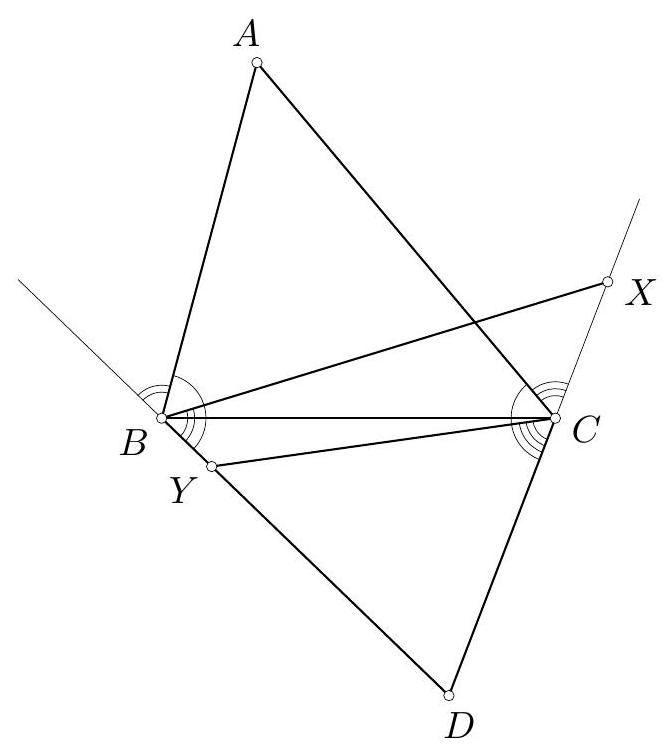
|
| 443 |
+
|
| 444 |
+
Figure 15
|
| 445 |
+
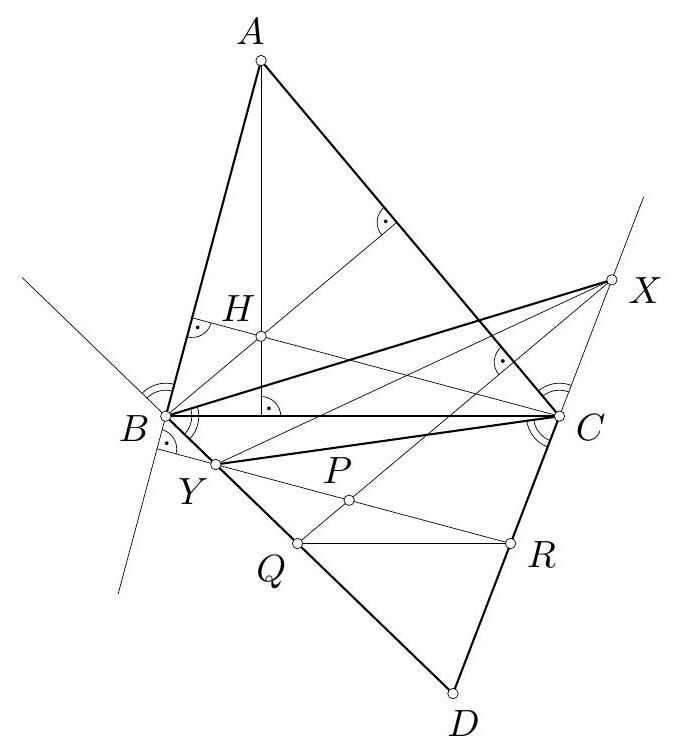
|
| 446 |
+
|
| 447 |
+
Figure 16
|
| 448 |
+
14. Let $A B C$ be an acute triangle with circumcircle $\omega$. The altitudes $A D, B E$ and $C F$ of the triangle $A B C$ intersect at point $H$. A point $K$ is chosen on the line $E F$ such that $K H \| B C$. Prove that the reflection of $H$ in $K D$ lies on $\omega$.
|
| 449 |
+
|
| 450 |
+
Solution: Since $\angle A E H=90^{\circ}=\angle A F H$, we know that $A E H F$ is a cyclic quadrilateral and $A H$ is a diameter of its circumcircle. As $K H \| B C$ and $A H \perp B C$, we have $\angle K H A=90^{\circ}$, so $K H$ is tangent to the circumcircle of $A E H F$.
|
| 451 |
+
|
| 452 |
+
Denote by $H^{\prime}$ the reflection of $H$ in $K D$ and by $L$ the intersection of lines $K D$ and $H H^{\prime}$ (Fig. 17). Clearly $\angle H L D=90^{\circ}$ and from the equality $\angle K H D=180^{\circ}-\angle H L D$ it follows that $K H$ is also tangent to the circumcircle of $D L H$. From the power of the point $K$ with respect to the circumcircles of $A E H F$ and $D L H$ we obtain $K E \cdot K F=K H^{2}=K L \cdot K D$. Hence points $E, F, D, L$ lie on a common circle.
|
| 453 |
+
|
| 454 |
+
By a known fact of triangle geometry, reflections of $H$ in the points $D, E$ and $F$ lie on $\omega$. Hence the homothety with center $H$ and ratio 2 maps the circumcircle of triangle $D E F$ to $\omega$. As this homothety maps $L$ to $H^{\prime}$ and $L$ lies on the circumcircle of triangle $D E F$, the point $H^{\prime}$ must lie on $\omega$.
|
| 455 |
+
|
| 456 |
+
Remark: The problem can be approached using computational methods, namely complex numbers and Cartesian coordinates.
|
| 457 |
+
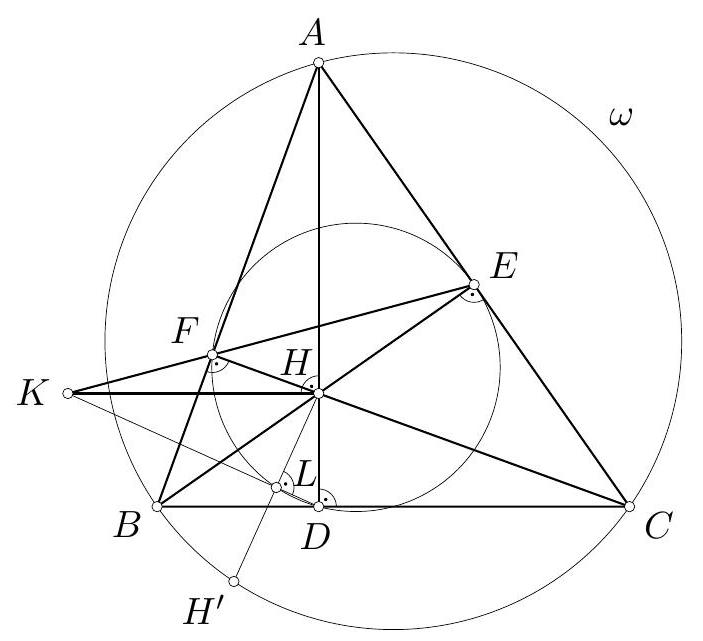
|
| 458 |
+
|
| 459 |
+
Figure 17
|
| 460 |
+
15. There is a set of $N \geq 3$ points in the plane, such that no three of them are collinear. Three points $A$, $B, C$ in the set are said to form a Baltic triangle if no other point in the set lies on the circumcircle of triangle $A B C$. Assume that there exists at least one Baltic triangle.
|
| 461 |
+
Show that there exist at least $\frac{N}{3}$ Baltic triangles.
|
| 462 |
+
Solution: If $N=3$, the number of Baltic triangles is 1 which is $\frac{N}{3}$.
|
| 463 |
+
To show that there always exist at least $\frac{N}{3}$ Baltic triangles, we prove that every point is a vertex of at least one Baltic triangle. This implies the desired result because every Baltic triangle consists of exactly 3 points.
|
| 464 |
+
First we prove a useful lemma: Given $n \geq 2$ points in the plane, either all are collinear or there exists a line passing through exactly 2 points.
|
| 465 |
+
Proof: Take a line $l$ going through at least 2 points, and a point $Q$ not on the line $l$ such that the distance from $Q$ to $l$ is minimal over all such pairs. Denote $Q^{\prime}$ as the projection of $Q$ to $l$. If $l$ contains at least 3 points, two of them must be on the same side of $Q^{\prime}$ (or coincide with $Q^{\prime}$ ). Say those points are $X$ and $Y$, with $X$ lying between $Y$ and $Q^{\prime}$ (Fig. 18). But then the distance from $X$ to the line $Q Y$ is smaller than $Q Q^{\prime}$ and this contradicts minimality.
|
| 466 |
+
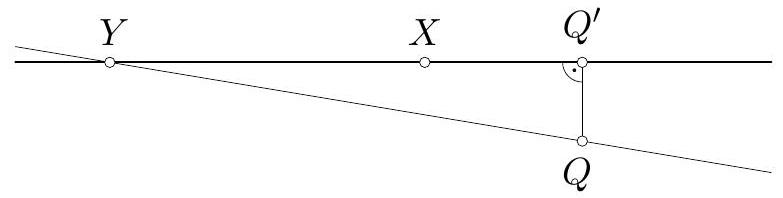
|
| 467 |
+
|
| 468 |
+
Figure 18
|
| 469 |
+
Now assume $N \geq 4$ and apply an inversion of the plane with center $O$ where $O$ is any point in the given set. Consider the $N-1$ other points after the inversion. By our lemma, there exists a line going through exactly 2 of them, because if they were all collinear, all points would have been concyclic before the inversion, contradicting the assumption about the existence of a Baltic triangle. Denote these points as $P$ and $Q$. The line $P Q$ cannot go through $O$, because this would mean that these 3 points were collinear before the inversion. But then before the inversion, no other point lied on the circumcircle of triangle $O P Q$, meaning that $O, P, Q$ formed a Baltic triangle.
|
| 470 |
+
So every single point in the given set is a vertex of at least one Baltic triangle and we are done.
|
| 471 |
+
Remark: The lemma proved in the solution is known as the Sylvester-Gallai theorem.
|
| 472 |
+
16. Determine all composite positive integers $n$ such that, for each positive divisor $d$ of $n$, there are integers $k \geq 0$ and $m \geq 2$ such that $d=k^{m}+1$.
|
| 473 |
+
|
| 474 |
+
Answer: 10.
|
| 475 |
+
Solution: Call a positive integer $n$ powerless if, for each positive divisor $d$ of $n$, there are integers $k \geq 0$ and $m \geq 2$ such that $d=k^{m}+1$. The solution is composed of proofs of three claims.
|
| 476 |
+
Claim 1: If $n$ is powerless, then each positive divisor $d$ of $n$ can be written as $k^{2}+1$ for some integer $k$.
|
| 477 |
+
Proof: We will prove this by strong induction on the divisors of $n$. First, we have that $1=0^{2}+1$. Now let $d=k^{m}+1>1$ be a divisor of $n$, and assume that all divisors less than $d$ can be written on the desired form. If $m$ is even, we are done, and if $m$ is odd, we have
|
| 478 |
+
|
| 479 |
+
$$
|
| 480 |
+
d=(k+1)\left(k^{m-1}-k^{m-2}+\cdots+1\right) .
|
| 481 |
+
$$
|
| 482 |
+
|
| 483 |
+
Then, either $k+1=d$, meaning that $k^{m}=k$ so $k=1$ and $d=1^{2}+1$, or $k+1$ is a divisor of $n$ stricly less than $d$, so we can write $k+1=l^{2}+1$ for some integer $l$. Hence $d=\left(l^{2}\right)^{m}+1=\left(l^{m}\right)^{2}+1$.
|
| 484 |
+
Claim 2: If $n$ is powerless, then $n$ is square-free.
|
| 485 |
+
Proof: Suppose for contradiction that there is a prime $p$ such that $p^{2} \mid n$. Then by Claim 1 we may write $p^{2}=l^{2}+1$. As the difference of square numbers are sums of consecutive odd integers, this leaves only the solution $l=0, p=1$, a contradiction.
|
| 486 |
+
Claim 3: The only composite powerless positive integer is 10.
|
| 487 |
+
We will give two proofs for this claim.
|
| 488 |
+
Proof 1: Suppose $n$ is a composite powerless number with prime divisors $p<q$. By Claim 1, we write $p=a^{2}+1, q=b^{2}+1$ and $p q=c^{2}+1$. Then we have $c^{2}<p q<q^{2}$, so $c<q$. However, as $b^{2}+1=q \mid c^{2}+1$, we have $c^{2} \equiv-1 \equiv b^{2}(\bmod q)$, so $c \equiv \pm b(\bmod q)$ and thus either $c=b$ or $c=q-b$. In the first case, we get $p=1$, a contradiction. In the second case, we get
|
| 489 |
+
|
| 490 |
+
$$
|
| 491 |
+
p q=c^{2}+1=(q-b)^{2}+1=q^{2}-2 b q+b^{2}+1=q^{2}-2 b q+q=(q-2 b+1) q
|
| 492 |
+
$$
|
| 493 |
+
|
| 494 |
+
so $p=q-2 b+1$ and thus $p$ is even. Therefore, $p=2$, and so $b^{2}+1=q=2 b+1$, which means $b=2$, and thus $q=5$. By Claim 2, this implies $n=10$, and since $1=0^{2}+1,2=1^{2}+1,5=2^{2}+1$ and $10=3^{2}+1$, this is indeed a powerless number.
|
| 495 |
+
Proof 2: Again, let $p \neq q$ be prime divisors of $n$ and write $p=a^{2}+1, q=b^{2}+1$ and $p q=c^{2}+1$. Factorizing in gaussian integers, this yields
|
| 496 |
+
|
| 497 |
+
$$
|
| 498 |
+
(a+\mathrm{i})(a-\mathrm{i})(b+\mathrm{i})(b-\mathrm{i})=(c+\mathrm{i})(c-\mathrm{i})
|
| 499 |
+
$$
|
| 500 |
+
|
| 501 |
+
We note that all the factors on the left, and none of the factors on the right, are gaussian primes. Thus, each factor on the right must be the product of two factors on the left. As $(a+i)(a-i)$ and $(b+i)(b-i)$ both are real, the unique factorization of $\mathbb{Z}[\mathrm{i}]$ leaves us without loss of generality with three cases:
|
| 502 |
+
|
| 503 |
+
$$
|
| 504 |
+
c+\mathrm{i}=(a+\mathrm{i})(b+\mathrm{i}), \quad c+\mathrm{i}=(a-\mathrm{i})(b-\mathrm{i}), \quad c+\mathrm{i}=(a+\mathrm{i})(b-\mathrm{i})
|
| 505 |
+
$$
|
| 506 |
+
|
| 507 |
+
In the first two cases, we have $a+b= \pm 1$, both contradictions. In the third case, we get $b-a=1$, and thus, $q=a^{2}+2 a+2$. As this makes $q-p$ odd, we get $p=2$ meaning $a=1$ so that $q=5$. Now we finish as in proof 1.
|
| 508 |
+
Remark: Claim 2 can also be proven independently of Claim 1 with the help of Mihailescu's theorem.
|
| 509 |
+
|
| 510 |
+
Do there exist infinitely many quadruples $(a, b, c, d)$ of positive integers such that the number $a^{a!}+$ $b^{b!}-c^{c!}-d^{d!}$ is prime and $2 \leq d \leq c \leq b \leq a \leq d^{2024} ?$
|
| 511 |
+
Answer: No.
|
| 512 |
+
Solution: Assume that there exists a prime $p<d$ such that $p \nmid a b c d$. Then, since $p-1 \mid d$ ! and $p \nmid d$, by Fermat's little theorem $d^{d!} \equiv\left(d^{p-1}\right)^{\frac{d!}{p-1}} \equiv 1(\bmod p)$. By the same argument $a^{a!} \equiv b^{b!} \equiv c^{c!} \equiv 1$ $(\bmod p)$, and therefore $a^{a!}+b^{b!}-c^{c!}-d^{d!} \equiv 1+1-1-1 \equiv 0(\bmod p)$.
|
| 513 |
+
Now we prove that for big enough $d$, the product $P$ of primes less than $d$ is at least $d^{10000}$. Assume $d>2^{\frac{10001 \cdot 10002}{2}}$. Notice that by Bertrand's postulate, the biggest prime less than $d$ is at least $\frac{d}{2}$, the second biggest is at least $\frac{d}{4}$ etc., and 10001-th biggest is at least $\frac{d}{2^{10001}}$. So
|
| 514 |
+
|
| 515 |
+
$$
|
| 516 |
+
P \geq \frac{d}{2} \frac{d}{4} \cdots \frac{d}{2^{10001}}=\frac{d^{10001}}{2^{\frac{10001 \cdot 10002}{2}}} \geq d^{10000}
|
| 517 |
+
$$
|
| 518 |
+
|
| 519 |
+
Now note that the number of quadruples where $d<2^{\frac{10001 \cdot 10002}{2}}$ is finite, because all the number are bounded above by $d^{2024}$ and hence by $2^{\frac{10001 \cdot 10002}{2}} \cdot 2024$. When $d \geq 2^{\frac{10001 \cdot 10002}{2}}$ we have $a b c d \leq$ $d^{1+3 \cdot 2024}<d^{7000}$ and since $P \geq d^{10000}$, there exist at least two primes $p$ and $q$, less than $d$, that do not divide $a b c d$. But then by our first result, we have $p q \mid a^{a!}+b^{b!}-c^{c!}-d^{d!}$, so it cannot be prime.
|
| 520 |
+
Remark: The solution can be modified as follows. We can proceed in the first paragraph to conclude that $a^{a!}+b^{b!}-c^{c!}-d^{d!}$ is not prime. Indeed, if $a^{a!}+b^{b!}-c^{c!}-d^{d!}=p$ where $p<d$ then definitely $a>d$ (otherwise $a=b=c=d$ and $a^{a!}+b^{b!}-c^{c!}-d^{d!}=0$ ). Hence
|
| 521 |
+
|
| 522 |
+
$$
|
| 523 |
+
\begin{aligned}
|
| 524 |
+
d & >p=a^{a!}+b^{b!}-c^{c!}-d^{d!} \geq a^{a!}-d^{d!}=\left(a^{(d+1) \cdot \ldots \cdot a}\right)^{d!}-d^{d!} \\
|
| 525 |
+
& \geq\left(a^{d+1}\right)^{d!}-d^{d!} \geq a^{d+1}-d>d^{d+1}-d>d^{2}-d=(d-1) d \geq d
|
| 526 |
+
\end{aligned}
|
| 527 |
+
$$
|
| 528 |
+
|
| 529 |
+
contradiction. Then in the last paragraph, there is no need to find two primes less than $d$ that do not divide $a b c d$, one is enough.
|
| 530 |
+
18. An infinite sequence $a_{1}, a_{2}, \ldots$ of positive integers is such that $a_{n} \geq 2$ and $a_{n+2}$ divides $a_{n+1}+a_{n}$ for all $n \geq 1$. Prove that there exists a prime which divides infinitely many terms of the sequence.
|
| 531 |
+
Solution: Assume that every prime divides only finitely many terms of the sequence. In particular this means that there exists an integer $N>1$ such that $2 \nmid a_{n}$ for all $n \geq N$. Let $M=\max \left(a_{N}, a_{N+1}\right)$ We will now show by induction that $a_{n} \leq M$ for all $n \geq N$. This is obvious for $n=N$ and $n=N+1$. Now let $n \geq N+2$ be arbitrary and assume that $a_{n-1}, a_{n-2} \leq M$. By the definition of $N$, it is clear that $a_{n-2}, a_{n-1}, a_{n}$ are all odd and so $a_{n} \neq a_{n-1}+a_{n-2}$, but we know that $a_{n} \mid a_{n-1}+a_{n-2}$ and therefore
|
| 532 |
+
|
| 533 |
+
$$
|
| 534 |
+
a_{n} \leq \frac{a_{n-1}+a_{n-2}}{2} \leq \max \left(a_{n-1}, a_{n-2}\right) \leq M
|
| 535 |
+
$$
|
| 536 |
+
|
| 537 |
+
by the induction hypothesis. This completes the induction.
|
| 538 |
+
This shows that the sequence is bounded and therefore there are only finitely many primes which divide a term of the sequence. However there are infinitely many terms, that all have a prime divisor, hence some prime must divide infinitely many terms of the sequence.
|
| 539 |
+
19. Does there exist a positive integer $N$ which is divisible by at least 2024 distinct primes and whose positive divisors $1=d_{1}<d_{2}<\ldots<d_{k}=N$ are such that the number
|
| 540 |
+
|
| 541 |
+
$$
|
| 542 |
+
\frac{d_{2}}{d_{1}}+\frac{d_{3}}{d_{2}}+\ldots+\frac{d_{k}}{d_{k-1}}
|
| 543 |
+
$$
|
| 544 |
+
|
| 545 |
+
is an integer?
|
| 546 |
+
|
| 547 |
+
Answer: Yes.
|
| 548 |
+
Solution: For arbitrary positive integer $N$, we will write $f(N)=\frac{d_{2}}{d_{1}}+\frac{d_{3}}{d_{2}}+\ldots+\frac{d_{k}}{d_{k-1}}$ where $1=d_{1}<d_{2}<\ldots<d_{k}=N$ are all positive divisors of $N$. Let us prove by induction that for any positive integer $M$ there is a positive integer $N$ with exactly $M$ different prime divisors such that $f(N)$ is an integer.
|
| 549 |
+
|
| 550 |
+
- Base case: If $M=1$, this is clearly true (any prime power $N>1$ works).
|
| 551 |
+
- Induction step: Assume that the claim holds for $M$ prime divisors. Let $N$ be a positive integer with exactly $M$ prime divisors such that $f(N)$ is an integer. Pick a prime $p>N$. We claim that there is some choice of $\alpha$ such that $f\left(N \cdot p^{\alpha}\right)$ is an integer. Note that since $p>N$, the divisors of $N \cdot p^{\alpha}$ in the ascending order are
|
| 552 |
+
|
| 553 |
+
$$
|
| 554 |
+
\begin{aligned}
|
| 555 |
+
& d_{1}, d_{2}, \ldots, d_{k} \\
|
| 556 |
+
& p d_{1}, p d_{2}, \ldots, p d_{k} \\
|
| 557 |
+
& \ldots \ldots \ldots \ldots \ldots \ldots \ldots \\
|
| 558 |
+
& p^{\alpha} d_{1}, p^{\alpha} d_{2}, \ldots, p^{\alpha} d_{k}
|
| 559 |
+
\end{aligned}
|
| 560 |
+
$$
|
| 561 |
+
|
| 562 |
+
Hence we get that
|
| 563 |
+
|
| 564 |
+
$$
|
| 565 |
+
f\left(N \cdot p^{\alpha}\right)=(\alpha+1) f(N)+\alpha \cdot \frac{p d_{1}}{d_{k}}
|
| 566 |
+
$$
|
| 567 |
+
|
| 568 |
+
The term $(\alpha+1) f(N)$ is an integer by the choice of $N$. If we pick $\alpha=N$ then $\alpha \cdot \frac{p d_{1}}{d_{k}}=N \cdot \frac{p}{N}=p$ is an integer, too. Thus $f\left(N \cdot p^{\alpha}\right)$ is an integer and we are done.
|
| 569 |
+
20. Positive integers $a, b$ and $c$ satisfy the system of equations
|
| 570 |
+
|
| 571 |
+
$$
|
| 572 |
+
\left\{\begin{aligned}
|
| 573 |
+
(a b-1)^{2} & =c\left(a^{2}+b^{2}\right)+a b+1 \\
|
| 574 |
+
a^{2}+b^{2} & =c^{2}+a b
|
| 575 |
+
\end{aligned}\right.
|
| 576 |
+
$$
|
| 577 |
+
|
| 578 |
+
(a) Prove that $c+1$ is a perfect square.
|
| 579 |
+
(b) Find all such triples $(a, b, c)$.
|
| 580 |
+
|
| 581 |
+
Answer: (b) $a=b=c=3$.
|
| 582 |
+
|
| 583 |
+
## Solution 1:
|
| 584 |
+
|
| 585 |
+
(a) Rearranging terms in the first equation gives
|
| 586 |
+
|
| 587 |
+
$$
|
| 588 |
+
a^{2} b^{2}-2 a b=c\left(a^{2}+b^{2}\right)+a b
|
| 589 |
+
$$
|
| 590 |
+
|
| 591 |
+
By substituting $a b=a^{2}+b^{2}-c^{2}$ into the right-hand side and rearranging the terms we get
|
| 592 |
+
|
| 593 |
+
$$
|
| 594 |
+
a^{2} b^{2}+c^{2}=(c+1)\left(a^{2}+b^{2}\right)+2 a b
|
| 595 |
+
$$
|
| 596 |
+
|
| 597 |
+
By adding $2 a b c$ to both sides and factorizing we get
|
| 598 |
+
|
| 599 |
+
$$
|
| 600 |
+
(a b+c)^{2}=(c+1)(a+b)^{2}
|
| 601 |
+
$$
|
| 602 |
+
|
| 603 |
+
Now it is obvious that $c+1$ has to be a square of an integer.
|
| 604 |
+
(b) Let us say $c+1=d^{2}$, where $d>1$ and is an integer. Then substituting this into the equation (10) and taking the square root of both sides (we can do that as all the terms are positive) we get
|
| 605 |
+
|
| 606 |
+
$$
|
| 607 |
+
a b+d^{2}-1=d(a+b)
|
| 608 |
+
$$
|
| 609 |
+
|
| 610 |
+
We can rearrange it to $(a-d)(b-d)=1$, which immediately tells us that either $a=b=d+1$ or $a=b=d-1$. Note that in either case $a=b$. Substituting this into the second equation of the given system we get $a^{2}=c^{2}$, implying $a=c$ (as $\left.a, c>0\right)$.
|
| 611 |
+
|
| 612 |
+
- If $a=b=d-1$, then $a=c$ gives $d-1=d^{2}-1$, so $d=0$ or $d=1$, neither of which gives a positive $c$, so cannot be a solution.
|
| 613 |
+
- If $a=b=d+1$, then $a=c$ gives $d+1=d^{2}-1$, so $d^{2}-d-2=0$. The only positive solution is $d=2$ which gives $a=b=c=3$. Substituting it once again into both equations we indeed get a solution.
|
| 614 |
+
|
| 615 |
+
|
| 616 |
+
## Solution 2:
|
| 617 |
+
|
| 618 |
+
(a) Substituting $a^{2}+b^{2}$ from the second equation to the first one gives
|
| 619 |
+
|
| 620 |
+
$$
|
| 621 |
+
(a b-1)^{2}=c\left(c^{2}+a b\right)+a b+1
|
| 622 |
+
$$
|
| 623 |
+
|
| 624 |
+
Rearranging terms in the obtained equation gives
|
| 625 |
+
|
| 626 |
+
$$
|
| 627 |
+
(a b)^{2}-(c+3) a b-c^{3}=0
|
| 628 |
+
$$
|
| 629 |
+
|
| 630 |
+
which we can consider as a quadratic equation in $a b$. Its discriminant is
|
| 631 |
+
|
| 632 |
+
$$
|
| 633 |
+
D=(c+3)^{2}+4 c^{3}=4 c^{3}+c^{2}+6 c+9=(c+1)\left(4 c^{2}-3 c+9\right)=(c+1)\left(4(c-1)^{2}+5(c+1)\right)
|
| 634 |
+
$$
|
| 635 |
+
|
| 636 |
+
To have solutions in integers, $D$ must be a perfect square. Note that $c+1$ and $4(c-1)^{2}+5(c+1)$ can have no common odd prime factors. Hence $\operatorname{gcd}\left(c+1,4(c-1)^{2}+5(c+1)\right)$ is a power of 2 , so $c+1$ and $4(c-1)^{2}+5(c+1)$ are either both perfect squares or both twice of some perfect squares. In the first case, we are done. In the second case, note that
|
| 637 |
+
|
| 638 |
+
$$
|
| 639 |
+
4(c-1)^{2}+5(c+1) \equiv 4(c-1)^{2}=(2(c-1))^{2} \quad(\bmod 5)
|
| 640 |
+
$$
|
| 641 |
+
|
| 642 |
+
so $4(c-1)^{2}+5(c+1)$ must be $0,1,4$ modulo 5 . On the other hand, twice of a perfect square is $0,2,3$ modulo 5 . Consequently, $c+1 \equiv 0(\bmod 5)$ and $4(c-1)^{2}+5(c+1) \equiv 0(\bmod 5)$, the latter of which implies $c-1 \equiv 0(\bmod 5)$. This leads to contradiction since $c-1$ and $c+1$ cannot be both divisible by 5 .
|
| 643 |
+
(b) By the solution of part (a), both $c+1$ and $4 c^{2}-3 c+9$ are perfect squares. However, due to $c>0$ we have $(2 c-1)^{2}=4 c^{2}-4 c+1<4 c^{2}-3 c+9$, and for $c>3$ we also have $(2 c)^{2}=4 c^{2}>4 c^{2}-3 c+9$. Thus $4 c^{2}-3 c+9$ is located between two consecutive perfect squares, which gives a contradiction with it being a square itself.
|
| 644 |
+
Out of $c=1,2,3$, only $c=3$ makes $c+1$ a perfect square. In this case, the quadratic equation $(a b)^{2}-(c+3) a b-c^{3}=0$ yields $a b=9$, so $a=1, b=9$ or $a=3, b=3$ or $a=9, b=1$. Out of those, only $a=3, b=3$ satisfies the equations.
|
| 645 |
+
Remark: Part (a) of the problem can be solved yet another way. By substituting $a^{2}+b^{2}$ from the second equation to the first one, we obtain
|
| 646 |
+
|
| 647 |
+
$$
|
| 648 |
+
(a b-1)^{2}=c\left(c^{2}+a b\right)+a b+1=c^{3}+1+a b c+a b=(c+1)\left(c^{2}-c+1+a b\right)
|
| 649 |
+
$$
|
| 650 |
+
|
| 651 |
+
Whenever an integer $n$ divides $c+1$, it also divides $a b-1$. Therefore $c \equiv-1(\bmod n)$ and $a b \equiv 1$ $(\bmod n)$. But then $c^{2}-c+1+a b \equiv 4(\bmod n)$, i.e., $n$ divides $c^{2}-c+1+a b-4$. Thus the greatest common divisor of $c+1$ and $c^{2}-c+1+a b$ divides 4 , i.e., it is either 1,2 or 4 . In the first and third case we are done. If their greatest common divisor is 2 , then clearly all three of $a, b, c$ are odd, so $a^{2} \equiv b^{2} \equiv c^{2} \equiv 1(\bmod 8)$. Thus from the second equation we have $a b=a^{2}+b^{2}-c^{2} \equiv 1$ $(\bmod 8)$, so $(a b-1)^{2}$ is divisible by 64 . Now, if $c \equiv 1(\bmod 4)$, then $c^{2}-c+1+a b \equiv 2(\bmod 4)$, which means that $(c+1)\left(c^{2}-c+1+a b\right) \equiv 4(\bmod 8)$, giving a contradiction with $(a b-1)^{2}$ being divisible by 64 . If instead $c \equiv 3(\bmod 4)$, then $c^{2}-c+1+a b \equiv 0(\bmod 4)$. This means that both $c+1$ and $c^{2}-c+1+a b$ are divisible by 4 , giving a contradiction with the assumption that their greatest common divisor is 2 . Therefore $c+1$ must be a perfect square.
|
| 652 |
+
|
BalticWay/md/en-bw90sol.md
ADDED
|
@@ -0,0 +1,164 @@
|
|
|
|
|
|
|
|
|
|
|
|
|
|
|
|
|
|
|
|
|
|
|
|
|
|
|
|
|
|
|
|
|
|
|
|
|
|
|
|
|
|
|
|
|
|
|
|
|
|
|
|
|
|
|
|
|
|
|
|
|
|
|
|
|
|
|
|
|
|
|
|
|
|
|
|
|
|
|
|
|
|
|
|
|
|
|
|
|
|
|
|
|
|
|
|
|
|
|
|
|
|
|
|
|
|
|
|
|
|
|
|
|
|
|
|
|
|
|
|
|
|
|
|
|
|
|
|
|
|
|
|
|
|
|
|
|
|
|
|
|
|
|
|
|
|
|
|
|
|
|
|
|
|
|
|
|
|
|
|
|
|
|
|
|
|
|
|
|
|
|
|
|
|
|
|
|
|
|
|
|
|
|
|
|
|
|
|
|
|
|
|
|
|
|
|
|
|
|
|
|
|
|
|
|
|
|
|
|
|
|
|
|
|
|
|
|
|
|
|
|
|
|
|
|
|
|
|
|
|
|
|
|
|
|
|
|
|
|
|
|
|
|
|
|
|
|
|
|
|
|
|
|
|
|
|
|
|
|
|
|
|
|
|
|
|
|
|
|
|
|
|
|
|
|
|
|
|
|
|
|
|
|
|
|
|
|
|
|
|
|
|
|
|
|
|
|
|
|
|
|
|
|
|
|
|
|
|
|
|
|
|
|
|
|
|
|
|
|
|
|
|
|
|
|
|
|
|
|
|
|
|
|
|
|
|
|
|
|
|
|
|
|
|
|
|
|
|
|
|
|
|
|
|
|
|
|
|
|
|
|
|
|
|
|
|
|
|
|
|
|
|
|
|
|
|
|
|
|
|
|
|
|
|
|
|
|
|
|
|
|
|
|
|
|
|
|
|
|
|
|
|
|
|
|
|
|
|
|
|
|
|
|
|
|
|
|
|
|
|
|
|
|
|
|
|
|
|
|
|
|
|
|
|
|
|
|
|
|
|
|
|
|
|
|
|
|
|
|
|
|
|
|
|
|
|
|
|
|
|
|
|
|
|
|
|
|
|
|
|
|
|
|
|
|
|
|
|
|
|
|
|
|
|
|
|
|
|
|
|
|
|
|
|
|
|
| 1 |
+
# Baltic Way 1990
|
| 2 |
+
|
| 3 |
+
## Riga, November 24, 1990
|
| 4 |
+
|
| 5 |
+
## Problems and solutions
|
| 6 |
+
|
| 7 |
+
1. Integers $1,2, \ldots, n$ are written (in some order) on the circumference of a circle. What is the smallest possible sum of moduli of the differences of neighbouring numbers?
|
| 8 |
+
|
| 9 |
+
Solution. Let $a_{1}=1, a_{2}, \ldots, a_{k}=n, a_{k+1}, \ldots, a_{n}$ be the order in which the numbers $1,2, \ldots, n$ are written around the circle. Then the sum of moduli of the differences of neighbouring numbers is
|
| 10 |
+
|
| 11 |
+
$$
|
| 12 |
+
\begin{aligned}
|
| 13 |
+
& \left|1-a_{2}\right|+\left|a_{2}-a_{3}\right|+\cdots+\left|a_{k}-n\right|+\left|n-a_{k+1}\right|+\cdots+\left|a_{n}-1\right| \\
|
| 14 |
+
& \geq\left|1-a_{2}+a_{2}-a_{3}+\cdots+a_{k}-n\right|+\left|n-a_{k+1}+\cdots+a_{n}-1\right| \\
|
| 15 |
+
& =|1-n|+|n-1|=2 n-2 .
|
| 16 |
+
\end{aligned}
|
| 17 |
+
$$
|
| 18 |
+
|
| 19 |
+
This minimum is achieved if the numbers are written around the circle in increasing order.
|
| 20 |
+
|
| 21 |
+
2. The squares of a squared paper are enumerated as follows:
|
| 22 |
+
|
| 23 |
+
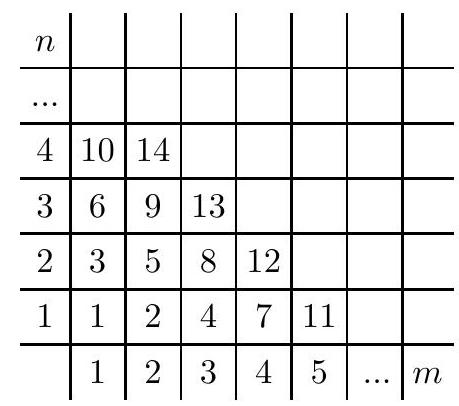
|
| 24 |
+
|
| 25 |
+
Devise a polynomial $p(m, n)$ of two variables $m, n$ such that for any positive integers $m$ and $n$ the number written in the square with coordinates $(m, n)$ will be equal to $p(m, n)$.
|
| 26 |
+
|
| 27 |
+
Solution. Since the square with the coordinates $(m, n)$ is $n$th on the $(n+m-1)$-th diagonal, it contains the number
|
| 28 |
+
|
| 29 |
+
$$
|
| 30 |
+
P(m, n)=\sum_{i=1}^{n+m-2} i+n=\frac{(n+m-1)(n+m-2)}{2}+n
|
| 31 |
+
$$
|
| 32 |
+
|
| 33 |
+
3. Let $a_{0}>0, c>0$ and
|
| 34 |
+
|
| 35 |
+
$$
|
| 36 |
+
a_{n+1}=\frac{a_{n}+c}{1-a_{n} c}, \quad n=0,1, \ldots
|
| 37 |
+
$$
|
| 38 |
+
|
| 39 |
+
Is it possible that the first 1990 terms $a_{0}, a_{1}, \ldots, a_{1989}$ are all positive but $a_{1990}<0$ ?
|
| 40 |
+
|
| 41 |
+
Solution. Obviously we can find angles $0<\alpha, \beta<90^{\circ}$ such that $\tan \alpha>0, \tan (\alpha+\beta)>0, \ldots$, $\tan (\alpha+1989 \beta)>0$ but $\tan (\alpha+1990 \beta)<0$. Now it suffices to note that if we take $a_{0}=\tan \alpha$ and $c=\tan \beta$ then $a_{n}=\tan (\alpha+n \beta)$.
|
| 42 |
+
|
| 43 |
+
4. Prove that, for any real $a_{1}, a_{2}, \ldots, a_{n}$,
|
| 44 |
+
|
| 45 |
+
$$
|
| 46 |
+
\sum_{i, j=1}^{n} \frac{a_{i} a_{j}}{i+j-1} \geq 0
|
| 47 |
+
$$
|
| 48 |
+
|
| 49 |
+
Solution. Consider the polynomial $P(x)=a_{1}+a_{2} x+\cdots+a_{n} x^{n-1}$. Then $P^{2}(x)=\sum_{k, l=1}^{n} a_{k} a_{l} x^{k+l-2}$ and $\int_{0}^{1} P^{2}(x) d x=\sum_{k, l=1}^{n} \frac{a_{k} a_{l}}{k+l-1}$.
|
| 50 |
+
|
| 51 |
+
5. Let $*$ denote an operation, assigning a real number $a * b$ to each pair of real numbers ( $a, b)$ (e.g., $a * b=$ $a+b^{2}-17$ ). Devise an equation which is true (for all possible values of variables) provided the operation $*$ is commutative or associative and which can be false otherwise.
|
| 52 |
+
|
| 53 |
+
Solution. A suitable equation is $x *(x * x)=(x * x) * x$ which is obviously true if $*$ is any commutative or associative operation but does not hold in general, e.g., $1-(1-1) \neq(1-1)-1$.
|
| 54 |
+
|
| 55 |
+
6. Let $A B C D$ be a quadrangle, $|A D|=|B C|, \angle A+\angle B=120^{\circ}$ and let $P$ be a point exterior to the quadrangle such that $P$ and $A$ lie at opposite sides of the line $D C$ and the triangle $D P C$ is equilateral. Prove that the triangle $A P B$ is also equilateral.
|
| 56 |
+
|
| 57 |
+
Solution. Note that $\angle A D C+\angle C D P+\angle B C D+\angle D C P=360^{\circ}$ (see Figure 1). Thus $\angle A D P=360^{\circ}-$ $\angle B C D-\angle D C P=\angle B C P$. As we have $|D P|=|C P|$ and $|A D|=|B C|$, the triangles $A D P$ and $B C P$ are congruent and $|A P|=|B P|$. Moreover, $\angle A P B=60^{\circ}$ since $\angle D P C=60^{\circ}$ and $\angle D P A=\angle C P B$.
|
| 58 |
+
|
| 59 |
+
7. The midpoint of each side of a convex pentagon is connected by a segment with the intersection point of the medians of the triangle formed by the remaining three vertices of the pentagon. Prove that all five such segments intersect at one point.
|
| 60 |
+
|
| 61 |
+
Solution. Let $A, B, C, D$ and $E$ be the vertices of the pentagon (in order), and take any point $O$ as origin. Let $M$ be the intersection point of the medians of the triangle $C D E$, and let $N$ be the midpoint of the segment $A B$. We have
|
| 62 |
+
|
| 63 |
+
$$
|
| 64 |
+
\overline{O M}=\frac{1}{3}(\overline{O C}+\overline{O D}+\overline{O E})
|
| 65 |
+
$$
|
| 66 |
+
|
| 67 |
+
and
|
| 68 |
+
|
| 69 |
+
$$
|
| 70 |
+
\overline{O N}=\frac{1}{2}(\overline{O A}+\overline{O B})
|
| 71 |
+
$$
|
| 72 |
+
|
| 73 |
+
The segment $N M$ may be written as
|
| 74 |
+
|
| 75 |
+
$$
|
| 76 |
+
\overline{O N}+t(\overline{O M}-\overline{O N}), \quad 0 \leq t \leq 1
|
| 77 |
+
$$
|
| 78 |
+
|
| 79 |
+
Taking $t=\frac{3}{5}$ we get the point
|
| 80 |
+
|
| 81 |
+
$$
|
| 82 |
+
P=\frac{1}{5}(\overline{O A}+\overline{O B}+\overline{O C}+\overline{O D}+\overline{O E}),
|
| 83 |
+
$$
|
| 84 |
+
|
| 85 |
+
the centre of gravity of the pentagon. Choosing a different side of the pentagon, we clearly get the same point $P$, which thus lies on all such line segments.
|
| 86 |
+
|
| 87 |
+
Remark. The problem expresses the idea of subdividing a system of five equal masses placed at the vertices of the pentagon into two subsystems, one of which consists of the two masses at the endpoints of the side under consideration, and one consisting of the three remaining masses. The segment mentioned in the problem connects the centres of gravity of these two subsystems, and hence it contains the centre of gravity of the whole system.
|
| 88 |
+
|
| 89 |
+
8. Let $P$ be a point on the circumcircle of a triangle $A B C$. It is known that the base points of the perpendiculars drawn from $P$ onto the lines $A B, B C$ and $C A$ lie on one straight line (called a Simson line). Prove that the Simson lines of two diametrically opposite points $P_{1}$ and $P_{2}$ are perpendicular.
|
| 90 |
+
|
| 91 |
+
Solution. Let $O$ be the circumcentre of the triangle $A B C$ and $\angle B$ be its maximal angle (so that $\angle A$ and $\angle C$ are necessarily acute). Further, let $B_{1}$ and $C_{1}$ be the base points of the perpendiculars drawn from the point $P$ to the sides $A C$ and $A B$ respectively and let $\alpha$ be the angle between the Simson line $l$ of point $P$ and the height $h$ of the triangle drawn to the side $A C$. It is sufficient to prove that $\alpha=\frac{1}{2} \angle P O B$. To show this, first note that the points $P, C_{1}, B_{1}, A$ all belong to a certain circle. Now we have to consider several sub-cases depending on the order of these points on that circle and the location of point $P$ on the circumcircle of triangle $A B C$. Figure 2 shows one of these cases - here we have $\alpha=\angle P B_{1} C_{1}=\angle P B_{1} C_{1}=$ $\angle P A B=\frac{1}{2} \angle P O B$. The other cases can be treated in a similar manner.
|
| 92 |
+
|
| 93 |
+
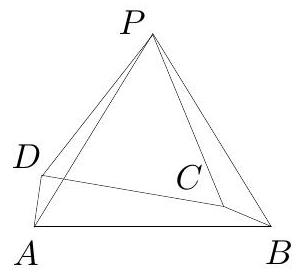
|
| 94 |
+
|
| 95 |
+
Figure 1
|
| 96 |
+
|
| 97 |
+
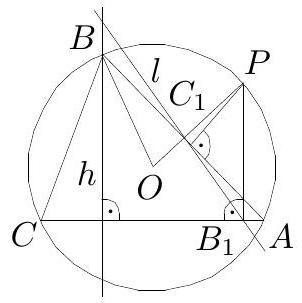
|
| 98 |
+
|
| 99 |
+
Figure 2
|
| 100 |
+
|
| 101 |
+
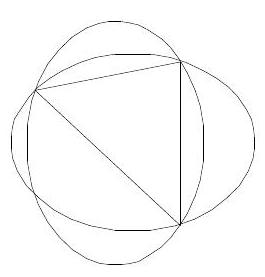
|
| 102 |
+
|
| 103 |
+
Figure 3
|
| 104 |
+
|
| 105 |
+
9. Two equal triangles are inscribed into an ellipse. Are they necessarily symmetrical with respect either to the axes or to the centre of the ellipse?
|
| 106 |
+
|
| 107 |
+
Solution. No, not necessarily (see Figure 3 where the two ellipses are equal).
|
| 108 |
+
|
| 109 |
+
10. A segment $A B$ of unit length is marked on the straight line $t$. The segment is then moved on the plane so that it remains parallel to $t$ at all times, the traces of the points $A$ and $B$ do not intersect and finally the segment returns onto $t$. How far can the point $A$ now be from its initial position?
|
| 110 |
+
|
| 111 |
+
Solution. The point $A$ can move any distance from its initial position - see Figure 4 and note that we can make the height $h$ arbitrarily small.
|
| 112 |
+
|
| 113 |
+
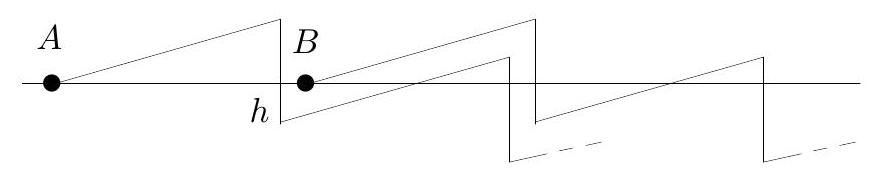
|
| 114 |
+
|
| 115 |
+
Figure 4
|
| 116 |
+
|
| 117 |
+
11. Prove that the modulus of an integer root of a polynomial with integer coefficients cannot exceed the maximum of the moduli of the coefficients.
|
| 118 |
+
|
| 119 |
+
Solution. For a non-zero polynomial $P(x)=a_{n} x^{n}+\cdots+a_{1} x+a_{0}$ with integer coefficients, let $k$ be the smallest index such that $a_{k} \neq 0$. Let $c$ be an integer root of $P(x)$. If $c=0$, the statement is obvious. If $c \neq 0$, then using $P(c)=0$ we get $a_{k}=-x\left(a_{k+1}+a_{k+2} x+\cdots+a_{n} x^{n-k-1}\right)$. Hence $c$ divides $a_{k}$, and since $a_{k} \neq 0$ we must have $|c| \leq\left|a_{k}\right|$.
|
| 120 |
+
|
| 121 |
+
12. Let $m$ and $n$ be positive integers. Prove that $25 m+3 n$ is divisible by 83 if and only if $3 m+7 n$ is divisible by 83 .
|
| 122 |
+
|
| 123 |
+
Solution. Use the equality $2 \cdot(25 x+3 y)+11 \cdot(3 x+7 y)=83 x+83 y$.
|
| 124 |
+
|
| 125 |
+
13. Prove that the equation $x^{2}-7 y^{2}=1$ has infinitely many solutions in natural numbers.
|
| 126 |
+
|
| 127 |
+
Solution. For any solution $(m, n)$ of the equation we have $m^{2}-7 n^{2}=1$ and
|
| 128 |
+
|
| 129 |
+
$$
|
| 130 |
+
1=\left(m^{2}-7 n^{2}\right)^{2}=\left(m^{2}+7 n^{2}\right)^{2}-7 \cdot(2 m n)^{2} .
|
| 131 |
+
$$
|
| 132 |
+
|
| 133 |
+
Thus $\left(m^{2}+7 n^{2}, 2 m n\right)$ is also a solution. Therefore it is sufficient to note that the equation $x^{2}-7 y^{2}=1$ has at least one solution, for example $x=8, y=3$.
|
| 134 |
+
|
| 135 |
+
14. Do there exist 1990 relatively prime numbers such that all possible sums of two or more of these numbers are composite numbers?
|
| 136 |
+
|
| 137 |
+
Solution. Such numbers do exist. Let $M=1990$ ! and consider the sequence of numbers $1+M, 1+2 M$, $1+3 M, \ldots$ For any natural number $2 \leq k \leq 1990$, any sum of exactly $k$ of these numbers (not necessarily different) is divisible by $k$, and hence is composite. number. It remains to show that we can choose 1990 numbers $a_{1}, \ldots, a_{1990}$ from this sequence which are relatively prime. Indeed, let $a_{1}=1+M$, $a_{2}=1+2 M$ and for $a_{1}, \ldots, a_{n}$ already chosen take $a_{n+1}=1+a_{1} \cdots a_{n} \cdot M$.
|
| 138 |
+
|
| 139 |
+
15. Prove that none of the numbers
|
| 140 |
+
|
| 141 |
+
$$
|
| 142 |
+
F_{n}=2^{2^{n}}+1, \quad n=0,1,2, \ldots,
|
| 143 |
+
$$
|
| 144 |
+
|
| 145 |
+
is a cube of an integer.
|
| 146 |
+
|
| 147 |
+
Solution. Assume there exist such natural numbers $k$ and $n$ that $2^{2^{n}}+1=k^{3}$. Then $k$ must be an odd number and we have $2^{2^{n}}=k^{3}-1=(k-1)\left(k^{2}+k+1\right)$. Hence $k-1=2^{s}$ and $k^{2}+k+1=2^{t}$ where $s$ and $t$ are some positive integers. Now $2^{2 s}=(k-1)^{2}=k^{2}-2 k+1$ and $2^{t}-2^{2 s}=3 k$. But $2^{t}-2^{2 s}$ is even while $3 k$ is odd, a contradiction.
|
| 148 |
+
|
| 149 |
+
16. A closed polygonal line is drawn on squared paper so that its links lie on the lines of the paper (the sides of the squares are equal to 1). The lengths of all links are odd numbers. Prove that the number of links is divisible by 4 .
|
| 150 |
+
|
| 151 |
+
Solution. There must be an equal number of horizontal and vertical links, and hence it suffices to show that the number of vertical links is even. Let's pass the whole polygonal line in a chosen direction and mark each vertical link as "up" or "down" according to the direction we pass it. As the sum of lengths of the "up" links is equal to that of the "down" ones and each link is of odd length, we have an even or odd number of links of both kinds depending on the parity of the sum of their lengths.
|
| 152 |
+
|
| 153 |
+
17. In two piles there are 72 and 30 sweets respectively. Two students take, one after another, some sweets from one of the piles. Each time the number of sweets taken from a pile must be an integer multiple of the number of sweets in the other pile. Is it the beginner of the game or his adversary who can always assure taking the last sweet from one of the piles?
|
| 154 |
+
|
| 155 |
+
Solution. Note that one of the players must have a winning strategy. Assume that it is the player making the second move who has it. Then his strategy will assure taking the last sweet also in the case when the beginner takes $2 \cdot 30$ sweets as his first move. But now, if the beginner takes $1 \cdot 30$ sweets then the second player has no choice but to take another 30 sweets from the same pile, and hence the beginner can use the same strategy to assure taking the last sweet himself. This contradiction shows that it must be the beginner who has the winning strategy.
|
| 156 |
+
|
| 157 |
+
18. Positive integers $1,2, \ldots, 100,101$ are written in the cells of a $101 \times 101$ square grid so that each number is repeated 101 times. Prove that there exists either a column or a row containing at least 11 different numbers.
|
| 158 |
+
|
| 159 |
+
Solution. Let $a_{k}$ denote the total number of rows and columns containing the number $k$ at least once. As $i \cdot(20-i)<101$ for any natural number $i$, we have $a_{k} \geq 21$ for all $k=1,2, \ldots, 101$. Hence $a_{1}+\cdots+a_{101} \geq 21 \cdot 101=2121$. On the other hand, assuming any row and any column contains no more than 10 different numbers we have $a_{1}+\cdots+a_{101} \leq 202 \cdot 10=2020$, a contradiction.
|
| 160 |
+
|
| 161 |
+
19. What is the largest possible number of subsets of the set $\{1,2, \ldots, 2 n+1\}$ such that the intersection of any two subsets consists of one or several consecutive integers?
|
| 162 |
+
|
| 163 |
+
Solution. Consider any subsets $A_{1}, \ldots, A_{s}$ satisfying the condition of the problem and let $A_{i}=$ $\left\{a_{i 1}, \ldots, a_{i, k_{i}}\right\}$ where $a_{i 1}<\cdots<a_{i, k_{i}}$. Replacing each $A_{i}$ by $A_{i}^{\prime}=\left\{a_{i 1}, a_{i 1}+1, \ldots, a_{i, k_{i}}-1, a_{i, k_{i}}\right\}$ (i.e., adding to it all "missing" numbers) yields a collection of different subsets $A_{1}^{\prime}, \ldots, A_{s}^{\prime}$ which also satisfies the required condition. Now, let $b_{i}$ and $c_{i}$ be the smallest and largest elements of the subset $A_{i}^{\prime}$, respectively. Then $\min _{1 \leq i \leq s} c_{i} \geq \max _{1 \leq i \leq s} b_{i}$, as otherwise some subsets $A_{k}^{\prime}$ and $A_{l}^{\prime}$ would not intersect. Hence there exists an element $a \in \bigcap_{1<i<s} A_{i}^{\prime}$. As the number of subsets of the set $\{1,2, \ldots, 2 n+1\}$ containing $a$ and consisting of $k$ consecutive integers does not exceed $\min (k, 2 n+2-k)$ we have $s \leq(n+1)+2 \cdot(1+2+\cdots+n)=(n+1)^{2}$. This maximum will be reached if we take $a=n+1$.
|
| 164 |
+
|
BalticWay/md/en-bw91sol.md
ADDED
|
@@ -0,0 +1,173 @@
|
|
|
|
|
|
|
|
|
|
|
|
|
|
|
|
|
|
|
|
|
|
|
|
|
|
|
|
|
|
|
|
|
|
|
|
|
|
|
|
|
|
|
|
|
|
|
|
|
|
|
|
|
|
|
|
|
|
|
|
|
|
|
|
|
|
|
|
|
|
|
|
|
|
|
|
|
|
|
|
|
|
|
|
|
|
|
|
|
|
|
|
|
|
|
|
|
|
|
|
|
|
|
|
|
|
|
|
|
|
|
|
|
|
|
|
|
|
|
|
|
|
|
|
|
|
|
|
|
|
|
|
|
|
|
|
|
|
|
|
|
|
|
|
|
|
|
|
|
|
|
|
|
|
|
|
|
|
|
|
|
|
|
|
|
|
|
|
|
|
|
|
|
|
|
|
|
|
|
|
|
|
|
|
|
|
|
|
|
|
|
|
|
|
|
|
|
|
|
|
|
|
|
|
|
|
|
|
|
|
|
|
|
|
|
|
|
|
|
|
|
|
|
|
|
|
|
|
|
|
|
|
|
|
|
|
|
|
|
|
|
|
|
|
|
|
|
|
|
|
|
|
|
|
|
|
|
|
|
|
|
|
|
|
|
|
|
|
|
|
|
|
|
|
|
|
|
|
|
|
|
|
|
|
|
|
|
|
|
|
|
|
|
|
|
|
|
|
|
|
|
|
|
|
|
|
|
|
|
|
|
|
|
|
|
|
|
|
|
|
|
|
|
|
|
|
|
|
|
|
|
|
|
|
|
|
|
|
|
|
|
|
|
|
|
|
|
|
|
|
|
|
|
|
|
|
|
|
|
|
|
|
|
|
|
|
|
|
|
|
|
|
|
|
|
|
|
|
|
|
|
|
|
|
|
|
|
|
|
|
|
|
|
|
|
|
|
|
|
|
|
|
|
|
|
|
|
|
|
|
|
|
|
|
|
|
|
|
|
|
|
|
|
|
|
|
|
|
|
|
|
|
|
|
|
|
|
|
|
|
|
|
|
|
|
|
|
|
|
|
|
|
|
|
|
|
|
|
|
|
|
|
|
|
|
|
|
|
|
|
|
|
|
|
|
|
|
|
|
|
|
|
|
|
|
|
|
|
|
|
|
|
|
|
|
|
|
|
|
|
|
|
|
|
|
|
|
|
|
|
|
|
|
|
|
|
|
|
|
|
|
|
|
| 1 |
+
# Baltic Way 1991
|
| 2 |
+
|
| 3 |
+
## Tartu, December 14, 1991
|
| 4 |
+
|
| 5 |
+
## Problems and solutions
|
| 6 |
+
|
| 7 |
+
1. Find the smallest positive integer $n$ having the property: for any set of $n$ distinct integers $a_{1}, a_{2}, \ldots, a_{n}$ the product of all differences $a_{i}-a_{j}, i<j$ is divisible by 1991 .
|
| 8 |
+
|
| 9 |
+
Solution. Let $S=\prod_{1 \leq i<j \leq n}\left(a_{i}-a_{j}\right)$. Note that $1991=11 \cdot 181$. Therefore $S$ is divisible by 1991 if and only if it is divisible by both 11 and 181 . If $n \leq 181$ then we can take the numbers $a_{1}, \ldots, a_{n}$ from distinct congruence classes modulo 181 so that $S$ will not be divisible by 181 . On the other hand, if $n \geq 182$ then according to the pigeonhole principle there always exist $a_{i}$ and $a_{j}$ such that $a_{i}-a_{j}$ is divisible by 181 (and of course there exist $a_{k}$ and $a_{l}$ such that $a_{k}-a_{l}$ is divisible by 11).
|
| 10 |
+
|
| 11 |
+
2. Prove that there are no positive integers $n$ and $m>1$ such that $102^{1991}+103^{1991}=n^{m}$.
|
| 12 |
+
|
| 13 |
+
Solution. Factorizing, we get
|
| 14 |
+
|
| 15 |
+
$$
|
| 16 |
+
102^{1991}+103^{1991}=(102+103)\left(102^{1990}-102^{1989} \cdot 103+102^{1988} \cdot 103^{2}-\cdots+103^{1990}\right),
|
| 17 |
+
$$
|
| 18 |
+
|
| 19 |
+
where $102+103=205=5 \cdot 41$. It suffices to show that the other factor is not divisible by 5 . Let $a_{k}=102^{k} \cdot 103^{1990-k}$, then $a_{k} \equiv 4(\bmod 5)$ if $k$ is even and $a_{k} \equiv-4(\bmod 5)$ if $k$ is odd. Thus the whole second factor is congruent to $4 \cdot 1991 \equiv 4(\bmod 5)$.
|
| 20 |
+
|
| 21 |
+
3. There are 20 cats priced from $\$ 12$ to $\$ 15$ and 20 sacks priced from 10 cents to $\$ 1$ for sale (all prices are different). Prove that each of two boys, John and Peter, can buy a cat in a sack paying the same amount of money.
|
| 22 |
+
|
| 23 |
+
Solution. The number of different possibilities for buying a cat and a sack is $20 \cdot 20=400$ while the number of different possible prices is $1600-1210+1=391$. Thus by the pigeonhole principle there exist two combinations of a cat and a sack costing the same amount of money. Note that the two cats (and also the two sacks) involved must be different as otherwise the two sacks (respectively, cats) would have equal prices.
|
| 24 |
+
|
| 25 |
+
4. Let $p$ be a polynomial with integer coefficients such that $p(-n)<p(n)<n$ for some integer $n$. Prove that $p(-n)<-n$.
|
| 26 |
+
|
| 27 |
+
Solution. As $a^{n}-b^{n}=(a-b)\left(a^{n-1}+a^{n-2} b+\cdots+b^{n-1}\right)$, then for any distinct integers $a, b$ and for any polynomial $p(x)$ with integer coefficients $p(a)-p(b)$ is divisible by $a-b$. Thus, $p(n)-p(-n) \neq 0$ is divisible by $2 n$ and consequently $p(-n) \leq p(n)-2 n<n-2 n=-n$.
|
| 28 |
+
|
| 29 |
+
5. For any positive numbers $a, b, c$ prove the inequalities
|
| 30 |
+
|
| 31 |
+
$$
|
| 32 |
+
\frac{1}{a}+\frac{1}{b}+\frac{1}{c} \geq \frac{2}{a+b}+\frac{2}{b+c}+\frac{2}{c+a} \geq \frac{9}{a+b+c} .
|
| 33 |
+
$$
|
| 34 |
+
|
| 35 |
+
Solution. To prove the first inequality, note that $\frac{2}{a+b} \leq \frac{1}{2}\left(\frac{1}{a}+\frac{1}{b}\right)$ and similarly $\frac{2}{b+c} \leq \frac{1}{2}\left(\frac{1}{b}+\frac{1}{c}\right), \frac{2}{c+a} \leq$ $\frac{1}{2}\left(\frac{1}{c}+\frac{1}{a}\right)$. For the second part, use the inequality $\frac{3}{x+y+z} \leq \frac{1}{3}\left(\frac{1}{x}+\frac{1}{y}+\frac{1}{z}\right)$ for $x=a+b, y=b+c$ and $z=c+a$.
|
| 36 |
+
|
| 37 |
+
6. Let $[x]$ be the integer part of a number $x$, and $\{x\}=x-[x]$. Solve the equation
|
| 38 |
+
|
| 39 |
+
$$
|
| 40 |
+
[x] \cdot\{x\}=1991 x .
|
| 41 |
+
$$
|
| 42 |
+
|
| 43 |
+
Solution. Let $f(x)=[x] \cdot\{x\}$. Then we have to solve the equation $f(x)=1991 x$. Obviously, $x=0$ is a solution. For any $x>0$ we have $0 \leq[x] \leq x$ and $0 \leq\{x\}<1$ which imply $f(x)<x<1991 x$. For $x \leq-1$ we have $0>[x]>x-1$ and $0 \leq\{x\}<1$ which imply $f(x)>x-1>1991 x$. Finally, if $-1<x<0$, then $[x]=-1,\{x\}=x-[x]=x+1$ and $f(x)=-x-1$. The only solution of the equation $-x-1=1991 x$ is $x=-\frac{1}{1992}$.
|
| 44 |
+
|
| 45 |
+
7. Let $A, B, C$ be the angles of an acute-angled triangle. Prove the inequality
|
| 46 |
+
|
| 47 |
+
$$
|
| 48 |
+
\sin A+\sin B>\cos A+\cos B+\cos C
|
| 49 |
+
$$
|
| 50 |
+
|
| 51 |
+
Solution. In an acute-angled triangle we have $A+B>\frac{\pi}{2}$. Hence we have $\sin A>\sin \left(\frac{\pi}{2}-B\right)=\cos B$ and $\sin B>\cos A$. Using these inequalities we get $(1-\sin A)(1-\sin B)<(1-\cos A)(1-\cos B)$ and
|
| 52 |
+
|
| 53 |
+
$$
|
| 54 |
+
\begin{aligned}
|
| 55 |
+
\sin A+\sin B & >\cos A+\cos B-\cos A \cos B+\sin A \sin B \\
|
| 56 |
+
& =\cos A+\cos B-\cos (A+B)=\cos A+\cos B+\cos C
|
| 57 |
+
\end{aligned}
|
| 58 |
+
$$
|
| 59 |
+
|
| 60 |
+
8. Let $a, b, c, d, e$ be distinct real numbers. Prove that the equation
|
| 61 |
+
|
| 62 |
+
$$
|
| 63 |
+
\begin{aligned}
|
| 64 |
+
& (x-a)(x-b)(x-c)(x-d) \\
|
| 65 |
+
& +(x-a)(x-b)(x-c)(x-e) \\
|
| 66 |
+
& +(x-a)(x-b)(x-d)(x-e) \\
|
| 67 |
+
& +(x-a)(x-c)(x-d)(x-e) \\
|
| 68 |
+
& +(x-b)(x-c)(x-d)(x-e)=0
|
| 69 |
+
\end{aligned}
|
| 70 |
+
$$
|
| 71 |
+
|
| 72 |
+
has 4 distinct real solutions.
|
| 73 |
+
|
| 74 |
+
Solution. On the left-hand side of the equation we have the derivative of the function
|
| 75 |
+
|
| 76 |
+
$$
|
| 77 |
+
f(x)=(x-a)(x-b)(x-c)(x-d)(x-e)
|
| 78 |
+
$$
|
| 79 |
+
|
| 80 |
+
which is continuous and has five distinct real roots.
|
| 81 |
+
|
| 82 |
+
9. Find the number of solutions of the equation $a e^{x}=x^{3}$.
|
| 83 |
+
|
| 84 |
+
Solution. Studying the graphs of the functions $a e^{x}$ and $x^{3}$ it is easy to see that the equation always has one solution if $a<0$ and can have 0,1 or 2 solutions if $a>0$. Moreover, in the case $a>0$ the number of solutions can only decrease as $a$ increases and we have exactly one positive value of $a$ for which the equation has one solution - this is the case when the graphs of $a e^{x}$ and $x^{3}$ are tangent to each other, i.e., there exists $x_{0}$ such that $a e^{x_{0}}=x_{0}^{3}$ and $a e^{x_{0}}=3 x_{0}^{2}$. From these two equations we get $x_{0}=3$ and $a=\frac{27}{e^{3}}$. Summarizing: the equation $a e^{x}=x^{3}$ has one solution for $a \leq 0$ and $a=\frac{27}{e^{3}}$, two solutions for $0<a<\frac{27}{e^{3}}$ and no solutions for $a>\frac{27}{e^{3}}$.
|
| 85 |
+
|
| 86 |
+
10. Express the value of $\sin 3^{\circ}$ in radicals.
|
| 87 |
+
|
| 88 |
+
Solution. We use the equality
|
| 89 |
+
|
| 90 |
+
$$
|
| 91 |
+
\sin 3^{\circ}=\sin \left(18^{\circ}-15^{\circ}\right)=\sin 18^{\circ} \cos 15^{\circ}+\cos 18^{\circ} \sin 15^{\circ}
|
| 92 |
+
$$
|
| 93 |
+
|
| 94 |
+
where
|
| 95 |
+
|
| 96 |
+
$$
|
| 97 |
+
\sin 15^{\circ}=\sin \frac{30^{\circ}}{2}=\sqrt{\frac{1-\cos 30^{\circ}}{2}}=\frac{\sqrt{6}-\sqrt{2}}{4}
|
| 98 |
+
$$
|
| 99 |
+
|
| 100 |
+
and
|
| 101 |
+
|
| 102 |
+
$$
|
| 103 |
+
\cos 15^{\circ}=\sqrt{1-\sin ^{2} 15^{\circ}}=\frac{\sqrt{6}+\sqrt{2}}{4} .
|
| 104 |
+
$$
|
| 105 |
+
|
| 106 |
+
To calculate $\cos 18^{\circ}$ and $\sin 18^{\circ}$ note that $\cos \left(3 \cdot 18^{\circ}\right)=\sin \left(2 \cdot 18^{\circ}\right)$. As $\cos 3 x=\cos ^{3} x-3 \cos x \sin ^{2} x=$ $\cos x\left(1-4 \sin ^{2} x\right)$ and $\sin 2 x=2 \sin x \cos x$ we get $1-4 \sin ^{2} 18^{\circ}=2 \sin 18^{\circ}$. Solving this quadratic equation yields $\sin 18^{\circ}=\frac{\sqrt{5}-1}{4}$ (we discard $\frac{-\sqrt{5}-1}{4}$ which is negative) and $\cos 18^{\circ}=\frac{\sqrt{10+2 \sqrt{5}}}{4}$.
|
| 107 |
+
|
| 108 |
+
11. All positive integers from 1 to 1000000 are divided into two groups consisting of numbers with odd or even sums of digits respectively. Which group contains more numbers?
|
| 109 |
+
|
| 110 |
+
Solution. Among any ten integers $\overline{a_{1} \ldots a_{n} 0}, \overline{a_{1} \ldots a_{n} 1}, \ldots, \overline{a_{1} \ldots a_{n} 9}$ there are exactly five numbers with odd digit sum and five numbers with even digit sum. Thus, among the integers 0, 1, . , 999999 we have equally many numbers of both kinds. After substituting 1000000 instead of 0 we shall have more numbers with odd digit sum.
|
| 111 |
+
|
| 112 |
+
12. The vertices of a convex 1991-gon are enumerated with integers from 1 to 1991. Each side and diagonal of the 1991-gon is coloured either red or blue. Prove that, for an arbitrary renumeration of vertices, one can find integers $k$ and $l$ such that the line connecting vertices with numbers $k$ and $l$ before the renumeration has the same colour as the line between the vertices having these numbers after the renumeration.
|
| 113 |
+
|
| 114 |
+
Solution. Assume there exists a renumeration such that for any numbers $1 \leq k<l \leq n$ the segment connecting vertices numbered $k$ and $l$ before the renumeration has a different colour than the segment connecting vertices with the same numbers after the renumeration. Then there has to be an equal number of red and blue segments, and thus the total number of segments must be even. However, the number of segments is $\left(\begin{array}{c}1991 \\ 2\end{array}\right)=995 \cdot 1991$, an odd number.
|
| 115 |
+
|
| 116 |
+
13. An equilateral triangle is divided into 25 congruent triangles enumerated with numbers from 1 to 25 . Prove that one can find two triangles having a common side and with the difference of the numbers assigned to them greater than 3 .
|
| 117 |
+
|
| 118 |
+
Solution. Define the distance between two small triangles to be the minimal number of steps one needs to move from one of the triangles to the other (a step here means transition from one triangle to another having a common side with it). The maximum distance between two small triangles is 8 and this maximum is achieved if and only if one of these lies at a corner of the big triangle and the other lies anywhere at the opposite side of it. Assume now that we have assigned the numbers 1, .., 25 to the small triangles so that the difference of the numbers assigned to any two adjacent triangles does not exceed 3 . Then the distance between the triangles numbered 1 and $25 ; 1$ and $24 ; 2$ and $25 ; 2$ and 24 must be equal to 8 . However, this is not possible since it implies that either the numbers 1 and 2 or 24 and 25 are assigned to the same "corner" triangle.
|
| 119 |
+
|
| 120 |
+
14. A castle has a number of halls and $n$ doors. Every door leads into another hall or outside. Every hall has at least two doors. A knight enters the castle. In any hall, he can choose any door for exit except the one he just used to enter that hall. Find a strategy allowing the knight to get outside after visiting no more than $2 n$ halls (a hall is counted each time it is entered).
|
| 121 |
+
|
| 122 |
+
Solution. The knight can use the following strategy: exit from any hall through the door immediately to the right of the one he used to enter that hall. Then, knowing which door was passed last and in which direction we can uniquely restore the whole path of the knight up to that point. Therefore, he will not be able to pass any door twice in the same direction unless he has been outside the castle in between.
|
| 123 |
+
|
| 124 |
+
15. In each of the squares of a chess board an arbitrary integer is written. A king starts to move on the board. As the king moves, 1 is added to the number in each square it "visits". Is it always possible to make the numbers on the chess board:
|
| 125 |
+
|
| 126 |
+
(a) all even;
|
| 127 |
+
|
| 128 |
+
(b) all divisible by 3 ;
|
| 129 |
+
|
| 130 |
+
(c) all equal?
|
| 131 |
+
|
| 132 |
+
Solution. Figure 1 demonstrates a possible king's path passing through each square exactly once and finally returning to the initial square. Thus, it suffices to prove part (c) as we can always increase the numbers in all the squares by 1 or 2 if necessary. Moreover, note that for any given square it is possible to modify the path shown in Figure 1 in such a way that this particular square will be passed twice while any other square will still be passed exactly once. Repeating this procedure a suitable number of times for each square we can make all the numbers on the chess board equal.
|
| 133 |
+
|
| 134 |
+
16. Let two circles $C_{1}$ and $C_{2}$ (with radii $r_{1}$ and $r_{2}$ ) touch each other externally, and let $l$ be their common tangent. A third circle $C_{3}$ (with radius $r_{3}<\min \left(r_{1}, r_{2}\right)$ ) is externally tangent to the two given circles and tangent to the line $l$. Prove that
|
| 135 |
+
|
| 136 |
+
$$
|
| 137 |
+
\frac{1}{\sqrt{r_{3}}}=\frac{1}{\sqrt{r_{1}}}+\frac{1}{\sqrt{r_{2}}}
|
| 138 |
+
$$
|
| 139 |
+
|
| 140 |
+
Solution. Let $O_{1}, O_{2}, O_{3}$ be the centres of the circles $C_{1}, C_{2}, C_{3}$, respectively. Let $P_{1}, P_{2}, P_{3}$ be the perpendicular projections of $O_{1}, O_{2}, O_{3}$ onto the line $l$ and let $Q$ be the perpendicular projection of $O_{3}$ onto the line $P_{1} O_{1}$ (see Figure 2). Then $\left|P_{1} P_{3}\right|^{2}=\left|Q O_{3}\right|^{2}=\left|O_{1} O_{3}\right|^{2}-\left|Q O_{1}\right|^{2}=\left(r_{1}+r_{3}\right)^{2}-\left(r_{1}-r_{3}\right)^{2}=4 r_{1} r_{3}$. Similarly we get $\left|P_{1} P_{2}\right|^{2}=4 r_{1} r_{2}$ and $\left|P_{2} P_{3}\right|^{2}=4 r_{2} r_{3}$. Since $\left|P_{1} P_{2}\right|=\left|P_{1} P_{3}\right|+\left|P_{2} P_{3}\right|$ we have $\sqrt{r_{1} r_{2}}=$ $\sqrt{r_{1} r_{3}}+\sqrt{r_{2} r_{3}}$, which implies the required equality.
|
| 141 |
+
|
| 142 |
+
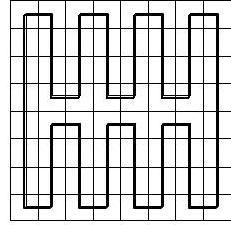
|
| 143 |
+
|
| 144 |
+
Figure 1
|
| 145 |
+
|
| 146 |
+
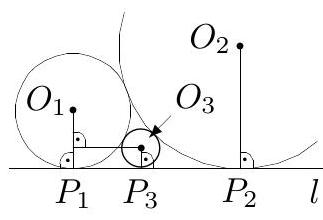
|
| 147 |
+
|
| 148 |
+
Figure 2
|
| 149 |
+
|
| 150 |
+
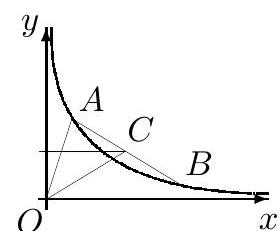
|
| 151 |
+
|
| 152 |
+
Figure 3
|
| 153 |
+
|
| 154 |
+
17. Let the coordinate planes have the reflection property. A beam falls onto one of them. How does the final direction of the beam after reflecting from all three coordinate planes depend on its initial direction?
|
| 155 |
+
|
| 156 |
+
Solution. Let the velocity vector of the beam be $\vec{v}=(\alpha, \beta, \gamma)$. Reflection from each of the coordinate planes changes the sign of exactly one of the coordinates $\alpha, \beta$ and $\gamma$, and thus the final direction will be opposite to the initial one.
|
| 157 |
+
|
| 158 |
+
18. Is it possible to put two tetrahedra of volume $\frac{1}{2}$ without intersection into a sphere with radius 1 ?
|
| 159 |
+
|
| 160 |
+
Solution. No, it is not. Any tetrahedron that does not contain the centre of the sphere as an internal point has a height drawn to one of its faces less than or equal to the radius of the sphere. As each of the faces of the tetrahedron is contained in a circle with radius not greater than 1 , its area cannot exceed $\frac{3 \sqrt{3}}{4}$. Thus, the volume of such a tetrahedron must be less or equal than $\frac{1}{3} \cdot 1 \cdot \frac{3 \sqrt{3}}{4}=\frac{\sqrt{3}}{4}<\frac{1}{2}$.
|
| 161 |
+
|
| 162 |
+
19. Let's expand a little bit three circles, touching each other externally, so that three pairs of intersection points appear. Denote by $A_{1}, B_{1}, C_{1}$ the three so obtained "external" points and by $A_{2}, B_{2}, C_{2}$ the corresponding "internal" points. Prove the equality
|
| 163 |
+
|
| 164 |
+
$$
|
| 165 |
+
\left|A_{1} B_{2}\right| \cdot\left|B_{1} C_{2}\right| \cdot\left|C_{1} A_{2}\right|=\left|A_{1} C_{2}\right| \cdot\left|C_{1} B_{2}\right| \cdot\left|B_{1} A_{2}\right| .
|
| 166 |
+
$$
|
| 167 |
+
|
| 168 |
+
Solution. First, note that the three straight lines $A_{1} A_{2}, B_{1} B_{2}$ and $C_{1} C_{2}$ intersect in a single point $O$. Indeed, each of the lines is the locus of points from which the tangents to two of the circles are of equal length (it is easy to check that this locus has the form of a straight line and obviously it contains the two intersection points of the circles). Now, we have $\left|O A_{1}\right| \cdot\left|O A_{2}\right|=\left|O B_{1}\right| \cdot\left|O B_{2}\right|$ (as both of these products are equal to $|O T|^{2}$ where $O T$ is a tangent line to the circle containing $A_{1}, A_{2}, B_{1}, B_{2}$, and $T$ is the corresponding point of tangency). Hence $\frac{\left|O A_{1}\right|}{\left|O B_{2}\right|}=\frac{\left|O B_{1}\right|}{\left|O A_{2}\right|}$ which implies that the triangles $O A_{1} B_{2}$ and $O B_{1} A_{2}$ are similar and $\frac{\left|A_{1} B_{2}\right|}{\left|A_{2} B_{1}\right|}=\frac{\left|O A_{1}\right|}{\left|O B_{1}\right|}$. Similarly we get $\frac{\left|B_{1} C_{2}\right|}{\left|B_{2} C_{1}\right|}=\frac{\left|O B_{1}\right|}{\left|O C_{1}\right|}$ and $\frac{\left|C_{1} A_{2}\right|}{\left|C_{2} A_{1}\right|}=\frac{\left|O C_{1}\right|}{\left|O A_{1}\right|}$. Multiplying these three equalities gives the desired result.
|
| 169 |
+
|
| 170 |
+
20. Consider two points $A\left(x_{1}, y_{1}\right)$ and $B\left(x_{2}, y_{2}\right)$ on the graph of the function $y=\frac{1}{x}$ such that $0<x_{1}<x_{2}$ and $|A B|=2 \cdot|O A|(O$ is the reference point, i.e., $O(0,0))$. Let $C$ be the midpoint of the segment $A B$. Prove that the angle between the $x$-axis and the ray $O A$ is equal to three times the angle between $x$-axis and the ray $O C$.
|
| 171 |
+
|
| 172 |
+
Solution. We have $A\left(x_{1}, \frac{1}{x_{1}}\right), B\left(x_{2}, \frac{1}{x_{2}}\right)$ and $C\left(\frac{x_{1}+x_{2}}{2}, \frac{1}{2 x_{1}}+\frac{1}{2 x_{2}}\right)$. Computing the coordinates of $\bar{v}=$ $|O C| \cdot \overline{A C}+|A C| \cdot \overline{O C}$ we find that the vector $\bar{v}-$ and hence also the bisector of the angle $\angle O C A-$ is parallel to the $x$-axis. Since $|O A|=|A C|$ this yields $\angle A O C=\angle A C O=2 \cdot \angle C O x$ (see Figure 3) and $\angle A O x=\angle A O C+\angle C O x=3 \cdot \angle C O x$.
|
| 173 |
+
|
BalticWay/md/en-bw92sol.md
ADDED
|
@@ -0,0 +1,195 @@
|
|
|
|
|
|
|
|
|
|
|
|
|
|
|
|
|
|
|
|
|
|
|
|
|
|
|
|
|
|
|
|
|
|
|
|
|
|
|
|
|
|
|
|
|
|
|
|
|
|
|
|
|
|
|
|
|
|
|
|
|
|
|
|
|
|
|
|
|
|
|
|
|
|
|
|
|
|
|
|
|
|
|
|
|
|
|
|
|
|
|
|
|
|
|
|
|
|
|
|
|
|
|
|
|
|
|
|
|
|
|
|
|
|
|
|
|
|
|
|
|
|
|
|
|
|
|
|
|
|
|
|
|
|
|
|
|
|
|
|
|
|
|
|
|
|
|
|
|
|
|
|
|
|
|
|
|
|
|
|
|
|
|
|
|
|
|
|
|
|
|
|
|
|
|
|
|
|
|
|
|
|
|
|
|
|
|
|
|
|
|
|
|
|
|
|
|
|
|
|
|
|
|
|
|
|
|
|
|
|
|
|
|
|
|
|
|
|
|
|
|
|
|
|
|
|
|
|
|
|
|
|
|
|
|
|
|
|
|
|
|
|
|
|
|
|
|
|
|
|
|
|
|
|
|
|
|
|
|
|
|
|
|
|
|
|
|
|
|
|
|
|
|
|
|
|
|
|
|
|
|
|
|
|
|
|
|
|
|
|
|
|
|
|
|
|
|
|
|
|
|
|
|
|
|
|
|
|
|
|
|
|
|
|
|
|
|
|
|
|
|
|
|
|
|
|
|
|
|
|
|
|
|
|
|
|
|
|
|
|
|
|
|
|
|
|
|
|
|
|
|
|
|
|
|
|
|
|
|
|
|
|
|
|
|
|
|
|
|
|
|
|
|
|
|
|
|
|
|
|
|
|
|
|
|
|
|
|
|
|
|
|
|
|
|
|
|
|
|
|
|
|
|
|
|
|
|
|
|
|
|
|
|
|
|
|
|
|
|
|
|
|
|
|
|
|
|
|
|
|
|
|
|
|
|
|
|
|
|
|
|
|
|
|
|
|
|
|
|
|
|
|
|
|
|
|
|
|
|
|
|
|
|
|
|
|
|
|
|
|
|
|
|
|
|
|
|
|
|
|
|
|
|
|
|
|
|
|
|
|
|
|
|
|
|
|
|
|
|
|
|
|
|
|
|
|
|
|
|
|
|
|
|
|
|
|
|
|
|
|
|
|
|
|
|
|
|
|
|
|
|
|
|
|
|
|
|
|
|
|
|
|
|
|
|
|
|
|
|
|
|
|
|
|
|
|
|
|
|
|
|
|
|
|
|
|
|
|
|
|
|
|
|
|
|
|
|
|
|
|
|
|
|
|
|
|
|
|
|
| 1 |
+
# Baltic Way 1992
|
| 2 |
+
|
| 3 |
+
## Vilnius, November 7, 1992
|
| 4 |
+
|
| 5 |
+
## Problems and solutions
|
| 6 |
+
|
| 7 |
+
1. Let $p$ and $q$ be two consecutive odd prime numbers. Prove that $p+q$ is a product of at least three positive integers greater than 1 (not necessarily different).
|
| 8 |
+
|
| 9 |
+
Solution. Since $q-p=2 k$ is even, we have $p+q=2(p+k)$. It is clear that $p<p+k<p+2 k=q$. Therefore $p+k$ is not prime and, consequently, is a product of two positive integers greater than 1 .
|
| 10 |
+
|
| 11 |
+
2. Denote by $d(n)$ the number of all positive divisors of a positive integer $n$ (including 1 and $n$ ). Prove that there are infinitely many $n$ such that $\frac{n}{d(n)}$ is an integer.
|
| 12 |
+
|
| 13 |
+
Solution. Consider numbers of the form $p^{p^{n}-1}$ where $p$ is an arbitrary prime number and $n=1,2, \ldots$
|
| 14 |
+
|
| 15 |
+
3. Find an infinite non-constant arithmetic progression of positive integers such that each term is neither a sum of two squares, nor a sum of two cubes (of positive integers).
|
| 16 |
+
|
| 17 |
+
Solution. For any natural number $n$, we have $n^{2} \equiv 0$ or $n^{2} \equiv 1(\bmod 4)$ and $n^{3} \equiv 0$ or $n^{3} \equiv \pm 1(\bmod 9)$. Thus $\{36 n+3 \mid n=1,2, \ldots\}$ is a progression with the required property.
|
| 18 |
+
|
| 19 |
+
4. Is it possible to draw a hexagon with vertices in the knots of an integer lattice so that the squares of the lengths of the sides are six consecutive positive integers?
|
| 20 |
+
|
| 21 |
+
Solution. The sum of any six consecutive positive integers is odd. On the other hand, the sum of the squares of the lengths of the sides of the hexagon is equal to the sum of the squares of their projections onto the two axes. But this number has the same parity as the sum of the projections themselves, the latter being obviously even.
|
| 22 |
+
|
| 23 |
+
5. Given that $a^{2}+b^{2}+(a+b)^{2}=c^{2}+d^{2}+(c+d)^{2}$, prove that $a^{4}+b^{4}+(a+b)^{4}=c^{4}+d^{4}+(c+d)^{4}$.
|
| 24 |
+
|
| 25 |
+
Solution. Use the identity $\left(a^{2}+b^{2}+(a+b)^{2}\right)^{2}=2\left(a^{4}+b^{4}+(a+b)^{4}\right)$.
|
| 26 |
+
|
| 27 |
+
6. Prove that the product of the 99 numbers of the form $\frac{k^{3}-1}{k^{3}+1}$ where $k=2,3, \ldots, 100$, is greater than $\frac{2}{3}$.
|
| 28 |
+
|
| 29 |
+
Solution. Note that
|
| 30 |
+
|
| 31 |
+
$$
|
| 32 |
+
\frac{k^{3}-1}{k^{3}+1}=\frac{(k-1)\left(k^{2}+k+1\right)}{(k+1)\left(k^{2}-k+1\right)}=\frac{(k-1)\left(k^{2}+k+1\right)}{(k+1)\left((k-1)^{2}+(k-1)+1\right)}
|
| 33 |
+
$$
|
| 34 |
+
|
| 35 |
+
After obvious cancellations we get
|
| 36 |
+
|
| 37 |
+
$$
|
| 38 |
+
\prod_{k=2}^{100} \frac{k^{3}-1}{k^{3}+1}=\frac{1 \cdot 2 \cdot\left(100^{2}+100+1\right)}{100 \cdot 101 \cdot\left(1^{2}+1+1\right)}>\frac{2}{3}
|
| 39 |
+
$$
|
| 40 |
+
|
| 41 |
+
7. Let $a=\sqrt[1992]{1992}$. Which number is greater:
|
| 42 |
+
|
| 43 |
+
$$
|
| 44 |
+
\left.a^{a^{a^{a}}}\right\} 1992
|
| 45 |
+
$$
|
| 46 |
+
|
| 47 |
+
or 1992 ?
|
| 48 |
+
|
| 49 |
+
Solution. The first of these numbers is less than
|
| 50 |
+
|
| 51 |
+
$$
|
| 52 |
+
\left.\left.a^{a^{a^{. \cdot}}}\right\}^{1992}=a^{a^{a^{. \cdot}}}\right\}^{1991}=\ldots=1992 .
|
| 53 |
+
$$
|
| 54 |
+
|
| 55 |
+
8. Find all integers satisfying the equation $2^{x} \cdot(4-x)=2 x+4$.
|
| 56 |
+
|
| 57 |
+
Solution. Since $2^{x}$ must be positive, we have $\frac{2 x+4}{4-x}>0$ yielding $-2<x<4$. Thus it suffices to check the points $-1,0,1,2,3$. The three solutions are $x=0,1,2$.
|
| 58 |
+
|
| 59 |
+
9. A polynomial $f(x)=x^{3}+a x^{2}+b x+c$ is such that $b<0$ and $a b=9 c$. Prove that the polynomial has three different real roots.
|
| 60 |
+
|
| 61 |
+
Solution. Consider the derivative $f^{\prime}(x)=3 x^{2}+2 a x+b$. Since $b<0$, it has two real roots $x_{1}$ and $x_{2}$. Since $f(x) \rightarrow \pm \infty$ as $x \rightarrow \pm \infty$, it is sufficient to check that $f\left(x_{1}\right)$ and $f\left(x_{2}\right)$ have different signs, i.e., $f\left(x_{1}\right) f\left(x_{2}\right)<0$. Dividing $f(x)$ by $f^{\prime}(x)$ and using the equality $a b=9 c$ we find that the remainder is equal to $x\left(\frac{2}{3} b-\frac{2}{9} a^{2}\right)$. Now, as $x_{1} x_{2}=\frac{b}{3}<0$ we have $f\left(x_{1}\right) f\left(x_{2}\right)=x_{1} x_{2}\left(\frac{2}{3} b-\frac{2}{9} a^{2}\right)^{2}<0$.
|
| 62 |
+
|
| 63 |
+
10. Find all fourth degree polynomials $p(x)$ such that the following four conditions are satisfied:
|
| 64 |
+
|
| 65 |
+
(i) $p(x)=p(-x)$ for all $x$.
|
| 66 |
+
|
| 67 |
+
(ii) $p(x) \geq 0$ for all $x$.
|
| 68 |
+
|
| 69 |
+
(iii) $p(0)=1$.
|
| 70 |
+
|
| 71 |
+
(iv) $p(x)$ has exactly two local minimum points $x_{1}$ and $x_{2}$ such that $\left|x_{1}-x_{2}\right|=2$.
|
| 72 |
+
|
| 73 |
+
Solution. Let $p(x)=a x^{4}+b x^{3}+c x^{2}+d x+e$ with $a \neq 0$. From $(i)-(i i i)$ we get $b=d=0, a>0$ and $e=1$. From (iv) it follows that $p^{\prime}(x)=4 a x^{3}+2 c x$ has at least two different real roots. Since $a>0$, we have $c<0$ and $p^{\prime}(x)$ has three roots $x=0, x= \pm \sqrt{-c /(2 a)}$. The minimum points mentioned in $(i v)$ must be $x= \pm \sqrt{-c /(2 a)}$, so $2 \sqrt{-c /(2 a)}=2$ and $c=-2 a$. Finally, by $(i i)$ we have $p(x)=a\left(x^{2}-1\right)^{2}+1-a \geq 0$ for all $x$, which implies $0<a \leq 1$. It is easy to check that every such polynomial satisfies the conditions (i)-(iv).
|
| 74 |
+
|
| 75 |
+
11. Let $\mathbb{Q}^{+}$denote the set of positive rational numbers. Show that there exists one and only one function $f: \mathbb{Q}^{+} \rightarrow \mathbb{Q}^{+}$satisfying the following conditions:
|
| 76 |
+
|
| 77 |
+
(i) If $0<q<\frac{1}{2}$ then $f(q)=1+f\left(\frac{q}{1-2 q}\right)$.
|
| 78 |
+
|
| 79 |
+
(ii) If $1<q \leq 2$ then $f(q)=1+f(q-1)$.
|
| 80 |
+
|
| 81 |
+
(iii) $f(q) \cdot f\left(\frac{1}{q}\right)=1$ for all $q \in \mathbb{Q}^{+}$.
|
| 82 |
+
|
| 83 |
+
Solution. By condition (iii) we have $f(1)=1$. Applying condition (iii) to each of (i) and (ii) gives two new conditions $\left(i^{\prime}\right)$ and $\left(i i^{\prime}\right)$ taking care of $q>2$ and $\frac{1}{2} \leq q<1$ respectively. Now, for any rational number $\frac{a}{b} \neq 1$ we can use $(i),\left(i^{\prime}\right),(i i)$ or $\left(i i^{\prime}\right)$ to express $f\left(\frac{a}{b}\right)$ in terms of $f\left(\frac{a^{\prime}}{b^{\prime}}\right)$ where $a^{\prime}+b^{\prime}<a+b$. The recursion therefore finishes in a finite number of steps, when we can use $f(1)=1$. Thus we have established that such a function $f$ exists, and is uniquely determined by the given conditions.
|
| 84 |
+
|
| 85 |
+
Remark. Initially it was also required to determine all fixed points of the function $f$, i.e., all solutions $q$ of the equation $f(q)=q$, but the Jury of the contest decided to simplify the problem. Here we present a solution. First note that if $q$ is a fixed point, then so is $\frac{1}{q}$. By $(i)$, if $0<q<\frac{1}{2}$ is a fixed point, then $f\left(\frac{q}{1-2 q}\right)=q-1<0$ which is impossible, so there are no fixed points $0<q<\frac{1}{2}$ or $q>2$. Now, for a fixed point $1<\frac{a}{b} \leq 2$ (ii) easily gives us that $\frac{a}{b}-1=\frac{a-b}{b}$ and $\frac{b}{a-b}$ are fixed points too. It is easy to see that $1 \leq \frac{b}{a-b} \leq 2$ (the latter holds because $\frac{b}{a-b}$ is a fixed point). As the sum of the numerator and denominator of the new fixed point is strictly less than $a+b$ we can continue in this manner until, in a finite number of steps, we arrive at the fixed point 1. By reversing the process, any fixed point $q>1$ can be constructed by repeatedly using the condition that if $\frac{a}{b}>1$ is a fixed point then so is $\frac{a+b}{a}$, starting with $a=b=1$. It is now an easy exercise to see that these fixed points have the form $\frac{F_{n+1}}{F_{n}}$ where $\left\{F_{n}\right\}_{n \in \mathbb{N}}$ is the sequence of Fibonacci numbers.
|
| 86 |
+
|
| 87 |
+
12. Let $\mathbb{N}$ denote the set of positive integers. Let $\varphi: \mathbb{N} \rightarrow \mathbb{N}$ be a bijective function and assume that there exists a finite limit
|
| 88 |
+
|
| 89 |
+
$$
|
| 90 |
+
\lim _{n \rightarrow \infty} \frac{\varphi(n)}{n}=L
|
| 91 |
+
$$
|
| 92 |
+
|
| 93 |
+
What are the possible values of $L$ ?
|
| 94 |
+
|
| 95 |
+
Solution. In this solution we allow $L$ to be $\infty$ as well. We show that $L=1$ is the only possible value. Assume that $L>1$. Then there exists a number $N$ such that for any $n \geq N$ we have $\frac{\varphi(n)}{n}>1$ and thus $\varphi(n) \geq n+1 \geq N+1$. But then $\varphi$ cannot be bijective, since the numbers $1,2, \ldots, N-1$ cannot be bijectively mapped onto $1,2, \ldots, N$.
|
| 96 |
+
|
| 97 |
+
Now assume that $L<1$. Since $\varphi$ is bijective we clearly have $\varphi(n) \rightarrow \infty$ as $n \rightarrow \infty$. Then
|
| 98 |
+
|
| 99 |
+
$$
|
| 100 |
+
\lim _{n \rightarrow \infty} \frac{\varphi^{-1}(n)}{n}=\lim _{n \rightarrow \infty} \frac{\varphi^{-1}(\varphi(n))}{\varphi(n)}=\lim _{n \rightarrow \infty} \frac{n}{\varphi(n)}=\frac{1}{L}>1,
|
| 101 |
+
$$
|
| 102 |
+
|
| 103 |
+
i.e., $\lim _{n \rightarrow \infty} \frac{\varphi^{-1}(n)}{n}>1$, which is a contradiction since $\varphi^{-1}$ is also bijective. (When $L=0$ we interpret $\frac{1}{L}$ as $\infty$ ).
|
| 104 |
+
|
| 105 |
+
13. Prove that for any positive $x_{1}, x_{2}, \ldots, x_{n}$ and $y_{1}, y_{2}, \ldots, y_{n}$ the inequality
|
| 106 |
+
|
| 107 |
+
$$
|
| 108 |
+
\sum_{i=1}^{n} \frac{1}{x_{i} y_{i}} \geq \frac{4 n^{2}}{\sum_{i=1}^{n}\left(x_{i}+y_{i}\right)^{2}}
|
| 109 |
+
$$
|
| 110 |
+
|
| 111 |
+
holds.
|
| 112 |
+
|
| 113 |
+
Solution. Since $\left(x_{i}+y_{i}\right)^{2} \geq 4 x_{i} y_{i}$, it is sufficient to prove that
|
| 114 |
+
|
| 115 |
+
$$
|
| 116 |
+
\left(\sum_{i=1}^{n} \frac{1}{x_{i} y_{i}}\right)\left(\sum_{i=1}^{n} x_{i} y_{i}\right) \geq n^{2}
|
| 117 |
+
$$
|
| 118 |
+
|
| 119 |
+
This can easily be done by induction using the fact that $a+\frac{1}{a} \geq 2$ for any $a>0$. It also follows directly from the Cauchy-Schwarz inequality.
|
| 120 |
+
|
| 121 |
+
14. There is a finite number of towns in a country. They are connected by one direction roads. It is known that, for any two towns, one of them can be reached from the other one. Prove that there is a town such that all the remaining towns can be reached from it.
|
| 122 |
+
|
| 123 |
+
Solution. Consider a town $A$ from which a maximal number of towns can be reached. Suppose there is a town $B$ which cannot be reached from $A$. Then $A$ can be reached from $B$ and so one can reach more towns from $B$ than from $A$, a contradiction.
|
| 124 |
+
|
| 125 |
+
15. Noah has to fit 8 species of animals into 4 cages of the ark. He plans to put species in each cage. It turns out that, for each species, there are at most 3 other species with which it cannot share the accommodation. Prove that there is a way to assign the animals to their cages so that each species shares a cage with compatible species.
|
| 126 |
+
|
| 127 |
+
Solution. Start assigning the species to cages in an arbitrary order. Since for each species there are at most three species incompatible with it, we can always add it to one of the four cages.
|
| 128 |
+
|
| 129 |
+
Remark. Initially the problem was posed as follows: "...He plans to put two species in each cage..." Because of a misprint the word "two" disappeared, and the problem became trivial. We give a solution to the original problem. Start with the distribution obtained above. If in some cage $A$ there are more than three species, then there is also a cage $B$ with at most one species and this species is compatible with at least one species in cage $A$, which we can then transfer to cage $B$. Thus we may assume that there are at most three species in each cage. If there are two cages with 3 species, then we can obviously transfer one of these 6 species to one of the remaining two cages. Now, assume the four cages contain 1, 2, 2 and 3 species respectively. If the species in the first cage is compatible with one in the fourth cage, we can transfer that species to the first cage, and we are done. Otherwise, for an arbitrary species $X$ in the fourth cage there exists a species compatible with it in either the second or the third cage. Transfer the other species from that cage to the first cage, and then $X$ to that cage.
|
| 130 |
+
|
| 131 |
+
16. All faces of a convex polyhedron are parallelograms. Can the polyhedron have exactly 1992 faces?
|
| 132 |
+
|
| 133 |
+
Solution. No, it cannot. Let us call a series of faces $F_{1}, F_{2}, \ldots, F_{k}$ a ring if the pairs $\left(F_{1}, F_{2}\right),\left(F_{2}, F_{3}\right), \ldots$, $\left(F_{k-1}, F_{k}\right),\left(F_{k}, F_{1}\right)$ each have a common edge and all these common edges are parallel. It is not difficult to see that any two rings have exactly two common faces and, conversely, each face belongs to exactly two rings. Therefore, if there are $n$ rings then the total number of faces must be $2\left(\begin{array}{l}n \\ 2\end{array}\right)=n(n-1)$. But there is no positive integer $n$ such that $n(n-1)=1992$.
|
| 134 |
+
|
| 135 |
+
Remark. The above solution, which is the only one proposed that is known to us, is not correct. For a counterexample, consider a cube with side 2 built up of four unit cubes, and take the polyhedron with 24 faces built up of the faces of the unit cubes that face the outside. This polyhedron has rings that do not have any faces in common. Moreover, by subdividing faces into rectangles sufficiently many times, we can obtain a polyhedron with 1992 faces.
|
| 136 |
+
|
| 137 |
+
17. Quadrangle $A B C D$ is inscribed in a circle with radius 1 in such a way that one diagonal, $A C$, is a diameter of the circle, while the other diagonal, $B D$, is as long as $A B$. The diagonals intersect in $P$. It is known that the length of $P C$ is $\frac{2}{5}$. How long is the side $C D$ ?
|
| 138 |
+
|
| 139 |
+
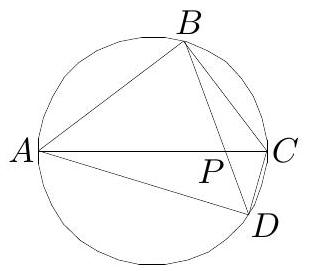
|
| 140 |
+
|
| 141 |
+
Figure 1
|
| 142 |
+
|
| 143 |
+
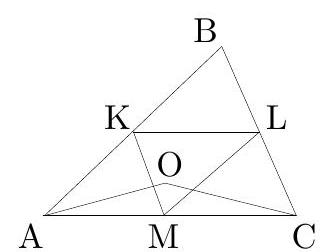
|
| 144 |
+
|
| 145 |
+
Figure 2
|
| 146 |
+
|
| 147 |
+
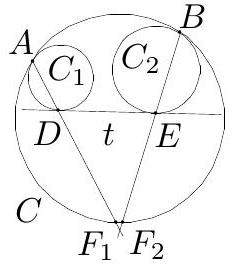
|
| 148 |
+
|
| 149 |
+
Figure 3
|
| 150 |
+
|
| 151 |
+
Solution. Let $\angle A C D=2 \alpha$ (see Figure 1). Then $\angle C A D=\frac{\pi}{2}-2 \alpha, \angle A B D=2 \alpha, \angle A D B=\frac{\pi}{2}-\alpha$ and $\angle C D B=\alpha$. The sine theorem applied to triangles $D C P$ and $D A P$ yields
|
| 152 |
+
|
| 153 |
+
$$
|
| 154 |
+
\frac{|D P|}{\sin 2 \alpha}=\frac{2}{5 \sin \alpha}
|
| 155 |
+
$$
|
| 156 |
+
|
| 157 |
+
and
|
| 158 |
+
|
| 159 |
+
$$
|
| 160 |
+
\frac{|D P|}{\sin \left(\frac{\pi}{2}-2 \alpha\right)}=\frac{8}{5 \sin \left(\frac{\pi}{2}-\alpha\right)}
|
| 161 |
+
$$
|
| 162 |
+
|
| 163 |
+
Combining these equalities we have
|
| 164 |
+
|
| 165 |
+
$$
|
| 166 |
+
\frac{2 \sin 2 \alpha}{5 \sin \alpha}=\frac{8 \cos 2 \alpha}{5 \cos \alpha}
|
| 167 |
+
$$
|
| 168 |
+
|
| 169 |
+
which gives $4 \sin \alpha \cos ^{2} \alpha=8 \cos 2 \alpha \sin \alpha$ and $\cos 2 \alpha+1=4 \cos 2 \alpha$. So we get $\cos 2 \alpha=\frac{1}{3}$ and $|C D|=$ $2 \cos 2 \alpha=\frac{2}{3}$.
|
| 170 |
+
|
| 171 |
+
18. Show that in a non-obtuse triangle the perimeter of the triangle is always greater than two times the diameter of the circumcircle.
|
| 172 |
+
|
| 173 |
+
Solution. Let $K, L, M$ be the midpoints of the sides $A B, B C, A C$ of a non-obtuse triangle $A B C$ (see Figure 2). Note that the centre $O$ of the circumcircle is inside the triangle $K L M$ (or at one of its vertices if $A B C$ is a right-angled triangle). Therefore $|A K|+|K L|+|L C|>|A O|+|O C|$ and hence $|A B|+|A C|+|B C|>$ $2(|A O|+|O C|)=2 d$, where $d$ is the diameter of the circumcircle.
|
| 174 |
+
|
| 175 |
+
19. Let $C$ be a circle in the plane. Let $C_{1}$ and $C_{2}$ be non-intersecting circles touching $C$ internally at points $A$ and $B$ respectively. Let $t$ be a common tangent of $C_{1}$ and $C_{2}$, touching them at points $D$ and $E$ respectively, such that both $C_{1}$ and $C_{2}$ are on the same side of $t$. Let $F$ be the point of intersection of $A D$ and $B E$. Show that $F$ lies on $C$.
|
| 176 |
+
|
| 177 |
+
Solution. Let $F_{1}$ be the second intersection point of the line $A D$ and the circle $C$ (see Figure 3). Consider the homothety with centre $A$ which maps $D$ onto $F_{1}$. This homothety maps the circle $C_{1}$ onto $C$ and the tangent line $t$ of $C_{1}$ onto the tangent line of the circle $C$ at $F_{1}$. Let us do the same with the circle $C_{2}$ and the line $B E$ : let $F_{2}$ be their intersection point and consider the homothety with centre $B$, mapping $E$ onto $F_{2}$, $C_{2}$ onto $C$ and $t$ onto the tangent of $C$ at point $F_{2}$. Since the tangents of $C$ at $F_{1}$ and $F_{2}$ are both parallel to $t$, they must coincide, and so must the points $F_{1}$ and $F_{2}$.
|
| 178 |
+
|
| 179 |
+
20. Let $a \leq b \leq c$ be the sides of a right triangle, and let $2 p$ be its perimeter. Show that
|
| 180 |
+
|
| 181 |
+
$$
|
| 182 |
+
p(p-c)=(p-a)(p-b)=S
|
| 183 |
+
$$
|
| 184 |
+
|
| 185 |
+
where $S$ is the area of the triangle.
|
| 186 |
+
|
| 187 |
+
Solution. By straightforward computation, we find:
|
| 188 |
+
|
| 189 |
+
$$
|
| 190 |
+
\begin{aligned}
|
| 191 |
+
& p(p-c)=\frac{1}{4}\left((a+b)^{2}-c^{2}\right)=\frac{a b}{2}=S, \\
|
| 192 |
+
& (p-a)(p-b)=\frac{1}{4}\left(c^{2}-(a-b)^{2}\right)=\frac{a b}{2}=S .
|
| 193 |
+
\end{aligned}
|
| 194 |
+
$$
|
| 195 |
+
|
BalticWay/md/en-bw93sol.md
ADDED
|
@@ -0,0 +1,251 @@
|
|
|
|
|
|
|
|
|
|
|
|
|
|
|
|
|
|
|
|
|
|
|
|
|
|
|
|
|
|
|
|
|
|
|
|
|
|
|
|
|
|
|
|
|
|
|
|
|
|
|
|
|
|
|
|
|
|
|
|
|
|
|
|
|
|
|
|
|
|
|
|
|
|
|
|
|
|
|
|
|
|
|
|
|
|
|
|
|
|
|
|
|
|
|
|
|
|
|
|
|
|
|
|
|
|
|
|
|
|
|
|
|
|
|
|
|
|
|
|
|
|
|
|
|
|
|
|
|
|
|
|
|
|
|
|
|
|
|
|
|
|
|
|
|
|
|
|
|
|
|
|
|
|
|
|
|
|
|
|
|
|
|
|
|
|
|
|
|
|
|
|
|
|
|
|
|
|
|
|
|
|
|
|
|
|
|
|
|
|
|
|
|
|
|
|
|
|
|
|
|
|
|
|
|
|
|
|
|
|
|
|
|
|
|
|
|
|
|
|
|
|
|
|
|
|
|
|
|
|
|
|
|
|
|
|
|
|
|
|
|
|
|
|
|
|
|
|
|
|
|
|
|
|
|
|
|
|
|
|
|
|
|
|
|
|
|
|
|
|
|
|
|
|
|
|
|
|
|
|
|
|
|
|
|
|
|
|
|
|
|
|
|
|
|
|
|
|
|
|
|
|
|
|
|
|
|
|
|
|
|
|
|
|
|
|
|
|
|
|
|
|
|
|
|
|
|
|
|
|
|
|
|
|
|
|
|
|
|
|
|
|
|
|
|
|
|
|
|
|
|
|
|
|
|
|
|
|
|
|
|
|
|
|
|
|
|
|
|
|
|
|
|
|
|
|
|
|
|
|
|
|
|
|
|
|
|
|
|
|
|
|
|
|
|
|
|
|
|
|
|
|
|
|
|
|
|
|
|
|
|
|
|
|
|
|
|
|
|
|
|
|
|
|
|
|
|
|
|
|
|
|
|
|
|
|
|
|
|
|
|
|
|
|
|
|
|
|
|
|
|
|
|
|
|
|
|
|
|
|
|
|
|
|
|
|
|
|
|
|
|
|
|
|
|
|
|
|
|
|
|
|
|
|
|
|
|
|
|
|
|
|
|
|
|
|
|
|
|
|
|
|
|
|
|
|
|
|
|
|
|
|
|
|
|
|
|
|
|
|
|
|
|
|
|
|
|
|
|
|
|
|
|
|
|
|
|
|
|
|
|
|
|
|
|
|
|
|
|
|
|
|
|
|
|
|
|
|
|
|
|
|
|
|
|
|
|
|
|
|
|
|
|
|
|
|
|
|
|
|
|
|
|
|
|
|
|
|
|
|
|
|
|
|
|
|
|
|
|
|
|
|
|
|
|
|
|
|
|
|
|
|
|
|
|
|
|
|
|
|
|
|
|
|
|
|
|
|
|
|
|
|
|
|
|
|
|
|
|
|
|
|
|
|
|
|
|
|
|
|
|
|
|
|
|
|
|
|
|
|
|
|
|
|
|
|
|
|
|
|
|
|
|
|
|
|
|
|
|
|
|
|
|
|
|
|
|
|
|
|
|
|
|
|
|
|
|
|
|
|
|
|
|
|
|
|
|
|
|
|
|
|
|
|
|
|
|
|
|
|
|
|
|
|
|
|
|
|
|
|
|
|
|
|
|
|
|
|
|
|
|
|
|
|
|
|
|
|
|
|
|
|
|
|
|
|
|
| 1 |
+
# Baltic Way 1993
|
| 2 |
+
|
| 3 |
+
Riga, November 13, 1993
|
| 4 |
+
|
| 5 |
+
## Problems and solutions
|
| 6 |
+
|
| 7 |
+
1. $\overline{a_{1} a_{2} a_{3}}$ and $\overline{a_{3} a_{2} a_{1}}$ are two three-digit decimal numbers, with $a_{1}, a_{3}$ being different non-zero digits. The squares of these numbers are five-digit numbers $\overline{b_{1} b_{2} b_{3} b_{4} b_{5}}$ and $\overline{b_{5} b_{4} b_{3} b_{2} b_{1}}$ respectively. Find all such threedigit numbers.
|
| 8 |
+
|
| 9 |
+
Solution. Assume $a_{1}>a_{3}>0$. As the square of $\overline{a_{1} a_{2} a_{3}}$ must be a five-digit number we have $a_{1} \leq 3$. Now a straightforward case study shows that $\overline{a_{1} a_{2} a_{3}}$ can be 301, 311, 201, 211 or 221 .
|
| 10 |
+
|
| 11 |
+
2. Do there exist positive integers $a>b>1$ such that for each positive integer $k$ there exists a positive integer $n$ for which $a n+b$ is a $k$ th power of a positive integer?
|
| 12 |
+
|
| 13 |
+
Solution. Let $a=6, b=3$ and denote $x_{n}=a n+b$. Then we have $x_{l} \cdot x_{m}=x_{6 l m+3(l+m)+1}$ for any natural numbers $l$ and $m$. Thus, any powers of the numbers $x_{n}$ belong to the same sequence.
|
| 14 |
+
|
| 15 |
+
3. Let's call a positive integer "interesting" if it is a product of two (distinct or equal) prime numbers. What is the greatest number of consecutive positive integers all of which are "interesting"?
|
| 16 |
+
|
| 17 |
+
Solution. The three consecutive numbers $33=3 \cdot 11,34=2 \cdot 17$ and $35=5 \cdot 7$ are all "interesting". On the other hand, among any four consecutive numbers there is one of the form $4 k$ which is "interesting" only if $k=1$. But then we have either 3 or 5 among the four numbers, neither of which is "interesting".
|
| 18 |
+
|
| 19 |
+
4. Determine all integers $n$ for which
|
| 20 |
+
|
| 21 |
+
$$
|
| 22 |
+
\sqrt{\frac{25}{2}+\sqrt{\frac{625}{4}-n}}+\sqrt{\frac{25}{2}-\sqrt{\frac{625}{4}-n}}
|
| 23 |
+
$$
|
| 24 |
+
|
| 25 |
+
is an integer.
|
| 26 |
+
|
| 27 |
+
Solution. Let
|
| 28 |
+
|
| 29 |
+
$$
|
| 30 |
+
p=\sqrt{\frac{25}{2}+\sqrt{\frac{625}{4}-n}}+\sqrt{\frac{25}{2}-\sqrt{\frac{625}{4}-n}}=\sqrt{25+2 \sqrt{n}} .
|
| 31 |
+
$$
|
| 32 |
+
|
| 33 |
+
Then $n=\left(\frac{p^{2}-25}{2}\right)^{2}$ and obviously $p$ is an odd number not less than 5. If $p \geq 9$ then $n>\frac{625}{4}$ and the initial expression would be undefined. The two remaining values $p=5$ and $p=7$ give $n=0$ and $n=144$ respectively.
|
| 34 |
+
|
| 35 |
+
5. Prove that for any odd positive integer $n, n^{12}-n^{8}-n^{4}+1$ is divisible by $2^{9}$.
|
| 36 |
+
|
| 37 |
+
Solution. Factorizing the expression, we get
|
| 38 |
+
|
| 39 |
+
$$
|
| 40 |
+
n^{12}-n^{8}-n^{4}+1=\left(n^{4}+1\right)\left(n^{2}+1\right)^{2}(n-1)^{2}(n+1)^{2} .
|
| 41 |
+
$$
|
| 42 |
+
|
| 43 |
+
Now note that one of the two even numbers $n-1$ and $n+1$ is divisible by 4 .
|
| 44 |
+
|
| 45 |
+
6. Suppose two functions $f(x)$ and $g(x)$ are defined for all $x$ such that $2<x<4$ and satisfy $2<f(x)<4$, $2<g(x)<4, f(g(x))=g(f(x))=x$ and $f(x) \cdot g(x)=x^{2}$ for all such values of $x$. Prove that $f(3)=g(3)$.
|
| 46 |
+
|
| 47 |
+
Solution. Let $h(x)=\frac{f(x)}{x}$. Then we have $g(x)=\frac{x^{2}}{f(x)}=\frac{x}{h(x)}$ and $g(f(x))=\frac{f(x)}{h(f(x))}=x$ which yields $h(f(x))=\frac{f(x)}{x}=h(x)$. Using induction we easily get $h\left(f^{(k)}(x)\right)=h(x)$ for any natural number $k$ where $f^{(k)}(x)$ denotes $\underbrace{f(f(\ldots f}_{k}(x) \ldots))$. Now
|
| 48 |
+
|
| 49 |
+
$$
|
| 50 |
+
f^{(k+1)}(x)=f\left(f^{(k)}(x)\right)=f^{(k)}(x) \cdot h\left(f^{(k)}(x)\right)=f^{(k)}(x) \cdot h(x)
|
| 51 |
+
$$
|
| 52 |
+
|
| 53 |
+
and $\frac{f^{(k+1)}(x)}{f^{(k)}(x)}=h(x)$ for any natural number $k$. Thus
|
| 54 |
+
|
| 55 |
+
$$
|
| 56 |
+
\frac{f^{(k)}(x)}{x}=\frac{f^{(k)}(x)}{f^{(k-1)}(x)} \cdots \cdot \frac{f(x)}{x}=(h(x))^{k}
|
| 57 |
+
$$
|
| 58 |
+
|
| 59 |
+
and $\frac{f^{(k)}(3)}{3}=(h(3))^{k} \in\left(\frac{2}{3}, \frac{4}{3}\right)$ for all $k$. This is only possible if $h(3)=1$ and thus $f(3)=g(3)=3$.
|
| 60 |
+
|
| 61 |
+
7. Solve the system of equations in integers:
|
| 62 |
+
|
| 63 |
+
$$
|
| 64 |
+
\left\{\begin{array}{l}
|
| 65 |
+
z^{x}=y^{2 x} \\
|
| 66 |
+
2^{z}=4^{x} \\
|
| 67 |
+
x+y+z=20 .
|
| 68 |
+
\end{array}\right.
|
| 69 |
+
$$
|
| 70 |
+
|
| 71 |
+
Solution. From the second and third equation we find $z=2 x$ and $x=\frac{20-y}{3}$. Substituting these into the first equation yields $\left(\frac{40-2 y}{3}\right)^{x}=\left(y^{2}\right)^{x}$. As $x \neq 0$ (otherwise we have $0^{0}$ in the first equation which is usually considered undefined) we have $y^{2}= \pm \frac{40-2 y}{3}$ (the ' - ' case occurring only if $x$ is even). The equation $y^{2}=-\frac{40-2 y}{3}$ has no integer solutions; from $y^{2}=\frac{40-2 y}{3}$ we get $y=-4, x=8, z=16$ (the other solution $y=\frac{10}{3}$ is not an integer).
|
| 72 |
+
|
| 73 |
+
Remark. If we accept the definition $0^{0}=1$, then we get the additional solution $x=0, y=20, z=0$. Defining $0^{0}=0$ gives no additional solution.
|
| 74 |
+
|
| 75 |
+
8. Compute the sum of all positive integers whose digits form either a strictly increasing or a strictly decreasing sequence.
|
| 76 |
+
|
| 77 |
+
Solution. Denote by $I$ and $D$ the sets of all positive integers with strictly increasing (respectively, decreasing) sequence of digits. Let $D_{0}, D_{1}, D_{2}$ and $D_{3}$ be the subsets of $D$ consisting of all numbers starting with 9 , not starting with 9 , ending in 0 and not ending in 0 , respectively. Let $S(A)$ denote the sum of all numbers belonging to a set $A$. All numbers in $I$ are obtained from the number 123456789 by deleting some of its digits. Thus, for any $k=0,1, \ldots, 9$ there are $\left(\begin{array}{l}9 \\ k\end{array}\right) k$-digit numbers in $I$ (here we consider 0 a 0 -digit number). Every $k$-digit number $a \in I$ can be associated with a unique number $b_{0} \in D_{0}, b_{1} \in D_{1}$ and $b_{3} \in D_{3}$ such that
|
| 78 |
+
|
| 79 |
+
$$
|
| 80 |
+
\begin{aligned}
|
| 81 |
+
& a+b_{0}=999 \ldots 9=10^{k+1}-1 \\
|
| 82 |
+
& a+b_{1}=99 \ldots 9=10^{k}-1 \\
|
| 83 |
+
& a+b_{3}=111 \ldots 10=\frac{10}{9}\left(10^{k}-1\right)
|
| 84 |
+
\end{aligned}
|
| 85 |
+
$$
|
| 86 |
+
|
| 87 |
+
Hence we have
|
| 88 |
+
|
| 89 |
+
$$
|
| 90 |
+
\begin{aligned}
|
| 91 |
+
& S(I)+S\left(D_{0}\right)=\sum_{k=0}^{9}\left(\begin{array}{l}
|
| 92 |
+
9 \\
|
| 93 |
+
k
|
| 94 |
+
\end{array}\right)\left(10^{k+1}-1\right)=10 \cdot 11^{9}-2^{9} \\
|
| 95 |
+
& S(I)+S\left(D_{1}\right)=\sum_{k=0}^{9}\left(\begin{array}{l}
|
| 96 |
+
9 \\
|
| 97 |
+
k
|
| 98 |
+
\end{array}\right)\left(10^{k}-1\right)=11^{9}-2^{9} \\
|
| 99 |
+
& S(I)+S\left(D_{3}\right)=\frac{10}{9}\left(11^{9}-2^{9}\right)
|
| 100 |
+
\end{aligned}
|
| 101 |
+
$$
|
| 102 |
+
|
| 103 |
+
Noting that $S\left(D_{0}\right)+S\left(D_{1}\right)=S\left(D_{2}\right)+S\left(D_{3}\right)=S(D)$ and $S\left(D_{2}\right)=10 S\left(D_{3}\right)$ we obtain the system of equations
|
| 104 |
+
|
| 105 |
+
$$
|
| 106 |
+
\left\{\begin{aligned}
|
| 107 |
+
2 S(I)+S(D) & =11^{10}-2^{10} \\
|
| 108 |
+
S(I)+\frac{1}{11} S(D) & =\frac{10}{9}\left(11^{9}-2^{9}\right)
|
| 109 |
+
\end{aligned}\right.
|
| 110 |
+
$$
|
| 111 |
+
|
| 112 |
+
which yields
|
| 113 |
+
|
| 114 |
+
$$
|
| 115 |
+
S(I)+S(D)=\frac{80}{81} \cdot 11^{10}-\frac{35}{81} \cdot 2^{10} .
|
| 116 |
+
$$
|
| 117 |
+
|
| 118 |
+
This sum contains all one-digit numbers twice, so the final answer is
|
| 119 |
+
|
| 120 |
+
$$
|
| 121 |
+
\frac{80}{81} \cdot 11^{10}-\frac{35}{81} \cdot 2^{10}-45=25617208995
|
| 122 |
+
$$
|
| 123 |
+
|
| 124 |
+
9. Solve the system of equations:
|
| 125 |
+
|
| 126 |
+
$$
|
| 127 |
+
\left\{\begin{array}{l}
|
| 128 |
+
x^{5}=y+y^{5} \\
|
| 129 |
+
y^{5}=z+z^{5} \\
|
| 130 |
+
z^{5}=t+t^{5} \\
|
| 131 |
+
t^{5}=x+x^{5} .
|
| 132 |
+
\end{array}\right.
|
| 133 |
+
$$
|
| 134 |
+
|
| 135 |
+
Solution. Adding all four equations we get $x+y+z+t=0$. On the other hand, the numbers $x, y, z, t$ are simultaneously positive, negative or equal to zero. Thus, $x=y=z=t=0$ is the only solution.
|
| 136 |
+
|
| 137 |
+
10. Let $a_{1}, a_{2}, \ldots, a_{n}$ and $b_{1}, b_{2}, \ldots, b_{n}$ be two finite sequences consisting of $2 n$ different real numbers. Rearranging each of the sequences in the increasing order we obtain $a_{1}^{\prime}, a_{2}^{\prime}, \ldots, a_{n}^{\prime}$ and $b_{1}^{\prime}, b_{2}^{\prime}, \ldots, b_{n}^{\prime}$. Prove that
|
| 138 |
+
|
| 139 |
+
$$
|
| 140 |
+
\max _{1 \leq i \leq n}\left|a_{i}-b_{i}\right| \geq \max _{1 \leq i \leq n}\left|a_{i}^{\prime}-b_{i}^{\prime}\right| .
|
| 141 |
+
$$
|
| 142 |
+
|
| 143 |
+
Solution. Let $m$ be such index that $\left|a_{m}^{\prime}-b_{m}^{\prime}\right|=\max _{1 \leq i \leq n}\left|a_{i}^{\prime}-b_{i}^{\prime}\right|=c$. Without loss of generality we may assume $a_{m}^{\prime}>b_{m}^{\prime}$. Consider the numbers $a_{m}^{\prime}, a_{m+1}^{\prime}, \ldots, a_{n}^{\prime}$ and $b_{1}^{\prime}, b_{2}^{\prime}, \ldots, b_{m}^{\prime}$. As there are $n+1$ numbers altogether and only $n$ places in the initial sequence there must exist an index $j$ such that we have $a_{j}$ among $a_{m}^{\prime}, a_{m+1}^{\prime}, \ldots, a_{n}^{\prime}$ and $b_{j}$ among $b_{1}^{\prime}, b_{2}^{\prime}, \ldots, b_{m}^{\prime}$. Now, as $b_{j} \leq b_{m}^{\prime}<a_{m}^{\prime} \leq a_{j}$ we have $\left|a_{j}-b_{j}\right| \geq\left|a_{m}^{\prime}-b_{m}^{\prime}\right|=c$ and $\max _{1 \leq i \leq n}\left|a_{i}-b_{i}\right| \geq c=\max _{1 \leq i \leq n}\left|a_{i}^{\prime}-b_{i}^{\prime}\right|$.
|
| 144 |
+
|
| 145 |
+
11. An equilateral triangle is divided into $n^{2}$ congruent equilateral triangles. A spider stands at one of the vertices, a fly at another. Alternately each of them moves to a neighbouring vertex. Prove that the spider can always catch the fly.
|
| 146 |
+
|
| 147 |
+
Solution. Assume that the big triangle lies on one of its sides. Then a suitable strategy for the spider will be as follows:
|
| 148 |
+
|
| 149 |
+
(1) First, move to the lower left vertex of the big triangle.
|
| 150 |
+
|
| 151 |
+
(2) Then, as long as the fly is higher than the spider, move upwards along the left side of the big triangle.
|
| 152 |
+
|
| 153 |
+
(3) After reaching the horizontal line where the fly is, retain this situation while moving to the right (more precisely: move "right", "right and up" or "right and down" depending on the last move of the fly).
|
| 154 |
+
|
| 155 |
+
12. There are 13 cities in a certain kingdom. Between some pairs of cities two-way direct bus, train or plane connections are established. What is the least possible number of connections to be established in order that choosing any two means of transportation one can go from any city to any other without using the third kind of vehicle?
|
| 156 |
+
|
| 157 |
+
Solution. An example for 18 connections is shown in Figure 1 (where single, double and dashed lines denote the three different kinds of transportation). On the other hand, a connected graph with 13 vertices has at least 12 edges, so the total number of connections for any two kinds of vehicle is at least 12 . Thus, twice the total number of all connections is at least $12+12+12=36$.
|
| 158 |
+
|
| 159 |
+
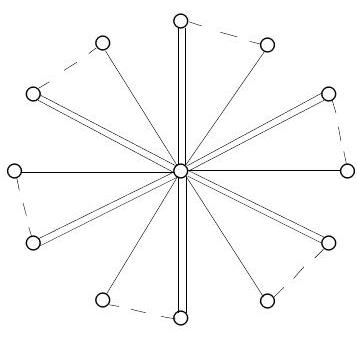
|
| 160 |
+
|
| 161 |
+
Figure 1
|
| 162 |
+
|
| 163 |
+
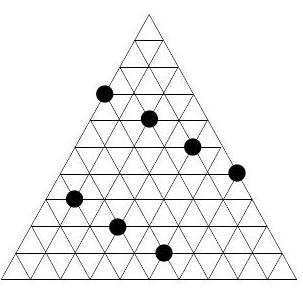
|
| 164 |
+
|
| 165 |
+
Figure 2
|
| 166 |
+
|
| 167 |
+
13. An equilateral triangle $A B C$ is divided into 100 congruent equilateral triangles. What is the greatest number of vertices of small triangles that can be chosen so that no two of them lie on a line that is parallel to any of the sides of the triangle $A B C$ ?
|
| 168 |
+
|
| 169 |
+
Solution. An example for 7 vertices is shown in Figure 2. Now assume we have chosen 8 vertices satisfying the conditions of the problem. Let the height of each small triangle be equal to 1 and denote by $a_{i}, b_{i}, c_{i}$ the distance of the $i$ th point from the three sides of the big triangle. For any $i=1,2, \ldots, 8$ we then have $a_{i}, b_{i}, c_{i} \geq 0$ and $a_{i}+b_{i}+c_{i}=10$. Thus, $\left(a_{1}+a_{2}+\cdots+a_{8}\right)+\left(b_{1}+b_{2}+\cdots+b_{8}\right)+\left(c_{1}+c_{2}+\cdots+c_{8}\right)=80$. On the other hand, each of the sums in the brackets is not less than $0+1+\cdots+7=28$, but $3 \cdot 28=84>80$, a contradiction.
|
| 170 |
+
|
| 171 |
+
14. A square is divided into 16 equal squares, obtaining the set of 25 different vertices. What is the least number of vertices one must remove from this set, so that no 4 points of the remaining set are the vertices of any square with sides parallel to the sides of the initial square?
|
| 172 |
+
|
| 173 |
+
Remark. The proposed solution to this problem claimed that it is enough to remove 7 vertices but the example to demonstrate this appeared to be incorrect. Below we show that removing 6 vertices is not sufficient but removing 8 vertices is. It seems that removing 7 vertices is not sufficient but we currently know no potential way to prove this, apart from a tedious case study.
|
| 174 |
+
|
| 175 |
+
Solution. The example in Figure 3a demonstrates that it suffices to remove 8 vertices to "destroy" all squares. Assume now that we have managed to do that by removing only 6 vertices. Denote the horizontal and vertical lines by $A, B, \ldots, E$ and $1,2, \ldots, 5$ respectively. Obviously, one of the removed vertices must be a vertex of the big square - let this be vertex $A 1$. Then, in order to "destroy" all the squares shown in Figure $3 \mathrm{~b}-\mathrm{e}$ we have to remove vertices $B 2, C 3, D 4, D 2$ and $B 4$. Thus we have removed 6 vertices without having any choice but a square shown in Figure $3 \mathrm{f}$ is still left intact.
|
| 176 |
+
|
| 177 |
+
12345
|
| 178 |
+
|
| 179 |
+
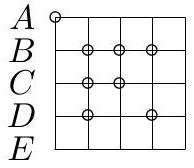
|
| 180 |
+
|
| 181 |
+
$\mathrm{a}$
|
| 182 |
+
|
| 183 |
+
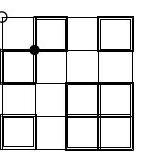
|
| 184 |
+
|
| 185 |
+
$\mathrm{b}$
|
| 186 |
+
|
| 187 |
+
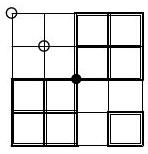
|
| 188 |
+
|
| 189 |
+
c
|
| 190 |
+
|
| 191 |
+
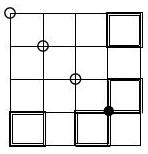
|
| 192 |
+
|
| 193 |
+
d
|
| 194 |
+
|
| 195 |
+
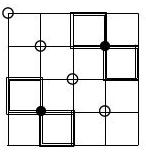
|
| 196 |
+
|
| 197 |
+
e
|
| 198 |
+
|
| 199 |
+
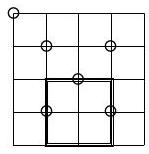
|
| 200 |
+
|
| 201 |
+
f
|
| 202 |
+
|
| 203 |
+
Figure 3
|
| 204 |
+
|
| 205 |
+
15. On each face of two dice some positive integer is written. The two dice are thrown and the numbers on the top faces are added. Determine whether one can select the integers on the faces so that the possible sums are $2,3,4,5,6,7,8,9,10,11,12,13$, all equally likely?
|
| 206 |
+
|
| 207 |
+
Solution. We can write 1, 2, 3, 4, 5, 6 on the sides of one die and 1, 1, 1, 7, 7, 7 on the sides of the other. Then each of the 12 possible sums appears in exactly 3 cases.
|
| 208 |
+
|
| 209 |
+
16. Two circles, both with the same radius $r$, are placed in the plane without intersecting each other. A line in the plane intersects the first circle at the points $A, B$ and the other at the points $C, D$ so that $|A B|=|B C|=|C D|=14 \mathrm{~cm}$. Another line intersects the circles at points $E, F$ and $G, H$ respectively, so that $|E F|=|F G|=|G H|=6 \mathrm{~cm}$. Find the radius $r$.
|
| 210 |
+
|
| 211 |
+
Solution. First, note that the centres $O_{1}$ and $O_{2}$ of the two circles lie on different sides of the line $E H-$ otherwise we have $r<12$ and $A B$ cannot be equal to 14 . Let $P$ be the intersection point of $E H$ and $O_{1} O_{2}$ (see Figure 4). Points $A$ and $D$ lie on the same side of the line $O_{1} O_{2}$ (otherwise the three lines $A D, E H$ and $O_{1} O_{2}$ would intersect in $P$ and $|A B|=|B C|=|C D|,|E F|=|F G|=|G H|$ would imply $|B C|=|F G|$, a contradiction). It is easy to see that $\left|O_{1} O_{2}\right|=2 \cdot\left|O_{1} P\right|=|A C|=28 \mathrm{~cm}$. Let $h=\left|O_{1} T\right|$ be the height of triangle $O_{1} E P$. Then we have $h^{2}=14^{2}-6^{2}=160$ from triangle $O_{1} T P$ and $r^{2}=h^{2}+3^{2}=169$ from triangle $O_{1} T F$. Thus $r=13 \mathrm{~cm}$.
|
| 212 |
+
|
| 213 |
+

|
| 214 |
+
|
| 215 |
+
Figure 4
|
| 216 |
+
|
| 217 |
+
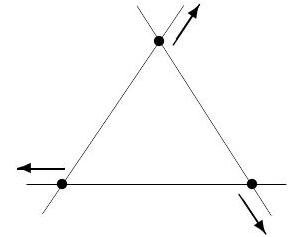
|
| 218 |
+
|
| 219 |
+
Figure 5
|
| 220 |
+
|
| 221 |
+
17. Let's consider three pairwise non-parallel straight lines in the plane. Three points are moving along these lines with different non-zero velocities, one on each line (we consider the movement as having taken place for infinite time and continuing infinitely in the future). Is it possible to determine these straight lines, the velocities of each moving point and their positions at some "zero" moment in such a way that the points never were, are or will be collinear?
|
| 222 |
+
|
| 223 |
+
Solution. Yes, it is. First, place the three points at the vertices of an equilateral triangle at the "zero" moment and let them move with equal velocities along the straight lines determined by the sides of the
|
| 224 |
+
triangle as shown in Figure 5. Then, at any moment in the past or future, the points are located at the vertices of some equilateral triangle, and thus cannot be collinear. Finally, to make the velocities of the points also differ, take any non-zero constant vector such that its projections on the three lines have different lengths and add it to each of the velocity vectors. This is equivalent to making the whole picture "drift" across the plane with constant velocity, so the non-collinearity of our points is preserved (in fact, they are still located at the vertices of an equilateral triangle at any given moment).
|
| 225 |
+
|
| 226 |
+
18. In the triangle $A B C$ we have $|A B|=15,|B C|=12$ and $|A C|=13$. Let the median $A M$ and bisector $B K$ intersect at point $O$, where $M \in B C, K \in A C$. Let $O L \perp A B$, where $L \in A B$. Prove that $\angle O L K=\angle O L M$. Solution. Let the line $O C$ intersect $A B$ in point $P$. As $A M$ is a median, we have $\frac{|A P|}{|P B|}=\frac{|A K|}{|K C|}$ (this obviously holds if $|A B|=|A C|$ and the equality is preserved under uniform compression of the plane along $B K)$. Applying the sine theorem to the triangles $A B K$ and $B C K$ we obtain $\frac{|A P|}{|P B|}=\frac{|A K|}{|K C|}=\frac{|A B|}{|B C|}=\frac{5}{4}$ (see Figure 6). As $|A P|+|P B|=|A B|=15$, we have $|A P|=\frac{25}{3}$ and $|P B|=\frac{20}{3}$. Thus $|A C|^{2}-|B C|^{2}=$ $25=|A P|^{2}-|B P|^{2}$ and $|A C|^{2}-|A P|^{2}=|B C|^{2}-|B P|^{2}$. Applying now the cosine theorem to the triangles $A P C$ and $B P C$ we get $\cos \angle A P C=\cos \angle B P C$, i.e., $P=L$. As above, we can use a compression of the plane to show that $K P \| B C$ and therefore $\angle O P K=\angle O C B$. As $|B M|=|M C|$ and $\angle B P C=90^{\circ}$ we have $\angle O C B=\angle O P M$. Combining these equalities, we get $\angle O L K=\angle O P K=\angle O C B=\angle O P M=\angle O L M$.
|
| 227 |
+
|
| 228 |
+

|
| 229 |
+
|
| 230 |
+
Figure 6
|
| 231 |
+
|
| 232 |
+

|
| 233 |
+
|
| 234 |
+
Figure 7
|
| 235 |
+
|
| 236 |
+

|
| 237 |
+
|
| 238 |
+
Figure 8
|
| 239 |
+
|
| 240 |
+
19. A convex quadrangle $A B C D$ is inscribed in a circle with the centre $O$. The angles $\angle A O B, \angle B O C, \angle C O D$ and $\angle D O A$, taken in some order, are of the same size as the angles of quadrangle $A B C D$. Prove that $A B C D$ is a square.
|
| 241 |
+
|
| 242 |
+
Solution. As the quadrangle $A B C D$ is inscribed in a circle, we have $\angle A B C+\angle C D A=\angle B C D+\angle D A B=$ $180^{\circ}$. It suffices to show that if each of these angles is equal to $90^{\circ}$, then each of the angles $A O B, B O C$, $C O D$ and $D O A$ is also equal to $90^{\circ}$ and thus $A B C D$ is a square. We consider the two possible situations:
|
| 243 |
+
|
| 244 |
+
(a) At least one of the diagonals of $A B C D$ is a diameter - say, $\angle A O B+\angle B O C=180^{\circ}$. Then $\angle A B C=$ $\angle C D A=90^{\circ}$ and at least two of the angles $A O B, B O C, C O D$ and $D O A$ must be $90^{\circ}$ : say, $\angle A O B=$ $\angle B O C=90^{\circ}$. Now, $\angle C O D=\angle D A B$ and $\angle D O A=\angle B C D$ (see Figure 7). Using the fact that $\frac{1}{2} \angle D O A=\angle D C A=\angle B C D-45^{\circ}$ we have $\angle B C D=\angle D A B=90^{\circ}$.
|
| 245 |
+
|
| 246 |
+
(b) None of the diagonals of the quadrangle $A B C D$ is a diameter. Then $\angle A O B+\angle C O D=\angle B O C+$ $\angle D O A=180^{\circ}$ and no angle of the quadrangle $A B C D$ is equal to $90^{\circ}$. Consequently, none of the angles $A O B, B O C, C O D$ and $D O A$ is equal to $90^{\circ}$. Without loss of generality we assume that $\angle A O B>90^{\circ}$, $\angle B O C>90^{\circ}$ (see Figure 8). Then $\angle A B C<90^{\circ}$ and thus $\angle A B C=\angle C O D$ or $\angle A B C=\angle D O A$. As $\angle C O D+\angle D O A=\angle A O C=2 \angle A B C$, we have $\angle C O D=\angle D O A$ and $\angle A O B+\angle D O A=180^{\circ}$, a contradiction.
|
| 247 |
+
|
| 248 |
+
20. Let $Q$ be a unit cube. We say a tetrahedron is "good" if all its edges are equal and all its vertices lie on the boundary of $Q$. Find all possible volumes of "good" tetrahedra.
|
| 249 |
+
|
| 250 |
+
Solution. Clearly, the volume of a regular tetrahedron contained in a sphere reaches its maximum value if and only if all four vertices of the tetrahedron lie on the surface of the sphere. Therefore, a "good" tetrahedron with maximum volume must have its vertices at the vertices of the cube (for a proof, inscribe the cube in a sphere). There are exactly two such tetrahedra, their volume being equal to $1-4 \cdot \frac{1}{6}=\frac{1}{3}$. On the other hand, one can find arbitrarily small "good" tetrahedra by applying homothety to the maximal tetrahedron, with the centre of the homothety in one of its vertices.
|
| 251 |
+
|
BalticWay/md/en-bw94sol.md
ADDED
|
@@ -0,0 +1,308 @@
|
|
|
|
|
|
|
|
|
|
|
|
|
|
|
|
|
|
|
|
|
|
|
|
|
|
|
|
|
|
|
|
|
|
|
|
|
|
|
|
|
|
|
|
|
|
|
|
|
|
|
|
|
|
|
|
|
|
|
|
|
|
|
|
|
|
|
|
|
|
|
|
|
|
|
|
|
|
|
|
|
|
|
|
|
|
|
|
|
|
|
|
|
|
|
|
|
|
|
|
|
|
|
|
|
|
|
|
|
|
|
|
|
|
|
|
|
|
|
|
|
|
|
|
|
|
|
|
|
|
|
|
|
|
|
|
|
|
|
|
|
|
|
|
|
|
|
|
|
|
|
|
|
|
|
|
|
|
|
|
|
|
|
|
|
|
|
|
|
|
|
|
|
|
|
|
|
|
|
|
|
|
|
|
|
|
|
|
|
|
|
|
|
|
|
|
|
|
|
|
|
|
|
|
|
|
|
|
|
|
|
|
|
|
|
|
|
|
|
|
|
|
|
|
|
|
|
|
|
|
|
|
|
|
|
|
|
|
|
|
|
|
|
|
|
|
|
|
|
|
|
|
|
|
|
|
|
|
|
|
|
|
|
|
|
|
|
|
|
|
|
|
|
|
|
|
|
|
|
|
|
|
|
|
|
|
|
|
|
|
|
|
|
|
|
|
|
|
|
|
|
|
|
|
|
|
|
|
|
|
|
|
|
|
|
|
|
|
|
|
|
|
|
|
|
|
|
|
|
|
|
|
|
|
|
|
|
|
|
|
|
|
|
|
|
|
|
|
|
|
|
|
|
|
|
|
|
|
|
|
|
|
|
|
|
|
|
|
|
|
|
|
|
|
|
|
|
|
|
|
|
|
|
|
|
|
|
|
|
|
|
|
|
|
|
|
|
|
|
|
|
|
|
|
|
|
|
|
|
|
|
|
|
|
|
|
|
|
|
|
|
|
|
|
|
|
|
|
|
|
|
|
|
|
|
|
|
|
|
|
|
|
|
|
|
|
|
|
|
|
|
|
|
|
|
|
|
|
|
|
|
|
|
|
|
|
|
|
|
|
|
|
|
|
|
|
|
|
|
|
|
|
|
|
|
|
|
|
|
|
|
|
|
|
|
|
|
|
|
|
|
|
|
|
|
|
|
|
|
|
|
|
|
|
|
|
|
|
|
|
|
|
|
|
|
|
|
|
|
|
|
|
|
|
|
|
|
|
|
|
|
|
|
|
|
|
|
|
|
|
|
|
|
|
|
|
|
|
|
|
|
|
|
|
|
|
|
|
|
|
|
|
|
|
|
|
|
|
|
|
|
|
|
|
|
|
|
|
|
|
|
|
|
|
|
|
|
|
|
|
|
|
|
|
|
|
|
|
|
|
|
|
|
|
|
|
|
|
|
|
|
|
|
|
|
|
|
|
|
|
|
|
|
|
|
|
|
|
|
|
|
|
|
|
|
|
|
|
|
|
|
|
|
|
|
|
|
|
|
|
|
|
|
|
|
|
|
|
|
|
|
|
|
|
|
|
|
|
|
|
|
|
|
|
|
|
|
|
|
|
|
|
|
|
|
|
|
|
|
|
|
|
|
|
|
|
|
|
|
|
|
|
|
|
|
|
|
|
|
|
|
|
|
|
|
|
|
|
|
|
|
|
|
|
|
|
|
|
|
|
|
|
|
|
|
|
|
|
|
|
|
|
|
|
|
|
|
|
|
|
|
|
|
|
|
|
|
|
|
|
|
|
|
|
|
|
|
|
|
|
|
|
|
|
|
|
|
|
|
|
|
|
|
|
|
|
|
|
|
|
|
|
|
|
|
|
|
|
|
|
|
|
|
|
|
|
|
|
|
|
|
|
|
|
|
|
|
|
|
|
|
|
|
|
|
|
|
|
|
|
|
|
|
|
|
|
|
|
|
|
|
|
|
|
|
|
|
|
|
|
|
|
|
|
|
|
|
|
|
|
|
|
|
|
|
|
|
|
|
|
|
|
|
|
|
|
|
|
|
|
|
|
|
|
|
|
|
|
|
|
|
|
|
|
|
|
|
|
|
|
|
|
|
|
|
|
|
|
|
|
|
|
|
|
|
|
|
|
| 1 |
+
# Baltic Way 1994
|
| 2 |
+
|
| 3 |
+
## Tartu, November 11, 1994
|
| 4 |
+
|
| 5 |
+
## Problems and solutions
|
| 6 |
+
|
| 7 |
+
1. Let $a \circ b=a+b-a b$. Find all triples $(x, y, z)$ of integers such that $(x \circ y) \circ z+(y \circ z) \circ x+(z \circ x) \circ y=0$.
|
| 8 |
+
|
| 9 |
+
Solution. Note that
|
| 10 |
+
|
| 11 |
+
$$
|
| 12 |
+
(x \circ y) \circ z=x+y+z-x y-y z-x z+x y z=(x-1)(y-1)(z-1)+1 .
|
| 13 |
+
$$
|
| 14 |
+
|
| 15 |
+
Hence
|
| 16 |
+
|
| 17 |
+
$$
|
| 18 |
+
(x \circ y) \circ z+(y \circ z) \circ x+(z \circ x) \circ y=3((x-1)(y-1)(z-1)+1) \text {. }
|
| 19 |
+
$$
|
| 20 |
+
|
| 21 |
+
Now, if the required equality holds we have $(x-1)(y-1)(z-1)=-1$. There are only four possible decompositions of -1 into a product of three integers. Thus we have four such triples, namely $(0,0,0)$, $(0,2,2),(2,0,2)$ and $(2,2,0)$.
|
| 22 |
+
|
| 23 |
+
2. Let $a_{1}, a_{2}, \ldots, a_{9}$ be any non-negative numbers such that $a_{1}=a_{9}=0$ and at least one of the numbers is non-zero. Prove that for some $i, 2 \leq i \leq 8$, the inequality $a_{i-1}+a_{i+1}<2 a_{i}$ holds. Will the statement remain true if we change the number 2 in the last inequality to $1.9 ?$
|
| 24 |
+
|
| 25 |
+
Solution. Suppose we have the opposite inequality $a_{i-1}+a_{i+1} \geq 2 a_{i}$ for all $i=2, \ldots, 8$. Let $a_{k}=\max _{1 \leq i \leq 9} a_{i}$. Then we have $a_{k-1}=a_{k+1}=a_{k}, a_{k-2}=a_{k-1}=a_{k}$, etc. Finally we get $a_{1}=a_{k}$, a contradiction.
|
| 26 |
+
|
| 27 |
+
Suppose now $a_{i-1}+a_{i+1} \geq 1.9 a_{i}$, i.e., $a_{i+1} \geq 1.9 a_{i}-a_{i-1}$ for all $i=2, \ldots, 8$, and let $a_{k}=\max _{1 \leq i \leq 9} a_{i}$. We can multiply all numbers $a_{1}, \ldots, a_{9}$ by the same positive constant without changing the situation in any way, so we assume $a_{k}=1$. Then we have $a_{k-1}+a_{k+1} \geq 1.9$ and hence $0.9 \leq a_{k-1}, a_{k+1} \leq 1$. Moreover, at least one of the numbers $a_{k-1}, a_{k+1}$ must be greater than or equal to 0.95 - let us assume $a_{k+1} \geq 0.95$. Now, we consider two sub-cases:
|
| 28 |
+
|
| 29 |
+
(a) $k \geq 5$. Then we have
|
| 30 |
+
|
| 31 |
+
$$
|
| 32 |
+
\begin{aligned}
|
| 33 |
+
1 \geq a_{k+1} & \geq 0.95>0 \\
|
| 34 |
+
1 \geq a_{k+2} & \geq 1.9 a_{k+1}-a_{k} \geq 1.9 \cdot 0.95-1=0.805>0 \\
|
| 35 |
+
a_{k+3} & \geq 1.9 a_{k+2}-a_{k+1} \geq 1.9 \cdot 0.805-1=0.5295>0 \\
|
| 36 |
+
a_{k+4} & \geq 1.9 a_{k+3}-a_{k+2} \geq 1.9 \cdot 0.5295-1=0.00605>0
|
| 37 |
+
\end{aligned}
|
| 38 |
+
$$
|
| 39 |
+
|
| 40 |
+
So in any case we have $a_{9}>0$, a contradiction.
|
| 41 |
+
|
| 42 |
+
(b) $k \leq 4$. In this case we obtain
|
| 43 |
+
|
| 44 |
+
$$
|
| 45 |
+
\begin{aligned}
|
| 46 |
+
1 \geq a_{k-1} & \geq 0.9>0 \\
|
| 47 |
+
a_{k-2} & \geq 1.9 a_{k-1}-a_{k} \geq 1.9 \cdot 0.9-1=0.71>0 \\
|
| 48 |
+
a_{k-3} & \geq 1.9 a_{k-2}-a_{k-1} \geq 1.9 \cdot 0.71-1=0.349>0
|
| 49 |
+
\end{aligned}
|
| 50 |
+
$$
|
| 51 |
+
|
| 52 |
+
and hence $a_{1}>0$, contrary to the condition of the problem.
|
| 53 |
+
|
| 54 |
+
3. Find the largest value of the expression
|
| 55 |
+
|
| 56 |
+
$$
|
| 57 |
+
x y+x \sqrt{1-y^{2}}+y \sqrt{1-x^{2}}-\sqrt{\left(1-x^{2}\right)\left(1-y^{2}\right)}
|
| 58 |
+
$$
|
| 59 |
+
|
| 60 |
+
Solution. The expression is well-defined only for $|x|,|y| \leq 1$ and we can assume that $x, y \geq 0$. Let $x=\cos \alpha$ and $y=\cos \beta$ for some $0 \leq \alpha, \beta \leq \frac{\pi}{2}$. This reduces the expression to
|
| 61 |
+
|
| 62 |
+
$$
|
| 63 |
+
\cos \alpha \cos \beta+\cos \alpha \sin \beta+\cos \beta \sin \alpha-\sin \alpha \sin \beta=\cos (\alpha+\beta)+\sin (\alpha+\beta)=\sqrt{2} \cdot \sin \left(\alpha+\beta+\frac{\pi}{4}\right)
|
| 64 |
+
$$
|
| 65 |
+
|
| 66 |
+
which does not exceed $\sqrt{2}$. The equality holds when $\alpha+\beta+\frac{\pi}{4}=\frac{\pi}{2}$, for example when $\alpha=\frac{\pi}{4}$ and $\beta=0$, i.e., $x=\frac{\sqrt{2}}{2}$ and $y=1$.
|
| 67 |
+
|
| 68 |
+
4. Is there an integer $n$ such that $\sqrt{n-1}+\sqrt{n+1}$ is a rational number?
|
| 69 |
+
|
| 70 |
+
Solution. Inverting the relation gives
|
| 71 |
+
|
| 72 |
+
$$
|
| 73 |
+
\frac{q}{p}=\frac{1}{\sqrt{n+1}+\sqrt{n-1}}=\frac{\sqrt{n+1}-\sqrt{n-1}}{(\sqrt{n+1}+\sqrt{n-1})(\sqrt{n+1}-\sqrt{n-1})}=\frac{\sqrt{n+1}-\sqrt{n-1}}{2} .
|
| 74 |
+
$$
|
| 75 |
+
|
| 76 |
+
Hence we get the system of equations
|
| 77 |
+
|
| 78 |
+
$$
|
| 79 |
+
\left\{\begin{array}{l}
|
| 80 |
+
\sqrt{n+1}+\sqrt{n-1}=\frac{p}{q} \\
|
| 81 |
+
\sqrt{n+1}-\sqrt{n-1}=\frac{2 q}{p}
|
| 82 |
+
\end{array}\right.
|
| 83 |
+
$$
|
| 84 |
+
|
| 85 |
+
Adding these equations and dividing by 2 gives $\sqrt{n+1}=\frac{2 q^{2}+p^{2}}{2 p q}$. This implies $4 n p^{2} q^{2}=4 q^{4}+p^{4}$.
|
| 86 |
+
|
| 87 |
+
Suppose now that $n, p$ and $q$ are all positive integers with $p$ and $q$ relatively prime. The relation $4 n p^{2} q^{2}=$ $4 q^{4}+p^{4}$ shows that $p^{4}$, and hence $p$, is divisible by 2 . Letting $p=2 P$ we obtain $4 n P^{2} q^{2}=q^{4}+4 P^{4}$ which shows that $q$ must also be divisible by 2 . This contradicts the assumption that $p$ and $q$ are relatively prime.
|
| 88 |
+
|
| 89 |
+
5. Let $p(x)$ be a polynomial with integer coefficients such that both equations $p(x)=1$ and $p(x)=3$ have integer solutions. Can the equation $p(x)=2$ have two different integer solutions?
|
| 90 |
+
|
| 91 |
+
Solution. Observe first that if $a$ and $b$ are two different integers then $p(a)-p(b)$ is divisible by $a-b$. Suppose now that $p(a)=1$ and $p(b)=3$ for some integers $a$ and $b$. If we have $p(c)=2$ for some integer $c$, then $c-b= \pm 1$ and $c-a= \pm 1$, hence there can be at most one such integer $c$.
|
| 92 |
+
|
| 93 |
+
6. Prove that any irreducible fraction $\frac{p}{q}$, where $p$ and $q$ are positive integers and $q$ is odd, is equal to a fraction $\frac{n}{2^{k}-1}$ for some positive integers $n$ and $k$.
|
| 94 |
+
|
| 95 |
+
Solution. Since the number of congruence classes modulo $q$ is finite, there exist two non-negative integers $i$ and $j$ with $i>j$ which satisfy $2^{i} \equiv 2^{j}(\bmod q)$. Hence, $q$ divides the number $2^{i}-2^{j}=2^{j}\left(2^{i-j}-1\right)$. Since $q$ is odd, $q$ has to divide $2^{i-j}-1$. Now it suffices to multiply the numerator and denominator of the fraction $\frac{p}{q}$ by $\frac{2^{i-j}-1}{q}$.
|
| 96 |
+
|
| 97 |
+
7. Let $p>2$ be a prime number and $1+\frac{1}{2^{3}}+\frac{1}{3^{3}}+\cdots+\frac{1}{(p-1)^{3}}=\frac{m}{n}$ where $m$ and $n$ are relatively prime. Show that $m$ is a multiple of $p$.
|
| 98 |
+
|
| 99 |
+
Solution. The sum has an even number of terms; they can be joined in pairs in such a way that the sum is the sum of the terms
|
| 100 |
+
|
| 101 |
+
$$
|
| 102 |
+
\frac{1}{k^{3}}+\frac{1}{(p-k)^{3}}=\frac{p^{3}-3 p^{2} k+3 p k^{2}}{k^{3}(p-k)^{3}} .
|
| 103 |
+
$$
|
| 104 |
+
|
| 105 |
+
The sum of all terms of this type has a denominator in which every prime factor is less than $p$ while the numerator has $p$ as a factor.
|
| 106 |
+
|
| 107 |
+
8. Show that for any integer $a \geq 5$ there exist integers $b$ and $c, c \geq b \geq a$, such that $a, b, c$ are the lengths of the sides of a right-angled triangle.
|
| 108 |
+
|
| 109 |
+
Solution. We first show this for odd numbers $a=2 i+1 \geq 3$. Put $c=2 k+1$ and $b=2 k$. Then $c^{2}-b^{2}=(2 k+1)^{2}-(2 k)^{2}=4 k+1=a^{2}$. Now $a=2 i+1$ and thus $a^{2}=4 i^{2}+4 i+1$ and $k=i^{2}+i$. Furthermore, $c>b=2 i^{2}+2 i>2 i+1=a$.
|
| 110 |
+
|
| 111 |
+
Since any multiple of a Pythagorean triple (i.e., a triple of integers $(x, y, z)$ such that $x^{2}+y^{2}=z^{2}$ ) is also a Pythagorean triple we see that the statement is also true for all even numbers which have an odd factor. Hence only the powers of 2 remain. But for 8 we have the triple $(8,15,17)$ and hence all higher powers of 2 are also minimum values of such a triple.
|
| 112 |
+
|
| 113 |
+
9. Find all pairs of positive integers $(a, b)$ such that $2^{a}+3^{b}$ is the square of an integer.
|
| 114 |
+
|
| 115 |
+
Solution. Considering the equality $2^{a}+3^{b}=n^{2}$ modulo 3 it is easy to see that $a$ must be even. Obviously $n$ is odd so we may take $a=2 x, n=2 y+1$ and write the equality as $4^{x}+3^{b}=(2 y+1)^{2}=4 y^{2}+4 y+1$. Hence $3^{b} \equiv 1(\bmod 4)$ which implies $b=2 z$ for some positive integer $z$. So we get $4^{x}+9^{z}=(2 y+1)^{2}$ and $4^{x}=\left(2 y+1-3^{z}\right)\left(2 y+1+3^{z}\right)$. Both factors on the right-hand side are even numbers but at most one of them is divisible by 4 (since their sum is not divisible by 4 ). Hence $2 y+1-3^{z}=2$ and $2 y+1+3^{z}=2^{2 x-1}$. These two equalities yield $2 \cdot 3^{z}=2^{2 x-1}-2$ and $3^{z}=4^{x-1}-1$. Clearly $x>1$ and a simple argument
|
| 116 |
+
modulo 10 gives $z=4 d+1, x-1=2 e+1$ for some non-negative integers $d$ and $e$. Substituting, we get $3^{4 d+1}=4^{2 e+1}-1$ and $3 \cdot(80+1)^{d}=4^{2 e+1}-1$. If $d \geq 1$ then $e \geq 1$, a contradiction (expanding the left-hand expression and moving everything to the left we find that all summands but one are divisible by $4^{2}$ ). Hence $e=d=0, z=1, b=2, x=2$ and $a=4$, and we obtain the classical $2^{4}+3^{2}=4^{2}+3^{2}=5^{2}$.
|
| 117 |
+
|
| 118 |
+
10. How many positive integers satisfy the following three conditions:
|
| 119 |
+
|
| 120 |
+
(i) All digits of the number are from the set $\{1,2,3,4,5\}$;
|
| 121 |
+
|
| 122 |
+
(ii) The absolute value of the difference between any two consecutive digits is 1 ;
|
| 123 |
+
|
| 124 |
+
(iii) The integer has 1994 digits?
|
| 125 |
+
|
| 126 |
+
Solution. Consider all positive integers with $2 n$ digits satisfying conditions $(i)$ and (ii) of the problem. Let the number of such integers beginning with $1,2,3,4$ and 5 be $a_{n}, b_{n}, c_{n}, d_{n}$ and $e_{n}$, respectively. Then, for $n=1$ we have $a_{1}=1$ (integer 12), $b_{1}=2$ (integers 21 and 23), $c_{1}=2$ (integers 32 and 34$), d_{1}=2$ (integers 43 and 45) and $e_{1}=1$ (integer 54). Observe that $c_{1}=a_{1}+e_{1}$.
|
| 127 |
+
|
| 128 |
+
Suppose now that $n>1$, i.e., the integers have at least four digits. If an integer begins with the digit 1 then the second digit is 2 while the third can be 1 or 3 . This gives the relation
|
| 129 |
+
|
| 130 |
+
$$
|
| 131 |
+
a_{n}=a_{n-1}+c_{n-1} \text {. }
|
| 132 |
+
$$
|
| 133 |
+
|
| 134 |
+
Similarly, if the first digit is 5 , then the second is 4 while the third can be 3 or 5 . This implies
|
| 135 |
+
|
| 136 |
+
$$
|
| 137 |
+
e_{n}=c_{n-1}+e_{n-1}
|
| 138 |
+
$$
|
| 139 |
+
|
| 140 |
+
If the integer begins with 23 then the third digit is 2 or 4 . If the integer begins with 21 then the third digit is 2 . From this we can conclude that
|
| 141 |
+
|
| 142 |
+
$$
|
| 143 |
+
b_{n}=2 b_{n-1}+d_{n-1} \text {. }
|
| 144 |
+
$$
|
| 145 |
+
|
| 146 |
+
In the same manner we can show that
|
| 147 |
+
|
| 148 |
+
$$
|
| 149 |
+
d_{n}=b_{n-1}+2 d_{n-1} .
|
| 150 |
+
$$
|
| 151 |
+
|
| 152 |
+
If the integer begins with 32 then the third digit must be 1 or 3 , and if it begins with 34 the third digit is 3 or 5 . Hence
|
| 153 |
+
|
| 154 |
+
$$
|
| 155 |
+
c_{n}=a_{n-1}+2 c_{n-1}+e_{n-1} \text {. }
|
| 156 |
+
$$
|
| 157 |
+
|
| 158 |
+
From (1), (2) and (5) it follows that $c_{n}=a_{n}+e_{n}$, which is true for all $n \geq 1$. On the other hand, adding the relations (1)-(5) results in
|
| 159 |
+
|
| 160 |
+
$$
|
| 161 |
+
a_{n}+b_{n}+c_{n}+d_{n}+e_{n}=2 a_{n-1}+3 b_{n-1}+4 c_{n-1}+3 d_{n-1}+2 e_{n-1}
|
| 162 |
+
$$
|
| 163 |
+
|
| 164 |
+
and, since $c_{n-1}=a_{n-1}+e_{n-1}$,
|
| 165 |
+
|
| 166 |
+
$$
|
| 167 |
+
a_{n}+b_{n}+c_{n}+d_{n}+e_{n}=3\left(a_{n-1}+b_{n-1}+c_{n-1}+d_{n-1}+e_{n-1}\right)
|
| 168 |
+
$$
|
| 169 |
+
|
| 170 |
+
Thus the number of integers satisfying conditions $(i)$ and $(i i)$ increases three times when we increase the number of digits by 2 . Since the number of such integers with two digits is 8 , and $1994=2+2 \cdot 996$, the number of integers satisfying all three conditions is $8 \cdot 3^{996}$.
|
| 171 |
+
|
| 172 |
+
11. Let $N S$ and $E W$ be two perpendicular diameters of a circle $\mathcal{C}$. A line $l$ touches $\mathcal{C}$ at point $S$. Let $A$ and $B$ be two points on $\mathcal{C}$, symmetric with respect to the diameter $E W$. Denote the intersection points of $l$ with the lines $N A$ and $N B$ by $A^{\prime}$ and $B^{\prime}$, respectively. Show that $\left|S A^{\prime}\right| \cdot\left|S B^{\prime}\right|=|S N|^{2}$.
|
| 173 |
+
|
| 174 |
+
Solution. We have $\angle N A S=\angle N B S=90^{\circ}$ (see Figure 1). Thus, the triangles $N A^{\prime} S$ and $N S A$ are similar. Also, the triangles $B^{\prime} N S$ and $S N B$ are similar and the triangles $N S A$ and $S N B$ are congruent. Hence, the triangles $N A^{\prime} S$ and $B^{\prime} N S$ are similar which implies $\frac{S A^{\prime}}{S N}=\frac{S N}{S B^{\prime}}$ and $S A^{\prime} \cdot S B^{\prime}=S N^{2}$.
|
| 175 |
+
|
| 176 |
+
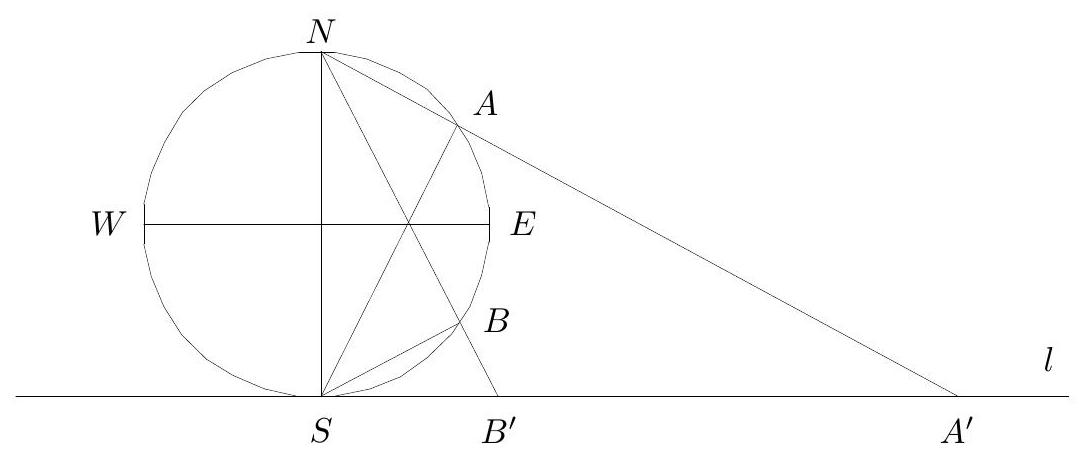
|
| 177 |
+
|
| 178 |
+
Figure 1
|
| 179 |
+
|
| 180 |
+
12. The inscribed circle of the triangle $A_{1} A_{2} A_{3}$ touches the sides $A_{2} A_{3}, A_{3} A_{1}$ and $A_{1} A_{2}$ at points $S_{1}, S_{2}, S_{3}$, respectively. Let $O_{1}, O_{2}, O_{3}$ be the centres of the inscribed circles of triangles $A_{1} S_{2} S_{3}, A_{2} S_{3} S_{1}$ and $A_{3} S_{1} S_{2}$, respectively. Prove that the straight lines $O_{1} S_{1}, O_{2} S_{2}$ and $O_{3} S_{3}$ intersect at one point.
|
| 181 |
+
|
| 182 |
+
Solution. We shall prove that the lines $S_{1} O_{1}, S_{2} O_{2}, S_{3} O_{3}$ are the bisectors of the angles of the triangle $S_{1} S_{2} S_{3}$. Let $O$ and $r$ be the centre and radius of the inscribed circle $C$ of the triangle $A_{1} A_{2} A_{3}$. Further, let $P_{1}$ and $H_{1}$ be the points where the inscribed circle of the triangle $A_{1} S_{2} S_{3}$ (with the centre $O_{1}$ and radius $r_{1}$ ) touches its sides $A_{1} S_{2}$ and $S_{2} S_{3}$, respectively (see Figure 2). To show that $S_{1} O_{1}$ is the bisector of the angle $\angle S_{3} S_{1} S_{2}$ it is sufficient to prove that $O_{1}$ lies on the circumference of circle $C$, for in this case the arcs $O_{1} S_{2}$ and $O_{1} S_{3}$ will obviously be equal. To prove this, first note that as $A_{1} S_{2} S_{3}$ is an isosceles triangle the point $H_{1}$, as well as $O_{1}$, lies on the straight line $A_{1} O$. Now, it suffices to show that $\left|O H_{1}\right|=r-r_{1}$. Indeed, we have
|
| 183 |
+
|
| 184 |
+
$$
|
| 185 |
+
\begin{aligned}
|
| 186 |
+
& \frac{r-r_{1}}{r}=1-\frac{r_{1}}{r}=1-\frac{\left|O_{1} P_{1}\right|}{\left|O S_{2}\right|}=1-\frac{\left|P_{1} A_{1}\right|}{\left|S_{2} A_{1}\right|}=\frac{\left|S_{2} A_{1}\right|-\left|P_{1} A_{1}\right|}{\left|S_{2} A_{1}\right|} \\
|
| 187 |
+
& =\frac{\left|S_{2} P_{1}\right|}{\left|S_{2} A_{1}\right|}=\frac{\left|S_{2} H_{1}\right|}{\left|S_{2} A_{1}\right|}=\frac{\left|O H_{1}\right|}{\left|O S_{2}\right|}=\frac{\left|O H_{1}\right|}{r} .
|
| 188 |
+
\end{aligned}
|
| 189 |
+
$$
|
| 190 |
+
|
| 191 |
+
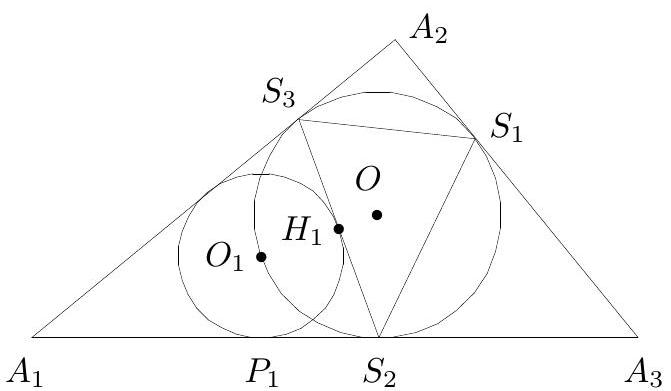
|
| 192 |
+
|
| 193 |
+
Figure 2
|
| 194 |
+
|
| 195 |
+
13. Find the smallest number $a$ such that a square of side $a$ can contain five disks of radius 1 so that no two of the disks have a common interior point.
|
| 196 |
+
|
| 197 |
+
Solution. Let $P Q R S$ be a square which has the property described in the problem. Clearly, $a>2$. Let $P^{\prime} Q^{\prime} R^{\prime} S^{\prime}$ be the square inside $P Q R S$ whose sides are at distance 1 from the sides of $P Q R S$, and, consequently, are of length $a-2$. Since all the five disks are inside $P Q R S$, their centres are inside $P^{\prime} Q^{\prime} R^{\prime} S^{\prime}$. Divide $P^{\prime} Q^{\prime} R^{\prime} S^{\prime}$ into four congruent squares of side length $\frac{a}{2}-1$. By the pigeonhole principle, at least two of the five centres are in the same small square. Their distance, then, is at most $\sqrt{2}\left(\frac{a}{2}-1\right)$. Since the distance has to be at least 2 , we have $a \geq 2+2 \sqrt{2}$. On the other hand, if $a=2+2 \sqrt{2}$, we can place the five disks in such a way that one is centred at the centre of $P Q R S$ and the other four have centres at $P^{\prime}, Q^{\prime}$, $R^{\prime}$ and $S^{\prime}$.
|
| 198 |
+
|
| 199 |
+
14. Let $\alpha, \beta, \gamma$ be the angles of a triangle opposite to its sides with lengths $a, b$ and $c$, respectively. Prove the inequality
|
| 200 |
+
|
| 201 |
+
$$
|
| 202 |
+
a \cdot\left(\frac{1}{\beta}+\frac{1}{\gamma}\right)+b \cdot\left(\frac{1}{\gamma}+\frac{1}{\alpha}\right)+c \cdot\left(\frac{1}{\alpha}+\frac{1}{\beta}\right) \geq 2 \cdot\left(\frac{a}{\alpha}+\frac{b}{\beta}+\frac{c}{\gamma}\right) \cdot
|
| 203 |
+
$$
|
| 204 |
+
|
| 205 |
+
Solution. Clearly, the inequality $a>b$ implies $\alpha>\beta$ and similarly $a<b$ implies $\alpha<\beta$, hence $(a-b)(\alpha-\beta) \geq$ 0 and $a \alpha+b \beta \geq a \beta+b \alpha$. Dividing the last equality by $\alpha \beta$ we get
|
| 206 |
+
|
| 207 |
+
$$
|
| 208 |
+
\frac{a}{\beta}+\frac{b}{\alpha} \geq \frac{a}{\alpha}+\frac{b}{\beta}
|
| 209 |
+
$$
|
| 210 |
+
|
| 211 |
+
Similarly we get
|
| 212 |
+
|
| 213 |
+
$$
|
| 214 |
+
\frac{a}{\gamma}+\frac{c}{\alpha} \geq \frac{a}{\alpha}+\frac{c}{\gamma}
|
| 215 |
+
$$
|
| 216 |
+
|
| 217 |
+
and
|
| 218 |
+
|
| 219 |
+
$$
|
| 220 |
+
\frac{b}{\gamma}+\frac{c}{\beta} \geq \frac{b}{\beta}+\frac{c}{\gamma}
|
| 221 |
+
$$
|
| 222 |
+
|
| 223 |
+
To finish the proof it suffices to add the inequalities (6)-(8).
|
| 224 |
+
|
| 225 |
+
15. Does there exist a triangle such that the lengths of all its sides and altitudes are integers and its perimeter is equal to 1995 ?
|
| 226 |
+
|
| 227 |
+
Solution. Consider a triangle $A B C$ with all its sides and heights having integer lengths. From the cosine theorem we conclude that $\cos \angle A, \cos \angle B$ and $\cos \angle C$ are rational numbers. Let $A H$ be one of the heights of the triangle $A B C$, with the point $H$ lying on the straight line determined by the side $B C$. Then $|B H|$ and $|C H|$ must be rational and hence integer (consider the Pythagorean theorem for the triangles $A B H$ and $A C H$ ). Now, if $|B H|$ and $|C H|$ have different parity then $|A B|$ and $|A C|$ also have different parity and $|B C|$ is odd. If $|B H|$ and $|C H|$ have the same parity then $|A B|$ and $|A C|$ also have the same parity and $|B C|$ is even. In both cases the perimeter of triangle $A B C$ is an even number and hence cannot be equal to 1995
|
| 228 |
+
|
| 229 |
+
Remark. In the solution we only used the fact that all three sides and one height of the triangle $A B C$ are integers.
|
| 230 |
+
|
| 231 |
+
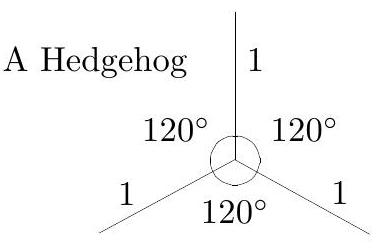
|
| 232 |
+
|
| 233 |
+
Figure 3
|
| 234 |
+
|
| 235 |
+
16. The Wonder Island is inhabited by Hedgehogs. Each Hedgehog consists of three segments of unit length having a common endpoint, with all three angles between them equal to $120^{\circ}$ (see Figure 3). Given that all Hedgehogs are lying flat on the island and no two of them touch each other, prove that there is a finite number of Hedgehogs on Wonder Island.
|
| 236 |
+
|
| 237 |
+
Solution. It suffices to prove that if the distance between the centres of two Hedgehogs is less than 0.2, then these Hedgehogs intersect. To show this, consider two Hedgehogs with their centres at points $O$ and $M$, respectively, such that $|O M|<0.2$. Let $A, B$ and $C$ be the endpoints of the needles of the first Hedgehog (see Figure 4) and draw a straight line $l$ parallel to $A C$ through the point $M$. As $|A C|=\sqrt{3}$ implies $|K L| \leq$ $\frac{0.2}{0.5}|A C|<1$ and the second Hedgehog has at least one of its needles pointing inside the triangle $O K L$, this needle intersects the first Hedgehog.
|
| 238 |
+
|
| 239 |
+
Remark. If the Hedgehogs can move their needles so that the angles between them can take any positive value then there can be an infinite number of Hedgehogs on the Wonder Island.
|
| 240 |
+
|
| 241 |
+
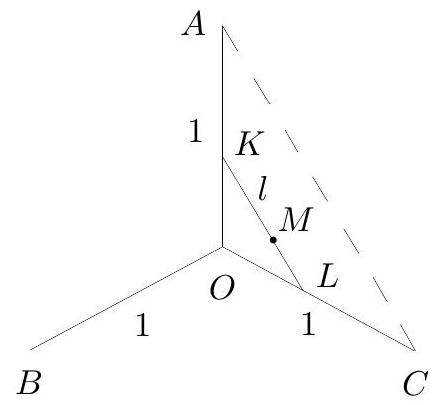
|
| 242 |
+
|
| 243 |
+
Figure 4
|
| 244 |
+
|
| 245 |
+
17. In a certain kingdom, the king has decided to build 25 new towns on 13 uninhabited islands so that on each island there will be at least one town. Direct ferry connections will be established between any pair of new towns which are on different islands. Determine the least possible number of these connections.
|
| 246 |
+
|
| 247 |
+
Solution. Let $a_{1}, \ldots, a_{13}$ be the numbers of towns on each island. Suppose there exist numbers $i$ and $j$ such that $a_{i} \geq a_{j}>1$ and consider an arbitrary town $A$ on the $j$-th island. The number of ferry connections from town $A$ is equal to $25-a_{j}$. On the other hand, if we "move" town $A$ to the $i$-th island then there will be $25-\left(a_{i}+1\right)$ connections from town $A$ while no other connections will be affected by this move. Hence, the smallest number of connections will be achieved if there are 13 towns on one island and one town on each of the other 12 islands. In this case there will be $13 \cdot 12+\frac{12 \cdot 11}{2}=222$ connections.
|
| 248 |
+
|
| 249 |
+
18. There are $n$ lines $(n>2)$ given in the plane. No two of the lines are parallel and no three of them intersect at one point. Every point of intersection of these lines is labelled with a natural number between 1 and $n-1$. Prove that, if and only if $n$ is even, it is possible to assign the labels in such a way that every line has all the numbers from 1 to $n-1$ at its points of intersection with the other $n-1$ lines.
|
| 250 |
+
|
| 251 |
+
Solution. Suppose we have assigned the labels in the required manner. When a point has label 1 then there can be no more occurrences of label 1 on the two lines that intersect at that point. Therefore the number of intersection points labelled with 1 has to be exactly $\frac{n}{2}$, and so $n$ must be even. Now, let $n$ be an even number and denote the $n$ lines by $l_{1}, l_{2}, \ldots, l_{n}$. First write the lines $l_{i}$ in the following table:
|
| 252 |
+
|
| 253 |
+
$$
|
| 254 |
+
\begin{array}{llllll}
|
| 255 |
+
& & l_{3} & l_{4} & \ldots & l_{n / 2+1} \\
|
| 256 |
+
l_{1} & l_{2} & & & & \\
|
| 257 |
+
& & l_{n} & l_{n-1} & \ldots & l_{n / 2+2}
|
| 258 |
+
\end{array}
|
| 259 |
+
$$
|
| 260 |
+
|
| 261 |
+
and then rotate the picture $n-1$ times:
|
| 262 |
+
|
| 263 |
+
$$
|
| 264 |
+
\begin{array}{llllll}
|
| 265 |
+
& & l_{2} & l_{3} & \ldots & l_{n / 2} \\
|
| 266 |
+
l_{1} & l_{n} & l_{n-1} & l_{n-2} & \ldots & l_{n / 2+1} \\
|
| 267 |
+
& & & & & \\
|
| 268 |
+
& & l_{n} & l_{2} & \ldots & l_{n / 2-1} \\
|
| 269 |
+
l_{1} & l_{n-1} & & & & l_{n / 2}
|
| 270 |
+
\end{array}
|
| 271 |
+
$$
|
| 272 |
+
|
| 273 |
+
etc.
|
| 274 |
+
|
| 275 |
+
According to these tables, we can join the lines in pairs in $n-1$ different ways $-l_{1}$ with the line next to it and every other line with the line directly above or under it. Now we can assign the label $i$ to all the intersection points of the pairs of lines shown in the $i$ th table.
|
| 276 |
+
|
| 277 |
+
19. The Wonder Island Intelligence Service has 16 spies in Tartu. Each of them watches on some of his colleagues. It is known that if spy $A$ watches on spy $B$ then $B$ does not watch on $A$. Moreover, any 10 spies can be numbered in such a way that the first spy watches on the second, the second watches on the third, .., the tenth watches on the first. Prove that any 11 spies can also be numbered in a similar manner.
|
| 278 |
+
|
| 279 |
+
Solution. We call two spies $A$ and $B$ neutral to each other if neither $A$ watches on $B$ nor $B$ watches on $A$.
|
| 280 |
+
|
| 281 |
+
Denote the spies $A_{1}, A_{2}, \ldots, A_{16}$. Let $a_{i}, b_{i}$ and $c_{i}$ denote the number of spies that watch on $A_{i}$, the number of that are watched by $A_{i}$ and the number of spies neutral to $A_{i}$, respectively. Clearly, we have
|
| 282 |
+
|
| 283 |
+
$$
|
| 284 |
+
\begin{aligned}
|
| 285 |
+
a_{i}+b_{i}+c_{i} & =15, \\
|
| 286 |
+
a_{i}+c_{i} & \leq 8, \\
|
| 287 |
+
b_{i}+c_{i} & \leq 8
|
| 288 |
+
\end{aligned}
|
| 289 |
+
$$
|
| 290 |
+
|
| 291 |
+
for any $i=1, \ldots, 16$ (if any of the last two inequalities does not hold then there exist 10 spies who cannot be numbered in the required manner). Combining the relations above we find $c_{i} \leq 1$. Hence, for any spy, the number of his neutral colleagues is 0 or 1 .
|
| 292 |
+
|
| 293 |
+
Now suppose there is a group of 11 spies that cannot be numbered as required. Let $B$ be an arbitrary spy in this group. Number the other 10 spies as $C_{1}, C_{2}, \ldots, C_{10}$ so that $C_{1}$ watches on $C_{2}, \ldots, C_{10}$ watches on $C_{1}$. Suppose there is no spy neutral to $B$ among $C_{1}, \ldots, C_{10}$. Then, if $C_{1}$ watches on $B$ then $B$ cannot watch on $C_{2}$, as otherwise $C_{1}, B, C_{2}, \ldots, C_{10}$ would form an 11-cycle. So $C_{2}$ watches on $B$, etc. As some of the spies $C_{1}, C_{2}, \ldots, C_{10}$ must watch on $B$ we get all of them watching on $B$, a contradiction. Therefore, each of the 11 spies must have exactly one spy neutral to him among the other 10 - but this is impossible.
|
| 294 |
+
|
| 295 |
+
20. An equilateral triangle is divided into 9000000 congruent equilateral triangles by lines parallel to its sides. Each vertex of the small triangles is coloured in one of three colours. Prove that there exist three points of the same colour being the vertices of a triangle with its sides parallel to the sides of the original triangle.
|
| 296 |
+
|
| 297 |
+
Solution. Consider the side $A B$ of the big triangle $A B C$ as "horizontal" and suppose the statement of the problem does not hold. The side $A B$ contains 3001 vertices $A=A_{0}, A_{1}, \ldots, A_{3000}=B$ of 3 colours. Hence, there are at least 1001 vertices of one colour, e.g., red. For any two red vertices $A_{k}$ and $A_{n}$ there exists a unique vertex $B_{k n}$ such that the triangle $B_{k n} A_{k} A_{n}$ is equilateral. That vertex $B_{k n}$ cannot be red. For different pairs $(k, n)$ the corresponding vertices $B_{k n}$ are different, so we have at least $\left(\begin{array}{c}1001 \\ 2\end{array}\right)>500000$ vertices of type $B_{k n}$ that cannot be red. As all these vertices are situated on 3000 horizontal lines, there exists a line $L$ which contains more than 160 vertices of type $B_{k n}$, each of them coloured in one of the two remaining colours. Hence there exist at least 81 vertices of the same colour, e.g., blue, on line $L$. For every two blue vertices $B_{k n}$ and $B_{m l}$ on line $L$ there exists a unique vertex $C_{k n m l}$ such that:
|
| 298 |
+
|
| 299 |
+
(i) $C_{k n m l}$ lies above the line $L$;
|
| 300 |
+
|
| 301 |
+
(ii) The triangle $C_{k n m l} B_{k n} B_{m l}$ is equilateral;
|
| 302 |
+
|
| 303 |
+
(iii) $C_{k n m l}=B_{p q}$ where $p=\min (k, m)$ and $q=\max (n, l)$.
|
| 304 |
+
|
| 305 |
+
Different pairs of vertices $B_{k n}$ belonging to line $L$ define different vertices $C_{k n m l}$. So we have at least $\left(\begin{array}{c}81 \\ 2\end{array}\right)>3200$ vertices of type $C_{k n m l}$ that can be neither blue nor red. As the number of these vertices exceeds the number of horizontal lines, there must be two vertices $C_{k n m l}$ and $C_{p q r s}$ on one horizontal line. Now, these two vertices define a new vertex $D_{\text {knmlpqrs }}$ that cannot have any of the three colours, a contradiction.
|
| 306 |
+
|
| 307 |
+
Remark. The minimal size of the big triangle that can be handled by this proof is 2557 .
|
| 308 |
+
|
BalticWay/md/en-bw95sol.md
ADDED
|
@@ -0,0 +1,227 @@
|
|
|
|
|
|
|
|
|
|
|
|
|
|
|
|
|
|
|
|
|
|
|
|
|
|
|
|
|
|
|
|
|
|
|
|
|
|
|
|
|
|
|
|
|
|
|
|
|
|
|
|
|
|
|
|
|
|
|
|
|
|
|
|
|
|
|
|
|
|
|
|
|
|
|
|
|
|
|
|
|
|
|
|
|
|
|
|
|
|
|
|
|
|
|
|
|
|
|
|
|
|
|
|
|
|
|
|
|
|
|
|
|
|
|
|
|
|
|
|
|
|
|
|
|
|
|
|
|
|
|
|
|
|
|
|
|
|
|
|
|
|
|
|
|
|
|
|
|
|
|
|
|
|
|
|
|
|
|
|
|
|
|
|
|
|
|
|
|
|
|
|
|
|
|
|
|
|
|
|
|
|
|
|
|
|
|
|
|
|
|
|
|
|
|
|
|
|
|
|
|
|
|
|
|
|
|
|
|
|
|
|
|
|
|
|
|
|
|
|
|
|
|
|
|
|
|
|
|
|
|
|
|
|
|
|
|
|
|
|
|
|
|
|
|
|
|
|
|
|
|
|
|
|
|
|
|
|
|
|
|
|
|
|
|
|
|
|
|
|
|
|
|
|
|
|
|
|
|
|
|
|
|
|
|
|
|
|
|
|
|
|
|
|
|
|
|
|
|
|
|
|
|
|
|
|
|
|
|
|
|
|
|
|
|
|
|
|
|
|
|
|
|
|
|
|
|
|
|
|
|
|
|
|
|
|
|
|
|
|
|
|
|
|
|
|
|
|
|
|
|
|
|
|
|
|
|
|
|
|
|
|
|
|
|
|
|
|
|
|
|
|
|
|
|
|
|
|
|
|
|
|
|
|
|
|
|
|
|
|
|
|
|
|
|
|
|
|
|
|
|
|
|
|
|
|
|
|
|
|
|
|
|
|
|
|
|
|
|
|
|
|
|
|
|
|
|
|
|
|
|
|
|
|
|
|
|
|
|
|
|
|
|
|
|
|
|
|
|
|
|
|
|
|
|
|
|
|
|
|
|
|
|
|
|
|
|
|
|
|
|
|
|
|
|
|
|
|
|
|
|
|
|
|
|
|
|
|
|
|
|
|
|
|
|
|
|
|
|
|
|
|
|
|
|
|
|
|
|
|
|
|
|
|
|
|
|
|
|
|
|
|
|
|
|
|
|
|
|
|
|
|
|
|
|
|
|
|
|
|
|
|
|
|
|
|
|
|
|
|
|
|
|
|
|
|
|
|
|
|
|
|
|
|
|
|
|
|
|
|
|
|
|
|
|
|
|
|
|
|
|
|
|
|
|
|
|
|
|
|
|
|
|
|
|
|
|
|
|
|
|
|
|
|
|
|
|
|
|
|
|
|
|
|
|
|
|
|
|
|
|
|
|
|
|
|
|
|
|
|
|
|
|
|
|
|
|
|
|
|
|
|
|
|
|
|
|
|
|
|
|
|
|
|
|
|
|
|
|
|
|
|
|
|
|
|
|
|
|
|
|
|
|
|
|
|
|
|
|
|
|
|
|
|
|
| 1 |
+
# Baltic Way 1995
|
| 2 |
+
|
| 3 |
+
## Västerås (Sweden), November 12, 1995
|
| 4 |
+
|
| 5 |
+
## Problems and solutions
|
| 6 |
+
|
| 7 |
+
1. Find all triples $(x, y, z)$ of positive integers satisfying the system of equations
|
| 8 |
+
|
| 9 |
+
$$
|
| 10 |
+
\left\{\begin{array}{l}
|
| 11 |
+
x^{2}=2(y+z) \\
|
| 12 |
+
x^{6}=y^{6}+z^{6}+31\left(y^{2}+z^{2}\right)
|
| 13 |
+
\end{array}\right.
|
| 14 |
+
$$
|
| 15 |
+
|
| 16 |
+
Solution. From the first equation it follows that $x$ is even. The second equation implies $x>y$ and $x>z$. Hence $4 x>2(y+z)=x^{2}$, and therefore $x=2$ and $y+z=2$, so $y=z=1$. It is easy to check that the triple $(2,1,1)$ satisfies the given system of equations.
|
| 17 |
+
|
| 18 |
+
2. Let $a$ and $k$ be positive integers such that $a^{2}+k$ divides $(a-1) a(a+1)$. Prove that $k \geq a$.
|
| 19 |
+
|
| 20 |
+
Solution. We have $(a-1) a(a+1)=a\left(a^{2}+k\right)-(k+1) a$. Hence $a^{2}+k$ divides $(k+1) a$, and thus $k+1 \geq a$, or equivalently, $k \geq a$.
|
| 21 |
+
|
| 22 |
+
3. The positive integers $a, b, c$ are pairwise relatively prime, $a$ and $c$ are odd and the numbers satisfy the equation $a^{2}+b^{2}=c^{2}$. Prove that $b+c$ is a square of an integer.
|
| 23 |
+
|
| 24 |
+
Solution. Since $a$ and $c$ are odd, $b$ must be even. We have $a^{2}=c^{2}-b^{2}=(c+b)(c-b)$. Let $d=\operatorname{gcd}(c+b, c-b)$. Then $d$ divides $(c+b)+(c-b)=2 c$ and $(c+b)-(c-b)=2 b$. Since $c+b$ and $c-b$ are odd, $d$ is odd, and hence $d$ divides both $b$ and $c$. But $b$ and $c$ are relatively prime, so $d=1$, i.e., $c+b$ and $c-b$ are also relatively prime. Since $(c+b)(c-b)=a^{2}$ is a square, it follows that $c+b$ and $c-b$ are also squares. In particular, $b+c$ is a square as required.
|
| 25 |
+
|
| 26 |
+
4. John is older than Mary. He notices that if he switches the two digits of his age (an integer), he gets Mary's age. Moreover, the difference between the squares of their ages is the square of an integer. How old are Mary and John?
|
| 27 |
+
|
| 28 |
+
Solution. Let John's age be $10 a+b$ where $0 \leq a, b \leq 9$. Then Mary's age is $10 b+a$, and hence $a>b$. Now
|
| 29 |
+
|
| 30 |
+
$$
|
| 31 |
+
(10 a+b)^{2}-(10 b+a)^{2}=9 \cdot 11(a+b)(a-b) .
|
| 32 |
+
$$
|
| 33 |
+
|
| 34 |
+
Since this is the square of an integer, $a+b$ or $a-b$ must be divisible by 11 . The only possibility is clearly $a+b=11$. Hence $a-b$ must be a square. A case study yields the only possibility $a=6, b=5$. Thus John is 65 and Mary 56 years old.
|
| 35 |
+
|
| 36 |
+
5. Let $a<b<c$ be three positive integers. Prove that among any $2 c$ consecutive positive integers there exist three different numbers $x, y, z$ such that $a b c$ divides $x y z$.
|
| 37 |
+
|
| 38 |
+
Solution. First we show that among any $b$ consecutive numbers there are two different numbers $x$ and $y$ such that $a b$ divides $x y$. Among the $b$ consecutive numbers there is clearly a number $x^{\prime}$ divisible by $b$, and a number $y^{\prime}$ divisible by $a$. If $x^{\prime} \neq y^{\prime}$, we can take $x=x^{\prime}$ and $y=y^{\prime}$, and we are done. Now assume that $x^{\prime}=y^{\prime}$. Then $x^{\prime}$ is divisible by $e$, the least common multiple of $a$ and $b$. Let $d=\operatorname{gcd}(a, b)$. As $a<b$, we have $d \leq \frac{1}{2} b$. Hence there is a number $z^{\prime} \neq x^{\prime}$ among the $b$ consecutive numbers such that $z^{\prime}$ is divisible by $d$. Hence $x^{\prime} z^{\prime}$ is divisible by $d e$. But $d e=a b$, so we can take $x=x^{\prime}$ and $y=z^{\prime}$.
|
| 39 |
+
|
| 40 |
+
Now divide the $2 c$ consecutive numbers into two groups of $c$ consecutive numbers. In the first group, by the above reasoning, there exist distinct numbers $x$ and $y$ such that $a b$ divides $x y$. The second group contains a number $z$ divisible by $c$. Then $a b c$ divides $x y z$.
|
| 41 |
+
|
| 42 |
+
6. Prove that for positive $a, b, c, d$
|
| 43 |
+
|
| 44 |
+
$$
|
| 45 |
+
\frac{a+c}{a+b}+\frac{b+d}{b+c}+\frac{c+a}{c+d}+\frac{d+b}{d+a} \geq 4 .
|
| 46 |
+
$$
|
| 47 |
+
|
| 48 |
+
Solution. The inequality between the arithmetic and harmonic mean gives
|
| 49 |
+
|
| 50 |
+
$$
|
| 51 |
+
\begin{aligned}
|
| 52 |
+
& \frac{a+c}{a+b}+\frac{c+a}{c+d} \geq \frac{4}{\frac{a+b}{a+c}+\frac{c+d}{c+a}}=4 \cdot \frac{a+c}{a+b+c+d} \\
|
| 53 |
+
& \frac{b+d}{b+c}+\frac{d+b}{d+a} \geq \frac{4}{\frac{b+c}{b+d}+\frac{d+a}{d+b}}=4 \cdot \frac{b+d}{a+b+c+d}
|
| 54 |
+
\end{aligned}
|
| 55 |
+
$$
|
| 56 |
+
|
| 57 |
+
and adding these inequalities yields the required inequality.
|
| 58 |
+
|
| 59 |
+
7. Prove that $\sin ^{3} 18^{\circ}+\sin ^{2} 18^{\circ}=1 / 8$.
|
| 60 |
+
|
| 61 |
+
Solution. We have
|
| 62 |
+
|
| 63 |
+
$$
|
| 64 |
+
\begin{aligned}
|
| 65 |
+
\sin ^{3} 18^{\circ}+\sin ^{2} 18^{\circ} & =\sin ^{2} 18^{\circ}\left(\sin 18^{\circ}+\sin 90^{\circ}\right)=\sin ^{2} 18^{\circ} \cdot 2 \sin 54^{\circ} \cos 36^{\circ}=2 \sin ^{2} 18^{\circ} \cos ^{2} 36^{\circ} \\
|
| 66 |
+
& =\frac{2 \sin ^{2} 18^{\circ} \cos ^{2} 18^{\circ} \cos ^{2} 36^{\circ}}{\cos ^{2} 18^{\circ}}=\frac{\sin ^{2} 36^{\circ} \cos ^{2} 36^{\circ}}{2 \cos ^{2} 18^{\circ}}=\frac{\sin ^{2} 72^{\circ}}{8 \cos ^{2} 18^{\circ}}=\frac{1}{8} .
|
| 67 |
+
\end{aligned}
|
| 68 |
+
$$
|
| 69 |
+
|
| 70 |
+
8. The real numbers $a, b$ and $c$ satisfy the inequalities $|a| \geq|b+c|,|b| \geq|c+a|$ and $|c| \geq|a+b|$. Prove that $a+b+c=0$.
|
| 71 |
+
|
| 72 |
+
Solution. Squaring both sides of the given inequalities we get
|
| 73 |
+
|
| 74 |
+
$$
|
| 75 |
+
\left\{\begin{array}{l}
|
| 76 |
+
a^{2} \geq(b+c)^{2} \\
|
| 77 |
+
b^{2} \geq(c+a)^{2} \\
|
| 78 |
+
c^{2} \geq(a+b)^{2}
|
| 79 |
+
\end{array}\right.
|
| 80 |
+
$$
|
| 81 |
+
|
| 82 |
+
Adding these three inequalities and rearranging, we get $(a+b+c)^{2} \leq 0$. Clearly equality must hold, and we have $a+b+c=0$.
|
| 83 |
+
|
| 84 |
+
9. Prove that
|
| 85 |
+
|
| 86 |
+
$$
|
| 87 |
+
\frac{1995}{2}-\frac{1994}{3}+\frac{1993}{4}-\cdots-\frac{2}{1995}+\frac{1}{1996}=\frac{1}{999}+\frac{3}{1000}+\cdots+\frac{1995}{1996} .
|
| 88 |
+
$$
|
| 89 |
+
|
| 90 |
+
Solution. Denote the left-hand side of the equation by $L$, and the right-hand side by $R$. Then
|
| 91 |
+
|
| 92 |
+
$$
|
| 93 |
+
\begin{aligned}
|
| 94 |
+
L & =\sum_{k=1}^{1996}(-1)^{k+1}\left(\frac{1997}{k+1}-1\right)=1997 \cdot \sum_{k=1}^{1996}(-1)^{k+1} \cdot \frac{1}{k+1}=1997 \cdot \sum_{k=1}^{1996}(-1)^{k} \cdot \frac{1}{k}+1996, \\
|
| 95 |
+
R & =\sum_{k=1}^{998}\left(\frac{2 k+1996}{998+k}-\frac{1997}{998+k}\right)=1996-1997 \cdot \sum_{k=1}^{998} \frac{1}{k+998} .
|
| 96 |
+
\end{aligned}
|
| 97 |
+
$$
|
| 98 |
+
|
| 99 |
+
We must verify that $\sum_{k=1}^{1996}(-1)^{k-1} \cdot \frac{1}{k}=\sum_{k=1}^{998} \frac{1}{k+998}$. But this follows from the calculation
|
| 100 |
+
|
| 101 |
+
$$
|
| 102 |
+
\sum_{k=1}^{1996}(-1)^{k-1} \cdot \frac{1}{k}=\sum_{k=1}^{1996} \frac{1}{k}-2 \cdot \sum_{k=1}^{998} \frac{1}{2 k}=\sum_{k=1}^{998} \frac{1}{k+998}
|
| 103 |
+
$$
|
| 104 |
+
|
| 105 |
+
10. Find all real-valued functions $f$ defined on the set of all non-zero real numbers such that:
|
| 106 |
+
|
| 107 |
+
(i) $f(1)=1$,
|
| 108 |
+
|
| 109 |
+
(ii) $f\left(\frac{1}{x+y}\right)=f\left(\frac{1}{x}\right)+f\left(\frac{1}{y}\right)$ for all non-zero $x, y, x+y$,
|
| 110 |
+
|
| 111 |
+
(iii) $(x+y) f(x+y)=x y f(x) f(y)$ for all non-zero $x, y, x+y$.
|
| 112 |
+
|
| 113 |
+
Solution. Substituting $x=y=\frac{1}{2} z$ in (ii) we get
|
| 114 |
+
|
| 115 |
+
$$
|
| 116 |
+
f\left(\frac{1}{z}\right)=2 f\left(\frac{2}{z}\right)
|
| 117 |
+
$$
|
| 118 |
+
|
| 119 |
+
for all $z \neq 0$. Substituting $x=y=\frac{1}{z}$ in (iii) yields
|
| 120 |
+
|
| 121 |
+
$$
|
| 122 |
+
\frac{2}{z} f\left(\frac{2}{z}\right)=\frac{1}{z^{2}}\left(f\left(\frac{1}{z}\right)\right)^{2}
|
| 123 |
+
$$
|
| 124 |
+
|
| 125 |
+
for all $z \neq 0$, and hence
|
| 126 |
+
|
| 127 |
+
$$
|
| 128 |
+
2 f\left(\frac{2}{z}\right)=\frac{1}{z}\left(f\left(\frac{1}{z}\right)\right)^{2} .
|
| 129 |
+
$$
|
| 130 |
+
|
| 131 |
+
From (1) and (2) we get
|
| 132 |
+
|
| 133 |
+
$$
|
| 134 |
+
f\left(\frac{1}{z}\right)=\frac{1}{z}\left(f\left(\frac{1}{z}\right)\right)^{2},
|
| 135 |
+
$$
|
| 136 |
+
|
| 137 |
+
or, equivalently,
|
| 138 |
+
|
| 139 |
+
$$
|
| 140 |
+
f(x)=x(f(x))^{2}
|
| 141 |
+
$$
|
| 142 |
+
|
| 143 |
+
for all $x \neq 0$. If $f(x)=0$ for some $x$, then by (iii) we would have
|
| 144 |
+
|
| 145 |
+
$$
|
| 146 |
+
f(1)=(x+(1-x)) f(x+(1-x))=(1-x) f(x) f(1-x)=0
|
| 147 |
+
$$
|
| 148 |
+
|
| 149 |
+
which contradicts the condition (i). Hence $f(x) \neq 0$ for all $x$, and (3) implies $x f(x)=1$ for all $x$, and thus $f(x)=\frac{1}{x}$. It is easily verified that this function satisfies the given conditions.
|
| 150 |
+
|
| 151 |
+
11. In how many ways can the set of integers $\{1,2, \ldots, 1995\}$ be partitioned into three nonempty sets so that none of these sets contains two consecutive integers?
|
| 152 |
+
|
| 153 |
+
Solution. We construct the three subsets by adding the numbers successively, and disregard at first the condition that the sets must be non-empty. The numbers 1 and 2 must belong to two different subsets, say $A$ and $B$. We then have two choices for each of the numbers $3,4, \ldots, 1995$, and different choices lead to different partitions. Hence there are $2^{1993}$ such partitions, one of which has an empty part. The number of partitions satisfying the requirements of the problem is therefore $2^{1993}-1$.
|
| 154 |
+
|
| 155 |
+
12. Assume we have 95 boxes and 19 balls distributed in these boxes in an arbitrary manner. We take six new balls at a time and place them in six of the boxes, one ball in each of the six. Can we, by repeating this process a suitable number of times, achieve a situation in which each of the 95 boxes contains an equal number of balls?
|
| 156 |
+
|
| 157 |
+
Solution. Since $6 \cdot 16=96$, we can put 16 times 6 balls in the boxes so that the number of balls in one of the boxes increases by two, while in all other boxes it increases by one. Repeating this procedure, we can either diminish the difference between the number of balls in the box which has most balls and the number of balls in the box with the least number of balls, or diminish the number of boxes having the least number of balls, until all boxes have the same number of balls.
|
| 158 |
+
|
| 159 |
+
13. Consider the following two person game. A number of pebbles are situated on the table. Two players make their moves alternately. A move consists of taking off the table $x$ pebbles where $x$ is the square of any positive integer. The player who is unable to make a move loses. Prove that there are infinitely many initial situations in which the second player can win no matter how his opponent plays.
|
| 160 |
+
|
| 161 |
+
Solution. Suppose that there is an $n$ such that the first player always wins if there are initially more than $n$ pebbles. Consider the initial situation with $n^{2}+n+1$ pebbles. Since $(n+1)^{2}>n^{2}+n+1$, the first player can take at most $n^{2}$ pebbles, leaving at least $n+1$ pebbles on the table. By the assumption, the second player now wins. This contradiction proves that there are infinitely many situations in which the second player wins no matter how the first player plays.
|
| 162 |
+
|
| 163 |
+
14. There are $n$ fleas on an infinite sheet of triangulated paper. Initially the fleas are in different small triangles, all of which are inside some equilateral triangle consisting of $n^{2}$ small triangles (see Figure 1 for a possible initial configuration with $n=5$ ). Once a second each flea jumps from its triangle to one of the three small triangles as indicated in the figure. For which positive integers $n$ does there exist an initial configuration such that after a finite number of jumps all the $n$ fleas can meet in a single small triangle?
|
| 164 |
+
|
| 165 |
+
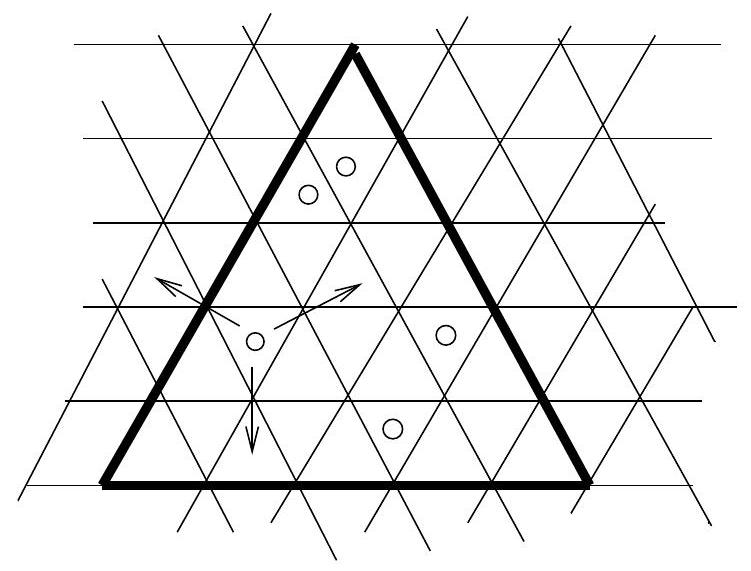
|
| 166 |
+
|
| 167 |
+
Figure 1
|
| 168 |
+
|
| 169 |
+
Solution. The small triangles can be coloured in four colours as shown in Figure 2. Then each flea can only reach triangles of a single colour. Moreover, number the horizontal rows are numbered as in Figure 2, and note that with each move a flea jumps from a triangle in an even-numbered row to a triangle in an odd-numbered row, or vice versa. Hence, if all the fleas are to meet in one small triangle, then they must initially be located in triangles of the same colour and in rows of the same parity. On the other hand, if these conditions are met, then the fleas can end up all in some designated triangle (of the right colour and parity). When a flea reaches this triangle, it can jump back and forth between the designated triangle and one of its neighbours until the other fleas arrive.
|
| 170 |
+
|
| 171 |
+
It remains to find the values of $n$ for which the big triangle contains at least $n$ small triangles of one colour, in rows of the same parity. For any odd $n$ there are at least $1+2+\cdots+\frac{n+1}{2}=\frac{1}{8}\left(n^{2}+4 n+3\right) \geq n$ such triangles. For even $n \geq 6$ we also have at least $1+2+\cdots+\frac{n}{2}=\frac{1}{8}\left(n^{2}+2 n\right) \geq n$ triangles of the required kind. Finally, it is easy to check that for $n=2$ and $n=4$ the necessary set of small triangles cannot be found.
|
| 172 |
+
|
| 173 |
+
Hence it is possible for the fleas to meet in one small triangle for all $n$ except 2 and 4 .
|
| 174 |
+
|
| 175 |
+
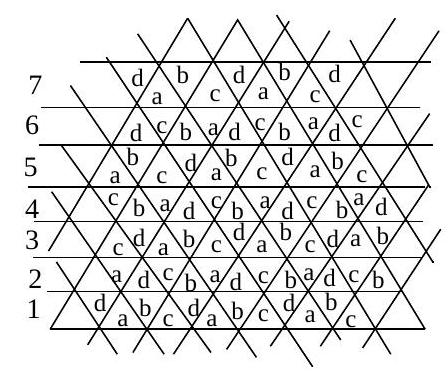
|
| 176 |
+
|
| 177 |
+
Figure 2
|
| 178 |
+
|
| 179 |
+
15. A polygon with $2 n+1$ vertices is given. Show that it is possible to label the vertices and midpoints of the sides of the polygon, using all the numbers $1,2, \ldots, 4 n+2$, so that the sums of the three numbers assigned to each side are all equal.
|
| 180 |
+
|
| 181 |
+
Solution. First, label the midpoints of the sides of the polygon with the numbers $1,2, \ldots, 2 n+1$, in clockwise order. Then, beginning with the vertex between the sides labelled by 1 and 2 , label every second vertex in clockwise order with the numbers $4 n+2,4 n+1, \ldots, 2 n+2$.
|
| 182 |
+
|
| 183 |
+
16. In the triangle $A B C$, let $l$ be the bisector of the external angle at $C$. The line through the midpoint $O$ of the segment $A B$ parallel to $l$ meets the line $A C$ at $E$. Determine $|C E|$, if $|A C|=7$ and $|C B|=4$.
|
| 184 |
+
|
| 185 |
+
Solution. Let $F$ be the intersection point of $l$ and the line $A B$. Since $|A C|>|B C|$, the point $E$ lies on the segment $A C$, and $F$ lies on the ray $A B$. Let the line through $B$ parallel to $A C$ meet $C F$ at $G$. Then the triangles $A F C$ and $B F G$ are similar. Moreover, we have $\angle B G C=\angle B C G$, and hence the triangle $C B G$ is isosceles with $|B C|=|B G|$. Hence $\frac{|F A|}{|F B|}=\frac{|A C|}{|B G|}=\frac{|A C|}{|B C|}=\frac{7}{4}$. Therefore $\frac{|A O|}{|A F|}=\frac{3}{2} / 7=\frac{3}{14}$. Since the triangles $A C F$ and $A E O$ are similar, $\frac{|A E|}{|A C|}=\frac{|A O|}{|A F|}=\frac{3}{14}$, whence $|A E|=\frac{3}{2}$ and $|E C|=\frac{11}{2}$.
|
| 186 |
+
|
| 187 |
+
17. Prove that there exists a number $\alpha$ such that for any triangle $A B C$ the inequality
|
| 188 |
+
|
| 189 |
+
$$
|
| 190 |
+
\max \left(h_{A}, h_{B}, h_{C}\right) \leq \alpha \cdot \min \left(m_{A}, m_{B}, m_{C}\right)
|
| 191 |
+
$$
|
| 192 |
+
|
| 193 |
+
holds, where $h_{A}, h_{B}, h_{C}$ denote the lengths of the altitudes and $m_{A}, m_{B}, m_{C}$ denote the lengths of the medians. Find the smallest possible value of $\alpha$.
|
| 194 |
+
|
| 195 |
+
Solution. Let $h=\max \left(h_{A}, h_{B}, h_{C}\right)$ and $m=\min \left(m_{A}, m_{B}, m_{C}\right)$. If the longest height and the shortest median are drawn from the same vertex, then obviously $h \leq m$. Now let the longest height and shortest median be $A D$ and $B E$, respectively, with $|A D|=h$ and $|B E|=m$. Let $F$ be the point on the line $B C$ such that $E F$ is parallel to $A D$. Then $m=|E B| \geq|E F|=\frac{h}{2}$, whence $h \leq 2 m$. For an example with $h=2 m$, consider a triangle where $D$ lies on the ray $C B$ with $|C B|=|B D|$. Hence the smallest such value is $\alpha=2$.
|
| 196 |
+
|
| 197 |
+
18. Let $M$ be the midpoint of the side $A C$ of a triangle $A B C$ and let $H$ be the foot point of the altitude from $B$. Let $P$ and $Q$ be the orthogonal projections of $A$ and $C$ on the bisector of angle $B$. Prove that the four points $M, H, P$ and $Q$ lie on the same circle.
|
| 198 |
+
|
| 199 |
+
Solution. If $|A B|=|B C|$, the points $M, H, P$ and $Q$ coincide and the circle degenerates to a point. We will assume that $|A B|<|B C|$, so that $P$ lies inside the triangle $A B C$, and $Q$ lies outside of it.
|
| 200 |
+
|
| 201 |
+
Let the line $A P$ intersect $B C$ at $P_{1}$, and let $C Q$ intersect $A B$ at $Q_{1}$. Then $|A P|=\left|P P_{1}\right|$ (since $\triangle A P B \cong$ $\left.\triangle P_{1} P B\right)$, and therefore $M P \| B C$. Similarly, $M Q \| A B$. Therefore $\angle A M Q=\angle B A C$. We have two cases:
|
| 202 |
+
|
| 203 |
+
(i) $\angle B A C \leq 90^{\circ}$. Then $A, H, P$ and $B$ lie on a circle in this order. Hence $\angle H P Q=180^{\circ}-\angle H P B=$ $\angle B A C=\angle H M Q$. Therefore $H, P, M$ and $Q$ lie on a circle.
|
| 204 |
+
|
| 205 |
+
(ii) $\angle B A C>90^{\circ}$. Then $A, H, B$ and $P$ lie on a circle in this order. Hence $\angle H P Q=180^{\circ}-\angle H P B=$ $180^{\circ}-\angle H A B=\angle B A C=\angle H M Q$, and therefore $H, P, M$ and $Q$ lie on a circle.
|
| 206 |
+
|
| 207 |
+
|
| 208 |
+
|
| 209 |
+
Figure 3
|
| 210 |
+
|
| 211 |
+
19. The following construction is used for training astronauts: A circle $C_{2}$ of radius $2 R$ rolls along the inside of another, fixed circle $C_{1}$ of radius $n R$, where $n$ is an integer greater than 2 . The astronaut is fastened to a third circle $C_{3}$ of radius $R$ which rolls along the inside of circle $C_{2}$ in such a way that the touching point of the circles $C_{2}$ and $C_{3}$ remains at maximum distance from the touching point of the circles $C_{1}$ and $C_{2}$ at all times (see Figure 3).
|
| 212 |
+
|
| 213 |
+
How many revolutions (relative to the ground) does the astronaut perform together with the circle $C_{3}$ while the circle $C_{2}$ completes one full lap around the inside of circle $C_{1}$ ?
|
| 214 |
+
|
| 215 |
+
Solution. Consider a circle $C_{4}$ with radius $R$ that rolls inside $C_{2}$ in such a way that the two circles always touch in the point opposite to the touching point of $C_{2}$ and $C_{3}$. Then the circles $C_{3}$ and $C_{4}$ follow each other and make the same number of revolutions, and so we will assume that the astronaut is inside the circle $C_{4}$ instead. But the touching point of $C_{2}$ and $C_{4}$ coincides with the touching point of $C_{1}$ and $C_{2}$. Hence the circles $C_{4}$ and $C_{1}$ always touch each other, and we can disregard the circle $C_{2}$ completely.
|
| 216 |
+
|
| 217 |
+
Suppose the circle $C_{4}$ rolls inside $C_{1}$ in counterclockwise direction. Then the astronaut revolves in clockwise direction. If the circle $C_{4}$ had rolled along a straight line of length $2 \pi n R$ (instead of the inside of $C_{1}$ ), the circle $C_{4}$ would have made $n$ revolutions during its movement. As the path of the circle $C_{4}$ makes a $360^{\circ}$ counterclockwise turn itself, the total number of revolutions of the astronaut relative to the ground is $n-1$.
|
| 218 |
+
|
| 219 |
+
Remark: The radius of the intermediate circle $C_{2}$ is irrelevant. Moreover, for any number of intermediate circles the answer remains the same, depending only on the radii of the outermost and innermost circles.
|
| 220 |
+
|
| 221 |
+
20. Prove that if both coordinates of every vertex of a convex pentagon are integers, then the area of this pentagon is not less than $\frac{5}{2}$.
|
| 222 |
+
|
| 223 |
+
Solution. There are two vertices $A_{1}$ and $A_{2}$ of the pentagon that have their first coordinates of the parity, and their second coordinates of the same parity. Therefore the midpoint $M$ of $A_{1} A_{2}$ has integer coordinates. There are two possibilities:
|
| 224 |
+
|
| 225 |
+
(i) The considered vertices are not consecutive. Then $M$ lies inside the pentagon (because it is convex) and is the common vertex of five triangles having as their bases the sides of the pentagon. The area of any one of these triangles is not less than $\frac{1}{2}$, so the area of the pentagon is at least $\frac{5}{2}$.
|
| 226 |
+
(ii) The considered vertices are consecutive. Since the pentagon is convex, the side $A_{1} A_{2}$ is not simultaneously parallel to $A_{3} A_{4}$ and $A_{4} A_{5}$. Suppose that the segments $A_{1} A_{2}$ and $A_{3} A_{4}$ are not parallel. Then the triangles $A_{2} A_{3} A_{4}, M A_{3} A_{4}$ and $A-1 A_{3} A_{4}$ have different areas, since their altitudes dropped onto the side $A_{3} A_{4}$ form a monotone sequence. At least one of these triangles has area not less than $\frac{3}{2}$, and the pentagon has area not less than $\frac{5}{2}$.
|
| 227 |
+
|
BalticWay/md/en-bw96sol.md
ADDED
|
@@ -0,0 +1,262 @@
|
|
|
|
|
|
|
|
|
|
|
|
|
|
|
|
|
|
|
|
|
|
|
|
|
|
|
|
|
|
|
|
|
|
|
|
|
|
|
|
|
|
|
|
|
|
|
|
|
|
|
|
|
|
|
|
|
|
|
|
|
|
|
|
|
|
|
|
|
|
|
|
|
|
|
|
|
|
|
|
|
|
|
|
|
|
|
|
|
|
|
|
|
|
|
|
|
|
|
|
|
|
|
|
|
|
|
|
|
|
|
|
|
|
|
|
|
|
|
|
|
|
|
|
|
|
|
|
|
|
|
|
|
|
|
|
|
|
|
|
|
|
|
|
|
|
|
|
|
|
|
|
|
|
|
|
|
|
|
|
|
|
|
|
|
|
|
|
|
|
|
|
|
|
|
|
|
|
|
|
|
|
|
|
|
|
|
|
|
|
|
|
|
|
|
|
|
|
|
|
|
|
|
|
|
|
|
|
|
|
|
|
|
|
|
|
|
|
|
|
|
|
|
|
|
|
|
|
|
|
|
|
|
|
|
|
|
|
|
|
|
|
|
|
|
|
|
|
|
|
|
|
|
|
|
|
|
|
|
|
|
|
|
|
|
|
|
|
|
|
|
|
|
|
|
|
|
|
|
|
|
|
|
|
|
|
|
|
|
|
|
|
|
|
|
|
|
|
|
|
|
|
|
|
|
|
|
|
|
|
|
|
|
|
|
|
|
|
|
|
|
|
|
|
|
|
|
|
|
|
|
|
|
|
|
|
|
|
|
|
|
|
|
|
|
|
|
|
|
|
|
|
|
|
|
|
|
|
|
|
|
|
|
|
|
|
|
|
|
|
|
|
|
|
|
|
|
|
|
|
|
|
|
|
|
|
|
|
|
|
|
|
|
|
|
|
|
|
|
|
|
|
|
|
|
|
|
|
|
|
|
|
|
|
|
|
|
|
|
|
|
|
|
|
|
|
|
|
|
|
|
|
|
|
|
|
|
|
|
|
|
|
|
|
|
|
|
|
|
|
|
|
|
|
|
|
|
|
|
|
|
|
|
|
|
|
|
|
|
|
|
|
|
|
|
|
|
|
|
|
|
|
|
|
|
|
|
|
|
|
|
|
|
|
|
|
|
|
|
|
|
|
|
|
|
|
|
|
|
|
|
|
|
|
|
|
|
|
|
|
|
|
|
|
|
|
|
|
|
|
|
|
|
|
|
|
|
|
|
|
|
|
|
|
|
|
|
|
|
|
|
|
|
|
|
|
|
|
|
|
|
|
|
|
|
|
|
|
|
|
|
|
|
|
|
|
|
|
|
|
|
|
|
|
|
|
|
|
|
|
|
|
|
|
|
|
|
|
|
|
|
|
|
|
|
|
|
|
|
|
|
|
|
|
|
|
|
|
|
|
|
|
|
|
|
|
|
|
|
|
|
|
|
|
|
|
|
|
|
|
|
|
|
|
|
|
|
|
|
|
|
|
|
|
|
|
|
|
|
|
|
|
|
|
|
|
|
|
|
|
|
|
|
|
|
|
|
|
|
|
|
|
|
|
|
|
|
|
|
|
|
|
|
|
|
|
|
|
|
|
|
|
|
|
|
|
|
|
|
|
|
|
|
|
|
|
|
|
|
|
|
|
|
|
|
|
|
|
|
|
|
|
|
|
|
|
|
|
|
|
|
|
|
|
|
|
|
|
|
|
|
|
|
|
|
|
|
|
|
|
|
|
|
|
|
|
|
|
|
|
|
|
|
|
|
|
|
|
|
|
|
|
|
|
|
|
|
|
|
|
| 1 |
+
# Baltic Way 1996
|
| 2 |
+
|
| 3 |
+
## Valkeakoski (Finland), November 3, 1996
|
| 4 |
+
|
| 5 |
+
## Problems and solutions
|
| 6 |
+
|
| 7 |
+
1. Let $\alpha$ be the angle between two lines containing the diagonals of a regular 1996-gon, and let $\beta \neq 0$ be another such angle. Prove that $\alpha / \beta$ is a rational number.
|
| 8 |
+
|
| 9 |
+
Solution. Let $O$ be the circumcentre of the 1996-gon. Consider two diagonals $A B$ and $C D$. There is a rotation around $O$ that takes the point $C$ to $A$ and $D$ to a point $D^{\prime}$. Clearly the angle of this rotation is a multiple of $2 \varphi=2 \pi / 1996$.
|
| 10 |
+
|
| 11 |
+
The angle $B A D^{\prime}$ is the inscribed angle on the $\operatorname{arc} B D^{\prime}$, and hence is an integral multiple of $\varphi$, the inscribed angle on the arc between any two adjacent vertices of the 1996-gon. Hence the angle between $A B$ and $C D$ is also an integral multiple of $\varphi$.
|
| 12 |
+
|
| 13 |
+
Since both $\alpha$ and $\beta$ are integral multiples of $\varphi, \alpha / \beta$ is a rational number.
|
| 14 |
+
|
| 15 |
+
2. In the figure below, you see three half-circles. The circle $C$ is tangent to two of the half-circles and to the line $P Q$ perpendicular to the diameter $A B$. The area of the shaded region is $39 \pi$, and the area of the circle $C$ is $9 \pi$. Find the length of the diameter $A B$.
|
| 16 |
+
|
| 17 |
+

|
| 18 |
+
|
| 19 |
+
Figure 1
|
| 20 |
+
|
| 21 |
+
Solution. Let $r$ and $s$ be the radii of the half-circles with diameters $A P$ and $B P$. Then we have
|
| 22 |
+
|
| 23 |
+
$$
|
| 24 |
+
39 \pi=\frac{\pi}{2}\left((r+s)^{2}-r^{2}-s^{2}\right)-9 \pi
|
| 25 |
+
$$
|
| 26 |
+
|
| 27 |
+
hence $r s=48$. Let $M$ be the midpoint of the diameter $A B, N$ be the midpoint of $P B, O$ be the centre of the circle $C$, and let $F$ be the orthogonal projection of $O$ on $A B$. Since the radius of $C$ is 3 , we have $|M O|=r+s-3,|M F|=r-s+3,|O N|=s+3$, and $|F N|=s-3$.
|
| 28 |
+
|
| 29 |
+
Applying the Pythagorean theorem to the triangles $M F O$ and $N F O$ yields
|
| 30 |
+
|
| 31 |
+
$$
|
| 32 |
+
(r+s-3)^{2}-(r-s+3)^{2}=|O F|^{2}=(s+3)^{2}-(s-3)^{2},
|
| 33 |
+
$$
|
| 34 |
+
|
| 35 |
+
which implies $r(s-3)=3 s$, so that $3(r+s)=r s=48$. Hence $|A B|=2(r+s)=32$.
|
| 36 |
+
|
| 37 |
+
3. Let $A B C D$ be a unit square and let $P$ and $Q$ be points in the plane such that $Q$ is the circumcentre of triangle $B P C$ and $D$ is the circumcentre of triangle $P Q A$. Find all possible values of the length of segment $P Q$.
|
| 38 |
+
|
| 39 |
+
Solution. As $Q$ is the circumcentre of triangle $B P C$, we have $|P Q|=|Q C|$ and $Q$ lies on the perpendicular bisector $s$ of $B C$. On the other hand, as $D$ is the circumcentre of triangle $P Q A, Q$ lies on the circle centred at $D$ and passing through $A$. Thus $Q$ must be one of the two intersection points $Q_{1}$ and $Q_{2}$ of this circle and the line $s$. We may choose $Q_{1}$ to lie inside, and $Q_{2}$ outside of the square $A B C D$.
|
| 40 |
+
|
| 41 |
+
Let $E$ and $F$ be the midpoints of $A D$ and $B C$, respectively. We have $\left|A Q_{1}\right|=\left|D Q_{1}\right|=|D A|=1$. Hence $\left|E Q_{1}\right|=\frac{\sqrt{3}}{2}$ and $\left|F Q_{1}\right|=1-\frac{\sqrt{3}}{2}$. The Pythagorean theorem applied to the triangle $C F Q_{1}$ now yields
|
| 42 |
+
|
| 43 |
+
$$
|
| 44 |
+
\left|C Q_{1}\right|^{2}=|C F|^{2}+\left|F Q_{1}\right|^{2}=\left(\frac{1}{2}\right)^{2}+\left(1-\frac{\sqrt{3}}{2}\right)^{2}=2-\sqrt{3}
|
| 45 |
+
$$
|
| 46 |
+
|
| 47 |
+
and hence $\left|C Q_{1}\right|=\sqrt{2-\sqrt{3}}$. Similarly, $\left|Q_{2} E\right|=\frac{\sqrt{3}}{2}$, and the Pythagorean theorem applied to the triangle $C F Q_{2}$ now yields
|
| 48 |
+
|
| 49 |
+
$$
|
| 50 |
+
\left|C Q_{2}\right|^{2}=|C F|^{2}+\left|F Q_{2}\right|^{2}=\left(\frac{1}{2}\right)^{2}+\left(1+\frac{\sqrt{3}}{2}\right)^{2}=2+\sqrt{3}
|
| 51 |
+
$$
|
| 52 |
+
|
| 53 |
+
and hence $\left|C Q_{2}\right|=\sqrt{2+\sqrt{3}}$. Hence the possible values of the length of the segment $P Q$ are $\sqrt{2-\sqrt{3}}$ and $\sqrt{2+\sqrt{3}}$.
|
| 54 |
+
|
| 55 |
+
Remark. The actual location of the point $P$ is unimportant for us. Note however that the point $P$ exists because $P$ and $C$ are the two intersection points of the circle centred at $D$ passing through $A$ and the circle centred at $Q$ passing through $C$.
|
| 56 |
+
|
| 57 |
+
4. $A B C D$ is a trapezium $(A D \| B C) . P$ is the point on the line $A B$ such that $\angle C P D$ is maximal. $Q$ is the point on the line $C D$ such that $\angle B Q A$ is maximal. Given that $P$ lies on the segment $A B$, prove that $\angle C P D=\angle B Q A$.
|
| 58 |
+
|
| 59 |
+
Solution. The property that $\angle C P D$ is maximal is equivalent to the property that the circle $C P D$ touches the line $A B$ (at $P$ ). Let $O$ be the intersection point of the lines $A B$ and $C D$, and let $\ell$ be the bisector of $\angle A O D$. Let $A^{\prime}, B^{\prime}$ and $Q^{\prime}$ be the points symmetrical to $A, B$ and $Q$, respectively, relative to the line $\ell$. Then the circle $A Q B$ is symmetrical to the circle $A^{\prime} Q^{\prime} B^{\prime}$ that touches the line $A B$ at $Q^{\prime}$. We have
|
| 60 |
+
|
| 61 |
+
$$
|
| 62 |
+
\frac{|O D|}{\left|O A^{\prime}\right|}=\frac{|O D|}{|O A|}=\frac{|O C|}{|O B|}=\frac{|O C|}{\left|O B^{\prime}\right|}
|
| 63 |
+
$$
|
| 64 |
+
|
| 65 |
+
Hence the homothety with centre $O$ and coefficient $|O D| /|O A|$ takes $A^{\prime}$ to $D, B^{\prime}$ to $C$, and $Q^{\prime}$ to a point $Q^{\prime \prime}$ such that the circle $C Q^{\prime \prime} D$ touches the line $A B$, and thus $Q^{\prime \prime}$ coincides with $P$. Therefore $\angle A Q B=\angle A^{\prime} Q^{\prime} B^{\prime}=\angle C Q^{\prime \prime} D=\angle C P D$ as required.
|
| 66 |
+
|
| 67 |
+
5. Let $A B C D$ be a cyclic convex quadrilateral and let $r_{a}, r_{b}, r_{c}, r_{d}$ be the radii of the circles inscribed in the triangles $B C D, A C D, A B D, A B C$ respectively. Prove that $r_{a}+r_{c}=r_{b}+r_{d}$.
|
| 68 |
+
|
| 69 |
+
Solution. For a triangle $M N K$ with in-radius $r$ and circumradius $R$, the equality
|
| 70 |
+
|
| 71 |
+
$$
|
| 72 |
+
\cos \angle M+\cos \angle N+\cos \angle K=1+\frac{r}{R}
|
| 73 |
+
$$
|
| 74 |
+
|
| 75 |
+
hold; this follows from the cosine theorem and formulas for $r$ and $R$.
|
| 76 |
+
|
| 77 |
+
We have $\angle A C B=\angle A D B, \angle B D C=\angle B A C, \angle C A D=\angle C B D$ and $\angle D B A=\angle D C A$. Denoting these angles by $\alpha, \beta, \gamma$ and $\delta$, respectively, we get $r_{a}=(\cos \beta+\cos \gamma+\cos (\alpha+\delta)-1) R$ and $r_{c}=(\cos \alpha+\cos \delta+$ $\cos (\beta+\gamma)-1) R$. Since $\cos (\alpha+\delta)=-\cos (\beta+\gamma)$, we get
|
| 78 |
+
|
| 79 |
+
$$
|
| 80 |
+
r_{a}+r_{c}=(\cos \alpha+\cos \beta+\cos \gamma+\cos \delta-2) R .
|
| 81 |
+
$$
|
| 82 |
+
|
| 83 |
+
Similarly,
|
| 84 |
+
|
| 85 |
+
$$
|
| 86 |
+
r_{b}+r_{d}=(\cos \alpha+\cos \beta+\cos \gamma+\cos \delta-2) R,
|
| 87 |
+
$$
|
| 88 |
+
|
| 89 |
+
where $R$ is the circumradius of the quadrangle $A B C D$.
|
| 90 |
+
|
| 91 |
+
6. Let $a, b, c, d$ be positive integers such that $a b=c d$. Prove that $a+b+c+d$ is not prime.
|
| 92 |
+
|
| 93 |
+
Solution 1. As $a b=c d$, we get $a(a+b+c+d)=(a+c)(a+d)$. If $a+b+c+d$ were a prime, then it would be a factor in either $a+c$ or $a+d$, which are both smaller than $a+b+c+d$.
|
| 94 |
+
|
| 95 |
+
Solution 2. Let $r=\operatorname{gcd}(a, c)$ and $s=\operatorname{gcd}(b, d)$. Let $a=a^{\prime} r, b=b^{\prime} s, c=c^{\prime} r$ and $d=d^{\prime} s$. Then $a^{\prime} b^{\prime}=c^{\prime} d^{\prime}$. But $\operatorname{gcd}\left(a^{\prime}, c^{\prime}\right)=1$ and $\operatorname{gcd}\left(b^{\prime}, d^{\prime}\right)=1$, so we must have $a^{\prime}=d^{\prime}$ and $b^{\prime}=c^{\prime}$. This gives
|
| 96 |
+
|
| 97 |
+
$$
|
| 98 |
+
a+b+c+d=a^{\prime} r+b^{\prime} s+c^{\prime} r+d^{\prime} s=a^{\prime} r+b^{\prime} s+b^{\prime} r+a^{\prime} s=\left(a^{\prime}+b^{\prime}\right)(r+s) \text {. }
|
| 99 |
+
$$
|
| 100 |
+
|
| 101 |
+
Since $a^{\prime}, b^{\prime}, r$ and $s$ are positive integers, $a+b+c+d$ is not a prime.
|
| 102 |
+
|
| 103 |
+
7. A sequence of integers $a_{1}, a_{2}, \ldots$, is such that $a_{1}=1, a_{2}=2$ and for $n \geq 1$
|
| 104 |
+
|
| 105 |
+
$$
|
| 106 |
+
a_{n+2}= \begin{cases}5 a_{n+1}-3 a_{n} & \text { if } a_{n} \cdot a_{n+1} \text { is even, } \\ a_{n+1}-a_{n} & \text { if } a_{n} \cdot a_{n+1} \text { is odd. }\end{cases}
|
| 107 |
+
$$
|
| 108 |
+
|
| 109 |
+
Prove that $a_{n} \neq 0$ for all $n$.
|
| 110 |
+
|
| 111 |
+
Solution. Considering the sequence modulo 6 we obtain 1, 2, 1, 5, 4, 5, 1, 2, ... The conclusion follows.
|
| 112 |
+
|
| 113 |
+
8. Consider the sequence
|
| 114 |
+
|
| 115 |
+
$$
|
| 116 |
+
\begin{aligned}
|
| 117 |
+
x_{1} & =19, \\
|
| 118 |
+
x_{2} & =95, \\
|
| 119 |
+
x_{n+2} & =\operatorname{lcm}\left(x_{n+1}, x_{n}\right)+x_{n},
|
| 120 |
+
\end{aligned}
|
| 121 |
+
$$
|
| 122 |
+
|
| 123 |
+
for $n>1$, where $\operatorname{lcm}(a, b)$ means the least common multiple of $a$ and $b$. Find the greatest common divisor of $x_{1995}$ and $x_{1996}$.
|
| 124 |
+
|
| 125 |
+
Solution. Let $d=\operatorname{gcd}\left(x_{k}, x_{k+1}\right)$. Then $\operatorname{lcm}\left(x_{k}, x_{k+1}\right)=x_{k} x_{k+1} / d$, and
|
| 126 |
+
|
| 127 |
+
$$
|
| 128 |
+
\operatorname{gcd}\left(x_{k+1}, x_{k+2}\right)=\operatorname{gcd}\left(x_{k+1}, \frac{x_{k} x_{k+1}}{d}+x_{k}\right)=\operatorname{gcd}\left(x_{k+1}, \frac{x_{k}}{d}\left(x_{k+1}+d\right)\right) .
|
| 129 |
+
$$
|
| 130 |
+
|
| 131 |
+
Since $x_{k+1}$ and $x_{k} / d$ are relatively prime, this equals $\operatorname{gcd}\left(x_{k+1}, x_{k+1}+d\right)=d$. It follows by induction that $\operatorname{gcd}\left(x_{n}, x_{n+1}\right)=\operatorname{gcd}\left(x_{1}, x_{2}\right)=19$ for all $n \geq 1$. Hence $\operatorname{gcd}\left(x_{1995}, x_{1996}\right)=19$.
|
| 132 |
+
|
| 133 |
+
9. Let $n$ and $k$ be integers, $1<k \leq n$. Find an integer $b$ and a set $A$ of $n$ integers satisfying the following conditions:
|
| 134 |
+
|
| 135 |
+
(i) No product of $k-1$ distinct elements of $A$ is divisible by $b$.
|
| 136 |
+
|
| 137 |
+
(ii) Every product of $k$ distinct elements of $A$ is divisible by $b$.
|
| 138 |
+
|
| 139 |
+
(iii) For all distinct $a, a^{\prime}$ in $A$, $a$ does not divide $a^{\prime}$.
|
| 140 |
+
|
| 141 |
+
Solution. Let $p_{1}, \ldots, p_{n}$ be the first $n$ odd primes. Then we can take $A=\left\{2 p_{1}, 2 p_{2}, \ldots, 2 p_{n}\right\}$ and $b=2^{k}$. It is easily seen that the conditions are satisfied.
|
| 142 |
+
|
| 143 |
+
10. Denote by $d(n)$ the number of distinct positive divisors of a positive integer $n$ (including 1 and $n$ ). Let $a>1$ and $n>0$ be integers such that $a^{n}+1$ is a prime. Prove that
|
| 144 |
+
|
| 145 |
+
$$
|
| 146 |
+
d\left(a^{n}-1\right) \geq n .
|
| 147 |
+
$$
|
| 148 |
+
|
| 149 |
+
Solution. First we show that $n=2^{s}$ for some integer $s \geq 0$. Indeed, if $n=m p$ where $p$ is an odd prime, then $a^{n}+1=a^{m p}+1=\left(a^{m}+1\right)\left(a^{m(p-1)}-a^{m(p-2)}+\cdots-a+1\right)$, a contradiction.
|
| 150 |
+
|
| 151 |
+
Now we use induction on $s$ to prove that $d\left(a^{2^{s}}-1\right) \geq 2^{s}$. The case $s=0$ is obvious. As $a^{2^{s}}-1=$ $\left(a^{2^{s-1}}-1\right)\left(a^{2^{s-1}}+1\right)$, then for any divisor $q$ of $a^{2^{s-1}}-1$, both $q$ and $q\left(a^{2^{s-1}}+1\right)$ are divisors of $a^{2^{s}}-1$. Since the divisors of the form $q\left(a^{2^{s-1}}+1\right)$ are all larger than $a^{2^{s-1}}-1$ we have $d\left(a^{2^{s}}-1\right) \geq 2 \cdot d\left(a^{2^{s-1}}-1\right)=2^{s}$.
|
| 152 |
+
|
| 153 |
+
11. The real numbers $x_{1}, x_{2}, \ldots, x_{1996}$ have the following property: for any polynomial $W$ of degree 2 at least three of the numbers $W\left(x_{1}\right), W\left(x_{2}\right), \ldots, W\left(x_{1996}\right)$ are equal. Prove that at least three of the numbers $x_{1}, x_{2}, \ldots, x_{1996}$ are equal.
|
| 154 |
+
|
| 155 |
+
Solution. Let $m=\min \left\{x_{1}, \ldots, x_{1996}\right\}$. Then the polynomial $W(x)=(x-m)^{2}$ is strictly increasing for $x \geq m$. Hence if $W\left(x_{i}\right)=W\left(x_{j}\right)$ we must have $x_{i}=x_{j}$, and the conclusion follows.
|
| 156 |
+
|
| 157 |
+
12. Let $S$ be a set of integers containing the numbers 0 and 1996. Suppose further that any integer root of any non-zero polynomial with coefficients in $S$ also belongs to $S$. Prove that -2 belongs to $S$.
|
| 158 |
+
|
| 159 |
+
Solution. Consider the polynomial $W(x)=1996 x+1996$. As $W(-1)=0$ we conclude that $-1 \in S$. Now consider the polynomial $U(x)=-x^{1996}-x^{1995}-\cdots-x^{2}-x+1996$. As $U(1)=0$ we have $1 \in S$. Finally, let $T(x)=-x^{10}+x^{9}-x^{8}+x^{7}-x^{6}+x^{3}-x^{2}+1996$. Then $-2 \in S$ since $T(-2)=0$.
|
| 160 |
+
|
| 161 |
+
13. Consider the functions $f$ defined on the set of integers such that
|
| 162 |
+
|
| 163 |
+
$$
|
| 164 |
+
f(x)=f\left(x^{2}+x+1\right),
|
| 165 |
+
$$
|
| 166 |
+
|
| 167 |
+
for all integers $x$. Find
|
| 168 |
+
|
| 169 |
+
(a) all even functions,
|
| 170 |
+
|
| 171 |
+
(b) all odd functions of this kind.
|
| 172 |
+
|
| 173 |
+
## Solution.
|
| 174 |
+
|
| 175 |
+
(a) For $f$ even, we have $f(x-1)=f\left((x-1)^{2}+(x-1)+1\right)=f\left(x^{2}-x+1\right)=f\left((-x)^{2}-x+1\right)=f(-x)=f(x)$ for any $x \in \mathbb{Z}$. Hence $f$ has a constant value; any constant will do.
|
| 176 |
+
(b) For $f$ odd, a similar computation yields $f(x-1)=-f(x)$. Since $f(0)=0$, we see that $f(x)=0$ for all $x \in \mathbb{Z}$.
|
| 177 |
+
|
| 178 |
+
14. The graph of the function $f(x)=x^{n}+a_{n-1} x^{n-1}+\cdots+a_{1} x+a_{0}$ (where $n>1$ ), intersects the line $y=b$ at the points $B_{1}, B_{2}, \ldots, B_{n}$ (from left to right), and the line $y=c(c \neq b)$ at the points $C_{1}, C_{2}, \ldots, C_{n}$ (from left to right). Let $P$ be a point on the line $y=c$, to the right to the point $C_{n}$. Find the sum $\cot \angle B_{1} C_{1} P+\cdots+\cot \angle B_{n} C_{n} P$.
|
| 179 |
+
|
| 180 |
+
Solution. Let the points $B_{i}$ and $C_{i}$ have the coordinates $\left(b_{i}, b\right)$ and $\left(c_{i}, c\right)$, respectively, for $i=1,2, \ldots, n$. Then we have
|
| 181 |
+
|
| 182 |
+
$$
|
| 183 |
+
\cot \angle B_{1} C_{1} P+\cdots+\cot \angle B_{n} C_{n} P=\frac{1}{b-c} \sum_{i=1}^{n}\left(b_{i}-c_{i}\right)
|
| 184 |
+
$$
|
| 185 |
+
|
| 186 |
+
The numbers $b_{i}$ and $c_{i}$ are the solutions of $f(x)-b=0$ and $f(x)-c=0$, respectively. As $n \geq 2$, it follows from the relationships between the roots and coefficients of a polynomial (Viète's relations) that $\sum_{i=1}^{n} b_{i}=$ $\sum_{i=1}^{n} c_{i}=-a_{n-1}$ regardless of the values of $b$ and $c$, and hence $\cot \angle B_{1} C_{1} P+\cdots+\cot \angle B_{n} C_{n} P=0$.
|
| 187 |
+
|
| 188 |
+
15. For which positive real numbers $a, b$ does the inequality
|
| 189 |
+
|
| 190 |
+
$$
|
| 191 |
+
x_{1} \cdot x_{2}+x_{2} \cdot x_{3}+\cdots+x_{n-1} \cdot x_{n}+x_{n} \cdot x_{1} \geq x_{1}^{a} \cdot x_{2}^{b} \cdot x_{3}^{a}+x_{2}^{a} \cdot x_{3}^{b} \cdot x_{4}^{a}+\cdots+x_{n}^{a} \cdot x_{1}^{b} \cdot x_{2}^{a}
|
| 192 |
+
$$
|
| 193 |
+
|
| 194 |
+
hold for all integers $n>2$ and positive real numbers $x_{1}, x_{2}, \ldots, x_{n}$ ?
|
| 195 |
+
|
| 196 |
+
Solution. Substituting $x_{i}=x$ easily yields that $2 a+b=2$. Now take $n=4, x_{1}=x_{3}=x$ and $x_{2}=x_{4}=1$. This gives $2 x \geq x^{2 a}+x^{b}$. But the inequality between the arithmetic and geometric mean yields $x^{2 a}+x^{b} \geq$ $2 \sqrt{x^{2 a} x^{b}}=2 x$. Here equality must hold, and this implies that $x^{2 a}=x^{b}$, which gives $2 a=b=1$.
|
| 197 |
+
|
| 198 |
+
On the other hand, if $b=1$ and $a=\frac{1}{2}$, we let $y_{i}=\sqrt{x_{i} x_{i+1}}$ for $1 \leq i \leq n$, with $x_{n+1}=x_{1}$. The inequality then takes the form
|
| 199 |
+
|
| 200 |
+
$$
|
| 201 |
+
y_{1}^{2}+\cdots+y_{n}^{2} \geq y_{1} y_{2}+y_{2} y_{3}+\cdots+y_{n} y_{1} \text {. }
|
| 202 |
+
$$
|
| 203 |
+
|
| 204 |
+
But the inequality between the arithmetic and geometric mean yields
|
| 205 |
+
|
| 206 |
+
$$
|
| 207 |
+
\frac{1}{2}\left(y_{i}^{2}+y_{i+1}^{2}\right) \geq y_{i} y_{i+1}, \quad 1 \leq i \leq n,
|
| 208 |
+
$$
|
| 209 |
+
|
| 210 |
+
where $y_{n+1}=y_{n}$. Adding these $n$ inequalities yields the inequality (1).
|
| 211 |
+
|
| 212 |
+
The inequality (1) can also be obtained from the Cauchy-Schwarz inequality, which implies that $\sum_{i=1}^{n} y_{i}^{2} \sum_{i=1}^{n} y_{i+1}^{2} \geq\left(\sum_{i=1}^{n} y_{i} y_{i+1}\right)^{2}$, which is exactly the stated inequality.
|
| 213 |
+
|
| 214 |
+
16. On an infinite checkerboard, two players alternately mark one unmarked cell. One of them uses $\times$, the other $o$. The first who fills a $2 \times 2$ square with his symbols wins. Can the player who starts always win?
|
| 215 |
+
|
| 216 |
+
Solution. Divide the plane into dominoes in the way indicated by the thick lines in Figure 2. The second player can respond by marking the other cell of the same domino where the first player placed his mark. Since every $2 \times 2$ square contains one whole domino, the first player cannot win.
|
| 217 |
+
|
| 218 |
+
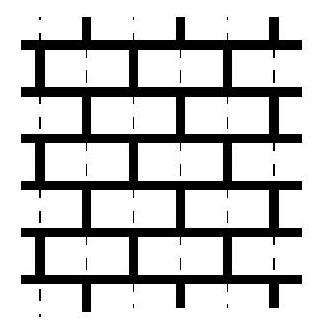
|
| 219 |
+
|
| 220 |
+
Figure 2
|
| 221 |
+
|
| 222 |
+
17. Using each of the eight digits $1,3,4,5,6,7,8$ and 9 exactly once, a three-digit number $A$, two twodigit numbers $B$ and $C, B<C$, and a one-digit number $D$ are formed. The numbers are such that $A+D=B+C=143$. In how many ways can this be done?
|
| 223 |
+
|
| 224 |
+
Solution. From $A=143-D$ and $1 \leq D \leq 9$, it follows that $134 \leq A \leq 142$. The hundreds digit of $A$ is therefore 1 , and the tens digit is either 3 or 4 . If the tens digit of $A$ is 4 , then the sum of the units digits of
|
| 225 |
+
$A$ and $D$ must be 3 , which is impossible, as the digits 0 and 2 are not among the eight digits given. Hence the first two digits of $A$ are uniquely determined as 1 and 3 . The sum of the units digits of $A$ and $D$ must be 13. This can be achieved in six different ways as $13=4+9=5+8=6+7=7+6=8+5=9+4$.
|
| 226 |
+
|
| 227 |
+
The sum of the units digits of $B$ and $C$ must again be 13, and as $B+C=143$, this must also be true for the tens digits. For each choice of the numbers $A$ and $D$, the remaining four digits form two pairs, both with the sum 13. The units digits of $B$ and $C$ may then be chosen in four ways. The tens digits are then uniquely determined by the remaining pair and the relation $B<C$. The total number of possibilities is therefore $6 \cdot 4=24$.
|
| 228 |
+
|
| 229 |
+
18. The jury of an olympiad has 30 members in the beginning. Each member of the jury thinks that some of his colleagues are competent, while all the others are not, and these opinions do not change. At the beginning of every session a voting takes place, and those members who are not competent in the opinion of more than one half of the voters are excluded from the jury for the rest of the olympiad. Prove that after at most 15 sessions there will be no more exclusions. (Note that nobody votes about his own competence.)
|
| 230 |
+
|
| 231 |
+
Solution. First we note that if nobody is excluded in some session, then the situation becomes stable and nobody can be excluded in any later session.
|
| 232 |
+
|
| 233 |
+
We use induction to prove the slightly more general claim that if the jury has $2 n$ members, $n \geq 2$, then after at most $n$ sessions nobody will be excluded anymore. For $n=2$ the claim is obvious, since if some members are excluded in the first two sessions, there are at most two members left, and hence nobody is excluded in the third session.
|
| 234 |
+
|
| 235 |
+
Now assuming that the claim is true for $n \leq k-1$, suppose the jury has $2 k$ members, and consider the first session. If nobody is excluded, we are done. If a positive and even number of members are excluded, there will be $2 r$ members left with $r<k$, and by the induction hypotheses the jury will stabilize after at most $r$ more sessions, giving a total of at most $r+1 \leq k$ sessions, as required.
|
| 236 |
+
|
| 237 |
+
Finally suppose that an odd number of members are excluded in the first session. There are three alternatives:
|
| 238 |
+
|
| 239 |
+
(i) An even number of members are excluded in each of the next $m$ sessions, after which nobody is excluded. Then the number of members left is at most $2 k-1-2 m$. Hence $2 k-1-2 m \geq 1$, so that $k \geq m+1$. Hence the number of sessions is at most $k$.
|
| 240 |
+
|
| 241 |
+
(ii) An even number of members are excluded in each of the next $m$ sessions, after which an odd number of members greater than 1 are excluded. Then there are at most $2 k-1-2 m-3$ members left, and by the induction hypotheses, the jury will stabilize in no more than $k-m-2$ sessions. The total number of sessions is therefore $1+m+1+(k-m-2)=k$.
|
| 242 |
+
|
| 243 |
+
(iii) An even number of members are excluded in each of the next $m$ sessions, followed by a session where precisely one member $M$ is excluded. In this session, there were $2 r+1$ members present for some $r$, and $r+1$ of these voted for the exclusion of $M$. But then any member other than $M$ was thought to be incompetent by at most $r$ others. In the next session the jury will have $2 r$ members, and since the members do not change their sympathies, nobody can be excluded. Hence the situation is stable after $m+2$ sessions, and at least $1+2 m+1=2 m+2$ members have been excluded. But there must be at least 3 members left, for one member cannot be excluded from a jury of 2 members. Hence $2 m+2 \leq 2 k-3$, whence $m+2 \leq k$.
|
| 244 |
+
|
| 245 |
+
Thus the claim holds for $n=k$ also. We conclude that the claim holds for all $n \geq 2$.
|
| 246 |
+
|
| 247 |
+
19. Four heaps contain 38, 45, 61, and 70 matches respectively. Two players take turns choosing any two of the heaps and take some non-zero number of matches from one heap and some non-zero number of matches from the other heap. The player who cannot make a move, loses. Which one of the players has a winning strategy?
|
| 248 |
+
|
| 249 |
+
Solution. The first player wins by making moves so that the opponent must face positions of the form $(a, a, a, b)$, where $a \leq b$.
|
| 250 |
+
|
| 251 |
+
20. Is it possible to partition all positive integers into disjoint sets $A$ and $B$ such that
|
| 252 |
+
|
| 253 |
+
(i) no three numbers of $A$ form arithmetic progression,
|
| 254 |
+
|
| 255 |
+
(ii) no infinite non-constant arithmetic progression can be formed by numbers of $B$ ?
|
| 256 |
+
|
| 257 |
+
Solution. Let $\mathbb{N}$ denote the set of positive integers. There is a bijective function $f: \mathbb{N} \rightarrow \mathbb{N} \times \mathbb{N}$. Let $a_{0}=1$, and for $k \geq 1$, let $a_{k}$ be the least integer of the form $m+t n$ for some integer $t \geq 0$ where $f(k)=(m, n)$, such that $a_{k} \geq 2 a_{k-1}$. Let $A=\left\{a_{0}, a_{1}, \ldots\right\}$ and let $B=\mathbb{N} \backslash A$. We now show that $A$ and $B$ satisfy the given conditions.
|
| 258 |
+
|
| 259 |
+
(i) For any non-negative integers $i<j<k$, we have $a_{k} \geq a_{j+1} \geq 2 a_{j}$, and hence $a_{k}-a_{j} \geq a_{j}>a_{j}-a_{i}$. Thus $a_{i}, a_{j}$ and $a_{k}$ do not form an arithmetic progression, since this would mean that $a_{k}-a_{j}=a_{j}-a_{i}$. Hence no three numbers in $A$ form an arithmetic progression.
|
| 260 |
+
|
| 261 |
+
(ii) Consider an infinite arithmetic progression $m, m+n, m+2 n, \ldots$, with $m, n \in \mathbb{N}$. Then $m+n t=a_{k}$ for some integer $t \geq 0$, where $k=f^{-1}(m, n)$. Thus $a_{k}$ belongs to the arithmetic progression, but $a_{k} \notin B$. Hence $B$ does not contain any infinite non-constant arithmetic progression.
|
| 262 |
+
|
BalticWay/md/en-bw97sol.md
ADDED
|
@@ -0,0 +1,409 @@
|
|
|
|
|
|
|
|
|
|
|
|
|
|
|
|
|
|
|
|
|
|
|
|
|
|
|
|
|
|
|
|
|
|
|
|
|
|
|
|
|
|
|
|
|
|
|
|
|
|
|
|
|
|
|
|
|
|
|
|
|
|
|
|
|
|
|
|
|
|
|
|
|
|
|
|
|
|
|
|
|
|
|
|
|
|
|
|
|
|
|
|
|
|
|
|
|
|
|
|
|
|
|
|
|
|
|
|
|
|
|
|
|
|
|
|
|
|
|
|
|
|
|
|
|
|
|
|
|
|
|
|
|
|
|
|
|
|
|
|
|
|
|
|
|
|
|
|
|
|
|
|
|
|
|
|
|
|
|
|
|
|
|
|
|
|
|
|
|
|
|
|
|
|
|
|
|
|
|
|
|
|
|
|
|
|
|
|
|
|
|
|
|
|
|
|
|
|
|
|
|
|
|
|
|
|
|
|
|
|
|
|
|
|
|
|
|
|
|
|
|
|
|
|
|
|
|
|
|
|
|
|
|
|
|
|
|
|
|
|
|
|
|
|
|
|
|
|
|
|
|
|
|
|
|
|
|
|
|
|
|
|
|
|
|
|
|
|
|
|
|
|
|
|
|
|
|
|
|
|
|
|
|
|
|
|
|
|
|
|
|
|
|
|
|
|
|
|
|
|
|
|
|
|
|
|
|
|
|
|
|
|
|
|
|
|
|
|
|
|
|
|
|
|
|
|
|
|
|
|
|
|
|
|
|
|
|
|
|
|
|
|
|
|
|
|
|
|
|
|
|
|
|
|
|
|
|
|
|
|
|
|
|
|
|
|
|
|
|
|
|
|
|
|
|
|
|
|
|
|
|
|
|
|
|
|
|
|
|
|
|
|
|
|
|
|
|
|
|
|
|
|
|
|
|
|
|
|
|
|
|
|
|
|
|
|
|
|
|
|
|
|
|
|
|
|
|
|
|
|
|
|
|
|
|
|
|
|
|
|
|
|
|
|
|
|
|
|
|
|
|
|
|
|
|
|
|
|
|
|
|
|
|
|
|
|
|
|
|
|
|
|
|
|
|
|
|
|
|
|
|
|
|
|
|
|
|
|
|
|
|
|
|
|
|
|
|
|
|
|
|
|
|
|
|
|
|
|
|
|
|
|
|
|
|
|
|
|
|
|
|
|
|
|
|
|
|
|
|
|
|
|
|
|
|
|
|
|
|
|
|
|
|
|
|
|
|
|
|
|
|
|
|
|
|
|
|
|
|
|
|
|
|
|
|
|
|
|
|
|
|
|
|
|
|
|
|
|
|
|
|
|
|
|
|
|
|
|
|
|
|
|
|
|
|
|
|
|
|
|
|
|
|
|
|
|
|
|
|
|
|
|
|
|
|
|
|
|
|
|
|
|
|
|
|
|
|
|
|
|
|
|
|
|
|
|
|
|
|
|
|
|
|
|
|
|
|
|
|
|
|
|
|
|
|
|
|
|
|
|
|
|
|
|
|
|
|
|
|
|
|
|
|
|
|
|
|
|
|
|
|
|
|
|
|
|
|
|
|
|
|
|
|
|
|
|
|
|
|
|
|
|
|
|
|
|
|
|
|
|
|
|
|
|
|
|
|
|
|
|
|
|
|
|
|
|
|
|
|
|
|
|
|
|
|
|
|
|
|
|
|
|
|
|
|
|
|
|
|
|
|
|
|
|
|
|
|
|
|
|
|
|
|
|
|
|
|
|
|
|
|
|
|
|
|
|
|
|
|
|
|
|
|
|
|
|
|
|
|
|
|
|
|
|
|
|
|
|
|
|
|
|
|
|
|
|
|
|
|
|
|
|
|
|
|
|
|
|
|
|
|
|
|
|
|
|
|
|
|
|
|
|
|
|
|
|
|
|
|
|
|
|
|
|
|
|
|
|
|
|
|
|
|
|
|
|
|
|
|
|
|
|
|
|
|
|
|
|
|
|
|
|
|
|
|
|
|
|
|
|
|
|
|
|
|
|
|
|
|
|
|
|
|
|
|
|
|
|
|
|
|
|
|
|
|
|
|
|
|
|
|
|
|
|
|
|
|
|
|
|
|
|
|
|
|
|
|
|
|
|
|
|
|
|
|
|
|
|
|
|
|
|
|
|
|
|
|
|
|
|
|
|
|
|
|
|
|
|
|
|
|
|
|
|
|
|
|
|
|
|
|
|
|
|
|
|
|
|
|
|
|
|
|
|
|
|
|
|
|
|
|
|
|
|
|
|
|
|
|
|
|
|
|
|
|
|
|
|
|
|
|
|
|
|
|
|
|
|
|
|
|
|
|
|
|
|
|
|
|
|
|
|
|
|
|
|
|
|
|
|
|
|
|
|
|
|
|
|
|
|
|
|
|
|
|
|
|
|
|
|
|
|
|
|
|
|
|
|
|
|
|
|
|
|
|
|
|
|
|
|
|
|
|
|
|
|
|
|
|
|
|
|
|
|
|
|
|
|
|
|
|
|
|
|
|
|
|
|
|
|
|
|
|
|
|
|
|
|
|
|
|
|
|
|
|
|
|
|
|
|
|
|
|
|
|
|
|
|
|
|
|
|
|
|
|
|
|
|
|
|
|
|
|
|
|
|
|
|
|
|
|
|
|
|
|
|
|
|
|
|
|
|
|
|
|
|
|
|
|
|
|
|
|
|
|
|
|
|
|
|
|
|
|
|
|
|
|
|
|
|
|
|
|
|
|
|
|
|
|
|
|
|
|
|
|
|
|
|
|
|
|
|
|
|
|
|
|
|
|
|
|
| 1 |
+
# Baltic Way 1997
|
| 2 |
+
|
| 3 |
+
## Copenhagen, November 9, 1997
|
| 4 |
+
|
| 5 |
+
## Problems
|
| 6 |
+
|
| 7 |
+
1. Determine all functions $f$ from the real numbers to the real numbers, different from the zero function, such that $f(x) f(y)=f(x-y)$ for all real numbers $x$ and $y$.
|
| 8 |
+
2. Given a sequence $a_{1}, a_{2}, a_{3}, \ldots$ of positive integers in which every positive integer occurs exactly once. Prove that there exist integers $\ell$ and $m$, $1<\ell<m$, such that $a_{1}+a_{m}=2 a_{\ell}$.
|
| 9 |
+
3. Let $x_{1}=1$ and $x_{n+1}=x_{n}+\left\lfloor\frac{x_{n}}{n}\right\rfloor+2$ for $n=1,2,3, \ldots$, where $\lfloor x\rfloor$ denotes the largest integer not greater than $x$. Determine $x_{1997}$.
|
| 10 |
+
4. Prove that the arithmetic mean $a$ of $x_{1}, \ldots, x_{n}$ satisfies
|
| 11 |
+
|
| 12 |
+
$$
|
| 13 |
+
\left(x_{1}-a\right)^{2}+\cdots+\left(x_{n}-a\right)^{2} \leqslant \frac{1}{2}\left(\left|x_{1}-a\right|+\cdots+\left|x_{n}-a\right|\right)^{2} .
|
| 14 |
+
$$
|
| 15 |
+
|
| 16 |
+
5. In a sequence $u_{0}, u_{1}, \ldots$ of positive integers, $u_{0}$ is arbitrary, and for any non-negative integer $n$,
|
| 17 |
+
|
| 18 |
+
$$
|
| 19 |
+
u_{n+1}= \begin{cases}\frac{1}{2} u_{n} & \text { for even } u_{n} \\ a+u_{n} & \text { for odd } u_{n}\end{cases}
|
| 20 |
+
$$
|
| 21 |
+
|
| 22 |
+
where $a$ is a fixed odd positive integer. Prove that the sequence is periodic from a certain step.
|
| 23 |
+
|
| 24 |
+
6. Find all triples $(a, b, c)$ of non-negative integers satisfying $a \geqslant b \geqslant c$ and $1 \cdot a^{3}+9 \cdot b^{2}+9 \cdot c+7=1997$.
|
| 25 |
+
7. Let $P$ and $Q$ be polynomials with integer coefficients. Suppose that the integers $a$ and $a+1997$ are roots of $P$, and that $Q(1998)=2000$. Prove that the equation $Q(P(x))=1$ has no integer solutions.
|
| 26 |
+
8. If we add 1996 and 1997, we first add the unit digits 6 and 7. Obtaining 13, we write down 3 and "carry" 1 to the next column. Thus we make a carry. Continuing, we see that we are to make three carries in total:
|
| 27 |
+
|
| 28 |
+
$$
|
| 29 |
+
\begin{array}{r}
|
| 30 |
+
111 \\
|
| 31 |
+
1996 \\
|
| 32 |
+
+1997 \\
|
| 33 |
+
\hline 3993
|
| 34 |
+
\end{array}
|
| 35 |
+
$$
|
| 36 |
+
|
| 37 |
+
Does there exist a positive integer $k$ such that adding $1996 \cdot k$ to $1997 \cdot k$ no carry arises during the whole calculation?
|
| 38 |
+
|
| 39 |
+
9. The worlds in the Worlds' Sphere are numbered $1,2,3, \ldots$ and connected so that for any integer $n \geqslant 1$, Gandalf the Wizard can move in both directions between any worlds with numbers $n, 2 n$ and $3 n+1$. Starting his travel from an arbitrary world, can Gandalf reach every other world?
|
| 40 |
+
10. Prove that in every sequence of 79 consecutive positive integers written in the decimal system, there is a positive integer whose sum of digits is divisible by 13 .
|
| 41 |
+
11. On two parallel lines, the distinct points $A_{1}, A_{2}, A_{3}, \ldots$ respectively $B_{1}$, $B_{2}, B_{3}, \ldots$ are marked in such a way that $\left|A_{i} A_{i+1}\right|=1$ and $\left|B_{i} B_{i+1}\right|=2$ for $i=1,2, \ldots$ (see Figure). Provided that $\angle A_{1} A_{2} B_{1}=\alpha$, find the infinite sum $\angle A_{1} B_{1} A_{2}+\angle A_{2} B_{2} A_{3}+\angle A_{3} B_{3} A_{4}+\ldots$
|
| 42 |
+
|
| 43 |
+
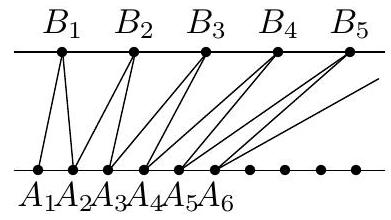
|
| 44 |
+
|
| 45 |
+
12. Two circles $\mathcal{C}_{1}$ and $\mathcal{C}_{2}$ intersect in $P$ and $Q$. A line through $P$ intersects $\mathcal{C}_{1}$ and $\mathcal{C}_{2}$ again in $A$ and $B$, respectively, and $X$ is the midpoint of $A B$. The line through $Q$ and $X$ intersects $\mathcal{C}_{1}$ and $\mathcal{C}_{2}$ again in $Y$ and $Z$, respectively. Prove that $X$ is the midpoint of $Y Z$.
|
| 46 |
+
13. Five distinct points $A, B, C, D$ and $E$ lie on a line with
|
| 47 |
+
|
| 48 |
+
$$
|
| 49 |
+
|A B|=|B C|=|C D|=|D E| \text {. }
|
| 50 |
+
$$
|
| 51 |
+
|
| 52 |
+
The point $F$ lies outside the line. Let $G$ be the circumcentre of triangle $A D F$ and $H$ be the circumcentre of triangle $B E F$. Show that lines $G H$ and $F C$ are perpendicular.
|
| 53 |
+
|
| 54 |
+
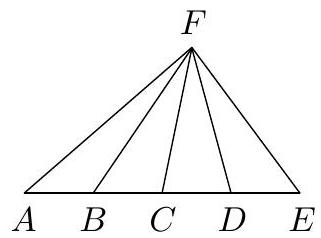
|
| 55 |
+
|
| 56 |
+
14. In the triangle $A B C,|A C|^{2}$ is the arithmetic mean of $|B C|^{2}$ and $|A B|^{2}$. Show that $\cot ^{2} B \geqslant \cot A \cot C$.
|
| 57 |
+
15. In the acute triangle $A B C$, the bisectors of $\angle A, \angle B$ and $\angle C$ intersect the circumcircle again in $A_{1}, B_{1}$ and $C_{1}$, respectively. Let $M$ be the point of intersection of $A B$ and $B_{1} C_{1}$, and let $N$ be the point of intersection of $B C$ and $A_{1} B_{1}$. Prove that $M N$ passes through the incentre of triangle $A B C$.
|
| 58 |
+
16. On a $5 \times 5$ chessboard, two players play the following game. The first player places a knight on some square. Then the players alternately move the knight according to the rules of chess, starting with the second player. It is not allowed to move the knight to a square that has been visited previously. The player who cannot move loses. Which of the two players has a winning strategy?
|
| 59 |
+
17. A rectangle can be divided into $n$ equal squares. The same rectangle can also be divided into $n+76$ equal squares. Find all possible values of $n$.
|
| 60 |
+
18. a) Prove the existence of two infinite sets $A$ and $B$, not necessarily disjoint, of non-negative integers such that each non-negative integer $n$ is uniquely representable in the form $n=a+b$ with $a \in A, b \in B$.
|
| 61 |
+
|
| 62 |
+
b) Prove that for each such pair $(A, B)$, either $A$ or $B$ contains only multiples of some integer $k>1$.
|
| 63 |
+
|
| 64 |
+
19. In a forest each of $n$ animals $(n \geqslant 3)$ lives in its own cave, and there is exactly one separate path between any two of these caves. Before the election for King of the Forest some of the animals make an election campaign. Each campaign-making animal visits each of the other caves exactly once,
|
| 65 |
+
uses only the paths for moving from cave to cave, never turns from one path to another between the caves and returns to its own cave in the end of its campaign. It is also known that no path between two caves is used by more than one campaign-making animal.
|
| 66 |
+
|
| 67 |
+
a) Prove that for any prime $n$, the maximum possible number of campaign-making animals is $\frac{n-1}{2}$;
|
| 68 |
+
|
| 69 |
+
b) Find the maximum number of campaign-making animals for $n=9$.
|
| 70 |
+
|
| 71 |
+
20. Twelve cards lie in a row. The cards are of three kinds: with both sides white, both sides black, or with a white and a black side. Initially, nine of the twelve cards have a black side up. The cards 1-6 are turned, and subsequently four of the twelve cards have a black side up. Now cards $4-9$ are turned, and six cards have a black side up. Finally, the cards 1-3 and 10-12 are turned, after which five cards have a black side up. How many cards of each kind are there?
|
| 72 |
+
|
| 73 |
+
## Solutions
|
| 74 |
+
|
| 75 |
+
1. Answer: $f(x) \equiv 1$ is the only such function.
|
| 76 |
+
|
| 77 |
+
Since $f$ is not the zero function, there is an $x_{0}$ such that $f\left(x_{0}\right) \neq 0$. From $f\left(x_{0}\right) f(0)=f\left(x_{0}-0\right)=f\left(x_{0}\right)$ we then get $f(0)=1$. Then by $f(x)^{2}=f(x) f(x)=f(x-x)=f(0)$ we have $f(x) \neq 0$ for any real $x$. Finally from $f(x) f\left(\frac{x}{2}\right)=f\left(x-\frac{x}{2}\right)=f\left(\frac{x}{2}\right)$ we get $f(x)=1$ for any real $x$. It is readily verified that this function satisfies the equation.
|
| 78 |
+
|
| 79 |
+
2. Let $\ell$ be the least index such that $a_{\ell}>a_{1}$. Since $2 a_{\ell}-a_{1}$ is a positive integer larger than $a_{1}$, it occurs in the given sequence beyond $a_{\ell}$. In other words, there exists an index $m>\ell$ such that $a_{m}=2 a_{\ell}-a_{1}$. This completes the proof.
|
| 80 |
+
|
| 81 |
+
Remarks. The problem was proposed in the slightly more general form where the first term of the arithmetic progression has an arbitary index. The remarks below refer to this version. The problem committee felt that no essential new aspects would arise from the generalization.
|
| 82 |
+
|
| 83 |
+
1. A generalization of this problem is to ask about an existence of an $s$-term arithmetic subsequence of the sequence $\left(a_{n}\right)$ (such a subsequence
|
| 84 |
+
always exists for $s=3$, as shown above). It turns out that for $s=5$ such a subsequence may not exist. The proof can be found in [1]. The same problem for $s=4$ is still open!
|
| 85 |
+
2. The present problem $(s=3)$ and the above solution is also taken from [1].
|
| 86 |
+
|
| 87 |
+
Reference. [1] J. A. Davis, R. C. Entringer, R. L. Graham and G. J. Simmons, On permutations containing no long arithmetic progressions, Acta Arithmetica 1(1977), pp. 81-90.
|
| 88 |
+
|
| 89 |
+
3. Answer: $x_{1997}=23913$.
|
| 90 |
+
|
| 91 |
+
Note that if $x_{n}=a n+b$ with $0 \leqslant b<n$, then
|
| 92 |
+
|
| 93 |
+
$$
|
| 94 |
+
x_{n+1}=x_{n}+a+2=a(n+1)+b+2 \text {. }
|
| 95 |
+
$$
|
| 96 |
+
|
| 97 |
+
Hence if $x_{N}=A N$ for some positive integers $A$ and $N$, then for $i=0,1, \ldots, N$ we have $x_{N+i}=A(N+i)+2 i$, and $x_{2 N}=(A+1) \cdot 2 N$. Since for $N=1$ the condition $x_{N}=A N$ holds with $A=1$, then for $N=2^{k}$ (where $k$ is any non-negative integer) it also holds with $A=k+1$. Now for $N=2^{10}=1024$ we have $A=11$ and $x_{N+i}=A(N+i)+2 i$, which for $i=973$ makes $x_{1997}=11 \cdot 1997+2 \cdot 973=23913$.
|
| 98 |
+
|
| 99 |
+
4. Denote $y_{i}=x_{i}-a$. Then $y_{1}+y_{2}+\cdots+y_{n}=0$. We can assume $y_{1} \leqslant y_{2} \leqslant \cdots \leqslant y_{k} \leqslant 0 \leqslant y_{k+1} \leqslant \cdots \leqslant y_{n}$. Let $y_{1}+y_{2}+\cdots+y_{k}=-z$, then $y_{k+1}+\cdots+y_{n}=z$ and
|
| 100 |
+
|
| 101 |
+
$$
|
| 102 |
+
\begin{aligned}
|
| 103 |
+
y_{1}^{2}+y_{2}^{2}+\cdots+y_{n}^{2} & =y_{1}^{2}+y_{2}^{2}+\cdots+y_{k}^{2}+y_{k+1}^{2}+\cdots+y_{n}^{2} \leqslant \\
|
| 104 |
+
& \leqslant\left(y_{1}+y_{2}+\cdots+y_{k}\right)^{2}+\left(y_{k+1}+\cdots+y_{n}\right)^{2}=2 z^{2}= \\
|
| 105 |
+
& =\frac{1}{2}(2 z)^{2}=\frac{1}{2}\left(\left|y_{1}\right|+\left|y_{2}\right|+\cdots+\left|y_{n}\right|\right)^{2} .
|
| 106 |
+
\end{aligned}
|
| 107 |
+
$$
|
| 108 |
+
|
| 109 |
+
Alternative solution. The case $n=1$ is trivial (then $x_{1}-a=0$ and we get the inequality $0 \leqslant 0$ ). Suppose now that $n \geqslant 2$. Consider a square of side length $\left|x_{1}-a\right|+\left|x_{2}-a\right|+\ldots+\left|x_{n}-a\right|$ and construct squares of side lengths $\left|x_{1}-a\right|,\left|x_{2}-a\right|, \ldots,\left|x_{n}-a\right|$ side by side inside it as shown on Figure 1. Since none of the side lengths of the small squares exceeds half of the side length of the large square, then all the small squares are contained within the upper half of the large square, i.e. the sum of their areas does not exceed half of the area of the large square, q.e.d.
|
| 110 |
+
|
| 111 |
+
5. Suppose $u_{n}>a$. Then, if $u_{n}$ is even we have $u_{n+1}=\frac{1}{2} u_{n}<u_{n}$, and if
|
| 112 |
+
$u_{n}$ is odd we have $u_{n+1}=a+u_{n}<2 u_{n}$ and $u_{n+2}=\frac{1}{2} u_{n+1}<u_{n}$. Hence the iteration results in $u_{n} \leqslant a$ in a finite number of steps. Thus for any non-negative integer $m$, some non-negative integer $n>m$ satisfies $u_{n} \leqslant a$, and there must be an infinite set of such integers $n$.
|
| 113 |
+
|
| 114 |
+
Since the set of natural numbers not exceeding $a$ is finite and such values arise in the sequence $\left(u_{n}\right)$ an infinite number of times, there exist nonnegative integers $m$ and $n$ with $n>m$ such that $u_{n}=u_{m}$. Starting from $u_{m}$ the sequence is then periodic with a period dividing $n-m$.
|
| 115 |
+
|
| 116 |
+
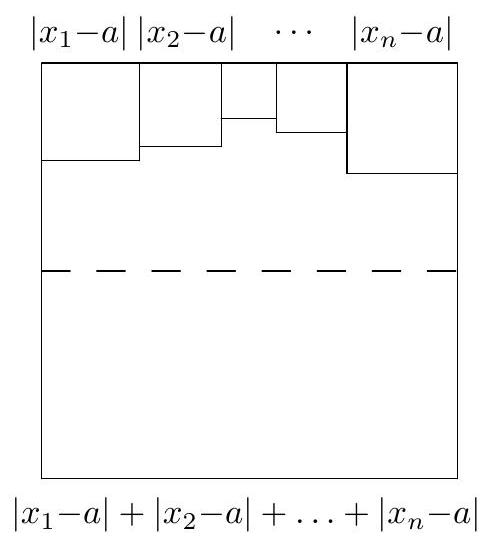
|
| 117 |
+
|
| 118 |
+
Figure 1
|
| 119 |
+
|
| 120 |
+
6. Answer: $(10,10,10)$ is the only such triple.
|
| 121 |
+
|
| 122 |
+
The equality immediately implies $a^{3}+9 b^{2}+9 c=1990 \equiv 1(\bmod 9)$. Hence $a^{3} \equiv 1(\bmod 9)$ and $a \equiv 1(\bmod 3)$. Since $13^{3}=2197>1990$ then the possible values for $a$ are $1,4,7,10$.
|
| 123 |
+
|
| 124 |
+
On the other hand, if $a \leqslant 7$ then by $a \geqslant b \geqslant c$ we have
|
| 125 |
+
|
| 126 |
+
$$
|
| 127 |
+
a^{3}+9 b^{2}+9 c^{2} \leqslant 7^{3}+9 \cdot 7^{2}+9 \cdot 7=847<1990
|
| 128 |
+
$$
|
| 129 |
+
|
| 130 |
+
a contradiction. Hence $a=10$ and $9 b^{2}+9 c=990$, whence by $c \leqslant b \leqslant 10$ we have $c=b=10$.
|
| 131 |
+
|
| 132 |
+
7. Suppose $b$ is an integer such that $Q(P(b))=1$. Since $a$ and $a+1997$ are roots of $P$ we have $P(x)=(x-a)(x-a-1997) R(x)$ where $R$ is a polynomial with integer coefficients. For any integer $b$ the integers $b-a$ and
|
| 133 |
+
$b-a-1997$ are of different parity and hence $P(b)=(b-a)(b-a-1997) R(b)$ is even. Since $Q(1998)=2000$ then the constant term in the expansion of $Q(x)$ is even (otherwise $Q(x)$ would be odd for any even integer $x$ ), and $Q(c)$ is even for any even integer $c$. Hence $Q(P(b))$ is also even and cannot be equal to 1 .
|
| 134 |
+
8. Answer: yes.
|
| 135 |
+
|
| 136 |
+
The key to the proof is noting that if we add two positive integers and the result is an integer consisting only of digits 9 then the process of addition must have gone without any carries. Therefore it is enough to prove that there exists an integer $k$ such that $3993 k$ is of the form $999 \ldots 9$.
|
| 137 |
+
|
| 138 |
+
Consider the first 3994 positive integers consisting only of digits 9:
|
| 139 |
+
|
| 140 |
+
$$
|
| 141 |
+
9,99,999, \ldots, \underbrace{999 \ldots 9}_{3994} .
|
| 142 |
+
$$
|
| 143 |
+
|
| 144 |
+
By the pigeonhole principle some two of these give the same remainder upon division by 3993 , so their difference
|
| 145 |
+
|
| 146 |
+
$$
|
| 147 |
+
\underbrace{99 \ldots 9}_{n} \underbrace{00 \ldots 0}_{r}=\underbrace{99 \ldots 9}_{n} \cdot 10^{r}
|
| 148 |
+
$$
|
| 149 |
+
|
| 150 |
+
is divisible by 3993 . Since 10 and 3993 are coprime we get an integer consisting only of digits 9 and divisible by 3993 .
|
| 151 |
+
|
| 152 |
+
## Remarks.
|
| 153 |
+
|
| 154 |
+
1. The existence of an integer $10^{\ell}-1$ consisting only of digits 9 and divisible by 3993 may also be demonstrated quite elegantly by means of Euler's Theorem. The numbers 10 and 3993 are coprime, so $10^{\varphi(3993)}-1$ is divisible by 3993 . Thus we may take $\ell=\varphi(3993)$.
|
| 155 |
+
|
| 156 |
+
2 . By a computer search it can be found that the smallest integer $k$ satisfying the condition of the problem is $k=162$. Then $1996 \cdot 162=323352$; $1997 \cdot 162=323514$ and
|
| 157 |
+
|
| 158 |
+
$$
|
| 159 |
+
\begin{array}{r}
|
| 160 |
+
323352 \\
|
| 161 |
+
+323514 \\
|
| 162 |
+
\hline 646866
|
| 163 |
+
\end{array}
|
| 164 |
+
$$
|
| 165 |
+
|
| 166 |
+
9. Answer: yes.
|
| 167 |
+
|
| 168 |
+
For any two given worlds, Gandalf can move between them either in both
|
| 169 |
+
directions or none. Hence, it suffices to show that Gandalf can move to the world 1 from any given world $n$. For that, it is sufficient for him to be able to move from any world $n>1$ to some world $m$ such that $m<n$. We consider three possible cases:
|
| 170 |
+
|
| 171 |
+
a) If $n=3 k+1$, then Gandalf can move directly from the world $n$ to the world $k<n$.
|
| 172 |
+
|
| 173 |
+
b) If $n=3 k+2$, then Gandalf can move from the world $n$ to the world $2 n=6 k+4=3 \cdot(2 k+1)+1$ and further to the world $2 k+1<n$. c) If $n=3 k$ then Gandalf can move from the world $n$ to the world $3 n+1=9 k+1$, further from there to the worlds $2 \cdot(9 k+1)=18 k+2$, $2 \cdot(18 k+2)=36 k+4=3 \cdot(12 k+1)+1,12 k+1,4 k$ and finally to the world $2 k<n$.
|
| 174 |
+
|
| 175 |
+
10. Among the first 40 numbers in the sequence, four are divisible by 10 and at least one of these has its second digit from the right less than or equal to 6 . Let this number be $x$ and let $y$ be its sum of digits. Then the numbers $x, x+1, x+2, \ldots, x+39$ all belong to the sequence, and each of $y, y+1, \ldots, y+12$ appears at least once among their sums of decimal digits. One of these is divisible by 13 .
|
| 176 |
+
|
| 177 |
+
Remark: there exist 78 consecutive natural numbers, none of which has its sum of digits divisible by 13 - e.g. 859999999961 through 860000000038 .
|
| 178 |
+
|
| 179 |
+
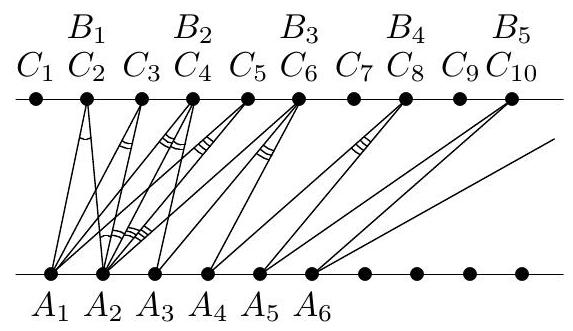
|
| 180 |
+
|
| 181 |
+
Figure 2
|
| 182 |
+
|
| 183 |
+
11. Answer: $\pi-\alpha$.
|
| 184 |
+
|
| 185 |
+
Let $C_{1}, C_{2}, C_{3}, \ldots$ be points on the upper line such that $\left|C_{i} C_{i+1}\right|=1$ and $B_{i}=C_{2 i}$ for each $i=1,2, \ldots$ (see Figure 2 ). Then for any $i=1,2, \ldots$ we have
|
| 186 |
+
|
| 187 |
+
$$
|
| 188 |
+
\angle A_{i} B_{i} A_{i+1}=\angle A_{i} C_{2 i} A_{i+1}=\angle A_{1} C_{i+1} A_{2}=\angle C_{i+1} A_{2} C_{i+2}
|
| 189 |
+
$$
|
| 190 |
+
|
| 191 |
+
Hence
|
| 192 |
+
|
| 193 |
+
$$
|
| 194 |
+
\begin{aligned}
|
| 195 |
+
& \angle A_{1} B_{1} A_{2}+\angle A_{2} B_{2} A_{3}+\angle A_{3} B_{3} A_{4}+\ldots= \\
|
| 196 |
+
& \quad=\angle C_{2} A_{2} C_{3}+\angle C_{3} A_{2} C_{4}+\angle C_{4} A_{2} C_{5}+\ldots=\pi-\alpha .
|
| 197 |
+
\end{aligned}
|
| 198 |
+
$$
|
| 199 |
+
|
| 200 |
+
12. Depending on the radii of the circles, the distance between their centres and the choice of the line through $P$ we have several possible arrangements of the points $A, B, P$ and $Y, Z, Q$. We shall show that in each case the triangles $A X Y$ and $B X Z$ are congruent, whence $|Y X|=|X Z|$.
|
| 201 |
+
|
| 202 |
+
(a) Point $P$ lies within segment $A B$ and point $Q$ lies within segment $Y Z$ (see Figure 3). Then
|
| 203 |
+
|
| 204 |
+
$$
|
| 205 |
+
\angle A Y X=\angle A Y Q=\pi-\angle A P Q=\angle B P Q=\angle B Z Q=\angle B Z X .
|
| 206 |
+
$$
|
| 207 |
+
|
| 208 |
+
Since also $\angle A X Y=\angle B X Z$ and $|A X|=|X B|$, triangles $A X Y$ and $B X Z$ are congruent.
|
| 209 |
+
|
| 210 |
+
(b) Point $P$ lies outside of segment $A B$ and point $Q$ lies within segment $Y Z$ (see Figure 4). Then
|
| 211 |
+
|
| 212 |
+
$$
|
| 213 |
+
\angle A Y X=\angle A Y Q=\angle A P Q=\angle B P Q=\angle B Z Q=\angle B Z X .
|
| 214 |
+
$$
|
| 215 |
+
|
| 216 |
+
|
| 217 |
+
|
| 218 |
+
Figure 3
|
| 219 |
+
|
| 220 |
+
|
| 221 |
+
|
| 222 |
+
Figure 4
|
| 223 |
+
|
| 224 |
+
(c) Point $P$ lies outside of segment $A B$ and point $Q$ lies outside of segment $Y Z$ (see Figure 5). Then
|
| 225 |
+
|
| 226 |
+
$$
|
| 227 |
+
\angle A Y X=\pi-\angle A Y Q=\angle A P Q=\angle B P Q=\angle B Z Q=\angle B Z X .
|
| 228 |
+
$$
|
| 229 |
+
|
| 230 |
+
(d) Point $P$ lies within segment $A B$ and point $Q$ lies outside of segment $Y Z$. This case is similar to (b): exchange the roles of points $P$ and $Q, A$ and $Y, B$ and $Z$.
|
| 231 |
+
|
| 232 |
+
|
| 233 |
+
|
| 234 |
+
Figure 5
|
| 235 |
+
|
| 236 |
+
13. Let $O, H^{\prime}$ and $G^{\prime}$ be the circumcentres of the triangles $B D F, B C F$ and $C D F$, respectively (see Figure 6). Then $O, G$ and $G^{\prime}$ lie on the perpendicular bisector of the segment $D F$, while $O, H$ and $H^{\prime}$ lie on the perpendicular bisector of the segment $B F$. Moreover, $G$ and $H^{\prime}$ lie on the perpendicular bisector of $B C, O$ lies on the perpendicular bisector of $B D$, $H$ and $G^{\prime}$ lie on the perpendicular bisector of $C D$ and $C$ is the midpoint of $B D$. Hence $H^{\prime}$ and $G^{\prime}$ are symmetric to $H$ and $G$, respectively, relative to point $O$. Hence triangles $O G H^{\prime}$ and $O G^{\prime} H$ are congruent, and $G H G^{\prime} H^{\prime}$ is a parallelogram.
|
| 237 |
+
|
| 238 |
+
Since $C F$ is the common side of triangles $B C F$ and $C D F$, the line $G^{\prime} H^{\prime}$ connecting their circumcentres is perpendicular to $C F$. Therefore $G H$ is also perpendicular to $C F$.
|
| 239 |
+
|
| 240 |
+
|
| 241 |
+
|
| 242 |
+
Figure 6
|
| 243 |
+
|
| 244 |
+
Alternative solution. Note that the diagonals of a quadrangle $X Y Z W$ are perpendicular to each other if and only if $|X Y|^{2}-|Z Y|^{2}=|X W|^{2}-|Z W|^{2}$. Applying this to the quadrangle $G F H C$ it is sufficient to prove that $|G F|^{2}-|H F|^{2}=|G C|^{2}-|H C|^{2}$. Denote $|A B|=|B C|=|C D|=|D E|=a$, $\angle G A C=\alpha$ and $\angle H E C=\beta$, and let $R_{1}, R_{2}$ be the circumradii of triangles $A D F$ and $B E F$, respectively (see Figure 7). Applying the cosine law to triangles $C G A$ and $C H E$, we have $|G C|^{2}=R_{1}^{2}+4 a^{2}-4 a R_{1} \cos \alpha$
|
| 245 |
+
and $|H C|^{2}=R_{2}^{2}+4 a^{2}-4 a R_{2} \cos \beta$. Together with $\cos \alpha=\frac{3 a}{2 R_{1}}$ and $\cos \beta=\frac{3 a}{2 R_{2}}$ this yields $|G C|^{2}-|H C|^{2}=R_{1}^{2}-R_{2}^{2}$. Since $|G F|=R_{1}$ and $|H F|=R_{2}$, we also have $|G F|^{2}-|H F|^{2}=R_{1}^{2}-R_{2}^{2}$.
|
| 246 |
+
|
| 247 |
+
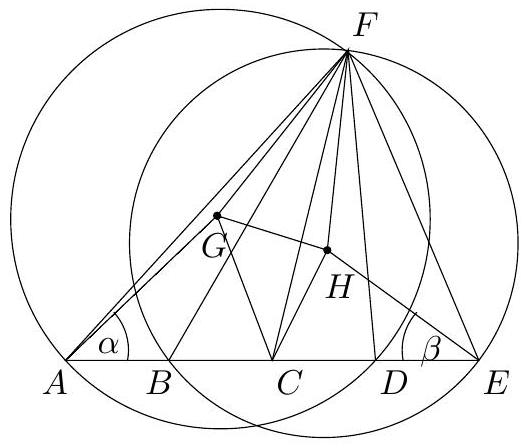
|
| 248 |
+
|
| 249 |
+
Figure 7
|
| 250 |
+
|
| 251 |
+
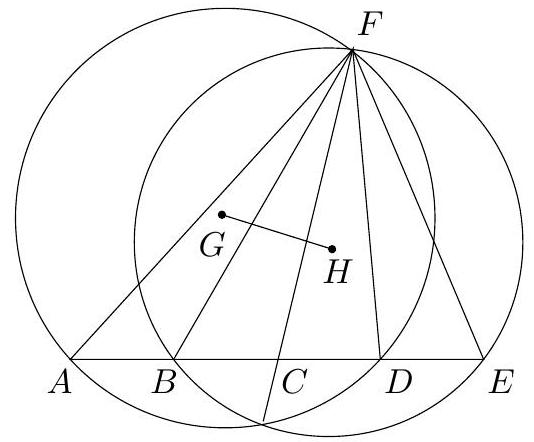
|
| 252 |
+
|
| 253 |
+
Figure 8
|
| 254 |
+
|
| 255 |
+
Another solution. We shall use the following fact that can easily be derived from the properties of the power of a point: Let a line $s$ intersect two circles at points $K, L$ and $M, N$, respectively, and let these circles intersect each other at $P$ and $Q . A$ point $X$ on the line $s$ lies also on the line $P Q$ (i.e. is the intersection point of the lines $s$ and $P Q$ ) if and only if $|K X| \cdot|L X|=|M X| \cdot|N X|$.
|
| 256 |
+
|
| 257 |
+
The line $A E$ intersects the circumcircles of triangles $A D F$ and $B E F$ at $A, D$ and $B, E$, respectively. Since point $C$ lies on line $A E$ and $|A C| \cdot|D C|=|B C| \cdot|E C|$, then line $C F$ passes through the second intersection point of these circles (see Figure 8) and hence is perpendicular to the segment $G H$ connecting the centres of these circles.
|
| 258 |
+
|
| 259 |
+
14. Denote $|B C|=a,|C A|=b$ and $|A B|=c$, then we have $2 b^{2}=a^{2}+c^{2}$. Applying the cosine and sine laws to triangle $A B C$ we have:
|
| 260 |
+
|
| 261 |
+
$$
|
| 262 |
+
\begin{aligned}
|
| 263 |
+
& \cot B=\frac{\cos B}{\sin B}=\frac{\left(a^{2}+c^{2}-b^{2}\right) \cdot 2 R}{2 a c \cdot b}=\frac{\left(a^{2}+c^{2}-b^{2}\right) \cdot R}{a b c}, \\
|
| 264 |
+
& \cot A=\frac{\cos A}{\sin A}=\frac{\left(b^{2}+c^{2}-a^{2}\right) \cdot R}{a b c},
|
| 265 |
+
\end{aligned}
|
| 266 |
+
$$
|
| 267 |
+
|
| 268 |
+
$$
|
| 269 |
+
\cot C=\frac{\cos C}{\sin C}=\frac{\left(a^{2}+b^{2}-c^{2}\right) \cdot R}{a b c}
|
| 270 |
+
$$
|
| 271 |
+
|
| 272 |
+
where $R$ is the circumradius of triangle $A B C$. To finish the proof it hence suffices to show that $\left(a^{2}+c^{2}-b^{2}\right)^{2} \geqslant\left(b^{2}+c^{2}-a^{2}\right)\left(a^{2}+b^{2}-c^{2}\right)$. Indeed, from the AM-GM inequality we get
|
| 273 |
+
|
| 274 |
+
$$
|
| 275 |
+
\begin{aligned}
|
| 276 |
+
\left(b^{2}+c^{2}-a^{2}\right)\left(a^{2}+b^{2}-c^{2}\right) & \leqslant \frac{\left(b^{2}+c^{2}-a^{2}+a^{2}+b^{2}-c^{2}\right)^{2}}{4}=b^{4}= \\
|
| 277 |
+
& =\left(2 b^{2}-b^{2}\right)^{2}=\left(a^{2}+c^{2}-b^{2}\right)^{2} .
|
| 278 |
+
\end{aligned}
|
| 279 |
+
$$
|
| 280 |
+
|
| 281 |
+
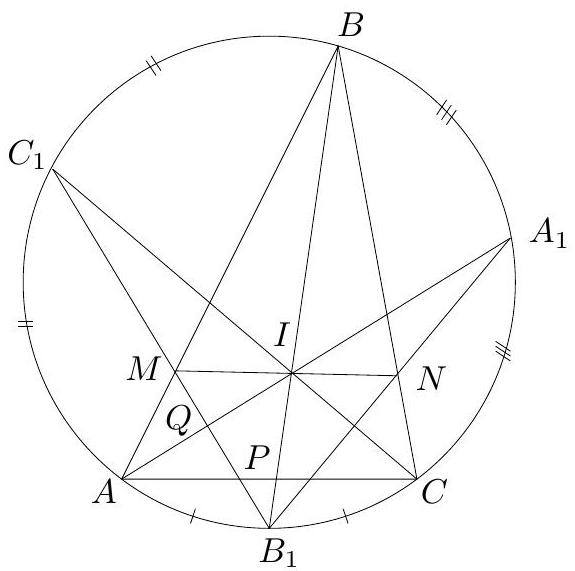
|
| 282 |
+
|
| 283 |
+
Figure 9
|
| 284 |
+
|
| 285 |
+
15. Let $I$ be the incenter of triangle $A B C$ (the intersection point of the angle bisectors $A A_{1}, B B_{1}$ and $C C_{1}$ ), and let $B_{1} C_{1}$ intersect the side $A C$ and the angle bisector $A A_{1}$ at $P$ and $Q$, respectively (see Figure 9 ). Then
|
| 286 |
+
|
| 287 |
+
$$
|
| 288 |
+
\angle A Q C_{1}=\frac{1}{2}\left(\overparen{A C}_{1}+\overparen{A_{1} B_{1}}\right)=\frac{1}{2} \cdot\left(\frac{1}{2} \overparen{A B}+\frac{1}{2} \overparen{B C}+\frac{1}{2} \overparen{C A}\right)=90^{\circ}
|
| 289 |
+
$$
|
| 290 |
+
|
| 291 |
+
Since $\angle A C_{1} B_{1}=\angle B_{1} C_{1} C$ (as their supporting arcs are of equal size), then $C_{1} B_{1}$ is the bisector of angle $A C_{1} I$. Moreover, since $A I$ and $C_{1} B_{1}$ are perpendicular, then $C_{1} B_{1}$ is also the bisector of angle $A M I$. Similarly we can show that $B_{1} C_{1}$ bisects the angles $A B_{1} I$ ja $A P I$. Hence the diagonals of the quadrangle $A M I P$ are perpendicular and bisect its angles, i.e.
|
| 292 |
+
$A M I P$ is a rhombus and $M I$ is parrallel to $A C$. Similarly we can prove that $N I$ is parallel to $A C$, i.e. points $M, I$ and $N$ are collinear, q.e.d.
|
| 293 |
+
|
| 294 |
+
16. Answer: the first player has a winning strategy.
|
| 295 |
+
|
| 296 |
+
Divide all the squares of the board except one in pairs so that the squares of each pair are accessible from each other by one move of the knight (see Figure 10 where the squares of each pair are marked with the same number, and the remaining square is marked by $X$ ). The winning strategy for the first player will be to place the knight on the square $X$ in the beginning and further make each move from a square to the other square paired with it.
|
| 297 |
+
|
| 298 |
+
| $X$ | 12 | 8 | 3 | 11 |
|
| 299 |
+
| :---: | :---: | :---: | :---: | :---: |
|
| 300 |
+
| 5 | 3 | 11 | 1 | 7 |
|
| 301 |
+
| 12 | 8 | 6 | 10 | 4 |
|
| 302 |
+
| 2 | 5 | 9 | 7 | 1 |
|
| 303 |
+
| 9 | 6 | 2 | 4 | 10 |
|
| 304 |
+
|
| 305 |
+
Figure 10
|
| 306 |
+
|
| 307 |
+
| 7 | | | | 1 |
|
| 308 |
+
| :--- | :--- | :--- | :--- | :--- |
|
| 309 |
+
| | | 8 | | |
|
| 310 |
+
| | 6 | | 2 | |
|
| 311 |
+
| | | 4 | 9 | |
|
| 312 |
+
| 5 | | | | 3 |
|
| 313 |
+
|
| 314 |
+
Figure 11
|
| 315 |
+
|
| 316 |
+
| 7 | 12 | 23 | 18 | 1 |
|
| 317 |
+
| :---: | :---: | :---: | :---: | :---: |
|
| 318 |
+
| 22 | 17 | 8 | 13 | 24 |
|
| 319 |
+
| 11 | 6 | 25 | 2 | 19 |
|
| 320 |
+
| 16 | 21 | 4 | 9 | 14 |
|
| 321 |
+
| 5 | 10 | 15 | 20 | 3 |
|
| 322 |
+
|
| 323 |
+
Figure 12
|
| 324 |
+
|
| 325 |
+
Alternative solution. If the first player places the knight on the square marked by 1 on Figure 11, then the second player will have two possible moves which are symmetric to each other relative to a diagonal of the board. Suppose w.l.o.g. that he makes a move to the square marked by 2 , then the first player can make his move to the square marked by 3 . At this point, the second player can only make a move to the square marked by 4 , and the first player can make his next move to the square marked by 5 ; then the second player can only make a move to the square marked by 6 , etc., until the first player will make a move to the square marked by 9 . Now the second player will again have two possible moves, but since these two squares are symmetric relative to a diagonal of the board (and the set of squares already used is symmetric to that diagonal as well) we can assume w.l.o.g. that he makes a move to the square marked by 10 . Now the first player can make his moves until the end of the game so that the second player will have no choice for his subsequent moves (these moves will be to the squares marked by 11 through 25 , in this order). We see that the first
|
| 326 |
+
player will be the one to make the last move, and hence the winner.
|
| 327 |
+
|
| 328 |
+
17. Answer: $n=324$.
|
| 329 |
+
|
| 330 |
+
Let $a b=n$ and $c d=n+76$, where $a, b$ and $c, d$ are the numbers of squares in each direction for the partitioning of the rectangle into $n$ and $n+76$ squares, respectively. Then $\frac{a}{c}=\frac{b}{d}$, or $a d=b c$. Denote $u=\operatorname{gcd}(a, c)$ ja $v=\operatorname{gcd}(b, d)$, then there exist positive integers $x$ and $y$ such that $\operatorname{gcd}(x, y)=1, a=u x, c=u y$ and $b=v x, d=v y$. Hence we have
|
| 331 |
+
|
| 332 |
+
$$
|
| 333 |
+
c d-a b=u v\left(y^{2}-x^{2}\right)=u v(y-x)(y+x)=76=2^{2} \cdot 19 .
|
| 334 |
+
$$
|
| 335 |
+
|
| 336 |
+
Since $y-x$ and $y+x$ are positive integers of the same parity and $\operatorname{gcd}(x, y)=1$, we have $y-x=1$ and $y+x=19$ as the only possibility, yielding $y=10, x=9$ and $u v=4$. Finally we have $n=a b=x^{2} u v=324$.
|
| 337 |
+
|
| 338 |
+
18. a) Let $A$ be the set of non-negative integers whose only non-zero decimal digits are in even positions counted from the right, and $B$ the set of nonnegative integers whose only non-zero decimal digits are in odd positions counted from the right. It is obvious that $A$ and $B$ have the required property.
|
| 339 |
+
|
| 340 |
+
b) Since the only possible representation of 0 is $0+0$, we have $0 \in A \cap B$. The only possible representations of 1 are $1+0$ and $0+1$. Hence 1 must belong to at least one of the sets $A$ and $B$. Let $1 \in A$, and let $k$ be the smallest positive integer such that $k \notin A$. Then $k>1$. If any number $b$ with $0<b<k$ belonged to $B$, it would have the two representations $b+0$ and $0+b$. Hence no such number belongs to $B$. Also, in $k=a+b$ with $a \in A$ and $b \in B$ the number $b$ cannot be 0 since then $a=k$, contradicting the assumption that $k \notin A$. Hence $b=k$, and $k \in B$.
|
| 341 |
+
|
| 342 |
+
Consider the decomposition of $A$ into the union $A_{1} \cup A_{2} \cup \cdots$ of its maximal subsets $A_{1}, A_{2}, \ldots$ of consecutive numbers, where each element of $A_{1}$ is less than each element of $A_{2}$ etc. In particular, $A_{1}=\{0,1, \ldots, k-1\}$. By our assumption the set of all non-negative integers is the union of nonintersecting sets $A_{n}+b=\left\{a+b \mid a \in A_{n}\right\}$ with $n \in \mathbb{N}$ and $b \in B$, each of these consisting of some number of consecutive integers. We will show that each subset $A_{n}$ has exactly $k$ elements. Indeed, suppose $m$ is the smallest index for which the number $l$ of elements in $A_{m}$ is different from $k$, then $l<k$ since $A_{m}+0$ and $A_{m}+k$ do not overlap. Denoting by $c$ the smallest element of $A_{m}$, we have $c+k-1 \notin A$, so $c+k-1=a+b$ with $a \in A$
|
| 343 |
+
and $0 \neq b \in B$. Hence, $b \geqslant k$ and $a<c$. Suppose $a \in A_{n}$, then $n<m$ and the subset $A_{n}$ has $k$ elements. But then $A_{n}+b$ overlaps with either $A_{m}+0$ or $A_{m}+k$, a contradiction.
|
| 344 |
+
|
| 345 |
+
Hence, the set of non-negative integers is the union of non-intersecting sets $A_{n}+b$ with $n \in \mathbb{N}$ and $b \in B$, each of which consists of $k$ consecutive integers. The smallest element of each of these subsets is a multiple of $k$. Since each integer $b \in B$ is the smallest element of $A_{1}+b$, it follows that each $b \in B$ is a multiple of $k$.
|
| 346 |
+
|
| 347 |
+
19. Answer: b) 4 .
|
| 348 |
+
|
| 349 |
+
a) As each campaign-making animal uses exactly $n$ paths and the total number of paths is $\frac{n(n-1)}{2}$, the number of campaign-making animals cannot exceed $\frac{n-1}{2}$. Labeling the caves by integers $0,1,2, \ldots, n-1$, we can construct $\frac{n-1}{2}$ non-intersecting campaign routes as follows:
|
| 350 |
+
|
| 351 |
+
$$
|
| 352 |
+
\begin{aligned}
|
| 353 |
+
& 0 \rightarrow 1 \rightarrow 2 \rightarrow 3 \rightarrow \ldots \rightarrow n \rightarrow 0 \\
|
| 354 |
+
& 0 \rightarrow 2 \rightarrow 4 \rightarrow 6 \rightarrow \ldots \rightarrow n-1 \rightarrow 0 \\
|
| 355 |
+
& 0 \rightarrow 3 \rightarrow 6 \rightarrow 9 \rightarrow \ldots \rightarrow n-2 \rightarrow 0 \\
|
| 356 |
+
& \ldots \ldots \ldots+\cdots \\
|
| 357 |
+
& 0 \rightarrow \frac{n-1}{2} \rightarrow n-1 \rightarrow \ldots \rightarrow \frac{n+1}{2} \rightarrow 0
|
| 358 |
+
\end{aligned}
|
| 359 |
+
$$
|
| 360 |
+
|
| 361 |
+
(As each of these cyclic routes passes through any cave, the $\frac{n-1}{2}$ campaign-making animals can be chosen arbitrarily).
|
| 362 |
+
|
| 363 |
+
b) As noted above, the number of campaign-making animals cannot exceed $\frac{9-1}{2}=4$. The 4 non-intersecting campaign routes can be constructed as follows:
|
| 364 |
+
|
| 365 |
+
$$
|
| 366 |
+
\begin{aligned}
|
| 367 |
+
& 0 \rightarrow 1 \rightarrow 2 \rightarrow 8 \rightarrow 3 \rightarrow 7 \rightarrow 4 \rightarrow 6 \rightarrow 5 \rightarrow 0 \\
|
| 368 |
+
& 0 \rightarrow 2 \rightarrow 3 \rightarrow 1 \rightarrow 4 \rightarrow 8 \rightarrow 5 \rightarrow 7 \rightarrow 6 \rightarrow 0 \\
|
| 369 |
+
& 0 \rightarrow 3 \rightarrow 4 \rightarrow 2 \rightarrow 5 \rightarrow 1 \rightarrow 6 \rightarrow 8 \rightarrow 7 \rightarrow 0 \\
|
| 370 |
+
& 0 \rightarrow 4 \rightarrow 5 \rightarrow 3 \rightarrow 6 \rightarrow 2 \rightarrow 7 \rightarrow 1 \rightarrow 8 \rightarrow 0
|
| 371 |
+
\end{aligned}
|
| 372 |
+
$$
|
| 373 |
+
|
| 374 |
+
Remark. In fact it can be proved that the maximal number of nonintersecting Hamiltonian cycles in a complete graph on $n$ vertices (that is what the problem actually asks for) is equal to $\left\lfloor\frac{n-1}{2}\right\rfloor$ for any integer $n$. The proof uses a construction similar to the one shown in part b) of the above solution.
|
| 375 |
+
|
| 376 |
+
20. Answer: there are 9 cards with one black and one white side and 3 cards with both sides white.
|
| 377 |
+
|
| 378 |
+
Divide the cards into four types according to the table below.
|
| 379 |
+
|
| 380 |
+
| Type | Initially up | Initially down |
|
| 381 |
+
| :---: | :---: | :---: |
|
| 382 |
+
| $A$ | black | white |
|
| 383 |
+
| $B$ | white | black |
|
| 384 |
+
| $C$ | white | white |
|
| 385 |
+
| $D$ | black | black |
|
| 386 |
+
|
| 387 |
+
When the cards 1-6 were turned, the number of cards with a black side up decreased by 5 . Hence among the cards 1-6 there are five of type $A$ and one of type $C$ or $D$. The result of all three moves is that cards $7-12$ have been turned over, hence among these cards there must be four of type $A$, and the combination of the other two must be one of the following:
|
| 388 |
+
|
| 389 |
+
(a) one of type $A$ and one of type $B$;
|
| 390 |
+
|
| 391 |
+
(b) one of type $C$ and one of type $D$;
|
| 392 |
+
|
| 393 |
+
(c) both of type $C$;
|
| 394 |
+
|
| 395 |
+
(d) both of type $D$.
|
| 396 |
+
|
| 397 |
+
Hence the unknown card among the cards 1-6 cannot be of type $D$, since this would make too many cards having a black side up initially. For the same reason, the alternatives (a), (b) and (d) are impossible. Hence there were nine cards of type $A$ and three cards of type $C$.
|
| 398 |
+
|
| 399 |
+
Alternative solution. Denote by $a_{1}, a_{2}, \ldots, a_{12}$ the sides of each card that are initially visible, and by $b_{1}, b_{2}, \ldots, b_{12}$ the initially invisible sides each of these is either white or black. The conditions of the problem imply the following:
|
| 400 |
+
|
| 401 |
+
(a) there are 9 black and 3 white sides among $a_{1}, a_{2}, a_{3}, a_{4}, a_{5}, a_{6}$, $a_{7}, a_{8}, a_{9}, a_{10}, a_{11}, a_{12}$
|
| 402 |
+
|
| 403 |
+
(b) there are 4 black and 8 white sides among $b_{1}, b_{2}, b_{3}, b_{4}, b_{5}, b_{6}, a_{7}$, $a_{8}, a_{9}, a_{10}, a_{11}, a_{12}$;
|
| 404 |
+
(c) there are 6 black and 6 white sides among $b_{1}, b_{2}, b_{3}, a_{4}, a_{5}, a_{6}, b_{7}$, $b_{8}, b_{9}, a_{10}, a_{11}, a_{12}$;
|
| 405 |
+
|
| 406 |
+
(d) there are 5 black and 7 white sides among $a_{1}, a_{2}, a_{3}, a_{4}, a_{5}, a_{6}, b_{7}$, $b_{8}, b_{9}, b_{10}, b_{11}, b_{12}$.
|
| 407 |
+
|
| 408 |
+
Cases (b) and (d) together enumerate each of the sides $a_{i}$ and $b_{i}$ exactly once - hence there are 9 black and 15 white sides altogether. Therefore, all existing black sides are enumerated in (a), implying that we have 9 cards with one black and one white side, and the remaining 3 cards have both sides white.
|
| 409 |
+
|
BalticWay/md/en-bw98sol.md
ADDED
|
@@ -0,0 +1,468 @@
|
|
|
|
|
|
|
|
|
|
|
|
|
|
|
|
|
|
|
|
|
|
|
|
|
|
|
|
|
|
|
|
|
|
|
|
|
|
|
|
|
|
|
|
|
|
|
|
|
|
|
|
|
|
|
|
|
|
|
|
|
|
|
|
|
|
|
|
|
|
|
|
|
|
|
|
|
|
|
|
|
|
|
|
|
|
|
|
|
|
|
|
|
|
|
|
|
|
|
|
|
|
|
|
|
|
|
|
|
|
|
|
|
|
|
|
|
|
|
|
|
|
|
|
|
|
|
|
|
|
|
|
|
|
|
|
|
|
|
|
|
|
|
|
|
|
|
|
|
|
|
|
|
|
|
|
|
|
|
|
|
|
|
|
|
|
|
|
|
|
|
|
|
|
|
|
|
|
|
|
|
|
|
|
|
|
|
|
|
|
|
|
|
|
|
|
|
|
|
|
|
|
|
|
|
|
|
|
|
|
|
|
|
|
|
|
|
|
|
|
|
|
|
|
|
|
|
|
|
|
|
|
|
|
|
|
|
|
|
|
|
|
|
|
|
|
|
|
|
|
|
|
|
|
|
|
|
|
|
|
|
|
|
|
|
|
|
|
|
|
|
|
|
|
|
|
|
|
|
|
|
|
|
|
|
|
|
|
|
|
|
|
|
|
|
|
|
|
|
|
|
|
|
|
|
|
|
|
|
|
|
|
|
|
|
|
|
|
|
|
|
|
|
|
|
|
|
|
|
|
|
|
|
|
|
|
|
|
|
|
|
|
|
|
|
|
|
|
|
|
|
|
|
|
|
|
|
|
|
|
|
|
|
|
|
|
|
|
|
|
|
|
|
|
|
|
|
|
|
|
|
|
|
|
|
|
|
|
|
|
|
|
|
|
|
|
|
|
|
|
|
|
|
|
|
|
|
|
|
|
|
|
|
|
|
|
|
|
|
|
|
|
|
|
|
|
|
|
|
|
|
|
|
|
|
|
|
|
|
|
|
|
|
|
|
|
|
|
|
|
|
|
|
|
|
|
|
|
|
|
|
|
|
|
|
|
|
|
|
|
|
|
|
|
|
|
|
|
|
|
|
|
|
|
|
|
|
|
|
|
|
|
|
|
|
|
|
|
|
|
|
|
|
|
|
|
|
|
|
|
|
|
|
|
|
|
|
|
|
|
|
|
|
|
|
|
|
|
|
|
|
|
|
|
|
|
|
|
|
|
|
|
|
|
|
|
|
|
|
|
|
|
|
|
|
|
|
|
|
|
|
|
|
|
|
|
|
|
|
|
|
|
|
|
|
|
|
|
|
|
|
|
|
|
|
|
|
|
|
|
|
|
|
|
|
|
|
|
|
|
|
|
|
|
|
|
|
|
|
|
|
|
|
|
|
|
|
|
|
|
|
|
|
|
|
|
|
|
|
|
|
|
|
|
|
|
|
|
|
|
|
|
|
|
|
|
|
|
|
|
|
|
|
|
|
|
|
|
|
|
|
|
|
|
|
|
|
|
|
|
|
|
|
|
|
|
|
|
|
|
|
|
|
|
|
|
|
|
|
|
|
|
|
|
|
|
|
|
|
|
|
|
|
|
|
|
|
|
|
|
|
|
|
|
|
|
|
|
|
|
|
|
|
|
|
|
|
|
|
|
|
|
|
|
|
|
|
|
|
|
|
|
|
|
|
|
|
|
|
|
|
|
|
|
|
|
|
|
|
|
|
|
|
|
|
|
|
|
|
|
|
|
|
|
|
|
|
|
|
|
|
|
|
|
|
|
|
|
|
|
|
|
|
|
|
|
|
|
|
|
|
|
|
|
|
|
|
|
|
|
|
|
|
|
|
|
|
|
|
|
|
|
|
|
|
|
|
|
|
|
|
|
|
|
|
|
|
|
|
|
|
|
|
|
|
|
|
|
|
|
|
|
|
|
|
|
|
|
|
|
|
|
|
|
|
|
|
|
|
|
|
|
|
|
|
|
|
|
|
|
|
|
|
|
|
|
|
|
|
|
|
|
|
|
|
|
|
|
|
|
|
|
|
|
|
|
|
|
|
|
|
|
|
|
|
|
|
|
|
|
|
|
|
|
|
|
|
|
|
|
|
|
|
|
|
|
|
|
|
|
|
|
|
|
|
|
|
|
|
|
|
|
|
|
|
|
|
|
|
|
|
|
|
|
|
|
|
|
|
|
|
|
|
|
|
|
|
|
|
|
|
|
|
|
|
|
|
|
|
|
|
|
|
|
|
|
|
|
|
|
|
|
|
|
|
|
|
|
|
|
|
|
|
|
|
|
|
|
|
|
|
|
|
|
|
|
|
|
|
|
|
|
|
|
|
|
|
|
|
|
|
|
|
|
|
|
|
|
|
|
|
|
|
|
|
|
|
|
|
|
|
|
|
|
|
|
|
|
|
|
|
|
|
|
|
|
|
|
|
|
|
|
|
|
|
|
|
|
|
|
|
|
|
|
|
|
|
|
|
|
|
|
|
|
|
|
|
|
|
|
|
|
|
|
|
|
|
|
|
|
|
|
|
|
|
|
|
|
|
|
|
|
|
|
|
|
|
|
|
|
|
|
|
|
|
|
|
|
|
|
|
|
|
|
|
|
|
|
|
|
|
|
|
|
|
|
|
|
|
|
|
|
|
|
|
|
|
|
|
|
|
|
|
|
|
|
|
|
|
|
|
|
|
|
|
|
|
|
|
|
|
|
|
|
|
|
|
|
|
|
|
|
|
|
|
|
|
|
|
|
|
|
|
|
|
|
|
|
|
|
|
|
|
|
|
|
|
|
|
|
|
|
|
|
|
|
|
|
|
|
|
|
|
|
|
|
|
|
|
|
|
|
|
|
|
|
|
|
|
|
|
|
|
|
|
|
|
|
|
|
|
|
|
|
|
|
|
|
|
|
|
|
|
|
|
|
|
|
|
|
|
|
|
|
|
|
|
|
|
|
|
|
|
|
|
|
|
|
|
|
|
|
|
|
|
|
|
|
|
|
|
|
|
|
|
|
|
|
|
|
|
|
|
|
|
|
|
|
|
|
|
|
|
|
|
|
|
|
|
|
|
|
|
|
|
|
|
|
|
|
|
|
|
|
|
|
|
|
|
|
|
|
|
|
|
|
|
|
|
|
|
|
|
|
|
|
|
|
|
|
|
|
|
|
|
|
|
|
| 1 |
+
# Baltic Way 1998
|
| 2 |
+
|
| 3 |
+
## Warsaw, November 8, 1998
|
| 4 |
+
|
| 5 |
+
## Problems
|
| 6 |
+
|
| 7 |
+
1. Let $\mathbb{Z}^{+}$be the set of all positive integers. Find all functions $f: \mathbb{Z}^{+} \rightarrow \mathbb{Z}^{+}$ satisfying the following conditions for all $x, y \in \mathbb{Z}^{+}$:
|
| 8 |
+
|
| 9 |
+
$$
|
| 10 |
+
\begin{aligned}
|
| 11 |
+
f(x, x) & =x, \\
|
| 12 |
+
f(x, y) & =f(y, x), \\
|
| 13 |
+
(x+y) f(x, y) & =y f(x, x+y) .
|
| 14 |
+
\end{aligned}
|
| 15 |
+
$$
|
| 16 |
+
|
| 17 |
+
2. A triple of positive integers $(a, b, c)$ is called quasi-Pythagorean if there exists a triangle with lengths of the sides $a, b, c$ and the angle opposite to the side $c$ equal to $120^{\circ}$. Prove that if $(a, b, c)$ is a quasi-Pythagorean triple then $c$ has a prime divisor greater than 5 .
|
| 18 |
+
3. Find all pairs of positive integers $x, y$ which satisfy the equation
|
| 19 |
+
|
| 20 |
+
$$
|
| 21 |
+
2 x^{2}+5 y^{2}=11(x y-11) \text {. }
|
| 22 |
+
$$
|
| 23 |
+
|
| 24 |
+
4. Let $P$ be a polynomial with integer coefficients. Suppose that for $n=1,2,3, \ldots, 1998$ the number $P(n)$ is a three-digit positive integer. Prove that the polynomial $P$ has no integer roots.
|
| 25 |
+
5. Let $a$ be an odd digit and $b$ an even digit. Prove that for every positive integer $n$ there exists a positive integer, divisible by $2^{n}$, whose decimal representation contains no digits other than $a$ and $b$.
|
| 26 |
+
6. Let $P$ be a polynomial of degree 6 and let $a, b$ be real numbers such that $0<a<b$. Suppose that $P(a)=P(-a), P(b)=P(-b)$ and $P^{\prime}(0)=0$. Prove that $P(x)=P(-x)$ for all real $x$.
|
| 27 |
+
7. Let $\mathbb{R}$ be the set of all real numbers. Find all functions $f: \mathbb{R} \rightarrow \mathbb{R}$ satisfying for all $x, y \in \mathbb{R}$ the equation
|
| 28 |
+
|
| 29 |
+
$$
|
| 30 |
+
f(x)+f(y)=f(f(x) f(y)) .
|
| 31 |
+
$$
|
| 32 |
+
|
| 33 |
+
8. Let $P_{k}(x)=1+x+x^{2}+\cdots+x^{k-1}$. Show that
|
| 34 |
+
|
| 35 |
+
$$
|
| 36 |
+
\sum_{k=1}^{n}\left(\begin{array}{l}
|
| 37 |
+
n \\
|
| 38 |
+
k
|
| 39 |
+
\end{array}\right) P_{k}(x)=2^{n-1} P_{n}\left(\frac{1+x}{2}\right)
|
| 40 |
+
$$
|
| 41 |
+
|
| 42 |
+
for every real number $x$ and every positive integer $n$.
|
| 43 |
+
|
| 44 |
+
9. Let the numbers $\alpha, \beta$ satisfy $0<\alpha<\beta<\pi / 2$ and let $\gamma$ and $\delta$ be the numbers defined by the conditions:
|
| 45 |
+
|
| 46 |
+
(i) $0<\gamma<\pi / 2$, and $\tan \gamma$ is the arithmetic mean of $\tan \alpha$ and $\tan \beta$;
|
| 47 |
+
|
| 48 |
+
(ii) $0<\delta<\pi / 2$, and $\frac{1}{\cos \delta}$ is the arithmetic mean of $\frac{1}{\cos \alpha}$ and $\frac{1}{\cos \beta}$.
|
| 49 |
+
|
| 50 |
+
Prove that $\gamma<\delta$.
|
| 51 |
+
|
| 52 |
+
10. Let $n \geqslant 4$ be an even integer. A regular $n$-gon and a regular $(n-1)$-gon are inscribed into the unit circle. For each vertex of the $n$-gon consider the distance from this vertex to the nearest vertex of the $(n-1)$-gon, measured along the circumference. Let $S$ be the sum of these $n$ distances. Prove that $S$ depends only on $n$, and not on the relative position of the two polygons.
|
| 53 |
+
11. Let $a, b$ and $c$ be the lengths of the sides of a triangle with circumradius $R$. Prove that
|
| 54 |
+
|
| 55 |
+
$$
|
| 56 |
+
R \geqslant \frac{a^{2}+b^{2}}{2 \sqrt{2 a^{2}+2 b^{2}-c^{2}}} .
|
| 57 |
+
$$
|
| 58 |
+
|
| 59 |
+
When does equality hold?
|
| 60 |
+
|
| 61 |
+
12. In a triangle $A B C, \angle B A C=90^{\circ}$. Point $D$ lies on the side $B C$ and satisfies $\angle B D A=2 \angle B A D$. Prove that
|
| 62 |
+
|
| 63 |
+
$$
|
| 64 |
+
\frac{1}{|A D|}=\frac{1}{2}\left(\frac{1}{|B D|}+\frac{1}{|C D|}\right)
|
| 65 |
+
$$
|
| 66 |
+
|
| 67 |
+
13. In a convex pentagon $A B C D E$, the sides $A E$ and $B C$ are parallel and $\angle A D E=\angle B D C$. The diagonals $A C$ and $B E$ intersect at $P$. Prove that $\angle E A D=\angle B D P$ and $\angle C B D=\angle A D P$.
|
| 68 |
+
14. Given a triangle $A B C$ with $|A B|<|A C|$. The line passing through $B$ and parallel to $A C$ meets the external bisector of angle $B A C$ at $D$. The line passing through $C$ and parallel to $A B$ meets this bisector at $E$. Point $F$ lies on the side $A C$ and satisfies the equality $|F C|=|A B|$. Prove that $|D F|=|F E|$.
|
| 69 |
+
15. Given an acute triangle $A B C$. Point $D$ is the foot of the perpendicular from $A$ to $B C$. Point $E$ lies on the segment $A D$ and satisfies the equation
|
| 70 |
+
|
| 71 |
+
$$
|
| 72 |
+
\frac{|A E|}{|E D|}=\frac{|C D|}{|D B|}
|
| 73 |
+
$$
|
| 74 |
+
|
| 75 |
+
Point $F$ is the foot of the perpendicular from $D$ to $B E$. Prove that $\angle A F C=90^{\circ}$.
|
| 76 |
+
|
| 77 |
+
16. Is it possible to cover a $13 \times 13$ chessboard with forty-two tiles of size $4 \times 1$ so that only the central square of the chessboard remains uncovered? (It is assumed that each tile covers exactly four squares of the chessboard, and the tiles do not overlap.)
|
| 78 |
+
17. Let $n$ and $k$ be positive integers. There are $n k$ objects (of the same size) and $k$ boxes, each of which can hold $n$ objects. Each object is coloured in one of $k$ different colours. Show that the objects can be packed in the boxes so that each box holds objects of at most two colours.
|
| 79 |
+
18. Determine all positive integers $n$ for which there exists a set $S$ with the following properties:
|
| 80 |
+
|
| 81 |
+
(i) $S$ consists of $n$ positive integers, all smaller than $2^{n-1}$;
|
| 82 |
+
|
| 83 |
+
(ii) for any two distinct subsets $A$ and $B$ of $S$, the sum of the elements of $A$ is different from the sum of the elements of $B$.
|
| 84 |
+
|
| 85 |
+
19. Consider a ping-pong match between two teams, each consisting of 1000 players. Each player played against each player of the other team exactly once (there are no draws in ping-pong). Prove that there exist ten players, all from the same team, such that every member of the other team has lost his game against at least one of those ten players.
|
| 86 |
+
20. We say that an integer $m$ covers the number 1998 if $1,9,9,8$ appear in this order as digits of $m$. (For instance, 1998 is covered by 215993698 but not by 213326798 .) Let $k(n)$ be the number of positive integers that cover 1998 and have exactly $n$ digits $(n \geqslant 5)$, all different from 0 . What is the remainder of $k(n)$ in division by 8 ?
|
| 87 |
+
|
| 88 |
+
## Solutions
|
| 89 |
+
|
| 90 |
+
1. Answer: $f(x, y)=\operatorname{lcm}(x, y)$ is the only such function.
|
| 91 |
+
|
| 92 |
+
We first show that there is at most one such function $f$. Let $z \geqslant 2$ be an integer. Knowing the values $f(x, y)$ for all $x, y$ with $0<x, y<z$, we compute $f(x, z)$ for $0<x<z$ using the third equation (with $y=z-x$ ); then from the first two equations we get the values $f(z, y)$ for $0<y \leqslant z$. Hence, if $f$ exists then it is unique.
|
| 93 |
+
|
| 94 |
+
Experimenting a little, we can guess that $f(x, y)$ is the least common multiple of $x$ and $y$. It remains to verify that the least-common-multiple function satisfies the given equations. The first two are clear, and for the third one:
|
| 95 |
+
|
| 96 |
+
$$
|
| 97 |
+
\begin{aligned}
|
| 98 |
+
(x+y) \cdot \operatorname{lcm}(x, y) & =(x+y) \cdot \frac{x y}{\operatorname{gcd}(x, y)}=y \cdot \frac{x(x+y)}{\operatorname{gcd}(x, x+y)}= \\
|
| 99 |
+
& =y \cdot \operatorname{lcm}(x, x+y) .
|
| 100 |
+
\end{aligned}
|
| 101 |
+
$$
|
| 102 |
+
|
| 103 |
+
2. By the cosine law, a triple of positive integers $(a, b, c)$ is quasi-Pythagorean if and only if
|
| 104 |
+
|
| 105 |
+
$$
|
| 106 |
+
c^{2}=a^{2}+a b+b^{2}
|
| 107 |
+
$$
|
| 108 |
+
|
| 109 |
+
If a triple $(a, b, c)$ with a common divisor $d>1$ satisfies (1), then so does the reduced triple $\left(\frac{a}{d}, \frac{b}{d}, \frac{c}{d}\right)$. Hence it suffices to prove that in every irreducible quasi-Pythagorean triple the greatest term $c$ has a prime divisor greater than 5. Actually, we will show that in that case every prime divisor of $c$ is greater than 5 .
|
| 110 |
+
|
| 111 |
+
Let $(a, b, c)$ be an irreducible triple satisfying (1). Note that then $a, b$ and $c$ are pairwise coprime. We have to show that $c$ is not divisible by 2,3 or 5 .
|
| 112 |
+
|
| 113 |
+
If $c$ were even, then $a$ and $b$ (coprime to $c$ ) should be odd, and (1) would not hold.
|
| 114 |
+
|
| 115 |
+
Suppose now that $c$ is divisible by 3 , and rewrite (1) as
|
| 116 |
+
|
| 117 |
+
$$
|
| 118 |
+
4 c^{2}=(a+2 b)^{2}+3 a^{2}
|
| 119 |
+
$$
|
| 120 |
+
|
| 121 |
+
Then $a+2 b$ must be divisible by 3 . Since $a$ is coprime to $c$, the number $3 a^{2}$ is not divisible by 9 . This yields a contradiction since the remaining terms in (2) are divisible by 9 .
|
| 122 |
+
|
| 123 |
+
Finally, suppose $c$ is divisible by 5 (and hence $a$ is not). Again we get a contradiction with (2) since the square of every integer is congruent to 0 ,
|
| 124 |
+
|
| 125 |
+
1 or -1 modulo 5 ; so $4 c^{2}-3 a^{2} \equiv \pm 2(\bmod 5)$ and it cannot be equal to $(a+2 b)^{2}$. This completes the proof.
|
| 126 |
+
|
| 127 |
+
Remark. A yet stronger claim is true: If $a$ and $b$ are coprime, then every prime divisor $p>3$ of $a^{2}+a b+b^{2}$ is of the form $p=6 k+1$. (Hence every prime divisor of $c$ in an irreducible quasi-Pythagorean triple $(a, b, c)$ has such a form.)
|
| 128 |
+
|
| 129 |
+
This stronger claim can be proved by observing that $p$ does not divide $a$ and the number $g=(a+2 b) a^{(p-3) / 2}$ is an integer whose square satisfies
|
| 130 |
+
|
| 131 |
+
$$
|
| 132 |
+
\begin{aligned}
|
| 133 |
+
g^{2} & =(a+2 b)^{2} a^{p-3}=\left(4\left(a^{2}+a b+b^{2}\right)-3 a^{2}\right) a^{p-3} \equiv-3 a^{p-1} \equiv \\
|
| 134 |
+
& \equiv-3(\bmod p)
|
| 135 |
+
\end{aligned}
|
| 136 |
+
$$
|
| 137 |
+
|
| 138 |
+
Hence -3 is a quadratic residue modulo $p$. This is known to be true only for primes of the form $6 k+1$; proofs can be found in many books on number theory, e.g. [1].
|
| 139 |
+
|
| 140 |
+
Reference. [1] K. Ireland, M. Rosen, A Classical Introduction to Modern Number Theory, Second Edition, Springer-Verlag, New York 1990.
|
| 141 |
+
|
| 142 |
+
3. Answer: $x=14, y=27$.
|
| 143 |
+
|
| 144 |
+
Rewriting the equation as $2 x^{2}-x y+5 y^{2}-10 x y=-121$ and factoring we get:
|
| 145 |
+
|
| 146 |
+
$$
|
| 147 |
+
(2 x-y) \cdot(5 y-x)=121 .
|
| 148 |
+
$$
|
| 149 |
+
|
| 150 |
+
Both factors must be of the same sign. If they were both negative, we would have $2 x<y<\frac{x}{5}$, a contradiction. Hence the last equation represents the number 121 as the product of two positive integers: $a=2 x-y$ and $b=5 y-x$, and $(a, b)$ must be one of the pairs $(1,121),(11,11)$ or $(121,1)$. Examining these three possibilities we find that only the first one yields integer values of $x$ and $y$, namely, $(x, y)=(14,27)$. Hence this pair is the unique solution of the original equation.
|
| 151 |
+
|
| 152 |
+
4. Let $m$ be an arbitrary integer and define $n \in\{1,2, \ldots, 1998\}$ to be such that $m \equiv n(\bmod 1998)$. Then $P(m) \equiv P(n)(\bmod 1998)$. Since $P(n)$ as a three-digit number cannot be divisible by 1998 , then $P(m)$ cannot be equal to 0 . Hence $P$ has no integer roots.
|
| 153 |
+
5. If $b=0$, then $N=10^{n} a$ meets the demands. For the sequel, suppose $b \neq 0$.
|
| 154 |
+
|
| 155 |
+
Let $n$ be fixed. We prove that if $1 \leqslant k \leqslant n$, then we can find a positive integer $m_{k}<5^{k}$ such that the last $k$ digits of $m_{k} 2^{n}$ are all $a$ or $b$. Clearly, for $k=1$ we can find $m_{1}$ with $1 \leqslant m_{1} \leqslant 4$ such that $m_{1} 2^{n}$ ends with the digit $b$. (This corresponds to solving the congruence $m_{1} 2^{n-1} \equiv \frac{b}{2}$ modulo 5.) If $n=1$, we are done. Hence let $n \geqslant 2$.
|
| 156 |
+
|
| 157 |
+
Assume that for a certain $k$ with $1 \leqslant k<n$ we have found the integer $m_{k}$. Let $c$ be the $(k+1)$-st digit from the right of $m_{k} 2^{n}$ (i.e., the coefficient of $10^{k}$ in its decimal representation). Consider the number $5^{k} 2^{n}$ : it ends with precisely $k$ zeros, and the last non-zero digit is even; call it $d$. For any $r$, the corresponding digit of the number $m_{k} 2^{n}+r 5^{k} 2^{n}$ will be $c+r d$ modulo 10. By a suitable choice of $r \leqslant 4$ we can make this digit be either $a$ or $b$, according to whether $c$ is odd or even. (As before, this corresponds to solving one of the congruences $r \cdot \frac{d}{2} \equiv \frac{a-c}{2}$ or $r \cdot \frac{d}{2} \equiv \frac{b-c}{2}$ modulo 5.) Now, let $m_{k+1}=m_{k}+r 5^{k}$. The last $k+1$ digits of $m_{k+1} 2^{n}$ are all $a$ or $b$. As $m_{k+1}<5^{k}+4 \cdot 5^{k}=5^{k+1}$, we see that $m_{k+1}$ has the required properties. This process can be continued until we obtain a number $m_{n}$ such that the last $n$ digits of $N=m_{n} 2^{n}$ are $a$ or $b$. Since $m_{n}<5^{n}$, the number $N$ has at most $n$ digits, all of which are $a$ or $b$.
|
| 158 |
+
|
| 159 |
+
Alternative solution. The case $b=0$ is handled as in the first solution. Assume that $b \neq 0$. We prove the statement by induction on $n$, postulating, in addition, that $N$ (the integer we are looking for) must be an $n$-digit number.
|
| 160 |
+
|
| 161 |
+
For $n=1$ we take the one-digit number $b$. Assume the claim is true for a certain $n \geqslant 1$, with $N \equiv 0\left(\bmod 2^{n}\right)$ having exactly $n$ digits, all $a$ or $b$; thus $N<10^{n}$. Define
|
| 162 |
+
|
| 163 |
+
$$
|
| 164 |
+
N^{*}= \begin{cases}10^{n} b+N & \text { if } N \equiv 0\left(\bmod 2^{n+1}\right) \\ 10^{n} a+N & \text { if } N \equiv 2^{n}\left(\bmod 2^{n+1}\right) .\end{cases}
|
| 165 |
+
$$
|
| 166 |
+
|
| 167 |
+
Clearly, $N^{*}$ is an $(n+1)$-digit number, satisfying
|
| 168 |
+
|
| 169 |
+
$$
|
| 170 |
+
N^{*} \equiv \begin{cases}0+0\left(\bmod 2^{n+1}\right) & \text { in the first case } \\ 2^{n}+2^{n}\left(\bmod 2^{n+1}\right) & \text { in the second case. }\end{cases}
|
| 171 |
+
$$
|
| 172 |
+
|
| 173 |
+
In both cases $N^{*}$ is divisible by $2^{n+1}$, and we have the induction claim. The result follows.
|
| 174 |
+
|
| 175 |
+
6. The polynomial $Q(x)=P(x)-P(-x)$, of degree at most 5 , has roots at $-b,-a, 0, a$ and $b$; these are five distinct numbers. Moreover, $Q^{\prime}(0)=0$, showing that $Q$ has a multiple root at 0 . Thus $Q$ must be the constant 0 , i.e. $P(x)=P(-x)$ for all $x$.
|
| 176 |
+
7. Answer: $f(x) \equiv 0$ is the only such function.
|
| 177 |
+
|
| 178 |
+
Choose an arbitrary real number $x_{0}$ and denote $f\left(x_{0}\right)=c$. Setting $x=y=x_{0}$ in the equation we obtain $f\left(c^{2}\right)=2 c$. For $x=y=c^{2}$ the equation now gives $f\left(4 c^{2}\right)=4 c$. On the other hand, substituting $x=x_{0}$ and $y=4 c^{2}$ we obtain $f\left(4 c^{2}\right)=5 c$. Hence $4 c=5 c$, implying $c=0$. As $x_{0}$ was chosen arbitrarily, we have $f(x)=0$ for all real numbers $x$.
|
| 179 |
+
|
| 180 |
+
Obviously, the function $f(x) \equiv 0$ satisfies the equation. So it is the only solution.
|
| 181 |
+
|
| 182 |
+
8. Let $A$ and $B$ be the left- and right-hand side of the claimed formula, respectively. Since
|
| 183 |
+
|
| 184 |
+
$$
|
| 185 |
+
(1-x) P_{k}(x)=1-x^{k},
|
| 186 |
+
$$
|
| 187 |
+
|
| 188 |
+
we get
|
| 189 |
+
|
| 190 |
+
$$
|
| 191 |
+
(1-x) \cdot A=\sum_{k=1}^{n}\left(\begin{array}{l}
|
| 192 |
+
n \\
|
| 193 |
+
k
|
| 194 |
+
\end{array}\right)\left(1-x^{k}\right)=\sum_{k=0}^{n}\left(\begin{array}{l}
|
| 195 |
+
n \\
|
| 196 |
+
k
|
| 197 |
+
\end{array}\right)\left(1-x^{k}\right)=2^{n}-(1+x)^{n}
|
| 198 |
+
$$
|
| 199 |
+
|
| 200 |
+
and
|
| 201 |
+
|
| 202 |
+
$$
|
| 203 |
+
\begin{aligned}
|
| 204 |
+
(1-x) \cdot B & =2\left(1-\frac{1+x}{2}\right) \cdot 2^{n-1} P_{n}\left(\frac{1+x}{2}\right)= \\
|
| 205 |
+
& =2^{n}\left(1-\left(\frac{1+x}{2}\right)^{n}\right)=2^{n}-(1+x)^{n} .
|
| 206 |
+
\end{aligned}
|
| 207 |
+
$$
|
| 208 |
+
|
| 209 |
+
Thus $A=B$ for all real numbers $x \neq 1$. Since both $A$ and $B$ are polynomials, they coincide also for $x=1$.
|
| 210 |
+
|
| 211 |
+
Remark. The desired equality can be also proved without multiplication by $(1-x)$, just via regrouping the terms of the expanded $P_{k}$ 's and some more manipulation; this approach is more cumbersome.
|
| 212 |
+
|
| 213 |
+
9. Let $f(t)=\sqrt{1+t^{2}}$. Since $f^{\prime \prime}(t)=\left(1+t^{2}\right)^{-3 / 2}>0$, the function $f(t)$ is
|
| 214 |
+
strictly convex on $(0, \infty)$. Consequently,
|
| 215 |
+
|
| 216 |
+
$$
|
| 217 |
+
\begin{aligned}
|
| 218 |
+
\frac{1}{\cos \gamma} & =\sqrt{1+\tan ^{2} \gamma}=f(\tan \gamma)=f\left(\frac{\tan \alpha+\tan \beta}{2}\right)< \\
|
| 219 |
+
& <\frac{f(\tan \alpha)+f(\tan \beta)}{2}=\frac{1}{2}\left(\frac{1}{\cos \alpha}+\frac{1}{\cos \beta}\right)=\frac{1}{\cos \delta},
|
| 220 |
+
\end{aligned}
|
| 221 |
+
$$
|
| 222 |
+
|
| 223 |
+
and hence $\gamma<\delta$.
|
| 224 |
+
|
| 225 |
+
Remark. The use of calculus can be avoided. We only need the midpointconvexity of $f$, i.e., the inequality
|
| 226 |
+
|
| 227 |
+
$$
|
| 228 |
+
\sqrt{1+\frac{1}{4}(u+v)^{2}}<\frac{1}{2} \sqrt{1+u^{2}}+\frac{1}{2} \sqrt{1+v^{2}}
|
| 229 |
+
$$
|
| 230 |
+
|
| 231 |
+
for $u, v>0$ and $u \neq v$, which is equivalent (via squaring) to
|
| 232 |
+
|
| 233 |
+
$$
|
| 234 |
+
1+u v<\sqrt{\left(1+u^{2}\right)\left(1+v^{2}\right)} .
|
| 235 |
+
$$
|
| 236 |
+
|
| 237 |
+
The latter inequality reduces (again by squaring) to $2 u v<u^{2}+v^{2}$, holding trivially.
|
| 238 |
+
|
| 239 |
+
Alternative solution. Draw a unit segment $O P$ in the plane and take points $A$ and $B$ on the same side of line $O P$ so that $\angle P O A=\angle P O B=90^{\circ}$, $\angle O P A=\alpha$ and $\angle O P B=\beta$ (see Figure 1). Then we have $|O A|=\tan \alpha$, $|O B|=\tan \beta,|P A|=\frac{1}{\cos \alpha}$ and $|P B|=\frac{1}{\cos \beta}$.
|
| 240 |
+
|
| 241 |
+
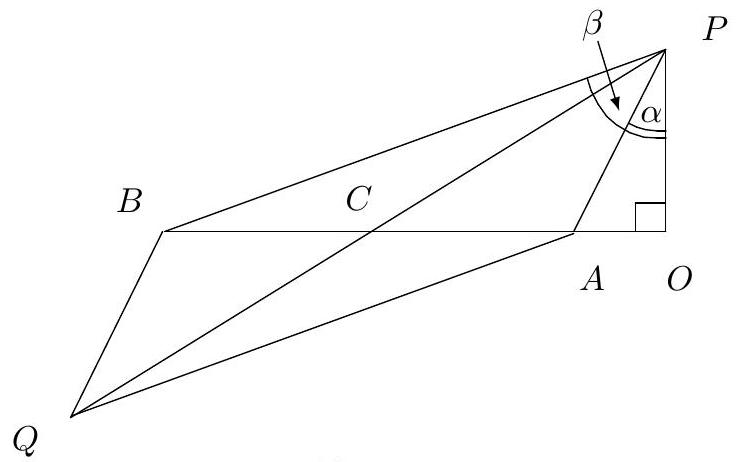
|
| 242 |
+
|
| 243 |
+
Figure 1
|
| 244 |
+
|
| 245 |
+
Let $C$ be the midpoint of the segment $A B$. By hypothesis, we have $|O C|=\frac{\tan \alpha+\tan \beta}{2}=\tan \gamma$, hence $\angle O P C=\gamma$ and $|P C|=\frac{1}{\cos \gamma}$. Let $Q$ be the point symmetric to $P$ with respect to $C$. The quadrilateral $P A Q B$ is a parallelogram, and therefore $|A Q|=|P B|=\frac{1}{\cos \beta}$. Eventually,
|
| 246 |
+
|
| 247 |
+
$$
|
| 248 |
+
\frac{2}{\cos \delta}=\frac{1}{\cos \alpha}+\frac{1}{\cos \beta}=|P A|+|A Q|>|P Q|=2 \cdot|P C|=\frac{2}{\cos \gamma},
|
| 249 |
+
$$
|
| 250 |
+
|
| 251 |
+
and hence $\delta>\gamma$.
|
| 252 |
+
|
| 253 |
+
Another solution. Set $x=\frac{\alpha+\beta}{2}$ and $y=\frac{\alpha-\beta}{2}$, then $\alpha=x+y, \beta=x-y$ and
|
| 254 |
+
|
| 255 |
+
$$
|
| 256 |
+
\begin{aligned}
|
| 257 |
+
\cos \alpha \cos \beta & =\frac{1}{2}(\cos 2 x+\cos 2 y)= \\
|
| 258 |
+
& =\frac{1}{2}\left(1-2 \sin ^{2} x\right)+\frac{1}{2}\left(2 \cos ^{2} y-1\right)=\cos ^{2} y-\sin ^{2} x .
|
| 259 |
+
\end{aligned}
|
| 260 |
+
$$
|
| 261 |
+
|
| 262 |
+
By the conditions of the problem,
|
| 263 |
+
|
| 264 |
+
$$
|
| 265 |
+
\tan \gamma=\frac{1}{2}\left(\frac{\sin \alpha}{\cos \alpha}+\frac{\sin \beta}{\cos \beta}\right)=\frac{1}{2} \cdot \frac{\sin (\alpha+\beta)}{\cos \alpha \cos \beta}=\frac{\sin x \cos x}{\cos \alpha \cos \beta}
|
| 266 |
+
$$
|
| 267 |
+
|
| 268 |
+
and
|
| 269 |
+
|
| 270 |
+
$$
|
| 271 |
+
\frac{1}{\cos \delta}=\frac{1}{2}\left(\frac{1}{\cos \alpha}+\frac{1}{\cos \beta}\right)=\frac{1}{2} \cdot \frac{\cos \alpha+\cos \beta}{\cos \alpha \cos \beta}=\frac{\cos x \cos y}{\cos \alpha \cos \beta} .
|
| 272 |
+
$$
|
| 273 |
+
|
| 274 |
+
Using (3) we hence obtain
|
| 275 |
+
|
| 276 |
+
$$
|
| 277 |
+
\begin{aligned}
|
| 278 |
+
\tan ^{2} \delta-\tan ^{2} \gamma & =\frac{1}{\cos ^{2} \delta}-1-\tan ^{2} \gamma=\frac{\cos ^{2} x \cos ^{2} y-\sin ^{2} x \cos ^{2} x}{\cos ^{2} \alpha \cos ^{2} \beta}-1= \\
|
| 279 |
+
& =\frac{\cos ^{2} x\left(\cos ^{2} y-\sin ^{2} x\right)}{\left(\cos ^{2} y-\sin ^{2} x\right)^{2}}-1=\frac{\cos ^{2} x}{\cos ^{2} y-\sin ^{2} x}-1= \\
|
| 280 |
+
& =\frac{\cos ^{2} x-\cos ^{2} y+\sin ^{2} x}{\cos ^{2} y-\sin ^{2} x}=\frac{\sin ^{2} y}{\cos \alpha \cos \beta}>0,
|
| 281 |
+
\end{aligned}
|
| 282 |
+
$$
|
| 283 |
+
|
| 284 |
+
showing that $\delta>\gamma$.
|
| 285 |
+
|
| 286 |
+
10. For simplicity, take the length of the circle to be $2 n(n-1)$ rather than $2 \pi$. The vertices of the $(n-1)$-gon $A_{0} A_{1} \ldots A_{n-2}$ divide it into $n-1$ arcs of length $2 n$. By the pigeonhole principle, some two of the vertices of the $n$-gon $B_{0} B_{1} \ldots B_{n-1}$ lie in the same arc. Assume w.l.o.g. that $B_{0}$ and $B_{1}$ lie in the arc $A_{0} A_{1}$, with $B_{0}$ closer to $A_{0}$ and $B_{1}$ closer to $A_{1}$, and that $\left|A_{0} B_{0}\right| \leqslant\left|B_{1} A_{1}\right|$.
|
| 287 |
+
|
| 288 |
+
Consider the circle as the segment $[0,2 n(n-1)]$ of the real line, with both of its endpoints identified with the vertex $A_{0}$ and the numbers $2 n, 4 n, 6 n, \ldots$ identified accordingly with the vertices $A_{1}, A_{2}, A_{3}, \ldots$
|
| 289 |
+
|
| 290 |
+
For $k=0,1, \ldots, n-1$, let $x_{k}$ be the "coordinate" of the vertex $B_{k}$ of the $n$-gon. Each arc $B_{k} B_{k+1}$ has length $2(n-1)$. By the choice of labelling, we have
|
| 291 |
+
|
| 292 |
+
$$
|
| 293 |
+
0 \leqslant x_{0}<x_{1}=x_{0}+2(n-1) \leqslant 2 n
|
| 294 |
+
$$
|
| 295 |
+
|
| 296 |
+
and, moreover, $x_{0}-0 \leqslant 2 n-x_{1}$. Hence $0 \leqslant x_{0} \leqslant 1$.
|
| 297 |
+
|
| 298 |
+
Clearly, $x_{k}=x_{0}+2 k(n-1)$ for $k=0,1, \ldots, n-1$. It is not hard to see that $(2 k-1) n \leqslant x_{k} \leqslant 2 k n$ if $1 \leqslant k \leqslant \frac{n}{2}$, and $(2 k-2) n \leqslant x_{k} \leqslant(2 k-1) n$ if $\frac{n}{2}<k \leqslant n-1$. These inequalities are verified immediately by inserting $x_{k}=x_{0}+2 k(n-1)$ and taking into account that $0 \leqslant x_{0} \leqslant 1$.
|
| 299 |
+
|
| 300 |
+
Summing up, we have:
|
| 301 |
+
|
| 302 |
+
1) if $1 \leqslant k \leqslant \frac{n}{2}$, then $B_{k}$ lies between $A_{k-1}$ and $A_{k}$, closer to $A_{k}$; recalling that $A_{k}$ has "coordinate" $2 k n$, we see that the distance in question is equal to $2 k n-x_{k}=2 k-x_{0}$;
|
| 303 |
+
2) if $\frac{n}{2}<k \leqslant n-1$, then $B_{k}$ lies between $A_{k-1}$ and $A_{k}$, closer to $A_{k-1}$; the distance in question is equal to $x_{k}-(2 k-2) n=x_{0}-2 k+2 n$;
|
| 304 |
+
3) for $B_{0}$, the distance in question is $x_{0}$.
|
| 305 |
+
|
| 306 |
+
The sum of these distances evaluates to
|
| 307 |
+
|
| 308 |
+
$$
|
| 309 |
+
x_{0}+\sum_{k=1}^{n / 2}\left(2 k-x_{0}\right)+\sum_{k=n / 2+1}^{n-1}\left(x_{0}-2 k+2 n\right)
|
| 310 |
+
$$
|
| 311 |
+
|
| 312 |
+
Note that here $x_{0}$ appears half of the times with a plus sign and half of the times with a minus sign. Thus, eventually, all terms $x_{0}$ cancel out, and the value of $S$ does not depend on anything but $n$.
|
| 313 |
+
|
| 314 |
+
11. Answer: equality holds if $a=b$ or the angle opposite to $c$ is equal to $90^{\circ}$. Denote the angles opposite to the sides $a, b, c$ by $A, B, C$, respectively. By the law of sines we have $a=2 R \sin A, b=2 R \sin B, c=2 R \sin C$. Hence, the given inequality is equivalent to each of the following:
|
| 315 |
+
|
| 316 |
+
$$
|
| 317 |
+
\begin{aligned}
|
| 318 |
+
& R \geqslant \frac{4 R^{2}\left(\sin ^{2} A+\sin ^{2} B\right)}{2 \sqrt{8 R^{2}\left(\sin ^{2} A+\sin ^{2} B\right)-4 R^{2} \sin ^{2} C}}, \\
|
| 319 |
+
& 2\left(\sin ^{2} A+\sin ^{2} B\right)-\sin ^{2} C \geqslant\left(\sin ^{2} A+\sin ^{2} B\right)^{2} \\
|
| 320 |
+
& \left(\sin ^{2} A+\sin ^{2} B\right)\left(2-\sin ^{2} A-\sin ^{2} B\right) \geqslant \sin ^{2} C \\
|
| 321 |
+
& \left(\sin ^{2} A+\sin ^{2} B\right)\left(\cos ^{2} A+\cos ^{2} B\right) \geqslant \sin ^{2} C
|
| 322 |
+
\end{aligned}
|
| 323 |
+
$$
|
| 324 |
+
|
| 325 |
+
The last inequality follows from the Cauchy-Schwarz inequality:
|
| 326 |
+
|
| 327 |
+
$$
|
| 328 |
+
\begin{aligned}
|
| 329 |
+
& \left(\sin ^{2} A+\sin ^{2} B\right)\left(\cos ^{2} B+\cos ^{2} A\right) \geqslant \\
|
| 330 |
+
& \quad \geqslant(\sin A \cdot \cos B+\sin B \cdot \cos A)^{2}=\sin ^{2} C .
|
| 331 |
+
\end{aligned}
|
| 332 |
+
$$
|
| 333 |
+
|
| 334 |
+
Equality requires that $\sin A=\lambda \cos B$ and $\sin B=\lambda \cos A$ for a certain real number $\lambda$, implying that $\lambda$ is positive and $A, B$ are acute angles. From these two equations we conclude that $\sin 2 A=\sin 2 B$. This means that either $2 A=2 B$ or $2 A+2 B=\pi$; in other words, $a=b$ or $C=90^{\circ}$. In each of these two cases the inequality indeed turns into equality.
|
| 335 |
+
|
| 336 |
+
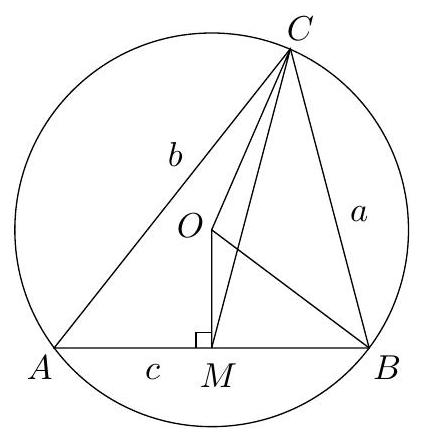
|
| 337 |
+
|
| 338 |
+
Figure 2
|
| 339 |
+
|
| 340 |
+
Alternative solution. Let $A, B, C$ be the respective vertices of the triangle, $O$ be its circumcentre and $M$ be the midpoint of $A B$ (see Figure 2). The length $m_{c}=|C M|$ of the median drawn from $C$ is expressed by the well-
|
| 341 |
+
known formula
|
| 342 |
+
|
| 343 |
+
$$
|
| 344 |
+
4 m_{c}^{2}=2 a^{2}+2 b^{2}-c^{2} .
|
| 345 |
+
$$
|
| 346 |
+
|
| 347 |
+
Hence the inequality of the problem can be rewritten as $4 R m_{c} \geqslant a^{2}+b^{2}$, or $8 R m_{c} \geqslant 4 m_{c}^{2}+c^{2}$. The last inequality is equivalent to
|
| 348 |
+
|
| 349 |
+
$$
|
| 350 |
+
\left|m_{c}-R\right| \leqslant \sqrt{R^{2}-(c / 2)^{2}},
|
| 351 |
+
$$
|
| 352 |
+
|
| 353 |
+
or ||$M C|-| O C|| \leqslant|O M|$, which is the triangle inequality for triangle COM .
|
| 354 |
+
|
| 355 |
+
Equality holds if and only if the points $C, O, M$ are collinear. This happens if and only if $a=b$ or $\angle C=90^{\circ}$.
|
| 356 |
+
|
| 357 |
+
Remark. Yet another solution can be obtained by setting $R=\frac{a b c}{4 S}$ (where $S$ denotes the area of the triangle) and expressing $S$ by Heron's formula. After squaring both sides, cross-multiplying and cancelling a lot, the inequality reduces to $\left(a^{2}-b^{2}\right)^{2}\left(a^{2}+b^{2}-c^{2}\right)^{2} \geqslant 0$, with equality if $a=b$ or $a^{2}+b^{2}=c^{2}$.
|
| 358 |
+
|
| 359 |
+
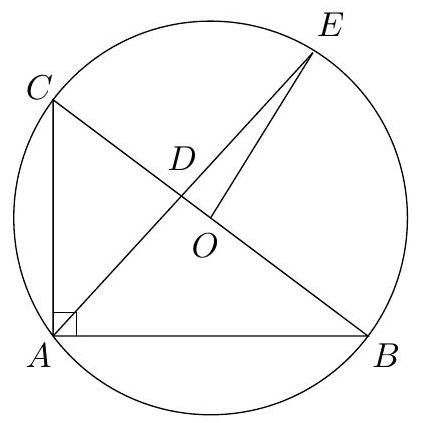
|
| 360 |
+
|
| 361 |
+
Figure 3
|
| 362 |
+
|
| 363 |
+
12. Let $O$ be the circumcentre of triangle $A B C$ (i.e., the midpoint of $B C$ ) and let $A D$ meet the circumcircle again at $E$ (see Figure 3). Then $\angle B O E=2 \angle B A E=\angle C D E$, showing that $|D E|=|O E|$. Triangles $A D C$ and $B D E$ are similar; hence $\frac{|A D|}{|B D|}=\frac{|C D|}{|D E|}, \frac{|A D|}{|C D|}=\frac{|B D|}{|D E|}$ and finally
|
| 364 |
+
|
| 365 |
+
$$
|
| 366 |
+
\frac{|A D|}{|B D|}+\frac{|A D|}{|C D|}=\frac{|C D|}{|D E|}+\frac{|B D|}{|D E|}=\frac{|B C|}{|D E|}=\frac{|B C|}{|O E|}=2
|
| 367 |
+
$$
|
| 368 |
+
|
| 369 |
+
which is equivalent to the equality we have to prove.
|
| 370 |
+
|
| 371 |
+
Alternative solution. Let $\angle B A D=\alpha$ and $\angle C A D=\beta$. By the conditions of the problem, $\alpha+\beta=90^{\circ}$ (hence $\sin \beta=\cos \alpha$ ), $\angle B D A=2 \alpha$ and $\angle C D A=2 \beta$. By the law of sines,
|
| 372 |
+
|
| 373 |
+
$$
|
| 374 |
+
\frac{|A D|}{|B D|}=\frac{\sin 3 \alpha}{\sin \alpha}=3-4 \sin ^{2} \alpha
|
| 375 |
+
$$
|
| 376 |
+
|
| 377 |
+
and
|
| 378 |
+
|
| 379 |
+
$$
|
| 380 |
+
\frac{|A D|}{|C D|}=\frac{\sin 3 \beta}{\sin \beta}=3-4 \sin ^{2} \beta=3-4 \cos ^{2} \alpha .
|
| 381 |
+
$$
|
| 382 |
+
|
| 383 |
+
Adding these two equalities we get the claimed one.
|
| 384 |
+
|
| 385 |
+
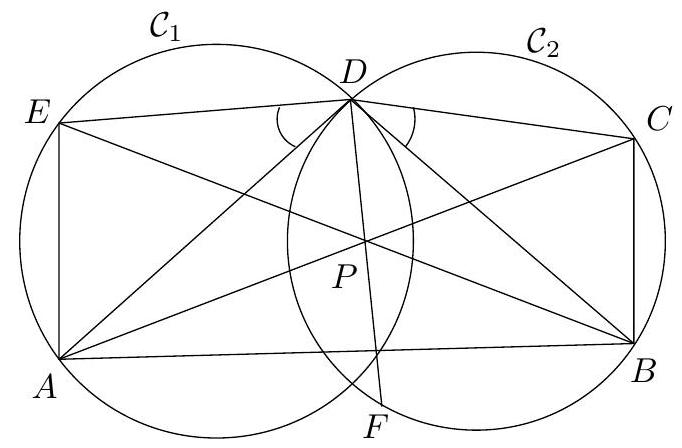
|
| 386 |
+
|
| 387 |
+
Figure 4
|
| 388 |
+
|
| 389 |
+
13. Let $\mathcal{C}_{1}$ and $\mathcal{C}_{2}$ be the circumcircles of triangles $A E D$ and $B C D$, respectively. Let $D P$ meet $\mathcal{C}_{2}$ for the second time at $F$ (see Figure 4). Since $\angle A D E=\angle B D C$, the ratio of the lengths of the segments $E A$ and $B C$ is equal to the ratio of the radii of $\mathcal{C}_{1}$ and $\mathcal{C}_{2}$. Thus the homothety with centre $P$ that takes $A E$ to $C B$, also transforms $\mathcal{C}_{1}$ onto $\mathcal{C}_{2}$. The same homothety transforms the arc $D E$ of $\mathcal{C}_{1}$ onto the $\operatorname{arc} F B$ of $\mathcal{C}_{2}$. Therefore $\angle E A D=\angle B D F=\angle B D P$. The second equality is proved similarly.
|
| 390 |
+
14. Since the lines $B D$ and $A C$ are parallel and since $A D$ is the external bisector of $\angle B A C$, we have $\angle B A D=\angle B D A$; denote their common size by $\alpha$ (see Figure 5). Also $\angle C A E=\angle C E A=\alpha$, implying $|A B|=|B D|$ and $|A C|=|C E|$. Let $B^{\prime}, C^{\prime}, F^{\prime}$ be the feet of the perpendiculars from
|
| 391 |
+
|
| 392 |
+
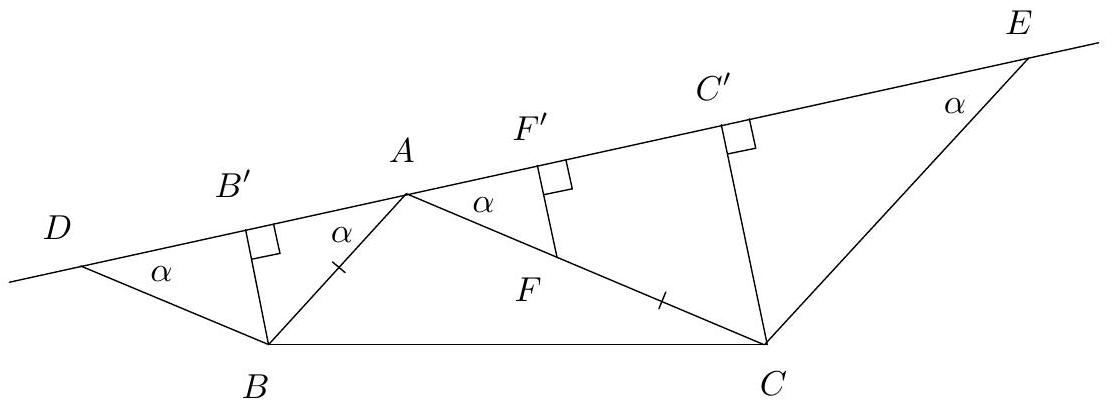
|
| 393 |
+
|
| 394 |
+
Figure 5
|
| 395 |
+
|
| 396 |
+
the points $B, C, F$ to line $D E$. From $|F C|=|A B|$ we obtain
|
| 397 |
+
|
| 398 |
+
$$
|
| 399 |
+
\left|B^{\prime} F^{\prime}\right|=(|A B|+|A F|) \cos \alpha=|A C| \cos \alpha=\left|A C^{\prime}\right|=\left|C^{\prime} E\right|
|
| 400 |
+
$$
|
| 401 |
+
|
| 402 |
+
and
|
| 403 |
+
|
| 404 |
+
$$
|
| 405 |
+
\left|D B^{\prime}\right|=|B D| \cos \alpha=|F C| \cos \alpha=\left|F^{\prime} C^{\prime}\right|,
|
| 406 |
+
$$
|
| 407 |
+
|
| 408 |
+
Thus $\left|D F^{\prime}\right|=\left|F^{\prime} E\right|$, whence $|D F|=|F E|$.
|
| 409 |
+
|
| 410 |
+
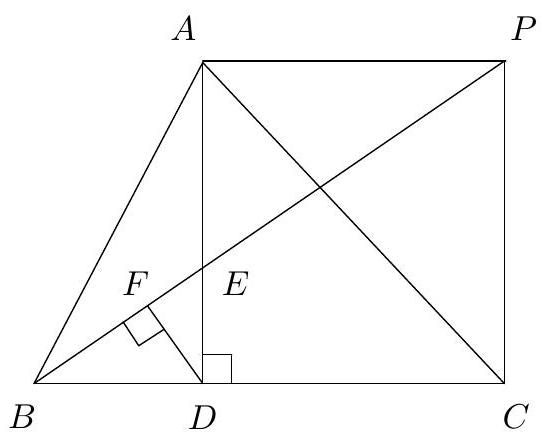
|
| 411 |
+
|
| 412 |
+
Figure 6
|
| 413 |
+
|
| 414 |
+
15. Complete the rectangle $A D C P$ (see Figure 6). In view of
|
| 415 |
+
|
| 416 |
+
$$
|
| 417 |
+
\frac{|A E|}{|E D|}=\frac{|C D|}{|D B|}=\frac{|A P|}{|D B|}
|
| 418 |
+
$$
|
| 419 |
+
|
| 420 |
+
the points $B, E, P$ are collinear. Therefore $\angle D F P=90^{\circ}$, and so $F$ lies on the circumcircle of the rectangle $A D C P$ with diameter $A C$; hence $\angle A F C=90^{\circ}$.
|
| 421 |
+
|
| 422 |
+
16. Answer: no.
|
| 423 |
+
|
| 424 |
+
Label the horizontal rows by integers from 1 to 13. Assume that the tiling is possible, and let $a_{i}$ be the number of vertical tiles with their outer squares in rows $i$ and $i+3$. Then $b_{i}=a_{i}+a_{i-1}+a_{i-2}+a_{i-3}$ is the number of vertical tiles intersecting row $i$ (here we assume $a_{j}=0$ if $j \leqslant 0$ ). Since there are 13 squares in each row, and each horizontal tile covers four (i.e. an even number) of these, then $b_{i}$ must be odd for all $1 \leqslant i \leqslant 13$ except for $b_{7}$, which must be even.
|
| 425 |
+
|
| 426 |
+
We now get that $a_{1}=b_{1}$ is odd, $a_{2}$ is even (since $b_{2}=a_{2}+a_{1}$ is odd), and similarly $a_{3}$ and $a_{4}$ are even. Since $b_{5}=a_{5}+a_{4}+a_{3}+a_{2}$ is odd, then $a_{5}$ must be odd. Continuing this way we find that $a_{6}$ is even, $a_{7}$ is odd (since $b_{7}$ is even), $a_{8}$ is odd, $a_{9}$ is odd and $a_{10}$ is even. Obviously $a_{i}=0$ for $i>10$, as no tile is allowed to extend beyond the edge of the board. But then $b_{13}=a_{10}$ must be both even and odd, a contradiction.
|
| 427 |
+
|
| 428 |
+
Alternative solution. Colour the squares of the board black and white in the following pattern. In the first (top) row, let the two leftmost squares be black, the next two be white, the next two black, the next two white, and so on (at the right end there remains a single black square). In the second row, let the colouring be reciprocal to that of the first row (two white squares, two black squares, and so on). If the rows are labelled by 1 through 13 , let all the odd-indexed rows be coloured as the first row, and all the even-indexed ones as the second row (see Figure 7).
|
| 429 |
+
|
| 430 |
+
Note that there are more black squares than white squares in the board. Each $4 \times 1$ tile, no matter how placed, covers two black squares and two white squares. Thus if a tiling leaves a single square uncovered, this square must be black. But the central square of the board is white. Hence such a tiling is impossible.
|
| 431 |
+
|
| 432 |
+
Another solution. Colour the squares in four colours as follows: colour all squares in the 1-st column green, all squares in the 2-nd column black, all squares in the 3 -rd column white, all squares in the 4 -th column red, all squares in the 5 -th column green, all squares in the 6 -th column black etc., leaving only the central square uncoloured (see Figure 8). Altogether we have $3 \cdot 13=39$ black squares and $3 \cdot 13-1=38$ white squares. Since
|
| 433 |
+
each $4 \times 1$ tile covers either one square of each colour or all four squares of the same colour, then the difference of the numbers of black and white squares must be divisible by 4 . Since $39-38=1$ is not divisible by 4 , the required tiling does not exist.
|
| 434 |
+
|
| 435 |
+
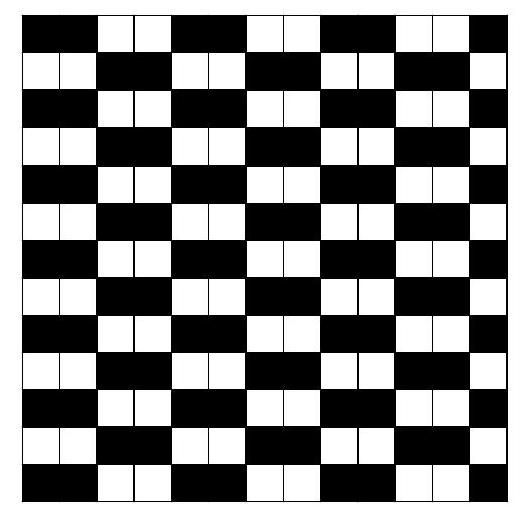
|
| 436 |
+
|
| 437 |
+
Figure 7
|
| 438 |
+
G BWR G B WR G BWR G
|
| 439 |
+
|
| 440 |
+
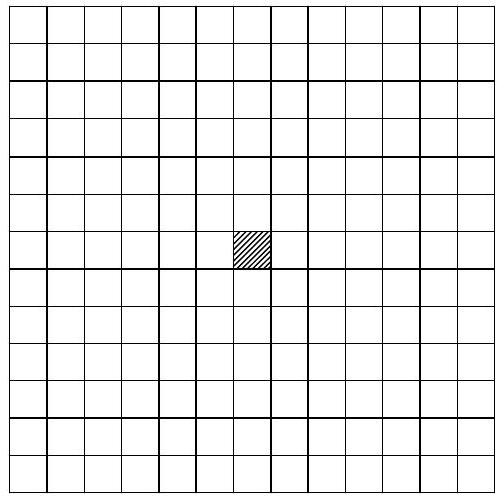
|
| 441 |
+
|
| 442 |
+
Figure 8
|
| 443 |
+
|
| 444 |
+
17. If $k=1$, it is obvious how to do the packing. Now assume $k>1$. There are not more than $n$ objects of a certain colour - say, pink - and also not fewer than $n$ objects of some other colour - say, grey. Pack all pink objects into one box; if there is space left, fill the box up with grey objects. Then remove that box together with its contents; the problem gets reduced to an analogous one with $k-1$ boxes and $k-1$ colours. Assuming inductively that the task can be done in that case, we see that it can also be done for $k$ boxes and colours. The general result follows by induction.
|
| 445 |
+
18. Answer: all integers $n \geqslant 4$.
|
| 446 |
+
|
| 447 |
+
Direct search shows that there is no such set $S$ for $n=1,2,3$. For $n=4$ we can take $S=\{3,5,6,7\}$. If, for a certain $n \geqslant 4$ we have a set $S=\left\{a_{1}, a_{2}, \ldots, a_{n}\right\}$ as needed, then the set $S^{*}=\left\{1,2 a_{1}, 2 a_{2}, \ldots, 2 a_{n}\right\}$ satisfies the requirements for $n+1$. Hence a set with the required properties exists if and only if $n \geqslant 4$.
|
| 448 |
+
|
| 449 |
+
19. We start with the following observation: In a match between two teams (not necessarily of equal sizes), there exists in one of the teams a player who won his games with at least half of the members of the other team.
|
| 450 |
+
|
| 451 |
+
Indeed: suppose there is no such player. If the teams consist of $m$ and $n$ members then the players of the first team jointly won less than $m \cdot \frac{n}{2}$ games, and the players of the second team jointly won less than $m \cdot \frac{n}{2}$ games - this is a contradiction since the total number of games played is $m n$, and in each game there must have been a winner.
|
| 452 |
+
|
| 453 |
+
Returning to the original problem (with two equal teams of size 1000), choose a player who won his games with at least half of the members of the other team - such a player exists, according to the observation above, and we shall call his team "first" and the other team "second" in the sequel. Mark this player with a white hat and remove from further consideration all those players of the second team who lost their games to him. Applying the same observation to the first team (complete) and the second team truncated as explained above, we again find a player (in the first or in the second team) who won with at least half of the other team members. Mark him with a white hat, too, and remove the players who lost to him from further consideration.
|
| 454 |
+
|
| 455 |
+
We repeat this procedure until there are no players left in one of the teams; say, in team $Y$. This means that the white-hatted players of team $X$ constitute a group with the required property (every member of team $Y$ has lost his game to at least one player from that group). Each time when a player of team $X$ was receiving a white hat, the size of team $Y$ was reduced at least by half; and since initially the size was a number less than $2^{10}$, this could not happen more than ten times.
|
| 456 |
+
|
| 457 |
+
Hence the white-hatted group from team $X$ consists of not more than ten players. If there are fewer than ten, round the group up to ten with any players.
|
| 458 |
+
|
| 459 |
+
20. Answer: 1.
|
| 460 |
+
|
| 461 |
+
Let $1 \leqslant g<h<i<j \leqslant n$ be fixed integers. Consider all $n$-digit numbers $a=\overline{a_{1} a_{2} \ldots a_{n}}$ with all digits non-zero, such that $a_{g}=1, a_{h}=9, a_{i}=9$, $a_{j}=8$ and this quadruple 1998 is the leftmost one in $a$; that is,
|
| 462 |
+
|
| 463 |
+
$$
|
| 464 |
+
\begin{cases}a_{l} \neq 1 & \text { if } l<g ; \\ a_{l} \neq 9 & \text { if } g<l<h ; \\ a_{l} \neq 9 & \text { if } h<l<i \\ a_{l} \neq 8 & \text { if } i<l<j\end{cases}
|
| 465 |
+
$$
|
| 466 |
+
|
| 467 |
+
There are $k_{g h i j}(n)=8^{g-1} \cdot 8^{h-g-1} \cdot 8^{i-h-1} \cdot 8^{j-i-1} \cdot 9^{n-j}$ such numbers $a$. Obviously, $k_{g h i j}(n) \equiv 1(\bmod 8)$ for $g=1, h=2, i=3, j=4$, and $k_{g h i j}(n) \equiv 0(\bmod 8)$ in all other cases. Since $k(n)$ is obtained by summing up the values of $k_{g h i j}(n)$ over all possible choicecs of $g, h, i, j$, the remainder we are looking for is 1 .
|
| 468 |
+
|
BalticWay/md/en-bw99sol.md
ADDED
|
@@ -0,0 +1,500 @@
|
|
|
|
|
|
|
|
|
|
|
|
|
|
|
|
|
|
|
|
|
|
|
|
|
|
|
|
|
|
|
|
|
|
|
|
|
|
|
|
|
|
|
|
|
|
|
|
|
|
|
|
|
|
|
|
|
|
|
|
|
|
|
|
|
|
|
|
|
|
|
|
|
|
|
|
|
|
|
|
|
|
|
|
|
|
|
|
|
|
|
|
|
|
|
|
|
|
|
|
|
|
|
|
|
|
|
|
|
|
|
|
|
|
|
|
|
|
|
|
|
|
|
|
|
|
|
|
|
|
|
|
|
|
|
|
|
|
|
|
|
|
|
|
|
|
|
|
|
|
|
|
|
|
|
|
|
|
|
|
|
|
|
|
|
|
|
|
|
|
|
|
|
|
|
|
|
|
|
|
|
|
|
|
|
|
|
|
|
|
|
|
|
|
|
|
|
|
|
|
|
|
|
|
|
|
|
|
|
|
|
|
|
|
|
|
|
|
|
|
|
|
|
|
|
|
|
|
|
|
|
|
|
|
|
|
|
|
|
|
|
|
|
|
|
|
|
|
|
|
|
|
|
|
|
|
|
|
|
|
|
|
|
|
|
|
|
|
|
|
|
|
|
|
|
|
|
|
|
|
|
|
|
|
|
|
|
|
|
|
|
|
|
|
|
|
|
|
|
|
|
|
|
|
|
|
|
|
|
|
|
|
|
|
|
|
|
|
|
|
|
|
|
|
|
|
|
|
|
|
|
|
|
|
|
|
|
|
|
|
|
|
|
|
|
|
|
|
|
|
|
|
|
|
|
|
|
|
|
|
|
|
|
|
|
|
|
|
|
|
|
|
|
|
|
|
|
|
|
|
|
|
|
|
|
|
|
|
|
|
|
|
|
|
|
|
|
|
|
|
|
|
|
|
|
|
|
|
|
|
|
|
|
|
|
|
|
|
|
|
|
|
|
|
|
|
|
|
|
|
|
|
|
|
|
|
|
|
|
|
|
|
|
|
|
|
|
|
|
|
|
|
|
|
|
|
|
|
|
|
|
|
|
|
|
|
|
|
|
|
|
|
|
|
|
|
|
|
|
|
|
|
|
|
|
|
|
|
|
|
|
|
|
|
|
|
|
|
|
|
|
|
|
|
|
|
|
|
|
|
|
|
|
|
|
|
|
|
|
|
|
|
|
|
|
|
|
|
|
|
|
|
|
|
|
|
|
|
|
|
|
|
|
|
|
|
|
|
|
|
|
|
|
|
|
|
|
|
|
|
|
|
|
|
|
|
|
|
|
|
|
|
|
|
|
|
|
|
|
|
|
|
|
|
|
|
|
|
|
|
|
|
|
|
|
|
|
|
|
|
|
|
|
|
|
|
|
|
|
|
|
|
|
|
|
|
|
|
|
|
|
|
|
|
|
|
|
|
|
|
|
|
|
|
|
|
|
|
|
|
|
|
|
|
|
|
|
|
|
|
|
|
|
|
|
|
|
|
|
|
|
|
|
|
|
|
|
|
|
|
|
|
|
|
|
|
|
|
|
|
|
|
|
|
|
|
|
|
|
|
|
|
|
|
|
|
|
|
|
|
|
|
|
|
|
|
|
|
|
|
|
|
|
|
|
|
|
|
|
|
|
|
|
|
|
|
|
|
|
|
|
|
|
|
|
|
|
|
|
|
|
|
|
|
|
|
|
|
|
|
|
|
|
|
|
|
|
|
|
|
|
|
|
|
|
|
|
|
|
|
|
|
|
|
|
|
|
|
|
|
|
|
|
|
|
|
|
|
|
|
|
|
|
|
|
|
|
|
|
|
|
|
|
|
|
|
|
|
|
|
|
|
|
|
|
|
|
|
|
|
|
|
|
|
|
|
|
|
|
|
|
|
|
|
|
|
|
|
|
|
|
|
|
|
|
|
|
|
|
|
|
|
|
|
|
|
|
|
|
|
|
|
|
|
|
|
|
|
|
|
|
|
|
|
|
|
|
|
|
|
|
|
|
|
|
|
|
|
|
|
|
|
|
|
|
|
|
|
|
|
|
|
|
|
|
|
|
|
|
|
|
|
|
|
|
|
|
|
|
|
|
|
|
|
|
|
|
|
|
|
|
|
|
|
|
|
|
|
|
|
|
|
|
|
|
|
|
|
|
|
|
|
|
|
|
|
|
|
|
|
|
|
|
|
|
|
|
|
|
|
|
|
|
|
|
|
|
|
|
|
|
|
|
|
|
|
|
|
|
|
|
|
|
|
|
|
|
|
|
|
|
|
|
|
|
|
|
|
|
|
|
|
|
|
|
|
|
|
|
|
|
|
|
|
|
|
|
|
|
|
|
|
|
|
|
|
|
|
|
|
|
|
|
|
|
|
|
|
|
|
|
|
|
|
|
|
|
|
|
|
|
|
|
|
|
|
|
|
|
|
|
|
|
|
|
|
|
|
|
|
|
|
|
|
|
|
|
|
|
|
|
|
|
|
|
|
|
|
|
|
|
|
|
|
|
|
|
|
|
|
|
|
|
|
|
|
|
|
|
|
|
|
|
|
|
|
|
|
|
|
|
|
|
|
|
|
|
|
|
|
|
|
|
|
|
|
|
|
|
|
|
|
|
|
|
|
|
|
|
|
|
|
|
|
|
|
|
|
|
|
|
|
|
|
|
|
|
|
|
|
|
|
|
|
|
|
|
|
|
|
|
|
|
|
|
|
|
|
|
|
|
|
|
|
|
|
|
|
|
|
|
|
|
|
|
|
|
|
|
|
|
|
|
|
|
|
|
|
|
|
|
|
|
|
|
|
|
|
|
|
|
|
|
|
|
|
|
|
|
|
|
|
|
|
|
|
|
|
|
|
|
|
|
|
|
|
|
|
|
|
|
|
|
|
|
|
|
|
|
|
|
|
|
|
|
|
|
|
|
|
|
|
|
|
|
|
|
|
|
|
|
|
|
|
|
|
|
|
|
|
|
|
|
|
|
|
|
|
|
|
|
|
|
|
|
|
|
|
|
|
|
|
|
|
|
|
|
|
|
|
|
|
|
|
|
|
|
|
|
|
|
|
|
|
|
|
|
|
|
|
|
|
|
|
|
|
|
|
|
|
|
|
|
|
|
|
|
|
|
|
|
|
|
|
|
|
|
|
|
|
|
|
|
|
|
|
|
|
|
|
|
|
|
|
|
|
|
|
|
|
|
|
|
|
|
|
|
|
|
|
|
|
|
|
|
|
|
|
|
|
|
|
|
|
|
|
|
|
|
|
|
|
|
|
|
|
|
|
|
|
|
|
|
|
|
|
|
|
|
|
|
|
|
|
|
|
|
|
|
|
|
|
|
|
|
|
|
|
|
|
|
|
|
|
|
|
|
|
|
|
|
|
|
|
|
|
|
|
|
|
|
|
|
|
| 1 |
+
# Baltic Way 1999
|
| 2 |
+
|
| 3 |
+
## Reykjavík, November 6, 1999
|
| 4 |
+
|
| 5 |
+
## Problems
|
| 6 |
+
|
| 7 |
+
1. Determine all real numbers $a, b, c, d$ that satisfy the following system of equations.
|
| 8 |
+
|
| 9 |
+
$$
|
| 10 |
+
\left\{\begin{array}{r}
|
| 11 |
+
a b c+a b+b c+c a+a+b+c=1 \\
|
| 12 |
+
b c d+b c+c d+d b+b+c+d=9 \\
|
| 13 |
+
c d a+c d+d a+a c+c+d+a=9 \\
|
| 14 |
+
d a b+d a+a b+b d+d+a+b=9
|
| 15 |
+
\end{array}\right.
|
| 16 |
+
$$
|
| 17 |
+
|
| 18 |
+
2. Determine all positive integers $n$ with the property that the third root of $n$ is obtained by removing the last three decimal digits of $n$.
|
| 19 |
+
3. Determine all positive integers $n \geqslant 3$ such that the inequality
|
| 20 |
+
|
| 21 |
+
$$
|
| 22 |
+
a_{1} a_{2}+a_{2} a_{3}+\cdots+a_{n-1} a_{n}+a_{n} a_{1} \leqslant 0
|
| 23 |
+
$$
|
| 24 |
+
|
| 25 |
+
holds for all real numbers $a_{1}, a_{2}, \ldots, a_{n}$ which satisfy $a_{1}+\cdots+a_{n}=0$.
|
| 26 |
+
|
| 27 |
+
4. For all positive real numbers $x$ and $y$ let
|
| 28 |
+
|
| 29 |
+
$$
|
| 30 |
+
f(x, y)=\min \left(x, \frac{y}{x^{2}+y^{2}}\right) .
|
| 31 |
+
$$
|
| 32 |
+
|
| 33 |
+
Show that there exist $x_{0}$ and $y_{0}$ such that $f(x, y) \leqslant f\left(x_{0}, y_{0}\right)$ for all positive $x$ and $y$, and find $f\left(x_{0}, y_{0}\right)$.
|
| 34 |
+
|
| 35 |
+
5. The point $(a, b)$ lies on the circle $x^{2}+y^{2}=1$. The tangent to the circle at this point meets the parabola $y=x^{2}+1$ at exactly one point. Find all such points $(a, b)$.
|
| 36 |
+
6. What is the least number of moves it takes a knight to get from one corner of an $n \times n$ chessboard, where $n \geqslant 4$, to the diagonally opposite corner?
|
| 37 |
+
7. Two squares on an $8 \times 8$ chessboard are called adjacent if they have a common edge or common corner. Is it possible for a king to begin in some
|
| 38 |
+
square and visit all squares exactly once in such a way that all moves except the first are made into squares adjacent to an even number of squares already visited?
|
| 39 |
+
8. We are given 1999 coins. No two coins have the same weight. A machine is provided which allows us with one operation to determine, for any three coins, which one has the middle weight. Prove that the coin that is the 1000 -th by weight can be determined using no more than 1000000 operations and that this is the only coin whose position by weight can be determined using this machine.
|
| 40 |
+
9. A cube with edge length 3 is divided into 27 unit cubes. The numbers $1,2, \ldots, 27$ are distributed arbitrarily over the unit cubes, with one number in each cube. We form the 27 possible row sums (there are nine such sums of three integers for each of the three directions parallel to the edges of the cube). At most how many of the 27 row sums can be odd?
|
| 41 |
+
10. Can the points of a disc of radius 1 (including its circumference) be partitioned into three subsets in such a way that no subset contains two points separated by distance 1 ?
|
| 42 |
+
11. Prove that for any four points in the plane, no three of which are collinear, there exists a circle such that three of the four points are on the circumference and the fourth point is either on the circumference or inside the circle.
|
| 43 |
+
12. In a triangle $A B C$ it is given that $2|A B|=|A C|+|B C|$. Prove that the incentre of $A B C$, the circumcentre of $A B C$, and the midpoints of $A C$ and $B C$ are concyclic.
|
| 44 |
+
13. The bisectors of the angles $A$ and $B$ of the triangle $A B C$ meet the sides $B C$ and $C A$ at the points $D$ and $E$, respectively. Assuming that $|A E|+|B D|=|A B|$, determine the size of angle $C$.
|
| 45 |
+
14. Let $A B C$ be an isosceles triangle with $|A B|=|A C|$. Points $D$ and $E$ lie on the sides $A B$ and $A C$, respectively. The line passing through $B$ and parallel to $A C$ meets the line $D E$ at $F$. The line passing through $C$ and parallel to $A B$ meets the line $D E$ at $G$. Prove that
|
| 46 |
+
|
| 47 |
+
$$
|
| 48 |
+
\frac{[D B C G]}{[F B C E]}=\frac{|A D|}{|A E|}
|
| 49 |
+
$$
|
| 50 |
+
|
| 51 |
+
where $[P Q R S]$ denotes the area of the quadrilateral $P Q R S$.
|
| 52 |
+
|
| 53 |
+
15. Let $A B C$ be a triangle with $\angle C=60^{\circ}$ and $|A C|<|B C|$. The point $D$ lies on the side $B C$ and satisfies $|B D|=|A C|$. The side $A C$ is extended to the point $E$ where $|A C|=|C E|$. Prove that $|A B|=|D E|$.
|
| 54 |
+
16. Find the smallest positive integer $k$ which is representable in the form $k=19^{n}-5^{m}$ for some positive integers $m$ and $n$.
|
| 55 |
+
17. Does there exist a finite sequence of integers $c_{1}, \ldots, c_{n}$ such that all the numbers $a+c_{1}, \ldots, a+c_{n}$ are primes for more than one but not infinitely many different integers $a$ ?
|
| 56 |
+
18. Let $m$ be a positive integer such that $m \equiv 2(\bmod 4)$. Show that there exists at most one factorization $m=a b$ where $a$ and $b$ are positive integers satisfying $0<a-b<\sqrt{5+4 \sqrt{4 m+1}}$.
|
| 57 |
+
19. Prove that there exist infinitely many even positive integers $k$ such that for every prime $p$ the number $p^{2}+k$ is composite.
|
| 58 |
+
20. Let $a, b, c$ and $d$ be prime numbers such that $a>3 b>6 c>12 d$ and $a^{2}-b^{2}+c^{2}-d^{2}=1749$. Determine all possible values of $a^{2}+b^{2}+c^{2}+d^{2}$.
|
| 59 |
+
|
| 60 |
+
## Solutions
|
| 61 |
+
|
| 62 |
+
1. Answer: $a=b=c=\sqrt[3]{2}-1, d=5 \sqrt[3]{2}-1$.
|
| 63 |
+
|
| 64 |
+
Substituting $A=a+1, B=b+1, C=c+1, D=d+1$, we obtain
|
| 65 |
+
|
| 66 |
+
$$
|
| 67 |
+
\begin{aligned}
|
| 68 |
+
& A B C=2 \\
|
| 69 |
+
& B C D=10 \\
|
| 70 |
+
& C D A=10 \\
|
| 71 |
+
& D A B=10
|
| 72 |
+
\end{aligned}
|
| 73 |
+
$$
|
| 74 |
+
|
| 75 |
+
Multiplying (1), (2), (3) gives $C^{3}(A B D)^{2}=200$, which together with (4) implies $C^{3}=2$. Similarly we find $A^{3}=B^{3}=2$ and $D^{3}=250$. Therefore the only solution is $a=b=c=\sqrt[3]{2}-1, d=5 \sqrt[3]{2}-1$.
|
| 76 |
+
|
| 77 |
+
2. Answer: 32768 is the only such integer.
|
| 78 |
+
|
| 79 |
+
If $n=m^{3}$ is a solution, then $m$ satisfies $1000 m \leqslant m^{3}<1000(m+1)$. From the first inequality, we get $m^{2} \geqslant 1000$, or $m \geqslant 32$. By the second inequality, we then have
|
| 80 |
+
|
| 81 |
+
$$
|
| 82 |
+
m^{2}<1000 \cdot \frac{m+1}{m} \leqslant 1000 \cdot \frac{33}{32}=1000+\frac{1000}{32} \leqslant 1032,
|
| 83 |
+
$$
|
| 84 |
+
|
| 85 |
+
or $m \leqslant 32$. Hence, $m=32$ and $n=m^{3}=32768$ is the only solution.
|
| 86 |
+
|
| 87 |
+
3. Answer: $n=3$ and $n=4$.
|
| 88 |
+
|
| 89 |
+
For $n=3$ we have
|
| 90 |
+
|
| 91 |
+
$$
|
| 92 |
+
\begin{aligned}
|
| 93 |
+
& a_{1} a_{2}+a_{2} a_{3}+a_{3} a_{1}=\frac{\left(a_{1}+a_{2}+a_{3}\right)^{2}-\left(a_{1}^{2}+a_{2}^{3}+a_{3}^{2}\right)}{2} \leqslant \\
|
| 94 |
+
& \quad \leqslant \frac{\left(a_{1}+a_{2}+a_{3}\right)^{2}}{2}=0 .
|
| 95 |
+
\end{aligned}
|
| 96 |
+
$$
|
| 97 |
+
|
| 98 |
+
For $n=4$, applying the AM-GM inequality we have
|
| 99 |
+
|
| 100 |
+
$$
|
| 101 |
+
\begin{aligned}
|
| 102 |
+
& a_{1} a_{2}+a_{2} a_{3}+a_{3} a_{4}+a_{4} a_{1}=\left(a_{1}+a_{3}\right)\left(a_{2}+a_{4}\right) \leqslant \\
|
| 103 |
+
& \\
|
| 104 |
+
& \leqslant \frac{\left(a_{1}+a_{2}+a_{3}+a_{4}\right)^{2}}{4}=0 .
|
| 105 |
+
\end{aligned}
|
| 106 |
+
$$
|
| 107 |
+
|
| 108 |
+
For $n \geqslant 5$ take $a_{1}=-1, a_{2}=-2, a_{3}=a_{4}=\cdots=a_{n-2}=0, a_{n-1}=2$, $a_{n}=1$. This gives
|
| 109 |
+
|
| 110 |
+
$$
|
| 111 |
+
a_{1} a_{2}+a_{2} a_{3}+\ldots+a_{n-1} a_{n}+a_{n} a_{1}=2+2-1=3>0 .
|
| 112 |
+
$$
|
| 113 |
+
|
| 114 |
+
4. Answer: the maximum value is $f\left(\frac{1}{\sqrt{2}}, \frac{1}{\sqrt{2}}\right)=\frac{1}{\sqrt{2}}$.
|
| 115 |
+
|
| 116 |
+
We shall make use of the inequality $x^{2}+y^{2} \geqslant 2 x y$. If $x \leqslant \frac{y}{x^{2}+y^{2}}$, then
|
| 117 |
+
|
| 118 |
+
$$
|
| 119 |
+
x \leqslant \frac{y}{x^{2}+y^{2}} \leqslant \frac{y}{2 x y}=\frac{1}{2 x},
|
| 120 |
+
$$
|
| 121 |
+
|
| 122 |
+
implying $x \leqslant \frac{1}{\sqrt{2}}$, and the equality holds if and only if $x=y=\frac{1}{\sqrt{2}}$.
|
| 123 |
+
|
| 124 |
+
If $x>\frac{1}{\sqrt{2}}$, then
|
| 125 |
+
|
| 126 |
+
$$
|
| 127 |
+
\frac{y}{x^{2}+y^{2}} \leqslant \frac{y}{2 x y}=\frac{1}{2 x}<\frac{1}{\sqrt{2}} .
|
| 128 |
+
$$
|
| 129 |
+
|
| 130 |
+
Hence always at least one of $x$ and $\frac{y}{x^{2}+y^{2}}$ does not exceed $\frac{1}{\sqrt{2}}$. Consequently $f(x, y) \leqslant \frac{1}{\sqrt{2}}$, with an equality if and only if $x=y=\frac{1}{\sqrt{2}}$.
|
| 131 |
+
|
| 132 |
+
5. Answer: $(-1,0),(1,0),(0,1),\left(-\frac{2 \sqrt{6}}{5},-\frac{1}{5}\right),\left(\frac{2 \sqrt{6}}{5},-\frac{1}{5}\right)$.
|
| 133 |
+
|
| 134 |
+
Since any non-vertical line intersecting the parabola $y=x^{2}+1$ has exactly two intersection points with it, the line mentioned in the problem must be either vertical or a common tangent to the circle and the parabola. The only vertical lines with the required property are the lines $x=1$ and $x=-1$, which meet the circle in the points $(1,0)$ and $(-1,0)$, respectively.
|
| 135 |
+
|
| 136 |
+
Now, consider a line $y=k x+l$. It touches the circle if and only if the system of equations
|
| 137 |
+
|
| 138 |
+
$$
|
| 139 |
+
\left\{\begin{array}{l}
|
| 140 |
+
x^{2}+y^{2}=1 \\
|
| 141 |
+
y=k x+l
|
| 142 |
+
\end{array}\right.
|
| 143 |
+
$$
|
| 144 |
+
|
| 145 |
+
has a unique solution, or equivalently the equation $x^{2}+(k x+l)^{2}=1$ has unique solution, i.e. if and only if
|
| 146 |
+
|
| 147 |
+
$$
|
| 148 |
+
D_{1}=4 k^{2} l^{2}-4\left(1+k^{2}\right)\left(l^{2}-1\right)=4\left(k^{2}-l^{2}+1\right)=0 \text {, }
|
| 149 |
+
$$
|
| 150 |
+
|
| 151 |
+
or $l^{2}-k^{2}=1$. The line is tangent to the parabola if and only if the system
|
| 152 |
+
|
| 153 |
+
$$
|
| 154 |
+
\left\{\begin{array}{l}
|
| 155 |
+
y=x^{2}+1 \\
|
| 156 |
+
y=k x+l
|
| 157 |
+
\end{array}\right.
|
| 158 |
+
$$
|
| 159 |
+
|
| 160 |
+
has a unique solution, or equivalently the equation $x^{2}=k x+l-1$ has unique solution, i.e. if and only if
|
| 161 |
+
|
| 162 |
+
$$
|
| 163 |
+
D_{2}=k^{2}-4(1-l)=k^{2}+4 l-4=0 \text {. }
|
| 164 |
+
$$
|
| 165 |
+
|
| 166 |
+
From the system of equations
|
| 167 |
+
|
| 168 |
+
$$
|
| 169 |
+
\left\{\begin{array}{l}
|
| 170 |
+
l^{2}-k^{2}=1 \\
|
| 171 |
+
k^{2}+4 l-4=0
|
| 172 |
+
\end{array}\right.
|
| 173 |
+
$$
|
| 174 |
+
|
| 175 |
+
we have $l^{2}+4 l-5=0$, which has two solutions $l=1$ and $l=-5$. Hence the last system of equations has the solutions $k=0, l=1$ and $k= \pm 2 \sqrt{6}$, $l=-5$. From (5) we now have $(0,1)$ and $\left( \pm \frac{2 \sqrt{6}}{5},-\frac{1}{5}\right)$ as the possible points of tangency on the circle.
|
| 176 |
+
|
| 177 |
+
6. Answer: $2 \cdot\left\lfloor\frac{n+1}{3}\right\rfloor$.
|
| 178 |
+
|
| 179 |
+
Label the squares by pairs of integers $(x, y), x, y=1, \ldots, n$, and consider a sequence of moves that takes the knight from square $(1,1)$ to square $(n, n)$.
|
| 180 |
+
|
| 181 |
+
The total increment of $x+y$ is $2(n-1)$, and the maximal increment in each move is 3 . Furthermore, the parity of $x+y$ shifts in each move, and $1+1$ and $n+n$ are both even. Hence, the number of moves is even and larger than or equal to $\frac{2 \cdot(n-1)}{3}$. If $N=2 m$ is the least integer that satisfies these conditions, then $m$ is the least integer that satisfies $m \geqslant \frac{n-1}{3}$, i.e. $m=\left\lfloor\frac{n+1}{3}\right\rfloor$.
|
| 182 |
+
|
| 183 |
+
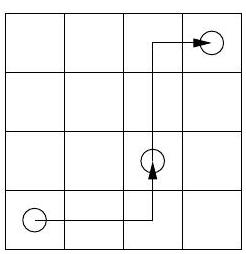
|
| 184 |
+
|
| 185 |
+
$n=4$
|
| 186 |
+
|
| 187 |
+
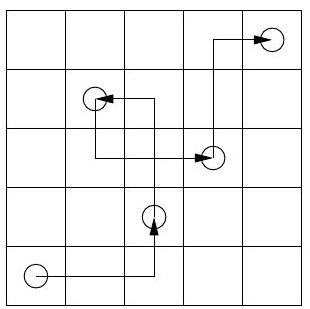
|
| 188 |
+
|
| 189 |
+
$n=5$
|
| 190 |
+
|
| 191 |
+
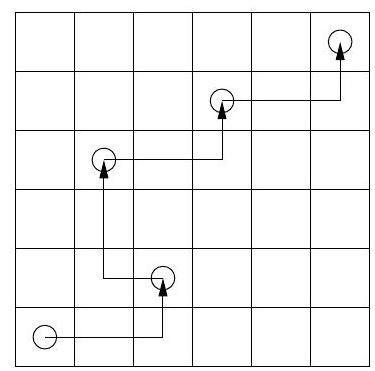
|
| 192 |
+
|
| 193 |
+
$n=6$
|
| 194 |
+
|
| 195 |
+
Figure 1
|
| 196 |
+
|
| 197 |
+
For $n=4, n=5$ and $n=6$ the sequences of moves are easily found that take the knight from square $(1,1)$ to square $(n, n)$ in 2,4 and 4 moves,
|
| 198 |
+
respectively (see Figure 1). In particular, the knight may get from square $(k, k)$ to square $(k+3, k+3)$ in 2 moves. Hence, by simple induction, for any $n$ the knight can get from square $(1,1)$ to square $(n, n)$ in a number of moves equal to twice the integer part of $\frac{n+1}{3}$, which is the minimal possible number of moves.
|
| 199 |
+
|
| 200 |
+
7. Answer: No, it is not possible.
|
| 201 |
+
|
| 202 |
+
Consider the set $S$ of all (non-ordered) pairs of adjacent squares. Call an element of $S$ treated if the king has visited both its squares. After the first move there is one treated pair. Each subsequent move creates a further even number of treated pairs. So after each move the total number of treated pairs is odd. If the king could complete his tour then the total number of pairs of adjacent squares (i.e. the number of elements of $S$ ) would have to be odd. But the number of elements of $S$ is even as can be seen by the following argument. Rotation by 180 degrees around the centre of the board induces a bijection of $S$ onto itself. This bijection leaves precisely two pairs fixed, namely the pairs of squares sharing only a common corner at the middle of the board. It follows that the number of elements of $S$ is even.
|
| 203 |
+
|
| 204 |
+
8. It is possible to find the 1000 -th coin (i.e. the medium one among the 1999 coins). First we exclude the lightest and heaviest coin - for this we use 1997 weighings, putting the medium-weighted coin aside each time. Next we exclude the 2 -nd and 1998 -th coins using 1995 weighings, etc. In total we need
|
| 205 |
+
|
| 206 |
+
$$
|
| 207 |
+
1997+1995+1993+\ldots+3+1=999 \cdot 999<1000000
|
| 208 |
+
$$
|
| 209 |
+
|
| 210 |
+
weighings to determine the 1000 -th coin in such a way.
|
| 211 |
+
|
| 212 |
+
It is not possible to determine the position by weight of any other coin, since we cannot distinguish between the $k$-th and $(2000-k)$-th coin. To prove this, label the coins in some order as $a_{1}, a_{2}, \ldots, a_{1999}$. If a procedure for finding the $k$-th coin exists then it should work as follows. First we choose some three coins $a_{i_{1}}, a_{j_{1}}, a_{k_{1}}$, find the medium-weighted one among them, then choose again some three coins $a_{i_{2}}, a_{j_{2}}, a_{k_{2}}$ (possibly using the information obtained from the previous weighing) etc. The results of these
|
| 213 |
+
weighings can be written in a table like this:
|
| 214 |
+
|
| 215 |
+
| Coin 1 | Coin 2 | Coin 3 | Medium |
|
| 216 |
+
| :---: | :---: | :---: | :---: |
|
| 217 |
+
| $a_{i_{1}}$ | $a_{j_{1}}$ | $a_{k_{1}}$ | $a_{m_{1}}$ |
|
| 218 |
+
| $a_{i_{2}}$ | $a_{j_{2}}$ | $a_{k_{2}}$ | $a_{m_{2}}$ |
|
| 219 |
+
| $\ldots$ | $\ldots$ | $\ldots$ | $\ldots$ |
|
| 220 |
+
| $a_{i_{n}}$ | $a_{j_{n}}$ | $a_{k_{n}}$ | $a_{m_{n}}$ |
|
| 221 |
+
|
| 222 |
+
Suppose we make a decision " $a_{k}$ is the $k$-th coin" based on this table. Now let us exchange labels of the lightest and the heaviest coins, of the 2-nd and 1998 -th (by weight) coins etc. It is easy to see that, after this relabeling, each step in the procedure above gives the same result as before - but if $a_{k}$ was previously the $k$-th coin by weight, then now it is the $(2000-k)$-th coin, so the procedure yields a wrong coin which gives us the contradiction.
|
| 223 |
+
|
| 224 |
+
9. Answer: 24.
|
| 225 |
+
|
| 226 |
+
Since each unit cube contributes to exactly three of the row sums, then the total of all the 27 row sums is $3 \cdot(1+2+\ldots+27)=3 \cdot 14 \cdot 27$, which is even. Hence there must be an even number of odd row sums.
|
| 227 |
+
|
| 228 |
+
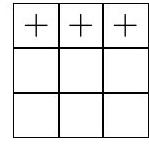
|
| 229 |
+
|
| 230 |
+
(a)
|
| 231 |
+
|
| 232 |
+
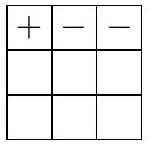
|
| 233 |
+
|
| 234 |
+
(b)
|
| 235 |
+
|
| 236 |
+
|
| 237 |
+
|
| 238 |
+
I
|
| 239 |
+
|
| 240 |
+
|
| 241 |
+
|
| 242 |
+
II
|
| 243 |
+
|
| 244 |
+
|
| 245 |
+
|
| 246 |
+
III
|
| 247 |
+
|
| 248 |
+
Figure 2
|
| 249 |
+
|
| 250 |
+
Figure 3
|
| 251 |
+
|
| 252 |
+
We shall prove that if one of the three levels of the cube (in any given direction) contains an even row sum, then there is another even row sum within that same level - hence there cannot be 26 odd row sums. Indeed, if this even row sum is formed by three even numbers (case (a) on Figure 2, where + denotes an even number and - denotes an odd number), then in order not to have even column sums (i.e. row sums in the perpendicular direction), we must have another even number in each of the three columns. But then the two remaining rows contain three even and three odd numbers, and hence their row sums cannot both be odd. Consider now the other case when the even row sum is formed by one even number and two odd numbers (case (b) on Figure 2). In order not to have even column sums, the column
|
| 253 |
+
containing the even number must contain another even number and an odd number, and each of the other two columns must have two numbers of the same parity. Hence the two other row sums have different parity, and one of them must be even.
|
| 254 |
+
|
| 255 |
+
It remains to notice that we can achieve 24 odd row sums (see Figure 3, where the three levels of the cube are shown).
|
| 256 |
+
|
| 257 |
+
10. Answer: no.
|
| 258 |
+
|
| 259 |
+
Let $O$ denote the centre of the disc, and $P_{1}, \ldots, P_{6}$ the vertices of an inscribed regular hexagon in the natural order (see Figure 4).
|
| 260 |
+
|
| 261 |
+
If the required partitioning exists, then $\{O\},\left\{P_{1}, P_{3}, P_{5}\right\}$ and $\left\{P_{2}, P_{4}, P_{6}\right\}$ are contained in different subsets. Now consider the circles of radius 1 centered in $P_{1}, P_{3}$ and $P_{5}$. The circle of radius $1 / \sqrt{3}$ centered in $O$ intersects these three circles in the vertices $A_{1}, A_{2}, A_{3}$ of an equilateral triangle of side length 1 . The vertices of this triangle belong to different subsets, but none of them can belong to the same subset as $P_{1}$ - a contradiction. Hence the required partitioning does not exist.
|
| 262 |
+
|
| 263 |
+
|
| 264 |
+
|
| 265 |
+
Figure 4
|
| 266 |
+
|
| 267 |
+
11. Consider a circle containing all these four points in its interior. First, decrease its radius until at least one of these points (say, $A$ ) will be on the circle. If the other three points are still in the interior of the circle, then rotate the circle around $A$ (with its radius unchanged) until at least one of the other three points (say, $B$ ) will also be on the circle. The centre of the circle now lies on the perpendicular bisector of the segment $A B$ - moving
|
| 268 |
+
the centre along that perpendicular bisector (and changing its radius at the same time, so that points $A$ and $B$ remain on the circle) we arrive at a situation where at least one of the remaining two points will also be on the circle (see Figure 5).
|
| 269 |
+
|
| 270 |
+
|
| 271 |
+
|
| 272 |
+
Figure 5
|
| 273 |
+
|
| 274 |
+
Alternative solution. The quadrangle with its vertices in the four points can be convex or non-convex.
|
| 275 |
+
|
| 276 |
+
If the quadrangle is non-convex, then one of the points lies in the interior of the triangle defined by the remaining three points (see Figure 6) - the circumcircle of that triangle has the required property.
|
| 277 |
+
|
| 278 |
+
|
| 279 |
+
|
| 280 |
+
Figure 6
|
| 281 |
+
|
| 282 |
+
|
| 283 |
+
|
| 284 |
+
Figure 7
|
| 285 |
+
|
| 286 |
+
Assume now that the quadrangle $A B C D$ (where $A, B, C, D$ are the four points) is convex. Then it has a pair of opposite angles, the sum of which is at least $180^{\circ}$ - assume these are at vertices $B$ and $D$ (see Figure 7). We shall prove that point $D$ lies either in the interior of the circumcircle of triangle $A B C$ or on that circle. Indeed, let the ray drawn from the
|
| 287 |
+
circumcentre $O$ of triangle $A B C$ through point $D$ intersect the circumcircle in $D^{\prime}$ : since $\angle B+\angle D^{\prime}=180^{\circ}$ and $\angle B+\angle D \geqslant 180^{\circ}$, then $D$ cannot lie in the exterior of the circumcircle.
|
| 288 |
+
|
| 289 |
+
12. Let $N$ be the midpoint of $B C$ and $M$ the midpoint of $A C$. Let $O$ be the circumcentre of $A B C$ and $I$ its incentre (see Figure 8). Since $\angle C M O=\angle C N O=90^{\circ}$, the points $C, N, O$ and $M$ are concyclic (regardless of whether $O$ lies inside the triangle $A B C$ ). We now have to show that the points $C, N, I$ and $M$ are also concyclic, i.e $I$ lies on the same circle as $C, N, O$ and $M$. It will be sufficient to show that $\angle N C M+\angle N I M=180^{\circ}$ in the quadrilateral $C N I M$. Since
|
| 290 |
+
|
| 291 |
+
$$
|
| 292 |
+
|A B|=\frac{|A C|+|B C|}{2}=|A M|+|B N|
|
| 293 |
+
$$
|
| 294 |
+
|
| 295 |
+
we can choose a point $D$ on the side $A B$ such that $|A D|=|A M|$ and $|B D|=|B N|$. Then triangle $A I M$ is congruent to triangle $A I D$, and similarly triangle $B I N$ is congruent to triangle $B I D$. Therefore
|
| 296 |
+
|
| 297 |
+
$$
|
| 298 |
+
\begin{aligned}
|
| 299 |
+
\angle N C M+\angle N I M & =\angle N C M+\left(360^{\circ}-2 \angle A I D-2 \angle B I D\right)= \\
|
| 300 |
+
& =\angle B C A+360^{\circ}-2 \angle A I B= \\
|
| 301 |
+
& =\angle B C A+360^{\circ}-2 \cdot\left(180^{\circ}-\frac{\angle B A C}{2}-\frac{\angle A B C}{2}\right)= \\
|
| 302 |
+
& =\angle B C A+\angle A B C+\angle C A B=180^{\circ} .
|
| 303 |
+
\end{aligned}
|
| 304 |
+
$$
|
| 305 |
+
|
| 306 |
+
|
| 307 |
+
|
| 308 |
+
Figure 8
|
| 309 |
+
|
| 310 |
+
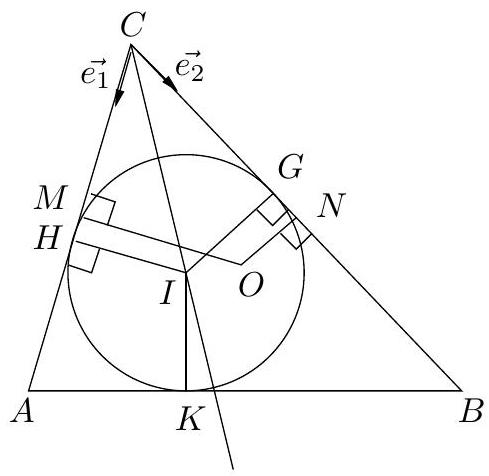
|
| 311 |
+
|
| 312 |
+
Figure 9
|
| 313 |
+
|
| 314 |
+
Alternative solution. Let $O$ be the circumcentre of $A B C$ and $I$ its in-
|
| 315 |
+
centre, and let $G, H$ and $K$ be the points where the incircle touches the sides $B C, A C$ and $A B$ of the triangle, respectively. Also, let $N$ be the midpoint of $B C$ and $M$ the midpoint of $A C$ (see Figure 9). Since $\angle C M O=\angle C N O=90^{\circ}$, points $M$ and $N$ lie on the circle with diameter $O C$. We will show that point $I$ also lies on that circle. Indeed, we have
|
| 316 |
+
|
| 317 |
+
$$
|
| 318 |
+
|A H|+|B G|=|A K|+|B K|=|A B|=\frac{|A C|+|B C|}{2}=|A M|+|B N|,
|
| 319 |
+
$$
|
| 320 |
+
|
| 321 |
+
implying $|M H|=|N G|$. Since $M H$ and $N G$ are the perpendicular projections of $O I$ to the lines $A C$ and $B C$, respectively, then $I O$ must be either parallel or perpendicular to the bisector $C I$ of angle $A C B$. (To formally prove this, consider unit vectors $\overrightarrow{e_{1}}$ and $\overrightarrow{e_{2}}$ defined by the rays $C A$ and $C B$, and show that the condition $|M H|=|N G|$ is equivalent to $\left(\overrightarrow{e_{1}} \pm \overrightarrow{e_{2}}\right) \cdot \overrightarrow{I O}=0$.)
|
| 322 |
+
|
| 323 |
+
If $I O$ is perpendicular to $C I$, then $\angle C I O=90^{\circ}$ and we are done. If $I O$ is parallel to $C I$, the the circumcentre $O$ of triangle $A B C$ lies on the bisector $C I$ of angle $A C B$, whence $|A C|=|B C|$ and the condition $2|A B|=|A C|+|B C|$ implies that $A B C$ is an equilateral triangle. Hence in this case points $O$ and $I$ coincide and the claim of the problem holds trivially.
|
| 324 |
+
|
| 325 |
+
## 13. Answer: $60^{\circ}$.
|
| 326 |
+
|
| 327 |
+
Let $F$ be the point of the side $A B$ such that $|A F|=|A E|$ and $|B F|=|B D|$ (see Figure 10). The line $A D$ is the angle bisector of $\angle A$ in the isosceles triangle $A E F$. This implies that $A D$ is the perpendicular bisector of $E F$, whence $|D E|=|D F|$. Similarly we show that $|D E|=|E F|$. This proves that the triangle $D E F$ is equilateral, i.e. $\angle E F D=60^{\circ}$. Hence $\angle A F E+\angle B F D=120^{\circ}$, and also $\angle A E F+\angle B D F=120^{\circ}$. Thus $\angle C A B+\angle C B A=120^{\circ}$ and finally $\angle C=60^{\circ}$.
|
| 328 |
+
|
| 329 |
+
Alternative solution. Let $I$ be the incenter of triangle $A B C$, and let $G$, $H, K$ be the points where its incircle touches the sides $B C, A C, A B$ respectively (see Figure 11). Then
|
| 330 |
+
|
| 331 |
+
$$
|
| 332 |
+
|A E|+|B D|=|A B|=|A K|+|B K|=|A H|+|B G| \text {, }
|
| 333 |
+
$$
|
| 334 |
+
|
| 335 |
+
implying $|D G|=|E H|$. Hence the triangles $D I G$ ja $E I H$ are congruent,
|
| 336 |
+
and
|
| 337 |
+
|
| 338 |
+
$\angle D I E=\angle G I H=180^{\circ}-\angle C$.
|
| 339 |
+
|
| 340 |
+
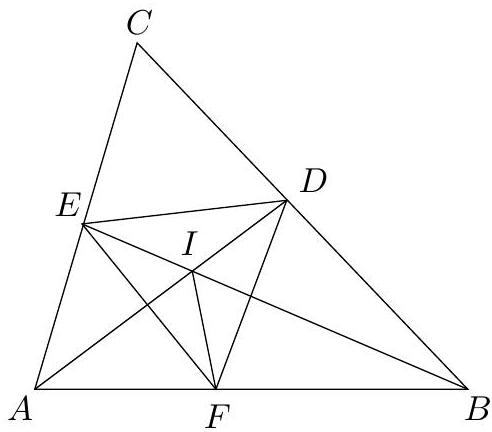
|
| 341 |
+
|
| 342 |
+
Figure 10
|
| 343 |
+
|
| 344 |
+
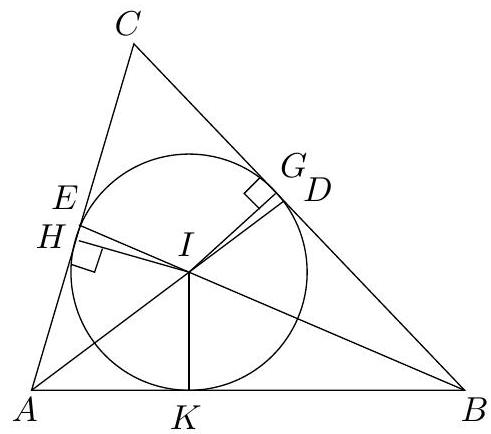
|
| 345 |
+
|
| 346 |
+
Figure 11
|
| 347 |
+
|
| 348 |
+
On the other hand,
|
| 349 |
+
|
| 350 |
+
$$
|
| 351 |
+
\angle D I E=\angle A I B=180^{\circ}-\frac{\angle A+\angle B}{2} .
|
| 352 |
+
$$
|
| 353 |
+
|
| 354 |
+
Hence
|
| 355 |
+
|
| 356 |
+
$$
|
| 357 |
+
\angle C=\frac{\angle A+\angle B}{2}=90^{\circ}-\frac{\angle C}{2}
|
| 358 |
+
$$
|
| 359 |
+
|
| 360 |
+
which gives $\angle C=60^{\circ}$.
|
| 361 |
+
|
| 362 |
+
14. The quadrilaterals $D B C G$ and $F B C E$ are trapeziums. The area of a trapezium is equal to half the sum of the lengths of the parallel sides multiplied by the distance between them. But the distance between the parallel sides is the same for both of these trapeziums, since the distance from $B$ to $A C$ is equal to the distance from $C$ to $A B$. It therefore suffices to show that
|
| 363 |
+
|
| 364 |
+
$$
|
| 365 |
+
\frac{|B D|+|C G|}{|C E|+|B F|}=\frac{|A D|}{|A E|}
|
| 366 |
+
$$
|
| 367 |
+
|
| 368 |
+
(see Figure 12). Now, since the triangles $B D F, A D E$ and $C G E$ are similar, we have
|
| 369 |
+
|
| 370 |
+
$$
|
| 371 |
+
\frac{|B D|}{|B F|}=\frac{|C G|}{|C E|}=\frac{|A D|}{|A E|}
|
| 372 |
+
$$
|
| 373 |
+
|
| 374 |
+
which implies the required equality.
|
| 375 |
+
|
| 376 |
+
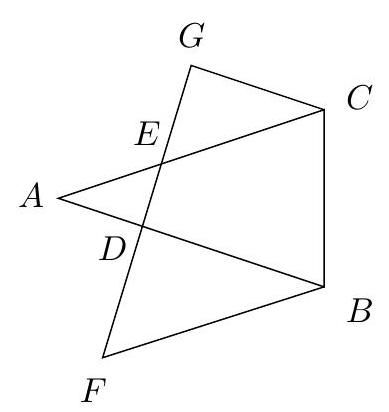
|
| 377 |
+
|
| 378 |
+
Figure 12
|
| 379 |
+
|
| 380 |
+
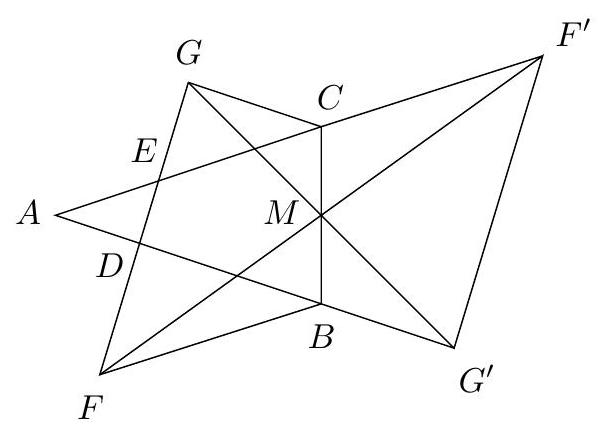
|
| 381 |
+
|
| 382 |
+
Figure 13
|
| 383 |
+
|
| 384 |
+
Alternative solution. As in the first solution, we need to show that
|
| 385 |
+
|
| 386 |
+
$$
|
| 387 |
+
\frac{|B D|+|C G|}{|B F|+|C E|}=\frac{|A D|}{|A E|}
|
| 388 |
+
$$
|
| 389 |
+
|
| 390 |
+
Let $M$ be the midpoint of $B C$, and let $F^{\prime}$ and $G^{\prime}$ be the points symmetric to $F$ and $G$, respectively, relative to $M$ (see Figure 13). Since $C G$ is parallel to $A B$, then point $G^{\prime}$ lies on the line $A B$, and $\left|B G^{\prime}\right|=|C G|$. Similarly point $F^{\prime}$ lies on the line $A C$, and $\left|C F^{\prime}\right|=|B F|$. It remains to show that
|
| 391 |
+
|
| 392 |
+
$$
|
| 393 |
+
\frac{\left|D G^{\prime}\right|}{\left|E F^{\prime}\right|}=\frac{|A D|}{|A E|}
|
| 394 |
+
$$
|
| 395 |
+
|
| 396 |
+
which follows from $D E$ and $F^{\prime} G^{\prime}$ being parallel.
|
| 397 |
+
|
| 398 |
+
Another solution. Express the areas of the quadrilaterals as
|
| 399 |
+
|
| 400 |
+
$$
|
| 401 |
+
[D B C G]=[A B C]-[A D E]+[E C G]
|
| 402 |
+
$$
|
| 403 |
+
|
| 404 |
+
and
|
| 405 |
+
|
| 406 |
+
$$
|
| 407 |
+
[F B C E]=[A B C]-[A D E]+[D B F]
|
| 408 |
+
$$
|
| 409 |
+
|
| 410 |
+
The required equality can now be proved by direct computation.
|
| 411 |
+
|
| 412 |
+
15. Consider a point $F$ on $B C$ such that $|C F|=|B D|$ (see Figure 14). Since $\angle A C F=60^{\circ}$, triangle $A C F$ is equilateral. Therefore $|A F|=|A C|=|C E|$
|
| 413 |
+
and $\angle A F B=\angle E C D=120^{\circ}$. Moreover, $|B F|=|C D|$. This implies that triangles $A F B$ and $E C D$ are congruent, and $|A B|=|D E|$.
|
| 414 |
+
|
| 415 |
+
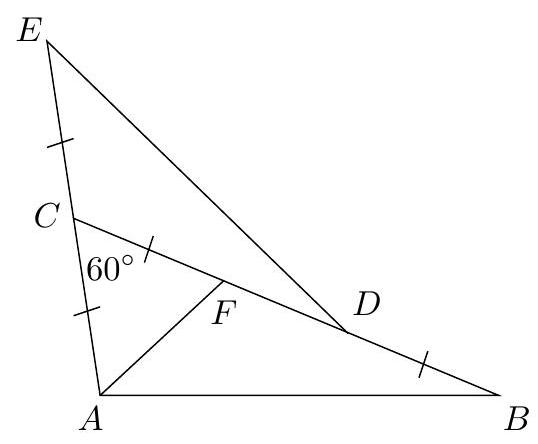
|
| 416 |
+
|
| 417 |
+
Figure 14
|
| 418 |
+
|
| 419 |
+
Alternative solution. The cosine law in triangle $A B C$ implies
|
| 420 |
+
|
| 421 |
+
$$
|
| 422 |
+
\begin{aligned}
|
| 423 |
+
|A B|^{2} & =|A C|^{2}+|B C|^{2}-2 \cdot|A C| \cdot|B C| \cdot \cos \angle A C B= \\
|
| 424 |
+
& =|A C|^{2}+|B C|^{2}-|A C| \cdot|B C|= \\
|
| 425 |
+
& =|A C|^{2}+(|B D|+|D C|)^{2}-|A C| \cdot(|B D|+|D C|)= \\
|
| 426 |
+
& =|A C|^{2}+(|A C|+|D C|)^{2}-|A C| \cdot(|A C|+|D C|)= \\
|
| 427 |
+
& =|A C|^{2}+|D C|^{2}+|A C| \cdot|D C|
|
| 428 |
+
\end{aligned}
|
| 429 |
+
$$
|
| 430 |
+
|
| 431 |
+
On the other hand, the cosine law in triangle $C D E$ gives
|
| 432 |
+
|
| 433 |
+
$$
|
| 434 |
+
\begin{aligned}
|
| 435 |
+
|D E|^{2} & =|D C|^{2}+|C E|^{2}-2 \cdot|D C| \cdot|C E| \cdot \cos \angle D C E= \\
|
| 436 |
+
& =|D C|^{2}+|C E|^{2}+|D C| \cdot|E C|= \\
|
| 437 |
+
& =|D C|^{2}+|A C|^{2}+|D C| \cdot|A C| .
|
| 438 |
+
\end{aligned}
|
| 439 |
+
$$
|
| 440 |
+
|
| 441 |
+
Hence $|A B|=|D E|$.
|
| 442 |
+
|
| 443 |
+
16. Answer: 14.
|
| 444 |
+
|
| 445 |
+
Assume that there are integers $n, m$ such that $k=19^{n}-5^{m}$ is a positive integer smaller than $19^{1}-5^{1}=14$. For obvious reasons, $n$ and $m$ must be positive.
|
| 446 |
+
|
| 447 |
+
Case 1: Assume that $n$ is even. Then the last digit of $k$ is 6 . Consequently, we have $19^{n}-5^{m}=6$. Considering this equation modulo 3 implies that $m$
|
| 448 |
+
must be even as well. With $n=2 n^{\prime}$ and $m=2 m^{\prime}$ the above equation can be restated as $\left(19^{n^{\prime}}+5^{m^{\prime}}\right)\left(19^{n^{\prime}}-5^{m^{\prime}}\right)=6$ which evidently has no solution in positive integers.
|
| 449 |
+
|
| 450 |
+
Case 2: Assume that $n$ is odd. Then the last digit of $k$ is 4 . Consequently, we have $19^{n}-5^{m}=4$. On the other hand, the remainder of $19^{n}-5^{m}$ modulo 3 is never 1 , a contradiction.
|
| 451 |
+
|
| 452 |
+
17. Answer: yes.
|
| 453 |
+
|
| 454 |
+
Let $n=5$ and consider the integers $0,2,8,14,26$. Adding $a=3$ or $a=5$ to all of these integers we get primes. Since the numbers $0,2,8,14$ and 26 have pairwise different remainders modulo 5 then for any integer $a$ the numbers $a+0, a+2, a+8, a+14$ and $a+26$ have also pairwise different remainders modulo 5 ; therefore one of them is divisible by 5 . Hence if the numbers $a+0, a+2, a+8, a+14$ and $a+26$ are all primes then one of them must be equal to 5 , which is only true for $a=3$ and $a=5$.
|
| 455 |
+
|
| 456 |
+
18. Squaring the second inequality gives $(a-b)^{2}<5+4 \sqrt{4 m+1}$. Since $m=a b$, we have
|
| 457 |
+
|
| 458 |
+
$$
|
| 459 |
+
(a+b)^{2}<5+4 \sqrt{4 m+1}+4 m=(\sqrt{4 m+1}+2)^{2}
|
| 460 |
+
$$
|
| 461 |
+
|
| 462 |
+
implying
|
| 463 |
+
|
| 464 |
+
$$
|
| 465 |
+
a+b<\sqrt{4 m+1}+2 \text {. }
|
| 466 |
+
$$
|
| 467 |
+
|
| 468 |
+
Since $a>b$, different factorizations $m=a b$ will give different values for the sum $a+b(a b=m, a+b=k, a>b$ has at most one solution in $(a, b))$. Since $m \equiv 2(\bmod 4)$, we see that $a$ and $b$ must have different parity, and $a+b$ must be odd. Also note that
|
| 469 |
+
|
| 470 |
+
$$
|
| 471 |
+
a+b \geqslant 2 \sqrt{a b}=\sqrt{4 m}
|
| 472 |
+
$$
|
| 473 |
+
|
| 474 |
+
Since $4 m$ cannot be a square we have
|
| 475 |
+
|
| 476 |
+
$$
|
| 477 |
+
a+b \geqslant \sqrt{4 m+1} .
|
| 478 |
+
$$
|
| 479 |
+
|
| 480 |
+
Since $a+b$ is odd and the interval $[\sqrt{4 m+1}, \sqrt{4 m+1}+2)$ contains exactly one odd integer, then there can be at most one pair $(a, b)$ such that $a+b<\sqrt{4 m+1}+2$, or equivalently $a-b<\sqrt{5+4 \sqrt{4 m+1}}$.
|
| 481 |
+
|
| 482 |
+
19. Note that the square of any prime $p \neq 3$ is congruent to 1 modulo 3 . Hence the numbers $k=6 m+2$ will have the required property for any $p \neq 3$, as
|
| 483 |
+
$p^{2}+k$ will be divisible by 3 and hence composite.
|
| 484 |
+
|
| 485 |
+
In order to have $3^{2}+k$ also composite, we look for such values of $m$ for which $k=6 m+2$ is congruent to 1 modulo 5 - then $3^{2}+k$ will be divisible by 5 and hence composite. Taking $m=5 t+4$, we have $k=30 t+26$, which is congruent to 2 modulo 3 and congruent to 1 modulo 5 . Hence $p^{2}+(30 t+26)$ is composite for any positive integer $t$ and prime $p$.
|
| 486 |
+
|
| 487 |
+
20. Answer: the only possible value is 1999 .
|
| 488 |
+
|
| 489 |
+
Since $a^{2}-b^{2}+c^{2}-d^{2}$ is odd, one of the primes $a, b, c$ and $d$ must be 2 , and in view of $a>3 b>6 c>12 d$ we must have $d=2$. Now
|
| 490 |
+
|
| 491 |
+
$$
|
| 492 |
+
1749=a^{2}-b^{2}+c^{2}-d^{2}>9 b^{2}-b^{2}+4 d^{2}-d^{2}=8 b^{2}-12,
|
| 493 |
+
$$
|
| 494 |
+
|
| 495 |
+
implying $b \leqslant 13$. From $4<c<\frac{b}{2}$ we now have $c=5$ and $b$ must be either 11 or 13 . It remains to check that $1749+2^{2}-5^{2}+13^{2}=1897$ is not a square of an integer, and $1749+2^{2}-5^{2}+11^{2}=1849=43^{2}$. Hence $b=11$, $a=43$ and
|
| 496 |
+
|
| 497 |
+
$$
|
| 498 |
+
a^{2}+b^{2}+c^{2}+d^{2}=43^{2}+11^{2}+5^{2}+2^{2}=1999
|
| 499 |
+
$$
|
| 500 |
+
|
BalticWay/raw/en-bw00sol.pdf
ADDED
|
@@ -0,0 +1,3 @@
|
|
|
|
|
|
|
|
|
|
|
|
|
| 1 |
+
version https://git-lfs.github.com/spec/v1
|
| 2 |
+
oid sha256:66c5abb6ca13b6cd36ff69eeeea2dd30a776165aa0340c7ab81e48956957daa2
|
| 3 |
+
size 105216
|
BalticWay/raw/en-bw01sol.pdf
ADDED
|
@@ -0,0 +1,3 @@
|
|
|
|
|
|
|
|
|
|
|
|
|
| 1 |
+
version https://git-lfs.github.com/spec/v1
|
| 2 |
+
oid sha256:c9d61daaf23c2686007a636aa05b121fea4abff068f3b1e9951bb836777fff1d
|
| 3 |
+
size 98127
|
BalticWay/raw/en-bw02sol.pdf
ADDED
|
@@ -0,0 +1,3 @@
|
|
|
|
|
|
|
|
|
|
|
|
|
| 1 |
+
version https://git-lfs.github.com/spec/v1
|
| 2 |
+
oid sha256:dc876d66591c4ef1037ba3031cd235729d1fdf26394604d1c73e1c1d0a11e084
|
| 3 |
+
size 124309
|
BalticWay/raw/en-bw03sol.pdf
ADDED
|
@@ -0,0 +1,3 @@
|
|
|
|
|
|
|
|
|
|
|
|
|
| 1 |
+
version https://git-lfs.github.com/spec/v1
|
| 2 |
+
oid sha256:2db41be325a384a4d14b01ac16d3a2d049d1f74655f1a9609e23c08844eeb48b
|
| 3 |
+
size 161521
|
BalticWay/raw/en-bw04sol.pdf
ADDED
|
@@ -0,0 +1,3 @@
|
|
|
|
|
|
|
|
|
|
|
|
|
| 1 |
+
version https://git-lfs.github.com/spec/v1
|
| 2 |
+
oid sha256:0eab5428ec6b0458a37c0481a3cff9fb41b45e7bbaede6e70bff052c9b82d63a
|
| 3 |
+
size 144077
|
BalticWay/raw/en-bw05sol.pdf
ADDED
|
@@ -0,0 +1,3 @@
|
|
|
|
|
|
|
|
|
|
|
|
|
| 1 |
+
version https://git-lfs.github.com/spec/v1
|
| 2 |
+
oid sha256:560d20f7c769fbdf2ff06786339c922551532ab9e5cf6754c431e4dd802d0871
|
| 3 |
+
size 147975
|
BalticWay/raw/en-bw06sol.pdf
ADDED
|
@@ -0,0 +1,3 @@
|
|
|
|
|
|
|
|
|
|
|
|
|
| 1 |
+
version https://git-lfs.github.com/spec/v1
|
| 2 |
+
oid sha256:359ffb4c60be5aaca00d6b37d3fd255ec58ecdf87121174a421278a44a10b109
|
| 3 |
+
size 148761
|
BalticWay/raw/en-bw07sol.pdf
ADDED
|
@@ -0,0 +1,3 @@
|
|
|
|
|
|
|
|
|
|
|
|
|
| 1 |
+
version https://git-lfs.github.com/spec/v1
|
| 2 |
+
oid sha256:21903bba5e6f5b600157f8d013e5936beafb8225d45d62bdabc81c05fc7c819c
|
| 3 |
+
size 212309
|
BalticWay/raw/en-bw08sol.pdf
ADDED
|
@@ -0,0 +1,3 @@
|
|
|
|
|
|
|
|
|
|
|
|
|
| 1 |
+
version https://git-lfs.github.com/spec/v1
|
| 2 |
+
oid sha256:fcb77f4b7af47e51a6a7e564f0e947a78f3e86bdaabc7fe9b895a54485776e47
|
| 3 |
+
size 163731
|
BalticWay/raw/en-bw09eng.pdf
ADDED
|
@@ -0,0 +1,3 @@
|
|
|
|
|
|
|
|
|
|
|
|
|
| 1 |
+
version https://git-lfs.github.com/spec/v1
|
| 2 |
+
oid sha256:1b2358180e5211d52a76bfe9504d03102f3c5ee333ec207ffa8a4a83359fada4
|
| 3 |
+
size 51051
|
BalticWay/raw/en-bw10sol.pdf
ADDED
|
@@ -0,0 +1,3 @@
|
|
|
|
|
|
|
|
|
|
|
|
|
| 1 |
+
version https://git-lfs.github.com/spec/v1
|
| 2 |
+
oid sha256:8096f9d7dcff08b2cda5b1b2c7b9aea1b80c92cc76c777d04f0fc818ea328f42
|
| 3 |
+
size 229984
|
BalticWay/raw/en-bw11sol.pdf
ADDED
|
@@ -0,0 +1,3 @@
|
|
|
|
|
|
|
|
|
|
|
|
|
| 1 |
+
version https://git-lfs.github.com/spec/v1
|
| 2 |
+
oid sha256:7fa139348b8c8cea9578a545b4b0c2c8a6436c1935296481946de62eb114fbd0
|
| 3 |
+
size 149097
|
BalticWay/raw/en-bw12sol.pdf
ADDED
|
@@ -0,0 +1,3 @@
|
|
|
|
|
|
|
|
|
|
|
|
|
| 1 |
+
version https://git-lfs.github.com/spec/v1
|
| 2 |
+
oid sha256:bafda93e799ef8d9cf12cb010b1d3878d83d7efe2d76ea04b5dd4623bdbc0c05
|
| 3 |
+
size 209851
|
BalticWay/raw/en-bw13sol.pdf
ADDED
|
@@ -0,0 +1,3 @@
|
|
|
|
|
|
|
|
|
|
|
|
|
| 1 |
+
version https://git-lfs.github.com/spec/v1
|
| 2 |
+
oid sha256:ec9b676de950cfb6423fc50fc5141c83e85ac52a135042c986d49cbf671f7cf6
|
| 3 |
+
size 1350294
|