


USAMO 2000 Solution Notes
Evan Chen《陳誼廷》
15 April 2024
This is a compilation of solutions for the 2000 USAMO. The ideas of the solution are a mix of my own work, the solutions provided by the competition organizers, and solutions found by the community. However, all the writing is maintained by me.
These notes will tend to be a bit more advanced and terse than the "official" solutions from the organizers. In particular, if a theorem or technique is not known to beginners but is still considered "standard", then I often prefer to use this theory anyways, rather than try to work around or conceal it. For example, in geometry problems I typically use directed angles without further comment, rather than awkwardly work around configuration issues. Similarly, sentences like "let $\mathbb{R}$ denote the set of real numbers" are typically omitted entirely.
Corrections and comments are welcome!
Contents
0 Problems ..... 2 1 Solutions to Day 1 ..... 3 1.1 USAMO 2000/1 ..... 3 1.2 USAMO 2000/2 ..... 4 1.3 USAMO 2000/3 2 Solutions to Day 2 ..... 6 2.1 USAMO 2000/4 ..... 6 2.2 USAMO 2000/5 ..... 7 2.3 USAMO 2000/6, proposed by Gheorghita Zbaganu ..... 8
§0 Problems
- Call a real-valued function $f$ very convex if
holds for all real numbers $x$ and $y$. Prove that no very convex function exists. 2. Let $S$ be the set of all triangles $A B C$ for which
where $r$ is the inradius and $P, Q, R$ are the points of tangency of the incircle with sides $A B, B C, C A$ respectively. Prove that all triangles in $S$ are isosceles and similar to one another. 3. A game of solitaire is played with $R$ red cards, $W$ white cards, and $B$ blue cards. A player plays all the cards one at a time. With each play he accumulates a penalty. If he plays a blue card, then he is charged a penalty which is the number of white cards still in his hand. If he plays a white card, then he is charged a penalty which is twice the number of red cards still in his hand. If he plays a red card, then he is charged a penalty which is three times the number of blue cards still in his hand. Find, as a function of $R, W$, and $B$, the minimal total penalty a player can amass and the number of ways in which this minimum can be achieved. 4. Find the smallest positive integer $n$ such that if $n$ squares of a $1000 \times 1000$ chessboard are colored, then there will exist three colored squares whose centers form a right triangle with sides parallel to the edges of the board. 5. Let $A_{1} A_{2} A_{3}$ be a triangle, and let $\omega_{1}$ be a circle in its plane passing through $A_{1}$ and $A_{2}$. Suppose there exists circles $\omega_{2}, \omega_{3}, \ldots, \omega_{7}$ such that for $k=2,3, \ldots, 7$, circle $\omega_{k}$ is externally tangent to $\omega_{k-1}$ and passes through $A_{k}$ and $A_{k+1}$ (indices $\bmod 3)$. Prove that $\omega_{7}=\omega_{1}$. 6. Let $a_{1}, b_{1}, a_{2}, b_{2}, \ldots, a_{n}, b_{n}$ be nonnegative real numbers. Prove that
§1 Solutions to Day 1
§1.1 USAMO 2000/1
Available online at https://aops.com/community/p299244.
Problem statement
Call a real-valued function $f$ very convex if
holds for all real numbers $x$ and $y$. Prove that no very convex function exists.
For $C \geq 0$, we say a function $f$ is $C$-convex
Suppose $f$ is $C$-convex. Let $a<b<c<d<e$ be any arithmetic progression, such that $t=|e-a|$. Observe that
Adding the first two to twice the third gives
So we conclude $C$-convex function is also $2 C$-convex. This is clearly not okay for $C>0$.
§1.2 USAMO 2000/2
Available online at https://aops.com/community/p338078.
Problem statement
Let $S$ be the set of all triangles $A B C$ for which
where $r$ is the inradius and $P, Q, R$ are the points of tangency of the incircle with sides $A B, B C, C A$ respectively. Prove that all triangles in $S$ are isosceles and similar to one another.
We will prove the inequality
with equality when $A P: B Q: C R=1: 4: 4$. This implies the problem statement. Letting $x=A P, y=B Q, z=C R$, the inequality becomes
Squaring both sides and collecting terms gives
If we replace $x=1 / a, y=4 / b, z=4 / c$, then it remains to prove the inequality
where equality holds when $a=b=c$. This follows by two applications of AM-GM:
Again one can tell this is an inequality by counting degrees of freedom.
§1.3 USAMO 2000/3
Available online at https://aops.com/community/p338081.
Problem statement
A game of solitaire is played with $R$ red cards, $W$ white cards, and $B$ blue cards. A player plays all the cards one at a time. With each play he accumulates a penalty. If he plays a blue card, then he is charged a penalty which is the number of white cards still in his hand. If he plays a white card, then he is charged a penalty which is twice the number of red cards still in his hand. If he plays a red card, then he is charged a penalty which is three times the number of blue cards still in his hand.
Find, as a function of $R, W$, and $B$, the minimal total penalty a player can amass and the number of ways in which this minimum can be achieved.
The minimum penalty is
or equivalently, the natural guess of "discard all cards of one color first" is actually optimal (though not necessarily unique).
This can be proven directly by induction. Indeed the base case $B W R=0$ (in which case zero penalty is clearly achievable). The inductive step follows from
It remains to characterize the strategies. This is an annoying calculation, so we just state the result.
- If any of the three quantities $B W, 2 W R, 3 R B$ is strictly smaller than the other three, there is one optimal strategy.
- If $B W=2 W R<3 R B$, there are $W+1$ optimal strategies, namely discarding from 0 to $W$ white cards, then discarding all blue cards. (Each white card discarded still preserves $B W=2 W R$.)
- If $2 W R=3 R B<B W$, there are $R+1$ optimal strategies, namely discarding from 0 to $R$ red cards, and then discarding all white cards.
- If $3 W R=R B<2 W R$, there are $B+1$ optimal strategies, namely discarding from 0 to $B$ blue cards, and then discarding all red cards.
- Now suppose $B W=2 W R=3 R B$. Discarding a card of one color ends up in exactly one of the previous three cases. This gives an answer of $R+W+B$ strategies.
§2 Solutions to Day 2
§2.1 USAMO 2000/4
Available online at https://aops.com/community/p338084.
Problem statement
Find the smallest positive integer $n$ such that if $n$ squares of a $1000 \times 1000$ chessboard are colored, then there will exist three colored squares whose centers form a right triangle with sides parallel to the edges of the board.
The answer is $n=1999$. For a construction with $n=1998$, take a punctured L as illustrated below (with 1000 replaced by 4):
We now show that if there is no right triangle, there are at most 1998 tokens (colored squares). In every column with more than two tokens, we have token emit a bidirectional horizontal death ray (laser) covering its entire row: the hypothesis is that the death ray won't hit any other tokens.
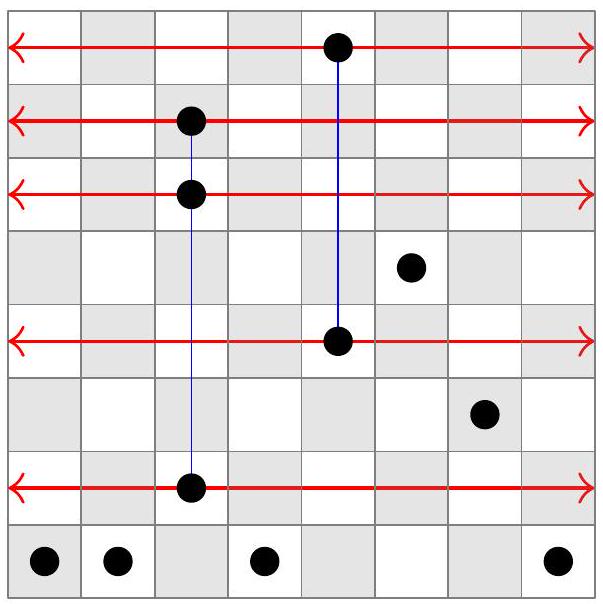
Assume there are $n$ tokens and that $n>1000$. Then obviously some column has more than two tokens, so at most 999 tokens don't emit a death ray (namely, any token in its own column). Thus there are at least $n-999$ death rays. On the other hand, we can have at most 999 death rays total (since it would not be okay for the whole board to have death rays, as some row should have more than two tokens). Therefore, $n \leq 999+999=1998$ as desired.
§2.2 USAMO 2000/5
Available online at https://aops.com/community/p338089.
Problem statement
Let $A_{1} A_{2} A_{3}$ be a triangle, and let $\omega_{1}$ be a circle in its plane passing through $A_{1}$ and $A_{2}$. Suppose there exists circles $\omega_{2}, \omega_{3}, \ldots, \omega_{7}$ such that for $k=2,3, \ldots, 7$, circle $\omega_{k}$ is externally tangent to $\omega_{k-1}$ and passes through $A_{k}$ and $A_{k+1}$ (indices mod 3). Prove that $\omega_{7}=\omega_{1}$.
The idea is to keep track of the subtended arc $\widehat{A_{i} A_{i+1}}$ of $\omega_{i}$ for each $i$. To this end, let $\beta=\measuredangle A_{1} A_{2} A_{3}, \gamma=\measuredangle A_{2} A_{3} A_{1}$ and $\alpha=\measuredangle A_{1} A_{2} A_{3}$.
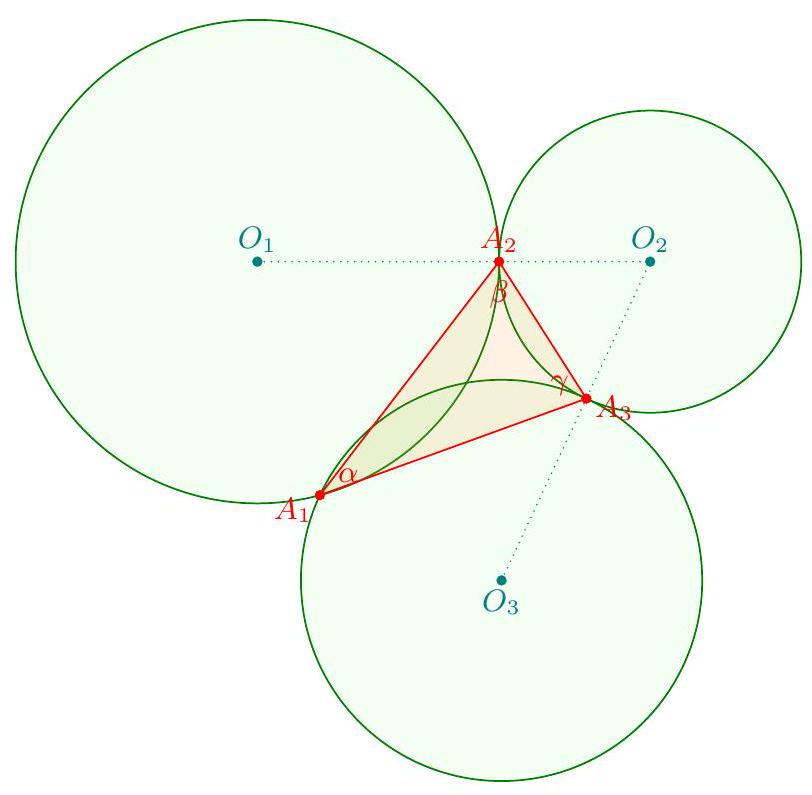
Initially, we set $\theta=\measuredangle O_{1} A_{2} A_{1}$. Then we compute
and repeating the same calculation another round gives
with $k=\gamma-\beta-\alpha$. This implies $O_{7}=O_{1}$, so $\omega_{7}=\omega_{1}$.
§2.3 USAMO 2000/6, proposed by Gheorghita Zbaganu
Available online at https://aops.com/community/p108437.
Problem statement
Let $a_{1}, b_{1}, a_{2}, b_{2}, \ldots, a_{n}, b_{n}$ be nonnegative real numbers. Prove that
We present two solutions. 【 First solution by creating a single min (Vincent Huang and Ravi Boppana). Let $b_{i}=r_{i} a_{i}$ for each $i$, and rewrite the inequality as
We now do the key manipulation to convert the double min into a separate single min. Let $\varepsilon_{i}=+1$ if $r_{i} \geq 1$, and $\varepsilon_{i}=-1$ otherwise, and let $s_{i}=\left|r_{i}-1\right|$. Then we pass to absolute values:
So let us denote $x_{i}=a_{i} \varepsilon_{i} s_{i} \in \mathbb{R}$, and $t_{i}=\frac{r_{i}+1}{s_{i}}-1 \in \mathbb{R}_{\geq 0}$. Thus it suffices to prove that:
Claim - We have
for arbitrary $x_{i} \in \mathbb{R}, t_{i} \in \mathbb{R} \geq 0$. Proof. One can just check this "by hand" by assuming $t_{1} \leq t_{2} \leq \cdots \leq t_{n}$; then the left-hand side becomes
There is also a nice proof using the integral identity
where the $\mathbf{1}$ are indicator functions. Indeed,
【 Second solution by smoothing (Alex Zhai). The case $n=1$ is immediate, so we'll proceed by induction on $n \geq 2$.
Again, let $b_{i}=r_{i} a_{i}$ for each $i$, and write the inequality as
First note that if $r_{1}=r_{2}$ then
and so our goal is to smooth to a situation where two of the $r_{i}$ 's are equal, so that we may apply induction.
On the other hand, $L_{n}$ is a piecewise linear function in $r_{1} \geq 0$. Let us smooth $r_{1}$ then. Note that if the minimum is attained at $r_{1}=0$, we can ignore $a_{1}$ and reduce to the $(n-1)$-variable case. On the other hand, the minimum must be achieved at a cusp which opens upward, which can only happen if $r_{i} r_{j}=1$ for some $j$. (The $r_{i}=r_{j}$ cusps open downward, sadly.)
In this way, whenever some $r_{i}$ is not equal to the reciprocal of any other $r_{\boldsymbol{\bullet}}$, we can smooth it. This terminates; so we may smooth until we reach a situation for which
Now, assume WLOG that $r_{1}=\max {i} r{i}$ and $r_{2}=\min {i} r{i}$, hence $r_{1} r_{2}=1$ and $r_{1} \geq 1 \geq r_{2}$. We isolate the contributions from $a_{1}, a_{2}, r_{1}$ and $r_{2}$.
The idea now is to smooth via
where $t \geq 1$ is such that $\frac{1}{t} r_{1} \geq \max \left(1, r_{3}, \ldots, r_{n}\right)$ holds. (This choice is such that $a_{1}$ and $a_{2} r_{2}$ are unchanged, because we don't know the sign of $\sum_{i \geq 3}\left(1-r_{i}\right) a_{i}$ and so the post-smoothing value is still at least the max.) Then,
the last line by AM-GM. Now pick $t=\frac{r_{1}}{\max \left(1, r_{3}, \ldots, r_{n}\right)}$, and at last we can induct down.