

text stringlengths 3 2.83k | label int64 0 1 |
|---|---|
Extending a class is the first thing that comes to mind when you need to alter an object’s behavior. However, inheritance has several serious caveats that you need to be aware of. | 0 |
The object that has some interesting state is often called _subject_, but since it’s also going to notify other objects about the changes to its state, we’ll call it _publisher_. All other objects that want to track changes to the publisher’s state are called _subscribers_. | 0 |
That’s a lot of code! And it must all be put into a single place so that you don’t pollute the program with duplicate code. | 0 |
Note that you can always adjust this limitation and allow creating any number of Singleton instances. The only piece of code that needs changing is the body of the `getInstance` method. | 0 |
If your code has access to the Singleton class, then it’s able to call the Singleton’s static method. So whenever that method is called, the same object is always returned. | 0 |
Relations with Other Patterns | 1 |
New functionality shouldn’t be created during refactoring. | 1 |
Pseudocode | 1 |
Notifying objects about events that happen to other objects. | 0 |
Relations with Other Patterns | 1 |
Visiting the store vs. sending spam | 0 |
Many programming languages have the `final` keyword that can be used to prevent further extension of a class. For a final class, the only way to reuse the existing behavior would be to wrap the class with your own wrapper, using the Decorator pattern. | 0 |
Several classes implement the same functionality. | 0 |
Use the pattern to reduce duplication of the traversal code across your app. | 0 |
In an ideal world, we’d want to put this code directly into our object’s class, but that isn’t always possible. For instance, the class may be part of a closed 3rd-party library. | 0 |
Patterns try to systematize approaches that are already widely used. This unification is viewed by many as a dogma, and they implement patterns “to the letter”, without adapting them to the context of their project. | 0 |
“Wrapper” is the alternative nickname for the Decorator pattern that clearly expresses the main idea of the pattern. A _wrapper_ is an object that can be linked with some _target_ object. The wrapper contains the same set of methods as the target and delegates to it all requests it receives. However, the wrapper may al... | 0 |
The main purpose of refactoring is to fight technical debt. It transforms a mess into clean code and simple design. | 0 |
Some pattern catalogs list other useful details, such as applicability of the pattern, implementation steps and relations with other patterns. | 0 |
Since you can link the handlers in the chain in any order, all requests will get through the chain exactly as you planned. | 0 |
 | 0 |
Following this approach, we can extract the color-related code into its own class with two subclasses: `Red` and `Blue`. The `Shape` class then gets a reference field pointing to one of the color objects. Now the shape can delegate any color-related work to the linked color object. That reference will act as a bridge b... | 0 |
There’s one more thing left to clarify: if the client is only exposed to the abstract interfaces, what creates the actual factory objects? Usually, the application creates a concrete factory object at the initialization stage. Just before that, the app must select the factory type depending on the configuration or the ... | 0 |
1. If there’s no pre-existing service interface, create one to make proxy and service objects interchangeable. Extracting the interface from the service class isn’t always possible, because you’d need to change all of the service’s clients to use that interface. Plan B is to make the proxy a subclass of the service cl... | 0 |
Intent | 1 |
- You can work with complex tree structures more conveniently: use polymorphism and recursion to your advantage.
- _Open/Closed Principle_. You can introduce new element types into the app without breaking the existing code, which now works with the object tree. | 0 |
As a result, the business logic of your classes would become tightly coupled to the implementation details of 3rd-party classes, making it hard to comprehend and maintain. | 0 |
- _Single Responsibility Principle_. You can extract the communications between various components into a single place, making it easier to comprehend and maintain.
- _Open/Closed Principle_. You can introduce new mediators without having to change the actual components.
- You can reduce coupling between various ... | 0 |
 | 0 |
There are several options where this method could be placed. The most obvious place is a flyweight container. Alternatively, you could create a new factory class. Or you could make the factory method static and put it inside an actual flyweight class. | 0 |
This is when the project resembles a monolith rather than the product of individual modules. In this case, any changes to one part of the project will affect others. Team development is made more difficult because it’s difficult to isolate the work of individual members. | 0 |
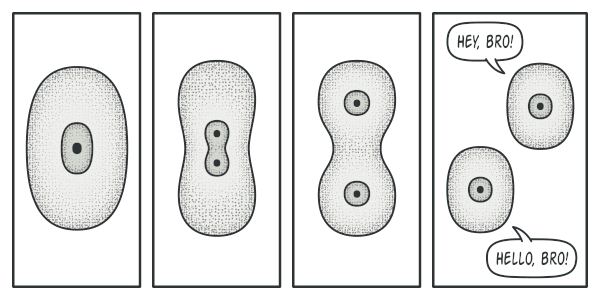
An object that supports cloning is called a _prototype_. When your objects have dozens of fields and hundreds of possible configurations, cloning them might serve as an alternative to subclassing. | 0 |
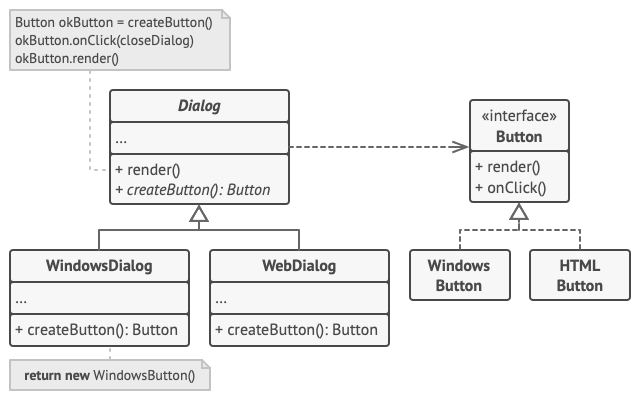
Use the Factory Method when you want to provide users of your library or framework with a way to extend its internal components. | 0 |
The same collection can be traversed in several different ways. | 0 |
1. Add a private static field to the class for storing the singleton instance.
2. Declare a public static creation method for getting the singleton instance.
3. Implement “lazy initialization” inside the static method. It should create a new object on its first call and put it into the static field. The me... | 0 |
- [Chain of Responsibility](https://refactoring.guru/pattern/chain-of-responsibility), [Command](https://refactoring.guru/pattern/command), [Mediator](https://refactoring.guru/pattern/mediator) and [Observer](https://refactoring.guru/pattern/observer) address various ways of connecting senders and receivers of reques... | 0 |
Checklist of refactoring done _right way_ | 1 |
All of these options—the random directions born in your head, the smartphone navigator or the human guide—act as iterators over the vast collection of sights and attractions located in Rome. | 0 |
Solution | 1 |
1. The **Client** is a class that contains the existing business logic of the program.
2. The **Client Interface** describes a protocol that other classes must follow to be able to collaborate with the client code.
3. The **Service** is some useful class (usually 3rd-party or legacy). The client can’t use ... | 0 |
You can create an _adapter_. This is a special object that converts the interface of one object so that another object can understand it. | 0 |
Pseudocode | 1 |
This structure may look similar to the [Strategy](https://refactoring.guru/pattern/strategy) pattern, but there’s one key difference. In the State pattern, the particular states may be aware of each other and initiate transitions from one state to another, whereas strategies almost never know about each other. | 0 |
Patterns are often confused with algorithms, because both concepts describe typical solutions to some known problems. While an algorithm always defines a clear set of actions that can achieve some goal, a pattern is a more high-level description of a solution. The code of the same pattern applied to two different progr... | 0 |
 | 0 |
How to Implement | 1 |
 | 0 |
A third alternative is that you could spend some of the trip’s budget and hire a local guide who knows the city like the back of his hand. The guide would be able to tailor the tour to your likings, show you every attraction and tell a lot of exciting stories. That’ll be even more fun; but, alas, more expensive, too. | 0 |
Here’s the best part: a handler can decide not to pass the request further down the chain and effectively stop any further processing. | 0 |
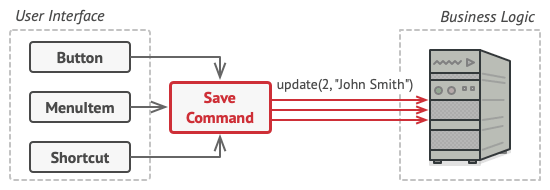
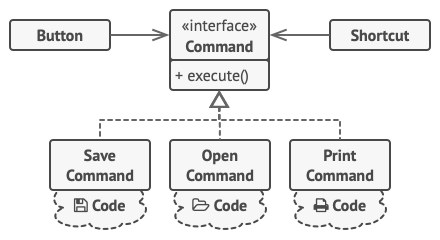
As a result, commands become a convenient middle layer that reduces coupling between the GUI and business logic layers. And that’s only a fraction of the benefits that the Command pattern can offer! | 0 |
 | 0 |
This method has two drawbacks. First, it isn’t that easy to save an application’s state because some of it can be private. This problem can be mitigated with the [Memento](https://refactoring.guru/pattern/memento) pattern. | 0 |
Solution | 1 |
The Factory Method separates product construction code from the code that actually uses the product. Therefore it’s easier to extend the product construction code independently from the rest of the code. | 0 |
Use the Command pattern when you want to parametrize objects with operations. | 0 |
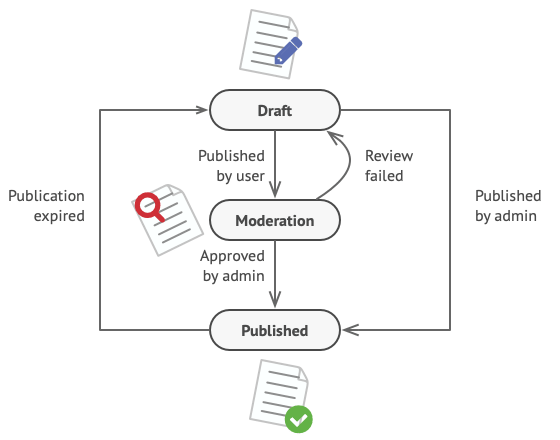
The buttons and switches in your smartphone behave differently depending on the current state of the device: | 0 |
- A [Facade](https://refactoring.guru/pattern/facade) class can often be transformed into a [Singleton](https://refactoring.guru/pattern/singleton) since a single facade object is sufficient in most cases.
- [Flyweight](https://refactoring.guru/pattern/flyweight) would resemble [Singleton](https://refactoring.... | 0 |
It seems like only lazy people haven’t criticized design patterns yet. Let’s take a look at the most typical arguments against using patterns. | 0 |
How to Implement | 1 |
Structure | 1 |
- You can control the service object without clients knowing about it.
- You can manage the lifecycle of the service object when clients don’t care about it.
- The proxy works even if the service object isn’t ready or is not available.
- _Open/Closed Principle_. You can introduce new proxies without changing th... | 0 |
To achieve this, you create a subclass `UIWithRoundButtons` from a base framework class and override its `createButton` method. While this method returns `Button` objects in the base class, you make your subclass return `RoundButton` objects. Now use the `UIWithRoundButtons` class instead of `UIFramework`. And that’s a... | 0 |
In most cases most of the parameters will be unused, making [the constructor calls pretty ugly](https://refactoring.guru/smells/long-parameter-list). For instance, only a fraction of houses have swimming pools, so the parameters related to swimming pools will be useless nine times out of ten. | 0 |
 | 0 |
 | 0 |
The simplest solution is to extend the base `House` class and create a set of subclasses to cover all combinations of the parameters. But eventually you’ll end up with a considerable number of subclasses. Any new parameter, such as the porch style, will require growing this hierarchy even more. | 0 |
Use the Facade when you want to structure a subsystem into layers. | 0 |
Lack of tests | 1 |
How to Implement | 1 |
But no matter how a collection is structured, it must provide some way of accessing its elements so that other code can use these elements. There should be a way to go through each element of the collection without accessing the same elements over and over. | 0 |
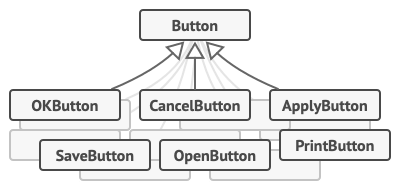
Adding a new class to the program isn’t that simple if the rest of the code is already coupled to existing classes. | 0 |
In the code it might look like this: a GUI object calls a method of a business logic object, passing it some arguments. This process is usually described as one object sending another a _request_. | 0 |
1. The **Service Interface** declares the interface of the Service. The proxy must follow this interface to be able to disguise itself as a service object.
2. The **Service** is a class that provides some useful business logic.
3. The **Proxy** class has a reference field that points to a service object. A... | 0 |
Probably the most obvious and convenient place where this code could be placed is the constructor of the class whose objects we’re trying to reuse. However, a constructor must always return **new objects** by definition. It can’t return existing instances. | 0 |
During a code review | 1 |
This example illustrates how the **Bridge** pattern can help divide the monolithic code of an app that manages devices and their remote controls. The `Device` classes act as the implementation, whereas the `Remote`s act as the abstraction. | 0 |
Pre-built prototypes can be an alternative to subclassing. | 0 |
Also known as: Action, Transaction | 0 |
Dependency Inversion Principle implies that high-level modules should not depend on low-level modules, both should depend on abstractions. Abstractions should not depend upon details. Details should depend upon abstractions. The dependency inversion principle helps us to couple software modules loosely.
The above line ... | 0 |
Relations with Other Patterns | 1 |
The Prototype pattern delegates the cloning process to the actual objects that are being cloned. The pattern declares a common interface for all objects that support cloning. This interface lets you clone an object without coupling your code to the class of that object. Usually, such an interface contains just a single... | 0 |
Logging requests (logging proxy). This is when you want to keep a history of requests to the service object. | 0 |
Nice! But there’s a catch. Not all objects can be copied that way because some of the object’s fields may be private and not visible from outside of the object itself. | 0 |
Structure | 1 |
1. Make all products follow the same interface. This interface should declare methods that make sense in every product.
2. Add an empty factory method inside the creator class. The return type of the method should match the common product interface.
3. In the creator’s code find all references to product c... | 0 |
 | 0 |
Local execution of a remote service (remote proxy). This is when the service object is located on a remote server. | 0 |
Pros and Cons | 1 |
It frequently happens when you move away from refactoring with small changes and mix a whole bunch of refactorings into one big change. So it’s very easy to lose your mind, especially if you have a time limit. | 0 |
Delayed refactoring | 1 |
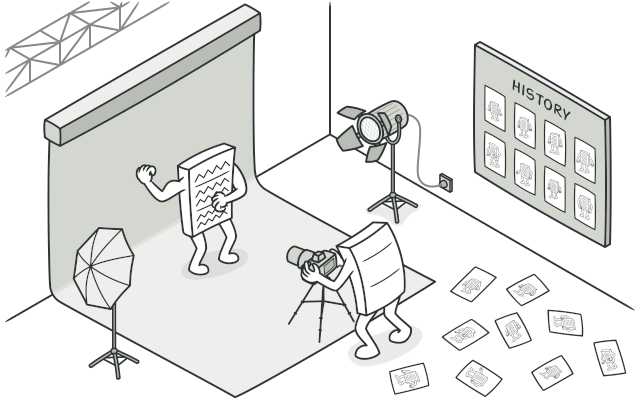
Saving snapshots of the text editor’s state. | 0 |
**Adapter** is a structural design pattern that allows objects with incompatible interfaces to collaborate. | 0 |
The pattern lets you extract all the relationships between classes into a separate class, isolating any changes to a specific component from the rest of the components. | 0 |
The Adapter pretends to be a round peg, with a radius equal to a half of the square’s diameter (in other words, the radius of the smallest circle that can accommodate the square peg). | 0 |
Possible states and transitions of a document object. | 0 |
Applicability | 1 |
All shape classes follow the same interface, which provides a cloning method. A subclass may call the parent’s cloning method before copying its own field values to the resulting object. | 0 |
Imagine that you’re working on an online ordering system. You want to restrict access to the system so only authenticated users can create orders. Also, users who have administrative permissions must have full access to all orders. | 0 |
 | 0 |
We could apply the same approach to other behaviors such as formatting messages or composing the recipient list. The client can decorate the object with any custom decorators, as long as they follow the same interface as the others. | 0 |
End of preview. Expand in Data Studio
No dataset card yet
- Downloads last month
- 13