

CaiYuanhao/X-Gaussian
Updated • 1
The dataset viewer is not available because its heuristics could not detect any supported data files. You can try uploading some data files, or configuring the data files location manually.






5 CT scenes + 3 real scans · X-ray novel view synthesis · Direct 3D CT reconstruction
 |
 |
 |
Point Cloud Visualization

Training Process Visualization
GIF demonstrations are from the official X-Gaussian repository. The five scenes available in this release are listed below.
This repository hosts the five processed CT scenes used in X-Gaussian, introduced in Radiative Gaussian Splatting for Efficient X-ray Novel View Synthesis (ECCV 2024): Chest, Abdomen, Foot, Head, and Pancreas.
Each scene contains a reference 3D CT volume, simulated cone-beam X-ray projections, view angles, and scanner geometry. The data support sparse-view reconstruction and held-out X-ray projection rendering. The current X-Gaussian code also supports direct 3D CT reconstruction from the same Gaussian field.
Results measured on the hosted joint 2D/3D checkpoints, averaged over 50 held-out views per scene:
| Scene | 2D PSNR (dB) | 2D SSIM |
|---|---|---|
| Chest | 47.21 | 0.9937 |
| Abdomen | 48.16 | 0.9968 |
| Foot | 44.40 | 0.9869 |
| Head | 51.66 | 0.9979 |
| Pancreas | 47.65 | 0.9923 |
Each predicted and reference projection is normalized by its own maximum.
Original paper comparisons
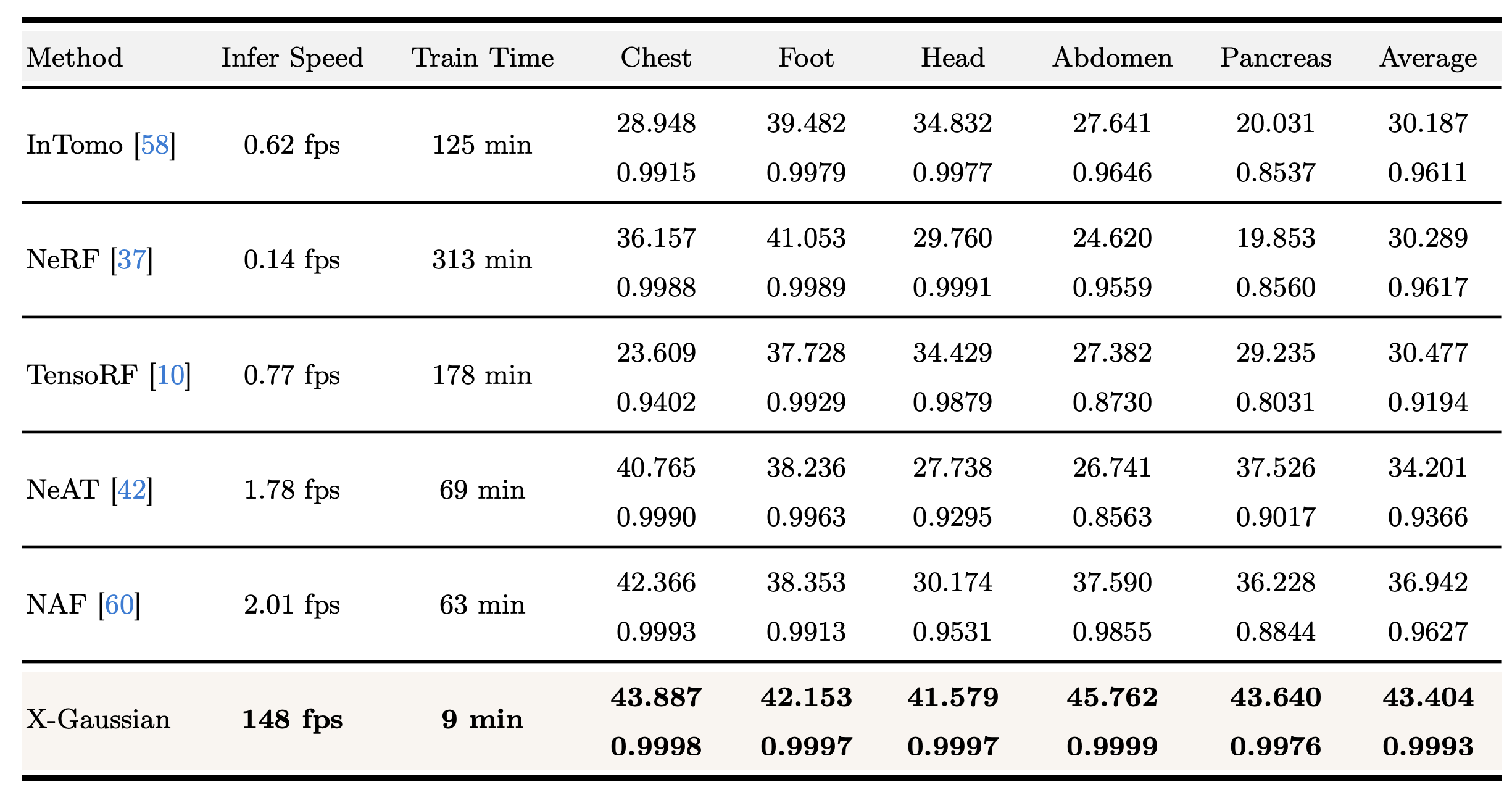
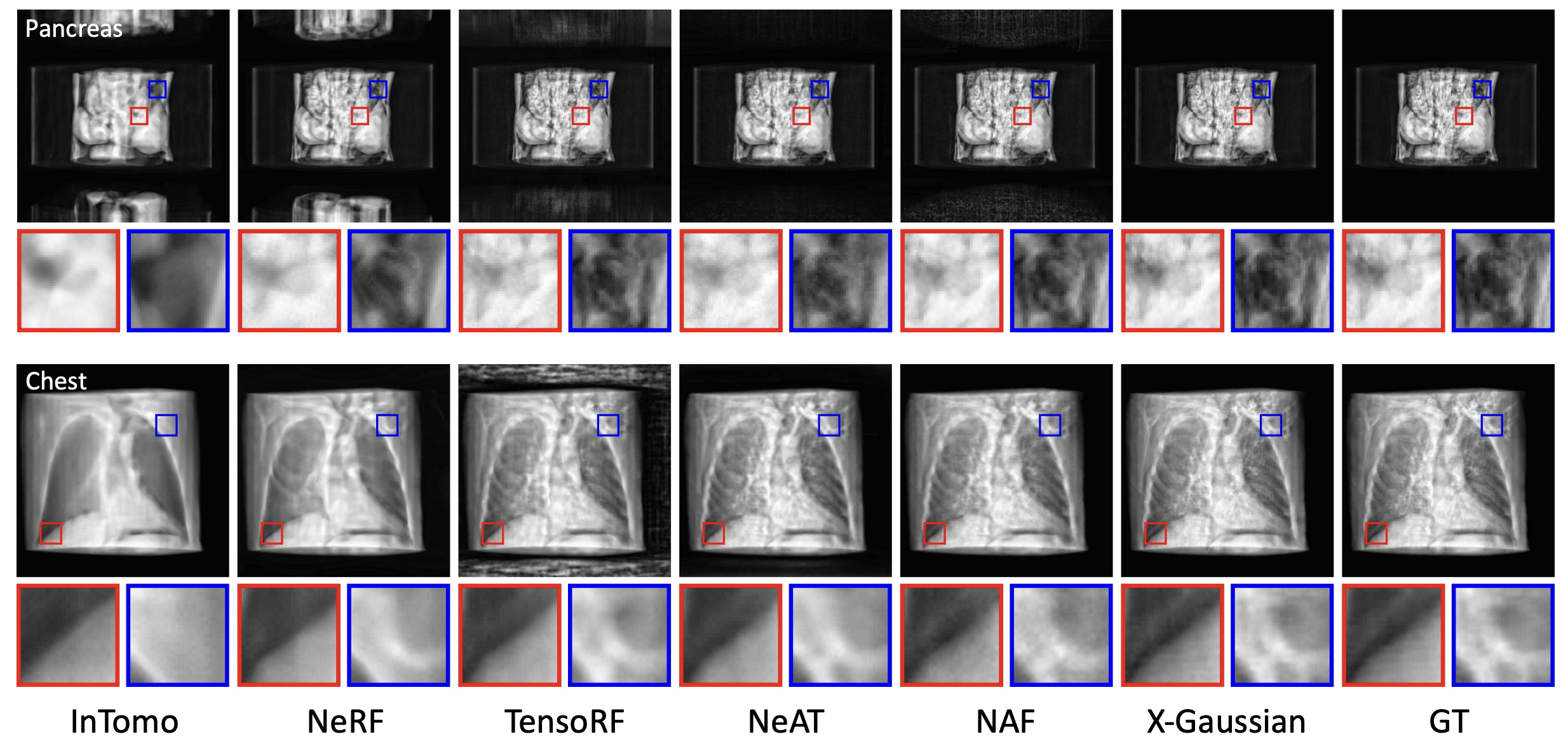
The figures reproduce the original paper results; the table above evaluates the hosted joint 2D/3D checkpoints.
Results measured on the five released models after 30,000 training steps and 1,000 refinement steps, without downsampling:
| Scene | CT resolution | 3D PSNR (dB) | 3D SSIM |
|---|---|---|---|
| Chest | 128 × 128 × 128 | 31.94 | 0.8895 |
| Abdomen | 512 × 512 × 463 | 33.33 | 0.8917 |
| Foot | 256 × 256 × 256 | 31.88 | 0.8795 |
| Head | 256 × 256 × 128 | 40.21 | 0.9732 |
| Pancreas | 512 × 512 × 240 | 22.22 | 0.8750 |
3D metrics use a fixed range of 1 on the original voxel grid, without clipping or intensity correction. SSIM averages nonempty reference slices along each axis, then across axes. CT ground truth is used only for evaluation.
Three real FIPS cone-beam scans are available in real/: Pine, Seashell, and Walnut.
Each scene contains 50 training projections, 100 held-out measured projections,
560 × 560 detector images, and a 256³ full-view FDK pseudo-reference.
The official processed projections, scanner geometry, split, and reference volume
are preserved without additional downsampling. The provided initialization is
computed by X-Gaussian from only the 50 training views; the pseudo-reference is
used only for evaluation.
See real-data contents, original sources, and CC BY 4.0 attribution. The 3D reference is an algorithmic reconstruction, not measured CT ground truth.
One Python pickle file is provided per original CT scene. The real scans use the folder format described above. Dimensions below are the original stored array dimensions; no downsampling is applied to this release.
| File | CT volume shape | Projection shape per view |
|---|---|---|
chest_50.pickle |
128 × 128 × 128 | 256 × 256 |
abdomen_50.pickle |
512 × 512 × 463 | 1024 × 1024 |
foot_50.pickle |
256 × 256 × 256 | 512 × 512 |
head_50.pickle |
256 × 256 × 128 | 512 × 512 |
pancreas_50.pickle |
512 × 512 × 240 | 1024 × 1024 |
Each file contains 50 training projections and 50 held-out projections. The held-out split is named val; these are different views of the same scene, rather than separate training and validation scenes. The uploaded files specify cone-beam geometry, a configured scan range of 180°, and noise: 0.
| Field | Description |
|---|---|
image |
Reference CT volume with shape (N_x, N_y, N_z), used for reconstruction evaluation. |
train.projections, val.projections |
Projection arrays with shape (50, H, W). |
train.angles, val.angles |
Corresponding view angles in radians. |
numTrain, numVal |
Numbers of training and held-out views. |
DSD, DSO |
Source-to-detector and source-to-origin distances. |
nDetector, dDetector |
Detector pixel counts and pixel sizes. |
nVoxel, dVoxel |
CT voxel counts and voxel sizes. |
offOrigin, offDetector |
Volume and detector offsets. |
mode, accuracy, filter |
Acquisition and reconstruction settings. |
Physical lengths in the stored scanner metadata are in millimeters. The official loader handles unit conversion and scene normalization. CT ground truth is not required by the current X-Gaussian training workflow.
Please refer to the X-Gaussian repository for installation, data preparation, training, and testing.
These scenes use the processed CT data format shared with SAX-NeRF. X-ray projections are synthesized from CT volumes using the TIGRE-based data generation pipeline. See the SAX-NeRF dataset card and data generation code for source attribution and preprocessing details. Acquisition settings for this release should be read from the individual files as summarized above.
If you use these data, please cite X-Gaussian and SAX-NeRF:
@inproceedings{x_gaussian,
  title={Radiative gaussian splatting for efficient x-ray novel view synthesis},
  author={Yuanhao Cai and Yixun Liang and Jiahao Wang and Angtian Wang and Yulun Zhang and Xiaokang Yang and Zongwei Zhou and Alan Yuille},
  booktitle={ECCV},
  year={2024}
}

@inproceedings{sax_nerf,
  title={Structure-Aware Sparse-View X-ray 3D Reconstruction},
  author={Yuanhao Cai and Jiahao Wang and Alan Yuille and Zongwei Zhou and Angtian Wang},
  booktitle={CVPR},
  year={2024}
}
The original five CT datasets retain the Apache-2.0 license. The FIPS real data and derived initialization under real/ are CC BY 4.0; see source attribution and processing details.