

pdf pdf |
|---|
Agent Harness Engineering: A Survey





This dataset hosts the PDF for Agent Harness Engineering: A Survey.
This release contains only the survey PDF. For the curated resource list, please see the companion project page or GitHub repository.
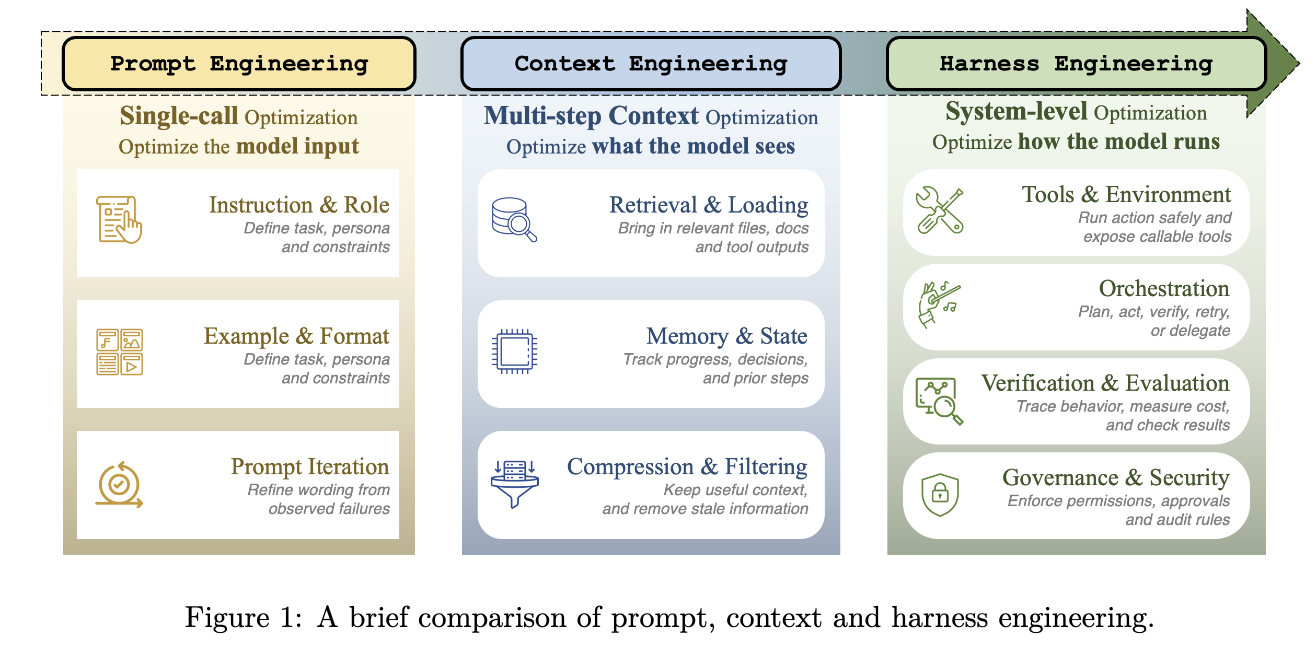
Three Engineering Phases
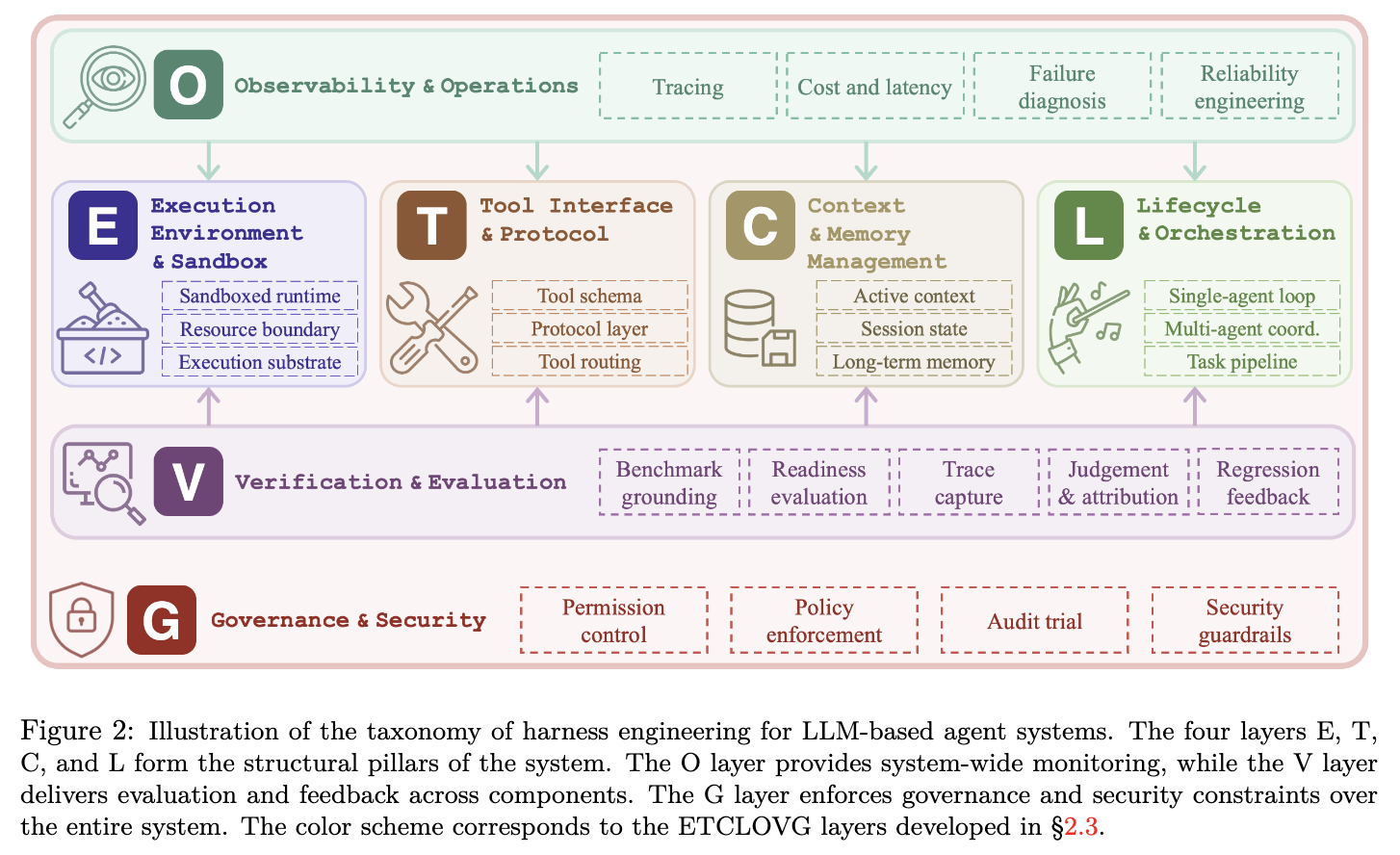
The ETCLOVG Taxonomy
We organize the harness into seven layers. The first four describe the structural core of a harness; the last three describe the control plane around it. Compared with earlier six-component frameworks, Observability and Governance appear here as independent layers because, in production deployments, each has its own tooling stack and is owned by a different team.
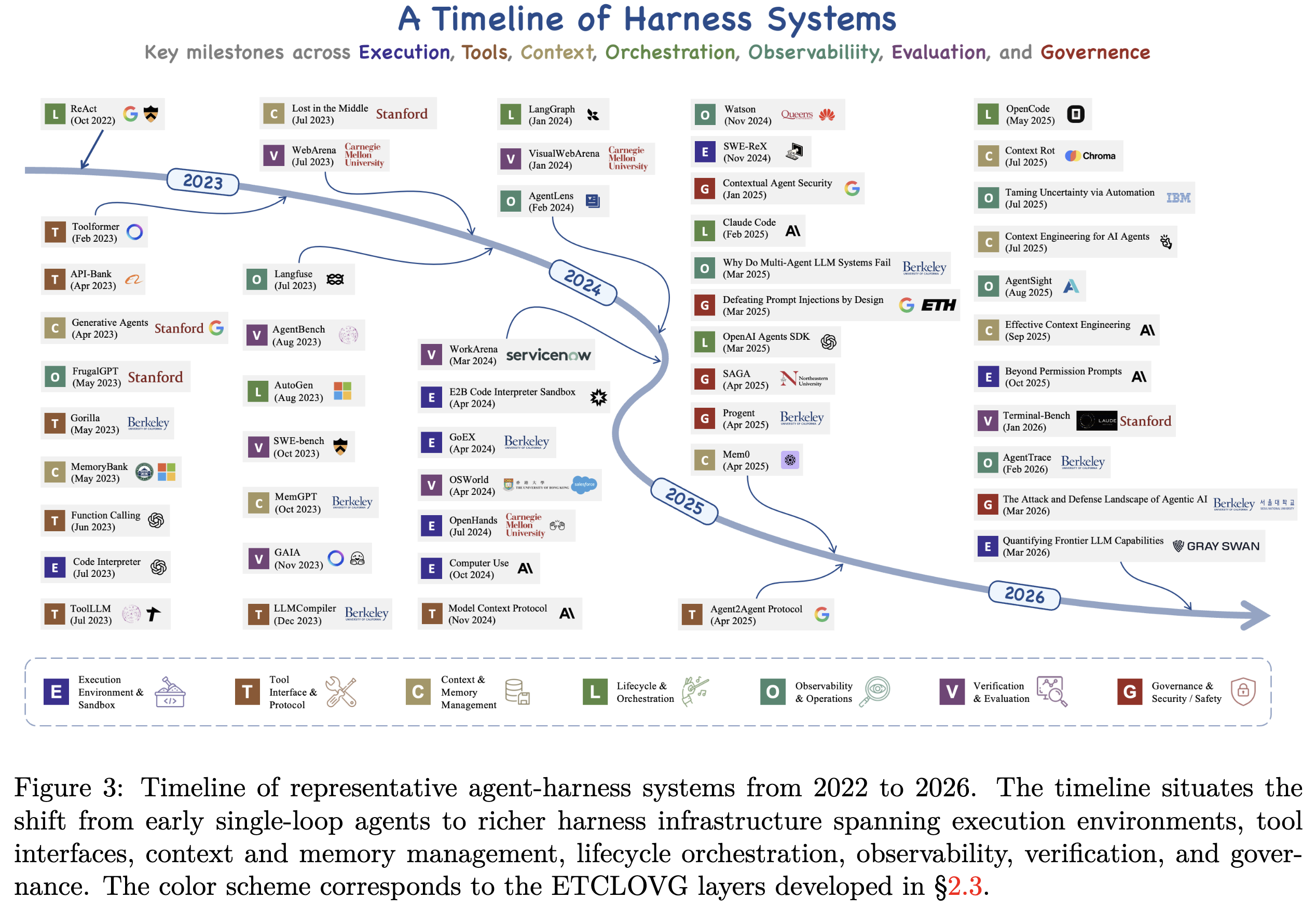
Timeline of Agent-Harness Systems
The same shift is visible in the systems themselves. The ReAct era of 2022–2023 wrapped a single model loop with a while-loop, a prompt template, and a small tool dispatch table; AutoGPT and BabyAGI exposed the resulting failures, including execution runaway, context blowout, state loss, and unmonitored side effects, as infrastructure problems rather than prompt problems. Tool integration and multi-agent coordination from 2023–2024 added learned tool use (Gorilla, ToolLLM, Toolformer), role-playing organizations (CAMEL, ChatDev, MetaGPT, Mixture-of-Agents), the first agent benchmarks (SWE-bench, AgentBench, WebArena, GAIA), and the beginnings of protocol standardization (MCP, A2A). By 2025–2026 enough deployment experience had accumulated that “harness engineering” began to be named as a discipline of its own, accompanied by automated harness optimization and a wave of results in which only the harness was varied.
Mapping Open-Source Projects
The counts below reflect primary assignments in the current snapshot.
| Layer | Scope | Primary Projects |
|---|---|---|
| ■ E | Execution environment & sandbox | 20 |
| ■ T | Tool interface & protocol | 12 |
| ■ C | Context & memory management | 9 |
| ■ L | Lifecycle & orchestration | 47 |
| ■ O | Observability & operations | 15 |
| ■ V | Verification & evaluation | 21 |
| ■ G | Governance & security | 14 |
Looking for more?
More information can be found on the project page and the Github repository.
Citation
If you use this survey, please cite:
@misc{li2026agentharness,
  title={Agent Harness Engineering: A Survey},
  author={Li, Junjie and Xiao, Xi and Zhang, Yunbei and Liu, Chen and Zhao, Lin and Liao, Xiaoying and Ji, Yingrui and Wang, Janet and Gu, Jianyang and Ge, Yingqiang and Xu, Weijie and Fang, Xi and Xu, Xiang and Zhao, Tianchen and Kim, Youngeun and Wang, Tianyang and Hamm, Jihun and Krishnaswamy, Smita and Huan, Jun and Reddy, Chandan},
  url={https://openreview.net/pdf?id=eONq7FdiHa},
  year={2026}
}
- Downloads last month
- 76