
Datasets:

language:
  - en
  - zh
  - ko
  - ja
  - fr
license: apache-2.0
task_categories:
  - image-text-to-text
configs:
  - config_name: default
    data_files:
      - split: test
        path: MMTR.jsonl
MMTR-Bench: Multimodal Masked Text Reconstruction Benchmark
📖 Abstract
We present MMTR-Bench (Multimodal Masked Text Reconstruction Benchmark) to evaluate native visual context reconstruction in complex multimodal inputs. Unlike traditional question-answering tasks, MMTR-Bench presents models with masked single- or multi-image inputs from diverse real-world scenarios, such as documents and webpages.
To solve the task, models must recover the hidden text by relying on the remaining layout structure, visual cues, and relevant world knowledge. By removing question-based guidance, this task challenges models to autonomously parse and reason over complex visual structures, testing their fundamental capacity for end-to-end document parsing and structured reading. The benchmark contains 2,771 test samples spanning multiple languages and varying target lengths. To fairly assess this diversity, we introduce a level-aware scoring mechanism. Extensive experiments on representative models demonstrate that MMTR-Bench remains highly challenging, particularly for sentence- and paragraph-level recovery.
📊 Dataset Overview
MMTR-Bench evaluates a model's ability to maintain a continuous, structured reading flow across complex multimodal layouts. The dataset is rigorously balanced across various dimensions to ensure a comprehensive evaluation of current Multimodal Large Language Models (MLLMs).
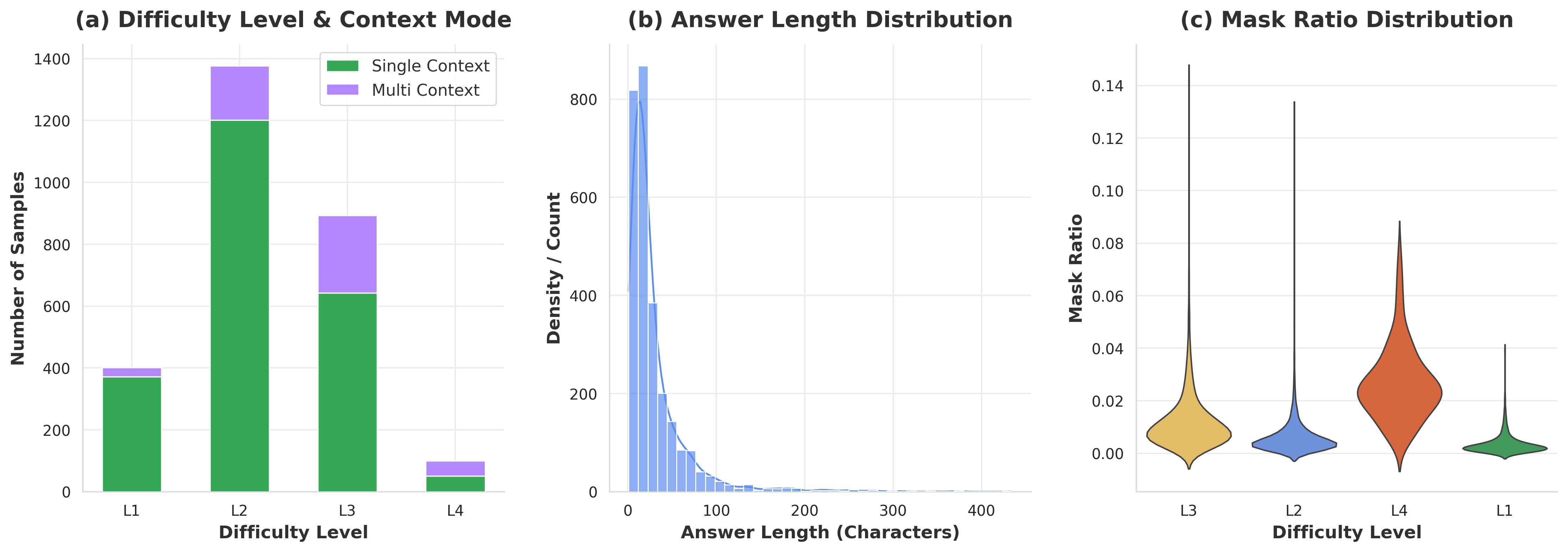
The distributions in the dataset highlight our multi-faceted evaluation strategy:
- Difficulty Level & Context Mode: The dataset is categorized into four distinct difficulty levels (L1 to L4), scaling from word-level completion to complex paragraph-level reconstruction. It incorporates both Single Context (single-page) and Multi Context (multi-page) scenarios, demanding robust cross-page reasoning.
- Answer Length Distribution: Target texts span a wide spectrum of character lengths, ensuring models are tested on both concise factual recall and extended, coherent text generation based on visual context.
- Mask Ratio Distribution: The proportion of masked content varies dynamically across difficulty levels, pushing the boundaries of how much missing information a model can infer purely from surrounding document structures and visual semantics.
🏆 Leaderboard & Evaluation
The benchmark assesses models using a specialized level-aware scoring mechanism to account for the varying complexities of L1 through L4 tasks. The inclusion of explicit reasoning ("Thinking") models reveals a significant paradigm shift in how MLLMs approach visual text reconstruction.
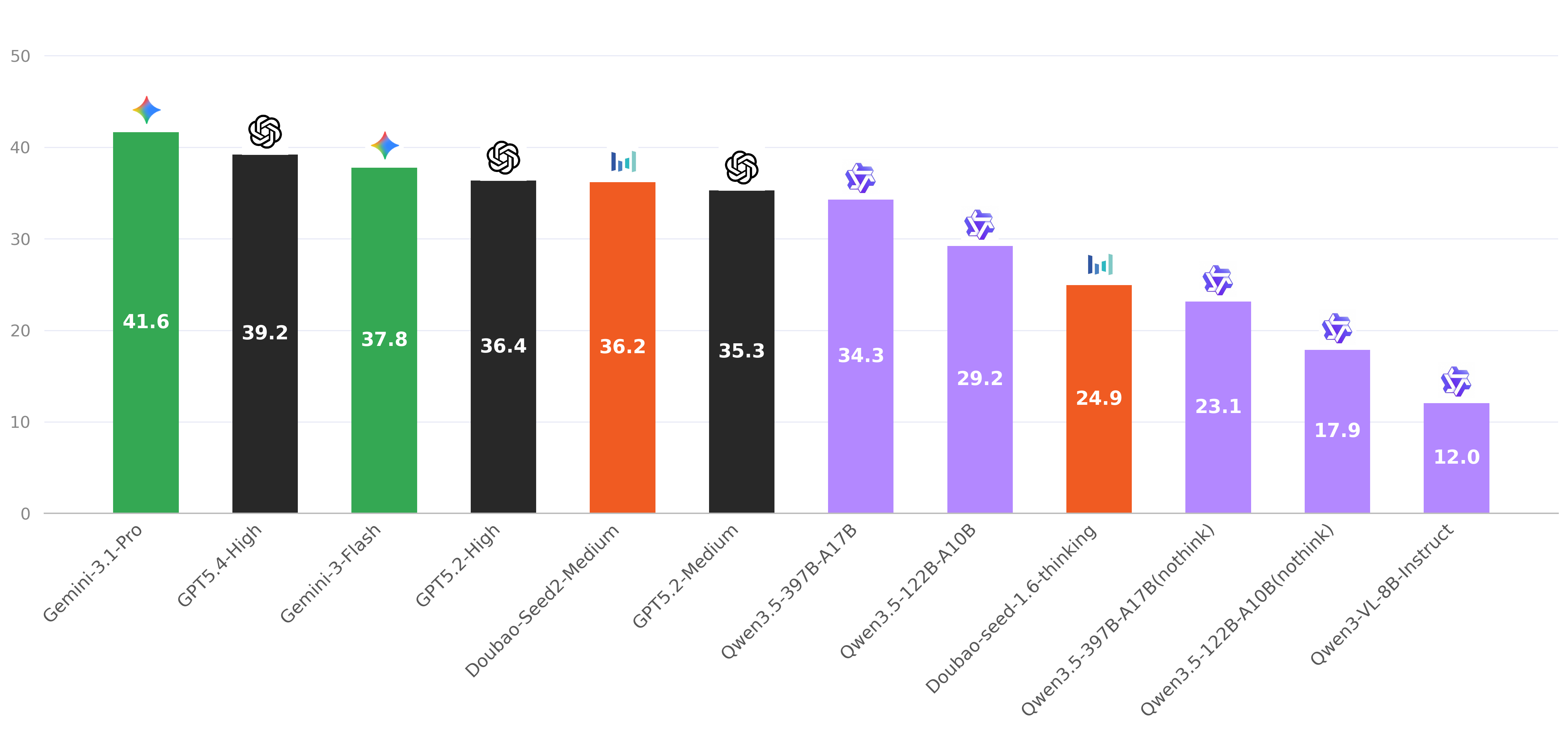
Main Results
Note: "Think" marks models with explicit reasoning capabilities, except for variants explicitly marked as "nothink" or "Instruct". All numbers are reported as percentages.
| Models | Think | Single-page | Multi-page | L1 | L2 | L3 | L4 | Final |
|---|---|---|---|---|---|---|---|---|
| Gemini-3.1-Pro | ✅ | 42.57 | 38.70 | 64.17 | 44.64 | 37.50 | 31.86 | 41.87 |
| GPT5.4-High | ✅ | 41.00 | 30.98 | 57.46 | 41.20 | 35.72 | 30.92 | 39.18 |
| Gemini-3-Flash | ✅ | 38.49 | 34.90 | 56.75 | 38.51 | 34.86 | 29.46 | 37.84 |
| GPT5.2-High | ✅ | 36.64 | 37.62 | 51.49 | 38.61 | 34.02 | 29.42 | 36.81 |
| Doubao-Seed2-Medium | ✅ | 37.06 | 31.96 | 52.46 | 36.10 | 33.63 | 31.28 | 36.13 |
| GPT5.2-Medium | ✅ | 35.39 | 36.61 | 50.27 | 37.22 | 32.72 | 30.51 | 35.61 |
| Qwen3.5-397B-A17B | ✅ | 34.67 | 30.10 | 48.39 | 34.67 | 31.46 | 26.68 | 33.84 |
| Qwen3.5-122B-A10B | ✅ | 30.37 | 23.94 | 43.91 | 27.23 | 27.84 | 23.92 | 29.20 |
| Doubao-Seed1.6-Thinking | ✅ | 25.50 | 23.01 | 33.81 | 22.10 | 24.74 | 25.02 | 25.04 |
| Qwen3.5-397B-A17B | 24.25 | 18.96 | 31.94 | 20.75 | 22.91 | 22.37 | 23.29 | |
| Qwen3.5-112B-A10B | 18.56 | 15.47 | 18.79 | 13.62 | 19.31 | 23.40 | 18.00 | |
| Qwen3-VL-8B-Instruct | 12.16 | 11.38 | 7.94 | 7.12 | 14.19 | 20.11 | 12.02 |
🚀 How to Use
MMTR-Bench is an evaluation-only benchmark designed to test Multimodal LLMs. There is no training set.
1. Installation
Ensure you have the required libraries installed:
pip install datasets
2. Loading the Benchmark
from datasets import load_dataset

# Load the benchmark dataset
dataset = load_dataset(
    "MMTR-Bench/MMTR-Bench-Dataset",
    data_files="MMTR.jsonl"
)
benchmark_data = dataset["test"]

# Inspect the first evaluation sample
sample = benchmark_data[0]

print(f"Sample ID: {sample['sample_id']}")
print(f"Difficulty Level: L{sample['level']}")
print(f"Ground Truth Answer: {sample['answer']}")
print(f"Context Image Paths: {sample['context_img_paths']}")
📜 Citation
If you find our benchmark, models, or data useful in your research, please consider citing our paper:
@article{mmtrbench2026,
  title={Can MLLMs "Read" What is Missing?},
  author={Anonymous Authors},
  journal={arXiv preprint arXiv:2604.21277},
  year={2026}
}