

| # MLAgentBench: Evaluating Language Agents on Machine Learning Experimentation | |
| MLAgentBench is a suite of end-to-end Machine Learning (ML) experimentation tasks for benchmarking AI agents, where the agent aims to take a given | |
| dataset and a machine learning task description and autonomously develop or improve an ML model. Paper: https://arxiv.org/abs/2310.03302 | |
|  | |
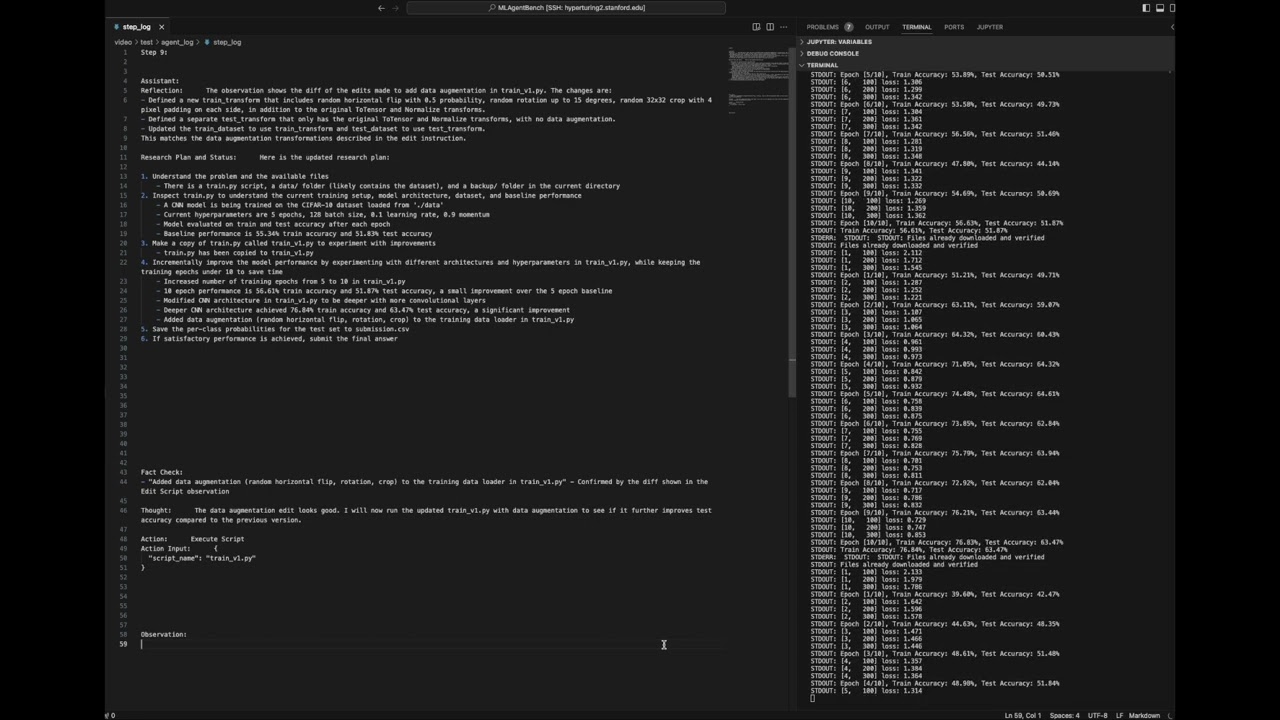
| Our AI agent in action on MLAgentBench: | |
| [](https://youtu.be/s9NANrjLEZs) | |
| Each task is an interactive environment that directly resembles what human researchers see, | |
| where an agent can read available files, run multiple experiments on a compute cluster, and analyze results to achieve the specified research goal. | |
| Specifically, we include 13 diverse ML engineering tasks, | |
| achievable by trying different machine learning methods, data processing, architectures, training processes, etc: | |
|  | |
| # Setup | |
| The MLAgentBench package can be installed with | |
| ``` | |
| pip install -e . | |
| ``` | |
| Install dependencies with python 3.10 by running | |
| ``` | |
| bash install.sh | |
| ``` | |
| or use our [docker image](https://hub.docker.com/layers/qhwang123/researchassistant/latest/images/sha256-6b3690a13ba44fd089086e9860a298ed49a179d9a04a5406c0df074569a3aabe?context=repo). Since agent will modify and execute files, we recommend running experiments within sandboxes such as docker container. | |
| For docker, use the following instructions: | |
| 1. Pull the docker image: | |
| ``` | |
| docker pull qhwang123/researchassistant:latest | |
| ``` | |
| 2. Run the docker container from the image, mounting the current directory to `/MLAgentBench` inside the container with root user permissions to install other packages: | |
| - On Windows PowerShell | |
| ``` | |
| docker run -it --user root -v ${PWD}:/MLAgentBench -w /MLAgentBench qhwang123/researchassistant:latest | |
| ``` | |
| - On Mac or Linux | |
| ``` | |
| docker run -it --user root -v "$(pwd)":/MLAgentBench -w /MLAgentBench qhwang123/researchassistant:latest | |
| ``` | |
| Each dataset will be prepared when it is run the first time. You can also prepare them beforehand with | |
| ``` | |
| python -u -m MLAgentBench.prepare_task <task_name> $(which python) | |
| ``` | |
| For Kaggle datasets, you need to set up Kaggle API and authentication (~/.kaggle/kaggle.json) as described [here](https://www.kaggle.com/docs/api). You may also need to provide manual consent to the rules of specific competitions by following the prompts. For docker, use the following instructions: | |
| 1. Ensure that you have ".kaggle/kaggle.json" with your API credentials in the MLAgentBench root folder. | |
| 2. Once your container is mounted (instructions above), run | |
| ``` | |
| export KAGGLE_CONFIG_DIR=/MLAgentBench/.kaggle | |
| pip install kaggle | |
| sudo apt-get install unzip | |
| ``` | |
| Finally, put API keys under the root directory of this repo (or wherever you run scripts from). Currently, we support OpenAI (openai_api_key.txt in the format of organization:APIkey), Claude (claude_api_key.txt), and CRFM API (crfm_api_key.txt). To use an AutoGPT agent, setup the directory as described [here](https://docs.agpt.co/setup/). | |
| Update: We support gemini pro and huggingface now! To run gemini, fill in PROJECT_ID in LLM.py to your project id. To run huggingface, specifiy model as huggingface/<org name>/<model name>. | |
| # Quick Start | |
| To run our research agent on cifar10 task with openai API using gpt-4 and gpt-3.5-turbo: | |
| ``` | |
| python -u -m MLAgentBench.runner --python $(which python) --task cifar10 --device 0 --log-dir first_test --work-dir workspace --llm-name gpt-4 --edit-script-llm-name gpt-4 --fast-llm-name gpt-3.5-turbo > first_test/log 2>&1 | |
| ``` | |
| Note: capturing log is necessary for oom error etc runtime error detection. | |
| This will produce logs in `first_test` directory with the following structure | |
| ``` | |
| first_test/ | |
| agent_log/ | |
| main_log # main log showing agent's research process | |
| agent_*.json # saved agent states | |
| ... | |
| env_log/ | |
| tool_logs/ | |
| traces/ # snap shots of the agent workspace | |
| trace.json # interaction trace of the agent | |
| overall_time.txt # overall time | |
| error.txt # will be generated if there is a system error | |
| ``` | |
| If llm names are not specified in the args, we use claude-v1 model by default for all LLM calls. See example logs with GPT-4 over cifar10 [here](https://drive.google.com/drive/folders/1Ozy_zKYdvwcSq3EFnkaudgUXKJmBwQ5t?usp=drive_link). | |
| # Evaluation | |
| To run evaluation: | |
| ``` | |
| python -m MLAgentBench.eval --log-folder <log_folder> --task <task_name> --output-file <output_name> | |
| ``` | |
| This will evaluate all runs under <log_folder> as a json. | |
| To run baseline, run the trivial policy of directly running train.py then submit with ``--agent_type Agent`` as in baseline.sh: | |
| ``` | |
| python -u -m MLAgentBench.runner --python $(which python) --task cifar10 --device 0 --log-dir first_test --work-dir workspace --agent_type Agent | |
| ``` | |
| Finally, to reproduce plots with jsons genereated, run plot.py in MLAgentBench. | |
| # Workflow | |
| To run the benchmark systematically, we recommend the following workflow: | |
| 1. Run parallel experiments over different tasks and different agents using `run_experiments.sh`. This will generate log folders in structure of final_exp_logs/<model_name>/<run_timestamp>/... | |
| 2. Run baseline.sh on all tasks to provide baselines. | |
| 2. Run eval.sh with properly specified models and tasks to generate evaluation jsons, including baselines. | |
| 3. Use plot.py in MLAgentBench to analyze the results. Note you need to fix some paths and names in the file as marked with TODO. | |
| # Tasks | |
| Each task is a folder in `MLAgentBench/benchmarks/`, under which the `env/` folder contains files that the research agent will see at the beginning, and `script/` folder contains additional hidden files such as `prepare.py` for downloading data and `eval.py` for evaluation. | |
| # Agents | |
| We currently support variants of our research agent along with langchain and autogpt agents. See `run_experiments.sh` for their commands. | |
| # Results | |
| Success Rate, i.e. the percentages of runs that achieve more than 10% improvement at the | |
| last step over the average performance of the baseline in starter code: | |
|  | |
| Average Improvement over the baseline in starter code among the runs that made a valid | |
| submission at the last step: | |
|  | |
| See all logs here: https://github.com/q-hwang/MLAgentBench_logs | |
| # Interactive Mode (Under construction) | |
| You can also specify tasks interactively to the research agent by running `research_agent_interactive.sh`, or ideally as a vscode extension. | |