


Solutions
Note: The points to be awarded for each part of the solution are indicated on the right side. Problem 1.
which is easily shown by induction. (up to 3 points) Now 5 is the sum of the reciprocals of these numbers where the last, $1993006=$ $1996 \times 1997$ $\frac{1996 \times 1997}{2}=8996$. Thus we have
(ap to 3 points)
P'roblem 2. Note that $2^{n+2}=2\left(2^{n-1}+1\right)$ so that $n$ is of the form 2 r with r odd. We will consider two cases.
i) $n=2 p$ with $p$ prime. $2 p \mid 2^{2 p}+2$, implies that $p!2^{2 n-1}+1$ and hence, hence $p \mid 2^{40-2}-1$. On the
 follows that $p \mid 2^{d}-1$. But $d \mid p-1$ and $d \mid 4 p-2=4(p-1)+2$. Fence $d \mid 2$ and since $p-1,4 p-2$ are even $d=2$. Then $p=3$ and $n=6<100$.
(up to 2 points)
ii) $n=2 p q$ where $p, q$ are odd primes, $p<q$ and $p q<\frac{1997}{2}$. Now $n!2 r+2$ impites that $p i 2^{n-1}$ +1 and therefore that $\mathrm{p}^{\prime} 2^{2 \mathrm{
follows that $p \mid 2^{d}-1$. But $d \mid p-1$ and $d \mid 4 p-2=4(p-1)+2$. Fence $d \mid 2$ and since $p-1,4 p-2$ are even $d=2$. Then $p=3$ and $n=6<100$.
(up to 2 points)
ii) $n=2 p q$ where $p, q$ are odd primes, $p<q$ and $p q<\frac{1997}{2}$. Now $n!2 r+2$ impites that $p i 2^{n-1}$ +1 and therefore that $\mathrm{p}^{\prime} 2^{2 \mathrm{m}-2} . .1=2^{4 \mathrm{m}-2}-1$. Once again by Femat's theorern we have pl $2^{n-1}$ 1 which implies that $\mathrm{p}-1 / 4 \mathrm{pq}$-2. The same holds tole for q so that
Both $p-1$ and $q-1$ are thus multiples of 2 but not of 4 su that $p \equiv q \equiv 3$ (mod 4). ( points) laking $p=3$, we huve $4 p q-2=12 q-2$. Now from (1) we have
if $q \geq 11$, and clearly $\frac{12 q-?}{q-1}=13$ if $q=11$. But this gives $n=2(3)(11)=66<100$. Furthermore $(p, \varphi)=:(3,7)$ does not salisty (1).
Taking $p=7$ we observe that $4 \mathrm{pq}-2=28 \mathrm{q}-2$, and from (1) we have
if $q \geq 27$ and clearly $\frac{28 q-2}{q-1}=29$ if $q=27$. But 27 is not prime and the cases $(p, q)=(7$. 11), (7,19) and (7,23) do not satisfy (1).
Taking $p=11$, then $4 p q-2=44 q-2$, and
Now clearly $\frac{44 q-2}{q-1}=45$ when $q=43$. In this case we have $n:=2 p q=2(11)(43)=946$. Furthermore, $\frac{2^{44 x}+2}{946}$ is incieed an integer. The cases $(p, q)=(11,19),(11,23)$ and 111,31$)$ do not satisfy (1). (2 points) [Aditionally for completeness, if $p=19$ then $4 p y-2=76 q-2$ and $76<\frac{76 q-2}{4-1}=77$ if $q$ $\geqq 75$. Now 75 is not prime and for the cases $(p, 4)=(19,23),(19,31),(19,43)$ and $(19,47), q$ -1 is not a divisor of $74=2 \times 37$.
Similarly, if $p=23$ then $4 \mathrm{pq}-2=92 \mathrm{q}-2$ and $92<\frac{92 q-2}{q-\Gamma} \leq 93$ if $q \geq 91$ and $\frac{92 q-2}{q-1}=93$ if $q=91$. But 91 is not prime and of the cases $(p, q)=(23,31),(23,43)$, when q $=31$ all of the conditions are satisfied. But, $n=2 p q=1426$ is not a solution because $\frac{2^{1426}+2}{1+20}$ is not an integer.
No other pairs of F, q yield numbers within the required range.] (1) point)
Problem 3.
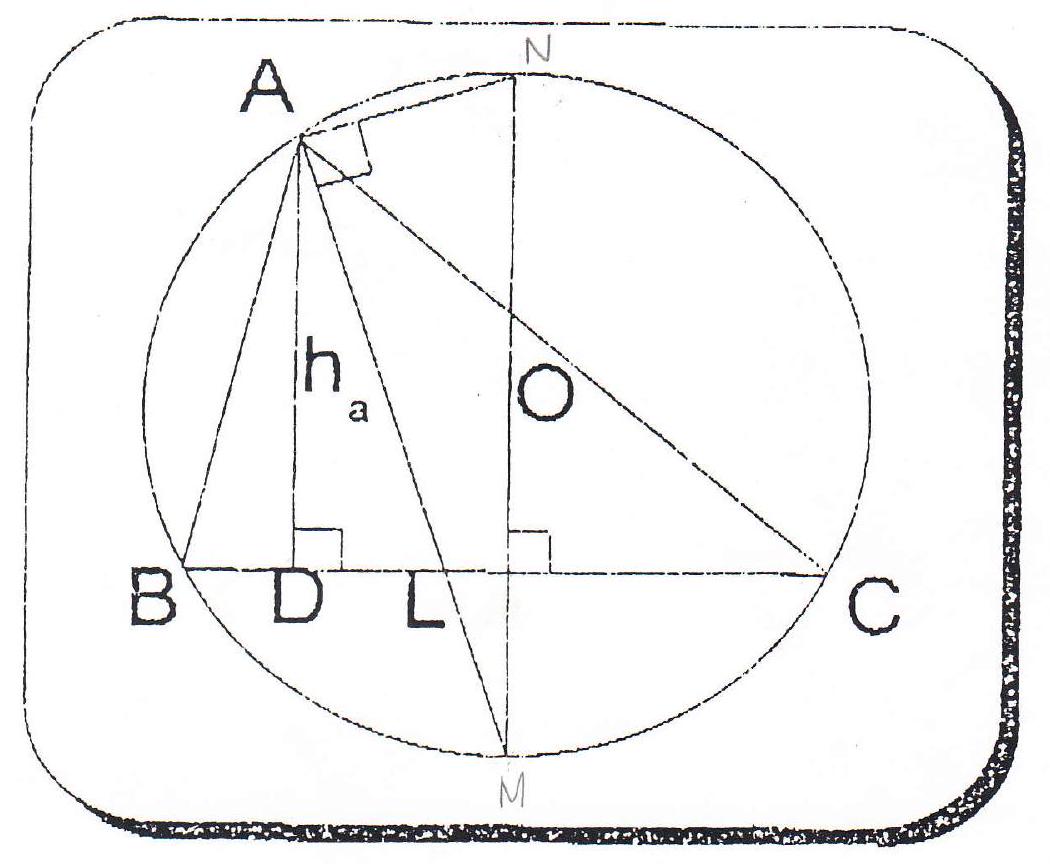 $\angle A L D=\frac{1}{2}(\overparen{M C}+\widehat{A B})$
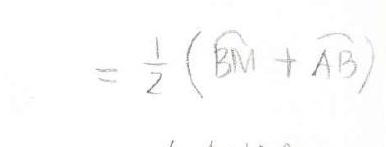 $\angle \triangle N M$
It is known (see Geometry Revisited) or easily derivable that
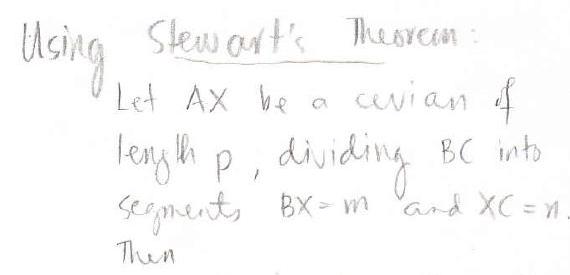 (1 point)
From $\triangle$ ADL a MAN we have
(1 point)
From $\triangle$ ADL a MAN we have
So that
with similar expressions for $l_{b}$ and $l_{c}$. (2 points) $\therefore$ Given that $\sin A=\frac{t^{2}}{2 k}$, etc. the expression we are working with becomes
But $a b c=f R(.4 B C)$ so that this last expression becomes
since $R \geq 2 r$. All of the inequalitics are equalities iff $a=b=c$. (1 point)
Problem 4.
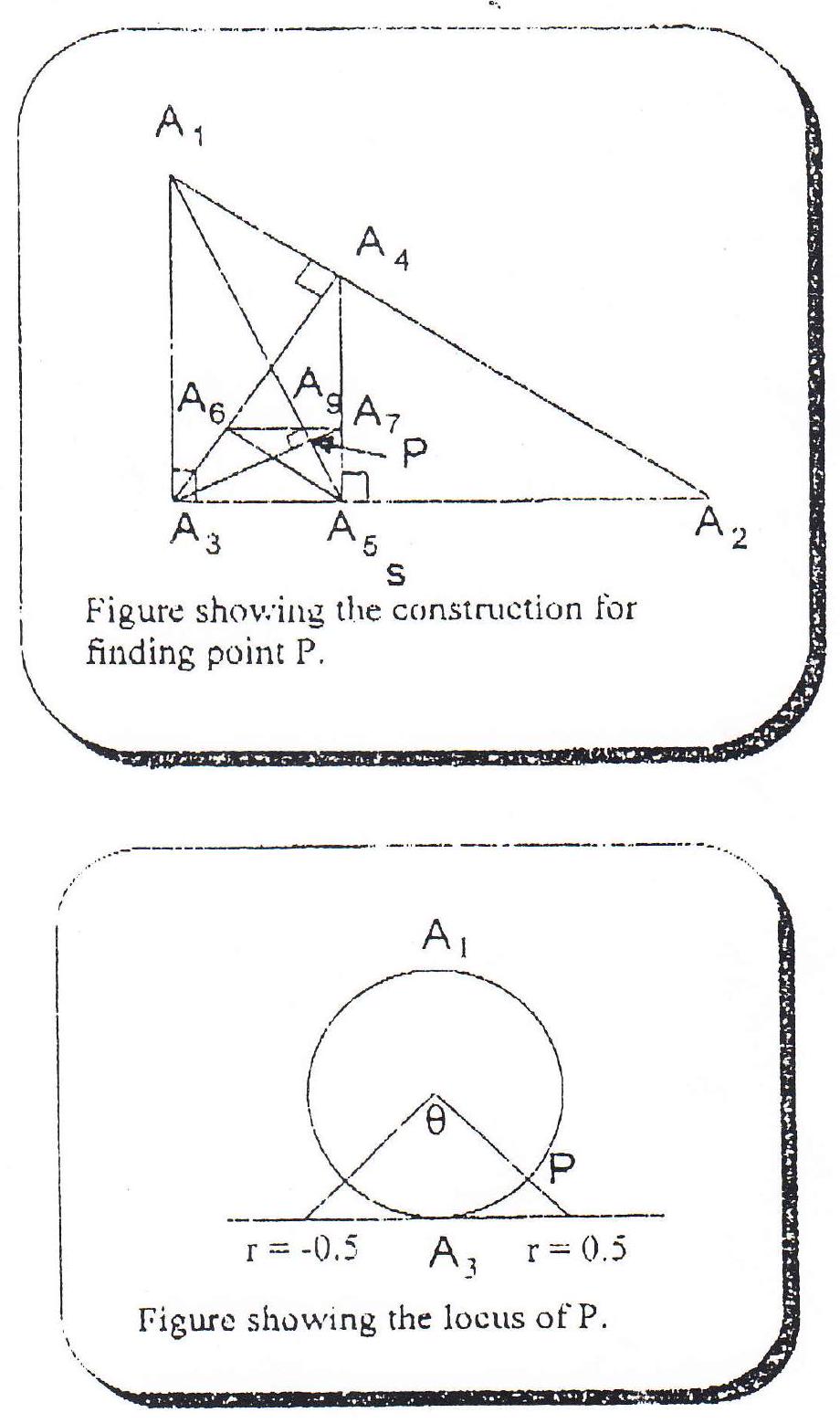
- (a) Consider the gequence of triangles on the plane 4 . $42,4, A_{2}, 4,4,4,4,4, \ldots$ It is easy to see that any pair of them are similar. Let's prove that triangles $A_{1} A_{3} A_{5}$ and $A_{3} A$; are similar. Triangles $A_{2} A_{3} A_{4}$ and $A_{4} A_{4} A_{6}$ are similar and their altitudes are $A_{4} A_{5}$ and $A_{6}, A_{0}$, then
Triangles $A A_{} A_{s}$ and $A_{s} A_{} A$ - are similar. then
Now we can conclude that
and triangles $A, A: A$ and $A ; A: A-$ are similar.
 $\triangle \quad A \cdot A_{s} A_{1}=\triangle \quad A-A_{3} P=\triangle \quad A_{A} A_{1}$, so triangle $A-A, P$ has a righr angle at $P$ and lines $A_{1} A_{5}$ and $A A^{A}$ - are perpendicular. In the same way lines $A A_{2}$. and $A$ are perpendicular and lines $A, A y$ and $A_{-1} A_{11}$ are perpendicular, hence $A_{1}, A_{3}, A_{9}$ are collinear and $A_{-}, A_{1 i} . A_{j}$ are collincar. It follows that triangle $A_{l A} A_{2} A_{;}$and $A_{0} A_{10} A_{l \mid}$ are homothetic and the center of homothety is P . Moreover, all
 an interior point to any of these triangles and there is no other point distinct from $P$ that is interior to any of these triangles. So this is the point we are looking for.
(b) Since $\triangle \quad A_{1} P A_{3} 90^{\prime \prime}$ then $P$ lies on the circle with diameter $A_{i}, A_{3}$. Let $A_{i} A_{3}=1, A_{2} A_{2}=s, A_{3} A_{3}$ $=r$ and let $A_{i} A_{2} A_{3}$ be clockwise. Triangles $A_{1} A_{2} A_{3}$ and $A_{3} A_{+} A_{5}$ are similar, thus $A_{2} A_{5}: r=s: 1$, and so $A_{2} A_{5}=r s$. Besides $A_{3} A_{y}=r \sqrt{1+s^{2}}$ (Pythagoras), and area of triangle $A_{1} A_{2} A_{3}=$ $\frac{1}{2} r \sqrt{1+s^{2}} \cdot \sqrt{1+s^{2}}=\frac{1}{2} s \cdot 1$. Thus $r=\frac{s}{1+s^{2}}$. By the arithmetic-geometric mean $\frac{s}{1+s^{2}} \leq \frac{1}{2}$, thus $r \leq \frac{1}{4}$ and the set of all possible values of $r$ consists of two real intervals $\left[-\frac{1}{2}, 0\right)$ and $\left(0, \frac{1}{2}\right]$. $\triangle A_{2} A_{1} P$ takes the maximum value when $r= \pm$ thus the locus of $P$
consists of two continuous arcs from the circle with dianeter $4, A_{i}$ with two extreme positions corresponding to $r=-\frac{1}{2}$ and $r=\frac{1}{2}$.
(up to 3 points)
Problem 5.
A redistribution can be written as $\left(x_{1}, x_{2}, \cdots, x_{n}\right)$ where $x_{1}$ denotes the number of objects transferred from $A_{i}$ to $A_{i+1}$. Our objective is to minimize the function $F\left(x_{1}, x_{2}, \cdots, x_{n}\right)=\sum_{i=1}^{n}\left|x_{1}\right|$ After redistribution we should have at each $A_{i}, a_{i}-x_{1}+x_{i-1}=N$ for $i \in{1,2, \ldots, n}$ where $x_{0}$ means $x_{n}$. (1 point) Solving this system of linear equations we obtain: $x_{i}=x_{1}-\left[(i-1) N-a_{2}-a_{3}-\ldots-a_{i}\right]$ for $i \in{1,2, \ldots, n}$. Hence
Basically the problem reduces to find the minimum of $F(x)=\sum_{i=1}^{n}\left|x-\alpha_{i}\right|$ where $\alpha_{i}=(i-1) N-\sum_{j=2}^{i} a_{j}$. (up to. 3 points)
First rearrange $\alpha_{1}, \alpha_{2}, \ldots, \alpha_{n}$ in non decreasing order. Collecting terms which are equal to one another we write the ordered sequence $\beta_{1}<\beta_{2}<\cdots<\beta_{m}$, each $\beta_{i}$ occurs $k_{i}$ times in the family $\left{\alpha_{1}, \alpha_{2}, \cdots, \alpha_{n}\right}$. Thus $k_{1}+k_{2}+\cdots+k_{m}=n$.
Consider the intervals $\left(-\infty, \beta_{1}\right],\left[\begin{array}{l}\beta_{1}, \beta_{2}\end{array}\right], \cdots,\left[\begin{array}{cc}\beta_{m-1}, \beta_{m}\end{array}\right],\left[\begin{array}{l}\left.\beta_{m}, \infty\right) \ \end{array}\right.$ the graph of $F(x)=\sum_{i=1}^{n}\left|x-\alpha_{i}\right|=\sum_{i=1}^{m} k_{i}\left|x-\beta_{i}\right|$ is a continuos piece wise linear graph define in the following way:
The slopes of each line segment on each interval are respectively: $S_{0}=-k_{1}-k_{2}-k_{3}-\cdots-k_{m}$ $S_{1}=k_{1}-k_{2}-k_{3}-\cdots-k_{m}$ $S_{2}=k_{1}+k_{2}-k_{3}-\cdots-k_{m}$ $S_{m}=k_{1}+k_{2}+k_{3}+\cdots+k_{m}$ Note that this sequence of increasing numbers goes from a negative to a positive number, hence for some $t \geq 1$ there is an
In the first case the minimum occurs at $x=\beta_{t}$ or $\beta_{t+1}$ and in the second case the minimum occurs at $x=\beta_{t}$ (Up to 7 points) We can rephrase the computations above in terms of $\alpha_{1}, \alpha_{2}, \cdots, \alpha_{n}$ rather than $\beta_{1}, \beta_{2}, \cdots, \beta_{m}$. After rearranging the $\alpha^{\prime} s$ in non decreasing order, pick $x=\alpha \quad$ if $n$ is odd and take $x=\alpha$ or $\alpha \quad$ if $n$ is even.
If no justification is given for the choice of $x$, give up to 4 points.