


XIV APMO: Solutions and Marking Schemes
- Let $a_{1}, a_{2}, a_{3}, \ldots, a_{n}$ be a sequence of non-negative integers, where $n$ is a positive integer.
Let
Prove that
where $\left\lfloor A_{n}\right\rfloor$ is the greatest integer less than or equal to $A_{n}$, and $a!=1 \times 2 \times \cdots \times a$ for $a \geq 1$ (and $0!=1$ ). When does equality hold?
Solution 1.
Assume without loss of generality that $a_{1} \geq a_{2} \geq \cdots \geq a_{n} \geq 0$, and let $s=\left\lfloor A_{n}\right\rfloor$. Let $k$ be any (fixed) index for which $a_{k} \geq s \geq a_{k+1}$.
Our inequality is equivalent to proving that
Now for $i=1,2, \ldots, k, a_{i}!/ s!$ is the product of $a_{i}-s$ factors. For example, 9!/5! $=9 \cdot 8 \cdot 7 \cdot 6$. The left side of inequality (1) therefore is the product of $A=a_{1}+a_{2}+\cdots+a_{k}-k s$ factors, all of which are greater than $s$. Similarly, the right side of (1) is the product of $B=(n-k) s-$ $\left(a_{k+1}+a_{k+2}+\cdots+a_{n}\right)$ factors, all of which are at most $s$. Since $\sum_{i=1}^{n} a_{i}=n A_{n} \geq n s, A \geq B$. This proves the inequality. [ 5 marks to here.]
Equality in (1) holds if and only if either: (i) $A=B=0$, that is, both sides of (1) are the empty product, which occurs if and only if $a_{1}=a_{2}=\cdots=a_{n}$; or (ii) $a_{1}=1$ and $s=0$, that is, the only factors on either side of (1) are 1 's, which occurs if and only if $a_{i} \in{0,1}$ for all $i$. [2 marks for both (i) and (ii), no marks for (i) only.]
Solution 2. Assume without loss of generality that $0 \leq a_{1} \leq a_{2} \leq \cdots \leq a_{n}$. Let $d=a_{n}-a_{1}$ and $m=\left|\left{i: a_{i}=a_{1}\right}\right|$. Our proof is by induction on $d$.
We first do the case $d=a_{n}-a_{1}=0$ or 1 separately. Then $a_{1}=a_{2}=\cdots=a_{m}=a$ and $a_{m+1}=\cdots=a_{n}=a+1$ for some $1 \leq m \leq n$ and $a \geq 0$. In this case we have $\left\lfloor A_{n}\right\rfloor=a$, so the inequality to be proven is just $a_{1}!a_{2}!\ldots a_{n}!\geq(a!)^{n}$, which is obvious. Equality holds if and only if either $m=n$, that is, $a_{1}=a_{2}=\cdots=a_{n}=a$; or if $a=0$, that is, $a_{1}=\cdots=a_{m}=0$ and $a_{m+1}=\cdots=a_{n}=1$. [ 2 marks to here.]
So assume that $d=a_{n}-a_{1} \geq 2$ and that the inequality holds for all sequences with smaller values of $d$, or with the same value of $d$ and smaller values of $m$. Then the sequence
though not necessarily in non-decreasing order any more, does have either a smaller value of $d$, or the same value of $d$ and a smaller value of $m$, but in any case has the same value of $A_{n}$. Thus, by induction and since $a_{n}>a_{1}+1$,
which completes the proof. Equality cannot hold in this case. 2. Find all positive integers $a$ and $b$ such that
are both integers. Solution. By the symmetry of the problem, we may suppose that $a \leq b$. Notice that $b^{2}-a \geq 0$, so that if $\frac{a^{2}+b}{b^{2}-a}$ is a positive integer, then $a^{2}+b \geq b^{2}-a$. Rearranging this inequality and factorizing, we find that $(a+b)(a-b+1) \geq 0$. Since $a, b>0$, we must have $a \geq b-1$. [3 marks to here.] We therefore have two cases:
Case 1: $a=b$. Substituting, we have
which is an integer if and only if $(a-1) \mid 2$. As $a>0$, the only possible values are $a-1=1$ or 2. Hence, $(a, b)=(2,2)$ or $(3,3)$. [1 mark.]
Case 2: $a=b-1$. Substituting, we have
Once again, notice that $4 a+2>0$, and hence, for $\frac{4 a+2}{a^{2}-a-1}$ to be an integer, we must have $4 a+2 \geq a^{2}-a-1$, that is, $a^{2}-5 a-3 \leq 0$. Hence, since $a$ is an integer, we can bound $a$ by $1 \leq \bar{a} \leq 5$. Checking all the ordered pairs $(a, b)=(1,2),(2,3), \ldots,(5,6)$, we find that only $(1,2)$ and $(2,3)$ satisfy the given conditions. [3 marks.]
Thus, the ordered pairs that work are
where the last two pairs follow by symmetry. [2 marks if these solutions are found without proof that there are no others.] 3. Let $A B C$ be an equilateral triangle. Let $P$ be a point on the side $A C$ and $Q$ be a point on the side $A B$ so that both triangles $A B P$ and $A C Q$ are acute. Let $R$ be the orthocentre of triangle $A B P$ and $S$ be the orthocentre of triangle $A C Q$. Let $T$ be the point common to the segments $B P$ and $C Q$. Find all possible values of $\angle C B P$ and $\angle B C Q$ such that triangle $T R S$ is equilateral.
Solution.
We are going to show that this can only happen when
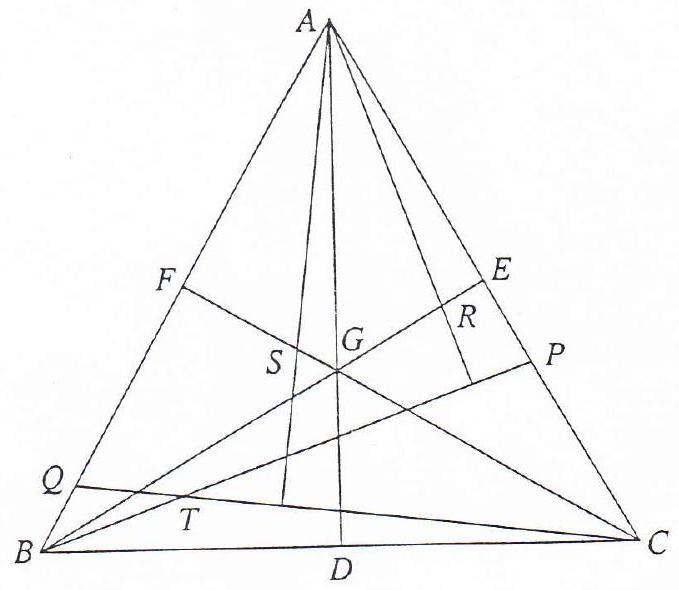
Lemma. If $\angle C B P>\angle B C Q$, then $R T>S T$.
Proof. Let $A D, B E$ and $C F$ be the altitudes of triangle $A B C$ concurrent at its centre $G$. Then $P$ lies on $C E, Q$ lies on $B F$, and thus $T$ lies in triangle $B D G$.
Note that -
Since $A F=A E$, we have $F S>E R$ so that
Let $T_{x}$ be the projection of $T$ onto $B C$ and $T_{y}$ be the projection of $T$ onto $A D$, and similarly for $R$ and $S$. We have
and
It follows that $R T>S T$.
[1 mark for stating the Lemma, 3 marks for proving it.]
Thus, if $\triangle T R S$ is equilateral, we must have $\angle C B P=\angle B C Q$.
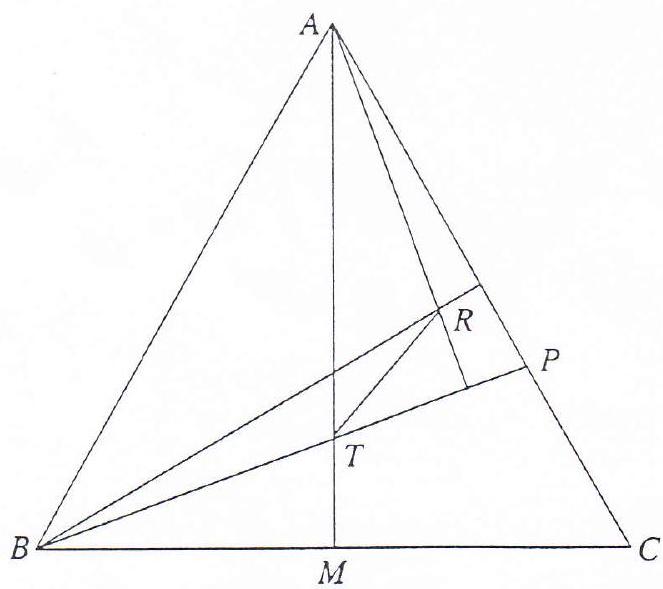
It is clear from the symmetry of the figure that $T R=T S$, so $\triangle T R S$ is equilateral if and only if $\angle R T A=30^{\circ}$. Now, as $B R$ is an altitude of the triangle $A B C, \angle R B A=30^{\circ}$. So $\triangle T R S$ is equilateral if and only if $R T B A$ is a cyclic quadrilateral. Therefore, $\triangle T R S$ is equilateral if and only if $\angle T B R=\angle T A R$. But
and so
But these angles must be equal, so $\angle T A R=\angle T B R=15^{\circ}$. Therefore $\angle C B P=\angle B C Q=15^{\circ}$. [3 marks for finishing the proof with the assumption that $\angle C B P=\angle B C Q$.] 4. Let $x, y, z$ be positive numbers such that
Show that
Solution 1.
Note. It is easy to check that equality holds if and only if $x=y=z=3$. Solution 2. Squaring both sides of the given inequality, we obtain
It follows from the given condition $\frac{1}{x}+\frac{1}{y}+\frac{1}{z}=1$ that $x y z=\sum_{\text {cyclic }} x y$. Therefore, the given inequality is equivalent to
Using the Cauchy-Schwarz inequality [or just $x^{2}+y^{2} \geq 2 x y$ ], we see that
or
Taking the cyclic sum of this inequality over $x, y$ and $z$, we get the desired inequality. [2 marks.]
Solution 3. This is another way of presenting the idea in the first solution. Using the condition $\frac{1}{x}+\frac{1}{y}+\frac{1}{z}=1$ and the AM-GM inequality, we have
which gives
Similarly, we have
Addition yields
[2 marks.] Using the condition $\frac{1}{x}+\frac{1}{y}+\frac{1}{z}=1$ again, we have
and thus
Solution 4.
This is also another way of presenting the idea in the first solution. We make the substitution $a=\frac{1}{x}, b=\frac{1}{y}, c=\frac{1}{z}$. Then it is enough to show that
where $a+b+c=1$. Multiplying this inequality by $\sqrt{a b c}$, we find that it can be written
This is equivalent to
which in turn is equivalent to
[1 mark.] (This is a homogeneous version of the original inequality.) By the Cauchy-Schwarz inequality (or since $b+c \geq 2 \sqrt{b c}$ ), we have
or
Taking the cyclic sum of this inequality over $a, b, c$, we get the desired inequality. [2 marks.] 5. Let R denote the set of all real numbers. Find all functions $f$ from R to R satisfying: (i) there are only finitely many $s$ in R such that $f(s)=0$, and (ii) $f\left(x^{4}+y\right)=x^{3} f(x)+f(f(y))$ for all $x, y$ in $\mathbf{R}$.
Solution 1.
The only such function is the identity function on $R$. Setting $(x, y)=(1,0)$ in the given functional equation (ii), we have $f(f(0))=0$. Setting $x=0$ in (ii), we find
[1 mark.] and thus $f(0)=f(f(0))=0$ [1 mark.]. It follows from (ii) that $f\left(x^{4}+y\right)=$ $x^{3} f(x)+f(y)$ for all $x, y \in \mathbf{R}$. Set $y=0$ to obtain
for all $x \in \mathrm{R}$, and so
for all $x, y \in \mathbf{R}$. The functional equation (3) suggests that $f$ is additive, that is, $f(a+b)=$ $f(a)+f(b)$ for all $a, b \in \mathbf{R}$. [1 mark.] We now show this.
First assume that $a \geq 0$ and $b \in R$. It follows from (3) that
We next note that $f$ is an odd function, since from (2)
Since $f$ is odd, we have that, for $a<0$ and $b \in R$,
Therefore, we conclude that $f(a+b)=f(a)+f(b)$ for all $a, b \in R$. [2 mers.].] We now show that ${s \in \mathrm{R} \mid f(s)=0}={0}$. Recall that $f(0)=0$. Assume that there is a nonzero $h \in \mathrm{R}$ such that $f(h)=0$. Then, using the fact that $f$ is additive, we inductively have $f(n h)=0$ or $n h \in{s \in R \mid f(s)=0}$ for all $n \in \mathbf{N}$. However, this is a contradiction to the given condition (i). [1 mark.]
It's now easy to check that $f$ is one-to-one. Assume that $f(a)=f^{\prime}(b)$ for some $a, b \in \mathbb{P}$. Then, we have $f(b)=f(a)=f(a-b)+f(b)$ or $f(a-b)=0$. This implies that $a-b \in{s \in$ $\mathbf{R} \mid f(s)=0}={0}$ or $a=b$, as desired. From (1) and the fact that $f$ is one-to-one, we deduce that $f(x)=x$ for all $x \in \mathbf{R}$. [1 mark.] This completes the proof.
Solution 2.
Again, the only such function is the identity function on R . As in Solution 1, we first show that $f(f(y))=f(y), f(0)=0$, and $f\left(x^{4}\right)=x^{3} f(x)$. [2 marks.] From the latter follows
and from condition (i) we get that $f(x)=0$ only possibly for $x \in{0,1,-1}$. [1 mark.] Next we prove
This is clear if $a=b$. If $a>b$ then
so $(a-b)^{3 / 4} f(\sqrt[4]{a-b})=0$ which means $f(\sqrt[4]{|a-b|})=0$. If $a<b$ we get similarly
and again $f(\sqrt[4]{|a-b|})=0$. [2 marks.] Thus $f(a)=b \Longrightarrow|a-b| \in{0,1}$. Suppose that $f(x)=x+b$ for some $x$, where $|b|=1$. Then from $f\left(x^{4}\right)=x^{3} f(x)$ and $f\left(x^{4}\right)=x^{4}+a$ for some $|a| \leq 1$ we get $x^{3}=a / b$, so $|x| \leq 1$. Thus $f(x)=x$ for all $x$ except possibly $x= \pm 1$. [ 1 mark.] But for example,
and
[1 mark.] This finishes the proof.