


Suggested solutions
- We first prove the lemma that if $x_{1}>\cdots>x_{2 n}$ then the grouping
gives the largest sum of products of pairs of these numbers.
Let $a$ be the largest and $b$ the second largest among the numbers $x_{i}$. Consider a grouping of these numbers into pairs such that $a$ is paired with some $c$, and $b$ is paired with some $d$, where $c \neq b$. Then $a \neq d$ (otherwise $a$ would be together with $b$ ). Furthermore, $b>c$ since otherwise the choice of $b$ implies $a=c$ or $b=c$ which are both excluded. Now
that is, replacing the pairs ${a, c}$ and ${b, d}$ by the pairs ${a, b}$ and ${c, d}$ makes the sum larger. If the two largest numbers are paired already, we can do the same to the remaining numbers. So whenever the grouping is different from (1), the sum of the products of pairs can be made larger.
Now it suffices to prove that $a_{n}=\frac{1}{1} \cdot \frac{1}{2}+\cdots+\frac{1}{2 n-1} \cdot \frac{1}{2 n}<1$. We have
- Assume that such an exact sequence exists. Then by induction we must have $a_{2 k}^{2}=a_{2 k-2}^{2}+a_{4 k-2} a_{2}=$ $a_{2 k-2}^{2}=0$.
Next we prove by induction that $a_{2 n+1}=(-1)^{n}$. We have $a_{3}=a_{2}^{2}-a_{1}^{2}=-1$ and
when $k \geq 1$. This shows that if such a sequence exists, necessarily $a_{2007}=-1$.
It remains to show that the sequence defined by $a_{n}=0$ for $n$ even, $a_{n}=1$ when $n \equiv 1(\bmod 4)$ and $a_{n}=-1$ when $n \equiv 3(\bmod 4)$ is exact:
If $n$ and $m$ have the same parity, then $n-m$ and $n+m$ are both even, and then clearly $a_{n}^{2}-a_{m}^{2}=0=$ $a_{n-m} a_{n+m}$.
If $n$ is odd and $m$ is even, $n-m \equiv n+m(\bmod 4)$, so $a_{n}^{2}-a_{m}^{2}=1=a_{n-m} a_{n+m}$, since both factors are either -1 or +1 .
Finally, if $n$ is even and $m$ is odd, $n-m \not \equiv n+m(\bmod 4)$, so $a_{n}^{2}-a_{m}^{2}=-1=a_{n-m} a_{n+m}$, since exactly one factor is -1 and one factor is +1 .
- Consider the polynomial $P(x)=G(x)-F(x)$. It has degree at most $2 n+1$. By the condition (1) we have $P(x) \geq 0$ for all real $x$. By the condition (2) the numbers $x_{1}, x_{2}, \ldots, x_{n}$ are roots of $P$. Since $P$ is non-negative, each of these roots must have even multiplicity, and therefore $P$ must be divisible by $\left(x-x_{i}\right)^{2}$ for $i=1,2, \ldots, n$. In other words,
for some polynomial $Q$. Calculating degrees we see that $\operatorname{deg} Q=\operatorname{deg} P-2 n \leq 1$. On the other hand, we have $Q(x) \geq 0$ for all real $x$. This can be possible only if $Q$ is constant. Hence
for some real constant $a \geq 0$. Similarly we prove that
for some $b \geq 0$. Now we compute that
By the assumption (3) the above number is equal to 0 for some value of $x=x_{0}$ different from $x_{1}, x_{2}, \ldots$, $x_{n}$. Looking at the right-hand side we see that this forces $b-2 a=0$, so the expression becomes identically zero. In other words, we have $F(x)+H(x)-2 G(x)=0$ for all real $x$, which is what we wanted.
- Rewrite the two factors on the left-hand side:
Applying the Cauchy-Schwarz inequality to the $3 n$-vectors
we obtain
with $a_{n+1}=a_{1}$.
- Set $y=1$ in the first equation. This gives $f(x)=f(x) f(-1)-f(x)+f(1)$, that is, $f(x)(2-f(-1))=f(1)$. Since $f$ is not constant, we must have $f(-1)=2$ and $f(1)=0$. Substituting $-x$ instead of $x$ and $y=-1$ in the first equation gives $f(x)=f(-x) f(1)-f(-x)+f(-1)=-f(-x)+2$. If we let $g(x)=1-f(x)$, this means that $g$ is an odd function.
Rewriting the first equation in terms of $g$ gives
Now the second equation gives (since $g(1)=-g(-1)=1$ )
that is,
Since $f$ takes all values except $1, g$ takes all values except 0 . By setting $y=1-g(x)$ it follows that $g(y)=1 / y$ for all $y \neq 0$, that is, $f(x)=1-g(x)=1-1 / x$.
It is easily verified that this function satisfies the conditions of the problem.
- First note that, whenever the numbers are not ordered ascendingly, there exists a pair $(i, j)$ (not necessarily in the list) such that $1 \leq i<j \leq n$ and the $i$ th number is exactly 1 greater than the $j$ th number. For proving it, let $i$ be the least number such that the $i$ th number is not $i$; then the permutation starts with $1, \ldots, i-1$. Thus the $i$ th number is greater than $i$; let it be $k$. As $k-1 \geq i$, the number $k-1$ does not occur at positions 1 to $i$ in the permutation. Let $j$ be the position of $k-1$. Then $(i, j)$ meets the required condition.
Suppose Freddy chooses such a pair $(i, j)$ on his first move. Obviously, the interchange of the $i$ th and the $j$ th element does not affect the greater/smaller relationships between elements at other positions. It also does not affect the greater/smaller relationship between the number at either the $i$ th or the $j$ th position and numbers at other positions since the number at any other position is either greater than both numbers interchanged or smaller than both of them. Consequently, the only greater/smaller relationship that changed is between the $i$ th and the $j$ th position. Hence, after Freddy has completed the action first time, the list consists of precisely those pairs $(i, j)$ which would have been there if he started the whole process from the new permutation.
Using this as the loop invariant, one easily deduces that when the pairs in the list are all gone then the numbers are ordered increasingly.
- The regular triangle with side length $n$ can be divided into $n^{2}$ regular triangles with side length 1 having sides parallel with the original triangle. It is clear that every squiggle must cover exactly six of these smaller triangles. Thus we get that $6 \mid n^{2}$, which implies that $6 \mid n$.
Assume now that $n$ is divisible by 6 , but not with 12 , i.e. $n=12 k+6$ for some non-negative integer $k$. Colour the large triangle in a "triangular chessboard" fashion with black triangles on the boundary so that no adjacent triangles have the same colour. Then each squiggle covers either two or four black triangles. The total number of black triangles is then
which is an odd number and hence a covering is impossible to achieve.
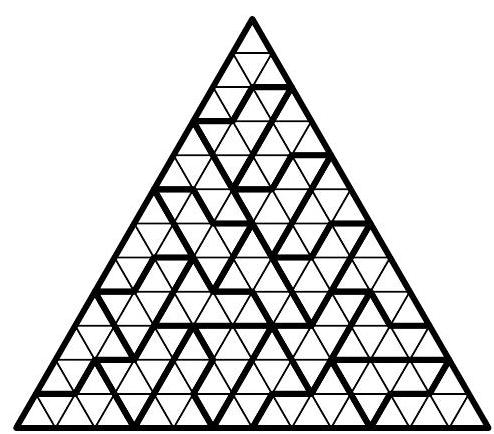
It remains to prove that when $12 \mid n$ the required division is possible. It is enough to give an example for $n=12$, since triangles with side length $12 m$ can be composed of these for any integer $m$. A suitable construction is shown in the figure below.
- We may associate with each five-element subset of ${1,2, \ldots, n}$ a sequence $a_{1}, a_{2}, \ldots, a_{n}$ such that exactly five of the $a_{i} \mathrm{
s}$ are ones and the rest are zeros. In particular, the non-isolated five-element sets correspond to sequences, where two of the ones are adjacent and three other ones are adjacent. The number of such sequences can be computed by considering the number of sequences $b_{1}, b_{2}, \ldots, b_{n-3}$, where one of the $b_{i} \mathrm{s}$ is 2 , one is 3 , and the rest are zeroes. The number of such sequences is $(n-3)(n-4)$. But here sequences with $b_{i}=2, b_{i+1}=3$ and $b_{i}=3$ and $b_{i+1}=2$ correspond to the same subset (having all the elements consecutive). This means that subsets with all the numbers consecutive have been counted twice. The number of such subsets equals $n-4$. So the total number of non-isolated subsets is $(n-3)(n-4)-(n-4)=(n-4)^{2}$. - Let $a$ be any member of the society and $A$ the board consisting of the candidates chosen by $a$. If everybody is happy with $A$, we are too. Otherwise there is a member $b$ such that the board $B$ consisting of all his candidates has an empty intersection with A. Let's divide $A=A_{1} \cup A_{2}$ and $B=B_{1} \cup B_{2}$, each of $A_{1}, A_{2}$, $B_{1}, B_{2}$ consisting of five persons. We claim that at least one of the boards $A_{1} \cup B_{1}, A_{1} \cup B_{2}, A_{2} \cup B_{1}$, $A_{2} \cup B_{2}$ will make everybody happy. Suppose, on the contrary, that $x_{1}$ isn't happy with $A_{1} \cup B_{1}, x_{2}$ isn't happy with $A_{1} \cup B_{2}, x_{3}$ isn't happy with $A_{2} \cup B_{1}$, and $x_{4}$ isn't happy with $A_{2} \cup B_{2}$. Notice that some $x_{i} \mathrm{~s}$ may coincide. It's easy to check that there isn't a board consisting of two persons making all the members $a, b, x_{1}, x_{2}, x_{3}, x_{4}$ happy - a contradiction.
- No, it is not possible.
To prove this, note first that for any choice of 16 cells in the $18 \times 18$ table there exists a $2 \times 2$ square containing exactly one of these cells. Indeed, there are more rows in the table than the chosen cells, so we can choose two neighboring rows $R_{1}, R_{2}$ such that $R_{1}$ contains none of the chosen cells and $R_{2}$ contains some of them (but not the whole row, since there are 18 cells in this row and only 16 chosen cells). Thus there are two neighbouring cells $A, B$ in the row $R_{2}$, of which exactly one is chosen. Take also two cells $C, D$ in the row $R_{1}$ in the same columns as $A, B$. Then the numbers $A, B, C, D$ form a $2 \times 2$ square, in which exactly one of the cells is among the chosen cells.
Thus if the answer to the problem is positive, it is in particular possible to have exactly one black cell in some $2 \times 2$ square. However, it is not hard to see that changing colours of all cells in one column or all cells in one row in the whole table does not change the parity of the number of black cells in this $2 \times 2$ square (it either remains the same if there were two cells of opposite colour in the chosen column or row, or changes by 2 if these two cells had the same colour). Initially every $2 \times 2$ square contains an even number of black cells (namely, zero). Hence it is not possible to have exactly one black cell in any such square after a series of operations.
- If $P$ is the circumcentre then $Q$ is the intersection different from $A$ of the circumcircle and the bisector of $\angle B A C$. If triangle $A^{\prime} B^{\prime} C^{\prime}$ is obtained from triangle $A B C$ by a $90^{\circ}$ rotation in the direction $A C B$ then the oriented segment $E B$ and hence $R Q$ has the same direction as the oriented segment $A^{\prime} C^{\prime}$, and $C F$ and hence $R S$ has the same direction as $A^{\prime} B^{\prime}$. The bisector of $\angle Q R S$ is then parallel to or coincident with the bisector of $\angle C^{\prime} A^{\prime} B^{\prime}$ and hence perpendicular to the bisector of $\angle C A B$. Since $R Q=R S$, the line $Q S$ is then parallel to or coincident with the bisector, and since $Q$ lies on the bisector, $S$ then does so as well.
Let $T$ be the point such that $P Q R T$ is a parallelogram. Since $P T=Q R$ and $T R=P Q$, the segments $P T$ and $T R$ are both equal to the circumradius of triangle $A B C$. Furthermore, $P T$ has the same direction as $Q R$ and hence $B E$, end $T R$ has the same direction as $P Q$ and hence $A D$. From an argument analogous to that above (interchange $A$ and $Q$ with $B$ and $T$, respectively) it then follows that $S$ lies on the bisector of $\angle C B A$. Thus $S$ is the incentre of triangle $A B C$.
Alternative solution: Let $O$ and $I$ denote the circumcentre and incentre, respectively, of triangle $A B C$. Let the bisectors of $\angle B A C, \angle A B C$ and $\angle A C B$ intersect the circumcircle again at $K, L$ and $M$, respectively. Then $\overrightarrow{O K}=\overrightarrow{P Q}, \overrightarrow{O L}=\overrightarrow{Q R}$ and $\overrightarrow{O M}=\overrightarrow{R S}$, so we must prove $\overrightarrow{O K}+\overrightarrow{O L}+\overrightarrow{O M}=\overrightarrow{O I}$. Without loss of generality assume $\angle A B C \geq \angle A C B$. From $\angle(\overrightarrow{O A}, \overrightarrow{O L})=\angle A B C$ and $\angle(\overrightarrow{O A}, \overrightarrow{O M})=\angle A C B$ we get $\angle(\overrightarrow{O A}, \overrightarrow{O L}+\overrightarrow{O M})=(\angle A B C-\angle A C B) / 2$, whence $\angle(\overrightarrow{O A}, \overrightarrow{O L}+\overrightarrow{O M})+\angle(\overrightarrow{O K}, \overrightarrow{O L}+\overrightarrow{O M})=$ $2 \times(\angle A B C-\angle A C B) / 2+2 \times \angle A C B+\angle B A C=\pi$. Thus we have $\overrightarrow{O L}+\overrightarrow{O M} | \overrightarrow{A K}$, so if $\overrightarrow{O K}+\overrightarrow{O L}+\overrightarrow{O M}=\overrightarrow{O X}$, the point $X$ lies on the bisector of $\angle B A C$. Similarly $X$ lies on the bisector of $\angle A B C$, so $X=I$.
- Triangles $A M X$ and $C M Y$ are similar: $\angle M X A=\angle M Y C=90^{\circ}$ and $\angle M A X=\angle M C Y$ as inscribed angles. Therefore there exists a spiral homothety $H$ that brings $X$ to $A$ and $Y$ to $C$ : Its centre is $M$, its angle is $\angle X M A=\angle Y M C$, and its coefficient is $\frac{A M}{M X}=\frac{C M}{M Y}$. By the definition $\overrightarrow{M N}=\frac{1}{2}(\overrightarrow{M X}+\overrightarrow{M Y})$ and $\overrightarrow{M K}=\frac{1}{2}(\overrightarrow{M A}+\overrightarrow{M C})$. As $H$ is a linear transformation we get $H(\overrightarrow{M N})=\frac{1}{2}(H(\overrightarrow{M X})+H(\overrightarrow{M Y}))=$ $\frac{1}{2}(\overrightarrow{M A}+\overrightarrow{M C})=\overrightarrow{M K}$, from which the desired follows.
- If all the lines are parallel to each other, choose some plane perpendicular to them. Then the points may be chosen to be the intersections of the lines with this plane.
Otherwise, denote the acute or right angle between $t_{i}$ and $t_{i+1}$ by $\alpha_{i}, i=1, \ldots, k-1$, and the acute or right angle between $t_{k}$ and $t_{1}$ by $\alpha_{k}$. At least one of these angles is not 0 , so $\cos \alpha_{1} \cos \alpha_{2} \cdots \cos \alpha_{k}<1$.
Clearly, $P_{i}, i=2, \ldots, k$, is determined by a choice of $P_{1}$, so let $P_{k+1}$ be the projection of $P_{k}$ on $t_{1}$. We must prove that $P_{1}$ may be chosen such that $P_{1}$ and $P_{k+1}$ coincide.
If $P_{1}$ moves along $t_{1}$ with constant speed $v$, then $P_{k+1}$ moves along $t_{1}$ with constant speed $v \cdot \cos \alpha_{1}$. $\cos \alpha_{2} \cdots \cos \alpha_{k}<v$. Hence at some moment $P_{1}$ and $P_{k+1}$ coincide.
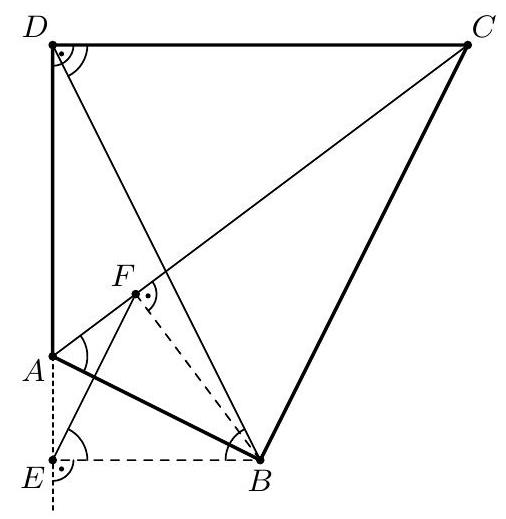
- The triangle $D E B$ is right-angled $\left(\angle D E B=90^{\circ}\right)$. Hence if the line $E F$ passes through the midpoint of the hypotenuse $B D$, we must have $\angle F E B=\angle D B E$. On the other hand, the lines $B E$ and $D C$ are parallel and we have $\angle D B E=\angle C D B$. Thus $\angle F E B=\angle C D B$. But since $\angle A E B=\angle A F B=90^{\circ}$, the points $A, E, F, B$ lie on a circle and $\angle F E B=\angle F A B=\angle C A B$. Hence we see that $\angle C D B=\angle C A B$, and the assertion follows.
- Let $B_{1}=D$, and similarly let the incircle touch the sides $A B$ and $B C$ at the points $C_{1}$ and $A_{1}$, respectively. Let the second circle touch the ray $B C$ at the point $M$. Let $x=B_{1} C, y=A B_{1}$. Obviously, $A_{1} M=C_{1} A=$ $A B_{1}=y$ and $A_{1} C=B_{1} C=x$. Hence
On the other hand, $C M$ is a tangent and $C A$ is a secant to the second circle. Therefore, by powers with respect to this circle,
So we have the equation
From this equation, we get $y / x=3$.
- Let $a=\frac{m}{k}$ and $b=\frac{n}{k}$ where $k$ is the least positive common denominator of $a$ and $b$. Then $k, m, n$ are relatively prime, otherwise we could obtain a smaller positive common denominator by dividing them all by their greatest common divisor.
By the conditions of the problem, $s=\frac{m+n}{k}=\frac{m^{2}+n^{2}}{k^{2}}$, giving
This representation shows that each prime that divides both $k$ and $m$ divides also $n$ and therefore would be a common divisor of $k, m, n$. Analogous consideration can be made about primes dividing both $k$ and $n$. Thus there cannot be such primes, i.e., $\operatorname{gcd}(k, m)=\operatorname{gcd}(k, n)=1$.
As the denominator in the representation of $s$ as an irreducible fraction obviously divides $k$, it suffices to prove that $\operatorname{gcd}(k, 6)=1$. For that, we prove that $3 \nmid k$ and $2 \nmid k$.
Suppose that $3 \mid k$. Then $3 \nmid m$ and $3 \nmid n$, giving $m^{2} \equiv n^{2} \equiv 1(\bmod 3)$. Hence the left-hand side of equation (2) is divisible by 3 while the right-hand side is not, a contradiction.
Suppose that $2 \mid k$. Then $2 \nmid m$ and $2 \nmid n$, giving both $2 \mid m+n$ and $m^{2} \equiv n^{2} \equiv 1(\bmod 4)$. Hence the left-hand side of equation (2) is divisible by 4 while the right-hand side is not, a contradiction.
- If we denote $x=d x_{1}, y=d y_{1}, z=d z_{1}$, we get that
As $S$ is an integer $d$ is a divisor of $x_{1} y_{1}+y_{1} z_{1}+z_{1} x_{1}$. Therefore $d \leq \frac{x y+y z+z x}{d^{2}}$, from which the desired follows.
- No. Indeed, if integers $x, y, z, t$ satisfy $x^{2}+y^{2}-3 z^{2}-3 t^{2}=0$, then $x^{2}+y^{2}$ is a multiple of 3 . But squares are congruent to 0 or 1 modulo 3 , so this is possible only if both $x, y$ are divisible by 3 . Then the number $x^{2}+y^{2}=3\left(z^{2}+t^{2}\right)$ is divisible by 9 , the number $z^{2}+t^{2}$ is divisible by 3 , and analogously we see that $z$, $t$ are divisible by 3 . Hence any integer solution to the equation $x^{2}+y^{2}-3 z^{2}-3 t^{2}=0$ has all variables divisible by 3 , and since the equation is homogeneous, this implies $x=y=z=t=0$.
- There exist infinitely many nice numbers, so we can find a nice number with at least $10 k+1$ digits in its decimal representation. Let $c_{1}, c_{2}, \ldots, c_{10 k+1}$ be consecutive digits of this nice number.
By the definition of a nice number, the following two numbers are divisible by $r$ :
It follows that the number
is divisible by $r$ as well. If we denote $d_{i}=c_{i k+1}(i=0,1, \ldots, 10)$, then by similar calculations we obtain the divisibilities
Observe that $d_{0}, d_{1}, \ldots, d_{10}$ is a sequence of 11 digits, so some of them must be equal. Consequently, there exist indices $0 \leq i<j \leq 10$ such that the digits $d_{i}, d_{i+1}, \ldots, d_{j-1}$ are pairwise different and $d_{i}=d_{j}$. Therefore using (3) we see that the number
is divisible by $r$. But the factor $d_{i}+d_{i+1}+\cdots+d_{j-1}$ is a sum of distinct digits, so it does not exceed $0+1+2+\cdots+9=45$. Hence this factor is relatively prime to $r$. This proves that the $k$-digit number $10^{k}-1$ is divisible by $r$, and it is therefore a nice number.
- It it is sufficient to check that for any prime $p$ the maximal power of $p$ that divides $a b$ equals $p^{3 m}$.
Let $p^{k}$ be a maximal power of $p$ that divides $a$, and $p^{\ell}$ be a maximal power of $p$ that divides $b$.
(1) If $k=\ell$ then $a^{3}+b^{3}+a b$ is divisible by at most $p^{2 k}$, and $a b(a-b)$ is divisible by at least $p^{3 k}$. Therefore, this case is impossible.
(2) If $k>\ell$ then $a b(a-b)$ is divisible by at least $p^{k+2 \ell}$. The three summands in the first number is divisible by $p^{3 k}, p^{3 \ell}$ and $p^{k+\ell}$. Since $3 \ell$ and $k+\ell$ are less than $k+2 \ell$, the divisibility of the given numbers is possible if and only if $k+\ell=3 \ell$ (in this case the sum $b^{3}+a b$ could be divisible by a power of $p$ greater than $\left.p^{k+\ell}\right)$. Therefore, we have $k=2 \ell$, and hence the maximal power of $p$ that divides $a b$ is $p^{3 \ell}$.