


Baltic Way 1991
Tartu, December 14, 1991
Problems and solutions
- Find the smallest positive integer $n$ having the property: for any set of $n$ distinct integers $a_{1}, a_{2}, \ldots, a_{n}$ the product of all differences $a_{i}-a_{j}, i<j$ is divisible by 1991 .
Solution. Let $S=\prod_{1 \leq i<j \leq n}\left(a_{i}-a_{j}\right)$. Note that $1991=11 \cdot 181$. Therefore $S$ is divisible by 1991 if and only if it is divisible by both 11 and 181 . If $n \leq 181$ then we can take the numbers $a_{1}, \ldots, a_{n}$ from distinct congruence classes modulo 181 so that $S$ will not be divisible by 181 . On the other hand, if $n \geq 182$ then according to the pigeonhole principle there always exist $a_{i}$ and $a_{j}$ such that $a_{i}-a_{j}$ is divisible by 181 (and of course there exist $a_{k}$ and $a_{l}$ such that $a_{k}-a_{l}$ is divisible by 11).
- Prove that there are no positive integers $n$ and $m>1$ such that $102^{1991}+103^{1991}=n^{m}$.
Solution. Factorizing, we get
where $102+103=205=5 \cdot 41$. It suffices to show that the other factor is not divisible by 5 . Let $a_{k}=102^{k} \cdot 103^{1990-k}$, then $a_{k} \equiv 4(\bmod 5)$ if $k$ is even and $a_{k} \equiv-4(\bmod 5)$ if $k$ is odd. Thus the whole second factor is congruent to $4 \cdot 1991 \equiv 4(\bmod 5)$.
- There are 20 cats priced from $$ 12$ to $$ 15$ and 20 sacks priced from 10 cents to $$ 1$ for sale (all prices are different). Prove that each of two boys, John and Peter, can buy a cat in a sack paying the same amount of money.
Solution. The number of different possibilities for buying a cat and a sack is $20 \cdot 20=400$ while the number of different possible prices is $1600-1210+1=391$. Thus by the pigeonhole principle there exist two combinations of a cat and a sack costing the same amount of money. Note that the two cats (and also the two sacks) involved must be different as otherwise the two sacks (respectively, cats) would have equal prices.
- Let $p$ be a polynomial with integer coefficients such that $p(-n)<p(n)<n$ for some integer $n$. Prove that $p(-n)<-n$.
Solution. As $a^{n}-b^{n}=(a-b)\left(a^{n-1}+a^{n-2} b+\cdots+b^{n-1}\right)$, then for any distinct integers $a, b$ and for any polynomial $p(x)$ with integer coefficients $p(a)-p(b)$ is divisible by $a-b$. Thus, $p(n)-p(-n) \neq 0$ is divisible by $2 n$ and consequently $p(-n) \leq p(n)-2 n<n-2 n=-n$.
- For any positive numbers $a, b, c$ prove the inequalities
Solution. To prove the first inequality, note that $\frac{2}{a+b} \leq \frac{1}{2}\left(\frac{1}{a}+\frac{1}{b}\right)$ and similarly $\frac{2}{b+c} \leq \frac{1}{2}\left(\frac{1}{b}+\frac{1}{c}\right), \frac{2}{c+a} \leq$ $\frac{1}{2}\left(\frac{1}{c}+\frac{1}{a}\right)$. For the second part, use the inequality $\frac{3}{x+y+z} \leq \frac{1}{3}\left(\frac{1}{x}+\frac{1}{y}+\frac{1}{z}\right)$ for $x=a+b, y=b+c$ and $z=c+a$.
- Let $[x]$ be the integer part of a number $x$, and ${x}=x-[x]$. Solve the equation
Solution. Let $f(x)=[x] \cdot{x}$. Then we have to solve the equation $f(x)=1991 x$. Obviously, $x=0$ is a solution. For any $x>0$ we have $0 \leq[x] \leq x$ and $0 \leq{x}<1$ which imply $f(x)<x<1991 x$. For $x \leq-1$ we have $0>[x]>x-1$ and $0 \leq{x}<1$ which imply $f(x)>x-1>1991 x$. Finally, if $-1<x<0$, then $[x]=-1,{x}=x-[x]=x+1$ and $f(x)=-x-1$. The only solution of the equation $-x-1=1991 x$ is $x=-\frac{1}{1992}$.
- Let $A, B, C$ be the angles of an acute-angled triangle. Prove the inequality
Solution. In an acute-angled triangle we have $A+B>\frac{\pi}{2}$. Hence we have $\sin A>\sin \left(\frac{\pi}{2}-B\right)=\cos B$ and $\sin B>\cos A$. Using these inequalities we get $(1-\sin A)(1-\sin B)<(1-\cos A)(1-\cos B)$ and
- Let $a, b, c, d, e$ be distinct real numbers. Prove that the equation
has 4 distinct real solutions.
Solution. On the left-hand side of the equation we have the derivative of the function
which is continuous and has five distinct real roots.
- Find the number of solutions of the equation $a e^{x}=x^{3}$.
Solution. Studying the graphs of the functions $a e^{x}$ and $x^{3}$ it is easy to see that the equation always has one solution if $a<0$ and can have 0,1 or 2 solutions if $a>0$. Moreover, in the case $a>0$ the number of solutions can only decrease as $a$ increases and we have exactly one positive value of $a$ for which the equation has one solution - this is the case when the graphs of $a e^{x}$ and $x^{3}$ are tangent to each other, i.e., there exists $x_{0}$ such that $a e^{x_{0}}=x_{0}^{3}$ and $a e^{x_{0}}=3 x_{0}^{2}$. From these two equations we get $x_{0}=3$ and $a=\frac{27}{e^{3}}$. Summarizing: the equation $a e^{x}=x^{3}$ has one solution for $a \leq 0$ and $a=\frac{27}{e^{3}}$, two solutions for $0<a<\frac{27}{e^{3}}$ and no solutions for $a>\frac{27}{e^{3}}$.
- Express the value of $\sin 3^{\circ}$ in radicals.
Solution. We use the equality
where
and
To calculate $\cos 18^{\circ}$ and $\sin 18^{\circ}$ note that $\cos \left(3 \cdot 18^{\circ}\right)=\sin \left(2 \cdot 18^{\circ}\right)$. As $\cos 3 x=\cos ^{3} x-3 \cos x \sin ^{2} x=$ $\cos x\left(1-4 \sin ^{2} x\right)$ and $\sin 2 x=2 \sin x \cos x$ we get $1-4 \sin ^{2} 18^{\circ}=2 \sin 18^{\circ}$. Solving this quadratic equation yields $\sin 18^{\circ}=\frac{\sqrt{5}-1}{4}$ (we discard $\frac{-\sqrt{5}-1}{4}$ which is negative) and $\cos 18^{\circ}=\frac{\sqrt{10+2 \sqrt{5}}}{4}$.
- All positive integers from 1 to 1000000 are divided into two groups consisting of numbers with odd or even sums of digits respectively. Which group contains more numbers?
Solution. Among any ten integers $\overline{a_{1} \ldots a_{n} 0}, \overline{a_{1} \ldots a_{n} 1}, \ldots, \overline{a_{1} \ldots a_{n} 9}$ there are exactly five numbers with odd digit sum and five numbers with even digit sum. Thus, among the integers 0, 1, . , 999999 we have equally many numbers of both kinds. After substituting 1000000 instead of 0 we shall have more numbers with odd digit sum.
- The vertices of a convex 1991-gon are enumerated with integers from 1 to 1991. Each side and diagonal of the 1991-gon is coloured either red or blue. Prove that, for an arbitrary renumeration of vertices, one can find integers $k$ and $l$ such that the line connecting vertices with numbers $k$ and $l$ before the renumeration has the same colour as the line between the vertices having these numbers after the renumeration.
Solution. Assume there exists a renumeration such that for any numbers $1 \leq k<l \leq n$ the segment connecting vertices numbered $k$ and $l$ before the renumeration has a different colour than the segment connecting vertices with the same numbers after the renumeration. Then there has to be an equal number of red and blue segments, and thus the total number of segments must be even. However, the number of segments is $\left(\begin{array}{c}1991 \ 2\end{array}\right)=995 \cdot 1991$, an odd number.
- An equilateral triangle is divided into 25 congruent triangles enumerated with numbers from 1 to 25 . Prove that one can find two triangles having a common side and with the difference of the numbers assigned to them greater than 3 .
Solution. Define the distance between two small triangles to be the minimal number of steps one needs to move from one of the triangles to the other (a step here means transition from one triangle to another having a common side with it). The maximum distance between two small triangles is 8 and this maximum is achieved if and only if one of these lies at a corner of the big triangle and the other lies anywhere at the opposite side of it. Assume now that we have assigned the numbers 1, .., 25 to the small triangles so that the difference of the numbers assigned to any two adjacent triangles does not exceed 3 . Then the distance between the triangles numbered 1 and $25 ; 1$ and $24 ; 2$ and $25 ; 2$ and 24 must be equal to 8 . However, this is not possible since it implies that either the numbers 1 and 2 or 24 and 25 are assigned to the same "corner" triangle.
- A castle has a number of halls and $n$ doors. Every door leads into another hall or outside. Every hall has at least two doors. A knight enters the castle. In any hall, he can choose any door for exit except the one he just used to enter that hall. Find a strategy allowing the knight to get outside after visiting no more than $2 n$ halls (a hall is counted each time it is entered).
Solution. The knight can use the following strategy: exit from any hall through the door immediately to the right of the one he used to enter that hall. Then, knowing which door was passed last and in which direction we can uniquely restore the whole path of the knight up to that point. Therefore, he will not be able to pass any door twice in the same direction unless he has been outside the castle in between.
- In each of the squares of a chess board an arbitrary integer is written. A king starts to move on the board. As the king moves, 1 is added to the number in each square it "visits". Is it always possible to make the numbers on the chess board:
(a) all even;
(b) all divisible by 3 ;
(c) all equal?
Solution. Figure 1 demonstrates a possible king's path passing through each square exactly once and finally returning to the initial square. Thus, it suffices to prove part (c) as we can always increase the numbers in all the squares by 1 or 2 if necessary. Moreover, note that for any given square it is possible to modify the path shown in Figure 1 in such a way that this particular square will be passed twice while any other square will still be passed exactly once. Repeating this procedure a suitable number of times for each square we can make all the numbers on the chess board equal.
- Let two circles $C_{1}$ and $C_{2}$ (with radii $r_{1}$ and $r_{2}$ ) touch each other externally, and let $l$ be their common tangent. A third circle $C_{3}$ (with radius $r_{3}<\min \left(r_{1}, r_{2}\right)$ ) is externally tangent to the two given circles and tangent to the line $l$. Prove that
Solution. Let $O_{1}, O_{2}, O_{3}$ be the centres of the circles $C_{1}, C_{2}, C_{3}$, respectively. Let $P_{1}, P_{2}, P_{3}$ be the perpendicular projections of $O_{1}, O_{2}, O_{3}$ onto the line $l$ and let $Q$ be the perpendicular projection of $O_{3}$ onto the line $P_{1} O_{1}$ (see Figure 2). Then $\left|P_{1} P_{3}\right|^{2}=\left|Q O_{3}\right|^{2}=\left|O_{1} O_{3}\right|^{2}-\left|Q O_{1}\right|^{2}=\left(r_{1}+r_{3}\right)^{2}-\left(r_{1}-r_{3}\right)^{2}=4 r_{1} r_{3}$. Similarly we get $\left|P_{1} P_{2}\right|^{2}=4 r_{1} r_{2}$ and $\left|P_{2} P_{3}\right|^{2}=4 r_{2} r_{3}$. Since $\left|P_{1} P_{2}\right|=\left|P_{1} P_{3}\right|+\left|P_{2} P_{3}\right|$ we have $\sqrt{r_{1} r_{2}}=$ $\sqrt{r_{1} r_{3}}+\sqrt{r_{2} r_{3}}$, which implies the required equality.
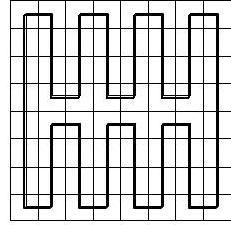
Figure 1
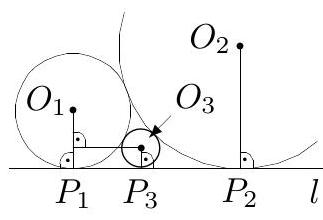
Figure 2
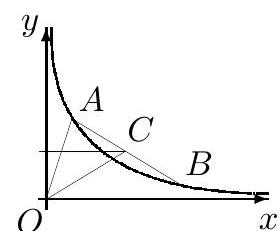
Figure 3
- Let the coordinate planes have the reflection property. A beam falls onto one of them. How does the final direction of the beam after reflecting from all three coordinate planes depend on its initial direction?
Solution. Let the velocity vector of the beam be $\vec{v}=(\alpha, \beta, \gamma)$. Reflection from each of the coordinate planes changes the sign of exactly one of the coordinates $\alpha, \beta$ and $\gamma$, and thus the final direction will be opposite to the initial one.
- Is it possible to put two tetrahedra of volume $\frac{1}{2}$ without intersection into a sphere with radius 1 ?
Solution. No, it is not. Any tetrahedron that does not contain the centre of the sphere as an internal point has a height drawn to one of its faces less than or equal to the radius of the sphere. As each of the faces of the tetrahedron is contained in a circle with radius not greater than 1 , its area cannot exceed $\frac{3 \sqrt{3}}{4}$. Thus, the volume of such a tetrahedron must be less or equal than $\frac{1}{3} \cdot 1 \cdot \frac{3 \sqrt{3}}{4}=\frac{\sqrt{3}}{4}<\frac{1}{2}$.
- Let's expand a little bit three circles, touching each other externally, so that three pairs of intersection points appear. Denote by $A_{1}, B_{1}, C_{1}$ the three so obtained "external" points and by $A_{2}, B_{2}, C_{2}$ the corresponding "internal" points. Prove the equality
Solution. First, note that the three straight lines $A_{1} A_{2}, B_{1} B_{2}$ and $C_{1} C_{2}$ intersect in a single point $O$. Indeed, each of the lines is the locus of points from which the tangents to two of the circles are of equal length (it is easy to check that this locus has the form of a straight line and obviously it contains the two intersection points of the circles). Now, we have $\left|O A_{1}\right| \cdot\left|O A_{2}\right|=\left|O B_{1}\right| \cdot\left|O B_{2}\right|$ (as both of these products are equal to $|O T|^{2}$ where $O T$ is a tangent line to the circle containing $A_{1}, A_{2}, B_{1}, B_{2}$, and $T$ is the corresponding point of tangency). Hence $\frac{\left|O A_{1}\right|}{\left|O B_{2}\right|}=\frac{\left|O B_{1}\right|}{\left|O A_{2}\right|}$ which implies that the triangles $O A_{1} B_{2}$ and $O B_{1} A_{2}$ are similar and $\frac{\left|A_{1} B_{2}\right|}{\left|A_{2} B_{1}\right|}=\frac{\left|O A_{1}\right|}{\left|O B_{1}\right|}$. Similarly we get $\frac{\left|B_{1} C_{2}\right|}{\left|B_{2} C_{1}\right|}=\frac{\left|O B_{1}\right|}{\left|O C_{1}\right|}$ and $\frac{\left|C_{1} A_{2}\right|}{\left|C_{2} A_{1}\right|}=\frac{\left|O C_{1}\right|}{\left|O A_{1}\right|}$. Multiplying these three equalities gives the desired result.
- Consider two points $A\left(x_{1}, y_{1}\right)$ and $B\left(x_{2}, y_{2}\right)$ on the graph of the function $y=\frac{1}{x}$ such that $0<x_{1}<x_{2}$ and $|A B|=2 \cdot|O A|(O$ is the reference point, i.e., $O(0,0))$. Let $C$ be the midpoint of the segment $A B$. Prove that the angle between the $x$-axis and the ray $O A$ is equal to three times the angle between $x$-axis and the ray $O C$.
Solution. We have $A\left(x_{1}, \frac{1}{x_{1}}\right), B\left(x_{2}, \frac{1}{x_{2}}\right)$ and $C\left(\frac{x_{1}+x_{2}}{2}, \frac{1}{2 x_{1}}+\frac{1}{2 x_{2}}\right)$. Computing the coordinates of $\bar{v}=$ $|O C| \cdot \overline{A C}+|A C| \cdot \overline{O C}$ we find that the vector $\bar{v}-$ and hence also the bisector of the angle $\angle O C A-$ is parallel to the $x$-axis. Since $|O A|=|A C|$ this yields $\angle A O C=\angle A C O=2 \cdot \angle C O x$ (see Figure 3) and $\angle A O x=\angle A O C+\angle C O x=3 \cdot \angle C O x$.