


The $8^{\text {th }}$ Romanian Master of Mathematics Competition
Day 2 - Solutions
Problem 4. Let $x$ and $y$ be positive real numbers such that $x+y^{2016} \geq 1$. Prove that $x^{2016}+y>$ 1 - 1/100.
Solution. If $x \geq 1-1 /(100 \cdot 2016)$, then
by Bernoulli's inequality, whence the conclusion. If $x<1-1 /(100 \cdot 2016)$, then $y \geq(1-x)^{1 / 2016}>(100 \cdot 2016)^{-1 / 2016}$, and it is sufficient to show that the latter is greater than $1-1 / 100=99 / 100$; alternatively, but equivalently, that
To establish the latter, refer again to Bernoulli's inequality to write
Remarks. (1) Although the constant $1 / 100$ is not sharp, it cannot be replaced by the smaller constant $1 / 400$, as the values $x=1-1 / 210$ and $y=1-1 / 380$ show. (2) It is natural to ask whether $x^{n}+y \geq 1-1 / k$, whenever $x$ and $y$ are positive real numbers such that $x+y^{n} \geq 1$, and $k$ and $n$ are large. Using the inequality $\left(1+\frac{1}{k-1}\right)^{k}>\mathrm{e}$, it can be shown along the lines in the solution that this is indeed the case if $k \leq \frac{n}{2 \log n}(1+o(1))$. It seems that this estimate differs from the best one by a constant factor.
Problem 5. A convex hexagon $A_{1} B_{1} A_{2} B_{2} A_{3} B_{3}$ is inscribed in a circle $\Omega$ of radius $R$. The diagonals $A_{1} B_{2}, A_{2} B_{3}$, and $A_{3} B_{1}$ concur at $X$. For $i=1,2,3$, let $\omega_{i}$ be the circle tangent to the segments $X A_{i}$ and $X B_{i}$, and to the arc $A_{i} B_{i}$ of $\Omega$ not containing other vertices of the hexagon; let $r_{i}$ be the radius of $\omega_{i}$. (a) Prove that $R \geq r_{1}+r_{2}+r_{3}$. (b) If $R=r_{1}+r_{2}+r_{3}$, prove that the six points where the circles $\omega_{i}$ touch the diagonals $A_{1} B_{2}, A_{2} B_{3}, A_{3} B_{1}$ are concyclic.
Solution. (a) Let $\ell_{1}$ be the tangent to $\Omega$ parallel to $A_{2} B_{3}$, lying on the same side of $A_{2} B_{3}$ as $\omega_{1}$. The tangents $\ell_{2}$ and $\ell_{3}$ are defined similarly. The lines $\ell_{1}$ and $\ell_{2}, \ell_{2}$ and $\ell_{3}, \ell_{3}$ and $\ell_{1}$ meet at $C_{3}, C_{1}, C_{2}$, respectively (see Fig. 1). Finally, the line $C_{2} C_{3}$ meets the rays $X A_{1}$ and $X B_{1}$ emanating from $X$ at $S_{1}$ and $T_{1}$, respectively; the points $S_{2}, T_{2}$, and $S_{3}, T_{3}$ are defined similarly.
Each of the triangles $\Delta_{1}=\triangle X S_{1} T_{1}, \Delta_{2}=\triangle T_{2} X S_{2}$, and $\Delta_{3}=\triangle S_{3} T_{3} X$ is similar to $\Delta=\triangle C_{1} C_{2} C_{3}$, since their corresponding sides are parallel. Let $k_{i}$ be the ratio of similitude of $\Delta_{i}$ and $\Delta$ (e.g., $k_{1}=X S_{1} / C_{1} C_{2}$ and the like). Since $S_{1} X=C_{2} T_{3}$ and $X T_{2}=S_{3} C_{1}$, it follows that $k_{1}+k_{2}+k_{3}=1$, so, if $\rho_{i}$ is the inradius of $\Delta_{i}$, then $\rho_{1}+\rho_{2}+\rho_{3}=R$.
Finally, notice that $\omega_{i}$ is interior to $\Delta_{i}$, so $r_{i} \leq \rho_{i}$, and the conclusion follows by the preceding.
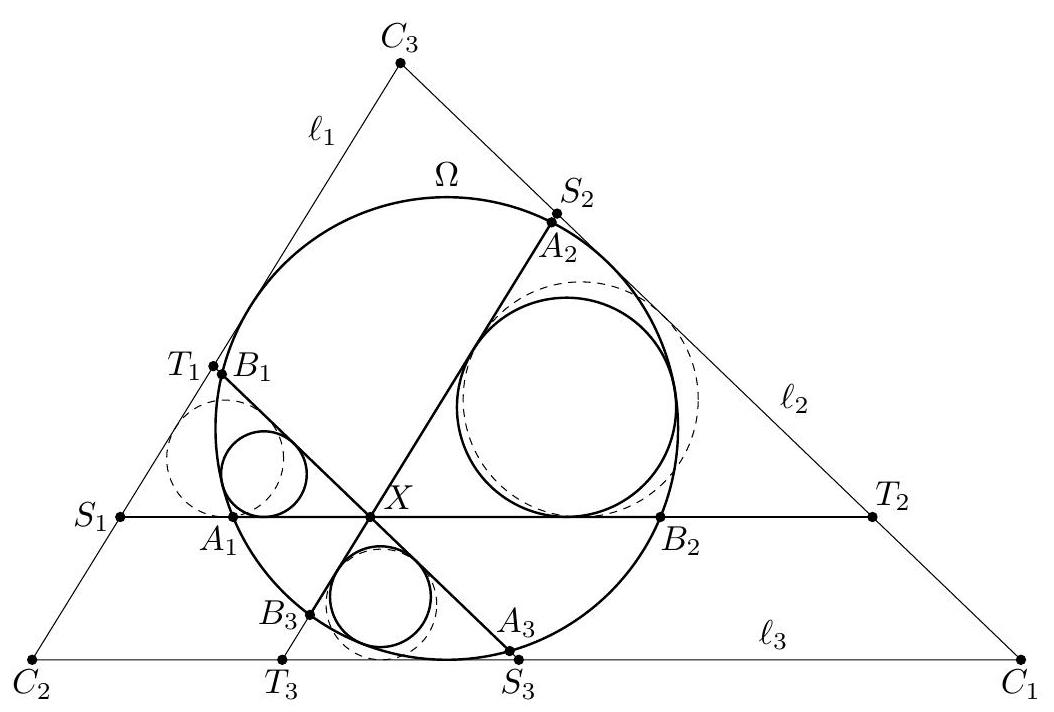
Fig. 1
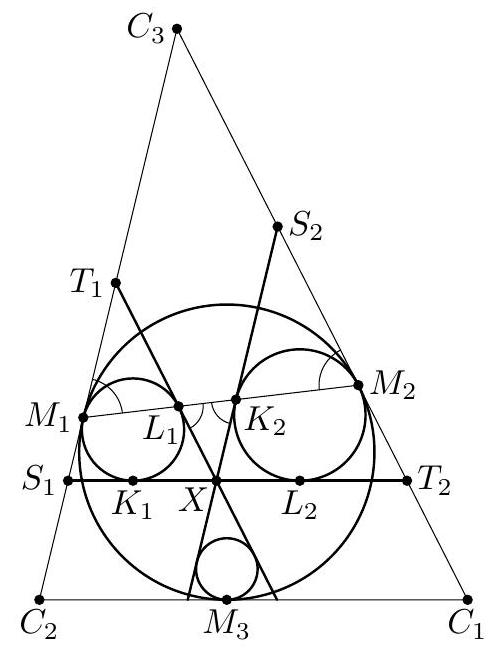
Fig. 2 (b) By part (a), the equality $R=r_{1}+r_{2}+r_{3}$ holds if and only if $r_{i}=\rho_{i}$ for all $i$, which implies in turn that $\omega_{i}$ is the incircle of $\Delta_{i}$. Let $K_{i}, L_{i}, M_{i}$ be the points where $\omega_{i}$ touches the sides $X S_{i}, X T_{i}, S_{i} T_{i}$, respectively. We claim that the six points $K_{i}$ and $L_{i}(i=1,2,3)$ are equidistant from $X$.
Clearly, $X K_{i}=X L_{i}$, and we are to prove that $X K_{2}=X L_{1}$ and $X K_{3}=X L_{2}$. By similarity, $\angle T_{1} M_{1} L_{1}=\angle C_{3} M_{1} M_{2}$ and $\angle S_{2} M_{2} K_{2}=\angle C_{3} M_{2} M_{1}$, so the points $M_{1}, M_{2}, L_{1}, K_{2}$ are collinear. Consequently, $\angle X K_{2} L_{1}=\angle C_{3} M_{1} M_{2}=\angle C_{3} M_{2} M_{1}=\angle X L_{1} K_{2}$, so $X K_{2}=X L_{1}$. Similarly, $X K_{3}=X L_{2}$.
Remark. Under the assumption in part (b), the point $M_{i}$ is the centre of a homothety mapping $\omega_{i}$ to $\Omega$. Since this homothety maps $X$ to $C_{i}$, the points $M_{i}, C_{i}, X$ are collinear, so $X$ is the Gergonne point of the triangle $C_{1} C_{2} C_{3}$. This condition is in fact equivalent to $R=r_{1}+r_{2}+r_{3}$.
Problem 6. A set of $n$ points in Euclidean 3-dimensional space, no four of which are coplanar, is partitioned into two subsets $\mathcal{A}$ and $\mathcal{B}$. An $\mathcal{A B}$-tree is a configuration of $n-1$ segments, each of which has an endpoint in $\mathcal{A}$ and the other in $\mathcal{B}$, and such that no segments form a closed polyline. An $\mathcal{A B}$-tree is transformed into another as follows: choose three distinct segments $A_{1} B_{1}, B_{1} A_{2}$ and $A_{2} B_{2}$ in the $\mathcal{A B}$-tree such that $A_{1}$ is in $\mathcal{A}$ and $A_{1} B_{1}+A_{2} B_{2}>A_{1} B_{2}+A_{2} B_{1}$, and remove the segment $A_{1} B_{1}$ to replace it by the segment $A_{1} B_{2}$. Given any $\mathcal{A B}$-tree, prove that every sequence of successive transformations comes to an end (no further transformation is possible) after finitely many steps.
Solution. The configurations of segments under consideration are all bipartite geometric trees on the points $n$ whose vertex-parts are $\mathcal{A}$ and $\mathcal{B}$, and transforming one into another preserves the degree of any vertex in $\mathcal{A}$, but not necessarily that of a vertex in $\mathcal{B}$.
The idea is to devise a strict semi-invariant of the process, i.e., assign each $\mathcal{A B}$-tree a real number strictly decreasing under a transformation. Since the number of trees on the $n$ points is finite, the conclusion follows.
To describe the assignment, consider an $\mathcal{A B}$-tree $\mathcal{T}=(\mathcal{A} \sqcup \mathcal{B}, \mathcal{E})$. Removal of an edge $e$ of $\mathcal{T}$ splits the graph into exactly two components. Let $p_{\mathcal{T}}(e)$ be the number of vertices in $\mathcal{A}$ lying in the component of $\mathcal{T}-e$ containing the $\mathcal{A}$-endpoint of $e$; since $\mathcal{T}$ is a tree, $p_{\mathcal{T}}(e)$ counts the number of paths in $\mathcal{T}-e$ from the $\mathcal{A}$-endpoint of $e$ to vertices in $\mathcal{A}$ (including the one-vertex path). Define $f(\mathcal{T})=\sum_{e \in \mathcal{E}} p_{\mathcal{T}}(e)|e|$, where $|e|$ is the Euclidean length of $e$.
We claim that $f$ strictly decreases under a transformation. To prove this, let $\mathcal{T}^{\prime}$ be obtained from $\mathcal{T}$ by a transformation involving the polyline $A_{1} B_{1} A_{2} B_{2}$; that is, $A_{1}$ and $A_{2}$ are in $\mathcal{A}, B_{1}$ and $B_{2}$ are in $\mathcal{B}, A_{1} B_{1}+A_{2} B_{2}>A_{1} B_{2}+A_{2} B_{1}$, and $\mathcal{T}^{\prime}=\mathcal{T}-A_{1} B_{1}+A_{1} B_{2}$. It is readily checked that $p_{\mathcal{T}^{\prime}}(e)=p_{\mathcal{T}}(e)$ for every edge $e$ of $\mathcal{T}$ different from $A_{1} B_{1}, A_{2} B_{1}$ and $A_{2} B_{2}, p_{\mathcal{T}^{\prime}}\left(A_{1} B_{2}\right)=$ $p_{\mathcal{T}}\left(A_{1} B_{1}\right), p_{\mathcal{T}^{\prime}}\left(A_{2} B_{1}\right)=p_{\mathcal{T}}\left(A_{2} B_{1}\right)+p_{\mathcal{T}}\left(A_{1} B_{1}\right)$, and $p_{\mathcal{T}^{\prime}}\left(A_{2} B b_{2}\right)=p_{\mathcal{T}}\left(A_{2} B_{2}\right)-p_{\mathcal{T}}\left(A_{1} B_{1}\right)$. Consequently,
Remarks. (1) The solution above does not involve the geometric structure of the configurations, so the conclusion still holds if the Euclidean length (distance) is replaced by any real-valued function on $\mathcal{A} \times \mathcal{B}$. (2) There are infinitely many strict semi-invariants that can be used to establish the conclusion, as we are presently going to show. The idea is to devise a non-strict real-valued semiinvariant $f_{A}$ for each $A$ in $\mathcal{A}$ (i.e., $f_{A}$ does not increase under a transformation) such that $\sum_{A \in \mathcal{A}} f_{A}=f$. It then follows that any linear combination of the $f_{A}$ with positive coefficients is a strict semi-invariant.
To describe $f_{A}$, where $A$ is a fixed vertex in $\mathcal{A}$, let $\mathcal{T}$ be an $\mathcal{A B}$-tree. Since $\mathcal{T}$ is a tree, by orienting all paths in $\mathcal{T}$ with an endpoint at $A$ away from $A$, every edge of $\mathcal{T}$ comes out with a unique orientation so that the in-degree of every vertex of $\mathcal{T}$ other than $A$ is 1 . Define $f_{A}(\mathcal{T})$ to be the sum of the Euclidean lengths of all out-going edges from $\mathcal{A}$. It can be shown that $f_{A}$ does not increase under a transformation, and it strictly decreases if the paths from $A$ to each of $A_{1}$, $A_{2}, B_{1}, B_{2}$ all pass through $A_{1}$ - i.e., of these four vertices, $A_{1}$ is combinatorially nearest to $A$. In particular, this is the case if $A_{1}=A$, i.e., the edge-switch in the transformation occurs at $A$. It is not hard to prove that $\sum_{A \in \mathcal{A}} f_{A}(\mathcal{T})=f(\mathcal{T})$.
The conclusion of the problem can also be established by resorting to a single carefully chosen $f_{A}$. Suppose, if possible, that the process is infinite, so some tree $\mathcal{T}$ occurs (at least) twice. Let $A$ be the vertex in $\mathcal{A}$ at which the edge-switch occurs in the transformation of the first occurrence of $\mathcal{T}$. By the preceding paragraph, consideration of $f_{A}$ shows that $\mathcal{T}$ can never occur again. (3) Recall that the degree of any vertex in $\mathcal{A}$ is invariant under a transformation, so the linear combination $\sum_{A \in \mathcal{A}}(\operatorname{deg} A-1) f_{A}$ is a strict semi-invariant for $\mathcal{A B}$-trees $\mathcal{T}$ whose vertices in $\mathcal{A}$ all have degrees exceeding 1. Up to a factor, this semi-invariant can alternatively, but equivalently be described as follows. Fix a vertex $$ and assign each vertex $X$ a number $g(X)$ so that $g()=0$, and $g(A)-g(B)=A B$ for every $A$ in $\mathcal{A}$ and every $B$ in $\mathcal{B}$ joined by an edge. Next, let $\beta(\mathcal{T})=\frac{1}{|\mathcal{B}|} \sum_{B \in \mathcal{B}} g(B)$, let $\alpha(\mathcal{T})=\frac{1}{|\mathcal{E}|-|\mathcal{A}|} \sum_{A \in \mathcal{A}}(\operatorname{deg} A-1) g(A)$, where $\mathcal{E}$ is the edge-set of $\mathcal{T}$, and set $\mu(\mathcal{T})=\beta(\mathcal{T})-\alpha(\mathcal{T})$. It can be shown that $\mu$ strictly decreases under a transformation; in fact, $\mu$ and $\sum_{A \in \mathcal{A}}(\operatorname{deg} A-1) f_{A}$ are proportional to one another.