


USAMO 2005 Solution Notes
Evan Chen《陳誼廷》
15 April 2024
This is a compilation of solutions for the 2005 USAMO. The ideas of the solution are a mix of my own work, the solutions provided by the competition organizers, and solutions found by the community. However, all the writing is maintained by me.
These notes will tend to be a bit more advanced and terse than the "official" solutions from the organizers. In particular, if a theorem or technique is not known to beginners but is still considered "standard", then I often prefer to use this theory anyways, rather than try to work around or conceal it. For example, in geometry problems I typically use directed angles without further comment, rather than awkwardly work around configuration issues. Similarly, sentences like "let $\mathbb{R}$ denote the set of real numbers" are typically omitted entirely.
Corrections and comments are welcome!
Contents
0 Problems ..... 2 1 Solutions to Day 1 ..... 3 1.1 USAMO 2005/1, proposed by Zuming Feng ..... 3 1.2 USAMO 2005/2, proposed by Răzvan Gelca ..... 4 1.3 USAMO 2005/3, proposed by Zuming Feng ..... 5 2 Solutions to Day 2 ..... 7 2.1 USAMO 2005/4, proposed by Elgin Johnston ..... 7 2.2 USAMO 2005/5, proposed by Kiran Kedlaya ..... 8 2.3 USAMO 2005/6, proposed by Titu Andreescu, Gabriel Dospinescu
§0 Problems
- Determine all composite positive integers $n$ for which it is possible to arrange all divisors of $n$ that are greater than 1 in a circle so that no two adjacent divisors are relatively prime.
- Prove that the system of equations
has no integer solutions. 3. Let $A B C$ be an acute-angled triangle, and let $P$ and $Q$ be two points on side $B C$. Construct a point $C_{1}$ in such a way that the convex quadrilateral $A P B C_{1}$ is cyclic, $\overline{Q C_{1}} | \overline{C A}$, and $C_{1}$ and $Q$ lie on opposite sides of line $A B$. Construct a point $B_{1}$ in such a way that the convex quadrilateral $A P C B_{1}$ is cyclic, $\overline{Q B_{1}} | \overline{B A}$, and $B_{1}$ and $Q$ lie on opposite sides of line $A C$. Prove that the points $B_{1}, C_{1}, P$, and $Q$ lie on a circle. 4. Legs $L_{1}, L_{2}, L_{3}, L_{4}$ of a square table each have length $n$, where $n$ is a positive integer. For how many ordered 4 -tuples ( $k_{1}, k_{2}, k_{3}, k_{4}$ ) of nonnegative integers can we cut a piece of length $k_{i}$ from the end of leg $L_{i}$ and still have a stable table? (The table is stable if it can be placed so that all four of the leg ends touch the floor. Note that a cut leg of length 0 is permitted.) 5. Let $n>1$ be an integer. Suppose $2 n$ points are given in the plane, no three of which are collinear. Suppose $n$ of the given $2 n$ points are colored blue and the other $n$ colored red. A line in the plane is called a balancing line if it passes through one blue and one red point and, for each side of the line, the number of blue points on that side is equal to the number of red points on the same side. Prove that there exist at least two balancing lines. 6. For a positive integer $m$, let $s(m)$ denote the sum of the decimal digits of $m$. A set $S$ positive integers is $k$-stable if $s\left(\sum_{x \in X} x\right)=k$ for any nonempty subset $X \subseteq S$. For each integer $n \geq 2$ let $f(n)$ be the minimal $k$ for which there exists a $k$-stable set with $n$ integers. Prove that there are constants $0<C_{1}<C_{2}$ with
§1 Solutions to Day 1
§1.1 USAMO 2005/1, proposed by Zuming Feng
Available online at https://aops.com/community/p213007.
Problem statement
Determine all composite positive integers $n$ for which it is possible to arrange all divisors of $n$ that are greater than 1 in a circle so that no two adjacent divisors are relatively prime.
The only bad ones are $n=p q$, products of two distinct primes. Clearly they can't be so arranged, so we show all others work.
- If $n$ is a power of a prime, the result is obvious; any arrangement works.
- If $n=p_{1}^{e_{1}} \ldots p_{k}^{e_{k}}$ for some $k \geq 3$, then first situate $p_{1} p_{2}, p_{2} p_{3}, \ldots, p_{k} p_{1}$ on the circle. Then we can arbitrarily place any multiples of $p_{i}$ between $p_{i-1} p_{i}$ and $p_{i} p_{i+1}$. This finishes this case.
- Finally suppose $n=p^{a} q^{b}$. If $a>1$, say, we can repeat the argument by first placing $p q$ and $p^{2} q$ and then placing multiples of $p$ in one arc and multiples of $q$ in the other arc. On the other hand the case $a=b=1$ is seen to be impossible.
§1.2 USAMO 2005/2, proposed by Răzvan Gelca
Available online at https://aops.com/community/p213009.
Problem statement
Prove that the system of equations
has no integer solutions.
Sum the equations and add 1 to both sides to get
But $a^{2}+b^{9} \not \equiv 14(\bmod 19)$ for any integers $a$ and $b$, since the ninth powers modulo 19 are $0, \pm 1$ and none of ${13,14,15}$ are squares modulo 19. Therefore, there are no integer solutions.
Remark. In fact, $a^{2}+b^{3} \equiv 14(\bmod 19)$ has no solutions modulo 19 either.
Remark. It can also be checked that the original system has no equations modulo 13, although this requires using both equations rather than just their sum. (As in the modulo 19 situation, $z^{9}$ may be replaced by $z^{3}$ and this remark still holds.)
§1.3 USAMO 2005/3, proposed by Zuming Feng
Available online at https://aops.com/community/p213011.
Problem statement
Let $A B C$ be an acute-angled triangle, and let $P$ and $Q$ be two points on side $B C$. Construct a point $C_{1}$ in such a way that the convex quadrilateral $A P B C_{1}$ is cyclic, $\overline{Q C_{1}} | \overline{C A}$, and $C_{1}$ and $Q$ lie on opposite sides of line $A B$. Construct a point $B_{1}$ in such a way that the convex quadrilateral $A P C B_{1}$ is cyclic, $\overline{Q B_{1}} | \overline{B A}$, and $B_{1}$ and $Q$ lie on opposite sides of line $A C$. Prove that the points $B_{1}, C_{1}, P$, and $Q$ lie on a circle.
It is enough to prove that $A, B_{1}$, and $C_{1}$ are collinear, since then $\measuredangle C_{1} Q P=\measuredangle A C P=$ $\measuredangle A B_{1} P=\measuredangle C_{1} B_{1} P$.
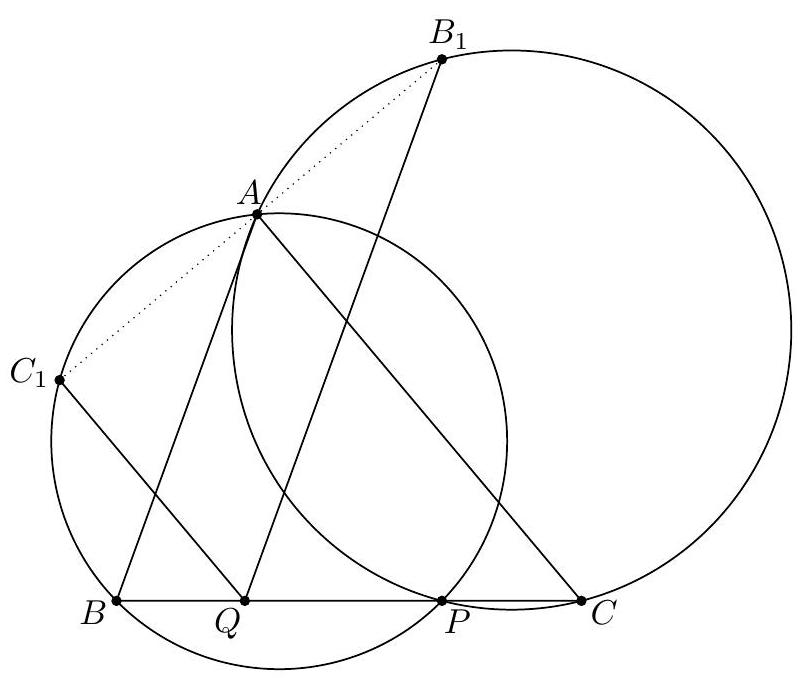
ब First solution. Let $T$ be the second intersection of $\overline{A C_{1}}$ with $(A P C)$. Then readily $\triangle P C_{1} T \sim \triangle A B C$. Consequently, $\overline{Q C_{1}} | \overline{A C}$ implies $T C_{1} Q P$ cyclic. Finally, $\overline{T Q} | \overline{A B}$ now follows from the cyclic condition, so $T=B_{1}$ as desired. \ Second solution. One may also use barycentric coordinates. Let $P=(0, m, n)$ and $Q=(0, r, s)$ with $m+n=r+s=1$. Once again,
Set $C_{1}=(s-z, r, z)$, where $C_{1} Q | A C$ follows by $(s-z)+r+z=1$. We solve for this $z$.
So the quotient of the $z$ and $y$ coordinates of $C_{1}$ satisfies this quadratic. Similarly, if $B_{1}=(r-y, y, s)$ we obtain that
Since these two quadratics are the same when one is written backwards (and negated), it follows that their roots are reciprocals. But the roots of the quadratics represent $\frac{z}{y}$ and $\frac{y}{z}$ for the points $C_{1}$ and $B_{1}$, respectively. This implies (with some configuration blah) that the points $B_{1}$ and $C_{1}$ are collinear with $A=(1,0,0)$ (in some line of the form $\frac{y}{z}=k$ ), as desired.
§2 Solutions to Day 2
§2.1 USAMO 2005/4, proposed by Elgin Johnston
Available online at https://aops.com/community/p213012.
Problem statement
Legs $L_{1}, L_{2}, L_{3}, L_{4}$ of a square table each have length $n$, where $n$ is a positive integer. For how many ordered 4 -tuples $\left(k_{1}, k_{2}, k_{3}, k_{4}\right)$ of nonnegative integers can we cut a piece of length $k_{i}$ from the end of leg $L_{i}$ and still have a stable table? (The table is stable if it can be placed so that all four of the leg ends touch the floor. Note that a cut leg of length 0 is permitted.)
Flip the table upside-down so that that the table's surface rests on the floor. Then, we see that we want the truncated legs to have endpoints $A, B, C, D$ which are coplanar (say).
Claim - This occurs if and only if $A B C D$ is a parallelogram.
Proof. Obviously $A B C D$ being a parallelogram is sufficient. Conversely, if they are coplanar, we let $D^{\prime}$ be such that $A B C D^{\prime}$ is a parallelogram. Then $D^{\prime}$ also lies in the same plane as $A B C D$, but is situated directly above $D$ (since the table was a square). This implies $D^{\prime}=D$, as needed.
In still other words, we are counting the number of solutions to
Define
so that the number of solutions to $k_{1}+k_{3}=k_{2}+k_{4}=r$ is just given by $a_{r}^{2}$. We now just compute
§2.2 USAMO 2005/5, proposed by Kiran Kedlaya
Available online at https://aops.com/community/p213018.
Problem statement
Let $n>1$ be an integer. Suppose $2 n$ points are given in the plane, no three of which are collinear. Suppose $n$ of the given $2 n$ points are colored blue and the other $n$ colored red. A line in the plane is called a balancing line if it passes through one blue and one red point and, for each side of the line, the number of blue points on that side is equal to the number of red points on the same side. Prove that there exist at least two balancing lines.
Consider the convex hull $\mathcal{H}$ of the polygon. There are two cases. 【 Easy case: the convex hull has both colors. If the convex hull $\mathcal{H}$ is not all the same color, there exist two edges of $\mathcal{H}$ (at least) which have differently colored endpoints. The extensions of those sides form balancing lines; indeed given any such line $\ell$ one side of $\ell$ has no points, the other has $n-1$ red and $n-1$ blue points.
【 Harder case: the convex hull is all one color. Now assume $\mathcal{H}$ is all blue (WLOG). We will prove there are at least $|\mathcal{H}|$ balancing lines in the following way.
Claim - For any vertex $B$ of $\mathcal{H}$ there is a balancing line through it.
Proof. Assume $A, B, C$ are three consecutive blue vertices of $\mathcal{H}$. Imagine starting with line $\ell$ passing through $B$ and $A$, then rotating it through $B$ until it coincides with line $B C$, through the polygon.
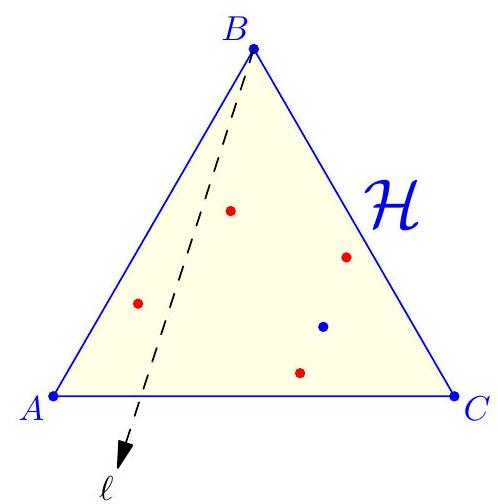
During this process, we consider the set of points on the same side of $\ell$ as $C$, and let $x$ be the number of such red points minus the number of such blue points. Note that:
- Every time $\ell$ touches a blue point, $x$ increases by 1 .
- Every time $\ell$ touches a red point, $x$ decreases by 1 .
- Initially, $x=+1$.
- Just before reaching the end we have $x=-1$.
So at the moment where $x$ first equals zero, we have found our balancing line.
§2.3 USAMO 2005/6, proposed by Titu Andreescu, Gabriel Dospinescu
Available online at https://aops.com/community/p213014.
Problem statement
For a positive integer $m$, let $s(m)$ denote the sum of the decimal digits of $m$. A set $S$ positive integers is $k$-stable if $s\left(\sum_{x \in X} x\right)=k$ for any nonempty subset $X \subseteq S$.
For each integer $n \geq 2$ let $f(n)$ be the minimal $k$ for which there exists a $k$-stable set with $n$ integers. Prove that there are constants $0<C_{1}<C_{2}$ with
【 Construction showing $f(n) \leq 9\left\lceil\log _{10}\binom{n+1}{2}\right\rceil$. Let $n \geq 1$ and $e \geq 1$ be integers satisfying $1+2+\cdots+n<10^{e}$. Consider the set
For example, if $n=6$ and $e=3$, we have $S={999,1998,2997,3996,4995,5994}$. The set $S$ here is easily seen to be $9 e$-stable. Thus $f(n) \leq 9\left\lceil\log _{10}\binom{n+1}{2}\right\rceil$, proving one direction.
Remark. I think the problem is actually more natural with a multiset $S$ rather than a vanilla set, in which case $S=\left{10^{e}-1,10^{e}-1, \ldots, 10^{e}-1\right}$ works fine, and is easier to think of. In some sense the actual construction is obtained by starting with this one, and then pushing together the terms together in order to get the terms to be distinct, hence the $1+2+\cdots+n$ appearance.
【 Proof that $f(n) \geq \log _{12} n$. We are going to prove the following, which obviously sufficient.
Claim - Let $k$ be a positive integer. In any (multi)set $S$ of more than $12^{k}$ integers, there exists a subset whose sum of decimal digits exceeds $k$.
Proof. Imagine writing entries of $S$ on a blackboard, while keeping a running sum $\Sigma$ initially set to zero. For $i=1,2, \ldots$ we will have a process such that at the end of the $i$ th step all entries on the board are divisible by $10^{i}$. It goes as follows:
- If the $i$ th digit from the right of $\Sigma$ is nonzero, then arbitrarily partition the numbers on the board into groups of 10 , erasing any leftover numbers. Within each group of 10 , we can find a nonempty subset with sum $0 \bmod 10^{i}$; we then erase each group and replace it with that sum.
- If the $i$ th digit from the right of $\Sigma$ is zero, but some entry on the board is not divisible by $10^{i}$, then we erase that entry and add it to $\Sigma$. Then we do the grouping as in the previous step.
- If the $i$ th digit from the right of $\Sigma$ is zero, and all entries on the board are divisible by $10^{i}$, we do nothing and move on to the next step.
This process ends when no numbers remain on the blackboard. The first and second cases occur at least $k+1$ times (the number of entries decreases by a factor of at most 12 each step), and each time $\Sigma$ gets some nonzero digit, which is never changed at later steps. Therefore $\Sigma$ has sum of digits at least $k+1$ as needed.
Remark. The official solutions contain a slicker proof: it turns out that any multiple of $10^{e}-1$ has sum of decimal digits at least $9 e$. However, if one does not know this lemma it seems nontrivial to imagine coming up with it.