


USAMO 2011 Solution Notes
Evan Chen《陳誼廷》
15 April 2024
This is a compilation of solutions for the 2011 USAMO. The ideas of the solution are a mix of my own work, the solutions provided by the competition organizers, and solutions found by the community. However, all the writing is maintained by me.
These notes will tend to be a bit more advanced and terse than the "official" solutions from the organizers. In particular, if a theorem or technique is not known to beginners but is still considered "standard", then I often prefer to use this theory anyways, rather than try to work around or conceal it. For example, in geometry problems I typically use directed angles without further comment, rather than awkwardly work around configuration issues. Similarly, sentences like "let $\mathbb{R}$ denote the set of real numbers" are typically omitted entirely.
Corrections and comments are welcome!
Contents
0 Problems ..... 2 1 Solutions to Day 1 ..... 3 1.1 USAMO 2011/1, proposed by Titu Andreescu ..... 3 1.2 USAMO 2011/2, proposed by Sam Vandervelde ..... 4 1.3 USAMO 2011/3, proposed by Gabriel Carroll ..... 6 2 Solutions to Day 2 ..... 8 2.1 USAMO 2011/4, proposed by Sam Vandervelde ..... 8 2.2 USAMO 2011/5, proposed by Zuming Feng, Delong Meng ..... 9 2.3 USAMO 2011/6, proposed by Sid Graham . ..... 10
§0 Problems
- Let $a, b, c$ be positive real numbers such that $a^{2}+b^{2}+c^{2}+(a+b+c)^{2} \leq 4$. Prove that
- An integer is assigned to each vertex of a regular pentagon so that the sum of the five integers is 2011. A turn of a solitaire game consists of subtracting an integer $m$ (not necessarily positive) from each of the integers at two neighboring vertices and adding $2 m$ to the opposite vertex, which is not adjacent to either of the first two vertices. (The amount $m$ and the vertices chosen can vary from turn to turn.) The game is won at a certain vertex if, after some number of turns, that vertex has the number 2011 and the other four vertices have the number 0. Prove that for any choice of the initial integers, there is exactly one vertex at which the game can be won.
- In hexagon $A B C D E F$, which is nonconvex but not self-intersecting, no pair of opposite sides are parallel. The internal angles satisfy $\angle A=3 \angle D, \angle C=3 \angle F$, and $\angle E=3 \angle B$. Furthermore $A B=D E, B C=E F$, and $C D=F A$. Prove that diagonals $\overline{A D}, \overline{B E}$, and $\overline{C F}$ are concurrent.
- Consider the assertion that for each positive integer $n \geq 2$, the remainder upon dividing $2^{2^{n}}$ by $2^{n}-1$ is a power of 4 . Either prove the assertion or find (with proof) a counterexample.
- Let $P$ be a point inside convex quadrilateral $A B C D$. Points $Q_{1}$ and $Q_{2}$ are located within $A B C D$ such that
Prove that $\overline{Q_{1} Q_{2}} | \overline{A B}$ if and only if $\overline{Q_{1} Q_{2}} | \overline{C D}$. 6. Let $A$ be a set with $|A|=225$, meaning that $A$ has 225 elements. Suppose further that there are eleven subsets $A_{1}, \ldots, A_{11}$ of $A$ such that $\left|A_{i}\right|=45$ for $1 \leq i \leq 11$ and $\left|A_{i} \cap A_{j}\right|=9$ for $1 \leq i<j \leq 11$. Prove that $\left|A_{1} \cup A_{2} \cup \cdots \cup A_{11}\right| \geq 165$, and give an example for which equality holds.
§1 Solutions to Day 1
§1.1 USAMO 2011/1, proposed by Titu Andreescu
Available online at https://aops.com/community/p2254758.
Problem statement
Let $a, b, c$ be positive real numbers such that $a^{2}+b^{2}+c^{2}+(a+b+c)^{2} \leq 4$. Prove that
The condition becomes $2 \geq a^{2}+b^{2}+c^{2}+a b+b c+c a$. Therefore,
with the last line by AM-GM. This completes the proof.
§1.2 USAMO 2011/2, proposed by Sam Vandervelde
Available online at https://aops.com/community/p2254765.
Problem statement
An integer is assigned to each vertex of a regular pentagon so that the sum of the five integers is 2011. A turn of a solitaire game consists of subtracting an integer $m$ (not necessarily positive) from each of the integers at two neighboring vertices and adding $2 m$ to the opposite vertex, which is not adjacent to either of the first two vertices. (The amount $m$ and the vertices chosen can vary from turn to turn.) The game is won at a certain vertex if, after some number of turns, that vertex has the number 2011 and the other four vertices have the number 0. Prove that for any choice of the initial integers, there is exactly one vertex at which the game can be won.
Call the vertices $0,1,2,3,4$ in order. First, notice that the quantity
is invariant, where $N_{i}$ is the amount at vertex $i$. This immediately implies that at most one vertex can win, since in a winning situation all $N_{i}$ are 0 except for one, which is 2011. (For example, if $S \equiv 3(\bmod 5)$, any victory must occur at the vertex 3 , via $N_{3}=2011$, $N_{0}=N_{1}=N_{2}=N_{4}=0$.)
Now we prove we can win on this unique vertex. Let $a_{i}, x_{i}$ denote the number initially at $i$ and $x_{i}$ denote $\sum m$ over all $m$ where vertex $i$ gains $2 m$. WLOG the possible vertex is 0 , meaning $a_{1}+2 a_{2}+3 a_{3}+4 a_{4} \equiv 0(\bmod 5)$. Moreover we want
We can ignore the first equation since its the sum of the other four, and we can WLOG shift $x_{0} \rightarrow 0$ by shifting each $x_{i}$ by a fixed amount. We will now solve the resulting system of equations.
First, we have
Using these to remove all instances of $x_{1}$ and $x_{4}$ gives
whence we have a two-variable system of equations! To verify its solution is integral, note that
is an integer, since
Abbreviating $\frac{a_{1}-3 a_{2}+3 a_{3}-a_{4}}{5}$ as $k$, we obtain the desired $x_{i}$ :
This is the desired integer solution. Remark. In principle, you could unwind all the definitions above to explicitly write every $x_{i}$ as a function of $a_{1}, a_{2}, a_{3}, a_{4}$. If you did this, you could get the long equations
which indeed are all integers whenever $a_{1}+2 a_{2}+3 a_{3}+4 a_{4} \equiv 0(\bmod 5)$. However, this is quite tedious and also unnecessary to solve the problem. That's because we only care that the $x_{i}$ are integers, and do not need to actually know the values. This lets us work more indirectly to avoid long calculation, as we did above.
§1.3 USAMO 2011/3, proposed by Gabriel Carroll
Available online at https://aops.com/community/p2254803.
Problem statement
In hexagon $A B C D E F$, which is nonconvex but not self-intersecting, no pair of opposite sides are parallel. The internal angles satisfy $\angle A=3 \angle D, \angle C=3 \angle F$, and $\angle E=3 \angle B$. Furthermore $A B=D E, B C=E F$, and $C D=F A$. Prove that diagonals $\overline{A D}, \overline{B E}$, and $\overline{C F}$ are concurrent.
We present the official solution. We say a hexagon is satisfying if it obeys the six conditions; note that intuitively we expect three degrees of freedom for satisfying hexagons.
Main idea: Claim - In a satisfying hexagon, $B, D, F$ are reflections of $A, C, E$ across the sides of $\triangle A C E$. (This claim looks plausible because every excellent hexagon is satisfying, and both configuration spaces are three-dimensional.) Call a hexagon of this shape "excellent"; in a excellent hexagon the diagonals clearly concur (at the orthocenter).
Set $\beta=\angle B, \delta=\angle D, \varphi=\angle F$.
Now given a satisfying hexagon $A B C D E F$, construct a "phantom hexagon" $A^{\prime} B^{\prime} C^{\prime} D^{\prime} E^{\prime} F^{\prime}$ with the same angles which is excellent (see figure). This is possible since $\beta+\delta+\varphi=180^{\circ}$.
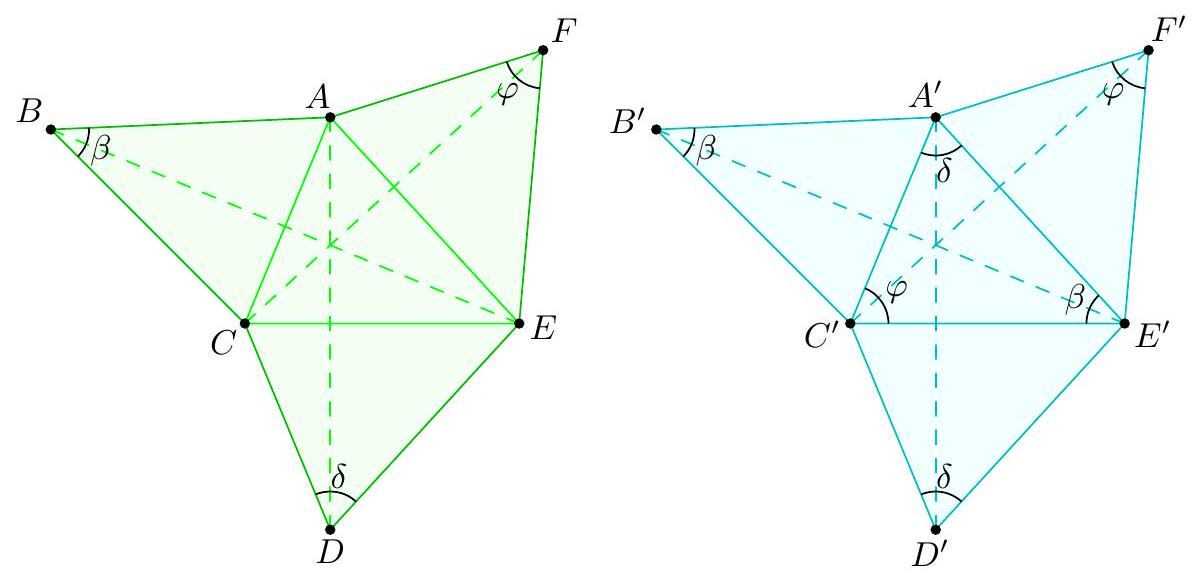
Then it would suffice to prove that:
Lemma
A satisfying hexagon is uniquely determined by its angles up to similarity. That is, at most one hexagon (up to similarity) has angles $\beta, \delta, \gamma$ as above.
Proof. Consider any two satisfying hexagons $A B C D E F$ and $A^{\prime} B^{\prime} C^{\prime} D^{\prime} E^{\prime} F^{\prime}$ (not necessarily as constructed above!) with the same angles. We show they are similar.
To do this, consider the unit complex numbers in the directions $\overrightarrow{B A}$ and $\overrightarrow{D E}$ respectively and let $\vec{x}$ denote their sum. Define $\vec{y}, \vec{z}$ similarly. Note that the condition $\overline{A B} \nVdash \overline{D E}$ implies $\vec{x} \neq 0$, and similarly. Then we have the identities
So we would obtain $A B: C D: E F=A^{\prime} B^{\prime}: C^{\prime} D^{\prime}: E^{\prime} F^{\prime}$ if only we could show that $\vec{x}, \vec{y}, \vec{z}$ are not multiples of each other (linear dependency reasons). This is a tiresome computation with arguments, but here it is.
First note that none of $\beta, \delta, \varphi$ can be $90^{\circ}$, since otherwise we get a pair of parallel sides. Now work in the complex plane, fix a reference such that $\vec{A}-\vec{B}$ has argument 0 , and assume $A B C D E F$ are labelled counterclockwise. Then
- $\vec{B}-\vec{C}$ has argument $\pi-\beta$
- $\vec{C}-\vec{D}$ has argument $-(\beta+3 \varphi)$
- $\vec{D}-\vec{E}$ has argument $\pi-(\beta+3 \varphi+\delta)$
- $\vec{E}-\vec{F}$ has argument $-(4 \beta+3 \varphi+\delta)$
So the argument of $\vec{x}$ has argument $\frac{\pi-(\beta+3 \varphi+\delta)}{2}(\bmod \pi)$. The argument of $\vec{y}$ has argument $\frac{\pi-(5 \beta+3 \varphi+\delta)}{2}(\bmod \pi)$. Their difference is $2 \beta(\bmod \pi)$, and since $\beta \neq 90^{\circ}$, it follows that $\vec{x}$ and $\vec{y}$ are not multiples of each other; the other cases are similar.
Then the lemma implies $A B C D E F \sim A^{\prime} B^{\prime} C^{\prime} D^{\prime} E^{\prime} F$ and we're done. Remark. This problem turned out to be known already. It appears in this reference: Nikolai Beluhov, Matematika, 2008, issue 6, problem 3. It was reprinted as Kvant, 2009, issue 2, problem M2130; the reprint is available at http: //kvant.ras.ru/pdf/2009/2009-02.pdf.
Remark. The vector perspective also shows the condition about parallel sides cannot be dropped. Here is a counterexample from Ryan Kim in the event that it is.
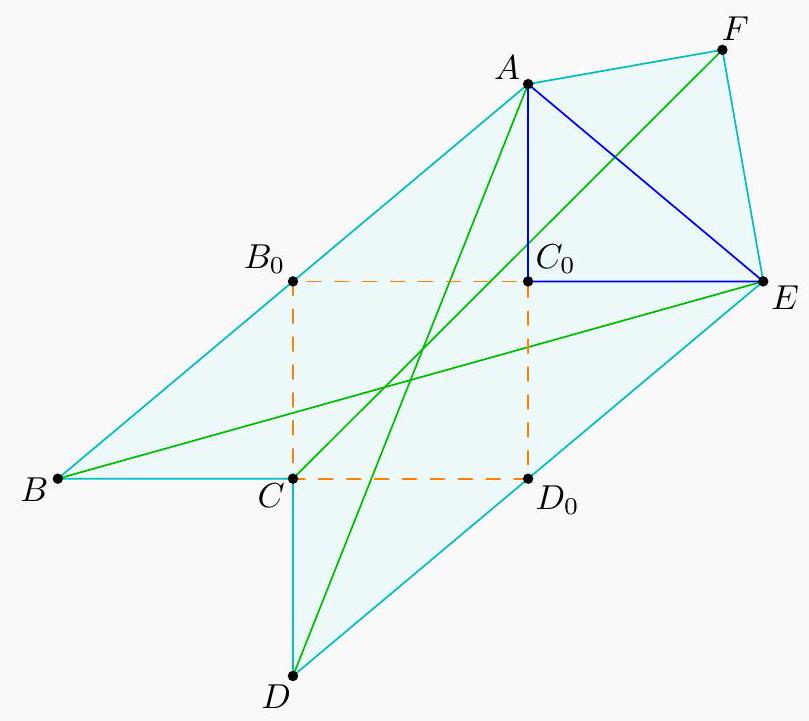
By adjusting the figure above so that the triangles are right isosceles (instead of just right), one also finds an example of a hexagon which is satisfying and whose diagonals are concurrent, but which is not excellent.
§2 Solutions to Day 2
§2.1 USAMO 2011/4, proposed by Sam Vandervelde
Available online at https://aops.com/community/p2254810.
Problem statement
Consider the assertion that for each positive integer $n \geq 2$, the remainder upon dividing $2^{2^{n}}$ by $2^{n}-1$ is a power of 4 . Either prove the assertion or find (with proof) a counterexample.
We claim $n=25$ is a counterexample. Since $2^{25} \equiv 2^{0}\left(\bmod 2^{25}-1\right)$, we have
and the right-hand side is actually the remainder, since $0<2^{7}<2^{25}$. But $2^{7}$ is not a power of 4 .
Remark. Really, the problem is just equivalent for asking $2^{n}$ to have odd remainder when divided by $n$.
§2.2 USAMO 2011/5, proposed by Zuming Feng, Delong Meng
Available online at https://aops.com/community/p2254841. Problem statement Let $P$ be a point inside convex quadrilateral $A B C D$. Points $Q_{1}$ and $Q_{2}$ are located within $A B C D$ such that
Prove that $\overline{Q_{1} Q_{2}} | \overline{A B}$ if and only if $\overline{Q_{1} Q_{2}} | \overline{C D}$.
If $\overline{A B} | \overline{C D}$ there is nothing to prove. Otherwise let $X=\overline{A B} \cap \overline{C D}$. Then the $Q_{1}$ and $Q_{2}$ are the isogonal conjugates of $P$ with respect to triangles $X B C$ and $X A D$. Thus $X$, $Q_{1}, Q_{2}$ are collinear, on the isogonal of $\overline{X P}$ with respect to $\angle D X A=\angle C X B$.
§2.3 USAMO 2011/6, proposed by Sid Graham
Available online at https://aops.com/community/p2254871.
Problem statement
Let $A$ be a set with $|A|=225$, meaning that $A$ has 225 elements. Suppose further that there are eleven subsets $A_{1}, \ldots, A_{11}$ of $A$ such that $\left|A_{i}\right|=45$ for $1 \leq i \leq 11$ and $\left|A_{i} \cap A_{j}\right|=9$ for $1 \leq i<j \leq 11$. Prove that $\left|A_{1} \cup A_{2} \cup \cdots \cup A_{11}\right| \geq 165$, and give an example for which equality holds.
Ignore the 225 - it is irrelevant. Denote the elements of $A_{1} \cup \cdots \cup A_{11}$ by $a_{1}, \ldots, a_{n}$, and suppose that $a_{i}$ appears $x_{i}$ times among $A_{i}$ for each $1 \leq i \leq n$ (so $1 \leq x_{i} \leq 11$ ). Then we have
and
Therefore, we deduce that $\sum x_{i}=495$ and $\sum_{i} x_{i}^{2}=1485$. Now, by Cauchy Schwarz
which implies $n \geq \frac{495^{2}}{1485}=165$. Equality occurs if we let $A$ consist of the 165 three-element subsets of ${1, \ldots, 11}$ (plus 60 of your favorite reptiles if you really insist $|A|=225$ ). Then we let $A_{i}$ denote those subsets containing $i$, of which there are $\binom{10}{2}=45$, and so that $\left|A_{i} \cap A_{j}\right|=\binom{9}{1}=9$.