


USAMO 2014 Solution Notes
Evan ChEn《陳誼廷》
15 April 2024
This is a compilation of solutions for the 2014 USAMO. The ideas of the solution are a mix of my own work, the solutions provided by the competition organizers, and solutions found by the community. However, all the writing is maintained by me.
These notes will tend to be a bit more advanced and terse than the "official" solutions from the organizers. In particular, if a theorem or technique is not known to beginners but is still considered "standard", then I often prefer to use this theory anyways, rather than try to work around or conceal it. For example, in geometry problems I typically use directed angles without further comment, rather than awkwardly work around configuration issues. Similarly, sentences like "let $\mathbb{R}$ denote the set of real numbers" are typically omitted entirely.
Corrections and comments are welcome!
Contents
0 Problems ..... 2 1 Solutions to Day 1 ..... 3 1.1 USAMO 2014/1, proposed by Titu Andreescu ..... 3 1.2 USAMO 2014/2, proposed by Titu Andreescu ..... 4 1.3 USAMO 2014/3, proposed by Sam Vandervelde ..... 6 2 Solutions to Day 2 ..... 7 2.1 USAMO 2014/4, proposed by Palmer Mebane ..... 7 2.2 USAMO 2014/5, proposed by Titu Andreescu, Cosmin Pohoata ..... 9 2.3 USAMO 2014/6, proposed by Gabriel Dospinescu ..... 11
§0 Problems
- Let $a, b, c, d$ be real numbers such that $b-d \geq 5$ and all zeros $x_{1}, x_{2}, x_{3}$, and $x_{4}$ of the polynomial $P(x)=x^{4}+a x^{3}+b x^{2}+c x+d$ are real. Find the smallest value the product $\left(x_{1}^{2}+1\right)\left(x_{2}^{2}+1\right)\left(x_{3}^{2}+1\right)\left(x_{4}^{2}+1\right)$ can take.
- Find all $f: \mathbb{Z} \rightarrow \mathbb{Z}$ such that
for all $x, y \in \mathbb{Z}$ such that $x \neq 0$. 3. Prove that there exists an infinite set of points
in the plane with the following property: For any three distinct integers $a, b$, and $c$, points $P_{a}, P_{b}$, and $P_{c}$ are collinear if and only if $a+b+c=2014$. 4. Let $k$ be a positive integer. Two players $A$ and $B$ play a game on an infinite grid of regular hexagons. Initially all the grid cells are empty. Then the players alternately take turns with $A$ moving first. In her move, $A$ may choose two adjacent hexagons in the grid which are empty and place a counter in both of them. In his move, $B$ may choose any counter on the board and remove it. If at any time there are $k$ consecutive grid cells in a line all of which contain a counter, $A$ wins. Find the minimum value of $k$ for which $A$ cannot win in a finite number of moves, or prove that no such minimum value exists. 5. Let $A B C$ be a triangle with orthocenter $H$ and let $P$ be the second intersection of the circumcircle of triangle $A H C$ with the internal bisector of $\angle B A C$. Let $X$ be the circumcenter of triangle $A P B$ and let $Y$ be the orthocenter of triangle $A P C$. Prove that the length of segment $X Y$ is equal to the circumradius of triangle $A B C$. 6. Prove that there is a constant $c>0$ with the following property: If $a, b, n$ are positive integers such that $\operatorname{gcd}(a+i, b+j)>1$ for all $i, j \in{0,1, \ldots, n}$, then
§1 Solutions to Day 1
§1.1 USAMO 2014/1, proposed by Titu Andreescu
Available online at https://aops.com/community/p3477753.
Problem statement
Let $a, b, c, d$ be real numbers such that $b-d \geq 5$ and all zeros $x_{1}, x_{2}, x_{3}$, and $x_{4}$ of the polynomial $P(x)=x^{4}+a x^{3}+b x^{2}+c x+d$ are real. Find the smallest value the product $\left(x_{1}^{2}+1\right)\left(x_{2}^{2}+1\right)\left(x_{3}^{2}+1\right)\left(x_{4}^{2}+1\right)$ can take.
The answer is 16 . This can be achieved by taking $x_{1}=x_{2}=x_{3}=x_{4}=1$, whence the product is $2^{4}=16$, and $b-d=5$.
We now show the quantity is always at least 16. We prove: Claim - We always have $\left(x_{1}^{2}+1\right)\left(x_{2}^{2}+1\right)\left(x_{3}^{2}+1\right)\left(x_{4}^{2}+1\right)=(b-d-1)^{2}+(a-c)^{2}$.
Proof. Let $i=\sqrt{-1}$. The key observation is that
Since $P(i)=(-1+b-d)+(c-a) i$, the claim follows. Since $b-d-1 \geq 4$, we get the desired lower bound of $4^{2}+0^{2}=16$.
§1.2 USAMO 2014/2, proposed by Titu Andreescu
Available online at https://aops.com/community/p3477690.
Problem statement
Find all $f: \mathbb{Z} \rightarrow \mathbb{Z}$ such that
for all $x, y \in \mathbb{Z}$ such that $x \neq 0$.
The answer is $f(x) \equiv 0$ and $f(x) \equiv x^{2}$. Check that these work. Now let's prove these are the only solutions. Put $y=0$ to obtain
The nicest part of the problem is the following step:
Proof. If not, select a prime $p \nmid f(0)$ and put $x=p \neq 0$. In the above, we find that $p \mid f(p)^{2}$, so $p \mid f(p)$ and hence $p \left\lvert, \frac{f(p)^{2}}{p}\right.$. From here we derive $p \mid f(0)$, contradiction. Hence
Claim - We have $f(x) \in\left{0, x^{2}\right}$ for each individual $x$. Proof. The above then implies that
holds for all nonzero $x$, but also for $x=0$. Let us now check that $f$ is an even function. In the above, we may also derive $f(-x)^{2}=x^{2} f(x)$. If $f(x) \neq f(-x)$ (and hence $x \neq 0$ ), then subtracting the above and factoring implies that $f(x)+f(-x)=-x^{2}$; we can then obtain by substituting the relation
which is impossible. This means $f(x)^{2}=x^{2} f(x)$, thus
Now suppose there exists a nonzero integer $t$ with $f(t)=0$. We will prove that $f(x) \equiv 0$. Put $y=t$ in the given to obtain that
for any integer $x \neq 0$, and hence conclude that $f(2 \mathbb{Z}) \equiv 0$. Then selecting $x=2 k \neq 0$ in the given implies that
Assume for contradiction that $f(m)=m^{2}$ now for some odd $m \neq 0$. Evidently
If $f\left(m^{3}\right) \neq 0$ this forces $f\left(4 k-m^{2}\right) \neq 0$, and hence $m^{2}\left(4 k-m^{2}\right)^{2}=m^{6}$ for arbitrary $k \neq 0$, which is clearly absurd. That means
for each $k \neq 0$. Since $m$ is odd, $m^{2} \equiv 1(\bmod 4)$, and so $f(n)=0$ for all $n$ other than $\pm m^{2}$ (since we cannot select $\left.k=0\right)$.
Now $f(m)=m^{2}$ means that $m= \pm 1$. Hence either $f(x) \equiv 0$ or
To show that the latter fails, we simply take $x=5$ and $y=1$ in the given. Hence, the only solutions are $f(x) \equiv 0$ and $f(x) \equiv x^{2}$.
§1.3 USAMO 2014/3, proposed by Sam Vandervelde
Available online at https://aops.com/community/p3477763.
Problem statement
Prove that there exists an infinite set of points
in the plane with the following property: For any three distinct integers $a, b$, and $c$, points $P_{a}, P_{b}$, and $P_{c}$ are collinear if and only if $a+b+c=2014$.
The construction
works fine, and follows from the following claim: Claim - If $x, y, z$ are distinct real numbers then the points $\left(x, x^{3}\right),\left(y, y^{3}\right),\left(z, z^{3}\right)$ are collinear if and only if $x+y+z=0$.
Proof. Note that by the "shoelace formula", the collinearity is equivalent to
But the determinant equals
§2 Solutions to Day 2
§2.1 USAMO 2014/4, proposed by Palmer Mebane
Available online at https://aops.com/community/p3478584.
Problem statement
Let $k$ be a positive integer. Two players $A$ and $B$ play a game on an infinite grid of regular hexagons. Initially all the grid cells are empty. Then the players alternately take turns with $A$ moving first. In her move, $A$ may choose two adjacent hexagons in the grid which are empty and place a counter in both of them. In his move, $B$ may choose any counter on the board and remove it. If at any time there are $k$ consecutive grid cells in a line all of which contain a counter, $A$ wins. Find the minimum value of $k$ for which $A$ cannot win in a finite number of moves, or prove that no such minimum value exists.
The answer is $k=6$.
\ Proof that $A$ cannot win if $k=6$. We give a strategy for $B$ to prevent $A$ 's victory. Shade in every third cell, as shown in the figure below. Then $A$ can never cover two shaded cells simultaneously on her turn. Now suppose $B$ always removes a counter on a shaded cell (and otherwise does whatever he wants). Then he can prevent $A$ from ever getting six consecutive counters, because any six consecutive cells contain two shaded cells.
 \ Example of a strategy for $A$ when $k=5$. We describe a winning strategy for $A$ explicitly. Note that after $B$ 's first turn there is one counter, so then $A$ may create an equilateral triangle, and hence after $B$ 's second turn there are two consecutive counters. Then, on her third turn, $A$ places a pair of counters two spaces away on the same line. Label the two inner cells $x$ and $y$ as shown below.

Now it is $B$ 's turn to move; in order to avoid losing immediately, he must remove either $x$ or $y$. Then on any subsequent turn, $A$ can replace $x$ or $y$ (whichever was removed) and add one more adjacent counter. This continues until either $x$ or $y$ has all its neighbors filled (we ask $A$ to do so in such a way that she avoids filling in the two central cells between $x$ and $y$ as long as possible).
So, let's say without loss of generality (by symmetry) that $x$ is completely surrounded by tokens. Again, $B$ must choose to remove $x$ (or $A$ wins on her next turn). After $x$ is removed by $B$, consider the following figure.

We let $A$ play in the two marked green cells. Then, regardless of what move $B$ plays, one of the two choices of moves marked in red lets $A$ win. Thus, we have described a winning strategy when $k=5$ for $A$.
§2.2 USAMO 2014/5, proposed by Titu Andreescu, Cosmin Pohoata
Available online at https://aops.com/community/p3478581.
Problem statement
Let $A B C$ be a triangle with orthocenter $H$ and let $P$ be the second intersection of the circumcircle of triangle $A H C$ with the internal bisector of $\angle B A C$. Let $X$ be the circumcenter of triangle $A P B$ and let $Y$ be the orthocenter of triangle $A P C$. Prove that the length of segment $X Y$ is equal to the circumradius of triangle $A B C$.
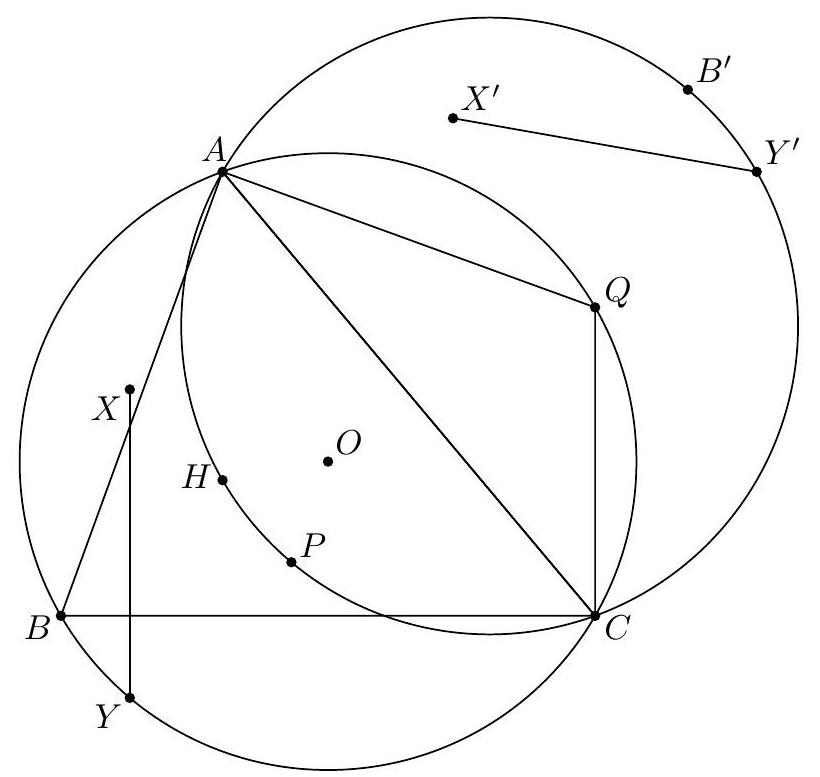
We eliminate the floating orthocenter by reflecting $P$ across $\overline{A C}$ to $Q$. Then $Q$ lies on ( $A B C$ ) and moreover $\angle Q A C=\frac{1}{2} \angle B A C$. This motivates us to reflect $B, X, Y$ to $B^{\prime}$, $X^{\prime}, Y^{\prime}$ and complex bash with respect to $\triangle A Q C$. Obviously
Now we need to compute $x^{\prime}$. You can get this using the formula
Using the angle condition we know $b=\frac{c^{3}}{q^{2}}$, and then that
Therefore
whence
§2.3 USAMO 2014/6, proposed by Gabriel Dospinescu
Available online at https://aops.com/community/p3478578.
Problem statement
Prove that there is a constant $c>0$ with the following property: If $a, b, n$ are positive integers such that $\operatorname{gcd}(a+i, b+j)>1$ for all $i, j \in{0,1, \ldots, n}$, then
Let $N=n+1$ and assume $N$ is (very) large. We construct an $N \times N$ with cells $(i, j)$ where $0 \leq i, j \leq n$ and in each cell place a prime $p$ dividing $\operatorname{gcd}(a+i, b+j)$.
The central claim is at least $50 %$ of the primes in this table exceed $0.001 n^{2}$. We count the maximum number of squares they could occupy:
Here the summation runs over primes $p \leq 0.001 n^{2}$. Let $r=\pi\left(0.001 n^{2}\right)$ denote the number of such primes. Now we consider the following three estimates. First,
which follows by adding all the primes directly with some computation. Moreover,
using the harmonic series bound, and
via Prime Number Theorem. Hence the sum in question is certainly less than $\frac{1}{2} N^{2}$ for $N$ large enough, establishing the central claim.
Hence some column $a+i$ has at least one half of its primes greater than $0.001 n^{2}$. Because this is greater than $n$ for large $n$, these primes must all be distinct, so $a+i$ exceeds their product, which is larger than
where $c$ is some constant (better than the requested bound).