

condition stringclasses 1
value | instruction stringlengths 15 7.47k | response stringlengths 12 9.93k |
|---|---|---|
synth,cot | 11. Given that $A B C D$ is a parallelogram, if $\overrightarrow{A B}=\vec{a}, \overrightarrow{A C}=\vec{b}, E$ is the midpoint of $C D$, then $\overrightarrow{E B}=$ $\qquad$ | 11. $\frac{3}{2} \vec{a}-\vec{b}$.
\boxed{\frac{3}{2}\vec{}-\vec{b}} |
synth,cot | In the diagram, $\triangle Q R S$ is an isosceles right-angled triangle with $Q R=S R$ and $\angle Q R S=90^{\circ}$. Line segment $P T$ intersects $S Q$ at $U$ and $S R$ at $V$. If $\angle P U Q=\angle R V T=y^{\circ}$, the value of $y$ is
(A) 72.5
(B) 60
(C) 67.5
(D) 62.5
(E) 70
+\frac{1}{2 \sqrt{2... |
synth,cot | Suppose $F$ is a polygon with lattice vertices and sides parralell to x-axis and y-axis.Suppose $S(F),P(F)$ are area and perimeter of $F$.
Find the smallest k that:
$S(F) \leq k.P(F)^2$ | 1. **Understanding the Problem:**
We need to find the smallest constant \( k \) such that for any polygon \( F \) with lattice vertices and sides parallel to the x-axis and y-axis, the inequality \( S(F) \leq k \cdot P(F)^2 \) holds, where \( S(F) \) is the area and \( P(F) \) is the perimeter of \( F \).
2. **Anal... |
synth,cot | If $\left(2^{a}\right)\left(2^{b}\right)=64$, then the mean (average) of $a$ and $b$ is
(A) 12
(B) $\frac{5}{2}$
(C) $\frac{3}{2}$
(D) 3
(E) 8
Part B: Each correct answer is worth 6. | Since $\left(2^{a}\right)\left(2^{b}\right)=64$, then $2^{a+b}=64$, using an exponent law.
Since $64=2^{6}$, then $2^{a+b}=2^{6}$ and so $a+b=6$.
Therefore, the average of $a$ and $b$ is $\frac{1}{2}(a+b)=3$.
ANSWER: (D)
\boxed{3} |
synth,cot | 3. All seven-digit numbers consisting of different digits from 1 to 7 were listed in ascending order. What is the position of the number 3241765? | Answer: 1590
## Examples of how to write the answer:
1,7
#
\boxed{1590} |
synth,cot | 4.9. Form the equation of the plane passing through the line $(x-1) / 2=(y-3) / 4=z /(-1)$ and the point $P_{1}(1,5,2)$. | Solution. Let's write the condition of coplanarity of three vectors: the current vector $\overrightarrow{P_{0} M}=(x-1, y-3, z)$, the vector $\overrightarrow{P_{0} P_{1}}=(0,2,2)$; belonging to the plane, and the direction vector of the given line $\vec{a}=(2,4,-1)$, parallel to the given plane:
$$
\begin{aligned}
& \... |
synth,cot | Example 9 For a finite set $A$, function $f: N \rightarrow A$ has only the following property: if $i, j \in N, |H| i-j |$ is a prime number, then $f(i) \neq f(j)$. How many elements does set $A$ have at least? | Solution: Let $|A|$ denote the number of elements in the finite set $A$, and estimate the lower bound of $|A|$.
Since the absolute value of the difference between any two numbers among $1, 3, 6, 8$ is a prime number, by the problem's condition: $f(1)$, $f(3)$, $f(6)$, $f(8)$ are four distinct elements in $A$. Therefor... |
synth,cot | In a right-angled triangle, the height dropped from the right angle to the hypotenuse forms angles with the bisectors of the acute angles, the ratio of which is $13: 17$. What are the measures of the acute angles of the triangle? | Let one of the acute angles of the right triangle be $\alpha$, the angle formed by the height and the two angle bisectors be $\varepsilon$ and $\eta$. Then
$$
\varepsilon=90^{\circ}-\frac{\alpha}{2} \text { and } 90^{\circ}-\frac{90^{\circ}-\alpha}{2}=45^{\circ}+\frac{\alpha}{2}
$$
According to the problem,
$$
\frac... |
synth,cot | 2. In $\triangle A B C$, it is known that the three interior angles $\angle A$, $\angle B$, $\angle C$ are opposite to the sides $a$, $b$, $c$ respectively, and satisfy $a \sin A \cdot \sin B + b \cos ^{2} A = \sqrt{2} a$. Then $\frac{b}{a}=$ . $\qquad$ | 2. $\sqrt{2}$.
From the given and the Law of Sines, we have
$$
\begin{array}{l}
\sqrt{2} a=a \sin A \cdot \sin B+b\left(1-\sin ^{2} A\right) \\
=b+\sin A(a \sin B-b \sin A)=b . \\
\text { Therefore, } \frac{b}{a}=\sqrt{2} .
\end{array}
$$
\boxed{\sqrt{2}} |
synth,cot | Example 2 Find all sequences of positive integers $\left\{a_{n}\right\}$ that satisfy the following conditions:
(1) The sequence $\left\{a_{n}\right\}$ is bounded above, i.e., there exists $M>0$, such that for any $n \in \mathbf{N}^{\cdot}$, we have $a_{n} \leqslant M ;$
(2) For any $n \in \mathbf{N}^{*}$, we have $a_{... | Let $g_{n}=\left(a_{n}, a_{n+1}\right)$, then $g_{n} a_{n+2}=a_{n+1}+a_{n}$. Combining this with $g_{n+1}\left|a_{n+1}, g_{n+1}\right| a_{n+2}$, we know that $g_{n+1} \mid a_{n}$, which indicates that $g_{n+1}$ is a common divisor of $a_{n}$ and $a_{n+1}$, hence $g_{n+1} \leqslant g_{n}$. This means that the sequence $... |
synth,cot | Example 2 Let $A B C D$ be a trapezoid, $A D / / B C, A D=a, B C=b$, the diagonals $A C$ and $B D$ intersect at $P_{1}$, draw $P_{1} Q_{1} / / A D$ intersecting $C D$ at $Q_{1}$, connect $A Q_{1}$, intersecting $B D$ at $P_{2}$, draw $P_{2} Q_{2} / / A D$ intersecting $C D$ at $Q_{2}$, connect $A Q_{2}$ intersecting $B... | Solution: (1) As shown in Figure 4-2 (a), since $A D=a$, $B C=b$, according to the problem, we have
$$
P_{1} Q_{1}=x_{1}=\frac{a b}{a+b},
$$
Taking out the trapezoid $A P_{k} Q_{k} D$, as shown in Figure (b), we get
$$
\begin{array}{l}
\frac{x_{k+1}}{x_{k}}=\frac{D Q_{k+1}}{D Q_{k}} . \\
\text { Also } \quad \frac{x_{... |
synth,cot | II. (25 points) Given the quadratic function
$$
y=x^{2}+b x-c
$$
the graph passes through three points
$$
P(1, a), Q(2,3 a)(a \geqslant 3), R\left(x_{0}, y_{0}\right) .
$$
If the centroid of $\triangle P Q R$ is on the $y$-axis, find the minimum perimeter of $\triangle P Q R$. | Given points $P$ and $Q$ are on the graph of the quadratic function
$$
y=x^{2}+b x-c
$$
we have,
$$
\left\{\begin{array} { l }
{ 1 + b - c = a , } \\
{ 4 + 2 b - c = 3 a }
\end{array} \Rightarrow \left\{\begin{array}{l}
b=2 a-3, \\
c=a-2 .
\end{array}\right.\right.
$$
Since the centroid of $\triangle P Q R$ lies on ... |
synth,cot | Example 4. A discrete random variable $X$ has the following distribution:
| $X$ | 3 | 4 | 5 | 6 | 7 |
| :--- | :--- | :--- | :--- | :--- | :--- |
| $P$ | $p_{1}$ | 0.15 | $p_{3}$ | 0.25 | 0.35 |
Find the probabilities $p_{1}=P(X=3)$ and $p_{3}=P(X=5)$, given that $p_{3}$ is 4 times $p_{1}$. | Solution. Since
$$
p_{2}+p_{4}+p_{5}=0.15+0.25+0.35=0.75
$$
then based on equality (2.1.2), we conclude that
$$
p_{1}+p_{3}=1-0.75=0.25
$$
Since by the condition $p_{3}=4 p_{1}$, then
$$
p_{1}+p_{3}=p_{1}+4 p_{1}=5 p_{1} .
$$
Thus, $5 p_{1}=0.25$, from which $p_{1}=0.05$; therefore,
$$
p_{3}=4 p_{1}=4 \cdot 0.05... |
synth,cot | Riquinho distributed $R \$ 1000.00$ reais among his friends: Antônio, Bernardo, and Carlos in the following manner: he gave, successively, 1 real to Antônio, 2 reais to Bernardo, 3 reais to Carlos, 4 reais to Antônio, 5 reais to Bernardo, etc. How much did Bernardo receive? | The money was divided into installments in the form
$$
1+2+3+\cdots+n \leq 1000
$$
Since $1+2+3+\cdots+n$ is the sum $S_{n}$ of the first $n$ natural numbers starting from $a_{1}=1$, we have:
$$
S_{n}=\frac{\left(a_{1}+a_{n}\right) n}{2}=\frac{(1+n) n}{2} \leq 1000 \Longrightarrow n^{2}+n-2000 \leq 0
$$
We have tha... |
synth,cot | Example 8 Let the area of $\triangle ABC$ be $1, B_{1}, B_{2}$ and $C_{1}, C_{2}$ be the trisection points of sides $AB, AC$, respectively. Connect $B_{1}C, B_{2}C, BC_{1}, BC_{2}$. Find the area of the quadrilateral they form. | As shown in Figure 1.3.7, let $B C_{2}$ intersect $C B_{2}$ at $R$, and intersect $B_{1} C$ at $S$; $B C_{1}$ intersects $B_{1} C$ at $P$, and intersects $B_{2} C$ at $Q$. By Menelaus' theorem, we have
$$
\frac{B S}{S C_{2}} \cdot \frac{C_{2} C}{C A} \cdot \frac{A B_{1}}{B_{1} B}=1
$$
Also, because
$$
\frac{C_{2} C}{C... |
synth,cot | 689. Find the following improper integrals:
1) $\int_{0}^{+\infty} e^{-x} d x$
2) $\int_{-\infty}^{+\infty} \frac{d x}{x^{2}+1}$
3) $\int_{0}^{1} \frac{d x}{x}$
4) $\int_{-1}^{2} \frac{d x}{\sqrt[3]{(x-1)^{2}}}$
Explain the solutions geometrically. | Solution. 1) Using equality (1), we have
$$
\int_{0}^{+\infty} e^{-x} d x=\lim _{\beta \rightarrow+\infty} \int_{0}^{\beta} e^{-x} d x=\left.\lim \left(-e^{-x}\right)\right|_{0} ^{\beta}=\lim \left(e^{0}-e^{-\beta}\right)=1
$$
Therefore, the given improper integral converges.
Geometrically, in a rectangular coordina... |
synth,cot | 13. Task $\Gamma$. Dudeney. If one and a half chickens lay one and a half eggs in one and a half days, then how many chickens plus another half chicken, laying eggs one and a half times faster, will lay ten eggs and a half in one and a half weeks? | 13.If one and a half chickens lay one and a half eggs in one and a half days, then one chicken will lay one egg in one and a half days. A chicken that "works" one and a half times faster will lay one and a half eggs in one and a half days (one egg per day). Therefore, this chicken will lay ten and a half eggs in ten an... |
synth,cot | 11. (20 points) Given the ellipse $\Gamma: \frac{x^{2}}{a^{2}}+\frac{y^{2}}{b^{2}}=1$. Find the maximum perimeter of the inscribed parallelogram $A B C D$ in the ellipse. | 11. The perimeter of $\square A B C D$ is a bounded continuous number in the closed interval of the positions of points $A, B, C, D$, and it must have a maximum value. Taking a set of points $A, B, C, D$ that maximize this perimeter, the ellipse with foci at $A, C$ and passing through $B, D$ is tangent to the ellipse $... |
synth,cot | Let's determine all solutions of the system of equations $x^{2}+y^{2}=x, 2 x y=y$.
---
Find all solutions of the system of equations $x^{2}+y^{2}=x, 2 x y=y$. | Combine the two equations:
$$
x^{2}+y^{2}=x, \quad (1) \quad 2xy=y, \quad (2)
$$
and we get
$$
(x+y)^{2}=x+y
$$
If $x+y \neq 0$, we can simplify by dividing by $x+y$, leading to the equation $x+y=1$. From this, substituting $x=1-y$ we get
$$
2y(1-y)=y
$$
If $y \neq 0$, simplifying by dividing by $y$ gives the equ... |
synth,cot | N3 (4-1, Poland) Find the smallest positive integer $n$ with the following properties:
(1) The unit digit of $n$ is 6;
(2) If the unit digit 6 of $n$ is moved to the front of the other digits, the resulting new number is 4 times $n$. | Solution 1 Let $n=10a+6$, where $a$ is an $m$-digit number. Then
$$
\begin{array}{c}
6 \times 10^{m}+a=4(10a+6). \\
a=\frac{2\left(10^{m}-4\right)}{13}.
\end{array}
$$
Since $a$ is a positive integer, $(2,13)=1$, hence $13 \mid 10^{m}-4. m$ is at least 5, at this point $n=$ 153846.
Therefore, the minimum value of $n$ ... |
synth,cot | 5. Let $f(x)=a_{0}+a_{1} x+a_{2} x^{2}+a_{4} x^{3}+a_{4} x^{4}+a_{5} x^{5}$ be a polynomial in $x$ where $a_{0}, a_{1}, a_{2}, a_{3}, a_{4}$ are constants and $a_{5}=7$. When divided by $x-2004, x-2005, x-2006, x-2007$ and $x-2008$, $\mathrm{f}(x)$ leaves a remainder of $72,-30,32,-24$ and 24 respectively. Find the val... | 5. Answer: 1742.
We have
$$
\begin{array}{l}
f(x)=\frac{(x-2005)(x-2006)(x-2007)(x-2008)}{(-1)(-2)(-3)(-4)}(72)+\frac{(x-2004)(x-2006)(x-2007)(x-2008)}{(1)(-1)(-2)(-3)}(-30)+ \\
\frac{(x-2004)(x-2005)(x-2007)(x-2008)}{(2)(1)(-1)(-2)}(32)+\frac{(x-2004)(x-2005)(x-2006)(x-2008)}{(3)(2)(1)(-1)}(-24)+ \\
\frac{(x-2004)(x-2... |
synth,cot | 3. Solve the system of equations $\left\{\begin{array}{l}x^{2} y+x y^{2}-2 x-2 y+10=0, \\ x^{3} y-x y^{3}-2 x^{2}+2 y^{2}-30=0 .\end{array}\right.$ | Answer: $(-4, -1)$.
Solution. The given system is equivalent to the following:
$$
\left\{\begin{array} { l }
{ x y ( x + y ) - 2 ( x + y ) + 10 = 0 , } \\
{ x y ( x ^ { 2 } - y ^ { 2 } ) - 2 ( x ^ { 2 } - y ^ { 2 } ) - 30 = 0 }
\end{array} \Leftrightarrow \left\{\begin{array}{l}
(x y-2)(x+y)=-10 \\
(x y-2)(x-y)(x+y)... |
synth,cot | 【Question 12】
The 200-digit number $M$ consists of 200 ones, $M \times 2013$, the sum of the digits of the product is $\qquad$. | 【Analysis and Solution】
$$
M \times 2013=M \times 2000+M \times 10+M \times 3=\underbrace{11 \cdots 1}_{200 \uparrow 1} \times 2000+\underbrace{11 \cdots 1}_{200 \uparrow 1} \times 10+\underbrace{11 \cdots 1}_{200 \uparrow 1} \times 3=\underbrace{22 \cdots 2}_{200 \uparrow 2} 000+\underbrace{11 \cdots 10}_{200 \uparrow... |
synth,cot | 3. In $\triangle A B C$,
$$
\cos A+\sin A-\frac{2}{\cos B+\sin B}=0 \text {. }
$$
Then the value of $\frac{a}{c}$ is $\qquad$ | 3. $\frac{\sqrt{2}}{2}$.
From the given equation, we have
$$
\sqrt{2} \sin \left(A+\frac{\pi}{4}\right)-\frac{\sqrt{2}}{\sin \left(B+\frac{\pi}{4}\right)}=0,
$$
which means $\sin \left(A+\frac{\pi}{4}\right) \cdot \sin \left(B+\frac{\pi}{4}\right)=1$.
Since $0 \leqslant \sin \left(A+\frac{\pi}{4}\right), \sin \left(B... |
synth,cot | 4. (7 points) When copying a problem, Lin Lin mistakenly wrote a repeating decimal as 0.123456. If the digits are correct but the dots indicating the repeating section were omitted, there are $\qquad$ possible original decimals. | 【Answer】Solution: According to the analysis,
if there is only one point in the repeating section, then it can only be above the digit "6";
if there are 2 points in the repeating section, then one of them must be above the digit "6"; the other may be above " $1, 2, 3, 4, 5$ ",
so there are $1+5=6$ possibilities in tota... |
synth,cot | Question 17: Let the function $f(x)$ be defined on $[0,1]$, satisfying: $f(0)=f(1)$, and for any $x, y \in[0,1]$ there is $|f(x)-f(y)|<|x-y|$. Try to find the smallest real number $m$, such that for any $f(x)$ satisfying the above conditions and any $x, y \in[0,1]$, we have $|f(x)-f(y)|<m$. | Question 17, Solution: First, we prove that for any function $f(x)$ satisfying the conditions and any $x, y \in [0,1]$, we have $|f(x)-f(y)| < \frac{1}{2}$. If $|x-y| > \frac{1}{2}$, then $|f(x)-f(y)| = |f(x)-f(0)+f(1)-f(y)| \leq |f(x)-f(0)| + |f(1)-f(y)| < (x-0) + (1-y) = 1 - (y-x) < \frac{1}{2}$.
On the other hand, ... |
synth,cot | 5. The number of non-negative integer solutions $(x, y)$ for the equation $3 x^{2}+x y+y^{2}=3 x-2 y$ is ( )
(A) 0
(B) 1
(C) 2
(D) 3 | 5.C.
From $3 x^{2}+x y+y^{2}=3 x-2 y$, we can obtain the equation about $y$: $y^{2}+(2+x) y+3 x^{2}-3 x=0$.
. Then $\Delta=(2+x)^{2}-4\left(3 x^{2}-3 x\right)$
$$
\begin{array}{l}
=-11 x^{2}+16 x+4 \\
\leqslant \frac{16^{2}+4 \times 11 \times 4}{4 \times 11} \leqslant 10,
\end{array}
$$
Therefore, when $-11 x^{2}+16 ... |
synth,cot | 14. Given an equilateral triangle $ABC$, points $D$, $E$, and $F$ are on $BC$, $AC$, and $AB$ respectively, with $BC=3BD$, $BA=3BF$, and $EA=\frac{1}{3}AC$. Find the degree measure of $\angle ADE + \angle FEB$. | 【Answer】 $30^{\circ}$
【Analysis】 $\because \angle A D E=\angle F E D, \therefore \angle A D E+\angle F E B=\angle F E D$. Also, $\because \angle F A E=60^{\circ}$, $A E: A F=1: 2, \therefore \angle A E F=90^{\circ}$, and $A B / / D E$, then $\angle B \cdot 4 C=\angle D E C=60^{\circ}$ : Therefore, $\angle A D E+\angle ... |
synth,cot | 3-2. In the decimal representation of a positive number \(\alpha\), all decimal places starting from the fourth digit after the decimal point are discarded (i.e., an approximation of \(\alpha\) with a deficiency is taken with an accuracy of 0.001). The resulting number is divided by \(\alpha\), and the quotient is agai... | Solve 2. Answer: \(0, \frac{500}{1000}, \frac{501}{1000}, \ldots, \frac{999}{1000}, 1\). See the solution to problem 2 for 8th grade.
\boxed{0,\frac{500}{1000},\frac{501}{1000},\ldots,\frac{999}{1000},1} |
synth,cot | Let's determine the first term and the common difference of an arithmetic progression, if the sum of the first $n$ terms of this progression is $\frac{n^{2}}{2}$ for all values of $n$. | I. Solution. Since the sum of the first $n$ terms is $\frac{n^{2}}{2}$, the first term is $\frac{1^{2}}{2}=\frac{1}{2}$; the sum of the first two terms is $\frac{2^{2}}{2}=2$; thus, the second term is $2-\frac{1}{2}=\frac{3}{2}$, and the common difference $d=1$; the arithmetic sequence itself is:
$$
\frac{1}{2}, \frac... |
synth,cot | 330. Simplify the sums:
a) $\operatorname{ctg}^{2} \frac{\pi}{2 n+1}+\operatorname{ctg}^{2} \frac{2 \pi}{2 n+1}+\operatorname{ctg}^{2} \frac{3 \pi}{2 n+1}+\ldots+\operatorname{ctg}^{2} \frac{n \pi}{2 n+1}$;
b) $\operatorname{cosec}^{2} \frac{\pi}{2 n+1}+\operatorname{cosec}^{2} \frac{2 \pi}{2 n+1}+\operatorname{cosec... | 330. a) The sum of the roots of the equation of degree $n$
$$
x^{n}-\frac{C_{2 n+1}^{3}}{C_{2 n+1}^{1}} x^{n-1}+\frac{C_{2 n+1}^{5}}{C_{2 n+1}^{1}} x^{n-2}-\ldots=0
$$
(see the solution of problem 229 b)) is equal to the coefficient of $x^{n-1}$, taken with the opposite sign, i.e.
$\operatorname{ctg}^{2} \frac{\pi}{... |
synth,cot | 22. The figure below shows a circle with diameter $A B . C$ and $D$ are points on the circle on the same side of $A B$ such that $B D$ bisects $\angle C B A$. The chords $A C$ and $B D$ intersect at $E$. It is given that $A E=169 \mathrm{~cm}$ and $E C=119 \mathrm{~cm}$, If $E D=x \mathrm{~cm}$, find the value of $x$. | 22. Answer: 65
Since $B E$ bisects $\angle C B A$, we have $\frac{B C}{B A}=\frac{E C}{E A}=\frac{119}{169}$. Thus we can let $B C=119 y$ and $B A=169 y$ for some real number $y$. Since $\angle B C A=90^{\circ}$, we have
$$
\begin{array}{l}
A B^{2}=A C^{2}+B C^{2} \\
(169 y)^{2}=(169+119)^{2}+(119 y)^{2} \\
y^{2}(169-1... |
synth,cot | Example 5. Calculate the integral
$$
\int_{0}^{i} z \cos z d z
$$ | Solution. The functions $f(z)=z$ and $\varphi(z)=\cos z$ are analytic everywhere. Applying the formula for integration by parts, we get
$$
\begin{aligned}
\int_{0}^{i} z \cos z d z & =\int_{0}^{i} z(\sin z)^{\prime} d z=\left.(z \sin z)\right|_{0} ^{i}-\int_{0}^{i} \sin z d z= \\
& =i \sin i+\left.\cos z\right|_{0} ^{... |
synth,cot | ## Problem Statement
Calculate the definite integral:
$$
\int_{6}^{10} \sqrt{\frac{4-x}{x-12}} d x
$$ | ## Solution
$$
\int_{6}^{10} \sqrt{\frac{4-x}{x-12}} d x=
$$
Substitution:
$$
\begin{aligned}
& t=\sqrt{\frac{4-x}{x-12}} \Rightarrow t^{2}=\frac{4-x}{x-12}=-\frac{x-12+8}{x-12}=-1-\frac{8}{x-12} \Rightarrow \\
& \Rightarrow 12-x=\frac{8}{t^{2}+1} \Rightarrow x=-\frac{8}{t^{2}+1}+12 \\
& d x=\frac{8}{\left(t^{2}+1\r... |
synth,cot | If $10 x+y=75$ and $10 y+x=57$ for some positive integers $x$ and $y$, the value of $x+y$ is
(A) 12
(B) 5
(C) 7
(D) 77
(E) 132 | Since $10 x+y=75$ and $10 y+x=57$, then
$$
(10 x+y)+(10 y+x)=75+57
$$
and so
$$
11 x+11 y=132
$$
Dividing by 11 , we get $x+y=12$.
(We could have noticed initially that $(x, y)=(7,5)$ is a pair that satisfies the two equations, thence concluding that $x+y=12$.)
ANSWER: (A)
\boxed{12} |
synth,cot | 8. The cunning rabbit and the foolish fox agreed: if the fox crosses the bridge in front of the rabbit's house each time, the rabbit will give the fox money to double the fox's money, but each time crossing the bridge, the fox has to pay the rabbit 40 cents as a toll. Hearing that his money would double every time he c... | 8. C.
Let $f(x)=2 x-40$. Then
$$
\begin{array}{l}
f(f(f(x)))=0 \\
\Rightarrow 2[2(2 x-40)-40]-40=0 \\
\Rightarrow x=35 .
\end{array}
$$
\boxed{35} |
synth,cot | 16. Find the sum: $1+3+5+\ldots+1999$. | 16. Let $S=1+3+5+\ldots+1999$. Rewrite it as: $S=1999+1997+\ldots+1$. Then $2 S=2000 \cdot 1000 . S=1000000$.
\boxed{1000000} |
synth,cot | $1 \cdot 111$ An increasing integer sequence, if its 1st term is odd, the 2nd term is even, the 3rd term is odd, the 4th term is even, and so on, is called an alternating sequence. The empty set is also considered an alternating sequence. The number of all alternating sequences with each term taken from the set $\{1,2,... | [Solution]When $n=1$, the empty set $\emptyset$ and $\{1\}$ are two alternating sequences, so $A(1)=2$. When $n=2$, in addition to the above two, the alternating sequence $\{1,2\}$ is added, so $A(2)=3$.
Let $\left\{a_{1}, a_{2}, \cdots, a_{m}\right\}$ be a non-empty alternating sequence taken from the set $\{1,2, \cd... |
synth,cot | 12. (10 points) Grandpa Hua Luogeng was born on November 12, 1910. Arrange these numbers into an integer, and factorize it as $19101112=1163 \times 16424$. Are either of the numbers 1163 and 16424 prime? Please explain your reasoning. | 12. (10 points) Grandpa Hua Luogeng was born on November 12, 1910. Arrange these numbers into an integer, and factorize it as $19101112=1163 \times 16424$. Are there any prime numbers among 1163 and 16424? Please explain your reasoning.
【Analysis】According to the concept of composite numbers, it is easy to determine th... |
synth,cot | 16. If an internal point of some $n$-sided prism is connected to all its vertices, then we obtain $n$ quadrilateral pyramids with a common vertex at this point, the bases of which are the lateral faces of the prism. Find the ratio of the sum of the volumes of these pyramids to the volume of the given prism. | 16. Let $S$ be the area of the base of a prism, $h$ its height, and $P$ a given point. If all pyramids with vertex $P$ and lateral faces of the prism as bases are removed from the prism, two pyramids with vertex $P$ and bases coinciding with the bases of the prism will remain. The volume of one of them is $\frac{1}{3} ... |
synth,cot | Example 4.10. Investigate the convergence of the series $\sum_{n=1}^{\infty} \frac{2 n+1}{a^{n}}$, $(a>0)$. | Solution. In this case $a_{n}=\frac{2 n+1}{a^{n}}>0$. Let's find the limit (4.6)
$$
\lim _{n \rightarrow \infty} \frac{2 n+3}{a^{n+1}}: \frac{2 n+1}{a^{n}}=\lim _{n \rightarrow \infty} \frac{2 n+3}{2 n+1} \cdot \frac{1}{a}=\frac{1}{a}
$$
Based on Theorem 4.8, we conclude: if $a>1$ the series converges, if $0<a<1$ the... |
synth,cot | ## Task A-2.1.
Determine, if it exists, the real parameter $k$ such that the maximum value of the function
$$
f_{1}(x)=(k-8) x^{2}-2(k-5) x+k-9
$$
is equal to the minimum value of the function
$$
f_{2}(x)=(k-4) x^{2}-2(k-1) x+k+7
$$ | ## Solution.
For the function $f_{1}(x)$ to have a maximum, it must be $k-8<0$, i.e., $k<8$,
The maximum value of the function $f_{1}(x)$ is $\quad \frac{4(k-8)(k-9)-4(k-5)^{2}}{4(k-8)}$,
i.e., $\max _{x \in \mathbb{R}} f_{1}(x)=\frac{47-7 k}{k-8}$.
The minimum value of the function $f_{2}(x)$ is $\frac{4(k-4)(k+7)... |
synth,cot | The following limits need to be calculated:
a.) $\lim _{x \rightarrow 0} \frac{1-\cos x}{x^{2}}=$ ?
b.) $\lim _{x \rightarrow \pi} \frac{\sin 3 x}{x-\pi}=?$
c.) $\lim _{x \rightarrow 1} \frac{\cos \frac{\pi x}{2}}{x-1}=$ ?
d.) $\lim _{x=0} \frac{1}{x} \sin \frac{\pi}{1+\pi x}=$ ? | Since
$$
\begin{aligned}
& \frac{1-\cos x}{x^{2}}=\frac{1}{2} \cdot \frac{\sin ^{2} \frac{x}{2}}{\left(\frac{x}{2}\right)^{2}} ; \quad \frac{\sin 3 x}{x-\pi}=\frac{\sin 3[\pi+(x-\pi)]}{x-\pi}= \\
& =-3 \cdot \frac{\sin 3(x-\pi)}{3(x-\pi)} ; \quad \frac{\cos \frac{\pi}{2} x}{x-1}=-\frac{\pi}{2} \cdot \frac{\sin \left[\... |
synth,cot | The regular price for a T-shirt is $\$ 25$ and the regular price for a pair of jeans is $\$ 75$. If the T-shirt is sold at a $30 \%$ discount and the jeans are sold at a $10 \%$ discount, then the total discount is
(A) $\$ 15$
(B) $\$ 20$
(C) $\$ 30$
(D) $\$ 36$
(E) $\$ 40$ | The discount on the T-shirt is $30 \%$ of $\$ 25$, or $0.3 \times \$ 25=\$ 7.50$.
The discount on the jeans is $10 \%$ of $\$ 75$, or $0.1 \times \$ 75=\$ 7.50$.
So the total discount is $\$ 7.50+\$ 7.50=\$ 15$.
ANSWER: (A)
\boxed{15} |
synth,cot | The value of $\frac{1}{2}-\frac{1}{8}$ is
(A) $\frac{3}{8}$
(B) $-\frac{1}{6}$
(C) $\frac{5}{8}$
(D) $\frac{1}{16}$
(E) $\frac{1}{4}$ | Using a common denominator,
$$
\frac{1}{2}-\frac{1}{8}=\frac{4}{8}-\frac{1}{8}=\frac{3}{8}
$$
Answer: (A)
\boxed{\frac{3}{8}} |
synth,cot | 10. What is the value of $\sqrt{13+\sqrt{28+\sqrt{281}}} \times \sqrt{13-\sqrt{28+\sqrt{281}}} \times \sqrt{141+\sqrt{281}}$ ? | Solution
140
$$
\begin{array}{l}
\sqrt{13+\sqrt{28+\sqrt{281}}} \times \sqrt{13-\sqrt{28+\sqrt{281}}} \times \sqrt{141+\sqrt{281}} \\
=\sqrt{13^{2}-(\sqrt{28+\sqrt{281}})^{2}} \times \sqrt{141+\sqrt{281}} \\
=\sqrt{169-(28+\sqrt{281})} \times \sqrt{141+\sqrt{281}} \\
=\sqrt{141-\sqrt{281}} \times \sqrt{141+\sqrt{281}}=... |
synth,cot | 203. Find the condition for the compatibility of the equations:
$$
a_{1} x+b_{1} y=c_{1}, \quad a_{2} x+b_{2} y=c_{2}, \quad a_{3} x+b_{3} y=c_{3}
$$ | Instruction. Assuming that the equations are consistent, transform the first two into the form:
$$
\left(a_{1} b_{2}-a_{2} b_{1}\right) x=c_{1} b_{2}-c_{2} b_{1}, \quad\left(a_{1} b_{2}-a_{2} b_{1}\right) y=a_{1} c_{2}-a_{2} c_{1}
$$
Determine the form of the values for $x$ and $y$ under the assumption that $a_{1} b_... |
synth,cot | 2.4. How many 9-digit numbers divisible by 2 can be formed by rearranging the digits of the number 231157152? | Answer: 3360. Instructions. The number of numbers will be $\frac{8!}{3!2!}=3360$.
\boxed{3360} |
synth,cot | 7.088. $3 \cdot 4^{\log _{x} 2}-46 \cdot 2^{\log _{x} 2-1}=8$. | Solution.
Domain of definition: $0<x \neq 1$.
We have $3 \cdot 2^{2 \log _{x} 2}-23 \cdot 2^{\log _{x} 2}-8=0$. Solving the equation as a quadratic in terms of $2^{\log _{x} 2}$, we find $2^{\log _{x} 2}=-\frac{1}{3}, \varnothing$; or $2^{\log _{x} 2}=8$, from which $\log _{x} 2=3, x=\sqrt[3]{2}$.
Answer: $\sqrt[3]{... |
synth,cot | There are $10$ seats in each of $10$ rows of a theatre and all the seats are numbered. What is the probablity that two friends buying tickets independently will occupy adjacent seats?
$
\textbf{a)}\ \dfrac{1}{55}
\qquad\textbf{b)}\ \dfrac{1}{50}
\qquad\textbf{c)}\ \dfrac{2}{55}
\qquad\textbf{d)}\ \dfrac{1}{25}
\qquad... | 1. **Total Number of Ways to Choose Seats:**
- There are \(10\) rows and \(10\) seats in each row, making a total of \(100\) seats.
- The total number of ways to choose \(2\) seats out of \(100\) is given by the combination formula:
\[
\binom{100}{2} = \frac{100 \times 99}{2} = 4950
\]
2. **Number... |
synth,cot | 6. Ms. Carol promises: In the upcoming exam, students who answer all multiple-choice questions correctly will receive an excellent award. Which of the following statements is correct? ( ).
(A) If Louis did not receive the excellent award, then he got all multiple-choice questions wrong.
(B) If Louis did not receive the... | 6. B.
Original statement: If all multiple-choice questions are answered correctly, then an excellent award is obtained.
Contrapositive: If an excellent award is not obtained, then at least one multiple-choice question is answered incorrectly.
Since the original statement is equivalent to the contrapositive, option $... |
synth,cot | In a race, people rode either bicycles with blue wheels or tricycles with tan wheels. Given that 15 more people rode bicycles than tricycles and there were 15 more tan wheels than blue wheels, what is the total number of people who rode in the race? | 1. Let \( b \) be the number of bicycles and \( t \) be the number of tricycles.
2. According to the problem, there are 15 more people who rode bicycles than tricycles. This can be written as:
\[
b = t + 15
\]
3. Each bicycle has 2 blue wheels and each tricycle has 3 tan wheels. The problem states that there a... |
synth,cot | ## Aufgabe 34/81
Man ermittle alle Paare $(a ; b)$ natürlicher Zahlen $a$ und $b$, für die gilt $a^{2}-b^{2}=1981$. | Es ist
$$
a^{2}-b^{2}=(a-b)(a+b)=1981=1 \cdot 7 \cdot 283
$$
Wegen $a-b<a+b(b \neq 0$, wie man sich leicht überzeugt) folgt entweder
$$
\begin{array}{r}
a-b=1 \quad ; \quad a+b=1981 \quad ; \quad a=991 ; \quad b=990 \quad \text { oder } \\
a-b=7 \quad ; \quad a+b=283 \quad ; \quad a=145 \quad ; \quad b=138
\end{arra... |
synth,cot | Consider 9 points in the plane with no alignment. What is the minimum value of $n$ such that if we color $n$ edges connecting two of the points in red or blue, we are sure to have a monochromatic triangle regardless of the coloring?
(IMO 1992) | The answer is 33. Indeed, there are $\binom{9}{2}=36$ drawable edges. If 33 are drawn, 3 different points are selected which are vertices of these edges. The other 6 therefore form a complete graph (each connected to each other). It is a classic small exercise to show the existence of a monochromatic triangle. Now, let... |
synth,cot | Compute the sum of all the roots of
$(2x+3)(x-4)+(2x+3)(x-6)=0$
$\textbf{(A) } \frac{7}{2}\qquad \textbf{(B) } 4\qquad \textbf{(C) } 5\qquad \textbf{(D) } 7\qquad \textbf{(E) } 13$ | We expand to get $2x^2-8x+3x-12+2x^2-12x+3x-18=0$ which is $4x^2-14x-30=0$ after combining like terms. Using the quadratic part of [Vieta's Formulas](https://artofproblemsolving.com/wiki/index.php/Vieta%27s_Formulas), we find the sum of the roots is $\frac{14}4 = \boxed{\textbf{(A) }7/2}$.
\boxed{\textbf{(A)}7/2} |
synth,cot | 16*. Among the first ten thousand numbers, how many of them end in 1 and can be represented in the following form: \(8^{m}+5^{n} ?(m \in N, n \in N)\) | 16. Five numbers. Hint. Show that \(m=4\). (KvN, 1972, No. 5, p. 81 .)
\boxed{5} |
synth,cot | Six balls, numbered 2, 3, 4, 5, 6, 7, are placed in a hat. Each ball is equally likely to be chosen. If one ball is chosen, what is the probability that the number on the selected ball is a prime number?
(A) $\frac{1}{6}$
(B) $\frac{1}{3}$
(C) $\frac{1}{2}$
(D) $\frac{2}{3}$
(E) $\frac{5}{6}$ | Of the numbers $2,3,4,5,6,7$, only the numbers $2,3,5$, and 7 are prime.
Since 4 out of the 6 numbers are prime, then the probability of choosing a ball with a prime number is $\frac{4}{6}=\frac{2}{3}$.
ANSWER: (D)
\boxed{\frac{2}{3}} |
synth,cot | Example 1 Given $\left\{\begin{array}{l}\sin \alpha+\sin \beta=1 \\ \cos \alpha+\cos \beta=0\end{array}\right.$, find $\cos 2 \alpha+\cos 2 \beta$. | Solution: From the given, we have $\left\{\begin{array}{l}\sin \alpha=1-\sin \beta, \\ \cos \alpha=-\cos \beta \text {. }\end{array}\right.$ Squaring and adding, we get $\sin \beta=\frac{1}{2}$, thus obtaining $\sin \alpha=\frac{1}{2}$.
Therefore, $\cos 2 \alpha+\cos 2 \beta=1-2 \sin ^{2} \alpha+1-2 \sin ^{2} \beta=1$.... |
synth,cot | 3. Three numbers, the sum of which is 114, are, on the one hand, three consecutive terms of a geometric progression, and on the other - the first, fourth, and twenty-fifth terms of an arithmetic progression, respectively. Find these numbers. | Solution: Let $a, b, c$ be the required numbers, and $d$ be the common difference of the arithmetic progression. Then
$$
\begin{gathered}
\left\{\begin{array} { c }
{ a + b + c = 114 , } \\
{ a c = b ^ { 2 } , } \\
{ b = a + 3 d , } \\
{ c = a + 24 d , }
\end{array} \Leftrightarrow \left\{\begin{array} { c }
{ 3 a +... |
synth,cot | A frog is placed at the [origin](https://artofproblemsolving.com/wiki/index.php/Origin) on the [number line](https://artofproblemsolving.com/wiki/index.php/Number_line), and moves according to the following rule: in a given move, the frog advances to either the closest [point](https://artofproblemsolving.com/wiki/index... | Solution 1
Let us keep a careful tree of the possible number of paths around every multiple of $13$.
From $0 \Rightarrow 13$, we can end at either $12$ (mult. of 3) or $13$ (mult. of 13).
Only $1$ path leads to $12$
Continuing from $12$, there is $1 \cdot 1 = 1$ way to continue to $24$
There are $1 \cdot \left(\frac{... |
synth,cot | Find all triples of continuous functions $f, g, h$ from $\mathbb{R}$ to $\mathbb{R}$ such that $f(x+y)=$ $g(x)+h(y)$ for all real numbers $x$ and $y$. | The answer is $f(x)=c x+a+b, g(x)=c x+a, h(x)=c x+b$, where $a$, $b, c$ are real numbers. Obviously these solutions work, so we wish to show they are the only ones.
First, put $y=0$ to get $f(x+0)=g(x)+h(0)$, so $g(x)=f(x)-h(0)$. Similarly, $h(y)=f(y)-g(0)$. Therefore, the functional equation boils down to $f(x+y)=$ $... |
synth,cot | 4. Inside triangle $ABC$, where $\angle C=70^{\circ}, \angle B=80^{\circ}$, a point $M$ is taken such that triangle $CMB$ is equilateral. Find the angles $MAB$ and $MAC$. | 4. Answer. $\angle M A B=20^{\circ}, \angle M A C=10^{\circ}$.
Consider the circle with center at point $M$ and radius $R=M B=M C$ (see figure).
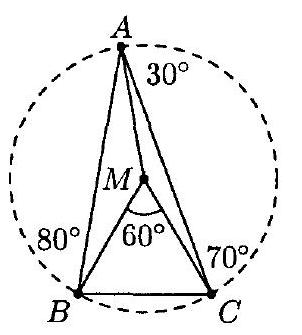
$\angle A=180^{\circ}-(\angle B+\angle C)=30... |
synth,cot | 5. The figure shows a quadrilateral $A B C D$ in which $A D=D C$ and $\angle A D C=\angle A B C=90^{\circ}$. The point $E$ is the foot of the perpendicular from $D$ to $A B$. The length $D E$ is 25 . What is the area of quadrilateral $A B C D$ ? | 5. 625
Draw a line through $D$ that is parallel to $A B$. Let $F$ be the intersection of that line with $B C$ extended, as shown in the diagram.
Now $\quad \angle E D C+\angle C D F=\angle E D C+\angle A D E=90^{\circ}$
Therefore $\angle C D F=\angle A D E=90^{\circ}-\angle E C D$
Also $\quad \angle D F C=\angle D E ... |
synth,cot | 3. Given a tetrahedron $S-ABC$ with the base being an isosceles right triangle with hypotenuse $AB$, and $SA=SB=SC=AB=2$. Suppose points $S, A, B, C$ all lie on a sphere with center $O$. Then the surface area of this sphere is $\qquad$ | 3. $\frac{16 \pi}{3}$.
Since $S A=S B=S C$, the projection of point $S$ on the base, $D$, is the circumcenter of $\triangle A B C$, which is the midpoint of $A B$. It is easy to see that point $O$ lies on $S D$ and is the centroid of $\triangle S A B$. We can find that $O S=\frac{2 \sqrt{3}}{3}$. Therefore, the surfac... |
synth,cot | Let $a_{1}, a_{2}, \cdots, a_{n}$ be all the irreducible proper fractions with a denominator of 60, then $\sum_{i=1}^{n}\left(\cos \frac{a_{1} \pi}{2}\right)^{2}$ equals ( )
(A) 0
(B) 8
(C) 16
(D) 30 | 4. (B).
Since for any $a_{1} \in\left\{a_{1}, \cdots, a_{n}\right\}$, we have $1 \cdots a_{1} \in\left\{a_{1}, \cdots, a_{n}\right\}$, thus $\sum_{1=1}^{n}\left(\cos \frac{a_{1} \pi}{2}\right)^{2}-$ $\sum_{i=1}^{n}\left(\cos \frac{\left(1-a_{i}\right) \pi}{2}\right)^{2}=\sum_{i}^{\pi}\left(\sin \frac{a_{i} \pi}{2}\rig... |
synth,cot | 2. Given $a, b \in \mathbf{R}$, the circle $C_{1}: x^{2}+y^{2}-2 x+4 y-b^{2}+5=0$ intersects with $C_{2}: x^{2}+y^{2}-2(a-6) x-2 a y$ $+2 a^{2}-12 a+27=0$ at two distinct points $A\left(x_{1}, y_{1}\right), B\left(x_{2}, y_{2}\right)$, and $\frac{y_{1}+y_{2}}{x_{1}+x_{2}}+\frac{x_{1}-x_{2}}{y_{1}-y_{2}}$ $=0$, then $a=... | 2. $a=4$ Detailed explanation: Let the midpoint of $A B$ be $M$, and the origin of coordinates be $O$. Then, from $\frac{y_{1}+y_{2}}{x_{1}+x_{2}}+\frac{x_{1}-x_{2}}{y_{1}-y_{2}}=0$ we get $M O \perp A B$, so $O, M, C_{1}, C_{2}$ are collinear. From $k_{\alpha_{1}}=k_{\alpha_{2}}$ we get $a=4$.
\boxed{4} |
synth,cot | 4.20. The length of the hypotenuse of an isosceles right triangle is 40. A circle with a radius of 9 touches the hypotenuse at its midpoint. Find the length of the segment cut off by this circle on one of the legs. | 4.20. First, let's determine whether the problem has a solution given the values of the hypotenuse length and the radius of the circle. From geometric considerations (Fig. 4.17), it is clear that for the circle with center \( O \), lying on the height \( B K \) of triangle \( A B C \), to intersect the leg \( B C \) at... |
synth,cot | 1. Let $a \in R$. If the function $y=f(x)$ is symmetric to $y=10^{x}+3$ with respect to the line $y=x$, and $y=f(x)$ intersects with $y=$ $\lg \left(x^{2}-x+a\right)$, then the range of values for $a$ is $\qquad$ | $$
=, 1 . a3)$, and the equation $x^{2}-x+a=x-3$ has a root $x$ greater than 3. Therefore, the range of values for $a$ is the range of the function $a=-x^{2}+2x-3=-(x-1)^{2}-2$ $(x>3)$. Hence, $a<-6$ is the solution. (Please note the equivalent transformation)
$$
\boxed{a<-6} |
synth,cot | 9.166. $3^{\lg x+2}<3^{\lg x^{2}+5}-2$.
Translate the above text into English, please retain the original text's line breaks and format, and output the translation result directly.
9.166. $3^{\lg x+2}<3^{\lg x^{2}+5}-2$. | ## Solution.
Domain of definition: $x>0$.
Let's write the given inequality as $243 \cdot\left(3^{\lg x}\right)^{2}-9 \cdot 3^{\lg x}-2>0$. Solving
it as a quadratic equation in terms of $3^{\lg x}$, we find $\left[\begin{array}{l}3^{\lg x}>3^{-2}, \\ 3^{\lg x}-2, x>0.01\end{array}\right.$.
Answer: $x \in(0.01 ; \i... |
synth,cot | 3. The solution set of the inequality $\frac{3 x^{2}}{(1-\sqrt[3]{3 x+1})^{2}} \leqslant x+2+\sqrt[3]{3 x+1}$ is $\qquad$ | 3. $\left\{x \left\lvert\,-\frac{2}{3} \leqslant x<0\right.\right\}$.
Let $y=\sqrt[3]{3 x+1}$, then $3 x+1=y^{3}, 3 x=y^{3}-1$. The original inequality transforms to $\frac{(3 x)^{2}}{(1-\sqrt[3]{3 x+1})^{2}} \leqslant 3 x + y \leqslant 1$, which simplifies to $-1 \leqslant \sqrt[3]{3 x+1} \leqslant 1$, yielding $-\fr... |
synth,cot | Let's determine the coefficients $a, b, c$, knowing that the following system of equations has no solution, but if we replace $x-1$ with $|x-1|$ in equation (2), the pair $x=3/4, y=5/8$ satisfies the new system of equations.
$$
\begin{aligned}
& a(x-1)+2 y=1 \\
& b(x-1)+c y=3
\end{aligned}
$$ | The second condition gives two equations for the coefficients. If $x=3 / 4$, then $x-1=-1 / 4,|x-1|=1 / 4$, and thus
$$
\frac{5-a}{4}=1, \quad \frac{2 b+5 c}{8}=3
$$
which means $a=1, b=12-(5 / 2) c$. Substituting these into (1) and (2) results in the system of equations
$$
(x-1)+2 y=1, \quad\{12-(5 / 2) c)\}(x-1)+c... |
synth,cot | 8. Two Go teams, Team A and Team B, each have 5 players who compete in a relay match according to a predetermined order. The No. 1 players of both teams start the match, and the loser is eliminated; then the No. 2 player of the losing team competes against the winner, and the loser is eliminated. This continues until a... | 8. $\frac{187}{256}$.
Let the event of Team A winning be denoted as $A$. Then
$$
P(A)=P(\bar{A})=\frac{1}{2} \text {. }
$$
When Team B wins, all members of Team A have participated, so the number of members who did not participate $X=0$.
When Team A wins and $X=k(k=0,1,36,4)$, $4-k$ members of Team A are eliminated,... |
synth,cot | Can a circle be circumscribed around quadrilateral $A B C D$, if $\angle A D C=30^{\circ}, A B=3, B C=4, A C=6$? | Apply the Law of Cosines and the property of a cyclic quadrilateral.
## Solution
By the Law of Cosines in triangle $A B C$, we find that
$$
\cos \angle B=\frac{9+15-36}{2 \cdot 3 \cdot 4}=-\frac{11}{24} \neq-\frac{\sqrt{3}}{2} .
$$
Therefore, $\angle B+\angle D \neq 180^{\circ}$. Hence, it is not possible to circum... |
synth,cot | 3. In the spatial rectangular coordinate system, the three vertices of $\triangle A B C$ have coordinates $A(3,4,1), B(0,4,5), C(5,2,0)$, then the value of $\tan \frac{A}{2}$ is
A. $\sqrt{5}$
B. $\frac{\sqrt{5}}{5}$
C. $\sqrt{6}$
D. $\frac{\sqrt{6}}{6}$ | Solve $a=BC=3\sqrt{6}, b=AC=3, c=AB=5$, thus $\cos A=\frac{9+25-54}{2 \cdot 3 \cdot 5}=-\frac{2}{3}$, so $\tan \frac{A}{2}=\frac{\sin A}{1+\cos A}=\sqrt{5}$, hence the answer is $A$.
\boxed{\sqrt{5}} |
synth,cot | Solve the triangle if $a=15 \mathrm{~cm}, \alpha=32^{\circ} 15^{\prime} 25^{\prime \prime}, t=156 \mathrm{~cm}^{2}$. | It is known that
$$
2 t=b c \sin \alpha \quad \text { or } \quad b c=\frac{2 t}{\sin \alpha}
$$
According to Carnot's theorem,
$$
a^{2}=b^{2}+c^{2}-2 b c \cos \alpha=(b+c)^{2}-2 b c(\cos \alpha+1)=(b+c)^{2}-4 b c \cos ^{2} \frac{\alpha}{2}
$$
or
$$
(b+c)^{2}=a^{2}+\frac{8 t}{\sin \alpha} \cos ^{2} \frac{\alpha}{2}... |
synth,cot | 22. The diagram shows a regular octagon and a square formed by drawing four diagonals of the octagon. The edges of the square have length 1 .
What is the area of the octagon?
A $\frac{\sqrt{6}}{2}$
B $\frac{4}{3}$
C $\frac{7}{5}$
D $\sqrt{2}$
E $\frac{3}{2}$ | Solution
D
Let $O$ be the centre of the regular octagon, and let $P, Q$ and $R$ be adjacent vertices of the octagon as shown in the figure on the right. Let $K$ be the point where $O Q$ meets $P R$.
Let $x$ be distance of $O$ from the vertices of the octagon.
Since the edges of the square have length $1, P R=1$. By Py... |
synth,cot | $2 \cdot 87$ The number of distinct solutions to the equation $|x-| 2 x+1||=3$ is
(A) 0 .
(B) 1 .
(C) 2 .
(D) 3 .
(E) 4 .
(35th American High School Mathematics Examination, 1984) | [Solution 1] Let's consider the left side of the equation as the vertical distance between the graphs of the two functions $y=x$ and $y=12 x+1|$. When we plot their graphs in a Cartesian coordinate system, the latter has a V-shape with its vertex at $\left(-\frac{1}{2}, 0\right)$ and slopes of $\pm 2$.
From the graph,... |
synth,cot | Example 5. Calculate the coordinates of the center of gravity of the square $0 \leqslant x \leqslant 2,0 \leqslant y \leqslant 2$ with density $\rho=x+y$. | Solution. First, we calculate the mass and static moments of the square. We have:
$$
m=\iint_{D} \rho d x d y=\int_{0}^{2} d x \int_{0}^{2}(x+y) d y=8
$$
$$
\begin{gathered}
M_{x}=\int_{D} x \rho d x d y=\int_{0}^{2} x d x \int_{0}^{2}(x+y) d y=\left.\int_{0}^{2}\left(x^{2} y+\frac{x y^{2}}{2}\right)\right|_{0} ^{2} ... |
synth,cot | Find all integers $k$ such that there exist 2017 integers $a_{1}, a_{2}, \cdots, a_{2017}$, satisfying that for any positive integer $n$ not divisible by the prime 2017, we have
$$
\frac{n+a_{1}^{n}+a_{2}^{n}+\cdots+a_{2017}^{n}}{n+k} \in \mathbf{Z} .
$$ | First, we prove a lemma.
Lemma There exist infinitely many primes of the form $2017k + 1$.
Proof Assume there are only finitely many primes of the form $2017k + 1$, denoted as $p_{1}, p_{2}, \cdots, p_{n}$.
Let $m = 2017 p_{1} p_{2} \cdots p_{n}$,
$$
t = \frac{m^{2017} - 1}{m - 1} = m^{2016} + m^{2015} + \cdots + m + 1... |
synth,cot | Example 8 Given a cube $A B C D-A_{1} B_{1} C_{1} D_{1}$ with edge length $1, O$ is the center of the base $A B C D$, and points $M, N$ are the midpoints of edges $C C_{1}, A_{1} D_{1}$, respectively. Then the volume of the tetrahedron $O-M N B_{1}$ is ( ).
(A) $\frac{1}{6}$
(B) $\frac{5}{48}$
(C) $\frac{1}{8}$
(D) $\f... | Analysis: As shown in Figure 6, the four faces of the required pyramid are oblique sections of a cube, making it difficult to find the volume. However, using Basic Conclusion 14, the volume of the tetrahedron $O-M N B_{1}$ can be converted to a multiple of the volume of the triangular pyramid $C_{1}-M N B_{1}$. The key... |
synth,cot | 1. [2] Find the number of positive integers $x$ less than 100 for which
$$
3^{x}+5^{x}+7^{x}+11^{x}+13^{x}+17^{x}+19^{x}
$$
is prime. | Answer: 0 We claim that our integer is divisible by 3 for all positive integers $x$. Indeed, we have
$$
\begin{aligned}
3^{x}+5^{x}+7^{x}+11^{x}+13^{x}+17^{x}+19^{x} & \equiv(0)^{x}+(-1)^{x}+(1)^{x}+(-1)^{x}+(1)^{x}+(-1)^{x}+(1)^{x} \\
& \equiv 3\left[(1)^{x}+(-1)^{x}\right] \\
& \equiv 0 \quad(\bmod 3) .
\end{aligned}... |
synth,cot | Example 4 Find all pairs of positive integers $(m, n)$ such that $m^{2}-4 n$ and $n^{2}-4 m$ are both perfect squares. | By symmetry, assume $m \leqslant n$.
(1) If $m \leqslant n-1$, then $n^{2}-4 m \geqslant n^{2}-4 n+4=(n-2)^{2}$.
Also, $n^{2}-4 m \leqslant(n-1)^{2}=n^{2}-2 n+1$, and the
equality does not hold, so
$$
n^{2}-4 m=(n-2)^{2} \Rightarrow n=m+1 \text {. }
$$
Thus, $m^{2}-4 n=(m-2)^{2}-8=t^{2}\left(t \in \mathbf{N}_{+}\right... |
synth,cot | 2. Suppose $\frac{1}{2} \leq x \leq 2$ and $\frac{4}{3} \leq y \leq \frac{3}{2}$. Determine the minimum value of
$$
\frac{x^{3} y^{3}}{x^{6}+3 x^{4} y^{2}+3 x^{3} y^{3}+3 x^{2} y^{4}+y^{6}} \text {. }
$$ | Answer: $\frac{27}{1081}$
Solution: Note that
$$
\begin{aligned}
\frac{x^{3} y^{3}}{x^{6}+3 x^{4} y^{2}+3 x^{3} y^{3}+3 x^{2} y^{4}+y^{6}} & =\frac{x^{3} y^{3}}{\left(x^{2}+y^{2}\right)^{3}+3 x^{3} y^{3}} \\
& =\frac{1}{\frac{\left(x^{2}+y^{2}\right)^{3}}{x^{3} y^{3}}+3} \\
& =\frac{1}{\left(\frac{x^{2}+y^{2}}{x y}\rig... |
synth,cot | 5. For which $a$ does the system of equations $\left\{\begin{array}{c}x \sin a-y \cos a=2 \sin a-\cos a \\ x-3 y+13=0\end{array}\right.$ have a solution $(x ; y)$ in the square $5 \leq x \leq 9,3 \leq y \leq 7 ?$ | Solution. The line $L$, defined by the equation $x-3 y+13=0$, intersects the sides of the square at points $A(5 ; 6)$ and $B(8 ; 7)$.
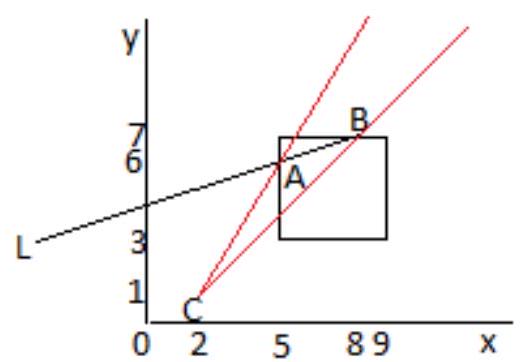
The first equation of the system can be written as $(x-... |
synth,cot | II. (40 points) Let $p$ be a prime number, and the sequence $\left\{a_{n}\right\}(n \geqslant 0)$ satisfies $a_{0}=0, a_{1}=1$, and for any non-negative integer $n$, $a_{n+2}=2 a_{n+1}-p a_{n}$. If -1 is a term in the sequence $\left\{a_{n}\right\}$, find all possible values of $p$.
保留了原文的换行和格式。 | The only solution that satisfies the problem is $p=5$.
It is easy to see that when $p=5$, $a_{3}=-1$.
Below, we prove that this is the only solution that satisfies the conditions.
Assume $a_{m}=-1\left(m \in \mathbf{Z}_{+}\right)$, clearly, $p \neq 2$, otherwise, from $a_{n+2}=2 a_{n+1}-2 a_{n}$, we know that for $n \g... |
synth,cot | A circle passes through vertices $A$ and $B$ of triangle $A B C$ and is tangent to line $A C$ at point $A$. Find the radius of the circle if $\angle B A C=\alpha, \angle A B C=\beta$ and the area of triangle $A B C$ is $S$. | Let $D$ be the point of intersection of the given circle with side $B C$. Knowing the area of triangle $A B C$, find $A B$ using the Law of Sines. Then prove that $\angle A D B=180^{\circ}-\alpha$.
## Solution
Let $D$ be the point of intersection of the given circle with line $B C$. Denote $A B=c, B C=a$. Applying th... |
synth,cot | 8,9
A circle inscribed in a triangle touches one of the sides, dividing it into segments of 3 and 4, and the angle opposite this side is $120^{\circ}$. Find the area of the triangle. | Let $x$ be the distance from the vertex of the angle of $120^{\circ}$ to the nearest point of tangency, and apply the Law of Cosines. We obtain the equation $x^2 + 7x - 4 = 0$, from which we find that $x = \frac{\sqrt{65} - 7}{2}$.
Let $p$ be the semiperimeter of the triangle, $r$ be the radius of the inscribed circle... |
synth,cot | 7. Given $y=a x+\frac{1}{3}$, when $x$ satisfies the condition $0 \leqslant x \leqslant 1, y$ satisfies $0 \leqslant y \leqslant 1$, then the range of values for $a$ is . $\qquad$ | $-\frac{1}{3} \leqslant a \leqslant \frac{2}{3}$.
\boxed{-\frac{1}{3}\leqslant\leqslant\frac{2}{3}} |
synth,cot | 5. Solve the inequality $\frac{x+2}{x-1}>\frac{x+4}{x-3}$. | Solution: $\frac{x+2}{x-1}>\frac{x+4}{x-3}, \frac{x+2}{x-1}-\frac{x+4}{x-3}>0, \frac{(x+2)(x-3)-(x+4)(x-1)}{(x-1)(x-3)}>0$, $\frac{x^{2}-x-6-x^{2}-3 x+4}{(x-1)(x-3)}>0, \frac{-4 x-2}{(x-1)(x-3)}>0$.
Answer: $\left(-\infty ;-\frac{1}{2}\right) \cup(1 ; 3)$.
\boxed{(-\infty;-\frac{1}{2})\cup(1;3)} |
synth,cot | Let's determine the values of $\sin x$ and $\sin y$ if
$$
\begin{gathered}
\sin y=k \sin x \ldots \\
2 \cos x+\cos y=1 \ldots
\end{gathered}
$$
For which values of $k$ does a solution exist? | From (2) $\cos y=1-2 \cos x$.
Considering (1) $\sin ^{2} y+\cos ^{2} y=1=k^{2} \sin ^{2} x+(1-2 \cos x)^{2}$.
$$
4 \cos ^{2} x-4 \cos x+k^{2}\left(1-\cos ^{2} x\right)=0 \quad \text { or } \quad\left(4-k^{2}\right) \cos ^{2} x-4 \cos x+k^{2}=0 \ldots
$$
From this, $\cos x=\frac{4 \pm \sqrt{16-4 k^{2}\left(4-k^{2}\ri... |
synth,cot | 14. As shown in the figure, the axial section of the reflector on the spotlight bulb of a movie projector is part of an ellipse, with the filament located at focus $F_{2}$, and the distance between the filament and the vertex $A$ of the reflector $|F_{2} A|=1.5$ cm, and the latus rectum of the ellipse $|B C|=5.4$ cm. T... | 14. According to the optical properties of the elliptical mirror, light rays emitted from one focus of the ellipse are reflected and converge at the other focus. Therefore, the lamp should be placed at focus $F_{1}$ to obtain the strongest light. For this, the focal distance needs to be determined.
Assume the equation... |
synth,cot | 6. The probability that the product of the points obtained from rolling a die three times is divisible by 6 is $\qquad$ | 6. $\frac{133}{216}$.
Let $P_{3}$ and $P_{6}$ represent the probabilities that the product is divisible by 3 and by 6, respectively.
Then $P_{3}=1-\left(\frac{4}{6}\right)^{3}=\frac{152}{216}$.
Let $P_{3}^{\prime}$ denote the probability that the product is divisible by 3 and is also odd.
Then $P_{3}^{\prime}=\left(\f... |
synth,cot | 2. Ivan Semenovich leaves for work at the same time every day, drives at the same speed, and arrives exactly at 9:00. One day he overslept and left 40 minutes later than usual. To avoid being late, Ivan Semenovich drove at a speed 60% faster than usual and arrived at 8:35. By what percentage should he have increased hi... | Answer: By $30 \%$.
Solution: By increasing the speed by $60 \%$, i.e., by 1.6 times, Ivan Semenovich reduced the time by 1.6 times and gained 40+25=65 minutes. Denoting the usual travel time as $T$, we get $\frac{T}{1.6}=T-65$, from which $T=\frac{520}{3}$. To arrive in $T-40=\frac{400}{3}$, the speed needed to be in... |
synth,cot | 2. Solve the equation
$$
2\left|\log _{1 / 2} x-1\right|-\left|\log _{4}\left(x^{2}\right)+2\right|=-\frac{1}{2} \log _{\sqrt{2}} x
$$ | # Problem 2.
Answer: $\left(0 ; \frac{1}{4}\right] \cup\{1\}$ (variants V-1, V-2, V-4), $\left\{2^{-8 / 5} ; 1\right\}$ (variant V-3).
Solution (variant V-1). Rewrite the equation as
$$
\left|\log _{2} x+2\right|-2\left|\log _{2} x+1\right|=\log _{2} x
$$
and perform the substitution $t=\log _{2} x$. Solving the re... |
synth,cot | 4 The line $\frac{x}{4}+\frac{y}{3}=1$ intersects the ellipse $\frac{x^{2}}{16}+\frac{y^{2}}{9}=1$ at points $A$ and $B$. There is a point $P$ on the ellipse such that the area of $\triangle P A B$ equals 3. How many such points $P$ are there?
(A) 1
(B) 2
(C) 3
(D) 4 | Let a point on the ellipse be $P(4 \cos \alpha, 3 \sin \alpha)$. When it is on the opposite side of $A B$ from the origin $O$, the distance from $P$ to $A B$ is
$$
\begin{aligned}
& \frac{3(4 \cos \alpha)+4(3 \sin \alpha)-12}{5} \\
= & \frac{12}{5}(\cos \alpha+\sin \alpha-1) \leqslant \frac{12}{5}(\sqrt{2}-1) \\
< & \f... |
synth,cot | 21.2. (PRB, 61). Find all pairs of real numbers $p, q$, for which the polynomial $x^{4}+p x^{2}+q$ has 4 real roots forming an arithmetic progression. | 21.2. The polynomial $x^{4}+p x^{2}+q$ has 4 real roots if and only if the polynomial $y^{2}+p y+q$ (relative to

satisfies the conditions $p^{2} \geqslant 4 q, q \geqslant 0, p \leqslant 0$. ... |
synth,cot | 13. A frog starts a series of jumps from point $(1,2)$, with each jump parallel to one of the coordinate axes and 1 unit in length. It is known that the direction of each jump (up, down, right, or left) is randomly chosen. The frog stops jumping when it reaches the boundary of the square with vertices at $(0,0)$, $(0,4... | 13. B.
If the frogs are on any diagonal, the probability of them landing on a vertical or horizontal line becomes $\frac{1}{2}$. Starting from point $(1,2)$, there is a $\frac{3}{4}$ probability (up, down, or right) of reaching the diagonal on the first jump, and a $\frac{1}{4}$ probability (left) of reaching the vert... |
synth,cot | We have a domino of width 1 and length $n$. We denote $A_{n}$ as the number of possible colorings of this domino, that is, the number of different ways to blacken or not blacken the cells. We denote $F_{n}$ as the number of ways to color this domino such that there are never two adjacent blackened cells.
1. Calculate ... | 1. For each cell, we can choose to color it or not (2 choices). Therefore, we have $A_{n}=2^{n}$.
2. We easily find $F_{1}=2, F_{2}=3, F_{3}=5, F_{4}=8$.
3. Let $n \geqslant 3$ and distinguish two cases. If the first cell is colored, the second one must not be.
![](https://cdn.mathpix.com/cropped/2024_05_10_0a55a0465f... |
End of preview. Expand in Data Studio
README.md exists but content is empty.
- Downloads last month
- 10