
Datasets:

metadata
license: mit
task_categories:
  - object-detection
  - zero-shot-object-detection
language:
  - en
size_categories:
  - 1M+
source_datasets:
  - DOTA
  - DIOR
  - FAIR1M
  - NWPU-VHR-10
  - HRSC2016
  - RSOD
  - AID
  - NWPU-RESISC45
  - SLM
  - EMS
tags:
  - remote-sensing
  - computer-vision
  - open-vocabulary
  - benchmark
  - image-dataset
pretty_name: LAE-1M
LAE-1M: Locate Anything on Earth Dataset
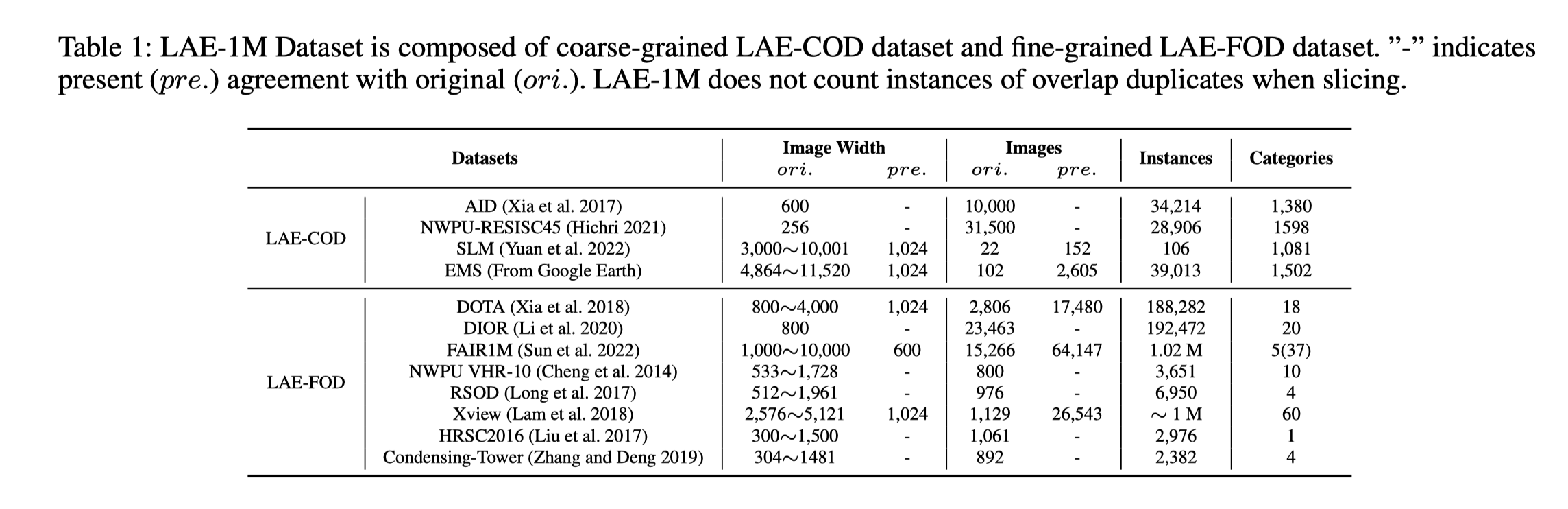
LAE-1M (Locate Anything on Earth - 1 Million) is a large-scale open-vocabulary remote sensing object detection dataset introduced in the paper "Locate Anything on Earth: Advancing Open-Vocabulary Object Detection for Remote Sensing Community" (AAAI 2025).
It contains over 1M images with coarse-grained (LAE-COD) and fine-grained (LAE-FOD) annotations, unified in COCO format, enabling zero-shot and few-shot detection in remote sensing.
Dataset Details
Dataset Description
- Curated by: Jiancheng Pan, Yanxing Liu, Yuqian Fu, Muyuan Ma, Jiahao Li, Danda Pani Paudel, Luc Van Gool, Xiaomeng Huang
- Funded by: ETH Zürich, INSAIT (partial computing support)
- Shared by: LAE-DINO Project Team
- Language(s): Not language-specific; visual dataset
- License: MIT License
Dataset Sources
- Repository: GitHub - LAE-DINO
- Paper: ArXiv 2408.09110, AAAI 2025
- Project Page: LAE Website
- Dataset Download: HuggingFace
Dataset Structure
| Subset | # Images | # Classes | Format | Description |
|---|---|---|---|---|
| LAE-COD | 400k+ | 20+ | COCO | Coarse-grained detection (AID, EMS, SLM) |
| LAE-FOD | 600k+ | 50+ | COCO | Fine-grained detection (DIOR, DOTAv2, FAIR1M) |
| LAE-80C | 20k (val) | 80 | COCO | Benchmark with 80 semantically distinct classes |
All annotations are in COCO JSON format with bounding boxes and categories.
Uses
Direct Use
- Open-Vocabulary Object Detection in Remote Sensing
- Benchmarking zero-shot and few-shot detection models
- Pretraining large vision-language models
Out-of-Scope Use
- Any tasks requiring personal or sensitive information
- Real-time inference on satellite streams without further optimization
Quick Start
from datasets import load_dataset

# Load the dataset
dataset = load_dataset("jaychempan/LAE-1M", split="train")

# Access one example
example = dataset[0]
print(example.keys())  # image, annotations, category_id, etc.

# Show the image (requires Pillow)
from PIL import Image
import io

img = Image.open(io.BytesIO(example["image"]))
img.show()