| | --- |
| | language: |
| | - en |
| | license: cc-by-nc-4.0 |
| | size_categories: |
| | - 1K<n<10K |
| | task_categories: |
| | - image-text-to-text |
| | - visual-question-answering |
| | - multiple-choice |
| | tags: |
| | - vision-language |
| | - multimodal |
| | - benchmark |
| | - chess |
| | - chemistry |
| | - music |
| | - graph-theory |
| | - semantic-equivalence |
| | - VLM |
| | dataset_info: |
| | features: |
| | - name: task |
| | dtype: string |
| | - name: domain |
| | dtype: string |
| | - name: index |
| | dtype: int32 |
| | - name: question_type |
| | dtype: string |
| | - name: question |
| | dtype: string |
| | - name: notation |
| | dtype: string |
| | - name: notation_type |
| | dtype: string |
| | - name: option_a |
| | dtype: string |
| | - name: option_b |
| | dtype: string |
| | - name: option_c |
| | dtype: string |
| | - name: option_d |
| | dtype: string |
| | - name: correct_answer |
| | dtype: string |
| | - name: correct_idx |
| | dtype: int32 |
| | - name: image |
| | dtype: image |
| | splits: |
| | - name: fork |
| | num_bytes: 0 |
| | num_examples: 200 |
| | - name: legal |
| | num_bytes: 0 |
| | num_examples: 200 |
| | - name: puzzle |
| | num_bytes: 0 |
| | num_examples: 200 |
| | - name: eval |
| | num_bytes: 0 |
| | num_examples: 200 |
| | - name: carbon |
| | num_bytes: 0 |
| | num_examples: 200 |
| | - name: hydrogen |
| | num_bytes: 0 |
| | num_examples: 200 |
| | - name: weight |
| | num_bytes: 0 |
| | num_examples: 200 |
| | - name: caption |
| | num_bytes: 0 |
| | num_examples: 200 |
| | - name: notes |
| | num_bytes: 0 |
| | num_examples: 200 |
| | - name: measures |
| | num_bytes: 0 |
| | num_examples: 200 |
| | - name: forms |
| | num_bytes: 0 |
| | num_examples: 200 |
| | - name: rhythm |
| | num_bytes: 0 |
| | num_examples: 200 |
| | - name: path_counting |
| | num_bytes: 0 |
| | num_examples: 200 |
| | - name: path_existence |
| | num_bytes: 0 |
| | num_examples: 200 |
| | - name: shortest_path |
| | num_bytes: 0 |
| | num_examples: 200 |
| | - name: bfs_traversal |
| | num_bytes: 0 |
| | num_examples: 200 |
| | download_size: 0 |
| | dataset_size: 0 |
| | configs: |
| | - config_name: default |
| | data_files: |
| | - split: fork |
| | path: data/fork-* |
| | - split: legal |
| | path: data/legal-* |
| | - split: puzzle |
| | path: data/puzzle-* |
| | - split: eval |
| | path: data/eval-* |
| | - split: carbon |
| | path: data/carbon-* |
| | - split: hydrogen |
| | path: data/hydrogen-* |
| | - split: weight |
| | path: data/weight-* |
| | - split: caption |
| | path: data/caption-* |
| | - split: notes |
| | path: data/notes-* |
| | - split: measures |
| | path: data/measures-* |
| | - split: forms |
| | path: data/forms-* |
| | - split: rhythm |
| | path: data/rhythm-* |
| | - split: path_counting |
| | path: data/path_counting-* |
| | - split: path_existence |
| | path: data/path_existence-* |
| | - split: shortest_path |
| | path: data/shortest_path-* |
| | - split: bfs_traversal |
| | path: data/bfs_traversal-* |
| | --- |
| | |
| | # SEAM: Semantically Equivalent Across Modalities Benchmark for Vision-Language Models |
| |
|
| | *[CSSLab](https://csslab.cs.toronto.edu/), Department of Computer Science, University of Toronto* |
| | *[COLM '25] Second Conference on Language Modeling* |
| |
|
| | - **Paper**: [Paper](https://huggingface.co/papers/2508.18179) |
| | - **Project Page / Leaderboard**: [SEAM Benchmark](https://lilv98.github.io/SEAM-Website/) |
| | - **Code**: [GitHub](https://github.com/CSSLab/SEAM) |
| |
|
| |  |
| |
|
| | ## Abstract |
| |
|
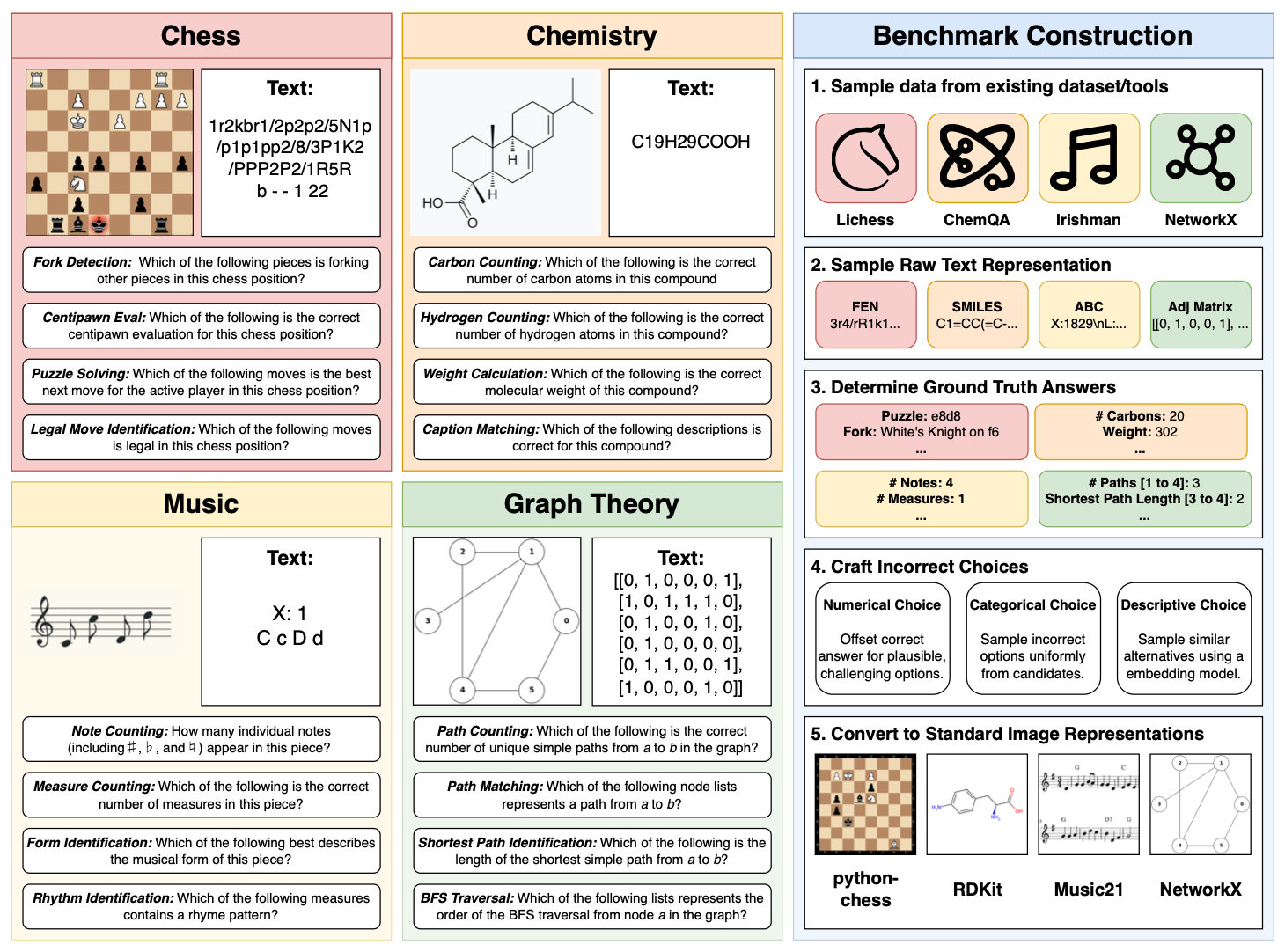
| | Evaluating whether vision-language models (VLMs) reason consistently across representations is challenging because modality comparisons are typically confounded by task differences and asymmetric information. We introduce SEAM, a benchmark that pairs semantically equivalent inputs across four domains that have existing standardized textual and visual notations. By employing distinct notation systems across modalities, in contrast to OCR-based image-text pairing, SEAM provides a rigorous comparative assessment of the textual-symbolic and visual-spatial reasoning capabilities of VLMs. Across 21 contemporary models, we observe systematic modality imbalance: vision frequently lags language in overall performance, despite the problems containing semantically equivalent information, and cross-modal agreement is relatively low. Our error analysis reveals two main drivers: textual perception failures from tokenization in domain notation and visual perception failures that induce hallucinations. We also show that our results are largely robust to visual transformations. SEAM establishes a controlled, semantically equivalent setting for measuring and improving modality-agnostic reasoning. |
| |
|
| | ## Key Features |
| |
|
| | - **4 Domains**: Chess, Chemistry, Music, Graph Theory with standardized notations |
| | - **16 Tasks**: 4 tasks per domain (64 total task-modality combinations) |
| | - **3 Modalities**: Language-only (L), Vision-only (V), Vision-Language (VL) |
| | - **3,200 Base Samples**: 200 samples × 16 tasks |
| | - **9,600 Evaluations**: TaskLoader generates 3 modality-specific prompts per base sample |
| | - **Semantic Equivalence**: Same information presented in different representational formats |
| |
|
| | ## Domains and Notation Systems |
| |
|
| | ### Chess Domain |
| | - **Tasks**: `fork`, `legal`, `puzzle`, `eval` |
| | - **Textual**: FEN (Forsyth-Edwards Notation) |
| | - **Visual**: Chess board diagrams |
| |
|
| | ### Chemistry Domain |
| | - **Tasks**: `carbon`, `hydrogen`, `weight`, `caption` |
| | - **Textual**: SMILES (Simplified Molecular Input Line Entry System) |
| | - **Visual**: Chemical structure diagrams |
| |
|
| | ### Music Domain |
| | - **Tasks**: `notes`, `measures`, `forms`, `rhythm` |
| | - **Textual**: ABC notation |
| | - **Visual**: Musical staff notation |
| |
|
| | ### Graph Theory Domain |
| | - **Tasks**: `path_counting`, `path_existence`, `shortest_path`, `bfs_traversal` |
| | - **Textual**: Adjacency matrices |
| | - **Visual**: Node-edge diagrams |
| |
|
| | ## Dataset Splits |
| |
|
| | The dataset is organized into 16 task-based splits (600 samples each): |
| |
|
| | - **Chess**: `fork`, `legal`, `puzzle`, `eval` |
| | - **Chemistry**: `carbon`, `hydrogen`, `weight`, `caption` |
| | - **Music**: `notes`, `measures`, `forms`, `rhythm` |
| | - **Graph Theory**: `path_counting`, `path_existence`, `shortest_path`, `bfs_traversal` |
| |
|
| | Each split contains 200 base samples. TaskLoader generates modality-specific prompts (L, V, VL) from these base samples. |
| |
|
| | ## Usage |
| |
|
| | ```python |
| | from datasets import load_dataset |
| | |
| | # Load the dataset |
| | dataset = load_dataset("lilvjosephtang/SEAM-Benchmark") |
| | |
| | # Access specific tasks |
| | chess_fork = dataset["fork"] # Chess fork detection (600 samples) |
| | chemistry_carbon = dataset["carbon"] # Carbon atom counting (600 samples) |
| | |
| | # Each task contains 200 base samples |
| | # TaskLoader generates modality-specific prompts (L/V/VL) from these base samples |
| | print(f"Task {chess_fork[0]['task']} has {len(chess_fork)} base samples") |
| | |
| | # Example sample structure |
| | sample = chess_fork[0] |
| | print(f"Task: {sample['task']}") |
| | print(f"Domain: {sample['domain']}") |
| | # No modality field - TaskLoader handles modality generation |
| | print(f"Question: {sample['question']}") |
| | print(f"Options: A) {sample['option_a']}, B) {sample['option_b']}, C) {sample['option_c']}, D) {sample['option_d']}") |
| | print(f"Correct Answer: {sample['correct_answer']}") |
| | print(f"Notation: {sample['notation']}") # FEN string for chess |
| | # sample['image'] contains the chess board image for Vision/Vision-Language modalities |
| | ``` |
| |
|
| | ## Sample Structure |
| |
|
| | Each sample contains: |
| | - `task`: Task identifier (e.g., "fork", "carbon") |
| | - `domain`: Domain category ("chess", "chemistry", "music", "graph") |
| | - No modality field (TaskLoader generates modality-specific prompts) |
| | - `index`: Sample index within the task |
| | - `question`: Question text (if applicable) |
| | - `notation`: Domain-specific notation (FEN, SMILES, ABC, adjacency matrix) |
| | - `notation_type`: Type of notation used |
| | - `option_a`, `option_b`, `option_c`, `option_d`: Multiple choice options |
| | - `correct_answer`: The correct answer |
| | - `correct_idx`: Index of the correct option |
| | - `image`: Associated image (PIL Image, None for base storage - TaskLoader handles image loading for V/VL modalities) |
| |
|
| | ## Evaluation Protocol |
| |
|
| | SEAM enables three types of evaluation: |
| |
|
| | 1. **Language**: Models receive only textual notation |
| | 2. **Vision**: Models receive only visual representation |
| | 3. **Vision-Language**: Models receive both notation and image |
| |
|
| | The semantic equivalence across modalities allows for direct comparison of reasoning capabilities and cross-modal agreement analysis. |
| |
|
| | ## Citation |
| |
|
| | ```bibtex |
| | @inproceedings{ |
| | tang2025seam, |
| | title={{SEAM}: Semantically Equivalent Across Modalities Benchmark for Vision-Language Models}, |
| | author={Zhenwei Tang and Difan Jiao and Blair Yang and Ashton Anderson}, |
| | booktitle={Second Conference on Language Modeling}, |
| | year={2025}, |
| | url={https://openreview.net/forum?id=lI4LgGv4sX} |
| | } |
| | @misc{tang2025seamsemanticallyequivalentmodalities, |
| | title={SEAM: Semantically Equivalent Across Modalities Benchmark for Vision-Language Models}, |
| | author={Zhenwei Tang and Difan Jiao and Blair Yang and Ashton Anderson}, |
| | year={2025}, |
| | eprint={2508.18179}, |
| | archivePrefix={arXiv}, |
| | primaryClass={cs.AI}, |
| | url={https://arxiv.org/abs/2508.18179}, |
| | } |
| | ``` |

