
_id stringlengths 1 6 | title stringlengths 15 150 | text stringlengths 30 20.1k | instruction_seed stringlengths 58 1.47k | __original_row_idx int64 0 38.3k | _source stringclasses 1
value |
|---|---|---|---|---|---|
95561 | Implications of Formula for Stellar Aberration | I am studying relativity and was working on deriving stellar aberration using relativity. My derivation is as follows: Suppose that the observer is traveling at a velocity $v$ in the $x$-direction. Consider a light beam coming from a star to the ship's crew, which has velocity $c$ and components $u_x=c\cos\theta$ and $... | What would be the apparent angle of a star observed from a spaceship traveling at a velocity \( v \) in the \( x \)-direction when the star moves in the opposite direction at velocity \( -v \)? Specifically, can you derive the critical angle where the observed angle of the star would reach \( \theta' = \frac{\pi}{2} \)... | 24,615 | cqadupstack-physics |
3158 | Why quantum entanglement is considered to be active link between particles? | From everything I've read about quantum mechanics and quantum entanglement phenomena it's unobvious for me, why quantum entanglement is considered to be active link. I.e. it's stated every time that measurement of one particle _affects_ another. While in my head there is less magic explanation: the entangling measureme... | What experimental evidence supports the idea that measurement of one particle in a quantum entangled pair instantaneously affects the state of the other particle, and what are the implications for our understanding of locality in quantum mechanics? | 29,870 | cqadupstack-physics |
57510 | Light traveling through a medium | Does the frequency of light change when it travels across an interface between two media? What happens to the light wavelength and the light velocity at the interface? I've gotten different answers some say all three change and some say frequency is constant or some say that the wavelength is constant... What's the rig... | When light passes from one medium to another, such as from air into water, how do the frequency, wavelength, and velocity of the light change? Provide a qualitative or quantitative explanation for your answer. | 6,036 | cqadupstack-physics |
123511 | How to calculate transmission of photonic band gap fiber? | How to calculate transmission of hollow core photonic fibers (multilayer fiber and 2D band gap fiber)? Which books/article you can recommend ? I see that comsol can do it, but is there a model that runs faster maybe semi- geometrical approximation ? I dont see chapter about photonic fibers in the Agrawal book. | What is the transmission efficiency of hollow core photonic fibers (multilayer fiber and 2D band gap fiber) under varying wavelengths, and how does this compare to solid core fibers? | 5,098 | cqadupstack-physics |
43127 | Finding an equation relating the mass of a blade of a wind turbine to its velocity | I'm writing up my physics coursework and I thought I'd try and find an equation described in the title. This is my attempt:  Is it correct? | What is the correct equation for calculating the gravitational potential energy of an object at a height \( h \) above the surface of the Earth, and how does it depend on the mass of the object and the acceleration due to gravity? | 9,923 | cqadupstack-physics |
5985 | How do ideas of leading singularities and Grassmanian help in curing infrared divergences when calculating N=4 scattering amplitudes? | Broadly speaking how do ideas of leading singularities and Grassmanian help in curing infrared divergences when calculating N=4 scattering amplitudes? My understanding is that one gets infra red divergences because the external gluon momenta becomes collinear with the the loop momenta. I am confused as to what Nima's a... | How do leading singularities and Grassmannian methods contribute to eliminating infrared divergences in the calculation of N=4 scattering amplitudes? Additionally, what specific strategies have Nima and Freddie employed to tackle these issues, and how can this understanding be applied to planar QCD? | 4,470 | cqadupstack-physics |
817 | What are some approaches to discrete space-time used in modern physics? | This thought gave rise to some new questions in my mind. What are the consequences for: 1. How would it affect duality i.e. particle, wave property of photons? 2. How does this statement affect the information theoretical aspect (entropy) of the universe? **Update:** Given a volume V of space, is the entropy (maxim... | What is the relationship between the volume \( V \) of space and the maximum entropy that can be stored within it, particularly in the context of how quantum properties might influence this relationship? | 26,191 | cqadupstack-physics |
82553 | Divergence of series | How do I understand whether a series will diverge at some point? For example, in the Legendre's diff. equation $$(1-z^2)y' '-2zy'+\ell(\ell+1)y~=~0,$$ does $y(z)$ diverge for $z=-1$ and $z=+1$? | For the Legendre's differential equation $$(1-z^2)y'' - 2zy' + \ell(\ell + 1)y = 0,$$ determine whether the solutions $y(z)$ diverge at the points $z = -1$ and $z = 1$. If so, identify the conditions under which divergence occurs. | 21,272 | cqadupstack-physics |
113875 | How can a single quantum system be prepared in a particular mixed state? | Let's consider an electron in some sort of potential well. Suppose $|i\rangle$ is an $i$th eigenstate, and we want to prepare the electron in state with state vector (up to normalization) $|\psi_1\rangle=|1\rangle+|2\rangle$. We can prepare such a state arbitrarily precisely by e.g. making the barrier finite (but still... | How can we prepare a mixed state for an electron in a potential well represented by the density operator \(\hat\sigma = |1\rangle\langle1| + |2\rangle\langle2|\), and is it necessary to use multiple electrons for this preparation, or can a single electron be placed in such a mixed state? | 23,166 | cqadupstack-physics |
92337 | Determine laser cavity modal content from beating / interference? | I'm trying to better understand the modal content and dynamics of laser cavities. I'm specifically interested in mode-locking, although this question is pretty general and applies to CW lasers too. I understand that the modal spacing, Δf, in a cavity is set by cavity geometry and the gain bandwidth, ΔF, is set by the g... | If a laser cavity supports three excited modes spaced by 10 MHz, how many distinct peaks would you expect to observe on an electrical spectrum analyzer when the laser light is directed onto a photodetector? Specifically, what frequencies would those peaks correspond to, and how would the situation differ if the laser e... | 8,231 | cqadupstack-physics |
112289 | Damped Coupled Oscillations | I'm currently revising for a vibrations and waves module that I am taking as part of my physics degree. One of the our final questions involved finding equations for the displacements of the two masses in this system as a superposition of their normal modes: 
2. \(\ddot{q_2} + \gamma \dot{q_2} + q_2 (\omega_0^2 + 2\omega_s^2) = 0\)
where \(\gamma = \frac{b}{m}\), \(\omega_0^2 = \frac{g}{l}\), and \(\omega_s^2 = \frac{k}{m}\), derive the normal mode fr... | 28,033 | cqadupstack-physics |
13662 | One point to change electric field | Can there be a charge configuration in space such that at any instant of time I can change the electric field at one and only one point? | Is it possible to design a three-dimensional charge configuration such that the electric field can be altered at a single point in space without affecting the electric field at any other point? If so, provide an example with specific charge values and positions. | 35,502 | cqadupstack-physics |
66783 | Bouncing ball simulation computer science | In my Computer science class I was given a problem where I have to simulate a bouncing ball using "real physics". I have been trying to find a equation that will simulate the height of the bounce given a gravity and an arbitrary mass. And I will need to calculate the next bounce and it's height. A lot of the equations ... | Given a bouncing ball dropped from an initial height of 2 meters, if the coefficient of restitution (the ratio of the height of the bounce to the height from which it fell) is 0.8, what will be the height of the ball after the first three bounces? | 28,134 | cqadupstack-physics |
9960 | What are Grassmann (even/odd) numbers used in superalgebras? | Are Grassmann numbers a concept of graded Lie algebras or is something specific to superalgebras? What are they (i.e: how are they defined, important properties, etc.)? Is there a reasonable introduction to them? I think that what makes me wonder a little is, since there does not seem to be a sensible constructivist ap... | What are the defining properties of Grassmann numbers, and how do they relate to graded Lie algebras and superalgebras? Additionally, can you illustrate how the algebra involving Grassmann numbers remains closed under operations? | 19,820 | cqadupstack-physics |
26677 | Ring height stats? | I'm working on a basic simulation system which will include planets with rings, I want to create dust and asteroids within a 3D ring but I'm struggling to find any stats on the sort of height ranges a ring might have (I can find inner and outer radius estimates, but not the height ranges). Does anybody know a good reso... | What is the typical vertical height range of planetary rings in relation to their inner and outer radii? | 6,839 | cqadupstack-physics |
29569 | Loop of wire in a varying magnetic field | Let us suppose we have a loop of wire with some definite resistance in a magnetic field. Let the magnetic field be varying. This varying magnetic field will st up an EMF in the wire. My questions are as follows: 1). Energy is dissipated across the wire resistance. Where does this energy come from? 2). The current gener... | If a loop of wire with a resistance of 5 ohms is placed in a magnetic field that is increasing at a rate of 0.1 T/s, what is the induced electromotive force (EMF) in the loop, and how much energy is dissipated as heat in the wire after 10 seconds? | 29,085 | cqadupstack-physics |
134083 | Textbook on classical E&M in curved spacetime | Can anyone recommend a good reference for classical electrodynamics that goes over electrodynamics in curved spacetime that doesn't assume much knowledge of GR -- that is it builds up the tensor calculus and GR principles itself? | What is the relationship between the electromagnetic field tensor and the curvature of spacetime in general relativity, and how does this relationship affect the motion of charged particles in a gravitational field? | 1,432 | cqadupstack-physics |
113061 | Double slit experiment and single particles. Is the wave function just a mathematical model? | I really do want to apologize in advance, I know this question has been 'answered' before. I have this 'problem' of feeling negatively toward much of today's 'mystical' interpretations of physics, quantum physics in particular. I am going through the Solid State Chemistry course provided by MIT's open- course-ware and ... | If a single photon is fired through a double-slit apparatus, does it exhibit an interference pattern when many photons are recorded, and what does this suggest about the nature of the photon in relation to its position while passing through the slits? | 37,615 | cqadupstack-physics |
118572 | Perturbation of an operator - Meaning of matrix element | Let be $B$ an operator and $\left|\Psi\right>$, $\left|\Phi\right>$ two states (not necessarily equals). What is the meaning of a matrix element $\left<\Psi\right| B \left|\Phi\right>\neq 0$ for $\left|\Psi\right> \neq \left|\Phi\right>$ ? Can i think that this matrix element isn't zero due to a perturbation that doesn... | Given two quantum states \(|\Psi\rangle\) and \(|\Phi\rangle\) and an operator \(B\), if the matrix element \(\langle \Psi| B |\Phi \rangle \neq 0\) while \(|\Psi\rangle \neq |\Phi\rangle\), what physical interpretation can be assigned to this non-zero matrix element? Additionally, under what circumstances could this s... | 11,464 | cqadupstack-physics |
70391 | 2nd order phase transition trouble deriving coefficient in fluctuations analysis | I can't get one of the coefficients in the equation for $T < T_c$ in the bottom, specifically the equation with the factor of two. any help appreciated. Consider an ising type expansion of the free energy density in the order parameter $\psi$. (the mean values of $\psi$ corresponding to a uniform configuration.) \begin... | Can you derive the coefficient of the term $\delta\psi^2$ in the expression for the change in free energy density $\Delta F(T,\delta\psi)$ for $T < T_c$, using the specified order parameter fluctuation equations? Also, explain why there are two possible values for the mean $\bar{\psi}$, and clarify why only the positiv... | 2,115 | cqadupstack-physics |
107029 | Would QM be detectable in a all boson universe | If there was a universe with the same laws as this one, but there were only bosons in it, would QM 'do anything'? Would there be any QM effects - such as an energy level (but that would require fermions..). | In a hypothetical universe composed solely of bosons and governed by the same physical laws as our own, what phenomena or quantum mechanical effects would emerge in comparison to a universe containing both fermions and bosons? Specifically, explain how the absence of fermions would affect the existence of discrete ener... | 25,594 | cqadupstack-physics |
1901 | If the universe were compressed into a super massive black hole, how big would it be? | I understand only a little of general relativity, but that's why I'm here! :) Consider the hypothetical situation of some extra-terrestrial intelligence pushing all the mass in the universe, every last subatomic particle, into a giant black hole. What is the surface area of such an object? For the sake of argument, let... | What would be the surface area of a hypothetical black hole formed by compressing all the mass in the universe into a single point, given that the mass of the observable universe is approximately \(1.5 \times 10^{53}\) kg? Use the formula for the surface area of a black hole, \(A = 4\pi \left(\frac{2GM}{c^2}\right)^2\)... | 34,936 | cqadupstack-physics |
18083 | Finding coefficient of proportionality | Recently in my AP Physics class I did a lab in which I measured k for a spring by setting up an oscillating system with it, and timing the period, repeating for different masses. Since $T=2\pi\sqrt{\frac mk}$, we were supposed to relate $T^2=\frac{4\pi^2}km=Cm$ for some $C$. This is a proportionality equation in $T^2$ ... | In a lab experiment measuring the spring constant \( k \) using the relationship \( T^2 = \frac{4\pi^2}{k}m \), two methods were employed to calculate \( k \): one by directly averaging \( k_i = \frac{C_i}{4\pi^2} \) from individual trials and another using linear regression to fit the data to \( \hat{T}^2 \approx C_a ... | 35,217 | cqadupstack-physics |
48285 | Why is a washing machine unable to spin-dry a duvet? | _Background story: I put my duvet (synthetic filling) into a washing machine, and the machine was unable to spin-dry it. My mom told me: "It's because it is full of air"._ I was not satisfied with the answer. So: Why is it problem for a washing machine to spin-dry a synthetic duvet? From my point of view, the only impo... | What are the physical principles that prevent a washing machine from effectively spin-drying a synthetic duvet, and how does the duvet's air content impact the moment of inertia compared to a load of casual clothes? | 23,640 | cqadupstack-physics |
67627 | Is it possible see an invisible light with something similar to a normal lens of an eyeglass? | Let's say that I am a spy in a room with a lot of people and I want to communicate with my friend using Morse code via a light signal. Does there exist a type of light (laser or otherwise) that is invisible to the human eye, but that I can see using a modified transparent lens? In other words, can I make an infrared or... | What modifications would I need to make to a normal eyeglass lens to make infrared or ultraviolet light visible, and how readily can I obtain or create such a modified lens? | 7,058 | cqadupstack-physics |
128582 | Physical laws in all inertial frames | Do there exist physical laws which do not take the same form in all inertial frames? | What are examples of physical laws that do not maintain the same form in all inertial frames, and how do these laws differ from those that are invariant? | 22,502 | cqadupstack-physics |
116810 | Bouncing ball time problem | I'm studying a problem and I encountered a strange problem: > _When a ball bounces how much time does the ball spend while touching the > floor?_ To be more clear I suppose that when a ball bounces the actual bounce can't start EXACTLY when the ball touches the floor but the ball touches the floor, the Energy from the ... | When a ball bounces on a floor, how do you calculate the time it spends in contact with the floor during the bounce, given its initial drop height and its material properties? | 21,338 | cqadupstack-physics |
9935 | Should I begin to study quantum mechanics or wait until I have a stronger base on easier topics? | I apologize if this is off topic since it does not relate directly to the study of physics, but I could not think of a better place to ask. I am a high school student graduating in a few days and have recently developed an interest in quantum mechanics. I began to study physics about one and a half years ago and calcul... | What are the essential mathematical prerequisites and foundational concepts in classical physics that a student should master before studying quantum mechanics at a college level? | 23,619 | cqadupstack-physics |
28175 | How do I simulate a constant velocity flow in porous media | I am modelling gas combustion in porous media. Most contemporary models assume that the pressure drop from the porous media is small enough to disregard, but I want to include that in my investigation. Most studies alos assume that the gas is filtered through the media at a constant speed $u$. I use Darcy's law to coup... | What pressure difference is required to maintain a constant gas velocity of 0.5 m/s in a porous medium, according to Darcy's law, given the permeability \( k \) and dynamic viscosity \( \mu \) of the medium? | 1,004 | cqadupstack-physics |
33458 | What are hadrons anyway? | I'm new to this particle physics field. What are hadrons and does they have any relation with Higgs Boson, which is now being talked everywhere as "THE GOD PARTICLE". | What are hadrons and how is their mass related to the Higgs boson in the context of the Standard Model of particle physics? | 6,614 | cqadupstack-physics |
111860 | Resistor and LED - together and separated | Something very basic which I don't get no matter how much I read. * circuit A: only a resistor and power supply - the resistor will burn. * circuit B: only a LED and power supply - the LED will damaged. As far as I understand these are the facts. * in circuit B LED will draw as much current as we give it (we shou... | If you connect a 500 Ω resistor to a 10 V power supply, what will be the current flowing through the resistor, and will it exceed the power rating of 0.2 W? | 14,090 | cqadupstack-physics |
15236 | Is traveling at the speed of light the same thing as teleportation? | If I were on one side of the room and moved at the speed of light to the other side of the room, to an observer it would appear that I teleported. If time stops at that speed, it would be instantaneous but we know that light is not instantaneous (see light years). So I'm curious what the difference between traveling at... | What are the fundamental differences between traveling at the speed of light and teleportation, particularly in terms of the physical principles governing each process? | 24,521 | cqadupstack-physics |
455 | Distance travelled in free-fall | When an object is in free fall, we have: $a(t) = g - \frac{c}{m}v(t)^2$ where $g$ is acceleration due to gravity, $m$ is the mass of the object, and $c$ is the coefficient of air resistance. How does one get the distance traveled after t seconds? I tried integrating it, giving $v(t) = gt - \frac{c}{3m}s(t)^3$ $s(t) = \... | Given the equation of motion for an object in free fall with air resistance, \( a(t) = g - \frac{c}{m}v(t)^2 \), where \( g \) is the acceleration due to gravity, \( m \) is the mass of the object, \( c \) is the coefficient of air resistance, and \( v(t) \) is the velocity, can you derive an expression for the distanc... | 5,739 | cqadupstack-physics |
117080 | Does inducing charge on a grounded conductor do work? | Imagine a grounded conductor as an plane of infinite area. If I bring a charge to a close proximity to the plane, it induces some charge distribution on the conductor. The question is: is any work being done on the (induced) charge during this process? | If a point charge \( q \) is brought to a distance \( d \) above an infinite grounded conducting plane, what is the work done by the electric field on the induced charges in the conductor when the point charge is placed at that distance? Assume the potential at the surface of the conductor is zero. | 21,749 | cqadupstack-physics |
100464 | Otto cycle efficiency described in pressure ratio (instead of compression ratio) | The Otto cycle's thermodynamic efficiency is often described using the compression ratio: $$\eta_{th} = 1 - \left( \tfrac{1}{CR} \right ) ^ {k-1},$$ (where CR is the compression ratio, and k the ratios of specific heat). Now I tried describing this using a pressure ratio (So instead of $\tfrac{V_1}{V_2}$ using $\tfrac{... | What is the relationship between the compression ratio (CR) in the Otto cycle and the pressure ratio (\(\Pi\)) in terms of their effect on thermodynamic efficiency, and how do the assumptions of each cycle's combustion process impact their efficiencies? Additionally, can you explain why the derived equations for effici... | 35,988 | cqadupstack-physics |
93199 | Does the Relativity Principle of Special Relativity imply homogeneity and isotropy of all the reference frames? | In Rindler's book: Relativity, Special, General and Cosmological, is stated on page 40 that the Relativity Principle (RP), when applied to just one Inertial Frame (IF), guarantees the homogeneity and isotropy of tha IF. By inertial frame Rindler means an ideal infinity extended rigid body moving freely in a world witho... | If an inertial frame is defined as one in which the laws of physics are invariant under changes of inertial coordinate systems, what are the implications for the speed of light measured in different directions within that frame? Specifically, how would a variation in the measured speed of light in two different directi... | 12,366 | cqadupstack-physics |
38339 | How is explained the lower ionization potential for atoms compared to closed shell nobel atoms? | Why adding just one electron changes tremendously the ionization potential from any of the nobel atoms ? If it is the screening why adding a second electron increases the ionization potential ? http://en.wikipedia.org/wiki/File:IonizationEnergyAtomicWeight.PNG | How does the addition of a single electron to a noble gas atom affect its ionization energy, and what role does electron screening play when a second electron is added? Can you quantify the changes in ionization potential for a specific noble gas, such as neon or argon, upon adding one or two electrons? | 34,735 | cqadupstack-physics |
51744 | Why does unbroken supersymmetry imply the absence of tachyons? | Just a quick question, same as in the title. I'm trying to understand stable D-branes. | What conditions must be met for D-branes in string theory to be considered stable, and how does this stability relate to their tension and dimensional properties? | 10,858 | cqadupstack-physics |
110645 | Why does ice melting not change the water level in a container? | I have read the explanation for this in several textbooks, but I am struggling to understand it via Archimedes' principle. If someone can clarify with a diagram or something so I can understand or a clear equation explanation that would be great. | Using Archimedes' principle, calculate the buoyant force acting on a submerged object that has a volume of 0.5 m³ in water. Assume the density of water is 1000 kg/m³. What is the magnitude of the buoyant force in newtons? | 13,703 | cqadupstack-physics |
94125 | Angular momentum and spin | I am having problems with this excercise. We look at a system where the total angular momentum is given by an electron with $l=1$ and $s=\frac{1}{2}$. Now I am supposed to calculate the eigenfunctions $|\frac{3}{2},m_j\rangle, |\frac{1}{2},m_j\rangle$ with respect to $J^2 $ and $J_z$, where $J=L^{(1)}+S^{(2)}.$ In part... | What are the eigenvalues corresponding to the eigenfunctions $|\frac{3}{2}, m_j\rangle$ and $|\frac{1}{2}, m_j\rangle$ when calculated with respect to the operators $J^2$ and $J_z$, given that the total angular momentum $J$ is the result of combining an electron with orbital angular momentum $l=1$ and spin $s=\frac{1}{... | 21,553 | cqadupstack-physics |
3983 | Haag's theorem and practical QFT computations | There exists this famous Haag's theorem which basically states that the interaction picture in QFT cannot exist. Yet, everyone uses it to calculate almost everything in QFT and it works beautifully. 1. Why? More specifically to particle physics: In which limit does the LSZ formula work? 2. Can someone give me an ex... | What is the limit in which the Lehmann-Symanzik-Zimmermann (LSZ) formula is valid in quantum field theory, and can you provide an example of a measurable quantity in particle physics where calculations using the interaction picture are inconsistent with Haag's theorem? | 3,991 | cqadupstack-physics |
16550 | Why do mirages only appear on hot days? | A previous question asked why the road sometimes appears wet on hot days. The reason is that when there's a temperature gradient in the air, it causes a gradient in the index of refraction, causing the light to bend. This diagram (from Lagerbaer's answer to the previous question) is  to produce a significant bending of light, such that a light path dips at least 0.25 mm over a distance of 200 m? Consider using the values \(... | 17,226 | cqadupstack-physics |
105070 | Electromagnetism duality theorem | Concerning Electromagnetism, textbooks often refer to the Duality Theorem. Sometimes it is presented like this: «Consider the Maxwell's Equations (with phasors) and a known field $\mathbf{E}_1$, $\mathbf{H}_1$: $\nabla \times \mathbf{E}_1 = - j \omega \mu \mathbf{H}_1$ $\nabla \times \mathbf{H}_1 = j \omega \epsilon \m... | In the context of electromagnetic fields described by Maxwell's Equations, if we consider a known electric field \(\mathbf{E}_1\) and magnetic field \(\mathbf{H}_1\) and apply the substitutions defined by the Duality Theorem, what is the relationship between \(\mathbf{E}_1\) and \(\mathbf{H}_2\) in terms of the intrins... | 2,724 | cqadupstack-physics |
74200 | Why does increasing the flickering speed of a light have a dimming effect? | I'm setting up one of my first circuits. I have a knob to increase the flickering speed of a led. When I increase the flickering speed up to a certain point I am not able anymore to perceive it is flickering. When I increase the flickering speed even more the led dims. Why? Some sort of wave interference effect? | What is the relationship between the flickering frequency of a LED and human perception, and at what frequency does the LED become indistinguishable from a constant light source? | 21,663 | cqadupstack-physics |
72435 | Why does a dielectric have a frequency dependent resistivity? | This question has come about because of my discussion with Steve B in the link below. Related: Why is glass much more transparent than water? For conductors, I can clearly see how resistivity $\rho\,\,(=1/\sigma)$ can depend on frequency from Ohm’s law, $\mathbf{J}=\sigma\mathbf{E}$. So if the E-field is an electromagn... | What is the relationship between the frequency of an electromagnetic wave and the electric permittivity of a dielectric material in the optical frequency range, and how does this compare to the frequency dependence of resistivity in conductors? Provide a mathematical expression that illustrates this relationship. | 6,423 | cqadupstack-physics |
88779 | What does it mean for a metric to be regular? | A problem in Carroll (a general relativity textbook) asks if a certain metric is regular. What does it mean for a metric to be regular? | What are the conditions that define a regular metric in general relativity, and how can one determine if a given metric meets these conditions? | 26,725 | cqadupstack-physics |
114775 | Help explore a self-feedback camera-monitor chaotic system | We are trying to emulate the chaotic system Jim Al-Khalili demonstrate (3 min video). In our chaos lab, we are trying to research the chaotic system shown in the video. We are using just a webcam and a regular PC monitor. Our goal is to build a bifurcation tree for this system and to show how by changing the parameters... | How can we mathematically model the system demonstrated by Jim Al-Khalili to construct a bifurcation tree, and what specific parameters should we manipulate to observe the transition from order to chaos, particularly focusing on the significance of the y-axis values in the bifurcation tree? | 2,974 | cqadupstack-physics |
29702 | What counts as a measurement? | In quantum mechanics, an elementary particle does not have a well defined position until a measurement is performed on it (right?). Such a "measurement" is any sort of interaction with other particles that gives those particles information about the position of the first particle. However, systems of elementary particl... | In the context of quantum mechanics, how does the measurement process affect the wave functions of elementary particles, and what implications does this have for the behavior of larger systems, such as atoms and buckyballs, in experiments like the double slit experiment? Specifically, could you quantify how the number ... | 999 | cqadupstack-physics |
87134 | Why do you experience low-gravity outside the Earth (but near it), and experience more gravity on it? | Spacecraft, satellites, etc. They also experience zero gravity, weightlessness, or "micro gravity" when outside Earth, about 20-300+ miles beyond the escape velocity zone("atmosphere"). However, you experience full gravity on the Earth. Why does gravity decrease just slightly farther away? | What is the mathematical relationship that describes how gravitational force changes with distance from the center of the Earth, and how does this explain the phenomenon of weightlessness experienced by spacecraft at altitudes of 20-300 miles? | 20,574 | cqadupstack-physics |
67491 | Matter and anti-matter collision energy problem | From _Beyond Einstein_ , by Michio Kaku and Jennifer Thompson, Chapter 13, _Antimatter_ : > Dirac, also focused on the fact that Einstein's equation $E=mc^2$ wasn't > totally true. (Einstein was aware that the true equation was $E=\pm mc^2$ > but as his theory was based on forces, he ignored the minus sign.) As Dirac >... | When a particle and its corresponding antiparticle collide, they annihilate and release energy according to the equation \( E = mc^2 \). If a particle has a rest mass \( m \), how much energy is released during their annihilation? Please provide a quantitative answer and explain the role of the rest mass in the energy ... | 22,573 | cqadupstack-physics |
76477 | Why gauge theories have such a success? | [This question was inspired by a identical question asked on a other forum] Note that we may morally include general relativity in the gauge theories. We may have several (some are deliberately contradictory) remarks : 1) Gauge invariance is only a mathematical redundancy, which is unphysical. In fact, we are not using... | What are the implications of gauge invariance in the context of general relativity, and how does it relate to the behavior of massless particles in terms of helicity? Provide a quantitative example illustrating the role of gauge invariance in a physical theory. | 23,402 | cqadupstack-physics |
83167 | Density distribution of gas in a centrifugal field | The problem asks me to find the density of gas in a cylinder of radius $R$ and length $l$ rotating about its axis with angular velocity $ω$, there being a total of $N$ molecules in the cylinder. What I have done is shown as following: I choose to look this scenario in a static frame with the cylinder, which is rotating... | What is the expression for the density of gas in a rotating cylinder with radius \( R \) and length \( l \), containing \( N \) molecules, when accounting for the centrifugal potential energy effects and thermal contributions? | 1,150 | cqadupstack-physics |
102225 | In Feynman's "Random Walker" probability example, why is $D^2$ better for illustrating "wandering"? | Taken from Volume 1, Chapter 6, Section 3 of the Feynman Lectures on Physics. Feynman says that in describing random, equally-probable-backwards-or-forwards motion, that, > We might therefore ask what is his average distance travelled in _absolute > value_ , that is, what is the average of $|D|$. It is, howevermore > c... | In a random walk where a particle moves either 1 unit forward or 1 unit backward with equal probability, if the particle takes \( N \) steps, what is the expected value of the square of the distance from the starting point, \( D^2_N \), and how does this result relate to the number of steps taken? | 32,843 | cqadupstack-physics |
46754 | Why does Physica A journal contain economics papers? | Why does Physica A journal contain economics papers? Like this: > Steve Keen, Russell Standish. Profit maximization, industry structure, and > competition: A critique of neoclassical theory. _Physica A_ **370** no. 1 > (2006), pp. 81–85. doi:10.1016/j.physa.2006.04.032. Available online at > http:// www. debtdeflation.c... | What is the connection between statistical mechanics and the economic concepts discussed in the paper "Profit maximization, industry structure, and competition: A critique of neoclassical theory" published in Physica A, and how might statistical mechanics principles apply to economic models? | 15,107 | cqadupstack-physics |
103867 | Including special relativistic effects in momentum in Heisenberg's Uncertainty Principle | I've been told that an electron is somewhere within the space of $10^{-10}m$ and am supposed to find the uncertainty in its velocity. Simply applying $m\Delta x \Delta v \geq \frac{h}{4\pi}$ results in $\Delta v \geq 5.79\times10^{10} m/s$. Now, this velocity is not approaching the speed of light, but I wanted to know ... | If the uncertainty in an electron's position is reduced to $10^{-12} m$, what would be the minimum uncertainty in its velocity according to the uncertainty principle, and how would relativistic effects need to be considered in this calculation? | 26,115 | cqadupstack-physics |
74532 | what are the main factors holding back magnetic energy storage systems? | Perhaps is it the magnet's own magnetic field that causes it to lose its superconductive state? It seems as though these systems could become incredible energy dense. | What is the critical magnetic field strength at which a type-II superconductor transitions from its superconducting state to a normal state, and how does this relate to the energy density of the system? | 13,514 | cqadupstack-physics |
73663 | A set of problems for "The Theoretical Minimum" Stanford course | I'm really excited by an opportunity to watch Leonard Susskind's course "The Theoretical Minimum". However, I couldn't find any physics problems on the website, and I'm a little bit wary of just watching videos. I want to think on some problems during that. Maybe there's a good collection of Physics problems on related... | What are some challenging physics problems related to the principles of quantum mechanics and relativity that I could work on while watching Leonard Susskind's "The Theoretical Minimum" course? | 15,879 | cqadupstack-physics |
128372 | Calculating equipotential lines and current density in a rectangular conductor | (This isn't homework, I'm trying to make an illustration for an article I'm writing.) Let's say that I have a thin rectangular bar of uniform conductivity, and I have point probes at various places: 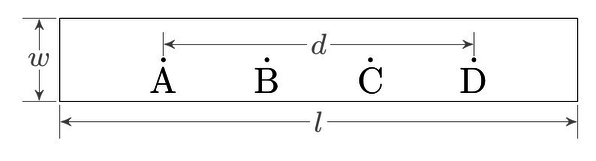 The bar has width $w$ and thickness $t$ where $t \l... | Given a thin rectangular bar of uniform conductivity with a width \( w \) and thickness \( t \) (where \( t \ll w \)), how do you calculate the current density \( J \) and define the equipotential lines when a current of 1 ampere is injected between two points \( A \) and \( D \) that are \( d \) apart along the bar's ... | 1,660 | cqadupstack-physics |
117075 | Modify permittivity with a current? | Permittivity is a function of frequency from an existing EM wave. But permittivity in some ways describes how a wavelength of light interacts with a metal. Certain wavelengths, sense different densities of electrons more than others. 1. Can I modify the permittivity of a conductor, by applying a current? Considering ... | How does the application of an electric current affect the effective permittivity of a conductor, and can this effect be quantitatively calculated using the equations \( J = \sigma \times E \) and \( J = I/A = q \times n \times v \)? Additionally, is it possible for an electromagnetic wave at frequency \( f_1 \) to inf... | 37,893 | cqadupstack-physics |
118882 | Why is the magnetic field stronger at the edges of a bar magnet? | I have been performing an experiment at school in which I test the force on an iron surface from the magnetic field of an electromagnet. The electromagnet has a rectangular iron core. The theory predicts that the force increases linear with the surface area of the iron plate. This is because the volume between the plat... | What is the relationship between the surface area of an iron plate and the force exerted on it by the magnetic field of an electromagnet, and how does the divergence of the magnetic field lines at the edges of the electromagnet's poles affect this relationship? | 23,470 | cqadupstack-physics |
71990 | How to heat swimming pool with physics principles | I'd like to apply physics principles to a home-experiment relating to my swimming pool. The water should flow inner to 100 meters of black pipe and so it should become warm. Then it should return in the swimming pool. But how can I carry the water from the swimming pool to the pipe? if I use a tight pipe, for the capil... | What diameter of a narrow pipe would be required to achieve capillary rise and transport water 30 cm vertically above the water level in a swimming pool, considering the properties of water and the pipe material? If this is not feasible, what alternative method could effectively transport the water? | 11,662 | cqadupstack-physics |
46719 | Why do power lines buzz more when it is low-humidity outside? | I have observed that the power lines buzz louder when there is less moisture in the air. Why is this? If it will help the lines are located on the foot hills of a nearby mountain. | How does the humidity level in the air affect the sound produced by power lines, and what specific physical mechanisms might explain this relationship? | 31,241 | cqadupstack-physics |
65300 | Convergence of Light on the Retina | So, I've learned about lens ray diagrams-but the problem I'm having is that when ray diagrams are drawn for a point of an image, they converge to another point, but there are two problems that I see with regards to our eyes: 1) In the simplest drawn case it's at least three rays converging to the same point, but our ey... | How does the human eye process multiple light rays converging at the same point on the retina, given that there is only one photoreceptor (or receptive cell) present at that point? Can you explain the mechanisms involved in resolving multiple points of light to a single perception? | 30,259 | cqadupstack-physics |
78682 | Is the firewall paradox really a paradox? | The firewall paradox is a very hot topic at the moment (1207.3123v4). Everyone who is anybody in theoretical physics seems to be jumping into the action (Maldacena, Polchinski, Susskind to name a few). However, I am unable to see the paradox. To me Hawking's resolution of the information paradox (hep-th/0507171) also r... | What are the implications of considering topologically trivial metrics in the context of black holes and Hawking radiation, and how do they relate to the resolution of the information paradox in quantum gravity? | 37,552 | cqadupstack-physics |
130800 | What is the physical meaning of commutators in quantum mechanics? | This is a question I've been asked several times by students and I tend to have a hard time phrasing it in terms they can understand. This is a natural question to ask and it is not usually well covered in textbooks, so I would like to know of various perspectives and explanations that I can use when teaching. The ques... | What is the physical significance of the commutator \([A, B]\) in quantum mechanics, and how does it relate to the compatibility of observables and symmetries in quantum systems? Provide examples and explain its importance in the context of the Heisenberg Uncertainty Principle and canonical commutation relations. | 4,389 | cqadupstack-physics |
87374 | Understanding vectors in physics: notation | We have the formula for the Lorentz force $$\textbf{F} = q \space(\textbf{E} + \textbf{v} \times \textbf {B})$$ This is a simple formula you learn in high school, but I'm interested to self- study electromagnetism and I found out a different notation for this formula: $$ \textbf{F}(\textbf{r}, \dot{\textbf{r}} , t,q) =... | What is the significance of the position vector \(\textbf{r}\) and time \(t\) in the notation for the Lorentz force \(\textbf{F}(\textbf{r}, \dot{\textbf{r}}, t, q) = q[\textbf{E}(\textbf{r}, t) + \dot{\textbf{r}} \times \textbf{B}(\textbf{r}, t)]\), and how do these variables affect the electric field \(\textbf{E}\) a... | 11,607 | cqadupstack-physics |
69285 | Derivation of differential scattering cross-section | I'm trying to follow the derivation of the Boltzmann equation in my Theory of Heat script, but have a little trouble understanding the following: The cross-section $d\sigma$ is defined as: **The amount of particles which get scattered into the solid angle $d\Omega$ per time over the incoming flux intensity** In my scri... | Can you explain how the infinitesimal impact parameter \( db \) and the angle \( d\phi \) relate to the scattering of particles into a solid angle \( d\Omega \) in the context of the Boltzmann equation's cross-section formulation? Additionally, could you derive the expression for the differential cross-section \( \frac... | 8,019 | cqadupstack-physics |
112205 | Optimal Airplane trajectory | The last time I took a plane the following problem crossed my mind. Setting: take the Earth and neglect its rotation around the Sun. It then only rotates on itself with angular velocity $\Omega$. Assume an airplane is flying with constant velocity $v$ in this absolute reference frame, at a constant altitude, i.e. we co... | What is the expression for the path \((\theta, \phi)\) that minimizes the flight time \(T\) for an airplane flying at a constant velocity \(v\) on a rotating Earth, given a starting point \((\theta_0, 0)\) and an endpoint \((\theta_f, \phi_f)\)? Additionally, how does the flight time \(T\) relate to the angular velocit... | 38,001 | cqadupstack-physics |
53777 | Formalities of the variational integral | Usually when the variational principle is introduced one starts by defining a Lagrangian density $${\mathscr L}(x,\phi(x),\partial_{\mu}\phi(x))$$ and an action $$S[\phi]=\int_R d(x) {\mathscr L}$$ Then one tries to find the form of $\phi(x)$ that makes the value of $S$ be an extremum (either maximum or minimum). To so... | How can we determine the conditions under which the variation $\partial_\mu (\delta \phi(x))$ remains small when $\delta \phi(x)$ is defined as $\delta \phi(x)=\epsilon \sin\left(\frac{1}{x-a}\right)$, given that $a$ is a constant and $\epsilon$ is a small parameter? Provide a mathematical analysis or condition that ca... | 14,974 | cqadupstack-physics |
113866 | Spherical harmonics for two particle? | For one particle angular momentum eigenket, we can represent it in position space, such as $\langle\theta,\phi|l,m\rangle=Y_{lm}$ where $Y_{lm}$ means spherical harmonics. But if we have we have two particle with angular momentum $\frac{1}{2}$(of course no angular momentum $\frac{1}{2}$ particle, but for simplicity) , ... | If we have a total angular momentum state $|10\rangle$ represented as a superposition of two spin-$\frac{1}{2}$ particles, given by $|10\rangle = \frac{1}{\sqrt{2}}(|\frac{1}{2},\frac{1}{2}\rangle + |\frac{1}{2},-\frac{1}{2}\rangle)$, what is the relationship between the spherical harmonic $Y_{1,0}(\theta, \phi)$ and t... | 13,097 | cqadupstack-physics |
126266 | Sunspots and brightness | I tried to look up some facts regarding sunspots and its relation between the brightness of the sun, only to find information that are intriguing yet not what I am looking for. My understanding is that sunspots are darker compared to the brightness around it, so I am thinking ... the more sunspots there are visible the... | How does the presence of sunspots affect the overall brightness of the sun, and why might the sun be brighter when there are more sunspots visible, despite them being darker than the surrounding areas? | 19,048 | cqadupstack-physics |
82536 | Electric field lines density | When we're dealing with problems in electrostatics (especially when we use Gauss' law) we often refer to electric field lines density which is inversely proportional to radius in case of a single point charge (all field lines are directed radially). My question may sound dumb, but despite the fact that this concept is ... | How does the density of electric field lines change with distance from a point charge, and how can this concept be quantitatively expressed using Gauss' law? | 714 | cqadupstack-physics |
106168 | A good book for Quantum Cryptography | I am interested in Quantum Information and Cryptography in particular. I have gone through Neilson's text and Preskill's notes . Can someone suggest me some good text for Quantum Cryptography ? I thank you for your time. | What are the key principles of Quantum Key Distribution (QKD) in Quantum Cryptography, and how does it ensure secure communication? | 11,179 | cqadupstack-physics |
86719 | Is isotropy a fundamental/invariant feature of our universe, or is it merely a convenient, albeit arbitrary, feature of some reference frames? | This is related to a previous post. Assuming that the Cosmological Principle is correct, does this imply that the universe possess an empircially privileged reference frame? What I am trying to understand is related to the following: From what I understand of general relativity (GR) (which is NOT much), not only is it ... | Given the Cosmological Principle and the use of comoving coordinates in cosmology, can you determine the conditions under which a universe is considered isotropic and homogeneous, and how this relates to the observable effects of different reference frames on cosmological observations? Provide a mathematical expression... | 21,011 | cqadupstack-physics |
23279 | Why does a coin falls faster when it's flipping as well? | From my experiments with measuring how fast a coin falls, I have consistently measured a faster falling rate for a coin that flips as it falls. As an example, a coin dropping on its edge from height of $45 \:\rm{cm}$ hits the ground $20 \:\rm{ms}$ later than a flipping coin falling from the same height. Now here's the ... | If a coin dropped on its edge from a height of 45 cm takes 20 ms longer to hit the ground than a flipping coin dropped from the same height, and using the speed of sound as approximately 340 m/s, how much longer does it take for the sound of the coin hitting the ground to reach the microphone compared to the time it ta... | 30,805 | cqadupstack-physics |
59422 | Polarizability and the Clausius-Mossotti Relation | There seems to be a fairly large inconsistency in various textbooks (and some assorted papers that I went through) about how to define the Clausius-Mossotti relationship (also called the Lorentz-Lorenz relationship, when applied to optics). It basically relates the polarizability of a material to it's relative permitti... | What is the relationship between the definitions of the electric field $\vec{E}$ and the effective electric field $\vec{E_{eff}}$ in the context of the Clausius-Mossotti relationship, and how can both versions of the polarizability equations be reconciled to show consistency? Specifically, derive the Clausius-Mossotti ... | 16,514 | cqadupstack-physics |
91045 | What is the relationship between the second law of thermodynamics and evolution? | On one hand evolution seems to drive against the second law in that it creates a state of (locally) higher order. On the other hand the second law seems to drives evolution - in the sense that it provides a constant fitness measure - essentially evolutionary fitness of life is a measure of its ability to maintain an ... | How does the second law of thermodynamics relate to the process of evolution, and can you provide a quantitative example of how entropy influences evolutionary fitness within a closed system? | 7,722 | cqadupstack-physics |
109103 | Why are we blind for the era before the recombination? | At recombination, Universe became transparent to electromagnetic radiation after universe expanded enough to cool down to form neutral atoms. Before that, the matter plasma was effectively opaque to electromagnetic radiation due to Thomson scattering by free electrons, as the mean free path each photon could travel bef... | What physical processes prevented neutrinos from being detected during the era before recombination in the early universe? Quantify the reasons and discuss how these processes influenced the interactions of different particles. | 32,665 | cqadupstack-physics |
94320 | Is Lagrangian a scalar? | I may be wrong: Lagrangian are scalars. They are NOT invariant under coordinate transformations. The simplest example is when you have a gravitational potential ($V=mgz$) and you translate $z$ by $a$ (some number). $$L=\frac12m\left(\frac{dz}{dt}\right)^2-mgz\to L=\frac12m\left(\frac{dz}{dt}\right)^2-mgz-mga$$ thus the... | If the Lagrangian for a particle in a gravitational field is given by \( L = \frac{1}{2}m\left(\frac{dz}{dt}\right)^2 - mgz \), what is the form of the Lagrangian after translating the coordinate \( z \) by a distance \( a \)? Additionally, how does this transformation affect the equations of motion derived from the Eu... | 33,120 | cqadupstack-physics |
121623 | Twinkling in sunlight reflections | A question that covers optics and possibly biology/physiology: looking out my window, I see the Sun reflecting off car windshields in a distant parking lot. The very bright reflections are distinctly twinkling. Is this twinkling false, and it's actually irritation to my eyes from the brightness (as well as tiny eye mov... | What is the angle of refraction for sunlight reflecting off a car windshield if the angle of incidence is 30 degrees, assuming the index of refraction for glass is 1.5? Additionally, how might temperature variations in the air above the car influence the perception of twinkling in the sunlight's reflection? | 35,744 | cqadupstack-physics |
46475 | Is the artificial gauge field a gauge field? | The so-called artificial gauge fields are actually the Berry connection. They could be $U(1)$ or $SU(N)$ which depends on the level degeneracy. For simplicity, let's focus on $U(1)$ artificial gauge field, or artificial electromagnetic field. One can show that it is indeed gauge invariant. My criterion for a gauge fiel... | What is the expression for the dual field strength tensor \( F_{\mu\nu} \) in a \( U(1) \) artificial gauge field, and how can one demonstrate its gauge invariance while satisfying Maxwell's equations? Additionally, what is the conservation law associated with the current derived from this gauge field? | 20,690 | cqadupstack-physics |
130388 | Dissipating light pollution | If all the lights in a city, and the area surrounding it were shut off. How long would it take for the light pollution to clear, so the light from stars could be seen? | How long would it take for the sky to become dark enough to observe stars from a city after all artificial lights are turned off, assuming typical atmospheric conditions and light pollution levels? | 32,451 | cqadupstack-physics |
70230 | Mass frequency problem | For Dispersion relation , according to Gaussian profile, the author in the equation 3 wrote as $\omega= \left(k^2+\omega_{mass}^2\right)^{1/2}$ My question is what is mass frequency and how it arose in the frequency term? | What is the significance of the term $\omega_{mass}$ in the dispersion relation $\omega= \left(k^2+\omega_{mass}^2\right)^{1/2}$, and how can it be derived from the physical context of wave propagation in a medium? | 21,156 | cqadupstack-physics |
132872 | Taking photos without photons? | I was looking up some science news and I came across this! **Blind quantum camera snaps photos of Schrödinger’s cat** https://www.sciencenews.org/article/blind-quantum-camera-snaps-photos- schr%C3%B6dinger%E2%80%99s-cat Can somebody please explain how is this possible? | What are the key principles of quantum mechanics that allow a blind quantum camera to capture images of a superposition state, such as Schrödinger's cat? | 9,224 | cqadupstack-physics |
43922 | Does the Higgs Mechanism contradict Entropic Gravity? | Does the Higgs Mechanism contradict Entropic Gravity? It seems like it probably does. But then again, one is a microscopic theory and the other is macroscopic. Can they live together in harmony? or is the recent CERN stuff empirical evidence against EG? | What are the implications of the Higgs Mechanism and Entropic Gravity on our understanding of mass and gravity, and can you provide a calculation that illustrates a key difference between predictions of both theories? | 20,730 | cqadupstack-physics |
98294 | Faraday rotation effect in circularly polarized waves? | We all know farady effect is observed in linearly polarized wave when it passes through a dielectric medium and magnetic field is along the direction of propagation. Is this phenomenon observable in circularly polarized waves?  Circularly polarized wave... | Is there an experimental formula analogous to the Becquerel equation for calculating the change in phase of circularly polarized waves as they pass through a dielectric medium in the presence of a magnetic field, and if so, how is it derived? | 10,911 | cqadupstack-physics |
29589 | How can one feel cold without touching it? | Let me explain. My shower is inconsistant in how hot it gets. Whenever I turn on the shower, I always put my hand really close to the water, but not touching it, so I can feel the heat radiate from the shower. That way, if I can feel it from a distance, I know it is too hot. I also notice that if the water is very cold... | What is the relationship between the distance from a heat source, such as a shower, and the temperature felt by a person standing nearby? Can you quantify this relationship using concepts from thermodynamics or heat transfer? | 29,969 | cqadupstack-physics |
86164 | Average number of spin up particles | In a paramagnetic system, where $N = N_\uparrow + N_\downarrow$ is fixed, how does one calculate the average number of spin-up particles $\langle N_\uparrow \rangle$? You can assume we have the canonical partition function. The Hamiltonian for this system is: $$ H = \sum_{i=1}^N {\frac{(p_i - b s_i)^2}{2m} - h s_i} $$ ... | How can we calculate the average number of spin-up particles, \(\langle N_\uparrow \rangle\), in a paramagnetic system described by the given Hamiltonian \( H = \sum_{i=1}^N \left(\frac{(p_i - b s_i)^2}{2m} - h s_i\right) \), using the canonical partition function? Additionally, how do we relate \(\langle N_\uparrow \r... | 312 | cqadupstack-physics |
10376 | Light travels a straight line write down the principle in which this is manitested | Light traveles a straight line write down the principle in which this is manifested. | What is the principle that describes the phenomenon of light traveling in a straight line, and how is it demonstrated through a real-world experiment? | 28,237 | cqadupstack-physics |
106521 | force on a moving charge in magnetic field | Need help in understanding the direction of magnetic force in the magnetic field!Totally confused by directions. Why is it that magnetic force is perpendicular to the direction of magnetic field and velocity of charged particle. Why is it(force) not in the same direction as the magnetuc field | A charged particle with a velocity of 2 m/s enters a uniform magnetic field with a strength of 0.5 T at an angle of 30 degrees to the direction of the magnetic field. What is the magnitude of the magnetic force acting on the particle? (Assume the charge of the particle is 1.6 x 10^-19 C.) | 13,146 | cqadupstack-physics |
99358 | Translation Operator on two operators | On my last HW set, we were asked to show that the operator $$\hat T = \exp(-ic\hat p /\hbar)$$ acts as a translation operator ($\hat T^\dagger q\hat T=q+c)$. This was simple to show using commutators and other such things. The same thing can be said with a momentum operator. Can I have a translation operator that will ... | Can you derive the translation operator that transforms the operator \(\hat A = (\hat p - p_0)(\hat q - q_0)\) such that the resulting operator no longer contains the constants \(p_0\) and \(q_0\)? | 1,657 | cqadupstack-physics |
2521 | Flux through a Mobius strip | I was sent here from mathoverflow, hoping for a complete answer to this: === A friend of mine asked me what is the flux of the electric field (or any vector field like $$ \vec r=(x,y,z)\mapsto \frac{\vec r}{|r|^3} $$ where $|r|=(x^2+y^2+z^2)^{1/2}$) through a Mobius strip. It seems to me there are no way to compute it ... | What is the electric flux through a Möbius strip when subjected to the vector field \(\vec{r} = \frac{\vec{r}}{|r|^3}\), and how does the non-orientability of the Möbius strip affect this calculation? | 14,592 | cqadupstack-physics |
22596 | How do magnets work? | I've read a classbook on the field theory (including EM): it perfectly describes quantitive patterns in EM-theory, but I have no luck understanding how and why it works. I mean, magnetic substances are described mainly by magnetic moments of electrons, but all explanations of the phenomenon I've found are rather of dee... | What are the underlying mechanisms and concepts that explain the long-distance magnetic interactions in materials, particularly focusing on the role of electron magnetic moments, and can you recommend any accessible resources or studies that delve into the computation of magnetic properties in physical objects, such as... | 25,020 | cqadupstack-physics |
93520 | Could a spatial filter improve a heterodyne signal? | Consider two beams of light at slightly difference frequencies that are interfered at a detector. The signal of interest is contained in the phase of the observed signal. As the beams travel around they pass through a variety of optics, which slightly distort the beams' wavefronts. As I understand it, a spatial filter ... | How does a spatial filter affect the signal phase and noise level of two interfered light beams with slightly different frequencies? Quantitatively, what improvements in signal-to-noise ratio can be expected as a result of applying the spatial filter? | 15,238 | cqadupstack-physics |
77752 | How does the properties of a soil affect gamma-radiation | I'm doing data-analysis on airborne gamma-ray data and I have the following statement given which I don't fully understand and I would need some help interpreting it: > "Gamma radiation attenuation is affected by density, porosity, particle size > and water content of the soil. Increase of fine aggregate in the soil ca... | How does the increase in water content and density of soil affect the attenuation of gamma radiation, and what is the quantitative relationship between soil density and gamma radiation intensity? | 32,386 | cqadupstack-physics |
20947 | Is a superconductor really a super conductor? | It is known that a superconductor is a material with electrical resistance zero. My question is, it is exactly zero, a theoretical zero, or for practical realistic reasons it is effectively zero? | What is the critical temperature below which a specific superconductor, such as Yttrium Barium Copper Oxide (YBCO), exhibits zero electrical resistance, and how does this temperature vary with different material compositions? | 30,561 | cqadupstack-physics |
13329 | How to prepare a desired quantum state? | Given a quantum state function, we can Fourier expand it in terms of stationary states of the Hamiltonian. So if we want to build that same quantum state approximately all we need to do is to superpose stationary states with proper amplitudes. Assuming that we can prepare such stationary states individually, how is the... | How can an experimental setup be designed to create a quantum state that is a superposition of the first four stationary states (n = 1, 2, 3, and 4) of a particle in a one-dimensional box, and what specific techniques or methods would be required to achieve this superposition? | 38,211 | cqadupstack-physics |
118424 | About parametrizing quadratic fluctuations in the metric about $AdS_2 \times S^2$ | I am referring to the contents of page 20-23 of the paper, http://arxiv.org/abs/1108.3842.pdf * Equation 4.5 seems to suggest that one wants to restrict the metric fluctuations $h$ to a subset such that, $D^\mu h_{\mu \rho} = (1/2)D_\rho h^\mu _ \mu$. (where the $D$ is presumably calculated on the background metric a... | What is the relationship between the parametrization of the 10 components of the 4-dimensional metric \( h \) using the 10 scalars \( B_0, \ldots, B_9 \) in equation 4.14, and the chosen scalar harmonic on \( AdS_2 \times S^2 \)? How can one derive this parametrization, and what implications does it have for understand... | 685 | cqadupstack-physics |
60106 | Universal Sequence and relationship of mathematics and reality | # _**In "The Special and General Theory of Relativity" Einstein says:_** > _How can it be that mathematics, being after all a product of human thought > which is independent of experience, is so admirably appropriate to the > objects of reality? Is human reason, then, without experience, merely by > taking thought, abl... | Does the pattern observed in the "Universal Sequence" (1, 2, 4, 6, 5, 3, 6, 5, 6, 4, 6, 5, 6) exhibit any mathematical properties that could be used to extrapolate future terms in the sequence, and how do these properties compare to Einstein's assertion about the relationship between mathematics and reality? | 35,570 | cqadupstack-physics |
71680 | Distance of image from concave mirror | A concave mirror of focal length $8cm$ forms an inverted image of an object placed at a certain distance. If the image is twice as large as the object, what is the distance of the object and the image from the pole of the mirror? I started off with the relation: $\frac{h_o}{h_i} = \frac{d_o}{d_i}$ since the image is in... | What are the distances of the object and the inverted image from the pole of a concave mirror with a focal length of 8 cm, given that the image is twice the size of the object? | 31,738 | cqadupstack-physics |
Subsets and Splits
No community queries yet
The top public SQL queries from the community will appear here once available.