
problem stringlengths 11 5.47k | reasoning stringlengths 708 124k | deepseek_solution stringlengths 0 10.3k | ground_truth_solution stringlengths 97 9.16k |
|---|---|---|---|
Points \(A\) and \(A_1\), \(B\) and \(B_1\), \(C\) and \(C_1\) are symmetric with respect to line \( l \). \(N\) is an arbitrary point on \( l \). Prove that the lines \( AN, BN, CN \) intersect the lines \( B_1C_1, A_1C_1, A_1B_1 \) respectively at three points that lie on a single straight line. | Okay, so I need to prove that if points A and A₁, B and B₁, C and C₁ are symmetric with respect to a line l, and N is any point on l, then the lines AN, BN, CN intersect the lines B₁C₁, A₁C₁, A₁B₁ respectively at three points that lie on a straight line. Hmm. Let me think step by step.
First, let me visualize the prob... | To prove that the intersections of lines \(AN\), \(BN\), \(CN\) with \(B_1C_1\), \(A_1C_1\), \(A_1B_1\) respectively lie on a straight line, we utilize coordinate geometry and properties of reflection symmetry.
**Step-by-Step Explanation:**
1. **Coordinate Setup:**
- Let line \(l\) be the x-axis. Points \(A, B, C\... |
To prove that the lines $AN, BN, CN$ intersect the lines $B_1C_1, A_1C_1, A_1B_1$ respectively in three collinear points, we will use the idea of considering a limit case when the point $N$ is at infinity. Here's a step-by-step breakdown of the proof:
1. **Limit Case Analysis**:
- Consider the limit case when poin... |
The plane is divided into equilateral triangles of equal size by three series of parallel lines. Do there exist four vertices of these triangles that form a square? | Okay, so I need to figure out if there's a square formed by four vertices in a grid made of equilateral triangles. Let me start by visualizing the grid. If the plane is divided into equilateral triangles with parallel lines, that probably means it's a tessellation using three sets of parallel lines, each set at 60-degr... | After a thorough exploration of the problem using coordinate systems, vector analysis, and geometric properties, we conclude that no four vertices in a triangular lattice form a square. Here's the step-by-step reasoning:
1. **Triangular Lattice Structure**: The lattice is generated by vectors with 60° angles, leading ... |
1. **Define the Hypothetical Square:**
Suppose $OABC$ is a square formed by four vertices of equilateral triangles that are created by dividing the plane by three sets of parallel lines. Let's analyze this configuration within a coordinate system.
2. **Establish the Coordinate System:**
Consider a coordinat... |
Is it possible to partition an infinite graph paper into dominoes of $1 \times 2$ cells in such a way that any straight line following the grid lines cuts in half only a finite number of dominoes? | Okay, so I need to figure out if it's possible to tile an infinite graph paper with dominoes (which are 1x2 cells) such that any straight line along the grid lines only cuts a finite number of dominoes in half. Hmm, let's start by understanding the problem better.
First, domino tiling means covering the entire plane w... | To determine whether an infinite graph paper can be partitioned into dominoes such that any straight line along the grid lines cuts only finitely many dominoes, we analyze the problem through structured reasoning and constructive methods.
**Key Observations:**
1. **Domino Crossings:** A domino placed horizontally (spa... | 1. Consider an infinite grid of cells, where each cell is represented as a square of unit edge length.
2. We wish to tile this grid using dominoes, where each domino occupies exactly two adjacent cells. Our goal is to arrange the dominoes so that any line running along the grid lines intersects only a finite number of ... |
Does there exist a six-digit number \( A \) such that among the numbers \( A, 2A, \ldots, 500000A \), there is not a single number ending in six identical digits? | Okay, so I need to figure out if there's a six-digit number A such that when you multiply it by any number from 1 up to 500,000, none of those products end with six identical digits. That means for every multiple from A to 500,000A, the last six digits shouldn't be all the same, like 111111 or 999999. Hmm, interesting ... | To determine if there exists a six-digit number \( A \) such that none of the numbers \( A, 2A, \ldots, 500000A \) end in six identical digits, we analyze the problem as follows:
1. **Understanding the Problem**: We need to avoid numbers ending in six identical digits (e.g., 111111, 222222, ..., 999999). These numbers... | We need to determine whether there exists a six-digit number \( A \) such that none of the numbers \( A, 2A, \ldots, 500,000A \) end with six identical digits.
1. **Initial Setup**: Let's consider \( A \) to be coprime with 10, i.e., \( \gcd(A, 10) = 1 \). This ensures that \( A \) is not divisible by 2 or 5, elimina... |
Given a cube \( ABCD-A_1B_1C_1D_1 \) with edge length 1, let \( \alpha \) be a plane passing through the line \( BD_1 \). Determine the range of possible areas for the cross-section of the cube intersected by \( \alpha \). | Okay, so I need to figure out the range of possible areas for the cross-section of a cube with edge length 1 when intersected by a plane α that passes through the line BD₁. Hmm, let me start by visualizing the cube and the line BD₁.
First, let me recall the cube structure. The cube has vertices labeled ABCD on the bo... | Given a cube \(ABCD-A_1B_1C_1D_1\) with edge length 1, we need to determine the range of possible areas for the cross-section intersected by a plane \(\alpha\) passing through the line \(BD_1\).
1. **Cube Coordinates and Line BD₁**:
- The vertices of the cube are assigned coordinates with \(A = (0,0,0)\), \(B = (1,... |
1. Consider a cube with edge length equal to $1$ and let $A, B, C, D, A_1, B_1, C_1, D_1$ be the vertices of the cube, such that $B$ and $D_1$ are located on the diagonal of one of its faces.
2. Let $\alpha$ be a plane passing through the diagonal $BD_1$. Our goal is to determine the range of the area of the cross-se... |
\[\sqrt{x-y} = \frac{2}{5}, \quad \sqrt{x+y} = 2\]
The solution \((x, y) = \left( \frac{52}{25}, \frac{48}{25} \right)\).
The points corresponding to the solutions are the vertices of a rectangle. The area of the rectangle is \(\frac{8}{25}\). | Okay, let me try to figure out this problem. So, we have two equations involving square roots:
√(x - y) = 2/5, and √(x + y) = 2.
And the solution given is (x, y) = (52/25, 48/25). Then it says the points corresponding to the solutions are the vertices of a rectangle with area 8/25. Hmm, I need to understand how this ... | The given equations are \(\sqrt{x - y} = \frac{2}{5}\) and \(\sqrt{x + y} = 2\). Squaring both equations, we get:
1. \(x - y = \left(\frac{2}{5}\right)^2 = \frac{4}{25}\)
2. \(x + y = 2^2 = 4\)
Solving these linear equations by adding and subtracting them:
- Adding: \(2x = \frac{4}{25} + 4 = \frac{104}{25} \Rightarr... | # Problem:
Solve the equations \(\sqrt{x-y} = \frac{2}{5}\) and \(\sqrt{x+y} = 2\).
Find the area of the rectangle formed by the points corresponding to the solutions \((x,y) = \left(\frac{52}{25},\frac{48}{25}\right)\).
# Solution:
We are given two equations:
\[
\sqrt{x-y} = \frac{2}{5}
\]
\[
\sqrt{x+y} = 2
\]
##... |
Given an inequality in the form $(m-3) x^{2}-2 m x-8>0$ with respect to $x$, its solution set is an open interval. Furthermore, the length of this interval $l$ satisfies $l \in [1,2]$. Find the range of the real number $m$. (Note: The length of an open interval $(a, b)$ is $l = b - a$.) | Alright, let's tackle this inequality problem. The question is about finding the range of real number m such that the solution set of the quadratic inequality (m-3)x² - 2mx -8 > 0 is an open interval with length between 1 and 2, inclusive. Hmm, okay, let me break this down step by step.
First, I know that quadratic in... | Given the quadratic inequality \((m-3)x^2 - 2mx - 8 > 0\) with respect to \(x\), we need to find the range of \(m\) such that the solution set is an open interval with length \(l\) satisfying \(l \in [1, 2]\).
1. **Leading Coefficient and Discriminant Analysis**:
- The quadratic opens downwards, so \(m - 3 < 0 \imp... |
1. **Identify the condition for open interval:**
Given that the inequality \((m-3) x^{2} - 2 m x - 8 > 0\) has a solution in the form of an open interval, we need the quadratic function to be either upwards (assuming \(m - 3 > 0\)) or downwards (assuming \(m - 3 < 0\)). For simplicity, we start by solving under the... |
Inside triangle \(ABC\), a point \(D\) is chosen such that \(BD = CD\) and \(\angle BDC = 120^\circ\). Outside triangle \(ABC\), a point \(E\) is chosen such that \(AE = CE\) and \(\angle AEC = 60^\circ\), with points \(B\) and \(E\) being on different sides of line \(AC\). Prove that \(\angle AFD = 90^\circ\), where \... | Okay, let me try to work through this geometry problem. It's a bit complex, but I'll take it step by step.
First, let me parse the problem statement again to make sure I understand all the given conditions and what needs to be proven.
We have triangle ABC. Inside this triangle, a point D is chosen such that BD = CD... | To prove that \(\angle AFD = 90^\circ\) where \(F\) is the midpoint of segment \(BE\), we start by considering the given conditions and using coordinate geometry and complex numbers for simplification.
1. **Coordinates Setup**:
- Place \(A\) at \((0, 0)\), \(C\) at \((2, 0)\), and \(E\) at \((1, -\sqrt{3})\) (since... |
1. **Define Points:** Let's consider triangle $ABC$ with vertices $A$, $B$, and $C$ in a clockwise direction. We will refer to point $D$ inside triangle $ABC$ such that $BD = CD$ and $\angle BDC = 120^\circ$. Outside the triangle, point $E$ is placed such that $AE = CE$, $\angle AEC = 60^\circ$, and points $B$ and $E$... |
From a beam in the shape of a triangular prism, pieces were cut off from two sides using a flat saw. The cuts did not touch the bases or each other.
a) Can the cuts be similar, but not equal triangles?
b) Can one cut be an equilateral triangle with side length 1, and the other an equilateral triangle with side length... | Okay, let me try to figure out these geometry problems. Both parts a) and b) are about cutting pieces off a triangular prism with a flat saw, and the cuts don't touch the bases or each other. I need to determine if the cuts can be similar but not equal triangles for part a), and for part b) if one can be an equilateral... | **a)** Yes, the cuts can be similar but not equal triangles.
**b)** No, one cut cannot be an equilateral triangle with side length 1 and the other with side length 2.
### Explanation:
**a)**
In a triangular prism, planar cuts on different rectangular faces can produce similar triangles if the cuts are oriented pr... | ### Problem
Given a triangular prism from which portions have been sawed off from both sides without affecting either base or another side:
a) Can the sawed-off sections be similar but not identical triangles?
b) Can one of the sawed-off sections be an equilateral triangle with side length 1 and the other with side ... |
Which of the four given shapes can be cut along the grid lines into two parts, which can then be reassembled to form a $5 \times 5$ square? The shapes can be rotated and flipped. | Okay, so I have this problem here where I need to figure out which of the four given shapes can be cut along the grid lines into two parts. These two parts should then be reassembled, possibly after rotating or flipping, to form a 5x5 square. Hmm, let's try to break this down step by step.
First, since the target is a... | The shape that can be cut along the grid lines into two parts which can then be reassembled to form a \(5 \times 5\) square is the one composed of a \(3 \times 5\) and \(2 \times 5\) rectangle joined together.
**Step-by-Step Explanation:**
1. **Area Check:** The target \(5 \times 5\) square has an area of 25. The ori... | To solve this problem, we need to determine which of the given figures can be cut along the grid lines into two pieces, which can subsequently be rearranged to form a $5 \times 5$ square.
1. **Figure A**:
- Observe that Figure A can be divided along the grid into two parts.
- These parts can be rearranged to fo... |
In each cell of a chessboard, there is a knight. What is the minimum number of knights that should be removed from the board so that there is not a single knight left on the board that can attack exactly four other knights? (A knight attacks cells that are one square away horizontally and two squares vertically, or vic... | Okay, let's try to figure out this chessboard problem. So, the question is: in each cell of a chessboard, there's a knight. We need to find the minimum number of knights to remove so that no remaining knight can attack exactly four other knights. Hmm, that's interesting. Let me break this down step by step.
First, I r... | To solve the problem of determining the minimum number of knights to remove from an 8x8 chessboard (with one knight per square) so that no remaining knight can attack exactly four others, we analyze the attack patterns and required removals systematically:
1. **Knight Attack Patterns**: Knights attack in L-shaped move... |
Let us rewrite the given problem for clarity:
5. In each cell of the chessboard, there is a knight. What is the smallest number of knights that can be removed from the board so that there is not a single knight left that is attacking exactly four other knights? (The knight attacks cells that are one cell horizontally... |
Take a fixed point P inside a fixed circle. Take a pair of perpendicular chords AC and BD through the point P. Let Q be one of the four points such that ASCQ, ASDQ, BSCQ, or BSDQ is a rectangle. Find the locus of all possible positions of Q for all possible such chords. | Okay, let's see. The problem is about finding the locus of a point Q that forms a rectangle with certain points on a circle where there are perpendicular chords passing through a fixed point P inside the circle. Hmm, this seems a bit complex, but let's break it down step by step.
First, let me visualize the scenario. ... | The locus of all possible positions of \( Q \) is a circle centered at the original circle's center with radius equal to the distance from the center to point \( P \).
**Step-by-Step Explanation:**
1. **Setup and Definitions:**
- Consider a fixed circle with center \( O \) and a fixed point \( P \) inside it.
-... |
1. **Identify known points and their relationships**: Given a fixed point \( P \) inside a fixed circle with center \( O \) and radius \( R \). Through \( P \), construct perpendicular chords \( AC \) and \( BD \).
2. **Define the point \( Q \)**: \( Q \) is one of the four points such that \( ASCQ, ASDQ, BSCQ \), or... |
For what value of $a$ does the equation $\log_{x+a} (2x) = 2$ have two distinct real roots in terms of $x$? | Okay, let's see. I need to find the value of 'a' such that the equation log base (x + a) of (2x) equals 2 has two distinct real roots in terms of x. Hmm, log equations can sometimes be tricky because of their domains and stuff. Let me start by recalling the definition of a logarithm.
So, the equation log_{b}(c) = d m... | To find the value of \( a \) such that the equation \( \log_{x+a} (2x) = 2 \) has two distinct real roots in terms of \( x \), we start by converting the logarithmic equation to its exponential form:
\[
(x + a)^2 = 2x
\]
Expanding and rearranging terms, we get the quadratic equation:
\[
x^2 + (2a - 2)x + a^2 = 0
\]
... |
Given the equation:
\[ \log_{x+a}(2x) = 2 \]
First, we convert the logarithmic equation to its exponential form:
\[ (x+a)^2 = 2x \]
Additionally, we must consider the constraints for the logarithmic function to be valid:
\[ x > 0 \]
\[ x + a > 0 \]
\[ x + a \neq 1 \]
This leads us to the following system of equatio... |
Let $H$ be the set of points in the plane such that the following conditions are satisfied:
1. If $P \in H, Q \in H,$ and $R \in H$, then $S \in H$, where $S$ denotes the reflection of $P$ with respect to the midpoint of the segment $QR$.
2. For any positive $\varepsilon$, there is a circle with radius $\varepsilon$ i... | Okay, so I need to prove that any circle in the plane contains infinitely many points of set H, given those two conditions. Let me start by understanding the problem step by step.
First, let's parse the conditions for set H:
1. If P, Q, R are in H, then the reflection of P over the midpoint of QR is also in H.
2. Fo... | Given the set \( H \) in the plane satisfying the conditions:
1. If \( P, Q, R \in H \), then the reflection of \( P \) over the midpoint of \( QR \) is also in \( H \).
2. For any positive \( \varepsilon \), there exists a circle of radius \( \varepsilon \) containing infinitely many non-collinear points of \( H \).
... |
We need to prove that for any circle in the plane, there are infinitely many points in \(H\) within that circle.
#### Stepwise Detailed Solution:
1. **Restate Property (1):**
If \(P \in H\), \(Q \in H\), and \(R \in H\), then \(S \in H\), where \(S\) is the reflection of \(P\) over the midpoint of \(QR\).
... |
Given two intersecting circles with radius $R$, where the distance between their centers is greater than $R$. Prove that $\beta=3 \alpha$. | Okay, so I need to prove that β equals three times α when there are two intersecting circles with radius R, and the distance between their centers is greater than R. Hmm, let me start by visualizing the problem. There are two circles intersecting, each with radius R. The distance between their centers is more than R bu... | Given two intersecting circles with radius \( R \), where the distance between their centers is greater than \( R \). We need to prove that \( \beta = 3\alpha \).
1. **Visualizing the Problem**:
- Two intersecting circles with radius \( R \).
- The distance between their centers \( D \) is greater than \( R \) b... | 1. **Define Points and Angles:**
Let \( A \) and \( B \) be the vertices of angles \( \alpha \) and \( \beta \), respectively. Let \( P \) be the point of intersection of the non-coincident sides of these angles. Let \( Q \) be a common point of the given circles lying on the segment \( PA \).
2. **Consider Triangl... |
In the plane coordinate system \( xOy \), consider the point set \( K = \{(x, y) \mid x, y = -1, 0, 1\} \). If three points are randomly selected from \( K \), find the probability that the distance between each pair of these three points does not exceed 2. | Okay, so I have this problem here about probability in a coordinate system. Let me try to figure it out step by step. The question is: In the plane coordinate system xOy, consider the point set K = {(x, y) | x, y = -1, 0, 1}. If three points are randomly selected from K, find the probability that the distance between e... | The problem involves finding the probability that three randomly selected points from the set \( K = \{(x, y) \mid x, y = -1, 0, 1\} \) have pairwise distances not exceeding 2.
1. **Total number of ways to select three points**:
\[
\binom{9}{3} = 84
\]
2. **Forbidden pairs**: Pairs with distance greater tha... |
1. **Understanding the Point Set \(K\)**:
The given point set \( K \) is defined as \( K = \{(x, y) \mid x, y = -1, 0, 1\} \). This set contains all ordered pairs \((x, y)\) where both \(x\) and \(y\) can take values from \(-1\), \(0\), and \(1\). Therefore, \(K\) consists of \(3 \times 3 = 9\) points:
\[
... |
Let \( A B C \) be a triangle, and let \( A^{\prime}, B^{\prime}, \) and \( C^{\prime} \) be the feet of the altitudes drawn from \( A, B, \) and \( C \) respectively. Show that the center of the inscribed circle of triangle \( A^{\prime} B^{\prime} C^{\prime} \) is the orthocenter of triangle \( A B C \). | Okay, so I need to show that the incenter of triangle A'B'C' (which is the orthic triangle of ABC) is the orthocenter of ABC. Hmm, let me start by recalling some definitions and properties.
First, the orthic triangle is formed by the feet of the altitudes of the original triangle ABC. The orthocenter H of ABC is the p... | To show that the orthocenter \( H \) of triangle \( ABC \) is the incenter of its orthic triangle \( A'B'C' \), we analyze the geometric relationships and properties of these triangles.
**Step-by-Step Explanation:**
1. **Definitions and Setup:**
- The orthic triangle \( A'B'C' \) has vertices at the feet of the al... |
We start by considering the orthocenter \(H\) of triangle \(ABC\), which is the point where the heights of the triangle intersect. We need to show that the incenter of triangle \(A'B'C'\) is \(H\).
1. **Identify Similar Triangles:**
The triangles \(A'BC'\) and \(A'B'C\) are similar to \(\triangle ABC\). This simi... |
Suppose you have 9 evenly spaced dots in a circle on a piece of paper. You want to draw a 9-pointed star by connecting dots around the circle without lifting your pencil, skipping the same number of dots each time.
Determine the number of different stars that can be drawn, if the regular nonagon does not count as a st... | Okay, so I need to figure out how many different 9-pointed stars can be drawn by connecting dots arranged in a circle, right? The rules are that I can't lift the pencil, and I have to skip the same number of dots each time. Also, the regular nonagon (which is just connecting each dot to the next one with no skips) does... | To determine the number of different 9-pointed stars that can be drawn by connecting 9 evenly spaced dots on a circle without lifting the pencil and skipping the same number of dots each time, we need to consider the step sizes that generate such stars.
1. **Key Concepts**:
- A step size \( k \) will form a star i... |
To determine the number of different stars that can be drawn by connecting dots around a circle without lifting the pencil, skipping the same number of dots each time, follow these steps:
1. **Understand the Circle and Dots**:
- There are 9 evenly spaced dots on the circle.
- We need to connect these dots in a ... |
Find the values of $\sin x$, $\cos x$, and $\operatorname{ctg} x$ given that $\operatorname{tg} x = -\frac{8}{15}$ and $ \frac{3 \pi}{2} < x < 2 \pi$. | Okay, so I need to find the values of sin x, cos x, and ctg x when tg x is -8/15 and x is in the interval between 3π/2 and 2π. Hmm, let's start by recalling some trigonometric identities and the unit circle properties.
First, tg x is given as -8/15. I know that tg x is the same as sin x over cos x, right? So, tan x = ... | Given that \(\operatorname{tg} x = -\frac{8}{15}\) and \( \frac{3 \pi}{2} < x < 2 \pi \), we need to find the values of \(\sin x\), \(\cos x\), and \(\operatorname{ctg} x\).
1. **Determine \(\cos x\):**
- Using the identity \(\tan^2 x + 1 = \sec^2 x\):
\[
\tan^2 x = \left(-\frac{8}{15}\right)^2 = \frac{64... |
Given:
$$
\operatorname{tg} x = -\frac{8}{15} \quad \text{and} \quad \frac{3\pi}{2} < x < 2\pi
$$
We need to find:
$$
\sin x, \cos x, \operatorname{ctg} x
$$
1. **Determine $\operatorname{ctg} x$**
Since $\operatorname{ctg} x = \frac{1}{\operatorname{tg} x}$, we have:
$$
\operatorname{ctg} x = \frac{1}{-\frac{8}{15... |
Given three points in the plane, specifically \( O(0,0) \), \( M(10,0) \), and \( N(6,8) \). If these points form the vertices of a triangle, determine the centroid, the orthocenter, and the circumcenter of the triangle. Furthermore, prove that these three points lie on a straight line and that the distance from the ci... | Okay, so I need to find the centroid, orthocenter, and circumcenter of the triangle formed by the points O(0,0), M(10,0), and N(6,8). Then I have to prove that these three centers lie on a straight line (which I think is called the Euler line) and that the distance from the circumcenter to the orthocenter is three time... | **Centroid (G):**
The centroid is the average of the vertices' coordinates:
\[
G\left(\frac{0 + 10 + 6}{3}, \frac{0 + 0 + 8}{3}\right) = \left(\frac{16}{3}, \frac{8}{3}\right)
\]
**Circumcenter (C):**
1. **Perpendicular bisector of OM:**
- Midpoint: \((5, 0)\), perpendicular line: \(x = 5\).
2. **Perpendi... |
We will start by finding the centroid \( G \) of the triangle \( O M N \). The centroid is the intersection of the medians, which connect each vertex to the midpoint of the opposite side.
1. **Finding the midpoints of \( O M \) and \( O N \)**:
\[
N' \left( \frac{0 + 10}{2}, \frac{0 + 0}{2} \right) = N'(5, 0)... |
A quadrilateral is inscribed in a circle with a radius of 17. The diagonals of the quadrilateral are perpendicular to each other and are 8 and 9 units away from the center of the circle. Find the sides of the quadrilateral. | Okay, so I have this problem here about a cyclic quadrilateral with radius 17. The diagonals are perpendicular and are 8 and 9 units away from the center. I need to find the sides of the quadrilateral. Hmm, cyclic quadrilaterals... their properties... Let me try to recall.
First, a cyclic quadrilateral is one where al... | Given a cyclic quadrilateral inscribed in a circle with radius 17, where the diagonals are perpendicular and 8 and 9 units away from the center, we need to find the sides of the quadrilateral.
1. **Lengths of the Diagonals**:
- Using the formula for the length of a chord \( l = 2\sqrt{r^2 - d^2} \):
- First di... |
1. **Identify the problem context**:
We are given a quadrilateral inscribed in a circle with a radius of 17. The quadrilateral has diagonals that are perpendicular to each other and whose distances to the center of the circle are 8 and 9 respectively. We are required to find the sides of the quadrilateral.
2. **De... |
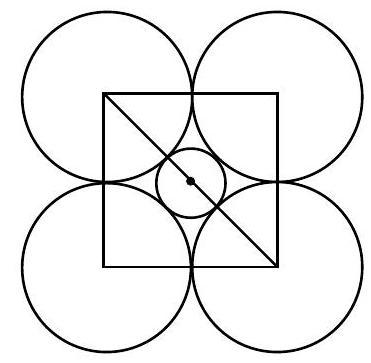
Four larger circles with radius 5 are arranged so that their centers are the vertices of a square. Each of the larger circles is tangent to (that is, just touches) two of the other circles, as shown. A smaller circle with radius \( r \) is drawn in the region between the four larger circles. The smaller circle is tange... | Okay, let's see. There are four large circles arranged so their centers form a square. Each large circle has a radius of 5, and they're tangent to two others. Then there's a smaller circle in the middle that's tangent to all four large circles. We need to find the radius r of this smaller circle. The options are from 1... | The centers of the four larger circles form a square with side length 10, as each circle has a radius of 5 and is tangent to two others. The smaller circle is tangent to each of the four larger circles and is located at the center of this square.
1. **Distance from the center of the square to a corner**:
The center... | 1. **Establish Diagram:**
Draw the diagonal of the square formed by the centers of the four larger circles. The intersection of the diagonals is the center of the square.
... |
Solve the equation $x^{2} + y^{2} = 3xy$ in integers. | Okay, so I need to solve the equation \( x^{2} + y^{2} = 3xy \) in integers. Hmm, let's see. First, I remember that Diophantine equations can sometimes be tricky, but maybe there's a way to manipulate this equation to make it more manageable. Let me start by rearranging the terms to see if I can factor it or find some ... | To solve the equation \( x^{2} + y^{2} = 3xy \) in integers, we proceed as follows:
1. **Initial Observations**:
- If \( x = 0 \), substituting into the equation gives \( y^{2} = 0 \), so \( y = 0 \). Similarly, \( y = 0 \) implies \( x = 0 \). Thus, \((0, 0)\) is a trivial solution.
- For non-trivial solutions,... |
We start with the given equation:
\[
x^2 + y^2 = 3xy
\]
1. **Rearrange Equation:**
We rearrange the equation to move all terms to one side:
\[
x^2 + y^2 - 3xy = 0
\]
2. **Complete the Square:**
To analyze this equation, we will complete the square. Observe that:
\[
x^2 - 3xy + y^2 = 0 \quad \tex... |
Given the integer coefficient equation \( t^{2} + xt + y = 0 \) in terms of \( t \) has real roots \( \alpha \) and \( \beta \), and \( \alpha^{2} + \beta^{2} < 4 \), determine the values of \( x \) and \( y \). | Okay, so I need to solve this problem where we have a quadratic equation with integer coefficients, t² + xt + y = 0, which has real roots α and β. Additionally, the condition given is that α² + β² < 4. I have to determine the integer values of x and y that satisfy these conditions. Hmm, let me think step by step.
Firs... | The integer coefficient quadratic equation \( t^{2} + xt + y = 0 \) has real roots \( \alpha \) and \( \beta \) with \( \alpha^{2} + \beta^{2} < 4 \). Using Vieta's formulas and the discriminant condition, we derive the following:
1. **Sum and Product of Roots**:
\( \alpha + \beta = -x \)
\( \alpha\beta = y ... |
Given the quadratic equation in terms of \( t \):
\[
t^2 + xt + y = 0
\]
with real roots \(\alpha\) and \(\beta\), and the condition \(\alpha^2 + \beta^2 < 4\).
1. **Using Vieta's formulas:**
From Vieta's formulas for the roots of a quadratic equation \( t^2 + xt + y = 0 \), we have:
- \(\alpha + \beta = -x\)... |
Call a simple graph \( G \) quasi-colorable if we can color each edge blue, red, green, and white such that
- for each vertex \( v \) of degree 3 in \( G \), the three edges containing \( v \) as an endpoint are either colored blue, red, and green, or all three edges are white,
- not all edges are white.
A connected g... | Okay, so I need to find the smallest real number c such that if a connected graph G has a/b > c, then G is quasi-colorable. The graph G has a vertices of degree 4, b vertices of degree 3, and no other vertices. Both a and b are positive integers. Quasi-colorable means we can color each edge with blue, red, green, or wh... | The smallest real number \( c \) is \( \boxed{\dfrac{3}{4}} \).
**Step-by-Step Explanation:**
1. **Understanding Quasi-Colorability:**
- A graph \( G \) is quasi-colorable if edges can be colored with blue, red, green, or white such that:
- Each degree 3 vertex has edges either all white or one of each primar... |
1. **Define our goal**:
We need to find the smallest real number \( c \) such that if \(\frac{a}{b} > c\) for a connected graph \( G \) with \( a \) vertices of degree 4 and \( b \) vertices of degree 3, the graph \( G \) is guaranteed to be quasi-colorable.
2. **Set up the known conditions**:
- \( a \) verti... |
Given a positive integer $d$ which is square-free, and a fundamental solution $(x_{0}, y_{0})$ to the equation $x^{2} - d y^{2} = 1$. Find the positive integer solutions $(x, y)$ to this equation such that all prime factors of $x$ divide $x_{0}$. | Okay, so I need to solve this problem where given a square-free positive integer d and a fundamental solution (x₀, y₀) to the Pell equation x² - d y² = 1, I have to find all positive integer solutions (x, y) such that every prime factor of x divides x₀. Hmm, Pell equations... I remember they have infinitely many soluti... | Given a positive integer \( d \) which is square-free, and a fundamental solution \( (x_0, y_0) \) to the equation \( x^2 - d y^2 = 1 \), we need to find the positive integer solutions \( (x, y) \) such that all prime factors of \( x \) divide \( x_0 \).
1. **Pell Equation Solutions**: All solutions to the Pell equati... |
1. First, let us consider the basic form of the Pell equation:
\[
x^2 - d y^2 = 1
\]
As given in the problem, suppose \( x_0 + \sqrt{d} y_0 \) is a fundamental solution of the above equation.
2. According to the theory of Pell equations, any solution \((x, y)\) can be expressed as:
\[
x + \sqrt{d} y... |
There are \( n + 4 \) labeled points on a plane, where 4 points are the vertices of a square, and the remaining \( n \) points are inside this square. A line segment can be drawn between any two labeled points, but these segments must not contain any other labeled points except at their endpoints, and no two segments c... | Okay, let's tackle this problem step by step. So, we have a square with 4 vertices, and inside the square, there are n labeled points. The total number of points is n + 4. We need to find the maximum number of line segments we can draw between these points such that no line segment contains any other labeled points exc... | To solve the problem of finding the maximum number of line segments that can be drawn between \( n + 4 \) labeled points (4 vertices of a square and \( n \) internal points) such that no line segment contains any other labeled points except at their endpoints and no two segments intersect except at their endpoints, we ... |
1. **Setup and Notation**:
We are given $n+4$ marked points on a plane, where 4 of those points are the vertices of a square $K$, and the remaining $n$ points lie strictly inside the square. We need to determine the maximum number of line segments that can be formed between these $n+4$ points, subject to the ... |
Find the center of gravity of a homogeneous hollow truncated cylinder and the moment of inertia of this cylinder with respect to its axis. | Okay, so I need to find the center of gravity and the moment of inertia for a homogeneous hollow truncated cylinder with respect to its axis. Hmm, let's start by visualizing the problem. A hollow truncated cylinder is like a cylindrical tube that's been cut at an angle, right? So it's not a full cylinder; part of it ha... | The center of gravity (centroid) of a homogeneous hollow truncated cylinder and its moment of inertia about its axis are determined as follows:
### **Center of Gravity**
For a truncated cylinder with heights \( H_1 \) (maximum) and \( H_2 \) (minimum) at opposite ends, the centroid lies along the central axis at a hei... |
Given:
- External radius \( R \),
- Internal radius \( r \),
- Height \( H \),
We need to find the center of mass and the moment of inertia of a truncated cylindrical section.
#### Step 1: Set up the cylindrical equations
The cylindrical surfaces and planes that bound the cylinder \( G \) given by:
\[ x^2 + y^2 = ... |
Decompose the function \( y = \arccos x + 1 \) into a Fourier series on the interval \((-1,1)\) using the system of Chebyshev polynomials. | Okay, I need to decompose the function \( y = \arccos x + 1 \) into a Fourier series using Chebyshev polynomials on the interval \((-1,1)\). Hmm, Chebyshev polynomials are orthogonal on this interval with a weight function \( \frac{1}{\sqrt{1 - x^2}} \). So, I should use this weight function in the inner product when c... | To decompose the function \( y = \arccos x + 1 \) into a Fourier series using Chebyshev polynomials of the first kind \( T_n(x) \) on the interval \((-1,1)\), we utilize their orthogonality with the weight function \( \frac{1}{\sqrt{1 - x^2}} \). The series is expressed as:
\[
\arccos x + 1 = \sum_{n=0}^{\infty} a_n T... |
1. We begin by recalling the definition and properties of Chebyshev polynomials. The Chebyshev polynomials of the first kind, $T_n(x)$, are defined by:
$$
T_n(x) = \cos(n \arccos x), \quad n = 0, 1, 2, \ldots
$$
These polynomials form an orthogonal basis in the space of functions defined on the interval $(... |
On a convex polygon-shaped billiard table $A_{1} A_{2} \cdots A_{n}$, there are two billiard balls $M_{1}$ and $M_{2}$. From what direction should ball $M_{1}$ be struck so that it successively hits sides $A_{1} A_{2}, A_{2} A_{3}, \cdots, A_{n} A_{1}$ and then hits ball $M_{2}$? (The reflection rule states that the an... | Okay, so I need to figure out from which direction to hit the ball M1 so that it bounces off all the sides of a convex polygon in order and then hits M2. The polygon is labeled A1, A2, ..., An, and it's convex, which probably matters because the reflections might behave differently in a non-convex polygon. The reflecti... | To determine the direction from which to strike ball \( M_1 \) so that it successively hits all sides \( A_1A_2, A_2A_3, \ldots, A_nA_1 \) of a convex polygon and then hits \( M_2 \), follow these steps:
1. **Reflect \( M_2 \) Across Sides in Reverse Order**:
Reflect \( M_2 \) across the sides starting from \( A_... |
1. **Identify Reflection Points:**
- Start by identifying the reflection points for the ball $M_1$ against each edge of the convex polygon $A_1A_2 \cdots A_n$.
- Define the reflection of $M_1$ across the line $A_1A_2$ as $M_1^{(1)}$.
- Next, reflect $M_1^{(1)}$ across the line $A_2A_3$ to get $M_1^{(2)}$.
... |
Prove that in an integer triangle, the following statements are equivalent:
a) The sine of one of the angles is a rational number;
b) The sines of all angles are rational numbers;
c) The area of the triangle is a rational number;
d) The radius of the inscribed circle is a rational number;
e) The radius of the circ... | Okay, so I need to prove that all these statements from a) to i) are equivalent in an integer triangle. That means if one of them holds true, then all the others must also hold true, right? Let me start by recalling what an integer triangle is. An integer triangle has all sides of integer length, so it's a triangle wit... | In an integer triangle (a triangle with integer side lengths), the following statements are all equivalent due to the interconnected relationships between trigonometric functions, area, inradius, circumradius, heights, and half-angle tangents. Here's the systematic proof:
### **Equivalence Proof**
1. **a) ⇨ b):**
... |
We need to show the equivalence of the statements for an integer-sided triangle. The equivalence can be established using the formulas for the area, heights, and tangent of half-angles. Let's go step-by-step:
#### Step 1: Understanding the Relation between Sine and Area
The area \( S \) of a triangle can be expresse... |
Let \( N \) be a positive integer such that \( 5 \mid N \). We arrange one red ball and \( N \) identical green balls randomly in a row. Let \( P(N) \) be the probability that the number of green balls on one side of the red ball is at least \(\frac{3}{5}\) of the total number of green balls. It is known that \( P(5) =... | Okay, let's see. The problem is about probability and finding the smallest N (divisible by 5) where the probability P(N) is much less than 321/400. The answer choices are given as digits sums, so I need to find the correct N and then add its digits.
First, let me make sure I understand the setup. We have one red ball ... | To solve the problem, we need to find the smallest positive integer \( N \) divisible by 5 such that the probability \( P(N) \) is less than \( \frac{321}{400} \).
**Key Steps:**
1. **Understanding the Probability \( P(N) \):**
- \( N \) green balls and 1 red ball are arranged randomly in a row.
- \( P(N) \) i... | 1. Given that \(N\) is a positive integer and \(5\) divides \(N\), we start by setting \(N = 5n\) where \(n\) is a positive integer.
2. We are to arrange \(N\) green balls and one red ball randomly in a line, resulting in \(N+1\) total positions where the red ball can be placed.
3. The probability \(P(N)\) is defined t... |
In the spatial quadrilateral \(ABCD\), points \(A\), \(B\), \(C\), and \(D\) are not coplanar. Denote the sum of the four internal angles as \(\theta = \angle ABC + \angle BCD + \angle CDA + \angle DAB\). Then:
A. \(\theta > 360^\circ\)
B. \(\theta = 360^\circ\)
C. \(\theta < 360^\circ\)
D. Cannot be determined | Okay, so I have this geometry problem here about a spatial quadrilateral ABCD where the points aren't coplanar. The question is asking about the sum of the four internal angles, which they denote as θ. The options are whether θ is greater than, equal to, less than 360 degrees, or if it can't be determined. Hmm, let's t... | The sum of the internal angles of a spatial quadrilateral \(ABCD\) where the points are not coplanar can vary depending on the specific geometry of the quadrilateral.
1. **Planar Quadrilaterals**: For planar quadrilaterals, the sum of internal angles is always \(360^\circ\). However, since the problem specifies a spa... |
Given a 3D quadrilateral \(ABCD\) where the points \(A, B, C,\) and \(D\) are not coplanar, we want to investigate the sum of the angles \(\theta = \angle ABC + \angle BCD + \angle CDA + \angle DAB\).
1. **Setup Relationship of Angles:**
- Select \(A, B, C\) as defining a plane. Then, \(D\) lies outside this plane... |
Let \( f(n) \) and \( g(n) \) be polynomials of degree 2014 such that \( f(n) + (-1)^n g(n) = 2^n \) for \( n = 1, 2, \ldots, 4030 \). Find the coefficient of \( x^{2014} \) in \( g(x) \). | Okay, so I need to find the coefficient of \( x^{2014} \) in the polynomial \( g(x) \), given that \( f(n) + (-1)^n g(n) = 2^n \) for \( n = 1, 2, \ldots, 4030 \). Both \( f(n) \) and \( g(n) \) are polynomials of degree 2014. Hmm, let's try to unpack this step by step.
First, since \( f \) and \( g \) are both polyno... | To solve the problem, we analyze the given polynomials \( f(n) \) and \( g(n) \) of degree 2014 that satisfy \( f(n) + (-1)^n g(n) = 2^n \) for \( n = 1, 2, \ldots, 4030 \).
### Key Steps:
1. **Separate Equations by Parity**:
- For even \( n \): \( f(n) + g(n) = 2^n \)
- For odd \( n \): \( f(n) - g(n) = 2^n \... |
Let's start by understanding the given problem:
We are given two polynomials \( f(n) \) and \( g(n) \) of degree 2014 such that
\[ f(n) + (-1)^n g(n) = 2^n \]
for \( n = 1, 2, \ldots, 4030 \).
Our objective is to find the coefficient of \( x^{2014} \) in \( g(x) \).
1. **Define New Functions:**
Define new pol... |
If Clara doubles a number and then adds 3, the result is 23. What is the original number? | Okay, so Clara doubles a number and then adds 3, and the result is 23. I need to find the original number. Let me think about how to approach this step by step.
First, let me parse the problem. The problem says that if you take a number, double it, and then add 3, you end up with 23. My task is to figure out what that... | The original number can be determined by reversing the operations described:
1. **Start with the final result**: 23
2. **Subtract the 3 added**: \(23 - 3 = 20\)
3. **Divide by 2 (undo doubling)**: \(20 \div 2 = 10\)
**Verification**:
Doubling 10 gives \(2 \times 10 = 20\), then adding 3 yields \(20 + 3 = 23\)... |
1. Let the original number be represented by the variable \( x \).
2. According to the problem, if Clara doubles the number \( x \) and then adds 3, the result is 23. We can represent this mathematically as:
\[
2x + 3 = 23
\]
3. To find the value of \( x \), first isolate \( 2x \) by subtracting 3 from both... |
A certain country has \( n(n \geqslant 2) \) cities, and there is a direct bidirectional flight route between each pair of cities. The aviation authority authorizes certain airlines to use these routes under the following conditions:
1. Each flight route is used by exactly one airline.
2. For each airline, passengers c... | Okay, let's try to tackle this problem. So, we have a country with n cities, where each pair of cities is connected by a direct bidirectional flight route. The aviation authority wants to authorize airlines such that each route is assigned to exactly one airline, and for each airline, their set of routes must allow pas... | To solve the problem of finding the maximum number of airlines that can be authorized by the aviation authority, we need to partition the edges of the complete graph \( K_n \) into connected spanning subgraphs. Each subgraph must be connected and cover all cities, and each edge must be assigned to exactly one airline.
... |
1. Let the number of authorized airline companies be $m$.
We aim to prove that \(m \leq \left\lfloor \frac{n}{2} \right\rfloor\).
2. Consider a country with $n$ cities denoted as \( \{1, 2, \ldots, n \}\). Each pair of cities has a bidirectional flight route.
Let the set of airline companies be denoted as ... |
Given a parallelogram \(ABCD\) with \(\angle D = 100^\circ\) and \(BC = 12\). On the side \(AD\), there exists a point \(L\) such that \(\angle ABL = 50^\circ\) and \(LD = 4\). Find the length of \(CD\). | Okay, so I need to solve this geometry problem about a parallelogram ABCD. Let me first recall the properties of a parallelogram. In a parallelogram, opposite sides are equal and parallel, and opposite angles are equal. Also, consecutive angles are supplementary, meaning they add up to 180 degrees.
Given that angle D... | Given a parallelogram \(ABCD\) with \(\angle D = 100^\circ\) and \(BC = 12\). On the side \(AD\), there exists a point \(L\) such that \(\angle ABL = 50^\circ\) and \(LD = 4\). We need to find the length of \(CD\).
1. **Properties of Parallelogram**:
- Opposite sides are equal: \(AD = BC = 12\) and \(AB = CD\).
... | 1. We know the properties of a parallelogram:
- Opposite angles are equal.
- Opposite sides are equal.
2. Given:
- Parallelogram \(ABCD\) with \(\angle D = 100^\circ\), \(BC = 12\).
- A point \(L\) on side \(AD\) such that \(\angle ABL = 50^\circ\), and \(LD = 4\).
3. By the properties of parallelograms:
... |
Fifteen freshmen are sitting in a circle around a table, but there are only six copies of today's handout available. Each freshman should get at most one handout, and any freshman who does not receive a handout should be able to read from a neighbor who has one. The freshmen are distinguishable but the handouts are not... | Alright, so I need to figure out how many ways there are to distribute six handouts to fifteen freshmen sitting in a circle. Each freshman can get at most one handout, and every freshman without a handout must be adjacent to someone who has one. The freshmen are distinguishable, but the handouts are not. Hmm, okay. Let... | To solve the problem of distributing six handouts to fifteen freshmen sitting in a circle such that each freshman without a handout is adjacent to one with a handout, we need to count the number of dominating sets of size 6 in a cycle graph \( C_{15} \).
1. **Understanding the Problem**:
- The students are distingu... |
1. **Identify the Problem Framework**:
We have 15 freshmen sitting in a circle, but only 6 handouts to distribute such that no freshman should get more than one handout, and any freshman who does not get one should be able to read a neighbor’s handout.
2. **Calculate Probability Context**:
Let's consider the... |
Find the equation of the plane passing through the points \( P_{0}(2, -1, 2) \), \( P_{1}(4, 3, 0) \), and \( P_{2}(5, 2, 1) \). | Okay, let me try to figure out the equation of the plane passing through these three points: P0(2, -1, 2), P1(4, 3, 0), and P2(5, 2, 1). Hmm, I remember that to find the equation of a plane, I need a point on the plane and a normal vector to the plane. Since all three points lie on the plane, I can use any one of them ... | The equation of the plane passing through the points \( P_{0}(2, -1, 2) \), \( P_{1}(4, 3, 0) \), and \( P_{2}(5, 2, 1) \) is found as follows:
1. **Find two vectors on the plane**:
- \( \overrightarrow{P_0P_1} = (4-2, 3-(-1), 0-2) = (2, 4, -2) \)
- \( \overrightarrow{P_0P_2} = (5-2, 2-(-1), 1-2) = (3, 3, -1) \)... | :
To find the equation of the plane passing through the points \( P_0(2,-1,2) \), \( P_1(4,3,0) \), and \( P_2(5,2,1) \), we follow these steps:
1. **Determine vectors in the plane:**
We can use the given points to form the vectors:
\[
\overrightarrow{P_0P_1} = (4-2, 3+1, 0-2) = (2, 4, -2)
\]
\[
\... |
Is it possible to find two lucky tickets among ten consecutive tickets? A ticket is considered lucky if the sum of the first three digits is equal to the sum of the last three digits. | Okay, so the question is asking if it's possible to find two lucky tickets among ten consecutive tickets. A lucky ticket is one where the sum of the first three digits equals the sum of the last three digits. Let me start by understanding the problem properly.
First, I need to recall what a lucky ticket is. In many co... | **Step-by-Step Explanation and Answer:**
To determine if two lucky tickets can exist among ten consecutive six-digit tickets, we analyze the structure and transitions between ticket numbers.
1. **Definition of a Lucky Ticket**: A ticket is lucky if the sum of the first three digits (S₁) equals the sum of the last thr... | To solve this problem, we need to establish whether it is possible to find two "lucky" tickets among a sequence of ten consecutive ticket numbers. A ticket is considered "lucky" if the sum of its first three digits equals the sum of its last three digits.
Let's verify with an example.
1. **Identify a range of ten co... |
Given an isosceles triangle \( \triangle ABC \) with base \( BC \) and height \( AD \) both being integers, then among \( \sin A \) and \( \cos A \), which of the following is true?
(A) One is rational, the other is irrational
(B) Both are rational
(C) Both are irrational
(D) Whether they are rational or irrational dep... | Okay, let's try to figure out this problem step by step. So, we have an isosceles triangle ABC with base BC and height AD, both of which are integers. We need to determine whether sin A and cos A are rational, irrational, or if it depends on BC and AD. The options are (A) One is rational, the other is irrational; (B) B... | Given an isosceles triangle \( \triangle ABC \) with base \( BC \) and height \( AD \) both being integers, we need to determine whether \( \sin A \) and \( \cos A \) are rational or irrational.
1. **Identify the sides and height**:
- Let \( BC = b \) (integer) and \( AD = h \) (integer).
- The legs \( AB \) and... |
1. Given an isosceles triangle \( \triangle ABC \) with base \( BC \) and height \( AD \) (from vertex \( A \) to midpoint \( D \) of \( BC \)).
2. The base \( BC \) and height \( AD \) are both rational numbers.
### Step-by-step solution:
#### Step 1: Relationship among \( \tan \frac{A}{2} \), \( BC \), and \( AD \... |
Determine all pairs \((m, n)\) of positive integers such that \(\frac{n^{3}+1}{m^{2}-1}\) is an integer. | Okay, let's see. I need to find all pairs of positive integers (m, n) such that the expression (n³ + 1)/(m² - 1) is an integer. Hmm, so both m and n are positive integers, and m² - 1 has to divide n³ + 1. That means n³ + 1 must be a multiple of m² - 1.
First, maybe I should start by understanding the structure of the... | To determine all pairs \((m, n)\) of positive integers such that \(\frac{n^{3}+1}{m^{2}-1}\) is an integer, we start by noting that \(m \geq 2\) (since \(m = 1\) would make the denominator zero). The key steps involve factoring both the numerator and the denominator:
1. **Factorization**:
- The numerator \(n^3 + 1\... | To determine all pairs \((m, n)\) of positive integers such that \(\frac{n^3 + 1}{m^2 - 1}\) is an integer, follow the steps below:
1. **Initial Setup:**
We need \(\frac{n^3 + 1}{m^2 - 1} \in \mathbb{Z}\), where \(\mathbb{Z}\) denotes the set of integers.
2. **Rewriting the Problem:**
Notice that \(m^2 - 1 = (m... |
Let \( A B C \) be a triangle with orthocenter \( H \) and let \( P \) be the second intersection of the circumcircle of triangle \( A H C \) with the internal bisector of \( \angle B A C \). Let \( X \) be the circumcenter of triangle \( A P B \) and let \( Y \) be the orthocenter of triangle \( A P C \). Prove that t... | Okay, let's try to tackle this geometry problem. It seems a bit involved, but if I take it step by step, maybe I can figure it out. So, we have triangle ABC with orthocenter H. Point P is defined as the second intersection of the circumcircle of triangle AHC with the internal bisector of angle BAC. Then X is the circum... | Given triangle \(ABC\) with orthocenter \(H\), we need to prove that the length of segment \(XY\) is equal to the circumradius \(R\) of triangle \(ABC\). Here, \(P\) is the second intersection of the circumcircle of triangle \(AHC\) with the internal bisector of \(\angle BAC\), \(X\) is the circumcenter of triangle \(A... | Let's break down the given problem and solution step-by-step with all necessary details.
1. Let $X$ be the circumcenter of $\triangle APB$, and $Y$ be the orthocenter of $\triangle APC$. We need to show that $XY$ equals the circumradius of $\triangle ABC$.
2. Reflect point $P$ across $\overline{AC}$ to obtain poin... |
Do there exist 2016 consecutive natural numbers, among which there are exactly 16 prime numbers? | Alright, let me try to work through this problem step by step. The question is: Do there exist 2016 consecutive natural numbers, among which there are exactly 16 prime numbers?
First, I need to understand what the problem is asking. We need to find a sequence of 2016 numbers in a row (like n, n+1, n+2, ..., n+2015) su... | **Step-by-Step Explanation and Answer:**
To determine whether there exist 2016 consecutive natural numbers containing exactly 16 primes, we analyze the density and distribution of prime numbers.
1. **Prime Density Analysis**:
- The Prime Number Theorem states that the number of primes less than \( x \) is approxim... |
To determine if there exist 2016 consecutive natural numbers that contain exactly 16 prime numbers, we introduce a function \( S(n) \). This function represents the number of prime numbers in the interval from \( n \) to \( n + 2015 \).
1. **Observation of \( S(n) \)):**
Notice that when we shift the starting po... |
Three pedestrians are walking along three straight roads at constant speeds. At the initial time, they were not on the same line. Prove that they can be on the same line at most twice. | Okay, let me try to work through this problem step by step. So, the question is: Three pedestrians are walking along three straight roads at constant speeds. At the initial time, they were not on the same line. Prove that they can be on the same line at most twice.
First, I need to understand the setup. There are thr... | To prove that three pedestrians moving along three distinct straight roads at constant speeds can be collinear at most twice, we analyze their motion parametrically and use the properties of quadratic equations.
**Step-by-Step Explanation:**
1. **Parametric Equations:**
Each pedestrian's position at time \( t \) i... |
1. **Define the vectors:**
Let \( \boldsymbol{v}(t) \) and \( \boldsymbol{w}(t) \) be vectors that connect the first pedestrian with the second and third pedestrians, respectively, at time \( t \). Without loss of generality, we can represent \( \boldsymbol{v}(t) \) and \( \boldsymbol{w}(t) \) as linear functions ... |
Given an integer $n$ greater than 3, let real numbers $x_{1}, x_{2}, \cdots, x_{n}, x_{n+1}, x_{n+2}$ satisfy the conditions $0 < x_{1} < x_{2} < \cdots < x_{n} < x_{n+1} < x_{n+2}$. Find the minimum value of the expression
\[
\frac{\left(\sum_{i=1}^{n} \frac{x_{i+1}}{x_{i}}\right)\left(\sum_{j=1}^{n} \frac{x_{j+2}}{x... | Okay, so I have this problem here where I need to find the minimum value of a certain expression involving sequences of real numbers. Let me try to parse the problem first and then figure out a strategy.
Given an integer n greater than 3, we have real numbers x₁, x₂, ..., xₙ, xₙ₊₁, xₙ₊₂ such that they are strictly inc... | Given an integer \( n \) greater than 3, we need to find the minimum value of the expression
\[
\frac{\left(\sum_{i=1}^{n} \frac{x_{i+1}}{x_{i}}\right)\left(\sum_{j=1}^{n} \frac{x_{j+2}}{x_{j+1}}\right)}{\left(\sum_{k=1}^{n} \frac{x_{k+1} x_{k+2}}{x_{k+1}^{2} + x_{k} x_{k+2}}\right)\left(\sum_{l=1}^{n} \frac{x_{l+1}^{... | 1. Let $t_i = \frac{x_{i+1}}{x_i}$ for $1 \leq i \leq n+1$. Since $0 < x_1 < x_2 < \dots < x_n < x_{n+1} < x_{n+2}$, it follows that $t_i > 1$.
2. The given expression can be rewritten in terms of $t_i$ as:
\[
\frac {\left( \sum_{i=1}^{n} t_i \right) \left( \sum_{i=1}^{n} t_{i+1} \right)} {\left( \sum_{i=1}^{n} \fra... |
Given the sets \( A=\{1,5\} \) and \( B=\{x^{2}-3x+1, x^{2}-4x+5\} \), if the number of elements in the set \( A \cup B \) is 3, then the real number \( x \) equals what? | Okay, let's see. So, the problem is about sets A and B. Set A is given as {1, 5}, and set B is {x² - 3x + 1, x² - 4x + 5}. We need to find the real number x such that the union of sets A and B, which is A ∪ B, has exactly 3 elements. Hmm, okay.
First, let me recall that the union of two sets combines all the elements ... | Given the sets \( A = \{1, 5\} \) and \( B = \{x^2 - 3x + 1, x^2 - 4x + 5\} \), we need to find the real number \( x \) such that the number of elements in the set \( A \cup B \) is 3.
To solve this, we need to ensure that exactly one element from set \( B \) overlaps with set \( A \), and the other element from set ... | 1. Given sets \( A = \{1, 5\} \) and \( B = \left\{ x^2 - 3x + 1, x^2 - 4x + 5 \right\} \), we know that the number of elements in \( A \cup B \) is 3.
2. This implies that the expressions \( x^2 - 3x + 1 \) and \( x^2 - 4x + 5 \) must yield distinct values that, when combined with the elements of \( A \), give a tota... |
Let \( a_{k} \) be the coefficient of \( x^{k} \) in the expansion of \( (1+2x)^{100} \), where \( 0 \leq k \leq 100 \). Find the number of integers \( r \) such that \( 0 \leq r \leq 99 \) and \( a_{r} < a_{r+1} \). | Okay, so I need to find the number of integers r between 0 and 99 such that the coefficient of x^r in the expansion of (1 + 2x)^100 is less than the coefficient of x^{r+1}. Let me start by recalling some basic concepts about binomial expansions.
The expansion of (1 + 2x)^100 can be written using the binomial theorem ... | To find the number of integers \( r \) such that \( 0 \leq r \leq 99 \) and \( a_r < a_{r+1} \) in the expansion of \( (1 + 2x)^{100} \), we start by noting that the coefficients \( a_k \) are given by \( \binom{100}{k} \cdot 2^k \).
We need to determine when \( a_r < a_{r+1} \). This translates to the inequality:
\[... |
1. **Expression of Coefficients**:
Let's denote \( a_k \) as the coefficient of \( x^k \) in the expansion of \( (1 + 2x)^{100} \). Using the binomial theorem, the coefficient \( a_k \) can be written as:
\[
a_k = 2^k \binom{100}{k}
\]
2. **Finding the Ratio \( \frac{a_{r+1}}{a_r} \)**:
To find the nat... |
If \( M = \left\{ z \left\lvert\, z = \frac{t}{1+t} + \mathrm{i} \frac{1+t}{t} \right., t \in \mathbf{R}, t \neq -1, t \neq 0 \right\} \) and \( N = \left\{ z \mid z = \sqrt{2} \cdot [\cos (\arcsin t) + \mathrm{i} \cos (\arccos t)], t \in \mathbf{R}\, \lvert\, t \leqslant 1 \right\} \), then the number of elements in \... | Okay, let me try to figure out this problem step by step. So, we have two sets M and N, both consisting of complex numbers defined in different ways, and we need to find how many elements are in their intersection. The answer choices are 0, 1, 2, or 4. Hmm, I need to understand what each set looks like and then see whe... | To determine the number of elements in \( M \cap N \), we analyze the sets \( M \) and \( N \) separately and then find their intersection.
**Set \( M \)**:
- Defined as \( z = \frac{t}{1+t} + \mathrm{i} \frac{1+t}{t} \) where \( t \in \mathbf{R} \), \( t \neq -1 \), \( t \neq 0 \).
- Expressing \( x = \frac{t}{1+t} \... |
To solve this problem, we need to find the elements that belong to both sets \( M \) and \( N \). Let's start by writing down the definitions of the sets \( M \) and \( N \):
1. \( M \) is defined as:
\[
M=\left\{ z \, \left| \, z=\frac{t}{1+t}+\mathrm{i} \frac{1+t}{t}, \, t \in \mathbf{R}, \, t \neq -1, \, t \neq 0... |
Let the function be defined as
$$
f(x)=|\cos x+\alpha \cos 2 x+\beta \cos 3 x|,
$$
where $\alpha$ and $\beta$ are real numbers. Find
$$
M=\min _{\alpha, \beta} \max _{x \in \mathbf{R}}\{f(x)\}. | Okay, so I have this problem here where I need to find the minimum value M such that M is the smallest maximum of the function f(x) = |cos x + α cos 2x + β cos 3x|, where α and β are real numbers. The goal is to minimize the maximum value of f(x) over all real numbers x by choosing the best possible α and β. Hmm, that ... | To find the minimum value \( M \) such that \( M \) is the smallest maximum of the function \( f(x) = |\cos x + \alpha \cos 2x + \beta \cos 3x| \) over all real numbers \( x \) by choosing the best possible \( \alpha \) and \( \beta \), we start by transforming the function using trigonometric identities and substituti... | Given the function:
\[ f(x) = |\cos x + \alpha \cos 2x + \beta \cos 3x|, \quad \alpha , \beta \in \mathbb{R} \]
we seek to find
\[ M = \min_{\alpha, \beta} \max_{x \in \mathbb{R}} \{f(x)\}. \]
1. **Evaluate the function at specific points:**
Notice that:
\[ f\left(\frac{\pi}{6}\right) = \left| \cos \frac{\pi}{... |
Transform the expression:
\[ \frac{x^{3}+x^{2}-4 x-4}{(x-1)(x-3)+3 x-5}=\frac{(x+1)\left(x^{2}-4\right)}{x^{2}-x-2}=\frac{(x+1)(x-2)(x+2)}{(x-2)(x+1)}\]
\[
\begin{gathered}
f(x)=\left|\frac{x^{3}+x^{2}-4 x-4}{(x-1)(x-3)+3 x-5}\right|=|x+2| \\
D(f): x \neq 2, x \neq -1
\end{gathered}
\]
\[
p(x)=\sqrt{x^{2}}+a=|x|+a... | Okay, so I need to solve this equation |x + 2| = |x| + a graphically in the XOA coordinate system. Hmm, let me start by understanding what the problem is asking. The user mentioned transforming the original rational function into a simpler form, which ended up being |x + 2|, considering the domain restrictions. Then, t... | The equation \(|x + 2| = |x| + a\) is solved by analyzing three intervals based on the critical points \(x = -2\) and \(x = 0\). Here's the step-by-step breakdown:
1. **Case 1: \(x < -2\)**
- Both \(x + 2\) and \(x\) are negative.
- Equation: \(-x - 2 = -x + a \Rightarrow a = -2\).
- **Result:** \(a = -2\) yi... |
We are given the following expression:
\[ \frac{x^3 + x^2 - 4x - 4}{(x-1)(x-3) + 3x - 5} \]
We need to simplify it step by step.
1. **Simplify the denominator**:
\[
(x-1)(x-3) + 3x - 5
\]
First, expand the product:
\[
(x-1)(x-3) = x^2 - 3x - x + 3 = x^2 - 4x + 3
\]
Then, add \(3x... |
Prove the general statement: the ratio of the length of a segment to the length of its shadow is the same for all segments.
(Of course, we mean that the two lines, on which the segment and its shadow lie, and the direction of projection are fixed.) | Alright, so I need to prove that the ratio of the length of a segment to the length of its shadow is the same for all segments, given that the projection direction and the lines on which the segments and their shadows lie are fixed. Hmm, let's start by visualizing the problem.
First, let me make sure I understand the... | To prove that the ratio of the length of a segment to the length of its shadow is constant for all segments under a fixed projection direction and fixed lines, we analyze the geometric relationship as follows:
**1. Setup and Definitions:**
- Let **L₁** and **L₂** be two lines in a plane, and **v** be the fixed project... |
1. **Define Variables:** Let the lengths of two segments be denoted as \(a\) and \(b\), and the lengths of their shadows be denoted as \(a'\) and \(b'\).
2. **Apply Thales' Theorem:** According to Thales' theorem, the ratio of the lengths of the segments is the same as the ratio of the lengths of their shadows. There... |
In a \(3 \times 3\) table, 9 numbers are arranged such that all six products of these numbers in the rows and columns of the table are different. What is the maximum number of numbers in this table that can be equal to one? | Okay, so I need to figure out the maximum number of ones that can be placed in a 3x3 table where all six products (three rows and three columns) are different. Hmm, let me start by understanding the problem better.
First, the table has 9 entries, and we want as many of them as possible to be 1. But the catch is that w... | To determine the maximum number of ones that can be placed in a \(3 \times 3\) table such that all six products of the numbers in the rows and columns are different, we need to explore various configurations and verify the uniqueness of the products.
1. **Initial Considerations**:
- If all 9 numbers are 1, all prod... |
1. **Setup the problem:**
We are given a $3 \times 3$ table filled with 9 numbers such that the product of the numbers in any row and any column are all distinct. We need to determine the maximum possible number of 1's in this table.
2. **Problem Analysis:**
We first define the "index of the table" to be the ... |
Schoolchildren were given 7 sheets of paper and asked to cut some of them into 7 pieces. The resulting pieces of paper were mixed and they were again asked to cut some of them into 7 pieces. This process was repeated several times. How many pieces of paper need to be cut in order to end up with 331 pieces? | Okay, let's try to figure out this problem. So, the schoolchildren start with 7 sheets of paper. Each time they cut some sheets into 7 pieces. After each cutting, the pieces are mixed, and then they repeat the process. We need to find out how many pieces of paper need to be cut in order to end up with 331 pieces.
Fir... | To determine how many pieces of paper need to be cut to reach 331 pieces, observe the following:
1. **Key Insight**: Each time a sheet is cut into 7 pieces, the total number of sheets increases by \(6\) (since \(7 - 1 = 6\)). Thus, cutting \(k\) sheets increases the total by \(6k\).
2. **Total Increase Required**: St... |
Let us denote by \(k\) the number of times the pieces of paper were cut. Initially, we start with 7 pieces of paper.
1. **Observe the effect of one cut on the number of pieces:**
Each piece that is cut into 7 parts will result in 6 additional pieces since 1 piece is turned into 7 pieces (6 new pieces are created ... |
Given an acute triangle \( \triangle ABC \), where \(\sin (A+B)=\frac{3}{5}\) and \(\sin (A-B)=\frac{1}{5}\).
1. Prove that \(\tan A = 2 \tan B\).
2. Given \(AB = 3\), find the height on the side \(AB\). | Okay, let me try to figure out how to solve these two problems. So, first, we have an acute triangle ABC. The first part asks us to prove that tan A is twice tan B, given that sin(A+B) is 3/5 and sin(A-B) is 1/5. The second part gives us that AB is 3 and wants the height on side AB. Alright, let's start with the first ... | Given an acute triangle \( \triangle ABC \), where \(\sin (A+B) = \frac{3}{5}\) and \(\sin (A-B) = \frac{1}{5}\):
1. **Prove that \(\tan A = 2 \tan B\):**
Using the sine addition and subtraction formulas:
\[
\sin(A+B) = \sin A \cos B + \cos A \sin B = \frac{3}{5}
\]
\[
\sin(A-B) = \sin A \cos B - \c... | ### Problem Statement:
Given that in an acute triangle \( \triangle ABC \), \(\sin(A+B) = \frac{3}{5}\) and \(\sin(A-B) = \frac{1}{5}\):
1. Prove: \(\tan A = 2 \tan B\);
2. Let \(AB = 3\), find the height on side \(AB\).
1. **Step 1: Express \(\sin(A+B)\) and \(\sin(A-B)\) using angle addition and subtraction formulas... |
In a certain population, the ratio of the number of females to the number of males is 11:10. If the average age of the females is 34 years, and the average age of the males is 32 years, what is the average age in this population?
(A) $32 \frac{9}{10}$
(B) $32 \frac{20}{21}$
(C) 33
(D) $33 \frac{1}{21}$
(E) $33 \frac{1}... | Okay, let's try to figure out this problem. So, we have a population where the ratio of females to males is 11:10. The average age of the females is 34 years, and the average age of the males is 32 years. We need to find the overall average age of the entire population. The answer choices are given, so maybe that can h... | Given a population where the ratio of females to males is 11:10, with the average age of females being 34 years and the average age of males being 32 years, we need to find the overall average age of the population.
1. **Represent the number of females and males using the ratio:**
- Let the number of females be \(1... |
1. We start by letting \( w \) represent the number of females and \( m \) represent the number of males. According to the problem, the ratio of females to males is given as \( 11:10 \).
We can express this ratio using a common multiplier \( x \):
\[
w = 11x \quad \text{and} \quad m = 10x
\]
2. Next, we... |
A quadratic function \( y = f(x) \) has the same values as \( \sin x \) at \( x = 0, \frac{\pi}{2}, \pi \). Find this quadratic function. | Okay, so I need to find a quadratic function y = f(x) that has the same values as sin(x) at x = 0, π/2, and π. Hmm, quadratic function means it's a parabola, right? So a quadratic function is generally of the form f(x) = ax² + bx + c, where a, b, c are constants. My goal is to find the values of a, b, and c such that w... | The quadratic function \( y = f(x) \) that matches \( \sin x \) at \( x = 0, \frac{\pi}{2}, \pi \) is derived as follows:
1. **Identify key points**:
- At \( x = 0 \): \( \sin(0) = 0 \).
- At \( x = \frac{\pi}{2} \): \( \sin\left(\frac{\pi}{2}\right) = 1 \).
- At \( x = \pi \): \( \sin(\pi) = 0 \).
... | ### Problem:
求一个二次函数 $y = f(x)$,当 $x = 0, \frac{\pi}{2}, \pi$ 时,它的值与 $\sin x$ 的对应值相同。求此二次函数。
1. **利用拉格朗日插值多项式**: 根据已知条件 $f(0) = \sin(0) = 0$, $f\left(\frac{\pi}{2}\right) = \sin\left(\frac{\pi}{2}\right) = 1$, $f(\pi) = \sin(\pi) = 0$ ,以及拉格朗日插值多项式公式,有:
\[
f(x) = \sum_{i=0}^{n} y_i \prod_{\substack{0 \le j \le n \\ j ... |
From the consecutive natural numbers \(1, 2, 3, \ldots, 2014\), select \( n \) numbers such that any two selected numbers do not have the property that one number is five times the other. Find the maximum value of \( n \) and provide a justification. | Okay, so I need to figure out the maximum number of numbers, n, that I can select from the natural numbers 1 to 2014 such that no two selected numbers have one being five times the other. Hmm, let's start by understanding the problem.
First, the key constraint here is that if I pick a number, say x, I cannot pick 5x i... | To solve the problem of selecting the maximum number \( n \) from the natural numbers \( 1, 2, 3, \ldots, 2014 \) such that no two selected numbers have one being five times the other, we can use the following approach:
1. **Group Numbers into Chains**:
- Each number can be uniquely represented as \( 5^k \cdot m \)... |
To find the maximum value of \( n \) such that any \( n \) integers chosen from the set of consecutive natural numbers \(\{1, 2, 3, \ldots, 2014\}\) do not contain a pair of numbers where one is 5 times the other, let's carefully examine the structure involved.
1. **Partitioning into Groups:**
We begin by noting t... |
Solve the system
$$
\left\{\begin{aligned}
x_{1}-2 x_{2}+3 x_{3} & =5 \\
2 x_{1}+3 x_{2}-x_{3} & =7 \\
3 x_{1}+x_{2}+2 x_{3} & =10
\end{aligned}\right.
$$ | Okay, so I need to solve this system of equations. Let me write them down again to make sure I have them right:
1. \( x_1 - 2x_2 + 3x_3 = 5 \)
2. \( 2x_1 + 3x_2 - x_3 = 7 \)
3. \( 3x_1 + x_2 + 2x_3 = 10 \)
Hmm, three equations with three variables. That should be solvable using either substitution, elimination, or ma... | To solve the system of equations:
$$
\left\{\begin{aligned}
x_{1}-2 x_{2}+3 x_{3} & =5 \\
2 x_{1}+3 x_{2}-x_{3} & =7 \\
3 x_{1}+x_{2}+2 x_{3} & =10
\end{aligned}\right.
$$
we start by using elimination to eliminate \( x_1 \) from the second and third equations.
1. Multiply the first equation by 2 and subtract the s... |
1. Given system of linear equations is:
\[
\begin{aligned}
x_{1} - 2 x_{2} + 3 x_{3} &= 5 \\
2 x_{1} + 3 x_{2} - x_{3} &= 7 \\
3 x_{1} + x_{2} + 2 x_{3} &= 10
\end{aligned}
\]
We aim to solve this system using Cramer's rule, which involves calculating the determinant of the coefficient matrix $\Delta$ an... |
In a circle with a radius of 5 units, \( CD \) and \( AB \) are mutually perpendicular diameters. A chord \( CH \) intersects \( AB \) at \( K \) and has a length of 8 units. What are the lengths of the two segments into which \( AB \) is divided?
(A) \( 1.25 ; 8.75 \).
(B) \( 2.75 ; 7.25 \).
(C) \( 2 ; 8 \).
(D) \( 4 ... | Okay, let's try to solve this geometry problem step by step. First, let me understand what's given and what needs to be found.
We have a circle with radius 5 units. The diameters CD and AB are mutually perpendicular, so they intersect at the center of the circle, which I'll call O. Since they are diameters, each has a... | Given a circle with radius 5 units, diameters \( CD \) and \( AB \) are mutually perpendicular and intersect at the center \( O \). A chord \( CH \) intersects \( AB \) at \( K \) and has a length of 8 units. We need to find the lengths of the segments \( AK \) and \( KB \).
1. **Coordinate System Setup**:
- Place ... |
Let's analyze the problem step-by-step to determine the correct segment lengths into which $A B$ is divided.
1. **Understanding the Diagram**:
- We are given a circle with a radius of $5$ units.
- Line segments $C D$ and $A B$ are perpendicular to each other.
- The chord $C H$ intersects $A B$ at point $... |
Let \( a, b, c \in [0,1] \). Show that:
\[
\frac{a}{b+c+1} + \frac{b}{c+a+1} + \frac{c}{a+b+1} + (1-a)(1-b)(1-c) \leq 1
\] | Okay, so I need to prove this inequality:
\[
\frac{a}{b+c+1} + \frac{b}{c+a+1} + \frac{c}{a+b+1} + (1-a)(1-b)(1-c) \leq 1
\]
where \( a, b, c \) are all in the interval [0,1]. Let me start by understanding the problem and then try different approaches to tackle it.
First, since all variables are between 0 and 1, may... | To prove the inequality:
\[
\frac{a}{b+c+1} + \frac{b}{c+a+1} + \frac{c}{a+b+1} + (1-a)(1-b)(1-c) \leq 1
\]
for \( a, b, c \in [0, 1] \), we start by examining boundary cases and then use convexity arguments to generalize.
**Boundary Cases:**
1. **All variables are 0:**
\[
\frac{0}{0+0+1} + \frac{0}{0+0+1} + \... | 1. **Problem Understanding & Functional Formulation:**
Given \(a, b, c \in [0,1]\), we need to prove:
\[
\frac{a}{b+c+1} + \frac{b}{c+a+1} + \frac{c}{a+b+1} + (1-a)(1-b)(1-c) \leq 1
\]
To analyze this inequality, consider the function \( f(a) \) for fixed \( b \) and \( c \):
\[
f(a) = \frac{a... |
Is it possible to traverse every convex polyhedron by moving along appropriately chosen edges so that each vertex is touched exactly once and we return to the starting vertex? | Okay, so the question is: Can we traverse every convex polyhedron by moving along edges, touch each vertex exactly once, and return to the starting vertex? Hmm. Let me think.
First, let me make sure I understand the problem correctly. We need a path that goes along the edges of a convex polyhedron, visits every verte... | The question asks whether every convex polyhedron can be traversed along its edges such that each vertex is visited exactly once and the path returns to the starting vertex. This is equivalent to asking whether every convex polyhedron has a **Hamiltonian circuit**. Here's the systematic analysis:
1. **Convex Polyhedra... |
1. **Identify the polyhedron:**
We consider a regular octahedron as an example of a convex polyhedron.
2. **Construct a new polyhedron \( T \) by attaching tetrahedrons:**
Imagine attaching a tetrahedron to each of the eight faces of the octahedron such that the resulting polyhedron \( T \) remains convex.
3... |
Janet picked a number, added 7 to the number, multiplied the sum by 2, and then subtracted 4. If the final result was 28, what number did Janet pick? | Okay, let's see. So the problem is about Janet picking a number, then performing a series of operations on it, and ending up with 28. I need to find out what the original number she picked was. Alright, let's break it down step by step.
First, let me try to understand each operation she did in order. The problem says ... | Janet picked a number \( x \) and performed the following operations:
1. **Added 7**: \( x + 7 \).
2. **Multiplied by 2**: \( 2(x + 7) \).
3. **Subtracted 4**: \( 2(x + 7) - 4 \).
The final result is 28, so we solve:
\[
2(x + 7) - 4 = 28
\]
**Step-by-Step Solution:**
1. Expand the equation:
\[
2x + 14 - 4 = 2... |
We can work through the problem using two different methods to verify the solution.
## Solution 1: Working Backwards
1. **Start with the final result:**
The final result given is 28.
2. **Undoing subtraction:**
Janet subtracted 4 in her steps. To find the previous step, add 4 to 28:
\[
28 + 4 = 32
\]... |
Find all prime numbers \( p \) such that \( 5^p + 12^p \) is a perfect square. | Okay, so I need to find all prime numbers \( p \) such that \( 5^p + 12^p \) is a perfect square. Hmm, primes... Let's start by checking small prime numbers first because maybe the solution is among them.
First, the primes are 2, 3, 5, 7, 11, etc. Let me test \( p = 2 \).
For \( p = 2 \):
\( 5^2 + 12^2 = 25 + 144 = 1... | To find all prime numbers \( p \) such that \( 5^p + 12^p \) is a perfect square, we start by checking small prime numbers and then use modular arithmetic to generalize.
1. **Testing small primes:**
- For \( p = 2 \):
\[
5^2 + 12^2 = 25 + 144 = 169 = 13^2
\]
This is a perfect square, so \( p = 2... |
1. We start by considering the problem: Find prime numbers \( p \) such that \( 5^p + 12^p \) is a perfect square. Denote by \( k \) an integer such that:
\[
5^p + 12^p = k^2
\]
2. Let's analyze this for \( p = 2 \):
\[
5^2 + 12^2 = 25 + 144 = 169 = 13^2
\]
Thus, \( p = 2 \) works.
3. Next... |
We inscribe a frustum of a regular square pyramid around a sphere of radius \( r \). What is the volume of this frustum if the diagonal of its base is \( 4r \)? | Okay, so I need to find the volume of a frustum of a regular square pyramid that's inscribed around a sphere with radius \( r \). The diagonal of the frustum's base is given as \( 4r \). Hmm, let me try to visualize this. A frustum is like a pyramid with the top cut off, right? So it has two square bases, one larger (t... | To find the volume of the frustum of a regular square pyramid inscribed around a sphere of radius \( r \) with the diagonal of its base being \( 4r \):
1. **Determine the side length of the base:**
- The diagonal of the base is \( 4r \). For a square, the diagonal \( d \) and side length \( a \) are related by \( d... |
1. **Understanding the Problem:**
We need to calculate the volume of a truncated pyramid (also known as a frustum) circumscribed around a sphere of radius \( r \). The base of the frustum is a square whose diagonal is \( 4r \).
2. **Relation Between Diagonal and Side of Square Base:**
The diagonal of the squa... |
Find the maximum positive integer \( n \) such that
\[
n^{2} \leq 160 \times 170 \times 180 \times 190
\] | Okay, so I need to find the maximum positive integer \( n \) such that \( n^2 \leq 160 \times 170 \times 180 \times 190 \). Hmm, let me start by understanding what exactly the problem is asking. It wants the largest integer \( n \) where when you square it, the result is less than or equal to the product of these four ... | To find the maximum positive integer \( n \) such that \( n^2 \leq 160 \times 170 \times 180 \times 190 \), we start by computing the product of the given numbers.
First, we pair the numbers for easier multiplication:
\[
160 \times 190 = 30400
\]
\[
170 \times 180 = 30600
\]
Next, we multiply the results:
\[
30400 \t... |
To find the maximum positive integer \( n \) such that
\[
n^{2} \leq 160 \times 170 \times 180 \times 190,
\]
we start with defining the product \( 160 \times 170 \times 180 \times 190 \). Notice that an easier way to handle this product is to transform the numbers closer to a central number.
1. **Centering the pr... |
Inside a right circular cone, a cube is placed such that one edge of the cube lies on the diameter of the base of the cone, the vertices of the cube that do not belong to this edge lie on the lateral surface of the cone, and the center of the cube lies on the height of the cone. Find the ratio of the volume of the cone... | Okay, let's see. I need to find the ratio of the volume of a cone to the volume of a cube that's placed inside it in a specific way. The cube has one edge on the diameter of the cone's base, the other vertices (not on that edge) are on the lateral surface of the cone, and the center of the cube is on the cone's height.... | To find the ratio of the volume of the cone to the volume of the cube, we start by analyzing the given conditions. The cube is placed such that one edge lies on the diameter of the base of the cone, the vertices not on this edge lie on the lateral surface of the cone, and the center of the cube lies on the height of th... |
To solve the problem of finding the ratio of the volume of the cone to the volume of the cube, we will follow a step-by-step analysis of the geometrical configuration.
Given:
- A cube is inscribed within a cone such that one edge of the cube lies on the diameter of the base of the cone.
- The vertices of the cube tha... |
Write the decomposition of the vector $x$ in terms of the vectors $p, q, r$:
$x=\{8 ; 9 ; 4\}$
$p=\{1 ; 0 ; 1\}$
$q=\{0 ; -2 ; 1\}$
$r=\{1 ; 3 ; 0\}$ | Okay, so I need to decompose the vector x into a combination of vectors p, q, and r. Let me start by recalling what that means. Essentially, I have to find scalars a, b, and c such that:
a*p + b*q + c*r = x
Given that all these vectors are in three-dimensional space, and we have three vectors p, q, r, I need to check... | To decompose the vector \( x = \{8; 9; 4\} \) in terms of the vectors \( p = \{1; 0; 1\} \), \( q = \{0; -2; 1\} \), and \( r = \{1; 3; 0\} \), we need to find scalars \( a \), \( b \), and \( c \) such that:
\[ a \cdot p + b \cdot q + c \cdot r = x \]
This translates to the following system of linear equations:
1. ... |
To write the decomposition of vector \( \mathbf{x} \) in terms of the vectors \( \mathbf{p} \), \( \mathbf{q} \), and \( \mathbf{r} \), we start with the following given vectors:
\[
\mathbf{x} = \begin{pmatrix} 8 \\ 9 \\ 4 \end{pmatrix}, \quad \mathbf{p} = \begin{pmatrix} 1 \\ 0 \\ 1 \end{pmatrix}, \quad \mathbf{q} =... |
Given the line \( l \) passing through the point \( (0,1) \) intersects the curve \( C \), \( y = x + \frac{1}{x} \) (for \( x > 0 \)), at two distinct points \( M \) and \( N \). Find the locus of the intersection point of the tangents to the curve \( C \) at points \( M \) and \( N \). | Okay, so I need to find the locus of the intersection point of the tangents to the curve \( C: y = x + \frac{1}{x} \) (for \( x > 0 \)) at points \( M \) and \( N \), where \( M \) and \( N \) are two distinct intersection points of a line \( l \) passing through \( (0,1) \). Hmm, let's start by understanding the probl... | Given the line \( l \) passing through the point \( (0,1) \) intersects the curve \( C \), \( y = x + \frac{1}{x} \) (for \( x > 0 \)), at two distinct points \( M \) and \( N \). We need to find the locus of the intersection point of the tangents to the curve \( C \) at points \( M \) and \( N \).
1. **Equation of th... | 1. Let points $M$ and $N$ have coordinates $\left(x_{1}, y_{1}\right)$ and $\left(x_{2}, y_{2}\right)$, respectively. The tangents to the curve $y = x + \frac{1}{x}$ at points $M$ and $N$ are denoted by $l_{1}$ and $l_{2}$, respectively, which intersect each other at point $P \left( x_{P}, y_{P} \right)$.
2. Given the ... |
On a circle, ten points \(A_{1}, A_{2}, A_{3}, \ldots, A_{10}\) are equally spaced. If \(C\) is the center of the circle, what is the size, in degrees, of the angle \(A_{1} A_{5} C\) ?
(A) 18
(B) 36
(C) 10
(D) 72
(E) 144 | Okay, so I need to find the measure of angle \(A_{1} A_{5} C\) in a circle with ten equally spaced points and center C. Let me visualize this first. Imagine a circle divided into ten equal parts, like a clock but with ten numbers instead of twelve. Each point \(A_1\) to \(A_{10}\) is spaced equally around the circumfer... | To determine the measure of the angle \(A_{1} A_{5} C\) in a circle with ten equally spaced points and center \(C\), we start by noting that each central angle between adjacent points is \(36^\circ\) (since \(360^\circ / 10 = 36^\circ\)).
The points \(A_1\) and \(A_5\) are four intervals apart, resulting in a central ... |
1. **Identify the Given and Required Quantities:**
We are given ten points \( A_{1}, A_{2}, A_{3}, \ldots, A_{10} \) that are equally spaced on a circle with center \( C \). We need to determine the angle \( \angle A_{1}A_{5}C \).
2. **Calculate the Angle Subtended by Each Segment at the Center:**
Since there... |
a) Given that $A, B, C$ are points that are not collinear, construct a point $D$ such that the area of the quadrilateral $ABCD$ is three times the area of the triangle $ABC$. The quadrilateral $ABCD$ can be concave but not self-intersecting. The construction can only use the usual right-angle triangles, and sliding (t... | Okay, let's tackle part (a) first. We need to construct a point D such that the area of quadrilateral ABCD is three times the area of triangle ABC. The points A, B, C are not collinear, so they form a triangle. The quadrilateral ABCD should be concave but not self-intersecting. The tools allowed are right-angle triangl... | Given points \( A, B, C \) are not collinear, we need to construct a point \( D \) such that the area of quadrilateral \( ABCD \) is three times the area of triangle \( ABC \). The quadrilateral \( ABCD \) can be concave but not self-intersecting, and the construction can use right-angle triangles and sliding (translat... | Given three non-collinear points \( A, B, C \), we seek to construct a point \( D \) such that the quadrilateral \( ABCD \) has an area that is three times the area of the triangle \( ABC \). This quadrilateral \( ABCD \) can be concave but should not be self-intersecting.
A polygon's area will be denoted by the same ... |
A graph has 1982 points. Given any four points, there is at least one joined to the other three. What is the smallest number of points which are joined to 1981 points? | Okay, so I need to figure out the smallest number of points in a graph with 1982 points where, given any four points, at least one of them is connected to the other three. The question is asking for the minimal number of points that are joined to 1981 points. Hmm, let's break this down step by step.
First, let's parse... | Given a graph with 1982 vertices where every subset of four vertices contains at least one vertex connected to the other three, we need to determine the smallest number of vertices that are connected to all other 1981 vertices (universal vertices).
1. **Understanding the Condition**:
- The graph must have the prope... |
1. **Understanding the Problem**:
- We are given a graph with 1982 vertices.
- For any set of four vertices, there is at least one vertex in this set connected to the other three.
2. **Restate Objective**:
- We need to determine the smallest number of vertices that are connected to 1981 other vertices (de... |
Donald Duck and Mickey Mouse are competing in a 10,000-meter race. Mickey Mouse runs at a speed of 125 meters per minute, while Donald Duck runs at a speed of 100 meters per minute. Donald Duck has an electronic remote control that can force Mickey Mouse to move backward. When this remote control is used for the \( n \... | Okay, let's see. Donald Duck and Mickey Mouse are racing 10,000 meters. Mickey's speed is 125 meters per minute, Donald's is 100 meters per minute. So, normally, Mickey is faster. But Donald has this remote control that can make Mickey go backward. Each time Donald uses the remote, the nth time, Mickey moves backward f... | To determine the minimum number of times Donald Duck needs to use the remote control to win the race, we analyze the impact of each use on Mickey Mouse's progress:
1. **Race Overview**:
- Mickey's speed: 125 m/min.
- Donald's speed: 100 m/min (finishes in 100 minutes).
- Each remote use forces Mickey backward... |
1. **Calculate the time it takes for the mouse and the duck to run 10,000 meters:**
- The speed of the mouse is 125 meters per minute.
- Therefore, the time for the mouse to complete the race is:
\[
\text{Time}_{\text{mouse}} = \frac{10000 \text{ meters}}{125 \text{ meters per minute}} = 80 \text{ minutes... |
A convex polyhedron has no diagonals (every pair of vertices are connected by an edge). Prove that it is a tetrahedron. | Okay, so I need to prove that if a convex polyhedron has no diagonals, meaning every pair of vertices is connected by an edge, then it must be a tetrahedron. Hmm, let me start by recalling some basics about polyhedrons.
First, a convex polyhedron means that any line segment connecting two points inside the polyhedron... | To prove that a convex polyhedron with no diagonals (every pair of vertices connected by an edge) must be a tetrahedron, we proceed as follows:
1. **Complete Graph and Edges**:
If every pair of vertices is connected by an edge, the polyhedron's graph is complete, so the number of edges \( E = \binom{V}{2} = \frac... |
1. **Define the Variables:**
- Let \(V\) be the number of vertices.
- Let \(E\) be the number of edges.
- Let \(F\) be the number of faces.
2. **Analyze the Faces:**
Since the polyhedron is convex and has no diagonals, every pair of vertices is connected by an edge. This implies that every face must be a ... |
The product of three different positive integers is 144. What is the maximum possible sum of these three integers?
(A) 20
(B) 75
(C) 146
(D) 52
(E) 29 | Okay, so I need to find three different positive integers whose product is 144, and figure out what the maximum possible sum of those three numbers could be. The options given are A) 20, B) 75, C) 146, D) 52, E) 29. Let me start by understanding the problem properly.
First, the problem states that we have three differ... | To determine the maximum possible sum of three distinct positive integers whose product is 144, we systematically explore all valid triplets:
1. **Prime Factorization**:
\(144 = 2^4 \times 3^2\), which helps identify factor combinations.
2. **Triplet Exploration**:
- **Starting with 1**:
- \(1 \times... |
To maximize the sum of three different positive integers whose product is 144, we should consider using the largest possible divisors. Here’s the step-by-step solution:
1. **Identify the prime factorization of 144**:
\[
144 = 2^4 \times 3^2
\]
This factorization will help us find the divisors.
2. **Try t... |
The polynomial \( x^8 - 4x^7 + 7x^6 + \cdots + a_0 \) has all its roots positive and real numbers. Find the possible values for \( a_0 \). | Okay, so I need to find the possible values of the constant term \( a_0 \) of the polynomial \( x^8 - 4x^7 + 7x^6 + \cdots + a_0 \), given that all its roots are positive real numbers. Hmm, let's see.
First, I remember that for a polynomial with all roots being positive real numbers, it can be expressed in factored f... | Given the polynomial \( x^8 - 4x^7 + 7x^6 + \cdots + a_0 \) with all its roots being positive real numbers, we need to find the possible values for \( a_0 \).
1. **Vieta's Formulas and Symmetric Sums**:
- The polynomial can be expressed as \( (x - r_1)(x - r_2) \cdots (x - r_8) \) where each \( r_i > 0 \).
- The... |
To solve for the possible values of \(a_0\) in the polynomial given by \(P(x) = x^8 - 4x^7 + 7x^6 + a_5 x^5 + \cdots + a_0\), we follow these steps:
1. **Declare the Polynomial and Roots:**
The polynomial is
\[
P(x) = x^8 - 4x^7 + 7x^6 + a_5 x^5 + \cdots + a_0.
\]
Let the roots of \(P(x)\) be \(x_1, x... |
All divisors of a natural number \( N \), except for \( N \) and one, are written in a row in descending order: \( d_{1}>d_{2}>\ldots>d_{k} \). It turns out that in each pair of divisors equally distant from the ends of this row, the larger divisor is divisible by the smaller one (i.e., \( d_{1} \) is divisible by \( d... | Okay, so I need to prove that if a natural number N has all its proper divisors (excluding 1 and N) arranged in descending order, and in each pair of divisors equally distant from the ends, the larger one is divisible by the smaller one, then actually every pair of divisors of N must satisfy that the larger is divisibl... | To prove that in any pair of divisors of \( N \), the larger divisor is divisible by the smaller one, we first demonstrate that \( N \) must be a prime power under the given conditions. Here's the step-by-step reasoning:
1. **Proper Divisors Arrangement**: List all proper divisors of \( N \) (excluding 1 and \( N \)) ... | 1. Consider the natural number $N$. Let’s denote its divisors in descending order (excluding $N$ and $1$) by $d_{1} > d_{2} > \ldots > d_{k}$. Given that for each pair of divisors $(d_{i}, d_{k+1-i})$, the larger divisor is divisible by the smaller divisor.
2. Note that for any divisor $d_i$ of $N$, the product of $... |
Given that the starting point \( P \) and the ending point \( Q \) of the directed line segment \( P Q \) have coordinates \((-1, 1)\) and \((2, 2)\), respectively, and that the line \( l: x + my + m = 0 \) intersects \( P Q \) when extended, then the range of values for \( m \) is ____. | Okay, let's try to figure out this problem step by step. So, we have points P(-1, 1) and Q(2, 2), and a line l with equation x + m y + m = 0. We need to find the range of values for m such that the line l intersects the directed line segment PQ when extended. Hmm, let's see.
First, I remember that a line intersects a ... | To determine the range of values for \( m \) such that the line \( l: x + my + m = 0 \) intersects the directed line segment \( PQ \) when extended, we analyze the intersection conditions of the lines involved.
1. **Equation of Line PQ**:
- Points \( P(-1, 1) \) and \( Q(2, 2) \).
- Slope of \( PQ \): \( \frac{2... | 1. The equation of the line $l$ is given as \( x + my + m = 0 \).
- This can be rewritten as \( x + m(y + 1) = 0 \).
2. Clearly, \( x + m(y + 1) = 0 \) is a line that passes through the point \( M(0, -1) \).
3. Consider a line \( l_1 \) that passes through point \( M(0, -1) \) and is parallel to the line segment \... |
How many lines can be drawn through a point given inside a given triangle that will intersect similar triangles from the given triangle? | Okay, so I need to figure out how many lines can be drawn through a point inside a triangle such that each line intersects similar triangles formed from the original triangle. Hmm, let me start by breaking down the problem.
First, let's make sure I understand the question correctly. We have a triangle, let's call it t... | The number of lines that can be drawn through a given point inside a triangle, intersecting two sides of the triangle and forming a smaller similar triangle, is **three**. These lines are each parallel to one of the triangle's sides. Here's the reasoning:
1. **Similarity Requirement**: For a line through an interior p... |
To determine the number of lines that can be drawn through a point inside a given triangle, such that each line intersects the triangle and forms a triangle similar to the original, we can follow these steps:
1. **Understanding Similar Triangles:**
Given a triangle \( \triangle ABC \), a line \( l \) that intersec... |
In a triangular prism $D-ABC$, $AD=a, BD=b, AB=CD=c$, and $\angle DAB + \angle BAC + \angle DAC = 180^\circ, \angle DBA + \angle ABC + \angle DBC = 180^\circ$. Find the angle between the skew lines $AD$ and $BC$. | Okay, let's tackle this problem step by step. First, I need to visualize the triangular prism D-ABC. A triangular prism has two triangular bases connected by three rectangles. So, in this case, the bases are triangles ABC and D is connected to A, B, and C. Wait, actually, in a triangular prism, the two triangular bases... | Given a triangular prism \(D-ABC\) with \(AD = a\), \(BD = b\), \(AB = CD = c\), and the angle conditions \(\angle DAB + \angle BAC + \angle DAC = 180^\circ\) and \(\angle DBA + \angle ABC + \angle DBC = 180^\circ\), we need to find the angle between the skew lines \(AD\) and \(BC\).
1. **Understanding the Prism Struc... |
1. **Visualize the Tetrahedron \(D-ABC\)**:
- Consider a tetrahedron \(D-ABC\) with \(A D = a\), \(B D = b\), and \(A B = C D = c\).
- The given angles satisfy \(\angle D A B + \angle B A C + \angle D A C = 180^\circ\) and \(\angle D B A + \angle A B C + \angle D B C = 180^\circ\).
2. **Flattening the Tetrahed... |
In a sequence of positive integers, each term starting from the third one is equal to the absolute difference of the two preceding terms.
What is the maximum number of terms such a sequence can have if each term does not exceed 1967? | Alright, let's try to figure out this problem. So, the question is about a sequence of positive integers where each term starting from the third one is the absolute difference of the two preceding terms. We need to find the maximum number of terms possible in such a sequence if each term doesn't exceed 1967. Hmm, okay.... | The maximum number of terms in such a sequence, where each term does not exceed 1967, is determined by leveraging the properties of the Fibonacci sequence. Here's the step-by-step reasoning:
1. **Sequence Definition**: The sequence starts with two positive integers, and each subsequent term is the absolute difference ... |
Let's consider a sequence of positive integers where each term, starting from the third term, is equal to the absolute difference between the two preceding terms. We are asked to find the maximum length of such a sequence if none of its terms exceed 1967.
To find the maximum length, we are given some crucial informat... |
Prove that the side $BC$ of triangle $ABC$ is seen from the center $O$ of the inscribed circle at an angle of $90^{\circ} + \angle A / 2$, and from the center $O_{a}$ of the exscribed circle at an angle of $90^{\circ} - \angle A / 2$. | Okay, so I need to prove that in triangle ABC, the side BC is seen from the incenter O at an angle of 90 degrees plus half of angle A, and from the excenter O_a at 90 degrees minus half of angle A. Hmm, let's start by recalling some properties of the incenter and excenter.
First, the incenter O is the intersection of ... | To prove that the side \( BC \) of triangle \( ABC \) is seen from the incenter \( O \) at an angle of \( 90^\circ + \frac{\angle A}{2} \) and from the excenter \( O_a \) at an angle of \( 90^\circ - \frac{\angle A}{2} \), we proceed as follows:
### For the Incenter \( O \):
1. **Incenter Properties**: The incenter \(... |
To prove that the angle $\angle BOC$ is $90^\circ + \frac{\angle A}{2}$ and the angle $\angle BO_aC$ is $90^\circ - \frac{\angle A}{2}$, we proceed as follows:
1. **Consider $\angle BOC$ in Incenter Circle:**
First, note that the point $O$ is the incenter of $\triangle ABC$. Therefore, the angles $\angle OBC$ and... |
The probability that a randomly chosen positive divisor of \( 12! \) is a perfect square can be expressed as \( \frac{m}{n} \), where \( m \) and \( n \) are coprime positive integers. Find the value of \( m + n \).
(A) 3
(B) 5
(C) 12
(D) 18
(E) 23 | Okay, let me try to figure out this problem step by step. The question is about finding the probability that a randomly chosen positive divisor of \(12!\) is a perfect square. The answer needs to be expressed as a fraction \(\frac{m}{n}\) where \(m\) and \(n}\) are coprime, and then we have to find \(m + n\). The optio... | To find the probability that a randomly chosen positive divisor of \(12!\) is a perfect square, we start by determining the prime factorization of \(12!\). Using Legendre's formula, we calculate the exponents of each prime factor:
- For \(2\): \(\left\lfloor \frac{12}{2} \right\rfloor + \left\lfloor \frac{12}{4} \righ... |
1. First, we note the prime factorization of \( 12! \):
\[
12! = 1 \times 2 \times 3 \times 4 \times 5 \times 6 \times 7 \times 8 \times 9 \times 10 \times 11 \times 12
\]
Breaking each term down into its prime factors, we have:
\[
1, 2, 3, (2^2), 5, (2 \times 3), 7, (2^3), (3^2), (2 \times 5), 11, (2^2 \times 3)
\... |
Given a parallelogram \(ABCD\) and a point \(O\) inside it, such that \(\angle AOB + \angle DOC = \pi\). Show that
\[ \angle CBO = \angle CDO \] | Okay, so I need to show that in a parallelogram ABCD with a point O inside it, if the sum of angles AOB and DOC is equal to π (180 degrees), then angles CBO and CDO are equal. Hmm, let me start by drawing a diagram to visualize the problem.
First, in a parallelogram, opposite sides are equal and parallel, and opposit... | Given a parallelogram \(ABCD\) with a point \(O\) inside it such that \(\angle AOB + \angle DOC = \pi\), we need to show that \(\angle CBO = \angle CDO\).
1. **Parallelogram Properties**: In a parallelogram, opposite sides are equal and parallel, and the diagonals bisect each other. This gives \(AB = CD\) and \(AD = B... |
1. **Constructing the Point \( Q \)**:
- To start, construct a point \( Q \) on the opposite side of \( CD \) relative to \( O \) such that \( CQ \parallel BO \) and \( DQ \parallel AO \). This construction helps establish parallel relationships and additional geometric properties.
2. **Establishing Parallel Lines... |
Find the smallest fraction which, when divided by each of the fractions \(\frac{21}{25}\) and \(\frac{14}{15}\), results in natural numbers. | Okay, so I need to find the smallest fraction that, when divided by both 21/25 and 14/15, gives natural numbers each time. Hmm, let me think. Let's start by understanding the problem again. The task is to find a fraction, let's call it x, such that when x is divided by 21/25, the result is a natural number, and similar... | To find the smallest fraction \( x \) such that dividing \( x \) by each of \( \frac{21}{25} \) and \( \frac{14}{15} \) results in natural numbers, we proceed as follows:
1. **Convert Division to Multiplication by Reciprocal**:
- \( x \div \frac{21}{25} = x \times \frac{25}{21} \)
- \( x \div \frac{14}{15} = x \... |
1. Let's denote the desired fraction as \(\frac{a}{b}\), where \(a\) and \(b\) are natural numbers that are coprime (i.e., their greatest common divisor is 1).
2. We need to divide \(\frac{a}{b}\) by each of the given fractions \(\frac{21}{25}\) and \(\frac{14}{15}\) and ensure the results are natural numbers.
D... |
At Barker High School, a total of 36 students are on either the baseball team, the hockey team, or both. If there are 25 students on the baseball team and 19 students on the hockey team, how many students play both sports? | Okay, so I need to figure out how many students play both baseball and hockey at Barker High School. Let me start by understanding the problem. The total number of students on either the baseball team, the hockey team, or both is 36. The baseball team has 25 students, and the hockey team has 19 students. The question i... | To determine how many students play both baseball and hockey at Barker High School, we use the principle of inclusion-exclusion for sets:
**Given:**
- Total students on either team: \( 36 \)
- Baseball team (\( B \)): \( 25 \)
- Hockey team (\( H \)): \( 19 \)
**Formula:**
\[
\text{Total} = B + H - \text{Both}
\]
**... |
To determine the number of students who play both baseball and hockey, we can solve the problem in two different ways. Let's go through each approach step-by-step.
# 1:
1. **Sum of Team Members:**
The total number of students on the baseball team is 25, and the total number of students on the hockey team is 19. ... |
Given that \( \mathrm{a}, \mathrm{b}, \mathrm{c} \) are three natural numbers, and the least common multiple (LCM) of \( \mathrm{a} \) and \( \mathrm{b} \) is 60, and the LCM of \( \mathrm{a} \) and \( \mathrm{c} \) is 270, find the LCM of \( \mathrm{b} \) and \( \mathrm{c} \). | Okay, so I need to find the least common multiple (LCM) of b and c given some information about a, b, and c. Let me start by recalling what LCM means. The LCM of two numbers is the smallest number that is a multiple of both of them. Also, remember that for any two numbers, the product of their LCM and greatest common d... | Given that \( \mathrm{a}, \mathrm{b}, \mathrm{c} \) are three natural numbers, with the least common multiple (LCM) of \( \mathrm{a} \) and \( \mathrm{b} \) being 60, and the LCM of \( \mathrm{a} \) and \( \mathrm{c} \) being 270, we need to find the LCM of \( \mathrm{b} \) and \( \mathrm{c} \).
First, we factorize th... | ### Problem:
Given \(a, b,\) and \(c\) are three natural numbers, and the least common multiple (LCM) of \(a\) and \(b\) is 60, and the LCM of \(a\) and \(c\) is 270. Find the LCM of \(b\) and \(c\).
1. **The Relationship Between LCM and GCD:**
The LCM and Greatest Common Divisor (GCD) of two numbers \(x\) and \(y... |
There are $k$ students ($k>12$) in a class. The average score of these students in a test is 8 points, and the average score of 12 out of these students is 14 points. Find the average score of the remaining students.
(A) $\frac{14-8}{k-12}$
(B) $\frac{8 k-168}{k-12}$
(C) $\frac{14}{12}-\frac{8}{k}$
(D) $\frac{14... | Okay, let's see. The problem is about finding the average score of the remaining students when there are k students in total, with k being greater than 12. The average score for all k students is 8 points, and the average score for 12 of these students is 14 points. The question is asking for the average score of the r... | Given there are \( k \) students (\( k > 12 \)) in a class, the average score of all students is 8 points, and the average score of 12 of these students is 14 points. We need to find the average score of the remaining students.
1. **Total sum of scores for all \( k \) students**:
\[
8k
\]
2. **Total sum of s... |
1. **Identify the total number of students and their constraints:**
Given:
- There are \(k\) students in a class with \(k > 12\).
- The average score of all students in a test is 8.
- Among these students, 12 students have an average score of 14.
2. **Calculate the total scores:**
Let \(S_{total}\) b... |
Let \( p(x) \) be a non-constant polynomial with integer coefficients, and let \( n(p) \) denote the number of distinct integers \( x \) that satisfy \( (p(x))^{2}=1 \). Prove that \( n(p) - \operatorname{deg} p(x) \leqslant n \). | Okay, let me try to figure out how to approach this problem. So, we have a non-constant polynomial \( p(x) \) with integer coefficients, and \( n(p) \) is the number of distinct integer solutions \( x \) to the equation \( (p(x))^2 = 1 \). We need to prove that \( n(p) - \operatorname{deg} p(x) \leq n \), but wait, the... | To prove that \( n(p) - \operatorname{deg} p(x) \leq 2 \) for a non-constant polynomial \( p(x) \) with integer coefficients, where \( n(p) \) denotes the number of distinct integer solutions to \( (p(x))^2 = 1 \), we proceed as follows:
**Step 1:** The equation \( (p(x))^2 = 1 \) implies \( p(x) = 1 \) or \( p(x) = -... |
1. Consider a polynomial $p(x)$ of integer coefficients such that $(p(x))^2 = 1$. This implies that $p(x)$ can only take the values $p(x) = 1$ or $p(x) = -1$ when $(p(x))^2 = 1$.
2. Define $n(p)$ to be the number of distinct integers $x$ that satisfy $(p(x))^2 = 1$.
3. Consider the polynomials $p(x) - 1$ and $p(x) +... |
What type of pension is the lifelong provision assigned to A.S. Pushkin's daughters and wife after his death in 1837? | Okay, so I need to figure out what type of pension A.S. Pushkin's daughters and wife received after his death in 1837. Let me start by recalling what I know about Pushkin. He was a famous Russian poet and writer who died in a duel in 1837. His family situation at the time: he was married to Natalia Nikolaevna Pushkina ... | The lifelong provision assigned to A.S. Pushkin's daughters and wife after his death in 1837 was a **state pension granted by Tsar Nicholas I of Russia**, categorized as an **imperial pension**. This support was a discretionary act of patronage from the Tsar, reflecting Pushkin's cultural significance despite his compl... | 1. **Interpret the historical context**: The problem mentions that after the death of A. S. Pushkin in 1837 during a duel, a financial allowance known as a 'pension' was granted to his wife and daughters. This allowance is described as a lifelong provision.
2. **Modern equivalent analysis**: The task is to determine... |
In the expression $* 1 * 2 * 4 * 8 * 16 * 32 * 64=27$, replace the "*" signs with "+" or "-" so that the equality holds true. | Okay, so I need to figure out how to replace the asterisks in the expression *1*2*4*8*16*32*64 with plus or minus signs so that the whole thing equals 27. Hmm, let's start by understanding the problem. The expression starts with a star, which is either a plus or minus, then 1, then another star, 2, and so on up to 64. ... | To solve the expression \( *1*2*4*8*16*32*64 = 27 \) by replacing the "*" signs with "+" or "-", follow these steps:
1. **Total Sum Calculation**:
First, calculate the total sum if all signs are "+":
\(1 + 2 + 4 + 8 + 16 + 32 + 64 = 127\).
2. **Required Adjustment**:
The target is 27, so the differen... |
Let's consider the expression with placeholders for the operations that we need to determine:
\[ *1 *2 *4 *8 *16 *32 *64 = 27 \]
We need to replace the '*' signs with either '+' or '-' to get the equation to hold true. We can work step-by-step from right to left to ensure the resultant value is accurate.
1. **Evalu... |
In a right triangle $ABC$, the leg $AC = 15$ and the leg $BC = 20$. On the hypotenuse $AB$, the segment $AD$ is 4 units long, and the point $D$ is connected to $C$. Find $CD$. | Okay, so I need to find the length of CD in this right triangle ABC where AC is 15 units, BC is 20 units, and AD is 4 units on the hypotenuse AB. Let me start by visualizing the triangle. Since ABC is a right triangle, and the legs are AC and BC, the right angle must be at point C. So, point C is where the two legs mee... | To find the length of \( CD \) in the right triangle \( ABC \) where \( AC = 15 \), \( BC = 20 \), and \( AD = 4 \) on the hypotenuse \( AB \):
1. **Calculate the hypotenuse \( AB \)** using the Pythagorean theorem:
\[
AB = \sqrt{AC^2 + BC^2} = \sqrt{15^2 + 20^2} = \sqrt{225 + 400} = \sqrt{625} = 25
\]
2. **... |
To find the length \( CD \) in the given right-angled triangle \( ABC \), we can use the Pythagorean theorem and the cosine rule. Let's break down the solution step by step.
1. **Calculate the length of the hypotenuse \( AB \) using the Pythagorean Theorem**:
\[
AB = \sqrt{AC^{2} + BC^{2}} = \sqrt{15^{2} + 20^... |
Calculate the definite integral:
$$
\int_{2}^{3}(x-1)^{3} \cdot \ln ^{2}(x-1) \, dx
$$ | Okay, so I need to calculate the definite integral of (x-1)^3 times [ln(x-1)]^2 from 2 to 3. Hmm, that looks a bit complicated, but maybe I can simplify it by substitution. Let me think... The integral is from 2 to 3, and the integrand has (x-1) inside both the polynomial and the logarithm. So, maybe substituting t = x... | To calculate the definite integral
$$
\int_{2}^{3}(x-1)^{3} \cdot \ln ^{2}(x-1) \, dx,
$$
we start by substituting \( t = x - 1 \), which transforms the integral into:
$$
\int_{1}^{2} t^{3} \cdot \ln^{2}t \, dt.
$$
Using integration by parts with \( u = \ln^{2}t \) and \( dv = t^{3} dt \), we find \( du = \frac{2 ... | ### Problem:
Evaluate the definite integral:
$$
\int_{2}^{3} (x-1)^{3} \cdot \ln^{2}(x-1) \, dx.
$$
To evaluate the integral, we use integration by parts. Let's start by identifying the appropriate parts for this method. We will first let:
\[
u = \ln^2(x-1) \quad \text{and} \quad dv = (x-1)^3 \, dx.
\]
From these c... |
The vertices of a regular polygon with \( n \) sides are \( A_{1}, A_{2}, \ldots, A_{n} \), and \( P \) is any point on its circumscribed circle. Show that the sum
\[ P A_{1}^{4} + P A_{2}^{4} + \cdots + P A_{n}^{4} \]
is independent of the choice of point \( P \) and has a constant value. | Okay, so I need to show that the sum of the fourth powers of the distances from any point P on the circumcircle of a regular n-gon to its vertices is constant. Hmm, interesting. Let me start by recalling some properties of regular polygons and distances on a circle.
First, let's consider a regular n-gon inscribed in a... | To show that the sum \( PA_1^4 + PA_2^4 + \cdots + PA_n^4 \) is independent of the choice of point \( P \) on the circumscribed circle of a regular \( n \)-gon, we start by expressing the distance \( PA_k \) using the law of cosines.
The vertices \( A_k \) of the regular \( n \)-gon are equally spaced on the circumci... |
1. Let's assume point $P$ is on the arc $A_1 A_n$, and let the central angle corresponding to the arc $P A_1$ be $\alpha$. Then, the central angles corresponding to the arcs $P A_2, \ldots, P A_n$ will be $\alpha + \frac{2 \pi}{n}, \ldots, \alpha + \frac{(n-1) 2 \pi}{n}$.
2. Let the radius of the circumcircle of the... |
The sides \( AB \) and \( AC \) of a triangle are \( a \) and \( b \) respectively. A point \( M \) is taken on the median drawn to side \( BC \). The sum of the distances from this point to the lines \( AB \) and \( AC \) is equal to \( c \). Find these distances. | Okay, let's try to solve this geometry problem. So, we have a triangle ABC where sides AB and AC have lengths a and b respectively. There's a median drawn to side BC, and a point M is on this median. The sum of the distances from M to the lines AB and AC is equal to c. We need to find these distances. Hmm, let's break ... | Given a triangle \(ABC\) with \(AB = a\) and \(AC = b\), a point \(M\) is taken on the median \(AD\) drawn to side \(BC\). The sum of the distances from \(M\) to the lines \(AB\) and \(AC\) is equal to \(c\). We need to find these distances.
1. **Coordinate System Setup**:
- Place \(A\) at the origin \((0, 0)\), \(... |
Consider the sides \(AB = a\) and \(AC = b\) of triangle \(\triangle ABC\). Let \(AK\) be the median to side \(BC\), and let \(M\) be a point on this median such that the sum of the distances from \(M\) to the lines \(AB\) and \(AC\) is \(c\).
1. **Define the distances**:
Let's denote the distance from point \(M\)... |
If you chose any option, justify why this option will give the highest average income for the department employees. | Okay, let me try to work through this problem step by step. So, the question is about determining which option would give the highest average income for the department employees. The options aren't listed here, but maybe I can think of typical scenarios where such a question might come up, like choosing between differe... | To determine which option yields the highest average income for department employees, we analyze the impact of different strategies on total income and employee count. The average income is calculated as **total income ÷ number of employees**. The optimal strategy maximizes this ratio by either increasing total income ... | 1. Let \( A \) be the total salary of all employees in December.
2. Let \( E \) be the total bonus distributed among all employees in December.
3. The total income of the employees in December is the sum of the salaries and bonuses, i.e., \( A + E \).
4. If there are 10 employees in the department, the average income p... |
Acute triangle \( ABC \) has circumcircle \(\Gamma\). Let \( M \) be the midpoint of \( BC \). Points \( P \) and \( Q \) lie on \(\Gamma\) such that \(\angle A P M = 90^\circ\) and \( Q \neq A \) lies on line \( AM \). Segments \( PQ \) and \( BC \) intersect at \( S \). Suppose that \( BS = 1 \), \( CS = 3 \), \( PQ ... | Okay, so I need to solve this geometry problem. Let me try to break it down step by step. First, let me parse the given information and figure out what needs to be found.
We have an acute triangle ABC with circumcircle Γ. M is the midpoint of BC. Points P and Q are on Γ such that angle APM is 90 degrees, and Q (not eq... | Given an acute triangle \(ABC\) with circumcircle \(\Gamma\), midpoint \(M\) of \(BC\), points \(P\) and \(Q\) on \(\Gamma\) such that \(\angle APM = 90^\circ\) and \(Q \neq A\) lies on line \(AM\). Segments \(PQ\) and \(BC\) intersect at \(S\) with \(BS = 1\), \(CS = 3\), \(PQ = 8 \sqrt{\frac{7}{37}}\), and the radius... |
Let \( A' \) be the \( A \)-antipode in \(\Gamma\), let \( O \) be the center of \(\Gamma\), and let \( T := AA' \cap BC \). Note that \( A' \) lies on line \( PM \). The key observation is that \( T \) is the reflection of \( S \) about \( M \); this follows by the Butterfly Theorem on chords \(\overline{PA'}\) and \... |
Prove that for $k > 1$, Bernoulli numbers satisfy the equality $\sum_{p=0}^{k} B_{p} C_{k}^{p} = B_{k}$, that is, $\sum_{p=0}^{k-1} B_{p} C_{k}^{p} = 0$. | Okay, so I need to prove that for k > 1, the Bernoulli numbers satisfy the equation ∑ₚ₌₀ᵏ BₖCₖᵖ = Bₖ, which simplifies to ∑ₚ₌₀ᵏ⁻¹ BₚCₖᵖ = 0. Hmm, let's start by recalling what Bernoulli numbers are and their properties. Bernoulli numbers are a sequence of rational numbers that arise in various areas of mathematics, inc... | To prove that for \( k > 1 \), Bernoulli numbers satisfy the equality \(\sum_{p=0}^{k} B_{p} \binom{k}{p} = B_{k}\), which simplifies to \(\sum_{p=0}^{k-1} B_{p} \binom{k}{p} = 0\), we start by considering the generating function for Bernoulli numbers:
\[
\frac{t}{e^t - 1} = \sum_{n=0}^{\infty} B_n \frac{t^n}{n!}
\]
... |
1. **Introduction to Bernoulli Numbers**:
The Bernoulli numbers \(B_n\) are a sequence of rational numbers with deep connections to number theory. They appear in the expansion of the generating function:
\[
\frac{x}{e^{x} - 1} = \sum_{n=0}^{\infty} B_n \frac{x^n}{n!}
\]
By multiplying both sides of th... |
Simplify \(\sqrt{4+2 \sqrt{3}}+\sqrt{4-2 \sqrt{3}}\).
The options are:
(A) \(2 \sqrt{3}\).
(B) \(2 \sqrt{2}\).
(C) 2.
(D) \(2 \sqrt{3}-1\). | Okay, let's see. I need to simplify the expression √(4 + 2√3) + √(4 - 2√3). Hmm, I remember sometimes when you have square roots with nested square roots inside, you can express them as the sum of simpler square roots. Like, maybe √(a + b√c) can be written as √d + √e or something. Let me try that approach here.
So, le... | To simplify \(\sqrt{4 + 2 \sqrt{3}} + \sqrt{4 - 2 \sqrt{3}}\), we start by expressing each term as the sum or difference of simpler square roots.
First, consider \(\sqrt{4 + 2 \sqrt{3}}\). We assume it can be written as \(\sqrt{x} + \sqrt{y}\). Squaring both sides, we get:
\[
(\sqrt{x} + \sqrt{y})^2 = x + y + 2\sqrt{x... | To simplify the expression $\sqrt{4 + 2 \sqrt{3}} + \sqrt{4 - 2 \sqrt{3}}$, we can begin by expressing the square roots in a different form to recognize patterns.
1. **Express the Square Roots:**
Let's assume:
\[
\sqrt{4 + 2 \sqrt{3}} = \sqrt{a + b} \quad \text{and} \quad \sqrt{4 - 2 \sqrt{3}} = \sqrt{a -... |
Find the cosine of the angle between adjacent lateral faces of a regular quadrilateral pyramid, where the lateral edge is equal to the side of the base. | Okay, so I need to find the cosine of the angle between two adjacent lateral faces of a regular quadrilateral pyramid where the lateral edge is equal to the side of the base. Hmm, let's start by understanding the problem step by step.
First, a regular quadrilateral pyramid. That means the base is a square, right? And... | To find the cosine of the angle between adjacent lateral faces of a regular quadrilateral pyramid where the lateral edge is equal to the side of the base, we start by understanding the structure of the pyramid. The base is a square with side length \(a\), and the lateral edges (from the apex to the base vertices) are a... |
1. First, we consider the triangle \( \triangle AOC \). By the Law of Cosines, we have the relationship:
\[
AC^2 = AO^2 + OC^2 - 2 \cdot AO \cdot OC \cdot \cos(\alpha)
\]
2. Since \( A O = O C \) (because both are radii of the circumcircle of the base and all sides of the base are equal in a regular pyramid):
\[
AC... |
Subsets and Splits
No community queries yet
The top public SQL queries from the community will appear here once available.