
problem stringlengths 11 5.47k | reasoning stringlengths 708 124k | deepseek_solution stringlengths 0 10.3k | ground_truth_solution stringlengths 97 9.16k |
|---|---|---|---|
Use the inversion method to prove Pascal's theorem: For a hexagon $ABCDEF$ inscribed in a circle, let $AB \cap DE = X$, $BC \cap EF = Y$, and $CD \cap FA = Z$. Prove that the points $X$, $Y$, and $Z$ are collinear. | Okay, so I need to prove Pascal's Theorem using the inversion method. Hmm, first I should remember what Pascal's Theorem states. It says that for a hexagon inscribed in a circle (which makes it a cyclic hexagon), the intersections of the pairs of opposite sides are colinear. Specifically, if you take the hexagon ABCDEF... | To prove Pascal's theorem using the inversion method, we follow these key steps:
1. **Inversion Setup**: Choose a point \( O \) on the circle \( \Gamma \) in which the hexagon \( ABCDEF \) is inscribed. Invert the entire configuration with respect to \( O \). Under this inversion, the circle \( \Gamma \) maps to a lin... |
To prove that the points \(X\), \(Y\), and \(Z\) are collinear using inversion, we proceed as follows:
1. **Define the inversion:**
Let \(k^2\) be the power of the inversion with respect to the circle centered at point \(X\) with a radius \(k\). This inversion will transform points and circles in a specific way th... |
Given an integer \( n > 1 \) which divides \( 2^{\alpha(n)} + 3^{\kappa(n)} + \cdots + n^{\phi(n)} \), where \( p_{1}, p_{2}, \cdots, p_{k} \) are all distinct prime factors of \( n \), prove that:
\[ \frac{1}{p_{1}}+\frac{1}{p_{2}}+\cdots+\frac{1}{p_{k}}+\frac{1}{p_{1} p_{2} \cdots p_{k}} \]
is an integer. [Here \( \v... | Okay, so I need to prove that if an integer n > 1 divides this expression 2^{α(n)} + 3^{κ(n)} + ... + n^{φ(n)}, then the sum of reciprocals of its distinct prime factors plus the reciprocal of their product is an integer. Hmm, let's break this down step by step.
First, let's clarify the notation. The problem mentions ... | To prove that for an integer \( n > 1 \) dividing \( S = 2^{\varphi(n)} + 3^{\varphi(n)} + \cdots + n^{\varphi(n)} \), the expression
\[
\frac{1}{p_{1}} + \frac{1}{p_{2}} + \cdots + \frac{1}{p_{k}} + \frac{1}{p_{1} p_{2} \cdots p_{k}}
\]
is an integer (where \( p_1, p_2, \ldots, p_k \) are the distinct primes dividing... |
1. **Consider the expression \( s_n \):**
Define \( s_n \) as:
\[
s_n = 2^{\varphi(n)} + 3^{\varphi(n)} + \cdots + n^{\varphi(n)}
\]
2. **Contradiction with existence of prime powers in \( n \):**
Assume there exists a prime \( p \) such that \( p^2 \mid n \). Let \( n = p^2 m \). Then:
\[
\... |
Determine the share of gold in the currency structure of the National Welfare Fund (NWF) as of December 1, 2022, using one of the following methods:
First Method:
a) Find the total amount of NWF funds allocated in gold as of December 1, 2022:
\[GOLD_{22} = 1388.01 - 41.89 - 2.77 - 478.48 - 309.72 - 0.24 = 554.91 \, (... | Okay, so I need to figure out the share of gold in the National Welfare Fund (NWF) as of December 1, 2022, using one of the two methods provided. Let me start by understanding the problem and the given data.
First, looking at the first method:
a) They calculate GOLD_22 by subtracting other components from the total N... | The share of gold in the currency structure of the National Welfare Fund (NWF) as of December 1, 2022, is determined as follows:
### Method 1:
1. **Calculate the gold allocation (in billion rubles):**
\[
GOLD_{22} = 1388.01 - 41.89 - 2.77 - 478.48 - 309.72 - 0.24 = 554.91 \, \text{billion rubles}.
\]
2. **C... |
#### First Method:
1. **Calculate the total amount of funds in gold as of 01.12.2022:**
\[
G O L D_{22} = 1388.01 - 41.89 - 2.77 - 478.48 - 309.72 - 0.24
\]
Detailed subtraction:
\[
G O L D_{22} = 1388.01 - 41.89
\]
\[
G O L D_{22} = 1346.12 - 2.77
\]
\[
G O L D_{22} = 1343.... |
Out of 100 externally identical marbles, one is radioactive, but I don't know which one it is. A friend of mine would buy only non-radioactive marbles from me, at a price of 1 forint each. Another friend of mine has an instrument that can determine whether or not there is a radioactive marble among any number of marbl... | Alright, so I need to figure out the maximum profit I can absolutely achieve in this marble problem. Let me try to break it down step by step.
First, let's restate the problem to make sure I understand it correctly. There are 100 marbles that look the same, but one of them is radioactive. I don't know which one. I hav... | The maximum profit you can absolutely achieve is **80 forints**.
**Step-by-Step Explanation:**
1. **Problem Analysis:**
- You have 100 marbles, one radioactive. Friends buy non-radioactive marbles at 1 forint each. Testing costs 1 forint, but if a test is positive, all marbles in the tested group become radioactiv... |
Let's consider the steps to solve this problem in detail:
1. **Understand the Constraints and Requirements**:
- We have 100 indistinguishable balls, one of which is radioactive.
- One friend will only buy non-radioactive balls at 1 forint each.
- Another friend has an instrument that can detect the presence ... |
On November 15, a dodgeball tournament took place. In each game, two teams competed. A win was awarded 15 points, a tie 11 points, and a loss 0 points. Each team played against every other team once. At the end of the tournament, the total number of points accumulated was 1151. How many teams participated? | Okay, let's try to figure out how many teams participated in the dodgeball tournament. Hmm, the problem says that each team played against every other team once. So if there are n teams, each team plays n-1 games. But since each game involves two teams, the total number of games is actually n choose 2, which is n(n-1)/... | The number of teams that participated in the tournament is determined by analyzing the total points accumulated (1151) and the structure of games. Each team plays every other team once, leading to \( \frac{n(n-1)}{2} \) total games. Each game contributes either 15 points (for a win) or 22 points (for a tie). Let \( W \... | 1. Let the number of teams be \( N \).
2. Each team plays against every other team exactly once. Therefore, the total number of games played is given by the combination formula \( \binom{N}{2} \) which simplifies to:
\[
\text{Total games} = \frac{N(N-1)}{2}
\]
3. For each game played, the possible points dis... |
Consider the sequence defined by the recurrence relation
$$
a_{0}=1, \quad a_{1}=\frac{1}{3}, \quad a_{n+1}=\frac{2 a_{n}}{3}-a_{n-1} \quad(n \geq 1).
$$
Prove that there exists a positive integer $n$ for which $a_{n}>0.9999$. | Okay, so I need to prove that there's a positive integer n where a_n exceeds 0.9999. The sequence is defined by a recurrence relation: a_0 = 1, a_1 = 1/3, and then a_{n+1} = (2a_n)/3 - a_{n-1} for n ≥ 1. Hmm, let's start by understanding the sequence better. Maybe writing out the first few terms will help.
Starting wi... | To prove that there exists a positive integer \( n \) for which \( a_n > 0.9999 \) given the recurrence relation:
\[
a_0 = 1, \quad a_1 = \frac{1}{3}, \quad a_{n+1} = \frac{2a_n}{3} - a_{n-1} \quad (n \geq 1),
\]
we start by analyzing the recurrence relation. The characteristic equation for this recurrence is:
\[
r^... |
**Step 1: Understanding the Recursive Sequence**
We are given the recursive sequence:
\[
a_0 = 1, \quad a_1 = \frac{1}{3}, \quad a_{n+1} = \frac{2 a_n}{3} - a_{n-1} \quad (n \geq 1)
\]
**Step 2: Proving an Intermediate Identity via Induction**
We aim to prove by induction the identity:
\[
a_{i+j} + a_{i-j} = 2 a_i ... |
If \( a \) is the sum of all the positive factors of 2002, find the value of \( a \).
It is given that \( x>0, y>0 \) and \( \sqrt{x}(\sqrt{x}+\sqrt{y})=3 \sqrt{y}(\sqrt{x}+5 \sqrt{y}) \). If \( b=\frac{2 x+\sqrt{x y}+3 y}{x+\sqrt{x y}-y} \), find the value of \( b \).
Given that the equation \(||x-2|-1|=c\) has only... | Okay, let's tackle these four problems one by one. I need to make sure I understand each step and verify my answers as I go. Let's start with the first one.
**Problem 1: If \( a \) is the sum of all the positive factors of 2002, find the value of \( a \).**
Alright, so to find the sum of all positive factors of a num... | **Problem 1: Sum of Positive Factors of 2002**
To find the sum of all positive factors of 2002, we first determine its prime factorization:
\[ 2002 = 2 \times 7 \times 11 \times 13 \]
Using the formula for the sum of divisors, we calculate:
\[
(1 + 2)(1 + 7)(1 + 11)(1 + 13) = 3 \times 8 \times 12 \times 14 = 4032
\]
... | :
#### G4.1
To find the sum of all positive factors of 2002, we start by determining its prime factorization:
\[ 2002 = 2 \times 7 \times 11 \times 13 \]
The sum of the divisors of a number \( n \) is given by the product of the sum of the geometric series of its prime factors. Thus:
\[ S(n) = (1 + p_1 + p_1^2 + \cd... |
Determine the real number \( a \) having the property that \( f(a) = a \) is a relative minimum of \( f(x) = x^4 - x^3 - x^2 + ax + 1 \). | Alright, so I need to find the real number \( a \) such that \( f(a) = a \) is a relative minimum of the function \( f(x) = x^4 - x^3 - x^2 + a x + 1 \). Hmm, okay, let me start by understanding what the problem is asking for.
First off, the function given is a quartic polynomial, which is a fourth-degree polynomial.... | To determine the real number \( a \) such that \( f(a) = a \) is a relative minimum of \( f(x) = x^4 - x^3 - x^2 + ax + 1 \), we need to satisfy two conditions: \( f(a) = a \) and \( x = a \) is a relative minimum.
1. **Condition \( f(a) = a \)**:
\[
f(a) = a^4 - a^3 - a^2 + a \cdot a + 1 = a^4 - a^3 + 1
\]
... |
To determine the real number \( a \) such that \( f(a) = a \) is a relative minimum of the given function \( f(x) = x^4 - x^3 - x^2 + ax + 1 \), we proceed as follows:
1. **Compute the first derivative \( f'(x) \):**
\[
f(x) = x^4 - x^3 - x^2 + ax + 1
\]
Taking the derivative with respect to \( x \):
\... |
Plot the set of points on the coordinate plane whose coordinates satisfy the equation \((x^{2}+3xy+2y^{2})(x^{2}y^{2}-1)=0\). | Okay, so I need to plot the set of points where the equation \((x^{2} + 3xy + 2y^{2})(x^{2}y^{2} - 1) = 0\) is satisfied. Hmm, let's break this down. Since it's a product of two factors equal to zero, the equation is satisfied if either of the factors is zero. That means I can consider each part separately and then com... | To plot the set of points satisfying \((x^{2} + 3xy + 2y^{2})(x^{2}y^{2} - 1) = 0\), we solve each factor separately and combine the results:
1. **First Factor: \(x^{2} + 3xy + 2y^{2} = 0\)**
- Factorizes into \((x + y)(x + 2y) = 0\).
- Solutions: The lines \(x + y = 0\) (slope \(-1\)) and \(x + 2y = 0\) (sl... | To solve the given equation:
\[
\left(x^{2}+3xy+2y^{2}\right)\left(x^{2}y^{2}-1\right)=0
\]
1. **Factor the first parenthesis**:
\[
x^{2} + 3xy + 2y^{2} = (x + 2y)(x + y)
\]
This comes from recognizing that \(x^{2} + 3xy + 2y^{2}\) is a quadratic trinomial that can be factored into the product of two binom... |
In the table below, the numbers in the first row increase by 2 from left to right, and the numbers in the second row increase by 5 from right to left. Find the smallest difference between the larger number and the smaller number in the same column.
\begin{tabular}{|c|c|c|c|c|c|c|}
\hline
1 & 3 & 5 & 7 & $\ldots$ & 20... | Okay, let's see. I need to find the smallest difference between the larger number and the smaller number in the same column of this table. The first row increases by 2 from left to right, and the second row increases by 5 from right to left. Hmm, let me break this down step by step.
First, let's understand the structu... | To find the smallest difference between the larger number and the smaller number in the same column, we start by analyzing the sequences in both rows.
The first row is an arithmetic sequence starting at 1 with a common difference of 2. The nth term of this sequence is given by:
\[ a_k = 1 + 2(k-1) \]
The second row i... |
1. **Consider the given table and patterns:**
- The first row increases by 2 for each subsequent number:
\[
1, 3, 5, 7, \ldots , 2017, 2019
\]
- The second row decreases by 5 for each subsequent number:
\[
5050, 5045, 5040, 5035, \ldots , 10, 5
\]
2. **Assign the general term form... |
Find the maximum real number $\lambda$ such that for the real coefficient polynomial $f(x)=x^{3}+a x^{2}+b x+c$ having all non-negative real roots, it holds that $f(x) \geqslant \lambda(x-a)^{3}$ for all $x \geqslant 0$. Additionally, determine when equality holds in the given expression. | Okay, let's try to tackle this problem. So, we need to find the maximum real number λ such that for any cubic polynomial f(x) = x³ + a x² + b x + c with all non-negative real roots, the inequality f(x) ≥ λ(x - a)³ holds for all x ≥ 0. Also, we need to determine when equality occurs.
First, let me understand the proble... | To find the maximum real number \(\lambda\) such that for any cubic polynomial \(f(x) = x^3 + ax^2 + bx + c\) with all non-negative real roots, the inequality \(f(x) \geq \lambda(x - a)^3\) holds for all \(x \geq 0\), we start by considering the polynomial in its factored form.
Given that \(f(x)\) has all non-negativ... |
To find the maximum real number $\lambda$ such that for the real coefficient polynomial \( f(x) = x^3 + ax^2 + bx + c \) with all roots being non-negative real numbers, it holds that \( f(x) \geqslant \lambda (x - a)^3 \) for all \( x \geqslant 0 \), we proceed as follows:
1. **Roots of the Polynomial:**
Let the ... |
Given a sphere with a radius of 4 and two points \( A \) and \( B \) on its surface, where \( AB = 4\sqrt{2} \), and the center of the sphere is \( O \). If a moving point \( C \) on the sphere satisfies that the dihedral angle \( C-AB-O \) is \( 60^\circ \), find the radius of the circumscribed sphere of the tetrahedr... | Okay, let's try to tackle this geometry problem. So, we have a sphere with radius 4, center O, and points A and B on its surface such that the distance AB is 4√2. Then there's a moving point C on the sphere that makes the dihedral angle C-AB-O equal to 60 degrees. We need to find the radius of the circumscribed sphere ... | Given a sphere with radius 4 and center \( O \), points \( A \) and \( B \) on its surface such that \( AB = 4\sqrt{2} \), and a moving point \( C \) on the sphere satisfying a dihedral angle \( C-AB-O \) of \( 60^\circ \), we need to find the radius of the circumscribed sphere of the tetrahedron \( OABC \).
1. **Coor... |
1. **Identify Given Information:**
- The radius of the sphere, $r = 4$.
- Two points $A$ and $B$ on the sphere such that $AB = 4\sqrt{2}$.
- The angle $\angle CABO = 60^\circ$.
2. **Determine the Diameter:**
- Identify the fact that since $A$ and $B$ lie on the sphere's surface, the distance $AB = 4\sqrt{... |
Find the product \( A B \), if
\[
A = \begin{pmatrix}
0 & -1 & 2 \\
2 & 1 & 1 \\
3 & 0 & 1 \\
3 & 7 & 1
\end{pmatrix}, \quad
B = \begin{pmatrix}
3 & 1 \\
2 & 1 \\
1 & 0
\end{pmatrix}
\] | Okay, so I need to find the product of matrices A and B, which are given. Let me recall how matrix multiplication works. If I remember right, to multiply two matrices, the number of columns in the first matrix must equal the number of rows in the second matrix. Let me check that first.
Matrix A is a 4x3 matrix because... | To find the product \( AB \) of the given matrices \( A \) and \( B \):
\[
A = \begin{pmatrix}
0 & -1 & 2 \\
2 & 1 & 1 \\
3 & 0 & 1 \\
3 & 7 & 1
\end{pmatrix}, \quad
B = \begin{pmatrix}
3 & 1 \\
2 & 1 \\
1 & 0
\end{pmatrix}
\]
**Step-by-Step Calculation:**
1. **Verify Compatibility:**
\( A \) is \( 4 \t... |
Consider the matrices \( A \) and \( B \) given by:
\[
A = \begin{pmatrix}
0 & -1 & 2 \\
2 & 1 & 1 \\
3 & 0 & 1 \\
3 & 7 & 1
\end{pmatrix}, \quad B = \begin{pmatrix}
3 & 1 \\
2 & 1 \\
1 & 0
\end{pmatrix}
\]
To find the product \( AB \), we must perform the matrix multiplication according to the formula:
\[
(AB)_{... |
We color each point of the plane in white or black. Show that there exists an equilateral triangle whose vertices are all the same color. | Okay, so I need to show that no matter how you color the plane with two colors, there's always an equilateral triangle with all three vertices the same color. Hmm, this sounds like a problem from Ramsey theory, right? Ramsey theory deals with conditions under which order must appear. But I'm not too familiar with the s... | To demonstrate that any two-coloring of the plane contains a monochromatic equilateral triangle, we employ a geometric and combinatorial argument centered around rotational symmetry and the pigeonhole principle. Here's the structured proof:
**Step-by-Step Explanation:**
1. **Choose a Reference Point:**
Select an a... |
1. First, we color each point in the plane either white or black. Our goal is to show that there exists an equilateral triangle whose vertices are all the same color.
2. Consider an equilateral hexagon (a regular hexagon) in the plane. Let's denote this hexagon as \(ABCDEF\), where \(A, B, C, D, E, F\) are the vertic... |
Quadrilateral \(ABCD\) is circumscribed about circle \(O\). The external angle bisectors of \(\angle A\) and \(\angle B\) intersect at point \(K\), the external angle bisectors of \(\angle B\) and \(\angle C\) intersect at point \(L\), the external angle bisectors of \(\angle C\) and \(\angle D\) intersect at point \(M... | Okay, so I need to prove that the quadrilateral \(K_1L_1M_1N_1\) formed by the orthocenters of triangles \(ABK\), \(BCL\), \(CDM\), and \(DAN\) is a parallelogram. The original quadrilateral \(ABCD\) is circumscribed about a circle, which means it's a tangential quadrilateral. That probably implies that the sums of its... | To prove that \(K_1L_1M_1N_1\) is a parallelogram, we analyze the properties of the orthocenters in relation to the angle bisectors of the tangential quadrilateral \(ABCD\):
1. **External and Internal Angle Bisectors**: The external angle bisectors of adjacent angles in \(ABCD\) intersect at points \(K, L, M, N\). For... |
1. **Identify the relation between internal and external angle bisectors**:
Consider that the internal angle bisectors of the cyclic quadrilateral $ABCD$ are perpendicular to the external angle bisectors. Therefore,
\[
OA \perp AK \quad\text{and}\quad OB \perp BK
\]
2. **Establish parallelism in triangle ... |
Trodgor the dragon is burning down a village consisting of 90 cottages. At time \( t = 0 \), an angry peasant arises from each cottage, and every 8 minutes (480 seconds) thereafter, another angry peasant spontaneously generates from each non-burned cottage. It takes Trodgor 5 seconds to either burn a peasant or to burn... | Okay, so there's this problem about Trodgor the dragon burning down a village with 90 cottages. Let me try to understand what's going on here. Let me read the problem again and break it down.
At time t = 0, each cottage has an angry peasant appear. Then, every 8 minutes (which is 480 seconds) after that, another angry... | The problem involves Trodgor burning down a village of 90 cottages while managing peasants that spawn periodically. Here's the step-by-step breakdown:
1. **Initial Wave (t = 0):** Each cottage generates 1 peasant. Trodgor burns all 90 peasants, taking \(90 \times 5 = 450\) seconds. He finishes at \(t = 450\).
2. **Fi... |
1. **Define Initial Conditions:**
At time \( t = 0 \), there are \( 90 \) cottages in the village, and an angry peasant arises from each cottage. Thus, initially:
\[
A_0 = 90
\]
2. **Understanding the Burning Rate:**
Every 8 minutes (or 480 seconds), a new wave of peasants generates from each non-... |
According to the pattern in the following table, 2020 is located at ().
A. 505th row, 505th column
B. 505th row, 506th column
C. 505th row, 508th column
D. 504th row, 504th column
E. 504th row, 506th column | Okay, let me try to figure out where the number 2020 is located in this table. The options are given from A to E, so I need to determine the correct row and column. Hmm, first I need to understand the pattern of the table. Since the problem mentions a table but doesn't provide it, I should probably assume it's a standa... | The correct answer is determined by analyzing the spiral pattern where each layer forms a square with odd side lengths. The number 2020 lies in the 45th layer (side length 45), starting from 1850 and ending at 2025. By calculating the position within this layer and considering the direction of the spiral, the coordinat... |
1. **Identify Pattern in the Table:**
- The problem involves determining the position of the number 2020 based on a specific pattern in the table. The table appears to follow a specific rule.
2. **Analyze the Form of Sequence:**
- The sequence likely follows a pattern of increasing numbers arranged in a tabular... |
A hare is sitting at one of the vertices of a cube \(A B C D E F G H\), but the hunters cannot see it. Three hunters fire a volley simultaneously, and they can "hit" any three vertices of the cube. If the hunters miss the hare, then the hare moves to one of the three neighboring vertices (by edge) before the next voll... | Okay, let me try to figure out how the hunters can guarantee hitting the hare within four volleys. Hmm, the cube has eight vertices, and the hare starts at one of them. Each turn, the hunters can shoot three vertices, and if they miss, the hare moves to a neighboring vertex. The hare can move along the edges to any of ... | To ensure the hunters hit the hare within four volleys, they should target the following vertices sequentially:
1. **First Volley:** \( \{A, E, G\} \)
2. **Second Volley:** \( \{B, F, H\} \)
3. **Third Volley:** \( \{C, D, G\} \)
4. **Fourth Volley:** \( \{A, B, H\} \)
This strategy systematically covers all ... |
To solve the problem, we will strategically select four sets of vertices to shoot at in order to ensure that we necessarily hit the rabbit within four volleys regardless of its movements.
1. **Color Coding Strategy**: Color the vertices \( A, C, F, \) and \( H \) in black, and all the other vertices \( B, D, E, \) an... |
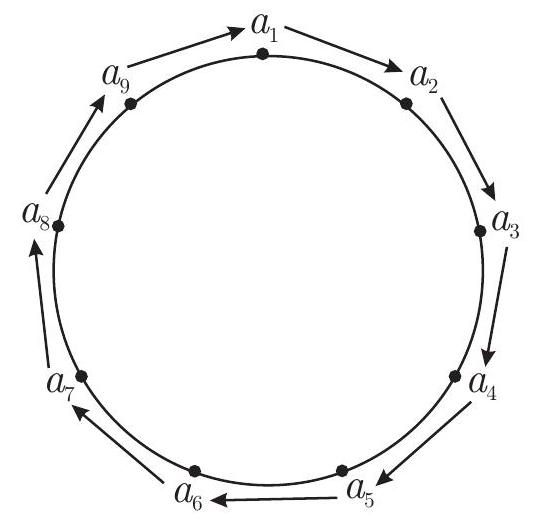
Numbers $1, 2, 3, \ldots, 1000000000$ are listed. Then each number is replaced by the sum of its digits, and this process is repeated until only single-digit numbers remain in the sequence. Which digit is more frequent in this sequence: ones or fives? | Okay, so I need to figure out whether the digit 1 or 5 appears more frequently in the final single-digit sequence after repeatedly summing the digits of numbers from 1 to 1,000,000,000. Let me start by understanding the problem step by step.
First, the numbers from 1 to 1,000,000,000 are listed. Then, each number is r... | To determine whether the digit 1 or 5 is more frequent in the final sequence of single-digit numbers obtained by repeatedly summing the digits of numbers from 1 to 1,000,000,000, we need to consider the concept of digital roots. The digital root of a number is the single-digit value obtained by repeatedly summing its d... | 1. Given the problem, we need to determine whether there are more occurrences of the digit 1 or the digit 5 after repeatedly replacing each number in the list from 1 to 1,000,000,000 with the sum of its digits until only single digit numbers remain.
2. Recall that any number can be repeatedly summed by its digits until... |
The digits 1, 2, 3, 4, 5, 6, 7, 8, and 9 were written (in an unknown order) around a circle. Reading these digits in groups of three in a clockwise direction, nine three-digit numbers are formed. Determine the sum of these nine numbers. | Okay, so there's this problem where the digits 1 through 9 are arranged in a circle in some order. Then, if you read them in groups of three clockwise, you get nine three-digit numbers. We need to find the sum of all these nine numbers. Hmm, let's think about how to approach this.
First, let me visualize the problem. ... | The digits 1 through 9 are arranged in a circle, forming nine three-digit numbers when read clockwise in groups of three. To find their total sum:
1. **Position Contribution**: Each digit appears exactly once in the hundreds, tens, and ones place across the nine numbers.
2. **Sum Per Digit**: A digit \( d \) contrib... |
1. Firstly, represent the nine digits \(1, 2, 3, 4, 5, 6, 7, 8, 9\) written around a circle in an unknown order:
2. Reading these digits around the circumference in groups of three, we... |
An obtuse triangle has side lengths of \(x\), \(x+1\), and \(x+2\). The range of the shortest side \(x\) is:
(A) \(3<x<5\).
(B) \(2<x<4\).
(C) \(1<x<3\).
(D) \(x>1\). | Okay, let's see. I need to find the range of the shortest side x in an obtuse triangle with sides x, x+1, and x+2. The options are given, so I need to figure out which one is correct. Hmm, where to start?
First, I remember that for any triangle, the triangle inequality must hold. So, the sum of any two sides must be g... | To determine the range of the shortest side \(x\) in an obtuse triangle with sides \(x\), \(x+1\), and \(x+2\), we need to consider both the triangle inequality and the condition for an obtuse triangle.
1. **Triangle Inequality**:
- The sum of any two sides must be greater than the third side.
- For sides \(x\),... |
1. Consider a right-angled triangle with the three sides designated as \(x\), \(x+1\), and \(x+2\), where \((x+2)\) is the hypotenuse because it is the longest side.
2. We want to determine the range of \(x\) such that this is a valid right triangle.
3. According to the cosine rule for a right-angled triangle, the c... |
Given the function \( f: \mathbf{R} \rightarrow \mathbf{R} \) where we know that \( f(1)=0 \), and for any two real numbers \( (x, y) \), it holds that \( |f(x)-f(y)|=|x-y| \). Determine the function \( f \). | Okay, so I need to figure out what the function f is, given that it's from real numbers to real numbers, f(1) is 0, and for any two real numbers x and y, the absolute difference between f(x) and f(y) is equal to the absolute difference between x and y. Let me start by breaking down the problem step by step.
First, the... | The given function \( f: \mathbf{R} \rightarrow \mathbf{R} \) satisfies \( f(1) = 0 \) and the isometry condition \( |f(x) - f(y)| = |x - y| \) for all \( x, y \in \mathbf{R} \).
1. **Isometry Property**: The condition \( |f(x) - f(y)| = |x - y| \) implies \( f \) is a distance-preserving function (an isometry). On t... |
1. We start with the given information:
- \( f: \mathbb{R} \rightarrow \mathbb{R} \)
- \( f(1) = 0 \)
- For any real numbers \( x \) and \( y \), \( |f(x) - f(y)| = |x - y| \)
2. Let us employ the given property for \( y = 1 \):
\[
\forall x \in \mathbb{R}, \quad |f(x) - f(1)| = |x - 1|
\]
Since ... |
Given that the radius of the large circle is 20 cm and the radius of each of the 7 smaller circles is 10 cm, find the area of the shaded region in square centimeters (use π = 3.14). | Okay, let me try to figure out this problem step by step. So, we have a large circle with radius 20 cm, and inside it, there are 7 smaller circles, each with radius 10 cm. We need to find the area of the shaded region, which I assume is the area of the large circle not covered by the smaller circles. Let me start by re... | The problem as stated contains a contradiction. The total area of the seven smaller circles (each with radius 10 cm) exceeds the area of the large circle (radius 20 cm), making it geometrically impossible for all small circles to fit inside the large one without overlap. Here's the calculation:
1. **Area of the large ... | To find the area of the shaded region, we need to subtract the area of the seven small circles from the area of the large circle. The solution will involve the following steps:
1. **Calculate the area of the large circle:**
The formula for the area of a circle is given by:
\[
A = \pi r^2
\]
Here, the r... |
Some 20-faced polyhedron is circumscribed around a sphere of radius 10. Prove that there are two points on its surface such that the distance between them is greater than 21. | Okay, let's see. I need to prove that there are two points on the surface of a 20-faced polyhedron circumscribed around a sphere of radius 10 such that the distance between them is greater than 21. Hmm, interesting. Alright, where do I start?
First, let me make sure I understand the problem correctly. The polyhedron i... | To prove that a 20-faced polyhedron circumscribed around a sphere of radius 10 has two points on its surface with a distance greater than 21, we employ geometric and combinatorial arguments:
1. **Sphere and Polyhedron Relationship**:
The polyhedron is circumscribed around a sphere of radius 10, meaning each face ... |
**Step 1:** Considering a 20-faced polyhedron inscribed in a sphere with radius 10, and the polyhedron's surface is tangent to the sphere at some points.
**Step 2:** For a polyhedron with faces that are tangent to a sphere with radius $r = 10$, any two vertices of the polyhedron's faces must not exceed a certain dist... |
In the forest of Baron Munchausen, there are fir trees and birch trees, such that at a distance of exactly 1 km from each fir tree, there are exactly 10 birch trees growing. The baron claims that there are more fir trees than birch trees in his forest. Is this possible? | Okay, let's try to figure out if Baron Munchausen's claim that there are more fir trees than birch trees in his forest is possible. The problem says that for each fir tree, at a distance of exactly 1 km, there are exactly 10 birch trees. Hmm, so every fir tree has 10 birch trees located exactly 1 km away from it. And t... | **Step-by-Step Explanation and Answer:**
To determine if Baron Munchausen's claim that there are more fir trees (F) than birch trees (B) is possible, we analyze the relationships between the trees based on the given condition: *each fir tree has exactly 10 birch trees at a distance of 1 km*.
### Key Analysis:
1. **G... |
Let us define the key variables and parameters of the problem:
- Let \( E \) represent the total number of fir trees in the forest.
- Let \( B \) represent the total number of birch trees in the forest.
- Baron Munchausen claims \( B > E \).
The problem states that for each fir tree, there are exactly 10 birch trees... |
For any \( x \in \left[-\frac{\pi}{6}, \frac{\pi}{2}\right] \), the inequality \( \sin^2 x + a \sin x + a + 3 \geq 0 \) always holds. Find the range of the real number \( a \). | Okay, so I need to find the range of real numbers \( a \) such that the inequality \( \sin^2 x + a \sin x + a + 3 \geq 0 \) holds for all \( x \) in the interval \( \left[-\frac{\pi}{6}, \frac{\pi}{2}\right] \). Hmm, let me start by breaking down the problem.
First, I know that \( \sin x \) in the interval \( \left[-\... | To find the range of the real number \( a \) such that the inequality \( \sin^2 x + a \sin x + a + 3 \geq 0 \) holds for all \( x \in \left[-\frac{\pi}{6}, \frac{\pi}{2}\right] \), we start by substituting \( t = \sin x \). This transforms the inequality into \( t^2 + a t + a + 3 \geq 0 \) for all \( t \in \left[-\frac... |
We are given the inequality \(\sin^2 x + a \sin x + a + 3 \geq 0\) for all \(x \in \left[-\frac{\pi}{6}, \frac{\pi}{2} \right]\) and we need to find the range of real values of \(a\) such that the inequality holds.
1. **Define the function**:
Let \( f(x) = \sin^2 x + a \sin x + a + 3 \).
2. **Transform the funct... |
Two hunters, $A$ and $B$, went duck hunting. Assume that each of them hits a duck as often as they miss it. Hunter $A$ encountered 50 ducks during the hunt, while hunter $B$ encountered 51 ducks. What is the probability that hunter $B$'s catch exceeds hunter $A$'s catch? | Okay, so I need to figure out the probability that hunter B catches more ducks than hunter A. Both hunters hit a duck as often as they miss, which means each has a 50% chance of hitting any duck they encounter. Let me break this down step by step.
First, let's understand the problem. Hunter A encountered 50 ducks, and... | To determine the probability that hunter $B$'s catch exceeds hunter $A$'s catch, we start by noting that each hunter hits a duck with a probability of 0.5. Hunter $A$ encountered 50 ducks, and hunter $B$ encountered 51 ducks. We denote the number of ducks caught by $A$ and $B$ as $X_A \sim \text{Binomial}(50, 0.5)$ and... |
1. **Understanding the problem setup**:
- Two hunters, \( A \) and \( B \), are hunting ducks.
- Each has a probability of hitting (or missing) a duck, both being equal and independent of the other, specifically \( \frac{1}{2} \).
- Hunter \( A \) encounters 50 ducks.
- Hunter \( B \) encounters 51 ducks.
... |
Find the remainders when the polynomial
$$
f(x)=x^{243}+x^{81}+x^{27}+x^{9}+x^{3}+1
$$
is divided by a) $x-1$, b) $x^{2}-1$. | Okay, so I need to find the remainders when the polynomial f(x) = x²⁴³ + x⁸¹ + x²⁷ + x⁹ + x³ + 1 is divided by two different divisors: part a) is x - 1, and part b) is x² - 1. Let me start with part a) because it seems simpler.
For part a), when dividing a polynomial by x - 1, the remainder is just the value of the po... | To find the remainders when the polynomial \( f(x) = x^{243} + x^{81} + x^{27} + x^{9} + x^{3} + 1 \) is divided by \( x - 1 \) and \( x^2 - 1 \):
### Part a) Remainder when divided by \( x - 1 \)
Using the Remainder Theorem, the remainder is the value of the polynomial evaluated at \( x = 1 \):
\[
f(1) = 1^{243} + 1^... |
#### Part a):
**Step 1**: Use the Remainder Theorem. The Remainder Theorem states that if a polynomial $f(x)$ is divided by $(x - c)$, then the remainder of this division is $f(c)$.
**Step 2**: According to the Remainder Theorem, to find the remainder when $f(x)$ is divided by $(x - 1)$, evaluate $f(1)$.
**Step 3**:... |
Does there exist an angle \(\alpha \in (0, \pi / 2)\) such that \(\sin \alpha\), \(\cos \alpha\), \(\tan \alpha\), and \(\cot \alpha\), taken in some order, are consecutive terms of an arithmetic progression? | Okay, so I need to figure out if there's an angle α between 0 and π/2 (which is 0 to 90 degrees) such that sin α, cos α, tan α, and cot α can be arranged in some order to form consecutive terms of an arithmetic progression. Hmm, arithmetic progression means that the difference between consecutive terms is constant. Let... | **Step-by-Step Explanation and Answer:**
To determine if an angle \(\alpha \in (0, \pi/2)\) exists such that \(\sin \alpha\), \(\cos \alpha\), \(\tan \alpha\), and \(\cot \alpha\) form an arithmetic progression (AP) in some order, we analyze the relationships and constraints between these trigonometric functions.
1. ... | 1. **Suppose there exists an angle \( \alpha \in (0, \pi/2) \) such that \( \sin \alpha, \cos \alpha, \tan \alpha, \cot \alpha \) taken in some order, are consecutive terms of an arithmetic progression.**
Let's assume \( 0 < x < \frac{\pi}{2} \) and \( \sin x, \cos x, \tan x, \cot x \) are in some order consecut... |
Determine the number of quadruples of natural numbers \((a, b, c, d)\) that satisfy \(a b c d = 98\).
Note: \((98,1,1,1)\) and \((1,1,98,1)\) are considered different quadruples. | Okay, so I need to find the number of quadruples of natural numbers (a, b, c, d) such that their product is 98. Since the order matters here, like the examples given (98,1,1,1) and (1,1,98,1) are different, this is a problem about counting ordered quadruples.
First, I remember that when dealing with problems where th... | To determine the number of quadruples of natural numbers \((a, b, c, d)\) that satisfy \(abcd = 98\), we start by prime factorizing 98:
\[ 98 = 2^1 \times 7^2. \]
Each prime factor's exponents must be distributed among the four variables. This is equivalent to solving:
1. For the prime 2 (\(2^1\)):
\(x_1 + ... | To find the number of quadruplets of natural numbers \((a, b, c, d)\) that satisfy the equation \(a \cdot b \cdot c \cdot d = 98\), we need to consider the factorization of 98 and how to distribute these factors into four parts so that their product remains 98.
1. **Prime Factorization**:
- First, we find the prim... |
In a regular decagon, all the diagonals are drawn. At each vertex and at each intersection point of the diagonals, a number +1 is placed (only the diagonals themselves are considered, not their extensions). It is allowed to simultaneously change all the signs of the numbers standing on one side or on one diagonal. Is i... | Okay, so I have this problem about a regular decagon where all diagonals are drawn, and at each vertex and each intersection point of the diagonals, there's a number +1. The operation allowed is to simultaneously flip all the signs of the numbers on one side or one diagonal. The question is whether it's possible to tur... | **Step-by-Step Explanation and Answer:**
To determine if all +1s in a regular decagon with diagonals can be flipped to -1s using line sign flips, we analyze the problem through linear algebra over GF(2) and parity considerations:
1. **Graph Structure and Points**:
- A regular decagon has 10 vertices and numerous i... |
#### Step 1: Understand the problem
In a regular decagon, all diagonals have been drawn. At each vertex and each intersection point of the diagonals, a number +1 is placed. We are allowed to simultaneously change the signs of all numbers placed on either one side or along one diagonal. The question asks if it is pos... |
Determine the polynomial $P$ that satisfies the following conditions:
(a) $P$ is a homogeneous polynomial of degree $n$ in $x$ and $y$, that is, for all real numbers $t, x, y$, $P(t x, t y)=t^{n} P(x, y)$, where $n$ is a positive integer;
(b) For all real numbers $a, b, c$, $P(a+b, c)+P(b+c, a)+P(c+a, b)=0$;
(c) $P(1,... | Okay, so I need to find a polynomial P that satisfies three conditions: it's homogeneous of degree n, there's this symmetry condition where the sum of P(a+b,c) + P(b+c,a) + P(c+a,b) equals zero for all real numbers a, b, c, and P(1,0) is 1. Hmm, let's start breaking this down step by step.
First, since P is a homogene... | The polynomial \( P(x, y) \) that satisfies all the given conditions is determined to be:
\[
P(x, y) = (x - 2y)(x + y)^{n-1}
\]
**Step-by-Step Explanation and Verification:**
1. **Homogeneity (Condition a):**
- The polynomial \( (x - 2y)(x + y)^{n-1} \) is homogeneous of degree \( n \) because each term in the ex... | To verify the polynomial $P(x,y)$ given the conditions:
(a) $P$ is a homogeneous polynomial of degree $n$ in $x$ and $y$,
which means for all real numbers $t, x, y$, we have:
\[
P(t x, t y) = t^n P(x, y)
\]
where $n$ is a positive integer.
(b) For all real numbers $a, b, c$, it holds that:
\[
P(a + b, c) + P(b + c, a... |
Let $b_{1}=1$. For a positive integer $n$ greater than 1, let
$$
b_{n}=b_{n-1} \cdot n^{f(n)}, \quad f(n)=2^{1-n}.
$$
Prove: For all positive integers $n, b_{n}<3$. | Okay, so I need to prove that for all positive integers n, the sequence b_n defined by b_1 = 1 and b_n = b_{n-1} * n^{f(n)} where f(n) = 2^{1 - n} is always less than 3. Hmm, let me start by understanding the sequence and how it behaves. Maybe writing out the first few terms will help.
First, b_1 is given as 1. Let's ... | Given the sequence \( b_n \) defined by \( b_1 = 1 \) and for \( n \geq 2 \), \( b_n = b_{n-1} \cdot n^{2^{1-n}} \), we need to prove that \( b_n < 3 \) for all positive integers \( n \).
### Key Steps and Analysis:
1. **Understanding the Sequence**:
- The sequence is defined recursively with \( b_1 = 1 \).
- F... |
We are given the initial condition \(b_1 = 1\) and the recursive formula for \(n > 1\):
\[ b_n = b_{n-1} \cdot n^{f(n)}, \quad f(n) = 2^{1-n}. \]
We need to prove that for all positive integers \(n\), \(b_n < 3\).
#### Step-by-Step Proof:
1. **Base Case Verification:**
- When \(n = 1\), we have \(b_1 = 1 < 3\). ... |
The diagonals of a trapezoid are 3 and 5, and the segment connecting the midpoints of the bases is 2. Find the area of the trapezoid. | Alright, let's tackle this trapezoid problem. The diagonals are 3 and 5, the segment connecting the midpoints of the bases is 2, and we need to find the area. Hmm, okay, first, let me recall some properties of trapezoids.
A trapezoid has two parallel sides called bases, and the other two sides are legs. The midsegmen... | Given a trapezoid with diagonals of lengths 3 and 5, and the segment connecting the midpoints of the bases (MN) of length 2, we need to find the area of the trapezoid.
1. **Coordinate System Setup**:
- Place the midpoint of the lower base AB at the origin (0,0).
- The midpoint of the upper base CD is at point (x... | To solve for the area of the trapezoid \(ABCD\) with given diagonals and other segment measurements, we approach the problem as follows:
1. Let \(M\) and \(K\) be the midpoints of the bases \(BC\) and \(AD\) of the trapezoid \(ABCD\), respectively.
2. Given: diagonals \(AC = 3\) and \(BD = 5\), and the segment connec... |
For every integer \( n \) ( \( n \geq 2 \) ), let \( f(n) \) represent the largest prime factor of \( n \). A "singular pair" is defined as an unordered pair of distinct prime numbers \( p \) and \( q \) such that there is no integer \( n \geq 2 \) which satisfies \( f(n) \cdot f(n+1) = pq \). Prove: there are infinite... | Okay, so I need to prove that there are infinitely many singular pairs. A singular pair is defined as an unordered pair of distinct primes p and q such that there's no integer n ≥ 2 where the product of the largest prime factors of n and n+1 equals pq. Hmm, let's unpack this step by step.
First, let me make sure I und... | To prove that there are infinitely many singular pairs, we start by understanding that a singular pair is an unordered pair of distinct primes \( p \) and \( q \) such that there is no integer \( n \geq 2 \) where \( f(n) \cdot f(n+1) = pq \). Here, \( f(n) \) denotes the largest prime factor of \( n \).
1. **Key Insi... |
Given that for each integer $n (n \geq 2)$, we denote $f(n)$ as the largest prime factor of $n$. A "strange pair" is defined as two distinct prime numbers $p$ and $q$ such that there is no integer $n \geq 2$ for which $f(n) \cdot f(n+1) = pq$. We are required to prove that there exist infinitely many strange pairs.
1... |
Through the intersection point of two circles, two arbitrary secants are drawn, intersecting the circles again at points \(C\) and \(C_1\), \(D\) and \(D_1\) respectively. Prove that the angle between the chords \(CD\) and \(D_1C_1\) is constant. | Okay, so I need to prove that the angle between chords CD and D₁C₁ is constant, no matter how we choose the secants through the intersection points of the two circles. Let me try to visualize the problem first.
We have two circles that intersect at two points. Let's call those intersection points A and B. From one of... | To prove that the angle between the chords \(CD\) and \(D_1C_1\) is constant, we start by considering two intersecting circles \(\Gamma_1\) and \(\Gamma_2\) with intersection points \(A\) and \(B\). Arbitrary secants are drawn through \(A\), intersecting \(\Gamma_1\) again at points \(C\) and \(D\), and \(\Gamma_2\) ag... |
1. **Construct Diameters and Perpendiculars:**
\[
\text{Through the points } C \text{ and } C_{1}, \text{ and } D \text{ and } D_{1}, \text{ we draw diameters of the circles involved.}
\]
\[
\text{Let } O \text{ and } O_{1} \text{ be the centers of the two circles.}
\]
\[
\text{From point } A... |
Given $2n$ integers $a_{1}, a_{2}, \cdots, a_{2 n}$, if we arbitrarily select one number from them, the remaining $2n-1$ numbers can always be divided into two disjoint subsets such that the sum of the numbers in each subset is equal. Prove that all $a_{1}, a_{2}, \cdots, a_{2 n}$ must be zero.
(Note: "two disjoint s... | Okay, so I need to prove that if I have 2n integers, and if I remove any one of them, the remaining 2n-1 numbers can always be divided into two disjoint subsets with equal sums, then all the original numbers must be zero. Hmm. Let me start by understanding the problem step by step.
First, let's parse the problem state... | To prove that all \(2n\) integers \(a_1, a_2, \ldots, a_{2n}\) must be zero under the given condition, we proceed as follows:
**Step 1: Parity Analysis**
For any removed \(a_i\), the sum \(S - a_i\) of the remaining \(2n-1\) numbers must be even (since it must be split into two equal subsets). Thus, \(S - a_i \equiv... | 1. Given $2n$ integers $a_1, a_2, \cdots, a_{2n}$.
2. According to the problem, if we remove any one of these integers, the remaining $2n-1$ integers can always be divided into two disjoint subsets with equal sums.
3. Let us denote $\sum_{i=1}^{2n} a_i$ as the total sum of these integers.
4. When any integer $a_k \in \... |
Let \( k \) be a natural number. Let \( S \) be a set of \( n \) points in the plane such that:
- No three points of \( S \) are collinear
- For every point \( P \) in \( S \), there exists a real number \( r \) such that there are at least \( k \) points at a distance \( r \) from \( P \).
Show that:
$$
k < \frac{1... | Okay, so I need to show that for a set S of n points in the plane, with no three collinear, and each point has at least k other points at the same distance from it, then k must be less than 1/2 plus the square root of 2n. Hmm. Let me start by understanding the problem better.
First, the conditions: no three points are... | Given a set \( S \) of \( n \) points in the plane with no three points collinear, and each point \( P \) in \( S \) having at least \( k \) points at some distance \( r \) from \( P \), we need to show that \( k < \frac{1}{2} + \sqrt{2n} \).
### Key Steps:
1. **Pairs on Circles**:
- For each point \( P \), consid... |
Given the conditions of the problem:
1. Any three points in set \( S \) are never collinear.
2. For each point \( P \in S \), there are at least \( k \) points at the same distance \( r \) from \( P \).
1. Let \( N \) be the number of isosceles triangles \( (P, Q, R) \) with \( P \), \( Q \), and \( R \) being distin... |
Prove that:
(1) $\tan \frac{\pi}{7} \tan \frac{2 \pi}{7} \tan \frac{3 \pi}{7}=\sqrt{7}$;
(2) $\tan ^{2} \frac{\pi}{7}+\tan ^{2} \frac{2 \pi}{7}+\tan ^{2} \frac{3 \pi}{7}=21$. | Okay, so I have to prove these two trigonometric identities involving tangents of angles that are multiples of π/7. Both of them seem pretty challenging, especially because π/7 isn't one of the standard angles we usually deal with. Let me start with the first one: tan(π/7) tan(2π/7) tan(3π/7) = √7. Hmm, I remember that... | To prove the given trigonometric identities, we utilize properties of polynomials derived from trigonometric expansions and apply Vieta's formulas.
### (1) Prove that $\tan \frac{\pi}{7} \tan \frac{2\pi}{7} \tan \frac{3\pi}{7} = \sqrt{7}$
**Step 1: Polynomial for $\tan(7\theta)$**
The equation $\tan(7\theta) = 0$ has... |
To prove:
1. \(\tan \frac{\pi}{7} \tan \frac{2\pi}{7} \tan \frac{3\pi}{7} = \sqrt{7}\)
2. \(\tan^2 \frac{\pi}{7} + \tan^2 \frac{2\pi}{7} + \tan^2 \frac{3\pi}{7} = 21\)
First, consider the identity:
\[
\tan 3\theta + \tan 4\theta = 0
\]
which can be simplified to:
\[
\frac{\tan \theta + \tan 2\theta}{1 - \tan \theta ... |
Rohan wants to cut a piece of string into nine pieces of equal length. He marks his cutting points on the string. Jai wants to cut the same piece of string into only eight pieces of equal length. He marks his cutting points on the string. Yuvraj then cuts the string at all the cutting points that are marked. How many p... | Okay, let me try to figure out this problem step by step. So, Rohan wants to cut a string into nine equal pieces. That means he needs to make eight cuts, right? Because if you have one piece, you need zero cuts. For two pieces, one cut, and so on. So for nine pieces, it's eight cuts. Similarly, Jai wants to cut the sam... | To determine the number of pieces Yuvraj obtains, analyze the cutting points marked by Rohan and Jai:
1. **Rohan's Cuts**: To divide the string into 9 equal parts, he makes **8 cuts** at positions:
\( \frac{L}{9}, \frac{2L}{9}, \ldots, \frac{8L}{9} \).
2. **Jai's Cuts**: To divide the same string into 8 equal pa... |
1. **Understand the problem requirements:**
- Rohan wants to cut the string into 9 equal pieces.
- Jai wants to cut the same string into 8 equal pieces.
- Yuvraj cuts the string at all the marked points made by both Rohan and Jai.
2. **Calculate the number of cuts each makes:**
- To divide a string in... |
In a regular quadrilateral pyramid \( S A B C D \), the height is equal to the side of the base. Points \( M \) and \( N \) are marked on the lateral edges \( S D \) and \( S B \) respectively such that the lines \( A M \) and \( C N \) are mutually perpendicular. Prove that
\[ 2 S A(S M + S N) = S A^2 + S M \cdot S N... | Okay, let's see. So, I need to prove this equation: 2 SA(SM + SN) = SA² + SM·SN. The pyramid is a regular quadrilateral pyramid, which means the base is a square, and the apex S is directly above the center of the base. The height of the pyramid is equal to the side of the base. Points M and N are on the lateral edges ... | To prove the given equation in a regular quadrilateral pyramid \( SABCD \) where the height is equal to the side of the base, and points \( M \) and \( N \) are on lateral edges \( SD \) and \( SB \) such that lines \( AM \) and \( CN \) are mutually perpendicular, we proceed as follows:
1. **Coordinate Setup**:
- ... |
1. **Setup the Coordinate System:**
We place the coordinate system such that the origin coincides with the vertex $A$ of the pyramid. Assume that the side length of the base of the pyramid is $2$. Therefore, the coordinates of the key points are:
$$ \overrightarrow{A B} = \{0, 2, 0\}, $$
$$ \overrightarrow... |
Given the point $P(\tan \alpha, \cos \alpha)$ is in the third quadrant, determine in which quadrant the terminal side of angle $\alpha$ lies. | Okay, so I need to figure out in which quadrant the terminal side of angle α lies, given that the point P(tan α, cos α) is in the third quadrant. Let me start by recalling some basic concepts about coordinate quadrants and trigonometric functions.
First, the coordinate plane is divided into four quadrants. In the thir... | Given the point \( P(\tan \alpha, \cos \alpha) \) is in the third quadrant, we need to determine in which quadrant the terminal side of angle \(\alpha\) lies.
1. **Identify the signs of the coordinates in the third quadrant**:
- The x-coordinate (tan \(\alpha\)) is negative.
- The y-coordinate (cos \(\alpha\)) i... |
When analyzing the problem, we are given the point \( P(\tan \alpha, \cos \alpha) \) and it's known to be in the third quadrant. We need to determine where the terminal side of the angle \( \alpha \) is located.
1. **Identify the characteristics of trigonometric functions in the third quadrant:**
- In the third q... |
Given that the complex numbers \( z_{1}, z_{2} \) correspond to the points \( A, B \) respectively in the complex plane, and \( \left|z_{2}\right| = 4 \) and \( 4z_{1}^2 - 2z_{1}z_{2} + z_{2}^2 = 0 \), the area of the triangle \( AOB \) is:
A. \( \sqrt{3} \)
B. 1
C. \( 4 \sqrt{3} \)
D. \( 2 \sqrt{3} \) | Okay, let me try to figure out this problem step by step. So, we have two complex numbers z₁ and z₂ corresponding to points A and B in the complex plane. The modulus of z₂ is 4, which means the distance from the origin to point B is 4. Then there's this equation: 4z₁² - 2z₁z₂ + z₂² = 0. We need to find the area of tria... | Given the complex numbers \( z_1 \) and \( z_2 \) corresponding to points \( A \) and \( B \) respectively in the complex plane, with \( |z_2| = 4 \) and the equation \( 4z_1^2 - 2z_1z_2 + z_2^2 = 0 \), we need to find the area of the triangle \( AOB \).
First, we solve the quadratic equation \( 4z_1^2 - 2z_1z_2 + z_2... | 1. Given the complex numbers \( z_1 \) and \( z_2 \) correspond to points \( A \) and \( B \) in the complex plane, and given the conditions:
\[
|z_2| = 4 \quad \text{and} \quad 4z_1^2 - 2z_1z_2 + z_2^2 = 0
\]
2. Let's start by simplifying the given equation. Dividing the entire equation by \( z_2^2 \), we ge... |
In triangle \(ABC\), the angle bisectors of angles \(A\) and \(B\) are extended to intersect the circumcircle at points \(A'\) and \(B'\) respectively. It is known that \(A A' = B B'\). Show that either triangle \(ABC\) is isosceles or angle \(C\) is \(60^\circ\). | Okay, so I need to solve this geometry problem where in triangle ABC, the angle bisectors of angles A and B are extended to intersect the circumcircle at points A' and B' respectively. It's given that AA' = BB', and I have to show that either the triangle is isosceles or angle C is 60 degrees. Hmm, let's try to unpack ... | Given triangle \(ABC\) with the angle bisectors of angles \(A\) and \(B\) extended to intersect the circumcircle at points \(A'\) and \(B'\) respectively, and knowing that \(AA' = BB'\), we need to show that either triangle \(ABC\) is isosceles or angle \(C\) is \(60^\circ\).
1. **Understanding the Problem**:
- \(A... | 1. We start by noting that in the problem, we have the triangle $ \triangle ABC$ with the angle bisectors of $\angle A$ and $\angle B$ intersecting the circumcircle of the triangle at points $A'$ and $B'$ respectively. We are given that $AA' = BB'$.
2. Let the angles of $\triangle ABC$ be denoted as $\angle A = \al... |
Give the smallest possible interval containing the roots of
$$
x^{2014} - 100x + 1
$$ | Okay, so I need to find the smallest possible interval that contains all the roots of the polynomial equation \( x^{2014} - 100x + 1 = 0 \). Hmm, let me think about how to approach this.
First, I remember that for polynomials, especially high-degree ones, it's useful to use theorems or inequalities that can bound the... | To determine the smallest interval containing all real roots of the polynomial \( f(x) = x^{2014} - 100x + 1 \), we analyze the behavior of the function and locate its roots through systematic reasoning.
### Key Steps:
1. **Behavior at Extremes**:
- As \( x \to \pm\infty \), \( x^{2014} \) dominates, making \( f(x)... |
1. **Analyzing the case when \( x \leqslant 0 \):**
Consider the expression
\[
P(x) = x^{2014} - 100x + 1.
\]
If \( x \leqslant 0 \), then \( x^{2014} \geqslant 0 \) because any even power of a non-positive number is non-negative. Therefore,
\[
x^{2014} - 100x + 1 \geqslant 0 - 100x + 1 \geqslan... |
Given that \( m, n, k \) are positive integers, if there exists a pair of positive integers \( (a, b) \) such that
\[
(1+a) n^{2}-4(m+a) n+4 m^{2}+4 a+b(k-1)^{2}<3,
\]
then the number of possible values of \( m+n+k \) is \(\quad\) . | Okay, so I need to figure out the number of possible values of \( m + n + k \) given that \( m, n, k \) are positive integers, and there exists a pair of positive integers \( (a, b) \) such that the inequality
\[
(1 + a) n^{2} - 4(m + a) n + 4 m^{2} + 4 a + b(k - 1)^{2} < 3
\]
holds. Hmm, this looks a bit complicate... | Given that \( m, n, k \) are positive integers, we need to determine the number of possible values of \( m + n + k \) if there exists a pair of positive integers \( (a, b) \) such that the inequality
\[
(1 + a) n^{2} - 4(m + a) n + 4 m^{2} + 4 a + b(k - 1)^{2} < 3
\]
holds.
### Key Steps:
1. **Analyzing the Quadra... |
Given that \( m, n, k \) are positive integers, and there exists positive integers \(a, b\) such that
\[
(1+a) n^{2}-4(m+a) n+4 m^{2}+4 a+b(k-1)^{2}<3
\]
We can start by simplifying the expression:
\[
(1+a) n^{2} - 4(m+a) n + 4 m^{2} + 4 a + b(k-1)^{2}
\]
To better understand the condition, let's rearrange the term... |
Once, on the last day of the month, Kostya, while looking at the wall calendar, exclaimed in surprise: "Look, in this month the number of V-days (as Kostya called Tuesdays and Sundays), S-days (Wednesdays and Saturdays), and P-days (Mondays and Fridays) is the same!". "Nothing surprising," responded his friend Andrey, ... | Okay, let's try to figure out this calendar problem. So, Kostya noticed that in a certain month, the number of V-days, S-days, and P-days are the same. Then Andrey says the same will happen next month, and when they checked the previous two months, those also had equal numbers. We need to find the exact date and day of... | The problem requires determining the exact date when Kostya and Andrey had their conversation, given that four consecutive months each had equal numbers of V-days (Tuesdays and Sundays), S-days (Wednesdays and Saturdays), and P-days (Mondays and Fridays).
### Key Steps:
1. **Understanding the Categories**:
- V-day... |
To determine the exact date and day of the week when this conversation happened, we need to identify specific monthly and weekly patterns.
1. **Definition of a "Good" Month**:
Let's define a "good" month as one where the counts of $B$-days (Tuesdays and Sundays), $S$-days (Wednesdays and Saturdays), and $P$-days (... |
Inside a convex quadrilateral, four circles are placed, each of which touches two adjacent sides of the quadrilateral and the other two circles (externally). It is known that a circle can be inscribed in the quadrilateral. Prove that at least two of these circles are equal. | Okay, so I need to prove that in a convex quadrilateral with an incircle (so it's a tangential quadrilateral), if we place four circles inside it such that each circle touches two adjacent sides and the other two circles externally, then at least two of these four circles must be equal. Hmm, let me try to unpack this s... | To prove that at least two of the four circles in a tangential quadrilateral are equal, consider the following steps:
1. **Tangential Quadrilateral Properties**: A tangential quadrilateral has an incircle and satisfies \( a + c = b + d \), where \( a, b, c, d \) are its sides.
2. **Circle Configuration**: Each circle... | 1. Denote the radius of the circles inscribed in the angles $A, B, C$, and $D$ of quadrilateral $ABCD$ as $x, y, z$, and $t$ respectively.
2. Recall that the distance between the tangent points of adjacent circles with a common external tangent is given by $2\sqrt{xy}$, $2\sqrt{yz}$, $2\sqrt{zt}$, and $2\sqrt{tx}$ for ... |
In a $3 \times 3$ table, natural numbers (not necessarily distinct) are placed such that the sums in all rows and columns are different. What is the minimum value that the sum of the numbers in the table can take?
| Okay, so I need to find the minimum possible sum of numbers in a 3x3 table where all the row sums and column sums are different. Let me try to break this down step by step.
First, let's recall that in a 3x3 grid, there are 3 rows and 3 columns. The requirement is that all these six sums must be distinct. The numbers ... | The minimum possible sum of the numbers in a 3×3 table where all row and column sums are distinct is **17**.
**Step-by-Step Explanation:**
1. **Requirements:**
- 3 rows and 3 columns with distinct sums.
- All numbers are natural numbers (≥1).
- Minimize the total sum of the table.
2. **Key Observatio... | 1. **Define Constraints:**
The problem states that we are to fill a \(3 \times 3\) table with natural numbers such that each row sum and each column sum must all be distinct. First, note that each row and each column should contain at least 3 as a sum because the smallest natural number is 1:
\[
\text{Minimum ... |
Let
$$
K=\frac{\left(m^{2}+2 m-24\right) x^{2}-6(m+6) x+\left(m^{2}+10 m+24\right)}{\left(m^{2}-9 m+18\right) x^{2}-8(m-6) x+\left(m^{2}-3 m-18\right)}
$$
Determine all values of $m$ for which a) $K>0$ for any $x$; b) $K<0$ for any $x$. | Okay, so I need to determine all values of m for which the given rational function K is always positive (part a) or always negative (part b) for any x. Let me start by understanding what the problem is asking.
First, K is a rational function, meaning it's a ratio of two quadratic polynomials in x. For K to be always ... | To determine the values of \( m \) for which \( K \) is always positive or always negative for any \( x \), we analyze the given rational function:
\[
K = \frac{\left(m^{2} + 2m - 24\right)x^{2} - 6(m + 6)x + \left(m^{2} + 10m + 24\right)}{\left(m^{2} - 9m + 18\right)x^{2} - 8(m - 6)x + \left(m^{2} - 3m - 18\right)}
\... |
We are given the following expression for \( K \):
\[ K = \frac{\left(m^{2}+2m-24\right) x^{2} - 6(m+6) x + \left(m^{2}+10m+24\right)}{\left(m^{2}-9m+18\right) x^{2} - 8(m-6) x + \left(m^{2}-3m-18\right)}. \]
To find all the values of \( m \) for which \( K \) is positive for all \( x \) or negative for all \( x \),... |
In a cyclic quadrilateral $ABCD$, where $AD = BD$, let $M$ be the intersection point of the two diagonals of the quadrilateral, and $N$ be a point on diagonal $AC$ other than $M$. Additionally, if points $M$, $N$, $B$, and the incenter $I$ of triangle $BCM$ are concyclic, prove that:
$$
AN \cdot NC = CD \cdot BN.
$$ | Okay, let's try to tackle this geometry problem. Hmm, so we have a cyclic quadrilateral ABCD with AD = BD. The diagonals intersect at point M. There's a point N on diagonal AC, not equal to M. Also, points M, N, B, and the incenter I of triangle BCM are concyclic. We need to prove that AN · NC = CD · BN.
First, let m... | To prove that \( AN \cdot NC = CD \cdot BN \) in the given cyclic quadrilateral \(ABCD\) with \(AD = BD\), and points \(M\), \(N\), \(B\), and the incenter \(I\) of \(\triangle BCM\) being concyclic, we proceed as follows:
### Key Steps and Proof:
1. **Cyclic Quadrilateral Properties**:
- Since \(ABCD\) is cyclic,... |
1. Given the quadrilateral \(ABCD\) inscribed in a circle, with \( AD = BD \).
By symmetry, we can set
\[
\angle BAD = \angle DBA = \alpha.
\]
2. Since \(AD = BD\), we can deduce that \(\angle ACB = \angle ADB\). Hence,
\[
\angle ACB = \angle ADB = 180^\circ - 2\alpha.
\]
3. Points \(M\), \(... |
Let \( p \) be an arbitrary prime number. Find all non-negative integer solutions to the equation
$$
\sqrt{x}+\sqrt{y}=\sqrt{p}.
$$ | Okay, so I need to solve the equation √x + √y = √p where p is a prime number, and x and y are non-negative integers. Hmm, let's think step by step.
First, since we're dealing with square roots, maybe squaring both sides will help eliminate the radicals. Let me try that. If I square both sides of the equation:
(√x + √... | To solve the equation \(\sqrt{x} + \sqrt{y} = \sqrt{p}\) where \(p\) is a prime number and \(x\) and \(y\) are non-negative integers, we start by squaring both sides:
\[
(\sqrt{x} + \sqrt{y})^2 = (\sqrt{p})^2
\]
This simplifies to:
\[
x + y + 2\sqrt{xy} = p
\]
Rearranging the terms, we isolate the square root:
\[
... |
1. Consider the given equation involving the square roots and a prime number:
\[
\sqrt{x} + \sqrt{y} = \sqrt{p}
\]
where \( p \) is a prime number, and \( x \) and \( y \) are non-negative integers.
2. To eliminate the square roots, square both sides of the equation:
\[
(\sqrt{x} + \sqrt{y})^2 = (\s... |
Six consecutive natural numbers from 10 to 15 are inscribed in circles on the sides of a triangle in such a way that the sums of the three numbers on each side are equal.
What is the maximum value this sum can take? | Okay, so I need to figure out the maximum possible sum of the numbers on each side of a triangle where the numbers from 10 to 15 are placed in the circles on the sides. The triangle has three sides, and each side has three circles, right? Wait, hold on. If it's a triangle with numbers on the sides, how exactly are the ... | To determine the maximum possible sum of the numbers on each side of a triangle where the numbers from 10 to 15 are inscribed in circles on the sides, we need to consider the arrangement of these numbers. The triangle has three vertices (each shared by two sides) and three edges (each unique to a side). Each side's sum... |
1. **Define Variables:**
Let \(a, b, c, d, e, f\) be the six consecutive natural numbers from 10 to 15, arranged sequentially in the circles around the triangle. Assume that \(a, c,\) and \(e\) are positioned at the vertices of the triangle.
2. **Equations for Sums:**
We need to find the maximum sum \(S\) such that t... |
Calculate the limit of the numerical sequence:
$$\lim _{n \rightarrow \infty} \frac{n^{3}-(n-1)^{3}}{(n+1)^{4}-n^{4}}$$ | Okay, let me try to figure out this limit problem. So, the question is to find the limit as n approaches infinity of the fraction [n³ - (n - 1)³] divided by [(n + 1)⁴ - n⁴]. Hmm, right. Let me start by expanding both the numerator and the denominator to see if I can simplify the expression.
First, let's tackle the num... | To calculate the limit of the numerical sequence:
$$\lim _{n \rightarrow \infty} \frac{n^{3}-(n-1)^{3}}{(n+1)^{4}-n^{4}}$$
we start by expanding both the numerator and the denominator.
**Numerator Expansion:**
\[
n^3 - (n - 1)^3 = n^3 - (n^3 - 3n^2 + 3n - 1) = n^3 - n^3 + 3n^2 - 3n + 1 = 3n^2 - 3n + 1
\]
**Denomina... |
1. First, consider the given limit expression:
\[
\lim_{n \rightarrow \infty} \frac{n^{3} - (n-1)^{3}}{(n+1)^{4} - n^{4}}
\]
2. Expand both the numerator \(n^3 - (n-1)^3\) and the denominator \((n+1)^4 - n^4\):
\[
n^3 - (n-1)^3 = n^3 - (n^3 - 3n^2 + 3n - 1) = 3n^2 - 3n + 1
\]
\[
(n+1)^4 - ... |
There are 18 visitor tickets to be distributed among four classes A, B, C, and D. Class A must receive at least 1 ticket but no more than 5 tickets. Class B must receive at least 1 ticket but no more than 6 tickets. Class C must receive at least 2 tickets but no more than 7 tickets. Class D must receive at least 4 tick... | Okay, so I have this problem where I need to distribute 18 visitor tickets among four classes: A, B, C, and D. Each class has specific minimum and maximum ticket requirements. Let me try to break this down step by step.
First, I remember that when dealing with distributions with constraints, one common approach is to... | To solve the problem of distributing 18 visitor tickets among four classes A, B, C, and D with specific minimum and maximum constraints, we start by assigning the minimum required tickets to each class. The minimum tickets are: A=1, B=1, C=2, D=4, totaling 8 tickets. This leaves 10 tickets to be distributed with the ne... | 1. **Define the Constraints as Generating Functions:**
To find the total number of ways to distribute the tickets according to the given constraints, we can use generating functions. Each class's ticket count is established with a range represented as a sum of terms in a polynomial.
- For class 甲 (A), the ticke... |
A steamboat takes three days to travel from Kyiv to Kherson, and four days to travel from Kherson to Kyiv (without stops). How long will it take a raft to drift from Kyiv to Kherson? | Okay, so I need to figure out how long a raft would take to drift from Kyiv to Kherson. The problem says a steamboat takes three days going downstream and four days going upstream. The raft's time should depend on the river's current speed, right? Let me start by recalling some physics concepts about relative speed.
F... | To determine how long a raft will take to drift from Kyiv to Kherson, we analyze the steamboat's downstream and upstream travel times. Let:
- \( D \) = distance between Kyiv and Kherson
- \( V_b \) = steamboat speed in still water
- \( V_c \) = river current speed
**Downstream (Kyiv to Kherson):**
Effective s... |
1. Define the variables:
- $s$ is the distance from Kyiv to Kherson.
- $v_{down}$ is the speed of the steamboat downstream.
- $v_{up}$ is the speed of the steamboat upstream.
- $v_c$ is the speed of the current.
2. Understand the speed relations involving the current:
\[
v_{down} = v_b + v_c
... |
ABCDEF is a convex hexagon with \( AB = BC \), \( CD = DE \), \( EF = FA \). Show that \( \frac{BC}{BE} + \frac{DE}{DA} + \frac{FA}{FC} \geq \frac{3}{2} \). When does equality occur? | Okay, so I have this geometry problem here about a convex hexagon named ABCDEF. The conditions given are that AB equals BC, CD equals DE, and EF equals FA. I need to show that the sum of BC divided by BE, plus DE divided by DA, plus FA divided by FC is at least 3/2. Also, I need to figure out when equality holds. Alrig... | Given a convex hexagon \(ABCDEF\) with \(AB = BC\), \(CD = DE\), and \(EF = FA\), we need to show that \(\frac{BC}{BE} + \frac{DE}{DA} + \frac{FA}{FC} \geq \frac{3}{2}\) and determine when equality occurs.
1. **Hexagon Structure**: The hexagon has pairs of equal sides: \(AB = BC\), \(CD = DE\), and \(EF = FA\). This s... |
1. **Introduction of Key Inequalities:**
- We need to use **Ptolemy's inequality**: For a convex quadrilateral $WXYZ$, it states:
\[
WX \cdot YZ + XY \cdot ZW \geq WY \cdot XZ
\]
Equality holds if and only if the quadrilateral is cyclic.
- We also need **Nesbitt's inequality**: F... |
A₁, A₂, ..., Aₙ are points in the plane, so that if we take the points in any order B₁, B₂, ..., Bₙ, then the broken line B₁B₂...Bₙ does not intersect itself. What is the largest possible value of n? | Okay, let's try to figure out this problem. So, the question is about points in a plane with a specific property: no matter how you order them and connect them as a broken line (polyline), the result is never self-intersecting. We need to find the largest possible number of points, n, for which this is true.
First, I ... | The largest possible value of \( n \) is **4**. This is achieved by arranging three points on the vertices of a triangle and the fourth point at the centroid, ensuring that any permutation of these points forms a non-intersecting polyline. However, careful analysis shows that a specific star-shaped configuration with t... |
1. **Observation on Collinearity**:
- We first observe that if we have three points collinear, then this will lead to a self-intersecting broken line.
To elaborate, consider three points \(A, B, C\) such that \(B\) lies on the segment \(AC\). The broken line \(ACB\) would intersect itself if another point tri... |
Consider in a plane \(\Pi\) the points \(O, A_{1}, A_{2}, A_{3}, A_{4}\) such that \(\sigma(O A_{i} A_{j}) \geq 1\) for all \(i, j=1,2,3,4, i \neq j\). Prove that there is at least one pair \(i_{0}, j_{0} \in\{1,2,3,4\}\) such that \(\sigma(O A_{i_{0}} A_{j_{0}}) \geq \sqrt{2}\).
(We have denoted by \(\sigma(O A_{i} A... | Alright, let's tackle this geometry problem. So, we have a plane with points O and A1, A2, A3, A4. The condition is that the area of any triangle OAiAj is at least 1 for all distinct i and j. We need to prove that there's at least one pair i0, j0 such that the area of triangle OAi0Aj0 is at least sqrt(2).
First, let m... | To prove that there exists a pair \(i_0, j_0\) such that \(\sigma(O A_{i_0} A_{j_0}) \geq \sqrt{2}\), we proceed as follows:
**Step 1: Translate the Area Condition into Determinants**
The area of \(\triangle O A_i A_j\) is given by \(\frac{1}{2} |x_i y_j - x_j y_i|\). The condition \(\sigma(O A_i A_j) \geq 1\) implie... | Let's restate the problem clearly. We need to show that for points \(O, A_1, A_2, A_3, A_4\) in a plane, satisfying \(\sigma(O A_i A_j) \geq 1\) for all pairs \((i, j)\) where \(i \neq j\), there exists at least one pair \((i_0, j_0)\) such that \(\sigma(O A_{i_0} A_{j_0}) \geq \sqrt{2}\).
1. **Assumption and Setup**:... |
Towns $B$ and $C$ are located $20 \mathrm{~km}$ apart along the $D$ river. Trains travel along the shore railway track at a speed of $30 \mathrm{~km}$/hour. Trains depart from $B$ to $C$ at 8:20 AM and 10:20 AM, and arrive from $C$ to $B$ at 10:00 AM and 11:50 AM. There is also a morning boat service from $B$ to $C$ an... | Okay, let me try to figure out this problem. It seems a bit complex at first, but I'll take it step by step.
First, let me parse the information given. We have two towns, B and C, 20 km apart along a river D. Trains run along the shore railway track at 30 km/h. There are specific departure and arrival times for the t... | **Final Answer:**
The river \( D \) flows from \( C \) to \( B \) with a speed of \( \boxed{10 \text{ km/h}} \). The boat departs \( B \) at \( \boxed{8:00 \text{ AM}} \), arrives at \( C \) at \( \boxed{10:00 \text{ AM}} \), then departs \( C \) at \( \boxed{11:10 \text{ AM}} \) and returns to \( B \) at \( \boxed{11... |
1. **Calculating the train travel times**:
The trains travel at a speed of \(30 \text{ km/h}\) over a distance of \(20 \text{ km}\). To find the travel time, we use the formula:
\[
\text{time} = \frac{\text{distance}}{\text{speed}} = \frac{20 \text{ km}}{30 \text{ km/h}} = \frac{2}{3} \text{ hours} = 40 ... |
459. If you connect point $E$ at the intersection of the diagonals of a trapezoid with point $F$ at the intersection of its non-parallel sides, then the larger base will be bisected by the line $E F$. | Okay, so I need to prove that in a trapezoid, if you connect point E, which is the intersection of the diagonals, with point F, which is the intersection of the non-parallel sides, then the line EF will bisect the larger base of the trapezoid. Hmm, let me think about how to approach this.
First, let me recall what a t... | To prove that connecting point \( E \) (intersection of the diagonals) and point \( F \) (intersection of the non-parallel sides) in a trapezoid bisects the larger base, we use coordinate geometry:
1. **Assign Coordinates**:
- Let trapezoid \( ABCD \) have bases \( AB \) (larger) and \( CD \), with \( A(0,0) \), \(... |
To prove that the segment \(EF\) splits the larger base of the trapezoid into two equal parts, we need to demonstrate that the point \(F\) on the larger base \(AB\) is the midpoint of \(AB\).
1. **Identify relevant points and segment properties:**
- Consider the trapezoid \(ABCD\) where \(AB\) is the larger base ... |
A flower bed is being built in the central square of a city. The flower bed is divided into 6 parts. 4 different colors of flowers need to be planted. Each part plants 1 kind of flower, and adjacent parts cannot plant the same color of flowers. How many different planting methods are there? | Okay, let's see. I need to figure out how many different ways there are to plant flowers in a flower bed that's divided into 6 parts. There are 4 different flower colors, and each part gets one color. The main rule is that adjacent parts can't have the same color. Hmm, so this is a permutation problem with constraints.... | To determine the number of different planting methods for a circular flower bed with 6 parts and 4 flower colors, where adjacent parts cannot have the same color, we use the formula for the chromatic polynomial of a cycle graph \( C_n \):
\[
(k-1)^n + (-1)^n (k-1)
\]
**Step-by-Step Explanation:**
1. **Identify Param... |
We need to determine the number of different ways to plant 4 types of differently colored flowers in a flower bed divided into 6 parts, with the condition that no two adjacent parts can have flowers of the same color.
This problem is equivalent to finding the chromatic polynomial of a cycle graph of 6 vertices, where... |
At the beginning of 2015, Vladimir bought several kilograms of buckwheat at a price of 70 rubles per kilogram. By the beginning of 2017, Vladimir had 1 kilogram of buckwheat left, and its price was 85 rubles per kilogram. It is known that at the beginning of 2015, Vladimir could open annual deposits at a rate of 16% p... | Okay, let's try to tackle this problem step by step. So, Vladimir bought some buckwheat at 70 rubles/kg in 2015. By 2017, he had 1 kg left, which was then worth 85 rubles/kg. We need to analyze if he could have invested his money instead of buying buckwheat and gotten a better return. There are three parts to this ques... | 1) **Can it be concluded that Vladimir had the opportunity to allocate his funds more profitably at the beginning of 2015?**
**Yes.**
- **Buckwheat Investment:** Purchasing 1 kg at 70 rubles in 2015 grows to 85 rubles by 2017, yielding a 21.43% total return (≈10.2% annualized).
- **Deposit Options:**
... |
**Part (a)**
In this problem, we need to compare two scenarios: one where Vladimir bought buckwheat and kept it, and another where he invested his money. The goal is to see if he could have allocated his funds more profitably in early 2015.
1. Let's consider the amount of money Vladimir would have if he invested in ... |
In a square with side length 5, 201 points are marked arbitrarily. Is it true that some 5 points can be covered by a square with side length 1? | Okay, so I've got this problem here: In a square with side length 5, 201 points are marked arbitrarily. The question is whether it's true that some 5 points can be covered by a square with side length 1. Hmm, interesting. Let me try to figure this out step by step.
First off, I remember something about the pigeonhole ... | To determine if 201 points in a 5×5 square guarantee that some 5 points lie within a 1×1 square, we use the **pigeonhole principle** with strategic partitioning:
1. **Divide the 5×5 square into overlapping grids**:
- **First grid**: Split the square into 25 axis-aligned 1×1 squares.
- **Second grid**: Shift this... | 1. Consider a square with a side length of 5 units. We are given that 201 points are marked inside this square.
2. Divide the original square into 25 smaller squares, each with a side length of 1 unit. This is done by drawing lines parallel to the sides of the original square at every integer coordinate.
3. By the Pige... |
Which of the following numbers is the largest?
(A) 3.2571
(B) $3 . \overline{2571}$
(C) $3.2 \overline{571}$
(D) $3.25 \overline{71}$
(E) $3.257 \overline{1}$ | Okay, let's see. I need to figure out which of the given numbers is the largest. The options are all decimals with repeating parts, so I have to compare them carefully. Let me list them again to make sure I have them right:
(A) 3.2571
(B) 3.̄2571
(C) 3.2̄571
(D) 3.25̄71
(E) 3.257̄1
First, let's make sure I understand... | To determine which number is the largest, we analyze the decimal expansions of each option:
- **(A) 3.2571**: Finite decimal, expands to **3.25710000...**
- **(B) \(3.\overline{2571}\)**: Repeats "2571" indefinitely: **3.257125712571...**
- **(C) \(3.2\overline{571}\)**: After "3.2," "571" repeats: **3.2571571571...**... | :
To compare the given numbers and determine which one is the largest, we will write each of the numbers out to 8 decimal places. This step will help us compare them more accurately.
1. **Convert each number to 8 decimal places**:
- **Option (A):** \( 3.2571 \)
\[
3.2571 = 3.25710000\ldots
\]
- ... |
Two cars simultaneously started driving from points \( A \) and \( B \), which are 300 km apart. The speed of the car that started from \( A \) is 40 km/h. Determine the speed of the second car if it is known that after two hours, the distance between the cars was 100 km. | Okay, let's try to figure out this problem. So, there are two cars starting from points A and B, which are 300 km apart. The car from A is going at 40 km/h, and we need to find the speed of the car from B. The key piece of information is that after two hours, the distance between them is 100 km. Hmm, okay.
First, let ... | The two cars start 300 km apart. Let’s denote the speed of the second car (from point \( B \)) as \( v \) km/h. The distance between the cars after 2 hours is 100 km. We analyze two scenarios:
1. **Cars moving toward each other** (distance decreasing):
The combined distance covered by both cars in 2 hours is \( 3... | Let us analyze the problem step-by-step by considering both possible scenarios for the direction of the second car.
#### Case 1: Both cars are traveling in the same direction
1. First car, with a speed of 40 km/h, travels from point $A$ to point $B$.
2. Distance between $A$ and $B$ is 300 km.
3. The first car travels ... |
199 people signed up to participate in a tennis tournament. In the first round, pairs of opponents are selected by drawing lots. The same method is used to pair opponents in the second, third, and all subsequent rounds. After each match, one of the two opponents is eliminated, and whenever the number of participants in... | Okay, let's try to figure out how many boxes of balls are needed for the entire tennis tournament. So there are 199 people participating. Each match is between two players, and after each match, one is eliminated. When the number of players is odd, one person skips the round. We need to find the total number of matches... | To determine the number of boxes of balls needed for the tournament, observe that each match eliminates exactly one player. Starting with 199 participants, the tournament requires eliminating **198 players** to crown a single winner. Since every match corresponds to one elimination, the total number of matches (and thu... |
1. Determine the total number of participants at the start of the tournament, which is given as \(199\).
2. Understand that in each match, one player is eliminated. Thus, for one player to emerge as the winner, everyone else must be eliminated.
3. Since there are \(199\) players, and only one winner at the end, a to... |
Let \(ABCD\) be a rectangle with an area of 2, \(P\) be a point on side \(CD\), and \(Q\) be the point where the incircle of \(\triangle PAB\) is tangent to side \(AB\). The value of the product \(PA \cdot PB\) varies as point \(P\) changes. When \(PA \cdot PB\) reaches its minimum value,
(1) Prove that \(AB \geqslant ... | Okay, let's try to tackle this problem step by step. First, let me make sure I understand the problem correctly.
We have a rectangle \(ABCD\) with area 2. Point \(P\) is on side \(CD\), and \(Q\) is the point where the incircle of triangle \(PAB\) is tangent to side \(AB\). We need to consider the product \(PA \cdot P... | Given a rectangle \(ABCD\) with area 2, point \(P\) on side \(CD\), and point \(Q\) where the incircle of \(\triangle PAB\) is tangent to side \(AB\), we need to prove \(AB \geqslant 2BC\) and find the value of \(AQ \cdot BQ\) when \(PA \cdot PB\) is minimized.
1. **Proving \(AB \geqslant 2BC\):**
- Let \(AB = a\)... |
#### Part (1):
1. We are given a rectangle $ABCD$ with an area of 2. Let point $P$ be on side $CD$.
2. Consider the triangle $\triangle APB$ and its area. Given that the area of the rectangle is 2, we have:
\[
S_{\triangle APB} = \frac{1}{2} \times S_{ABCD} = \frac{1}{2} \times 2 = 1
\]
3. The area of $\tr... |
Given four points on a plane, find the set of centers of rectangles formed by four lines, each passing through one of the given points. | Okay, so I have this problem where I need to find the set of centers of rectangles formed by four lines, each passing through one of the given four points on a plane. Hmm, let me try to break this down. First, let's make sure I understand the problem correctly. We have four fixed points, say A, B, C, D. Then, for each ... | The set of centers of rectangles formed by four lines, each passing through one of the given four points on a plane, is a circle. This circle is centered at the centroid of the four points and has a radius equal to half the distance between the midpoints of the two diagonals of the quadrilateral formed by the points.
... | 1. Assume the four points are labeled as $A$, $B$, $C$, and $D$.
2. We know that in any rectangle, opposite sides are equal and parallel, and the diagonals bisect each other at the center.
3. We place points \( A \) and \( C \) on two opposite sides of a rectangle.
4. Let's denote \( M \) as the midpoint of segment \( ... |
A natural number that can be expressed as the sum of two consecutive non-zero natural numbers and can also be expressed as the sum of three consecutive non-zero natural numbers is called a "good number". What is the largest "good number" less than or equal to 2011? | Alright, so I need to find the largest "good number" less than or equal to 2011. A "good number" is defined as a natural number that can be expressed both as the sum of two consecutive non-zero natural numbers and as the sum of three consecutive non-zero natural numbers. Hmm, okay. Let me break this down step by step.
... | A "good number" must be expressible as both the sum of two consecutive non-zero natural numbers and the sum of three consecutive non-zero natural numbers.
1. **Sum of two consecutive numbers**: This results in an odd number of the form \(2n + 1\) (e.g., \(3, 5, 7, \dots\)).
2. **Sum of three consecutive numbers**: Th... |
1. According to the problem, a "好数" (good number) can be represented both as the sum of two consecutive non-zero natural numbers and as the sum of three consecutive non-zero natural numbers.
2. Let the good number be represented by the sum of two consecutive non-zero natural numbers as follows:
\[
m + (m + 1) ... |
Prove that when \( n \) and \( k \) are given positive integers, and \( n > 2, k > 2 \), \( n(n-1)^{k-1} \) can be expressed as the sum of \( n \) consecutive even numbers.
(Chinese High School Mathematics League, 1978) | Okay, so I have this problem: Given positive integers n and k, both greater than 2, I need to prove that n(n-1)^{k-1} can be expressed as the sum of n consecutive even numbers. Hmm, interesting. Let me start breaking this down.
First, let's make sure I understand the problem correctly. They want me to show that for an... | Given positive integers \( n \) and \( k \) where \( n > 2 \) and \( k > 2 \), we need to prove that \( n(n-1)^{k-1} \) can be expressed as the sum of \( n \) consecutive even numbers.
To approach this, we consider the sum of \( n \) consecutive even numbers starting from an even number \( a \). These numbers form an ... |
1. Consider \( n \) consecutive even numbers, starting from \( 2a \):
\[
2a, 2a+2, 2a+4, \ldots, 2a + 2(n-1).
\]
2. The sum \( S_n \) of these \( n \) consecutive even numbers can be written as:
\[
S_n = \sum_{i=0}^{n-1} (2a + 2i) = 2a + (2a + 2) + (2a + 4) + \ldots + (2a + 2(n-1)).
\]
3. This i... |
Given a cube with a side length of 4, is it possible to entirely cover three of its faces, which share a common vertex, using 16 paper rectangular strips each measuring \(1 \times 3\)? | Okay, so I need to figure out if I can cover three faces of a cube with side length 4 using 16 paper strips that are each 1x3. The three faces share a common vertex. Hmm, let me start by visualizing the cube. A cube has six faces, each 4x4 squares. The three faces sharing a common vertex would meet at a corner, like th... | The problem involves covering three adjacent faces of a 4×4×4 cube (sharing a common vertex) using sixteen 1×3 rectangular strips. Here's the analysis:
1. **Area Check**:
Each face has 16 squares, so three faces total 48 squares. Sixteen 1×3 strips cover \(16 \times 3 = 48\) squares, satisfying the area requireme... | 1. **Determine the Surface Area:**
The cube has a side length of 4. Therefore, each face of the cube is a square with area:
\[
A_{\text{face}} = 4 \times 4 = 16 \quad \text{square units}.
\]
The cube has 6 faces, so the total surface area is:
\[
A_{\text{total}} = 6 \times 16 = 96 \quad \text{squar... |
There is a fair coin, and we play a game of continuous coin tossing with the following rules: during the tossing process, whenever there is an odd number of consecutive heads followed by a tail, the game stops; otherwise, the game continues. The game can be played for a maximum of 10 tosses. What is the expected number... | Okay, let's try to figure out the expected number of tosses in this game. The rules say that the game stops when there's an odd number of consecutive heads followed by a tail. Otherwise, it continues, and it can go up to a maximum of 10 tosses. Hmm, so the stopping condition is whenever we have an odd number of heads a... | The expected number of tosses in the game can be calculated using dynamic programming, considering states based on the current toss number and the consecutive heads count. By evaluating each state from the 10th toss backward and accounting for stopping conditions, the expected value is found to be:
**Final Answer**
Th... |
To determine the expected number of flips, let's use the notation $E_n$ to represent the mathematical expectation (average number) of flips when at most $n$ flips can be made. We need to solve for $n \leq 10$. The key here is to understand how each probability scenario contributes to this expectation. Here are the ste... |
Given three (different) points, construct a rectangle such that one of its vertices is one of the given points, each side passes through one of the remaining points, and its diagonal forms a \(30^{\circ}\) angle with the longer side. How many such rectangles are possible? | Okay, let's see. I need to figure out how many rectangles can be constructed with one vertex at a given point, each side passing through the other two points, and the diagonal forming a 30-degree angle with the longer side. Hmm. Let's break this down step by step.
First, there are three different points. Let's call th... | Given three different points, we need to construct a rectangle such that one of its vertices is one of the given points, each side passes through one of the remaining points, and its diagonal forms a \(30^\circ\) angle with the longer side.
1. **Key Conditions**:
- One vertex is one of the given points.
- Each ... |
1. **Selection of Point A and Lines \(e_2\) and \(e_3\)**:
- Choose an arbitrary point \(A\) among the three given distinct points \(P_1\), \(P_2\), \(P_3\).
- Assume \(A\) to be one of the vertices of the desired rectangle \(ABCD\).
- The other two points, \(P_2\) and \(P_3\), will lie on two different l... |
Calculate the limit of the numerical sequence:
$$\lim _{n \rightarrow \infty} \frac{\sqrt{n^{4}+2}+\sqrt{n-2}}{\sqrt[1]{n^{4}+2}+\sqrt{n-2}}.$$ | Okay, so I need to find the limit of this sequence as n approaches infinity:
$$\lim _{n \rightarrow \infty} \frac{\sqrt{n^{4}+2}+\sqrt{n-2}}{\sqrt[1]{n^{4}+2}+\sqrt{n-2}}.$$
Hmm, let me start by understanding the components of the expression. Both the numerator and the denominator have similar terms: the square root... | To calculate the limit of the numerical sequence:
$$\lim _{n \rightarrow \infty} \frac{\sqrt{n^{4}+2}+\sqrt{n-2}}{\sqrt[1]{n^{4}+2}+\sqrt{n-2}},$$
we start by analyzing the dominant terms in both the numerator and the denominator.
1. **Numerator Analysis**:
- The term \(\sqrt{n^4 + 2}\) is approximately \(n^2\) f... |
To evaluate the limit of the sequence given by
\[ \lim _{n \to \infty} \frac{\sqrt{n^4 + 2} + \sqrt{n - 2}}{\sqrt[1]{n^4 + 2} + \sqrt{n - 2}}, \]
we proceed with the following steps:
1. **Simplify the expression by identifying the dominant term**: Note that as \( n \to \infty \), the term \( n^4 \) in the expressi... |
We consider three distinct half-lines \( O x \), \( O y \), \( O z \) in a plane. Prove the existence and uniqueness of three points \( A \in O x \), \( B \in O y \), \( C \in O z \) such that the perimeters of the triangles \( OAB \), \( OBC \), \( OCA \) are all equal to a given number \( 2p > 0 \). | Okay, let me try to work through this problem step by step. So, the question is about proving the existence and uniqueness of three points A, B, C on three distinct half-lines Ox, Oy, Oz in a plane such that the perimeters of the triangles OAB, OBC, and OCA are all equal to a given number 2p > 0.
First, I need to vis... | To prove the existence and uniqueness of three points \( A \in Ox \), \( B \in Oy \), \( C \in Oz \) such that the perimeters of triangles \( OAB \), \( OBC \), and \( OCA \) are all equal to \( 2p > 0 \), we proceed as follows:
**1. System of Equations:**
Let \( OA = a \), \( OB = b \), and \( OC = c \). The perimete... | We are given three distinct half-lines \(O x\), \(O y\), and \(O z\) in a plane. We need to prove the existence and uniqueness of three points \(A \in O x\), \(B \in O y\), and \(C \in O z\) such that the perimeters of the triangles \(OAB\), \(OBC\), and \(OCA\) are all equal to a given number \(2p > 0\).
1. **Define ... |
Let the sum of the members in each of two given numerical triples be zero. Show that the sums of the cubes of the members of these triples are in the same ratio as the products of their members. | Okay, let's see. The problem says that we have two numerical triples, and each of them has a sum of their members equal to zero. We need to show that the ratio of the sums of their cubes is the same as the ratio of the products of their members. Hmm. Alright, let me break this down.
First, let me restate the problem t... | Given two numerical triples \((a, b, c)\) and \((d, e, f)\) where \(a + b + c = 0\) and \(d + e + f = 0\), we aim to show that the ratio of the sums of their cubes equals the ratio of their products.
**Step 1: Utilize the algebraic identity for cubes when the sum is zero.**
For any numbers \(x, y, z\) such that \(x ... |
Given the problem, we need to show that if the sum of the members of each of two given numerical triplets is zero, the sums of the cubes of the members of these triplets relate to each other in the same way as the products of their members.
1. **Understanding the Given Information:**
Let the two numerical triple... |
There is a natural number \$A\$ that has 1001 digits. Another 1001-digit number \$Z\$ is obtained by cyclically permuting the digits of \$A\$ one place to the left. It is known that \$A > Z\$. For which \$A\$ will the quotient \$ A / Z \$ be the smallest (but strictly greater than 1)? | Okay, let's try to tackle this problem step by step. So, the problem is about finding a 1001-digit natural number A such that when you cyclically permute its digits one place to the left, you get another 1001-digit number Z. We know that A is greater than Z, and we need to find the A for which the quotient A/Z is the s... | To find the 1001-digit natural number \( A \) such that the quotient \( A / Z \) (where \( Z \) is a cyclic permutation of \( A \) one place to the left) is the smallest strictly greater than 1, we need to consider the structure of \( A \) and \( Z \).
1. **Understanding Cyclic Permutations**: Cyclically permuting \( ... | 1. Let $A = \overline{a_{1000} a_{999} \dots a_0}$ be a 1001-digit natural number.
2. We know $A > Z$. Therefore, in the first half of the digits (i.e., $a_0, a_1, \dots, a_{499}$), there must be at least one digit that is not 9.
3. Define $Z_0 = \underbrace{99 \dots 9}_{499 \text{ nines}}8\underbrace{99 \dots 9}_{501 ... |
Suppose there are 128 ones written on a blackboard. At each step, you can erase any two numbers \(a\) and \(b\) from the blackboard and write \(ab + 1\). After performing this operation 127 times, only one number is left. Let \(A\) be the maximum possible value of this remaining number. Find the last digit of \(A\). | Okay, so I need to figure out the last digit of the maximum possible number left after performing this operation 127 times starting with 128 ones. Let me try to break this down step by step.
First, the problem says we have 128 ones on a blackboard. Each step involves erasing two numbers, say a and b, and replacing the... | To determine the last digit of the maximum possible value \( A \) left after performing 127 operations on 128 ones, where each operation replaces two numbers \( a \) and \( b \) with \( ab + 1 \), we need to analyze the process step by step.
1. **Initial Step**: Start with 128 ones. Each pair of ones (1, 1) is combine... |
Given:
- There are 128 ones initially written on a blackboard.
- We can erase any two numbers $a$ and $b$ from the board and write $ab + 1$ instead.
- This process is repeated 127 times until only one number remains on the board.
We are to find the last digit of the maximum possible value of the number left after the... |
Let \( A, B, C, \) and \( D \) be four concyclic points. The orthogonal projections of \( A \) and \( C \) onto \( BD \) are denoted as \( A' \) and \( C' \) respectively, and the orthogonal projections of \( B \) and \( D \) onto \( AC \) are denoted as \( B' \) and \( D' \) respectively.
Prove that \( A', B', C', \)... | Okay, so I need to prove that the four points A', B', C', and D' are concyclic. Let me start by understanding the problem again. We have four concyclic points A, B, C, D on a circle. Then, we project A and C orthogonally onto the line BD, getting points A' and C'. Similarly, we project B and D orthogonally onto the lin... | To prove that the orthogonal projections \( A', B', C', D' \) of the concyclic points \( A, B, C, D \) onto the diagonals \( BD \) and \( AC \) are also concyclic, we can use properties of cyclic quadrilaterals and coordinate geometry. Here's a concise proof:
**Step-by-Step Explanation:**
1. **Setup and Projections:*... | 1. We start by considering the quadrilateral $ADAD'$ formed by the points $A$, $D$, $A'$, and $D'$. Since $A'$ and $D'$ are the orthogonal projections of $A$ and $D$ onto line $BD$ respectively, we have:
\[
\angle A A' D = 90^\circ \quad \text{and} \quad \angle A D' D = 90^\circ.
\]
By the Inscribed Angle T... |
The total sum of all deposits in a certain savings bank is 20,000 rubles, and the probability that a randomly chosen deposit does not exceed 100 rubles is 0.8. What can be said about the number of depositors in this savings bank? | Okay, let's see. I need to figure out what can be said about the number of depositors in the savings bank given that the total sum of all deposits is 20,000 rubles and the probability that a randomly chosen deposit does not exceed 100 rubles is 0.8. Hmm, so 80% of the depositors have deposits of 100 rubles or less, and... | The number of depositors in the savings bank must be less than 200.
**Step-by-Step Explanation:**
1. **Define Variables:**
- Let \( N \) be the total number of depositors.
- 80% (0.8N) of depositors have ≤100 rubles each.
- 20% (0.2N) of depositors have >100 rubles each.
- Total deposits = 20,000 rubles.... |
1. **Define Variables:**
Let \( X \) be the amount of a randomly chosen deposit. Let \( n \) be the number of depositors in the savings bank.
2. **Determine the Expected Value \( E(X) \):**
From the problem, we know the total amount of deposits sums to 20,000 rubles. Thus, the expected value \( E(X) \) is given... |
$2017^{\ln \ln 2017}-(\ln 2017)^{\ln 2017}=$ | Okay, so I need to solve this expression: \(2017^{\ln \ln 2017} - (\ln 2017)^{\ln 2017}\). Hmm, that looks a bit intimidating at first glance, but let's break it down step by step.
First, let me recall some logarithmic and exponential properties. Remember that \(a^{\ln b} = b^{\ln a}\) because \(a^{\ln b} = e^{\ln a ... | To solve the expression \(2017^{\ln \ln 2017} - (\ln 2017)^{\ln 2017}\), we start by recognizing the logarithmic identity \(a^{\ln b} = b^{\ln a}\).
Let \(A = 2017\) and \(B = \ln 2017\). The given expression can be rewritten as \(A^{\ln B} - B^{\ln A}\). Using the identity, we know \(A^{\ln B} = B^{\ln A}\). Therefo... |
1. **Step 1: Substitute the logarithm expression**
Let \( \ln 2017 = x \).
2. **Step 2: Express the original problem with \( x \)**
Then we have:
\[
e^{x} = 2017
\]
3. **Step 3: Rewrite the given expression using \( x \)**
The expression \( 2017^{\ln \ln 2017} - (\ln 2017)^{\ln 2017} \) can n... |
Four crates, each containing a different item (oranges, apples, cucumbers, and potatoes), were delivered to a store. The crates are numbered from 1 to 4, and each has the following label:
- Crate 1: "The potatoes are in crate 2."
- Crate 2: "The oranges are not in this crate."
- Crate 3: "The apples are in this crate.... | Okay, let's try to figure out this problem. So we have four crates numbered 1 to 4, each containing either oranges, apples, cucumbers, or potatoes. Each crate has a label, and the labels on the fruit crates (oranges and apples) are false, while the labels on the vegetable crates (cucumbers and potatoes) are true. Our j... | To determine the contents of each crate, we analyze the labels considering that fruit crates (oranges and apples) have false labels, while vegetable crates (cucumbers and potatoes) have true labels:
1. **Crate 1 Label**: "The potatoes are in crate 2."
- If false (fruit crate), potatoes are not in crate 2.
- ... |
Let's reexamine and validate each step of the process to identify the contents of each box based on the provided clues and the true or false nature of the inscriptions.
1. **Analyze Box 3 (Third Box)**:
- Inscription: "Here are apples".
- Note: On fruits (apples and oranges), inscriptions are false.
- Thu... |
Given the conditions of the previous problem, find the depth \( x = c \) at which the lock gate should be divided by a horizontal line so that the water pressure on the upper and lower parts of the gate is equal. | Okay, so I have this problem where I need to find the depth x = c where a lock gate should be divided by a horizontal line such that the water pressure on the upper part and the lower part of the gate are equal. Hmm, let's start by recalling some basic concepts about fluid pressure.
First, I remember that the pressure... | To determine the depth \( x = c \) at which a lock gate should be divided horizontally so that the water pressure force on the upper and lower parts is equal, we analyze the hydrostatic pressure distribution and compute the total forces on both sections.
### Key Steps:
1. **Hydrostatic Pressure**: The pressure at dept... |
1. **Formulation of the Problem**:
We need to find the depth \( x = c \) at which we need to horizontally divide the sluice gate such that the water pressure on the upper and lower parts of the gate is equal.
2. **Pressure Integration**:
Let's determine the water pressure on each part of the gate by integratin... |
If the number of the ship's crew is multiplied by one less than the number of the crew, you get fifteen more than if you multiplied the captain's age by two less than the number of the crew. | Okay, let's try to figure out this problem. So, the problem says: If the number of the ship's crew is multiplied by one less than the number of the crew, you get fifteen more than if you multiplied the captain's age by two less than the number of the crew. Hmm, that's a bit of a mouthful. Let me break it down step by s... | The problem translates to the equation:
\[
C(C - 1) = A(C - 2) + 15
\]
**Key Steps:**
1. **Equation Setup**:
- Let \( C \) = number of crew members (positive integer).
- Let \( A \) = captain's age (positive integer).
- The equation becomes: \( C^2 - C = A(C - 2) + 15 \).
2. **Solve for \( A \)**:
- Rea... |
1. Let the number of crew members be denoted by \( l \) and the captain's age by \( k \). According to the problem statement, we have the following equation:
\[
l(l-1) = k(l-2) + 15
\]
2. Rearrange the equation to solve for \( k \):
\[
k(l-2) = l(l-1) - 15
\]
\[
k = \frac{l(l-1) - 15}{l-2}
... |
Calculate the limit of the function:
\[
\lim _{x \rightarrow \frac{\pi}{2}}(\cos x+1)^{\sin x}
\] | Okay, let's see. I need to find the limit of (cos x + 1) raised to the power of sin x as x approaches π/2. Hmm, alright. So, first, I should probably plug in x = π/2 directly and see what happens. If it doesn't lead to an indeterminate form, then that's the answer. If it does, then I need to manipulate it somehow.
So,... | To calculate the limit of the function \(\lim _{x \rightarrow \frac{\pi}{2}}(\cos x+1)^{\sin x}\), we start by substituting \(x = \frac{\pi}{2}\) directly. This gives \(\cos \left(\frac{\pi}{2}\right) + 1 = 1\) and \(\sin \left(\frac{\pi}{2}\right) = 1\), leading to the expression \(1^1 = 1\). However, we need to ensur... |
1. First, we need to identify the limit we are considering, which is:
\[
\lim_{x \to \frac{\pi}{2}} (\cos x + 1)^{\sin x}
\]
2. Evaluate the innermost terms as \( x \) approaches \( \frac{\pi}{2} \):
- The cosine function \(\cos x\) approaches \(\cos \frac{\pi}{2} = 0\).
- Adding 1 to this gives:
... |
If the square of a two-digit number minus the square of the number obtained by reversing its digits often results in a difference that cannot be exactly divided by:
(A) 9.
(B) The product of the two digits.
(C) The sum of the two digits.
(D) The difference of the two digits.
(E) 11. | Okay, so I have this problem here about two-digit numbers and their reverses. Let me try to understand what it's asking. The question says that if you take a two-digit number, square it, subtract the square of the number obtained by reversing its digits, the difference often cannot be exactly divided by one of the opti... | The difference between the square of a two-digit number \(10a + b\) and the square of its reversed digits \(10b + a\) is derived as follows:
\[
(10a + b)^2 - (10b + a)^2 = 99(a^2 - b^2) = 99(a - b)(a + b).
\]
This factorization reveals the difference is divisible by **99**, **9**, **11**, **\((a - b)\)**, and **\((a ... |
1. Consider a two-digit number represented as $10m + n$, where $m$ is the tens digit and $n$ is the units digit.
2. The number obtained by reversing the digits is $10n + m$.
3. We are asked to find the difference between the squares of these two numbers:
$$
(10m + n)^2 - (10n + m)^2
$$
4. We use the diffe... |
If the cubic equation \( x^{3} - 10x^{2} + Px - 30 = 0 \) has three positive integer roots, determine the value of \( P \). | Okay, let's see. I have this cubic equation: \( x^3 - 10x^2 + Px - 30 = 0 \), and it's given that all three roots are positive integers. I need to find the value of P. Hmm, where do I start?
Well, I remember that for a cubic equation \( x^3 + ax^2 + bx + c = 0 \), the sum of the roots is -a, the sum of the product of ... | The cubic equation \( x^3 - 10x^2 + Px - 30 = 0 \) has three positive integer roots. To determine \( P \):
1. **Vieta's Formulas** relate the roots \( r, s, t \) to the coefficients:
- Sum of roots: \( r + s + t = 10 \)
- Product of roots: \( rst = 30 \)
- Sum of products two at a time: \( rs + rt + st = P \)... |
Given that the cubic equation is \(x^3 - 10x^2 + Px - 30 = 0\) and it has three positive integer roots, we need to determine the value of \(P\).
Let's denote the roots of the cubic equation as \(x_1\), \(x_2\), and \(x_3\). From Vieta's formulas for a cubic equation \(ax^3 + bx^2 + cx + d = 0\), we know:
1. The sum ... |
Let \(n \geq 3\) be an integer. An integer \(m \geq n+1\) is called \(n\)-colourful if, given infinitely many marbles in each of \(n\) colours \(C_{1}, C_{2}, \ldots, C_{n}\), it is possible to place \(m\) of them around a circle so that in any group of \(n+1\) consecutive marbles there is at least one marble of colour... | Okay, so I need to figure out this problem about n-colourful numbers. Let me read it again to make sure I understand.
We have an integer n ≥ 3. Then, an integer m ≥ n+1 is called n-colourful if, given infinitely many marbles in each of n colors C₁, C₂, ..., Cₙ, it's possible to arrange m marbles around a circle such t... | To determine the largest positive integer which is not \(n\)-colourful, we need to explore the conditions under which an integer \(m \geq n+1\) can be arranged around a circle such that every group of \(n+1\) consecutive marbles contains at least one marble of each color \(C_1, C_2, \ldots, C_n\).
Key steps and reason... |
1. **Objective**:
Find the largest integer \( m_{\text{max}} \) which is not \( n \)-colourful.
2. **Define \( n \)-colourful**:
An integer \( m \geq n+1 \) is \( n \)-colourful if, given infinitely many marbles in each of \( n \) colours \( C_1, C_2, \ldots, C_n \), it is possible to place \( m \) of them a... |
Given that the positive integer \( N \) has exactly nine positive divisors, and three of these divisors \( a \), \( b \), and \( c \) satisfy the conditions:
\[ a + b + c = 2017 \]
and
\[ ac = b^2 \]
find the value of \( N \). | Alright, so I have this problem here where a positive integer N has exactly nine positive divisors. Among these divisors, three of them, a, b, and c, satisfy the conditions a + b + c = 2017 and ac = b². I need to find the value of N. Hmm, okay, let's break this down step by step.
First, the problem mentions that N has... | The positive integer \( N \) has exactly nine positive divisors, implying its prime factorization is either \( p^8 \) or \( p^2 q^2 \) for distinct primes \( p \) and \( q \). Given three divisors \( a, b, c \) such that \( a + b + c = 2017 \) and \( ac = b^2 \), we analyze both cases:
1. **Case \( N = p^8 \):**
... |
Given that $N$ is a positive integer with exactly nine positive divisors, and among its divisors, three are positive divisors \( a, b, \) and \( c \) such that:
\[ a + b + c = 2017 \]
\[ a \cdot c = b^2 \]
Let us examine the form of \( N \). For \( N \) to have exactly 9 positive divisors, it can be written in one o... |
Given a triangle \( \triangle ABC \) with sides \( AB \), \( BC \), and \( CA \) (or their extensions) intersecting a line \( l \) at points \( F \), \( D \), and \( E \) respectively. Prove that \(\frac{AF}{FB} \cdot \frac{BD}{DC} \cdot \frac{CE}{EA} = -1\). | Okay, so I need to prove that in triangle ABC, if a line l intersects the sides AB, BC, and CA (or their extensions) at points F, D, and E respectively, then the product of the ratios AF/FB, BD/DC, and CE/EA is equal to -1. Hmm, this seems familiar. I think it's related to Ceva's Theorem. Wait, isn't Ceva's Theorem exa... | To prove that for a triangle \( \triangle ABC \) intersected by a line \( l \) at points \( F \), \( D \), and \( E \) on sides \( AB \), \( BC \), and \( CA \) (or their extensions), the product of the ratios satisfies:
\[
\frac{AF}{FB} \cdot \frac{BD}{DC} \cdot \frac{CE}{EA} = -1,
\]
we employ **Menelaus' Theorem** w... |
Given a triangle $\triangle ABC$ with sides $AB$, $BC$, and $CA$ (or their extensions) intersecting line $l$ at points $F$, $D$, and $E$ respectively, we need to prove that:
\[
\frac{AF}{FB} \cdot \frac{BD}{DC} \cdot \frac{CE}{EA} = -1.
\]
1. **Set up the coordinate system:**
Assume a rectangular coordinate syst... |
The sides of an \( N \)-sided regular polygon are extended to form a "star". If the angle at each point of that "star" is \( 108^{\circ} \), find \( N \). | Okay, so I need to find the number of sides, N, of a regular polygon where when you extend its sides to form a star, each point of the star has an angle of 108 degrees. Hmm, let me try to visualize this.
First, a regular polygon has all sides and angles equal. When you extend the sides to form a star, I imagine that ... | To find the number of sides \( N \) of a regular polygon where extending its sides forms a star with each point having an angle of \( 108^\circ \):
1. **Understanding the relationship between the star angle and the polygon's exterior angle**:
- The angle at each star point is formed by the extensions of two sides o... |
1. **Understanding the Star Formation**: The regular N-sided polygon is extended to form a star, with each vertex angle of the star being $108^{\circ}$.
2. **Isosceles Triangle Consideration**: Consider one of the isosceles triangles formed by the star points. Each of these triangles has:
- A vertex angle of $108... |
There are three buckets with capacities of 13, 3, and 2 liters. It is necessary to fetch 50 liters of water from the well. What is the minimum number of trips needed to the well if you can only carry a full bucket and can't carry more than one bucket at a time? | Okay, so I need to figure out the minimum number of trips required to fetch exactly 50 liters of water from the well using three buckets with capacities of 13, 3, and 2 liters. The constraints are that I can only carry one full bucket at a time, and I can't carry more than one. Hmm, let me think through this step by st... | The minimum number of trips needed to fetch exactly 50 liters using buckets of 13, 3, and 2 liters is determined by maximizing the use of the largest bucket (13L) to minimize trips. Here's the breakdown:
1. **Use the 13-liter bucket 3 times**:
\( 13 \times 3 = 39 \) liters.
Remaining: \( 50 - 39 = 11 \) lite... |
Given three buckets with capacities of 13 liters, 3 liters, and 2 liters, we need to bring 50 liters of water from the well using a minimal number of trips. Each trip we can carry only one full bucket.
1. **Understand the capacity and different combinations:**
- Let's denote the 13-liter bucket as $B_{13}$, the 3-... |
Prove that \([\sqrt{n}+\sqrt{n+1}+\sqrt{n+2}] = [\sqrt{9n+8}]\) for any natural number \(n\). | Alright, so I need to prove that the floor of the sum of three consecutive square roots, specifically sqrt(n) + sqrt(n+1) + sqrt(n+2), is equal to the floor of sqrt(9n + 8) for any natural number n. Hmm, okay. Let me start by understanding what the problem is asking. The floor function, denoted by [x], means the greate... | To prove that \( \left\lfloor \sqrt{n} + \sqrt{n+1} + \sqrt{n+2} \right\rfloor = \left\lfloor \sqrt{9n + 8} \right\rfloor \) for any natural number \( n \), we establish the following key steps:
### Step 1: Show \( \sqrt{9n + 8} < \sqrt{n} + \sqrt{n+1} + \sqrt{n+2} \)
1. **Square both sides** of the inequality:
\[
... |
To prove that \(\left\lfloor \sqrt{n} + \sqrt{n+1} + \sqrt{n+2} \right\rfloor = \left\lfloor \sqrt{9n + 8} \right\rfloor\) for any natural number \(n\), we will denote \( x = \sqrt{n} + \sqrt{n+1} + \sqrt{n+2} \).
1. **Calculate \(x^2\):**
\[
x^2 = (\sqrt{n} + \sqrt{n+1} + \sqrt{n+2})^2
\]
2. Expanding \(x... |
Given six socks, each of a different color and easily stretchable. Turning them inside out is not allowed. In how many ways can you put three socks on each foot, considering the order in which they are put on? | Okay, let me try to figure out this problem step by step. So, the question is: Given six socks, each of a different color and easily stretchable. Turning them inside out is not allowed. In how many ways can you put three socks on each foot, considering the order in which they are put on?
First, let me parse the proble... | Given six socks, each of a different color and easily stretchable, we need to determine the number of ways to put three socks on each foot, considering the order in which they are put on.
1. **Understanding the Problem**:
- We have six distinct socks.
- Each foot (left and right) must have three socks.
- Th... |
To determine the number of ways to put on 3 socks on each leg using a set of 6 distinct socks, we need to consider both the placement and the order of the socks for each leg.
1. **Choose which socks go on each leg**:
- We have 6 distinct socks and we need to choose 3 of them for the right leg.
- This can be d... |
(a) Three of the five numbers \(2,5,10,13,15\) can be chosen to form an arithmetic sequence with three terms. What are the three numbers?
(b) The numbers \(p, 7, q, 13\), in that order, form an arithmetic sequence with four terms. Determine the value of \(p\) and the value of \(q\).
(c) The numbers \(a, b, c, (a+21)\... | Okay, so I need to solve these four problems related to arithmetic sequences. Let me take them one by one. Starting with part (a).
**Problem (a):** Three of the five numbers 2, 5, 10, 13, 15 can be chosen to form an arithmetic sequence with three terms. What are the three numbers?
Alright, arithmetic sequence means t... | (a) To determine which three numbers form an arithmetic sequence, we check if the middle term is the average of the other two. The numbers are 2, 5, 10, 13, 15.
- For the triplet (5, 10, 15), the differences are 5 (10 - 5) and 5 (15 - 10), which are equal. Thus, the three numbers are 5, 10, and 15.
\[
\boxed{5}, \bo... | #### (a)
Given five numbers: $2, 5, 10, 13, 15$, we need to find three that form an arithmetic sequence.
1. Identify possible triplets from given numbers.
2. Verify each triplet if they form an arithmetic sequence:
**Checking $(5, 10, 15)$:**
- Common difference:
\[
10 - 5 = 5 \quad \text{and} \quad 15 - 10 = 5
\]
Si... |
Find all pairs of positive integers \((a, b)\) such that \(\frac{a^{2}}{2ab^{2} - b^{3} + 1}\) is a positive integer.
| Okay, let's see. I need to find all pairs of positive integers (a, b) such that the expression a² divided by (2ab² - b³ + 1) is a positive integer. Since both a and b are positive integers, the denominator must also divide a². Hmm, right. So, first, I should probably start by understanding the structure of the denomina... | The pairs of positive integers \((a, b)\) that satisfy the condition \(\frac{a^{2}}{2ab^{2} - b^{3} + 1}\) being a positive integer are:
1. **When \(b = 1\):**
All pairs where \(a\) is even, i.e., \((2k, 1)\) for any positive integer \(k\).
2. **For each even \(b = 2k\):**
- **Trivial solution:** \((k, 2k)\... |
1. **Finding integer solutions for \( b = 1 \)**:
Let's first consider the case when \( b = 1 \). The expression becomes:
\[
\frac{a^2}{2ab^2 - b^3 + 1} = \frac{a^2}{2a \cdot 1^2 - 1^3 + 1} = \frac{a^2}{2a}
\]
For this to be an integer, \( \frac{a^2}{2a} = \frac{a}{2} \) must also be an integer, indica... |
Calculate the gas pressure. | Okay, so I need to calculate the gas pressure. Hmm, let me start by recalling what I know about gas pressure. I remember that pressure is force per unit area. So maybe if I can figure out the force the gas exerts on a certain area, I can find the pressure. But wait, how does that apply to gases? Gases in a container, r... | To calculate the gas pressure, follow these steps using the **ideal gas law**, the most common method when sufficient data is provided:
---
### **Step 1: Ideal Gas Law Formula**
The pressure \( P \) of a gas is given by:
\[
PV = nRT \quad \Rightarrow \quad P = \frac{nRT}{V}
\]
**Variables required:**
- \( n \):... |
1. **Write the reaction equation and conditions:**
The dissociation of ammonia in water can be written as:
\[
\mathrm{NH}_{3} \cdot \mathrm{H}_{2} \mathrm{O} = \mathrm{NH}_{4}^{+} + \mathrm{OH}^{-}
\]
The problem states that $\mathrm{pH} > 7$.
2. **Relate the equilibrium molar concentration of hydrox... |
In a group of 50 students, some know all letters except "r", which they just skip when writing, and the rest know all letters except "k", which they also skip. One day, the teacher asked 10 students to write the word "cat", 18 other students to write the word "rat", and the remaining students to write the word "crocodi... | Okay, let's try to figure this problem out step by step. So, there are 50 students in total. Some of them can't write the letter "r" and just skip it, while others can't write "k" and skip that instead. The teacher assigned different words to different groups: 10 students wrote "cat", 18 wrote "rat", and the remaining ... | Given a group of 50 students, some know all letters except "r" (Type R students), and the rest know all letters except "k" (Type K students). The teacher assigned 10 students to write "cat", 18 students to write "rat", and 22 students to write "crocodile". The words "cat" and "rat" were each written 15 times correctly.... | Given:
- There are 50 students in total.
- Some students know all the letters except "r" and skip it in writing.
- Others know all the letters except "k" and skip it in writing.
- 10 students were asked to write the word "кот".
- 18 students were asked to write the word "рот".
- The remaining students were asked to wri... |
Show that if \( n \) is a positive integer for which \( 2 + 2 \sqrt{1 + 12 n^2} \) is an integer, then \( n \) is a perfect square. | Okay, let's try to tackle this problem. So, the question is: Show that if \( n \) is a positive integer for which \( 2 + 2 \sqrt{1 + 12 n^2} \) is an integer, then \( n \) is a perfect square. Hmm, interesting. Alright, let's break this down step by step.
First, let me restate the problem to make sure I understand it.... | The problem statement as given is incorrect. However, if we proceed under the assumption that the original problem might have a typo and adjust it to a form where the conclusion holds, here's a possible valid approach:
**Step-by-Step Explanation and Solution:**
1. **Given Expression:**
We are given that \( 2 + 2\s... |
We are given the expression \( 2 + 2 \sqrt{1 + 12 n^2} \) and need to show that if this is an integer, then \( n \) must be a perfect square.
1. **Assume the Expression is an Integer**:
Let \( 2 + 2 \sqrt{1 + 12 n^2} \) be an integer. We denote this integer by \( 2k \). Therefore, we have:
\[
2 + 2 \sqrt{1 +... |
Subsets and Splits
No community queries yet
The top public SQL queries from the community will appear here once available.