
instruction stringlengths 15 21.8k |
|---|
What effect does stereochemistry have on the number of signals in an H-NMR?
For example, if you consider the two structures below, would the number of signals and splitting differ due to the restricted rotation? If so, which hydrogens are being affected?[![cis and trans 1,3-dimethyl cyclobutane][1]][1]
EDIT: Thi... |
I'm wondering if it is possible, theoretically, to create compounds which perform the opposite function of a catalyst (thus an anticatalyst). That is to say, could a compound be made which raises the activation barrier of a reaction rather than lowers it?
I know [enzyme inhibitors](https://en.wikipedia.org/wiki/Enz... |
In my book it was written sorption is basically when the substance gets uniformly distributed into the bulk of the solid but at the same time its concentration is higher at the surface then in the bulk. for negative adsorption a same type of defination was there so is there any difference between them? |
Can negative adsorption be considered equal to sorption? |
This might be a silly question, but how does one acquire the energy of *the system* from the Kohn--Sham equations?
$\left[ -\frac{1}{2}\nabla^2 + V_{eN}(\vec{r}) + V_{ee}(\vec{r}) + V_{xc}(\vec{r}) \right]\phi_i(\vec{r})=\epsilon_i\phi_i(\vec{r})$
Where $\nabla$ is the Laplacian operator, $V_{eN}(\vec{r})$ is the... |
I know that $\ce{LiAlH4}$ is able to reduce amides into amines, specifically [benzamide][1] into [benzylamine][2]. However, I am unsure what other by-products are formed as a result.
$$\ce{LiAlH4 + C6H5CONH2 -> C6H5CH2NH2 + H2O + ??}$$
[1]: https://en.wikipedia.org/wiki/Benzamide
[2]: https://en.wikipedia... |
I am probably missing something obvious, but I was looking into heterocyclic compounds and their alkylation (i.e. the regioselectivity of the alkylation of the compound), people are able to give pretty exact numbers, for an experiment done in solution. Take, for example, 1,2,4-triazole, the alkylation can occur in one ... |
How is ATP generated by cellular respiration? |
I'm trying to help a friend of mine with this chemistry question:
> What is the pH of a $1.0M$ solution of glycine?
They're given that the pKa of COOH is $2.4$ and the pKa of the amine group is 9.6. The solution they were given says the pH is just $\frac{2.4+9.6}{2} = 6.1$, but I don't see any reason why this sho... |
All of those are activated. And to me, those 2 that are most far from the NO2 group are the major products. But, between those 2, which one will be the major? Because both of them are more separeted in the same way[![enter image description here][1]][1]
[1]: https://i.stack.imgur.com/zIfkW.jpg |
How can i decide the most activated spot? |
All of those are activated. And to me, those 2 that are most far from the $\ce{NO2}$ group are the major products. But, between those 2, which one will be the major? Because both of them are more separated in the same way:
[![enter image description here][1]][1]
[1]: https://i.stack.imgur.com/zIfkW.jpg |
How can I decide the most activated spot? |
This might be a silly question, but how does one acquire the energy of *the system* from the Kohn–Sham equations?
$\left[ -\frac{1}{2}\nabla^2 + V_{eN}(\vec{r}) + V_{ee}(\vec{r}) + V_{xc}(\vec{r}) \right]\phi_i(\vec{r})=\epsilon_i\phi_i(\vec{r})$
Where $\nabla$ is the Laplacian operator, $V_{eN}(\vec{r})$ is the ... |
How does one actually get the energy from the Kohn–Sham equations? |
I know that $\ce{LiAlH4}$ is able to reduce amides into amines, e.g. [benzamide][1] into [benzylamine][2]. However, I am unsure what other by-products are formed as a result.
$$\ce{LiAlH4 + C6H5CONH2 -> C6H5CH2NH2 + H2O + ??}$$
[1]: https://en.wikipedia.org/wiki/Benzamide
[2]: https://en.wikipedia.org/wik... |
I've just started studying biochemistry and I read that a general $\alpha$-amino acid looks like (ignore the ionisation for now):
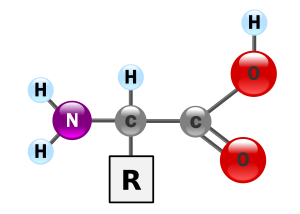
My question is: why isn't the general $\alpha$-... |
Why do $\alpha$-amino acids have a $\ce{C-H}$ bond at the $\alpha$-carbon? |
A common mistake is the thought that the total energy is the sum of all orbital energies $\{\epsilon_i\}$.
From Step #6 of [Daniel Crawford's SCF programming project](http://sirius.chem.vt.edu/wiki/doku.php?id=crawdad:programming:project3) (modified slightly in some places):
> The SCF electronic energy may be com... |
In the nonideal solution, why can't one of the solute be positive deviation and the other be negative deviation?
Let's say A and B makes a nonideal solution.
The moleculat force between A and B means A-B.
Let's say A-A > A-B > B-B.
Then A would evaporate more than in the pure state, and B would evaporate l... |
In the nonideal solution, why can't one of the solute be positive deviation and the other be negative deviation? |
Why do α-amino acids have a C-H bond at the α-carbon? |
It has 3d3 configuration, but how will we decide if they enter t2g or eg orbitals since we don't inow the complex which will form? |
It has $\mathrm{3d^3}$ configuration, but how will we decide if they enter $\mathrm{t_{2g}}$ or $\mathrm{e_g}$ orbitals since we don't know which complex will form? |
What's the configuration of Cr+3 in aqueous medium according to crystal field theory? |
[![enter image description here][1]][1]
I'm really stuck on the question shown in the above image, because with these types of questions usually the concentration of at least one reactant or product at equilibrium is provided, so I know the direction of the equilibrium shift.
Usually I allow the variable 'x' to eq... |
> The equilibrium constant for the reaction:
$$\ce{2NO(g) <=> N2(g) + O2(g)}$$
is $2.60 \cdot 10^{-3}$ at $\pu{1000^\circ C}$. If $\pu{0.820 mol}$ of $\ce{NO}$ and $\pu{0.223 mol}$ each of $\ce{N2}$ and $\ce{O2}$ are mixed at $\pu{1100^\circ C}$, what are the concentrations of $\ce{NO}$, $\ce{N2}$ and $\ce{O2}$ at eq... |

The author seems to imply that the formation of an alkene from a carbocation is energetically more favorable than the formation of an SN1 product. Why?
Once the carbocation is formed, the step leading to the SN1 product requires the formation of... |
Why is the alkene a more stable species in this case? |
**One note at the beginning:** please do not be scared! You can scroll right down to the bottom of this answer to read the conclusion which in itself should sufficiently answer the question. The bits in between are merely elaboration and need not be known in full detail.
---
The reaction one typically receives in... |
> How can we account for $\mathrm{S_N1}$ substitution in this case versus elimination in others?
> **When we dehydrate alcohols,** we usually carry out the reaction in concentrated sulfuric acid and at high temperature. The hydrogen sulfate ($\ce{HSO4-}$) present after protonation of the acohol is a weak nucleophile... |
What's the configuration of chromium(III) in aqueous medium according to crystal field theory? |
If I were to do a simulation and obtain all the chemical shifts and coupling constants between the different atoms, how would I then predict the NMR spectrum ***with coupling***. Without coupling, I just use the chemical shifts and compare those to a base (TMS for example) and then I have all the peak locations and I'm... |
> How can we account for $\mathrm{S_N1}$ substitution in this case versus elimination in others?
> **When we dehydrate alcohols,** we usually carry out the reaction in concentrated sulfuric acid and at high temperature. The hydrogen sulfate ($\ce{HSO4-}$) present after protonation of the acohol is a weak nucleophile... |
What compound is more reactive, **Benzyl Chloride** or **Allyl Chloride**? I know that both have a higher reactivity than alkyl and aryl chlorides.
[![enter image description here][1]][1]
[1]: https://i.stack.imgur.com/eHNCC.png |
I was trying to predict different $\ce{C-F}$ bond lengths of [octafluoropropane](https://en.wikipedia.org/wiki/Octafluoropropane), $\ce{CF3-CF2-CF3}$ :
[![enter image description here][1]][1]
Applying Bent's rule here, we see that
* For $\ce{C^2}$, we have $\ce{C^3}$ and $\ce{C^1}$ towards which s-character ... |
In a solution to a problem, to calculate Molecular mass of unknown gas from a mixture containing $O_2$ in $80$%, the author used the formula :
>$\dfrac{1}{\sqrt{M_{mix}}}=\dfrac{X_{O_{2}}}{\sqrt{M_{O_2}}}+\dfrac{X_{gas}}{\sqrt{M_{gas}}}$.
The exact problem is:
>Pure $O_2$ diffuses through an aperture in $224$ ... |

Practice problem 11.11 what stops R-O-R from forming at the same rate as the desired product? |
Why is this a good synthesis route? |
In a solution to a problem, to calculate Molecular mass of unknown gas from a mixture containing $\ce{O2}$ in $80~\%$, the author used the formula :
>$\dfrac{1}{\sqrt{M_\text{mix}}}=\dfrac{X_\ce{O2}}{\sqrt{M_\ce{O_2}}}+\dfrac{X_\text{gas}}{\sqrt{M_\text{gas}}}$.
The exact problem is:
>Pure $\ce{O_2}$ diffuses ... |
Why can unsymmetrical tert-butyl ethers be prepared by dehydration of the constituent alcohols? |
Is benzyl chloride or allyl chloride more reactive? |
In my textbook, the percentages of anti-eliminations are given which are quite contrary to expectations. The reason is also not given quite clearly. Why does the preference for anti-periplanarity change and what are the reasons for the disparity between the different cyclic structures?
\begin{array}{lr}
\text{Ring ... |
Pretty simple: If you do not have access to water, what could reduce damage from getting acid on your skin?
I'm a total noob - I studied philosophy - but I know bases neutralize acids. I have a vague sort of idea coal does too? Are there other ways? |
Proust's work led him to conclude that compounds always contain the same ratio, by weight, of their constituent elements. How did he know (or deduce?) what gases weighed?
Precise answers appreciated - I can find nothing on the net that explains how the weight of gases was measured at that time - all accounts of Pro... |
How did joseph-louis proust know what gases weighed? |
Unsaturated groups conjugated to the site of attack (aromatic rings, alkenes, carbonyl groups) all tend to have the effect of increasing the rate of an S<sub>N</sub>2 reaction at that centre.
As an example, displacement by nucleophilic iodide in acetone as a solvent is *ca.* 30x faster for allyl chloride than ethyl... |
It is my understanding that transition states in an S<sub>N</sub>2 reaction have some filled and some empty orbital character, as we have the backside of the **C-X σ*** beginning to fill with electrons from the **HOMO** of the nucleophile, forming a **C-Nu σ** bond in the process.
If we have an adjacent carbonyl gro... |
Proust's work led him to conclude that compounds always contain the same ratio, by weight, of their constituent elements. How did he know (or deduce?) what gases weighed?
Precise answers appreciated - I can find nothing on the net that explains how the weight of gases was measured at that time - all accounts of Pro... |
How did Joseph-Louis Proust know what gases weighed? |
What compound is more reactive, **benzyl chloride** [(chloromethyl)benzene] or **allyl chloride** (3-chloroprop-1-ene)? I know that both have a higher reactivity than alkyl and aryl chlorides.
[![enter image description here][1]][1]
[1]: https://i.stack.imgur.com/eHNCC.png |
I was looking into heterocyclic compounds and their alkylation (i.e. the regioselectivity of the alkylation of the compound).
People are able to give pretty exact numbers, for an experiment done in solution. Take, for example, 1,2,4-triazole, the alkylation can occur in one of two positions and papers state that th... |
> Essentially, it is just the formation of the open chain form, and then back to the other cyclic anomer, right?
Precisely, mutarotation involves interconversion of the α-and β-forms of the monosaccharide with intermediate formation of the linear aldehyde (or ketone).
----------
The mutarotation of glucose is ... |
In Peter Sykes' *A Guidebook to Mechanism in Organic Chemistry* regarding the retention of configuration of reaction of alcohols with $\ce{SOCl2}$:
>The rate at which the alkyl chlorosulphite intermediate breaks down to $\ce{RCl}$ is found to increase with increasing polarity of the solvent and also with the increa... |
I have always thought that parts per million meant that in a solution of one million particles, one of those particles is the particle that you are looking for its concentration in ppm. However looking at the formula ppm=(mass solute/mass solution)* 1 million, it seems like it may be meaning one part of mass per mass o... |
In a solution to a problem, to calculate Molecular mass of unknown gas from a mixture containing $\ce{O2}$ in $80~\%$, the author used the formula :
>$\frac{1}{\sqrt{M_\text{mix}}}=\frac{X_{\ce{O2}}}{\sqrt{M_{\ce{O2}}}}+\frac{X_\text{gas}}{\sqrt{M_\text{gas}}}$.
The exact problem is:
>Pure $\ce{O_2}$ diffuses ... |
We know that $\mathrm{S_N2}$ reactions always go with inversion at the saturated centre (they're stereo*specific*) and $\mathrm{E2}$ reactions are always *anti* (also stereospecific).
I recently observed in a paper an example of what was called an $\mathrm{S_E2}$ reaction, but can't understand how the stereochemist... |
So I've been watching a lot of fire tornado videos and I came across one that had a reasonable and safe setup (around the 3:23 mark):
[Fire Tornado DIY][1]
[1]: https://www.youtube.com/watch?v=1BxQd6AGYiI
Is there a way to change the color of the fire tornado using the butane-powered base option?
The i... |
How to safely change the color of a fire tornado? |
At first I thought that both the **OH** groups would cancel out their dipole moments in **hydroquinone**. On reading further, I realized that because of the two different planar structures possible, it has a non-zero dipole moment. My textbook says the dipole moment of ***para*-dichlorobenzene** is zero. But by the sam... |
Why does p-dichlorobenzene have zero dipole moment while hydroquinone does not? |
This is a procedure to synthesize a propylene oxide.
[![enter image description here][1]][1]
[1]: https://i.stack.imgur.com/REZL6.png
I wonder if the inversion occurs or not after the reaction. That is, I want to know which product is correct in the diagram above.
I thought that this reaction is an SN2 ... |
*"Is it correct that this reaction is SN2, and the inversion occurs?"* Yes, and yes, so the product is the one on the top.
[![mechanism][1]][1]
"Inversion" in this context doesn't mean that every substituent has to be flipped. Maybe it's clearer if you take away the intramolecular aspect of it. This is a typical ... |
At first I thought that both the OH groups would cancel out their dipole moments in hydroquinone. On reading further, I realized that because of the two different planar structures possible, it has a non-zero dipole moment. My textbook says the dipole moment of *para*-dichlorobenzene is zero. But by the same logic we u... |
Bullvalene is a fluxional molecule able to interconvert any two carbon atoms through a series of degenerate Cope rearrangements (for more information, see [the Wikipedia article on bullvalene](https://en.wikipedia.org/wiki/Bullvalene#Stereodynamics)). At slightly above room temperature bullvalene produces a single lin... |
What is the isomer distribution in monosubstituted fluorobullvalene? |
Let me begin by thanking Martin and long for supplying the key reference ([*J. Am. Chem. Soc.* **1996,** *118* (34), 7995–8005](https://doi.org/10.1021/ja954004t)). Importantly, long also provided the isomer ratio I was asking for; according to him, the ratio was estimated using the numbers at bottom of page 7997 (wit... |
Let me begin by thanking Martin and long for supplying the key reference ([*J. Am. Chem. Soc.* **1996,** *118* (34), 7995–8005](https://doi.org/10.1021/ja954004t)). Importantly, long also provided the isomer ratio I was asking for; according to him, the ratio was estimated using the numbers at bottom of page 7997 (wit... |
In my textbook, the percentages of anti-eliminations are given which are quite contrary to expectations. The reason is also not given quite clearly. Why does the preference for anti-periplanarity change and what are the reasons for the disparity between the different cyclic structures?
\begin{array}{lr}
\text{Ring ... |
these three compounds are listed in our workbook. Answer is not known and our teacher is known for his trying-to-fit-facts-to-construe-a-logical-looking-and generally-wrong-answer style so he isn't really reliable anyway.
The compounds (Sorry for drawing them on paint):
[![enter image description here][1]][1]
... |
These three compounds are listed in our workbook. Answer is not known and our teacher is known for his trying-to-fit-facts-to-construe-a-logical-looking-and generally-wrong-answer style so he isn't really reliable anyway.
The compounds:
[![Three substituents][1]][1]
The groups are (each has a free valency thro... |
> Calculate the wavelength of the radiation released when an electron in a hydrogen atom moves from $n = 5$ to $n = 2$.
How can I find this wavelength? |
I use the TINKER molecular modeling software package (version 7.1.2) for computational physical chemistry. There is an extra file (extra1.f) included for the user to edit and incorporate their own unique forces/energies to the dynamics of the molecules. The energy that I want to add contains the Boltzmann constant, but... |
These three compounds are listed in our workbook. Answer is not known and our teacher is known for his trying-to-fit-facts-to-construe-a-logical-looking-and generally-wrong-answer style so he isn't really reliable anyway.
The compounds:
[![Three substituents][1]][1]
The groups are (each has a free valency thro... |
I'm not a chemist.
I understand that phosphorus comes in multiple forms, one of which is white, volatile, and highly toxic. I know that phosphors come in multiple chemical forms, two of which are Zinc Sulfide and Strontium Aluminate for glow-in-the-dark products like light sticks, etc, many of which kids use.
... |
How does nucleophilic substitution work in a compound consisting of two leaving groups? For example, in the reaction of Dihaloalkanes with Aq. NaOH, how exactly do the substitutions take place? Do they happen all at once or is each halide replaced by a hydroxyl group one at a time? And what about SN1 vs SN2 in this cas... |
How does nucleophilic substitution work in a compound consisting of two leaving groups? For example, in the reaction of dihaloalkanes with aq. NaOH, how exactly do the substitutions take place? Do they happen all at once or is each halide replaced by a hydroxyl group one at a time? And what about SN1 vs SN2 in this cas... |
Bullvalene (tricyclo[3.3.2.0<sup>2,8</sup>]deca-3,6,9-triene) is a fluxional molecule able to interconvert any two carbon atoms through a series of degenerate Cope rearrangements (for more information, see [the Wikipedia article on bullvalene](https://en.wikipedia.org/wiki/Bullvalene#Stereodynamics)). At slightly abov... |
Let me begin by thanking Martin and long for supplying the key reference ([*J. Am. Chem. Soc.* **1996,** *118* (34), 7995–8005](https://doi.org/10.1021/ja954004t)). Importantly, long also provided the isomer ratio I was asking for; according to him, the ratio was estimated using the numbers at bottom of page 7997 (wit... |
How to remove it? Any other simple method apart from distillation.
I have a small container of mercury that I’ve collected over the past decade. I opened the container after a few years now and I noticed that there is a grey coating on the surface of mercury. Also there is a black powdery deposit at the bottom. It s... |
What is the grey film/black sludge from mercury? How to remove it? |
I'm following a protocol for extraction of proteins from yeast, and I came across this recipe for immunoprecipitation buffer:
" 50 mM HEPES-KOH, pH 6.8, 150 mM KOAc, 2 mM MgOAc, 1 mM CaCl2, 15% glycerol "
Does this mean I bring the whole solution to pH 6.8, or do I make the HEPES at pH 6.8 then add the remaining ... |
I'm not a chemist.
I understand that phosphorus comes in multiple forms, one of which is white, volatile, and highly toxic. I know that phosphors come in multiple chemical forms, two of which are zinc sulfide and strontium aluminate for glow-in-the-dark products like light sticks, etc, many of which kids use.
... |
This afternoon, I was having some trouble with an HSQC (Heteronuclear Single Quantum Coherence Spectroscopy) spectrum I was trying to acquire, and the spectroscopist recommended I try HMQC (Heteronuclear Multiple Quantum Coherence) spectra, as they are more robust. I did so and got a very nice spectrum in about half th... |
How does nucleophilic substitution work in a compound consisting of two leaving groups?
I understand that OH- ions will attack the delta-positive carbon centre and cause a nucleophilic substitution reaction.
What I'm unsure of is whether the reaction proceeds with
1. The hydroxyl groups replacing the leaving... |
BET surface area is measured by specific surface area of the adsorbent. BET surface area is measured by using non-corrosive gases like N2, CO2, Ar etc. BET surface area depends on size and number of gas molecules adsorbed. Langmuir surface area depends on adsorption capacity of the adsorbent.
Why is langmuir surf... |
[Brunauer–Emmett–Teller (BET)][1] surface area is measured by specific surface area of the adsorbent. BET surface area is measured by using non-corrosive gases like $\ce{N2}$, $\ce{CO2}$, $\ce{Ar}$ etc. BET surface area depends on size and number of gas molecules adsorbed. Langmuir surface area depends on adsorption ca... |
What is the difference between BET and Langmuir model for calculating the specific surface area? |
I'm following a protocol for extraction of proteins from yeast, and I came across this recipe for immunoprecipitation buffer:
> $\pu{50 mM}$ [HEPES][1]-$\ce{KOH}$, pH 6.8, $\pu{150 mM}$ $\ce{KOAc}$, $\pu{2 mM}$ $\ce{MgOAc}$, $\pu{1 mM}$ $\ce{CaCl2}$, $15\%$ glycerol.
Does this mean I bring the whole solution to p... |
Is it just coincidence that many organic halogen compounds (especially chlorinated ones) tend to either taste or smell sweet? Examples include dichloromethane, vinyl chloride, chloroform, and sucralose. [This chart](https://jameskennedymonash.files.wordpress.com/2014/01/table-of-organic-compounds-and-their-smells-w12.p... |
Why do many organic halogen compounds smell or taste sweet? |
What is [odor](https://en.wikipedia.org/wiki/Odor) (smell)? We know that $H_2S$ has a foul odor but $H_2O$ (distilled) does not have any strong smell. Do $H_2Se$ has a similar foul smell?
What is smell? Is it any radiation or how it is characterized?
How can we define the smell of any substance? |
What is odor (smell)? |
What is [odor](https://en.wikipedia.org/wiki/Odor) (smell)? We know that $\ce{H2S}$ has a foul odor, but $\ce{H2O}$ (distilled) does not have any strong smell. Does $\ce{H2Se}$ have a similar foul smell?
What is smell? Is it any radiation or how it is characterized?
How can we define the smell of any substance? |
Diiron nonacarbonyl, $\ce{[Fe2(CO)9]}$, is often depicted with an Fe–Fe bond as shown at the left-hand side:
[![structure of Fe2(CO)9][1]][1]
The Fe—Fe bond is usually invoked in order to (1) explain the observed diamagnetism and (2) satisfy the 18-electron rule. However, I'm also aware that the presence of such ... |
To supplement the accepted answer, here is something else I found.
**Bonding in bridging carbonyls**
An alternative explanation for the bonding in $\ce{[Fe2(CO)9]}$ is presented in a 2012 article by Green<sup>1</sup> (which also contains numerous references to earlier computational studies indicating the *absence... |
I was thinking about how Daniell cell works and got into a serious doubt.
Let's consider a half cell of Zn. In standard conditions, it'll have an electrode potential of -0.76V with respect to SHE. If I now increase the zinc ion concentration, I know from Nernst equation that it's electrode potential (still with resp... |
Subsets and Splits
No community queries yet
The top public SQL queries from the community will appear here once available.