
instruction stringlengths 15 21.8k |
|---|
> Which of the following contains one mole of neutrons?
>
> A. $\pu{1 g}$ of $\ce{^1_1H}$
> B. $\pu{1 g}$ of $\ce{^{12}_6C}$
> C. $\pu{2 g}$ of $\ce{^{24}_{12}Mg}$
> D. $\pu{2 g}$ of $\ce{^{23}_{10}Ne}$
Here's a question which I don't know how to answer. I tried using the equation:
moles=mass/mr
but that did ... |
I need a way to prove/show that hydrogen peroxide was **decomposed** through use of catalyst.
I want to ensure that my catalyst: $\ce{Fe(NO3)3}$ or iron(III) nitrate is a catalyst, not a reactant/ consumed during the reaction.
>$$\ce{2 H2O2 (aq) ->[Fe(NO3)3 (s)] 2 H2O (l) + O2 (g)}$$
--------------------------
- W... |
The following data are given for the reaction of $\ce{NO} \text{ and } \ce{Cl2}$:
> $$\ce{2NO + Cl2 -> 2NOCl}$$
>
> The reaction is second order in $[\ce{NO}]$ and first order in $[\ce{Cl2}]$,
and the initial rate equals $\pu{1.43E-6 mol L^-1 s^-1}$ at the instant when $[\ce{NO}]_0 = [\ce{Cl2}]_0 = \pu{0.25 mol L... |
> Order of hydrogen bond strength:
>
> $\ce{O-H...N}$ > $\ce{O-H...O}$ > $\ce{N-H...N}$ > $\ce{N-H...O}$. Why is that so?
According to me $\ce{O-H...O}$ should have the maximum strength while $\ce{N-H...N}$ should have the weakest hydrogen bonds based on the fact that oxygen is more electronegative than nitrogen.... |
Recently, I've run an experiment about the effect of reducing concentration on rate of a reaction.
Here's the chemical reaction:
$\ce{10 NaHSO3 + 4 KIO3 ⇌ 5 Na2SO4 + 2 I2 + 3 H2SO4 + 2 K2SO4 + 2 H2O}$
I ran three tests:
>1. $10$ cc $\ce{KIO3}$ Solution + $10$ cc $\ce{NaHSO3}$ solution _ Time: $163$ sec
>
>2. $10$ c... |
Trying to learn how to use $\ce{K_{\mathrm{sp}}}$ values and not understanding. See question below:
>Two saturated aqueous solutions are prepared at $\pu{25^\circ C}$
>
>**Solution1** is made by dissolving cadmium fluoride ($\ce{CdF2}$, $\ce{K_{sp}} = \pu{6.44E−3}$) in $\pu{100.0 mL}$ of water until excess solid is pr... |
>From these three salts, which will be best able to buffer the addition of $\ce{HCl}$?
>
>1. ammonium chloride
>
>2. sodium carbonate
>
>3. ammonium acetate.
I think sodium carbonate is the right choice because when it dissociates in water forms a basic solution, so when $\ce{HCl}$ mixes with sodium carbonate it will... |
There is a near continuum (and thus a potential infinitude) of relative concentrations of the different components of ceramics and their means of fabrication, but [US Patent US7879449 B2][1] ([PDF][2]) gives a thorough description of their own non-stick ceramic invention as well as descriptions and references to others... |
>Which of the following compounds is expected to have maximum enol content in ethanol?
>
> (A) $\ce{CH3COCH2CO2CH3}$
>
> (B) $\ce{CH3COCH2CO2C2H5}$ ✔(I think this is the correct answer)
>
> (C) $\ce{CH3COCH2COCH3}$
>
> (D) $\ce{CH3COCH(CH3)COCH3}$
I think the ketoesters will have greater enol content than the diketo... |
Suppose we know the Van Der Waals coefficients $a$ and $b$ for a set of gases in the real gas equation, then which is the correct method to predict which gas shows most ideal behavior at STP ?
Our professor said that we must check the critical temperature using the formula $$T_c=\frac{8a}{27Rb}$$ Then he said: "*The g... |
In a step wise approach, based on the NMR data provided:
- The broadband decoupled 13C NMR spectrum accounts for six magnetically different nuclei. (2-Pentanone drawn by you is not consistent with that, its carbon atoms would yield at maximum five signals.) The four signals in the interval of about 120 to 140 ppm co... |
In thermal decomposition studies where very high temperatures are used (see below for four reactions and their respective temperatures, coming from one paper), can I directly relate these decomposition processes to the ones that happen in room temperature?
Is it OK to assume those same reactions will take place even i... |
**No, it doesn't, at least not strictly.**
According to [Wikipedia][1] (emphasis added):
> One of the most common variations on this reaction uses malonic acid $(\ce{CH2(CO2H)2})$ as the acid and potassium bromate $(\ce{KBrO3})$ as the source of bromine. The overall equation is:
>
> $$ \ce{3CH2(CO2H)2 + 4BrO3− → 4... |
I'm working on chemistry and I'm not quite sure how to solve this question? I haven't worked with moles before and whenever I try to figure out how to do these types of question I only end up confusing myself more.
> How many Mg atoms are in 5.7892 mol of $\ce{Mg(NO3)2}$?
>
> How many N atoms does the sample contain?... |
According to [this listing][1], $\ce{Na2CO3}$ is on of the *primary standards* used in volumetric analysis, i.e. is easily available in a reproducible form and concentration, has a high molecular mass, is -- once the container is opened -- not (so much) hygroscopic; and is stable.
I *speculate*, a dilute solution of... |
I'm not sure if I understood your question correctly, and my thought is based on this assumed reaction:
[![enter image description here][1]][1]
Your indication of a resolution of about 1.8 Å reads like the data were collected by Cu K$\alpha$ radiation, rather than by Mo K$\alpha$. If sulfur was split off from your m... |
Discussion around the question [Why does bleach feel slippery?][6] has started me thinking about the saponification explanation for the slippery feeling of basic solutions.
According to [Wikipedia][1]:
>Alkaline drain openers can dissolve hair (containing proteins) and fats inside pipes via alkaline hydrolysis of ami... |
Consider the decomposition of ozone as follows
1. (fast)
$$\ce{O3 <=> O2 + O}$$
1. (slow)
$$\ce{O + O3 -> O2 }$$
The question comes here if the concentration of $\ce{O2}$ is increased , then comment on the rate of the reaction.
1. increases
1. decreases
1. constant
1. cannot be predicted
My try: I hav... |
I've got the following question and I'm having doubts with it:
> $$\ce{NAD+ + 2e- + H+ -> NADH}$$
>
> Calculate ${E^\circ}'$ for the half cell $\ce{Pt | NADH, NAD+, H+}$ at pH 7, given that $E^\circ = \pu{-0.358 V}$ at $\pu{298 K}$.
It wants the formal potential. So I write the Nernst equation:
$$E = E^\circ - \f... |
I am searching a long time now. I have a question about the Folin–Ciocalteu formula for quantification of polyphenol. How is the $62.5$ in the equation explained? Where does it come from?
This is the protocol \[1, p. 38\]:
> $\pu{5.0 mL}$ of extract were placed in calibrated flask and filled up to $\pu{25 mL}$ by dis... |
The following question is #21 from [this test form][1] (PDF link):
> The apparatus in Figure 4 was set up to measure the time taken for $\pu{20.0 cm3}$ of sodium thiosulfate solution to react with $\pu{5.0 cm3}$ of hydrochloric acid in a $\pu{100 cm3}$ conical flask at $\pu{20 °C}$. The timer was started when the sod... |
>$$\ce{CO2(g) + Ca^2+(aq) + H2O(aq) <=> CaCO3(s) + 2H^+(aq)}$$
>
>Find the equilibrium constant using a free energy table.
Finding the free energy and plugging it into the equation $\mathrm{G = -RT \ln (\mathit{K})}$ is easy, but I am confused about what $K$ it is. Is it $K_c$ or $K_p$, or does it even matter?
This ... |
Excerpts from my answer [here][1].
>The mechanism proposed for the cleavage reaction involves an initial attack by the donor on one boron atom in diborane, leading to cleavage of one $\ce{B-H-B}$ bridge.
>
>[![enter image description here][2]][2]
>
>This is followed by the attack of a second donor molecule, cleaving t... |
> But what standard deviation is small enough to be considered precise?
**"Sufficiently precise," ironically enough, is something that can't really be defined precisely in general terms.**
In other words, a level of precision that is perfectly fine in one context might be unacceptably low in others.
For example, if... |
Given statement: Enthalpy of adsorption is the strength at which molecule (say $\ce{H2}$) is bound to the adsorbent (say some metal center). For a free $\ce{H2}$ molecule, the entropy contribution is from translational, rotational and vibrational motion. After the adsorption, the translational and rotational motions wi... |
I came across this question:
> Which of the following is bigger?
>
> $$\ce{K+, Ca^2+, Al^3+, S^2-, Cl-}$$
Now, I know that the radius decreases as the period progresses to the right and increases as we go down on the P.T. So, I get to this:
$$\ce{S^2- > Cl- > K+ > Ca^2+}$$
Also, I know that $\ce{Al^3+ < Al^0}$ a... |
> [![enter image description here][1]][1]
>
> Which of these compounds - anilinium ion and *para*-fluoro anilium ion - is more acidic?
I thought the answer would the be first one since $\ce{-F}$ is an ortho-para activating group, so the electron density at the carbon at which $\ce{-NH3+}$ is attached would be more. I ... |
My textbook states:
> The oxoacids of Phosphorous which contain $\ce{P-H}$ bond have strong reducing properties. Thus, hypophosphorous acid is a good reducing agent as it contains two $\ce{P-H}$ bonds and reduces, for example, $\ce{AgNO3}$ to metallic silver.
>
>These $\ce{P-H}$ bonds do not ionize to give $\ce{H+}$ a... |
I'm basing this answer from translation of the [original question][1] (in German) which I believe is supposed to read:
*Ammonia can exist in oxidised form, reduced form, acid or base. Name the form in which ammonia exist in the following:* (correct me if I am wrong)
Focusing on the acid/base forms (3) and (4):
- ... |
I was faced with the following question:
> **PART C – CHEMISTRY**
>
> Which one of the following properties is **not** shown by $\ce{NO}$?
>
> 1. It combines with oxygen to form nitrogen dioxide
>
> 2. Its bond order is $2.5$
>
> 3. It is diamagnetic in the gaseous state
>
> 4. It is a neutral oxide
I am c... |
I have an unknown white powder, which is an ionic solid, and I need to identify what it is by using qualitative analysis. I've run quite a few tests, but I am having a lot of trouble identifying the anion. The data I've collected is below.
**General Properties:**
- It is a white powder, and I know that it is an ion... |
The definition of NTP as given by IUPAC is
> NTP – Normal Temperature and Pressure – is defined as air
> at $20\ ^\circ\mathrm C$ ($\pu{293.15 K}$, $\pu{68^{\circ}F}$) and $\pu{1 atm}$ ($\pu{101.325 kN/m2}$, $101.325\ \mathrm{kPa}$, $14.7\ \mathrm{psia}$, $0\ \mathrm{psig}$, $29.92\ \mathrm{inHg}$, $407\ \mathrm{in}\c... |
As part of a conformation analysis of a library of piano stool complexes to find global minima and TS, a relaxed scan where the legs of the piano stool complex rotated about the Cp-M bond need to be performed (Here a $\ce{[(Me-Cp)RuClH(CO)]}$ is given here to illustrate the task in question) :
[![enter image descripti... |
In my chemistry book, the law of chemical equilibrium is derived from the law of mass action:
> For a reversible chemical reaction $$\ce{aA +bB\rightleftharpoons cC + dD}$$ where $a$, $b$, $c$ and $d$ are stoichiometric coefficients in the balanced equation, we have, from the law of mass action, the rate of the forwar... |
I can see that denitrification consists of processes involving mainly two steps:
**Step 1** (nitrate to nitrite):
$$ \ce{3NO3- + CH3OH -> 3NO2- + CO2 + 2H2O} $$
**Step 2** (nitrite to molecular nitrogen):
$ \ce{2NO2- + CH3OH -> N2 + CO2 + H2O + 2OH-} $$
Total reaction is supposed to be:
> $$ \ce{6NO3- + 5CH3OH -... |
> Which is best solvent for recrystallization of benzoic acid?
>
> - Water
> - $\ce{CH3Cl}$
> - $\ce{CCl3COOH}$
> - $\pu{0.1 M}\ \ce{NaOH}$
I understand the solute/solvent should be soluble at high temperature, and insoluble at room temperature. But how to make the specific arguments for eliminating the altern... |
A slight misconception. According to http://www.chemguide.co.uk/basicorg/isomerism/geometric.html, the definition of geometrical isomers is (emphasis mine):
> These isomers occur where you have **restricted rotation** somewhere in a molecule. At an introductory level in organic chemistry, examples usually just involve... |
> Aqueous solutions of $\ce{HNO3}$, $\ce{KOH}$, $\ce{CH3COOH}$, and $\ce{CH3COONa}$ of identical concentrations are provided. The pair (s) of solutions which form a buffer upon mixing is(are)?
>
> A. $\ce{HNO3}$ and $\ce{CH3COOH}$ <br>
> B. $\ce{KOH}$ and $\ce{CH3COONa}$ <br>
> C. $\ce{HNO3}$ and $\ce{CH3COONa}$ <br>
>... |
> Consider a cubic unit cell of crystal that is composed of a single kind of atom. By placing atoms at every corner of the cube, a simple cubic lattice is formed. Assume that the atoms are perfect hard spheres with a radius $r$ and that the atoms are in close contact to minimize the volume of the cube.
>
> In a simple ... |
For the first example, I definitely wouldn't want to react $\ce{CuCl2}$ with $\ce{HCl}$, because then I would end up getting the same products again. I'm *primarily driven* by the motive to create something new, albeit the reaction must be a *feasible* one. Many factors influence feasibility, and you've mentioned the f... |
I am trying to do the following exercise in a chemistry workbook. I have searched over internet but I couldn't find or understand it.
> How many atoms of each element are found in:
>
> - 5 moles $\ce{H2SO4}$
Now the only confusing thing for me is the 5 moles.
For example lets take $\ce{H2}$ element
> so n=N/Na *-->... |
To further illustrate brilliant [Jan's answer][1], here are the experimental crystallographic data for both structures; also notice that reduced form contains $\ce{[Co(CN)5O]}$ units tilted at about $45^\circ$ dihedral angle, whereas in oxidized form those are perfectly aligned:
1. Oxidized form $\ce{[(CN)5CoO2Co(CN)... |
> Methanoic acid ($\ce{HCOOH}$) is found in stinging nettles. In an analysis of the concentration of methanoic acid in a solution extracted from nettles, the solution was titrated with a standard solution of potassium hydroxide. Aliquots of the methanoic acid were transferred to a conical flask and titrated against the... |
Given in my book is the following reaction mechanism for the unimolecular $\ce{A -> B + C}$,
>$$\ce{A + M ->[k_1] A^* + M} \\ \ce{A^* + M ->[k_2] A + M} \\ \ce{A^* ->[k_3] B + C}$$
>
>Here $A^*$ is an $A$ molecule with enough vibrational energy to isomerize or decompose. In other words, part of kinetic energy of a bi... |
A few things first...
**Arrhenius Theory:**
> An "acid" is a **proton donor**; a "base" is a **hydroxide donor**.
So for example, $\ce{HCl}$ and $\ce{NaOH}$ (both in water) ionize to produce $\ce{H+}$ and $\ce{OH-}$ respectively.
$$\ce{HCl -> H^+ + Cl^-}$$
$$\ce{ NaOH -> Na^+ + OH^-}$$
Which gives us the all-t... |
In a recent installment of [Deus Ex game series][1] there is an augmentation called ["Titan Shield"][2] (it has nothing to do with $\ce{Ti}$ element):
> A neodymium skin underlay matrix built of nano-meshed rare earth magnets and powered with hook-ins to the Biocell electrical system, the TITAN skin augmentation can b... |
While there are quite a few answers here already, I would like to approach this without going into complicated theories.
You might have heard that Coulomb's law can't be used in the case where charges move. You were thinking that the Coulomb's law is *incorrect* for moving charges, but the fact is that Coulomb's law i... |
I always prefer to drink water without sipping, like this:
[![a person pours water from a bottle into their mouth, from a height of about 3~5cm, without touching the bottle rim with the mouth][1]][1]
I do this so that my saliva doesn't contaminate the water contents, which would make the water impossible to share wit... |
I have heard of the [leveling effect](https://en.wikipedia.org/wiki/Leveling_effect), which mentions that highly basic ions cannot exist in a solvent if it's acidity is high enough to be deprotonated by the base.
Considering that, check out the Grignard reagent. I'll use a methylgrignard for this purpose, generated in... |
> In a mass spectrometer some hydrogen chloride molecules will split into atoms. Chlorine has two isotopes. The hydrogen involved here is the isotope $\ce{^1_1H}$ only.
>
> How many peaks does a mass spectrum will show?
My answer was two with $\ce{H^35Cl}$ and $\ce{H^37Cl}$ but I found the answer to be wrong. Where ha... |
> Suppose 1 mol of $\ce{KI (aq)}$ is mixed with $\pu{1 mol}$ of $\ce{I_2^*}$, where $\ce{I_2^*}$ represents a di-iodine molecule which has been radioactively labelled, and the substances are allowed to react for an infinite amount of time. Assume radioactive labeling does not affect reactivity of the atom.
>
>i) Predic... |
> How can we account for $\mathrm{S_N1}$ substitution in this case versus elimination in others?
>
> **When we dehydrate alcohols,** we usually carry out the reaction in concentrated sulfuric acid and at high temperature. The hydrogen sulfate ($\ce{HSO4-}$) present after protonation of the acohol is a weak nucleophile,... |
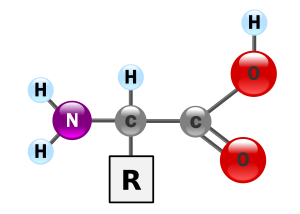
I've just started studying biochemistry and I read that a general $\alpha$-amino acid looks like (ignore the ionisation for now):
My question is: why isn't the general $\alpha$-amin... |
At class, we were (briefly) taught about the *Loschmidt Number/Constant ($n_0$)*, which isn't really different from the [Wikipedia definition][1],
> The **Loschmidt constant** or **Loschmidt's number** (symbol: $n_0$) is the number of particles (atoms or molecules) of an ideal gas in a given volume (the *number densit... |
What factors need to be considered in order to rank the acidity of aromatic molecules with various substituents?
> Given benzene with 1 $\ce{OH}$ group. How does adding the following functional groups affect acidity, and what are the rules to determine this?
>
> - an additional $\ce{OH}$ group
> - $\ce{Cl}$
> - $... |
# Short answer
You can't!
# Longer answer
1. Toxicity is not defined for a plant (or animal), but for specific compounds which are either produced or accumulated in these "toxic organisms". The concentration of toxic compounds may vary during the vegetation cycle and can depend, particularly in the case of accumulat... |
>**The IUPAC name of $\ce{K4[Fe(CN)6]}$ is:**
>
>**A**. Potassium hexacyanido ferrate(II)
>
>**B**. Potassium hexacyanido ferrate(4-)
>
>**C**. Tetrapotassium hexacyanoferrate
>
>**D**. All are correct
>
Actually I had been going through the IUPAC exercise of my book when I encountered just this question.
I know tha... |
Coordinate covalent bonds and Resonance are very very vastly different things. You may have coordinate compounds without resonance, and you may have resonance involving compounds without any coordinate covalent bonds. There's no connection.
## Coordinate Covalent Bonds (a.k.a Dative Bonds):
These bonds are just like ... |
You're probably picking up hydrogen gas, which is produced when lead-acid batteries are [overcharged at high charging voltages](https://en.wikipedia.org/wiki/Lead%E2%80%93acid_battery) (a danger in its own right). [This article](http://www.firehouse.com/article/10518243/the-unexpected-golf-cart-hazard) details a situat... |
Recently started reading up on *Chemical Kinetics*, and I came across a certain "Ostwald Isolation Method" that figures in my school-issued workbook. Apparently, it's used to determine (approximately) the order of a given reaction.
However, the painfully short passage that constitutes that section of the book, couple... |
**Prologue**:
Recently started with *Chemical Kinetics* at class. Came across a couple of points in Levine's *Physical Chemistry* (the book was [recommended on Chem.SE][1]; so I thought I'd give it a read :D) that I'm having serious issues wrapping my head around. This query is about the kinetics of equilibrium (and n... |
In 2016 synthesis and structure of tetranitratoethane $\ce{C2H2N4O12}$ were reported \[1\]. Currently (as of 2017-Q4) this is the only dinitrato-carbon compound with the well-established crystal structure and composition:
[![enter image description here][1]][1]
This article also mentions dinitratomethane (reference n... |
How do you read Platt's Notation / Nomenclature? Where can I learn this?
Some examples where I've seen this mentioned:
> In Platt's notation the transitions are designated as $\ce{A -> B}$ and $\ce{A -> C}$ transitions
>
> The analysis reveals that the $L_a$ and $B_a$ states of the benzene fragments mix with CT confi... |
We have a **cyclic** cascade of unimolecular chemical reactions
$$\ce{A} \xrightarrow{\kappa_1} \ce{B} \xrightarrow{\kappa_2} \ce{C} \xrightarrow{\kappa_3} \ce{A}$$
where $\kappa_1, \kappa_2, \kappa_3 > 0$ are the rate constants. Assuming that each chemical reaction in this cascade has [mass action][1] kinetics, then... |
> Consider the S<sub>N</sub>1 reaction shown below:
>
>[![https://imgur.com/a/EuMnG][1]][1]
>
> Would different products be formed if $\ce{CH3SH}$ was an additional reagent?
>
>[![https://imgur.com/a/BCBM9][2]][2]
>
> Superimpose both energy diagrams on top of each other.
For the first question, yes, two products woul... |
> A compound of Ca, C, N and S was subjected to quantitative analysis and formula mass determination, and the following data were recorded.
>
> A $\pu{0.250 g}$ sample was mixed with $\ce{Na2CO3}$ to convert all of the Ca to $\pu{0.160 g}$ of $\ce{CaCO3}$.
>
> A $\pu{0.115 g}$ of the compound was carried through a se... |
My textbook says the following about the [Ellingham diagram][2]:
> Each plot is a straight line except when some change in phase ($\ce{s -> liq}$ or $\ce{liq -> g}$) takes place. The temperature at which such change occurs, is indicated by an increase in the slope on +ve side (e.g., in the Zn, ZnO plot, the melting is... |
We must demonstrate two reactions: endergonic and exergonic. I'm wondering if thefollowing reactions are accurate.
- Exergonic: I have sodium bicarbonate and vinegar. Would it be catabolic, spontaneous, and $-\Delta G$ as well?
Sodium bicarbonate and vinegar is your basic science-fair volcano reaction. You have the... |
While reading some publications on solid superconductors, I encountered a term "chemical pressure" a few times, which is usually attributed to the changes of superconducting transition temperature $T_\mathrm{c}$ alongside with the hydrostatic, or physical, pressure. For the reference, consider this paper:
*Chemical Pr... |
While studying alkanes, I found this written in my book:
> Fluoridation can be achieved without violence when alkane is treated with fluorine diluted with an inert gas, or by the action of inorganic fluorides like $\ce{AsF3}$, $\ce{SbF3}$, $\ce{AgF}$, $\ce{HgF2}$, $\ce{Hg2F2}$, etc., or by use of bromo or iodo derivat... |
I have had to ask this question again because it was marked as a duplicate but it wasn't. Here it goes..
Suppose we want to estimate $G_f^\circ$ of a molecule. If it has rotational conformers, right way to calculate $G$ should include a Boltzmann average of them.
We will do it as:
$$\large \langle G_f^\circ \rangle ... |
While studying about d block elements I came across this table showing outer shell electronic configuration of group 10 elements
> $\ce{Ni}$ $ $ $ $ $ $ $ $ $ $ $3d^8$ $4s^2$
>
> $\ce{Pd}$ $ $ $ $ $ $ $ $ $4d^{10}$ $5s^0$
>
> $\ce{Pt}$ $ $ $ $ $ $ $ $ $ $ $5d^9$ $6s^1$
(Source [Concise Inorganic Chemistry, JD Lee... |
So, it's been a good two years since I've done chemistry and I have my first university lab in a few days and I'm sort of freaking out because I can't even remember how to do stoichiometry properly. This a question off of my pre-lab review and I'm having troubles remembering what to do. I believe this is a limiting rea... |
When we add Group-1 and Group-2 metals to liquid ammonia, they dissolve to form metal cations and solvated electrons.
$$\ce{M + NH3(liq) -> M+ + e-}$$
Now, when the G-1 solutions evaporate, we get the metal back, but in the case of G-2 solutions (except Beryllium), they give a metal complex, $\ce{[M(NH3)6]}$.
>"Evap... |
Even if reaction has low entropy of formation does that mean it is favorable to loss aromaticity and form highly strained cyclopropane ring? Why this reaction happens? Maybe someone can explain that in more details? Is this equilibrium reaction? I assume cyclopropane ring can be as easily opened with nucleophile as it ... |
> * Unknown mixture A [$\ce{H2SO4}$ and $\ce{CuSO4}$]
> * Unknown mixture B [$\ce{H2SO4}$ and $\ce{HNO3}$] (ranged between $\pu{0.1 - 0.3 M}$ for the solution)
>
> (E.g. if you are using Unknown mixture B [$\ce{H2SO4}$ and $\ce{HNO3}$], concentration of $\ce{H2SO4}$ will be $\pu{0.1 – 0.3 mol/dm3}$, and concentration ... |
> When solid ammonium chloride dissociates at a certain temperature in a $\pu{0.500 dm3}$ container, ammonia and hydrogen chloride are formed.
>
> $$\ce{NH4Cl <=> NH3 + HCl}$$
>
> The initial amount of ammonium chloride was $\pu{1.00 mol}$, and when the system had reached equilibrium there was a $\pu{0.300 mol}$ of amm... |
How can it be explained that in the first reaction mentioned below, a 7-membered ring dominates when the leaving group is nitrogen and an epoxide forms when the leaving group is dimethyl sulfide?
This is quoted from "*The Art of Writing Reasonable Organic Reaction Mechanisms*", Second Edition by Robert B. Grossman, [D... |
Why secondary alkyl groups are more prone to shifting than primary? I attach example from Grossman book \[p. 20\]:
> [![enter image description here][2]][2]
>
> When $\ce{R} = \ce{CH2CH2Ph}$, the coordinated $\ce{Al}$ simply transfers a $\ce{Me}$ group to the carbocation $\ce{C}$ (σ bond nucleophile). The $\ce{O}$ ato... |
> To boil glass, the lime and sand mixture of potash was heated and the off gas spent $\pu{125 mL}$ of barley hydroxide solution (density $\pu{1.14 g mL-1}$). The mass of the sediment was $\pu{4.925 g}$. It is known that the ratio of gas to alkalinity is $1 : 1$.
>
> 1. Find the volume of absorbed gas.
>
> 2. Find mas... |
This is not really an answer to your question, but I do not think that it is possible to answer it. From one of the many comments we learn that the reference is actually the "preparation of piperonal". It uses 3-4-dihydroxy-benzenecarbaldehyde instead of catechol, but the reaction is same, with $\ce{CH2I2}$ and $\ce{Na... |
> **This question has also been asked on physics stack exchange:**
> [Why is the helium atom wavefunction a product of the two 1s wavefunctions?](https://physics.stackexchange.com/questions/373985)
From \[1, p. 116\]:
> In seeking an approximation to the ground state, we might first work out the solution in the abs... |
> Propane gas, $\ce{C3H8}$, burns in oxygen to produce carbon dioxide and water vapour as follows:
>
> $$\ce{C3H8 (g) + 5O2 (g) = 3 CO2(g) + 4 H2O (g) + \pu{2200 kJ}}$$
>
> If $\pu{1.5 mol}$ of propane is consumed in this reaction, how many moles of $\ce{H2O}$ are produced?
I'm completely stuck on this question, I ha... |
**Chemistry**
AgNO3 is a strong electrolyte it dissociates completely.
$\ce{AgNO3 -> Ag+ + NO3-}$
If it was just HCN in solution, then most of the $\ce{CN^-}$ species would be as HCN. But since $\ce{AgCN}$ precipitates, more HCN dissociates. So essentially the overall reaction is:
$\ce{HCN + Ag+ -> AgCN}\,\ce{v + H... |
> Given a solution with molarity $\pu{0.5 M}$ of a weak acid $\ce{HA}$ has $\mathrm{pH} = 1.670$. How much water in liters needs to be added to $\pu{0.150 L}$ of the first solution to get a $\mathrm{pH} = 2.5$?
>
> Consider volumes additive.
My attempt was calculating the $K_\mathrm{a}$ of the acid using the first $\... |
> An important step in the preparation of sulfuric acid involves the production of sulfur trioxide ($\ce{SO3}$) from sulfur dioxide ($\ce{SO2}$) and oxygen.
>
> $$\ce{2 SO2 (g) + O2 (g) -> 2 SO3 (g)}$$
>
> If all volumes are measured at the same temperature and pressure, calculate the volume of sulfur trioxide produced... |
My text book just referred to this term. I have absolutely no idea what it is. Articles on the internet are too difficult for me to comprehend.
> In some alkenes, steric crowding in the planar state may be so severe that the latter is no longer an energy minimum but becomes an energy barrier with the ground state be... |
> In a certain $\pu{1 L}$ buffer with $\pu{0.25 M}$ $\ce{NH3}$ and $\pu{0.4 M}$ $\ce{NH4Cl}$, $\pu{0.1 mol}$ of $\ce{HCl}$ has been added to the solution. What is the $\mathrm{pH}$?
>
> $K_\mathrm{a}(\ce{NH4+}) = \pu{5.56e-10}$, and $K_\mathrm{b}(\ce{NH3}) = \pu{1.8e-5}$.
The answer says that at last there will be $\p... |
First off, solving these kind of problems we are assuming that
1. the resulting mixture is homogeneous;
2. the mixing of various solutions takes place instantaneously;
3. the volume of the mixture is equal to the sum of the volumes of the miscible solutions.
The approach is very similar, there slight deviation... |
> What is the number of transition states and intermediates formed in the following reaction?
>
> [![enter image description here][1]][1]
**My thought:**
1. First the alkene extracts $\ce {H^+}$ from the acid to form a **carbocation**. This step involves a transition state and the formation of an intermediate which i... |
> For many years of drinking water has been cooled in hot climates by evaporating it from the surfaces of canvas bags or porous clay pots. How many grams of water can be cooled from $\pu{35 ^\circ C}$ to $\pu{20 ^\circ C}$ by the evaporation of $\pu{60 g}$ of water?
>
> Heat of vaporisation of water in this temperatur... |
**Summary of IUPAC definition**
$\def\d{\mathrm{d}}$In IUPAC recommendations from 1994<sup>[1, 1166–1167]</sup>, the authors discuss the process
$$\ce{A <-->[$k_1$][$k_{-1}$] X\\ X + C ->[$k_2$] D}$$
A kinetic stationary state or steady state is defined very reasonably:
$$\frac{\d\ce{[X]}}{\d t}=0.\tag2$$
They go ... |
IUPAC should say they are defining the "steady state approximation" rather than the steady state.
There are two approximations in this technique.
First, that final reaction step is not an equilibrium (reverse reaction rate is zero).
Second, that the intermediate is so unstable that its concentration (and there... |
> Which substance has the fastest rate of evaporation at room temperature?
>
> **A**) $\ce{CH3OH}$
> **B**) $\ce{C7H16}$
> **C**) $\ce{C6H14}$
> **D**) $\ce{C4H10}$ |
> In a condensation polymerization between two different monomers, the average molecular weight of the product depends on the ratio of the monomers used. This question illustrates the effect of using different ratios of ethylenediamine ($\ce{A}$) and 1,4-butanoic acid chloride ($\ce{B}$):
>
> [![enter image description... |
> $$\ce{C (s) + H2O (g) <=> CO2 (g) + H2 (g)}$$
>
> What will happen to the equilibrium when the pressure of gases is increased? What will happen to the yield of $\ce{H2}$?
Since pressure increased means the volume is decreased, equilibrium will shift to the direction with the least number of moles. But since the stoi... |
The *reason* why the generic name of most drugs have seemingly little semblance to their chemistry is in the interests of practicality; a doctor would find it easier to write [sildenafil][2] (generic name) or Viagra (brand name) in a prescription than 5-{2-Ethoxy-5-[(4-methylpiperazin-1-yl)sulfonyl]phenyl}-1-methyl-3-p... |
> How is aqua regia stored as it dissolves all metals?
--------------------------
No one stores [aqua regia][4] for extended periods of time, because it [decomposes rapidly][1], yielding volatile products that escape from the solution resulting in a loss of potency.
From the Wikipedia article on aqua regia,
> Due t... |
Your assessment of which groups are *trans* to each other is correct but you have not taken into account that the molecule can adopt other conformers.
The classic confomation for E2 elimination is when the hydrogen and the leaving group are *trans*. This is because it maximises the orbital overlap between the $\ce{C-X... |
**Problem:**
> One of the most widely used methods for the formation of $\ce{C=C}$ is β - elimination reaction of the following type:
>
>[![enter image description here][1]][1]
>
>The spatial arrangement for a bimolecular elimination (E2) of the type shown above **requires a trans geometry of the β - hydrogen and the ... |
Subsets and Splits
No community queries yet
The top public SQL queries from the community will appear here once available.