

The dataset viewer is not available for this split.
Error code: TooBigContentError
Need help to make the dataset viewer work? Make sure to review how to configure the dataset viewer, and open a discussion for direct support.
VulSpot
A living benchmark for vulnerability detection, CWE classification, and statement-level localization, where no vulnerability goes unlocalized.
💻 Code (GitHub) · 📄 Paper: Beyond the Diff — VulSpot: A Vulnerability Dataset Where No Vulnerability Goes Unlocalized (under review) · 🏷️ Paper release: v2026-10-12
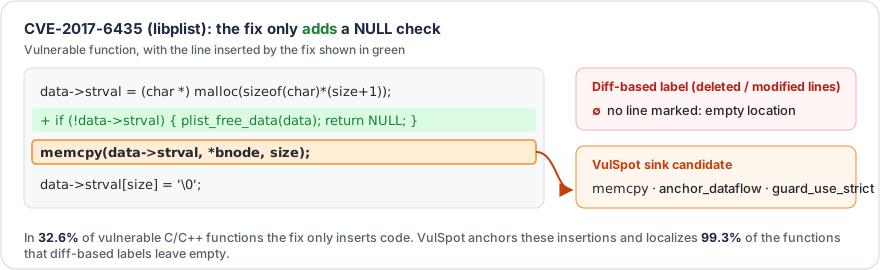
VulSpot links CVEs from the NVD to their fixing commits and labels every changed function as vulnerable (before the fix) or safe (after it). Existing datasets give a vulnerable function no location when its fix only adds code, such as a missing NULL check, free, or lock. VulSpot anchors such insertions on the statement of the vulnerable version they protect, and localizes 99.3% of the functions that diff-based labels leave empty. It also provides:
- a rule-based confidence tier for each vulnerable label and a provenance type for each negative, instead of a hard filter;
- clone-aware chronological and project-holdout splits, plus high-confidence, paired, and non-Linux test subsets;
- a
balancedvariant that caps the post-2024 surge of Linux kernel CVEs; - deterministic AST context (callees, types, macros, globals) and four hierarchical CWE views;
- a monthly refresh, so each release adds vulnerabilities that no model has seen yet.
Quick start
from datasets import load_dataset

cpp = load_dataset("ods01/VulSpot", "cpp", split="full", revision="v2026-10-12")   # paper release
multi = load_dataset("ods01/VulSpot", "multi", split="full")                       # latest release
import json
from huggingface_hub import hf_hub_download

path = hf_hub_download("ods01/VulSpot", "cpp/full/splits/chrono.json",
                       repo_type="dataset", revision="v2026-10-12")
split = json.load(open(path))     # train, val, test, test_high, test_paired_high, test_no_linux
df = cpp.to_pandas().set_index("idx")
train, test = df.loc[split["train"]], df.loc[split["test"]]
Statistics (release v2026-10-12)
cpp full |
cpp balanced |
cpp paired |
multi full |
multi balanced |
multi paired |
|
|---|---|---|---|---|---|---|
| Functions | 283,361 | 107,977 | 29,782 | 503,332 | 327,759 | 53,198 |
| Vulnerable functions | 15,932 | 5,629 | 14,891 | 28,334 | 18,025 | 26,599 |
| Vulnerable share | 5.6% | 5.2% | 50.0% | 5.6% | 5.5% | 50.0% |
| CVEs | 16,176 | 5,332 | 12,079 | 24,257 | 13,407 | 18,270 |
| Repositories | 753 | 753 | 688 | 3,634 | 3,634 | 3,112 |
| Distinct CWEs | 231 | 217 | 228 | 429 | 420 | 426 |
| Linux share of vulnerable | 75.1% | 29.7% | 74.3% | 42.3% | 9.3% | 41.6% |
| Confidence high / medium / low | 81 / 17 / 3% | 67 / 27 / 7% | 80 / 17 / 3% | 61 / 36 / 3% | 45 / 50 / 5% | 61 / 36 / 3% |
| Additive fixes (of vulnerable) | 32.6% | 32.4% | 33.2% | 25.4% | 21.2% | 26.0% |
The CVEs span 2009 to October 2026. multi covers 21 languages: C, C++, PHP, Python, JavaScript, TypeScript, Go, Java, Ruby, Rust, C#, Erlang, Perl, Swift, Kotlin, Objective-C, Scala, Bash, Lua, Dart, and TSX.
Releases
VulSpot is updated every month. Each release is a tag of this repository named after the last NVD publication day it covers (v<YYYY-MM-DD>). Loading without revision gives the latest release. Use v2026-10-12 to reproduce the paper. Tags appear in the branch selector of the Files and versions tab, and you can list them with:
from huggingface_hub import list_repo_refs
print(sorted(t.name for t in list_repo_refs("ods01/VulSpot", repo_type="dataset").tags))
Each release's version.json records the window it covers. The code that built each release is tagged with the same name on GitHub.
Configurations and variants
| Config | Content |
|---|---|
cpp |
C/C++ files only (.c, .cc, .cpp, .h, .hpp, ...) |
multi |
All 21 supported languages, with a language column |
Each config has three variants, exposed as dataset splits:
full: every function that passed the filters (vulnerable, fixed, untouched, and added by the fix).balanced:full, with the post-2024 Linux kernel CVEs (is_kernel_cna) of each calendar year capped at the kernel's average yearly CVE count before 2024. The kept CVEs are a seeded sample spread over the year, so chronological val/test still contain some Linux.paired: vulnerable functions whose fixed version is also infull, plus those fixed rows.idxandfixed_func_idxkeep theirfullvalues, so the fixed version of a function is the row withidx == fixed_func_idx.
Splits
Two index files sit next to each variant's Parquet file. They list values of the idx column.
splits/chrono.json: commits are sorted by the earliest publication date of their CVEs and cut 80/10/10 (by rows) into train/val/test. All rows of a commit stay together. Then the clone rule applies: a row whoseclone_group_idalready appears in an earlier split (train < val < test) is excluded. As a result, no test function is a near-duplicate of a training function, and training never contains data newer than test.splits/project_holdout.json: randomly chosen whole projects, about 10% of the rows, form the test set (torvalds/linuxalways stays in train/val). The rest is split chronologically into train/val. The same clone rule applies.
Both files also contain evaluation subsets of test:
test_high:cleantest rows, without the vulnerable rows whoselabel_confidenceis nothigh. All clean negatives are kept.test_paired_high: high-confidence vulnerable rows whose fixed version is also in test, plus those fixed versions (paired evaluation).test_no_linux: test withouttorvalds/linuxrows.
Collection
- CVEs: all non-rejected CVEs from the NVD API 2.0, fetched in windows by publication date.
- Patch commits: references tagged
Patchthat point to a GitHub commit, or togit.kernel.org(remapped totorvalds/linux). A fork is kept only if the SHA exists in the parent repository, and is attributed to the parent. - Commits: message, unified diff, and before/after file contents. Merge commits, commits with more than 300 files, and files over 2 MB are dropped. Linux stable backports are dropped when a mainline commit covers the same CVE. The remaining multi-commit CVEs are dropped.
- Functions: tree-sitter extraction, before/after pairing by name, signature, and order, and a statement-level edit script.
- Labels and filters: confidence tiers replace a hard filter for tangled commits. Other changed functions in multi-function files, and vulnerable functions in test or fuzzing files, are never labeled vulnerable.
Label semantics
is_vulnerable is the function-level label. cve_list and cwe_list hold the linked CVEs and their raw NVD CWEs.
Localization
VulSpot provides two localization layers:
changed_lines/changed_statements: diff-based labels. On a vulnerable row, they hold the deleted and updated statements. On a fixed row, they hold the added and updated ones. They are JSON strings[[line, text], ...]with line numbers relative to the start of the file.edit_actionsstores the full statement edit script: each statement is unchanged, updated, deleted, inserted, or moved. Whitespace-only edits count as unchanged, and comment edits are flagged as non-code (is_code).sink_candidates(vulnerable rows only): a JSON list of the statements a localizer should point at. It contains the deleted and updated statements, plus one anchor per group of consecutive inserted statements, taken from the vulnerable version. Each entry haskind,abs_line,rel_line,byte_start,byte_end,text, and, for anchors,anchor_ruleandinserted_text.
kind |
anchor_rule |
Strength | Anchor |
|---|---|---|---|
deleted, updated |
– | diff | The statement removed or changed by the fix |
anchor_dataflow |
guard_use_strict |
strong | Inserted guard if (c) return/goto/break/continue;: the first later use of a variable of c |
anchor_dataflow |
release_acquire |
strong | Inserted free/put of X: the statement that assigns X. Inserted unlock of L: the lock of L |
anchor_dataflow |
lock_region |
strong | Inserted lock … unlock pair: the statements it now protects |
anchor_dataflow |
status_def |
strong | Inserted check of a status variable (if (err) goto out;): the call that set it |
anchor_dataflow |
init_use |
strong | Inserted reset or zeroing of X: the earlier free that left X dangling, else the next use of X |
anchor_dataflow |
move_early |
strong | Pure reordering, statement moved later: the statement itself, at its old place |
anchor_dataflow |
move_crossed |
strong | Pure reordering, statement moved earlier: the first statement it jumped over that uses what it assigns |
anchor_dataflow |
guard_use_relaxed |
medium | Any other inserted if (c): the first later use of a variable of c |
anchor_dataflow |
jump_enclosing |
medium | Inserted bare return/goto/break: the condition it now exits on |
anchor_dataflow |
shared_ident |
weak | The nearest statement sharing the rarest identifiers with the inserted code |
anchor_next / anchor_prev |
– | positional | No shared identifier: the next statement, or the previous one at the end of the function |
You can train on diff-only targets (deleted, updated), add the anchors, or keep only the strongest rules. n_sink_candidates and n_code_edits give per-function counts.
Label reliability
label_confidence (vulnerable rows):
high: the commit changes exactly one function (test files excluded), or the function is named in a linked CVE description.medium: the only changed function of its file, in a commit that touches several files.low: one of several changed functions in its file, and named in the commit message.
neg_type (safe rows):
fixed: the patched version of a vulnerable function.untouched: an unchanged function from a file the fix touches (up to 20 per file). It is assumed safe, but may hide unknown vulnerabilities.added_by_fix: a function introduced by the fix.patched_later_vulnerable: afixedrow that a later CVE commit in the dataset modifies again (later_fixed_by).
label_conflict marks a body whose exact duplicates carried different labels. This happens, for example, when a fix was reverted or an unfixed function was copied elsewhere. clean is true when label_confidence is high, medium, or null (untouched negatives), label_conflict is false, neg_type is not patched_later_vulnerable, and the row is not a vulnerable function whose fix only changed comments. mentioned_in_cve_desc and mentioned_in_commit_msg give the raw evidence behind the tiers.
is_kernel_cna flags CVEs assigned by the kernel.org CNA with published_date ≥ 2024-02-01.
CWE views
Each raw CWE is mapped onto four MITRE views by walking up the CWE hierarchy to the nearest member of the view. The lists keep first-seen order and drop duplicates, unless stated otherwise.
cwe_1000_list: the 10 pillars of CWE-1000 (Research Concepts), following the primary ChildOf link.cwe_1003_list: the 130 members of CWE-1003 (Simplified Mapping of Vulnerabilities).cwe_1003_high_listkeeps only its 37 top-level entries.cwe_699_list: the 40 categories of CWE-699 (Software Development). A weakness listed under several categories maps to all of them.cwe_1400_list: the categories of CWE-1400 (Software Assurance Trends). It has one entry per CWE incwe_list, in the same order, and null when the CWE is not in the view.top15_cwe_1400: one entry per CWE incwe_list. The 15 most frequent CWEs of the table's chronological training split stay as they are. Every other CWE is replaced by itscwe_1400_listentry. Frequent weaknesses keep their precise class, and the long tail is grouped instead of dropped.
A CWE with no path to the view is dropped (or null in the per-position columns). This mostly affects deprecated NVD categories (NVD-CWE-Other, NVD-CWE-noinfo).
Context
These columns are extracted deterministically from the AST and the source file, without LLMs:
calleessame_file_callee_defs(name, lines, and code of the callees defined in the same file)types_usedmacros_usedglobals_used
Deduplication
hash: the MD5 of the body, with each line stripped. Exact duplicates are removed, and the earliest occurrence by CVE publication date is kept.norm_hash: the same, ignoring comments and whitespace.clone_group_id: near-duplicate groups found with MinHash-LSH (5-token shingles, Jaccard ≥ 0.8).
Other columns
| Group | Columns |
|---|---|
| Source | project, project_url, commit_id, parent_commit_id, filepath, func_name, func_signature, qualified_name, language |
| Code | func_body, func_start_line, func_end_line, func_byte_range, n_lines, n_statements |
| Pairing | fixed_func_idx, pair_id, pair_status (paired, renamed, removed, added, untouched) |
| CVE metadata | cve_descriptions, cvss, cvss_base_score, cvss_severity, published_date, cna |
| Commit metadata | commit_message (trailers removed), commit_message_raw, commit_date, commit_n_files, commit_n_funcs, file_n_changed_funcs, is_test_file |
Limitations
- Confidence tiers quantify and reduce label noise, but do not remove it. A single-function commit can be a partial fix, and untouched negatives may hide unknown vulnerabilities.
- Anchors follow data flow only through shared identifiers.
- Only CVEs fixed by a single commit linked from NVD with a
Patchtag on GitHub orgit.kernel.orgare included. CWE labels are taken from NVD as is.
Licensing
The function bodies are reproduced verbatim from open-source repositories for research purposes. Each row points back to its source through project_url and commit_id. The code remains under the license of its original project. This dataset does not grant or claim a single license covering the code.
Citation
@inproceedings{ouchebara2027vulspot,
  title     = {Beyond the Diff -- {VulSpot}: A Vulnerability Dataset Where No Vulnerability Goes Unlocalized},
  author    = {Ouchebara, Dyna Soumhane and Dupont, St{\'e}phane},
  year      = {2027},
  note      = {Under review}
}
- Downloads last month
- 349