

Add data for JBMO
#13
by LxYxvv - opened
This view is limited to 50 files because it contains too many changes. See the raw diff here.
- JBMO/md/en-official/en-2021_jbmo_problems_and_sol.md +156 -0
- JBMO/md/en-official/en-jbmo-2010-solutions.md +60 -0
- JBMO/md/en-official/en-jbmo-2022-solutions.md +288 -0
- JBMO/md/en-official/en-jbmo2012-problems-solutions.md +159 -0
- JBMO/md/en-official/en-jbmo2013solutions.md +128 -0
- JBMO/md/en-official/en-jbmo_2016_paper_eng.md +217 -0
- JBMO/md/en-official/en-jbmo_2017_english_solutions.md +187 -0
- JBMO/md/en-official/en-jbmo_2018_solutions.md +167 -0
- JBMO/md/en-official/en-jbmo_2020_solutions.md +248 -0
- JBMO/md/en-official/en-jbmo_2023_final_paper_-_with_solutions_1.md +121 -0
- JBMO/md/en-official/en-optimizedjbmo_2019_problems_and_solutions_english.md +195 -0
- JBMO/md/en-official/en-solutions-english-jbmo2015.md +175 -0
- JBMO/md/en-official/en-solutions_en-jbmo2014.md +181 -0
- JBMO/md/en-shortlist/en-alg-20111.md +158 -0
- JBMO/md/en-shortlist/en-combi-2011.md +116 -0
- JBMO/md/en-shortlist/en-geome-2011.md +126 -0
- JBMO/md/en-shortlist/en-jbmo-2003_shl.md +1220 -0
- JBMO/md/en-shortlist/en-jbmo-2004_shl.md +471 -0
- JBMO/md/en-shortlist/en-jbmo-2005_shl.md +825 -0
- JBMO/md/en-shortlist/en-jbmo-2006_shl.md +717 -0
- JBMO/md/en-shortlist/en-jbmo-2007_shl.md +397 -0
- JBMO/md/en-shortlist/en-jbmo-2008_shl.md +1533 -0
- JBMO/md/en-shortlist/en-jbmo-2009_shl.md +968 -0
- JBMO/md/en-shortlist/en-jbmo-2010_shl.md +263 -0
- JBMO/md/en-shortlist/en-jbmo_2013.md +495 -0
- JBMO/md/en-shortlist/en-jbmo_2014.md +869 -0
- JBMO/md/en-shortlist/en-jbmo_2017_short_list.md +756 -0
- JBMO/md/en-shortlist/en-jbmo_shortlist_2019-1.md +1324 -0
- JBMO/md/en-shortlist/en-jbmo_shortlist_2020.md +872 -0
- JBMO/md/en-shortlist/en-nt20111.md +77 -0
- JBMO/md/en-shortlist/en-shl-2012.md +819 -0
- JBMO/md/en-shortlist/en-shl-2015.md +771 -0
- JBMO/md/en-shortlist/en-shl-jbmo2018.md +1115 -0
- JBMO/md/en-shortlist/en-shortlist_jbmo_2016_v7-1.md +714 -0
- JBMO/raw/en-official/en-2021_jbmo_problems_and_sol.pdf +3 -0
- JBMO/raw/en-official/en-jbmo-2010-solutions.pdf +3 -0
- JBMO/raw/en-official/en-jbmo-2022-solutions.pdf +3 -0
- JBMO/raw/en-official/en-jbmo2012-problems-solutions.pdf +3 -0
- JBMO/raw/en-official/en-jbmo2013solutions.pdf +3 -0
- JBMO/raw/en-official/en-jbmo_2016_paper_eng.pdf +3 -0
- JBMO/raw/en-official/en-jbmo_2017_english_solutions.pdf +3 -0
- JBMO/raw/en-official/en-jbmo_2018_solutions.pdf +3 -0
- JBMO/raw/en-official/en-jbmo_2020_solutions.pdf +3 -0
- JBMO/raw/en-official/en-jbmo_2023_final_paper_-_with_solutions_1.pdf +3 -0
- JBMO/raw/en-official/en-optimizedjbmo_2019_problems_and_solutions_english.pdf +3 -0
- JBMO/raw/en-official/en-solutions-english-jbmo2015.pdf +3 -0
- JBMO/raw/en-official/en-solutions_en-jbmo2014.pdf +3 -0
- JBMO/raw/en-shortlist/en-alg-20111.pdf +3 -0
- JBMO/raw/en-shortlist/en-combi-2011.pdf +3 -0
- JBMO/raw/en-shortlist/en-geome-2011.pdf +3 -0
JBMO/md/en-official/en-2021_jbmo_problems_and_sol.md
ADDED
|
@@ -0,0 +1,156 @@
|
|
|
|
|
|
|
|
|
|
|
|
|
|
|
|
|
|
|
|
|
|
|
|
|
|
|
|
|
|
|
|
|
|
|
|
|
|
|
|
|
|
|
|
|
|
|
|
|
|
|
|
|
|
|
|
|
|
|
|
|
|
|
|
|
|
|
|
|
|
|
|
|
|
|
|
|
|
|
|
|
|
|
|
|
|
|
|
|
|
|
|
|
|
|
|
|
|
|
|
|
|
|
|
|
|
|
|
|
|
|
|
|
|
|
|
|
|
|
|
|
|
|
|
|
|
|
|
|
|
|
|
|
|
|
|
|
|
|
|
|
|
|
|
|
|
|
|
|
|
|
|
|
|
|
|
|
|
|
|
|
|
|
|
|
|
|
|
|
|
|
|
|
|
|
|
|
|
|
|
|
|
|
|
|
|
|
|
|
|
|
|
|
|
|
|
|
|
|
|
|
|
|
|
|
|
|
|
|
|
|
|
|
|
|
|
|
|
|
|
|
|
|
|
|
|
|
|
|
|
|
|
|
|
|
|
|
|
|
|
|
|
|
|
|
|
|
|
|
|
|
|
|
|
|
|
|
|
|
|
|
|
|
|
|
|
|
|
|
|
|
|
|
|
|
|
|
|
|
|
|
|
|
|
|
|
|
|
|
|
|
|
|
|
|
|
|
|
|
|
|
|
|
|
|
|
|
|
|
|
|
|
|
|
|
|
|
|
|
|
|
|
|
|
|
|
|
|
|
|
|
|
|
|
|
|
|
|
|
|
|
|
|
|
|
|
|
|
|
|
|
|
|
|
|
|
|
|
|
|
|
|
|
|
|
|
|
|
|
|
|
|
|
|
|
|
|
|
|
|
|
|
|
|
|
|
|
|
|
|
|
|
|
|
|
|
|
|
|
|
|
|
|
|
|
|
|
|
|
|
|
|
|
|
|
|
|
|
|
|
|
|
|
|
|
|
|
|
|
|
|
|
|
|
|
|
|
|
|
|
|
|
|
|
|
|
|
|
|
|
|
|
|
|
|
|
|
|
|
|
|
|
|
|
|
|
|
|
|
|
|
|
| 1 |
+
Problem 1. Let $n(n \geq 1)$ be an integer. Consider the equation
|
| 2 |
+
|
| 3 |
+
$$
|
| 4 |
+
2 \cdot\left\lfloor\frac{1}{2 x}\right\rfloor-n+1=(n+1)(1-n x)
|
| 5 |
+
$$
|
| 6 |
+
|
| 7 |
+
where $x$ is the unknown real variable.
|
| 8 |
+
|
| 9 |
+
(a) Solve the equation for $n=8$.
|
| 10 |
+
|
| 11 |
+
(b) Prove that there exists an integer $n$ for which the equation has at least 2021 solutions. (For any real number $y$ by $\lfloor y\rfloor$ we denote the largest integer $m$ such that $m \leq y$.)
|
| 12 |
+
|
| 13 |
+
Solution. Let $k=\left[\frac{1}{2 x}\right], k \in \mathbb{Z}$.
|
| 14 |
+
|
| 15 |
+
(a) For $n=8$, the equation becomes
|
| 16 |
+
|
| 17 |
+
$$
|
| 18 |
+
k=\left[\frac{1}{2 x}\right]=8-36 x \Rightarrow x \neq 0 \text { and } x=\frac{8-k}{36}
|
| 19 |
+
$$
|
| 20 |
+
|
| 21 |
+
Since $x \neq 0$, we have $k \neq 8$, and the last relation implies $k=\left[\frac{1}{2 x}\right]=\left[\frac{18}{8-k}\right]$. Checking signs, we see that $0<k<8$. By direct verification, we find the solutions $k=3$ (hence $x=\frac{5}{36}$ and $k=4$ (hence $x=\frac{1}{9}$ ).
|
| 22 |
+
|
| 23 |
+
(b) From the given equation we have $x \neq 0$ and $x=\frac{2(n-k)}{n(n+1)}$. Therefore, $k \neq n$ and $k=\left[\frac{1}{2 x}\right]=\left[\frac{n(n+1)}{4(n-k)}\right]$. Again, checking signs we see that $0 \leq k<n$. The last equation implies
|
| 24 |
+
|
| 25 |
+
$$
|
| 26 |
+
\begin{gathered}
|
| 27 |
+
k \leq \frac{n(n+1)}{4(n-k)}<k+1 \Rightarrow\left\{\begin{array}{l}
|
| 28 |
+
(2 k-n)^{2}+n \geq 0 \\
|
| 29 |
+
(2 k+1-n)^{2}<n+1
|
| 30 |
+
\end{array} \Rightarrow\right. \\
|
| 31 |
+
\quad \Rightarrow \frac{n-1-\sqrt{n+1}}{2}<k<\frac{n-1+\sqrt{n+1}}{2}
|
| 32 |
+
\end{gathered}
|
| 33 |
+
$$
|
| 34 |
+
|
| 35 |
+
Conversely, if $k \in \mathbb{Z}$ satisfies (2) and $0<k<n$, then $x=\frac{2(n-k)}{n(n+1}$ is a solution to the given equation. It remains to note that choosing $n$ such that $\sqrt{n+1}>2021$ ensures that there exist at least 2021 integer values of $k$ which satisfy (2).
|
| 36 |
+
|
| 37 |
+
Problem 2. For any set $A=\left\{x_{1}, x_{2}, x_{3}, x_{4}, x_{5}\right\}$ of five distinct positive integers denote by $S_{A}$ the sum of its elements, and denote by $T_{A}$ the number of triples $(i, j, k)$ with $1 \leqslant i<j<k \leqslant 5$ for which $x_{i}+x_{j}+x_{k}$ divides $S_{A}$.
|
| 38 |
+
|
| 39 |
+
Find the largest possible value of $T_{A}$.
|
| 40 |
+
|
| 41 |
+
Solution. We will prove that the maximum value that $T_{A}$ can attain is 4 . Let $A=$ $\left\{x_{1}, x_{2}, x_{3}, x_{4}, x_{5}\right\}$ be a set of five positive integers such that $x_{1}<x_{2}<x_{3}<x_{4}<x_{5}$. Call a triple $(i, j, k)$ with $1 \leqslant i<j<k \leqslant 5$ good if $x_{i}+x_{j}+x_{k}$ divides $S_{A}$. None of the triples $(3,4,5),(2,4,5),(1,4,5),(2,3,5),(1,3,5)$ is good, since, for example
|
| 42 |
+
|
| 43 |
+
$$
|
| 44 |
+
x_{5}+x_{3}+x_{1}\left|S_{A} \Rightarrow x_{5}+x_{3}+x_{1}\right| x_{2}+x_{4}
|
| 45 |
+
$$
|
| 46 |
+
|
| 47 |
+
which is impossible since $x_{5}>x_{4}$ and $x_{3}>x_{2}$. Analogously we can show that any triple of form $(x, y, 5)$ where $y>2$ isn't good.
|
| 48 |
+
|
| 49 |
+
By above, the number of good triples can be at most 5 and only triples $(1,2,5),(2,3,4)$, $(1,3,4),(1,2,4),(1,2,3)$ can be good. But if triples $(1,2,5)$ and $(2,3,4)$ are simultaneously good we have that:
|
| 50 |
+
|
| 51 |
+
$$
|
| 52 |
+
x_{1}+x_{2}+x_{5} \mid x_{3}+x_{4} \Rightarrow x_{5}<x_{3}+x_{4}
|
| 53 |
+
$$
|
| 54 |
+
|
| 55 |
+
and
|
| 56 |
+
|
| 57 |
+
$$
|
| 58 |
+
x_{2}+x_{3}+x_{4} \mid x_{1}+x_{5} \Rightarrow x_{2}+x_{3}+x_{4} \leqslant x_{1}+x_{5} \stackrel{(1)}{<} x_{1}+x_{3}+x_{4}<x_{2}+x_{3}+x_{4},
|
| 59 |
+
$$
|
| 60 |
+
|
| 61 |
+
which is impossible. Therefore, $T_{A} \leqslant 4$.
|
| 62 |
+
|
| 63 |
+
Alternatively, one can prove the statement above by adding up the two inequalities $x_{1}+x_{2}+x_{4}<x_{3}+x_{4}$ and $x_{2}+x_{3}+x_{4}<x_{1}+x_{5}$ that are derived from the divisibilities.
|
| 64 |
+
|
| 65 |
+
To show that $T_{A}=4$ is possible, consider the numbers $1,2,3,4,494$. This works because $6|498,7| 497,8 \mid 496$, and $9 \mid 495$.
|
| 66 |
+
|
| 67 |
+
Remark. The motivation for construction is to realize that if we choose $x_{1}, x_{2}, x_{3}, x_{4}$ we can get all the conditions $x_{5}$ must satisfy. Let $S=x_{1}+x_{2}+x_{3}+x_{4}$. Now we have to choose $x_{5}$ such that
|
| 68 |
+
|
| 69 |
+
$$
|
| 70 |
+
S-x_{i} \mid x_{i}+x_{5} \text {, i.e. } x_{5} \equiv-x_{i} \quad \bmod \left(S-x_{i}\right) \forall i \in\{1,2,3,4\}
|
| 71 |
+
$$
|
| 72 |
+
|
| 73 |
+
By the Chinese Remainder Theorem it is obvious that if $S-x_{1}, S-x_{2}, S-x_{3}, S-x_{4}$ are pairwise coprime, such $x_{5}$ must exist. To make all these numbers pairwise coprime it's natural to take $x_{1}, x_{2}, x_{3}, x_{4}$ to be all odd and then solve mod 3 issues. Fortunately it can be seen that $1,5,7,11$ easily works because $13,17,19,23$ are pairwise coprime.
|
| 74 |
+
|
| 75 |
+
However, even without the knowledge of this theorem it makes sense intuitively that this system must have a solution for some $x_{1}, x_{2}, x_{3}, x_{4}$. By taking $\left(x_{1}, x_{2}, x_{3}, x_{4}\right)=$ $(1,2,3,4)$ we get pretty simple system which can be solved by hand rather easily.
|
| 76 |
+
|
| 77 |
+
Problem 3. Let $A B C$ be an acute scalene triangle with circumcenter $O$. Let $D$ be the foot of the altitude from $A$ to the side $B C$. The lines $B C$ and $A O$ intersect at $E$. Let $s$ be the line through $E$ perpendicular to $A O$. The line $s$ intersects $A B$ and $A C$ at $K$ and $L$, respectively. Denote by $\omega$ the circumcircle of triangle $A K L$. Line $A D$ intersects $\omega$ again at $X$.
|
| 78 |
+
|
| 79 |
+
Prove that $\omega$ and the circumcircles of triangles $A B C$ and $D E X$ have a common point.
|
| 80 |
+
|
| 81 |
+
## Solution.
|
| 82 |
+
|
| 83 |
+
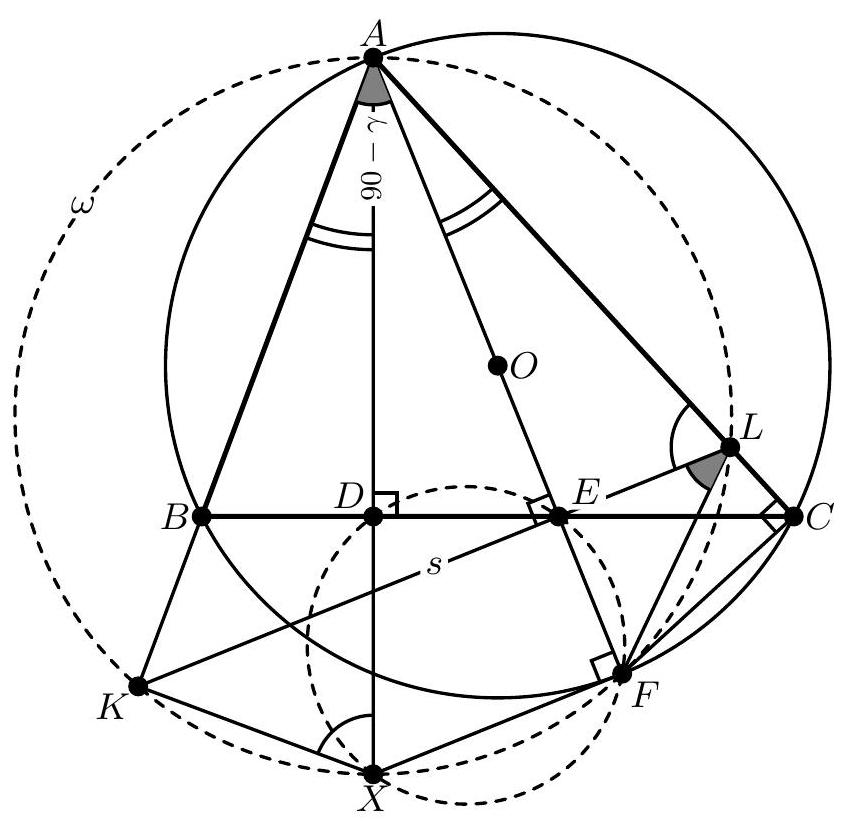
|
| 84 |
+
|
| 85 |
+
Let us denote angles of triangle $A B C$ with $\alpha, \beta, \gamma$ in a standard way. By basic anglechasing we have
|
| 86 |
+
|
| 87 |
+
$$
|
| 88 |
+
\angle B A D=90^{\circ}-\beta=\angle O A C \text { and } \angle C A D=\angle B A O=90^{\circ}-\gamma
|
| 89 |
+
$$
|
| 90 |
+
|
| 91 |
+
Using the fact that lines $A E$ and $A X$ are isogonal with respect to $\angle K A L$ we can conclude that $X$ is an $A$-antipode on $\omega$. (This fact can be purely angle-chased: we have
|
| 92 |
+
|
| 93 |
+
$$
|
| 94 |
+
\angle K A X+\angle A X K=\angle K A X+\angle A L K=90^{\circ}-\beta+\beta=90^{\circ}
|
| 95 |
+
$$
|
| 96 |
+
|
| 97 |
+
which implies $\angle A K X=90^{\circ}$ ). Now let $F$ be the projection of $X$ on the line $A E$. Using that $A X$ is a diameter of $\omega$ and $\angle E D X=90^{\circ}$ it's clear that $F$ is the intersection point of $\omega$ and the circumcircle of triangle $D E X$. Now it suffices to show that $A B F C$ is cyclic. We have $\angle K L F=\angle K A F=90^{\circ}-\gamma$ and from $\angle F E L=90^{\circ}$ we have that $\angle E F L=\gamma=\angle E C L$ so quadrilateral $E F C L$ is cyclic. Next, we have
|
| 98 |
+
|
| 99 |
+
$$
|
| 100 |
+
\angle A F C=\angle E F C=180^{\circ}-\angle E L C=\angle E L A=\beta
|
| 101 |
+
$$
|
| 102 |
+
|
| 103 |
+
(where last equality holds because of $\angle A E L=90^{\circ}$ and $\angle E A L=90^{\circ}-\beta$ ).
|
| 104 |
+
|
| 105 |
+
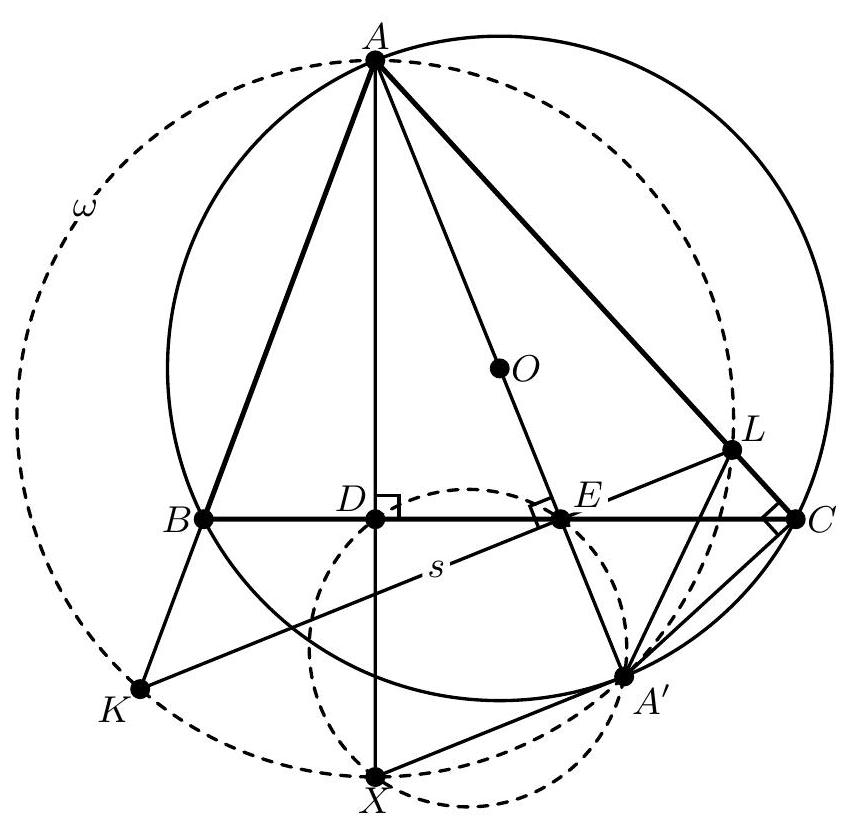
|
| 106 |
+
|
| 107 |
+
Solution 2. We have $\angle B A D=90^{\circ}-\beta=\angle O A C$ and that $A X$ is the diameter of $\omega$. Also we note that
|
| 108 |
+
|
| 109 |
+
$$
|
| 110 |
+
\angle A L K=\beta, \angle K L C=180^{\circ}-\beta=\angle K B C
|
| 111 |
+
$$
|
| 112 |
+
|
| 113 |
+
so $B K C L$ is cyclic. Let $A O$ intersect circumcircle of $A B C$ again at $A^{\prime}$. We will show that $A^{\prime}$ is the desired concurrence point. Obviously $A A^{\prime}$ is the diameter of circumcircle of triangle $A B C$ so $\angle A^{\prime} C A=90^{\circ}$ which implies that $A^{\prime} C L E$ is cyclic. From power of point $E$ we have that $E K \cdot E L=E B \cdot E C=E A \cdot E A^{\prime}$ so we can conclude that $A^{\prime} \in \omega$. Now using the fact that $A X$ is a diameter of $\omega$ implies $\angle A X A^{\prime}=90^{\circ}$ we have that $D X A^{\prime} E$ is cyclic because of $\angle E D X=90^{\circ}$ which finishes the proof. $\square$
|
| 114 |
+
|
| 115 |
+
Problem 4. Let $M$ be a subset of the set of 2021 integers $\{1,2,3, \ldots, 2021\}$ such that for any three elements (not necessarily distinct) $a, b, c$ of $M$ we have $|a+b-c|>10$. Determine the largest possible number of elements of $M$.
|
| 116 |
+
|
| 117 |
+
Solution. The set $M=\{1016,1017, \ldots, 2021\}$ has 1006 elements and satisfies the required property, since $a, b, c \in M$ implies that $a+b-c \geqslant 1016+1016-2021=11$. We will show that this is optimal.
|
| 118 |
+
|
| 119 |
+
Suppose $M$ satisfies the condition in the problem. Let $k$ be the minimal element of $M$. Then $k=|k+k-k|>10 \Rightarrow k \geqslant 11$. Note also that for every $m$, the integers $m, m+k-10$ cannot both belong to $M$, since $k+m-(m+k-10)=10$.
|
| 120 |
+
|
| 121 |
+
Claim 1: $M$ contains at most $k-10$ out of any $2 k-20$ consecutive integers.
|
| 122 |
+
|
| 123 |
+
Proof: We can partition the set $\{m, m+1, \ldots, m+2 k-21\}$ into $k-10$ pairs as follows:
|
| 124 |
+
|
| 125 |
+
$$
|
| 126 |
+
\{m, m+k-10\},\{m+1, m+k-9\}, \ldots,\{m+k-11, m+2 k-21\}
|
| 127 |
+
$$
|
| 128 |
+
|
| 129 |
+
It remains to note that $M$ can contain at most one element of each pair.
|
| 130 |
+
|
| 131 |
+
Claim 2: $M$ contains at most $[(t+k-10) / 2]$ out of any $t$ consecutive integers.
|
| 132 |
+
|
| 133 |
+
Proof: Write $t=q(2 k-20)+r$ with $r \in\{0,1,2 \ldots, 2 k-21\}$. From the set of the first $q(2 k-20)$ integers, by Claim 1 at most $q(k-10)$ can belong to $M$. Also by claim 1, it follows that from the last $r$ integers, at $\operatorname{most} \min \{r, k-10\}$ can belong to $M$.
|
| 134 |
+
|
| 135 |
+
Thus,
|
| 136 |
+
|
| 137 |
+
- If $r \leqslant k-10$, then at most
|
| 138 |
+
|
| 139 |
+
$$
|
| 140 |
+
q(k-10)+r=\frac{t+r}{2} \leqslant \frac{t+k-10}{2} \text { integers belong to } M
|
| 141 |
+
$$
|
| 142 |
+
|
| 143 |
+
- If $r>k-10$, then at most
|
| 144 |
+
|
| 145 |
+
$$
|
| 146 |
+
q(k-10)+k-10=\frac{t-r+2(k-10)}{2} \leqslant \frac{t+k-10}{2} \text { integers belong to } M
|
| 147 |
+
$$
|
| 148 |
+
|
| 149 |
+
By Claim 2, the number of elements of $M$ amongst $k+1, k+2, \ldots, 2021$ is at most
|
| 150 |
+
|
| 151 |
+
$$
|
| 152 |
+
\left[\frac{(2021-k)+(k-10)}{2}\right]=1005
|
| 153 |
+
$$
|
| 154 |
+
|
| 155 |
+
Since amongst $\{1,2, \ldots, k\}$ only $k$ belongs to $M$, we conclude that $M$ has at most 1006 elements as claimed.
|
| 156 |
+
|
JBMO/md/en-official/en-jbmo-2010-solutions.md
ADDED
|
@@ -0,0 +1,60 @@
|
|
|
|
|
|
|
|
|
|
|
|
|
|
|
|
|
|
|
|
|
|
|
|
|
|
|
|
|
|
|
|
|
|
|
|
|
|
|
|
|
|
|
|
|
|
|
|
|
|
|
|
|
|
|
|
|
|
|
|
|
|
|
|
|
|
|
|
|
|
|
|
|
|
|
|
|
|
|
|
|
|
|
|
|
|
|
|
|
|
|
|
|
|
|
|
|
|
|
|
|
|
|
|
|
|
|
|
|
|
|
|
|
|
|
|
|
|
|
|
|
|
|
|
|
|
|
|
|
|
|
|
|
|
|
|
|
|
|
|
|
|
|
|
|
|
|
|
|
|
|
|
|
|
|
|
|
|
|
|
|
|
|
|
|
|
|
|
|
|
|
|
|
|
|
|
|
|
|
|
|
|
|
|
| 1 |
+
Problem 1. The real numbers $a, b, c, d$ satisfy simultaneously the equations
|
| 2 |
+
|
| 3 |
+
$$
|
| 4 |
+
a b c-d=1, b c d-a=2, c d a-b=3, d a b-c=-6
|
| 5 |
+
$$
|
| 6 |
+
|
| 7 |
+
Prove that $a+b+c+d \neq 0$.
|
| 8 |
+
|
| 9 |
+
Solution. Suppose that $a+b+c+d=0$. Then
|
| 10 |
+
|
| 11 |
+
$$
|
| 12 |
+
a b c+b c d+c d a+d a b=0
|
| 13 |
+
$$
|
| 14 |
+
|
| 15 |
+
If $a b c d=0$, then one of numbers, say $d$, must be 0 . In this case $a b c=0$, and so at least two of the numbers $a, b, c, d$ will be equal to 0 , making one of the given equations impossible. Hence $a b c d \neq 0$ and, from (1),
|
| 16 |
+
|
| 17 |
+
$$
|
| 18 |
+
\frac{1}{a}+\frac{1}{b}+\frac{1}{c}+\frac{1}{d}=0
|
| 19 |
+
$$
|
| 20 |
+
|
| 21 |
+
implying
|
| 22 |
+
|
| 23 |
+
$$
|
| 24 |
+
\frac{1}{a}+\frac{1}{b}+\frac{1}{c}=\frac{1}{a+b+c}
|
| 25 |
+
$$
|
| 26 |
+
|
| 27 |
+
It follows that $(a+b)(b+c)(c+a)=0$, which is impossible (for instance, if $a+b=0$, then adding the second and third given equations would lead to $0=2+3$, a contradiction). Thus $a+b+c+d \neq 0$.
|
| 28 |
+
|
| 29 |
+
Problem 2. Find all integers $n, n \geqslant 1$, such that $n \cdot 2^{n+1}+1$ is a perfect square. Solution. Answer: $n=0$ and $n=3$.
|
| 30 |
+
|
| 31 |
+
Clearly $n 2^{n+1}+1$ is odd, so, if this number is a perfect square, then $n 2^{n+1}+1=$ $(2 x+1)^{2}, x \in \mathbb{N}$, whence $n 2^{n-1}=x(x+1)$.
|
| 32 |
+
|
| 33 |
+
The integers $x$ and $x+1$ are coprime, so one of them must divisible by $2^{n-1}$, which means that the other must be at most $n$. This shows that $2^{n-1} \leqslant n+1$.
|
| 34 |
+
|
| 35 |
+
An easy induction shows that the above inequality is false for all $n \geqslant 4$, and a direct inspection confirms that the only convenient values in the case $n \leqslant 3$ are 0 and 3 .
|
| 36 |
+
|
| 37 |
+
Problem 3. Let $A L$ and $B K$ be angle bisectors in the non-isosceles triangle $A B C$ ( $L$ lies on the side $B C, K$ lies on the side $A C$ ). The perpendicular bisector of $B K$ intersects the line $A L$ at point $M$. Point $N$ lies on the line $B K$ such that $L N$ is parallel to $M K$. Prove that $L N=N A$.
|
| 38 |
+
|
| 39 |
+
Solution. The point $M$ lies on the circumcircle of $\triangle A B K$ (since both $A L$ and the perpendicular bisector of $B K$ bisect the arc $B K$ of this circle). Then $\angle C B K=$ $\angle A B K=\angle A M K=\angle N L A$. Thus $A B L N$ is cyclic, whence $\angle N A L=\angle N B L=$ $\angle C B K=\angle N L A$. Now it follows that $L N=N A$.
|
| 40 |
+
|
| 41 |
+
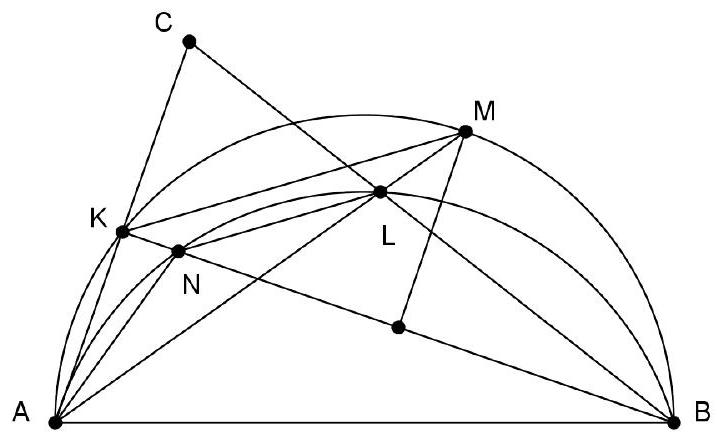
|
| 42 |
+
|
| 43 |
+
Problem 4. A $9 \times 7$ rectangle is tiled with tiles of the two types shown in the picture below (the tiles are composed by three, respectively four unit squares and the L-shaped tiles can be rotated repeatedly with $90^{\circ}$ ).
|
| 44 |
+
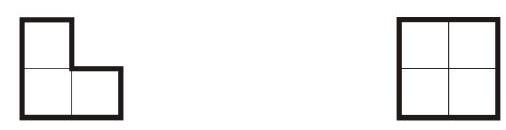
|
| 45 |
+
|
| 46 |
+
Let $n \geqslant 0$ be the number of the $2 \times 2$ tiles which can be used in such a tiling. Find all the values of $n$.
|
| 47 |
+
|
| 48 |
+
Solution. Answer: 0 or 3 .
|
| 49 |
+
|
| 50 |
+
Denote by $x$ the number of the pieces of the type ornerănd by $y$ the number of the pieces of the type of $2 \times 2$. Mark 20 squares of the rectangle as in the figure below.
|
| 51 |
+
|
| 52 |
+
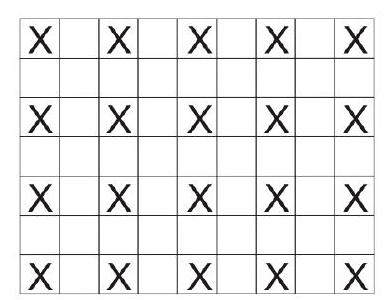
|
| 53 |
+
|
| 54 |
+
Obviously, each piece covers at most one marked square.
|
| 55 |
+
|
| 56 |
+
Thus, $x+y \geq 20$ (1) and consequently $3 x+3 y \geq 60(2)$. On the other hand $3 x+4 y=63$ (3). From (2) and (3) it follows $y \leq 3$ and from (3), $3 \mid y$.
|
| 57 |
+
|
| 58 |
+
The proof is finished if we produce tilings with 3 , respectively $0,2 \times 2$ tiles:
|
| 59 |
+
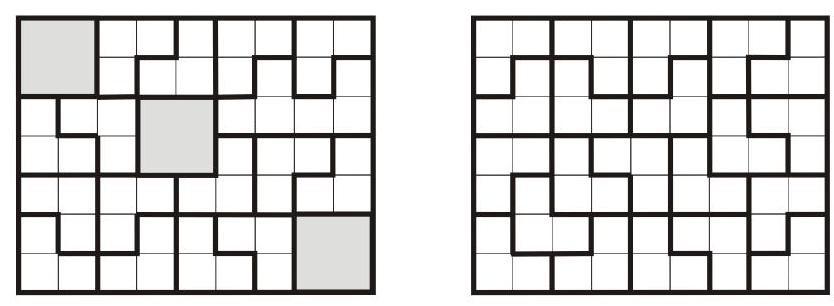
|
| 60 |
+
|
JBMO/md/en-official/en-jbmo-2022-solutions.md
ADDED
|
@@ -0,0 +1,288 @@
|
|
|
|
|
|
|
|
|
|
|
|
|
|
|
|
|
|
|
|
|
|
|
|
|
|
|
|
|
|
|
|
|
|
|
|
|
|
|
|
|
|
|
|
|
|
|
|
|
|
|
|
|
|
|
|
|
|
|
|
|
|
|
|
|
|
|
|
|
|
|
|
|
|
|
|
|
|
|
|
|
|
|
|
|
|
|
|
|
|
|
|
|
|
|
|
|
|
|
|
|
|
|
|
|
|
|
|
|
|
|
|
|
|
|
|
|
|
|
|
|
|
|
|
|
|
|
|
|
|
|
|
|
|
|
|
|
|
|
|
|
|
|
|
|
|
|
|
|
|
|
|
|
|
|
|
|
|
|
|
|
|
|
|
|
|
|
|
|
|
|
|
|
|
|
|
|
|
|
|
|
|
|
|
|
|
|
|
|
|
|
|
|
|
|
|
|
|
|
|
|
|
|
|
|
|
|
|
|
|
|
|
|
|
|
|
|
|
|
|
|
|
|
|
|
|
|
|
|
|
|
|
|
|
|
|
|
|
|
|
|
|
|
|
|
|
|
|
|
|
|
|
|
|
|
|
|
|
|
|
|
|
|
|
|
|
|
|
|
|
|
|
|
|
|
|
|
|
|
|
|
|
|
|
|
|
|
|
|
|
|
|
|
|
|
|
|
|
|
|
|
|
|
|
|
|
|
|
|
|
|
|
|
|
|
|
|
|
|
|
|
|
|
|
|
|
|
|
|
|
|
|
|
|
|
|
|
|
|
|
|
|
|
|
|
|
|
|
|
|
|
|
|
|
|
|
|
|
|
|
|
|
|
|
|
|
|
|
|
|
|
|
|
|
|
|
|
|
|
|
|
|
|
|
|
|
|
|
|
|
|
|
|
|
|
|
|
|
|
|
|
|
|
|
|
|
|
|
|
|
|
|
|
|
|
|
|
|
|
|
|
|
|
|
|
|
|
|
|
|
|
|
|
|
|
|
|
|
|
|
|
|
|
|
|
|
|
|
|
|
|
|
|
|
|
|
|
|
|
|
|
|
|
|
|
|
|
|
|
|
|
|
|
|
|
|
|
|
|
|
|
|
|
|
|
|
|
|
|
|
|
|
|
|
|
|
|
|
|
|
|
|
|
|
|
|
|
|
|
|
|
|
|
|
|
|
|
|
|
|
|
|
|
|
|
|
|
|
|
|
|
|
|
|
|
|
|
|
|
|
|
|
|
|
|
|
|
|
|
|
|
|
|
|
|
|
|
|
|
|
|
|
|
|
|
|
|
|
|
|
|
|
|
|
|
|
|
|
|
|
|
|
|
|
|
|
|
|
|
|
|
|
|
|
|
|
|
|
|
|
|
|
|
|
|
|
|
|
|
|
|
|
|
|
|
|
|
|
|
|
|
|
|
|
|
|
|
|
|
|
|
|
|
|
|
|
|
|
|
|
|
|
|
|
|
|
|
|
|
|
|
|
|
|
|
|
|
|
|
|
|
|
|
|
|
|
|
|
|
|
|
|
|
|
|
|
|
|
|
|
|
|
|
|
|
|
|
|
|
|
|
|
|
|
|
|
|
|
|
|
|
|
|
|
|
|
|
|
|
|
|
|
|
|
|
|
|
|
|
|
|
|
|
|
|
|
|
|
|
|
|
|
|
|
|
|
|
|
|
|
|
|
|
|
|
|
|
|
|
|
|
|
|
|
|
|
|
|
|
|
|
|
|
|
|
|
|
|
|
|
|
|
|
|
|
|
|
|
|
|
|
|
|
|
|
|
|
|
|
|
|
|
|
|
|
|
|
|
|
|
|
|
|
|
|
|
|
|
|
|
|
|
|
|
|
|
|
|
|
|
|
|
|
|
|
|
|
|
|
|
|
|
|
|
|
|
|
|
|
|
|
|
|
|
|
|
|
|
|
|
|
|
|
|
|
|
|
|
|
|
|
|
|
|
|
|
|
|
| 1 |
+
# JBMO 2022 - Solutions
|
| 2 |
+
|
| 3 |
+
Problem 1. Find all pairs $(a, b)$ of positive integers such that
|
| 4 |
+
|
| 5 |
+
$$
|
| 6 |
+
11 a b \leq a^{3}-b^{3} \leq 12 a b
|
| 7 |
+
$$
|
| 8 |
+
|
| 9 |
+
Solution 1. Let $a-b=t$. Due to $a^{3}-b^{3} \geq 11 a b$ we conclude that $a>b$ so $t$ is a positive integer and the condition can be written as
|
| 10 |
+
|
| 11 |
+
$$
|
| 12 |
+
11 b(b+t) \leq t\left[b^{2}+b(b+t)+(b+t)^{2}\right] \leq 12 b(b+t)
|
| 13 |
+
$$
|
| 14 |
+
|
| 15 |
+
Since
|
| 16 |
+
|
| 17 |
+
$$
|
| 18 |
+
t\left[b^{2}+b(b+t)+(b+t)^{2}\right]=t\left(b^{2}+b^{2}+b t+b^{2}+2 b t+t^{2}\right)=3 t b(b+t)+t^{3}
|
| 19 |
+
$$
|
| 20 |
+
|
| 21 |
+
the condition can be rewritten as
|
| 22 |
+
|
| 23 |
+
$$
|
| 24 |
+
(11-3 t) b(b+t) \leq t^{3} \leq(12-3 t) b(b+t)
|
| 25 |
+
$$
|
| 26 |
+
|
| 27 |
+
We can not have $t \geq 4$ since in that case $t^{3} \leq(12-3 t) b(b+t)$ is not satisfied as the right hand side is not positive. Therefore it remains to check the cases when $t \in\{1,2,3\}$. If $t=3$, the above condition becomes
|
| 28 |
+
|
| 29 |
+
$$
|
| 30 |
+
2 b(b+3) \leq 27 \leq 3 b(b+3)
|
| 31 |
+
$$
|
| 32 |
+
|
| 33 |
+
If $b \geq 3$, the left hand side is greater than 27 and if $b=1$ the right hand side is smaller than 27 so there are no solutions in these cases. If $b=2$, we get a solution $(a, b)=(5,2)$.
|
| 34 |
+
|
| 35 |
+
If $t \leq 2$, we have
|
| 36 |
+
|
| 37 |
+
$$
|
| 38 |
+
(11-3 t) b(b+t) \geq(11-6) \cdot 1 \cdot(1+1)=10>t^{3}
|
| 39 |
+
$$
|
| 40 |
+
|
| 41 |
+
so there are no solutions in this case.
|
| 42 |
+
|
| 43 |
+
In summary, the only solution is $(a, b)=(5,2)$.
|
| 44 |
+
|
| 45 |
+
Solution 2. First, from $a^{3}-b^{3} \geq 11 a b>0$ it follows that $a>b$, implying that $a-b \geq 1$. Note that
|
| 46 |
+
|
| 47 |
+
$$
|
| 48 |
+
a^{3}-b^{3}=(a-b)\left(a^{2}+a b+b^{2}\right)=(a-b)\left[(a-b)^{2}+3 a b\right] \geq(a-b)(1+3 a b)>3 a b(a-b)
|
| 49 |
+
$$
|
| 50 |
+
|
| 51 |
+
Therefore $12 a b \geq a^{3}-b^{3}>3 a b(a-b)$, which implies that $a-b<4$ so $a-b \in\{1,2,3\}$. We discuss three possible cases:
|
| 52 |
+
|
| 53 |
+
- $a-b=1$
|
| 54 |
+
|
| 55 |
+
After replacing $a=b+1$, the condition $a^{3}-b^{3} \geq 11 a b$ reduces to $1 \geq 8 b^{2}+8 b$, which is not satisfied for any positive integer $b$.
|
| 56 |
+
|
| 57 |
+
- $a-b=2$
|
| 58 |
+
|
| 59 |
+
After replacing $a=b+2$, the condition $a^{3}-b^{3} \geq 11 a b$ reduces to $8 \geq 5 b^{2}+10 b$, which is also not satisfied for any positive integer $b$.
|
| 60 |
+
|
| 61 |
+
- $a-b=3$
|
| 62 |
+
|
| 63 |
+
After replacing $a=b+3$, the condition $a^{3}-b^{3} \geq 11 a b$ reduces to $27 \geq 2 b^{2}+6 b$. The last inequality holds true only for $b=1$ and $b=2$. For $b=1$ we get $a=4$ and for $b=2$ we get $a=5$. Direct verification shows that $a^{3}-b^{3} \leq 12 a b$ is satisfied only for $(a, b)=(5,2)$.
|
| 64 |
+
|
| 65 |
+
In summary, $(a, b)=(5,2)$ is the only pair of positive integers satisfying all conditions of the problem.
|
| 66 |
+
|
| 67 |
+
Problem 2. Let $A B C$ be an acute triangle such that $A H=H D$, where $H$ is the orthocenter of $A B C$ and $D \in B C$ is the foot of the altitude from the vertex $A$. Let $\ell$ denote the line through $H$ which is tangent to the circumcircle of the triangle $B H C$. Let $S$ and $T$ be the intersection points of $\ell$ with $A B$ and $A C$, respectively. Denote the midpoints of $B H$ and $C H$ by $M$ and $N$, respectively. Prove that the lines $S M$ and $T N$ are parallel.
|
| 68 |
+
|
| 69 |
+
Solution 1. In order to prove that $S M$ and $T N$ are parallel, it suffices to prove that both of them are perpendicular to $S T$. Due to symmetry, we will provide a detailed proof of $S M \perp S T$, whereas the proof of $T N \perp S T$ is analogous. In this solution we will use the following notation: $\angle B A C=\alpha, \angle A B C=\beta, \angle A C B=\gamma$.
|
| 70 |
+
|
| 71 |
+
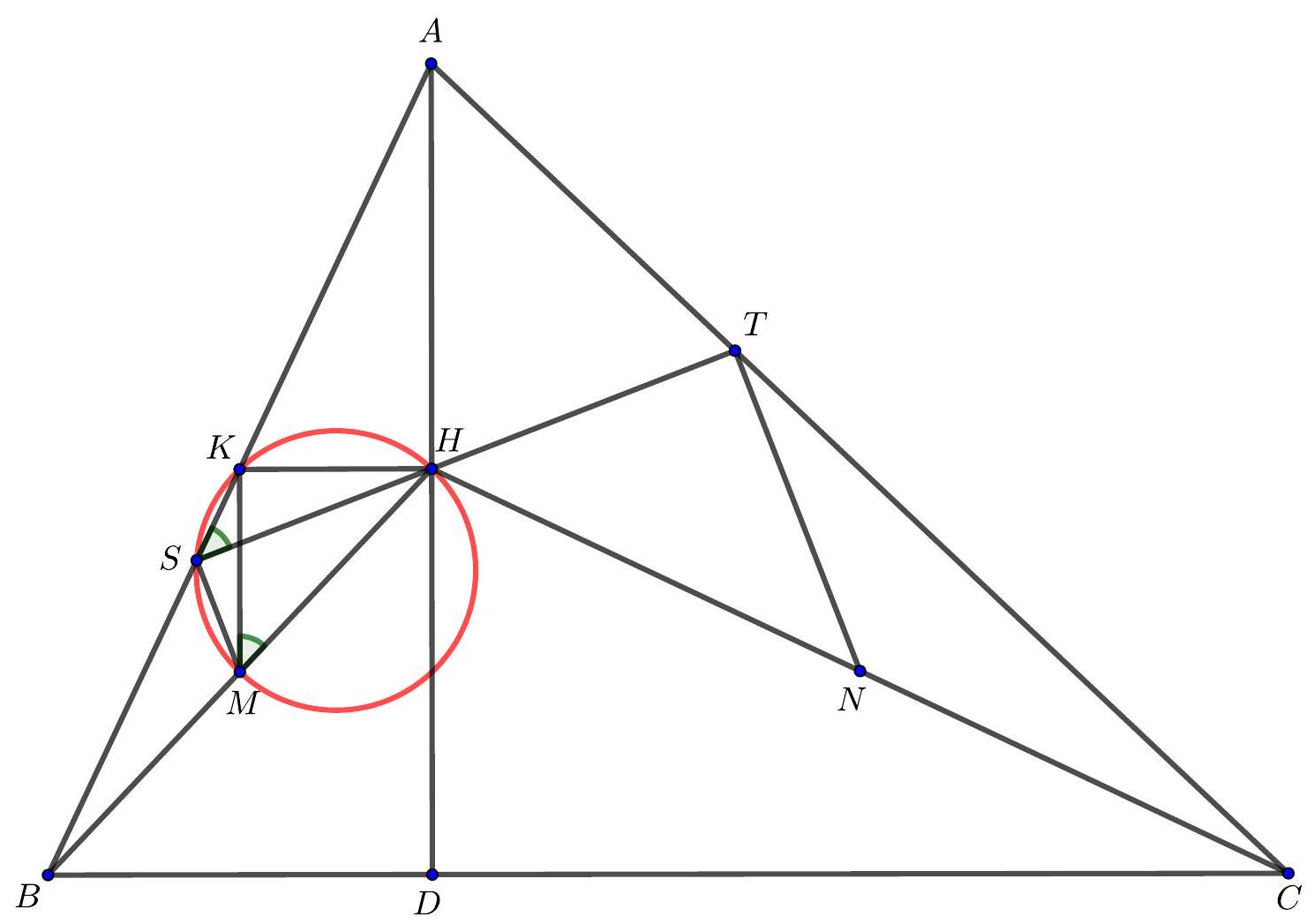
|
| 72 |
+
|
| 73 |
+
We first observe that, due to the tangency condition, we have
|
| 74 |
+
|
| 75 |
+
$$
|
| 76 |
+
\angle S H B=\angle H C B=90^{\circ}-\beta
|
| 77 |
+
$$
|
| 78 |
+
|
| 79 |
+
Combining the above with
|
| 80 |
+
|
| 81 |
+
$$
|
| 82 |
+
\angle S B H=\angle A B H=90^{\circ}-\alpha
|
| 83 |
+
$$
|
| 84 |
+
|
| 85 |
+
we get
|
| 86 |
+
|
| 87 |
+
$$
|
| 88 |
+
\angle B S H=180^{\circ}-\left(90^{\circ}-\beta\right)-\left(90^{\circ}-\alpha\right)=\alpha+\beta=180^{\circ}-\gamma
|
| 89 |
+
$$
|
| 90 |
+
|
| 91 |
+
from which it follows that $\angle A S T=\gamma$.
|
| 92 |
+
|
| 93 |
+
Since $A H=H D, H$ is the midpoint of $A D$. If $K$ denotes the midpoint of $A B$, we have that $K H$ and $B C$ are parallel. Since $M$ is the midpoint of $B H$, the lines $K M$ and $A D$ are parallel, from which it follows that $K M$ is perpendicular to $B C$. As $K H$ and $B C$ are parallel, we have that $K M$ is perpendicular to $K H$ so $\angle M K H=90^{\circ}$. Using the parallel lines $K H$ and $B C$ we also have
|
| 94 |
+
|
| 95 |
+
$$
|
| 96 |
+
\angle K H M=\angle K H B=\angle H B C
|
| 97 |
+
$$
|
| 98 |
+
|
| 99 |
+
Now,
|
| 100 |
+
|
| 101 |
+
$$
|
| 102 |
+
\angle H M K=90^{\circ}-\angle K H M=90^{\circ}-\angle H B C=90^{\circ}-\left(90^{\circ}-\gamma\right)=\gamma=\angle A S T=\angle K S H
|
| 103 |
+
$$
|
| 104 |
+
|
| 105 |
+
so the quadrilateral $M S K H$ is cyclic, which implies that $\angle M S H=\angle M K H=90^{\circ}$. In other words, the lines $S M$ and $S T$ are perpendicular, which completes our proof.
|
| 106 |
+
|
| 107 |
+
Solution 2. We will refer to the same figure as in the first solution. Since $C H$ is tangent to the circumcircle of triangle $B H C$, we have
|
| 108 |
+
|
| 109 |
+
$$
|
| 110 |
+
\angle S H B=\angle H C B=90^{\circ}-\angle A B C=\angle H A B
|
| 111 |
+
$$
|
| 112 |
+
|
| 113 |
+
From the above it follows that triangles $A H B$ and $H S B$ are similar. If $K$ denotes the midpoint of $A B$, then triangles $A H K$ and $H S M$ are also similar. Now, observe that $H$ and $K$ are respectively the midpoints of $A D$ and $A B$, which implies that $H K \| D B$, so
|
| 114 |
+
|
| 115 |
+
$$
|
| 116 |
+
\angle A H K=\angle A D B=90^{\circ}
|
| 117 |
+
$$
|
| 118 |
+
|
| 119 |
+
Now, from the last observation and the similarity of triangles $A H K$ and $H S M$, it follows that
|
| 120 |
+
|
| 121 |
+
$$
|
| 122 |
+
\angle H S M=\angle A H K=90^{\circ}
|
| 123 |
+
$$
|
| 124 |
+
|
| 125 |
+
Due to symmetry, analogously as above, we can prove that $\angle H T N=90^{\circ}$, implying that both $S M$ and $T N$ are perpendicular to $T S$, hence they are parallel.
|
| 126 |
+
|
| 127 |
+
Problem 3. Find all quadruples of positive integers $(p, q, a, b)$, where $p$ and $q$ are prime numbers and $a>1$, such that
|
| 128 |
+
|
| 129 |
+
$$
|
| 130 |
+
p^{a}=1+5 q^{b}
|
| 131 |
+
$$
|
| 132 |
+
|
| 133 |
+
Solution 1. First of all, observe that if $p, q$ are both odd, then the left hand side of the given equation is odd and the right hand side is even so there are no solutions in this case. In other words, one of these numbers has to be equal to 2 so we can discuss the following two cases:
|
| 134 |
+
|
| 135 |
+
- $p=2$
|
| 136 |
+
|
| 137 |
+
In this case the given equation becomes
|
| 138 |
+
|
| 139 |
+
$$
|
| 140 |
+
2^{a}=1+5 \cdot q^{b}
|
| 141 |
+
$$
|
| 142 |
+
|
| 143 |
+
Note that $q$ has to be odd. In addition, $2^{a} \equiv 1(\bmod 5)$. It can be easily shown that the last equation holds if and only if $a=4 c$, for some positive integer $c$. Now, our equation becomes $2^{4 c}-1=5 \cdot q^{b}$, which can be written into its equivalent form
|
| 144 |
+
|
| 145 |
+
$$
|
| 146 |
+
\left(4^{c}-1\right)\left(4^{c}+1\right)=5 \cdot q^{b}
|
| 147 |
+
$$
|
| 148 |
+
|
| 149 |
+
Since $q$ is odd, it can not divide both $4^{c}-1$ and $4^{c}+1$. Namely, if it divides both of these numbers then it also divides their difference, which is equal to 2 , and this is clearly impossible. Therefore, we have that either $q^{b} \mid 4^{c}-1$ or $q^{b} \mid 4^{c}+1$, which implies that one of the numbers $4^{c}-1$ and $4^{c}+1$ divides 5 . Since for $c \geq 2$ both of these numbers are greater than 5 , we only need to discuss the case $c=1$. But in this case $5 \cdot q^{b}=15$, which is obviously satisfied only for $b=1$ and $q=3$. In summary, $(p, q, a, b)=(2,3,4,1)$ is the only solution in this case.
|
| 150 |
+
|
| 151 |
+
- $q=2$
|
| 152 |
+
|
| 153 |
+
In this case obviously $p$ must be an odd number and the given equation becomes
|
| 154 |
+
|
| 155 |
+
$$
|
| 156 |
+
p^{a}=1+5 \cdot 2^{b}
|
| 157 |
+
$$
|
| 158 |
+
|
| 159 |
+
First, assume that $b$ is even. Then $2^{b} \equiv 1(\bmod 3)$, which implies that $1+5 \cdot 2^{b}$ is divisible by 3 , hence $3 \mid p^{a}$ so $p$ must be equal to 3 and our equation becomes
|
| 160 |
+
|
| 161 |
+
$$
|
| 162 |
+
3^{a}=1+5 \cdot 2^{b}
|
| 163 |
+
$$
|
| 164 |
+
|
| 165 |
+
From here it follows that $3^{a} \equiv 1(\bmod 5)$, which implies that $a=4 c$, for some positive integer $c$. Then the equation $3^{a}=1+5 \cdot 2^{b}$ can be written into its equivalent form
|
| 166 |
+
|
| 167 |
+
$$
|
| 168 |
+
\frac{3^{2 c}-1}{2} \cdot \frac{3^{2 c}+1}{2}=5 \cdot 2^{b-2}
|
| 169 |
+
$$
|
| 170 |
+
|
| 171 |
+
Observe now that $3^{2 c} \equiv 1(\bmod 4)$ from where it follows that $\frac{3^{2 c}+1}{2} \equiv 1(\bmod 2)$. From here we can conclude that the number is $\frac{3^{2 c}+1}{2}$ is relatively prime to $2^{b-2}$, so it has to divide 5. Clearly, this is possible only for $c=1$ since for $c>1$ we have $\frac{3^{2 c}+1}{2}>5$. For $c=1$, we easily find $b=4$, which yields the solution $(p, q, a, b)=(3,2,4,4)$.
|
| 172 |
+
|
| 173 |
+
Next, we discuss the case when $b$ is odd. In this case,
|
| 174 |
+
|
| 175 |
+
$$
|
| 176 |
+
p^{a}=1+5 \cdot 2^{b} \equiv 1+5 \cdot 2 \equiv 2(\bmod 3)
|
| 177 |
+
$$
|
| 178 |
+
|
| 179 |
+
The last equation implies that $a$ must be odd. Namely, if $a$ is even then we can not have $p^{a} \equiv 2(\bmod 3)$ regardless of the value of $p$. Combined with the condition $a>1$, we conclude that $a \geq 3$. The equation $p^{a}=1+5 \cdot 2^{b}$ can be written as
|
| 180 |
+
|
| 181 |
+
$$
|
| 182 |
+
5 \cdot 2^{b}=p^{a}-1=(p-1)\left(p^{a-1}+p^{a-2}+\cdots+1\right)
|
| 183 |
+
$$
|
| 184 |
+
|
| 185 |
+
Observe that
|
| 186 |
+
|
| 187 |
+
$$
|
| 188 |
+
p^{a-1}+p^{a-2}+\cdots+1 \equiv 1+1+\cdots+1=a \equiv 1(\bmod 2)
|
| 189 |
+
$$
|
| 190 |
+
|
| 191 |
+
so this number is relatively prime to $2^{b}$, which means that it has to divide 5 . But this is impossible, since $a \geq 3$ and $p \geq 3$ imply that
|
| 192 |
+
|
| 193 |
+
$$
|
| 194 |
+
p^{a-1}+p^{a-2}+\cdots+1 \geq p^{2}+p+1 \geq 3^{2}+3+1=13>5
|
| 195 |
+
$$
|
| 196 |
+
|
| 197 |
+
In other words, there are no solutions when $q=2$ and $b$ is an even number.
|
| 198 |
+
|
| 199 |
+
In summary, $(a, b, p, q)=(4,4,3,2)$ and $(a, b, p, q)=(4,1,2,3)$ are the only solutions.
|
| 200 |
+
|
| 201 |
+
Solution 2. Analogously as in the first solution we conclude that at least one of the numbers $p$ and $q$ has to be even. Since these numbers are prime, this implies that at least one of $p$ and $q$ must be equal to 2 . Therefore it is sufficient to discuss the following two cases:
|
| 202 |
+
|
| 203 |
+
- $p=2$
|
| 204 |
+
|
| 205 |
+
In this case the given equation then becomes
|
| 206 |
+
|
| 207 |
+
$$
|
| 208 |
+
2^{a}=1+5 \cdot q^{b}
|
| 209 |
+
$$
|
| 210 |
+
|
| 211 |
+
From here, it follows that $q$ is an odd number. In addition, $2^{a} \equiv 1(\bmod 5)$, which implies that $a=4 c$, for some positive integer $c$. Then the above equation can be written in its equivalent form
|
| 212 |
+
|
| 213 |
+
$$
|
| 214 |
+
\left(2^{c}-1\right)\left(2^{c}+1\right)\left(2^{2 c}+1\right)=5 \cdot q^{b}
|
| 215 |
+
$$
|
| 216 |
+
|
| 217 |
+
Since $2^{c}-1,2^{c}$ and $2^{c}+1$ are three consecutive integers, one of them must be divisible by 3. Clearly it is not $2^{c}$ implying that one of the numbers $2^{c}-1$ and $2^{c}+1$ is divisible by 3 . This implies that $3 \mid\left(2^{c}-1\right)\left(2^{c}+1\right)\left(2^{2 c}+1\right)$ so $3 \mid 5 \cdot q^{b}$, hence $q$ must be equal to 3 and we are left with solving the equation
|
| 218 |
+
|
| 219 |
+
$$
|
| 220 |
+
\left(2^{c}-1\right)\left(2^{c}+1\right)\left(2^{2 c}+1\right)=5 \cdot 3^{b}
|
| 221 |
+
$$
|
| 222 |
+
|
| 223 |
+
Note that $2^{2 c}+1 \equiv 2(\bmod 3)$ so from the above equation it follows that $2^{2 c}+1$ must be equal to 5 , which implies that $c=1$. For $c=1$ we have $b=1$, so we get $(a, b, p, q)=(4,1,2,3)$ as the only solution in this case.
|
| 224 |
+
|
| 225 |
+
- $q=2$
|
| 226 |
+
|
| 227 |
+
In this case the given equation becomes
|
| 228 |
+
|
| 229 |
+
$$
|
| 230 |
+
p^{a}=1+5 \cdot 2^{b}
|
| 231 |
+
$$
|
| 232 |
+
|
| 233 |
+
so clearly $p$ must be an odd number.
|
| 234 |
+
|
| 235 |
+
If $a$ is odd then we have
|
| 236 |
+
|
| 237 |
+
$$
|
| 238 |
+
5 \cdot 2^{b}=(p-1)\left(p^{a-1}+p^{a-2}+\cdots+p+1\right)
|
| 239 |
+
$$
|
| 240 |
+
|
| 241 |
+
The second bracket on the right hand side is sum of $a$ odd numbers so it is an odd number. Due to the condition $a>1$ we must have $a \geq 3$. But then
|
| 242 |
+
|
| 243 |
+
$$
|
| 244 |
+
p^{a-1}+p^{a-2}+\cdots+p+1 \geq p^{2}+p+1 \geq 3^{2}+3+1>5
|
| 245 |
+
$$
|
| 246 |
+
|
| 247 |
+
so we do not have solutions in this case. Therefore it remains to discuss the case when $a$ is even.
|
| 248 |
+
|
| 249 |
+
Let $a=2 c$ for some positive integer $c$. Then we have the following equation
|
| 250 |
+
|
| 251 |
+
$$
|
| 252 |
+
\left(p^{c}-1\right)\left(p^{c}+1\right)=5 \cdot 2^{b}
|
| 253 |
+
$$
|
| 254 |
+
|
| 255 |
+
Note that $p^{c}-1$ and $p^{c}+1$ are two consecutive even numbers so one of them is divisible by 2 but not by 4 . Looking into the right hand side of the above equation, we conclude that this number must be equal to either 2 or $5 \cdot 2=10$. In other words, either $p^{c}-1 \in\{2,10\}$ or $p^{c}+1 \in\{2,10\}$ yielding the following possible values for $p^{c}$ : $1,3,9,11$. Clearly $p^{c}=1$ is impossible, whereas $p^{c}=3$ implies that $\left(p^{c}-1\right)\left(p^{c}+1\right)$ is not divisible by 5 so there are no solutions if $p^{c}=3$. Similarly, for $p^{c}=11$ we have that $\left(p^{c}-1\right)\left(p^{c}+1\right)$ is divisible by 3 so it can not be equal to $5 \cdot 2^{b}$ for any positive integer $b$. Finally, if $p^{c}=9$, we have solution $(a, b, p, q)=(4,4,3,2)$.
|
| 256 |
+
|
| 257 |
+
In summary, $(a, b, p, q)=(4,4,3,2)$ and $(a, b, p, q)=(4,1,2,3)$ are the only solutions.
|
| 258 |
+
|
| 259 |
+
Problem 4. We call an even positive integer $n$ nice if the set $\{1,2, \ldots, n\}$ can be partitioned into $\frac{n}{2}$ two-element subsets, such that the sum of the elements in each subset is a power of 3 . For example, 6 is nice, because the set $\{1,2,3,4,5,6\}$ can be partitioned into subsets $\{1,2\},\{3,6\},\{4,5\}$. Find the number of nice positive integers which are smaller than $3^{2022}$.
|
| 260 |
+
|
| 261 |
+
Solution. For a nice number $n$ and a given partition of the set $\{1,2, \ldots, n\}$ into twoelement subsets such that the sum of the elements in each subset is a power of 3 , we say that $a, b \in\{1,2, \ldots, n\}$ are paired if both of them belong to the same subset.
|
| 262 |
+
|
| 263 |
+
Let $x$ be a nice number and $k$ be a (unique) non-negative integer such that $3^{k} \leq x<3^{k+1}$. Suppose that $x$ is paired with $y<x$. Then, $x+y=3^{s}$, for some positive integer $s$. Since
|
| 264 |
+
|
| 265 |
+
$$
|
| 266 |
+
3^{s}=x+y<2 x<2 \cdot 3^{k+1}<3^{k+2}
|
| 267 |
+
$$
|
| 268 |
+
|
| 269 |
+
we must have $s<k+2$. On the other hand, the inequality
|
| 270 |
+
|
| 271 |
+
$$
|
| 272 |
+
x+y \geq 3^{k}+1>3^{k}
|
| 273 |
+
$$
|
| 274 |
+
|
| 275 |
+
implies that $s>k$. From these we conclude that $s$ must be equal to $k+1$, so $x+y=3^{k+1}$. The last equation, combined with $x>y$, implies that $x>\frac{3^{k+1}}{2}$.
|
| 276 |
+
|
| 277 |
+
Similarly as above, we can conclude that each number $z$ from the closed interval $\left[3^{k+1}-x, x\right]$ is paired with $3^{k+1}-z$. Namely, for any such $z$, the larger of the numbers $z$ and $3^{k+1}-z$ is greater than $\frac{3^{k+1}}{2}$ which is greater than $3^{k}$, so the numbers $z$ and $3^{k+1}-z$ must necessarily be in the same subset. In other words, each number from the interval $\left[3^{k+1}-x, x\right]$ is paired with another number from this interval. Note that this implies that all numbers smaller than $3^{k+1}-x$ are paired among themselves, so the number $3^{k+1}-x-1$ is either nice or equals zero. Also, the number $3^{k}$ must be paired with $2 \cdot 3^{k}$, so $x \geq 2 \cdot 3^{k}$.
|
| 278 |
+
|
| 279 |
+
Finally, we prove by induction that $a_{n}=2^{n}-1$, where $a_{n}$ is the number of nice positive integers smaller than $3^{n}$. For $n=1$, the claim is obviously true, because 2 is the only nice positive integer smaller than 3 . Now, assume that $a_{n}=2^{n}-1$ for some positive integer $n$. We will prove that $a_{n+1}=2^{n+1}-1$. To prove this, first observe that the number of nice positive integers between $2 \cdot 3^{n}$ and $3^{n+1}$ is exactly $a_{n+1}-a_{n}$. Next, observe that $3^{n+1}-1$ is nice. For every nice number $2 \cdot 3^{n} \leq x<3^{n+1}-1$, the number $3^{n+1}-x-1$ is also nice and is strictly smaller than $3^{n}$. Also, for every positive integer $y<3^{n}$, obviously there is a unique number $x$ such that $2 \cdot 3^{n} \leq x<3^{n+1}-1$ and $3^{n+1}-x-1=y$. Thus,
|
| 280 |
+
|
| 281 |
+
$$
|
| 282 |
+
a_{n+1}-a_{n}=a_{n}+1 \Leftrightarrow a_{n+1}=2 a_{n}+1=2\left(2^{n}-1\right)+1=2^{n+1}-1
|
| 283 |
+
$$
|
| 284 |
+
|
| 285 |
+
completing the proof.
|
| 286 |
+
|
| 287 |
+
In summary, there are $2^{2022}-1$ nice positive integers smaller than $3^{2022}$.
|
| 288 |
+
|
JBMO/md/en-official/en-jbmo2012-problems-solutions.md
ADDED
|
@@ -0,0 +1,159 @@
|
|
|
|
|
|
|
|
|
|
|
|
|
|
|
|
|
|
|
|
|
|
|
|
|
|
|
|
|
|
|
|
|
|
|
|
|
|
|
|
|
|
|
|
|
|
|
|
|
|
|
|
|
|
|
|
|
|
|
|
|
|
|
|
|
|
|
|
|
|
|
|
|
|
|
|
|
|
|
|
|
|
|
|
|
|
|
|
|
|
|
|
|
|
|
|
|
|
|
|
|
|
|
|
|
|
|
|
|
|
|
|
|
|
|
|
|
|
|
|
|
|
|
|
|
|
|
|
|
|
|
|
|
|
|
|
|
|
|
|
|
|
|
|
|
|
|
|
|
|
|
|
|
|
|
|
|
|
|
|
|
|
|
|
|
|
|
|
|
|
|
|
|
|
|
|
|
|
|
|
|
|
|
|
|
|
|
|
|
|
|
|
|
|
|
|
|
|
|
|
|
|
|
|
|
|
|
|
|
|
|
|
|
|
|
|
|
|
|
|
|
|
|
|
|
|
|
|
|
|
|
|
|
|
|
|
|
|
|
|
|
|
|
|
|
|
|
|
|
|
|
|
|
|
|
|
|
|
|
|
|
|
|
|
|
|
|
|
|
|
|
|
|
|
|
|
|
|
|
|
|
|
|
|
|
|
|
|
|
|
|
|
|
|
|
|
|
|
|
|
|
|
|
|
|
|
|
|
|
|
|
|
|
|
|
|
|
|
|
|
|
|
|
|
|
|
|
|
|
|
|
|
|
|
|
|
|
|
|
|
|
|
|
|
|
|
|
|
|
|
|
|
|
|
|
|
|
|
|
|
|
|
|
|
|
|
|
|
|
|
|
|
|
|
|
|
|
|
|
|
|
|
|
|
|
|
|
|
|
|
|
|
|
|
|
|
|
|
|
|
|
|
|
|
|
|
|
|
|
|
|
|
|
|
|
|
|
|
|
|
|
|
|
|
|
|
|
|
|
|
|
|
|
|
|
|
|
|
|
|
|
|
|
|
|
|
|
|
|
|
|
|
|
|
|
|
|
|
|
|
|
|
|
|
|
|
|
|
|
|
|
|
|
|
|
|
|
|
|
|
|
| 1 |
+

|
| 2 |
+
|
| 3 |
+
Solutions of JBMO 2012
|
| 4 |
+
|
| 5 |
+
Wednesday, June 27, 2012
|
| 6 |
+
|
| 7 |
+
# Problem 1
|
| 8 |
+
|
| 9 |
+
Let $a, b$ and $c$ be positive real numbers such that $a+b+c=1$. Prove that
|
| 10 |
+
|
| 11 |
+
$$
|
| 12 |
+
\frac{a}{b}+\frac{b}{a}+\frac{b}{c}+\frac{c}{b}+\frac{c}{a}+\frac{a}{c}+6 \geq 2 \sqrt{2}\left(\sqrt{\frac{1-a}{a}}+\sqrt{\frac{1-b}{b}}+\sqrt{\frac{1-c}{c}}\right)
|
| 13 |
+
$$
|
| 14 |
+
|
| 15 |
+
When does equality hold?
|
| 16 |
+
|
| 17 |
+
## Solution
|
| 18 |
+
|
| 19 |
+
Replacing $1-a, 1-b, 1-c$ with $b+c, c+a, a+b$ respectively on the right hand side, the given inequality becomes
|
| 20 |
+
|
| 21 |
+

|
| 22 |
+
|
| 23 |
+
and equivalently
|
| 24 |
+
|
| 25 |
+
$$
|
| 26 |
+
\left(\frac{b+c}{a}-2 \sqrt{2} \sqrt{\frac{b+c}{a}}+2\right)+\left(\frac{c+a}{b}-2 \sqrt{2} \sqrt{\frac{c+a}{b}}+2\right)+\left(\frac{a+b}{c}-2 \sqrt{2} \sqrt{\frac{a+b}{c}}+2\right) \geq 0
|
| 27 |
+
$$
|
| 28 |
+
|
| 29 |
+
which can be written as
|
| 30 |
+
|
| 31 |
+
$$
|
| 32 |
+
\left(\sqrt{\frac{b+c}{a}}-\sqrt{2}\right)^{2}+\left(\sqrt{\frac{c+a}{b}}-\sqrt{2}\right)^{2}+\left(\sqrt{\frac{a+b}{c}}-\sqrt{2}\right)^{2} \geq 0
|
| 33 |
+
$$
|
| 34 |
+
|
| 35 |
+
which is true.
|
| 36 |
+
|
| 37 |
+
The equality holds if and only if
|
| 38 |
+
|
| 39 |
+
$$
|
| 40 |
+
\frac{b+c}{a}=\frac{c+a}{b}=\frac{a+b}{c}
|
| 41 |
+
$$
|
| 42 |
+
|
| 43 |
+
which together with the given condition $a+b+c=1$ gives $a=b=c=\frac{1}{3}$.
|
| 44 |
+
|
| 45 |
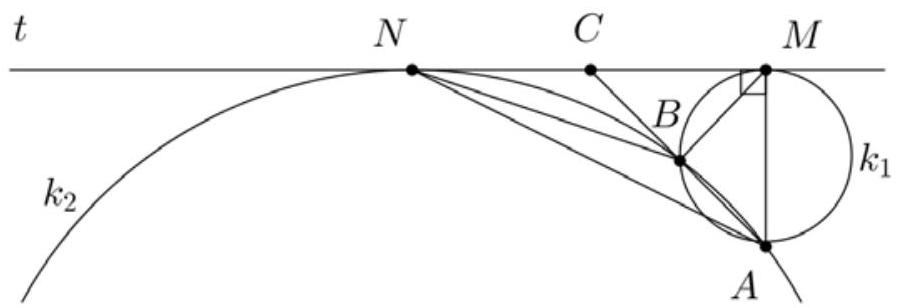
+
## Problem 2
|
| 46 |
+
|
| 47 |
+
Let the circles $k_{1}$ and $k_{2}$ intersect at two distinct points $A$ and $B$, and let $t$ be a common tangent of $k_{1}$ and $k_{2}$, that touches $k_{1}$ and $k_{2}$ at $M$ and $N$, respectively. If $t \perp A M$ and $M N=2 A M$, evaluate $\angle N M B$.
|
| 48 |
+
|
| 49 |
+
## Solution 1
|
| 50 |
+
|
| 51 |
+
Let $P$ be the symmetric of $A$ with respect to $M$ (Figure 1). Then $A M=M P$ and $t \perp A P$, hence the triangle $A P N$ is isosceles with $A P$ as its base, so $\angle N A P=\angle N P A$. We have $\angle B A P=\angle B A M=\angle B M N$ and $\angle B A N=\angle B N M$.
|
| 52 |
+
|
| 53 |
+
Thus we have
|
| 54 |
+
|
| 55 |
+
$$
|
| 56 |
+
180^{\circ}-\angle N B M=\angle B N M+\angle B M N=\angle B A N+\angle B A P=\angle N A P=\angle N P A
|
| 57 |
+
$$
|
| 58 |
+
|
| 59 |
+
so the quadrangle $M B N P$ is cyclic (since the points $B$ and $P$ lie on different sides of $M N$ ). Hence $\angle A P B=\angle M P B=\angle M N B$ and the triangles $A P B$ and $M N B$ are congruent ( $M N=2 A M=A M+M P=A P$ ). From that we get $A B=M B$, i.e. the triangle $A M B$ is isosceles, and since $t$ is tangent to $k_{1}$ and perpendicular to $A M$, the centre of $k_{1}$ is on $A M$, hence $A M B$ is a right-angled triangle. From the last two statements we infer $\angle A M B=45^{\circ}$, and so $\angle N M B=90^{\circ}-\angle A M B=45^{\circ}$.
|
| 60 |
+
|
| 61 |
+
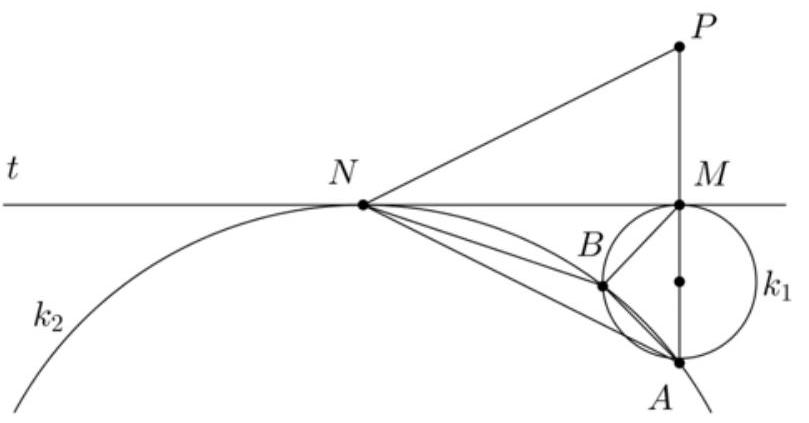
|
| 62 |
+
|
| 63 |
+
Figure 1
|
| 64 |
+
|
| 65 |
+
## Solution 2
|
| 66 |
+
|
| 67 |
+
Let $C$ be the common point of $M N, A B$ (Figure 2). Then $C N^{2}=C B \cdot C A$ and $C M^{2}=C B \cdot C A$. So $C M=C N$. But $M N=2 A M$, so $C M=C N=A M$, thus the right triangle $A C M$ is isosceles, hence $\angle N M B=\angle C M B=\angle B C M=45^{\circ}$.
|
| 68 |
+
|
| 69 |
+
|
| 70 |
+
|
| 71 |
+
Figure 2
|
| 72 |
+
|
| 73 |
+
## Problem 3
|
| 74 |
+
|
| 75 |
+
On a board there are $n$ nails each two connected by a string. Each string is colored in one of $n$ given distinct colors. For each three distinct colors, there exist three nails connected with strings in these three colors. Can $n$ be
|
| 76 |
+
a) 6 ?
|
| 77 |
+
b) 7 ?
|
| 78 |
+
|
| 79 |
+
Solution. (a) The answer is no.
|
| 80 |
+
|
| 81 |
+
Suppose it is possible. Consider some color, say blue. Each blue string is the side of 4 triangles formed with vertices on the given points. As there exist $\binom{5}{2}=\frac{5 \cdot 4}{2}=10$ pairs of colors other than blue, and for any such pair of colors together with the blue color there exists a triangle with strings in these colors, we conclude that there exist at least 3 blue strings (otherwise the number of triangles with a blue string as a side would be at most $2 \cdot 4=8$, a contradiction). The same is true for any color, so altogether there exist at least $6 \cdot 3=18$ strings, while we have just $\binom{6}{2}=\frac{6 \cdot 5}{2}=15$ of them.
|
| 82 |
+
|
| 83 |
+
(b) The answer is yes
|
| 84 |
+
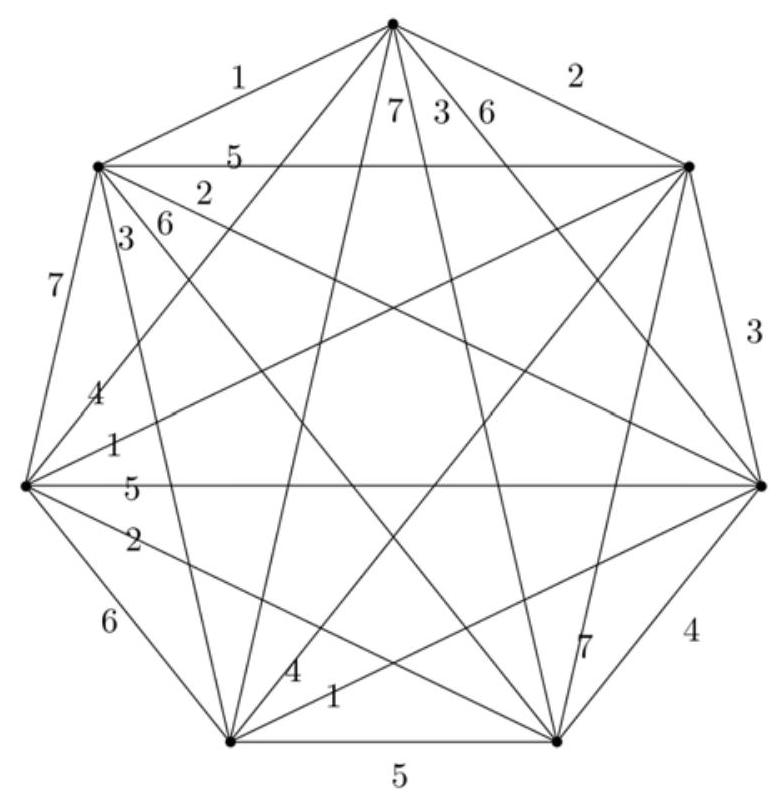
|
| 85 |
+
Put the nails at the vertices of a regular 7-gon and color each one of its sides in a different color. Now color each diagonal in the color of the unique side parallel to it. It can be checked directly that each triple of colors appears in some triangle (because of symmetry, it is enough to check only the triples containing the first color).
|
| 86 |
+
|
| 87 |
+
|
| 88 |
+
|
| 89 |
+
Remark. The argument in (a) can be applied to any even n. The argument in (b) can be applied to any odd $n=2 k+1$ as follows: first number the nails as $0,1,2 \ldots, 2 k$ and similarly number the colors as $0,1,2 \ldots, 2 k$. Then connect nail $x$ with nail $y$ by a string of color $x+y(\bmod n)$. For each triple of colors $(p, q, r)$ there are vertices $x, y, z$ connected by these three colors. Indeed, we need to solve $(\bmod n)$ the system
|
| 90 |
+
|
| 91 |
+
$$
|
| 92 |
+
(*)(x+y \equiv p, x+z \equiv q, y+z \equiv r)
|
| 93 |
+
$$
|
| 94 |
+
|
| 95 |
+
Adding all three, we get $2(x+y+z) \equiv p+q+r$ and multiplying by $k+1$ we get $x+y+z \equiv(k+1)(p+q+r)$. We can now find $x, y, z$ from the identities $(*)$.
|
| 96 |
+
|
| 97 |
+
## Problem 4
|
| 98 |
+
|
| 99 |
+
Find all positive integers $x, y, z$ and $t$ such that
|
| 100 |
+
|
| 101 |
+
$$
|
| 102 |
+
2^{x} \cdot 3^{y}+5^{z}=7^{t}
|
| 103 |
+
$$
|
| 104 |
+
|
| 105 |
+
## Solution
|
| 106 |
+
|
| 107 |
+
Reducing modulo 3 we get $5^{z} \equiv 1$, therefore $z$ is even, $z=2 c, c \in \mathbb{N}$.
|
| 108 |
+
|
| 109 |
+
Next we prove that $t$ is even:
|
| 110 |
+
|
| 111 |
+
Obviously, $t \geq 2$. Let us suppose that $t$ is odd, say $t=2 d+1, d \in \mathbb{N}$. The equation becomes $2^{x} \cdot 3^{y}+25^{c}=7 \cdot 49^{d}$. If $x \geq 2$, reducing modulo 4 we get $1 \equiv 3$, a contradiction. And if $x=1$, we have $2 \cdot 3^{y}+25^{c}=7 \cdot 49^{d}$ and reducing modulo 24 we obtain
|
| 112 |
+
|
| 113 |
+
$$
|
| 114 |
+
2 \cdot 3^{y}+1 \equiv 7 \Rightarrow 24 \mid 2\left(3^{y}-3\right) \text {, i.e. } 4 \mid 3^{y-1}-1
|
| 115 |
+
$$
|
| 116 |
+
|
| 117 |
+
which means that $y-1$ is even. Then $y=2 b+1, b \in \mathbb{N}$. We obtain $6 \cdot 9^{b}+25^{c}=7 \cdot 49^{d}$, and reducing modulo 5 we get $(-1)^{b} \equiv 2 \cdot(-1)^{d}$, which is false for all $b, d \in \mathbb{N}$. Hence $t$ is even, $t=2 d, d \in \mathbb{N}$, as claimed.
|
| 118 |
+
|
| 119 |
+
Now the equation can be written as
|
| 120 |
+
|
| 121 |
+
$$
|
| 122 |
+
2^{x} \cdot 3^{y}+25^{d}=49^{d} \Leftrightarrow 2^{x} \cdot 3^{y}=\left(7^{d}-5^{c}\right)\left(7^{d}+5^{c}\right)
|
| 123 |
+
$$
|
| 124 |
+
|
| 125 |
+
As $\operatorname{gcd}\left(7^{d}-5^{c}, 7^{d}+5^{c}\right)=2$ and $7^{d}+5^{c}>2$, there exist exactly three possibilities:
|
| 126 |
+
(1) $\left\{\begin{array}{l}7^{\mathrm{d}}-5^{\mathrm{d}}=2^{\mathrm{x-1}} \\ 7^{\mathrm{d}}+5^{\mathrm{d}}=2 \cdot 3^{y}\end{array} ;\right.$
|
| 127 |
+
(2) $\left\{\begin{array}{l}7^{\mathrm{d}}-5^{\mathrm{d}}=2 \cdot 3^{\mathrm{y}} \\ 7^{\mathrm{d}}+5^{\mathrm{d}}=2^{\mathrm{x-1}}\end{array}\right.$;
|
| 128 |
+
(3) $\left\{\begin{array}{l}7^{d}-5^{d}=2 \\ 7^{d}+5^{d}=2^{x-1} \cdot 3^{y}\end{array}\right.$
|
| 129 |
+
|
| 130 |
+
## Case (1)
|
| 131 |
+
|
| 132 |
+
We have $7^{d}=2^{x-2}+3^{y}$ and reducing modulo 3 , we get $2^{x-2} \equiv 1(\bmod 3)$, hence $x-2$ is even, i.e. $x=2 a+2, a \in \mathbb{N}$, where $a>0$, since $a=0$ would mean $3^{y}+1=7^{d}$, which is impossible (even $=$ odd).
|
| 133 |
+
|
| 134 |
+
We obtain
|
| 135 |
+
|
| 136 |
+
$$
|
| 137 |
+
7^{d}-5^{d}=2 \cdot 4^{a} \stackrel{\bmod 4}{\Rightarrow} 7^{d} \equiv 1(\bmod 4) \Rightarrow d=2 e, e \in \mathbb{N}
|
| 138 |
+
$$
|
| 139 |
+
|
| 140 |
+
Then we have
|
| 141 |
+
|
| 142 |
+
$$
|
| 143 |
+
49^{e}-5^{d}=2 \cdot 4^{a} \stackrel{\bmod 8}{\Rightarrow} 5^{c} \equiv 1(\bmod 8) \Rightarrow c=2 f, f \in \mathbb{N}
|
| 144 |
+
$$
|
| 145 |
+
|
| 146 |
+
We obtain $49^{e}-25^{f}=2 \cdot 4^{a} \stackrel{\text { mod } 3}{\Rightarrow} 0 \equiv 2(\bmod 3)$, false. In conclusion, in this case there are no solutions to the equation.
|
| 147 |
+
|
| 148 |
+
## Case (2)
|
| 149 |
+
|
| 150 |
+
From $2^{x-1}=7^{d}+5^{c} \geq 12$ we obtain $x \geq 5$. Then $7^{d}+5^{c} \equiv 0(\bmod 4)$, i.e. $3^{d}+1 \equiv 0(\bmod 4)$, hence $d$ is odd. As $7^{d}=5^{c}+2 \cdot 3^{y} \geq 11$, we get $d \geq 2$, hence $d=2 e+1, e \in \mathbb{N}$.
|
| 151 |
+
|
| 152 |
+
As in the previous case, from $7^{d}=2^{x-2}+3^{y}$ reducing modulo 3 we obtain $x=2 a+2$ with $a \geq 2$ (because $x \geq 5$ ). We get $7^{d}=4^{a}+3^{y}$ i.e. $7 \cdot 49^{e}=4^{a}+3^{y}$, hence, reducing modulo 8 we obtain $7 \equiv 3^{y}$ which is false, because $3^{y}$ is congruent either to 1 (if $y$ is even) or to 3 (if $y$ is odd). In conclusion, in this case there are no solutions to the equation.
|
| 153 |
+
|
| 154 |
+
## Case (3)
|
| 155 |
+
|
| 156 |
+
From $7^{d}=5^{c}+2$ it follows that the last digit of $7^{d}$ is 7 , hence $d=4 k+1, k \in \mathbb{N}$.
|
| 157 |
+
|
| 158 |
+
If $c \geq 2$, from $7^{4 k+1}=5^{c}+2$ reducing modulo 25 we obtain $7 \equiv 2(\bmod 25)$ which is false. For $c=1$ we get $d=1$ and the solution $x=3, y=1, z=t=2$.
|
| 159 |
+
|
JBMO/md/en-official/en-jbmo2013solutions.md
ADDED
|
@@ -0,0 +1,128 @@
|
|
|
|
|
|
|
|
|
|
|
|
|
|
|
|
|
|
|
|
|
|
|
|
|
|
|
|
|
|
|
|
|
|
|
|
|
|
|
|
|
|
|
|
|
|
|
|
|
|
|
|
|
|
|
|
|
|
|
|
|
|
|
|
|
|
|
|
|
|
|
|
|
|
|
|
|
|
|
|
|
|
|
|
|
|
|
|
|
|
|
|
|
|
|
|
|
|
|
|
|
|
|
|
|
|
|
|
|
|
|
|
|
|
|
|
|
|
|
|
|
|
|
|
|
|
|
|
|
|
|
|
|
|
|
|
|
|
|
|
|
|
|
|
|
|
|
|
|
|
|
|
|
|
|
|
|
|
|
|
|
|
|
|
|
|
|
|
|
|
|
|
|
|
|
|
|
|
|
|
|
|
|
|
|
|
|
|
|
|
|
|
|
|
|
|
|
|
|
|
|
|
|
|
|
|
|
|
|
|
|
|
|
|
|
|
|
|
|
|
|
|
|
|
|
|
|
|
|
|
|
|
|
|
|
|
|
|
|
|
|
|
|
|
|
|
|
|
|
|
|
|
|
|
|
|
|
|
|
|
|
|
|
|
|
|
|
|
|
|
|
|
|
|
|
|
|
|
|
|
|
|
|
|
|
|
|
|
|
|
|
|
|
|
|
|
|
|
|
|
|
|
|
|
|
|
|
|
|
|
|
|
|
|
|
|
|
|
|
|
|
|
|
|
|
|
|
|
|
|
|
|
|
|
|
|
|
|
|
|
|
|
|
|
|
|
|
|
|
|
|
|
|
|
|
|
|
|
|
|
|
|
|
|
|
|
|
|
|
|
|
|
|
|
|
|
|
|
|
|
|
|
|
|
|
|
|
|
| 1 |
+
# Problem 1.
|
| 2 |
+
|
| 3 |
+
Solution. As $a^{3} b-1=b\left(a^{3}+1\right)-(b+1)$ and $a+1 \mid a^{3}+1$, we have $a+1 \mid b+1$.
|
| 4 |
+
|
| 5 |
+
As $b^{3} a+1=a\left(b^{3}-1\right)+(a+1)$ and $b-1 \mid b^{3}-1$, we have $b-1 \mid a+1$.
|
| 6 |
+
|
| 7 |
+
So $b-1 \mid b+1$ and hence $b-1 \mid 2$.
|
| 8 |
+
|
| 9 |
+
- If $b=2$, then $a+1 \mid b+1=3$ gives $a=2$. Hence $(a, b)=(2,2)$ is the only solution in this case.
|
| 10 |
+
- If $b=3$, then $a+1 \mid b+1=4$ gives $a=1$ or $a=3$. Hence $(a, b)=(1,3)$ and $(3,3)$ are the only solutions in this case.
|
| 11 |
+
|
| 12 |
+
To summarize, $(a, b)=(1,3),(2,2)$ and $(3,3)$ are the only solutions.
|
| 13 |
+
|
| 14 |
+

|
| 15 |
+
|
| 16 |
+
## Problem 2.
|
| 17 |
+
|
| 18 |
+
Solution. We will show that $M O P D$ is a parallelogram. From this it follows that $M, N, P$ are collinear.
|
| 19 |
+
|
| 20 |
+
Since $\angle B A D=\angle C A O=90^{\circ}-\angle A B C, D$ is the foot of the perpendicular from $A$ to side $B C$. Since $M$ is the midpoint of the line segment $B E$, we have $B M=M E=M D$ and hence $\angle M D E=\angle M E D=\angle A C B$.
|
| 21 |
+
|
| 22 |
+
Let the line $M D$ intersect the line $A C$ at $D_{1}$. Since $\angle A D D_{1}=\angle M D E=\angle A C D, M D$ is perpendicular to $A C$. On the other hand, since $O$ is the center of the circumcircle of triangle $A B C$ and $P$ is the midpoint of the side $A C, O P$ is perpendicular to $A C$. Therefore $M D$ and $O P$ are parallel.
|
| 23 |
+
|
| 24 |
+
Similarly, since $P$ is the midpoint of the side $A C$, we have $A P=P C=D P$ and hence $\angle P D C=\angle A C B$. Let the line $P D$ intersect the line $B E$ at $D_{2}$. Since $\angle B D D_{2}=\angle P D C=$ $\angle A C B=\angle B E D$, we conclude that $P D$ is perpendicular to $B E$. Since $M$ is the midpoint of the line segment $B E, O M$ is perpendicular to $B E$ and hence $O M$ and $P D$ are parallel.
|
| 25 |
+
|
| 26 |
+

|
| 27 |
+
|
| 28 |
+
## Problem 3.
|
| 29 |
+
|
| 30 |
+
Solution 1. By the AM-GM Inequality we have:
|
| 31 |
+
|
| 32 |
+
$$
|
| 33 |
+
\frac{a+1}{2}+\frac{2}{a+1} \geq 2
|
| 34 |
+
$$
|
| 35 |
+
|
| 36 |
+
Therefore
|
| 37 |
+
|
| 38 |
+
$$
|
| 39 |
+
a+2 b+\frac{2}{a+1} \geq \frac{a+3}{2}+2 b
|
| 40 |
+
$$
|
| 41 |
+
|
| 42 |
+
and, similarly,
|
| 43 |
+
|
| 44 |
+
$$
|
| 45 |
+
b+2 a+\frac{2}{b+1} \geq 2 a+\frac{b+3}{2}
|
| 46 |
+
$$
|
| 47 |
+
|
| 48 |
+
On the other hand,
|
| 49 |
+
|
| 50 |
+
$$
|
| 51 |
+
(a+4 b+3)(b+4 a+3) \geq(\sqrt{a b}+4 \sqrt{a b}+3)^{2} \geq 64
|
| 52 |
+
$$
|
| 53 |
+
|
| 54 |
+
by the Cauchy-Schwarz Inequality as $a b \geq 1$, and we are done.
|
| 55 |
+
|
| 56 |
+
Solution 2. Since $a b \geq 1$, we have $a+b \geq a+1 / a \geq 2 \sqrt{a \cdot(1 / a)}=2$.
|
| 57 |
+
|
| 58 |
+
Then
|
| 59 |
+
|
| 60 |
+
$$
|
| 61 |
+
\begin{aligned}
|
| 62 |
+
a+2 b+\frac{2}{a+1} & =b+(a+b)+\frac{2}{a+1} \\
|
| 63 |
+
& \geq b+2+\frac{2}{a+1} \\
|
| 64 |
+
& =\frac{b+1}{2}+\frac{b+1}{2}+1+\frac{2}{a+1} \\
|
| 65 |
+
& \geq 4 \sqrt[4]{\frac{(b+1)^{2}}{2(a+1)}}
|
| 66 |
+
\end{aligned}
|
| 67 |
+
$$
|
| 68 |
+
|
| 69 |
+
by the AM-GM Inequality. Similarly,
|
| 70 |
+
|
| 71 |
+
$$
|
| 72 |
+
b+2 a+\frac{2}{b+1} \geq 4 \sqrt[4]{\frac{(a+1)^{2}}{2(b+1)}}
|
| 73 |
+
$$
|
| 74 |
+
|
| 75 |
+

|
| 76 |
+
|
| 77 |
+
Now using these and applying the AM-GM Inequality another time we obtain:
|
| 78 |
+
|
| 79 |
+
$$
|
| 80 |
+
\begin{aligned}
|
| 81 |
+
\left(a+2 b+\frac{2}{a+1}\right)\left(b+2 a+\frac{2}{b+1}\right) & \geq 16 \sqrt[4]{\frac{(a+1)(b+1)}{4}} \\
|
| 82 |
+
& \geq 16 \sqrt[4]{\frac{(2 \sqrt{a})(2 \sqrt{b})}{4}} \\
|
| 83 |
+
& =16 \sqrt[8]{a b} \\
|
| 84 |
+
& \geq 16
|
| 85 |
+
\end{aligned}
|
| 86 |
+
$$
|
| 87 |
+
|
| 88 |
+
Solution 3. We have
|
| 89 |
+
|
| 90 |
+
$$
|
| 91 |
+
\begin{aligned}
|
| 92 |
+
\left(a+2 b+\frac{2}{a+1}\right)\left(b+2 a+\frac{2}{b+1}\right) & =\left((a+b)+b+\frac{2}{a+1}\right)\left((a+b)+a+\frac{2}{b+1}\right) \\
|
| 93 |
+
& \geq\left(a+b+\sqrt{a b}+\frac{2}{\sqrt{(a+1)(b+1)}}\right)^{2}
|
| 94 |
+
\end{aligned}
|
| 95 |
+
$$
|
| 96 |
+
|
| 97 |
+
by the Cauchy-Schwarz Inequality.
|
| 98 |
+
|
| 99 |
+
On the other hand,
|
| 100 |
+
|
| 101 |
+
$$
|
| 102 |
+
\frac{2}{\sqrt{(a+1)(b+1)}} \geq \frac{4}{a+b+2}
|
| 103 |
+
$$
|
| 104 |
+
|
| 105 |
+
by the AM-GM Inequality and
|
| 106 |
+
|
| 107 |
+
$$
|
| 108 |
+
a+b+\sqrt{a b}+\frac{2}{\sqrt{(a+1)(b+1)}} \geq a+b+1+\frac{4}{a+b+2}=\frac{(a+b+1)(a+b-2)}{a+b+2}+4 \geq 4
|
| 109 |
+
$$
|
| 110 |
+
|
| 111 |
+
as $a+b \geq 2 \sqrt{a b} \geq 2$, finishing the proof.
|
| 112 |
+
|
| 113 |
+

|
| 114 |
+
|
| 115 |
+
## Problem 4.
|
| 116 |
+
|
| 117 |
+
Solution. a. Yes. Let $a \leq b \leq c \leq d \leq e$ be the numbers chosen by Alice. As each number appears in a pairwise sum 4 times, by adding all 10 pairwise sums and dividing the result by 4, Bob obtains $a+b+c+d+e$. Subtracting the smallest and the largest pairwise sums $a+b$ and $d+e$ from this he obtains $c$. Subtracting $c$ from the second largest pairwise sum $c+e$ he obtains $e$. Subtracting $e$ from the largest pairwise sum $d+e$ he obtains $d$. He can similarly determine $a$ and $b$.
|
| 118 |
+
|
| 119 |
+
b. Yes. Let $a \leq b \leq c \leq d \leq e \leq f$ be the numbers chosen by Alice. As each number appears in a pairwise sum 5 times, by adding all 15 pairwise sums and dividing the result by 5 , Bob obtains $a+b+c+d+e+f$. Subtracting the smallest and the largest pairwise sums $a+b$ and $e+f$ from this he obtains $c+d$.
|
| 120 |
+
|
| 121 |
+
Subtracting the smallest and the second largest pairwise sums $a+b$ and $d+f$ from $a+b+c+$ $d+e+f$ he obtains $c+e$. Similarly he can obtain $b+d$. He uses these to obtain $a+f$ and $b+e$.
|
| 122 |
+
|
| 123 |
+
Now $a+d, a+e, b+c$ are the three smallest among the remaining six pairwise sums. If Bob adds these up, subtracts the known sums $c+d$ and $b+e$ from the result and divides the difference by 2 , he obtains $a$. Then he can determine the remaining numbers.
|
| 124 |
+
|
| 125 |
+
c. No. If Alice chooses the eight numbers $1,5,7,9,12,14,16,20$, then Bob cannot be sure to guess these numbers correctly as the eight numbers $2,4,6,10,11,15,17,19$ also give exactly the same 28 pairwise sums as these numbers.
|
| 126 |
+
|
| 127 |
+

|
| 128 |
+
|
JBMO/md/en-official/en-jbmo_2016_paper_eng.md
ADDED
|
@@ -0,0 +1,217 @@
|
|
|
|
|
|
|
|
|
|
|
|
|
|
|
|
|
|
|
|
|
|
|
|
|
|
|
|
|
|
|
|
|
|
|
|
|
|
|
|
|
|
|
|
|
|
|
|
|
|
|
|
|
|
|
|
|
|
|
|
|
|
|
|
|
|
|
|
|
|
|
|
|
|
|
|
|
|
|
|
|
|
|
|
|
|
|
|
|
|
|
|
|
|
|
|
|
|
|
|
|
|
|
|
|
|
|
|
|
|
|
|
|
|
|
|
|
|
|
|
|
|
|
|
|
|
|
|
|
|
|
|
|
|
|
|
|
|
|
|
|
|
|
|
|
|
|
|
|
|
|
|
|
|
|
|
|
|
|
|
|
|
|
|
|
|
|
|
|
|
|
|
|
|
|
|
|
|
|
|
|
|
|
|
|
|
|
|
|
|
|
|
|
|
|
|
|
|
|
|
|
|
|
|
|
|
|
|
|
|
|
|
|
|
|
|
|
|
|
|
|
|
|
|
|
|
|
|
|
|
|
|
|
|
|
|
|
|
|
|
|
|
|
|
|
|
|
|
|
|
|
|
|
|
|
|
|
|
|
|
|
|
|
|
|
|
|
|
|
|
|
|
|
|
|
|
|
|
|
|
|
|
|
|
|
|
|
|
|
|
|
|
|
|
|
|
|
|
|
|
|
|
|
|
|
|
|
|
|
|
|
|
|
|
|
|
|
|
|
|
|
|
|
|
|
|
|
|
|
|
|
|
|
|
|
|
|
|
|
|
|
|
|
|
|
|
|
|
|
|
|
|
|
|
|
|
|
|
|
|
|
|
|
|
|
|
|
|
|
|
|
|
|
|
|
|
|
|
|
|
|
|
|
|
|
|
|
|
|
|
|
|
|
|
|
|
|
|
|
|
|
|
|
|
|
|
|
|
|
|
|
|
|
|
|
|
|
|
|
|
|
|
|
|
|
|
|
|
|
|
|
|
|
|
|
|
|
|
|
|
|
|
|
|
|
|
|
|
|
|
|
|
|
|
|
|
|
|
|
|
|
|
|
|
|
|
|
|
|
|
|
|
|
|
|
|
|
|
|
|
|
|
|
|
|
|
|
|
|
|
|
|
|
|
|
|
|
|
|
|
|
|
|
|
|
|
|
|
|
|
|
|
|
|
|
|
|
|
|
|
|
|
|
|
|
|
|
|
|
|
|
|
|
|
|
|
|
|
|
|
|
|
|
|
|
|
|
|
|
|
|
|
|
|
|
|
|
|
|
|
|
|
|
|
|
|
|
|
|
|
|
|
|
|
|
|
|
|
|
|
|
|
|
|
|
|
|
|
|
|
|
|
|
|
|
|
|
|
|
|
|
|
|
|
|
|
|
|
|
|
|
|
|
|
|
|
|
|
|
|
|
|
|
|
|
|
|
|
|
|
|
|
|
|
|
|
|
|
|
|
|
|
|
|
|
|
|
|
|
|
|
|
|
|
|
| 1 |
+
# JBMO 2016 <br> Problems and solutions
|
| 2 |
+
|
| 3 |
+
Problem 1. A trapezoid $A B C D(A B \| C D, A B>C D)$ is circumscribed. The incircle of the triangle $A B C$ touches the lines $A B$ and $A C$ at the points $M$ and $N$, respectively. Prove that the incenter of the trapezoid $A B C D$ lies on the line $M N$.
|
| 4 |
+
|
| 5 |
+
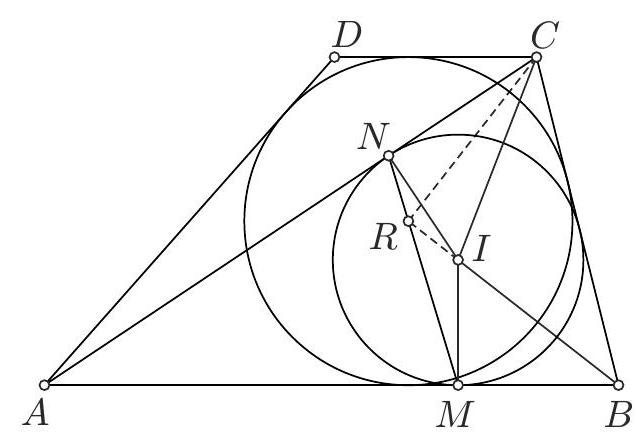
|
| 6 |
+
|
| 7 |
+
## Solution.
|
| 8 |
+
|
| 9 |
+
Version 1. Let $I$ be the incenter of triangle $A B C$ and $R$ be the common point of the lines $B I$ and $M N$. Since
|
| 10 |
+
|
| 11 |
+
$$
|
| 12 |
+
m(\widehat{A N M})=90^{\circ}-\frac{1}{2} m(\widehat{M A N}) \quad \text { and } \quad m(\widehat{B I C})=90^{\circ}+\frac{1}{2} m(\widehat{M A N})
|
| 13 |
+
$$
|
| 14 |
+
|
| 15 |
+
the quadrilateral $I R N C$ is cyclic.
|
| 16 |
+
|
| 17 |
+
It follows that $m(\widehat{B R C})=90^{\circ}$ and therefore
|
| 18 |
+
|
| 19 |
+
$$
|
| 20 |
+
m(\widehat{B C R})=90^{\circ}-m(\widehat{C B R})=90^{\circ}-\frac{1}{2}\left(180^{\circ}-m(\widehat{B C D})\right)=\frac{1}{2} m(\widehat{B C D})
|
| 21 |
+
$$
|
| 22 |
+
|
| 23 |
+
So, $(C R$ is the angle bisector of $\widehat{D C B}$ and $R$ is the incenter of the trapezoid.
|
| 24 |
+
|
| 25 |
+
Version 2. If $R$ is the incentre of the trapezoid $A B C D$, then $B, I$ and $R$ are collinear,
|
| 26 |
+
|
| 27 |
+
and $m(\widehat{B R C})=90^{\circ}$.
|
| 28 |
+
|
| 29 |
+
The quadrilateral $I R N C$ is cyclic.
|
| 30 |
+
|
| 31 |
+
Then $m(\widehat{M N C})=90^{\circ}+\frac{1}{2} \cdot m(\widehat{B A C})$
|
| 32 |
+
|
| 33 |
+
and $m(\widehat{R N C})=m(\widehat{B I C})=90^{\circ}+\frac{1}{2} \cdot m(\widehat{B A C})$,
|
| 34 |
+
so that $m(\widehat{M N C})=m(\widehat{R N C})$ and the points $M, R$ and $N$ are collinear.
|
| 35 |
+
|
| 36 |
+
Version 3. If $R$ is the incentre of the trapezoid $A B C D$, let $M^{\prime} \in(A B)$ and $N^{\prime} \in(A C)$ be the unique points, such that $R \in M^{\prime} N^{\prime}$ and $\left(A M^{\prime}\right) \equiv\left(A N^{\prime}\right)$.
|
| 37 |
+
|
| 38 |
+
Let $S$ be the intersection point of $C R$ and $A B$. Then $C R=R S$.
|
| 39 |
+
|
| 40 |
+
Consider $K \in A C$ such that $S K \| M^{\prime} N^{\prime}$. Then $N^{\prime}$ is the midpoint of $(C K)$.
|
| 41 |
+
|
| 42 |
+
We deduce
|
| 43 |
+
|
| 44 |
+
$$
|
| 45 |
+
A N^{\prime}=\frac{A K+A C}{2}=\frac{A S+A C}{2}=\frac{A B-B S+A C}{2}=\frac{A B+A C-B C}{2}=A N
|
| 46 |
+
$$
|
| 47 |
+
|
| 48 |
+
We conclude that $N=N^{\prime}$, hence $M=M^{\prime}$, and $R, M, N$ are collinear.
|
| 49 |
+
|
| 50 |
+
Problem 2. Let $a, b$ and $c$ be positive real numbers. Prove that
|
| 51 |
+
|
| 52 |
+
$$
|
| 53 |
+
\frac{8}{(a+b)^{2}+4 a b c}+\frac{8}{(b+c)^{2}+4 a b c}+\frac{8}{(c+a)^{2}+4 a b c}+a^{2}+b^{2}+c^{2} \geq \frac{8}{a+3}+\frac{8}{b+3}+\frac{8}{c+3}
|
| 54 |
+
$$
|
| 55 |
+
|
| 56 |
+
Solution. Since $2 a b \leq a^{2}+b^{2}$, it follows that $(a+b)^{2} \leq 2\left(a^{2}+b^{2}\right)$
|
| 57 |
+
|
| 58 |
+
and $4 a b c \leq 2 c\left(a^{2}+b^{2}\right)$, for any positive reals $a, b, c$.
|
| 59 |
+
|
| 60 |
+
Adding these inequalities, we find
|
| 61 |
+
|
| 62 |
+
$$
|
| 63 |
+
(a+b)^{2}+4 a b c \leq 2\left(a^{2}+b^{2}\right)(c+1)
|
| 64 |
+
$$
|
| 65 |
+
|
| 66 |
+
so that
|
| 67 |
+
|
| 68 |
+
$$
|
| 69 |
+
\frac{8}{(a+b)^{2}+4 a b c} \geq \frac{4}{\left(a^{2}+b^{2}\right)(c+1)}
|
| 70 |
+
$$
|
| 71 |
+
|
| 72 |
+
Using the AM-GM inequality, we have
|
| 73 |
+
|
| 74 |
+
$$
|
| 75 |
+
\frac{4}{\left(a^{2}+b^{2}\right)(c+1)}+\frac{a^{2}+b^{2}}{2} \geq 2 \sqrt{\frac{2}{c+1}}=\frac{4}{\sqrt{2(c+1)}}
|
| 76 |
+
$$
|
| 77 |
+
|
| 78 |
+
respectively
|
| 79 |
+
|
| 80 |
+
$$
|
| 81 |
+
\frac{c+3}{8}=\frac{(c+1)+2}{8} \geq \frac{\sqrt{2(c+1)}}{4}
|
| 82 |
+
$$
|
| 83 |
+
|
| 84 |
+
We conclude that
|
| 85 |
+
|
| 86 |
+
$$
|
| 87 |
+
\frac{4}{\left(a^{2}+b^{2}\right)(c+1)}+\frac{a^{2}+b^{2}}{2} \geq \frac{8}{c+3}
|
| 88 |
+
$$
|
| 89 |
+
|
| 90 |
+
and finally
|
| 91 |
+
|
| 92 |
+
$$
|
| 93 |
+
\frac{8}{(a+b)^{2}+4 a b c}+\frac{8}{(a+c)^{2}+4 a b c}+\frac{8}{(b+c)^{2}+4 a b c}+a^{2}+b^{2}+c^{2} \geq \frac{8}{a+3}+\frac{8}{b+3}+\frac{8}{c+3}
|
| 94 |
+
$$
|
| 95 |
+
|
| 96 |
+
Problem 3. Find all the triples of integers $(a, b, c)$ such that the number
|
| 97 |
+
|
| 98 |
+
$$
|
| 99 |
+
N=\frac{(a-b)(b-c)(c-a)}{2}+2
|
| 100 |
+
$$
|
| 101 |
+
|
| 102 |
+
is a power of 2016 .
|
| 103 |
+
|
| 104 |
+
(A power of 2016 is an integer of the form $2016^{n}$, where $n$ is a non-negative integer.)
|
| 105 |
+
|
| 106 |
+
Solution. Let $a, b, c$ be integers and $n$ be a positive integer such that
|
| 107 |
+
|
| 108 |
+
$$
|
| 109 |
+
(a-b)(b-c)(c-a)+4=2 \cdot 2016^{n}
|
| 110 |
+
$$
|
| 111 |
+
|
| 112 |
+
We set $a-b=-x, b-c=-y$ and we rewrite the equation as
|
| 113 |
+
|
| 114 |
+
$$
|
| 115 |
+
x y(x+y)+4=2 \cdot 2016^{n}
|
| 116 |
+
$$
|
| 117 |
+
|
| 118 |
+
If $n>0$, then the right hand side is divisible by 7 , so we have that
|
| 119 |
+
|
| 120 |
+
$$
|
| 121 |
+
x y(x+y)+4 \equiv 0 \quad(\bmod 7)
|
| 122 |
+
$$
|
| 123 |
+
|
| 124 |
+
or
|
| 125 |
+
|
| 126 |
+
$$
|
| 127 |
+
3 x y(x+y) \equiv 2 \quad(\bmod 7)
|
| 128 |
+
$$
|
| 129 |
+
|
| 130 |
+
or
|
| 131 |
+
|
| 132 |
+
$$
|
| 133 |
+
(x+y)^{3}-x^{3}-y^{3} \equiv 2 \quad(\bmod 7)
|
| 134 |
+
$$
|
| 135 |
+
|
| 136 |
+
Note that, by Fermat's Little Theorem, for any integer $k$ the cubic residues are $k^{3} \equiv-1,0,1$ $(\bmod 7)$.
|
| 137 |
+
|
| 138 |
+
It follows that in (1) some of $(x+y)^{3}, x^{3}$ and $y^{3}$ should be divisible by 7 .
|
| 139 |
+
|
| 140 |
+
But in this case, $x y(x+y)$ is divisible by 7 and this is a contradiction.
|
| 141 |
+
|
| 142 |
+
So, the only possibility is to have $n=0$ and consequently, $x y(x+y)+4=2$, or, equivalently, $x y(x+y)=-2$.
|
| 143 |
+
|
| 144 |
+
The solutions for this are $(x, y) \in\{(-1,-1),(2,-1),(-1,2)\}$,
|
| 145 |
+
|
| 146 |
+
so the required triples are $(a, b, c)=(k+2, k+1, k), k \in \mathbb{Z}$, and all their cyclic permutations. (9)
|
| 147 |
+
|
| 148 |
+
Alternative version: If $n>0$ then 9 divides $(a-b)(b-c)(c-a)+4$, that is, the equation $x y(x+y)+4 \equiv 0(\bmod 9))$ has the solution $x=b-a, y=c-b$.
|
| 149 |
+
|
| 150 |
+
But then $x$ and $y$ have to be 1 modulo 3 , implying $x y(x+y) \equiv 2(\bmod 9)$, which is a contradiction.
|
| 151 |
+
|
| 152 |
+
We can continue now as in the first version.
|
| 153 |
+
|
| 154 |
+
Problem 4. A $5 \times 5$ table is called regular if each of its cells contains one of four pairwise distinct real numbers, such that each of them occurs exactly once in every $2 \times 2$ subtable. The sum of all numbers of a regular table is called the total sum of the table. With any four numbers, one constructs all possible regular tables, computes their total sums and counts the distinct outcomes. Determine the maximum possible count.
|
| 155 |
+
|
| 156 |
+
Solution. We will prove that the maximum number of total sums is 60 .
|
| 157 |
+
|
| 158 |
+
The proof is based on the following claim.
|
| 159 |
+
|
| 160 |
+
Claim. In a regular table either each row contains exactly two of the numbers, or each column contains exactly two of the numbers.
|
| 161 |
+
|
| 162 |
+
Proof of the Claim. Indeed, let $R$ be a row containing at least three of the numbers. Then, in row $R$ we can find three of the numbers in consecutive positions, let $x, y, z$ be the numbers in consecutive positions(where $\{x, y, s, z\}=\{a, b, c, d\}$ ). Due to our hypothesis that in every $2 \times 2$ subarray each number is used exactly once, in the row above $\mathrm{R}$ (if there is such a row), precisely above the numbers $x, y, z$ will be the numbers $z, t, x$ in this order. And above them will be the numbers $x, y, z$ in this order. The same happens in the rows below $R$ (see at the following figure).
|
| 163 |
+
|
| 164 |
+
$$
|
| 165 |
+
\left(\begin{array}{lllll}
|
| 166 |
+
\bullet & x & y & z & \bullet \\
|
| 167 |
+
\bullet & z & t & x & \bullet \\
|
| 168 |
+
\bullet & x & y & z & \bullet \\
|
| 169 |
+
\bullet & z & t & x & \bullet \\
|
| 170 |
+
\bullet & x & y & z & \bullet
|
| 171 |
+
\end{array}\right)
|
| 172 |
+
$$
|
| 173 |
+
|
| 174 |
+
Completing all the array, it easily follows that each column contains exactly two of the numbers and our claim is proven.
|
| 175 |
+
|
| 176 |
+
Rotating the matrix (if it is necessary), we may assume that each row contains exactly two of the numbers. If we forget the first row and column from the array, we obtain a $4 \times 4$ array, that can be divided into four $2 \times 2$ subarrays, containing thus each number exactly four times, with a total sum of $4(a+b+c+d)$.
|
| 177 |
+
|
| 178 |
+
It suffices to find how many different ways are there to put the numbers in the first row $R_{1}$ and the first column $C_{1}$.
|
| 179 |
+
|
| 180 |
+
Denoting by $a_{1}, b_{1}, c_{1}, d_{1}$ the number of appearances of $a, b, c$, and respectively $d$ in $R_{1}$ and $C_{1}$, the total sum of the numbers in the entire $5 \times 5$ array will be
|
| 181 |
+
|
| 182 |
+
$$
|
| 183 |
+
S=4(a+b+c+d)+a_{1} \cdot a+b_{1} \cdot b+c_{1} \cdot c+d_{1} \cdot d
|
| 184 |
+
$$
|
| 185 |
+
|
| 186 |
+
If the first, the third and the fifth row contain the numbers $x, y$, with $x$ denoting the number at the entry $(1,1)$, then the second and the fourth row will contain only the numbers $z, t$, with $z$ denoting the number at the entry $(2,1)$. Then $x_{1}+y_{1}=7$ and $x_{1} \geqslant 3, y_{1} \geqslant 2, z_{1}+t_{1}=2$, and $z_{1} \geqslant t_{1}$. Then $\left\{x_{1}, y_{1}\right\}=\{5,2\}$ or $\left\{x_{1}, y_{1}\right\}=\{4,3\}$, respectively $\left\{z_{1}, t_{1}\right\}=\{2,0\}$ or $\left\{z_{1}, t_{1}\right\}=\{1,1\}$
|
| 187 |
+
|
| 188 |
+
Then $\left(a_{1}, b_{1}, c_{1}, d_{1}\right)$ is obtained by permuting one of the following quadruples:
|
| 189 |
+
|
| 190 |
+
$$
|
| 191 |
+
(5,2,2,0),(5,2,1,1),(4,3,2,0),(4,3,1,1)
|
| 192 |
+
$$
|
| 193 |
+
|
| 194 |
+
There are a total of $\frac{4!}{2!}=12$ permutations of $(5,2,2,0)$, also 12 permutations of $(5,2,1,1), 24$ permutations of $(4,3,2,0)$ and finally, there are 12 permutations of $(4,3,1,1)$. Hence, there are at most 60 different possible total sums.
|
| 195 |
+
|
| 196 |
+
We can obtain indeed each of these 60 combinations: take three rows ababa alternating with two rows $c d c d c$ to get $(5,2,2,0)$; take three rows ababa alternating with one row $c d c d c$ and a row $(d c d c d)$ to get $(5,2,1,1)$; take three rows $a b a b c$ alternating with two rows $c d c d a$ to get $(4,3,2,0)$; take three rows $a b c d a$ alternating with two rows $c d a b c$ to get $(4,3,1,1)$.
|
| 197 |
+
|
| 198 |
+
By choosing for example $a=10^{3}, b=10^{2}, c=10, d=1$, we can make all these sums different. (8)
|
| 199 |
+
|
| 200 |
+
Hence, 60 is indeed the maximum possible number of different sums.
|
| 201 |
+
|
| 202 |
+
Alternative Version: Consider a regular table containing the four distinct numbers $a, b, c, d$. The four $2 \times 2$ corners contain each all the four numbers, so that, if $a_{1}, b_{1}, c_{1}, d_{1}$ are the numbers of appearances of $a, b, c$, and respectively $d$ in the middle row and column, then
|
| 203 |
+
|
| 204 |
+
$$
|
| 205 |
+
S=4(a+b+c+d)+a_{1} \cdot a+b_{1} \cdot b+c_{1} \cdot c+d_{1} \cdot d
|
| 206 |
+
$$
|
| 207 |
+
|
| 208 |
+
Consider the numbers $x$ in position $(3,3), y$ in position $(3,2), y^{\prime}$ in position $(3,4), z$ in position $(2,3)$ and $z^{\prime}$ in position $(4,3)$.
|
| 209 |
+
|
| 210 |
+
If $z \neq z^{\prime}=t$, then $y=y^{\prime}$, and in positions $(3,1)$ and $(3,5)$ there will be the number $x$.
|
| 211 |
+
|
| 212 |
+
The second and fourth row can only contain now the numbers $z$ and $t$, respectively the first and fifth row only $x$ and $y$.
|
| 213 |
+
|
| 214 |
+
Then $x_{1}+y_{1}=7$ and $x_{1} \geqslant 3, y_{1} \geqslant 2, z_{1}+t_{1}=2$, and $z_{1} \geqslant t_{1}$. Then $\left\{x_{1}, y_{1}\right\}=\{5,2\}$ or $\left\{x_{1}, y_{1}\right\}=\{4,3\}$, respectively $\left\{z_{1}, t_{1}\right\}=\{2,0\}$ or $\left\{z_{1}, t_{1}\right\}=\{1,1\}$.
|
| 215 |
+
|
| 216 |
+
One can continue now as in the first version.
|
| 217 |
+
|
JBMO/md/en-official/en-jbmo_2017_english_solutions.md
ADDED
|
@@ -0,0 +1,187 @@
|
|
|
|
|
|
|
|
|
|
|
|
|
|
|
|
|
|
|
|
|
|
|
|
|
|
|
|
|
|
|
|
|
|
|
|
|
|
|
|
|
|
|
|
|
|
|
|
|
|
|
|
|
|
|
|
|
|
|
|
|
|
|
|
|
|
|
|
|
|
|
|
|
|
|
|
|
|
|
|
|
|
|
|
|
|
|
|
|
|
|
|
|
|
|
|
|
|
|
|
|
|
|
|
|
|
|
|
|
|
|
|
|
|
|
|
|
|
|
|
|
|
|
|
|
|
|
|
|
|
|
|
|
|
|
|
|
|
|
|
|
|
|
|
|
|
|
|
|
|
|
|
|
|
|
|
|
|
|
|
|
|
|
|
|
|
|
|
|
|
|
|
|
|
|
|
|
|
|
|
|
|
|
|
|
|
|
|
|
|
|
|
|
|
|
|
|
|
|
|
|
|
|
|
|
|
|
|
|
|
|
|
|
|
|
|
|
|
|
|
|
|
|
|
|
|
|
|
|
|
|
|
|
|
|
|
|
|
|
|
|
|
|
|
|
|
|
|
|
|
|
|
|
|
|
|
|
|
|
|
|
|
|
|
|
|
|
|
|
|
|
|
|
|
|
|
|
|
|
|
|
|
|
|
|
|
|
|
|
|
|
|
|
|
|
|
|
|
|
|
|
|
|
|
|
|
|
|
|
|
|
|
|
|
|
|
|
|
|
|
|
|
|
|
|
|
|
|
|
|
|
|
|
|
|
|
|
|
|
|
|
|
|
|
|
|
|
|
|
|
|
|
|
|
|
|
|
|
|
|
|
|
|
|
|
|
|
|
|
|
|
|
|
|
|
|
|
|
|
|
|
|
|
|
|
|
|
|
|
|
|
|
|
|
|
|
|
|
|
|
|
|
|
|
|
|
|
|
|
|
|
|
|
|
|
|
|
|
|
|
|
|
|
|
|
|
|
|
|
|
|
|
|
|
|
|
|
|
|
|
|
|
|
|
|
|
|
|
|
|
|
|
|
|
|
|
|
|
|
|
|
|
|
|
|
|
|
|
|
|
|
|
|
|
|
|
|
|
|
|
|
|
|
|
|
|
|
|
|
|
|
|
|
|
|
|
|
|
|
|
|
|
|
|
|
|
|
|
|
|
|
|
|
|
|
|
|
|
|
|
|
|
|
|
|
|
|
|
|
|
|
|
|
|
|
|
|
|
|
|
|
|
|
|
|
|
|
|
|
|
|
|
|
|
|
|
|
|
|
|
|
|
|
|
|
| 1 |
+
# $21^{\text {th }}$ Junior Balkan Mathematical Olympiad
|
| 2 |
+
|
| 3 |
+
Problem 1. Determine all the sets of six consecutive positive integers such that the product of some two of them, added to the product of some other two of them is equal to the product of the remaining two numbers.
|
| 4 |
+
|
| 5 |
+
Solution. Exactly two of the six numbers are multiples of 3 and these two need to be multiplied together, otherwise two of the three terms of the equality are multiples of 3 but the third one is not.
|
| 6 |
+
|
| 7 |
+
Let $n$ and $n+3$ denote these multiples of 3 . Two of the four remaining numbers give remainder 1 when divided by 3 , while the other two give remainder 2 , so the two other products are either $\equiv 1 \cdot 1=1$ $(\bmod 3)$ and $\equiv 2 \cdot 2 \equiv 1(\bmod 3)$, or they are both $\equiv 1 \cdot 2 \equiv 2(\bmod 3)$. In conclusion, the term $n(n+3)$ needs to be on the right hand side of the equality.
|
| 8 |
+
|
| 9 |
+
Looking at parity, three of the numbers are odd, and three are even. One of $n$ and $n+3$ is odd, the other even, so exactly two of the other numbers are odd. As $n(n+3)$ is even, the two remaining odd numbers need to appear in different terms.
|
| 10 |
+
|
| 11 |
+
We distinguish the following cases:
|
| 12 |
+
|
| 13 |
+
I. The numbers are $n-2, n-1, n, n+1, n+2, n+3$.
|
| 14 |
+
|
| 15 |
+
The product of the two numbers on the RHS needs to be larger than $n(n+3)$. The only possibility is $(n-2)(n-1)+n(n+3)=(n+1)(n+2)$ which leads to $n=3$. Indeed, $1 \cdot 2+3 \cdot 6=4 \cdot 5$.
|
| 16 |
+
|
| 17 |
+
II. The numbers are $n-1, n, n+1, n+2, n+3, n+4$.
|
| 18 |
+
|
| 19 |
+
As $(n+4)(n-1)+n(n+3)=(n+1)(n+2)$ has no solutions, $n+4$ needs to be on the RHS, multiplied with a number having a different parity, so $n-1$ or $n+1$.
|
| 20 |
+
|
| 21 |
+
$(n+2)(n-1)+n(n+3)=(n+1)(n+4)$ leads to $n=3$. Indeed, $2 \cdot 5+3 \cdot 6=4 \cdot 7$.
|
| 22 |
+
|
| 23 |
+
$(n+2)(n+1)+n(n+3)=(n-1)(n+4)$ has no solution.
|
| 24 |
+
|
| 25 |
+
III. The numbers are $n, n+1, n+2, n+3, n+4, n+5$.
|
| 26 |
+
|
| 27 |
+
We need to consider the following situations:
|
| 28 |
+
|
| 29 |
+
$(n+1)(n+2)+n(n+3)=(n+4)(n+5)$ which leads to $n=6$; indeed $7 \cdot 8+6 \cdot 9=10 \cdot 11$;
|
| 30 |
+
|
| 31 |
+
$(n+2)(n+5)+n(n+3)=(n+1)(n+4)$ obviously without solutions, and
|
| 32 |
+
|
| 33 |
+
$(n+1)(n+4)+n(n+3)=(n+2)(n+5)$ which leads to $n=2$ (not a multiple of 3 ).
|
| 34 |
+
|
| 35 |
+
In conclusion, the problem has three solutions:
|
| 36 |
+
|
| 37 |
+
$$
|
| 38 |
+
1 \cdot 2+3 \cdot 6=4 \cdot 5, \quad 2 \cdot 5+3 \cdot 6=4 \cdot 7, \quad \text { and } \quad 7 \cdot 8+6 \cdot 9=10 \cdot 11
|
| 39 |
+
$$
|
| 40 |
+
|
| 41 |
+
Problem 2. Let $x, y, z$ be positive integers such that $x \neq y \neq z \neq x$. Prove that
|
| 42 |
+
|
| 43 |
+
$$
|
| 44 |
+
(x+y+z)(x y+y z+z x-2) \geq 9 x y z
|
| 45 |
+
$$
|
| 46 |
+
|
| 47 |
+
When does the equality hold?
|
| 48 |
+
|
| 49 |
+
Solution. Since $x, y, z$ are distinct positive integers, the required inequality is symmetric and WLOG we can suppose that $x \geq y+1 \geq z+2$. We consider 2 possible cases:
|
| 50 |
+
|
| 51 |
+
Case 1. $y \geq z+2$. Since $x \geq y+1 \geq z+3$ it follows that
|
| 52 |
+
|
| 53 |
+
$$
|
| 54 |
+
(x-y)^{2} \geq 1, \quad(y-z)^{2} \geq 4, \quad(x-z)^{2} \geq 9
|
| 55 |
+
$$
|
| 56 |
+
|
| 57 |
+
which are equivalent to
|
| 58 |
+
|
| 59 |
+
$$
|
| 60 |
+
x^{2}+y^{2} \geq 2 x y+1, \quad y^{2}+z^{2} \geq 2 y z+4, \quad x^{2}+z^{2} \geq 2 x z+9
|
| 61 |
+
$$
|
| 62 |
+
|
| 63 |
+
or otherwise
|
| 64 |
+
|
| 65 |
+
$$
|
| 66 |
+
z x^{2}+z y^{2} \geq 2 x y z+z, \quad x y^{2}+x z^{2} \geq 2 x y z+4 x, \quad y x^{2}+y z^{2} \geq 2 x y z+9 y
|
| 67 |
+
$$
|
| 68 |
+
|
| 69 |
+
Adding up the last three inequalities we have
|
| 70 |
+
|
| 71 |
+
$$
|
| 72 |
+
x y(x+y)+y z(y+z)+z x(z+x) \geq 6 x y z+4 x+9 y+z
|
| 73 |
+
$$
|
| 74 |
+
|
| 75 |
+
which implies that $(x+y+z)(x y+y z+z x-2) \geq 9 x y z+2 x+7 y-z$.
|
| 76 |
+
|
| 77 |
+
Since $x \geq z+3$ it follows that $2 x+7 y-z \geq 0$ and our inequality follows.
|
| 78 |
+
|
| 79 |
+
Case 2. $y=z+1$. Since $x \geq y+1=z+2$ it follows that $x \geq z+2$, and replacing $y=z+1$ in the required inequality we have to prove
|
| 80 |
+
|
| 81 |
+
$$
|
| 82 |
+
(x+z+1+z)(x(z+1)+(z+1) z+z x-2) \geq 9 x(z+1) z
|
| 83 |
+
$$
|
| 84 |
+
|
| 85 |
+
which is equivalent to
|
| 86 |
+
|
| 87 |
+
$$
|
| 88 |
+
(x+2 z+1)\left(z^{2}+2 z x+z+x-2\right)-9 x(z+1) z \geq 0
|
| 89 |
+
$$
|
| 90 |
+
|
| 91 |
+
Doing easy algebraic manipulations, this is equivalent to prove
|
| 92 |
+
|
| 93 |
+
$$
|
| 94 |
+
(x-z-2)(x-z+1)(2 z+1) \geq 0
|
| 95 |
+
$$
|
| 96 |
+
|
| 97 |
+
which is satisfied since $x \geq z+2$.
|
| 98 |
+
|
| 99 |
+
The equality is achieved only in the Case 2 for $x=z+2$, so we have equality when $(x, y, z)=$ $(k+2, k+1, k)$ and all the permutations for any positive integer $k$.
|
| 100 |
+
|
| 101 |
+
Problem 3. Let $A B C$ be an acute triangle such that $A B \neq A C$, with circumcircle $\Gamma$ and circumcenter $O$. Let $M$ be the midpoint of $B C$ and $D$ be a point on $\Gamma$ such that $A D \perp B C$. Let $T$ be a point such that $B D C T$ is a parallelogram and $Q$ a point on the same side of $B C$ as $A$ such that
|
| 102 |
+
|
| 103 |
+
$$
|
| 104 |
+
\angle B Q M=\angle B C A \quad \text { and } \quad \angle C Q M=\angle C B A
|
| 105 |
+
$$
|
| 106 |
+
|
| 107 |
+
Let the line $A O$ intersect $\Gamma$ at $E,(E \neq A)$ and let the circumcircle of $\triangle E T Q$ intersect $\Gamma$ at point $X \neq E$. Prove that the points $A, M$, and $X$ are collinear.
|
| 108 |
+
|
| 109 |
+
Solution. Let $X^{\prime}$ be symmetric point to $Q$ in line $B C$. Now since $\angle C B A=\angle C Q M=\angle C X^{\prime} M$, $\angle B C A=\angle B Q M=\angle B X^{\prime} M$, we have
|
| 110 |
+
|
| 111 |
+
$$
|
| 112 |
+
\angle B X^{\prime} C=\angle B X^{\prime} M+\angle C X^{\prime} M=\angle C B A+\angle B C A=180^{\circ}-\angle B A C
|
| 113 |
+
$$
|
| 114 |
+
|
| 115 |
+
we have that $X^{\prime} \in \Gamma$. Now since $\angle A X^{\prime} B=\angle A C B=\angle M X^{\prime} B$ we have that $A, M, X^{\prime}$ are collinear. Note that since
|
| 116 |
+
|
| 117 |
+
$$
|
| 118 |
+
\angle D C B=\angle D A B=90^{\circ}-\angle A B C=\angle O A C=\angle E A C
|
| 119 |
+
$$
|
| 120 |
+
|
| 121 |
+
we get that $D B C E$ is an isosceles trapezoid.
|
| 122 |
+
|
| 123 |
+
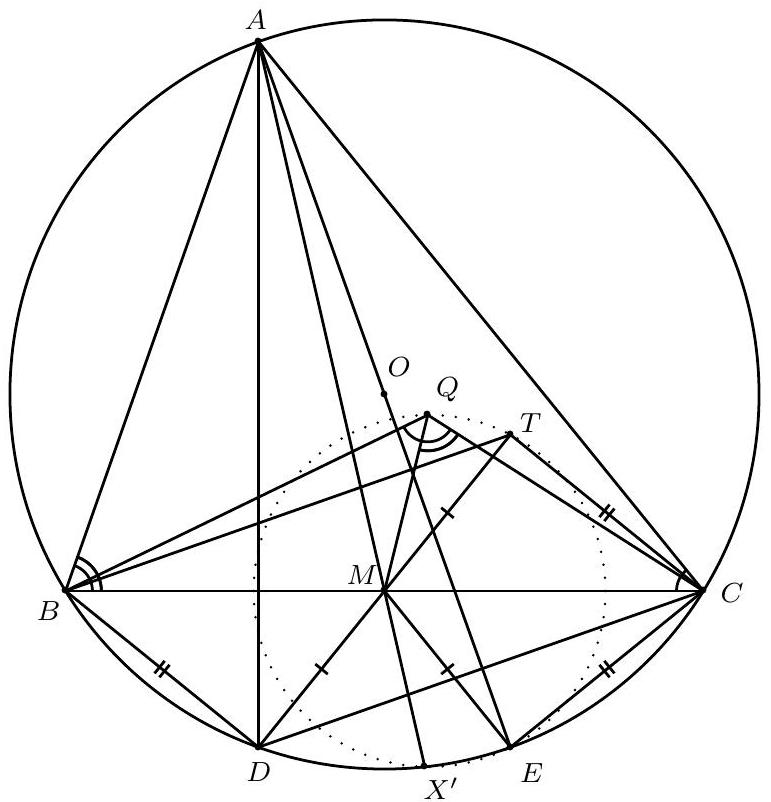
|
| 124 |
+
|
| 125 |
+
Since $B D C T$ is a parallelogram we have $M T=M D$, with $M, D, T$ being collinear, $B D=C T$, and since $B D E C$ is an isosceles trapezoid we have $B D=C E$ and $M E=M D$. Since
|
| 126 |
+
|
| 127 |
+
$$
|
| 128 |
+
\angle B T C=\angle B D C=\angle B E D, \quad C E=B D=C T \quad \text { and } \quad M E=M T
|
| 129 |
+
$$
|
| 130 |
+
|
| 131 |
+
we have that $E$ and $T$ are symmetric with respect to the line $B C$. Now since $Q$ and $X^{\prime}$ are symmetric with respect to the line $B C$ as well, this means that $Q X^{\prime} E T$ is an isosceles trapezoid which means that $Q, X^{\prime}, E, T$ are concyclic. Since $X^{\prime} \in \Gamma$ this means that $X \equiv X^{\prime}$ and therefore $A, M, X$ are collinear.
|
| 132 |
+
|
| 133 |
+
Alternative solution. Denote by $H$ the orthocenter of $\triangle A B C$. We use the following well known properties:
|
| 134 |
+
(i) Point $D$ is the symmetric point of $H$ with respect to $B C$. Indeed, if $H_{1}$ is the symmetric point of $H$ with respect to $B C$ then $\angle B H_{1} C+\angle B A C=180^{\circ}$ and therefore $H_{1} \equiv D$.
|
| 135 |
+
|
| 136 |
+
(ii) The symmetric point of $H$ with respect to $M$ is the point $E$. Indeed, if $H_{2}$ is the symmetric point of $H$ with respect to $M$ then $B H_{2} C H$ is parallelogram, $\angle B H_{2} C+\angle B A C=180^{\circ}$ and since $E B \| C H$ we have $\angle E B A=90^{\circ}$.
|
| 137 |
+
|
| 138 |
+
Since $D E T H$ is a parallelogram and $M H=M D$ we have that $D E T H$ is a rectangle. Therefore $M T=M E$ and $T E \perp B C$ implying that $T$ and $E$ are symmetric with respect to $B C$. Denote by $Q^{\prime}$ the symmetric point of $Q$ with respect to $B C$. Then $Q^{\prime} E T Q$ is isosceles trapezoid, so $Q^{\prime}$ is a point on the circumcircle of $\triangle E T Q$. Moreover $\angle B Q^{\prime} C+\angle B A C=180^{\circ}$ and we conclude that $Q^{\prime} \in \Gamma$. Therefore $Q^{\prime} \equiv X$.
|
| 139 |
+
|
| 140 |
+
It remains to observe that $\angle C X M=\angle C Q M=\angle C B A$ and $\angle C X A=\angle C B A$ and we infer that $X, M$ and $A$ are collinear.
|
| 141 |
+
|
| 142 |
+
Problem 4. Consider a regular $2 n$-gon $P, A_{1} A_{2} \ldots A_{2 n}$ in the plane, where $n$ is a positive integer. We say that a point $S$ on one of the sides of $P$ can be seen from a point $E$ that is external to $P$, if the line segment $S E$ contains no other points that lie on the sides of $P$ except $S$. We color the sides of $P$ in 3 different colors (ignore the vertices of $P$, we consider them colorless), such that every side is colored in exactly one color, and each color is used at least once. Moreover, from every point in the plane external to $P$, points of at most 2 different colors on $P$ can be seen. Find the number of distinct such colorings of $P$ (two colorings are considered distinct if at least one of the sides is colored differently).
|
| 143 |
+
|
| 144 |
+
Solution Answer: For $n=2$, the answer is 36 ; for $n=3$, the answer is 30 and for $n \geq 4$, the answer is $6 n$.
|
| 145 |
+
|
| 146 |
+
Lemma 1. Given a regular $2 n$-gon in the plane and a sequence of $n$ consecutive sides $s_{1}, s_{2}, \ldots, s_{n}$ there is an external point $Q$ in the plane, such that the color of each $s_{i}$ can be seen from $Q$, for $i=1,2, \ldots, n$.
|
| 147 |
+
|
| 148 |
+
Proof. It is obvious that for a semi-circle $S$, there is a point $R$ in the plane far enough on the bisector of its diameter such that almost the entire semi-circle can be seen from $R$.
|
| 149 |
+
|
| 150 |
+
Now, it is clear that looking at the circumscribed circle around the $2 n$-gon, there is a semi-circle $S$ such that each $s_{i}$ either has both endpoints on it, or has an endpoint that's on the semi-circle, and is not on the semi-circle's end. So, take $Q$ to be a point in the plane from which almost all of $S$ can be seen, clearly, the color of each $s_{i}$ can be seen from $Q$.
|
| 151 |
+
|
| 152 |
+
Lemma 2. Given a regular $2 n$-gon in the plane, and a sequence of $n+1$ consecutive sides $s_{1}, s_{2}, \ldots, s_{n+1}$ there is no external point $Q$ in the plane, such that the color of each $s_{i}$ can be seen from $Q$, for $i=1,2, \ldots, n+1$.
|
| 153 |
+
|
| 154 |
+
Proof. Since $s_{1}$ and $s_{n+1}$ are parallel opposite sides of the $2 n$-gon, they cannot be seen at the same time from an external point.
|
| 155 |
+
|
| 156 |
+
For $n=2$, we have a square, so all we have to do is make sure each color is used. Two sides will be of the same color, and we have to choose which are these 2 sides, and then assign colors according to this choice, so the answer is $\binom{4}{2} .3 .2=36$.
|
| 157 |
+
|
| 158 |
+
For $n=3$, we have a hexagon. Denote the sides as $a_{1}, a_{2}, \ldots q_{6}$, in that order. There must be 2 consecutive sides of different colors, say $a_{1}$ is red, $a_{2}$ is blue. We must have a green side, and only $a_{4}$ and $a_{5}$ can be green. We have 3 possibilities:
|
| 159 |
+
|
| 160 |
+
1) $a_{4}$ is green, $a_{5}$ is not. So, $a_{3}$ must be blue and $a_{5}$ must be blue (by elimination) and $a_{6}$ must be blue, so we get a valid coloring.
|
| 161 |
+
2) Both $a_{4}$ and $a_{5}$ are green, thus $a_{6}$ must be red and $a_{5}$ must be blue, and we get the coloring rbbggr.
|
| 162 |
+
3) $a_{5}$ is green, $a_{4}$ is not. Then $a_{6}$ must be red. Subsequently, $a_{4}$ must be red (we assume it is not green). It remains that $a_{3}$ must be red, and the coloring is rbrrgr.
|
| 163 |
+
|
| 164 |
+
Thus, we have 2 kinds of configurations:
|
| 165 |
+
i) 2 opposite sides have 2 opposite colors and all other sides are of the third color. This can happen in 3.(3.2.1) $=18$ ways (first choosing the pair of opposite sides, then assigning colors),
|
| 166 |
+
|
| 167 |
+
ii) 3 pairs of consecutive sides, each pair in one of the 3 colors. This can happen in $2.6=12$ ways (2 partitioning into pairs of consecutive sides, for each partitioning, 6 ways to assign the colors).
|
| 168 |
+
|
| 169 |
+
Thus, for $n=3$, the answer is $18+12=30$.
|
| 170 |
+
|
| 171 |
+
Finally, let's address the case $n \geq 4$. The important thing now is that any 4 consecutive sides can be seen from an external point, by Lemma 1 .
|
| 172 |
+
|
| 173 |
+
Denote the sides as $a_{1}, a_{2}, \ldots, a_{2 n}$. Again, there must be 2 adjacent sides that are of different colors, say $a_{1}$ is blue and $a_{2}$ is red. We must have a green side, and by Lemma 1 , that can only be $a_{n+1}$ or $a_{n+2}$. So, we have 2 cases:
|
| 174 |
+
|
| 175 |
+
Case 1: $a_{n+1}$ is green, so $a_{n}$ must be red (cannot be green due to Lemma 1 applied to $a_{1}, a_{2}, \ldots, a_{n}$, cannot be blue for the sake of $a_{2}, \ldots, a_{n+1}$. If $a_{n+2}$ is red, so are $a_{n+3}, \ldots, a_{2 n}$, and we get a valid coloring: $a_{1}$ is blue, $a_{n+1}$ is green, and all the others are red.
|
| 176 |
+
|
| 177 |
+
If $a_{n+2}$ is green:
|
| 178 |
+
a) $a_{n+3}$ cannot be green, because of $a_{2}, a_{1}, a_{2 n} \ldots, a_{n+3}$.
|
| 179 |
+
b) $a_{n+3}$ cannot be blue, because the 4 adjacent sides $a_{n}, \ldots, a_{n+3}$ can be seen (this is the case that makes the separate treatment of $n \geq 4$ necessary)
|
| 180 |
+
c) $a_{n+3}$ cannot be red, because of $a_{1}, a_{2 n}, \ldots, a_{n+2}$.
|
| 181 |
+
|
| 182 |
+
So, in the case that $a_{n+2}$ is also green, we cannot get a valid coloring.
|
| 183 |
+
|
| 184 |
+
Case 2: $a_{n+2}$ is green is treated the same way as Case 1.
|
| 185 |
+
|
| 186 |
+
This means that the only valid configuration for $n \geq 4$ is having 2 opposite sides colored in 2 different colors, and all other sides colored in the third color. This can be done in $n .3 .2=6 n$ ways.
|
| 187 |
+
|
JBMO/md/en-official/en-jbmo_2018_solutions.md
ADDED
|
@@ -0,0 +1,167 @@
|
|
|
|
|
|
|
|
|
|
|
|
|
|
|
|
|
|
|
|
|
|
|
|
|
|
|
|
|
|
|
|
|
|
|
|
|
|
|
|
|
|
|
|
|
|
|
|
|
|
|
|
|
|
|
|
|
|
|
|
|
|
|
|
|
|
|
|
|
|
|
|
|
|
|
|
|
|
|
|
|
|
|
|
|
|
|
|
|
|
|
|
|
|
|
|
|
|
|
|
|
|
|
|
|
|
|
|
|
|
|
|
|
|
|
|
|
|
|
|
|
|
|
|
|
|
|
|
|
|
|
|
|
|
|
|
|
|
|
|
|
|
|
|
|
|
|
|
|
|
|
|
|
|
|
|
|
|
|
|
|
|
|
|
|
|
|
|
|
|
|
|
|
|
|
|
|
|
|
|
|
|
|
|
|
|
|
|
|
|
|
|
|
|
|
|
|
|
|
|
|
|
|
|
|
|
|
|
|
|
|
|
|
|
|
|
|
|
|
|
|
|
|
|
|
|
|
|
|
|
|
|
|
|
|
|
|
|
|
|
|
|
|
|
|
|
|
|
|
|
|
|
|
|
|
|
|
|
|
|
|
|
|
|
|
|
|
|
|
|
|
|
|
|
|
|
|
|
|
|
|
|
|
|
|
|
|
|
|
|
|
|
|
|
|
|
|
|
|
|
|
|
|
|
|
|
|
|
|
|
|
|
|
|
|
|
|
|
|
|
|
|
|
|
|
|
|
|
|
|
|
|
|
|
|
|
|
|
|
|
|
|
|
|
|
|
|
|
|
|
|
|
|
|
|
|
|
|
|
|
|
|
|
|
|
|
|
|
|
|
|
|
|
|
|
|
|
|
|
|
|
|
|
|
|
|
|
|
|
|
|
|
|
|
|
|
|
|
|
|
|
|
|
|
|
|
|
|
|
|
|
|
|
|
|
|
|
|
|
|
|
|
|
|
|
|
|
|
|
|
|
|
|
|
|
|
|
|
|
|
|
|
|
|
|
|
|
|
|
|
|
|
|
|
|
|
|
|
|
|
|
|
|
|
|
|
|
|
|
|
|
|
|
|
|
|
|
|
|
|
|
|
|
|
|
|
|
|
|
|
|
|
|
|
|
|
|
|
|
|
|
|
|
|
|
| 1 |
+

|
| 2 |
+
|
| 3 |
+
# 22nd Junior Balkan Mathematical Olympiad Rhodes 19-24 J une 2018
|
| 4 |
+
|
| 5 |
+
## Solutions
|
| 6 |
+
|
| 7 |
+
Problem 1. Find all the pairs $(m, n)$ of integers which satisfy the equation
|
| 8 |
+
|
| 9 |
+
$$
|
| 10 |
+
m^{5}-n^{5}=16 m n
|
| 11 |
+
$$
|
| 12 |
+
|
| 13 |
+
Solution. If one of $m, n$ is 0 , the other has to be 0 too, and $(m, n)=(0,0)$ is one solution. If $m n \neq 0$, let $d=\operatorname{gcd}(m, n)$ and we write $m=d a, n=d b, a, b \in \mathbb{Z}$ with $(a, b)=1$. Then, the given equation is transformed into
|
| 14 |
+
|
| 15 |
+
$$
|
| 16 |
+
d^{3} a^{5}-d^{3} b^{5}=16 a b
|
| 17 |
+
$$
|
| 18 |
+
|
| 19 |
+
So, by the above equation, we conclude that $a \mid d^{3} b^{5}$ and thus $a \mid d^{3}$. Similarly $b \mid d^{3}$. Since $(a, b)=1$, we get that $a b \mid d^{3}$, so we can write $d^{3}=a b r$ with $r \in \mathbb{Z}$. Then, equation (1) becomes
|
| 20 |
+
|
| 21 |
+
$$
|
| 22 |
+
\begin{aligned}
|
| 23 |
+
a b r a^{5}-a b r b^{5} & =16 a b \Rightarrow \\
|
| 24 |
+
r\left(a^{5}-b^{5}\right) & =16
|
| 25 |
+
\end{aligned}
|
| 26 |
+
$$
|
| 27 |
+
|
| 28 |
+
Therefore, the difference $a^{5}-b^{5}$ must divide 16. Therefore, the difference $a^{5}-b^{5}$ must divide 16. This means that
|
| 29 |
+
|
| 30 |
+
$$
|
| 31 |
+
a^{5}-b^{5}= \pm 1, \pm 2, \pm 4, \pm 8, \pm 16
|
| 32 |
+
$$
|
| 33 |
+
|
| 34 |
+
The smaller values of $\left|a^{5}-b^{5}\right|$ are 1 or 2 . Indeed, if $\left|a^{5}-b^{5}\right|=1$ then $a= \pm 1$ and $b=0$ or $a=0$ and $b= \pm 1$, a contradiction. If $\left|a^{5}-b^{5}\right|=2$, then $a=1$ and $b=-1$ or $a=-1$ and $b=1$. Then $r=-8$, and $d^{3}=-8$ or $d=-2$. Therefore, $(m, n)=(-2,2)$. If $\left|a^{5}-b^{5}\right|>2$ then, without loss of generality, let $a>b$ and $a \geq 2$. Putting $a=x+1$ with $x \geq 1$, we have
|
| 35 |
+
|
| 36 |
+
$$
|
| 37 |
+
\begin{aligned}
|
| 38 |
+
\left|a^{5}-b^{5}\right| & =\left|(x+1)^{5}-b^{5}\right| \\
|
| 39 |
+
& \geq\left|(x+1)^{5}-x^{5}\right| \\
|
| 40 |
+
& =\left|5 x^{4}+10 x^{3}+10 x^{2}+5 x+1\right| \geq 31
|
| 41 |
+
\end{aligned}
|
| 42 |
+
$$
|
| 43 |
+
|
| 44 |
+
which is impossible. Thus, the only solutions are $(m, n)=(0,0)$ or $(-2,2)$.
|
| 45 |
+
|
| 46 |
+
Problem 2. Let $n$ three-digit numbers satisfy the following properties:
|
| 47 |
+
|
| 48 |
+
(1) No number contains the digit 0 .
|
| 49 |
+
|
| 50 |
+
(2) The sum of the digits of each number is 9 .
|
| 51 |
+
|
| 52 |
+
(3) The units digits of any two numbers are different.
|
| 53 |
+
|
| 54 |
+
(4) The tens digits of any two numbers are different.
|
| 55 |
+
|
| 56 |
+
(5) The hundreds digits of any two numbers are different.
|
| 57 |
+
|
| 58 |
+
Find the largest possible value of $n$.
|
| 59 |
+
|
| 60 |
+
Solution. Let $S$ denote the set of three-digit numbers that have digit sum equal to 9 and no digit equal to 0 . We will first find the cardinality of $S$. We start from the number 111 and each element of $S$ can be obtained from 111 by a string of 6 A's (which means that we add 1 to the current digit) and $2 G$ 's (which means go to the next digit). Then for example 324 can be obtained from 111 by the string AAGAGAAA. There are in total
|
| 61 |
+
|
| 62 |
+
$$
|
| 63 |
+
\frac{8!}{6!\cdot 2!}=28
|
| 64 |
+
$$
|
| 65 |
+
|
| 66 |
+
such words, so $S$ contains 28 numbers. Now, from the conditions (3), (4), (5), if $\overline{a b c}$ is in $T$ then each of the other numbers of the form $\overline{* c}$ cannot be in $T$, neither $\overline{* *}$ can be, nor $\overline{a * *}$. Since there are $a+b-2$ numbers of the first category, $a+c-2$ from the second and $b+c-2$ from the third one. In these three categories there are
|
| 67 |
+
|
| 68 |
+
$$
|
| 69 |
+
(a+b-2)+(b+c-2)+(c+a-2)=2(a+b+c)-6=2 \cdot 9-6=12
|
| 70 |
+
$$
|
| 71 |
+
|
| 72 |
+
distinct numbers that cannot be in $T$ if $\overline{a b c}$ is in $T$. So, if $T$ has $n$ numbers, then $12 n$ are the forbidden ones that are in $S$, but each number from $S$ can be a forbidden number no more than three times, once for each of its digits, so
|
| 73 |
+
|
| 74 |
+
$$
|
| 75 |
+
n+\frac{12 n}{3} \leq 28 \Longleftrightarrow n \leq \frac{28}{5}
|
| 76 |
+
$$
|
| 77 |
+
|
| 78 |
+
and since $n$ is an integer, we get $n \leq 5$. A possible example for $n=5$ is
|
| 79 |
+
|
| 80 |
+
$$
|
| 81 |
+
T=\{144,252,315,423,531\}
|
| 82 |
+
$$
|
| 83 |
+
|
| 84 |
+
Comment by PSC. It is classical to compute the cardinality of $S$ and this can be done in many ways. In general, the number of solutions of the equation
|
| 85 |
+
|
| 86 |
+
$$
|
| 87 |
+
x_{1}+x_{2}+\cdots+x_{k}=n
|
| 88 |
+
$$
|
| 89 |
+
|
| 90 |
+
in positive integers, where the order of $x_{i}$ matters, is well known that equals to $\binom{n-1}{k-1}$. In our case, we want to count the number of positive solutions to $a+b+c=9$. By the above, this equals to $\binom{9-1}{3-1}=28$. Using the general result above, we can also find that there are $a+b-2$ numbers of the form $\overline{* c}$.
|
| 91 |
+
|
| 92 |
+
Problem 3. Let $k>1$ be a positive integer and $n>2018$ be an odd positive integer. The nonzero rational numbers $x_{1}, x_{2}, \ldots, x_{n}$ are not all equal and satisfy
|
| 93 |
+
|
| 94 |
+
$$
|
| 95 |
+
x_{1}+\frac{k}{x_{2}}=x_{2}+\frac{k}{x_{3}}=x_{3}+\frac{k}{x_{4}}=\cdots=x_{n-1}+\frac{k}{x_{n}}=x_{n}+\frac{k}{x_{1}}
|
| 96 |
+
$$
|
| 97 |
+
|
| 98 |
+
Find:
|
| 99 |
+
|
| 100 |
+
a) the product $x_{1} x_{2} \ldots x_{n}$ as a function of $k$ and $n$
|
| 101 |
+
|
| 102 |
+
b) the least value of $k$, such that there exist $n, x_{1}, x_{2}, \ldots, x_{n}$ satisfying the given conditions.
|
| 103 |
+
|
| 104 |
+
a) If $x_{i}=x_{i+1}$ for some $i$ (assuming $x_{n+1}=x_{1}$ ), then by the given identity all $x_{i}$ will be equal, a contradiction. Thus $x_{1} \neq x_{2}$ and
|
| 105 |
+
|
| 106 |
+
$$
|
| 107 |
+
x_{1}-x_{2}=k \frac{x_{2}-x_{3}}{x_{2} x_{3}}
|
| 108 |
+
$$
|
| 109 |
+
|
| 110 |
+
Analogously
|
| 111 |
+
|
| 112 |
+
$$
|
| 113 |
+
x_{1}-x_{2}=k \frac{x_{2}-x_{3}}{x_{2} x_{3}}=k^{2} \frac{x_{3}-x_{4}}{\left(x_{2} x_{3}\right)\left(x_{3} x_{4}\right)}=\cdots=k^{n} \frac{x_{1}-x_{2}}{\left(x_{2} x_{3}\right)\left(x_{3} x_{4}\right) \ldots\left(x_{1} x_{2}\right)}
|
| 114 |
+
$$
|
| 115 |
+
|
| 116 |
+
Since $x_{1} \neq x_{2}$ we get
|
| 117 |
+
|
| 118 |
+
$$
|
| 119 |
+
x_{1} x_{2} \ldots x_{n}= \pm \sqrt{k^{n}}= \pm k^{\frac{n-1}{2}} \sqrt{k}
|
| 120 |
+
$$
|
| 121 |
+
|
| 122 |
+
If one among these two values, positive or negative, is obtained, then the other one will be also obtained by changing the sign of all $x_{i}$ since $n$ is odd.
|
| 123 |
+
|
| 124 |
+
b) From the above result, as $n$ is odd, we conclude that $k$ is a perfect square, so $k \geq 4$. For $k=4$ let $n=2019$ and $x_{3 j}=4, x_{3 j-1}=1, x_{3 j-2}=-2$ for $j=1,2, \ldots, 673$. So the required least value is $k=4$.
|
| 125 |
+
|
| 126 |
+
Comment by PSC. There are many ways to construct the example when $k=4$ and $n=2019$. Since 3 | 2019, the idea is to find three numbers $x_{1}, x_{2}, x_{3}$ satisfying the given equations, not all equal, and repeat them as values for the rest of the $x_{i}$ 's. So, we want to find $x_{1}, x_{2}, x_{3}$ such that
|
| 127 |
+
|
| 128 |
+
$$
|
| 129 |
+
x_{1}+\frac{4}{x_{2}}=x_{2}+\frac{4}{x_{3}}=x_{3}+\frac{4}{x_{1}}
|
| 130 |
+
$$
|
| 131 |
+
|
| 132 |
+
As above, $x_{1} x_{2} x_{3}= \pm 8$. Suppose without loss of generality that $x_{1} x_{2} x_{3}=-8$. Then, solving the above system we see that if $x_{1} \neq 2$, then
|
| 133 |
+
|
| 134 |
+
$$
|
| 135 |
+
x_{2}=-\frac{4}{x_{1}-2} \quad \text { and } \quad x_{3}=2-\frac{4}{x_{1}}
|
| 136 |
+
$$
|
| 137 |
+
|
| 138 |
+
leading to infinitely many solutions. The example in the official solution is obtained by choosing $x_{1}=-2$.
|
| 139 |
+
|
| 140 |
+
Problem 4. Let $A B C$ be an acute triangle, $A^{\prime}, B^{\prime}$ and $C^{\prime}$ be the reflections of the vertices $A, B$ and $C$ with respect to $B C, C A$, and $A B$, respectively, and let the circumcircles of triangles $A B B^{\prime}$ and $A C C^{\prime}$ meet again at $A_{1}$. Points $B_{1}$ and $C_{1}$ are defined similarly. Prove that the lines $A A_{1}, B B_{1}$ and $C C_{1}$ have a common point.
|
| 141 |
+
|
| 142 |
+
Solution. Let $O_{1}, O_{2}$ and $O$ be the circumcenters of triangles $A B B^{\prime}, A C C^{\prime}$ and $A B C$ respectively. As $A B$ is the perpendicular bisector of the line segment $C C^{\prime}, O_{2}$ is the intersection of the perpendicular bisector of $A C$ with $A B$. Similarly, $O_{1}$ is the intersection of the perpendicular bisector of $A B$ with $A C$. It follows that $O$ is the orthocenter of triangle $A O_{1} O_{2}$. This means that $A O$ is perpendicular to $O_{1} O_{2}$. On the other hand, the segment $A A_{1}$ is the common chord of the two circles, thus it is perpendicular to $O_{1} O_{2}$. As a result, $A A_{1}$ passes through $O$. Similarly, $B B_{1}$ and $C C_{1}$ pass through $O$, so the three lines are concurrent at $O$.
|
| 143 |
+
|
| 144 |
+
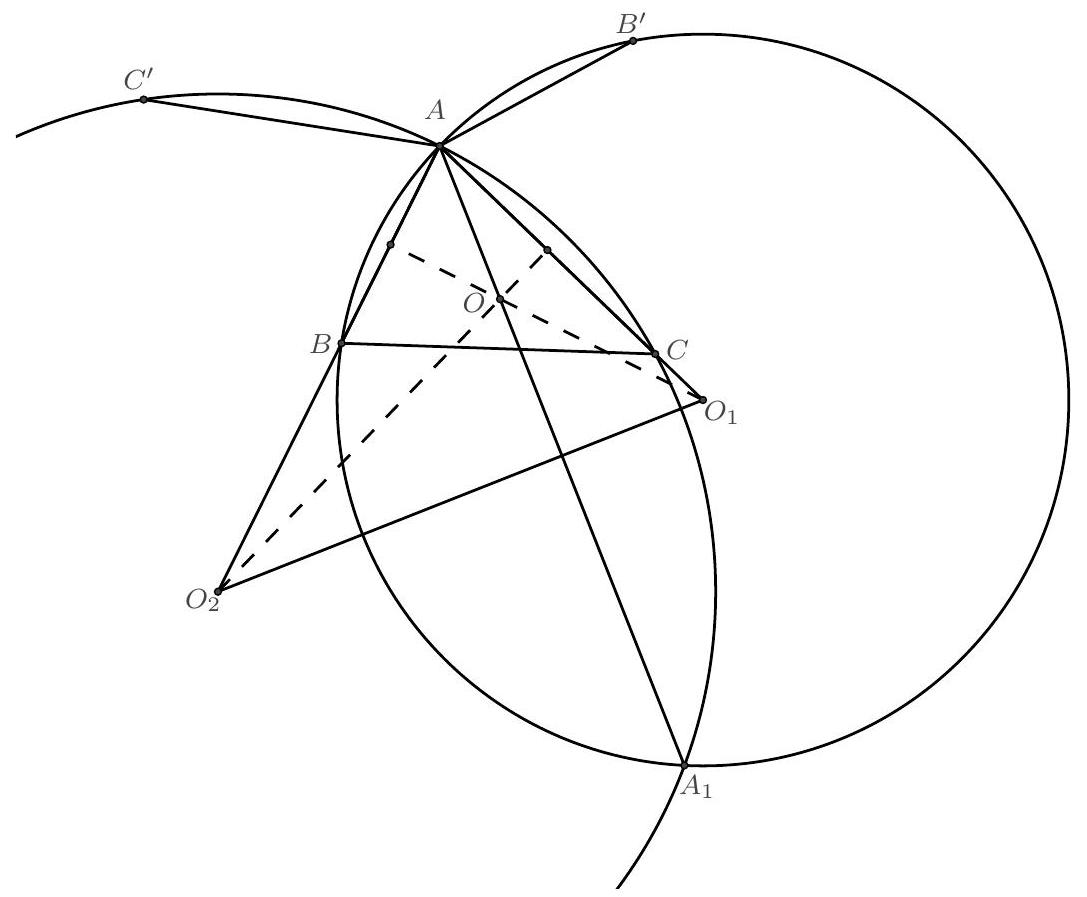
|
| 145 |
+
|
| 146 |
+
Comment by PSC. We present here a different approach.
|
| 147 |
+
|
| 148 |
+
We first prove that $A_{1}, B$ and $C^{\prime}$ are collinear. Indeed, since $\angle B A B^{\prime}=\angle C A C^{\prime}=2 \angle B A C$, then from the circles $\left(A B B^{\prime}\right),\left(A C C^{\prime}\right)$ we get
|
| 149 |
+
|
| 150 |
+
$$
|
| 151 |
+
\angle A A_{1} B=\frac{\angle B A_{1} B^{\prime}}{2}=\frac{180^{\circ}-\angle B A B^{\prime}}{2}=90^{\circ}-\angle B A C=\angle A A_{1} C^{\prime}
|
| 152 |
+
$$
|
| 153 |
+
|
| 154 |
+
It follows that
|
| 155 |
+
|
| 156 |
+
$$
|
| 157 |
+
\angle A_{1} A C=\angle A_{1} C^{\prime} C=\angle B C^{\prime} C=90^{\circ}-\angle A B C
|
| 158 |
+
$$
|
| 159 |
+
|
| 160 |
+
On the other hand, if $O$ is the circumcenter of $A B C$, then
|
| 161 |
+
|
| 162 |
+
$$
|
| 163 |
+
\angle O A C=90^{\circ}-\angle A B C \text {. }
|
| 164 |
+
$$
|
| 165 |
+
|
| 166 |
+
From (1) and (2) we conclude that $A_{1}, A$ and $O$ are collinear. Similarly, $B B_{1}$ and $C C_{1}$ pass through $O$, so the three lines are concurrent in $O$.
|
| 167 |
+
|
JBMO/md/en-official/en-jbmo_2020_solutions.md
ADDED
|
@@ -0,0 +1,248 @@
|
|
|
|
|
|
|
|
|
|
|
|
|
|
|
|
|
|
|
|
|
|
|
|
|
|
|
|
|
|
|
|
|
|
|
|
|
|
|
|
|
|
|
|
|
|
|
|
|
|
|
|
|
|
|
|
|
|
|
|
|
|
|
|
|
|
|
|
|
|
|
|
|
|
|
|
|
|
|
|
|
|
|
|
|
|
|
|
|
|
|
|
|
|
|
|
|
|
|
|
|
|
|
|
|
|
|
|
|
|
|
|
|
|
|
|
|
|
|
|
|
|
|
|
|
|
|
|
|
|
|
|
|
|
|
|
|
|
|
|
|
|
|
|
|
|
|
|
|
|
|
|
|
|
|
|
|
|
|
|
|
|
|
|
|
|
|
|
|
|
|
|
|
|
|
|
|
|
|
|
|
|
|
|
|
|
|
|
|
|
|
|
|
|
|
|
|
|
|
|
|
|
|
|
|
|
|
|
|
|
|
|
|
|
|
|
|
|
|
|
|
|
|
|
|
|
|
|
|
|
|
|
|
|
|
|
|
|
|
|
|
|
|
|
|
|
|
|
|
|
|
|
|
|
|
|
|
|
|
|
|
|
|
|
|
|
|
|
|
|
|
|
|
|
|
|
|
|
|
|
|
|
|
|
|
|
|
|
|
|
|
|
|
|
|
|
|
|
|
|
|
|
|
|
|
|
|
|
|
|
|
|
|
|
|
|
|
|
|
|
|
|
|
|
|
|
|
|
|
|
|
|
|
|
|
|
|
|
|
|
|
|
|
|
|
|
|
|
|
|
|
|
|
|
|
|
|
|
|
|
|
|
|
|
|
|
|
|
|
|
|
|
|
|
|
|
|
|
|
|
|
|
|
|
|
|
|
|
|
|
|
|
|
|
|
|
|
|
|
|
|
|
|
|
|
|
|
|
|
|
|
|
|
|
|
|
|
|
|
|
|
|
|
|
|
|
|
|
|
|
|
|
|
|
|
|
|
|
|
|
|
|
|
|
|
|
|
|
|
|
|
|
|
|
|
|
|
|
|
|
|
|
|
|
|
|
|
|
|
|
|
|
|
|
|
|
|
|
|
|
|
|
|
|
|
|
|
|
|
|
|
|
|
|
|
|
|
|
|
|
|
|
|
|
|
|
|
|
|
|
|
|
|
|
|
|
|
|
|
|
|
|
|
|
|
|
|
|
|
|
|
|
|
|
|
|
|
|
|
|
|
|
|
|
|
|
|
|
|
|
|
|
|
|
|
|
|
|
|
|
|
|
|
|
|
|
|
|
|
|
|
|
|
|
|
|
|
|
|
|
|
|
|
|
|
|
|
|
|
|
|
|
|
|
|
|
|
|
|
|
|
|
|
|
|
|
|
|
|
|
|
|
|
|
|
|
|
|
|
|
|
|
|
|
|
|
|
|
|
|
|
|
|
|
|
|
|
|
|
|
|
|
|
|
|
|
|
|
|
|
|
|
|
|
|
|
|
|
|
|
|
|
|
|
|
|
|
|
|
|
|
|
|
|
|
|
|
|
|
|
|
|
|
|
|
|
|
|
|
|
|
|
|
|
|
|
|
|
|
|
|
|
|
|
|
|
|
|
|
|
|
|
|
|
|
|
|
|
|
|
|
|
|
|
|
|
|
|
|
|
|
|
|
|
|
|
|
|
|
|
|
|
|
|
|
|
|
|
| 1 |
+
Problem 1. Find all triples $(a, b, c)$ of real numbers such that the following system holds:
|
| 2 |
+
|
| 3 |
+
$$
|
| 4 |
+
\left\{\begin{array}{l}
|
| 5 |
+
a+b+c=\frac{1}{a}+\frac{1}{b}+\frac{1}{c} \\
|
| 6 |
+
a^{2}+b^{2}+c^{2}=\frac{1}{a^{2}}+\frac{1}{b^{2}}+\frac{1}{c^{2}}
|
| 7 |
+
\end{array}\right.
|
| 8 |
+
$$
|
| 9 |
+
|
| 10 |
+
Solution. First of all if $(a, b, c)$ is a solution of the system then also $(-a,-b,-c)$ is a solution. Hence we can suppose that $a b c>0$. From the first condition we have
|
| 11 |
+
|
| 12 |
+
$$
|
| 13 |
+
a+b+c=\frac{a b+b c+c a}{a b c}
|
| 14 |
+
$$
|
| 15 |
+
|
| 16 |
+
Now, from the first condition and the second condition we get
|
| 17 |
+
|
| 18 |
+
$$
|
| 19 |
+
(a+b+c)^{2}-\left(a^{2}+b^{2}+c^{2}\right)=\left(\frac{1}{a}+\frac{1}{b}+\frac{1}{c}\right)^{2}-\left(\frac{1}{a^{2}}+\frac{1}{b^{2}}+\frac{1}{c^{2}}\right)
|
| 20 |
+
$$
|
| 21 |
+
|
| 22 |
+
The last one simplifies to
|
| 23 |
+
|
| 24 |
+
$$
|
| 25 |
+
a b+b c+c a=\frac{a+b+c}{a b c}
|
| 26 |
+
$$
|
| 27 |
+
|
| 28 |
+
First we show that $a+b+c$ and $a b+b c+c a$ are different from 0 . Suppose on contrary then from relation (1) or (2) we have $a+b+c=a b+b c+c a=0$. But then we would have
|
| 29 |
+
|
| 30 |
+
$$
|
| 31 |
+
a^{2}+b^{2}+c^{2}=(a+b+c)^{2}-2(a b+b c+c a)=0
|
| 32 |
+
$$
|
| 33 |
+
|
| 34 |
+
which means that $a=b=c=0$. This is not possible since $a, b, c$ should be different from 0 . Now multiplying (1) and (2) we have
|
| 35 |
+
|
| 36 |
+
$$
|
| 37 |
+
(a+b+c)(a b+b c+c a)=\frac{(a+b+c)(a b+b c+c a)}{(a b c)^{2}}
|
| 38 |
+
$$
|
| 39 |
+
|
| 40 |
+
Since $a+b+c$ and $a b+b c+c a$ are different from 0 , we get $(a b c)^{2}=1$ and using the fact that $a b c>0$ we obtain that $a b c=1$. So relations (1) and (2) transform to
|
| 41 |
+
|
| 42 |
+
$$
|
| 43 |
+
a+b+c=a b+b c+c a .
|
| 44 |
+
$$
|
| 45 |
+
|
| 46 |
+
Therefore,
|
| 47 |
+
|
| 48 |
+
$$
|
| 49 |
+
(a-1)(b-1)(c-1)=a b c-a b-b c-c a+a+b+c-1=0 \text {. }
|
| 50 |
+
$$
|
| 51 |
+
|
| 52 |
+
This means that at least one of the numbers $a, b, c$ is equal to 1 . Suppose that $c=1$ then relations (1) and (2) transform to $a+b+1=a b+a+b \Rightarrow a b=1$. Taking $a=t$ then we have $b=\frac{1}{t}$. We can now verify that any triple $(a, b, c)=\left(t, \frac{1}{t}, 1\right)$ satisfies both conditions. $t \in \mathbb{R} \backslash\{0\}$. From the initial observation any triple $(a, b, c)=\left(t, \frac{1}{t},-1\right)$ satisfies both conditions. $t \in \mathbb{R} \backslash\{0\}$. So, all triples that satisfy both conditions are $(a, b, c)=\left(t, \frac{1}{t}, 1\right),\left(t, \frac{1}{t},-1\right)$ and all permutations for any $t \in \mathbb{R} \backslash\{0\}$.
|
| 53 |
+
|
| 54 |
+
Comment by PSC. After finding that $a b c=1$ and
|
| 55 |
+
|
| 56 |
+
$$
|
| 57 |
+
a+b+c=a b+b c+c a
|
| 58 |
+
$$
|
| 59 |
+
|
| 60 |
+
we can avoid the trick considering $(a-1)(b-1)(c-1)$ as follows. By the Vieta's relations we have that $a, b, c$ are roots of the polynomial
|
| 61 |
+
|
| 62 |
+
$$
|
| 63 |
+
P(x)=x^{3}-s x^{2}+s x-1
|
| 64 |
+
$$
|
| 65 |
+
|
| 66 |
+
which has one root equal to 1 . Then, we can conclude as in the above solution.
|
| 67 |
+
|
| 68 |
+
Problem 2. Let $\triangle A B C$ be a right-angled triangle with $\angle B A C=90^{\circ}$ and let $E$ be the foot of the perpendicular from $A$ on $B C$. Let $Z \neq A$ be a point on the line $A B$ with $A B=B Z$. Let (c) be the circumcircle of the triangle $\triangle A E Z$. Let $D$ be the second point of intersection of $(c)$ with $Z C$ and let $F$ be the antidiametric point of $D$ with respect to (c). Let $P$ be the point of intersection of the lines $F E$ and $C Z$. If the tangent to (c) at $Z$ meets $P A$ at $T$, prove that the points $T, E, B, Z$ are concyclic.
|
| 69 |
+
|
| 70 |
+
Solution. We will first show that $P A$ is tangent to $(c)$ at $A$.
|
| 71 |
+
|
| 72 |
+
Since $E, D, Z, A$ are concyclic, then $\angle E D C=\angle E A Z=\angle E A B$. Since also the triangles $\triangle A B C$ and $\triangle E B A$ are similar, then $\angle E A B=\angle B C A$, therefore $\angle E D C=\angle B C A$.
|
| 73 |
+
|
| 74 |
+
Since $\angle F E D=90^{\circ}$, then $\angle P E D=90^{\circ}$ and so
|
| 75 |
+
|
| 76 |
+
$$
|
| 77 |
+
\angle E P D=90^{\circ}-\angle E D C=90^{\circ}-\angle B C A=\angle E A C
|
| 78 |
+
$$
|
| 79 |
+
|
| 80 |
+
Therefore the points $E, A, C, P$ are concyclic. It follows that $\angle C P A=90^{\circ}$ and therefore the triangle $\angle P A Z$ is right-angled. Since also $B$ is the midpoint of $A Z$, then $P B=A B=B Z$ and so $\angle Z P B=$ $\angle P Z B$.
|
| 81 |
+
|
| 82 |
+
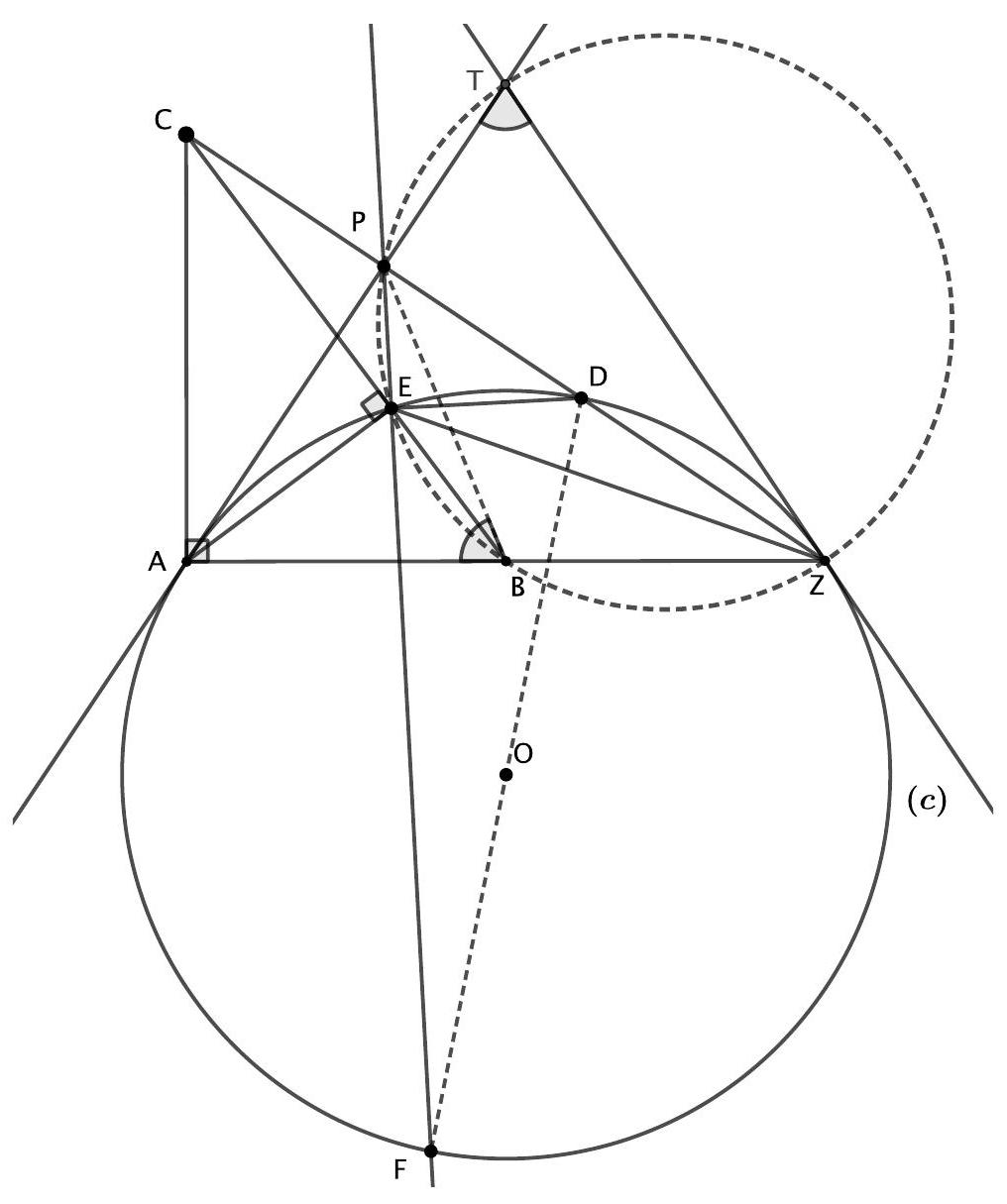
|
| 83 |
+
|
| 84 |
+
Furthermore, $\angle E P D=\angle E A C=\angle C B A=\angle E B A$ from which it follows that the points $P, E, B, Z$ are also concyclic.
|
| 85 |
+
|
| 86 |
+
Now observe that
|
| 87 |
+
|
| 88 |
+
$$
|
| 89 |
+
\angle P A E=\angle P C E=\angle Z P B-\angle P B E=\angle P Z B-\angle P Z E=\angle E Z B
|
| 90 |
+
$$
|
| 91 |
+
|
| 92 |
+
Therefore $P A$ is tangent to $(c)$ at $A$ as claimed.
|
| 93 |
+
|
| 94 |
+
It now follows that $T A=T Z$. Therefore
|
| 95 |
+
|
| 96 |
+
$$
|
| 97 |
+
\begin{aligned}
|
| 98 |
+
\angle P T Z & =180^{\circ}-2(\angle T A B)=180^{\circ}-2(\angle P A E+\angle E A B)=180^{\circ}-2(\angle E C P+\angle A C B) \\
|
| 99 |
+
& =180^{\circ}-2\left(90^{\circ}-\angle P Z B\right)=2(\angle P Z B)=\angle P Z B+\angle B P Z=\angle P B A .
|
| 100 |
+
\end{aligned}
|
| 101 |
+
$$
|
| 102 |
+
|
| 103 |
+
Thus $T, P, B, Z$ are concyclic, and since $P, E, B, Z$ are also concyclic then $T, E, B, Z$ are concyclic as required.
|
| 104 |
+
|
| 105 |
+
Problem 3. Alice and Bob play the following game: Alice picks a set $A=\{1,2, \ldots, n\}$ for some natural number $n \geqslant 2$. Then starting with Bob, they alternatively choose one number from the set $A$, according to the following conditions: initially Bob chooses any number he wants, afterwards the number chosen at each step should be distinct from all the already chosen numbers, and should differ by 1 from an already chosen number. The game ends when all numbers from the set $A$ are chosen. Alice wins if the sum of all of the numbers that she has chosen is composite. Otherwise Bob wins. Decide which player has a winning strategy.
|
| 106 |
+
|
| 107 |
+
Solution. To say that Alice has a winning strategy means that she can find a number $n$ to form the set A, so that she can respond appropriately to all choices of Bob and always get at the end a composite number for the sum of her choices. If such $n$ does not exist, this would mean that Bob has a winning strategy instead.
|
| 108 |
+
|
| 109 |
+
Alice can try first to check the small values of $n$. Indeed, this gives the following winning strategy for her: she initially picks $n=8$ and responds to all possible choices made by Bob as in the list below (in each row the choices of Bob and Alice are given alternatively, starting with Bob):
|
| 110 |
+
|
| 111 |
+
$\begin{array}{llllllll}1 & 2 & 3 & 4 & 5 & 6 & 7 & 8\end{array}$
|
| 112 |
+
|
| 113 |
+
$\begin{array}{llllllll}2 & 3 & 1 & 4 & 5 & 6 & 7 & 8\end{array}$
|
| 114 |
+
|
| 115 |
+
$\begin{array}{llllllll}2 & 3 & 4 & 1 & 5 & 6 & 7 & 8\end{array}$
|
| 116 |
+
|
| 117 |
+
$\begin{array}{llllllll}3 & 2 & 1 & 4 & 5 & 6 & 7 & 8\end{array}$
|
| 118 |
+
|
| 119 |
+
$\begin{array}{llllllll}3 & 2 & 4 & 5 & 1 & 6 & 7 & 8\end{array}$
|
| 120 |
+
|
| 121 |
+
$\begin{array}{llllllll}3 & 2 & 4 & 5 & 6 & 1 & 7 & 8\end{array}$
|
| 122 |
+
|
| 123 |
+
$\begin{array}{llllllll}4 & 5 & 3 & 6 & 2 & 1 & 7 & 8\end{array}$
|
| 124 |
+
|
| 125 |
+
$\begin{array}{llllllll}4 & 5 & 3 & 6 & 7 & 8 & 2 & 1\end{array}$
|
| 126 |
+
|
| 127 |
+
$\begin{array}{llllllll}4 & 5 & 6 & 7 & 3 & 2 & 1 & 8\end{array}$
|
| 128 |
+
|
| 129 |
+
$\begin{array}{llllllll}4 & 5 & 6 & 7 & 3 & 2 & 8 & 1\end{array}$
|
| 130 |
+
|
| 131 |
+
$\begin{array}{llllllll}4 & 5 & 6 & 7 & 8 & 3 & 2 & 1\end{array}$
|
| 132 |
+
|
| 133 |
+
$\begin{array}{llllllll}5 & 4 & 3 & 2 & 1 & 6 & 7 & 8\end{array}$
|
| 134 |
+
|
| 135 |
+
$\begin{array}{llllllll}5 & 4 & 3 & 2 & 6 & 7 & 1 & 8\end{array}$
|
| 136 |
+
|
| 137 |
+
$\begin{array}{llllllll}5 & 4 & 3 & 2 & 6 & 7 & 8 & 1\end{array}$
|
| 138 |
+
|
| 139 |
+
$\begin{array}{llllllll}5 & 4 & 6 & 3 & 2 & 1 & 7 & 8\end{array}$
|
| 140 |
+
|
| 141 |
+
$\begin{array}{llllllll}5 & 4 & 6 & 3 & 7 & 8 & 2 & 1\end{array}$
|
| 142 |
+
|
| 143 |
+
$\begin{array}{llllllll}6 & 7 & 5 & 4 & 3 & 8 & 2 & 1\end{array}$
|
| 144 |
+
|
| 145 |
+
$\begin{array}{llllllll}6 & 7 & 5 & 4 & 8 & 3 & 2 & 1\end{array}$
|
| 146 |
+
|
| 147 |
+
$\begin{array}{llllllll}6 & 7 & 8 & 5 & 4 & 3 & 2 & 1\end{array}$
|
| 148 |
+
|
| 149 |
+
$\begin{array}{llllllll}7 & 6 & 8 & 5 & 4 & 3 & 2 & 1\end{array}$
|
| 150 |
+
|
| 151 |
+
$\begin{array}{llllllll}7 & 6 & 5 & 8 & 4 & 3 & 2 & 1\end{array}$
|
| 152 |
+
|
| 153 |
+
$\begin{array}{llllllll}8 & 7 & 6 & 5 & 4 & 3 & 2 & 1\end{array}$
|
| 154 |
+
|
| 155 |
+
In all cases, Alice's sum is either an even number greater than 2 , or else 15 or 21 , thus Alice always wins.
|
| 156 |
+
|
| 157 |
+
Problem 4. Find all pairs $(p, q)$ of prime numbers such that
|
| 158 |
+
|
| 159 |
+
$$
|
| 160 |
+
1+\frac{p^{q}-q^{p}}{p+q}
|
| 161 |
+
$$
|
| 162 |
+
|
| 163 |
+
is a prime number.
|
| 164 |
+
|
| 165 |
+
Solution. It is clear that $p \neq q$. We set
|
| 166 |
+
|
| 167 |
+
$$
|
| 168 |
+
1+\frac{p^{q}-q^{p}}{p+q}=r
|
| 169 |
+
$$
|
| 170 |
+
|
| 171 |
+
and we have that
|
| 172 |
+
|
| 173 |
+
$$
|
| 174 |
+
p^{q}-q^{p}=(r-1)(p+q)
|
| 175 |
+
$$
|
| 176 |
+
|
| 177 |
+
From Fermat's Little Theorem we have
|
| 178 |
+
|
| 179 |
+
$$
|
| 180 |
+
p^{q}-q^{p} \equiv-q \quad(\bmod p)
|
| 181 |
+
$$
|
| 182 |
+
|
| 183 |
+
Since we also have that
|
| 184 |
+
|
| 185 |
+
$$
|
| 186 |
+
(r-1)(p+q) \equiv-r q-q \quad(\bmod p)
|
| 187 |
+
$$
|
| 188 |
+
|
| 189 |
+
from (3) we get that
|
| 190 |
+
|
| 191 |
+
$$
|
| 192 |
+
r q \equiv 0 \quad(\bmod p) \Rightarrow p \mid q r
|
| 193 |
+
$$
|
| 194 |
+
|
| 195 |
+
hence $p \mid r$, which means that $p=r$. Therefore, (3) takes the form
|
| 196 |
+
|
| 197 |
+
$$
|
| 198 |
+
p^{q}-q^{p}=(p-1)(p+q)
|
| 199 |
+
$$
|
| 200 |
+
|
| 201 |
+
We will prove that $p=2$. Indeed, if $p$ is odd, then from Fermat's Little Theorem we have
|
| 202 |
+
|
| 203 |
+
$$
|
| 204 |
+
p^{q}-q^{p} \equiv p \quad(\bmod q)
|
| 205 |
+
$$
|
| 206 |
+
|
| 207 |
+
and since
|
| 208 |
+
|
| 209 |
+
$$
|
| 210 |
+
(p-1)(p+q) \equiv p(p-1) \quad(\bmod q)
|
| 211 |
+
$$
|
| 212 |
+
|
| 213 |
+
we have
|
| 214 |
+
|
| 215 |
+
$$
|
| 216 |
+
p(p-2) \equiv 0 \quad(\bmod q) \Rightarrow q|p(p-2) \Rightarrow q| p-2 \Rightarrow q \leq p-2<p
|
| 217 |
+
$$
|
| 218 |
+
|
| 219 |
+
Now, from (4) we have
|
| 220 |
+
|
| 221 |
+
$$
|
| 222 |
+
p^{q}-q^{p} \equiv 0 \quad(\bmod p-1) \Rightarrow 1-q^{p} \equiv 0 \quad(\bmod p-1) \Rightarrow q^{p} \equiv 1 \quad(\bmod p-1)
|
| 223 |
+
$$
|
| 224 |
+
|
| 225 |
+
Clearly $\operatorname{gcd}(q, p-1)=1$ and if we set $k=\operatorname{ord}_{p-1}(q)$, it is well-known that $k \mid p$ and $k<p$, therefore $k=1$. It follows that
|
| 226 |
+
|
| 227 |
+
$$
|
| 228 |
+
q \equiv 1 \quad(\bmod p-1) \Rightarrow p-1 \mid q-1 \Rightarrow p-1 \leq q-1 \Rightarrow p \leq q
|
| 229 |
+
$$
|
| 230 |
+
|
| 231 |
+
a contradiction.
|
| 232 |
+
|
| 233 |
+
Therefore, $p=2$ and (4) transforms to
|
| 234 |
+
|
| 235 |
+
$$
|
| 236 |
+
2^{q}=q^{2}+q+2
|
| 237 |
+
$$
|
| 238 |
+
|
| 239 |
+
We can easily check by induction that for every positive integer $n \geq 6$ we have $2^{n}>n^{2}+n+2$. This means that $q \leq 5$ and the only solution is for $q=5$. Hence the only pair which satisfy the condition is $(p, q)=(2,5)$.
|
| 240 |
+
|
| 241 |
+
Comment by the PSC. From the problem condition, we get that $p^{q}$ should be bigger than $q^{p}$, which gives
|
| 242 |
+
|
| 243 |
+
$$
|
| 244 |
+
q \ln p>p \ln q \Longleftrightarrow \frac{\ln p}{p}>\frac{\ln q}{q}
|
| 245 |
+
$$
|
| 246 |
+
|
| 247 |
+
The function $\frac{\ln x}{x}$ is decreasing for $x>e$, thus if $p$ and $q$ are odd primes, we obtain $q>p$.
|
| 248 |
+
|
JBMO/md/en-official/en-jbmo_2023_final_paper_-_with_solutions_1.md
ADDED
|
@@ -0,0 +1,121 @@
|
|
|
|
|
|
|
|
|
|
|
|
|
|
|
|
|
|
|
|
|
|
|
|
|
|
|
|
|
|
|
|
|
|
|
|
|
|
|
|
|
|
|
|
|
|
|
|
|
|
|
|
|
|
|
|
|
|
|
|
|
|
|
|
|
|
|
|
|
|
|
|
|
|
|
|
|
|
|
|
|
|
|
|
|
|
|
|
|
|
|
|
|
|
|
|
|
|
|
|
|
|
|
|
|
|
|
|
|
|
|
|
|
|
|
|
|
|
|
|
|
|
|
|
|
|
|
|
|
|
|
|
|
|
|
|
|
|
|
|
|
|
|
|
|
|
|
|
|
|
|
|
|
|
|
|
|
|
|
|
|
|
|
|
|
|
|
|
|
|
|
|
|
|
|
|
|
|
|
|
|
|
|
|
|
|
|
|
|
|
|
|
|
|
|
|
|
|
|
|
|
|
|
|
|
|
|
|
|
|
|
|
|
|
|
|
|
|
|
|
|
|
|
|
|
|
|
|
|
|
|
|
|
|
|
|
|
|
|
|
|
|
|
|
|
|
|
|
|
|
|
|
|
|
|
|
|
|
|
|
|
|
|
|
|
|
|
|
|
|
|
|
|
|
|
|
|
|
|
|
|
|
|
|
|
|
|
|
|
|
|
|
|
|
|
|
|
|
|
|
|
|
|
|
|
|
|
|
|
|
|
|
|
|
|
|
|
|
|
|
|
|
|
|
|
|
|
|
|
|
|
|
|
|
|
|
|
|
|
|
|
|
|
|
|
|
|
|
|
|
|
|
|
|
|
|
|
|
|
|
|
|
|
|
|
|
|
| 1 |
+
# The $27^{r d}$ Balkan Mathematical Olympiad Tirana, June 25, 2023
|
| 2 |
+
|
| 3 |
+
## Problem 1.
|
| 4 |
+
|
| 5 |
+
Find all pairs $(a, b)$ of positive integers such that $a!+b$ and $b!+a$ are both powers of 5 .
|
| 6 |
+
|
| 7 |
+
Solution. The condition is symmetric so we can assume that $b \leq a$.
|
| 8 |
+
|
| 9 |
+
The first case is when $a=b$. In this case, $a!+a=5^{m}$ for some positive integer $m$. We can rewrite this as $a \cdot((a-1)!+1)=5^{m}$. This means that $a=5^{k}$ for some integer $k \geq 0$. It is clear that $k$ cannot be 0 . If $k \geq 2$, then $(a-1)!+1=5^{l}$ for some $l \geq 1$, but $a-1=5^{k}-1>5$, so $5 \mid(a-1)$ !, which is not possible because $5 \mid(a-1)!+1$. This means that $k=1$ and $a=5$. In this case, $5!+5=125$, which gives us the solution $(5,5)$.
|
| 10 |
+
|
| 11 |
+
Let us now assume that $1 \leq b<a$. Let us first assume that $b=1$. Then $a+1=5^{x}$ and $a!+1=5^{y}$ for integers $x, y \geq 1$. If $x \geq 2$, then $a=5^{x}-1 \geq 5^{2}-1>5$, so $5 \mid a$ !. However, $5 \mid 5^{y}=a!+1$, which leads to a contradiction. We conclude that $x=1$ and $a=4$. From here $a!+b=25$ and $b!+a=5$, so we get two more solutions: $(1,4)$ and $(4,1)$.
|
| 12 |
+
|
| 13 |
+
Now we focus on the case $1<b<a$. Then we have $a!+b=5^{x}$ for $x \geq 2$, so $b \cdot\left(\frac{a!}{b}+1\right)=5^{x}$, where $b \mid a$ ! because $a>b$. Because $b \mid 5^{x}$ and $b>1$, we have $b=5^{z}$ for $z \geq 1$. If $z \geq 2$, then $5<b<a$, so $5 \mid a$ !, which means that $\frac{a!}{b}+1$ cannot be a power of 5 . We conclude that $z=1$ and $b=5$. From here $5!+a$ is a power of 5 , so $5 \mid a$, but $a>b=5$, which gives us $a \geq 10$. However, this would mean that $25|a!, 5| b$ and $25 \nmid b$, which is not possible, because $a!+b=5^{x}$ and $25 \mid 5^{x}$.
|
| 14 |
+
|
| 15 |
+
We conclude that the only solutions are $(1,4),(4,1)$ and $(5,5)$.
|
| 16 |
+
|
| 17 |
+
## Problem 2.
|
| 18 |
+
|
| 19 |
+
Prove that for all non-negative real numbers $x, y, z$, not all equal to 0 , the following inequality holds
|
| 20 |
+
|
| 21 |
+
$$
|
| 22 |
+
\frac{2 x^{2}-x+y+z}{x+y^{2}+z^{2}}+\frac{2 y^{2}+x-y+z}{x^{2}+y+z^{2}}+\frac{2 z^{2}+x+y-z}{x^{2}+y^{2}+z} \geqslant 3
|
| 23 |
+
$$
|
| 24 |
+
|
| 25 |
+
Determine all the triples $(x, y, z)$ for which the equality holds.
|
| 26 |
+
|
| 27 |
+
Solution. Let us first write the expression $L$ on the left hand side in the following way
|
| 28 |
+
|
| 29 |
+
$$
|
| 30 |
+
\begin{aligned}
|
| 31 |
+
L & =\left(\frac{2 x^{2}-x+y+z}{x+y^{2}+z^{2}}+2\right)+\left(\frac{2 y^{2}+x-y+z}{x^{2}+y+z^{2}}+2\right)+\left(\frac{2 z^{2}+x+y-z}{x^{2}+y^{2}+z}+2\right)-6 \\
|
| 32 |
+
& =\left(2 x^{2}+2 y^{2}+2 z^{2}+x+y+z\right)\left(\frac{1}{x+y^{2}+z^{2}}+\frac{1}{x^{2}+y+z^{2}}+\frac{1}{x^{2}+y^{2}+z}\right)-6
|
| 33 |
+
\end{aligned}
|
| 34 |
+
$$
|
| 35 |
+
|
| 36 |
+
If we introduce the notation $A=x+y^{2}+z^{2}, B=x^{2}+y+z^{2}, C=x^{2}+y^{2}+z$, then the previous relation becomes
|
| 37 |
+
|
| 38 |
+
$$
|
| 39 |
+
L=(A+B+C)\left(\frac{1}{A}+\frac{1}{B}+\frac{1}{C}\right)-6
|
| 40 |
+
$$
|
| 41 |
+
|
| 42 |
+
Using the arithmetic-harmonic mean inequality or Cauchy-Schwartz inequality for positive real numbers $A, B, C$, we easily obtain
|
| 43 |
+
|
| 44 |
+
$$
|
| 45 |
+
(A+B+C)\left(\frac{1}{A}+\frac{1}{B}+\frac{1}{C}\right) \geqslant 9
|
| 46 |
+
$$
|
| 47 |
+
|
| 48 |
+
so it holds $L \geqslant 3$.
|
| 49 |
+
|
| 50 |
+
The equality occurs if and only if $A=B=C$, which is equivalent to the system of equations
|
| 51 |
+
|
| 52 |
+
$$
|
| 53 |
+
x^{2}-y^{2}=x-y, \quad y^{2}-z^{2}=y-z, \quad x^{2}-z^{2}=x-z
|
| 54 |
+
$$
|
| 55 |
+
|
| 56 |
+
It follows easily that the only solutions of this system are
|
| 57 |
+
|
| 58 |
+
$(x, y, z) \in\{(t, t, t) \mid t>0\} \cup\{(t, t, 1-t) \mid t \in[0,1]\} \cup\{(t, 1-t, t) \mid t \in[0,1]\} \cup\{(1-t, t, t) \mid t \in[0,1]\}$.
|
| 59 |
+
|
| 60 |
+
PSC Remark We feel the equality case needs more explanations in order to have a complete solution, our suggestion follows:
|
| 61 |
+
|
| 62 |
+
Clearly if $x, y, z$ are all equal and not 0 satisfy the condition. Now suppose that not all of them are equal it means we can't simultaneously have $x+y=y+z=z+x=1$ otherwise we would have all $x, y, z$ equal to $\frac{1}{2}$ which we already discussed. We can suppose now that $x=y$ and $y+z=z+x=1$ where we get $z=1-x$. So, all triples which satisfy the equality are $(x, y, z)=(a, a, a),(b, b, 1-b)$ and all permutations for any $a>0$ and $b \in[0,1]$
|
| 63 |
+
|
| 64 |
+
## Problem 3.
|
| 65 |
+
|
| 66 |
+
Alice and Bob play the following game on a $100 \times 100$ grid, taking turns, with Alice starting first. Initially the grid is empty. At their turn, they choose an integer from 1 to $100^{2}$ that is not written yet in any of the cells and choose an empty cell, and place it in the chosen cell. When there is no empty cell left, Alice computes the sum of the numbers in each row, and her score is the maximum of these 100 sums. Bob computes the sum of the numbers in each column, and his score is the maximum of these 100 sums. Alice wins if her score is greater than Bob's score, Bob wins if his score is greater than Alice's score, otherwise no one wins.
|
| 67 |
+
|
| 68 |
+
Find if one of the players has a winning strategy, and if so which player has a winning strategy.
|
| 69 |
+
|
| 70 |
+
Solution. We denote by $(i, j)$ the cell in the $i$-th line and in the $j$-th column for every $1 \leq i, j \leq n$. Bob associates the following pair of cells : $(i, 2 k+1),(i, 2 k+2)$ for $1 \leq i \leq 100$ and $0 \leq k \leq 49$ except for $(i, k)=(100,0)$ and $(100,1)$, and the pairs $(100,1),(100,3)$ and $(100,2),(100,4)$.
|
| 71 |
+
|
| 72 |
+
Each time Alice writes the number $j$ in one of the cell, Bob writes the number $100^{2}+1-j$ in the other cell of the pair.
|
| 73 |
+
|
| 74 |
+
One can prove by induction that after each of Bob's turn, for each pair of cell, either there is a number written in each of the cell of the pair, or in neither of them. And that if a number $j$ is written, $100^{2}+1-j$ is also written. Thus Bob can always apply the previous strategy (since $j=100^{2}+1-j$ is impossible).
|
| 75 |
+
|
| 76 |
+
At the end, every line has sum $\left(100^{2}+1\right) \times 50$.
|
| 77 |
+
|
| 78 |
+
Assume by contradiction that Alice can stop Bob from winning if he applies this strategy. Let $c_{j}$ be the sum of the number in the $j$-th column for $1 \leq j \leq 100$ : then $c_{j} \leq 50\left(100^{2}+1\right)$. Note that :
|
| 79 |
+
|
| 80 |
+
$$
|
| 81 |
+
100 \times 50\left(100^{2}+1\right) \geq c_{1}+\cdots+c_{100}=1+\cdots+100^{2}=\frac{100^{2}\left(100^{2}+1\right)}{2}=100 \times 50\left(100^{2}+1\right)
|
| 82 |
+
$$
|
| 83 |
+
|
| 84 |
+
Thus we have equality in the previous inequality : $c_{1}=\cdots=c_{100}=50\left(100^{2}+1\right)$. But if $a$ is the number written in the case $(100,1)$ and $b$ the number written in the case $(100,2)$, then $c_{1}-b+c_{2}-c=99\left(100^{2}+1\right)$. Thus $b+c=100\left(100^{2}+1\right)-99\left(100^{2}+1\right)=100^{2}+1$ : by hypothesis $c$ is also written in the cell $(100,3)$ which is a contradiction.
|
| 85 |
+
|
| 86 |
+
Thus Bob has a winning strategy
|
| 87 |
+
|
| 88 |
+
## Problem 4.
|
| 89 |
+
|
| 90 |
+
Let $A B C$ be an acute triangle with circumcenter $O$. Let $D$ be the foot of the altitude from $A$ to $B C$ and let $M$ be the midpoint of $O D$. The points $O_{b}$ and $O_{c}$ are the circumcenters of triangles $A O C$ and $A O B$, respectively. If $A O=A D$, prove that the points $A, O_{b}, M$ and $O_{c}$ are concyclic.
|
| 91 |
+
|
| 92 |
+
## Solution.
|
| 93 |
+
|
| 94 |
+
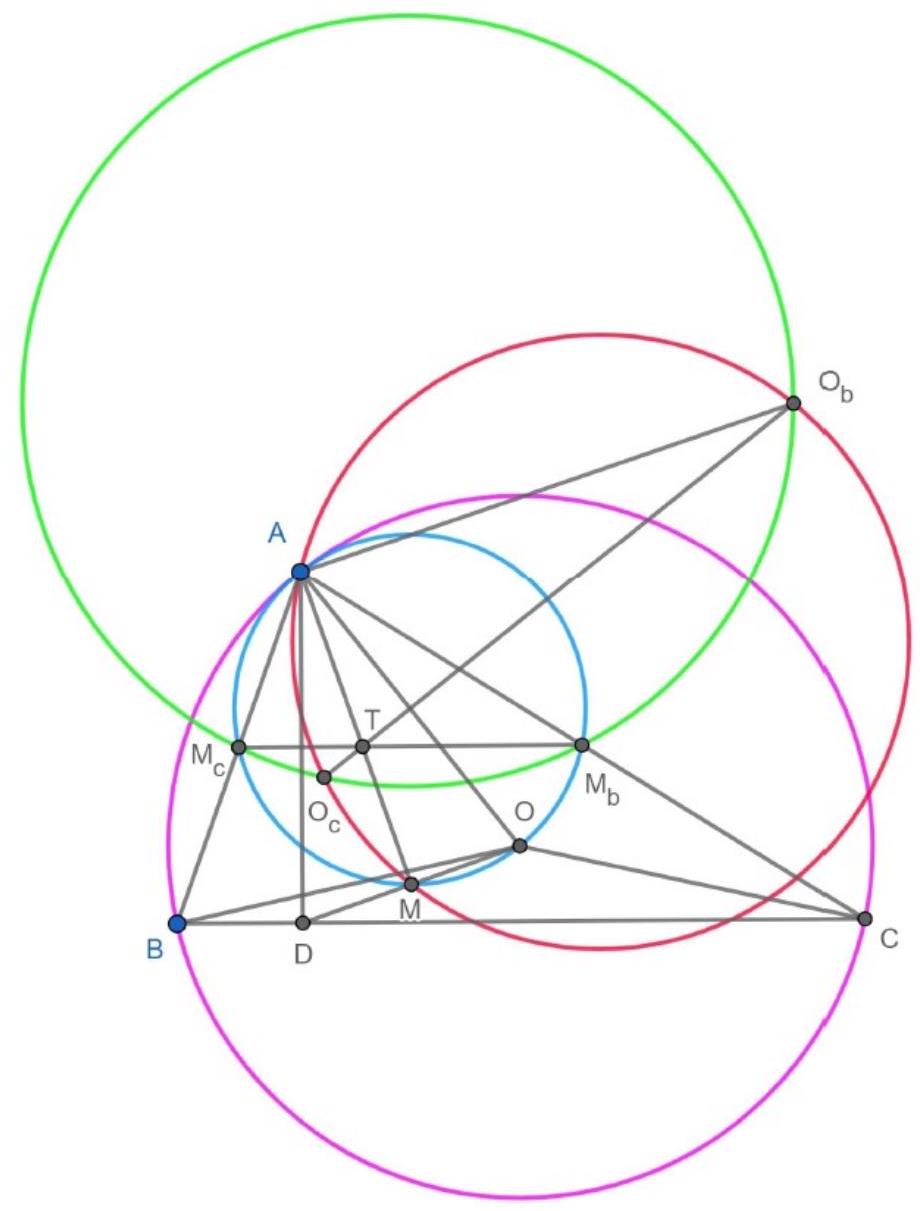
|
| 95 |
+
|
| 96 |
+
Note that $A B=A C$ cannot hold since $A O=A D$ would imply that $O$ is the midpoint of $B C$, which is not possible for an acute triangle. So we may assume without loss of generality that $A B<A C$.
|
| 97 |
+
|
| 98 |
+
Let $M_{b}$ and $M_{c}$ be the midpoints of $A C$ and $A B$, respectively. Since $\angle A M_{b} O=\angle A M_{c} O=$ $90^{\circ}=\angle A M O$ (the latter since $A O=A D$ ), the pentagon $A M_{b} O M M_{c}$ is cyclic.
|
| 99 |
+
|
| 100 |
+
Next, notice that $A M$ is the perpendicular bisector of $O D, O_{b} O_{c}$ is the perpendicular bisector of $A O$ and $M_{b} M_{c}$ is the perpendicular bisector of $A D$. Hence these three lines are concurrent - denote their common point by $T$.
|
| 101 |
+
|
| 102 |
+
The quadrilateral $A O_{b} M O_{C}$ is cyclic if and only if $A T \cdot T M=O_{b} T \cdot O_{c} T$. From the cyclic $A M_{b} M M_{c}$ we have $A T \cdot T M=M_{b} T \cdot M_{c} T$. Hence it now suffices to argue $M_{b} T \cdot M_{c} T=O_{b} T \cdot O_{c} T$ - or equivalently, that $M_{b}, M_{c}, O_{b}$ and $O_{c}$ are concyclic.
|
| 103 |
+
|
| 104 |
+
We assume that $\angle A O B<90^{\circ}$ and $\angle A O C>90^{\circ}$ so that $O_{c}$ is in the interior of triangle $A O B$ and $O_{b}$ in external to the triangles $A O C$ (the other cases are analogous and if $\angle A O B=90^{\circ}$ or $\angle A O C=90^{\circ}$, then $M_{b} \equiv O_{b}$ or $M_{c} \equiv O_{c}$ and we are automatically done). We have
|
| 105 |
+
|
| 106 |
+
$$
|
| 107 |
+
\angle M_{c} M_{b} O_{b}=90^{\circ}+\angle A M_{b} M_{c}=90^{\circ}+\angle A C B
|
| 108 |
+
$$
|
| 109 |
+
|
| 110 |
+
as well as (since $O_{c} O_{b}$ is a perpendicular bisector of $A O$ and hence bisects $\angle A O_{C} O$ )
|
| 111 |
+
|
| 112 |
+
$$
|
| 113 |
+
\angle M_{c} O_{c} O_{b}=180^{\circ}-\angle O O_{c} O_{b}=90^{\circ}+\frac{\angle A O_{c} M_{c}}{2}
|
| 114 |
+
$$
|
| 115 |
+
|
| 116 |
+
$$
|
| 117 |
+
=90^{\circ}+\frac{\angle A O_{c} B}{4}=90^{\circ}+\frac{\angle A O B}{2}=90^{\circ}+\angle A C B
|
| 118 |
+
$$
|
| 119 |
+
|
| 120 |
+
and therefore $O_{b} M_{b} O_{c} M_{c}$ is cyclic, as desired.
|
| 121 |
+
|
JBMO/md/en-official/en-optimizedjbmo_2019_problems_and_solutions_english.md
ADDED
|
@@ -0,0 +1,195 @@
|
|
|
|
|
|
|
|
|
|
|
|
|
|
|
|
|
|
|
|
|
|
|
|
|
|
|
|
|
|
|
|
|
|
|
|
|
|
|
|
|
|
|
|
|
|
|
|
|
|
|
|
|
|
|
|
|
|
|
|
|
|
|
|
|
|
|
|
|
|
|
|
|
|
|
|
|
|
|
|
|
|
|
|
|
|
|
|
|
|
|
|
|
|
|
|
|
|
|
|
|
|
|
|
|
|
|
|
|
|
|
|
|
|
|
|
|
|
|
|
|
|
|
|
|
|
|
|
|
|
|
|
|
|
|
|
|
|
|
|
|
|
|
|
|
|
|
|
|
|
|
|
|
|
|
|
|
|
|
|
|
|
|
|
|
|
|
|
|
|
|
|
|
|
|
|
|
|
|
|
|
|
|
|
|
|
|
|
|
|
|
|
|
|
|
|
|
|
|
|
|
|
|
|
|
|
|
|
|
|
|
|
|
|
|
|
|
|
|
|
|
|
|
|
|
|
|
|
|
|
|
|
|
|
|
|
|
|
|
|
|
|
|
|
|
|
|
|
|
|
|
|
|
|
|
|
|
|
|
|
|
|
|
|
|
|
|
|
|
|
|
|
|
|
|
|
|
|
|
|
|
|
|
|
|
|
|
|
|
|
|
|
|
|
|
|
|
|
|
|
|
|
|
|
|
|
|
|
|
|
|
|
|
|
|
|
|
|
|
|
|
|
|
|
|
|
|
|
|
|
|
|
|
|
|
|
|
|
|
|
|
|
|
|
|
|
|
|
|
|
|
|
|
|
|
|
|
|
|
|
|
|
|
|
|
|
|
|
|
|
|
|
|
|
|
|
|
|
|
|
|
|
|
|
|
|
|
|
|
|
|
|
|
|
|
|
|
|
|
|
|
|
|
|
|
|
|
|
|
|
|
|
|
|
|
|
|
|
|
|
|
|
|
|
|
|
|
|
|
|
|
|
|
|
|
|
|
|
|
|
|
|
|
|
|
|
|
|
|
|
|
|
|
|
|
|
|
|
|
|
|
|
|
|
|
|
|
|
|
|
|
|
|
|
|
|
|
|
|
|
|
|
|
|
|
|
|
|
|
|
|
|
|
|
|
|
|
|
|
|
|
|
|
|
|
|
|
|
|
|
|
|
|
|
|
|
|
|
|
|
|
|
|
|
|
|
|
|
|
|
|
|
|
|
|
|
|
|
|
|
|
|
|
|
|
|
|
|
|
|
|
|
|
|
|
|
|
|
|
|
|
|
|
|
|
|
|
|
|
|
|
|
|
|
|
|
|
|
|
|
|
|
|
|
|
|
|
|
|
| 1 |
+
# Problems and Solutions
|
| 2 |
+
|
| 3 |
+
Problem 1. Find all prime numbers $p$ for which there exist positive integers $x, y$ and $z$ such that the number
|
| 4 |
+
|
| 5 |
+
$$
|
| 6 |
+
x^{p}+y^{p}+z^{p}-x-y-z
|
| 7 |
+
$$
|
| 8 |
+
|
| 9 |
+
is a product of exactly three distinct prime numbers.
|
| 10 |
+
|
| 11 |
+
Solution. Let $A=x^{p}+y^{p}+z^{p}-x-y-z$. For $p=2$, we take $x=y=4$ and $z=3$. Then $A=30=2 \cdot 3 \cdot 5$. For $p=3$ we can take $x=3$ and $y=2$ and $z=1$. Then again $A=30=2 \cdot 3 \cdot 5$. For $p=5$ we can take $x=2$ and $y=1$ and $z=1$. Again $A=30=2 \cdot 3 \cdot 5$.
|
| 12 |
+
|
| 13 |
+
Assume now that $p \geqslant 7$. Working modulo 2 and modulo 3 we see that $A$ is divisible by both 2 and 3. Moreover, by Fermat's Little Theorem, we have
|
| 14 |
+
|
| 15 |
+
$$
|
| 16 |
+
x^{p}+y^{p}+z^{p}-x-y-z \equiv x+y+z-x-y-z=0 \bmod p \text {. }
|
| 17 |
+
$$
|
| 18 |
+
|
| 19 |
+
Therefore, by the given condition, we have to solve the equation
|
| 20 |
+
|
| 21 |
+
$$
|
| 22 |
+
x^{p}+y^{p}+z^{p}-x-y-z=6 p
|
| 23 |
+
$$
|
| 24 |
+
|
| 25 |
+
If one of the numbers $x, y$ and $z$ is bigger than or equal to 2 , let's say $x \geqslant 2$, then
|
| 26 |
+
|
| 27 |
+
$$
|
| 28 |
+
6 p \geqslant x^{p}-x=x\left(x^{p-1}-1\right) \geqslant 2\left(2^{p-1}-1\right)=2^{p}-2
|
| 29 |
+
$$
|
| 30 |
+
|
| 31 |
+
It is easy to check by induction that $2^{n}-2>6 n$ for all natural numbers $n \geqslant 6$. This contradiction shows that there are no more values of $p$ which satisfy the required property.
|
| 32 |
+
|
| 33 |
+
Remark. There are a couple of other ways to prove that $2^{p}-2>6 p$ for $p \geqslant 7$. For example, we can use the Binomial Theorem as follows:
|
| 34 |
+
|
| 35 |
+
$$
|
| 36 |
+
2^{p}-2 \geqslant 1+p+\frac{p(p-1)}{2}+\frac{p(p-1)(p-2)}{6}-2 \geqslant 1+p+3 p+5 p-2>6 p
|
| 37 |
+
$$
|
| 38 |
+
|
| 39 |
+
We can also use Bernoulli's Inequality as follows:
|
| 40 |
+
|
| 41 |
+
$$
|
| 42 |
+
2^{p}-2=8(1+1)^{p-3}-2 \geqslant 8(1+(p-3))-2=8 p-18>6 p
|
| 43 |
+
$$
|
| 44 |
+
|
| 45 |
+
The last inequality is true for $p \geqslant 11$. For $p=7$ we can see directly that $2^{p}-2>6 p$.
|
| 46 |
+
|
| 47 |
+
One can also use calculus to show that $f(x)=2^{x}-6 x$ is increasing for $x \geqslant 5$.
|
| 48 |
+
|
| 49 |
+
Problem 2. Let $a, b$ be two distinct real numbers and let $c$ be a positive real number such that
|
| 50 |
+
|
| 51 |
+
$$
|
| 52 |
+
a^{4}-2019 a=b^{4}-2019 b=c .
|
| 53 |
+
$$
|
| 54 |
+
|
| 55 |
+
Prove that $-\sqrt{c}<a b<0$.
|
| 56 |
+
|
| 57 |
+
Solution. Firstly, we see that
|
| 58 |
+
|
| 59 |
+
$$
|
| 60 |
+
2019(a-b)=a^{4}-b^{4}=(a-b)(a+b)\left(a^{2}+b^{2}\right)
|
| 61 |
+
$$
|
| 62 |
+
|
| 63 |
+
Since $a \neq b$, we get $(a+b)\left(a^{2}+b^{2}\right)=2019$, so $a+b \neq 0$. Thus
|
| 64 |
+
|
| 65 |
+
$$
|
| 66 |
+
\begin{aligned}
|
| 67 |
+
2 c & =a^{4}-2019 a+b^{4}-2019 b \\
|
| 68 |
+
& =a^{4}+b^{4}-2019(a+b) \\
|
| 69 |
+
& =a^{4}+b^{4}-(a+b)^{2}\left(a^{2}+b^{2}\right) \\
|
| 70 |
+
& =-2 a b\left(a^{2}+a b+b^{2}\right)
|
| 71 |
+
\end{aligned}
|
| 72 |
+
$$
|
| 73 |
+
|
| 74 |
+
Hence $a b\left(a^{2}+a b+b^{2}\right)=-c<0$. Note that
|
| 75 |
+
|
| 76 |
+
$$
|
| 77 |
+
a^{2}+a b+b^{2}=\frac{1}{2}\left(a^{2}+b^{2}+(a+b)^{2}\right)>0
|
| 78 |
+
$$
|
| 79 |
+
|
| 80 |
+
thus $a b<0$. Finally, $a^{2}+a b+b^{2}=(a+b)^{2}-a b>-a b$ (the equality does not occur since $a+b \neq 0$ ). So
|
| 81 |
+
|
| 82 |
+
$$
|
| 83 |
+
-c=a b\left(a^{2}+a b+b^{2}\right)<-(a b)^{2} \Longrightarrow(a b)^{2}<c \Rightarrow-\sqrt{c}<a b<\sqrt{c}
|
| 84 |
+
$$
|
| 85 |
+
|
| 86 |
+
Therefore, we have $-\sqrt{c}<a b<0$.
|
| 87 |
+
|
| 88 |
+
Remark. We can get $c=-a b\left(a^{2}+a b+b^{2}\right)$ in several other ways. For example using that,
|
| 89 |
+
|
| 90 |
+
$$
|
| 91 |
+
(a-b) c=a\left(b^{4}-2019 b\right)-b\left(a^{4}-2019 a\right)=a b\left(b^{3}-a^{3}\right)=a b(b-a)\left(a^{2}+a b+b^{2}\right)
|
| 92 |
+
$$
|
| 93 |
+
|
| 94 |
+
We can also divide $f(x)=x^{4}-2019 x-c$ by $(x-a)(x-b)$ and look at the constant term of the remainder.
|
| 95 |
+
|
| 96 |
+
Alternative Solution. By Descartes' Rule of Signs, the polynomial $p(x)=x^{4}-2019 x-c$ has exactly one positive root and exactly one negative root. So $a, b$ must be its two real roots. Since one of them is positive and the other is negative, then $a b<0$. Let $r \pm i s$ be the two non-real roots of $p(x)$.
|
| 97 |
+
|
| 98 |
+
By Vieta, we have
|
| 99 |
+
|
| 100 |
+
$$
|
| 101 |
+
\begin{gathered}
|
| 102 |
+
a b\left(r^{2}+s^{2}\right)=-c, \\
|
| 103 |
+
a+b+2 r=0 \\
|
| 104 |
+
a b+2 a r+2 b r+r^{2}+s^{2}=0 .
|
| 105 |
+
\end{gathered}
|
| 106 |
+
$$
|
| 107 |
+
|
| 108 |
+
Using (2) and (3), we have
|
| 109 |
+
|
| 110 |
+
$$
|
| 111 |
+
r^{2}+s^{2}=-2 r(a+b)-a b=(a+b)^{2}-a b \geqslant-a b
|
| 112 |
+
$$
|
| 113 |
+
|
| 114 |
+
If in the last inequality we actually have an equality, then $a+b=0$. Then (2) gives $r=0$ and (3) gives $s^{2}=-a b$. Thus the roots of $p(x)$ are $a,-a, i a,-i a$. This would give that $p(x)=x^{4}+a^{4}$, a contradiction.
|
| 115 |
+
|
| 116 |
+
So the inequality in (4) is strict and now from (1) we get
|
| 117 |
+
|
| 118 |
+
$$
|
| 119 |
+
c=-\left(r^{2}+s^{2}\right) a b>(a b)^{2}
|
| 120 |
+
$$
|
| 121 |
+
|
| 122 |
+
which gives that $a b>-\sqrt{c}$.
|
| 123 |
+
|
| 124 |
+
Remark. One can get that $x^{4}-2019 x-c$ has only two real roots by showing (e.g. by calculus) that it is initially decreasing and then increasing.
|
| 125 |
+
|
| 126 |
+
Also, instead of Vieta one can also proceed by factorising the polynomial as:
|
| 127 |
+
|
| 128 |
+
$$
|
| 129 |
+
x^{4}-2019 x-c=\left(x^{2}-(a+b) x+a b\right)\left(x^{2}+(a+b) x-\frac{c}{a b}\right) .
|
| 130 |
+
$$
|
| 131 |
+
|
| 132 |
+
Since the second quadratic has no real roots, its discriminant is negative which gives that $c>(a b)^{2}$.
|
| 133 |
+
|
| 134 |
+
Problem 3. Triangle $A B C$ is such that $A B<A C$. The perpendicular bisector of side $B C$ intersects lines $A B$ and $A C$ at points $P$ and $Q$, respectively. Let $H$ be the orthocentre of triangle $A B C$, and let $M$ and $N$ be the midpoints of segments $B C$ and $P Q$, respectively. Prove that lines $H M$ and $A N$ meet on the circumcircle of $A B C$.
|
| 135 |
+
|
| 136 |
+
Solution. We have
|
| 137 |
+
|
| 138 |
+
$$
|
| 139 |
+
\angle A P Q=\angle B P M=90^{\circ}-\angle M B P=90^{\circ}-\angle C B A=\angle H C B
|
| 140 |
+
$$
|
| 141 |
+
|
| 142 |
+
and
|
| 143 |
+
|
| 144 |
+
$$
|
| 145 |
+
\angle A Q P=\angle M Q C=90^{\circ}-\angle Q C M=90^{\circ}-\angle A C B=\angle C B H
|
| 146 |
+
$$
|
| 147 |
+
|
| 148 |
+
From these two equalities, we see that the triangles $A P Q$ and $H C B$ are similar. Moreover, since $M$ and $N$ are the midpoints of the segments $B C$ and $P Q$ respectively, then the triangles $A Q N$ and $H B M$ are also similar. Therefore, we have $\angle A N Q=\angle H M B$.
|
| 149 |
+
|
| 150 |
+
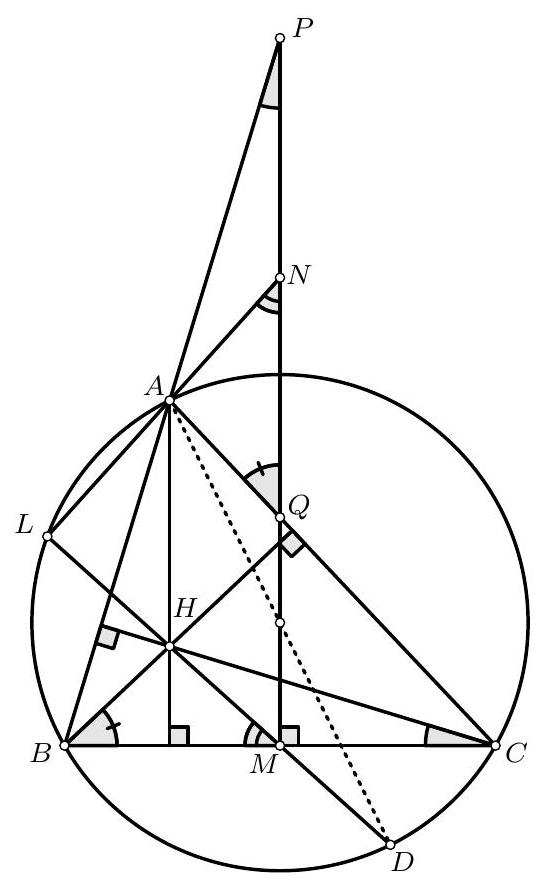
|
| 151 |
+
|
| 152 |
+
Let $L$ be the intersection of $A N$ and $H M$. We have
|
| 153 |
+
|
| 154 |
+
$$
|
| 155 |
+
\angle M L N=180^{\circ}-\angle L N M-\angle N M L=180^{\circ}-\angle L M B-\angle N M L=180^{\circ}-\angle N M B=90^{\circ} .
|
| 156 |
+
$$
|
| 157 |
+
|
| 158 |
+
Now let $D$ be the point on the circumcircle of $A B C$ diametrically oposite to $A$. It is known that $D$ is also the relfection of point $H$ over the point $M$. Therefore, we have that $D$ belongs on $M H$ and that $\angle D L A=\angle M L A=\angle M L N=90^{\circ}$. But, as $D A$ is the diameter of the circumcirle of $A B C$, the condition that $\angle D L A=90^{\circ}$ is enough to conclude that $L$ belongs on the circumcircle of $A B C$.
|
| 159 |
+
|
| 160 |
+
Remark. There is a spiral similarity mapping $A Q P$ to $H B C$. Since the similarity maps $A N$ to $H M$, it also maps $A H$ to $N M$, and since these two lines are parallel, the centre of the similarity is $L=A N \cap H M$. Since the similarity maps $B C$ to $Q P$, its centre belongs on the circumcircle of $B C X$, where $X=B Q \cap P C$. But $X$ is the reflection of $A$ on $Q M$ and so it must belong on the circumcircle of $A B C$. Hence so must $L$.
|
| 161 |
+
|
| 162 |
+
Remark. Students have also submitted correct proofs using radical axes, harmonic quadruples, coordinate geometry and complex numbers.
|
| 163 |
+
|
| 164 |
+
Problem 4. A $5 \times 100$ table is divided into 500 unit square cells, where $n$ of them are coloured black and the rest are coloured white. Two unit square cells are called adjacent if they share a common side. Each of the unit square cells has at most two adjacent black unit square cells. Find the largest possible value of $n$.
|
| 165 |
+
|
| 166 |
+
Solution. If we colour all the cells along all edges of the board together with the entire middle row except the second and the last-but-one cell, the condition is satisfied and there are 302 black cells. The figure below exhibits this colouring for the $5 \times 8$ case.
|
| 167 |
+
|
| 168 |
+
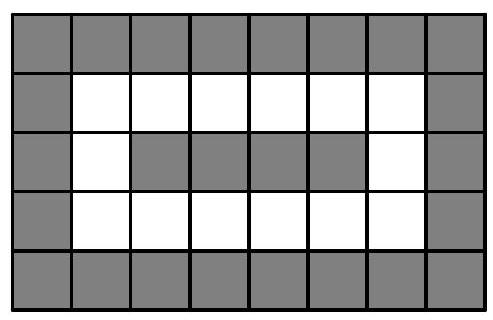
|
| 169 |
+
|
| 170 |
+
We can cover the table by one fragment like the first one on the figure below, 24 fragments like the middle one, and one fragment like the third one.
|
| 171 |
+
|
| 172 |
+
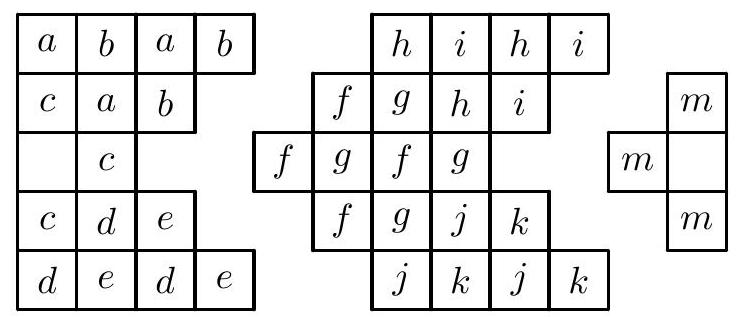
|
| 173 |
+
|
| 174 |
+
In each fragment, among the cells with the same letter, there are at most two coloured black, so the total number of coloured cells is at most $(5+24 \cdot 6+1) \cdot 2+2=302$.
|
| 175 |
+
|
| 176 |
+
Alternative Solution. Consider the cells adjacent to all cells of the second and fourth row. Counting multiplicity, each cell in the first and fifth row is counted once, each cell in the third row twice, while each cell in the second and fourth row is also counted twice apart from their first and last cells which are counted only once.
|
| 177 |
+
|
| 178 |
+
So there are 204 cells counted once and 296 cells counted twice. Those cells contain, counting multiplicity, at most 400 black cells. Suppose $a$ of the cells have multiplicity one and $b$ of them have multiplicity 2 . Then $a+2 b \leqslant 400$ and $a \leqslant 204$. Thus
|
| 179 |
+
|
| 180 |
+
$$
|
| 181 |
+
2 a+2 b \leqslant 400+a \leqslant 604
|
| 182 |
+
$$
|
| 183 |
+
|
| 184 |
+
and so $a+b \leqslant 302$ as required.
|
| 185 |
+
|
| 186 |
+
Remark. The alternative solution shows that if we have equality, then all cells in the perimeter of the table except perhaps the two cells of the third row must be coloured black. No other cell in the second or fourth row can be coloured black as this will give a cell in the first or fifth row with at least three neighbouring black cells. For similar reasons we cannot colour black the second and last-but-one cell of the third row. So we must colour black all other cells of the third row and therefore the colouring is unique.
|
| 187 |
+
|
| 188 |
+
Alternative Solution. Suppose we have $a$ black corner cells, $b$ black side cells, and $c$ black interior cells. Let $N$ be the number of pairs of cells $\left(c_{1}, c_{2}\right)$ such that $c_{1}$ is black and $c_{2}$ is neighbour of $c_{1}$. Then $N=2 a+3 b+4 c$ and $N \leqslant 1000$. Since also $a \leqslant 4$ and $b \leqslant 202$ we get
|
| 189 |
+
|
| 190 |
+
$$
|
| 191 |
+
1000 \geqslant 4(a+b+c)-2 a-b \geqslant 4(a+b+c)-210
|
| 192 |
+
$$
|
| 193 |
+
|
| 194 |
+
giving $a+b+c \leqslant 302.5$.
|
| 195 |
+
|
JBMO/md/en-official/en-solutions-english-jbmo2015.md
ADDED
|
@@ -0,0 +1,175 @@
|
|
|
|
|
|
|
|
|
|
|
|
|
|
|
|
|
|
|
|
|
|
|
|
|
|
|
|
|
|
|
|
|
|
|
|
|
|
|
|
|
|
|
|
|
|
|
|
|
|
|
|
|
|
|
|
|
|
|
|
|
|
|
|
|
|
|
|
|
|
|
|
|
|
|
|
|
|
|
|
|
|
|
|
|
|
|
|
|
|
|
|
|
|
|
|
|
|
|
|
|
|
|
|
|
|
|
|
|
|
|
|
|
|
|
|
|
|
|
|
|
|
|
|
|
|
|
|
|
|
|
|
|
|
|
|
|
|
|
|
|
|
|
|
|
|
|
|
|
|
|
|
|
|
|
|
|
|
|
|
|
|
|
|
|
|
|
|
|
|
|
|
|
|
|
|
|
|
|
|
|
|
|
|
|
|
|
|
|
|
|
|
|
|
|
|
|
|
|
|
|
|
|
|
|
|
|
|
|
|
|
|
|
|
|
|
|
|
|
|
|
|
|
|
|
|
|
|
|
|
|
|
|
|
|
|
|
|
|
|
|
|
|
|
|
|
|
|
|
|
|
|
|
|
|
|
|
|
|
|
|
|
|
|
|
|
|
|
|
|
|
|
|
|
|
|
|
|
|
|
|
|
|
|
|
|
|
|
|
|
|
|
|
|
|
|
|
|
|
|
|
|
|
|
|
|
|
|
|
|
|
|
|
|
|
|
|
|
|
|
|
|
|
|
|
|
|
|
|
|
|
|
|
|
|
|
|
|
|
|
|
|
|
|
|
|
|
|
|
|
|
|
|
|
|
|
|
|
|
|
|
|
|
|
|
|
|
|
|
|
|
|
|
|
|
|
|
|
|
|
|
|
|
|
|
|
|
|
|
|
|
|
|
|
|
|
|
|
|
|
|
|
|
|
|
|
|
|
|
|
|
|
|
|
|
|
|
|
|
|
|
|
|
|
|
|
|
|
|
|
|
|
|
|
|
|
|
|
|
|
|
|
|
|
|
|
|
|
|
|
|
|
|
|
|
|
|
|
|
|
|
|
|
|
|
|
|
|
|
|
|
|
|
|
|
|
|
|
|
|
|
|
|
|
|
|
|
|
|
|
|
|
|
|
|
|
|
|
|
|
|
|
|
|
|
|
|
|
|
|
|
|
|
|
|
|
|
|
|
|
|
|
|
|
|
|
|
|
|
| 1 |
+

|
| 2 |
+
|
| 3 |
+
$19^{\text {th }}$ Junior Balkan Mathematical Olympiad June 24-29, 2015, Belgrade, Serbia
|
| 4 |
+
|
| 5 |
+
Problem 1. Find all prime numbers $a, b, c$ and positive integers $k$ which satisfy the equation
|
| 6 |
+
|
| 7 |
+
$$
|
| 8 |
+
a^{2}+b^{2}+16 \cdot c^{2}=9 \cdot k^{2}+1
|
| 9 |
+
$$
|
| 10 |
+
|
| 11 |
+
# Solution:
|
| 12 |
+
|
| 13 |
+
The relation $9 \cdot k^{2}+1 \equiv 1(\bmod 3)$ implies
|
| 14 |
+
|
| 15 |
+
$$
|
| 16 |
+
a^{2}+b^{2}+16 \cdot c^{2} \equiv 1(\bmod 3) \Leftrightarrow a^{2}+b^{2}+c^{2} \equiv 1(\bmod 3)
|
| 17 |
+
$$
|
| 18 |
+
|
| 19 |
+
Since $a^{2} \equiv 0,1(\bmod 3), \quad b^{2} \equiv 0,1(\bmod 3), c^{2} \equiv 0,1(\bmod 3)$, we have:
|
| 20 |
+
|
| 21 |
+
| $a^{2}$ | 0 | 0 | 0 | 0 | 1 | 1 | 1 | 1 |
|
| 22 |
+
| :---: | :---: | :---: | :---: | :---: | :---: | :---: | :---: | :---: |
|
| 23 |
+
| $b^{2}$ | 0 | 0 | 1 | 1 | 0 | 0 | 1 | 1 |
|
| 24 |
+
| $c^{2}$ | 0 | 1 | 0 | 1 | 0 | 1 | 0 | 1 |
|
| 25 |
+
| $a^{2}+b^{2}+c^{2}$ | 0 | 1 | 1 | 2 | 1 | 2 | 2 | 0 |
|
| 26 |
+
|
| 27 |
+
From the previous table it follows that two of three prime numbers $a, b, c$ are equal to 3 .
|
| 28 |
+
|
| 29 |
+
Case 1. $a=b=3$
|
| 30 |
+
|
| 31 |
+
We have
|
| 32 |
+
|
| 33 |
+
$$
|
| 34 |
+
\begin{aligned}
|
| 35 |
+
& a^{2}+b^{2}+16 \cdot c^{2}=9 \cdot k^{2}+1 \Leftrightarrow 9 \cdot k^{2}-16 \cdot c^{2}=17 \Leftrightarrow(3 k-4 c) \cdot(3 k+4 c)=17, \\
|
| 36 |
+
& \Leftrightarrow\left\{\begin{array} { l }
|
| 37 |
+
{ 3 k - 4 c = 1 , } \\
|
| 38 |
+
{ 3 k + 4 c = 1 7 , }
|
| 39 |
+
\end{array} \Leftrightarrow \left\{\begin{array}{l}
|
| 40 |
+
c=2, \\
|
| 41 |
+
k=3,
|
| 42 |
+
\end{array} \text { and } \quad(a, b, c, k)=(3,3,2,3) .\right.\right.
|
| 43 |
+
\end{aligned}
|
| 44 |
+
$$
|
| 45 |
+
|
| 46 |
+
Case 2. $c=3$
|
| 47 |
+
|
| 48 |
+
If $\left(3, b_{0}, c, k\right)$ is a solution of the given equation, then $\left(b_{0}, 3, c, k\right)$ is a solution too.
|
| 49 |
+
|
| 50 |
+
Let $a=3$. We have
|
| 51 |
+
|
| 52 |
+
$$
|
| 53 |
+
a^{2}+b^{2}+16 \cdot c^{2}=9 \cdot k^{2}+1 \Leftrightarrow 9 \cdot k^{2}-b^{2}=152 \Leftrightarrow(3 k-b) \cdot(3 k+b)=152 .
|
| 54 |
+
$$
|
| 55 |
+
|
| 56 |
+
Both factors shall have the same parity and we obtain only 2 cases:
|
| 57 |
+
|
| 58 |
+
- $\left\{\begin{array}{l}3 k-b=2, \\ 3 k+b=76,\end{array} \Leftrightarrow\left\{\begin{array}{l}b=37, \\ k=13,\end{array}\right.\right.$ and $(a, b, c, k)=(3,37,3,13)$;
|
| 59 |
+
- $\left\{\begin{array}{l}3 k-b=4, \\ 3 k+b=38,\end{array} \Leftrightarrow\left\{\begin{array}{l}b=17, \\ k=7,\end{array}\right.\right.$ and $(a, b, c, k)=(3,17,3,7)$.
|
| 60 |
+
|
| 61 |
+
So, the given equation has 5 solutions:
|
| 62 |
+
|
| 63 |
+
$\{(37,3,3,13),(17,3,3,7),(3,37,3,13),(3,17,3,7),(3,3,2,3)\}$.
|
| 64 |
+
|
| 65 |
+
Problem 2. Let $a, b, c$ be positive real numbers such that $a+b+c=3$. Find the minimum value of the expression
|
| 66 |
+
|
| 67 |
+
$$
|
| 68 |
+
A=\frac{2-a^{3}}{a}+\frac{2-b^{3}}{b}+\frac{2-c^{3}}{c}
|
| 69 |
+
$$
|
| 70 |
+
|
| 71 |
+
|
| 72 |
+
|
| 73 |
+
$19^{\text {th }}$ Junior Balkan Mathematical Olympiad June 24-29, 2015, Belgrade, Serbia
|
| 74 |
+
|
| 75 |
+
## Solution:
|
| 76 |
+
|
| 77 |
+
We can rewrite $A$ as follows:
|
| 78 |
+
|
| 79 |
+
$$
|
| 80 |
+
\begin{aligned}
|
| 81 |
+
& A=\frac{2-a^{3}}{a}+\frac{2-b^{3}}{b}+\frac{2-c^{3}}{c}=2\left(\frac{1}{a}+\frac{1}{b}+\frac{1}{c}\right)-a^{2}-b^{2}-c^{2}= \\
|
| 82 |
+
& 2\left(\frac{a b+b c+c a}{a b c}\right)-\left(a^{2}+b^{2}+c^{2}\right)=2\left(\frac{a b+b c+c a}{a b c}\right)-\left((a+b+c)^{2}-2(a b+b c+c a)\right)= \\
|
| 83 |
+
& 2\left(\frac{a b+b c+c a}{a b c}\right)-(9-2(a b+b c+c a))=2\left(\frac{a b+b c+c a}{a b c}\right)+2(a b+b c+c a)-9= \\
|
| 84 |
+
& 2(a b+b c+c a)\left(\frac{1}{a b c}+1\right)-9
|
| 85 |
+
\end{aligned}
|
| 86 |
+
$$
|
| 87 |
+
|
| 88 |
+
Recall now the well-known inequality $(x+y+z)^{2} \geq 3(x y+y z+z x)$ and set $x=a b, y=b c, z=c a$, to obtain $(a b+b c+c a)^{2} \geq 3 a b c(a+b+c)=9 a b c$, where we have used $a+b+c=3$. By taking the square roots on both sides of the last one we obtain:
|
| 89 |
+
|
| 90 |
+
$$
|
| 91 |
+
a b+b c+c a \geq 3 \sqrt{a b c}
|
| 92 |
+
$$
|
| 93 |
+
|
| 94 |
+
Also by using AM-GM inequality we get that
|
| 95 |
+
|
| 96 |
+
$$
|
| 97 |
+
\frac{1}{a b c}+1 \geq 2 \sqrt{\frac{1}{a b c}}
|
| 98 |
+
$$
|
| 99 |
+
|
| 100 |
+
Multiplication of (1) and (2) gives:
|
| 101 |
+
|
| 102 |
+
$$
|
| 103 |
+
(a b+b c+c a)\left(\frac{1}{a b c}+1\right) \geq 3 \sqrt{a b c} \cdot 2 \sqrt{\frac{1}{a b c}}=6
|
| 104 |
+
$$
|
| 105 |
+
|
| 106 |
+
So $A \geq 2 \cdot 6-9=3$ and the equality holds if and only if $a=b=c=1$, so the minimum value is 3.
|
| 107 |
+
|
| 108 |
+
Problem 3. Let $\triangle A B C$ be an acute triangle. The lines $l_{1}, l_{2}$ are perpendicular to $A B$ at the points $A, B$ respectively. The perpendicular lines from the midpoint $M$ of $A B$ to the sides of the triangle $A C, B C$ intersect the lines $l_{1}, l_{2}$ at the points $E, F$, respectively. If $D$ is the intersection point of $E F$ and $M C$, prove that
|
| 109 |
+
|
| 110 |
+
$$
|
| 111 |
+
\angle A D B=\angle E M F
|
| 112 |
+
$$
|
| 113 |
+
|
| 114 |
+
## Solution:
|
| 115 |
+
|
| 116 |
+
Let $H, G$ be the points of intersection of $M E, M F$ with $A C, B C$ respectively. From the similarity of triangles $\triangle M H A$ and $\triangle M A E$ we get $\frac{M H}{M A}=\frac{M A}{M E}$, thus
|
| 117 |
+
|
| 118 |
+
$$
|
| 119 |
+
M A^{2}=M H \cdot M E
|
| 120 |
+
$$
|
| 121 |
+
|
| 122 |
+
Similarly, from the similarity of triangles $\triangle M B G$ and $\triangle M F B$ we get $\frac{M B}{M F}=\frac{M G}{M B}$, thus
|
| 123 |
+
|
| 124 |
+
$$
|
| 125 |
+
M B^{2}=M F \cdot M G
|
| 126 |
+
$$
|
| 127 |
+
|
| 128 |
+
Since $M A=M B$, from (1), (2), we conclude that the points $E, H, G, F$ are concyclic.
|
| 129 |
+
|
| 130 |
+
|
| 131 |
+
Therefore, we get that $\angle F E H=\angle F E M=\angle H G M$. Also, the quadrilateral $C H M G$ is cyclic, so $\angle C M H=\angle H G C$. We have
|
| 132 |
+
|
| 133 |
+
$$
|
| 134 |
+
\angle F E H+\angle C M H=\angle H G M+\angle H G C=90^{\circ}
|
| 135 |
+
$$
|
| 136 |
+
|
| 137 |
+
thus $C M \perp E F$. Now, from the cyclic quadrilaterals $F D M B$ and $E A M D$, we get that $\angle D F M=\angle D B M$ and $\angle D E M=\angle D A M$. Therefore, the triangles $\triangle E M F$ and $\triangle A D B$ are similar, so $\angle A D B=\angle E M F$.
|
| 138 |
+
|
| 139 |
+
## Problem 4.
|
| 140 |
+
|
| 141 |
+
An $L$-figure is one of the following four pieces, each consisting of three unit squares:
|
| 142 |
+
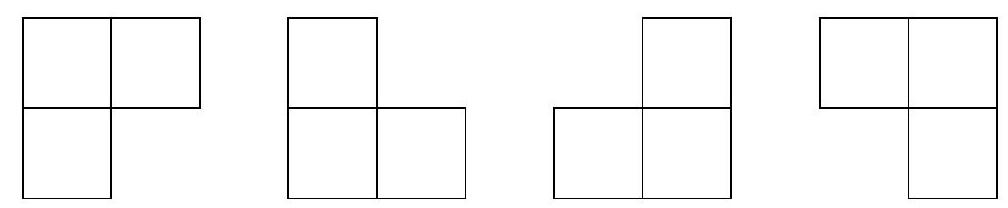
|
| 143 |
+
|
| 144 |
+
A $5 \times 5$ board, consisting of 25 unit squares, a positive integer $k \leq 25$ and an unlimited supply $L$-figures are given. Two players, $\boldsymbol{A}$ and $\boldsymbol{B}$, play the following game: starting with $\boldsymbol{A}$ they alternatively mark a previously unmarked unit square until they marked a total of $k$ unit squares.
|
| 145 |
+
|
| 146 |
+
We say that a placement of $L$-figures on unmarked unit squares is called good if the $L$-figure do not overlap and each of them covers exactly three unmarked unit squares of the board. $\boldsymbol{B}$ wins if every $\boldsymbol{g o o d}$ placement of $L$-figures leaves uncovered at least three unmarked unit squares. Determine the minimum value of $k$ for which $\boldsymbol{B}$ has a winning strategy.
|
| 147 |
+
|
| 148 |
+
## Solution:
|
| 149 |
+
|
| 150 |
+
We will show that player $\boldsymbol{A}$ wins if $k=1,2,3$, but player $\boldsymbol{B}$ wins if $k=4$. Thus the smallest $k$ for which $\boldsymbol{B}$ has a winning strategy exists and is equal to 4 .
|
| 151 |
+
|
| 152 |
+
If $k=1$, player $\boldsymbol{A}$ marks the upper left corner of the square and then fills it as follows.
|
| 153 |
+
|
| 154 |
+
|
| 155 |
+
|
| 156 |
+
## $19^{\text {th }}$ Junior Balkan Mathematical Olympiad
|
| 157 |
+
|
| 158 |
+
June 24-29, 2015, Belgrade, Serbia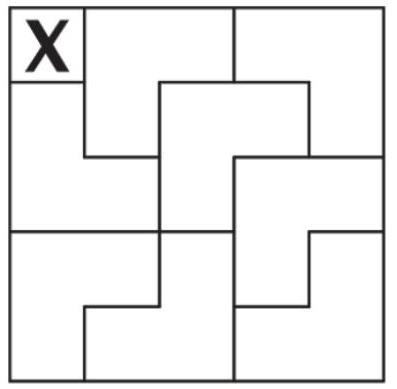
|
| 159 |
+
|
| 160 |
+
If $k=2$, player $\boldsymbol{A}$ marks the upper left corner of the square. Whatever square player $\boldsymbol{B}$ marks, then player $\boldsymbol{A}$ can fill in the square in exactly the same pattern as above except that he doesn't put the $L$-figure which covers the marked square of $\boldsymbol{B}$. Player $\boldsymbol{A}$ wins because he has left only two unmarked squares uncovered.
|
| 161 |
+
|
| 162 |
+
For $k=3$, player $\boldsymbol{A}$ wins by following the same strategy. When he has to mark a square for the second time, he marks any yet unmarked square of the $L$-figure that covers the marked square of $\boldsymbol{B}$.
|
| 163 |
+
|
| 164 |
+
Let us now show that for $k=4$ player $\boldsymbol{B}$ has a winning strategy. Since there will be 21 unmarked squares, player $\boldsymbol{A}$ will need to cover all of them with seven $L$-figures. We can assume that in his first move, player $\boldsymbol{A}$ does not mark any square in the bottom two rows of the chessboard (otherwise just rotate the chessboard). In his first move player $\boldsymbol{B}$ marks the square labeled 1 in the following figure.
|
| 165 |
+
|
| 166 |
+
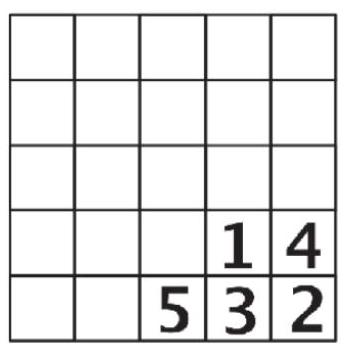
|
| 167 |
+
|
| 168 |
+
If player $\boldsymbol{A}$ in his next move does not mark any of the squares labeled 2,3 and 4 then player $\boldsymbol{B}$ marks the square labeled 3 . Player $\boldsymbol{B}$ wins as the square labeled 2 is left unmarked but cannot be covered with an $L$-figure.
|
| 169 |
+
|
| 170 |
+
If player $\boldsymbol{A}$ in his next move marks the square labeled 2, then player $\boldsymbol{B}$ marks the square labeled 5. Player $\boldsymbol{B}$ wins as the square labeled 3 is left unmarked but cannot be covered with an $L$-figure.
|
| 171 |
+
|
| 172 |
+
Finally, if player $\boldsymbol{A}$ in his next move marks one of the squares labeled 3 or 4, player $\boldsymbol{B}$ marks the other of these two squares. Player $\boldsymbol{B}$ wins as the square labeled 2 is left unmarked but cannot be covered with an $L$-figure.
|
| 173 |
+
|
| 174 |
+
Since we have covered all possible cases, player $\boldsymbol{B}$ wins when $k=4$.
|
| 175 |
+
|
JBMO/md/en-official/en-solutions_en-jbmo2014.md
ADDED
|
@@ -0,0 +1,181 @@
|
|
|
|
|
|
|
|
|
|
|
|
|
|
|
|
|
|
|
|
|
|
|
|
|
|
|
|
|
|
|
|
|
|
|
|
|
|
|
|
|
|
|
|
|
|
|
|
|
|
|
|
|
|
|
|
|
|
|
|
|
|
|
|
|
|
|
|
|
|
|
|
|
|
|
|
|
|
|
|
|
|
|
|
|
|
|
|
|
|
|
|
|
|
|
|
|
|
|
|
|
|
|
|
|
|
|
|
|
|
|
|
|
|
|
|
|
|
|
|
|
|
|
|
|
|
|
|
|
|
|
|
|
|
|
|
|
|
|
|
|
|
|
|
|
|
|
|
|
|
|
|
|
|
|
|
|
|
|
|
|
|
|
|
|
|
|
|
|
|
|
|
|
|
|
|
|
|
|
|
|
|
|
|
|
|
|
|
|
|
|
|
|
|
|
|
|
|
|
|
|
|
|
|
|
|
|
|
|
|
|
|
|
|
|
|
|
|
|
|
|
|
|
|
|
|
|
|
|
|
|
|
|
|
|
|
|
|
|
|
|
|
|
|
|
|
|
|
|
|
|
|
|
|
|
|
|
|
|
|
|
|
|
|
|
|
|
|
|
|
|
|
|
|
|
|
|
|
|
|
|
|
|
|
|
|
|
|
|
|
|
|
|
|
|
|
|
|
|
|
|
|
|
|
|
|
|
|
|
|
|
|
|
|
|
|
|
|
|
|
|
|
|
|
|
|
|
|
|
|
|
|
|
|
|
|
|
|
|
|
|
|
|
|
|
|
|
|
|
|
|
|
|
|
|
|
|
|
|
|
|
|
|
|
|
|
|
|
|
|
|
|
|
|
|
|
|
|
|
|
|
|
|
|
|
|
|
|
|
|
|
|
|
|
|
|
|
|
|
|
|
|
|
|
|
|
|
|
|
|
|
|
|
|
|
|
|
|
|
|
|
|
|
|
|
|
|
|
|
|
|
|
|
|
|
|
|
|
|
|
|
|
|
|
|
|
|
|
|
|
|
|
|
|
|
|
|
|
|
|
|
|
|
|
|
|
|
|
|
|
|
|
|
|
|
|
|
|
|
|
|
|
|
|
|
|
|
|
|
|
|
|
|
|
|
|
|
|
|
|
|
|
|
|
|
|
|
|
|
|
|
|
|
|
|
|
|
|
|
|
|
|
|
|
|
|
|
|
|
|
|
|
|
|
|
|
|
|
|
|
|
|
|
|
|
|
|
| 1 |
+
# Problems and Solutions, JBMO 2014
|
| 2 |
+
|
| 3 |
+
Problem 1. Find all distinct prime numbers $p, q$ and $r$ such that
|
| 4 |
+
|
| 5 |
+
$$
|
| 6 |
+
3 p^{4}-5 q^{4}-4 r^{2}=26
|
| 7 |
+
$$
|
| 8 |
+
|
| 9 |
+
Solution. First notice that if both primes $q$ and $r$ differ from 3 , then $q^{2} \equiv r^{2} \equiv 1(\bmod 3)$, hence the left hand side of the given equation is congruent to zero modulo 3 , which is impossible since 26 is not divisible by 3 . Thus, $q=3$ or $r=3$. We consider two cases.
|
| 10 |
+
|
| 11 |
+
Case 1. $q=3$.
|
| 12 |
+
|
| 13 |
+
The equation reduces to $3 p^{4}-4 r^{2}=431$
|
| 14 |
+
|
| 15 |
+
If $p \neq 5, \quad$ by Fermat's little theorem, $\quad p^{4} \equiv 1(\bmod 5)$, which yields $3-4 r^{2} \equiv 1(\bmod 5), \quad$ or equivalently, $\quad r^{2}+2 \equiv 0(\bmod 5)$. The last congruence is impossible in view of the fact that a residue of a square of a positive integer belongs to the set $\{0,1,4\}$. Therefore $p=5$ and $r=19$.
|
| 16 |
+
|
| 17 |
+
Case 2. $r=3$.
|
| 18 |
+
|
| 19 |
+
The equation becomes $3 p^{4}-5 q^{4}=62$
|
| 20 |
+
|
| 21 |
+
Obviously $p \neq 5$. Hence, Fermat's little theorem gives $p^{4} \equiv 1(\bmod 5)$. But then $5 q^{4} \equiv 1(\bmod 5)$, which is impossible .
|
| 22 |
+
|
| 23 |
+
Hence, the only solution of the given equation is $p=5, q=3, r=19$.
|
| 24 |
+
|
| 25 |
+
Problem 2. Consider an acute triangle $A B C$ with area S. Let $C D \perp A B \quad(D \in A B)$, $D M \perp A C \quad(M \in A C)$ and $\quad D N \perp B C \quad(N \in B C)$. Denote by $H_{1}$ and $H_{2}$ the orthocentres of the triangles $M N C$ and $M N D$ respectively. Find the area of the quadrilateral $\mathrm{AH}_{1} \mathrm{BH}_{2}$ in terms of $S$.
|
| 26 |
+
|
| 27 |
+
Solution 1. Let $O, P, K, R$ and $T$ be the mid-points of the segments $C D, M N$, $C N, C H_{1}$ and $M H_{1}$, respectively. From $\triangle M N C$ we have that $\overline{P K}=\frac{1}{2} \overline{M C}$ and $P K \| M C$. Analogously, from $\Delta M H_{1} C$ we have that $\overline{T R}=\frac{1}{2} \overline{M C}$ and $T R \| M C$. Consequently, $\overline{P K}=\overline{T R}$ and $P K \| T R$. Also $O K \| D N \quad$ (from
|
| 28 |
+
|
| 29 |
+
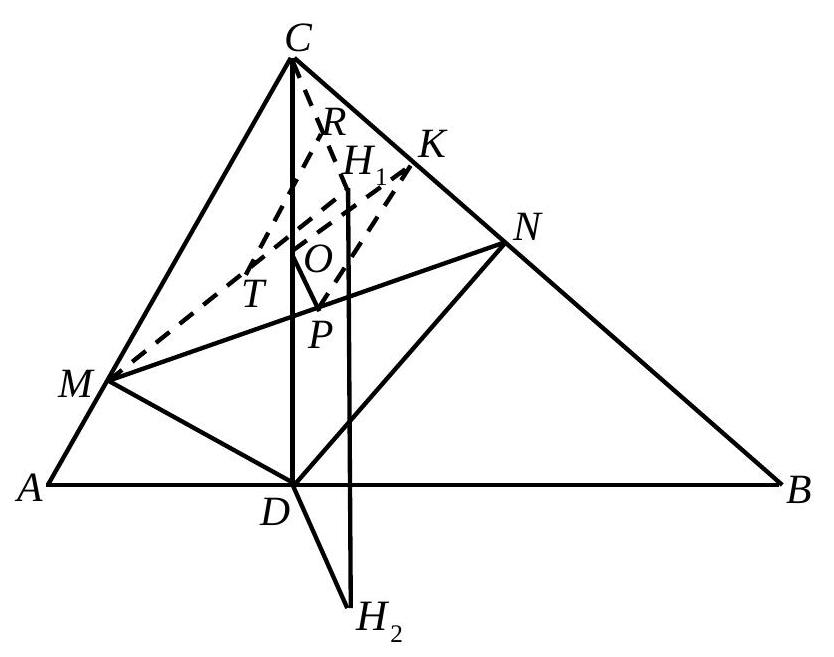
|
| 30 |
+
|
| 31 |
+
$\triangle C D N$ ) and since $D N \perp B C$ and $M H_{1} \perp B C$, it follows that $T H_{1} \| O K$. Since $O$ is the circumcenter of $\triangle C M N, O P \perp M N$. Thus, $C H_{1} \perp M N$ implies $O P \| C H_{1}$. We conclude $\triangle T R H_{1} \cong \triangle K P O \quad$ (they have parallel sides and $\overline{T R}=\overline{P K}$ ), hence $\overline{R H_{1}}=\overline{P O}$, i.e. $\overline{C H_{1}}=2 \overline{P O}$ and $C H_{1} \| P O$.
|
| 32 |
+
|
| 33 |
+
Analogously, $\overline{D H_{2}}=2 \overline{P O} \quad$ and $\quad D H_{2} \| P O$. From $\quad \overline{C H_{1}}=2 \overline{P O}=\overline{D H_{2}} \quad$ and $C H_{1}\|P O\| D H_{2}$ the quadrilateral $C H_{1} H_{2} D$ is a parallelogram, thus $\overline{H_{1} H_{2}}=\overline{C D}$ and $H_{1} H_{2} \| C D$. Therefore the area of the quadrilateral $A H_{1} B H_{2}$ is $\frac{\overline{A B} \cdot \overline{H_{1} H_{2}}}{2}=\frac{\overline{A B} \cdot \overline{C D}}{2}=S$.
|
| 34 |
+
|
| 35 |
+
Solution 2. Since $M H_{1} \| D N$ and $N H_{1} \| D M, M D N H_{1}$ is a parallelogram. Similarly, $N H_{2} \| C M$ and $M H_{2} \| C N$ imply $M C N H_{2}$ is a parallelogram . Let $P$ be the midpoint of the segment $\overline{M N}$. Then $\sigma_{P}(D)=H_{1}$ and $\sigma_{P}(C)=H_{2}$, thus $C D \| H_{1} H_{2}$ and $\overline{C D}=\overline{H_{1} H_{2}}$. From $C D \perp A B$ we deduce $A_{A H_{1} B H_{2}}=\frac{1}{2} \overline{A B} \cdot \overline{C D}=S$.
|
| 36 |
+
|
| 37 |
+
Problem 3. Let $a, b, c$ be positive real numbers such that $a b c=1$. Prove that
|
| 38 |
+
|
| 39 |
+
$$
|
| 40 |
+
\left(a+\frac{1}{b}\right)^{2}+\left(b+\frac{1}{c}\right)^{2}+\left(c+\frac{1}{a}\right)^{2} \geq 3(a+b+c+1)
|
| 41 |
+
$$
|
| 42 |
+
|
| 43 |
+
When does equality hold?
|
| 44 |
+
|
| 45 |
+
Solution 1. By using AM-GM $\left(x^{2}+y^{2}+z^{2} \geq x y+y z+z x\right)$ we have
|
| 46 |
+
|
| 47 |
+
$$
|
| 48 |
+
\begin{aligned}
|
| 49 |
+
\left(a+\frac{1}{b}\right)^{2}+\left(b+\frac{1}{c}\right)^{2}+\left(c+\frac{1}{a}\right)^{2} & \geq\left(a+\frac{1}{b}\right)\left(b+\frac{1}{c}\right)+\left(b+\frac{1}{c}\right)\left(c+\frac{1}{a}\right)+\left(c+\frac{1}{a}\right)\left(a+\frac{1}{b}\right) \\
|
| 50 |
+
& =\left(a b+1+\frac{a}{c}+a\right)+\left(b c+1+\frac{b}{a}+b\right)+\left(c a+1+\frac{c}{b}+c\right) \\
|
| 51 |
+
& =a b+b c+c a+\frac{a}{c}+\frac{c}{b}+\frac{b}{a}+3+a+b+c
|
| 52 |
+
\end{aligned}
|
| 53 |
+
$$
|
| 54 |
+
|
| 55 |
+
Notice that by AM-GM we have $a b+\frac{b}{a} \geq 2 b, b c+\frac{c}{b} \geq 2 c$, and $c a+\frac{a}{c} \geq 2 a$.
|
| 56 |
+
|
| 57 |
+
Thus ,
|
| 58 |
+
|
| 59 |
+
$\left(a+\frac{1}{b}\right)^{2}+\left(b+\frac{1}{c}\right)^{2}+\left(c+\frac{1}{a}\right)^{2} \geq\left(a b+\frac{b}{a}\right)+\left(b c+\frac{c}{b}\right)+\left(c a+\frac{a}{c}\right)+3+a+b+c \geq 3(a+b+c+1)$.
|
| 60 |
+
|
| 61 |
+
The equality holds if and only if $a=b=c=1$.
|
| 62 |
+
|
| 63 |
+
Solution 2. From QM-AM we obtain
|
| 64 |
+
|
| 65 |
+
$$
|
| 66 |
+
\begin{gathered}
|
| 67 |
+
\sqrt{\frac{\left(a+\frac{1}{b}\right)^{2}+\left(b+\frac{1}{c}\right)^{2}+\left(c+\frac{1}{a}\right)^{2}}{3}} \geq \frac{a+\frac{1}{b}+b+\frac{1}{c}+c+\frac{1}{a}}{3} \Leftrightarrow \\
|
| 68 |
+
\left(a+\frac{1}{b}\right)^{2}+\left(b+\frac{1}{c}\right)^{2}+\left(c+\frac{1}{a}\right)^{2}
|
| 69 |
+
\end{gathered} \Leftrightarrow \frac{\left(a+\frac{1}{b}+b+\frac{1}{c}+c+\frac{1}{a}\right)^{2}}{3}(1)
|
| 70 |
+
$$
|
| 71 |
+
|
| 72 |
+
From AM-GM we have $\frac{1}{a}+\frac{1}{b}+\frac{1}{c} \geq 3 \sqrt[3]{\frac{1}{a b c}}=3$, and substituting in (1) we get
|
| 73 |
+
|
| 74 |
+
$$
|
| 75 |
+
\begin{aligned}
|
| 76 |
+
& \left(a+\frac{1}{b}\right)^{2}+\left(b+\frac{1}{c}\right)^{2}+\left(c+\frac{1}{a}\right)^{2} \geq \frac{\left(a+\frac{1}{b}+b+\frac{1}{c}+c+\frac{1}{a}\right)^{2}}{3} \geq \frac{(a+b+c+3)^{2}}{3}= \\
|
| 77 |
+
& =\frac{(a+b+c)(a+b+c)+6(a+b+c)+9}{3} \geq \frac{(a+b+c) 3 \sqrt[3]{a b c}+6(a+b+c)+9}{3}= \\
|
| 78 |
+
& =\frac{9(a+b+c)+9}{3}=3(a+b+c+1) .
|
| 79 |
+
\end{aligned}
|
| 80 |
+
$$
|
| 81 |
+
|
| 82 |
+
The equality holds if and only if $a=b=c=1$.
|
| 83 |
+
|
| 84 |
+
## Solution 3.
|
| 85 |
+
|
| 86 |
+
By using $x^{2}+y^{2}+z^{2} \geq x y+y z+z x$
|
| 87 |
+
|
| 88 |
+
$$
|
| 89 |
+
\begin{aligned}
|
| 90 |
+
& \left(a+\frac{1}{b}\right)^{2}+\left(b+\frac{1}{c}\right)^{2}+\left(c+\frac{1}{a}\right)^{2}=a^{2}+b^{2}+c^{2}+\frac{1}{b^{2}}+\frac{1}{c^{2}}+\frac{1}{a^{2}}+\frac{2 a}{b}+\frac{2 b}{c}+\frac{2 c}{a} \geq \\
|
| 91 |
+
& \geq a b+a c+b c+\frac{1}{b c}+\frac{1}{c a}+\frac{1}{a b}+\frac{2 a}{b}+\frac{2 b}{c}+\frac{2 c}{a}
|
| 92 |
+
\end{aligned}
|
| 93 |
+
$$
|
| 94 |
+
|
| 95 |
+
Clearly
|
| 96 |
+
|
| 97 |
+
$$
|
| 98 |
+
\begin{gathered}
|
| 99 |
+
\frac{1}{b c}+\frac{1}{c a}+\frac{1}{a b}=\frac{a b c}{b c}+\frac{a b c}{c a}+\frac{a b c}{a b}=a+b+c \\
|
| 100 |
+
a b+\frac{a}{b}+b c+\frac{b}{c}+c a+\frac{c}{a} \geq 2 a+2 b+2 c \\
|
| 101 |
+
\frac{a}{b}+\frac{b}{c}+\frac{c}{a} \geq 3 \sqrt[3]{\frac{a}{b} \cdot \frac{b}{c} \cdot \frac{c}{a}}=3
|
| 102 |
+
\end{gathered}
|
| 103 |
+
$$
|
| 104 |
+
|
| 105 |
+
Hence
|
| 106 |
+
|
| 107 |
+
$$
|
| 108 |
+
\begin{aligned}
|
| 109 |
+
& \left(a+\frac{1}{b}\right)^{2}+\left(b+\frac{1}{c}\right)^{2}+\left(c+\frac{1}{a}\right)^{2} \geq\left(a b+\frac{a}{b}\right)+\left(a c+\frac{c}{a}\right)+\left(b c+\frac{b}{c}\right)+a+b+c+\frac{a}{b}+\frac{b}{c}+\frac{c}{a} \geq \\
|
| 110 |
+
& \geq 2 a+2 b+2 c+a+b+c+3=3(a+b+c+1)
|
| 111 |
+
\end{aligned}
|
| 112 |
+
$$
|
| 113 |
+
|
| 114 |
+
The equality holds if and only if $a=b=c=1$.
|
| 115 |
+
|
| 116 |
+
Solution 4. $a=\frac{x}{y}, b=\frac{y}{z}, c=\frac{z}{x}$
|
| 117 |
+
|
| 118 |
+
$$
|
| 119 |
+
\begin{aligned}
|
| 120 |
+
& \left(\frac{x}{y}+\frac{z}{y}\right)^{2}+\left(\frac{y}{z}+\frac{x}{z}\right)^{2}+\left(\frac{z}{x}+\frac{y}{x}\right)^{2} \geq 3\left(\frac{x}{y}+\frac{y}{z}+\frac{z}{x}+1\right) \\
|
| 121 |
+
& (x+z)^{2} x^{2} z^{2}+(y+x)^{2} y^{2} x^{2}+(z+y)^{2} z^{2} y^{2} \geq 3 x y z\left(x^{2} z+y^{2} x+z^{2} y+x y z\right) \\
|
| 122 |
+
& x^{4} z^{2}+2 x^{3} z^{3}+x^{2} z^{4}+x^{2} y^{4}+2 x^{3} y^{3}+x^{4} y^{2}+y^{2} z^{4}+2 y^{3} z^{3}+y^{4} z^{2} \geq 3 x^{3} y z^{2}+3 x^{2} y^{3} z+3 x y^{2} z^{3}+3 x^{2} y^{2} z^{2} \\
|
| 123 |
+
& \text { 1) } x^{3} y^{3}+y^{3} z^{3}+z^{3} x^{3} \geq 3 x^{2} y^{2} z^{2} \\
|
| 124 |
+
& \text { 2) } x^{4} z^{2}+z^{4} x^{2}+x^{3} y^{3} \geq 3 x^{3} z^{2} y \\
|
| 125 |
+
& \text { 3) } x^{4} y^{2}+y^{4} x^{2}+y^{3} z^{3} \geq 3 y^{3} x^{2} z \\
|
| 126 |
+
& \text { 4) } z^{4} y^{2}+y^{4} z^{2}+x^{3} z^{3} \geq 3 z^{3} y^{2} x
|
| 127 |
+
\end{aligned}
|
| 128 |
+
$$
|
| 129 |
+
|
| 130 |
+
Equality holds when $x=y=z$, i.e., $a=b=c=1$.
|
| 131 |
+
|
| 132 |
+
Solution 5. $\sum_{\text {cyc }}\left(a+\frac{1}{b}\right)^{2} \geq 3 \sum_{c y c} a+3$
|
| 133 |
+
|
| 134 |
+
$$
|
| 135 |
+
\begin{aligned}
|
| 136 |
+
& \Leftrightarrow 2 \sum_{\text {cyc }} \frac{a}{b}+\sum_{\text {cyc }}\left(a^{2}+\frac{1}{a^{2}}-3 a-1\right) \geq 0 \\
|
| 137 |
+
& 2 \sum_{\text {cyc }} \frac{a}{b} \geq 6 \sqrt[3]{\frac{a}{b} \frac{b}{c} \frac{c}{a}}=6
|
| 138 |
+
\end{aligned}
|
| 139 |
+
$$
|
| 140 |
+
|
| 141 |
+
$$
|
| 142 |
+
\begin{aligned}
|
| 143 |
+
& \forall a>0, a^{2}+\frac{1}{a^{2}}-3 a \geq \frac{3}{a}-4 \\
|
| 144 |
+
& \Leftrightarrow a^{4}-3 a^{3}+4 a^{2}-3 a+1 \geq 0 \\
|
| 145 |
+
& \Leftrightarrow(a-1)^{2}\left(a^{2}-a+1\right) \geq 0 \\
|
| 146 |
+
& \sum_{\text {cyc }}\left(a^{2}+\frac{1}{a^{2}}-3 a-1\right) \geq 3 \sum_{\text {cyc }} \frac{1}{a}-15 \geq 9 \sqrt[3]{\frac{1}{a b c}}-15=-6
|
| 147 |
+
\end{aligned}
|
| 148 |
+
$$
|
| 149 |
+
|
| 150 |
+
Using (1) and (2) we obtain
|
| 151 |
+
|
| 152 |
+
$2 \sum_{\text {cyc }} \frac{a}{b}+\sum\left(a^{2}+\frac{1}{a^{2}}-3 a-1\right) \geq 6-6=0$
|
| 153 |
+
|
| 154 |
+
Equality holds when $a=b=c=1$.
|
| 155 |
+
|
| 156 |
+
Problem 4. For a positive integer $n$, two players A and B play the following game: Given a pile of $s$ stones, the players take turn alternatively with A going first. On each turn the player is allowed to take either one stone, or a prime number of stones, or a multiple of $n$ stones. The winner is the one who takes the last stone. Assuming both $\mathrm{A}$ and $\mathrm{B}$ play perfectly, for how many values of $s$ the player A cannot win?
|
| 157 |
+
|
| 158 |
+
Solution. Denote by $k$ the sought number and let $\left\{s_{1}, \mathrm{~s}_{2}, \ldots, \mathrm{s}_{k}\right\}$ be the corresponding values for $s$. We call each $s_{i}$ a losing number and every other nonnegative integer a winning numbers.
|
| 159 |
+
|
| 160 |
+
## Clearly every multiple of $n$ is a winning number.
|
| 161 |
+
|
| 162 |
+
Suppose there are two different losing numbers $s_{i}>s_{j}$, which are congruent modulo $n$. Then, on his first turn of play, player $A$ may remove $s_{i}-s_{j}$ stones (since $n \mid s_{i}-s_{j}$ ), leaving a pile with $s_{j}$ stones for B. This is in contradiction with both $s_{i}$ and $s_{j}$ being losing numbers.
|
| 163 |
+
|
| 164 |
+
Hence, there are at most $n-1$ losing numbers, i.e. $k \leq n-1$.
|
| 165 |
+
|
| 166 |
+
Suppose there exists an integer $r \in\{1,2, \ldots, n-1\}$, such that $m n+r$ is a winning number for every $m \in \mathbb{N}_{0}$. Let us denote by $u$ the greatest losing number (if $k>0$ ) or 0 (if $k=0)$, and let $s=\operatorname{LCM}(2,3, \ldots, u+n+1)$. Note that all the numbers $s+2, s+3, \ldots$, $s+u+n+1 \quad$ are composite. Let $m^{\prime} \in \mathbb{N}_{0}$, be such that $s+u+2 \leq m^{\prime} n+r \leq s+u+n+1$. In order for $m^{\prime} n+r$ to be a winning number, there must exist an integer $p$, which is either one, or prime, or a positive multiple of $n$, such that $m^{\prime} n+r-p$ is a losing number or 0 , and hence lesser than or equal to $u$. Since $s+2 \leq m^{\prime} n+r-u \leq p \leq m^{\prime} n+r \leq s+u+n+1, p$ must be a composite, hence $p$ is a multiple of $n$ (say $p=q n$ ). But then $m^{\prime} n+r-p=\left(m^{\prime}-q\right) n+r$ must be a winning number, according to our assumption. This contradicts our assumption that all numbers $m n+r, m \in \mathbb{N}_{0}$ are winning.
|
| 167 |
+
|
| 168 |
+
Hence, each nonzero residue class modulo $n$ contains a loosing number.
|
| 169 |
+
|
| 170 |
+
There are exactly $n-1$ losing numbers .
|
| 171 |
+
|
| 172 |
+
Lemma: No pair $(u, n)$ of positive integers satisfies the following property:
|
| 173 |
+
|
| 174 |
+
$(*) \quad$ In $\mathbb{N}$ exists an arithmetic progression $\left(a_{t}\right)_{t=1}^{\infty}$ with difference $n$ such that each segment
|
| 175 |
+
|
| 176 |
+
$\left[a_{i}-u, a_{i}+u\right]$ contains a prime.
|
| 177 |
+
|
| 178 |
+
Proof of the lemma: Suppose such a pair $(u, n)$ and a corresponding arithmetic progression $\left(\mathrm{a}_{t}\right)_{t=1}^{\infty}$ exist. In $\mathbb{N}$ exist arbitrarily long patches of consecutive composites. Take such a patch $P$ of length $3 u n$. Then, at least one segment $\left[a_{i}-u, a_{i}+u\right]$ is fully contained in $P$, a contradiction.
|
| 179 |
+
|
| 180 |
+
Suppose such a nonzero residue class modulo $n$ exists (hence $n>1$ ). Let $u \in \mathbb{N}$ be greater than every loosing number. Consider the members of the supposed residue class which are greater than $u$. They form an arithmetic progression with the property $\left({ }^{*}\right)$, a contradiction (by the lemma).
|
| 181 |
+
|
JBMO/md/en-shortlist/en-alg-20111.md
ADDED
|
@@ -0,0 +1,158 @@
|
|
|
|
|
|
|
|
|
|
|
|
|
|
|
|
|
|
|
|
|
|
|
|
|
|
|
|
|
|
|
|
|
|
|
|
|
|
|
|
|
|
|
|
|
|
|
|
|
|
|
|
|
|
|
|
|
|
|
|
|
|
|
|
|
|
|
|
|
|
|
|
|
|
|
|
|
|
|
|
|
|
|
|
|
|
|
|
|
|
|
|
|
|
|
|
|
|
|
|
|
|
|
|
|
|
|
|
|
|
|
|
|
|
|
|
|
|
|
|
|
|
|
|
|
|
|
|
|
|
|
|
|
|
|
|
|
|
|
|
|
|
|
|
|
|
|
|
|
|
|
|
|
|
|
|
|
|
|
|
|
|
|
|
|
|
|
|
|
|
|
|
|
|
|
|
|
|
|
|
|
|
|
|
|
|
|
|
|
|
|
|
|
|
|
|
|
|
|
|
|
|
|
|
|
|
|
|
|
|
|
|
|
|
|
|
|
|
|
|
|
|
|
|
|
|
|
|
|
|
|
|
|
|
|
|
|
|
|
|
|
|
|
|
|
|
|
|
|
|
|
|
|
|
|
|
|
|
|
|
|
|
|
|
|
|
|
|
|
|
|
|
|
|
|
|
|
|
|
|
|
|
|
|
|
|
|
|
|
|
|
|
|
|
|
|
|
|
|
|
|
|
|
|
|
|
|
|
|
|
|
|
|
|
|
|
|
|
|
|
|
|
|
|
|
|
|
|
|
|
|
|
|
|
|
|
|
|
|
|
|
|
|
|
|
|
|
|
|
|
|
|
|
|
|
|
|
|
|
|
|
|
|
|
|
|
|
|
|
|
|
|
|
|
|
|
|
|
|
|
|
|
|
|
|
|
|
|
|
|
|
|
|
|
|
|
|
|
|
|
|
|
|
|
|
|
|
|
|
|
|
|
|
|
|
|
|
|
|
|
|
|
|
|
|
|
|
|
|
|
|
|
|
|
|
|
|
|
|
|
|
|
|
|
|
|
|
|
|
|
|
|
|
|
|
|
|
|
|
|
|
|
|
|
|
|
|
|
|
|
|
|
|
|
|
|
|
|
| 1 |
+
# 0.1 Algebra
|
| 2 |
+
|
| 3 |
+
A1 Let $a, b, c$ be positive real numbers such that $a b c=1$. Prove that:
|
| 4 |
+
|
| 5 |
+
$\left(a^{5}+a^{4}+a^{3}+a^{2}+a+1\right)\left(b^{5}+b^{4}+b^{3}+b^{2}+b+1\right)\left(c^{5}+c^{4}+c^{3}+c^{2}+c+1\right) \geq 8\left(a^{2}+a+1\right)\left(b^{2}+b+1\right)\left(c^{2}+c+1\right)$.
|
| 6 |
+
|
| 7 |
+
## Solution
|
| 8 |
+
|
| 9 |
+
We have $x^{5}+x^{4}+x^{3}+x^{2}+x+1=\left(x^{3}+1\right)\left(x^{2}+x+1\right)$ for all $x \in \mathbb{R}_{+}$.
|
| 10 |
+
|
| 11 |
+
Take $S=\left(a^{2}+a+1\right)\left(b^{2}+b+1\right)\left(c^{2}+c+1\right)$.
|
| 12 |
+
|
| 13 |
+
The inequality becomes $S\left(a^{3}+1\right)\left(b^{3}+1\right)\left(c^{3}+1\right) \geq 8 S$.
|
| 14 |
+
|
| 15 |
+
It remains to prove that $\left(a^{3}+1\right)\left(b^{3}+1\right)\left(c^{3}+1\right) \geq 8$.
|
| 16 |
+
|
| 17 |
+
By $A M-G M$ we have $x^{3}+1 \geq 2 \sqrt{x^{3}}$ for all $x \in \mathbb{R}_{+}$.
|
| 18 |
+
|
| 19 |
+
So $\left(a^{3}+1\right)\left(b^{3}+1\right)\left(c^{3}+1\right) \geq 2^{3} \cdot \sqrt{a^{3} b^{3} c^{3}}=8$ and we are done.
|
| 20 |
+
|
| 21 |
+
Equality holds when $a=b=c=1$.
|
| 22 |
+
|
| 23 |
+
A2 Let $x, y, z$ be positive real numbers. Prove that:
|
| 24 |
+
|
| 25 |
+
$$
|
| 26 |
+
\frac{x+2 y}{z+2 x+3 y}+\frac{y+2 z}{x+2 y+3 z}+\frac{z+2 x}{y+2 z+3 x} \leq \frac{3}{2}
|
| 27 |
+
$$
|
| 28 |
+
|
| 29 |
+
## Solution 1
|
| 30 |
+
|
| 31 |
+
Notice that $\sum_{c y c} \frac{x+2 y}{z+2 x+3 y}=\sum_{c y c}\left(1-\frac{x+y+z}{z+2 x+3 y}\right)=3-(x+y+z) \sum_{c y c} \frac{1}{z+2 x+3 y}$.
|
| 32 |
+
|
| 33 |
+
We have to proof that $3-(x+y+z) \sum_{c y c} \frac{1}{z+2 x+3 y} \leq \frac{3}{2}$ or $\frac{3}{2(x+y+z)} \leq \sum_{c y c} \frac{1}{z+2 x+3 y}$.
|
| 34 |
+
|
| 35 |
+
By Cauchy-Schwarz we obtain $\sum_{\text {cyc }} \frac{1}{z+2 x+3 y} \geq \frac{(1+1+1)^{2}}{\sum_{\text {cyc }}(z+2 x+3 y)}=\frac{3}{2(x+y+z)}$.
|
| 36 |
+
|
| 37 |
+
## Solution 2
|
| 38 |
+
|
| 39 |
+
Because the inequality is homogenous, we can take $x+y+z=1$.
|
| 40 |
+
|
| 41 |
+
Denote $x+2 y=a, y+2 z=b, z+2 x=c$. Hence, $a+b+c=3(x+y+z)=3$.
|
| 42 |
+
|
| 43 |
+
We have $(k-1)^{2} \geq 0 \Leftrightarrow(k+1)^{2} \geq 4 k \Leftrightarrow \frac{k+1}{4} \geq \frac{k}{k+1}$ for all $k>0$.
|
| 44 |
+
|
| 45 |
+
Hence $\sum_{\text {cyc }} \frac{x+2 y}{z+2 x+3 y}=\sum \frac{a}{1+a} \leq \sum \frac{a+1}{4}=\frac{a+b+c+3}{4}=\frac{3}{2}$.
|
| 46 |
+
|
| 47 |
+
A3 Let $a, b$ be positive real numbers. Prove that $\sqrt{\frac{a^{2}+a b+b^{2}}{3}}+\sqrt{a b} \leq a+b$.
|
| 48 |
+
|
| 49 |
+
Solution 1
|
| 50 |
+
|
| 51 |
+
Applying $x+y \leq \sqrt{2\left(x^{2}+y^{2}\right)}$ for $x=\sqrt{\frac{a^{2}+a b+b^{2}}{3}}$ and $y=\sqrt{a b}$, we will obtain $\sqrt{\frac{a^{2}+a b+b^{2}}{3}}+\sqrt{a b} \leq \sqrt{\frac{2 a^{2}+2 a b+2 b^{2}+6 a b}{3}} \leq \sqrt{\frac{3\left(a^{2}+b^{2}+2 a b\right)}{3}}=a+b$.
|
| 52 |
+
|
| 53 |
+
## Solution 2
|
| 54 |
+
|
| 55 |
+
The inequality is equivalent to $\frac{a^{2}+a b+b^{2}}{3}+\frac{3 a b}{3}+2 \sqrt{\frac{a b\left(a^{2}+a b+b^{2}\right)}{3}} \leq \frac{3 a^{2}+6 a b+3 b^{2}}{3}$. This can be rewritten as $2 \sqrt{\frac{a b\left(a^{2}+a b+b^{2}\right)}{3}} \leq \frac{2\left(a^{2}+a b+b^{2}\right)}{3}$ or $\sqrt{a b} \leq \sqrt{\frac{a^{2}+a b+b^{2}}{3}}$ which is obviously true since $a^{2}+b^{2}+a b \geq 2 a b+a b=3 a b$.
|
| 56 |
+
|
| 57 |
+
A4 Let $x, y$ be positive real numbers such that $x^{3}+y^{3} \leq x^{2}+y^{2}$. Find the greatest possible value of the product $x y$.
|
| 58 |
+
|
| 59 |
+
## Solution 1
|
| 60 |
+
|
| 61 |
+
We have $(x+y)\left(x^{2}+y^{2}\right) \geq(x+y)\left(x^{3}+y^{3}\right) \geq\left(x^{2}+y^{2}\right)^{2}$, hence $x+y \geq x^{2}+y^{2}$. Now $2(x+y) \geq(1+1)\left(x^{2}+y^{2}\right) \geq(x+y)^{2}$, thus $2 \geq x+y$. Because $x+y \geq 2 \sqrt{x y}$, we will obtain $1 \geq x y$. Equality holds when $x=y=1$.
|
| 62 |
+
|
| 63 |
+
So the greatest possible value of the product $x y$ is 1 .
|
| 64 |
+
|
| 65 |
+
## Solution 2
|
| 66 |
+
|
| 67 |
+
By $A M-G M$ we have $x^{3}+y^{3} \geq \sqrt{x y} \cdot\left(x^{2}+y^{2}\right)$, hence $1 \geq \sqrt{x y}$ since $x^{2}+y^{2} \geq x^{3}+y^{3}$. Equality holds when $x=y=1$. So the greatest possible value of the product $x y$ is 1 .
|
| 68 |
+
|
| 69 |
+
A5 Determine the positive integers $a, b$ such that $a^{2} b^{2}+208=4\{l c m[a ; b]+g c d(a ; b)\}^{2}$.
|
| 70 |
+
|
| 71 |
+
## Solution
|
| 72 |
+
|
| 73 |
+
Let $d=\operatorname{gcd}(a, b)$ and $x, y \in \mathbb{Z}_{+}$such that $a=d x, b=d y$. Obviously, $(x, y)=1$. The equation is equivalent to $d^{4} x^{2} y^{2}+208=4 d^{2}(x y+1)^{2}$. Hence $d^{2} \mid 208$ or $d^{2} \mid 13 \cdot 4^{2}$, so $d \in\{1,2,4\}$. Take $t=x y$ with $t \in \mathbb{Z}_{+}$.
|
| 74 |
+
|
| 75 |
+
Case I. If $d=1$, then $(x y)^{2}+208=4(x y+1)^{2}$ or $3 t^{2}+8 t-204=0$, without solutions.
|
| 76 |
+
|
| 77 |
+
Case II. If $d=2$, then $16 x^{2} y^{2}+208=16(x y+1)^{2}$ or $t^{2}+13=t^{2}+2 t+1 \Rightarrow t=6$, so $(x, y) \in\{(1,6) ;(2,3) ;(3,2) ;(6,1)\} \Rightarrow(a, b) \in\{(2,12) ;(4,6) ;(6,4) ;(12 ; 2)\}$.
|
| 78 |
+
|
| 79 |
+
Case III. If $d=4$, then $16^{2} x^{2} y^{2}+208=4 \cdot 16(x y+1)^{2}$ or $16 t^{2}+13=4(t+1)^{2}$ and if $t \in \mathbb{Z}$, then 13 must be even, contradiction!
|
| 80 |
+
|
| 81 |
+
Finally, the solutions are $(a, b) \in\{(2,12) ;(4,6) ;(6,4) ;(12 ; 2)\}$.
|
| 82 |
+
|
| 83 |
+
A6 Let $x_{i}>1$, for all $i \in\{1,2,3, \ldots, 2011\}$. Prove the inequality $\sum_{i=1}^{2011} \frac{x_{i}^{2}}{x_{i+1}-1} \geq 8044$ where $x_{2012}=x_{1}$. When does equality hold?
|
| 84 |
+
|
| 85 |
+
## Solution 1
|
| 86 |
+
|
| 87 |
+
Realize that $\left(x_{i}-2\right)^{2} \geq 0 \Leftrightarrow x_{i}^{2} \geq 4\left(x_{i}-1\right)$. So we get:
|
| 88 |
+
|
| 89 |
+
$\frac{x_{1}^{2}}{x_{2}-1}+\frac{x_{2}^{2}}{x_{3}-1}+\ldots+\frac{x_{2011}^{2}}{x_{1}-1} \geq 4\left(\frac{x_{1}-1}{x_{2}-1}+\frac{x_{2}-1}{x_{3}-1}+\ldots+\frac{x_{2011}-1}{x_{1}-1}\right)$. By $A M-G M$ :
|
| 90 |
+
$\frac{x_{1}-1}{x_{2}-1}+\frac{x_{2}-1}{x_{3}-1}+\ldots+\frac{x_{2011}-1}{x_{1}-1} \geq 2011 \cdot \sqrt[2011]{\frac{x_{1}-1}{x_{2}-1} \cdot \frac{x_{2}-1}{x_{3}-1} \cdot \ldots \cdot \frac{x_{2011}-1}{x_{1}-1}}=2011$
|
| 91 |
+
|
| 92 |
+
Finally, we obtain that $\frac{x_{1}^{2}}{x_{2}-1}+\frac{x_{2}^{2}}{x_{3}-1}+\ldots+\frac{x_{2011}^{2}}{x_{1}-1} \geq 8044$.
|
| 93 |
+
|
| 94 |
+
Equality holds when $\left(x_{i}-2\right)^{2}=0,(\forall) i=\overline{1,2011}$, or $x_{1}=x_{2}=\ldots=x_{2011}=2$.
|
| 95 |
+
|
| 96 |
+
## Solution 2
|
| 97 |
+
|
| 98 |
+
All the denominators are greater than 0 , so by Cauchy - Schwar $z$ we have:
|
| 99 |
+
|
| 100 |
+
$\frac{x_{1}^{2}}{x_{2}-1}+\frac{x_{2}^{2}}{x_{3}-1}+\ldots+\frac{x_{2011}^{2}}{x_{1}-1} \geq \frac{\left(x_{1}+x_{2}+\ldots+x_{2011}\right)^{2}}{x_{1}+x_{2}+\ldots+x_{2011}-2011}$. It remains to prove that $\frac{\left(x_{1}+x_{2}+\ldots+x_{2011}\right)^{2}}{x_{1}+x_{2}+\ldots+x_{2011}-2011} \geq 8044$ or $\left(\sum_{i=1}^{2011} x_{i}\right)^{2}+4 \cdot 2011^{2} \geq 4 \cdot 2011 \cdot \sum_{i=1}^{2011} x_{i}$ which is obviously true by $A M-G M$ for $\left(\sum_{i=1}^{2011} x_{i}\right)^{2}$ and $4 \cdot 2011^{2}$.
|
| 101 |
+
|
| 102 |
+
Equality holds when $x_{1}+x_{2}+\ldots+x_{2011}=4022$ and $\frac{x_{1}}{x_{2}-1}=\frac{x_{2}}{x_{3}-1}=\ldots=\frac{x_{2011}}{x_{1}-1}$ or $x_{i}^{2}-x_{i}=x_{i-1} x_{i+1}-x_{i-1},(\forall) i=\overline{1,2011} \Rightarrow \sum_{i=1}^{2011} x_{i}^{2}=\sum_{i=1}^{2011} x_{i} x_{i+2}$ where $x_{2012}=x_{1}$ and $x_{2013}=x_{2}$. This means that $x_{1}=x_{2}=\ldots=x_{2011}$.
|
| 103 |
+
|
| 104 |
+
So equality holds when $x_{1}=x_{2}=\ldots=x_{2011}=2$ since $x_{1}+x_{2}+\ldots+x_{2011}=4022$.
|
| 105 |
+
|
| 106 |
+
A7 Let $a, b, c$ be positive real numbers with $a b c=1$. Prove the inequality:
|
| 107 |
+
|
| 108 |
+
$$
|
| 109 |
+
\frac{2 a^{2}+\frac{1}{a}}{b+\frac{1}{a}+1}+\frac{2 b^{2}+\frac{1}{b}}{c+\frac{1}{b}+1}+\frac{2 c^{2}+\frac{1}{c}}{a+\frac{1}{c}+1} \geq 3
|
| 110 |
+
$$
|
| 111 |
+
|
| 112 |
+
## Solution 1
|
| 113 |
+
|
| 114 |
+
By $A M-G M$ we have $2 x^{2}+\frac{1}{x}=x^{2}+x^{2}+\frac{1}{x} \geq 3 \sqrt[3]{\frac{x^{4}}{x}}=3 x$ for all $x>0$, so we have:
|
| 115 |
+
|
| 116 |
+
$\sum_{\text {cyc }} \frac{2 a^{2}+\frac{1}{a}}{b+\frac{1}{a}+1} \geq \sum_{c y c} \frac{3 a}{1+b+b c}=3\left(\sum_{c y c} \frac{a^{2}}{1+a+a b}\right) \geq \frac{3(a+b+c)^{2}}{3+a+b+c+a b+b c+c a}$.
|
| 117 |
+
|
| 118 |
+
By $A M-G M$ we have $a b+b c+c a \geq 3$ and $a+b+c \geq 3$. But $3\left(a^{2}+b^{2}+c^{2}\right) \geq(a+b+c)^{2} \geq$ $3(a+b+c)$. So $(a+b+c)^{2}=a^{2}+b^{2}+c^{2}+2 a b+2 b c+2 c a \geq 3+a+b+c+a b+b c+c a$. Hence $\sum_{c y c} \frac{2 a^{2}+\frac{1}{a}}{b+\frac{1}{a}+1} \geq \frac{3(a+b+c)^{2}}{3+a+b+c+a b+b c+c a} \geq \frac{3(a+b+c)^{2}}{(a+b+c)^{2}}=3$.
|
| 119 |
+
|
| 120 |
+
Solution 2
|
| 121 |
+
|
| 122 |
+
Denote $a=\frac{y}{x}, b=\frac{z}{y}$ and $c=\frac{x}{z}$. We have $\frac{2 a^{2}+\frac{1}{a}}{b+\frac{1}{a}+1}=\frac{\frac{2 y^{2}}{x^{2}}+\frac{x}{y}}{\frac{z}{y}+\frac{x}{y}+1}=\frac{2 y^{3}+x^{3}}{x^{2}(x+y+z)}$.
|
| 123 |
+
|
| 124 |
+
Hence $\sum_{c y c} \frac{2 a^{2}+\frac{1}{a}}{b+\frac{1}{a}+1}=\frac{1}{x+y+z} \cdot \sum_{c y c} \frac{2 y^{3}+x^{3}}{x^{2}}=\frac{1}{x+y+z} \cdot\left(x+y+z+2 \sum_{c y c} \frac{y^{3}}{x^{2}}\right)$.
|
| 125 |
+
|
| 126 |
+
By Rearrangements Inequality we get $\sum_{\text {cyc }} \frac{y^{3}}{x^{2}} \geq x+y+z$.
|
| 127 |
+
|
| 128 |
+
So $\sum_{\text {cyc }} \frac{2 a^{2}+\frac{1}{a}}{b+\frac{1}{a}+1} \geq \frac{1}{x+y+z} \cdot(3 x+3 y+3 z)=3$.
|
| 129 |
+
|
| 130 |
+
A8 Decipher the equality $(\overline{L A R N}-\overline{A C A}):(\overline{C Y P}+\overline{R U S})=C^{Y^{P}} \cdot R^{U^{S}}$ where different symbols correspond to different digits and equal symbols correspond to equal digits. It is also supposed that all these digits are different from 0 .
|
| 131 |
+
|
| 132 |
+
## Solution
|
| 133 |
+
|
| 134 |
+
Denote $x=\overline{L A R N}-\overline{A C A}, y=\overline{C Y P}+\overline{R U S}$ and $z=C^{Y^{P}} \cdot R^{U^{S}}$. It is obvious that $1823-898 \leq x \leq 9187-121,135+246 \leq y \leq 975+864$, that is $925 \leq x \leq 9075$ and $381 \leq y \leq 1839$, whence it follows that $\frac{925}{1839} \leq \frac{x}{y} \leq \frac{9075}{381}$, or $0,502 \ldots \leq \frac{x}{y} \leq 23,81 \ldots$ Since $\frac{x}{y}=z$ is an integer, it follows that $1 \leq \frac{x}{y} \leq 23$, hence $1 \leq C^{Y^{P}} \cdot R^{U^{S}} \leq 23$. So both values $C^{Y^{P}}$ and $R^{U^{S}}$ are $\leq 23$. From this and the fact that $2^{2^{3}}>23$ it follows that at least one of the symbols in the expression $C^{Y^{P}}$ and at least one of the symbols in the expression $R^{U^{S}}$ correspond to the digit 1. This is impossible because of the assumption that all the symbols in the set $\{C, Y, P, R, U, S\}$ correspond to different digits.
|
| 135 |
+
|
| 136 |
+
A9 Let $x_{1}, x_{2}, \ldots, x_{n}$ be real numbers satisfying $\sum_{k=1}^{n-1} \min \left(x_{k} ; x_{k+1}\right)=\min \left(x_{1}, x_{n}\right)$.
|
| 137 |
+
|
| 138 |
+
Prove that $\sum_{k=2}^{n-1} x_{k} \geq 0$.
|
| 139 |
+
|
| 140 |
+
## Solution 1
|
| 141 |
+
|
| 142 |
+
Case I. If $\min \left(x_{1}, x_{n}\right)=x_{1}$, we know that $x_{k} \geq \min \left(x_{k} ; x_{k+1}\right)$ for all $k \in\{1,2,3, \ldots, n-1\}$. So $x_{1}+x_{2}+\ldots+x_{n-1} \geq \sum_{k=1}^{n-1} \min \left(x_{k} ; x_{k+1}\right)=\min \left(x_{1}, x_{n}\right)=x_{1}$, hence $\sum_{k=2}^{n-1} x_{k} \geq 0$.
|
| 143 |
+
|
| 144 |
+
Case II. If $\min \left(x_{1}, x_{n}\right)=x_{n}$, we know that $x_{k} \geq \min \left(x_{k-1} ; x_{k}\right)$ for all $k \in\{2,3,4, \ldots, n\}$. So $x_{2}+x_{3}+\ldots+x_{n} \geq \sum_{k=1}^{n-1} \min \left(x_{k} ; x_{k+1}\right)=\min \left(x_{1}, x_{n}\right)=x_{n}$, hence $\sum_{k=2}^{n-1} x_{k} \geq 0$.
|
| 145 |
+
|
| 146 |
+
## Solution 2
|
| 147 |
+
|
| 148 |
+
Since $\min (a, b)=\frac{1}{2}(a+b-|a-b|)$, after substitutions, we will have:
|
| 149 |
+
|
| 150 |
+
$$
|
| 151 |
+
\begin{aligned}
|
| 152 |
+
\sum_{k=1}^{n-1} \frac{1}{2}\left(x_{k}+x_{k+1}-\left|x_{k}-x_{k+1}\right|\right) & =\frac{1}{2}\left(x_{1}+x_{n}-\left|x_{1}-x_{n}\right|\right) \Leftrightarrow \ldots \\
|
| 153 |
+
2\left(x_{2}+x_{3}+\ldots+x_{n-1}\right)+\left|x_{1}-x_{n}\right| & =\left|x_{1}-x_{2}\right|+\left|x_{2}-x_{3}\right|+\ldots+\left|x_{n-1}-x_{n}\right|
|
| 154 |
+
\end{aligned}
|
| 155 |
+
$$
|
| 156 |
+
|
| 157 |
+
As $\left|x_{1}-x_{2}\right|+\left|x_{2}-x_{3}\right|+\ldots+\left|x_{n-1}-x_{n}\right| \geq\left|x_{1}-x_{2}+x_{2}-x_{3}+\ldots+x_{n-1}-x_{n}\right|=\left|x_{1}-x_{n}\right|$, we obtain the desired result.
|
| 158 |
+
|
JBMO/md/en-shortlist/en-combi-2011.md
ADDED
|
@@ -0,0 +1,116 @@
|
|
|
|
|
|
|
|
|
|
|
|
|
|
|
|
|
|
|
|
|
|
|
|
|
|
|
|
|
|
|
|
|
|
|
|
|
|
|
|
|
|
|
|
|
|
|
|
|
|
|
|
|
|
|
|
|
|
|
|
|
|
|
|
|
|
|
|
|
|
|
|
|
|
|
|
|
|
|
|
|
|
|
|
|
|
|
|
|
|
|
|
|
|
|
|
|
|
|
|
|
|
|
|
|
|
|
|
|
|
|
|
|
|
|
|
|
|
|
|
|
|
|
|
|
|
|
|
|
|
|
|
|
|
|
|
|
|
|
|
|
|
|
|
|
|
|
|
|
|
|
|
|
|
|
|
|
|
|
|
|
|
|
|
|
|
|
|
|
|
|
|
|
|
|
|
|
|
|
|
|
|
|
|
|
|
|
|
|
|
|
|
|
|
|
|
|
|
|
|
|
|
|
|
|
|
|
|
|
|
|
|
|
|
|
|
|
|
|
|
|
|
|
|
|
|
|
|
|
|
|
|
|
|
|
|
|
|
|
|
|
|
|
|
|
|
|
|
|
|
|
|
|
|
|
|
|
|
|
|
|
|
|
|
|
|
|
|
|
|
|
|
|
|
|
|
|
|
|
|
|
|
|
|
|
|
|
|
|
|
|
|
|
|
|
|
|
|
|
|
|
|
|
|
|
|
|
|
|
|
|
|
|
|
|
|
|
|
|
|
|
|
|
|
|
|
|
|
|
|
|
|
|
|
|
|
|
|
|
|
|
|
|
|
|
|
|
|
|
|
|
|
| 1 |
+
# 0.1 Combinatorics
|
| 2 |
+
|
| 3 |
+
C1 Inside of a square whose side length is 1 there are a few circles such that the sum of their circumferences is equal to 10 . Show that there exists a line that meets alt least four of these circles.
|
| 4 |
+
|
| 5 |
+
Solution
|
| 6 |
+
|
| 7 |
+
Find projections of all given circles on one of the sides of the square. The projection of each circle is a segment whose length is equal to the length of a diameter of this circle. Since the sum of the lengths of all circles' diameters is equal to $10 / \pi$, it follows that the sum of the lengths of all mentioned projections is equal to $10 / \pi>3$. Because the side of the square is equal to 1 , we conclude that at least one point is covered with at least four of these projections. Hence, a perpendicular line to the projection side passing through this point meets at least four of the given circles, so this is a line with the desired property.
|
| 8 |
+
|
| 9 |
+
C2 Can we divide an equilateral triangle $\triangle A B C$ into 2011 small triangles using 122 straight lines? (there should be 2011 triangles that are not themselves divided into smaller parts and there should be no polygons which are not triangles)
|
| 10 |
+
|
| 11 |
+
## Solution
|
| 12 |
+
|
| 13 |
+
Firstly, for each side of the triangle, we draw 37 equidistant, parallel lines to it. In this way we get $38^{2}=1444$ triangles. Then we erase 11 lines which are closest to the vertex $A$ and parallel to the side $B C$ and we draw 21 lines perpendicular to $B C$, the first starting from the vertex $A$ and 10 on each of the two sides, the lines which are closest to the vertex $A$, distributed symmetrically. In this way we get $26 \cdot 21+10=$ 556 new triangles. Therefore we obtain a total of 2000 triangles and we have used $37 \cdot 3-11+21=121$ lines. Let $D$ be the $12^{\text {th }}$ point on side $A B$, starting from $B$ (including it). The perpendicular to $B C$ passing through $D$ will be the last line we draw. In this way we obtain the required configuration.
|
| 14 |
+
|
| 15 |
+
C3 We can change a natural number $n$ in three ways:
|
| 16 |
+
|
| 17 |
+
a) If the number $n$ has at least two digits, we erase the last digit and we subtract that digit from the remaining number (for example, from 123 we get $12-3=9$ );
|
| 18 |
+
|
| 19 |
+
b) If the last digit is different from 0 , we can change the order of the digits in the opposite one (for example, from 123 we get 321 );
|
| 20 |
+
|
| 21 |
+
c) We can multiply the number $n$ by a number from the set $\{1,2,3, \ldots, 2010\}$.
|
| 22 |
+
|
| 23 |
+
Can we get the number 21062011 from the number 1012011?
|
| 24 |
+
|
| 25 |
+
Solution
|
| 26 |
+
|
| 27 |
+
The answer is NO. We will prove that if the first number is divisible by 11, then all the numbers which we can get from $n$, are divisible by 11 . When we use $a$ ), from the number $10 a+b$, we will get the number $m=a-b=11 a-n$, so $11 \mid m$ since $11 \mid n$. It's well-known that a number is divisible by 11 if and only if the difference between sum of digits on even places and sum of digits on odd places is divisible by 11 . Hence, when we use $b$ ), from a number which is divisible by 11, we will get a number which is also divisible by 11 . When we use $c$ ), the obtained number remains divisible by 11 . So, the answer is NO since 1012011 is divisible by 11 and 21062011 is not.
|
| 28 |
+
|
| 29 |
+
C4 In a group of $n$ people, each one had a different ball. They performed a sequence of swaps; in each swap, two people swapped the ball they had at that moment. Each pair of people performed at least one swap. In the end each person had the ball he/she had at the start. Find the least possible number of swaps, if: $a$ ) $n=5$; b) $n=6$.
|
| 30 |
+
|
| 31 |
+
## Solution
|
| 32 |
+
|
| 33 |
+
We will denote the people by $A, B, C, \ldots$ and their initial balls by the corresponding small letters. Thus the initial state is $A a, B b, C c, D d, E e(, F f)$. A swap is denoted by the (capital) letters of the people involved.
|
| 34 |
+
|
| 35 |
+
a) Five people form 10 pairs, so at least 10 swaps are necessary.
|
| 36 |
+
|
| 37 |
+
In fact, 10 swaps are sufficient:
|
| 38 |
+
|
| 39 |
+
Swap $A B$, then $B C$, then $C A$; the state is now $A a, B c, C b, D d, E e$.
|
| 40 |
+
|
| 41 |
+
Swap $A D$, then $D E$, then $E A$; the state is now $A a, B c, C b, D e, E d$.
|
| 42 |
+
|
| 43 |
+
Swap $B E$, then $C D$; the state is now $A a, B d, C e, D b, E c$.
|
| 44 |
+
|
| 45 |
+
Swap $B D$, then $C E$; the state is now $A a, B b, C c, D d, E e$.
|
| 46 |
+
|
| 47 |
+
All requirements are fulfilled now, so the answer is 10 .
|
| 48 |
+
|
| 49 |
+
b) Six people form 15 pairs, so at least 15 swaps are necessary. We will prove that the final number of swaps must be even. Call a pair formed by a ball and a person inverted if letter of the ball lies after letter of the person in the alphabet. Let $T$ be the number of inverted pairs; at the start we have $T=0$. Each swap changes $T$ by 1 , so it changes the parity of $T$. Since in the end $T=0$, the total number of swaps must be even. Hence, at least 16 swaps are necessary. In fact 16 swaps are sufficient:
|
| 50 |
+
|
| 51 |
+
Swap $A B$, then $B C$, then $C A$; the state is now $A a, B c, C b, D d, E e, F f$. Swap $A D$, then $D E$, then $E A$; the state is now $A a, B c, C b, D e, E d, F f$. Swap $F B$, then $B E$, then $E F$; the state is now $A a, B d, C b, D e, E c, F f$. Swap $F C$, then $C D$, then $D F$; the state is now $A a, B d, C e, D b, E c, F f$. Swap $B D$, then $C E$, then twice $A F$, the state is now $A a, B b, C c, D d, E e, F f$. All requirements are fulfilled now, so the answer is 16 .
|
| 52 |
+
|
| 53 |
+
C5 A set $S$ of natural numbers is called good, if for each element $x \in S, x$ does not divide the sum of the remaining numbers in $S$. Find the maximal possible number of elements of a good set which is a subset of the set $A=\{1,2,3, \ldots, 63\}$.
|
| 54 |
+
|
| 55 |
+
Solution
|
| 56 |
+
|
| 57 |
+
Let set $B$ be the good subset of $A$ which have the maximum number of elements. We can easily see that the number 1 does not belong to $B$ since 1 divides all natural numbers. Based on the property of divisibility, we know that $x$ divides the sum of the remaining numbers if and only if $x$ divides the sum of all numbers in the set $B$. If $B$ has exactly 62 elements, than $B=\{2,3,4, \ldots, 62\}$, but this set can't be good since the sum of its elements is 2015 which is divisible by 5 . Therefore $B$ has at most 61 elements. Now we are looking for the set, whose elements does not divide their sum, so the best way to do that is making a sum of elements be a prime number. $2+3+4+\ldots+63=2015$ and if we remove the number 4, we will obtain the prime number 2011. Hence the set $B=\{2,3,5,6,7, \ldots, 63\}$ is a good one. We conclude that our number is 61 .
|
| 58 |
+
|
| 59 |
+
C6 Let $n>3$ be a positive integer. An equilateral triangle $\triangle A B C$ is divided into $n^{2}$ smaller congruent equilateral triangles (with sides parallel to its sides).
|
| 60 |
+
|
| 61 |
+
Let $m$ be the number of rhombuses that contain two small equilateral triangles and $d$ the number of rhombuses that contain eight small equilateral triangles. Find the difference $m-d$ in terms of $n$.
|
| 62 |
+
|
| 63 |
+
## Solution
|
| 64 |
+
|
| 65 |
+
We will count the rhombuses having their large diagonal perpendicular to one side of the large triangle, then we will multiply by 3 . So consider the horizontal side, and then the other $n-1$ horizontal dividing lines, plus a horizontal line through the apex. Index them by $1,2, \ldots, n$, from top down (the basis remains unindexed). Then each indexed $k$ line contains exactly $k$ nodes of this triangular lattice.
|
| 66 |
+
|
| 67 |
+
The top vertex of a rhombus containing two small triangles, and with its large diagonal vertical, may (and has to) a node of this triangular lattice found on the top $n-1$ lines, so there are $m=3[1+2+\ldots+(n-1)]=\frac{3 n(n-1)}{2}$ such rhombuses.
|
| 68 |
+
|
| 69 |
+
The top vertex of a rhombus containing eight small triangles, and with its large diagonal vertical, may (and has to) be a node of this triangular lattice found on the top $n-3$ lines, so there are $d=3[1+2+\cdots+(n-3)]=\frac{3(n-3)(n-2)}{2}$ such rhombuses. Finally we have $m-d=\frac{3}{2} \cdot\left(n^{2}-n-n^{2}+5 n-6\right)=6 n-9$.
|
| 70 |
+
|
| 71 |
+
C7 Consider a rectangle whose lengths of sides are natural numbers. If someone places as many squares as possible, each with area 3 , inside of the given rectangle, such that
|
| 72 |
+
the sides of the squares are parallel to the rectangle sides, then the maximal number of these squares fill exactly half of the area of the rectangle. Determine the dimensions of all rectangles with this property.
|
| 73 |
+
|
| 74 |
+
## Solution
|
| 75 |
+
|
| 76 |
+
Let $A B C D$ be a rectangle with $A B=m$ and $A D=n$ where $m, n$ are natural numbers such that $m \geq n \geq 2$. Suppose that inside of the rectangle $A B C D$ is placed a rectangular lattice consisting of some identical squares whose areas are equals to 3 , where $k$ of them are placed along the side $A B$ and $l$ of them along the side $A D$.
|
| 77 |
+
|
| 78 |
+
The sum of areas of all of this squares is equal to $3 k l$. Besides of the obvious conditions $k \sqrt{3}<m$ and $l \sqrt{3} \leq n \mathbf{( 1 )}$, by the assumption of the maximality of the lattice consisting of these squares, we must have $(k+1) \sqrt{3}>m$ and $(l+1) \sqrt{3}>n$ (2).
|
| 79 |
+
|
| 80 |
+
The proposed problem is to determine all pairs $(m, n) \in \mathbb{N} \times \mathbb{N}$ with $m \geq n \geq 2$, for which the ratio $R_{m, n}=\frac{3 k l}{m n}$ is equal to 0,5 where $k, l$ are natural numbers determined by the conditions (1) and (2).
|
| 81 |
+
|
| 82 |
+
Observe that for $n \geq 6$, using (2), we get $R_{m, n}=\frac{k \sqrt{3} \cdot l \sqrt{3}}{m n}>\frac{(m-\sqrt{3})(n-\sqrt{3})}{m n}=$ $\left(1-\frac{\sqrt{3}}{m}\right)\left(1-\frac{\sqrt{3}}{n}\right) \geq\left(1-\frac{\sqrt{3}}{6}\right)^{2}=\frac{1}{2}+\frac{7}{12}-\frac{\sqrt{3}}{3}>\frac{1}{2}+\frac{\sqrt{48}}{12}-\frac{\sqrt{3}}{3}=0,5$
|
| 83 |
+
|
| 84 |
+
So, the condition $R_{m, n}=0,5$ yields $n \leq 5$ or $n \in\{2,3,4,5\}$. We have 4 possible cases:
|
| 85 |
+
|
| 86 |
+
Case 1: $n=2$. Then $l=1$ and thus as above we get $R_{m, 2}=\frac{3 k}{2 m}>\frac{\sqrt{3} \cdot(m-\sqrt{3})}{2 m}=$ $\frac{\sqrt{3}}{2} \cdot\left(1-\frac{\sqrt{3}}{m}\right)$, which is greater than 0,5 for each $m>\frac{\sqrt{27}+3}{2}>\frac{5+3}{2}=4$, hence $m \in\{2,3,4\}$. Direct calculations give $R_{2,2}=R_{2,4}=0,75$ and $R_{2,3}=0,5$.
|
| 87 |
+
|
| 88 |
+
Case 2: $n=3$. Then $l=1$ and thus as above we get $R_{m, 3}=\frac{3 k}{3 m}>\frac{\sqrt{3} \cdot(m-\sqrt{3})}{3 m}=$ $\frac{\sqrt{3}}{3} \cdot\left(1-\frac{\sqrt{3}}{m}\right)$, which is greater than 0,5 for each $m>4 \sqrt{3}+6>12$, hence $m \in$ $\{3,4, \ldots, 12\}$. Direct calculations give $R_{3,3}=0,(3), R_{3,5}=0,4, R_{3,7}=4 / 7, R_{3,9}=$ $5 / 9, R_{3,11}=6 / 11$ and $R_{3,4}=R_{3,6}=R_{3,8}=R_{3,10}=R_{3,12}=0,5$.
|
| 89 |
+
|
| 90 |
+
Case 3: $n=4$. Then $l=2$ and thus as above we get $R_{m, 4}=\frac{6 k}{4 m}>\frac{\sqrt{3} \cdot(m-\sqrt{3})}{2 m}=$ $\frac{\sqrt{3}}{2} \cdot\left(1-\frac{\sqrt{3}}{m}\right)$, which is greater than 0,5 for each $m>\frac{\sqrt{27}+3}{2}>\frac{5+3}{2}=4$.
|
| 91 |
+
|
| 92 |
+
Hence $m=4$ and a calculation gives $R_{4,4}=0,75$.
|
| 93 |
+
|
| 94 |
+
Case 4: $n=5$. Then $l=2$ and thus as above we get $R_{m, 5}=\frac{6 k}{5 m}>\frac{2 \sqrt{3} \cdot(m-\sqrt{3})}{5 m}=$
|
| 95 |
+
$\frac{2 \sqrt{3}}{5} \cdot\left(1-\frac{\sqrt{3}}{m}\right)$, which is greater than 0,5 for each $m>\frac{12(4 \sqrt{3}+5}{23}>\frac{12 \cdot 11}{23}>6$, hence $m \in\{5,6\}$. Direct calculations give $R_{5,5}=0,48$ and $R_{5,6}=0,6$.
|
| 96 |
+
|
| 97 |
+
We conclude that: $R_{i, j}=0,5$ for $(i, j) \in\{(2,3) ;(3,4) ;(, 3,6) ;(3,8) ;(3,10) ;(3,12)\}$.
|
| 98 |
+
|
| 99 |
+
These pairs are the dimensions of all rectangles with desired property.
|
| 100 |
+
|
| 101 |
+
C8 Determine the polygons with $n$ sides $(n \geq 4)$, not necessarily convex, which satisfy the property that the reflection of every vertex of polygon with respect to every diagonal of the polygon does not fall outside the polygon.
|
| 102 |
+
|
| 103 |
+
Note: Each segment joining two non-neighboring vertices of the polygon is a diagonal. The reflection is considered with respect to the support line of the diagonal.
|
| 104 |
+
|
| 105 |
+
## Solution
|
| 106 |
+
|
| 107 |
+
A polygon with this property has to be convex, otherwise we consider an edge of the convex hull of this set of vertices which is not an edge of this polygon. All the others vertices are situated in one of the half-planes determined by the support-line of this edge, therefore the reflections of the others vertices falls outside the polygon.
|
| 108 |
+
|
| 109 |
+
Now we choose a diagonal. It divides the polygon into two parts, $P 1$ and $P 2$. The reflection of $P 1$ falls into the interior of $P 2$ and viceversa. As a consequence, the diagonal is a symmetry axis for the polygon. Then every diagonal of the polygon bisects the angles of the polygon and this means that there are 4 vertices and the polygon is a rhombus. Each rhombus satisfies the desired condition.
|
| 110 |
+
|
| 111 |
+
C9 Decide if it is possible to consider 2011 points in a plane such that the distance between every two of these points is different from 1 and each unit circle centered at one of these points leaves exactly 1005 points outside the circle.
|
| 112 |
+
|
| 113 |
+
## Solution
|
| 114 |
+
|
| 115 |
+
NO. If such a configuration existed, the number of segments starting from each of the 2011 points towards the other one and having length less than 1 would be 1005 . Since each segment is counted twice, their total number would be $1005 \cdot 2011 / 2$ which is not an integer, contradiction!
|
| 116 |
+
|
JBMO/md/en-shortlist/en-geome-2011.md
ADDED
|
@@ -0,0 +1,126 @@
|
|
|
|
|
|
|
|
|
|
|
|
|
|
|
|
|
|
|
|
|
|
|
|
|
|
|
|
|
|
|
|
|
|
|
|
|
|
|
|
|
|
|
|
|
|
|
|
|
|
|
|
|
|
|
|
|
|
|
|
|
|
|
|
|
|
|
|
|
|
|
|
|
|
|
|
|
|
|
|
|
|
|
|
|
|
|
|
|
|
|
|
|
|
|
|
|
|
|
|
|
|
|
|
|
|
|
|
|
|
|
|
|
|
|
|
|
|
|
|
|
|
|
|
|
|
|
|
|
|
|
|
|
|
|
|
|
|
|
|
|
|
|
|
|
|
|
|
|
|
|
|
|
|
|
|
|
|
|
|
|
|
|
|
|
|
|
|
|
|
|
|
|
|
|
|
|
|
|
|
|
|
|
|
|
|
|
|
|
|
|
|
|
|
|
|
|
|
|
|
|
|
|
|
|
|
|
|
|
|
|
|
|
|
|
|
|
|
|
|
|
|
|
|
|
|
|
|
|
|
|
|
|
|
|
|
|
|
|
|
|
|
|
|
|
|
|
|
|
|
|
|
|
|
|
|
|
|
|
|
|
|
|
|
|
|
|
|
|
|
|
|
|
|
|
|
|
|
|
|
|
|
|
|
|
|
|
|
|
|
|
|
|
|
|
|
|
|
|
|
|
|
|
|
|
|
|
|
|
|
|
|
|
|
|
|
|
|
|
|
|
|
|
|
|
|
|
|
|
|
|
|
|
|
|
|
|
|
|
|
|
|
|
|
|
|
|
|
|
|
|
|
|
|
|
|
|
|
|
|
|
|
|
|
|
|
|
|
|
|
|
|
|
|
|
|
|
|
|
|
|
|
| 1 |
+
# 0.1 Geometry
|
| 2 |
+
|
| 3 |
+
G1 Let $A B C$ be an isosceles triangle with $A B=A C$. On the extension of the side $[C A]$ we consider the point $D$ such that $A D<A C$. The perpendicular bisector of the segment $[B D]$ meets the internal and the external bisectors of the angle $\widehat{B A C}$ at the points $E$ and $Z$, respectively. Prove that the points $A, E, D, Z$ are concyclic.
|
| 4 |
+
|
| 5 |
+
Solution 1
|
| 6 |
+
|
| 7 |
+
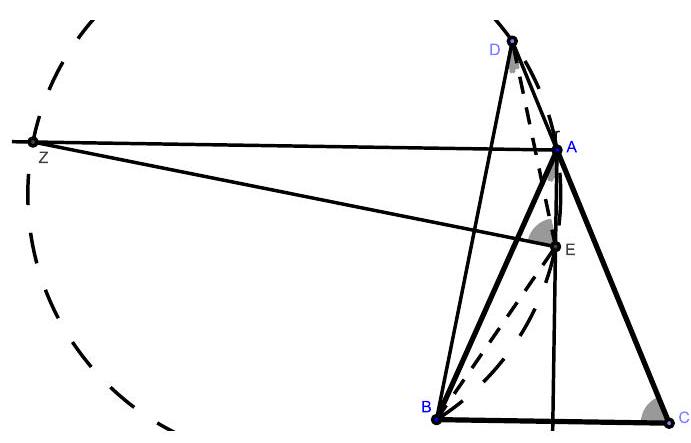
|
| 8 |
+
|
| 9 |
+
In $\triangle A B D$ the ray $[A Z$ bisects the angle $\widehat{D A B}$ and the line $Z E$ is the perpendicular bisector of the side $[B D]$. Hence $Z$ belongs to the circumcircle of $\triangle A B D$.
|
| 10 |
+
|
| 11 |
+
Therefore the points $A, B, D, Z$ are concyclic.
|
| 12 |
+
|
| 13 |
+
In $\triangle B C D, A E$ and $Z E$ are the perpendicular bisectors $[B C]$ and $[B D]$, respectively. Hence, $E$ is the circumcenter of $\triangle B C D$ and therefore $\widehat{D E Z}=\widehat{B E D} / 2=\widehat{A C B}$. Since $B D \perp Z E$, we conclude that: $\widehat{B D E}=90^{\circ}-\widehat{D E Z}=90^{\circ}-\widehat{A C B}=\widehat{B A E}$. Hence the quadrilateral $A E B D$ is cyclic, that is the points $A, B, D, E$ are concyclic. Therefore, since $A, B, D, Z$ are also concyclic, we conclude that $A E Z D$ is cyclic.
|
| 14 |
+
|
| 15 |
+
## Solution 2
|
| 16 |
+
|
| 17 |
+
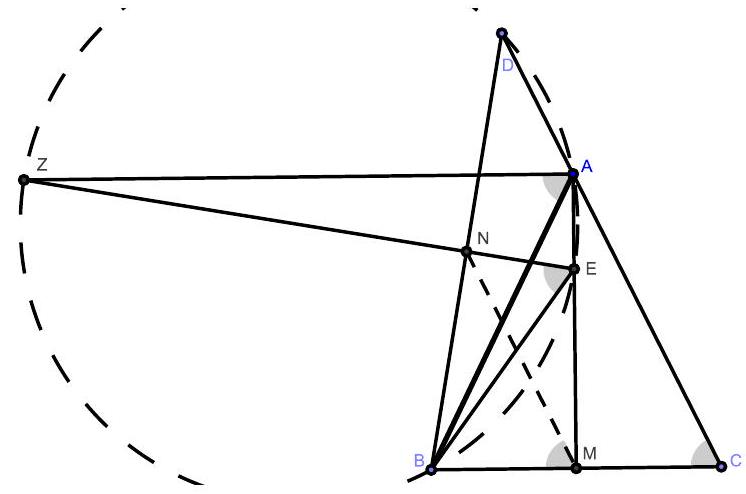
|
| 18 |
+
|
| 19 |
+
In $\triangle A B D$ the ray $[A Z$ bisects the angle $\widehat{D A B}$ and the line $Z E$ is the perpendicular bisector of the side $[B D]$. Hence $Z$ belongs to the circumcircle of $\triangle A B D$.
|
| 20 |
+
|
| 21 |
+
Therefore the points $A, B, D, Z$ are concyclic.
|
| 22 |
+
|
| 23 |
+
Let $M$ and $N$ be the midpoints of the sides $[B C]$ and $[D B]$, respectively. Then $N \in Z E$ and $M \in A E$. Next, $[M N]$ is a midline in $\triangle B C D$, so $M N \| C D \Rightarrow \widehat{N M B} \equiv \widehat{A C B}$.
|
| 24 |
+
|
| 25 |
+
But $[A Z$ is the external bisector of the angle $\widehat{B A C}$ of $\triangle A B C$, hence $\widehat{B A Z} \equiv \widehat{A C B}$. Therefore, $\widehat{N M B} \equiv \widehat{B A Z}$. In the quadrilateral $B M E N$ we have $\widehat{B N E}=\widehat{B M E}=90^{\circ}$, so $B M E N$ is cyclic $\Rightarrow \widehat{N M B} \equiv \widehat{B E Z}$, hence $\widehat{B A Z} \equiv \widehat{B E Z} \Rightarrow A E B Z$ is cyclic.
|
| 26 |
+
|
| 27 |
+
Therefore, since $A, B, D, Z$ are also concyclic, we conclude that $A E Z D$ is cyclic.
|
| 28 |
+
|
| 29 |
+
## Solution 3
|
| 30 |
+
|
| 31 |
+
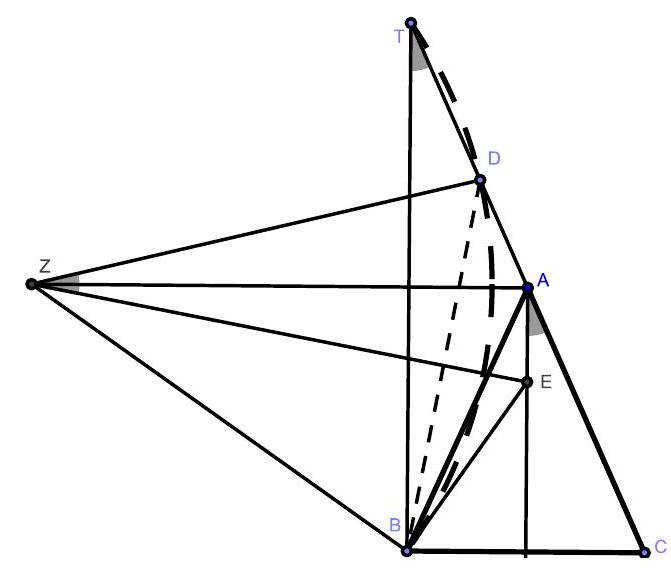
|
| 32 |
+
|
| 33 |
+
Let $T$ be the symmetric of $B$ with respect to the axis $A Z$. Obviously $T \in A D$. Since $A E$ and $B T$ are both perpendiculars to $A Z$, they are parallel, so $\widehat{B A C} \equiv \widehat{B T A}$. (1)
|
| 34 |
+
|
| 35 |
+
Since $Z B=Z T=Z D$, the point $Z$ is the circumcenter of $\triangle B D T$.
|
| 36 |
+
|
| 37 |
+
Therefore $\widehat{B T A}=\widehat{B Z D} / 2=\widehat{E Z D}$.
|
| 38 |
+
|
| 39 |
+
From (1) and (2) we conclude that $\widehat{E A C} \equiv \widehat{E Z D}$, which gives that $A E D Z$ is cyclic.
|
| 40 |
+
|
| 41 |
+
G2 Let $A D, B F$ and $C E$ be the altitudes of $\triangle A B C$. A line passing through $D$ and parallel to $A B$ intersects the line $E F$ at the point $G$. If $H$ is the orthocenter of $\triangle A B C$, find the angle $\widehat{C G H}$.
|
| 42 |
+
|
| 43 |
+
## Solution 1
|
| 44 |
+
|
| 45 |
+
We can see easily that points $C, D, H, F$ lies on a circle of diameter $[C H]$.
|
| 46 |
+
|
| 47 |
+
Take $\left\{F, G^{\prime}\right\}=\odot(C H F) \cap E F$. We have $\widehat{E F H}=\widehat{B A D}=\widehat{B C E}=\widehat{D F H}$ since the quadrilaterals $A E D C, A E H F, C D H F$ are cyclic. Hence $[F B$ is the bisector of $\widehat{E F D}$, so $H$ is the midpoint of the arc $D G^{\prime}$. It follows that $D G^{\prime} \perp C H$ since $[C H]$ is a diameter. Therefore $D G^{\prime} \| A B$ and $G \equiv G^{\prime}$. Finally $G$ lies on the circle $\odot(C F H)$, so $\widehat{H G C}=90^{\circ}$.
|
| 48 |
+
|
| 49 |
+
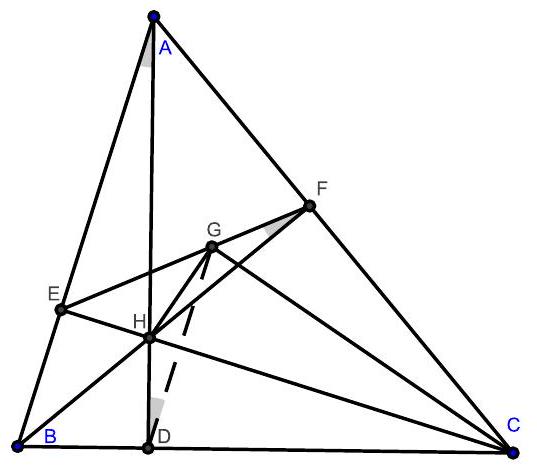
|
| 50 |
+
|
| 51 |
+
## Solution 2
|
| 52 |
+
|
| 53 |
+
The quadrilateral $A E H F$ is cyclic since $\widehat{A E H}=\widehat{A F H}=90^{\circ}$, so $\widehat{E A D} \equiv \widehat{G F H}$.
|
| 54 |
+
|
| 55 |
+
But $A B \| G D$, hence $\widehat{E A D} \equiv \widehat{G D H}$. Therefore $\widehat{G F H} \equiv \widehat{G D H} \Rightarrow D F G H$ is cyclic.
|
| 56 |
+
|
| 57 |
+
Because the quadrilateral $C D H F$ is cyclic since $\widehat{C D H}=\widehat{C F H}=90^{\circ}$, we conclude that the quadrilateral $C F G H$ is cyclic, which gives that $\widehat{C G H}=\widehat{C F H}=90^{\circ}$.
|
| 58 |
+
|
| 59 |
+
G3 Let $A B C$ be a triangle in which ( $B L$ is the angle bisector of $\widehat{A B C}(L \in A C), A H$ is an altitude of $\triangle A B C(H \in B C)$ and $M$ is the midpoint of the side $[A B]$. It is known that the midpoints of the segments $[B L]$ and $[M H]$ coincides. Determine the internal angles of triangle $\triangle A B C$.
|
| 60 |
+
|
| 61 |
+
## Solution
|
| 62 |
+
|
| 63 |
+
Let $N$ be the intersection of the segments $[B L]$ and $[M H]$. Because $N$ is the midpoint of both segments $[B L]$ and $[M H]$, it follows that $B M L H$ is a parallelogram. This implies that $M L \| B C$ and $L H \| A B$ and hence, since $M$ is the midpoint of $[A B]$, the angle bisector [ $B L$ and the altitude $A H$ are also medians of $\triangle A B C$. This shows that $\triangle A B C$ is an equilateral one with all internal angles measuring $60^{\circ}$.
|
| 64 |
+
|
| 65 |
+
G4 Point $D$ lies on the side $[B C]$ of $\triangle A B C$. The circumcenters of $\triangle A D C$ and $\triangle B A D$ are $O_{1}$ and $O_{2}$, respectively and $O_{1} O_{2} \| A B$. The orthocenter of $\triangle A D C$ is $H$ and $A H=O_{1} O_{2}$. Find the angles of $\triangle A B C$ if $2 m(<C)=3 m(<B)$.
|
| 66 |
+
|
| 67 |
+
## Solution 1
|
| 68 |
+
|
| 69 |
+
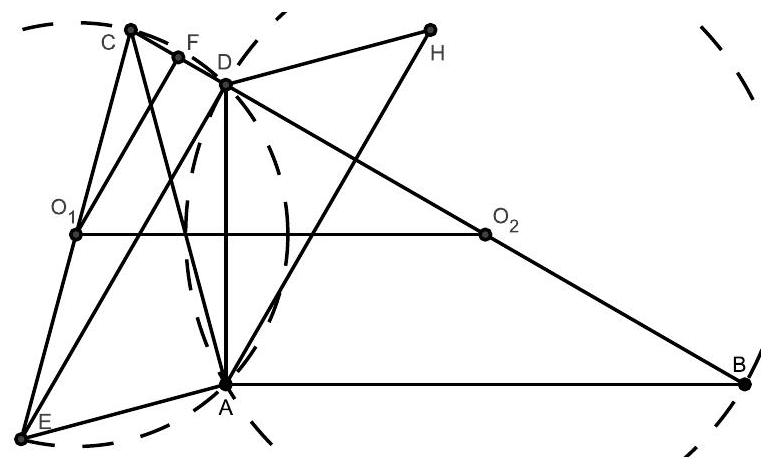
|
| 70 |
+
|
| 71 |
+
As $A D$ is the radical axis of the circumcircles of $\triangle A D C$ and $\triangle B A D$, we have that $O_{1} O_{2} \perp A D$, therefore $\widehat{D A B}=90^{\circ}$. Let $F$ be the midpoint of $[C D]$ and $[C E]$ be a diameter of the circumcircle of $\triangle A D C$. Then $E D \perp C D$ and $E A \perp C A$, so $E D \| A H$ and $E A \| D H$ since $A H \perp C D$ and $D H \perp A C$ (H is the orthocenter of $\triangle A D C$ ) and hence $E A H D$ is a parallelogram. Therefore $O_{1} O_{2}=A H=E D=2 O_{1} F$, so in $\triangle F O_{1} O_{2}$ with $\widehat{O_{1} F O_{2}}=90^{\circ}$ we have $O_{1} O_{2}=2 F O_{1} \Rightarrow \widehat{A B C}=\widehat{O_{1} O_{2} F}=30^{\circ}$.
|
| 72 |
+
|
| 73 |
+
Then we get $\widehat{A C B}=45^{\circ}$ and $\widehat{B A C}=105^{\circ}$.
|
| 74 |
+
|
| 75 |
+
## Solution 2
|
| 76 |
+
|
| 77 |
+

|
| 78 |
+
|
| 79 |
+
As $A D$ is the radical axis of the circumcircles of $\triangle A D C$ and $\triangle B A D$, we have that $O_{1} O_{2} \perp A D$, therefore $\widehat{D A B}=90^{\circ}$ and $O_{2}$ is the midpoint of $[B D]$.
|
| 80 |
+
|
| 81 |
+
Take $\{E\}=D H \cap A C,\{F\}=A H \cap B C$ and $\{M\}=A D \cap O_{1} O_{2}$.
|
| 82 |
+
|
| 83 |
+
We have $\widehat{C E H}=\widehat{C F H}=90^{\circ} \Rightarrow C E F H$ is cyclic, hence $\widehat{A C D}=\widehat{A H D}$.
|
| 84 |
+
|
| 85 |
+
But $\widehat{A C D}=\operatorname{arc} A D / 2=\widehat{D O_{1} O_{2}}$, so $\widehat{A H D}=\widehat{D O_{1} O_{2}}$. We know that $A H=O_{1} O_{2}$.
|
| 86 |
+
|
| 87 |
+
We also have $\widehat{D A H}=\widehat{O_{1} O_{2} D}$ since $A O_{2} F M$ is cyclic with $\widehat{A M O_{2}}=\widehat{A F O_{2}}$.
|
| 88 |
+
|
| 89 |
+
Therefore $\triangle H D A \equiv \triangle O_{1} D O_{2} \Rightarrow D A=D O_{2}=B D / 2$, so in right-angled $\triangle A B D$ we have $m(\widehat{A B D})=30^{\circ}$. Then we get $\widehat{A C B}=45^{\circ}$ and $\widehat{B A C}=105^{\circ}$.
|
| 90 |
+
|
| 91 |
+
G5 Inside the square $A B C D$, the equilateral triangle $\triangle A B E$ is constructed. Let $M$ be an interior point of the triangle $\triangle A B E$ such that $M B=\sqrt{2}, M C=\sqrt{6}, M D=\sqrt{5}$ and $M E=\sqrt{3}$. Find the area of the square $A B C D$.
|
| 92 |
+
|
| 93 |
+
## Solution
|
| 94 |
+
|
| 95 |
+
Let $K, F, H, Z$ be the projections of point $M$ on the sides of the square.
|
| 96 |
+
|
| 97 |
+
Then by Pythagorean Theorem we can prove that $M A^{2}+M C^{2}=M B^{2}+M D^{2}$.
|
| 98 |
+
|
| 99 |
+
From the given condition we obtain $M A=1$.
|
| 100 |
+
|
| 101 |
+
With center $A$ and angle $60^{\circ}$, we rotate $\triangle A M E$, so we construct the triangle $A N B$.
|
| 102 |
+
|
| 103 |
+
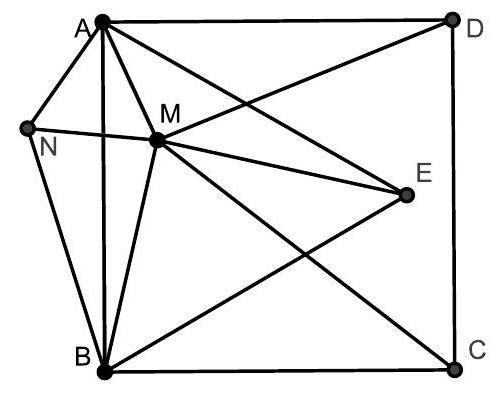
|
| 104 |
+
|
| 105 |
+
Since $A M=A N$ and $\widehat{M A N}=60^{\circ}$, it follows that $\triangle A M N$ is equilateral and $M N=1$. Hence $\triangle B M N$ is right-angled because $B M^{2}+M N^{2}=B N^{2}$.
|
| 106 |
+
|
| 107 |
+
So $m(\widehat{B M A})=m(\widehat{B M N})+m(\widehat{A M N})=150^{\circ}$.
|
| 108 |
+
|
| 109 |
+
Applying Pythagorean Generalized Theorem in $\triangle A M B$, we get:
|
| 110 |
+
|
| 111 |
+
$A B^{2}=A M^{2}+B M^{2}-2 A M \cdot B M \cdot \cos 150^{\circ}=1+2+2 \sqrt{2} \cdot \sqrt{3}: 2=3+\sqrt{6}$.
|
| 112 |
+
|
| 113 |
+
We conclude that the area of the square $A B C D$ is $3+\sqrt{6}$.
|
| 114 |
+
|
| 115 |
+
G6 Let $A B C D$ be a convex quadrilateral, $E$ and $F$ points on the sides $A B$ and $C D$, respectively, such that $\frac{A B}{A E}=\frac{C D}{D F}=n$. Denote by $S$ the area of the quadrilateral $A E F D$. Prove that $S \leq \frac{A B \cdot C D+n(n-1) \cdot D A^{2}+n \cdot A D \cdot B C}{2 n^{2}}$.
|
| 116 |
+
|
| 117 |
+
## Solution
|
| 118 |
+
|
| 119 |
+
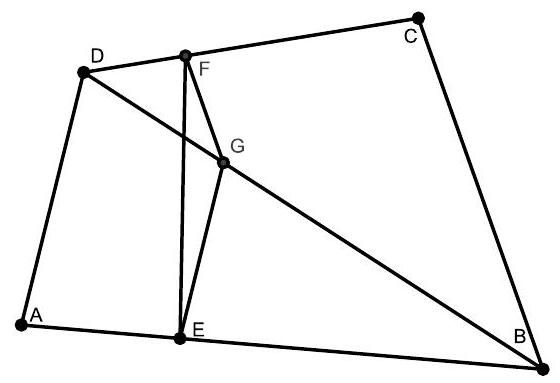
|
| 120 |
+
|
| 121 |
+
By Ptolemy's Inequality in $A E F D$, we get $S=\frac{A F \cdot D E \cdot \sin (\widehat{A F, D E})}{2} \leq \frac{A F \cdot D E}{2} \leq$ $\frac{A E \cdot D F+A D \cdot E F}{2}=\frac{A B \cdot C D+n^{2} \cdot D A \cdot E F}{2 n^{2}}$.
|
| 122 |
+
|
| 123 |
+
Let $G$ be a point on diagonal $B D$ such that $\frac{D B}{D G}=n$. By Thales's Theorem we get $G E=\frac{(n-1) A D}{n}$ and $G F=\frac{B C}{n}$. Applying the inequality of triangle in $\triangle E G F$ we get $E F \leq E G+G F=\frac{(n-1) A D+B C}{n}$. Now, we get:
|
| 124 |
+
|
| 125 |
+
$S \leq \frac{A B \cdot C D+n^{2} A D \cdot E F}{2 n^{2}} \leq \frac{A B \cdot C D+n(n-1) \cdot D A^{2}+n \cdot A D \cdot B C}{2 n^{2}}$.
|
| 126 |
+
|
JBMO/md/en-shortlist/en-jbmo-2003_shl.md
ADDED
|
@@ -0,0 +1,1220 @@
|
|
|
|
|
|
|
|
|
|
|
|
|
|
|
|
|
|
|
|
|
|
|
|
|
|
|
|
|
|
|
|
|
|
|
|
|
|
|
|
|
|
|
|
|
|
|
|
|
|
|
|
|
|
|
|
|
|
|
|
|
|
|
|
|
|
|
|
|
|
|
|
|
|
|
|
|
|
|
|
|
|
|
|
|
|
|
|
|
|
|
|
|
|
|
|
|
|
|
|
|
|
|
|
|
|
|
|
|
|
|
|
|
|
|
|
|
|
|
|
|
|
|
|
|
|
|
|
|
|
|
|
|
|
|
|
|
|
|
|
|
|
|
|
|
|
|
|
|
|
|
|
|
|
|
|
|
|
|
|
|
|
|
|
|
|
|
|
|
|
|
|
|
|
|
|
|
|
|
|
|
|
|
|
|
|
|
|
|
|
|
|
|
|
|
|
|
|
|
|
|
|
|
|
|
|
|
|
|
|
|
|
|
|
|
|
|
|
|
|
|
|
|
|
|
|
|
|
|
|
|
|
|
|
|
|
|
|
|
|
|
|
|
|
|
|
|
|
|
|
|
|
|
|
|
|
|
|
|
|
|
|
|
|
|
|
|
|
|
|
|
|
|
|
|
|
|
|
|
|
|
|
|
|
|
|
|
|
|
|
|
|
|
|
|
|
|
|
|
|
|
|
|
|
|
|
|
|
|
|
|
|
|
|
|
|
|
|
|
|
|
|
|
|
|
|
|
|
|
|
|
|
|
|
|
|
|
|
|
|
|
|
|
|
|
|
|
|
|
|
|
|
|
|
|
|
|
|
|
|
|
|
|
|
|
|
|
|
|
|
|
|
|
|
|
|
|
|
|
|
|
|
|
|
|
|
|
|
|
|
|
|
|
|
|
|
|
|
|
|
|
|
|
|
|
|
|
|
|
|
|
|
|
|
|
|
|
|
|
|
|
|
|
|
|
|
|
|
|
|
|
|
|
|
|
|
|
|
|
|
|
|
|
|
|
|
|
|
|
|
|
|
|
|
|
|
|
|
|
|
|
|
|
|
|
|
|
|
|
|
|
|
|
|
|
|
|
|
|
|
|
|
|
|
|
|
|
|
|
|
|
|
|
|
|
|
|
|
|
|
|
|
|
|
|
|
|
|
|
|
|
|
|
|
|
|
|
|
|
|
|
|
|
|
|
|
|
|
|
|
|
|
|
|
|
|
|
|
|
|
|
|
|
|
|
|
|
|
|
|
|
|
|
|
|
|
|
|
|
|
|
|
|
|
|
|
|
|
|
|
|
|
|
|
|
|
|
|
|
|
|
|
|
|
|
|
|
|
|
|
|
|
|
|
|
|
|
|
|
|
|
|
|
|
|
|
|
|
|
|
|
|
|
|
|
|
|
|
|
|
|
|
|
|
|
|
|
|
|
|
|
|
|
|
|
|
|
|
|
|
|
|
|
|
|
|
|
|
|
|
|
|
|
|
|
|
|
|
|
|
|
|
|
|
|
|
|
|
|
|
|
|
|
|
|
|
|
|
|
|
|
|
|
|
|
|
|
|
|
|
|
|
|
|
|
|
|
|
|
|
|
|
|
|
|
|
|
|
|
|
|
|
|
|
|
|
|
|
|
|
|
|
|
|
|
|
|
|
|
|
|
|
|
|
|
|
|
|
|
|
|
|
|
|
|
|
|
|
|
|
|
|
|
|
|
|
|
|
|
|
|
|
|
|
|
|
|
|
|
|
|
|
|
|
|
|
|
|
|
|
|
|
|
|
|
|
|
|
|
|
|
|
|
|
|
|
|
|
|
|
|
|
|
|
|
|
|
|
|
|
|
|
|
|
|
|
|
|
|
|
|
|
|
|
|
|
|
|
|
|
|
|
|
|
|
|
|
|
|
|
|
|
|
|
|
|
|
|
|
|
|
|
|
|
|
|
|
|
|
|
|
|
|
|
|
|
|
|
|
|
|
|
|
|
|
|
|
|
|
|
|
|
|
|
|
|
|
|
|
|
|
|
|
|
|
|
|
|
|
|
|
|
|
|
|
|
|
|
|
|
|
|
|
|
|
|
|
|
|
|
|
|
|
|
|
|
|
|
|
|
|
|
|
|
|
|
|
|
|
|
|
|
|
|
|
|
|
|
|
|
|
|
|
|
|
|
|
|
|
|
|
|
|
|
|
|
|
|
|
|
|
|
|
|
|
|
|
|
|
|
|
|
|
|
|
|
|
|
|
|
|
|
|
|
|
|
|
|
|
|
|
|
|
|
|
|
|
|
|
|
|
|
|
|
|
|
|
|
|
|
|
|
|
|
|
|
|
|
|
|
|
|
|
|
|
|
|
|
|
|
|
|
|
|
|
|
|
|
|
|
|
|
|
|
|
|
|
|
|
|
|
|
|
|
|
|
|
|
|
|
|
|
|
|
|
|
|
|
|
|
|
|
|
|
|
|
|
|
|
|
|
|
|
|
|
|
|
|
|
|
|
|
|
|
|
|
|
|
|
|
|
|
|
|
|
|
|
|
|
|
|
|
|
|
|
|
|
|
|
|
|
|
|
|
|
|
|
|
|
|
|
|
|
|
|
|
|
|
|
|
|
|
|
|
|
|
|
|
|
|
|
|
|
|
|
|
|
|
|
|
|
|
|
|
|
|
|
|
|
|
|
|
|
|
|
|
|
|
|
|
|
|
|
|
|
|
|
|
|
|
|
|
|
|
|
|
|
|
|
|
|
|
|
|
|
|
|
|
|
|
|
|
|
|
|
|
|
|
|
|
|
|
|
|
|
|
|
|
|
|
|
|
|
|
|
|
|
|
|
|
|
|
|
|
|
|
|
|
|
|
|
|
|
|
|
|
|
|
|
|
|
|
|
|
|
|
|
|
|
|
|
|
|
|
|
|
|
|
|
|
|
|
|
|
|
|
|
|
|
|
|
|
|
|
|
|
|
|
|
|
|
|
|
|
|
|
|
|
|
|
|
|
|
|
|
|
|
|
|
|
|
|
|
|
|
|
|
|
|
|
|
|
|
|
|
|
|
|
|
|
|
|
|
|
|
|
|
|
|
|
|
|
|
|
|
|
|
|
|
|
|
|
|
|
|
|
|
|
|
|
|
|
|
|
|
|
|
|
|
|
|
|
|
|
|
|
|
|
|
|
|
|
|
|
|
|
|
|
|
|
|
|
|
|
|
|
|
|
|
|
|
|
|
|
|
|
|
|
|
|
|
|
|
|
|
|
|
|
|
|
|
|
|
|
|
|
|
|
|
|
|
|
|
|
|
|
|
|
|
|
|
|
|
|
|
|
|
|
|
|
|
|
|
|
|
|
|
|
|
|
|
|
|
|
|
|
|
|
|
|
|
|
|
|
|
|
|
|
|
|
|
|
|
|
|
|
|
|
|
|
|
|
|
|
|
|
|
|
|
|
|
|
|
|
|
|
|
|
|
|
|
|
|
|
|
|
|
|
|
|
|
|
|
|
|
|
|
|
|
|
|
|
|
|
|
|
|
|
|
|
|
|
|
|
|
|
|
|
|
|
|
|
|
|
|
|
|
|
|
|
|
|
|
|
|
|
|
|
|
|
|
|
|
|
|
|
|
|
|
|
|
|
|
|
|
|
|
|
|
|
|
|
|
|
|
|
|
|
|
|
|
|
|
|
|
|
|
|
|
|
|
|
|
|
|
|
|
|
|
|
|
|
|
|
|
|
|
|
|
|
|
|
|
|
|
|
|
|
|
|
|
|
|
|
|
|
|
|
|
|
|
|
|
|
|
|
|
|
|
|
|
|
|
|
|
|
|
|
|
|
|
|
|
|
|
|
|
|
|
|
|
|
|
|
|
|
|
|
|
|
|
|
|
|
|
|
|
|
|
|
|
|
|
|
|
|
|
|
|
|
|
|
|
|
|
|
|
|
|
|
|
|
|
|
|
|
|
|
|
|
|
|
|
|
|
|
|
|
|
|
|
|
|
|
|
|
|
|
|
|
|
|
|
|
|
|
|
|
|
|
|
|
|
|
|
|
|
|
|
|
|
|
|
|
|
|
|
|
|
|
|
|
|
|
|
|
|
|
|
|
|
|
|
|
|
|
|
|
|
|
|
|
|
|
|
|
|
|
|
|
|
|
|
|
|
|
|
|
|
|
|
|
|
|
|
|
|
|
|
|
|
|
|
|
|
|
|
|
|
|
|
|
|
|
|
|
|
|
|
|
|
|
|
|
|
|
|
|
|
|
|
|
|
|
|
|
|
|
|
|
|
|
|
|
|
|
|
|
|
|
|
|
|
|
|
|
|
|
|
|
|
|
|
|
|
|
|
|
|
|
|
|
|
|
|
|
|
|
|
|
|
|
|
|
|
|
|
|
|
|
|
|
|
|
|
|
|
|
|
|
|
|
|
|
|
|
|
|
|
|
|
|
|
|
|
|
|
|
|
|
|
|
|
|
|
|
|
|
|
|
|
|
|
|
|
|
|
|
|
|
|
|
|
|
|
|
|
|
|
|
|
|
|
|
|
|
|
|
|
|
|
|
|
|
|
|
|
|
|
|
|
|
|
|
|
|
|
|
|
|
|
|
|
|
|
|
|
|
|
|
|
|
|
|
|
|
|
|
|
|
|
|
|
|
|
|
|
|
|
|
|
|
|
|
|
|
|
|
|
|
|
|
|
|
|
|
|
|
|
|
|
|
|
|
|
|
|
|
|
|
|
|
|
|
|
|
|
|
|
|
|
|
|
|
|
|
|
|
|
|
|
|
|
|
|
|
|
|
|
|
|
|
|
|
|
|
|
|
|
|
|
|
|
|
|
|
|
|
|
|
|
|
|
|
|
|
|
|
|
|
|
|
|
|
|
|
|
|
|
|
|
|
|
|
|
|
|
|
|
|
|
|
|
|
|
|
|
|
|
|
|
|
|
|
|
|
|
|
|
|
|
|
|
|
|
|
|
|
|
|
|
|
|
|
|
|
|
|
|
|
|
|
|
|
|
|
|
|
|
|
|
|
|
|
|
|
|
|
|
|
|
|
|
|
|
|
|
|
|
|
|
|
|
|
|
|
|
|
|
|
|
|
|
|
|
|
|
|
|
|
|
|
|
|
|
|
|
|
|
|
|
|
|
|
|
|
|
|
|
|
|
|
|
|
|
|
|
|
|
|
|
|
|
|
|
|
|
|
|
|
|
|
|
|
|
|
|
|
|
|
|
|
|
|
|
|
|
|
|
|
|
|
|
|
|
|
|
|
|
|
|
|
|
|
|
|
|
|
|
|
|
|
|
|
|
|
|
|
|
|
|
|
|
|
|
|
|
|
|
|
|
|
|
|
|
|
|
|
|
|
|
|
|
|
|
|
|
|
|
|
|
|
|
|
|
|
|
|
|
|
|
|
|
|
|
|
|
|
|
|
|
|
|
|
|
|
|
|
|
|
|
|
|
|
|
|
|
|
|
|
|
|
|
|
|
|
|
|
|
|
|
|
|
|
|
|
|
|
|
|
|
|
|
|
|
|
|
|
|
|
|
|
|
|
|
|
|
|
|
|
|
|
|
|
|
|
|
|
|
|
|
|
|
|
|
|
|
|
|
|
|
|
|
|
|
|
|
|
|
|
|
|
|
|
|
|
|
|
|
|
|
|
|
|
|
|
|
|
|
|
|
|
|
|
|
|
|
|
|
|
|
|
|
|
|
|
|
|
|
|
|
|
|
|
|
|
|
|
|
|
|
|
|
|
|
|
|
|
|
|
|
|
|
|
|
|
|
|
|
|
|
|
|
|
|
|
|
|
|
|
|
|
|
|
|
|
|
|
|
|
|
|
|
|
|
|
|
|
|
|
|
|
|
|
|
|
|
|
|
|
|
|
|
|
|
|
|
|
|
|
|
|
|
|
|
|
|
|
|
|
|
|
|
|
|
|
|
|
|
|
|
|
|
|
|
|
|
|
|
|
|
|
|
|
|
|
|
|
|
|
|
|
|
|
|
|
|
|
|
|
|
|
|
|
|
|
|
|
|
|
|
|
|
|
|
|
|
|
|
|
|
|
|
|
|
|
|
|
|
|
|
|
|
|
|
|
|
|
|
|
|
|
|
|
|
|
|
|
|
|
|
|
|
|
|
|
|
|
|
|
|
|
|
|
|
|
|
|
|
|
|
|
|
|
|
|
|
|
|
|
|
|
|
|
|
|
|
|
|
|
|
|
|
|
|
|
|
|
|
|
|
|
|
|
|
|
|
|
|
|
|
|
|
|
|
|
|
|
|
|
|
|
|
|
|
|
|
|
|
|
|
|
|
|
|
|
|
|
|
|
|
|
|
|
|
|
|
|
|
|
|
|
|
|
|
|
|
|
|
|
|
|
|
|
|
|
|
|
|
|
|
|
|
|
|
|
|
|
|
|
|
|
|
|
|
|
|
|
|
|
|
|
|
|
|
|
|
|
|
|
|
|
|
|
|
|
|
|
|
|
|
|
|
|
|
|
|
|
|
|
|
|
|
|
|
|
|
|
|
|
|
|
|
|
|
|
|
|
|
|
|
|
|
|
|
|
|
|
|
|
|
|
|
|
|
|
|
|
|
|
|
|
|
|
|
|
|
|
|
|
|
|
|
|
|
|
|
|
|
|
|
|
|
|
|
|
|
|
|
|
|
|
|
|
|
|
|
|
|
|
|
|
|
|
|
|
|
|
|
|
|
|
|
|
|
|
|
|
|
|
|
|
|
|
|
|
|
|
|
|
|
|
|
|
|
|
|
|
|
|
|
|
|
|
|
|
|
|
|
|
|
|
|
|
|
|
|
|
|
|
|
|
|
|
|
|
|
|
|
|
|
|
|
|
|
|
|
|
|
|
|
|
|
|
|
|
|
|
|
|
|
|
|
|
|
|
|
|
|
|
|
|
|
|
|
|
|
|
|
|
|
|
|
|
|
|
|
|
|
|
|
|
|
|
|
|
|
|
|
|
|
|
|
|
|
|
|
|
|
|
|
|
|
|
|
|
|
|
|
|
|
|
|
|
|
|
|
|
|
|
|
|
|
|
|
|
|
|
|
|
|
|
|
|
|
|
|
|
|
|
|
|
|
|
|
|
|
|
|
|
|
|
|
|
|
|
|
|
|
|
|
|
|
|
|
|
|
|
|
|
|
|
|
|
|
|
|
|
|
|
|
|
|
|
|
|
|
|
|
|
|
|
|
|
|
|
|
|
|
|
|
|
|
|
|
|
|
|
|
|
|
|
|
|
|
|
|
|
|
|
|
|
|
|
|
|
|
|
|
|
|
|
|
|
|
|
|
|
|
|
|
|
|
|
|
|
|
|
|
|
|
|
|
|
|
|
|
|
|
|
|
|
|
|
|
|
|
|
|
|
|
|
|
|
|
|
|
|
|
|
|
|
|
|
|
|
|
|
|
|
|
|
|
|
|
|
|
|
|
|
|
|
|
|
|
|
|
|
|
|
|
|
|
|
|
|
|
|
|
|
|
|
|
|
|
|
|
|
|
|
|
|
|
|
|
|
|
|
|
|
|
|
|
|
|
|
|
|
|
|
|
|
|
|
|
|
|
|
|
|
|
|
|
|
|
|
|
|
|
|
|
|
|
|
|
|
|
|
|
|
|
|
|
|
|
|
|
|
|
|
|
|
|
|
|
|
|
|
|
|
|
|
|
|
|
|
|
|
|
|
|
|
|
|
|
|
|
|
|
|
|
|
|
|
|
|
|
|
|
|
|
|
|
|
|
|
|
|
|
|
|
|
|
|
|
|
|
|
|
|
|
|
|
|
|
|
|
|
|
|
|
|
|
|
|
|
|
|
|
|
|
|
|
|
|
|
|
|
|
|
|
|
|
|
|
|
|
|
|
|
|
|
|
|
|
|
|
|
|
|
|
|
|
|
|
|
|
|
|
|
|
|
|
|
|
|
|
|
|
|
|
|
|
|
|
|
|
|
|
|
|
|
|
|
|
|
|
|
|
|
|
|
|
|
|
|
|
|
|
|
|
|
|
|
|
|
|
|
|
|
|
|
|
|
|
|
|
|
|
|
|
|
|
|
|
|
|
|
|
|
|
|
|
|
|
|
|
|
|
|
|
|
|
|
|
|
|
|
|
|
|
|
|
|
|
|
|
|
|
|
|
|
|
|
|
|
|
|
|
|
|
|
|
|
|
|
|
|
|
|
|
|
|
|
|
|
|
|
|
|
|
|
|
|
|
|
|
|
|
|
|
|
|
|
|
|
|
|
|
|
|
|
|
|
| 1 |
+
# PROPOSED PROBLEMS
|
| 2 |
+
|
| 3 |
+
$$
|
| 4 |
+
7^{\text {th }} \mathrm{JBMO}
|
| 5 |
+
$$
|
| 6 |
+
|
| 7 |
+

|
| 8 |
+
|
| 9 |
+
You will find in this booklet 20 problems in total, proposed by Bulgaria, Former Yugoslav Republic of Macedonia, Republic of Moldova, Romania and Yugoslavia (Serbia and Montenegro). We thank very much these countries for their proposals. The proposed problems and solutions presented here are essentially unedited with the exception of certain minor modifications that seemed necessary. Relatively more substantial corrections and suggestions of the Problem Committee appear under the heading of Comments.
|
| 10 |
+
|
| 11 |
+
The problems are classified into three categories: Algebra, Combinatorics and Geometry. There are eight problems in Algebra, five in Combinatorics and seven in Geometry. Each problem is listed under the category that seems to describe its content best. The problems in each category are listed to roughly reflect their order of difficulty based on the judgement of the Problem
|
| 12 |
+
|
| 13 |
+
Committee.
|
| 14 |
+
|
| 15 |
+
Problem Committee:
|
| 16 |
+
|
| 17 |
+
Albert Erkip
|
| 18 |
+
|
| 19 |
+
Varga Kalantarov
|
| 20 |
+
|
| 21 |
+
Azer Kerimov
|
| 22 |
+
|
| 23 |
+
Burak Özbağc1
|
| 24 |
+
|
| 25 |
+
Mehmet Hamidoğlu Tagiyev
|
| 26 |
+
|
| 27 |
+
Okan Tekman
|
| 28 |
+
|
| 29 |
+
ALG 1. A number $A$ is written with $2 n$ digits, each of whish is 4 , and a number $B$ is written with $n$ digits, each of which is 8 . Prove that for each $n, A+2 B+4$ is a total square.
|
| 30 |
+
|
| 31 |
+
## Solution.
|
| 32 |
+
|
| 33 |
+
$$
|
| 34 |
+
\begin{aligned}
|
| 35 |
+
A & =\underbrace{44 \ldots 44}_{2 n}=\underbrace{44 \ldots 4}_{n} \underbrace{44 \ldots 4}_{n}=\underbrace{44 \ldots 4}_{n} \underbrace{400 \ldots 0}_{n}-\underbrace{44 \ldots 4}_{n}+\underbrace{88 \ldots 8}_{n}=\underbrace{44 \ldots 4}_{n} \cdot\left(10^{n}-1\right)+B \\
|
| 36 |
+
& =4 \cdot \underbrace{11 \ldots 1}_{n} \cdot \underbrace{99 \ldots 9}_{n}+B=2^{2} \cdot \underbrace{11 \ldots 1}_{n} \cdot 3^{2} \cdot \underbrace{11 \ldots 1}_{n}+B=\underbrace{66}_{n} \ldots 6 \\
|
| 37 |
+
& =[\frac{36}{4} \cdot \underbrace{88 \ldots 8}_{n}+B=[3 \cdot \underbrace{22 \ldots 2}_{n}]^{2}+B=\left(\frac{3}{4} B\right)^{2}+B .
|
| 38 |
+
\end{aligned}
|
| 39 |
+
$$
|
| 40 |
+
|
| 41 |
+
So,
|
| 42 |
+
|
| 43 |
+
$$
|
| 44 |
+
\begin{aligned}
|
| 45 |
+
A+2 B+4 & =\left(\frac{3}{4} B\right)^{2}+B+2 B+4=\left(\frac{3}{4} B\right)^{2}+2 \cdot \frac{3}{4} B \cdot 2+2^{2}=\left(\frac{3}{4} B+2\right)^{2}=(\frac{3}{4} \cdot \underbrace{88 \ldots 8}_{n}+2)^{2} \\
|
| 46 |
+
& =(3 \cdot \underbrace{22 \ldots 2}_{n}+2)^{2}=\underbrace{66 \ldots 68^{2}}_{n-1}
|
| 47 |
+
\end{aligned}
|
| 48 |
+
$$
|
| 49 |
+
|
| 50 |
+
ALG 2. Let $a, b, c$ be lengths of triangle sides, $p=\frac{a}{b}+\frac{b}{c}+\frac{c}{a}$ and $q=\frac{a}{c}+\frac{c}{b}+\frac{b}{a}$.
|
| 51 |
+
|
| 52 |
+
Prove that $|p-q|<1$.
|
| 53 |
+
|
| 54 |
+
Solution: One has
|
| 55 |
+
|
| 56 |
+
$$
|
| 57 |
+
\begin{aligned}
|
| 58 |
+
a b c|p-q| & =a b c\left|\frac{c-b}{a}+\frac{a-c}{b}+\frac{b-a}{c}\right| \\
|
| 59 |
+
& =\left|b c^{2}-b^{2} c+a^{2} c-a c^{2}+a b^{2}-a^{2} b\right|= \\
|
| 60 |
+
& =\left|a b c-a c^{2}-a^{2} b+a^{2} c-b^{2} c+b c^{2}+a b^{2}-a b c\right|= \\
|
| 61 |
+
& =\left|(b-c)\left(a c-a^{2}-b c+a b\right)\right|= \\
|
| 62 |
+
& =|(b-c)(c-a)(a-b)| .
|
| 63 |
+
\end{aligned}
|
| 64 |
+
$$
|
| 65 |
+
|
| 66 |
+
Since $|b-c|<a,|c-a|<b$ and $|a-b|<c$ we infere
|
| 67 |
+
|
| 68 |
+
$$
|
| 69 |
+
|(b-c)(c-a)(a-b)|<a b c
|
| 70 |
+
$$
|
| 71 |
+
|
| 72 |
+
and
|
| 73 |
+
|
| 74 |
+
$$
|
| 75 |
+
|p-q|=\frac{|(b-c)(c-a)(a-b)|}{a b c}<1
|
| 76 |
+
$$
|
| 77 |
+
|
| 78 |
+
ALG 3: Let $a, b, c$ be real numbers such that $a^{2}+b^{2}+c^{2}=1$. Prove that. $P=a b+b c+c a-2(a+b+c) \geq-\frac{5}{2}$. Are there values of $a, b, c$, such that $P=-\frac{5}{2}$.
|
| 79 |
+
|
| 80 |
+
Solution: We have $a b+b c+c a=\frac{(a+b+c)^{2}-c^{2}-b^{2}-a^{2}}{2}=\frac{(a+b+c)^{2}-1}{2}$.
|
| 81 |
+
|
| 82 |
+
If put $t=a+b+c$ we obtain
|
| 83 |
+
|
| 84 |
+
$$
|
| 85 |
+
P=\frac{t^{2}-1}{2}-2 t=\frac{t^{2}-4 t-1}{2}=\frac{(t-2)^{2}-5}{2} \geq-\frac{5}{2}
|
| 86 |
+
$$
|
| 87 |
+
|
| 88 |
+
Obviously $P=-\frac{5}{2}$ when $t=2$, i.e. $a+b+c=2$, or $c=2-a-b$. Substitute in $a^{2}+b^{2}+c^{2}=1$ and obtain $2 a^{2}+2(b-2) a+2 b^{2}-4 b+3=0$. Sinse this quadratic equation has solutions it follows that $(b-2)^{2}-2\left(2 b^{2}-3 b+3\right) \geq 0$, from where
|
| 89 |
+
|
| 90 |
+
$$
|
| 91 |
+
-3 b^{2}+4 b-6 \geq 0
|
| 92 |
+
$$
|
| 93 |
+
|
| 94 |
+
or
|
| 95 |
+
|
| 96 |
+
$$
|
| 97 |
+
3 b^{2}-4 b+6 \leq 0
|
| 98 |
+
$$
|
| 99 |
+
|
| 100 |
+
But $3 b^{2}-4 b+6=3\left(b-\frac{2}{3}\right)^{2}+\frac{14}{3}>0$. The contradiction shows that $P=-\frac{5}{2}$.
|
| 101 |
+
|
| 102 |
+
Comment: By the Cauchy Schwarz inequality $|t| \leq \sqrt{3}$, so the smallest value of $P$ is attained at $t=\sqrt{3}$ and equals $1-2 \sqrt{3} \approx-2.46$.
|
| 103 |
+
|
| 104 |
+
## ALG 4.
|
| 105 |
+
|
| 106 |
+
Let $a, b, c$ be rational numbers such that
|
| 107 |
+
|
| 108 |
+
$$
|
| 109 |
+
\frac{1}{a+b c}+\frac{1}{b+a c}=\frac{1}{a+b}
|
| 110 |
+
$$
|
| 111 |
+
|
| 112 |
+
Prove that $\sqrt{\frac{c-3}{c+1}}$ is also a rational number
|
| 113 |
+
|
| 114 |
+
Solution. By cancelling the denominators
|
| 115 |
+
|
| 116 |
+
$$
|
| 117 |
+
(a+b)^{2}(1+c)=a b+c\left(a^{2}+b^{2}\right)+a b c^{2}
|
| 118 |
+
$$
|
| 119 |
+
|
| 120 |
+
and
|
| 121 |
+
|
| 122 |
+
$$
|
| 123 |
+
a b(c-1)^{2}=(a+b)^{2}
|
| 124 |
+
$$
|
| 125 |
+
|
| 126 |
+
If $c=-1$, we obtrin the contradiction
|
| 127 |
+
|
| 128 |
+
$$
|
| 129 |
+
\frac{1}{a-b}+\frac{1}{b-a}=\frac{1}{a+b}
|
| 130 |
+
$$
|
| 131 |
+
|
| 132 |
+
Furtherrdore,
|
| 133 |
+
|
| 134 |
+
$$
|
| 135 |
+
\begin{aligned}
|
| 136 |
+
(c-3)(c+1) & =(c-1)^{2}-4=\frac{(a+b)^{2}}{a b}-4 \\
|
| 137 |
+
& =\frac{(a-b)^{2}}{a b}=\left(\frac{(a-b)(c-1)}{a+b}\right)^{2}
|
| 138 |
+
\end{aligned}
|
| 139 |
+
$$
|
| 140 |
+
|
| 141 |
+
Thus
|
| 142 |
+
|
| 143 |
+
$$
|
| 144 |
+
\sqrt{\frac{c-3}{c+1}}=\frac{\sqrt{(c-3)(c+1)}}{c+1}=\frac{|a-b||c-1|}{(c+1)|a+b|} \in \mathrm{Q}
|
| 145 |
+
$$
|
| 146 |
+
|
| 147 |
+
as needed.
|
| 148 |
+
|
| 149 |
+
ALG 5. Let $A B C$ be a scalene triangle with $B C=a, A C=b$ and $A B=c$, where $a_{r} b, c$ are positive integers. Prove that
|
| 150 |
+
|
| 151 |
+
$$
|
| 152 |
+
\left|a b^{2}+b c^{2}+c a^{2}-a^{2} b-b^{2} c-c^{2} a\right| \geq 2
|
| 153 |
+
$$
|
| 154 |
+
|
| 155 |
+
Solution. Denote $E=a b^{2}+b c^{2}+c a^{2}-a^{2} b-b^{2} c-c^{2} a$. We have
|
| 156 |
+
|
| 157 |
+
$$
|
| 158 |
+
\begin{aligned}
|
| 159 |
+
E= & \left(a b c-c^{2} a\right)+\left(c a^{2}-a^{2} b\right)+\left(b c^{2}-b^{2} c\right)+\left(a b^{2}-a b c\right)= \\
|
| 160 |
+
& (b-c)\left(a c-a^{2}-b c+a b\right)=(b-c)\left(a a^{2}-b\right)(c-a)
|
| 161 |
+
\end{aligned}
|
| 162 |
+
$$
|
| 163 |
+
|
| 164 |
+
So, $|E|=|a-b| \cdot|b-c| \cdot|c-a|$. By hypothesis each factor from $|E|$ is a positive integer. We shall prove that at least one factor from $|E|$ is greater than 1. Suppose that $|a-b|=|b-c|=|c-a|=1$. It follows that the numbers $a-b, b-c, c-a$ are odd. So, the number $0=(a-b)+(b-c) \div(c-a)$ is olso odd, a contradiction. Hence, $|E| \geq 1 \cdot 1 \cdot 2=2$.
|
| 165 |
+
|
| 166 |
+
## ALG 6.
|
| 167 |
+
|
| 168 |
+
Let $a, b, c$ be positive numbers such that $a^{2} b^{2}+b^{2} c^{2}+c^{2} a^{2}=3$. Prove that
|
| 169 |
+
|
| 170 |
+
$$
|
| 171 |
+
a+b+c \geq a b c+2
|
| 172 |
+
$$
|
| 173 |
+
|
| 174 |
+
Solution. We can consider the case $a \geq b \geq c$ which implies $c \leq 1$. The given inequality writes
|
| 175 |
+
|
| 176 |
+
$$
|
| 177 |
+
a+b-2 \geq(a b-1) c \geq(a b-1) c^{2}=(a b-1) \frac{3-a^{2} b^{2}}{a^{2}+b^{2}}
|
| 178 |
+
$$
|
| 179 |
+
|
| 180 |
+
Put $x=\sqrt{a b}$. From the inequality $3 a^{2} b^{2} \geq a^{2} b^{2}+b^{2} c^{2}+c^{2} a^{2}=3$ we infer $x \geq 1$ and from $a^{2} b^{2}<a^{2} b^{2}+b^{2} c^{2}+c^{2} a^{2}=3$ we find $x \leq \sqrt[4]{3}$. As $a+b \geq 2 \sqrt{a b}=2 x$ and $a^{2}+b^{2} \geq 2 a b=2 x^{2}$, to prove the inequality (1) it will sufice to show that
|
| 181 |
+
|
| 182 |
+
$$
|
| 183 |
+
2(x-1) \geq\left(x^{2}-1\right) \frac{3-x^{4}}{2 x^{2}}
|
| 184 |
+
$$
|
| 185 |
+
|
| 186 |
+
As $x-1 \geq 0$, the last. inequality is equivalent to
|
| 187 |
+
|
| 188 |
+
$$
|
| 189 |
+
4 x^{2} \geq(x+1)\left(3-x^{4}\right)
|
| 190 |
+
$$
|
| 191 |
+
|
| 192 |
+
which can be easily obtained by multplying the obvious ones $2 x^{2} \geq x+1$ and $2 \geq 3-x^{4}$.
|
| 193 |
+
|
| 194 |
+
Equality holds only in the case when $a=b=c=1$.
|
| 195 |
+
|
| 196 |
+
Comment: As it is, the solution is incorrect, it only proves the weaker inequality $a+b-2 \geq(a b-1) c^{2}$, that is: $a+b+c^{2} \geq a b c^{2}+2$. The problem committee could not find a reasonable solution. Instead the problem could be slightly modified so that the method of the proposed solution applies. The modified problem is:
|
| 197 |
+
|
| 198 |
+
ALG 6'. Let $a, b, c$ be positive numbers such that $a b+b c+c a=3$. Prove that
|
| 199 |
+
|
| 200 |
+
$$
|
| 201 |
+
a+b+c \geq a b c+2
|
| 202 |
+
$$
|
| 203 |
+
|
| 204 |
+
Solution. Eliminating $c$ gives
|
| 205 |
+
|
| 206 |
+
$$
|
| 207 |
+
a+b+c-a b c=a+b+(1-a b) c=a+b+\frac{(1-a b)(3-a b)}{a+b}
|
| 208 |
+
$$
|
| 209 |
+
|
| 210 |
+
Put $x=\sqrt{a b}$. Then $a+b \geq 2 x$, and since $1<x^{2}<3, \frac{(1-a b)(3-a b)}{a+b} \geq \frac{\left(1-x^{2}\right)\left(3-x^{2}\right)}{2 x}$.
|
| 211 |
+
|
| 212 |
+
It then suffices to prove that
|
| 213 |
+
|
| 214 |
+
$$
|
| 215 |
+
2 x+\frac{\left(1-x^{2}\right)\left(3-x^{2}\right)}{2 x} \geq 2
|
| 216 |
+
$$
|
| 217 |
+
|
| 218 |
+
This iast inequality follows from the arithrnelic-geomeric means inequadily
|
| 219 |
+
|
| 220 |
+
$$
|
| 221 |
+
2 x+\frac{\left(1-x^{2}\right)\left(3-x^{2}\right)}{2 x}=\frac{3+x^{4}}{2 x}=\frac{1}{2 x}+\frac{1}{2 x}+\frac{1}{2 x}+\frac{x^{3}}{2} \geq 4\left(\frac{1}{-16}\right)^{\frac{1}{4}}=2
|
| 222 |
+
$$
|
| 223 |
+
|
| 224 |
+
ALG 7 .
|
| 225 |
+
|
| 226 |
+
Let $x, y, z$ be real numbers greater than -1 . Prove that
|
| 227 |
+
|
| 228 |
+
$$
|
| 229 |
+
\frac{1+x^{2}}{1+y+z^{2}}+\frac{1+y^{2}}{1+z+x^{2}}+\frac{1+z^{2}}{1+x+y^{2}} \geq 2
|
| 230 |
+
$$
|
| 231 |
+
|
| 232 |
+
Solution. We have $y \leq \frac{1+y^{2}}{2}$, hence $\quad$
|
| 233 |
+
|
| 234 |
+
$$
|
| 235 |
+
\frac{1+x^{2}}{1+y+z^{2}} \geq \frac{1+x^{2}}{1+z^{2}+\frac{1+\dot{y}^{2}}{2}}
|
| 236 |
+
$$
|
| 237 |
+
|
| 238 |
+
and the similar inequalities.
|
| 239 |
+
|
| 240 |
+
Setting $a=1+x^{2}, b=1+y^{2}, c=1+z^{2}$, it sufices to prove that
|
| 241 |
+
|
| 242 |
+
$$
|
| 243 |
+
\frac{a}{2 c+b}+\frac{b}{2 a+c}+\frac{c}{2 b+a} \geq 1
|
| 244 |
+
$$
|
| 245 |
+
|
| 246 |
+
for all $a, b, c \geq 0$.
|
| 247 |
+
|
| 248 |
+
Put $A=2 c+b, B=2 a+c, C=2 b+a$. Then
|
| 249 |
+
|
| 250 |
+
$$
|
| 251 |
+
a=\frac{C+4 B-2 A}{9}, b=\frac{A+4 C-2 B}{9}, c=\frac{B+4 A-2 C}{9}
|
| 252 |
+
$$
|
| 253 |
+
|
| 254 |
+
and (1) rewrites as
|
| 255 |
+
|
| 256 |
+
$$
|
| 257 |
+
\frac{C+4 B-2 A}{A}+\frac{A+4 C-2 B}{B}+\frac{B+4 A-2 C}{C} \geq 9
|
| 258 |
+
$$
|
| 259 |
+
|
| 260 |
+
and consequently
|
| 261 |
+
|
| 262 |
+
$$
|
| 263 |
+
\frac{C}{A}+\frac{A}{B}+\frac{B}{C}+4\left(\frac{B}{A}+\frac{C}{B}+\frac{A}{C}\right) \geq 15
|
| 264 |
+
$$
|
| 265 |
+
|
| 266 |
+
As $A, B, C>0$, by $A M-G M$ inequality we have
|
| 267 |
+
|
| 268 |
+
$$
|
| 269 |
+
\frac{A}{B}+\frac{B}{C}+\frac{C}{A} \geq 3 \sqrt[3]{\frac{A}{B} \cdot \frac{B}{C} \cdot \frac{C}{A}}
|
| 270 |
+
$$
|
| 271 |
+
|
| 272 |
+
and
|
| 273 |
+
|
| 274 |
+
$$
|
| 275 |
+
\frac{B}{A}+\frac{C}{B}+\frac{A}{C} \geq 3
|
| 276 |
+
$$
|
| 277 |
+
|
| 278 |
+
and we are done.
|
| 279 |
+
|
| 280 |
+
Alternative solution for inequality (1).
|
| 281 |
+
|
| 282 |
+
By the Cauchy-Schwarz inequality,
|
| 283 |
+
|
| 284 |
+
$$
|
| 285 |
+
\frac{a}{2 c+b}+\frac{b}{2 a+c}+\frac{c}{2 b+a}=\frac{a^{2}}{2 a c+a b}+\frac{b^{2}}{2 a b+c b}+\frac{c^{2}}{2 b c+a c} \geq \frac{(a+b+c)^{2}}{3(a b+b c+c a)} \geq 1
|
| 286 |
+
$$
|
| 287 |
+
|
| 288 |
+
The last inequality reduces immediately to the obvious $a^{2}+b^{2}+c^{2} \geq a b+b c+c a$.
|
| 289 |
+
|
| 290 |
+
ALG 8. Prove that there exist two sets $A=\{x, y, z\}$ and $B=\{m, n, p\}$ of positive integers greater than 2003 such that the sets have no common elements and the equalities $x+y+z=m+n+p$ and $x^{2}+y^{2}+z^{2}=m^{2}+n^{2}+p^{2}$ hold.
|
| 291 |
+
|
| 292 |
+
Solution. Let $A B C$ be a triangle with $B C=a, A C=b, A B=c$ and $a<b<c$. Denote by $m_{a}, m_{b}, m_{c}$ the lengths of medianes drawing from the vertices $A, B, C$ respectively. Using the formulas
|
| 293 |
+
|
| 294 |
+
$$
|
| 295 |
+
4 m_{a}^{2}=2\left(b^{2}+c^{2}\right)-a^{2}, 4 m_{b}^{2}=2\left(a^{2}+c^{2}\right)-b^{2}, 4 m_{c}^{2}=2\left(a^{2}+b^{2}\right)-c^{2}
|
| 296 |
+
$$
|
| 297 |
+
|
| 298 |
+
we obtain the relations
|
| 299 |
+
|
| 300 |
+
$$
|
| 301 |
+
\begin{gathered}
|
| 302 |
+
4 m_{a}^{2}+4 m_{b}^{2}+4 m_{c}^{2}=3 a^{2}+3 b^{2}+3 c^{2} \\
|
| 303 |
+
\left(4 m_{a}^{2}\right)^{2}+\left(4 m_{b}^{2}\right)^{2}+\left(4 m_{c}^{2}\right)^{2}=\left(2 b^{2}+2 c^{2}-a^{2}\right)^{2}+ \\
|
| 304 |
+
\left(2 a^{2}+2 c^{2}-b^{2}\right)^{2}+\left(2 a^{2}+2 b^{2}-c^{2}\right)^{2}=9 a^{4}+9 b^{4}+9 c^{4}= \\
|
| 305 |
+
\left(3 a^{2}\right)^{2}+\left(3 b^{2}\right)^{2}+\left(3 c^{2}\right)^{2}
|
| 306 |
+
\end{gathered}
|
| 307 |
+
$$
|
| 308 |
+
|
| 309 |
+
We put $A=\left\{4 m_{a}^{2}, 4 m_{b}^{2}, 4 m_{c}^{2}\right\}$ and $B=\left\{3 a^{2}, 3 b^{2}, 3 c^{2}\right\}$. Let $k \geq 1$ be a positive integer. Let $a=k+1, b=k+2$ and $c=k+3$. Because
|
| 310 |
+
|
| 311 |
+
$$
|
| 312 |
+
a+b=(k+1)+(k+2)=2 k+3>k+3=c
|
| 313 |
+
$$
|
| 314 |
+
|
| 315 |
+
a triangle with such length sides there exist. After the simple calculations we have
|
| 316 |
+
|
| 317 |
+
$$
|
| 318 |
+
\begin{gathered}
|
| 319 |
+
A=\left\{3(k+1)^{2}-2,3(k+2)^{2}+4,3(k+3)^{2}-2\right\} \\
|
| 320 |
+
B=\left\{3(k+1)^{2}, 3(k+2)^{2}, 3(k+3)^{2}\right\}
|
| 321 |
+
\end{gathered}
|
| 322 |
+
$$
|
| 323 |
+
|
| 324 |
+
It easy to prove that
|
| 325 |
+
|
| 326 |
+
$$
|
| 327 |
+
\begin{gathered}
|
| 328 |
+
x+y+z=m+n+p=3\left[(k+1)^{2}+(k+2)^{2}+(k+3)^{2}\right] \\
|
| 329 |
+
x^{2}+y^{2}+z^{2}=m^{2}+n^{2}+p^{2}=9\left[(k+1)^{4}+(k+2)^{4}+(k+3)^{4}\right]
|
| 330 |
+
\end{gathered}
|
| 331 |
+
$$
|
| 332 |
+
|
| 333 |
+
$>$ From the inequality $3(k+1)^{2}-2>2003$ we obtain $k \geq 25$. For $k=25$ we have an example of two sets
|
| 334 |
+
|
| 335 |
+
$$
|
| 336 |
+
A=\{2026,2191,2350\}, \quad B=\{2028,2187,2352\}
|
| 337 |
+
$$
|
| 338 |
+
|
| 339 |
+
with desired properties.
|
| 340 |
+
|
| 341 |
+
COM 1. In a group of 60 students: 40 speak English; 30 speak French; 8 speak all the three languages; the number of students that speak English and French but not German is equal to "the sum of the number of students that speak English and German but not French plus the number of students that speak French and German but not English; and the number of students that speak at least 2 of those fanguages is 28 . How many students speak:
|
| 342 |
+
a) German;
|
| 343 |
+
b) only English;
|
| 344 |
+
c) only German?
|
| 345 |
+
|
| 346 |
+
Solution: We use the following notation.
|
| 347 |
+
|
| 348 |
+
$E=\#$ students that speak English, $F=\#$ students that speak French,
|
| 349 |
+
|
| 350 |
+
$G=\#$ students that speak German; $m=$ \# students that speak all the three languages,
|
| 351 |
+
|
| 352 |
+
$x=\#$ students that speak English and French but not German,
|
| 353 |
+
|
| 354 |
+
$y=\#$ students that speak German and French but not English,
|
| 355 |
+
|
| 356 |
+
$z=\#$ students that speak English and German but not French.
|
| 357 |
+
|
| 358 |
+
The conditions $x+y=z$ and $x+y+z+8=28$, imply that $z=x+y=10$, i.e. 10 students speak German and French, but not English. Then: $G+E-y-8+F-x-8-10=60$, implies that $G+70-$ $36=60$. Hence: a) $\mathrm{G}=36$; b) only English speak $40-10-8=22$ students; c) the information given is not enough to find the number of students that speak only German. This ${ }^{n}$ number can be any one from 8 to 18 .
|
| 359 |
+
|
| 360 |
+
Comment: There are some mistakes in the solution. The corrections are as follows:
|
| 361 |
+
|
| 362 |
+
1. The given condition is $x=y+z($ not $x+y=z)$; thus $x=y+z=10$.
|
| 363 |
+
2. From $G+70-36=60$ one gets $G=26$ (not $G=36$ ).
|
| 364 |
+
3. One gets "only German speakers" as $G-y-z-8=8$.
|
| 365 |
+
4. "Only English speakers" are $E-x-z-8=22-z$, so this number can not be determined.
|
| 366 |
+
|
| 367 |
+
COM 2 Natural numbers 1,2,3, .., 2003 are written in an arbitrary sequence $a_{1}, a_{2}, a_{3}, \ldots a_{2003}$. Let $b_{1}=1 a_{1}, b_{2}=2 a_{2}, b_{3}=3 a_{3}, \ldots, b_{2003}=2003 a_{2003}$, and $B$ be the maximum of the numbers $b_{1}, b_{2}, b_{3}, \ldots, b_{2003}$.
|
| 368 |
+
|
| 369 |
+
a) If $a_{1}=2003, a_{2}=2002, a_{3}=2001, \ldots, a_{2002}=2, a_{2003}=1$, find the value of $B$.
|
| 370 |
+
|
| 371 |
+
b) Prove that $B \geq 1002^{2}$.
|
| 372 |
+
|
| 373 |
+
Solution: a) Using the inequality between the arithmetical and geometrical mean, we obtain that $b_{n}=n(2004-n) \leq\left(\frac{n+(2004-n)}{2}\right)^{2}=1002^{2}$ for $n=1,2,3, \ldots, 2003$. The equality holds if and only if $n=2004-n$, i.e. $n=1002$. Therefore, $B=b_{1002}=1002 \times(2004-1002)=1002^{2}$. b) Let $a_{1}, a_{2}, a_{3}, \ldots a_{2003}$ be an arbitrary order of the numbers $1,2,3, \ldots, 2003$. First, we will show that numbers $1002,1003,1004, \ldots, 2003$ cannot occulpy the places numbered $1,2,3$, $\ldots, 1001$ only. Indeed, we have $(2003-1002)+1=1002$ numbers and 1002 places. This means that at least one of the numbers $1002,1003,1004, \ldots, 2003$, say $a_{m}$, lies on a place which number $m$ is greater than 1001 . Therefore, $B \geq m a \geq 1002 \times 1002=1002^{2}$.
|
| 374 |
+
|
| 375 |
+
COM 3. Prove that amongst any 29 natural numbers there are 15 such that sum of them is divisible by 15 .
|
| 376 |
+
|
| 377 |
+
Solution: Amongst any 5 natural numbers there are 3 such that sum of them is divisible by 3 . Amongst any 29 natural numbers we can choose 9 groups with 3 numbers such that sum of numbers in every group is divisible by 3. In that way we get 9 natural numbers such that all of them are divisiblc by 3. It is easy to see that amongst any 9 natural numbers there are 5 such that sum of them is divisible by 5 . Since we have 9 numbers, all of them are divisible by 3 , there are 5 such that sum of them is divisible by 15 .
|
| 378 |
+
|
| 379 |
+
## $\operatorname{COM} 4$.
|
| 380 |
+
|
| 381 |
+
$n$ points are given in a plane, not three of them colinear. One observes that no matter how we label the points from 1 to $n$, the broken line joining the points $1,2,3, \ldots, n$ (in this order) do not intersect itself.
|
| 382 |
+
|
| 383 |
+
Find the maximal value of $n$.
|
| 384 |
+
|
| 385 |
+
Solution. Notice that $n=4$ satisfies the condition. Indeed, for a
|
| 386 |
+
|
| 387 |
+
concave quadrilateral, this can be checked immediately.
|
| 388 |
+
|
| 389 |
+
Then, observe that for $n \geq 5$ one can choose four points $A, B, C, D$ such that $A B C D$ is a convex quadrilateral. The diagonals $A C$ and $B D$ intersect at a point, hence labeling $A, B, C, D$ with $1,2,3,4$ we reach a contradiction.
|
| 390 |
+
|
| 391 |
+
Thus, it is sufficient to proove that from five points we can select four that are vertices of a convex quadrilateral. Consider the convex hull of the five points set. If this is not a triangle we are done. If it is a triangle, then draw the line through the two points inside the triangle. This line meet exactly two sides of the triangle. Let $A$ be the common vertex of these sides. Then the four remaining points solve the claim.
|
| 392 |
+
|
| 393 |
+
COM 5. If $m$ is a number from the set $\{1,2,3,4\}$ and each point of the plane is painted in red or blue, prove that in the plane there exists at least an equilateral triangle with the vertices of the same colour and with length side $m$.
|
| 394 |
+
|
| 395 |
+
Solution. Suppose that in the plane there no exists an equilateral triangle with the vertices of the same colour and length side $m=1,2,3,4$.
|
| 396 |
+
|
| 397 |
+
First assertion: we shall prove that in the plane there no exists a segment with the length 2 such that the ends and the midpint of this segment have the same colour. Suppose that the segment $X Y$ with length 2 have the midpoint $T$ such that the points $X, Y, T$ have the same colour (for example, red). We construct the equilateral triangle. $X Y Z$. Hence, the point $Z$ is blue. Let $U$ and $V$ be the midpoints of the segments $X Z$ and $Y Z$ respectively. So, the points $U$ and $V$ are blue. We obtain a contradiction, because the equilateral triangle $U V Z$ have three blue vertices.
|
| 398 |
+
|
| 399 |
+
Second assertion: in the same way we prove that in the plane there no exists a segment with the length 4 such that the ends and the midpoint of this segment have the same colour.
|
| 400 |
+
|
| 401 |
+
Consider the equilateral triangle $A B C$ with length side 4 and divide it into 16 equilateral triangles with length sides 1. L $0: D$ be the midpoint of the segment $A B$. The vertices $A, B, C$ don't have the same colour. WLOG we suppose that $A$ and $B$ are red and $C$ is blue. So, the point $D$ is blue too. We shall investigate the following cases:
|
| 402 |
+
|
| 403 |
+
a) The midpoints $E$ and $F$ of the sides $A C$ and, respectively, $B C$ are red. From the first assertion it follows that the midpoints $M$ and $N$ of the segments $A E$ and, respectively, $B F$ are blue. Hence, the equilateral triangle $M N C$ have three blue vertices, a contradiction.
|
| 404 |
+
|
| 405 |
+
b) Let $E$ is red and $F$ is blue. The second one position of $E$ and $F$ is simmetrical. If $P, K, L$ are the midpoints of the segments $C F, A D, B D$ respectively, then by first assertion $P$ is red, $M$ is blue and $N$ is red. This imply that $K$ and $L$ are blue. So, the segment $K L$ with length 2 has the blue ends and blue midpoint, a contradiction.
|
| 406 |
+
|
| 407 |
+
c) If $E$ and $F$ are blue, then the equilateral triangle $E F C$ has three blue vertices, a contradiction.
|
| 408 |
+
|
| 409 |
+
Hence, in the plane there exists at least an equilateral triangle with the vertices of the same colour and with length side $m$, where $m \in\{1,2,3,4\}$.
|
| 410 |
+
|
| 411 |
+
Comment: The formuation of the problem suggests that one has to find 4 triangles, one for each $m$ from the set $\{1,2,3,4\}$ whereas the solution is for one $m$. A better formulation is:
|
| 412 |
+
|
| 413 |
+
Each point of the plane is painted in red or blue. Prove that in the plane there exists at least an equilateral triangle with the vertices of the same colour and with length side $m$, where $m$ is some number from the set $\{1,2,3,4\}$.
|
| 414 |
+
|
| 415 |
+
GEO 1. Is there a convex quadrilateral, whose diagonals divide it into four triangles, such that their areas are four distinct prime integers.
|
| 416 |
+
|
| 417 |
+
Solution. No. Let the areas of those triangles be the prime numbers $p, q, r$ and $t$. But for the areas of the triangles we have $\mathrm{pq}=\mathrm{rt}$, where the triangles with areas $\mathrm{p}$ and $\mathrm{q}$ have only a common vertex. This is not possible for distinct primes.
|
| 418 |
+
|
| 419 |
+
GEO 2. Is there a triangle whose area is $12 \mathrm{~cm}^{2}$ and whose perimeter is $12 \mathrm{~cm}$.
|
| 420 |
+
|
| 421 |
+
Solution. No. Let $\mathrm{r}$ be the radius of the inscribed circle. Then $12=6 \mathrm{r}$, i.e. $\mathrm{r}=2 \mathrm{~cm}$. But the area of the inscribed circle is $4 \pi>12$, and it is known that the area of any triangle is bigger than the area of its inscribed circle.
|
| 422 |
+
|
| 423 |
+
## GEO 3.
|
| 424 |
+
|
| 425 |
+
Let $G$ be the centroid of the the triangle $A B C$. Reflect point $A$ across $C$ at $A^{\prime}$. Prove that $G, B, C, A^{\prime}$ are on the same circle if and only if $G A$ is perpendicular to $G C$.
|
| 426 |
+
|
| 427 |
+
Solution. Observe first that $G A \perp G C$ if and only if $5 A C^{2}=A B^{2}+B C^{2}$. Indeed,
|
| 428 |
+
|
| 429 |
+
$$
|
| 430 |
+
G A \perp G C \Leftrightarrow \frac{4}{9} m_{a}^{2}+\frac{4}{9} m_{c}^{2}=b^{2} \Leftrightarrow 5 b^{2}=a^{2}+c^{2}
|
| 431 |
+
$$
|
| 432 |
+
|
| 433 |
+
Moreover,
|
| 434 |
+
|
| 435 |
+
$$
|
| 436 |
+
G B^{2}=\frac{4}{9} m_{b}^{2}=\frac{2 a^{2}+2 c^{2}-b^{2}}{9}=\frac{9 b^{2}}{9}=b^{2}
|
| 437 |
+
$$
|
| 438 |
+
|
| 439 |
+
hence $G B=A C=C A^{\prime}$ (1). Let $C^{\prime}$ be the intersection point of the lines $G C$ and $A B$. Then $C C^{\prime}$ is the middle line of the triangle $A B A^{\prime}$, hence $G C \| B A^{\prime}$. Consequently, $G C A^{\prime} B$ is a trapezoid. From (1) we find that $G C A^{\prime} B$ is isosceles, thus cyclic, as needed.
|
| 440 |
+
|
| 441 |
+
Conversely, since $G C A^{\prime} B$ is a cyclic trapezoid, then it is also isosceles. Thus $C A^{\prime}=$ $G B$, which leads to (1).
|
| 442 |
+
|
| 443 |
+
Comment: An alternate proof is as follows:
|
| 444 |
+
|
| 445 |
+
Let $M$ be the midpoint of $A C$. Then the triangles $M C G$ and $M A^{\prime} B$ are similar. So $G C$ is parallel to $A^{\prime} B$.
|
| 446 |
+
|
| 447 |
+
$G A \perp G C$ if and only if $G M=M C$. By the above similarity, this happen if and only if $A^{\prime} C=G B$; if and only if the trapezoid is cyclic.
|
| 448 |
+
|
| 449 |
+
GEO 4. Triangle $A B C$ is inscribed in a circle $k$. Let $D_{2} E$, and $F$ be the midpoints of the arcs of $k, \overparen{B C}$, and $\overparen{A B}$ respectively, $A \notin B C, B \notin E A$, and $C \notin G B$. Let segment $D E$ meets $C B$ and $C A$ in points $G$ and $H$ respectively, and segment $D F$ meet $B C$ and $=B A$ in points $I$ and $J$ respectively. Let $M$ and $N$ be the midpoints of the segments $G H$ and $I J$ respectively.
|
| 450 |
+
|
| 451 |
+
a) Find the angles of triangle $D M N$ in terms of the angles $\alpha=1 B A C$, $\beta=\triangle C B A$, and $\gamma=\not A C B$.
|
| 452 |
+
|
| 453 |
+
b) If $O$ is the circumcentre of triangle $D M N$ and $P$ is the intersection point of $A D$ and $E F$, prove that the points $O, P, M$ and $N$ are concircular.
|
| 454 |
+
|
| 455 |
+
Comment: Because of a compatibility problem, the signs for arcs and angles appear as squares.
|
| 456 |
+
|
| 457 |
+

|
| 458 |
+
|
| 459 |
+

|
| 460 |
+
Using the properties of the angles whose vertices are inside a circle, we obtain that $\& E H A=\frac{1}{2}(C E+E D)=\frac{1}{2}(\alpha+\beta)=\frac{1}{2}(B D+E E)=Z C G E$.
|
| 461 |
+
|
| 462 |
+
On the other hand, $E H A=C H G$. Therefore $\triangle C H G$ is isosceles $(C H=C G)$. Since $C F$ is an angle-bisector, the midpoint $M$ of $H G$ lies on $C F$. Also, $C M$ is an altitude in $\triangle C H G$. Therefore, $\square E M F=90^{\circ}$. The same way we prove that $\triangle F N E=90^{\circ}$. It follows that points $E, F, N$, and $M$ lie on a circle $k_{1}$ (whose diameter is $E F$ ). Therefore, $\triangle D N M=A D E F=90^{\circ}-\frac{\beta}{2}, D D N=A D F E 90^{\circ}-\frac{\gamma}{2}$.
|
| 463 |
+
|
| 464 |
+
b) Let $A B \cap E F=K$ and $A C \cap E F=L$. As in a) we can prove that $\triangle A P K=\triangle A P L=90^{\circ}, \quad \angle F P N=90^{\circ}-\frac{\alpha}{2} \quad$ and $\quad \angle E P M=90^{\circ}-\frac{\alpha}{2}$. Since $\triangle A K P=\angle A L P=90^{\circ}-\frac{\alpha}{2}$ we obtain $A B \| P N$ and $A C \| P M$. Hence $\underset{L}{G P N}=\triangle B A C=\alpha$. Since $D M N$ is acute angle triangle (i.e. $O$ is interior point) and $\left\{M D N=90^{\circ}-\frac{\alpha}{2}\right.$, we have $\angle M O N=180^{\circ}-\alpha$. Therefore $\triangle M O N+M P N=180^{\circ}$ i.e. the points $O, P, M$ and $N$ are concircular.
|
| 465 |
+
|
| 466 |
+

|
| 467 |
+
|
| 468 |
+
GEO 5. Let three congruent circles intersect in one point $M$ and $A_{1}, A_{2}$ and $A_{3}$ be the other intersection points for those circles. Prove that $M$ is a.orthocenter for a triangle $A_{1} A_{2} A_{3}$.
|
| 469 |
+
|
| 470 |
+
Solution: The quadrilaterals $\mathrm{O}_{3} M O_{2} A_{1}, \mathrm{O}_{3} M O_{1} A_{2}$ and $O_{1} M O_{2} A_{3}$ are rombes. Therefore, $O_{2} A_{1} \| M O_{3}$ and $M O_{3} \| O_{1} A_{2}$, which imply $O_{2} A_{1} \| O_{1} A_{2}$. Because $O_{2} A_{1}=O_{3}{ }^{*} M=O_{1} A_{2}$ the quadrilateral $O_{2} A_{1} A_{2} O_{1}$ is parallelogram and then $A_{1} A_{2} \| O_{1} O_{2}$ and $A_{1} A_{2}=O_{1} O_{2}$. Similary, $A_{2} A_{3} \| O_{2} O_{3}$ and $A_{2} A_{3}=O_{2} O_{3} ; A_{3} A_{1} \| O_{3} O_{1}$ and $A_{3} A_{1}=O_{3} O_{1}$. The triangles $A_{1} A_{2} A_{3}$ and $\mathrm{O}_{1} \mathrm{O}_{2} \mathrm{O}_{3}$ are congruent.
|
| 471 |
+
|
| 472 |
+
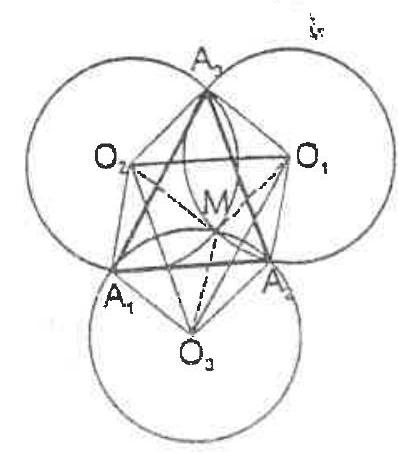
|
| 473 |
+
|
| 474 |
+
Since $A_{3} M \perp O_{1} O_{2}$ and $O_{1} O_{2} \| A_{1} A_{2}$ we infere $A_{3} M \perp A_{1} A_{2}$. Similary, $A_{2} M \perp A_{1} A_{3}$ and $A_{1} M \perp A_{2} A_{3}$. Thus, $M$ is the orthocenter for the triangle $A_{1} A_{2} A_{3}$.
|
| 475 |
+
|
| 476 |
+
## GEO.6.
|
| 477 |
+
|
| 478 |
+
Consider an isosceles triangle $A B C$ with $A B=A C$. A semicircle of diameter $E F$, lying on the side $B C$, is tangent to the lines $A B$ and $A C$ at $M$ and $N$, respectively. The line $A E$ intersects again the semicircle at point $P$.
|
| 479 |
+
|
| 480 |
+
Prove that the line PF passes through the midpoint of the chord $M N$.
|
| 481 |
+
|
| 482 |
+
Solution. Let $O$ be the center of the semicircle and let $R$ be the midpoint of $M N$. It is obvious that $M N$ is perpendicular to $A O$ at point $R$. Since $\angle A N O$ is right, then from the leg theorem we have $A N^{2}=A R \cdot A O$. From the powen of a point theorem,
|
| 483 |
+
|
| 484 |
+
$$
|
| 485 |
+
A P \cdot A E=A N^{2}=A M^{2}=A R \cdot A O
|
| 486 |
+
$$
|
| 487 |
+
|
| 488 |
+
Using the same theorem we infer that points $P, R, O$ and $E$ are concyclic, hence $\angle R P E$ is right. As $\angle F P E$ is also a right angle, the conclusion follows.
|
| 489 |
+
|
| 490 |
+
GEO 7. Through a interior point of a triangle, three lines parallel to the sides of the triangle are constructed. In that way the triangle is divided on six figures, areas equal $a, b, c, \alpha, \beta, \gamma$ (see the picture).
|
| 491 |
+
|
| 492 |
+
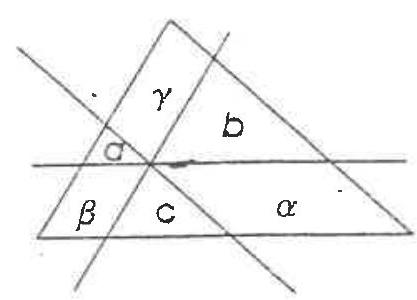
|
| 493 |
+
|
| 494 |
+
Prove that
|
| 495 |
+
|
| 496 |
+
$$
|
| 497 |
+
\frac{a}{\alpha}+\frac{b}{\beta}+\frac{c}{\gamma} \geqslant \frac{3}{2}
|
| 498 |
+
$$
|
| 499 |
+
|
| 500 |
+
Solution: We will prove the inequality in two steps. First one is the following
|
| 501 |
+
|
| 502 |
+
Lemma: Let $A B C$ be a triangle, $E$ arbitrary point on the side $A C$. Parallel lines to $A B$ and $B C$, drown through $E$ meet sides $B C$ and $A B$ in points $F$. and $D$ respectively. Then: $P_{B D E F}=2 \sqrt{P_{A D E} \cdot P_{E F C}}$ ( $P_{X}$ is area for the figure $X)$.
|
| 503 |
+
|
| 504 |
+
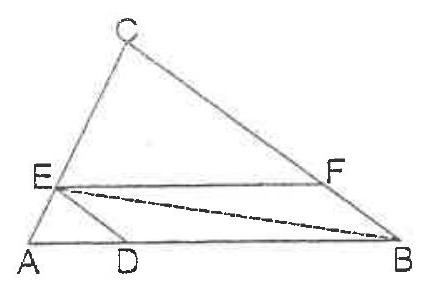
|
| 505 |
+
|
| 506 |
+
The triangles $A D E$ and $E F C$ are similar. Then:
|
| 507 |
+
|
| 508 |
+
$$
|
| 509 |
+
\frac{P_{B D E F}}{2 P_{A D E}}=\frac{P_{B D E}}{P_{A D E}}=\frac{B D}{A D}=\frac{E F}{A D}=\frac{\sqrt{P_{E F C}}}{\sqrt{P_{A D E}}}
|
| 510 |
+
$$
|
| 511 |
+
|
| 512 |
+
Hence, $P_{B D E F}=2 \sqrt{P_{A D E} \cdot P_{E F C}}$.
|
| 513 |
+
|
| 514 |
+
Using this lemma one has $\alpha=2 \sqrt{b c}, \beta=2 \sqrt{a c}, \gamma=2 \sqrt{a b}$. The GML-AM mean inequality provides
|
| 515 |
+
|
| 516 |
+
$$
|
| 517 |
+
\frac{a}{\alpha}+\frac{b}{\beta}+\frac{c}{\gamma} \geqslant 3 \sqrt[3]{\frac{a b c}{\alpha \beta \gamma}}=3 \sqrt[3]{\frac{a b c}{2^{3} \sqrt{a^{2} b^{2} c^{2}}}}=\frac{3}{2}
|
| 518 |
+
$$
|
| 519 |
+
|
| 520 |
+
BULGARIA
|
| 521 |
+
|
| 522 |
+
| Leader: | Chavdar Lozanov |
|
| 523 |
+
| :--- | :--- |
|
| 524 |
+
| Deputy Leader: | Ivan Tonov |
|
| 525 |
+
| Contestants: | Asparuh Vladislavov Hriston |
|
| 526 |
+
| | Tzvetelina Kirilova Tzeneva |
|
| 527 |
+
| | Vladislav Vladilenon Petkov |
|
| 528 |
+
| | Alexander Sotirov Bikov |
|
| 529 |
+
| | Deyan Stanislavov Simeonov |
|
| 530 |
+
| | Anton Sotirov Bikov |
|
| 531 |
+
|
| 532 |
+
## CYPRUS
|
| 533 |
+
|
| 534 |
+
| Leader: | Efthyvoulos Liasides |
|
| 535 |
+
| :--- | :--- |
|
| 536 |
+
| Deputy Leader: | Andreas Savvides |
|
| 537 |
+
| Contestants: | Marina Kouyiali |
|
| 538 |
+
| | Yiannis loannides |
|
| 539 |
+
| | Anastasia Solea |
|
| 540 |
+
| | Nansia Drakou |
|
| 541 |
+
| | Michalis Rossides |
|
| 542 |
+
| | Domna Fanidou |
|
| 543 |
+
| Observer: | Myrianthi Savvidou |
|
| 544 |
+
|
| 545 |
+
FORMER YUGOSLAV
|
| 546 |
+
|
| 547 |
+
REPUBLIC of MACEDONIA
|
| 548 |
+
|
| 549 |
+
| Leader: | Slavica Grkovska |
|
| 550 |
+
| :--- | :--- |
|
| 551 |
+
| Deputy Leader: | Misko Mitkovski |
|
| 552 |
+
| Contestants: | Aleksandar lliovski |
|
| 553 |
+
| | Viktor Simjanovski |
|
| 554 |
+
| | Maja Tasevska |
|
| 555 |
+
| | Tanja Velkova |
|
| 556 |
+
| | Matej Dobrevski |
|
| 557 |
+
| | Oliver Metodijev |
|
| 558 |
+
|
| 559 |
+
## GREECE
|
| 560 |
+
|
| 561 |
+
Leader: Anargyros Felouris
|
| 562 |
+
|
| 563 |
+
Deputy Leader: Ageliki Vlachou
|
| 564 |
+
|
| 565 |
+
Contestants: Theodosios Douvropoulos
|
| 566 |
+
|
| 567 |
+
Marina lliopoulou
|
| 568 |
+
|
| 569 |
+
Faethontas Karagiannopoulos
|
| 570 |
+
|
| 571 |
+
Stefanos Kasselakis
|
| 572 |
+
|
| 573 |
+
Fragiskos Koufogiannis
|
| 574 |
+
|
| 575 |
+
Efrosyni Sarla
|
| 576 |
+
|
| 577 |
+
ROMANIA
|
| 578 |
+
|
| 579 |
+
| Leader: | Dan Branzei |
|
| 580 |
+
| :--- | :--- |
|
| 581 |
+
| Deputy Leader: | Dinu Serbanescu |
|
| 582 |
+
| Contestants: | Dragos Michnea |
|
| 583 |
+
| | Adrian Zahariuc |
|
| 584 |
+
| | Cristian Talau |
|
| 585 |
+
| | Beniämin Bogosel |
|
| 586 |
+
| | Sebastian Dumitrescu |
|
| 587 |
+
| | Lucian Turea |
|
| 588 |
+
|
| 589 |
+
## TURKEY
|
| 590 |
+
|
| 591 |
+
Leader:
|
| 592 |
+
|
| 593 |
+
Halil Ibrahim Karakaş
|
| 594 |
+
|
| 595 |
+
\&Deputy Leader: Duru Türkoğlu
|
| 596 |
+
|
| 597 |
+
Contestants: Sait Tunç
|
| 598 |
+
|
| 599 |
+
Anmet Kabakulak
|
| 600 |
+
|
| 601 |
+
Türkü Çobanoğlu
|
| 602 |
+
|
| 603 |
+
Burak Sağlam
|
| 604 |
+
|
| 605 |
+
Ibrahim Çimentepe
|
| 606 |
+
|
| 607 |
+
Hale Nur Kazaçeşme
|
| 608 |
+
|
| 609 |
+
## YUGOSLAVIA
|
| 610 |
+
|
| 611 |
+
(SERBIA and MONTENEGRO)
|
| 612 |
+
|
| 613 |
+
| Leader: | Branislav Popovic |
|
| 614 |
+
| :--- | :--- |
|
| 615 |
+
| Deputy Leader: | Marija Stanic |
|
| 616 |
+
| Contestants: | Radojevic Mladen |
|
| 617 |
+
| | Jevremovic Marko |
|
| 618 |
+
| | Djoric Milos |
|
| 619 |
+
| | Lukic Dragan |
|
| 620 |
+
| | Andric Jelena |
|
| 621 |
+
| | Pajovic Jelena |
|
| 622 |
+
|
| 623 |
+
## TURKEY-B
|
| 624 |
+
|
| 625 |
+
## Leader:
|
| 626 |
+
|
| 627 |
+
Deputy Leader: Contestants:
|
| 628 |
+
Ahmet Karahan
|
| 629 |
+
Deniz Ahçihoca ..... Havva Yeşildağl|
|
| 630 |
+
Çağıl Şentip
|
| 631 |
+
Buse Uslu
|
| 632 |
+
Ali Yilmaz
|
| 633 |
+
Demirhan Çetereisi
|
| 634 |
+
Yakup Yildirim
|
| 635 |
+
|
| 636 |
+
## REPUBLIC of MOLDOVA
|
| 637 |
+
|
| 638 |
+
| Leader: | Ion Goian |
|
| 639 |
+
| :--- | :--- |
|
| 640 |
+
| Deputy Leader: | Ana Costas |
|
| 641 |
+
| Contestants: | lurie Boreico |
|
| 642 |
+
| | Andrei Frimu |
|
| 643 |
+
| | Mihaela Rusu |
|
| 644 |
+
| | Vladimir Vanovschi |
|
| 645 |
+
| | Da Vier: |
|
| 646 |
+
| | Alexandru Zamorzaev |
|
| 647 |
+
|
| 648 |
+
1.Prove that $7^{n}-1$ is not divisible by $6^{n}-1$ for any positive integer $n$.
|
| 649 |
+
|
| 650 |
+
2. 2003 denars were divided in several bags and the bags were placed in several pockets. The number of bags is greater than the number of denars in each pocket. Is it true that the number of pockets is greater than the number of denars in one of the bags?
|
| 651 |
+
3. In the triangle $\mathrm{ABC}, R$ and $r$ are the radii of the circumcircle and the incircle, respectively; $a$ is the longest side and $h$ is the shortest altitude. Prove that $R / r>a / h$.
|
| 652 |
+
4. Prove that for all positive numbers $x, y, z$ such that $x+y+z=1$ the following inequality holds
|
| 653 |
+
|
| 654 |
+
$$
|
| 655 |
+
\frac{x^{2}}{1+y}+\frac{y^{2}}{1+z}+\frac{z^{2}}{1+x} \leq 1
|
| 656 |
+
$$
|
| 657 |
+
|
| 658 |
+
5.Is it possible to cover a $2003 \times 2003$ board with $1 \times 2$ dominoes placed horizontally and $1 \times 3$ threeminoes placed vertically?
|
| 659 |
+
|
| 660 |
+
## THE 47-th MATHEMATIAL OLYMPIAD OF REPUBLIC OF MOLDOVA Chişinău, March 9-12, 2003
|
| 661 |
+
|
| 662 |
+
7.1 Let $m>n$ be pozitive integers. For every positive integers $k$ we define the number $a_{k}=(\sqrt{5}+2)^{k}+$ $(\sqrt{5}-2)^{k}$. Show that $a_{m+n}+a_{m-n}=a_{m} \cdot a_{n}$.
|
| 663 |
+
|
| 664 |
+
T. Fild all five digits numbers $\overline{a b c d e}$, written in decimal system, if it is known that $\overline{a b} c d e-\overline{e b c d a}=69993$, $\overline{b c d}-\overline{d c b}=792, \overline{b c}-\overline{c b}=72$.
|
| 665 |
+
|
| 666 |
+
7.3 In the triangle $A B C$ with semiperemeter $p$ the points $M, N$ and $P$ lie on the sides $(B C),(C A)$ and - (AB) respectively. Show that $p<A M+B N+C P<3 p$.
|
| 667 |
+
|
| 668 |
+
7.4 Let $a$ and $b$ be positive integer such, that $a+b \leq 10$. Find all pairs $(a, b)$ such, that the fraction $(2 n+a) /(5 n+b)$ are irreducible for every natural number $n$.
|
| 669 |
+
|
| 670 |
+
7.5 A given rectangular table has at least one column and at least one line. He is full completed by the first positive integers, written consecutively from the left to the right and begining to the first line. It is known, that the number 170 is written on the middle line and in the same column with him on the last line is written the number 329 . How much numbers are written in the given table.
|
| 671 |
+
|
| 672 |
+
7.6 Prove that for every positive integer $n$ the number $a=(2 n+1)^{5}-2 n-1$ is divisible by 240 .
|
| 673 |
+
|
| 674 |
+
7.7 In the square $A B C D$ the point $N$ is the middle point of the side $[A B]$ and the point $M$ lies on the diagonal $(A C)$ so that $A C=4 C M$. Prove that the angle $D M N$ is right.
|
| 675 |
+
|
| 676 |
+
7.8 The real numbers $x_{1}, x_{2}, \ldots, x_{2003}$ satisfy the relations $x_{1} / 1=x_{2} / 2=x_{3} / 3=\ldots=x_{2003} / 2003$ and $\sqrt{1^{2}+2^{2}+\ldots+2003^{2}}+\sqrt{x_{1}^{2}+x_{2}^{2}+\ldots+x_{2003}^{2}}=\sqrt{\left(1+x_{1}\right)^{2}+\left(2+x_{2}\right)^{2}+\ldots+\left(2003+x_{2003}\right)^{2}}$. Prove that $x_{i} \geq 0$ for every $i=1,2, \ldots, 2003$.
|
| 677 |
+
|
| 678 |
+
8.1 Calculate the sum
|
| 679 |
+
|
| 680 |
+
$$
|
| 681 |
+
\frac{2^{4}+2^{2}+1}{2^{7}-2}+\frac{3^{4}+3^{2}+1}{3^{7}-3}+\ldots+\frac{2003^{4}+2003^{2}+1}{2003^{7}-2003}+\frac{1}{2 \cdot 2003 \cdot 2004}
|
| 682 |
+
$$
|
| 683 |
+
|
| 684 |
+
8.2 Let $[A B]$ be a segment and $\sigma$ be one of the halfplane, determined by the straight line $A B$. The segments $[A P]$ and $[B Q]$ with integer lengths are situated in $\sigma$ and are perpendicular to the straight line $A B$. The intersection point $M$ of the straight lines $A Q$ and $B P$ is distanced at 8 units to the straight line $A B$. Find the lengths of the segments $[A P]$ and $[B Q]$, if it is known that the triangle $B Q M$ has a greatest area.
|
| 685 |
+
|
| 686 |
+
8.3 Let $A B C$ be an acuteangled triangle such that $m(\angle A C B) \neq 45^{\circ}$. The points $M$ and $N$ are the feets of the altitudes, drawn from the vertices $A$ and $B$ respectively. The points $P$ and $Q$ lyes on the halfstraight lines ( $M A$ and ( $N B$ respectively so that $M P=M B$ and $N Q=N A$. Prove that the straight lines $P Q$ and $M N$ are parallel.
|
| 687 |
+
|
| 688 |
+
8.4 The equation $x^{13}-x^{11}+x^{9}-x^{7}+x^{5}-x^{3}+x-2=0$ has a real solution $x_{0}$. Show that $\left[x_{0}^{14}\right]=3$, where $[a]$ is a integral part of the real number $a$.
|
| 689 |
+
|
| 690 |
+
8.5 Prove that every positive integer number $n \geq 3$ can be written as a sum of at least two consecutive positive integers if and only if he is not a power of the number 2 .
|
| 691 |
+
|
| 692 |
+
8.6 The prime number $p$ has the following property: the remainder $r$ of the division of $p$ by 210 is a composite number which can be represented us a sum of two perfect squares. Find the number $r$.
|
| 693 |
+
|
| 694 |
+
8.7 Through the arbitrary point of the triangle $A B C$ construct (explain the steps of the construction) a straight, line which divides the triangle $A B C$ in two parts so that the ratio of they areas is equal to $3 / 4$.
|
| 695 |
+
|
| 696 |
+
8.8 Let $x$ be a real number. Find the smallest value of the expression $\sqrt{x^{2}+2 x+4}+\sqrt{x^{2}-\sqrt{3} x+1}$.
|
| 697 |
+
|
| 698 |
+
9.1 In the space a geometrical configuration, which include $n(n \geq 3)$ distinct points, is given. A point $A$ of this configuration has the following properties: if $A$ is excluded from the configuration, then among the remaining points there are no colinear points; after the elimination of $A$ from the configuration the number of all straight lines, that were constructed through any 2 points of the configuration, is lowered by $1 / 15$ part. Find the value of $n$.
|
| 699 |
+
|
| 700 |
+
9.2 Let $x^{2}+b x+c=0$ be the equation, where $b$ and $c$ are two consecutive triangular numbers and $c>b \geq$ 10. Prove that this equation has two irrational solutions. (The number $m$ is triangular, if $m=n(n-1) / 2$ for certain positive integer $n \geq 1$ ).
|
| 701 |
+
|
| 702 |
+
9.3 The distinct points $M$ and $N$ lie on the hypotenuse ( $A C)$ of the right isosceles triangle $A B C$ so that $M \in(A N)$ and $M N^{2}=A M^{2}+C N^{2}$. Prove that $m(\angle M B N)=45^{\circ}$.
|
| 703 |
+
|
| 704 |
+
9.4 Find all the functions $f: N^{*} \rightarrow N^{*}$ which verify the relation $f(2 x+3 y)=2 f(x)+3 f(y)+4$ for every positive integers $x, y \geq 1$.
|
| 705 |
+
|
| 706 |
+
9.5 The numbers $a_{1}, a_{2}, \ldots, a_{n}$ are the first $n$ positive integers with the property that the number $8 a_{k}+1$ is a perfect square for every $k=1,2, \ldots, n$. Find the sum $S_{n}=a_{1}+a_{2}+\ldots+a_{n}$.
|
| 707 |
+
|
| 708 |
+
9.6 Find all real solutions of the equation $x^{4}+7 x^{3}+6 x^{2}+5 \sqrt{2003} x-2003=0$.
|
| 709 |
+
|
| 710 |
+
9.7 The side lengths of the triangle $A B C$ satisfy the relations $a>b \geq 2 c$. Prove that the altitudes of the triangle $A B C$ can not be the sides of any triangle.
|
| 711 |
+
|
| 712 |
+
9.8 The base of a pyramid is a convex polygon with 9 sides. All the lateral edges of the pyramid and all the liagunads ui the base are coloured in a random way in red or blue. Pröve that there exist at least three vertices of the pyramid which belong to a triangle with the sides coloured in the same colour.
|
| 713 |
+
|
| 714 |
+
10.1 Find all prime numbers $a, b$ and $c$ for which the equality $(a-2)!+2 b!=22 c-1$ holds.
|
| 715 |
+
|
| 716 |
+
10.2 Solve the system $x+y+z+t=6, \sqrt{1-x^{2}}+\sqrt{4-y^{2}}+\sqrt{9-z^{2}}+\sqrt{16-t^{2}}=8$.
|
| 717 |
+
|
| 718 |
+
10.3 In the scalen triangle $A B C$ the points $A_{1}$ and $B_{1}$ are the bissectrices feets, drawing from the vertices $A$ and $B$ respectively. The straight line $A_{1} B_{1}$ intersect the line $A B$ at the point $D$. Prove that one of the angles $\angle A C D$ or $\angle B C D$ is obtuze and $m(\angle A C D)+m(\angle B C D)=180^{\circ}$.
|
| 719 |
+
|
| 720 |
+
10.4 Let $a>1$ be not integer number and $a \neq \sqrt[2]{q}$ for every positive integers $p \geq 2$ and $q \geq 1$, $k=\left[\log _{a} n\right] \geq 1$, where $[x]$ is the integral part of the real number $x$. Prove that for every positive integer $n \geq 1$ the equality
|
| 721 |
+
|
| 722 |
+
$$
|
| 723 |
+
\left[\log _{a} 2\right]+\left[\log _{a} 3\right]+\ldots+\left[\log _{a} n\right]+[a]+\left[a^{2}\right]+\ldots+\left[a^{k}\right]=n k
|
| 724 |
+
$$
|
| 725 |
+
|
| 726 |
+
holds.
|
| 727 |
+
|
| 728 |
+
10.5 The rational numbers $p, q, r$ satisfy the relation $p q+p r+q r=1$. Prove that the number $\left(1+p^{2}\right)\left(1+q^{3}\right)\left(1+r^{2}\right)$ is a square of any rational number.
|
| 729 |
+
|
| 730 |
+
10.6 Let $n \geq 1$ be a positive integer. For every $k=1,2, \ldots, n$ the functions $f_{k}: R \rightarrow R, f_{k}(x)=$ $a_{k} x^{2}+b_{k} x+c_{k}$ with $a_{k} \neq 0$ are given. Find the greatest possible number of parts of the rectangular plane $x O y$ which can be obtained by the intersection of the graphs of the functions $f_{k}(k=1,2, \ldots, n)$.
|
| 731 |
+
|
| 732 |
+
10.7 The circle with the center $O$ is tangent to the sides $[A B],[B C],[C D]$ and $[D A]$ of the convex quadrilateral $A B C D$ at the points $M, N, \mathcal{K}$ and $L$ respectively. The straight lines $M N$ and $A C$ are parallel and the straight line $M K$ intersect the line $L N$ at the point $P$. Prove that the points $A, M, P, O$ and $L$ are concyclic.
|
| 733 |
+
|
| 734 |
+
10.8 Find all integers $n$ for which the number $\log _{2 n-1}\left(n^{2}+2\right)$ is rational.
|
| 735 |
+
|
| 736 |
+
11.1 Let $a, b, c, d \geq 1$ be arbitrary positive numbers. Prove that the equations system $a x-y z=$ $c, \quad b x-y t=-d$. has at least a solution $(x, y, z, t)$ in positive integers.
|
| 737 |
+
|
| 738 |
+
11.2 The sequences $\left(a_{n}\right)_{n \geq 0}$ and $\left(b_{n}\right)_{n \geq 0}$ satisfy the conditions $(1+\sqrt{3})^{2 n+1}=a_{n}+b_{n} \sqrt{3}$ and $a_{n}, b_{n} \in Z$. Find the recurrent relation for each of the sequences $\left(a_{n}\right)$ and $\left(b_{n}\right)$.
|
| 739 |
+
|
| 740 |
+
11.3 The triangle $A B C$ is rightangled in $A, A C=b, A B=c$ and $B C=a$. The halfstraight line ( $A z$ is perpendicular to the plane $(A B C), M \in(A z$ so that $\alpha, \beta, \gamma$ are the mesures of the angles, formed by the edges $M B, M C$ and the plane ( $M B C$ ) with the plane ( $A B C$ ) respectively. In the set of the triangular pyramids MABC on consider the pyramids with the volumes $V_{1}$ and $V_{2}$ which satisfy the relations $\alpha+\beta+\gamma=\pi$ and $\alpha+\beta+\gamma=\pi / 2$ respectively. Prove the equality $\left(V_{1} / V_{2}\right)^{2}=(a+b+c)(1 / a+1 / b+1 / c)$.
|
| 741 |
+
|
| 742 |
+
11.4 Find all the functions $f:[0 ;+\infty) \rightarrow[0 ;+\infty)$ which satisfy the conditions: : $f(x f(y)) \cdot f(y)=$ $f(x+y)$ for every $x, y \in[0 ;+\infty) ; f(2)=0 ; f(x) \neq 0$ for every $x \in[0 ; 2)$.
|
| 743 |
+
|
| 744 |
+
11.5 Let $0<a<b$ be real positive numbers. Prove that the equation $[(a+b) / 2]^{x+y}=a^{x} b^{y}$ has at least a solution in the set $(a ; b) \times(a ; b)$.
|
| 745 |
+
|
| 746 |
+
11.6 Each of the plane angles of the vertex $V$ of the tetrahedron $V A B C$ has the measure equal to $60^{\circ}$. Prove that $V A+V B+V C \leq A B+B C+C A$. When the equality holds?
|
| 747 |
+
|
| 748 |
+
11.7 The plane $\alpha$ is tangent in the points $A_{3}, A_{2}$ and $A_{3}$ to three spheres with different radii $R_{1}, R_{2}$ and $R_{3}$ respectively, situated in the same halfspace two by two exteriorly. The plane $\beta$ is parallel to the plane $\alpha$ and intersect all three spheres so that the circles $D_{1}, D_{2}$ and $D_{3}$ are obtained. Find the distance between the planes $\alpha$ and $\beta$ so that the sum of the volumes $V_{1}, V_{2}$ and $V_{3}$ of the cones with the bases $D_{1}, D_{2}, D_{3}$ and the vertices $A_{1}, A_{2}, A_{3}$ respectively, will be the greatest.
|
| 749 |
+
|
| 750 |
+
11.8 For every positive integer $n \geq 1$ wie define the matrix $A_{n}=\left(a_{i j}\right)_{1 \leq i, j \leq n}$, where $a_{i j}=$ $\max (i, j) / \min (i, j), \quad 1 \leq i, j \leq n$. Calculate the determinant of the matrix $A_{n}$.
|
| 751 |
+
|
| 752 |
+
12.1 Prove that $\lim _{n \rightarrow+\infty} \ln \left(1+2 e+4 e^{4}+6 e^{9}+\ldots+2 n e^{n^{2}}\right) / n^{2}=1$.
|
| 753 |
+
|
| 754 |
+
12.2 For every positive integer $n \geq 2$ the affirmation $P_{n}^{\prime}$ : "If the derivative $P^{\prime}(X)$ of a polynomial $P(X)$ * of degree $n$ with real coefficients has $n-1$ real distinct roots, then there exists a real constant $C$ such that the equation $P(x)=C$ has $n$ real distinct solutions" is considered. Prove that $P_{4}$ is true. Is the affirmation $P_{5}$ true? Prove the answer.
|
| 755 |
+
|
| 756 |
+
12.3 In the circle with radius $R$ the distinct chords $[A B]$ and $[C D]$ are concurrent and form an acute angle with mesure $\alpha$. Prove that $A B+C D>2 R \sin \alpha$.
|
| 757 |
+
|
| 758 |
+
12.4 The real numbers $\alpha, \beta, \gamma$ satisfy the relations $\sin \alpha+\sin \beta+\sin \gamma=0$ and $\cos \alpha+\cos \beta+\cos \gamma=0$. Find all positive integers $n \geq 0$ for-which $\sin (n \alpha+\pi / 4)+\sin (n \beta+\pi / 4)+\sin (n \gamma+\pi / 4)=0$.
|
| 759 |
+
|
| 760 |
+
12.5 For every positive integer $n \geq 1$ we define the polynomial $P(X)=X^{2 n}-X^{2 n-1}+\ldots-X+1$, Find the remainder of the division of the polynomial $P\left(X^{2 n+1}\right)$ by the polynomial $P(X)$.
|
| 761 |
+
|
| 762 |
+
12.6 Fie $n \in N$. Find all the primitives of the function
|
| 763 |
+
|
| 764 |
+
$$
|
| 765 |
+
f: R \rightarrow R, \quad f(x)=\frac{x^{3}-9 x^{2}+29 x-33}{\left(x^{2}-6 x+10\right)^{n}}
|
| 766 |
+
$$
|
| 767 |
+
|
| 768 |
+
12.7 In a rectangular system $x O y$ the graph of the function $f: R \rightarrow R, f(x)=x^{2}$ is drawn. The ordered triple $B, A, C$ has distinct points on the parabola, the point $D \in(B C)$ such that the straight line $A D$ is parallel to the axis $O y$ and the triangles $B A D$ and $C A D$ have the areas $s_{1}$ and $s_{2}$ respectively. Find the length of the segment $[A D]$.
|
| 769 |
+
|
| 770 |
+
12.8 Let $\left(F_{n}\right)_{n \in N^{*}}$ be the Fibonacci sequence so that: $F_{1}=1, F_{2}=1, F_{n+1}=F_{n}+F_{n-1}$ for every positive integer $n \geq 2$. Shown that $F_{n}<3^{n / 2}$ and calculate the limit $\lim _{n \rightarrow \infty}\left(F_{1} / 2+F_{2} / 2^{2}+\ldots+F_{n} / 2^{n}\right)$.
|
| 771 |
+
|
| 772 |
+
## The first selection test for IMO 2003 and BMO 2003, March 12, 2003
|
| 773 |
+
|
| 774 |
+
B1. Each side of the arbitrary triangle is divided into 2002 congruent segments. After that each interior division point of the side is joined with opposite vertex. Prove that the number of obtained regions of the triangle is divisible by 6 .
|
| 775 |
+
|
| 776 |
+
B2. The positive real numbers $x, y$ and $z$ satisfy the relation $x+y+z \geq 1$. Prove the inequality
|
| 777 |
+
|
| 778 |
+
$$
|
| 779 |
+
\frac{x \sqrt{x}}{y+z}+\frac{y \sqrt{y}}{x+z}+\frac{z \sqrt{z}}{x+y} \geq \frac{\sqrt{3}}{2}
|
| 780 |
+
$$
|
| 781 |
+
|
| 782 |
+
B3. The quadrilateral $A B C D$ is inscribed in the circle with center $O$, the points $M$ and $N$ are the middle points of the diagonals $[A C]$ and $[B D]$ respectively and $P$ is the intersection point of the diagonals. It is known that the points $O, M, N$ si $P$ are distinct. Prove that the points $O, M, B$ and $D$ are concyclic if and only if the points $O, N, A$ and $C$ are concyclic.
|
| 783 |
+
|
| 784 |
+
B4. Prove that the equation $1 / a+1 / b+1 / c+1 /(a b c) \doteq 12 /(a+b+c)$ has many solutions $(a, b, c)$ in strictly positive integers.
|
| 785 |
+
|
| 786 |
+
## The second selection test for IMO 2003, March 22, 2003
|
| 787 |
+
|
| 788 |
+
B5. Let $n \geq 1$ be positive integer. Find all polynomials of degree $2 n$ with real coefficients
|
| 789 |
+
|
| 790 |
+
$$
|
| 791 |
+
P(X)=X^{2 n}+(2 n-10) X^{2 n-1}+a_{2} X^{2 n-2}+\ldots+a_{2 n-2} X^{2}+(2 n-10) X+1
|
| 792 |
+
$$
|
| 793 |
+
|
| 794 |
+
-if it is known that they have positive real roots.
|
| 795 |
+
|
| 796 |
+
B6. The triangle $A B C$ has the semiperimeter $p$, the circumradius $R$, the inradius $r$ and $l_{a,}, l_{b}, l_{c}$ are the lengths of internal bissecticies, drawing from the vertices $A, B$ and $C$ respectively. Prove the inequality $l_{a} l_{b}+l_{b} l_{c}+l_{c} l_{a} \leq p \sqrt{3 r^{2}+12 R r}$.
|
| 797 |
+
|
| 798 |
+
B7. The points $M$ and $N$ are the tangent points of the sides $[A B]$ and $[A C]$ of the triangle $A B C$ to the incircle with the center $I$. The internal bissectrices, drawn from the vertices $B$ and $C$, intersect the straight line $M N$ at points $P$ and $Q$ respectively. If $F$ is the intersection point of the swtraight lines $C P$ and $B Q$, then prove that the straight lines $F I$ and $B C$ are perpendicular.
|
| 799 |
+
|
| 800 |
+
B8. Let $n \geq 4$ be the positive integer. On the checkmate table with dimensions $n \times n$ we put the coins. One consider the diagonal of the table each diagonal with at least two unit squares. What is the smallest number of coins put on the table so that on the each horizontal, each vertical and each diagonal there exists att least one coin. Prove the answer.
|
| 801 |
+
|
| 802 |
+
## The third selection test for IMO 2003, March 23, 2003
|
| 803 |
+
|
| 804 |
+
B9. Let $n \geq 1$ be positive integer. A permutation $\left(a_{1}, a_{2}, \ldots, a_{n}\right)$ of the numbers $(1,2, \ldots, n)$ is called quadratique if among the numbers $a_{1}, a_{1}+a_{2}, \ldots, a_{1}+a_{2}+\ldots+a_{n}$ there exist at least a perfect square. Find the greatest number $n$, which is less than 2003 , such that every permutation of the numbers $(1,2, \ldots, n)$ will be quadratique.
|
| 805 |
+
|
| 806 |
+
B10. The real numbers $a_{1}, a_{2}, \ldots, a_{2003}$ satisfy simultaneousiy the relations: $a_{i} \geq 0$ for all $i=$ $1,2, \ldots, 2003 ; \quad a_{1}+a_{2}+\ldots+a_{2003}=2 ; \quad a_{1} a_{2}+a_{2} a_{3}+\ldots+a_{2003} a_{1}=1$. Find the smallest value of the sum $a_{1}^{2}+a_{2}^{2}+\ldots+a_{2003}^{2}$.
|
| 807 |
+
|
| 808 |
+
B11. The arbitrary point $M$ on the plane of the triangle $A B C$ does not belong on the straight lines $A B, B C$ and $A C$. If $S_{1}, S_{2}$ and $S_{3}$ are the areas of the triangles $A M B, B M C$ and $A M C$ respectively, find the geometrical locus of the points $M$ which satisfy the relation $\left(M A^{2}+M B^{2}+M C^{2}\right)^{2}=16\left(S_{1}^{2}+S_{2}^{2}+S_{3}^{2}\right)$.
|
| 809 |
+
|
| 810 |
+
812. Let $n \geq 1$ be a positive integer. A square table of dimensions $n \times n$ is full arbitrarly completed $\because$ the numb so, shat every number appear exactly conce the table. from cack fine one select the smallest number and the greatest of them is denote by $x$. From each column one select the greatest number and the smallest of them is denote by $y$. The table is called equilibrated if $x=y$. How match equilibrated tables there exist?
|
| 811 |
+
|
| 812 |
+
## The first selection test for JBMO 2003, April 12, 2003
|
| 813 |
+
|
| 814 |
+
JB1. Let $n \geq 2003$ be a positive integer such that the number $1+2003 n$ is a perfect square. Prove that the number $n+1$ is equal to the sum of 2003 positive perfect squares.
|
| 815 |
+
|
| 816 |
+
JB2. The positive real numbers $a, b, c$ satisfy the relation $a^{2}+b^{2}+c^{2}=3 a b c$. Prove the inequality
|
| 817 |
+
|
| 818 |
+
$$
|
| 819 |
+
\frac{a}{b^{2} c^{2}}+\frac{b}{c^{2} a^{2}}+\frac{c}{a^{2} b^{2}} \geq \frac{9}{a+b+c}
|
| 820 |
+
$$
|
| 821 |
+
|
| 822 |
+
JB3. The quadrilateral $A B C D$ with perpendicular diagonals is inscribed in the circle with center $O$, the points $M$ and $N$ are the middle points of the sides $[B C]$ and $[C D]$ respectively. Find the value of the ratio of areas of the figures $O M C N$ and $A B C D$.
|
| 823 |
+
|
| 824 |
+
JB4. Let $m$ and $n$ be the arbitrary digits of the decimal system and $a, b, c$ be the positive distinct integers of the form $2^{m} \cdot 5^{n}$. Find the number of the equations $a x^{2}-2 b x+c=0$, if it is known that each equation has a single real solution.
|
| 825 |
+
|
| 826 |
+
## The second selection test for JMBO 2003, April 13, 2003
|
| 827 |
+
|
| 828 |
+
JB5. Prove that each positive integer is equal to a difference of two positive integers with the same number of the prime divisors.
|
| 829 |
+
|
| 830 |
+
JB6. The real numbers $x$ and $y$ satisfy the equalities
|
| 831 |
+
|
| 832 |
+
$$
|
| 833 |
+
\sqrt{3 x}\left(1+\frac{1}{x+y}\right)=2, \quad \sqrt{7 y}\left(1-\frac{1}{x+y}\right)=4 \sqrt{2}
|
| 834 |
+
$$
|
| 835 |
+
|
| 836 |
+
Find the numerical value of the ratio $y / x$.
|
| 837 |
+
|
| 838 |
+
$J B 7$. The triangle $A B C$ is isosceles with $A B=B C$. The point $F$ on the side $[B C]$ and the point $D$ on the side $[A C]$ are the feets of the internal bissectrix drawn from $A$ and altitude drawn from $B$ respectively so that $A F=2 B D$. Find the measure of the angle $A B C$.
|
| 839 |
+
|
| 840 |
+
JB8. In the rectangular coordinate system every point with integer coordinates is called laticeal point. Let $P_{n}(n, n+5)$ be a laticeal point and denote by $f(n)$ the number of laticeal points on the open segment $\left(O P_{n}\right)$, where the point $O(0,0)$ is the coordinates system origine. Calculate the number $f(1)+f(2)+$ $f(3)+\ldots+f(2002)+f(2003)$.
|
| 841 |
+
|
| 842 |
+
7 th Junior Balkan Mathematical O-lympiad
|
| 843 |
+
|
| 844 |
+
$20-25$ Jun e, 20.03 I $\mathrm{m}$ i r $\quad$. $\quad$ u rke y
|
| 845 |
+
|
| 846 |
+
## English Version
|
| 847 |
+
|
| 848 |
+
1. Let $n$ be a positive integer. A number $A$ consists of $2 n$ digits, each of which is 4 ; and a number $B$ consists of $n$ digits, each of which is 8 . Prove that $A+2 B+4$ is a perfect square.
|
| 849 |
+
|
| 850 |
+
\&
|
| 851 |
+
|
| 852 |
+
2. Suppose there are $n$ points in a plane no three of which are collinear with the following property:
|
| 853 |
+
|
| 854 |
+
If we label these points as $A_{1}, A_{2}, \ldots, A_{n}$ in any way whatsoever, the broken line $A_{1} A_{2} \ldots A_{n}$ does not intersect itself.
|
| 855 |
+
|
| 856 |
+
Find the maximal value that $n$ can have.
|
| 857 |
+
|
| 858 |
+
3. Let $k$ be the circumcircle of the triangle $A B C$. Consider the arcs $\overparen{A B}, \widehat{B C}, \widetilde{C A}$ such that $C \notin \widetilde{A B}, A \notin \widetilde{B C}, B \notin \widetilde{C A}$. Let $D, E$ and $F$ be the midpoints of the arcs $\widehat{B C}, \overparen{C A}, \overparen{A B}$, respectively. Let $G$ and $H$ be the points of intersection of $D E$ with $C B$ and $C A$; let $I$ and $J$ be the points of intersection of $D F$ with $B C$ and $B A$, respectively. Denote the midpoints of $G H$ and $I J$ by $M$ and $N$, respectively.
|
| 859 |
+
|
| 860 |
+
a) Find the angles of the triangle $D M N$ in terms of the angles of the triangle $A B C$.
|
| 861 |
+
|
| 862 |
+
b) If $O$ is the circumcentre of the triangle $D M N$ and $P$ is the intersection point of $A D$ and $E F$, prove that $O, P, M$ and $N$ lie on the same circle.
|
| 863 |
+
|
| 864 |
+
4. Let $x, y, z$ be real numbers greater than -1 . Prove that
|
| 865 |
+
|
| 866 |
+
$$
|
| 867 |
+
\frac{1+x^{2}}{1+y+z^{2}}+\frac{1+y^{2}}{1+z+x^{2}}+\frac{1+z^{2}}{1+x+y^{2}} \geq 2
|
| 868 |
+
$$
|
| 869 |
+
|
| 870 |
+
## Romanian Version
|
| 871 |
+
|
| 872 |
+
A1 1. Fie $n$ un număr natural nenul.. Un număr $A$ conține $2 n$ cifre, fiecare fiind 4 ; și un număr $B$ conţine $n$ cifre, fiecare fiind 8 . Demonstratị că $A+2 B+4$ este un pătrat perfect.
|
| 873 |
+
|
| 874 |
+
$$
|
| 875 |
+
\begin{aligned}
|
| 876 |
+
& \text { Macedrea } \\
|
| 877 |
+
& \text { Shucar Crevok. }
|
| 878 |
+
\end{aligned}
|
| 879 |
+
$$
|
| 880 |
+
|
| 881 |
+
2. Fie $n$ puncte în plan, oricare trei necoliniare, cu proprietátea:
|
| 882 |
+
|
| 883 |
+
oricum am numerota aceste puncte $A_{1}, A_{2}, \ldots, A_{n}$, linia frântă $A_{1} A_{2} \ldots A_{n}$ nu se autointersectează.
|
| 884 |
+
|
| 885 |
+
Găsitị valoarea maximă a lui $n$.
|
| 886 |
+
|
| 887 |
+

|
| 888 |
+
|
| 889 |
+
3. Fie $k$ cercul circumscris triunghiului $A B C$. Fie arcele $\overparen{A B}, \overparen{B C}, \overparen{C A}$ astfel încât $C \notin \widehat{A B}, A \notin \widehat{B C}, B \notin \widehat{C A}$ siV․ $E$ mijloacele acestor arce. Fie $G, H$ punctele de intersectie ale lui $D E$ cu $C B, C A$; fie $I, J$ punctele de intersecție ale lui $D F$ cu $B C, B A$. Notăm mijloacele lui $G H, I J$ cu $M$, respectiv $N$.
|
| 890 |
+
|
| 891 |
+
a) Găsiți unghiurile triunghiului $D M N$ în funcție de unghiurile triunghiului $A B C$.
|
| 892 |
+
|
| 893 |
+
b) Dacă $O$ este circumcentrul triunghiului $D M N$ şi $P$ este intersecția lui $A D \mathrm{cu}$ $E F$, arătați că $O, P, M$ şi $N$ aparțin unui acelaşi cerc.
|
| 894 |
+
|
| 895 |
+
4. Fie $x, y, z$ numere reale mai mari decât -1 . Demonstrați că:
|
| 896 |
+
|
| 897 |
+
$$
|
| 898 |
+
\frac{1+x^{2}}{1+y+z^{2}}+\frac{1+y^{2}}{1+z+x^{2}}+\frac{1+z^{2}}{1+x+y^{2}} \geq 2
|
| 899 |
+
$$
|
| 900 |
+
|
| 901 |
+
Romalala - Pmecityol.
|
| 902 |
+
|
| 903 |
+
Timp de lucru: 4 ore și jumătate.
|
| 904 |
+
|
| 905 |
+
Fiecare problemăeste notată czu 10 مuncte
|
| 906 |
+
|
| 907 |
+
## Question 1
|
| 908 |
+
|
| 909 |
+
I. To do a special case $n \geq 2$.
|
| 910 |
+
|
| 911 |
+
II. To assert that $A+2 B+4=(\underbrace{6 \ldots 68}_{n-1})^{2}$.
|
| 912 |
+
|
| 913 |
+
III. To observe that $A=4 \times \frac{10^{2 n}-1}{9}$ and $B=8 \times \frac{10^{n}-1}{9}$.
|
| 914 |
+
|
| 915 |
+
IV. To observe that $A=3^{2} \times(\underbrace{2 \ldots 2}_{n})^{2}+4 \times(\underbrace{2 \ldots 2}_{n})$ or $A=\left(\frac{3 B}{4}\right)^{2}+B$.
|
| 916 |
+
|
| 917 |
+
$$
|
| 918 |
+
\begin{aligned}
|
| 919 |
+
& \mathbf{I} \rightarrow 1 \text { point } \\
|
| 920 |
+
& \mathbf{I}+\mathrm{II} \rightarrow 2 \text { points } \\
|
| 921 |
+
& \mathbf{I I I} \rightarrow 4 \text { points or } \quad \mathbf{I V} \rightarrow 5 \text { points }
|
| 922 |
+
\end{aligned}
|
| 923 |
+
$$
|
| 924 |
+
|
| 925 |
+
## Question 2
|
| 926 |
+
|
| 927 |
+
I. To claim $n=4$ with example for $n=4$.
|
| 928 |
+
|
| 929 |
+
II. To show impossibility of the case when the set of points includes 4 points that form a convex quadrilateral.
|
| 930 |
+
|
| 931 |
+
III. To show that every set of $n \geq 5$ points contains 4 points forming a convex quadrilateral.
|
| 932 |
+
|
| 933 |
+
$$
|
| 934 |
+
\begin{aligned}
|
| 935 |
+
& \text { I } \rightarrow 2 \text { points } \\
|
| 936 |
+
& \text { II } \rightarrow 1 \text { point } \\
|
| 937 |
+
& \text { III } \rightarrow 4 \text { points } \\
|
| 938 |
+
& \text { II }+ \text { III } \rightarrow 7 \text { points }
|
| 939 |
+
\end{aligned}
|
| 940 |
+
$$
|
| 941 |
+
|
| 942 |
+
## Question 3
|
| 943 |
+
|
| 944 |
+
## Part a
|
| 945 |
+
|
| 946 |
+
I. Computing the angles of the triangle $D E F$.
|
| 947 |
+
|
| 948 |
+
II. Observing that the lines $C F \perp D E$ and that $B E \perp D F$.
|
| 949 |
+
|
| 950 |
+
I $\rightarrow$ 1"point
|
| 951 |
+
|
| 952 |
+
$\mathrm{I}+\mathrm{II} \rightarrow 3$ points
|
| 953 |
+
|
| 954 |
+
Only Part a $\rightarrow 6$ points
|
| 955 |
+
|
| 956 |
+
## Part b
|
| 957 |
+
|
| 958 |
+
III. Completing the figure by drawing $E F$.
|
| 959 |
+
|
| 960 |
+
Part a + III $\rightarrow 7$ points
|
| 961 |
+
|
| 962 |
+
Only Part $\mathbf{b} \rightarrow 6$ points
|
| 963 |
+
|
| 964 |
+
## Question 4
|
| 965 |
+
|
| 966 |
+
I. To observe that $y \leq \frac{y^{2}+1}{2}$.
|
| 967 |
+
|
| 968 |
+
II. To observe that $1+y+z^{2}>0$ and to obtain $\frac{1+x^{2}}{1+y+z^{2}} \geq \frac{1+x^{2}}{1+z^{2}+\frac{1+y^{2}}{2}}$.
|
| 969 |
+
|
| 970 |
+
III. To reduce to $\frac{C+4 B-2 A}{A}+\frac{A+4 C-2 B}{B}+\frac{B+4 A-2 C}{C} \geq 9$.
|
| 971 |
+
|
| 972 |
+
$$
|
| 973 |
+
\begin{aligned}
|
| 974 |
+
& I \rightarrow 1 \text { point } \\
|
| 975 |
+
& X \rightarrow I Y \rightarrow 3 \text { points } \\
|
| 976 |
+
& I+I I+I I \rightarrow 5 \text { points }
|
| 977 |
+
\end{aligned}
|
| 978 |
+
$$
|
| 979 |
+
|
| 980 |
+
| SCORES | | | | |
|
| 981 |
+
| :---: | :---: | :---: | :---: | :---: |
|
| 982 |
+
| $=1$ | ROM-6 | Adrian Zahariuc | 40 | First Prize |
|
| 983 |
+
| 2 | ROM-3 $=$ | Dragos Michnea | 40 | First Prize |
|
| 984 |
+
| 3 | MOL-6 | Alexandru Zamorzaev | 39 | First Prize |
|
| 985 |
+
| 4 | MOL-1 | lurie Boreico | 38 | First Prize |
|
| 986 |
+
| 5 | ROM-5 | Lucian Turea. | 38 | First Prize |
|
| 987 |
+
| 6 | ROM-4 | Cristian Talau | 37 | First Prize |
|
| 988 |
+
| 7 | BUL-4 | Vladislav Vladilenon Petkov | 33 | Second Prize |
|
| 989 |
+
| 8 | HEL-1 | Theodosios Douvropaulos | 32 | Second Prize |
|
| 990 |
+
| 9 | BUL-1 | Alexander Sotirov Bikov | 31 | Second Prize |
|
| 991 |
+
| 10 | BUL-2 | Anton Sotirov Bikov | 31 | Second Prize |
|
| 992 |
+
| 11 | TUR-4 | Hale Nur Kazaçeşme | 31 | Second Prize |
|
| 993 |
+
| 12 | TUR-6 | Sait Tunç | 31 | Second Prize |
|
| 994 |
+
| 13 | BUL-5 | Deyan Stanislavov Simeonov | 30 | Second Prize |
|
| 995 |
+
| 14 | HEL-3 | Faethontas Karagiannopoulos | 30 | Second Prize |
|
| 996 |
+
| 15 | MCD-5 | Maja Tasevska | 29 | Second Prize |
|
| 997 |
+
| 16 | ROM-2 | Sebastian Dumitrescu | 29 | Second Prize |
|
| 998 |
+
| 17 | $B U L-6$ | Tzvetelina Kirilova Tzeneva | 29 | Second Prize |
|
| 999 |
+
| 18 | $B U L-3$ | Asparuh Vladislavov Hriston | 28 | Second Prize |
|
| 1000 |
+
| 19 | TUR-5 | Burak Sağlam | 24 | Third Prize |
|
| 1001 |
+
| 20 | TUR-1 | Ibrahim Çimentepe | 23 | Third Prize |
|
| 1002 |
+
| 21 | YUG-4 | Jevremovic Marko | 22 | Third Prize |
|
| 1003 |
+
| 22 | YUG-1 | Lukic Dragan | 22 | Third Prize |
|
| 1004 |
+
| 23 | ROM-1 | Beniamin Bogosel | 21 | Third Prize |
|
| 1005 |
+
| 24 | YUG-5 | Djoric.Milos | 21 | Third Prize |
|
| 1006 |
+
|
| 1007 |
+
|
| 1008 |
+
| 25 | MOL-4 | Vladimir Vanovschi | 21 | Third Prize |
|
| 1009 |
+
| :---: | :---: | :---: | :---: | :---: |
|
| 1010 |
+
| 26 | YUG-2 | Andric Jelena | 19 | Third Prize |
|
| 1011 |
+
| 27 | YUG-6 | Radojevic Mladen | 19 | Third Prize |
|
| 1012 |
+
| 28 | MCD-4 | Viktor Simjanovski | 17 | Third Prize |
|
| 1013 |
+
| 29 | HEL-6 | Efrosyni Sarla | 16 | Third Prize |
|
| 1014 |
+
| 30 | TUR-2 | Türkü Çobanoğlu | 13 | Third Prize |
|
| 1015 |
+
| 31 | YUG-3 | Pajovic Jelena | 12 | Third Prize |
|
| 1016 |
+
| 32 | MCD-2 | Aleksandar lliovski | 11 | Third Prize |
|
| 1017 |
+
| 33 | MCD-6 | Tanja Velkova | 11 | Third Prize |
|
| 1018 |
+
| 34 | MOL-2 | Andrei Frimu | 10 | Honorary Mention |
|
| 1019 |
+
| 35 | MOL-5 | Dan Vieru | 10 | Honorary Mention |
|
| 1020 |
+
| 36 | MCD-3 | Oliver Metodijev | 10 | Honorary Mention |
|
| 1021 |
+
| 37 | $H E L-4$ | Stefanos Kasselakis | 9 | |
|
| 1022 |
+
| 38 | HEL-5 | Fragiskos Koufogiannis | 8 | - |
|
| 1023 |
+
| 39 | MCD-1 | Matej Dobrevski | 8 | |
|
| 1024 |
+
| 40 | HEL-2 | Marina lliopoulou | 4 | |
|
| 1025 |
+
| 41 | MOL-3 | Mihaela Rusu | 4 | |
|
| 1026 |
+
| 42 | CYP-1 | Narısia Drakou | 4 | |
|
| 1027 |
+
| 43 | CYP-6 | Anastasia Solea | 3 | |
|
| 1028 |
+
| 44 | TUR-3 | Ahmet Kabakulak | 2 | |
|
| 1029 |
+
| 45 | CYP-4 | Marina Kouyiali | 2 | |
|
| 1030 |
+
| 46 | CYP-5 | Michalis Rossides | 2 | |
|
| 1031 |
+
| 47 | CYP-2 | Domna Fanidou | 1 | |
|
| 1032 |
+
| 48 | CYP-3 | Yiannis loannides | 0 | |
|
| 1033 |
+
|
| 1034 |
+
Een de a 7-a Olingriodá Batcanicà de Mabematicepentre juniosi s-a elesfancuat in pesidada 20-25 iunce in Tercia in stationea Kusadasi ( ecirca $90 \mathrm{~km} \mathrm{la}$ sud de Izmir, pe malul mäci Egee). Gchecpa Ronaincer' a fost condusà de. Prof di. Dan Brainzei, ascsbat de. Prof. grad I Dinu Yerfinescu. In clasamentul nesficial pe nationi Romincia scupà primal loc usmatà de Bulgoria, Jurcia, Republica Molabra, Serbia, Macedonia, Mecia, Sipta. Eomponentic echipei Romainiei cu. oblimat ismattoorele punctaje ic medolic:
|
| 1035 |
+
|
| 1036 |
+
Dragos Michnen (Satu Mare) - 40p-Awr.
|
| 1037 |
+
|
| 1038 |
+
Adricin Zahariuc (Bacciu) - $40 p-$ Aur
|
| 1039 |
+
|
| 1040 |
+
Lucian Turen (Bucuresti) - $38 p$ - Awr
|
| 1041 |
+
|
| 1042 |
+
Geistian Taliu (Slacova) - 37p-Aar
|
| 1043 |
+
|
| 1044 |
+
Sebastian Sumitresce (Bucuegti) - 29p-Aegint
|
| 1045 |
+
|
| 1046 |
+
Beniamin Bogosel (Hlad) - 21p-Aegint.
|
| 1047 |
+
|
| 1048 |
+
Mentionaim ca promic doi trax sealicat punctajid total.
|
| 1049 |
+
|
| 1050 |
+
Tnainte de a se deplasn im Turcia, exhipn Romannier a fost garduità thei zile la Bucuresti. bैxclesio on sosp de antenument, in accastà periondin, juniouric au participat le al 5-lea si al 6-lea test test de selectie pentru OIM. Pestatio junioscibs la aceste leste a fost excelenta-
|
| 1051 |
+
|
| 1052 |
+
## Olimpiada Naţională de Matematică
|
| 1053 |
+
|
| 1054 |
+
Al cincilea test de selectie pentru OIM - 19 iunie 2003
|
| 1055 |
+
|
| 1056 |
+
## Subiectul 1
|
| 1057 |
+
|
| 1058 |
+
Un parlament are $n$ deputati. Aceştia fac parte din 10 partide şi din 10 comisi parlamentare. Fiecare deputat face parte dintr-un singur partid si dintr-o singură comisie.
|
| 1059 |
+
|
| 1060 |
+
Determinati valoarea minimă a lui $n$ pentru care indiferent de componenţa numerică a partidelor şi indiferent de repartizarea în comisii, să existe o numerotare cu toate numerele $1,2, \ldots, 10$ atât a partidelor cât şi a comisiilor, astfel încât cel puţin 11 deputaţi să facă parte dintr-un partid si o comisie cu număr identic.
|
| 1061 |
+
|
| 1062 |
+
## Subiectul 2
|
| 1063 |
+
|
| 1064 |
+
Se dă un romb $A B C D$ cu latura 1. Pe laturile $B C$ şi $C D$ există punctele $M$, respectiv $N$, astfel încât $M C+C N+N M=2$ si $\angle M A N=\frac{1}{2} \angle B A D$.
|
| 1065 |
+
|
| 1066 |
+
Să se afle unghiurile rombului.
|
| 1067 |
+
|
| 1068 |
+
## Subiectul 3
|
| 1069 |
+
|
| 1070 |
+
Într-un plan înzestrat cu un sistem de coordonate $X O Y$ se numeste punct laticial un punct $A(x, y)$ in care ambele coordonate sunt numere întregi. Un punct laticial $A$ se numeşte invizibil dacă pe segmentul deschis $O A$ există cel puţin un punct laticial.
|
| 1071 |
+
|
| 1072 |
+
Să. se arate că pentru orice număr natural $n, n>0$, există un pătrat de latură $n$ în care toate punctele laticiale interioare, de pe laturi sau din vârfuri, sunt invizibile.
|
| 1073 |
+
|
| 1074 |
+
Timp de lucru: 4 ore
|
| 1075 |
+
|
| 1076 |
+
## Olimpiada Naţională de Matematică 2003
|
| 1077 |
+
|
| 1078 |
+
Al şaselea test de selecţie pentru OIM - 20 iunie 2003
|
| 1079 |
+
|
| 1080 |
+
## Problema 1.
|
| 1081 |
+
|
| 1082 |
+
Fie $A B C D E F$ un hexagon convex. Notăm cu $A^{\prime}, B^{\prime}, C^{\prime}, D^{\prime}, E^{\prime}, F^{\prime}$ mijloacele laturilor $A B, B C, C D, D E, E F, F A$ respectiv. Se cunosc arile triunghiurilor $A B C^{\prime}, B C D^{\prime}, C D E^{\prime}$, $D E F^{\prime}, E F A^{\prime}, F A B^{\prime}$.
|
| 1083 |
+
|
| 1084 |
+
Să se afle aria hexagonului $A B C D E F$.
|
| 1085 |
+
|
| 1086 |
+
## Problema 2.
|
| 1087 |
+
|
| 1088 |
+
O permutare $\sigma:\{1,2, \ldots, n\} \rightarrow\{1,2, \ldots, n\}$ se numeşte strânsă dacă pentru orice $k=1,2, \ldots, n-1$ avem
|
| 1089 |
+
|
| 1090 |
+
$$
|
| 1091 |
+
|\sigma(k)-\sigma(k+1)| \leq 2
|
| 1092 |
+
$$
|
| 1093 |
+
|
| 1094 |
+
Să se găsească cel mai mic număr natural $n$ pentru care Єxistă cel puţin 2003 permutări strânse.
|
| 1095 |
+
|
| 1096 |
+
## Problema 3.
|
| 1097 |
+
|
| 1098 |
+
Pentru orice număr natural $n$ notăm cu $C(n)$ suma cifrelor sale în baza 10. Arătaţi că oricare ar fi numărul natural $k$ există un număr natural $m$ astfel încât ecuaţia $x+C(x)=m$ are cel puţin $k$ soluţii.
|
| 1099 |
+
|
| 1100 |
+
Timp de lucru 4 ore
|
| 1101 |
+
|
| 1102 |
+
## Proposed Problem \#72
|
| 1103 |
+
|
| 1104 |
+
$==$ Valentin Vornicu $==$
|
| 1105 |
+
|
| 1106 |
+
June 20, 2003
|
| 1107 |
+
|
| 1108 |
+
Problem: A permutation $\sigma:\{1,2, \ldots, n\} \rightarrow\{1,2, \ldots, n\}$ is called straight if and only if for each integer $k, 1 \leq k \leq n-1$ the following inequality is fulfilled
|
| 1109 |
+
|
| 1110 |
+
$$
|
| 1111 |
+
|\sigma(k)-\sigma(k+1)| \leq 2
|
| 1112 |
+
$$
|
| 1113 |
+
|
| 1114 |
+
Find the smallest positive integer $n$ for which there exist at least 2003 straight permutations.
|
| 1115 |
+
|
| 1116 |
+
Solution: The main trick is to look where $n$ is positioned. Tn that idea let us denote by $x_{n}$ the number of all the straight permutations and by $a_{n}$ the number of straight permutations having $n$ on the first or on the last position, i.e. $\sigma(1)=n$ or $\sigma(n)=n$. Also let us denote by $b_{n}$ the difference $x_{n}-a_{n}$ and by $a_{n}^{\prime}$ the number of permutations having $n$ on the first position, and by $a_{n}^{\prime \prime}$ the number of permutations having $n$ on the last position. From symmetry we have that $2 a_{n}^{\prime}=2 a_{n}^{\prime \prime}=a_{n}^{\prime}+a_{n}^{\prime \prime}=a_{n}$, for all $n$-s. Therefore finding a recurrence relationship for $\left\{a_{n}\right\}_{n}$ is equivalent with finding one for $\left\{a_{n}^{\prime}\right\}_{n}$.
|
| 1117 |
+
|
| 1118 |
+
One can simply compute: $a_{2}^{\prime}=1, a_{3}^{\prime}=2, a_{4}^{\prime}=4$. Suppose that $n \geq 5$. We have two possibilities for the second position: if $\sigma(2)=n-1$ then we must complete the remaining positions with $3,4, \ldots, n$ thus the number of ways in which we can do that is $a_{n-1}^{\prime}$ (because the permutation $\sigma^{\prime}:\{1,2, \ldots, n-1\} \rightarrow$ $\{1,2, \ldots, n-1\}, \sigma^{\prime}(k)=\sigma(k+1)$, for all $k, 1 \leq k \leq n-1$, is also a straight permutation $)$.
|
| 1119 |
+
|
| 1120 |
+
If on the second position we have $n-2, \sigma(2)=n-2$, then $n-1$ can only be in the last position of the permutation or on the third position, i.e. $\sigma(3)=n-1$ or $\sigma(n)=n-1$. If $\sigma(n)=n-1$, then we caw only have $\sigma(n-1)=n-3$ thus $\sigma(3)=n-4$ and so on, thus there is only one permutation of this kind. On the other hand, if $\sigma(3)=n-1$ then it follows that $\sigma(4)=n-3$ and now we can complete the permutation in $n_{n-3}^{\prime}$ ways (hecause the permutation $\sigma^{\prime}:\{1,2, \ldots, n-3\} \rightarrow\{1,2, \ldots, n-3\}, \sigma^{\prime}(k)=\sigma(k+3)$, for all $k$, $1 \leq k \leq n-3$, is also a straight permutation).
|
| 1121 |
+
|
| 1122 |
+
Summing all up we get the recurrence:
|
| 1123 |
+
|
| 1124 |
+
$$
|
| 1125 |
+
a_{n}^{\prime}=a_{n-1}^{\prime}+1+a_{n-3}^{\prime} \Rightarrow a_{n}=a_{n-1}+a_{n-3}+2, \forall n \geq 5
|
| 1126 |
+
$$
|
| 1127 |
+
|
| 1128 |
+
The recurrence relationship for $\left\{b_{n}\right\}$ can be obtained by observing that for each straight permutation $\tau:\{1,2, \ldots, n+1\} \rightarrow\{1,2, \ldots, n+1\}$ for which $2 \leq \tau^{-1}(n+1) \leq n$ we can obtain a straight permutation $\sigma:\{1,2, \ldots, n\} \rightarrow\{1,2, \ldots, n\}$ by removing $n+1$. Indeed $n+1$ is "surrounded" by $n$ and $n-1$, so by removing it, $n$ and $n-1$ become neighbors, and thus the newly formed permutation is indeed straight. Now, if $\tau^{-1}(n) \in\{1, n+1\}$ then the newly formed permutation $\sigma$ was counted as one of the $a_{n}$-s, minus the two special cases in which $n$ and $n-1$ are on the first and last positions. If $\tau^{-1}(n) \notin\{1, n+1\}$ then certainly $\sigma$ was counted with the $b_{n}$-s. Also, from any straight permutation of $n$ elements, not having $n$ and $n-1$ in the first and last position, thus $n$ certainly being neighbor with $n-1$, we can make a straight $n+1$-element permutation by inserting $n+1$ between $n$ and $n-1$.
|
| 1129 |
+
|
| 1130 |
+
Therefore we have obtained the following relationship:
|
| 1131 |
+
|
| 1132 |
+
$$
|
| 1133 |
+
b_{n+1}=a_{n}-2+b_{n}=x_{n}-2, \forall n \geq 4
|
| 1134 |
+
$$
|
| 1135 |
+
|
| 1136 |
+
From (1) and (2) we get that
|
| 1137 |
+
|
| 1138 |
+
$$
|
| 1139 |
+
x_{n}=x_{n-1}+a_{n-1}+a_{n-3}, \forall n \geq 5
|
| 1140 |
+
$$
|
| 1141 |
+
|
| 1142 |
+
It is obvious that $\left\{x_{n}\right\}_{n}$ is a "fast" increasing sequence, so we will compute the first terms using the relationships obtained above, which will prove that the number that we are looking for is $n=16$ :
|
| 1143 |
+
|
| 1144 |
+
$$
|
| 1145 |
+
\begin{aligned}
|
| 1146 |
+
& a_{2}=2 \quad x_{2}=3 \\
|
| 1147 |
+
& a_{9}=62 \quad x_{9}=164 \\
|
| 1148 |
+
& a_{3}=4 \quad x_{3}=6 \\
|
| 1149 |
+
& a_{4}=8 \quad x_{4}=12 \\
|
| 1150 |
+
& a_{5}=12 \quad x_{5}=22 \\
|
| 1151 |
+
& a_{6}=18 \quad x_{6}=38 \\
|
| 1152 |
+
& a_{7}=28 \quad x_{7}=64 \\
|
| 1153 |
+
& a_{10}=92 \quad x_{10}=254 \\
|
| 1154 |
+
& a_{8}=42 \quad x_{8}=i 04 \\
|
| 1155 |
+
& a_{11}=136 \quad x_{11}=388 \\
|
| 1156 |
+
& a_{12}=200 \quad x_{12}=586 \\
|
| 1157 |
+
& a_{13}=294 \quad x_{13}=878 \\
|
| 1158 |
+
& a_{14}=432 \quad x_{14}=1308 \\
|
| 1159 |
+
& a_{15}=034 \quad x_{15}=1940
|
| 1160 |
+
\end{aligned}
|
| 1161 |
+
$$
|
| 1162 |
+
|
| 1163 |
+
## ENUNȚURULE PROBLEMELOR DIN ATENTTIA JURIULUT LA CEA DE A 7-A JBMO (KUSADASI, TURCIA, 20-25 IUNIE 2003)
|
| 1164 |
+
|
| 1165 |
+
A.1. Un număr A este scris cu 2 n cifre, fiecare dintre acestea fiind 4 ; un număr B este scris cu $n$ cifre, fiecare dintre acestea fiind 8 . Demonstrați că, pentru orice $n, A+2 B+4$ este pătrat perfect. A.2. Fie a, b, c lungimile laturilor unui triunghi, $p=\frac{a}{b}+\frac{b}{c}+\frac{c}{a}, q=\frac{a}{c}+\frac{c}{b}+\frac{b}{a}$. Demonstrați că $|p-q|<1$.
|
| 1166 |
+
|
| 1167 |
+
A.3. Fie $\mathrm{a}, \mathrm{b}, \mathrm{c}$ numere reale astfel încât $a^{2}+b^{2}+c^{2}=1$. Demonstrați că $P=a b+b c+c a-2(a+b+c) \geq-5 / 2$. Există valori pentru $\mathrm{a}, \mathrm{b}, \mathrm{c}$ încât $\mathrm{P}=-5 / 2$ ?
|
| 1168 |
+
|
| 1169 |
+
A.4. Fie $\mathrm{a}, \mathrm{b}$, c numere raționale astfel încât $\frac{1}{a+b c}+\frac{1}{b+a c}=\frac{1}{a+b}$. Demonstrați că $\sqrt{\frac{c-3}{c+1}}$ este de asemenea număr rațional.
|
| 1170 |
+
|
| 1171 |
+
A.5. Fie $A B C$ triunghi neisoscel cu lungimile $a, b, c$ ale laturilor numere naturale. Dempnstraţi că $\left|a b^{2}\right|+\left|\tilde{b c} c^{2}\right|+\left|c a^{2}-a^{2} b-b^{2} c-c^{2} a\right| \geq 2$.
|
| 1172 |
+
|
| 1173 |
+
A.6. Fie $\mathrm{a}, \mathrm{b}$, c c numere pozitive astfel ca $a^{2} b^{2}+b^{2} c^{2}+c^{2} a^{2}=3$. Demonstrați că $a+b+c \geq a b c+2$.
|
| 1174 |
+
|
| 1175 |
+
A.6'. Fie $\mathrm{a}, \mathrm{b}, \mathrm{c}$ numere pozitive astfel ca $a b+b c+c a=3$. Demonstrați că $a+b+c \geq a b c+2$.
|
| 1176 |
+
|
| 1177 |
+
A.7. Fie $\mathrm{x}, \mathrm{y}$, $\mathrm{z}$ numere mai mari câ -1. Demönstraţi că $\frac{1+x^{2}}{1+y+z^{2}}+\frac{1+y^{2}}{1+z+x^{2}}+\frac{1+z^{2}}{1+x+y^{2}} \geq 2$. A.8. Demonstraţi că există mulțimi disjuncte $A=\{x, y, z\}$ șì $B=\{m, n, p\}$ de numere naturale mai mari ca 2003 astfel ca $x+y+z=m+n+p$ si $x^{2}+y^{2}+z^{2}=m^{2}+n^{2}+p^{2}$.
|
| 1178 |
+
|
| 1179 |
+
C.1. Într-un grup de 60 studenți: 40 vorbesc engleza, 30 vorbesc franceza, 8 vorbesc toate cele trei limbi. Numărul celor ce vorbesc doar engleza şi franceza este egal cu suma celor care vorbesc doar germana şi franceza cu a celor ce vorbesc doar engleza şi germana. Numărul celor ce vorbesc cel puțin două dintre aceste limbi este 28. Cât de mulți studenți vorbesc: a) germana; b) numai engleza; c) numai germana.
|
| 1180 |
+
|
| 1181 |
+
C.2. Numerele $1,2,3, \ldots, 2003$ sunt scrise într-un şir $a_{1}, a_{2}, a_{3}, \ldots, a_{2003}$. Fie $b_{1}=1 \exists a_{1}, b_{2}=2 \exists a_{2}$, $b_{3}=3 \exists a_{3}, \ldots, b_{2003}=2003 \exists a_{2003}$ şi B maximul numerelor $b_{1}, b_{2}, b_{3}, \ldots, b_{2003}$.
|
| 1182 |
+
|
| 1183 |
+
a) Dacă $a_{1}=2003, a_{2}=2002, a_{3}=2001, \ldots, a_{2003}=1$, găsiți valoarea lui $B$.
|
| 1184 |
+
|
| 1185 |
+
b) Demonstrați că $B \geq 1002^{2}$.
|
| 1186 |
+
|
| 1187 |
+
C.3. Demonstrați că îtr-o mulțime de 29 numere naturale există 15 a căror sumă este divizibilă cu 15 . C.4. Fie n puncte în plan, oricare trei necoliniare, cu proprietatea că oricum le-am numerota $A_{1}$, $A_{2}, \ldots, A_{n}$, linia frântă $A_{1} A_{2} \ldots A_{n}$ nu se autointersectează. Găsiți valoarea maximă a lui $n$.
|
| 1188 |
+
|
| 1189 |
+
C.5. Fie mulțmea $M=\{1,2,3,4\}$. Fiecare punct al planului este colorat în roşu sau albastru.
|
| 1190 |
+
|
| 1191 |
+
Demonstrați că există cel puțin un triunghi echilateral cu latura $m \in M$ cu vârfurile de aceeaşí culoare.
|
| 1192 |
+
|
| 1193 |
+
G.1. Există un patrulater convex pe care diagonalele să-1 împartă în patru triunghiuri cu ariile numere prime distincte?
|
| 1194 |
+
|
| 1195 |
+
G.2. Există un triunghi cu aria $12 \mathrm{~cm}^{2}$ şi perimetrul 12 ?
|
| 1196 |
+
|
| 1197 |
+
G.3. Fie $\mathrm{G}$ centrul de greutate al triunghiului $\mathrm{ABC}$ şi $\mathrm{A}$ ' simetricul lui $\mathrm{A}$ faţă de $\mathrm{C}$. Demonstrați că punctele $\mathrm{G}, \mathrm{B}, \mathrm{C}, \mathrm{A}$ ' sunt conciclice dacă și numai dacă $\mathrm{GA} \zeta \mathrm{GC}$.
|
| 1198 |
+
|
| 1199 |
+
G.4. Fie $k$ cercul circumscris triunghiului $A B C$. Fie arcele $A B, B C, C A$ astfel incât
|
| 1200 |
+
$C \notin A B, A \notin B C, B \notin \mathcal{C} A$ şi $F, D, E$ mijloacele acestor arce. Fie $G, H$ punctele de intersectie ale lui $D E$ cu $C B, C A$; fie $I, J$ punctele de intersectie ale lui $D F$ cu $B C, B A$. Notăm mijloacele lui $G H, I J$ cu $M$, respectiv $N$.
|
| 1201 |
+
|
| 1202 |
+
a) Găsiți unghiurile triunghiului $D M N$ în funcție de unghiurile triunghiului $A B C$.
|
| 1203 |
+
|
| 1204 |
+
b) Dacă $O$ este circumcentrul triunghiului $D M N$ şi $P$ este intersectia lui $A D \operatorname{cu} E F$, arătați că $O, P, M$ şi $N$ aparțin unui acelaşi cerc.
|
| 1205 |
+
|
| 1206 |
+
G.5. Trei cercuri egale au în comun un punct $\mathrm{M}$ şi se intersectează câte două în puncte $\mathrm{A}, \mathrm{B}, \mathrm{C}$. Demonstrați că $M$ este ortocentrul triunghiului $A B C$. ${ }^{1)}$
|
| 1207 |
+
|
| 1208 |
+
G.6. Fie $\mathrm{ABC}$ un triunghi isoscel $\mathrm{cu} \mathrm{AB}=\mathrm{AC}$. Un semicerc de diametru $\mathrm{EF}$ situat pe baza $\mathrm{BC}$ este tangent laturilor $\mathrm{AB}, \mathrm{AC}$ în $\mathrm{M}, \mathrm{N}$. $\mathrm{AE}$ retaie semicercul în $\mathrm{P}$. Demonstraţi că dreapta $\mathrm{PF}$ trece prin mijlocul corzii MN.
|
| 1209 |
+
|
| 1210 |
+
G.7. Paralelele la laturile unui triunghi duse printr-un punct interior împart interiorul triunghiului în şase părți cu ariile notate ca în figură.
|
| 1211 |
+
|
| 1212 |
+
Demonstrați că $\frac{a}{\alpha}+\frac{b}{\beta}+\frac{c}{\gamma} \geq \frac{3}{2}$.
|
| 1213 |
+
|
| 1214 |
+
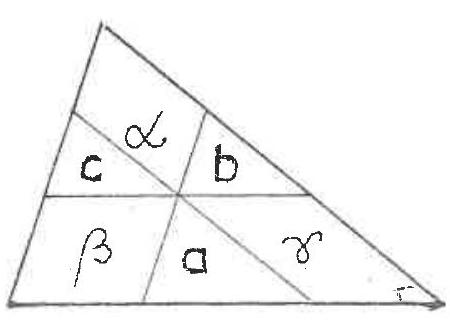
|
| 1215 |
+
|
| 1216 |
+
A1-Mac; A2-Yug; A3-Bul;A4-Rom; A5-Mold;A6, A7-Rom; A8-Mold C1-Mac; C2-Bul; C3-Yug; C4-Rom; C5-Mold. G1,G2-Mac; G3-Rom; G4-Bul; G5-Yug;G6-Rom; G7-Yug.[^0]
|
| 1217 |
+
|
| 1218 |
+
|
| 1219 |
+
[^0]: i) Identificată drept problema piesei de 5 lei a lui Țițeica.
|
| 1220 |
+
|
JBMO/md/en-shortlist/en-jbmo-2004_shl.md
ADDED
|
@@ -0,0 +1,471 @@
|
|
|
|
|
|
|
|
|
|
|
|
|
|
|
|
|
|
|
|
|
|
|
|
|
|
|
|
|
|
|
|
|
|
|
|
|
|
|
|
|
|
|
|
|
|
|
|
|
|
|
|
|
|
|
|
|
|
|
|
|
|
|
|
|
|
|
|
|
|
|
|
|
|
|
|
|
|
|
|
|
|
|
|
|
|
|
|
|
|
|
|
|
|
|
|
|
|
|
|
|
|
|
|
|
|
|
|
|
|
|
|
|
|
|
|
|
|
|
|
|
|
|
|
|
|
|
|
|
|
|
|
|
|
|
|
|
|
|
|
|
|
|
|
|
|
|
|
|
|
|
|
|
|
|
|
|
|
|
|
|
|
|
|
|
|
|
|
|
|
|
|
|
|
|
|
|
|
|
|
|
|
|
|
|
|
|
|
|
|
|
|
|
|
|
|
|
|
|
|
|
|
|
|
|
|
|
|
|
|
|
|
|
|
|
|
|
|
|
|
|
|
|
|
|
|
|
|
|
|
|
|
|
|
|
|
|
|
|
|
|
|
|
|
|
|
|
|
|
|
|
|
|
|
|
|
|
|
|
|
|
|
|
|
|
|
|
|
|
|
|
|
|
|
|
|
|
|
|
|
|
|
|
|
|
|
|
|
|
|
|
|
|
|
|
|
|
|
|
|
|
|
|
|
|
|
|
|
|
|
|
|
|
|
|
|
|
|
|
|
|
|
|
|
|
|
|
|
|
|
|
|
|
|
|
|
|
|
|
|
|
|
|
|
|
|
|
|
|
|
|
|
|
|
|
|
|
|
|
|
|
|
|
|
|
|
|
|
|
|
|
|
|
|
|
|
|
|
|
|
|
|
|
|
|
|
|
|
|
|
|
|
|
|
|
|
|
|
|
|
|
|
|
|
|
|
|
|
|
|
|
|
|
|
|
|
|
|
|
|
|
|
|
|
|
|
|
|
|
|
|
|
|
|
|
|
|
|
|
|
|
|
|
|
|
|
|
|
|
|
|
|
|
|
|
|
|
|
|
|
|
|
|
|
|
|
|
|
|
|
|
|
|
|
|
|
|
|
|
|
|
|
|
|
|
|
|
|
|
|
|
|
|
|
|
|
|
|
|
|
|
|
|
|
|
|
|
|
|
|
|
|
|
|
|
|
|
|
|
|
|
|
|
|
|
|
|
|
|
|
|
|
|
|
|
|
|
|
|
|
|
|
|
|
|
|
|
|
|
|
|
|
|
|
|
|
|
|
|
|
|
|
|
|
|
|
|
|
|
|
|
|
|
|
|
|
|
|
|
|
|
|
|
|
|
|
|
|
|
|
|
|
|
|
|
|
|
|
|
|
|
|
|
|
|
|
|
|
|
|
|
|
|
|
|
|
|
|
|
|
|
|
|
|
|
|
|
|
|
|
|
|
|
|
|
|
|
|
|
|
|
|
|
|
|
|
|
|
|
|
|
|
|
|
|
|
|
|
|
|
|
|
|
|
|
|
|
|
|
|
|
|
|
|
|
|
|
|
|
|
|
|
|
|
|
|
|
|
|
|
|
|
|
|
|
|
|
|
|
|
|
|
|
|
|
|
|
|
|
|
|
|
|
|
|
|
|
|
|
|
|
|
|
|
|
|
|
|
|
|
|
|
|
|
|
|
|
|
|
|
|
|
|
|
|
|
|
|
|
|
|
|
|
|
|
|
|
|
|
|
|
|
|
|
|
|
|
|
|
|
|
|
|
|
|
|
|
|
|
|
|
|
|
|
|
|
|
|
|
|
|
|
|
|
|
|
|
|
|
|
|
|
|
|
|
|
|
|
|
|
|
|
|
|
|
|
|
|
|
|
|
|
|
|
|
|
|
|
|
|
|
|
|
|
|
|
|
|
|
|
|
|
|
|
|
|
|
|
|
|
|
|
|
|
|
|
|
|
|
|
|
|
|
|
|
|
|
|
|
|
|
|
|
|
|
|
|
|
|
|
|
|
|
|
|
|
|
|
|
|
|
|
|
|
|
|
|
|
|
|
|
|
|
|
|
|
|
|
|
|
|
|
|
|
|
|
|
|
|
|
|
|
|
|
|
|
|
|
|
|
|
|
|
|
|
|
|
|
|
|
|
|
|
|
|
|
|
|
|
|
|
|
|
|
|
|
|
|
|
|
|
|
|
|
|
|
|
|
|
|
|
|
|
|
|
|
|
|
|
|
|
|
|
|
|
|
|
|
|
|
|
|
|
|
|
|
|
|
|
|
|
|
|
|
|
|
|
|
|
|
|
|
|
|
|
|
|
|
|
|
|
|
|
|
|
|
|
|
|
|
|
|
|
|
|
|
|
|
|
|
|
|
|
|
|
|
|
|
|
|
|
|
|
|
|
|
|
|
|
|
|
|
|
|
|
|
|
|
|
|
|
|
|
|
|
|
|
|
|
|
|
|
|
|
|
|
|
|
|
|
|
|
|
|
|
|
|
|
|
|
|
|
|
|
|
|
|
|
|
|
|
|
|
|
|
|
|
|
|
|
|
|
|
|
|
|
|
|
|
|
|
|
|
|
|
|
|
|
|
|
|
|
|
|
|
|
|
|
|
|
|
|
|
|
|
|
|
|
|
|
|
|
|
|
|
|
|
|
|
|
|
|
|
|
|
|
|
|
|
|
|
|
|
|
|
|
|
|
|
|
|
|
|
|
|
|
|
|
|
|
|
|
|
|
|
|
|
|
|
|
|
|
|
|
|
|
|
|
|
|
|
|
|
|
|
|
|
|
|
|
|
|
|
|
|
|
|
|
|
|
|
|
|
|
|
|
|
|
|
|
|
|
|
|
|
|
|
|
|
|
|
|
|
|
|
|
|
|
|
|
|
|
|
|
|
|
|
|
|
|
|
|
|
|
|
|
|
|
|
|
|
|
|
|
|
|
|
|
|
|
|
|
|
|
|
|
|
|
|
|
|
|
|
|
|
|
|
|
|
|
|
|
|
|
|
|
|
|
|
|
|
|
|
|
|
|
|
|
|
|
|
|
|
|
|
|
|
|
|
|
|
|
|
|
|
|
|
|
|
|
|
|
|
|
|
|
|
|
|
|
|
|
|
|
|
|
|
|
|
|
|
|
|
|
|
|
|
|
|
|
|
|
|
|
|
|
|
|
|
|
|
|
|
|
|
|
|
|
|
|
|
|
|
|
|
|
|
| 1 |
+
# A OPTA OLIMPIADĂ BALCANICĂ DE MATEMATICÄ PENTRU JUNIORI
|
| 2 |
+
|
| 3 |
+
## Novi Sad, Serbia \& Muntenegru, 28.06.2004.
|
| 4 |
+
|
| 5 |
+
1. Să se demonstreze inegalitatea
|
| 6 |
+
|
| 7 |
+
$$
|
| 8 |
+
\frac{x+y}{x^{2}-x y+y^{2}} \leq \frac{2 \sqrt{2}}{\sqrt{x^{2}+y^{2}}}
|
| 9 |
+
$$
|
| 10 |
+
|
| 11 |
+
pentru orice numere reale $x$ şi $y$, nu simultan nule.
|
| 12 |
+
|
| 13 |
+
2. Fie $A B C$ un triunghi isoscel $\mathrm{cu} A C=B C, M$ mijlocul segmentului $A C$ şi $\ell$ dreapta ce trece prin $C$ şi este perpendiculară pe $A B$. Cercul ce trece prin punctele $B, C$ si $M$ intersectează dreapta $\ell$ în punctele $C$ si $Q$. Să se afle raza cercului circumscris triunghiului $A B C$ in funcţie de $m=C Q$.
|
| 14 |
+
3. Se consideră numerele naturale nenule $x$ si $y$ astfel încât $3 x+4 y$ si $4 x+3 y$ sunt ambele pătrate perfecte. Să se arate că numerele $x$ §̧i $y$
|
| 15 |
+
|
| 16 |
+
sunt ambele divizibile cu 7 .
|
| 17 |
+
|
| 18 |
+
4. Se consideră un poligon convex având $n$ vârfuri, $n \geq 4$. Descompunem arbitrar poligonul in triunghiuri ale căror vârfuri sunt printre vârfurile poligonului, astfel încât orice două triunghiuri să nu aibă puncte interioare comune. Colorăm cu negru triunghiurile ce au două laturi care sunt şi laturi ale poligonului, cu roşu triunghiurile ce au exact o latură care este şi latură a poligonului şi cu alb triunghiurile ale căror laturi nu sunt laturi ale poligonului.
|
| 19 |
+
|
| 20 |
+
Să se demonstreze că numărul triunghiurilor negre este cu 2 mai mare decât numărul triunghiurilor albe.
|
| 21 |
+
|
| 22 |
+
## NUMBER THEORY
|
| 23 |
+
|
| 24 |
+
NT1. Let $a, b, p, q$ be positive integers such that $a$ and $b$ are relatively prime, $a b$ is even and $p, q \geq 3$. Prove that
|
| 25 |
+
|
| 26 |
+
$$
|
| 27 |
+
2 a^{p} b-2 a b^{q}
|
| 28 |
+
$$
|
| 29 |
+
|
| 30 |
+
$$
|
| 31 |
+
a \text { esche }
|
| 32 |
+
$$
|
| 33 |
+
|
| 34 |
+
cannot be a square of an integer number.
|
| 35 |
+
|
| 36 |
+
Solution. Withou loss of
|
| 37 |
+
|
| 38 |
+
Let $a=2 a^{\prime}$. If $\vdots$. Without loss of generality, assume that $a$ is even and consequently $b$ is odd.
|
| 39 |
+
|
| 40 |
+
$$
|
| 41 |
+
2 a^{p} b-2 a b^{q}=4 a^{\prime} b\left(a^{p-1}-b^{q-1}\right)
|
| 42 |
+
$$
|
| 43 |
+
|
| 44 |
+
is a square, then $a^{\prime}, b$ and $a^{p-1}-b^{q-1}$ are pairwise coprime.
|
| 45 |
+
|
| 46 |
+
On the other hand, $a^{p-1}$ is divisible by 4 and $b^{q-1}$ gives the remainder 1 when divided by 4. It follows that $a^{p-1}-b^{q-1}$ has the form $4 k+3$, a contradiction.
|
| 47 |
+
|
| 48 |
+
NT2. Find all four digit numbers A such that
|
| 49 |
+
|
| 50 |
+
$$
|
| 51 |
+
\frac{1}{3} A+2000=\frac{2}{3} \bar{A}
|
| 52 |
+
$$
|
| 53 |
+
|
| 54 |
+
where $\bar{A}$ is the number with the same digits as $A$, but written in opposite order. (For example, $\overline{1234}=4321$.)
|
| 55 |
+
|
| 56 |
+
Solution. Let $A=1000 a+100 b+10 c+d$. Then we obtain the equality
|
| 57 |
+
|
| 58 |
+
$$
|
| 59 |
+
\frac{1}{3}(1000 n+100 b+10 c+d)+2000=\frac{2}{3}(1000 d+100 c+10 b+a)
|
| 60 |
+
$$
|
| 61 |
+
|
| 62 |
+
ol
|
| 63 |
+
|
| 64 |
+
$$
|
| 65 |
+
1999 d+190 c=80 b+998 a+6000
|
| 66 |
+
$$
|
| 67 |
+
|
| 68 |
+
It is clear that $d$ is even digit and $d>2$. So we have to investigate three cases: (i) $d=4$ : (ii) $d=6$; (iii) $d=8$.
|
| 69 |
+
|
| 70 |
+
(i) If $d=4$. comparing the last digits in the upper equality we see that $a=2$ or $a=\overline{1}$.
|
| 71 |
+
|
| 72 |
+
If $a=2$ then $19 c=80$, which is possible only when $40=c=0$. Hence the number $4=2004$ satisfies the condition.
|
| 73 |
+
|
| 74 |
+
If $a=\overline{7}$ then $19 c-8 b=490$, which is impossible.
|
| 75 |
+
|
| 76 |
+
(ii) If $d=6$ then $190 c+5994=80 b+998$ r. Comparing the last digits we obtain tilat. $a=3$ or $a=8$.
|
| 77 |
+
|
| 78 |
+
If $a=3$ then $80 b+998 a<80 \cdot 9+1000 \cdot 3<5994$.
|
| 79 |
+
|
| 80 |
+
If $a=8$ then $306+998 a \geq 998 \cdot \delta=7984=5994+1990>599+190 c$.
|
| 81 |
+
|
| 82 |
+
(iii) If $d=8$ then $190 c+9992=80 b+998 a$. Now $80 b+998 a \leq 80 \cdot 9+998 \cdot 9=9702<$ $9992+190 c$
|
| 83 |
+
|
| 84 |
+
Hence we have the only solution $4=2004$.
|
| 85 |
+
|
| 86 |
+
NT3. Find all positive integers $n, n \geq 3$, such that $n \mid(n-2)$ !.
|
| 87 |
+
|
| 88 |
+
Solution. For $n=3$ and $n=4$ we easily check that $n$ does not divide $(n-2)!$.
|
| 89 |
+
|
| 90 |
+
If $n$ is prime, $n \geq 5$, then $(n-2)!=1 \cdot 2 \cdot 3 \cdot \ldots \cdot(n-2)$ is not divided by $n$, since $n$ is a prime not included in the set of factors of ( $n-2)$ !.
|
| 91 |
+
|
| 92 |
+
If $n$ is composite, $n \geq 6$, then $n=p m$, where $p$ is prime and $m>1$. Since $p \geq 2$, we have $n=p m \geq 2 m$, and consequently $m \leq \frac{n}{2}$. Moreover $m<n-2$, since $n>4$.
|
| 93 |
+
|
| 94 |
+
Therefore, if $p \neq m$, both $p$ and $m$ are distinct factors of ( $n-2)$ ! and so $n$ divides $(n-2)!$.
|
| 95 |
+
|
| 96 |
+
If $p=m$, then $n=p^{2}$ and $p>2$ (since $n>4$ ). Hence $2 p<p^{2}=n$. Moreover $2 p<n-1$ :(since $n>4$ ). Therefore, both $p$ and $2 p$ are distinct factors of $(n-2)$ ! and so $2 p^{2} \mid(n-2)$ !. Hence $p^{2} \mid(n-2)$ !, i.e. $n \mid(n-2)$ !. So we conclude that $n \mid(n-2)!$ if and only if $n$ is composite, $n \geq 6$.
|
| 97 |
+
|
| 98 |
+
NT4. If the positive integers $x$ and $y$ are such that both $3 x+4 y$ and $4 x+3 y$ are perfect squares, prove that both $x$ and $y$ are multiples of 7 .
|
| 99 |
+
|
| 100 |
+
Solution. Let
|
| 101 |
+
|
| 102 |
+
$$
|
| 103 |
+
3 x+4 y=m^{2}, \quad 4 x+3 y=n^{2}
|
| 104 |
+
$$
|
| 105 |
+
|
| 106 |
+
Then
|
| 107 |
+
|
| 108 |
+
$$
|
| 109 |
+
7(x+y)=m^{2}+n^{2} \Rightarrow 7 \mid m^{2}+n^{2}
|
| 110 |
+
$$
|
| 111 |
+
|
| 112 |
+
Considering $m=7 k+r, \quad r \in\{0,1,2,3,4,5,6\}$ we find that $m^{2} \equiv u(\bmod 7), \quad u \in$ $\{0,1,2,4\}$ and similarly $n^{2} \equiv v(\bmod 7), \quad v \in\{0,1,2,4\}$. Therefore we have either $m^{2}+n^{2} \equiv 0 \quad(\bmod 7)$, when $u=v=0$, or $m^{2}+n^{2} \equiv w(\bmod 7), w \in\{1,2,3,4,5,6\}$. However, from (2) we have that $m^{2}+n^{2} \equiv 0(\bmod \tau)$ and hence $u=v=0$ and
|
| 113 |
+
|
| 114 |
+
$$
|
| 115 |
+
m^{2}+n^{2} \equiv 0 \quad\left(\bmod \tau^{2}\right) \Rightarrow 7(x+y) \equiv 0 \quad\left(\bmod \tau^{2}\right)
|
| 116 |
+
$$
|
| 117 |
+
|
| 118 |
+
and cousequently
|
| 119 |
+
|
| 120 |
+
$$
|
| 121 |
+
x+y \equiv 0 \quad(\bmod 7)
|
| 122 |
+
$$
|
| 123 |
+
|
| 124 |
+
Moreover. from (1) we have $x-y=n^{2}-m^{2}$ and $n^{2}-m^{2} \equiv 0\left(\bmod i^{2}\right)$ (since $\left.u=c=0\right)$, so
|
| 125 |
+
|
| 126 |
+
$$
|
| 127 |
+
x-y \equiv 0 \quad(\bmod 7) .
|
| 128 |
+
$$
|
| 129 |
+
|
| 130 |
+
From (3) and (4) we have tliat $x+y=7 k, x-y=7 l$, where $k$ and $l$ are positive incegers. Hence
|
| 131 |
+
|
| 132 |
+
$$
|
| 133 |
+
2 x=7(k+l), 2 y=7(k-l)
|
| 134 |
+
$$
|
| 135 |
+
|
| 136 |
+
where $k+l$ and $k-l$ are positive integers. It follows that $i \mid 2 x$ and $i \mid 2 y$, and finally $\pi \mid x$ and i|y.
|
| 137 |
+
|
| 138 |
+
## ALGEBRA
|
| 139 |
+
|
| 140 |
+
A1. Prove that
|
| 141 |
+
|
| 142 |
+
$$
|
| 143 |
+
(1+a b c)\left(\frac{1}{a}+\frac{1}{b}+\frac{1}{c}\right) \geq 3+a+b+c
|
| 144 |
+
$$
|
| 145 |
+
|
| 146 |
+
for any real numbers $a, b, c \geq 1$.
|
| 147 |
+
|
| 148 |
+
Solution. The inequality rewrites as
|
| 149 |
+
|
| 150 |
+
$$
|
| 151 |
+
\left(\frac{1}{a}+\frac{1}{b}+\frac{1}{c}\right)+(b c+a c+a b) \geq 3+a+b+c
|
| 152 |
+
$$
|
| 153 |
+
|
| 154 |
+
or
|
| 155 |
+
|
| 156 |
+
$$
|
| 157 |
+
\left(\frac{\frac{1}{a}+\frac{1}{b}}{2}+\frac{\frac{1}{b}+\frac{1}{c}}{2}+\frac{\frac{1}{a}+\frac{1}{c}}{2}\right)+(b c+a c+a b) \geq 3+a+b+c
|
| 158 |
+
$$
|
| 159 |
+
|
| 160 |
+
which is equivalent to
|
| 161 |
+
|
| 162 |
+
$$
|
| 163 |
+
\frac{(2 a b-(a+b))(a b-1)}{2 a b}+\frac{(2 b c-(b+c))(b c-1)}{2 b c}+\frac{(2 c a-(c+a))(c a-1)}{2 c a} \geq 0
|
| 164 |
+
$$
|
| 165 |
+
|
| 166 |
+
The last inequality is true due to the obvious relations
|
| 167 |
+
|
| 168 |
+
$$
|
| 169 |
+
2 x y-(x+y)=x(y-1)+y(x-1) \geq 0
|
| 170 |
+
$$
|
| 171 |
+
|
| 172 |
+
for any two real numbers $x, y \geq 1$.
|
| 173 |
+
|
| 174 |
+
A2. Prove that, for all real numbers $x, y, z$ :
|
| 175 |
+
|
| 176 |
+
$$
|
| 177 |
+
\frac{x^{2}-y^{2}}{2 x^{2}+1}+\frac{y^{2}-z^{2}}{2 y^{2}+1}+\frac{z^{2}-x^{2}}{2 z^{2}+1} \leq(x+y+z)^{2}
|
| 178 |
+
$$
|
| 179 |
+
|
| 180 |
+
When the equality holds?
|
| 181 |
+
|
| 182 |
+
Solution. For $x=y=z=0$ the equality is valid.
|
| 183 |
+
|
| 184 |
+
Since $(x+y+z)^{2} \geq 0$ it is enongh to prove that
|
| 185 |
+
|
| 186 |
+
$$
|
| 187 |
+
\frac{x^{2}-y^{2}}{2 x^{2}+1}+\frac{y^{2}-z^{2}}{2 y^{2}+1}+\frac{z^{2}-x^{2}}{2 z^{2}+1} \leq 0
|
| 188 |
+
$$
|
| 189 |
+
|
| 190 |
+
which is equivalent to the inequality
|
| 191 |
+
|
| 192 |
+
$$
|
| 193 |
+
\frac{x^{2}-y^{2}}{x^{2}+\frac{1}{2}}+\frac{y^{2}-z^{2}}{y^{2}+\frac{1}{2}}+\frac{z^{2}-x^{2}}{z^{2}+\frac{1}{2}} \leq 0
|
| 194 |
+
$$
|
| 195 |
+
|
| 196 |
+
Dellote
|
| 197 |
+
|
| 198 |
+
$$
|
| 199 |
+
a=x^{2}+\frac{1}{2}, b=y^{2}+\frac{1}{2}, c=z^{2}+\frac{1}{2}
|
| 200 |
+
$$
|
| 201 |
+
|
| 202 |
+
Then (1) is equivalent to
|
| 203 |
+
|
| 204 |
+
$$
|
| 205 |
+
\frac{a-b}{a}+\frac{b-c}{b}+\frac{c-a}{c} \leq 0
|
| 206 |
+
$$
|
| 207 |
+
|
| 208 |
+
From very well known $A G$ inequality follows that
|
| 209 |
+
|
| 210 |
+
$$
|
| 211 |
+
a^{2} b+b^{2} c+c^{2} a \geq 3 a b c
|
| 212 |
+
$$
|
| 213 |
+
|
| 214 |
+
Fron the equivalencies
|
| 215 |
+
|
| 216 |
+
$$
|
| 217 |
+
a^{2} b+b^{2} c+c^{2} a \geq 3 a b c \Leftrightarrow \frac{a}{c}+\frac{b}{a}+\frac{c}{b} \geq-3 \Leftrightarrow \frac{a-b}{a}+\frac{b-c}{b}+\frac{c-a}{c} \leq 0
|
| 218 |
+
$$
|
| 219 |
+
|
| 220 |
+
follows thait the inequality (2) is valid, for positive real numbers $a, b, c$.
|
| 221 |
+
|
| 222 |
+
A3. Prove that for all real $x, y$
|
| 223 |
+
|
| 224 |
+
$$
|
| 225 |
+
\frac{x+y}{x^{2}-x y+y^{2}} \leq \frac{2 \sqrt{2}}{\sqrt{x^{2}+y^{2}}}
|
| 226 |
+
$$
|
| 227 |
+
|
| 228 |
+
Solution. The inequality rewrites as
|
| 229 |
+
|
| 230 |
+
$$
|
| 231 |
+
\frac{x+y}{x^{2}-x y+y^{2}} \leq \frac{\sqrt{2\left(x^{2}+y^{2}\right)}}{\frac{x^{2}+y^{2}}{2}}
|
| 232 |
+
$$
|
| 233 |
+
|
| 234 |
+
Now it is enough to prove the next two simple inequalities:
|
| 235 |
+
|
| 236 |
+
$$
|
| 237 |
+
x+y \leq \sqrt{2\left(x^{2}+y^{2}\right)}, \quad x^{2}-x y+y^{2} \geq \frac{x^{2}+y^{2}}{2}
|
| 238 |
+
$$
|
| 239 |
+
|
| 240 |
+
A4. Prove that if $0<\frac{a}{b}<b<2 a$ then
|
| 241 |
+
|
| 242 |
+
$$
|
| 243 |
+
\frac{2 a b-a^{2}}{7 a b-3 b^{2}-2 a^{2}}+\frac{2 a b-b^{2}}{7 a b-3 a^{2}-2 b^{2}} \geq 1+\frac{1}{4}\left(\frac{a}{b}-\frac{b}{a}\right)^{2}
|
| 244 |
+
$$
|
| 245 |
+
|
| 246 |
+
Solution. If we denote
|
| 247 |
+
|
| 248 |
+
$$
|
| 249 |
+
u=2-\frac{a}{b}, \quad v=2-\frac{b}{a}
|
| 250 |
+
$$
|
| 251 |
+
|
| 252 |
+
then the inequality rewrites as
|
| 253 |
+
|
| 254 |
+
$$
|
| 255 |
+
\begin{aligned}
|
| 256 |
+
& \frac{u}{v+u v}+\frac{v}{u+u v} \geq 1+\frac{1}{4}(u-u)^{2} \\
|
| 257 |
+
& \frac{(u-v)^{2}+u v(1-u v)}{u v(u v+u+v+1)} \geq \frac{(u-u)^{2}}{4}
|
| 258 |
+
\end{aligned}
|
| 259 |
+
$$
|
| 260 |
+
|
| 261 |
+
$\mathrm{Or}$
|
| 262 |
+
|
| 263 |
+
Since $u>0, v>0, u+v \leq 2, u v \leq 1, u v(u+v+u v+1) \leq 4$, the result is clear.
|
| 264 |
+
|
| 265 |
+
## GEOMETRY
|
| 266 |
+
|
| 267 |
+
G1. Two circles $k_{1}$ and $k_{2}$ intersect a.t points $A$ and $B$. A circle $k_{3}$ centered at $A$ meet $k_{1}$ at $M$ and $P$ and $k_{2}$ at $N$ and $Q$, such that $N$ and $Q$ are on different sides of $M P$ and $A B>A M$.
|
| 268 |
+
|
| 269 |
+
Prove rhat the angles $\angle M B Q$ and $\angle N B P$ are equal.
|
| 270 |
+
|
| 271 |
+
Solution As $A M=A P$, we have
|
| 272 |
+
|
| 273 |
+
$$
|
| 274 |
+
\angle M B A=\frac{1}{2} \operatorname{arcAM}=\frac{1}{2} \operatorname{arc} A P=\angle A B P
|
| 275 |
+
$$
|
| 276 |
+
|
| 277 |
+
and likewise
|
| 278 |
+
|
| 279 |
+
$$
|
| 280 |
+
\angle Q B A=\frac{1}{2} \operatorname{arc} A Q=\frac{1}{2} \operatorname{arc} c A N=\angle A B N
|
| 281 |
+
$$
|
| 282 |
+
|
| 283 |
+
Summing these equalities yields $\angle M B Q=\angle N B P$ as needed.
|
| 284 |
+
|
| 285 |
+
Q2. Let $E$ and $F$ be two distinct points inside of a parallelogram $A B C D$. Find the maximum number of triangles with the same area and having the vertices in three of the following five points: $A, B, C, D, E, F$.
|
| 286 |
+
|
| 287 |
+
Solution. We shall use the following two well known results:
|
| 288 |
+
|
| 289 |
+
Lemma 1. Let $A, B, C, D$ be four points lying in the same plane such that the line $A B$ do not intersect the segment $C D$ (in particular $\triangle B C D$ is a convex quadrilateral). If $[A B C]=[A B D]$, then $A B \| C D$.
|
| 290 |
+
|
| 291 |
+
Lemma 2. Let $X$ be a point inside of a parallelogram $A B C D$. Then $[A C X]<[A B C]$ and $[B D X]<[4 B D]$. (Here and below the notation $[S]$ stands for the area of the surface of $S$.
|
| 292 |
+
|
| 293 |
+
With the points $A, B, C, D, E, F$ we can form 20 triangles. We will show that at most ten of them can have the same area. In that sense three cases may occur.
|
| 294 |
+
|
| 295 |
+
Gase 1. EF is parallel with one side of the parallelogram $\triangle B C D$.
|
| 296 |
+
|
| 297 |
+
We can assume that $E F \|: A D, E$ lies inside of the triangle $A B F$ and $F$ lies inside of thr hiangle $C D E$. With the points $A, B, C, D, E$ we can form ten pairs of triangles als follows:
|
| 298 |
+
|
| 299 |
+
$(\triangle .4 D E, \triangle A E F) ;(\triangle . A D F, \triangle D E F) ;(\triangle B C E, \triangle B E F) ;(\triangle B C F, \triangle C E F) ;(\triangle C D E, \triangle C D F):$
|
| 300 |
+
|
| 301 |
+
$(\triangle A B E: \triangle A B F) ;(\triangle A D C ; \triangle A C E) ;(\triangle A B C, \triangle . A C F) ;(\triangle A B D, \triangle B D E) ;(\triangle C B D . \triangle B D F)$.
|
| 302 |
+
|
| 303 |
+
Using Lemmas $1-2$ one can easily prove that any two triangles that belong to the same pair have distinct area, so there exists at most ten triangles having the same area.
|
| 304 |
+
|
| 305 |
+
Case 2. $E F$ is parallel with a diagonal of the paralellogram $\triangle B C D$.
|
| 306 |
+
|
| 307 |
+
Let us assume $E F \| A C$ and that $E, F$ lie inside of the triangle $A B C$. We consider the following pairs of triangles:
|
| 308 |
+
|
| 309 |
+
$(\triangle A B D, \triangle B D E) ;(\triangle A B C, \triangle B C F) ;(\triangle A C D, \triangle B C E) ;(\triangle A B F, \triangle A B E) ;(\triangle B E F, \triangle D E F) ;$
|
| 310 |
+
|
| 311 |
+
$(\triangle A E F, \triangle A C E) ;(\triangle C E F, \triangle A C F) ;(\triangle A D E ; \triangle A D F) ;(\triangle D C E, \triangle D C F) ;(\triangle C B D, \triangle B D F)$.
|
| 312 |
+
|
| 313 |
+
With the same idea as above we deduce that any two triangles that belong to the same pair have distinct area and the conclusion follows.
|
| 314 |
+
|
| 315 |
+
We also note that if $E$ and $F$ lie on $A C$ then only 16 of 20 triangles are nondegenerate. In this case we consider the following pairs:
|
| 316 |
+
|
| 317 |
+
$$
|
| 318 |
+
\begin{aligned}
|
| 319 |
+
& (\triangle A B E, \triangle A B F) ;(\triangle A B C, \triangle B C F) ;(\triangle B C E, \triangle B E F) ;(\triangle A D E, \triangle A D F) \\
|
| 320 |
+
& (\triangle A C D, \triangle D C F) ;(\triangle C D E, \triangle E D F) ;(\triangle B D E, \triangle A B D) ;(\triangle B D F, \triangle B D C)
|
| 321 |
+
\end{aligned}
|
| 322 |
+
$$
|
| 323 |
+
|
| 324 |
+
Case 3. $E F$ is not parallel with any side or diagonal of $\triangle B C D$.
|
| 325 |
+
|
| 326 |
+
We claim that at most two of the triangles $A E F, B E F, C E F, D E F$ can have the same area. Indeed, supposing the contrary, we may have $[A E F]=[B E F]=[C E F]$. We remark first that $A, B, C$ do not belong to $E F$ (elsewhere, exactly one of the above triangles is degenerate, contradiction!). Hence at least two of the points $A, B, C$ belong to the same side of the line $E F$. Using now Lemma 1 we get that $E F$ is parallel with $A B$ or $B C$ or $A C$. This is clearly a contradiction and our claim follows. With the remaining 16 triangles we form 8 pairs as follows:
|
| 327 |
+
|
| 328 |
+
$(\triangle A B D, \triangle B D E) ;(\triangle C D B, \triangle B D F) ;(\triangle A D C, \triangle A C E) ;(\triangle A B C, \triangle A C F) ;$
|
| 329 |
+
|
| 330 |
+
$(\triangle A B E, \triangle A B F) ;(\triangle B C E, \triangle B C F) ;(\triangle A D E, \triangle A D F) ;(\triangle D C E, \triangle D C F)$.
|
| 331 |
+
|
| 332 |
+
With the same arguments as above, we get at most ten triangles with the same area.
|
| 333 |
+
|
| 334 |
+
To conclude the proof, it remains only to give an example of points $E, F$ inside of the parallelogram $A B C D$ such that exactly ten of the triangles that can be formed with the vetices $A, B, C, D, E, F$ have the same area.
|
| 335 |
+
|
| 336 |
+
Denote $A C \cap B D=\{O\}$ and let $M, N$ be the midpoints of $A B$ and $C D$ respectively Consider $E$ and $F$ the midpoints of $M O$ and $N O$. Then $O, M, N, E, F$ are collinear and $M E=E O=F O=N F$. Since $E$ and $F$ are the centroids of the triangles $A B F$ and $C D E$ we get $[A B E]=[A E F]=[B E F]$ and $[C E F]=[D E F]=[C D F]$. On the other hand, taking into account that $A E C F$ and $B E D F$ are parallelograms we deduce $[4 E F]=[C E F]=[4 C E]=[A C F]$ and $[B E F]=[D E F]=[B D E]=[B D F]$. From the above equalities we conclude that the triangles
|
| 337 |
+
|
| 338 |
+
## $\triangle A B E, \triangle C D F E, \triangle A C E, \triangle A C F, \triangle B D E, \triangle B D F, \triangle A E F, \triangle B E F, \triangle C E F, \triangle D E F$
|
| 339 |
+
|
| 340 |
+
have the same area. This finishes our proof.
|
| 341 |
+
|
| 342 |
+
G3. Let $A B C$ be scalene triangle inscribed in the circle $k$. Circles $\alpha, \beta, \gamma$ are internally tangent to $k$ at points $A_{1}, B_{1}, C_{1}$ respectively, and tangent to the sides $B C, C A, A B$ at points $A_{2}, B_{2}, C_{2}$ respectively, so that $A$ and $A_{1}$ are on opposite sides of $B C^{\prime}, B$ and $B_{1}$ mre on opposite sides of $C A$, and $C$ and $C_{1}$ are on opposite sides of $A B$. Lines $A_{1} A_{2}, B_{1} B_{2}$ and $C_{1} C_{2}$ meet again the circle $k$ in the points $A^{\prime}, B^{\prime}, C^{\prime \prime}$ respectively. is right.
|
| 343 |
+
|
| 344 |
+
Prove that if $M$ is the intersection point of the lines $B B^{\prime}$ and $C^{\prime} C^{\prime \prime}$, the angle $\angle M A .4^{\prime}$
|
| 345 |
+
|
| 346 |
+
Solution. The idea is to observe that $A^{\prime}, B^{\prime}, C^{\prime \prime}$ are the midpoints of the arcs $B C$, $C A$ and $A B$ of the circle $k$ which do not contain the points $A, B, C$ respectively. To prove this, consider the dilatation with the center $A_{1}$ taking' $\alpha$ to $k$. The line $B C$, which touches $\alpha$ at $A_{2}$, is taken to the line $t$ touching $l$ at $A^{\prime}$. Since $t$ is parallel to $B C^{\prime}$, it follows that $A^{\prime}$ is the midpoint of thr arc $B C$ that do not touch $\alpha$.
|
| 347 |
+
|
| 348 |
+
Consequently; lines $B B^{\prime}$ and $C C^{\prime}$ are the exterior bisectors of the angles $B$ and $C$ of the scalene triangle $A B C$ and so $M$ is the excenter of $A B C$. Hence $A M$ and $4.4^{\prime}$ are the interior and exterior bisectors of the angle $A$, implying $\angle M A A^{i}=90^{\circ}$.
|
| 349 |
+
|
| 350 |
+
Q4. Let $A B C$ be isosceles triangle with $A C=B C, M$ be the midpoint of $A C, B H$ be the line through $C^{\prime}$ perpendicular to $A B$. The circle through $B, C$ and $M$ intersects $C H$ in point $Q$. If $C Q=m$, find the radius of the circumcircle of $A B C$.
|
| 351 |
+
|
| 352 |
+
Solution. Let $P$ be the center of circle $k_{1}$ through $B, C$ and $M, O$ be the center of the circumcircle of $A B C$, and $K E$ be the midpoint of $M C^{\prime}$. Since $A C^{\prime}=B C$, the center $O$ lies on $C H$. Let $K P$ intersects $C H$ in point $L$. Since $K P$ and $O M$ are perpendicular to AC, then $K P \| O M$. From $M K=K C$ it follows that $O L=C L$. On the other hand $O P$ is perpendicular to $B C$, hence $\angle L O P=\angle C O P=90^{\circ}-\angle \dot{B C H}$. Also we have $\angle O L P=\angle C L K^{\circ}=90^{\circ}-\angle A C H$. Since $A B C$ is isosceles and $\angle B C H=\angle A C H$, then $\angle L O P=\angle O L P$ and $\angle P=O P$. Since $C P=P Q$ we obtain that $\angle C L P=\angle Q O P$ and $C L=O Q$. Thus we have $C L=L O=O Q$, so $C O=\frac{2}{3} C Q$. Finally for the radius $R$ of the circumcircle of $A B C$ we obtain $R=\frac{2}{3} m$.
|
| 353 |
+
|
| 354 |
+

|
| 355 |
+
|
| 356 |
+
G5. Let $A B C$ be a triangle with $\angle C=90^{\circ}$ and $D \in C .4, E \in C^{\prime} B$, and $k_{1}, k_{2}, k_{3}, k_{4}$ semicircles with diameters $C A, C B, C D, C E$ respectively, which have common part with the triangle $A B C$. Let also,
|
| 357 |
+
|
| 358 |
+
$$
|
| 359 |
+
k_{1} \cap k_{2}=\{C, K\}, k_{3} \cap k_{4}=\{C, M\}, k_{2} \cap k_{3}=\{C, L\}, k_{1} \cap k_{4}=\{C, N\}
|
| 360 |
+
$$
|
| 361 |
+
|
| 362 |
+
Prove that $K, L, M$ and $N$ are cocyclic points.
|
| 363 |
+
|
| 364 |
+
Solution. The points $K, L, M, N$ belong to the segments $A B, B D, D E, E A$ respectively, where $C K \perp A B, C L \perp B D, C M \perp D E, C N \perp A E$. Then quadrilaterals $C D L M$ and $C E N M$ are inscribed. Let $\angle C A E=\varphi, \angle D C L=\theta$. Then $\angle E M N=\angle E C N=\varphi$ and $\angle D M L=\angle D C L=\theta$. So $\angle D M L+\angle E M N=\varphi+\theta$ and therefore $\angle L M N=180^{\circ}-\varphi-\theta$. The quadrilaterals $C B K L$ and $C A K N$ are also inscribed and hence $\angle L K C=\angle L B C=\theta$, $\angle C K N=\angle C A N=\varphi$, and so $\angle L K N=\varphi+\theta$, while $\angle L M N=180^{\circ}-\varphi-\theta$, which means that $K L M N$ is inscribed.
|
| 365 |
+
|
| 366 |
+
Note that $K L M N$ is convex because $L, N$ lie in the interior of the convex quadrilateral $A D E B$.
|
| 367 |
+
|
| 368 |
+
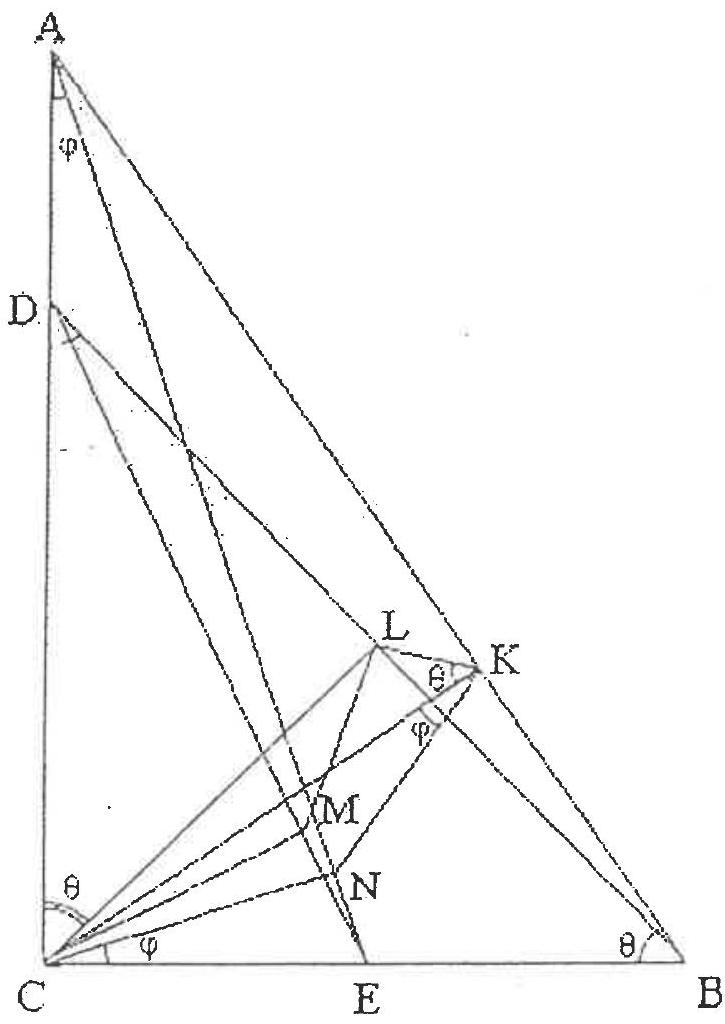
|
| 369 |
+
|
| 370 |
+
## COMBINATORICS
|
| 371 |
+
|
| 372 |
+
C1. A polygon having $n$ sides is arbitrarily decomposed in triangles having all the vertices among the vertices of the polygon. We paint in black the triangles that have two sides that are also sides of the polygon, in red if only one side of the triangle is side of the polygon and white those triangles that have in common with the poligon only vertices.
|
| 373 |
+
|
| 374 |
+
Prove that there are 2 more black triangles than white ones.
|
| 375 |
+
|
| 376 |
+
Solution. Denote by $b, r, w$ the number of black, red white triangles respectively.
|
| 377 |
+
|
| 378 |
+
It is easy to prove that the polygon is divided into $n-2$ triangles, hence
|
| 379 |
+
|
| 380 |
+
$$
|
| 381 |
+
b+r+w=n-2
|
| 382 |
+
$$
|
| 383 |
+
|
| 384 |
+
Each side of the polygon is a side of exactly one triangle of the decomposition, and thus
|
| 385 |
+
|
| 386 |
+
$$
|
| 387 |
+
2 b+r=n
|
| 388 |
+
$$
|
| 389 |
+
|
| 390 |
+
Subtracting the two relations yields $w=b-2$, as needed. allowed:
|
| 391 |
+
|
| 392 |
+
C2. Given $m \times n$ table, each cell signed with "-". The following operations are
|
| 393 |
+
|
| 394 |
+
(i) to change all the signs in entire row to the opposite, i. e. every "-" to "+", and every "+" to "-";
|
| 395 |
+
|
| 396 |
+
(ii) to change all the signs in entire column to the opposite, i. e. every "-" to "+" and every "+" to " -".
|
| 397 |
+
|
| 398 |
+
(a) Prove that if $m=n=100$, using the above operations one can not obtain 2004 signs "t".
|
| 399 |
+
|
| 400 |
+
(b) If $m=1004$, find the least $n>100$ for which 2004 signs " + " can be obtained.
|
| 401 |
+
|
| 402 |
+
Solution. If we apply (i) to $l$ rows and (ii) to $k$ columns we obtain $(m-k) l+(n-l) k$
|
| 403 |
+
|
| 404 |
+
(a) We have equation $(100-k) l+(100-l) k=2004$, or $100 l+100 k-2 l k=2004$, le
|
| 405 |
+
|
| 406 |
+
$$
|
| 407 |
+
50 l+50 k-1 k=1002
|
| 408 |
+
$$
|
| 409 |
+
|
| 410 |
+
Rewrite the lasc equation as
|
| 411 |
+
|
| 412 |
+
$$
|
| 413 |
+
(50-l)(50-h)=2.500-100.2=1498
|
| 414 |
+
$$
|
| 415 |
+
|
| 416 |
+
Since $1498=2 \cdot 7 \cdot 107$, this equation has no solitions in natural numbers.
|
| 417 |
+
|
| 418 |
+
(b) Let $n=101$. Then we have
|
| 419 |
+
|
| 420 |
+
$$
|
| 421 |
+
(100-k) l+(101-l) k=2004
|
| 422 |
+
$$
|
| 423 |
+
|
| 424 |
+
OI
|
| 425 |
+
|
| 426 |
+
$$
|
| 427 |
+
100 l+101 k-2 l k=2004
|
| 428 |
+
$$
|
| 429 |
+
|
| 430 |
+
l.e.
|
| 431 |
+
|
| 432 |
+
$$
|
| 433 |
+
101 k=2004-100 l+2 l k \div 2(1002-50 l+l k)
|
| 434 |
+
$$
|
| 435 |
+
|
| 436 |
+
Hence $s=2 t$ and we have $101 t=501-25 l+2 l t$. From here we have
|
| 437 |
+
|
| 438 |
+
$$
|
| 439 |
+
t=\frac{501-25 l}{101-2 l}=4+\frac{97-17 l}{101-2 l}
|
| 440 |
+
$$
|
| 441 |
+
|
| 442 |
+
Since $t$ is natural number and $97-17 l<101-2 l$, this is a contradiction, Hence $n \neq 101$. Let $n=1.02$. Then we have
|
| 443 |
+
|
| 444 |
+
$$
|
| 445 |
+
(100-k) l+(102-l) k=2004
|
| 446 |
+
$$
|
| 447 |
+
|
| 448 |
+
or
|
| 449 |
+
|
| 450 |
+
$$
|
| 451 |
+
100 l+102 k-2 l k=2004
|
| 452 |
+
$$
|
| 453 |
+
|
| 454 |
+
$$
|
| 455 |
+
50 l+51 k-l k=1002
|
| 456 |
+
$$
|
| 457 |
+
|
| 458 |
+
Rewrite the last equation as
|
| 459 |
+
|
| 460 |
+
$$
|
| 461 |
+
(51-l)(50-k)=25.50-1002=1.548
|
| 462 |
+
$$
|
| 463 |
+
|
| 464 |
+
Since $145 S=2 \cdot 2 \cdot 3 \cdot 3 \cdot 43$ we have $51-l=36$ and $50-k=43$. From here obtain $l=15$ and $k=7$. Indeed,
|
| 465 |
+
|
| 466 |
+
$$
|
| 467 |
+
(100-\bar{\imath}) \cdot 15+(102-1.5) \cdot \overline{7}=93 \cdot 15+87 \cdot 7=1395+609=2004
|
| 468 |
+
$$
|
| 469 |
+
|
| 470 |
+
Hence, the least $n$ is 102 .
|
| 471 |
+
|
JBMO/md/en-shortlist/en-jbmo-2005_shl.md
ADDED
|
@@ -0,0 +1,825 @@
|
|
|
|
|
|
|
|
|
|
|
|
|
|
|
|
|
|
|
|
|
|
|
|
|
|
|
|
|
|
|
|
|
|
|
|
|
|
|
|
|
|
|
|
|
|
|
|
|
|
|
|
|
|
|
|
|
|
|
|
|
|
|
|
|
|
|
|
|
|
|
|
|
|
|
|
|
|
|
|
|
|
|
|
|
|
|
|
|
|
|
|
|
|
|
|
|
|
|
|
|
|
|
|
|
|
|
|
|
|
|
|
|
|
|
|
|
|
|
|
|
|
|
|
|
|
|
|
|
|
|
|
|
|
|
|
|
|
|
|
|
|
|
|
|
|
|
|
|
|
|
|
|
|
|
|
|
|
|
|
|
|
|
|
|
|
|
|
|
|
|
|
|
|
|
|
|
|
|
|
|
|
|
|
|
|
|
|
|
|
|
|
|
|
|
|
|
|
|
|
|
|
|
|
|
|
|
|
|
|
|
|
|
|
|
|
|
|
|
|
|
|
|
|
|
|
|
|
|
|
|
|
|
|
|
|
|
|
|
|
|
|
|
|
|
|
|
|
|
|
|
|
|
|
|
|
|
|
|
|
|
|
|
|
|
|
|
|
|
|
|
|
|
|
|
|
|
|
|
|
|
|
|
|
|
|
|
|
|
|
|
|
|
|
|
|
|
|
|
|
|
|
|
|
|
|
|
|
|
|
|
|
|
|
|
|
|
|
|
|
|
|
|
|
|
|
|
|
|
|
|
|
|
|
|
|
|
|
|
|
|
|
|
|
|
|
|
|
|
|
|
|
|
|
|
|
|
|
|
|
|
|
|
|
|
|
|
|
|
|
|
|
|
|
|
|
|
|
|
|
|
|
|
|
|
|
|
|
|
|
|
|
|
|
|
|
|
|
|
|
|
|
|
|
|
|
|
|
|
|
|
|
|
|
|
|
|
|
|
|
|
|
|
|
|
|
|
|
|
|
|
|
|
|
|
|
|
|
|
|
|
|
|
|
|
|
|
|
|
|
|
|
|
|
|
|
|
|
|
|
|
|
|
|
|
|
|
|
|
|
|
|
|
|
|
|
|
|
|
|
|
|
|
|
|
|
|
|
|
|
|
|
|
|
|
|
|
|
|
|
|
|
|
|
|
|
|
|
|
|
|
|
|
|
|
|
|
|
|
|
|
|
|
|
|
|
|
|
|
|
|
|
|
|
|
|
|
|
|
|
|
|
|
|
|
|
|
|
|
|
|
|
|
|
|
|
|
|
|
|
|
|
|
|
|
|
|
|
|
|
|
|
|
|
|
|
|
|
|
|
|
|
|
|
|
|
|
|
|
|
|
|
|
|
|
|
|
|
|
|
|
|
|
|
|
|
|
|
|
|
|
|
|
|
|
|
|
|
|
|
|
|
|
|
|
|
|
|
|
|
|
|
|
|
|
|
|
|
|
|
|
|
|
|
|
|
|
|
|
|
|
|
|
|
|
|
|
|
|
|
|
|
|
|
|
|
|
|
|
|
|
|
|
|
|
|
|
|
|
|
|
|
|
|
|
|
|
|
|
|
|
|
|
|
|
|
|
|
|
|
|
|
|
|
|
|
|
|
|
|
|
|
|
|
|
|
|
|
|
|
|
|
|
|
|
|
|
|
|
|
|
|
|
|
|
|
|
|
|
|
|
|
|
|
|
|
|
|
|
|
|
|
|
|
|
|
|
|
|
|
|
|
|
|
|
|
|
|
|
|
|
|
|
|
|
|
|
|
|
|
|
|
|
|
|
|
|
|
|
|
|
|
|
|
|
|
|
|
|
|
|
|
|
|
|
|
|
|
|
|
|
|
|
|
|
|
|
|
|
|
|
|
|
|
|
|
|
|
|
|
|
|
|
|
|
|
|
|
|
|
|
|
|
|
|
|
|
|
|
|
|
|
|
|
|
|
|
|
|
|
|
|
|
|
|
|
|
|
|
|
|
|
|
|
|
|
|
|
|
|
|
|
|
|
|
|
|
|
|
|
|
|
|
|
|
|
|
|
|
|
|
|
|
|
|
|
|
|
|
|
|
|
|
|
|
|
|
|
|
|
|
|
|
|
|
|
|
|
|
|
|
|
|
|
|
|
|
|
|
|
|
|
|
|
|
|
|
|
|
|
|
|
|
|
|
|
|
|
|
|
|
|
|
|
|
|
|
|
|
|
|
|
|
|
|
|
|
|
|
|
|
|
|
|
|
|
|
|
|
|
|
|
|
|
|
|
|
|
|
|
|
|
|
|
|
|
|
|
|
|
|
|
|
|
|
|
|
|
|
|
|
|
|
|
|
|
|
|
|
|
|
|
|
|
|
|
|
|
|
|
|
|
|
|
|
|
|
|
|
|
|
|
|
|
|
|
|
|
|
|
|
|
|
|
|
|
|
|
|
|
|
|
|
|
|
|
|
|
|
|
|
|
|
|
|
|
|
|
|
|
|
|
|
|
|
|
|
|
|
|
|
|
|
|
|
|
|
|
|
|
|
|
|
|
|
|
|
|
|
|
|
|
|
|
|
|
|
|
|
|
|
|
|
|
|
|
|
|
|
|
|
|
|
|
|
|
|
|
|
|
|
|
|
|
|
|
|
|
|
|
|
|
|
|
|
|
|
|
|
|
|
|
|
|
|
|
|
|
|
|
|
|
|
|
|
|
|
|
|
|
|
|
|
|
|
|
|
|
|
|
|
|
|
|
|
|
|
|
|
|
|
|
|
|
|
|
|
|
|
|
|
|
|
|
|
|
|
|
|
|
|
|
|
|
|
|
|
|
|
|
|
|
|
|
|
|
|
|
|
|
|
|
|
|
|
|
|
|
|
|
|
|
|
|
|
|
|
|
|
|
|
|
|
|
|
|
|
|
|
|
|
|
|
|
|
|
|
|
|
|
|
|
|
|
|
|
|
|
|
|
|
|
|
|
|
|
|
|
|
|
|
|
|
|
|
|
|
|
|
|
|
|
|
|
|
|
|
|
|
|
|
|
|
|
|
|
|
|
|
|
|
|
|
|
|
|
|
|
|
|
|
|
|
|
|
|
|
|
|
|
|
|
|
|
|
|
|
|
|
|
|
|
|
|
|
|
|
|
|
|
|
|
|
|
|
|
|
|
|
|
|
|
|
|
|
|
|
|
|
|
|
|
|
|
|
|
|
|
|
|
|
|
|
|
|
|
|
|
|
|
|
|
|
|
|
|
|
|
|
|
|
|
|
|
|
|
|
|
|
|
|
|
|
|
|
|
|
|
|
|
|
|
|
|
|
|
|
|
|
|
|
|
|
|
|
|
|
|
|
|
|
|
|
|
|
|
|
|
|
|
|
|
|
|
|
|
|
|
|
|
|
|
|
|
|
|
|
|
|
|
|
|
|
|
|
|
|
|
|
|
|
|
|
|
|
|
|
|
|
|
|
|
|
|
|
|
|
|
|
|
|
|
|
|
|
|
|
|
|
|
|
|
|
|
|
|
|
|
|
|
|
|
|
|
|
|
|
|
|
|
|
|
|
|
|
|
|
|
|
|
|
|
|
|
|
|
|
|
|
|
|
|
|
|
|
|
|
|
|
|
|
|
|
|
|
|
|
|
|
|
|
|
|
|
|
|
|
|
|
|
|
|
|
|
|
|
|
|
|
|
|
|
|
|
|
|
|
|
|
|
|
|
|
|
|
|
|
|
|
|
|
|
|
|
|
|
|
|
|
|
|
|
|
|
|
|
|
|
|
|
|
|
|
|
|
|
|
|
|
|
|
|
|
|
|
|
|
|
|
|
|
|
|
|
|
|
|
|
|
|
|
|
|
|
|
|
|
|
|
|
|
|
|
|
|
|
|
|
|
|
|
|
|
|
|
|
|
|
|
|
|
|
|
|
|
|
|
|
|
|
|
|
|
|
|
|
|
|
|
|
|
|
|
|
|
|
|
|
|
|
|
|
|
|
|
|
|
|
|
|
|
|
|
|
|
|
|
|
|
|
|
|
|
|
|
|
|
|
|
|
|
|
|
|
|
|
|
|
|
|
|
|
|
|
|
|
|
|
|
|
|
|
|
|
|
|
|
|
|
|
|
|
|
|
|
|
|
|
|
|
|
|
|
|
|
|
|
|
|
|
|
|
|
|
|
|
|
|
|
|
|
|
|
|
|
|
|
|
|
|
|
|
|
|
|
|
|
|
|
|
|
|
|
|
|
|
|
|
|
|
|
|
|
|
|
|
|
|
|
|
|
|
|
|
|
|
|
|
|
|
|
|
|
|
|
|
|
|
|
|
|
|
|
|
|
|
|
|
|
|
|
|
|
|
|
|
|
|
|
|
|
|
|
|
|
|
|
|
|
|
|
|
|
|
|
|
|
|
|
|
|
|
|
|
|
|
|
|
|
|
|
|
|
|
|
|
|
|
|
|
|
|
|
|
|
|
|
|
|
|
|
|
|
|
|
|
|
|
|
|
|
|
|
|
|
|
|
|
|
|
|
|
|
|
|
|
|
|
|
|
|
|
|
|
|
|
|
|
|
|
|
|
|
|
|
|
|
|
|
|
|
|
|
|
|
|
|
|
|
|
|
|
|
|
|
|
|
|
|
|
|
|
|
|
|
|
|
|
|
|
|
|
|
|
|
|
|
|
|
|
|
|
|
|
|
|
|
|
|
|
|
|
|
|
|
|
|
|
|
|
|
|
|
|
|
|
|
|
|
|
|
|
|
|
|
|
|
|
|
|
|
|
|
|
|
|
|
|
|
|
|
|
|
|
|
|
|
|
|
|
|
|
|
|
|
|
|
|
|
|
|
|
|
|
|
|
|
|
|
|
|
|
|
|
|
|
|
|
|
|
|
|
|
|
|
|
|
|
|
|
|
|
|
|
|
|
|
|
|
|
|
|
|
|
|
|
|
|
|
|
|
|
|
|
|
|
|
|
|
|
|
|
|
|
|
|
|
|
|
|
|
|
|
|
|
|
|
|
|
|
|
|
|
|
|
|
|
|
|
|
|
|
|
|
|
|
|
|
|
|
|
|
|
|
|
|
|
|
|
|
|
|
|
|
|
|
|
|
|
|
|
|
|
|
|
|
|
|
|
|
|
|
|
|
|
|
|
|
|
|
|
|
|
|
|
|
|
|
|
|
|
|
|
|
|
|
|
|
|
|
|
|
|
|
|
|
|
|
|
|
|
|
|
|
|
|
|
|
|
|
|
|
|
|
|
|
|
|
|
|
|
|
|
|
|
|
|
|
|
|
|
|
|
|
|
|
|
|
|
|
|
|
|
|
|
|
|
|
|
|
|
|
|
|
|
|
|
|
|
|
|
|
|
|
|
|
|
|
|
|
|
|
|
|
|
|
|
|
|
|
|
|
|
|
|
|
|
|
|
|
|
|
|
|
|
|
|
|
|
|
|
|
|
|
|
|
|
|
|
|
|
|
|
|
|
|
|
|
|
|
|
|
|
|
|
|
|
|
|
|
|
|
|
|
|
|
|
|
|
|
|
|
|
|
|
|
|
|
|
|
|
|
|
|
|
|
|
|
|
|
|
|
|
|
|
|
|
|
|
|
|
|
|
|
|
|
|
|
|
| 1 |
+
# OJBM - Lista scuntá2005
|
| 2 |
+
|
| 3 |
+
## Algebra
|
| 4 |
+
|
| 5 |
+
A1. Let $a, b, c, d, e$ be real numbers such that $a+b+c+d+e=0$. Let, also $A=a b+b c+c d+d e+e a$ and $B=a c+c e+e b+b d+d a$.
|
| 6 |
+
|
| 7 |
+
Show that
|
| 8 |
+
|
| 9 |
+
$$
|
| 10 |
+
2005 A+B \leq 0 \text { or } \quad A+2005 B \leq 0
|
| 11 |
+
$$
|
| 12 |
+
|
| 13 |
+
## Solution
|
| 14 |
+
|
| 15 |
+
We have
|
| 16 |
+
|
| 17 |
+
$$
|
| 18 |
+
0=(a+b+c+d+e)^{2}=a^{2}+b^{2}+c^{2}+d^{2}+e^{2}+2 A+2 B
|
| 19 |
+
$$
|
| 20 |
+
|
| 21 |
+
This implies that
|
| 22 |
+
|
| 23 |
+
$$
|
| 24 |
+
A+B \leq 0 \text { or } 2006(\dot{A}+B)=(2005 A+B)+(A+2005 B) \leq 0
|
| 25 |
+
$$
|
| 26 |
+
|
| 27 |
+
This implies the conclusion.
|
| 28 |
+
|
| 29 |
+
## Alternative solution
|
| 30 |
+
|
| 31 |
+
We haye
|
| 32 |
+
|
| 33 |
+
$$
|
| 34 |
+
\begin{aligned}
|
| 35 |
+
2 A+2 B & =a(b+c+d+e)+b(c+d+e+a)+c(d+e+a+b) \\
|
| 36 |
+
& +d(e+a+b+c)+e(a+b+c+d) \\
|
| 37 |
+
& =-a^{2}-b^{2}-c^{2}-d^{2}-e^{2} \leq 0
|
| 38 |
+
\end{aligned}
|
| 39 |
+
$$
|
| 40 |
+
|
| 41 |
+
Therefore we have $A+B \leq 0$, etc.
|
| 42 |
+
|
| 43 |
+
A2. Find all positive integers $x, y$ satisfying the equation
|
| 44 |
+
|
| 45 |
+
$$
|
| 46 |
+
9\left(x^{2}+y^{2}+1\right)+2(3 x y+2)=2005
|
| 47 |
+
$$
|
| 48 |
+
|
| 49 |
+
## Solution
|
| 50 |
+
|
| 51 |
+
The given equation can be written into the form
|
| 52 |
+
|
| 53 |
+
$$
|
| 54 |
+
2(x+y)^{2}+(x-y)^{2}=664
|
| 55 |
+
$$
|
| 56 |
+
|
| 57 |
+
Therefore, both numbers $x+y$ and $x-y$ are even.
|
| 58 |
+
|
| 59 |
+
Let $x+y=2 m$ and $x-y=2 t, t \in \mathbb{Z}$.
|
| 60 |
+
|
| 61 |
+
Now from (1) we have that $t$ and $t^{2}$ are even and $m$ is odd.
|
| 62 |
+
|
| 63 |
+
So, if $t=2 k, k \in \mathbb{Z}$ and $m=2 n+1, n \in \mathbb{N}$, then from (1) we get
|
| 64 |
+
|
| 65 |
+
$$
|
| 66 |
+
k^{2}=41-2 n(n+1)
|
| 67 |
+
$$
|
| 68 |
+
|
| 69 |
+
Thus $41-2 n(n+1) \geq 0$ or $2 n^{2}+2 n-41 \leq 0$. The last inequality is satisfied for the positive integers $n=1,2,3,4$ and for $n=0$.
|
| 70 |
+
|
| 71 |
+
However, only for $n=4$, equation (2) gives a perfect square $k^{2}=1 \Leftrightarrow k= \pm 1$. Therefore the solutions are $(x, y)=(11,7)$ or $(x, y)=(7,11)$.
|
| 72 |
+
|
| 73 |
+
A3. Find the maximum value of the area of a triangle having side lengths $a, b, c$ with
|
| 74 |
+
|
| 75 |
+
$$
|
| 76 |
+
a^{2}+b^{2}+c^{2}=a^{3}+b^{3}+c^{3}
|
| 77 |
+
$$
|
| 78 |
+
|
| 79 |
+
## Solution
|
| 80 |
+
|
| 81 |
+
Without any loss of generality, we may assume that $a \leq b \leq c$.
|
| 82 |
+
|
| 83 |
+
On the one hand, Tchebyshev's inequality gives
|
| 84 |
+
|
| 85 |
+
$$
|
| 86 |
+
(a+b+c)\left(a^{2}+b^{2}+c^{2}\right) \leq 3\left(a^{3}+b^{3}+c^{3}\right)
|
| 87 |
+
$$
|
| 88 |
+
|
| 89 |
+
Therefore using the given equation we get
|
| 90 |
+
|
| 91 |
+
$$
|
| 92 |
+
a+b+c \leq 3 \text { or } p \leq \frac{3}{2}
|
| 93 |
+
$$
|
| 94 |
+
|
| 95 |
+
where $p$ denotes the semi perimeter of the triangle.
|
| 96 |
+
|
| 97 |
+
On the other hand,
|
| 98 |
+
|
| 99 |
+
$$
|
| 100 |
+
p=(p-a)+(p-b)+(p-c) \geq 3 \sqrt[3]{(p-a)(p-b)(p-c)}
|
| 101 |
+
$$
|
| 102 |
+
|
| 103 |
+
Hence
|
| 104 |
+
|
| 105 |
+
$$
|
| 106 |
+
\begin{aligned}
|
| 107 |
+
p^{3} \geq 27(p-a)(p-b)(p-c) & \Leftrightarrow p^{4} \geq 27 p(p-a)(p-b)(p-c) \\
|
| 108 |
+
& \Leftrightarrow p^{2} \geq 3 \sqrt{3} \cdot S
|
| 109 |
+
\end{aligned}
|
| 110 |
+
$$
|
| 111 |
+
|
| 112 |
+
where $S$ is the area of the triangle.
|
| 113 |
+
|
| 114 |
+
Thus $S \leq \frac{\sqrt{3}}{4}$ and equality holds whenever when $a=b=c=1$.
|
| 115 |
+
|
| 116 |
+
## Comment
|
| 117 |
+
|
| 118 |
+
Cauchy's inequality implies the following two inequalities are true:
|
| 119 |
+
|
| 120 |
+
$$
|
| 121 |
+
\frac{a+b+c}{3} \leq \frac{a^{2}+b^{2}+c^{2}}{a+b+c} \leq \frac{a^{3}+b^{3}+c^{3}}{a^{2}+b^{2}+c^{2}}
|
| 122 |
+
$$
|
| 123 |
+
|
| 124 |
+
Now note that
|
| 125 |
+
|
| 126 |
+
$$
|
| 127 |
+
\frac{a+b+c}{3} \leq \frac{a^{2}+b^{2}+c^{2}}{a+b+c}
|
| 128 |
+
$$
|
| 129 |
+
|
| 130 |
+
gives
|
| 131 |
+
|
| 132 |
+
$$
|
| 133 |
+
(a+b+c)^{2} \leq 3\left(a^{2}+b^{2}+c^{2}\right)
|
| 134 |
+
$$
|
| 135 |
+
|
| 136 |
+
whereas $\frac{a^{2}+b^{2}+c^{2}}{a+b+c} \leq \frac{a^{3}+b^{3}+c^{3}}{a^{2}+b^{2}+c^{2}}$, because of our assumptions, becomes $\frac{a^{2}+b^{2}+c^{2}}{a+b+c} \leq 1$, and so,
|
| 137 |
+
|
| 138 |
+
$$
|
| 139 |
+
a^{2}+b^{2}+c^{2} \leq a+b+c
|
| 140 |
+
$$
|
| 141 |
+
|
| 142 |
+
Combining (1) and (2) we get
|
| 143 |
+
|
| 144 |
+
$(a+b+c)^{2} \leq 3(a+b+c)$ and then $a+b+c \leq 3$.
|
| 145 |
+
|
| 146 |
+
A4. Find all the integer solutions of the equation
|
| 147 |
+
|
| 148 |
+
$$
|
| 149 |
+
9 x^{2} y^{2}+9 x y^{2}+6 x^{2} y+18 x y+x^{2}+2 y^{2}+5 x+7 y+6=0
|
| 150 |
+
$$
|
| 151 |
+
|
| 152 |
+
## Solution
|
| 153 |
+
|
| 154 |
+
The equation is equivalent to the following one
|
| 155 |
+
|
| 156 |
+
$$
|
| 157 |
+
\begin{aligned}
|
| 158 |
+
& \left(9 y^{2}+6 y+1\right) x^{2}+\left(9 y^{2}+18 y+5\right) x+2 y^{2}+7 y++6=0 \\
|
| 159 |
+
& \Leftrightarrow(3 y+1)^{2}\left(x^{2}+x\right)+4(3 y+1) x+2 y^{2}+7 y+6=0
|
| 160 |
+
\end{aligned}
|
| 161 |
+
$$
|
| 162 |
+
|
| 163 |
+
Therefore $3 y+1$ must divide $2 y^{2}+7 y+6$ and so it must also divide
|
| 164 |
+
|
| 165 |
+
$$
|
| 166 |
+
9\left(2 y^{2}+7 y+6\right)=18 y^{2}+63 y+54=2(3 y+1)^{2}+17(3 y+1)+35
|
| 167 |
+
$$
|
| 168 |
+
|
| 169 |
+
from which it follows that it must divide 35 as well. Since $3 y+1 \in \mathbb{Z}$ we conclude that $y \in\{0,-2,2,-12\}$ and it is easy now to get all the solutions $(-2,0),(-3,0),(0,-2),(-1,2)$.
|
| 170 |
+
|
| 171 |
+
A5. Solve the equation
|
| 172 |
+
|
| 173 |
+
$$
|
| 174 |
+
8 x^{3}+8 x^{2} y+8 x y^{2}+8 y^{3}=15\left(x^{2}+y^{2}+x y+1\right)
|
| 175 |
+
$$
|
| 176 |
+
|
| 177 |
+
in the set of integers.
|
| 178 |
+
|
| 179 |
+
## Solution
|
| 180 |
+
|
| 181 |
+
We transform the equation to the following one
|
| 182 |
+
|
| 183 |
+
$$
|
| 184 |
+
\left(x^{2}+y^{2}\right)(8 x+8 y-15)=15(x y+1)
|
| 185 |
+
$$
|
| 186 |
+
|
| 187 |
+
Since the right side is divisible by 3 , then $3 /\left(x^{2}+y^{2}\right)(8 x+8 y-15)$. But if $3 /\left(x^{2}+y^{2}\right)$, then $3 / x$ and $3 / y, 009$ will wive $15(x y+1)$ and $3 /(x y+1)$, which is impossible. Hence $3 /(x+y)$ and 3 does not divide $x$ or $y$. Without loss of generality we can assume that $x=3 a+1$ and $y=3 b+2$. Substituting in the equation, we obtain
|
| 188 |
+
|
| 189 |
+
$$
|
| 190 |
+
\left(x^{2}+y^{2}\right)(8(a+b)+3)=5(x y+1)
|
| 191 |
+
$$
|
| 192 |
+
|
| 193 |
+
Since $x y+1 \equiv 0(\bmod 3)$, we conclude that $3 /(a+b)$.
|
| 194 |
+
|
| 195 |
+
Now we distinguish the following cases:
|
| 196 |
+
|
| 197 |
+
- If $a+b=0$, then $x=3 a+1$ and $y=-3 a+2$ from which we get
|
| 198 |
+
|
| 199 |
+
$$
|
| 200 |
+
\left(9 a^{2}+6 a+1+9 a^{2}-12 a+4\right) \cdot 3=5\left(-9 a^{2}+3 a+3\right) \text { or } 3 a^{2}-a=0
|
| 201 |
+
$$
|
| 202 |
+
|
| 203 |
+
But $a=\frac{1}{3}$ is not an integer, so $a=0$ and $x=1, y=2$. Thus, by symmetry, we have two solutions $(x, y)=(1,2)$ and $(x, y)=(2,1)$.
|
| 204 |
+
|
| 205 |
+
- If $a+b \neq 0$, then $|8(a+b)+3| \geq 21$. So we obtain
|
| 206 |
+
|
| 207 |
+
$$
|
| 208 |
+
\left|\left(x^{2}+y^{2}\right)(8(a+b)+3)\right| \geq 21 x^{2}+21 y^{2} \geq|5 x y+5|
|
| 209 |
+
$$
|
| 210 |
+
|
| 211 |
+
which means that the equation has no other solutions.
|
| 212 |
+
|
| 213 |
+
## Geometry
|
| 214 |
+
|
| 215 |
+
G1. Let $A B C D$ be an isosceles trapezoid with $A B=A D=B C, A B / / D C, A B>D C$. Let $E$ be the point of intersection of the diagonals $A C$ and $B D$ and $N$ be the symmetric point of $\mathrm{B}$ with respect to the line $\mathrm{AC}$. Prove that quadrilateral $A N D E$ is cyclic.
|
| 216 |
+
|
| 217 |
+
## Solution
|
| 218 |
+
|
| 219 |
+
Let $\omega$ be a circle passing through the points $A, N, D$ and let $M$ the point where $\omega$ intersects $B D$ for the second time. The quadrilateral $A N D M$ is cyclic and it follows that
|
| 220 |
+
|
| 221 |
+
$$
|
| 222 |
+
\angle N D M+\angle N A M=\angle N D M+\angle B D C=180^{\circ}
|
| 223 |
+
$$
|
| 224 |
+
|
| 225 |
+
and
|
| 226 |
+
|
| 227 |
+
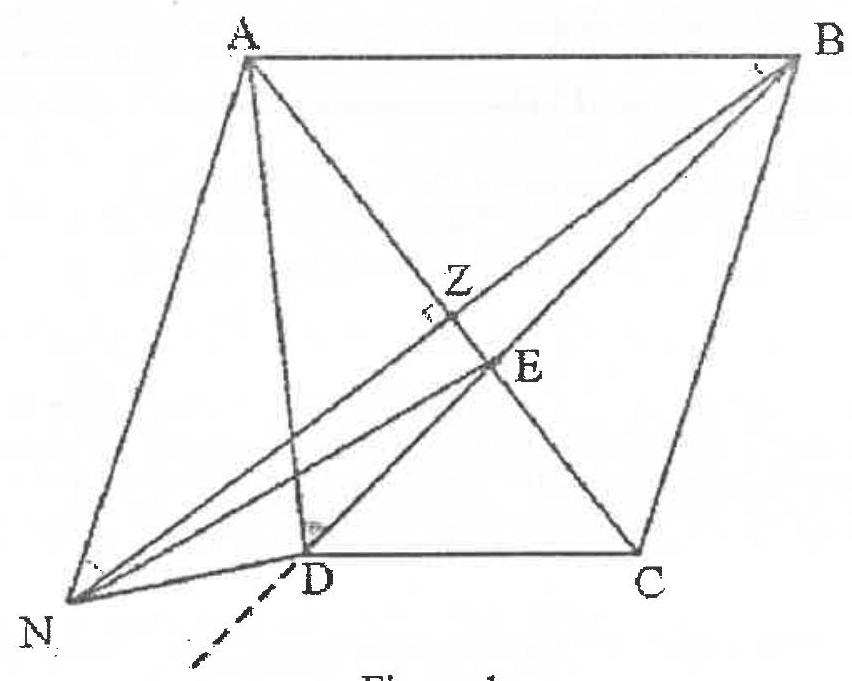
|
| 228 |
+
|
| 229 |
+
Figure 1
|
| 230 |
+
|
| 231 |
+
$$
|
| 232 |
+
\angle N A M=\angle B D C
|
| 233 |
+
$$
|
| 234 |
+
|
| 235 |
+
Now we have
|
| 236 |
+
|
| 237 |
+
$$
|
| 238 |
+
\angle B D C=\angle A C D=\angle N A C
|
| 239 |
+
$$
|
| 240 |
+
|
| 241 |
+
and
|
| 242 |
+
|
| 243 |
+
$$
|
| 244 |
+
\angle N A M=\angle N A C
|
| 245 |
+
$$
|
| 246 |
+
|
| 247 |
+
So the points $A, M, C$ are collinear and $M \equiv E$.
|
| 248 |
+
|
| 249 |
+
## Alternative solution
|
| 250 |
+
|
| 251 |
+
In this solution we do not need the circle passing through the points $A, N$ and $D$.
|
| 252 |
+
|
| 253 |
+
Because of the given symmetry we have
|
| 254 |
+
|
| 255 |
+
$$
|
| 256 |
+
\angle A N E=\angle A B D
|
| 257 |
+
$$
|
| 258 |
+
|
| 259 |
+
and from the equality $\mathrm{AD}=\mathrm{AB}$ the triangle $\mathrm{ABD}$ is isosceles with
|
| 260 |
+
|
| 261 |
+
$$
|
| 262 |
+
\angle A B D=\angle A D E
|
| 263 |
+
$$
|
| 264 |
+
|
| 265 |
+
From (1) and (2) we get that $\angle A N E=\angle A D E$, which means that the quadrilateral $A N D E$ is cyclic.
|
| 266 |
+
|
| 267 |
+
G2. Let $A B C$ be a triangle inscribed in a circle $K$. The tangent from $A$ to the circle meets the line $B C$ at point $P$. Let $M$ be the midpoint of the line segment $A P$ and let $R$ be the intersection point of the circle $K$ with the line $B M$. The line $P R$ meets again the circle $K$ at the point $S$. Prove that the lines $A P$ and $C S$ are parallel.
|
| 268 |
+
|
| 269 |
+
## Solution
|
| 270 |
+
|
| 271 |
+
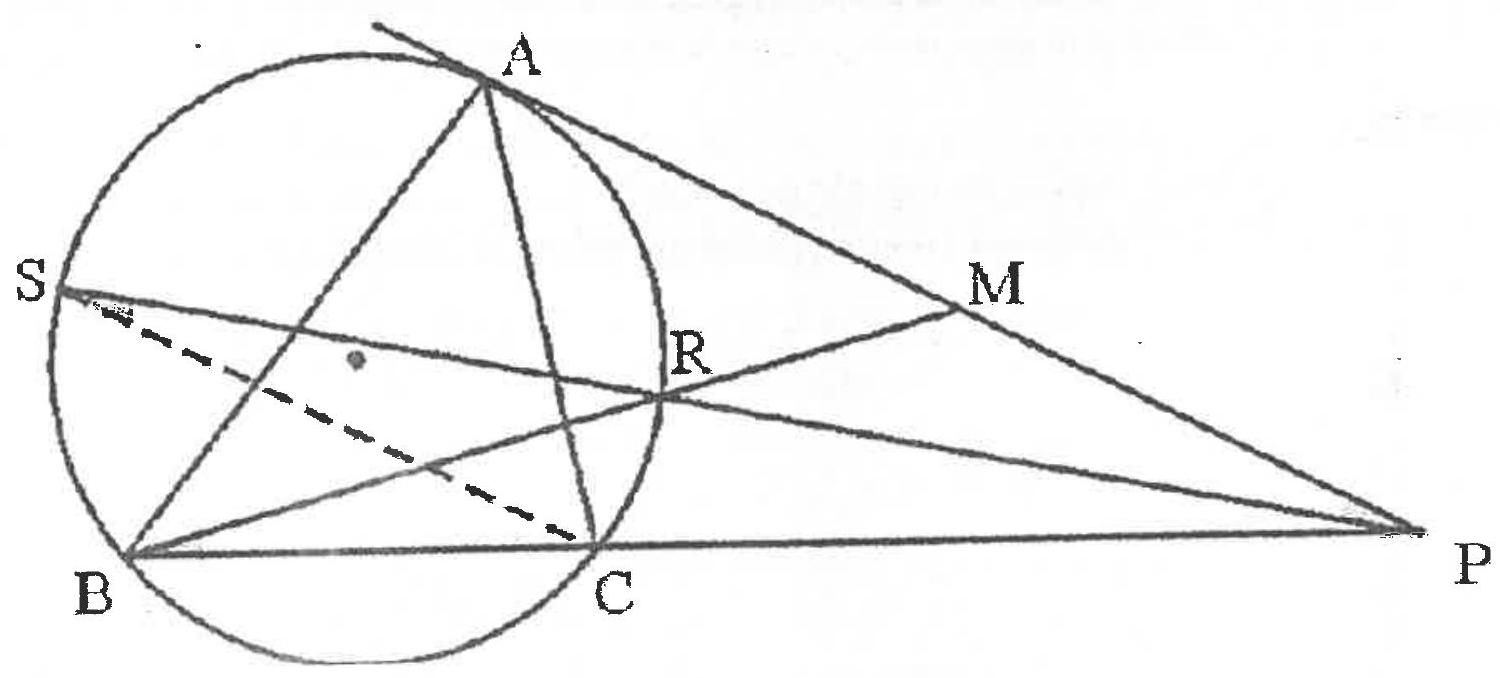
|
| 272 |
+
|
| 273 |
+
Figure 2
|
| 274 |
+
|
| 275 |
+
Assume that point $C$ lies on the line segment $B P$. By the Power of Point theorem we have $M A^{2}=M R \cdot M B$ and so $M P^{2}=M R \cdot M B$. The last equality implies that the triangles $M R$ and $M P B$ are similar. Hence $\angle M P R=\angle M B P$ and since $\angle P S C=\angle M B P$, the claim is proved.
|
| 276 |
+
|
| 277 |
+
Slight changes are to be made if the point $B$ lies on the line segment $P C$.
|
| 278 |
+
|
| 279 |
+
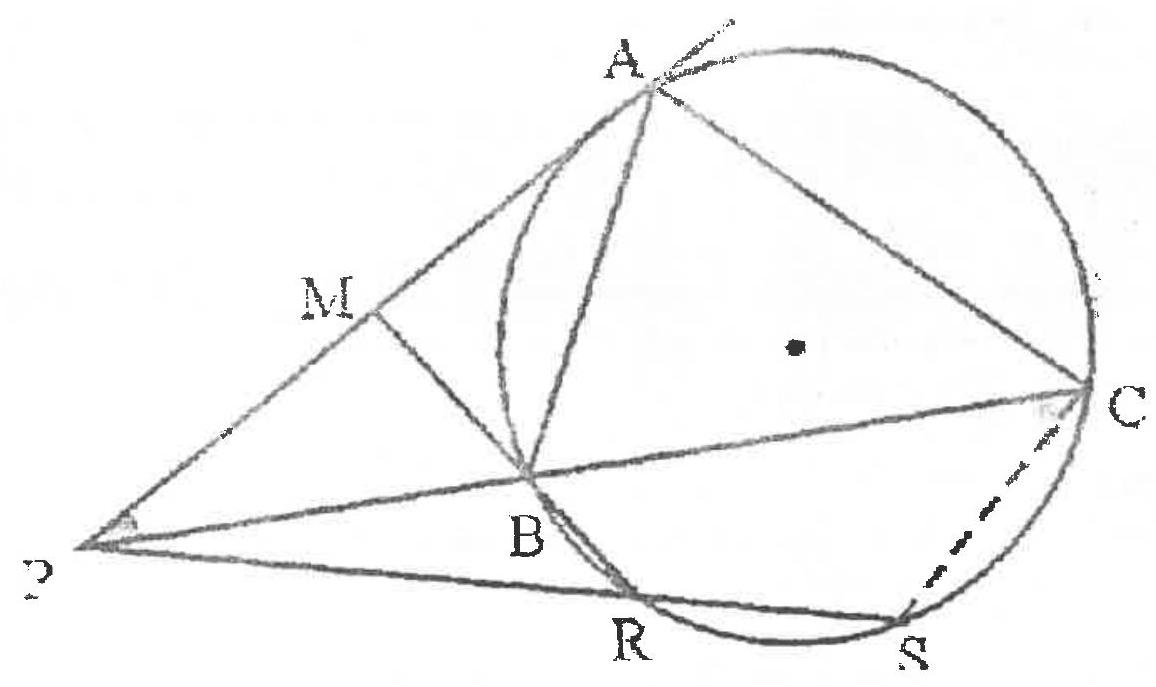
|
| 280 |
+
|
| 281 |
+
Figure 3
|
| 282 |
+
|
| 283 |
+
G3. Let $A B C D E F$ be a regular hexagon. The points $\mathrm{M}$ and $\mathrm{N}$ are internal points of the sides $\mathrm{DE}$ and $\mathrm{DC}$ respectively, such that $\angle A M N=90^{\circ}$ and $A N=\sqrt{2} \cdot C M$. Find the measure of the angle $\angle B A M$.
|
| 284 |
+
|
| 285 |
+
## Solution
|
| 286 |
+
|
| 287 |
+
Since $A C \perp C D$ and $A M \perp M N$ the quadrilateral $A M N C$ is inscribed. So, we have
|
| 288 |
+
|
| 289 |
+
$$
|
| 290 |
+
\angle M A N=\angle M C N
|
| 291 |
+
$$
|
| 292 |
+
|
| 293 |
+
Let $P$ be the projection of the point $M$ on the line $C D$. The triangles $A M N$ and $C P M$ are similar implying
|
| 294 |
+
|
| 295 |
+
$$
|
| 296 |
+
\frac{A M}{C P}=\frac{M N}{P M}=\frac{A N}{C M}=\sqrt{2}
|
| 297 |
+
$$
|
| 298 |
+
|
| 299 |
+
So, we have
|
| 300 |
+
|
| 301 |
+
$$
|
| 302 |
+
\frac{M P}{M N}=\frac{1}{\sqrt{2}} \Rightarrow \angle M N P=45^{\circ}
|
| 303 |
+
$$
|
| 304 |
+
|
| 305 |
+
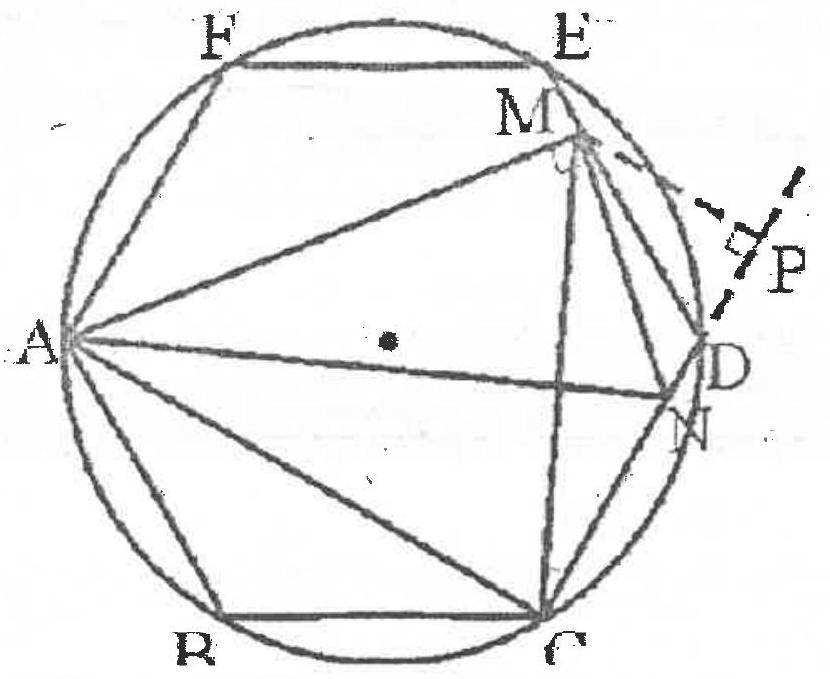
|
| 306 |
+
|
| 307 |
+
Figure 4
|
| 308 |
+
|
| 309 |
+
Hence we have
|
| 310 |
+
|
| 311 |
+
$$
|
| 312 |
+
\angle C A M=\angle M N P=45^{\circ}
|
| 313 |
+
$$
|
| 314 |
+
|
| 315 |
+
and finally, we obtain
|
| 316 |
+
|
| 317 |
+
$$
|
| 318 |
+
\angle B A M=\angle B A C+\angle C A M=75^{\circ}
|
| 319 |
+
$$
|
| 320 |
+
|
| 321 |
+
G4. Let $\mathrm{ABC}$ be an isosceles triangle such that $A B=A C$ and $\angle \frac{A}{2}<\angle B$. On the extension of the altitude $\mathrm{AM}$ we get the points $\mathrm{D}$ and $\mathrm{Z}$ such that $\angle C B D=\angle A$ and $\angle Z B A=90^{\circ}$. $\mathrm{E}$ is the foot of the perpendicular from $\mathrm{M}$ to the altitude $\mathrm{BF}$ and $\mathrm{K}$ is the foot of the perpendicular from $\mathrm{Z}$ to $\mathrm{AE}$. Prove that $\angle K D Z=\angle K B D=\angle K Z B$.
|
| 322 |
+
|
| 323 |
+
## Solution
|
| 324 |
+
|
| 325 |
+
The points $A, B, K, Z$ and $C$ are co-cyclic.
|
| 326 |
+
|
| 327 |
+
Because ME//AC so we have
|
| 328 |
+
|
| 329 |
+
$$
|
| 330 |
+
\angle K E M=\angle E A C=\angle M B K
|
| 331 |
+
$$
|
| 332 |
+
|
| 333 |
+
Therefore the points $B, K, M$ and $E$ are co-cyclic. Now, we have
|
| 334 |
+
|
| 335 |
+
$$
|
| 336 |
+
\begin{aligned}
|
| 337 |
+
& \angle A B F=\angle A B C-\angle F B C \\
|
| 338 |
+
& =\angle A K C-\angle E K M=\angle M K C
|
| 339 |
+
\end{aligned}
|
| 340 |
+
$$
|
| 341 |
+
|
| 342 |
+
Also, we have
|
| 343 |
+
|
| 344 |
+
$$
|
| 345 |
+
\begin{aligned}
|
| 346 |
+
& \angle A B F=90^{\circ}-\angle B A F=90^{\circ}-\angle M B D \\
|
| 347 |
+
& =\angle B D M=\angle M D C
|
| 348 |
+
\end{aligned}
|
| 349 |
+
$$
|
| 350 |
+
|
| 351 |
+
From (1) and (2) we get $\angle M K C=\angle M D C$ and so the points $M, K, D$ and $C$ are co-cyclic.
|
| 352 |
+
|
| 353 |
+
Consequently,
|
| 354 |
+
|
| 355 |
+
$$
|
| 356 |
+
\angle K D M=\angle K C M=\angle B A K=\angle B Z K \text {, }
|
| 357 |
+
$$
|
| 358 |
+
|
| 359 |
+
and because the line $\mathrm{BD}$ is tangent to the circumcircle of triangle $A B C$, we have
|
| 360 |
+
|
| 361 |
+
$$
|
| 362 |
+
\angle K B D=\angle B A K
|
| 363 |
+
$$
|
| 364 |
+
|
| 365 |
+
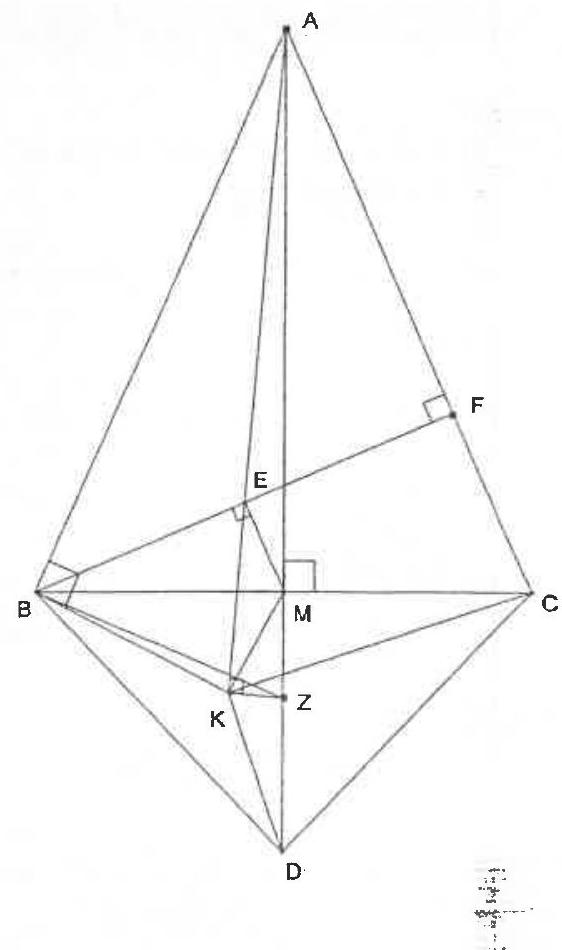
|
| 366 |
+
|
| 367 |
+
Figure 5
|
| 368 |
+
|
| 369 |
+
Finally, we have
|
| 370 |
+
|
| 371 |
+
$$
|
| 372 |
+
\angle K D Z=\angle K B D=\angle K Z B
|
| 373 |
+
$$
|
| 374 |
+
|
| 375 |
+
G5. Let $A$ and $P$ are the points of intersection of the circles $k_{1}$ and $k_{2}$ with centers $O$ and $K$, respectively. Let also $B$ and $C$ be the symmetric points of $A$ with respect to $O$ and $K$, respectively. A line through $A$ intersects the circles $k_{1}$ and $k_{2}$ at the points $D$ and $E$, respectively. Prove that the centre of the circumcircle of the triangle $D E P$ lies on the circumcircle $O K P$.
|
| 376 |
+
|
| 377 |
+
## Solution
|
| 378 |
+
|
| 379 |
+
The points $B, P, C$ are collinear, and
|
| 380 |
+
|
| 381 |
+
$$
|
| 382 |
+
\angle A P C=\angle A P B=90^{\circ}
|
| 383 |
+
$$
|
| 384 |
+
|
| 385 |
+
Let $N$ be the midpoint of $D P$.
|
| 386 |
+
|
| 387 |
+
So we have:
|
| 388 |
+
|
| 389 |
+
$$
|
| 390 |
+
\begin{aligned}
|
| 391 |
+
& \angle N O P=\angle D A P \\
|
| 392 |
+
& =\angle E C P=\angle E C A+\angle A C P
|
| 393 |
+
\end{aligned}
|
| 394 |
+
$$
|
| 395 |
+
|
| 396 |
+
Since $O K / / B C$ and $O K$ is the bisector of $\angle A K P$ we get
|
| 397 |
+
|
| 398 |
+
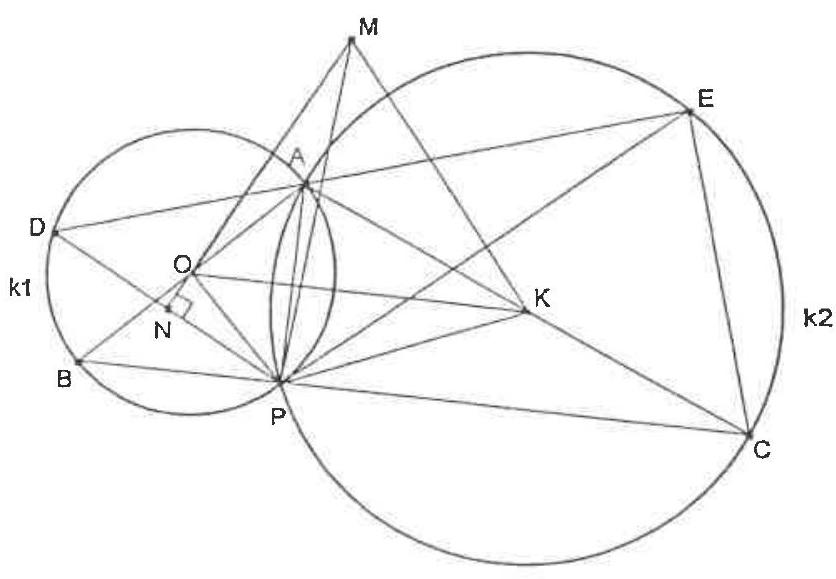
|
| 399 |
+
|
| 400 |
+
Figure 6
|
| 401 |
+
|
| 402 |
+
$$
|
| 403 |
+
\angle A C P=O K P
|
| 404 |
+
$$
|
| 405 |
+
|
| 406 |
+
Also, since $A P \perp O K$ and $M K \perp P E$ we have that
|
| 407 |
+
|
| 408 |
+
$$
|
| 409 |
+
\angle A P E=\angle M K O
|
| 410 |
+
$$
|
| 411 |
+
|
| 412 |
+
The points $A, E, C, P$ are co-cyclic, and so $\angle E C A=\angle A P E$.
|
| 413 |
+
|
| 414 |
+
Therefore, from (1), (2) and (3) we have that $\angle N O P=\angle M K P$.
|
| 415 |
+
|
| 416 |
+
Thus $O, M, K$ and $P$ are co-cyclic.
|
| 417 |
+
|
| 418 |
+
## Comment
|
| 419 |
+
|
| 420 |
+
Points B and C may not be included in the statement of the problem
|
| 421 |
+
|
| 422 |
+
## Alternative solution
|
| 423 |
+
|
| 424 |
+
It is sufficient to prove that the quadrilateral $M O P K$ is circumscrible.
|
| 425 |
+
|
| 426 |
+
Since $M O$ and $M K$ are perpendicular bisectors of the line segments $P D$ and $P E$, respectively, we have
|
| 427 |
+
|
| 428 |
+
Therefore the quadrilateral $M O P K$ is circumscrible.
|
| 429 |
+
|
| 430 |
+

|
| 431 |
+
|
| 432 |
+
Figure 7
|
| 433 |
+
|
| 434 |
+
G6. A point $O$ and the circles $k_{1}$ with center $O$ and radius $3, k_{2}$ with center $O$ and radius 5, are given. Let $A$ be a point on $k_{1}$ and $B$ be a point on $k_{2}$. If $A B C$ is equilateral triangle, find the maximum value of the distance $O C$.
|
| 435 |
+
|
| 436 |
+
## Solution
|
| 437 |
+
|
| 438 |
+
It is easy to see that the points $O$ and $C$ must be in different semi-planes with respect to the line $A B$.
|
| 439 |
+
|
| 440 |
+
Let $O P B$ be an equilateral triangle ( $P$ and $C$ on the same side of $O B$ ). Since $\angle P B C$ $=60^{\circ}-\angle A B P$ and $\angle O B A=60^{\circ}-\angle A B P$, then $\angle P B C=\angle O B A$. Hence the triangles $A O B$ and $C P B$ are equal and $P C=O A$. From the triangle $O P C$ we have
|
| 441 |
+
|
| 442 |
+
$$
|
| 443 |
+
O C \leq O P+P C=O B+O A=8
|
| 444 |
+
$$
|
| 445 |
+
|
| 446 |
+
Hence, the maximum yalue of the distance $O C$ is 8 (when the point $P$ lies on $O C$ )
|
| 447 |
+
|
| 448 |
+
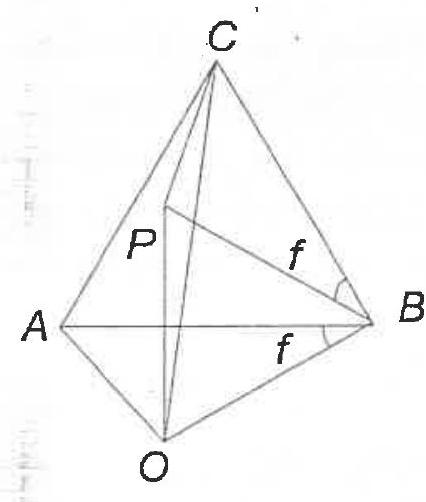
|
| 449 |
+
|
| 450 |
+
Figure 8
|
| 451 |
+
|
| 452 |
+
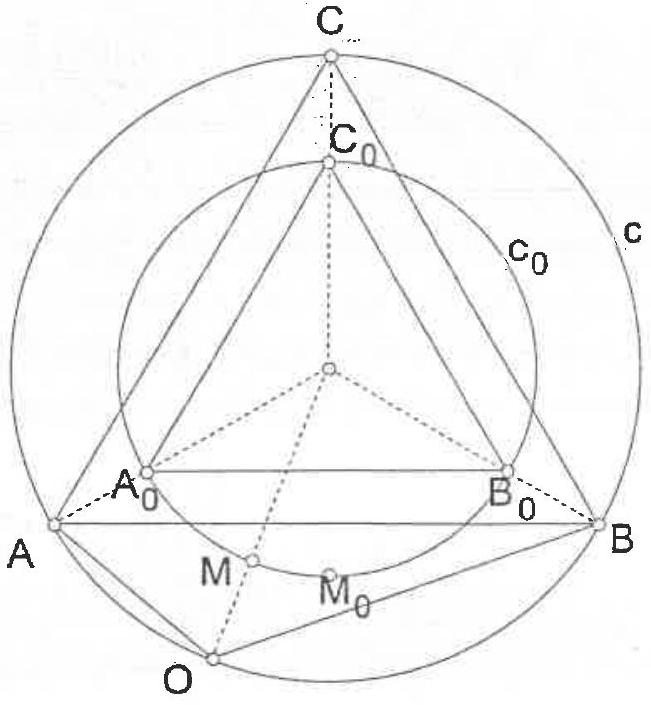
|
| 453 |
+
|
| 454 |
+
Figure 9
|
| 455 |
+
|
| 456 |
+
## Complement to the solution
|
| 457 |
+
|
| 458 |
+
Indeed there exists a triangle $\mathrm{OAB}$ with $\mathrm{OA}=3, \mathrm{OB}=5$ and $\mathrm{OC}=8$.
|
| 459 |
+
|
| 460 |
+
To construct such a triangle, let's first consider a point $M$ on the minor arc $\widehat{A_{0} B_{0}}$ of the circumference $\left(c_{0}\right)$ of an arbitrary equilateral triangle $A_{0} B_{0} C_{0}$. As $\mathrm{M}$ moves along $\widehat{\mathrm{A}_{0} \mathrm{~B}_{0}}$ from the midpoint position $\mathrm{M}_{0}$ towards $\mathrm{A}_{0}$, the ratio $\frac{\mathrm{MA}_{0}}{\mathrm{MB}_{0}}$ takes on all the decreasing values from 1 to 0 . Thus there exists a position of $\mathrm{M}$ such that $\frac{\mathrm{MA}_{0}}{\mathrm{MB}_{0}}=\frac{3}{5}$. Now a homothesy centered at the center of $\left(\mathrm{c}_{0}\right)$ can take $\mathrm{A}_{0}, \mathrm{~B}_{0}, \mathrm{C}_{0}, \mathrm{M}$ to the new positions $\mathrm{A}, \mathrm{B}, \mathrm{C}, \mathrm{O}$ so that $\mathrm{OA}=3$ and $\mathrm{OB}=5$. Then, since $\mathrm{C}$ lies on the minor arc $\overparen{\mathrm{AB}}$ of the circumference (c) of the equilateral triangle $\mathrm{ABC}$ we get $\mathrm{OC}=\mathrm{OA}+\mathrm{OB}=3+5=8$ as wanted, (figure 9).
|
| 461 |
+
|
| 462 |
+
## Alternative solution 1 (by the proposer)
|
| 463 |
+
|
| 464 |
+
Let $\phi$ be a $60^{\circ}$ rotation with center at $B$. Then $\phi(A)=C, \phi(O)=P$ and $P C=O A$, $O P=O$, etc.
|
| 465 |
+
|
| 466 |
+
## Alternative solution 2
|
| 467 |
+
|
| 468 |
+
Let $O A=x, A B=B C=C A=a$. From the second theorem of Ptolemy we get
|
| 469 |
+
|
| 470 |
+
$$
|
| 471 |
+
O A \cdot B C+O B \cdot A C \geq A B \cdot O C \Leftrightarrow 3 a+5 a=a x \Leftrightarrow x \leq 8
|
| 472 |
+
$$
|
| 473 |
+
|
| 474 |
+
The value $x=8$ is attained when the quadrilateral OACB is circumscrible, i.e. when $\angle A O B=120^{\circ}$.
|
| 475 |
+
|
| 476 |
+
The point $\mathrm{B}$ can be constructed as follows:
|
| 477 |
+
|
| 478 |
+
It is the point of intersection of the circle $(0,5)$ with the ray coming from the rotation of the ray $\mathrm{OA}$ with center $\mathrm{O}$ by an angle $\theta=-120^{\circ}$, (figure 10).
|
| 479 |
+
|
| 480 |
+

|
| 481 |
+
|
| 482 |
+
Figure 10
|
| 483 |
+
|
| 484 |
+
G7. Let $A B C D$ be a parallelogram, $\mathrm{P}$ a point on $C D$, and $Q$ a point on $A B$. Let also $M=A P \cap D Q, \quad N=B P \cap C Q, K=M N \cap A D$, and $L=M N \cap B C$. Show that $B L=D K$.
|
| 485 |
+
|
| 486 |
+
## Solution
|
| 487 |
+
|
| 488 |
+
Let $O$ be the intersection of the diagonals. Let $P_{1}$ be on $A B$ such that $P P_{1} / / A D$, and let $Q_{1}$ be on $C D$ such that $\mathrm{Q} Q_{1} / / A D$. Let $\sigma$ be the central symmetry with center $\mathrm{O}$. Let $\left.P^{\prime}=\sigma(P), Q^{\prime}=\sigma(Q), P_{1}^{\prime}=\sigma\left(P_{1}\right)\right)$ and, (figure 1).
|
| 489 |
+
|
| 490 |
+
Let $M_{1}=A Q_{1} \cap D P_{1}, N_{1}=B Q_{1} \cap C P_{1}, N^{\prime}=A Q^{\prime} \cap D P^{\prime}$ and $M^{\prime}=B Q^{\prime} \cap C P^{\prime}$.
|
| 491 |
+
|
| 492 |
+
Then: $M^{\prime}=\sigma(M), N^{\prime}=\sigma(N), M_{1}^{\prime}=\sigma\left(M_{1}\right)$ and $N_{1}^{\prime}=\sigma\left(N_{1}\right)$.
|
| 493 |
+
|
| 494 |
+
Since $A P$ and $D P_{1}$ are the diagonals of the parallelogram $A P_{1} P D, C P_{1}$ and $B P$ are the diagonals of the parallelogram $P_{1} B C P$, and $A Q_{1}$ and $D O$ are the diagonals of the parallelogram $A Q Q_{1} D$, it follows that the points $U, V, W$ (figure 2) are collinear and they lie on the line passing through the midpoints $R$ of $A D$ and $Z$ of $B C$. The diagonals AM and $D M_{1}$ the quadrilateral $A M_{1} M D$ intersect at $U$ and the diagonals $A M_{1}$ and - $D M$ intersect at $W$. Since the midpoint of $A D$ is on the line $U W$, it follows that the quadrilateral $A M_{1} M D$ is a trapezoid. Hence, $M M_{1}$ is parallel to $A D$ and the midpoint $S$ of $M M_{1}$ lies on the line $U W$, (figure 2).
|
| 495 |
+
|
| 496 |
+
|
| 497 |
+
|
| 498 |
+
Figure 11
|
| 499 |
+
|
| 500 |
+
Similarly $M^{\prime} M_{1}^{\prime}$ is parallel to $A D$ and its midpoint lies on $U W$. So $M_{1} M^{\prime} M_{1}^{\prime} M$ is a parallelogram whose diagonals intersect at $\mathrm{O}$.
|
| 501 |
+
|
| 502 |
+
Similarly, $N_{1}^{\prime} N N_{1} N^{\prime}$ is a parallelogram whose diagonals intersect at $O$.
|
| 503 |
+
|
| 504 |
+
All these imply that $M, N, M^{\prime}, N^{\prime}$ and $O$ are collinear, i.e. $O$ lies on the line $K L$. This implies that $K=\sigma(L)$, and since $D=\sigma(B)$, the conclusion follows.
|
| 505 |
+
|
| 506 |
+
|
| 507 |
+
|
| 508 |
+
Figure 12
|
| 509 |
+
|
| 510 |
+
## Alternative solution
|
| 511 |
+
|
| 512 |
+
Let the line ( $\varepsilon$ ) through the points $\mathrm{M}, \mathrm{N}$ intersect the lines $\mathrm{DC}, \mathrm{AB}$ at points $\mathrm{T}_{1}, \mathrm{~T}_{2}$ respectively. Applying Menelaus Theorem to the triangles DQC, APB with intersecting line $(\varepsilon)$ in both cases we get:
|
| 513 |
+
|
| 514 |
+
$$
|
| 515 |
+
\frac{M D}{M Q} \frac{N Q}{N C} \frac{T_{1} C}{T_{1} D}=1 \text { and } \frac{M P}{M A} \frac{N B}{N P} \frac{T_{2} A}{T_{2} B}=1
|
| 516 |
+
$$
|
| 517 |
+
|
| 518 |
+
But it is true that $\frac{\mathrm{MD}}{\mathrm{MQ}}=\frac{\mathrm{MP}}{\mathrm{MA}}$ and $\frac{\mathrm{NQ}}{\mathrm{NC}}=\frac{\mathrm{NB}}{\mathrm{NP}}$.
|
| 519 |
+
|
| 520 |
+
It follows that $\frac{T_{1} C}{T_{1} D}=\frac{T_{2} A}{T_{2} B}$ i.e. $\frac{T_{1} D+D C}{T_{1} D}=\frac{T_{2} B+B A}{T_{2} B}$ hence $T_{1} D=T_{2} B$ (since
|
| 521 |
+
|
| 522 |
+
$\mathrm{DC}=\mathrm{BA})$.
|
| 523 |
+
|
| 524 |
+
Then of course by the similarity of the triangles $\mathrm{T}_{1} \mathrm{DK}$ and $\mathrm{T}_{2} \mathrm{BL}$ we get the desired equality $\mathrm{DK} \cdot \mathrm{BL}$.
|
| 525 |
+
|
| 526 |
+
|
| 527 |
+
|
| 528 |
+
Figure 13
|
| 529 |
+
|
| 530 |
+
## Number Theory
|
| 531 |
+
|
| 532 |
+
NT1. Find all the natural numbers $m$ and $n$, such that the square of $m$ minus the product of $n$ with $k$, is 2 , where the number $k$ is obtained from $n$ by writing 1 on the left of the decimal notation of $n$.
|
| 533 |
+
|
| 534 |
+
## Solution
|
| 535 |
+
|
| 536 |
+
Let $t$ be the number of digits of $n$. Then $k=10^{t}+n$. So
|
| 537 |
+
|
| 538 |
+
$$
|
| 539 |
+
\mathrm{m}^{2}=n\left(10^{t}+\mathrm{n}\right)+2, \text { i.e. } \mathrm{m}^{2}-\mathrm{n}^{2}=10^{t} n+2
|
| 540 |
+
$$
|
| 541 |
+
|
| 542 |
+
This implies that $\mathrm{m}, \mathrm{n}$ are even and both $\mathrm{m}, \mathrm{n}$ are odd.
|
| 543 |
+
|
| 544 |
+
If $t=1$, then, 4 is divisor of $10 n+2$, so, $n$ is odd. We check that the only solution in this case is $\mathrm{m}=11$ and $\mathrm{n}=7$.
|
| 545 |
+
|
| 546 |
+
If $t>1$, then 4 is divisor of $\mathrm{m}^{2}-\mathrm{n}^{2}$, but 4 is not divisor of $10^{t}+2$.
|
| 547 |
+
|
| 548 |
+
Hence the only solution is $\mathrm{m}=11$ and $\mathrm{n}=7$.
|
| 549 |
+
|
| 550 |
+
NT2. Find all natural numbers $n$ such that $5^{n}+12^{n}$ is perfect square.
|
| 551 |
+
|
| 552 |
+
## Solution
|
| 553 |
+
|
| 554 |
+
By checking the cases $n=1,2,3$ we get the solution $n=2$ and $13^{2}=5^{2}+12^{2}$.
|
| 555 |
+
|
| 556 |
+
If $n=2 k+1$ is odd, we consider the equation modulo 5 and we obtain
|
| 557 |
+
|
| 558 |
+
$$
|
| 559 |
+
\begin{aligned}
|
| 560 |
+
x^{2} & \equiv 5^{2 k+1}+12^{2 k+1}(\bmod 5) \equiv 2^{2 k} \cdot 2(\bmod 5) \\
|
| 561 |
+
& \equiv(-1)^{k} \cdot 2(\bmod 5) \equiv \pm 2(\bmod 5)
|
| 562 |
+
\end{aligned}
|
| 563 |
+
$$
|
| 564 |
+
|
| 565 |
+
This is not possible, because the square residue of any natural number module 5 is 0,1 or 4. Therefore $n$ is even and $x^{2}=5^{2 k}+12^{2 k}$. Rearrange this equation in the form
|
| 566 |
+
|
| 567 |
+
$$
|
| 568 |
+
5^{2 k}=\left(x-12^{k}\right)\left(x+12^{k}\right)
|
| 569 |
+
$$
|
| 570 |
+
|
| 571 |
+
If 5 divides both factors on the right, it must also divide their difference, that is
|
| 572 |
+
|
| 573 |
+
$$
|
| 574 |
+
5 \mid\left(x+12^{k}\right)-\left(x-12^{k}\right)=2 \cdot 12^{k}
|
| 575 |
+
$$
|
| 576 |
+
|
| 577 |
+
which is not possible. Therefore we must have
|
| 578 |
+
|
| 579 |
+
$$
|
| 580 |
+
x-12^{k}=1 \text { and } x+12^{k}=5^{2 k}
|
| 581 |
+
$$
|
| 582 |
+
|
| 583 |
+
By adding the above equalities we get
|
| 584 |
+
|
| 585 |
+
$$
|
| 586 |
+
5^{2 k}-1=2 \cdot 12^{k}
|
| 587 |
+
$$
|
| 588 |
+
|
| 589 |
+
For $k \geq 2$, we have the inequality
|
| 590 |
+
|
| 591 |
+
$$
|
| 592 |
+
25^{k}-1>24^{k}=2^{k} \cdot 12^{k}>2 \cdot 12^{k}
|
| 593 |
+
$$
|
| 594 |
+
|
| 595 |
+
Thus we conclude that there exists a unique solution to our problem, namely $n=2$.
|
| 596 |
+
|
| 597 |
+
NT3. Let $p$ be an odd prime. Prove that $p$ divides the integer
|
| 598 |
+
|
| 599 |
+
$$
|
| 600 |
+
\frac{2^{p!}-1}{2^{k}-1}
|
| 601 |
+
$$
|
| 602 |
+
|
| 603 |
+
for all integers $k=1,2, \ldots, p$.
|
| 604 |
+
|
| 605 |
+
## Solution
|
| 606 |
+
|
| 607 |
+
At first, note that $\frac{2^{p!}-1}{2^{k}-1}$ is indeed an integer.
|
| 608 |
+
|
| 609 |
+
We start with the case $\mathrm{k}=\mathrm{p}$. Since $p \mid 2^{p}-2$, then $p / 22^{p}-1$ and so it suffices to prove that $p \mid 2^{(p)!}-1$. This is obvious as $p \mid 2^{p-1}-1$ and $\left(2^{p-1}-1\right) \mid 2^{(p)!}-1$.
|
| 610 |
+
|
| 611 |
+
If $\mathrm{k}=1,2, \ldots, \mathrm{p}-1$, let $m=\frac{(p-1)!}{k} \in \mathbb{N}$ and observe that $p!=k m p$. Consider $a \in \mathbb{N}$ so that $p^{a} \mid 2^{k}-1$ and observe that it suffices to prove $p^{a+1} \mid 2^{p!}-1$. The case $a=0$ is solved as the case $k=p$. If else, write $2^{k}=1+p^{a} \cdot l, l \in \mathbb{N}$ and rising at the power mp gives
|
| 612 |
+
|
| 613 |
+
$$
|
| 614 |
+
2^{p!}=\left(1+p^{a} \cdot l\right)^{m p}=1+m p \cdot p^{a} \cdot l+M p^{2 a}
|
| 615 |
+
$$
|
| 616 |
+
|
| 617 |
+
where $M n$ stands for a multiply of $\mathrm{n}$. Now it is clear that $p^{a+1} \mid 2^{p!}-1$, as claimed.
|
| 618 |
+
|
| 619 |
+
Comment. The case $\mathrm{k}=\mathrm{p}$ can be included in the case $a=0$.
|
| 620 |
+
|
| 621 |
+
NT4. Find all the three digit numbers $\overline{a b c}$ such that
|
| 622 |
+
|
| 623 |
+
$$
|
| 624 |
+
\overline{a b c}=a b c(a+b+c)
|
| 625 |
+
$$
|
| 626 |
+
|
| 627 |
+
## Solution
|
| 628 |
+
|
| 629 |
+
We will show that the only solutions are 135 and 144 .
|
| 630 |
+
|
| 631 |
+
We have $a>0, b>0, c>0$ and
|
| 632 |
+
|
| 633 |
+
$$
|
| 634 |
+
9(11 a+b)=(a+b+c)(a b c-1)
|
| 635 |
+
$$
|
| 636 |
+
|
| 637 |
+
- If $a+b+c \equiv 0(\bmod 3)$ and $a b c-1 \equiv 0(\bmod 3)$, then $a \equiv b \equiv c \equiv 1(\bmod 3)$ and $11 a+b \equiv 0(\bmod 3)$. It follows now that
|
| 638 |
+
|
| 639 |
+
$$
|
| 640 |
+
a+b+c \equiv 0(\bmod 9) ; \text { or } a b c-1 \equiv 0(\bmod 9)
|
| 641 |
+
$$
|
| 642 |
+
|
| 643 |
+
- If . $a b c-1 \equiv 0(\bmod 9)$
|
| 644 |
+
|
| 645 |
+
we have $11 a+b=(a+b+c) k$, where $k$ is an integer
|
| 646 |
+
|
| 647 |
+
and is easy to see that we must have $1<k \leq 10$.
|
| 648 |
+
|
| 649 |
+
So we must deal only with the cases $k=2,3,4,5,6,7,8,9,10$
|
| 650 |
+
|
| 651 |
+
If $k=2.4,5,6,8,9,10$ then $9 k+1$ has prime divisors greater than 9 ,so we must see only the cases $\quad k=3,7$.
|
| 652 |
+
|
| 653 |
+
- If $k=3$ we have
|
| 654 |
+
|
| 655 |
+
$$
|
| 656 |
+
8 a=2 b+3 c \text { and } \quad a b c=28
|
| 657 |
+
$$
|
| 658 |
+
|
| 659 |
+
It is clear that $\mathrm{c}$ is even, $c=2 c_{1}$ and that both $b$ and $c_{1}$ are odd.
|
| 660 |
+
|
| 661 |
+
Frem $a b c_{1}=14$ it follows that $a=2, b=7, c_{l}=1$ or $a=2, b=1, c_{i}=7$ and it is clear that there exists no solution in this case. - If $k=7$ we have $c$-even, $c=2 c_{k}, 2 a=3 b+7 c_{1}, a b c_{1}=32$, then both $b$ and $c_{I}$ are
|
| 662 |
+
even.
|
| 663 |
+
|
| 664 |
+
But this is impossible, because they imply that $a>9$.
|
| 665 |
+
|
| 666 |
+
Now we will deal with the case when $a+b+c \equiv 0(\bmod 9)$ or $a+b+c=9 l$, where $l$ is an integer.
|
| 667 |
+
|
| 668 |
+
- If $l \geq 2$ we have $a+b+c \geq 18, \max \{a, b, c\} \geq 6$ and it is easy to see that $a b c \geq 72$ and $a b c(a+b+c)>1000$,so the case $l \geq 2$ is impossible.
|
| 669 |
+
- If $l=1$ we have
|
| 670 |
+
|
| 671 |
+
$$
|
| 672 |
+
11 a+b=a b c-1 \text { or } 11 a+b+1=a b c \leq\left(\frac{a+b+c}{3}\right)^{3}=27
|
| 673 |
+
$$
|
| 674 |
+
|
| 675 |
+
So we have only two cases: $a=1$ or $a=2$.
|
| 676 |
+
|
| 677 |
+
- If $a=1$, we have $b+c=8$ and $11+b=b c-1$ or $b+(c-1)=7$ and $b(c-1)=12$ and the solutions are $(a, b, c)=(1,3,5)$ and $(a, b, c)=(1,4,4)$, and the answer is 135 and 144.
|
| 678 |
+
- If $a=2$ we have $b(2 c-1)=23$ and there is no solution for the problem.
|
| 679 |
+
|
| 680 |
+
NT5. Let $p$ be a prime number and let $a$ be an integer. Show that if $n^{2}-5$ is not divisible by $p$ for any integer $n$, there exist infinitely many integers $m$ so that $p$ divides $m^{5}+a$.
|
| 681 |
+
|
| 682 |
+
## Solution
|
| 683 |
+
|
| 684 |
+
We start with a simple fact:
|
| 685 |
+
|
| 686 |
+
Lemma: If $b$ is an integer not divisible by $p$ then there is an integer $s$ so that $s b$ has the remainder $l$ when divided by $p$.
|
| 687 |
+
|
| 688 |
+
For a proof, just note that numbers $b, 2 b, \ldots,(p-1) b$ have distinct non-zero remainders when divided by $p$, and hence one of them is equal to 1 .
|
| 689 |
+
|
| 690 |
+
We prove that if $x, y=0,1,2, \ldots, p-1$ and $\mathrm{p}$ divides $x^{5}-y^{5}$, then $x=y$.
|
| 691 |
+
|
| 692 |
+
Indeed, assume that $x \neq y$. If $x=0$, then $p \mid y^{5}$ and so $y=0$, a contradiction.
|
| 693 |
+
|
| 694 |
+
To this point we have $x, y \neq 0$. Since
|
| 695 |
+
|
| 696 |
+
$$
|
| 697 |
+
p \mid(x-y)\left(x^{4}+x^{3} y+x^{2} y^{2}+x y^{3}+y^{4}\right) \text { and } p /(x-y)
|
| 698 |
+
$$
|
| 699 |
+
|
| 700 |
+
we have
|
| 701 |
+
|
| 702 |
+
$$
|
| 703 |
+
\begin{aligned}
|
| 704 |
+
& p l\left(x^{2}+y^{2}\right)^{2}+x y\left(x^{2}+y^{2}\right)-x^{2} y^{2} \text {, and so } \\
|
| 705 |
+
& p \|\left(2\left(x^{2}+y^{2}\right)+x y\right)^{2}-5 x^{2} y^{2}
|
| 706 |
+
\end{aligned}
|
| 707 |
+
$$
|
| 708 |
+
|
| 709 |
+
As $p / x y$, from the lemma we find an integer $s$ so that $s x y=k p+1, k \in \mathbb{N}$. Then
|
| 710 |
+
|
| 711 |
+
$$
|
| 712 |
+
p \mid\left[s\left(2 x^{2}+2 y^{2}+x y\right)\right]^{2}-5\left(k^{2} p^{2}+2 k p+1\right)
|
| 713 |
+
$$
|
| 714 |
+
|
| 715 |
+
and so $p \mid z^{2}-5$, where $z=s\left(2 x^{2}+2 y^{2}+x y\right)$, a contradiction.
|
| 716 |
+
|
| 717 |
+
Consequeatly $r=y$.
|
| 718 |
+
|
| 719 |
+
Since we have proved that numbers $0^{5}, 1^{5}, \ldots,(p-1)^{5}$ have distinct remainders when divided by $p$, the same goes for the numbers $0^{5}+a, 1^{5}+a, \ldots,(p-1)^{5}+a$ and the conclusion can be reached easily.
|
| 720 |
+
|
| 721 |
+
## Comments
|
| 722 |
+
|
| 723 |
+
1. For beauty we may choose $a=-2$ or any other value.
|
| 724 |
+
2. Moreover, we may ask only for one value of $m$, instead of "infinitely many".
|
| 725 |
+
3. A simple version will be to ask for a proof that the numbers $0^{5}, 1^{5}, \ldots,(p-1)^{5}$ have distinct remainders when divided by $p$.
|
| 726 |
+
|
| 727 |
+
## Combinatorics
|
| 728 |
+
|
| 729 |
+
C1. A triangle with area 2003 is divided into non-overlapping small triangles. The number of all the vertices of all those triangles is 2005 . Show that at mest one of the smaller triangles has area less or equal to 1.
|
| 730 |
+
|
| 731 |
+
## Solution
|
| 732 |
+
|
| 733 |
+
Since all the vertices are 2005 , and the vertices of the big triangle are among them, it follows that the number of the small triangles is at least 2003. So, it follows that at least one of the small triangles has area at most 1
|
| 734 |
+
|
| 735 |
+
C2. Government of Greece wants to change the building. So they will move in building with square shape $2005 \times 2005$. Only demand is that every room has exactly 2 doors and doors cannot lead outside the building. Is this possible? What about a building $2004 \times 2005$ ?
|
| 736 |
+
|
| 737 |
+
## Solution
|
| 738 |
+
|
| 739 |
+
The key idea is to color the table $2005 \times 2005$ in two colors, like chessboard. One door connects two adjacent squares, so they have different colors. We can count the number of doors in two ways. The number of doors is twice the number of white squares and it is also twice the number of black squares. This is, of course, Ipossible, because we have one more black square on the table. So, if $n$ is odd, we cannot achieve that every room has two doors.
|
| 740 |
+
|
| 741 |
+
For table $2004 \times 2005$ this is possible, and one of many solutions is presented on the picture below.
|
| 742 |
+
|
| 743 |
+
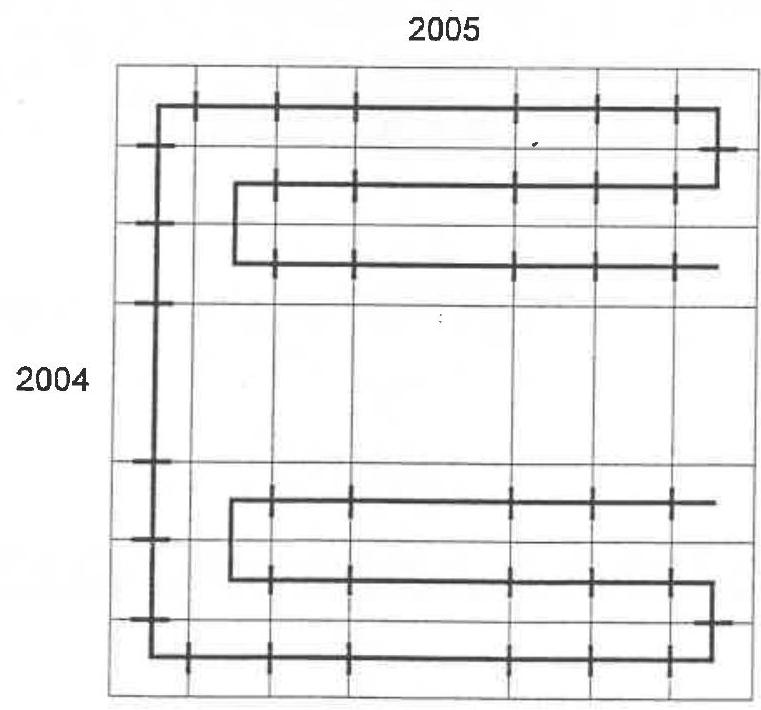
|
| 744 |
+
|
| 745 |
+
Figure 14
|
| 746 |
+
|
| 747 |
+
## Alternative statement of the problem
|
| 748 |
+
|
| 749 |
+
Is it possible to open holes on two distinct sides of each cell of a $2005 \times 2005$ square grid so that no hole is on the perimeter of the grid? What about a $2004 \times 2005$ grid?
|
| 750 |
+
|
| 751 |
+
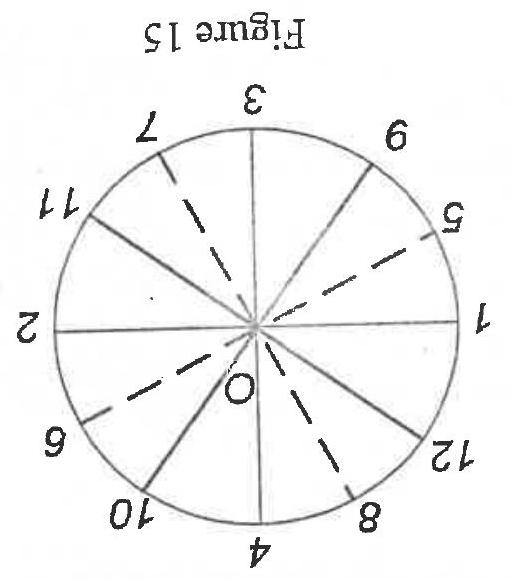
|
| 752 |
+
|
| 753 |
+
$$
|
| 754 |
+
\cdot \varsigma 00 Z<8 \downarrow 0 Z=(9 \mathrm{I}) \mathrm{X}=(\varsigma 9) \Psi
|
| 755 |
+
$$
|
| 756 |
+
|
| 757 |
+

|
| 758 |
+
|
| 759 |
+
$$
|
| 760 |
+
\tau_{2} w 8=(\mathfrak{I}-w \tau) 8+{ }_{\tau}(I-u) 8=\tau \cdot(I-w) \nabla+(I-w) \tau \cdot \nabla+8+(\tau-u) X=(u) Y
|
| 761 |
+
$$
|
| 762 |
+
|
| 763 |
+
|
| 764 |
+
|
| 765 |
+
$$
|
| 766 |
+
\dot{r}_{\tau} \varepsilon \cdot 8=8 \cdot 6=\tau \cdot 8+\tau \cdot \tau \cdot \nabla+8+(\tau) X=\underset{\partial \Lambda E Y}{(\varepsilon) Y}
|
| 767 |
+
$$
|
| 768 |
+
|
| 769 |
+
$$
|
| 770 |
+
{ }^{2} \tau \cdot 8=8 \cdot t=\tau \cdot \downarrow+\tau \cdot \downarrow+8+\text { (I) } y=\text { (乙) } y
|
| 771 |
+
$$
|
| 772 |
+
|
| 773 |
+

|
| 774 |
+
|
| 775 |
+

|
| 776 |
+
|
| 777 |
+

|
| 778 |
+
|
| 779 |
+
$$
|
| 780 |
+
8=(\mathrm{L}) X
|
| 781 |
+
$$
|
| 782 |
+
|
| 783 |
+
:әлеч $\partial M$ ঈ uo sұutod
|
| 784 |
+
|
| 785 |
+

|
| 786 |
+
|
| 787 |
+

|
| 788 |
+
|
| 789 |
+

|
| 790 |
+
|
| 791 |
+

|
| 792 |
+
|
| 793 |
+

|
| 794 |
+
uo!n [0S
|
| 795 |
+
|
| 796 |
+

|
| 797 |
+
|
| 798 |
+

|
| 799 |
+
|
| 800 |
+

|
| 801 |
+
|
| 802 |
+

|
| 803 |
+
|
| 804 |
+
C4. Let $p_{1}, p_{2}, \ldots, p_{2005}$ be different prime numbers. Let $\mathrm{S}$ be a set of natural numbers which elements have the property that their simple divisors are some of the numbers $p_{1}, p_{2}, \ldots, p_{2005}$ and product of any two elements from $\mathrm{S}$ is not perfect square.
|
| 805 |
+
|
| 806 |
+
What is the maximum number of elements in $\mathrm{S}$ ?
|
| 807 |
+
|
| 808 |
+
## Solution
|
| 809 |
+
|
| 810 |
+
Let $a, b$ be two arbitrary numbers from $\mathrm{S}$. They can be written as
|
| 811 |
+
|
| 812 |
+
$$
|
| 813 |
+
a=p_{1}^{a_{1}} p_{2}^{a_{2}} \cdots p_{2005}^{a_{2005}} \text { and } b=p_{1}^{\beta_{1}} p_{2}^{\beta_{2}} \cdots p_{2005}^{\beta_{2005}}
|
| 814 |
+
$$
|
| 815 |
+
|
| 816 |
+
In order for the product of the elements $a$ and $b$ to be a square all the sums of the corresponding exponents need to be even from where we can conclude that for every $i, a_{i}$ and $\beta_{i}$ have the same parity. If we replace all exponents of $\mathrm{a}$ and $b$ by their remainders modulo 2 , then we get two numbers $a^{\prime}, b^{\prime}$ whose product is a perfect square if and only if ab is a perfect square.
|
| 817 |
+
|
| 818 |
+
In order for the product $a^{\prime} b^{\prime}$ not to be a perfect square, at least one pair of the corresponding exponents modulo 2, need to be of opposite parity.
|
| 819 |
+
|
| 820 |
+
Since we form 2005 such pairs modulo 2, and each number in these pairs is 1 or 2 , we conclude that we can obtain $2^{2005}$ distinct products none of which is a perfect square.
|
| 821 |
+
|
| 822 |
+
Now if we are given $2^{2005}+1$ numbers, thanks to Dirichlet's principle, there are at least two with the same sequence of modulo 2 exponents, thus giving a product equal to a square.
|
| 823 |
+
|
| 824 |
+
So, the maximal number of the elements of $S$ is $2^{2005}$.
|
| 825 |
+
|
JBMO/md/en-shortlist/en-jbmo-2006_shl.md
ADDED
|
@@ -0,0 +1,717 @@
|
|
|
|
|
|
|
|
|
|
|
|
|
|
|
|
|
|
|
|
|
|
|
|
|
|
|
|
|
|
|
|
|
|
|
|
|
|
|
|
|
|
|
|
|
|
|
|
|
|
|
|
|
|
|
|
|
|
|
|
|
|
|
|
|
|
|
|
|
|
|
|
|
|
|
|
|
|
|
|
|
|
|
|
|
|
|
|
|
|
|
|
|
|
|
|
|
|
|
|
|
|
|
|
|
|
|
|
|
|
|
|
|
|
|
|
|
|
|
|
|
|
|
|
|
|
|
|
|
|
|
|
|
|
|
|
|
|
|
|
|
|
|
|
|
|
|
|
|
|
|
|
|
|
|
|
|
|
|
|
|
|
|
|
|
|
|
|
|
|
|
|
|
|
|
|
|
|
|
|
|
|
|
|
|
|
|
|
|
|
|
|
|
|
|
|
|
|
|
|
|
|
|
|
|
|
|
|
|
|
|
|
|
|
|
|
|
|
|
|
|
|
|
|
|
|
|
|
|
|
|
|
|
|
|
|
|
|
|
|
|
|
|
|
|
|
|
|
|
|
|
|
|
|
|
|
|
|
|
|
|
|
|
|
|
|
|
|
|
|
|
|
|
|
|
|
|
|
|
|
|
|
|
|
|
|
|
|
|
|
|
|
|
|
|
|
|
|
|
|
|
|
|
|
|
|
|
|
|
|
|
|
|
|
|
|
|
|
|
|
|
|
|
|
|
|
|
|
|
|
|
|
|
|
|
|
|
|
|
|
|
|
|
|
|
|
|
|
|
|
|
|
|
|
|
|
|
|
|
|
|
|
|
|
|
|
|
|
|
|
|
|
|
|
|
|
|
|
|
|
|
|
|
|
|
|
|
|
|
|
|
|
|
|
|
|
|
|
|
|
|
|
|
|
|
|
|
|
|
|
|
|
|
|
|
|
|
|
|
|
|
|
|
|
|
|
|
|
|
|
|
|
|
|
|
|
|
|
|
|
|
|
|
|
|
|
|
|
|
|
|
|
|
|
|
|
|
|
|
|
|
|
|
|
|
|
|
|
|
|
|
|
|
|
|
|
|
|
|
|
|
|
|
|
|
|
|
|
|
|
|
|
|
|
|
|
|
|
|
|
|
|
|
|
|
|
|
|
|
|
|
|
|
|
|
|
|
|
|
|
|
|
|
|
|
|
|
|
|
|
|
|
|
|
|
|
|
|
|
|
|
|
|
|
|
|
|
|
|
|
|
|
|
|
|
|
|
|
|
|
|
|
|
|
|
|
|
|
|
|
|
|
|
|
|
|
|
|
|
|
|
|
|
|
|
|
|
|
|
|
|
|
|
|
|
|
|
|
|
|
|
|
|
|
|
|
|
|
|
|
|
|
|
|
|
|
|
|
|
|
|
|
|
|
|
|
|
|
|
|
|
|
|
|
|
|
|
|
|
|
|
|
|
|
|
|
|
|
|
|
|
|
|
|
|
|
|
|
|
|
|
|
|
|
|
|
|
|
|
|
|
|
|
|
|
|
|
|
|
|
|
|
|
|
|
|
|
|
|
|
|
|
|
|
|
|
|
|
|
|
|
|
|
|
|
|
|
|
|
|
|
|
|
|
|
|
|
|
|
|
|
|
|
|
|
|
|
|
|
|
|
|
|
|
|
|
|
|
|
|
|
|
|
|
|
|
|
|
|
|
|
|
|
|
|
|
|
|
|
|
|
|
|
|
|
|
|
|
|
|
|
|
|
|
|
|
|
|
|
|
|
|
|
|
|
|
|
|
|
|
|
|
|
|
|
|
|
|
|
|
|
|
|
|
|
|
|
|
|
|
|
|
|
|
|
|
|
|
|
|
|
|
|
|
|
|
|
|
|
|
|
|
|
|
|
|
|
|
|
|
|
|
|
|
|
|
|
|
|
|
|
|
|
|
|
|
|
|
|
|
|
|
|
|
|
|
|
|
|
|
|
|
|
|
|
|
|
|
|
|
|
|
|
|
|
|
|
|
|
|
|
|
|
|
|
|
|
|
|
|
|
|
|
|
|
|
|
|
|
|
|
|
|
|
|
|
|
|
|
|
|
|
|
|
|
|
|
|
|
|
|
|
|
|
|
|
|
|
|
|
|
|
|
|
|
|
|
|
|
|
|
|
|
|
|
|
|
|
|
|
|
|
|
|
|
|
|
|
|
|
|
|
|
|
|
|
|
|
|
|
|
|
|
|
|
|
|
|
|
|
|
|
|
|
|
|
|
|
|
|
|
|
|
|
|
|
|
|
|
|
|
|
|
|
|
|
|
|
|
|
|
|
|
|
|
|
|
|
|
|
|
|
|
|
|
|
|
|
|
|
|
|
|
|
|
|
|
|
|
|
|
|
|
|
|
|
|
|
|
|
|
|
|
|
|
|
|
|
|
|
|
|
|
|
|
|
|
|
|
|
|
|
|
|
|
|
|
|
|
|
|
|
|
|
|
|
|
|
|
|
|
|
|
|
|
|
|
|
|
|
|
|
|
|
|
|
|
|
|
|
|
|
|
|
|
|
|
|
|
|
|
|
|
|
|
|
|
|
|
|
|
|
|
|
|
|
|
|
|
|
|
|
|
|
|
|
|
|
|
|
|
|
|
|
|
|
|
|
|
|
|
|
|
|
|
|
|
|
|
|
|
|
|
|
|
|
|
|
|
|
|
|
|
|
|
|
|
|
|
|
|
|
|
|
|
|
|
|
|
|
|
|
|
|
|
|
|
|
|
|
|
|
|
|
|
|
|
|
|
|
|
|
|
|
|
|
|
|
|
|
|
|
|
|
|
|
|
|
|
|
|
|
|
|
|
|
|
|
|
|
|
|
|
|
|
|
|
|
|
|
|
|
|
|
|
|
|
|
|
|
|
|
|
|
|
|
|
|
|
|
|
|
|
|
|
|
|
|
|
|
|
|
|
|
|
|
|
|
|
|
|
|
|
|
|
|
|
|
|
|
|
|
|
|
|
|
|
|
|
|
|
|
|
|
|
|
|
|
|
|
|
|
|
|
|
|
|
|
|
|
|
|
|
|
|
|
|
|
|
|
|
|
|
|
|
|
|
|
|
|
|
|
|
|
|
|
|
|
|
|
|
|
|
|
|
|
|
|
|
|
|
|
|
|
|
|
|
|
|
|
|
|
|
|
|
|
|
|
|
|
|
|
|
|
|
|
|
|
|
|
|
|
|
|
|
|
|
|
|
|
|
|
|
|
|
|
|
|
|
|
|
|
|
|
|
|
|
|
|
|
|
|
|
|
|
|
|
|
|
|
|
|
|
|
|
|
|
|
|
|
|
|
|
|
|
|
|
|
|
|
|
|
|
|
|
|
|
|
|
|
|
|
|
|
|
|
|
|
|
|
|
|
|
|
|
|
|
|
|
|
|
|
|
|
|
|
|
|
|
|
|
|
|
|
|
|
|
|
|
|
|
|
|
|
|
|
|
|
|
|
|
|
|
|
|
|
|
|
|
|
|
|
|
|
|
|
|
|
|
|
|
|
|
|
|
|
|
|
|
|
|
|
|
|
|
|
|
|
|
|
|
|
|
|
|
|
|
|
|
|
|
|
|
|
|
|
|
|
|
|
|
|
|
|
|
|
|
|
|
|
|
|
|
|
|
|
|
|
|
|
|
|
|
|
|
|
|
|
|
|
|
|
|
|
|
|
|
|
|
|
|
|
|
|
|
|
|
|
|
|
|
|
|
|
|
|
|
|
|
|
|
|
|
|
|
|
|
|
|
|
|
|
|
|
|
|
|
|
|
|
|
|
|
|
|
|
|
|
|
|
|
|
|
|
|
|
|
|
|
|
|
|
|
|
|
|
|
|
|
|
|
|
|
|
|
|
|
|
|
|
|
|
|
|
|
|
|
|
|
|
|
|
|
|
|
|
|
|
|
|
|
|
|
|
|
|
|
|
|
|
|
|
|
|
|
|
|
|
|
|
|
|
|
|
|
|
|
|
|
|
|
|
|
|
|
|
|
|
|
|
|
|
|
|
|
|
|
|
|
|
|
|
|
|
|
|
|
|
|
|
|
|
|
|
|
|
|
|
|
|
|
|
|
|
|
|
|
|
|
|
|
|
|
|
|
|
|
|
|
|
|
|
|
|
|
|
|
|
|
|
|
|
|
|
|
|
|
|
|
|
|
|
|
|
|
|
|
|
|
|
|
|
|
|
|
|
|
|
|
|
|
|
|
|
|
|
|
|
|
|
|
|
|
|
|
|
|
|
|
|
|
|
|
|
|
|
|
|
|
|
|
|
|
|
|
|
|
|
|
|
|
|
|
|
|
|
|
|
|
|
|
|
|
|
|
|
|
|
|
|
|
|
|
|
|
|
|
|
|
|
|
|
|
|
|
|
|
|
|
|
|
|
|
|
|
|
|
|
|
|
|
|
|
|
|
|
|
|
|
|
|
|
|
|
|
|
|
|
|
|
|
|
|
|
|
|
|
|
|
|
|
|
|
|
|
|
|
|
|
|
|
|
|
|
|
|
|
|
|
|
|
|
|
|
|
|
|
|
|
|
|
|
|
|
|
|
|
|
|
|
|
|
|
|
|
|
|
|
|
|
|
|
|
|
|
|
|
|
|
|
|
|
|
|
|
|
|
|
|
|
|
|
|
|
|
|
|
|
|
|
|
|
|
|
|
|
|
|
|
|
|
|
|
|
|
|
|
|
|
|
|
|
|
|
|
|
|
|
|
|
|
|
|
|
|
|
|
|
|
|
|
|
|
|
|
|
|
|
|
|
|
|
|
|
|
|
|
|
|
|
|
|
|
|
|
|
|
|
|
|
|
|
|
|
|
|
|
|
|
|
|
|
|
|
|
| 1 |
+

|
| 2 |
+
|
| 3 |
+
# GELI
|
| 4 |
+
|
| 5 |
+
Poblem A L Let $a, b, c$ and $m_{a} \times m_{b}$, ms be respectively he lengiks of the sides and the medians of an acxte-dngled triagle Anc. Frove that
|
| 6 |
+
|
| 7 |
+
$$
|
| 8 |
+
\frac{m_{a}^{2}}{b^{2}+c^{2}-a^{2}}+\frac{m_{k}^{2}}{c^{2}+a^{2}-b^{2}}+\frac{m_{c}^{2}}{a^{2}+b^{2}-c^{2}} \times \frac{9}{4}
|
| 9 |
+
$$
|
| 10 |
+
|
| 11 |
+
Solutuon: Taking into considerution that the trangle ABC 5 acute-singld, using tho formulde bration
|
| 12 |
+
|
| 13 |
+
$$
|
| 14 |
+
4 m_{s}^{2}=2 b^{2}+2 c^{2}-a^{2}, \quad 4 m_{n}^{2}=2 a^{2}+2 c^{2}-b^{2}, \quad 4 m_{e}^{2}=2 a^{2}+2 b^{2}-c^{2}
|
| 15 |
+
$$
|
| 16 |
+
|
| 17 |
+
and uang the notations $x=b^{2}+c^{2}-a^{2}>a, y=a^{2}+c^{2}-b^{2}>0, \quad z=a^{2}+b^{2}-c^{2}>0$ we shal prove tha cequizalesc naciqualiyy
|
| 18 |
+
|
| 19 |
+
$$
|
| 20 |
+
\frac{4 x+y+x}{x}+\frac{4 y+z+x}{y}+\frac{4 x+x+y}{z} \geq 18
|
| 21 |
+
$$
|
| 22 |
+
|
| 23 |
+
But
|
| 24 |
+
|
| 25 |
+
$$
|
| 26 |
+
\frac{4 x+y+z}{x}+\frac{4 y+z+x}{y}+\frac{4 z+x+y}{z}=\left\{2+\left(\frac{x}{y}+\frac{y}{x}\right)+\left(\frac{y}{x}+\frac{z}{y}\right)+\left(\frac{z}{x}+\frac{x}{z}\right) \geq 18\right.
|
| 27 |
+
$$
|
| 28 |
+
|
| 29 |
+
Exuality holds iff $x=y=2$, thad is for the cquilateral wriangio.
|
| 30 |
+
|
| 31 |
+
1rabert A Lat $x, y, z$ bered non-negative mumbers such that $x+2 y+3 z=\frac{11}{12}$ Troye t较at
|
| 32 |
+
|
| 33 |
+
$$
|
| 34 |
+
63 x y+4 x+2 y z+6 x+3 y+4 z+72 x y z \frac{1 y 7}{18}
|
| 35 |
+
$$
|
| 36 |
+
|
| 37 |
+
Wea does chiality bold?
|
| 38 |
+
|
| 39 |
+

|
| 40 |
+
|
| 41 |
+
$$
|
| 42 |
+
x+2 y+3=\frac{11}{1}
|
| 43 |
+
$$
|
| 44 |
+
|
| 45 |
+
Uxing the notations $a=b x, b=3$ and $c=2$, from () we obiain the equaliy
|
| 46 |
+
|
| 47 |
+
$$
|
| 48 |
+
2 a+86+9 c-11 .
|
| 49 |
+
$$
|
| 50 |
+
|
| 51 |
+

|
| 52 |
+
|
| 53 |
+
$$
|
| 54 |
+
a b c+a b+a c+b c+a+b+c+1=(a+1)(b+1)(c+1) \times \frac{125}{18}
|
| 55 |
+
$$
|
| 56 |
+
|
| 57 |
+
1y using ha a a inegrality wow
|
| 58 |
+
|
| 59 |
+
$$
|
| 60 |
+
\begin{gathered}
|
| 61 |
+
14(a+1+-1)=(2 c+2)+6+8) 0 c+9= \\
|
| 62 |
+
\left.\frac{2 a+2+\alpha+8+9 c+9}{3}\right)=\left(\frac{2 \alpha+80+9 c+1}{3}\right)=10
|
| 63 |
+
\end{gathered}
|
| 64 |
+
$$
|
| 65 |
+
|
| 66 |
+
From the bast inegualify tolow tha $(a+1)\left(b+10+1 \leq \frac{15}{18}\right.$
|
| 67 |
+
|
| 68 |
+
- fualy lods if $20+2=8+8-9+9-10$ or $a=4, b=\frac{1}{4}$, $\frac{1}{9}$, Hat is $x=\frac{2}{3}, x=\frac{1}{12}, \frac{1}{30}$
|
| 69 |
+
|
| 70 |
+

|
| 71 |
+
ned $s \geq \frac{2}{3}$ nomer for $x, y, 2$ of we cquality case to be non-negative las $\frac{3}{2}<^{2}$, de wholden Sedertan Commithe changed the sahe to be nsed for $\$$ ).
|
| 72 |
+
|
| 73 |
+

|
| 74 |
+
mamono is $\frac{1}{x_{i}}+\frac{1}{x_{0}}-1$.
|
| 75 |
+
|
| 76 |
+
(i) Powe that for ever $n \geq 3$ there exist a summable ser of $n$ megers havine the rake of Ge largest vennent Greter than $2^{2 \text { ? }}$;
|
| 77 |
+
|
| 78 |
+

|
| 79 |
+
ake of the laxest dement less thoak $z^{2}$.
|
| 80 |
+
|
| 81 |
+
Sobtion For givers, denote by $t_{n}$ be value of the largest clencat n a considered simmonbe st $x_{1}, x_{2}, \ldots, x_{n}$ :
|
| 82 |
+
|
| 83 |
+
(i) We soduluse wa badutity
|
| 84 |
+
|
| 85 |
+
$$
|
| 86 |
+
\frac{1}{3}=\frac{1}{m+1} \frac{1}{m(n+1)}
|
| 87 |
+
$$
|
| 88 |
+
|
| 89 |
+
We have the dodtiky $\frac{1}{2}+\frac{1}{3}+\frac{1}{6}=1$ or $n=3$ and $=6>2^{2 x-2}=4$
|
| 90 |
+
|
| 91 |
+
By successively bxaking, socordixigo (1), $\frac{1}{6}-\frac{1}{7}+\frac{1}{42}$ then $\frac{1}{42}=\frac{1}{43}+\frac{1}{42} 43$ ete be act smmabe sets with $3>3$ aerents. Eut we have $t_{y+1}=t_{x}\left(i_{n}+1\right)>t_{2}^{2}$ hexce for,$>2^{3 n-2}$ bow tham $x_{n+3}>2^{2\{n+1)-2}$.
|
| 92 |
+
|
| 93 |
+
The assethou as is this nroved by dtemby--tep constructing mumable sets.
|
| 94 |
+
(ii) Using the identity (1), written as
|
| 95 |
+
|
| 96 |
+
$$
|
| 97 |
+
\frac{1}{m(m+1)}=\frac{1}{m}-\frac{1}{m+1}
|
| 98 |
+
$$
|
| 99 |
+
|
| 100 |
+
we get
|
| 101 |
+
|
| 102 |
+
$$
|
| 103 |
+
\frac{1}{1 \cdot 2}+\frac{1}{2 \cdot 3}+\ldots+\frac{1}{(n-1) n}+\frac{1}{n}=1
|
| 104 |
+
$$
|
| 105 |
+
|
| 106 |
+
if $n$ m $m$ ( for all m, then $t_{n}=(n-1) n<n^{2}$.
|
| 107 |
+
|
| 108 |
+
अ. $n=m\{n+3)$ for some ms then $n-1$ on $k+1\}$ for all k as otherwise
|
| 109 |
+
|
| 110 |
+
$$
|
| 111 |
+
1=n-(n-1)=m(n+1)-k(k+1)=(m-k)(m+k+1)
|
| 112 |
+
$$
|
| 113 |
+
|
| 114 |
+
minying $m+k=0$, alssura. Lest
|
| 115 |
+
|
| 116 |
+
$$
|
| 117 |
+
\frac{1}{1 \cdot 2}+\frac{1}{2 \cdot 3}+\ldots+\frac{1}{(n-2)(n-1)}+\frac{1}{n-1}=1
|
| 118 |
+
$$
|
| 119 |
+
|
| 120 |
+
Nove write $\frac{1}{2 \cdot 3}=\frac{1}{10}+\frac{1}{15}(a 5 n=n(n+1), n \rightarrow 3$, we will haxe $n-1,10,15)$
|
| 121 |
+
|
| 122 |
+
Ve thus obtain a surmmate set
|
| 123 |
+
|
| 124 |
+
$$
|
| 125 |
+
\frac{1}{1-2}+\frac{1}{10}+\frac{1}{34}+\frac{1}{15}+\frac{1}{4-5}+\ldots+\frac{1}{(n-2)(n-1)}+\frac{1}{n-1}=1
|
| 126 |
+
$$
|
| 127 |
+
|
| 128 |
+
with nelements add $t_{n}=$ max $\left.15,(n-2)(n-1\}\right\}<n^{2}$.
|
| 129 |
+
|
| 130 |
+
The asserturn (ai) is proved.
|
| 131 |
+
|
| 132 |
+
hemark. Is can bo shown that $t_{n}<2^{\text {nt }}$ for ary surnumble set of nelemenis (ow A. Exgek. Problem Solying Strategies). The authors do not have a berter lower bound for $t_{x}$ is the case of summable sers of no disince elements.
|
| 133 |
+
|
| 134 |
+
## GOMIS
|
| 135 |
+
|
| 136 |
+
Probler G . Lef ABCD bo a trapezoid wilh $A B \| C D$ and $A B>C 7$. is given that ile sum of and angles at the base AB se equal to 90 . breve that the distance between the muskints of the parallel sides is equal to $\frac{1}{2}\{A B-C D$.
|
| 137 |
+
|
| 138 |
+
Sulution: Let $E$ bo the intersection point of $A D$ and $\quad \mathrm{C}$. The point Eis on the line through the midpolnts $\&$ and $E$ of the graxillat wides. Lat $G$ and 13 be the points on $A B$, sich wat coll $E x$ and $C H I R$ AE Then the trisugle shC is right anged with the sigh angle at $C$ and the nodiam $\mathrm{CO}, \mathrm{SO}$
|
| 139 |
+
|
| 140 |
+
$K F=C G=\frac{1}{2} H B=\frac{1}{2}(A B-A H)=\frac{1}{2}(A B-C D)$
|
| 141 |
+
|
| 142 |
+

|
| 143 |
+
|
| 144 |
+
Figure $G$
|
| 145 |
+
|
| 146 |
+

|
| 147 |
+
the circle $Y$, and $A B=2 C D$. The strathblines $A D$ and $B C$ weec at $Q$, and he kangents to $Y$ at Is and $D$ micet at 5 . Lo $\$$ denote the area of he triangle RDY. Find the area of the cqualrikera As?
|
| 148 |
+
|
| 149 |
+

|
| 150 |
+
We bave $D P=B F$ as comon tangeuts from $P_{2}$ and $\angle D B P=\angle D B C+\angle C B=\angle D Y C+\angle A B D=\angle A B C$.
|
| 151 |
+
|
| 152 |
+
TWer $\angle B D D=180^{\circ}-2 \angle A B C=\angle A O B=\angle D O D$. Ifllows that the porias $D, Z, P$ and $Q$ are cocyclic. Tus mplies $\angle B Q P=\angle M D P=\angle A C=\angle A B Q$. SO. Qค $A$. From $A S=2 C 3$ and $C \cup \| A B$ we obain that $C O$ is midsegncut the triatrge $A O B$, 12 , $D$ is the raiborint of $A Q$.
|
| 153 |
+
|
| 154 |
+
Let he bhe beigh of the traperod ABPQ. We have
|
| 155 |
+
|
| 156 |
+
$$
|
| 157 |
+
\begin{gathered}
|
| 158 |
+
S_{B R Q}+S_{B A B}=\frac{1}{2} \cdot \frac{H}{2}+\frac{1}{2} \cdot \frac{B}{2} \cdot A B= \\
|
| 159 |
+
\frac{1}{2} \cdot \frac{A B+Q Q}{2} \cdot \frac{1}{2} \cdot S_{\text {KAQ }}
|
| 160 |
+
\end{gathered}
|
| 161 |
+
$$
|
| 162 |
+
|
| 163 |
+
Thus, ws obtaia $S_{A B P E}=2 S_{\text {sop }}=2 S$.
|
| 164 |
+
|
| 165 |
+

|
| 166 |
+
|
| 167 |
+
Fgure Q2.
|
| 168 |
+
|
| 169 |
+

|
| 170 |
+
|
| 171 |
+

|
| 172 |
+
|
| 173 |
+

|
| 174 |
+
of the quadilateral $A B P 2$
|
| 175 |
+
|
| 176 |
+
Solvekon Any intcribed Wyegum ADCD is 1roscelos. We have $D P=s P$ cormon tangents from $P$ and $\triangle O B P=\triangle D A C+\angle C B P=\angle D B C+\angle A D O-\angle A B C$ Then $\angle D Y D=2^{6}-2 \angle A B C=\angle 1 Q B=\angle 0 D D$, 1 follow that the poins $D, A$, wnd $Q$ ane cocycis. This implies $\angle B Q P=\angle B D P=\angle A B C=\angle A B C$. SO, $O P\lfloor A D$, Tom $A B=2 C D$ and $C D\lfloor\angle L D$ we obain that $C D$ is nudsegment in the tiangle $\triangle O B$. $⿵ 冂$ is the midpolit of $A 2$. From $D O=O C=D C$ we have $\angle D O C=\angle D A B=60^{\circ} \quad$ A $\quad \angle P D C=\angle C A=$ $\angle O D P=3 O$ L $D P \cap Q Q=M, \xi$ W DM $M P$ and $C=\frac{1}{2} C Q=\frac{1}{2} B C$ is tollows that the point $C$ is the centroil of the trangle nof. Then $\$_{2 \pi x p}=3 S_{\mathrm{Dxp}}=35$
|
| 177 |
+
|
| 178 |
+
Menco, we obtain $\$_{\text {A3PR }}=2 S_{\text {maz }}=6 S$.
|
| 179 |
+
|
| 180 |
+

|
| 181 |
+
|
| 182 |
+
Fige 62.2
|
| 183 |
+
|
| 184 |
+
Problem O3. Let ABC be an isosceles triangle with $\triangle 3=\triangle C$ ande $\angle A<60^{\circ}$ Lot Dand be inkal points ying on the side $4 C$ suck tat $\angle B=E D$ and $\angle A B D=\angle C B E$. The bisestos of the angles ACO and BDe met at $\bigcirc$. Compute $\angle \mathrm{COD}$.
|
| 185 |
+
|
| 186 |
+
Soluthon: Lat $D$ ano $E$ be inteknd on the side $A C$ such ใost $\angle B=E O$ and $\angle A$ D $=\angle C B E$. Suposse EE $(A D)$ Then $\angle C+\angle C B D=\angle B D E=\angle C B D<\angle B$ contradiction, So, follows bhat $D$ e $\langle A$. We have
|
| 187 |
+
|
| 188 |
+
$$
|
| 189 |
+
\begin{gathered}
|
| 190 |
+
\angle D B C=\angle D B E+\angle B D C=\angle B D B+\angle B B C= \\
|
| 191 |
+
\angle A+\angle A B D+\angle B C=\angle A+2 \cdot \angle D B C=
|
| 192 |
+
\end{gathered}
|
| 193 |
+
$$
|
| 194 |
+
|
| 195 |
+
$18 O^{\circ}-2 \cdot \angle B+2 \cdot \angle E B C=180^{\circ}-2(\angle D X C+\angle A B D)+$
|
| 196 |
+
|
| 197 |
+
$$
|
| 198 |
+
\begin{gathered}
|
| 199 |
+
\left.+2 \cdot \angle E B C=\angle 80^{\circ}-2 \cdot \angle D B C+\angle E B C\right)+\angle E B C=180^{3}-2 \cdot \angle D B C
|
| 200 |
+
\end{gathered}
|
| 201 |
+
$$
|
| 202 |
+
|
| 203 |
+

|
| 204 |
+
|
| 205 |
+
Fgume 63
|
| 206 |
+
|
| 207 |
+
Henco $\angle O B C=60^{\circ}$. Becuke the prin $O$ is the incenter of he tiange $D B C$, we obtain
|
| 208 |
+
|
| 209 |
+
$$
|
| 210 |
+
\begin{aligned}
|
| 211 |
+
& \angle C O D=180^{\circ}-(\angle O C D+\angle O H C)=180^{9}-\frac{1}{2}(\angle B D C+\angle D C D)= \\
|
| 212 |
+
& 1 B 0^{3}-\frac{1}{2}\left(30^{0}-\angle D O C\right)=90^{3}+\frac{1}{2} \cdot \angle D B C=90^{\circ}+30^{6}-120^{\circ}
|
| 213 |
+
\end{aligned}
|
| 214 |
+
$$
|
| 215 |
+
|
| 216 |
+

|
| 217 |
+
Whg on the segrnent $A$. A straid fine through $M$ oolher than $A B$, meet the cirdes $V$ and at $\angle, D$ and $E, C$ respectively, zwch that $E$ and $D$ lie os the segnemt $Z C$. The perperidiendar
|
| 218 |
+
|
| 219 |
+

|
| 220 |
+
\& respectively. Yrove that $\mathrm{k}=\mathrm{NC}$.
|
| 221 |
+
|
| 222 |
+
Solutlom: We kaye
|
| 223 |
+
|
| 224 |
+
$\angle N A C=\angle M A C-\angle B A N=$ $\angle B A C-\angle H D=\angle B E C-\angle B A D$.
|
| 225 |
+
|
| 226 |
+
Firm $\angle B E C=\angle B Z E+\angle Z B E$ and $\angle B K D=\angle B Z=\angle B Z$ we obtain
|
| 227 |
+
|
| 228 |
+
$$
|
| 229 |
+
\begin{aligned}
|
| 230 |
+
& \angle Z B E=\angle B E C-\angle B E E= \\
|
| 231 |
+
& \angle B E C-\angle B A D=\angle N A C
|
| 232 |
+
\end{aligned}
|
| 233 |
+
$$
|
| 234 |
+
|
| 235 |
+
Tye angles $\angle 72 E$ and $\angle \mathrm{k}$ हT haxe the corresyranding sidses gerpendiculax, hertoc are chual.
|
| 236 |
+
|
| 237 |
+
From the suabity $\angle 2 \pi B=\angle K$ it
|
| 238 |
+
|
| 239 |
+

|
| 240 |
+
|
| 241 |
+
Figure 64
|
| 242 |
+
|
| 243 |
+
follows that $\angle N A C=\angle X O F$. Thus be chords $E F$ and $N C$ are equat,
|
| 244 |
+
|
| 245 |
+
Toblem GS. Let ABC be an equilateral triangle of center O. For an abhitrary internal point h lying on the sibe DC let X-
|
| 246 |
+
|
| 247 |
+

|
| 248 |
+
|
| 249 |
+
Sobutfor: Let $N$ and $Q$ he tixe nubounts of $B C$ and Ad respectively. Tron $K$, $L$ and $N$ the segment $A$ is seem whder $90^{\circ}$, so the points $A, L, M$ and $N$ are cocyclic and the triangles ox and LQN ars equilateras. Let $Q N \rightarrow K L=\{D\} . T$ M $Q N \perp K Q$ and $\angle K O D=\angle Z O D$, hence $2 N$ is the perpendicular misector whe the sment al. and $D$ is the midpoimt of the segment $Q N$ The \{iatgle AMN right angled $N$ and NQ is the moduresponding to the hyxotenuse. By aryxing Mexelaus theorem for the Hiangle $A O N$ and the point $A, D, O$, wo Dbtain k
|
| 250 |
+
|
| 251 |
+

|
| 252 |
+
|
| 253 |
+
Eigure 35
|
| 254 |
+
|
| 255 |
+
$\frac{A M}{M Q} \cdot \frac{Q D}{D N} \cdot \frac{N O}{Q A}=1, A M=2 M Q, O D=D N$, and $A O=2 N O$
|
| 256 |
+
|
| 257 |
+
Troblem C6. La $A$ and $u_{2}$ be viewal poins ling onthe ades $B C^{\circ}$ and AC athe triangle $A D C$ resecthely and cemyen $A$ and $B B_{2}$ noet $O$ The med of he thazgle
|
| 258 |
+
|
| 259 |
+

|
| 260 |
+
|
| 261 |
+

|
| 262 |
+
oxistence of suely ahande.
|
| 263 |
+
|
| 264 |
+
Solatom Let $s_{105}=\beta_{1 N}=9, S_{\text {NOS }}=r$, Where 1 . aud $r$ we astinct prime aunhers for two
|
| 265 |
+
|
| 266 |
+

|
| 267 |
+
of theif dreas is cqual whe thon on heir bis xides. Tes beine the case for the pair of nangles 1 \& $08_{3}$ and $\left.A O B_{3}\right\}\left\{B O A_{1}\right.$ aOA \. BCE, md $\left.A D E_{h}\right\}$. $\left(C A B_{3} \text { and } A Z_{2}\right\}_{2}$, we obuin
|
| 268 |
+
|
| 269 |
+

|
| 270 |
+
|
| 271 |
+
Let $\mathrm{S}_{C \& B_{i}}=x_{\text {Fon the prevons equakies we kave }}$
|
| 272 |
+
|
| 273 |
+

|
| 274 |
+
|
| 275 |
+
mgure 66
|
| 276 |
+
|
| 277 |
+

|
| 278 |
+
|
| 279 |
+
Fon ble last equality tollows that $r^{2}>$, we obrain
|
| 280 |
+
|
| 281 |
+

|
| 282 |
+
|
| 283 |
+
Since the number $S_{\text {kine }}$ xaust be and integer, and ss the oumbors $f$ aud $r^{2}$ po are tutually prine, ऊo obano that $\gamma^{2}-p q$ must be a divisur of $(r+p)(\gamma+a)$.
|
| 284 |
+
|
| 285 |
+
If $\frac{(r+p)(x+q)}{r^{2} \cdots p q}=k \quad r^{2}+(p+q)+\left(k+1 p q=k r^{2}\right.$.
|
| 286 |
+
|
| 287 |
+
Siace $r$ and are coprime, from the last oquality it follows that $r$ mus divile $k+1$. From here $\}+1, r$ and $k \geq r-1$. So
|
| 288 |
+
|
| 289 |
+
$$
|
| 290 |
+
S_{\Delta a c}=\operatorname{kr} \geq r(r-1)
|
| 291 |
+
$$
|
| 292 |
+
|
| 293 |
+
for $r=2$ or $y=3$ there are no distinct prime numbers $g$ and $r$, such that $r^{2}>p q$. For $y$ the pars of debnot prime number $(9,9)$, xuch nat $p q<25$, are 2,3$),(2 ; 7), 2,1)$ and (3). The unst theee do not make Sinc an integer, whle the toxkh one yoldo s sici $=120$. For $r=7$ we find thd $p=2$, $q=11$ yield $S_{\text {sbo }}=42$, which is the best we can adheve, as ses in (), Fwherrore 72 is a lower value than 120 from be case above
|
| 294 |
+
|
| 295 |
+
Fir $x>7$ wo kave the kequality $S_{\text {wac }}>42$, as seem h (i), therefore the least possilke value of the dres of the \{rawgle ADC 42
|
| 296 |
+
|
| 297 |
+
The existence of such a tiangle s garanted by the very requirment $r^{2}>$ pa. The value of
|
| 298 |
+
|
| 299 |
+

|
| 300 |
+
|
| 301 |
+

|
| 302 |
+
conditions of fhe problem. Knally, tor $\gamma^{2}$ pg $>0$, one an always buld a triange $A B C$ (he lines $A B_{7}$ atd $A_{3} D$ will meat on the " $x$ git " stae of $A B$.
|
| 303 |
+
|
| 304 |
+
## NUXXR TITOXY
|
| 305 |
+
|
| 306 |
+

|
| 307 |
+
|
| 308 |
+
$$
|
| 309 |
+
\text { 20ంx }+20 n y=m
|
| 310 |
+
$$
|
| 311 |
+
|
| 312 |
+

|
| 313 |
+
|
| 314 |
+

|
| 315 |
+
|
| 316 |
+

|
| 317 |
+
|
| 318 |
+
$$
|
| 319 |
+
2003+200 \text { - } 2 x+20 I\rangle=m
|
| 320 |
+
$$
|
| 321 |
+
|
| 322 |
+

|
| 323 |
+
Saday 3 . 200 :
|
| 324 |
+
|
| 325 |
+

|
| 326 |
+
|
| 327 |
+
$$
|
| 328 |
+
200 \text {. }-2 \pi \% \cdot y=2 \cdot 20 \mathrm{~m} \cdot 2 \mathrm{WH}
|
| 329 |
+
$$
|
| 330 |
+
|
| 331 |
+

|
| 332 |
+
|
| 333 |
+

|
| 334 |
+
|
| 335 |
+

|
| 336 |
+
|
| 337 |
+

|
| 338 |
+
|
| 339 |
+

|
| 340 |
+
numbets:
|
| 341 |
+
|
| 342 |
+

|
| 343 |
+
|
| 344 |
+

|
| 345 |
+
|
| 346 |
+

|
| 347 |
+
|
| 348 |
+

|
| 349 |
+
|
| 350 |
+

|
| 351 |
+
|
| 352 |
+

|
| 353 |
+
|
| 354 |
+

|
| 355 |
+
|
| 356 |
+

|
| 357 |
+
an bututen the follownd equivalem fan
|
| 358 |
+
|
| 359 |
+
$$
|
| 360 |
+
n^{2}=n D^{2} n+2 \quad \text { Wad } \quad m^{2}-n^{2}=m^{2}+2
|
| 361 |
+
$$
|
| 362 |
+
|
| 363 |
+

|
| 364 |
+
|
| 365 |
+

|
| 366 |
+
$(n+)^{2}-n=23$ we obalo he only solution $(1,7)$ So n n $=31$ ad $n=2$
|
| 367 |
+
|
| 368 |
+
I $>$. 3 adomsorar numke $m^{2}-n^{2}$; but $n 10,2$ mo divelue 4 utio cose here ano pairs (n) wilhe hesirc poyery:
|
| 369 |
+
|
| 370 |
+
Gease $m, n=(n$.
|
| 371 |
+
|
| 372 |
+

|
| 373 |
+
|
| 374 |
+

|
| 375 |
+
Fonethe nolations
|
| 376 |
+
|
| 377 |
+
$$
|
| 378 |
+
a-1-a=b=a-1-(a+b=(a-1 b-1-2) 0
|
| 379 |
+
$$
|
| 380 |
+
|
| 381 |
+

|
| 382 |
+
|
| 383 |
+
Wo divide the sobution into the cosses
|
| 384 |
+
|
| 385 |
+
(a=b> 2 约 $2 a=b+2 \leq n-1$.
|
| 386 |
+
|
| 387 |
+

|
| 388 |
+
|
| 389 |
+
(i) $a<b$
|
| 390 |
+
|
| 391 |
+

|
| 392 |
+
n $m$ Dis.
|
| 393 |
+
|
| 394 |
+

|
| 395 |
+
綮能
|
| 396 |
+
|
| 397 |
+
$$
|
| 398 |
+
\begin{aligned}
|
| 399 |
+
& \text { b-4 then } 2 n=10 \text { divitos }(n-\text { ) } \\
|
| 400 |
+
& n b=4 \text { then } 2 n=12 \text { diudes }(n-1)=\$
|
| 401 |
+
\end{aligned}
|
| 402 |
+
$$
|
| 403 |
+
|
| 404 |
+

|
| 405 |
+
|
| 406 |
+

|
| 407 |
+
|
| 408 |
+

|
| 409 |
+
|
| 410 |
+

|
| 411 |
+
Fom the relinons
|
| 412 |
+
|
| 413 |
+
$$
|
| 414 |
+
n-1-(a b b=a b-1-(a+b)=(b-1)(b-1)-22 b
|
| 415 |
+
$$
|
| 416 |
+
|
| 417 |
+

|
| 418 |
+
|
| 419 |
+

|
| 420 |
+
|
| 421 |
+

|
| 422 |
+
|
| 423 |
+

|
| 424 |
+
|
| 425 |
+

|
| 426 |
+
|
| 427 |
+

|
| 428 |
+
|
| 429 |
+

|
| 430 |
+
|
| 431 |
+

|
| 432 |
+
|
| 433 |
+
$$
|
| 434 |
+
a n=1+a+b+a
|
| 435 |
+
$$
|
| 436 |
+
|
| 437 |
+

|
| 438 |
+
|
| 439 |
+

|
| 440 |
+
|
| 441 |
+

|
| 442 |
+
(i) +6
|
| 443 |
+
\|b) $b=a+a+1$
|
| 444 |
+
$(m)+4=a+a$
|
| 445 |
+
|
| 446 |
+
Le:
|
| 447 |
+
|
| 448 |
+
$$
|
| 449 |
+
\text { Wo } a+10-b+10 \cdot+d=1 a+b+c+d)^{2}
|
| 450 |
+
$$
|
| 451 |
+
|
| 452 |
+
(I $\quad$.
|
| 453 |
+
|
| 454 |
+
$$
|
| 455 |
+
b=\frac{4+c\} a+a-j}{4} \| a
|
| 456 |
+
$$
|
| 457 |
+
|
| 458 |
+

|
| 459 |
+
|
| 460 |
+

|
| 461 |
+
abrimTE
|
| 462 |
+
|
| 463 |
+

|
| 464 |
+
$\Delta=6$ mad abd 2 T.
|
| 465 |
+
|
| 466 |
+

|
| 467 |
+
|
| 468 |
+
$$
|
| 469 |
+
\frac{(a+c+14 a+c+1)-1}{3}-1 a+c+1+9-14
|
| 470 |
+
$$
|
| 471 |
+
|
| 472 |
+

|
| 473 |
+
|
| 474 |
+

|
| 475 |
+
that $a+a=6$ and $b=58-1 a$. So $a=5, b=x=1, a=9$ and abod wholg.
|
| 476 |
+
|
| 477 |
+

|
| 478 |
+
|
| 479 |
+
$$
|
| 480 |
+
y=\frac{\left(a+y-1\left(4+x^{-1}-1\right.\right.}{9}+x+x-1+9-10
|
| 481 |
+
$$
|
| 482 |
+
|
| 483 |
+

|
| 484 |
+
|
| 485 |
+

|
| 486 |
+
|
| 487 |
+

|
| 488 |
+
|
| 489 |
+

|
| 490 |
+
|
| 491 |
+

|
| 492 |
+
|
| 493 |
+

|
| 494 |
+
sikxos:
|
| 495 |
+
|
| 496 |
+

|
| 497 |
+
3 or 3 eman be perternut.
|
| 498 |
+
|
| 499 |
+

|
| 500 |
+
|
| 501 |
+
(*) The digh in de decural reneremation of $n$ 1 14,591 he suse He last digit of gextect squane belongs to it
|
| 502 |
+
|
| 503 |
+

|
| 504 |
+
|
| 505 |
+

|
| 506 |
+
|
| 507 |
+
(a**) I sd 9 canoy be at the swe tine bigits of $n$, hecuss a numer ohnaned
|
| 508 |
+
|
| 509 |
+

|
| 510 |
+
|
| 511 |
+

|
| 512 |
+
|
| 513 |
+
() Allatits of are herate, so
|
| 514 |
+
|
| 515 |
+

|
| 516 |
+
bu cher a 14,2$\},$ iscuuse $10-1=92.90=9.96+3=4+3$,
|
| 517 |
+
|
| 518 |
+

|
| 519 |
+
|
| 520 |
+

|
| 521 |
+
|
| 522 |
+

|
| 523 |
+
|
| 524 |
+

|
| 525 |
+
(**),hus $42 p^{2}-a^{2} \geq p^{2}-\left(p-11^{2}=2 p-1\right.$ \#ereko $p \leq 2$ and $4 \leq 52 \%$.
|
| 526 |
+
|
| 527 |
+

|
| 528 |
+
|
| 529 |
+

|
| 530 |
+
|
| 531 |
+

|
| 532 |
+
|
| 533 |
+

|
| 534 |
+
|
| 535 |
+
## OUXINTOKT
|
| 536 |
+
|
| 537 |
+

|
| 538 |
+
解
|
| 539 |
+
|
| 540 |
+

|
| 541 |
+
af ob dixides
|
| 542 |
+
|
| 543 |
+

|
| 544 |
+
of b. bow diver
|
| 545 |
+
|
| 546 |
+

|
| 547 |
+
|
| 548 |
+

|
| 549 |
+
|
| 550 |
+

|
| 551 |
+
|
| 552 |
+

|
| 553 |
+
|
| 554 |
+

|
| 555 |
+
|
| 556 |
+

|
| 557 |
+
|
| 558 |
+

|
| 559 |
+
|
| 560 |
+

|
| 561 |
+
|
| 562 |
+

|
| 563 |
+
|
| 564 |
+

|
| 565 |
+
|
| 566 |
+

|
| 567 |
+
|
| 568 |
+

|
| 569 |
+
|
| 570 |
+

|
| 571 |
+
|
| 572 |
+

|
| 573 |
+
|
| 574 |
+

|
| 575 |
+
|
| 576 |
+

|
| 577 |
+
|
| 578 |
+

|
| 579 |
+
|
| 580 |
+

|
| 581 |
+
|
| 582 |
+

|
| 583 |
+
|
| 584 |
+

|
| 585 |
+
|
| 586 |
+

|
| 587 |
+
|
| 588 |
+

|
| 589 |
+
|
| 590 |
+

|
| 591 |
+
|
| 592 |
+

|
| 593 |
+
|
| 594 |
+
น幺幺幺幺
|
| 595 |
+
|
| 596 |
+

|
| 597 |
+
|
| 598 |
+
Tcare (i)
|
| 599 |
+
|
| 600 |
+

|
| 601 |
+
|
| 602 |
+
Puxข ไax
|
| 603 |
+
|
| 604 |
+

|
| 605 |
+
|
| 606 |
+

|
| 607 |
+
|
| 608 |
+

|
| 609 |
+
|
| 610 |
+

|
| 611 |
+
|
| 612 |
+

|
| 613 |
+
|
| 614 |
+

|
| 615 |
+
|
| 616 |
+

|
| 617 |
+
|
| 618 |
+

|
| 619 |
+
|
| 620 |
+

|
| 621 |
+
|
| 622 |
+

|
| 623 |
+
|
| 624 |
+
$$
|
| 625 |
+
2 \|-1+(k-2)+2 *]=k-n
|
| 626 |
+
$$
|
| 627 |
+
|
| 628 |
+

|
| 629 |
+
|
| 630 |
+

|
| 631 |
+
|
| 632 |
+

|
| 633 |
+
|
| 634 |
+

|
| 635 |
+
|
| 636 |
+
$$
|
| 637 |
+
4 k-1+1+4 x^{2}-4 k+4=(2 k-1+3=3+3
|
| 638 |
+
$$
|
| 639 |
+
|
| 640 |
+

|
| 641 |
+
|
| 642 |
+
$$
|
| 643 |
+
(2 k-1)-(2 k-3)+\infty+1=x^{2}
|
| 644 |
+
$$
|
| 645 |
+
|
| 646 |
+
Hive sual squas, The ame arwert as atore shoms hat ha his cose the hargest nunber of
|
| 647 |
+
|
| 648 |
+

|
| 649 |
+
|
| 650 |
+

|
| 651 |
+
|
| 652 |
+

|
| 653 |
+
|
| 654 |
+

|
| 655 |
+
|
| 656 |
+

|
| 657 |
+
|
| 658 |
+

|
| 659 |
+
|
| 660 |
+

|
| 661 |
+
|
| 662 |
+
$$
|
| 663 |
+
p=a+2+x+n-q, a-\frac{n a x y-p-q}{2}
|
| 664 |
+
$$
|
| 665 |
+
|
| 666 |
+
嗗
|
| 667 |
+
|
| 668 |
+

|
| 669 |
+
|
| 670 |
+

|
| 671 |
+
|
| 672 |
+

|
| 673 |
+
|
| 674 |
+

|
| 675 |
+
|
| 676 |
+

|
| 677 |
+
|
| 678 |
+

|
| 679 |
+
|
| 680 |
+

|
| 681 |
+
We cuxalion:
|
| 682 |
+
|
| 683 |
+
$$
|
| 684 |
+
p=\left(a+2+\ldots-b-a \quad \Leftrightarrow \quad 4+n+1=\frac{n+1}{2}\right.
|
| 685 |
+
$$
|
| 686 |
+
|
| 687 |
+

|
| 688 |
+
|
| 689 |
+

|
| 690 |
+
|
| 691 |
+
$$
|
| 692 |
+
\left.\mu_{k=4}=\left(1,2 y, \quad S_{2 k y y} \mid\right\}_{k}, n\right)-1,2 k
|
| 693 |
+
$$
|
| 694 |
+
|
| 695 |
+

|
| 696 |
+
rohution $\left(\mu_{1}\right)=(k, 2 k), 3$, we bhan the vulo
|
| 697 |
+
|
| 698 |
+
$$
|
| 699 |
+
\left.\left.A_{k}=14-1,24: \quad \delta_{3 k}-12 x, 1\right\}-12 k\right\}
|
| 700 |
+
$$
|
| 701 |
+
|
| 702 |
+
The moblem sololy
|
| 703 |
+
|
| 704 |
+

|
| 705 |
+
|
| 706 |
+

|
| 707 |
+
Wore Uos wol provide oll be soutions to all asse) ane way.
|
| 708 |
+
|
| 709 |
+
Hod (at \}emit an cxayk end of odd an even sixh that has can be tone to mon thaz
|
| 710 |
+
|
| 711 |
+

|
| 712 |
+
|
| 713 |
+

|
| 714 |
+
|
| 715 |
+

|
| 716 |
+
moration mo the $\mid P_{0}=3$, wis yolds $x_{3}=1,911$ where $\left.k_{4}=1,74\right\}$, ad $1=\{14$, whex $P=\{1920$
|
| 717 |
+
|
JBMO/md/en-shortlist/en-jbmo-2007_shl.md
ADDED
|
@@ -0,0 +1,397 @@
|
|
|
|
|
|
|
|
|
|
|
|
|
|
|
|
|
|
|
|
|
|
|
|
|
|
|
|
|
|
|
|
|
|
|
|
|
|
|
|
|
|
|
|
|
|
|
|
|
|
|
|
|
|
|
|
|
|
|
|
|
|
|
|
|
|
|
|
|
|
|
|
|
|
|
|
|
|
|
|
|
|
|
|
|
|
|
|
|
|
|
|
|
|
|
|
|
|
|
|
|
|
|
|
|
|
|
|
|
|
|
|
|
|
|
|
|
|
|
|
|
|
|
|
|
|
|
|
|
|
|
|
|
|
|
|
|
|
|
|
|
|
|
|
|
|
|
|
|
|
|
|
|
|
|
|
|
|
|
|
|
|
|
|
|
|
|
|
|
|
|
|
|
|
|
|
|
|
|
|
|
|
|
|
|
|
|
|
|
|
|
|
|
|
|
|
|
|
|
|
|
|
|
|
|
|
|
|
|
|
|
|
|
|
|
|
|
|
|
|
|
|
|
|
|
|
|
|
|
|
|
|
|
|
|
|
|
|
|
|
|
|
|
|
|
|
|
|
|
|
|
|
|
|
|
|
|
|
|
|
|
|
|
|
|
|
|
|
|
|
|
|
|
|
|
|
|
|
|
|
|
|
|
|
|
|
|
|
|
|
|
|
|
|
|
|
|
|
|
|
|
|
|
|
|
|
|
|
|
|
|
|
|
|
|
|
|
|
|
|
|
|
|
|
|
|
|
|
|
|
|
|
|
|
|
|
|
|
|
|
|
|
|
|
|
|
|
|
|
|
|
|
|
|
|
|
|
|
|
|
|
|
|
|
|
|
|
|
|
|
|
|
|
|
|
|
|
|
|
|
|
|
|
|
|
|
|
|
|
|
|
|
|
|
|
|
|
|
|
|
|
|
|
|
|
|
|
|
|
|
|
|
|
|
|
|
|
|
|
|
|
|
|
|
|
|
|
|
|
|
|
|
|
|
|
|
|
|
|
|
|
|
|
|
|
|
|
|
|
|
|
|
|
|
|
|
|
|
|
|
|
|
|
|
|
|
|
|
|
|
|
|
|
|
|
|
|
|
|
|
|
|
|
|
|
|
|
|
|
|
|
|
|
|
|
|
|
|
|
|
|
|
|
|
|
|
|
|
|
|
|
|
|
|
|
|
|
|
|
|
|
|
|
|
|
|
|
|
|
|
|
|
|
|
|
|
|
|
|
|
|
|
|
|
|
|
|
|
|
|
|
|
|
|
|
|
|
|
|
|
|
|
|
|
|
|
|
|
|
|
|
|
|
|
|
|
|
|
|
|
|
|
|
|
|
|
|
|
|
|
|
|
|
|
|
|
|
|
|
|
|
|
|
|
|
|
|
|
|
|
|
|
|
|
|
|
|
|
|
|
|
|
|
|
|
|
|
|
|
|
|
|
|
|
|
|
|
|
|
|
|
|
|
|
|
|
|
|
|
|
|
|
|
|
|
|
|
|
|
|
|
|
|
|
|
|
|
|
|
|
|
|
|
|
|
|
|
|
|
|
|
|
|
|
|
|
|
|
|
|
|
|
|
|
|
|
|
|
|
|
|
|
|
|
|
|
|
|
|
|
|
|
|
|
|
|
|
|
|
|
|
|
|
|
|
|
|
|
|
|
|
|
|
|
|
|
|
|
|
|
|
|
|
|
|
|
|
|
|
|
|
|
|
|
|
|
|
|
|
|
|
|
|
|
|
|
|
|
|
|
|
|
|
|
|
|
|
|
|
|
|
|
|
|
|
|
|
|
|
|
|
|
|
|
|
|
|
|
|
|
|
|
|
|
|
|
|
|
|
|
|
|
|
|
|
|
|
|
|
|
|
|
|
|
|
|
|
|
|
|
|
|
|
|
|
|
|
|
|
|
|
|
|
|
|
|
|
|
|
|
|
|
|
|
|
|
|
|
|
|
|
|
|
|
|
|
|
|
|
|
|
|
|
|
|
|
|
|
|
|
|
|
|
|
|
|
|
|
|
|
|
|
|
|
|
|
|
|
|
|
|
|
|
|
|
|
|
|
|
|
|
|
|
|
|
|
|
|
|
|
|
|
|
|
|
|
|
|
|
|
|
|
|
|
|
|
|
|
|
|
|
|
|
|
|
|
|
|
|
|
|
|
|
|
|
|
|
|
|
|
|
|
|
|
|
|
|
|
|
|
|
|
|
|
|
|
|
|
|
|
|
|
|
|
|
|
|
|
|
|
|
|
|
|
|
|
|
|
|
|
|
|
|
|
|
|
|
|
|
|
|
|
|
|
|
|
|
|
|
|
|
|
|
|
|
|
|
|
|
|
|
|
|
|
|
|
|
|
|
|
|
|
|
|
|
|
|
|
|
|
|
|
|
|
|
|
|
|
|
|
|
|
|
|
|
|
|
|
|
|
|
|
|
|
|
|
|
|
|
|
|
|
|
|
|
|
|
|
|
|
|
|
|
|
|
|
|
|
|
|
|
|
|
|
|
|
|
|
|
|
|
|
|
|
|
|
|
|
|
|
|
|
|
|
|
|
|
|
|
|
|
|
|
|
|
|
|
|
|
|
|
|
|
|
|
|
|
|
|
|
|
|
|
|
|
|
|
|
|
|
|
|
|
|
|
|
|
|
|
|
|
|
|
|
|
|
|
|
|
|
|
|
|
|
|
|
|
|
|
|
|
|
|
|
|
| 1 |
+
# Chapter 1
|
| 2 |
+
|
| 3 |
+
## 2007 Shortlist JBMO - Problems
|
| 4 |
+
|
| 5 |
+
### 1.1 Algebra
|
| 6 |
+
|
| 7 |
+
A1 Let $a$ be a real positive number such that $a^{3}=6(a+1)$. Prove that the equation $x^{2}+a x+a^{2}-6=0$ has no solution in the set of the real number.
|
| 8 |
+
|
| 9 |
+
A2 Prove that $\frac{a^{2}-b c}{2 a^{2}+b c}+\frac{b^{2}-c a}{2 b^{2}+c a}+\frac{c^{2}-a b}{2 c^{2}+a b} \leq 0$ for any real positive numbers $a, b, c$.
|
| 10 |
+
|
| 11 |
+
A3 Let $A$ be a set of positive integers containing the number 1 and at least one more element. Given that for any two different elements $m, n$ of $A$ the number $\frac{m+1}{(m+1, n+1)}$ is also an element of $A$, prove that $A$ coincides with the set of positive integers.
|
| 12 |
+
|
| 13 |
+
A4 Let $a$ and $b$ be positive integers bigger than 2. Prove that there exists a positive integer $k$ and a sequence $n_{1}, n_{2}, \ldots, n_{k}$ consisting of positive integers, such that $n_{1}=a$, $n_{k}=b$, and $\left(n_{i}+n_{i+1}\right) \mid n_{i} n_{i+1}$ for all $i=1,2, \ldots, k-1$.
|
| 14 |
+
|
| 15 |
+
A5 The real numbers $x, y, z, m, n$ are positive, such that $m+n \geq 2$. Prove that
|
| 16 |
+
|
| 17 |
+
$$
|
| 18 |
+
\begin{gathered}
|
| 19 |
+
x \sqrt{y z(x+m y)(x+n z)}+y \sqrt{x z(y+m x)(y+n z)}+z \sqrt{x y(z+m x)(x+n y)} \leq \\
|
| 20 |
+
\frac{3(m+n)}{8}(x+y)(y+z)(z+x)
|
| 21 |
+
\end{gathered}
|
| 22 |
+
$$
|
| 23 |
+
|
| 24 |
+
### 1.2 Combinatorics
|
| 25 |
+
|
| 26 |
+
C1 We call a tiling of an $m \times n$ rectangle with corners (see figure below) "regular" if there is no sub-rectangle which is tiled with corners. Prove that if for some $m$ and $n$ there exists a "regular" tiling of the $m \times n$ rectangular then there exists a "regular" tiling also for the $2 m \times 2 n$ rectangle.
|
| 27 |
+
|
| 28 |
+

|
| 29 |
+
|
| 30 |
+
C2 Consider 50 points in the plane, no three of them belonging to the same line. The points have been colored into four colors. Prove that there are at least 130 scalene triangles whose vertices are colored in the same color.
|
| 31 |
+
|
| 32 |
+
C3 The nonnegative integer $n$ and $(2 n+1) \times(2 n+1)$ chessboard with squares colored alternatively black and white are given. For every natural number $m$ with $1<m<2 n+1$, an $m \times m$ square of the given chessboard that has more than half of its area colored in black, is called a $B$-square. If the given chessboard is a $B$-square, find in terms of $n$ the total number of $B$-squares of this chessboard.
|
| 33 |
+
|
| 34 |
+
### 1.3 Geometry
|
| 35 |
+
|
| 36 |
+
G1 Let $M$ be an interior point of the triangle $A B C$ with angles $\varangle B A C=70^{\circ}$ and $\varangle A B C=80^{\circ}$. If $\varangle A C M=10^{\circ}$ and $\varangle C B M=20^{\circ}$, prove that $A B=M C$.
|
| 37 |
+
|
| 38 |
+
G2 Let $A B C D$ be a convex quadrilateral with $\varangle D A C=\varangle B D C=36^{\circ}, \varangle C B D=18^{\circ}$ and $\varangle B A C=72^{\circ}$. If $P$ is the point of intersection of the diagonals $A C$ and $B D$, find the measure of $\varangle A P D$.
|
| 39 |
+
|
| 40 |
+
G3 Let the inscribed circle of the triangle $\triangle A B C$ touch side $B C$ at $M$, side $C A$ at $N$ and side $A B$ at $P$. Let $D$ be a point from $[N P]$ such that $\frac{D P}{D N}=\frac{B D}{C D}$. Show that $D M \perp P N$.
|
| 41 |
+
|
| 42 |
+
G4 Let $S$ be a point inside $\varangle p O q$, and let $k$ be a circle which contains $S$ and touches the legs $O p$ and $O q$ in points $P$ and $Q$ respectively. Straight line $s$ parallel to $O p$ from $S$ intersects $O q$ in a point $R$. Let $T$ be the point of intersection of the ray $P S$ and circumscribed circle of $\triangle S Q R$ and $T \neq S$. Prove that $O T \| S Q$ and $O T$ is a tangent of the circumscribed circle of $\triangle S Q R$.
|
| 43 |
+
|
| 44 |
+
### 1.4 Number Theory
|
| 45 |
+
|
| 46 |
+
NT1 Find all the pairs positive integers $(x, y)$ such that
|
| 47 |
+
|
| 48 |
+
$$
|
| 49 |
+
\frac{1}{x}+\frac{1}{y}+\frac{1}{[x, y]}+\frac{1}{(x, y)}=\frac{1}{2}
|
| 50 |
+
$$
|
| 51 |
+
|
| 52 |
+
where $(x, y)$ is the greatest common divisor of $x, y$ and $[x, y]$ is the least common multiple of $x, y$.
|
| 53 |
+
|
| 54 |
+
NT2 Prove that the equation $x^{2006}-4 y^{2006}-2006=4 y^{2007}+2007 y$ has no solution in the set of the positive integers.
|
| 55 |
+
|
| 56 |
+
NT3 Let $n>1$ be a positive integer and $p$ a prime number such that $n \mid(p-1)$ and $p \mid\left(n^{6}-1\right)$. Prove that at least one of the numbers $p-n$ and $p+n$ is a perfect square.
|
| 57 |
+
|
| 58 |
+
NT4 Let $a, b$ be two co-prime positive integers. A number is called good if it can be written in the form $a x+b y$ for non-negative integers $x, y$. Define the function $f: \mathbb{Z} \rightarrow \mathbb{Z}$
|
| 59 |
+
as $f(n)=n-n_{a}-n_{b}$, where $s_{t}$ represents the remainder of $s$ upon division by $t$. Show that an integer $n$ is good if and only if the infinite sequence $n, f(n), f(f(n)), \ldots$ contains only non-negative integers.
|
| 60 |
+
|
| 61 |
+
NT5 Let $p$ be a prime number. Show that $7 p+3^{p}-4$ is not a perfect square.
|
| 62 |
+
|
| 63 |
+
## Chapter 2
|
| 64 |
+
|
| 65 |
+
## 2007 Shortlist JBMO - Solutions
|
| 66 |
+
|
| 67 |
+
### 2.1 Algebra
|
| 68 |
+
|
| 69 |
+
A1 Let $a$ be a real positive number such that $a^{3}=6(a+1)$. Prove that the equation $x^{2}+a x+a^{2}-6=0$ has no solution in the set of the real number.
|
| 70 |
+
|
| 71 |
+
## Solution
|
| 72 |
+
|
| 73 |
+
The discriminant of the equation is $\Delta=3\left(8-a^{2}\right)$. If we accept that $\Delta \geq 0$, then $a \leq 2 \sqrt{2}$ and $\frac{1}{a} \geq \frac{\sqrt{2}}{4}$, from where $a^{2} \geq 6+6 \cdot \frac{\sqrt{2}}{4}=6+\frac{6}{a} \geq 6+\frac{3 \sqrt{2}}{2}>8$ (contradiction).
|
| 74 |
+
|
| 75 |
+
A2 Prove that $\frac{a^{2}-b c}{2 a^{2}+b c}+\frac{b^{2}-c a}{2 b^{2}+c a}+\frac{c^{2}-a b}{2 c^{2}+a b} \leq 0$ for any real positive numbers $a, b, c$.
|
| 76 |
+
|
| 77 |
+
## Solution
|
| 78 |
+
|
| 79 |
+
The inequality rewrites as $\sum \frac{2 a^{2}+b c-3 b c}{2 a^{2}+b c} \leq 0$, or $3-3 \sum \frac{b c}{2 a^{2}+b c} \leq 0$ in other words $\sum \frac{b c}{2 a^{2}+b c} \geq 1$.
|
| 80 |
+
|
| 81 |
+
Using Cauchy-Schwarz inequality we have
|
| 82 |
+
|
| 83 |
+
$$
|
| 84 |
+
\sum \frac{b c}{2 a^{2}+b c}=\sum \frac{b^{2} c^{2}}{2 a^{2} b c+b^{2} c^{2}} \geq \frac{\left(\sum b c\right)^{2}}{2 a b c(a+b+c)+\sum b^{2} c^{2}}=1
|
| 85 |
+
$$
|
| 86 |
+
|
| 87 |
+
as claimed.
|
| 88 |
+
|
| 89 |
+
A3 Let $A$ be a set of positive integers containing the number 1 and at least one more element. Given that for any two different elements $m, n$ of $A$ the number $\frac{m+1}{(m+1, n+1)}$ is also an element of $A$, prove that $A$ coincides with the set of positive integers.
|
| 90 |
+
|
| 91 |
+
## Solution
|
| 92 |
+
|
| 93 |
+
Let $a>1$ be lowest number in $A \backslash\{1\}$. For $m=a, n=1$ one gets $y=\frac{a+1}{(2, a+1)} \in A$. Since $(2, a+1)$ is either 1 or 2 , then $y=a+1$ or $y=\frac{a+1}{2}$.
|
| 94 |
+
|
| 95 |
+
But $1<\frac{a+1}{2}<a$, hence $y=a+1$. Applying the given property for $m=a+1, n=a$ one has $\frac{a+2}{(a+2, a+1)}=a+2 \in A$, and inductively $t \in A$ for all integers $t \geq a$.
|
| 96 |
+
|
| 97 |
+
Furthermore, take $m=2 a-1, n=3 a-1$ (now in $A!$ ); as $(m+1, n+1)=(2 a, 3 a)=a$ one obtains $\frac{2 a}{a}=2 \in A$, so $a=2$, by the definition of $a$.
|
| 98 |
+
|
| 99 |
+
The conclusion follows immediately.
|
| 100 |
+
|
| 101 |
+
A4 Let $a$ and $b$ be positive integers bigger than 2. Prove that there exists a positive integer $k$ and a sequence $n_{1}, n_{2}, \ldots, n_{k}$ consisting of positive integers, such that $n_{1}=a$, $n_{k}=b$, and $\left(n_{i}+n_{i+1}\right) \mid n_{i} n_{i+1}$ for all $i=1,2, \ldots, k-1$.
|
| 102 |
+
|
| 103 |
+
## Solution
|
| 104 |
+
|
| 105 |
+
We write $a \Leftrightarrow b$ if the required sequence exists. It is clear that $\Leftrightarrow$ is equivalence relation, i.e. $a \Leftrightarrow a,(a \Leftrightarrow b$ implies $b \Rightarrow a)$ and $(a \Leftrightarrow b, b \Leftrightarrow c$ imply $a \Leftrightarrow c$ ).
|
| 106 |
+
|
| 107 |
+
We shall prove that for every $a \geq 3$, ( $a-$ an integer), $a \Leftrightarrow 3$.
|
| 108 |
+
|
| 109 |
+
If $a=2^{s} t$, where $t>1$ is an odd number, we take the sequence
|
| 110 |
+
|
| 111 |
+
$$
|
| 112 |
+
2^{s} t, 2^{s}\left(t^{2}-t\right), 2^{s}\left(t^{2}+t\right), 2^{s}(t+1)=2^{s+1} \cdot \frac{t+1}{2}
|
| 113 |
+
$$
|
| 114 |
+
|
| 115 |
+
Since $\frac{t+1}{2}<t$ after a finite number of steps we shall get a power of 2 . On the other side, if $s>1$ we have $2^{s}, 3 \cdot 2^{s}, 3 \cdot 2^{s-1}, 3 \cdot 2^{s-2}, \ldots, 3$.
|
| 116 |
+
|
| 117 |
+
A5 The real numbers $x, y, z, m, n$ are positive, such that $m+n \geq 2$. Prove that
|
| 118 |
+
|
| 119 |
+
$$
|
| 120 |
+
\begin{gathered}
|
| 121 |
+
x \sqrt{y z(x+m y)(x+n z)}+y \sqrt{x z(y+m x)(y+n z)}+z \sqrt{x y(z+m x)(x+n y)} \leq \\
|
| 122 |
+
\frac{3(m+n)}{8}(x+y)(y+z)(z+x) .
|
| 123 |
+
\end{gathered}
|
| 124 |
+
$$
|
| 125 |
+
|
| 126 |
+
## Solution
|
| 127 |
+
|
| 128 |
+
Using the AM-GM inequality we have
|
| 129 |
+
|
| 130 |
+
$$
|
| 131 |
+
\begin{aligned}
|
| 132 |
+
& \sqrt{y z(x+m y)(x+n z)}=\sqrt{(x z+m y z)(x y+n y z)} \leq \frac{x y+x z+(m+n) y z}{2} \\
|
| 133 |
+
& \sqrt{x z(y+m x)(y+n z)}=\sqrt{(y z+m x z)(x y+n x z)} \leq \frac{x y+y z+(m+n) x z}{2} \\
|
| 134 |
+
& \sqrt{x y(z+m x)(z+n y)}=\sqrt{(y z+m x y)(x z+n x y)} \leq \frac{x z+y z+(m+n) x y}{2}
|
| 135 |
+
\end{aligned}
|
| 136 |
+
$$
|
| 137 |
+
|
| 138 |
+
Thus it is enough to prove that
|
| 139 |
+
|
| 140 |
+
$$
|
| 141 |
+
\begin{aligned}
|
| 142 |
+
x[x y+x z+(m+n) y z] & +y[x y+y z+(m+n) x z]+z[x y+y z+(m+n) x z] \leq \\
|
| 143 |
+
\leq & \frac{3(m+n)}{4}(x+y)(y+z)(z+x),
|
| 144 |
+
\end{aligned}
|
| 145 |
+
$$
|
| 146 |
+
|
| 147 |
+
or
|
| 148 |
+
|
| 149 |
+
$$
|
| 150 |
+
4[A+3(m+n) B] \leq 3(m+n)(A+2 B) \Leftrightarrow 6(m+n) B \leq[3(m+n)-4] A
|
| 151 |
+
$$
|
| 152 |
+
|
| 153 |
+
where $A=x^{2} y+x^{2} z+x y^{2}+y^{2} z+x z^{2}+y z^{2}, B=x y z$.
|
| 154 |
+
|
| 155 |
+
Because $m+n \geq 2$ we obtain the inequality $m+n \leq 3(m+n)-4$. From AMGM inequality it follows that $6 B \leq A$. From the last two inequalities we deduce that $6(m+n) B \leq[3(m+n)-4] A$. The inequality is proved.
|
| 156 |
+
|
| 157 |
+
Equality holds when $m=n=1$ and $x=y=z$.
|
| 158 |
+
|
| 159 |
+
### 2.2 Combinatorics
|
| 160 |
+
|
| 161 |
+
C1 We call a tiling of an $m \times n$ rectangle with corners (see figure below) "regular" if there is no sub-rectangle which is tiled with corners. Prove that if for some $m$ and $n$ there exists a "regular" tiling of the $m \times n$ rectangular then there exists a "regular" tiling also for the $2 m \times 2 n$ rectangle.
|
| 162 |
+
|
| 163 |
+

|
| 164 |
+
|
| 165 |
+
## Solution
|
| 166 |
+
|
| 167 |
+
A corner-shaped tile consists of 3 squares. Let us call "center of the tile" the square that has two neighboring squares. Notice that in a "regular" tiling, the squares situated in the corners of the rectangle have to be covered by the "center" of a tile, otherwise a $2 \times 3$ (or $3 \times 2$ ) rectangle tiled with two tiles would form.
|
| 168 |
+
|
| 169 |
+
Consider a $2 m \times 2 n$ rectangle, divide it into four $m \times n$ rectangles by drawing its midlines, then do a "regular" tiling for each of these rectangles. In the center of the $2 m \times 2 n$ rectangle we will necessarily obtain the following configuration:
|
| 170 |
+
|
| 171 |
+
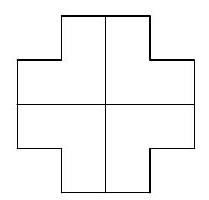
|
| 172 |
+
|
| 173 |
+
Now simply change the position of these four tiles into:
|
| 174 |
+
|
| 175 |
+
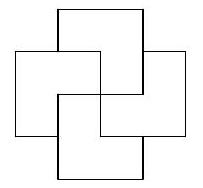
|
| 176 |
+
|
| 177 |
+
It is easy to see that this tiling is "regular".
|
| 178 |
+
|
| 179 |
+
C2 Consider 50 points in the plane, no three of them belonging to the same line. The points have been colored into four colors. Prove that there are at least 130 scalene triangles whose vertices are colored in the same color.
|
| 180 |
+
|
| 181 |
+
## Solution
|
| 182 |
+
|
| 183 |
+
Since $50=4 \cdot 12+2$, according to the pigeonhole principle we will have at least 13 points colored in the same color. We start with the:
|
| 184 |
+
|
| 185 |
+
Lemma. Given $n>8$ points in the plane, no three of them collinear, then there are at least $\frac{n(n-1)(n-8)}{6}$ scalene triangles with vertices among the given points.
|
| 186 |
+
|
| 187 |
+
Proof. There are $\frac{n(n-1)}{2}$ segments and $\frac{n(n-1)(n-2)}{6}$ triangles with vertices among the given points. We shall prove that there are at most $n(n-1)$ isosceles triangles. Indeed, for every segment $A B$ we can construct at most two isosceles triangles (if we have three $A B C, A B D$ and $A B E$, than $C, D, E$ will be collinear). Hence we have at least
|
| 188 |
+
|
| 189 |
+
$$
|
| 190 |
+
\frac{n(n-1)(n-2)}{6}-n(n-1)=\frac{n(n-1)(n-8)}{6} \text { scalene triangles. }
|
| 191 |
+
$$
|
| 192 |
+
|
| 193 |
+
For $n=13$ we have $\frac{13 \cdot 12 \cdot 5}{6}=130$, QED.
|
| 194 |
+
|
| 195 |
+
C3 The nonnegative integer $n$ and $(2 n+1) \times(2 n+1)$ chessboard with squares colored alternatively black and white are given. For every natural number $m$ with $1<m<2 n+1$, an $m \times m$ square of the given chessboard that has more than half of its area colored in black, is called a $B$-square. If the given chessboard is a $B$-square, find in terms of $n$ the total number of $B$-squares of this chessboard.
|
| 196 |
+
|
| 197 |
+
## Solution
|
| 198 |
+
|
| 199 |
+
Every square with even side length will have an equal number of black and white $1 \times 1$ squares, so it isn't a $B$-square. In a square with odd side length, there is one more $1 \times 1$ black square than white squares, if it has black corner squares. So, a square with odd side length is a $B$-square either if it is a $1 \times 1$ black square or it has black corners.
|
| 200 |
+
|
| 201 |
+
Let the given $(2 n+1) \times(2 n+1)$ chessboard be a $B$-square and denote by $b_{i}(i=$ $1,2, \ldots, n+1)$ the lines of the chessboard, which have $n+1$ black $1 \times 1$ squares, by $w_{i}(i=1,2, \ldots, n)$ the lines of the chessboard, which have $n$ black $1 \times 1$ squares and by $T_{m}(m=1,3,5, \ldots, 2 n-1,2 n+1)$ the total number of $B$-squares of dimension $m \times m$ of the given chessboard.
|
| 202 |
+
|
| 203 |
+
For $T_{1}$ we obtain $T_{1}=(n+1)(n+1)+n \cdot n=(n+1)^{2}+n^{2}$.
|
| 204 |
+
|
| 205 |
+
For computing $T_{3}$ we observe that there are $n 3 \times 3 B$-squares, which have the black corners on each pair of lines $\left(b_{i}, b_{i+1}\right)$ for $i=1,2, \ldots, n$ and there are $n-13 \times 3 B$-squares, which have the black corners on each pair of lines $\left(w_{i}, w_{i+1}\right)$ for $i=1,2, \ldots, n-1$. So, we have
|
| 206 |
+
|
| 207 |
+
$$
|
| 208 |
+
T_{3}=n \cdot n+(n-1)(n-1)=n^{2}+(n-1)^{2} \text {. }
|
| 209 |
+
$$
|
| 210 |
+
|
| 211 |
+
By using similar arguments for each pair of lines $\left(b_{i}, b_{i+2}\right)$ for $i=1,2, \ldots, n-1$ and for each pair of lines $\left(w_{i}, w_{i+2}\right)$ for $i=1,2, \ldots, n-2$ we compute
|
| 212 |
+
|
| 213 |
+
$$
|
| 214 |
+
T_{5}=(n-1)(n-1)+(n-2)(n-2)=(n-1)^{2}+(n-2)^{2}
|
| 215 |
+
$$
|
| 216 |
+
|
| 217 |
+
Step by step, we obtain
|
| 218 |
+
|
| 219 |
+
$$
|
| 220 |
+
\begin{gathered}
|
| 221 |
+
T_{7}=(n-2)(n-2)+(n-3)(n-3)=(n-2)^{2}+(n-3)^{2} \\
|
| 222 |
+
\ldots \ldots \ldots \ldots \ldots \ldots \ldots \ldots \ldots \ldots \ldots \ldots \ldots \ldots \ldots \ldots \\
|
| 223 |
+
T_{2 n-1}=2 \cdot 2+1 \cdot 1=2^{2}+1^{2} \\
|
| 224 |
+
T_{2 n+1}=1 \cdot 1=1^{2}
|
| 225 |
+
\end{gathered}
|
| 226 |
+
$$
|
| 227 |
+
|
| 228 |
+
The total number of $B$-squares of the given chessboard equals to
|
| 229 |
+
|
| 230 |
+
$$
|
| 231 |
+
\begin{gathered}
|
| 232 |
+
T_{1}+T_{3}+T_{5}+\ldots+T_{2 n+1}=2\left(1^{2}+2^{2}+\ldots+n^{2}\right)+(n+1)^{2}= \\
|
| 233 |
+
\frac{n(n+1)(2 n+1)}{3}+(n+1)^{2}=\frac{(n+1)\left(2 n^{2}+4 n+3\right)}{3}
|
| 234 |
+
\end{gathered}
|
| 235 |
+
$$
|
| 236 |
+
|
| 237 |
+
The problem is solved.
|
| 238 |
+
|
| 239 |
+
### 2.3 Geometry
|
| 240 |
+
|
| 241 |
+
G1 Let $M$ be an interior point of the triangle $A B C$ with angles $\varangle B A C=70^{\circ}$ and $\varangle A B C=80^{\circ}$. If $\varangle A C M=10^{\circ}$ and $\varangle C B M=20^{\circ}$, prove that $A B=M C$.
|
| 242 |
+
|
| 243 |
+
## Solution
|
| 244 |
+
|
| 245 |
+
Let $O$ be the circumcenter of the triangle $A B C$. Because the triangle $A B C$ is acute, $O$ is in the interior of $\triangle A B C$. Now we have that $\varangle A O C=2 \varangle A B C=160^{\circ}$, so $\varangle A C O=10^{\circ}$ and $\varangle B O C=2 \varangle B A C=140^{\circ}$, so $\varangle C B O=20^{\circ}$. Therefore $O \equiv M$, thus $M A=$ $M B=M C$. Because $\varangle A B O=80^{\circ}-20^{\circ}=60^{\circ}$, the triangle $A B M$ is equilateral and so $A B=M B=M C$.
|
| 246 |
+
|
| 247 |
+
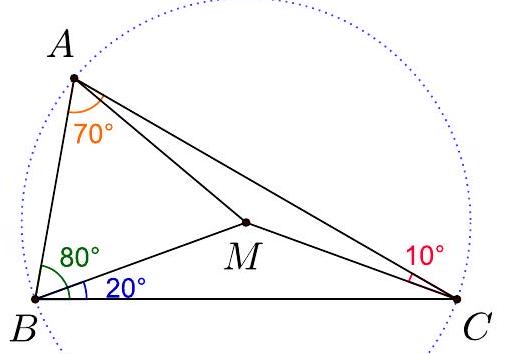
|
| 248 |
+
|
| 249 |
+
G2 Let $A B C D$ be a convex quadrilateral with $\varangle D A C=\varangle B D C=36^{\circ}, \varangle C B D=18^{\circ}$ and $\varangle B A C=72^{\circ}$. If $P$ is the point of intersection of the diagonals $A C$ and $B D$, find the measure of $\varangle A P D$.
|
| 250 |
+
|
| 251 |
+
## Solution
|
| 252 |
+
|
| 253 |
+
On the rays ( $D A$ and ( $B A$ we take points $E$ and $Z$, respectively, such that $A C=A E=$ $A Z$. Since $\varangle D E C=\frac{\varangle D A C}{2}=18^{\circ}=\varangle C B D$, the quadrilateral $D E B C$ is cyclic.
|
| 254 |
+
|
| 255 |
+
Similarly, the quadrilateral $C B Z D$ is cyclic, because $\varangle A Z C=\frac{\varangle B A C}{2}=36^{\circ}=\varangle B D C$. Therefore the pentagon $B C D Z E$ is inscribed in the circle $k(A, A C)$. It gives $A C=A D$ and $\varangle A C D=\varangle A D C=\frac{180^{\circ}-36^{\circ}}{2}=72^{\circ}$, which gives $\varangle A D P=36^{\circ}$ and $\varangle A P D=108^{\circ}$.
|
| 256 |
+
|
| 257 |
+
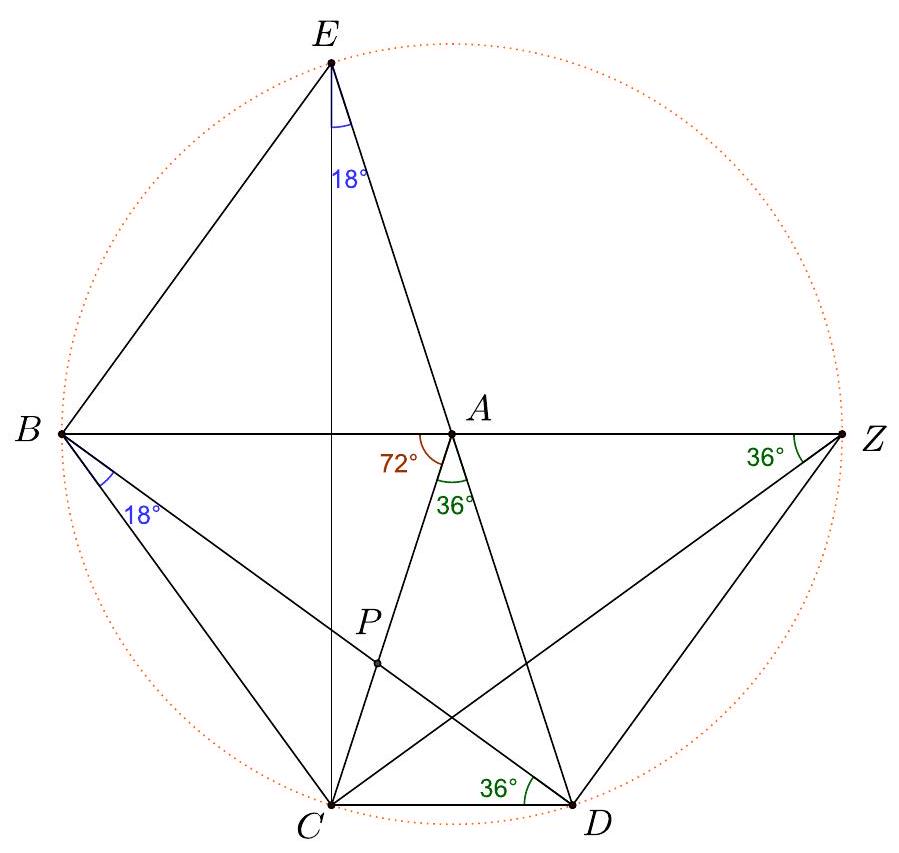
|
| 258 |
+
|
| 259 |
+
Alternative solution. Let $X$ be the intersection point of the angle bisector of $\varangle C A D$ and $P D$. As $\varangle C A X=\varangle C B X=18^{\circ}, A B C X$ is cyclic, hence $\varangle B X C=72^{\circ}$. It follows that $C X D$ is isosceles. From the SSA criterion for triangles $A X C$ and $A X D$, it follows that either $\varangle A C X=\varangle A D X$, or $\varangle A C X+\varangle A D X=180^{\circ}$. The latter being excluded, it follows that triangles $A X C$ and $A X D$ are congruent. Immediate angle chasing leads to the conclusion.
|
| 260 |
+
|
| 261 |
+
Alternative solution. Let $S$ be the reflection of $D$ in the line $B C$. Triangle $B D S$ is isosceles, with $\varangle D B S=36^{\circ}$, hence $\varangle S D B=\varangle B S D=72^{\circ}$. It follows that $A B S D$ is cyclic $\left(\varangle B S D+\varangle B A D=180^{\circ}\right)$, hence $\varangle B A S=\varangle B D S=72^{\circ}$ which means that $A, C, S$
|
| 262 |
+
are collinear. $C$ is the incenter of $\triangle B S D$, therefore $\varangle P S B=\varangle P B S=36^{\circ}$, which leads to $\varangle D P A=108^{\circ}$.
|
| 263 |
+
|
| 264 |
+

|
| 265 |
+
|
| 266 |
+
G3 Let the inscribed circle of the triangle $\triangle A B C$ touch side $B C$ at $M$, side $C A$ at $N$ and side $A B$ at $P$. Let $D$ be a point from $[N P]$ such that $\frac{D P}{D N}=\frac{B D}{C D}$. Show that $D M \perp P N$. Solution
|
| 267 |
+
|
| 268 |
+
From $A P=A N$ it follows that $\varangle A N P=\varangle A P N$ or $\varangle N P B=\varangle P N C$ (both obtuse). Hence the triangles $B D P$ and $C N D$ are similar (SSA) and $\varangle C D N=\varangle B D P$ and $\frac{C D}{B D}=$ $\frac{C N}{B P}=\frac{C M}{B M}$. So $D M$ is a bisector of the angle $B D C$, from where $N P \perp M D$.
|
| 269 |
+
|
| 270 |
+

|
| 271 |
+
|
| 272 |
+
G4 Let $S$ be a point inside $\varangle p O q$, and let $k$ be a circle which contains $S$ and touches the legs $O p$ and $O q$ in points $P$ and $Q$ respectively. Straight line $s$ parallel to $O p$ from $S$ intersects $O q$ in a point $R$. Let $T$ be the point of intersection of the ray $(P S$ and circumscribed circle of $\triangle S Q R$ and $T \neq S$. Prove that $O T \| S Q$ and $O T$ is a tangent of the circumscribed circle of $\triangle S Q R$.
|
| 273 |
+
|
| 274 |
+
## Solution
|
| 275 |
+
|
| 276 |
+
Let $\varangle O P S=\varphi_{1}$ and $\varangle O Q S=\varphi_{2}$. We have that $\varangle O P S=\varangle P Q S=\varphi_{1}$ and $\varangle O Q S=$ $\varangle Q P S=\varphi_{2}$ (tangents to circle $k$ ).
|
| 277 |
+
|
| 278 |
+
Because $R S \| O P$ we have $\varangle O P S=\varangle R S T=\varphi_{1}$ and $\varangle R Q T=\varangle R S T=\varphi_{1}$ (cyclic quadrilateral $R S Q T$ ). So, we have as follows $\varangle O P T=\varphi_{1}=\varangle R Q T=\varangle O Q T$, which implies that the quadrilateral $O P Q T$ is cyclic. From that we directly obtain $\varangle Q O T=$ $\varangle Q P T=\varphi_{2}=\varangle O Q S$, so $O T \| S Q$. From the cyclic quadrilateral $O P Q T$ by easy calculation we get
|
| 279 |
+
|
| 280 |
+
$$
|
| 281 |
+
\varangle O T R=\varangle O T P-\varangle R T S=\varangle O Q P-\varangle R Q S=\left(\varphi_{1}+\varphi_{2}\right)-\varphi_{2}=\varphi_{1}=\varangle R Q T
|
| 282 |
+
$$
|
| 283 |
+
|
| 284 |
+
Thus, $O T$ is a tangent to the circumscribed circle of $\triangle S Q R$.
|
| 285 |
+
|
| 286 |
+
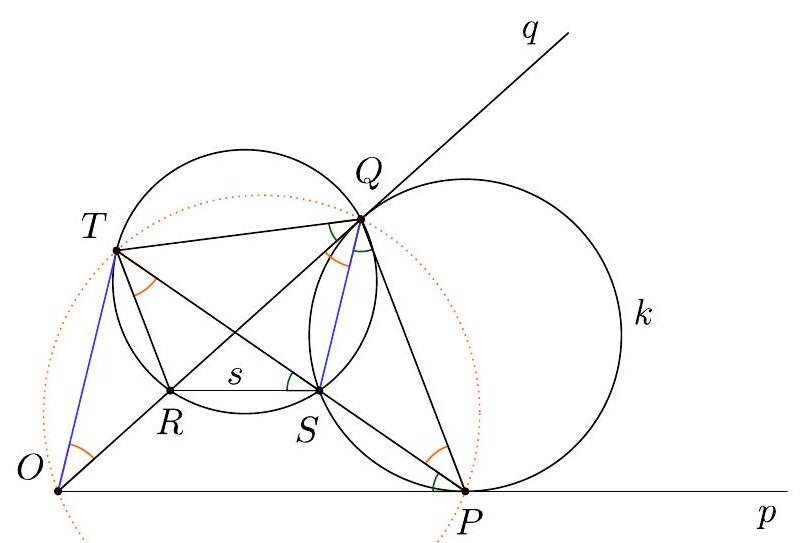
|
| 287 |
+
|
| 288 |
+
### 2.4 Number Theory
|
| 289 |
+
|
| 290 |
+
NT1 Find all the pairs positive integers $(x, y)$ such that
|
| 291 |
+
|
| 292 |
+
$$
|
| 293 |
+
\frac{1}{x}+\frac{1}{y}+\frac{1}{[x, y]}+\frac{1}{(x, y)}=\frac{1}{2}
|
| 294 |
+
$$
|
| 295 |
+
|
| 296 |
+
where $(x, y)$ is the greatest common divisor of $x, y$ and $[x, y]$ is the least common multiple of $x, y$.
|
| 297 |
+
|
| 298 |
+
## Solution
|
| 299 |
+
|
| 300 |
+
We put $x=d u$ and $y=d v$ where $d=(x, y)$. So we have $(u, v)=1$. From the conclusion we obtain $2(u+1)(v+1)=d u v$. Because $(v, v+1)=1, v$ divides $2(u+1)$.
|
| 301 |
+
|
| 302 |
+
Case 1. $u=v$. Hence $x=y=[x, y]=(x, y)$, which leads to the solution $x=8$ and $y=8$.
|
| 303 |
+
|
| 304 |
+
Case 2. $u<v$. Then $u+1 \leq v \Leftrightarrow 2(u+1) \leq 2 v \Leftrightarrow \frac{2(u+1)}{v} \leq 2$, so $\frac{2(u+1)}{v} \in\{1,2\}$. But $\frac{2(u+1)}{v}=\frac{d u}{v+1}$.
|
| 305 |
+
|
| 306 |
+
If $\frac{2(u+1)}{v}=1$ then we have $(d-2) u=3$. Therefore $(d, u)=(3,3)$ or $(d, u)=(5,1)$ so $(d, u, v)=(3,3,8)$ or $(d, u, v)=(5,1,4)$.
|
| 307 |
+
|
| 308 |
+
Thus we get $(x, y)=(9,24)$ or $(x, y)=(5,20)$.
|
| 309 |
+
|
| 310 |
+
If $\frac{2(u+1)}{v}=2$ we similarly get $(d-2) u=4$ from where $(d, u)=(3,4)$, or $(d, u)=(4,2)$, or $(d, u)=(6,1)$. This leads $(x, y)=(12,15)$ or $(x, y)=(8,12)$ or $(x, y)=(6,12)$.
|
| 311 |
+
|
| 312 |
+
Case 3. $u>v$. Because of the symmetry of $u, v$ and $x, y$ respectively we get exactly the symmetrical solutions of case 2 .
|
| 313 |
+
|
| 314 |
+
Finally the pairs of $(x, y)$ which are solutions of the problem are:
|
| 315 |
+
|
| 316 |
+
$(8,8),(9,24),(24,9),(5,20),(20,5),(12,15),(15,12),(8,12),(12,8),(6,12),(12,6)$.
|
| 317 |
+
|
| 318 |
+
NT2 Prove that the equation $x^{2006}-4 y^{2006}-2006=4 y^{2007}+2007 y$ has no solution in the set of the positive integers.
|
| 319 |
+
|
| 320 |
+
## Solution
|
| 321 |
+
|
| 322 |
+
We assume the contrary is true. So there are $x$ and $y$ that satisfy the equation. Hence we have
|
| 323 |
+
|
| 324 |
+
$$
|
| 325 |
+
\begin{gathered}
|
| 326 |
+
x^{2006}=4 y^{2007}+4 y^{2006}+2007 y+2006 \\
|
| 327 |
+
x^{2006}+1=4 y^{2006}(y+1)+2007(y+1) \\
|
| 328 |
+
x^{2006}+1=\left(4 y^{2006}+2007\right)(y+1)
|
| 329 |
+
\end{gathered}
|
| 330 |
+
$$
|
| 331 |
+
|
| 332 |
+
But $4 y^{2006}+2007 \equiv 3(\bmod 4)$, so $x^{2006}+1$ will have at least one prime divisor of the type $4 k+3$. It is known (and easily obtainable by using Fermat's Little Theorem) that this is impossible.
|
| 333 |
+
|
| 334 |
+
NT3 Let $n>1$ be a positive integer and $p$ a prime number such that $n \mid(p-1)$ and $p \mid\left(n^{6}-1\right)$. Prove that at least one of the numbers $p-n$ and $p+n$ is a perfect square.
|
| 335 |
+
|
| 336 |
+
## Solution
|
| 337 |
+
|
| 338 |
+
Since $n \mid p-1$, then $p=1+n a$, where $a \geq 1$ is an integer. From the condition $p \mid n^{6}-1$, it follows that $p|n-1, p| n+1, p \mid n^{2}+n+1$ or $p \mid n^{2}-n+1$.
|
| 339 |
+
|
| 340 |
+
- Let $p \mid n-1$. Then $n \geq p+1>n$ which is impossible.
|
| 341 |
+
- Let $p \mid n+1$. Then $n+1 \geq p=1+n a$ which is possible only when $a=1$ and $p=n+1$, i.e. $p-n=1=1^{2}$.
|
| 342 |
+
- Let $p \mid n^{2}+n+1$, i.e. $n^{2}+n+1=p b$, where $b \geq 1$ is an integer.
|
| 343 |
+
|
| 344 |
+
The equality $p=1+n a$ implies $n \mid b-1$, from where $b=1+n c, c \geq 0$ is an integer. We have
|
| 345 |
+
|
| 346 |
+
$$
|
| 347 |
+
n^{2}+n+1=p b=(1+n a)(1+n c)=1+(a+c) n+a c n^{2} \text { or } n+1=a c n+a+c
|
| 348 |
+
$$
|
| 349 |
+
|
| 350 |
+
If $a c \geq 1$ then $a+c \geq 2$, which is impossible. If $a c=0$ then $c=0$ and $a=n+1$. Thus we obtain $p=n^{2}+n+1$ from where $p+n=n^{2}+2 n+1=(n+1)^{2}$.
|
| 351 |
+
|
| 352 |
+
- Let $p \mid n^{2}-n+1$, i.e. $n^{2}-n+1=p b$ and analogously $b=1+n c$. So
|
| 353 |
+
|
| 354 |
+
$$
|
| 355 |
+
n^{2}-n+1=p b=(1+n a)(1+n c)=1+(a+c) n+a c n^{2} \text { or } n-1=a c n+a+c
|
| 356 |
+
$$
|
| 357 |
+
|
| 358 |
+
Similarly, we have $c=0, a=n-1$ and $p=n^{2}-n+1$ from where $p-n=n^{2}-2 n+1=$ $(n-1)^{2}$.
|
| 359 |
+
|
| 360 |
+
NT4 Let $a, b$ be two co-prime positive integers. A number is called good if it can be written in the form $a x+b y$ for non-negative integers $x, y$. Define the function $f: \mathbb{Z} \rightarrow \mathbb{Z}$ as $f(n)=n-n_{a}-n_{b}$, where $s_{t}$ represents the remainder of $s$ upon division by $t$. Show that an integer $n$ is good if and only if the infinite sequence $n, f(n), f(f(n)), \ldots$ contains only non-negative integers.
|
| 361 |
+
|
| 362 |
+
## Solution
|
| 363 |
+
|
| 364 |
+
If $n$ is good then $n=a x+b y$ also $n_{a}=(b y)_{a}$ and $n_{b}=(a x)_{b}$ so
|
| 365 |
+
|
| 366 |
+
$$
|
| 367 |
+
f(n)=a x-(a x)_{b}+b y-(b y)_{a}=b y^{\prime}+a x^{\prime}
|
| 368 |
+
$$
|
| 369 |
+
|
| 370 |
+
is also good, thus the sequence contains only good numbers which are non-negative.
|
| 371 |
+
|
| 372 |
+
Now we have to prove that if the sequence contains only non-negative integers then $n$ is good. Because the sequence is non-increasing then the sequence will become constant from some point onwards. But $f(k)=k$ implies that $k$ is a multiple of $a b$ thus some term of the sequence is good. We are done if we prove the following:
|
| 373 |
+
|
| 374 |
+
Lemma: $f(n)$ is good implies $n$ is good.
|
| 375 |
+
|
| 376 |
+
Proof of Lemma: $n=2 n-n_{a}-n_{b}-f(n)=a x^{\prime}+b y^{\prime}-a x-b y=a\left(x^{\prime}-x\right)+b\left(y^{\prime}-y\right)$ and $x^{\prime} \geq x$ because $n \geq f(n) \Rightarrow n-n_{a} \geq f(n)-f(n)_{a} \Rightarrow a x^{\prime} \geq a x+b y-(b y)_{a} \geq a x$. Similarly $y^{\prime} \geq y$.
|
| 377 |
+
|
| 378 |
+
NT5 Let $p$ be a prime number. Show that $7 p+3^{p}-4$ is not a perfect square.
|
| 379 |
+
|
| 380 |
+
## Solution
|
| 381 |
+
|
| 382 |
+
Assume that for a prime number $p$ greater than $3, m=7 p+3^{p}-4$ is a perfect square. Let $m=n^{2}$ for some $n \in \mathbb{Z}$. By Fermat's Little Theorem,
|
| 383 |
+
|
| 384 |
+
$$
|
| 385 |
+
m=7 p+3^{p}-4 \equiv 3-4 \equiv-1 \quad(\bmod p)
|
| 386 |
+
$$
|
| 387 |
+
|
| 388 |
+
If $p=4 k+3, k \in \mathbb{Z}$, then again by Fermat's Little Theorem
|
| 389 |
+
|
| 390 |
+
$$
|
| 391 |
+
-1 \equiv m^{2 k+1} \equiv n^{4 k+2} \equiv n^{p-1} \equiv 1 \quad(\bmod p), \text { but } p>3
|
| 392 |
+
$$
|
| 393 |
+
|
| 394 |
+
a contradiction. So $p \equiv 1(\bmod 4)$.
|
| 395 |
+
|
| 396 |
+
Therefore $m=7 p+3^{p}-4 \equiv 3-1 \equiv 2(\bmod 4)$. But this is a contradiction since 2 is not perfect square in $(\bmod 4)$. For $p=2$ we have $m=19$ and for $p=3$ we have $m=44$.
|
| 397 |
+
|
JBMO/md/en-shortlist/en-jbmo-2008_shl.md
ADDED
|
@@ -0,0 +1,1533 @@
|
|
|
|
|
|
|
|
|
|
|
|
|
|
|
|
|
|
|
|
|
|
|
|
|
|
|
|
|
|
|
|
|
|
|
|
|
|
|
|
|
|
|
|
|
|
|
|
|
|
|
|
|
|
|
|
|
|
|
|
|
|
|
|
|
|
|
|
|
|
|
|
|
|
|
|
|
|
|
|
|
|
|
|
|
|
|
|
|
|
|
|
|
|
|
|
|
|
|
|
|
|
|
|
|
|
|
|
|
|
|
|
|
|
|
|
|
|
|
|
|
|
|
|
|
|
|
|
|
|
|
|
|
|
|
|
|
|
|
|
|
|
|
|
|
|
|
|
|
|
|
|
|
|
|
|
|
|
|
|
|
|
|
|
|
|
|
|
|
|
|
|
|
|
|
|
|
|
|
|
|
|
|
|
|
|
|
|
|
|
|
|
|
|
|
|
|
|
|
|
|
|
|
|
|
|
|
|
|
|
|
|
|
|
|
|
|
|
|
|
|
|
|
|
|
|
|
|
|
|
|
|
|
|
|
|
|
|
|
|
|
|
|
|
|
|
|
|
|
|
|
|
|
|
|
|
|
|
|
|
|
|
|
|
|
|
|
|
|
|
|
|
|
|
|
|
|
|
|
|
|
|
|
|
|
|
|
|
|
|
|
|
|
|
|
|
|
|
|
|
|
|
|
|
|
|
|
|
|
|
|
|
|
|
|
|
|
|
|
|
|
|
|
|
|
|
|
|
|
|
|
|
|
|
|
|
|
|
|
|
|
|
|
|
|
|
|
|
|
|
|
|
|
|
|
|
|
|
|
|
|
|
|
|
|
|
|
|
|
|
|
|
|
|
|
|
|
|
|
|
|
|
|
|
|
|
|
|
|
|
|
|
|
|
|
|
|
|
|
|
|
|
|
|
|
|
|
|
|
|
|
|
|
|
|
|
|
|
|
|
|
|
|
|
|
|
|
|
|
|
|
|
|
|
|
|
|
|
|
|
|
|
|
|
|
|
|
|
|
|
|
|
|
|
|
|
|
|
|
|
|
|
|
|
|
|
|
|
|
|
|
|
|
|
|
|
|
|
|
|
|
|
|
|
|
|
|
|
|
|
|
|
|
|
|
|
|
|
|
|
|
|
|
|
|
|
|
|
|
|
|
|
|
|
|
|
|
|
|
|
|
|
|
|
|
|
|
|
|
|
|
|
|
|
|
|
|
|
|
|
|
|
|
|
|
|
|
|
|
|
|
|
|
|
|
|
|
|
|
|
|
|
|
|
|
|
|
|
|
|
|
|
|
|
|
|
|
|
|
|
|
|
|
|
|
|
|
|
|
|
|
|
|
|
|
|
|
|
|
|
|
|
|
|
|
|
|
|
|
|
|
|
|
|
|
|
|
|
|
|
|
|
|
|
|
|
|
|
|
|
|
|
|
|
|
|
|
|
|
|
|
|
|
|
|
|
|
|
|
|
|
|
|
|
|
|
|
|
|
|
|
|
|
|
|
|
|
|
|
|
|
|
|
|
|
|
|
|
|
|
|
|
|
|
|
|
|
|
|
|
|
|
|
|
|
|
|
|
|
|
|
|
|
|
|
|
|
|
|
|
|
|
|
|
|
|
|
|
|
|
|
|
|
|
|
|
|
|
|
|
|
|
|
|
|
|
|
|
|
|
|
|
|
|
|
|
|
|
|
|
|
|
|
|
|
|
|
|
|
|
|
|
|
|
|
|
|
|
|
|
|
|
|
|
|
|
|
|
|
|
|
|
|
|
|
|
|
|
|
|
|
|
|
|
|
|
|
|
|
|
|
|
|
|
|
|
|
|
|
|
|
|
|
|
|
|
|
|
|
|
|
|
|
|
|
|
|
|
|
|
|
|
|
|
|
|
|
|
|
|
|
|
|
|
|
|
|
|
|
|
|
|
|
|
|
|
|
|
|
|
|
|
|
|
|
|
|
|
|
|
|
|
|
|
|
|
|
|
|
|
|
|
|
|
|
|
|
|
|
|
|
|
|
|
|
|
|
|
|
|
|
|
|
|
|
|
|
|
|
|
|
|
|
|
|
|
|
|
|
|
|
|
|
|
|
|
|
|
|
|
|
|
|
|
|
|
|
|
|
|
|
|
|
|
|
|
|
|
|
|
|
|
|
|
|
|
|
|
|
|
|
|
|
|
|
|
|
|
|
|
|
|
|
|
|
|
|
|
|
|
|
|
|
|
|
|
|
|
|
|
|
|
|
|
|
|
|
|
|
|
|
|
|
|
|
|
|
|
|
|
|
|
|
|
|
|
|
|
|
|
|
|
|
|
|
|
|
|
|
|
|
|
|
|
|
|
|
|
|
|
|
|
|
|
|
|
|
|
|
|
|
|
|
|
|
|
|
|
|
|
|
|
|
|
|
|
|
|
|
|
|
|
|
|
|
|
|
|
|
|
|
|
|
|
|
|
|
|
|
|
|
|
|
|
|
|
|
|
|
|
|
|
|
|
|
|
|
|
|
|
|
|
|
|
|
|
|
|
|
|
|
|
|
|
|
|
|
|
|
|
|
|
|
|
|
|
|
|
|
|
|
|
|
|
|
|
|
|
|
|
|
|
|
|
|
|
|
|
|
|
|
|
|
|
|
|
|
|
|
|
|
|
|
|
|
|
|
|
|
|
|
|
|
|
|
|
|
|
|
|
|
|
|
|
|
|
|
|
|
|
|
|
|
|
|
|
|
|
|
|
|
|
|
|
|
|
|
|
|
|
|
|
|
|
|
|
|
|
|
|
|
|
|
|
|
|
|
|
|
|
|
|
|
|
|
|
|
|
|
|
|
|
|
|
|
|
|
|
|
|
|
|
|
|
|
|
|
|
|
|
|
|
|
|
|
|
|
|
|
|
|
|
|
|
|
|
|
|
|
|
|
|
|
|
|
|
|
|
|
|
|
|
|
|
|
|
|
|
|
|
|
|
|
|
|
|
|
|
|
|
|
|
|
|
|
|
|
|
|
|
|
|
|
|
|
|
|
|
|
|
|
|
|
|
|
|
|
|
|
|
|
|
|
|
|
|
|
|
|
|
|
|
|
|
|
|
|
|
|
|
|
|
|
|
|
|
|
|
|
|
|
|
|
|
|
|
|
|
|
|
|
|
|
|
|
|
|
|
|
|
|
|
|
|
|
|
|
|
|
|
|
|
|
|
|
|
|
|
|
|
|
|
|
|
|
|
|
|
|
|
|
|
|
|
|
|
|
|
|
|
|
|
|
|
|
|
|
|
|
|
|
|
|
|
|
|
|
|
|
|
|
|
|
|
|
|
|
|
|
|
|
|
|
|
|
|
|
|
|
|
|
|
|
|
|
|
|
|
|
|
|
|
|
|
|
|
|
|
|
|
|
|
|
|
|
|
|
|
|
|
|
|
|
|
|
|
|
|
|
|
|
|
|
|
|
|
|
|
|
|
|
|
|
|
|
|
|
|
|
|
|
|
|
|
|
|
|
|
|
|
|
|
|
|
|
|
|
|
|
|
|
|
|
|
|
|
|
|
|
|
|
|
|
|
|
|
|
|
|
|
|
|
|
|
|
|
|
|
|
|
|
|
|
|
|
|
|
|
|
|
|
|
|
|
|
|
|
|
|
|
|
|
|
|
|
|
|
|
|
|
|
|
|
|
|
|
|
|
|
|
|
|
|
|
|
|
|
|
|
|
|
|
|
|
|
|
|
|
|
|
|
|
|
|
|
|
|
|
|
|
|
|
|
|
|
|
|
|
|
|
|
|
|
|
|
|
|
|
|
|
|
|
|
|
|
|
|
|
|
|
|
|
|
|
|
|
|
|
|
|
|
|
|
|
|
|
|
|
|
|
|
|
|
|
|
|
|
|
|
|
|
|
|
|
|
|
|
|
|
|
|
|
|
|
|
|
|
|
|
|
|
|
|
|
|
|
|
|
|
|
|
|
|
|
|
|
|
|
|
|
|
|
|
|
|
|
|
|
|
|
|
|
|
|
|
|
|
|
|
|
|
|
|
|
|
|
|
|
|
|
|
|
|
|
|
|
|
|
|
|
|
|
|
|
|
|
|
|
|
|
|
|
|
|
|
|
|
|
|
|
|
|
|
|
|
|
|
|
|
|
|
|
|
|
|
|
|
|
|
|
|
|
|
|
|
|
|
|
|
|
|
|
|
|
|
|
|
|
|
|
|
|
|
|
|
|
|
|
|
|
|
|
|
|
|
|
|
|
|
|
|
|
|
|
|
|
|
|
|
|
|
|
|
|
|
|
|
|
|
|
|
|
|
|
|
|
|
|
|
|
|
|
|
|
|
|
|
|
|
|
|
|
|
|
|
|
|
|
|
|
|
|
|
|
|
|
|
|
|
|
|
|
|
|
|
|
|
|
|
|
|
|
|
|
|
|
|
|
|
|
|
|
|
|
|
|
|
|
|
|
|
|
|
|
|
|
|
|
|
|
|
|
|
|
|
|
|
|
|
|
|
|
|
|
|
|
|
|
|
|
|
|
|
|
|
|
|
|
|
|
|
|
|
|
|
|
|
|
|
|
|
|
|
|
|
|
|
|
|
|
|
|
|
|
|
|
|
|
|
|
|
|
|
|
|
|
|
|
|
|
|
|
|
|
|
|
|
|
|
|
|
|
|
|
|
|
|
|
|
|
|
|
|
|
|
|
|
|
|
|
|
|
|
|
|
|
|
|
|
|
|
|
|
|
|
|
|
|
|
|
|
|
|
|
|
|
|
|
|
|
|
|
|
|
|
|
|
|
|
|
|
|
|
|
|
|
|
|
|
|
|
|
|
|
|
|
|
|
|
|
|
|
|
|
|
|
|
|
|
|
|
|
|
|
|
|
|
|
|
|
|
|
|
|
|
|
|
|
|
|
|
|
|
|
|
|
|
|
|
|
|
|
|
|
|
|
|
|
|
|
|
|
|
|
|
|
|
|
|
|
|
|
|
|
|
|
|
|
|
|
|
|
|
|
|
|
|
|
|
|
|
|
|
|
|
|
|
|
|
|
|
|
|
|
|
|
|
|
|
|
|
|
|
|
|
|
|
|
|
|
|
|
|
|
|
|
|
|
|
|
|
|
|
|
|
|
|
|
|
|
|
|
|
|
|
|
|
|
|
|
|
|
|
|
|
|
|
|
|
|
|
|
|
|
|
|
|
|
|
|
|
|
|
|
|
|
|
|
|
|
|
|
|
|
|
|
|
|
|
|
|
|
|
|
|
|
|
|
|
|
|
|
|
|
|
|
|
|
|
|
|
|
|
|
|
|
|
|
|
|
|
|
|
|
|
|
|
|
|
|
|
|
|
|
|
|
|
|
|
|
|
|
|
|
|
|
|
|
|
|
|
|
|
|
|
|
|
|
|
|
|
|
|
|
|
|
|
|
|
|
|
|
|
|
|
|
|
|
|
|
|
|
|
|
|
|
|
|
|
|
|
|
|
|
|
|
|
|
|
|
|
|
|
|
|
|
|
|
|
|
|
|
|
|
|
|
|
|
|
|
|
|
|
|
|
|
|
|
|
|
|
|
|
|
|
|
|
|
|
|
|
|
|
|
|
|
|
|
|
|
|
|
|
|
|
|
|
|
|
|
|
|
|
|
|
|
|
|
|
|
|
|
|
|
|
|
|
|
|
|
|
|
|
|
|
|
|
|
|
|
|
|
|
|
|
|
|
|
|
|
|
|
|
|
|
|
|
|
|
|
|
|
|
|
|
|
|
|
|
|
|
|
|
|
|
|
|
|
|
|
|
|
|
|
|
|
|
|
|
|
|
|
|
|
|
|
|
|
|
|
|
|
|
|
|
|
|
|
|
|
|
|
|
|
|
|
|
|
|
|
|
|
|
|
|
|
|
|
|
|
|
|
|
|
|
|
|
|
|
|
|
|
|
|
|
|
|
|
|
|
|
|
|
|
|
|
|
|
|
|
|
|
|
|
|
|
|
|
|
|
|
|
|
|
|
|
|
|
|
|
|
|
|
|
|
|
|
|
|
|
|
|
|
|
|
|
|
|
|
|
|
|
|
|
|
|
|
|
|
|
|
|
|
|
|
|
|
|
|
|
|
|
|
|
|
|
|
|
|
|
|
|
|
|
|
|
|
|
|
|
|
|
|
|
|
|
|
|
|
|
|
|
|
|
|
|
|
|
|
|
|
|
|
|
|
|
|
|
|
|
|
|
|
|
|
|
|
|
|
|
|
|
|
|
|
|
|
|
|
|
|
|
|
|
|
|
|
|
|
|
|
|
|
|
|
|
|
|
|
|
|
|
|
|
|
|
|
|
|
|
|
|
|
|
|
|
|
|
|
|
|
|
|
|
|
|
|
|
|
|
|
|
|
|
|
|
|
|
|
|
|
|
|
|
|
|
|
|
|
|
|
|
|
|
|
|
|
|
|
|
|
|
|
|
|
|
|
|
|
|
|
|
|
|
|
|
|
|
|
|
|
|
|
|
|
|
|
|
|
|
|
|
|
|
|
|
|
|
|
|
|
|
|
|
|
|
|
|
|
|
|
|
|
|
|
|
|
|
|
|
|
|
|
|
|
|
|
|
|
|
|
|
|
|
|
|
|
|
|
|
|
|
|
|
|
|
|
|
|
|
|
|
|
|
|
|
|
|
|
|
|
|
|
|
|
|
|
|
|
|
|
|
|
|
|
|
|
|
|
|
|
|
|
|
|
|
|
|
|
|
|
|
|
|
|
|
|
|
|
|
|
|
|
|
|
|
|
|
|
|
|
|
|
|
|
|
|
|
|
|
|
|
|
|
|
|
|
|
|
|
|
|
|
|
|
|
|
|
|
|
|
|
|
|
|
|
|
|
|
|
|
|
|
|
|
|
|
|
|
|
|
|
|
|
|
|
|
|
|
|
|
|
|
|
|
|
|
|
|
|
|
|
|
|
|
|
|
|
|
|
|
|
|
|
|
|
|
|
|
|
|
|
|
|
|
|
|
|
|
|
|
|
|
|
|
|
|
|
|
|
|
|
|
|
|
|
|
|
|
|
|
|
|
|
|
|
|
|
|
|
|
|
|
|
|
|
|
|
|
|
|
|
|
|
|
|
|
|
|
|
|
|
|
|
|
|
|
|
|
|
|
|
|
|
|
|
|
|
|
|
|
|
|
|
|
|
|
|
|
|
|
|
|
|
|
|
|
|
|
|
|
|
|
|
|
|
|
|
|
|
|
|
|
|
|
|
|
|
|
|
|
|
|
|
|
|
|
|
|
|
|
|
|
|
|
|
|
|
|
|
|
|
|
|
|
|
|
|
|
|
|
|
|
|
|
|
|
|
|
|
|
|
|
|
|
|
|
|
|
|
|
|
|
|
|
|
|
|
|
|
|
|
|
|
|
|
|
|
|
|
|
|
|
|
|
|
|
|
|
|
|
|
|
|
|
|
|
|
|
|
|
|
|
|
|
|
|
|
|
|
|
|
|
|
|
|
|
|
|
|
|
|
|
|
|
|
|
|
|
|
|
|
|
|
|
|
|
|
|
|
|
|
|
|
|
|
|
|
|
|
|
|
|
|
|
|
|
|
|
|
|
|
|
|
|
|
|
|
|
|
|
|
|
|
|
|
|
|
|
|
|
|
|
|
|
|
|
|
|
|
|
|
|
|
|
|
|
|
|
|
|
|
|
|
|
|
|
|
|
|
|
|
|
|
|
|
|
|
|
|
|
|
|
|
|
|
|
|
|
|
|
|
|
|
|
|
|
|
|
|
|
|
|
|
|
|
|
|
|
|
|
|
|
|
|
|
|
|
|
|
|
|
|
|
|
|
|
|
|
|
|
|
|
|
|
|
|
|
|
|
|
|
|
|
|
|
|
|
|
|
|
|
|
|
|
|
|
|
|
|
|
|
|
|
|
|
|
|
|
|
|
|
|
|
|
|
|
|
|
|
|
|
|
|
|
|
|
|
|
|
|
|
|
|
|
|
|
|
|
|
|
|
|
|
|
|
|
|
|
|
|
|
|
|
|
|
|
|
|
|
|
|
|
|
|
|
|
|
|
|
|
|
|
|
|
|
|
|
|
|
|
|
|
|
|
|
|
|
|
|
|
|
|
|
|
|
|
|
|
|
|
|
|
|
|
|
|
|
|
|
|
|
|
|
|
|
|
|
|
|
|
|
|
|
|
|
|
|
|
|
|
|
|
|
|
|
|
|
|
|
|
|
|
|
|
|
|
|
|
|
|
|
|
|
|
|
|
|
|
|
|
|
|
|
|
|
|
|
|
|
|
|
|
|
|
|
|
|
|
|
|
|
|
|
|
|
|
|
|
|
|
|
|
|
|
|
|
|
|
|
|
|
|
|
|
|
|
|
|
|
|
|
|
|
|
|
|
|
|
|
|
|
|
|
|
|
|
|
|
|
|
|
|
|
|
|
|
|
|
|
|
|
|
|
|
|
|
|
|
|
|
|
|
|
|
|
|
|
|
|
|
|
|
|
|
|
|
|
|
|
|
|
|
|
|
|
|
|
|
|
|
|
|
|
|
|
|
|
|
|
|
|
|
|
|
|
|
|
|
|
|
|
|
|
|
|
|
|
|
|
|
|
|
|
|
|
|
|
|
|
|
|
|
|
|
|
|
|
|
|
|
|
|
|
|
|
|
|
|
|
|
|
|
|
|
|
|
|
|
|
|
|
|
|
|
|
|
|
|
|
|
|
|
|
|
|
|
|
|
|
|
|
|
|
|
|
|
|
|
|
|
|
|
|
|
|
|
|
|
|
|
|
|
|
|
|
|
|
|
|
|
|
|
|
|
|
|
|
|
|
|
|
|
|
|
|
|
|
|
|
|
|
|
|
|
|
|
|
|
|
|
|
|
|
|
|
|
|
|
|
|
|
|
|
|
|
|
|
|
|
|
|
|
|
|
|
|
|
|
|
|
|
|
|
|
|
|
|
|
|
|
|
|
|
|
|
|
|
|
|
|
|
|
|
|
|
|
|
|
|
|
|
|
|
|
|
|
|
|
|
|
|
|
|
|
|
|
|
|
|
|
|
|
|
|
|
|
|
|
|
|
|
|
|
|
|
|
|
|
|
|
|
|
|
|
|
|
|
|
|
|
|
|
|
|
|
|
|
|
|
|
|
|
|
|
|
|
|
|
|
|
|
|
|
|
|
|
|
|
|
|
|
|
|
|
|
|
|
|
|
|
|
|
|
|
|
|
|
|
|
|
|
|
|
|
|
|
|
|
|
|
|
|
|
|
|
|
|
|
|
|
|
|
|
|
|
|
|
|
|
|
|
|
|
|
|
|
|
|
|
|
|
|
|
|
|
|
|
|
|
|
|
|
|
|
|
|
|
|
|
|
|
|
|
|
|
|
|
|
|
|
|
|
|
|
|
|
|
|
|
|
|
|
|
|
|
|
|
|
|
|
|
|
|
|
|
|
|
|
|
|
|
|
|
|
|
|
|
|
|
|
|
|
|
|
|
|
|
|
|
|
|
|
|
|
|
|
|
|
|
|
|
|
|
|
|
|
|
|
|
|
|
|
|
|
|
|
|
|
|
|
|
|
|
|
|
|
|
|
|
|
|
|
|
|
|
|
|
|
|
|
|
|
|
|
|
|
|
|
|
|
|
|
|
|
|
|
|
|
|
|
|
|
|
|
|
|
|
|
|
|
|
|
|
|
|
|
|
|
|
|
|
|
|
|
|
|
|
|
|
|
|
|
|
|
|
|
|
|
|
|
|
|
|
|
|
|
|
|
|
|
|
|
|
|
|
|
|
|
|
|
|
|
|
|
|
|
|
|
|
|
|
|
|
|
|
|
|
|
|
|
|
|
|
|
|
|
|
|
|
|
|
|
|
|
|
|
|
|
|
|
|
|
|
|
|
|
|
|
|
|
|
|
|
|
|
|
|
|
|
|
|
|
|
|
|
|
|
|
|
|
|
|
|
|
|
|
|
|
|
|
|
|
|
|
|
|
|
|
|
|
|
|
|
|
|
|
|
|
|
|
|
|
|
|
|
|
|
|
|
|
|
|
|
|
|
|
|
|
|
|
|
|
|
|
|
|
|
|
|
|
|
|
|
|
|
|
|
|
|
|
|
|
|
|
|
|
|
|
|
|
|
|
|
|
|
|
|
|
|
|
|
|
|
|
|
|
|
|
|
|
|
|
|
|
|
|
|
|
|
|
|
|
|
|
|
|
|
|
|
|
|
|
|
|
|
|
|
|
|
|
|
|
|
|
|
|
|
|
|
|
|
|
|
|
|
|
|
|
|
|
|
|
|
|
|
|
|
|
|
|
|
|
|
|
|
|
|
|
|
|
|
|
|
|
|
|
|
|
|
|
|
|
|
|
|
|
|
|
|
|
|
|
| 1 |
+
# Chapter 1
|
| 2 |
+
|
| 3 |
+
## 2008 Shortlist JBMO - Problems
|
| 4 |
+
|
| 5 |
+
### 1.1 Algebra
|
| 6 |
+
|
| 7 |
+
A1 If for the real numbers $x, y, z, k$ the following conditions are valid, $x \neq y \neq z \neq x$ and $x^{3}+y^{3}+k\left(x^{2}+y^{2}\right)=y^{3}+z^{3}+k\left(y^{2}+z^{2}\right)=z^{3}+x^{3}+k\left(z^{2}+x^{2}\right)=2008$, find the product $x y z$.
|
| 8 |
+
|
| 9 |
+
A2 Find all real numbers $a, b, c, d$ such that $a+b+c+d=20$ and $a b+a c+a d+b c+b d+c d=$ 150 .
|
| 10 |
+
|
| 11 |
+
A3 Let the real parameter $p$ be such that the system
|
| 12 |
+
|
| 13 |
+
$$
|
| 14 |
+
\left\{\begin{array}{l}
|
| 15 |
+
p\left(x^{2}-y^{2}\right)=\left(p^{2}-1\right) x y \\
|
| 16 |
+
|x-1|+|y|=1
|
| 17 |
+
\end{array}\right.
|
| 18 |
+
$$
|
| 19 |
+
|
| 20 |
+
has at least three different real solutions. Find $p$ and solve the system for that $p$.
|
| 21 |
+
|
| 22 |
+
A4 Find all triples $(x, y, z)$ of real numbers that satisfy the system
|
| 23 |
+
|
| 24 |
+
$$
|
| 25 |
+
\left\{\begin{array}{l}
|
| 26 |
+
x+y+z=2008 \\
|
| 27 |
+
x^{2}+y^{2}+z^{2}=6024^{2} \\
|
| 28 |
+
\frac{1}{x}+\frac{1}{y}+\frac{1}{z}=\frac{1}{2008}
|
| 29 |
+
\end{array}\right.
|
| 30 |
+
$$
|
| 31 |
+
|
| 32 |
+
A5 Find all triples $(x, y, z)$ of real positive numbers, which satisfy the system
|
| 33 |
+
|
| 34 |
+
$$
|
| 35 |
+
\left\{\begin{array}{l}
|
| 36 |
+
\frac{1}{x}+\frac{4}{y}+\frac{9}{z}=3 \\
|
| 37 |
+
x+y+z \leq 12
|
| 38 |
+
\end{array}\right.
|
| 39 |
+
$$
|
| 40 |
+
|
| 41 |
+
A6 If the real numbers $a, b, c, d$ are such that $0<a, b, c, d<1$, show that
|
| 42 |
+
|
| 43 |
+
$$
|
| 44 |
+
1+a b+b c+c d+d a+a c+b d>a+b+c+d
|
| 45 |
+
$$
|
| 46 |
+
|
| 47 |
+
A7 Let $a, b$ and $c$ be positive real numbers such that $a b c=1$. Prove the inequality
|
| 48 |
+
|
| 49 |
+
$$
|
| 50 |
+
\left(a b+b c+\frac{1}{c a}\right)\left(b c+c a+\frac{1}{a b}\right)\left(c a+a b+\frac{1}{b c}\right) \geq(1+2 a)(1+2 b)(1+2 c)
|
| 51 |
+
$$
|
| 52 |
+
|
| 53 |
+
A8 Show that
|
| 54 |
+
|
| 55 |
+
$$
|
| 56 |
+
(x+y+z)\left(\frac{1}{x}+\frac{1}{y}+\frac{1}{z}\right) \geq 4\left(\frac{x}{x y+1}+\frac{y}{y z+1}+\frac{z}{z x+1}\right)^{2}
|
| 57 |
+
$$
|
| 58 |
+
|
| 59 |
+
for all real positive numbers $x, y$ and $z$.
|
| 60 |
+
|
| 61 |
+
A9 Consider an integer $n \geq 4$ and a sequence of real numbers $x_{1}, x_{2}, x_{3}, \ldots, x_{n}$. An operation consists in eliminating all numbers not having the rank of the form $4 k+3$, thus leaving only the numbers $x_{3}, x_{7}, x_{11}, \ldots$ (for example, the sequence $4,5,9,3,6,6,1,8$ produces the sequence 9,1 ). Upon the sequence $1,2,3, \ldots, 1024$ the operation is performed successively for 5 times. Show that at the end only one number remains and find this number.
|
| 62 |
+
|
| 63 |
+
### 1.2 Combinatorics
|
| 64 |
+
|
| 65 |
+
C1 On a $5 \times 5$ board, $n$ white markers are positioned, each marker in a distinct $1 \times 1$ square. A smart child got an assignment to recolor in black as many markers as possible, in the following manner: a white marker is taken from the board; it is colored in black, and then put back on the board on an empty square such that none of the neighboring squares contains a white marker (two squares are called neighboring if they share a common side). If it is possible for the child to succeed in coloring all the markers black, we say that the initial positioning of the markers was good.
|
| 66 |
+
|
| 67 |
+
a) Prove that if $n=20$, then a good initial positioning exists.
|
| 68 |
+
|
| 69 |
+
b) Prove that if $n=21$, then a good initial positioning does not exist.
|
| 70 |
+
|
| 71 |
+
C2 Kostas and Helene have the following dialogue:
|
| 72 |
+
|
| 73 |
+
Kostas: I have in my mind three positive real numbers with product 1 and sum equal to the sum of all their pairwise products.
|
| 74 |
+
|
| 75 |
+
Helene: I think that I know the numbers you have in mind. They are all equal to 1.
|
| 76 |
+
|
| 77 |
+
Kostas: In fact, the numbers you mentioned satisfy my conditions, but I did not think of these numbers. The numbers you mentioned have the minimal sum between all possible solutions of the problem.
|
| 78 |
+
|
| 79 |
+
Can you decide if Kostas is right? (Explain your answer).
|
| 80 |
+
|
| 81 |
+
C3 Integers $1,2, \ldots, 2 n$ are arbitrarily assigned to boxes labeled with numbers $1,2, \ldots, 2 n$. Now, we add the number assigned to the box to the number on the box label. Show that two such sums give the same remainder modulo $2 n$.
|
| 82 |
+
|
| 83 |
+
C4 Every cell of table $4 \times 4$ is colored into white. It is permitted to place the cross (pictured below) on the table such that its center lies on the table (the whole figure does not need to lie on the table) and change colors of every cell which is covered into opposite (white and black). Find all $n$ such that after $n$ steps it is possible to get the table with every cell colored black.
|
| 84 |
+
|
| 85 |
+

|
| 86 |
+
|
| 87 |
+
### 1.3 Geometry
|
| 88 |
+
|
| 89 |
+
G1 Two perpendicular chords of a circle, $A M, B N$, which intersect at point $K$, define on the circle four arcs with pairwise different length, with $A B$ being the smallest of them. We draw the chords $A D, B C$ with $A D \| B C$ and $C, D$ different from $N, M$. If $L$ is the point of intersection of $D N, M C$ and $T$ the point of intersection of $D C, K L$, prove that $\angle K T C=\angle K N L$.
|
| 90 |
+
|
| 91 |
+

|
| 92 |
+
|
| 93 |
+
G2 For a fixed triangle $A B C$ we choose a point $M$ on the ray $C A$ (after $A$ ), a point $N$ on the ray $A B$ (after $B$ ) and a point $P$ on the ray $B C$ (after $C$ ) in a way such that $A M-B C=B N-A C=C P-A B$. Prove that the angles of triangle $M N P$ do not depend on the choice of $M, N, P$.
|
| 94 |
+
|
| 95 |
+
G3 The vertices $A$ and $B$ of an equilateral $\triangle A B C$ lie on a circle $k$ of radius 1 , and the vertex $C$ is inside $k$. The point $D \neq B$ lies on $k, A D=A B$ and the line $D C$ intersects $k$ for the second time in point $E$. Find the length of the segment $C E$.
|
| 96 |
+
|
| 97 |
+

|
| 98 |
+
|
| 99 |
+
G4 Let $A B C$ be a triangle, $(B C<A B)$. The line $\ell$ passing trough the vertices $C$ and orthogonal to the angle bisector $B E$ of $\angle B$, meets $B E$ and the median $B D$ of the side $A C$ at points $F$ and $G$, respectively. Prove that segment $D F$ bisects the segment $E G$.
|
| 100 |
+
|
| 101 |
+

|
| 102 |
+
|
| 103 |
+
G5 Is it possible to cover a given square with a few congruent right-angled triangles with acute angle equal to $30^{\circ}$ ? (The triangles may not overlap and may not exceed the margins of the square.)
|
| 104 |
+
|
| 105 |
+
G6 Let $A B C$ be a triangle with $A<90^{\circ}$. Outside of a triangle we consider isosceles triangles $A B E$ and $A C Z$ with bases $A B$ and $A C$, respectively. If the midpoint $D$ of the side $B C$ is such that $D E \perp D Z$ and $E Z=2 \cdot E D$, prove that $\widehat{A E B}=2 \cdot \widehat{A Z C}$.
|
| 106 |
+
|
| 107 |
+

|
| 108 |
+
|
| 109 |
+
G7 Let $A B C$ be an isosceles triangle with $A C=B C$. The point $D$ lies on the side $A B$ such that the semicircle with diameter $B D$ and center $O$ is tangent to the side $A C$ in the point $P$ and intersects the side $B C$ at the point $Q$. The radius $O P$ intersects the chord $D Q$ at the point $E$ such that $5 \cdot P E=3 \cdot D E$. Find the ratio $\frac{A B}{B C}$.
|
| 110 |
+
|
| 111 |
+
G8 The side lengths of a parallelogram are $a, b$ and diagonals have lengths $x$ and $y$, Knowing that $a b=\frac{x y}{2}$, show that
|
| 112 |
+
|
| 113 |
+
$$
|
| 114 |
+
a=\frac{x}{\sqrt{2}}, b=\frac{y}{\sqrt{2}} \quad \text { or } \quad a=\frac{y}{\sqrt{2}}, b=\frac{x}{\sqrt{2}}
|
| 115 |
+
$$
|
| 116 |
+
|
| 117 |
+
G9 Let $O$ be a point inside the parallelogram $A B C D$ such that
|
| 118 |
+
|
| 119 |
+
$$
|
| 120 |
+
\angle A O B+\angle C O D=\angle B O C+\angle C O D
|
| 121 |
+
$$
|
| 122 |
+
|
| 123 |
+
Prove that there exists a circle $k$ tangent to the circumscribed circles of the triangles $\triangle A O B, \triangle B O C, \triangle C O D$ and $\triangle D O A$.
|
| 124 |
+

|
| 125 |
+
|
| 126 |
+
G10 Let $\Gamma$ be a circle of center $O$, and $\delta$ be a line in the plane of $\Gamma$, not intersecting it. Denote by $A$ the foot of the perpendicular from $O$ onto $\delta$, and let $M$ be a (variable) point
|
| 127 |
+
on $\Gamma$. Denote by $\gamma$ the circle of diameter $A M$, by $X$ the (other than $M$ ) intersection point of $\gamma$ and $\Gamma$, and by $Y$ the (other than $A$ ) intersection point of $\gamma$ and $\delta$. Prove that the line $X Y$ passes through a fixed point.
|
| 128 |
+
|
| 129 |
+
G11 Consider $A B C$ an acute-angled triangle with $A B \neq A C$. Denote by $M$ the midpoint of $B C$, by $D, E$ the feet of the altitudes from $B, C$ respectively and let $P$ be the intersection point of the lines $D E$ and $B C$. The perpendicular from $M$ to $A C$ meets the perpendicular from $C$ to $B C$ at point $R$. Prove that lines $P R$ and $A M$ are perpendicular.
|
| 130 |
+
|
| 131 |
+
### 1.4 Number Theory
|
| 132 |
+
|
| 133 |
+
NT1 Find all the positive integers $x$ and $y$ that satisfy the equation
|
| 134 |
+
|
| 135 |
+
$$
|
| 136 |
+
x(x-y)=8 y-7
|
| 137 |
+
$$
|
| 138 |
+
|
| 139 |
+
NT2 Let $n \geq 2$ be a fixed positive integer. An integer will be called " $n$-free" if it is not a multiple of an $n$-th power of a prime. Let $M$ be an infinite set of rational numbers, such that the product of every $n$ elements of $M$ is an $n$-free integer. Prove that $M$ contains only integers.
|
| 140 |
+
|
| 141 |
+
NT3 Let $s(a)$ denote the sum of digits of a given positive integer $a$. The sequence $a_{1}, a_{2}, \ldots a_{n}, \ldots$ of positive integers is such that $a_{n+1}=a_{n}+s\left(a_{n}\right)$ for each positive integer $n$. Find the greatest possible $n$ for which it is possible to have $a_{n}=2008$.
|
| 142 |
+
|
| 143 |
+
NT4 Find all integers $n$ such that $n^{4}+8 n+11$ is a product of two or more consecutive integers.
|
| 144 |
+
|
| 145 |
+
NT5 Is it possible to arrange the numbers $1^{1}, 2^{2}, \ldots, 2008^{2008}$ one after the other, in such a way that the obtained number is a perfect square? (Explain your answer.)
|
| 146 |
+
|
| 147 |
+
NT6 Let $f: \mathbb{N} \rightarrow \mathbb{R}$ be a function, satisfying the following condition:
|
| 148 |
+
|
| 149 |
+
for every integer $n>1$, there exists a prime divisor $p$ of $n$ such that $f(n)=f\left(\frac{n}{p}\right)-f(p)$. If
|
| 150 |
+
|
| 151 |
+
$$
|
| 152 |
+
f\left(2^{2007}\right)+f\left(3^{2008}\right)+f\left(5^{2009}\right)=2006
|
| 153 |
+
$$
|
| 154 |
+
|
| 155 |
+
determine the value of
|
| 156 |
+
|
| 157 |
+
$$
|
| 158 |
+
f\left(2007^{2}\right)+f\left(2008^{3}\right)+f\left(2009^{5}\right)
|
| 159 |
+
$$
|
| 160 |
+
|
| 161 |
+
NT7 Determine the minimal prime number $p>3$ for which no natural number $n$ satisfies
|
| 162 |
+
|
| 163 |
+
$$
|
| 164 |
+
2^{n}+3^{n} \equiv 0(\bmod p)
|
| 165 |
+
$$
|
| 166 |
+
|
| 167 |
+
NT8 Let $a, b, c, d, e, f$ are nonzero digits such that the natural numbers $\overline{a b c}, \overline{d e f}$ and $\overline{a b c d e f}$ are squares.
|
| 168 |
+
|
| 169 |
+
a) Prove that $\overline{a b c d e f}$ can be represented in two different ways as a sum of three squares of natural numbers.
|
| 170 |
+
b) Give an example of such a number.
|
| 171 |
+
|
| 172 |
+
NT9 Let $p$ be a prime number. Find all positive integers $a$ and $b$ such that:
|
| 173 |
+
|
| 174 |
+
$$
|
| 175 |
+
\frac{4 a+p}{b}+\frac{4 b+p}{a}
|
| 176 |
+
$$
|
| 177 |
+
|
| 178 |
+
and
|
| 179 |
+
|
| 180 |
+
$$
|
| 181 |
+
\frac{a^{2}}{b}+\frac{b^{2}}{a}
|
| 182 |
+
$$
|
| 183 |
+
|
| 184 |
+
are integers.
|
| 185 |
+
|
| 186 |
+
NT10 Prove that $2^{n}+3^{n}$ is not a perfect cube for any positive integer $n$.
|
| 187 |
+
|
| 188 |
+
NT11 Determine the greatest number with $n$ digits in the decimal representation which is divisible by 429 and has the sum of all digits less than or equal to 11 .
|
| 189 |
+
|
| 190 |
+
NT12 Solve the equation $\frac{p}{q}-\frac{4}{r+1}=1$ in prime numbers.
|
| 191 |
+
|
| 192 |
+
## Chapter 2
|
| 193 |
+
|
| 194 |
+
## 2008 Shortlist JBMO - Solutions
|
| 195 |
+
|
| 196 |
+
### 2.1 Algebra
|
| 197 |
+
|
| 198 |
+
A1 If for the real numbers $x, y, z, k$ the following conditions are valid, $x \neq y \neq z \neq x$ and $x^{3}+y^{3}+k\left(x^{2}+y^{2}\right)=y^{3}+z^{3}+k\left(y^{2}+z^{2}\right)=z^{3}+x^{3}+k\left(z^{2}+x^{2}\right)=2008$, find the product $x y z$.
|
| 199 |
+
|
| 200 |
+
Solution
|
| 201 |
+
|
| 202 |
+
$x^{3}+y^{3}+k\left(x^{2}+y^{2}\right)=y^{3}+z^{3}+k\left(y^{2}+z^{2}\right) \Rightarrow x^{2}+x z+z^{2}=-k(x+z):(1)$ and $y^{3}+z^{3}+k\left(y^{2}+z^{2}\right)=z^{3}+x^{3}+k\left(z^{2}+x^{2}\right) \Rightarrow y^{2}+y x+x^{2}=-k(y+x):(2)$
|
| 203 |
+
|
| 204 |
+
- From (1) $-(2) \Rightarrow x+y+z=-k:(*)$
|
| 205 |
+
- If $x+z=0$, then from $(1) \Rightarrow x^{2}+x z+z^{2}=0 \Rightarrow(x+z)^{2}=x z \Rightarrow x z=0$
|
| 206 |
+
|
| 207 |
+
So $x=z=0$, contradiction since $x \neq z$ and therefore $(1) \Rightarrow-k=\frac{x^{2}+x z+z^{2}}{x+z}$
|
| 208 |
+
|
| 209 |
+
Similarly we have: $-k=\frac{y^{2}+y x+x^{2}}{y+x}$.
|
| 210 |
+
|
| 211 |
+
So $\frac{x^{2}+x z+z^{2}}{x+z}=\frac{y^{2}+x y+x^{2}}{x+y}$ from which $x y+y z+z x=0:(* *)$.
|
| 212 |
+
|
| 213 |
+
We substitute $k$ in $x^{3}+y^{3}+k\left(x^{2}+y^{2}\right)=2008$ from the relation $(*)$ and using the $(* *)$, we finally obtain that $2 x y z=2008$ and therefore $x y z=1004$.
|
| 214 |
+
|
| 215 |
+
Remark: $x, y, z$ must be the distinct real solutions of the equation $t^{3}+k t^{2}-1004=0$. Such solutions exist if (and only if) $k>3 \sqrt[3]{251}$.
|
| 216 |
+
|
| 217 |
+
A2 Find all real numbers $a, b, c, d$ such that $a+b+c+d=20$ and $a b+a c+a d+b c+b d+c d=$ 150 .
|
| 218 |
+
|
| 219 |
+
## Solution
|
| 220 |
+
|
| 221 |
+
$400=(a+b+c+d)^{2}=a^{2}+b^{2}+c^{2}+d^{2}+2 \cdot 150$, so $a^{2}+b^{2}+c^{2}+d^{2}=100$. Now $(a-b)^{2}+(a-c)^{2}+(a-d)^{2}+(b-c)^{2}+(b-d)^{2}+(c-d)^{2}=3\left(a^{2}+b^{2}+c^{2}+d^{2}\right)-2(a b+$ $a c+a d+b c+b d+c d)=300-300=0$. Thus $a=b=c=d=5$.
|
| 222 |
+
|
| 223 |
+
A3 Let the real parameter $p$ be such that the system
|
| 224 |
+
|
| 225 |
+
$$
|
| 226 |
+
\left\{\begin{array}{l}
|
| 227 |
+
p\left(x^{2}-y^{2}\right)=\left(p^{2}-1\right) x y \\
|
| 228 |
+
|x-1|+|y|=1
|
| 229 |
+
\end{array}\right.
|
| 230 |
+
$$
|
| 231 |
+
|
| 232 |
+
has at least three different real solutions. Find $p$ and solve the system for that $p$.
|
| 233 |
+
|
| 234 |
+
## Solution
|
| 235 |
+
|
| 236 |
+
The second equation is invariant when $y$ is replaced by $-y$, so let us assume $y \geq 0$. It is also invariant when $x-1$ is replaced by $-(x-1)$, so let us assume $x \geq 1$. Under these conditions the equation becomes $x+y=2$, which defines a line on the coordinate plane. The set of points on it that satisfy the inequalities is a segment with endpoints $(1,1)$ and $(2,0)$. Now taking into account the invariance under the mentioned replacements, we conclude that the set of points satisfying the second equation is the square $\diamond$ with vertices $(1,1),(2,0),(1,-1)$ and $(0,0)$.
|
| 237 |
+
|
| 238 |
+
The first equation is equivalent to
|
| 239 |
+
|
| 240 |
+
$p x^{2}-p^{2} x y+x y-p y^{2}=0$
|
| 241 |
+
|
| 242 |
+
$p x(x-p y)+y(x-p y)=0$
|
| 243 |
+
|
| 244 |
+
$(p x+y)(x-p y)=0$.
|
| 245 |
+
|
| 246 |
+
Thus $y=-p x$ or $x=p y$. These are equations of two perpendicular lines passing through the origin, which is also a vertex of $\diamond$. If one of them passes through an interior point of the square, the other cannot have any common points with $\diamond$ other than $(0,0)$, so the system has two solutions. Since we have at least three different real solutions, the lines must contain some sides of $\diamond$, i.e. the slopes of the lines have to be 1 and -1 . This happens if $p=1$ or $p=-1$. In either case $x^{2}=y^{2},|x|=|y|$, so the second equation becomes $|1-x|+|x|=1$. It is true exactly when $0 \leq x \leq 1$ and $y= \pm x$.
|
| 247 |
+
|
| 248 |
+
A4 Find all triples $(x, y, z)$ of real numbers that satisfy the system
|
| 249 |
+
|
| 250 |
+
$$
|
| 251 |
+
\left\{\begin{array}{l}
|
| 252 |
+
x+y+z=2008 \\
|
| 253 |
+
x^{2}+y^{2}+z^{2}=6024^{2} \\
|
| 254 |
+
\frac{1}{x}+\frac{1}{y}+\frac{1}{z}=\frac{1}{2008}
|
| 255 |
+
\end{array}\right.
|
| 256 |
+
$$
|
| 257 |
+
|
| 258 |
+
## Solution
|
| 259 |
+
|
| 260 |
+
The last equation implies $x y z=2008(x y+y z+z x)$, therefore $x y z-2008(x y+y z+z x)+$ $2008^{2}(x+y+z)-2008^{3}=0$.
|
| 261 |
+
|
| 262 |
+
$(x-2008)(y-2008)(z-2008)=0$.
|
| 263 |
+
|
| 264 |
+
Thus one of the variable equals 2008. Let this be $x$. Then the first equation implies $y=-z$. From the second one it now follows that $2 y^{2}=6024^{2}-2008^{2}=2008^{2}(9-1)=$ $2 \cdot 4016^{2}$. Thus $(x, y, z)$ is the triple $(2008,4016,-4016)$ or any of its rearrangements.
|
| 265 |
+
|
| 266 |
+
A5 Find all triples $(x, y, z)$ of real positive numbers, which satisfy the system
|
| 267 |
+
|
| 268 |
+
$$
|
| 269 |
+
\left\{\begin{array}{l}
|
| 270 |
+
\frac{1}{x}+\frac{4}{y}+\frac{9}{z}=3 \\
|
| 271 |
+
x+y+z \leq 12
|
| 272 |
+
\end{array}\right.
|
| 273 |
+
$$
|
| 274 |
+
|
| 275 |
+
## Solution
|
| 276 |
+
|
| 277 |
+
If we multiply the given equation and inequality $(x>0, y>0, z>0)$, we have
|
| 278 |
+
|
| 279 |
+
$$
|
| 280 |
+
\left(\frac{4 x}{y}+\frac{y}{x}\right)+\left(\frac{z}{x}+\frac{9 x}{z}\right)+\left(\frac{4 z}{y}+\frac{9 y}{z}\right) \leq 22
|
| 281 |
+
$$
|
| 282 |
+
|
| 283 |
+
From AM-GM we have
|
| 284 |
+
|
| 285 |
+
$$
|
| 286 |
+
\frac{4 x}{y}+\frac{y}{x} \geq 4, \quad \frac{z}{x}+\frac{9 x}{z} \geq 6, \quad \frac{4 z}{y}+\frac{9 y}{z} \geq 12
|
| 287 |
+
$$
|
| 288 |
+
|
| 289 |
+
Therefore
|
| 290 |
+
|
| 291 |
+
$$
|
| 292 |
+
22 \leq\left(\frac{4 x}{y}+\frac{y}{x}\right)+\left(\frac{z}{x}+\frac{9 x}{z}\right)+\left(\frac{4 z}{y}+\frac{9 y}{z}\right)
|
| 293 |
+
$$
|
| 294 |
+
|
| 295 |
+
Now from (1) and (3) we get
|
| 296 |
+
|
| 297 |
+
$$
|
| 298 |
+
\left(\frac{4 x}{y}+\frac{y}{x}\right)+\left(\frac{z}{x}+\frac{9 x}{z}\right)+\left(\frac{4 z}{y}+\frac{9 y}{z}\right)=22
|
| 299 |
+
$$
|
| 300 |
+
|
| 301 |
+
which means that in (2), everywhere equality holds i.e. we have equality between means, also $x+y+z=12$.
|
| 302 |
+
|
| 303 |
+
Therefore $\frac{4 x}{y}=\frac{y}{x}, \frac{z}{x}=\frac{9 x}{z}$ and, as $x>0, y>0, z>0$, we get $y=2 x, z=3 x$. Finally if we substitute for $y$ and $z$, in $x+y+z=12$, we get $x=2$, therefore $y=2 \cdot 2=4$ and $z=3 \cdot 2=6$.
|
| 304 |
+
|
| 305 |
+
Thus the unique solution is $(x, y, z)=(2,4,6)$.
|
| 306 |
+
|
| 307 |
+
A6 If the real numbers $a, b, c, d$ are such that $0<a, b, c, d<1$, show that
|
| 308 |
+
|
| 309 |
+
$$
|
| 310 |
+
1+a b+b c+c d+d a+a c+b d>a+b+c+d
|
| 311 |
+
$$
|
| 312 |
+
|
| 313 |
+
## Solution
|
| 314 |
+
|
| 315 |
+
If $1 \geq a+b+c$ then we write the given inequality equivalently as
|
| 316 |
+
|
| 317 |
+
$$
|
| 318 |
+
\begin{gathered}
|
| 319 |
+
1-(a+b+c)+d[(a+b+c)-1]+a b+b c+c a>0 \\
|
| 320 |
+
\Leftrightarrow[1-(a+b+c)](1-d)+a b+b c+c a>0
|
| 321 |
+
\end{gathered}
|
| 322 |
+
$$
|
| 323 |
+
|
| 324 |
+
which is of course true.
|
| 325 |
+
|
| 326 |
+
If instead $a+b+c>1$, then $d(a+b+c)>d$ i.e.
|
| 327 |
+
|
| 328 |
+
$$
|
| 329 |
+
d a+d b+d c>d
|
| 330 |
+
$$
|
| 331 |
+
|
| 332 |
+
We are going to prove that also
|
| 333 |
+
|
| 334 |
+
$$
|
| 335 |
+
1+a b+b c+c a>a+b+c
|
| 336 |
+
$$
|
| 337 |
+
|
| 338 |
+
thus adding (1) and (2) together we'll get the desired result in this case too.
|
| 339 |
+
|
| 340 |
+
For the truth of $(2)$ :
|
| 341 |
+
|
| 342 |
+
If $1 \geq a+b$, then we rewrite (2) equivalently as
|
| 343 |
+
|
| 344 |
+
$$
|
| 345 |
+
\begin{gathered}
|
| 346 |
+
1-(a+b)+c[(a+b)-1]+a b>0 \\
|
| 347 |
+
\quad \Leftrightarrow[1-(a+b)](1-c)+a b>0
|
| 348 |
+
\end{gathered}
|
| 349 |
+
$$
|
| 350 |
+
|
| 351 |
+
which is of course true.
|
| 352 |
+
|
| 353 |
+
If instead $a+b>1$, then $c(a+b)>c$, i.e.
|
| 354 |
+
|
| 355 |
+
$$
|
| 356 |
+
c a+c b>c
|
| 357 |
+
$$
|
| 358 |
+
|
| 359 |
+
But it is also true that
|
| 360 |
+
|
| 361 |
+
$$
|
| 362 |
+
1+a b>a+b
|
| 363 |
+
$$
|
| 364 |
+
|
| 365 |
+
because this is equivalent to $(1-a)+b(a-1)>0$, i.e. to $(1-a)(1-b)>0$ which holds. Adding (3) and (4) together we get the truth of (2) in this case too and we are done. You can instead consider the following generalization:
|
| 366 |
+
|
| 367 |
+
Exercise. If for the real numbers $x_{1}, x_{2}, \ldots, x_{n}$ it is $0<x_{i}<1$, for any $i$, show that
|
| 368 |
+
|
| 369 |
+
$$
|
| 370 |
+
1+\sum_{1 \leq i<j \leq n} x_{i} x_{j}>\sum_{i=1}^{n} x_{i}
|
| 371 |
+
$$
|
| 372 |
+
|
| 373 |
+
## Solution
|
| 374 |
+
|
| 375 |
+
We'll prove it by induction.
|
| 376 |
+
|
| 377 |
+
For $n=1$ the desired result becomes $1>x_{1}$ which is true.
|
| 378 |
+
|
| 379 |
+
Let the result be true for some natural number $n \geq 1$.
|
| 380 |
+
|
| 381 |
+
We'll prove it to be true for $n+1$ as well, and we'll be done.
|
| 382 |
+
|
| 383 |
+
So let $x_{1}, x_{2}, \ldots, x_{n}, x_{n+1}$ be $n+1$ given real numbers with $0<x_{i}<1$, for any $i$. We wish to show that
|
| 384 |
+
|
| 385 |
+
$$
|
| 386 |
+
1+\sum_{1 \leq i<j \leq n+1} x_{i} x_{j}>x_{1}+x_{2}+\ldots+x_{n}+x_{n+1}
|
| 387 |
+
$$
|
| 388 |
+
|
| 389 |
+
If $1 \geq x_{1}+x_{2}+\ldots+x_{n}$ then we rewrite (5) equivalently as
|
| 390 |
+
|
| 391 |
+
$$
|
| 392 |
+
1-\left(x_{1}+x_{2}+\ldots+x_{n}\right)+x_{n+1}\left(x_{1}+x_{2}+\ldots+x_{n}-1\right)+\sum_{1 \leq i<j \leq n} x_{i} x_{j}>0
|
| 393 |
+
$$
|
| 394 |
+
|
| 395 |
+
This is also written as
|
| 396 |
+
|
| 397 |
+
$$
|
| 398 |
+
\left(1-x_{n+1}\right)\left[1-\left(x_{1}+x_{2}+\ldots+x_{n}\right)\right]+\sum_{1 \leq i<j \leq n} x_{i} x_{j}>0
|
| 399 |
+
$$
|
| 400 |
+
|
| 401 |
+
which is clearly true.
|
| 402 |
+
|
| 403 |
+
If instead $x_{1}+x_{2}+\ldots+x_{n}>1$ then $x_{n+1}\left(x_{1}+x_{2}+\ldots+x_{n}\right)>x_{n+1}$, i.e.
|
| 404 |
+
|
| 405 |
+
$$
|
| 406 |
+
x_{n+1} x_{1}+x_{n+1} x_{2}+\ldots+x_{n+1} x_{n}>x_{n+1}
|
| 407 |
+
$$
|
| 408 |
+
|
| 409 |
+
By the induction hypothesis applied to the $n$ real numbers $x_{1}, x_{2}, \ldots, x_{n}$ we also know that
|
| 410 |
+
|
| 411 |
+
$$
|
| 412 |
+
1+\sum_{1 \leq i<j \leq n} x_{i} x_{j}>\sum_{i=1}^{n} x_{i}
|
| 413 |
+
$$
|
| 414 |
+
|
| 415 |
+
Adding (6) and (7) together we get the validity of (5) in this case too, and we are done.
|
| 416 |
+
|
| 417 |
+
You can even consider the following variation:
|
| 418 |
+
|
| 419 |
+
Exercise. If the real numbers $x_{1}, x_{2}, \ldots, x_{2008}$ are such that $0<x_{i}<1$, for any $i$, show that
|
| 420 |
+
|
| 421 |
+
$$
|
| 422 |
+
1+\sum_{1 \leq i<j \leq 2008} x_{i} x_{j}>\sum_{i=1}^{2008} x_{i}
|
| 423 |
+
$$
|
| 424 |
+
|
| 425 |
+
Remark: Inequality (2) follows directly from $(1-a)(1-b)(1-c)>0 \Leftrightarrow 1-a-b-c+$ $a b+b c+c a>a b c>0$.
|
| 426 |
+
|
| 427 |
+
A7 Let $a, b$ and $c$ be a positive real numbers such that $a b c=1$. Prove the inequality
|
| 428 |
+
|
| 429 |
+
$$
|
| 430 |
+
\left(a b+b c+\frac{1}{c a}\right)\left(b c+c a+\frac{1}{a b}\right)\left(c a+a b+\frac{1}{b c}\right) \geq(1+2 a)(1+2 b)(1+2 c)
|
| 431 |
+
$$
|
| 432 |
+
|
| 433 |
+
## Solution 1
|
| 434 |
+
|
| 435 |
+
By Cauchy-Schwarz inequality and $a b c=1$ we get
|
| 436 |
+
|
| 437 |
+
$$
|
| 438 |
+
\begin{gathered}
|
| 439 |
+
\sqrt{\left(b c+c a+\frac{1}{a b}\right)\left(a b+b c+\frac{1}{c a}\right)}=\sqrt{\left(b c+c a+\frac{1}{a b}\right)\left(\frac{1}{c a}+a b+b c\right)} \geq \\
|
| 440 |
+
\left(\sqrt{a b} \cdot \sqrt{\frac{1}{a b}}+\sqrt{b c} \cdot \sqrt{b c}+\sqrt{\frac{1}{c a}} \cdot \sqrt{c a}\right)=(2+b c)=(2 a b c+b c)=b c(1+2 a)
|
| 441 |
+
\end{gathered}
|
| 442 |
+
$$
|
| 443 |
+
|
| 444 |
+
Analogously we get $\sqrt{\left(b c+c a+\frac{1}{a b}\right)\left(c a+a b+\frac{1}{b c}\right)} \geq c a(1+2 b)$ and
|
| 445 |
+
|
| 446 |
+
$\sqrt{\left(c a+a b+\frac{1}{b c}\right)\left(a b+b c+\frac{1}{c a}\right)} \geq a b(1+2 a)$.
|
| 447 |
+
|
| 448 |
+
Multiplying these three inequalities we get:
|
| 449 |
+
|
| 450 |
+
$$
|
| 451 |
+
\left(a b+b c+\frac{1}{c a}\right)\left(b c+c a+\frac{1}{a b}\right)\left(c a+a b+\frac{1}{b c}\right) \geq a^{2} b^{2} c^{2}(1+2 a)(1+2 b)(1+2 c)=
|
| 452 |
+
$$
|
| 453 |
+
|
| 454 |
+
$(1+2 a)(1+2 b)(1+2 c)$ because $a b c=1$.
|
| 455 |
+
|
| 456 |
+
Equality holds if and only if $a=b=c=1$.
|
| 457 |
+
|
| 458 |
+
## Solution 2
|
| 459 |
+
|
| 460 |
+
Using $a b c=1$ we get
|
| 461 |
+
|
| 462 |
+
$$
|
| 463 |
+
\begin{gathered}
|
| 464 |
+
\left(a b+b c+\frac{1}{c a}\right)\left(b c+c a+\frac{1}{a b}\right)\left(c a+a b+\frac{1}{b c}\right)= \\
|
| 465 |
+
=\left(\frac{1}{c}+\frac{1}{a}+b\right)\left(\frac{1}{a}+\frac{1}{b}+c\right)\left(\frac{1}{b}+\frac{1}{c}+a\right)= \\
|
| 466 |
+
=\frac{(a+c+a b c)}{a c} \cdot \frac{(b+a+a b c)}{a b} \cdot \frac{(b+c+a b c)}{b c}=(a+b+1)(b+c+1)(c+a+1)
|
| 467 |
+
\end{gathered}
|
| 468 |
+
$$
|
| 469 |
+
|
| 470 |
+
Thus, we need to prove
|
| 471 |
+
|
| 472 |
+
$$
|
| 473 |
+
(a+b+1)(b+c+1)(c+a+1) \geq(1+2 a)(1+2 b)(1+2 c)
|
| 474 |
+
$$
|
| 475 |
+
|
| 476 |
+
After multiplication and using the fact $a b c=1$ we have to prove
|
| 477 |
+
|
| 478 |
+
$$
|
| 479 |
+
\begin{gathered}
|
| 480 |
+
a^{2} b+a^{2} c+b^{2} c+b^{2} a+c^{2} a+c^{2} b+3(a b+b c+c a)+2(a+b+c)+a^{2}+b^{2}+c^{2}+3 \geq \\
|
| 481 |
+
\geq 4(a b+b c+c a)+2(a+b+c)+9
|
| 482 |
+
\end{gathered}
|
| 483 |
+
$$
|
| 484 |
+
|
| 485 |
+
So we need to prove
|
| 486 |
+
|
| 487 |
+
$$
|
| 488 |
+
a^{2} b+a^{2} c+b^{2} c+b^{2} a+c^{2} a+c^{2} b+a^{2}+b^{2}+c^{2} \geq a b+b c+c a+6
|
| 489 |
+
$$
|
| 490 |
+
|
| 491 |
+
This follows from the well-known (AM-GM inequality) inequalities
|
| 492 |
+
|
| 493 |
+
$$
|
| 494 |
+
a^{2}+b^{2}+c^{2} \geq a b+b c+c a
|
| 495 |
+
$$
|
| 496 |
+
|
| 497 |
+
and
|
| 498 |
+
|
| 499 |
+
$$
|
| 500 |
+
a^{2} b+a^{2} c+b^{2} c+b^{2} a+c^{2} a+c^{2} b \geq 6 a b c=6
|
| 501 |
+
$$
|
| 502 |
+
|
| 503 |
+
A8 Show that
|
| 504 |
+
|
| 505 |
+
$$
|
| 506 |
+
(x+y+z)\left(\frac{1}{x}+\frac{1}{y}+\frac{1}{z}\right) \geq 4\left(\frac{x}{x y+1}+\frac{y}{y z+1}+\frac{z}{z x+1}\right)^{2}
|
| 507 |
+
$$
|
| 508 |
+
|
| 509 |
+
for any real positive numbers $x, y$ and $z$.
|
| 510 |
+
|
| 511 |
+
## Solution
|
| 512 |
+
|
| 513 |
+
The idea is to split the inequality in two, showing that
|
| 514 |
+
|
| 515 |
+
$$
|
| 516 |
+
\left(\sqrt{\frac{x}{y}}+\sqrt{\frac{y}{z}}+\sqrt{\frac{z}{x}}\right)^{2}
|
| 517 |
+
$$
|
| 518 |
+
|
| 519 |
+
can be intercalated between the left-hand side and the right-hand side. Indeed, using the Cauchy-Schwarz inequality one has
|
| 520 |
+
|
| 521 |
+
$$
|
| 522 |
+
(x+y+z)\left(\frac{1}{x}+\frac{1}{y}+\frac{1}{z}\right) \geq\left(\sqrt{\frac{x}{y}}+\sqrt{\frac{y}{z}}+\sqrt{\frac{z}{x}}\right)^{2}
|
| 523 |
+
$$
|
| 524 |
+
|
| 525 |
+
On the other hand, as
|
| 526 |
+
|
| 527 |
+
$$
|
| 528 |
+
\sqrt{\frac{x}{y}} \geq \frac{2 x}{x y+1} \Leftrightarrow(\sqrt{x y}-1)^{2} \geq 0
|
| 529 |
+
$$
|
| 530 |
+
|
| 531 |
+
by summation one has
|
| 532 |
+
|
| 533 |
+
$$
|
| 534 |
+
\sqrt{\frac{x}{y}}+\sqrt{\frac{y}{z}}+\sqrt{\frac{z}{x}} \geq \frac{2 x}{x y+1}+\frac{2 y}{y z+1}+\frac{2 z}{z x+1}
|
| 535 |
+
$$
|
| 536 |
+
|
| 537 |
+
The rest is obvious.
|
| 538 |
+
|
| 539 |
+
A9 Consider an integer $n \geq 4$ and a sequence of real numbers $x_{1}, x_{2}, x_{3}, \ldots, x_{n}$. An operation consists in eliminating all numbers not having the rank of the form $4 k+3$, thus leaving only the numbers $x_{3}, x_{7}, x_{11}, \ldots$ (for example, the sequence $4,5,9,3,6,6,1,8$ produces the sequence 9,1 . Upon the sequence $1,2,3, \ldots, 1024$ the operation is performed successively for 5 times. Show that at the end only 1 number remains and find this number.
|
| 540 |
+
|
| 541 |
+
## Solution
|
| 542 |
+
|
| 543 |
+
After the first operation 256 number remain; after the second one, 64 are left, then 16, next 4 and ultimately only one number.
|
| 544 |
+
|
| 545 |
+
Notice that the 256 numbers left after the first operation are $3,7, \ldots, 1023$, hence they are in arithmetical progression of common difference 4. Successively, the 64 numbers left after the second operation are in arithmetical progression of ratio 16 and so on.
|
| 546 |
+
|
| 547 |
+
Let $a_{1}, a_{2}, a_{3}, a_{4}, a_{5}$ be the first term in the 5 sequences obtained after each of the 5 operations. Thus $a_{1}=3$ and $a_{5}$ is the requested number. The sequence before the fifth operation has 4 numbers, namely
|
| 548 |
+
|
| 549 |
+
$$
|
| 550 |
+
a_{4}, a_{4}+256, a_{4}+512, a_{4}+768
|
| 551 |
+
$$
|
| 552 |
+
|
| 553 |
+
and $a_{5}=a_{4}+512$. Similarly, $a_{4}=a_{3}+128, a_{3}=a_{2}+32, a_{2}=a_{1}+8$.
|
| 554 |
+
|
| 555 |
+
Summing up yields $a_{5}=a_{1}+8+32+128+512=3+680=683$.
|
| 556 |
+
|
| 557 |
+
### 2.2 Combinatorics
|
| 558 |
+
|
| 559 |
+
C1 On a $5 \times 5$ board, $n$ white markers are positioned, each marker in a distinct $1 \times 1$ square. A smart child got an assignment to recolor in black as many markers as possible, in the following manner: a white marker is taken from the board; it is colored in black, and then put back on the board on an empty square such that none of the neighboring squares contains a white marker (two squares are called neighboring if they contain a common side). If it is possible for the child to succeed in coloring all the markers black, we say that the initial positioning of the markers was good.
|
| 560 |
+
|
| 561 |
+
a) Prove that if $n=20$, then a good initial positioning exists.
|
| 562 |
+
|
| 563 |
+
b) Prove that if $n=21$, then a good initial positioning does not exist.
|
| 564 |
+
|
| 565 |
+
Solution
|
| 566 |
+
|
| 567 |
+
a) Position 20 white markers on the board such that the left-most column is empty. This
|
| 568 |
+
positioning is good because the coloring can be realized column by column, starting with the second (from left), then the third, and so on, so that the white marker on position $(i, j)$ after the coloring is put on position $(i, j-1)$.
|
| 569 |
+
|
| 570 |
+
b) Suppose there exists a good positioning with 21 white markers on the board i.e. there exists a re-coloring of them all, one by one. In any moment when there are 21 markers on the board, there must be at least one column completely filled with markers, and there must be at least one row completely filled with markers. So, there exists a "cross" of markers on the board. At the initial position, each such cross is completely white, at the final position each such cross is completely black, and at every moment when there are 21 markers on the board, each such cross is monochromatic. But this cannot be, since every two crosses have at least two common squares and therefore it is not possible for a white cross to vanish and for a black cross to appear by re-coloring of only one marker. Contradiction!
|
| 571 |
+
|
| 572 |
+
C2 Kostas and Helene have the following dialogue:
|
| 573 |
+
|
| 574 |
+
Kostas: I have in my mind three positive real numbers with product 1 and sum equal to the sum of all their pairwise products.
|
| 575 |
+
|
| 576 |
+
Helene: I think that I know the numbers you have in mind. They are all equal to 1.
|
| 577 |
+
|
| 578 |
+
Kostas: In fact, the numbers you mentioned satisfy my conditions, but I did not think of these numbers. The numbers you mentioned have the minimal sum between all possible solutions of the problem.
|
| 579 |
+
|
| 580 |
+
Can you decide if Kostas is right? (Explain your answer).
|
| 581 |
+
|
| 582 |
+
## Solution
|
| 583 |
+
|
| 584 |
+
Kostas is right according to the following analysis:
|
| 585 |
+
|
| 586 |
+
If $x, y, z$ are the three positive real numbers Kostas thought about, then they satisfy the following equations:
|
| 587 |
+
|
| 588 |
+
$$
|
| 589 |
+
\begin{gathered}
|
| 590 |
+
x y+y z+z x=x+y+z \\
|
| 591 |
+
x y z=1
|
| 592 |
+
\end{gathered}
|
| 593 |
+
$$
|
| 594 |
+
|
| 595 |
+
Subtracting (1) from (2) by parts we obtain
|
| 596 |
+
|
| 597 |
+
$$
|
| 598 |
+
\begin{gathered}
|
| 599 |
+
x y z-(x y+y z+z x)=1-(x+y+z) \\
|
| 600 |
+
\Leftrightarrow x y z-x y-y z-z x+x+y+z-1=0 \\
|
| 601 |
+
\Leftrightarrow x y(z-1)-x(z-1)-y(z-1)+(z-1)=0 \\
|
| 602 |
+
\Leftrightarrow(z-1)(x y-x-y+1)=0 \\
|
| 603 |
+
(z-1)(x-1)(y-1)=0 \\
|
| 604 |
+
\Leftrightarrow x=1 \text { or } y=1 \text { or } z=1 .
|
| 605 |
+
\end{gathered}
|
| 606 |
+
$$
|
| 607 |
+
|
| 608 |
+
For $x=1$, from (1) and (2) we have the equation $y z=1$, which has the solutions
|
| 609 |
+
|
| 610 |
+
$$
|
| 611 |
+
(y, z)=\left(a, \frac{1}{a}\right), a>0
|
| 612 |
+
$$
|
| 613 |
+
|
| 614 |
+
And therefore the solutions of the problem are the triples
|
| 615 |
+
|
| 616 |
+
$$
|
| 617 |
+
(x, y, z)=\left(1, a, \frac{1}{a}\right), a>0
|
| 618 |
+
$$
|
| 619 |
+
|
| 620 |
+
Similarly, considering $y=1$ or $z=1$ we get the solutions
|
| 621 |
+
|
| 622 |
+
$$
|
| 623 |
+
(x, y, z)=\left(a, 1, \frac{1}{a}\right) \text { or }(x, y, z)=\left(a, \frac{1}{a}, 1\right), a>0
|
| 624 |
+
$$
|
| 625 |
+
|
| 626 |
+
Since for each $a>0$ we have
|
| 627 |
+
|
| 628 |
+
$$
|
| 629 |
+
x+y+z=1+a+\frac{1}{a} \geq 1+2=3
|
| 630 |
+
$$
|
| 631 |
+
|
| 632 |
+
and equality is valid only for $a=1$, we conclude that among the solutions of the problem, the triple $(x, y, z)=(1,1,1)$ is the one whose sum $x+y+z$ is minimal.
|
| 633 |
+
|
| 634 |
+
C3 Integers $1,2, \ldots, 2 n$ are arbitrarily assigned to boxes labeled with numbers $1,2, \ldots, 2 n$. Now, we add the number assigned to the box to the number on the box label. Show that two such sums give the same remainder modulo $2 n$.
|
| 635 |
+
|
| 636 |
+
## Solution
|
| 637 |
+
|
| 638 |
+
Let us assume that all sums give different remainder modulo $2 n$, and let $S$ denote the value of their sum.
|
| 639 |
+
|
| 640 |
+
For our assumption,
|
| 641 |
+
|
| 642 |
+
$$
|
| 643 |
+
S \equiv 0+1+\ldots+2 n-1=\frac{(2 n-1) 2 n}{2}=(2 n-1) n \equiv n \quad(\bmod 2 n)
|
| 644 |
+
$$
|
| 645 |
+
|
| 646 |
+
But, if we sum, breaking all sums into its components, we derive
|
| 647 |
+
|
| 648 |
+
$$
|
| 649 |
+
S \equiv 2(1+\ldots+2 n)=2 \cdot \frac{2 n(2 n+1)}{2}=2 n(2 n+1) \equiv 0 \quad(\bmod 2 n)
|
| 650 |
+
$$
|
| 651 |
+
|
| 652 |
+
From the last two conclusions we derive $n \equiv 0(\bmod 2 n)$. Contradiction.
|
| 653 |
+
|
| 654 |
+
Therefore, there are two sums with the same remainder modulo $2 n$.
|
| 655 |
+
|
| 656 |
+
Remark: The result is no longer true if one replaces $2 n$ by $2 n+1$. Indeed, one could assign the number $k$ to the box labeled $k$, thus obtaining the sums $2 k, k=\overline{1,2 n+1}$. Two such numbers give different remainders when divided by $2 n+1$.
|
| 657 |
+
|
| 658 |
+
C4 Every cell of table $4 \times 4$ is colored into white. It is permitted to place the cross (pictured below) on the table such that its center lies on the table (the whole figure does not need to lie on the table) and change colors of every cell which is covered into opposite (white and black). Find all $n$ such that after $n$ steps it is possible to get the table with every cell colored black.
|
| 659 |
+
|
| 660 |
+
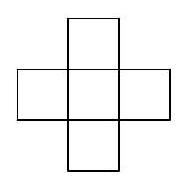
|
| 661 |
+
|
| 662 |
+
## Solution
|
| 663 |
+
|
| 664 |
+
The cross covers at most five cells so we need at least 4 steps to change the color of every cell. If we place the cross 4 times such that its center lies in the cells marked below, we see that we can turn the whole square black in $n=4$ moves.
|
| 665 |
+
|
| 666 |
+
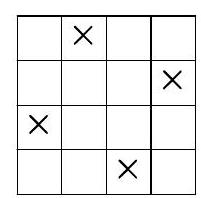
|
| 667 |
+
|
| 668 |
+
Furthermore, applying the same operation twice (,,do and undo"), we get that is possible to turn all the cells black in $n$ steps for every even $n \geq 4$.
|
| 669 |
+
|
| 670 |
+
We shall prove that for odd $n$ it is not possible to do that. Look at the picture below.
|
| 671 |
+
|
| 672 |
+
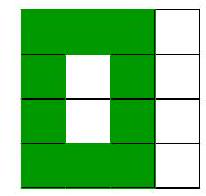
|
| 673 |
+
|
| 674 |
+
Let $k$ be a difference between white and black cells in the green area in picture. Every figure placed on the table covers an odd number of green cells, so after every step $k$ is changed by a number $\equiv 2(\bmod 4)$. At the beginning $k=10$, at the end $k=-10$. From this it is clear that we need an even number of steps.
|
| 675 |
+
|
| 676 |
+
Solution for $n$ is: every even number except 2 .
|
| 677 |
+
|
| 678 |
+
### 2.3 Geometry
|
| 679 |
+
|
| 680 |
+
G1 Two perpendicular chords of a circle, $A M, B N$, which intersect at point $K$, define on the circle four arcs with pairwise different length, with $A B$ being the smallest of them.
|
| 681 |
+
|
| 682 |
+
We draw the chords $A D, B C$ with $A D \| B C$ and $C, D$ different from $N, M$. If $L$ is the point of intersection of $D N, M C$ and $T$ the point of intersection of $D C, K L$, prove that $\angle K T C=\angle K N L$.
|
| 683 |
+
|
| 684 |
+
## Solution
|
| 685 |
+
|
| 686 |
+
First we prove that $N L \perp M C$. The arguments depend slightly on the position of $D$. The other cases are similar.
|
| 687 |
+
|
| 688 |
+
From the cyclic quadrilaterals $A D C M$ and $D N B C$ we have:
|
| 689 |
+
|
| 690 |
+
$$
|
| 691 |
+
\varangle D C L=\varangle D A M \text { and } \varangle C D L=\varangle C B N \text {. }
|
| 692 |
+
$$
|
| 693 |
+
|
| 694 |
+
So we obtain
|
| 695 |
+
|
| 696 |
+
$$
|
| 697 |
+
\varangle D C L+\varangle C D L=\varangle D A M+\varangle C B N .
|
| 698 |
+
$$
|
| 699 |
+
|
| 700 |
+
And because $A D \| B C$, if $Z$ the point of intersection of $A M, B C$ then $\varangle D A M=\varangle B Z A$, and we have
|
| 701 |
+
|
| 702 |
+
$$
|
| 703 |
+
\varangle D C L+\varangle C D L=\varangle B Z A+\varangle C B N=90^{\circ}
|
| 704 |
+
$$
|
| 705 |
+
|
| 706 |
+
Let $P$ the point of intersection of $K L, A C$, then $N P \perp A C$, because the line $K P L$ is a Simson line of the point $N$ with respect to the triangle $A C M$.
|
| 707 |
+
|
| 708 |
+
From the cyclic quadrilaterals $N P C L$ and $A N D C$ we obtain:
|
| 709 |
+
|
| 710 |
+
$$
|
| 711 |
+
\varangle C P L=\varangle C N L \text { and } \varangle C N L=\varangle C A D \text {, }
|
| 712 |
+
$$
|
| 713 |
+
|
| 714 |
+
so $\varangle C P L=\varangle C A D$, that is $K L\|A D\| B C$ therefore $\varangle K T C=\varangle A D C$ (1).
|
| 715 |
+
|
| 716 |
+
But $\varangle A D C=\varangle A N C=\varangle A N K+\varangle K N C=\varangle C N L+\varangle K N C$, so
|
| 717 |
+
|
| 718 |
+
$$
|
| 719 |
+
\varangle A D C=\varangle K N L
|
| 720 |
+
$$
|
| 721 |
+
|
| 722 |
+
From (1) and (2) we obtain the result.
|
| 723 |
+
|
| 724 |
+
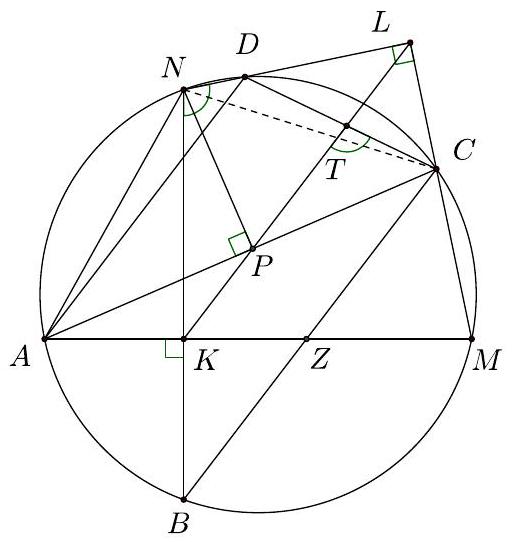
|
| 725 |
+
|
| 726 |
+
G2 For a fixed triangle $A B C$ we choose a point $M$ on the ray $C A$ (after $A$ ), a point $N$ on the ray $A B$ (after $B$ ) and a point $P$ on the ray $B C$ (after $C$ ) in a way such that $A M-B C=B N-A C=C P-A B$. Prove that the angles of triangle $M N P$ do not depend on the choice of $M, N, P$.
|
| 727 |
+
|
| 728 |
+
## Solution
|
| 729 |
+
|
| 730 |
+
Consider the points $M^{\prime}$ on the ray $B A$ (after $A$ ), $N^{\prime}$ on the ray $C B$ (after $B$ ) and $P^{\prime}$ on the ray $A C$ (after $C$ ), so that $A M=A M^{\prime}, B N=B N^{\prime}, C P=C P^{\prime}$. Since $A M-B C=B N-A C=B N^{\prime}-A C$, we get $C M=A C+A M=B C+B N^{\prime}=C N^{\prime}$. Thus triangle $M C N^{\prime}$ is isosceles, so the perpendicular bisector of $\left[M N^{\prime}\right]$ bisects angle $A C B$ and hence passes through the incenter $I$ of triangle $A B C$. Arguing similarly, we may conclude that $I$ lies also on the perpendicular bisectors of $\left[N P^{\prime}\right]$ and $\left[P M^{\prime}\right]$. On the other side, $I$ clearly lies on the perpendicular bisectors of $\left[M M^{\prime}\right],\left[N N^{\prime}\right]$ and $\left[P P^{\prime}\right]$. Thus the hexagon $M^{\prime} M N^{\prime} N P^{\prime} P$ is cyclic. Then angle $P M N$ equals angle $P N^{\prime} N$, which measures $90^{\circ}-\frac{\beta}{2}$ (the angles of triangle $A B C$ are $\alpha, \beta, \gamma$ ). In the same way angle $M N P$ measures $90^{\circ}-\frac{\gamma}{2}$ and angle $M P N$ measures $90^{\circ}-\frac{\alpha}{2}$.
|
| 731 |
+
|
| 732 |
+
G3 The vertices $A$ and $B$ of an equilateral $\triangle A B C$ lie on a circle $k$ of radius 1 , and the vertex $C$ is inside $k$. The point $D \neq B$ lies on $k, A D=A B$ and the line $D C$ intersects $k$ for the second time in point $E$. Find the length of the segment $C E$.
|
| 733 |
+
|
| 734 |
+
## Solution
|
| 735 |
+
|
| 736 |
+
As $A D=A C, \triangle C D A$ is isosceles. If $\varangle A D C=\varangle A C D=\alpha$ and $\varangle B C E=\beta$, then $\beta=120^{\circ}-\alpha$. The quadrilateral $A B E D$ is cyclic, so $\varangle A B E=180^{\circ}-\alpha$. Then $\varangle C B E=$ $120^{\circ}-\alpha$ so $\varangle C B E=\beta$. Thus $\triangle C B E$ is isosceles, so $A E$ is the perpendicular bisector of $B C$, so it bisects $\varangle B A C$. Now the arc $B E$ is intercepted by a $30^{\circ}$ inscribed angle, so it measures $60^{\circ}$. Then $B E$ equals the radius of $k$, namely 1 . Hence $C E=B E=1$.
|
| 737 |
+
|
| 738 |
+
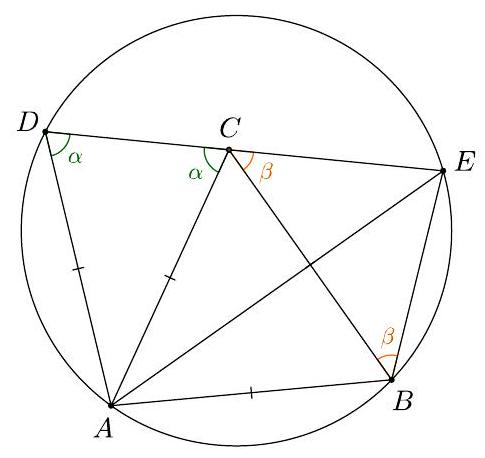
|
| 739 |
+
|
| 740 |
+
G4 Let $A B C$ be a triangle, $(B C<A B)$. The line $\ell$ passing trough the vertices $C$ and orthogonal to the angle bisector $B E$ of $\angle B$, meets $B E$ and the median $B D$ of the side $A C$ at points $F$ and $G$, respectively. Prove that segment $D F$ bisect the segment $E G$.
|
| 741 |
+
|
| 742 |
+
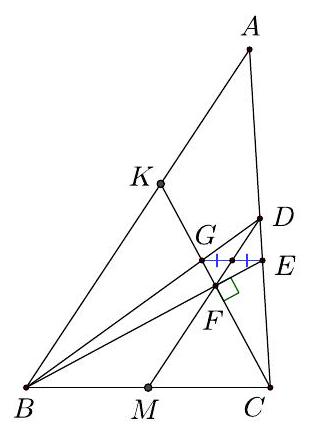
|
| 743 |
+
|
| 744 |
+
## Solution
|
| 745 |
+
|
| 746 |
+
Let $C F \cap A B=\{K\}$ and $D F \cap B C=\{M\}$. Since $B F \perp K C$ and $B F$ is angle bisector of $\varangle K B C$, we have that $\triangle K B C$ is isosceles i.e. $B K=B C$, also $F$ is midpoint of $K C$. Hence $D F$ is midline for $\triangle A C K$ i.e. $D F \| A K$, from where it is clear that $M$ is a midpoint of $B C$.
|
| 747 |
+
|
| 748 |
+
We will prove that $G E \| B C$. It is sufficient to show $\frac{B G}{G D}=\frac{C E}{E D}$. From $D F \| A K$ and $D F=\frac{A K}{2}$ we have
|
| 749 |
+
|
| 750 |
+
$$
|
| 751 |
+
\frac{B G}{G D}=\frac{B K}{D F}=\frac{2 B K}{A K}
|
| 752 |
+
$$
|
| 753 |
+
|
| 754 |
+
Also
|
| 755 |
+
|
| 756 |
+
$$
|
| 757 |
+
\begin{gathered}
|
| 758 |
+
\frac{C E}{D E}=\frac{C D-D E}{D E}=\frac{C D}{D E}-1=\frac{A D}{D E}-1=\frac{A E-D E}{D E}-1=\frac{A E}{D E}-2= \\
|
| 759 |
+
=\frac{A B}{D F}-2=\frac{A K+B K}{\frac{A K}{2}}-2=2+2 \frac{B K}{A K}-2=\frac{2 B K}{A K}
|
| 760 |
+
\end{gathered}
|
| 761 |
+
$$
|
| 762 |
+
|
| 763 |
+
From (1) and (2) we have $\frac{B G}{G D}=\frac{C E}{E D}$, so $G E \| B C$, as $M$ is the midpoint of $B C$, it follows that the segment $D F$, bisects the segment $G E$.
|
| 764 |
+
|
| 765 |
+
G5 Is it possible to cover a given square with a few congruent right-angled triangles with acute angle equal to $30^{\circ}$ ? (The triangles may not overlap and may not exceed the margins of the square.)
|
| 766 |
+
|
| 767 |
+
## Solution
|
| 768 |
+
|
| 769 |
+
We will prove that desired covering is impossible.
|
| 770 |
+
|
| 771 |
+
Let assume the opposite i.e. a square with side length $a$, can be tiled with $k$ congruent right angled triangles, whose sides are of lengths $b, b \sqrt{3}$ and $2 b$.
|
| 772 |
+
|
| 773 |
+
Then the area of such a triangle is $\frac{b^{2} \sqrt{3}}{2}$.
|
| 774 |
+
|
| 775 |
+
And the area of the square is
|
| 776 |
+
|
| 777 |
+
$$
|
| 778 |
+
S_{s q}=k b^{2} \frac{\sqrt{3}}{2}
|
| 779 |
+
$$
|
| 780 |
+
|
| 781 |
+
Furthermore, the length of the side of the square, $a$, is obtained by the contribution of an integer number of length $b, 2 b$ and $b \sqrt{3}$, hence
|
| 782 |
+
|
| 783 |
+
$$
|
| 784 |
+
a=m b \sqrt{3}+n b
|
| 785 |
+
$$
|
| 786 |
+
|
| 787 |
+
where $m, n \in \mathbb{N} \cup\{0\}$, and at least one of the numbers $m$ and $n$ is different from zero. So the area of the square is
|
| 788 |
+
|
| 789 |
+
$$
|
| 790 |
+
S_{s q}=a^{2}=(m b \sqrt{3}+n b)^{2}=b^{2}\left(3 m^{2}+n^{2}+2 \sqrt{3} m n\right)
|
| 791 |
+
$$
|
| 792 |
+
|
| 793 |
+
Now because of (1) and (2) it follows $3 m^{2}+n^{2}+2 \sqrt{3} m n=k \frac{\sqrt{3}}{2}$ i.e.
|
| 794 |
+
|
| 795 |
+
$$
|
| 796 |
+
6 m^{2}+2 n^{2}=(k-4 m n) \sqrt{3}
|
| 797 |
+
$$
|
| 798 |
+
|
| 799 |
+
Because of $3 m^{2}+n^{2} \neq 0$ and from the equality (3) it follows $4 m n \neq k$. Using once more (3), we get
|
| 800 |
+
|
| 801 |
+
$$
|
| 802 |
+
\sqrt{3}=\frac{6 m^{2}+2 n^{2}}{k-4 m n}
|
| 803 |
+
$$
|
| 804 |
+
|
| 805 |
+
which contradicts at the fact that $\sqrt{3}$ is irrational, because $\frac{6 m^{2}+2 n^{2}}{k-4 m n}$ is a rational number.
|
| 806 |
+
|
| 807 |
+
Finally, we have obtained a contradiction, which proves that the desired covering is impossible.
|
| 808 |
+
|
| 809 |
+
## Remark.
|
| 810 |
+
|
| 811 |
+
This problem has been given in Russian Mathematical Olympiad 1993 - 1995 for 9-th Grade.
|
| 812 |
+
|
| 813 |
+
G6 Let $A B C$ be a triangle with $A<90^{\circ}$. Outside of a triangle we consider isosceles triangles $A B E$ and $A C Z$ with bases $A B$ and $A C$, respectively. If the midpoint $D$ of the side $B C$ is such that $D E \perp D Z$ and $E Z=2 \cdot E D$, prove that $\widehat{A E B}=2 \cdot \widehat{A Z C}$.
|
| 814 |
+
|
| 815 |
+
## Solution
|
| 816 |
+
|
| 817 |
+
Since $D$ is the midpoint of the side $B C$, in the extension of the line segment $Z D$ we take a point $H$ such that $Z D=D H$. Then the quadrilateral $B H C Z$ is parallelogram and therefore we have
|
| 818 |
+
|
| 819 |
+
$$
|
| 820 |
+
B H=Z C=Z A
|
| 821 |
+
$$
|
| 822 |
+
|
| 823 |
+
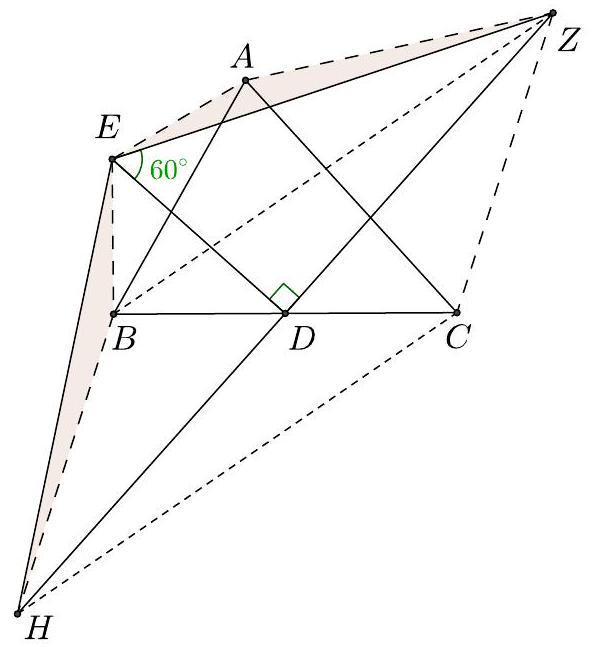
|
| 824 |
+
|
| 825 |
+
Also from the isosceles triangle $A B E$ we get
|
| 826 |
+
|
| 827 |
+
$$
|
| 828 |
+
B E=A E
|
| 829 |
+
$$
|
| 830 |
+
|
| 831 |
+
Since $D E \perp D Z, E D$ is altitude and median of the triangle $E Z H$ and so this triangle is isosceles with
|
| 832 |
+
|
| 833 |
+
$$
|
| 834 |
+
E H=E Z
|
| 835 |
+
$$
|
| 836 |
+
|
| 837 |
+
From (1), (2) and (3) we conclude that the triangles $B E H$ and $A E Z$ are equal. Therefore they have also
|
| 838 |
+
|
| 839 |
+
$$
|
| 840 |
+
\widehat{B E H}=\widehat{A E Z}, \widehat{E B H}=\widehat{E A Z} \text { and } \widehat{E H B}=\widehat{A Z E}
|
| 841 |
+
$$
|
| 842 |
+
|
| 843 |
+
Putting $\widehat{E B A}=\widehat{E A B}=\omega, \widehat{Z A C}=\widehat{Z C A}=\varphi$, then we have $\widehat{C B H}=\widehat{B C Z}=\widehat{C}+\varphi$, and therefore from the equality $\widehat{E B H}=\widehat{E A Z}$ we receive:
|
| 844 |
+
|
| 845 |
+
$$
|
| 846 |
+
\begin{gathered}
|
| 847 |
+
360^{\circ}-\widehat{E B A}-\widehat{B}-\widehat{C B H}=\widehat{E A B}+\widehat{A}+\widehat{Z A C} \\
|
| 848 |
+
\Rightarrow 360^{\circ}-\widehat{B}-\omega-\varphi-\widehat{C}=\omega+\widehat{A}+\varphi \\
|
| 849 |
+
\Rightarrow 2(\omega+\varphi)=360^{\circ}-(\widehat{A}+\widehat{B}+\widehat{C}) \\
|
| 850 |
+
\Rightarrow \omega+\varphi=90^{\circ} \\
|
| 851 |
+
\Rightarrow \frac{180^{\circ}-\widehat{A E B}}{2}+\frac{180^{\circ}-\widehat{A Z C}}{2}=90^{\circ} \\
|
| 852 |
+
\Rightarrow \widehat{A E B}+\widehat{A Z C}=180^{\circ}
|
| 853 |
+
\end{gathered}
|
| 854 |
+
$$
|
| 855 |
+
|
| 856 |
+
From the supposition $E Z=2 \cdot E D$, we get that the right triangle $Z E H$ has $\widehat{E Z D}=30^{\circ}$ and $\widehat{Z E D}=60^{\circ}$. Thus we have $\widehat{Z E H}=120^{\circ}$.
|
| 857 |
+
|
| 858 |
+
However, since we have proved that $\widehat{B E H}=\widehat{A E Z}$, we get that
|
| 859 |
+
|
| 860 |
+
$$
|
| 861 |
+
\widehat{A E B}=\widehat{A E Z}+\widehat{Z E B}=\widehat{Z E B}+\widehat{B E H}=\widehat{Z E H}=120^{\circ}
|
| 862 |
+
$$
|
| 863 |
+
|
| 864 |
+
From (5) and (6) we obtain that $\widehat{A Z C}=60^{\circ}$ and thus $\widehat{A E B}=2 \cdot \widehat{A Z C}$.
|
| 865 |
+
|
| 866 |
+
G7 Let $A B C$ be an isosceles triangle with $A C=B C$. The point $D$ lies on the side $A B$ such that the semicircle with diameter $[B D]$ and center $O$ is tangent to the side $A C$ in the point $P$ and intersects the side $B C$ at the point $Q$. The radius $O P$ intersects the chord $D Q$ at the point $E$ such that $5 \cdot P E=3 \cdot D E$. Find the ratio $\frac{A B}{B C}$.
|
| 867 |
+
|
| 868 |
+
## Solution
|
| 869 |
+
|
| 870 |
+
We denote $O P=O D=O B=R, A C=B C=b$ and $A B=2 a$. Because $O P \perp A C$ and $D Q \perp B C$, then the right triangles $A P O$ and $B Q D$ are similar and $\varangle B D Q=\varangle A O P$. So, the triangle $D E O$ is isosceles with $D E=O E$. It follows that
|
| 871 |
+
|
| 872 |
+
$$
|
| 873 |
+
\frac{P E}{D E}=\frac{P E}{O E}=\frac{3}{5}
|
| 874 |
+
$$
|
| 875 |
+
|
| 876 |
+
Let $F$ and $G$ are the orthogonal projections of the points $E$ and $P$ respectively on the side $A B$ and $M$ is the midpoint of the side $[A B]$. The triangles $O F E, O G P, O P A$ and $C M A$ are similar. We obtain the following relations
|
| 877 |
+
|
| 878 |
+
$$
|
| 879 |
+
\frac{O F}{O E}=\frac{O G}{O P}=\frac{C M}{A C}=\frac{O P}{O A}
|
| 880 |
+
$$
|
| 881 |
+
|
| 882 |
+
But $C M=\sqrt{b^{2}-a^{2}}$ and we have $O G=\frac{R}{b} \cdot \sqrt{b^{2}-a^{2}}$. In isosceles triangle $D E O$ the point $F$ is the midpoint of the radius $D O$. So, $O F=R / 2$. By using Thales' theorem we obtain
|
| 883 |
+
|
| 884 |
+
$$
|
| 885 |
+
\frac{3}{5}=\frac{P E}{O E}=\frac{G F}{O F}=\frac{O G-O F}{O F}=\frac{O G}{O F}-1=2 \cdot \sqrt{1-\left(\frac{a}{b}\right)^{2}}-1
|
| 886 |
+
$$
|
| 887 |
+
|
| 888 |
+
From the last relations it is easy to obtain that $\frac{a}{b}=\frac{3}{5}$ and $\frac{A B}{B C}=\frac{6}{5}$.
|
| 889 |
+
|
| 890 |
+
The problem is solved.
|
| 891 |
+
|
| 892 |
+
G8 The side lengths of a parallelogram are $a, b$ and diagonals have lengths $x$ and $y$, Knowing that $a b=\frac{x y}{2}$, show that
|
| 893 |
+
|
| 894 |
+
$$
|
| 895 |
+
a=\frac{x}{\sqrt{2}}, b=\frac{y}{\sqrt{2}} \text { or } a=\frac{y}{\sqrt{2}}, b=\frac{x}{\sqrt{2}}
|
| 896 |
+
$$
|
| 897 |
+
|
| 898 |
+
## Solution 1.
|
| 899 |
+
|
| 900 |
+
Let us consider a parallelogram $A B C D$, with $A B=a, B C=b, A C=x, B D=y$, $\widehat{A O D}=\theta$.
|
| 901 |
+
|
| 902 |
+
For the area of $A B C D$ we know $(A B C D)=a b \sin A$.
|
| 903 |
+
|
| 904 |
+
But it is also true that $(A B C D)=4(A O D)=4 \cdot \frac{O A \cdot O D}{2} \sin \theta=2 O A \cdot O D \sin \theta=$ $=2 \cdot \frac{x}{2} \cdot \frac{y}{2} \sin \theta=\frac{x y}{2} \sin \theta$. So $a b \sin A=\frac{x y}{2} \sin \theta$ and since $a b=\frac{x y}{2}$ by hypothesis, we get
|
| 905 |
+
|
| 906 |
+
$$
|
| 907 |
+
\sin A=\sin \theta
|
| 908 |
+
$$
|
| 909 |
+
|
| 910 |
+
Thus
|
| 911 |
+
|
| 912 |
+
$$
|
| 913 |
+
\theta=\widehat{A} \text { or } \theta=180^{\circ}-\widehat{A}=\widehat{B}
|
| 914 |
+
$$
|
| 915 |
+
|
| 916 |
+
If $\theta=A$ then (see Figure below) $A_{2}+B_{1}=A_{1}+A_{2}$, so $B_{1}=A_{1}$ which implies that $A D$ is tangent to the circumcircle of triangle $O A B$. So
|
| 917 |
+
|
| 918 |
+
$$
|
| 919 |
+
D A^{2}=D O \cdot D B \Rightarrow b^{2}=\frac{y}{2} \cdot y \Rightarrow b=\frac{y}{\sqrt{2}}
|
| 920 |
+
$$
|
| 921 |
+
|
| 922 |
+
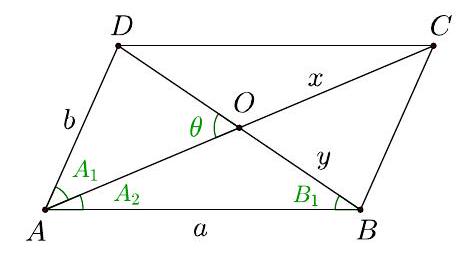
|
| 923 |
+
|
| 924 |
+
Then by $a b=\frac{x y}{2}$ we get $a=\frac{x}{\sqrt{2}}$.
|
| 925 |
+
|
| 926 |
+
If $\theta=B$ we similarly get $a=\frac{x}{\sqrt{2}}, b=\frac{y}{\sqrt{2}}$.
|
| 927 |
+
|
| 928 |
+
## Solution 2.
|
| 929 |
+
|
| 930 |
+
Let us consider a parallelogram $A B C D$, with $A B=a, B C=b, A C=x, B D=y$, $\widehat{B O C}=\theta$, and let us produce the line $A D$ towards $D$ and consider $M \in(A D$ so that $A D=D M$. Then $B C M D$ is a parallelogram, so $C M=B D=y$.
|
| 931 |
+
|
| 932 |
+
Observe also that $(A B C D)=2(A C D)=(A C M)$ which is written equivalently as
|
| 933 |
+
|
| 934 |
+
$$
|
| 935 |
+
C B \cdot C D \cdot \sin C=\frac{A C \cdot C M \cdot \sin \theta}{2} \text { i.e. } a b \sin C=\frac{x y \sin \theta}{2}
|
| 936 |
+
$$
|
| 937 |
+
|
| 938 |
+
Because of the given relation $a b=\frac{x y}{2}$ the last relation becomes $\sin C=\sin \theta$, i.e.
|
| 939 |
+
|
| 940 |
+
$$
|
| 941 |
+
\theta=\widehat{C} \text { or } \theta=180^{\circ}-\widehat{C}=\widehat{B}
|
| 942 |
+
$$
|
| 943 |
+
|
| 944 |
+
If $\theta=\widehat{C}$, then the triangles $A C M$ and $B C D$ are similar because their angles at $C$ are equal, as well as their angles at $B, M$ (remember $B C M D$ is a parallelogram).
|
| 945 |
+
|
| 946 |
+
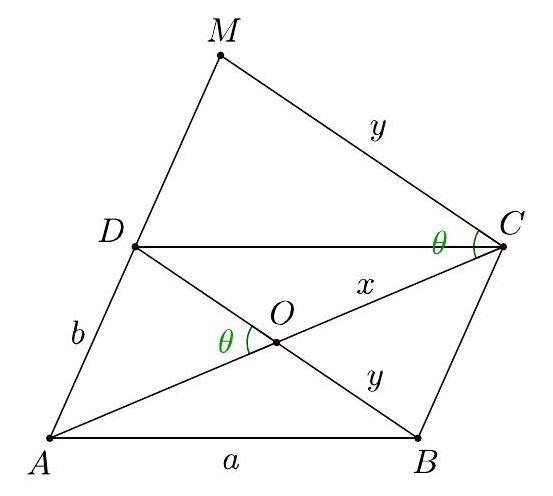
|
| 947 |
+
|
| 948 |
+
Then
|
| 949 |
+
|
| 950 |
+
$$
|
| 951 |
+
\frac{b}{y}=\frac{a}{x}=\frac{y}{2 b} \Rightarrow\left(b=\frac{y}{2}, a=\frac{x}{2}\right)
|
| 952 |
+
$$
|
| 953 |
+
|
| 954 |
+
If $\theta=\widehat{B}$, then similarly we prove that the triangles $A C M$ and $A C D$ are similar, which then implies
|
| 955 |
+
|
| 956 |
+
$$
|
| 957 |
+
\frac{a}{y}=\frac{b}{x}=\frac{x}{2 b} \Rightarrow\left(a=\frac{y}{2}, b=\frac{x}{2}\right)
|
| 958 |
+
$$
|
| 959 |
+
|
| 960 |
+
## Solution 3 .
|
| 961 |
+
|
| 962 |
+
The Parallelogram Law states that, in any parallelogram, the sum of the squares of its diagonals is equal to the sum of the squares of its sides.
|
| 963 |
+
|
| 964 |
+
In our case, this translates to $x^{2}+y^{2}=2\left(a^{2}+b^{2}\right)$. First adding $2 x y=4 a b$, then subtracting the same equality, yields $(x+y)^{2}=2(a+b)^{2}$ and $(x-y)^{2}=2(a-b)^{2}$. It follows that $x+y=a \sqrt{2}+b \sqrt{2}$ and either $x-y=a \sqrt{2}-b \sqrt{2}$, or $x-y=b \sqrt{2}-a \sqrt{2}$. In the first case one obtains $x=a \sqrt{2}, y=b \sqrt{2}$, in the latter case, $x=b \sqrt{2}, y=a \sqrt{2}$.
|
| 965 |
+
|
| 966 |
+
For the proof of the Parallelogram Law, simply apply the Law of cosines in triangles $A B C$ and $A B D$ and use the fact that $\cos (\varangle A B C)=-\cos (\varangle B A D)$. Adding the two relations gives the desired condition.
|
| 967 |
+
|
| 968 |
+
G9 Let $O$ be a point inside the parallelogram $A B C D$ such that
|
| 969 |
+
|
| 970 |
+
$$
|
| 971 |
+
\angle A O B+\angle C O D=\angle B O C+\angle C O D
|
| 972 |
+
$$
|
| 973 |
+
|
| 974 |
+
Prove that there exists a circle $k$ tangent to the circumscribed circles of the triangles $\triangle A O B, \triangle B O C, \triangle C O D$ and $\triangle D O A$.
|
| 975 |
+
|
| 976 |
+
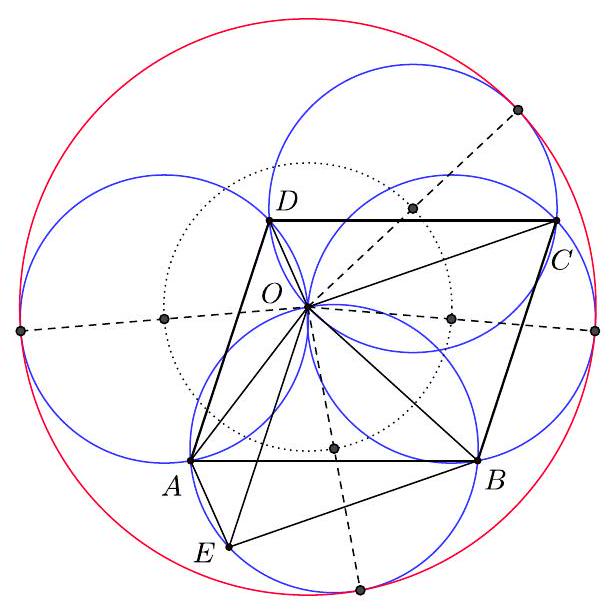
|
| 977 |
+
|
| 978 |
+
## Solution
|
| 979 |
+
|
| 980 |
+
From given condition it is clear that $\varangle A O B+\varangle C O D=\varangle B O C+\varangle A O D=180^{\circ}$.
|
| 981 |
+
|
| 982 |
+
Let $E$ be a point such that $A E=D O$ and $B E=C E$. Clearly, $\triangle A E B \equiv \triangle D O C$ and from that $A E \| D O$ and $B E \| C O$. Also, $\varangle A E B=\varangle C O D$ so $\varangle A O B+\varangle A E B=$ $\varangle A O B+\varangle C O D=180^{\circ}$. Thus, the quadrilateral $A O B E$ is cyclic.
|
| 983 |
+
|
| 984 |
+
So $\triangle A O B$ and $\triangle A E B$ the same circumcircle, therefor the circumcircles of the triangles $\triangle A O B$ and $\triangle C O D$ have the same radius.
|
| 985 |
+
|
| 986 |
+
Also, $A E \| D O$ and $A E=D O$ gives $A E O D$ is parallelogram and $\triangle A O D \equiv \triangle O A E$. So $\triangle A O B, \triangle C O D$ and $\triangle D O A$ has the same radius of their circumcircle (the radius of the cyclic quadrilateral $A E B O)$. Analogously, triangles $\triangle A O B, \triangle B O C, \triangle C O D$ and $\triangle D O A$ has same radius $R$.
|
| 987 |
+
|
| 988 |
+
Obviously, the circle with center $O$ and radius $2 R$ is externally tangent to each of these circles, so this will be the circle $k$.
|
| 989 |
+
|
| 990 |
+
G10 Let $\Gamma$ be a circle of center $O$, and $\delta$ be a line in the plane of $\Gamma$, not intersecting it. Denote by $A$ the foot of the perpendicular from $O$ onto $\delta$, and let $M$ be a (variable) point on $\Gamma$. Denote by $\gamma$ the circle of diameter $A M$, by $X$ the (other than $M$ ) intersection point of $\gamma$ and $\Gamma$, and by $Y$ the (other than $A$ ) intersection point of $\gamma$ and $\delta$. Prove that the line $X Y$ passes through a fixed point.
|
| 991 |
+
|
| 992 |
+
## Solution
|
| 993 |
+
|
| 994 |
+
Consider the line $\rho$ tangent to $\gamma$ at $A$, and take the points $\{K\}=A M \cap X Y,\{L\}=$ $\rho \cap X M$, and $\{F\}=O A \cap X Y$.
|
| 995 |
+
|
| 996 |
+
(Remark: Moving $M$ into its reflection with respect to the line $O A$ will move $X Y$ into its reflection with respect to $O A$. These old and the new $X Y$ meet on $O A$, hence it should be clear that the fixed point mult be $F$.)
|
| 997 |
+
|
| 998 |
+
Since $\varangle L M A=\varangle F Y A$ and $\varangle Y A F=\varangle L A M=90^{\circ}$, it follows that triangles $F A Y$ and $L A M$ are similar, therefore $\varangle A F Y=\varangle A L M$, hence the quadrilateral $A L X F$ is cyclic. But then $\varangle A F L=\varangle A X L=90^{\circ}$, so $L F \perp A F$, hence $L F \| \delta$.
|
| 999 |
+
|
| 1000 |
+
Now, $\rho$ is the radical axis of circles $\gamma$ and $A$ (consider $A$ as a circle of center $A$ and radius 0 ), while $X M$ is the radical axis of circles $\gamma$ and $\Gamma$, so $L$ is the radical center of the three circle, which means that $L$ lies on the radical axis of circles $\Gamma$ and $A$. From $L F \perp O A$, where $O A$ is the line of the centers of the circles $A$ and $\Gamma$, and $F \in X Y$, it follows that $F$ is (the) fixed point of $X Y$.
|
| 1001 |
+
|
| 1002 |
+
(The degenerate two cases when $M \in O A$, where $X \equiv M$ and $Y \equiv A$, also trivially satisfy the conclusion, as then $F \in A M)$.
|
| 1003 |
+
|
| 1004 |
+
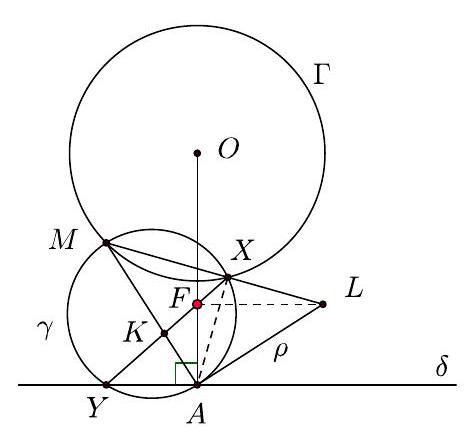
|
| 1005 |
+
|
| 1006 |
+
G11 Consider $A B C$ an acute-angled triangle with $A B \neq A C$. Denote by $M$ the midpoint of $B C$, by $D, E$ the feet of the altitudes from $B, C$ respectively and let $P$ be the intersection point of the lines $D E$ and $B C$. The perpendicular from $M$ to $A C$ meets the perpendicular from $C$ to $B C$ at point $R$. Prove that lines $P R$ and $A M$ are perpendicular.
|
| 1007 |
+
|
| 1008 |
+
Solution
|
| 1009 |
+
|
| 1010 |
+
Let $F$ be the foot of the altitude from $A$ and let $S$ be the intersection point of $A M$ and $R C$. As $P C$ is an altitude of the triangle $P R S$, the claim is equivalent to $R M \perp P S$, since the latter implies that $M$ is the orthocenter of $P R S$. Due to $R M \perp A C$, we need to prove that $A C \| P S$, in other words
|
| 1011 |
+
|
| 1012 |
+
$$
|
| 1013 |
+
\frac{M C}{M P}=\frac{M A}{M S}
|
| 1014 |
+
$$
|
| 1015 |
+
|
| 1016 |
+
Notice that $A F \| C S$, so $\frac{M A}{M S}=\frac{M F}{M C}$. Now the claim is reduced to proving $M C^{2}=$ $M F \cdot M P$, a well-known result considering that $A F$ is the polar line of $P$ with respect to circle of radius $M C$ centered at $M$.
|
| 1017 |
+
|
| 1018 |
+
The "elementary proof" on the latter result may be obtained as follows: $\frac{P B}{P C}=\frac{F B}{F C}$, using, for instance, Menelaus and Ceva theorems with respect to $A B C$. Cross-multiplying one gets $(P M-x)(F M+x)=(x-F M)(P M+x)$
|
| 1019 |
+
|
| 1020 |
+
- $x$ stands for the length of $M C$ - and then $P M \cdot F M=x^{2}$.
|
| 1021 |
+
|
| 1022 |
+
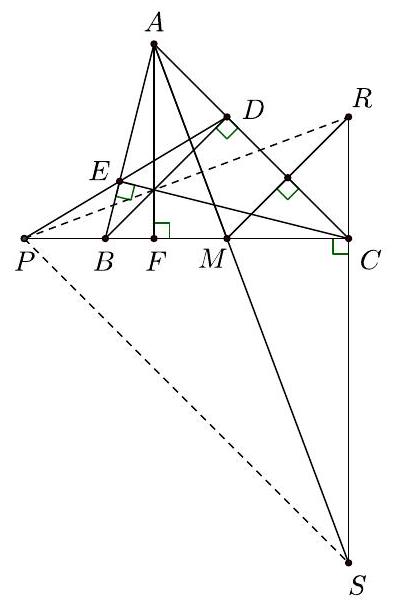
|
| 1023 |
+
|
| 1024 |
+
Comment. The proof above holds for both cases $A B<A C$ and $A B>A C$; it is for the committee to decide if a contestant is supposed to (even) mention this.
|
| 1025 |
+
|
| 1026 |
+
### 2.4 Number Theory
|
| 1027 |
+
|
| 1028 |
+
NT1 Find all the positive integers $x$ and $y$ that satisfy the equation
|
| 1029 |
+
|
| 1030 |
+
$$
|
| 1031 |
+
x(x-y)=8 y-7
|
| 1032 |
+
$$
|
| 1033 |
+
|
| 1034 |
+
## Solution 1:
|
| 1035 |
+
|
| 1036 |
+
The given equation can be written as:
|
| 1037 |
+
|
| 1038 |
+
$$
|
| 1039 |
+
\begin{aligned}
|
| 1040 |
+
& x(x-y)=8 y-7 \\
|
| 1041 |
+
& x^{2}+7=y(x+8)
|
| 1042 |
+
\end{aligned}
|
| 1043 |
+
$$
|
| 1044 |
+
|
| 1045 |
+
Let $x+8=m, m \in \mathbb{N}$. Then we have: $x^{2}+7 \equiv 0(\bmod m)$, and $x^{2}+8 x \equiv 0(\bmod m)$. So we obtain that $8 x-7 \equiv 0(\bmod m) \quad(1)$.
|
| 1046 |
+
|
| 1047 |
+
Also we obtain $8 x+8^{2}=8(x+8) \equiv 0(\bmod m) \quad(2)$.
|
| 1048 |
+
|
| 1049 |
+
From (1) and $(2)$ we obtain $(8 x+64)-(8 x-7)=71 \equiv 0(\bmod m)$, therefore $m \mid 71$, since 71 is a prime number, we have:
|
| 1050 |
+
|
| 1051 |
+
$x+8=1$ or $x+8=71$. The only accepted solution is $x=63$, and from the initial equation we obtain $y=56$.
|
| 1052 |
+
|
| 1053 |
+
Therefore the equation has a unique solution, namely $(x, y)=(63,56)$.
|
| 1054 |
+
|
| 1055 |
+
Solution 2:
|
| 1056 |
+
|
| 1057 |
+
The given equation is $x^{2}-x y+7-8 y=0$.
|
| 1058 |
+
|
| 1059 |
+
Discriminant is $\Delta=y^{2}+32 y-28=(y+16)^{2}-284$ and must be perfect square. So $(y+16)^{2}-284=m^{2}$, and its follow $(y+16)^{2}-m^{2}=284$, and after some casework, $y+16-m=2$ and $y+16+m=142$, hence $y=56, x=63$.
|
| 1060 |
+
|
| 1061 |
+
NT2 Let $n \geq 2$ be a fixed positive integer. An integer will be called " $n$-free" if it is not a multiple of an $n$-th power of a prime. Let $M$ be an infinite set of rational numbers, such that the product of every $n$ elements of $M$ is an $n$-free integer. Prove that $M$ contains only integers.
|
| 1062 |
+
|
| 1063 |
+
## Solution
|
| 1064 |
+
|
| 1065 |
+
We first prove that $M$ can contain only a finite number of non-integers. Suppose that there are infinitely many of them: $\frac{p_{1}}{q_{1}}, \frac{p_{2}}{q_{2}}, \ldots, \frac{p_{k}}{q_{k}}, \ldots$, with $\left(p_{k}, q_{k}\right)=1$ and $q_{k}>1$ for each $k$. Let $\frac{p}{q}=\frac{p_{1} p_{2} \ldots p_{n-1}}{q_{1} q_{2} \ldots q_{n-1}}$, where $(p, q)=1$. For each $i \geq n$, the number $\frac{p}{q} \cdot \frac{p_{i}}{q_{i}}$ is an integer, so $q_{i}$ is a divisor of $p$ (as $q_{i}$ and $p_{i}$ are coprime). But $p$ has a finite set of divisors, so there are $n$ numbers of $M$ with equal denominators. Their product cannot be an integer, a contradiction.
|
| 1066 |
+
|
| 1067 |
+
Now suppose that $M$ contains a fraction $\frac{a}{b}$ in lowest terms with $b>1$. Take a prime divisor $p$ of $b$. If we take any $n-1$ integers from $M$, their product with $\frac{a}{b}$ is an integer, so some of them is a multiple of $p$. Therefore there are infinitely many multiples of $p$ in $M$, and the product of $n$ of them is not $n$-free, a contradiction.
|
| 1068 |
+
|
| 1069 |
+
NT3 Let $s(a)$ denote the sum of digits of a given positive integer $a$. The sequence $a_{1}, a_{2}, \ldots a_{n}, \ldots$ of positive integers is such that $a_{n+1}=a_{n}+s\left(a_{n}\right)$ for each positive integer $n$. Find the greatest possible $n$ for which it is possible to have $a_{n}=2008$.
|
| 1070 |
+
|
| 1071 |
+
## Solution
|
| 1072 |
+
|
| 1073 |
+
Since $a_{n-1} \equiv s\left(a_{n-1}\right)$ (all congruences are modulo 9 ), we have $2 a_{n-1} \equiv a_{n} \equiv 2008 \equiv 10$, so $a_{n-1} \equiv 5$. But $a_{n-1}<2008$, so $s\left(a_{n-1}\right) \leq 28$ and thus $s\left(a_{n-1}\right)$ can equal 5,14 or 23 . We check $s(2008-5)=s(2003)=5, s(2008-14)=s(1994)=23, s(2008-23)=s(1985)=$ 23. Thus $a_{n-1}$ can equal 1985 or 2003 . As above $2 a_{n-2} \equiv a_{n-1} \equiv 5 \equiv 14$, so $a_{n-2} \equiv 7$. But $a_{n-2}<2003$, so $s\left(a_{n-2}\right) \leq 28$ and thus $s\left(a_{n-2}\right)$ can equal 16 or 25 . Checking as above we see that the only possibility is $s(2003-25)=s(1978)=25$. Thus $a_{n-2}$ can be only 1978. Now $2 a_{n-3} \equiv a_{n-2} \equiv 7 \equiv 16$ and $a_{n-3} \equiv 8$. But $s\left(a_{n-3}\right) \leq 27$ and thus $s\left(a_{n-3}\right)$ can equal 17 or 26 . The check works only for $s(1978-17)=s(1961)=17$. Thus $a_{n-3}=1961$ and similarly $a_{n-4}=1939 \equiv 4, a_{n-5}=1919 \equiv 2$ (if they exist). The search for $a_{n-6}$ requires a residue of 1 . But $a_{n-6}<1919$, so $s\left(a_{n-6}\right) \leq 27$ and thus $s\left(a_{n-6}\right)$ can be equal only to 10 or 19 . The check fails for both $s(1919-10)=s(1909)=19$ and $s(1919-19)=s(1900)=10$. Thus $n \leq 6$ and the case $n=6$ is constructed above (1919, 1939, 1961, 1978, 2003, 2008).
|
| 1074 |
+
|
| 1075 |
+
NT4 Find all integers $n$ such that $n^{4}+8 n+11$ is a product of two or more consecutive integers.
|
| 1076 |
+
|
| 1077 |
+
Solution
|
| 1078 |
+
|
| 1079 |
+
We will prove that $n^{4}+8 n+11$ is never a multiple of 3 . This is clear if $n$ is a multiple of 3 . If
|
| 1080 |
+
$n$ is not a multiple of 3 , then $n^{4}+8 n+11=\left(n^{4}-1\right)+12+8 n=(n-1)(n+1)\left(n^{2}+1\right)+12+8 n$, where $8 n$ is the only term not divisible by 3 . Thus $n^{4}+8 n+11$ is never the product of three or more integers.
|
| 1081 |
+
|
| 1082 |
+
It remains to discuss the case when $n^{4}+8 n+11=y(y+1)$ for some integer $y$. We write this as $4\left(n^{4}+8 n+11\right)=4 y(y+1)$ or $4 n^{4}+32 n+45=(2 y+1)^{2}$. A check shows that among $n= \pm 1$ and $n=0$ only $n=1$ satisfies the requirement, as $1^{4}+8 \cdot 1+11=20=4 \cdot 5$. Now let $|n| \geq 2$. The identities $4 n^{2}+32 n+45=\left(2 n^{2}-2\right)^{2}+8(n+2)^{2}+9$ and $4 n^{4}+32 n+45=$ $\left(2 n^{2}+8\right)^{2}-32 n(n-1)-19$ indicate that for $|n| \geq 2,2 n^{2}-2<2 y+1<2 n^{2}+8$. But $2 y+1$ is odd, so it can equal $2 n^{2} \pm 1 ; 2 n^{2}+3 ; 2 n^{2}+5$ or $2 n^{2}+7$. We investigate them one by one.
|
| 1083 |
+
|
| 1084 |
+
If $4 n^{4}+32 n+45=\left(2 n^{2}-1\right)^{2} \Rightarrow n^{2}+8 n+11=0 \Rightarrow(n+4)^{2}=5$, which is impossible, as 5 is not a perfect square.
|
| 1085 |
+
|
| 1086 |
+
If $4 n^{4}+32 n+45=\left(2 n^{2}+1\right)^{2} \Rightarrow n^{2}-8 n-11=0 \Rightarrow(n-4)^{2}=27$ which also fails.
|
| 1087 |
+
|
| 1088 |
+
Also $4 n^{4}+32 n+45=\left(2 n^{2}+3\right)^{2} \Rightarrow 3 n^{2}-8 n-9=0 \Rightarrow 9 n^{2}-24 n-27=0 \Rightarrow(3 n-4)^{2}=43$ fails.
|
| 1089 |
+
|
| 1090 |
+
If $4 n^{4}+32 n+45=\left(2 n^{2}+5\right)^{2} \Rightarrow 5 n^{2}-8 n=5 \Rightarrow 25 n^{2}-40 n=25 \Rightarrow(5 n-4)^{2}=41$ which also fails.
|
| 1091 |
+
|
| 1092 |
+
Finally, if $4 n^{4}+32 n+45=\left(2 n^{2}+7\right)^{2}$, then $28 n^{2}-32 n+4=0 \Rightarrow 4(n-1)(7 n-1)=0$, whence $n=1$ that we already found. Thus the only solution is $n=1$.
|
| 1093 |
+
|
| 1094 |
+
NT5 Is it possible to arrange the numbers $1^{1}, 2^{2}, \ldots, 2008^{2008}$ one after the other, in such a way that the obtained number is a perfect square? (Explain your answer.)
|
| 1095 |
+
|
| 1096 |
+
## Solution
|
| 1097 |
+
|
| 1098 |
+
We will use the following lemmas.
|
| 1099 |
+
|
| 1100 |
+
Lemma 1. If $x \in \mathbb{N}$, then $x^{2} \equiv 0$ or $1(\bmod 3)$.
|
| 1101 |
+
|
| 1102 |
+
Proof: Let $x \in \mathbb{N}$, then $x=3 k, x=3 k+1$ or $x=3 k+2$, hence
|
| 1103 |
+
|
| 1104 |
+
$$
|
| 1105 |
+
\begin{aligned}
|
| 1106 |
+
& x^{2}=9 k^{2} \equiv 0(\bmod 3) \\
|
| 1107 |
+
& x^{2}=9 k^{2}+6 k+1 \equiv 1(\bmod 3), \\
|
| 1108 |
+
& x^{2}=9 k^{2}+12 k+4 \equiv 1(\bmod 3), \text { respectively. }
|
| 1109 |
+
\end{aligned}
|
| 1110 |
+
$$
|
| 1111 |
+
|
| 1112 |
+
Hence $x^{2} \equiv 0$ or $1(\bmod 3)$, for every positive integer $x$.
|
| 1113 |
+
|
| 1114 |
+
Without proof we will give the following lemma.
|
| 1115 |
+
|
| 1116 |
+
Lemma 2. If $a$ is a positive integer then $a \equiv S(a)(\bmod 3)$, where $S(a)$ is the sum of the digits of the number $a$.
|
| 1117 |
+
|
| 1118 |
+
Further we have
|
| 1119 |
+
|
| 1120 |
+
$$
|
| 1121 |
+
\begin{aligned}
|
| 1122 |
+
& (6 k+1)^{6 k+1}=\left[(6 k+1)^{k}\right]^{6} \cdot(6 k+1) \equiv 1(\bmod 3) \\
|
| 1123 |
+
& (6 k+2)^{6 k+2}=\left[(6 k+2)^{3 k+1}\right]^{2} \equiv 1(\bmod 3) \\
|
| 1124 |
+
& (6 k+3)^{6 k+3} \equiv 0(\bmod 3) \\
|
| 1125 |
+
& (6 k+4)^{6 k+4}=\left[(6 k+1)^{3 k+2}\right]^{2} \equiv 1(\bmod 3) \\
|
| 1126 |
+
& (6 k+5)^{6 k+5}=\left[(6 k+5)^{3 k+2}\right]^{2} \cdot(6 k+5) \equiv 2(\bmod 3) \\
|
| 1127 |
+
& (6 k+6)^{6 k+6} \equiv 0(\bmod 3)
|
| 1128 |
+
\end{aligned}
|
| 1129 |
+
$$
|
| 1130 |
+
|
| 1131 |
+
for every $k=1,2,3, \ldots$.
|
| 1132 |
+
|
| 1133 |
+
Let us separate the numbers $1^{1}, 2^{2}, \ldots, 2008^{2008}$ into the following six classes: $(6 k+1)^{6 k+1}$, $(6 k+2)^{6 k+2},(6 k+3)^{6 k+3},(6 k+4)^{6 k+4},(6 k+5)^{6 k+5},(6 k+6)^{6 k+6}, k=1,2, \ldots$.
|
| 1134 |
+
|
| 1135 |
+
For $k=1,2,3, \ldots$ let us denote by
|
| 1136 |
+
|
| 1137 |
+
$s_{k}=(6 k+1)^{6 k+1}+(6 k+2)^{6 k+2}+(6 k+3)^{6 k+3}+(6 k+4)^{6 k+4}+(6 k+5)^{6 k+5}+(6 k+6)^{6 k+6}$.
|
| 1138 |
+
|
| 1139 |
+
From (3) we have
|
| 1140 |
+
|
| 1141 |
+
$$
|
| 1142 |
+
s_{k} \equiv 1+1+0+1+2+0 \equiv 2(\bmod 3)
|
| 1143 |
+
$$
|
| 1144 |
+
|
| 1145 |
+
for every $k=1,2,3, \ldots$.
|
| 1146 |
+
|
| 1147 |
+
Let $A$ be the number obtained by writing one after the other (in some order) the numbers $1^{1}, 2^{2}, \ldots, 2008^{2008}$.
|
| 1148 |
+
|
| 1149 |
+
The sum of the digits, $S(A)$, of the number $A$ is equal to the sum of the sums of digits, $S\left(i^{i}\right)$, of the numbers $i^{i}, i=1,2, \ldots, 2008$, and so, from Lemma 2, it follows that
|
| 1150 |
+
|
| 1151 |
+
$$
|
| 1152 |
+
A \equiv S(A)=S\left(1^{1}\right)+S\left(2^{2}\right)+\ldots+S\left(2008^{2008}\right) \equiv 1^{1}+2^{2}+\ldots+2008^{2008}(\bmod 3)
|
| 1153 |
+
$$
|
| 1154 |
+
|
| 1155 |
+
Further on $2008=334 \cdot 6+4$ and if we use (3) and (4) we get
|
| 1156 |
+
|
| 1157 |
+
$$
|
| 1158 |
+
\begin{aligned}
|
| 1159 |
+
A & \equiv 1^{1}+2^{2}+\ldots+2008^{2008} \\
|
| 1160 |
+
& \equiv s_{1}+s_{2}+\ldots+s_{334}+2005^{2005}+2006^{2006}+2007^{2007}+2008^{2008}(\bmod 3) \\
|
| 1161 |
+
& \equiv 334 \cdot 2+1+1+0+1=671 \equiv 2(\bmod 3)
|
| 1162 |
+
\end{aligned}
|
| 1163 |
+
$$
|
| 1164 |
+
|
| 1165 |
+
Finally, from Lemma 1, it follows that $A$ can not be a perfect square.
|
| 1166 |
+
|
| 1167 |
+
NT6 Let $f: \mathbb{N} \rightarrow \mathbb{R}$ be a function, satisfying the following condition:
|
| 1168 |
+
|
| 1169 |
+
for every integer $n>1$, there exists a prime divisor $p$ of $n$ such that $f(n)=f\left(\frac{n}{p}\right)-f(p)$. If
|
| 1170 |
+
|
| 1171 |
+
$$
|
| 1172 |
+
f\left(2^{2007}\right)+f\left(3^{2008}\right)+f\left(5^{2009}\right)=2006
|
| 1173 |
+
$$
|
| 1174 |
+
|
| 1175 |
+
determine the value of
|
| 1176 |
+
|
| 1177 |
+
$$
|
| 1178 |
+
f\left(2007^{2}\right)+f\left(2008^{3}\right)+f\left(2009^{5}\right)
|
| 1179 |
+
$$
|
| 1180 |
+
|
| 1181 |
+
## Solution
|
| 1182 |
+
|
| 1183 |
+
If $n=p$ is prime number, we have
|
| 1184 |
+
|
| 1185 |
+
$$
|
| 1186 |
+
f(p)=f\left(\frac{p}{p}\right)-f(p)=f(1)-f(p)
|
| 1187 |
+
$$
|
| 1188 |
+
|
| 1189 |
+
i.e.
|
| 1190 |
+
|
| 1191 |
+
$$
|
| 1192 |
+
f(p)=\frac{f(1)}{2}
|
| 1193 |
+
$$
|
| 1194 |
+
|
| 1195 |
+
If $n=p q$, where $p$ and $q$ are prime numbers, then
|
| 1196 |
+
|
| 1197 |
+
$$
|
| 1198 |
+
f(n)=f\left(\frac{n}{p}\right)-f(p)=f(q)-f(p)=\frac{f(1)}{2}-\frac{f(1)}{2}=0
|
| 1199 |
+
$$
|
| 1200 |
+
|
| 1201 |
+
If $n$ is a product of three prime numbers, we have
|
| 1202 |
+
|
| 1203 |
+
$$
|
| 1204 |
+
f(n)=f\left(\frac{n}{p}\right)-f(p)=0-f(p)=-f(p)=-\frac{f(1)}{2}
|
| 1205 |
+
$$
|
| 1206 |
+
|
| 1207 |
+
With mathematical induction by a number of prime multipliers we shell prove that: if $n$ is a product of $k$ prime numbers then
|
| 1208 |
+
|
| 1209 |
+
$$
|
| 1210 |
+
f(n)=(2-k) \frac{f(1)}{2}
|
| 1211 |
+
$$
|
| 1212 |
+
|
| 1213 |
+
For $k=1$, clearly the statement (2), holds.
|
| 1214 |
+
|
| 1215 |
+
Let statement (2) holds for all integers $n$, where $n$ is a product of $k$ prime numbers.
|
| 1216 |
+
|
| 1217 |
+
Now let $n$ be a product of $k+1$ prime numbers. Then we have $n=n_{1} p$, where $n_{1}$ is a product of $k$ prime numbers.
|
| 1218 |
+
|
| 1219 |
+
So
|
| 1220 |
+
|
| 1221 |
+
$$
|
| 1222 |
+
f(n)=f\left(\frac{n}{p}\right)-f(p)=f\left(n_{1}\right)-f(p)=(2-k) \frac{f(1)}{2}-\frac{f(1)}{2}=(2-(k+1)) \frac{f(1)}{2}
|
| 1223 |
+
$$
|
| 1224 |
+
|
| 1225 |
+
So (2) holds for every integer $n>1$.
|
| 1226 |
+
|
| 1227 |
+
Now from $f\left(2^{2007}\right)+f\left(3^{2008}\right)+f\left(5^{2009}\right)=2006$ and because of (2) we have
|
| 1228 |
+
|
| 1229 |
+
$$
|
| 1230 |
+
\begin{aligned}
|
| 1231 |
+
2006 & =f\left(2^{2007}\right)+f\left(3^{2008}\right)+f\left(5^{2009}\right) \\
|
| 1232 |
+
& =\frac{2-2007}{2} f(1)+\frac{2-2008}{2} f(1)+\frac{2-2009}{2} f(1)=-\frac{3 \cdot 2006}{2} f(1)
|
| 1233 |
+
\end{aligned}
|
| 1234 |
+
$$
|
| 1235 |
+
|
| 1236 |
+
i.e.
|
| 1237 |
+
|
| 1238 |
+
$$
|
| 1239 |
+
f(1)=-\frac{2}{3}
|
| 1240 |
+
$$
|
| 1241 |
+
|
| 1242 |
+
Since
|
| 1243 |
+
|
| 1244 |
+
$$
|
| 1245 |
+
2007=3^{2} \cdot 223,2008=2^{3} \cdot 251,2009=7^{2} \cdot 41
|
| 1246 |
+
$$
|
| 1247 |
+
|
| 1248 |
+
and because of (2) and (3), we get
|
| 1249 |
+
|
| 1250 |
+
$$
|
| 1251 |
+
\begin{aligned}
|
| 1252 |
+
f\left(2007^{2}\right)+f\left(2008^{3}\right)+f\left(2009^{5}\right) & =\frac{2-6}{2} f(1)+\frac{2-12}{2} f(1)+\frac{2-15}{2} f(1) \\
|
| 1253 |
+
& =-\frac{27}{2} f(1)=-\frac{27}{2} \cdot\left(-\frac{2}{3}\right)=9
|
| 1254 |
+
\end{aligned}
|
| 1255 |
+
$$
|
| 1256 |
+
|
| 1257 |
+
NT7 Determine the minimal prime number $p>3$ for which no natural number $n$ satisfies
|
| 1258 |
+
|
| 1259 |
+
$$
|
| 1260 |
+
2^{n}+3^{n} \equiv 0(\bmod p)
|
| 1261 |
+
$$
|
| 1262 |
+
|
| 1263 |
+
## Solution
|
| 1264 |
+
|
| 1265 |
+
We put $A(n)=2^{n}+3^{n}$. From Fermat's little theorem, we have $2^{p-1} \equiv 1(\bmod p)$ and $3^{p-1} \equiv 1(\bmod p)$ from which we conclude $A(n) \equiv 2(\bmod p)$. Therefore, after $p-1$ steps
|
| 1266 |
+
at most, we will have repetition of the power. It means that in order to determine the minimal prime number $p$ we seek, it is enough to determine a complete set of remainders $S(p)=\{0,1, \ldots, p-1\}$ such that $2^{n}+3^{n} \not \equiv 0(\bmod p)$, for every $n \in S(p)$.
|
| 1267 |
+
|
| 1268 |
+
For $p=5$ and $n=1$ we have $A(1) \equiv 0(\bmod 5)$.
|
| 1269 |
+
|
| 1270 |
+
For $p=7$ and $n=3$ we have $A(3) \equiv 0(\bmod 7)$.
|
| 1271 |
+
|
| 1272 |
+
For $p=11$ and $n=5$ we have $A(5) \equiv 0(\bmod 11)$.
|
| 1273 |
+
|
| 1274 |
+
For $p=13$ and $n=2$ we have $A(2) \equiv 0(\bmod 13)$.
|
| 1275 |
+
|
| 1276 |
+
For $p=17$ and $n=8$ we have $A(8) \equiv 0(\bmod 17)$.
|
| 1277 |
+
|
| 1278 |
+
For $p=19$ we have $A(n) \not \equiv 0(\bmod 19)$, for all $n \in S(19)$.
|
| 1279 |
+
|
| 1280 |
+
Hence the minimal value of $p$ is 19 .
|
| 1281 |
+
|
| 1282 |
+
NT8 Let $a, b, c, d, e, f$ are nonzero digits such that the natural numbers $\overline{a b c}, \overline{d e f}$ and $\overline{a b c d e f}$ are squares.
|
| 1283 |
+
|
| 1284 |
+
a) Prove that $\overline{a b c d e f}$ can be represented in two different ways as a sum of three squares of natural numbers.
|
| 1285 |
+
|
| 1286 |
+
b) Give an example of such a number.
|
| 1287 |
+
|
| 1288 |
+
Solution
|
| 1289 |
+
|
| 1290 |
+
a) Let $\overline{a b c}=m^{2}, \overline{d e f}=n^{2}$ and $\overline{a b c d e f}=p^{2}$, where $11 \leq m \leq 31,11 \leq n \leq 31$ are natural numbers. So, $p^{2}=1000 \cdot m^{2}+n^{2}$. But $1000=30^{2}+10^{2}=18^{2}+26^{2}$. We obtain the following relations
|
| 1291 |
+
|
| 1292 |
+
$$
|
| 1293 |
+
\begin{gathered}
|
| 1294 |
+
p^{2}=\left(30^{2}+10^{2}\right) \cdot m^{2}+n^{2}=\left(18^{2}+26^{2}\right) \cdot m^{2}+n^{2}= \\
|
| 1295 |
+
=(30 m)^{2}+(10 m)^{2}+n^{2}=(18 m)^{2}+(26 m)^{2}+n^{2}
|
| 1296 |
+
\end{gathered}
|
| 1297 |
+
$$
|
| 1298 |
+
|
| 1299 |
+
The assertion a) is proved.
|
| 1300 |
+
|
| 1301 |
+
b) We write the equality $p^{2}=1000 \cdot m^{2}+n^{2}$ in the equivalent form $(p+n)(p-n)=1000 \cdot m^{2}$, where $349 \leq p \leq 979$. If $1000 \cdot m^{2}=p_{1} \cdot p_{2}$, such that $p+n=p_{1}$ and $p-n=p_{2}$, then $p_{1}$ and $p_{2}$ are even natural numbers with $p_{1}>p_{2} \geq 318$ and $22 \leq p_{1}-p_{2} \leq 62$. For $m=15$ we obtain $p_{1}=500, p_{2}=450$. So, $n=25$ and $p=475$. We have
|
| 1302 |
+
|
| 1303 |
+
$$
|
| 1304 |
+
225625=475^{2}=450^{2}+150^{2}+25^{2}=270^{2}+390^{2}+25^{2}
|
| 1305 |
+
$$
|
| 1306 |
+
|
| 1307 |
+
The problem is solved.
|
| 1308 |
+
|
| 1309 |
+
NT9 Let $p$ be a prime number. Find all positive integers $a$ and $b$ such that:
|
| 1310 |
+
|
| 1311 |
+
$$
|
| 1312 |
+
\frac{4 a+p}{b}+\frac{4 b+p}{a}
|
| 1313 |
+
$$
|
| 1314 |
+
|
| 1315 |
+
and
|
| 1316 |
+
|
| 1317 |
+
$$
|
| 1318 |
+
\frac{a^{2}}{b}+\frac{b^{2}}{a}
|
| 1319 |
+
$$
|
| 1320 |
+
|
| 1321 |
+
are integers.
|
| 1322 |
+
|
| 1323 |
+
## Solution
|
| 1324 |
+
|
| 1325 |
+
Since $a$ and $b$ are symmetric we can assume that $a \leq b$. Let $d=(a, b), a=d u, b=d v$ and $(u, v)=1$. Then we have:
|
| 1326 |
+
|
| 1327 |
+
$$
|
| 1328 |
+
\frac{a^{2}}{b}+\frac{b^{2}}{a}=\frac{d\left(u^{3}+v^{3}\right)}{u v}
|
| 1329 |
+
$$
|
| 1330 |
+
|
| 1331 |
+
Since,
|
| 1332 |
+
|
| 1333 |
+
$$
|
| 1334 |
+
\left(u^{3}+v^{3}, u\right)=\left(u^{3}+v^{3}, v\right)=1
|
| 1335 |
+
$$
|
| 1336 |
+
|
| 1337 |
+
we deduce that $u \mid d$ and $v \mid d$. But as $(u, v)=1$, it follows that $u v \mid d$.
|
| 1338 |
+
|
| 1339 |
+
Now, let $d=u v t$. Furthermore,
|
| 1340 |
+
|
| 1341 |
+
$$
|
| 1342 |
+
\frac{4 a+p}{b}+\frac{4 b+p}{a}=\frac{4\left(a^{2}+b^{2}\right)+p(a+b)}{a b}=\frac{4 u v t\left(u^{2}+v^{2}\right)+p(u+v)}{u^{2} v^{2} t}
|
| 1343 |
+
$$
|
| 1344 |
+
|
| 1345 |
+
This implies,
|
| 1346 |
+
|
| 1347 |
+
$$
|
| 1348 |
+
u v \mid p(u+v)
|
| 1349 |
+
$$
|
| 1350 |
+
|
| 1351 |
+
But from our assumption $1=(u, v)=(u, u+v)=(v, u+v)$ we conclude $u v \mid p$. Therefore, we have three cases $\{u=v=1\},\{u=1, v=p\},\{u=p, v=1\}$. We assumed that $a \leq b$, and this implies $u \leq v$.
|
| 1352 |
+
|
| 1353 |
+
If $a=b$, we need $\frac{4 a+p}{a}+\frac{4 a+p}{a} \in \mathbb{N}$, i.e. $a \mid 2 p$. Then $a \in\{1,2, p, 2 p\}$. The other condition being fulfilled, we obtain the solutions $(1,1),(2,2),(p, p)$ and $(2 p, 2 p)$.
|
| 1354 |
+
|
| 1355 |
+
Now, we have only one case to investigate, $u=1, v=p$. The last equation is transformed into:
|
| 1356 |
+
|
| 1357 |
+
$$
|
| 1358 |
+
\frac{4 a+p}{b}+\frac{4 b+p}{a}=\frac{4 p t\left(1+p^{2}\right)+p(p+1)}{p^{2} t}=\frac{4 t+1+p(1+4 p t)}{p t}
|
| 1359 |
+
$$
|
| 1360 |
+
|
| 1361 |
+
From the last equation we derive
|
| 1362 |
+
|
| 1363 |
+
$$
|
| 1364 |
+
p \mid(4 t+1)
|
| 1365 |
+
$$
|
| 1366 |
+
|
| 1367 |
+
Let $4 t+1=p q$. From here we derive
|
| 1368 |
+
|
| 1369 |
+
$$
|
| 1370 |
+
\frac{4 t+1+p(1+4 p t)}{p t}=\frac{q+1+4 p t}{t}
|
| 1371 |
+
$$
|
| 1372 |
+
|
| 1373 |
+
Now, we have
|
| 1374 |
+
|
| 1375 |
+
$$
|
| 1376 |
+
t \mid(q+1)
|
| 1377 |
+
$$
|
| 1378 |
+
|
| 1379 |
+
or
|
| 1380 |
+
|
| 1381 |
+
$$
|
| 1382 |
+
q+1=\text { st. }
|
| 1383 |
+
$$
|
| 1384 |
+
|
| 1385 |
+
Therefore,
|
| 1386 |
+
|
| 1387 |
+
$$
|
| 1388 |
+
p=\frac{4 t+1}{q}=\frac{4 t+1}{s t-1}
|
| 1389 |
+
$$
|
| 1390 |
+
|
| 1391 |
+
Since $p$ is a prime number, we deduce
|
| 1392 |
+
|
| 1393 |
+
$$
|
| 1394 |
+
\frac{4 t+1}{s t-1} \geq 2
|
| 1395 |
+
$$
|
| 1396 |
+
|
| 1397 |
+
or
|
| 1398 |
+
|
| 1399 |
+
$$
|
| 1400 |
+
s \leq \frac{4 t+3}{2 t}=2+\frac{3}{2 t}<4
|
| 1401 |
+
$$
|
| 1402 |
+
|
| 1403 |
+
Case 1: $s=1, p=\frac{4 t+1}{t-1}=4+\frac{5}{t-1}$. We conclude $t=2$ or $t=6$. But when $t=2$, we have $p=9$, not a prime. When $t=6, p=5, a=30, b=150$.
|
| 1404 |
+
|
| 1405 |
+
Case 2: $s=2, p=\frac{4 t+1}{2 t-1}=2+\frac{3}{2 t-1}$. We conclude $t=1, p=5, a=5, b=25$ or $t=2, p=3, a=6, b=18$.
|
| 1406 |
+
|
| 1407 |
+
Case 3: $s=3, p=\frac{4 t+1}{3 t-1}$ or $3 p=4+\frac{7}{3 t-1}$. As 7 does not have any divisors of the form $3 t-1$, in this case we have no solutions.
|
| 1408 |
+
|
| 1409 |
+
So, the solutions are
|
| 1410 |
+
|
| 1411 |
+
$$
|
| 1412 |
+
(a, b)=\{(1,1),(2,2),(p, p),(2 p, 2 p),(5,25),(6,18),(18,6),(25,5),(30,150),(150,30)\}
|
| 1413 |
+
$$
|
| 1414 |
+
|
| 1415 |
+
NT10 Prove that $2^{n}+3^{n}$ is not a perfect cube for any positive integer $n$.
|
| 1416 |
+
|
| 1417 |
+
## Solution
|
| 1418 |
+
|
| 1419 |
+
If $n=1$ then $2^{1}+3^{1}=5$ is not perfect cube.
|
| 1420 |
+
|
| 1421 |
+
Perfect cube gives residues $-1,0$ and 1 modulo 9 . If $2^{n}+3^{n}$ is a perfect cube, then $n$ must be divisible with 3 (congruence $2^{n}+3^{n}=x^{3}$ modulo 9 ).
|
| 1422 |
+
|
| 1423 |
+
If $n=3 k$ then $2^{3 k}+3^{2 k}>\left(3^{k}\right)^{3}$. Also, $\left(3^{k}+1\right)^{3}=3^{3 k}+3 \cdot 3^{2 k}+3 \cdot 3^{k}+1>3^{3 k}+3^{2 k}=$ $3^{3 k}+9^{k}>3^{3 k}+8^{k}=3^{3 k}+2^{3 k}$. But, $3^{k}$ and $3^{k}+1$ are two consecutive integers so $2^{3 k}+3^{3 k}$ is not a perfect cube.
|
| 1424 |
+
|
| 1425 |
+
NT11 Determine the greatest number with $n$ digits in the decimal representation which is divisible by 429 and has the sum of all digits less than or equal to 11 .
|
| 1426 |
+
|
| 1427 |
+
## Solution
|
| 1428 |
+
|
| 1429 |
+
Let $A=\overline{a_{n} a_{n-1} \ldots a_{1}}$ and notice that $429=3 \cdot 11 \cdot 13$.
|
| 1430 |
+
|
| 1431 |
+
Since the sum of the digits $\sum a_{i} \leq 11$ and $\sum a_{i}$ is divisible by 3 , we get $\sum a_{i}=3,6$ or 9. As 11 divides $A$, we have
|
| 1432 |
+
|
| 1433 |
+
$$
|
| 1434 |
+
11 \mid a_{n}-a_{n-1}+a_{n-2}-a_{n-3}+\ldots
|
| 1435 |
+
$$
|
| 1436 |
+
|
| 1437 |
+
in other words $11 \mid \sum_{i \text { odd }} a_{i}-\sum_{i \text { even }} a_{i}$. But
|
| 1438 |
+
|
| 1439 |
+
$$
|
| 1440 |
+
-9 \leq-\sum a_{i} \leq \sum_{i \text { odd }} a_{i}-\sum_{i \text { even }} a_{i} \leq \sum a_{i} \leq 9
|
| 1441 |
+
$$
|
| 1442 |
+
|
| 1443 |
+
so $\sum_{i \text { odd }} a_{i}-\sum_{i \text { even }} a_{i}=0$. It follows that $\sum a_{i}$ is even, so $\sum a_{i}=6$ and $\sum_{i \text { odd }} a_{i}=\sum_{i \text { even }} a_{i}=3$.
|
| 1444 |
+
|
| 1445 |
+
The number 13 is a divisor of 1001 , hence
|
| 1446 |
+
|
| 1447 |
+
$$
|
| 1448 |
+
13 \mid \overline{a_{3} a_{2} a_{1}}-\overline{a_{6} a_{5} a_{4}}+\overline{a_{9} a_{8} a_{7}}-\overline{a_{12} a_{11} a_{10}}+\ldots
|
| 1449 |
+
$$
|
| 1450 |
+
|
| 1451 |
+
For each $k=1,2,3,4,5,6$, let $s_{k}$ be the sum of the digits $a_{k+6 m}, m \geq 0$; that is
|
| 1452 |
+
|
| 1453 |
+
$$
|
| 1454 |
+
s_{1}=a_{1}+a_{7}+a_{13}+\ldots \text { and so on. }
|
| 1455 |
+
$$
|
| 1456 |
+
|
| 1457 |
+
With this notation, (1) rewrites as
|
| 1458 |
+
|
| 1459 |
+
$$
|
| 1460 |
+
13 \mid 100\left(s_{3}-s_{6}\right)+10\left(s_{2}-s_{5}\right)+\left(s_{1}-s_{4}\right), \text { or } 13 \mid 4\left(s_{6}-s_{3}\right)+3\left(s_{5}-s_{2}\right)+\left(s_{1}-s_{4}\right)
|
| 1461 |
+
$$
|
| 1462 |
+
|
| 1463 |
+
Let $S_{3}=s_{3}-s_{6}, S_{2}=s_{2}-s_{5}$, and $S_{1}=s_{1}-s_{4}$. Recall that $\sum_{i \text { odd }} a_{i}=\sum_{i \text { even }} a_{i}$, which implies $S_{2}=S_{1}+S_{3}$. Then
|
| 1464 |
+
|
| 1465 |
+
$$
|
| 1466 |
+
13\left|4 S_{3}+3 S_{2}-S_{1}=7 S_{3}+2 S_{1} \Rightarrow 13\right| 49 S_{3}+14 S_{1} \Rightarrow 13 \mid S_{1}-3 S_{3}
|
| 1467 |
+
$$
|
| 1468 |
+
|
| 1469 |
+
Observe that $\left|S_{1}\right| \leq s_{1}=\sum_{i \text { odd }} a_{i}=3$ and likewise $\left|S_{2}\right|,\left|S_{3}\right| \leq 3$. Then $-13<S_{1}-3 S_{3}<13$ and consequently $S_{1}=3 S_{3}$. Thus $S_{2}=4 S_{3}$ and $\left|S_{2}\right| \leq 3$ yields $S_{2}=0$ and then $S_{1}=S_{3}=0$. We have $s_{1}=s_{4}, s_{2}=s_{5}, s_{3}=s_{6}$ and $s_{1}+s_{2}+s_{3}=3$, so the greatest number $A$ is $30030000 \ldots$.
|
| 1470 |
+
|
| 1471 |
+
NT12 Solve the equation $\frac{p}{q}-\frac{4}{r+1}=1$ in prime numbers.
|
| 1472 |
+
|
| 1473 |
+
## Solution
|
| 1474 |
+
|
| 1475 |
+
We can rewrite the equation in the form
|
| 1476 |
+
|
| 1477 |
+
$$
|
| 1478 |
+
\begin{gathered}
|
| 1479 |
+
\frac{p r+p-4 q}{q(r+1)}=1 \Rightarrow p r+p-4 q=q r+q \\
|
| 1480 |
+
p r-q r=5 q-p \Rightarrow r(p-q)=5 q-p
|
| 1481 |
+
\end{gathered}
|
| 1482 |
+
$$
|
| 1483 |
+
|
| 1484 |
+
It follows that $p \neq q$ and
|
| 1485 |
+
|
| 1486 |
+
$$
|
| 1487 |
+
\begin{gathered}
|
| 1488 |
+
r=\frac{5 q-p}{p-q}=\frac{4 q+q-p}{p-q} \\
|
| 1489 |
+
r=\frac{4 q}{p-q}-1
|
| 1490 |
+
\end{gathered}
|
| 1491 |
+
$$
|
| 1492 |
+
|
| 1493 |
+
As $p$ is prime, $p-q \neq q, p-q \neq 2 q, p-q \neq 4 q$.
|
| 1494 |
+
|
| 1495 |
+
We have $p-q=1$ or $p-q=2$ or $p-q=4$
|
| 1496 |
+
|
| 1497 |
+
i) If $p-q=1$ then
|
| 1498 |
+
|
| 1499 |
+
$$
|
| 1500 |
+
q=2, p=3, r=7
|
| 1501 |
+
$$
|
| 1502 |
+
|
| 1503 |
+
ii) If $p-q=2$ then $p=q+2, r=2 q-1$
|
| 1504 |
+
|
| 1505 |
+
If $q=1(\bmod 3)$ then $q+2 \equiv 0(\bmod 3)$
|
| 1506 |
+
|
| 1507 |
+
$$
|
| 1508 |
+
q+2=3 \Rightarrow q=1
|
| 1509 |
+
$$
|
| 1510 |
+
|
| 1511 |
+
contradiction.
|
| 1512 |
+
|
| 1513 |
+
If $q \equiv-1(\bmod 3)$ then $r \equiv-2-1 \equiv 0(\bmod 3)$
|
| 1514 |
+
|
| 1515 |
+
$$
|
| 1516 |
+
\begin{gathered}
|
| 1517 |
+
r=3 \\
|
| 1518 |
+
r=2 q-1=3 \\
|
| 1519 |
+
q=2 \\
|
| 1520 |
+
p=4
|
| 1521 |
+
\end{gathered}
|
| 1522 |
+
$$
|
| 1523 |
+
|
| 1524 |
+
contradiction.
|
| 1525 |
+
|
| 1526 |
+
Hence $q=3, p=5, r=5$.
|
| 1527 |
+
|
| 1528 |
+
iii) If $p-q=4$ then $p=q+4$.
|
| 1529 |
+
|
| 1530 |
+
$r=q-1$
|
| 1531 |
+
|
| 1532 |
+
Hence $q=3, p=7, r=2$.
|
| 1533 |
+
|
JBMO/md/en-shortlist/en-jbmo-2009_shl.md
ADDED
|
@@ -0,0 +1,968 @@
|
|
|
|
|
|
|
|
|
|
|
|
|
|
|
|
|
|
|
|
|
|
|
|
|
|
|
|
|
|
|
|
|
|
|
|
|
|
|
|
|
|
|
|
|
|
|
|
|
|
|
|
|
|
|
|
|
|
|
|
|
|
|
|
|
|
|
|
|
|
|
|
|
|
|
|
|
|
|
|
|
|
|
|
|
|
|
|
|
|
|
|
|
|
|
|
|
|
|
|
|
|
|
|
|
|
|
|
|
|
|
|
|
|
|
|
|
|
|
|
|
|
|
|
|
|
|
|
|
|
|
|
|
|
|
|
|
|
|
|
|
|
|
|
|
|
|
|
|
|
|
|
|
|
|
|
|
|
|
|
|
|
|
|
|
|
|
|
|
|
|
|
|
|
|
|
|
|
|
|
|
|
|
|
|
|
|
|
|
|
|
|
|
|
|
|
|
|
|
|
|
|
|
|
|
|
|
|
|
|
|
|
|
|
|
|
|
|
|
|
|
|
|
|
|
|
|
|
|
|
|
|
|
|
|
|
|
|
|
|
|
|
|
|
|
|
|
|
|
|
|
|
|
|
|
|
|
|
|
|
|
|
|
|
|
|
|
|
|
|
|
|
|
|
|
|
|
|
|
|
|
|
|
|
|
|
|
|
|
|
|
|
|
|
|
|
|
|
|
|
|
|
|
|
|
|
|
|
|
|
|
|
|
|
|
|
|
|
|
|
|
|
|
|
|
|
|
|
|
|
|
|
|
|
|
|
|
|
|
|
|
|
|
|
|
|
|
|
|
|
|
|
|
|
|
|
|
|
|
|
|
|
|
|
|
|
|
|
|
|
|
|
|
|
|
|
|
|
|
|
|
|
|
|
|
|
|
|
|
|
|
|
|
|
|
|
|
|
|
|
|
|
|
|
|
|
|
|
|
|
|
|
|
|
|
|
|
|
|
|
|
|
|
|
|
|
|
|
|
|
|
|
|
|
|
|
|
|
|
|
|
|
|
|
|
|
|
|
|
|
|
|
|
|
|
|
|
|
|
|
|
|
|
|
|
|
|
|
|
|
|
|
|
|
|
|
|
|
|
|
|
|
|
|
|
|
|
|
|
|
|
|
|
|
|
|
|
|
|
|
|
|
|
|
|
|
|
|
|
|
|
|
|
|
|
|
|
|
|
|
|
|
|
|
|
|
|
|
|
|
|
|
|
|
|
|
|
|
|
|
|
|
|
|
|
|
|
|
|
|
|
|
|
|
|
|
|
|
|
|
|
|
|
|
|
|
|
|
|
|
|
|
|
|
|
|
|
|
|
|
|
|
|
|
|
|
|
|
|
|
|
|
|
|
|
|
|
|
|
|
|
|
|
|
|
|
|
|
|
|
|
|
|
|
|
|
|
|
|
|
|
|
|
|
|
|
|
|
|
|
|
|
|
|
|
|
|
|
|
|
|
|
|
|
|
|
|
|
|
|
|
|
|
|
|
|
|
|
|
|
|
|
|
|
|
|
|
|
|
|
|
|
|
|
|
|
|
|
|
|
|
|
|
|
|
|
|
|
|
|
|
|
|
|
|
|
|
|
|
|
|
|
|
|
|
|
|
|
|
|
|
|
|
|
|
|
|
|
|
|
|
|
|
|
|
|
|
|
|
|
|
|
|
|
|
|
|
|
|
|
|
|
|
|
|
|
|
|
|
|
|
|
|
|
|
|
|
|
|
|
|
|
|
|
|
|
|
|
|
|
|
|
|
|
|
|
|
|
|
|
|
|
|
|
|
|
|
|
|
|
|
|
|
|
|
|
|
|
|
|
|
|
|
|
|
|
|
|
|
|
|
|
|
|
|
|
|
|
|
|
|
|
|
|
|
|
|
|
|
|
|
|
|
|
|
|
|
|
|
|
|
|
|
|
|
|
|
|
|
|
|
|
|
|
|
|
|
|
|
|
|
|
|
|
|
|
|
|
|
|
|
|
|
|
|
|
|
|
|
|
|
|
|
|
|
|
|
|
|
|
|
|
|
|
|
|
|
|
|
|
|
|
|
|
|
|
|
|
|
|
|
|
|
|
|
|
|
|
|
|
|
|
|
|
|
|
|
|
|
|
|
|
|
|
|
|
|
|
|
|
|
|
|
|
|
|
|
|
|
|
|
|
|
|
|
|
|
|
|
|
|
|
|
|
|
|
|
|
|
|
|
|
|
|
|
|
|
|
|
|
|
|
|
|
|
|
|
|
|
|
|
|
|
|
|
|
|
|
|
|
|
|
|
|
|
|
|
|
|
|
|
|
|
|
|
|
|
|
|
|
|
|
|
|
|
|
|
|
|
|
|
|
|
|
|
|
|
|
|
|
|
|
|
|
|
|
|
|
|
|
|
|
|
|
|
|
|
|
|
|
|
|
|
|
|
|
|
|
|
|
|
|
|
|
|
|
|
|
|
|
|
|
|
|
|
|
|
|
|
|
|
|
|
|
|
|
|
|
|
|
|
|
|
|
|
|
|
|
|
|
|
|
|
|
|
|
|
|
|
|
|
|
|
|
|
|
|
|
|
|
|
|
|
|
|
|
|
|
|
|
|
|
|
|
|
|
|
|
|
|
|
|
|
|
|
|
|
|
|
|
|
|
|
|
|
|
|
|
|
|
|
|
|
|
|
|
|
|
|
|
|
|
|
|
|
|
|
|
|
|
|
|
|
|
|
|
|
|
|
|
|
|
|
|
|
|
|
|
|
|
|
|
|
|
|
|
|
|
|
|
|
|
|
|
|
|
|
|
|
|
|
|
|
|
|
|
|
|
|
|
|
|
|
|
|
|
|
|
|
|
|
|
|
|
|
|
|
|
|
|
|
|
|
|
|
|
|
|
|
|
|
|
|
|
|
|
|
|
|
|
|
|
|
|
|
|
|
|
|
|
|
|
|
|
|
|
|
|
|
|
|
|
|
|
|
|
|
|
|
|
|
|
|
|
|
|
|
|
|
|
|
|
|
|
|
|
|
|
|
|
|
|
|
|
|
|
|
|
|
|
|
|
|
|
|
|
|
|
|
|
|
|
|
|
|
|
|
|
|
|
|
|
|
|
|
|
|
|
|
|
|
|
|
|
|
|
|
|
|
|
|
|
|
|
|
|
|
|
|
|
|
|
|
|
|
|
|
|
|
|
|
|
|
|
|
|
|
|
|
|
|
|
|
|
|
|
|
|
|
|
|
|
|
|
|
|
|
|
|
|
|
|
|
|
|
|
|
|
|
|
|
|
|
|
|
|
|
|
|
|
|
|
|
|
|
|
|
|
|
|
|
|
|
|
|
|
|
|
|
|
|
|
|
|
|
|
|
|
|
|
|
|
|
|
|
|
|
|
|
|
|
|
|
|
|
|
|
|
|
|
|
|
|
|
|
|
|
|
|
|
|
|
|
|
|
|
|
|
|
|
|
|
|
|
|
|
|
|
|
|
|
|
|
|
|
|
|
|
|
|
|
|
|
|
|
|
|
|
|
|
|
|
|
|
|
|
|
|
|
|
|
|
|
|
|
|
|
|
|
|
|
|
|
|
|
|
|
|
|
|
|
|
|
|
|
|
|
|
|
|
|
|
|
|
|
|
|
|
|
|
|
|
|
|
|
|
|
|
|
|
|
|
|
|
|
|
|
|
|
|
|
|
|
|
|
|
|
|
|
|
|
|
|
|
|
|
|
|
|
|
|
|
|
|
|
|
|
|
|
|
|
|
|
|
|
|
|
|
|
|
|
|
|
|
|
|
|
|
|
|
|
|
|
|
|
|
|
|
|
|
|
|
|
|
|
|
|
|
|
|
|
|
|
|
|
|
|
|
|
|
|
|
|
|
|
|
|
|
|
|
|
|
|
|
|
|
|
|
|
|
|
|
|
|
|
|
|
|
|
|
|
|
|
|
|
|
|
|
|
|
|
|
|
|
|
|
|
|
|
|
|
|
|
|
|
|
|
|
|
|
|
|
|
|
|
|
|
|
|
|
|
|
|
|
|
|
|
|
|
|
|
|
|
|
|
|
|
|
|
|
|
|
|
|
|
|
|
|
|
|
|
|
|
|
|
|
|
|
|
|
|
|
|
|
|
|
|
|
|
|
|
|
|
|
|
|
|
|
|
|
|
|
|
|
|
|
|
|
|
|
|
|
|
|
|
|
|
|
|
|
|
|
|
|
|
|
|
|
|
|
|
|
|
|
|
|
|
|
|
|
|
|
|
|
|
|
|
|
|
|
|
|
|
|
|
|
|
|
|
|
|
|
|
|
|
|
|
|
|
|
|
|
|
|
|
|
|
|
|
|
|
|
|
|
|
|
|
|
|
|
|
|
|
|
|
|
|
|
|
|
|
|
|
|
|
|
|
|
|
|
|
|
|
|
|
|
|
|
|
|
|
|
|
|
|
|
|
|
|
|
|
|
|
|
|
|
|
|
|
|
|
|
|
|
|
|
|
|
|
|
|
|
|
|
|
|
|
|
|
|
|
|
|
|
|
|
|
|
|
|
|
|
|
|
|
|
|
|
|
|
|
|
|
|
|
|
|
|
|
|
|
|
|
|
|
|
|
|
|
|
|
|
|
|
|
|
|
|
|
|
|
|
|
|
|
|
|
|
|
|
|
|
|
|
|
|
|
|
|
|
|
|
|
|
|
|
|
|
|
|
|
|
|
|
|
|
|
|
|
|
|
|
|
|
|
|
|
|
|
|
|
|
|
|
|
|
|
|
|
|
|
|
|
|
|
|
|
|
|
|
|
|
|
|
|
|
|
|
|
|
|
|
|
|
|
|
|
|
|
|
|
|
|
|
|
|
|
|
|
|
|
|
|
|
|
|
|
|
|
|
|
|
|
|
|
|
|
|
|
|
|
|
|
|
|
|
|
|
|
|
|
|
|
|
|
|
|
|
|
|
|
|
|
|
|
|
|
|
|
|
|
|
|
|
|
|
|
|
|
|
|
|
|
|
|
|
|
|
|
|
|
|
|
|
|
|
|
|
|
|
|
|
|
|
|
|
|
|
|
|
|
|
|
|
|
|
|
|
|
|
|
|
|
|
|
|
|
|
|
|
|
|
|
|
|
|
|
|
|
|
|
|
|
|
|
|
|
|
|
|
|
|
|
|
|
|
|
|
|
|
|
|
|
|
|
|
|
|
|
|
|
|
|
|
|
|
|
|
|
|
|
|
|
|
|
|
|
|
|
|
|
|
|
|
|
|
|
|
|
|
|
|
|
|
|
|
|
|
|
|
|
|
|
|
|
|
|
|
|
|
|
|
|
|
|
|
|
|
|
|
|
|
|
|
|
|
|
|
|
|
|
|
|
|
|
|
|
|
|
|
|
|
|
|
|
|
|
|
|
|
|
|
|
|
|
|
|
|
|
|
|
|
|
|
|
|
|
|
|
|
|
|
|
|
|
|
|
|
|
|
|
|
|
|
|
|
|
|
|
|
|
|
|
|
|
|
|
|
|
|
|
|
|
|
|
|
|
|
|
|
|
|
|
|
|
|
|
|
|
|
|
|
|
|
|
|
|
|
|
|
|
|
|
|
|
|
|
|
|
|
|
|
|
|
|
|
|
|
|
|
|
|
|
|
|
|
|
|
|
|
|
|
|
|
|
|
|
|
|
|
|
|
|
|
|
|
|
|
|
|
|
|
|
|
|
|
|
|
|
|
|
|
|
|
|
|
|
|
|
|
|
|
|
|
|
|
|
|
|
|
|
|
|
|
|
|
|
|
|
|
|
|
|
|
|
|
|
|
|
|
|
|
|
|
|
|
|
|
|
|
|
|
|
|
|
|
|
|
|
|
|
|
|
|
|
|
|
|
|
|
|
|
|
|
|
|
|
|
|
|
|
|
|
|
|
|
|
|
|
|
|
|
|
|
|
|
|
|
|
|
|
|
|
|
|
|
|
|
|
|
|
|
|
|
|
|
|
|
|
|
|
|
|
|
|
|
|
|
|
|
|
|
|
|
|
|
|
|
|
|
|
|
|
|
|
|
|
|
|
|
|
|
|
|
|
|
|
|
|
|
|
|
|
|
|
|
|
|
|
|
|
|
|
|
|
|
|
|
|
|
|
|
|
|
|
|
|
|
|
|
|
|
|
|
|
|
|
|
|
|
|
|
|
|
|
|
|
|
|
|
|
|
|
|
|
|
|
|
|
|
|
|
|
|
|
|
|
|
|
|
|
|
|
|
|
|
|
|
|
|
|
|
|
|
|
|
|
|
|
|
|
|
|
|
|
|
|
|
|
|
|
|
|
|
|
|
|
|
|
|
|
|
|
|
|
|
|
|
|
|
|
|
|
|
|
|
|
|
|
|
|
|
|
|
|
|
|
|
|
|
|
|
|
|
|
|
|
|
|
|
|
|
|
|
|
|
|
|
|
|
|
|
|
|
|
|
|
|
|
|
|
|
|
|
|
|
|
|
|
|
|
|
|
|
|
|
|
|
|
|
|
|
|
|
|
|
|
|
|
|
|
|
|
|
|
|
|
|
|
|
|
|
|
|
|
|
|
|
|
|
|
|
|
|
|
|
|
|
| 1 |
+
# Chapter 1
|
| 2 |
+
|
| 3 |
+
## 2009 Shortlist JBMO - Problems
|
| 4 |
+
|
| 5 |
+
### 1.1 Algebra
|
| 6 |
+
|
| 7 |
+
A1 Determine all integers $a, b, c$ satisfying the identities:
|
| 8 |
+
|
| 9 |
+
$$
|
| 10 |
+
\begin{gathered}
|
| 11 |
+
a+b+c=15 \\
|
| 12 |
+
(a-3)^{3}+(b-5)^{3}+(c-7)^{3}=540
|
| 13 |
+
\end{gathered}
|
| 14 |
+
$$
|
| 15 |
+
|
| 16 |
+
A2 Find the maximum value of $z+x$, if $(x, y, z, t)$ satisfies the conditions:
|
| 17 |
+
|
| 18 |
+
$$
|
| 19 |
+
\left\{\begin{array}{l}
|
| 20 |
+
x^{2}+y^{2}=4 \\
|
| 21 |
+
z^{2}+t^{2}=9 \\
|
| 22 |
+
x t+y z \geq 6
|
| 23 |
+
\end{array}\right.
|
| 24 |
+
$$
|
| 25 |
+
|
| 26 |
+
A3 Find all values of the real parameter $a$, for which the system
|
| 27 |
+
|
| 28 |
+
$$
|
| 29 |
+
\left\{\begin{array}{c}
|
| 30 |
+
(|x|+|y|-2)^{2}=1 \\
|
| 31 |
+
y=a x+5
|
| 32 |
+
\end{array}\right.
|
| 33 |
+
$$
|
| 34 |
+
|
| 35 |
+
has exactly three solutions.
|
| 36 |
+
|
| 37 |
+
A4 Real numbers $x, y, z$ satisfy
|
| 38 |
+
|
| 39 |
+
$$
|
| 40 |
+
0<x, y, z<1
|
| 41 |
+
$$
|
| 42 |
+
|
| 43 |
+
and
|
| 44 |
+
|
| 45 |
+
$$
|
| 46 |
+
x y z=(1-x)(1-y)(1-z)
|
| 47 |
+
$$
|
| 48 |
+
|
| 49 |
+
Show that
|
| 50 |
+
|
| 51 |
+
$$
|
| 52 |
+
\frac{1}{4} \leq \max \{(1-x) y,(1-y) z,(1-z) x\}
|
| 53 |
+
$$
|
| 54 |
+
|
| 55 |
+
A5 Let $x, y, z$ be positive real numbers. Prove that:
|
| 56 |
+
|
| 57 |
+
$$
|
| 58 |
+
\left(x^{2}+y+1\right)\left(x^{2}+z+1\right)\left(y^{2}+z+1\right)\left(y^{2}+x+1\right)\left(z^{2}+x+1\right)\left(z^{2}+y+1\right) \geq(x+y+z)^{6}
|
| 59 |
+
$$
|
| 60 |
+
|
| 61 |
+
### 1.2 Combinatorics
|
| 62 |
+
|
| 63 |
+
C1 Each one of 2009 distinct points in the plane is coloured in blue or red, so that on every blue-centered unit circle there are exactly two red points. Find the gratest possible number of blue points.
|
| 64 |
+
|
| 65 |
+
C2 Five players $(A, B, C, D, E)$ take part in a bridge tournament. Every two players must play (as partners) against every other two players. Any two given players can be partners not more than once per day. What is the least number of days needed for this tournament?
|
| 66 |
+
|
| 67 |
+
C3 a) In how many ways can we read the word SARAJEVO from the table below, if it is allowed to jump from any cell to an adjacent cell (by vertex or a side)?
|
| 68 |
+
|
| 69 |
+

|
| 70 |
+
|
| 71 |
+
b) After the letter in one cell was deleted, only 525 ways to read the word SARAJEVO remained. Find all possible positions of that cell.
|
| 72 |
+
|
| 73 |
+
C4 Determine all pairs $(m, n)$ for which it is possible to tile the table $m \times n$ with "corners" as in the figure below, with the condition that in the tiling there is no rectangle (except for the $m \times n$ one) regularly covered with corners.
|
| 74 |
+
|
| 75 |
+

|
| 76 |
+
|
| 77 |
+
### 1.3 Geometry
|
| 78 |
+
|
| 79 |
+
G1 Let $A B C D$ be a parallelogram with $A C>B D$, and let $O$ be the point of intersection of $A C$ and $B D$. The circle with center at $O$ and radius $O A$ intersects the extensions of $A D$ and $A B$ at points $G$ and $L$, respectively. Let $Z$ be intersection point of lines $B D$ and $G L$. Prove that $\angle Z C A=90^{\circ}$.
|
| 80 |
+
|
| 81 |
+
G2 In a right trapezoid $A B C D(A B \| C D)$ the angle at vertex $B$ measures $75^{\circ}$. Point $H$ is the foot of the perpendicular from point $A$ to the line $B C$. If $B H=D C$ and
|
| 82 |
+
$A D+A H=8$, find the area of $A B C D$.
|
| 83 |
+
|
| 84 |
+
G3 A parallelogram $A B C D$ with obtuse angle $\angle A B C$ is given. After rotating the triangle $A C D$ around the vertex $C$, we get a triangle $C D^{\prime} A^{\prime}$, such that points $B, C$ and $D^{\prime}$ are collinear. The extension of the median of triangle $C D^{\prime} A^{\prime}$ that passes through $D^{\prime}$ intersects the straight line $B D$ at point $P$. Prove that $P C$ is the bisector of the angle $\angle B P D^{\prime}$.
|
| 85 |
+
|
| 86 |
+
G4 Let $A B C D E$ be a convex pentagon such that $A B+C D=B C+D E$ and let $k$ be a semicircle with center on side $A E$ that touches the sides $A B, B C, C D$ and $D E$ of the pentagon, respectively, at points $P, Q, R$ and $S$ (different from the vertices of the pentagon). Prove that $P S \| A E$.
|
| 87 |
+
|
| 88 |
+
G5 Let $A, B, C$ and $O$ be four points in the plane, such that $\angle A B C>90^{\circ}$ and $O A=$ $O B=O C$. Define the point $D \in A B$ and the line $\ell$ such that $D \in \ell, A C \perp D C$ and $\ell \perp A O$. Line $\ell$ cuts $A C$ at $E$ and the circumcircle of $\triangle A B C$ at $F$. Prove that the circumcircles of triangles $B E F$ and $C F D$ are tangent at $F$.
|
| 89 |
+
|
| 90 |
+
### 1.4 Number Theory
|
| 91 |
+
|
| 92 |
+
NT1 Determine all positive integer numbers $k$ for which the numbers $k+9$ are perfect squares and the only prime factors of $k$ are 2 and 3 .
|
| 93 |
+
|
| 94 |
+
NT2 A group of $n>1$ pirates of different ages owned a total of 2009 coins. Initially each pirate (except the youngest one) had one coin more than the next younger.
|
| 95 |
+
|
| 96 |
+
a) Find all possible values of $n$.
|
| 97 |
+
|
| 98 |
+
b) Every day a pirate was chosen. The chosen pirate gave a coin to each of the other pirates. If $n=7$, find the largest possible number of coins a pirate can have after several days.
|
| 99 |
+
|
| 100 |
+
NT3 Find all pairs $(x, y)$ of integers which satisfy the equation
|
| 101 |
+
|
| 102 |
+
$$
|
| 103 |
+
(x+y)^{2}\left(x^{2}+y^{2}\right)=2009^{2}
|
| 104 |
+
$$
|
| 105 |
+
|
| 106 |
+
NT4 Determine all prime numbers $p_{1}, p_{2}, \ldots, p_{12}, p_{13}, p_{1} \leq p_{2} \leq \ldots \leq p_{12} \leq p_{13}$, such that
|
| 107 |
+
|
| 108 |
+
$$
|
| 109 |
+
p_{1}^{2}+p_{2}^{2}+\ldots+p_{12}^{2}=p_{13}^{2}
|
| 110 |
+
$$
|
| 111 |
+
|
| 112 |
+
and one of them is equal to $2 p_{1}+p_{9}$.
|
| 113 |
+
|
| 114 |
+
NT5 Show that there are infinitely many positive integers $c$, such that both of the following equations have solutions in positive integers:
|
| 115 |
+
|
| 116 |
+
$$
|
| 117 |
+
\left(x^{2}-c\right)\left(y^{2}-c\right)=z^{2}-c
|
| 118 |
+
$$
|
| 119 |
+
|
| 120 |
+
and
|
| 121 |
+
|
| 122 |
+
$$
|
| 123 |
+
\left(x^{2}+c\right)\left(y^{2}-c\right)=z^{2}-c
|
| 124 |
+
$$
|
| 125 |
+
|
| 126 |
+
## Chapter 2
|
| 127 |
+
|
| 128 |
+
## 2009 Shortlist JBMO - Solutions
|
| 129 |
+
|
| 130 |
+
### 2.1 Algebra
|
| 131 |
+
|
| 132 |
+
A1 Determine all integers $a, b, c$ satisfying the identities:
|
| 133 |
+
|
| 134 |
+
$$
|
| 135 |
+
\begin{gathered}
|
| 136 |
+
a+b+c=15 \\
|
| 137 |
+
(a-3)^{3}+(b-5)^{3}+(c-7)^{3}=540
|
| 138 |
+
\end{gathered}
|
| 139 |
+
$$
|
| 140 |
+
|
| 141 |
+
Solution I: We will use the following fact:
|
| 142 |
+
|
| 143 |
+
Lemma: If $x, y, z$ are integers such that
|
| 144 |
+
|
| 145 |
+
$$
|
| 146 |
+
x+y+z=0
|
| 147 |
+
$$
|
| 148 |
+
|
| 149 |
+
then
|
| 150 |
+
|
| 151 |
+
$$
|
| 152 |
+
x^{3}+y^{3}+z^{3}=3 x y z
|
| 153 |
+
$$
|
| 154 |
+
|
| 155 |
+
Proof: Let
|
| 156 |
+
|
| 157 |
+
$$
|
| 158 |
+
x+y+z=0 \text {. }
|
| 159 |
+
$$
|
| 160 |
+
|
| 161 |
+
Then we have
|
| 162 |
+
|
| 163 |
+
$$
|
| 164 |
+
x^{3}+y^{3}+z^{3}=x^{3}+y^{3}+(-x-y)^{3}=x^{3}+y^{3}-x^{3}-y^{3}-3 x y(x+y)=3 x y z
|
| 165 |
+
$$
|
| 166 |
+
|
| 167 |
+
Now, from
|
| 168 |
+
|
| 169 |
+
$$
|
| 170 |
+
a+b+c=15
|
| 171 |
+
$$
|
| 172 |
+
|
| 173 |
+
we obtain:
|
| 174 |
+
|
| 175 |
+
$$
|
| 176 |
+
(a-3)+(b-5)+(c-7)=0
|
| 177 |
+
$$
|
| 178 |
+
|
| 179 |
+
Using the lemma and the given equations, we get:
|
| 180 |
+
|
| 181 |
+
$$
|
| 182 |
+
540=(a-3)^{3}+(b-5)^{3}+(c-7)^{3}=3(a-3)(b-5)(c-7)
|
| 183 |
+
$$
|
| 184 |
+
|
| 185 |
+
Now,
|
| 186 |
+
|
| 187 |
+
$$
|
| 188 |
+
(a-3)(b-5)(c-7)=180=2 \times 2 \times 3 \times 3 \times 5
|
| 189 |
+
$$
|
| 190 |
+
|
| 191 |
+
Since
|
| 192 |
+
|
| 193 |
+
$$
|
| 194 |
+
(a-3)+(b-5)+(c-7)=0
|
| 195 |
+
$$
|
| 196 |
+
|
| 197 |
+
only possibility for the product $(a-3)(b-5)(c-7)$ is $(-4) \times(-5) \times 9$. Finally, we obtain the following systems of equations:
|
| 198 |
+
|
| 199 |
+
$$
|
| 200 |
+
\left\{\begin{array} { l }
|
| 201 |
+
{ a - 3 = - 4 } \\
|
| 202 |
+
{ b - 5 = - 5 } \\
|
| 203 |
+
{ c - 7 = 9 , }
|
| 204 |
+
\end{array} \quad \left\{\begin{array} { l }
|
| 205 |
+
{ a - 3 = - 5 } \\
|
| 206 |
+
{ b - 5 = - 4 } \\
|
| 207 |
+
{ c - 7 = 9 , }
|
| 208 |
+
\end{array} \quad \left\{\begin{array} { l }
|
| 209 |
+
{ a - 3 = - 4 } \\
|
| 210 |
+
{ b - 5 = - 5 } \\
|
| 211 |
+
{ c - 7 = 9 , }
|
| 212 |
+
\end{array} \quad \left\{\begin{array}{l}
|
| 213 |
+
a-3=-5 \\
|
| 214 |
+
b-5=-4 \\
|
| 215 |
+
c-7=9
|
| 216 |
+
\end{array}\right.\right.\right.\right.
|
| 217 |
+
$$
|
| 218 |
+
|
| 219 |
+
From here we get:
|
| 220 |
+
|
| 221 |
+
$$
|
| 222 |
+
(a, b, c) \in\{(-1,0,16),(-2,1,16),(7,10,-2),(8,9,-2)\}
|
| 223 |
+
$$
|
| 224 |
+
|
| 225 |
+
Solution II: We use the substitution $a-3=x, b-5=y, c-7=z$.
|
| 226 |
+
|
| 227 |
+
Now, equations are transformed to:
|
| 228 |
+
|
| 229 |
+
$$
|
| 230 |
+
\begin{aligned}
|
| 231 |
+
x+y+z & =0 \\
|
| 232 |
+
x^{3}+y^{3}+z^{3} & =540 .
|
| 233 |
+
\end{aligned}
|
| 234 |
+
$$
|
| 235 |
+
|
| 236 |
+
Substituting $z=-x-y$ in second equation, we get:
|
| 237 |
+
|
| 238 |
+
$$
|
| 239 |
+
-3 x y^{2}-3 x^{2} y=540
|
| 240 |
+
$$
|
| 241 |
+
|
| 242 |
+
or
|
| 243 |
+
|
| 244 |
+
$$
|
| 245 |
+
x y(x+y)=-180
|
| 246 |
+
$$
|
| 247 |
+
|
| 248 |
+
or
|
| 249 |
+
|
| 250 |
+
$$
|
| 251 |
+
x y z=180 \text {. }
|
| 252 |
+
$$
|
| 253 |
+
|
| 254 |
+
Returning to starting problem we have:
|
| 255 |
+
|
| 256 |
+
$$
|
| 257 |
+
(a-3)(b-5)(c-7)=180
|
| 258 |
+
$$
|
| 259 |
+
|
| 260 |
+
Solution proceeds as the previous one.
|
| 261 |
+
|
| 262 |
+
A2 Find the maximum value of $z+x$, if $(x, y, z, t)$ satisfies the conditions:
|
| 263 |
+
|
| 264 |
+
$$
|
| 265 |
+
\left\{\begin{array}{l}
|
| 266 |
+
x^{2}+y^{2}=4 \\
|
| 267 |
+
z^{2}+t^{2}=9 \\
|
| 268 |
+
x t+y z \geq 6
|
| 269 |
+
\end{array}\right.
|
| 270 |
+
$$
|
| 271 |
+
|
| 272 |
+
Solution I: From the conditions we have
|
| 273 |
+
|
| 274 |
+
$$
|
| 275 |
+
36=\left(x^{2}+y^{2}\right)\left(z^{2}+t^{2}\right)=(x t+y z)^{2}+(x z-y t)^{2} \geq 36+(x z-y t)^{2}
|
| 276 |
+
$$
|
| 277 |
+
|
| 278 |
+
and this implies $x z-y t=0$.
|
| 279 |
+
|
| 280 |
+
Now it is clear that
|
| 281 |
+
|
| 282 |
+
$$
|
| 283 |
+
x^{2}+z^{2}+y^{2}+t^{2}=(x+z)^{2}+(y-t)^{2}=13
|
| 284 |
+
$$
|
| 285 |
+
|
| 286 |
+
and the maximum value of $z+x$ is $\sqrt{13}$. It is achieved for $x=\frac{4}{\sqrt{13}}, y=t=\frac{6}{\sqrt{13}}$ and $z=\frac{9}{\sqrt{13}}$.
|
| 287 |
+
|
| 288 |
+
Solution II: From inequality $x t+y z \geq 6$ and problem conditions we have:
|
| 289 |
+
|
| 290 |
+
$$
|
| 291 |
+
\begin{gathered}
|
| 292 |
+
(x t+y z)^{2}-36 \geq 0 \Leftrightarrow \\
|
| 293 |
+
(x t+y z)^{2}-\left(x^{2}+y^{2}\right)\left(z^{2}+t^{2}\right) \geq 0 \Leftrightarrow \\
|
| 294 |
+
2 x y z t-x^{2} y^{2}-y^{2} t^{2} \geq 0 \Leftrightarrow \\
|
| 295 |
+
-(x z-y t)^{2} \geq 0
|
| 296 |
+
\end{gathered}
|
| 297 |
+
$$
|
| 298 |
+
|
| 299 |
+
From here we have $x z=y t$.
|
| 300 |
+
|
| 301 |
+
Furthermore,
|
| 302 |
+
|
| 303 |
+
$$
|
| 304 |
+
x^{2}+y^{2}+z^{2}+t^{2}=(x+z)^{2}+(y-t)^{2}=13
|
| 305 |
+
$$
|
| 306 |
+
|
| 307 |
+
and it follows that
|
| 308 |
+
|
| 309 |
+
$$
|
| 310 |
+
(x+z)^{2} \leq 13
|
| 311 |
+
$$
|
| 312 |
+
|
| 313 |
+
Thus,
|
| 314 |
+
|
| 315 |
+
$$
|
| 316 |
+
x+z \leq \sqrt{13}
|
| 317 |
+
$$
|
| 318 |
+
|
| 319 |
+
Equality $x+z=\sqrt{13}$ holds if we have $y=t$ and $z^{2}-x^{2}=5$, which leads to $z-x=\frac{5}{\sqrt{13}}$. Therefore, $x=\frac{4}{\sqrt{13}}, y=t=\frac{6}{\sqrt{13}}, z=\frac{9}{\sqrt{13}}$.
|
| 320 |
+
|
| 321 |
+
A3 Find all values of the real parameter $a$, for which the system
|
| 322 |
+
|
| 323 |
+
$$
|
| 324 |
+
\left\{\begin{array}{c}
|
| 325 |
+
(|x|+|y|-2)^{2}=1 \\
|
| 326 |
+
y=a x+5
|
| 327 |
+
\end{array}\right.
|
| 328 |
+
$$
|
| 329 |
+
|
| 330 |
+
has exactly three solutions.
|
| 331 |
+
|
| 332 |
+
Solution: The first equation is equivalent to
|
| 333 |
+
|
| 334 |
+
$$
|
| 335 |
+
|x|+|y|=1
|
| 336 |
+
$$
|
| 337 |
+
|
| 338 |
+
or
|
| 339 |
+
|
| 340 |
+
$$
|
| 341 |
+
|x|+|y|=3
|
| 342 |
+
$$
|
| 343 |
+
|
| 344 |
+
The graph of the first equation is symmetric with respect to both axes. In the first quadrant it is reduced to $x+y=1$, whose graph is segment connecting points $(1,0)$ and $(0,1)$. Thus, the graph of
|
| 345 |
+
|
| 346 |
+
$$
|
| 347 |
+
|x|+|y|=1
|
| 348 |
+
$$
|
| 349 |
+
|
| 350 |
+
is square with vertices $(1,0),(0,1),(-1,0)$ and $(0,-1)$. Similarly, the graph of
|
| 351 |
+
|
| 352 |
+
$$
|
| 353 |
+
|x|+|y|=3
|
| 354 |
+
$$
|
| 355 |
+
|
| 356 |
+
is a square with vertices $(3,0),(0,3),(-3,0)$ and $(0,-3)$. The graph of the second equation of the system is a straight line with slope $a$ passing through (0,5). This line intersects the graph of the first equation in three points exactly, when passing through one of the points $(1,0)$ or $(-1,0)$. This happens if and only if $a=5$ or $a=-5$.
|
| 357 |
+
|
| 358 |
+
A4 Real numbers $x, y, z$ satisfy
|
| 359 |
+
|
| 360 |
+
$$
|
| 361 |
+
0<x, y, z<1
|
| 362 |
+
$$
|
| 363 |
+
|
| 364 |
+
and
|
| 365 |
+
|
| 366 |
+
$$
|
| 367 |
+
x y z=(1-x)(1-y)(1-z) .
|
| 368 |
+
$$
|
| 369 |
+
|
| 370 |
+
Show that
|
| 371 |
+
|
| 372 |
+
$$
|
| 373 |
+
\frac{1}{4} \leq \max \{(1-x) y,(1-y) z,(1-z) x\}
|
| 374 |
+
$$
|
| 375 |
+
|
| 376 |
+
Solution: It is clear that $a(1-a) \leq \frac{1}{4}$ for any real numbers $a$ (equivalent to $0<(2 a-1)^{2}$ ). Thus,
|
| 377 |
+
|
| 378 |
+
$$
|
| 379 |
+
\begin{gathered}
|
| 380 |
+
x y z=(1-x)(1-y)(1-z) \\
|
| 381 |
+
(x y z)^{2}=[x(1-x)][y(1-y)][z(1-z)] \leq \frac{1}{4} \cdot \frac{1}{4} \cdot \frac{1}{4}=\frac{1}{4^{3}} \\
|
| 382 |
+
x y z \leq \frac{1}{2^{3}}
|
| 383 |
+
\end{gathered}
|
| 384 |
+
$$
|
| 385 |
+
|
| 386 |
+
It implies that at least one of $x, y, z$ is at less or equal to $\frac{1}{2}$. Let us say that $x \leq \frac{1}{2}$, and notice that $1-x \geq \frac{1}{2}$.
|
| 387 |
+
|
| 388 |
+
Assume contrary to required result, that we have
|
| 389 |
+
|
| 390 |
+
$$
|
| 391 |
+
\frac{1}{4}>\max \{(1-x) y,(1-y) x,(1-z) x\}
|
| 392 |
+
$$
|
| 393 |
+
|
| 394 |
+
Now
|
| 395 |
+
|
| 396 |
+
$$
|
| 397 |
+
(1-x) y<\frac{1}{4}, \quad(1-y) z<\frac{1}{4}, \quad(1-z) x<\frac{1}{4}
|
| 398 |
+
$$
|
| 399 |
+
|
| 400 |
+
From here we deduce:
|
| 401 |
+
|
| 402 |
+
$$
|
| 403 |
+
y<\frac{1}{4} \cdot \frac{1}{1-x} \leq \frac{1}{4} \cdot 2=\frac{1}{2}
|
| 404 |
+
$$
|
| 405 |
+
|
| 406 |
+
Notice that $1-y>\frac{1}{2}$.
|
| 407 |
+
|
| 408 |
+
Using same reasoning we conclude:
|
| 409 |
+
|
| 410 |
+
$$
|
| 411 |
+
z<\frac{1}{2}, \quad 1-z>\frac{1}{2}
|
| 412 |
+
$$
|
| 413 |
+
|
| 414 |
+
Using these facts we derive:
|
| 415 |
+
|
| 416 |
+
$$
|
| 417 |
+
\frac{1}{8}=\frac{1}{2} \cdot \frac{1}{2} \cdot \frac{1}{2}>x y z=(1-x)(1-y)(1-z)>\frac{1}{2} \cdot \frac{1}{2} \cdot \frac{1}{2}=\frac{1}{8}
|
| 418 |
+
$$
|
| 419 |
+
|
| 420 |
+
Contradiction!
|
| 421 |
+
|
| 422 |
+
Remark: The exercise along with its proof generalizes for any given (finite) number of numbers, and you can consider this new form in place of the proposed one:
|
| 423 |
+
|
| 424 |
+
Exercise: If for the real numbers $x_{1}, x_{2}, \ldots, x_{n}, 0<x_{i}<1$, for all indices $i$, and
|
| 425 |
+
|
| 426 |
+
$$
|
| 427 |
+
x_{1} x_{2} \ldots x_{n}=\left(1-x_{1}\right)\left(1-x_{2}\right) \ldots\left(1-x_{n}\right)
|
| 428 |
+
$$
|
| 429 |
+
|
| 430 |
+
show that
|
| 431 |
+
|
| 432 |
+
$$
|
| 433 |
+
\frac{1}{4} \leq \max _{1 \leq i \leq n}\left(1-x_{i}\right) x_{i+1}
|
| 434 |
+
$$
|
| 435 |
+
|
| 436 |
+
(where $x_{n+1}=x_{1}$ ).
|
| 437 |
+
|
| 438 |
+
Or you can consider the following variation:
|
| 439 |
+
|
| 440 |
+
Exercise: If for the real numbers $x_{1}, x_{2}, \ldots, x_{2009}, 0<x_{i}<1$, for all indices $i$, and
|
| 441 |
+
|
| 442 |
+
$$
|
| 443 |
+
x_{1} x_{2} \ldots x_{2009}=\left(1-x_{1}\right)\left(1-x_{2}\right) \ldots\left(1-x_{2009}\right)
|
| 444 |
+
$$
|
| 445 |
+
|
| 446 |
+
show that
|
| 447 |
+
|
| 448 |
+
$$
|
| 449 |
+
\frac{1}{4} \leq \max _{1 \leq i \leq 2009}\left(1-x_{i}\right) x_{i+1}
|
| 450 |
+
$$
|
| 451 |
+
|
| 452 |
+
(where $x_{2010}=x_{1}$ ).
|
| 453 |
+
|
| 454 |
+
A5 Let $x, y, z$ be positive real numbers. Prove that:
|
| 455 |
+
|
| 456 |
+
$$
|
| 457 |
+
\left(x^{2}+y+1\right)\left(x^{2}+z+1\right)\left(y^{2}+z+1\right)\left(y^{2}+x+1\right)\left(z^{2}+x+1\right)\left(z^{2}+y+1\right) \geq(x+y+z)^{6}
|
| 458 |
+
$$
|
| 459 |
+
|
| 460 |
+
Solution I: Applying Cauchy-Schwarz's inequality:
|
| 461 |
+
|
| 462 |
+
$$
|
| 463 |
+
\left(x^{2}+y+1\right)\left(z^{2}+y+1\right)=\left(x^{2}+y+1\right)\left(1+y+z^{2}\right) \geq(x+y+z)^{2}
|
| 464 |
+
$$
|
| 465 |
+
|
| 466 |
+
Using the same reasoning we deduce:
|
| 467 |
+
|
| 468 |
+
$$
|
| 469 |
+
\left(x^{2}+z+1\right)\left(y^{2}+z+1\right) \geq(x+y+z)^{2}
|
| 470 |
+
$$
|
| 471 |
+
|
| 472 |
+
and
|
| 473 |
+
|
| 474 |
+
$$
|
| 475 |
+
\left(y^{2}+x+1\right)\left(z^{2}+x+1\right) \geq(x+y+z)^{2}
|
| 476 |
+
$$
|
| 477 |
+
|
| 478 |
+
Multiplying these three inequalities we get the desired result.
|
| 479 |
+
|
| 480 |
+
Solution II: We have
|
| 481 |
+
|
| 482 |
+
$$
|
| 483 |
+
\begin{gathered}
|
| 484 |
+
\left(x^{2}+y+1\right)\left(z^{2}+y+1\right) \geq(x+y+z)^{2} \Leftrightarrow \\
|
| 485 |
+
x^{2} z^{2}+x^{2} y+x^{2}+y z^{2}+y^{2}+y+z^{2}+y+1 \geq x^{2}+y^{2}+z^{2}+2 x y+2 y z+2 z x \Leftrightarrow \\
|
| 486 |
+
\left(x^{2} z^{2}-2 z x+1\right)+\left(x^{2} y-2 x y+y\right)+\left(y z^{2}-2 y z+y\right) \geq 0 \Leftrightarrow \\
|
| 487 |
+
(x z-1)^{2}+y(x-1)^{2}+y(z-1)^{2} \geq 0
|
| 488 |
+
\end{gathered}
|
| 489 |
+
$$
|
| 490 |
+
|
| 491 |
+
which is correct.
|
| 492 |
+
|
| 493 |
+
Using the same reasoning we get:
|
| 494 |
+
|
| 495 |
+
$$
|
| 496 |
+
\begin{aligned}
|
| 497 |
+
& \left(x^{2}+z+1\right)\left(y^{2}+z+1\right) \geq(x+y+z)^{2} \\
|
| 498 |
+
& \left(y^{2}+x+1\right)\left(z^{2}+x+1\right) \geq(x+y+z)^{2}
|
| 499 |
+
\end{aligned}
|
| 500 |
+
$$
|
| 501 |
+
|
| 502 |
+
Multiplying these three inequalities we get the desired result. Equality is attained at $x=y=z=1$.
|
| 503 |
+
|
| 504 |
+
### 2.2 Combinatorics
|
| 505 |
+
|
| 506 |
+
C1 Each one of 2009 distinct points in the plane is coloured in blue or red, so that on every blue-centered unit circle there are exactly two red points. Find the gratest possible number of blue points.
|
| 507 |
+
|
| 508 |
+
Solution: Each pair of red points can belong to at most two blue-centered unit circles. As $n$ red points form $\frac{n(n-1)}{2}$ pairs, we can have not more than twice that number of blue points, i.e. $n(n-1)$ blue points. Thus, the total number of points can not exceed
|
| 509 |
+
|
| 510 |
+
$$
|
| 511 |
+
n+n(n-1)=n^{2}
|
| 512 |
+
$$
|
| 513 |
+
|
| 514 |
+
As $44^{2}<2009, n$ must be at least 45 . We can arrange 45 distinct red points on a segment of length 1 , and color blue all but $16\left(=45^{2}-2009\right)$ points on intersections of the redcentered unit circles (all points of intersection are distinct, as no blue-centered unit circle can intersect the segment more than twice). Thus, the greatest possible number of blue points is $2009-45=1964$.
|
| 515 |
+
|
| 516 |
+
C2 Five players $(A, B, C, D, E)$ take part in a bridge tournament. Every two players must play (as partners) against every other two players. Any two given players can be partners not more than once per day. What is the least number of days needed for this tournament?
|
| 517 |
+
|
| 518 |
+
Solution: A given pair must play with three other pairs and these plays must be in different days, so at three days are needed. Suppose that three days suffice. Let the pair $A B$ play against $C D$ on day $x$. Then $A B-D E$ and $C D-B E$ cannot play on day $x$. Then one of the other two plays of $D E$ (with $A C$ and $B C$ ) must be on day $x$. Similarly, one of the plays of $B E$ with $A C$ or $A D$ must be on day $x$. Thus, two of the plays in the chain $B C-D E-A C-B E-A D$ are on day $x$ (more than two among these cannot be on one day).
|
| 519 |
+
|
| 520 |
+
Consider the chain $A B-C D-E A-B D-C E-A B$. At least three days are needed for playing all the matches within it. For each of these days we conclude (as above) that there are exactly two of the plays in the chain $B C-D E-A C-B E-A D-B C$ on that day. This is impossible, as this chain consists of five plays.
|
| 521 |
+
|
| 522 |
+
It remains to show that four days will suffice:
|
| 523 |
+
|
| 524 |
+
Day 1: $A B-C D, A C-D E, A D-C E, A E-B C$
|
| 525 |
+
|
| 526 |
+
Day 2: $A B-D E, A C-B D, A D-B C, B E-C D$
|
| 527 |
+
|
| 528 |
+
Day 3: $A B-C E, A D-B E, A E-B D, B C-D E$
|
| 529 |
+
|
| 530 |
+
Day 4: $A C-B E, A E-C D, B D-C E$.
|
| 531 |
+
|
| 532 |
+
Remark: It is possible to have 5 games in one day (but not on each day).
|
| 533 |
+
|
| 534 |
+
## Alternative solution:
|
| 535 |
+
|
| 536 |
+
There are 10 pairs. Each of them plays 3 games, so the tournament needs to last at least 3 days. Assume the tournament could finish in 3 days. Then every pair must play one game on each day. There are 15 games to be played, so you must have 5 games on each day. Call "Day 1" the day AB plays against CD, "Day 2" the day AB plays against DE
|
| 537 |
+
and "Day 3" the day AB plays against CE. Let us examine the other possible games on Day 1. CE can't play $\mathrm{AB}$, so it must play either $\mathrm{AD}$ or $\mathrm{BD}$. $\mathrm{DE}$ can't play $\mathrm{AB}$, so it must play AC or BC. Similarly, AE can't play CD, so it must play BC or BD, and BE must play either $\mathrm{AC}$ or $\mathrm{AD}$. We obtain the following circular diagram in which exact every other game has to take place on Day 1, either the red ones or the blue ones:
|
| 538 |
+
|
| 539 |
+
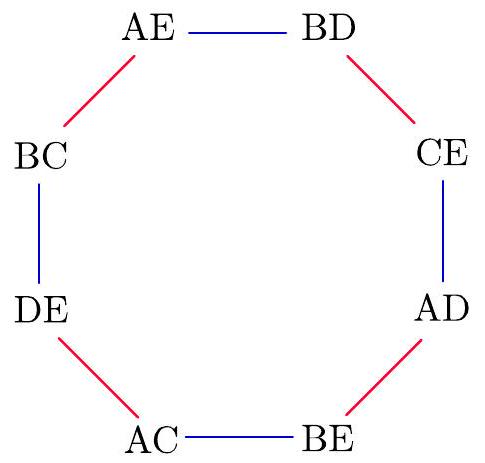
|
| 540 |
+
|
| 541 |
+
Similar reasoning leads un to the following diagram for Day 2. Here again, either all the red matches have to take place, or all the blue matches have to take place on Day 2.
|
| 542 |
+
|
| 543 |
+
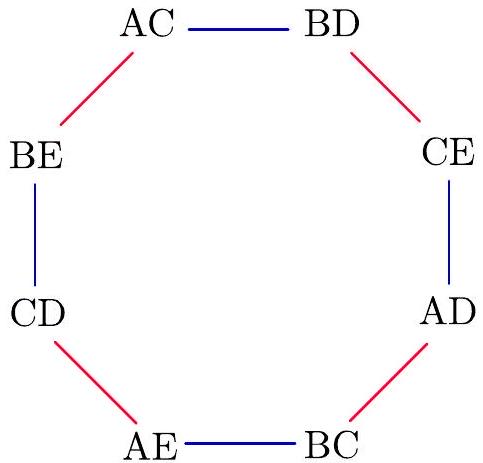
|
| 544 |
+
|
| 545 |
+
One can't have the blue matches on both Day 1 and Day 2 because AD-BE would repeat itself.
|
| 546 |
+
|
| 547 |
+
We can't have the red mathes on both days as this would repeat the match BD-CE.
|
| 548 |
+
|
| 549 |
+
We can not have the blue matches on Day 1 and the red matches on Day 2 because this would repeat the game AC-BE. Finally, choosing the red matches on Day 1 and the blue ones on Day 2 won't work either as the game AE-BC would repeat itself.
|
| 550 |
+
|
| 551 |
+
In conclusion, the tournament has to last at least four days. An example of how it could
|
| 552 |
+
be organized in four days is given in the previous solution.
|
| 553 |
+
|
| 554 |
+
C3 a) In how many ways can we read the word SARAJEVO from the table below, if it is allowed to jump from cell to an adjacent cell (by vertex or a side) cell?
|
| 555 |
+
|
| 556 |
+
|
| 557 |
+
|
| 558 |
+
b) After the letter in one cell was deleted, only 525 ways to read the word SARAJEVO remained. Find all possible positions of that cell.
|
| 559 |
+
|
| 560 |
+
Solution: In the first of the tables below the number in each cell shows the number of ways to reach that cell from the start (which is the sum of the quantities in the cells, from which we can come), and in the second one are the number of ways to arrive from that cell to the end (which is the sum of the quantities in the cells, to which we can go).
|
| 561 |
+
|
| 562 |
+
a) The answer is 750 , as seen from the second table.
|
| 563 |
+
|
| 564 |
+
b) If we delete the letter in a cell, the number of ways to read SARAJEVO will decrease by the product of the numbers in the corresponding cell in the two tables. As $750-525=225$, this product has to be 225. This happens only for two cells on the third row. Here is the table with the products:
|
| 565 |
+
|
| 566 |
+
C4 Determine all pairs $(m, n)$ for which it is possible to tile the table $m \times n$ with "corners" as in the figure below, with the condition that in the tiling there is no rectangle (except for the $m \times n$ one) regularly covered with corners.
|
| 567 |
+
|
| 568 |
+

|
| 569 |
+
|
| 570 |
+
Solution: Every "corner" covers exactly 3 squares, so a necessary condition for the tiling to exists is $3 \mid m n$.
|
| 571 |
+
|
| 572 |
+
First, we shall prove that for a tiling with our condition to exist, it is necessary that both $m, n$ for $m, n>3$ to be even. Suppose the contrary, i.e. suppose that that $m>3$ is odd (without losing generality). Look at the "corners" that cover squares on the side of length $m$ of table $m \times n$. Because $m$ is odd, there must be a "corner" which covers exactly one square of that side. But any placement of that corner forces existence of a $2 \times 3$ rectangle in the tiling. Thus, $m$ and $n$ for $m, n>3$ must be even and at least one of them is divisible by 3 .
|
| 573 |
+
|
| 574 |
+
Notice that in the corners of table $m \times n$, the "corner" must be placed such that it covers the square in the corner of the rectangle and its two neighboring squares, otherwise, again, a $2 \times 3$ rectangle would form.
|
| 575 |
+
|
| 576 |
+
If one of $m$ and $n$ is 2 then condition forces that the only convenient tables are $2 \times 3$ and $3 \times 2$. If we try to find the desired tiling when $m=4$, then we are forced to stop at table $4 \times 6$ because of the conditions of problem.
|
| 577 |
+
|
| 578 |
+
We easily find an example of a desired tiling for the table $6 \times 6$ and, more generally, a tiling for a $6 \times 2 k$ table.
|
| 579 |
+
|
| 580 |
+
Thus, it will be helpful to prove that the desired tiling exists for tables $6 k \times 4 \ell$, for $k, \ell \geq 2$. Divide that table at rectangle $6 \times 4$ and tile that rectangle as we described. Now, change placement of problematic "corners" as in figure.
|
| 581 |
+
|
| 582 |
+
Thus, we get desired tilling for this type of table.
|
| 583 |
+
|
| 584 |
+
Similarly, we prove existence in case $6 k \times(4 k+2)$ where $m, \ell \geq 2$. But, we first divide table at two tables $6 k \times 6$ and $6 k \times 4(\ell-1)$. Divide them at rectangles $6 \times 6$ and $6 \times 4$. Tile them as we described earlier, and arrange problematic "corners" as in previous case. So, $2 \times 3,3 \times 2,6 \times 2 k, 2 k \times 6, k \geq 2$, and $6 k \times 4 \ell$ for $k, \ell \geq 2$ and $6 k \times(4 \ell+2)$ for $k, \ell \geq 2$ are the convenient pairs.
|
| 585 |
+
|
| 586 |
+
Remark: The problem is inspired by a problem given at Romanian Selection Test 2000, but it is completely different.
|
| 587 |
+
|
| 588 |
+
Remark: Alternatively, the problem can be relaxed by asking: "Does such a tiling exist for some concrete values of $m$ and $n$ ?" .
|
| 589 |
+
|
| 590 |
+
### 2.3 Geometry
|
| 591 |
+
|
| 592 |
+
G1 Let $A B C D$ be a parallelogram with $A C>B D$, and let $O$ be the point of intersection of $A C$ and $B D$. The circle with center at $O$ and radius $O A$ intersects the extensions of $A D$ and $A B$ at points $G$ and $L$, respectively. Let $Z$ be intersection point of lines $B D$ and $G L$. Prove that $\angle Z C A=90^{\circ}$.
|
| 593 |
+
|
| 594 |
+
## Solution:
|
| 595 |
+
|
| 596 |
+
From the point $L$ we draw a parallel line to $B D$ that intersects lines $A C$ and $A G$ at points $N$ and $R$ respectively. Since $D O=O B$, we have that $N R=N L$, and point $N$ is the midpoint of segment $L R$.
|
| 597 |
+
|
| 598 |
+
Let $K$ be the midpoint of $G L$. Now, $N K \| R G$, and
|
| 599 |
+
|
| 600 |
+
$$
|
| 601 |
+
\angle A G L=\angle N K L=\angle A C L
|
| 602 |
+
$$
|
| 603 |
+
|
| 604 |
+
Therefore, from the cyclic quadrilateral $N K C L$ we deduce:
|
| 605 |
+
|
| 606 |
+
$$
|
| 607 |
+
\angle K C N=\angle K L N
|
| 608 |
+
$$
|
| 609 |
+
|
| 610 |
+
Now, since $L R \| D Z$, we have
|
| 611 |
+
|
| 612 |
+
$$
|
| 613 |
+
\angle K L N=\angle K Z O
|
| 614 |
+
$$
|
| 615 |
+
|
| 616 |
+
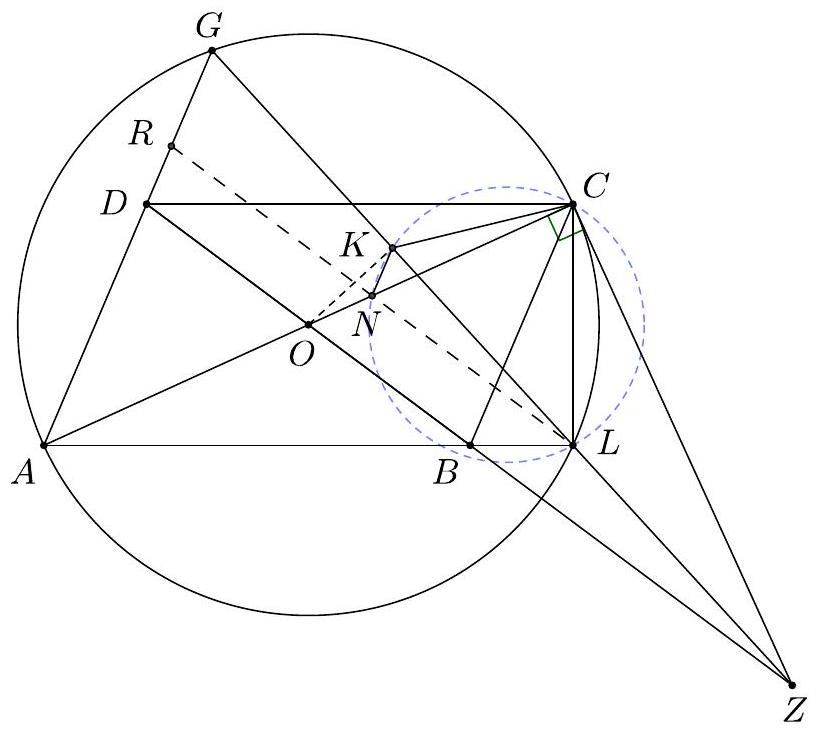
|
| 617 |
+
|
| 618 |
+
It implies that quadrilateral $O K C Z$ is cyclic, and
|
| 619 |
+
|
| 620 |
+
$$
|
| 621 |
+
\angle O K Z=\angle O C Z
|
| 622 |
+
$$
|
| 623 |
+
|
| 624 |
+
Since $O K \perp G L$, we derive that $\angle Z C A=90^{\circ}$.
|
| 625 |
+
|
| 626 |
+
G2 In a right trapezoid $A B C D(A B \| C D)$ the angle at vertex $B$ measures $75^{\circ}$. Point $H$ is the foot of the perpendicular from point $A$ to the line $B C$. If $B H=D C$ and $A D+A H=8$, find the area of $A B C D$.
|
| 627 |
+
|
| 628 |
+
Solution: Produce the legs of the trapezoid until they intersect at point $E$. The triangles $A B H$ and $E C D$ are congruent (ASA). The area of $A B C D$ is equal to area of triangle $E A H$ of hypotenuse
|
| 629 |
+
|
| 630 |
+
$$
|
| 631 |
+
A E=A D+D E=A D+A H=8
|
| 632 |
+
$$
|
| 633 |
+
|
| 634 |
+
Let $M$ be the midpoint of $A E$. Then
|
| 635 |
+
|
| 636 |
+
$$
|
| 637 |
+
M E=M A=M H=4
|
| 638 |
+
$$
|
| 639 |
+
|
| 640 |
+
and $\angle A M H=30^{\circ}$. Now, the altitude from $H$ to AM equals one half of $M H$, namely 2. Finally, the area is 8 .
|
| 641 |
+
|
| 642 |
+
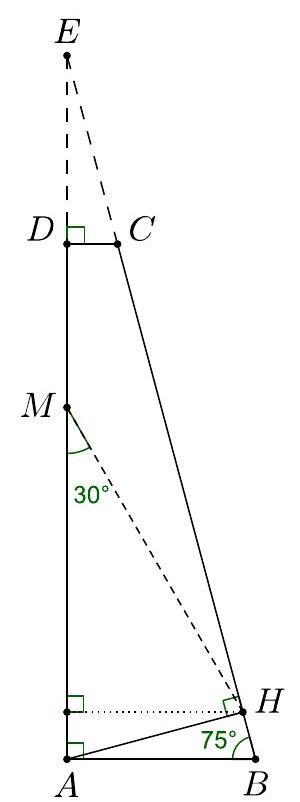
|
| 643 |
+
|
| 644 |
+
G3 A parallelogram $A B C D$ with obtuse angle $\angle A B C$ is given. After rotating the triangle $A C D$ around the vertex $C$, we get a triangle $C D^{\prime} A^{\prime}$, such that points $B, C$ and $D^{\prime}$ are collinear. The extension of the median of triangle $C D^{\prime} A^{\prime}$ that passes through $D^{\prime}$ intersects the straight line $B D$ at point $P$. Prove that $P C$ is the bisector of the angle $\angle B P D^{\prime}$.
|
| 645 |
+
|
| 646 |
+
Solution: Let $A C \cap B D=\{X\}$ and $P D^{\prime} \cap C A^{\prime}=\{Y\}$. Because $A X=C X$ and $C Y=Y A^{\prime}$, we deduce:
|
| 647 |
+
|
| 648 |
+
$$
|
| 649 |
+
\triangle A B C \cong \triangle C D A \cong \triangle C D^{\prime} A^{\prime} \Rightarrow \triangle A B X \cong \triangle C D^{\prime} Y, \triangle B C X \cong \triangle D^{\prime} A^{\prime} Y
|
| 650 |
+
$$
|
| 651 |
+
|
| 652 |
+
It follows that
|
| 653 |
+
|
| 654 |
+
$$
|
| 655 |
+
\angle A B X=\angle C D^{\prime} Y
|
| 656 |
+
$$
|
| 657 |
+
|
| 658 |
+
Let $M$ and $N$ be orthogonal projections of the point $C$ on the straight lines $P D^{\prime}$ and $B P$, respectively, and $Q$ is the orthogonal projection of the point $A$ on the straight line $B P$. Because $C D^{\prime}=A B$, we have that $\triangle A B Q \cong \triangle C D^{\prime} M$.
|
| 659 |
+
|
| 660 |
+
We conclude that $C M=A Q$. But, $A X=C X$ and $\triangle A Q X \cong \triangle C N X$. So, $C M=C N$ and $P C$ is the bisector of the angle $\angle B P D^{\prime}$.
|
| 661 |
+
|
| 662 |
+
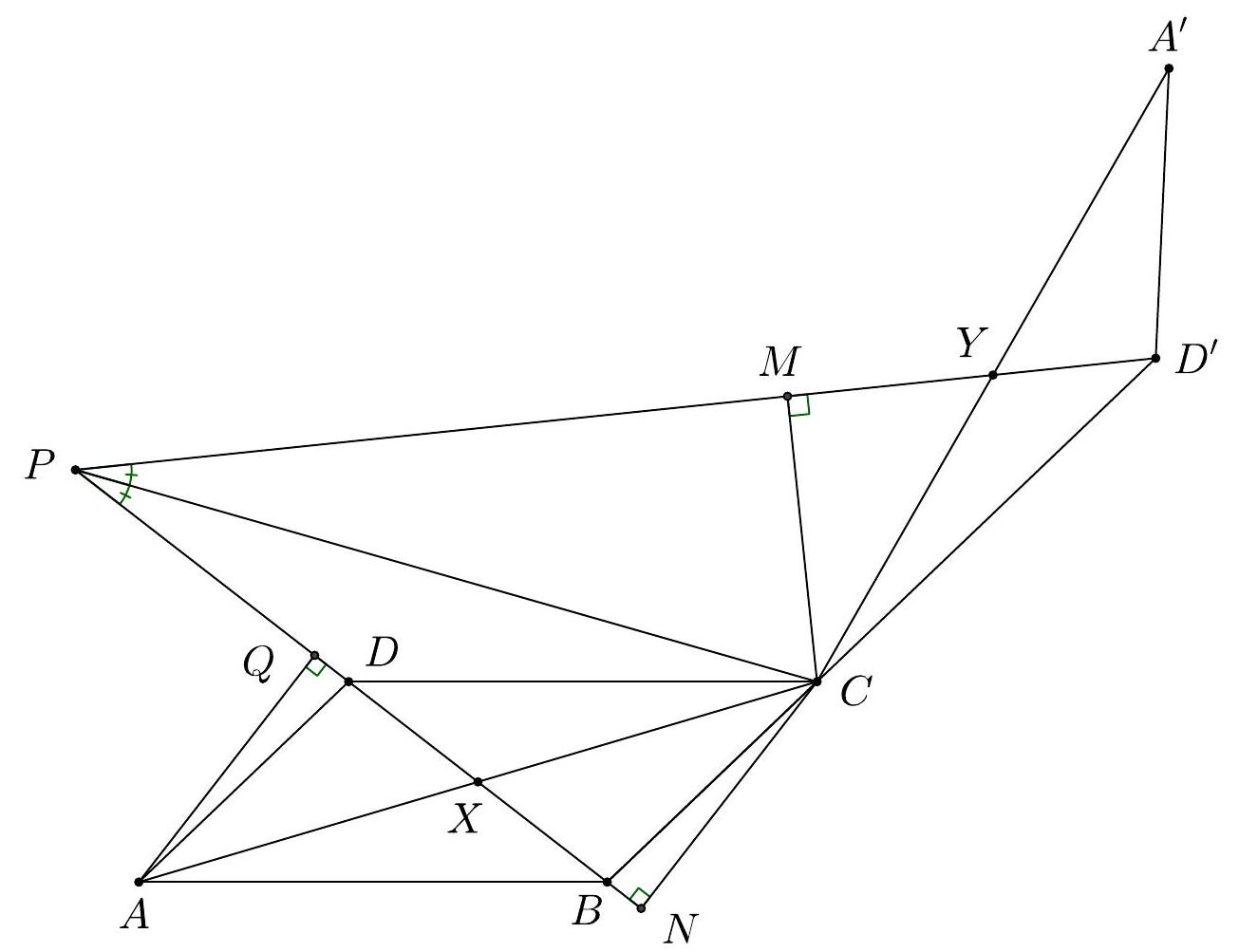
|
| 663 |
+
|
| 664 |
+
Much shortened: $\triangle C D^{\prime} Y \equiv \triangle C D X$ means their altitudes from $C$ are also equal, i.e. $C M=C N$ and the conclusion.
|
| 665 |
+
|
| 666 |
+
G4 Let $A B C D E$ be a convex pentagon such that $A B+C D=B C+D E$ and let $k$ be a semicircle with center on side $A E$ that touches the sides $A B, B C, C D$ and $D E$ of the pentagon, respectively, at points $P, Q, R$ and $S$ (different from the vertices of the pentagon). Prove that $P S \| A E$.
|
| 667 |
+
|
| 668 |
+
Solution: Let $O$ be center of $k$. We deduce that $B P=B Q, C Q=C R, D R=D S$, since those are tangents to the circle $k$. Using the condition $A B+C D=B C+D E$, we derive:
|
| 669 |
+
|
| 670 |
+
$$
|
| 671 |
+
A P+B P+C R+D R=B Q+C Q+D S+E S
|
| 672 |
+
$$
|
| 673 |
+
|
| 674 |
+
From here we have $A P=E S$.
|
| 675 |
+
|
| 676 |
+
Thus,
|
| 677 |
+
|
| 678 |
+
$$
|
| 679 |
+
\triangle A P O \cong \triangle E S O\left(A P=E S, \angle A P O=\angle E S O=90^{\circ}, P O=S O\right)
|
| 680 |
+
$$
|
| 681 |
+
|
| 682 |
+
This implies
|
| 683 |
+
|
| 684 |
+
$$
|
| 685 |
+
\angle O P S=\angle O S P
|
| 686 |
+
$$
|
| 687 |
+
|
| 688 |
+
Therefore,
|
| 689 |
+
|
| 690 |
+
$$
|
| 691 |
+
\angle A P S=\angle A P O+\angle O P S=90^{\circ}+\angle O P S=90^{\circ}+\angle O S P=\angle P S E
|
| 692 |
+
$$
|
| 693 |
+
|
| 694 |
+
Now, from quadrilateral $A P S E$ we deduce:
|
| 695 |
+
|
| 696 |
+
$$
|
| 697 |
+
2 \angle E A P+2 \angle A P S=\angle E A P+\angle A P S+\angle P S E+\angle S E A=360^{\circ}
|
| 698 |
+
$$
|
| 699 |
+
|
| 700 |
+
So,
|
| 701 |
+
|
| 702 |
+
$$
|
| 703 |
+
\angle E A P+\angle A P S=180^{\circ}
|
| 704 |
+
$$
|
| 705 |
+
|
| 706 |
+
and $A P S E$ is isosceles trapezoid. Therefore, $A E \| P S$.
|
| 707 |
+
|
| 708 |
+
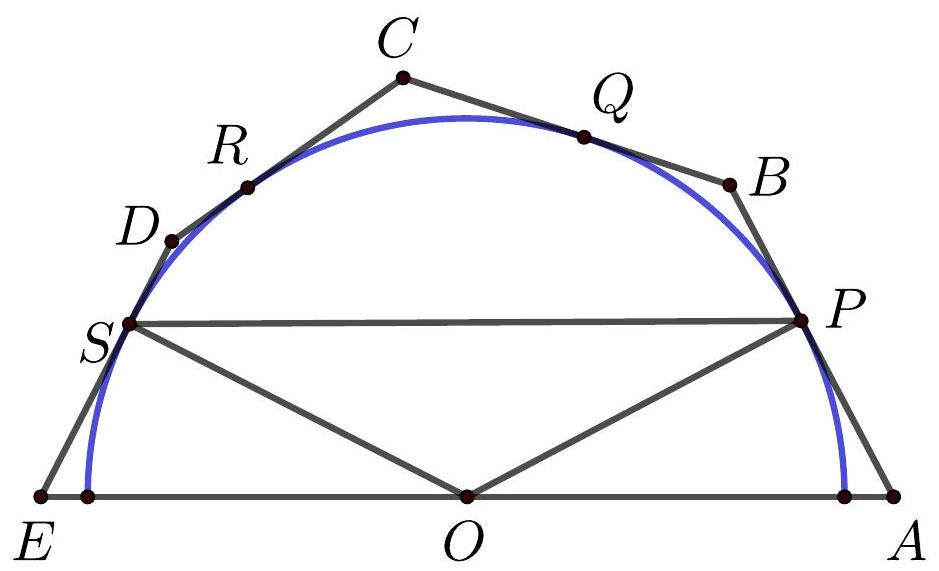
|
| 709 |
+
|
| 710 |
+
G5 Let $A, B, C$ and $O$ be four points in the plane, such that $\angle A B C>90^{\circ}$ and $O A=$ $O B=O C$. Define the point $D \in A B$ and the line $\ell$ such that $D \in \ell, A C \perp D C$ and $\ell \perp A O$. Line $\ell$ cuts $A C$ at $E$ and the circumcircle of $\triangle A B C$ at $F$. Prove that the circumcircles of triangles $B E F$ and $C F D$ are tangent at $F$.
|
| 711 |
+
|
| 712 |
+
Solution: Let $\ell \cap A C=\{K\}$ and define $G$ to be the mirror image of the point $A$ with respect to $O$. Then $A G$ is a diameter of the circumcircle of the triangle $A B C$, therefore $A C \perp C G$. On the other hand we have $A C \perp D C$, and it implies that points $D, C, G$ are collinear.
|
| 713 |
+
|
| 714 |
+
Moreover, as $A E \perp D G$ and $D E \perp A G$, we obtain that $E$ is the orthocenter of triangle $A D G$ and $G E \perp A D$. As $A G$ is a diameter, we have $A B \perp B G$, and since $A D \perp G E$, the points $E, G$, and $B$ are collinear.
|
| 715 |
+
|
| 716 |
+
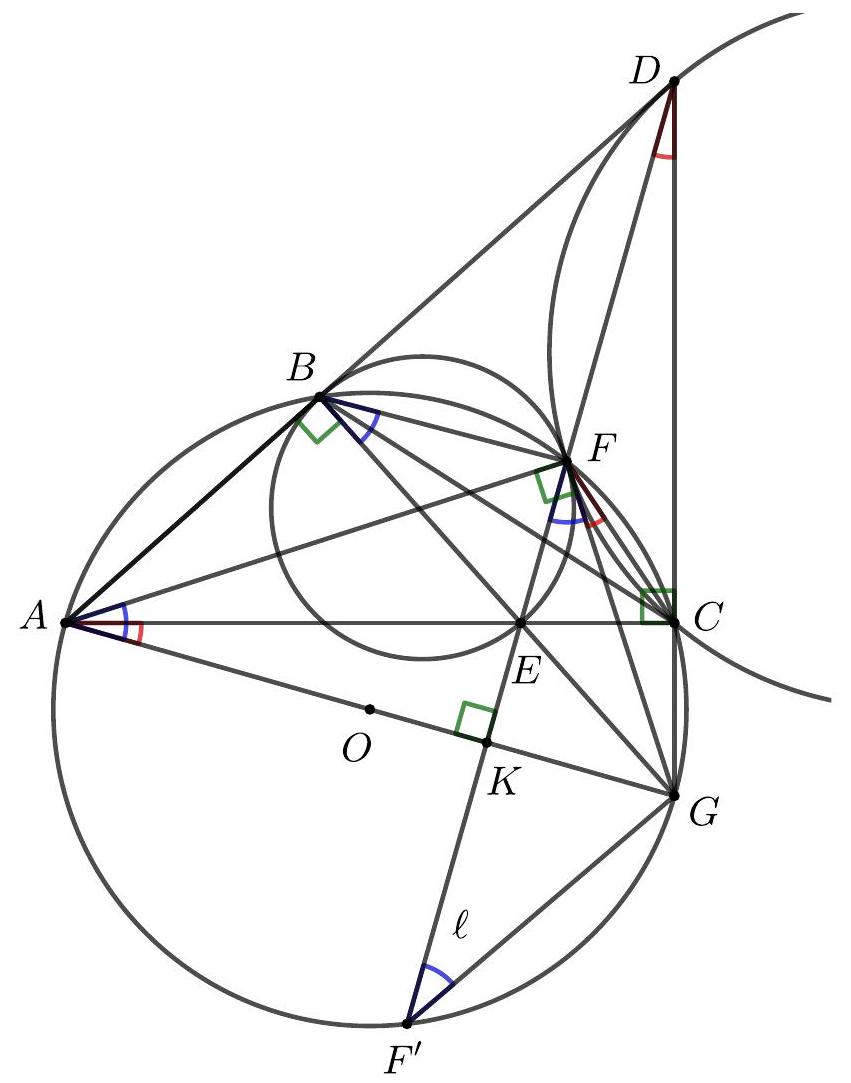
|
| 717 |
+
|
| 718 |
+
Notice that
|
| 719 |
+
|
| 720 |
+
$$
|
| 721 |
+
\angle C A G=90^{\circ}-\angle A G C=\angle K D C
|
| 722 |
+
$$
|
| 723 |
+
|
| 724 |
+
and
|
| 725 |
+
|
| 726 |
+
$$
|
| 727 |
+
\angle C A G=\angle G F C
|
| 728 |
+
$$
|
| 729 |
+
|
| 730 |
+
since both subtend the same arc.
|
| 731 |
+
|
| 732 |
+
Hence,
|
| 733 |
+
|
| 734 |
+
$$
|
| 735 |
+
\angle F D G=\angle G F C
|
| 736 |
+
$$
|
| 737 |
+
|
| 738 |
+
Therefore, $G F$ is tangent to the circumcircle of the triangle $C D F$ at point $F$.
|
| 739 |
+
|
| 740 |
+
We claim that line $G F$ is also tangent to the circumcircle of triangle $B E F$ at point $F$, which concludes the proof.
|
| 741 |
+
|
| 742 |
+
The claim is equivalent to $\angle G B F=\angle E F G$. Denote by $F^{\prime}$ the second intersection point - other than $F$ - of line $\ell$ with the circumcircle of triangle $A B C$. Observe that $\angle G B F=\angle G F^{\prime} F$, because both angles subtend the same arc, and $\angle F F^{\prime} G=\angle E F G$, since $A G$ is the perpendicular bisector of the chord $F F^{\prime}$, and we are done.
|
| 743 |
+
|
| 744 |
+
### 2.4 Number Theory
|
| 745 |
+
|
| 746 |
+
NT1 Determine all positive integer numbers $k$ for which the numbers $k+9$ are perfect squares and the only prime factors of $k$ are 2 and 3 .
|
| 747 |
+
|
| 748 |
+
Solution: We have an integer $x$ such that
|
| 749 |
+
|
| 750 |
+
$$
|
| 751 |
+
x^{2}=k+9
|
| 752 |
+
$$
|
| 753 |
+
|
| 754 |
+
$k=2^{a} 3^{b}, a, b \geq 0, a, b \in \mathbb{N}$.
|
| 755 |
+
|
| 756 |
+
Therefore,
|
| 757 |
+
|
| 758 |
+
$$
|
| 759 |
+
(x-3)(x+3)=k \text {. }
|
| 760 |
+
$$
|
| 761 |
+
|
| 762 |
+
If $b=0$ then we have $k=16$.
|
| 763 |
+
|
| 764 |
+
If $b>0$ then we have $3 \mid k+9$. Hence, $3 \mid x^{2}$ and $9 \mid k$.
|
| 765 |
+
|
| 766 |
+
Therefore, we have $b \geq 2$. Let $x=3 y$.
|
| 767 |
+
|
| 768 |
+
$$
|
| 769 |
+
(y-1)(y+1)=2^{a} 3^{b-2}
|
| 770 |
+
$$
|
| 771 |
+
|
| 772 |
+
If $a=0$ then $b=3$ and we have $k=27$.
|
| 773 |
+
|
| 774 |
+
If $a \geq 1$, then the numbers $y-1$ and $y+1$ are even. Therefore, we have $a \geq 2$, and
|
| 775 |
+
|
| 776 |
+
$$
|
| 777 |
+
\frac{y-1}{2} \cdot \frac{y+1}{2}=2^{a-2} 3^{b-2}
|
| 778 |
+
$$
|
| 779 |
+
|
| 780 |
+
Since the numbers $\frac{y-1}{2}, \frac{y+1}{2}$ are consecutive numbers, these numbers have to be powers of 2 and 3 . Let $m=a-2, n=b-2$.
|
| 781 |
+
|
| 782 |
+
- If $2^{m}-3^{n}=1$ then we have $m \geq n$. For $n=0$ we have $m=1, a=3, b=2$ and $k=72$. For $n>0$ using $\bmod 3$ we have that $m$ is even number. Let $m=2 t$. Therefore,
|
| 783 |
+
|
| 784 |
+
$$
|
| 785 |
+
\left(2^{t}-1\right)\left(2^{t}+1\right)=3^{n}
|
| 786 |
+
$$
|
| 787 |
+
|
| 788 |
+
Hence, $t=1, m=2, n=1$ and $a=4, b=3, k=432$.
|
| 789 |
+
|
| 790 |
+
- If $3^{n}-2^{m}=1$, then $m>0$. For $m=1$ we have $n=1, a=3, b=3, k=216$. For $m>1$ using $\bmod 4$ we have that $n$ is even number. Let $n=2 t$.
|
| 791 |
+
|
| 792 |
+
$$
|
| 793 |
+
\left(3^{t}-1\right)\left(3^{t}+1\right)=2^{m}
|
| 794 |
+
$$
|
| 795 |
+
|
| 796 |
+
Therefore, $t=1, n=2, m=3, a=5, b=4, k=2592$.
|
| 797 |
+
|
| 798 |
+
Set of solutions: $\{16,27,72,216,432,2592\}$.
|
| 799 |
+
|
| 800 |
+
NT2 A group of $n>1$ pirates of different age owned total of 2009 coins. Initially each pirate (except for the youngest one) had one coin more than the next younger.
|
| 801 |
+
|
| 802 |
+
a) Find all possible values of $n$.
|
| 803 |
+
|
| 804 |
+
b) Every day a pirate was chosen. The chosen pirate gave a coin to each of the other pirates. If $n=7$, find the largest possible number of coins a pirate can have after several days.
|
| 805 |
+
|
| 806 |
+
## Solution:
|
| 807 |
+
|
| 808 |
+
a) If $n$ is odd, then it is a divisor of $2009=7 \times 7 \times 41$. If $n>49$, then $n$ is at least $7 \times 41$, while the average pirate has 7 coins, so the initial division is impossible. So, we can have $n=7, n=41$ or $n=49$. Each of these cases is possible (e.g. if $n=49$, the average pirate has 41 coins, so the initial amounts are from $41-24=17$ to $41+24=65$ ).
|
| 809 |
+
|
| 810 |
+
If $n$ is even, then 2009 is multiple of the sum $S$ of the oldest and the youngest pirate. If $S<7 \times 41$, then $S$ is at most 39 and the pairs of pirates of sum $S$ is at least 41 , so we must have at least 82 pirates, a contradiction. So we can have just $S=7 \times 41=287$ and $S=49 \times 41=2009$; respectively, $n=2 \times 7=14$ or $n=2 \times 1=2$. Each of these cases is possible (e.g. if $n=14$, the initial amounts are from $144-7=137$ to $143+7=150$ ). In total, $n$ is one of the numbers $2,7,13,41$ and 49 .
|
| 811 |
+
|
| 812 |
+
b) If $n=7$, the average pirate has $7 \times 41=287$ coins, so the initial amounts are from 284 to 290; they have different residues modulo 7. The operation decreases one of the amounts by 6 and increases the other ones by 1 , so the residues will be different at all times. The largest possible amount in one pirate's possession will be achieved if all the others have as little as possible, namely $0,1,2,3,4$ and 5 coins (the residues modulo 7 have to be different). If this happens, the wealthiest pirate will have $2009-14=1994$ coins. Indeed, this can be achieved e.g. if every day (until that moment) the coins are given by the second wealthiest: while he has more than 5 coins, he can provide the 6 coins needed, and when he has no more than five, the coins at the poorest six pirates have to be $0,1,2,3,4,5$. Thus, $n=1994$ can be achieved.
|
| 813 |
+
|
| 814 |
+
NT3 Find all pairs $(x, y)$ of integers which satisfy the equation
|
| 815 |
+
|
| 816 |
+
$$
|
| 817 |
+
(x+y)^{2}\left(x^{2}+y^{2}\right)=2009^{2}
|
| 818 |
+
$$
|
| 819 |
+
|
| 820 |
+
Solution: Let $x+y=s, x y=p$ with $s \in \mathbb{Z}^{*}$ and $p \in \mathbb{Z}$. The given equation can be written in the form
|
| 821 |
+
|
| 822 |
+
$$
|
| 823 |
+
s^{2}\left(s^{2}-2 p\right)=2009^{2}
|
| 824 |
+
$$
|
| 825 |
+
|
| 826 |
+
or
|
| 827 |
+
|
| 828 |
+
$$
|
| 829 |
+
s^{2}-2 p=\left(\frac{2009}{s}\right)^{2}
|
| 830 |
+
$$
|
| 831 |
+
|
| 832 |
+
So, $s$ divides $2009=7^{2} \times 41$ and it follows that $p \neq 0$.
|
| 833 |
+
|
| 834 |
+
If $p>0$, then $2009^{2}=s^{2}\left(s^{2}-2 p\right)=s^{4}-2 p s^{2}<s^{4}$. We obtain that $s$ divides 2009 and $|s| \geq 49$. Thus, $s \in\{ \pm 49, \pm 287, \pm 2009\}$.
|
| 835 |
+
|
| 836 |
+
- For $s= \pm 49$, we have $p=360$, and $(x, y)=\{(40,9),(9,40),(-40,-9),(-9,-40)\}$.
|
| 837 |
+
- For $s \in\{ \pm 287, \pm 2009\}$ the equation has no integer solutions.
|
| 838 |
+
|
| 839 |
+
If $p<0$, then $2009^{2}=s^{4}-2 p s^{2}>s^{4}$. We obtain that $s$ divides 2009 and $|s| \leq 41$. Thus, $s \in\{ \pm 1, \pm 7, \pm 41\}$. For these values of $s$ the equation has no integer solutions.
|
| 840 |
+
|
| 841 |
+
So, the given equation has only the solutions $(40,9),(9,40),(-40,-9),(-9,-40)$.
|
| 842 |
+
|
| 843 |
+
NT4 Determine all prime numbers $p_{1}, p_{2}, \ldots, p_{12}, p_{13}, p_{1} \leq p_{2} \leq \ldots \leq p_{12} \leq p_{13}$, such that
|
| 844 |
+
|
| 845 |
+
$$
|
| 846 |
+
p_{1}^{2}+p_{2}^{2}+\ldots+p_{12}^{2}=p_{13}^{2}
|
| 847 |
+
$$
|
| 848 |
+
|
| 849 |
+
and one of them is equal to $2 p_{1}+p_{9}$.
|
| 850 |
+
|
| 851 |
+
Solution: Obviously, $p_{13} \neq 2$, because sum of squares of 12 prime numbers is greater or equal to $12 \times 2^{2}=48$. Thus, $p_{13}$ is odd number and $p_{13} \geq 7$.
|
| 852 |
+
|
| 853 |
+
We have that $n^{2} \equiv 1(\bmod 8)$, when $n$ is odd. Let $k$ be the number of prime numbers equal to 2 . Looking at equation modulo 8 we get:
|
| 854 |
+
|
| 855 |
+
$$
|
| 856 |
+
4 k+12-k \equiv 1 \quad(\bmod 8)
|
| 857 |
+
$$
|
| 858 |
+
|
| 859 |
+
So, $k \equiv 7(\bmod 8)$ and because $k \leq 12$ we get $k=7$. Therefore, $p_{1}=p_{2}=\ldots=p_{7}=2$. Furthermore, we are looking for solutions of equations:
|
| 860 |
+
|
| 861 |
+
$$
|
| 862 |
+
28+p_{8}^{2}+p_{9}^{2}+p_{10}^{2}+p_{11}^{2}+p_{12}^{2}=p_{13}^{2}
|
| 863 |
+
$$
|
| 864 |
+
|
| 865 |
+
where $p_{8}, p_{9}, \ldots, p_{13}$ are odd prime numbers and one of them is equal to $p_{9}+4$.
|
| 866 |
+
|
| 867 |
+
Now, we know that when $n$ is not divisible by $3, n^{2} \equiv 1(\bmod 3)$. Let $s$ be number of prime numbers equal to 3 . Looking at equation modulo 3 we get:
|
| 868 |
+
|
| 869 |
+
$$
|
| 870 |
+
28+5-s \equiv 1 \quad(\bmod 3)
|
| 871 |
+
$$
|
| 872 |
+
|
| 873 |
+
Thus, $s \equiv 2(\bmod 3)$ and because $s \leq 5, s$ is either 2 or 5 . We will consider both cases. i. When $s=2$, we get $p_{8}=p_{9}=3$. Thus, we are looking for prime numbers $p_{10} \leq p_{11} \leq$ $p_{12} \leq p_{13}$ greater than 3 and at least one of them is 7 (certainly $p_{13} \neq 7$ ), that satisfy
|
| 874 |
+
|
| 875 |
+
$$
|
| 876 |
+
46+p_{10}^{2}+p_{11}^{2}+p_{12}^{2}=p_{13}^{2}
|
| 877 |
+
$$
|
| 878 |
+
|
| 879 |
+
We know that $n^{2} \equiv 1(\bmod 5)$ or $n^{2}=4(\bmod 5)$ when $n$ is not divisible by 5 . It is not possible that $p_{10}=p_{11}=5$, because in that case $p_{12}$ must be equal to 7 and the left-hand side would be divisible by 5 , which contradicts the fact that $p_{13} \geq 7$. So, we proved that $p_{10}=5$ or $p_{10}=7$.
|
| 880 |
+
|
| 881 |
+
If $p_{10}=5$ then $p_{11}=7$ because $p_{11}$ is the least of remaining prime numbers. Thus, we are looking for solutions of equation
|
| 882 |
+
|
| 883 |
+
$$
|
| 884 |
+
120=p_{13}^{2}-p_{12}^{2}
|
| 885 |
+
$$
|
| 886 |
+
|
| 887 |
+
in prime numbers. Now, from
|
| 888 |
+
|
| 889 |
+
$$
|
| 890 |
+
2^{3} \cdot 3 \cdot 5=\left(p_{12}-p_{12}\right)\left(p_{13}+p_{12}\right)
|
| 891 |
+
$$
|
| 892 |
+
|
| 893 |
+
that desired solutions are $p_{12}=7, p_{13}=13 ; p_{12}=13, p_{13}=17 ; p_{12}=29, p_{13}=31$.
|
| 894 |
+
|
| 895 |
+
If $p_{10}=7$ we are solving equation:
|
| 896 |
+
|
| 897 |
+
$$
|
| 898 |
+
95+p_{11}^{2}+p_{12}^{2}=p_{13}^{2}
|
| 899 |
+
$$
|
| 900 |
+
|
| 901 |
+
in prime numbers greater than 5 . But left side can give residues 0 or 3 modulo 5 , while right side can give only 1 or 4 modulo 5 . So, in this case we do not have solution.
|
| 902 |
+
|
| 903 |
+
ii. When $s=5$ we get equation:
|
| 904 |
+
|
| 905 |
+
$$
|
| 906 |
+
28+45=73=p_{13}^{2}
|
| 907 |
+
$$
|
| 908 |
+
|
| 909 |
+
but 73 is not square or integer and we do not have solution in this case.
|
| 910 |
+
|
| 911 |
+
Finally, only solutions are:
|
| 912 |
+
|
| 913 |
+
$\{(2,2,2,2,2,2,2,3,3,5,7,7,13),(2,2,2,2,2,2,2,3,3,5,7,13,17),(2,2,2,2,2,2,2,3,3,5,7,29,31)\}$. NT5 Show that there are infinitely many positive integers $c$, such that the following equations both have solutions in positive integers:
|
| 914 |
+
|
| 915 |
+
$$
|
| 916 |
+
\left(x^{2}-c\right)\left(y^{2}-c\right)=z^{2}-c
|
| 917 |
+
$$
|
| 918 |
+
|
| 919 |
+
and
|
| 920 |
+
|
| 921 |
+
$$
|
| 922 |
+
\left(x^{2}+c\right)\left(y^{2}-c\right)=z^{2}-c
|
| 923 |
+
$$
|
| 924 |
+
|
| 925 |
+
Solution: The firs equation always has solutions, namely the triples $\{x, x+1, x(x+1)-c\}$ for all $x \in \mathbb{N}$. Indeed,
|
| 926 |
+
|
| 927 |
+
$$
|
| 928 |
+
\left(x^{2}-c\right)\left((x+1)^{2}-c\right)=x^{2}(x+1)^{2}-2 c\left(x^{2}+(x+1)^{2}\right)+c^{2}=(x(x+1)-c)^{2}-c .
|
| 929 |
+
$$
|
| 930 |
+
|
| 931 |
+
For second equation, we try $z=|x y-c|$. We need
|
| 932 |
+
|
| 933 |
+
$$
|
| 934 |
+
\left(x^{2}+c\right)\left(y^{2}-c\right)=(x y-c)^{2}
|
| 935 |
+
$$
|
| 936 |
+
|
| 937 |
+
or
|
| 938 |
+
|
| 939 |
+
$$
|
| 940 |
+
x^{2} y^{2}+c\left(y^{2}-x^{2}\right)-c^{2}=x^{2} y^{2}-2 x y c+c^{2}
|
| 941 |
+
$$
|
| 942 |
+
|
| 943 |
+
Cancelling the common terms we get
|
| 944 |
+
|
| 945 |
+
$$
|
| 946 |
+
c\left(x^{2}-y^{2}+2 x y\right)=2 c^{2}
|
| 947 |
+
$$
|
| 948 |
+
|
| 949 |
+
or
|
| 950 |
+
|
| 951 |
+
$$
|
| 952 |
+
c=\frac{x^{2}-y^{2}+2 x y}{2}
|
| 953 |
+
$$
|
| 954 |
+
|
| 955 |
+
Therefore, all $c$ of this form will work. This expression is a positive integer if $x$ and $y$ have the same parity, and it clearly takes infinitely many positive values. We only need to check $z \neq 0$, i.e. $c \neq x y$, which is true for $x \neq y$. For example, one can take
|
| 956 |
+
|
| 957 |
+
$$
|
| 958 |
+
y=x-2
|
| 959 |
+
$$
|
| 960 |
+
|
| 961 |
+
and
|
| 962 |
+
|
| 963 |
+
$$
|
| 964 |
+
z=\frac{x^{2}-(x-2)^{2}+2 x(x-2)}{2}=x^{2}-2 \text {. }
|
| 965 |
+
$$
|
| 966 |
+
|
| 967 |
+
Thus, $\{(x, x-2,2 x-2)\}$ is a solution for $c=x^{2}-2$.
|
| 968 |
+
|
JBMO/md/en-shortlist/en-jbmo-2010_shl.md
ADDED
|
@@ -0,0 +1,263 @@
|
|
|
|
|
|
|
|
|
|
|
|
|
|
|
|
|
|
|
|
|
|
|
|
|
|
|
|
|
|
|
|
|
|
|
|
|
|
|
|
|
|
|
|
|
|
|
|
|
|
|
|
|
|
|
|
|
|
|
|
|
|
|
|
|
|
|
|
|
|
|
|
|
|
|
|
|
|
|
|
|
|
|
|
|
|
|
|
|
|
|
|
|
|
|
|
|
|
|
|
|
|
|
|
|
|
|
|
|
|
|
|
|
|
|
|
|
|
|
|
|
|
|
|
|
|
|
|
|
|
|
|
|
|
|
|
|
|
|
|
|
|
|
|
|
|
|
|
|
|
|
|
|
|
|
|
|
|
|
|
|
|
|
|
|
|
|
|
|
|
|
|
|
|
|
|
|
|
|
|
|
|
|
|
|
|
|
|
|
|
|
|
|
|
|
|
|
|
|
|
|
|
|
|
|
|
|
|
|
|
|
|
|
|
|
|
|
|
|
|
|
|
|
|
|
|
|
|
|
|
|
|
|
|
|
|
|
|
|
|
|
|
|
|
|
|
|
|
|
|
|
|
|
|
|
|
|
|
|
|
|
|
|
|
|
|
|
|
|
|
|
|
|
|
|
|
|
|
|
|
|
|
|
|
|
|
|
|
|
|
|
|
|
|
|
|
|
|
|
|
|
|
|
|
|
|
|
|
|
|
|
|
|
|
|
|
|
|
|
|
|
|
|
|
|
|
|
|
|
|
|
|
|
|
|
|
|
|
|
|
|
|
|
|
|
|
|
|
|
|
|
|
|
|
|
|
|
|
|
|
|
|
|
|
|
|
|
|
|
|
|
|
|
|
|
|
|
|
|
|
|
|
|
|
|
|
|
|
|
|
|
|
|
|
|
|
|
|
|
|
|
|
|
|
|
|
|
|
|
|
|
|
|
|
|
|
|
|
|
|
|
|
|
|
|
|
|
|
|
|
|
|
|
|
|
|
|
|
|
|
|
|
|
|
|
|
|
|
|
|
|
|
|
|
|
|
|
|
|
|
|
|
|
|
|
|
|
|
|
|
|
|
|
|
|
|
|
|
|
|
|
|
|
|
|
|
|
|
|
|
|
|
|
|
|
|
|
|
|
|
|
|
|
|
|
|
|
|
|
|
|
|
|
|
|
|
|
|
|
|
|
|
|
|
|
|
|
|
|
|
|
|
|
|
|
|
|
|
|
|
|
|
|
|
|
|
|
|
|
|
|
|
|
|
|
|
|
|
|
|
|
|
|
|
|
|
|
|
|
|
|
|
|
|
|
|
|
|
|
|
|
|
|
|
|
|
|
|
|
|
|
|
|
|
|
|
|
|
|
|
|
|
|
|
|
|
|
|
|
|
|
|
|
|
|
|
|
|
|
|
|
|
|
|
|
|
|
|
|
|
|
|
|
|
|
|
|
|
|
|
|
|
|
|
|
|
|
|
|
|
|
|
|
|
|
|
|
|
|
|
|
|
|
|
|
|
|
|
|
|
|
|
|
|
|
|
|
|
|
|
|
|
|
|
|
|
|
|
|
|
|
|
|
|
|
|
|
|
|
|
|
|
|
|
|
|
|
|
|
|
|
|
|
|
|
|
|
|
|
|
|
|
|
|
|
|
|
|
|
|
|
|
|
|
|
|
|
|
|
|
|
|
|
|
|
|
|
|
|
|
|
|
|
|
|
|
|
|
|
|
|
|
|
|
|
|
|
|
|
|
|
|
|
|
|
|
|
|
|
|
|
|
|
|
|
|
|
|
|
|
|
|
|
| 1 |
+
# Algebra
|
| 2 |
+
|
| 3 |
+
Problem A1. The real numbers $a, b, c, d$ satisfy simultaneously the equations
|
| 4 |
+
|
| 5 |
+
$$
|
| 6 |
+
a b c-d=1, b c d-a=2, c d a-b=3, d a b-c=-6
|
| 7 |
+
$$
|
| 8 |
+
|
| 9 |
+
Prove that $a+b+c+d \neq 0$.
|
| 10 |
+
|
| 11 |
+
Solution. Suppose that $a+b+c+d=0$. Then
|
| 12 |
+
|
| 13 |
+
$$
|
| 14 |
+
a b c+b c d+c d a+d a b=0
|
| 15 |
+
$$
|
| 16 |
+
|
| 17 |
+
If $a b c d=0$, then one of numbers, say $d$, must be 0 . In this case $a b c=0$, and so at least two of the numbers $a, b, c, d$ will be equal to 0 , making one of the given equations impossible. Hence $a b c d \neq 0$ and, from (1),
|
| 18 |
+
|
| 19 |
+
$$
|
| 20 |
+
\frac{1}{a}+\frac{1}{b}+\frac{1}{c}+\frac{1}{d}=0
|
| 21 |
+
$$
|
| 22 |
+
|
| 23 |
+
implying
|
| 24 |
+
|
| 25 |
+
$$
|
| 26 |
+
\frac{1}{a}+\frac{1}{b}+\frac{1}{c}=\frac{1}{a+b+c}
|
| 27 |
+
$$
|
| 28 |
+
|
| 29 |
+
It follows that $(a+b)(b+c)(c+a)=0$, which is impossible (for instance, if $a+b=0$, then adding the second and third given equations would lead to $0=2+3$, a contradiction). Thus $a+b+c+d \neq 0$.
|
| 30 |
+
|
| 31 |
+
Problem A2. Determine all four digit numbers $\overline{a b c d}$ such that
|
| 32 |
+
|
| 33 |
+
$$
|
| 34 |
+
a(a+b+c+d)\left(a^{2}+b^{2}+c^{2}+d^{2}\right)\left(a^{6}+2 b^{6}+3 c^{6}+4 d^{6}\right)=\overline{a b c d}
|
| 35 |
+
$$
|
| 36 |
+
|
| 37 |
+
Solution. From $\overline{a b c d}<10000$ and
|
| 38 |
+
|
| 39 |
+
$$
|
| 40 |
+
a^{10} \leq a(a+b+c+d)\left(a^{2}+b^{2}+c^{2}+d^{2}\right)\left(a^{6}+2 b^{6}+3 c^{6}+4 d^{6}\right)=\overline{a b c d}
|
| 41 |
+
$$
|
| 42 |
+
|
| 43 |
+
follows that $a \leq 2$. We thus have two cases:
|
| 44 |
+
|
| 45 |
+
Case I: $a=1$.
|
| 46 |
+
|
| 47 |
+
Obviously $2000>\overline{1 b c d}=(1+b+c+d)\left(1+b^{2}+c^{2}+d^{2}\right)\left(1+2 b^{6}+3 c^{6}+4 d^{6}\right) \geq$ $(b+1)\left(b^{2}+1\right)\left(2 b^{6}+1\right)$, so $b \leq 2$. Similarly one gets $c<2$ and $d<2$. By direct check there is no solution in this case.
|
| 48 |
+
|
| 49 |
+
Case II: $a=2$.
|
| 50 |
+
|
| 51 |
+
We have $3000>\overline{2 b c d}=2(2+b+c+d)\left(4+b^{2}+c^{2}+d^{2}\right)\left(64+2 b^{6}+3 c^{6}+4 d^{6}\right) \geq$ $2(b+2)\left(b^{2}+4\right)\left(2 b^{6}+64\right)$, imposing $b \leq 1$. In the same way one proves $c<2$ and $d<2$. By direct check, we find out that 2010 is the only solution.
|
| 52 |
+
|
| 53 |
+
Problem A3. Find all pairs $(x, y)$ of real numbers such that $|x|+|y|=1340$ and $x^{3}+y^{3}+2010 x y=670^{3}$.
|
| 54 |
+
|
| 55 |
+
Solution. Answer: $(-670 ;-670),(1005 ;-335),(-335 ; 1005)$.
|
| 56 |
+
|
| 57 |
+
To prove this, let $z=-670$. We have
|
| 58 |
+
|
| 59 |
+
$$
|
| 60 |
+
0=x^{3}+y^{3}+z^{3}-3 x y z=\frac{1}{2}(x+y+z)\left((x-y)^{2}+(y-z)^{2}+(z-x)^{2}\right)
|
| 61 |
+
$$
|
| 62 |
+
|
| 63 |
+
Thus either $x+y+z=0$, or $x=y=z$. In the latter case we get $x=y=-670$, which satisfies both the equations. In the former case we get $x+y=670$. Then at least one of $x, y$ is positive, but not both, as from the second equation we would get $x+y=1340$. If $x>0 \geq y$, we get $x-y=1340$, which together with $x+y=670$ yields $x=1005, y=-335$. If $y>0 \geq x$ we get similarly $x=-335, y=1005$.
|
| 64 |
+
|
| 65 |
+
Problem A4. Let $a, b, c$ be positive real numbers such that $a b c(a+b+c)=3$. Prove the inequality
|
| 66 |
+
|
| 67 |
+
$$
|
| 68 |
+
(a+b)(b+c)(c+a) \geq 8
|
| 69 |
+
$$
|
| 70 |
+
|
| 71 |
+
and determine all cases when equality holds.
|
| 72 |
+
|
| 73 |
+
Solution. We have
|
| 74 |
+
|
| 75 |
+
$A=(a+b)(b+c)(c+a)=\left(a b+a c+b^{2}+b c\right)(c+a)=(b(a+b+c)+a c)(c+a)$,
|
| 76 |
+
|
| 77 |
+
so by the given condition
|
| 78 |
+
|
| 79 |
+
$$
|
| 80 |
+
A=\left(\frac{3}{a c}+a c\right)(c+a)=\left(\frac{1}{a c}+\frac{1}{a c}+\frac{1}{a c}+a c\right)(c+a)
|
| 81 |
+
$$
|
| 82 |
+
|
| 83 |
+
Aplying the AM-GM inequality for four and two terms respectively, we get
|
| 84 |
+
|
| 85 |
+
$$
|
| 86 |
+
A \geq 4 \sqrt[4]{\frac{a c}{(a c)^{3}}} \cdot 2 \sqrt{a c}=8
|
| 87 |
+
$$
|
| 88 |
+
|
| 89 |
+
From the last part, it is easy to see that inequality holds when $a=c$ and $\frac{1}{a c}=a c$, i.e. $a=b=c=1$.
|
| 90 |
+
|
| 91 |
+
Problem A5. The real positive numbers $x, y, z$ satisfy the relations $x \leq 2$, $y \leq 3, x+y+z=11$. Prove that $\sqrt{x y z} \leq 6$.
|
| 92 |
+
|
| 93 |
+
Solution. For $x=2, y=3$ and $z=6$ the equality holds.
|
| 94 |
+
|
| 95 |
+
After the substitutions $x=2-u, y=3-v$ with $u \in[0,2), v \in[0,3)$, we obtain that $z=6+u+v$ and the required inequality becomes
|
| 96 |
+
|
| 97 |
+
$$
|
| 98 |
+
(2-u)(3-v)(6+u+v) \leqslant 36
|
| 99 |
+
$$
|
| 100 |
+
|
| 101 |
+
We shall need the following lemma.
|
| 102 |
+
|
| 103 |
+
Lemma. If real numbers $a$ and $b$ satisfy the relations $0<b \leq a$, then for every real number $y \in[0, b)$ the inequality
|
| 104 |
+
|
| 105 |
+
$$
|
| 106 |
+
\frac{a}{a+y} \geqslant \frac{b-y}{b}
|
| 107 |
+
$$
|
| 108 |
+
|
| 109 |
+
holds.
|
| 110 |
+
|
| 111 |
+
Proof of the lemma. The inequality (2) is equivalent to
|
| 112 |
+
|
| 113 |
+
$$
|
| 114 |
+
a b \geq a b-a y+b y-y^{2} \Leftrightarrow y^{2}+(a-b) y \geq 0
|
| 115 |
+
$$
|
| 116 |
+
|
| 117 |
+
The last inequality is true, because $a \geq b>0$ and $y \geq 0$.
|
| 118 |
+
|
| 119 |
+
The equality in (2) holds if $y=0$. The lemma is proved.
|
| 120 |
+
|
| 121 |
+
By using the lemma we can write the following inequalities:
|
| 122 |
+
|
| 123 |
+
$$
|
| 124 |
+
\begin{gathered}
|
| 125 |
+
\frac{6}{6+u} \geqslant \frac{2-u}{2} \\
|
| 126 |
+
\frac{6}{6+v} \geqslant \frac{3-v}{3} \\
|
| 127 |
+
\frac{6+u}{6+u+v} \geqslant \frac{6}{6+v}
|
| 128 |
+
\end{gathered}
|
| 129 |
+
$$
|
| 130 |
+
|
| 131 |
+
By multiplying the inequalities (3), (4) and (5) we obtain:
|
| 132 |
+
|
| 133 |
+
$$
|
| 134 |
+
\begin{gathered}
|
| 135 |
+
\frac{6 \cdot 6 \cdot(6+u)}{(6+u)(6+v)(6+u+v)} \geqslant \frac{6(2-u)(3-v)}{2 \cdot 3(6+v)} \Leftrightarrow \\
|
| 136 |
+
(2-u)(3-v)(6+u+v) \leqslant 2 \cdot 3 \cdot 6=36 \Leftrightarrow \quad(1)
|
| 137 |
+
\end{gathered}
|
| 138 |
+
$$
|
| 139 |
+
|
| 140 |
+
By virtue of lemma, the equality holds if and only if $u=v=0$.
|
| 141 |
+
|
| 142 |
+
Alternative solution. With the same substitutions write the inequality as
|
| 143 |
+
|
| 144 |
+
$$
|
| 145 |
+
(6-u-v)(6+u+v)+(u v-2 u-v)(6+u+v) \leq 36
|
| 146 |
+
$$
|
| 147 |
+
|
| 148 |
+
As the first product on the lefthand side is $36-(u+v)^{2} \leq 36$, it is enough to prove that the second product is nonpositive. This comes easily from $|u-1| \leq 1$, $|v-2| \leq 2$ and $u v-2 u-v=(u-1)(v-2)-2$, which implies $u v-v-2 u \leq 0$.
|
| 149 |
+
|
| 150 |
+
## Geometry
|
| 151 |
+
|
| 152 |
+
Problem G1. Consider a triangle $A B C$ with $\angle A C B=90^{\circ}$. Let $F$ be the foot of the altitude from $C$. Circle $\omega$ touches the line segment $F B$ at point $P$, the altitude $C F$ at point $Q$ and the circumcircle of $A B C$ at point $R$. Prove that points $A, Q, R$ are collinear and $A P=A C$.
|
| 153 |
+
|
| 154 |
+
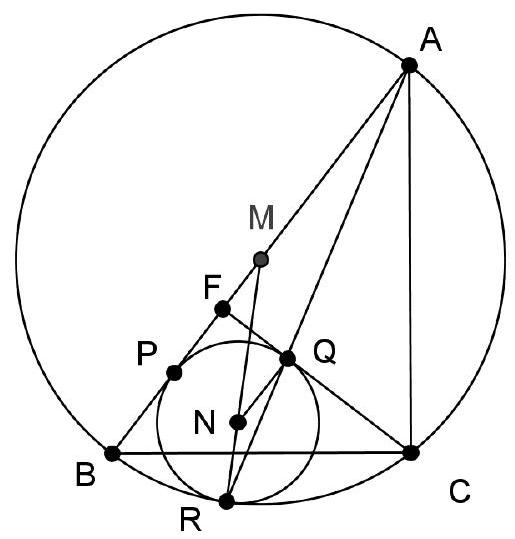
|
| 155 |
+
|
| 156 |
+
Solution. Let $M$ be the midpoint of $A B$ and let $N$ be the center of $\omega$. Then $M$ is the circumcenter of triangle $A B C$, so points $M, N$ and $R$ are collinear. From $Q N \| A M$ we get $\angle A M R=\angle Q N R$. Besides that, triangles $A M R$ and $Q N R$ are isosceles, therefore $\angle M R A=\angle N R Q$; thus points $A, Q, R$ are collinear.
|
| 157 |
+
|
| 158 |
+
Right angled triangles $A F Q$ and $A R B$ are similar, which implies $\frac{A Q}{A B}=\frac{A F}{A R}$, that is $A Q \cdot A R=A F \cdot A B$. The power of point $A$ with respect to $\omega$ gives $A Q \cdot A R=A P^{2}$. Also, from similar triangles $A B C$ and $A C F$ we get $A F \cdot A B=$ $A C^{2}$. Now, the claim follows from $A C^{2}=A F \cdot A B=A Q \cdot A R=A P^{2}$.
|
| 159 |
+
|
| 160 |
+
Problem G2. Consider a triangle $A B C$ and let $M$ be the midpoint of the side $B C$. Suppose $\angle M A C=\angle A B C$ and $\angle B A M=105^{\circ}$. Find the measure of $\angle A B C$.
|
| 161 |
+
|
| 162 |
+
Solution. The angle measure is $30^{\circ}$.
|
| 163 |
+
|
| 164 |
+
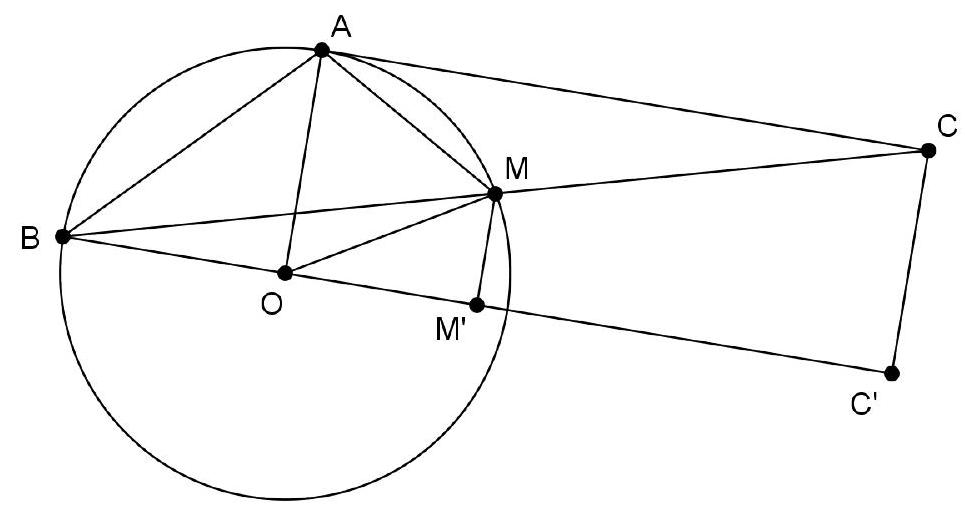
|
| 165 |
+
|
| 166 |
+
Let $O$ be the circumcenter of the triangle $A B M$. From $\angle B A M=105^{\circ}$ follows $\angle M B O=15^{\circ}$. Let $M^{\prime}, C^{\prime}$ be the projections of points $M, C$ onto the line $B O$. Since $\angle M B O=15^{\circ}$, then $\angle M O M^{\prime}=30^{\circ}$ and consequently $M M^{\prime}=\frac{M O}{2}$. On the other hand, $M M^{\prime}$ joins the midpoints of two sides of the triangle $B C C^{\prime}$, which implies $C C^{\prime}=M O=A O$.
|
| 167 |
+
|
| 168 |
+
The relation $\angle M A C=\angle A B C$ implies $C A$ tangent to $\omega$, hence $A O \perp A C$. It follows that $\triangle A C O \equiv \triangle O C C^{\prime}$, and furthermore $O B \| A C$.
|
| 169 |
+
|
| 170 |
+
Therefore $\angle A O M=\angle A O M^{\prime}-\angle M O M^{\prime}=90^{\circ}-30^{\circ}=60^{\circ}$ and $\angle A B M=$ $\frac{\angle A O M}{2}=30^{\circ}$.
|
| 171 |
+
|
| 172 |
+
Problem G3. Let $A B C$ be an acute-angled triangle. A circle $\omega_{1}\left(O_{1}, R_{1}\right)$ passes through points $B$ and $C$ and meets the sides $A B$ and $A C$ at points $D$ and $E$, respectively. Let $\omega_{2}\left(O_{2}, R_{2}\right)$ be the circumcircle of the triangle $A D E$. Prove that $O_{1} O_{2}$ is equal to the circumradius of the triangle $A B C$.
|
| 173 |
+
|
| 174 |
+
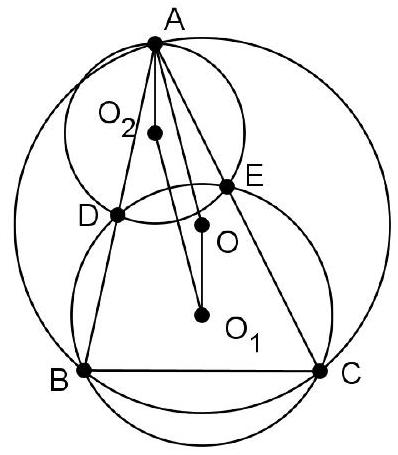
|
| 175 |
+
|
| 176 |
+
Solution. Recall that, in every triangle, the altitude and the diameter of the circumcircle drawn from the same vertex are isogonal. The proof offers no difficulty, being a simple angle chasing around the circumcircle of the triangle.
|
| 177 |
+
|
| 178 |
+
Let $O$ be the circumcenter of the triangle $A B C$. From the above, one has $\angle O A E=90^{\circ}-B$. On the other hand $\angle D E A=B$, for $B C D E$ is cyclic. Thus $A O \perp D E$, implying that in the triangle $A D E$ cevians $A O$ and $A O_{2}$ are isogonal. So, since $A O$ is a radius of the circumcircle of triangle $A B C$, one obtains that $A O_{2}$ is an altitude in this triangle.
|
| 179 |
+
|
| 180 |
+
Moreover, since $O O_{1}$ is the perpendicular bisector of the line segment $B C$, one has $O O_{1} \perp B C$, and furthermore $A O_{2} \| O O_{1}$.
|
| 181 |
+
|
| 182 |
+
Chord $D E$ is common to $\omega_{1}$ and $\omega_{2}$, hence $O_{1} O_{2} \perp D E$. It follows that $A O \|$ $O_{1} O_{2}$, so $A O O_{1} O_{2}$ is a parallelogram. The conclusion is now obvious.
|
| 183 |
+
|
| 184 |
+
Problem G4. Let $A L$ and $B K$ be angle bisectors in the non-isosceles triangle $A B C(L \in B C, K \in A C)$. The perpendicular bisector of $B K$ intersects the line $A L$ at point $M$. Point $N$ lies on the line $B K$ such that $L N \| M K$. Prove that $L N=N A$.
|
| 185 |
+
|
| 186 |
+
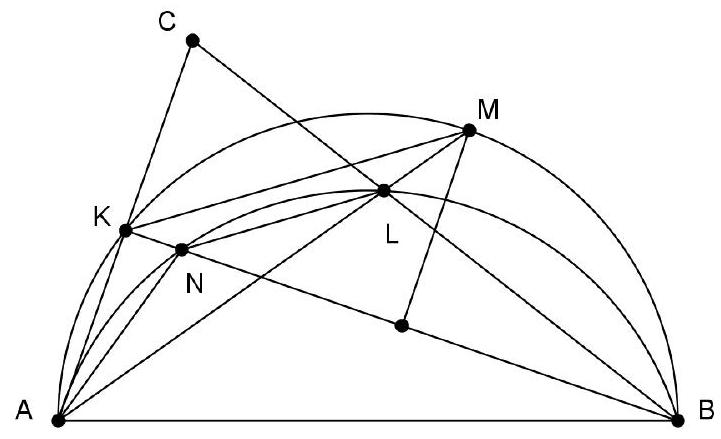
|
| 187 |
+
|
| 188 |
+
Solution. The point $M$ lies on the circumcircle of $\triangle A B K$ (since both $A L$ and the perpendicular bisector of $B K$ bisect the arc $B K$ of this circle). Then $\angle C B K=\angle A B K=\angle A M K=\angle N L A$. Thus $A B L N$ is cyclic, whence $\angle N A L=$ $\angle N B L=\angle C B K=\angle N L A$. Now it follows that $L N=N A$.
|
| 189 |
+
|
| 190 |
+
## Combinatorics
|
| 191 |
+
|
| 192 |
+
Problem C1. There are two piles of coins, each containing 2010 pieces. Two players A and B play a game taking turns (A plays first). At each turn, the player on play has to take one or more coins from one pile or exactly one coin from each pile. Whoever takes the last coin is the winner. Which player will win if they both play in the best possible way?
|
| 193 |
+
|
| 194 |
+
Solution. B wins.
|
| 195 |
+
|
| 196 |
+
In fact, we will show that A will lose if the total number of coins is a multiple of 3 and the two piles differ by not more than one coin (call this a balanced position). To this end, firstly notice that it is not possible to move from one balanced position to another. The winning strategy for B consists in returning A to a balanced position (notice that the initial position is a balanced position).
|
| 197 |
+
|
| 198 |
+
There are two types of balanced positions; for each of them consider the moves of $\mathrm{A}$ and the replies of B.
|
| 199 |
+
|
| 200 |
+
If the number in each pile is a multiple of 3 and there is at least one coin:
|
| 201 |
+
|
| 202 |
+
- if A takes $3 n$ coins from one pile, then $\mathrm{B}$ takes $3 n$ coins from the other one.
|
| 203 |
+
- if A takes $3 n+1$ coins from one pile, then $\mathrm{B}$ takes $3 n+2$ coins from the other one.
|
| 204 |
+
- if A takes $3 n+2$ coins from one pile, then $\mathrm{B}$ takes $3 n+1$ coins from the other one.
|
| 205 |
+
- if A takes a coin from each pile, then $\mathrm{B}$ takes one coin from one pile.
|
| 206 |
+
|
| 207 |
+
If the numbers are not multiples of 3 , then we have $3 m+1$ coins in one pile and $3 m+2$ in the other one. Hence:
|
| 208 |
+
|
| 209 |
+
- if A takes $3 n$ coins from one pile, then $\mathrm{B}$ takes $3 n$ coins from the other one.
|
| 210 |
+
- if A takes $3 n+1$ coins from the first pile $(n \leq m)$, then $\mathrm{B}$ takes $3 n+2$ coins from the second one.
|
| 211 |
+
- if A takes $3 n+2$ coins from the second pile $(n \leq m)$, then $\mathrm{B}$ takes $3 n+1$ coins from the first one.
|
| 212 |
+
- if A takes $3 n+2$ coins from the first pile $(n \leq m-1)$, then $\mathrm{B}$ takes $3 n+4$ coins from the second one.
|
| 213 |
+
- if A takes $3 n+1$ coins from the second pile $(n \leq m)$, then $\mathrm{B}$ takes $3 n-1$ coins from the first one. This is impossible if A has taken only one coin from the second pile; in this case $\mathrm{B}$ takes one coin from each pile.
|
| 214 |
+
- if A takes a coin from each pile, then B takes one coin from the second pile.
|
| 215 |
+
|
| 216 |
+
In all these cases, the position after B's move is again a balanced position. Since the number of coins decreases and $(0 ; 0)$ is a balanced position, after a finite number of moves, there will be no coins left after B's move. Thus, B wins.
|
| 217 |
+
|
| 218 |
+
Problem C2. A $9 \times 7$ rectangle is tiled with pieces of two types, shown in the picture below.
|
| 219 |
+
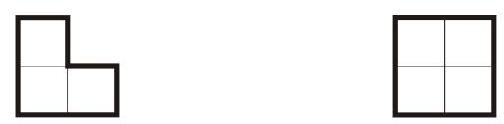
|
| 220 |
+
|
| 221 |
+
Find the possible values of the number of the $2 \times 2$ pieces which can be used in such a tiling.
|
| 222 |
+
|
| 223 |
+
Solution. Answer: 0 or 3.
|
| 224 |
+
|
| 225 |
+
Denote by $x$ the number of the pieces of the type 'corner' and by $y$ the number of the pieces of the type of $2 \times 2$. Mark 20 squares of the rectangle as in the figure below.
|
| 226 |
+
|
| 227 |
+
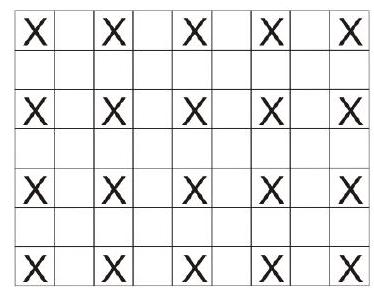
|
| 228 |
+
|
| 229 |
+
Obviously, each piece covers at most one marked square.
|
| 230 |
+
|
| 231 |
+
Thus, $x+y \geq 20$ (1) and consequently $3 x+3 y \geq 60$ (2). On the other hand $3 x+4 y=63$ (3). From (2) and (3) it follows $y \leq 3$ and from (3), $3 \mid y$.
|
| 232 |
+
|
| 233 |
+
The proof is finished if we produce tilings with 3 , respectively $0,2 \times 2$ tiles:
|
| 234 |
+
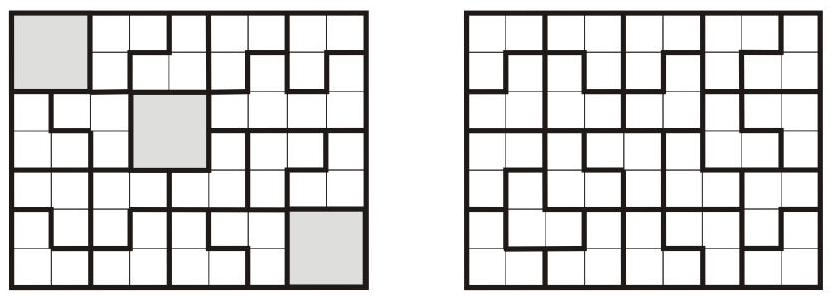
|
| 235 |
+
|
| 236 |
+
## Number Theory
|
| 237 |
+
|
| 238 |
+
Problem N1. Find all positive integers $n$ such that $n 2^{n+1}+1$ is a perfect square.
|
| 239 |
+
|
| 240 |
+
Solution. Answer: $n=0$ and $n=3$.
|
| 241 |
+
|
| 242 |
+
Clearly $n 2^{n+1}+1$ is odd, so, if this number is a perfect square, then $n 2^{n+1}+1=$ $(2 x+1)^{2}, x \in \mathbb{N}$, whence $n 2^{n-1}=x(x+1)$.
|
| 243 |
+
|
| 244 |
+
The integers $x$ and $x+1$ are coprime, so one of them must divisible by $2^{n-1}$, which means that the other must be at most $n$. This shows that $2^{n-1} \leqslant n+1$.
|
| 245 |
+
|
| 246 |
+
An easy induction shows that the above inequality is false for all $n \geqslant 4$, and a direct inspection confirms that the only convenient values in the case $n \leqslant 3$ are 0 and 3 .
|
| 247 |
+
|
| 248 |
+
Problem N2. Find all positive integers $n$ such that $36^{n}-6$ is a product of two or more consecutive positive integers.
|
| 249 |
+
|
| 250 |
+
Solution. Answer: $n=1$.
|
| 251 |
+
|
| 252 |
+
Among each four consecutive integers there is a multiple of 4 . As $36^{n}-6$ is not a multiple of 4 , it must be the product of two or three consecutive positive integers.
|
| 253 |
+
|
| 254 |
+
Case I. If $36^{n}-6=x(x+1)$ (all letters here and below denote positive integers), then $4 \cdot 36^{n}-23=(2 x+1)^{2}$, whence $\left(2 \cdot 6^{n}+2 x+1\right)\left(2 \cdot 6^{n}-2 x-1\right)=23$. As 23 is prime, this leads to $2 \cdot 6^{n}+2 x+1=23,2 \cdot 6^{n}-2 x-1=1$. Subtracting these yields $4 x+2=22, x=5, n=1$, which is a solution to the problem.
|
| 255 |
+
|
| 256 |
+
Case II. If $36^{n}-6=(y-1) y(y+1)$, then
|
| 257 |
+
|
| 258 |
+
$$
|
| 259 |
+
36^{n}=y^{3}-y+6=\left(y^{3}+8\right)-(y+2)=(y+2)\left(y^{2}-2 y+3\right)
|
| 260 |
+
$$
|
| 261 |
+
|
| 262 |
+
Thus each of $y+2$ and $y^{2}-2 y+3$ can have only 2 and 3 as prime factors, so the same is true for their GCD. This, combined with the identity $y^{2}-2 y+3=$ $(y+2)(y-4)+11$ yields $\operatorname{GCD}\left(y+2 ; y^{2}-2 y+3\right)=1$. Now $y+2<y^{2}-2 y+3$ and the latter number is odd, so $y+2=4^{n}, y^{2}-2 y+3=9^{n}$. The former identity implies $y$ is even and now by the latter one $9^{n} \equiv 3(\bmod 4)$, while in fact $9^{n} \equiv 1(\bmod 4)$ - a contradiction. So, in this case there is no such $n$.
|
| 263 |
+
|
JBMO/md/en-shortlist/en-jbmo_2013.md
ADDED
|
@@ -0,0 +1,495 @@
|
|
|
|
|
|
|
|
|
|
|
|
|
|
|
|
|
|
|
|
|
|
|
|
|
|
|
|
|
|
|
|
|
|
|
|
|
|
|
|
|
|
|
|
|
|
|
|
|
|
|
|
|
|
|
|
|
|
|
|
|
|
|
|
|
|
|
|
|
|
|
|
|
|
|
|
|
|
|
|
|
|
|
|
|
|
|
|
|
|
|
|
|
|
|
|
|
|
|
|
|
|
|
|
|
|
|
|
|
|
|
|
|
|
|
|
|
|
|
|
|
|
|
|
|
|
|
|
|
|
|
|
|
|
|
|
|
|
|
|
|
|
|
|
|
|
|
|
|
|
|
|
|
|
|
|
|
|
|
|
|
|
|
|
|
|
|
|
|
|
|
|
|
|
|
|
|
|
|
|
|
|
|
|
|
|
|
|
|
|
|
|
|
|
|
|
|
|
|
|
|
|
|
|
|
|
|
|
|
|
|
|
|
|
|
|
|
|
|
|
|
|
|
|
|
|
|
|
|
|
|
|
|
|
|
|
|
|
|
|
|
|
|
|
|
|
|
|
|
|
|
|
|
|
|
|
|
|
|
|
|
|
|
|
|
|
|
|
|
|
|
|
|
|
|
|
|
|
|
|
|
|
|
|
|
|
|
|
|
|
|
|
|
|
|
|
|
|
|
|
|
|
|
|
|
|
|
|
|
|
|
|
|
|
|
|
|
|
|
|
|
|
|
|
|
|
|
|
|
|
|
|
|
|
|
|
|
|
|
|
|
|
|
|
|
|
|
|
|
|
|
|
|
|
|
|
|
|
|
|
|
|
|
|
|
|
|
|
|
|
|
|
|
|
|
|
|
|
|
|
|
|
|
|
|
|
|
|
|
|
|
|
|
|
|
|
|
|
|
|
|
|
|
|
|
|
|
|
|
|
|
|
|
|
|
|
|
|
|
|
|
|
|
|
|
|
|
|
|
|
|
|
|
|
|
|
|
|
|
|
|
|
|
|
|
|
|
|
|
|
|
|
|
|
|
|
|
|
|
|
|
|
|
|
|
|
|
|
|
|
|
|
|
|
|
|
|
|
|
|
|
|
|
|
|
|
|
|
|
|
|
|
|
|
|
|
|
|
|
|
|
|
|
|
|
|
|
|
|
|
|
|
|
|
|
|
|
|
|
|
|
|
|
|
|
|
|
|
|
|
|
|
|
|
|
|
|
|
|
|
|
|
|
|
|
|
|
|
|
|
|
|
|
|
|
|
|
|
|
|
|
|
|
|
|
|
|
|
|
|
|
|
|
|
|
|
|
|
|
|
|
|
|
|
|
|
|
|
|
|
|
|
|
|
|
|
|
|
|
|
|
|
|
|
|
|
|
|
|
|
|
|
|
|
|
|
|
|
|
|
|
|
|
|
|
|
|
|
|
|
|
|
|
|
|
|
|
|
|
|
|
|
|
|
|
|
|
|
|
|
|
|
|
|
|
|
|
|
|
|
|
|
|
|
|
|
|
|
|
|
|
|
|
|
|
|
|
|
|
|
|
|
|
|
|
|
|
|
|
|
|
|
|
|
|
|
|
|
|
|
|
|
|
|
|
|
|
|
|
|
|
|
|
|
|
|
|
|
|
|
|
|
|
|
|
|
|
|
|
|
|
|
|
|
|
|
|
|
|
|
|
|
|
|
|
|
|
|
|
|
|
|
|
|
|
|
|
|
|
|
|
|
|
|
|
|
|
|
|
|
|
|
|
|
|
|
|
|
|
|
|
|
|
|
|
|
|
|
|
|
|
|
|
|
|
|
|
|
|
|
|
|
|
|
|
|
|
|
|
|
|
|
|
|
|
|
|
|
|
|
|
|
|
|
|
|
|
|
|
|
|
|
|
|
|
|
|
|
|
|
|
|
|
|
|
|
|
|
|
|
|
|
|
|
|
|
|
|
|
|
|
|
|
|
|
|
|
|
|
|
|
|
|
|
|
|
|
|
|
|
|
|
|
|
|
|
|
|
|
|
|
|
|
|
|
|
|
|
|
|
|
|
|
|
|
|
|
|
|
|
|
|
|
|
|
|
|
|
|
|
|
|
|
|
|
|
|
|
|
|
|
|
|
|
|
|
|
|
|
|
|
|
|
|
|
|
|
|
|
|
|
|
|
|
|
|
|
|
|
|
|
|
|
|
|
|
|
|
|
|
|
|
|
|
|
|
|
|
|
|
|
|
|
|
|
|
|
|
|
|
|
|
|
|
|
|
|
|
|
|
|
|
|
|
|
|
|
|
|
|
|
|
|
|
|
|
|
|
|
|
|
|
|
|
|
|
|
|
|
|
|
|
|
|
|
|
|
|
|
|
|
|
|
|
|
|
|
|
|
|
|
|
|
|
|
|
|
|
|
|
|
|
|
|
|
|
|
|
|
|
|
|
|
|
|
|
|
|
|
|
|
|
|
|
|
|
|
|
|
|
|
|
|
|
|
|
|
|
|
|
|
|
|
|
|
|
|
|
|
|
|
|
|
|
|
|
|
|
|
|
|
|
|
|
|
|
|
|
|
|
|
|
|
|
|
|
|
|
|
|
|
|
|
|
|
|
|
|
|
|
|
|
|
|
|
|
|
|
|
|
|
|
|
|
|
|
|
|
|
|
|
|
|
|
|
|
|
|
|
|
|
|
|
|
|
|
|
|
|
|
|
|
|
|
|
|
|
|
|
|
|
|
|
|
|
|
|
|
|
|
|
|
|
|
|
|
|
|
|
|
|
|
|
|
|
|
|
|
|
|
|
|
|
|
|
|
|
|
|
|
|
|
|
|
|
|
|
|
|
|
|
|
|
|
|
|
|
|
|
|
|
|
|
|
|
|
|
|
|
|
|
|
|
|
|
|
|
|
|
|
|
|
|
|
|
|
|
|
|
|
|
|
|
|
|
|
|
|
|
|
|
|
|
|
|
|
|
|
|
|
|
|
|
|
|
|
|
|
|
|
|
|
|
|
|
|
|
|
|
|
|
|
|
|
|
|
|
|
|
|
|
|
|
|
|
|
|
|
|
|
|
|
|
|
|
|
|
|
|
|
|
|
|
|
|
|
|
|
|
|
|
|
|
|
|
|
|
|
|
|
|
|
|
|
|
|
|
|
|
|
|
|
|
|
|
|
|
|
|
|
|
|
|
|
|
|
|
|
|
|
|
|
|
|
|
|
|
|
|
|
|
|
|
|
|
|
|
|
|
|
|
|
|
|
|
|
|
|
|
|
|
|
|
|
|
|
|
|
|
|
|
|
|
|
|
|
|
|
|
|
|
|
|
|
|
|
|
|
|
|
|
|
|
|
|
|
|
|
|
|
|
|
|
|
|
|
|
|
|
| 1 |
+
# CYP 7
|
| 2 |
+
|
| 3 |
+

|
| 4 |
+
|
| 5 |
+
## 17th Junior Balkan Mathematical Olympiad
|
| 6 |
+
|
| 7 |
+
Short-Listed Problems and Solutions
|
| 8 |
+
|
| 9 |
+
The JBMO 2013 Problem Committee thanks the following countries for submitting problem proposals:
|
| 10 |
+
|
| 11 |
+
- Albania
|
| 12 |
+
- Bulgaria
|
| 13 |
+
- Bosnia and Herzegovina
|
| 14 |
+
- Cyprus
|
| 15 |
+
- Greece
|
| 16 |
+
- Indonesia
|
| 17 |
+
- Kazakhstan
|
| 18 |
+
- FYRO Macedonia
|
| 19 |
+
- Philippines
|
| 20 |
+
- Romania
|
| 21 |
+
- Serbia
|
| 22 |
+
|
| 23 |
+
The Members of the Problem Committee:
|
| 24 |
+
|
| 25 |
+
Okan Tekman
|
| 26 |
+
|
| 27 |
+
Selim Bahadır
|
| 28 |
+
|
| 29 |
+
Şahin Emrah
|
| 30 |
+
|
| 31 |
+
Fehmi Emre Kadan
|
| 32 |
+
|
| 33 |
+
Fatih Sulak
|
| 34 |
+
|
| 35 |
+
Problems
|
| 36 |
+
|
| 37 |
+
## Algebra
|
| 38 |
+
|
| 39 |
+
HEL A1. Find all ordered triples $(x, y, z)$ of real numbers satisfying the following system of equations:
|
| 40 |
+
|
| 41 |
+
$$
|
| 42 |
+
\begin{aligned}
|
| 43 |
+
x^{3} & =\frac{z}{y}-2 \frac{y}{z} \\
|
| 44 |
+
y^{3} & =\frac{x}{z}-2 \frac{z}{x} \\
|
| 45 |
+
z^{3} & =\frac{y}{x}-2 \frac{x}{y}
|
| 46 |
+
\end{aligned}
|
| 47 |
+
$$
|
| 48 |
+
|
| 49 |
+
INDOMtuA
|
| 50 |
+
|
| 51 |
+
(musin (A2). Find the largest possible value of the expression $\left|\sqrt{x^{2}+4 x+8}-\sqrt{x^{2}+8 x+17}\right|$ where $x$ is a real number.
|
| 52 |
+
|
| 53 |
+
$5 R 8$
|
| 54 |
+
|
| 55 |
+
A3. Show that
|
| 56 |
+
|
| 57 |
+
$$
|
| 58 |
+
\left(a+2 b+\frac{2}{a+1}\right)\left(b+2 a+\frac{2}{b+1}\right) \geq 16
|
| 59 |
+
$$
|
| 60 |
+
|
| 61 |
+
for all positive real numbers $a, b$ satisfying $a b \geq 1$.
|
| 62 |
+
|
| 63 |
+
## Combinatorics
|
| 64 |
+
|
| 65 |
+
$M K D$
|
| 66 |
+
|
| 67 |
+
C1. Find the largest number of distinct integers that can be chosen from the set $\{1,2, \ldots, 2013\}$ so that the difference of no two of them is equal to 17 .
|
| 68 |
+
|
| 69 |
+
## BIH
|
| 70 |
+
|
| 71 |
+
(usin C2. On a billiards table in the shape of a rectangle $A B C D$ with $A B=2013$ and $A D=$ 1000 , a billiard ball is shot along the bisector of the angle $\angle B A D$. Assuming that the ball is reflected from the sides at the same angle it comes in, determine whether it will ever go to the corner $B$.
|
| 72 |
+
|
| 73 |
+
$\gamma$ in B6R
|
| 74 |
+
|
| 75 |
+
$\gamma u r^{4}$ C3. All possible pairs of $n$ apples are weighed and the results are given to us in an arbitrary order. Can we determine the weights of the apples if a. $n=4$, b. $n=5$, c. $n=6$ ?
|
| 76 |
+
|
| 77 |
+
## Geometry
|
| 78 |
+
|
| 79 |
+
A. 8
|
| 80 |
+
|
| 81 |
+
G1. Let $A B$ be a diameter of a circle $\omega$ with center $O$ and $O C$ be a radius of $\omega$ which is perpendicular to $A B$. Let $M$ be a point on the line segment $O C$. Let $N$ be the second point of intersection of the line $A M$ with $\omega$, and let $P$ be the point of intersection of the lines tangent to $\omega$ at $N$ and at $B$. Show that the points $M, O, P, N$ are concyclic.
|
| 82 |
+
|
| 83 |
+
CYP G2). $\omega_{1}$ and $\omega_{2}$ are two circles that are externally tangent to each other at the point $M$ and internally tangent to a circle $\omega_{3}$ at the points $K$ and $L$, respectively. Let $A$ and $B$ be the two points where the common tangent line at $M$ to $\omega_{1}$ and $\omega_{2}$ intersects $\omega_{3}$. Show that if $\angle K A B=\angle L A B$ then the line segment $A B$ is a diameter of $\omega_{3}$.
|
| 84 |
+
|
| 85 |
+
MkD G3. Let $D$ be a point on the side $B C$ of an acute triangle $A B C$ such that $\angle B A D=\angle C A O$ where $O$ is the center of the circumcircle $\omega$ of the triangle $A B C$. Let $E$ be the second point of intersection of $\omega$ and the line $A D$. Let $M, N, P$ be the midpoints of the line segments $B E, O D, A C$, respectively. Show that $M, N, P$ are collinear.
|
| 86 |
+
|
| 87 |
+
BIA G4. Let $I$ be the incenter and $A B$ the shortest side of a triangle $A B C$. The circle with center $I$ and passing through $C$ intersects the ray $A B$ at the point $P$ and the ray $B A$ at the point $Q$. Let $D$ be the point where the excircle of the triangle $A B C$ belonging to angle $A$ touches the side $B C$, and let $E$ be the symmetric of the point $C$ with respect to $D$. Show that the lines $P E$ and $C Q$ are perpendicular.
|
| 88 |
+
|
| 89 |
+
B6R G5. A circle passing through the midpoint $M$ of the side $B C$ and the vertex $A$ of a triangle $A B C$ intersects the sides $A B$ and $A C$ for the second time at the points $P$ and $Q$, respectively. Show that if $\angle B A C=60^{\circ}$ then
|
| 90 |
+
|
| 91 |
+
$$
|
| 92 |
+
A P+A Q+P Q<A B+A C+\frac{1}{2} B C
|
| 93 |
+
$$
|
| 94 |
+
|
| 95 |
+
G6 Let $P$ and $Q$ be the midpoints of the sides $B C$ and $C D$, respectively, of a rectangle $A B C D$. Let $K$ and $M$ be the points of intersection of the line $P D$ with $Q B$ and $Q A$, respectively, and let $N$ be the point of intersection of the lines $P A$ and $Q B$.
|
| 96 |
+
|
| 97 |
+
Let $X, Y, Z$ be the midpoints of the line segments $A N, K N, A M$, respectively. Let $\ell_{1}$ be the line passing through $X$ and perpendicular to $M K, \ell_{2}$ be the line passing through $Y$ and perpendicular to $A M, \ell_{3}$ be the line passing through $Z$ and perpendicular to $K N$. Show that $\ell_{1}, \ell_{2}, \ell_{3}$ are concurrent.
|
| 98 |
+
|
| 99 |
+
## Number Theory
|
| 100 |
+
|
| 101 |
+
$+18$
|
| 102 |
+
|
| 103 |
+
$\mathbf{N} 1$. Find all positive integers $n$ for which $1^{3}+2^{3}+\cdots+16^{3}+17^{n}$ is a perfect square.
|
| 104 |
+
|
| 105 |
+

|
| 106 |
+
|
| 107 |
+
N2 . Find all ordered triples $(x, y, z)$ of integers satisfying $20^{x}+13^{y}=2013^{z}$.
|
| 108 |
+
|
| 109 |
+
## $5 R B$
|
| 110 |
+
|
| 111 |
+
N3. Find all ordered pairs $(a, b)$ of positive integers for which the numbers $\frac{a^{3} b-1}{a+1}$ and $\frac{b^{3} a+1}{b-1}$ are positive integers.
|
| 112 |
+
|
| 113 |
+
## Rov
|
| 114 |
+
|
| 115 |
+
$\mathbf{N 4}$. A rectangle in the $x y$-plane is called latticed if all its vertices have integer coordinates.
|
| 116 |
+
|
| 117 |
+
a. Find a latticed rectangle with area 2013 whose sides are not parallel to the axes.
|
| 118 |
+
|
| 119 |
+
b. Show that if a latticed rectangle has area 2011, then its sides are parallel to the axes.
|
| 120 |
+
|
| 121 |
+
HGL
|
| 122 |
+
|
| 123 |
+
N5. Find all ordered triples $(x, y, z)$ of positive integers satisfying the equation
|
| 124 |
+
|
| 125 |
+
$$
|
| 126 |
+
\frac{1}{x^{2}}+\frac{y}{x z}+\frac{1}{z^{2}}=\frac{1}{2013}
|
| 127 |
+
$$
|
| 128 |
+
|
| 129 |
+
PII
|
| 130 |
+
|
| 131 |
+
N6. Find all ordered triples $(x, y, z)$ of integers satisfying the following system of equations:
|
| 132 |
+
|
| 133 |
+
$$
|
| 134 |
+
\begin{aligned}
|
| 135 |
+
x^{2}-y^{2} & =z \\
|
| 136 |
+
3 x y+(x-y) z & =z^{2}
|
| 137 |
+
\end{aligned}
|
| 138 |
+
$$
|
| 139 |
+
|
| 140 |
+
## Solutions
|
| 141 |
+
|
| 142 |
+
A1. Find all ordered triples $(x, y, z)$ of real numbers satisfying the following system of equations:
|
| 143 |
+
|
| 144 |
+
$$
|
| 145 |
+
\begin{aligned}
|
| 146 |
+
x^{3} & =\frac{z}{y}-2 \frac{y}{z} \\
|
| 147 |
+
y^{3} & =\frac{x}{z}-2 \frac{z}{x} \\
|
| 148 |
+
z^{3} & =\frac{y}{x}-2 \frac{x}{y}
|
| 149 |
+
\end{aligned}
|
| 150 |
+
$$
|
| 151 |
+
|
| 152 |
+
Solution. We have
|
| 153 |
+
|
| 154 |
+
$$
|
| 155 |
+
\begin{aligned}
|
| 156 |
+
& x^{3} y z=z^{2}-2 y^{2} \\
|
| 157 |
+
& y^{3} z x=x^{2}-2 z^{2} \\
|
| 158 |
+
& z^{3} x y=y^{2}-2 x^{2}
|
| 159 |
+
\end{aligned}
|
| 160 |
+
$$
|
| 161 |
+
|
| 162 |
+
with $x y z \neq 0$.
|
| 163 |
+
|
| 164 |
+
Adding these up we obtain $\left(x^{2}+y^{2}+z^{2}\right)(x y z+1)=0$. Hence $x y z=-1$. Now the system of equations becomes:
|
| 165 |
+
|
| 166 |
+
$$
|
| 167 |
+
\begin{aligned}
|
| 168 |
+
& x^{2}=2 y^{2}-z^{2} \\
|
| 169 |
+
& y^{2}=2 z^{2}-x^{2} \\
|
| 170 |
+
& z^{2}=2 x^{2}-y^{2}
|
| 171 |
+
\end{aligned}
|
| 172 |
+
$$
|
| 173 |
+
|
| 174 |
+
Then the first two equations give $x^{2}=y^{2}=z^{2}$. As $x y z=-1$, we conclude that $(x, y, z)=$ $(1,1,-1),(1,-1,1),(-1,1,1)$ and $(-1,-1,-1)$ are the only solutions.
|
| 175 |
+
|
| 176 |
+
A2. Find the largest possible value of the expression $\left|\sqrt{x^{2}+4 x+8}-\sqrt{x^{2}+8 x+17}\right|$ where $x$ is a real number.
|
| 177 |
+
|
| 178 |
+
Solution. We observe that
|
| 179 |
+
|
| 180 |
+
$$
|
| 181 |
+
\left|\sqrt{x^{2}+4 x+8}-\sqrt{x^{2}+8 x+17}\right|=\left|\sqrt{(x-(-2))^{2}+(0-2)^{2}}-\sqrt{\left.(x-(-4))^{2}+(0-1)^{2}\right)}\right|
|
| 182 |
+
$$
|
| 183 |
+
|
| 184 |
+
is the absolute difference of the distances from the point $P(x, 0)$ in the $x y$-plane to the points $A(-2,2)$ and $B(-4,1)$.
|
| 185 |
+
|
| 186 |
+
By the Triangle Inequality, $|P A-P B| \leq|A B|$ and the equality occurs exactly when $P$ lies on the line passing through $A$ and $B$, but not between them.
|
| 187 |
+
|
| 188 |
+
If $P, A, B$ are collinear, then $(x-(-2)) /(0-2)=((-4)-(-2)) /(1-2)$. This gives $x=-6$, and as $-6<-4<-2$,
|
| 189 |
+
|
| 190 |
+
$$
|
| 191 |
+
\left|\sqrt{(-6)^{2}+4(-6)+8}-\sqrt{(-6)^{2}+8(-6)+17}\right|=|\sqrt{20}-\sqrt{5}|=\sqrt{5}
|
| 192 |
+
$$
|
| 193 |
+
|
| 194 |
+
is the largest possible value of the expression.
|
| 195 |
+
|
| 196 |
+
A3. Show that
|
| 197 |
+
|
| 198 |
+
$$
|
| 199 |
+
\left(a+2 b+\frac{2}{a+1}\right)\left(b+2 a+\frac{2}{b+1}\right) \geq 16
|
| 200 |
+
$$
|
| 201 |
+
|
| 202 |
+
for all positive real numbers $a, b$ satisfying $a b \geq 1$.
|
| 203 |
+
|
| 204 |
+
Solution 1. By the AM-GM Inequality we have:
|
| 205 |
+
|
| 206 |
+
$$
|
| 207 |
+
\frac{a+1}{2}+\frac{2}{a+1} \geq 2
|
| 208 |
+
$$
|
| 209 |
+
|
| 210 |
+
Therefore
|
| 211 |
+
|
| 212 |
+
$$
|
| 213 |
+
a+2 b+\frac{2}{a+1} \geq \frac{a+3}{2}+2 b
|
| 214 |
+
$$
|
| 215 |
+
|
| 216 |
+
and, similarly,
|
| 217 |
+
|
| 218 |
+
$$
|
| 219 |
+
b+2 a+\frac{2}{b+1} \geq 2 a+\frac{b+3}{2}
|
| 220 |
+
$$
|
| 221 |
+
|
| 222 |
+
On the other hand,
|
| 223 |
+
|
| 224 |
+
$$
|
| 225 |
+
(a+4 b+3)(b+4 a+3) \geq(\sqrt{a b}+4 \sqrt{a b}+3)^{2} \geq 64
|
| 226 |
+
$$
|
| 227 |
+
|
| 228 |
+
by the Cauchy-Schwarz Inequality as $a b \geq 1$, and we are done.
|
| 229 |
+
|
| 230 |
+
Solution 2. Since $a b \geq 1$, we have $a+b \geq a+1 / a \geq 2 \sqrt{a \cdot(1 / a)}=2$.
|
| 231 |
+
|
| 232 |
+
Then
|
| 233 |
+
|
| 234 |
+
$$
|
| 235 |
+
\begin{aligned}
|
| 236 |
+
a+2 b+\frac{2}{a+1} & =b+(a+b)+\frac{2}{a+1} \\
|
| 237 |
+
& \geq b+2+\frac{2}{a+1} \\
|
| 238 |
+
& =\frac{b+1}{2}+\frac{b+1}{2}+1+\frac{2}{a+1} \\
|
| 239 |
+
& \geq 4 \sqrt[4]{\frac{(b+1)^{2}}{2(a+1)}}
|
| 240 |
+
\end{aligned}
|
| 241 |
+
$$
|
| 242 |
+
|
| 243 |
+
by the AM-GM Inequality. Similarly,
|
| 244 |
+
|
| 245 |
+
$$
|
| 246 |
+
b+2 a+\frac{2}{b+1} \geq 4 \sqrt[4]{\frac{(a+1)^{2}}{2(b+1)}}
|
| 247 |
+
$$
|
| 248 |
+
|
| 249 |
+
Now using these and applying the AM-GM Inequality another time we obtain:
|
| 250 |
+
|
| 251 |
+
$$
|
| 252 |
+
\begin{aligned}
|
| 253 |
+
\left(a+2 b+\frac{2}{a+1}\right)\left(b+2 a+\frac{2}{b+1}\right) & \geq 16 \sqrt[4]{\frac{(a+1)(b+1)}{4}} \\
|
| 254 |
+
& \geq 16 \sqrt[4]{\frac{(2 \sqrt{a})(2 \sqrt{b})}{4}} \\
|
| 255 |
+
& =16 \sqrt[8]{a b} \\
|
| 256 |
+
& \geq 16
|
| 257 |
+
\end{aligned}
|
| 258 |
+
$$
|
| 259 |
+
|
| 260 |
+
Solution 3. We have
|
| 261 |
+
|
| 262 |
+
$$
|
| 263 |
+
\begin{aligned}
|
| 264 |
+
\left(a+2 b+\frac{2}{a+1}\right)\left(b+2 a+\frac{2}{b+1}\right) & =\left((a+b)+b+\frac{2}{a+1}\right)\left((a+b)+a+\frac{2}{b+1}\right) \\
|
| 265 |
+
& \geq\left(a+b+\sqrt{a b}+\frac{2}{\sqrt{(a+1)(b+1)}}\right)^{2}
|
| 266 |
+
\end{aligned}
|
| 267 |
+
$$
|
| 268 |
+
|
| 269 |
+
by the Cauchy-Schwarz Inequality.
|
| 270 |
+
|
| 271 |
+
On the other hand,
|
| 272 |
+
|
| 273 |
+
$$
|
| 274 |
+
\frac{2}{\sqrt{(a+1)(b+1)}} \geq \frac{4}{a+b+2}
|
| 275 |
+
$$
|
| 276 |
+
|
| 277 |
+
by the AM-GM Inequality and
|
| 278 |
+
|
| 279 |
+
$$
|
| 280 |
+
a+b+\sqrt{a b}+\frac{2}{\sqrt{(a+1)(b+1)}} \geq a+b+1+\frac{4}{a+b+2}=\frac{(a+b+1)(a+b-2)}{a+b+2}+4 \geq 4
|
| 281 |
+
$$
|
| 282 |
+
|
| 283 |
+
as $a+b \geq 2 \sqrt{a b} \geq 2$, finishing the proof.
|
| 284 |
+
|
| 285 |
+
Q1. Find the largest number of distinct integers that can be chosen from the set $\{1,2, \ldots, 2013\}$ so that the difference of no two of them is equal to 17 .
|
| 286 |
+
|
| 287 |
+
Solution. Consider the sets $A_{m n}=\{34 m+n-34,34 m+n-17\}$ for $1 \leq m \leq 59$ and $1 \leq n \leq 17$, and $B_{k}=\{2006+k\}$ for $1 \leq k \leq 7$. As we cannot choose more than one number from each of these sets, we can choose at most $59 \cdot 17+7=1010$ numbers. On the other hand, choosing the smaller element of each of these sets gives exactly 1010 numbers satisfying the condition.
|
| 288 |
+
|
| 289 |
+
Comment. The original problem proposal asks the question with the numbers 55 and 5 .
|
| 290 |
+
|
| 291 |
+
Q2. On a billiards table in the shape of a rectangle $A B C D$ with $A B=2013$ and $A D=$ 1000 , a billiard ball is shot along the bisector of the angle $\angle B A D$. Assuming that the ball is reflected from the sides at the same angle it comes in, determine whether it will ever go to the corner $B$.
|
| 292 |
+
|
| 293 |
+
Solution 1. The ball travels a horizontal distance of 1000 units between two bounces from the sides $A B$ and $C D$ as it always moves on a line making a $45^{\circ}$ angle with the sides. Hence it is always at a distance of even number of units to the line $A D$ when it hits $A B$ or $C D$. Hence it can never hit $A B$ at $B$.
|
| 294 |
+
|
| 295 |
+
Solution 2. Consider a rectangle $A^{\prime} B^{\prime} C^{\prime} D^{\prime}$ which is wider $1 / 2$ units on all sides, divide it into unit squares, and color them black and white alternatingly with the vertex $A$ being the center of a black unit square. Then the ball always moves along the diagonals of the black unit squares. As $B$ lies at the center of a white unit square, the ball never reaches $B$.
|
| 296 |
+
|
| 297 |
+
Solution 3. The vertical lines $x=2013 m$ and the horizontal lines $y=1000 n$, where $m$ and $n$ are integers, divide the $x y$-plane into rectangles congruent to the rectangle $A B C D$. Let $A(0,0), B(2013,0), C(2013,1000), D(0,1000)$, and identify the other rectangles with $A B C D$ via reflections across these lines. Under this identification, the ball moves along the line $y=x$ and the coordinates of the points identified with $B$ have the form $(2013 k, 1000 l)$ where $k$ is an odd integer and $l$ is an even one. Hence the ball never goes to $B$.
|
| 298 |
+
|
| 299 |
+
C3. All possible pairs of $n$ apples are weighed and the results are given to us in an arbitrary order. Can we determine the weights of the apples if a. $n=4$, b. $n=5$, c. $n=6$ ?
|
| 300 |
+
|
| 301 |
+
Solution. a. No. Four apples with weights $1,5,7,9$ and with weights $2,4,6,10$ both give the results $6,8,10,12,14,16$ when weighed in pairs.
|
| 302 |
+
|
| 303 |
+
b. Yes. Let $a \leq b \leq c \leq d \leq e$ be the weights of the apples. As each apple is weighed 4 times, by adding all 10 pairwise weights and dividing the sum by 4 , we obtain $a+b+c+d+e$. Subtracting the smallest and the largest pairwise weights $a+b$ and $d+e$ from this we obtain c. Subtracting $c$ from the second largest pairwise weight $c+e$ we obtain $e$. Subtracting $e$ from the largest pairwise weight $d+e$ we obtain $d$. $a$ and $b$ are similarly determined.
|
| 304 |
+
|
| 305 |
+
c. Yes. Let $a \leq b \leq c \leq d \leq e \leq f$ be the weights of the apples. As each apple is weighed 5 times, by adding all 15 pairwise weights and dividing the sum by 5 , we obtain $a+b+c+d+e+f$. Subtracting the smallest and the largest pairwise weights $a+b$ and $e+f$ from this we obtain $c+d$.
|
| 306 |
+
|
| 307 |
+
Subtracting the smallest and the second largest pairwise weights $a+b$ and $d+f$ from $a+b+c+d+e+f$ we obtain $c+e$. Similarly we obtain $b+d$. We use these to obtain $a+f$ and $b+e$.
|
| 308 |
+
|
| 309 |
+
Now $a+d, a+e, b+c$ are the three smallest among the remaining six pairwise weights. If we add these up, subtract the known weights $c+d$ and $b+e$ form the sum and divide the difference by 2 , we obtain $a$. Then the rest follows.
|
| 310 |
+
|
| 311 |
+
G1. Let $A B$ be a diameter of a circle $\omega$ with center $O$ and $O C$ be a radius of $\omega$ which is perpendicular to $A B$. Let $M$ be a point on the line segment $O C$. Let $N$ be the second point of intersection of the line $A M$ with $\omega$, and let $P$ be the point of intersection of the lines tangent to $\omega$ at $N$ and at $B$. Show that the points $M, O, P, N$ are concyclic.
|
| 312 |
+
|
| 313 |
+
Solution. Since the lines $P N$ and $B P$ are tangent to $\omega, N P=P B$ and $O P$ is the bisector of $\angle N O B$. Therefore the lines $O P$ and $N B$ are perpendicular. Since $\angle A N B=90^{\circ}$, it follows that the lines $A N$ and $O P$ are parallel. As $M O$ and $P B$ are also parallel and $A O=O B$, the triangles $A M O$ and $O P B$ are congruent and $M O=P B$. Hence $M O=N P$. Therefore $M O P N$ is an isosceles trapezoid and therefore cyclic. Hence the points $M, O, P, N$ are concyclic.
|
| 314 |
+
|
| 315 |
+
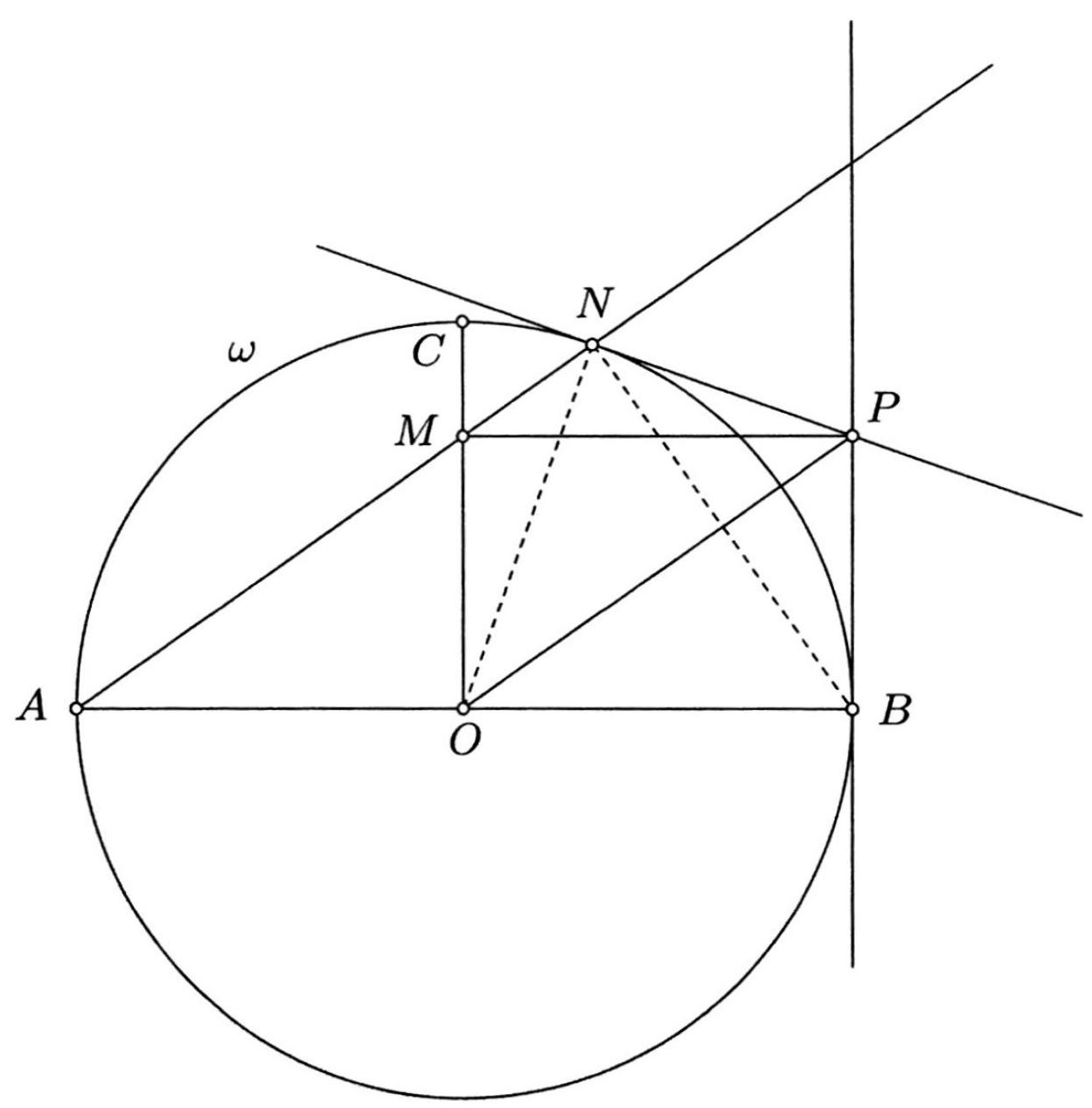
|
| 316 |
+
|
| 317 |
+
8.2. $\omega_{1}$ and $\omega_{2}$ are two circles that are externally tangent to each other at the point $M$ and internally tangent to a circle $\omega_{3}$ at the points $K$ and $L$, respectively. Let $A$ and $B$ be the two points where the common tangent line at $M$ to $\omega_{1}$ and $\omega_{2}$ intersects $\omega_{3}$. Show that if $\angle K A B=\angle L A B$ then the line segment $A B$ is a diameter of $\omega_{3}$.
|
| 318 |
+
|
| 319 |
+
Solution. Let $C$ be the intersection point of the tangent lines to the circles $\omega_{1}$ at $K$ and $\omega_{2}$ at $L$. Point $C$ lies on the radical axis of circles $\omega_{1}$ and $\omega_{3}$, and also on the radical axis of the circles $\omega_{2}$ and $\omega_{3}$. Therefore $C$ lies on the radical axis of the circles $\omega_{1}$ and $\omega_{2}$ too. Therefore the points $A, B, C$ are collinear.
|
| 320 |
+
|
| 321 |
+
Since $\angle K A B=\angle L A B$, the chords $K B$ and $B L$ have the same length. As we also have $C K=C L$, the triangles $K B C$ and $L B C$ are congruent. In particular, $\angle K B A=\angle L B A$. Therefore, $\angle B K A=180^{\circ}-(\angle A B K+\angle B A K)=180^{\circ}-(\angle L B K+\angle L A K) / 2=180^{\circ}-90^{\circ}=$ $90^{\circ}$, and $A B$ is a diameter.
|
| 322 |
+
|
| 323 |
+
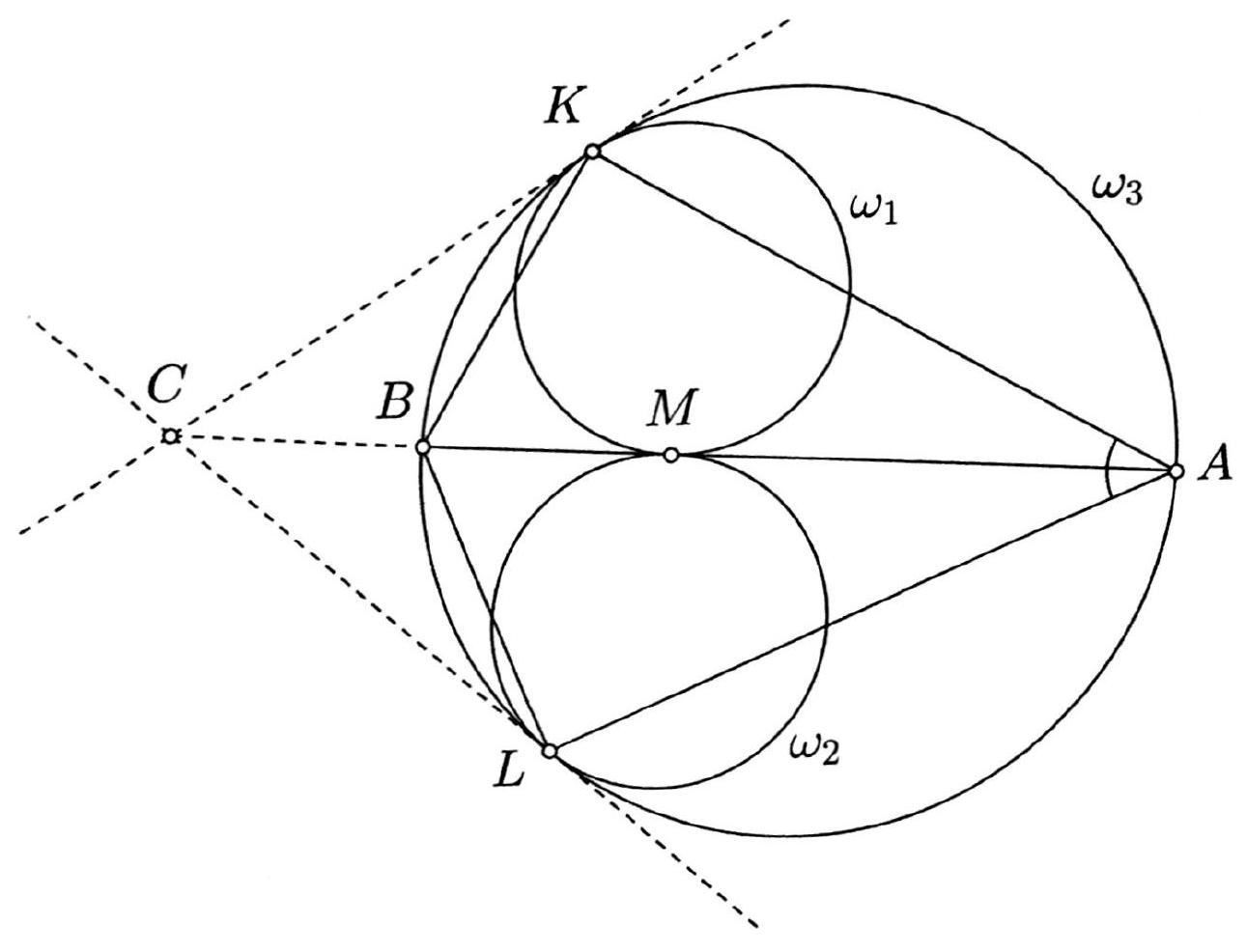
|
| 324 |
+
|
| 325 |
+
Comment. The original problem proposal gives $\angle K A B=\angle L A B=15^{\circ}$ and asks the measures of the angles of the quadrilateral $A K B L$.
|
| 326 |
+
|
| 327 |
+
G3. Let $D$ be a point on the side $B C$ of an acute triangle $A B C$ such that $\angle B A D=\angle C A O$ where $O$ is the center of the circumcircle $\omega$ of the triangle $A B C$. Let $E$ be the second point of intersection of $\omega$ and the line $A D$. Let $M, N, P$ be the midpoints of the line segments $B E, O D, A C$, respectively. Show that $M, N, P$ are collinear.
|
| 328 |
+
|
| 329 |
+
Solution. We will show that $M O P D$ is a parallelogram. From this it follows that $M, N$, $P$ are collinear.
|
| 330 |
+
|
| 331 |
+
Since $\angle B A D=\angle C A O=90^{\circ}-\angle A B C, D$ is the foot of the perpendicular from $A$ to side $B C$. Since $M$ is the midpoint of the line segment $B E$, we have $B M=M E=M D$ and hence $\angle M D E=\angle M E D=\angle A C B$.
|
| 332 |
+
|
| 333 |
+
Let the line $M D$ intersect the line $A C$ at $D_{1}$. Since $\angle A D D_{1}=\angle M D E=\angle A C D, M D$ is perpendicular to $A C$. On the other hand, since $O$ is the center of the circumcircle of triangle $A B C$ and $P$ is the midpoint of the side $A C, O P$ is perpendicular to $A C$. Therefore $M D$ and $O P$ are parallel.
|
| 334 |
+
|
| 335 |
+
Similarly, since $P$ is the midpoint of the side $A C$, we have $A P=P C=D P$ and hence $\angle P D C=\angle A C B$. Let the line $P D$ intersect the line $B E$ at $D_{2}$. Since $\angle B D D_{2}=\angle P D C=$ $\angle A C B=\angle B E D$, we conclude that $P D$ is perpendicular to $B E$. Since $M$ is the midpoint of the line segment $B E, O M$ is perpendicular to $B E$ and hence $O M$ and $P D$ are parallel.
|
| 336 |
+
|
| 337 |
+
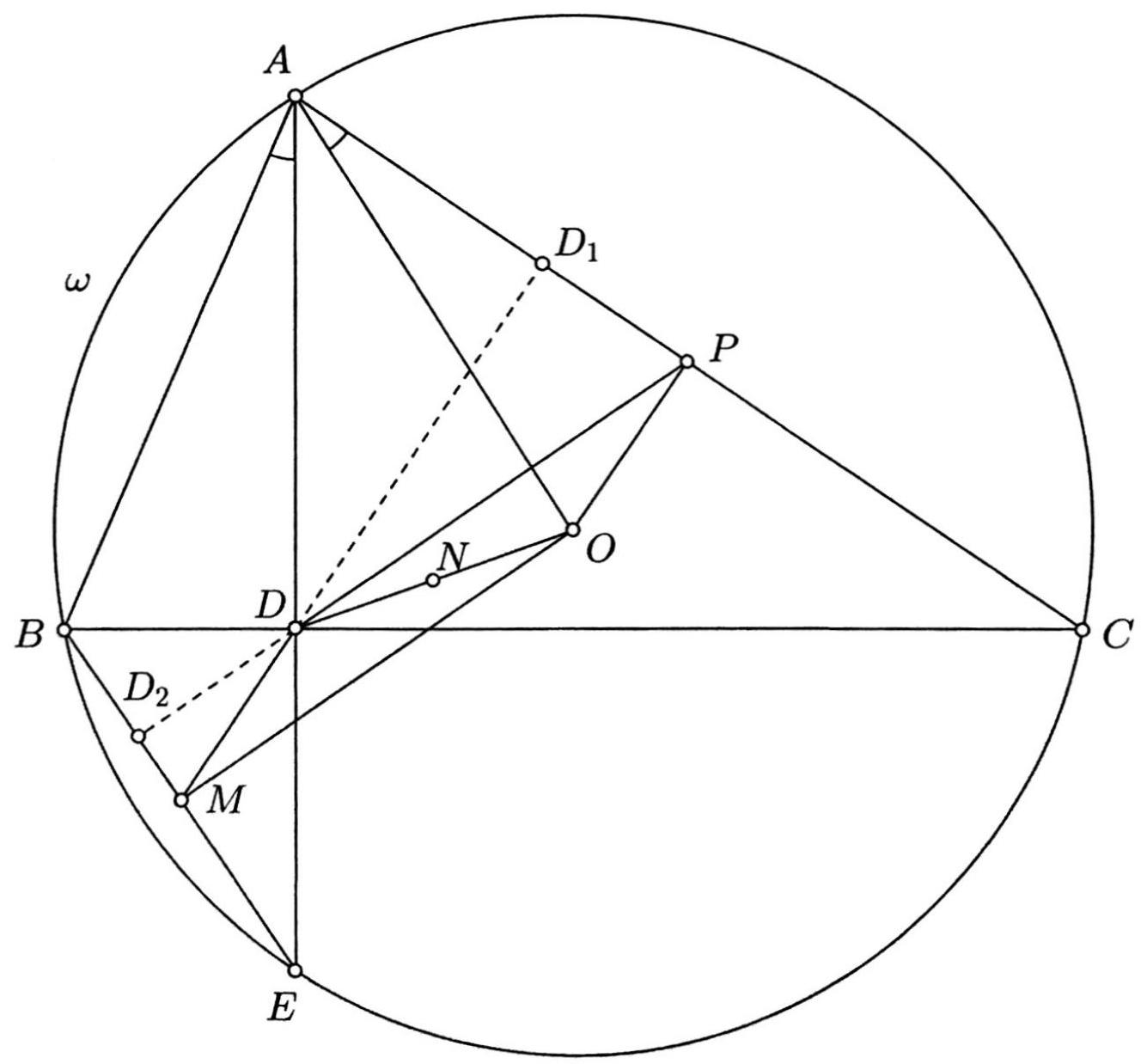
|
| 338 |
+
|
| 339 |
+
G4. Let $I$ be the incenter and $A B$ the shortest side of a triangle $A B C$. The circle with center $I$ and passing through $C$ intersects the ray $A B$ at the point $P$ and the ray $B A$ at the point $Q$. Let $D$ be the point where the excircle of the triangle $A B C$ belonging to angle $A$ touches the side $B C$, and let $E$ be the symmetric of the point $C$ with respect to $D$. Show that the lines $P E$ and $C Q$ are perpendicular.
|
| 340 |
+
|
| 341 |
+
Solution. First we will show that points $P$ and $Q$ are not on the line segment $A B$.
|
| 342 |
+
|
| 343 |
+
Assume that $Q$ is on the line segment $A B$. Since $C I=Q I$ and $\angle I B Q=\angle I B C$, either the triangles $C B I$ and $Q B I$ are congruent or $\angle I C B+\angle I Q B=180^{\circ}$. In the first case, we have $B C=B Q$ which contradicts $A B$ being the shortest side.
|
| 344 |
+
|
| 345 |
+
In the second case, we have $\angle I Q A=\angle I C B=\angle I C A$ and the triangles $I A C$ and $I A Q$ are congruent. Hence this time we have $A C=A Q$, contradicting $A B$ being the shortest side.
|
| 346 |
+
|
| 347 |
+
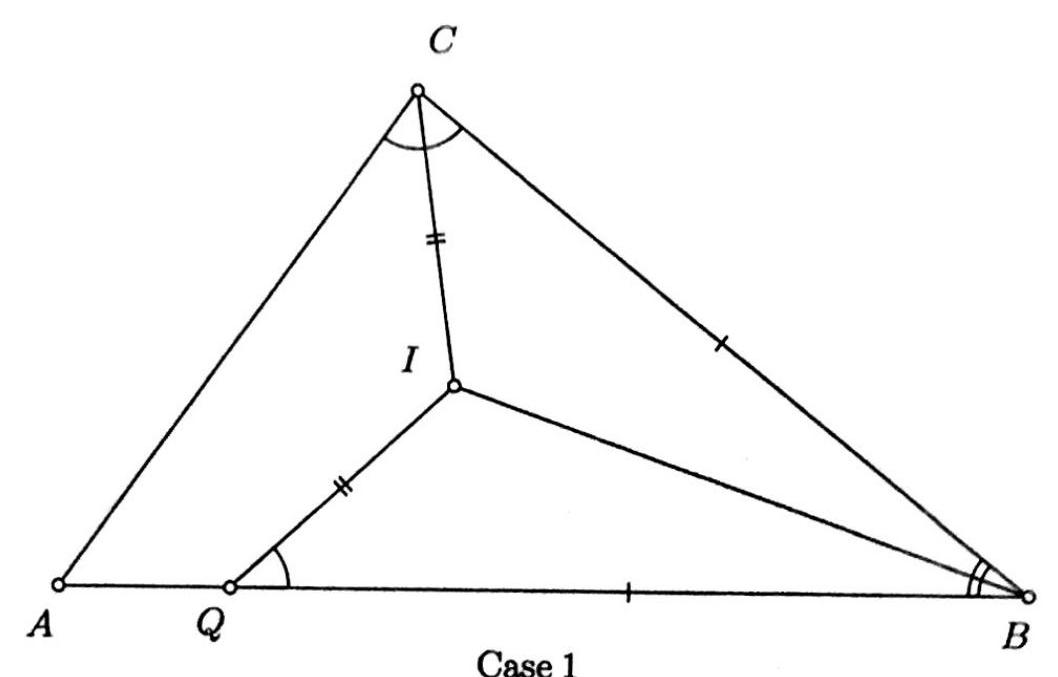
|
| 348 |
+
|
| 349 |
+
Case 1
|
| 350 |
+
|
| 351 |
+
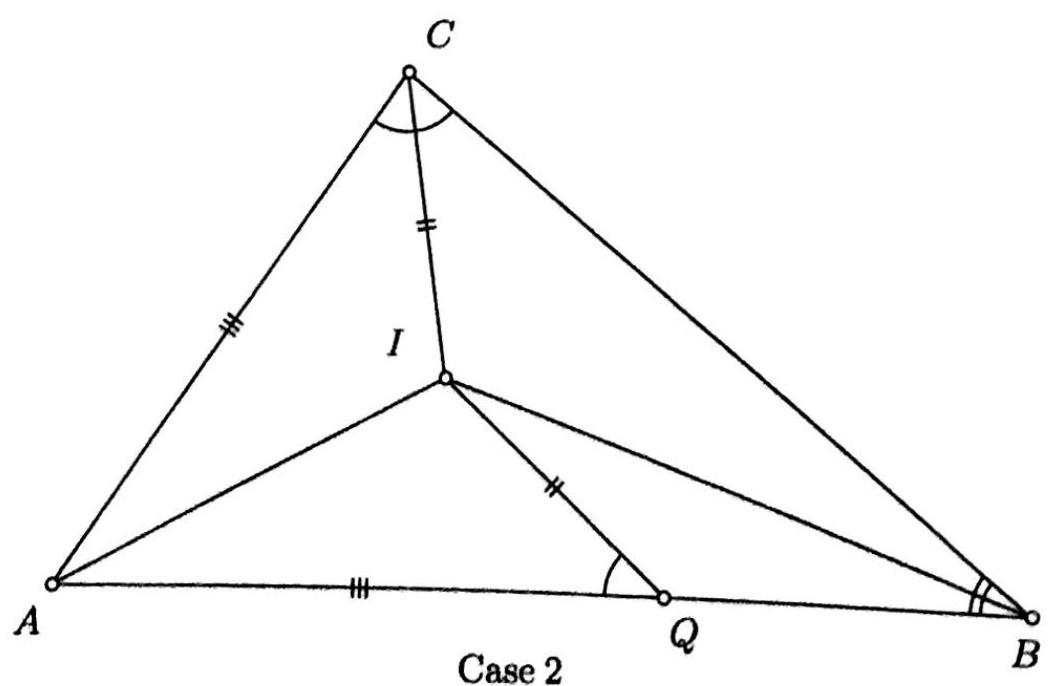
|
| 352 |
+
|
| 353 |
+
Now we will show that the lines $P E$ and $C Q$ are perpendicular.
|
| 354 |
+
|
| 355 |
+
Since $\angle I Q B \leq \angle I A B=(\angle C A B) / 2<90^{\circ}$ and $\angle I C B=(\angle A C B) / 2<90^{\circ}$, the triangles $C B I$ and $Q B I$ are congruent. Hence $B C=B Q$ and $\angle C Q P=\angle C Q B=90^{\circ}-(\angle A B C) / 2$. Similarly, we have $A C=A P$ and hence $B P=A C-A B$.
|
| 356 |
+
|
| 357 |
+
On the other hand, as $D E=C D$ and $C D+A C=u$, where $u$ denotes the semiperimeter of the triangle $A B C$, we have $B E=B C-2(u-A C)=A C-A B$. Therefore $B P=B E$ and $\angle Q P E=(\angle A B C) / 2$.
|
| 358 |
+
|
| 359 |
+
Hence, $\angle C Q P+\angle Q P E=90^{\circ}$.
|
| 360 |
+
|
| 361 |
+
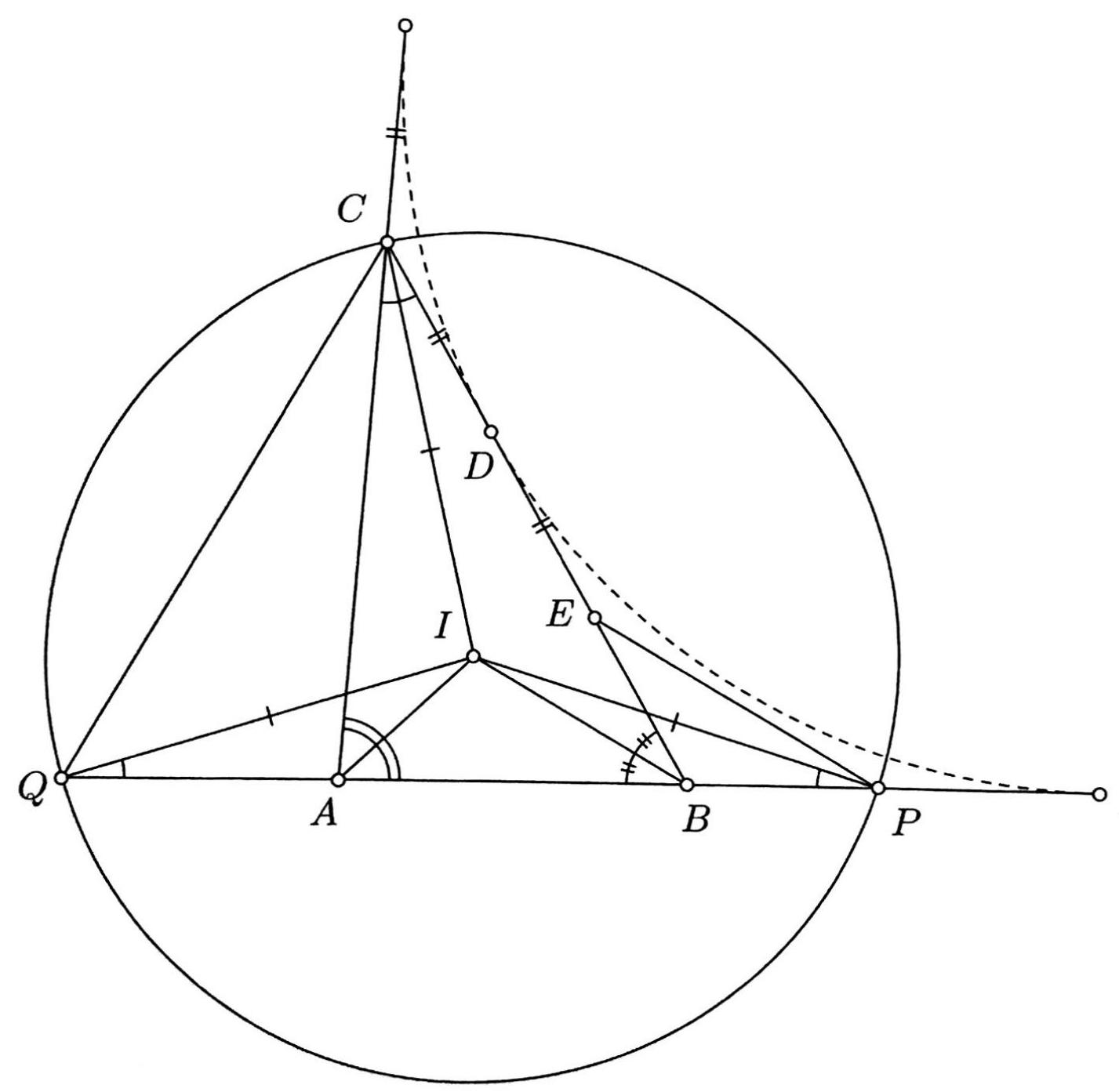
|
| 362 |
+
|
| 363 |
+
G5. A circle passing through the midpoint $M$ of the side $B C$ and the vertex $A$ of a triangle $A B C$ intersects the sides $A B$ and $A C$ for the second time at the points $P$ and $Q$, respectively. Show that if $\angle B A C=60^{\circ}$ then
|
| 364 |
+
|
| 365 |
+
$$
|
| 366 |
+
A P+A Q+P Q<A B+A C+\frac{1}{2} B C
|
| 367 |
+
$$
|
| 368 |
+
|
| 369 |
+
Solution. Since the quadrilateral $A P M Q$ is cyclic, we have $\angle P M Q=180^{\circ}-\angle P A Q=$ $180^{\circ}-\angle B A C=120^{\circ}$. Therefore $\angle P M B+\angle Q M C=180^{\circ}-\angle P M Q=60^{\circ}$.
|
| 370 |
+
|
| 371 |
+
Let the point $B^{\prime}$ be the symmetric of the point $B$ with respect to the line $P M$ and the point $C^{\prime}$ be the symmetric of the point $C$ with respect to the line $Q M$. The triangles $B^{\prime} M P$ and $B M P$ are congruent and the triangles $C^{\prime} M Q$ and $C M Q$ are congruent. Hence $\angle B^{\prime} M C^{\prime}=\angle P M Q-\angle B^{\prime} M P-\angle C^{\prime} M Q=120^{\circ}-\angle B M P-\angle C M Q=120^{\circ}-60^{\circ}=60^{\circ}$. As we also have $B^{\prime} M=B M=C M=C^{\prime} M$, we conclude that the triangle $B^{\prime} M C^{\prime}$ is equilateral and $B^{\prime} C^{\prime}=B C / 2$.
|
| 372 |
+
|
| 373 |
+
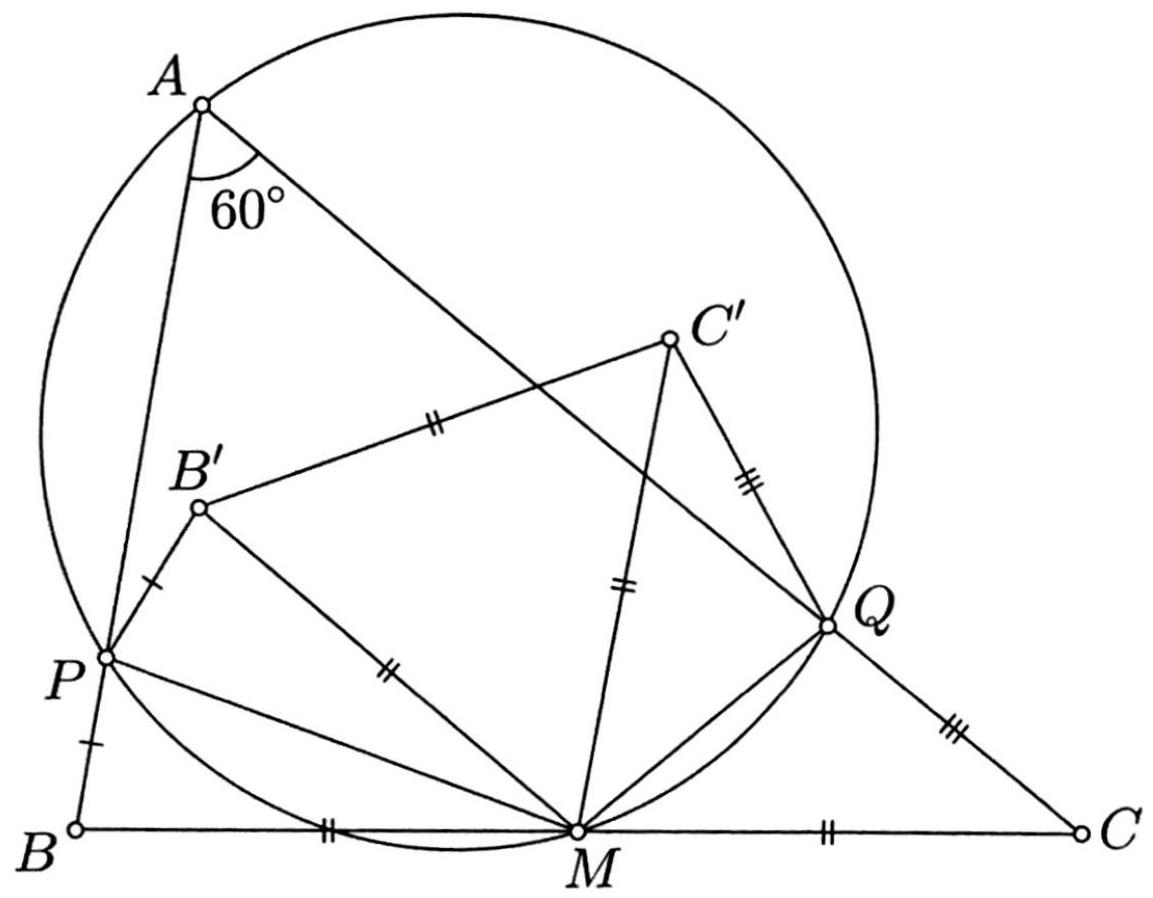
|
| 374 |
+
|
| 375 |
+
On the other hand, we have $P B^{\prime}+B^{\prime} C^{\prime}+C^{\prime} Q \geq P Q$ by the Triangle Inequality, and hence $P B+B C / 2+Q C \geq P Q$. This gives the inequality $A B+B C / 2+A C \geq A P+P Q+A Q$.
|
| 376 |
+
|
| 377 |
+
We get an equality only when the points $B^{\prime}$ and $C^{\prime}$ lie on the line segment $P Q$. If this is the case, then $\angle P Q C+\angle Q P B=2(\angle P Q M+\angle Q P M)=120^{\circ}$ and therefore $\angle A P Q+\angle A Q P=$ $240^{\circ} \neq 120^{\circ}$, a contradiction.
|
| 378 |
+
$A B C D$. Let $K$ and $M$ be the points of intersection of the line $P D$ with $Q B$ and $Q A$, respectively, and let $N$ be the point of intersection of the lines $P A$ and $Q B$.
|
| 379 |
+
|
| 380 |
+
Let $X, Y, Z$ be the midpoints of the line segments $A N, K N, A M$, respectively. Let $\ell_{1}$ be the line passing through $X$ and perpendicular to $M K, \ell_{2}$ be the line passing through $Y$ and perpendicular to $A M, \ell_{3}$ be the line passing through $Z$ and perpendicular to $K N$. Show that $\ell_{1}, \ell_{2}, \ell_{3}$ are concurrent.
|
| 381 |
+
|
| 382 |
+
Solution. Let $R$ be the midpoint of the side $A D$. Then the lines $B R$ and $P D$ are parallel. Since $\angle M A N=\angle Q A P=\angle Q B R=\angle Q K M$, the points $A, N, K, M$ are concyclic.
|
| 383 |
+
|
| 384 |
+

|
| 385 |
+
|
| 386 |
+
Let $\ell_{4}$ be the line passing through the midpoint $W$ of the line segment $M K$ and perpendicular to the line $A N$. Let $E_{1}$ be the point of intersection of $\ell_{1}$ and $\ell_{4}$, and $E_{2}$ be the point of intersection of $\ell_{2}$ and $\ell_{3}$. We will show that the points $E_{1}$ and $E_{2}$ coincide.
|
| 387 |
+
|
| 388 |
+
Let $O$ be the circumcenter of the cyclic quadrilateral $A N K M$. $O W$ is perpendicular to the side $M K$ and $O X$ is perpendicular to the side $A N$. Hence $O W$ is parallel to $\ell_{1}, O X$ is parallel to $\ell_{4}$, and $X O W E_{1}$ is a parallelogram. Therefore the midpoints of the line segments $O E_{1}$ and $W X$ coincide. Similarly, the midpoints of the line segments $O E_{2}$ and $Y Z$ coincide.
|
| 389 |
+
|
| 390 |
+
On the other hand, as $X, Y, Z, W$ are midpoints of the sides of the quadrilateral $A N K M$, $X Y W Z$ is a parallelogram and therefore the midpoints of the line segments $W X$ and $Y Z$ coincide. Hence the midpoints of the line segments $O E_{1}$ and $O E_{2}$ coincide. In other words, $E_{1}$ and $E_{2}$ are the same point, and the lines $\ell_{1}, \ell_{2}, \ell_{3}$ are concurrent.
|
| 391 |
+
|
| 392 |
+

|
| 393 |
+
|
| 394 |
+
Comment. The problem can be asked in the following form:
|
| 395 |
+
|
| 396 |
+
Let $A N K M$ be a cyclic quadrilateral and let $X, Y, Z$ be the midpoints of the sides $A N$, $K N, A M$, respectively. Let $\ell_{1}$ be the line passing through $X$ and perpendicular to $M K$, $\ell_{2}$ be the line passing through $Y$ and perpendicular to $A M, \ell_{3}$ be the line passing through $Z$ and perpendicular to $K N$. Show that $\ell_{1}, \ell_{2}, \ell_{3}$ are concurrent.
|
| 397 |
+
|
| 398 |
+
N1. Find all positive integere on for othich $1^{2}+2^{2}+\cdots+16^{2}+17$ is a perfort square
|
| 399 |
+
|
| 400 |
+
Solution. We bave $1^{3}+2^{5}+\cdots+16^{2}=(1+2+\cdots+16)^{2}=5^{2} \quad 17^{0}$ Herese. $11^{3}+2^{3}+$
|
| 401 |
+
|
| 402 |
+

|
| 403 |
+
meeger t then $1 T^{\prime}-(1+B)(t-3)$ A. $(1,5) \quad(t-3)=16$ this can coly happen
|
| 404 |
+
|
| 405 |
+

|
| 406 |
+
|
| 407 |
+
Eirornd all ordered triples $(x, y, z)$ of integers satisfying $20^{x}+13^{y}=2013^{z}$.
|
| 408 |
+
|
| 409 |
+
Solution. As $20 \cdot 13=2^{2} \cdot 5 \cdot 13$ and $2013=3 \cdot 11 \cdot 61$ are relatively prime, $x, y$ and $z$ must be nonnegative.
|
| 410 |
+
|
| 411 |
+
Considering the equation modulo 3 , we observe that $x$ must be odd. Now considering the equation modulo 7 , we obtain $(-1)+(-1)^{y} \equiv 4^{z}(\bmod 7)$, which is impossible as the right hand side can only be 1,2 and 4 modulo 7 .
|
| 412 |
+
|
| 413 |
+
There are no solutions.
|
| 414 |
+
|
| 415 |
+
N3. Find all ordered pairs $(a, b)$ of positive integers for which the numbers $\frac{a^{3} b-1}{a+1}$ and $\frac{b^{3} a+1}{b-1}$ are positive integers.
|
| 416 |
+
|
| 417 |
+
Solution. As $a^{3} b-1=b\left(a^{3}+1\right)-(b+1)$ and $a+1 \mid a^{3}+1$, we have $a+1 \mid b+1$.
|
| 418 |
+
|
| 419 |
+
As $b^{3} a+1=a\left(b^{3}-1\right)+(a+1)$ and $b-1 \mid b^{3}-1$, we have $b-1 \mid a+1$.
|
| 420 |
+
|
| 421 |
+
So $b-1 \mid b+1$ and hence $b-1 \mid 2$.
|
| 422 |
+
|
| 423 |
+
- If $b=2$, then $a+1 \mid b+1=3$ gives $a=2$. Hence $(a, b)=(2,2)$ is the only solution in this case.
|
| 424 |
+
- If $b=3$, then $a+1 \mid b+1=4$ gives $a=1$ or $a=3$. Hence $(a, b)=(1,3)$ and $(3,3)$ are the only solutions in this case.
|
| 425 |
+
|
| 426 |
+
To summarize, $(a, b)=(1,3),(2,2)$ and $(3,3)$ are the only solutions.
|
| 427 |
+
$\mathbf{N 4}$. A rectangle in the $x y$-plane is called latticed if all its vertices have integer coordinates.
|
| 428 |
+
|
| 429 |
+
a. Find a latticed rectangle with area 2013 whose sides are not parallel to the axes.
|
| 430 |
+
|
| 431 |
+
b. Show that if a latticed rectangle has area 2011, then its sides are parallel to the axes.
|
| 432 |
+
|
| 433 |
+
Solution. a. The rectangle $P Q R S$ with $P(0,0), Q(165,198), R(159,203), S(-6,5)$ has area 2013 .
|
| 434 |
+
|
| 435 |
+
b. Suppose that the latticed rectangle $P Q R S$ has area 2011 and its sides are not parallel to the axes. Without loss of generality we may assume that its vertices are $P(0,0), Q(a, b)$, $S(c, d), R(a+c, b+d)$ where $a, b, c, d$ are integers and $a b c d \neq 0$.
|
| 436 |
+
|
| 437 |
+
Then $\left(a^{2}+b^{2}\right)\left(c^{2}+d^{2}\right)=2011^{2}$. As 2011 is a prime, $2011 \mid a^{2}+b^{2}$ or $2011 \mid c^{2}+d^{2}$. Assume that the first one is the case. Since $2011 \equiv 3(\bmod 4)$, this can happen only if $a=2011 a_{0}$ and $b=2011 b_{0}$ for some integers $a_{0}$ and $b_{0}$. Now we have $\left(a_{0}^{2}+b_{0}^{2}\right)\left(c^{2}+d^{2}\right)=1$. This means $c^{2}+d^{2}=1$ and hence $c=0$ or $d=0$, contradicting $c d \neq 0$.
|
| 438 |
+
|
| 439 |
+
Comment. The original problem proposal has the numbers 13 and 11 instead.
|
| 440 |
+
|
| 441 |
+
N5. Find all ordered triples $(x, y, z)$ of positive integers satisfying the equation
|
| 442 |
+
|
| 443 |
+
$$
|
| 444 |
+
\frac{1}{x^{2}}+\frac{y}{x z}+\frac{1}{z^{2}}=\frac{1}{2013}
|
| 445 |
+
$$
|
| 446 |
+
|
| 447 |
+
Solution. We have $x^{2} z^{2}=2013\left(x^{2}+x y z+z^{2}\right)$. Let $d=\operatorname{gcd}(x, z)$ and $x=d a, z=d b$. Then $a^{2} b^{2} d^{2}=2013\left(a^{2}+a b y+b^{2}\right)$.
|
| 448 |
+
|
| 449 |
+
As $\operatorname{gcd}(a, b)=1$, we also have $\operatorname{gcd}\left(a^{2}, a^{2}+a b y+b^{2}\right)=1$ and $\operatorname{gcd}\left(b^{2}, a^{2}+a b y+b^{2}\right)=1$. Therefore $a^{2} \mid 2013$ and $b^{2} \mid 2013$. But $2013=3 \cdot 11 \cdot 61$ is squarefree and therefore $a=1=b$.
|
| 450 |
+
|
| 451 |
+
Now we have $x=z=d$ and $d^{2}=2013(y+2)$. Once again as 2013 is squarefree, we must have $y+2=2013 n^{2}$ where $n$ is a positive integer.
|
| 452 |
+
|
| 453 |
+
Hence $(x, y, z)=\left(2013 n, 2013 n^{2}-2,2013 n\right)$ where $n$ is a positive integer.
|
| 454 |
+
|
| 455 |
+
N6. Find all ordered triples $(x, y, z)$ of integers satisfying the following system of equations:
|
| 456 |
+
|
| 457 |
+
$$
|
| 458 |
+
\begin{aligned}
|
| 459 |
+
x^{2}-y^{2} & =z \\
|
| 460 |
+
3 x y+(x-y) z & =z^{2}
|
| 461 |
+
\end{aligned}
|
| 462 |
+
$$
|
| 463 |
+
|
| 464 |
+
Solution. If $z=0$, then $x=0$ and $y=0$, and $(x, y, z)=(0,0,0)$.
|
| 465 |
+
|
| 466 |
+
Let us assume that $z \neq 0$, and $x+y=a$ and $x-y=b$ where $a$ and $b$ are nonzero integers such that $z=a b$. Then $x=(a+b) / 2$ and $y=(a-b) / 2$, and the second equations gives $3 a^{2}-3 b^{2}+4 a b^{2}=4 a^{2} b^{2}$.
|
| 467 |
+
|
| 468 |
+
Hence
|
| 469 |
+
|
| 470 |
+
$$
|
| 471 |
+
b^{2}=\frac{3 a^{2}}{4 a^{2}-4 a+3}
|
| 472 |
+
$$
|
| 473 |
+
|
| 474 |
+
and
|
| 475 |
+
|
| 476 |
+
$$
|
| 477 |
+
3 a^{2} \geq 4 a^{2}-4 a+3
|
| 478 |
+
$$
|
| 479 |
+
|
| 480 |
+
which is satisfied only if $a=1,2$ or 3 .
|
| 481 |
+
|
| 482 |
+
- If $a=1$, then $b^{2}=1 .(x, y, z)=(1,0,1)$ and $(0,1,-1)$ are the only solutions in this case.
|
| 483 |
+
- If $a=2$, then $b^{2}=12 / 11$. There are no solutions in this case
|
| 484 |
+
- If $a=3$, then $b^{2}=1 .(x, y, z)=(1,2,-3)$ and $(2,1,3)$ are the only solutions in this case.
|
| 485 |
+
|
| 486 |
+
To summarize, $(x, y, z)=(0,0,0),(1,0,1),(0,1,-1),(1,2,-3)$ and $(2,1,3)$ are the only solutions.
|
| 487 |
+
|
| 488 |
+
Comments. 1. The original problem proposal asks for the solutions when $z=p$ is a prime number.
|
| 489 |
+
|
| 490 |
+
2. The problem can be asked with a single equation in the form:
|
| 491 |
+
|
| 492 |
+
$$
|
| 493 |
+
3 x y+(x-y)^{2}(x+y)=\left(x^{2}-y^{2}\right)^{2}
|
| 494 |
+
$$
|
| 495 |
+
|
JBMO/md/en-shortlist/en-jbmo_2014.md
ADDED
|
@@ -0,0 +1,869 @@
|
|
|
|
|
|
|
|
|
|
|
|
|
|
|
|
|
|
|
|
|
|
|
|
|
|
|
|
|
|
|
|
|
|
|
|
|
|
|
|
|
|
|
|
|
|
|
|
|
|
|
|
|
|
|
|
|
|
|
|
|
|
|
|
|
|
|
|
|
|
|
|
|
|
|
|
|
|
|
|
|
|
|
|
|
|
|
|
|
|
|
|
|
|
|
|
|
|
|
|
|
|
|
|
|
|
|
|
|
|
|
|
|
|
|
|
|
|
|
|
|
|
|
|
|
|
|
|
|
|
|
|
|
|
|
|
|
|
|
|
|
|
|
|
|
|
|
|
|
|
|
|
|
|
|
|
|
|
|
|
|
|
|
|
|
|
|
|
|
|
|
|
|
|
|
|
|
|
|
|
|
|
|
|
|
|
|
|
|
|
|
|
|
|
|
|
|
|
|
|
|
|
|
|
|
|
|
|
|
|
|
|
|
|
|
|
|
|
|
|
|
|
|
|
|
|
|
|
|
|
|
|
|
|
|
|
|
|
|
|
|
|
|
|
|
|
|
|
|
|
|
|
|
|
|
|
|
|
|
|
|
|
|
|
|
|
|
|
|
|
|
|
|
|
|
|
|
|
|
|
|
|
|
|
|
|
|
|
|
|
|
|
|
|
|
|
|
|
|
|
|
|
|
|
|
|
|
|
|
|
|
|
|
|
|
|
|
|
|
|
|
|
|
|
|
|
|
|
|
|
|
|
|
|
|
|
|
|
|
|
|
|
|
|
|
|
|
|
|
|
|
|
|
|
|
|
|
|
|
|
|
|
|
|
|
|
|
|
|
|
|
|
|
|
|
|
|
|
|
|
|
|
|
|
|
|
|
|
|
|
|
|
|
|
|
|
|
|
|
|
|
|
|
|
|
|
|
|
|
|
|
|
|
|
|
|
|
|
|
|
|
|
|
|
|
|
|
|
|
|
|
|
|
|
|
|
|
|
|
|
|
|
|
|
|
|
|
|
|
|
|
|
|
|
|
|
|
|
|
|
|
|
|
|
|
|
|
|
|
|
|
|
|
|
|
|
|
|
|
|
|
|
|
|
|
|
|
|
|
|
|
|
|
|
|
|
|
|
|
|
|
|
|
|
|
|
|
|
|
|
|
|
|
|
|
|
|
|
|
|
|
|
|
|
|
|
|
|
|
|
|
|
|
|
|
|
|
|
|
|
|
|
|
|
|
|
|
|
|
|
|
|
|
|
|
|
|
|
|
|
|
|
|
|
|
|
|
|
|
|
|
|
|
|
|
|
|
|
|
|
|
|
|
|
|
|
|
|
|
|
|
|
|
|
|
|
|
|
|
|
|
|
|
|
|
|
|
|
|
|
|
|
|
|
|
|
|
|
|
|
|
|
|
|
|
|
|
|
|
|
|
|
|
|
|
|
|
|
|
|
|
|
|
|
|
|
|
|
|
|
|
|
|
|
|
|
|
|
|
|
|
|
|
|
|
|
|
|
|
|
|
|
|
|
|
|
|
|
|
|
|
|
|
|
|
|
|
|
|
|
|
|
|
|
|
|
|
|
|
|
|
|
|
|
|
|
|
|
|
|
|
|
|
|
|
|
|
|
|
|
|
|
|
|
|
|
|
|
|
|
|
|
|
|
|
|
|
|
|
|
|
|
|
|
|
|
|
|
|
|
|
|
|
|
|
|
|
|
|
|
|
|
|
|
|
|
|
|
|
|
|
|
|
|
|
|
|
|
|
|
|
|
|
|
|
|
|
|
|
|
|
|
|
|
|
|
|
|
|
|
|
|
|
|
|
|
|
|
|
|
|
|
|
|
|
|
|
|
|
|
|
|
|
|
|
|
|
|
|
|
|
|
|
|
|
|
|
|
|
|
|
|
|
|
|
|
|
|
|
|
|
|
|
|
|
|
|
|
|
|
|
|
|
|
|
|
|
|
|
|
|
|
|
|
|
|
|
|
|
|
|
|
|
|
|
|
|
|
|
|
|
|
|
|
|
|
|
|
|
|
|
|
|
|
|
|
|
|
|
|
|
|
|
|
|
|
|
|
|
|
|
|
|
|
|
|
|
|
|
|
|
|
|
|
|
|
|
|
|
|
|
|
|
|
|
|
|
|
|
|
|
|
|
|
|
|
|
|
|
|
|
|
|
|
|
|
|
|
|
|
|
|
|
|
|
|
|
|
|
|
|
|
|
|
|
|
|
|
|
|
|
|
|
|
|
|
|
|
|
|
|
|
|
|
|
|
|
|
|
|
|
|
|
|
|
|
|
|
|
|
|
|
|
|
|
|
|
|
|
|
|
|
|
|
|
|
|
|
|
|
|
|
|
|
|
|
|
|
|
|
|
|
|
|
|
|
|
|
|
|
|
|
|
|
|
|
|
|
|
|
|
|
|
|
|
|
|
|
|
|
|
|
|
|
|
|
|
|
|
|
|
|
|
|
|
|
|
|
|
|
|
|
|
|
|
|
|
|
|
|
|
|
|
|
|
|
|
|
|
|
|
|
|
|
|
|
|
|
|
|
|
|
|
|
|
|
|
|
|
|
|
|
|
|
|
|
|
|
|
|
|
|
|
|
|
|
|
|
|
|
|
|
|
|
|
|
|
|
|
|
|
|
|
|
|
|
|
|
|
|
|
|
|
|
|
|
|
|
|
|
|
|
|
|
|
|
|
|
|
|
|
|
|
|
|
|
|
|
|
|
|
|
|
|
|
|
|
|
|
|
|
|
|
|
|
|
|
|
|
|
|
|
|
|
|
|
|
|
|
|
|
|
|
|
|
|
|
|
|
|
|
|
|
|
|
|
|
|
|
|
|
|
|
|
|
|
|
|
|
|
|
|
|
|
|
|
|
|
|
|
|
|
|
|
|
|
|
|
|
|
|
|
|
|
|
|
|
|
|
|
|
|
|
|
|
|
|
|
|
|
|
|
|
|
|
|
|
|
|
|
|
|
|
|
|
|
|
|
|
|
|
|
|
|
|
|
|
|
|
|
|
|
|
|
|
|
|
|
|
|
|
|
|
|
|
|
|
|
|
|
|
|
|
|
|
|
|
|
|
|
|
|
|
|
|
|
|
|
|
|
|
|
|
|
|
|
|
|
|
|
|
|
|
|
|
|
|
|
|
|
|
|
|
|
|
|
|
|
|
|
|
|
|
|
|
|
|
|
|
|
|
|
|
|
|
|
|
|
|
|
|
|
|
|
|
|
|
|
|
|
|
|
|
|
|
|
|
|
|
|
|
|
|
|
|
|
|
|
|
|
|
|
|
|
|
|
|
|
|
|
|
|
|
|
|
|
|
|
|
|
|
|
|
|
|
|
|
|
|
|
|
|
|
|
|
|
|
|
|
|
|
|
|
|
|
|
|
|
|
|
|
|
|
|
|
|
|
|
|
|
|
|
|
|
|
|
|
|
|
|
|
|
|
|
|
|
|
|
|
|
|
|
|
|
|
|
|
|
|
|
|
|
|
|
|
|
|
|
|
|
|
|
|
|
|
|
|
|
|
|
|
|
|
|
|
|
|
|
|
|
|
|
|
|
|
|
|
|
|
|
|
|
|
|
|
|
|
|
|
|
|
|
|
|
|
|
|
|
|
|
|
|
|
|
|
|
|
|
|
|
|
|
|
|
|
|
|
|
|
|
|
|
|
|
|
|
|
|
|
|
|
|
|
|
|
|
|
|
|
|
|
|
|
|
|
|
|
|
|
|
|
|
|
|
|
|
|
|
|
|
|
|
|
|
|
|
|
|
|
|
|
|
|
|
|
|
|
|
|
|
|
|
|
|
|
|
|
|
|
|
|
|
|
|
|
|
|
|
|
|
|
|
|
|
|
|
|
|
|
|
|
|
|
|
|
|
|
|
|
|
|
|
|
|
|
|
|
|
|
|
|
|
|
|
|
|
|
|
|
|
|
|
|
|
|
|
|
|
|
|
|
|
|
|
|
|
|
|
|
|
|
|
|
|
|
|
|
|
|
|
|
|
|
|
|
|
|
|
|
|
|
|
|
|
|
|
|
|
|
|
|
|
|
|
|
|
|
|
|
|
|
|
|
|
|
|
|
|
|
|
|
|
|
|
|
|
|
|
|
|
|
|
|
|
|
|
|
|
|
|
|
|
|
|
|
|
|
|
|
|
|
|
|
|
|
|
|
|
|
|
|
|
|
|
|
|
|
|
|
|
|
|
|
|
|
|
|
|
|
|
|
|
|
|
|
|
|
|
|
|
|
|
|
|
|
|
|
|
|
|
|
|
|
|
|
|
|
|
|
|
|
|
|
|
|
|
|
|
|
|
|
|
|
|
|
|
|
|
|
|
|
|
|
|
|
|
|
|
|
|
|
|
|
|
|
|
|
|
|
|
|
|
|
|
|
|
|
|
|
|
|
|
|
|
|
|
|
|
|
|
|
|
|
|
|
|
|
|
|
|
|
|
|
|
|
|
|
|
|
|
|
|
|
|
|
|
|
|
|
|
|
|
|
|
|
|
|
|
|
|
|
|
|
|
|
|
|
|
|
|
|
|
|
|
|
|
|
|
|
|
|
|
|
|
|
|
|
|
|
|
|
|
|
|
|
|
|
|
|
|
|
|
|
|
|
|
|
|
|
|
|
|
|
|
|
|
|
|
|
|
|
|
|
|
|
|
|
|
|
|
|
|
|
|
|
|
|
|
|
|
|
|
|
|
|
|
|
|
|
|
|
|
|
|
|
|
|
|
|
|
|
|
|
|
|
|
|
|
|
|
|
|
|
|
|
|
|
|
|
|
|
|
|
|
|
|
|
|
|
|
|
|
|
|
|
|
|
|
|
|
|
|
|
|
|
|
|
|
|
|
|
|
|
|
|
|
|
|
|
|
|
|
|
|
|
|
|
|
|
|
|
|
|
|
|
|
|
|
|
|
|
|
|
|
|
|
|
|
|
|
|
|
|
|
|
|
|
|
|
|
|
|
|
|
|
|
|
|
|
|
|
|
|
|
|
|
|
|
|
|
|
|
|
|
|
|
|
|
|
|
|
|
|
|
|
|
|
|
|
|
|
|
|
|
|
|
|
|
|
|
|
|
|
|
|
|
|
|
|
|
|
|
|
|
|
|
|
|
|
|
|
|
|
|
|
|
|
|
|
|
|
|
|
|
|
|
|
|
|
|
|
|
|
|
|
|
|
|
|
|
|
|
|
|
|
|
|
|
|
|
|
|
|
|
|
|
|
|
|
|
|
|
|
|
|
|
|
|
|
|
|
|
|
|
|
|
|
|
|
|
|
|
|
|
|
|
|
|
|
|
|
|
|
|
|
|
|
|
|
|
|
|
|
|
|
|
|
|
|
|
|
|
|
|
|
|
|
|
|
|
|
|
|
|
|
|
|
|
|
|
|
|
|
|
|
|
|
|
|
|
|
|
|
|
|
|
|
|
|
|
|
|
|
|
|
|
|
|
|
|
|
|
|
|
|
|
|
|
|
|
|
|
|
|
|
|
|
|
|
|
|
|
|
|
|
|
|
|
|
|
|
|
|
|
|
|
|
|
|
|
|
|
|
|
|
|
|
|
|
|
|
|
|
|
|
|
|
|
|
|
|
|
|
|
|
|
|
|
|
|
|
|
|
|
|
|
|
|
|
|
|
|
|
|
|
|
|
|
|
|
|
|
|
|
|
|
|
|
|
|
|
|
|
|
|
|
|
|
|
|
|
|
|
|
|
|
|
|
|
|
|
|
|
|
|
|
|
|
|
|
|
|
|
|
|
|
|
|
|
|
|
|
|
|
|
|
|
|
|
|
|
|
|
|
|
|
|
|
|
|
|
|
|
|
|
|
|
|
|
|
|
|
|
|
|
|
|
|
|
|
|
| 1 |
+

|
| 2 |
+
|
| 3 |
+
# UNION OF MATHEMATICIANS
|
| 4 |
+
|
| 5 |
+
OF MACEDONIA18 Junior Balkan Mathematical Olympiad June, 21-26 Ohrid
|
| 6 |
+
|
| 7 |
+
## Problem shortlist with solutions
|
| 8 |
+
|
| 9 |
+
## These Shortlist Problems have been kept strictly confidential until JBMO 2015
|
| 10 |
+
|
| 11 |
+
## Contributing countries
|
| 12 |
+
|
| 13 |
+
The organizing committee and the Problem Selection Committee of JBMO thank the following countries for submitting problems:
|
| 14 |
+
|
| 15 |
+
Albania, Bulgaria, Cyprus, Greece, Serbia, Romania, Turkey, Bosna and Herzegovina, Montenegro, France, Tadjikistan
|
| 16 |
+
|
| 17 |
+
## The Members of the Problem Committee
|
| 18 |
+
|
| 19 |
+
Mirko Petrushevski
|
| 20 |
+
|
| 21 |
+
Ilija Jovcheski
|
| 22 |
+
|
| 23 |
+
Bojan Prongoski
|
| 24 |
+
|
| 25 |
+
Pavel Dimovski
|
| 26 |
+
|
| 27 |
+
Slobodan Filipovski
|
| 28 |
+
|
| 29 |
+
Martin Shoptrajanov
|
| 30 |
+
|
| 31 |
+
## Algebra
|
| 32 |
+
|
| 33 |
+
## A1
|
| 34 |
+
|
| 35 |
+
For any real number $a$, let $\lfloor a\rfloor$ denote the greatest integer not exceeding a. In positive real numbers solve the following equation
|
| 36 |
+
|
| 37 |
+
$$
|
| 38 |
+
n+\lfloor\sqrt{n}\rfloor+\lfloor\sqrt[3]{n}\rfloor=2014
|
| 39 |
+
$$
|
| 40 |
+
|
| 41 |
+
## A2
|
| 42 |
+
|
| 43 |
+
Let $a, b$ and $c$ be positive real numbers such that $a b c=\frac{1}{8}$. Prove the inequality
|
| 44 |
+
|
| 45 |
+
$$
|
| 46 |
+
a^{2}+b^{2}+c^{2}+a^{2} b^{2}+b^{2} c^{2}+c^{2} a^{2} \geq \frac{15}{16}
|
| 47 |
+
$$
|
| 48 |
+
|
| 49 |
+
When does equality hold?
|
| 50 |
+
|
| 51 |
+
## A3
|
| 52 |
+
|
| 53 |
+
Let $a, b, c$ be positive real numbers such that abc $=1$. Prove that:
|
| 54 |
+
|
| 55 |
+
$$
|
| 56 |
+
\left(a+\frac{1}{b}\right)^{2}+\left(b+\frac{1}{c}\right)^{2}+\left(c+\frac{1}{a}\right)^{2} \geq 3(a+b+c+1)
|
| 57 |
+
$$
|
| 58 |
+
|
| 59 |
+
When does equality hold?
|
| 60 |
+
|
| 61 |
+
## A4
|
| 62 |
+
|
| 63 |
+
Let $a, b, c$ be positive real numbers such that $a+b+c=1$. Prove that
|
| 64 |
+
|
| 65 |
+
$$
|
| 66 |
+
\frac{7+2 b}{1+a}+\frac{7+2 c}{1+b}+\frac{7+2 a}{1+c} \geq \frac{69}{4} \text {. }
|
| 67 |
+
$$
|
| 68 |
+
|
| 69 |
+
When does equality hold?
|
| 70 |
+
|
| 71 |
+
## A5
|
| 72 |
+
|
| 73 |
+
Let $x, y, z$ be non-negative real numbers satisfying $x+y+z=x y z$. Prove that
|
| 74 |
+
|
| 75 |
+
$$
|
| 76 |
+
2\left(x^{2}+y^{2}+z^{2}\right) \geq 3(x+y+z)
|
| 77 |
+
$$
|
| 78 |
+
|
| 79 |
+
and determine when equality occurs.
|
| 80 |
+
|
| 81 |
+
## A6
|
| 82 |
+
|
| 83 |
+
Let $a, b, c$ be positive real numbers. Prove that
|
| 84 |
+
|
| 85 |
+
$$
|
| 86 |
+
\left(\left(3 a^{2}+1\right)^{2}+2\left(1+\frac{3}{b}\right)^{2}\right)\left(\left(3 b^{2}+1\right)^{2}+2\left(1+\frac{3}{c}\right)^{2}\right)\left(\left(3 c^{2}+1\right)^{2}+2\left(1+\frac{3}{a}\right)^{2}\right) \geq 48^{3}
|
| 87 |
+
$$
|
| 88 |
+
|
| 89 |
+
When does equality hold?
|
| 90 |
+
|
| 91 |
+
## A7
|
| 92 |
+
|
| 93 |
+
Let $a, b, c$ be positive real numbers such that $a^{2}+b^{2}+c^{2}=48$. Prove
|
| 94 |
+
|
| 95 |
+
$$
|
| 96 |
+
a^{2} \sqrt{2 b^{3}+16}+b^{2} \sqrt{2 c^{3}+16}+c^{2} \sqrt{2 a^{3}+16} \leq 24^{2}
|
| 97 |
+
$$
|
| 98 |
+
|
| 99 |
+
When does equality hold?
|
| 100 |
+
|
| 101 |
+
## A8
|
| 102 |
+
|
| 103 |
+
Let $x, y$ and $z$ be positive real numbers such that $x y z=1$. Prove the inequality
|
| 104 |
+
|
| 105 |
+
$$
|
| 106 |
+
\frac{1}{x(a y+b)}+\frac{1}{y(a z+b)}+\frac{1}{z(a x+b)} \geq 3, i f
|
| 107 |
+
$$
|
| 108 |
+
|
| 109 |
+
a) $a=0$ and $b=1$;
|
| 110 |
+
b) $a=1$ and $b=0$;
|
| 111 |
+
c) $a+b=1$ for $a, b>0$
|
| 112 |
+
|
| 113 |
+
When does the equality hold true?
|
| 114 |
+
|
| 115 |
+
Remark. The problem can be reformulated:
|
| 116 |
+
|
| 117 |
+
Let $a, b, x, y$ and $z$ be nonnegative real numbers such that $x y z=1$ and $a+b=1$. Prove the inequality
|
| 118 |
+
|
| 119 |
+
$$
|
| 120 |
+
\frac{1}{x(a y+b)}+\frac{1}{y(a z+b)}+\frac{1}{z(a x+b)} \geq 3
|
| 121 |
+
$$
|
| 122 |
+
|
| 123 |
+
When does the equality hold true?
|
| 124 |
+
|
| 125 |
+
## A9
|
| 126 |
+
|
| 127 |
+
Let $n$ be a positive integer, and let $x_{1}, \ldots, x_{n}, y_{1}, \ldots, y_{n}$ be positive real numbers such that $x_{1}+\ldots+x_{n}=y_{1}+\ldots+y_{n}=1$. Show that
|
| 128 |
+
|
| 129 |
+
$$
|
| 130 |
+
\left|x_{1}-y_{1}\right|+\ldots\left|x_{n}-y_{n}\right| \leq 2-\min _{1 \leq 1 \leq n} \frac{x_{i}}{y_{i}}-\min _{1 \leq i \leq n} \frac{y_{i}}{x_{i}}
|
| 131 |
+
$$
|
| 132 |
+
|
| 133 |
+
## Combinatorics
|
| 134 |
+
|
| 135 |
+
## C1
|
| 136 |
+
|
| 137 |
+
Several (at least two) segments are drawn on a board. Select two of them, and let $a$ and $b$ be their lengths. Delete the selected segments and draw a segment of length $\frac{a b}{a+b}$. Continue this procedure until only one segment remains on the board. Prove:
|
| 138 |
+
|
| 139 |
+
a) the length of the last remaining segment does not depend on the order of the deletions.
|
| 140 |
+
|
| 141 |
+
b) for every positive integer $n$, the initial segments on the board can be chosen with
|
| 142 |
+
|
| 143 |
+
## C2
|
| 144 |
+
|
| 145 |
+
In a country with $n$ cities, all direct airlines are two-way. There are $r>2014$ routes between pairs of different cities that include no more than one intermediate stop (the direction of each route matters). Find the least possible $n$ and the least possible $r$ for that value of $n$.
|
| 146 |
+
|
| 147 |
+
## C3
|
| 148 |
+
|
| 149 |
+
For a given positive integer $n$, two players $A$ and $B$ play the following game: Given is pile of a stones. The players take turn alternatively with A going first. On each turn the player is allowed to take one stone, a prime number of stones, or a multiple of $n$ stones. The winner is the one who takes the last stone. Assuming perfect play, find the number of values for a, for which A cannot win.
|
| 150 |
+
|
| 151 |
+
## $\mathbf{C 4}$
|
| 152 |
+
|
| 153 |
+
Let $A=1 \cdot 4 \cdot 7 \cdot \ldots .2014$ be the product of the numbers less or equal to 2014 that give remainder 1 when divided by 3 . Find the last non-zero digit of $A$.
|
| 154 |
+
|
| 155 |
+
## Geometry
|
| 156 |
+
|
| 157 |
+
## G1
|
| 158 |
+
|
| 159 |
+
Let $A B C$ be a triangle with $\measuredangle B=\measuredangle C=40^{\circ}$. The bisector of the $\measuredangle B$ meets $A C$ at the point $D$ . Prove that $\overline{B D}+\overline{D A}=\overline{B C}$.
|
| 160 |
+
|
| 161 |
+
## G2
|
| 162 |
+
|
| 163 |
+
Let $A B C$ be an acute triangle with $\overline{A B}<\overline{A C}<\overline{B C}$ and $c(O, R)$ be its circumcircle. Denote with $D$ and $E$ be the points diametrically opposite to the points $B$ and $C$, respectively. The circle $c_{1}(A, \overline{A E})$ intersects $\overline{A C}$ at point $K$, the circle $c_{2}(A, \overline{A D})$ intersects $B A$ at point $L(A$ lies between $B$ and $L$ ). Prove that the lines $E K$ and $D L$ meet on the circle $c$.
|
| 164 |
+
|
| 165 |
+
## G3
|
| 166 |
+
|
| 167 |
+
Let $C D \perp A B(D \in A B), D M \perp A C(M \in A C)$ and $D N \perp B C(N \in B C)$ for an acute triangle ABC with area $S$. If $H_{1}$ and $H_{2}$ are the orthocentres of the triangles MNC and MND respectively. Evaluate the area of the quadrilateral $\mathrm{AH}_{1} \mathrm{BH}_{2}$.
|
| 168 |
+
|
| 169 |
+
## G4
|
| 170 |
+
|
| 171 |
+
Let $A B C$ be a triangle such that $\overline{A B} \neq \overline{A C}$. Let $M$ be a midpoint of $\overline{B C}, H$ the orthocenter of $A B C, O_{1}$ the midpoint of $\overline{A H}$ and $O_{2}$ the circumcenter of $B C H$. Prove that $O_{1} A M O_{2}$ is a parallelogram.
|
| 172 |
+
|
| 173 |
+
## G5
|
| 174 |
+
|
| 175 |
+
Let $A B C$ be a triangle with $\overline{A B} \neq \overline{B C}$, and let $B D$ be the internal bisector of $\measuredangle A B C(D \in A C)$. Denote the midpoint of the arc AC which contains point Bby $M$. The circumcircle of the triangle $B D M$ intersects the segment $A B$ at point $K \neq B$, and let $J$ be the reflection of $A$ with respect to $K$. If $D J \cap A M=\{O\}$, prove that the points $J, B, M, O$ belong to the same circle.
|
| 176 |
+
|
| 177 |
+
## G6
|
| 178 |
+
|
| 179 |
+
Let $A B C D$ be a quadrilateral whose sides $A B$ and $C D$ are not parallel, and let $O$ be the intersection of its diagonals. Denote with $\mathrm{H}_{1}$ and $\mathrm{H}_{2}$ the orthocenters of the triangles $\mathrm{OAB}$ and OCD, respectively. If $M$ and $N$ are the midpoints of the segments $\overline{A B}$ and $\overline{C D}$, respectively, prove that the lines $M N$ and $H_{1} H_{2}$ are parallel if and only of $\overline{A C}=\overline{B D}$.
|
| 180 |
+
|
| 181 |
+
## Number theory
|
| 182 |
+
|
| 183 |
+
## N1
|
| 184 |
+
|
| 185 |
+
Each letter of the word OHRID corresponds to a different digit belonging to the set $\{1,2,3,4,5\}$. Decipher the equality $(O+H+R+I+D)^{2}:(O-H-R+I+D)=O^{H^{R^{I_{D}}}}$.
|
| 186 |
+
|
| 187 |
+
## $\mathbf{N} 2$
|
| 188 |
+
|
| 189 |
+
Find all triples $(p, q, r)$ of distinct primes $p, q$ and $r$ such that
|
| 190 |
+
|
| 191 |
+
$$
|
| 192 |
+
3 p^{4}-5 q^{4}-4 r^{2}=26
|
| 193 |
+
$$
|
| 194 |
+
|
| 195 |
+
## N3
|
| 196 |
+
|
| 197 |
+
Find the integer solutions of the equation
|
| 198 |
+
|
| 199 |
+
$$
|
| 200 |
+
x^{2}=y^{2}\left(x+y^{4}+2 y^{2}\right)
|
| 201 |
+
$$
|
| 202 |
+
|
| 203 |
+
N4
|
| 204 |
+
|
| 205 |
+
Prove there are no integers $a$ and $b$ satisfying the following conditions:
|
| 206 |
+
i) $16 a-9 b$ is a prime number
|
| 207 |
+
|
| 208 |
+
ii) ab is a perfect square
|
| 209 |
+
|
| 210 |
+
iii) $a+b$ is a perfect square
|
| 211 |
+
|
| 212 |
+
## N5
|
| 213 |
+
|
| 214 |
+
Find all nonnegative integers $x, y, z$ such that
|
| 215 |
+
|
| 216 |
+
$$
|
| 217 |
+
2013^{x}+2014^{y}=2015^{z}
|
| 218 |
+
$$
|
| 219 |
+
|
| 220 |
+
N6
|
| 221 |
+
|
| 222 |
+
Vukasin, Dimitrije, Dusan, Stefan and Filip asked their professor to guess a three consecutive positive integer numbers after they had told him these (true) sentences:
|
| 223 |
+
|
| 224 |
+
Vukasin: "Sum of the digits of one of them is a prime number. Sum of the digits of some of the other two is an even perfect number ( $n$ is perfect if $\sigma(n)=2 n$ ). Sum of the digits of the remaining number is equal to the number of its positive divisors."
|
| 225 |
+
|
| 226 |
+
Dimitrije:"Each of these three numbers has no more than two digits 1 in its decimal representation."
|
| 227 |
+
|
| 228 |
+
Dusan:"If we add 11 to one of them, we obtain a square of an integer."
|
| 229 |
+
|
| 230 |
+
Stefan:"Each of them has exactly one prime divisor less then 10."
|
| 231 |
+
|
| 232 |
+
Filip:"The 3 numbers are square-free."
|
| 233 |
+
|
| 234 |
+
Their professor gave the correct answer. Which numbers did he say?
|
| 235 |
+
|
| 236 |
+
## A1
|
| 237 |
+
|
| 238 |
+
For any real number a, let $\lfloor a\rfloor$ denote the greatest integer not exceeding a. In positive real numbers solve the following equation
|
| 239 |
+
|
| 240 |
+
$$
|
| 241 |
+
n+\lfloor\sqrt{n}\rfloor+\lfloor\sqrt[3]{n}\rfloor=2014
|
| 242 |
+
$$
|
| 243 |
+
|
| 244 |
+
Solution1. Obviously $n$ must be positive integer. Now note that $44^{2}=1936<2014<2025=45^{2}$ and $12^{3}<1900<2014<13^{3}$.
|
| 245 |
+
|
| 246 |
+
If $n<1950$ than $2014=n+\lfloor\sqrt{n}\rfloor+\lfloor\sqrt[3]{n}\rfloor<1950+44+12=2006$, a contradiction!
|
| 247 |
+
|
| 248 |
+
So $n \geq 1950$. Also if $n>2000$ than $2014=n+\lfloor\sqrt{n}\rfloor+\lfloor\sqrt[3]{n}\rfloor>2000+44+12=2056$, a contradiction!
|
| 249 |
+
|
| 250 |
+
So $1950 \leq n \leq 2000$, therefore $\lfloor\sqrt{n}\rfloor=44$ and $\lfloor\sqrt[3]{n}\rfloor=12$. Plugging that into the original equation we get:
|
| 251 |
+
|
| 252 |
+
$$
|
| 253 |
+
n+\lfloor\sqrt{n}\rfloor+\lfloor\sqrt[3]{n}\rfloor=n+44+12=2014
|
| 254 |
+
$$
|
| 255 |
+
|
| 256 |
+
From which we get $n=1956$, which is the only solution.
|
| 257 |
+
|
| 258 |
+
Solution2. Obviously $n$ must be positive integer. Since $n \leq 2014, \sqrt{n}<45$ and $\sqrt[3]{n}<13$.
|
| 259 |
+
|
| 260 |
+
Form $n=2014-\lfloor\sqrt{n}\rfloor-\lfloor\sqrt[3]{n}\rfloor>2014-45-13=1956, \sqrt{n}>44$ and $\sqrt[3]{n}>12$, thus $\lfloor\sqrt{n}\rfloor=44$ and $\lfloor\sqrt[3]{n}\rfloor=12$ and $n=2014-\lfloor\sqrt{n}\rfloor-\lfloor\sqrt[3]{n}\rfloor=2014-44-12=1958$.
|
| 261 |
+
|
| 262 |
+
## A2
|
| 263 |
+
|
| 264 |
+
Let $a, b$ and $c$ be positive real numbers such that abc $=\frac{1}{8}$. Prove the inequality
|
| 265 |
+
|
| 266 |
+
$$
|
| 267 |
+
a^{2}+b^{2}+c^{2}+a^{2} b^{2}+b^{2} c^{2}+c^{2} a^{2} \geq \frac{15}{16}
|
| 268 |
+
$$
|
| 269 |
+
|
| 270 |
+
When does equality hold?
|
| 271 |
+
|
| 272 |
+
Solution1. By using The Arithmetic-Geometric Mean Inequality for 15 positive numbers, we find that
|
| 273 |
+
|
| 274 |
+
$$
|
| 275 |
+
\begin{aligned}
|
| 276 |
+
& a^{2}+b^{2}+c^{2}+a^{2} b^{2}+b^{2} c^{2}+c^{2} a^{2}= \\
|
| 277 |
+
& \quad=\frac{a^{2}}{4}+\frac{a^{2}}{4}+\frac{a^{2}}{4}+\frac{a^{2}}{4}+\frac{b^{2}}{4}+\frac{b^{2}}{4}+\frac{b^{2}}{4}+\frac{b^{2}}{4}+\frac{c^{2}}{4}+\frac{c^{2}}{4}+\frac{c^{2}}{4}+\frac{c^{2}}{4}+a^{2} b^{2}+b^{2} c^{2}+c^{2} a^{2} \geq \\
|
| 278 |
+
& \quad \geq 1515 \sqrt{\frac{a^{12} b^{12} c^{12}}{4^{12}}}=15 \sqrt[5]{\left(\frac{a b c}{4}\right)^{4}}=15 \sqrt[5]{\left(\frac{1}{32}\right)^{4}}=\frac{15}{16}
|
| 279 |
+
\end{aligned}
|
| 280 |
+
$$
|
| 281 |
+
|
| 282 |
+
as desired. Equality holds if and only if $a=b=c=\frac{1}{2}$.
|
| 283 |
+
|
| 284 |
+
Solution2. By using AM-GM we obtain
|
| 285 |
+
|
| 286 |
+
$$
|
| 287 |
+
\begin{aligned}
|
| 288 |
+
& \left(a^{2}+b^{2}+c^{2}\right)+\left(a^{2} b^{2}+b^{2} c^{2}+c^{2} a^{2}\right) \geq 3 \sqrt[3]{a^{2} b^{2} c^{2}}+3 \sqrt[3]{a^{4} b^{4} c^{4}}= \\
|
| 289 |
+
& =3 \sqrt[3]{\left(\frac{1}{8}\right)^{2}}+3 \sqrt[3]{\left(\frac{1}{8}\right)^{4}}=\frac{3}{4}+\frac{3}{16}=\frac{15}{16}
|
| 290 |
+
\end{aligned}
|
| 291 |
+
$$
|
| 292 |
+
|
| 293 |
+
The equality holds when $a^{2}=b^{2}=c^{2}$, i.e. $a=b=c=\frac{1}{2}$.
|
| 294 |
+
|
| 295 |
+
## A3
|
| 296 |
+
|
| 297 |
+
Let $a, b, c$ be positive real numbers such that $a b c=1$. Prove that:
|
| 298 |
+
|
| 299 |
+
$$
|
| 300 |
+
\left(a+\frac{1}{b}\right)^{2}+\left(b+\frac{1}{c}\right)^{2}+\left(c+\frac{1}{a}\right)^{2} \geq 3(a+b+c+1)
|
| 301 |
+
$$
|
| 302 |
+
|
| 303 |
+
When does equality hold?
|
| 304 |
+
|
| 305 |
+
Solution1. By using AM-GM $\left(x^{2}+y^{2}+z^{2} \geq x y+y z+z x\right)$ we have
|
| 306 |
+
|
| 307 |
+
$$
|
| 308 |
+
\begin{aligned}
|
| 309 |
+
\left(a+\frac{1}{b}\right)^{2}+\left(b+\frac{1}{c}\right)^{2}+\left(c+\frac{1}{a}\right)^{2} & \geq\left(a+\frac{1}{b}\right)\left(b+\frac{1}{c}\right)+\left(b+\frac{1}{c}\right)\left(c+\frac{1}{a}\right)+\left(c+\frac{1}{a}\right)\left(a+\frac{1}{b}\right) \\
|
| 310 |
+
& =\left(a b+1+\frac{a}{c}+a\right)+\left(b c+1+\frac{b}{a}+b\right)+\left(c a+1+\frac{c}{b}+c\right) \\
|
| 311 |
+
& =a b+b c+c a+\frac{a}{c}+\frac{c}{b}+\frac{b}{a}+3+a+b+c
|
| 312 |
+
\end{aligned}
|
| 313 |
+
$$
|
| 314 |
+
|
| 315 |
+
Notice that by AM-GM we have $a b+\frac{b}{a} \geq 2 b, b c+\frac{c}{b} \geq 2 c$, and $c a+\frac{a}{c} \geq 2 a$.
|
| 316 |
+
|
| 317 |
+
Thus,
|
| 318 |
+
|
| 319 |
+
$$
|
| 320 |
+
\left(a+\frac{1}{b}\right)^{2}+\left(b+\frac{1}{c}\right)^{2}+\left(c+\frac{1}{a}\right)^{2} \geq\left(a b+\frac{b}{a}\right)+\left(b c+\frac{c}{b}\right)+\left(c a+\frac{a}{c}\right)+3+a+b+c \geq 3(a+b+c+1)
|
| 321 |
+
$$
|
| 322 |
+
|
| 323 |
+
The equality holds if and only if $a=b=c=1$.
|
| 324 |
+
|
| 325 |
+
Solution2. From QM-AM we obtain
|
| 326 |
+
|
| 327 |
+
$$
|
| 328 |
+
\begin{aligned}
|
| 329 |
+
& \sqrt{\frac{\left(a+\frac{1}{b}\right)^{2}+\left(b+\frac{1}{c}\right)^{2}+\left(c+\frac{1}{a}\right)^{2}}{3}} \geq \frac{a+\frac{1}{b}+b+\frac{1}{c}+c+\frac{1}{a}}{3} \Leftrightarrow \\
|
| 330 |
+
& \left(a+\frac{1}{b}\right)^{2}+\left(b+\frac{1}{c}\right)^{2}+\left(c+\frac{1}{a}\right)^{2} \geq \frac{\left(a+\frac{1}{b}+b+\frac{1}{c}+c+\frac{1}{a}\right)^{2}}{3}
|
| 331 |
+
\end{aligned}
|
| 332 |
+
$$
|
| 333 |
+
|
| 334 |
+
From AM-GM we have $\frac{1}{a}+\frac{1}{b}+\frac{1}{c} \geq 3 \sqrt[3]{\frac{1}{a b c}}=3$, and substituting in (1) we get
|
| 335 |
+
|
| 336 |
+
$$
|
| 337 |
+
\begin{aligned}
|
| 338 |
+
&\left(a+\frac{1}{b}\right)^{2}+\left(b+\frac{1}{c}\right)^{2}+\left(c+\frac{1}{a}\right)^{2} \geq \frac{\left(a+\frac{1}{b}+b+\frac{1}{c}+c+\frac{1}{a}\right)^{2}}{3} \geq \frac{(a+b+c+3)^{2}}{3}= \\
|
| 339 |
+
&=\frac{(a+b+c)(a+b+c)+6(a+b+c)+9}{3} \geq \frac{(a+b+c) 3 \sqrt[3]{a b c}+6(a+b+c)+9}{3}= \\
|
| 340 |
+
&=\frac{9(a+b+c)+9}{3}=3(a+b+c+1)
|
| 341 |
+
\end{aligned}
|
| 342 |
+
$$
|
| 343 |
+
|
| 344 |
+
The equality holds if and only if $a=b=c=1$.
|
| 345 |
+
|
| 346 |
+
## A4
|
| 347 |
+
|
| 348 |
+
Let $a, b, c$ be positive real numbers such that $a+b+c=1$. Prove that
|
| 349 |
+
|
| 350 |
+
$$
|
| 351 |
+
\frac{7+2 b}{1+a}+\frac{7+2 c}{1+b}+\frac{7+2 a}{1+c} \geq \frac{69}{4}
|
| 352 |
+
$$
|
| 353 |
+
|
| 354 |
+
When does equality hold?
|
| 355 |
+
|
| 356 |
+
Solution1. The inequality can be written as: $\frac{5+2(1+b)}{1+a}+\frac{5+2(1+c)}{1+b}+\frac{5+2(1+a)}{1+c} \geq \frac{69}{4}$.
|
| 357 |
+
|
| 358 |
+
We substitute $1+a=x, 1+b=y, 1+c=z$.
|
| 359 |
+
|
| 360 |
+
So, we have to prove the inequality
|
| 361 |
+
|
| 362 |
+
$$
|
| 363 |
+
\frac{5+2 y}{x}+\frac{5+2 z}{y}+\frac{5+2 x}{z} \geq \frac{69}{4} \Leftrightarrow 5\left(\frac{1}{x}+\frac{1}{y}+\frac{1}{z}\right)+2\left(\frac{y}{x}+\frac{z}{y}+\frac{x}{z}\right) \geq \frac{69}{4}
|
| 364 |
+
$$
|
| 365 |
+
|
| 366 |
+
where $x, y, z>1$ real numbers and $x+y+z=4$.
|
| 367 |
+
|
| 368 |
+
We have
|
| 369 |
+
|
| 370 |
+
- $\frac{x+y+z}{3} \geq \frac{3}{\frac{1}{x}+\frac{1}{y}+\frac{1}{z}} \Leftrightarrow \frac{1}{x}+\frac{1}{y}+\frac{1}{z} \geq \frac{9}{x+y+z} \Leftrightarrow \frac{1}{x}+\frac{1}{y}+\frac{1}{z} \geq \frac{9}{4}$
|
| 371 |
+
- $\frac{y}{x}+\frac{z}{y}+\frac{x}{z} \geq 3 \cdot \sqrt[3]{\frac{y}{x} \cdot \frac{z}{y} \cdot \frac{x}{z}}=3$
|
| 372 |
+
|
| 373 |
+
Thus, $\frac{5+2 y}{x}+\frac{5+2 z}{y}+\frac{5+2 x}{z}=5\left(\frac{1}{x}+\frac{1}{y}+\frac{1}{z}\right)+2\left(\frac{y}{x}+\frac{z}{y}+\frac{x}{z}\right) \geq 5 \cdot \frac{9}{4}+2 \cdot 3=\frac{69}{4}$.
|
| 374 |
+
|
| 375 |
+
The equality holds, when $\left(x=y=z, \frac{y}{x}=\frac{z}{y}=\frac{x}{z}, x+y+z=4\right)$, thus $x=y=z=\frac{4}{3}$, i.e. $a=b=c=\frac{1}{3}$.
|
| 376 |
+
|
| 377 |
+
## (Egw)
|
| 378 |
+
|
| 379 |
+
人s
|
| 380 |
+
|
| 381 |
+
Let $x, y, z$ be non-negative real numbers satisfying $x+y+z=x y z$. Prove that
|
| 382 |
+
|
| 383 |
+
$$
|
| 384 |
+
2\left(x^{2}+y^{2}+z^{2}\right) \geq 3(x+y+z)
|
| 385 |
+
$$
|
| 386 |
+
|
| 387 |
+
and determine when equality occurs.
|
| 388 |
+
|
| 389 |
+
Solution. Equality holds when $x=y=z=0$.
|
| 390 |
+
|
| 391 |
+
Apply AM-GM to $x+y+z=x y z$,
|
| 392 |
+
|
| 393 |
+
$$
|
| 394 |
+
\begin{aligned}
|
| 395 |
+
& x y z=x+y+z \geq 3 \sqrt[3]{x y z} \Rightarrow(x y z)^{3} \geq(3 \sqrt[3]{x y z})^{3} \\
|
| 396 |
+
& \Rightarrow x^{3} y^{3} z^{3} \geq 27 x y z \\
|
| 397 |
+
& \Rightarrow x^{2} y^{2} z^{2} \geq 27 \\
|
| 398 |
+
& \Rightarrow \sqrt[3]{x^{2} y^{2} z^{2}} \geq 3
|
| 399 |
+
\end{aligned}
|
| 400 |
+
$$
|
| 401 |
+
|
| 402 |
+
Also by AM-GM we have, $x^{2}+y^{2}+z^{2} \geq 3 \sqrt[3]{x^{2} y^{2} z^{2}} \geq 9$.
|
| 403 |
+
|
| 404 |
+
Therefore we get $x^{2}+y^{2}+z^{2} \geq 9$.
|
| 405 |
+
|
| 406 |
+
Now,
|
| 407 |
+
|
| 408 |
+
$$
|
| 409 |
+
\begin{gathered}
|
| 410 |
+
2\left(x^{2}+y^{2}+z^{2}\right) \geq 3(x+y+z) \Leftrightarrow \frac{2\left(x^{2}+y^{2}+z^{2}\right)}{3} \geq(x+y+z) \\
|
| 411 |
+
\Leftrightarrow 2 \cdot \frac{2\left(x^{2}+y^{2}+z^{2}\right)}{3} \geq 2 \cdot(x+y+z) \\
|
| 412 |
+
\Leftrightarrow \frac{4\left(x^{2}+y^{2}+z^{2}\right)}{3} \geq 2 \cdot(x+y+z) \\
|
| 413 |
+
\Leftrightarrow x^{2}+y^{2}+z^{2}+\frac{\left(x^{2}+y^{2}+z^{2}\right)}{3} \geq 2 \cdot(x+y+z) \\
|
| 414 |
+
\Leftrightarrow 3+\frac{x^{2}}{3}+3+\frac{y^{2}}{3}+3+\frac{z^{2}}{3} \geq 2(x+y+z) \\
|
| 415 |
+
\Leftrightarrow 3+\frac{x^{2}}{3}+3+\frac{y^{2}}{3}+3+\frac{z^{2}}{3} \geq 2(x+y+z) \\
|
| 416 |
+
\Leftrightarrow 2 \sqrt{3 \cdot \frac{x^{2}}{3}}+2 \sqrt{3 \cdot \frac{y^{2}}{3}}+2 \sqrt{3 \cdot \frac{z^{2}}{3}} \geq 2(x+y+z)
|
| 417 |
+
\end{gathered}
|
| 418 |
+
$$
|
| 419 |
+
|
| 420 |
+
Equality holds if $3=\frac{x^{2}}{3}=\frac{y^{2}}{3}=\frac{z^{2}}{3}$, i.e. $x=y=z=3$, for which $x+y+z \neq x y z$.
|
| 421 |
+
|
| 422 |
+
Remark. The inequality can be improved: $x^{2}+y^{2}+z^{2} \geq \sqrt{3}(x+y+z)$
|
| 423 |
+
|
| 424 |
+
Solution. If one of the numbers is zero, then from $x+y+z=x y z$ all three numbers are zero and the equality trivially holds.
|
| 425 |
+
|
| 426 |
+
From AM-GM $x^{2}+y^{2}+z^{2} \geq 3 \sqrt[3]{x^{2} y^{2} z^{2}}=3 \frac{x+y+z}{\sqrt[3]{x y z}} \geq 3 \frac{x+y+z}{\frac{x+y+z}{3}}=9$
|
| 427 |
+
|
| 428 |
+
From QM-AM $\frac{x^{2}+y^{2}+z^{2}}{3} \geq\left(\frac{x+y+z}{3}\right)^{2}$
|
| 429 |
+
|
| 430 |
+
Multiplying (1) and (2) we get $\frac{\left(x^{2}+y^{2}+z^{2}\right)^{2}}{3} \geq 9 \frac{(x+y+z)^{2}}{9}=(x+y+z)^{2}$. By taking square root on both sides we deduce the stated inequality.
|
| 431 |
+
|
| 432 |
+
Equality holds only when $x=y=z=\sqrt{3}$ or $x=y=z=0$.
|
| 433 |
+
|
| 434 |
+
## A6
|
| 435 |
+
|
| 436 |
+
Let $a, b, c$ be positive real numbers. Prove that
|
| 437 |
+
|
| 438 |
+
$$
|
| 439 |
+
\left(\left(3 a^{2}+1\right)^{2}+2\left(1+\frac{3}{b}\right)^{2}\right)\left(\left(3 b^{2}+1\right)^{2}+2\left(1+\frac{3}{c}\right)^{2}\right)\left(\left(3 c^{2}+1\right)^{2}+2\left(1+\frac{3}{a}\right)^{2}\right) \geq 48^{3}
|
| 440 |
+
$$
|
| 441 |
+
|
| 442 |
+
When does equality hold?
|
| 443 |
+
|
| 444 |
+
Solution. Let $x$ be a positive real number. By AM-GM we have $\frac{1+x+x+x}{4} \geq x^{\frac{3}{4}}$, or equivalently $1+3 x \geq 4 x^{\frac{3}{4}}$. Using this inequality we obtain:
|
| 445 |
+
|
| 446 |
+
$$
|
| 447 |
+
\left(3 a^{2}+1\right)^{2} \geq 16 a^{3} \text { and } 2\left(1+\frac{3}{b}\right)^{2} \geq 32 b^{-\frac{3}{2}}
|
| 448 |
+
$$
|
| 449 |
+
|
| 450 |
+
Moreover, by inequality of arithmetic and geometric means we have
|
| 451 |
+
|
| 452 |
+
$$
|
| 453 |
+
f(a, b)=\left(3 a^{2}+1\right)^{2}+2\left(1+\frac{3}{b}\right)^{2} \geq 16 a^{3}+32 b^{-\frac{3}{2}}=16\left(a^{3}+b^{-\frac{3}{2}}+b^{-\frac{3}{2}}\right) \geq 48 \frac{a}{b}
|
| 454 |
+
$$
|
| 455 |
+
|
| 456 |
+
Therefore, we obtain
|
| 457 |
+
|
| 458 |
+
$$
|
| 459 |
+
f(a, b) f(b, c) f(c, a) \geq 48 \cdot \frac{a}{b} \cdot 48 \cdot \frac{b}{c} \cdot 48 \cdot \frac{c}{a}=48^{3}
|
| 460 |
+
$$
|
| 461 |
+
|
| 462 |
+
Equality holds only when $a=b=c=1$.
|
| 463 |
+
|
| 464 |
+
## 1 IH $^{\text {th J.M. }} 2014$
|
| 465 |
+
|
| 466 |
+
## A7
|
| 467 |
+
|
| 468 |
+

|
| 469 |
+
|
| 470 |
+
$$
|
| 471 |
+
a^{3} \sqrt{2 b^{3}+10}+b^{4} \sqrt{2 e^{3}+10}+e^{3} \sqrt{2 t^{3}+10}<24^{3}
|
| 472 |
+
$$
|
| 473 |
+
|
| 474 |
+
When dees equetlify held?
|
| 475 |
+
|
| 476 |
+
Solutlon, Observe that $2 x^{2}+16=2\left(x^{2}+8\right)=2(x+2)\left(x^{3}=2 x+4\right)$, From AM-GM:
|
| 477 |
+
|
| 478 |
+
$$
|
| 479 |
+
\sqrt{2 x^{1}+16}=\sqrt{(2 x+4)\left(x^{3}-2 x+4\right)} \leq \frac{2 x+4+x^{3}-2 x+4}{2}=\frac{x^{2}+8}{2}
|
| 480 |
+
$$
|
| 481 |
+
|
| 482 |
+
By adding the inequality (1) obtained for $x=a, x=b$ and $x=c$ it sufflees to prove:
|
| 483 |
+
|
| 484 |
+
$$
|
| 485 |
+
a^{3} b^{3}+8 a^{3}+b^{3} c^{3}+8 b^{3}+c^{3} c^{3}+8 c^{3} \leq 2 \cdot 24^{3},
|
| 486 |
+
$$
|
| 487 |
+
|
| 488 |
+
Since $a^{3} b^{3}+b^{3} c^{3}+c^{3} a^{3} \leq \frac{\left(a^{3}+b^{3}+c^{3}\right)^{3}}{3}$, using $a^{3}+b^{2}+c^{2}=48$, we get the stated inequality.
|
| 489 |
+
|
| 490 |
+
Bquality holds only when $a=b=c=4$.
|
| 491 |
+
|
| 492 |
+
## A8
|
| 493 |
+
|
| 494 |
+
Let $x, y$ and $z$ be positive real numbers such that $x y z=1$. Prove the inequality
|
| 495 |
+
|
| 496 |
+
$$
|
| 497 |
+
\frac{1}{x(a y+b)}+\frac{1}{y(a z+b)}+\frac{1}{z(a x+b)} \geq 3 \text {, if: }
|
| 498 |
+
$$
|
| 499 |
+
|
| 500 |
+
a) $a=0$ and $b=1$;
|
| 501 |
+
b) $a=1$ and $b=0$;
|
| 502 |
+
c) $a+b=1$ for $a, b>0$
|
| 503 |
+
|
| 504 |
+
When does the equality hold true?
|
| 505 |
+
|
| 506 |
+
Solution. a) The inequality reduces to $\frac{1}{x}+\frac{1}{y}+\frac{1}{z} \geq 3$, which follows directly from the AM-GM inequality.
|
| 507 |
+
|
| 508 |
+
Equality holds only when $x=y=z=1$.
|
| 509 |
+
|
| 510 |
+
b) Here the inequality reduces to $\frac{1}{x y}+\frac{1}{y z}+\frac{1}{z x} \geq 3$, i.e. $x+y+z \geq 3$, which also follows from the AM-GM inequality.
|
| 511 |
+
|
| 512 |
+
Equality holds only when $x=y=z=1$.
|
| 513 |
+
|
| 514 |
+
c) Let $m, n$ and $p$ be such that $x=\frac{m}{n}, y=\frac{n}{p}$ и $z=\frac{p}{m}$. The inequality reduces to
|
| 515 |
+
|
| 516 |
+
$$
|
| 517 |
+
\frac{n p}{a m n+b m p}+\frac{p m}{a n p+b n m}+\frac{m n}{a p m+b p n} \geq 3
|
| 518 |
+
$$
|
| 519 |
+
|
| 520 |
+
By substituting $u=n p, v=p m$ and $w=m n$, (1) becomes
|
| 521 |
+
|
| 522 |
+
$$
|
| 523 |
+
\frac{u}{a w+b v}+\frac{v}{a u+b w}+\frac{w}{a v+b u} \geq 3
|
| 524 |
+
$$
|
| 525 |
+
|
| 526 |
+
The last inequality is equivalent to
|
| 527 |
+
|
| 528 |
+
$$
|
| 529 |
+
\frac{u^{2}}{a u w+b u v}+\frac{v^{2}}{a u v+b v w}+\frac{w^{2}}{a v w+b u w} \geq 3
|
| 530 |
+
$$
|
| 531 |
+
|
| 532 |
+
Cauchy-Schwarz Inequality implies
|
| 533 |
+
|
| 534 |
+
$$
|
| 535 |
+
\frac{u^{2}}{a u w+b u v}+\frac{v^{2}}{a u v+b v w}+\frac{w^{2}}{a v w+b u w} \geq \frac{(u+v+w)^{2}}{a u w+b u v+a u v+b v w+a v w+b u w}=\frac{(u+v+w)^{2}}{u w+v u+w v}
|
| 536 |
+
$$
|
| 537 |
+
|
| 538 |
+
Thus, the problem simplifies to $(u+v+w)^{2} \geq 3(u w+v u+w v)$, which is equivalent to $(u-v)^{2}+(v-w)^{2}+(w-u)^{2} \geq 0$.
|
| 539 |
+
|
| 540 |
+
Equality holds only when $u=v=w$, that is only for $x=y=z=1$.
|
| 541 |
+
|
| 542 |
+
Remark. The problem can be reformulated:
|
| 543 |
+
|
| 544 |
+
Let $a, b, x, y$ and $z$ be nonnegative real numbers such that $x y z=1$ and $a+b=1$. Prove the inequality
|
| 545 |
+
|
| 546 |
+
$$
|
| 547 |
+
\frac{1}{x(a y+b)}+\frac{1}{y(a z+b)}+\frac{1}{z(a x+b)} \geq 3
|
| 548 |
+
$$
|
| 549 |
+
|
| 550 |
+
When does the equality hold true?
|
| 551 |
+
|
| 552 |
+
## A9
|
| 553 |
+
|
| 554 |
+
Let $n$ be a positive integer, and let $x_{1}, \ldots, x_{n}, y_{1}, \ldots, y_{n}$ be positive real numbers such that $x_{1}+\ldots+x_{n}=y_{1}+\ldots+y_{n}=1$. Show that
|
| 555 |
+
|
| 556 |
+
$$
|
| 557 |
+
\left|x_{1}-y_{1}\right|+\ldots\left|x_{n}-y_{n}\right| \leq 2-\min _{1 \leq i \leq n} \frac{x_{i}}{y_{i}}-\min _{1 \leq i \leq n} \frac{y_{i}}{x_{i}}
|
| 558 |
+
$$
|
| 559 |
+
|
| 560 |
+
Solution. Up to reordering the real numbers $x_{i}$ and $y_{i}$, we may assume that $\frac{x_{1}}{y_{1}} \leq \ldots \leq \frac{x_{n}}{y_{n}}$. Let $A=\frac{x_{1}}{y_{1}}$ and $B=\frac{x_{n}}{y_{n}}$, and $\mathrm{S}=\left|x_{1}-y_{1}\right|+\ldots\left|x_{n}-y_{n}\right|$. Our aim is to prove that $S \leq 2-A-\frac{1}{B}$.
|
| 561 |
+
|
| 562 |
+
First, note that we cannot have $A>1$, since that would imply $x_{i}>y_{i}$ for all $i \leq n$, hence $x_{1}+\ldots+x_{n}>y_{1}+\ldots+y_{n}$. Similarly, we cannot have $B<1$, since that would imply $x_{i}<y_{i}$ for all $i \leq n$, hence $x_{1}+\ldots+x_{n}<y_{1}+\ldots+y_{n}$.
|
| 563 |
+
|
| 564 |
+
If $n=1$, then $x_{1}=y_{1}=A=B=1$ and $S=0$, hence $S \leq 2-A-\frac{1}{B}$. For $n \geq 2$ let $1 \leq k<n$ be some integer such that $\frac{x_{k}}{y_{k}} \leq 1 \leq \frac{x_{k+1}}{y_{k+1}}$. We define the positive real numbers $X_{1}=x_{1}+\ldots+x_{k}$, $X_{2}=x_{k+1}+\ldots+x_{n}, Y_{1}=y_{1}+\ldots+y_{k}, Y_{2}=y_{k+1}+\ldots+y_{n}$. Note that $Y_{1} \geq X_{1} \geq A Y_{1}$ and $Y_{2} \leq X_{2} \leq B Y_{2}$. Thus, $A \leq \frac{X_{1}}{Y_{1}} \leq 1 \leq \frac{X_{2}}{Y_{2}} \leq B$. In addition, $S=Y_{1}-X_{1}+X_{2}-Y_{2}$.
|
| 565 |
+
|
| 566 |
+
From $0<X_{2}, Y_{1} \leq 1,0 \leq Y_{1}-X_{1}$ and $0 \leq X_{2}-Y_{2}$, follows
|
| 567 |
+
|
| 568 |
+
$$
|
| 569 |
+
S=Y_{1}-X_{1}+X_{2}-Y_{2}=\frac{Y_{1}-X_{1}}{Y_{1}}+\frac{X_{2}-Y_{2}}{X_{2}}=2-\frac{X_{1}}{Y_{1}}-\frac{Y_{2}}{X_{2}} \leq 2-A-\frac{1}{B}
|
| 570 |
+
$$
|
| 571 |
+
|
| 572 |
+
## C1
|
| 573 |
+
|
| 574 |
+
Several (at least two) segments are drawn on a board. Select two of them, and let $a$ and $b$ be their lengths. Delete the selected segments and draw a segment of length $\frac{a b}{a+b}$. Continue this procedure until only one segment remains on the board. Prove:
|
| 575 |
+
|
| 576 |
+
a) the length of the last remaining segment does not depend on the order of the deletions.
|
| 577 |
+
|
| 578 |
+
b) for every positive integer $n$, the initial segments on the board can be chosen with distinct integer lengths, such that the last remaining segment has length $n$.
|
| 579 |
+
|
| 580 |
+
Solution. a) Observe that $\frac{1}{\frac{a b}{a+b}}=\frac{1}{a}+\frac{1}{b}$. Thus, if the lengths of the initial segments on the board were $a_{1}, a_{2}, \ldots, a_{n}$, and $c$ is the length of the last remaining segment, then $\frac{1}{c}=\frac{1}{a_{1}}+\frac{1}{a_{2}}+\ldots+\frac{1}{a_{n}}$ , proving a).
|
| 581 |
+
|
| 582 |
+
b) From a) and the equation $\frac{1}{n}=\frac{1}{2 n}+\frac{1}{3 n}+\frac{1}{6 n}$ it follows that if the lengths of the starting segments are $2 n, 3 n$ and $6 n$, then the length of the last remaining segment is $n$.
|
| 583 |
+
|
| 584 |
+
## C2
|
| 585 |
+
|
| 586 |
+
In a country with $n$ cities, all direct airlines are two-way. There are $r>2014$ routes between pairs of different cities that include no more than one intermediate stop (the direction of each route matters). Find the least possible $n$ and the least possible $r$ for that value of $n$.
|
| 587 |
+
|
| 588 |
+
Solution. Denote by $X_{1}, X_{2}, \ldots X_{n}$ the cities in the country and let $X_{i}$ be connected to exactly $m_{i}$ other cities by direct two-way airline. Then $X_{i}$ is a final destination of $m_{i}$ direct routes and an intermediate stop of $m_{i}\left(m_{i}-1\right)$ non-direct routes. Thus $r=m_{1}^{2}+\ldots+m_{n}^{2}$. As each $m_{i}$ is at most $n-1$ and $13 \cdot 12^{2}<2014$, we deduce $n \geq 14$.
|
| 589 |
+
|
| 590 |
+
Consider $n=14$. As each route appears in two opposite directions, $r$ is even, so $r \geq 2016$. We can achieve $r=2016$ by arranging the 14 cities uniformly on a circle connect (by direct two-way airlines) all of them, except the diametrically opposite pairs. This way, there are exactly $14 \cdot 12^{2}=2016$ routes.
|
| 591 |
+
|
| 592 |
+
## C3
|
| 593 |
+
|
| 594 |
+
For a given positive integer n, two players $A$ and B play the following game: Given is pile of $\boldsymbol{\Omega}$ stones. The players take turn alternatively with A going first. On each turn the player is allowed to take one stone, a prime number of stones, or a multiple of $n$ stones. The winner is the one who takes the last stone. Assuming perfect play, find the number of values for $S_{\infty}$, for which A cannot win.
|
| 595 |
+
|
| 596 |
+
Solution. Denote by $k$ the sought number and let $\left\{a_{1}, a_{2}, \ldots, a_{k}\right\}$ be the corresponding values for $a$. We will call each $a_{i}$ a losing number and every other positive integer a winning numbers. Clearly every multiple of $n$ is a winning number.
|
| 597 |
+
|
| 598 |
+
Suppose there are two different losing numbers $a_{i}>a_{j}$, which are congruent modulo $n$. Then, on his first turn of play, the player $A$ may remove $a_{i}-a_{j}$ stones (since $n \mid a_{i}-a_{j}$ ), leaving a pile with $a_{j}$ stones for B. This is in contradiction with both $a_{i}$ and $a_{j}$ being losing numbers. Therefore there are at most $n-1$ losing numbers, i.e. $k \leq n-1$.
|
| 599 |
+
|
| 600 |
+
Suppose there exists an integer $r \in\{1,2, \ldots, n-1\}$, such that $m n+r$ is a winning number for every $m \in \mathbb{N}_{0}$. Let us denote by $u$ the greatest losing number (if $k>0$ ) or 0 (if $k=0$ ), and let $s=\operatorname{LCM}(2,3, \ldots, u+n+1)$. Note that all the numbers $s+2, s+3, \ldots, s+u+n+1$ are composite. Let $m^{\prime} \in \mathbb{N}_{0}$, be such that $s+u+2 \leq m^{\prime} n+r \leq s+u+n+1$. In order for $m^{\prime} n+r$ to be a winning number, there must exist an integer $p$, which is either one, or prime, or a positive multiple of $n$, such that $m^{\prime} n+r-p$ is a losing number or 0 , and hence lesser than or equal to $u$. Since $s+2 \leq m^{\prime} n+r-u \leq p \leq m^{\prime} n+r \leq s+u+n+1, p$ must be a composite, hence $p$ is a multiple of $n$ (say $p=q n$ ). But then $m^{\prime} n+r-p=\left(m^{\prime}-q\right) n+r$ must be a winning number, according to our assumption. This contradicts our assumption that all numbers $m n+r, m \in \mathbb{N}_{0}$ are winning.
|
| 601 |
+
|
| 602 |
+
Hence there are exactly $n-1$ losing numbers (one for each residue $r \in\{1,2, \ldots, n-1\}$ ).
|
| 603 |
+
|
| 604 |
+
## C4
|
| 605 |
+
|
| 606 |
+
Let $A=1 \cdot 4 \cdot 7 \cdot \ldots \cdot 2014$ be the product of the numbers less or equal to 2014 that give remainder 1 when divided by 3 . Find the last non-zero digit of $A$.
|
| 607 |
+
|
| 608 |
+
Solution. Grouping the elements of the product by ten we get:
|
| 609 |
+
|
| 610 |
+
$$
|
| 611 |
+
\begin{aligned}
|
| 612 |
+
& (30 k+1)(30 k+4)(30 k+7)(30 k+10)(30 k+13)(30 k+16) \\
|
| 613 |
+
& (30 k+19)(30 k+22)(30 k+25)(30 k+28)= \\
|
| 614 |
+
& =(30 k+1)(15 k+2)(30 k+7)(120 k+40)(30 k+13)(15 k+8) \\
|
| 615 |
+
& (30 k+19)(15 k+11)(120 k+100)(15 k+14)
|
| 616 |
+
\end{aligned}
|
| 617 |
+
$$
|
| 618 |
+
|
| 619 |
+
(We divide all even numbers not divisible by five, by two and multiply all numbers divisible by five with four.)
|
| 620 |
+
|
| 621 |
+
We denote $P_{k}=(30 k+1)(15 k+2)(30 k+7)(30 k+13)(15 k+8)(30 k+19)(15 k+11)(15 k+14)$. For all the numbers not divisible by five, only the last digit affects the solution, since the power of two in the numbers divisible by five is greater than the power of five. Considering this, for even $k, P_{k}$ ends with the same digit as $1 \cdot 2 \cdot 7 \cdot 3 \cdot 8 \cdot 9 \cdot 1 \cdot 4$, i.e. six and for odd $k, P_{k}$ ends with the same digit as $1 \cdot 7 \cdot 7 \cdot 3 \cdot 3 \cdot 9 \cdot 6 \cdot 9$, i.e. six. Thus $P_{0} P_{1} \ldots P_{66}$ ends with six. If we remove one zero from the end of all numbers divisible with five, we get that the last nonzero digit of the given product is the same as the one from $6 \cdot 2011 \cdot 2014 \cdot 4 \cdot 10 \cdot 16 \cdot \ldots .796 \cdot 802$. Considering that $4 \cdot 6 \cdot 2 \cdot 8$ ends with four and removing one zero from every fifth number we get that the last nonzero digit is the same as in $4 \cdot 4^{26} \cdot 784 \cdot 796 \cdot 802 \cdot 1 \cdot 4 \cdot \ldots \cdot 76 \cdot 79$. Repeating the process we did for the starting sequence we conclude that the last nonzero number will be the same as in $2 \cdot 6 \cdot 6 \cdot 40 \cdot 100 \cdot 160 \cdot 220 \cdot 280 \cdot 61 \cdot 32 \cdot 67 \cdot 73 \cdot 38 \cdot 79$, which is two.
|
| 622 |
+
|
| 623 |
+
Let $A B C$ be a triangle with $\measuredangle B=\measuredangle C=40^{\circ}$. The bisector of the $\measuredangle B$ meets $A C$ at the point $D$ . Prove that $\overline{B D}+\overline{D A}=\overline{B C}$.
|
| 624 |
+
|
| 625 |
+
Solution. Since $\measuredangle B A C=100^{\circ}$ and $\measuredangle B D C=120^{\circ}$ we have $\overline{B D}<\overline{B C}$. Let $E$ be the point on $\overline{B C}$ such that $\overline{B D}=\overline{B E}$. Then $\measuredangle D E C=100^{\circ}$ and $\measuredangle E D C=40^{\circ}$, hence $\overline{D E}=\overline{E C}$, and $\measuredangle B A C+\measuredangle D E B=180^{\circ}$. So $A, B, E$ and $D$ are concyclic, implying $\overline{A D}=\overline{D E}$ (since $\measuredangle A B D=\measuredangle D B C=20^{\circ}$ ), which completes the proof.
|
| 626 |
+
|
| 627 |
+
## G2
|
| 628 |
+
|
| 629 |
+
Let $A B C$ be an acute triangle with $\overline{A B}<\overline{A C}<\overline{B C}$ and $c(O, R)$ be its circumcircle. Denote with $D$ and $E$ be the points diametrically opposite to the points $B$ and $C$, respectively. The circle $c_{1}(A, \overline{A E})$ intersects $\overline{A C}$ at point $K$, the circle $c_{2}(A, \overline{A D})$ intersects $B A$ at point $L(A$ lies between $B$ and $L$ ). Prove that the lines $E K$ and $D L$ meet on the circle $c$.
|
| 630 |
+
|
| 631 |
+
Solution. Let $\mathrm{M}$ be the point of intersection of the line $D L$ with the circle $c(O, R)$ (we choose $M \equiv D$ if $L D$ is tangent to $c$ and $M$ to be the second intersecting point otherwise). It is
|
| 632 |
+
|
| 633 |
+
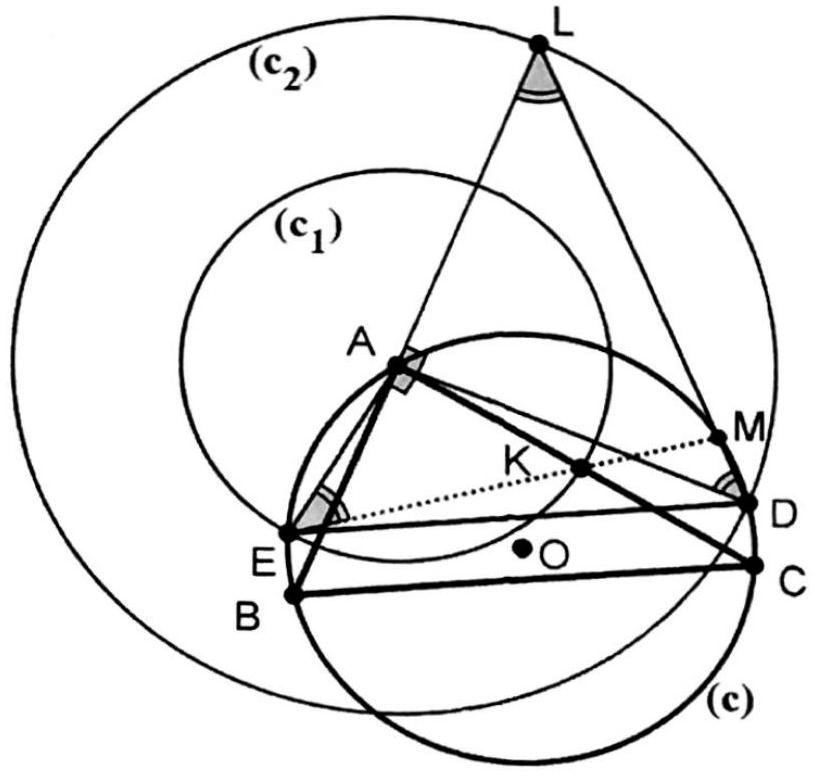
|
| 634 |
+
sufficient to prove that the points $E, K$ and $M$ are collinear.
|
| 635 |
+
|
| 636 |
+
We have that $\measuredangle E A C=90^{\circ}$ (since $E C$ is diameter of the circle $c$ ). The triangle $A E K$ is right-angled and isosceles ( $\overline{A E}$ and $\overline{A K}$ are radii of the circle $c_{1}$ ). Therefore
|
| 637 |
+
|
| 638 |
+
$$
|
| 639 |
+
\measuredangle \mathrm{AEK}=\measuredangle \mathrm{AKE}=45^{\circ} \text {. }
|
| 640 |
+
$$
|
| 641 |
+
|
| 642 |
+
Similarly, we obtain that $\measuredangle B A D=90^{\circ}=\measuredangle D A L$. Since $\overline{A D}=\overline{A L}$ the triangle $A D L$ is right-angled and isosceles, we have
|
| 643 |
+
|
| 644 |
+
$$
|
| 645 |
+
\measuredangle \mathrm{ADL}=\measuredangle \mathrm{A} L D=45^{\circ} .
|
| 646 |
+
$$
|
| 647 |
+
|
| 648 |
+
If $M$ is between $D$ and $L$, then $\measuredangle \mathrm{ADM}=\measuredangle A E M$, because they are inscribed in the circle $c(O, R)$ and they correspond to the same arch $\overparen{A M}$. Hence $\measuredangle \mathrm{AEK}=\measuredangle \mathrm{AEM}=45^{\circ}$ i.e. the points $E, K, M$ are collinear.
|
| 649 |
+
|
| 650 |
+
If $D$ is between $M$ and $L$, then $\measuredangle \mathrm{ADM}+\measuredangle A E M=180^{\circ}$ as opposite angles in cyclic quadrilateral. Hence $\measuredangle \mathrm{AEK}=\measuredangle \mathrm{AEM}=45^{\circ}$ i.e. the points $E, K, M$ are collinear.
|
| 651 |
+
|
| 652 |
+
## G3
|
| 653 |
+
|
| 654 |
+
Let $C D \perp A B(D \in A B), D M \perp A C(M \in A C)$ and $D N \perp B C(N \in B C)$ for an acute triangle ABC with area $S$. If $H_{1}$ and $H_{2}$ are the orthocentres of the triangles $M N C$ and MND respectively. Evaluate the area of the quadrilateral $\mathrm{AH}_{1} \mathrm{BH}_{2}$.
|
| 655 |
+
|
| 656 |
+
Solution1. Let $O, P, K, R$ and $T$ be the midpoints of the segments $C D, M N, C N, C H_{1}$ and $M H_{1}$, respectively. From $\triangle M N C$ we have that $\overline{P K}=\frac{1}{2} \overline{M C}$ and $P K \| M C$. Analogously, from $\Delta M H_{1} C$ we have that $\overline{T R}=\frac{1}{2} \overline{M C}$ and $T R \| M C$. Consequently, $\overline{P K}=\overline{T R}$ and $P K \| T R$. Also $O K \| D N$
|
| 657 |
+
|
| 658 |
+
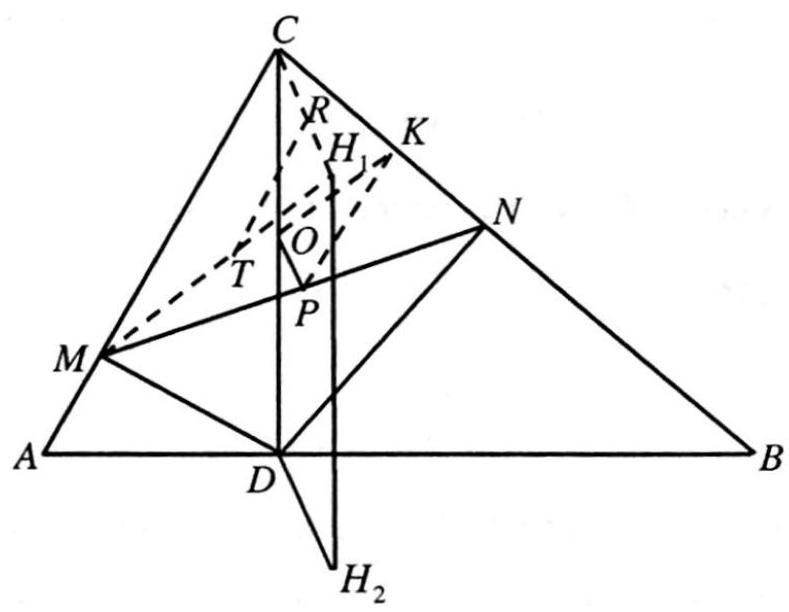
|
| 659 |
+
(from $\triangle C D N$ ) and since $D N \perp B C$ and $M H_{1} \perp B C$, it follows that $T H_{1} \| O K$. Since $O$ is the circumcenter of $\triangle C M N, O P \perp M N$. Thus, $C H_{1} \perp M N$ implies $O P \| C H_{1}$. We conclude $\Delta T R H_{1} \cong \triangle K P O$ (they have parallel sides and $\overline{T R}=\overline{P K}$ ), hence $\overline{R H_{1}}=\overline{P O}$, i.e. $\overline{C H_{1}}=2 \overline{P O}$ and $\mathrm{CH}_{1} \| \mathrm{PO}$.
|
| 660 |
+
|
| 661 |
+
Analogously, $\overline{D H_{2}}=2 \overline{P O}$ and $D H_{2} \| P O$. From $\overline{C H_{1}}=2 \overline{P O}=\overline{D H_{2}}$ and
|
| 662 |
+
|
| 663 |
+

|
| 664 |
+
$H_{1} H_{2} \| C D$. Therefore the area of the quadrilateral $A H_{1} B H_{2}$ is $\frac{\overline{A B} \cdot \overline{H_{1} H_{2}}}{2}=\frac{\overline{A B} \cdot \overline{C D}}{2}=S$.
|
| 665 |
+
|
| 666 |
+
Solution2. Since $M H_{1} \| D N$ and $N H_{1} \| D M, M D N H_{1}$ is a parallelogram. Similarly, $\mathrm{NH}_{2} \| C M$ and $\mathrm{MH}_{2} \| \mathrm{CN}$ imply $\mathrm{MCNH}_{2}$ is a parallelogram. Let $P$ be the midpoint of the segment $\overline{M N}$. Then $\sigma_{P}(D)=H_{1}$ and $\sigma_{P}(C)=H_{2}$, thus $C D \| H_{1} H_{2}$ and $\overline{C D}=\overline{H_{1} H_{2}}$. From $C D \perp A B$ we deduce $A_{A H_{1} B H_{2}}=\frac{1}{2} \overline{A B} \cdot \overline{C D}=S$.
|
| 667 |
+
|
| 668 |
+
## G4
|
| 669 |
+
|
| 670 |
+
Let $A B C$ be a triangle such that $\overline{A B} \neq \overline{A C}$. Let $M$ be a midpoint of $\overline{B C}, H$ the orthocenter of $A B C, O_{1}$ the midpoint of $\overline{A H}$ and $O_{2}$ the circumcenter of $B C H$. Prove that $O_{1} A M O_{2}$ is a parallelogram.
|
| 671 |
+
|
| 672 |
+
Solution1. Let $O_{2}^{\prime}$ be the point such that $O_{1} A M O_{2}^{\prime}$ is a parallelogram. Note that $\overrightarrow{M O_{2}}=\overrightarrow{A O_{1}}=\overrightarrow{O_{1} H}$. Therefore, $O_{1} H O_{2}^{\prime} M$ is a parallelogram and $\overrightarrow{M O_{1}}=\overrightarrow{O_{2} H}$.
|
| 673 |
+
|
| 674 |
+
Since $M$ is the midpoint of $\overline{B C}$ and $O_{1}$ is the midpoint of $\overline{A H}$, it follows that $4 \overrightarrow{M O_{1}}=\overrightarrow{B A}+\overrightarrow{B H}+\overrightarrow{C A}+\overrightarrow{C H}=2(\overrightarrow{C A}+\overrightarrow{B H})$. Moreover, let $B^{\prime}$ be the midpoint of $\overrightarrow{B H}$. Then,
|
| 675 |
+
|
| 676 |
+
$$
|
| 677 |
+
\begin{aligned}
|
| 678 |
+
2 \overrightarrow{O_{2}^{\prime B}} \cdot \overrightarrow{B H} & =\left(\overline{O_{2}^{\prime H}}+\overline{O_{2}^{\prime B}}\right) \cdot \overrightarrow{B H}=\left(2 \overline{O_{2}^{\prime} H}+\overrightarrow{H B}\right) \cdot \overrightarrow{B H}= \\
|
| 679 |
+
& =\left(2 \overline{M O_{1}}+\overline{H B}\right) \cdot \overline{B H}=(\overline{C A}+\overrightarrow{B H}+\overrightarrow{H B}) \cdot \overrightarrow{B H}=\overline{C A} \cdot \overrightarrow{B H}=0 .
|
| 680 |
+
\end{aligned}
|
| 681 |
+
$$
|
| 682 |
+
|
| 683 |
+
By $\vec{a} \cdot \vec{b}$ we denote the inner product of the vectors $\vec{a}$ and $\vec{b}$.
|
| 684 |
+
|
| 685 |
+
Therefore, $O_{2}^{\prime}$ lies on the perpendicular bisector of $\overline{B H}$. Since $B$ and $C$ play symmetric roles, $\mathrm{O}_{2}^{\prime}$ also lies on the perpendicular bisector of $\overline{\mathrm{CH}}$, hence $\mathrm{O}_{2}^{\prime}$ is the circumcenter of $\triangle B C H$ and $\mathrm{O}_{2}=\mathrm{O}_{2}^{\prime}$.
|
| 686 |
+
|
| 687 |
+
Note: The condition $\overline{A B} \neq \overline{A C}$ just aims at ensuring that the parallelogram $O_{1} A N O_{2}$ is not degenerate, hence at helping students to focus on the "general" case.
|
| 688 |
+
|
| 689 |
+
Solution2. We use the following two well-known facts:
|
| 690 |
+
|
| 691 |
+
$\sigma_{B C}(H)$ lies on the circumcircle of $\triangle A B C$.
|
| 692 |
+
|
| 693 |
+
$\overrightarrow{A H}=-2 \overrightarrow{M O}$, where $O$ is the circumcenter of $\triangle A B C$.
|
| 694 |
+
|
| 695 |
+
The statement " $\mathrm{O}_{1} A M O_{2}$ is parallelogram" is equivalent to " $\sigma_{B C}\left(O_{2}\right)=O$ ". The later is true because the circumcircles of $\triangle A B C$ and $\triangle B C H$ are symmetrical with respect to $B C$, from (1).
|
| 696 |
+
|
| 697 |
+
## G5
|
| 698 |
+
|
| 699 |
+
Let $A B C$ be a triangle with $\overline{A B} \neq \overline{B C}$, and let $B D$ be the internal bisector of $\measuredangle A B C(D \in A C)$. Denote the midpoint of the arc $A C$ which contains point BbyM. The circumcircle of the triangle $B D M$ intersects the segment $A B$ at point $K \neq B$, and let $J$ be the reflection of $A$ with respect to $K$. If $D J \cap A M=\{O\}$, prove that the points $J, B, M, O$ belong to the same circle.
|
| 700 |
+
|
| 701 |
+
## Solution1.
|
| 702 |
+
|
| 703 |
+
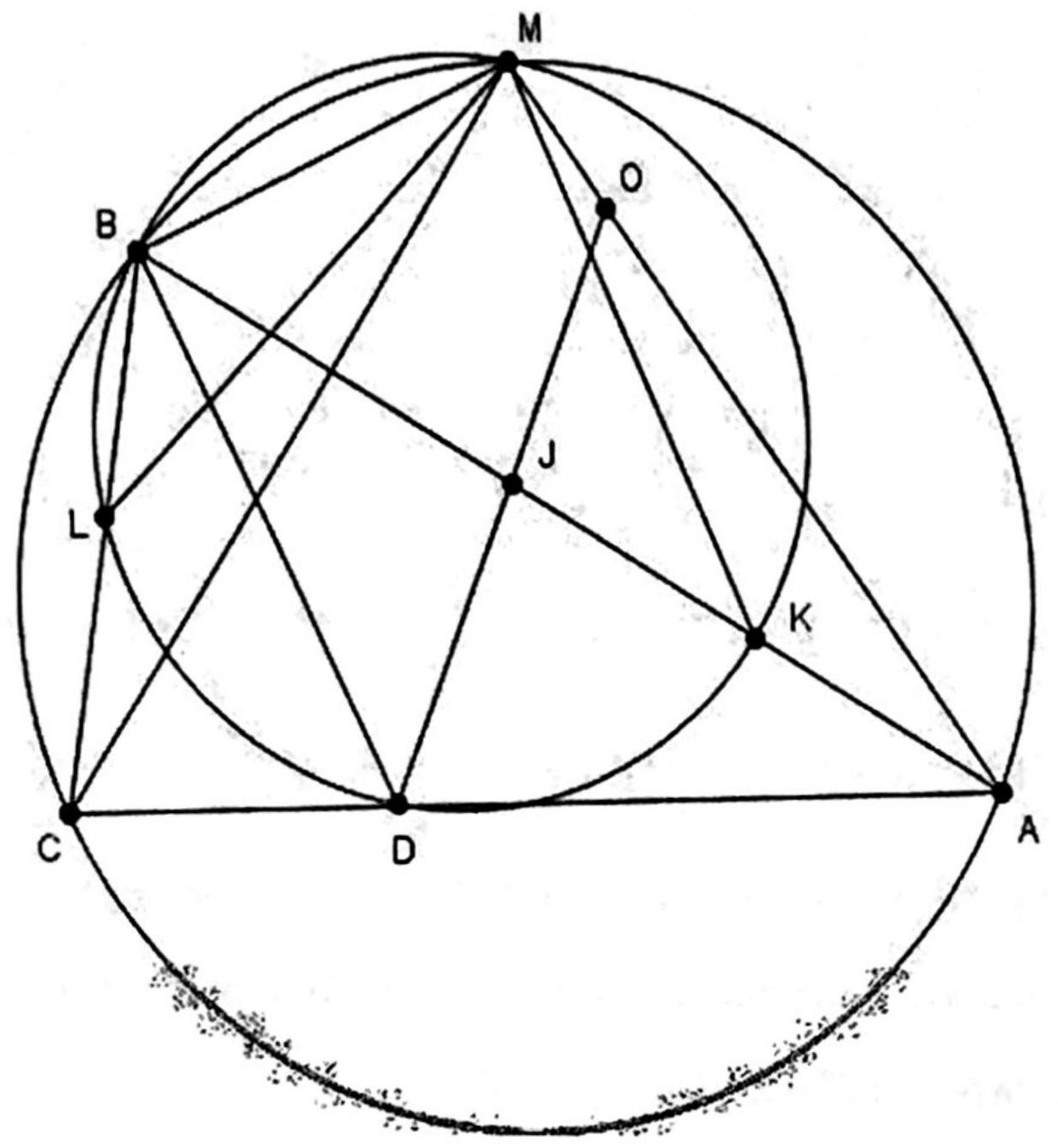
|
| 704 |
+
|
| 705 |
+
Let the circumcircle of the triangle $B D M$ intersect the line segment $B C$ at point $L \neq B$. From $\measuredangle C B D=\measuredangle D B A$ we have $\overline{D L}=\overline{D K}$. Since $\measuredangle L C M=\measuredangle B C M=\measuredangle B A M=\measuredangle K A M, \overline{M C}=\overline{M A}$ and
|
| 706 |
+
|
| 707 |
+
$$
|
| 708 |
+
\measuredangle L M C=\measuredangle L M K-\measuredangle C M K=\measuredangle L B K-\measuredangle C M K=\measuredangle C B A-\measuredangle C M K=\measuredangle C M A-\measuredangle C M K=\measuredangle K M A,
|
| 709 |
+
$$
|
| 710 |
+
|
| 711 |
+
it follows that triangles $M L C$ and $M K A$ are congruent, which implies $\overline{C L}=\overline{A K}=\overline{K J}$. Furthermore, $\measuredangle C L D=180^{\circ}-\measuredangle B L D=\measuredangle D K B=\measuredangle D K J$ and $\overline{D L}=\overline{D K}$, it follows that triangles $D C L$ and $D J K$ are congruent. Hence, $\angle D C L=\angle D J K=\measuredangle B J O$. Then
|
| 712 |
+
|
| 713 |
+
$$
|
| 714 |
+
\measuredangle B J O+\measuredangle B M O=\angle D C L+\angle B M A=\angle B C A+180^{\circ}-\angle B C A=180^{\circ}
|
| 715 |
+
$$
|
| 716 |
+
|
| 717 |
+
so the points $J, B, M, O$ belong to the same circle, q.e.d.
|
| 718 |
+
|
| 719 |
+
## Solution2.
|
| 720 |
+
|
| 721 |
+
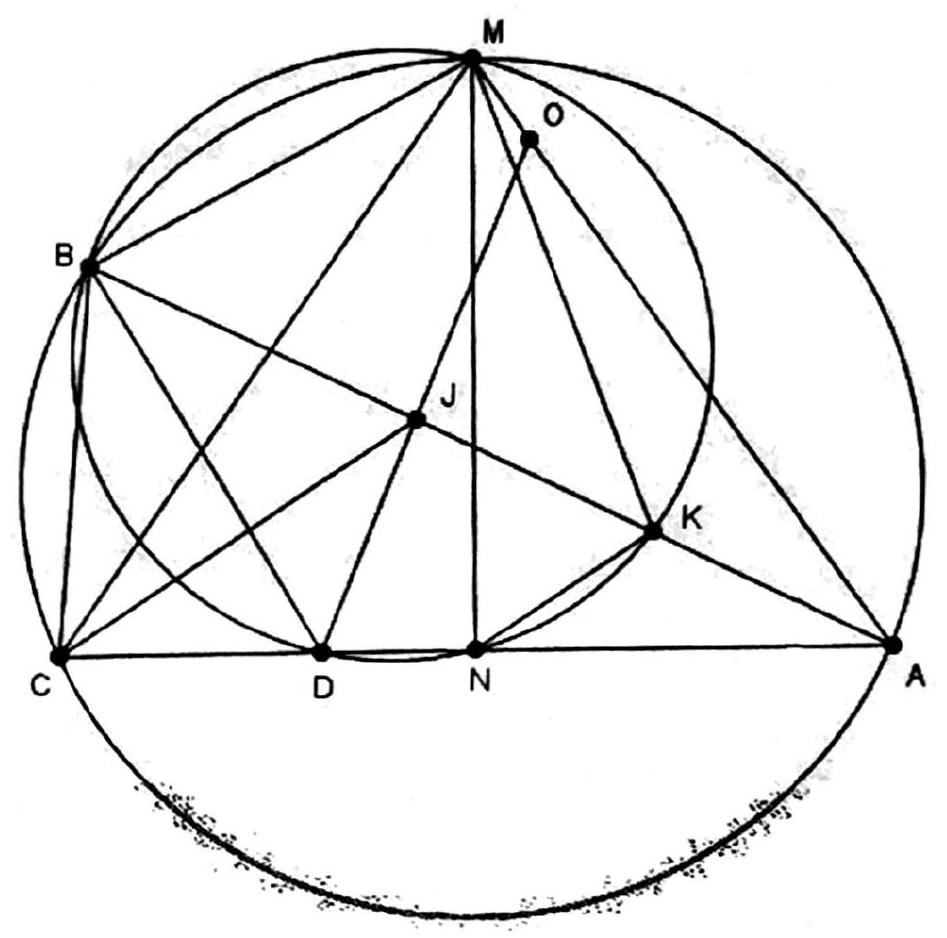
|
| 722 |
+
|
| 723 |
+
Since $\overline{M C}=\overline{M A}$ and $\measuredangle C M A=\measuredangle C B A$, we have $\measuredangle A C M=\measuredangle C A M=90^{\circ}-\frac{\measuredangle C B A}{2}$. It follows that $\measuredangle M B D=\measuredangle M B A+\measuredangle A B D=\measuredangle A C M+\measuredangle A B D=90^{\circ}-\frac{\measuredangle C B A}{2}+\frac{\measuredangle C B A}{2}=90^{\circ}$. Denote the midpoint of $\overline{A C}$ by $N$. Since $\measuredangle D N M=\measuredangle C N M=90^{\circ}, N$ belongs to the circumcircle of the triangle $B D M$. Since $N K$ is the midline of the triangle $A C J$ and $N K \| C J$, we have
|
| 724 |
+
|
| 725 |
+
$$
|
| 726 |
+
\measuredangle B J C=\measuredangle B K N=180^{\circ}-\measuredangle N D B=\measuredangle C D B
|
| 727 |
+
$$
|
| 728 |
+
|
| 729 |
+
Hence, the quadrilateral $C D J B$ is cyclic (this can also be obtained from the power of a point theorem, because $\overline{A N} \cdot \overline{A D}=\overline{A K} \cdot \overline{A B}$ implies $\overline{A C} \cdot \overline{A D}=\overline{A J} \cdot \overline{A B}$ ), and
|
| 730 |
+
|
| 731 |
+
$$
|
| 732 |
+
\measuredangle B J O=\measuredangle 180^{\circ}-\measuredangle B J D=\angle B C D=\angle B C A=180^{\circ}-\angle B M A=180^{\circ}-\measuredangle B M O
|
| 733 |
+
$$
|
| 734 |
+
|
| 735 |
+
so the points $J, B, M, O$ belong to the same circle, q.e.d.
|
| 736 |
+
|
| 737 |
+
Remark. If $J$ is between $A$ and $K$ the solution can be easily adapted.
|
| 738 |
+
|
| 739 |
+
## G6
|
| 740 |
+
|
| 741 |
+
Let $A B C D$ be a quadrilateral whose sides $A B$ and $C D$ are not parallel, and let $O$ be the intersection of its diagonals. Denote with $H_{1}$ and $H_{2}$ the orthocenters of the triangles $O A B$ and OCD, respectively. If $M$ and $N$ are the midpoints of the segments $\overline{A B}$ and $\overline{C D}$, respectively, prove that the lines $M N$ and $\mathrm{H}_{1} \mathrm{H}_{2}$ are parallel if and only if $\overline{A C}=\overline{B D}$.
|
| 742 |
+
|
| 743 |
+
## Solution.
|
| 744 |
+
|
| 745 |
+
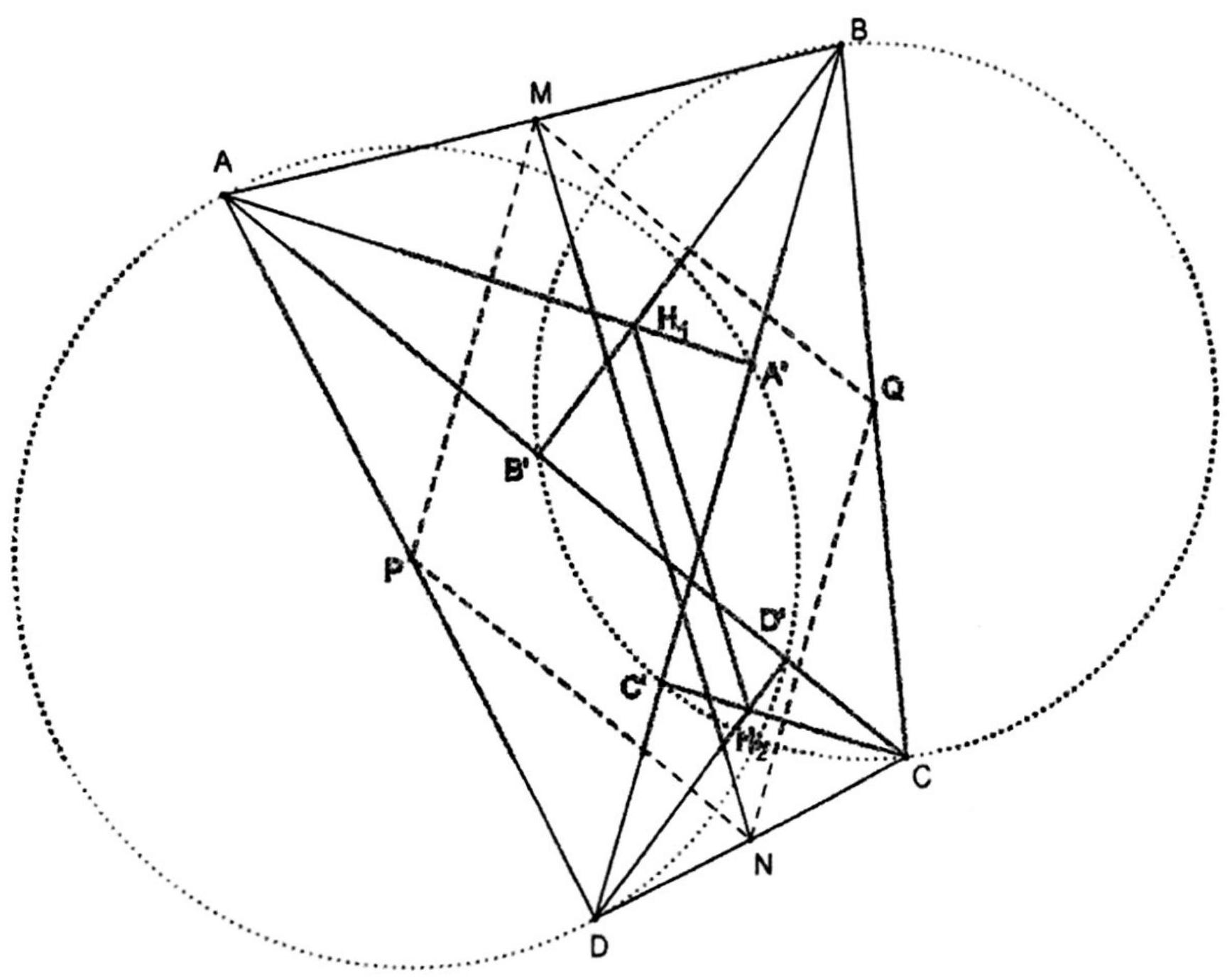
|
| 746 |
+
|
| 747 |
+
Let $A^{\prime}$ and $B^{\prime}$ be the feet of the altitudes drawn from $A$ and $B$ respectively in the triangle $A O B$, and $C^{\prime}$ and $D^{\prime}$ are the feet of the altitudes drawn from $C$ and $D$ in the triangle $C O D$. Obviously, $A^{\prime}$ and $D^{\prime}$ belong to the circle $c_{1}$ of diameter $\overline{A D}$, while $B^{\prime}$ and $C^{\prime}$ belong to the circle $c_{2}$ of diameter $\overline{B C}$.
|
| 748 |
+
|
| 749 |
+
It is easy to see that triangles $H_{1} A B$ and $H_{1} B^{\prime} A^{\prime}$ are similar. It follows that $\overline{H_{1} A} \cdot \overline{H_{1} A^{\prime}}=\overline{H_{1} B} \cdot \overline{H_{1} B^{\prime}}$. (Alternatively, one could notice that the quadrilateral $A B A^{\prime} B^{\prime}$ is cyclic and obtain the previous relation by writing the power of $H_{1}$ with respect to its circumcircle.) It
|
| 750 |
+
follows that $H_{1}$ has the same power with respect to circles $c_{1}$ and $c_{2}$. Thus, $H_{1}$ (and similarly, $\mathrm{H}_{2}$ ) is on the radical axis of the two circles.
|
| 751 |
+
|
| 752 |
+
The radical axis being perpendicular to the line joining the centers of the two circles, one concludes that $\mathrm{H}_{1} \mathrm{H}_{2}$ is perpendicular to $P Q$, where $P$ and $Q$ are the midpoints of the sides $\overline{A D}$ and $\overline{B C}$, respectively. ( $P$ and $Q$ are the centers of circles $c_{1}$ and $c_{2}$.)
|
| 753 |
+
|
| 754 |
+
The condition $H_{1} H_{2} \| M N$ is equivalent to $M N \perp P Q$. As $M P N Q$ is a parallelogram, we conclude that $H_{1} H_{2} \| M N \Leftrightarrow M N \perp P Q \Leftrightarrow M P N Q$ a rhombus $\Leftrightarrow \overline{M P}=\overline{M Q} \Leftrightarrow \overline{A C}=\overline{B D}$.
|
| 755 |
+
|
| 756 |
+
## N1
|
| 757 |
+
|
| 758 |
+
Each letter of the word OHRID corresponds to a different digit belonging to the set $(1,2,3,4,5)$. Decipher the equality $(O+H+R+I+D)^{2}:(O-H-R+I+D)=O^{H^{R^{I_{D}^{D}}}}$.
|
| 759 |
+
|
| 760 |
+
Solution. Since $O, H, R, I$ and $D$ are distinct numbers from $\{1,2,3,4,5\}$, we have $O+H+R+I+D=15$ and $O-H-R+I+D=O+H+R+I+D-2(H+R)<15$. From this $O^{H^{R^{I^{D}}}}=\frac{(O+H+R+I+D)^{2}}{O-H-R+I+D}=\frac{225}{15-2(H+R)}$, hence $O^{H^{R^{R^{D}}}}>15$ and divides 225 , which is only possible for $O^{H^{R^{I^{D}}}}=25$ (must be a power of three or five). This implies that $O=5, H=2$ and $R=1$. It's easy to check that both $I=3, D=4$ and $I=4, D=3$ satisfy the stated equation.
|
| 761 |
+
|
| 762 |
+
## $\mathbf{N} 2$
|
| 763 |
+
|
| 764 |
+
Find all triples $(p, q, r)$ of distinct primes $p, q$ and $r$ such that
|
| 765 |
+
|
| 766 |
+
$$
|
| 767 |
+
3 p^{4}-5 q^{4}-4 r^{2}=26
|
| 768 |
+
$$
|
| 769 |
+
|
| 770 |
+
Solution. First notice that if both primes $q$ and $r$ differ from 3 , then $q^{2} \equiv r^{2} \equiv 1(\bmod 3)$, hence the left hand side of the given equation is congruent to zero modulo 3 , which is impossible since 26 is not divisible by 3 . Thus, $q=3$ or $r=3$. We consider two cases.
|
| 771 |
+
|
| 772 |
+
Case 1. $q=3$.
|
| 773 |
+
|
| 774 |
+
The equation reduces to $3 p^{4}-4 r^{2}=431$
|
| 775 |
+
|
| 776 |
+
If $p \neq 5$, by Fermat's little theorem, $p^{4} \equiv 1(\bmod 5)$, which yields $3-4 r^{2} \equiv 1(\bmod 5)$, or equivalently, $r^{2}+2 \equiv 0(\bmod 5)$. The last congruence is impossible in view of the fact that a residue of a square of a positive integer belongs to the set $\{0,1,4\}$. Therefore $p=5$ and $r=19$.
|
| 777 |
+
|
| 778 |
+
Case 2. $r=3$.
|
| 779 |
+
|
| 780 |
+
The equation becomes $3 p^{4}-5 q^{4}=62(2)$.
|
| 781 |
+
|
| 782 |
+
Obviously $p \neq 5$. Hence, Fermat's little theorem gives $p^{4} \equiv 1(\bmod 5)$. But then $5 q^{4} \equiv 1(\bmod 5)$, which is impossible.
|
| 783 |
+
|
| 784 |
+
Hence, the only solution of the given equation is $p=5, q=3, r=19$.
|
| 785 |
+
|
| 786 |
+
N3
|
| 787 |
+
|
| 788 |
+
Find the integer solutions of the equation
|
| 789 |
+
|
| 790 |
+
$$
|
| 791 |
+
x^{2}=y^{2}\left(x+y^{4}+2 y^{2}\right)
|
| 792 |
+
$$
|
| 793 |
+
|
| 794 |
+
Solution. If $x=0$, then $y=0$ and conversely, if $y=0$, then $x=0$. It follows that $(x, y)=(0,0)$ is a solution of the problem. Assume $x \neq 0$ and $y \neq 0$ satisfy the equation. The equation can be transformed in the form $x^{2}-x y^{2}=y^{6}+2 y^{4}$. Then $4 x^{2}-4 x y^{2}+y^{4}=4 y^{6}+9 y^{4}$ and consequently $\left(\frac{2 x}{y^{2}}-1\right)^{2}=4 y^{2}+9 \quad$ (1). Obviously $\frac{2 x}{y^{2}}-1$ is integer. From (1), we get that the numbers $\frac{2 x}{y^{2}}-1,2 y$ and 3 are Pythagorean triplets. It follows that $\frac{2 x}{y^{2}}-1= \pm 5$ and $2 y= \pm 4$. Therefore, $x=3 y^{2}$ or $x=-2 y^{2}$ and $y= \pm 2$. Hence $(x, y)=(12,-2),(x, y)=(12,2),(x, y)=(-8,-2)$ and $(x, y)=(-8,2)$ are the possible solutions. By substituting them in the initial equation we verify that all the 4 pairs are solution. Thus, together with the couple $(x, y)=(0,0)$ the problem has 5 solutions.
|
| 795 |
+
|
| 796 |
+
N4
|
| 797 |
+
|
| 798 |
+
Prove there are no integers $a$ and $b$ satisfying the following conditions:
|
| 799 |
+
i) $16 a-9 b$ is a prime number
|
| 800 |
+
|
| 801 |
+
ii) $\quad a b$ is a perfect square
|
| 802 |
+
|
| 803 |
+
iii) $a+b$ is a perfect square
|
| 804 |
+
|
| 805 |
+
Solution. Suppose $a$ and $b$ be integers satisfying the given conditions. Let $p$ be a prime number, $n$ and $m$ be integers. Then we can write the conditions as follows:
|
| 806 |
+
|
| 807 |
+
$$
|
| 808 |
+
\begin{aligned}
|
| 809 |
+
& 16 a-9 b=p \\
|
| 810 |
+
& a b=n^{2} \\
|
| 811 |
+
& a+b=m^{2}
|
| 812 |
+
\end{aligned}
|
| 813 |
+
$$
|
| 814 |
+
|
| 815 |
+
Moreover, let $d=g d c(a, b)$ and $a=d x, b=d y$ for some relatively prime integers $x$ and $y$. Obviously $a \neq 0$ and $b \neq 0, a$ and $b$ are positive (by (2) and (3)).
|
| 816 |
+
|
| 817 |
+
From (2) follows that $x$ and $y$ are perfect squares, say $x=l^{2}$ and $y=s^{2}$.
|
| 818 |
+
|
| 819 |
+
From (1), $d \mid p$ and hence $d=p$ or $d=1$. If $d=p$, then $16 x-9 y=1$, and we obtain $x=9 k+4$, $y=16 k+7$ for some nonnegative integer $k$. But then $s^{2}=y \equiv 3(\bmod 4)$, which is a contradiction.
|
| 820 |
+
|
| 821 |
+
If $d=1$ then $16 l^{2}-9 s^{2}=p \Rightarrow(4 l-3 s)(4 l+3 s)=p \Rightarrow(4 l+3 s=p \wedge 4 l-3 s=1)$.
|
| 822 |
+
|
| 823 |
+
By adding the last two equations we get $8 l=p+1$ and by subtracting them we get $6 s=p-1$. Therefore $p=24 t+7$ for some integer $t$ and $a=(3 t+1)^{2}$ and $b=(4 t+1)^{2}$ satisfy the conditions (1) and (2). By (3) we have $m^{2}=(3 t+1)^{2}+(4 t+1)^{2}=25 t^{2}+14 t+2$, or equivalently $25 m^{2}=(25 t+7)^{2}+1$.
|
| 824 |
+
|
| 825 |
+
Since the difference between two nonzero perfect square cannot be 1 , we have a contradiction. As a result there is no solution.
|
| 826 |
+
|
| 827 |
+
## NS
|
| 828 |
+
|
| 829 |
+
Find all nonnegative integers $x, y, z$ such that
|
| 830 |
+
|
| 831 |
+
$$
|
| 832 |
+
2013^{x}+2014^{y}=2015^{z}
|
| 833 |
+
$$
|
| 834 |
+
|
| 835 |
+
Solution. Clearly, $y>0$, and $z>0$. If $x=0$ and $y=1$, then $z=1$ and $(x, y, z)=(0,1,1)$ is a solution. If $x=0$ and $y \geq 2$, then modulo 4 we have $1+0 \equiv(-1)^{z}$, hence $z$ is even $\left(z=2 z_{1}\right.$ for some integer $\left.z_{1}\right)$. Then $2^{y} 1007^{y}=\left(2015^{z_{1}}-1\right)\left(2015^{z_{1}}+1\right)$, and since $\operatorname{gcd}\left(1007,2015^{z_{1}}+1\right)=1$ we obtain $2 \cdot 1007^{y} \mid 2015^{z_{1}}-1$ and $2015^{z_{1}}+1 \mid 2^{y-1}$. From this we get $2015^{z_{1}}+1 \leq 2^{y-1}<2 \cdot 1007^{y} \leq 2015^{z_{1}}-1$, which is impossible.
|
| 836 |
+
|
| 837 |
+
Now for $x>0$, modulo 3 we get $0+1 \equiv(-1)^{z}$, hence $z$ must be even $\left(z=2 z_{1}\right.$ for some integer $z_{1}$ ). Modulo 2014 we get $(-1)^{x}+0 \equiv 1$, thus $x$ must be even $\left(x=2 x_{1}\right.$ for some integer $\left.x_{1}\right)$. We transform the equation to $2^{y} 1007^{y}=\left(2015^{z_{1}}-2013^{x_{1}}\right)\left(2015^{z_{1}}+2013^{x_{1}}\right)$ and since $\operatorname{gcd}\left(2015^{z_{1}}-2013^{x_{1}}, 2015^{z_{1}}+2013^{x_{1}}\right)=2,1007^{y}$ divides $2015^{z_{1}}-2013^{x_{1}}$ or $2015^{z_{1}}+2013^{x_{1}}$ but not both. If $1007^{y} \mid 2015^{z_{1}}-2013^{x_{1}}$, then $2015^{z_{1}}+2013^{x_{1}} \leq 2^{y}<1007^{y} \leq 2015^{z_{1}}-2013^{x_{1}}$, which is impossible. Hence $1007 \mid 2015^{z_{1}}+2013^{x_{1}}$, and from $2015^{z_{1}}+2013^{x_{1}} \equiv 1+(-1)^{x_{1}}(\bmod 1007), x_{1}$ is odd $\left(x=2 x_{1}=4 x_{2}+2\right.$ for some integer $\left.x_{2}\right)$.
|
| 838 |
+
|
| 839 |
+
Now modulo 5 we get $-1+(-1)^{y} \equiv(-2)^{4 x_{2}+2}+(-1)^{y} \equiv 0$, hence $y$ must be even $\left(y=2 y_{1}\right.$ for some integer $y_{1}$ ). Finally modulo 31 , we have $(-2)^{4 x_{2}+2}+(-1)^{2 y_{1}} \equiv 0$ or $4^{2 x_{2}+1} \equiv-1$. This is impossible since the reminders of the powers of 4 modulo 31 are 1, 2, 4, 8 and 16 .
|
| 840 |
+
|
| 841 |
+
## N6
|
| 842 |
+
|
| 843 |
+
Vukasin, Dimitrije, Dusan, Stefan and Filip asked their professor to guess a three consecutive positive integer numbers after they had told him these (true) sentences:
|
| 844 |
+
|
| 845 |
+
Vukasin: "Sum of the digits of one of them is a prime number. Sum of the digits of some of the other two is an even perfect number ( $n$ is perfect if $\sigma(n)=2 n$ ). Sum of the digits of the remaining number is equal to the number of its positive divisors."
|
| 846 |
+
|
| 847 |
+
Dimitrije:"Each of these three numbers has no more than two digits 1 in its decimal representation."
|
| 848 |
+
|
| 849 |
+
Dusan:"If we add 11 to one of them, we obtain a square of an integer."
|
| 850 |
+
|
| 851 |
+
Stefan:"Each of them has exactly one prime divisor less then 10."
|
| 852 |
+
|
| 853 |
+
Filip:"The 3 numbers are square-free."
|
| 854 |
+
|
| 855 |
+
Their professor gave the correct answer. Which numbers did he say?
|
| 856 |
+
|
| 857 |
+
Solution. Let the middle number be $n$, so the numbers are $n-1, n$ and $n+1$. Since 4 does not divide any of them, $n \equiv 2(\bmod 4)$. Furthermore, neither 3,5 nor 7 divides $n$. Also $n+1+11 \equiv 2(\bmod 4)$ cannot be a square. Then 3 must divide $n-1$ or $n+1$. If $n-1+11$ is a square, then $3 \mid n+1$ which implies $3 \mid n+10$ (a square), so $9 \mid n+10$ hence $9 \mid n+1$, which is impossible. Thus must be $n+11=m^{2}$.
|
| 858 |
+
|
| 859 |
+
Further, 7 does not divide $n-1$, nor $n+1$, because $1+11 \equiv 5(\bmod 7)$ and $-1+11 \equiv 3(\bmod 7)$ are quadratic nonresidues modulo 7. This implies $5 \mid n-1$ or $5 \mid n+1$. Again, since $n+11$ is a square, it is impossible $5 \mid n-1$, hence $5 \mid n+1$ which implies $3 \mid n-1$. This yields $n \equiv 4(\bmod 10)$ hence $S(n+1)=S(n)+1=S(n-1)+2(S(n)$ is sum of the digits of $n)$. Since the three numbers are square-free, their numbers of positive divisors are powers of 2 . Thus, we have two even sums of digits - they must be $S(n-1)$ and $S(n+1)$, so $S(n)$ is prime. From $3 \mid n-1$, follows $S(n-1)$ is an even perfect number, and $S(n+1)=2^{p}$. Consequently $S(n)=2^{p}-1$ is a prime, so $p$ is a prime number. One easily verifies $p \neq 2$, so $\mathrm{p}$ is odd implying $3 \mid 2^{p}-2$. Then
|
| 860 |
+
$\sigma\left(2^{p}-2\right) \geq\left(2^{p}-2\right)\left(1+\frac{1}{2}+\frac{1}{3}+\frac{1}{6}\right)=2\left(2^{p}-2\right)$. Since this number is perfect, $\frac{2^{p}-2}{6}$ must be one, i.e. $p=3$ and $S(n-1)=6, S(n)=7$ and $S(n+1)=8$.
|
| 861 |
+
|
| 862 |
+
Since 4 does not divide $n$, the 2 -digit ending of $n$ must be 14 or 34 . But $n=34$ is impossible, since $n+11=45$ is not a square. Hence, $n=10^{a}+10^{b}+14$ with $a \geq b \geq 2$. If $a \neq b$, then $n$ has three digits 1 in its decimal representation, which is impossible. Therefore $a=b$, and $n=2 \cdot 10^{a}+14$. Now, $2 \cdot 10^{a}+25=m^{2}$, hence $5 \mid m$, say $m=5 t$, and $(t-1)(t+1)=2^{a+1} 5^{a-2}$. Because $\operatorname{gcd}(t-1, t+1)=2$ there are three possibilities:
|
| 863 |
+
|
| 864 |
+
1) $t-1=2, t+1=2^{a} 5^{a-2}$, which implies $a=2, t=3$;
|
| 865 |
+
2) $t-1=2^{a}, t+1=2 \cdot 5^{a-2}$, so $2^{a}+2=2 \cdot 5^{a-2}$, which implies $a=3, t=9$;
|
| 866 |
+
3) $t-1=2 \cdot 5^{a-2}, t+1=2^{a}$, so $2 \cdot 5^{a-2}+2=2^{a}$, which implies $a=2, t=3$, same as case 1 ).
|
| 867 |
+
|
| 868 |
+
From the only two possibilities $(n-1, n, n+1)=(213,214,215)$ and $(n-1, n, n+1)=$ $(2013,2014,2015)$ the first one is not possible, because $S(215)=8$ and $\tau(215)=4$. By checking the conditions, we conclude that the latter is a solution, so the professor said the numbers: 2013, 2014, 2015.
|
| 869 |
+
|
JBMO/md/en-shortlist/en-jbmo_2017_short_list.md
ADDED
|
@@ -0,0 +1,756 @@
|
|
|
|
|
|
|
|
|
|
|
|
|
|
|
|
|
|
|
|
|
|
|
|
|
|
|
|
|
|
|
|
|
|
|
|
|
|
|
|
|
|
|
|
|
|
|
|
|
|
|
|
|
|
|
|
|
|
|
|
|
|
|
|
|
|
|
|
|
|
|
|
|
|
|
|
|
|
|
|
|
|
|
|
|
|
|
|
|
|
|
|
|
|
|
|
|
|
|
|
|
|
|
|
|
|
|
|
|
|
|
|
|
|
|
|
|
|
|
|
|
|
|
|
|
|
|
|
|
|
|
|
|
|
|
|
|
|
|
|
|
|
|
|
|
|
|
|
|
|
|
|
|
|
|
|
|
|
|
|
|
|
|
|
|
|
|
|
|
|
|
|
|
|
|
|
|
|
|
|
|
|
|
|
|
|
|
|
|
|
|
|
|
|
|
|
|
|
|
|
|
|
|
|
|
|
|
|
|
|
|
|
|
|
|
|
|
|
|
|
|
|
|
|
|
|
|
|
|
|
|
|
|
|
|
|
|
|
|
|
|
|
|
|
|
|
|
|
|
|
|
|
|
|
|
|
|
|
|
|
|
|
|
|
|
|
|
|
|
|
|
|
|
|
|
|
|
|
|
|
|
|
|
|
|
|
|
|
|
|
|
|
|
|
|
|
|
|
|
|
|
|
|
|
|
|
|
|
|
|
|
|
|
|
|
|
|
|
|
|
|
|
|
|
|
|
|
|
|
|
|
|
|
|
|
|
|
|
|
|
|
|
|
|
|
|
|
|
|
|
|
|
|
|
|
|
|
|
|
|
|
|
|
|
|
|
|
|
|
|
|
|
|
|
|
|
|
|
|
|
|
|
|
|
|
|
|
|
|
|
|
|
|
|
|
|
|
|
|
|
|
|
|
|
|
|
|
|
|
|
|
|
|
|
|
|
|
|
|
|
|
|
|
|
|
|
|
|
|
|
|
|
|
|
|
|
|
|
|
|
|
|
|
|
|
|
|
|
|
|
|
|
|
|
|
|
|
|
|
|
|
|
|
|
|
|
|
|
|
|
|
|
|
|
|
|
|
|
|
|
|
|
|
|
|
|
|
|
|
|
|
|
|
|
|
|
|
|
|
|
|
|
|
|
|
|
|
|
|
|
|
|
|
|
|
|
|
|
|
|
|
|
|
|
|
|
|
|
|
|
|
|
|
|
|
|
|
|
|
|
|
|
|
|
|
|
|
|
|
|
|
|
|
|
|
|
|
|
|
|
|
|
|
|
|
|
|
|
|
|
|
|
|
|
|
|
|
|
|
|
|
|
|
|
|
|
|
|
|
|
|
|
|
|
|
|
|
|
|
|
|
|
|
|
|
|
|
|
|
|
|
|
|
|
|
|
|
|
|
|
|
|
|
|
|
|
|
|
|
|
|
|
|
|
|
|
|
|
|
|
|
|
|
|
|
|
|
|
|
|
|
|
|
|
|
|
|
|
|
|
|
|
|
|
|
|
|
|
|
|
|
|
|
|
|
|
|
|
|
|
|
|
|
|
|
|
|
|
|
|
|
|
|
|
|
|
|
|
|
|
|
|
|
|
|
|
|
|
|
|
|
|
|
|
|
|
|
|
|
|
|
|
|
|
|
|
|
|
|
|
|
|
|
|
|
|
|
|
|
|
|
|
|
|
|
|
|
|
|
|
|
|
|
|
|
|
|
|
|
|
|
|
|
|
|
|
|
|
|
|
|
|
|
|
|
|
|
|
|
|
|
|
|
|
|
|
|
|
|
|
|
|
|
|
|
|
|
|
|
|
|
|
|
|
|
|
|
|
|
|
|
|
|
|
|
|
|
|
|
|
|
|
|
|
|
|
|
|
|
|
|
|
|
|
|
|
|
|
|
|
|
|
|
|
|
|
|
|
|
|
|
|
|
|
|
|
|
|
|
|
|
|
|
|
|
|
|
|
|
|
|
|
|
|
|
|
|
|
|
|
|
|
|
|
|
|
|
|
|
|
|
|
|
|
|
|
|
|
|
|
|
|
|
|
|
|
|
|
|
|
|
|
|
|
|
|
|
|
|
|
|
|
|
|
|
|
|
|
|
|
|
|
|
|
|
|
|
|
|
|
|
|
|
|
|
|
|
|
|
|
|
|
|
|
|
|
|
|
|
|
|
|
|
|
|
|
|
|
|
|
|
|
|
|
|
|
|
|
|
|
|
|
|
|
|
|
|
|
|
|
|
|
|
|
|
|
|
|
|
|
|
|
|
|
|
|
|
|
|
|
|
|
|
|
|
|
|
|
|
|
|
|
|
|
|
|
|
|
|
|
|
|
|
|
|
|
|
|
|
|
|
|
|
|
|
|
|
|
|
|
|
|
|
|
|
|
|
|
|
|
|
|
|
|
|
|
|
|
|
|
|
|
|
|
|
|
|
|
|
|
|
|
|
|
|
|
|
|
|
|
|
|
|
|
|
|
|
|
|
|
|
|
|
|
|
|
|
|
|
|
|
|
|
|
|
|
|
|
|
|
|
|
|
|
|
|
|
|
|
|
|
|
|
|
|
|
|
|
|
|
|
|
|
|
|
|
|
|
|
|
|
|
|
|
|
|
|
|
|
|
|
|
|
|
|
|
|
|
|
|
|
|
|
|
|
|
|
|
|
|
|
|
|
|
|
|
|
|
|
|
|
|
|
|
|
|
|
|
|
|
|
|
|
|
|
|
|
|
|
|
|
|
|
|
|
|
|
|
|
|
|
|
|
|
|
|
|
|
|
|
|
|
|
|
|
|
|
|
|
|
|
|
|
|
|
|
|
|
|
|
|
|
|
|
|
|
|
|
|
|
|
|
|
|
|
|
|
|
|
|
|
|
|
|
|
|
|
|
|
|
|
|
|
|
|
|
|
|
|
|
|
|
|
|
|
|
|
|
|
|
|
|
|
|
|
|
|
|
|
|
|
|
|
|
|
|
|
|
|
|
|
|
|
|
|
|
|
|
|
|
|
|
|
|
|
|
|
|
|
|
|
|
|
|
|
|
|
|
|
|
|
|
|
|
|
|
|
|
|
|
|
|
|
|
|
|
|
|
|
|
|
|
|
|
|
|
|
|
|
|
|
|
|
|
|
|
|
|
|
|
|
|
|
|
|
|
|
|
|
|
|
|
|
|
|
|
|
|
|
|
|
|
|
|
|
|
|
|
|
|
|
|
|
|
|
|
|
|
|
|
|
|
|
|
|
|
|
|
|
|
|
|
|
|
|
|
|
|
|
|
|
|
|
|
|
|
|
|
|
|
|
|
|
|
|
|
|
|
|
|
|
|
|
|
|
|
|
|
|
|
|
|
|
|
|
|
|
|
|
|
|
|
|
|
|
|
|
|
|
|
|
|
|
|
|
|
|
|
|
|
|
|
|
|
|
|
|
|
|
|
|
|
|
|
|
|
|
|
|
|
|
|
|
|
|
|
|
|
|
|
|
|
|
|
|
|
|
|
|
|
|
|
|
|
|
|
|
|
|
|
|
|
|
|
|
|
|
|
|
|
|
|
|
|
|
|
|
|
|
|
|
|
|
|
|
|
|
|
|
|
|
|
|
|
|
|
|
|
|
|
|
|
|
|
|
|
|
|
|
|
|
|
|
|
|
|
|
|
|
|
|
|
|
|
|
|
|
|
|
|
|
|
|
|
|
|
|
|
|
|
|
|
|
|
|
|
|
|
|
|
|
|
|
|
|
|
|
|
|
|
|
|
|
|
|
|
|
|
|
|
|
|
|
|
|
|
|
|
|
|
|
|
|
|
|
|
|
|
|
|
|
|
|
|
|
|
|
|
|
|
|
|
|
|
|
|
|
|
|
|
|
|
|
|
|
|
|
|
|
|
|
|
|
|
|
|
|
|
|
|
|
|
|
|
|
|
|
|
|
|
|
|
|
|
|
|
|
|
|
|
|
|
|
|
|
|
|
|
|
|
|
|
|
|
|
|
|
|
|
|
|
|
|
|
|
|
|
|
|
|
|
|
|
|
|
|
|
|
|
|
|
|
|
|
|
|
|
|
|
|
|
|
|
|
|
|
|
|
|
|
|
|
|
|
|
|
|
|
|
|
|
|
|
|
|
|
|
|
|
|
|
|
|
|
|
|
|
|
|
|
|
|
|
|
|
|
|
|
|
|
|
|
|
|
|
|
|
|
|
|
|
|
|
|
|
|
|
|
|
|
|
|
|
|
|
|
|
|
|
|
|
|
|
|
|
|
|
|
|
|
|
|
|
|
|
|
|
|
|
|
|
|
|
|
|
|
|
|
|
|
|
|
|
|
|
|
|
|
|
|
|
|
|
|
|
|
|
|
|
|
|
|
|
|
|
|
|
|
|
|
|
|
|
|
|
|
|
|
|
|
|
|
|
|
|
|
|
|
|
|
|
|
|
|
|
|
|
|
|
|
|
|
|
|
|
|
|
|
|
|
|
|
|
|
|
|
|
|
|
|
|
|
|
|
|
|
|
|
|
|
|
|
|
|
|
|
|
|
|
|
|
|
|
|
|
|
|
|
|
|
|
|
|
|
|
|
|
|
|
|
|
|
|
|
|
|
|
|
|
|
|
|
|
|
|
|
|
|
|
|
|
|
|
|
|
|
|
|
|
|
|
|
|
|
|
|
|
|
|
|
|
|
|
|
|
|
|
|
|
|
|
|
|
|
|
|
|
|
|
|
|
|
|
|
|
|
|
|
|
|
|
|
|
|
|
|
|
|
|
|
|
|
|
|
|
|
|
|
|
|
|
|
|
|
|
|
|
|
|
|
|
|
|
|
|
|
|
|
|
|
|
|
|
|
|
|
|
|
|
|
|
|
|
|
|
|
|
|
|
|
|
|
|
|
|
|
|
|
|
|
|
|
|
|
|
|
|
|
|
|
|
|
|
|
|
|
|
|
|
|
|
|
|
|
|
|
|
|
|
|
|
|
|
|
|
|
|
|
|
|
|
|
|
|
|
|
|
|
|
|
|
|
|
|
|
|
|
|
|
|
|
|
|
|
|
|
|
|
|
|
|
|
|
|
|
|
|
|
|
|
|
|
|
|
|
|
|
|
|
|
|
|
|
|
|
|
|
|
|
|
|
|
| 1 |
+
# Algebra
|
| 2 |
+
|
| 3 |
+
A1. Let $a, b, c$ be positive real numbers such that $a+b+c+a b+b c+c a+a b c=7$. Prove that
|
| 4 |
+
|
| 5 |
+
$$
|
| 6 |
+
\sqrt{a^{2}+b^{2}+2}+\sqrt{b^{2}+c^{2}+2}+\sqrt{c^{2}+a^{2}+2} \geq 6
|
| 7 |
+
$$
|
| 8 |
+
|
| 9 |
+
Solution. First we see that $x^{2}+y^{2}+1 \geq x y+x+y$. Indeed, this is equivalent to
|
| 10 |
+
|
| 11 |
+
$$
|
| 12 |
+
(x-y)^{2}+(x-1)^{2}+(y-1)^{2} \geq 0
|
| 13 |
+
$$
|
| 14 |
+
|
| 15 |
+
Therefore
|
| 16 |
+
|
| 17 |
+
$$
|
| 18 |
+
\begin{aligned}
|
| 19 |
+
& \sqrt{a^{2}+b^{2}+2}+\sqrt{b^{2}+c^{2}+2}+\sqrt{c^{2}+a^{2}+2} \\
|
| 20 |
+
\geq & \sqrt{a b+a+b+1}+\sqrt{b c+b+c+1}+\sqrt{c a+c+a+1} \\
|
| 21 |
+
= & \sqrt{(a+1)(b+1)}+\sqrt{(b+1)(a+1)}+\sqrt{(c+1)(a+1)}
|
| 22 |
+
\end{aligned}
|
| 23 |
+
$$
|
| 24 |
+
|
| 25 |
+
It follows from the AM-GM inequality that
|
| 26 |
+
|
| 27 |
+
$$
|
| 28 |
+
\begin{aligned}
|
| 29 |
+
& \sqrt{(a+1)(b+1)}+\sqrt{(b+1)(a+1)}+\sqrt{(c+1)(a+1)} \\
|
| 30 |
+
\geq & 3 \sqrt[3]{\sqrt{(a+1)(b+1)} \cdot \sqrt{(b+1)(a+1)} \cdot \sqrt{(c+1)(a+1)}} \\
|
| 31 |
+
= & 3 \sqrt[3]{(a+1)(b+1)(c+1)}
|
| 32 |
+
\end{aligned}
|
| 33 |
+
$$
|
| 34 |
+
|
| 35 |
+
On the other hand, the given condition is equivalent to $(a+1)(b+1)(c+1)=8$ and we get the desired inequality.
|
| 36 |
+
|
| 37 |
+
Obviously, equality is attained if and only if $a=b=c=1$.
|
| 38 |
+
|
| 39 |
+
Remark. The condition of positivity of $a, b, c$ is superfluous and the equality $\cdots=7$ can be replaced by the inequality $\cdots \geq 7$. Indeed, the above proof and the triangle inequality imply that
|
| 40 |
+
|
| 41 |
+
$$
|
| 42 |
+
\begin{aligned}
|
| 43 |
+
\sqrt{a^{2}+b^{2}+2}+\sqrt{b^{2}+c^{2}+2}+\sqrt{c^{2}+a^{2}+2} & \geq 3 \sqrt[3]{(|a|+1)(|b|+1)(|c|+1)} \\
|
| 44 |
+
& \geq 3 \sqrt[3]{|a+1| \cdot|b+1| \cdot|c+1|} \geq 6
|
| 45 |
+
\end{aligned}
|
| 46 |
+
$$
|
| 47 |
+
|
| 48 |
+
A2. Let $a$ and $b$ be positive real numbers such that $3 a^{2}+2 b^{2}=3 a+2 b$. Find the minimum value of
|
| 49 |
+
|
| 50 |
+
$$
|
| 51 |
+
A=\sqrt{\frac{a}{b(3 a+2)}}+\sqrt{\frac{b}{a(2 b+3)}}
|
| 52 |
+
$$
|
| 53 |
+
|
| 54 |
+
Solution. By the Cauchy-Schwarz inequality we have that
|
| 55 |
+
|
| 56 |
+
$$
|
| 57 |
+
5\left(3 a^{2}+2 b^{2}\right)=5\left(a^{2}+a^{2}+a^{2}+b^{2}+b^{2}\right) \geq(3 a+2 b)^{2}
|
| 58 |
+
$$
|
| 59 |
+
|
| 60 |
+
(or use that the last inequality is equivalent to $(a-b)^{2} \geq 0$ ).
|
| 61 |
+
|
| 62 |
+
So, with the help of the given condition we get that $3 a+2 b \leq 5$. Now, by the AM-GM inequality we have that
|
| 63 |
+
|
| 64 |
+
$$
|
| 65 |
+
A \geq 2 \sqrt{\sqrt{\frac{a}{b(3 a+2)}} \cdot \sqrt{\frac{b}{a(2 b+3)}}}=\frac{2}{\sqrt[4]{(3 a+2)(2 b+3)}}
|
| 66 |
+
$$
|
| 67 |
+
|
| 68 |
+
Finally, using again the AM-GM inequality, we get that
|
| 69 |
+
|
| 70 |
+
$$
|
| 71 |
+
(3 a+2)(2 b+3) \leq\left(\frac{3 a+2 b+5}{2}\right)^{2} \leq 25
|
| 72 |
+
$$
|
| 73 |
+
|
| 74 |
+
so $A \geq 2 / \sqrt{5}$ and the equality holds if and only if $a=b=1$.
|
| 75 |
+
|
| 76 |
+
A3. Let $a, b, c, d$ be real numbers such that $0 \leq a \leq b \leq c \leq d$. Prove the inequality
|
| 77 |
+
|
| 78 |
+
$$
|
| 79 |
+
a b^{3}+b c^{3}+c d^{3}+d a^{3} \geq a^{2} b^{2}+b^{2} c^{2}+c^{2} d^{2}+d^{2} a^{2}
|
| 80 |
+
$$
|
| 81 |
+
|
| 82 |
+
Solution. The inequality is equivalent to
|
| 83 |
+
|
| 84 |
+
$$
|
| 85 |
+
\left(a b^{3}+b c^{3}+c d^{3}+d a^{3}\right)^{2} \geq\left(a^{2} b^{2}+b^{2} c^{2}+c^{2} d^{2}+d^{2} a^{2}\right)^{2}
|
| 86 |
+
$$
|
| 87 |
+
|
| 88 |
+
By the Cauchy-Schwarz inequality,
|
| 89 |
+
|
| 90 |
+
$$
|
| 91 |
+
\left(a b^{3}+b c^{3}+c d^{3}+d a^{3}\right)\left(a^{3} b+b^{3} c+c^{3} d+d^{3} a\right) \geq\left(a^{2} b^{2}+b^{2} c^{2}+c^{2} d^{2}+d^{2} a^{2}\right)^{2}
|
| 92 |
+
$$
|
| 93 |
+
|
| 94 |
+
Hence it is sufficient to prove that
|
| 95 |
+
|
| 96 |
+
$$
|
| 97 |
+
\left(a b^{3}+b c^{3}+c d^{3}+d a^{3}\right)^{2} \geq\left(a b^{3}+b c^{3}+c d^{3}+d a^{3}\right)\left(a^{3} b+b^{3} c+c^{3} d+d^{3} a\right)
|
| 98 |
+
$$
|
| 99 |
+
|
| 100 |
+
i.e. to prove $a b^{3}+b c^{3}+c d^{3}+d a^{3} \geq a^{3} b+b^{3} c+c^{3} d+d^{3} a$.
|
| 101 |
+
|
| 102 |
+
This inequality can be written successively
|
| 103 |
+
|
| 104 |
+
$$
|
| 105 |
+
a\left(b^{3}-d^{3}\right)+b\left(c^{3}-a^{3}\right)+c\left(d^{3}-b^{3}\right)+d\left(a^{3}-c^{3}\right) \geq 0
|
| 106 |
+
$$
|
| 107 |
+
|
| 108 |
+
or
|
| 109 |
+
|
| 110 |
+
$$
|
| 111 |
+
(a-c)\left(b^{3}-d^{3}\right)-(b-d)\left(a^{3}-c^{3}\right) \geq 0
|
| 112 |
+
$$
|
| 113 |
+
|
| 114 |
+
which comes down to
|
| 115 |
+
|
| 116 |
+
$$
|
| 117 |
+
(a-c)(b-d)\left(b^{2}+b d+d^{2}-a^{2}-a c-c^{2}\right) \geq 0
|
| 118 |
+
$$
|
| 119 |
+
|
| 120 |
+
The last inequality is true because $a-c \leq 0, b-d \leq 0$, and $\left(b^{2}-a^{2}\right)+(b d-a c)+\left(d^{2}-c^{2}\right) \geq 0$ as a sum of three non-negative numbers.
|
| 121 |
+
|
| 122 |
+
The last inequality is satisfied with equality whence $a=b$ and $c=d$. Combining this with the equality cases in the Cauchy-Schwarz inequality we obtain the equality cases for the initial inequality: $a=b=c=d$.
|
| 123 |
+
|
| 124 |
+
Remark. Instead of using the Cauchy-Schwarz inequality, once the inequality $a b^{3}+b c^{3}+c d^{3}+$ $d a^{3} \geq a^{3} b+b^{3} c+c^{3} d+d^{3} a$ is established, we have $2\left(a b^{3}+b c^{3}+c d^{3}+d a^{3}\right) \geq\left(a b^{3}+b c^{3}+c d^{3}+\right.$ $\left.d a^{3}\right)+\left(a^{3} b+b^{3} c+c^{3} d+d^{3} a\right)=\left(a b^{3}+a^{3} b\right)+\left(b c^{3}+b^{3} c\right)+\left(c d^{3}+c^{3} d\right)+\left(d a^{3}+d^{3} a\right) \stackrel{A M-G M}{\geq}$ $2 a^{2} b^{2}+2 b^{2} c^{2}+2 c^{2} d^{2}+2 d^{2} a^{2}$ which gives the conclusion.
|
| 125 |
+
|
| 126 |
+
A4. Let $x, y, z$ be three distinct positive integers. Prove that
|
| 127 |
+
|
| 128 |
+
$$
|
| 129 |
+
(x+y+z)(x y+y z+z x-2) \geq 9 x y z
|
| 130 |
+
$$
|
| 131 |
+
|
| 132 |
+
When does the equality hold?
|
| 133 |
+
|
| 134 |
+
Solution. Since $x, y, z$ are distinct positive integers, the required inequality is symmetric and WLOG we can suppose that $x \geq y+1 \geq z+2$. We consider 2 possible cases:
|
| 135 |
+
|
| 136 |
+
Case 1. $y \geq z+2$. Since $x \geq y+1 \geq z+3$ it follows that
|
| 137 |
+
|
| 138 |
+
$$
|
| 139 |
+
(x-y)^{2} \geq 1, \quad(y-z)^{2} \geq 4, \quad(x-z)^{2} \geq 9
|
| 140 |
+
$$
|
| 141 |
+
|
| 142 |
+
which are equivalent to
|
| 143 |
+
|
| 144 |
+
$$
|
| 145 |
+
x^{2}+y^{2} \geq 2 x y+1, \quad y^{2}+z^{2} \geq 2 y z+4, \quad x^{2}+z^{2} \geq 2 x z+9
|
| 146 |
+
$$
|
| 147 |
+
|
| 148 |
+
or otherwise
|
| 149 |
+
|
| 150 |
+
$$
|
| 151 |
+
z x^{2}+z y^{2} \geq 2 x y z+z, \quad x y^{2}+x z^{2} \geq 2 x y z+4 x, \quad y x^{2}+y z^{2} \geq 2 x y z+9 y
|
| 152 |
+
$$
|
| 153 |
+
|
| 154 |
+
Adding up the last three inequalities we have
|
| 155 |
+
|
| 156 |
+
$$
|
| 157 |
+
x y(x+y)+y z(y+z)+z x(z+x) \geq 6 x y z+4 x+9 y+z
|
| 158 |
+
$$
|
| 159 |
+
|
| 160 |
+
which implies that $(x+y+z)(x y+y z+z x-2) \geq 9 x y z+2 x+7 y-z$.
|
| 161 |
+
|
| 162 |
+
Since $x \geq z+3$ it follows that $2 x+7 y-z \geq 0$ and our inequality follows.
|
| 163 |
+
|
| 164 |
+
Case 2. $y=z+1$. Since $x \geq y+1=z+2$ it follows that $x \geq z+2$, and replacing $y=z+1$ in the required inequality we have to prove
|
| 165 |
+
|
| 166 |
+
$$
|
| 167 |
+
(x+z+1+z)(x(z+1)+(z+1) z+z x-2) \geq 9 x(z+1) z
|
| 168 |
+
$$
|
| 169 |
+
|
| 170 |
+
which is equivalent to
|
| 171 |
+
|
| 172 |
+
$$
|
| 173 |
+
(x+2 z+1)\left(z^{2}+2 z x+z+x-2\right)-9 x(z+1) z \geq 0
|
| 174 |
+
$$
|
| 175 |
+
|
| 176 |
+
Doing easy algebraic manipulations, this is equivalent to prove
|
| 177 |
+
|
| 178 |
+
$$
|
| 179 |
+
(x-z-2)(x-z+1)(2 z+1) \geq 0
|
| 180 |
+
$$
|
| 181 |
+
|
| 182 |
+
which is satisfied since $x \geq z+2$.
|
| 183 |
+
|
| 184 |
+
The equality is achieved only in the Case 2 for $x=z+2$, so we have equality when $(x, y, z)=$ $(k+2, k+1, k)$ and all the permutations for any positive integer $k$.
|
| 185 |
+
|
| 186 |
+
## Combinatorics
|
| 187 |
+
|
| 188 |
+
C1. Consider a regular $2 n+1$-gon $P$ in the plane, where $n$ is a positive integer. We say that a point $S$ on one of the sides of $P$ can be seen from a point $E$ that is external to $P$, if the line segment $S E$ contains no other points that lie on the sides of $P$ except $S$. We want to color the sides of $P$ in 3 colors, such that every side is colored in exactly one color, and each color must be used at least once. Moreover, from every point in the plane external to $P$, at most 2 different colors on $P$ can be seen (ignore the vertices of $P$, we consider them colorless). Find the largest positive integer for which such a coloring is possible.
|
| 189 |
+
|
| 190 |
+
Solution. Answer: $n=1$ is clearly a solution, we can just color each side of the equilateral triangle in a different color, and the conditions are satisfied. We prove there is no larger $n$ that fulfills the requirements.
|
| 191 |
+
|
| 192 |
+
Lemma 1. Given a regular $2 n+1$-gon in the plane, and a sequence of $n+1$ consecutive sides $s_{1}, s_{2}, \ldots, s_{n+1}$ there is an external point $Q$ in the plane, such that the color of each $s_{i}$ can be seen from $Q$, for $i=1,2, \ldots, n+1$.
|
| 193 |
+
|
| 194 |
+
Proof. It is obvious that for a semi-circle $S$, there is a point $R$ in the plane far enough on the perpendicular bisector of the diameter of $S$ such that almost the entire semi-circle can be seen from $R$.
|
| 195 |
+
|
| 196 |
+
Now, it is clear that looking at the circumscribed circle around the $2 n+1$-gon, there is a semi-circle $S$ such that each $s_{i}$ either has both endpoints on it, or has an endpoint that is on the semi-circle, and is not on the semicircle's end. So, take $Q$ to be a point in the plane from which almost all of $S$ can be seen, clearly, the color of each $s_{i}$ can be seen from $Q$. $\diamond$ Take $n \geq 2$, denote the sides $a_{1}, a_{2}, \ldots, a_{2 n+1}$ in that order, and suppose we have a coloring that satisfies the condition of the problem. Let's call the 3 colors red, green and blue. We must have 2 adjacent sides of different colors, say $a_{1}$ is red and $a_{2}$ is green. Then, by Lemma 1 :
|
| 197 |
+
|
| 198 |
+
(i) We cannot have a blue side among $a_{1}, a_{2}, \ldots, a_{n+1}$.
|
| 199 |
+
(ii) We cannot have a blue side among $a_{2}, a_{1}, a_{2 n+1}, \ldots, a_{n+3}$.
|
| 200 |
+
|
| 201 |
+
We are required to have at least one blue side, and according to 1 ) and 2), that can only be $a_{n+2}$, so $a_{n+2}$ is blue. Now, applying Lemma 1 on the sequence of sides $a_{2}, a_{3}, \ldots, a_{n+2}$ we get that $a_{2}, a_{3}, \ldots, a_{n+1}$ are all green. Applying Lemma 1 on the sequence of sides $a_{1}, a_{2 n+1}, a_{2 n}, \ldots, a_{n+2}$ we get that $a_{2 n+1}, a_{2 n}, \ldots, a_{n+3}$ are all red.
|
| 202 |
+
|
| 203 |
+
Therefore $a_{n+1}, a_{n+2}$ and $a_{n+3}$ are all of different colors, and for $n \geq 2$ they can all be seen from the same point according to Lemma 1 , so we have a contradiction.
|
| 204 |
+
|
| 205 |
+
C2. Consider a regular $2 n$-gon $P$ in the plane, where $n$ is a positive integer. We say that a point $S$ on one of the sides of $P$ can be seen from a point $E$ that is external to $P$, if the line segment $S E$ contains no other points that lie on the sides of $P$ except $S$. We want to color the sides of $P$ in 3 colors, such that every side is colored in exactly one color, and each color must be used at least once. Moreover, from every point in the plane external to $P$, at most 2 different colors on $P$ can be seen (ignore the vertices of $P$, we consider them colorless). Find the number of distinct such colorings of $P$ (two colorings are considered distinct if at least one side is colored differently).
|
| 206 |
+
|
| 207 |
+
Solution. Answer: For $n=2$, the answer is 36 ; for $n=3$, the answer is 30 and for $n \geq 4$, the answer is $6 n$.
|
| 208 |
+
|
| 209 |
+
Lemma 1. Given a regular $2 n$-gon in the plane and a sequence of $n$ consecutive sides $s_{1}, s_{2}, \ldots, s_{n}$ there is an external point $Q$ in the plane, such that the color of each $s_{i}$ can be seen from $Q$, for $i=1,2, \ldots, n$.
|
| 210 |
+
|
| 211 |
+
Proof. It is obvious that for a semi-circle $S$, there is a point $R$ in the plane far enough on the bisector of its diameter such that almost the entire semi-circle can be seen from $R$.
|
| 212 |
+
|
| 213 |
+
Now, it is clear that looking at the circumscribed circle around the $2 n$-gon, there is a semi-circle $S$ such that each $s_{i}$ either has both endpoints on it, or has an endpoint that's on the semi-circle, and is not on the semi-circle's end. So, take $Q$ to be a point in the plane from which almost all of $S$ can be seen, clearly, the color of each $s_{i}$ can be seen from $Q$.
|
| 214 |
+
|
| 215 |
+
Lemma 2. Given a regular $2 n$-gon in the plane, and a sequence of $n+1$ consecutive sides $s_{1}, s_{2}, \ldots, s_{n+1}$ there is no external point $Q$ in the plane, such that the color of each $s_{i}$ can be seen from $Q$, for $i=1,2, \ldots, n+1$.
|
| 216 |
+
|
| 217 |
+
Proof. Since $s_{1}$ and $s_{n+1}$ are parallel opposite sides of the $2 n$-gon, they cannot be seen at the same time from an external point.
|
| 218 |
+
|
| 219 |
+
For $n=2$, we have a square, so all we have to do is make sure each color is used. Two sides will be of the same color, and we have to choose which are these 2 sides, and then assign colors
|
| 220 |
+
according to this choice, so the answer is $\binom{4}{2} \cdot 3 \cdot 2=36$.
|
| 221 |
+
|
| 222 |
+
For $n=3$, we have a hexagon. Denote the sides as $a_{1}, a_{2}, \ldots q_{6}$, in that order. There must be 2 consecutive sides of different colors, say $a_{1}$ is red, $a_{2}$ is blue. We must have a green side, and only $a_{4}$ and $a_{5}$ can be green. We have 3 possibilities:
|
| 223 |
+
|
| 224 |
+
1) $a_{4}$ is green, $a_{5}$ is not. So, $a_{3}$ must be blue and $a_{5}$ must be blue (by elimination) and $a_{6}$ must be blue, so we get a valid coloring.
|
| 225 |
+
2) Both $a_{4}$ and $a_{5}$ are green, thus $a_{6}$ must be red and $a_{5}$ must be blue, and we get the coloring rbbggr.
|
| 226 |
+
3) $a_{5}$ is green, $a_{4}$ is not. Then $a_{6}$ must be red. Subsequently, $a_{4}$ must be red (we assume it is not green). It remains that $a_{3}$ must be red, and the coloring is rbrrgr.
|
| 227 |
+
|
| 228 |
+
Thus, we have 2 kinds of configurations:
|
| 229 |
+
|
| 230 |
+
i) 2 opposite sides have 2 opposite colors and all other sides are of the third color. This can happen in 3.(3.2.1) $=18$ ways (first choosing the pair of opposite sides, then assigning colors), ii) 3 pairs of consecutive sides, each pair in one of the 3 colors. This can happen in $2.6=12$ ways (2 partitioning into pairs of consecutive sides, for each partitioning, 6 ways to assign the colors).
|
| 231 |
+
|
| 232 |
+
Thus, for $n=3$, the answer is $18+12=30$.
|
| 233 |
+
|
| 234 |
+
Finally, let's address the case $n \geq 4$. The important thing now is that any 4 consecutive sides can be seen from an external point, by Lemma 1.
|
| 235 |
+
|
| 236 |
+
Denote the sides as $a_{1}, a_{2}, \ldots, a_{2 n}$. Again, there must be 2 adjacent sides that are of different colors, say $a_{1}$ is blue and $a_{2}$ is red. We must have a green side, and by Lemma 1, that can only be $a_{n+1}$ or $a_{n+2}$. So, we have 2 cases:
|
| 237 |
+
|
| 238 |
+
Case 1: $a_{n+1}$ is green, so $a_{n}$ must be red (cannot be green due to Lemma 1 applied to $a_{1}, a_{2}, \ldots, a_{n}$, cannot be blue for the sake of $a_{2}, \ldots, a_{n+1}$. If $a_{n+2}$ is red, so are $a_{n+3}, \ldots, a_{2 n}$, and we get a valid coloring: $a_{1}$ is blue, $a_{n+1}$ is green, and all the others are red.
|
| 239 |
+
|
| 240 |
+
If $a_{n+2}$ is green:
|
| 241 |
+
|
| 242 |
+
a) $a_{n+3}$ cannot be green, because of $a_{2}, a_{1}, a_{2 n} \ldots, a_{n+3}$.
|
| 243 |
+
b) $a_{n+3}$ cannot be blue, because the 4 adjacent sides $a_{n}, \ldots, a_{n+3}$ can be seen (this is the case that makes the separate treatment of $n \geq 4$ necessary)
|
| 244 |
+
|
| 245 |
+
c) $a_{n+3}$ cannot be red, because of $a_{1}, a_{2 n}, \ldots, a_{n+2}$.
|
| 246 |
+
|
| 247 |
+
So, in the case that $a_{n+2}$ is also green, we cannot get a valid coloring.
|
| 248 |
+
|
| 249 |
+
Case 2: $a_{n+2}$ is green is treated the same way as Case 1.
|
| 250 |
+
|
| 251 |
+
This means that the only valid configuration for $n \geq 4$ is having 2 opposite sides colored in 2 different colors, and all other sides colored in the third color. This can be done in $n \cdot 3 \cdot 2=6 n$ ways.
|
| 252 |
+
|
| 253 |
+
C3. We have two piles with 2000 and 2017 coins respectively. Ann and Bob take alternate turns making the following moves: The player whose turn is to move picks a pile with at least two coins, removes from that pile $t$ coins for some $2 \leqslant t \leqslant 4$, and adds to the other pile 1 coin. The players can choose a different $t$ at each turn, and the player who cannot make a move loses. If Ann plays first determine which player has a winning strategy.
|
| 254 |
+
|
| 255 |
+
Solution. Denote the number of coins in the two piles by $X$ and $Y$. We say that the pair $(X, Y)$ is losing if the player who begins the game loses and that the pair $(X, Y)$ is winning otherwise. We shall prove that $(X, Y)$ is loosing if $X-Y \equiv 0,1,7 \bmod 8$, and winning if $X-Y \equiv 2,3,4,5,6 \bmod 8$.
|
| 256 |
+
|
| 257 |
+
Lemma 1. If we have a winning pair $(X, Y)$ then we can always play in such a way that the other player is then faced with a losing pair.
|
| 258 |
+
|
| 259 |
+
Proof of Lemma 1. Assume $X \geq Y$ and write $X=Y+8 k+\ell$ for some non-negative integer $k$ and some $\ell \in\{2,3,4,5,6\}$. If $\ell=2,3,4$ then we remove two coins from the first pile and add one coin to the second pile. If $\ell=5,6$ then we remove four coins from the first pile and add one coin to the second pile. In each case we then obtain loosing pair
|
| 260 |
+
|
| 261 |
+
Lemma 2. If we are faced with a losing distribution then either we cannot play, or, however we play, the other player is faced with a winning distribution.
|
| 262 |
+
|
| 263 |
+
Proof of Lemma 2. Without loss of generality we may assume that we remove $k$ coins from the first pile. The following table show the new difference for all possible values of $k$ and all possible differences $X-Y$. So however we move, the other player will be faced with a winning distribution.
|
| 264 |
+
|
| 265 |
+
| $k \backslash X-Y$ | 0 | 1 | 7 |
|
| 266 |
+
| :---: | :---: | :---: | :---: |
|
| 267 |
+
| 2 | 5 | 6 | 4 |
|
| 268 |
+
| 3 | 4 | 5 | 3 |
|
| 269 |
+
| 4 | 3 | 4 | 2 |
|
| 270 |
+
|
| 271 |
+
Since initially the coin difference is 1 mod 8 , by Lemmas 1 and 2 Bob has a winning strategy: He can play so that he is always faced with a winning distribution while Ann is always faced with a losing distribution. So Bob cannot lose. On the other hand the game finishes after at most 4017 moves, so Ann has to lose.
|
| 272 |
+
|
| 273 |
+
## Geometry
|
| 274 |
+
|
| 275 |
+
G1. Given a parallelogram $A B C D$. The line perpendicular to $A C$ passing through $C$ and the line perpendicular to $B D$ passing through $A$ intersect at point $P$. The circle centered at point $P$ and radius $P C$ intersects the line $B C$ at point $X,(X \neq C)$ and the line $D C$ at point $Y$, $(Y \neq C)$. Prove that the line $A X$ passes through the point $Y$.
|
| 276 |
+
|
| 277 |
+
Solution. Denote the feet of the perpendiculars from $P$ to the lines $B C$ and $D C$ by $M$ and $N$ respectively and let $O=A C \cap B D$. Since the points $O, M$ and $N$ are midpoints of $C A, C X$ and $C Y$ respectively it suffices to prove that $M, N$ and $O$ are collinear. According to Menelaus's theorem for $\triangle B C D$ and points $M, N$ and $O$ we have to prove that
|
| 278 |
+
|
| 279 |
+
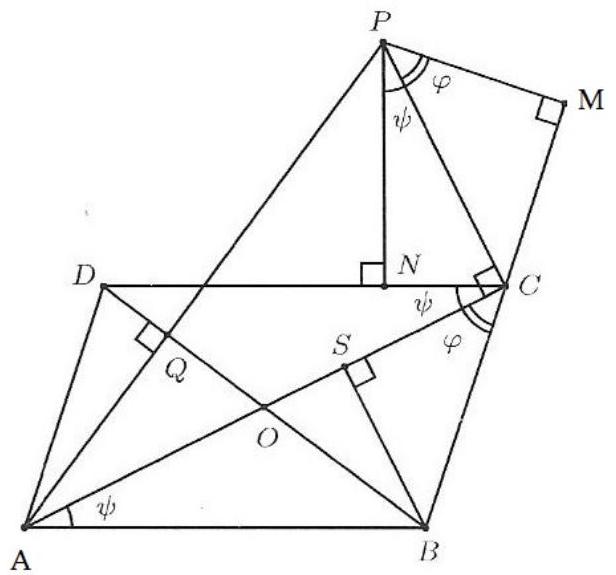
|
| 280 |
+
|
| 281 |
+
$$
|
| 282 |
+
\frac{B M}{M C} \cdot \frac{C N}{N D} \cdot \frac{D O}{O B}=1
|
| 283 |
+
$$
|
| 284 |
+
|
| 285 |
+
Since $D O=O B$ the above simplifies to $\frac{B M}{C M}=\frac{D N}{C N}$. It follows from $B M=B C+C M$ and $D N=D C-C N=A B-C N$ that the last equality is equivalent to:
|
| 286 |
+
|
| 287 |
+
$$
|
| 288 |
+
\frac{B C}{C M}+2=\frac{A B}{C N}
|
| 289 |
+
$$
|
| 290 |
+
|
| 291 |
+
Denote by $S$ the foot of the perpendicular from $B$ to $A C$. Since $\Varangle B C S=\Varangle C P M=\varphi$ and $\Varangle B A C=\Varangle A C D=\Varangle C P N=\psi$ we conclude that $\triangle C B S \sim \triangle P C M$ and $\triangle A B S \sim \triangle P C N$. Therefore
|
| 292 |
+
|
| 293 |
+
$$
|
| 294 |
+
\frac{C M}{B S}=\frac{C P}{B C} \text { and } \frac{C N}{B S}=\frac{C P}{A B}
|
| 295 |
+
$$
|
| 296 |
+
|
| 297 |
+
and thus,
|
| 298 |
+
|
| 299 |
+
$$
|
| 300 |
+
C M=\frac{C P . B S}{B C} \text { and } C N=\frac{C P . B S}{A B}
|
| 301 |
+
$$
|
| 302 |
+
|
| 303 |
+
Now equality (1) becomes $A B^{2}-B C^{2}=2 C P . B S$. It follows from
|
| 304 |
+
|
| 305 |
+
$$
|
| 306 |
+
A B^{2}-B C^{2}=A S^{2}-C S^{2}=(A S-C S)(A S+C S)=2 O S . A C
|
| 307 |
+
$$
|
| 308 |
+
|
| 309 |
+
that
|
| 310 |
+
|
| 311 |
+
$$
|
| 312 |
+
D C^{2}-B C^{2}=2 C P \cdot B S \Longleftrightarrow 2 O S \cdot A C=2 C P . B S \Longleftrightarrow O S \cdot A C=C P \cdot B S .
|
| 313 |
+
$$
|
| 314 |
+
|
| 315 |
+
Since $\Varangle A C P=\Varangle B S O=90^{\circ}$ and $\Varangle C A P=\Varangle S B O$ we conclude that $\triangle A C P \sim \triangle B S O$. This implies $O S . A C=C P . B S$, which completes the proof.
|
| 316 |
+
|
| 317 |
+
G2. Let $A B C$ be an acute triangle such that $A B$ is the shortest side of the triangle. Let $D$ be the midpoint of the side $A B$ and $P$ be an interior point of the triangle such that
|
| 318 |
+
|
| 319 |
+
$$
|
| 320 |
+
\Varangle C A P=\Varangle C B P=\Varangle A C B
|
| 321 |
+
$$
|
| 322 |
+
|
| 323 |
+
Denote by $M$ and $N$ the feet of the perpendiculars from $P$ to $B C$ and $A C$, respectively. Let $p$ be the line through $M$ parallel to $A C$ and $q$ be the line through $N$ parallel to $B C$. If $p$ and $q$ intersect at $K$ prove that $D$ is the circumcenter of triangle $M N K$.
|
| 324 |
+
|
| 325 |
+
Solution. If $\gamma=\Varangle A C B$ then $\Varangle C A P=\Varangle C B P=\Varangle A C B=\gamma$. Let $E=K N \cap A P$ and $F=K M \cap B P$. We show that points $E$ and $F$ are midpoints of $A P$ and $B P$, respectively.
|
| 326 |
+
|
| 327 |
+
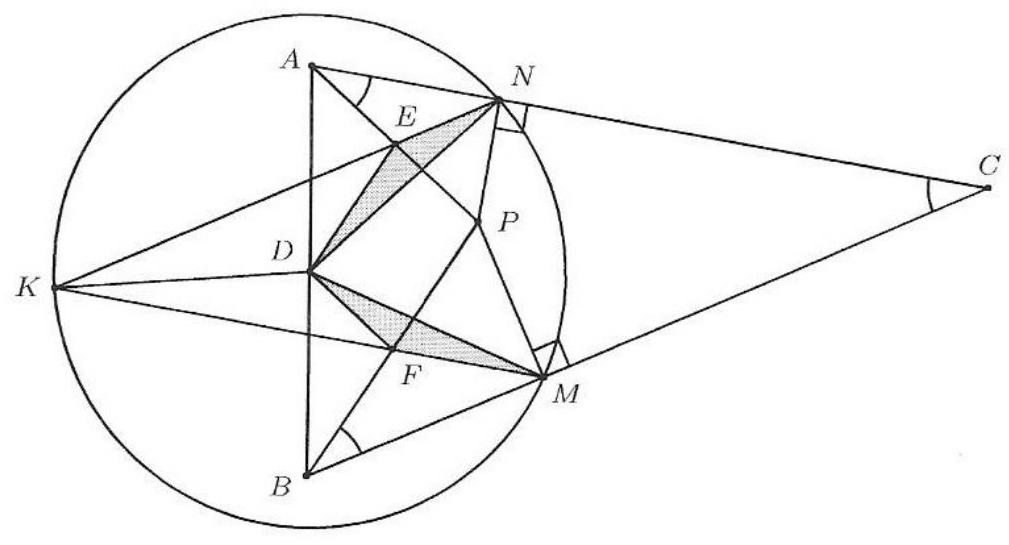
|
| 328 |
+
|
| 329 |
+
Indeed, consider the triangle $A E N$. Since $K N \| B C$, we have $\Varangle E N A=\Varangle B C A=\gamma$. Moreover $\Varangle E A N=\gamma$ giving that triangle $A E N$ is isosceles, i.e. $A E=E N$. Next, consider the triangle $E N P$. Since $\Varangle E N A=\gamma$ we find that
|
| 330 |
+
|
| 331 |
+
$$
|
| 332 |
+
\Varangle P N E=90^{\circ}-\Varangle E N A=90^{\circ}-\gamma
|
| 333 |
+
$$
|
| 334 |
+
|
| 335 |
+
Now $\Varangle E P N=90^{\circ}-\gamma$ implies that the triangle $E N P$ is isosceles triangle, i.e. $E N=E P$.
|
| 336 |
+
|
| 337 |
+
Since $A E=E N=E P$ point $E$ is the midpoint of $A P$ and analogously, $F$ is the midpoint of $B P$. Moreover, $D$ is also midpoint of $A B$ and we conclude that $D F P E$ is parallelogram.
|
| 338 |
+
|
| 339 |
+
It follows from $D E \| A P$ and $K E \| B C$ that $\Varangle D E K=\Varangle C B P=\gamma$ and analogously $\Varangle D F K=\gamma$.
|
| 340 |
+
|
| 341 |
+
We conclude that $\triangle E D N \cong \triangle F M D(E D=F P=F M, E N=E P=F D$ and $\Varangle D E N=$ $\left.\Varangle M F D=180^{\circ}-\gamma\right)$ and thus $N D=M D$. Therefore $D$ is a point on the perpendicular bisector of $M N$. Further,
|
| 342 |
+
|
| 343 |
+
$$
|
| 344 |
+
\begin{aligned}
|
| 345 |
+
\Varangle F D E & =\Varangle F P E=360^{\circ}-\Varangle B P M-\Varangle M P N-\Varangle N P A= \\
|
| 346 |
+
& =360^{\circ}-\left(90^{\circ}-\gamma\right)-\left(180^{\circ}-\gamma\right)-\left(90^{\circ}-\gamma\right)=3 \gamma
|
| 347 |
+
\end{aligned}
|
| 348 |
+
$$
|
| 349 |
+
|
| 350 |
+
It follows that
|
| 351 |
+
|
| 352 |
+
$$
|
| 353 |
+
\begin{aligned}
|
| 354 |
+
\Varangle M D N & =\Varangle F D E-\Varangle F D M-\Varangle E D N=\Varangle F D E-\Varangle E N D-\Varangle E D N= \\
|
| 355 |
+
& =\Varangle F D E-(\Varangle E N D+\Varangle E D N)=3 \gamma-\gamma=2 \gamma .
|
| 356 |
+
\end{aligned}
|
| 357 |
+
$$
|
| 358 |
+
|
| 359 |
+
Fianlly, $K M C N$ is parallelogram, i.e. $\Varangle M K N=\Varangle M C N=\gamma$. Therefore $D$ is a point on the perpendicular bisector of $M N$ and $\Varangle M D N=2 \Varangle M K N$, so $D$ is the circumcenter of $\triangle M N K$.
|
| 360 |
+
|
| 361 |
+
Problem G3. Consider triangle $A B C$ such that $A B \leq A C$. Point $D$ on the arc $B C$ of the circumcirle of $A B C$ not containing point $A$ and point $E$ on side $B C$ are such that
|
| 362 |
+
|
| 363 |
+
$$
|
| 364 |
+
\Varangle B A D=\Varangle C A E<\frac{1}{2} \Varangle B A C .
|
| 365 |
+
$$
|
| 366 |
+
|
| 367 |
+
Let $S$ be the midpoint of segment $A D$. If $\Varangle A D E=\Varangle A B C-\Varangle A C B$ prove that
|
| 368 |
+
|
| 369 |
+
$$
|
| 370 |
+
\Varangle B S C=2 \Varangle B A C
|
| 371 |
+
$$
|
| 372 |
+
|
| 373 |
+
Solution. Let the tangent to the circumcircle of $\triangle A B C$ at point $A$ intersect line $B C$ at $T$. Since $A B \leq A C$ we get that $B$ lies between $T$ and $C$. Since $\Varangle B A T=\Varangle A C B$ and $\Varangle A B T=\Varangle 180^{\circ}-\Varangle A B C$ we get $\Varangle E T A=\Varangle B T A=\Varangle A B C-\Varangle A C B=\Varangle A D E$ which gives that $A, E, D, T$ are concyclic. Since
|
| 374 |
+
|
| 375 |
+
$$
|
| 376 |
+
\Varangle T D B+\Varangle B C A=\Varangle T D B+\Varangle B D A=\Varangle T D A=\Varangle A E T=\Varangle A C B+\Varangle E A C
|
| 377 |
+
$$
|
| 378 |
+
|
| 379 |
+
this means $\Varangle T D B=\Varangle E A C=\Varangle D A B$ which means that $T D$ is tangent to the circumcircle of $\triangle A B C$ at point $D$.
|
| 380 |
+
|
| 381 |
+
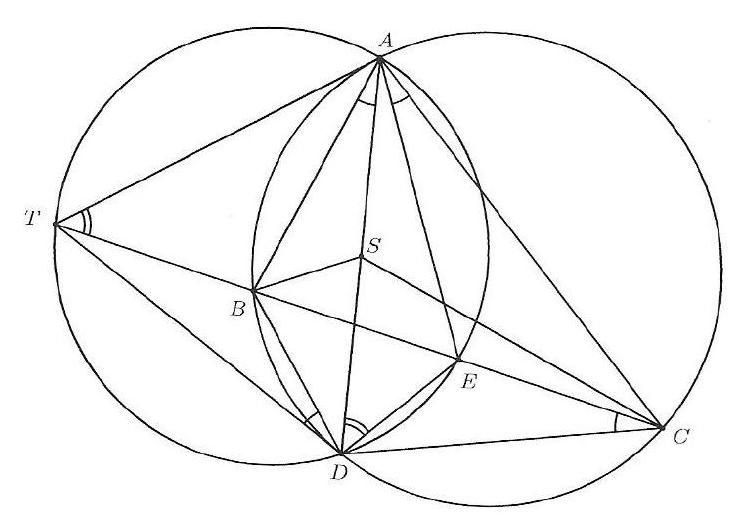
|
| 382 |
+
|
| 383 |
+
Using similar triangles $T A B$ and $T C A$ we get
|
| 384 |
+
|
| 385 |
+
$$
|
| 386 |
+
\frac{A B}{A C}=\frac{T A}{T C}
|
| 387 |
+
$$
|
| 388 |
+
|
| 389 |
+
Using similar triangles $T B D$ and $T D C$ we get
|
| 390 |
+
|
| 391 |
+
$$
|
| 392 |
+
\frac{B D}{C D}=\frac{T D}{T C}
|
| 393 |
+
$$
|
| 394 |
+
|
| 395 |
+
Using the fact that $T A=T D$ with (1) and (2) we get
|
| 396 |
+
|
| 397 |
+
$$
|
| 398 |
+
\frac{A B}{A C}=\frac{B D}{C D}
|
| 399 |
+
$$
|
| 400 |
+
|
| 401 |
+
Now since $\Varangle D A B=\Varangle C A E$ and $\Varangle B D A=\Varangle E C A$ we get that the triangles $D A B$ and $C A E$ are similar. Analogously, we get that triangles $C A D$ and $E A B$ are similar. These similarities give us
|
| 402 |
+
|
| 403 |
+
$$
|
| 404 |
+
\frac{D B}{C E}=\frac{A B}{A E} \quad \text { and } \quad \frac{C D}{E B}=\frac{C A}{E A}
|
| 405 |
+
$$
|
| 406 |
+
|
| 407 |
+
which, when combined with (3) give us $B E=C E$ giving $E$ is the midpoint of side $B C$.
|
| 408 |
+
|
| 409 |
+
Using the fact that triangles $D A B$ and $C A E$ are similar with the fact that $E$ is the midpoint of $B C$ we get:
|
| 410 |
+
|
| 411 |
+
$$
|
| 412 |
+
\frac{2 D S}{C A}=\frac{D A}{C A}=\frac{D B}{C E}=\frac{D B}{\frac{C B}{2}}=\frac{2 D B}{C B}
|
| 413 |
+
$$
|
| 414 |
+
|
| 415 |
+
implying that
|
| 416 |
+
|
| 417 |
+
$$
|
| 418 |
+
\frac{D S}{D B}=\frac{C A}{C B}
|
| 419 |
+
$$
|
| 420 |
+
|
| 421 |
+
Since $\Varangle S D B=\Varangle A D B=\Varangle A C B$ we get from (4) that the triangles $S D B$ and $A C B$ are similar, giving us $\Varangle B S D=\Varangle B A C$. Analogously we get $\triangle S D C$ and $\triangle A B C$ are similar we get $\Varangle C S D=\Varangle C A B$. Combining the last two equalities we get
|
| 422 |
+
|
| 423 |
+
$$
|
| 424 |
+
2 \Varangle B A C=\Varangle B A C+\Varangle C A B=\Varangle C S D+\Varangle B S D=\Varangle C S B
|
| 425 |
+
$$
|
| 426 |
+
|
| 427 |
+
This completes the proof.
|
| 428 |
+
|
| 429 |
+
## Alternative solution (PSC).
|
| 430 |
+
|
| 431 |
+
Lemma 1. A point $P$ is such that $\Varangle P X Y=\Varangle P Y Z$ and $\Varangle P Z Y=\Varangle P Y X$. If $R$ is the midpoint of $X Z$ then $\Varangle X Y P=\Varangle Z Y R$.
|
| 432 |
+
|
| 433 |
+
Proof. We consider the case when $P$ is inside the triangle $X Y Z$ (the other case is treated in similar way). Let $Q$ be the conjugate of $P$ in $\triangle X Y Z$ and let $Y Q$ intersects $X Z$ at $S$.
|
| 434 |
+
|
| 435 |
+
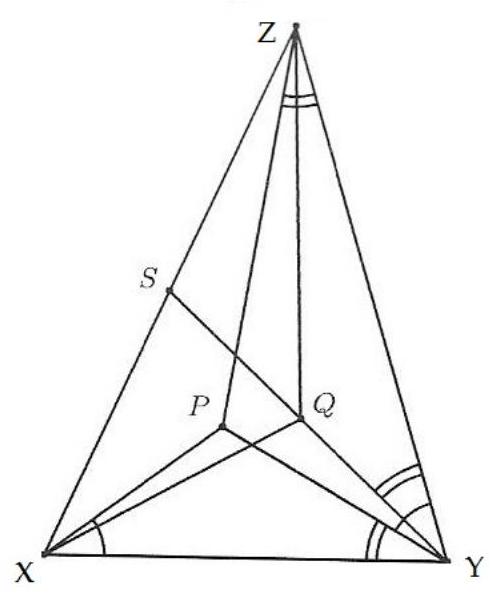
|
| 436 |
+
|
| 437 |
+
Then $\Varangle Q X Z=\Varangle Q Y X$ and $\Varangle Q Z X=\Varangle Q Y Z$ and therefore $\triangle S X Y \sim \triangle S Q X$ and $\triangle S Z Y \sim$ $\triangle S Q Z$. Thus $S X^{2}=S Q . S Y=S Z^{2}$ and we conclude that $S \equiv R$. This completes the proof of the Lemma.
|
| 438 |
+
|
| 439 |
+
For $\triangle D C A$ we have $\Varangle C D E=\Varangle E C A$ and $\Varangle E A C=\Varangle E C D$. By the Lemma 1 for $\triangle D C A$ and point $E$ we have that $\Varangle S C A=\Varangle D C E$. Therefore
|
| 440 |
+
|
| 441 |
+
$$
|
| 442 |
+
\Varangle D S C=\Varangle S A C+\Varangle S C A=\Varangle S A C+\Varangle D C E=\Varangle S A C+\Varangle B A D=\Varangle B A C .
|
| 443 |
+
$$
|
| 444 |
+
|
| 445 |
+
By analogy, Lemma 1 applied for $\triangle B D A$ and point $E$ gives $\Varangle B S D=\Varangle B A C$. Thus, $\Varangle B S C=$ $2 \Varangle B A C$.
|
| 446 |
+
|
| 447 |
+
Problem G4. Let $A B C$ be a scalene triangle with circumcircle $\Gamma$ and circumcenter $O$. Let $M$ be the midpoint of $B C$ and $D$ be a point on $\Gamma$ such that $A D \perp B C$. Let $T$ be a point such that $B D C T$ is a parallelogram and $Q$ a point on the same side of $B C$ as $A$ such that
|
| 448 |
+
|
| 449 |
+
$$
|
| 450 |
+
\Varangle B Q M=\Varangle B C A \quad \text { and } \quad \Varangle C Q M=\Varangle C B A
|
| 451 |
+
$$
|
| 452 |
+
|
| 453 |
+
Let $A O$ intersect $\Gamma$ again at $E$ and let the circumcircle of $E T Q$ intersect $\Gamma$ at point $X \neq E$. Prove that the points $A, M$, and $X$ are collinear.
|
| 454 |
+
|
| 455 |
+
Solution. Let $X^{\prime}$ be symmetric point to $Q$ in line $B C$. Now since $\Varangle C B A=\Varangle C Q M=$ $\Varangle C X^{\prime} M, \Varangle B C A=\Varangle B Q M=\Varangle B X^{\prime} M$, we have
|
| 456 |
+
|
| 457 |
+
$$
|
| 458 |
+
\Varangle B X^{\prime} C=\Varangle B X^{\prime} M+\Varangle C X^{\prime} M=\Varangle C B A+\Varangle B C A=180^{\circ}-\Varangle B A C
|
| 459 |
+
$$
|
| 460 |
+
|
| 461 |
+
we have that $X^{\prime} \in \Gamma$. Now since $\Varangle A X^{\prime} B=\Varangle A C B=\Varangle M X^{\prime} B$ we have that $A, M, X^{\prime}$ are collinear. Note that since
|
| 462 |
+
|
| 463 |
+
$$
|
| 464 |
+
\Varangle D C B=\Varangle D A B=90^{\circ}-\Varangle A B C=\Varangle O A C=\Varangle E A C
|
| 465 |
+
$$
|
| 466 |
+
|
| 467 |
+
we get that $D B C E$ is an isosceles trapezoid.
|
| 468 |
+
|
| 469 |
+
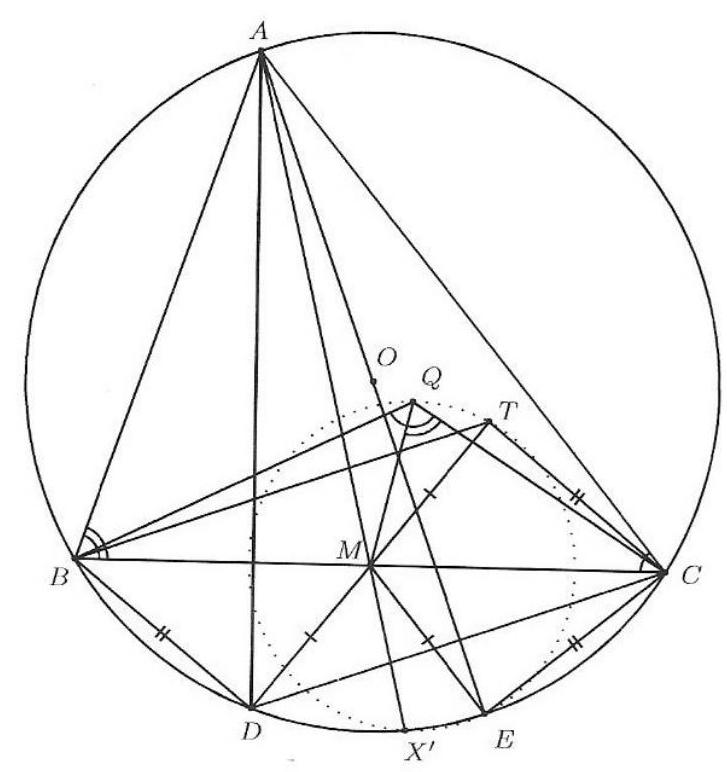
|
| 470 |
+
|
| 471 |
+
Since $B D C T$ is a parallelogram we have $M T=M D$, with $M, D, T$ being collinear, $B D=C T$, and since $B D E C$ is an isosceles trapezoid we have $B D=C E$ and $M E=M D$. Since
|
| 472 |
+
|
| 473 |
+
$$
|
| 474 |
+
\Varangle B T C=\Varangle B D C=\Varangle B E D, \quad C E=B D=C T \quad \text { and } \quad M E=M T
|
| 475 |
+
$$
|
| 476 |
+
|
| 477 |
+
we have that $E$ and $T$ are symmetric with respect to the line $B C$. Now since $Q$ and $X^{\prime}$ are symmetric with respect to the line $B C$ as well, this means that $Q X^{\prime} E T$ is an isosceles trapezoid which means that $Q, X^{\prime}, E, T$ are concyclic. Since $X^{\prime} \in \Gamma$ this means that $X \equiv X^{\prime}$ and therefore $A, M, X$ are collinear.
|
| 478 |
+
|
| 479 |
+
Alternative solution (PSC). Denote by $H$ the orthocenter of $\triangle A B C$. We use the following well known properties:
|
| 480 |
+
|
| 481 |
+
(i) Point $D$ is the symmetric point of $H$ with respect to $B C$. Indeed, if $H_{1}$ is the symmetric point of $H$ with respect to $B C$ then $\Varangle B H_{1} C+\Varangle B A C=180^{\circ}$ and therefore $H_{1} \equiv D$.
|
| 482 |
+
|
| 483 |
+
(ii) The symmetric point of $H$ with respect to $M$ is the point $E$. Indeed, if $H_{2}$ is the symmetric point of $H$ with respect to $M$ then $B H_{2} C H$ is parallelogram, $\Varangle B H_{2} C+\Varangle B A C=180^{\circ}$ and since $E B \| C H$ we have $\Varangle E B A=90^{\circ}$.
|
| 484 |
+
|
| 485 |
+
Since $D E T H$ is a parallelogram and $M H=M D$ we have that $D E T H$ is a rectangle. Therefore $M T=M E$ and $T E \perp B C$ implying that $T$ and $E$ are symmetric with respect to $B C$. Denote by $Q^{\prime}$ the symmetric point of $Q$ with respect to $B C$. Then $Q^{\prime} E T Q$ is isosceles trapezoid, so $Q^{\prime}$ is a point on the circumcircle of $\triangle E T Q$. Moreover $\Varangle B Q^{\prime} C+\Varangle B A C=180^{\circ}$ and we conclude that $Q^{\prime} \in \Gamma$. Therefore $Q^{\prime} \equiv X$.
|
| 486 |
+
|
| 487 |
+
It remains to observe that $\Varangle C X M=\Varangle C Q M=\Varangle C B A$ and $\Varangle C X A=\Varangle C B A$ and we infer that $X, M$ and $A$ are collinear.
|
| 488 |
+
|
| 489 |
+
Problem G5. A point $P$ lies in the interior of the triangle $A B C$. The lines $A P, B P$, and $C P$ intersect $B C, C A$, and $A B$ at points $D, E$, and $F$, respectively. Prove that if two of the quadrilaterals $A B D E, B C E F, C A F D, A E P F, B F P D$, and $C D P E$ are concyclic, then all six are concyclic.
|
| 490 |
+
|
| 491 |
+
Solution. We first prove the following lemma:
|
| 492 |
+
|
| 493 |
+
Lemma 1. Let $A B C D$ be a convex quadrilateral and let $A B \cap C D=E$ and $B C \cap D A=F$. Then the circumcircles of triangles $A B F, C D F, B C E$ and $D A E$ all pass through a common point $P$. This point lies on line $E F$ if and only if $A B C D$ in concyclic.
|
| 494 |
+
|
| 495 |
+
Proof. Let the circumcircles of $A B F$ and $B C F$ intersect at $P \neq B$. We have
|
| 496 |
+
|
| 497 |
+
$$
|
| 498 |
+
\begin{aligned}
|
| 499 |
+
\Varangle F P C & =\Varangle F P B+\Varangle B P C=\Varangle B A D+\Varangle B E C=\Varangle E A D+\Varangle A E D= \\
|
| 500 |
+
& =180^{\circ}-\Varangle A D E=180^{\circ}-\Varangle F D C
|
| 501 |
+
\end{aligned}
|
| 502 |
+
$$
|
| 503 |
+
|
| 504 |
+
which gives us $F, P, C$ and $D$ are concyclic. Similarly we have
|
| 505 |
+
|
| 506 |
+
$$
|
| 507 |
+
\begin{aligned}
|
| 508 |
+
\Varangle A P E & =\Varangle A P B+\Varangle B P E=\Varangle A F B+\Varangle B C D=\Varangle D F C+\Varangle F C D= \\
|
| 509 |
+
& =180^{\circ}-\Varangle F D C=180^{\circ}-\Varangle A D E
|
| 510 |
+
\end{aligned}
|
| 511 |
+
$$
|
| 512 |
+
|
| 513 |
+
which gives us $E, P, A$ and $D$ are concyclic. Since $\Varangle F P E=\Varangle F P B+\Varangle E P B=\Varangle B A D+$ $\Varangle B C D$ we get that $\Varangle F P E=180^{\circ}$ if and only if $\Varangle B A D+\Varangle B C D=180^{\circ}$ which completes the lemma. We now divide the problem into cases:
|
| 514 |
+
|
| 515 |
+
Case 1: $A E P F$ and $B F E C$ are concyclic. Here we get that
|
| 516 |
+
|
| 517 |
+
$$
|
| 518 |
+
180^{\circ}=\Varangle A E P+\Varangle A F P=360^{\circ}-\Varangle C E B-\Varangle B F C=360^{\circ}-2 \Varangle C E B
|
| 519 |
+
$$
|
| 520 |
+
|
| 521 |
+
and here we get that $\Varangle C E B=\Varangle C F B=90^{\circ}$, from here it follows that $P$ is the ortocenter of $\triangle A B C$ and that gives us $\Varangle A D B=\Varangle A D C=90^{\circ}$. Now the quadrilaterals $C E P D$ and $B D P F$ are concyclic because
|
| 522 |
+
|
| 523 |
+
$$
|
| 524 |
+
\Varangle C E P=\Varangle C D P=\Varangle P D B=\Varangle P F B=90^{\circ} .
|
| 525 |
+
$$
|
| 526 |
+
|
| 527 |
+
Quadrilaterals $A C D F$ and $A B D E$ are concyclic because
|
| 528 |
+
|
| 529 |
+
$$
|
| 530 |
+
\Varangle A E B=\Varangle A D B=\Varangle A D C=\Varangle A F C=90^{\circ}
|
| 531 |
+
$$
|
| 532 |
+
|
| 533 |
+
Case 2: $A E P F$ and $C E P D$ are concyclic. Now by lemma 1 applied to the quadrilateral $A E P F$ we get that the circumcircles of $C E P, C A F, B P F$ and $B E A$ intersect at a point on $B C$. Since $D \in B C$ and $C E P D$ is concyclic we get that $D$ is the desired point and it follows that $B D P F, B A E D, C A F D$ are all concylic and now we can finish same as Case 1 since $A E D B$ and $C E P D$ are concyclic.
|
| 534 |
+
|
| 535 |
+
Case 3: $A E P F$ and $A E D B$ are concyclic. We apply lemma 1 as in Case 2 on the quadrilateral $A E P F$. From the lemma we get that $B D P F, C E P D$ and $C A F D$ are concylic and we finish off the same as in Case 1.
|
| 536 |
+
|
| 537 |
+
Case 4: $A C D F$ and $A B D E$ are concyclic. We apply lemma 1 on the quadrilateral $A E P F$ and get that the circumcircles of $A C F, E C P, P F B$ and $B A E$ intersect at one point. Since this point is $D$ (because $A C D F$ and $A B D E$ are concyclic) we get that $A E P F, C E P D$ and $B F P D$ are concylic. We now finish off as in Case 1. These four cases prove the problem statement.
|
| 538 |
+
|
| 539 |
+
Remark. A more natural approach is to solve each of the four cases by simple angle chasing.
|
| 540 |
+
|
| 541 |
+
## Number Theory
|
| 542 |
+
|
| 543 |
+
NT1. Determine all sets of six consecutive positive integers such that the product of two of them, added to the the product of other two of them is equal to the product of the remaining two numbers.
|
| 544 |
+
|
| 545 |
+
Solution. Exactly two of the six numbers are multiples of 3 and these two need to be multiplied together, otherwise two of the three terms of the equality are multiples of 3 but the third one is not.
|
| 546 |
+
|
| 547 |
+
Let $n$ and $n+3$ denote these multiples of 3 . Two of the four remaining numbers give remainder 1 when divided by 3 , while the other two give remainder 2 , so the two other products are either
|
| 548 |
+
|
| 549 |
+
$\equiv 1 \cdot 1=1(\bmod 3)$ and $\equiv 2 \cdot 2 \equiv 1(\bmod 3)$, or they are both $\equiv 1 \cdot 2 \equiv 2(\bmod 3)$. In conclusion, the term $n(n+3)$ needs to be on the right hand side of the equality.
|
| 550 |
+
|
| 551 |
+
Looking at parity, three of the numbers are odd, and three are even. One of $n$ and $n+3$ is odd, the other even, so exactly two of the other numbers are odd. As $n(n+3)$ is even, the two remaining odd numbers need to appear in different terms.
|
| 552 |
+
|
| 553 |
+
We distinguish the following cases:
|
| 554 |
+
|
| 555 |
+
I. The numbers are $n-2, n-1, n, n+1, n+2, n+3$.
|
| 556 |
+
|
| 557 |
+
The product of the two numbers on the RHS needs to be larger than $n(n+3)$. The only possibility is $(n-2)(n-1)+n(n+3)=(n+1)(n+2)$ which leads to $n=3$. Indeed, $1 \cdot 2+3 \cdot 6=4 \cdot 5$
|
| 558 |
+
|
| 559 |
+
II. The numbers are $n-1, n, n+1, n+2, n+3, n+4$.
|
| 560 |
+
|
| 561 |
+
As $(n+4)(n-1)+n(n+3)=(n+1)(n+2)$ has no solutions, $n+4$ needs to be on the RHS, multiplied with a number having a different parity, so $n-1$ or $n+1$.
|
| 562 |
+
|
| 563 |
+
$(n+2)(n-1)+n(n+3)=(n+1)(n+4)$ leads to $n=3$. Indeed, $2 \cdot 5+3 \cdot 6=4 \cdot 7$. $(n+2)(n+1)+n(n+3)=(n-1)(n+4)$ has no solution.
|
| 564 |
+
|
| 565 |
+
III. The numbers are $n, n+1, n+2, n+3, n+4, n+5$.
|
| 566 |
+
|
| 567 |
+
We need to consider the following situations:
|
| 568 |
+
|
| 569 |
+
$(n+1)(n+2)+n(n+3)=(n+4)(n+5)$ which leads to $n=6$; indeed $7 \cdot 8+6 \cdot 9=10 \cdot 11$;
|
| 570 |
+
|
| 571 |
+
$(n+2)(n+5)+n(n+3)=(n+1)(n+4)$ obviously without solutions, and
|
| 572 |
+
|
| 573 |
+
$(n+1)(n+4)+n(n+3)=(n+2)(n+5)$ which leads to $n=2$ (not a multiple of 3 ).
|
| 574 |
+
|
| 575 |
+
In conclusion, the problem has three solutions:
|
| 576 |
+
|
| 577 |
+
$$
|
| 578 |
+
1 \cdot 2+3 \cdot 6=4 \cdot 5, \quad 2 \cdot 5+3 \cdot 6=4 \cdot 7, \quad \text { and } \quad 7 \cdot 8+6 \cdot 9=10 \cdot 11
|
| 579 |
+
$$
|
| 580 |
+
|
| 581 |
+
NT2. Determine all positive integers $n$ such that $n^{2} \mid(n-1)$ !.
|
| 582 |
+
|
| 583 |
+
First solution. This is true for all positive integers $n$ unless $n=8,9, p, 2 p$ for some prime $p$. It is easy to check that $8^{2} \nmid(8-1)$ ! and $9^{2} \nmid(9-1)$ ! by determining the largest powers of 2 and 3 which divide the right hand sides. It is also immediate that $p^{2} \nmid(p-1)$ ! and $(2 p)^{2} \nmid(2 p-1)$ ! as $(p-1)$ ! is not divisible by $p$, while the largest power of $p$ dividing $(2 p-1)$ ! is 1 .
|
| 584 |
+
|
| 585 |
+
The case $n=1$ is also clearly true. So it remains to show that $n^{2} \mid(n-1)$ ! in all other cases. It is enough to show that in those cases, for every prime $p$ which divides $n$, the largest power of $p$ dividing $n^{2}$ is less than or equal to the largest power of $p$ dividing $(n-1)!$. So let us write $n=m p^{r}$ where $(m, p)=1$. The largest power of $p$ dividing $(n-1)!$ is
|
| 586 |
+
|
| 587 |
+
$$
|
| 588 |
+
\left\lfloor\frac{n-1}{p}\right\rfloor+\left\lfloor\frac{n-1}{p^{2}}\right\rfloor+\cdots \geqslant\left(m p^{r-1}-1\right)+\cdots+(m-1)=m \frac{p^{r}-1}{p-1}-r
|
| 589 |
+
$$
|
| 590 |
+
|
| 591 |
+
So it is enough to prove that
|
| 592 |
+
|
| 593 |
+
$$
|
| 594 |
+
m \frac{p^{r}-1}{p-1} \geqslant 3 r
|
| 595 |
+
$$
|
| 596 |
+
|
| 597 |
+
We will distinguish between the cases $p=2, p=3$ and $p \geqslant 5$.
|
| 598 |
+
|
| 599 |
+
Case 1: Suppose $p=2$. We will further distinguish the cases $r \geqslant 4$ and $r \leqslant 3$
|
| 600 |
+
|
| 601 |
+
Case 1A: Suppose $r \geqslant 4$. Then
|
| 602 |
+
|
| 603 |
+
$$
|
| 604 |
+
m \frac{p^{r}-1}{p-1} \geqslant 2^{r}-1=8(1+1)^{r-3}-1 \geqslant 8(1+r-3)-1=3 r+(5 r-17) \geqslant 3 r
|
| 605 |
+
$$
|
| 606 |
+
|
| 607 |
+
Here, we have used Bernoulli's inequality.
|
| 608 |
+
|
| 609 |
+
Case 1B: Suppose $r \leqslant 3$. Because $n \neq 2,4,8$, then $n$ has another prime divisor and so $m \geqslant 3$. Then
|
| 610 |
+
|
| 611 |
+
$$
|
| 612 |
+
m \frac{p^{r}-1}{p-1} \geqslant 3\left(2^{r}-1\right) \geqslant 3 r
|
| 613 |
+
$$
|
| 614 |
+
|
| 615 |
+
where the last inequality is easily verifiable for $r \leqslant 3$. (It also follows by applying Bernoulli's inequality.)
|
| 616 |
+
|
| 617 |
+
Case 2: Suppose $p=3$. We will further distinguish three cases. The case $r \geqslant 3$ alone, and the cases $r=2$ and $r=1$ separately.
|
| 618 |
+
|
| 619 |
+
Case 2A: Suppose $r \geqslant 3$. Then
|
| 620 |
+
|
| 621 |
+
$$
|
| 622 |
+
m \frac{p^{r}-1}{p-1} \geqslant \frac{3^{r}-1}{2}=\frac{9(1+2)^{r-2}-1}{2} \geqslant \frac{9(1+2(r-2))-1}{2}=3 r+(6 r-14) \geqslant 3 r
|
| 623 |
+
$$
|
| 624 |
+
|
| 625 |
+
Case 2B: Suppose $r=2$. Because $n \neq 9$, then $n$ has another prime divisor and so $m \geqslant 2$. Then
|
| 626 |
+
|
| 627 |
+
$$
|
| 628 |
+
m \frac{p^{r}-1}{p-1} \geqslant 8 \geqslant 6=3 r
|
| 629 |
+
$$
|
| 630 |
+
|
| 631 |
+
Case 2C: Suppose $r=1$. Because $n \neq 3,6$, then $n$ has another divisor which is bigger than 2 . So $m \geqslant 4$. Then
|
| 632 |
+
|
| 633 |
+
$$
|
| 634 |
+
m \frac{p^{r}-1}{p-1} \geqslant 4 \geqslant 3=3 r
|
| 635 |
+
$$
|
| 636 |
+
|
| 637 |
+
Case 3: Suppose $p \geqslant 5$. We will further distinguish the cases $r \geqslant 2$ and $r=1$.
|
| 638 |
+
|
| 639 |
+
Case 3A: Suppose $r \geqslant 2$. Then
|
| 640 |
+
|
| 641 |
+
$$
|
| 642 |
+
m \frac{p^{r}-1}{p-1} \geqslant \frac{5^{r}-1}{4}=\frac{5(1+4)^{r-1}-1}{4} \geqslant \frac{5(1+4(r-1))-1}{4}=3 r+2(r-2) \geqslant 3 r
|
| 643 |
+
$$
|
| 644 |
+
|
| 645 |
+
Case 3B: Suppose $r=1$. Because $n \neq p, 2 p$, then $n$ has another divisor which is bigger than 2. So $m \geqslant 3$. Then
|
| 646 |
+
|
| 647 |
+
$$
|
| 648 |
+
m \frac{p^{r}-1}{p-1} \geqslant 3=3 r
|
| 649 |
+
$$
|
| 650 |
+
|
| 651 |
+
Second solution. (PSC) Let $n \neq 8,9, p, 2 p$, where $p$ is prime.
|
| 652 |
+
|
| 653 |
+
Let $n$ be odd and $p$ be the smallest prime divisor of $n$. If $n=p^{2}$, then $p \geq 5, p<2 p<3 p<4 p$ participate in $(n-1)$ ! and so $p^{4}=n^{2} \mid(n-1)$ !. If $p<\frac{n}{p}$, then $p<2 p$ and $\frac{n}{p}<\frac{2 n}{p}$ all are less that $n$ and therefore participate in $(n-1)!$. So $n^{2}\left|4 n^{2}=p \cdot 2 p \cdot \frac{n}{p} \cdot \frac{2 n}{p}\right|(n-1)$ !.
|
| 654 |
+
|
| 655 |
+
Let $n$ be even and $n=2^{k} m$, where $k$ is positive integer and $m$ is odd. If $m=1$, then $k \geq 4$ and $2<2^{2}<2^{k-2}<2^{k-1}$ shows that $n^{2}=2^{2 k} \mid(n-1)$ ! for $k \geq 5$ and the case $k=4$ is seen directly. Let now $m>1$. If $k \geq 2$, then the divisors $2<m<2^{k-1} m$ and $2^{k}$ of $n$ work. If $k=1$, then $m$ is not prime, and let $p$ is the smallest prime divisor of $m$. Now $4, p<2 p$ and $\frac{m}{p}<\frac{2 m}{p}$ work when $m \neq p^{2}$, and $4, p<2 p<3 p<4 p$ work when $m=p^{2}$.
|
| 656 |
+
|
| 657 |
+
NT3. Find all pairs of positive integers $(x, y)$ such that $2^{x}+3^{y}$ is a perfect square.
|
| 658 |
+
|
| 659 |
+
Solution. In order for the expression $2^{x}+3^{y}$ to be a perfect square, a positive integer $t$ such that $2^{x}+3^{y}=t^{2}$ should exist.
|
| 660 |
+
|
| 661 |
+
Case 1. If $x$ is even, then there exists a positive integer $z$ such that $x=2 z$. Then
|
| 662 |
+
|
| 663 |
+
$$
|
| 664 |
+
\left(t-2^{z}\right)\left(t+2^{z}\right)=3^{y}
|
| 665 |
+
$$
|
| 666 |
+
|
| 667 |
+
Since $t+2^{z}-\left(t-2^{z}\right)=2^{z+1}$, which implies $g c d\left(t-2^{z}, t+2^{z}\right) \mid 2^{z+1}$, it follows that $\operatorname{gcd}\left(t-2^{z}, t+\right.$ $\left.2^{z}\right)=1$, hence $t-2^{z}=1$ and $t+2^{z}=3^{y}$, so we have $2^{z+1}+1=3^{y}$.
|
| 668 |
+
|
| 669 |
+
For $z=1$ we have $5=3^{y}$ which clearly have no solution. For $z \geq 2$ we have (modulo 4) that $y$ is even. Let $y=2 k$. Then $2^{z+1}=\left(3^{k}-1\right)\left(3^{k}+1\right)$ which is possible only when $3^{k}-1=2$, i.e. $k=1, y=2$, which implies that $t=5$. So the pair $(4,2)$ is a solution to our problem. Case 2. If $y$ is even, then there exists a positive integer $w$ such that $y=2 w$, and
|
| 670 |
+
|
| 671 |
+
$$
|
| 672 |
+
\left(t-3^{w}\right)\left(t+3^{w}\right)=2^{x}
|
| 673 |
+
$$
|
| 674 |
+
|
| 675 |
+
Since $t+3^{w}-\left(t-3^{w}\right)=2 \cdot 3^{w}$, we have $\operatorname{gcd}\left(t-2^{z}, t+2^{z}\right) \mid 2 \cdot 3^{w}$, which means that $g c d(t-$ $\left.3^{w}, t+3^{w}\right)=2$. Hence $t-3^{w}=2$ and $t+3^{w}=2^{x-1}$. So we have
|
| 676 |
+
|
| 677 |
+
$$
|
| 678 |
+
2 \cdot 3^{w}+2=2^{x-1} \Rightarrow 3^{w}+1=2^{x-2}
|
| 679 |
+
$$
|
| 680 |
+
|
| 681 |
+
Here we see modulo 3 that $x-2$ is even. Let $x-2=2 m$, then $3^{w}=\left(2^{m}-1\right)\left(2^{m}+1\right)$, whence $m=1$ since $\operatorname{gcd}\left(2^{m}-1,2^{m}+1\right)=1$. So we arrive again to the solution $(4,2)$.
|
| 682 |
+
|
| 683 |
+
Case 3. Let $x$ and $y$ be odd. For $x \geq 3$ we have $2^{x}+3^{y} \equiv 3(\bmod 4)$ while $t^{2} \equiv 0,1(\bmod 4)$, a contradiction. For $x=1$ we have $2+3^{y}=t^{2}$. For $y \geq 2$ we have $2+3^{y} \equiv 2(\bmod 9)$ while $t^{2} \equiv 0,1,4,7(\bmod 9)$. For $y=1$ we have $5=2+3=t^{2}$ clearly this doesn't have solution. Note. The proposer's solution used Zsigmondy's theorem in the final steps of cases 1 and 2 .
|
| 684 |
+
|
| 685 |
+
NT4. Solve in nonnegative integers the equation $5^{t}+3^{x} 4^{y}=z^{2}$.
|
| 686 |
+
|
| 687 |
+
Solution. If $x=0$ we have
|
| 688 |
+
|
| 689 |
+
$$
|
| 690 |
+
z^{2}-2^{2 y}=5^{t} \Longleftrightarrow\left(z+2^{y}\right)\left(z-2^{y}\right)=5^{t}
|
| 691 |
+
$$
|
| 692 |
+
|
| 693 |
+
Putting $z+2^{y}=5^{a}$ and $z-2^{y}=5^{b}$ with $a+b=t$ we get $5^{a}-5^{b}=2^{y+1}$. This gives us $b=0$ and now we have $5^{t}-1=2^{y+1}$. If $y \geq 2$ then consideration by modulo 8 gives $2 \mid t$. Putting $t=2 s$ we get $\left(5^{s}-1\right)\left(5^{s}+1\right)=2^{y+1}$. This means $5^{s}-1=2^{c}$ and $5^{s}+1=2^{d}$ with $c+d=y+1$. Subtracting we get $2=2^{d}-2^{c}$. Then we have $c=1, d=2$, but the equation $5^{s}-1=2$ has no solutions over nonnegative integers. Therefore so $y \geq 2$ in this case gives us no solutions. If $y=0$ we get again $5^{t}-1=2$ which again has no solutions in nonnegative integers. If $y=1$ we get $t=1$ and $z=3$ which gives us the solution $(t, x, y, z)=(1,0,1,3)$.
|
| 694 |
+
|
| 695 |
+
Now if $x \geq 1$ then by modulo 3 we have $2 \mid t$. Putting $t=2 s$ we get
|
| 696 |
+
|
| 697 |
+
$$
|
| 698 |
+
3^{x} 4^{y}=z^{2}-5^{2 s} \Longleftrightarrow 3^{x} 4^{y}=\left(z+5^{s}\right)\left(z-5^{s}\right)
|
| 699 |
+
$$
|
| 700 |
+
|
| 701 |
+
Now we have $z+5^{s}=3^{m} 2^{k}$ and $z-5^{s}=3^{n} 2^{l}$, with $k+l=2 y$ and $m+n=x \geq 1$. Subtracting we get
|
| 702 |
+
|
| 703 |
+
$$
|
| 704 |
+
2.5^{s}=3^{m} 2^{k}-3^{n} 2^{l}
|
| 705 |
+
$$
|
| 706 |
+
|
| 707 |
+
Here we get that $\min \{m, n\}=0$. We now have a couple of cases.
|
| 708 |
+
|
| 709 |
+
Case 1. $k=l=0$. Now we have $n=0$ and we get the equation $2.5^{s}=3^{m}-1$. From modulo 4 we get that $m$ is odd. If $s \geq 1$ we get modulo 5 that $4 \mid m$, a contradiction. So $s=0$ and we get $m=1$. This gives us $t=0, x=1, y=0, z=2$.
|
| 710 |
+
|
| 711 |
+
Case 2. $\min \{k, l\}=1$. Now we deal with two subcases:
|
| 712 |
+
|
| 713 |
+
Case 2a. $l>k=1$. We get $5^{s}=3^{m}-3^{n} 2^{l-1}$. Since $\min \{m, n\}=0$, we get that $n=0$. Now the equation becomes $5^{s}=3^{m}-2^{l-1}$. Note that $l-1=2 y-2$ is even. By modulo 3 we get that $s$ is odd and this means $s \geq 1$. Now by modulo 5 we get $3^{m} \equiv 2^{2 y-2} \equiv 1,-1(\bmod 5)$. Here we get that $m$ is even as well, so we write $m=2 q$. Now we get $5^{s}=\left(3^{q}-2^{y-1}\right)\left(3^{q}+2^{y-1}\right)$.
|
| 714 |
+
|
| 715 |
+
Therefore $3^{q}-2^{y-1}=5^{v}$ and $3^{q}+2^{y-1}=5^{u}$ with $u+v=s$. Then $2^{y}=5^{u}-5^{v}$, whence $v=0$ and we have $3^{q}-2^{y-1}=1$. Plugging in $y=1,2$ we get the solution $y=2, q=1$. This gives us $m=2, s=1, n=0, x=2, t=2$ and therefore $z=13$. Thus we have the solution $(t, x, y, z)=(2,2,2,13)$. If $y \geq 3$ we get modulo 4 that $q, q=2 r$. Then $\left(3^{r}-1\right)\left(3^{r}+1\right)=2^{y-1}$. Putting $3^{r}-1=2^{e}$ and $3^{r}+1=2^{f}$ with $e+f=y-1$ and subtracting these two and dividing by 2 we get $2^{f-1}-2^{e-1}=1$, whence $e=1, f=2$. Therefore $r=1, q=2, y=4$. Now since $2^{4}=5^{u}-1$ does not have a solution, it follows that there are no more solutions in this case.
|
| 716 |
+
|
| 717 |
+
Case $2 b . \quad k>l=1$. We now get $5^{s}=3^{m} 2^{k-1}-3^{n}$. By modulo 4 (which we can use since $0<k-1=2 y-2)$ we get $3^{n} \equiv-1(\bmod 4)$ and therefore $n$ is odd. Now since $\min \{m, n\}=0$ we get that $m=0,0+n=m+n=x \geq 1$. The equation becomes $5^{s}=2^{2 y-2}-3^{x}$. By modulo 3 we see that $s$ is even. We now put $s=2 g$ and obtain $\left(2^{y-1}-5^{g}\right)\left(5^{g}+2^{y-1}\right)=3^{x}$. Putting $2^{y-1}-5^{g}=3^{h}, 2^{y-1}+5^{g}=3^{i}$, where $i+h=x$, and subtracting the equations we get $3^{i}-3^{h}=2^{y}$. This gives us $h=0$ and now we are solving the equation $3^{x}+1=2^{y}$.
|
| 718 |
+
|
| 719 |
+
The solution $x=0, y=1$ gives $1-5^{g}=1$ without solution. If $x \geq 1$ then by modulo 3 we get that $y$ is even. Putting $y=2 y_{1}$ we obtain $3^{x}=\left(2^{y_{1}}-1\right)\left(2^{y_{1}}+1\right)$. Putting $2^{y_{1}}-1=3^{x_{1}}$ and $2^{y_{1}}+1=3^{x_{2}}$ and subtracting we get $3^{x_{2}}-3^{x_{1}}=2$. This equation gives us $x_{1}=0, x_{2}=1$. Then $y_{1}=1, x=1, y=2$ is the only solution to $3^{x}+1=2^{y}$ with $x \geq 1$. Now from $2-5^{g}=1$ we get $g=0$. This gives us $t=0$. Now this gives us the solution $1+3.16=49$ and $(t, x, y, z)=(0,1,2,7)$.
|
| 720 |
+
|
| 721 |
+
This completes all the cases and thus the solutions are $(t, x, y, z)=(1,0,1,3),(0,1,0,2)$, $(2,2,2,13)$, and $(0,1,2,7)$.
|
| 722 |
+
|
| 723 |
+
Note. The problem can be simplified by asking for solutions in positive integers (without significant loss in ideas).
|
| 724 |
+
|
| 725 |
+
NT5. Find all positive integers $n$ such that there exists a prime number $p$, such that
|
| 726 |
+
|
| 727 |
+
$$
|
| 728 |
+
p^{n}-(p-1)^{n}
|
| 729 |
+
$$
|
| 730 |
+
|
| 731 |
+
is a power of 3 .
|
| 732 |
+
|
| 733 |
+
Note. A power of 3 is a number of the form $3^{a}$ where $a$ is a positive integer.
|
| 734 |
+
|
| 735 |
+
Solution. Suppose that the positive integer $n$ is such that
|
| 736 |
+
|
| 737 |
+
$$
|
| 738 |
+
p^{n}-(p-1)^{n}=3^{a}
|
| 739 |
+
$$
|
| 740 |
+
|
| 741 |
+
for some prime $p$ and positive integer $a$.
|
| 742 |
+
|
| 743 |
+
If $p=2$, then $2^{n}-1=3^{a}$ by $(1)$, whence $(-1)^{n}-1 \equiv 0(\bmod 3)$, so $n$ should be even. Setting $n=2 s$ we obtain $\left(2^{s}-1\right)\left(2^{s}+1\right)=3^{a}$. It follows that $2^{s}-1$ and $2^{s}+1$ are both powers of 3 , but since they are both odd, they are co-prime, and we have $2^{s}-1=1$, i.e. $s=1$ and $n=2$. If $p=3$, then (1) gives $3 \mid 2^{n}$, which is impossible.
|
| 744 |
+
|
| 745 |
+
Let $p \geq 5$. Then it follows from (1) that we can not have $3 \mid p-1$. This means that $2^{n}-1 \equiv 0$ $(\bmod 3)$, so $n$ should be even, and let $n=2 k$. Then
|
| 746 |
+
|
| 747 |
+
$$
|
| 748 |
+
p^{2 k}-(p-1)^{2 k}=3^{a} \Longleftrightarrow\left(p^{k}-(p-1)^{k}\right)\left(p^{k}+(p-1)^{k}\right)=3^{a}
|
| 749 |
+
$$
|
| 750 |
+
|
| 751 |
+
If $d=\left(p^{k}-(p-1)^{k}, p^{k}+(p-1)^{k}\right)$, then $d \mid 2 p^{k}$. However, both numbers are powers of 3 , so $d=1$ and $p^{k}-(p-1)^{k}=1, p^{k}+(p-1)^{k}=3^{a}$.
|
| 752 |
+
|
| 753 |
+
If $k=1$, then $n=2$ and we can take $p=5$. For $k \geq 2$ we have $1=p^{k}-(p-1)^{k} \geq p^{2}-(p-1)^{2}$ (this inequality is equivalent to $p^{2}\left(p^{k-2}-1\right) \geq(p-1)^{2}\left((p-1)^{k-2}-1\right)$, which is obviously true). Then $1 \geq p^{2}-(p-1)^{2}=2 p-1 \geq 9$, which is absurd.
|
| 754 |
+
|
| 755 |
+
It follows that the only solution is $n=2$.
|
| 756 |
+
|
JBMO/md/en-shortlist/en-jbmo_shortlist_2019-1.md
ADDED
|
@@ -0,0 +1,1324 @@
|
|
|
|
|
|
|
|
|
|
|
|
|
|
|
|
|
|
|
|
|
|
|
|
|
|
|
|
|
|
|
|
|
|
|
|
|
|
|
|
|
|
|
|
|
|
|
|
|
|
|
|
|
|
|
|
|
|
|
|
|
|
|
|
|
|
|
|
|
|
|
|
|
|
|
|
|
|
|
|
|
|
|
|
|
|
|
|
|
|
|
|
|
|
|
|
|
|
|
|
|
|
|
|
|
|
|
|
|
|
|
|
|
|
|
|
|
|
|
|
|
|
|
|
|
|
|
|
|
|
|
|
|
|
|
|
|
|
|
|
|
|
|
|
|
|
|
|
|
|
|
|
|
|
|
|
|
|
|
|
|
|
|
|
|
|
|
|
|
|
|
|
|
|
|
|
|
|
|
|
|
|
|
|
|
|
|
|
|
|
|
|
|
|
|
|
|
|
|
|
|
|
|
|
|
|
|
|
|
|
|
|
|
|
|
|
|
|
|
|
|
|
|
|
|
|
|
|
|
|
|
|
|
|
|
|
|
|
|
|
|
|
|
|
|
|
|
|
|
|
|
|
|
|
|
|
|
|
|
|
|
|
|
|
|
|
|
|
|
|
|
|
|
|
|
|
|
|
|
|
|
|
|
|
|
|
|
|
|
|
|
|
|
|
|
|
|
|
|
|
|
|
|
|
|
|
|
|
|
|
|
|
|
|
|
|
|
|
|
|
|
|
|
|
|
|
|
|
|
|
|
|
|
|
|
|
|
|
|
|
|
|
|
|
|
|
|
|
|
|
|
|
|
|
|
|
|
|
|
|
|
|
|
|
|
|
|
|
|
|
|
|
|
|
|
|
|
|
|
|
|
|
|
|
|
|
|
|
|
|
|
|
|
|
|
|
|
|
|
|
|
|
|
|
|
|
|
|
|
|
|
|
|
|
|
|
|
|
|
|
|
|
|
|
|
|
|
|
|
|
|
|
|
|
|
|
|
|
|
|
|
|
|
|
|
|
|
|
|
|
|
|
|
|
|
|
|
|
|
|
|
|
|
|
|
|
|
|
|
|
|
|
|
|
|
|
|
|
|
|
|
|
|
|
|
|
|
|
|
|
|
|
|
|
|
|
|
|
|
|
|
|
|
|
|
|
|
|
|
|
|
|
|
|
|
|
|
|
|
|
|
|
|
|
|
|
|
|
|
|
|
|
|
|
|
|
|
|
|
|
|
|
|
|
|
|
|
|
|
|
|
|
|
|
|
|
|
|
|
|
|
|
|
|
|
|
|
|
|
|
|
|
|
|
|
|
|
|
|
|
|
|
|
|
|
|
|
|
|
|
|
|
|
|
|
|
|
|
|
|
|
|
|
|
|
|
|
|
|
|
|
|
|
|
|
|
|
|
|
|
|
|
|
|
|
|
|
|
|
|
|
|
|
|
|
|
|
|
|
|
|
|
|
|
|
|
|
|
|
|
|
|
|
|
|
|
|
|
|
|
|
|
|
|
|
|
|
|
|
|
|
|
|
|
|
|
|
|
|
|
|
|
|
|
|
|
|
|
|
|
|
|
|
|
|
|
|
|
|
|
|
|
|
|
|
|
|
|
|
|
|
|
|
|
|
|
|
|
|
|
|
|
|
|
|
|
|
|
|
|
|
|
|
|
|
|
|
|
|
|
|
|
|
|
|
|
|
|
|
|
|
|
|
|
|
|
|
|
|
|
|
|
|
|
|
|
|
|
|
|
|
|
|
|
|
|
|
|
|
|
|
|
|
|
|
|
|
|
|
|
|
|
|
|
|
|
|
|
|
|
|
|
|
|
|
|
|
|
|
|
|
|
|
|
|
|
|
|
|
|
|
|
|
|
|
|
|
|
|
|
|
|
|
|
|
|
|
|
|
|
|
|
|
|
|
|
|
|
|
|
|
|
|
|
|
|
|
|
|
|
|
|
|
|
|
|
|
|
|
|
|
|
|
|
|
|
|
|
|
|
|
|
|
|
|
|
|
|
|
|
|
|
|
|
|
|
|
|
|
|
|
|
|
|
|
|
|
|
|
|
|
|
|
|
|
|
|
|
|
|
|
|
|
|
|
|
|
|
|
|
|
|
|
|
|
|
|
|
|
|
|
|
|
|
|
|
|
|
|
|
|
|
|
|
|
|
|
|
|
|
|
|
|
|
|
|
|
|
|
|
|
|
|
|
|
|
|
|
|
|
|
|
|
|
|
|
|
|
|
|
|
|
|
|
|
|
|
|
|
|
|
|
|
|
|
|
|
|
|
|
|
|
|
|
|
|
|
|
|
|
|
|
|
|
|
|
|
|
|
|
|
|
|
|
|
|
|
|
|
|
|
|
|
|
|
|
|
|
|
|
|
|
|
|
|
|
|
|
|
|
|
|
|
|
|
|
|
|
|
|
|
|
|
|
|
|
|
|
|
|
|
|
|
|
|
|
|
|
|
|
|
|
|
|
|
|
|
|
|
|
|
|
|
|
|
|
|
|
|
|
|
|
|
|
|
|
|
|
|
|
|
|
|
|
|
|
|
|
|
|
|
|
|
|
|
|
|
|
|
|
|
|
|
|
|
|
|
|
|
|
|
|
|
|
|
|
|
|
|
|
|
|
|
|
|
|
|
|
|
|
|
|
|
|
|
|
|
|
|
|
|
|
|
|
|
|
|
|
|
|
|
|
|
|
|
|
|
|
|
|
|
|
|
|
|
|
|
|
|
|
|
|
|
|
|
|
|
|
|
|
|
|
|
|
|
|
|
|
|
|
|
|
|
|
|
|
|
|
|
|
|
|
|
|
|
|
|
|
|
|
|
|
|
|
|
|
|
|
|
|
|
|
|
|
|
|
|
|
|
|
|
|
|
|
|
|
|
|
|
|
|
|
|
|
|
|
|
|
|
|
|
|
|
|
|
|
|
|
|
|
|
|
|
|
|
|
|
|
|
|
|
|
|
|
|
|
|
|
|
|
|
|
|
|
|
|
|
|
|
|
|
|
|
|
|
|
|
|
|
|
|
|
|
|
|
|
|
|
|
|
|
|
|
|
|
|
|
|
|
|
|
|
|
|
|
|
|
|
|
|
|
|
|
|
|
|
|
|
|
|
|
|
|
|
|
|
|
|
|
|
|
|
|
|
|
|
|
|
|
|
|
|
|
|
|
|
|
|
|
|
|
|
|
|
|
|
|
|
|
|
|
|
|
|
|
|
|
|
|
|
|
|
|
|
|
|
|
|
|
|
|
|
|
|
|
|
|
|
|
|
|
|
|
|
|
|
|
|
|
|
|
|
|
|
|
|
|
|
|
|
|
|
|
|
|
|
|
|
|
|
|
|
|
|
|
|
|
|
|
|
|
|
|
|
|
|
|
|
|
|
|
|
|
|
|
|
|
|
|
|
|
|
|
|
|
|
|
|
|
|
|
|
|
|
|
|
|
|
|
|
|
|
|
|
|
|
|
|
|
|
|
|
|
|
|
|
|
|
|
|
|
|
|
|
|
|
|
|
|
|
|
|
|
|
|
|
|
|
|
|
|
|
|
|
|
|
|
|
|
|
|
|
|
|
|
|
|
|
|
|
|
|
|
|
|
|
|
|
|
|
|
|
|
|
|
|
|
|
|
|
|
|
|
|
|
|
|
|
|
|
|
|
|
|
|
|
|
|
|
|
|
|
|
|
|
|
|
|
|
|
|
|
|
|
|
|
|
|
|
|
|
|
|
|
|
|
|
|
|
|
|
|
|
|
|
|
|
|
|
|
|
|
|
|
|
|
|
|
|
|
|
|
|
|
|
|
|
|
|
|
|
|
|
|
|
|
|
|
|
|
|
|
|
|
|
|
|
|
|
|
|
|
|
|
|
|
|
|
|
|
|
|
|
|
|
|
|
|
|
|
|
|
|
|
|
|
|
|
|
|
|
|
|
|
|
|
|
|
|
|
|
|
|
|
|
|
|
|
|
|
|
|
|
|
|
|
|
|
|
|
|
|
|
|
|
|
|
|
|
|
|
|
|
|
|
|
|
|
|
|
|
|
|
|
|
|
|
|
|
|
|
|
|
|
|
|
|
|
|
|
|
|
|
|
|
|
|
|
|
|
|
|
|
|
|
|
|
|
|
|
|
|
|
|
|
|
|
|
|
|
|
|
|
|
|
|
|
|
|
|
|
|
|
|
|
|
|
|
|
|
|
|
|
|
|
|
|
|
|
|
|
|
|
|
|
|
|
|
|
|
|
|
|
|
|
|
|
|
|
|
|
|
|
|
|
|
|
|
|
|
|
|
|
|
|
|
|
|
|
|
|
|
|
|
|
|
|
|
|
|
|
|
|
|
|
|
|
|
|
|
|
|
|
|
|
|
|
|
|
|
|
|
|
|
|
|
|
|
|
|
|
|
|
|
|
|
|
|
|
|
|
|
|
|
|
|
|
|
|
|
|
|
|
|
|
|
|
|
|
|
|
|
|
|
|
|
|
|
|
|
|
|
|
|
|
|
|
|
|
|
|
|
|
|
|
|
|
|
|
|
|
|
|
|
|
|
|
|
|
|
|
|
|
|
|
|
|
|
|
|
|
|
|
|
|
|
|
|
|
|
|
|
|
|
|
|
|
|
|
|
|
|
|
|
|
|
|
|
|
|
|
|
|
|
|
|
|
|
|
|
|
|
|
|
|
|
|
|
|
|
|
|
|
|
|
|
|
|
|
|
|
|
|
|
|
|
|
|
|
|
|
|
|
|
|
|
|
|
|
|
|
|
|
|
|
|
|
|
|
|
|
|
|
|
|
|
|
|
|
|
|
|
|
|
|
|
|
|
|
|
|
|
|
|
|
|
|
|
|
|
|
|
|
|
|
|
|
|
|
|
|
|
|
|
|
|
|
|
|
|
|
|
|
|
|
|
|
|
|
|
|
|
|
|
|
|
|
|
|
|
|
|
|
|
|
|
|
|
|
|
|
|
|
|
|
|
|
|
|
|
|
|
|
|
|
|
|
|
|
|
|
|
|
|
|
|
|
|
|
|
|
|
|
|
|
|
|
|
|
|
|
|
|
|
|
|
|
|
|
|
|
|
|
|
|
|
|
|
|
|
|
|
|
|
|
|
|
|
|
|
|
|
|
|
|
|
|
|
|
|
|
|
|
|
|
|
|
|
|
|
|
|
|
|
|
|
|
|
|
|
|
|
|
|
|
|
|
|
|
|
|
|
|
|
|
|
|
|
|
|
|
|
|
|
|
|
|
|
|
|
|
|
|
|
|
|
|
|
|
|
|
|
|
|
|
|
|
|
|
|
|
|
|
|
|
|
|
|
|
|
|
|
|
|
|
|
|
|
|
|
|
|
|
|
|
|
|
|
|
|
|
|
|
|
|
|
|
|
|
|
|
|
|
|
|
|
|
|
|
|
|
|
|
|
|
|
|
|
|
|
|
|
|
|
|
|
|
|
|
|
|
|
|
|
|
|
|
|
|
|
|
|
|
|
|
|
|
|
|
|
|
|
|
|
|
|
|
|
|
|
|
|
|
|
|
|
|
|
|
|
|
|
|
|
|
|
|
|
|
|
|
|
|
|
|
|
|
|
|
|
|
|
|
|
|
|
|
|
|
|
|
|
|
|
|
|
|
|
|
|
|
|
|
|
|
|
|
|
|
|
|
|
|
|
|
|
|
|
|
|
|
|
|
|
|
|
|
|
|
|
|
|
|
|
|
|
|
|
|
|
|
|
|
|
|
|
|
|
|
|
|
|
|
|
|
|
|
|
|
|
|
|
|
|
|
|
|
|
|
|
|
|
|
|
|
|
|
|
|
|
|
|
|
|
|
|
|
|
|
|
|
|
|
|
|
|
|
|
|
|
|
|
|
|
|
|
|
|
|
|
|
|
|
|
|
|
|
|
|
|
|
|
|
|
|
|
|
|
|
|
|
|
|
|
|
|
|
|
|
|
|
|
|
|
|
|
|
|
|
|
|
|
|
|
|
|
|
|
|
|
|
|
|
|
|
|
|
|
|
|
|
|
|
|
|
|
|
|
|
|
|
|
|
|
|
|
|
|
|
|
|
|
|
|
|
|
|
|
|
|
|
|
|
|
|
|
|
|
|
|
|
|
|
|
|
|
|
|
|
|
|
|
|
|
|
|
|
|
|
|
|
|
|
|
|
|
|
|
|
|
|
|
|
|
|
|
|
|
|
|
|
|
|
|
|
|
|
|
|
|
|
|
|
|
|
|
|
|
|
|
|
|
|
|
|
|
|
|
|
|
|
|
|
|
|
|
|
|
|
|
|
|
|
|
|
|
|
|
|
|
|
|
|
|
|
|
|
|
|
|
|
|
|
|
|
|
|
|
|
|
|
|
|
|
|
|
|
|
|
|
|
|
|
|
|
|
|
|
|
|
|
|
|
|
|
|
|
|
|
|
|
|
|
|
|
|
|
|
|
|
|
|
|
|
|
|
|
|
|
|
|
|
|
|
|
|
|
|
|
|
|
|
|
|
|
|
|
|
|
|
|
|
|
|
|
|
|
|
|
|
|
|
|
|
|
|
|
|
|
|
|
|
|
|
|
|
|
|
|
|
|
|
|
|
|
|
|
|
|
|
|
|
|
|
|
|
|
|
|
|
|
|
|
|
|
|
|
|
|
|
|
|
|
|
|
|
|
|
|
|
|
|
|
|
|
|
|
|
|
|
|
|
|
|
|
|
|
|
|
|
|
|
|
|
|
|
|
|
|
|
|
|
|
|
|
|
|
|
|
|
|
|
|
|
|
|
|
|
|
|
|
|
|
|
|
|
|
|
|
|
|
|
|
|
|
|
|
|
|
|
|
|
|
|
|
|
|
|
|
|
|
|
|
|
|
|
|
|
|
|
|
|
|
|
|
|
|
|
|
|
|
|
|
|
|
|
|
|
|
|
|
|
|
|
|
|
|
|
|
|
|
|
|
|
|
|
|
|
|
|
|
|
|
|
|
|
|
|
|
|
|
|
|
|
|
|
|
|
|
|
|
|
|
|
|
|
|
|
|
|
|
|
|
|
|
|
|
|
|
|
|
|
|
|
|
|
|
|
|
|
|
|
|
|
|
|
|
|
|
|
|
|
|
|
|
|
|
|
|
|
|
|
|
|
|
|
|
|
|
|
|
|
|
|
|
|
|
|
|
|
|
|
|
|
|
|
|
|
|
|
|
|
|
|
|
|
|
|
|
|
|
|
|
|
|
|
|
|
|
|
|
|
|
|
|
|
|
|
|
|
|
|
|
|
|
|
|
|
|
|
|
|
|
|
|
|
|
|
|
|
|
|
|
|
|
|
|
|
|
|
|
|
|
|
|
|
|
|
|
|
|
|
|
|
|
|
|
|
|
|
|
|
|
|
|
|
|
|
|
|
|
|
|
|
|
|
|
|
|
|
|
|
|
|
|
|
|
|
|
|
|
|
|
|
|
|
|
|
|
|
|
|
|
|
|
|
|
|
|
|
|
|
|
|
|
|
|
|
|
|
|
|
|
|
|
|
|
|
|
|
|
|
|
|
|
|
|
|
|
|
|
|
|
|
|
|
|
|
|
|
|
|
|
|
|
|
|
|
|
|
|
|
|
|
|
|
|
|
|
|
|
|
|
|
|
|
|
|
|
|
|
|
|
|
|
|
|
|
|
|
|
|
|
|
|
|
|
|
|
|
|
|
|
|
|
|
|
|
|
|
|
|
|
|
|
|
|
|
|
|
|
|
|
|
|
|
|
|
|
|
|
|
|
|
|
|
|
|
|
|
|
|
|
|
|
|
|
|
|
|
|
|
|
|
|
|
|
|
|
|
|
|
|
|
|
|
|
|
|
|
|
|
|
|
|
|
|
|
|
|
|
|
|
|
|
|
|
|
|
|
|
|
|
|
|
|
|
|
|
|
|
|
|
|
|
|
|
|
|
|
|
|
|
|
|
|
|
|
|
|
|
|
|
|
|
|
|
|
|
|
|
|
|
|
|
|
|
|
|
|
|
|
|
|
|
|
|
|
|
|
|
|
|
|
|
|
|
|
|
|
|
|
|
|
|
|
|
|
|
|
|
|
|
|
|
|
|
|
|
|
|
|
|
|
|
|
|
|
|
|
|
|
|
|
|
|
|
|
|
|
|
|
|
|
|
|
|
|
|
|
|
|
|
|
|
|
|
|
|
|
|
|
|
|
|
|
|
|
|
|
|
|
|
|
|
|
|
|
|
|
|
|
|
|
|
|
|
|
|
|
|
|
|
|
|
|
|
|
|
|
|
|
|
|
|
|
|
|
|
|
|
|
|
|
|
|
|
|
|
|
|
|
|
|
|
|
|
|
|
|
|
|
|
|
|
|
|
|
|
|
|
|
|
|
|
|
|
|
|
|
|
|
|
|
|
|
|
|
|
|
|
|
|
|
|
|
|
|
|
|
|
|
|
|
|
|
|
|
|
|
|
|
|
|
|
|
|
|
|
|
|
|
|
|
|
|
|
|
|
|
|
|
|
|
|
|
|
|
|
|
|
|
|
|
|
|
|
|
|
|
|
|
|
|
|
|
|
|
|
|
|
|
|
|
|
|
|
|
|
|
|
|
|
|
|
|
|
|
|
|
|
|
|
|
|
|
|
|
|
|
|
|
|
|
|
|
|
|
|
|
|
|
|
|
|
|
|
|
|
|
|
|
|
|
|
|
|
|
|
|
|
|
|
|
|
|
|
|
|
|
|
|
|
|
|
|
|
|
|
|
|
|
|
|
|
|
|
|
|
|
|
|
|
|
|
|
|
|
|
|
|
|
|
|
|
|
|
|
|
|
|
|
|
|
|
|
|
|
|
|
|
|
|
|
|
|
|
|
|
|
|
|
|
|
|
|
|
|
|
|
|
|
|
|
|
|
|
|
|
|
|
|
|
|
|
|
|
|
|
|
|
|
|
|
|
|
|
|
|
|
|
|
|
|
|
|
| 1 |
+
# 28ird Jounior <br> Balkan Milathematical Ollympiad
|
| 2 |
+
|
| 3 |
+

|
| 4 |
+
|
| 5 |
+
## Shoritisted Problems with Solutions
|
| 6 |
+
|
| 7 |
+
Joune 20 - 25 2019, Agros, Cypreus
|
| 8 |
+
|
| 9 |
+
Note of Confidentiality
|
| 10 |
+
|
| 11 |
+
## The shortlisted problems should be kept strictly confidential until JBMO 2020
|
| 12 |
+
|
| 13 |
+
## Contributing countries
|
| 14 |
+
|
| 15 |
+
The Organising Committee and the Problem Selection Committee of the JBMO 2019 wish to thank the following countries for contributing problem proposals:
|
| 16 |
+
|
| 17 |
+
- Albania (A7, G3, N5)
|
| 18 |
+
- Bulgaria (C3, C4, N3, N4)
|
| 19 |
+
- Greece (A3, G1, G7, N1)
|
| 20 |
+
- North Macedonia (A2, G2)
|
| 21 |
+
- Romania (A5, G5)
|
| 22 |
+
- Saudi Arabia (A4, G6, N7)
|
| 23 |
+
- Serbia (A1, C2, C5, G4, N6)
|
| 24 |
+
- Tajikistan (A6, C1, N2)
|
| 25 |
+
|
| 26 |
+
|
| 27 |
+
## Problem Selection Committee
|
| 28 |
+
|
| 29 |
+
Chairman: Demetres Christofides
|
| 30 |
+
|
| 31 |
+
Members: Demetris Karantanos
|
| 32 |
+
|
| 33 |
+
Theodosis Mourouzis
|
| 34 |
+
|
| 35 |
+
Theoklitos Parayiou
|
| 36 |
+
|
| 37 |
+
## Contents
|
| 38 |
+
|
| 39 |
+
PROBLEMS 3
|
| 40 |
+
|
| 41 |
+
Algebra 3
|
| 42 |
+
|
| 43 |
+
Combinatorics 4
|
| 44 |
+
|
| 45 |
+
Geometry 5
|
| 46 |
+
|
| 47 |
+
Number Theory 6
|
| 48 |
+
|
| 49 |
+
SOLUTIONS 7
|
| 50 |
+
|
| 51 |
+
Algebra 7
|
| 52 |
+
|
| 53 |
+
A1 . . . . . . . . . . . . . . . . . . . . . . . . . . . . . . . . . . . . . . . . . . 7
|
| 54 |
+
|
| 55 |
+
A2 . . . . . . . . . . . . . . . . . . . . . . . . . . . . . . . . . . . . . . . . . . 8
|
| 56 |
+
|
| 57 |
+
A3 . . . . . . . . . . . . . . . . . . . . . . . . . . . . . . . . . . . . . . . . . 10
|
| 58 |
+
|
| 59 |
+
A4 . . . . . . . . . . . . . . . . . . . . . . . . . . . . . . . . . . . . . . . . . 11
|
| 60 |
+
|
| 61 |
+
A5 . . . . . . . . . . . . . . . . . . . . . . . . . . . . . . . . . . . . . . . . . . 12
|
| 62 |
+
|
| 63 |
+
A6 . . . . . . . . . . . . . . . . . . . . . . . . . . . . . . . . . . . . . . . . . . 13
|
| 64 |
+
|
| 65 |
+
A7 . . . . . . . . . . . . . . . . . . . . . . . . . . . . . . . . . . . . . . . . 14
|
| 66 |
+
|
| 67 |
+
Combinatorics 16
|
| 68 |
+
|
| 69 |
+
C1 . . . . . . . . . . . . . . . . . . . . . . . . . . . . . . . . . . . . . . . . . . 16
|
| 70 |
+
|
| 71 |
+
C2 . . . . . . . . . . . . . . . . . . . . . . . . . . . . . . . . . . . . . . . . 17
|
| 72 |
+
|
| 73 |
+
C3 . . . . . . . . . . . . . . . . . . . . . . . . . . . . . . . . . . . . . . . . . 18
|
| 74 |
+
|
| 75 |
+
C4 . . . . . . . . . . . . . . . . . . . . . . . . . . . . . . . . . . . . . . . . . 19
|
| 76 |
+
|
| 77 |
+
C5 . . . . . . . . . . . . . . . . . . . . . . . . . . . . . . . . . . . . . . . 21
|
| 78 |
+
|
| 79 |
+
Geometry 23
|
| 80 |
+
|
| 81 |
+
G1 . . . . . . . . . . . . . . . . . . . . . . . . . . . . . . . . . . . . . . . . . . 23
|
| 82 |
+
|
| 83 |
+
G2 . . . . . . . . . . . . . . . . . . . . . . . . . . . . . . . . . . . . . . . . . . . 25
|
| 84 |
+
|
| 85 |
+
G3 . . . . . . . . . . . . . . . . . . . . . . . . . . . . . . . . . . . . . . . . . . 28
|
| 86 |
+
|
| 87 |
+
G4 . . . . . . . . . . . . . . . . . . . . . . . . . . . . . . . . . . . . . . . . . 29
|
| 88 |
+
|
| 89 |
+
G5 . . . . . . . . . . . . . . . . . . . . . . . . . . . . . . . . . . . . . . . . . 30
|
| 90 |
+
|
| 91 |
+
G6 . . . . . . . . . . . . . . . . . . . . . . . . . . . . . . . . . . . . . . . . . . 31
|
| 92 |
+
|
| 93 |
+
G7 . . . . . . . . . . . . . . . . . . . . . . . . . . . . . . . . . . . . . . . . . . 32
|
| 94 |
+
|
| 95 |
+
Number Theory 34
|
| 96 |
+
|
| 97 |
+
N1 . . . . . . . . . . . . . . . . . . . . . . . . . . . . . . . . . . . . . . . . . . . . . . . . . 34
|
| 98 |
+
|
| 99 |
+
N2 . . . . . . . . . . . . . . . . . . . . . . . . . . . . . . . . . . . . . . . . . . . . . . 35
|
| 100 |
+
|
| 101 |
+
N3 . . . . . . . . . . . . . . . . . . . . . . . . . . . . . . . . . . . . . . . . . . 36
|
| 102 |
+
|
| 103 |
+
N4 . . . . . . . . . . . . . . . . . . . . . . . . . . . . . . . . . . . . . . . . . 37
|
| 104 |
+
|
| 105 |
+
N5 . . . . . . . . . . . . . . . . . . . . . . . . . . . . . . . . . . . . . . . . . 38
|
| 106 |
+
|
| 107 |
+
N6 . . . . . . . . . . . . . . . . . . . . . . . . . . . . . . . . . . . . . . . . . . 40
|
| 108 |
+
|
| 109 |
+
N7 . . . . . . . . . . . . . . . . . . . . . . . . . . . . . . . . . . . . . . . . . . 41
|
| 110 |
+
|
| 111 |
+
## PROBLEMS
|
| 112 |
+
|
| 113 |
+
## ALGEBRA
|
| 114 |
+
|
| 115 |
+
A1. Real numbers $a$ and $b$ satisfy $a^{3}+b^{3}-6 a b=-11$. Prove that $-\frac{7}{3}<a+b<-2$.
|
| 116 |
+
|
| 117 |
+
A2. Let $a, b, c$ be positive real numbers such that $a b c=\frac{2}{3}$. Prove that
|
| 118 |
+
|
| 119 |
+
$$
|
| 120 |
+
\frac{a b}{a+b}+\frac{b c}{b+c}+\frac{c a}{c+a} \geqslant \frac{a+b+c}{a^{3}+b^{3}+c^{3}}
|
| 121 |
+
$$
|
| 122 |
+
|
| 123 |
+
A3. Let $A$ and $B$ be two non-empty subsets of $X=\{1,2, \ldots, 11\}$ with $A \cup B=X$. Let $P_{A}$ be the product of all elements of $A$ and let $P_{B}$ be the product of all elements of $B$. Find the minimum and maximum possible value of $P_{A}+P_{B}$ and find all possible equality cases.
|
| 124 |
+
|
| 125 |
+
A4. Let $a, b$ be two distinct real numbers and let $c$ be a positive real number such that
|
| 126 |
+
|
| 127 |
+
$$
|
| 128 |
+
a^{4}-2019 a=b^{4}-2019 b=c
|
| 129 |
+
$$
|
| 130 |
+
|
| 131 |
+
Prove that $-\sqrt{c}<a b<0$.
|
| 132 |
+
|
| 133 |
+
A5. Let $a, b, c, d$ be positive real numbers such that $a b c d=1$. Prove the inequality
|
| 134 |
+
|
| 135 |
+
$$
|
| 136 |
+
\frac{1}{a^{3}+b+c+d}+\frac{1}{a+b^{3}+c+d}+\frac{1}{a+b+c^{3}+d}+\frac{1}{a+b+c+d^{3}} \leqslant \frac{a+b+c+d}{4}
|
| 137 |
+
$$
|
| 138 |
+
|
| 139 |
+
A6. Let $a, b, c$ be positive real numbers. Prove the inequality
|
| 140 |
+
|
| 141 |
+
$$
|
| 142 |
+
\left(a^{2}+a c+c^{2}\right)\left(\frac{1}{a+b+c}+\frac{1}{a+c}\right)+b^{2}\left(\frac{1}{b+c}+\frac{1}{a+b}\right)>a+b+c
|
| 143 |
+
$$
|
| 144 |
+
|
| 145 |
+
A7. Show that for any positive real numbers $a, b, c$ such that $a+b+c=a b+b c+c a$, the following inequality holds
|
| 146 |
+
|
| 147 |
+
$$
|
| 148 |
+
3+\sqrt[3]{\frac{a^{3}+1}{2}}+\sqrt[3]{\frac{b^{3}+1}{2}}+\sqrt[3]{\frac{c^{3}+1}{2}} \leqslant 2(a+b+c)
|
| 149 |
+
$$
|
| 150 |
+
|
| 151 |
+
## COMBINATORICS
|
| 152 |
+
|
| 153 |
+
C1. Let $S$ be a set of 100 positive integer numbers having the following property:
|
| 154 |
+
|
| 155 |
+
"Among every four numbers of $S$, there is a number which divides each of the other three or there is a number which is equal to the sum of the other three."
|
| 156 |
+
|
| 157 |
+
Prove that the set $S$ contains a number which divides all other 99 numbers of $S$.
|
| 158 |
+
|
| 159 |
+
C2. In a certain city there are $n$ straight streets, such that every two streets intersect, and no three streets pass through the same intersection. The City Council wants to organize the city by designating the main and the side street on every intersection. Prove that this can be done in such way that if one goes along one of the streets, from its beginning to its end, the intersections where this street is the main street, and the ones where it is not, will apear in alternating order.
|
| 160 |
+
|
| 161 |
+
C3. In a $5 \times 100$ table we have coloured black $n$ of its cells. Each of the 500 cells has at most two adjacent (by side) cells coloured black. Find the largest possible value of $n$.
|
| 162 |
+
|
| 163 |
+
C4. We have a group of $n$ kids. For each pair of kids, at least one has sent a message to the other one. For each kid $A$, among the kids to whom $A$ has sent a message, exactly $25 \%$ have sent a message to $A$. How many possible two-digit values of $n$ are there?
|
| 164 |
+
|
| 165 |
+
C5. An economist and a statistician play a game on a calculator which does only one operation. The calculator displays only positive integers and it is used in the following way: Denote by $n$ an integer that is shown on the calculator. A person types an integer, $m$, chosen from the set $\{1,2, \ldots, 99\}$ of the first 99 positive integers, and if $m \%$ of the number $n$ is again a positive integer, then the calculator displays $m \%$ of $n$. Otherwise, the calculator shows an error message and this operation is not allowed. The game consists of doing alternatively these operations and the player that cannot do the operation looses. How many numbers from $\{1,2, \ldots, 2019\}$ guarantee the winning strategy for the statistician, who plays second?
|
| 166 |
+
|
| 167 |
+
For example, if the calculator displays 1200, the economist can type 50, giving the number 600 on the calculator, then the statistician can type 25 giving the number 150 . Now, for instance, the economist cannot type 75 as $75 \%$ of 150 is not a positive integer, but can choose 40 and the game continues until one of them cannot type an allowed number.
|
| 168 |
+
|
| 169 |
+
## GEOMETRY
|
| 170 |
+
|
| 171 |
+
G1. Let $A B C$ be a right-angled triangle with $\hat{A}=90^{\circ}$ and $\hat{B}=30^{\circ}$. The perpendicular at the midpoint $M$ of $B C$ meets the bisector $B K$ of the angle $\hat{B}$ at the point $E$. The perpendicular bisector of $E K$ meets $A B$ at $D$. Prove that $K D$ is perpendicular to $D E$.
|
| 172 |
+
|
| 173 |
+
G2. Let $A B C$ be a triangle and let $\omega$ be its circumcircle. Let $\ell_{B}$ and $\ell_{C}$ be two parallel lines passing through $B$ and $C$ respectively. The lines $\ell_{B}$ and $\ell_{C}$ intersect with $\omega$ for the second time at the points $D$ and $E$ respectively, with $D$ belonging on the arc $A B$, and $E$ on the arc $A C$. Suppose that $D A$ intersects $\ell_{C}$ at $F$, and $E A$ intersects $\ell_{B}$ at $G$. If $O, O_{1}$ and $O_{2}$ are the circumcenters of the triangles $A B C, A D G$ and $A E F$ respectively, and $P$ is the center of the circumcircle of the triangle $O O_{1} O_{2}$, prove that $O P$ is parallel to $\ell_{B}$ and $\ell_{C}$.
|
| 174 |
+
|
| 175 |
+
G3. Let $A B C$ be a triangle with incenter $I$. The points $D$ and $E$ lie on the segments $C A$ and $B C$ respectively, such that $C D=C E$. Let $F$ be a point on the segment $C D$. Prove that the quadrilateral $A B E F$ is circumscribable if and only if the quadrilateral $D I E F$ is cyclic.
|
| 176 |
+
|
| 177 |
+
G4. Let $A B C$ be a triangle such that $A B \neq A C$, and let the perpendicular bisector of the side $B C$ intersect lines $A B$ and $A C$ at points $P$ and $Q$, respectively. If $H$ is the orthocenter of the triangle $A B C$, and $M$ and $N$ are the midpoints of the segments $B C$ and $P Q$ respectively, prove that $H M$ and $A N$ meet on the circumcircle of $A B C$.
|
| 178 |
+
|
| 179 |
+
G5. Let $P$ be a point in the interior of a triangle $A B C$. The lines $A P, B P$ and $C P$ intersect again the circumcircles of the triangles $P B C, P C A$, and $P A B$ at $D, E$ and $F$ respectively. Prove that $P$ is the orthocenter of the triangle $D E F$ if and only if $P$ is the incenter of the triangle $A B C$.
|
| 180 |
+
|
| 181 |
+
G6. Let $A B C$ be a non-isosceles triangle with incenter $I$. Let $D$ be a point on the segment $B C$ such that the circumcircle of $B I D$ intersects the segment $A B$ at $E \neq B$, and the circumcircle of $C I D$ intersects the segment $A C$ at $F \neq C$. The circumcircle of $D E F$ intersects $A B$ and $A C$ at the second points $M$ and $N$ respectively. Let $P$ be the point of intersection of $I B$ and $D E$, and let $Q$ be the point of intersection of $I C$ and $D F$. Prove that the three lines $E N, F M$ and $P Q$ are parallel.
|
| 182 |
+
|
| 183 |
+
G7. Let $A B C$ be a right-angled triangle with $\hat{A}=90^{\circ}$. Let $K$ be the midpoint of $B C$, and let $A K L M$ be a parallelogram with centre $C$. Let $T$ be the intersection of the line $A C$ and the perpendicular bisector of $B M$. Let $\omega_{1}$ be the circle with centre $C$ and radius $C A$ and let $\omega_{2}$ be the circle with centre $T$ and radius $T B$. Prove that one of the points of intersection of $\omega_{1}$ and $\omega_{2}$ is on the line $L M$.
|
| 184 |
+
|
| 185 |
+
## NUMBER THEORY
|
| 186 |
+
|
| 187 |
+
N1. Find all prime numbers $p$ for which there are non-negative integers $x, y$ and $z$ such that the number
|
| 188 |
+
|
| 189 |
+
$$
|
| 190 |
+
A=x^{p}+y^{p}+z^{p}-x-y-z
|
| 191 |
+
$$
|
| 192 |
+
|
| 193 |
+
is a product of exactly three distinct prime numbers.
|
| 194 |
+
|
| 195 |
+
N2. Find all triples $(p, q, r)$ of prime numbers such that all of the following numbers are integers
|
| 196 |
+
|
| 197 |
+
$$
|
| 198 |
+
\frac{p^{2}+2 q}{q+r}, \quad \frac{q^{2}+9 r}{r+p}, \quad \frac{r^{2}+3 p}{p+q}
|
| 199 |
+
$$
|
| 200 |
+
|
| 201 |
+
N3. Find all prime numbers $p$ and nonnegative integers $x \neq y$ such that $x^{4}-y^{4}=$ $p\left(x^{3}-y^{3}\right)$.
|
| 202 |
+
|
| 203 |
+
N4. Find all integers $x, y$ such that
|
| 204 |
+
|
| 205 |
+
$$
|
| 206 |
+
x^{3}(y+1)+y^{3}(x+1)=19
|
| 207 |
+
$$
|
| 208 |
+
|
| 209 |
+
N5. Find all positive integers $x, y, z$ such that
|
| 210 |
+
|
| 211 |
+
$$
|
| 212 |
+
45^{x}-6^{y}=2019^{z}
|
| 213 |
+
$$
|
| 214 |
+
|
| 215 |
+
N6. Find all triples $(a, b, c)$ of nonnegative integers that satisfy
|
| 216 |
+
|
| 217 |
+
$$
|
| 218 |
+
a!+5^{b}=7^{c}
|
| 219 |
+
$$
|
| 220 |
+
|
| 221 |
+
N7. Find all perfect squares $n$ such that if the positive integer $a \geqslant 15$ is some divisor of $n$ then $a+15$ is a prime power.
|
| 222 |
+
|
| 223 |
+
## SOLUTIONS
|
| 224 |
+
|
| 225 |
+
## ALGEBRA
|
| 226 |
+
|
| 227 |
+
A1. Real numbers $a$ and $b$ satisfy $a^{3}+b^{3}-6 a b=-11$. Prove that $-\frac{7}{3}<a+b<-2$.
|
| 228 |
+
|
| 229 |
+
Solution. Using the identity
|
| 230 |
+
|
| 231 |
+
$$
|
| 232 |
+
x^{3}+y^{3}+z^{3}-3 x y z=\frac{1}{2}(x+y+z)\left((x-y)^{2}+(y-z)^{2}+(z-x)^{2}\right)
|
| 233 |
+
$$
|
| 234 |
+
|
| 235 |
+
we get
|
| 236 |
+
|
| 237 |
+
$$
|
| 238 |
+
-3=a^{3}+b^{3}+2^{3}-6 a b=\frac{1}{2}(a+b+2)\left((a-b)^{2}+(a-2)^{2}+(b-2)^{2}\right)
|
| 239 |
+
$$
|
| 240 |
+
|
| 241 |
+
Since $S=(a-b)^{2}+(a-2)^{2}+(b-2)^{2}$ must be positive, we conclude that $a+b+2<0$, i.e. that $a+b<-2$. Now $S$ can be bounded by
|
| 242 |
+
|
| 243 |
+
$$
|
| 244 |
+
S \geqslant(a-2)^{2}+(b-2)^{2}=a^{2}+b^{2}-4(a+b)+8 \geqslant \frac{(a+b)^{2}}{2}-4(a+b)+8>18
|
| 245 |
+
$$
|
| 246 |
+
|
| 247 |
+
Here, we have used the fact that $a+b<-2$, which we have proved earlier. Since $a+b+2$ is negative, it immediately implies that $a+b+2<-\frac{2 \cdot 3}{18}=-\frac{1}{3}$, i.e. $a+b<-\frac{7}{3}$ which we wanted.
|
| 248 |
+
|
| 249 |
+
Alternative Solution by PSC. Writing $s=a+b$ and $p=a b$ we have
|
| 250 |
+
|
| 251 |
+
$$
|
| 252 |
+
a^{3}+b^{3}-6 a b=(a+b)\left(a^{2}-a b+b^{2}\right)-6 a b=s\left(s^{2}-3 p\right)-6 p=s^{3}-3 p s-6 p
|
| 253 |
+
$$
|
| 254 |
+
|
| 255 |
+
This gives $3 p(s+2)=s^{3}+11$. Thus $s \neq-2$ and using the fact that $s^{2} \geqslant 4 p$ we get
|
| 256 |
+
|
| 257 |
+
$$
|
| 258 |
+
p=\frac{s^{3}+11}{3(s+2)} \leqslant \frac{s^{2}}{4}
|
| 259 |
+
$$
|
| 260 |
+
|
| 261 |
+
If $s>-2$, then (1) gives $s^{3}-6 s^{2}+44 \leqslant 0$. This is impossible as
|
| 262 |
+
|
| 263 |
+
$$
|
| 264 |
+
s^{3}-6 s^{2}+44=(s+2)(s-4)^{2}+8>0
|
| 265 |
+
$$
|
| 266 |
+
|
| 267 |
+
So $s<-2$. Then from (1) we get $s^{3}-6 s^{2}+44 \geqslant 0$. If $s<-\frac{7}{3}$ this is again impossible as $s^{3}-6 s^{2}=s^{2}(s-6)<-\frac{49}{9} \cdot \frac{25}{3}<-44$. (Since $49 \cdot 25=1225>1188=44 \cdot 27$.) So $-\frac{7}{3}<s<-2$ as required.
|
| 268 |
+
|
| 269 |
+
A2. Let $a, b, c$ be positive real numbers such that $a b c=\frac{2}{3}$. Prove that
|
| 270 |
+
|
| 271 |
+
$$
|
| 272 |
+
\frac{a b}{a+b}+\frac{b c}{b+c}+\frac{c a}{c+a} \geqslant \frac{a+b+c}{a^{3}+b^{3}+c^{3}}
|
| 273 |
+
$$
|
| 274 |
+
|
| 275 |
+
Solution. The given inequality is equivalent to
|
| 276 |
+
|
| 277 |
+
$$
|
| 278 |
+
\left(a^{3}+b^{3}+c^{3}\right)\left(\frac{a b}{a+b}+\frac{b c}{b+c}+\frac{c a}{c+a}\right) \geqslant a+b+c
|
| 279 |
+
$$
|
| 280 |
+
|
| 281 |
+
By the AM-GM Inequality it follows that
|
| 282 |
+
|
| 283 |
+
$$
|
| 284 |
+
a^{3}+b^{3}=\frac{a^{3}+a^{3}+b^{3}}{3}+\frac{b^{3}+b^{3}+a^{3}}{3} \geqslant a^{2} b+b^{2} a=a b(a+b)
|
| 285 |
+
$$
|
| 286 |
+
|
| 287 |
+
Similarly we have
|
| 288 |
+
|
| 289 |
+
$$
|
| 290 |
+
b^{3}+c^{3} \geqslant b c(b+c) \quad \text { and } \quad c^{3}+a^{3} \geqslant c a(c+a)
|
| 291 |
+
$$
|
| 292 |
+
|
| 293 |
+
Summing the three inequalities we get
|
| 294 |
+
|
| 295 |
+
$$
|
| 296 |
+
2\left(a^{3}+b^{2}+c^{3}\right) \geqslant(a b(a+b)+b c(b+c)+c a(c+a))
|
| 297 |
+
$$
|
| 298 |
+
|
| 299 |
+
From the Cauchy-Schwarz Inequality we have
|
| 300 |
+
|
| 301 |
+
$$
|
| 302 |
+
(a b(a+b)+b c(b+c)+c a(c+a))\left(\frac{a b}{a+b}+\frac{b c}{b+c}+\frac{c a}{c+a}\right) \geqslant(a b+b c+c a)^{2}
|
| 303 |
+
$$
|
| 304 |
+
|
| 305 |
+
We also have
|
| 306 |
+
|
| 307 |
+
$$
|
| 308 |
+
(a b+b c+c a)^{2} \geqslant 3(a b \cdot b c+b c \cdot c a+c a \cdot a b)=3 a b c(a+b+c)=2(a+b+c)
|
| 309 |
+
$$
|
| 310 |
+
|
| 311 |
+
Combining together (2),(3) and (4) we obtain (1) which is the required inequality.
|
| 312 |
+
|
| 313 |
+
Alternative Solution by PSC. By the Power Mean Inequality we have
|
| 314 |
+
|
| 315 |
+
$$
|
| 316 |
+
\frac{a^{3}+b^{3}+c^{3}}{3} \geqslant\left(\frac{a+b+c}{3}\right)^{3}
|
| 317 |
+
$$
|
| 318 |
+
|
| 319 |
+
So it is enough to prove that
|
| 320 |
+
|
| 321 |
+
$$
|
| 322 |
+
(a+b+c)^{2}\left(\frac{a b}{a+b}+\frac{b c}{b+c}+\frac{c a}{c+a}\right) \geqslant 9
|
| 323 |
+
$$
|
| 324 |
+
|
| 325 |
+
or equivalently, that
|
| 326 |
+
|
| 327 |
+
$$
|
| 328 |
+
(a+b+c)^{2}\left(\frac{1}{a c+b c}+\frac{1}{b a+c a}+\frac{1}{c b+a b}\right) \geqslant \frac{27}{2}
|
| 329 |
+
$$
|
| 330 |
+
|
| 331 |
+
Since $(a+b+c)^{2} \geqslant 3(a b+b c+c a)=\frac{3}{2}((a c+b c)+(b a+c a)+(c b+a c))$, then (5) follows by the Cauchy-Schwarz Inequality.
|
| 332 |
+
|
| 333 |
+
## Alternative Solution by PSC. We have
|
| 334 |
+
|
| 335 |
+
$$
|
| 336 |
+
\left(a^{3}+b^{3}+c^{3}\right) \frac{a b}{a+b}=a b\left(a^{2}-a b+b^{2}\right)+\frac{a b c^{3}}{a+b} \geqslant a^{2} b^{2}+\frac{2}{3} \frac{c^{2}}{a+b}
|
| 337 |
+
$$
|
| 338 |
+
|
| 339 |
+
So the required inequality follows from
|
| 340 |
+
|
| 341 |
+
$$
|
| 342 |
+
\left(a^{2} b^{2}+b^{2} c^{2}+c^{2} a^{2}\right)+\frac{2}{3}\left(\frac{a^{2}}{b+c}+\frac{b^{2}}{c+a}+\frac{c^{2}}{a+b}\right) \geqslant a+b+c
|
| 343 |
+
$$
|
| 344 |
+
|
| 345 |
+
By applying the AM-GM Inequality three times we get
|
| 346 |
+
|
| 347 |
+
$$
|
| 348 |
+
a^{2} b^{2}+b^{2} c^{2}+c^{2} a^{2} \geqslant a b c(a+b+c)=\frac{2}{3}(a+b+c)
|
| 349 |
+
$$
|
| 350 |
+
|
| 351 |
+
By the Cauchy-Schwarz Inequality we also have
|
| 352 |
+
|
| 353 |
+
$$
|
| 354 |
+
((b+c)+(c+a)+(a+b))\left(\frac{a^{2}}{b+c}+\frac{b^{2}}{c+a}+\frac{c^{2}}{a+b}\right) \geqslant(a+b+c)^{2}
|
| 355 |
+
$$
|
| 356 |
+
|
| 357 |
+
which gives
|
| 358 |
+
|
| 359 |
+
$$
|
| 360 |
+
\frac{a^{2}}{b+c}+\frac{b^{2}}{c+a}+\frac{c^{2}}{a+b} \geqslant \frac{a+b+c}{2}
|
| 361 |
+
$$
|
| 362 |
+
|
| 363 |
+
Combining (7) and (8) we get (6) as required.
|
| 364 |
+
|
| 365 |
+
A3. Let $A$ and $B$ be two non-empty subsets of $X=\{1,2, \ldots, 11\}$ with $A \cup B=X$. Let $P_{A}$ be the product of all elements of $A$ and let $P_{B}$ be the product of all elements of $B$. Find the minimum and maximum possible value of $P_{A}+P_{B}$ and find all possible equality cases.
|
| 366 |
+
|
| 367 |
+
Solution. For the maximum, we use the fact that $\left(P_{A}-1\right)\left(P_{B}-1\right) \geqslant 0$, to get that $P_{A}+P_{B} \leqslant P_{A} P_{B}+1=11!+1$. Equality holds if and only if $A=\{1\}$ or $B=\{1\}$.
|
| 368 |
+
|
| 369 |
+
For the minimum observe, first that $P_{A} \cdot P_{B}=11!=c$. Without loss of generality let $P_{A} \leqslant P_{B}$. In this case $P_{A} \leqslant \sqrt{c}$. We write $P_{A}+P_{B}=P_{A}+\frac{c}{P_{A}}$ and consider the function $f(x)=x+\frac{c}{x}$ for $x \leqslant \sqrt{c}$. Since
|
| 370 |
+
|
| 371 |
+
$$
|
| 372 |
+
f(x)-f(y)=x-y+\frac{c(y-x)}{y x}=\frac{(x-y)(x y-c)}{x y}
|
| 373 |
+
$$
|
| 374 |
+
|
| 375 |
+
then $f$ is decreasing for $x \in(0, c]$.
|
| 376 |
+
|
| 377 |
+
Since $x$ is an integer and cannot be equal with $\sqrt{c}$, the minimum is attained to the closest integer to $\sqrt{c}$. We have $\lfloor\sqrt{11!}\rfloor=\left\lfloor\sqrt{2^{8} \cdot 3^{4} \cdot 5^{2} \cdot 7 \cdot 11}\right\rfloor=\lfloor 720 \sqrt{77}\rfloor=6317$ and the closest integer which can be a product of elements of $X$ is $6300=2 \cdot 5 \cdot 7 \cdot 9 \cdot 10$.
|
| 378 |
+
|
| 379 |
+
Therefore the minimum is $f(6300)=6300+6336=12636$ and it is achieved for example for $A=\{2,5,7,9,10\}, B=\{1,3,4,6,8,11\}$.
|
| 380 |
+
|
| 381 |
+
Suppose now that there are different sets $A$ and $B$ such that $P_{A}+P_{B}=402$. Then the pairs of numbers $(6300,6336)$ and $\left(P_{A}, P_{B}\right)$ have the same sum and the same product, thus the equality case is unique for the numbers 6300 and 6336. It remains to find all possible subsets $A$ with product $6300=2^{2} \cdot 3^{2} \cdot 5^{2} \cdot 7$. It is immediate that $5,7,10 \in A$ and from here it is easy to see that all posibilities are $A=\{2,5,7,9,10\},\{1,2,5,7,9,10\},\{3,5,6,7,10\}$ and $\{1,3,5,6,7,10\}$.
|
| 382 |
+
|
| 383 |
+
Alternative Solution by PSC. We have $P_{A}+P_{B} \geqslant 2 \sqrt{P_{A} P_{B}}=2 \sqrt{11!}=1440 \sqrt{77}$. Since $P_{A}+P_{B}$ is an integer, we have $P_{A}+P_{B} \geqslant\lceil 1440 \sqrt{77}\rceil=12636$. One can then follow the approach of the first solution to find all equality cases.
|
| 384 |
+
|
| 385 |
+
Remark by PSC. We can increase the difficulty of the alternative solution by taking $X=\{1,2, \ldots, 9\}$. Following the first solution we have $\lfloor\sqrt{9!}\rfloor=\lfloor 72 \sqrt{70}\rfloor=602$ and the closest integer which can be a product of elements of $X$ is $2 \cdot 4 \cdot 8 \cdot 9=576$. The minimum is $f(576)=576+630=1206$ achieved by $A=\{1,2,4,8,9\}$ and $B=\{3,5,6,7\}$. For equality, the set with product 630 must contain 5 and 7 , either 2 and 9 or 3 and 6 , and finally it is allowed to either contain 1 or not.
|
| 386 |
+
|
| 387 |
+
Our alternative solution would give $P_{A}+P_{B} \geqslant\lceil 144 \sqrt{70}\rceil=1205$. One would then need to find a way to show that $P_{A}+P_{B} \neq 1205$. To do this we can assume without loss of generality that $5 \in A$. Then the last digit of $P_{A}$ is either 5 or 0 . In the first case the last digit of $P_{B}$ would be 0 and so $P_{B}$ would also be a multiple of 5 which is impossible. The second case is analogous.
|
| 388 |
+
|
| 389 |
+
The computation of the expresions here might be a bit simpler. For example $9!=362880$ so one expects $\sqrt{9!}$ to be slightly larger than 600 .
|
| 390 |
+
|
| 391 |
+
A4. Let $a, b$ be two distinct real numbers and let $c$ be a positive real number such that
|
| 392 |
+
|
| 393 |
+
$$
|
| 394 |
+
a^{4}-2019 a=b^{4}-2019 b=c
|
| 395 |
+
$$
|
| 396 |
+
|
| 397 |
+
Prove that $-\sqrt{c}<a b<0$.
|
| 398 |
+
|
| 399 |
+
Solution. Firstly, we see that
|
| 400 |
+
|
| 401 |
+
$$
|
| 402 |
+
2019(a-b)=a^{4}-b^{4}=(a-b)(a+b)\left(a^{2}+b^{2}\right)
|
| 403 |
+
$$
|
| 404 |
+
|
| 405 |
+
Since $a \neq b$, we get $(a+b)\left(a^{2}+b^{2}\right)=2019$, so $a+b \neq 0$. Thus
|
| 406 |
+
|
| 407 |
+
$$
|
| 408 |
+
\begin{aligned}
|
| 409 |
+
2 c & =a^{4}-2019 a+b^{4}-2019 b \\
|
| 410 |
+
& =a^{4}+b^{4}-2019(a+b) \\
|
| 411 |
+
& =a^{4}+b^{4}-(a+b)^{2}\left(a^{2}+b^{2}\right) \\
|
| 412 |
+
& =-2 a b\left(a^{2}+a b+b^{2}\right)
|
| 413 |
+
\end{aligned}
|
| 414 |
+
$$
|
| 415 |
+
|
| 416 |
+
Hence $a b\left(a^{2}+a b+b^{2}\right)=-c<0$. Note that
|
| 417 |
+
|
| 418 |
+
$$
|
| 419 |
+
a^{2}+a b+b^{2}=\frac{1}{2}\left(a^{2}+b^{2}+(a+b)^{2}\right) \geqslant 0
|
| 420 |
+
$$
|
| 421 |
+
|
| 422 |
+
thus $a b<0$. Finally, $a^{2}+a b+b^{2}=(a+b)^{2}-a b>-a b$ (the equality does not occur since $a+b \neq 0)$. So
|
| 423 |
+
|
| 424 |
+
$$
|
| 425 |
+
-c=a b\left(a^{2}+a b+b^{2}\right)<-(a b)^{2} \Longrightarrow(a b)^{2}<c \Rightarrow-\sqrt{c}<a b<\sqrt{c}
|
| 426 |
+
$$
|
| 427 |
+
|
| 428 |
+
Therefore, we have $-\sqrt{c}<a b<0$.
|
| 429 |
+
|
| 430 |
+
Alternative Solution by PSC. By Descartes' Rule of Signs, the polynomial $p(x)=$ $x^{4}-2019 x-c$ has exactly one positive root and exactly one negative root. So $a, b$ must be its two real roots. Since one of them is positive and the other is negative, then $a b<0$. Let $r \pm i s$ be the two non-real roots of $p(x)$.
|
| 431 |
+
|
| 432 |
+
By Vieta, we have
|
| 433 |
+
|
| 434 |
+
$$
|
| 435 |
+
\begin{gathered}
|
| 436 |
+
a b\left(r^{2}+s^{2}\right)=-c \\
|
| 437 |
+
a+b+2 r=0 \\
|
| 438 |
+
a b+2 a r+2 b r+r^{2}+s^{2}=0
|
| 439 |
+
\end{gathered}
|
| 440 |
+
$$
|
| 441 |
+
|
| 442 |
+
Using (2) and (3), we have
|
| 443 |
+
|
| 444 |
+
$$
|
| 445 |
+
r^{2}+s^{2}=-2 r(a+b)-a b=(a+b)^{2}-a b \geqslant-a b
|
| 446 |
+
$$
|
| 447 |
+
|
| 448 |
+
If in the last inequality we actually have an equality, then $a+b=0$. Then (2) gives $r=0$ and (3) gives $s^{2}=-a b$. Thus the roots of $p(x)$ are $a,-a, i a,-i a$. This would give that $p(x)=x^{4}+a^{4}$, a contradiction.
|
| 449 |
+
|
| 450 |
+
So the inequality in (4) is strict and now from (1) we get
|
| 451 |
+
|
| 452 |
+
$$
|
| 453 |
+
c=-\left(r^{2}+s^{2}\right) a b>(a b)^{2}
|
| 454 |
+
$$
|
| 455 |
+
|
| 456 |
+
which gives that $a b>-\sqrt{c}$.
|
| 457 |
+
|
| 458 |
+
A5. Let $a, b, c, d$ be positive real numbers such that $a b c d=1$. Prove the inequality
|
| 459 |
+
|
| 460 |
+
$$
|
| 461 |
+
\frac{1}{a^{3}+b+c+d}+\frac{1}{a+b^{3}+c+d}+\frac{1}{a+b+c^{3}+d}+\frac{1}{a+b+c+d^{3}} \leqslant \frac{a+b+c+d}{4}
|
| 462 |
+
$$
|
| 463 |
+
|
| 464 |
+
Solution. From the Cauchy-Schwarz Inequality, we obtain
|
| 465 |
+
|
| 466 |
+
$$
|
| 467 |
+
(a+b+c+d)^{2} \leqslant\left(a^{3}+b+c+d\right)\left(\frac{1}{a}+b+c+d\right)
|
| 468 |
+
$$
|
| 469 |
+
|
| 470 |
+
Using this, together with the other three analogous inequalities, we get
|
| 471 |
+
|
| 472 |
+
$$
|
| 473 |
+
\begin{aligned}
|
| 474 |
+
\frac{1}{a^{3}+b+c+d}+\frac{1}{a+b^{3}+c+d}+\frac{1}{a+b+c^{3}+d} & +\frac{1}{a+b+c+d^{3}} \\
|
| 475 |
+
& \leqslant \frac{3(a+b+c+d)+\left(\frac{1}{a}+\frac{1}{b}+\frac{1}{c}+\frac{1}{d}\right)}{(a+b+c+d)^{2}}
|
| 476 |
+
\end{aligned}
|
| 477 |
+
$$
|
| 478 |
+
|
| 479 |
+
So it suffices to prove that
|
| 480 |
+
|
| 481 |
+
$$
|
| 482 |
+
(a+b+c+d)^{3} \geqslant 12(a+b+c+d)+4\left(\frac{1}{a}+\frac{1}{b}+\frac{1}{c}+\frac{1}{d}\right)
|
| 483 |
+
$$
|
| 484 |
+
|
| 485 |
+
or equivalently, that
|
| 486 |
+
|
| 487 |
+
$$
|
| 488 |
+
\begin{aligned}
|
| 489 |
+
& \left(a^{3}+b^{3}+c^{3}+d^{3}\right)+3 \sum a^{2} b+6(a b c+a b d+a c d+b c d) \\
|
| 490 |
+
& \quad \geqslant 12(a+b+c+d)+4(a b c+a b d+a c d+b c d)
|
| 491 |
+
\end{aligned}
|
| 492 |
+
$$
|
| 493 |
+
|
| 494 |
+
(Here, the sum is over all possible $x^{2} y$ with $x, y \in\{a, b, c, d\}$ and $x \neq y$.) From the AM-GM Inequality we have
|
| 495 |
+
|
| 496 |
+
$a^{3}+a^{2} b+a^{2} b+a^{2} c+a^{2} c+a^{2} d+a^{2} d+b^{2} a+c^{2} a+d^{2} a+b c d+b c d \geqslant 12 \sqrt[12]{a^{18} b^{6} c^{6} d^{6}}=12 a$.
|
| 497 |
+
|
| 498 |
+
Similarly, we get three more inequalities. Adding them together gives the inequality we wanted. Equality holds if and only if $a=b=c=d=1$.
|
| 499 |
+
|
| 500 |
+
Remark by PSC. Alternatively, we can finish off the proof by using the following two inequalities: Firstly, we have $a+b+c+d \geqslant 4 \sqrt[4]{a b c d}=4$ by the AM-GM Inequality, giving
|
| 501 |
+
|
| 502 |
+
$$
|
| 503 |
+
\frac{3}{4}(a+b+c+d)^{3} \geqslant 12(a+b+c+d)
|
| 504 |
+
$$
|
| 505 |
+
|
| 506 |
+
Secondly, by Mclaurin's Inequality, we have
|
| 507 |
+
|
| 508 |
+
$$
|
| 509 |
+
\left(\frac{a+b+c+d}{4}\right)^{3} \geqslant \frac{b c d+a c d+a b d+a b c}{4}
|
| 510 |
+
$$
|
| 511 |
+
|
| 512 |
+
giving
|
| 513 |
+
|
| 514 |
+
$$
|
| 515 |
+
\frac{1}{4}(a+b+c+d)^{3} \geqslant 4(b c d+a c d+a b d+a b c)
|
| 516 |
+
$$
|
| 517 |
+
|
| 518 |
+
Adding those inequlities we get the required result.
|
| 519 |
+
|
| 520 |
+
A6. Let $a, b, c$ be positive real numbers. Prove the inequality
|
| 521 |
+
|
| 522 |
+
$$
|
| 523 |
+
\left(a^{2}+a c+c^{2}\right)\left(\frac{1}{a+b+c}+\frac{1}{a+c}\right)+b^{2}\left(\frac{1}{b+c}+\frac{1}{a+b}\right)>a+b+c
|
| 524 |
+
$$
|
| 525 |
+
|
| 526 |
+
Solution. By the Cauchy-Schwarz Inequality, we have
|
| 527 |
+
|
| 528 |
+
$$
|
| 529 |
+
\frac{1}{a+b+c}+\frac{1}{a+c} \geqslant \frac{4}{2 a+b+2 c}
|
| 530 |
+
$$
|
| 531 |
+
|
| 532 |
+
and
|
| 533 |
+
|
| 534 |
+
$$
|
| 535 |
+
\frac{1}{b+c}+\frac{1}{a+b} \geqslant \frac{4}{a+2 b+c}
|
| 536 |
+
$$
|
| 537 |
+
|
| 538 |
+
Since
|
| 539 |
+
|
| 540 |
+
$$
|
| 541 |
+
a^{2}+a c+c^{2}=\frac{3}{4}(a+c)^{2}+\frac{1}{4}(a-c)^{2} \geqslant \frac{3}{4}(a+c)^{2}
|
| 542 |
+
$$
|
| 543 |
+
|
| 544 |
+
then, writing $L$ for the Left Hand Side of the required inequality, we get
|
| 545 |
+
|
| 546 |
+
$$
|
| 547 |
+
L \geqslant \frac{3(a+c)^{2}}{2 a+b+2 c}+\frac{4 b^{2}}{a+2 b+c}
|
| 548 |
+
$$
|
| 549 |
+
|
| 550 |
+
Using again the Cauchy-Schwarz Inequality, we have:
|
| 551 |
+
|
| 552 |
+
$$
|
| 553 |
+
L \geqslant \frac{(\sqrt{3}(a+c)+2 b)^{2}}{3 a+3 b+3 c}>\frac{(\sqrt{3}(a+c)+\sqrt{3} b)^{2}}{3 a+3 b+3 c}=a+b+c
|
| 554 |
+
$$
|
| 555 |
+
|
| 556 |
+
Alternative Question by Proposers. Let $a, b, c$ be positive real numbers. Prove the inequality
|
| 557 |
+
|
| 558 |
+
$$
|
| 559 |
+
\frac{a^{2}}{a+c}+\frac{b^{2}}{b+c}>\frac{a b-c^{2}}{a+b+c}+\frac{a b}{a+b}
|
| 560 |
+
$$
|
| 561 |
+
|
| 562 |
+
Note that both this inequality and the original one are equivalent to
|
| 563 |
+
|
| 564 |
+
$$
|
| 565 |
+
\left(c+\frac{a^{2}}{a+c}\right)+\left(a-\frac{a b-c^{2}}{a+b+c}\right)+\frac{b^{2}}{b+c}+\left(b-\frac{a b}{a+b}\right)>a+b+c
|
| 566 |
+
$$
|
| 567 |
+
|
| 568 |
+
Alternative Solution by PSC. The required inequality is equivalent to
|
| 569 |
+
|
| 570 |
+
$$
|
| 571 |
+
\left[\frac{b^{2}}{a+b}-(b-a)\right]+\frac{b^{2}}{b+c}+\left[\frac{a^{2}+a c+c^{2}}{a+c}-a\right]+\left[\frac{a^{2}+a c+c^{2}}{a+b+c}-(a+c)\right]>0
|
| 572 |
+
$$
|
| 573 |
+
|
| 574 |
+
or equivalently, to
|
| 575 |
+
|
| 576 |
+
$$
|
| 577 |
+
\frac{a^{2}}{a+b}+\frac{b^{2}}{b+c}+\frac{c^{2}}{c+a}>\frac{a b+b c+c a}{a+b+c}
|
| 578 |
+
$$
|
| 579 |
+
|
| 580 |
+
However, by the Cauchy-Schwarz Inequality we have
|
| 581 |
+
|
| 582 |
+
$$
|
| 583 |
+
\frac{a^{2}}{a+b}+\frac{b^{2}}{b+c}+\frac{c^{2}}{c+a} \geqslant \frac{(a+b+c)^{2}}{2(a+b+c)} \geqslant \frac{3(a b+b c+c a)}{2(a+b+c)}>\frac{a b+b c+c a}{a+b+c}
|
| 584 |
+
$$
|
| 585 |
+
|
| 586 |
+
A7. Show that for any positive real numbers $a, b, c$ such that $a+b+c=a b+b c+c a$, the following inequality holds
|
| 587 |
+
|
| 588 |
+
$$
|
| 589 |
+
3+\sqrt[3]{\frac{a^{3}+1}{2}}+\sqrt[3]{\frac{b^{3}+1}{2}}+\sqrt[3]{\frac{c^{3}+1}{2}} \leqslant 2(a+b+c)
|
| 590 |
+
$$
|
| 591 |
+
|
| 592 |
+
Solution. Using the condition we have
|
| 593 |
+
|
| 594 |
+
$$
|
| 595 |
+
a^{2}-a+1=a^{2}-a+1+a b+b c+c a-a-b-c=(c+a-1)(a+b-1)
|
| 596 |
+
$$
|
| 597 |
+
|
| 598 |
+
Hence we have
|
| 599 |
+
|
| 600 |
+
$$
|
| 601 |
+
\sqrt[3]{\frac{a^{3}+1}{2}}=\sqrt[3]{\frac{(a+1)\left(a^{2}-a+1\right)}{2}}=\sqrt[3]{\left(\frac{a+1}{2}\right)(c+a-1)(a+b-1)}
|
| 602 |
+
$$
|
| 603 |
+
|
| 604 |
+
Using the last equality together with the AM-GM Inequality, we have
|
| 605 |
+
|
| 606 |
+
$$
|
| 607 |
+
\begin{aligned}
|
| 608 |
+
\sum_{\mathrm{cyc}} \sqrt[3]{\frac{a^{3}+1}{2}} & =\sum_{\mathrm{cyc}} \sqrt[3]{\left(\frac{a+1}{2}\right)(c+a-1)(a+b-1)} \\
|
| 609 |
+
& \leqslant \sum_{\mathrm{cyc}} \frac{\frac{a+1}{2}+c+a-1+a+b-1}{3} \\
|
| 610 |
+
& =\sum_{c y c} \frac{5 a+2 b+2 c-3}{6} \\
|
| 611 |
+
& =\frac{3(a+b+c-1)}{2}
|
| 612 |
+
\end{aligned}
|
| 613 |
+
$$
|
| 614 |
+
|
| 615 |
+
Hence it is enough to prove that
|
| 616 |
+
|
| 617 |
+
$$
|
| 618 |
+
3+\frac{3(a+b+c-1)}{2} \leqslant 2(a+b+c)
|
| 619 |
+
$$
|
| 620 |
+
|
| 621 |
+
or equivalently, that $a+b+c \geqslant 3$. From a well- known inequality and the condition, we have
|
| 622 |
+
|
| 623 |
+
$$
|
| 624 |
+
(a+b+c)^{2} \geqslant 3(a b+b c+c a)=3(a+b+c)
|
| 625 |
+
$$
|
| 626 |
+
|
| 627 |
+
thus $a+b+c \geqslant 3$ as desired.
|
| 628 |
+
|
| 629 |
+
Alternative Proof by PSC. Since $f(x)=\sqrt[3]{x}$ is concave for $x \geqslant 0$, by Jensen's Inequality we have
|
| 630 |
+
|
| 631 |
+
$$
|
| 632 |
+
\sqrt[3]{\frac{a^{3}+1}{2}}+\sqrt[3]{\frac{b^{3}+1}{2}}+\sqrt[3]{\frac{c^{3}+1}{2}} \leqslant 3 \sqrt[3]{\frac{a^{3}+b^{3}+c^{3}+3}{6}}
|
| 633 |
+
$$
|
| 634 |
+
|
| 635 |
+
So it is enough to prove that
|
| 636 |
+
|
| 637 |
+
$$
|
| 638 |
+
\sqrt[3]{\frac{a^{3}+b^{3}+c^{3}+3}{6}} \leqslant \frac{2(a+b+c)-3}{3}
|
| 639 |
+
$$
|
| 640 |
+
|
| 641 |
+
We now write $s=a+b+c=a b+b c+c a$ and $p=a b c$. We have
|
| 642 |
+
|
| 643 |
+
$$
|
| 644 |
+
a^{2}+b^{2}+c^{2}=(a+b+c)^{2}-2(a b+b c+c a)=s^{2}-2 s
|
| 645 |
+
$$
|
| 646 |
+
|
| 647 |
+
and
|
| 648 |
+
|
| 649 |
+
$$
|
| 650 |
+
r=a^{2} b+a b^{2}+b^{2} c+b c^{2}+c^{2} a+c a^{2}=(a b+b c+c a)(a+b+c)-3 a b c=s^{2}-3 p
|
| 651 |
+
$$
|
| 652 |
+
|
| 653 |
+
Thus,
|
| 654 |
+
|
| 655 |
+
$$
|
| 656 |
+
a^{3}+b^{3}+c^{3}=(a+b+c)^{3}-3 r-6 a b c=s^{3}-3 s^{2}+3 p
|
| 657 |
+
$$
|
| 658 |
+
|
| 659 |
+
So to prove (1), it is enough to show that
|
| 660 |
+
|
| 661 |
+
$$
|
| 662 |
+
\frac{s^{3}-3 s^{2}+3 p+3}{6} \leqslant \frac{(2 s-3)^{3}}{27}
|
| 663 |
+
$$
|
| 664 |
+
|
| 665 |
+
Expanding, this is equivalent to
|
| 666 |
+
|
| 667 |
+
$$
|
| 668 |
+
7 s^{3}-45 s^{2}+108 s-27 p-81 \geqslant 0
|
| 669 |
+
$$
|
| 670 |
+
|
| 671 |
+
By the AM-GM Inequality we have $s^{3} \geqslant 27 p$. So it is enough to prove that $p(s) \geqslant 0$, where
|
| 672 |
+
|
| 673 |
+
$$
|
| 674 |
+
p(s)=6 s^{3}-45 s^{2}+108 s-81=3(s-3)^{2}(2 s-3)
|
| 675 |
+
$$
|
| 676 |
+
|
| 677 |
+
It is easy to show that $s \geqslant 3$ (e.g. as in the first solution) so $p(s) \geqslant 0$ as required.
|
| 678 |
+
|
| 679 |
+
## COMBINATORICS
|
| 680 |
+
|
| 681 |
+
C1. Let $S$ be a set of 100 positive integers having the following property:
|
| 682 |
+
|
| 683 |
+
"Among every four numbers of $S$, there is a number which divides each of the other three or there is a number which is equal to the sum of the other three."
|
| 684 |
+
|
| 685 |
+
Prove that the set $S$ contains a number which divides each of the other 99 numbers of $S$.
|
| 686 |
+
|
| 687 |
+
Solution. Let $a<b$ be the two smallest numbers of $S$ and let $d$ be the largest number of $S$. Consider any two other numbers $x<y$ of $S$. For the quadruples $(a, b, x, d)$ and $(a, b, y, d)$ we cannot get both of $d=a+b+x$ and $d=a+b+y$, since $a+b+x<a+b+y$. From here, we get $a \mid b$ and $a \mid d$.
|
| 688 |
+
|
| 689 |
+
Consider any number $s$ of $S$ different from $a, b, d$. From the condition of the problem, we get $d=a+b+s$ or $a$ divides $b, s$ and $d$. But since we already know that $a$ divides $b$ and $d$ anyway, we also get that $a \mid s$, as in the first case we have $s=d-a-b$. This means that $a$ divides all other numbers of $S$.
|
| 690 |
+
|
| 691 |
+
Alternative Solution by PSC. Order the elements of $S$ as $x_{1}<x_{2}<\cdots<x_{100}$.
|
| 692 |
+
|
| 693 |
+
For $2 \leqslant k \leqslant 97$, looking at the quadruples $\left(x_{1}, x_{k}, x_{k+1}, x_{k+2}\right)$ and $\left(x_{1}, x_{k}, x_{k+1}, x_{k+3}\right)$, we get that $x_{1} \mid x_{k}$ as alternatively, we would have $x_{k+2}=x_{1}+x_{k}+x_{k+1}=x_{k+3}$, a contradiction.
|
| 694 |
+
|
| 695 |
+
For $5 \leqslant k \leqslant 100$, looking at the quadruples $\left(x_{1}, x_{k-2}, x_{k-1}, x_{k}\right)$ and $\left(x_{1}, x_{k-3}, x_{k-1}, x_{k}\right)$ we get that $x_{1} \mid x_{k}$ as alternatively, we would have $x_{k}=x_{1}+x_{k-2}+x_{k-1}=x_{1}+x_{k-3}+x_{k-1}$, a contradiction.
|
| 696 |
+
|
| 697 |
+
So $x_{1}$ divides all other elements of $S$.
|
| 698 |
+
|
| 699 |
+
Alternative Solution by PSC. The condition that one element is the sum of the other three cannot be satisfied by all quadruples. So we have four elements such that one divides the other three. Suppose inductively that we have a subset $S^{\prime}$ of $S$ with $\left|S^{\prime}\right|=k \geqslant 4$ such that there is $x \in S^{\prime}$ with $x \mid y$ for every $y \in S^{\prime}$. Pick $s \in S \backslash S^{\prime}$ and $y, z \in S^{\prime}$ different from $x$. Considering $(s, x, y, z)$ either $s \mid x$, or $x \mid s$ or one of the four is a sum of the other three. In the last case we have $s= \pm x \pm y \pm z$ and so $x \mid s$. In any case either $x$ or $s$ divides all elements of $S^{\prime} \cup\{s\}$.
|
| 700 |
+
|
| 701 |
+
Remark by PSC. The last solution shows that the condition that the elements of $S$ are positive can be ignored.
|
| 702 |
+
|
| 703 |
+
C2. In a certain city there are $n$ straight streets, such that every two streets intersect, and no three streets pass through the same intersection. The City Council wants to organize the city by designating the main and the side street on every intersection. Prove that this can be done in such way that if one goes along one of the streets, from its beginning to its end, the intersections where this street is the main street, and the ones where it is not, will apear in alternating order.
|
| 704 |
+
|
| 705 |
+
Solution. Pick any street $s$ and organize the intersections along $s$ such that the intersections of the two types alternate, as in the statement of the problem.
|
| 706 |
+
|
| 707 |
+
On every other street $s_{1}$, exactly one intersection has been organized, namely the one where $s_{1}$ intersects $s$. Call this intersection $I_{1}$. We want to organize the intersections along $s_{1}$ such that they alternate between the two types. Note that, as $I_{1}$ is already organized, we have exactly one way to organize the remaining intersections along $s_{1}$.
|
| 708 |
+
|
| 709 |
+
For every street $s_{1} \neq s$, we can apply the procedure described above. Now, we only need to show that every intersection not on $s$ is well-organized. More precisely, this means that for every two streets $s_{1}, s_{2} \neq s$ intersecting at $s_{1} \cap s_{2}=A, s_{1}$ is the main street on $A$ if and only if $s_{2}$ is the side street on $A$.
|
| 710 |
+
|
| 711 |
+
Consider also the intersections $I_{1}=s_{1} \cap s$ and $I_{2}=s_{2} \cap s$. Now, we will define the "role" of the street $t$ at the intersection $X$ as "main" if this street $t$ is the main street on $X$, and "side" otherwise. We will prove that the roles of $s_{1}$ and $s_{2}$ at $A$ are different.
|
| 712 |
+
|
| 713 |
+
Consider the path $A \rightarrow I_{1} \rightarrow I_{2} \rightarrow A$. Let the number of intersections between $A$ and $I_{1}$ be $u_{1}$, the number of these between $A$ and $I_{2}$ be $u_{2}$, and the number of these between $I_{1}$ and $I_{2}$ be $v$. Now, if we go from $A$ to $I_{1}$, we will change our role $u_{1}+1$ times, as we will encounter $u_{1}+1$ new intersections. Then, we will change our street from $s_{1}$ to $s$, changing our role once more. Then, on the segment $I_{1} \rightarrow I_{2}$, we have $v+1$ new role changes, and after that one more when we change our street from $s_{1}$ to $s_{2}$. The journey from $I_{2}$ to $A$ will induce $u_{2}+1$ new role changes, so in total we have changed our role $u_{1}+1+1+v+1+1+u_{2}+1=u_{1}+v+u_{2}+5$, As we try to show that roles of $s_{1}$ and $s_{2}$ differ, we need to show that the number of role changes is odd, i.e. that $u_{1}+v+u_{2}+5$ is odd.
|
| 714 |
+
|
| 715 |
+
Obviously, this claim is equivalent to $2 \mid u_{1}+v+u_{2}$. But $u_{1}, v$ and $u_{2}$ count the number of intersections of the triangle $A I_{1} I_{2}$ with streets other than $s, s_{1}, s_{2}$. Since every street other than $s, s_{1}, s_{2}$ intersects the sides of $A I_{1} I_{2}$ in exactly two points, the total number of intersections is even. As a consequence, $2 \mid u_{1}+v+u_{2}$ as required.
|
| 716 |
+
|
| 717 |
+
C3. In a $5 \times 100$ table we have coloured black $n$ of its cells. Each of the 500 cells has at most two adjacent (by side) cells coloured black. Find the largest possible value of $n$.
|
| 718 |
+
|
| 719 |
+
Solution. If we colour all the cells along all edges of the board together with the entire middle row except the second and the last-but-one cell, the condition is satisfied and there are 302 black cells. The figure below exhibits this colouring for the $5 \times 8$ case.
|
| 720 |
+
|
| 721 |
+
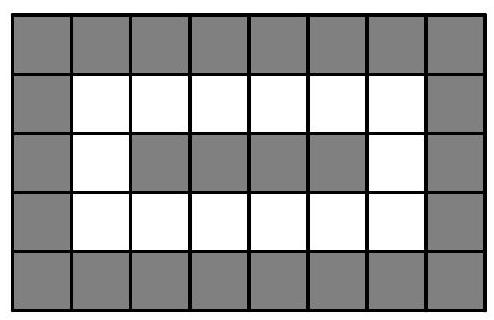
|
| 722 |
+
|
| 723 |
+
We can cover the table by one fragment like the first one on the figure below, 24 fragments like the middle one, and one fragment like the third one.
|
| 724 |
+
|
| 725 |
+
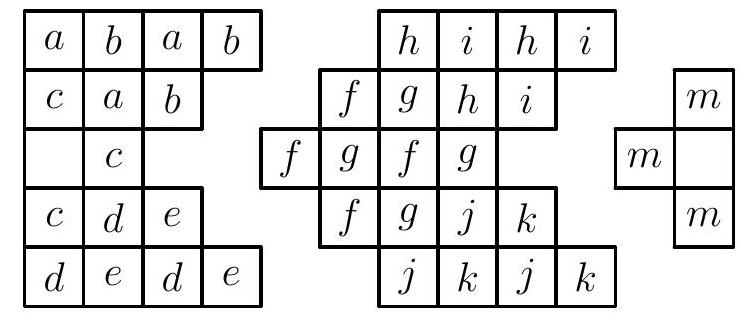
|
| 726 |
+
|
| 727 |
+
In each fragment, among the cells with the same letter, there are at most two coloured black, so the total number of coloured cells is at most $(5+24 \cdot 6+1) \cdot 2+2=302$.
|
| 728 |
+
|
| 729 |
+
Alternative Solution by PSC. Consider the cells adjacent to all cells of the second and fourth row. Counting multiplicity, each cell in the first and fifth row is counted once, each cell in the third row twice, while each cell in the second and fourth row is also counted twice apart from their first and last cells which are counted only once.
|
| 730 |
+
|
| 731 |
+
So there are 204 cells counted once and 296 cells counted twice. Those cells contain, counting multiplicity, at most 400 black cells. Suppose $a$ of the cells have multiplicity one and $b$ of them have multiplicity 2 . Then $a+2 b \leqslant 400$ and $a \leqslant 204$. Thus
|
| 732 |
+
|
| 733 |
+
$$
|
| 734 |
+
2 a+2 b \leqslant 400+a \leqslant 604
|
| 735 |
+
$$
|
| 736 |
+
|
| 737 |
+
and so $a+b \leqslant 302$ as required.
|
| 738 |
+
|
| 739 |
+
Remark by PSC. The alternative solution shows that if we have equality, then all cells in the perimeter of the table except perhaps the two cells of the third row must be coloured black. No other cell in the second or fourth row can be coloured black as this will give a cell in the first or fifth row with at least three neighbouring black cells. For similar reasons we cannot colour black the second and last-but-one cell of the third row. So we must colour black all other cells of the third row and therefore the colouring is unique.
|
| 740 |
+
|
| 741 |
+
C4. We have a group of $n$ kids. For each pair of kids, at least one has sent a message to the other one. For each kid $A$, among the kids to whom $A$ has sent a message, exactly $25 \%$ have sent a message to $A$. How many possible two-digit values of $n$ are there?
|
| 742 |
+
|
| 743 |
+
Solution. If the number of pairs of kids with two-way communication is $k$, then by the given condition the total number of messages is $4 k+4 k=8 k$. Thus the number of pairs of kids is $\frac{n(n-1)}{2}=7 k$. This is possible only if $n \equiv 0,1 \bmod 7$.
|
| 744 |
+
|
| 745 |
+
- In order to obtain $n=7 m+1$, arrange the kids in a circle and let each kid send a message to the first $4 m$ kids to its right and hence receive a message from the first $4 m$ kids to its left. Thus there are exactly $m$ kids to which it has both sent and received messages.
|
| 746 |
+
- In order to obtain $n=7 m$, let kid $X$ send no messages (and receive from every other kid). Arrange the remaining $7 m-1$ kids in a circle and let each kid on the circle send a message to the first $4 m-1$ kids to its right and hence receive a message from the first $4 m-1$ kids to its left. Thus there are exactly $m$ kids to which it has both sent and received messages.
|
| 747 |
+
|
| 748 |
+
There are 26 two-digit numbers with remainder 0 or 1 modulo 7 . (All numbers of the form $7 m$ and $7 m+1$ with $2 \leqslant m \leqslant 14$.)
|
| 749 |
+
|
| 750 |
+
Alternative Solution by PSC. Suppose kid $x_{i}$ sent $4 d_{i}$ messages. (Guaranteed by the conditions to be a multiple of 4.) Then it received $d_{i}$ messages from the kids that it has sent a message to, and another $n-1-4 d_{i}$ messages from the rest of the kids. So it received a total of $n-1-3 d_{i}$ messages. Since the total number of messages sent is equal to the total number of mesages received, we must have:
|
| 751 |
+
|
| 752 |
+
$$
|
| 753 |
+
d_{1}+\cdots+d_{n}=\left(n-1-3 d_{1}\right)+\cdots+\left(n-1-3 d_{n}\right)
|
| 754 |
+
$$
|
| 755 |
+
|
| 756 |
+
This gives $7\left(d_{1}+\cdots+d_{n}\right)=n(n-1)$ from which we get $n \equiv 0,1 \bmod 7$ as in the first solution.
|
| 757 |
+
|
| 758 |
+
We also present an alternative inductive construction (which turns out to be different from the construction in the first solution).
|
| 759 |
+
|
| 760 |
+
For the case $n \equiv 0 \bmod 7$, we start with a construction for $7 k$ kids, say $x_{1}, \ldots, x_{7 k}$, and another construction with 7 kids, say $y_{1}, \ldots, y_{7}$. We merge them by demanding that in addition, each kid $x_{i}$ sends and receives gifts according to the following table:
|
| 761 |
+
|
| 762 |
+
| $i \bmod 7$ | Sends | Receives |
|
| 763 |
+
| :---: | :---: | :---: |
|
| 764 |
+
| 0 | $y_{1}, y_{2}, y_{3}, y_{4}$ | $y_{4}, y_{5}, y_{6}, y_{7}$ |
|
| 765 |
+
| 1 | $y_{2}, y_{3}, y_{4}, y_{5}$ | $y_{5}, y_{6}, y_{7}, y_{1}$ |
|
| 766 |
+
| 2 | $y_{3}, y_{4}, y_{5}, y_{6}$ | $y_{6}, y_{7}, y_{1}, y_{2}$ |
|
| 767 |
+
| 3 | $y_{4}, y_{5}, y_{6}, y_{7}$ | $y_{7}, y_{1}, y_{2}, y_{3}$ |
|
| 768 |
+
| 4 | $y_{5}, y_{6}, y_{7}, y_{1}$ | $y_{1}, y_{2}, y_{3}, y_{4}$ |
|
| 769 |
+
| 5 | $y_{6}, y_{7}, y_{1}, y_{2}$ | $y_{2}, y_{3}, y_{4}, y_{5}$ |
|
| 770 |
+
| 6 | $y_{7}, y_{1}, y_{2}, y_{3}$ | $y_{3}, y_{4}, y_{5}, y_{6}$ |
|
| 771 |
+
|
| 772 |
+
So each kid $x_{i}$ sends an additional four messages and receives a message from only one of those four additional kids. Also, each kid $y_{j}$ sends an additional $4 k$ messages and receives from exactly $k$ of those additional kids. So this is a valid construction for $7(k+1)$ kids.
|
| 773 |
+
|
| 774 |
+
For the case $n \equiv 1 \bmod 7$, we start with a construction for $7 k+1$ kids, say $x_{1}, \ldots, x_{7 k+1}$, and we take another 7 kids, say $y_{1}, \ldots, y_{7}$ for which we do not yet mention how they exchange gifts. The kids $x_{1}, \ldots, x_{7 k+1}$ exchange gifts with the kids $y_{1}, \ldots, y_{7}$ according to the previous table. As before, each kid $x_{i}$ satisfies the conditions. We now put $y_{1}, \ldots, y_{7}$ on a circle and demand that each of $y_{1}, \ldots, y_{3}$ sends gifts to the next four kids on the circle and each of $y_{4}, \ldots, y_{7}$ sends gifts to the next three kids on the circle. It is each to check that the condition is satisfied by each $y_{i}$ as well.
|
| 775 |
+
|
| 776 |
+
C5. An economist and a statistician play a game on a calculator which does only one operation. The calculator displays only positive integers and it is used in the following way: Denote by $n$ an integer that is shown on the calculator. A person types an integer, $m$, chosen from the set $\{1,2, \ldots, 99\}$ of the first 99 positive integers, and if $m \%$ of the number $n$ is again a positive integer, then the calculator displays $m \%$ of $n$. Otherwise, the calculator shows an error message and this operation is not allowed. The game consists of doing alternatively these operations and the player that cannot do the operation looses. How many numbers from $\{1,2, \ldots, 2019\}$ guarantee the winning strategy for the statistician, who plays second?
|
| 777 |
+
|
| 778 |
+
For example, if the calculator displays 1200, the economist can type 50 , giving the number 600 on the calculator, then the statistician can type 25 giving the number 150 . Now, for instance, the economist cannot type 75 as $75 \%$ of 150 is not a positive integer, but can choose 40 and the game continues until one of them cannot type an allowed number.
|
| 779 |
+
|
| 780 |
+
Solution. First of all, the game finishes because the number on the calculator always decreases. By picking $m \%$ of a positive integer $n$, players get the number
|
| 781 |
+
|
| 782 |
+
$$
|
| 783 |
+
\frac{m \cdot n}{100}=\frac{m \cdot n}{2^{2} 5^{2}}
|
| 784 |
+
$$
|
| 785 |
+
|
| 786 |
+
We see that at least one of the powers of 2 and 5 that divide $n$ decreases after one move, as $m$ is not allowed to be 100 , or a multiple of it. These prime divisors of $n$ are the only ones that can decrease, so we conclude that all the other prime factors of $n$ are not important for this game. Therefore, it is enough to consider numbers of the form $n=2^{k} 5^{\ell}$ where $k, \ell \in \mathbb{N}_{0}$, and to draw conclusions from these numbers.
|
| 787 |
+
|
| 788 |
+
We will describe all possible changes of $k$ and $\ell$ in one move. Since $5^{3}>100$, then $\ell$ cannot increase, so all possible changes are from $\ell$ to $\ell+b$, where $b \in\{0,-1,-2\}$. For $k$, we note that $2^{6}=64$ is the biggest power of 2 less than 100 , so $k$ can be changed to $k+a$, where $a \in\{-2,-1,0,1,2,3,4\}$. But the changes of $k$ and $\ell$ are not independent. For example, if $\ell$ stays the same, then $m$ has to be divisible by 25 , giving only two possibilities for a change $(k, \ell) \rightarrow(k-2, \ell)$, when $m=25$ or $m=75$, or $(k, \ell) \rightarrow(k-1, \ell)$, when $m=50$. Similarly, if $\ell$ decreases by 1 , then $m$ is divisible exactly by 5 and then the different changes are given by $(k, \ell) \rightarrow(k+a, \ell-1)$, where $a \in\{-2,-1,0,1,2\}$, depending on the power of 2 that divides $m$ and it can be from $2^{0}$ to $2^{4}$. If $\ell$ decreases by 2 , then $m$ is not divisible by 5 , so it is enough to consider when $m$ is a power of two, giving changes $(k, \ell) \rightarrow(k+a, \ell-2)$, where $a \in\{-2,-1,0,1,2,3,4\}$.
|
| 789 |
+
|
| 790 |
+
We have translated the starting game into another game with changing (the starting pair of non-negative integers) $(k, \ell)$ by moves described above and the player who cannot make the move looses, i.e. the player who manages to play the move $(k, \ell) \rightarrow(0,0)$ wins. We claim that the second player wins if and only if $3 \mid k$ and $3 \mid \ell$.
|
| 791 |
+
|
| 792 |
+
We notice that all moves have their inverse modulo 3 , namely after the move $(k, \ell) \rightarrow$ $(k+a, \ell+b)$, the other player plays $(k+a, \ell+b) \rightarrow(k+a+c, \ell+b+d)$, where
|
| 793 |
+
|
| 794 |
+
$$
|
| 795 |
+
(c, d) \in\{(0,-1),(0,-2),(-1,0),(-1,-1),(-1,-2),(-2,0),(-2,-1),(-2,-2)\}
|
| 796 |
+
$$
|
| 797 |
+
|
| 798 |
+
is chosen such that $3 \mid a+c$ and $3 \mid b+d$. Such $(c, d)$ can be chosen as all possible residues different from $(0,0)$ modulo 3 are contained in the set above and there is no move that keeps $k$ and $\ell$ the same modulo 3 . If the starting numbers $(k, \ell)$ are divisible by 3 , then
|
| 799 |
+
after the move of the first player at least one of $k$ and $\ell$ will not be divisible by 3 , and then the second player will play the move so that $k$ and $\ell$ become divisible by 3 again. In this way, the first player can never finish the game, so the second player wins. In all other cases, the first player will make such a move to make $k$ and $\ell$ divisible by 3 and then he becomes the second player in the game, and by previous reasoning, wins.
|
| 800 |
+
|
| 801 |
+
The remaining part of the problem is to compute the number of positive integers $n \leqslant 2019$ which are winning for the second player. Those are the $n$ which are divisible by exactly $2^{3 k} 5^{3 \ell}, k, \ell \in \mathbb{N}_{0}$. Here, exact divisibility by $2^{3 k} 5^{3 \ell}$ in this context means that $2^{3 k} \| n$ and $5^{3 \ell} \| n$, even for $\ell=0$, or $k=0$. For example, if we say that $n$ is exactly divisible by 8 , it means that $8 \mid n, 16 \nmid n$ and $5 \nmid n$. We start by noting that for each ten consecutive numbers, exactly four of them coprime to 10 . Then we find the desired amount by dividing 2019 by numbers $2^{3 k} 5^{3 \ell}$ which are less than 2019 , and then computing the number of numbers no bigger than $\left\lfloor\frac{2019}{2^{3 k} 5^{3 \ell}}\right\rfloor$ which are coprime to 10 .
|
| 802 |
+
|
| 803 |
+
First, there are $4 \cdot 201+4=808$ numbers (out of positive integers $n \leqslant 2019$ ) coprime to 10 . Then, there are $\left\lfloor\frac{2019}{8}\right\rfloor=252$ numbers divisible by 8 , and $25 \cdot 4+1=101$ among them are exactly divisible by 8 . There are $\left\lfloor\frac{2019}{64}\right\rfloor=31$ numbers divisible by 64 , giving $3 \cdot 4+1=13$ divisible exactly by 64 . And there are two numbers, 512 and $3 \cdot 512$, which are divisible by exactly 512 . Similarly, there are $\left\lfloor\frac{2019}{125}\right\rfloor=16$ numbers divisible by 125 , implying that $4+2=6$ of them are exactly divisible by 125 . Finally, there is only one number divisible by exactly 1000 , and this is 1000 itself. All other numbers that are divisible by exactly $2^{3 k} 5^{3 \ell}$ are greater than 2019. So, we obtain that $808+101+13+2+6+1=931$ numbers not bigger that 2019 are winning for the statistician.
|
| 804 |
+
|
| 805 |
+
Alternative Solution by PSC. Let us call a positive integer $n$ losing if $n=2^{r} 5^{s} k$ where $r \equiv s \equiv 0 \bmod 3$ and $(k, 10)=1$. We call all other positive integers winning.
|
| 806 |
+
|
| 807 |
+
Lemma 1. If $n$ is losing, them $\frac{m n}{100}$ is winning for all $m \in\{1,2, \ldots, 99\}$ such that $100 \mid m n$.
|
| 808 |
+
|
| 809 |
+
Proof of Lemma 1. Let $m=2^{t} 5^{u} k^{\prime}$. For $\frac{m n}{100}$ to be losing, we would need $t \equiv u \equiv$ $2 \bmod 3$. But then $m \geqslant 100$, a contradiction.
|
| 810 |
+
|
| 811 |
+
Lemma 2. If $n$ is winning, then there is an $m \in\{1,2, \ldots, 99\}$ such that $100 \mid m n$ and $\frac{m n}{100}$ is losing.
|
| 812 |
+
|
| 813 |
+
Proof of Lemma 2. Let $n=2^{r} 5^{s} k$ where $(k, 10)=1$. Pick $t, u \in\{0,1,2\}$ such that $t \equiv(2-r) \bmod 3$ and $u \equiv(2-s) \bmod 3$ and let $m=2^{t} 5^{s}$. Then $100 \mid m n$ and $\frac{m n}{100}$ is winning. Furthermore $m<100$ as otherwise $m=100, t=u=2$ giving $r \equiv s \equiv 0 \bmod 3$ contradicting the fact that $n$ was winning.
|
| 814 |
+
|
| 815 |
+
Combining Lemmas 1 and 2 we obtain that the second player wins if and only if the game starts from a losing number.
|
| 816 |
+
|
| 817 |
+
## GEOMETRY
|
| 818 |
+
|
| 819 |
+
G1. Let $A B C$ be a right-angled triangle with $\hat{A}=90^{\circ}$ and $\hat{B}=30^{\circ}$. The perpendicular at the midpoint $M$ of $B C$ meets the bisector $B K$ of the angle $\hat{B}$ at the point $E$. The perpendicular bisector of $E K$ meets $A B$ at $D$. Prove that $K D$ is perpendicular to $D E$.
|
| 820 |
+
|
| 821 |
+
Solution. Let $I$ be the incenter of $A B C$ and let $Z$ be the foot of the perpendicular from $K$ on $E C$. Since $K B$ is the bisector of $\hat{B}$, then $\angle E B C=15^{\circ}$ and since $E M$ is the perpendicular bisector of $B C$, then $\angle E C B=\angle E B C=15^{\circ}$. Therefore $\angle K E C=30^{\circ}$. Moreover, $\angle E C K=60^{\circ}-15^{\circ}=45^{\circ}$. This means that $K Z C$ is isosceles and thus $Z$ is on the perpendicular bisector of $K C$.
|
| 822 |
+
|
| 823 |
+
Since $\angle K I C$ is the external angle of triangle $I B C$, and $I$ is the incenter of triangle $A B C$, then $\angle K I C=15^{\circ}+30^{\circ}=45^{\circ}$. Thus, $\angle K I C=\frac{\angle K Z C}{2}$. Since also $Z$ is on the perpendicular bisector of $K C$, then $Z$ is the circumcenter of $I K C$. This means that $Z K=Z I=Z C$. Since also $\angle E K Z=60^{\circ}$, then the triangle $Z K I$ is equilateral. Moreover, since $\angle K E Z=30^{\circ}$, we have that $Z K=\frac{E K}{2}$, so $Z K=I K=I E$.
|
| 824 |
+
|
| 825 |
+
Therefore $D I$ is perpendicular to $E K$ and this means that $D I K A$ is cyclic. So $\angle K D I=$ $\angle I A K=45^{\circ}$ and $\angle I K D=\angle I A D=45^{\circ}$. Thus $I D=I K=I E$ and so $K D$ is perpendicular to $D E$ as required.
|
| 826 |
+
|
| 827 |
+
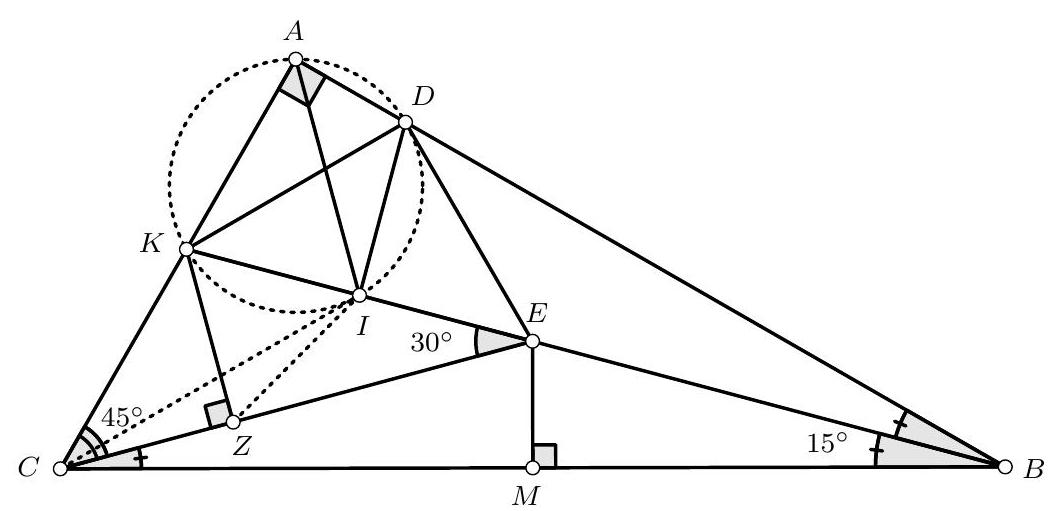
|
| 828 |
+
|
| 829 |
+
Alternative Question by Proposers. We can instead ask to prove that $E D=2 A D$. (After proving $K D \perp D E$ we have that the triangle $E D K$ is right angled and isosceles, therefore $E D=D K=2 A D$.) This alternative is probably more difficult because the perpendicular relation is hidden.
|
| 830 |
+
|
| 831 |
+
Alternative Solution by PSC. Let $P$ be the point of intersection of $E M$ with $A C$. The triangles $A B C$ and $M P C$ are equal since they have equal angles and $M C=\frac{B C}{2}=A C$. They also share the angle $\hat{C}$, so they must have identical incenter.
|
| 832 |
+
|
| 833 |
+
Let $I$ be the midpoint of $E K$. We have $\angle P E I=\angle B E M=75^{\circ}=\angle E K P$. So the triangle $P E K$ is isosceles and therefore $P I$ is a bisector of $\angle C P M$. So the incenter of $M P C$ belongs on $P I$. Since it shares the same incentre with $A B C$, then $I$ is the common incenter. We can now finish the proof as in the first solution.
|
| 834 |
+
|
| 835 |
+
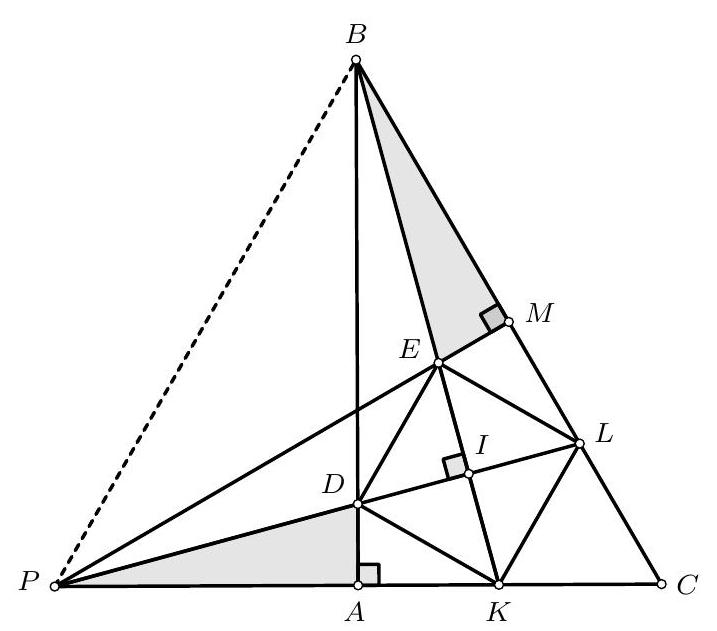
|
| 836 |
+
|
| 837 |
+
Alternative Solution by PSC. Let $P$ be the point of intersection of $E M$ with $A C$ and let $I$ be the midpoint of $E K$. Then the triangle $P B C$ is equilateral. We also have $\angle P E I=\angle B E M=75^{\circ}$ and $\angle P K E=75^{\circ}$, so $P E K$ is isosceles. We also have $P I \perp E K$ and $D I \perp E K$, so the points $P, D, I$ are collinear.
|
| 838 |
+
|
| 839 |
+
Furthermore, $\angle P B I=\angle B P I=45^{\circ}$, and therefore $B I=P I$.
|
| 840 |
+
|
| 841 |
+
We have $\angle D P A=\angle E B M=15^{\circ}$ and also $B M=\frac{A B}{2}=A C=P A$. So the right-angled triangles $P D A$ and $B E M$ are equal. Thus $P D=B E$.
|
| 842 |
+
|
| 843 |
+
So
|
| 844 |
+
|
| 845 |
+
$$
|
| 846 |
+
E I=B I-B E=P I-P D=D I
|
| 847 |
+
$$
|
| 848 |
+
|
| 849 |
+
Therefore $\angle D E I=\angle I D E=45^{\circ}$. Since $D E=D K$, we also have $\angle D E I=\angle D K I=$ $\angle K D I=45^{\circ}$. So finally, $\angle E D K=90^{\circ}$.
|
| 850 |
+
|
| 851 |
+
Coordinate Geometry Solution by PSC. We may assume that $A=(0,0), B=$ $(0, \sqrt{3})$ and $C=(1,0)$. Since $m_{B C}=-\sqrt{3}$, then $m_{E M}=\frac{\sqrt{3}}{3}$. Since also $M=\left(\frac{1}{2}, \frac{\sqrt{3}}{2}\right)$, then the equation of $E M$ is $y=\frac{\sqrt{3}}{3} x+\frac{\sqrt{3}}{3}$. The slope of $B K$ is
|
| 852 |
+
|
| 853 |
+
$$
|
| 854 |
+
m_{B K}=\tan \left(105^{\circ}\right)=\frac{\tan \left(60^{\circ}\right)+\tan \left(45^{\circ}\right)}{1-\tan \left(60^{\circ}\right) \tan \left(45^{\circ}\right)}=-(2+\sqrt{3})
|
| 855 |
+
$$
|
| 856 |
+
|
| 857 |
+
So the equation of $B K$ is $y=-(2+\sqrt{3}) x+\sqrt{3}$ which gives $K=(2 \sqrt{3}-3,0)$ and $E=(2-\sqrt{3}, \sqrt{3}-1)$. Letting $I$ be the midpoint of $E K$ we get $I=\left(\frac{\sqrt{3}-1}{2}, \frac{\sqrt{3}-1}{2}\right)$. Thus $I$ is equidistant from the sides $A B, A C$, so $A I$ is the bisector of $\hat{A}$, and thus $I$ is the incenter of triangle $A B C$. We can now finish the proof as in the first solution.
|
| 858 |
+
|
| 859 |
+
Metric Solution by PSC. We can assume that $A C=1$. Then $A B=\sqrt{3}$ and $B C=2$. So $B M=M C=1$. From triangle $B E M$ we get $B E=E C=\sec \left(15^{\circ}\right)$ and $E M=\tan \left(15^{\circ}\right)$. From triangle $B A K$ we get $B K=\sqrt{3} \sec \left(15^{\circ}\right)$. So $E K=B K-B E=$ $(\sqrt{3}-1) \sec \left(15^{\circ}\right)$. Thus, if $N$ is the midpoint of $E K$, then $E N=N K=\frac{\sqrt{3}-1}{2} \sec \left(15^{\circ}\right)$ and $B N=B E+E N=\frac{\sqrt{3}+1}{2} \sec \left(15^{\circ}\right)$. From triangle $B D N$ we get $D N=B N \tan \left(15^{\circ}\right)=$ $\frac{\sqrt{3}+1}{2} \tan \left(15^{\circ}\right) \sec \left(15^{\circ}\right)$. It is easy to check that $\tan \left(15^{\circ}\right)=2-\sqrt{3}$. Thus $D N=$ $\frac{\sqrt{3}-1}{2} \sec \left(15^{\circ}\right)=E N$. So $D N=E N=E K$ and therefore $\angle E D N=\angle K D N=45^{\circ}$ and $\angle K D E=90^{\circ}$ as required.
|
| 860 |
+
|
| 861 |
+
G2. Let $A B C$ be a triangle and let $\omega$ be its circumcircle. Let $\ell_{B}$ and $\ell_{C}$ be two parallel lines passing through $B$ and $C$ respectively. The lines $\ell_{B}$ and $\ell_{C}$ intersect with $\omega$ for the second time at the points $D$ and $E$ respectively, with $D$ belonging on the arc $A B$, and $E$ on the arc $A C$. Suppose that $D A$ intersects $\ell_{C}$ at $F$, and $E A$ intersects $\ell_{B}$ at $G$. If $O, O_{1}$ and $O_{2}$ are the circumcenters of the triangles $A B C, A D G$ and $A E F$ respectively, and $P$ is the center of the circumcircle of the triangle $O O_{1} O_{2}$, prove that $O P$ is parallel to $\ell_{B}$ and $\ell_{C}$.
|
| 862 |
+
|
| 863 |
+
Solution. We write $\omega_{1}, \omega_{2}$ and $\omega^{\prime}$ for the circumcircles of $A G D, A E F$ and $O O_{1} O_{2}$ respectively. Since $O_{1}$ and $O_{2}$ are the centers of $\omega_{1}$ and $\omega_{2}$, and because $D G$ and $E F$ are parallel, we get that
|
| 864 |
+
|
| 865 |
+
$$
|
| 866 |
+
\angle G A O_{1}=90^{\circ}-\frac{\angle G O_{1} A}{2}=90^{\circ}-\angle G D A=90^{\circ}-\angle E F A=90^{\circ}-\frac{\angle E O_{2} A}{2}=\angle E A O_{2}
|
| 867 |
+
$$
|
| 868 |
+
|
| 869 |
+
So, because $G, A$ and $E$ are collinear, we come to the conclusion that $O_{1}, A$ and $O_{2}$ are also collinear.
|
| 870 |
+
|
| 871 |
+
Let $\angle D F E=\varphi$. Then, as a central angle $\angle A O_{2} E=2 \varphi$. Because $A E$ is a common chord of both $\omega$ and $\omega_{2}$, the line $O O_{2}$ that passes through their centers bisects $\angle A O_{2} E$, thus $\angle A O_{2} O=\varphi$. By the collinearity of $O_{1}, A, O_{2}$, we get that $\angle O_{1} O_{2} O=\angle A O_{2} O=\varphi$. As a central angle in $\omega^{\prime}$, we have $\angle O_{1} P O=2 \varphi$, so $\angle P O O_{1}=90^{\circ}-\varphi$. Let $Q$ be the point of intersection of $D F$ and $O P$. Because $A D$ is a common chord of $\omega$ and $\omega_{1}$, we have that $O O_{1}$ is perpendicular to $D A$ and so $\angle D Q P=90^{\circ}-\angle P O O_{1}=\varphi$. Thus, $O P$ is parallel to $\ell_{C}$ and so to $\ell_{B}$ as well.
|
| 872 |
+
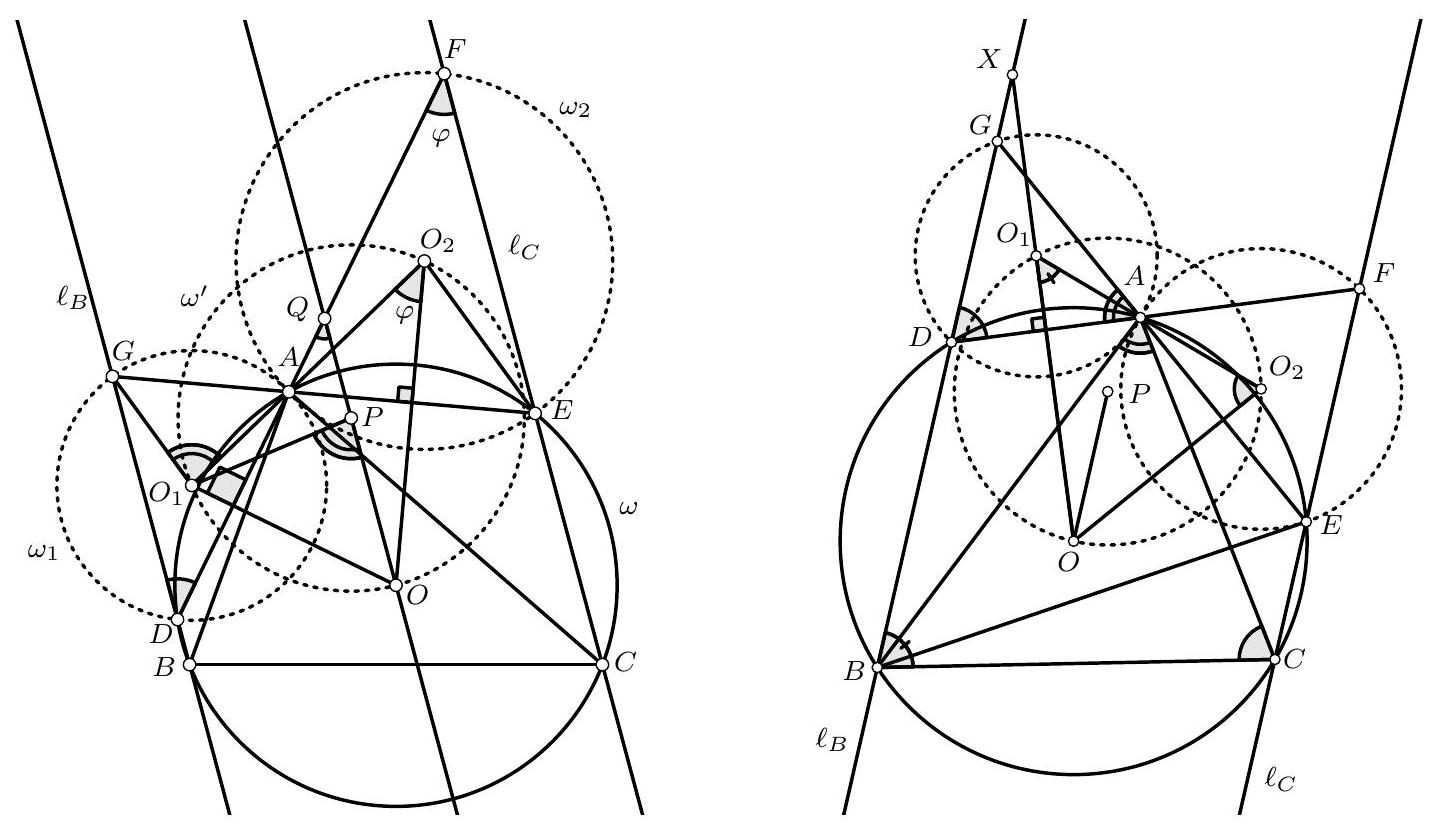
|
| 873 |
+
|
| 874 |
+
Alternative Solution by PSC. Let us write $\alpha, \beta, \gamma$ for the angles of $A B C$. Since $A D B C$ is cyclic, we have $\angle G D A=180^{\circ}-\angle B D A=\gamma$. Similarly, we have
|
| 875 |
+
|
| 876 |
+
$$
|
| 877 |
+
\angle G A D=180^{\circ}-\angle D A E=\angle E B D=\angle B E C=\angle B A C=\alpha
|
| 878 |
+
$$
|
| 879 |
+
|
| 880 |
+
where we have also used the fact that $\ell_{B}$ and $\ell_{C}$ are parallel.
|
| 881 |
+
|
| 882 |
+
Thus, the triangles $A B C$ and $A G D$ are similar. Analogously, $A E F$ is also similar to them.
|
| 883 |
+
|
| 884 |
+
Since $A D$ is a common chord of $\omega$ and $\omega_{1}$ then $A D$ is perpendicular to $O O_{1}$. Thus,
|
| 885 |
+
|
| 886 |
+
$$
|
| 887 |
+
\angle O O_{1} A=\frac{1}{2} \angle D O_{1} A=\angle D G A=\beta
|
| 888 |
+
$$
|
| 889 |
+
|
| 890 |
+
Similarly, we have $\angle O O_{2} A=\gamma$. Since $O_{1}, A, O_{2}$ are collinear (as in the first solution) we get that $O O_{1} O_{2}$ is also similar to $A B C$. Their circumcentres are $P$ and $O$ respectively, thus $\angle P O O_{1}=\angle O A B=90^{\circ}-\gamma$.
|
| 891 |
+
|
| 892 |
+
Since $O O_{1}$ is perpendicular to $A D$, letting $X$ be the point of intersection of $O O_{1}$ with $G D$, we get that $\angle D X O_{1}=90^{\circ}-\gamma$. Thus $O P$ is parallel to $\ell_{B}$ and therefore to $\ell_{C}$ as well.
|
| 893 |
+
|
| 894 |
+
## Alternative Solution by PSC.
|
| 895 |
+
|
| 896 |
+
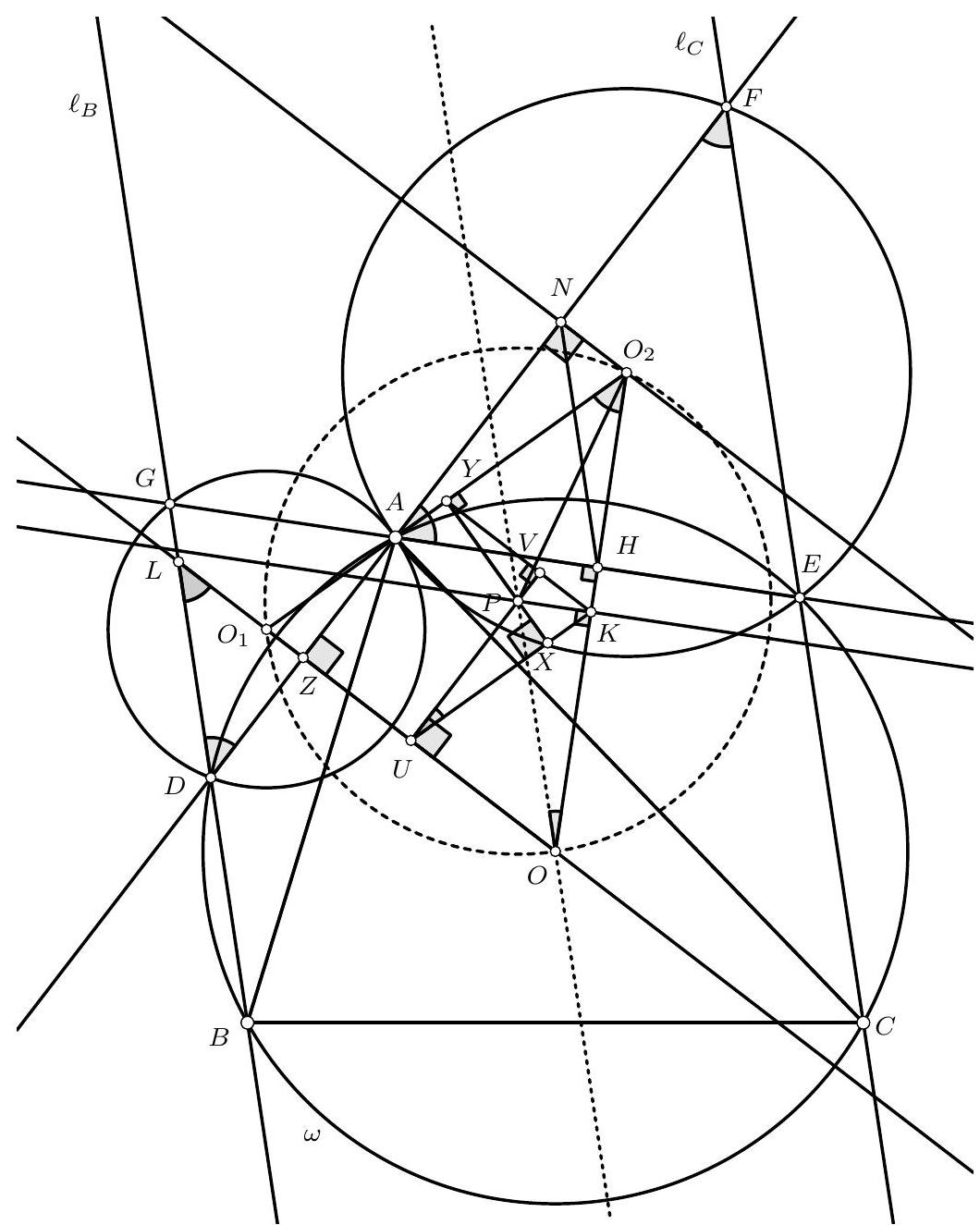
|
| 897 |
+
|
| 898 |
+
Let $L$ and $Z$ be the points of intesecrion of $O O_{1}$ with $\ell_{b}$ and $D A$ respectively. Since $L Z$ is perpendicular on $D A$, and since $\ell_{b}$ is parallel to $\ell_{c}$, then
|
| 899 |
+
|
| 900 |
+
$$
|
| 901 |
+
\angle D L O=90^{\circ}-\angle L D Z=90^{\circ}-\angle D F E=90^{\circ}-\angle A F E
|
| 902 |
+
$$
|
| 903 |
+
|
| 904 |
+
Since $A E$ is a common chord of $\omega$ and $\omega_{2}$, then it is perpendicular to $\mathrm{OO}_{2}$. So letting $H$ be their point of intersection, we get
|
| 905 |
+
|
| 906 |
+
$$
|
| 907 |
+
\angle D L O=90^{\circ}-\angle A F E=90^{\circ}-\angle A O_{2} H=\angle O_{2} A H
|
| 908 |
+
$$
|
| 909 |
+
|
| 910 |
+
Let $K, Y, U$ be the projections of $P$ onto $O O_{2}, O_{1} O_{2}$ and $O O_{1}$ respectively. Then $Y K U O_{1}$ is a parallelogram and so the extensions of $P Y$ and $P U$ meet the segments $U K$ and $K Y$ at points $X, V$ such that $Y X \perp K U$ and $U V \perp K Y$.
|
| 911 |
+
|
| 912 |
+
Since the points $O_{1}, A, O_{2}$ are collinear, we have
|
| 913 |
+
|
| 914 |
+
$$
|
| 915 |
+
\angle F A O_{2}=O_{1} A Z=90^{\circ}-\angle A O_{1} Z=90^{\circ}-\angle Y K U=\angle P U K=\angle P O K=\angle P O K
|
| 916 |
+
$$
|
| 917 |
+
|
| 918 |
+
where the last equality follows since $P U O K$ is cyclic.
|
| 919 |
+
|
| 920 |
+
Since $A Z O H$ is also cyclic, we have $\angle F A H=\angle O_{1} O O_{2}$. From this, together with (1) and (2) we get
|
| 921 |
+
|
| 922 |
+
$$
|
| 923 |
+
\angle D L O=\angle O_{2} A H=\angle F A H-\angle F A O_{2}=\angle O_{1} O O_{2}-\angle P O K=\angle U O P=\angle L O P
|
| 924 |
+
$$
|
| 925 |
+
|
| 926 |
+
Therefore $O P$ is parallel to $\ell_{B}$ and $\ell_{C}$.
|
| 927 |
+
|
| 928 |
+
G3. Let $A B C$ be a triangle with incenter $I$. The points $D$ and $E$ lie on the segments $C A$ and $B C$ respectively, such that $C D=C E$. Let $F$ be a point on the segment $C D$. Prove that the quadrilateral $A B E F$ is circumscribable if and only if the quadrilateral $D I E F$ is cyclic.
|
| 929 |
+
|
| 930 |
+
Solution. Since $C D=C E$ it means that $E$ is the reflection of $D$ on the bisector of $\angle A C B$, i.e. the line $C I$. Let $G$ be the reflection of $F$ on $C I$. Then $G$ lies on the segment $C E$, the segment $E G$ is the reflection of the segment $D F$ on the line $C I$. Also, the quadraliteral $D E G F$ is cyclic since $\angle D F E=\angle E G D$.
|
| 931 |
+
|
| 932 |
+
Suppose that the quadrilateral $A B E F$ is circumscribable. Since $\angle F A I=\angle B A I$ and $\angle E B I=\angle A B I$, then $I$ is the centre of its inscribed circle. Then $\angle D F I=\angle E F I$ and since segment $E G$ is the reflection of segment $D F$ on the line $C I$, we have $\angle E F I=$ $\angle D G I$. So $\angle D F I=\angle D G I$ which means that quadrilateral $D I G F$ is cyclic. Since the quadrilateral $D E G F$ is also cyclic, we have that the quadrilateral $D I E F$ is cyclic.
|
| 933 |
+
|
| 934 |
+
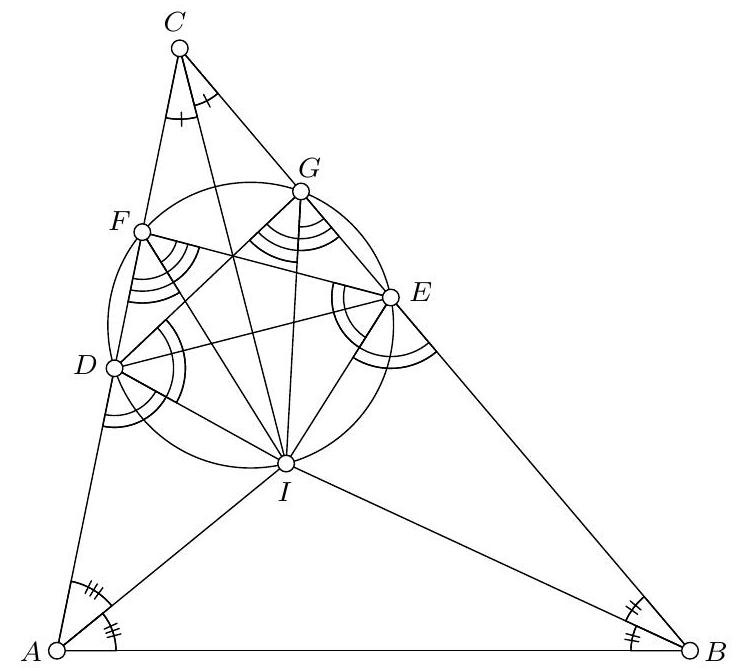
|
| 935 |
+
|
| 936 |
+
Suppose that the quadrilateral $D I E F$ is cyclic. Since quadrilateral $D E G F$ is also cyclic, we have that the pentagon $D I E G F$ is cyclic. So $\angle I E B=180^{\circ}-\angle I E G=\angle I D G$ and since segment $E G$ is the reflection of segment $D F$ on the line $C I$, we have $\angle I D G=$ $\angle I E F$. Hence $\angle I E B=\angle I E F$, which means that $E I$ is the angle bisector of $\angle B E F$. Since $\angle I F A=\angle I F D=\angle I G D$ and since the segment $E G$ is the reflection of segment $D F$ on the line $C I$, we have $\angle I G D=\angle I F E$, hence $\angle I F A=\angle I F E$, which means that $F I$ is the angle bisector of $\angle E F A$. We also know that $A I$ and $B I$ are the angle bisectors of $\angle F A B$ and $\angle A B E$. So all angle bisectors of the quadrilateral $A B E F$ intersect at $I$, which means that it is circumscribable.
|
| 937 |
+
|
| 938 |
+
Comment by PSC. There is no need for introducing the point $G$. One can show that triangles $C I D$ and $C I E$ are equal and also that the triangles $C D M$ and $C E M$ are equal, where $M$ is the midpoint of $D E$. From these, one can deduce that $\angle C D I=\angle C E I$ and $\angle I D E=\angle I E D$ and proceed with similar reasoning as in the solution.
|
| 939 |
+
|
| 940 |
+
G4. Let $A B C$ be a triangle such that $A B \neq A C$, and let the perpendicular bisector of the side $B C$ intersect lines $A B$ and $A C$ at points $P$ and $Q$, respectively. If $H$ is the orthocenter of the triangle $A B C$, and $M$ and $N$ are the midpoints of the segments $B C$ and $P Q$ respectively, prove that $H M$ and $A N$ meet on the circumcircle of $A B C$.
|
| 941 |
+
|
| 942 |
+
Solution. We have
|
| 943 |
+
|
| 944 |
+
$$
|
| 945 |
+
\angle A P Q=\angle B P M=90^{\circ}-\angle M B P=90^{\circ}-\angle C B A=\angle H C B
|
| 946 |
+
$$
|
| 947 |
+
|
| 948 |
+
and
|
| 949 |
+
|
| 950 |
+
$$
|
| 951 |
+
\angle A Q P=\angle M Q C=90^{\circ}-\angle Q C M=90^{\circ}-\angle A C B=\angle C B H
|
| 952 |
+
$$
|
| 953 |
+
|
| 954 |
+
From these two equalities, we see that the triangles $A P Q$ and $H C B$ are similar. Moreover, since $M$ and $N$ are the midpoints of the segments $B C$ and $P Q$ respectively, then the triangles $A Q N$ and $H B M$ are also similar. Therefore, we have $\angle A N Q=\angle H M B$.
|
| 955 |
+
|
| 956 |
+
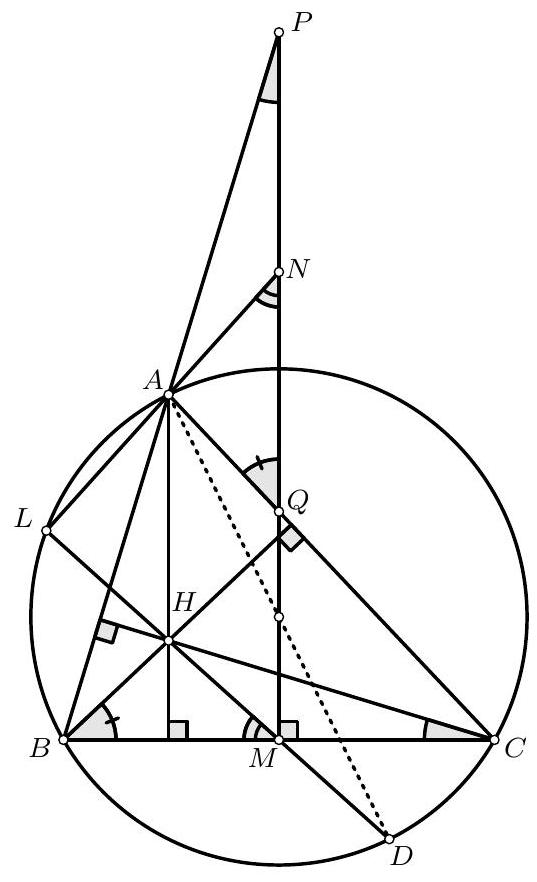
|
| 957 |
+
|
| 958 |
+
Let $L$ be the intersection of $A N$ and $H M$. We have
|
| 959 |
+
|
| 960 |
+
$\angle M L N=180^{\circ}-\angle L N M-\angle N M L=180^{\circ}-\angle L M B-\angle N M L=180^{\circ}-\angle N M B=90^{\circ}$.
|
| 961 |
+
|
| 962 |
+
Now let $D$ be the point on the circumcircle of $A B C$ diametrically oposite to $A$. It is known that $D$ is also the relfection of point $H$ over the point $M$. Therefore, we have that $D$ belongs on $M H$ and that $\angle D L A=\angle M L A=\angle M L N=90^{\circ}$. But, as $D A$ is the diameter of the circumcirle of $A B C$, the condition that $\angle D L A=90^{\circ}$ is enough to conclude that $L$ belongs on the circumcircle of $A B C$.
|
| 963 |
+
|
| 964 |
+
Remark by PSC. There is a spiral similarity mapping $A Q P$ to $H B C$. Since the similarity maps $A N$ to $H M$, it also maps $A H$ to $N M$, and since these two lines are parallel, the centre of the similarity is $L=A N \cap H M$. Since the similarity maps $B C$ to $Q P$, its centre belongs on the circumcircle of $B C X$, where $X=B Q \cap P C$. But $X$ is the reflection of $A$ on $Q M$ and so it must belong on the circumcircle of $A B C$. Hence so must $L$.
|
| 965 |
+
|
| 966 |
+
G5. Let $P$ be a point in the interior of a triangle $A B C$. The lines $A P, B P$ and $C P$ intersect again the circumcircles of the triangles $P B C, P C A$, and $P A B$ at $D, E$ and $F$ respectively. Prove that $P$ is the orthocenter of the triangle $D E F$ if and only if $P$ is the incenter of the triangle $A B C$.
|
| 967 |
+
|
| 968 |
+
Solution. If $P$ is the incenter of $A B C$, then $\angle B P D=\angle A B P+\angle B A P=\frac{\hat{A}+\hat{B}}{2}$, and $\angle B D P=\angle B C P=\frac{\hat{C}}{2}$. From triangle $B D P$, it follows that $\angle P B D=90^{\circ}$, i.e. that $E B$ is one of the altitudes of the triangle $D E F$. Similarly, $A D$ and $C F$ are altitudes, which means that $P$ is the orhocenter of $D E F$.
|
| 969 |
+
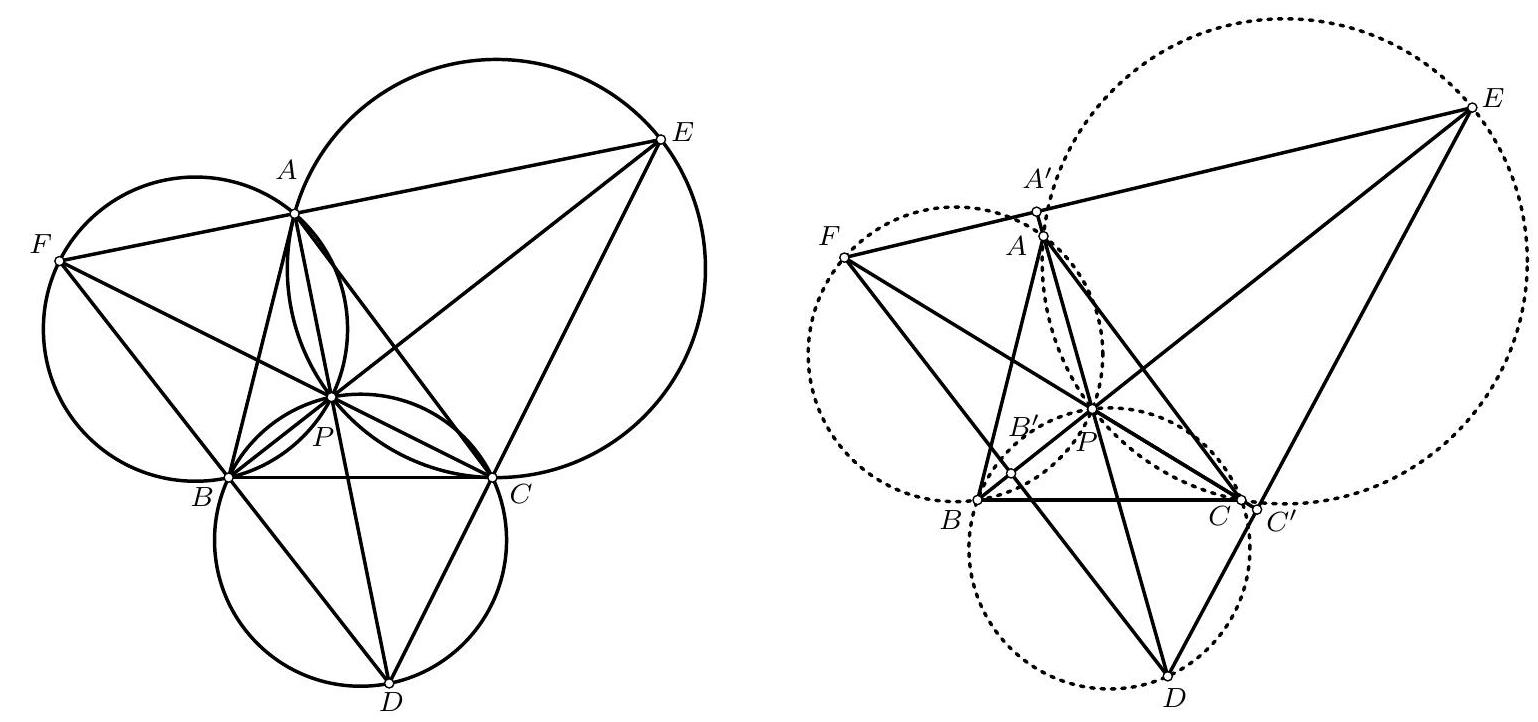
|
| 970 |
+
|
| 971 |
+
Notice that $A P$ separates $B$ from $C, B$ from $E$ and $C$ from $F$. Therefore $A P$ separates $E$ from $F$, which means that $P$ belongs to the interior of $\angle E D F$. It follows that $P \in$ $\operatorname{Int}(\triangle D E F)$.
|
| 972 |
+
|
| 973 |
+
If $P$ is the orthocenter of $D E F$, then clearly $D E F$ must be acute. Let $A^{\prime} \in E F, B^{\prime} \in D F$ and $C^{\prime} \in D E$ be the feet of the altitudes. Then the quadrilaterals $B^{\prime} P A^{\prime} F, C^{\prime} P B^{\prime} D$, and $A^{\prime} P C^{\prime} E$ are cyclic, which means that $\angle B^{\prime} F A^{\prime}=180^{\circ}-\angle B^{\prime} P A^{\prime}=180^{\circ}-\angle B P A=$ $\angle B F A$. Similarly, one obtains that $\angle C^{\prime} D B^{\prime}=\angle C D B$, and $\angle A^{\prime} E C^{\prime}=\angle A E C$.
|
| 974 |
+
|
| 975 |
+
- If $B \in \operatorname{Ext}(\triangle F P D)$, then $A \in \operatorname{Int}(\triangle E P F), C \in \operatorname{Ext}(\triangle D P E)$, and thus $B \in$ $\operatorname{Int}(\triangle F P D)$, contradiction.
|
| 976 |
+
- If $B \in \operatorname{Int}(\triangle F P D)$, then $A \in \operatorname{Ext}(\triangle E P F), C \in \operatorname{Int}(\triangle D P E)$, and thus $B \in$ $\operatorname{Ext}(\triangle F P D)$, contradiction.
|
| 977 |
+
|
| 978 |
+
This leaves us with $B \in F D$. Then we must have $A \in E F, C \in D E$, which means that $A=A^{\prime}, B=B^{\prime}, C=C^{\prime}$. Thus $A B C$ is the orthic triangle of triangle $D E F$ and it is well known that the orthocenter of an acute triangle $D E F$ is the incenter of its orthic triangle.
|
| 979 |
+
|
| 980 |
+
G6. Let $A B C$ be a non-isosceles triangle with incenter $I$. Let $D$ be a point on the segment $B C$ such that the circumcircle of $B I D$ intersects the segment $A B$ at $E \neq B$, and the circumcircle of $C I D$ intersects the segment $A C$ at $F \neq C$. The circumcircle of $D E F$ intersects $A B$ and $A C$ at the second points $M$ and $N$ respectively. Let $P$ be the point of intersection of $I B$ and $D E$, and let $Q$ be the point of intersection of $I C$ and $D F$. Prove that the three lines $E N, F M$ and $P Q$ are parallel.
|
| 981 |
+
|
| 982 |
+
Solution. Since $B D I E$ is cyclic, and $B I$ is the bisector of $\angle D B E$, then $I D=I E$. Similarly, $I D=I F$, so $I$ is the circumcenter of the triangle $D E F$. We also have
|
| 983 |
+
|
| 984 |
+
$$
|
| 985 |
+
\angle I E A=\angle I D B=\angle I F C
|
| 986 |
+
$$
|
| 987 |
+
|
| 988 |
+
which implies that $A E I F$ is cyclic. We can assume that $A, E, M$ and $A, N, F$ are collinear in that order. Then $\angle I E M=\angle I F N$. Since also $I M=I E=I N=I F$, the two isosceles triangles $I E M$ and $I N F$ are congruent, thus $E M=F N$ and therefore $E N$ is parallel to $F M$. From that, we can also see that the two triangles $I E A$ and $I N A$ are congruent, which implies that $A I$ is the perpendicular bisector of $E N$ and $M F$.
|
| 989 |
+
|
| 990 |
+
Note that $\angle I D P=\angle I D E=\angle I B E=\angle I B D$, so the triangles $I P D$ and $I D B$ are similar, which implies that $\frac{I D}{I B}=\frac{I P}{I D}$ and $I P \cdot I B=I D^{2}$. Similarly, we have $I Q \cdot I C=I D^{2}$, thus $I P \cdot I B=I Q \cdot I C$. This implies that $B P Q C$ is cyclic, which leads to
|
| 991 |
+
|
| 992 |
+
$$
|
| 993 |
+
\angle I P Q=\angle I C B=\frac{\hat{C}}{2}
|
| 994 |
+
$$
|
| 995 |
+
|
| 996 |
+
But $\angle A I B=90^{\circ}+\frac{\hat{C}}{2}$, so $A I$ is perpendicular to $P Q$. Hence, $P Q$ is parallel to $E N$ and FM.
|
| 997 |
+
|
| 998 |
+
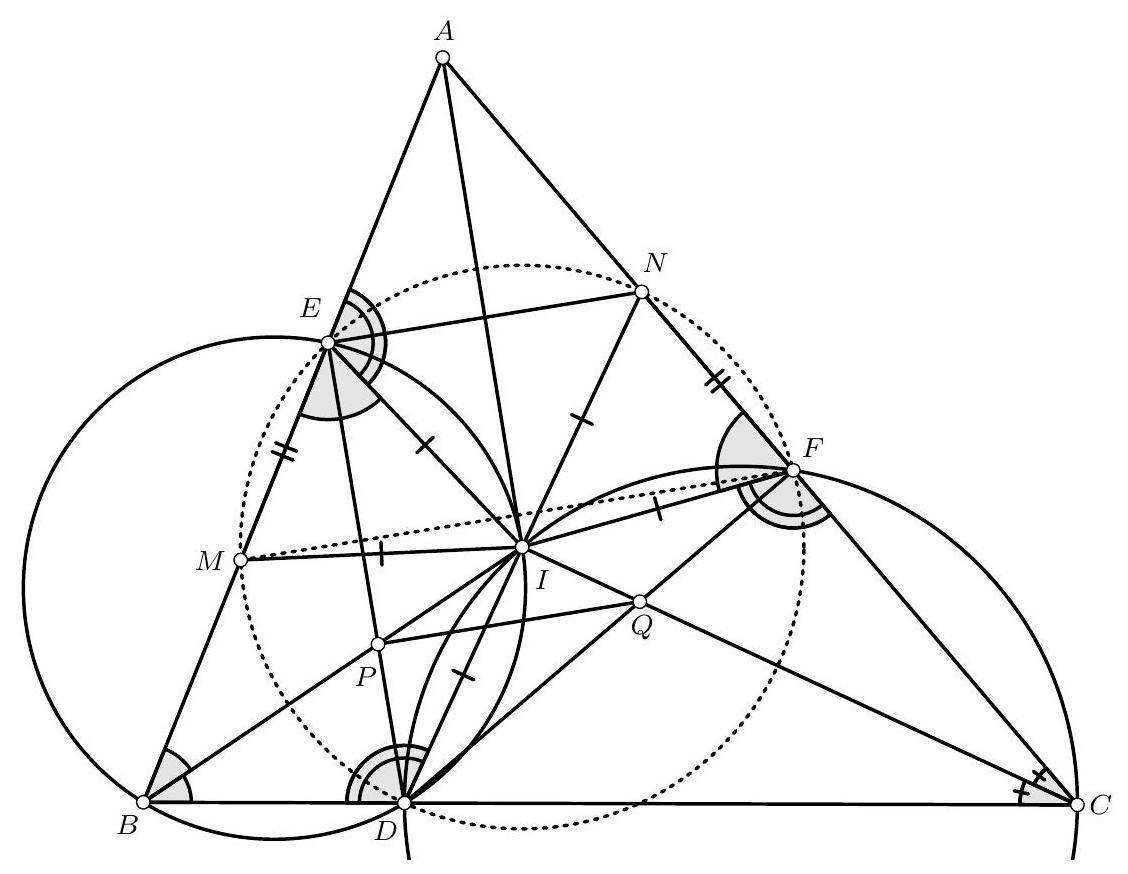
|
| 999 |
+
|
| 1000 |
+
G7. Let $A B C$ be a right-angled triangle with $\hat{A}=90^{\circ}$. Let $K$ be the midpoint of $B C$, and let $A K L M$ be a parallelogram with centre $C$. Let $T$ be the intersection of the line $A C$ and the perpendicular bisector of $B M$. Let $\omega_{1}$ be the circle with centre $C$ and radius $C A$ and let $\omega_{2}$ be the circle with centre $T$ and radius $T B$. Prove that one of the points of intersection of $\omega_{1}$ and $\omega_{2}$ is on the line $L M$.
|
| 1001 |
+
|
| 1002 |
+
Solution. Let $M^{\prime}$ be the symmetric point of $M$ with respect to $T$. Observe that $T$ is equidistant from $B$ and $M$, therefore $M$ belongs on $\omega_{2}$ and $M^{\prime} M$ is a diameter of $\omega_{2}$. It suffices to prove that $M^{\prime} A$ is perpendicular to $L M$, or equivalently, to $A K$. To see this, let $S$ be the point of intersection of $M^{\prime} A$ with $L M$. We will then have $\angle M^{\prime} S M=90^{\circ}$ which shows that $S$ belongs on $\omega_{2}$ as $M^{\prime} M$ is a diameter of $\omega_{2}$. We also have that $S$ belongs on $\omega_{1}$ as $A L$ is diameter of $\omega_{1}$.
|
| 1003 |
+
|
| 1004 |
+
Since $T$ and $C$ are the midpoints of $M^{\prime} M$ and $K M$ respectively, then $T C$ is parallel to $M^{\prime} K$ and so $M^{\prime} K$ is perpendicular to $A B$. Since $K A=K B$, then $K M^{\prime}$ is the perpendicular bisector of $A B$. But then the triangles $K B M^{\prime}$ and $K A M^{\prime}$ are equal, showing that $\angle M^{\prime} A K=\angle M^{\prime} B K=\angle M^{\prime} B M=90^{\circ}$ as required.
|
| 1005 |
+
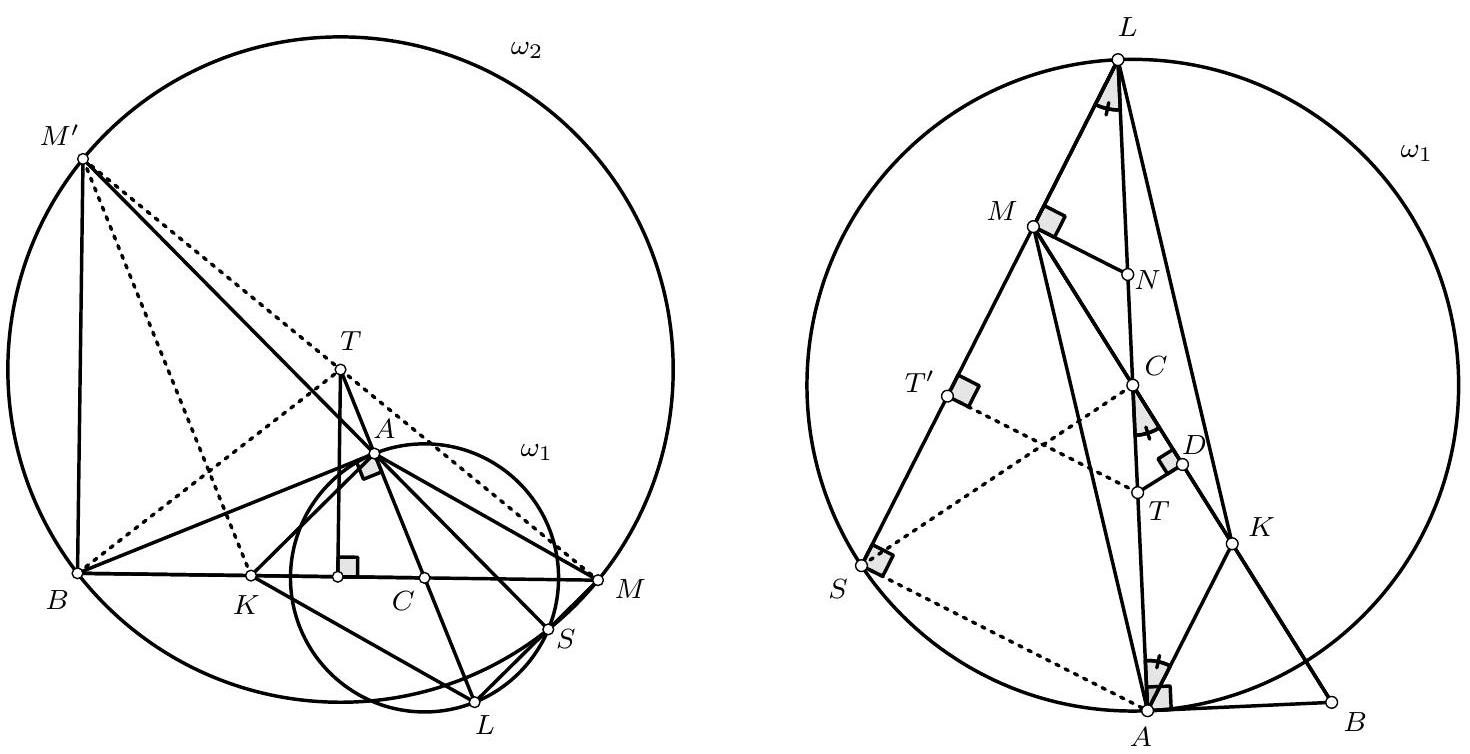
|
| 1006 |
+
|
| 1007 |
+
Alternative Solution by Proposers. Since $C A=C L$, then $L$ belongs on $\omega_{1}$. Let $S$ be the other point of intersection of $\omega_{1}$ with the line $L M$. We need to show that $S$ belongs on $\omega_{2}$. Since $T B=T M$ ( $T$ is on the perpendicular bisector of $B M$ ) it is enough to show that $T S=T M$.
|
| 1008 |
+
|
| 1009 |
+
Let $N, T^{\prime}$ be points on the lines $A L$ and $L M$ respectively, such that $M N \perp L M$ and $T T^{\prime} \perp L M$. It is enough to prove that $T^{\prime}$ is the midpoint of $S M$. Since $A L$ is diameter of $\omega_{1}$ we have that $A S \perp L S$. Thus, it is enough to show that $T$ is the midpoint of $A N$. We have
|
| 1010 |
+
|
| 1011 |
+
$$
|
| 1012 |
+
A T=\frac{A N}{2} \Leftrightarrow A C-C T=\frac{A L-L N}{2} \Leftrightarrow 2 A C-2 C T=A L-L N \Leftrightarrow L N=2 C T
|
| 1013 |
+
$$
|
| 1014 |
+
|
| 1015 |
+
as $A L=2 A C$. So it suffices to prove that $L N=2 C T$.
|
| 1016 |
+
|
| 1017 |
+
Let $D$ be the midpoint of $B M$. Since $B K=K C=C M$, then $D$ is also the midpont of $K C$. The triangles $L M N$ and $C T D$ are similar since they are right-angled with
|
| 1018 |
+
$\angle T C D=\angle C A K=\angle M L N$. (AK=KC and $A K$ is parallel to $L M$.) So we have
|
| 1019 |
+
|
| 1020 |
+
$$
|
| 1021 |
+
\frac{L N}{C T}=\frac{L M}{C D}=\frac{A K}{C D}=\frac{C K}{C D}=2
|
| 1022 |
+
$$
|
| 1023 |
+
|
| 1024 |
+
as required.
|
| 1025 |
+
|
| 1026 |
+
## NUMBER THEORY
|
| 1027 |
+
|
| 1028 |
+
N1. Find all prime numbers $p$ for which there are non-negative integers $x, y$ and $z$ such that the number
|
| 1029 |
+
|
| 1030 |
+
$$
|
| 1031 |
+
A=x^{p}+y^{p}+z^{p}-x-y-z
|
| 1032 |
+
$$
|
| 1033 |
+
|
| 1034 |
+
is a product of exactly three distinct prime numbers.
|
| 1035 |
+
|
| 1036 |
+
Solution. For $p=2$, we take $x=y=4$ and $z=3$. Then $A=30=2 \cdot 3 \cdot 5$. For $p=3$ we can take $x=3$ and $y=2$ and $z=1$. Then again $A=30=2 \cdot 3 \cdot 5$. For $p=5$ we can take $x=2$ and $y=1$ and $z=1$. Again $A=30=2 \cdot 3 \cdot 5$.
|
| 1037 |
+
|
| 1038 |
+
Assume now that $p \geqslant 7$. Working modulo 2 and modulo 3 we see that $A$ is divisible by both 2 and 3. Moreover, by Fermat's Little Theorem, we have
|
| 1039 |
+
|
| 1040 |
+
$$
|
| 1041 |
+
x^{p}+y^{p}+z^{p}-x-y-z \equiv x+y+z-x-y-z=0 \bmod p
|
| 1042 |
+
$$
|
| 1043 |
+
|
| 1044 |
+
Therefore, by the given condition, we have to solve the equation
|
| 1045 |
+
|
| 1046 |
+
$$
|
| 1047 |
+
x^{p}+y^{p}+z^{p}-x-y-z=6 p
|
| 1048 |
+
$$
|
| 1049 |
+
|
| 1050 |
+
If one of the numbers $x, y$ and $z$ is bigger than or equal to 2 , let's say $x \geqslant 2$, then
|
| 1051 |
+
|
| 1052 |
+
$$
|
| 1053 |
+
6 p \geqslant x^{p}-x=x\left(x^{p-1}-1\right) \geqslant 2\left(2^{p-1}-1\right)=2^{p}-2
|
| 1054 |
+
$$
|
| 1055 |
+
|
| 1056 |
+
It is easy to check by induction that $2^{p}-2>6 p$ for all primes $p \geqslant 7$. This contradiction shows that there are no more values of $p$ which satisfy the required property.
|
| 1057 |
+
|
| 1058 |
+
Remark by PSC. There are a couple of other ways to prove that $2^{p}-2>6 p$ for $p \geqslant 7$. For example, we can use the Binomial Theorem as follows:
|
| 1059 |
+
|
| 1060 |
+
$$
|
| 1061 |
+
2^{p}-2 \geqslant 1+p+\frac{p(p-1)}{2}+\frac{p(p-1)(p-2)}{6}-2 \geqslant 1+p+3 p+5 p-2>6 p
|
| 1062 |
+
$$
|
| 1063 |
+
|
| 1064 |
+
We can also use Bernoulli's Inequality as follows:
|
| 1065 |
+
|
| 1066 |
+
$$
|
| 1067 |
+
2^{p}-2=8(1+1)^{p-3}-2 \geqslant 8(1+(p-3))-2=8 p-18>6 p
|
| 1068 |
+
$$
|
| 1069 |
+
|
| 1070 |
+
The last inequality is true for $p \geqslant 11$. For $p=7$ we can see directly that $2^{p}-2>6 p$.
|
| 1071 |
+
|
| 1072 |
+
N2. Find all triples $(p, q, r)$ of prime numbers such that all of the following numbers are integers
|
| 1073 |
+
|
| 1074 |
+
$$
|
| 1075 |
+
\frac{p^{2}+2 q}{q+r}, \quad \frac{q^{2}+9 r}{r+p}, \quad \frac{r^{2}+3 p}{p+q}
|
| 1076 |
+
$$
|
| 1077 |
+
|
| 1078 |
+
Solution. We consider the following cases:
|
| 1079 |
+
|
| 1080 |
+
1st Case: If $r=2$, then $\frac{r^{2}+3 p}{p+q}=\frac{4+3 p}{p+q}$. If $p$ is odd, then $4+3 p$ is odd and therefore $p+q$ must be odd. From here, $q=2$ and $\frac{r^{2}+3 p}{p+q}=\frac{4+3 p}{p+2}=3-\frac{2}{p+2}$ which is not an integer. Thus $p=2$ and $\frac{r^{2}+3 p}{p+q}=\frac{10}{q+2}$ which gives $q=3$. But then $\frac{q^{2}+9 r}{r+p}=\frac{27}{4}$ which is not an integer. Therefore $r$ is an odd prime.
|
| 1081 |
+
|
| 1082 |
+
2nd Case: If $q=2$, then $\frac{q^{2}+9 r}{r+p}=\frac{4+9 r}{r+p}$. Since $r$ is odd, then $4+9 r$ is odd and therefore $r+p$ must be odd. From here $p=2$, but then $\frac{r^{2}+3 p}{p+q}=\frac{r^{2}+6}{4}$ which is not integer. Therefore $q$ is an odd prime.
|
| 1083 |
+
|
| 1084 |
+
Since $q$ and $r$ are odd primes, then $q+r$ is even. From the number $\frac{p^{2}+2 q}{q+r}$ we get that $p=2$. Since $\frac{p^{2}+2 q}{q+r}=\frac{4+2 q}{q+r}<2$, then $4+2 q=q+r$ or $r=q+4$. Since
|
| 1085 |
+
|
| 1086 |
+
$$
|
| 1087 |
+
\frac{r^{2}+3 p}{p+q}=\frac{(q+4)^{2}+6}{2+q}=q+6+\frac{10}{2+q}
|
| 1088 |
+
$$
|
| 1089 |
+
|
| 1090 |
+
is an integer, then $q=3$ and $r=7$. It is easy to check that this triple works. So the only answer is $(p, q, r)=(2,3,7)$.
|
| 1091 |
+
|
| 1092 |
+
N3. Find all prime numbers $p$ and nonnegative integers $x \neq y$ such that $x^{4}-y^{4}=$ $p\left(x^{3}-y^{3}\right)$.
|
| 1093 |
+
|
| 1094 |
+
Solution. If $x=0$ then $y=p$ and if $y=0$ then $x=p$. We will show that there are no other solutions.
|
| 1095 |
+
|
| 1096 |
+
Suppose $x, y>0$. Since $x \neq y$, we have
|
| 1097 |
+
|
| 1098 |
+
$$
|
| 1099 |
+
p\left(x^{2}+x y+y^{2}\right)=(x+y)\left(x^{2}+y^{2}\right)
|
| 1100 |
+
$$
|
| 1101 |
+
|
| 1102 |
+
If $p$ divides $x+y$, then $x^{2}+y^{2}$ must divide $x^{2}+x y+y^{2}$ and so it must also divide $x y$. This is a contradiction as $x^{2}+y^{2} \geqslant 2 x y>x y$.
|
| 1103 |
+
|
| 1104 |
+
Thus $p$ divides $x^{2}+y^{2}$, so $x+y$ divides $x^{2}+x y+y^{2}$. As $x+y$ divides $x^{2}+x y$ and $y^{2}+x y$, it also divides $x^{2}, x y$ and $y^{2}$. Suppose $x^{2}=a(x+y), y^{2}=b(x+y)$ and $x y=c(x+y)$. Then $x^{2}+x y+y^{2}=(a+b+c)(x+y), x^{2}+y^{2}=(a+b)(x+y)$, while $(x+y)^{2}=x^{2}+y^{2}+2 x y=(a+b+2 c)(x+y)$ yields $x+y=a+b+2 c$.
|
| 1105 |
+
|
| 1106 |
+
Substituting into $(*)$ gives
|
| 1107 |
+
|
| 1108 |
+
$$
|
| 1109 |
+
p(a+b+c)=(a+b+2 c)(a+b)
|
| 1110 |
+
$$
|
| 1111 |
+
|
| 1112 |
+
Now let $a+b=d m$ and $c=d c_{1}$, where $\operatorname{gcd}\left(m, c_{1}\right)=1$. Then
|
| 1113 |
+
|
| 1114 |
+
$$
|
| 1115 |
+
p\left(m+c_{1}\right)=\left(m+2 c_{1}\right) d m
|
| 1116 |
+
$$
|
| 1117 |
+
|
| 1118 |
+
If $m+c_{1}$ and $m$ had a common divisor, it would divide $c_{1}$, a contradiction. So $\operatorname{gcd}(m, m+$ $\left.c_{1}\right)=1$. and similarly, $\operatorname{gcd}\left(m+c_{1}, m+2 c_{1}\right)=1$. Thus $m+2 c_{1}$ and $m$ divide $p$, so $m+2 c_{1}=p$ and $m=1$. Then $m+c_{1}=d$ so $c \geqslant d=a+b$. Now
|
| 1119 |
+
|
| 1120 |
+
$$
|
| 1121 |
+
x y=c(x+y) \geqslant(a+b)(x+y)=x^{2}+y^{2}
|
| 1122 |
+
$$
|
| 1123 |
+
|
| 1124 |
+
again a contradiction.
|
| 1125 |
+
|
| 1126 |
+
Alternative Solution by PSC. Let $d=\operatorname{gcd}(x, y)$. Then $x=d a$ and $y=d b$ for some $a, b$ such that $\operatorname{gcd}(a, b)=1$. Then
|
| 1127 |
+
|
| 1128 |
+
$$
|
| 1129 |
+
d^{4}\left(a^{4}-b^{4}\right)=p d^{3}\left(a^{3}-b^{3}\right)
|
| 1130 |
+
$$
|
| 1131 |
+
|
| 1132 |
+
which gives
|
| 1133 |
+
|
| 1134 |
+
$$
|
| 1135 |
+
d(a+b)\left(a^{2}+b^{2}\right)=p\left(a^{2}+a b+b^{2}\right)
|
| 1136 |
+
$$
|
| 1137 |
+
|
| 1138 |
+
If a prime $q$ divides both $a+b$ and $a^{2}+a b+b^{2}$, then it also divides $(a+b)^{2}-\left(a^{2}+a b+b^{2}\right)=$ $a b$. So $q$ divides $a$ or $q$ divides $b$. Since $q$ also divides $a+b$, it must divide both $a$ and b. This is impossible as $\operatorname{gcd}(a, b)=1$. So $\operatorname{gcd}\left(a+b, a^{2}+a b+b^{2}\right)=1$ and similarly $\operatorname{gcd}\left(a^{2}+b^{2}, a^{2}+a b+b^{2}\right)=1$. Then $(a+b)\left(a^{2}+b^{2}\right)$ divides $p$ and since $a+b \leqslant a^{2}+b^{2}$, then $a+b=1$.
|
| 1139 |
+
|
| 1140 |
+
If $a=0, b=1$ then $(*)$ gives $d=p$ and so $x=0, y=p$ which is obviously a solution. If $a=1, b=0$ we similarly get the solution $x=p, y=0$. These are the only solutions.
|
| 1141 |
+
|
| 1142 |
+
N4. Find all integers $x, y$ such that
|
| 1143 |
+
|
| 1144 |
+
$$
|
| 1145 |
+
x^{3}(y+1)+y^{3}(x+1)=19
|
| 1146 |
+
$$
|
| 1147 |
+
|
| 1148 |
+
Solution. Substituting $s=x+y$ and $p=x y$ we get
|
| 1149 |
+
|
| 1150 |
+
$$
|
| 1151 |
+
2 p^{2}-\left(s^{2}-3 s\right) p+19-s^{3}=0
|
| 1152 |
+
$$
|
| 1153 |
+
|
| 1154 |
+
This is a quadratic equation in $p$ with discriminant $D=s^{4}+2 s^{3}+9 s^{2}-152$.
|
| 1155 |
+
|
| 1156 |
+
For each $s$ we have $D<\left(s^{2}+s+5\right)^{2}$ as this is equivalent to $(2 s+5)^{2}+329>0$.
|
| 1157 |
+
|
| 1158 |
+
For $s \geqslant 11$ and $s \leqslant-8$ we have $D>\left(s^{2}+s+3\right)^{2}$ as this is equivalent to $2 s^{2}-6 s-161>0$, and thus also to $2(s+8)(s-11)>-15$.
|
| 1159 |
+
|
| 1160 |
+
We have the following cases:
|
| 1161 |
+
|
| 1162 |
+
- If $s \geqslant 11$ or $s \leqslant-8$, then $D$ is a perfect square only when $D=\left(s^{2}+s+4\right)^{2}$, or equivalently, when $s=-21$. From (1) we get $p=232$ (which yields no solution) or $p=20$, giving the solutions $(-1,-20)$ and $(-20,-1)$.
|
| 1163 |
+
- If $-7 \leqslant s \leqslant 10$, then $D$ is directly checked to be perfect square only for $s=3$. Then $p= \pm 2$ and only $p=2$ gives solutions, namely $(2,1)$ and $(1,2)$.
|
| 1164 |
+
|
| 1165 |
+
Remark by PSC. In the second bullet point, one actually needs to check 18 possible values of $s$ which is actually quite time consuming. We did not see many possible shortcuts. For example, $D$ is always a perfect square modulo 2 and modulo 3, while modulo 5 we can only get rid the four cases of the form $s \equiv 0 \bmod 5$.
|
| 1166 |
+
|
| 1167 |
+
N5. Find all positive integers $x, y, z$ such that
|
| 1168 |
+
|
| 1169 |
+
$$
|
| 1170 |
+
45^{x}-6^{y}=2019^{z}
|
| 1171 |
+
$$
|
| 1172 |
+
|
| 1173 |
+
Solution. We define $v_{3}(n)$ to be the non-negative integer $k$ such that $3^{k} \mid n$ but $3^{k+1} \nmid n$. The equation is equivalent to
|
| 1174 |
+
|
| 1175 |
+
$$
|
| 1176 |
+
3^{2 x} \cdot 5^{x}-3^{y} \cdot 2^{y}=3^{z} \cdot 673^{z}
|
| 1177 |
+
$$
|
| 1178 |
+
|
| 1179 |
+
We will consider the cases $y \neq 2 x$ and $y=2 x$ separately.
|
| 1180 |
+
|
| 1181 |
+
Case 1. Suppose $y \neq 2 x$. Since $45^{x}>45^{x}-6^{y}=2019^{z}>45^{z}$, then $x>z$ and so $2 x>z$. We have
|
| 1182 |
+
|
| 1183 |
+
$$
|
| 1184 |
+
z=v_{3}\left(3^{z} \cdot 673^{z}\right)=v_{3}\left(3^{2 x} \cdot 5^{x}-3^{y} \cdot 2^{y}\right)=\min \{2 x, y\}
|
| 1185 |
+
$$
|
| 1186 |
+
|
| 1187 |
+
as $y \neq 2 x$. Since $2 x>z$, we get $z=y$. Hence the equation becomes $3^{2 x} \cdot 5^{x}-3^{y} \cdot 2^{y}=$ $3^{y} \cdot 673^{y}$, or equivalently,
|
| 1188 |
+
|
| 1189 |
+
$$
|
| 1190 |
+
3^{2 x-y} \cdot 5^{x}=2^{y}+673^{y}
|
| 1191 |
+
$$
|
| 1192 |
+
|
| 1193 |
+
Case 1.1. Suppose $y=1$. Doing easy manipulations we have
|
| 1194 |
+
|
| 1195 |
+
$$
|
| 1196 |
+
3^{2 x-1} \cdot 5^{x}=2+673=675=3^{3} \cdot 5^{2} \Longrightarrow 45^{x-2}=1 \Longrightarrow x=2
|
| 1197 |
+
$$
|
| 1198 |
+
|
| 1199 |
+
Hence one solution which satisfies the condition is $(x, y, z)=(2,1,1)$.
|
| 1200 |
+
|
| 1201 |
+
Case 1.2. Suppose $y \geqslant 2$. Using properties of congruences we have
|
| 1202 |
+
|
| 1203 |
+
$$
|
| 1204 |
+
1 \equiv 2^{y}+673^{y} \equiv 3^{2 x-y} \cdot 5^{y} \equiv(-1)^{2 x-y} \bmod 4
|
| 1205 |
+
$$
|
| 1206 |
+
|
| 1207 |
+
Hence $2 x-y$ is even, which implies that $y$ is even. Using this fact we have
|
| 1208 |
+
|
| 1209 |
+
$$
|
| 1210 |
+
0 \equiv 3^{2 x-y} \cdot 5^{y} \equiv 2^{y}+673^{y} \equiv 1+1 \equiv 2 \bmod 3
|
| 1211 |
+
$$
|
| 1212 |
+
|
| 1213 |
+
which is a contradiction.
|
| 1214 |
+
|
| 1215 |
+
Case 2. Suppose $y=2 x$. The equation becomes $3^{2 x} \cdot 5^{x}-3^{2 x} \cdot 2^{2 x}=3^{z} \cdot 673^{z}$, or equivalently,
|
| 1216 |
+
|
| 1217 |
+
$$
|
| 1218 |
+
5^{x}-4^{x}=3^{z-2 x} \cdot 673^{z}
|
| 1219 |
+
$$
|
| 1220 |
+
|
| 1221 |
+
Working modulo 3 we have
|
| 1222 |
+
|
| 1223 |
+
$$
|
| 1224 |
+
(-1)^{x}-1 \equiv 5^{x}-4^{x} \equiv 3^{z-2 x} \cdot 673^{z} \equiv 0 \bmod 3
|
| 1225 |
+
$$
|
| 1226 |
+
|
| 1227 |
+
hence $x$ is even, say $x=2 t$ for some positive integer $t$. The equation is now equivalent to
|
| 1228 |
+
|
| 1229 |
+
$$
|
| 1230 |
+
\left(5^{t}-4^{t}\right)\left(5^{t}+4^{t}\right)=3^{z-4 t} \cdot 673^{z}
|
| 1231 |
+
$$
|
| 1232 |
+
|
| 1233 |
+
It can be checked by hand that $t=1$ is not possible. For $t \geqslant 2$, since 3 and 673 are the only prime factors of the right hand side, and since, as it is easily checked $\operatorname{gcd}\left(5^{t}-4^{t}, 5^{t}+4^{t}\right)=1$ and $5^{t}-4^{t}>1$, the only way for this to happen is when $5^{t}-4^{t}=3^{z-4 t}$ and $5^{t}+4^{t}=673^{z}$ or $5^{t}-4^{t}=673^{z}$ and $5^{t}+4^{t}=3^{z-4 t}$. Adding together we have
|
| 1234 |
+
|
| 1235 |
+
$$
|
| 1236 |
+
2 \cdot 5^{t}=3^{z-4 t}+673^{z}
|
| 1237 |
+
$$
|
| 1238 |
+
|
| 1239 |
+
Working modulo 5 we have
|
| 1240 |
+
|
| 1241 |
+
$$
|
| 1242 |
+
0 \equiv 2 \cdot 5^{t} \equiv 3^{z-4 t}+673^{z} \equiv 3^{4 t} \cdot 3^{z-4 t}+3^{z} \equiv 2 \cdot 3^{z} \bmod 5
|
| 1243 |
+
$$
|
| 1244 |
+
|
| 1245 |
+
which is a contradiction. Hence the only solution which satisfies the equation is $(x, y, z)=$ $(2,1,1)$.
|
| 1246 |
+
|
| 1247 |
+
Alternative Solution by PSC. Working modulo 5 we see that $-1 \equiv 4^{z} \bmod 5$ and therefore $z$ is odd. Now working modulo 4 and using the fact that $z$ is odd we get that $1-2^{y} \equiv 3^{z} \equiv 3 \bmod 4$. This gives $y=1$. Now working modulo 9 we have $-6 \equiv 3^{z} \bmod 9$ which gives $z=1$. Now since $y=z=1$ we get $x=2$ and so $(2,1,1)$ is the unique solution.
|
| 1248 |
+
|
| 1249 |
+
N6. Find all triples $(a, b, c)$ of nonnegative integers that satisfy
|
| 1250 |
+
|
| 1251 |
+
$$
|
| 1252 |
+
a!+5^{b}=7^{c}
|
| 1253 |
+
$$
|
| 1254 |
+
|
| 1255 |
+
Solution. We cannot have $c=0$ as $a!+5^{b} \geqslant 2>1=7^{0}$.
|
| 1256 |
+
|
| 1257 |
+
Assume first that $b=0$. So we are solving $a!+1=7^{c}$. If $a \geqslant 7$, then $7 \mid a!$ and so $7 \nmid a!+1$. So $7 \nmid 7^{c}$ which is impossible as $c \neq 0$. Checking $a<7$ by hand, we find the solution $(a, b, c)=(3,0,1)$.
|
| 1258 |
+
|
| 1259 |
+
We now assume that $b>0$. In this case, if $a \geqslant 5$, we have $5 \mid a$ !, and since $5 \mid 5^{b}$, we have $5 \mid 7^{c}$, which obviously cannot be true. So we have $a \leqslant 4$. Now we consider the following cases:
|
| 1260 |
+
|
| 1261 |
+
Case 1. Suppose $a=0$ or $a=1$. In this case, we are solving the equation $5^{b}+1=7^{c}$. However the Left Hand Side of the equation is always even, and the Right Hand Side is always odd, implying that this case has no solutions.
|
| 1262 |
+
|
| 1263 |
+
Case 2. Suppose $a=2$. Now we are solving the equation $5^{b}+2=7^{c}$. If $b=1$, we have the solution $(a, b, c)=(2,1,1)$. Now assume $b \geqslant 2$. We have $5^{b}+2 \equiv 2 \bmod 25$ which implies that $7^{c} \equiv 2 \bmod 25$. However, by observing that $7^{4} \equiv 1 \bmod 25$, we see that the only residues that $7^{c}$ can have when divided with 25 are $7,24,18,1$. So this case has no more solutions.
|
| 1264 |
+
|
| 1265 |
+
Case 3. Suppose $a=3$. Now we are solving the equation $5^{b}+6=7^{c}$. We have $5^{b}+6 \equiv 1 \bmod 5$ which implies that $7^{c} \equiv 1 \bmod 5$. As the residues of $7^{c}$ modulo 5 are $2,4,3,1$, in that order, we obtain $4 \mid c$.
|
| 1266 |
+
|
| 1267 |
+
Viewing the equation modulo 4 , we have $7^{c} \equiv 5^{b}+6 \equiv 1+2 \equiv 3 \bmod 4$. But as $4 \mid c$, we know that $7^{c}$ is a square, and the only residues that a square can have when divided by 4 are 0,1 . This means that this case has no solutions either.
|
| 1268 |
+
|
| 1269 |
+
Case 4. Suppose $a=4$. Now we are solving the equation $5^{b}+24=7^{c}$. We have $5^{b} \equiv 7^{c}-24 \equiv 1-24 \equiv 1 \bmod 3$. Since $5 \equiv 2 \bmod 3$, we obtain $2 \mid b$. We also have $7^{c} \equiv 5^{b}+24 \equiv 4 \bmod 5$, and so we obtain $c \equiv 2 \bmod 4$. Let $b=2 m$ and $c=2 n$. Observe that
|
| 1270 |
+
|
| 1271 |
+
$$
|
| 1272 |
+
24=7^{c}-5^{b}=\left(7^{n}-5^{m}\right)\left(7^{n}+5^{m}\right)
|
| 1273 |
+
$$
|
| 1274 |
+
|
| 1275 |
+
Since $7^{n}+5^{m}>0$, we have $7^{n}-5^{m}>0$. There are only a few ways to express $24=$ $24 \cdot 1=12 \cdot 2=8 \cdot 3=6 \cdot 4$ as a product of two positive integers. By checking these cases we find one by one, the only solution in this case is $(a, b, c)=(4,2,2)$.
|
| 1276 |
+
|
| 1277 |
+
Having exhausted all cases, we find that the required set of triples is
|
| 1278 |
+
|
| 1279 |
+
$$
|
| 1280 |
+
(a, b, c) \in\{(3,0,1),(1,2,1),(4,2,2)\}
|
| 1281 |
+
$$
|
| 1282 |
+
|
| 1283 |
+
N7. Find all perfect squares $n$ such that if the positive integer $a \geqslant 15$ is some divisor of $n$ then $a+15$ is a prime power.
|
| 1284 |
+
|
| 1285 |
+
Solution. We call positive a integer $a$ "nice" if $a+15$ is a prime power.
|
| 1286 |
+
|
| 1287 |
+
From the definition, the numbers $n=1,4,9$ satisfy the required property. Suppose that for some $t \in \mathbb{Z}^{+}$, the number $n=t^{2} \geqslant 15$ also satisfies the required property. We have two cases:
|
| 1288 |
+
|
| 1289 |
+
1. If $n$ is a power of 2 , then $n \in\{16,64\}$ since
|
| 1290 |
+
|
| 1291 |
+
$$
|
| 1292 |
+
2^{4}+15=31, \quad 2^{5}+15=47, \quad \text { and } \quad 2^{6}+15=79
|
| 1293 |
+
$$
|
| 1294 |
+
|
| 1295 |
+
are prime, and $2^{7}+15=143=11 \cdot 13$ is not a prime power. (Thus $2^{7}$ does not divide $n$ and therefore no higher power of 2 satisfies the required property.)
|
| 1296 |
+
|
| 1297 |
+
2. Suppose $n$ has some odd prime divisor $p$. If $p>3$ then $p^{2} \mid n$ and $p^{2}>15$ which imply that $p^{2}$ must be a nice number. Hence
|
| 1298 |
+
|
| 1299 |
+
$$
|
| 1300 |
+
p^{2}+15=q^{m}
|
| 1301 |
+
$$
|
| 1302 |
+
|
| 1303 |
+
for some prime $q$ and some $m \in \mathbb{Z}^{+}$. Since $p$ is odd, then $p^{2}+15$ is even, thus we can conclude that $q=2$. I.e.
|
| 1304 |
+
|
| 1305 |
+
$$
|
| 1306 |
+
p^{2}+15=2^{m}
|
| 1307 |
+
$$
|
| 1308 |
+
|
| 1309 |
+
Considering the above modulo 3 , we can see that $p^{2}+15 \equiv 0,1 \bmod 3$, so $2^{m} \equiv$ $1 \bmod 3$, and so $m$ is even. Suppose $m=2 k$ for some $k \in \mathbb{Z}^{+}$. So we have $\left(2^{k}-p\right)\left(2^{k}+p\right)=15$ and $\left(2^{k}+p\right)-\left(2^{k}-p\right)=2 p \geqslant 10$. Thus
|
| 1310 |
+
|
| 1311 |
+
$$
|
| 1312 |
+
2^{k}-p=1 \quad \text { and } \quad 2^{k}+p=15
|
| 1313 |
+
$$
|
| 1314 |
+
|
| 1315 |
+
giving $p=7$ and $k=3$. Thus we can write $n=4^{x} \cdot 9^{y} \cdot 49^{z}$ for some non-negative integers $x, y, z$.
|
| 1316 |
+
|
| 1317 |
+
Note that 27 is not nice, so $27 \nmid n$ and therefore $y \leqslant 1$. The numbers 18 and 21 are also not nice, so similarly, $x, y$ and $y, z$ cannot both positive. Hence, we just need to consider $n=4^{x} \cdot 49^{z}$ with $z \geqslant 1$.
|
| 1318 |
+
|
| 1319 |
+
Note that $7^{3}$ is not nice, so $z=1$. By checking directly, we can see that $7^{2}+15=$ $2^{6}, 2 \cdot 7^{2}+15=113,4 \cdot 7^{2}+15=211$ are nice, but $8 \cdot 7^{2}$ is not nice, so only $n=49,196$ satisfy the required property.
|
| 1320 |
+
|
| 1321 |
+
Therefore, the numbers $n$ which satisfy the required property are $1,4,9,16,49,64$ and 196 .
|
| 1322 |
+
|
| 1323 |
+
Remark by PSC. One can get rid of the case $3 \mid n$ by noting that in that case, we have $9 \mid n$. But then $n^{2}+15$ is a multiple of 3 but not a multiple of 9 which is impossible. This simplifies a little bit the second case.
|
| 1324 |
+
|
JBMO/md/en-shortlist/en-jbmo_shortlist_2020.md
ADDED
|
@@ -0,0 +1,872 @@
|
|
|
|
|
|
|
|
|
|
|
|
|
|
|
|
|
|
|
|
|
|
|
|
|
|
|
|
|
|
|
|
|
|
|
|
|
|
|
|
|
|
|
|
|
|
|
|
|
|
|
|
|
|
|
|
|
|
|
|
|
|
|
|
|
|
|
|
|
|
|
|
|
|
|
|
|
|
|
|
|
|
|
|
|
|
|
|
|
|
|
|
|
|
|
|
|
|
|
|
|
|
|
|
|
|
|
|
|
|
|
|
|
|
|
|
|
|
|
|
|
|
|
|
|
|
|
|
|
|
|
|
|
|
|
|
|
|
|
|
|
|
|
|
|
|
|
|
|
|
|
|
|
|
|
|
|
|
|
|
|
|
|
|
|
|
|
|
|
|
|
|
|
|
|
|
|
|
|
|
|
|
|
|
|
|
|
|
|
|
|
|
|
|
|
|
|
|
|
|
|
|
|
|
|
|
|
|
|
|
|
|
|
|
|
|
|
|
|
|
|
|
|
|
|
|
|
|
|
|
|
|
|
|
|
|
|
|
|
|
|
|
|
|
|
|
|
|
|
|
|
|
|
|
|
|
|
|
|
|
|
|
|
|
|
|
|
|
|
|
|
|
|
|
|
|
|
|
|
|
|
|
|
|
|
|
|
|
|
|
|
|
|
|
|
|
|
|
|
|
|
|
|
|
|
|
|
|
|
|
|
|
|
|
|
|
|
|
|
|
|
|
|
|
|
|
|
|
|
|
|
|
|
|
|
|
|
|
|
|
|
|
|
|
|
|
|
|
|
|
|
|
|
|
|
|
|
|
|
|
|
|
|
|
|
|
|
|
|
|
|
|
|
|
|
|
|
|
|
|
|
|
|
|
|
|
|
|
|
|
|
|
|
|
|
|
|
|
|
|
|
|
|
|
|
|
|
|
|
|
|
|
|
|
|
|
|
|
|
|
|
|
|
|
|
|
|
|
|
|
|
|
|
|
|
|
|
|
|
|
|
|
|
|
|
|
|
|
|
|
|
|
|
|
|
|
|
|
|
|
|
|
|
|
|
|
|
|
|
|
|
|
|
|
|
|
|
|
|
|
|
|
|
|
|
|
|
|
|
|
|
|
|
|
|
|
|
|
|
|
|
|
|
|
|
|
|
|
|
|
|
|
|
|
|
|
|
|
|
|
|
|
|
|
|
|
|
|
|
|
|
|
|
|
|
|
|
|
|
|
|
|
|
|
|
|
|
|
|
|
|
|
|
|
|
|
|
|
|
|
|
|
|
|
|
|
|
|
|
|
|
|
|
|
|
|
|
|
|
|
|
|
|
|
|
|
|
|
|
|
|
|
|
|
|
|
|
|
|
|
|
|
|
|
|
|
|
|
|
|
|
|
|
|
|
|
|
|
|
|
|
|
|
|
|
|
|
|
|
|
|
|
|
|
|
|
|
|
|
|
|
|
|
|
|
|
|
|
|
|
|
|
|
|
|
|
|
|
|
|
|
|
|
|
|
|
|
|
|
|
|
|
|
|
|
|
|
|
|
|
|
|
|
|
|
|
|
|
|
|
|
|
|
|
|
|
|
|
|
|
|
|
|
|
|
|
|
|
|
|
|
|
|
|
|
|
|
|
|
|
|
|
|
|
|
|
|
|
|
|
|
|
|
|
|
|
|
|
|
|
|
|
|
|
|
|
|
|
|
|
|
|
|
|
|
|
|
|
|
|
|
|
|
|
|
|
|
|
|
|
|
|
|
|
|
|
|
|
|
|
|
|
|
|
|
|
|
|
|
|
|
|
|
|
|
|
|
|
|
|
|
|
|
|
|
|
|
|
|
|
|
|
|
|
|
|
|
|
|
|
|
|
|
|
|
|
|
|
|
|
|
|
|
|
|
|
|
|
|
|
|
|
|
|
|
|
|
|
|
|
|
|
|
|
|
|
|
|
|
|
|
|
|
|
|
|
|
|
|
|
|
|
|
|
|
|
|
|
|
|
|
|
|
|
|
|
|
|
|
|
|
|
|
|
|
|
|
|
|
|
|
|
|
|
|
|
|
|
|
|
|
|
|
|
|
|
|
|
|
|
|
|
|
|
|
|
|
|
|
|
|
|
|
|
|
|
|
|
|
|
|
|
|
|
|
|
|
|
|
|
|
|
|
|
|
|
|
|
|
|
|
|
|
|
|
|
|
|
|
|
|
|
|
|
|
|
|
|
|
|
|
|
|
|
|
|
|
|
|
|
|
|
|
|
|
|
|
|
|
|
|
|
|
|
|
|
|
|
|
|
|
|
|
|
|
|
|
|
|
|
|
|
|
|
|
|
|
|
|
|
|
|
|
|
|
|
|
|
|
|
|
|
|
|
|
|
|
|
|
|
|
|
|
|
|
|
|
|
|
|
|
|
|
|
|
|
|
|
|
|
|
|
|
|
|
|
|
|
|
|
|
|
|
|
|
|
|
|
|
|
|
|
|
|
|
|
|
|
|
|
|
|
|
|
|
|
|
|
|
|
|
|
|
|
|
|
|
|
|
|
|
|
|
|
|
|
|
|
|
|
|
|
|
|
|
|
|
|
|
|
|
|
|
|
|
|
|
|
|
|
|
|
|
|
|
|
|
|
|
|
|
|
|
|
|
|
|
|
|
|
|
|
|
|
|
|
|
|
|
|
|
|
|
|
|
|
|
|
|
|
|
|
|
|
|
|
|
|
|
|
|
|
|
|
|
|
|
|
|
|
|
|
|
|
|
|
|
|
|
|
|
|
|
|
|
|
|
|
|
|
|
|
|
|
|
|
|
|
|
|
|
|
|
|
|
|
|
|
|
|
|
|
|
|
|
|
|
|
|
|
|
|
|
|
|
|
|
|
|
|
|
|
|
|
|
|
|
|
|
|
|
|
|
|
|
|
|
|
|
|
|
|
|
|
|
|
|
|
|
|
|
|
|
|
|
|
|
|
|
|
|
|
|
|
|
|
|
|
|
|
|
|
|
|
|
|
|
|
|
|
|
|
|
|
|
|
|
|
|
|
|
|
|
|
|
|
|
|
|
|
|
|
|
|
|
|
|
|
|
|
|
|
|
|
|
|
|
|
|
|
|
|
|
|
|
|
|
|
|
|
|
|
|
|
|
|
|
|
|
|
|
|
|
|
|
|
|
|
|
|
|
|
|
|
|
|
|
|
|
|
|
|
|
|
|
|
|
|
|
|
|
|
|
|
|
|
|
|
|
|
|
|
|
|
|
|
|
|
|
|
|
|
|
|
|
|
|
|
|
|
|
|
|
|
|
|
|
|
|
|
|
|
|
|
|
|
|
|
|
|
|
|
|
|
|
|
|
|
|
|
|
|
|
|
|
|
|
|
|
|
|
|
|
|
|
|
|
|
|
|
|
|
|
|
|
|
|
|
|
|
|
|
|
|
|
|
|
|
|
|
|
|
|
|
|
|
|
|
|
|
|
|
|
|
|
|
|
|
|
|
|
|
|
|
|
|
|
|
|
|
|
|
|
|
|
|
|
|
|
|
|
|
|
|
|
|
|
|
|
|
|
|
|
|
|
|
|
|
|
|
|
|
|
|
|
|
|
|
|
|
|
|
|
|
|
|
|
|
|
|
|
|
|
|
|
|
|
|
|
|
|
|
|
|
|
|
|
|
|
|
|
|
|
|
|
|
|
|
|
|
|
|
|
|
|
|
|
|
|
|
|
|
|
|
|
|
|
|
|
|
|
|
|
|
|
|
|
|
|
|
|
|
|
|
|
|
|
|
|
|
|
|
|
|
|
|
|
|
|
|
|
|
|
|
|
|
|
|
|
|
|
|
|
|
|
|
|
|
|
|
|
|
|
|
|
|
|
|
|
|
|
|
|
|
|
|
|
|
|
|
|
|
|
|
|
|
|
|
|
|
|
|
|
|
|
|
|
|
|
|
|
|
|
|
|
|
|
|
|
|
|
|
|
|
|
|
|
|
|
|
|
|
|
|
|
|
|
|
|
|
|
|
|
|
|
|
|
|
|
|
|
|
|
|
|
|
|
|
|
|
|
|
|
|
|
|
|
|
|
|
|
|
|
|
|
|
|
|
|
|
|
|
|
|
|
|
|
|
|
|
|
|
|
|
|
|
|
|
|
|
|
|
|
|
|
|
|
|
|
|
|
|
|
|
|
|
|
|
|
|
|
|
|
|
|
|
|
|
|
|
|
|
|
|
|
|
|
|
|
|
|
|
|
|
|
|
|
|
|
|
|
|
|
|
|
|
|
|
|
|
|
|
|
|
|
|
|
|
|
|
|
|
|
|
|
|
|
|
|
|
|
|
|
|
|
|
|
|
|
|
|
|
|
|
|
|
|
|
|
|
|
|
|
|
|
|
|
|
|
|
|
|
|
|
|
|
|
|
|
|
|
|
|
|
|
|
|
|
|
|
|
|
|
|
|
|
|
|
|
|
|
|
|
|
|
|
|
|
|
|
|
|
|
|
|
|
|
|
|
|
|
|
|
|
|
|
|
|
|
|
|
|
|
|
|
|
|
|
|
|
|
|
|
|
|
|
|
|
|
|
|
|
|
|
|
|
|
|
|
|
|
|
|
|
|
|
|
|
|
|
|
|
|
|
|
|
|
|
|
|
|
|
|
|
|
|
|
|
|
|
|
|
|
|
|
|
|
|
|
|
|
|
|
|
|
|
|
|
|
|
|
|
|
|
|
|
|
|
|
|
|
|
|
|
|
|
|
|
|
|
|
|
|
|
|
|
|
|
|
|
|
|
|
|
|
|
|
|
|
|
|
|
|
|
|
|
|
|
|
|
|
|
|
|
|
|
|
|
|
|
|
|
|
|
|
|
|
|
|
|
|
|
|
|
|
|
|
|
|
|
|
|
|
|
|
|
|
|
|
|
|
|
|
|
|
|
|
|
|
|
|
|
|
|
|
|
|
|
|
|
|
|
|
|
|
|
|
|
|
|
|
|
|
|
|
|
|
|
|
|
|
|
|
|
|
|
|
|
|
|
|
|
|
|
|
|
|
|
|
|
|
|
|
|
|
|
|
|
|
|
|
|
|
|
|
|
|
|
|
|
|
|
|
|
|
|
|
|
|
|
|
|
|
|
|
|
|
|
|
|
|
|
|
|
|
|
|
|
|
|
|
|
|
|
|
|
|
|
|
|
|
|
|
|
|
|
|
|
|
|
|
|
|
|
|
|
|
|
|
|
|
|
|
|
|
|
|
|
|
|
|
|
|
|
|
|
|
|
|
|
|
|
|
|
|
|
|
|
|
|
|
|
|
|
|
|
|
|
|
|
|
|
|
|
|
|
|
|
|
|
|
|
|
|
|
|
|
|
|
|
|
|
|
|
|
|
|
|
|
|
|
|
|
|
|
|
|
|
|
|
|
|
|
|
|
|
|
|
|
|
|
|
|
|
|
|
|
|
|
|
|
|
|
|
|
|
|
|
|
|
|
|
|
|
|
|
|
|
|
|
|
|
|
|
|
|
|
|
|
|
|
|
|
|
|
|
|
|
|
|
|
|
|
|
|
|
|
|
|
|
|
|
|
|
|
|
|
|
|
|
|
|
|
|
|
|
|
|
|
|
|
|
|
|
|
|
|
|
|
|
|
|
|
|
|
|
|
|
|
|
|
|
|
|
|
|
|
|
|
|
|
|
|
|
|
|
|
|
|
|
|
|
|
|
|
|
|
|
|
|
|
|
|
|
|
|
|
|
|
|
|
|
|
|
|
|
|
|
|
|
|
|
|
|
|
|
|
|
|
|
|
|
|
|
|
|
|
|
|
|
|
|
|
|
|
|
|
|
|
|
|
|
|
|
|
|
|
|
|
|
|
|
|
|
|
|
|
|
|
|
|
|
|
|
|
|
|
|
|
|
|
|
|
|
|
|
|
|
|
|
| 1 |
+
# $24^{\text {th }}$ Junior Balkan Mathematical Olympiad
|
| 2 |
+
|
| 3 |
+
September 9-13 2020, Athens, Greece
|
| 4 |
+
|
| 5 |
+

|
| 6 |
+
|
| 7 |
+
## Shortlisted problems with Solutions
|
| 8 |
+
|
| 9 |
+
# $24^{\text {th }}$ Junior Balkan Mathematical Olympiad September 9-13 2020, Athens, Greece
|
| 10 |
+
|
| 11 |
+
Shortlisted problems<br>with Solutions
|
| 12 |
+
|
| 13 |
+
# Note of Confidentiality
|
| 14 |
+
|
| 15 |
+
The shortlisted problems should be kept strictly confidential until JBMO 2021
|
| 16 |
+
|
| 17 |
+
## Contributing countries
|
| 18 |
+
|
| 19 |
+
The Organising Committee and the Problem Selection Committee of the JBMO 2020 wish to thank the following countries for contributing problem proposals.
|
| 20 |
+
|
| 21 |
+
Albania<br>Bosnia<br>Bulgaria<br>Cyprus<br>North Macedonia
|
| 22 |
+
|
| 23 |
+
## Problem Selection Committee
|
| 24 |
+
|
| 25 |
+
Anargyros Fellouris
|
| 26 |
+
|
| 27 |
+
Zoran Kadelburg
|
| 28 |
+
|
| 29 |
+
Emil Kolev
|
| 30 |
+
|
| 31 |
+
Dimitrios Kodokostas
|
| 32 |
+
|
| 33 |
+
Silouanos Brazitikos
|
| 34 |
+
|
| 35 |
+
## Contents
|
| 36 |
+
|
| 37 |
+
Algebra ..... 4
|
| 38 |
+
A1 (Albania) ..... 4
|
| 39 |
+
A2 (Cyprus) ..... 5
|
| 40 |
+
A3 (Bulgaria) ..... 5
|
| 41 |
+
Combinatorics ..... 7
|
| 42 |
+
C1 (Republic of North Macedonia) ..... 7
|
| 43 |
+
C2 (Republic of North Macedonia) ..... 8
|
| 44 |
+
C3 (Cyprus) ..... 9
|
| 45 |
+
Geometry ..... 10
|
| 46 |
+
G1 (Republic of North Macedonia) ..... 10
|
| 47 |
+
G2 (Cyprus) ..... 13
|
| 48 |
+
G3 (Cyprus) ..... 15
|
| 49 |
+
Number Theory ..... 17
|
| 50 |
+
N1 (Cyprus) ..... 17
|
| 51 |
+
N2 (Moldova) ..... 18
|
| 52 |
+
N3 (Moldova) ..... 19
|
| 53 |
+
N4 (Bulgaria) ..... 20
|
| 54 |
+
N5 (Bulgaria) ..... 21
|
| 55 |
+
N6 (Bulgaria) ..... 22
|
| 56 |
+
N7 (Bosnia) ..... 23
|
| 57 |
+
N8 (Albania) ..... 26
|
| 58 |
+
|
| 59 |
+
## ALGEBRA
|
| 60 |
+
|
| 61 |
+
A 1. Find all triples $(a, b, c)$ of real numbers such that the following system holds:
|
| 62 |
+
|
| 63 |
+
$$
|
| 64 |
+
\left\{\begin{array}{l}
|
| 65 |
+
a+b+c=\frac{1}{a}+\frac{1}{b}+\frac{1}{c} \\
|
| 66 |
+
a^{2}+b^{2}+c^{2}=\frac{1}{a^{2}}+\frac{1}{b^{2}}+\frac{1}{c^{2}}
|
| 67 |
+
\end{array}\right.
|
| 68 |
+
$$
|
| 69 |
+
|
| 70 |
+
Solution. First of all if $(a, b, c)$ is a solution of the system then also $(-a,-b,-c)$ is a solution. Hence we can suppose that $a b c>0$. From the first condition we have
|
| 71 |
+
|
| 72 |
+
$$
|
| 73 |
+
a+b+c=\frac{a b+b c+c a}{a b c}
|
| 74 |
+
$$
|
| 75 |
+
|
| 76 |
+
Now, from the first condition and the second condition we get
|
| 77 |
+
|
| 78 |
+
$$
|
| 79 |
+
(a+b+c)^{2}-\left(a^{2}+b^{2}+c^{2}\right)=\left(\frac{1}{a}+\frac{1}{b}+\frac{1}{c}\right)^{2}-\left(\frac{1}{a^{2}}+\frac{1}{b^{2}}+\frac{1}{c^{2}}\right) .
|
| 80 |
+
$$
|
| 81 |
+
|
| 82 |
+
The last one simplifies to
|
| 83 |
+
|
| 84 |
+
$$
|
| 85 |
+
a b+b c+c a=\frac{a+b+c}{a b c}
|
| 86 |
+
$$
|
| 87 |
+
|
| 88 |
+
First we show that $a+b+c$ and $a b+b c+c a$ are different from 0 . Suppose on contrary then from relation (1) or (2) we have $a+b+c=a b+b c+c a=0$. But then we would have
|
| 89 |
+
|
| 90 |
+
$$
|
| 91 |
+
a^{2}+b^{2}+c^{2}=(a+b+c)^{2}-2(a b+b c+c a)=0
|
| 92 |
+
$$
|
| 93 |
+
|
| 94 |
+
which means that $a=b=c=0$. This is not possible since $a, b, c$ should be different from 0 . Now multiplying (1) and (2) we have
|
| 95 |
+
|
| 96 |
+
$$
|
| 97 |
+
(a+b+c)(a b+b c+c a)=\frac{(a+b+c)(a b+b c+c a)}{(a b c)^{2}}
|
| 98 |
+
$$
|
| 99 |
+
|
| 100 |
+
Since $a+b+c$ and $a b+b c+c a$ are different from 0 , we get $(a b c)^{2}=1$ and using the fact that $a b c>0$ we obtain that $a b c=1$. So relations (1) and (2) transform to
|
| 101 |
+
|
| 102 |
+
$$
|
| 103 |
+
a+b+c=a b+b c+c a
|
| 104 |
+
$$
|
| 105 |
+
|
| 106 |
+
Therefore,
|
| 107 |
+
|
| 108 |
+
$$
|
| 109 |
+
(a-1)(b-1)(c-1)=a b c-a b-b c-c a+a+b+c-1=0 .
|
| 110 |
+
$$
|
| 111 |
+
|
| 112 |
+
This means that at least one of the numbers $a, b, c$ is equal to 1 . Suppose that $c=1$ then relations (1) and (2) transform to $a+b+1=a b+a+b \Rightarrow a b=1$. Taking $a=t$ then we have $b=\frac{1}{t}$. We can now verify that any triple $(a, b, c)=\left(t, \frac{1}{t}, 1\right)$ satisfies both conditions. $t \in \mathbb{R} \backslash\{0\}$. From the initial observation any triple $(a, b, c)=\left(t, \frac{1}{t},-1\right)$ satisfies both conditions. $t \in \mathbb{R} \backslash\{0\}$. So, all triples that satisfy both conditions are $(a, b, c)=\left(t, \frac{1}{t}, 1\right),\left(t, \frac{1}{t},-1\right)$ and all permutations for any $t \in \mathbb{R} \backslash\{0\}$.
|
| 113 |
+
|
| 114 |
+
Comment by PSC. After finding that $a b c=1$ and
|
| 115 |
+
|
| 116 |
+
$$
|
| 117 |
+
a+b+c=a b+b c+c a
|
| 118 |
+
$$
|
| 119 |
+
|
| 120 |
+
we can avoid the trick considering $(a-1)(b-1)(c-1)$ as follows. By the Vieta's relations we have that $a, b, c$ are roots of the polynomial
|
| 121 |
+
|
| 122 |
+
$$
|
| 123 |
+
P(x)=x^{3}-s x^{2}+s x-1
|
| 124 |
+
$$
|
| 125 |
+
|
| 126 |
+
which has one root equal to 1 . Then, we can conclude as in the above solution.
|
| 127 |
+
|
| 128 |
+
A 2. Consider the sequence $a_{1}, a_{2}, a_{3}, \ldots$ defined by $a_{1}=9$ and
|
| 129 |
+
|
| 130 |
+
$$
|
| 131 |
+
a_{n+1}=\frac{(n+5) a_{n}+22}{n+3}
|
| 132 |
+
$$
|
| 133 |
+
|
| 134 |
+
for $n \geqslant 1$.
|
| 135 |
+
|
| 136 |
+
Find all natural numbers $n$ for which $a_{n}$ is a perfect square of an integer.
|
| 137 |
+
|
| 138 |
+
Solution: Define $b_{n}=a_{n}+11$. Then
|
| 139 |
+
|
| 140 |
+
$$
|
| 141 |
+
22=(n+3) a_{n+1}-(n+5) a_{n}=(n+3) b_{n+1}-11 n-33-(n+5) b_{n}+11 n+55
|
| 142 |
+
$$
|
| 143 |
+
|
| 144 |
+
giving $(n+3) b_{n+1}=(n+5) b_{n}$. Then
|
| 145 |
+
|
| 146 |
+
$b_{n+1}=\frac{n+5}{n+3} b_{n}=\frac{(n+5)(n+4)}{(n+3)(n+2)} b_{n-1}=\frac{(n+5)(n+4)}{(n+2)(n+1)} b_{n-2}=\cdots=\frac{(n+5)(n+4)}{5 \cdot 4} b_{1}=(n+5)(n+4)$.
|
| 147 |
+
|
| 148 |
+
Therefore $b_{n}=(n+4)(n+3)=n^{2}+7 n+12$ and $a_{n}=n^{2}+7 n+1$.
|
| 149 |
+
|
| 150 |
+
Since $(n+1)^{2}=n^{2}+2 n+1<a_{n}<n^{2}+8 n+16=(n+4)^{2}$, if $a_{n}$ is a perfect square, then $a_{n}=(n+2)^{2}$ or $a_{n}=(n+3)^{2}$.
|
| 151 |
+
|
| 152 |
+
If $a_{n}=(n+2)^{2}$, then $n^{2}+4 n+4=n^{2}+7 n+1$ giving $n=1$. If $a_{n}=(n+3)^{2}$, then $n^{2}+6 n+9=$ $n^{2}+7 n+1$ giving $n=8$.
|
| 153 |
+
|
| 154 |
+
Comment. We provide some other methods to find $a_{n}$.
|
| 155 |
+
|
| 156 |
+
Method 1: Define $b_{n}=\frac{a_{n}+11}{n+3}$. Then $b_{1}=5$ and $a_{n}=(n+3) b_{n}-11$. So
|
| 157 |
+
|
| 158 |
+
$$
|
| 159 |
+
a_{n+1}=(n+4) b_{n+1}-11=\frac{(n+5) a_{n}+22}{n+3}=a_{n}+\frac{2\left(a_{n}+11\right)}{n+3}=(n+3) b_{n}-11+2 b_{n}
|
| 160 |
+
$$
|
| 161 |
+
|
| 162 |
+
giving $(n+4) b_{n+1}=(n+5) b_{n}$. Then
|
| 163 |
+
|
| 164 |
+
$$
|
| 165 |
+
b_{n+1}=\frac{n+5}{n+4} b_{n}=\frac{n+5}{n+3} b_{n-1}=\cdots=\frac{n+5}{5} b_{1}=n+5
|
| 166 |
+
$$
|
| 167 |
+
|
| 168 |
+
Then $b_{n}=n+4$, so $a_{n}=(n+3)(n+4)-11=n^{2}+7 n+1$.
|
| 169 |
+
|
| 170 |
+
Method 2: We have
|
| 171 |
+
|
| 172 |
+
$$
|
| 173 |
+
(n+3) a_{n+1}-(n+5) a_{n}=22
|
| 174 |
+
$$
|
| 175 |
+
|
| 176 |
+
and therefore
|
| 177 |
+
|
| 178 |
+
$$
|
| 179 |
+
\frac{a_{n+1}}{(n+5)(n+4)}-\frac{a_{n}}{(n+4)(n+3)}=\frac{22}{(n+3)(n+4)(n+5)}=11\left[\frac{1}{n+3}-\frac{2}{n+4}+\frac{1}{n+5}\right]
|
| 180 |
+
$$
|
| 181 |
+
|
| 182 |
+
Now define $b_{n}=\frac{a_{n}}{(n+4)(n+3)}$ to get
|
| 183 |
+
|
| 184 |
+
$$
|
| 185 |
+
b_{n+1}=b_{n}+11\left[\frac{1}{n+3}-\frac{2}{n+4}+\frac{1}{n+5}\right]
|
| 186 |
+
$$
|
| 187 |
+
|
| 188 |
+
which telescopically gives
|
| 189 |
+
|
| 190 |
+
$$
|
| 191 |
+
\begin{aligned}
|
| 192 |
+
b_{n+1} & =b_{1}+11\left[\left(\frac{1}{4}-\frac{2}{5}+\frac{1}{6}\right)+\left(\frac{1}{5}-\frac{2}{6}+\frac{1}{7}\right)+\cdots+\left(\frac{1}{n+3}-\frac{2}{n+4}+\frac{1}{n+5}\right)\right] \\
|
| 193 |
+
& =b_{1}+11\left(\frac{1}{4}-\frac{1}{5}-\frac{1}{n+4}+\frac{1}{n+5}\right)=\frac{9}{20}+\frac{11}{20}-\frac{11}{(n+4)(n+5)}
|
| 194 |
+
\end{aligned}
|
| 195 |
+
$$
|
| 196 |
+
|
| 197 |
+
We get $b_{n+1}=(n+4)(n+5)-11$ from which it follows that $b_{n}=(n+3)(n+4)-11=n^{2}+7 n+1$.
|
| 198 |
+
|
| 199 |
+
A 3. Find all triples of positive real numbers $(a, b, c)$ so that the expression
|
| 200 |
+
|
| 201 |
+
$$
|
| 202 |
+
M=\frac{(a+b)(b+c)(a+b+c)}{a b c}
|
| 203 |
+
$$
|
| 204 |
+
|
| 205 |
+
gets its least value.
|
| 206 |
+
|
| 207 |
+
Solution. The expression $M$ is homogeneous, therefore we can assume that $a b c=1$. We set $s=a+c$ and $p=a c$ and using $b=\frac{1}{a c}$, we get
|
| 208 |
+
|
| 209 |
+
$$
|
| 210 |
+
M=\left(a+\frac{1}{a c}\right)\left(\frac{1}{a c}+c\right)\left(a+\frac{1}{a c}+c\right)=\left(a+p^{-1}\right)\left(c+p^{-1}\right)\left(s+p^{-1}\right)
|
| 211 |
+
$$
|
| 212 |
+
|
| 213 |
+
Expanding the right-hand side we get
|
| 214 |
+
|
| 215 |
+
$$
|
| 216 |
+
M=p s+\frac{s^{2}}{p}+1+\frac{2 s}{p^{2}}+\frac{1}{p^{3}}
|
| 217 |
+
$$
|
| 218 |
+
|
| 219 |
+
Now by $s \geq 2 \sqrt{p}$ and setting $x=p \sqrt{p}>0$ we get
|
| 220 |
+
|
| 221 |
+
$$
|
| 222 |
+
M \geq 2 x+5+\frac{4}{x}+\frac{1}{x^{2}}
|
| 223 |
+
$$
|
| 224 |
+
|
| 225 |
+
We will now prove that
|
| 226 |
+
|
| 227 |
+
$$
|
| 228 |
+
2 x+5+\frac{4}{x}+\frac{1}{x^{2}} \geq \frac{11+5 \sqrt{5}}{2} \text {. }
|
| 229 |
+
$$
|
| 230 |
+
|
| 231 |
+
Indeed, the latter is equivalent to $4 x^{3}-(5 \sqrt{5}+1) x^{2}+8 x+2 \geq 0$, which can be rewritten as
|
| 232 |
+
|
| 233 |
+
$$
|
| 234 |
+
\left(x-\frac{1+\sqrt{5}}{2}\right)^{2}(4 x+3-\sqrt{5}) \geq 0
|
| 235 |
+
$$
|
| 236 |
+
|
| 237 |
+
which is true.
|
| 238 |
+
|
| 239 |
+
Remark: Notice that the equality holds for $a=c=\sqrt{p}=\sqrt[3]{\frac{1+\sqrt{5}}{2}}$ and $b=\frac{1}{a c}$.
|
| 240 |
+
|
| 241 |
+
C 1. Alice and Bob play the following game: starting with the number 2 written on a blackboard, each player in turn changes the current number $n$ to a number $n+p$, where $p$ is a prime divisor of $n$. Alice goes first and the players alternate in turn. The game is lost by the one who is forced to write a number greater than $\underbrace{2 \ldots 2}_{2020}$. Assuming perfect play, who will win the game.
|
| 242 |
+
|
| 243 |
+
Solution. We prove that Alice wins the game. For argument's sake, suppose that Bob can win by proper play regardless of what Alice does on each of her moves. Note that Alice can force the line $2 \rightarrow \mathbf{4} \rightarrow 6 \rightarrow \mathbf{8} \rightarrow 10 \rightarrow \mathbf{1 2}$ at the beginning stages of the game. (As each intermediate 'position' from which Bob has to play is a prime power.) Thus the player on turn when the number 12 is written on the blackboard must be in a 'winning position', i.e., can win the game with skillful play. However, Alice can place herself in that position through the following line that is once again forced for Bob: $2 \rightarrow \mathbf{4} \rightarrow 6 \rightarrow \mathbf{9} \rightarrow 12$. (This time she is in turn with 12 written on the blackboard.) The obtained contradiction proves our point.
|
| 244 |
+
|
| 245 |
+
Comment by the PSC. Notice that this is a game of two players which always ends in a finite number of moves with a winner. For games like this, a player whose turn is to make a move, may be in position to force a win for him. If not, then the other player is in position to force a win for him.
|
| 246 |
+
|
| 247 |
+
C 2. Viktor and Natalia bought 2020 buckets of ice-cream and want to organize a degustation schedule with 2020 rounds such that:
|
| 248 |
+
|
| 249 |
+
- In every round, each one of them tries 1 ice-cream, and those 2 ice-creams tried in a single round are different from each other.
|
| 250 |
+
- At the end of the 2020 rounds, each one of them has tried each ice-cream exactly once.
|
| 251 |
+
|
| 252 |
+
We will call a degustation schedule fair if the number of ice-creams that were tried by Viktor before Natalia is equal to the number of ice creams tried by Natalia before Viktor.
|
| 253 |
+
|
| 254 |
+
Prove that the number of fair schedules is strictly larger than $2020!\left(2^{1010}+(1010!)^{2}\right)$.
|
| 255 |
+
|
| 256 |
+
Solution. If we fix the order in which Natalia tries the ice-creams, we may consider 2 types of fair schedules:
|
| 257 |
+
|
| 258 |
+
1) Her last 1010 ice-creams get assigned as Viktor's first 1010 ice-creams, and vice versa: Viktor's first 1010 ice-creams are assigned as Natalia's last 1010 ice-creams. This generates (1010!) $)^{2}$ distinct fair schedules by permuting the ice-creams within each group.
|
| 259 |
+
2) We divide all ice-creams into disjoint groups of 4 , and in each group we swap the first 2 ice-creams with the last 2 , which gives us $\left((2!)^{2}\right)^{504}=2^{1010}$ distinct schedules.
|
| 260 |
+
|
| 261 |
+
Now, to make the inequality strict, we consider 1 more schedule like 2 ), but with groups of 2 ice-creams instead of 4 .
|
| 262 |
+
|
| 263 |
+
C 3. Alice and Bob play the following game: Alice begins by picking a natural number $n \geqslant 2$. Then, with Bob starting first, they alternately choose one number from the set $A=\{1,2, \ldots, n\}$ according to the following condition: The number chosen at each step should be distinct from all the already chosen numbers, and should differ by 1 from an already chosen number. (At the very first step Bob can choose any number he wants.) The game ends when all numbers from the set $A$ are chosen.
|
| 264 |
+
|
| 265 |
+
For example, if Alice picks $n=4$, then a valid game would be for Bob to choose 2, then Alice to choose 3, then Bob to choose 1, and then Alice to choose 4 .
|
| 266 |
+
|
| 267 |
+
Alice wins if the sum $S$ of all of the numbers that she has chosen is composite. Otherwise Bob wins. (In the above example $S=7$, so Bob wins.)
|
| 268 |
+
|
| 269 |
+
Decide which player has a winning strategy.
|
| 270 |
+
|
| 271 |
+
Solution. Alice has a winning strategy. She initially picks $n=8$. We will give a strategy so that she can end up with $S$ even, or $S=15$, or $S=21$, so she wins.
|
| 272 |
+
|
| 273 |
+
Case 1: If Bob chooses 1, then the game ends with Alice choosing 2,4,6,8 so $S$ is even (larger than 2) and Alice wins.
|
| 274 |
+
|
| 275 |
+
Case 2: If Bob chooses 2, then Alice chooses 3. Bob can now choose either 1 or 3 .
|
| 276 |
+
|
| 277 |
+
Case 2A: If Bob chooses 1, then Alice's numbers are $3,4,6,8$. So $S=21$ and Alice wins.
|
| 278 |
+
|
| 279 |
+
Case 2B: If Bob chooses 4, then Alice chooses 1 and ends with the numbers 1,3,6,8. So $S$ is even and alice wins.
|
| 280 |
+
|
| 281 |
+
Case 3: If Bob chooses 3, then Alice chooses 2. Bob can now choose either 1 or 4 .
|
| 282 |
+
|
| 283 |
+
Case 3A: If Bob chooses 1, then Alice's numbers are 2,4,6,8. So $S$ is even and Alice wins.
|
| 284 |
+
|
| 285 |
+
Case 3B: If Bob chooses 4, then Alice chooses 5. Bob can now choose either 1 or 6 .
|
| 286 |
+
|
| 287 |
+
Case 3Bi: If Bob chooses 1, then Alice's numbers are 2,5,6,8. So $S=21$ and Alice wins.
|
| 288 |
+
|
| 289 |
+
Case 3Bii: If Bob chooses 6 , then Alice chooses 1. Then Alice's numbers are 2,5,1,8. So $S$ is even and Alice wins.
|
| 290 |
+
|
| 291 |
+
Case 4: If Bob chooses 4, then Alice chooses 5. Bob can now choose either 3 or 6 .
|
| 292 |
+
|
| 293 |
+
Case 4A: If Bob chooses 3, then Alice chooses 6. Bob can now choose either 2 or 7 .
|
| 294 |
+
|
| 295 |
+
Case 4Ai: If Bob chooses 2, then Alice chooses 1 and ends up with 5,6,1,8. So $S$ is even and Alice wins.
|
| 296 |
+
|
| 297 |
+
Case 4Aii: If Bob chooses 7, then Alice chooses 8 and ends up with $5,6,8,1$. So $S$ is even and Alice wins.
|
| 298 |
+
|
| 299 |
+
Case 4B: If Bob chooses 6, then Alice chooses 7. Bob can now choose either 3 or 8 .
|
| 300 |
+
|
| 301 |
+
Case 4Bi: If Bob chooses 3, then Alice chooses 2 and ends up with 5,7,2 and either 1 or 8 . So $S=15$ or $S=22$ and Alice wins.
|
| 302 |
+
|
| 303 |
+
Case 4Bii: If Bob chooses 8, then Alice's numbers are $5,7,3,1$. So $S$ is even and Alice wins.
|
| 304 |
+
|
| 305 |
+
Cases 5-8: If Bob chooses $k \in\{5,6,7,8\}$ then Alice follows the strategy in case $9-k$ but whenever she had to choose $\ell$, she instead chooses $9-\ell$. If at the end of that strategy she ended up with $S$, she will now end up with $S^{\prime}=4 \cdot 9-S=36-S$. Then $S^{\prime}$ is even or $S^{\prime}=15$ or $S^{\prime}=21$ so again she wins.
|
| 306 |
+
|
| 307 |
+
## GEOMETRY
|
| 308 |
+
|
| 309 |
+
G 1. Let $\triangle A B C$ be an acute triangle. The line through $A$ perpendicular to $B C$ intersects $B C$ at $D$. Let $E$ be the midpoint of $A D$ and $\omega$ the the circle with center $E$ and radius equal to $A E$. The line $B E$ intersects $\omega$ at a point $X$ such that $X$ and $B$ are not on the same side of $A D$ and the line $C E$ intersects $\omega$ at a point $Y$ such that $C$ and $Y$ are not on the same side of $A D$. If both of the intersection points of the circumcircles of $\triangle B D X$ and $\triangle C D Y$ lie on the line $A D$, prove that $A B=A C$.
|
| 310 |
+
|
| 311 |
+
Solution. Denote by $s$ the line $A D$. Let $T$ be the second intersection point of the circumcircles of $\triangle B D X$ and $\triangle C D Y$. Then $T$ is on the line $s$. Note that $C D Y T$ and $B D X T$ are cyclic. Using this and the fact that $A D$ is perpendicular to $B C$ we obtain:
|
| 312 |
+
|
| 313 |
+
$$
|
| 314 |
+
\angle T Y E=\angle T Y C=\angle T D C=90^{\circ}
|
| 315 |
+
$$
|
| 316 |
+
|
| 317 |
+
This means that $E Y$ is perpendicular to $T Y$, so $T Y$ must be tangent to $\omega$. We similarly show that $T X$ is tangent to $\omega$. Thus, $T X$ and $T Y$ are tangents from $T$ to $\omega$ which implies that $s$ is the perpendicular bisector of the segment $X Y$. Now denote by $\sigma$ the reflection of the plane with respect to $s$. Then the points $X$ and $Y$ are symmetric with respect to $s$, so $\sigma(X)=Y$. Also note that $\sigma(E)=E$, because $E$ is on $s$. Using the fact that $B C$ is perpendicular to $s$, we see that $B C$ is the reflection image of itself with respect to $s$. Now note that $B$ is the intersection point of the lines $E X$ and $B C$. This means that the image of $B$ is the intersection point of the lines $\sigma(E X)=E Y$ and $\sigma(B C)=B C$, which is $C$. From here we see that $\sigma(B)=C$, so $s$ is the perpendicular bisector of $B C$, which is what we needed to prove.
|
| 318 |
+
|
| 319 |
+
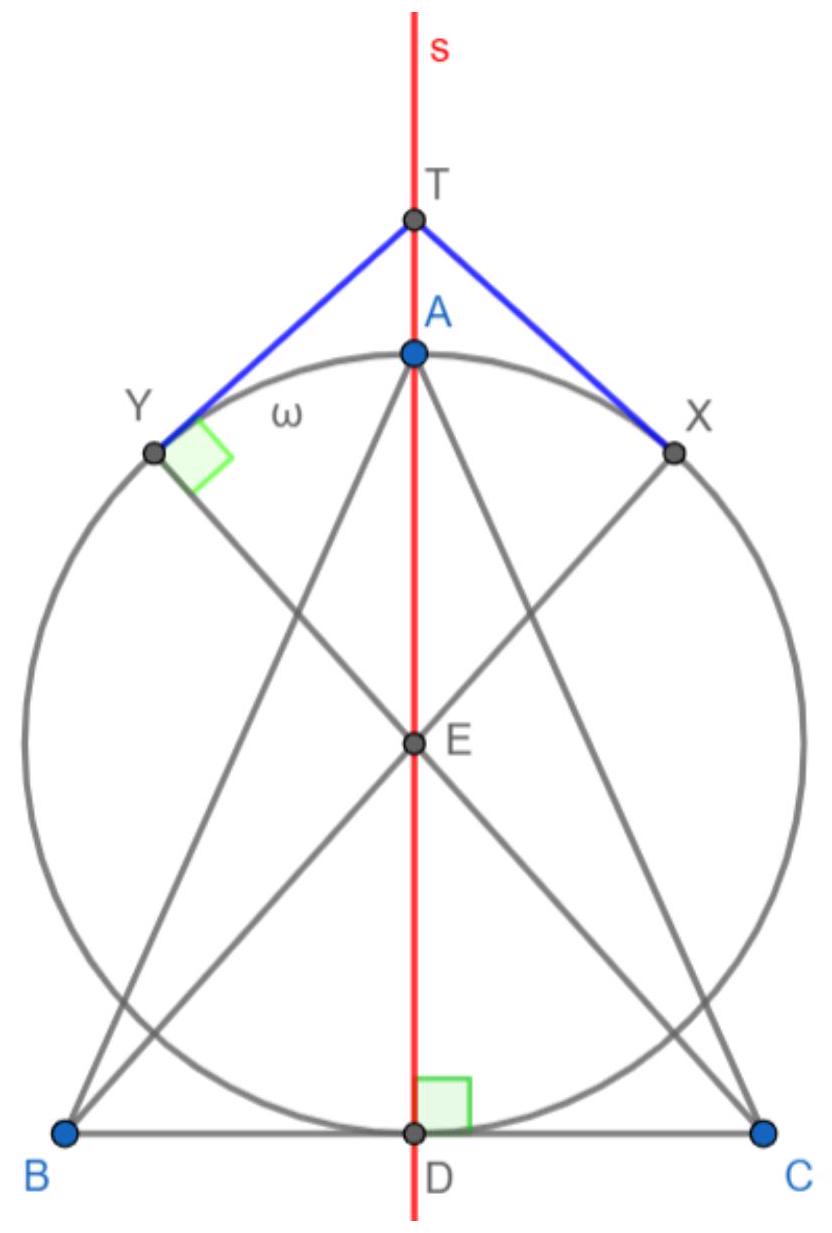
|
| 320 |
+
|
| 321 |
+
Alternative Solution. Let the circle $\odot C D Y$ intersects the line $A D$ at another point $Z$. Then we have $\angle C E D=\angle Y E Z$. We also have $E D=E Y$ because $E$ is the center of the circle $\omega$. Also note that
|
| 322 |
+
|
| 323 |
+
$$
|
| 324 |
+
\angle D C E=\angle D C Y=\angle D Z Y=\angle E Z Y
|
| 325 |
+
$$
|
| 326 |
+
|
| 327 |
+
We conclude that $\triangle C D E$ and $\triangle Z Y E$ are congruent. From here we have that $E Z=E C$. Now denote by $Z^{\prime}$ the other intersection point of $A D$ and $\odot B D X$. In the same way we prove that $E Z^{\prime}=E B$. By the assumption of the problem, we must have that $Z=Z^{\prime}$. We now conclude that
|
| 328 |
+
|
| 329 |
+
$$
|
| 330 |
+
B E=C E=E Z=E Z^{\prime}
|
| 331 |
+
$$
|
| 332 |
+
|
| 333 |
+
Also, $\angle B D E=90^{\circ}=\angle C D E$. Now we see that $\triangle B D E$ and $\triangle C D E$ are congruent (they share the side $E D)$, so $B D=C D$. But $D$ is both the midpoint of $B C$ and the foot of the altitude from $A$, which means that $A B=A C$.
|
| 334 |
+
|
| 335 |
+

|
| 336 |
+
|
| 337 |
+
Alternative Solution. Let $\alpha=\angle B X D$. Denote by $T$ the second intersection point of the circumcircles of $\triangle B D X$ and $\triangle C D Y$, which is on $A D$. We have
|
| 338 |
+
|
| 339 |
+
$$
|
| 340 |
+
E D=E A=E X
|
| 341 |
+
$$
|
| 342 |
+
|
| 343 |
+
because $E$ is the center of $\omega$. Now $E X=E D$ implies $\angle E D X=\alpha$. From here we have that $\angle B E D=2 \alpha$. Using that $B T X D$ is cyclic we obtain $\angle B T D=\angle B X D=\alpha$. We also have that
|
| 344 |
+
|
| 345 |
+
$$
|
| 346 |
+
\angle T B E=180^{\circ}-\angle B E T-\angle E T B=
|
| 347 |
+
$$
|
| 348 |
+
|
| 349 |
+
$$
|
| 350 |
+
=180^{\circ}-\left(180^{\circ}-2 \alpha\right)-\alpha=\alpha=\angle B T E
|
| 351 |
+
$$
|
| 352 |
+
|
| 353 |
+
This gives us $B E=T E$. We similarly show that $C E=T E$, and so $B E=C E$. In the same way as in the second solution, this now gives us that $B D=C D$, so $D$ is also the midpoint of $B C$ and we must have $A B=A C$.
|
| 354 |
+
|
| 355 |
+

|
| 356 |
+
|
| 357 |
+
Alternative Solution. We can solve the problem using only calculations. Note that the condition of the problem is that $E$ lies on the radical axis of the circumcircles of $\triangle B D X$ and $\triangle C D Y$. This gives us $E B \cdot E X=E C \cdot E Y$. However, $E X=E Y$ because $E$ is the center of $\omega$ and this means that $B E=C E$. Now using Pythagoras' theorem we have the following:
|
| 358 |
+
|
| 359 |
+
$$
|
| 360 |
+
A B^{2}=A D^{2}+B D^{2}=A D^{2}+\left(B E^{2}-D E^{2}\right)=A D^{2}+\left(C E^{2}-D E^{2}\right)=A D^{2}+C D^{2}=A C^{2}
|
| 361 |
+
$$
|
| 362 |
+
|
| 363 |
+
From here we obtain $A B=A C$.
|
| 364 |
+
|
| 365 |
+
G 2. Problem: Let $\triangle A B C$ be a right-angled triangle with $\angle B A C=90^{\circ}$, and let $E$ be the foot of the perpendicular from $A$ on $B C$. Let $Z \neq A$ be a point on the line $A B$ with $A B=B Z$. Let (c), $\left(c_{1}\right)$ be the circmucircles of the triangles $\triangle A E Z$ and $\triangle B E Z$, respectively. Let ( $c_{2}$ ) be an arbitrary circle passing through the points $A$ and $E$. Suppose $\left(c_{1}\right)$ meets the line $C Z$ again at the point $F$, and meets $\left(c_{2}\right)$ again at the point $N$. If $P$ is the other point of intesection of $\left(c_{2}\right)$ with $A F$, prove that the points $N, B, P$ are collinear.
|
| 366 |
+
|
| 367 |
+
Solution. Since the triangles $\triangle A E B$ and $\triangle C A B$ are similar, then
|
| 368 |
+
|
| 369 |
+
$$
|
| 370 |
+
\frac{A B}{E B}=\frac{C B}{A B}
|
| 371 |
+
$$
|
| 372 |
+
|
| 373 |
+
Since $A B=B Z$ we get
|
| 374 |
+
|
| 375 |
+
$$
|
| 376 |
+
\frac{B Z}{E B}=\frac{C B}{B Z}
|
| 377 |
+
$$
|
| 378 |
+
|
| 379 |
+
from which it follows that the triangles $\triangle Z B E$ and $\triangle C B Z$ are also similar. Since $F E B Z$ is cyclic,
|
| 380 |
+
|
| 381 |
+
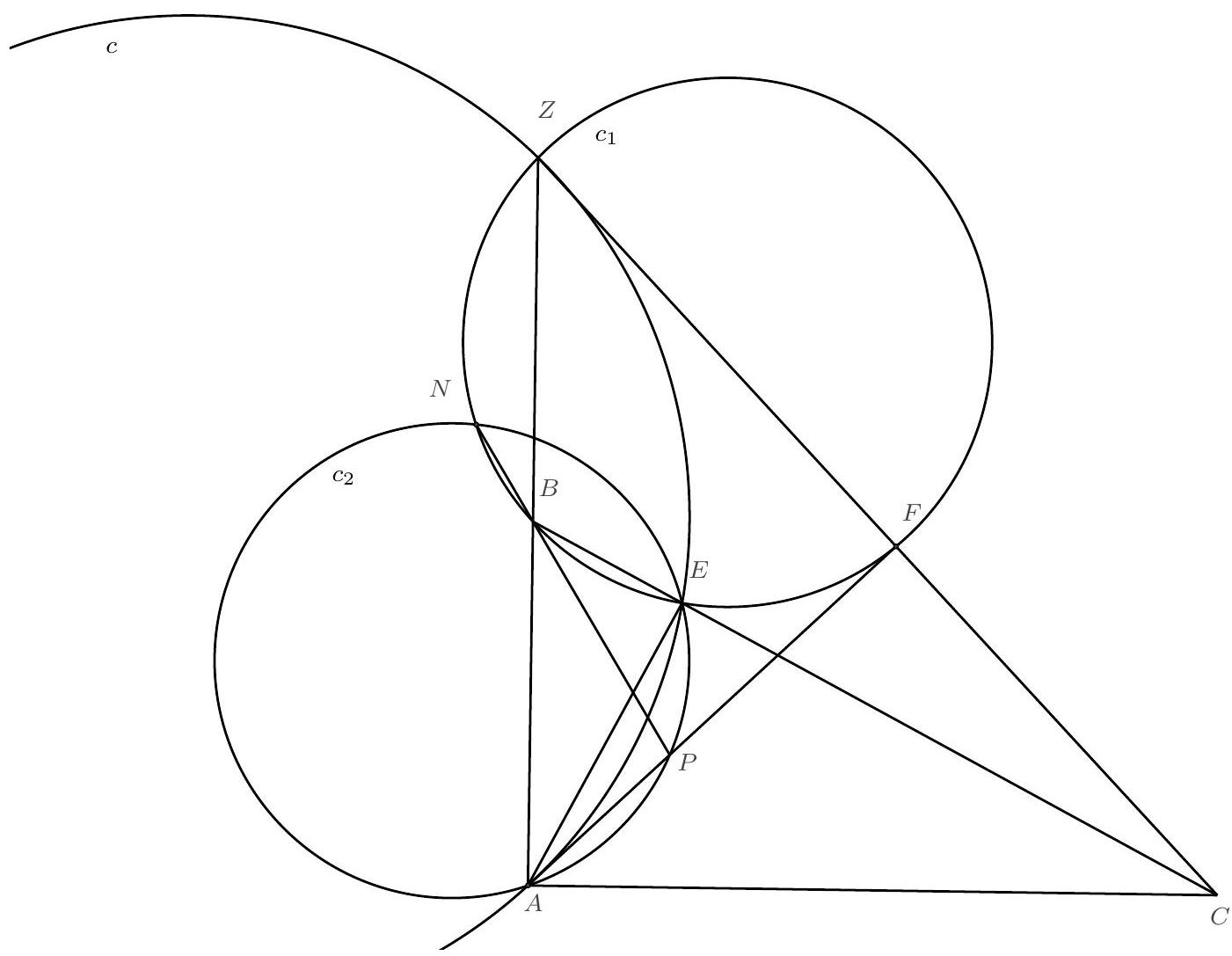
|
| 382 |
+
|
| 383 |
+
then $\angle B E Z=\angle B F Z$. So by the similarity of triangles $\triangle Z B E$ and $\triangle C B Z$ we get
|
| 384 |
+
|
| 385 |
+
$$
|
| 386 |
+
\angle B F Z=\angle B E Z=\angle B Z C=\angle B Z F
|
| 387 |
+
$$
|
| 388 |
+
|
| 389 |
+
and therefore the triangle $\triangle B F Z$ is isosceles. Since $B F=B Z=A B$, then the triangle $\triangle A F Z$ is right-angled with $\angle A F Z=90^{\circ}$.
|
| 390 |
+
|
| 391 |
+
It now follows that the points $A, E, F, C$ are concyclic. Since $A, P, E, N$ are also concyclic, then
|
| 392 |
+
|
| 393 |
+
$$
|
| 394 |
+
\angle E N P=\angle E A P=\angle E A F=\angle E C F=\angle B C Z=\angle B Z E,
|
| 395 |
+
$$
|
| 396 |
+
|
| 397 |
+
where in the last equality we used again the similarity of the triangles $\triangle Z B E$ and $\triangle C B Z$. Since $N, B, E, Z$ are concyclic, then $\angle E N P=\angle B Z E=\angle E N B$, from which it follows that the points $N, B, P$ are collinear.
|
| 398 |
+
|
| 399 |
+
G 3. Let $\triangle A B C$ be a right-angled triangle with $\angle B A C=90^{\circ}$ and let $E$ be the foot of the perpendicular from $A$ on $B C$. Let $Z \neq A$ be a point on the line $A B$ with $A B=B Z$. Let (c) be the circumcircle of the triangle $\triangle A E Z$. Let $D$ be the second point of intersection of $(c)$ with $Z C$ and let $F$ be the antidiametric point of $D$ with respect to $(c)$. Let $P$ be the point of intersection of the lines $F E$ and $C Z$. If the tangent to $(c)$ at $Z$ meets $P A$ at $T$, prove that the points $T, E, B, Z$ are concyclic.
|
| 400 |
+
|
| 401 |
+
Solution. We will first show that $P A$ is tangent to $(c)$ at $A$.
|
| 402 |
+
|
| 403 |
+
Since $E, D, Z, A$ are concyclic, then $\angle E D C=\angle E A Z=\angle E A B$. Since also the triangles $\triangle A B C$ and $\triangle E B A$ are similar, then $\angle E A B=\angle B C A$, therefore $\angle E D C=\angle B C A$.
|
| 404 |
+
|
| 405 |
+
Since $\angle F E D=90^{\circ}$, then $\angle P E D=90^{\circ}$ and so
|
| 406 |
+
|
| 407 |
+
$$
|
| 408 |
+
\angle E P D=90^{\circ}-\angle E D C=90^{\circ}-\angle B C A=\angle E A C
|
| 409 |
+
$$
|
| 410 |
+
|
| 411 |
+
Therefore the points $E, A, C, P$ are concyclic. It follows that $\angle C P A=90^{\circ}$ and therefore the triangle $\angle P A Z$ is right-angled. Since also $B$ is the midpoint of $A Z$, then $P B=A B=B Z$ and so $\angle Z P B=$ $\angle P Z B$.
|
| 412 |
+
|
| 413 |
+
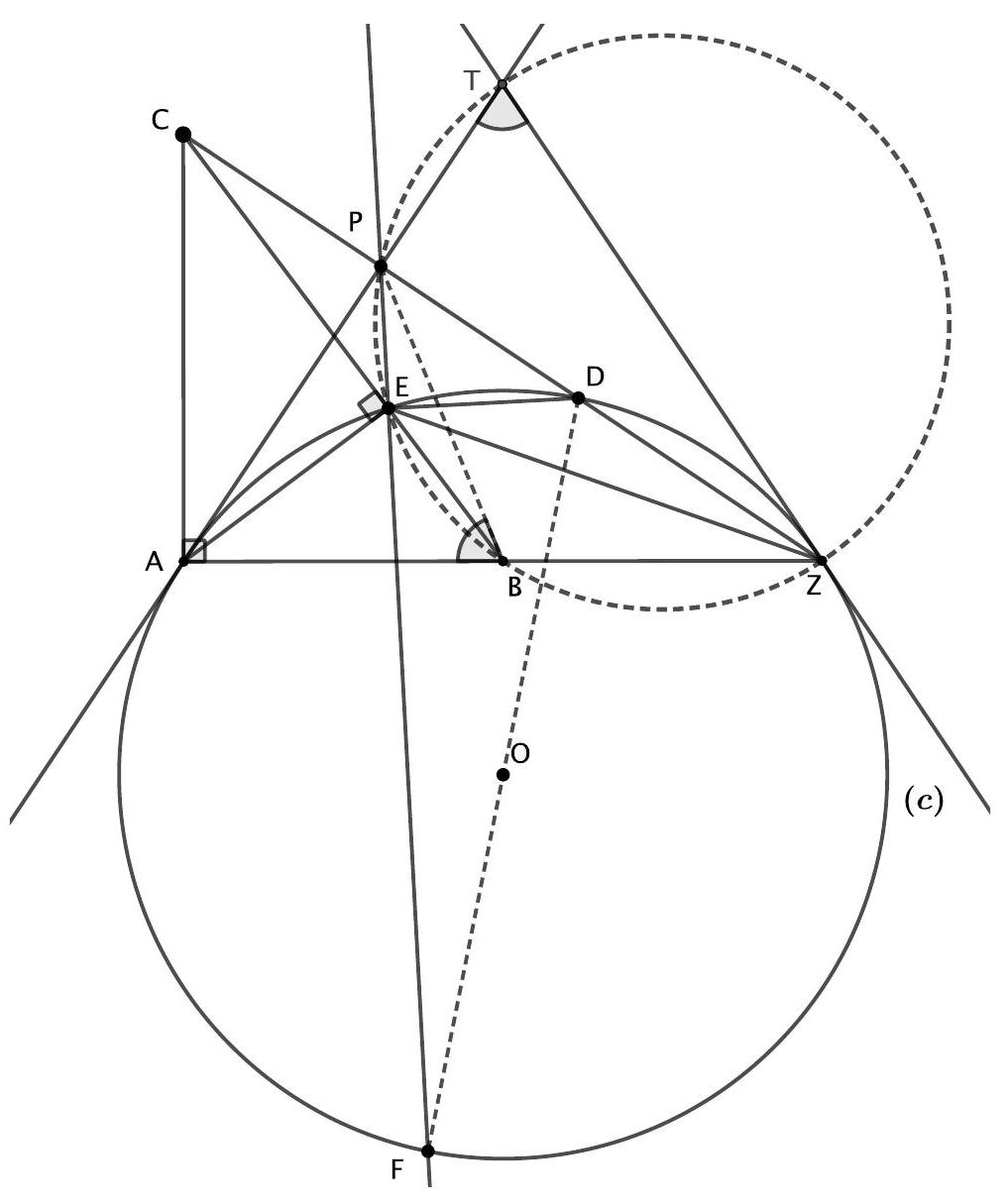
|
| 414 |
+
|
| 415 |
+
Furthermore, $\angle E P D=\angle E A C=\angle C B A=\angle E B A$ from which it follows that the points $P, E, B, Z$ are also concyclic.
|
| 416 |
+
|
| 417 |
+
Now observe that
|
| 418 |
+
|
| 419 |
+
$$
|
| 420 |
+
\angle P A E=\angle P C E=\angle Z P B-\angle P B E=\angle P Z B-\angle P Z E=\angle E Z B
|
| 421 |
+
$$
|
| 422 |
+
|
| 423 |
+
Therefore $P A$ is tangent to $(c)$ at $A$ as claimed.
|
| 424 |
+
|
| 425 |
+
It now follows that $T A=T Z$. Therefore
|
| 426 |
+
|
| 427 |
+
$$
|
| 428 |
+
\begin{aligned}
|
| 429 |
+
\angle P T Z & =180^{\circ}-2(\angle T A B)=180^{\circ}-2(\angle P A E+\angle E A B)=180^{\circ}-2(\angle E C P+\angle A C B) \\
|
| 430 |
+
& =180^{\circ}-2\left(90^{\circ}-\angle P Z B\right)=2(\angle P Z B)=\angle P Z B+\angle B P Z=\angle P B A .
|
| 431 |
+
\end{aligned}
|
| 432 |
+
$$
|
| 433 |
+
|
| 434 |
+
Thus $T, P, B, Z$ are concyclic, and since $P, E, B, Z$ are also concyclic then $T, E, B, Z$ are concyclic as required.
|
| 435 |
+
|
| 436 |
+
NT 1. Determine whether there is a natural number $n$ for which $8^{n}+47$ is prime.
|
| 437 |
+
|
| 438 |
+
Solution. The number $m=8^{n}+47$ is never prime.
|
| 439 |
+
|
| 440 |
+
If $n$ is even, say $n=2 k$, then $m=64^{k}+47 \equiv 1+2 \equiv 0 \bmod 3$. Since also $m>3$, then $m$ is not prime.
|
| 441 |
+
|
| 442 |
+
If $n \equiv 1 \bmod 4$, say $n=4 k+1$, then $m=8 \cdot\left(8^{k}\right)^{4}+47 \equiv 3+2 \equiv 0 \bmod 5$. Since also $m>3$, then $m$ is not prime.
|
| 443 |
+
|
| 444 |
+
If $n \equiv 3 \bmod 4$, say $n=4 k+3$, then $m=8\left(64^{2 k+1}+1\right) \equiv 8\left((-1)^{2 k+1}+1\right) \equiv 0 \bmod 13$. Since also $m>13$, then $m$ is not prime.
|
| 445 |
+
|
| 446 |
+
NT 2. Find all positive integers $a, b, c$ and $p$, where $p$ is a prime number, such that
|
| 447 |
+
|
| 448 |
+
$$
|
| 449 |
+
73 p^{2}+6=9 a^{2}+17 b^{2}+17 c^{2}
|
| 450 |
+
$$
|
| 451 |
+
|
| 452 |
+
Solution. Since the equation is symmetric with respect to the numbers $b$ and $c$, we assume that $b \geq c$.
|
| 453 |
+
|
| 454 |
+
If $p \geq 3$, then $p$ is an odd number. We consider the equation modulo 8 . Since,
|
| 455 |
+
|
| 456 |
+
$$
|
| 457 |
+
73 p^{2}+6 \equiv 79 \equiv 7 \quad(\bmod 8)
|
| 458 |
+
$$
|
| 459 |
+
|
| 460 |
+
we get that
|
| 461 |
+
|
| 462 |
+
$$
|
| 463 |
+
a^{2}+b^{2}+c^{2} \equiv 7 \quad(\bmod 8)
|
| 464 |
+
$$
|
| 465 |
+
|
| 466 |
+
This cannot happen since for any integer $x$ we have that
|
| 467 |
+
|
| 468 |
+
$$
|
| 469 |
+
x^{2} \equiv 0,1,4 \quad(\bmod 8)
|
| 470 |
+
$$
|
| 471 |
+
|
| 472 |
+
Hence, $p$ must be an even prime number, which means that $p=2$. In this case, we obtain the equation
|
| 473 |
+
|
| 474 |
+
$$
|
| 475 |
+
9 a^{2}+17\left(b^{2}+c^{2}\right)=289
|
| 476 |
+
$$
|
| 477 |
+
|
| 478 |
+
It follows that $b^{2}+c^{2} \leq 17$. This is possible only for
|
| 479 |
+
|
| 480 |
+
$$
|
| 481 |
+
(b, c) \in\{(4,1),(3,2),(3,1),(2,2),(2,1),(1,1)\}
|
| 482 |
+
$$
|
| 483 |
+
|
| 484 |
+
It is easy to check that among these pairs only the $(4,1)$ gives an integer solution for $a$, namely $a=1$. Therefore, the given equation has only two solutions,
|
| 485 |
+
|
| 486 |
+
$$
|
| 487 |
+
(a, b, c, p) \in\{(1,1,4,2),(1,4,1,2)\}
|
| 488 |
+
$$
|
| 489 |
+
|
| 490 |
+
NT 3. Find the largest integer $k(k \geq 2)$, for which there exists an integer $n(n \geq k)$ such that from any collection of $n$ consecutive positive integers one can always choose $k$ numbers, which verify the following conditions:
|
| 491 |
+
|
| 492 |
+
1. each chosen number is not divisible by 6 , by 7 and by 8 ;
|
| 493 |
+
2. the positive difference of any two different chosen numbers is not divisible by at least one of the numbers 6,7 or 8 .
|
| 494 |
+
|
| 495 |
+
Solution. An integer is divisible by 6,7 and 8 if and only if it is divisible by their Least Common Multiple, which equals $6 \times 7 \times 4=168$.
|
| 496 |
+
|
| 497 |
+
Let $n$ be a positive integer and let $A$ be an arbitrary set of $n$ consecutive positive integers. Replace each number $a_{i}$ from $A$ with its remainder $r_{i}$ ( mod 168). The number $a_{i}$ is divisible by 6 ( 7 or 8 ) if and only if its remainder $r_{i}$ is divisible by 6 (respectively 7 or 8 ). The difference $\left|a_{i}-a_{j}\right|$ is divisible by 168 if and only if their remainders $r_{i}=r_{j}$.
|
| 498 |
+
|
| 499 |
+
Choosing $k$ numbers from the initial set $A$, which verify the required conditions, is the same as choosing $k$ their remainders ( mod 168) such that:
|
| 500 |
+
|
| 501 |
+
1. each chosen remainder is not divisible by 6,7 and 8 ;
|
| 502 |
+
2. all chosen remainders are different.
|
| 503 |
+
|
| 504 |
+
Suppose we have chosen $k$ numbers from $A$, which verify the conditions. Therefore, all remainders are different and $k \leq 168$ (otherwise, there would be two equal remainders).
|
| 505 |
+
|
| 506 |
+
Denote by $B=\{0,1,2,3, \ldots, 167\}$ the set of all possible remainders ( $\bmod 168)$ and by $B_{m}$ the subset of all elements of $B$, which are divisible by $m$. Compute the number of elements of the following subsets:
|
| 507 |
+
|
| 508 |
+
$$
|
| 509 |
+
\begin{gathered}
|
| 510 |
+
\left|B_{6}\right|=168: 6=28, \quad\left|B_{7}\right|=168: 7=24, \quad\left|B_{8}\right|=168: 8=21 \\
|
| 511 |
+
\left|B_{6} \cap B_{7}\right|=\left|B_{42}\right|=168: 42=4, \quad\left|B_{6} \cap B_{8}\right|=\left|B_{24}\right|=168: 24=7 \\
|
| 512 |
+
\left|B_{7} \cap B_{8}\right|=\left|B_{56}\right|=168: 56=3, \quad\left|B_{6} \cap B_{7} \cap B_{8}\right|=\left|B_{168}\right|=1
|
| 513 |
+
\end{gathered}
|
| 514 |
+
$$
|
| 515 |
+
|
| 516 |
+
Denote by $D=B_{6} \cup B_{7} \cup B_{8}$, the subset of all elements of $B$, which are divisible by at least one of the numbers 6,7 or 8 . By the Inclusion-Exclusion principle we got
|
| 517 |
+
|
| 518 |
+
$$
|
| 519 |
+
\begin{gathered}
|
| 520 |
+
|D|=\left|B_{6}\right|+\left|B_{7}\right|+\left|B_{8}\right|-\left(\left|B_{6} \cap B_{7}\right|+\left|B_{6} \cap B_{8}\right|+\left|B_{7} \cap B_{8}\right|\right)+\left|B_{6} \cap B_{7} \cap B_{8}\right|= \\
|
| 521 |
+
28+24+21-(4+7+3)+1=60 .
|
| 522 |
+
\end{gathered}
|
| 523 |
+
$$
|
| 524 |
+
|
| 525 |
+
Each chosen remainder belongs to the subset $B \backslash D$, since it is not divisible by 6,7 and 8 . Hence, $k \leq|B \backslash D|=168-60=108$.
|
| 526 |
+
|
| 527 |
+
Let us show that the greatest possible value is $k=108$. Consider $n=168$. Given any collection $A$ of 168 consecutive positive integers, replace each number with its remainder ( $\bmod 168$ ). Choose from these remainders 108 numbers, which constitute the set $B \backslash D$. Finally, take 108 numbers from the initial set $A$, having exactly these remainders. These $k=108$ numbers verify the required conditions.
|
| 528 |
+
|
| 529 |
+
NT 4. Find all prime numbers $p$ such that
|
| 530 |
+
|
| 531 |
+
$$
|
| 532 |
+
(x+y)^{19}-x^{19}-y^{19}
|
| 533 |
+
$$
|
| 534 |
+
|
| 535 |
+
is a multiple of $p$ for any positive integers $x, y$.
|
| 536 |
+
|
| 537 |
+
Solution. If $x=y=1$ then $p$ divides
|
| 538 |
+
|
| 539 |
+
$$
|
| 540 |
+
2^{19}-2=2\left(2^{18}-1\right)=2\left(2^{9}-1\right)\left(2^{9}+1\right)=2 \cdot 511 \cdot 513=2 \cdot 3^{3} \cdot 7 \cdot 19 \cdot 73
|
| 541 |
+
$$
|
| 542 |
+
|
| 543 |
+
If $x=2, y=1$ then
|
| 544 |
+
|
| 545 |
+
$$
|
| 546 |
+
p \mid 3^{19}-2^{19}-1
|
| 547 |
+
$$
|
| 548 |
+
|
| 549 |
+
We will show that $3^{19}-2^{19}-1$ is not a multiple of 73 . Indeed,
|
| 550 |
+
|
| 551 |
+
$$
|
| 552 |
+
3^{19} \equiv 3^{3} \cdot\left(3^{4}\right)^{4} \equiv 3^{3} \cdot 8^{4} \equiv 3^{3} \cdot(-9)^{2} \equiv 27 \cdot 81 \equiv 27 \cdot 8 \equiv 70 \quad(\bmod 73)
|
| 553 |
+
$$
|
| 554 |
+
|
| 555 |
+
and
|
| 556 |
+
|
| 557 |
+
$$
|
| 558 |
+
2^{19} \equiv 2 \cdot 64^{3} \equiv 2 \cdot(-9)^{3} \equiv-18 \cdot 81 \equiv-18 \cdot 8 \equiv-144 \equiv 2 \quad(\bmod 73)
|
| 559 |
+
$$
|
| 560 |
+
|
| 561 |
+
Thus $p$ can be only among $2,3,7,19$. We will prove all these work.
|
| 562 |
+
|
| 563 |
+
- For $p=19$ this follows by Fermat's Theorem as
|
| 564 |
+
|
| 565 |
+
$$
|
| 566 |
+
(x+y)^{19} \equiv x+y \quad(\bmod 19), \quad x^{19} \equiv x \quad(\bmod 19), \quad y^{19} \equiv y \quad(\bmod 19)
|
| 567 |
+
$$
|
| 568 |
+
|
| 569 |
+
- For $p=7$, we have that
|
| 570 |
+
|
| 571 |
+
$$
|
| 572 |
+
a^{19} \equiv a \quad(\bmod 7)
|
| 573 |
+
$$
|
| 574 |
+
|
| 575 |
+
for every integer $a$. Indeed, if $7 \mid a$, it is trivial, while if $7 \nmid a$, then by Fermat's Theorem we have
|
| 576 |
+
|
| 577 |
+
$$
|
| 578 |
+
7\left|a^{6}-1\right| a^{18}-1
|
| 579 |
+
$$
|
| 580 |
+
|
| 581 |
+
therefore
|
| 582 |
+
|
| 583 |
+
$$
|
| 584 |
+
7 \mid a\left(a^{18}-1\right)
|
| 585 |
+
$$
|
| 586 |
+
|
| 587 |
+
- For $p=3$, we will prove that
|
| 588 |
+
|
| 589 |
+
$$
|
| 590 |
+
b^{19} \equiv b \quad(\bmod 3)
|
| 591 |
+
$$
|
| 592 |
+
|
| 593 |
+
Indeed, if $3 \mid b$, it is trivial, while if $3 \nmid b$, then by Fermat's Theorem we have
|
| 594 |
+
|
| 595 |
+
$$
|
| 596 |
+
3\left|b^{2}-1\right| b^{18}-1
|
| 597 |
+
$$
|
| 598 |
+
|
| 599 |
+
therefore
|
| 600 |
+
|
| 601 |
+
$$
|
| 602 |
+
3 \mid b\left(b^{18}-1\right)
|
| 603 |
+
$$
|
| 604 |
+
|
| 605 |
+
- For $p=2$ it is true, since among $x+y, x$ and $y$ there are 0 or 2 odd numbers.
|
| 606 |
+
|
| 607 |
+
NT 5. The positive integer $k$ and the set $A$ of different integers from 1 to $3 k$ inclusive are such that there are no distinct $a, b, c$ in $A$ satisfying $2 b=a+c$. The numbers from $A$ in the interval $[1, k]$ will be called small; those in $[k+1,2 k]$ - medium and those in $[2 k+1,3 k]$ - large. Is it always true that there are no positive integers $x$ and $d$ such that if $x, x+d$ and $x+2 d$ are divided by $3 k$ then the remainders belong to $A$ and those of $x$ and $x+d$ are different and are:
|
| 608 |
+
a) small?
|
| 609 |
+
b) medium?
|
| 610 |
+
c) large?
|
| 611 |
+
|
| 612 |
+
(In this problem we assume that if a multiple of $3 k$ is divided by $3 k$ then the remainder is $3 k$ rather than 0. )
|
| 613 |
+
|
| 614 |
+
## Solution.
|
| 615 |
+
|
| 616 |
+
Solution. A counterexample for a) is $k=3, A=\{1,2,9\}, x=2$ and $d=8$. A counterexample for c) is $k=3, A=\{1,8,9\}, x=8$ and $d=1$.
|
| 617 |
+
|
| 618 |
+
We will prove that b) is true.
|
| 619 |
+
|
| 620 |
+
Suppose the contrary and let $x, d$ have the above properties. We can assume $0<d<3 k, 0<x \leq 3 k$ (since for $d=3 k$ the remainders for $x$ and $x+d$ are equal). Hence $0<x+d<6 k$ and there are two cases:
|
| 621 |
+
|
| 622 |
+
- If $x+d>3 k$, then since the remainder for $x+d$ is medium we have $4 k<x+d \leq 5 k$. This means that the remainder of $x+d$ when it is divided by $3 k$ is
|
| 623 |
+
|
| 624 |
+
$$
|
| 625 |
+
x+d-3 k
|
| 626 |
+
$$
|
| 627 |
+
|
| 628 |
+
Since $x$ is medium we have $x \leq 2 k$ so $d=(x+d)-x>2 k$. Therefore $6 k=4 k+2 k<(x+d)+d<$ $8 k$. This means that the remainder of $x+2 d$ when it is divided by $3 k$ is
|
| 629 |
+
|
| 630 |
+
$$
|
| 631 |
+
x+2 d-6 k \text {. }
|
| 632 |
+
$$
|
| 633 |
+
|
| 634 |
+
Thus the remainders $(x+2 d-6 k),(x+d-3 k)$ and $x$ are in $[1,3 k]$, they belong to $A$ and
|
| 635 |
+
|
| 636 |
+
$$
|
| 637 |
+
2(x+d-3 k)=(x+2 d-6 k)+x
|
| 638 |
+
$$
|
| 639 |
+
|
| 640 |
+
a contradiction.
|
| 641 |
+
|
| 642 |
+
- If $x+d \leq 3 k$ then as $x+d$ is medium we have $k<x+d \leq 2 k$. From the limitations on $x$, we have $x>k$ so $d=(x+d)-x<k$. Hence $0 \leq x+2 d=(x+d)+d<3 k$. Thus the remainders $x, x+d$ and $x+2 d$ are in $A$ and
|
| 643 |
+
|
| 644 |
+
$$
|
| 645 |
+
2(x+d)=(x+2 d)+x
|
| 646 |
+
$$
|
| 647 |
+
|
| 648 |
+
a contradiction.
|
| 649 |
+
|
| 650 |
+
NT 6. Are there any positive integers $m$ and $n$ satisfying the equation
|
| 651 |
+
|
| 652 |
+
$$
|
| 653 |
+
m^{3}=9 n^{4}+170 n^{2}+289 ?
|
| 654 |
+
$$
|
| 655 |
+
|
| 656 |
+
Solution. We will prove that the answer is no. Note that
|
| 657 |
+
|
| 658 |
+
$$
|
| 659 |
+
m^{3}=9 n^{4}+170 n^{2}+289=\left(9 n^{2}+17\right)\left(n^{2}+17\right)
|
| 660 |
+
$$
|
| 661 |
+
|
| 662 |
+
If $n$ is odd then $m$ is even, therefore $8 \mid m^{3}$. However,
|
| 663 |
+
|
| 664 |
+
$$
|
| 665 |
+
9 n^{4}+170 n^{2}+289 \equiv 9+170+289 \equiv 4(\bmod 8)
|
| 666 |
+
$$
|
| 667 |
+
|
| 668 |
+
which leads to a contradiction. If $n$ is a multiple of 17 then so is $m$ and hence 289 is a multiple of $17^{3}$, which is absurd. For $n$ even and not multiple of 17 , since
|
| 669 |
+
|
| 670 |
+
$$
|
| 671 |
+
\operatorname{gcd}\left(9 n^{2}+17, n^{2}+17\right) \mid 9\left(n^{2}+17\right)-\left(9 n^{2}+17\right)=2^{3} \cdot 17
|
| 672 |
+
$$
|
| 673 |
+
|
| 674 |
+
this gcd must be 1 . Therefore $n^{2}+17=a^{3}$ for an odd $a$, so
|
| 675 |
+
|
| 676 |
+
$$
|
| 677 |
+
n^{2}+25=(a+2)\left(a^{2}-2 a+4\right)
|
| 678 |
+
$$
|
| 679 |
+
|
| 680 |
+
For $a \equiv 1(\bmod 4)$ we have $a+2 \equiv 3(\bmod 4)$, while for $a \equiv 3(\bmod 4)$ we have $a^{2}-2 a+4 \equiv 3$ $(\bmod 4)$. Thus $(a+2)\left(a^{2}-2 a+4\right)$ has a prime divisor of type $4 \ell+3$. As it divides $n^{2}+25$, it has to divide $n$ and 5 , which is absurd.
|
| 681 |
+
|
| 682 |
+
NT 7. Prove that there doesn't exist any prime $p$ such that every power of $p$ is a palindrome (palindrome is a number that is read the same from the left as it is from the right; in particular, number that ends in one or more zeros cannot be a palindrome).
|
| 683 |
+
|
| 684 |
+
Solution. Note that by criterion for divisibility by 11 and the definition of a palindrome we have that every palindrome that has even number of digits is divisible by 11 .
|
| 685 |
+
|
| 686 |
+
Since $11^{5}=161051$ is not a palindrome and since 11 cannot divide $p^{k}$ for any prime other than 11 we are now left to prove that no prime whose all powers have odd number of digits exists.
|
| 687 |
+
|
| 688 |
+
Assume the contrary. It means that the difference between the numbers of digits of $p^{m}$ and $p^{m+1}$ is even number. We will prove that for every natural $m$, the difference is the same even number.
|
| 689 |
+
|
| 690 |
+
If we assume not, that means that the difference for some $m_{1}$ has at least 2 digits more than the difference for some $m_{2}$. We will prove that this is impossible.
|
| 691 |
+
|
| 692 |
+
Let $p^{m_{1}}=10^{t_{1}} \cdot a_{1}, p^{m_{2}}=10^{t_{2}} \cdot a_{2}$ and $p=10^{h} \cdot z$, where
|
| 693 |
+
|
| 694 |
+
$$
|
| 695 |
+
1<a_{1}, a_{2}, z<10
|
| 696 |
+
$$
|
| 697 |
+
|
| 698 |
+
This implies that
|
| 699 |
+
|
| 700 |
+
$$
|
| 701 |
+
1<a_{1} \cdot z, a_{2} \cdot z<100
|
| 702 |
+
$$
|
| 703 |
+
|
| 704 |
+
which further implies that multiplying these powers of $p$ by $p$ can increase their number of digits by either $h$ or $h+1$.
|
| 705 |
+
|
| 706 |
+
This is a contradiction. Call the difference between numbers of digits of consecutive powers $d$. Number $p$ clearly cannot be equal to $10^{d}$ for $d \geq 1$ because 10 is divisible by two primes, but for $d=0$, we would have that 1 is a prime which is not true.
|
| 707 |
+
|
| 708 |
+
Case 1. $p>10^{d}$. Let $p=10^{d} \cdot a$, for some real number $a$ greater than 1. (1)
|
| 709 |
+
|
| 710 |
+
From the definition of $d$ we also see that $a$ is smaller than 10. (2)
|
| 711 |
+
|
| 712 |
+
From (1) we see that powering $a$ gives us arbitrarily large numbers and from (2) we conclude that there is some natural power of $a$, call it $b$, greater than 1 , such that
|
| 713 |
+
|
| 714 |
+
$$
|
| 715 |
+
10<a^{b}<100
|
| 716 |
+
$$
|
| 717 |
+
|
| 718 |
+
It is clear that $p^{b}$ has exactly $(b-1) d+1$ digits more than $p$ has, which is an odd number, but sum of even numbers is even.
|
| 719 |
+
|
| 720 |
+
Case 2. $p<10^{d}$. Let $p=\frac{10^{d}}{a}$, for some real number $a$ greater than 1. (1) From the definition of $d$ we also see that $a$ is smaller than 10. (2)
|
| 721 |
+
|
| 722 |
+
From (1) we see that powering $a$ gives us arbitrarily large numbers and from (2) we conclude that there is some natural power of $a$, call it $b$, greater than 1 , such that
|
| 723 |
+
|
| 724 |
+
$$
|
| 725 |
+
10<a^{b}<100
|
| 726 |
+
$$
|
| 727 |
+
|
| 728 |
+
It is clear that $p^{b}$ has exactly $(b-1) d-1$ digits more than $p$ has, which is an odd number, but sum of even numbers is even.
|
| 729 |
+
|
| 730 |
+
We have now arrived at the desired contradiction for both cases and have thus finished the proof.
|
| 731 |
+
|
| 732 |
+
Alternative solution. Note that the sequence $\left\{p^{n}\right\}$ is periodic $(\bmod 10)$. Let the period be $d$. Also, let $p^{d}=g$.
|
| 733 |
+
|
| 734 |
+
Since all powers of $p$ are palindromes, all powers of $g$ are as well. Since $\left\{g^{n}\right\}$ is constant (mod 10), the leftmost digit of each power of $g$ is equal to some $f$.
|
| 735 |
+
|
| 736 |
+
We will prove that the difference between numbers of digits of $g^{m}$ and $g^{m+1}$ is equal to some $r$ for every natural number $m$.
|
| 737 |
+
|
| 738 |
+
This is true due to size reasons. Namely, to add exactly $k$ digits, and yet to have the same leftmost digit, we need to multiply the number by at least $5 \cdot 10^{k-1}$ (if $k=0$ then it's 1 ) and by at most $2 \cdot 10^{k}$ (values depend on the leftmost digit, it can easily be seen that leftmost digit being 1 yields the extremal values). Notice that
|
| 739 |
+
|
| 740 |
+
$$
|
| 741 |
+
2 \cdot 10^{k}<5 \cdot 10^{k+1-1}
|
| 742 |
+
$$
|
| 743 |
+
|
| 744 |
+
Since this inequality has clearly shown that the interval of multipliers which add exactly $k$ digits and leave the leftmost digit the same is disjunct from the same kind of interval for $k+1$ digits, which implies that no number can belong to both intervals, we have successfully proven the claim.
|
| 745 |
+
|
| 746 |
+
Clearly, $g$ cannot be equal to $10^{r}$ for $r \geq 1$ because a palindrome cannot be divisible by 10 , but for $r=0$ we again cannot have the equality because 1 is not a natural power of a prime.
|
| 747 |
+
|
| 748 |
+
Case 1. $g>10^{r}$. Let $g=10^{r} \cdot a$, where $a$ is a real number, $10>a>1$. (1) Here, $a$ is less than 10 because if it was not, multiplying by $g$ would add at least $r+1$ digits, which is impossible.
|
| 749 |
+
|
| 750 |
+
From (1) we see that powering $a$ gives us arbitrarily large numbers and that there is some natural power of $a$, call it $b$, greater than 1 , such that
|
| 751 |
+
|
| 752 |
+
$$
|
| 753 |
+
10<a^{b}<100
|
| 754 |
+
$$
|
| 755 |
+
|
| 756 |
+
Pick smallest such $b$.
|
| 757 |
+
|
| 758 |
+
Now we easily see that the difference between numbers of digits of numbers $g^{b-1}$ and $g^{b}$ is exactly $r+1$.
|
| 759 |
+
|
| 760 |
+
Case 2. $g<10^{r}$. Let $g=\frac{10^{r}}{a}$, where $a$ is a real number, $10>a>1$. (2) Here, $a$ is less than 10 because if it was not, multiplying by $g$ would add at most $r-1$ digits, which is impossible.
|
| 761 |
+
|
| 762 |
+
From (2) we see that powering $a$ gives us arbitrarily large numbers and that there is some natural power of $a$, call it $b$, greater than 1 , such that
|
| 763 |
+
|
| 764 |
+
$$
|
| 765 |
+
10<a^{b}<100
|
| 766 |
+
$$
|
| 767 |
+
|
| 768 |
+
Pick smallest such $b$.
|
| 769 |
+
|
| 770 |
+
Now we easily see that the difference between numbers of digits of numbers $g^{b-1}$ and $g^{b}$ is exactly $r-1$.
|
| 771 |
+
|
| 772 |
+
We have arrived at the desired contradiction for both cases and have thus finished the proof.
|
| 773 |
+
|
| 774 |
+
Comment. In both solutions, after introducing $a$, there are multiple ways to finish the problem. In particular, solution 1 and solution 2 could be finished in the same way, but distinct finishes were purposely offered. Third, maybe even the most intuitive finishing argument, could be using non-exact size arguments; namely, just the fact that powers of $a$ grow arbitrarily large is enough to reach the contradiction.
|
| 775 |
+
|
| 776 |
+
Alternative problem. Find all positive integers $n$ such that every power of $n$ is a palindrome (palindrome is a number that is read the same from the left as it is from the right; in particular, number that ends in one or more zeros cannot be a palindrome).
|
| 777 |
+
|
| 778 |
+
Suggested difficulty for this problem is hard. Noting why solution 2 doesn't work for $n=1$ (because
|
| 779 |
+
$g$ now could be equal to 1 ) and saying that $n=1$ actually works are all necessary modifications to solution 2 to make it work for the alternative problem as well.
|
| 780 |
+
|
| 781 |
+
NT 8. Find all pairs $(p, q)$ of prime numbers such that
|
| 782 |
+
|
| 783 |
+
$$
|
| 784 |
+
1+\frac{p^{q}-q^{p}}{p+q}
|
| 785 |
+
$$
|
| 786 |
+
|
| 787 |
+
is a prime number.
|
| 788 |
+
|
| 789 |
+
Solution. It is clear that $p \neq q$. We set
|
| 790 |
+
|
| 791 |
+
$$
|
| 792 |
+
1+\frac{p^{q}-q^{p}}{p+q}=r
|
| 793 |
+
$$
|
| 794 |
+
|
| 795 |
+
and we have that
|
| 796 |
+
|
| 797 |
+
$$
|
| 798 |
+
p^{q}-q^{p}=(r-1)(p+q)
|
| 799 |
+
$$
|
| 800 |
+
|
| 801 |
+
From Fermat's Little Theorem we have
|
| 802 |
+
|
| 803 |
+
$$
|
| 804 |
+
p^{q}-q^{p} \equiv-q \quad(\bmod p)
|
| 805 |
+
$$
|
| 806 |
+
|
| 807 |
+
Since we also have that
|
| 808 |
+
|
| 809 |
+
$$
|
| 810 |
+
(r-1)(p+q) \equiv-r q-q \quad(\bmod p)
|
| 811 |
+
$$
|
| 812 |
+
|
| 813 |
+
from (1) we get that
|
| 814 |
+
|
| 815 |
+
$$
|
| 816 |
+
r q \equiv 0 \quad(\bmod p) \Rightarrow p \mid q r
|
| 817 |
+
$$
|
| 818 |
+
|
| 819 |
+
hence $p \mid r$, which means that $p=r$. Therefore, (1) takes the form
|
| 820 |
+
|
| 821 |
+
$$
|
| 822 |
+
p^{q}-q^{p}=(p-1)(p+q)
|
| 823 |
+
$$
|
| 824 |
+
|
| 825 |
+
We will prove that $p=2$. Indeed, if $p$ is odd, then from Fermat's Little Theorem we have
|
| 826 |
+
|
| 827 |
+
$$
|
| 828 |
+
p^{q}-q^{p} \equiv p \quad(\bmod q)
|
| 829 |
+
$$
|
| 830 |
+
|
| 831 |
+
and since
|
| 832 |
+
|
| 833 |
+
$$
|
| 834 |
+
(p-1)(p+q) \equiv p(p-1) \quad(\bmod q)
|
| 835 |
+
$$
|
| 836 |
+
|
| 837 |
+
we have
|
| 838 |
+
|
| 839 |
+
$$
|
| 840 |
+
p(p-2) \equiv 0 \quad(\bmod q) \Rightarrow q|p(p-2) \Rightarrow q| p-2 \Rightarrow q \leq p-2<p
|
| 841 |
+
$$
|
| 842 |
+
|
| 843 |
+
Now, from (2) we have
|
| 844 |
+
|
| 845 |
+
$$
|
| 846 |
+
p^{q}-q^{p} \equiv 0 \quad(\bmod p-1) \Rightarrow 1-q^{p} \equiv 0 \quad(\bmod p-1) \Rightarrow q^{p} \equiv 1 \quad(\bmod p-1)
|
| 847 |
+
$$
|
| 848 |
+
|
| 849 |
+
Clearly $\operatorname{gcd}(q, p-1)=1$ and if we set $k=\operatorname{ord}_{p-1}(q)$, it is well-known that $k \mid p$ and $k<p$, therefore $k=1$. It follows that
|
| 850 |
+
|
| 851 |
+
$$
|
| 852 |
+
q \equiv 1 \quad(\bmod p-1) \Rightarrow p-1 \mid q-1 \Rightarrow p-1 \leq q-1 \Rightarrow p \leq q
|
| 853 |
+
$$
|
| 854 |
+
|
| 855 |
+
a contradiction.
|
| 856 |
+
|
| 857 |
+
Therefore, $p=2$ and (2) transforms to
|
| 858 |
+
|
| 859 |
+
$$
|
| 860 |
+
2^{q}=q^{2}+q+2
|
| 861 |
+
$$
|
| 862 |
+
|
| 863 |
+
We can easily check by induction that for every positive integer $n \geq 6$ we have $2^{n}>n^{2}+n+2$. This means that $q \leq 5$ and the only solution is for $q=5$. Hence the only pair which satisfy the condition is $(p, q)=(2,5)$.
|
| 864 |
+
|
| 865 |
+
Comment by the PSC. From the problem condition, we get that $p^{q}$ should be bigger than $q^{p}$, which gives
|
| 866 |
+
|
| 867 |
+
$$
|
| 868 |
+
q \ln p>p \ln q \Longleftrightarrow \frac{\ln p}{p}>\frac{\ln q}{q}
|
| 869 |
+
$$
|
| 870 |
+
|
| 871 |
+
The function $\frac{\ln x}{x}$ is decreasing for $x>e$, thus if $p$ and $q$ are odd primes, we obtain $q>p$.
|
| 872 |
+
|
JBMO/md/en-shortlist/en-nt20111.md
ADDED
|
@@ -0,0 +1,77 @@
|
|
|
|
|
|
|
|
|
|
|
|
|
|
|
|
|
|
|
|
|
|
|
|
|
|
|
|
|
|
|
|
|
|
|
|
|
|
|
|
|
|
|
|
|
|
|
|
|
|
|
|
|
|
|
|
|
|
|
|
|
|
|
|
|
|
|
|
|
|
|
|
|
|
|
|
|
|
|
|
|
|
|
|
|
|
|
|
|
|
|
|
|
|
|
|
|
|
|
|
|
|
|
|
|
|
|
|
|
|
|
|
|
|
|
|
|
|
|
|
|
|
|
|
|
|
|
|
|
|
|
|
|
|
|
|
|
|
|
|
|
|
|
|
|
|
|
|
|
|
|
|
|
|
|
|
|
|
|
|
|
|
|
|
|
|
|
|
|
|
|
|
|
|
|
|
|
|
|
|
|
|
|
|
|
|
|
|
|
|
|
|
|
|
|
|
|
|
|
|
|
|
|
|
|
|
|
|
|
|
|
|
|
|
|
|
|
|
|
|
|
|
|
|
|
|
|
|
|
|
|
|
|
|
|
| 1 |
+
# 0.1 Number Theory
|
| 2 |
+
|
| 3 |
+
NT1 Solve in positive integers the equation $1005^{x}+2011^{y}=1006^{z}$.
|
| 4 |
+
|
| 5 |
+
## Solution
|
| 6 |
+
|
| 7 |
+
We have $1006^{z}>2011^{y}>2011$, hence $z \geq 2$. Then $1005^{x}+2011^{y} \equiv 0(\bmod 4)$.
|
| 8 |
+
|
| 9 |
+
But $1005^{x} \equiv 1(\bmod 4)$, so $2011^{y} \equiv-1(\bmod 4) \Rightarrow y$ is odd, i.e. $2011^{y} \equiv-1(\bmod 1006)$.
|
| 10 |
+
|
| 11 |
+
Since $1005^{x}+2011^{y} \equiv 0(\bmod 1006)$, we get $1005^{x} \equiv 1(\bmod 1006) \Rightarrow x$ is even.
|
| 12 |
+
|
| 13 |
+
Now $1005^{x} \equiv 1(\bmod 8)$ and $2011^{y} \equiv 3(\bmod 8)$, hence $1006^{z} \equiv 4(\bmod 8) \Rightarrow z=2$.
|
| 14 |
+
|
| 15 |
+
It follows that $y<2 \Rightarrow y=1$ and $x=2$. The solution is $(x, y, z)=(2,1,2)$.
|
| 16 |
+
|
| 17 |
+
NT2 Find all prime numbers $p$ such that there exist positive integers $x, y$ that satisfy the relation $x\left(y^{2}-p\right)+y\left(x^{2}-p\right)=5 p$.
|
| 18 |
+
|
| 19 |
+
## Solution
|
| 20 |
+
|
| 21 |
+
The given equation is equivalent to $(x+y)(x y-p)=5 p$. Obviously $x+y \geq 2$.
|
| 22 |
+
|
| 23 |
+
We will consider the following three cases:
|
| 24 |
+
|
| 25 |
+
Case 1: $x+y=5$ and $x y=2 p$. The equation $x^{2}-5 x+2 p=0$ has at least a solution, so we must have $0 \leq \Delta=25-8 p$ which implies $p \in\{2,3\}$. For $p=2$ we obtain the solutions $(1,4)$ and $(4,1)$ and for $p=3$ we obtain the solutions $(2,3)$ and $(3,2)$.
|
| 26 |
+
|
| 27 |
+
Case 2: $x+y=p$ and $x y=p+5$. We have $x y-x-y=5$ or $(x-1)(y-1)=6$ which implies $(x, y) \in\{(2,7) ;(3,4) ;(4,3) ;(7,2)\}$. Since $p$ is prime, we get $p=7$.
|
| 28 |
+
|
| 29 |
+
Case 3: $x+y=5 p$ and $x y=p+1$. We have $(x-1)(y-1)=x y-x-y+1=2-4 p<0$. But this is impossible since $x, y \geq 1$.
|
| 30 |
+
|
| 31 |
+
Finally, the equation has solutions in positive integers only for $p \in\{2,3,7\}$.
|
| 32 |
+
|
| 33 |
+
NT3 Find all positive integers $n$ such that the equation $y^{2}+x y+3 x=n\left(x^{2}+x y+3 y\right)$ has at least a solution $(x, y)$ in positive integers.
|
| 34 |
+
|
| 35 |
+
## Solution
|
| 36 |
+
|
| 37 |
+
Clearly for $n=1$, each pair $(x, y)$ with $x=y$ is a solution. Now, suppose that $n>1$ which implies $x \neq y$. We have $0<n-1=\frac{y^{2}+x y+3 x}{x^{2}+x y+3 y}-1=\frac{(x+y-3)(y-x)}{x^{2}+x y+3 y}$.
|
| 38 |
+
|
| 39 |
+
Since $x+y \geq 3$, we conclude that $x+y>3$ and $y>x$. Take $d=\operatorname{gcd}(x+y-$ $\left.3 ; x^{2}+x y+3 y\right)$. Then $d$ divides $x^{2}+x y+3 y-x(x+y-3)=3(x+y)$. Then $d$ also divides $3(x+y)-3(x+y-3)=9$, hence $d \in\{1,3,9\}$. As $n-1=\frac{\frac{x+y-3}{d}(y-x)}{\frac{x^{2}+x y+3 y}{d}}$ and $\operatorname{gcd}\left(\frac{x+y-3}{d} ; \frac{x^{2}+x y+3 y}{d}\right)=1$, it follows that $\frac{x^{2}+x y+3 y}{d}$ divides $y-x$, which leads to $x^{2}+x y+3 y \leq d y-d x \Leftrightarrow x^{2}+d x \leq(d-3-x) y$. It is necessary that
|
| 40 |
+
$d-3-x>0 \Rightarrow d>3$, therefore $d=9$ and $x<6$. Take $x+y-3=9 k, k \in \mathbb{N}^{*}$ since $d \mid x+y-3$ and we get $y=9 k+3-x$. Hence $n-1=\frac{k(9 k+3-2 x)}{k(x+3)+1}$. Because $k$ and $k(x+3)+1$ are relatively prime, the number $t=\frac{9 k+3-2 x}{k(x+3)+1}$ must be integer for some positive integers $x<6$. It remains to consider these values of $x$ :
|
| 41 |
+
|
| 42 |
+
1) For $x=1$, then $t=\frac{9 k+1}{4 k+1}$ and since $1<t<3$, we get $t=2, k=1, y=11$, so $n=3$.
|
| 43 |
+
2) For $x=2$, then $t=\frac{9 k-1}{5 k+1}$ and since $1<t<2$, there are no solutions in this case.
|
| 44 |
+
3) For $x=3$, then $t=\frac{9 k-3}{6 k+1}$ and since $1 \neq t<2$, there are no solutions in this case.
|
| 45 |
+
4) For $x=4$, then $t=\frac{9 k-5}{7 k+1}<2$,i.e. $t=1$ which leads to $k=3, y=26$, so $n=4$.
|
| 46 |
+
5) For $x=5$, then $t=\frac{9 k-7}{8 k+1}<2$,i.e. $t=1$ which leads to $k=8, y=70$, so $n=9$.
|
| 47 |
+
|
| 48 |
+
Finally, the answer is $n \in\{1,3,4,9\}$.
|
| 49 |
+
|
| 50 |
+
NT4 Find all prime positive integers $p, q$ such that $2 p^{3}-q^{2}=2(p+q)^{2}$.
|
| 51 |
+
|
| 52 |
+
## Solution 1
|
| 53 |
+
|
| 54 |
+
The given equation can be rewritten as $2 p^{2}(p-1)=q(3 q+4 p)$.
|
| 55 |
+
|
| 56 |
+
Hence $p\left|3 q^{2}+4 p q \Rightarrow p\right| 3 q^{2} \Rightarrow p \mid 3 q$ (since $p$ is a prime number) $\Rightarrow p \mid 3$ or $p \mid q$. If $p \mid q$, then $p=q$. The equation becomes $2 p^{3}-9 p^{2}=0$ which has no prime solution. If $p \mid 3$, then $p=3$. The equation becomes $q^{2}+4 q-12=0 \Leftrightarrow(q-2)(q+6)=0$.
|
| 57 |
+
|
| 58 |
+
Since $q>0$, we get $q=2$, so we have the solution $(p, q)=(3,2)$.
|
| 59 |
+
|
| 60 |
+
## Solution 2
|
| 61 |
+
|
| 62 |
+
Since $2 p^{3}$ and $2\left(p+q^{2}\right)$ are even, $q^{2}$ is also even, thus $q=2$ because it is a prime number.
|
| 63 |
+
|
| 64 |
+
The equation becomes $p^{3}-p^{2}-4 p-6=0 \Leftrightarrow\left(p^{2}-4\right)(p-1)=10$.
|
| 65 |
+
|
| 66 |
+
If $p \geq 4$, then $\left(p^{2}-4\right)(p-1) \geq 12 \cdot 3>10$, so $p \leq 3$. A direct verification gives $p=3$.
|
| 67 |
+
|
| 68 |
+
Finally, the unique solution is $(p, q)=(3,2)$.
|
| 69 |
+
|
| 70 |
+
NT5 Find the least positive integer such that the sum of its digits is 2011 and the product of its digits is a power of 6 .
|
| 71 |
+
|
| 72 |
+
## Solution
|
| 73 |
+
|
| 74 |
+
Denote this number by $N$. Then $N$ can not contain the digits $0,5,7$ and its digits must be written in increasing order. Suppose that $N$ has $x_{1}$ ones, $x_{2}$ twos, $x_{3}$ threes, $x_{4}$ fours, $x_{6}$ sixes, $x_{8}$ eights and $x_{9}$ nines, then $x_{1}+2 x_{2}+3 x_{3}+4 x_{4}+6 x_{6}+8 x_{8}+9 x_{9}=2011$. (1) The product of digits of the number $N$ is a power of 6 when we have the relation $x_{2}+2 x_{4}+x_{6}+3 x_{8}=x_{3}+x_{6}+2 x_{9}$, hence $x_{2}-x_{3}+2 x_{4}+3 x_{8}-2 x_{9}=0$.
|
| 75 |
+
|
| 76 |
+
Denote by $S$ the number of digits of $N\left(S=x_{1}+x_{2}+\ldots+x_{9}\right)$. In order to make the coefficients of $x_{8}$ and $x_{9}$ equal, we multiply relation (1) by 5 , then we add relation (2). We get $43 x_{9}+43 x_{8}+30 x_{6}+22 x_{4}+14 x_{3}+11 x_{2}+5 x_{1}=10055 \Leftrightarrow 43 S=10055+13 x_{6}+$ $21 x_{4}+29 x_{3}+32 x_{2}+38 x_{1}$. Then $10055+13 x_{6}+21 x_{4}+29 x_{3}+32 x_{2}+38 x_{1}$ is a multiple of 43 not less than 10055. The least such number is 10062 , but the relation $10062=$ $10055+13 x_{6}+21 x_{4}+29 x_{3}+32 x_{2}+38 x_{1}$ means that among $x_{1}, x_{2}, \ldots, x_{6}$ there is at least one positive, so $10062=10055+13 x_{6}+21 x_{4}+29 x_{3}+32 x_{2}+38 x_{1} \geq 10055+13=10068$ which is obviously false. The next multiple of 43 is 10105 and from relation $10105=$ $10055+13 x_{6}+21 x_{4}+29 x_{3}+32 x_{2}+38 x_{1}$ we get $50=13 x_{6}+21 x_{4}+29 x_{3}+32 x_{2}+38 x_{1}$. By writing as $13 x_{6}+21\left(x_{4}-1\right)+29\left(x_{3}-1\right)+32 x_{2}+38 x_{1}=0$, we can easily see that the only possibility is $x_{1}=x_{2}=x_{6}=0$ and $x_{3}=x_{4}=1$. Then $S=235, x_{8}=93, x_{9}=140$. Since $S$ is strictly minimal, we conclude that $N=34 \underbrace{88 \ldots 8}_{93} \underbrace{99 \ldots 9}_{140}$.
|
| 77 |
+
|
JBMO/md/en-shortlist/en-shl-2012.md
ADDED
|
@@ -0,0 +1,819 @@
|
|
|
|
|
|
|
|
|
|
|
|
|
|
|
|
|
|
|
|
|
|
|
|
|
|
|
|
|
|
|
|
|
|
|
|
|
|
|
|
|
|
|
|
|
|
|
|
|
|
|
|
|
|
|
|
|
|
|
|
|
|
|
|
|
|
|
|
|
|
|
|
|
|
|
|
|
|
|
|
|
|
|
|
|
|
|
|
|
|
|
|
|
|
|
|
|
|
|
|
|
|
|
|
|
|
|
|
|
|
|
|
|
|
|
|
|
|
|
|
|
|
|
|
|
|
|
|
|
|
|
|
|
|
|
|
|
|
|
|
|
|
|
|
|
|
|
|
|
|
|
|
|
|
|
|
|
|
|
|
|
|
|
|
|
|
|
|
|
|
|
|
|
|
|
|
|
|
|
|
|
|
|
|
|
|
|
|
|
|
|
|
|
|
|
|
|
|
|
|
|
|
|
|
|
|
|
|
|
|
|
|
|
|
|
|
|
|
|
|
|
|
|
|
|
|
|
|
|
|
|
|
|
|
|
|
|
|
|
|
|
|
|
|
|
|
|
|
|
|
|
|
|
|
|
|
|
|
|
|
|
|
|
|
|
|
|
|
|
|
|
|
|
|
|
|
|
|
|
|
|
|
|
|
|
|
|
|
|
|
|
|
|
|
|
|
|
|
|
|
|
|
|
|
|
|
|
|
|
|
|
|
|
|
|
|
|
|
|
|
|
|
|
|
|
|
|
|
|
|
|
|
|
|
|
|
|
|
|
|
|
|
|
|
|
|
|
|
|
|
|
|
|
|
|
|
|
|
|
|
|
|
|
|
|
|
|
|
|
|
|
|
|
|
|
|
|
|
|
|
|
|
|
|
|
|
|
|
|
|
|
|
|
|
|
|
|
|
|
|
|
|
|
|
|
|
|
|
|
|
|
|
|
|
|
|
|
|
|
|
|
|
|
|
|
|
|
|
|
|
|
|
|
|
|
|
|
|
|
|
|
|
|
|
|
|
|
|
|
|
|
|
|
|
|
|
|
|
|
|
|
|
|
|
|
|
|
|
|
|
|
|
|
|
|
|
|
|
|
|
|
|
|
|
|
|
|
|
|
|
|
|
|
|
|
|
|
|
|
|
|
|
|
|
|
|
|
|
|
|
|
|
|
|
|
|
|
|
|
|
|
|
|
|
|
|
|
|
|
|
|
|
|
|
|
|
|
|
|
|
|
|
|
|
|
|
|
|
|
|
|
|
|
|
|
|
|
|
|
|
|
|
|
|
|
|
|
|
|
|
|
|
|
|
|
|
|
|
|
|
|
|
|
|
|
|
|
|
|
|
|
|
|
|
|
|
|
|
|
|
|
|
|
|
|
|
|
|
|
|
|
|
|
|
|
|
|
|
|
|
|
|
|
|
|
|
|
|
|
|
|
|
|
|
|
|
|
|
|
|
|
|
|
|
|
|
|
|
|
|
|
|
|
|
|
|
|
|
|
|
|
|
|
|
|
|
|
|
|
|
|
|
|
|
|
|
|
|
|
|
|
|
|
|
|
|
|
|
|
|
|
|
|
|
|
|
|
|
|
|
|
|
|
|
|
|
|
|
|
|
|
|
|
|
|
|
|
|
|
|
|
|
|
|
|
|
|
|
|
|
|
|
|
|
|
|
|
|
|
|
|
|
|
|
|
|
|
|
|
|
|
|
|
|
|
|
|
|
|
|
|
|
|
|
|
|
|
|
|
|
|
|
|
|
|
|
|
|
|
|
|
|
|
|
|
|
|
|
|
|
|
|
|
|
|
|
|
|
|
|
|
|
|
|
|
|
|
|
|
|
|
|
|
|
|
|
|
|
|
|
|
|
|
|
|
|
|
|
|
|
|
|
|
|
|
|
|
|
|
|
|
|
|
|
|
|
|
|
|
|
|
|
|
|
|
|
|
|
|
|
|
|
|
|
|
|
|
|
|
|
|
|
|
|
|
|
|
|
|
|
|
|
|
|
|
|
|
|
|
|
|
|
|
|
|
|
|
|
|
|
|
|
|
|
|
|
|
|
|
|
|
|
|
|
|
|
|
|
|
|
|
|
|
|
|
|
|
|
|
|
|
|
|
|
|
|
|
|
|
|
|
|
|
|
|
|
|
|
|
|
|
|
|
|
|
|
|
|
|
|
|
|
|
|
|
|
|
|
|
|
|
|
|
|
|
|
|
|
|
|
|
|
|
|
|
|
|
|
|
|
|
|
|
|
|
|
|
|
|
|
|
|
|
|
|
|
|
|
|
|
|
|
|
|
|
|
|
|
|
|
|
|
|
|
|
|
|
|
|
|
|
|
|
|
|
|
|
|
|
|
|
|
|
|
|
|
|
|
|
|
|
|
|
|
|
|
|
|
|
|
|
|
|
|
|
|
|
|
|
|
|
|
|
|
|
|
|
|
|
|
|
|
|
|
|
|
|
|
|
|
|
|
|
|
|
|
|
|
|
|
|
|
|
|
|
|
|
|
|
|
|
|
|
|
|
|
|
|
|
|
|
|
|
|
|
|
|
|
|
|
|
|
|
|
|
|
|
|
|
|
|
|
|
|
|
|
|
|
|
|
|
|
|
|
|
|
|
|
|
|
|
|
|
|
|
|
|
|
|
|
|
|
|
|
|
|
|
|
|
|
|
|
|
|
|
|
|
|
|
|
|
|
|
|
|
|
|
|
|
|
|
|
|
|
|
|
|
|
|
|
|
|
|
|
|
|
|
|
|
|
|
|
|
|
|
|
|
|
|
|
|
|
|
|
|
|
|
|
|
|
|
|
|
|
|
|
|
|
|
|
|
|
|
|
|
|
|
|
|
|
|
|
|
|
|
|
|
|
|
|
|
|
|
|
|
|
|
|
|
|
|
|
|
|
|
|
|
|
|
|
|
|
|
|
|
|
|
|
|
|
|
|
|
|
|
|
|
|
|
|
|
|
|
|
|
|
|
|
|
|
|
|
|
|
|
|
|
|
|
|
|
|
|
|
|
|
|
|
|
|
|
|
|
|
|
|
|
|
|
|
|
|
|
|
|
|
|
|
|
|
|
|
|
|
|
|
|
|
|
|
|
|
|
|
|
|
|
|
|
|
|
|
|
|
|
|
|
|
|
|
|
|
|
|
|
|
|
|
|
|
|
|
|
|
|
|
|
|
|
|
|
|
|
|
|
|
|
|
|
|
|
|
|
|
|
|
|
|
|
|
|
|
|
|
|
|
|
|
|
|
|
|
|
|
|
|
|
|
|
|
|
|
|
|
|
|
|
|
|
|
|
|
|
|
|
|
|
|
|
|
|
|
|
|
|
|
|
|
|
|
|
|
|
|
|
|
|
|
|
|
|
|
|
|
|
|
|
|
|
|
|
|
|
|
|
|
|
|
|
|
|
|
|
|
|
|
|
|
|
|
|
|
|
|
|
|
|
|
|
|
|
|
|
|
|
|
|
|
|
|
|
|
|
|
|
|
|
|
|
|
|
|
|
|
|
|
|
|
|
|
|
|
|
|
|
|
|
|
|
|
|
|
|
|
|
|
|
|
|
|
|
|
|
|
|
|
|
|
|
|
|
|
|
|
|
|
|
|
|
|
|
|
|
|
|
|
|
|
|
|
|
|
|
|
|
|
|
|
|
|
|
|
|
|
|
|
|
|
|
|
|
|
|
|
|
|
|
|
|
|
|
|
|
|
|
|
|
|
|
|
|
|
|
|
|
|
|
|
|
|
|
|
|
|
|
|
|
|
|
|
|
|
|
|
|
|
|
|
|
|
|
|
|
|
|
|
|
|
|
|
|
|
|
|
|
|
|
|
|
|
|
|
|
|
|
|
|
|
|
|
|
|
|
|
|
|
|
|
|
|
|
|
|
|
|
|
|
|
|
|
|
|
|
|
|
|
|
|
|
|
|
|
|
|
|
|
|
|
|
|
|
|
|
|
|
|
|
|
|
|
|
|
|
|
|
|
|
|
|
|
|
|
|
|
|
|
|
|
|
|
|
|
|
|
|
|
|
|
|
|
|
|
|
|
|
|
|
|
|
|
|
|
|
|
|
|
|
|
|
|
|
|
|
|
|
|
|
|
|
|
|
|
|
|
|
|
|
|
|
|
|
|
|
|
|
|
|
|
|
|
|
|
|
|
|
|
|
|
|
|
|
|
|
|
|
|
|
|
|
|
|
|
|
|
|
|
|
|
|
|
|
|
|
|
|
|
|
|
|
|
|
|
|
|
|
|
|
|
|
|
|
|
|
|
|
|
|
|
|
|
|
|
|
|
|
|
|
|
|
|
|
|
|
|
|
|
|
|
|
|
|
|
|
|
|
|
|
|
|
|
|
|
|
|
|
|
|
|
|
|
|
|
|
|
|
|
|
|
|
|
|
|
|
|
|
|
|
|
|
|
|
|
|
|
|
|
|
|
|
|
|
|
|
|
|
|
|
|
|
|
|
|
|
|
|
|
|
|
|
|
|
|
|
|
|
|
|
|
|
|
|
|
|
|
|
|
|
|
|
|
|
|
|
|
|
|
|
|
|
|
|
|
|
|
|
|
|
|
|
|
|
|
|
|
|
|
|
|
|
|
|
|
|
|
|
|
|
|
|
|
|
|
|
|
|
|
|
|
|
|
|
|
|
|
|
|
|
|
|
|
|
|
|
|
|
|
|
|
|
|
|
|
|
|
|
|
|
|
|
|
|
|
|
|
|
|
|
|
|
|
|
|
|
|
|
|
|
|
|
|
|
|
|
|
|
|
|
|
|
|
|
|
|
|
|
|
|
|
|
|
|
|
|
|
|
|
|
|
|
|
|
|
|
|
|
|
|
|
|
|
|
|
|
|
|
|
|
|
|
|
|
|
|
|
|
|
|
|
|
|
|
|
|
|
|
|
|
|
|
|
|
|
|
|
|
|
|
|
|
|
|
|
|
|
|
|
|
|
|
|
|
|
|
|
|
|
|
|
|
|
|
|
|
|
|
|
|
|
|
|
|
|
|
|
|
|
|
|
|
|
|
|
|
|
|
|
|
|
|
|
|
|
|
|
|
|
|
|
|
|
|
|
|
|
|
|
|
|
|
|
|
|
|
|
|
|
|
|
|
|
|
|
|
|
|
|
|
|
|
|
|
|
|
|
|
|
|
|
|
|
|
|
|
|
|
|
|
|
|
|
|
|
|
|
|
|
|
|
|
|
|
|
|
|
|
|
|
|
|
|
|
|
|
|
|
|
|
|
|
|
|
|
|
|
|
|
|
|
|
|
|
|
|
|
|
|
|
|
|
|
|
|
|
|
|
|
|
|
|
|
|
|
|
|
|
|
|
|
|
|
|
|
|
|
|
|
|
|
|
|
|
|
|
|
|
|
|
|
|
|
|
|
|
|
|
|
|
|
|
|
|
|
|
|
|
|
|
|
|
|
|
|
|
|
|
|
|
|
|
|
|
|
|
|
|
|
|
|
|
|
|
|
|
|
|
|
|
|
|
|
|
|
|
|
|
|
|
|
|
|
|
|
|
|
|
|
|
|
|
|
|
| 1 |
+
# Algebra
|
| 2 |
+
|
| 3 |
+
1
|
| 4 |
+
|
| 5 |
+
A1. Let $a, b$ and bo positive reat numbers such that $a+b+c=1$. Prove the inequality
|
| 6 |
+
|
| 7 |
+
## When does equality hold
|
| 8 |
+
|
| 9 |
+
$\frac{a}{b}+\frac{b}{a}+\frac{b}{c}+\frac{c}{b}+\frac{c}{a}+\frac{a}{c}+6 \geq 2 \sqrt{2}\left(\sqrt{\frac{1-a}{a}}+\sqrt{\frac{1-b}{b}}+\sqrt{\frac{1-c}{c}}\right)$Solution. Replacing $1-a, 1-b, 1-c$ with $b+c, a+c, a+b$ respectively on the right
|
| 10 |
+
|
| 11 |
+
$$
|
| 12 |
+
\frac{a+c}{b}+\frac{b+c}{a}+\frac{a+b}{c}+6 \geq 2 \sqrt{2}\left(\sqrt{\frac{b+c}{a}}+\sqrt{\frac{a+c}{b}}+\sqrt{\frac{a+b}{c}}\right)
|
| 13 |
+
$$
|
| 14 |
+
|
| 15 |
+
and equivalently
|
| 16 |
+
|
| 17 |
+
$$
|
| 18 |
+
\begin{aligned}
|
| 19 |
+
\left(\frac{a+c}{b}-2 \sqrt{2} \sqrt{\frac{a+c}{b}}+2\right) & +\left(\frac{b+c}{a}-2 \sqrt{2} \sqrt{\frac{b+c}{a}}+2\right) \\
|
| 20 |
+
& +\left(\frac{a+b}{c}-2 \sqrt{2} \sqrt{\frac{a+b}{c}}+2\right) \geq 0
|
| 21 |
+
\end{aligned}
|
| 22 |
+
$$
|
| 23 |
+
|
| 24 |
+
which can be written as
|
| 25 |
+
|
| 26 |
+
$$
|
| 27 |
+
\left(\sqrt{\frac{a+c}{b}}-\sqrt{2}\right)^{2}+\left(\sqrt{\frac{b+c}{a}}-\sqrt{2}\right)^{2}+\left(\sqrt{\frac{a+b}{c}}-\sqrt{2}\right)^{2} \geq 0
|
| 28 |
+
$$
|
| 29 |
+
|
| 30 |
+
which is true. The equality holds if and only if $(a+c) / b=(b+c) / a=(a+b) / c=2$, which together with the given condition $a+b+c=1$ immediately give $a=b=c=1 / 3$.
|
| 31 |
+
|
| 32 |
+
A2. Let $a, b, c$ be positive real numbers such that abc $=1$. Show that
|
| 33 |
+
|
| 34 |
+
$$
|
| 35 |
+
\frac{1}{a^{3}+b c}+\frac{1}{b^{3}+c a}+\frac{1}{c^{3}+a b} \leq \frac{(a b+b c+c a)^{2}}{6}
|
| 36 |
+
$$
|
| 37 |
+
|
| 38 |
+
so
|
| 39 |
+
|
| 40 |
+
Solution. By the AM-GM inequality we have $a^{3}+b c \geq 2 \sqrt{a^{3} b c}=2 \sqrt{a^{2}(a b c)}=2 a$ and
|
| 41 |
+
|
| 42 |
+
$$
|
| 43 |
+
\frac{1}{a^{3}+b c} \leq \frac{1}{2 a}
|
| 44 |
+
$$
|
| 45 |
+
|
| 46 |
+
Similarly; $\frac{1}{b^{3}+c a} \leq \frac{1}{2 b} \cdot \frac{1}{c^{3}+a b} \leq \frac{1}{2 c}$ and then
|
| 47 |
+
|
| 48 |
+
$$
|
| 49 |
+
\frac{1}{a^{3}+b c}+\frac{1}{b^{3}+c a}+\frac{1}{c^{3}+a b} \leq \frac{1}{2 a}+\frac{1}{2 b}+\frac{1}{2 c}=\frac{1}{2} \frac{a b+b c+c a}{a b c} \leq \frac{(a b+b c+c a)^{2}}{6}
|
| 50 |
+
$$
|
| 51 |
+
|
| 52 |
+
Therefore it is enongil to prove $\frac{(a h+b c+c a)^{2}}{6} \leq \frac{(a b+b c+c a)^{2}}{6}$. This mequalits is trivially shomn to be equivalent to $3 \leq a b+b c+c a$ which is true because of the AM-GM inequalit: $3=\sqrt[3]{(a b c)^{2}} \leq a b+b c+c a$.
|
| 53 |
+
|
| 54 |
+
A3. Let $a . b$ c ce positue real numbers such that $a+b+c=a^{2}+b^{2}+c^{2}$. Shou that
|
| 55 |
+
|
| 56 |
+
$$
|
| 57 |
+
\frac{a^{2}}{a^{2}+a b}+\frac{b^{2}}{b^{2}+b c}+\frac{c^{2}}{c^{2}+c a} \geq \frac{a+b+c}{2}
|
| 58 |
+
$$
|
| 59 |
+
|
| 60 |
+
Solution. By the Cauchy-Schwarz inequality it is
|
| 61 |
+
|
| 62 |
+
$$
|
| 63 |
+
\begin{aligned}
|
| 64 |
+
& \left(\frac{a^{2}}{a^{2}+a b}+\frac{b^{2}}{b^{2}+b c}+\frac{c^{2}}{c^{2}+c a}\right)\left(\left(a^{2}+a b\right)+\left(b^{2}+b c\right)+\left(c^{2}+c a\right)\right) \geq(a+b+c)^{2} \\
|
| 65 |
+
\Rightarrow & \frac{a^{2}}{a^{2}+a b}+\frac{b^{2}}{b^{2}+b c}+\frac{c^{2}}{c^{2}+c a} \geq \frac{(a+b+c)^{2}}{a^{2}+b^{2}+c^{2}+a b+b c+c a}
|
| 66 |
+
\end{aligned}
|
| 67 |
+
$$
|
| 68 |
+
|
| 69 |
+
So in is enough to prove $\frac{(a+b+c)^{2}}{a^{2}+b^{2}+c^{2}+a b+b c+c a} \geq \frac{a+b+c}{2}$, that is to prove
|
| 70 |
+
|
| 71 |
+
$$
|
| 72 |
+
2(a+b+c) \geq a^{2}+b^{2}+c^{2}+a b+b c+c a
|
| 73 |
+
$$
|
| 74 |
+
|
| 75 |
+
Substituting $a^{2}+b^{2}+c^{2}$ for $a+b+c$ into the left hand side we wish equivalently to prove
|
| 76 |
+
|
| 77 |
+
$$
|
| 78 |
+
a^{2}+b^{2}+c^{2} \geq a b+b c+c a
|
| 79 |
+
$$
|
| 80 |
+
|
| 81 |
+
But the $a^{2}+b^{2} \geq 2 a b, b^{2}+c^{2} \geq 2 b c, c^{2}+a^{2} \geq 2 c a$ which by addition imply the desired inequality.
|
| 82 |
+
|
| 83 |
+
A4. Solve the following equation for $x, y, z \in \mathbb{N}$
|
| 84 |
+
|
| 85 |
+
$$
|
| 86 |
+
\left(1+\frac{x}{y+z}\right)^{2}+\left(1+\frac{y}{z+x}\right)^{2}+\left(1+\frac{z}{x+y}\right)^{2}=\frac{27}{4}
|
| 87 |
+
$$
|
| 88 |
+
|
| 89 |
+
Solution 1. Call $a=1+\frac{x}{y+z}, b=1+\frac{y}{z+x}, c=1+\frac{z}{x+y}$ to get
|
| 90 |
+
|
| 91 |
+
$$
|
| 92 |
+
a^{2}+b^{2}+c^{2}=\frac{27}{4}
|
| 93 |
+
$$
|
| 94 |
+
|
| 95 |
+
Since it is also true that
|
| 96 |
+
|
| 97 |
+
$$
|
| 98 |
+
\frac{1}{a}+\frac{1}{b}+\frac{1}{c}=2
|
| 99 |
+
$$
|
| 100 |
+
|
| 101 |
+
the quadratic-harmonic means inequality implies
|
| 102 |
+
|
| 103 |
+
$$
|
| 104 |
+
\frac{3}{2}=\sqrt{\frac{a^{2}+b^{2}+c^{2}}{3}} \geq \frac{3}{\frac{1}{a}+\frac{1}{b}+\frac{1}{c}}=\frac{3}{2}
|
| 105 |
+
$$
|
| 106 |
+
|
| 107 |
+
So the inequality in the middle holds as an equality, and this happens whenever $a=b=c$, from which $1+\frac{x}{y+z}=1+\frac{y}{z+x}=1+\frac{z}{x+y}$.
|
| 108 |
+
|
| 109 |
+
But $1+\frac{x}{y+z}=1+\frac{y}{z+x} \Leftrightarrow x^{2}+x z=y^{2}+y z \Leftrightarrow(x-y)(x+y)=z(y-\dot{x})$ and the two sides of this equality will be of different sign, unless $x=y$ in which case both sides become 0 . So $x=y$, and similarly $y=z$, thus $x=y=z$.
|
| 110 |
+
|
| 111 |
+
Indeed, any triad of equal natural numbers $x=y=z$ is a solution for the given equation, and so these are all its solutions.
|
| 112 |
+
|
| 113 |
+
Solution 2. The given equation is equivalent to
|
| 114 |
+
|
| 115 |
+
$$
|
| 116 |
+
\frac{27}{4}=(x+y+z)^{2}\left(\frac{1}{(y+z)^{2}}+\frac{1}{(z+x)^{2}}+\frac{1}{(x+y)^{2}}\right)
|
| 117 |
+
$$
|
| 118 |
+
|
| 119 |
+
Now observe that by the well known inequality $a^{2}+b^{2}+c^{2} \geq a b+b c+c a$, with $\frac{1}{y+z}, \frac{1}{z+x}$, $\frac{1}{x+y}$ in place of $a, b, c$; we get:
|
| 120 |
+
|
| 121 |
+
$$
|
| 122 |
+
\begin{aligned}
|
| 123 |
+
\frac{27}{4} & =(x+y+z)^{2}\left(\frac{1}{(y+z)^{2}}+\frac{1}{(z+x)^{2}}+\frac{1}{(x+y)^{2}}\right) \\
|
| 124 |
+
& \geq(x+y+z)^{2}\left(\frac{1}{(y+z)(z+x)}+\frac{1}{(z+x)(x+y)}+\frac{1}{(x+y)(y+z)}\right)=\frac{2(x+y+z)^{3}}{(x+y)(y+z)(z+x)} \\
|
| 125 |
+
& =\frac{(2(x+y+z))^{3}}{4(x+y)(y+z)(z+x)}=\frac{((x+y)+(y+z)+(z+x)))^{3}}{4(x+y)(y+z)(z+x)} \stackrel{\text { AM-GM }}{\geq \frac{(3 \sqrt[3]{(x+y)(y+z)(z+x)})^{3}}{4(x+y)(y+z)(z+x)} .} \\
|
| 126 |
+
& =\frac{27}{4}
|
| 127 |
+
\end{aligned}
|
| 128 |
+
$$
|
| 129 |
+
|
| 130 |
+
This means all inequalities in the above calculations are equalities, and this holds exactly whenever $x+y=y+z=z+x$, that is $x=y=z$. By the statement's demand we need to have $a, b, c$ integers. And conversely, any triad of equal natural numbers $x=y=z$ is indeed a solution for the given equation, and so these are all its solutions.
|
| 131 |
+
|
| 132 |
+
A5. Find the largest positive integer $n$ for which the inequality
|
| 133 |
+
|
| 134 |
+
$$
|
| 135 |
+
\frac{a+b+c}{a b c+1}+\sqrt[n]{a b c} \leq \frac{5}{2}
|
| 136 |
+
$$
|
| 137 |
+
|
| 138 |
+
holds for all $a, b, c \in[0,1]$. Here $\sqrt[1]{a b c}=a b c$.
|
| 139 |
+
|
| 140 |
+
Solution. Let $n_{\max }$ be the sought largest value of $n$, and let $E_{a, b, c}(n)=\frac{a+b+c}{a b c+1}+\sqrt[n]{a b c}$. Then $E_{a, b, c}(m)-E_{a, b, c}(n)=\sqrt[m]{a b c}-\sqrt[n]{a b c}$ and since $a . b c \leq 1$ we clearly have $E_{a, b, c}(m) \geq$ $E_{a, b, c}(n)$ for $m \geq n$. So if $E_{a, b, c}(n) \geq \frac{5}{2}$ for some choice of $a, b, c \in[0,1]$, it must be $n_{\max } \leq n$. We use this remark to determine the upper bound $n_{\max } \leq 3$ by plugging some particular values of $a, b, c$ into the given inequality as follow's:
|
| 141 |
+
|
| 142 |
+
$$
|
| 143 |
+
\text { For }(a, b, c)=(1,1, c), c \in[0,1] \text {, inequality (1) implies } \frac{c+2}{c+1}+\sqrt[n]{c} \leq \frac{5}{2} \Leftrightarrow \frac{1}{c+1}+\sqrt[n]{c} \leq
|
| 144 |
+
$$
|
| 145 |
+
|
| 146 |
+
$\frac{3}{2}$. Obviously, every $x \in[0 ; 1]$ is written as $\sqrt[n]{c}$ for some $c \in[0 ; 1]$. So the last inequality is equivalent to:
|
| 147 |
+
|
| 148 |
+
$$
|
| 149 |
+
\begin{aligned}
|
| 150 |
+
& \frac{1}{x^{n}+1}+x \leq \frac{3}{2} \Leftrightarrow 2+2 x^{n+1}+2 x \leq 3 x^{n}+3 \Leftrightarrow 3 x^{n}+1 \geq 2 x^{n+1}+2 x \\
|
| 151 |
+
\Leftrightarrow & 2 x^{n}(1-x)+(1-x)+(x-1)\left(x^{n-1}+\cdots+x\right) \geq 0 \\
|
| 152 |
+
\Leftrightarrow & (1-x)\left[2 x^{n}+1-\left(x^{n-1}+x^{n-2}+\ldots+x\right)\right] \geq 0, \forall x \in[0,1]
|
| 153 |
+
\end{aligned}
|
| 154 |
+
$$
|
| 155 |
+
|
| 156 |
+
For $n=4$, the left hand side of the above becomes $(1-x)\left(2 x^{4}+1-x^{3}-x^{2}-x\right)=$ $(1-x)(x-1)\left(2 x^{3}+x^{2}-1\right)=-(1-x)^{2}\left(2 x^{3}+x^{2}-1\right)$ which for $x=0.9$ is negative. Thus. $n_{\max } \leq 3$ as claimed.
|
| 157 |
+
|
| 158 |
+
Now, we shall prove that for $n=3$ inequality (1) holds for all $a, b, c \in[0,1]$, and this would mean $n_{\max }=3$. We shall use the following Lemma:
|
| 159 |
+
|
| 160 |
+
Lemma. For all $a, b, c \in[0 ; 1]: a+b+c \leq a b c+2$.
|
| 161 |
+
Proof of the Lemma: The required result comes by adding the following two inequalities side by side
|
| 162 |
+
|
| 163 |
+
$$
|
| 164 |
+
\begin{aligned}
|
| 165 |
+
& 0 \leq(a-1)(b-1) \Leftrightarrow a+b \leq a b+1 \Leftrightarrow a+b-a b \leq 1 \\
|
| 166 |
+
& 0 \leq(a b-1)(c-1) \Leftrightarrow a b+c \leq a b c+1
|
| 167 |
+
\end{aligned}
|
| 168 |
+
$$
|
| 169 |
+
|
| 170 |
+
Because of the Lemma, our inequality (1) for $n=3$ wrill be proved if the following weaker inequality is proved for all $a, b, c \in[0,1]$ :
|
| 171 |
+
|
| 172 |
+
$$
|
| 173 |
+
\frac{a b c+2}{a b c+1}+\sqrt[3]{a b c} \leq \frac{5}{2} \Leftrightarrow \frac{1}{a b c+1}+\sqrt[3]{a b c} \leq \frac{3}{2}
|
| 174 |
+
$$
|
| 175 |
+
|
| 176 |
+
Denoting $\sqrt[3]{a b c}=y \in[0 ; 1]$, this inequality becomes:
|
| 177 |
+
|
| 178 |
+
$$
|
| 179 |
+
\begin{aligned}
|
| 180 |
+
& \frac{1}{y^{3}+1}+y \leq \frac{3}{2} \Leftrightarrow 2+2 y^{4}+2 y \leq 3 y^{3}+3 \Leftrightarrow-2 y^{4}+3 y^{3}-2 y+1 \geq 0 \\
|
| 181 |
+
\Leftrightarrow & 2 y^{3}(1-y)+(y-1) y(y+1)+(1-y) \geq 0 \Leftrightarrow(1-y)\left(2 y^{3}+1-y^{2}-y\right) \geq 0
|
| 182 |
+
\end{aligned}
|
| 183 |
+
$$
|
| 184 |
+
|
| 185 |
+
The last inequality is obvious because $1-y \geq 0$ and $2 y^{3}+1-y^{2}-y=y^{3}+(y-1)^{2}(y+1) \geq 0$.
|
| 186 |
+
|
| 187 |
+
## Geometry
|
| 188 |
+
|
| 189 |
+
2
|
| 190 |
+
|
| 191 |
+
G1. Let $A B C$ be an equilateral triangle, and $P$ a point on the circumcircle of the triangle $A B C$ and distinct from $A, B$ and $C$. If the lines through $P$ and parallel to $B C, C A, A B$ intersect the lines $C A, A B, B C$ at $M, N$ and $Q$ respectively, prove that $M, N$ and $Q$ are collinear.
|
| 192 |
+
|
| 193 |
+
Solution. Without any loss of generality, let $P$ be in the minor arc of the chord $A C$ as in Figure 1. Since $\angle P N A=\angle N P M=60^{\circ}$ and $\angle N A M=\angle P M A=120^{\circ}$, it follows that the points $A, M, P$ and $N$ are concyclic. This yields
|
| 194 |
+
|
| 195 |
+
$$
|
| 196 |
+
\angle N M P=\angle N A P
|
| 197 |
+
$$
|
| 198 |
+
|
| 199 |
+
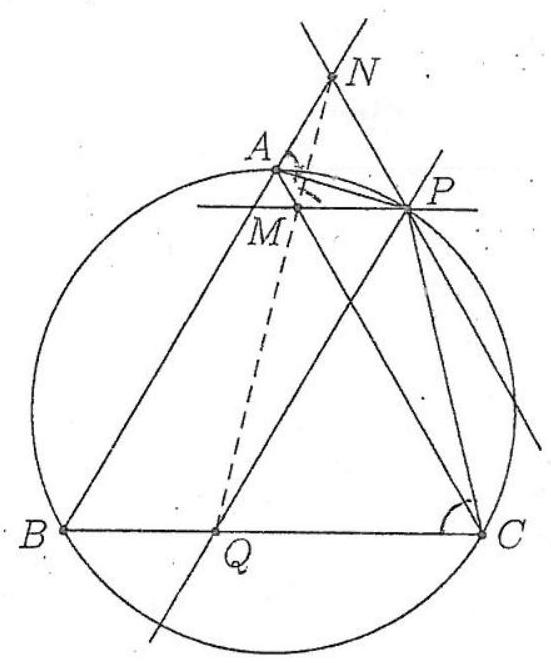
|
| 200 |
+
|
| 201 |
+
Figure 1: Exercise G1.
|
| 202 |
+
|
| 203 |
+
Similarly, since $\angle P M C=\angle M C Q=60^{\circ}$ and $\angle C Q P=60^{\circ}$, it follows that the points $P, M, Q$ and $C$ are concyclic. Thus
|
| 204 |
+
|
| 205 |
+
$$
|
| 206 |
+
\angle P M Q=180^{\circ}-\angle P C Q=180^{\circ}-\angle N A P \stackrel{(2)}{=} 180^{\circ}-\angle N M P .
|
| 207 |
+
$$
|
| 208 |
+
|
| 209 |
+
This implies $\angle P M Q+\angle N M P=180^{\circ}$, which shows that $M, N$ and $Q$ belong to the same line.
|
| 210 |
+
|
| 211 |
+
1 G2. Let $A B C$ be an isosceles triangle with $A B=A C$. Let also $c(K, K C)$ be a circle tangent to the line $A C$ at point $C$ which it intersects the segment $B C$ again at an interior point $H$. Prove that $H K \perp A B$.
|
| 212 |
+
|
| 213 |
+
Solution 1. Let lines $K H, A B$ intersect at $M$ (Figure 5a). From the quadrelateral $K M A C$ we have
|
| 214 |
+
|
| 215 |
+
$\angle K M A=360^{\circ}-\angle A-\angle A C K-\angle C K M=360^{\circ}-\angle A-90^{\circ}-\left(180^{\circ}-2 \angle K C H\right)=$ $90-\angle A+2 \angle K C H=90-\angle A+2\left(90^{\circ}-\angle A C B\right)=270^{\circ}-\angle A-2 \angle A C B=270-\angle A-$ $\angle A C B-\angle A B C=270^{\circ}-180^{\circ}=90^{\circ}$.
|
| 216 |
+
|
| 217 |
+

|
| 218 |
+
|
| 219 |
+
(a)
|
| 220 |
+
|
| 221 |
+

|
| 222 |
+
|
| 223 |
+
(b)
|
| 224 |
+
|
| 225 |
+
Figure 2: Exercise G2.
|
| 226 |
+
|
| 227 |
+
so $K H \perp A B$ as wanted.
|
| 228 |
+
|
| 229 |
+
Solution 2. Let $D$ be a point on $c$ such that $A D<A C$, and let $E, Z$ be the second points of intersection of lines $A D$ and $B D$ with $c$ respectively. Let also $N$ be the second point of intersection of line $B E$ with the circle $c$. Figure $5 \mathrm{~b}$ shows $Z$ between $B, D$. The argument below can be trivially modified to apply in case $D$ is in the segment $B, Z$ as well. It is
|
| 230 |
+
|
| 231 |
+
$$
|
| 232 |
+
A B^{2}=A C^{2}=A D \cdot A E \Rightarrow \frac{A B}{A E}=\frac{A D}{A B}
|
| 233 |
+
$$
|
| 234 |
+
|
| 235 |
+
This relation arid the fact that $\angle B A E=\angle B A D$ implies that the triangles $A B E, A D B$ are similar. Thus $\angle A B E=\angle A D B$. Also from the cyclic quadrilateral we get $\angle A D B=\angle Z N E$. Therefore $\angle A B E=\angle Z N E$, so $A B \| N Z$.
|
| 236 |
+
|
| 237 |
+
Call $P$ the intersection point of $B C, N Z$. Since $A C$ is tangent to $c$ it is
|
| 238 |
+
|
| 239 |
+
$$
|
| 240 |
+
\angle C E H=\angle B C A
|
| 241 |
+
$$
|
| 242 |
+
|
| 243 |
+
and then
|
| 244 |
+
|
| 245 |
+
$$
|
| 246 |
+
\begin{aligned}
|
| 247 |
+
& \angle Z N H+\angle C N Z=\angle H N C=\angle C E H \stackrel{(3)}{=} \angle B C A=\angle A B C=\angle Z P C=\angle B C N+\angle C N Z \\
|
| 248 |
+
\Rightarrow \quad & \angle Z N H=\angle B C N \\
|
| 249 |
+
\Rightarrow \quad & \angle Z N H=\angle H Z N
|
| 250 |
+
\end{aligned}
|
| 251 |
+
$$
|
| 252 |
+
|
| 253 |
+
Therefore $H$ is the midpoint of the arc $N Z$, so $K H \perp N Z$ and as $A B \| N Z$ we finally get $K H \perp A B$ as wanted.
|
| 254 |
+
|
| 255 |
+

|
| 256 |
+
|
| 257 |
+
Figure 3: Exercise G3.
|
| 258 |
+
|
| 259 |
+
2-3 G3. Let $A B$ and $C D$ be chords in a circle of center $O$ with $A, B, C, D$ distinct, and let the lines $A B$ and $C D$ meet at a right angle at point $E$. Let also $M$ and $N$ be the midpoints of $A C$ and $B D$ respectively. If $M N \perp O E$, prove that $A D \| B C$.
|
| 260 |
+
|
| 261 |
+
Solution. $E$ can be inside, or outside the circle (Figure 3) but the proof below holds in both cases; notice that $E$ cannot be on the circle as $A, B, C, D$ are distinct. Let lines $A C$ and $N E$ meet at point $P$. Then $E N=D N=B N$ (median in a right triangle), so $\angle P E C=\angle N E D=\angle N D E=\angle B D C=\angle B A C=\angle E A P$. Now $A B \perp C D$ so $E N \perp A C$. But $O M \perp A C$ so $O M \| E N$. Similarly $O N \| E M$ so $N E M O$ is a parallelogram (possibly degenerated). As $M N \perp O E$, this parallelogram is a rhombus. Then the chords $A C$ and $B D$, being equidistant from $O$, are equal. Hence their minor arcs are equal, which means that either $A D \| B C$ or $A B \| C D$; the latter contradicts the fact that $A B$ and $C D$ meet at $E$.
|
| 262 |
+
|
| 263 |
+
G4. Let $A B C$ be an acute-angled triangle with circumcircle $\Gamma$, and let $O, H$ be the triangle's circumcenter and orthocenter respectively. Let also $A^{\prime}$ be the point where the angle bisector of angle $B A C$ meets $\Gamma$. If $A^{\prime} H=A H$, find the measure of angle $B A C$.
|
| 264 |
+
|
| 265 |
+
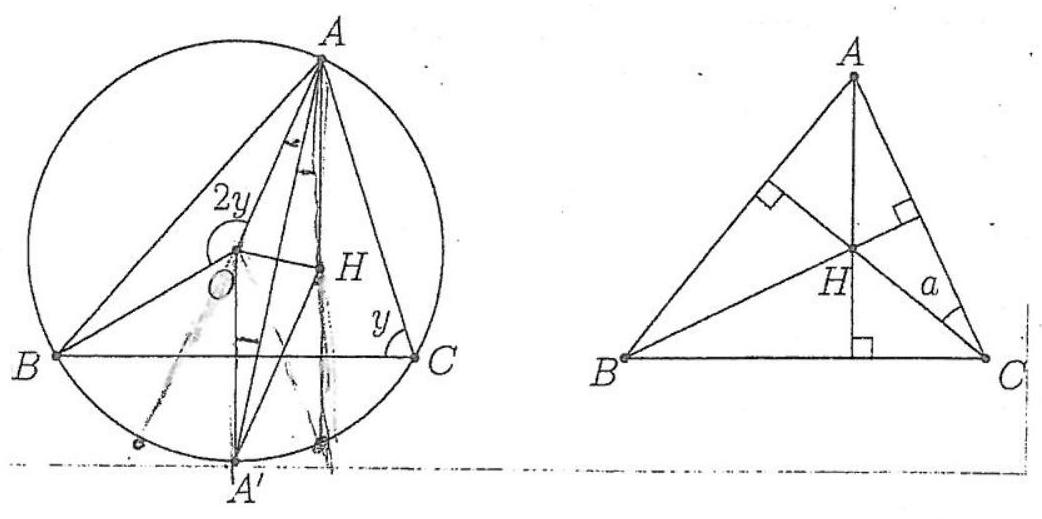
|
| 266 |
+
|
| 267 |
+
Figure 4: Exercise G4.
|
| 268 |
+
|
| 269 |
+
Solution. The segment $A A^{\prime}$ bisects $\angle O A H$ : if $\angle B C A=y$ (Figure 4), then $\angle B O A=$ $2 y$, and since $O A=O B$, it is $\angle O A B=\angle O B A=90^{\circ}-y$. Also since $A H \perp B C$, it is
|
| 270 |
+
$\angle H A C=90^{\circ}-y=\angle O A B$ and the claim follows.
|
| 271 |
+
|
| 272 |
+
Since $A . A^{\prime}$ bisects $\angle O A H$ and $A^{\prime} H=A H . O A^{\prime}=O A$, we have that the isosceles triangles $O A A^{\prime}, H A A^{\prime}$ are equal. Thus
|
| 273 |
+
|
| 274 |
+
$$
|
| 275 |
+
A H=O A=R
|
| 276 |
+
$$
|
| 277 |
+
|
| 278 |
+
where $R$ is the circumradius of triangle $A B C$.
|
| 279 |
+
|
| 280 |
+
Call $\angle A C H=a$ and recall by the law of sines that $A H=2 R^{\prime} \sin a$, where $R^{\prime}$ is the circumradius of triangle $A H C$. Then (4) implies
|
| 281 |
+
|
| 282 |
+
$$
|
| 283 |
+
R=2 R^{\prime} \sin a
|
| 284 |
+
$$
|
| 285 |
+
|
| 286 |
+
But notice that $R=R^{\prime}$ because $\frac{A C}{\sin (A H C)}=2 R^{\prime}, \frac{A C}{\sin (A B C)}=2 R$ and $\sin (A H C)=$ $\sin \left(180^{\circ}-A B C\right)=\sin (A B C)$. So (5) gives $1=2 \sin a$, and $a$ as an acuite angle can only be $30^{\circ}$. Finally, $\angle B A C=90^{\circ}-a=60^{\circ}$.
|
| 287 |
+
|
| 288 |
+
Remark. The steps in the above proof can be traced backwards making the converse also true, that is: If $\angle B A C=60^{\circ}$ then $A^{\prime} H=A H$.
|
| 289 |
+
|
| 290 |
+
- G5. Let the circles $k_{1}$ and $k_{2}$ intersect at two distinct points $A$ and $B$, and let $t$ be a common tangent of $k_{1}$ and $k_{2}$ that touches them at $M$ and, $N$ respectively. If $t \perp A M$ and $M N=2 A M$, evaluate $\angle N M B$.
|
| 291 |
+
|
| 292 |
+
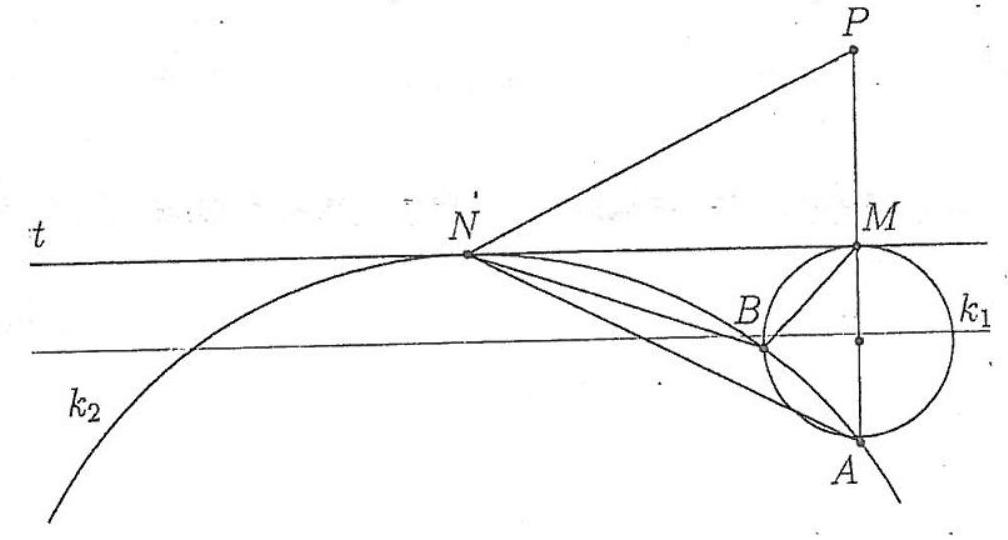
|
| 293 |
+
|
| 294 |
+
Figure 5: Exercise G5.
|
| 295 |
+
|
| 296 |
+
Solution. Let $P$ be the symmetric of $A$ with respect to $M$ (Figure 5). Then $A M=M P$ and $t \perp A P$, hence the triangle $A P N$ is isosceles with $\mathrm{AP}$ as its base, so $\angle N A P=\angle N P A$. We have $\angle B A P=\angle B A M=\angle B M N$ and $\angle B A N=\angle B N M$. Thus
|
| 297 |
+
|
| 298 |
+
$$
|
| 299 |
+
180^{\circ}-\angle N B M=\angle B N M+B M N=\angle B A N+\angle B A P=\angle N A P=\angle N P A
|
| 300 |
+
$$
|
| 301 |
+
|
| 302 |
+
so the quadrangle $M B N P$ is cyclic (since the points $B$ and $P$ lie on different sides of $M N$ ). Hence $\angle A P B=\angle M P B=\angle M N B$ and the triangles $A P B$ and $M N B$ are congruent $(M N=2 A M=A M+M P=A P)$. From that we get $A B=M B$, i.e. the triangle $A M B$ is
|
| 303 |
+
isosceles, and since $t$ is tangent to $k_{1}$ and perpendicular to $A M$, the center of $k_{1}$ is on $A M$, hence $A M B$ is a right-angled triangle. From the last two statements we infer $\angle A M B=45^{\circ}$, and so $\angle N M B=90^{\circ}-\angle A M B=45^{\circ}$.
|
| 304 |
+
|
| 305 |
+
4. G6. Let $O_{1}$ be a point in the exterior of the circle $c(O, R)$ and let $\dot{O}_{1} N, O_{1} D$ be the tangent segments from $O_{1}$ to the circle. On the segment $O_{1} N$ consider the point $B$ such that $B N=R$. Let the line from $B$ parallel to $O N$ intersect the segment $O_{1} D$ at $C$. If $A$ is a point on the segment $O_{1} D$ other than $C$ so that $B C=B A=a$, and if $\dot{C}^{\prime}(K, r)$ is the incircle of the triangle $O_{1} A B$; find the area of $A B C$ in terms of a, $R, r$.
|
| 306 |
+
|
| 307 |
+
Solution. Obviously; the segment $B C$ is taingent to the circle $c$. Let $M$ be the point of tangency (Figure 6). Call $Q, M$ the tangency points of $B A, B C$ with $c^{\prime}$ and $c$ respectively, and call $H$ the midpoint of segment $A C$. It is well known that
|
| 308 |
+
|
| 309 |
+
$$
|
| 310 |
+
A Q=\frac{1}{2}\left(A O_{1}+A B-B O_{1}\right) \text { and } C M=\frac{1}{2}\left(B O_{1}+B C-C O_{1}\right)
|
| 311 |
+
$$
|
| 312 |
+
|
| 313 |
+
and so
|
| 314 |
+
|
| 315 |
+
$$
|
| 316 |
+
A Q+C M=\frac{1}{2}(2 B C-A C)=a-\frac{1}{2} A C=a-H C
|
| 317 |
+
$$
|
| 318 |
+
|
| 319 |
+

|
| 320 |
+
|
| 321 |
+
Figure 6: Exercise G6.
|
| 322 |
+
|
| 323 |
+
The triangles $K A Q$ and $O C M$ are similar and this implies
|
| 324 |
+
|
| 325 |
+
$$
|
| 326 |
+
\begin{aligned}
|
| 327 |
+
\frac{K Q}{O M} & =\frac{A Q}{C M} \Leftrightarrow \frac{K Q}{A Q}=\frac{O M}{C M} \Leftrightarrow \frac{r}{A Q}=\frac{R}{C M}=\frac{R+r}{A Q+C M}=\frac{R+r}{a-H C} \Leftrightarrow \\
|
| 328 |
+
\frac{r}{A Q} & =\frac{R+r}{a-H A}
|
| 329 |
+
\end{aligned}
|
| 330 |
+
$$
|
| 331 |
+
|
| 332 |
+
If $A Z$ is the bisector segment of triangle $B A H$ it holds
|
| 333 |
+
|
| 334 |
+
$$
|
| 335 |
+
\angle A Z H=90^{\circ}=\frac{1}{2} \angle B A C \text { and } \angle K A Q=\frac{1}{2}\left(180^{\circ}-\angle B A C\right)=90^{\circ}-\frac{1}{2} \angle B A C
|
| 336 |
+
$$
|
| 337 |
+
|
| 338 |
+
Therefore, from the similar triangles $K Q A$ and $A H Z$ we get
|
| 339 |
+
|
| 340 |
+
$$
|
| 341 |
+
\frac{-A H}{Z H}=\frac{r}{A Q} \stackrel{(6)}{=} \frac{R+r}{a-H A}
|
| 342 |
+
$$
|
| 343 |
+
|
| 344 |
+
Also, from the bisector-theorem in triangle $A B H$ it holds
|
| 345 |
+
|
| 346 |
+
$$
|
| 347 |
+
Z H=\frac{A H \cdot B H}{a+A H}
|
| 348 |
+
$$
|
| 349 |
+
|
| 350 |
+
and from (7) it follows
|
| 351 |
+
|
| 352 |
+
$$
|
| 353 |
+
\frac{R+r}{a-H A}=\frac{A H}{\frac{A H \cdot B H}{a+A H}} \Rightarrow R+r=\frac{a^{2}-A H^{2}}{B H}=\frac{B H^{2}}{B H}=B H
|
| 354 |
+
$$
|
| 355 |
+
|
| 356 |
+
So
|
| 357 |
+
|
| 358 |
+
$$
|
| 359 |
+
H A^{2}=a^{2}-(R+r)^{2} \Leftrightarrow H A=\sqrt{a^{2}-(R+r)^{2}}
|
| 360 |
+
$$
|
| 361 |
+
|
| 362 |
+
and finally the area of triangle $A B C$ in terms of $a, R, r$ is:
|
| 363 |
+
|
| 364 |
+
$$
|
| 365 |
+
(A B C)=A H \cdot B H=(R+r) \sqrt{a^{2}-(R+r)^{2}}
|
| 366 |
+
$$
|
| 367 |
+
|
| 368 |
+
4 GZ, Let $M N P Q$ be a square of side length 1 , and $A, B, C, D$ points on the sides $M N$, $N P, P Q$, and $Q M$ respectively such that $A C \cdot B D=\frac{5}{4}$. Can the set $\{A B, B C, C D, D A\}$ be partitioned into two subsets $S_{1}$ and $S_{2}$ of two elements each, so that.each one of the sums of the elements of $S_{1}$ and $S_{2}$ are positive integers?
|
| 369 |
+
|
| 370 |
+
Solution. The answer is negative.
|
| 371 |
+
|
| 372 |
+
Suppose such a partitioning was possible (Figure 7). Then $A B+B C+C D+D A \in \mathbb{N}$. But $(A B+B C)+(C D+D A)>A C+A C \geq 2$, hence $A B+B C+C D+D A>2$.
|
| 373 |
+
|
| 374 |
+
On the other hand, $A B+B C+C D+D A<(A N+N B)+(B P+P C)+(C Q+Q D)+$ $(D M+M A)=4$, hence $A B+B C+C D+D A=3$.
|
| 375 |
+
|
| 376 |
+
Obviously one of the aums of the elerients of $S_{1}$ and $S_{2}$ must be 1 and the other 2 . Without any loss of generality, we may assume that the sum of the elements of $S_{1}$ is 1 and the sum of the elements of $S_{2}$ is 2 . As $A B+B C>A C \geq 1$ we find that $S_{1} \neq\{A B, B C\}$. Similarly, $S_{1}$ cannot contain two adjacent sides of the quadrilateral $A B C D$. Therefore, without any loss of generality, we may assume that $S_{1}=\{A D, B C\}$ and $S_{2}=\{A B, C D\}$. Then $A D+B C=1$ and $A B+C D=2$.
|
| 377 |
+
|
| 378 |
+
We have $A D \cdot B C \leq \frac{1}{4} \cdot(A D+C B)^{2}=\frac{1}{4}$ and $A B \cdot C D \leq \frac{1}{4} \cdot(A B+C D)^{2}=1$.
|
| 379 |
+
|
| 380 |
+
According to Ptolemy's inequality, we have
|
| 381 |
+
|
| 382 |
+
$$
|
| 383 |
+
\frac{5}{4}=A C \cdot B D \leq A B \cdot C D+A D \cdot B C=\frac{1}{4}+1=\frac{5}{4}
|
| 384 |
+
$$
|
| 385 |
+
|
| 386 |
+
hence we have equality all around, which means the quadrilateral $A B C D$ is cyclic, $A D=$ $B C=\frac{1}{2}$ and $A B=C D=1$, hence $A B C D$ is a rectangle of dimensions 1 and $\frac{1}{2}$.
|
| 387 |
+
|
| 388 |
+
There are many different ways of proving that this configuration is not possible. For example: - Suppose $A B C D$ is a rectangle with $A D=\frac{1}{2}, A B=1$. Then we have $A C=B D=\frac{\sqrt{5}}{2}$ and $\triangle A N B \equiv \triangle C Q D$ (Angle-Side-Angle). Denoting $A M=x, M D=y$ we have $A N=$
|
| 389 |
+
|
| 390 |
+

|
| 391 |
+
|
| 392 |
+
Figure 7: Exercise G7.
|
| 393 |
+
|
| 394 |
+
$1-x, B N=1-y$ and the following conditions need to be fulfilled for some $x, y \in[0 ; 1]$ (Pythagorean Theorem in triangles $A M D, A N B, B B^{\prime} C$, where $B^{\prime}$ is the projection of $B$ on $M Q)$ :
|
| 395 |
+
|
| 396 |
+
$$
|
| 397 |
+
x^{2}+y^{2}=\frac{1}{4}, \quad(1-x)^{2}+(1-y)^{2}=1 \text { and } 1+(2 y-1)^{2}=\frac{5}{4}
|
| 398 |
+
$$
|
| 399 |
+
|
| 400 |
+
But $1+(2 y-1)^{2}=\frac{5}{4}$ implies $y \in\left\{\frac{1}{4}, \frac{3}{4}\right\}$. If $y=\frac{3}{4}$, then $x^{2}+y^{2}=\frac{1}{4}$ cannot hold. If on the other hand $y=\frac{1}{4}$, then $(1-x)^{2}+(1-y)^{2}=1$ implies $x=0$, but then $(1-x)^{2}+(1-y)^{2}=1$ cannot hold. Therefore such a configuration is not possible.
|
| 401 |
+
|
| 402 |
+
## Combinatorics
|
| 403 |
+
|
| 404 |
+
C1. Along a round table are arranged 11 cards with the names (all distinct) of the 11 members of the $16^{\text {th }}$ JBMO Problem Selection Committee. The distances between each two consecutive cards are equal. Assume that in the first meeting of the Committee none of its 11 members sits in front of the card with his name. Is it possible to rotate the table by some angle so that at the end at least two members of sit in front of the card with their names?
|
| 405 |
+
|
| 406 |
+
Solution. Yes it is: Rotating the table by the angles $\frac{360^{\circ}}{11}, 2 \cdot \frac{360^{\circ}}{11}, 3 \cdot \frac{360^{\circ}}{11}, \ldots, 10 \cdot \frac{360^{\circ}}{11}$, we obtain 10 new positions of the table. By the assumption, it is obvious that every one of the 11 members of the Committee will be seated in front of the card with his name in exactly one of these 10 positions. Then by the Pigeonhole Principle there should exist one among these 10 positions in which at least two of the $11(>10)$ members of the Committee will be placed in their positions, as claimed.
|
| 407 |
+
|
| 408 |
+
C2. $n$ nails nailed on a board are connected by two via a string. Each string is colored in one of $n$ given colors. For any three colors there exist three nails conne.cted by two with strings in these three colors. Can $n$ be: (a) 6, (b) 7?
|
| 409 |
+
|
| 410 |
+
Solution. (a) The answer is no:
|
| 411 |
+
|
| 412 |
+
Suppose it is possible. Consider some color, say blue. Each blue string is the side of 4 triangles formed with vertices on the given points. As there exist $\binom{5}{2}=\frac{5 \cdot 4}{2}=10$ pairs of colors other than blue, and for any such pair of colors together with the blue color there exists a triangle with strings in these colors, we conclude that there exist at least 3 blue strings (otherwise the number of triangles with a blue string as a side would be at most $2 \cdot 4=8$, a contradiction). The same is true for any color, so altogether there exist at least $6 \cdot 3=18$ strings, while we have just $\binom{6}{2}=\frac{6 \cdot 5}{2}=15$ of them.
|
| 413 |
+
|
| 414 |
+
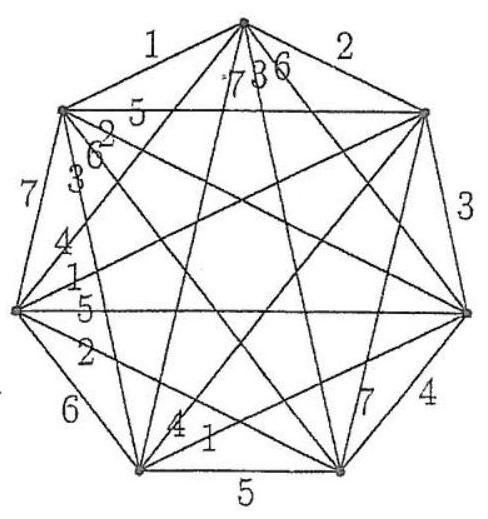
|
| 415 |
+
|
| 416 |
+
Figure 8: Exercise C2.
|
| 417 |
+
|
| 418 |
+
(b) The answer is yes (Figure 8):
|
| 419 |
+
|
| 420 |
+
Put the nails at the vertices of a regular 7-gon (Figure 8) and color each one of its sides in a different color. Now color each diagonal in the color of the unique side parallel to it. It can be checked directly that each triple of colors appears in some triangle (because of symmetry, it is enough to check only the triples containing the first color).
|
| 421 |
+
|
| 422 |
+
Remark. The argument in (a) can be applied to any even $n$. The argument. in (b) can be applied to any odd $n=2 k+1$ as follows: first number the nails as $0,1,2 \ldots, 2 k$ and similarly number the colors as $0,1,2 \ldots, 2 k$. Then connect nail $x$ with nail $y$ by a string of color $x+y(\bmod n)$. For each triple of colors $(p, q, r)$ there are vertices $x, y, z$ connected by these three colors. Indeed, we need to solve (modn.) the system
|
| 423 |
+
|
| 424 |
+
$$
|
| 425 |
+
(*)(x+y \equiv p, x+z \equiv q, y+z \equiv r)
|
| 426 |
+
$$
|
| 427 |
+
|
| 428 |
+
Adding all three, we get $2(x+y+z) \equiv p+q+r$ and multiplying by $k+1$ we get $x+y+z \equiv$ $(k+1)(p+q+r)$. We can now find $x, y, z$ from the identities $(*)$.
|
| 429 |
+
|
| 430 |
+
C3. In a circle of diameter 1 consider 65 points no three of which are collinear. Prove that there exist 3 among these points which form a triangle with area less then or equal to $\frac{1}{72}$.
|
| 431 |
+
|
| 432 |
+
Solution. Lemma: If a triangle $A B C$ lies in a rectangle $K L M N$. with sides $K L=a$ and $L M=b$, then the area of the triangle is less then or equal to $\frac{a b}{2}$.
|
| 433 |
+
|
| 434 |
+
Proof of the lemma: Writhout any loss of generality assume that among the distance of $A, B, C$ from $K L$, that of $A$ is between the other two. Let $\ell$ be the line through $A$ and parallel to $K L$. Let $D$ be the intersection of $\ell, B C$ and $x, y$ the distances of $B, C$ from $\ell$ respectively. Then the area of $A B C$ equals $\frac{A D(x+y)}{2} \leq \frac{a b}{2}$, since $A D \leq a$ and $x+y \leq b$ and we are done.
|
| 435 |
+
|
| 436 |
+
Now back to our problem, let us cover the circle with 24 squares of side $\frac{1}{6}$ and 8 other irregular and equal figures as shown in Figure 9, with boundary consisting of an arc on the circle and three line segments. Call $S=A D N M$ one of these figures. One of the line segments in the boundary of $S$ is of length $A D=A B-D B=\sqrt{A C^{2}-B C^{2}}-\frac{2}{6}=$ $\sqrt{\left(\frac{1}{2}\right)^{2}-\left(\frac{1}{6}\right)^{2}}-\frac{1}{3}=\frac{\sqrt{2}-1}{3}$. The boundary segment $M N$ goes through the center $C$ of the circle, forming with the horizontal lines an angle of $45^{\circ}$. The point in $S$ with maximum distance from the boundary segment $A B$ is the endpoint $M$ of the arc on the boundary of $S$. This distance equals $M E=M F-E F \stackrel{C M F=\text { isosceles }}{=} \frac{\sqrt{2}}{2} C M-\frac{1}{6}=\frac{\sqrt{2}}{4}-\frac{1}{6}=\frac{3 \sqrt{2}-2}{12}$. So $S$ can be put inside a rectangle $R$ with sides parallel to $A D, N D$ of lengths $\frac{\sqrt{2}-1}{3}$ and $\frac{3 \sqrt{2}-2}{12}$. So the triangle formed by any three points inside this figure, has an area less or
|
| 437 |
+
equal to $\frac{1}{2} \cdot \frac{\sqrt{2}-1}{3} \cdot \frac{3 \sqrt{2}-2}{12}=\frac{8-5 \sqrt{2}}{72}<\frac{1}{72}$.
|
| 438 |
+
|
| 439 |
+
Also, the triangle formed by any three points inside any square of side $\frac{1}{6}$, has an area less or equal to $\frac{1}{2} \cdot \frac{1}{6} \cdot \frac{1}{6}=\frac{1}{72}$.
|
| 440 |
+
|
| 441 |
+
By the Pigeonhole Principle, we know that among the 65 given points there exist 3 inside the same one of the 32 squares and irregular figures of the picture covering the given circle. Then according to the above, the triangle formed by these 3 points has an area not exceeding $\frac{1}{72}$ as wanted.
|
| 442 |
+
|
| 443 |
+
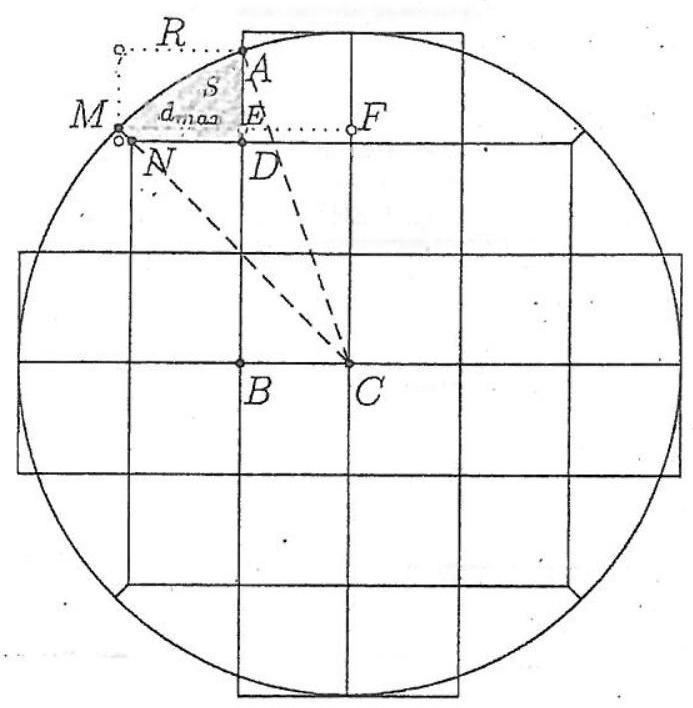
|
| 444 |
+
|
| 445 |
+
Figure 9: :Exercise C3.
|
| 446 |
+
|
| 447 |
+
## Number Theory
|
| 448 |
+
|
| 449 |
+
3 NT1. If $a, b$ are integers and $s=a^{3}+b^{3}-60 a b(a+b) \geq 2012$, find the least possible value of $s$.
|
| 450 |
+
|
| 451 |
+
Solution. It is $s=(a+b)^{3}-63 a b(a+b)$ which gives the same residue module 7 as $(a+b)^{3}$. But the residues modulo 7 of perfect cubes can only be 0,1 or 6 . So the residue of $s$ modulo 7 is 0,1 or 6 . Now for $a=6, b=-1$ we get $s=2015 \geq 2012$ and this is the least possible value of $s$ because the numbers 2012, 2013, 2014 give 3,4 and 5 as residues $\bmod 7$ which are distinct from $0,1,6$, and so 2012, 2013, 2014 cannot be $s$ for any choice of $a, b$. $\square$
|
| 452 |
+
|
| 453 |
+
2-3 NT2. Do there exist prime numbers $p$ and $q$ such that $p^{2}\left(p^{3}-1\right)=q(q+1)$ ?
|
| 454 |
+
|
| 455 |
+
Solution. Write the given equation in the form
|
| 456 |
+
|
| 457 |
+
$$
|
| 458 |
+
p^{2}(p-1)\left(p^{2}+p+1\right)=q(q+1)
|
| 459 |
+
$$
|
| 460 |
+
|
| 461 |
+
First observe that it must not be $p=q$, since in this case the left hand side of (9) is greater than its right hand side. Hence, since $p$ and $q$ are distinct prines, (9) immediately yields $p^{2} \mid q+1$, that is
|
| 462 |
+
|
| 463 |
+
$$
|
| 464 |
+
q=a p^{2}-1
|
| 465 |
+
$$
|
| 466 |
+
|
| 467 |
+
for some $a \in \mathrm{N}$. Since $p$ and $q$ are both primes, by (9) we get the following cases:
|
| 468 |
+
|
| 469 |
+
Case 1: $q \mid p-1$, that is
|
| 470 |
+
|
| 471 |
+
$$
|
| 472 |
+
p=b q+1
|
| 473 |
+
$$
|
| 474 |
+
|
| 475 |
+
for some $b \in N$. Substituting (11) into (10), and using the fact that $a \geq 1$ and $b \geq 1$, we obtain
|
| 476 |
+
|
| 477 |
+
$$
|
| 478 |
+
q=a(b q+1)^{2}-1 \geq(q+1)^{2}-1=q^{2}+2 q
|
| 479 |
+
$$
|
| 480 |
+
|
| 481 |
+
a contradiction.
|
| 482 |
+
|
| 483 |
+
Case 2: $q \mid p^{2}+p+1$, that is
|
| 484 |
+
|
| 485 |
+
$$
|
| 486 |
+
p^{2}+p+1=b q
|
| 487 |
+
$$
|
| 488 |
+
|
| 489 |
+
for some $b \in$ N. Substituting (10) into (12), we get
|
| 490 |
+
|
| 491 |
+
$$
|
| 492 |
+
p^{2}+p+1=b\left(a p^{2}-1\right)
|
| 493 |
+
$$
|
| 494 |
+
|
| 495 |
+
If $a \geq 2$, then from (13) it follows that
|
| 496 |
+
|
| 497 |
+
$$
|
| 498 |
+
p^{2}+p+1 \geq 2 p^{2}-1
|
| 499 |
+
$$
|
| 500 |
+
|
| 501 |
+
or equivalently, $p+1 \geq(p-1)(p+1)$, that is, $(p+1)(2-p) \geq 0$. This implies that $p=2$, and so $q \mid 2^{2}+2+1=7$. Hence, $q=7$, but the pair $p=2$ and $q=7$ does not satisfy the equation ( 9 ).
|
| 502 |
+
|
| 503 |
+
Hence, it must be $a=1$. Then if $b \geq 3$, (13) implies
|
| 504 |
+
|
| 505 |
+
$$
|
| 506 |
+
p^{2}+p+1 \geq 3\left(p^{2}-1\right)
|
| 507 |
+
$$
|
| 508 |
+
|
| 509 |
+
or equivalently, $4 \geq p(2 p-1)$, which is obviously impossible.
|
| 510 |
+
|
| 511 |
+
Thus, it must be $a=1$ and $b \in\{1,2\}$. For $a=b=1$, (13) implies that $p=2$, which by (12) again yields $q=7$, which is impossible. Finally, for $a=1$ and $b=2$, (13) gives $p(p-1)=3$, which is clearly not satisfied for any prime $p$.
|
| 512 |
+
|
| 513 |
+
Hence, there do not exist prime numbers $p$ and $q$ which satisfy given equation.
|
| 514 |
+
|
| 515 |
+
## 3 NT3. Decipher the equality
|
| 516 |
+
|
| 517 |
+
$$
|
| 518 |
+
(\overline{V E R}-\overline{I A}):(\overline{G R E}+\overline{E C E})=G^{R^{E}}
|
| 519 |
+
$$
|
| 520 |
+
|
| 521 |
+
assuming that the number $\overline{\text { GREECE }}$ has a maximum value. It is supposed that each letter corresponds to a unique digit from 0 to 9 and different letters correspond to different digits, and also that all letters $G, E, V$ and $I$ are different from 0 . Also, the notation $\overline{a_{n} \ldots a_{1} a_{0}}$ stands for the number $a_{n} \cdot 10^{n}+\cdots+10^{1} \cdot a_{1}+a_{0}$ :
|
| 522 |
+
|
| 523 |
+
Solution. Denote
|
| 524 |
+
|
| 525 |
+
$$
|
| 526 |
+
x=\overline{V E R}-\overline{I A}, y=\overline{G R E}+\overline{E C E}, z=G^{R^{E}}
|
| 527 |
+
$$
|
| 528 |
+
|
| 529 |
+
Then obviously, we have
|
| 530 |
+
|
| 531 |
+
$$
|
| 532 |
+
\begin{aligned}
|
| 533 |
+
& (201+131 \text { or } 231+101) \leq y \leq(879+969 \text { or } 869+979 \text { or. } 769+989) \\
|
| 534 |
+
\Rightarrow \quad & 332 \leq y \leq 1848 \Rightarrow 102-98 \leq x \leq 987-10 \Rightarrow 4 \leq x \leq 977,
|
| 535 |
+
\end{aligned}
|
| 536 |
+
$$
|
| 537 |
+
|
| 538 |
+
hence it follows that
|
| 539 |
+
|
| 540 |
+
$$
|
| 541 |
+
\frac{4}{1848} \leq \frac{x}{y}=z \leq \frac{977}{332} \Rightarrow 1 \leq z \leq 2
|
| 542 |
+
$$
|
| 543 |
+
|
| 544 |
+
This shows that $z=G^{R^{E}} \in\{1,2\}$. Hence, if $R \geq 1$, then $R^{E} \geq 1$, which implies that $2 \geq G^{R^{E}} \geq G$. Thus, if $R \geq 1$, then it must be $G \leq 2$. In view of this and the assumption of the problem that the number $\overline{G R E E C E}$ has a maximum value, we will consider the case when $R=0$ hoping to get a solution with $G>2$. Then $G^{R^{E}}=G^{0}=1$ for all digits $G$ and $E$ with $1 \leq G, E \leq 9$, and therefore, the above equality becomes
|
| 545 |
+
|
| 546 |
+
$$
|
| 547 |
+
\overline{V E R}-\overline{I A}=\overline{G R E}+\overline{E C E}
|
| 548 |
+
$$
|
| 549 |
+
|
| 550 |
+
which substituting $R=0$, can be written as
|
| 551 |
+
|
| 552 |
+
$$
|
| 553 |
+
\overline{V E O}=\overline{G O E}+\overline{E C E}+\overline{I A}
|
| 554 |
+
$$
|
| 555 |
+
|
| 556 |
+
Now we consider the following cases:
|
| 557 |
+
|
| 558 |
+
Case 1: $G=9$. Then $V \leq 8$, so $\overline{V E 0} \leq 900$, while the right hand side of (1) is greater than 900 . This is impossible, and no solution exists in this case.
|
| 559 |
+
|
| 560 |
+
Case 2: $G=8$. Then (14) becomes
|
| 561 |
+
|
| 562 |
+
$$
|
| 563 |
+
\overline{V E 0}=\overline{80 E}+\overline{E C E}+\overline{I A}
|
| 564 |
+
$$
|
| 565 |
+
|
| 566 |
+
hence it immediately follows that $V=9$. For $V=9$, (15) becomes
|
| 567 |
+
|
| 568 |
+
$$
|
| 569 |
+
\overline{9 E 0}=\overline{80 E}+\overline{E C E}+\overline{I A}
|
| 570 |
+
$$
|
| 571 |
+
|
| 572 |
+
Notice that for $E \geq 2$, the right hand side of (16) is greater than 1000 , while the left hand side of (16) is less than 1000 . Therefore, it must be $E \leq 1$, that is, $E=1$ in view of the fact that $R=0$. Substituting $E=1$ into (16), we get
|
| 573 |
+
|
| 574 |
+
$$
|
| 575 |
+
\overline{910}=\overline{801}+\overline{1 C 1}+\overline{I A}
|
| 576 |
+
$$
|
| 577 |
+
|
| 578 |
+
hence it follows that
|
| 579 |
+
|
| 580 |
+
$$
|
| 581 |
+
109=\overline{1 C 1}+\overline{I A}
|
| 582 |
+
$$
|
| 583 |
+
|
| 584 |
+
But the right hand side of (18) is greater than 121. This shows that $G=8$ does not lead to any solution.
|
| 585 |
+
|
| 586 |
+
Case 3: $G=7$. Then (14) becomes
|
| 587 |
+
|
| 588 |
+
$$
|
| 589 |
+
\overline{V E O}=\overline{70 E}+\overline{E C E}+\overline{I A}
|
| 590 |
+
$$
|
| 591 |
+
|
| 592 |
+
Thus it must be $V \geq 8$.
|
| 593 |
+
|
| 594 |
+
Subcase 3(a): $V=8$. Then (19) gives
|
| 595 |
+
|
| 596 |
+
$$
|
| 597 |
+
\overline{\delta E 0}=\overline{70 E}+\overline{E C E}+\overline{I A}
|
| 598 |
+
$$
|
| 599 |
+
|
| 600 |
+
hence we immediately obtain $E=1$ (since the right hand side of (6) must be lass than 900). For $E=1,(20)$ reduces to
|
| 601 |
+
|
| 602 |
+
$$
|
| 603 |
+
109=\overline{1 C 1}+\overline{I A}
|
| 604 |
+
$$
|
| 605 |
+
|
| 606 |
+
which is impossible since $\overline{1 C 1} \geq 121$.
|
| 607 |
+
|
| 608 |
+
Subcase 3(b): $V=9$. Then (19) gives
|
| 609 |
+
|
| 610 |
+
$$
|
| 611 |
+
\overline{9 E 0}=\overline{70 E}+\overline{E C E}+\overline{I A}
|
| 612 |
+
$$
|
| 613 |
+
|
| 614 |
+
hence we immediately obtain $E \leq 2$ (since the right hand side of (7) must be less than 1000). For $E=2$, (22) reduces to
|
| 615 |
+
|
| 616 |
+
$$
|
| 617 |
+
218=\overline{2 C 2}+\overline{I A}
|
| 618 |
+
$$
|
| 619 |
+
|
| 620 |
+
which is impossible since $\overline{2 C 2} \geq 232$. Finally, for $E=1$, (22) reduces to
|
| 621 |
+
|
| 622 |
+
$$
|
| 623 |
+
209=\overline{1 C 1}+\overline{I A}
|
| 624 |
+
$$
|
| 625 |
+
|
| 626 |
+
Since it is required that the number $\overline{G R E E C E}$ has a maximum value, taking $C=8$ into (24) we find that
|
| 627 |
+
|
| 628 |
+
$$
|
| 629 |
+
28=\overline{I A}
|
| 630 |
+
$$
|
| 631 |
+
|
| 632 |
+
which yields $8=A=C$. This is impossible since must be $A \neq C$. Since $C \neq G=7$, then taking $C=6$ into (24) we obtain
|
| 633 |
+
|
| 634 |
+
$$
|
| 635 |
+
48=\overline{I A}
|
| 636 |
+
$$
|
| 637 |
+
|
| 638 |
+
hence we have $I=4$ and $A=8$. Previously, we have obtain $G=7, R=0, V=9, E=1$ and $C=6$. For these values, we obtain that $\overline{G R E E C E}=701161$ is the desired maximum value.
|
| 639 |
+
|
| 640 |
+
4 NT4. Determine all triples $(m, n, p)$ satisfying
|
| 641 |
+
|
| 642 |
+
$$
|
| 643 |
+
n^{2 p}=m^{2}+n^{2}+p+1
|
| 644 |
+
$$
|
| 645 |
+
|
| 646 |
+
where $m$ and $n$ are integers and $p$ is a prime number.
|
| 647 |
+
|
| 648 |
+
Solution. By Fermat's theorem $n^{2 p} \equiv n^{2}(\bmod p)$, therefore $m^{2}+n^{2}+p+1 \equiv n^{2}(\bmod p) \Rightarrow$ $m^{2} \equiv-1(\bmod p)$.
|
| 649 |
+
|
| 650 |
+
Case 1: $p=4 k+3$. We have $\left(m^{2}\right)^{2 k+1} \equiv(-1)^{2 k+1}(\bmod p)$. Therefore,
|
| 651 |
+
|
| 652 |
+
$$
|
| 653 |
+
m^{p-1} \equiv-1(\bmod p)
|
| 654 |
+
$$
|
| 655 |
+
|
| 656 |
+
and $p$ does not divide $m$. On the other hand, by Fermat's theorem
|
| 657 |
+
|
| 658 |
+
$$
|
| 659 |
+
m^{p-1} \equiv 1(\bmod p)
|
| 660 |
+
$$
|
| 661 |
+
|
| 662 |
+
(28) and (29) yield $p=2$. Thus, $p \neq 4 k+3$.
|
| 663 |
+
|
| 664 |
+
Case 2: $p=4 k+1$. Let us consider (27) in mod4. $n^{2}=0$ or 1 in mod4. In both cases $n^{2 p}=n^{2}(\bmod 4)$. From $(27)$ we get $n^{2} \equiv m^{2}+n^{2}+1+1(\bmod 4)$. Therefore, $m^{2} \equiv-2(\bmod 4)$, and again there is no solution.
|
| 665 |
+
|
| 666 |
+
Case 3: $p=2$. The given equation is written as
|
| 667 |
+
|
| 668 |
+
$$
|
| 669 |
+
n^{4}-n^{2}-3=m^{2}
|
| 670 |
+
$$
|
| 671 |
+
|
| 672 |
+
Let $l=n^{2}$. Readily, we do not get any solution for $l=0$, 1 . If $l=4$, then there are four solutions: $(3,2,2),(-3,2,2),(3,-2,2),(-3,-2,2)$. There is no solution for $l>4$, since in this case
|
| 673 |
+
|
| 674 |
+
$$
|
| 675 |
+
(l-1)^{2}=l^{2}-2 l+1<m^{2}=l^{2}-l-3<l^{2}
|
| 676 |
+
$$
|
| 677 |
+
|
| 678 |
+
Thus, (27) has four solutions: $(3,2,2),(-3,2,2),(3,-2,2),(-3,-2,2)$ and we are done.
|
| 679 |
+
|
| 680 |
+
4
|
| 681 |
+
|
| 682 |
+
NT5. Find all the positive integers $x, y, z, t$ such that $2^{x} \cdot 3^{y}+5^{z}=7^{t}$.
|
| 683 |
+
|
| 684 |
+
Solution. Reducing modulo 3 we get $5^{z} \equiv 1$, therefore $z$ is even, $z=2 c, c \in \mathbb{N}$. .
|
| 685 |
+
|
| 686 |
+
Next we prove that $t$ is even. Obviously, $t \geq 2$. Let us suppose that $t$ is odd, $t=2 d+1$, $d \in \mathbb{N}$. The equation becomes $2^{x} \cdot 3^{y}+25^{c}=7 \cdot 49^{d}$.
|
| 687 |
+
|
| 688 |
+
If $x \geq 2$, reducing modulo 4 , we get $1 \equiv 3$, contradiction.
|
| 689 |
+
|
| 690 |
+
For $x=1$, we have $2 \cdot 3^{y}+25^{c}=7 \cdot 49^{d}$; and, reducing modulo 24 , we obtain $2 \cdot 3^{y}+1 \equiv$ $7 \Rightarrow 24 \mid 2\left(3^{y}-3\right)$, i.e. $4 \mid 3^{y-1}-1$, which means that $y-1$ is even. Then, $y=2 b+1$, $b \in \mathbb{N}$.
|
| 691 |
+
|
| 692 |
+
We obtain $6 \cdot 9^{b}+25^{c}=7 \cdot 49^{d}$, and, reducing modulo 5 , we get $(-1)^{b} \equiv 2 \cdot(-1)^{d}$, which is false, for all $b, d \in \mathbb{N}$. Hence $t$ is even, $t=2 d, d \in \mathbb{N}$. .
|
| 693 |
+
|
| 694 |
+
The equation can be written as $2^{x} \cdot 3^{y}+25^{c}=49^{d} \Leftrightarrow 2^{x} \cdot 3^{y}=\left(7^{d}-5^{c}\right)\left(7^{d}+5^{c}\right) . \quad$. As $\operatorname{gcd}\left(7^{d}-5^{c}, 7^{d}+5^{c}\right)=2$ and $7^{c}+5^{c}>2$, there exist exactly three possibilities:(1)
|
| 695 |
+
$\left\{\begin{array}{l}7^{d}-5^{c}=2^{x-1} \\ 7^{d}+5^{c}=2 \cdot 3^{y}\end{array}\right.$
|
| 696 |
+
(2) $\left\{\begin{array}{l}7^{d}-5^{c}=2 \cdot 3^{y} \\ 7^{d}+5^{c}=2^{x-1}\end{array}\right.$
|
| 697 |
+
(3) $\left\{\begin{array}{l}7^{d}-5^{c}=2 \\ 7^{d}+5^{c}=2^{x-1} \cdot 3^{y}\end{array}\right.$
|
| 698 |
+
|
| 699 |
+
Case (1). We have $7^{d}=2^{x-2}+3^{y}$ and, reducing modulo 3 , we get $2^{x-2} \equiv 1(\bmod 3)$, hence $x-2$ is even, i.e. $x=2 a+2$, where $a \in \mathbb{N}$, since $a=0$ would mean $3^{y}+1=7^{d}$, which is impossible (even $=$ odd).
|
| 700 |
+
|
| 701 |
+
We obtain $7^{d}-5^{c}=2 \cdot 4^{a} \stackrel{\text { mod } 4}{\Longrightarrow} 7^{d} \equiv 1(\bmod 4) \Rightarrow d=2 e, e \in \mathbb{N}$. Then $49^{e}-5^{c}=$ $2 \cdot 4^{k} \stackrel{\bmod 8}{\Longrightarrow} 5^{c} \equiv 1(\bmod 8) \Rightarrow c=2 f, f \in \mathbb{N}$. We obtain $49^{e}-25^{f}=2: 4^{a} \xlongequal{\bmod 3} 0 \equiv 2(\bmod 3)$, false. In conclusion, in this case there are no solutions to the equation.
|
| 702 |
+
|
| 703 |
+
Case (2). From $2^{x-1}=7^{d}+5^{c} \geq 12$, we obtain $x \geq 5$. Then $7^{d}+5^{c} \equiv 0(\bmod .4)$, i.e. $3^{d}+1 \equiv 0(\bmod 4)$, hence $d$ is odd. As $7^{d}=5^{c}+2 \cdot 3^{y} \geq 11$, we get $d \geq 2$, hence $d=2 e+1$, $e \in \mathbb{N}$.
|
| 704 |
+
|
| 705 |
+
As in the previous case, from $7^{d}=2^{x-2}+3^{y}$, reducing modulo 3, we obtain $x=2 a+2$, with $a \geq 2$ (because $x \geq 5$ ). We get $7^{d}=4^{a}+3^{y}$, i.e. $7 \cdot 49^{e}=4^{a}+3^{y}$, hence, reducing modulo 8 , we obtain $7 \equiv 3^{y}$, which is false, because $3^{y}$ is congruent mod8 either to 1 (if $y$ is even) or to. 3 (if $y$ is odd). In conclusion, in this case there are no solutions to the equation. $k \in \mathbb{N}$.
|
| 706 |
+
|
| 707 |
+
Case (3). From $7^{d}=5^{c}+2$, it follows that the last digit of $7^{d}$ is 7 , hence $d=4 k+1$, false.
|
| 708 |
+
|
| 709 |
+
If $c \geq 2$, from $7^{4 k+1}=5^{c}+2$, reducing modulo 25 , we obtain $7 \equiv 2(\bmod 25)$, which is
|
| 710 |
+
|
| 711 |
+
For $c=1$ we get $d=1$, and the solution $x=3, y=1, z=t=2$.
|
| 712 |
+
|
| 713 |
+
3 NT6. If $a, b, c, d$ are integers and $A=2(a-2 b+c)^{4}+2(b-2 c+a)^{4}+2(c-2 a+b)^{4}$, $B=d(d+1)(d+2)(d+3)+1$, prove that $(\sqrt{A}+1)^{2}+B$ cannot be a perfect square.
|
| 714 |
+
|
| 715 |
+
Solution. First we prove the following Lemma
|
| 716 |
+
|
| 717 |
+
Lemma: If $x, y, z$ real numbers such that $x+y+z=0$, then $2\left(x^{4}+y^{4}+z^{4}\right)=\left(x^{2}+y^{2}+z^{2}\right)^{2}$. Proof of the Lemma:
|
| 718 |
+
|
| 719 |
+
$$
|
| 720 |
+
\begin{aligned}
|
| 721 |
+
x^{4}+y^{4}+z^{4} & =x^{2} x^{2}+y^{2} y^{2}+z^{2} z^{2}=x^{2}(y+z)^{2}+y^{2}(z+x)^{2}+z^{2}(x+y)^{2} \\
|
| 722 |
+
& =2\left(x^{2} y^{2}+y^{2} z^{2}+z^{2} x^{2}\right)+2 x y z(x+y+z) \\
|
| 723 |
+
& =\left(x^{2}+y^{2}+z^{2}\right)^{2}-x^{4}-y^{4}-z^{4}
|
| 724 |
+
\end{aligned}
|
| 725 |
+
$$
|
| 726 |
+
|
| 727 |
+
and the claim follows.
|
| 728 |
+
|
| 729 |
+
Now back to our problem notice that $(a-2 b+c)+(b-2 c+a)+(c-2 a+b)=0$, thus according to the lemma it holds
|
| 730 |
+
|
| 731 |
+
$$
|
| 732 |
+
\begin{aligned}
|
| 733 |
+
A & =2(a-2 b+c)^{4}+2(b-2 c+a)^{4}+2(c-2 a+b)^{4} \\
|
| 734 |
+
& =\left[(a-2 b+c)^{2}+(b-2 c+a)^{2}+(c-2 a+b)^{2}\right]=\left[6\left(a^{2}+b^{2}+c^{2}-a b-b c-c a\right)\right]^{2}
|
| 735 |
+
\end{aligned}
|
| 736 |
+
$$
|
| 737 |
+
|
| 738 |
+
Since $a^{2}+b^{2}+c^{2} \geq a b+b c+c a$ we have that
|
| 739 |
+
|
| 740 |
+
$$
|
| 741 |
+
\sqrt{A}+1=6\left(a^{2}+b^{2}+c^{2}-a b-b c-c a\right)+1
|
| 742 |
+
$$
|
| 743 |
+
|
| 744 |
+
In addition, it is easy to check that
|
| 745 |
+
|
| 746 |
+
$$
|
| 747 |
+
B=d(d+1)(d+2)(d+3)=\left(d^{2}+3 d+1\right)^{2}
|
| 748 |
+
$$
|
| 749 |
+
|
| 750 |
+
Let us set $6\left(a^{2}+b^{2}+c^{2}-a b-b c-c a\right)+1=m, d^{2}+3 d+1=n$. We need to prove that the number $(\sqrt{A}+1)^{2}+B=m^{2}+n^{2}$ is not a perfect square.
|
| 751 |
+
|
| 752 |
+
Since both $m, n$ are odd integers, both $m^{2}, n^{2}$ are integers of the form $4 k+1$, so the number $m^{2}+n^{2}$ is an integer of the form $4 k+2$. But it is well known that all perfect squares are of the form $4 k$ or $4 k+1$, and we are done.
|
| 753 |
+
|
| 754 |
+
$4 \quad \mathrm{NT7}$. Find all natural numbers a,b, c for which $1997^{a}+15^{b}=2012^{c}$.
|
| 755 |
+
|
| 756 |
+
Solution. $1997^{a}+15^{b}=2012^{c} \Rightarrow 1+(-1)^{b} \equiv 0(\bmod 4)$, so $b$ is an odd number.
|
| 757 |
+
|
| 758 |
+
$1997^{a}+15^{b}=2012^{c} \Rightarrow 1+0 \equiv 2^{c}(\bmod 3)$, so $c$ is even, say $c=2 c_{1}$.
|
| 759 |
+
|
| 760 |
+
We intend to consider the given equation modulo 8 and for this reason we discern two cases:
|
| 761 |
+
|
| 762 |
+
(1): $c=1$. Clearly then $a=b=1$ and $a=b=c=1$ is a solution. This is actually the only solution of the given equation since in the remaining case where $c>1$ it will be shown that there exist no solution.
|
| 763 |
+
|
| 764 |
+
(2): $c>1$. Then $2012^{c}=(4 \cdot 503)^{c}$ is a multiple of 8 and
|
| 765 |
+
|
| 766 |
+
$1997^{a}+15^{b}=2012^{c} \Rightarrow 5^{a}+(-1)^{b} \equiv 5^{a}+(-1) \equiv 0(\bmod 8)$, so $a$ is even, say $a=2 a_{1}$. Hence
|
| 767 |
+
|
| 768 |
+
$$
|
| 769 |
+
3^{\&} \cdot 5^{d 1}=15^{b}=2012^{c}-1997^{a}=\left(2012^{c_{1}}-1997^{a_{1}}\right) \cdot\left(2012^{c_{1}}+1997^{a_{1}}\right)
|
| 770 |
+
$$
|
| 771 |
+
|
| 772 |
+
Observe that $2012^{c_{1}}-1997^{a_{1}}, 2012^{c_{1}}+199^{\prime} 7^{a_{1}}$ are both greater than 1 and prime to each other as $\operatorname{gcd}\left(2012^{c_{1}}-1997^{a_{1}}, 2012^{c_{1}}+1997^{a_{1}}\right)=\operatorname{gcd}\left(2012^{c_{1}}-1997^{a_{1}}, 2 \cdot 1997^{a_{1}}\right)=1$. So there exist two cases:
|
| 773 |
+
|
| 774 |
+
$$
|
| 775 |
+
\text { Case 1: } \begin{aligned}
|
| 776 |
+
& 2012^{c_{1}}-1997^{a_{1}}=5^{b} \\
|
| 777 |
+
& 2012^{c_{1}}+1997^{a_{1}}=3^{b}
|
| 778 |
+
\end{aligned}, \quad \text { Case 2: } \begin{aligned}
|
| 779 |
+
& 2012^{c_{1}}-1997^{a_{1}}=3^{b} \\
|
| 780 |
+
& 2012^{c_{1}}+1997^{a_{1}}=5^{b}
|
| 781 |
+
\end{aligned}
|
| 782 |
+
$$
|
| 783 |
+
|
| 784 |
+
Case 1:
|
| 785 |
+
|
| 786 |
+
$$
|
| 787 |
+
\begin{gathered}
|
| 788 |
+
2012^{c_{1}}-1997^{a_{1}}=5^{b} \Rightarrow 2^{c_{1}}-2^{a_{1}} \equiv 0(\bmod 5) \Rightarrow c_{1} \equiv a_{1}(\bmod 5) \\
|
| 789 |
+
2012^{c_{1}}+1997^{a_{1}}=3^{b} \Rightarrow 2^{c_{1}}+2^{a_{1}} \equiv 0(\bmod 5) \Rightarrow c_{1} \equiv a_{1}+1(\bmod 5)
|
| 790 |
+
\end{gathered}
|
| 791 |
+
$$
|
| 792 |
+
|
| 793 |
+
a contradiction.
|
| 794 |
+
|
| 795 |
+
Case 2:
|
| 796 |
+
|
| 797 |
+
$$
|
| 798 |
+
\begin{aligned}
|
| 799 |
+
& 2012^{c_{1}}-1997^{a_{1}}=3^{b} \\
|
| 800 |
+
& 2012^{c_{1}}+1997^{a_{1}}=5^{b}
|
| 801 |
+
\end{aligned}
|
| 802 |
+
$$
|
| 803 |
+
|
| 804 |
+
Since $b$ is an odd number we get $2012^{c_{1}}+1997^{a_{1}} \equiv 5^{b}(\bmod 3) \Rightarrow 2^{c_{1}}+2^{a_{1}} \equiv 5^{b} \equiv 2(\bmod 3)$ so $a_{1}, c_{1}$ are even numbers, say $a_{1}=2 a_{2}, c_{1}=2 c_{2}$. Then
|
| 805 |
+
|
| 806 |
+
$$
|
| 807 |
+
\left(2012^{c_{2}}-1997^{a_{2}}\right) \cdot\left(2012^{c_{2}}+1997^{a_{2}}\right)=3^{b}
|
| 808 |
+
$$
|
| 809 |
+
|
| 810 |
+
But $\operatorname{gcd}\left(2012^{c_{2}}-1997^{a_{2}}, 2012^{c_{2}}+1997^{a_{2}}\right)=1$ and the above implies $2012^{c_{2}}-1997^{a_{2}}=1$. But then mod4, we get $0-1 \equiv(\bmod 4)$, a contradiction.
|
| 811 |
+
|
| 812 |
+
Therefore there exists no solution for $c>1$.
|
| 813 |
+
|
| 814 |
+
Hence $a=b=c=1$ is the only solution.
|
| 815 |
+
|
| 816 |
+
$$
|
| 817 |
+
\therefore
|
| 818 |
+
$$
|
| 819 |
+
|
JBMO/md/en-shortlist/en-shl-2015.md
ADDED
|
@@ -0,0 +1,771 @@
|
|
|
|
|
|
|
|
|
|
|
|
|
|
|
|
|
|
|
|
|
|
|
|
|
|
|
|
|
|
|
|
|
|
|
|
|
|
|
|
|
|
|
|
|
|
|
|
|
|
|
|
|
|
|
|
|
|
|
|
|
|
|
|
|
|
|
|
|
|
|
|
|
|
|
|
|
|
|
|
|
|
|
|
|
|
|
|
|
|
|
|
|
|
|
|
|
|
|
|
|
|
|
|
|
|
|
|
|
|
|
|
|
|
|
|
|
|
|
|
|
|
|
|
|
|
|
|
|
|
|
|
|
|
|
|
|
|
|
|
|
|
|
|
|
|
|
|
|
|
|
|
|
|
|
|
|
|
|
|
|
|
|
|
|
|
|
|
|
|
|
|
|
|
|
|
|
|
|
|
|
|
|
|
|
|
|
|
|
|
|
|
|
|
|
|
|
|
|
|
|
|
|
|
|
|
|
|
|
|
|
|
|
|
|
|
|
|
|
|
|
|
|
|
|
|
|
|
|
|
|
|
|
|
|
|
|
|
|
|
|
|
|
|
|
|
|
|
|
|
|
|
|
|
|
|
|
|
|
|
|
|
|
|
|
|
|
|
|
|
|
|
|
|
|
|
|
|
|
|
|
|
|
|
|
|
|
|
|
|
|
|
|
|
|
|
|
|
|
|
|
|
|
|
|
|
|
|
|
|
|
|
|
|
|
|
|
|
|
|
|
|
|
|
|
|
|
|
|
|
|
|
|
|
|
|
|
|
|
|
|
|
|
|
|
|
|
|
|
|
|
|
|
|
|
|
|
|
|
|
|
|
|
|
|
|
|
|
|
|
|
|
|
|
|
|
|
|
|
|
|
|
|
|
|
|
|
|
|
|
|
|
|
|
|
|
|
|
|
|
|
|
|
|
|
|
|
|
|
|
|
|
|
|
|
|
|
|
|
|
|
|
|
|
|
|
|
|
|
|
|
|
|
|
|
|
|
|
|
|
|
|
|
|
|
|
|
|
|
|
|
|
|
|
|
|
|
|
|
|
|
|
|
|
|
|
|
|
|
|
|
|
|
|
|
|
|
|
|
|
|
|
|
|
|
|
|
|
|
|
|
|
|
|
|
|
|
|
|
|
|
|
|
|
|
|
|
|
|
|
|
|
|
|
|
|
|
|
|
|
|
|
|
|
|
|
|
|
|
|
|
|
|
|
|
|
|
|
|
|
|
|
|
|
|
|
|
|
|
|
|
|
|
|
|
|
|
|
|
|
|
|
|
|
|
|
|
|
|
|
|
|
|
|
|
|
|
|
|
|
|
|
|
|
|
|
|
|
|
|
|
|
|
|
|
|
|
|
|
|
|
|
|
|
|
|
|
|
|
|
|
|
|
|
|
|
|
|
|
|
|
|
|
|
|
|
|
|
|
|
|
|
|
|
|
|
|
|
|
|
|
|
|
|
|
|
|
|
|
|
|
|
|
|
|
|
|
|
|
|
|
|
|
|
|
|
|
|
|
|
|
|
|
|
|
|
|
|
|
|
|
|
|
|
|
|
|
|
|
|
|
|
|
|
|
|
|
|
|
|
|
|
|
|
|
|
|
|
|
|
|
|
|
|
|
|
|
|
|
|
|
|
|
|
|
|
|
|
|
|
|
|
|
|
|
|
|
|
|
|
|
|
|
|
|
|
|
|
|
|
|
|
|
|
|
|
|
|
|
|
|
|
|
|
|
|
|
|
|
|
|
|
|
|
|
|
|
|
|
|
|
|
|
|
|
|
|
|
|
|
|
|
|
|
|
|
|
|
|
|
|
|
|
|
|
|
|
|
|
|
|
|
|
|
|
|
|
|
|
|
|
|
|
|
|
|
|
|
|
|
|
|
|
|
|
|
|
|
|
|
|
|
|
|
|
|
|
|
|
|
|
|
|
|
|
|
|
|
|
|
|
|
|
|
|
|
|
|
|
|
|
|
|
|
|
|
|
|
|
|
|
|
|
|
|
|
|
|
|
|
|
|
|
|
|
|
|
|
|
|
|
|
|
|
|
|
|
|
|
|
|
|
|
|
|
|
|
|
|
|
|
|
|
|
|
|
|
|
|
|
|
|
|
|
|
|
|
|
|
|
|
|
|
|
|
|
|
|
|
|
|
|
|
|
|
|
|
|
|
|
|
|
|
|
|
|
|
|
|
|
|
|
|
|
|
|
|
|
|
|
|
|
|
|
|
|
|
|
|
|
|
|
|
|
|
|
|
|
|
|
|
|
|
|
|
|
|
|
|
|
|
|
|
|
|
|
|
|
|
|
|
|
|
|
|
|
|
|
|
|
|
|
|
|
|
|
|
|
|
|
|
|
|
|
|
|
|
|
|
|
|
|
|
|
|
|
|
|
|
|
|
|
|
|
|
|
|
|
|
|
|
|
|
|
|
|
|
|
|
|
|
|
|
|
|
|
|
|
|
|
|
|
|
|
|
|
|
|
|
|
|
|
|
|
|
|
|
|
|
|
|
|
|
|
|
|
|
|
|
|
|
|
|
|
|
|
|
|
|
|
|
|
|
|
|
|
|
|
|
|
|
|
|
|
|
|
|
|
|
|
|
|
|
|
|
|
|
|
|
|
|
|
|
|
|
|
|
|
|
|
|
|
|
|
|
|
|
|
|
|
|
|
|
|
|
|
|
|
|
|
|
|
|
|
|
|
|
|
|
|
|
|
|
|
|
|
|
|
|
|
|
|
|
|
|
|
|
|
|
|
|
|
|
|
|
|
|
|
|
|
|
|
|
|
|
|
|
|
|
|
|
|
|
|
|
|
|
|
|
|
|
|
|
|
|
|
|
|
|
|
|
|
|
|
|
|
|
|
|
|
|
|
|
|
|
|
|
|
|
|
|
|
|
|
|
|
|
|
|
|
|
|
|
|
|
|
|
|
|
|
|
|
|
|
|
|
|
|
|
|
|
|
|
|
|
|
|
|
|
|
|
|
|
|
|
|
|
|
|
|
|
|
|
|
|
|
|
|
|
|
|
|
|
|
|
|
|
|
|
|
|
|
|
|
|
|
|
|
|
|
|
|
|
|
|
|
|
|
|
|
|
|
|
|
|
|
|
|
|
|
|
|
|
|
|
|
|
|
|
|
|
|
|
|
|
|
|
|
|
|
|
|
|
|
|
|
|
|
|
|
|
|
|
|
|
|
|
|
|
|
|
|
|
|
|
|
|
|
|
|
|
|
|
|
|
|
|
|
|
|
|
|
|
|
|
|
|
|
|
|
|
|
|
|
|
|
|
|
|
|
|
|
|
|
|
|
|
|
|
|
|
|
|
|
|
|
|
|
|
|
|
|
|
|
|
|
|
|
|
|
|
|
|
|
|
|
|
|
|
|
|
|
|
|
|
|
|
|
|
|
|
|
|
|
|
|
|
|
|
|
|
|
|
|
|
|
|
|
|
|
|
|
|
|
|
|
|
|
|
|
|
|
|
|
|
|
|
|
|
|
|
|
|
|
|
|
|
|
|
|
|
|
|
|
|
|
|
|
|
|
|
|
|
|
|
|
|
|
|
|
|
|
|
|
|
|
|
|
|
|
|
|
|
|
|
|
|
|
|
|
|
|
|
|
|
|
|
|
|
|
|
|
|
|
|
|
|
|
|
|
|
|
|
|
|
|
|
|
|
|
|
|
|
|
|
|
|
|
|
|
|
|
|
|
|
|
|
|
|
|
|
|
|
|
|
|
|
|
|
|
|
|
|
|
|
|
|
|
|
|
|
|
|
|
|
|
|
|
|
|
|
|
|
|
|
|
|
|
|
|
|
|
|
|
|
|
|
|
|
|
|
|
|
|
|
|
|
|
|
|
|
|
|
|
|
|
|
|
|
|
|
|
|
|
|
|
|
|
|
|
|
|
|
|
|
|
|
|
|
|
|
|
|
|
|
|
|
|
|
|
|
|
|
|
|
|
|
|
|
|
|
|
|
|
|
|
|
|
|
|
|
|
|
|
|
|
|
|
|
|
|
|
|
|
|
|
|
|
|
|
|
|
|
|
|
|
|
|
|
|
|
|
|
|
|
|
|
|
|
|
|
|
|
|
|
|
|
|
|
|
|
|
|
|
|
|
|
|
|
|
|
|
|
|
|
|
|
|
|
|
|
|
|
|
|
|
|
|
|
|
|
|
|
|
|
|
|
|
|
|
|
|
|
|
|
|
|
|
|
|
|
|
|
|
|
|
|
|
|
|
|
|
|
|
|
|
|
|
|
|
|
|
|
|
|
|
|
|
|
|
|
|
|
|
|
|
|
|
|
|
|
|
|
|
|
|
|
|
|
|
|
|
|
|
|
|
|
|
|
|
|
|
|
|
|
|
|
|
|
|
|
|
|
|
|
|
|
|
|
|
|
|
|
|
|
|
|
|
|
|
|
|
|
|
|
|
|
|
|
|
|
|
|
|
|
|
|
|
|
|
|
|
|
|
|
|
|
|
|
|
|
|
|
|
|
|
|
|
|
|
|
|
|
|
|
|
|
|
|
|
|
|
|
|
|
|
|
|
|
|
|
|
|
|
|
|
|
|
|
|
|
|
|
|
|
|
|
|
|
|
|
|
|
|
|
|
|
|
|
|
|
|
|
|
|
|
|
|
|
|
|
|
|
|
|
|
|
|
|
|
|
|
|
|
|
|
|
|
|
|
|
|
|
|
|
|
|
|
|
|
|
|
|
|
|
|
|
|
|
|
|
|
|
|
|
|
|
|
|
|
|
|
|
|
|
|
|
|
|
|
|
|
|
|
|
|
|
|
|
|
|
|
|
|
|
|
|
|
|
|
|
|
|
|
|
|
|
|
|
|
|
|
|
|
|
|
|
|
|
|
|
|
|
|
|
|
|
|
|
|
|
|
|
|
|
|
|
|
|
|
|
|
|
|
|
|
|
|
|
|
|
|
|
|
|
|
|
|
|
|
|
|
|
|
|
|
|
|
|
|
|
|
|
|
|
|
|
|
|
|
|
|
|
|
|
|
|
|
|
|
|
|
|
|
|
|
|
|
|
|
|
|
|
|
|
|
|
|
|
|
|
|
|
|
|
|
|
|
|
|
|
|
|
|
|
|
|
|
|
|
|
|
|
|
|
|
|
|
|
|
|
|
|
|
|
|
|
|
|
|
|
|
|
|
|
|
|
|
|
|
|
|
|
|
|
|
|
|
|
|
|
|
|
|
|
|
|
| 1 |
+
# $19^{\text {th }}$ JUNIOR BALKAN MATHEMATICAL OLYMPIAD
|
| 2 |
+
|
| 3 |
+
I
|
| 4 |
+
|
| 5 |
+

|
| 6 |
+
|
| 7 |
+
## SUGGESTED PROBLEMS
|
| 8 |
+
|
| 9 |
+
## Short List
|
| 10 |
+
|
| 11 |
+
Belgrade, Serbia
|
| 12 |
+
|
| 13 |
+
June 2015
|
| 14 |
+
|
| 15 |
+
Problem Selecting Committee
|
| 16 |
+
|
| 17 |
+
Ratko Tošić
|
| 18 |
+
|
| 19 |
+
Jožef B. Varga
|
| 20 |
+
|
| 21 |
+
Branislay Popović
|
| 22 |
+
|
| 23 |
+
## ALGEBRA
|
| 24 |
+
|
| 25 |
+
## A1 MLD
|
| 26 |
+
|
| 27 |
+
Let $x, y, z$ be real numbers, satisfying the relations
|
| 28 |
+
|
| 29 |
+
$$
|
| 30 |
+
\left\{\begin{array}{l}
|
| 31 |
+
x \geq 20 \\
|
| 32 |
+
y \geq 40 \\
|
| 33 |
+
z \geq 1675 \\
|
| 34 |
+
x+y+z=2015
|
| 35 |
+
\end{array}\right.
|
| 36 |
+
$$
|
| 37 |
+
|
| 38 |
+
Find the greatest value of the product $P=x \cdot y \cdot z$.
|
| 39 |
+
|
| 40 |
+
## Solution 1:
|
| 41 |
+
|
| 42 |
+
By virtue of $z \geq 1675$ we have
|
| 43 |
+
|
| 44 |
+
$$
|
| 45 |
+
y+z<2015 \Leftrightarrow y<2015-z \leq 2015-1675<1675
|
| 46 |
+
$$
|
| 47 |
+
|
| 48 |
+
It follows that $(1675-y) \cdot(1675-z) \leq 0 \Leftrightarrow y \cdot z \leq 1675 \cdot(y+z-1675)$.
|
| 49 |
+
|
| 50 |
+
By using the inequality $u \cdot v \leq\left(\frac{u+v}{2}\right)^{2}$ for all real numbers $u, v$ we obtain
|
| 51 |
+
|
| 52 |
+
$$
|
| 53 |
+
\begin{gathered}
|
| 54 |
+
P=x \cdot y \cdot z \leq 1675 \cdot x \cdot(y+z-1675) \leq 1675 \cdot\left(\frac{x+y+z-1675}{2}\right)^{2}= \\
|
| 55 |
+
1675 \cdot\left(\frac{2015-1675}{2}\right)^{2}=1675 \cdot 170^{2}=48407500
|
| 56 |
+
\end{gathered}
|
| 57 |
+
$$
|
| 58 |
+
|
| 59 |
+
$$
|
| 60 |
+
\text { We have } P=x \cdot y \cdot z=48407500 \Leftrightarrow\left\{\begin{array} { l }
|
| 61 |
+
{ x + y + z = 2 0 1 5 , } \\
|
| 62 |
+
{ z = 1 6 7 5 , } \\
|
| 63 |
+
{ x = y + z - 1 6 7 5 }
|
| 64 |
+
\end{array} \Leftrightarrow \left\{\begin{array}{l}
|
| 65 |
+
x=170 \\
|
| 66 |
+
y=170 \\
|
| 67 |
+
z=1675
|
| 68 |
+
\end{array}\right.\right.
|
| 69 |
+
$$
|
| 70 |
+
|
| 71 |
+
So, the greatest value of the product is $P=x \cdot y \cdot z=48407500$.
|
| 72 |
+
|
| 73 |
+
## Solution 2:
|
| 74 |
+
|
| 75 |
+
Let $S=\{(x, y, z) \mid x \geq 20, y \geq 40, z \geq 1675, x+y+z=2015\}$ and $\Pi=\{|x \cdot y \cdot z|(x, y, z) \in S\}$ We have to find the biggest element of $\Pi$. By using the given inequalities we obtain:
|
| 76 |
+
|
| 77 |
+
$$
|
| 78 |
+
\left\{\begin{array}{l}
|
| 79 |
+
20 \leq x \leq 300 \\
|
| 80 |
+
40 \leq y \leq 320 \\
|
| 81 |
+
1675 \leq z \leq 1955 \\
|
| 82 |
+
y<1000<z
|
| 83 |
+
\end{array}\right.
|
| 84 |
+
$$
|
| 85 |
+
|
| 86 |
+
Let $z=1675+d$. Since $x \leq 300$ so $(1675+d) \cdot x=1675 x+d x \leq 1675 x+1675 d=1675 \cdot(x+d)$ That means that if $(x, y, 1675+d) \in S$ then $(x+d, y, 1675) \in S$, and $x \cdot y \cdot(1675+d) \leq(x+d) \cdot y \cdot 1675$. Therefore $z=1675$ must be for the greatest product.
|
| 87 |
+
|
| 88 |
+
Furthermore, $x \cdot y \leq\left(\frac{x+y}{2}\right)^{2}=\left(\frac{2015-1675}{2}\right)^{2}=\left(\frac{340}{2}\right)^{2}=170^{2}$. Since $(170,170,1675) \in S$ that means that the biggest element of $\Pi$ is $170 \cdot 170 \cdot 1675=48407500$
|
| 89 |
+
|
| 90 |
+
## A2 ALB
|
| 91 |
+
|
| 92 |
+
3) If $x^{3}-3 \sqrt{3} x^{2}+9 x-3 \sqrt{3}-64=0$, find the value of $x^{6}-8 x^{5}+13 x^{4}-5 x^{3}+49 x^{2}-137 x+2015$.
|
| 93 |
+
|
| 94 |
+
Solution
|
| 95 |
+
|
| 96 |
+
$x^{3}-3 \sqrt{3} x^{2}+9 x-3 \sqrt{3}-64=0 \Leftrightarrow(x-\sqrt{3})^{3}=64 \Leftrightarrow(x-\sqrt{3})=4 \Leftrightarrow x-4=\sqrt{3} \Leftrightarrow x^{2}-8 x+16=3 \Leftrightarrow$ $x^{2}-8 x+13=0$
|
| 97 |
+
|
| 98 |
+
$x^{6}-8 x^{5}+13 x^{4}-5 x^{3}+49 x^{2}-137 x+2015=\left(x^{2}-8 x+13\right)\left(x^{4}-5 x+9\right)+1898=0+1898=1898$
|
| 99 |
+
|
| 100 |
+
## A3 MNE
|
| 101 |
+
|
| 102 |
+
Let $a, b, c$ be positive real numbers. Prove that
|
| 103 |
+
|
| 104 |
+
$$
|
| 105 |
+
\frac{a}{b}+\sqrt{\frac{b}{c}}+\sqrt[3]{\frac{c}{a}}>2
|
| 106 |
+
$$
|
| 107 |
+
|
| 108 |
+
## Solution:
|
| 109 |
+
|
| 110 |
+
Starting from the double expression on the left-hand side of given inequality, and applying twice the Arithmetic-Geometric mean inequality, we find that
|
| 111 |
+
|
| 112 |
+
$$
|
| 113 |
+
\begin{aligned}
|
| 114 |
+
2 \frac{a}{b}+2 \sqrt{\frac{b}{c}}+2 \sqrt[3]{\frac{c}{a}} & =\frac{a}{b}+\left(\frac{a}{b}+\sqrt{\frac{b}{c}}+\sqrt{\frac{b}{c}}\right)+2 \sqrt[3]{\frac{c}{a}} \\
|
| 115 |
+
& \geq \frac{a}{b}+3 \sqrt[3]{\frac{a}{b}} \sqrt{\frac{b}{c}} \sqrt{\frac{b}{c}}+2 \sqrt[3]{\frac{c}{a}} \\
|
| 116 |
+
& =\frac{a}{b}+3 \sqrt[3]{\frac{a}{c}}+2 \sqrt[3]{\frac{c}{a}} \\
|
| 117 |
+
& \left.=\frac{a}{b}+\sqrt[3]{\frac{a}{c}}+2 \sqrt[3]{\frac{a}{c}}+\sqrt[3]{\frac{c}{a}}\right) \\
|
| 118 |
+
& \geq \frac{a}{b}+\sqrt[3]{\frac{a}{c}}+2 \cdot 2 \sqrt{\sqrt[3]{\frac{a}{c}} \sqrt[3]{\frac{c}{a}}} \\
|
| 119 |
+
& =\frac{a}{b}+\sqrt[3]{\frac{a}{c}}+4 \\
|
| 120 |
+
& >4
|
| 121 |
+
\end{aligned}
|
| 122 |
+
$$
|
| 123 |
+
|
| 124 |
+
which yields the given inequality.
|
| 125 |
+
|
| 126 |
+
(A4) GRE
|
| 127 |
+
|
| 128 |
+
Let $a, b, c$ be positive real numbers such that $a+b+c=3$. Find the minimum value of
|
| 129 |
+
|
| 130 |
+
$$
|
| 131 |
+
A=\frac{2-a^{3}}{a}+\frac{2-b^{3}}{b}+\frac{2-c^{3}}{c}
|
| 132 |
+
$$
|
| 133 |
+
|
| 134 |
+
## Solution:
|
| 135 |
+
|
| 136 |
+
We rewrite $A$ as follows:
|
| 137 |
+
|
| 138 |
+
$$
|
| 139 |
+
\begin{aligned}
|
| 140 |
+
& A=\frac{2-a^{3}}{a}+\frac{2-b^{3}}{b}+\frac{2-c^{3}}{c}=2\left(\frac{1}{a}+\frac{1}{b}+\frac{1}{c}\right)-a^{2}-b^{2}-c^{2}= \\
|
| 141 |
+
& 2\left(\frac{a b+b c+c a}{a b c}\right)-\left(a^{2}+b^{2}+c^{2}\right)=2\left(\frac{a b+b c+c a}{a b c}\right)-\left((a+b+c)^{2}-2(a b+b c+c a)\right)= \\
|
| 142 |
+
& 2\left(\frac{a b+b c+c a}{a b c}\right)-(9-2(a b+b c+c a))=2\left(\frac{a b+b c+c a}{a b c}\right)+2(a b+b c+c a)-9= \\
|
| 143 |
+
& 2(a b+b c+c a)\left(\frac{1}{a b c}+1\right)-9
|
| 144 |
+
\end{aligned}
|
| 145 |
+
$$
|
| 146 |
+
|
| 147 |
+
Recall now the well-known inequality $(x+y+z)^{2} \geq 3(x y+y z+z x)$ and set $x=a b, y=b c, z=c a$, to obtain $(a b+b c+c a)^{2} \geq 3 a b c(a+b+c)=9 a b c$ where we have used $a+b+c=3$. By taking the square roots on both sides of the last one we obtain:
|
| 148 |
+
|
| 149 |
+
$a b+b c+c a \geq 3 \sqrt{a b c}$. (1)
|
| 150 |
+
|
| 151 |
+
Also by using AM-GM inequality we get that
|
| 152 |
+
|
| 153 |
+
$$
|
| 154 |
+
\frac{1}{a b c}+1 \geq 2 \sqrt{\frac{1}{a b c}}
|
| 155 |
+
$$
|
| 156 |
+
|
| 157 |
+
Multiplication of (1) and (2) gives:
|
| 158 |
+
|
| 159 |
+
$(a b+b c+c a)\left(\frac{1}{a b c}+1\right) \geq 3 \sqrt{a b c} \cdot 2 \sqrt{\frac{1}{a b c}}=6$.
|
| 160 |
+
|
| 161 |
+
So $A \geq 2 \cdot 6-9=3$ and the equality holds if and only if $a=b=c=1$, so the minimum value is 3.
|
| 162 |
+
|
| 163 |
+
Remark: Note that if $f(x)=\frac{2-x^{3}}{x}, x \in(0,3)$ then $f^{\prime \prime}(x)=\frac{4}{x^{3}}-2$, so the function is convex on $x \in(0, \sqrt[3]{2})$ and concave on $x \in(\sqrt[3]{2}, 3)$. This means that we cannot apply Jensen's inequality.
|
| 164 |
+
|
| 165 |
+
## A5 MKCD
|
| 166 |
+
|
| 167 |
+
Let $x, y, z$ be positive real numbers that satisfy the equality $x^{2}+y^{2}+z^{2}=3$. Prove that
|
| 168 |
+
|
| 169 |
+
$$
|
| 170 |
+
\frac{x^{2}+y z}{x^{2}+y z+1}+\frac{y^{2}+z x}{y^{2}+z x+1}+\frac{z^{2}+x y}{z^{2}+x y+1} \leq 2
|
| 171 |
+
$$
|
| 172 |
+
|
| 173 |
+
## Solution:
|
| 174 |
+
|
| 175 |
+
We have
|
| 176 |
+
|
| 177 |
+
$$
|
| 178 |
+
\begin{aligned}
|
| 179 |
+
& \frac{x^{2}+y z}{x^{2}+y z+1}+\frac{y^{2}+z x}{y^{2}+z x+1}+\frac{z^{2}+x y}{z^{2}+x y+1} \leq 2 \Leftrightarrow \\
|
| 180 |
+
& \frac{x^{2}+y z+1}{x^{2}+y z+1}+\frac{y^{2}+z x+1}{y^{2}+z x+1}+\frac{z^{2}+x y+1}{z^{2}+x y+1} \leq 2+\frac{1}{x^{2}+y z+1}+\frac{1}{y^{2}+z x+1}+\frac{1}{z^{2}+x y+1} \Leftrightarrow \\
|
| 181 |
+
& 3 \leq 2+\frac{1}{x^{2}+y z+1}+\frac{1}{y^{2}+z x+1}+\frac{1}{z^{2}+x y+1} \Leftrightarrow \\
|
| 182 |
+
& 1 \leq \frac{1}{x^{2}+y z+1}+\frac{1}{y^{2}+z x+1}+\frac{1}{z^{2}+x y+1} \\
|
| 183 |
+
& \frac{1}{x^{2}+y z+1}+\frac{1}{y^{2}+z x+1}+\frac{1}{z^{2}+x y+1} \geq \frac{9}{x^{2}+y z+1+y^{2}+z x+1+z^{2}+x y+1}= \\
|
| 184 |
+
& \frac{9}{x^{2}+y^{2}+z^{2}+x y+y z+z x+3} \geq \frac{9}{2 x^{2}+y^{2}+z^{2}+3}=1
|
| 185 |
+
\end{aligned}
|
| 186 |
+
$$
|
| 187 |
+
|
| 188 |
+
The first inequality: AM-GM inequality (also can be achieved with Cauchy-BunjakowskiSchwarz inequality). The second inequality: $x y+y z+z x £ x^{2}+y^{2}+z^{2}$ (there are more ways to prove it, AM-GM, full squares etc.)
|
| 189 |
+
|
| 190 |
+
## GEOMETRY
|
| 191 |
+
|
| 192 |
+
## G1 MNE
|
| 193 |
+
|
| 194 |
+
Around the triangle $A B C$ the circle is circumscribed, and at the vertex $C$ tangent $t$ to this circle is drawn. The line $p$ which is parallel to this tangent intersects the lines $B C$ and $A C$ at the points $D$ and $E$, respectively. Prove that the points $A, B, D, E$ belong to the same circle.
|
| 195 |
+
|
| 196 |
+
## Solution:
|
| 197 |
+
|
| 198 |
+
Let $O$ be the center of a circumscribed circle $k$ of the triangle $A B C$, and let $F$ and $G$ be the points of intersection of the line $C O$ with the line $p$ and the circle $k$, respectively (see Figure). From $p \| t$ it follows that $p \perp C O$. Furthermore, $\angle A B C=\angle A G C$, because these angles are peripheral over the same chord. The quadrilateral $A G F E$ has two right angles at the vertices $A$ and $F$, and hence, $\angle A E D+\angle A B D=\angle A E F+\angle A G F=180^{\circ}$. Hence, the quadrilateral $A B D E$ is cyclic, as asserted.
|
| 199 |
+
|
| 200 |
+
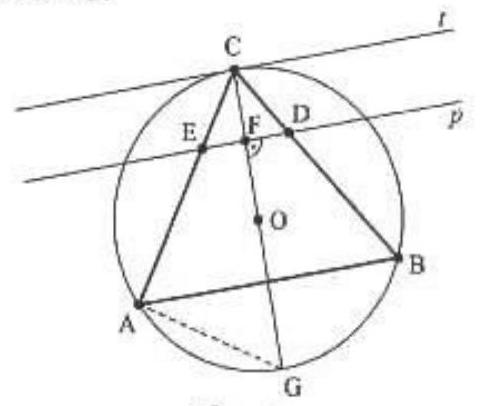
|
| 201 |
+
|
| 202 |
+
Figure
|
| 203 |
+
|
| 204 |
+
## G2 MLD
|
| 205 |
+
|
| 206 |
+
The point $P$ is outside of the circle $\Omega$. Two tangent lines, passing from the point $P$, touch the circle $\Omega$ at the points $A$ and $B$. The median $A M, M \in(B P)$, intersects the circle $\Omega$ at the point $C$ and the line $P C$ intersects again the circle $\Omega$ at the point $D$. Prove that the lines $A D$ and $B P$ are parallel.
|
| 207 |
+
|
| 208 |
+
## Solution:
|
| 209 |
+
|
| 210 |
+
Since $\angle B A C=\angle B A M=\angle M B C$, we have $\triangle M A B \cong \triangle M B C$.
|
| 211 |
+
|
| 212 |
+
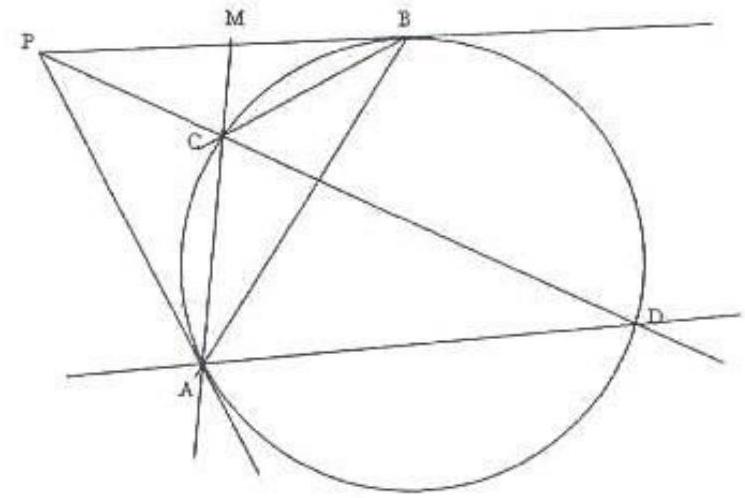
|
| 213 |
+
|
| 214 |
+
We obtain $\frac{M A}{M B}=\frac{M B}{M C}=\frac{A B}{B C}$. The equality $\quad M B=M P$ implies $\frac{M A}{M P}=\frac{M P}{M C}$ and $\angle P M C \equiv \angle P M A$ gives the relation $\triangle P M A \cong \triangle C M P$. It follows that $\angle B P D \equiv \angle M P C \equiv \angle M A P \equiv \angle C A P \equiv \angle C D A \equiv \angle P D A$. So, the lines $A D$ and $B P$ are parallel.
|
| 215 |
+
|
| 216 |
+
## G3 GRE
|
| 217 |
+
|
| 218 |
+
Let $c \equiv c(O, K)$ be a circle with center $O$ and radius $R$ and $A, B$ be two points on it, not belonging to the same diameter. The bisector of the angle $A \hat{B} O$ intersects the circle $c$ at point $C$, the circumcircle of the triangle $A O B$, say ${ }^{c_{1}}$ at point $K$ and the circumcircle of the triangle $A O C$, say ${ }^{c_{2}}$, at point $L$. Prove that the point $K$ is the circumcenter of the triangle $A O C$ and the point $L$ is the incenter of the triangle $A O B$.
|
| 219 |
+
|
| 220 |
+
## Solution:
|
| 221 |
+
|
| 222 |
+
The segments $O B, O C$ are equal, as radii of the circle ${ }^{c}$. Hence $O B C$ is an isosceles triangle and
|
| 223 |
+
|
| 224 |
+
$$
|
| 225 |
+
\hat{B}_{1}=\hat{C}_{1}=\hat{x}
|
| 226 |
+
$$
|
| 227 |
+
|
| 228 |
+
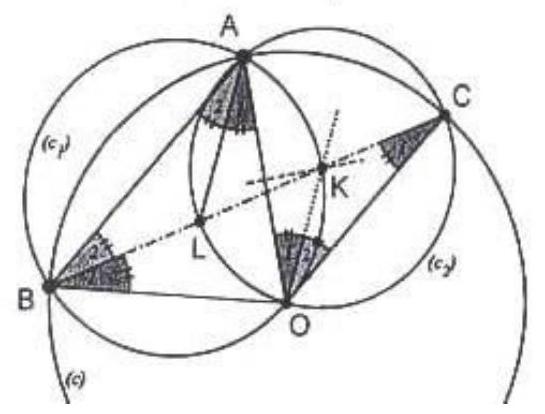
|
| 229 |
+
|
| 230 |
+
The chord $B C$ is the bisector of the angle $O \hat{B} A$, and hence
|
| 231 |
+
|
| 232 |
+
$$
|
| 233 |
+
\hat{B}_{1}=\hat{B}_{2}=\hat{x}
|
| 234 |
+
$$
|
| 235 |
+
|
| 236 |
+
The angles $\hat{B}_{2}$ and $\hat{O}_{1}$ are inscribed to the same arc $O K$ of the circle ${ }^{c_{1}}$ and hence
|
| 237 |
+
|
| 238 |
+
$$
|
| 239 |
+
\hat{B}_{2}=\hat{\mathrm{O}}_{1}=\hat{x}
|
| 240 |
+
$$
|
| 241 |
+
|
| 242 |
+
The segments $K O, K C$ are equal, as radii of the circle ${ }^{c_{2}}$. Hence the triangle $K O C$ is isosceles and so
|
| 243 |
+
|
| 244 |
+
$$
|
| 245 |
+
\hat{O}_{2}=\hat{C}_{1}=\hat{x}
|
| 246 |
+
$$
|
| 247 |
+
|
| 248 |
+
From equalities $(1),(2),(3)$ we conclude that
|
| 249 |
+
|
| 250 |
+
$$
|
| 251 |
+
\hat{O}_{1}=\hat{O}_{2}=\hat{x}
|
| 252 |
+
$$
|
| 253 |
+
|
| 254 |
+
and so $O K$ is the bisector, and hence perpendicular bisector of the isosceles triangle $O A C$. The point $K$ is the middle of the arc $O K$ (since $B K$ bisects the angle $O \hat{B} A$ ). Hence the perpendicular bisector of the chord $A O$ of the circle ${ }^{c_{1}}$ is passing through point $K$. It means that $K$ is the circumcenter of the triangle $O A C$.
|
| 255 |
+
|
| 256 |
+
From equalities (1),(2),(3) we conclude that $\hat{B}_{2}=\hat{C}_{1}=\hat{x}$ and so $A B / / O C \Rightarrow O \hat{A} B=A \hat{O} C$, that is $\hat{A}_{1}+\hat{A}_{2}=\hat{O}_{1}+\hat{O}_{2}$ and since $\hat{O}_{1}=\hat{O}_{2}=\hat{x}$, we conclude that
|
| 257 |
+
|
| 258 |
+
$$
|
| 259 |
+
\hat{A}_{1}+\hat{A}_{2}=2 \hat{O}_{1}=2 \hat{x}
|
| 260 |
+
$$
|
| 261 |
+
|
| 262 |
+
The angles $\hat{A}_{I}$ and $\hat{C}_{I}$ are inscribed into the circle ${ }^{c_{2}}$ and correspond to the same arc $O L$. Hence
|
| 263 |
+
|
| 264 |
+
$$
|
| 265 |
+
\hat{A}_{I}=\hat{C}_{1}=\hat{x}
|
| 266 |
+
$$
|
| 267 |
+
|
| 268 |
+
From (5) and (6) we have $\hat{A}_{1}=\hat{A}_{2}$, i.e. $A L$ is the bisector of the angle $B \hat{A} O$.
|
| 269 |
+
|
| 270 |
+
G4
|
| 271 |
+
|
| 272 |
+
CYP
|
| 273 |
+
|
| 274 |
+
Let $\triangle A B C$ be an acute triangle. The lines $\left(\varepsilon_{1}\right),\left(\varepsilon_{2}\right)$ are perpendicular to $A B$ at the points $A$, $B$, respectively. The perpendicular lines from the midpoint $M$ of $A B$ to the sides of the triangle $A C_{;} B C$ intersect the lines $\left(\varepsilon_{1}\right),\left(\xi_{2}\right)$ at the points $E, F$, respectively. If $I$ is the intersection point of $E F, M C$, prove that
|
| 275 |
+
|
| 276 |
+
$$
|
| 277 |
+
\angle A I B=\angle E M F=\angle C A B+\angle C B A
|
| 278 |
+
$$
|
| 279 |
+
|
| 280 |
+
## Solution:
|
| 281 |
+
|
| 282 |
+
Let $H, G$ be the points of intersection of $M E, M F$, with $A C, B C$ respectively. From the similarity of triangles $\triangle M H A$ and $\triangle M A E$ we get
|
| 283 |
+
|
| 284 |
+
$$
|
| 285 |
+
\frac{M H}{M A}=\frac{M A}{M E}
|
| 286 |
+
$$
|
| 287 |
+
|
| 288 |
+
thus, $M A^{2}=M H \cdot M E$
|
| 289 |
+
|
| 290 |
+
Similarly, from the similarity of triangles $\triangle M B G$ and $\triangle M F B$ we get
|
| 291 |
+
|
| 292 |
+
$$
|
| 293 |
+
\frac{M B}{M F}=\frac{M G}{M B}
|
| 294 |
+
$$
|
| 295 |
+
|
| 296 |
+
thus, $M B^{2}=M F \cdot M G$
|
| 297 |
+
|
| 298 |
+
Since $M A=M B$, from (1), (2), we have that the points $E, H, G, F$ are concyclic.
|
| 299 |
+
|
| 300 |
+
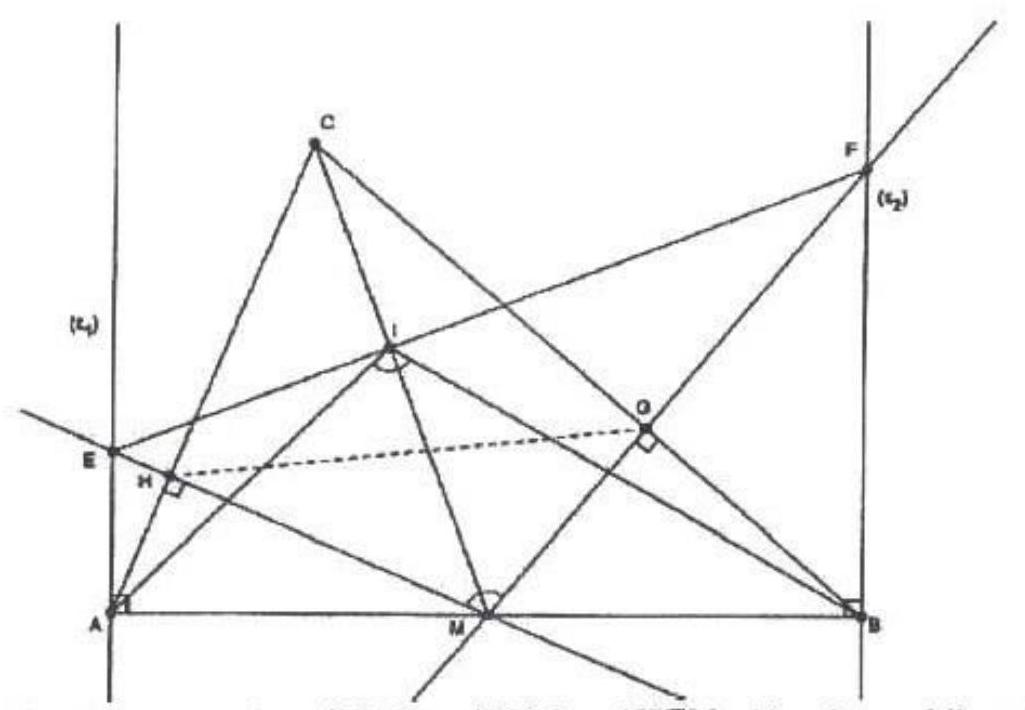
|
| 301 |
+
|
| 302 |
+
Therefore, we get that $\angle F E H=\angle F E M=\angle H G M$. Also, the quadrilateral $C H M G$ is cyclic, so $\angle C M H=\angle H G C$. We have
|
| 303 |
+
|
| 304 |
+
$$
|
| 305 |
+
\angle F E H+\angle C M H=\angle H G M+\angle H G C=90^{\circ}
|
| 306 |
+
$$
|
| 307 |
+
|
| 308 |
+
Thus $C M \perp E F$. Now, from the cyclic quadrilaterals $F I M B$ and EIMA, we get that
|
| 309 |
+
|
| 310 |
+
$\angle I F M=\angle I B M$ and $\angle I E M=\angle I A M$. Therefore, the triangles $\triangle E M F$ and $\triangle A I B$ are similar, so $\angle A J B=\angle E M F$. Finally
|
| 311 |
+
|
| 312 |
+
$$
|
| 313 |
+
\angle A I B=\angle A I M+\angle M I B=\angle A E M+\angle M F B=\angle C A B+\angle C B A
|
| 314 |
+
$$
|
| 315 |
+
|
| 316 |
+
G5 ROU
|
| 317 |
+
|
| 318 |
+
Let $A B C$ be an acute triangle with $A B \neq A C$. The incircle $\omega$ of the triangle touches the sides $B C, C A$ and $A B$ at $D, E$ and $F$, respectively. The perpendicular line erected at $C$ onto $B C$ meets $E F$ at $M$, and similarly, the perpendicular line erected at $B$ onto $B C$ meets $E F$ at $N$. The line $D M$ meets $\omega$ again in $P$, and the line $D N$ meets $\omega$ again at $Q$. Prove that $D P=D Q$.
|
| 319 |
+
|
| 320 |
+
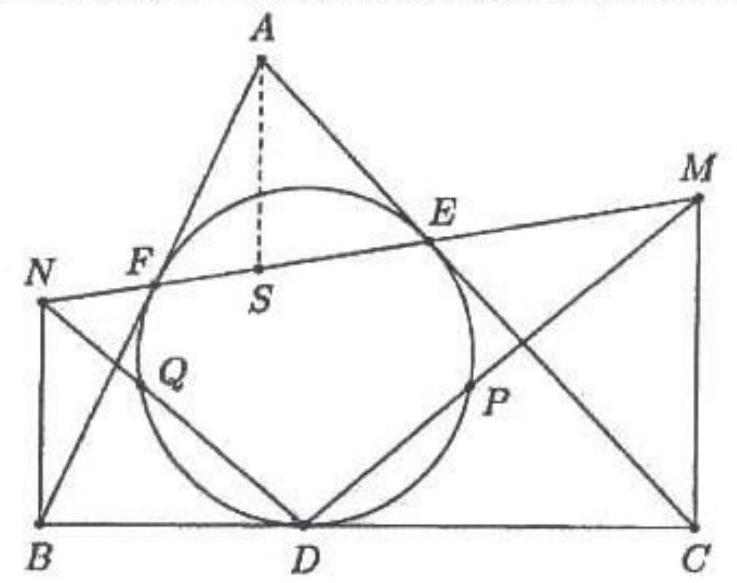
|
| 321 |
+
|
| 322 |
+
## Solution:
|
| 323 |
+
|
| 324 |
+
## Proof 1.1.
|
| 325 |
+
|
| 326 |
+
Let $\{T\}=E F \cap B C$. Applying Menelaus' theorem to the triangle $A B C$ and the transversal line $E-F-T$ we obtain $\frac{T B}{T C} \cdot \frac{E C}{E A} \cdot \frac{F A}{F B}=1$, i.e. $\frac{T B}{T C} \cdot \frac{s-c}{s-a} \cdot \frac{s-a}{s-b}=1$, or $\frac{T B}{T C}=\frac{s-b}{s-c}$, where the notations are the usual ones.
|
| 327 |
+
|
| 328 |
+
This means that triangles $T B N$ and $T C M$ are similar, therefore $\frac{T B}{T C}=\frac{B N}{C M}$. From the above it follows $\frac{B N}{C M}=\frac{s-b}{s-c}, \frac{B D}{C D}=\frac{s-b}{s-c}$, and $\angle D B N=\angle D C M=90^{\circ}$, which means that triangles $B D N$ and $C D M$ are similar, hence angles $B D N$ and $C D M$ are equal. This leads to the arcs $D Q$ and $D P$ being equal, and finally to $D P=D Q$.
|
| 329 |
+
|
| 330 |
+
## Proof 1.2.
|
| 331 |
+
|
| 332 |
+
Let $S$ be the meeting point of the altitude from $A$ with the line $E F$. Lines $B N, A S, C M$ are parallel, therefore triangles $B N F$ and $A S F$ are similar, as are triangles $A S E$ and $C M E$. We obtain $\frac{B N}{A S}=\frac{B F}{F A}$ and $\frac{A S}{C M}=\frac{A E}{E C}$.
|
| 333 |
+
|
| 334 |
+
Multiplying the two relations, we obtain $\frac{B N}{C M}=\frac{B F}{F A} \cdot \frac{A E}{E C}=\frac{B F}{E C}=\frac{B D}{D C}$ (we have used that $A E=A F, B F=B D$ and $C E=C D)$.
|
| 335 |
+
|
| 336 |
+
It follows that the right triangles $B D N$ and $C D M$ are similar (SAS), which leads to the same ending as in the first proof.
|
| 337 |
+
|
| 338 |
+
## NUMBER THEORY
|
| 339 |
+
|
| 340 |
+
NT1 SAU
|
| 341 |
+
|
| 342 |
+
What is the greatest number of integers that can be selected from a set of 2015 consecutive numbers so that no sum of any two selected numbers is divisible by their difference?
|
| 343 |
+
|
| 344 |
+
## Solution:
|
| 345 |
+
|
| 346 |
+
We take any two chosen numbers. If their difference is 1 , it is clear that their sum is divisible by their difference. If their difference is 2 , they will be of the same parity, and their sum is divisible by their difference. Therefore, the difference between any chosen numbers will be at least 3 . In other words, we can choose at most one number of any three consecutive numbers. This implies that we can choose at most 672 numbers.
|
| 347 |
+
|
| 348 |
+
Now, we will show that we can choose 672 such numbers from any 2015 consecutive numbers. Suppose that these numbers are $a, a+1, \ldots, a+2014$. If $a$ is divisible by 3 , we can choose $a+1, a+4, \ldots, a+2014$. If $a$ is not divisible by 3 , we can choose $a, a+3, \ldots, a+$ 2013.
|
| 349 |
+
|
| 350 |
+
NT2 BUL
|
| 351 |
+
|
| 352 |
+
A positive integer is called a repunit, if it is written only by ones. The repunit with $n$ digits will be denoted by $\underbrace{11 \ldots 1}_{n}$. Prove that:
|
| 353 |
+
|
| 354 |
+
a) the repunit $\underbrace{11 \ldots 1}_{n}$ is divisible by 37 if and only if $n$ is divisible by 3 ;
|
| 355 |
+
|
| 356 |
+
b) there exists a positive integer $k$ such that the repunit $\underbrace{11 \ldots 1}_{n}$ is divisible by 41 if and only if $n$ is divisible by $k$.
|
| 357 |
+
|
| 358 |
+
## Solution:
|
| 359 |
+
|
| 360 |
+
a) Let $n=3 m+r$, where $m$ and $r$ are non-negative integers and $r<3$.
|
| 361 |
+
|
| 362 |
+
Denote by $\underbrace{00 \ldots 0}_{p}$ a recording with $p$ zeroes and $\underbrace{a b c a b c \ldots a b c}_{p x a b c c}$ recording with $p$ times $a b c$. We
|
| 363 |
+
|
| 364 |
+
have: $\quad \underbrace{11 \ldots 1}_{n}=\underbrace{11 \ldots 1}_{3 m+r}=\underbrace{11 \ldots 1}_{3 m} \cdot \underbrace{00 \ldots 0}_{r}+\underbrace{11 \ldots 1}_{\tau}=111 \cdot \underbrace{100100 \ldots 100100 \ldots 0}_{(m-1) \times 100}+\underbrace{11 \ldots 1}_{r}$.
|
| 365 |
+
|
| 366 |
+
Since $111=37.3$, the numbers $\underbrace{11 \ldots 1}_{n}$ and $\underbrace{11 \ldots 1}_{r}$ are equal modulo 37 . On the other hand the numbers 1 and 11 are not divisible by 37 . We conclude that $\underbrace{11 \ldots 1}_{n}$ is divisible by 37 if only if $r=0$, i.e. if and only if $n$ is divisible by 3 .
|
| 367 |
+
|
| 368 |
+
b) Using the idea from a), we look for a repunit, which is divisible by 41 . Obviously, 1 and 11 are not divisible by 41 , while the residues of 111 and 1111 are 29 and 4 , respectively. We have $11111=41 \cdot 271$. Since 11111 is a repunit with 5 digits, it follows in the same way as in a) that $\underbrace{1}_{11 \ldots 1}$ is divisible by 41 if and only if $n$ is divisible by 5 .
|
| 369 |
+
|
| 370 |
+
## NT3 ALB
|
| 371 |
+
|
| 372 |
+
a) Show that the product of all differences of possible couples of six given positive integers is divisible by 960 (original from Albania).
|
| 373 |
+
|
| 374 |
+
b) Show that the product of all differences of possible couples of six given positive integers. is divisible by 34560 (modified by problem selecting committee).
|
| 375 |
+
|
| 376 |
+
## Solution:
|
| 377 |
+
|
| 378 |
+
a) Since we have six numbers then at least two of them have a same residue when divided by 3 , so at least one of the differences in our product is divisible by 3 .
|
| 379 |
+
|
| 380 |
+
Since we have six numbers then at least two of them have a same residuc when divided by 5 , so at least one of the differences in our product is divisible by 5 .
|
| 381 |
+
|
| 382 |
+
We may have:
|
| 383 |
+
|
| 384 |
+
a) six numbers with the same parity
|
| 385 |
+
|
| 386 |
+
b) five numbers with the same parity
|
| 387 |
+
|
| 388 |
+
c) four numbers with the same parity
|
| 389 |
+
|
| 390 |
+
d) three numbers with the same parity
|
| 391 |
+
|
| 392 |
+
There are $C_{6}^{2}=15$ different pairs, so there are 15 different differences in this product.
|
| 393 |
+
|
| 394 |
+
a) The six numbers have the same parity; then each difference is divisible by 2 , therefore our product is divisible by $2^{15}$.
|
| 395 |
+
b) If we have five numbers with the same parity, then the couples that have their difference odd are formed by taking one number from these five numbers, and the second will be the sixth one. Then $C_{5}^{1}=15=5$ differences are odd. So $15-5=10$ differences are even, so product is divisible by $2^{10}$.
|
| 396 |
+
|
| 397 |
+
c) If we have four numbers with the same parity, then the couples that have their difference odd are formed by taking one number from these four numbers, and the second will be from the two others numbers. Then $2 \cdot C_{4}^{1}=8$ differences are odd. So $15-8=7$ differences are even, so our product is divisible by $2^{7}$.
|
| 398 |
+
|
| 399 |
+
d) If we have three numbers with the same parity, then the couples that have their difference odd are formed by taking one from each triple. Then $C_{3}^{1} \cdot C_{3}^{1}=9$ differences are odd, therefore $15-9=6$ differences are even, so our product is divisible by $2^{6}$.
|
| 400 |
+
|
| 401 |
+
Thus, our production is divisible by $2^{6} \cdot 3 \cdot 5=960$.
|
| 402 |
+
|
| 403 |
+
b) Let $a_{1}, a_{2}, a_{3}, a_{4}, a_{5}, a_{6}$ be these numbers. Since we have six numbers then at least two of them when divided by 5 have the same residue, so at least one of these differences in our product is divisible by 5 .
|
| 404 |
+
|
| 405 |
+
Since we have six numbers, and we have three possible residues at the division by 3 , then at least three of them replies the residue of previous numbers, so at least three of these differences in our product are divisible by 3 .
|
| 406 |
+
|
| 407 |
+
Since we have six numbers, and we have two possible residues at the division by 2 , then at least four of them replies the residue of previous numbers, and two of them replies replied residues, so at least six of these differences in our product are divisible by 2 .
|
| 408 |
+
|
| 409 |
+
Since we have six numbers, and we have four possible residues at the division by 4 , then at least two of them replies the residue of previous numbers, so at least two of these differences in our product are divisible by 4 . That means that two of these differences are divisible by 4 and moreover four of them are divisible by 2 .
|
| 410 |
+
|
| 411 |
+
Thus, our production is divisible by $2^{4} \cdot 4^{2} \cdot 3^{3} \cdot 5=34560$.
|
| 412 |
+
|
| 413 |
+
NT4 MLD
|
| 414 |
+
|
| 415 |
+
|
| 416 |
+
|
| 417 |
+
Find all prime numbers $a, b, c$ and integers $k$ which satisfy the equation $a^{2}+b^{2}+16 \cdot c^{2}=9 \cdot k^{2}+1$.
|
| 418 |
+
|
| 419 |
+
## Solution:
|
| 420 |
+
|
| 421 |
+
The relation $9 \cdot k^{2}+1 \equiv 1(\bmod 3)$ implies
|
| 422 |
+
|
| 423 |
+
$$
|
| 424 |
+
a^{2}+b^{2}+16 \cdot c^{2} \equiv 1(\bmod 3) \Leftrightarrow a^{2}+b^{2}+c^{2} \equiv 1(\bmod 3)
|
| 425 |
+
$$
|
| 426 |
+
|
| 427 |
+
Since $a^{2} \equiv 0,1(\bmod 3), b^{2} \equiv 0,1(\bmod 3), c^{2} \equiv 0,1(\bmod 3)$, we have:
|
| 428 |
+
|
| 429 |
+
| $a^{2}$ | 0 | 0 | 0 | 0 | 1 | 1 | 1 | 1 |
|
| 430 |
+
| :--- | :--- | :--- | :--- | :--- | :--- | :--- | :--- | :--- |
|
| 431 |
+
| $b^{2}$ | 0 | 0 | 1 | 1 | 0 | 0 | 1 | 1 |
|
| 432 |
+
| $c^{2}$ | 0 | 1 | 0 | 1 | 0 | 1 | 0 | 1 |
|
| 433 |
+
| $a^{2}+b^{2}+c^{2}$ | 0 | 1 | 1 | 2 | 1 | 2 | 2 | 0 |
|
| 434 |
+
|
| 435 |
+
From the previous table it follows that two of three prime numbers $a, b, c$ are equal to 3 .
|
| 436 |
+
|
| 437 |
+
Case 1. $a=b=3$. We have
|
| 438 |
+
|
| 439 |
+
$$
|
| 440 |
+
a^{2}+b^{2}+16 \cdot c^{2}=9 \cdot k^{2}+1 \Leftrightarrow 9 \cdot k^{2}-16 \cdot c^{2}=17 \Leftrightarrow(3 k-4 c) \cdot(3 k+4 c)=17
|
| 441 |
+
$$
|
| 442 |
+
|
| 443 |
+
If $\left\{\begin{array}{l}3 k-4 c=1, \\ 3 k+4 c=17,\end{array}\right.$ then $\left\{\begin{array}{l}c=2, \\ k=3,\end{array}\right.$ and $(a, b, c, k)=(3,3,2,3)$.
|
| 444 |
+
|
| 445 |
+
If $\left\{\begin{array}{l}3 k-4 c=-17, \\ 3 k+4 c=-1,\end{array}\right.$ then $\left\{\begin{array}{l}c=2, \\ k=-3,\end{array}\right.$ and $(a, b, c, k)=(3,3,2,-3)$.
|
| 446 |
+
|
| 447 |
+
Case 2. $c=3$. If $\left(3, b_{0}, c, k\right)$ is a solution of the given equation, then $\left(b_{0}, 3, c, k\right)$ is a solution, too.
|
| 448 |
+
|
| 449 |
+
Let $a=3$. We have
|
| 450 |
+
|
| 451 |
+
$$
|
| 452 |
+
a^{2}+b^{2}+16 \cdot c^{2}=9 \cdot k^{2}+1 \Leftrightarrow 9 \cdot k^{2}-b^{2}=152 \Leftrightarrow(3 k-b) \cdot(3 k+b)=152 .
|
| 453 |
+
$$
|
| 454 |
+
|
| 455 |
+
Both factors shall have the same parity and we obtain only 4 cases:
|
| 456 |
+
|
| 457 |
+
If $\left\{\begin{array}{l}3 k-b=2, \\ 3 k+b=76,\end{array}\right.$ then $\left\{\begin{array}{l}b=37, \\ k=13,\end{array}\right.$ and $(a, b, c, k)=(3,37,3,13)$.
|
| 458 |
+
|
| 459 |
+
If $\left\{\begin{array}{l}3 k-b=4, \\ 3 k+b=38,\end{array}\right.$ then $\left\{\begin{array}{l}b=17, \\ k=7,\end{array}\right.$ and $(a, b, c, k)=(3,17,3,7)$.
|
| 460 |
+
|
| 461 |
+
If $\left\{\begin{array}{l}3 k-b=-76, \\ 3 k+b=-2,\end{array}\right.$, .
|
| 462 |
+
|
| 463 |
+
If $\left\{\begin{array}{l}3 k-b=-38, \\ 3 k+b=-4,\end{array}\right.$ then $\left\{\begin{array}{l}b=17, \\ k=-7,\end{array}\right.$ and $(a, b, c, k)=(3,17,3,-7)$.
|
| 464 |
+
|
| 465 |
+
In addition, $(a, b, c, k) \in\{(37,3,3,13),(17,3,3,7),(37,3,3,-13),(17,3,3,-7)\}$.
|
| 466 |
+
|
| 467 |
+
So, the given equation has 10 solutions:
|
| 468 |
+
|
| 469 |
+
$S=\left\{\begin{array}{l}(37,3,3,13),(17,3,3,7),(37,3,3,-13),(17,3,3,-7),(3,37,3,13),(3,17,3,7),(3,37,3,-13), \\ (3,17,3,-7),(3,3,2,3),(3,3,2,-3)\end{array}\right\}$
|
| 470 |
+
|
| 471 |
+
## NT5 MNE
|
| 472 |
+
|
| 473 |
+
Does there exist positive integers $a, b$ and a prime $p$ such that
|
| 474 |
+
|
| 475 |
+
$$
|
| 476 |
+
a^{3}-b^{3}=4 p^{2} ?
|
| 477 |
+
$$
|
| 478 |
+
|
| 479 |
+
## Solution:
|
| 480 |
+
|
| 481 |
+
The given equality may be written as
|
| 482 |
+
|
| 483 |
+
$$
|
| 484 |
+
(a-b)\left(a^{2}+a b+b^{2}\right)=4 p^{2}
|
| 485 |
+
$$
|
| 486 |
+
|
| 487 |
+
Since $a-b<a^{2}+a b+b^{2}$, it follows from (1) that
|
| 488 |
+
|
| 489 |
+
(2) $a-b<2 p$.
|
| 490 |
+
|
| 491 |
+
Now consider two cases: 1. $p=2$, and 2. $p$ is an odd prime.
|
| 492 |
+
|
| 493 |
+
Case 1: $p=2$. Then (1) becomes
|
| 494 |
+
|
| 495 |
+
(3) $(a-b)\left(a^{2}+a b+b^{2}\right)=16$ :
|
| 496 |
+
|
| 497 |
+
In view of (2) and (3), it must be $a-b=1$ or $a-b=2$. If $a-b=1$, then substituting $a=b+1$
|
| 498 |
+
|
| 499 |
+
in (3) we obtain
|
| 500 |
+
|
| 501 |
+
$$
|
| 502 |
+
b(b+1)=5
|
| 503 |
+
$$
|
| 504 |
+
|
| 505 |
+
which is impossible since $b(b+1)$ is an even integer.
|
| 506 |
+
|
| 507 |
+
If $a-b=2$, then substituting $a=b+2$ in (3) we get
|
| 508 |
+
|
| 509 |
+
$$
|
| 510 |
+
3 b(b+2)=4
|
| 511 |
+
$$
|
| 512 |
+
|
| 513 |
+
which is obviously impossible.
|
| 514 |
+
|
| 515 |
+
Case 2: $\mathrm{p}$ is an odd prime. Then (1) yields $a-b \mid 4 p^{2}$. This together with the facts that
|
| 516 |
+
|
| 517 |
+
$p$ is a prime and that by (2) $a-b<2 p$, yields $a-b \in\{1,2,4, p\}$.
|
| 518 |
+
|
| 519 |
+
If $a-b=1$, then substituting $a=b+1$ in (1) we obtain
|
| 520 |
+
|
| 521 |
+
$$
|
| 522 |
+
3 b(b+1)+1=4 p^{2}
|
| 523 |
+
$$
|
| 524 |
+
|
| 525 |
+
which is impossible since $3 b(b+1)+1$ is an odd integer.
|
| 526 |
+
|
| 527 |
+
If $a-b=2$, then substituting $a=b+2$ in (1) we obtain
|
| 528 |
+
|
| 529 |
+
$$
|
| 530 |
+
3 b^{2}+6 b+4=2 p^{2}
|
| 531 |
+
$$
|
| 532 |
+
|
| 533 |
+
whence it follows that
|
| 534 |
+
|
| 535 |
+
$$
|
| 536 |
+
2\left(p^{2}-2\right)=3\left(b^{2}+2 b\right) \equiv 0(\bmod 3)
|
| 537 |
+
$$
|
| 538 |
+
|
| 539 |
+
and hence
|
| 540 |
+
|
| 541 |
+
$$
|
| 542 |
+
p^{2} \equiv 2(\bmod 3)
|
| 543 |
+
$$
|
| 544 |
+
|
| 545 |
+
Since $p^{2} \equiv 1(\bmod 3)$ for each odd prime $p>3$ and $3^{2} \equiv 0(\bmod 3)$, it follows that the congruence (5) is not satisfied for any odd prime $p$.
|
| 546 |
+
|
| 547 |
+
If $a-b=4$, then substituting $a=b+4$ in (1) we obtain
|
| 548 |
+
|
| 549 |
+
$$
|
| 550 |
+
3 b^{2}+12 b+16=p^{2}
|
| 551 |
+
$$
|
| 552 |
+
|
| 553 |
+
whence it follows that $b$ is an odd integer such that
|
| 554 |
+
|
| 555 |
+
$$
|
| 556 |
+
3 b^{2} \equiv p^{2}(\bmod 4)
|
| 557 |
+
$$
|
| 558 |
+
|
| 559 |
+
whence since $p^{2} \equiv 1(\bmod 4)$ for each odd prime $p$, we have
|
| 560 |
+
|
| 561 |
+
$$
|
| 562 |
+
3 b^{2} \equiv 1(\bmod 4)
|
| 563 |
+
$$
|
| 564 |
+
|
| 565 |
+
However, since $b^{2} \equiv 1(\bmod 4)$ for each odd integer $b$, it follows that the congruence (6) is not satisfied for any odd integer $b$.
|
| 566 |
+
|
| 567 |
+
If $a-b=p$, then substituting $a=b+p$ in (1) we obtain
|
| 568 |
+
|
| 569 |
+
$$
|
| 570 |
+
p\left(3 b^{2}+3 b p+p^{2}-4 p\right)=0
|
| 571 |
+
$$
|
| 572 |
+
|
| 573 |
+
i.e.,
|
| 574 |
+
|
| 575 |
+
(7)
|
| 576 |
+
|
| 577 |
+
$$
|
| 578 |
+
3 b^{2}+3 b p+p^{2}-4 p=0
|
| 579 |
+
$$
|
| 580 |
+
|
| 581 |
+
If $p \geq 5$, then $p^{2}-4 p>0$, and thus (7) cannot be satisfied for any positive integer $b$. If $p=3$, then $(7)$ becomes
|
| 582 |
+
|
| 583 |
+
$$
|
| 584 |
+
3\left(b^{2}+3 b-1\right)=0
|
| 585 |
+
$$
|
| 586 |
+
|
| 587 |
+
which is obviously not satisfied for any positive integer $b$.
|
| 588 |
+
|
| 589 |
+
Hence, there does not exist positive integers $a, b$ and a prime $p$ such that $a^{3}-b^{3}=4 p^{2}$.
|
| 590 |
+
|
| 591 |
+
## COMBINATORICS
|
| 592 |
+
|
| 593 |
+
## C1 BUL
|
| 594 |
+
|
| 595 |
+
A board $n \times n(n \geq 3)$ is divided into $n^{2}$ unit squares. Integers from 0 to $n$ included are written down: one integer in each unit square, in such a way that the sums of integers in each $2 \times 2$ square of the board are different. Find all $n$ for which such boards exist.
|
| 596 |
+
|
| 597 |
+
## Solution:
|
| 598 |
+
|
| 599 |
+
The number of the $2 \times 2$ squares in a board $n \times n$ is equal to $(n-1)^{2}$. All possible sums of the numbers in such squares are $0,1, \ldots, 4 n$. A necessary condition for the existence of a board with the required property is $4 n+1 \geq(n-1)^{2}$ and consequently $n(n-6) \leq 0$. Thus $n \leq 6$. The examples show the existence of boards $n \times n$ for all $3 \leq n \leq 6$.
|
| 600 |
+
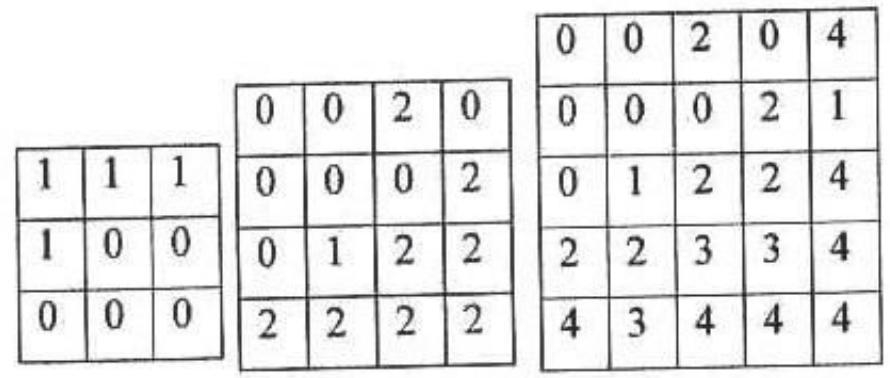
|
| 601 |
+
|
| 602 |
+
| 6 | 6 | 6 | 6 | 5 | 5 |
|
| 603 |
+
| :--- | :--- | :--- | :--- | :--- | :--- |
|
| 604 |
+
| 6 | 6 | 5 | 5 | 5 | 5 |
|
| 605 |
+
| 1 | 2 | 3 | 4 | 4 | 5 |
|
| 606 |
+
| 3 | 5 | 0 | 5 | 0 | 5 |
|
| 607 |
+
| 1 | 0 | 2 | 1 | 0 | 0 |
|
| 608 |
+
| 1 | 0 | 1 | 0 | 0 | 0 |
|
| 609 |
+
|
| 610 |
+
|
| 611 |
+
|
| 612 |
+
2015 points are given in a plane such that from any five points we can choose two points with distance less than 1 unit. Prove that 504 of the given points lie on a unit disc.
|
| 613 |
+
|
| 614 |
+
## Solution:
|
| 615 |
+
|
| 616 |
+
Start from an arbitrary point $A$ and draw a unit disc with center $A$. If all other points belong to this dise then we are done. Otherwise, take any point $B$ outside of the disc. Draw a unit disc with center $B$. If two drawn discs cover all 2015 points, by PHP, one of the discs contains at least 1008 points.
|
| 617 |
+
|
| 618 |
+
Suppose that there is a point $C$ outside of the two drawn discs. Draw a unit disc with center $C$, If three drawn discs cover all 2015 points, by PHP, one of the discs contains at least 672 points.
|
| 619 |
+
|
| 620 |
+
Finally, if there is a point $D$ outside of the three drawn discs, draw a unit disc with center $D$. By the given condition, any other point belongs to one of the four drawn discs. By PHP, one of the discs contains at least 504 points, concluding the solution.
|
| 621 |
+
|
| 622 |
+
## C3 ALB
|
| 623 |
+
|
| 624 |
+
Positive integers are put into the following table
|
| 625 |
+
|
| 626 |
+
| 1 | 3 | 6 | 10 | 15 | 21 | 28 | 36 | | |
|
| 627 |
+
| ---: | ---: | ---: | ---: | ---: | ---: | ---: | ---: | ---: | ---: |
|
| 628 |
+
| 2 | 5 | 9 | 14 | 20 | 27 | 35 | 44 | | |
|
| 629 |
+
| 4 | 8 | 13 | 19 | 26 | 34 | 43 | 53 | | |
|
| 630 |
+
| 7 | 12 | 18 | 25 | 33 | 42 | | | | |
|
| 631 |
+
| 11 | 17 | 24 | 32 | 41 | | | | | |
|
| 632 |
+
| 16 | 23 | | | | | | | | |
|
| 633 |
+
| $\ldots$ | | | | | | | | | |
|
| 634 |
+
| $\ldots$ | | | | | | | | | |
|
| 635 |
+
|
| 636 |
+
Find the number of the line and column where the number 2015 stays.
|
| 637 |
+
|
| 638 |
+
## Solution 1:
|
| 639 |
+
|
| 640 |
+
We shall observe straights lines as on the next picture. We can call these lines diagonals.
|
| 641 |
+
|
| 642 |
+
| 1 | $\sqrt{3}$ | 6 | 10 | 15 | 21 | 28 | 36 | |
|
| 643 |
+
| :---: | :---: | :---: | :---: | :---: | :---: | :---: | :---: | :---: |
|
| 644 |
+
| 2 | 5 | 9 | 14 | 20 | 27 | 35 | 44 | |
|
| 645 |
+
| 4 | 8 | 13 | 19 | 26 | 34 | 43 | 53 | |
|
| 646 |
+
| | 12 | 18 | 25 | 33 | 42 | | | |
|
| 647 |
+
| 11 | 17 | 24 | 32 | 41 | | | | |
|
| 648 |
+
|
| 649 |
+

|
| 650 |
+
|
| 651 |
+
On the first diagonal is number 1 .
|
| 652 |
+
|
| 653 |
+
On the second diagonal are two numbers: 2 and 3 .
|
| 654 |
+
|
| 655 |
+
On the 3rd diagonal are three numbers: 4,5 and 6
|
| 656 |
+
|
| 657 |
+
.
|
| 658 |
+
|
| 659 |
+
On the $n$-th diagonal are $n$ numbers. These numbers are greater then $\frac{(n-1) n}{2}$ and not greater than $\frac{n(n+1)}{2}$ (see the next sentence!).
|
| 660 |
+
|
| 661 |
+
On the first $n$ diagonals are $1+2+3+\ldots+n=\frac{n(n+1)}{2}$ numbers.
|
| 662 |
+
|
| 663 |
+
If $m$ is in the $k$-th row $l$-th column and on the $n$-th diagonal, then it is $m=\frac{(n-1) n}{2}+l$ and $n+1=k+l$. So, $m=\frac{(k+l-2)(k+l-1)}{2}+l$.
|
| 664 |
+
|
| 665 |
+
We have to find such numbers $n, k$ and $l$ for which:
|
| 666 |
+
|
| 667 |
+
$$
|
| 668 |
+
\begin{gathered}
|
| 669 |
+
\frac{(n-1) n}{2}<2015 \leq \frac{n(n+1)}{2} \\
|
| 670 |
+
n+1=k+l \\
|
| 671 |
+
2015=\frac{(k+l-2)(k+l-1)}{2}+l
|
| 672 |
+
\end{gathered}
|
| 673 |
+
$$
|
| 674 |
+
|
| 675 |
+
(1), (2), (3) $\Rightarrow n^{2}-n<4030 \leq n^{2}+n \Rightarrow n=63, k+l=64,2015=\frac{(64-2)(64-1)}{2}+l \Rightarrow$ $t=2015-31 \cdot 63=62, k=64-62=2$
|
| 676 |
+
|
| 677 |
+
Therefore 2015 is located in the second row and 62 -th column.
|
| 678 |
+
|
| 679 |
+
## Solution 2:
|
| 680 |
+
|
| 681 |
+
Firstly, we can see that the first elements of the columns are triangular numbers. If $a_{i}$ is the first element of the line $i$, we have $a_{i}=\frac{i(i-1)}{2}$.
|
| 682 |
+
|
| 683 |
+
The second elements of the first row obtained by adding the first element 2 .
|
| 684 |
+
|
| 685 |
+
The second elements of the second row is obtained by adding the first element 3 .
|
| 686 |
+
|
| 687 |
+
And so on, then the second element on the $n$-th row is obtained by adding the first element $n+1$.
|
| 688 |
+
|
| 689 |
+
Then the third element of the $n$-th row is obtained by adding $n+2$, and the $k$-th element of it is obtained by adding $k$.
|
| 690 |
+
|
| 691 |
+
Since the first element of the n-th row is $\frac{(n-1) n}{2}+1$, the second one is
|
| 692 |
+
|
| 693 |
+
$\frac{(n-1) n}{2}+1+(n+1)=\frac{n(n+1)}{2}+2$.
|
| 694 |
+
|
| 695 |
+
The third one $\frac{n(n+1)}{2}+1+(n+2)=\frac{(n+1)(n+2)}{2}+3$ so the $\mathrm{k}$-th one should be $\frac{(n+k-2)(n+k-1)}{2}+k$
|
| 696 |
+
|
| 697 |
+
$$
|
| 698 |
+
\frac{(n+k-2)(n+k-1)}{2}+k=2015 \Leftrightarrow n^{2}+n(2 k-3)+k^{2}-k-4028=0
|
| 699 |
+
$$
|
| 700 |
+
|
| 701 |
+
To have a positive integer solution $(2 k-3)^{2}-4\left(k^{2}-k-4028\right)=16121-8 k$ must be a perfect square.
|
| 702 |
+
|
| 703 |
+
From $16121-8 k=x^{2}$, it is noticed that the maximum of $x$ is 126 (since $\mathrm{k}>0$ ).
|
| 704 |
+
|
| 705 |
+
Simultaneously can be seen that $\mathrm{x}$ is odd, so $x \leq 125$.
|
| 706 |
+
|
| 707 |
+
$16121-8 k=x^{2} \Leftrightarrow 125^{2}+496-8 k=x^{2}$
|
| 708 |
+
|
| 709 |
+
So $496-8 k=0$, form that $k=62$.
|
| 710 |
+
|
| 711 |
+
From that we can find $n=2$.
|
| 712 |
+
|
| 713 |
+
So 2015 is located on the second row and 62-th column.
|
| 714 |
+
|
| 715 |
+
C4
|
| 716 |
+
|
| 717 |
+
GRE
|
| 718 |
+
|
| 719 |
+
Let $n \geq 1$ be a positive integer. A square of side length $n$ is divided by lines parallel to each side into $n^{2}$ squares of side length 1 . Find the number of parallelograms which have vertices among the vertices of the $n^{2}$ squares of side length 1 , with both sides smaller or equal to 2 , and which have the area equal to 2 .
|
| 720 |
+
|
| 721 |
+
Solution:
|
| 722 |
+
|
| 723 |
+
We can divide all these parallelograms into 7 classes (types I-VII), according to Figure.
|
| 724 |
+
|
| 725 |
+
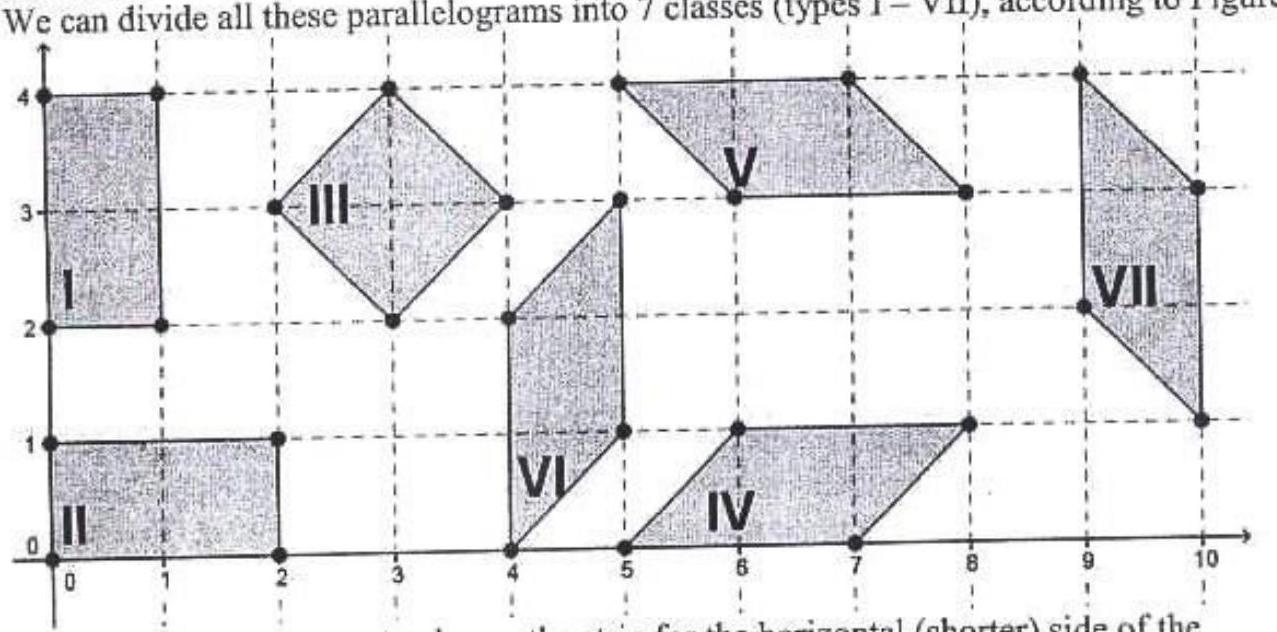
|
| 726 |
+
|
| 727 |
+
Type 1: There are $n$ ways to choose the strip for the horizontal (shorter) side of the parallelogram, and $(n-1)$ ways to choose the strip (of the width 2 ) for the vertical (longer) side. So there are $n(n-1)$ parallelograms of the type I.
|
| 728 |
+
|
| 729 |
+
Type II: There are $(n-1)$ ways to choose the strip (of the width 2 ) for the horizontal (longer) side, and $n$ ways to choose the strip for the vertical (shorter) side. So the number of the parallelogram of this type is also $n(n-1)$.
|
| 730 |
+
|
| 731 |
+
Type III: Each parallelogram of this type is a square inscribed in a unique square $2 \times 2$ of our grid. The number of such squares is $(n-1)^{2}$. So there are $(n-1)^{2}$ parallelograms of type III. For each of the types IV, V, VI, VII, the strip of the width 1 in which the parallelogram is located can be chosen in $n$ ways and for each such choice there are $n-2$ parallelograms located in the chosen strip.
|
| 732 |
+
|
| 733 |
+
Summing we obtain that the total number of parallelograms is:
|
| 734 |
+
|
| 735 |
+
$$
|
| 736 |
+
2 n(n-1)+(n-1)^{2}+4 n(n-2)=7 n^{2}-12 n+1
|
| 737 |
+
$$
|
| 738 |
+
|
| 739 |
+
(C5) CYP
|
| 740 |
+
|
| 741 |
+
We have a $5 \times 5$ chessboard and a supply of $\mathrm{L}$-shaped triominoes, i.e. $2 \times 2$ squares with one comer missing. Two players $A$ and $B$ play the following game: A positive integer $k \leq 25$ is chosen. Starting with $A$, the players take alternating turns marking squares of the chessboard until they mark a total of $k$ squares. (In each turn a player has to mark exactly one new square.)
|
| 742 |
+
|
| 743 |
+
At the end of the process, player $A$ wins if he can cover without overlapping all but at most 2 unmarked squares with $\mathrm{L}$-shaped triominoes, otherwise player $\boldsymbol{B}$ wins. It is not permitted any
|
| 744 |
+
marked squares to be covered.
|
| 745 |
+
|
| 746 |
+
Find the smallest $\boldsymbol{k}$, if it exists, such that player $\boldsymbol{B}$ has a winning strategy.
|
| 747 |
+
|
| 748 |
+
## Solution:
|
| 749 |
+
|
| 750 |
+
We will show that player $A$ wins if $k=1,2$ or 3 , but player $B$ wins if $k=4$. Thus the smallest $k$ for which $B$ has a winning strategy exists and is equal to 4 .
|
| 751 |
+
|
| 752 |
+
If $k=1$, player $A$ marks the upper left corner of the square and then fills it as follows.
|
| 753 |
+
|
| 754 |
+
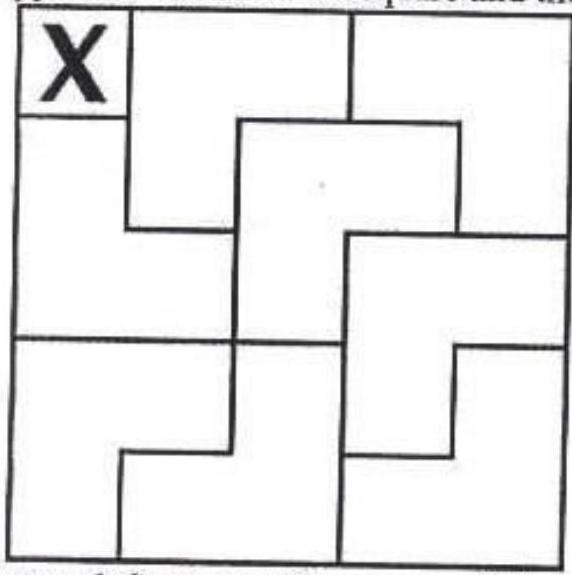
|
| 755 |
+
|
| 756 |
+
If $k=2$, player $A$ marks the upper left comer of the square. Whatever square player $B$ marks, then player $\boldsymbol{A}$ can fill in the square in exactly the same pattern as above except that he doesn't put the triomino which covers the marked square of $B$. Player $A$ wins because he has left only two unmarked squares uncovered.
|
| 757 |
+
|
| 758 |
+
For $k=3$, player $\boldsymbol{A}$ wins by following the same strategy. When he has to mark a square for the second time, he marks any yet unmarked square of the triomino that covers the marked square of $B$.
|
| 759 |
+
|
| 760 |
+
Let us now show that for $k=4$ player $B$ has a wimning strategy. Since there will be 21 unmarked squares, player $\boldsymbol{A}$ will need to cover all of them with seven L-shaped triominoes. We can assume that in his first move, player $\boldsymbol{A}$ does not mark any square in the bottom two rows of the chessboard (otherwise just rotate the chessboard). In his first move player $\boldsymbol{B}$ marks the square labeled 1 in the following figure.
|
| 761 |
+
|
| 762 |
+
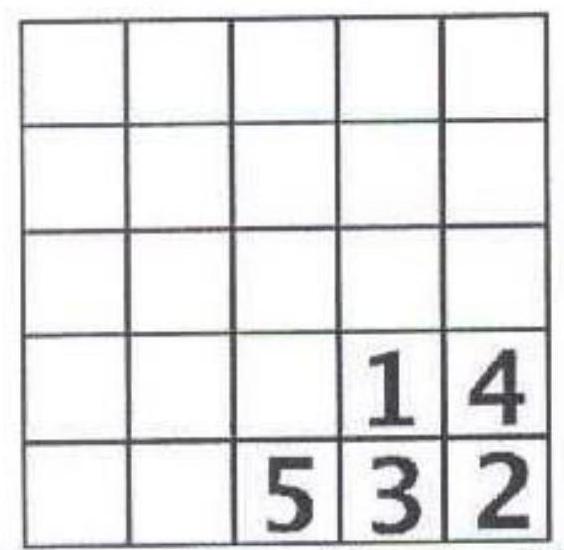
|
| 763 |
+
|
| 764 |
+
If player $\boldsymbol{A}$ in his next move does not mark any of the squares labeled 2,3 and 4 then player $\boldsymbol{B}$ marks the square labeled 3. Player $\boldsymbol{B}$ wins as the square labeled 2 is left unmarked but cannot be covered with an L-shaped triomino.
|
| 765 |
+
|
| 766 |
+
If player $\boldsymbol{A}$ in his next move marks the square labeled 2, then player $\boldsymbol{B}$ marks the square labeled 5 . Player $B$ wins as the square labeled 3 is left unmarked but cannot be covered with an L-shaped triomino.
|
| 767 |
+
|
| 768 |
+
Finally, if player $\boldsymbol{A}$ in his next move marks one of the squares labeled 3 or 4 , player $\boldsymbol{B}$ marks the other of these two squares. Player $\boldsymbol{B}$ wins as the square labeled 2 is left unmarked but cannot be covered with an L-shaped triomino.
|
| 769 |
+
|
| 770 |
+
Since we have covered all possible cases, player $B$ wins when $k=4$.
|
| 771 |
+
|
JBMO/md/en-shortlist/en-shl-jbmo2018.md
ADDED
|
@@ -0,0 +1,1115 @@
|
|
|
|
|
|
|
|
|
|
|
|
|
|
|
|
|
|
|
|
|
|
|
|
|
|
|
|
|
|
|
|
|
|
|
|
|
|
|
|
|
|
|
|
|
|
|
|
|
|
|
|
|
|
|
|
|
|
|
|
|
|
|
|
|
|
|
|
|
|
|
|
|
|
|
|
|
|
|
|
|
|
|
|
|
|
|
|
|
|
|
|
|
|
|
|
|
|
|
|
|
|
|
|
|
|
|
|
|
|
|
|
|
|
|
|
|
|
|
|
|
|
|
|
|
|
|
|
|
|
|
|
|
|
|
|
|
|
|
|
|
|
|
|
|
|
|
|
|
|
|
|
|
|
|
|
|
|
|
|
|
|
|
|
|
|
|
|
|
|
|
|
|
|
|
|
|
|
|
|
|
|
|
|
|
|
|
|
|
|
|
|
|
|
|
|
|
|
|
|
|
|
|
|
|
|
|
|
|
|
|
|
|
|
|
|
|
|
|
|
|
|
|
|
|
|
|
|
|
|
|
|
|
|
|
|
|
|
|
|
|
|
|
|
|
|
|
|
|
|
|
|
|
|
|
|
|
|
|
|
|
|
|
|
|
|
|
|
|
|
|
|
|
|
|
|
|
|
|
|
|
|
|
|
|
|
|
|
|
|
|
|
|
|
|
|
|
|
|
|
|
|
|
|
|
|
|
|
|
|
|
|
|
|
|
|
|
|
|
|
|
|
|
|
|
|
|
|
|
|
|
|
|
|
|
|
|
|
|
|
|
|
|
|
|
|
|
|
|
|
|
|
|
|
|
|
|
|
|
|
|
|
|
|
|
|
|
|
|
|
|
|
|
|
|
|
|
|
|
|
|
|
|
|
|
|
|
|
|
|
|
|
|
|
|
|
|
|
|
|
|
|
|
|
|
|
|
|
|
|
|
|
|
|
|
|
|
|
|
|
|
|
|
|
|
|
|
|
|
|
|
|
|
|
|
|
|
|
|
|
|
|
|
|
|
|
|
|
|
|
|
|
|
|
|
|
|
|
|
|
|
|
|
|
|
|
|
|
|
|
|
|
|
|
|
|
|
|
|
|
|
|
|
|
|
|
|
|
|
|
|
|
|
|
|
|
|
|
|
|
|
|
|
|
|
|
|
|
|
|
|
|
|
|
|
|
|
|
|
|
|
|
|
|
|
|
|
|
|
|
|
|
|
|
|
|
|
|
|
|
|
|
|
|
|
|
|
|
|
|
|
|
|
|
|
|
|
|
|
|
|
|
|
|
|
|
|
|
|
|
|
|
|
|
|
|
|
|
|
|
|
|
|
|
|
|
|
|
|
|
|
|
|
|
|
|
|
|
|
|
|
|
|
|
|
|
|
|
|
|
|
|
|
|
|
|
|
|
|
|
|
|
|
|
|
|
|
|
|
|
|
|
|
|
|
|
|
|
|
|
|
|
|
|
|
|
|
|
|
|
|
|
|
|
|
|
|
|
|
|
|
|
|
|
|
|
|
|
|
|
|
|
|
|
|
|
|
|
|
|
|
|
|
|
|
|
|
|
|
|
|
|
|
|
|
|
|
|
|
|
|
|
|
|
|
|
|
|
|
|
|
|
|
|
|
|
|
|
|
|
|
|
|
|
|
|
|
|
|
|
|
|
|
|
|
|
|
|
|
|
|
|
|
|
|
|
|
|
|
|
|
|
|
|
|
|
|
|
|
|
|
|
|
|
|
|
|
|
|
|
|
|
|
|
|
|
|
|
|
|
|
|
|
|
|
|
|
|
|
|
|
|
|
|
|
|
|
|
|
|
|
|
|
|
|
|
|
|
|
|
|
|
|
|
|
|
|
|
|
|
|
|
|
|
|
|
|
|
|
|
|
|
|
|
|
|
|
|
|
|
|
|
|
|
|
|
|
|
|
|
|
|
|
|
|
|
|
|
|
|
|
|
|
|
|
|
|
|
|
|
|
|
|
|
|
|
|
|
|
|
|
|
|
|
|
|
|
|
|
|
|
|
|
|
|
|
|
|
|
|
|
|
|
|
|
|
|
|
|
|
|
|
|
|
|
|
|
|
|
|
|
|
|
|
|
|
|
|
|
|
|
|
|
|
|
|
|
|
|
|
|
|
|
|
|
|
|
|
|
|
|
|
|
|
|
|
|
|
|
|
|
|
|
|
|
|
|
|
|
|
|
|
|
|
|
|
|
|
|
|
|
|
|
|
|
|
|
|
|
|
|
|
|
|
|
|
|
|
|
|
|
|
|
|
|
|
|
|
|
|
|
|
|
|
|
|
|
|
|
|
|
|
|
|
|
|
|
|
|
|
|
|
|
|
|
|
|
|
|
|
|
|
|
|
|
|
|
|
|
|
|
|
|
|
|
|
|
|
|
|
|
|
|
|
|
|
|
|
|
|
|
|
|
|
|
|
|
|
|
|
|
|
|
|
|
|
|
|
|
|
|
|
|
|
|
|
|
|
|
|
|
|
|
|
|
|
|
|
|
|
|
|
|
|
|
|
|
|
|
|
|
|
|
|
|
|
|
|
|
|
|
|
|
|
|
|
|
|
|
|
|
|
|
|
|
|
|
|
|
|
|
|
|
|
|
|
|
|
|
|
|
|
|
|
|
|
|
|
|
|
|
|
|
|
|
|
|
|
|
|
|
|
|
|
|
|
|
|
|
|
|
|
|
|
|
|
|
|
|
|
|
|
|
|
|
|
|
|
|
|
|
|
|
|
|
|
|
|
|
|
|
|
|
|
|
|
|
|
|
|
|
|
|
|
|
|
|
|
|
|
|
|
|
|
|
|
|
|
|
|
|
|
|
|
|
|
|
|
|
|
|
|
|
|
|
|
|
|
|
|
|
|
|
|
|
|
|
|
|
|
|
|
|
|
|
|
|
|
|
|
|
|
|
|
|
|
|
|
|
|
|
|
|
|
|
|
|
|
|
|
|
|
|
|
|
|
|
|
|
|
|
|
|
|
|
|
|
|
|
|
|
|
|
|
|
|
|
|
|
|
|
|
|
|
|
|
|
|
|
|
|
|
|
|
|
|
|
|
|
|
|
|
|
|
|
|
|
|
|
|
|
|
|
|
|
|
|
|
|
|
|
|
|
|
|
|
|
|
|
|
|
|
|
|
|
|
|
|
|
|
|
|
|
|
|
|
|
|
|
|
|
|
|
|
|
|
|
|
|
|
|
|
|
|
|
|
|
|
|
|
|
|
|
|
|
|
|
|
|
|
|
|
|
|
|
|
|
|
|
|
|
|
|
|
|
|
|
|
|
|
|
|
|
|
|
|
|
|
|
|
|
|
|
|
|
|
|
|
|
|
|
|
|
|
|
|
|
|
|
|
|
|
|
|
|
|
|
|
|
|
|
|
|
|
|
|
|
|
|
|
|
|
|
|
|
|
|
|
|
|
|
|
|
|
|
|
|
|
|
|
|
|
|
|
|
|
|
|
|
|
|
|
|
|
|
|
|
|
|
|
|
|
|
|
|
|
|
|
|
|
|
|
|
|
|
|
|
|
|
|
|
|
|
|
|
|
|
|
|
|
|
|
|
|
|
|
|
|
|
|
|
|
|
|
|
|
|
|
|
|
|
|
|
|
|
|
|
|
|
|
|
|
|
|
|
|
|
|
|
|
|
|
|
|
|
|
|
|
|
|
|
|
|
|
|
|
|
|
|
|
|
|
|
|
|
|
|
|
|
|
|
|
|
|
|
|
|
|
|
|
|
|
|
|
|
|
|
|
|
|
|
|
|
|
|
|
|
|
|
|
|
|
|
|
|
|
|
|
|
|
|
|
|
|
|
|
|
|
|
|
|
|
|
|
|
|
|
|
|
|
|
|
|
|
|
|
|
|
|
|
|
|
|
|
|
|
|
|
|
|
|
|
|
|
|
|
|
|
|
|
|
|
|
|
|
|
|
|
|
|
|
|
|
|
|
|
|
|
|
|
|
|
|
|
|
|
|
|
|
|
|
|
|
|
|
|
|
|
|
|
|
|
|
|
|
|
|
|
|
|
|
|
|
|
|
|
|
|
|
|
|
|
|
|
|
|
|
|
|
|
|
|
|
|
|
|
|
|
|
|
|
|
|
|
|
|
|
|
|
|
|
|
|
|
|
|
|
|
|
|
|
|
|
|
|
|
|
|
|
|
|
|
|
|
|
|
|
|
|
|
|
|
|
|
|
|
|
|
|
|
|
|
|
|
|
|
|
|
|
|
|
|
|
|
|
|
|
|
|
|
|
|
|
|
|
|
|
|
|
|
|
|
|
|
|
|
|
|
|
|
|
|
|
|
|
|
|
|
|
|
|
|
|
|
|
|
|
|
|
|
|
|
|
|
|
|
|
|
|
|
|
|
|
|
|
|
|
|
|
|
|
|
|
|
|
|
|
|
|
|
|
|
|
|
|
|
|
|
|
|
|
|
|
|
|
|
|
|
|
|
|
|
|
|
|
|
|
|
|
|
|
|
|
|
|
|
|
|
|
|
|
|
|
|
|
|
|
|
|
|
|
|
|
|
|
|
|
|
|
|
|
|
|
|
|
|
|
|
|
|
|
|
|
|
|
|
|
|
|
|
|
|
|
|
|
|
|
|
|
|
|
|
|
|
|
|
|
|
|
|
|
|
|
|
|
|
|
|
|
|
|
|
|
|
|
|
|
|
|
|
|
|
|
|
|
|
|
|
|
|
|
|
|
|
|
|
|
|
|
|
|
|
|
|
|
|
|
|
|
|
|
|
|
|
|
|
|
|
|
|
|
|
|
|
|
|
|
|
|
|
|
|
|
|
|
|
|
|
|
|
|
|
|
|
|
|
|
|
|
|
|
|
|
|
|
|
|
|
|
|
|
|
|
|
|
|
|
|
|
|
|
|
|
|
|
|
|
|
|
|
|
|
|
|
|
|
|
|
|
|
|
|
|
|
|
|
|
|
|
|
|
|
|
|
|
|
|
|
|
|
|
|
|
|
|
|
|
|
|
|
|
|
|
|
|
|
|
|
|
|
|
|
|
|
|
|
|
|
|
|
|
|
|
|
|
|
|
|
|
|
|
|
|
|
|
|
|
|
|
|
|
|
|
|
|
|
|
|
|
|
|
|
|
|
|
|
|
|
|
|
|
|
|
|
|
|
|
|
|
|
|
|
|
|
|
|
|
|
|
|
|
|
|
|
|
|
|
|
|
|
|
|
|
|
|
|
|
|
|
|
|
|
|
|
|
|
|
|
|
|
|
|
|
|
|
|
|
|
|
|
|
|
|
|
|
|
|
|
|
|
|
|
|
|
|
|
|
|
|
|
|
|
|
|
|
|
|
|
|
|
|
|
|
|
|
|
|
|
|
|
|
|
|
|
|
|
|
|
|
|
|
|
|
|
|
|
|
|
|
|
|
|
|
|
|
|
|
|
|
|
|
|
|
|
|
|
|
|
|
|
|
|
|
|
|
|
|
|
|
|
|
|
|
|
|
|
|
|
|
|
|
|
|
|
|
|
|
|
|
|
|
|
|
|
|
|
|
|
|
|
|
|
|
|
|
|
|
|
|
|
|
|
|
|
|
|
|
|
|
|
|
|
|
|
|
|
|
|
|
|
|
|
|
|
|
|
|
|
|
|
|
|
|
|
|
|
|
|
|
|
|
|
|
|
|
|
|
|
|
|
|
|
|
|
|
|
|
|
|
|
|
|
|
|
|
|
|
|
|
|
|
|
|
|
|
|
|
|
|
|
|
|
|
|
|
|
|
|
|
|
|
|
|
|
|
|
|
|
|
|
|
|
|
|
|
|
|
|
|
|
|
|
|
|
|
|
|
|
|
|
|
|
|
|
|
|
|
|
|
|
|
|
|
|
|
|
|
|
|
|
|
|
|
|
|
|
|
|
|
|
|
|
|
|
|
|
|
|
|
|
|
|
|
|
|
|
|
|
|
|
|
|
|
|
|
|
|
|
|
|
|
|
|
|
|
|
|
|
|
|
|
|
|
|
|
|
|
|
|
|
|
|
|
|
|
|
|
|
|
|
|
|
|
|
|
|
|
|
|
|
|
|
|
|
|
|
|
|
|
|
|
|
|
|
|
|
|
|
|
|
|
|
|
|
|
|
|
|
|
|
|
|
|
|
|
|
|
|
|
|
|
|
|
|
|
|
|
|
|
|
|
|
|
|
|
|
|
|
|
|
|
|
|
|
|
|
|
|
|
|
|
|
|
|
|
|
|
|
|
|
|
|
|
|
|
|
|
|
|
|
|
|
|
|
|
|
|
|
|
|
|
|
|
|
|
|
|
|
|
|
|
|
|
|
|
|
|
|
|
|
|
|
|
|
|
|
|
|
|
|
|
|
|
|
|
|
|
|
|
|
|
|
|
|
|
|
|
|
|
|
|
|
|
|
|
|
|
|
|
|
|
|
|
|
|
|
|
|
|
|
|
|
|
|
|
|
|
|
|
|
|
|
|
|
|
|
|
|
|
|
|
|
|
|
|
|
|
|
|
|
|
|
|
|
|
|
|
|
|
|
|
|
|
|
|
|
|
|
|
|
|
|
|
|
|
|
|
|
|
|
|
|
|
|
|
|
|
|
|
|
|
|
|
|
|
|
|
|
|
|
|
|
|
|
|
|
|
|
|
|
|
|
|
|
|
|
|
|
|
|
|
|
|
|
|
|
|
|
|
|
|
|
|
|
|
|
|
|
|
|
|
|
|
|
|
|
|
|
|
|
|
|
|
|
|
|
|
|
|
|
|
|
|
|
|
|
|
|
|
|
|
|
|
|
|
|
|
|
|
|
|
|
|
|
|
|
|
|
|
|
|
|
|
|
|
|
|
|
|
|
|
|
|
|
|
|
|
|
|
|
|
|
|
|
|
|
|
|
|
|
|
|
|
|
|
|
|
|
|
|
|
|
|
|
|
|
|
|
|
|
|
|
|
|
|
|
|
|
|
|
|
|
|
|
|
|
|
|
|
|
|
|
|
|
|
|
|
|
|
|
|
|
|
|
|
|
|
|
|
|
|
|
|
|
|
|
|
|
|
|
|
|
|
|
|
|
|
|
|
|
|
|
|
|
|
|
|
|
|
|
|
|
|
|
|
|
|
|
|
|
|
|
|
|
|
|
|
|
|
|
|
|
|
|
|
|
|
|
|
|
|
|
|
|
|
|
|
|
|
|
|
|
|
|
|
|
|
|
|
|
|
|
|
|
|
|
|
|
|
|
|
|
|
|
|
|
|
|
|
|
|
|
|
|
|
|
|
|
|
|
|
|
|
|
|
|
|
|
|
|
|
|
|
|
|
|
|
|
|
|
|
|
|
|
|
|
|
|
|
|
|
|
|
|
|
|
|
|
|
|
|
|
|
|
|
|
|
|
|
|
|
|
|
|
|
|
|
|
|
|
|
|
|
|
|
|
|
|
|
|
|
|
|
|
|
|
|
|
|
|
|
|
|
|
|
|
|
|
|
|
|
|
|
|
|
|
|
|
|
|
|
|
|
|
|
|
|
|
|
|
|
|
|
|
|
|
|
|
|
| 1 |
+
$22^{\text {nd }}$ Junior Balkan Mathematical Olympiad
|
| 2 |
+
|
| 3 |
+
June 19-24 2018, Rhodes, Greece
|
| 4 |
+
|
| 5 |
+

|
| 6 |
+
|
| 7 |
+
Shortlisted problems
|
| 8 |
+
|
| 9 |
+
with Solutions
|
| 10 |
+
|
| 11 |
+
$22^{\text {nd }}$ Junior Balkan Mathematical Olympiad June 19-24 2018, Rhodes, Greece
|
| 12 |
+
|
| 13 |
+
Shortlisted problems
|
| 14 |
+
|
| 15 |
+
with Solutions
|
| 16 |
+
|
| 17 |
+
## Note of Confidentiality
|
| 18 |
+
|
| 19 |
+
The shortlisted problems should be kept strictly confidential until JBMO 2019
|
| 20 |
+
|
| 21 |
+
## Contributing countries
|
| 22 |
+
|
| 23 |
+
The Organising Committee and the Problem Selection Cominittee of the JBMO 2018 wish to thank the following countries for contributing problem proposals.
|
| 24 |
+
|
| 25 |
+
## Albania
|
| 26 |
+
|
| 27 |
+
Bulgaria
|
| 28 |
+
|
| 29 |
+
Cyprus
|
| 30 |
+
|
| 31 |
+
The Former Yugoslav Republic of Macedonia
|
| 32 |
+
|
| 33 |
+
Montenegro
|
| 34 |
+
|
| 35 |
+
Romania
|
| 36 |
+
|
| 37 |
+
Serbia
|
| 38 |
+
|
| 39 |
+
Turkey
|
| 40 |
+
|
| 41 |
+
## Problem Selection Committee
|
| 42 |
+
|
| 43 |
+
Chairman: Dimitrios Kodokostas
|
| 44 |
+
|
| 45 |
+
Members: Silouanos Brazitikos
|
| 46 |
+
|
| 47 |
+
Alexandros Sygkelakis
|
| 48 |
+
|
| 49 |
+
## Contents
|
| 50 |
+
|
| 51 |
+
Algebra ..... 4
|
| 52 |
+
A1
|
| 53 |
+
4
|
| 54 |
+
$\mathrm{A} 2$
|
| 55 |
+
A3 ..... 5
|
| 56 |
+
6
|
| 57 |
+
A4 ..... 7
|
| 58 |
+
A5 ..... 8
|
| 59 |
+
A6 ..... 9
|
| 60 |
+
A7 ..... 10
|
| 61 |
+
Combinatorics ..... 11
|
| 62 |
+
C1 ..... 11
|
| 63 |
+
C2 ..... 12
|
| 64 |
+
C3 ..... 13
|
| 65 |
+
Geometry ..... 15
|
| 66 |
+
G1 ..... 15
|
| 67 |
+
G2 ..... 17
|
| 68 |
+
G3 ..... 18
|
| 69 |
+
G4 ..... 19
|
| 70 |
+
G5 ..... 20
|
| 71 |
+
G6 ..... 22
|
| 72 |
+
Number Theory ..... 25
|
| 73 |
+
N1 ..... 25
|
| 74 |
+
$\mathrm{N} 2$ ..... 26
|
| 75 |
+
N3 ..... 27
|
| 76 |
+
$\mathrm{N} 4$ ..... 28
|
| 77 |
+
|
| 78 |
+
## ALGEBRA
|
| 79 |
+
|
| 80 |
+
A 1. Let $x, y$ and $z$ be positive numbers. Prove that
|
| 81 |
+
|
| 82 |
+
$$
|
| 83 |
+
\frac{x}{\sqrt{\sqrt[4]{y}+\sqrt[4]{z}}}+\frac{y}{\sqrt{\sqrt[4]{z}+\sqrt[4]{x}}}+\frac{z}{\sqrt{\sqrt[4]{x}+\sqrt[4]{y}}} \geq \frac{\sqrt[4]{(\sqrt{x}+\sqrt{y}+\sqrt{z})^{7}}}{\sqrt{2 \sqrt{27}}}
|
| 84 |
+
$$
|
| 85 |
+
|
| 86 |
+
Solution. Replacing $x=a^{2}, y=b^{2}, z=c^{2}$, where $a, b, c$ are positive numbers, our inequality is equivalent to
|
| 87 |
+
|
| 88 |
+
$$
|
| 89 |
+
\frac{a^{2}}{\sqrt{\sqrt{b}+\sqrt{c}}}+\frac{b^{2}}{\sqrt{\sqrt{c}+\sqrt{a}}}+\frac{c^{2}}{\sqrt{\sqrt{a}+\sqrt{b}}} \geq \frac{\sqrt[4]{(a+b+c)^{7}}}{\sqrt{2 \sqrt{27}}}
|
| 90 |
+
$$
|
| 91 |
+
|
| 92 |
+
Using the Cauchy-Schwarz inequality for the left hand side we get
|
| 93 |
+
|
| 94 |
+
$$
|
| 95 |
+
\frac{a^{2}}{\sqrt{\sqrt{b}+\sqrt{c}}}+\frac{b^{2}}{\sqrt{\sqrt{c}+\sqrt{a}}}+\frac{c^{2}}{\sqrt{\sqrt{a}+\sqrt{b}}} \geq \frac{(a+b+c)^{2}}{\sqrt{\sqrt{b}+\sqrt{c}}+\sqrt{\sqrt{c}+\sqrt{a}}+\sqrt{\sqrt{a}+\sqrt{b}}}
|
| 96 |
+
$$
|
| 97 |
+
|
| 98 |
+
Using Cauchy-Schwarz inequality for three positive numbers $\alpha . \beta . \uparrow$, we have
|
| 99 |
+
|
| 100 |
+
$$
|
| 101 |
+
\sqrt{\alpha}+\sqrt{\beta}+\sqrt{\gamma} \leq \sqrt{3(\alpha+\beta+\gamma)}
|
| 102 |
+
$$
|
| 103 |
+
|
| 104 |
+
Using this result twice, we have
|
| 105 |
+
|
| 106 |
+
$$
|
| 107 |
+
\begin{aligned}
|
| 108 |
+
\sqrt{\sqrt{b}+\sqrt{c}}+\sqrt{\sqrt{c}+\sqrt{a}}+\sqrt{\sqrt{a}+\sqrt{b}} & \leq \sqrt{6(\sqrt{a}+\sqrt{b}+\sqrt{c})} \\
|
| 109 |
+
& \leq \sqrt{6 \sqrt{3(a+b+c)}}
|
| 110 |
+
\end{aligned}
|
| 111 |
+
$$
|
| 112 |
+
|
| 113 |
+
Combining (1) and (2) we get the desired result.
|
| 114 |
+
|
| 115 |
+
Alternative solution by PSC. We will use Hölder's inequality in the form
|
| 116 |
+
|
| 117 |
+
$$
|
| 118 |
+
\begin{aligned}
|
| 119 |
+
& \left(a_{11}+a_{12}+a_{13}\right)\left(a_{21}+a_{22}+a_{23}\right)\left(a_{31}+a_{32}+a_{33}\right)\left(a_{41}+a_{42}+a_{43}\right) \\
|
| 120 |
+
& \quad \geq\left(\left(a_{11} a_{21} a_{31} a_{41}\right)^{1 / 4}+\left(a_{12} a_{22} a_{32} a_{42}\right)^{1 / 4}+\left(a_{13} a_{23} a_{33} a_{43}\right)^{1 / 4}\right)^{4}
|
| 121 |
+
\end{aligned}
|
| 122 |
+
$$
|
| 123 |
+
|
| 124 |
+
where $a_{i j}$ are positive numbers. Using this appropriately we get
|
| 125 |
+
|
| 126 |
+
$$
|
| 127 |
+
\begin{aligned}
|
| 128 |
+
&(1+1+1)((\sqrt{b}+\sqrt{c})+(\sqrt{c}+\sqrt{a})+(\sqrt{a}+\sqrt{b}))\left(\frac{a^{2}}{\sqrt{\sqrt{b}+\sqrt{c}}}+\frac{b^{2}}{\sqrt{\sqrt{c}+\sqrt{a}}}+\frac{c^{2}}{\sqrt{\sqrt{a}+\sqrt{b}}}\right)^{2} \\
|
| 129 |
+
& \geq(a+b+c)^{4}
|
| 130 |
+
\end{aligned}
|
| 131 |
+
$$
|
| 132 |
+
|
| 133 |
+
By the Cauchy-Schwarz inequality we have
|
| 134 |
+
|
| 135 |
+
$$
|
| 136 |
+
(\sqrt{b}+\sqrt{c})+(\sqrt{c}+\sqrt{a})+(\sqrt{a}+\sqrt{b})=2(\sqrt{a}+\sqrt{b}+\sqrt{c}) \leq 2 \sqrt{3(a+b+c)}
|
| 137 |
+
$$
|
| 138 |
+
|
| 139 |
+
Combining these two inequalities we get the desired result.
|
| 140 |
+
|
| 141 |
+
A 2. Find the maximum positive integer $k$ such that for any positive integers $m, n$ such that $m^{3}+n^{3}>$ $(m+n)^{2}$, we have
|
| 142 |
+
|
| 143 |
+
$$
|
| 144 |
+
m^{3}+n^{3} \geq(m+n)^{2}+k
|
| 145 |
+
$$
|
| 146 |
+
|
| 147 |
+
Solution. We see that for $m=3$ and $n=2$ we have $m^{3}+n^{3}>(m+n)^{2}$, thus
|
| 148 |
+
|
| 149 |
+
$$
|
| 150 |
+
3^{3}+2^{3} \geq(3+2)^{2}+k \Rightarrow k \leq 10
|
| 151 |
+
$$
|
| 152 |
+
|
| 153 |
+
We will show that $k=10$ is the desired maximum. In other words, we have to prove that
|
| 154 |
+
|
| 155 |
+
$$
|
| 156 |
+
m^{3}+n^{3} \geq(m+n)^{2}+10
|
| 157 |
+
$$
|
| 158 |
+
|
| 159 |
+
The last inequality is equivalent to
|
| 160 |
+
|
| 161 |
+
$$
|
| 162 |
+
(m+n)\left(m^{2}+n^{2}-m n-m-n\right) \geq 10
|
| 163 |
+
$$
|
| 164 |
+
|
| 165 |
+
If $m+n=2$ or $m+n=3$, then $(m, n)=(1,1),(1,2),(2,1)$ and we can check that none of them satisfies the condition $m^{3}+n^{3}>(m+n)^{2}$.
|
| 166 |
+
|
| 167 |
+
If $m+n=4$, then $(m, n)=(1,3),(2,2),(3,1)$. The pair $(m, n)=(2,2)$ doesn't satisfy the condition. The pairs $(m, n)=(1,3),(3,1)$ satisfy the condition and we can readily check that $m^{3}+n^{3} \geq(m+$ $n)^{2}+10$.
|
| 168 |
+
|
| 169 |
+
If $m+n \geq 5$ then we will show that
|
| 170 |
+
|
| 171 |
+
$$
|
| 172 |
+
m^{2}+n^{2}-m n-m-n \geq 2
|
| 173 |
+
$$
|
| 174 |
+
|
| 175 |
+
which is equivalent to
|
| 176 |
+
|
| 177 |
+
$$
|
| 178 |
+
(m-n)^{2}+(m-1)^{2}+(n-1)^{2} \geq 6
|
| 179 |
+
$$
|
| 180 |
+
|
| 181 |
+
If at least one of the numbers $m, n$ is greater or equal to 4 then $(m-1)^{2} \geq 9$ or $(n-1)^{2} \geq 9$ hence the desired result holds. As a result, it remains to check what happens if $m \leq 3$ and $n \leq 3$. Using the condition $m+n \geq 5$ we have that all such pairs are $(m, n)=(2,3),(3,2),(3,3)$.
|
| 182 |
+
|
| 183 |
+
All of them satisfy the condition and also the inequality $m^{2}+n^{2}-m n-m-n \geq 2$, thus we have the desired result.
|
| 184 |
+
|
| 185 |
+
Alternative solution by PSC. The problem equivalently asks for to find the minimum value of
|
| 186 |
+
|
| 187 |
+
$$
|
| 188 |
+
A=(m+n)\left(m^{2}+n^{2}-m n-m-n\right)
|
| 189 |
+
$$
|
| 190 |
+
|
| 191 |
+
given that $(m+n)\left(m^{2}+n^{2}-m n-m-n\right)>0$. If $m=n$, we get that $m>2$ and
|
| 192 |
+
|
| 193 |
+
$$
|
| 194 |
+
A=2 m\left(m^{2}-2 m\right) \geq 6\left(3^{2}-6\right)=18
|
| 195 |
+
$$
|
| 196 |
+
|
| 197 |
+
Suppose without loss of generality that $m>n$. If $n=1$, then $m(m+1)(m-2)>0$, therefore $m>2$ and
|
| 198 |
+
|
| 199 |
+
$$
|
| 200 |
+
A \geq 3 \cdot(3+1) \cdot(3-2)=12
|
| 201 |
+
$$
|
| 202 |
+
|
| 203 |
+
If $n \geq 2$, then since $m \geq n+1$ we have
|
| 204 |
+
|
| 205 |
+
$$
|
| 206 |
+
A=(m+n)\left(m(m-n-1)+n^{2}-n\right) \geq(2 n+1)\left(n^{2}-n\right) \geq 5\left(2^{2}-2\right)=10
|
| 207 |
+
$$
|
| 208 |
+
|
| 209 |
+
In all cases $A \geq 10$ and the equality holds if $m=n+1$ and $n=2$, therefore if $m=3$ and $n=2$. It follows that the maximum $k$ is $k=10$.
|
| 210 |
+
|
| 211 |
+
A 3. Let $a, b, c$ be positive real numbers. Prove that
|
| 212 |
+
|
| 213 |
+
$$
|
| 214 |
+
\frac{1}{a b(b+1)(c+1)}+\frac{1}{b c(c+1)(a+1)}+\frac{1}{c a(a+1)(b+1)} \geq \frac{3}{(1+a b c)^{2}}
|
| 215 |
+
$$
|
| 216 |
+
|
| 217 |
+
Solution. The required inequality is equivalent to
|
| 218 |
+
|
| 219 |
+
$$
|
| 220 |
+
\frac{c(a+1)+a(b+1)+b(c+1)}{a b c(a+1)(b+1)(c+1)} \geq \frac{3}{(1+a b c)^{2}}
|
| 221 |
+
$$
|
| 222 |
+
|
| 223 |
+
or equivalently to,
|
| 224 |
+
|
| 225 |
+
$$
|
| 226 |
+
(1+a b c)^{2}(a b+b c+c a+a+b+c) \geq 3 a b c(a b+b c+c a+a+b+c+a b c+1)
|
| 227 |
+
$$
|
| 228 |
+
|
| 229 |
+
Let $m=a+b+c, n=a b+b c+c a$ and $x^{3}=a b c$, then the above can be rewritten as
|
| 230 |
+
|
| 231 |
+
$$
|
| 232 |
+
(m+n)\left(1+x^{3}\right)^{2} \geq 3 x^{3}\left(x^{3}+m+n+1\right)
|
| 233 |
+
$$
|
| 234 |
+
|
| 235 |
+
or
|
| 236 |
+
|
| 237 |
+
$$
|
| 238 |
+
(m+n)\left(x^{6}-x^{3}+1\right) \geq 3 x^{3}\left(x^{3}+1\right)
|
| 239 |
+
$$
|
| 240 |
+
|
| 241 |
+
By the AM-GM inequality we have $m \geq 3 x$ and $n \geq 3 x^{2}$, hence $m+n \geq 3 x(x+1)$. It is sufficient to prove that
|
| 242 |
+
|
| 243 |
+
$$
|
| 244 |
+
\begin{aligned}
|
| 245 |
+
x(x+1)\left(x^{6}-x^{3}+1\right) & \geq x^{3}(x+1)\left(x^{2}-x+1\right) \\
|
| 246 |
+
3\left(x^{6}-x^{3}+1\right) & \geq x^{2}\left(x^{2}-x+1\right) \\
|
| 247 |
+
\left(x^{2}-1\right)^{2} & \geq 0
|
| 248 |
+
\end{aligned}
|
| 249 |
+
$$
|
| 250 |
+
|
| 251 |
+
which is true.
|
| 252 |
+
|
| 253 |
+
Alternative solution by PSC. We present here an approach without fully expanding.
|
| 254 |
+
|
| 255 |
+
Let $a b c=k^{3}$ and set $a=k \frac{x}{y}, b=k \frac{y}{z}, c=k \frac{z}{x}$, where $k, x, y, z>0$. Then, the inequality can be rewritten as
|
| 256 |
+
|
| 257 |
+
$$
|
| 258 |
+
\frac{z^{2}}{(k y+z)(k z+x)}+\frac{x^{2}}{(k z+x)(k x+y)}+\frac{y^{2}}{(k x+y)(k y+z)} \geq \frac{3 k^{2}}{\left(1+k^{3}\right)^{2}}
|
| 259 |
+
$$
|
| 260 |
+
|
| 261 |
+
Using the Cauchy-Schwarz inequality we have that
|
| 262 |
+
|
| 263 |
+
$$
|
| 264 |
+
\sum_{\text {cyclic }} \frac{z^{2}}{(k y+z)(k z+x)} \geq \frac{(x+y+z)^{2}}{(k y+z)(k z+x)+(k z+x)(k x+y)+(k x+y)(k y+z)}
|
| 265 |
+
$$
|
| 266 |
+
|
| 267 |
+
therefore it suffices to prove that
|
| 268 |
+
|
| 269 |
+
$$
|
| 270 |
+
\frac{(x+y+z)^{2}}{(k y+z)(k z+x)+(k z+x)(k x+y)+(k x+y)(k y+z)} \geq \frac{3 k^{2}}{\left(1+k^{3}\right)^{2}}
|
| 271 |
+
$$
|
| 272 |
+
|
| 273 |
+
or
|
| 274 |
+
|
| 275 |
+
$$
|
| 276 |
+
\left(\left(1+k^{3}\right)^{2}-3 k^{3}\right)\left(x^{2}+y^{2}+z^{2}\right) \geq\left(3 k^{2}\left(k^{2}+k+1\right)-2\left(1+k^{3}\right)^{2}\right)(x y+y z+z x)
|
| 277 |
+
$$
|
| 278 |
+
|
| 279 |
+
Since $x^{2}+y^{2}+z^{2} \geq x y+y z+z x$ and $\left(1+k^{3}\right)^{2}-3 k^{3}>0$, it is enough to prove that
|
| 280 |
+
|
| 281 |
+
$$
|
| 282 |
+
\left(1+k^{3}\right)^{2}-3 k^{3} \geq 3 k^{2}\left(k^{2}+k+1\right)-2\left(1+k^{3}\right)^{2}
|
| 283 |
+
$$
|
| 284 |
+
|
| 285 |
+
or
|
| 286 |
+
|
| 287 |
+
$$
|
| 288 |
+
(k-1)^{2}\left(k^{2}+1\right)(k+1)^{2} \geq 0
|
| 289 |
+
$$
|
| 290 |
+
|
| 291 |
+
which is true.
|
| 292 |
+
|
| 293 |
+
A 4. Let $k>1, n>2018$ be positive integers, and let $n$ be odd. The nonzero rational numbers $x_{1}$, $x_{2}, \ldots, x_{n}$ are not all equal and satisfy
|
| 294 |
+
|
| 295 |
+
$$
|
| 296 |
+
x_{1}+\frac{k}{x_{2}}=x_{2}+\frac{k}{x_{3}}=x_{3}+\frac{k}{x_{4}}=\cdots=x_{n-1}+\frac{k}{x_{n}}=x_{n}+\frac{k}{x_{1}}
|
| 297 |
+
$$
|
| 298 |
+
|
| 299 |
+
Find:
|
| 300 |
+
|
| 301 |
+
a) the product $x_{1} x_{2} \ldots x_{n}$ as a function of $k$ and $n$
|
| 302 |
+
|
| 303 |
+
b) the least value of $k$, such that there exist $n, x_{1}, x_{2}, \ldots, x_{n}$ satisfying the given conditions.
|
| 304 |
+
|
| 305 |
+
Solution. a) If $x_{i}=x_{i+1}$ for some $i$ (assuming $x_{n+1}=x_{1}$ ), then by the given identity all $x_{i}$ will be equal, a contradiction. Thus $x_{1} \neq x_{2}$ and
|
| 306 |
+
|
| 307 |
+
$$
|
| 308 |
+
x_{1}-x_{2}=k \frac{x_{2}-x_{3}}{x_{2} x_{3}}
|
| 309 |
+
$$
|
| 310 |
+
|
| 311 |
+
Analogously
|
| 312 |
+
|
| 313 |
+
$$
|
| 314 |
+
x_{1}-x_{2}=k \frac{x_{2}-x_{3}}{x_{2} x_{3}}=k^{2} \frac{x_{3}-x_{4}}{\left(x_{2} x_{3}\right)\left(x_{3} x_{4}\right)}=\cdots=k^{n} \frac{x_{1}-x_{2}}{\left(x_{2} x_{3}\right)\left(x_{3} x_{4}\right) \ldots\left(x_{1} x_{2}\right)}
|
| 315 |
+
$$
|
| 316 |
+
|
| 317 |
+
Since $x_{1} \neq x_{2}$ we get
|
| 318 |
+
|
| 319 |
+
$$
|
| 320 |
+
x_{1} x_{2} \ldots x_{n}= \pm \sqrt{k^{n}}= \pm k^{\frac{n-1}{2}} \sqrt{k}
|
| 321 |
+
$$
|
| 322 |
+
|
| 323 |
+
If one among these two values, positive or negative, is obtained, then the other one will be also obtained by changing the sign of all $x_{i}$ since $n$ is odd.
|
| 324 |
+
|
| 325 |
+
b) From the above result, as $n$ is odd, we conclude that $k$ is a perfect square, so $k \geq 4$. For $k=4$ let $n=2019$ and $x_{3 j}=4, x_{3 j-1}=1, x_{3 j-2}=-2$ for $j=1,2, \ldots, 673$. So the required least value is $k=4$.
|
| 326 |
+
|
| 327 |
+
Comment by PSC. There are many ways to construct the example when $k=4$ and $n=2019$. Since $3 \mid 2019$, the idea is to find three numbers $x_{1}, x_{2}, x_{3}$ satisfying the given equations, not all equal, and repeat them as values for the rest of the $x_{i}$ 's. So, we want to find $x_{1}, x_{2}, x_{3}$ such that
|
| 328 |
+
|
| 329 |
+
$$
|
| 330 |
+
x_{1}+\frac{4}{x_{2}}=x_{2}+\frac{4}{x_{3}}=x_{3}+\frac{4}{x_{1}}
|
| 331 |
+
$$
|
| 332 |
+
|
| 333 |
+
As above, $x_{1} x_{2} x_{3}= \pm 8$. Suppose without loss of generality that $x_{1} x_{2} x_{3}=-8$. Then, solving the above system we see that if $x_{1} \neq 2$, then
|
| 334 |
+
|
| 335 |
+
$$
|
| 336 |
+
x_{2}=-\frac{4}{x_{1}-2} \text { and } x_{3}=2-\frac{4}{x_{1}}
|
| 337 |
+
$$
|
| 338 |
+
|
| 339 |
+
leading to infinitely many solutions. The example in the official solution is obtained by choosing $x_{1}=-2$.
|
| 340 |
+
|
| 341 |
+
Comment by PSC. An alternative formulation of the problem's statement could be the following: Let $k>1$ be a positive integer. Suppose that there exists an odd positive integer $n>2018$ and nonzero rational numbers $x_{1}, x_{2}, \ldots, x_{n}$, not all of them equal, that satisfy
|
| 342 |
+
|
| 343 |
+
$$
|
| 344 |
+
x_{1}+\frac{k}{x_{2}}=x_{2}+\frac{k}{x_{3}}=x_{3}+\frac{k}{x_{4}}=\cdots=x_{n-1}+\frac{k}{x_{n}}=x_{n}+\frac{k}{x_{1}}
|
| 345 |
+
$$
|
| 346 |
+
|
| 347 |
+
Find the minimum value of $k$.
|
| 348 |
+
|
| 349 |
+
A 5. Let $a, b, c, d$ and $x, y, z, t$ be real numbers such that
|
| 350 |
+
|
| 351 |
+
$$
|
| 352 |
+
0 \leq a, b, c, d \leq 1, \quad x, y, z, t \geq 1 \text { and } a+b+c+d+x+y+z+t=8
|
| 353 |
+
$$
|
| 354 |
+
|
| 355 |
+
Prove that
|
| 356 |
+
|
| 357 |
+
$$
|
| 358 |
+
a^{2}+b^{2}+c^{2}+d^{2}+x^{2}+y^{2}+z^{2}+t^{2} \leq 28
|
| 359 |
+
$$
|
| 360 |
+
|
| 361 |
+
When does the equality hold?
|
| 362 |
+
|
| 363 |
+
Solution. We observe that if $u \leq v$ then by replacing $(u, v)$ with $(u-\varepsilon, v+\varepsilon)$, where $\varepsilon>0$, the sum of squares increases. Indeed,
|
| 364 |
+
|
| 365 |
+
$$
|
| 366 |
+
(u-\varepsilon)^{2}+(v+\varepsilon)^{2}-u^{2}-v^{2}=2 \varepsilon(v-u)+2 \varepsilon^{2}>0
|
| 367 |
+
$$
|
| 368 |
+
|
| 369 |
+
Then, denoting
|
| 370 |
+
|
| 371 |
+
$$
|
| 372 |
+
E(a, b, c, d, x, y, z, t)=a^{2}+b^{2}+c^{2}+d^{2}+x^{2}+y^{2}+z^{2}+t^{2}
|
| 373 |
+
$$
|
| 374 |
+
|
| 375 |
+
and assuming without loss of generality that $a \leq b \leq c \leq d$ and $x \leq y \leq z \leq t$, we have
|
| 376 |
+
|
| 377 |
+
$$
|
| 378 |
+
\begin{aligned}
|
| 379 |
+
E(a, b, c, d, x, y, z, t) & \leq E(0,0,0,0, a+x, b+y, c+z, d+t) \\
|
| 380 |
+
& \leq E(0,0,0,0,1, b+y, c+z, a+d+x+t-1) \\
|
| 381 |
+
& \leq E(0,0,0,0,1,1, c+z, a+b+d+x+y+t-2) \\
|
| 382 |
+
& \leq E(0,0,0,0,1,1,1,5)=28
|
| 383 |
+
\end{aligned}
|
| 384 |
+
$$
|
| 385 |
+
|
| 386 |
+
Note that if $(a, b, c, d, x, y, z, t) \neq(0,0,0,0,1,1,1,5)$, at least one of the above inequalities, obtained by the $\epsilon$ replacement mentioned above, should be a strict inequality. Thus, the maximum value of $E$ is 28 , and it is obtained only for $(a, b, c, d, x, y, z, t)=(0,0,0,0,1,1,1,5)$ and permutations of $a, b, c, d$ and of $x, y, z, t$.
|
| 387 |
+
|
| 388 |
+
Alternative solution by PSC. Since $0 \leq a, b, c, d \leq 1$ we have that $a^{2} \leq a, b^{2} \leq b, c^{2} \leq c$ and $d^{2} \leq d$. It follows that
|
| 389 |
+
|
| 390 |
+
$$
|
| 391 |
+
a^{2}+b^{2}+c^{2}+d^{2} \leq a+b+c+d
|
| 392 |
+
$$
|
| 393 |
+
|
| 394 |
+
Moreover, using the fact that $y+z+t \geq 3$, we get that $x \leq 5$. This means that
|
| 395 |
+
|
| 396 |
+
$$
|
| 397 |
+
(x-1)(x-5) \leq 0 \Longleftrightarrow x^{2} \leq 6 x-5
|
| 398 |
+
$$
|
| 399 |
+
|
| 400 |
+
Similarly we prove that $y^{2} \leq 6 x-5, z^{2} \leq 6 z-5$ and $t^{2} \leq 6 t-5$. Adding them we get
|
| 401 |
+
|
| 402 |
+
$$
|
| 403 |
+
x^{2}+y^{2}+z^{2}+t^{2} \leq 6(x+y+z+t)-20
|
| 404 |
+
$$
|
| 405 |
+
|
| 406 |
+
Adding (1) and (2) we have that
|
| 407 |
+
|
| 408 |
+
$$
|
| 409 |
+
\begin{aligned}
|
| 410 |
+
a^{2}+b^{2}+c^{2}+d^{2}+x^{2}+y^{2}+z^{2}+t^{2} & \leq a+b+c+d+6(x+y+z+t)-20 \\
|
| 411 |
+
& \leq 6(a+b+c+d+x+y+z+t)-20=28
|
| 412 |
+
\end{aligned}
|
| 413 |
+
$$
|
| 414 |
+
|
| 415 |
+
We can readily check that the equality holds if and only if ( $a, b, c, d, x, y, z, t)=(0,0,0,1,1,1,5)$ and permutations of $a, b, c, d$ and of $x, y, z, t$.
|
| 416 |
+
|
| 417 |
+
A 6. Let $a, b, c$ be positive numbers such that $a b+b c+c a=3$. Prove that
|
| 418 |
+
|
| 419 |
+
$$
|
| 420 |
+
\frac{a}{\sqrt{a^{3}+5}}+\frac{b}{\sqrt{b^{3}+5}}+\frac{c}{\sqrt{c^{3}+5}} \leq \frac{\sqrt{6}}{2}
|
| 421 |
+
$$
|
| 422 |
+
|
| 423 |
+
Solution. From AM-GM inequality we have
|
| 424 |
+
|
| 425 |
+
$$
|
| 426 |
+
a^{3}+a^{3}+1 \geq 3 a^{2} \Rightarrow 2\left(a^{3}+5\right) \geq 3\left(a^{2}+3\right)
|
| 427 |
+
$$
|
| 428 |
+
|
| 429 |
+
Using the condition $a b+b c+c a=3$, we get
|
| 430 |
+
|
| 431 |
+
$$
|
| 432 |
+
\left(a^{3}+5\right) \geq 3\left(a^{2}+a b+b c+c a\right)=3(c+a)(a+b)
|
| 433 |
+
$$
|
| 434 |
+
|
| 435 |
+
therefore
|
| 436 |
+
|
| 437 |
+
$$
|
| 438 |
+
\frac{a}{\sqrt{a^{3}+5}} \leq \sqrt{\frac{2 a^{2}}{3(c+a)(a+b)}}
|
| 439 |
+
$$
|
| 440 |
+
|
| 441 |
+
Using again the AM-GM inequality we get
|
| 442 |
+
|
| 443 |
+
$$
|
| 444 |
+
\sqrt{\frac{2 a^{2}}{3(c+a)(a+b)}} \leq \sqrt{\frac{2}{3}}\left(\frac{\frac{a}{c+a}+\frac{a}{a+b}}{2}\right)=\frac{\sqrt{6}}{6}\left(\frac{a}{c+a}+\frac{a}{a+b}\right)
|
| 445 |
+
$$
|
| 446 |
+
|
| 447 |
+
From (1) and (2) we obtain
|
| 448 |
+
|
| 449 |
+
$$
|
| 450 |
+
\frac{a}{\sqrt{a^{3}+5}} \leq \frac{\sqrt{6}}{6}\left(\frac{a}{c+a}+\frac{a}{a+b}\right)
|
| 451 |
+
$$
|
| 452 |
+
|
| 453 |
+
Similar inequalities hold by cyclic permutations of the $a, b, c$ 's. Adding all these we get
|
| 454 |
+
|
| 455 |
+
$$
|
| 456 |
+
\sum_{\text {cyclic }} \frac{a}{\sqrt{a^{3}+5}} \leq \sum_{\text {cyc }} \frac{\sqrt{6}}{6}\left(\frac{a}{c+a}+\frac{a}{a+b}\right)=\frac{\sqrt{6}}{6} \cdot 3=\frac{\sqrt{6}}{2}
|
| 457 |
+
$$
|
| 458 |
+
|
| 459 |
+
which is the desired result.
|
| 460 |
+
|
| 461 |
+
A 7. Let $A$ be a set of positive integers with the following properties:
|
| 462 |
+
|
| 463 |
+
(a) If $n$ is an element of $A$ then $n \leqslant 2018$.
|
| 464 |
+
|
| 465 |
+
(b) If $S$ is a subset of $A$ with $|S|=3$ then there are two elements $n, m$ of $S$ with $|n-m| \geqslant \sqrt{n}+\sqrt{m}$.
|
| 466 |
+
|
| 467 |
+
What is the maximum number of elements that $A$ can have?
|
| 468 |
+
|
| 469 |
+
Solution. Assuming $n>m$ we have
|
| 470 |
+
|
| 471 |
+
$$
|
| 472 |
+
\begin{aligned}
|
| 473 |
+
|n-m| \geqslant \sqrt{n}+\sqrt{m} & \Leftrightarrow(\sqrt{n}-\sqrt{m})(\sqrt{n}+\sqrt{m}) \geqslant \sqrt{n}+\sqrt{m} \\
|
| 474 |
+
& \Leftrightarrow \sqrt{n} \geqslant \sqrt{m}+1 .
|
| 475 |
+
\end{aligned}
|
| 476 |
+
$$
|
| 477 |
+
|
| 478 |
+
Let $A_{k}=\left\{k^{2}, k^{2}+1, \ldots,(k+1)^{2}-1\right\}$. Note that each $A_{k}$ can contain at most two elements of since if $n, m \in$ with $n>m$ then
|
| 479 |
+
|
| 480 |
+
$$
|
| 481 |
+
\sqrt{n}-\sqrt{m} \leqslant \sqrt{(k+1)^{2}-1}-\sqrt{k^{2}}<(k+1)-k=1
|
| 482 |
+
$$
|
| 483 |
+
|
| 484 |
+
In particular, since $\subseteq A_{1} \cup \cdots \cup A_{44}$, we have $|S| \leqslant 2 \cdot 44=88$.
|
| 485 |
+
|
| 486 |
+
On the other hand we claim that $A=\left\{m^{2}: 1 \leqslant m \leqslant 44\right\} \cup\left\{m^{2}+m: 1 \leqslant m \leqslant 44\right\}$ satisfies the properties and has $|A|=88$. We check property (b) as everything else is trivial.
|
| 487 |
+
|
| 488 |
+
So let $r, s, t$ be three elements of $A$ and assume $r<s<t$. There are two cases for $r$.
|
| 489 |
+
|
| 490 |
+
(i) If we have that $r=m^{2}$, then $t \geqslant(m+1)^{2}$ and so $\sqrt{t}-\sqrt{r} \geq 1$ verifying (b).
|
| 491 |
+
|
| 492 |
+
(ii) If we have that $r=m^{2}+m$, then $t \geqslant(m+1)^{2}+(m+1)$ and
|
| 493 |
+
|
| 494 |
+
$$
|
| 495 |
+
\begin{aligned}
|
| 496 |
+
\sqrt{t} \geqslant \sqrt{r}+1 & \Leftrightarrow \sqrt{(m+1)^{2}+(m+1)} \geqslant \sqrt{m^{2}+m}+1 \\
|
| 497 |
+
& \Leftrightarrow m^{2}+3 m+2 \geqslant m^{2}+m+1+2 \sqrt{m^{2}+m} \\
|
| 498 |
+
& \Leftrightarrow 2 m+1 \geqslant 2 \sqrt{m^{2}+m} \\
|
| 499 |
+
& \Leftrightarrow 4 m^{2}+4 m+1 \geqslant 4 m^{2}+4 m .
|
| 500 |
+
\end{aligned}
|
| 501 |
+
$$
|
| 502 |
+
|
| 503 |
+
So property (b) holds in this case as well.
|
| 504 |
+
|
| 505 |
+
## COMBINATORICS
|
| 506 |
+
|
| 507 |
+
C 1. A set $S$ is called neighbouring if it has the following two properties:
|
| 508 |
+
a) $S$ has exactly four elements
|
| 509 |
+
|
| 510 |
+
b) for every element $x$ of $S$, at least one of the numbers $x-1$ or $x+1$ belongs to $S$.
|
| 511 |
+
|
| 512 |
+
Find the number of all neighbouring subsets of the set $\{1,2, \ldots, n\}$.
|
| 513 |
+
|
| 514 |
+
Solution. Let us denote with $a$ and $b$ the smallest and the largest element of a neighbouring set $S$, respectively. Since $a-1 \notin S$, we have that $a+1 \in S$. Similarly, we conclude that $b-1 \in S$. So, every neighbouring set has the following form $\{a, a+1, b-1, b\}$ for $b-a \geq 3$. The number of the neighbouring subsets for which $b-a=3$ is $n-3$. The number of the neighbouring subsets for which $b-a=4$ is $n-4$ and so on. It follows that the number of the neighbouring subsets of the set $\{1,2, \ldots, n\}$ is:
|
| 515 |
+
|
| 516 |
+
$$
|
| 517 |
+
(n-3)+(n-4)+\cdots+3+2+1=\frac{(n-3)(n-2)}{2}
|
| 518 |
+
$$
|
| 519 |
+
|
| 520 |
+
C 2. A set $T$ of $n$ three-digit numbers has the following five properties:
|
| 521 |
+
|
| 522 |
+
(1) No number contains the digit 0 .
|
| 523 |
+
|
| 524 |
+
(2) The sum of the digits of each number is 9 .
|
| 525 |
+
|
| 526 |
+
(3) The units digits of any two numbers are different.
|
| 527 |
+
|
| 528 |
+
(4) The tens digits of any two numbers are different.
|
| 529 |
+
|
| 530 |
+
(5) The hundreds digits of any two numbers are different.
|
| 531 |
+
|
| 532 |
+
Find the largest possible value of $n$.
|
| 533 |
+
|
| 534 |
+
Solution. Let $S$ denote the set of three-digit numbers that have digit sum equal to 9 and no digit equal to 0 . We will first find the cardinality of $S$. We start from the number 111 and each element of $S$ can be obtained from 111 by a string of $6 A$ 's (which means that we add 1 to the current digit) and 2 G's (which means go to the next digit). Then for example 324 can be obtained from 111 by the
|
| 535 |
+
string AAGAGAAA. There are in total
|
| 536 |
+
|
| 537 |
+
$$
|
| 538 |
+
\frac{8!}{6!\cdot 2!}=28
|
| 539 |
+
$$
|
| 540 |
+
|
| 541 |
+
such words, so $S$ contains 28 numbers. Now, from the conditions (3), (4), (5), if $\overline{a b c}$ is in $T$ then each of the other numbers of the form $\overline{* c}$ cannot be in $T$, neither $\overline{* * *}$ can be, nor $\overline{a * *}$. Since there are $a+b-2$ numbers of the first category, $a+c-2$ from the second and $b+c-2$ from the third one. In
|
| 542 |
+
these three categories there are
|
| 543 |
+
|
| 544 |
+
$$
|
| 545 |
+
(a+b-2)+(b+c-2)+(c+a-2)=2(a+b+c)-6=2 \cdot 9-6=12
|
| 546 |
+
$$
|
| 547 |
+
|
| 548 |
+
distinct numbers that cannot be in $T$ if $\overline{a b c}$ is in $T$. So, if $T$ has $n$ numbers, then $12 n$ are the forbidden ones that are in $S$, but each number from $S$ can be a forbidden number no more than three times, once for each of its digits, so
|
| 549 |
+
|
| 550 |
+
$$
|
| 551 |
+
n+\frac{12 n}{3} \leq 28 \Longleftrightarrow n \leq \frac{28}{5}
|
| 552 |
+
$$
|
| 553 |
+
|
| 554 |
+
and since $n$ is an integer, we get $n \leq 5$. A possible example for $n=5$ is
|
| 555 |
+
|
| 556 |
+
$$
|
| 557 |
+
T=\{144,252,315,423,531\}
|
| 558 |
+
$$
|
| 559 |
+
|
| 560 |
+
Comment by PSC. It is classical to compute the cardinality of $S$ and this can be done in many ways. In general, the number of solutions of the equation
|
| 561 |
+
|
| 562 |
+
$$
|
| 563 |
+
x_{1}+x_{2}+\cdots+x_{k}=n
|
| 564 |
+
$$
|
| 565 |
+
|
| 566 |
+
in positive integers, where the order of $x_{i}$ matters, is well known that equals to $\binom{n-1}{k-1}$. In our case,
|
| 567 |
+
we want to count the number of positive solutions to we want to count the number of positive solutions to $a+b+c=9$. By the above, this equals to $\binom{9-1}{3-1}=28$. Using the general result above, we can also find that there are $a+b-2$ numbers of the
|
| 568 |
+
form $\overline{* * c}$.
|
| 569 |
+
|
| 570 |
+
C 3. The cells of a $8 \times 8$ table are initially white. Alice and Bob play a game. First Alice paints $n$ of the fields in red. Then Bob chooses 4 rows and 4 columns from the table and paints all fields in them in black. Alice wins if there is at least one red field left. Find the least value of $n$ such that Alice can win the game no matter how Bob plays.
|
| 571 |
+
|
| 572 |
+
Solution. We will show that the least value of $n$ is $n=13$.
|
| 573 |
+
|
| 574 |
+
If $n \leq 12$, Bob wins by painting black the 4 rows containing the highest numbers of red cells. Indeed, if at least 5 red cells remain, then one of the rows not blackened contains at least 2 red cells. Thus, each one of the rows blackened contained at least 2 red cells, and then all blackened cells were at least 8. However, in this case, at most 4 would be not blackened, a contradiction. It follows that at most 4 red cells remain which can be easily blackened by Bob choosing the 4 columns that they are in.
|
| 575 |
+
|
| 576 |
+
Now let $n=13$. Enumerate the rows and the columns from 1 to 8 and each field will be referred to by the pair (row,column) it is in. Let Alice paint in red the fields
|
| 577 |
+
|
| 578 |
+
$$
|
| 579 |
+
(1,1),(1,2),(2,1),(2,3),(3,2),(3,4),(4,3),(4,5),(5,4),(5,5),(6,6),(7,7),(8,8)
|
| 580 |
+
$$
|
| 581 |
+
|
| 582 |
+
as in the following figure.
|
| 583 |
+
|
| 584 |
+
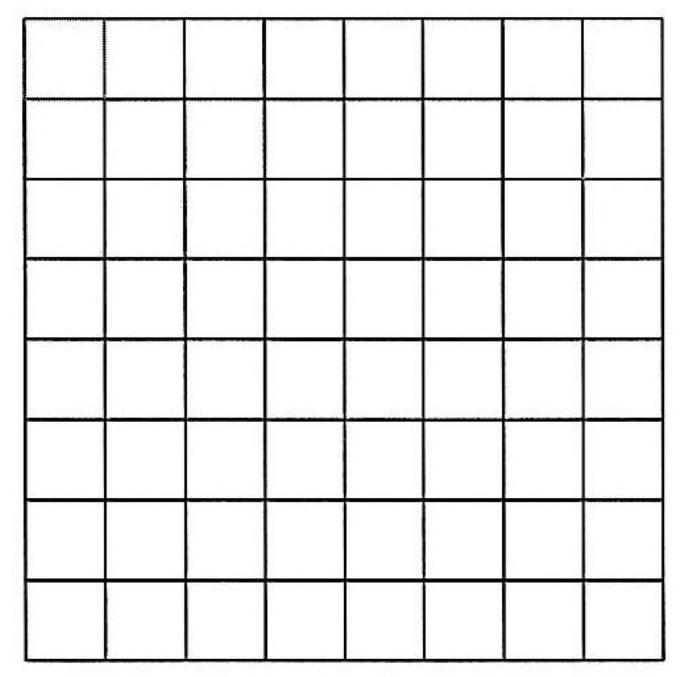
|
| 585 |
+
|
| 586 |
+
Suppose that Bob has managed to paint all red fields in black. The cells $(6,6),(7,7),(8,8)$ are painted black by three different lines (rows or columns) containing no other red felds, so the remaining 10 red fields have to be painted black by the remaining 5 lines. As no line contains more than 2 red fields, each red field has to be contained in exactly one of these lines. Assume that $(1,1)$ is painted black by a row, that is, row 1 is painted black. Let $k$ be the least positive integer such that row $k$ has not been painted black, where $2 \leq k \leq 5$. Then field $(k, k-1)$ should be painted black by column $k-1$. However, in this column there is another red field $(j, k-1)$ contained in the painted row with number $j<k$, which is a contradiction. Similar reasoning works if $(1,1)$ is painted black by a column.
|
| 587 |
+
|
| 588 |
+
Comment by PSC. Here is another reasoning to conclude that if Alice paints the table as above, then she wins.
|
| 589 |
+
|
| 590 |
+
Let $A$ be the $5 \times 5$ square defined by the corners $(1,1)$ and $(5,5)$.
|
| 591 |
+
|
| 592 |
+
Case 1: If Bob chooses 3 rows to paint black the cells $(6,6),(7,7)$ and $(8,8)$ then he has to use 1 row and 4 columns to paint in black the remaining 10 red squares in $A$. Then no matter which 4 columns
|
| 593 |
+
|
| 594 |
+
Bob select, the remaining 1 column in A contains two red squares which cannot be painted in black using only 1 row. Similar reasoning stands if Bob chooses 3 columns.
|
| 595 |
+
|
| 596 |
+
Case 2: If Bob chooses 2 rows and 1 column to paint black the cells $(6,6),(7,7)$ and $(8,8)$, then he has to use 3 columns and 2 rows to paint in black the remaining 10 red squares in $A$. Then, no matter which 3 columns Bob select, the remaining 2 columns in $A$ contain 4 red squares in 3 different rows which cannot be painted in black using only 2 rows. Similar reasoning stands if
|
| 597 |
+
Bob chooses 1 row and 2 columns.
|
| 598 |
+
|
| 599 |
+
## GEOMETRY
|
| 600 |
+
|
| 601 |
+
G 1. Let $H$ be the orthocentre of an acute triangle $A B C$ with $B C>A C$, inscribed in a circle $\Gamma$. The circle with centre $C$ and radius $C B$ intersects $\Gamma$ at the point $D$, which is on the arc $A B$ not containing $C$. The circle with centre $C$ and radius $C A$ intersects the segment $C D$ at the point $K$. The line parallel to $B D$ through $K$, intersects $A B$ at point $L$. If $M$ is the midpoint of $A B$ and $N$ is the foot of the perpendicular from $H$ to $C L$, prove that the line $M N$ bisects the segment $C H$.
|
| 602 |
+
|
| 603 |
+
Solution. We use standard notation for the angles of triangle $A B C$. Let $P$ be the midpoint of $C H$ and $O$ the centre of $\Gamma$. As
|
| 604 |
+
|
| 605 |
+
$$
|
| 606 |
+
\alpha=\angle B A C=\angle B D C=\angle D K L
|
| 607 |
+
$$
|
| 608 |
+
|
| 609 |
+
the quadrilateral $A C K L$ is cyclic. From the relation $C B=C D$ we get $\angle B C D=180^{\circ}-2 \alpha$, so
|
| 610 |
+
|
| 611 |
+
$$
|
| 612 |
+
\angle A C K=\gamma+2 \alpha-180^{\circ}
|
| 613 |
+
$$
|
| 614 |
+
|
| 615 |
+
where $\gamma=\angle A C B$. From the relation $C K=C A$ we get
|
| 616 |
+
|
| 617 |
+
$$
|
| 618 |
+
\angle A L C=\angle A K C=180^{\circ}-\alpha-\frac{\gamma}{2}
|
| 619 |
+
$$
|
| 620 |
+
|
| 621 |
+
and thus from the triangle $A C L$ we obtain
|
| 622 |
+
|
| 623 |
+
$$
|
| 624 |
+
\angle A C L=180^{\circ}-\alpha-\angle A L C=\frac{\gamma}{2}
|
| 625 |
+
$$
|
| 626 |
+
|
| 627 |
+
which means that $C L$ is the angle bisector of $\angle A C B$, thus $\angle A C L=\angle B C L$. Moreover, from the fact that $C H \perp A B$ and the isosceles triangle $B O C$ has $\angle B O C=2 \alpha$, we get $\angle A C H=\angle B C O=90^{\circ}-\alpha$. It follows that,
|
| 628 |
+
|
| 629 |
+
$$
|
| 630 |
+
\angle N P H=2 \angle N C H=\angle O C H
|
| 631 |
+
$$
|
| 632 |
+
|
| 633 |
+
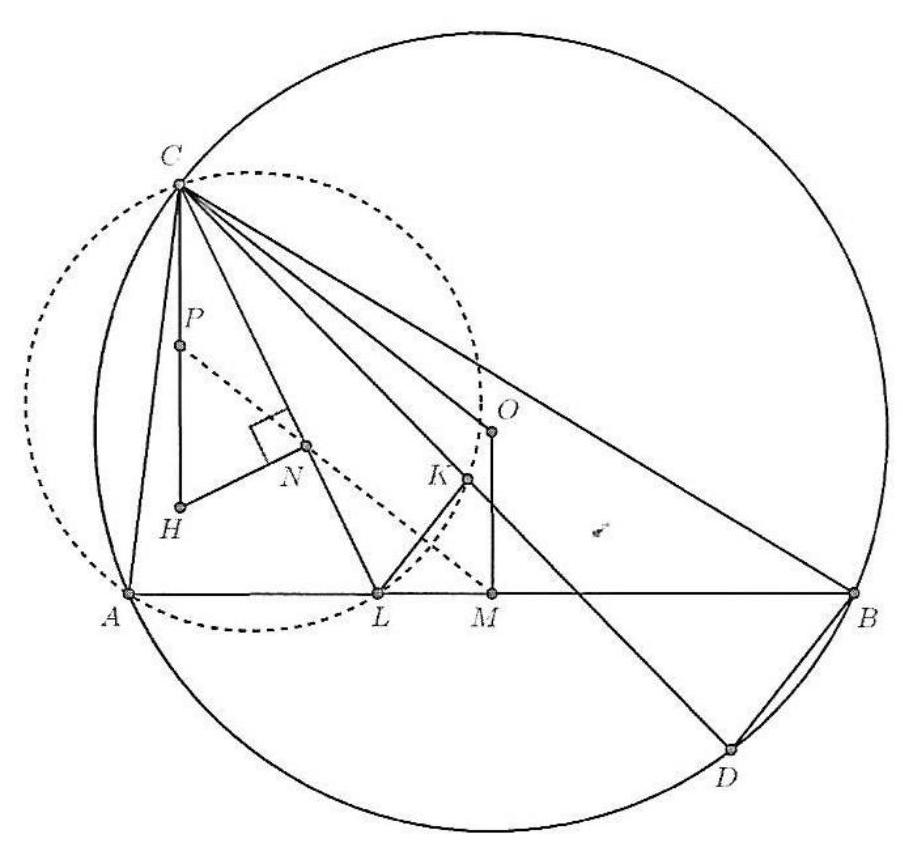
|
| 634 |
+
|
| 635 |
+
On the other hand, it is known that $2 C P=C H=2 O M$ and $C P \| O M$, so $C P M O$ is a parallelogram and
|
| 636 |
+
|
| 637 |
+
$$
|
| 638 |
+
\angle M P H=\angle O C H
|
| 639 |
+
$$
|
| 640 |
+
|
| 641 |
+
Now from (3) and (4) we obtain that
|
| 642 |
+
|
| 643 |
+
$$
|
| 644 |
+
\angle M P H=\angle N P H,
|
| 645 |
+
$$
|
| 646 |
+
|
| 647 |
+
which means that the points $M, N, P$ are collinear.
|
| 648 |
+
|
| 649 |
+
## Alternative formulation of the statement by PSC.
|
| 650 |
+
|
| 651 |
+
Let $H$ be the orthocentre of an acute triangle $A B C$ with $B C>A C$, inscribed in a circle $\Gamma$. A point $D$ on $\Gamma$, which is on the arc $A B$ not containing $C$, is chosen such that $C B=C D$. A point $K$ is chosen on the segment $C D$ such that $C A=C K$. The line parallel to $B D$ through $K$, intersects $A B$ at point $L$. If $M$ is the midpoint of $A B$ and $N$ is the foot of the perpendicular from $H$ to $C L$, prove that the line $M N$ bisects the segment $C H$.
|
| 652 |
+
|
| 653 |
+
G 2. Let $A B C$ be a right angled triangle with $\angle A=90^{\circ}$ and $A D$ its altitude. We draw parallel lines from $D$ to the vertical sides of the triangle and we call $E, Z$ their points of intersection with $A B$ and $A C$ respectively. The parallel line from $C$ to $E Z$ intersects the line $A B$ at the point $N$ Let $A^{\prime}$ be the symmetric of $A$ with respect to the line $E Z$ and $I, K$ the projections of $A^{\prime}$ onto $A B$ and $A C$ respectively. If $T$ is the point of intersection of the lines $I K$ and $D E$, prove that $\angle N A^{\prime} T=\angle A D T$.
|
| 654 |
+
|
| 655 |
+
Solution. Suppose that the line $A A^{\prime}$ intersects the lines $E Z, B C$ and $C N$ at the points $L, M$, $F$ respectively. The line $I K$ being diagonal of the rectangle $K A^{\prime} I A$ passes through $L$, which by construction of $A^{\prime}$, is the middle of the other diagonal $A A^{\prime}$. The triangles $Z A L, A L E$ are similar, so $\angle Z A L=\angle A E Z$. By the similarity of the triangles $A B C, D A B$, we get $\angle A C B=\angle B A D$. We have also that $\angle A E Z=\angle B A D$, therefore
|
| 656 |
+
|
| 657 |
+
$$
|
| 658 |
+
\angle Z A L=\angle C A M=\angle A C B=\angle A C M
|
| 659 |
+
$$
|
| 660 |
+
|
| 661 |
+
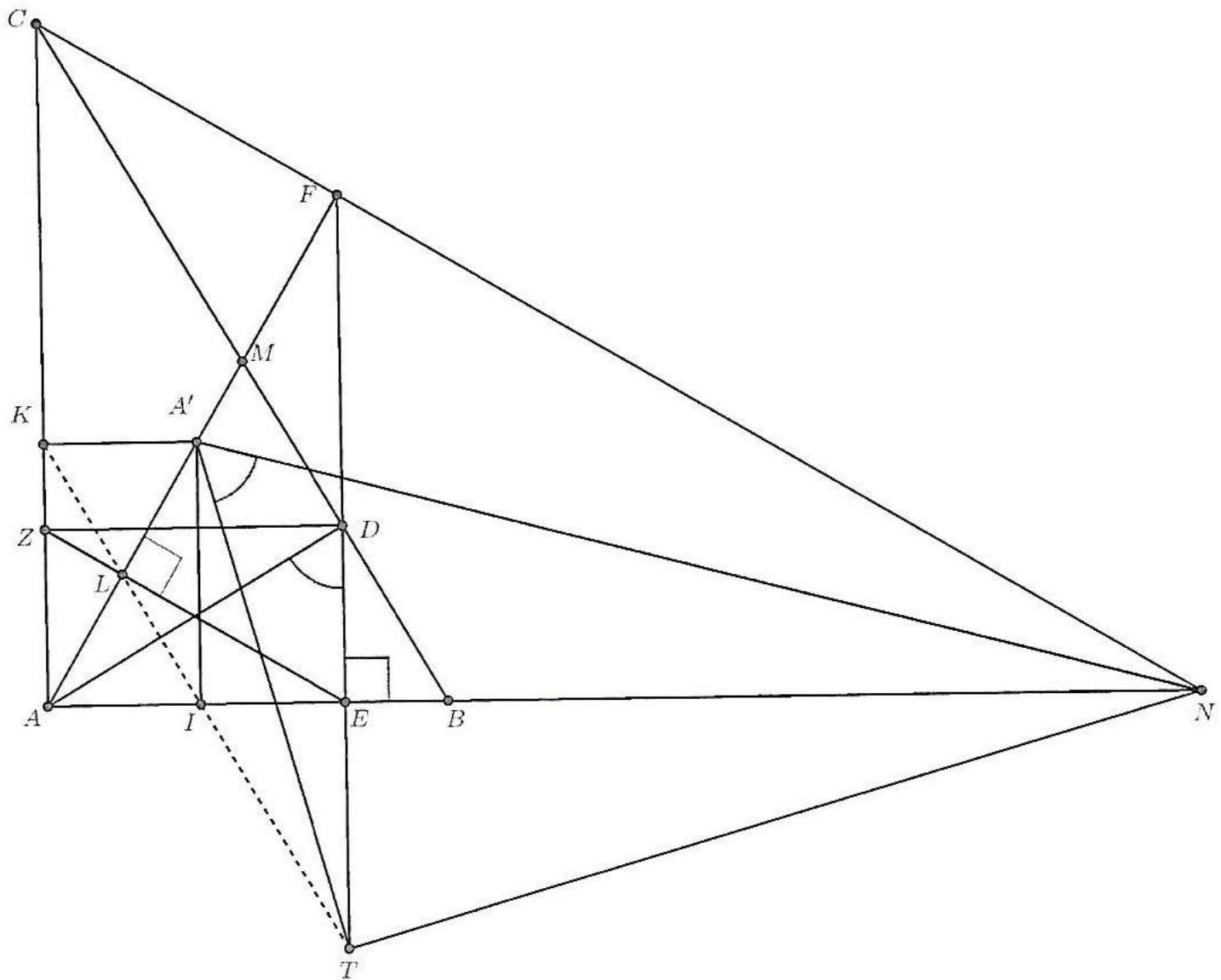
|
| 662 |
+
|
| 663 |
+
Since $A F \perp C N$, we have that the right triangles $A F C$ and $C D A$ are equal. Thus the altitudes from the vertices $F, D$ of the triangles $A F C, C D A$ respectively are equal. It follows that $F D \| A C$ and since $D E \| A C$ we get that the points $E, D, F$ are collinear.
|
| 664 |
+
|
| 665 |
+
In the triangle $L F T$ we have, $A^{\prime} I \| F T$ and $\angle L A^{\prime} I=\angle L I A^{\prime}$, so $\angle L F T=\angle L T F$. Therefore the points $F, A^{\prime}, I, T$ belong to the same circle. Also, $\angle A^{\prime} I N=\angle A^{\prime} F N=90^{\circ}$ so the quadrilateral $I A^{\prime} F N$ is cyclic. Thus, the points $F, A^{\prime}, I, T, N$ all lie on a circle. From the above, we infer that
|
| 666 |
+
|
| 667 |
+
$$
|
| 668 |
+
\angle N A^{\prime} T=\angle T F N=\angle A C F=\angle F E Z=\angle A D T \text {. }
|
| 669 |
+
$$
|
| 670 |
+
|
| 671 |
+
G 3. Let $A B C$ be an acute triangle, $A^{\prime}, B^{\prime}, C^{\prime}$ the reflexions of the vertices $A, B$ and $C$ with respect to $B C, C A$, and $A B$, respectively, and let the circumcircles of triangles $A B B^{\prime}$ and $A C C^{\prime}$ meet again at $A_{1}$. Points $B_{1}$ and $C_{1}$ are defined similarly. Prove that the lines $A A_{1}, B B_{1}$, and $C C_{1}$ have a common point.
|
| 672 |
+
|
| 673 |
+
Solution. Let $O_{1}, O_{2}$ and $O$ be the circumcenters of triangles $A B B^{\prime}, A C C^{\prime}$ and $A B C$ respectively. As $A B$ is the perpendicular bisector of the line segment $C C^{\prime}, O_{2}$ is the intersection of the perpendicular bisector of $A C$ with $A B$. Similarly, $O_{1}$ is the intersection of the perpendicular bisector of $A B$ with $A C$. It follows that $O$ is the orthocenter of triangle $A O_{1} O_{2}$. This means that $A O$ is perpendicular to $O_{1} O_{2}$. On the other hand, the segment $A A_{1}$ is the common chord of the two circles, thus it is perpendicular to $O_{1} O_{2}$. As a result, $A A_{1}$ passes through $O$. Similarly, $B B_{1}$ and $C C_{1}$ pass through $O$, so the three lines are concurrent at $O$.
|
| 674 |
+
|
| 675 |
+
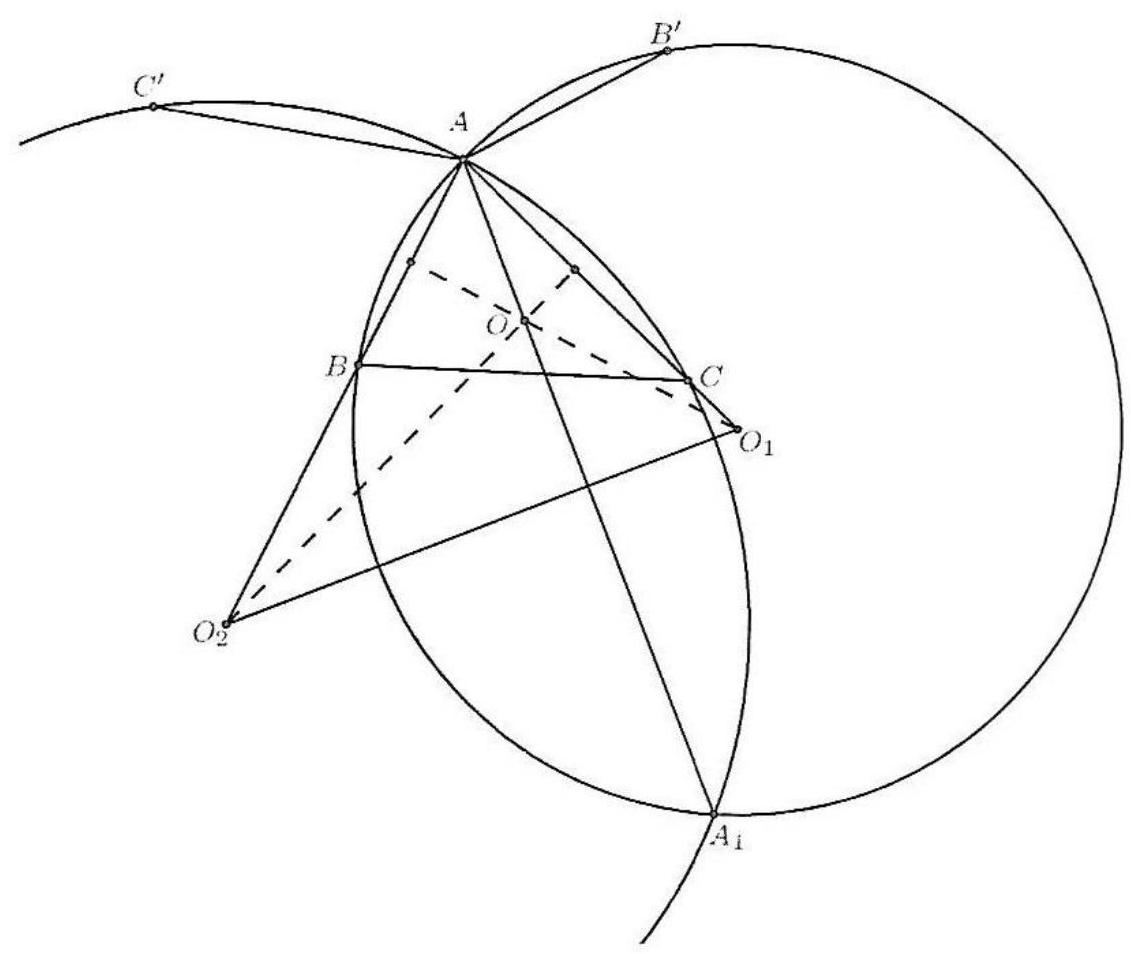
|
| 676 |
+
|
| 677 |
+
Comment by PSC. We present here a different approach.
|
| 678 |
+
|
| 679 |
+
We first prove that $A_{1}, B$ and $C^{\prime}$ are collinear. Indeed, since $\angle B A B^{\prime}=\angle C A C^{\prime}=2 \angle B A C$, then from the circles $\left(A B B^{\prime}\right),\left(A C C^{\prime}\right)$ we get
|
| 680 |
+
|
| 681 |
+
$$
|
| 682 |
+
\angle A A_{1} B=90^{\circ}-\angle B A C=\angle A A_{1} C^{\prime}
|
| 683 |
+
$$
|
| 684 |
+
|
| 685 |
+
It follows that
|
| 686 |
+
|
| 687 |
+
$$
|
| 688 |
+
\angle A_{1} A C=\angle A_{1} C^{\prime} C=\angle B C^{\prime} C=90^{\circ}-\angle A B C
|
| 689 |
+
$$
|
| 690 |
+
|
| 691 |
+
On the other hand, if $O$ is the circumcenter of $A B C$, then
|
| 692 |
+
|
| 693 |
+
$$
|
| 694 |
+
\angle O A C=90^{\circ}-\angle A B C
|
| 695 |
+
$$
|
| 696 |
+
|
| 697 |
+
From (1) and (2) we conclude that $A_{1}, A$ and $O$ are collinear. Similarly, $B B_{1}$ and $C C_{1}$ pass through $O$, so the three lines are concurrent in $O$.
|
| 698 |
+
|
| 699 |
+
G 4. Let $A B C$ be a triangle with side-lengths $a, b, c$, inscribed in a circle with radius $R$ and let $I$ be it's incenter. Let $P_{1}, P_{2}$ and $P_{3}$ be the areas of the triangles $A B I, B C I$ and $C A I$, respectively. Prove that
|
| 700 |
+
|
| 701 |
+
$$
|
| 702 |
+
\frac{R^{4}}{P_{1}^{2}}+\frac{R^{4}}{P_{2}^{2}}+\frac{R^{4}}{P_{3}^{2}} \geq 16
|
| 703 |
+
$$
|
| 704 |
+
|
| 705 |
+
Solution. Let $r$ be the radius of the inscribed circle of the triangle $A B C$. We have that
|
| 706 |
+
|
| 707 |
+
$$
|
| 708 |
+
P_{1}=\frac{r c}{2}, \quad P_{2}=\frac{r a}{2}, \quad P_{3}=\frac{r b}{2}
|
| 709 |
+
$$
|
| 710 |
+
|
| 711 |
+
It follows that
|
| 712 |
+
|
| 713 |
+
$$
|
| 714 |
+
\frac{1}{P_{1}^{2}}+\frac{1}{P_{2}^{2}}+\frac{1}{P_{3}^{2}}=\frac{4}{r^{2}}\left(\frac{1}{c^{2}}+\frac{1}{a^{2}}+\frac{1}{b^{2}}\right)
|
| 715 |
+
$$
|
| 716 |
+
|
| 717 |
+
From Leibniz's relation we have that if $H$ is the orthocenter, then
|
| 718 |
+
|
| 719 |
+
$$
|
| 720 |
+
O H^{2}=9 R^{2}-a^{2}-b^{2}-c^{2}
|
| 721 |
+
$$
|
| 722 |
+
|
| 723 |
+
It follows that
|
| 724 |
+
|
| 725 |
+
$$
|
| 726 |
+
9 R^{2} \geq a^{2}+b^{2}+c^{2}
|
| 727 |
+
$$
|
| 728 |
+
|
| 729 |
+
Therefore, using the AM-HM inequality and then (1), we get
|
| 730 |
+
|
| 731 |
+
$$
|
| 732 |
+
\frac{1}{c^{2}}+\frac{1}{a^{2}}+\frac{1}{b^{2}} \geq \frac{9}{a^{2}+b^{2}+c^{2}} \geq \frac{1}{R^{2}}
|
| 733 |
+
$$
|
| 734 |
+
|
| 735 |
+
Finally, using Euler's inequality, namely that $R \geq 2 r$, we get
|
| 736 |
+
|
| 737 |
+
$$
|
| 738 |
+
\frac{1}{P_{1}^{2}}+\frac{1}{P_{2}^{2}}+\frac{1}{P_{3}^{2}} \geq \frac{4}{r^{2} R^{2}} \geq \frac{16}{R^{4}}
|
| 739 |
+
$$
|
| 740 |
+
|
| 741 |
+
Comment by PSC. We can avoid using Leibniz's relation as follows: as in the above solution we have that
|
| 742 |
+
|
| 743 |
+
$$
|
| 744 |
+
\frac{1}{P_{1}^{2}}+\frac{1}{P_{2}^{2}}+\frac{1}{P_{3}^{2}}=\frac{4}{r^{2}}\left(\frac{1}{c^{2}}+\frac{1}{a^{2}}+\frac{1}{b^{2}}\right)
|
| 745 |
+
$$
|
| 746 |
+
|
| 747 |
+
Let $a+b+c=2 \tau, E=(A B C)$ and using the inequality $x^{2}+y^{2}+z^{2} \geq x y+y z+z x$ we get
|
| 748 |
+
|
| 749 |
+
$$
|
| 750 |
+
\begin{aligned}
|
| 751 |
+
\frac{1}{c^{2}}+\frac{1}{a^{2}}+\frac{1}{b^{2}} & \geq \frac{1}{a b}+\frac{1}{b c}+\frac{1}{c a}=\frac{2 \tau}{a b c} \\
|
| 752 |
+
& =\frac{\tau}{2 R E}=\frac{1}{2 R r}
|
| 753 |
+
\end{aligned}
|
| 754 |
+
$$
|
| 755 |
+
|
| 756 |
+
where we used the area formulas $E=\frac{a b c}{4 R}=\tau r$. Finally, using Euler's inequality, namely that $R \geq 2 r$, we get
|
| 757 |
+
|
| 758 |
+
$$
|
| 759 |
+
\frac{1}{P_{1}^{2}}+\frac{1}{P_{2}^{2}}+\frac{1}{P_{3}^{2}} \geq \frac{2}{r^{3} R} \geq \frac{16}{R^{4}}
|
| 760 |
+
$$
|
| 761 |
+
|
| 762 |
+
G 5. Given a rectangle $A B C D$ such that $A B=b>2 a=B C$, let $E$ be the midpoint of $A D$. On a line parallel to $A B$ through point $E$, a point $G$ is chosen such that the area of $G C E$ is
|
| 763 |
+
|
| 764 |
+
$$
|
| 765 |
+
(G C E)=\frac{1}{2}\left(\frac{a^{3}}{b}+a b\right)
|
| 766 |
+
$$
|
| 767 |
+
|
| 768 |
+
Point $H$ is the foot of the perpendicular from $E$ to $G D$ and a point $I$ is taken on the diagonal $A C$ such that the triangles $A C E$ and $A E I$ are similar. The lines $B H$ and $I E$ intersect at $K$ and the lines $C A$ and $E H$ intersect at $J$. Prove that $K J \perp A B$.
|
| 769 |
+
|
| 770 |
+
Solution. Let $L$ be the foot of the perpendicular from $G$ to $E C$ and let $Q$ the point of intersection of the lines $E G$ and $B C$. Then,
|
| 771 |
+
|
| 772 |
+
$$
|
| 773 |
+
(G C E)=\frac{1}{2} E C \cdot G L=\frac{1}{2} \sqrt{a^{2}+b^{2}} \cdot G L
|
| 774 |
+
$$
|
| 775 |
+
|
| 776 |
+
So, $G L=\frac{a}{b} \sqrt{a^{2}+b^{2}}$.
|
| 777 |
+
|
| 778 |
+
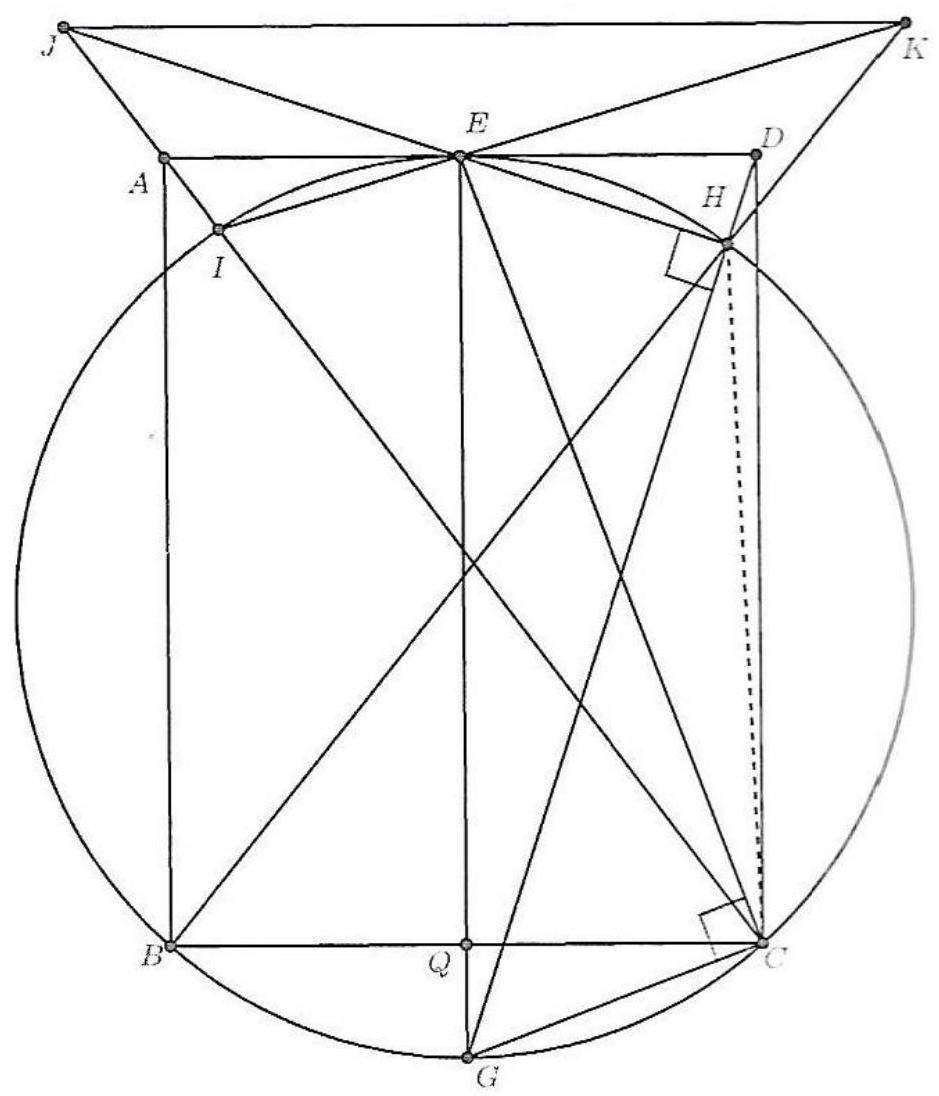
|
| 779 |
+
|
| 780 |
+
Observing that the triangles $Q C E$ and $E L G$ are similar, we have $\frac{a}{b}=\frac{G L}{E L}$, which implies that $E L=\sqrt{a^{2}+b^{2}}$, or in other words $L \equiv C$.
|
| 781 |
+
|
| 782 |
+
Consider the circumcircle $\omega$ of the triangle $E B C$. Since
|
| 783 |
+
|
| 784 |
+
$$
|
| 785 |
+
\angle E B G=\angle E C G=\angle E H G=90^{\circ}
|
| 786 |
+
$$
|
| 787 |
+
|
| 788 |
+
the points $H$ and $G$ lie on $\omega$.
|
| 789 |
+
|
| 790 |
+
From the given similarity of the triangles $A C E$ and $A E I$, we have that
|
| 791 |
+
|
| 792 |
+
$$
|
| 793 |
+
\angle A I E=\angle A E C=90^{\circ}+\angle G E C=90^{\circ}+\angle G H C=\angle E H C
|
| 794 |
+
$$
|
| 795 |
+
|
| 796 |
+
therefore $E H C I$ is cyclic, thus $I$ lies on $\omega$.
|
| 797 |
+
|
| 798 |
+
Since $E B=E C$, we get that $\angle E I C=\angle E H B$, thus $\angle J I E=\angle E H K$. We conclude that $J I H K$ is cyclic, therefore
|
| 799 |
+
|
| 800 |
+
$$
|
| 801 |
+
\angle J K H=\angle H I C=\angle H B C
|
| 802 |
+
$$
|
| 803 |
+
|
| 804 |
+
It follows that $K J \| B C$, so $K J \perp A B$.
|
| 805 |
+
|
| 806 |
+
Comment. The proposer suggests a different way to finish the proof after proving that $I$ lies on $\omega$ : We apply Pascal's Theorem to the degenerated hexagon $E E H B C I$. Since $B C$ and $E E$ intersect at infinity, this implies that $K J$, which is the line through the intersections of the other two opposite pairs of sides of the hexagon, has to go through this point at infinity, thus it is parallel to $B C$, and so $K J \perp A B$.
|
| 807 |
+
|
| 808 |
+
G 6. Let $X Y$ be a chord of a circle $\Omega$, with center $O$, which is not a diameter. Let $P, Q$ be two distinct points inside the segment $X Y$, where $Q$ lies between $P$ and $X$. Let $\ell$ the perpendicular line dropped from $P$ to the diameter which passes through $Q$. Let $M$ be the intersection point of $\ell$ and $\Omega$, which is closer to $P$. Prove that
|
| 809 |
+
|
| 810 |
+
$$
|
| 811 |
+
M P \cdot X Y \geq 2 \cdot Q X \cdot P Y
|
| 812 |
+
$$
|
| 813 |
+
|
| 814 |
+
Solution by PSC. At first, we will allow $P$ and $Q$ to coincide, and we will prove the inequality in this case. Let the perpendicular from $Q$ to $O Q$ meet $\Omega$ at $B$ and $C$. Then, we have that $Q B=Q C$. We will show that
|
| 815 |
+
|
| 816 |
+
$$
|
| 817 |
+
B Q \cdot X Y \geq 2 Q X \cdot Q Y
|
| 818 |
+
$$
|
| 819 |
+
|
| 820 |
+
By the power of a point Theorem we have that
|
| 821 |
+
|
| 822 |
+
$$
|
| 823 |
+
Q X \cdot Q Y=Q B \cdot Q C=Q B^{2}
|
| 824 |
+
$$
|
| 825 |
+
|
| 826 |
+
therefore it is enough to prove that $X Y \geq 2 B Q$ or $X Y \geq B C$. Let $T$ be the foot of the perpendicular from $O$ to $X Y$. Then, from the right-angled triangle $O T Q$ we have that $O T \leq O Q$, so the distance from $O$ to the chord $X Y$ is smaller or equal to the distance from $O$ to the chord $B C$. This means that $X Y \geq B C$, so (1) holds.
|
| 827 |
+
|
| 828 |
+
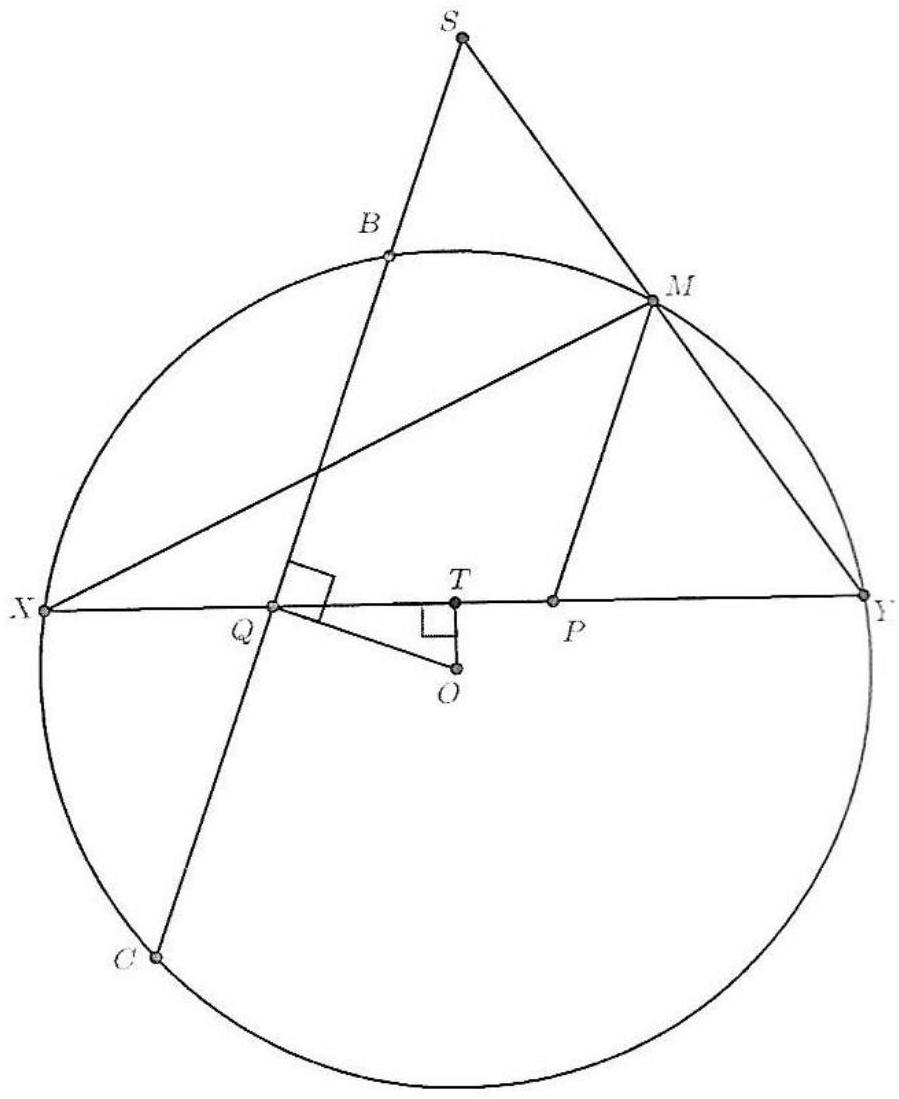
|
| 829 |
+
|
| 830 |
+
Back to the initial problem, we have to prove that
|
| 831 |
+
|
| 832 |
+
$$
|
| 833 |
+
M P \cdot X Y \geq 2 Q X \cdot P Y \Longleftrightarrow \frac{X Y}{2 Q X} \geq \frac{P Y}{P M}
|
| 834 |
+
$$
|
| 835 |
+
|
| 836 |
+
By (1) we have that
|
| 837 |
+
|
| 838 |
+
$$
|
| 839 |
+
\frac{X Y}{2 Q X} \geq \frac{Q Y}{Q B}
|
| 840 |
+
$$
|
| 841 |
+
|
| 842 |
+
so it is enough to prove that
|
| 843 |
+
|
| 844 |
+
$$
|
| 845 |
+
\frac{Q Y}{Q B} \geq \frac{P Y}{P M}
|
| 846 |
+
$$
|
| 847 |
+
|
| 848 |
+
If $C B$ meets $Y M$ at $S$, then from $M P \| Q S$ we get
|
| 849 |
+
|
| 850 |
+
$$
|
| 851 |
+
\frac{Q Y}{Q B} \geq \frac{Q Y}{Q S}=\frac{P Y}{P M}
|
| 852 |
+
$$
|
| 853 |
+
|
| 854 |
+
which is the desired.
|
| 855 |
+
|
| 856 |
+
Comment. The proposer's solution uses analytic geometry and it is the following.
|
| 857 |
+
|
| 858 |
+
We will show that $(Q M-Q P) \cdot X Y \geq 2 \cdot Q X \cdot P Y$. Since $M P \geq Q M-Q P$, our inequality follows directly. Let $A$ the intersection point of $\ell$ with the diameter which passes through $Q$. Like in the following picture, choose a coordinative system centered at $O$ and such that $Q=(a, 0), A=(c, 0)$, $P=(c, h)$ and denote the lengths $Q X=x, P Q=t, P Y=y, O P=d, Q M=z$.
|
| 859 |
+
|
| 860 |
+
Let $\lambda_{Q}=r^{2}-a^{2}$ and $\lambda_{P}=r^{2}-d^{2}$ respectively the power of $Q$ and $P$ qith respect to our circle $\Omega$. We will show that:
|
| 861 |
+
|
| 862 |
+
$$
|
| 863 |
+
(z-t)(t+x+y) \geq 2 x y
|
| 864 |
+
$$
|
| 865 |
+
|
| 866 |
+
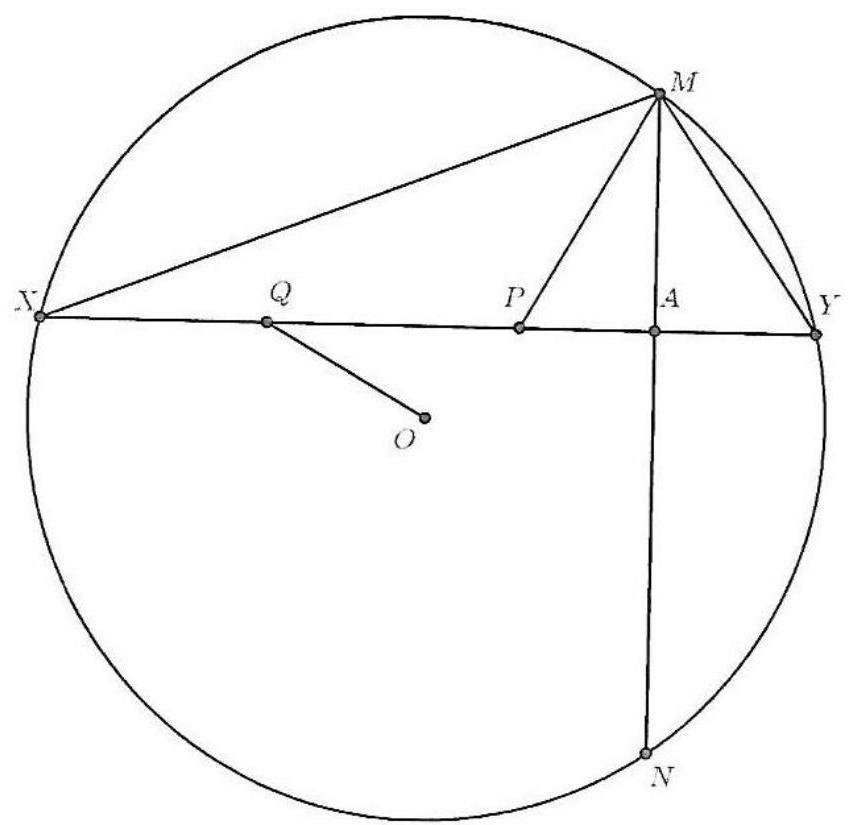
|
| 867 |
+
|
| 868 |
+
Adding and multiplying respectively the relations $x(t+y)=\lambda_{Q}$ and $y(t+x)=\lambda_{P}$, we will have
|
| 869 |
+
|
| 870 |
+
$$
|
| 871 |
+
t(x+y)+2 x y=\lambda_{P}+\lambda_{Q}
|
| 872 |
+
$$
|
| 873 |
+
|
| 874 |
+
and
|
| 875 |
+
|
| 876 |
+
$$
|
| 877 |
+
x y(t+x)(t+y)=\lambda_{P} \lambda_{Q}
|
| 878 |
+
$$
|
| 879 |
+
|
| 880 |
+
Using these two equations, it's easy to deduce that:
|
| 881 |
+
|
| 882 |
+
$$
|
| 883 |
+
(x y)^{2}-x y\left(t^{2}+\lambda_{P}+\lambda_{Q}\right)+\lambda_{P} \lambda_{Q}=0
|
| 884 |
+
$$
|
| 885 |
+
|
| 886 |
+
So, $w_{1}=x y$ is a zero of the second degree polynomial:
|
| 887 |
+
|
| 888 |
+
$$
|
| 889 |
+
p(w)=w^{2}-w\left(t^{2}+\lambda_{P}+\lambda_{Q}\right)+\lambda_{P} \lambda_{Q}
|
| 890 |
+
$$
|
| 891 |
+
|
| 892 |
+
But $w_{1}=x y<x(t+y)=\lambda_{Q}$ and
|
| 893 |
+
|
| 894 |
+
$$
|
| 895 |
+
\begin{aligned}
|
| 896 |
+
p\left(\lambda_{Q}\right) & =\left(r^{2}-a^{2}\right)^{2}-\left(r^{2}-a^{2}\right)\left(t^{2}+\lambda_{P}+\lambda_{Q}\right)+\lambda_{P} \lambda_{Q} \\
|
| 897 |
+
& =\left(r^{2}-a^{2}\right)^{2}-\left(r^{2}-a^{2}\right)\left(t^{2}+r^{2}-d^{2}+r^{2}-a^{2}\right)+\left(r^{2}-d^{2}\right)\left(r^{2}-a^{2}\right) \\
|
| 898 |
+
& =\left(r^{2}-a^{2}\right)^{2}-\left(r^{2}-a^{2}\right) t^{2}-\left(r^{2}-d^{2}\right)\left(r^{2}-a^{2}\right)-\left(r^{2}-a^{2}\right)^{4}+\left(r^{2}-d^{2}\right)\left(r^{2}-a^{2}\right) \\
|
| 899 |
+
& =-t^{2}\left(r^{2}-a^{2}\right)=-t^{2} \lambda_{Q}<0
|
| 900 |
+
\end{aligned}
|
| 901 |
+
$$
|
| 902 |
+
|
| 903 |
+
This implies that $\lambda_{Q}$ lies (strictly) between the two (positive) zeros $w_{1}, w_{2}$ of $p(w)$ and $w_{1}=x y$ is the smaller one.
|
| 904 |
+
|
| 905 |
+
After using (2) and (3), inequality (1) can be rewritten as:
|
| 906 |
+
|
| 907 |
+
$$
|
| 908 |
+
(x y)^{2} \leq\left(\frac{z-t}{z+t}\right) \lambda_{P} \lambda_{Q}
|
| 909 |
+
$$
|
| 910 |
+
|
| 911 |
+
In order to show this, it is enough to show that
|
| 912 |
+
|
| 913 |
+
$$
|
| 914 |
+
p\left(\sqrt{\frac{z-t}{z+t} \lambda_{P} \lambda_{Q}}\right) \leq 0
|
| 915 |
+
$$
|
| 916 |
+
|
| 917 |
+
because this will imply $\sqrt{\frac{z-t}{z+t} \lambda_{P} \lambda_{Q}} \in\left[w_{1}, w_{2}\right]$. After some manipulations, inequality (6) can be equivalently transformed to:
|
| 918 |
+
|
| 919 |
+
$$
|
| 920 |
+
4 z^{2} \lambda_{P} \lambda_{Q} \leq\left(z^{2}-t^{2}\right)\left(t^{2}+\lambda_{P}+\lambda_{Q}\right)^{2}
|
| 921 |
+
$$
|
| 922 |
+
|
| 923 |
+
Since $z^{2}-t^{2}=r^{2}-d^{2}=\lambda_{P}$, this is equivalent to:
|
| 924 |
+
|
| 925 |
+
$$
|
| 926 |
+
4 z^{2} \lambda_{Q} \leq\left(t^{2}+\lambda_{P}+\lambda_{Q}\right)^{2}
|
| 927 |
+
$$
|
| 928 |
+
|
| 929 |
+
But $t^{2}=(a-c)^{2}+h^{2}=a^{2}+d^{2}-2 a c, z^{2}=t^{2}+r^{2}-d^{2}=a^{2}-2 a c+r^{2}$ and $t^{2}+\lambda_{P}+\lambda_{Q}=\ldots=2\left(r^{2}-a c\right)$. Hence, (8) is equivalent with:
|
| 930 |
+
|
| 931 |
+
$$
|
| 932 |
+
\left(a^{2}-2 a c+r^{2}\right)\left(r^{2}-a^{2}\right) \leq\left(r^{2}-a c\right)^{2} \Leftrightarrow \cdots \Leftrightarrow 0 \leq a^{2}(a-c)^{2}
|
| 933 |
+
$$
|
| 934 |
+
|
| 935 |
+
which is clearly true.
|
| 936 |
+
|
| 937 |
+
## NUMBER THEORY
|
| 938 |
+
|
| 939 |
+
NT 1. Find all the integers pairs $(x, y)$ which satisfy the equation
|
| 940 |
+
|
| 941 |
+
$$
|
| 942 |
+
x^{5}-y^{5}=16 x y
|
| 943 |
+
$$
|
| 944 |
+
|
| 945 |
+
Solution. If one of $x, y$ is 0 , the other has to be 0 too, and $(x, y)=(0,0)$ is one solution. If $x y \neq 0$, let $d=\operatorname{gcd}(x, y)$ and we write $x=d a, y=d b, a, b \in \mathbb{Z}$ with $(a, b)=1$. Then, the given equation is transformed into
|
| 946 |
+
|
| 947 |
+
$$
|
| 948 |
+
d^{3} a^{5}-d^{3} b^{5}=16 a b
|
| 949 |
+
$$
|
| 950 |
+
|
| 951 |
+
So, by the above equation, we conclude that $a \mid d^{3} b^{5}$ and thus $a \mid d^{3}$. Similarly $b \mid d^{3}$. Since $(a, b)=1$, we get that $a b \mid d^{3}$, so we can write $d^{3}=a b r$ with $r \in \mathbb{Z}$. Then, equation (1) becomes
|
| 952 |
+
|
| 953 |
+
$$
|
| 954 |
+
\begin{aligned}
|
| 955 |
+
a b r a^{5}-a b r b^{5} & =16 a b \Rightarrow \\
|
| 956 |
+
r\left(a^{5}-b^{5}\right) & =16
|
| 957 |
+
\end{aligned}
|
| 958 |
+
$$
|
| 959 |
+
|
| 960 |
+
Therefore, the difference $a^{5}-b^{5}$ must divide 16. Therefore, the difference $a^{5}-b^{5}$ must divide 16 . This means that
|
| 961 |
+
|
| 962 |
+
$$
|
| 963 |
+
a^{5}-b^{5}= \pm 1, \pm 2, \pm 4, \pm 8, \pm 16
|
| 964 |
+
$$
|
| 965 |
+
|
| 966 |
+
The smaller values of $\left|a^{5}-b^{5}\right|$ are 1 or 2 . Indeed, if $\left|a^{5}-b^{5}\right|=1$ then $a= \pm 1$ and $b=0$ or $a=0$ and $b= \pm 1$, a contradiction. If $\left|a^{5}-b^{5}\right|=2$, then $a=1$ and $b=-1$ or $a=-1$ and $b=1$. Then $r=-8$, and $d^{3}=-8$ or $d=-2$. Therefore, $(x, y)=(-2,2)$. If $\left|a^{5}-b^{5}\right|>2$ then, without loss of generality, let $a>b$ and $a \geq 2$. Putting $a=x+1$ with $x \geq 1$, we have
|
| 967 |
+
|
| 968 |
+
$$
|
| 969 |
+
\begin{aligned}
|
| 970 |
+
\left|a^{5}-b^{5}\right| & =\left|(x+1)^{5}-b^{5}\right| \\
|
| 971 |
+
& \geq\left|(x+1)^{5}-x^{5}\right| \\
|
| 972 |
+
& =\left|5 x^{4}+10 x^{3}+10 x^{2}+5 x+1\right| \geq 31
|
| 973 |
+
\end{aligned}
|
| 974 |
+
$$
|
| 975 |
+
|
| 976 |
+
which is impossible. Thus, the only solutions are $(x, y)=(0,0)$ or $(-2,2)$.
|
| 977 |
+
|
| 978 |
+
NT 2. Find all pairs $(m, n)$ of positive integers such that
|
| 979 |
+
|
| 980 |
+
$$
|
| 981 |
+
125 \cdot 2^{n}-3^{m}=271
|
| 982 |
+
$$
|
| 983 |
+
|
| 984 |
+
Solution. Considering the equation mod5 we get
|
| 985 |
+
|
| 986 |
+
$$
|
| 987 |
+
3^{m} \equiv-1 \quad(\bmod 5)
|
| 988 |
+
$$
|
| 989 |
+
|
| 990 |
+
so $m=4 k+2$ for some positive integer $k$. Then, considering the equation $\bmod 7$ we get
|
| 991 |
+
|
| 992 |
+
$$
|
| 993 |
+
\begin{aligned}
|
| 994 |
+
& -2^{n}-9^{2 k+1} \equiv 5 \quad(\bmod 7) \Rightarrow \\
|
| 995 |
+
& 2^{n}+2^{2 k+1} \equiv 2 \quad(\bmod 7)
|
| 996 |
+
\end{aligned}
|
| 997 |
+
$$
|
| 998 |
+
|
| 999 |
+
Since $2^{s} \equiv 1,2,4(\bmod 7)$ for $s \equiv 0,1,2(\bmod 3)$, respectively, the only possibility is $2^{n} \equiv 2^{2 k+1} \equiv$ $1(\bmod 7)$, so $3 \mid n$ and $3 \mid 2 k+1$. From the last one we get $3 \mid m$, so we can write $n=3 x$ and $m=3 y$. Therefore, the given equation takes the form
|
| 1000 |
+
|
| 1001 |
+
$$
|
| 1002 |
+
5^{3} \cdot 2^{3 x}-3^{3 y}=271
|
| 1003 |
+
$$
|
| 1004 |
+
|
| 1005 |
+
or
|
| 1006 |
+
|
| 1007 |
+
$$
|
| 1008 |
+
\left(5 \cdot 2^{x}-3^{y}\right)\left(25 \cdot 2^{2 x}+5 \cdot 2^{x} \cdot 3^{y}+3^{2 y}\right)=271
|
| 1009 |
+
$$
|
| 1010 |
+
|
| 1011 |
+
It follows that $25 \cdot 2^{2 x}+5 \cdot 2^{x} \cdot 3^{y}+3^{2 y} \leq 271$, and so $25 \cdot 2^{2 x} \leq 271$, or $x<2$. We conclude that $x=1$ and from (2) we get $y=2$. Thus, the only solution is $(m, n)=(6,3)$.
|
| 1012 |
+
|
| 1013 |
+
Alternative solution by PSC. Considering the equation mod5 we get
|
| 1014 |
+
|
| 1015 |
+
$$
|
| 1016 |
+
3^{m} \equiv-1 \quad(\bmod 5)
|
| 1017 |
+
$$
|
| 1018 |
+
|
| 1019 |
+
so $m=4 k+2$ for some positive integer $k$. For $n \geq 4$, considering the equation $\bmod 16$ we get
|
| 1020 |
+
|
| 1021 |
+
$$
|
| 1022 |
+
\begin{aligned}
|
| 1023 |
+
-3^{4 k+2} \equiv-1 & (\bmod 16) \Rightarrow \\
|
| 1024 |
+
9 \cdot 81^{k} \equiv 1 & (\bmod 16)
|
| 1025 |
+
\end{aligned}
|
| 1026 |
+
$$
|
| 1027 |
+
|
| 1028 |
+
which is impossible since $81 \equiv 1 \bmod 16$. Therefore, $n \leq 3$.
|
| 1029 |
+
|
| 1030 |
+
We can readily check that $n=1$ and $n=2$ give no solution for $m$, and $n=3$ gives $m=6$. Thus, the only solution is $(m, n)=(6,3)$.
|
| 1031 |
+
|
| 1032 |
+
Comment by PSC. Note that first solution works if 271 is replaced by any number $A$ of the form $1 \bmod 5$ and at the same time $5 \bmod 7$, which gives $A \equiv 26 \bmod 35$, while the second solution works if 271 is replaced by any number $B$ of the form $1 \bmod 5$ and which is not $7 \bmod 16$, which gives that $B$ is not of the form $71 \bmod 80$. This means, for example, that if 271 is replaced by 551 , then the first solution works, while the second doesn't.
|
| 1033 |
+
|
| 1034 |
+
NT 3. Find all four-digit positive integers $\overline{a b c d}=10^{3} a+10^{2} b+10 c+d$, with $a \neq 0$, such that
|
| 1035 |
+
|
| 1036 |
+
$$
|
| 1037 |
+
\overline{a b c d}=a^{a+b+c+d}-a^{-a+b-c+d}+a
|
| 1038 |
+
$$
|
| 1039 |
+
|
| 1040 |
+
Solution. It is obvious that $a \neq 1$ and $-a+b-c+d \geq 0$. It follows that $b+d \geq c+a \geq a$. Then,
|
| 1041 |
+
|
| 1042 |
+
$$
|
| 1043 |
+
\begin{aligned}
|
| 1044 |
+
10000>\overline{a b c d} & =a^{a+b+c+d}-a^{-a+b-c+d}+a \\
|
| 1045 |
+
& >a^{a+b+c+d}-a^{a+b+c+d-2} \\
|
| 1046 |
+
& =a^{a+b+c+d-2}\left(a^{2}-1\right) \\
|
| 1047 |
+
& \geq a^{2 a-2}\left(a^{2}-1\right)
|
| 1048 |
+
\end{aligned}
|
| 1049 |
+
$$
|
| 1050 |
+
|
| 1051 |
+
For $a \geq 4$, we have
|
| 1052 |
+
|
| 1053 |
+
$$
|
| 1054 |
+
a^{2 a-2}\left(a^{2}-1\right)=4^{6} \cdot 15>4^{5} \cdot 10=10240>10000
|
| 1055 |
+
$$
|
| 1056 |
+
|
| 1057 |
+
a contradiction. This means that $a=2$ or $a=3$.
|
| 1058 |
+
|
| 1059 |
+
Case 1: If $\mathrm{a}=3$, then since $3^{7}=2187<3000$, we conclude that $a+b+c+d \geq 8$ and like in the previous paragraph we get
|
| 1060 |
+
|
| 1061 |
+
$$
|
| 1062 |
+
3^{a+b+c+d}-3^{-a+b-c+d}+3>3^{a+b+c+d-2} \cdot 8 \geq 729 \cdot 8>4000
|
| 1063 |
+
$$
|
| 1064 |
+
|
| 1065 |
+
which is again a contradiction.
|
| 1066 |
+
|
| 1067 |
+
Case 2: If $a=2$ then $2^{10}=1024<2000$, thus $a+b+c+d \geq 11$. If $a+b+c+d \geq 12$, we have again as above that
|
| 1068 |
+
|
| 1069 |
+
$$
|
| 1070 |
+
\overline{a b c d}>2^{a+b+c+d-2} \cdot 3=1024 \cdot 3>3000
|
| 1071 |
+
$$
|
| 1072 |
+
|
| 1073 |
+
which is absurd and we conclude that $a+b+c+d=11$. Then $\overline{a b c d}<2^{11}+2=2050$, so $b=0$. Moreover, from
|
| 1074 |
+
|
| 1075 |
+
$$
|
| 1076 |
+
2050-2^{d-c-2} \geq 2000 \Longleftrightarrow 2^{d-c-2} \leq 50
|
| 1077 |
+
$$
|
| 1078 |
+
|
| 1079 |
+
we get $d-c-2 \leq 5$. However, from $d+c=9$ we have that $d-c-2$ is odd, so $d-c-2 \in\{1,3,5\}$. This means that
|
| 1080 |
+
|
| 1081 |
+
$$
|
| 1082 |
+
\overline{a b c d}=2050-2^{d-c-2} \in\{2048,2042,2018\}
|
| 1083 |
+
$$
|
| 1084 |
+
|
| 1085 |
+
The only number that satisfies $a+b+c+d=11$ is 2018 , so it is the only solution.
|
| 1086 |
+
|
| 1087 |
+
Comment by PSC. After proving $b+d \geq a+c \geq 2$, we can alternatively conclude that $a \leq 3$, as follows. If $a \geq 4$, then
|
| 1088 |
+
|
| 1089 |
+
$$
|
| 1090 |
+
\begin{aligned}
|
| 1091 |
+
\overline{a b c d} & =a^{a+b+c+d}-a^{-a+b-c+d}+a \\
|
| 1092 |
+
& >a^{b+d-a-c}\left(a^{2 a+2 c}-1\right) \\
|
| 1093 |
+
& >a^{2 a+2 c}-1 \\
|
| 1094 |
+
& \geq 4^{8}-1=65535
|
| 1095 |
+
\end{aligned}
|
| 1096 |
+
$$
|
| 1097 |
+
|
| 1098 |
+
a contradiction.
|
| 1099 |
+
|
| 1100 |
+
NT 4. Show that there exist infinitely many positive integers $n$ such that
|
| 1101 |
+
|
| 1102 |
+
$$
|
| 1103 |
+
\frac{4^{n}+2^{n}+1}{n^{2}+n+1}
|
| 1104 |
+
$$
|
| 1105 |
+
|
| 1106 |
+
is an integer.
|
| 1107 |
+
|
| 1108 |
+
Solution. Let $f(n)=n^{2}+n+1$. Note that
|
| 1109 |
+
|
| 1110 |
+
$$
|
| 1111 |
+
f\left(n^{2}\right)=n^{4}+n^{2}+1=\left(n^{2}+n+1\right)\left(n^{2}-n+1\right)
|
| 1112 |
+
$$
|
| 1113 |
+
|
| 1114 |
+
This means that $f(n) \mid f\left(n^{2}\right)$ for every positive integer $n$. By induction on $k$, one can easily see that $f(n) \mid f\left(n^{2^{k}}\right)$ for every positive integers $n$ and $k$. Note that the required condition is equivalent to $f(n) \mid f\left(2^{n}\right)$. From the discussion above, if there exists a positive integer $n$ so that $2^{n}$ can be written as $n^{2^{k}}$, for some positive integer $k$, then $f(n) \mid f\left(2^{n}\right)$. If we choose $n=2^{2^{m}}$ and $k=2^{m}-m$ for some positive integer $m$, then $2^{n}=n^{2^{k}}$ and since there are infinitely many positive integers of the form $n=2^{2^{m}}$, we have the desired result.
|
| 1115 |
+
|
JBMO/md/en-shortlist/en-shortlist_jbmo_2016_v7-1.md
ADDED
|
@@ -0,0 +1,714 @@
|
|
|
|
|
|
|
|
|
|
|
|
|
|
|
|
|
|
|
|
|
|
|
|
|
|
|
|
|
|
|
|
|
|
|
|
|
|
|
|
|
|
|
|
|
|
|
|
|
|
|
|
|
|
|
|
|
|
|
|
|
|
|
|
|
|
|
|
|
|
|
|
|
|
|
|
|
|
|
|
|
|
|
|
|
|
|
|
|
|
|
|
|
|
|
|
|
|
|
|
|
|
|
|
|
|
|
|
|
|
|
|
|
|
|
|
|
|
|
|
|
|
|
|
|
|
|
|
|
|
|
|
|
|
|
|
|
|
|
|
|
|
|
|
|
|
|
|
|
|
|
|
|
|
|
|
|
|
|
|
|
|
|
|
|
|
|
|
|
|
|
|
|
|
|
|
|
|
|
|
|
|
|
|
|
|
|
|
|
|
|
|
|
|
|
|
|
|
|
|
|
|
|
|
|
|
|
|
|
|
|
|
|
|
|
|
|
|
|
|
|
|
|
|
|
|
|
|
|
|
|
|
|
|
|
|
|
|
|
|
|
|
|
|
|
|
|
|
|
|
|
|
|
|
|
|
|
|
|
|
|
|
|
|
|
|
|
|
|
|
|
|
|
|
|
|
|
|
|
|
|
|
|
|
|
|
|
|
|
|
|
|
|
|
|
|
|
|
|
|
|
|
|
|
|
|
|
|
|
|
|
|
|
|
|
|
|
|
|
|
|
|
|
|
|
|
|
|
|
|
|
|
|
|
|
|
|
|
|
|
|
|
|
|
|
|
|
|
|
|
|
|
|
|
|
|
|
|
|
|
|
|
|
|
|
|
|
|
|
|
|
|
|
|
|
|
|
|
|
|
|
|
|
|
|
|
|
|
|
|
|
|
|
|
|
|
|
|
|
|
|
|
|
|
|
|
|
|
|
|
|
|
|
|
|
|
|
|
|
|
|
|
|
|
|
|
|
|
|
|
|
|
|
|
|
|
|
|
|
|
|
|
|
|
|
|
|
|
|
|
|
|
|
|
|
|
|
|
|
|
|
|
|
|
|
|
|
|
|
|
|
|
|
|
|
|
|
|
|
|
|
|
|
|
|
|
|
|
|
|
|
|
|
|
|
|
|
|
|
|
|
|
|
|
|
|
|
|
|
|
|
|
|
|
|
|
|
|
|
|
|
|
|
|
|
|
|
|
|
|
|
|
|
|
|
|
|
|
|
|
|
|
|
|
|
|
|
|
|
|
|
|
|
|
|
|
|
|
|
|
|
|
|
|
|
|
|
|
|
|
|
|
|
|
|
|
|
|
|
|
|
|
|
|
|
|
|
|
|
|
|
|
|
|
|
|
|
|
|
|
|
|
|
|
|
|
|
|
|
|
|
|
|
|
|
|
|
|
|
|
|
|
|
|
|
|
|
|
|
|
|
|
|
|
|
|
|
|
|
|
|
|
|
|
|
|
|
|
|
|
|
|
|
|
|
|
|
|
|
|
|
|
|
|
|
|
|
|
|
|
|
|
|
|
|
|
|
|
|
|
|
|
|
|
|
|
|
|
|
|
|
|
|
|
|
|
|
|
|
|
|
|
|
|
|
|
|
|
|
|
|
|
|
|
|
|
|
|
|
|
|
|
|
|
|
|
|
|
|
|
|
|
|
|
|
|
|
|
|
|
|
|
|
|
|
|
|
|
|
|
|
|
|
|
|
|
|
|
|
|
|
|
|
|
|
|
|
|
|
|
|
|
|
|
|
|
|
|
|
|
|
|
|
|
|
|
|
|
|
|
|
|
|
|
|
|
|
|
|
|
|
|
|
|
|
|
|
|
|
|
|
|
|
|
|
|
|
|
|
|
|
|
|
|
|
|
|
|
|
|
|
|
|
|
|
|
|
|
|
|
|
|
|
|
|
|
|
|
|
|
|
|
|
|
|
|
|
|
|
|
|
|
|
|
|
|
|
|
|
|
|
|
|
|
|
|
|
|
|
|
|
|
|
|
|
|
|
|
|
|
|
|
|
|
|
|
|
|
|
|
|
|
|
|
|
|
|
|
|
|
|
|
|
|
|
|
|
|
|
|
|
|
|
|
|
|
|
|
|
|
|
|
|
|
|
|
|
|
|
|
|
|
|
|
|
|
|
|
|
|
|
|
|
|
|
|
|
|
|
|
|
|
|
|
|
|
|
|
|
|
|
|
|
|
|
|
|
|
|
|
|
|
|
|
|
|
|
|
|
|
|
|
|
|
|
|
|
|
|
|
|
|
|
|
|
|
|
|
|
|
|
|
|
|
|
|
|
|
|
|
|
|
|
|
|
|
|
|
|
|
|
|
|
|
|
|
|
|
|
|
|
|
|
|
|
|
|
|
|
|
|
|
|
|
|
|
|
|
|
|
|
|
|
|
|
|
|
|
|
|
|
|
|
|
|
|
|
|
|
|
|
|
|
|
|
|
|
|
|
|
|
|
|
|
|
|
|
|
|
|
|
|
|
|
|
|
|
|
|
|
|
|
|
|
|
|
|
|
|
|
|
|
|
|
|
|
|
|
|
|
|
|
|
|
|
|
|
|
|
|
|
|
|
|
|
|
|
|
|
|
|
|
|
|
|
|
|
|
|
|
|
|
|
|
|
|
|
|
|
|
|
|
|
|
|
|
|
|
|
|
|
|
|
|
|
|
|
|
|
|
|
|
|
|
|
|
|
|
|
|
|
|
|
|
|
|
|
|
|
|
|
|
|
|
|
|
|
|
|
|
|
|
|
|
|
|
|
|
|
|
|
|
|
|
|
|
|
|
|
|
|
|
|
|
|
|
|
|
|
|
|
|
|
|
|
|
|
|
|
|
|
|
|
|
|
|
|
|
|
|
|
|
|
|
|
|
|
|
|
|
|
|
|
|
|
|
|
|
|
|
|
|
|
|
|
|
|
|
|
|
|
|
|
|
|
|
|
|
|
|
|
|
|
|
|
|
|
|
|
|
|
|
|
|
|
|
|
|
|
|
|
|
|
|
|
|
|
|
|
|
|
|
|
|
|
|
|
|
|
|
|
|
|
|
|
|
|
|
|
|
|
|
|
|
|
|
|
|
|
|
|
|
|
|
|
|
|
|
|
|
|
|
|
|
|
|
|
|
|
|
|
|
|
|
|
|
|
|
|
|
|
|
|
|
|
|
|
|
|
|
|
|
|
|
|
|
|
|
|
|
|
|
|
|
|
|
|
|
|
|
|
|
|
|
|
|
|
|
|
|
|
|
|
|
|
|
|
|
|
|
|
|
|
|
|
|
|
|
|
|
|
|
|
|
|
|
|
|
|
|
|
|
|
|
|
|
|
|
|
|
|
|
|
|
|
|
|
|
|
|
|
|
|
|
|
|
|
|
|
|
|
|
|
|
|
|
|
|
|
|
|
|
|
|
|
|
|
|
|
|
|
|
|
|
|
|
|
|
|
|
|
|
|
|
|
|
|
|
|
|
|
|
|
|
|
|
|
|
|
|
|
|
|
|
|
|
|
|
|
|
|
|
|
|
|
|
|
|
|
|
|
|
|
|
|
|
|
|
|
|
|
|
|
|
|
|
|
|
|
|
|
|
|
|
|
|
|
|
|
|
|
|
|
|
|
|
|
|
|
|
|
|
|
|
|
|
|
|
|
|
|
|
|
|
|
|
|
|
|
|
|
|
|
|
|
|
|
|
|
|
|
|
|
|
|
|
|
|
|
|
|
|
|
|
|
|
|
|
|
|
|
|
|
|
|
|
|
|
|
|
|
|
|
|
|
|
|
|
|
|
|
|
|
|
|
|
|
|
|
|
|
|
|
|
|
|
|
|
|
|
|
|
|
|
|
|
|
|
|
|
|
|
|
|
|
|
|
|
|
|
|
|
|
|
|
|
|
|
|
|
|
|
|
|
|
|
|
|
|
|
|
|
|
|
|
|
|
|
|
|
|
|
|
|
|
|
|
|
|
|
|
|
|
|
|
|
|
|
|
|
|
|
|
|
|
|
|
|
|
|
|
|
|
|
|
|
|
|
|
|
|
|
|
|
|
|
|
|
|
|
|
|
|
|
|
|
|
|
|
|
|
|
|
|
|
|
|
|
|
|
|
|
|
|
|
|
|
|
|
|
|
|
|
|
|
|
|
|
|
|
|
|
|
|
|
|
|
|
|
|
|
|
|
|
|
|
|
|
|
|
|
|
|
|
|
|
|
|
|
|
|
|
|
|
|
|
|
|
|
|
|
|
|
|
|
|
|
|
|
|
|
|
|
|
|
|
|
|
|
|
|
|
|
|
|
|
|
|
|
|
|
|
|
|
|
|
|
|
|
|
|
|
|
|
|
|
|
|
|
|
|
|
|
|
|
|
|
|
|
|
|
|
|
|
|
|
|
|
|
|
|
|
|
|
|
|
|
|
|
|
|
|
|
|
|
|
|
|
|
|
|
|
|
|
|
|
|
|
|
|
|
|
|
|
|
|
|
|
|
|
|
|
|
|
|
|
|
|
|
|
|
|
|
|
|
|
|
|
|
|
|
|
|
|
|
|
|
|
|
|
|
|
|
|
|
|
|
|
|
|
|
|
|
|
|
|
|
|
|
|
|
|
|
|
|
|
|
|
|
|
|
|
|
|
|
|
|
|
|
|
|
|
|
|
|
|
|
|
|
|
|
|
|
|
|
|
|
|
|
|
|
|
|
|
|
|
|
|
|
|
|
|
|
|
|
|
|
|
|
|
|
|
|
|
|
|
|
|
|
|
|
|
|
|
|
|
|
|
|
|
|
|
|
|
|
|
|
|
|
|
|
|
|
|
|
|
|
|
|
|
|
|
|
|
|
|
| 1 |
+
# Shortlisted problems for the Junior Balkan Mathematics Olympiad
|
| 2 |
+
|
| 3 |
+
2016
|
| 4 |
+
|
| 5 |
+
Romania, Slatina, 24-29 June 2016
|
| 6 |
+
|
| 7 |
+
## Contributing Countries:
|
| 8 |
+
|
| 9 |
+
The Organizing Committee and the Problem Selection Committee of the JBMO 2016 thank the following countries for contributing with problem proposals:
|
| 10 |
+
|
| 11 |
+
Albania, Azerbaijan, Bosnia and Herzegovina, Bulgaria, Cyprus, FYROM, Greece, Moldova, Montenegro, Serbia
|
| 12 |
+
|
| 13 |
+
## Problem Selection Committee:
|
| 14 |
+
|
| 15 |
+
Mihail Bălună
|
| 16 |
+
|
| 17 |
+
Mihai Chiş - coordinator
|
| 18 |
+
|
| 19 |
+
Mircea Fianu
|
| 20 |
+
|
| 21 |
+
Marian Haiducu
|
| 22 |
+
|
| 23 |
+
Dorel Miheţ
|
| 24 |
+
|
| 25 |
+
Cǎlin Popescu
|
| 26 |
+
|
| 27 |
+
## Contents
|
| 28 |
+
|
| 29 |
+
1 Algebra 3
|
| 30 |
+
|
| 31 |
+
2 Combinatorics 10
|
| 32 |
+
|
| 33 |
+
3 Geometry 15
|
| 34 |
+
|
| 35 |
+
4 Number Theory 22
|
| 36 |
+
|
| 37 |
+
## Chapter 1
|
| 38 |
+
|
| 39 |
+
## Algebra
|
| 40 |
+
|
| 41 |
+
A1. Let $a, b, c$ be positive real numbers such that $a b c=8$. Prove that
|
| 42 |
+
|
| 43 |
+
$$
|
| 44 |
+
\frac{a b+4}{a+2}+\frac{b c+4}{b+2}+\frac{c a+4}{c+2} \geq 6
|
| 45 |
+
$$
|
| 46 |
+
|
| 47 |
+
Solution. We have $a b+4=\frac{8}{c}+4=\frac{4(c+2)}{c}$ and similarly $b c+4=\frac{4(a+2)}{a}$ and $c a+4=\frac{4(b+2)}{b}$. It follows that
|
| 48 |
+
|
| 49 |
+
$$
|
| 50 |
+
(a b+4)(b c+4)(c a+4)=\frac{64}{a b c}(a+2)(b+2)(c+2)=8(a+2)(b+2)(c+2)
|
| 51 |
+
$$
|
| 52 |
+
|
| 53 |
+
so that
|
| 54 |
+
|
| 55 |
+
$$
|
| 56 |
+
\frac{(a b+4)(b c+4)(c a+4)}{(a+2)(b+2)(c+2)}=8
|
| 57 |
+
$$
|
| 58 |
+
|
| 59 |
+
Applying AM-GM, we conclude:
|
| 60 |
+
|
| 61 |
+
$$
|
| 62 |
+
\frac{a b+4}{a+2}+\frac{b c+4}{b+2}+\frac{c a+4}{c+2} \geq 3 \cdot \sqrt[3]{\frac{(a b+4)(b c+4)(c a+4)}{(a+2)(b+2)(c+2)}}=6
|
| 63 |
+
$$
|
| 64 |
+
|
| 65 |
+
Alternatively, we can write LHS as
|
| 66 |
+
|
| 67 |
+
$$
|
| 68 |
+
\frac{b c(a b+4)}{2(b c+4)}+\frac{a c(b c+4)}{2(a c+4)}+\frac{a b(c a+4)}{2(a b+4)}
|
| 69 |
+
$$
|
| 70 |
+
|
| 71 |
+
and then apply AM-GM.
|
| 72 |
+
|
| 73 |
+
A2. Given positive real numbers $a, b, c$, prove that
|
| 74 |
+
|
| 75 |
+
$$
|
| 76 |
+
\frac{8}{(a+b)^{2}+4 a b c}+\frac{8}{(a+c)^{2}+4 a b c}+\frac{8}{(b+c)^{2}+4 a b c}+a^{2}+b^{2}+c^{2} \geq \frac{8}{a+3}+\frac{8}{b+3}+\frac{8}{c+3}
|
| 77 |
+
$$
|
| 78 |
+
|
| 79 |
+
Solution. Since $2 a b \leq a^{2}+b^{2}$, it follows that $(a+b)^{2} \leq 2\left(a^{2}+b^{2}\right)$ and $4 a b c \leq 2 c\left(a^{2}+b^{2}\right)$, for any positive reals $a, b, c$. Adding these inequalities, we find
|
| 80 |
+
|
| 81 |
+
$$
|
| 82 |
+
(a+b)^{2}+4 a b c \leq 2\left(a^{2}+b^{2}\right)(c+1)
|
| 83 |
+
$$
|
| 84 |
+
|
| 85 |
+
so that
|
| 86 |
+
|
| 87 |
+
$$
|
| 88 |
+
\frac{8}{(a+b)^{2}+4 a b c} \geq \frac{4}{\left(a^{2}+b^{2}\right)(c+1)}
|
| 89 |
+
$$
|
| 90 |
+
|
| 91 |
+
Using the AM-GM inequality, we have
|
| 92 |
+
|
| 93 |
+
$$
|
| 94 |
+
\frac{4}{\left(a^{2}+b^{2}\right)(c+1)}+\frac{a^{2}+b^{2}}{2} \geq 2 \sqrt{\frac{2}{c+1}}=\frac{4}{\sqrt{2(c+1)}}
|
| 95 |
+
$$
|
| 96 |
+
|
| 97 |
+
respectively
|
| 98 |
+
|
| 99 |
+
$$
|
| 100 |
+
\frac{c+3}{8}=\frac{(c+1)+2}{8} \geq \frac{\sqrt{2(c+1)}}{4}
|
| 101 |
+
$$
|
| 102 |
+
|
| 103 |
+
We conclude that
|
| 104 |
+
|
| 105 |
+
$$
|
| 106 |
+
\frac{4}{\left(a^{2}+b^{2}\right)(c+1)}+\frac{a^{2}+b^{2}}{2} \geq \frac{8}{c+3}
|
| 107 |
+
$$
|
| 108 |
+
|
| 109 |
+
and finally
|
| 110 |
+
|
| 111 |
+
$\frac{8}{(a+b)^{2}+4 a b c}+\frac{8}{(a+c)^{2}+4 a b c}+\frac{8}{(b+c)^{2}+4 a b c}+a^{2}+b^{2}+c^{2} \geq \frac{8}{a+3}+\frac{8}{b+3}+\frac{8}{c+3}$.
|
| 112 |
+
|
| 113 |
+
A3. Determine the number of pairs of integers $(m, n)$ such that
|
| 114 |
+
|
| 115 |
+
$$
|
| 116 |
+
\sqrt{n+\sqrt{2016}}+\sqrt{m-\sqrt{2016}} \in \mathbb{Q}
|
| 117 |
+
$$
|
| 118 |
+
|
| 119 |
+
Solution. Let $r=\sqrt{n+\sqrt{2016}}+\sqrt{m-\sqrt{2016}}$. Then
|
| 120 |
+
|
| 121 |
+
$$
|
| 122 |
+
n+m+2 \sqrt{n+\sqrt{2016}} \cdot \sqrt{m-\sqrt{2016}}=r^{2}
|
| 123 |
+
$$
|
| 124 |
+
|
| 125 |
+
and
|
| 126 |
+
|
| 127 |
+
$$
|
| 128 |
+
(m-n) \sqrt{2106}=\frac{1}{4}\left(r^{2}-m-n\right)^{2}-m n+2016 \in \mathbb{Q}
|
| 129 |
+
$$
|
| 130 |
+
|
| 131 |
+
Since $\sqrt{2016} \notin \mathbb{Q}$, it follows that $m=n$. Then
|
| 132 |
+
|
| 133 |
+
$$
|
| 134 |
+
\sqrt{n^{2}-2016}=\frac{1}{2}\left(r^{2}-2 n\right) \in \mathbb{Q}
|
| 135 |
+
$$
|
| 136 |
+
|
| 137 |
+
Hence, there is some nonnegative integer $p$ such that $n^{2}-2016=p^{2}$ and (1) becomes $2 n+2 p=r^{2}$.
|
| 138 |
+
|
| 139 |
+
It follows that $2(n+p)=r^{2}$ is the square of a rational and also an integer, hence a perfect square. On the other hand, $2016=(n-p)(n+p)$ and $n+p$ is a divisor of 2016, larger than $\sqrt{2016}$. Since $n+p$ is even, so is also $n-p$, and $r^{2}=2(n+p)$ is a divisor of $2016=2^{5} \cdot 3^{2} \cdot 7$, larger than $2 \sqrt{2016}>88$. The only possibility is $r^{2}=2^{4} \cdot 3^{2}=12^{2}$. Hence, $n+p=72$ and $n-p=28$, and we conclude that $n=m=50$. Thus, there is only one such pair.
|
| 140 |
+
|
| 141 |
+
A4. If $x, y, z$ are non-negative real numbers such that $x^{2}+y^{2}+z^{2}=x+y+z$, then show that:
|
| 142 |
+
|
| 143 |
+
$$
|
| 144 |
+
\frac{x+1}{\sqrt{x^{5}+x+1}}+\frac{y+1}{\sqrt{y^{5}+y+1}}+\frac{z+1}{\sqrt{z^{5}+z+1}} \geq 3
|
| 145 |
+
$$
|
| 146 |
+
|
| 147 |
+
When does the equality hold?
|
| 148 |
+
|
| 149 |
+
Solution. First we factor $x^{5}+x+1$ as follows:
|
| 150 |
+
|
| 151 |
+
$$
|
| 152 |
+
\begin{aligned}
|
| 153 |
+
x^{5}+x+1 & =x^{5}-x^{2}+x^{2}+x+1=x^{2}\left(x^{3}-1\right)+x^{2}+x+1=x^{2}(x-1)\left(x^{2}+x+1\right)+x^{2}+x+1 \\
|
| 154 |
+
& =\left(x^{2}+x+1\right)\left(x^{2}(x-1)+1\right)=\left(x^{2}+x+1\right)\left(x^{3}-x^{2}+1\right)
|
| 155 |
+
\end{aligned}
|
| 156 |
+
$$
|
| 157 |
+
|
| 158 |
+
Using the $A M-G M$ inequality, we have
|
| 159 |
+
|
| 160 |
+
$$
|
| 161 |
+
\sqrt{x^{5}+x+1}=\sqrt{\left(x^{2}+x+1\right)\left(x^{3}-x^{2}+1\right)} \leq \frac{x^{2}+x+1+x^{3}-x^{2}+1}{2}=\frac{x^{3}+x+2}{2}
|
| 162 |
+
$$
|
| 163 |
+
|
| 164 |
+
and since
|
| 165 |
+
|
| 166 |
+
$x^{3}+x+2=x^{3}+1+x+1=(x+1)\left(x^{2}-x+1\right)+x+1=(x+1)\left(x^{2}-x+1+1\right)=(x+1)\left(x^{2}-x+2\right)$,
|
| 167 |
+
|
| 168 |
+
then
|
| 169 |
+
|
| 170 |
+
$$
|
| 171 |
+
\sqrt{x^{5}+x+1} \leq \frac{(x+1)\left(x^{2}-x+2\right)}{2}
|
| 172 |
+
$$
|
| 173 |
+
|
| 174 |
+
Using $x^{2}-x+2=\left(x-\frac{1}{2}\right)^{2}+\frac{7}{4}>0$, we obtain $\frac{x+1}{\sqrt{x^{5}+x+1}} \geq \frac{2}{x^{2}-x+2}$ Applying the CauchySchwarz inequality and the given condition, we get
|
| 175 |
+
|
| 176 |
+
$$
|
| 177 |
+
\sum_{c y c} \frac{x+1}{\sqrt{x^{5}+x+1}} \geq \sum_{c y c} \frac{2}{x^{2}-x+2} \geq \frac{18}{\sum_{c y c}\left(x^{2}-x+2\right)}=\frac{18}{6}=3
|
| 178 |
+
$$
|
| 179 |
+
|
| 180 |
+
which is the desired result.
|
| 181 |
+
|
| 182 |
+
For the equality both conditions: $x^{2}-x+2=y^{2}-y+2=z^{2}-z+2$ (equality in CBS) and $x^{3}-x^{2}+1=x^{2}+x+1$ (equality in AM-GM) have to be satisfied.
|
| 183 |
+
|
| 184 |
+
By using the given condition it follows that $x^{2}-x+2+y^{2}-y+2+z^{2}-z+2=6$, hence $3\left(x^{2}-x+2\right)=6$, implying $x=0$ or $x=1$. Of these, only $x=0$ satisfies the second condition. We conclude that equality can only hold for $x=y=z=0$.
|
| 185 |
+
|
| 186 |
+
It is an immediate check that indeed for these values equality holds.
|
| 187 |
+
|
| 188 |
+
## Alternative solution
|
| 189 |
+
|
| 190 |
+
Let us present an heuristic argument to reach the key inequality $\frac{x+1}{\sqrt{x^{5}+x+1}} \geq \frac{2}{x^{2}-x+2}$.
|
| 191 |
+
|
| 192 |
+
In order to exploit the condition $x^{2}+y^{2}+z^{2}=x+y+z$ when applying CBS in Engel form, we are looking for $\alpha, \beta, \gamma>0$ such that
|
| 193 |
+
|
| 194 |
+
$$
|
| 195 |
+
\frac{x+1}{\sqrt{x^{5}+x+1}} \geq \frac{\gamma}{\alpha\left(x^{2}-x\right)+\beta}
|
| 196 |
+
$$
|
| 197 |
+
|
| 198 |
+
After squaring and cancelling the denominators, we get
|
| 199 |
+
|
| 200 |
+
$$
|
| 201 |
+
(x+1)^{2}\left(\alpha\left(x^{2}-x\right)+\beta\right)^{2} \geq \gamma^{2}\left(x^{5}+x+1\right)
|
| 202 |
+
$$
|
| 203 |
+
|
| 204 |
+
for all $x \geq 0$, and, after some manipulations, we reach to $f(x) \geq 0$ for all $x \geq 0$, where $f(x)=\alpha^{2} x^{6}-\gamma^{2} x^{5}+\left(2 \alpha \beta-2 \alpha^{2}\right) x^{4}+2 \alpha \beta x^{3}+(\alpha-\beta)^{2} x^{2}+\left(2 \beta^{2}-2 \alpha \beta-\gamma^{2}\right) x+\beta^{2}-\gamma^{2}$.
|
| 205 |
+
|
| 206 |
+
As we are expecting the equality to hold for $x=0$, we naturally impose the condition that $f$ has 0 as a double root. This implies $\beta^{2}-\gamma^{2}=0$ and $2 \beta^{2}-2 \alpha \beta-\gamma^{2}=0$, that is, $\beta=\gamma$ and $\gamma=2 \alpha$.
|
| 207 |
+
|
| 208 |
+
Thus the inequality $f(x) \geq 0$ becomes
|
| 209 |
+
|
| 210 |
+
$$
|
| 211 |
+
\alpha^{2} x^{6}-4 \alpha^{2} x^{5}+2 \alpha^{2} x^{4}+4 \alpha^{2} x^{3}+\alpha^{2} x^{2} \geq 0, \forall x \geq 0
|
| 212 |
+
$$
|
| 213 |
+
|
| 214 |
+
that is,
|
| 215 |
+
|
| 216 |
+
$$
|
| 217 |
+
\alpha^{2} x^{2}\left(x^{2}-2 x-1\right)^{2} \geq 0 \forall x \geq 0
|
| 218 |
+
$$
|
| 219 |
+
|
| 220 |
+
which is obviously true.
|
| 221 |
+
|
| 222 |
+
Therefore, the inequality $\frac{x+1}{\sqrt{x^{5}+x+1}} \geq \frac{2}{x^{2}-x+2}$ holds for all $x \geq 0$ and now we can continue as in the first solution.
|
| 223 |
+
|
| 224 |
+
A5. Let $x, y, z$ be positive real numbers such that $x+y+z=\frac{1}{x}+\frac{1}{y}+\frac{1}{z}$.
|
| 225 |
+
|
| 226 |
+
a) Prove the inequality
|
| 227 |
+
|
| 228 |
+
$$
|
| 229 |
+
x+y+z \geq \sqrt{\frac{x y+1}{2}}+\sqrt{\frac{y z+1}{2}}+\sqrt{\frac{z x+1}{2}}
|
| 230 |
+
$$
|
| 231 |
+
|
| 232 |
+
b) (Added by the problem selecting committee) When does the equality hold?
|
| 233 |
+
|
| 234 |
+
## Solution.
|
| 235 |
+
|
| 236 |
+
a) We rewrite the inequality as
|
| 237 |
+
|
| 238 |
+
$$
|
| 239 |
+
(\sqrt{x y+1}+\sqrt{y z+1}+\sqrt{z x+1})^{2} \leq 2 \cdot(x+y+z)^{2}
|
| 240 |
+
$$
|
| 241 |
+
|
| 242 |
+
and note that, from CBS,
|
| 243 |
+
|
| 244 |
+
$$
|
| 245 |
+
\text { LHS } \leq\left(\frac{x y+1}{x}+\frac{y z+1}{y}+\frac{z x+1}{z}\right)(x+y+z)
|
| 246 |
+
$$
|
| 247 |
+
|
| 248 |
+
But
|
| 249 |
+
|
| 250 |
+
$$
|
| 251 |
+
\frac{x y+1}{x}+\frac{y z+1}{y}+\frac{z x+1}{z}=x+y+z+\frac{1}{x}+\frac{1}{y}+\frac{1}{z}=2(x+y+z)
|
| 252 |
+
$$
|
| 253 |
+
|
| 254 |
+
which proves (1).
|
| 255 |
+
|
| 256 |
+
b) The equality occurs when we have equality in CBS, i.e. when
|
| 257 |
+
|
| 258 |
+
$$
|
| 259 |
+
\frac{x y+1}{x^{2}}=\frac{y z+1}{y^{2}}=\frac{z x+1}{z^{2}}\left(=\frac{x y+y z+z x+3}{x^{2}+y^{2}+z^{2}}\right)
|
| 260 |
+
$$
|
| 261 |
+
|
| 262 |
+
Since we can also write
|
| 263 |
+
|
| 264 |
+
$$
|
| 265 |
+
(\sqrt{x y+1}+\sqrt{y z+1}+\sqrt{z x+1})^{2} \leq\left(\frac{x y+1}{y}+\frac{y z+1}{z}+\frac{z x+1}{x}\right)(y+z+x)=2(x+y+z)^{2}
|
| 266 |
+
$$
|
| 267 |
+
|
| 268 |
+
the equality implies also
|
| 269 |
+
|
| 270 |
+
$$
|
| 271 |
+
\frac{x y+1}{y^{2}}=\frac{y z+1}{z^{2}}=\frac{z x+1}{x^{2}}\left(=\frac{x y+y z+z x+3}{x^{2}+y^{2}+z^{2}}\right)
|
| 272 |
+
$$
|
| 273 |
+
|
| 274 |
+
But then $x=y=z$, and since $x+y+z=\frac{1}{x}+\frac{1}{y}+\frac{1}{z}$, we conclude that $x=\frac{1}{x}=1=y=z$.
|
| 275 |
+
|
| 276 |
+
Alternative solution to $b$ ): The equality condition
|
| 277 |
+
|
| 278 |
+
$$
|
| 279 |
+
\frac{x y+1}{x^{2}}=\frac{y z+1}{y^{2}}=\frac{z x+1}{z^{2}}
|
| 280 |
+
$$
|
| 281 |
+
|
| 282 |
+
can be rewritten as
|
| 283 |
+
|
| 284 |
+
$$
|
| 285 |
+
\frac{y+\frac{1}{x}}{x}=\frac{z+\frac{1}{y}}{y}=\frac{x+\frac{1}{z}}{z}=\frac{x+y+z+\frac{1}{x}+\frac{1}{y}+\frac{1}{z}}{x+y+z}=2
|
| 286 |
+
$$
|
| 287 |
+
|
| 288 |
+
and thus we obtain the system:
|
| 289 |
+
|
| 290 |
+
$$
|
| 291 |
+
\left\{\begin{array}{l}
|
| 292 |
+
y=2 x-\frac{1}{x} \\
|
| 293 |
+
z=2 y-\frac{1}{y} \\
|
| 294 |
+
x=2 z-\frac{1}{z}
|
| 295 |
+
\end{array}\right.
|
| 296 |
+
$$
|
| 297 |
+
|
| 298 |
+
We show that $x=y=z$. Indeed, if for example $x>y$, then $2 x-\frac{1}{x}>2 y-\frac{1}{y}$, that is, $y>z$ and $z=2 y-\frac{1}{y}>2 z-\frac{1}{z}=x$, and we obtain the contradiction $x>y>z>x$. Similarly, if $x<y$, we obtain $x<y<z<x$.
|
| 299 |
+
|
| 300 |
+
Hence, the numbers are equal, and as above we get $x=y=z=1$.
|
| 301 |
+
|
| 302 |
+
## Chapter 2
|
| 303 |
+
|
| 304 |
+
## Combinatorics
|
| 305 |
+
|
| 306 |
+
C1. Let $S_{n}$ be the sum of reciprocal values of non-zero digits of all positive integers up to (and including) $n$. For instance, $S_{13}=\frac{1}{1}+\frac{1}{2}+\frac{1}{3}+\frac{1}{4}+\frac{1}{5}+\frac{1}{6}+\frac{1}{7}+\frac{1}{8}+\frac{1}{9}+\frac{1}{1}+\frac{1}{1}+\frac{1}{1}+\frac{1}{1}+\frac{1}{2}+\frac{1}{1}+\frac{1}{3}$. Find the least positive integer $k$ making the number $k!\cdot S_{2016}$ an integer.
|
| 307 |
+
|
| 308 |
+
## Solution.
|
| 309 |
+
|
| 310 |
+
We will first calculate $S_{999}$, then $S_{1999}-S_{999}$, and then $S_{2016}-S_{1999}$.
|
| 311 |
+
|
| 312 |
+
Writing the integers from 1 to 999 as 001 to 999, adding eventually also 000 (since 0 digits actually do not matter), each digit appears exactly 100 times in each position(as unit, ten, or hundred). Hence
|
| 313 |
+
|
| 314 |
+
$$
|
| 315 |
+
S_{999}=300 \cdot\left(\frac{1}{1}+\frac{1}{2}+\cdots+\frac{1}{9}\right)
|
| 316 |
+
$$
|
| 317 |
+
|
| 318 |
+
For the numbers in the interval $1000 \rightarrow 1999$, compared to $0 \rightarrow 999$, there are precisely 1000 more digits 1 . We get
|
| 319 |
+
|
| 320 |
+
$$
|
| 321 |
+
S_{1999}-S_{999}=1000+S_{999} \Longrightarrow S_{1999}=1000+600 \cdot\left(\frac{1}{1}+\frac{1}{2}+\cdots+\frac{1}{9}\right)
|
| 322 |
+
$$
|
| 323 |
+
|
| 324 |
+
Finally, in the interval $2000 \rightarrow 2016$, the digit 1 appears twice as unit and seven times as a ten, the digit 2 twice as a unit and 17 times as a thousand, the digits $3,4,5$, and 6 each appear exactly twice as units, and the digits 7,8 , and 9 each appear exactly once as a unit. Hence
|
| 325 |
+
|
| 326 |
+
$$
|
| 327 |
+
S_{2016}-S_{1999}=9 \cdot 1+19 \cdot \frac{1}{2}+2 \cdot\left(\frac{1}{3}+\frac{1}{4}+\frac{1}{5}+\frac{1}{6}\right)+1 \cdot\left(\frac{1}{7}+\frac{1}{8}+\frac{1}{9}\right)
|
| 328 |
+
$$
|
| 329 |
+
|
| 330 |
+
In the end, we get
|
| 331 |
+
|
| 332 |
+
$$
|
| 333 |
+
\begin{aligned}
|
| 334 |
+
S_{2016} & =1609 \cdot 1+619 \cdot \frac{1}{2}+602 \cdot\left(\frac{1}{3}+\frac{1}{4}+\frac{1}{5}+\frac{1}{6}\right)+601 \cdot\left(\frac{1}{7}+\frac{1}{8}+\frac{1}{9}\right) \\
|
| 335 |
+
& =m+\frac{1}{2}+\frac{2}{3}+\frac{2}{4}+\frac{2}{5}+\frac{2}{6}+\frac{6}{7}+\frac{1}{8}+\frac{7}{9}=n+\frac{p}{2^{3} \cdot 3^{2} \cdot 5 \cdot 7}
|
| 336 |
+
\end{aligned}
|
| 337 |
+
$$
|
| 338 |
+
|
| 339 |
+
where $m, n$, and $p$ are positive integers, $p$ coprime to $2^{3} \cdot 3^{2} \cdot 5 \cdot 7$. Then $k!\cdot S_{2016}$ is an integer precisely when $k$ ! is a multiple of $2^{3} \cdot 3^{2} \cdot 5 \cdot 7$. Since $7 \mid k!$, it follows that $k \geq 7$. Also, $7!=2^{4} \cdot 3^{2} \cdot 5 \cdot 7$, implying that the least $k$ satisfying $k!\cdot S_{2016} \in \mathbb{Z}$ is $k=7$.
|
| 340 |
+
|
| 341 |
+
C2. The natural numbers from 1 to 50 are written down on the blackboard. At least how many of them should be deleted, in order that the sum of any two of the remaining numbers is not a prime?
|
| 342 |
+
|
| 343 |
+
Solution. Notice that if the odd, respectively even, numbers are all deleted, then the sum of any two remaining numbers is even and exceeds 2 , so it is certainly not a prime. We prove that 25 is the minimal number of deleted numbers. To this end, we group the positive integers from 1 to 50 in 25 pairs, such that the sum of the numbers within each pair is a prime:
|
| 344 |
+
|
| 345 |
+
$$
|
| 346 |
+
\begin{aligned}
|
| 347 |
+
& (1,2),(3,4),(5,6),(7,10),(8,9),(11,12),(13,16),(14,15),(17,20) \\
|
| 348 |
+
& (18,19),(21,22),(23,24),(25,28),(26,27),(29,30),(31,36),(32,35) \\
|
| 349 |
+
& (33,34),(37,42),(38,41),(39,40),(43,46),(44,45),(47,50),(48,49)
|
| 350 |
+
\end{aligned}
|
| 351 |
+
$$
|
| 352 |
+
|
| 353 |
+
Since at least one number from each pair has to be deleted, the minimal number is 25 .
|
| 354 |
+
|
| 355 |
+
C3. Consider any four pairwise distinct real numbers and write one of these numbers in each cell of a $5 \times 5$ array so that each number occurs exactly once in every $2 \times 2$ subarray. The sum over all entries of the array is called the total sum of that array. Determine the maximum number of distinct total sums that may be obtained in this way.
|
| 356 |
+
|
| 357 |
+
Solution. We will prove that the maximum number of total sums is 60 .
|
| 358 |
+
|
| 359 |
+
The proof is based on the following claim.
|
| 360 |
+
|
| 361 |
+
Claim. Either each row contains exactly two of the numbers, or each column contains exactly two of the numbers.
|
| 362 |
+
|
| 363 |
+
Proof of the Claim. Indeed, let $R$ be a row containing at least three of the numbers. Then, in row $R$ we can find three of the numbers in consecutive positions, let $x, y, z$ be the numbers in consecutive positions(where $\{x, y, s, z\}=\{a, b, c, d\}$ ). Due to our hypothesis that in every $2 \times 2$ subarray each number is used exactly once, in the row above $\mathrm{R}$ (if there is such a row), precisely above the numbers $x, y, z$ will be the numbers $z, t, x$ in this order. And above them will be the numbers $x, y, z$ in this order. The same happens in the rows below $R$ (see at the following figure).
|
| 364 |
+
|
| 365 |
+
$$
|
| 366 |
+
\left(\begin{array}{lllll}
|
| 367 |
+
\bullet & x & y & z & \bullet \\
|
| 368 |
+
\bullet & z & t & x & \bullet \\
|
| 369 |
+
\bullet & x & y & z & \bullet \\
|
| 370 |
+
\bullet & z & t & x & \bullet \\
|
| 371 |
+
\bullet & x & y & z & \bullet
|
| 372 |
+
\end{array}\right)
|
| 373 |
+
$$
|
| 374 |
+
|
| 375 |
+
Completing all the array, it easily follows that each column contains exactly two of the numbers and our claim has been proven.
|
| 376 |
+
|
| 377 |
+
Rotating the matrix (if it is necessary), we may assume that each row contains exactly two of the numbers. If we forget the first row and column from the array, we obtain a $4 \times 4$ array, that can be divided into four $2 \times 2$ subarrays, containing thus each number exactly four times, with a total sum of $4(a+b+c+d)$. It suffices to find how many different ways are there to put the numbers in the first row $R_{1}$ and the first column $C_{1}$.
|
| 378 |
+
|
| 379 |
+
Denoting by $a_{1}, b_{1}, c_{1}, d_{1}$ the number of appearances of $a, b, c$, and respectively $d$ in $R_{1}$ and $C_{1}$, the total sum of the numbers in the entire $5 \times 5$ array will be
|
| 380 |
+
|
| 381 |
+
$$
|
| 382 |
+
S=4(a+b+c+d)+a_{1} \cdot a+b_{1} \cdot b+c_{1} \cdot c+d_{1} \cdot d
|
| 383 |
+
$$
|
| 384 |
+
|
| 385 |
+
If the first, the third and the fifth row contain the numbers $x, y$, with $x$ denoting the number at the entry $(1,1)$, then the second and the fourth row will contain only the numbers $z, t$, with $z$ denoting the number at the entry $(2,1)$. Then $x_{1}+y_{1}=7$ and $x_{1} \geqslant 3$, $y_{1} \geqslant 2, z_{1}+t_{1}=2$, and $z_{1} \geqslant t_{1}$. Then $\left\{x_{1}, y_{1}\right\}=\{5,2\}$ or $\left\{x_{1}, y_{1}\right\}=\{4,3\}$, respectively $\left\{z_{1}, t_{1}\right\}=\{2,0\}$ or $\left\{z_{1}, t_{1}\right\}=\{1,1\}$. Then $\left(a_{1}, b_{1}, c_{1}, d_{1}\right)$ is obtained by permuting one of the following quadruples:
|
| 386 |
+
|
| 387 |
+
$$
|
| 388 |
+
(5,2,2,0),(5,2,1,1),(4,3,2,0),(4,3,1,1)
|
| 389 |
+
$$
|
| 390 |
+
|
| 391 |
+
There are a total of $\frac{4!}{2!}=12$ permutations of $(5,2,2,0)$, also 12 permutations of $(5,2,1,1)$, 24 permutations of $(4,3,2,0)$ and finally, there are 12 permutations of $(4,3,1,1)$. Hence, there are at most 60 different possible total sums.
|
| 392 |
+
|
| 393 |
+
We can obtain indeed each of these 60 combinations: take three rows ababa alternating
|
| 394 |
+
with two rows $c d c d c$ to get $(5,2,2,0)$; take three rows ababa alternating with one row $c d c d c$ and a row $(d c d c d)$ to get $(5,2,1,1)$; take three rows $a b a b c$ alternating with two rows $c d c d a$ to get $(4,3,2,0)$; take three rows abcda alternating with two rows $c d a b c$ to get $(4,3,1,1)$. By choosing for example $a=10^{3}, b=10^{2}, c=10, d=1$, we can make all these sums different. Hence, 60 is indeed the maximum possible number of different sums.
|
| 395 |
+
|
| 396 |
+
C4. A splitting of a planar polygon is a finite set of triangles whose interiors are pairwise disjoint, and whose union is the polygon in question. Given an integer $n \geq 3$, determine the largest integer $m$ such that no planar $n$-gon splits into less than $m$ triangles.
|
| 397 |
+
|
| 398 |
+
Solution. The required maximum is $\lceil n / 3\rceil$, the least integer greater than or equal to $n / 3$. To describe a planar $n$-gon splitting into this many triangles, write $n=3 m-r$, where $m$ is a positive integer and $r=0,1,2$, and consider $m$ coplanar equilateral triangles $A_{3 i} A_{3 i+1} A_{3 i+2}$, $i=0, \ldots, m-1$, where the $A_{i}$ are pairwise distinct, the $A$ 's of rank congruent to 0 or 2 modulo 3 are all collinear, $A_{2}, A_{3}, A_{5}, \ldots, A_{3 m-3}, A_{3 m-1}, A_{0}$, in order, and the line $A_{0} A_{2}$ separates $A_{1}$ from the remaining $A$ 's of rank congruent to 1 modulo 3 . The polygon $A_{0} A_{1} A_{2} A_{3} A_{4} A_{5} \ldots A_{3 m-3} A_{3 m-2} A_{3 m-1}$ settles the case $r=0$; removal of $A_{3}$ from the list settles the case $r=1$; and removal of $A_{3}$ and $A_{3 m-1}$ settles the case $r=2$.
|
| 399 |
+
|
| 400 |
+
Next, we prove that no planar $n$-gon splits into less than $n / 3$ triangles. Alternatively, but equivalently, if a planar polygon splits into $t$ triangles, then its boundary has (combinatorial) length at most $3 t$. Proceed by induction on $t$. The base case $t=1$ is clear, so let $t>1$.
|
| 401 |
+
|
| 402 |
+
The vertices of the triangles in the splitting may subdivide the boundary of the polygon, making it into a possibly combinatorially longer simple loop $\Omega$. Clearly, it is sufficient to prove that the length of $\Omega$ does not exceed $3 t$.
|
| 403 |
+
|
| 404 |
+
To this end, consider a triangle in the splitting whose boundary $\omega$ meets $\Omega$ along at least one of its edges. Trace $\Omega$ counterclockwise and let $\alpha_{1}, \ldots, \alpha_{k}$, in order, be the connected components of $\Omega-\omega$. Each $\alpha_{i}$ is a path along $\Omega$ with distinct end points, whose terminal point is joined to the starting point of $\alpha_{i+1}$ by a (possibly constant) path $\beta_{i}$ along $\omega$. Trace $\omega$ clockwise from the terminal point of $\alpha_{i}$ to its starting point to obtain a path $\alpha_{i}^{\prime}$ of positive length, and notice that $\alpha_{i}+\alpha_{i}^{\prime}$ is the boundary of a polygon split into $t_{i}<t$ triangles. By the induction hypothesis, the length of $\alpha_{i}+\alpha_{i}^{\prime}$ does not exceed $3 t_{i}$, and since $\alpha_{i}^{\prime}$ has positive length, the length of $\alpha_{i}$ is at most $3 t_{i}-1$. Consequently, the length of $\Omega-\omega$ does not exceed $\sum_{i=1}^{k}\left(3 t_{i}-1\right)=3 t-3-k$.
|
| 405 |
+
|
| 406 |
+
Finally, we prove that the total length of the $\beta_{i}$ does not exceed $k+3$. Begin by noticing that no $\beta_{i}$ has length greater than 4 , at most one has length greater than 2 , and at most three have length 2 . If some $\beta_{i}$ has length 4 , then the remaining $k-1$ are all of length at most 1 , so the total length of the $\beta$ 's does not exceed $4+(k-1)=k+3$. Otherwise, either some $\beta_{i}$ has length 3 , in which case at most one other has length 2 and the remaining $k-2$ all have length at most 1 , or the $\beta_{i}$ all have length less than 3 , in which case there are at most three of length 2 and the remaining $k-3$ all have length at most 1 ; in the former case, the total length of the $\beta$ 's does not exceed $3+2+(k-2)=k+3$, and in the latter, the total length of the $\beta$ 's does not exceed $3 \cdot 2+(k-3)=k+3$. The conclusion follows.
|
| 407 |
+
|
| 408 |
+
## Chapter 3
|
| 409 |
+
|
| 410 |
+
## Geometry
|
| 411 |
+
|
| 412 |
+
G1. Let $A B C$ be an acute angled triangle, let $O$ be its circumcentre, and let $D, E, F$ be points on the sides $B C, A C, A B$, respectively. The circle $\left(c_{1}\right)$ of radius $F A$, centred at $F$, crosses the segment $(O A)$ at $A^{\prime}$ and the circumcircle (c) of the triangle $A B C$ again at $K$. Similarly, the circle $\left(c_{2}\right)$ of radius $D B$, centred at $D$, crosses the segment $(O B)$ at $B^{\prime}$ and the circle (c) again at $L$. Finally, the circle $\left(c_{3}\right)$ of radius $E C$, centred at $E$, crosses the segment $(O C)$ at $C^{\prime}$ and the circle (c) again at $M$. Prove that the quadrilaterals $B K F A^{\prime}$, $C L D B^{\prime}$ and $A M E C^{\prime}$ are all cyclic, and their circumcircles share a common point.
|
| 413 |
+
|
| 414 |
+
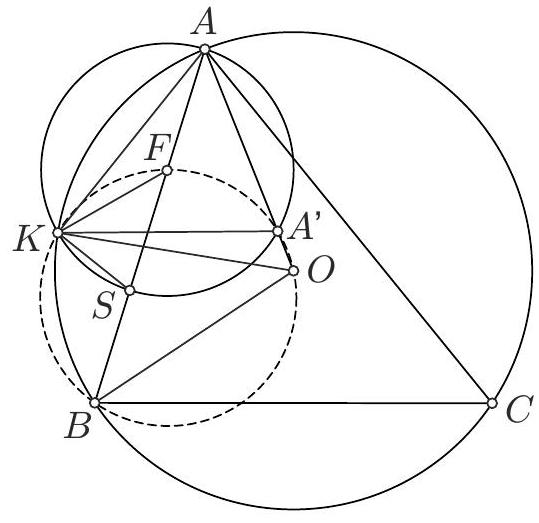
|
| 415 |
+
|
| 416 |
+
Solution. We will prove that the quadrilateral $B K F A^{\prime}$ is cyclic and its circumcircle passes through the center $O$ of the circle (c).
|
| 417 |
+
|
| 418 |
+
The triangle $A F K$ is isosceles, so $m(\widehat{K F B})=2 m(\widehat{K A B})=m(\widehat{K O B})$. It follows that the quadrilateral $B K F O$ is cyclic.
|
| 419 |
+
|
| 420 |
+
The triangles $O F K$ and $O F A$ are congruent (S.S.S.), hence $m(\widehat{O K F})=m(\widehat{O A F})$. The triangle $F A A^{\prime}$ is isosceles, so $m\left(\widehat{F A^{\prime} A}\right)=m(\widehat{O A F})$. Therefore $m\left(\widehat{F A^{\prime} A}\right)=m(\widehat{O K F})$, so the quadrilateral $O K F A^{\prime}$ is cyclic.
|
| 421 |
+
|
| 422 |
+
(1) and (2) prove the initial claim.
|
| 423 |
+
|
| 424 |
+
Along the same lines, we can prove that the points $C, D, L, B^{\prime}, O$ and $A, M, E, C^{\prime}, O$ are concylic, respectively, so their circumcircles also pass through $O$.
|
| 425 |
+
|
| 426 |
+
G2. Let $A B C$ be a triangle with $m(\widehat{B A C})=60^{\circ}$. Let $D$ and $E$ be the feet of the perpendiculars from $A$ to the external angle bisectors of $\widehat{A B C}$ and $\widehat{A C B}$, respectively. Let $O$ be the circumcenter of the triangle $A B C$. Prove that the circumcircles of the triangles $\triangle A D E$ and $\triangle B O C$ are tangent to each other.
|
| 427 |
+
|
| 428 |
+
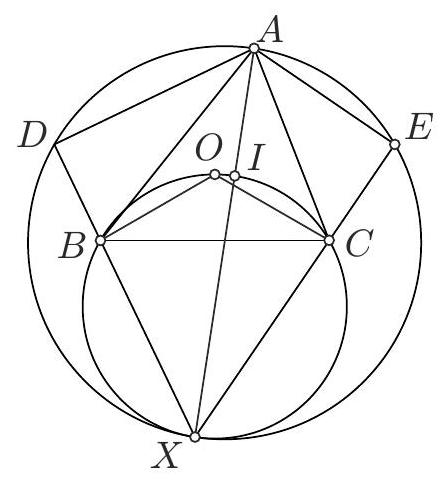
|
| 429 |
+
|
| 430 |
+
Solution. Let $X$ be the intersection of the lines $B D$ and $C E$.
|
| 431 |
+
|
| 432 |
+
We will prove that $X$ lies on the circumcircles of both triangles $\triangle A D E$ and $\triangle B O C$ and then we will prove that the centers of these circles and the point $X$ are collinear, which is enough for proving that the circles are tangent to each other.
|
| 433 |
+
|
| 434 |
+
In this proof we will use the notation $(M N P)$ to denote the circumcircle of the triangle $\triangle M N P$.
|
| 435 |
+
|
| 436 |
+
Obviously, the quadrilateral $A D X E$ is cyclic, and the circle $(D A E)$ has $[A X]$ as diameter. (1)
|
| 437 |
+
|
| 438 |
+
Let $I$ be the incenter of triangle $A B C$. So, the point $I$ lies on the segment $[A X]$ (2), and the quadrilateral $X B I C$ is cyclic because $I C \perp X C$ and $I B \perp X B$. So, the circle (BIC) has $[I X]$ as diameter.
|
| 439 |
+
|
| 440 |
+
Finally, $m(\widehat{B I C})=90^{\circ}+\frac{1}{2} m(\widehat{B A C})=120^{\circ}$ and $m(\widehat{B O C})=2 m(\widehat{B A C})=120^{\circ}$.
|
| 441 |
+
|
| 442 |
+
So, the quadrilateral $B O I C$ is cyclic and the circle $(B O C)$ has $[I X]$ as diameter. (3)
|
| 443 |
+
|
| 444 |
+
(1), (2), (3) imply the conclusion.
|
| 445 |
+
|
| 446 |
+
G3. A trapezoid $A B C D(A B \| C D, A B>C D)$ is circumscribed. The incircle of triangle $A B C$ touches the lines $A B$ and $A C$ at $M$ and $N$, respectively. Prove that the incenter of the trapezoid lies on the line $M N$.
|
| 447 |
+
|
| 448 |
+
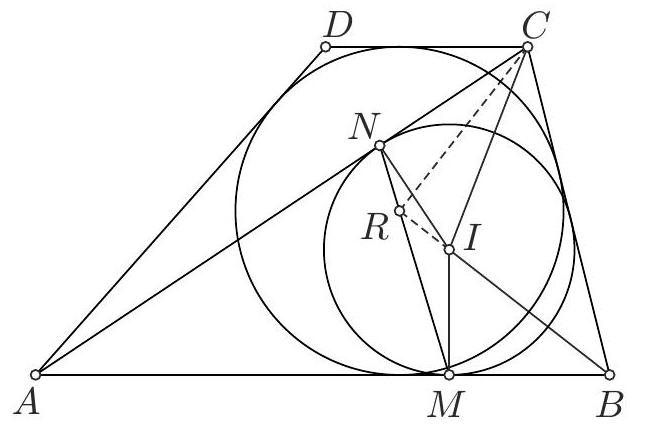
|
| 449 |
+
|
| 450 |
+
Solution. Let $I$ be the incenter of triangle $A B C$ and $R$ be the common point of the lines $B I$ and $M N$. Since
|
| 451 |
+
|
| 452 |
+
$$
|
| 453 |
+
m(\widehat{A N M})=90^{\circ}-\frac{1}{2} m(\widehat{M A N}) \quad \text { and } \quad m(\widehat{B I C})=90^{\circ}+\frac{1}{2} m(\widehat{M A N})
|
| 454 |
+
$$
|
| 455 |
+
|
| 456 |
+
the quadrilateral $I R N C$ is cyclic.
|
| 457 |
+
|
| 458 |
+
It follows that $m(\widehat{B R C})=90^{\circ}$ and therefore
|
| 459 |
+
|
| 460 |
+
$$
|
| 461 |
+
m(\widehat{B C R})=90^{\circ}-m(\widehat{C B R})=90^{\circ}-\frac{1}{2}\left(180^{\circ}-m(\widehat{B C D})\right)=\frac{1}{2} m(\widehat{B C D})
|
| 462 |
+
$$
|
| 463 |
+
|
| 464 |
+
So, $(C R$ is the angle bisector of $\widehat{D C B}$ and $R$ is the incenter of the trapezoid.
|
| 465 |
+
|
| 466 |
+
G4. Let $A B C$ be an acute angled triangle whose shortest side is $[B C]$. Consider a variable point $P$ on the side $[B C]$, and let $D$ and $E$ be points on $(A B]$ and $(A C]$, respectively, such that $B D=B P$ and $C P=C E$. Prove that, as $P$ traces $[B C]$, the circumcircle of the triangle $A D E$ passes through a fixed point.
|
| 467 |
+
|
| 468 |
+
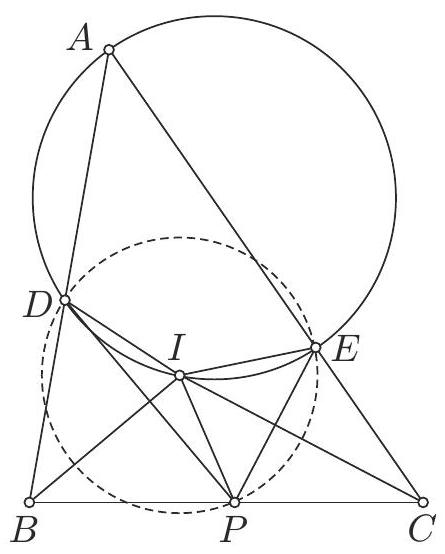
|
| 469 |
+
|
| 470 |
+
Solution. We claim that the fixed point is the center of the incircle of $A B C$.
|
| 471 |
+
|
| 472 |
+
Let $I$ be the center of the incircle of $A B C$. Since $B D=B P$ and $[B I$ is the bisector of $\widehat{D B P}$, the line $B I$ is the perpendicular bisector of $[D P]$. This yields $D I=P I$. Analogously we get $E I=P I$. So, the point $I$ is the circumcenter of the triangle $D E P$.
|
| 473 |
+
|
| 474 |
+
This means $m(\widehat{D I E})=2 m(\widehat{D P E})$.
|
| 475 |
+
|
| 476 |
+
On the other hand
|
| 477 |
+
|
| 478 |
+
$$
|
| 479 |
+
\begin{aligned}
|
| 480 |
+
m(\widehat{D P E}) & =180^{\circ}-m(\widehat{D P B})-m(\widehat{E P C}) \\
|
| 481 |
+
& =180^{\circ}-\left(90^{\circ}-\frac{1}{2} m(\widehat{D B P})\right)-\left(90^{\circ}-\frac{1}{2} m(\widehat{E C P})\right) \\
|
| 482 |
+
& =90^{\circ}-\frac{1}{2} m(\widehat{B A C})
|
| 483 |
+
\end{aligned}
|
| 484 |
+
$$
|
| 485 |
+
|
| 486 |
+
So, $m(\widehat{D I E})=2 m(\widehat{D P E})=180^{\circ}-m(\widehat{D A E})$, which means that the points $A, D, E$ and $I$ are cocyclic.
|
| 487 |
+
|
| 488 |
+
Remark. The fact that the incentre $I$ of the triangle $A B C$ is the required fixed point could be guessed by considering the two extremal positions of $P$. Thus, if $P=B$, then $D=D_{B}=B$ as well, and $C E=C E_{B}=B C$, so $m(\angle A E B)=m(\angle C)+m(\angle E B C)=$ $m(\angle C)+\frac{180^{\circ}-m(\angle C)}{2}=90^{\circ}+\frac{m(\angle C)}{2}=m(\angle A I B)$. Hence the points $A, E=E_{B}, I, D_{B}=B$ are cocyclic. Similarly, letting $P=C$, the points $A, D=D_{C}, I, E_{C}=C$ are cocyclic. Consequently, the circles $A D_{B} E_{B}$ and $A D_{C} E_{C}$ meet again at $I$.
|
| 489 |
+
|
| 490 |
+
G5. Let $A B C$ be an acute angled triangle with orthocenter $H$ and circumcenter $O$. Assume the circumcenter $X$ of $B H C$ lies on the circumcircle of $A B C$. Reflect $O$ across $X$ to obtain $O^{\prime}$, and let the lines $X H$ and $O^{\prime} A$ meet at $K$. Let $L, M$ and $N$ be the midpoints of $[X B],[X C]$ and $[B C]$, respectively. Prove that the points $K, L, M$ and $N$ are cocyclic.
|
| 491 |
+
|
| 492 |
+
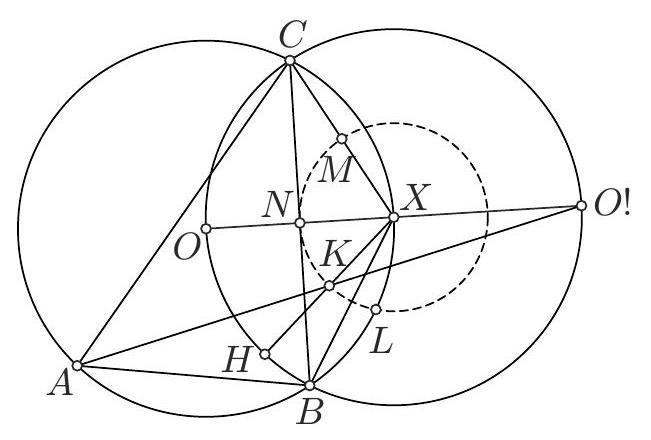
|
| 493 |
+
|
| 494 |
+
Solution. The circumcircles of $A B C$ and $B H C$ have the same radius. So, $X B=$ $X C=X H=X O=r$ (where $r$ is the radius of the circle $A B C$ ) and $O^{\prime}$ lies on $C(X, r)$. We conclude that $O X$ is the perpendicular bisector for $[B C]$. So, $B O X$ and $C O X$ are equilateral triangles.
|
| 495 |
+
|
| 496 |
+
It is known that $A H=2 O N=r$. So, $A H O^{\prime} X$ is parallelogram, and $X K=K H=r / 2$. Finally, $X L=X K=X N=X M=r / 2$. So, $K, L, M$ and $N$ lie on the circle $c(X, r / 2)$.
|
| 497 |
+
|
| 498 |
+
G6. Given an acute triangle $A B C$, erect triangles $A B D$ and $A C E$ externally, so that $m(\widehat{A D B})=m(\widehat{A E C})=90^{\circ}$ and $\widehat{B A D} \equiv \widehat{C A E}$. Let $A_{1} \in B C, B_{1} \in A C$ and $C_{1} \in A B$ be the feet of the altitudes of the triangle $A B C$, and let $K$ and $L$ be the midpoints of $\left[B C_{1}\right]$ and $\left[C B_{1}\right]$, respectively. Prove that the circumcenters of the triangles $A K L, A_{1} B_{1} C_{1}$ and $D E A_{1}$ are collinear.
|
| 499 |
+
|
| 500 |
+
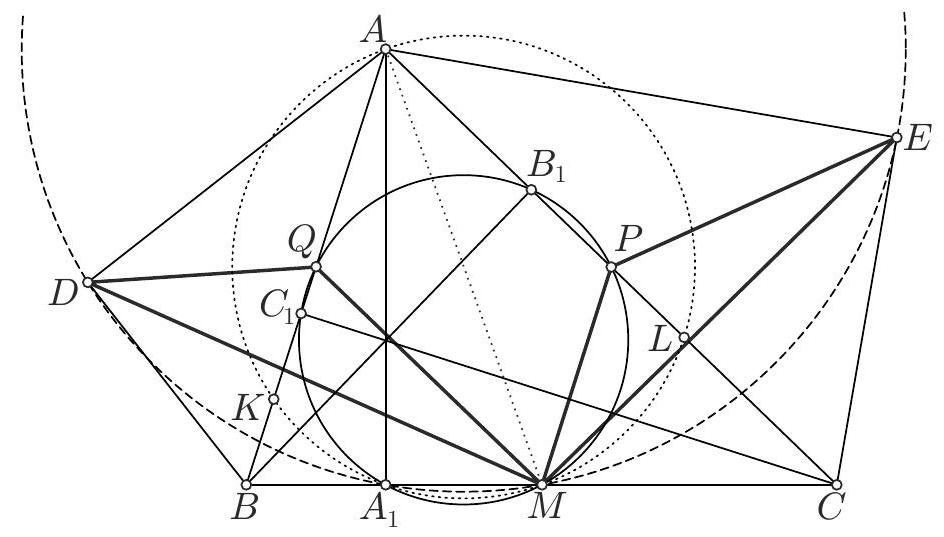
|
| 501 |
+
|
| 502 |
+
Solution. Let $M, P$ and $Q$ be the midpoints of $[B C],[C A]$ and $[A B]$, respectively.
|
| 503 |
+
|
| 504 |
+
The circumcircle of the triangle $A_{1} B_{1} C_{1}$ is the Euler's circle. So, the point $M$ lies on this circle.
|
| 505 |
+
|
| 506 |
+
It is enough to prove now that $\left[A_{1} M\right]$ is a common chord of the three circles $\left(A_{1} B_{1} C_{1}\right)$, $(A K L)$ and $\left(D E A_{1}\right)$.
|
| 507 |
+
|
| 508 |
+
The segments $[M K]$ and $[M L]$ are midlines for the triangles $B C C_{1}$ and $B C B_{1}$ respectively, hence $M K \| C C_{1} \perp A B$ and $M L \| B B_{1} \perp A C$. So, the circle $(A K L)$ has diameter $[A M]$ and therefore passes through $M$.
|
| 509 |
+
|
| 510 |
+
Finally, we prove that the quadrilateral $D A_{1} M E$ is cyclic.
|
| 511 |
+
|
| 512 |
+
From the cyclic quadrilaterals $A D B A_{1}$ and $A E C A_{1}, \widehat{A A_{1} D} \equiv \widehat{A B D}$ and $\widehat{A A_{1} E} \equiv \widehat{A C E} \equiv$ $\widehat{A B D}$, so $m\left(\widehat{D A_{1} E}\right)=2 m(\widehat{A B D})=180^{\circ}-2 m(\widehat{D A B})$.
|
| 513 |
+
|
| 514 |
+
We notice now that $D Q=A B / 2=M P, Q M=A C / 2=P E$ and
|
| 515 |
+
|
| 516 |
+
$$
|
| 517 |
+
\begin{aligned}
|
| 518 |
+
& m(\widehat{D Q M})=m(\widehat{D Q B})+m(\widehat{B Q M})=2 m(\widehat{D A B})+m(\widehat{B A C}) \\
|
| 519 |
+
& m(\widehat{E P M})=m(\widehat{E P C})+m(\widehat{C P M})=2 m(\widehat{E A C})+m(\widehat{C A B})
|
| 520 |
+
\end{aligned}
|
| 521 |
+
$$
|
| 522 |
+
|
| 523 |
+
so $\triangle M P E \equiv \triangle D Q M$ (S.A.S.). This leads to $m(\widehat{D M E})=m(\widehat{D M Q})+m(Q M P)+$ $m(P M E)=m(\widehat{D M Q})+m(B Q M)+m(Q D M)=180^{\circ}-m(\widehat{D Q B})=180^{\circ}-2 m(\widehat{D A B})$. Since $m\left(\widehat{D A_{1} E}\right)=m(\widehat{D M E})$, the quadrilateral $D A_{1} M E$ is cyclic.
|
| 524 |
+
|
| 525 |
+
G7. Let $[A B]$ be a chord of a circle $(c)$ centered at $O$, and let $K$ be a point on the segment $(A B)$ such that $A K<B K$. Two circles through $K$, internally tangent to (c) at $A$ and $B$, respectively, meet again at $L$. Let $P$ be one of the points of intersection of the line $K L$ and the circle (c), and let the lines $A B$ and $L O$ meet at $M$. Prove that the line $M P$ is tangent to the circle $(c)$.
|
| 526 |
+
|
| 527 |
+
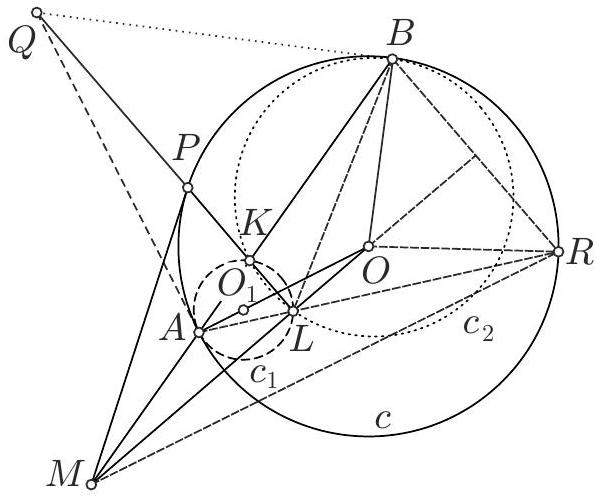
|
| 528 |
+
|
| 529 |
+
Solution. Let $\left(c_{1}\right)$ and $\left(c_{2}\right)$ be circles through $K$, internally tangent to (c) at $A$ and $B$, respectively, and meeting again at $L$, and let the common tangent to $\left(c_{1}\right)$ and $(c)$ meet the common tangent to $\left(c_{2}\right)$ and $(c)$ at $Q$. Then the point $Q$ is the radical center of the circles $\left(c_{1}\right),\left(c_{2}\right)$ and $(c)$, and the line $K L$ passes through $Q$.
|
| 530 |
+
|
| 531 |
+
We have $m(\widehat{Q L B})=m(\widehat{Q B K})=m(\widehat{Q B A})=\frac{1}{2} m(\overparen{B A})=m(\widehat{Q O B})$. So, the quadrilateral $O B Q L$ is cyclic. We conclude that $m(\widehat{Q L O})=90^{\circ}$ and the points $O, B, Q, A$ and $L$ are cocyclic on a circle $(k)$.
|
| 532 |
+
|
| 533 |
+
In the sequel, we will denote $\mathcal{P}_{\omega}(X)$ the power of the point $X$ with respect of the circle $\omega$. The first continuation.
|
| 534 |
+
|
| 535 |
+
From $M O^{2}-O P^{2}=\mathcal{P}_{c}(M)=M A \cdot M B=\mathcal{P}_{k}(M)=M L \cdot M O=(M O-O L) \cdot M O=$ $M O^{2}-O L \cdot M O$ follows that $O P^{2}=O L \cdot O M$. Since $P L \perp O M$, this shows that the triangle $M P O$ is right at point $P$. Thus, the line $M P$ is tangent to the circle (c).
|
| 536 |
+
|
| 537 |
+
The second continuation.
|
| 538 |
+
|
| 539 |
+
Let $R \in(c)$ be so that $B R \perp M O$. The triangle $L B R$ is isosceles with $L B=L R$, so $\widehat{O L R} \equiv \widehat{O L B} \equiv \widehat{O Q B} \equiv \widehat{O Q A} \equiv \widehat{M L A}$. We conclude that the points $A, L$ and $R$ are collinear.
|
| 540 |
+
|
| 541 |
+
Now $m(\widehat{A M R})+m(\widehat{A O R})=m(\widehat{A M R})+2 m(\widehat{A B R})=m(\widehat{A M R})+m(\widehat{A B R})+m(\widehat{M R B})=$ $180^{\circ}$, since the triangle $M B R$ is isosceles. So, the quadrilateral $M A O R$ is cyclic.
|
| 542 |
+
|
| 543 |
+
This yields $L M \cdot L O=-\mathcal{P}_{(\text {MAOR })}(L)=L A \cdot L R=-\mathcal{P}_{c}(L)=L P^{2}$, which as above, shows that $O P \perp P M$.
|
| 544 |
+
|
| 545 |
+
The third continuation.
|
| 546 |
+
|
| 547 |
+
$\widehat{K L A} \equiv \widehat{K A Q} \equiv \widehat{K L B}$ and $m(\widehat{M L K})=90^{\circ}$ show that $[L K$ and $[L M$ are the internal and external bisectors af the angle $\widehat{A L B}$, so $(M, K)$ and $(A, B)$ are harmonic conjugates. So, $L K$ is the polar line of $M$ in the circle $(c)$.
|
| 548 |
+
|
| 549 |
+
## Chapter 4
|
| 550 |
+
|
| 551 |
+
## Number Theory
|
| 552 |
+
|
| 553 |
+
N1. Determine the largest positive integer $n$ that divides $p^{6}-1$ for all primes $p>7$.
|
| 554 |
+
|
| 555 |
+
Solution. Note that
|
| 556 |
+
|
| 557 |
+
$$
|
| 558 |
+
p^{6}-1=(p-1)(p+1)\left(p^{2}-p+1\right)\left(p^{2}+p+1\right)
|
| 559 |
+
$$
|
| 560 |
+
|
| 561 |
+
For $p=11$ we have
|
| 562 |
+
|
| 563 |
+
$$
|
| 564 |
+
p^{6}-1=1771560=2^{3} \cdot 3^{2} \cdot 5 \cdot 7 \cdot 19 \cdot 37
|
| 565 |
+
$$
|
| 566 |
+
|
| 567 |
+
For $p=13$ we have
|
| 568 |
+
|
| 569 |
+
$$
|
| 570 |
+
p^{6}-1=2^{3} \cdot 3^{2} \cdot 7 \cdot 61 \cdot 157
|
| 571 |
+
$$
|
| 572 |
+
|
| 573 |
+
From the last two calculations we find evidence to try showing that $p^{6}-1$ is divisible by $2^{3} \cdot 3^{2} \cdot 7=504$ and this would be the largest positive integer that divides $p^{6}-1$ for all primes greater than 7 .
|
| 574 |
+
|
| 575 |
+
By Fermat's theorem, $7 \mid p^{6}-1$.
|
| 576 |
+
|
| 577 |
+
Next, since $p$ is odd, $8 \mid p^{2}-1=(p-1)(p+1)$, hence $8 \mid p^{6}-1$.
|
| 578 |
+
|
| 579 |
+
It remains to show that $9 \mid p^{6}-1$.
|
| 580 |
+
|
| 581 |
+
Any prime number $p, p>3$ is 1 or -1 modulo 3 .
|
| 582 |
+
|
| 583 |
+
In the first case both $p-1$ and $p^{2}+p+1$ are divisible by 3 , and in the second case, both $p+1$ and $p^{2}-p+1$ are divisible by 3 .
|
| 584 |
+
|
| 585 |
+
Consequently, the required number is indeed 504
|
| 586 |
+
|
| 587 |
+
## Alternative solution
|
| 588 |
+
|
| 589 |
+
Let $q$ be a (positive) prime factor of $n$. Then $q \leq 7$, as $q \nmid q^{6}-1$. Also, $q$ is not 5 , as the last digit of $13^{6}-1$ is 8 .
|
| 590 |
+
|
| 591 |
+
Hence, the prime factors of $n$ are among 2,3 , and 7 .
|
| 592 |
+
|
| 593 |
+
Next, from $11^{6}-1=2^{3} \cdot 3^{2} \cdot 5 \cdot 7 \cdot 19 \cdot 37$ it follows that the largest integer $n$ such that $n \mid p^{6}-1$ for all primes $p$ greater than 7 is at most $2^{3} \cdot 3^{2} \cdot 7$, and it remains to prove that 504 divides $p^{6}-1$ for all primes grater than 7 .
|
| 594 |
+
|
| 595 |
+
N2. Find the maximum number of natural numbers $x_{1}, x_{2}, \ldots, x_{m}$ satisfying the conditions:
|
| 596 |
+
|
| 597 |
+
a) No $x_{i}-x_{j}, 1 \leq i<j \leq m$ is divisible by 11 ; and
|
| 598 |
+
|
| 599 |
+
b) The sum $x_{2} x_{3} \ldots x_{m}+x_{1} x_{3} \ldots x_{m}+\cdots+x_{1} x_{2} \ldots x_{m-1}$ is divisible by 11 .
|
| 600 |
+
|
| 601 |
+
Solution. The required maximum is 10 .
|
| 602 |
+
|
| 603 |
+
According to a), the numbers $x_{i}, 1 \leq i \leq m$, are all different $(\bmod 11)$ (1)
|
| 604 |
+
|
| 605 |
+
Hence, the number of natural numbers satisfying the conditions is at most 11.
|
| 606 |
+
|
| 607 |
+
If $x_{j} \equiv 0(\bmod 11)$ for some $j$, then
|
| 608 |
+
|
| 609 |
+
$$
|
| 610 |
+
x_{2} x_{3} \ldots x_{m}+x_{1} x_{3} \ldots x_{m}+\cdots+x_{1} x_{2} \ldots x_{m-1} \equiv x_{1} \ldots x_{j-1} x_{j+1} \ldots x_{m} \quad(\bmod 11)
|
| 611 |
+
$$
|
| 612 |
+
|
| 613 |
+
which would lead to $x_{i} \equiv 0(\bmod 11)$ for some $i \neq j$, contradicting (1).
|
| 614 |
+
|
| 615 |
+
We now prove that 10 is indeed the required maximum.
|
| 616 |
+
|
| 617 |
+
Consider $x_{i}=i$, for all $i \in\{1,2, \ldots, 10\}$. The products $2 \cdot 3 \cdots \cdot 10,1 \cdot 3 \cdots \cdots 10, \ldots$, $1 \cdot 2 \cdots \cdot 9$ are all different $(\bmod 11)$, and so
|
| 618 |
+
|
| 619 |
+
$$
|
| 620 |
+
2 \cdot 3 \cdots \cdots 10+1 \cdot 3 \cdots \cdots 10+\cdots+1 \cdot 2 \cdots \cdot 9 \equiv 1+2+\cdots+10 \quad(\bmod 11)
|
| 621 |
+
$$
|
| 622 |
+
|
| 623 |
+
and condition b) is satisfied, since $1+2+\cdots+10=55=5 \cdot 11$.
|
| 624 |
+
|
| 625 |
+
N3. Find all positive integers $n$ such that the number $A_{n}=\frac{2^{4 n+2}+1}{65}$ is
|
| 626 |
+
|
| 627 |
+
a) an integer;
|
| 628 |
+
|
| 629 |
+
b) a prime.
|
| 630 |
+
|
| 631 |
+
Solution. a) Note that $65=5 \cdot 13$.
|
| 632 |
+
|
| 633 |
+
Obviously, $5=2^{2}+1$ is a divisor of $\left(2^{2}\right)^{2 n+1}+1=2^{4 n+2}+1$ for any positive integer $n$. Since $2^{12} \equiv 1(\bmod 13)$, if $n \equiv r(\bmod 3)$, then $2^{4 n+2}+1 \equiv 2^{4 r+2}+1(\bmod 13)$. Now, $2^{4 \cdot 0+2}+1=5,2^{4 \cdot 1+2}+1=65$, and $2^{4 \cdot 2+2}+1=1025=13 \cdot 78+11$. Hence 13 is a divisor of $2^{4 n+2}+1$ precisely when $n \equiv 1(\bmod 3)$. Hence, $A_{n}$ is an integer iff $n \equiv 1(\bmod 3)$.
|
| 634 |
+
|
| 635 |
+
b) Applying the identity $4 x^{4}+1=\left(2 x^{2}-2 x+1\right)\left(2 x^{2}+2 x+1\right)$, we have $2^{4 n+2}+1=$ $\left(2^{2 n+1}-2^{n+1}+1\right)\left(2^{2 n+1}+2^{n+1}+1\right)$. For $n=1, A_{1}=1$, which is not a prime. According to a), if $n \neq 1$, then $n \geq 4$. But then $2^{2 n+1}+2^{n+1}+1>2^{2 n+1}-2^{n+1}+1>65$, and $A_{n}$ has at least two factors. We conclude that $A_{n}$ can never be a prime.
|
| 636 |
+
|
| 637 |
+
Alternative Solution to b): Knowing that $n=3 k+1$ in order for $A_{n}$ to be an integer, $2^{4 n+2}+1=2^{12 k+6}+1=\left(2^{4 k+2}\right)^{3}+1=\left(2^{4 k+2}+1\right)\left(2^{8 k+4}-2^{4 k+2}+1\right) \quad(*)$. As in the previous solution, if $k=0$, then $A_{1}=1$, if $k=1$, then $A_{4}=2^{12}-2^{6}+1=4033=37 \cdot 109$, and for $k \geq 2$ both factors in $(*)$ are larger than 65 , so $A_{3 k+1}$ is not a prime.
|
| 638 |
+
|
| 639 |
+
N4. Find all triples of integers $(a, b, c)$ such that the number
|
| 640 |
+
|
| 641 |
+
$$
|
| 642 |
+
N=\frac{(a-b)(b-c)(c-a)}{2}+2
|
| 643 |
+
$$
|
| 644 |
+
|
| 645 |
+
is a power of 2016 .
|
| 646 |
+
|
| 647 |
+
Solution. Let $z$ be a positive integer such that
|
| 648 |
+
|
| 649 |
+
$$
|
| 650 |
+
(a-b)(b-c)(c-a)+4=2 \cdot 2016^{z}
|
| 651 |
+
$$
|
| 652 |
+
|
| 653 |
+
We set $a-b=-x, b-c=-y$ and we rewrite the equation as
|
| 654 |
+
|
| 655 |
+
$$
|
| 656 |
+
x y(x+y)+4=2 \cdot 2016^{z}
|
| 657 |
+
$$
|
| 658 |
+
|
| 659 |
+
Note that the right hand side is divisible by 7 , so we have that
|
| 660 |
+
|
| 661 |
+
$$
|
| 662 |
+
x y(x+y)+4 \equiv 0 \quad(\bmod 7)
|
| 663 |
+
$$
|
| 664 |
+
|
| 665 |
+
or
|
| 666 |
+
|
| 667 |
+
$$
|
| 668 |
+
3 x y(x+y) \equiv 2 \quad(\bmod 7)
|
| 669 |
+
$$
|
| 670 |
+
|
| 671 |
+
or
|
| 672 |
+
|
| 673 |
+
$$
|
| 674 |
+
(x+y)^{3}-x^{3}-y^{3} \equiv 2 \quad(\bmod 7)
|
| 675 |
+
$$
|
| 676 |
+
|
| 677 |
+
Note that, by Fermat's Little Theorem, we have that for any integer $k$ the cubic residues are $k^{3} \equiv-1,0,1 \bmod 7$. It follows that in (4.1) some of $(x+y)^{3}, x^{3}$ and $y^{3}$ should be divisible by 7 , but in this case, $x y(x+y)$ is divisible by 7 and this is a contradiction. So, the only possibility is to have $z=0$ and consequently, $x y(x+y)+4=2$, or, equivalently, $x y(x+y)=-2$. The only solution of the latter is $(x, y)=(-1,-1)$, so the required triples are $(a, b, c)=(k+2, k+1, k), k \in \mathbb{Z}$, and all their cyclic permutations.
|
| 678 |
+
|
| 679 |
+
N5. Determine all four-digit numbers $\overline{a b c d}$ such that
|
| 680 |
+
|
| 681 |
+
$$
|
| 682 |
+
(a+b)(a+c)(a+d)(b+c)(b+d)(c+d)=\overline{a b c d}
|
| 683 |
+
$$
|
| 684 |
+
|
| 685 |
+
Solution. Depending on the parity of $a, b, c, d$, at least two of the factors $(a+b),(a+c)$, $(a+d),(b+c),(b+d),(c+d)$ are even, so that $4 \mid \overline{a b c d}$.
|
| 686 |
+
|
| 687 |
+
We claim that $3 \mid \overline{a b c d}$.
|
| 688 |
+
|
| 689 |
+
Assume $a+b+c+d \equiv 2(\bmod 3)$. Then $x+y \equiv 1(\bmod 3)$, for all distinct $x, y \in\{a, b, c, d\}$. But then the left hand side in the above equality is congruent to $1(\bmod 3)$ and the right hand side congruent to $2(\bmod 3)$, contradiction.
|
| 690 |
+
|
| 691 |
+
Assume $a+b+c+d \equiv 1(\bmod 3)$. Then $x+y \equiv 2(\bmod 3)$, for all distinct $x, y \in\{a, b, c, d\}$, and $x \equiv 1(\bmod 3)$, for all $x, y \in\{a, b, c, d\}$. Hence, $a, b, c, d \in\{1,4,7\}$, and since $4 \mid \overline{a b c d}$, we have $c=d=4$. Therefore, $8 \mid \overline{a b 44}$, and since at least one more factor is even, it follows that $16 \overline{a b 44}$. Then $b \neq 4$, and the only possibilities are $b=1$, implying $a=4$, which is impossible because 4144 is not divisible by $5=1+4$, or $b=7$, implying $11 \mid \overline{a 744}$, hence $a=7$, which is also impossible because 7744 is not divisible by $14=7+7$.
|
| 692 |
+
|
| 693 |
+
We conclude that $3 \mid \overline{a b c d}$, hence also $3 \mid a+b+c+d$. Then at least one factor $x+y$ of $(a+b),(a+c),(a+d),(b+c),(b+d),(c+d)$ is a multiple of 3 , implying that also $3 \mid a+b+c+d-x-y$, so $9 \mid \overline{a b c d}$. Then $9 \mid a+b+c+d$, and $a+b+c+d \in\{9,18,27,36\}$. Using the inequality $x y \geq x+y-1$, valid for all $x, y \in \mathbb{N}^{*}$, if $a+b+c+d \in\{27,36\}$, then
|
| 694 |
+
|
| 695 |
+
$$
|
| 696 |
+
\overline{a b c d}=(a+b)(a+c)(a+d)(b+c)(b+d)(c+d) \geq 26^{3}>10^{4}
|
| 697 |
+
$$
|
| 698 |
+
|
| 699 |
+
which is impossible.
|
| 700 |
+
|
| 701 |
+
Using the inequality $x y \geq 2(x+y)-4$ for all $x, y \geq 2$, if $a+b+c+d=18$ and all two-digit sums are greater than 1 , then $\overline{a b c d} \geq 32^{3}>10^{4}$. Hence, if $a+b+c+d=18$, some two-digit sum must be 1 , hence the complementary sum will be 17 , and the digits are $\{a, b, c, d\}=\{0,1,8,9\}$. But then $\overline{a b c d}=1 \cdot 17 \cdot 8 \cdot 9^{2} \cdot 10>10^{4}$.
|
| 702 |
+
|
| 703 |
+
We conclude that $a+b+c+d=9$. Then among $a, b, c, d$ there are either three odd or three even numbers, and $8 \mid \overline{a b c d}$.
|
| 704 |
+
|
| 705 |
+
If three of the digits are odd, then $d$ is even and since $c$ is odd, divisibility by 8 implies that $d \in\{2,6\}$. If $d=6$, then $a=b=c=1$. But 1116 is not divisible by 7 , so this is not a solution. If $d=2$, then $a, b, c$ are either $1,1,5$ or $1,3,3$ in some order. In the first case $2 \cdot 6^{2} \cdot 3^{2} \cdot 7=4536 \neq \overline{a b c d}$. The second case cannot hold because the resulting number is not a multiple of 5 .
|
| 706 |
+
|
| 707 |
+
Hence, there has to be one odd and three even digits. At least one of the two-digits sums of even digits is a multiple of 4 , and since there cannot be two zero digits, we have either $x+y=4$ and $z+t=5$, or $x+y=8$ and $z+t=1$ for some ordering $x, y, z, t$ of $a, b, c, d$. In the first case we have $d=0$ and the digits are $0,1,4,4$, or $0,2,3,4$, or $0,2,2,5$. None of these is a solution because $1 \cdot 4^{2} \cdot 5^{2} \cdot 8=3200,2 \cdot 3 \cdot 4 \cdot 5 \cdot 6 \cdot 7=5040$ and $2^{2} \cdot 5 \cdot 4 \cdot 7^{2}=3920$. In the second case two of the digits are 0 and 1 , and the other two have to be either 4 and 4 , or 2 and 6 . We already know that the first possibility fails. For the second, we get
|
| 708 |
+
|
| 709 |
+
$$
|
| 710 |
+
(0+1) \cdot(0+2) \cdot(0+6) \cdot(1+2) \cdot(1+6) \cdot(2+6)=2016
|
| 711 |
+
$$
|
| 712 |
+
|
| 713 |
+
and $\overline{a b c d}=2016$ is the only solution.
|
| 714 |
+
|
JBMO/raw/en-official/en-2021_jbmo_problems_and_sol.pdf
ADDED
|
@@ -0,0 +1,3 @@
|
|
|
|
|
|
|
|
|
|
|
|
|
| 1 |
+
version https://git-lfs.github.com/spec/v1
|
| 2 |
+
oid sha256:28a9e5e2ef49a246646d307eee3ba5867a0192166365243a932090c4d0f87a8a
|
| 3 |
+
size 194086
|
JBMO/raw/en-official/en-jbmo-2010-solutions.pdf
ADDED
|
@@ -0,0 +1,3 @@
|
|
|
|
|
|
|
|
|
|
|
|
|
| 1 |
+
version https://git-lfs.github.com/spec/v1
|
| 2 |
+
oid sha256:242a40d962231e49d8f7983d3aa07185baa563254c519c91511153f062d0eb23
|
| 3 |
+
size 183595
|
JBMO/raw/en-official/en-jbmo-2022-solutions.pdf
ADDED
|
@@ -0,0 +1,3 @@
|
|
|
|
|
|
|
|
|
|
|
|
|
| 1 |
+
version https://git-lfs.github.com/spec/v1
|
| 2 |
+
oid sha256:e2a63411e5263b7aafcf13c445c67a180862dbca7ec167028f592a3d9df78fd7
|
| 3 |
+
size 173109
|
JBMO/raw/en-official/en-jbmo2012-problems-solutions.pdf
ADDED
|
@@ -0,0 +1,3 @@
|
|
|
|
|
|
|
|
|
|
|
|
|
| 1 |
+
version https://git-lfs.github.com/spec/v1
|
| 2 |
+
oid sha256:be59deea017f600923eb0dfd8a7d2b30305f06c53264f4cff90b44c98deec17a
|
| 3 |
+
size 97374
|
JBMO/raw/en-official/en-jbmo2013solutions.pdf
ADDED
|
@@ -0,0 +1,3 @@
|
|
|
|
|
|
|
|
|
|
|
|
|
| 1 |
+
version https://git-lfs.github.com/spec/v1
|
| 2 |
+
oid sha256:407af3cc20cc8258dfaf8033f27b991cb22aeb85cd73ff3228ff42ac56003c25
|
| 3 |
+
size 523427
|
JBMO/raw/en-official/en-jbmo_2016_paper_eng.pdf
ADDED
|
@@ -0,0 +1,3 @@
|
|
|
|
|
|
|
|
|
|
|
|
|
| 1 |
+
version https://git-lfs.github.com/spec/v1
|
| 2 |
+
oid sha256:f2285b731c1aa755269bd9c367e86fe99072d94ee37e01d5cd19393d69ed0ecd
|
| 3 |
+
size 136423
|
JBMO/raw/en-official/en-jbmo_2017_english_solutions.pdf
ADDED
|
@@ -0,0 +1,3 @@
|
|
|
|
|
|
|
|
|
|
|
|
|
| 1 |
+
version https://git-lfs.github.com/spec/v1
|
| 2 |
+
oid sha256:28e3966c60a5873d40faebef328f39912fce57a759fecb4f67a4842a905b83b8
|
| 3 |
+
size 87753
|
JBMO/raw/en-official/en-jbmo_2018_solutions.pdf
ADDED
|
@@ -0,0 +1,3 @@
|
|
|
|
|
|
|
|
|
|
|
|
|
| 1 |
+
version https://git-lfs.github.com/spec/v1
|
| 2 |
+
oid sha256:e790201cdd6314543b677be8f39926dcdb99b000832145cc83345eede5bdde12
|
| 3 |
+
size 279984
|
JBMO/raw/en-official/en-jbmo_2020_solutions.pdf
ADDED
|
@@ -0,0 +1,3 @@
|
|
|
|
|
|
|
|
|
|
|
|
|
| 1 |
+
version https://git-lfs.github.com/spec/v1
|
| 2 |
+
oid sha256:58448d6889feb50a3216ef4906cabfd259d44830386fb282a371d91d67aec7cf
|
| 3 |
+
size 120051
|
JBMO/raw/en-official/en-jbmo_2023_final_paper_-_with_solutions_1.pdf
ADDED
|
@@ -0,0 +1,3 @@
|
|
|
|
|
|
|
|
|
|
|
|
|
| 1 |
+
version https://git-lfs.github.com/spec/v1
|
| 2 |
+
oid sha256:39688cb9a36f8f64659df0ae55328f0eb5af08a279555bc1b7133f066f625d22
|
| 3 |
+
size 350824
|
JBMO/raw/en-official/en-optimizedjbmo_2019_problems_and_solutions_english.pdf
ADDED
|
@@ -0,0 +1,3 @@
|
|
|
|
|
|
|
|
|
|
|
|
|
| 1 |
+
version https://git-lfs.github.com/spec/v1
|
| 2 |
+
oid sha256:899c2ea7d4e72046c8277283f51cc3de3f5575a644255ad41af5c569ded46c4f
|
| 3 |
+
size 201673
|
JBMO/raw/en-official/en-solutions-english-jbmo2015.pdf
ADDED
|
@@ -0,0 +1,3 @@
|
|
|
|
|
|
|
|
|
|
|
|
|
| 1 |
+
version https://git-lfs.github.com/spec/v1
|
| 2 |
+
oid sha256:03536bf1f9ddd5ba346efcabb60009adf8fb2142fd185b45492453f6b50f1563
|
| 3 |
+
size 540548
|
JBMO/raw/en-official/en-solutions_en-jbmo2014.pdf
ADDED
|
@@ -0,0 +1,3 @@
|
|
|
|
|
|
|
|
|
|
|
|
|
| 1 |
+
version https://git-lfs.github.com/spec/v1
|
| 2 |
+
oid sha256:4f32345b2d3f2d26162a0535cb6140b2e9c18b6134e0795d25929afaa4f82786
|
| 3 |
+
size 70772
|
JBMO/raw/en-shortlist/en-alg-20111.pdf
ADDED
|
@@ -0,0 +1,3 @@
|
|
|
|
|
|
|
|
|
|
|
|
|
| 1 |
+
version https://git-lfs.github.com/spec/v1
|
| 2 |
+
oid sha256:49acfdec9a1d5657bf9bc05eb3c354fa5a6e6d1e82d323004ab64d9d6b762d75
|
| 3 |
+
size 170048
|
JBMO/raw/en-shortlist/en-combi-2011.pdf
ADDED
|
@@ -0,0 +1,3 @@
|
|
|
|
|
|
|
|
|
|
|
|
|
| 1 |
+
version https://git-lfs.github.com/spec/v1
|
| 2 |
+
oid sha256:5ba1e7ede213142993bf3723425d16d4bcbe81f2d1f41a8c2b37583a5b6cf1c1
|
| 3 |
+
size 153175
|
JBMO/raw/en-shortlist/en-geome-2011.pdf
ADDED
|
@@ -0,0 +1,3 @@
|
|
|
|
|
|
|
|
|
|
|
|
|
| 1 |
+
version https://git-lfs.github.com/spec/v1
|
| 2 |
+
oid sha256:c50318333fe4f613b8cba820f596d67adbed744fcc3af50ac0f063b7e2323927
|
| 3 |
+
size 67004
|