


language: zh
license: cc-by-nc-4.0
tags:
  - speech
  - conversational-speech
  - chinese
pretty_name: DuplexConv
DuplexConv
DuplexConv is a large-scale Chinese multi-channel conversational speech dataset with LLM-assisted annotations, developed by ASLP@NPU and QualiaLabs as part of the SmoothConv–DuplexConv corpus family.



Companion dataset: SmoothConv on HuggingFace (100 hours, expert human annotation). DuplexConv and SmoothConv share the same conversational domains and a unified data design. SmoothConv focuses on high-quality human annotations for benchmarking and supervised learning; DuplexConv emphasizes scale for Speech LLM pre-training and data-driven modeling.
Dataset Overview
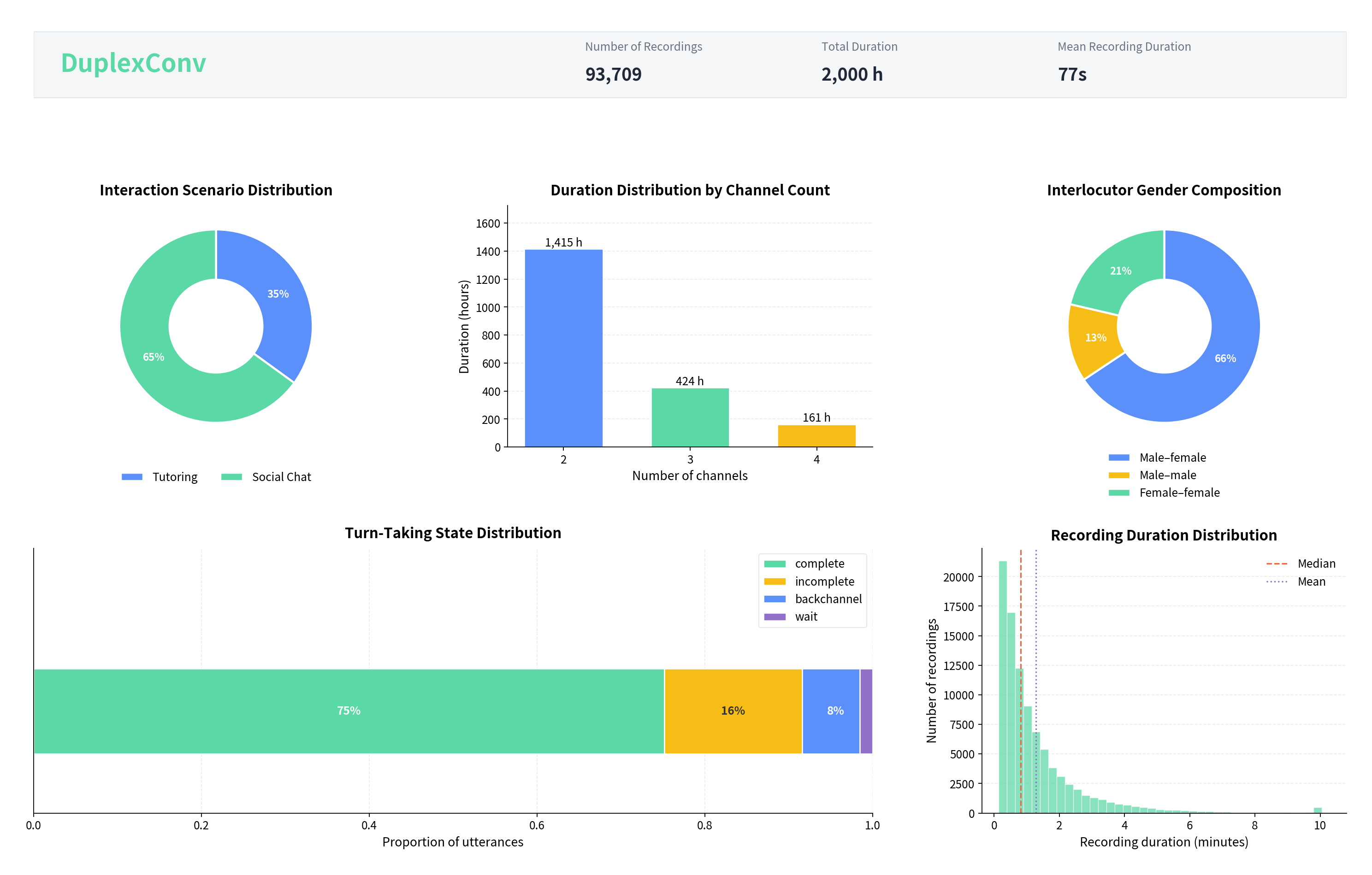
DuplexConv comprises 2,000 hours of naturally occurring multi-party Chinese conversations recorded in multi-channel environments across Tutoring and Social Chat scenarios. The dataset captures realistic full-duplex conversational behaviors, including overlapping speech, backchannels, interruptions, pauses, and dynamic turn transitions.
An LLM-assisted annotation pipeline generates transcripts, speaker-aware conversational structures, turn-level interaction information, and scene-level contextual labels. Together with SmoothConv, DuplexConv bridges fine-grained human annotation and large-scale Speech LLM training in realistic full-duplex settings.
| Metric | Value |
|---|---|
| Total Duration | 2,000.21 hours |
| Audio Files | 93,709 |
| Mean Duration | 76.84 sec |
| Duration Range | 8.0 – 618.3 sec |
| Language | Chinese (zh) |
| Domains | Tutoring, Social Chat |
| Annotation | LLM-assisted |
Domains & Directory Layout
After download, each conversation is stored under a top-level folder whose name indicates the scenario. Match the folder prefix to the domain:
| Scenario | Folder prefix | Example |
|---|---|---|
| Tutoring | starts with edu or Edu |
Edu_20240101_001/ |
| Social Chat | starts with none_Edu |
none_Edu_20240101_001/ |
Within each folder you will find paired multi-channel audio (.wav) and annotation (.json) files. The same naming convention applies to both DuplexConv and SmoothConv.
Dataset Statistics
Supported Tasks
- Speech Language Model (Speech LLM) pre-training
- Conversational speech understanding
- Turn-taking and interaction modeling
- Full-duplex spoken dialogue systems
- Multi-party conversational AI
Annotation Format
Each audio file is paired with a JSON annotation file. The root object wavInfo has the following structure:
wavInfo
├── nTrack, timeLenInSec, fs          # channels, duration (s), sample rate (Hz)
├── vadFrmLenInMs                     # VAD frame length (ms)
├── vadFlagPerFrmPerTrack             # ndarray (nFrm, nTrack), frame-level VAD per channel
└── asr[track][sentence]              # per-channel, per-utterance ASR & labels
wavInfo — audio metadata
| Field | Type | Description |
|---|---|---|
nTrack |
int |
Number of audio channels |
timeLenInSec |
float |
Duration (seconds) |
fs |
int |
Sample rate (Hz) |
vadFrmLenInMs |
int |
VAD frame length (milliseconds) |
vadFlagPerFrmPerTrack |
ndarray (nFrm, nTrack) |
Per-frame VAD flag per channel |
asr |
list[nTrack] |
ASR results; asr[i] is a list of utterances on channel i |
asr[track][sentence] — per-utterance fields
| Field | Type | Description |
|---|---|---|
txt |
str |
Transcript (primary ASR engine) |
startInMs / endInMs |
int |
Start / end time (milliseconds) |
LID |
str |
Language ID (e.g. cn) |
privacyFlag |
bool |
True if sensitive content detected |
asrRes |
dict |
Results from multiple open-source ASR engines |
labels |
dict |
LLM labels: gender, age, emotion, accent, paralinguistic, txt, … |
state |
str |
Turn state, e.g. <|complete|>, <|incomplete|> |
speaker |
dict |
Speaker stats within this utterance (not global speaker IDs): numSpeakers, multiSpeaker, segments |
snr / mos |
float |
Signal-to-noise ratio / MOS estimate |
AED_dasheng |
list |
Audio event detection scores |
Example utterance
{
  "startInMs": 3664,
  "endInMs": 17280,
  "LID": "cn",
  "txt": "right away不是状语它就是副词嘛...",
  "privacyFlag": false,
  "state": "<|complete|>",
  "labels": {"gender": "男声", "age": "青年", "emotion": "...", "txt": "..."},
  "speaker": {"numSpeakers": 1, "segments": [{"speaker": "SPEAKER_00", "startSec": 3.664, "endSec": 10.264}]}
}
Usage
import json
import numpy as np
from datasets import load_dataset

ds = load_dataset("qualialabsAI/DuplexConv")

# Load annotation for a sample
with open("path/to/annotation.json", "r", encoding="utf-8") as f:
    wav_info = json.load(f)

print(wav_info["nTrack"], wav_info["timeLenInSec"], wav_info["fs"])

# Per-track sentences
for track_idx, track_asr in enumerate(wav_info["asr"]):
    for sent in track_asr:
        print(track_idx, sent["startInMs"], sent["endInMs"], sent.get("txt", sent.get("labels", {}).get("txt")))
Ethics Statement
- Informed consent. Conversations were recorded with the knowledge and consent of participants. Personal identifiers have been removed or anonymized prior to release.
- Privacy protection. For academic and research use only. Do not attempt to re-identify speakers or reconstruct private information.
- Intended use. Research on spoken dialogue, turn-taking, and speech understanding—not for unauthorized surveillance, impersonation, or deceptive content generation.
- Limitations & bias. Labels are machine-assisted and may contain errors; account for domain, demographic, and annotation bias in experiments.
- Responsible use. Report suspected misuse to jimz@qualialabs.ai.
License
Citation
@article{wang2026duoconv,
  title   = {DuoConv: Large-Scale Chinese Full-Duplex Speech Datasets for Conversational AI},
  author  = {Chengyou Wang and Chunjiang He and Zhou Zhu and Lei Xie},
  journal = {arXiv preprint arXiv:0000.00000},
  year    = {2026},
  note    = {Placeholder; paper forthcoming}
}