| --- |
| license: apache-2.0 |
| task_categories: |
| - tabular-regression |
| - tabular-classification |
| - question-answering |
| language: |
| - en |
| tags: |
| - user modelling |
| - trust |
| size_categories: |
| - 10K<n<100K |
| configs: |
| - config_name: data |
| data_files: "data.jsonl" |
| --- |
| |
| This is a slightly edited dataset of the one [found here on GitHub](https://github.com/zouharvi/trust-intervention/). |
| The data contains the user interactions, their bet values, answer correctness etc. |
| Please contact the authors if you have any questions. |
|
|
| # A Diachronic Perspective on User Trust in AI under Uncertainty |
|
|
| > **Abstract:** In a human-AI collaboration, users build a mental model of the AI system based on its veracity and how it presents its decision, e.g. its presentation of system confidence and an explanation of the output. |
| > However, modern NLP systems are often uncalibrated, resulting in confidently incorrect predictions that undermine user trust. |
| > In order to build trustworthy AI, we must understand how user trust is developed and how it can be regained after potential trust-eroding events. |
| > We study the evolution of user trust in response to these trust-eroding events using a betting game as the users interact with the AI. |
| > We find that even a few incorrect instances with inaccurate confidence estimates can substantially damage user trust and performance, with very slow recovery. |
| > We also show that this degradation in trust can reduce the success of human-AI collaboration |
| > and that different types of miscalibration---unconfidently correct and confidently incorrect---have different (negative) effects on user trust. |
| > Our findings highlight the importance of calibration in user-facing AI application, and shed light onto what aspects help users decide whether to trust the system. |
|
|
| This work was presented EMNLP 2023, read it [**here**](https://aclanthology.org/2023.emnlp-main.339/). |
| Written by Shehzaad Dhuliawala, Vilém Zouhar, Mennatallah El-Assady, and Mrinmaya Sachan from ETH Zurich, Department of Computer Science. |
| ``` |
| @inproceedings{dhuliawala-etal-2023-diachronic, |
| title = "A Diachronic Perspective on User Trust in {AI} under Uncertainty", |
| author = "Dhuliawala, Shehzaad and |
| Zouhar, Vil{\'e}m and |
| El-Assady, Mennatallah and |
| Sachan, Mrinmaya", |
| booktitle = "Proceedings of the 2023 Conference on Empirical Methods in Natural Language Processing", |
| month = dec, |
| year = "2023", |
| address = "Singapore", |
| publisher = "Association for Computational Linguistics", |
| url = "https://aclanthology.org/2023.emnlp-main.339", |
| doi = "10.18653/v1/2023.emnlp-main.339", |
| pages = "5567--5580" |
| } |
| ``` |
|
|
| <img width="400em" src="https://raw.githubusercontent.com/zouharvi/trust-intervention/main/meta/figure_1.png"> |
|
|
| <small> |
| Figure 1: Diachronic view of a typical human-AI collaborative setting. |
| Here, at each timestep <em>t</em>, the user uses their prior mental model <em>ψ<sub>t</sub></em> to accept or reject the AI system’s answer <em>y<sub>t</sub></em>, supported by an additional message <em>m<sub>t</sub></em> comprising of the AI’s confidence, and updates their mental model of the AI system to <em>ψ<sub>t+1</sub></em>. If the message is rejected, the user invokes a fallback process to provide a different answer. |
| </small> |
|
|
| ## Resources |
|
|
| [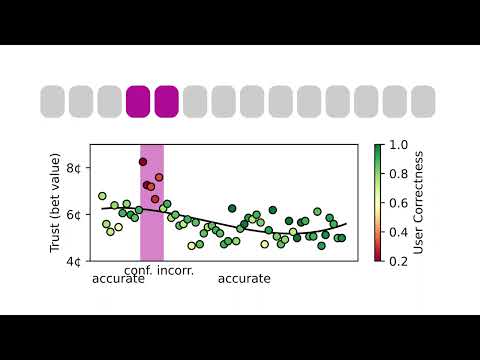](https://www.youtube.com/watch?v=NrH3flpijDw) |
|
|
|
|
| <img width="500em" src="https://raw.githubusercontent.com/zouharvi/trust-intervention/main/meta/poster.png"> |

