| --- |
| license: bsd-3-clause |
| tags: |
| - weather |
| - super-resolution |
| - flow-matching |
| - era5 |
| - atmospheric-science |
| library_name: diffusers |
| --- |
| |
| # Super-Resolving Coarse-Resolution Weather Forecasts with Flow Matching |
|
|
| [](https://arxiv.org/abs/2604.00897) |
| [](https://github.com/dataymeric/ArchesWeatherSR) |
|
|
|  |
|
|
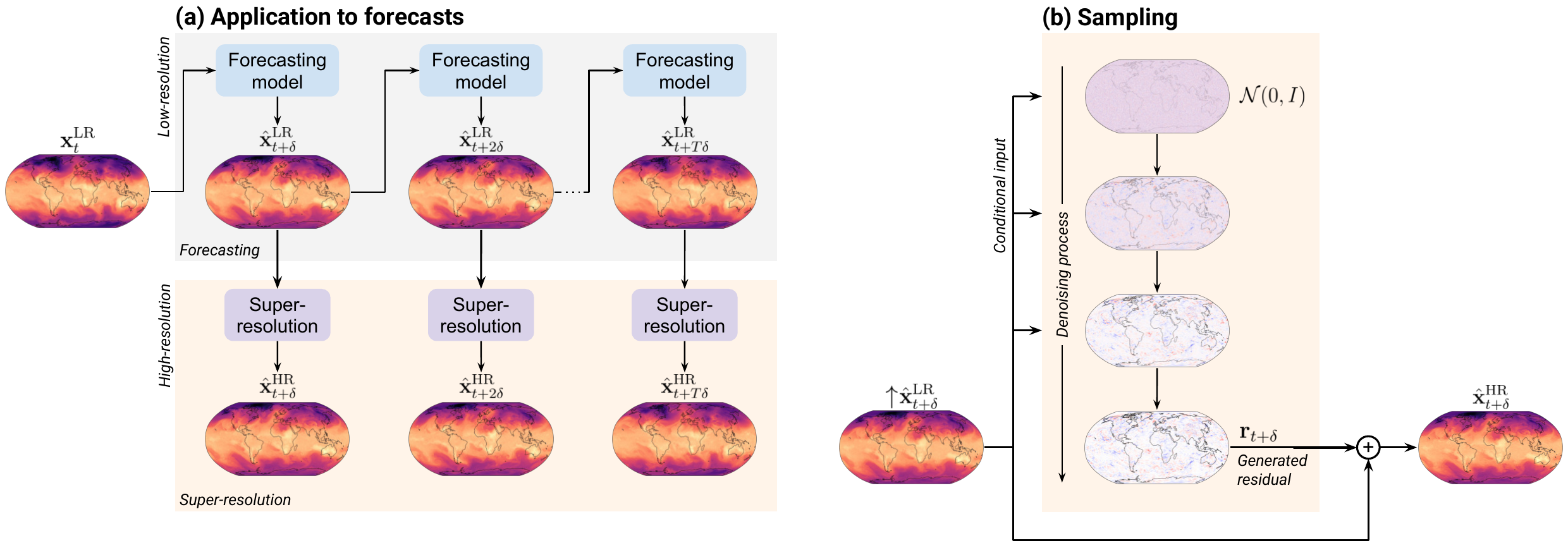
| A flow matching–based generative super-resolution model for global weather forecasts. Takes coarse-resolution (1.5°) forecast trajectories and generates stochastic high-resolution (0.25°) outputs, recovering fine-scale variability while preserving large-scale structure. |
|
|
| ## Model description |
|
|
| ArchesWeatherSR is formulated as a stochastic inverse problem using flow matching. It learns the residual between the bicubically interpolated coarse field and the true ERA5 analysis at 0.25°, concentrating model capacity on fine-scale structure. At inference, the residual is sampled and added back to the interpolated field. The backbone is a 3D Swin U-Net Transformer shared with [ArchesWeather & ArchesWeatherGen](https://github.com/INRIA/geoarches). |
|
|
| ## Usage |
|
|
| Install the package and download the model: |
|
|
| ```bash |
| git clone https://github.com/dataymeric/ArchesWeatherSR.git |
| cd ArchesWeatherSR |
| uv sync |
| hf download dataymeric/ArchesWeatherSR --local-dir runs/archesweathersr |
| ``` |
|
|
| Run inference: |
|
|
| ```bash |
| python train.py mode=test ++name=archesweathersr |
| ``` |
|
|
| Or load programmatically: |
|
|
| ```python |
| from geoarches.lightning_modules import load_module |
| |
| sr_model, cfg = load_module("runs/archesweathersr") |
| sr_model = sr_model.cuda().eval() |
| |
| # sample a super-resolved state from a batch |
| samples = sr_model.sample(batch) |
| ``` |
|
|
| ## Training |
|
|
| - **Training data**: ERA5 reanalysis (WeatherBench2), 1979–2018 (train), 2019 (val), 2020 (test) |
| - **Variables**: 6 upper-air (z, u, v, t, q, w) × 13 levels + 4 surface (t2m, msl, u10, v10) |
| - **Optimizer**: AdamW, lr=3×10⁻⁴, β=(0.9, 0.98), wd=0.01 |
| - **Training steps**: 75,000 |
| - **Hardware**: 4 × A100 80GB, \~40h |

