TTS Examples for SHIFT Cultural Heritage Partners
Examples from Audionar
voicecan be any from SHIFT voices / Phonetic variationssoundscapeis a free language text description
Display PyThoN
Python code for the following generations
import subprocess
# 1. git clone https://huggingface.co/dkounadis/artificial-styletts2
# 2. Start api.py & run the code below, from artificial_styletts2/:
#            CUDA_DEVICE_ORDER=PCI_BUS_ID HF_HOME=/data/.hf7/ CUDA_VISIBLE_DEVICES=0 python api.py
# 3.         Also paste your IP displayed from api.py to client's : tts.py
# 4. Outputs = ./out/1_baranica_en_US_vctk_p234.wav, ./out/1_baranica_serbian.wav, ..


desc = [
    {
        'title': 'embossed mask',
        'en': 'The embossed mask, created by Milinko Koković in 1984, is part of the collection at the Museum of Knjaževac. Catalogued under the identifier ZMK IU 209L, the artwork is titled Maska. The artist employed the technique of embossing copper, which is then mounted onto a wooden backing. This piece showcases Kokovits skill in metalworking and his artistic interpretation of a mask form.',
        'foreign': 'Embosovana maska, delo Milinka Kokovića iz 1984. godine, deo je kolekcije Muzeja Knjaževac. Katalogizovana pod identifikatorom ZMK IU 209L, ovo umetničko delo nosi naziv "Maska". Umetnik je koristio tehniku iskucavanja bakra, koji je zatim montiran na drvenu podlogu. Ovaj rad prikazuje Kokovićevu veštinu u obradi metala i njegovu umetničku interpretaciju forme maske.',
        'soundscape': 'gong musi',
        'en-voice': 'en_US_vctk_p238',
        'foreign-voice': 'serbian'  # https://huggingface.co/facebook/mms-tts-rmc-script_latin
    },
    {
        'title': 'pass',
        'en': 'is possible that this painting is from the Homeland Museum of Knjaževac and that it is by Dragoslav Živković. His artworks constitute a significant portion of the museums permanent collection, The painting shows a river valley. Off a rocky landscape for a sheppard walking alone along the path through the moutanins.',
        'foreign': 'Smatra se da ova slika pripada Zavičajnom muzeju Knjaževac i da ju je djelo Dragoslava Živkovića. Njegova umjetnička djela čine značajan dio stalne muzejske kolekcije. Slika prikazuje riječnu dolinu u kamenitom krajoliku za pastira koji sam hoda stazom kroz planine.',
        'soundscape': 'birds fomig river valley then mountain wind',
        'en-voice': 'en_US_vctk_p234',
        'foreign-voice': 'serbian'
    },
    {
        'title': 'river',
        'en': 'Sima, the artist, captures a serene landscape scene in Knjaževac. Several cows are depicted standing in a river, gently lowering their heads to drink from the clear waters. The atmosphere suggests a peaceful spring day, with the cows enjoying the refreshing water.',
        'foreign': 'Sima, umetnik, prikazuje miran pejzaž u Knjaževcu. Nekoliko krava je prikazano kako stoje u reci, nežno spuštajući glave da piju iz bistre vode. Atmosfera sugeriše miran prolećni dan, sa kravama koje uživaju u osvežavajućoj vodi.',
        'soundscape': 'bells cow farm',
        'en-voice': 'de_DE_thorsten-emotion_whisper',
        'foreign-voice': 'serbian'
    },
    {
        'title': 'Taverna',
        'en': 'This is a watercolor painting depicting an old tavern likely in a rural village of Serbian The buildings feature red brown walls with brick roofs.The sign above its door reads Kafana PORT ARTHUR in old cyrillic suggesting its a tavern. Another building to the right has a sign that reads MEShKA, which means "Bear" in Serbian, possibly indicating another local. Trees of green foliage are visible behind and around the buildings as in a timeless village. In the background, gentle hills or mountains rise under a partly cloudy sky.',
        'foreign': 'Ovo je akvarelna slika koja prikazuje niz starih, tradicionalnih zgrada, verovatno u ruralnom ili istorijskom okruženju. Zgrade imaju crvenkasto-smeđe krovove od crepa i čini se da su izgrađene od kamena ili maltera, sa vidljivim tragovima vremena i karakterom. Centralna zgrada je posebno istaknuta, sa natpisom iznad ulaza koji glasi "KAVANA PORT ARTUR", što sugeriše da je to kafana ili gostionica nazvana "Port Artur". Druga zgrada desno ima natpis MEČKA, što znači Medved, verovatno ukazujući na još jedan objekat. Drveće sa zelenim i žutim lišćem vidljivo je iza i oko zgrada, a u pozadini se uzdižu blaga brda ili planine pod delimično oblačnim nebom. Ukupan stil slike sugeriše rustični šarm i dočarava atmosferu starog sela ili grada.',
        'soundscape': 'The clattering of dishes being washed in a kitchen', #'merchants cauldron cooking boiling broths',
        'en-voice': 'en_US_cmu_arctic_eey',
        'foreign-voice': 'serbian',
    },
    {
        'title': 'lake',
        'en': 'A paint depicting a blue hour twilight scene of a lake with mountains in the background; On the left there is a building resembling a castle or large estate with red roofs near the far shore of the lake. The sky is a dark blue, dotted with numerous stars, and features stylized clouds. In the far distance, other mountains with snow-capped peaks are visible, further adding to the dramatic landscape. The overall impression is one of a serene, almost fantastical scene by a lake.',
        'foreign': 'Ovo je slika, verovatno koja prikazuje noćnu ili sumračnu scenu jezera sa planinama u pozadini. Na levoj strani slike, veliki kompleks zgrada, koji podseća na zamak ili veliko imanje sa crvenim krovovima  odražavajući se u mirnoj vodi. U sredini jezera istaknuto je jedrilica sa jednim jedrom, sa figurama koje se čine da su unutra. Voda takođe prikazuje odraze neba i udaljenih izvora svetlosti. Nebo je tamnoplavo, ispunjeno brojnim zvezdama i stilizovanim oblacima',
        'soundscape': 'swims in lake',
        'en-voice': 'en_US/vctk_p229',
        'foreign-voice': 'serbian',
    },
    {
        'title': 'Baranica',
        'en': 'Baranica is a large horizontal charcoal drawing canvas of size of a dining table Created in 1996 by Dragoslav Živković. Has a gravure pencil style. The dreamlike artwork pictures a family of prehistoric people outside their settlement near the Baranica cave. By the Trgoviški Timok River in the Knjaževac region of Serbia. A pointed tent and a pile of fruits exists next to a hunted animal head. The family has a bearded man holding a long spear, a woman with flowing hair leaning against him, as weell as a toddlershrout at the feet!',
        'foreign': 'Baranica je velika horizontalna crtež ugljem na platnu, veličine otprilike kao trpezarijski sto. Nastalo 1996. godine, delo Dragoslava Živkovića u metafizičkom stilu zamišlja svakodnevni život praistorijskih ljudi u blizini pećine Baranica, pored reke Trgoviški Timok u knjaževačkom kraju Srbije. Prikaz je nežno osvetljen i u potpunosti izveden u sivim tonovima, pri čemu zamagljena tekstura uglja stvara atmosferu nalik snu. Levo, dve figure u odeći nalik na krzno vraćaju se iz lova — jedan nosi zakrivljeni luk, dok drugi nosi veliki rog, Šator u obliku kupe i gomila okruglih plodova ili kamenja nalaze se pored glave oborenog životinjskog tela sa krupnim očima i uvijenim rogovima. U središtu kompozicije sedi porodica: bradati muškarac drži dugačko koplje, žena sa raspuštenom kosom oslanja se na njega, dok se puzeće dete priljubljuje uz njenu nogu. Njihovo trouglasto raspoređivanje sugeriše jedinstvo i porodični mir. Iza njih se nazire obris stene ili pećine, prikazan oštrim vertikalnim potezima.',
        'soundscape': 'birds fomig',
        'en-voice': 'en_US_vctk_p234',
        'foreign-voice': 'serbian'
    },
    {
        'title': 'Knjazevac women',
        'en': 'The oil painting called Knjaževac created in 1999 by Dragoslav Živković is exhibited in the gallery of the Homeland Museum of Knjaževac. In the center three female figures each drawn in warm autumnal colours waring folk costumes have disproportional size to houses of background. They want to shatter through the canvas and appear in real life. The background shows a town of Knjaževac recognizable architecture of washed houses with red roofs, the river Timok flowing gently, and a tall church anchoring the far side of the canvas.',
        'foreign': 'Uljana slika Knjaževac koju je srpski umetnik Dragoslav Živković naslikao 1999. godine, predstavlja otprilike delo veličine lista papira. Centralni deo kompozicije zauzimaju tri ženske figure, svaka prikazana u toplim jesenjim tonovima zlatne, rđe i nežne crvene. Okupljene su blizu ispred velikog zaobljenog drveta, u blagim i introspektivnim pozama. Neposredno iza njih, dete u crvenoj kapi proviruje, posmatrajući prizor. Pozadina se otvara u meku, maglovitu vizuru prepoznatljive arhitekture Knjaževca: bele kuće sa crvenim krovovima, reka Timok koja lagano teče i visoki crkveni toranj koji dominira udaljenim delom platna. Drveće u narandžastim nijansama i oblačno nebo zaokružuju scenu, dajući joj snovitu tišinu',
        'soundscape': 'orchestrating',
        'en-voice': 'jv_ID_google-gmu_06941',
        'foreign-voice': 'serbian'
    },
    {
        'title': 'distaff',
        'en': 'This wooden Distaff is made in the 20th century in the rural area surrounding Knjaževac. This staff is in the artisanal craft spinning of wool. Shaped like a narrow paddle the distaff is of a single piece of wood handcurved and richly decorated of a wealth of floral and geometric details. The surface is densely ornamented with stylized flower tendrils, especially resembling blooming geraniums interwoven in rhythmic oscillational patterns. At the center of the design lies a circular depression framed by a sunburst motif, which may have once held a mirror or glass inlay. Below at the decorated panel a carved inscription of personal ownership or commemorative then a narrow leaf that would have once formed the knob. A distaff was often accompanied by a spindle and was used to hold unspun wool fibers while the yarn was twisted manually.',
        'foreign': 'Ova bogato rezbarena Preslica, nastala u prvoj polovini 20. veka na seoskom području oko Knjaževca. Oblikom podseća na usku veslačku lopaticu ili izduženo veslo, izrađena iz jednog komada drveta, ručno rezbarena i bogato ukrašena, objedinjujući kućnu funkciju i lični izraz. Preslica je tradicionalno oruđe koje se koristi pri predenju vlakana, poput lana, vune ili pamuka',
        'soundscape': 'accordion musi',
        'en-voice': 'en_US_vctk_p238',
        'foreign-voice': 'serbian'
    },
    {
        'title': 'Herders staff',
        'en': 'This Herders staff is a faithful replica of early 20th-century shepherd tools from the Knjaževac region. The stick is handcarved from wood and was used by cattle herders. It consists of a pole and a distinctive carved top sculpted into an expressive animalistic figure of a vigilant dog. The animal head has a pronounced blunt snout, wide-open mouth with carved teeth, notched whiskers, and rounded ears. The head is darker than the rest of the object because of weathering.',
        'foreign': 'Pastirski štap, izrađen u 21. veku kao verna replika pastirskih alata s početka 20. veka iz knjaževačkog kraja, visok je 150 centimetara — otprilike do visine ramena prosečne odrasle osobe — i izrađen je od ručno cepanog i rezbarenog drveta, sa površinom premazanom lakom. Štap, koji su tradicionalno koristili stočari, sastoji se iz dva glavna dela: dugačkog stuba i karakteristično rezbarene glave poznate kao „jabuka“, koja služi i kao oslonac i kao simbolični element. Glava štapa oblikovana je u izražajnu figuru životinje, sa osobinama koje podsećaju na lava ili psa — dve životinje koje simbolizuju snagu i budnost. Ima izražen, tup njušku, otvorena usta sa urezanim zubima, urezane brkove i zaobljene uši.. U nekim balkanskim pogrebnim običajima, ovakav štap postavljao se na grob preminulog muškarca umesto nadgrobnog spomenika, označavajući njegovu vezu sa zemljom i životinjama.',
        'soundscape': 'bells cow farm',
        'en-voice': 'en_US_vctk_p238',
        'foreign-voice': 'serbian'
    },
    {
        'title': 'head of fortunu',
        'en': 'This white stone head of Fortuna has size 8 centimeters in height is formed via plaster to replicate a Roman original statue made from marble of Timacum Minus archaeological sites Roman temple. The original is now in the National Museum in Niš. S faithful reproduction preserves all of its stylistic elements of the original showing viewers the form of ancient goddess Fortuna  a Roman goddess of fate, fortune, and prosperity and abundance.',
        'foreign': 'Ova mala skulpturalna replika pod nazivom Glava Fortune visoka je svega 8 centimetara — otprilike veličine šljivei izrađena je od gipsa. Originalni artefakt otkriven je 1935. godine tokom iskopavanja na arheološkom lokalitetu Timacum Minus, tačnije u ruševinama rimskog hrama, i danas se čuva u Narodnom muzeju u Nišu. Ova verna replika čuva ključne stilističke elemente rimskog originala, omogućavajući posmatračima da se približe formi i ikonografiji antičke boginje Fortune. Ova gipsana replika očuvaće konture i zamišljenu strukturu. Fortuna, poznata u grčkoj mitologiji kao Tyhy, bila je rimska boginja  sreće i blagostanja. Često je prikazivana sa simbolima kao što su kormilo, točak ili rog izobilja — predmetima koji označavaju slučaj, upravljanje i obiljelo',
        'soundscape': 'lullaby',
        'en-voice': 'en_US_vctk_p238',
        'foreign-voice': 'serbian'
    },
    {
        'title': 'Tombstone medallion',
        'en': 'Roman Tombstone Medallion from limestone of the late 3rd century Common Era. THis has 99 centimeters high was excavated during 1991 at the Timacum Minus archaeological site from remains of a horreum (a Roman grain storehouse). Circular in shape with a radius of 87 centimeters, the medallion is framed by a subtly grooved border and anchored at the bottom by a rectangular spike, which would have been embedded into a foundation to keep the monument upright. Its rounded form and relief design present a solemn visual tribute to a Roman family, immortalized in stone. The medallion’s relief sculpture features seven human heads relatives of the family of the trepassed.',
        'foreign': 'Ovaj rimski nadgrobni medaljon. isklesan od krečnjaka krajem 3. veka nove ere. visok je 1 metara i otkriven je 1991 godine na arheološkom lokalitetu Timacum Minus. tačnije unutar ostataka rimskog horreuma. U gornjoj polovini nalaze se tri veće figure koje predstavljaju užu porodicu: u sredini sin, levo žena, a desno otac — pater familias. U donjoj zoni nalaze se četiri dodatne figure. Sve figure nose tradicionalne rimske haljine?',
        'soundscape': 'wolfs howl',
        'en-voice': 'en_US_vctk_p246',
        'foreign-voice': 'serbian'
    },
    {
        'title': 'watzmann',
        'en': 'Professor Friedrich has created a truly beautiful large landscape here. as said in Literary Conversations Journal on the occasion of the Dresden Academy Exhibition. in 1825. A lonely mountainous region where the various colors of the higher mountain regions are excellently depicted in The foreground between the towering basalt blocks grass and small trees still emerge higher up mists spread around. the desolate mountain ridges at the very top the rocky peaks shimmer covered with eternal snow. The utter solitude here has something terrifying about it one longs to glimpse at least an eagle. Caspar David Friedrich never visited the Alps. How he painted several views of this mountain range is a mystery. Central to his work was a watercolor study of the summit, which his student Johann August Heinrich had captured (now held in National Museum Oslo). He also used his own sketches from his journey through the Harts Mountains. As early as 1824 Friedrich had presented a large-scale Alpine landscape in Dresden depicting a view of Mont Blanc oil on canvas. In Friedrichs painting, the glacier mountain, shining in bright light and embodying the grandeur and immensity of nature. Friedrich subtly rendered the hues shifting between green and violetin this high-mountain landscape. The pyramidal composition culminates in the luminous white of the eternal icy.',
        'foreign': 'Vom Prof. Friedrich ist noch eine recht schöne große Landschaft hier',
        'soundscape': 'breezy humms',
        'en-voice': 'en_US_cmu_arctic_lnh',
        'foreign-voice': 'deu'
    }
]


# Phonemize toponyms
def filter_nouns(text):
    text = text.replace('Živković', 'zifkovis')
    text = text.replace('Knjaževac', 'Kniazevach')
    return text


buffer = 'buffer.txt'

for i, d in enumerate(desc):

    print(i)

    # English TTS

    with open(buffer, 'w') as f:
        f.write(filter_nouns(d['en']))  # API expects file .txt / .srt for synchronizing pauses

    subprocess.run(["python",
         "tts.py",
         "--text", buffer,
         # '--image', 'pic.png',  # loads pic.png as video background / outputs .mp4 video instead of  audio-only .wav
         '--soundscape', d['soundscape'],
         '--voice', d["en-voice"],
         '--out_file', f'{i}_{d["title"]}_en'])

    # Foreign TTS

    with open(buffer, 'w') as f:
        f.write(d['foreign'])

    subprocess.run(["python",
             "tts.py",
             "--text", buffer,
             '--soundscape', d['soundscape'],
             '--voice', d['foreign-voice'],
             '--out_file', f'{i}_{d["title"]}_foreign'])
Art samples from Homeland Museum Knjaževac / various SHIFT Partners.
|
Description |
TTS En. |
TTS Foreign |
|---|---|---|
|
|
The embossed mask, created by Milinko Koković in 1984, |
Embosovana maska, delo Milinka Kokovića iz 1984. godine, deo je kolekcije Muzeja Knjaževac. Katalogizovana pod identifikatorom ZMK IU 209L, ovo umetničko delo nosi naziv "Maska". Umetnik je koristio tehniku iskucavanja bakra, koji je zatim montiran na drvenu podlogu. Ovaj rad prikazuje Kokovićevu veštinu u obradi metala i njegovu umetničku interpretaciju forme maske. |
|
|
Is possible that this painting is from the Homeland Museum of Knjaževac and that it is by Dragoslav Živković. His artworks constitute a significant portion of the museums permanent collection, The painting shows a river valley of a rocky landscape for a sheppard walking alone along the path through the moutanins. |
Smatra se da ova slika pripada Zavičajnom muzeju Knjaževac i da ju je djelo Dragoslava Živkovića. Njegova umjetnička djela čine značajan dio stalne muzejske kolekcije. Slika prikazuje riječnu dolinu u kamenitom krajoliku za pastira koji sam hoda stazom kroz planine. |
|
|
Sima, the artist, captures a serene landscape scene in Knjaževac. Several cows are depicted standing in a river, gently lowering their heads to drink from the clear waters. The atmosphere suggests a peaceful spring day, with the cows enjoying the refreshing water! |
Sima, umetnik, prikazuje miran pejzaž u Knjaževcu. Nekoliko krava je prikazano kako stoje u reci, nežno spuštajući glave da piju iz bistre vode. Atmosfera sugeriše miran prolećni dan, sa kravama koje uživaju u osvežavajućoj vodi! |
|
|
This is a watercolor painting depicting an old tavern likely in a rural village of Serbian The buildings feature red brown walls with brick roofs.The sign above its door reads Kafana PORT ARTHUR in old cyrillic suggesting its a tavern. Another building to the right has a sign that reads MEShKA, which means "Bear" in Serbian, possibly indicating another local. Trees of green foliage are visible behind and around the buildings as in a timeless village. In the background, gentle hills or mountains rise under a partly cloudy sky. |
Ovo je akvarelna slika koja prikazuje niz starih, tradicionalnih zgrada, verovatno u ruralnom ili istorijskom okruženju. Zgrade imaju crvenkasto-smeđe krovove od crepa i čini se da su izgrađene od kamena ili maltera, sa vidljivim tragovima vremena i karakterom. Centralna zgrada je posebno istaknuta, sa natpisom iznad ulaza koji glasi "KAVANA PORT ARTUR", što sugeriše da je to kafana ili gostionica nazvana "Port Artur". Druga zgrada desno ima natpis MEČKA, što znači Medved, verovatno ukazujući na još jedan objekat. Drveće sa zelenim i žutim lišćem vidljivo je iza i oko zgrada, a u pozadini se uzdižu blaga brda ili planine pod delimično oblačnim nebom. Ukupan stil slike sugeriše rustični šarm i dočarava atmosferu starog sela ili grada. |
|
|
A paint depicting a blue hour twilight scene of a lake with mountains in the background; On the left there is a building resembling a castle or large estate with red roofs near the far shore of the lake. The sky is a dark blue, dotted with numerous stars, and features stylized clouds. In the far distance, other mountains with snow-capped peaks are visible, further adding to the dramatic landscape. The overall impression is one of a serene, almost fantastical scene by a lake.' |
Ovo je slika, verovatno koja prikazuje noćnu ili sumračnu scenu jezera sa planinama u pozadini. Dominantne boje su tamnoplave za vodu i nebo, sa zelenim, narandžastim i žutim tonovima za lišće na okolnim brdima. Na levoj strani slike, veliki kompleks zgrada, koji podseća na zamak ili veliko imanje sa crvenim krovovima, nalazi se blizu obale, odražavajući se u mirnoj vodi. U sredini jezera istaknuto je jedrilica sa jednim jedrom, sa figurama koje se čine da su unutra. Voda takođe prikazuje odraze neba i udaljenih izvora svetlosti. Nebo je tamnoplavo, ispunjeno brojnim zvezdama i stilizovanim oblacima. U dalekoj pozadini vidljive su i druge planine sa snežnim vrhovima, što dodatno doprinosi dramatičnom pejzažu. Ukupan utisak je mirna, gotovo fantastična, noćna scena pored jezera. |
|
|
Baranica is a large horizontal charcoal drawing canvas of size of a dining table Created in 1996 by Dragoslav Živković. Has a gravure pencil style. The dreamlike artwork pictures a family of prehistoric people outside their settlement near the Baranica cave. By the Trgoviški Timok River in the Knjaževac region of Serbia. A pointed tent and a pile of fruits exists next to a hunted animal head. The family has a bearded man holding a long spear, a woman with flowing hair leaning against him, as weell as a toddlershrout at the feet! |
Baranica je velika horizontalna crtež ugljem na platnu, veličine otprilike kao trpezarijski sto. Nastalo 1996. godine, delo Dragoslava Živkovića u metafizičkom stilu zamišlja svakodnevni život praistorijskih ljudi u blizini pećine Baranica, pored reke Trgoviški Timok u knjaževačkom kraju Srbije. Prikaz je nežno osvetljen i u potpunosti izveden u sivim tonovima, pri čemu zamagljena tekstura uglja stvara atmosferu nalik snu. Levo, dve figure u odeći nalik na krzno vraćaju se iz lova — jedan nosi zakrivljeni luk, dok drugi nosi veliki rog, Šator u obliku kupe i gomila okruglih plodova ili kamenja nalaze se pored glave oborenog životinjskog tela sa krupnim očima i uvijenim rogovima. U središtu kompozicije sedi porodica: bradati muškarac drži dugačko koplje, žena sa raspuštenom kosom oslanja se na njega, dok se puzeće dete priljubljuje uz njenu nogu. Njihovo trouglasto raspoređivanje sugeriše jedinstvo i porodični mir. Iza njih se nazire obris stene ili pećine, prikazan oštrim vertikalnim potezima. |
|
|
The oil painting called Knjaževac created in 1999 by Dragoslav Živković is exhibited in the gallery of the Homeland Museum of Knjaževac. In the center three female figures each drawn in warm autumnal colours waring folk costumes have disproportional size to houses of background. They want to shatter through the canvas and appear in real life. The background shows a town of Knjaževac recognizable architecture of washed houses with red roofs, the river Timok flowing gently, and a tall church anchoring the far side of the canvas. |
Uljana slika Knjaževac koju je srpski umetnik Dragoslav Živković naslikao 1999. godine, predstavlja otprilike delo veličine lista papira. Centralni deo kompozicije zauzimaju tri ženske figure, svaka prikazana u toplim jesenjim tonovima zlatne, rđe i nežne crvene. Okupljene su blizu ispred velikog zaobljenog drveta, u blagim i introspektivnim pozama. Neposredno iza njih, dete u crvenoj kapi proviruje, posmatrajući prizor. Pozadina se otvara u meku, maglovitu vizuru prepoznatljive arhitekture Knjaževca: bele kuće sa crvenim krovovima, reka Timok koja lagano teče i visoki crkveni toranj koji dominira udaljenim delom platna. Drveće u narandžastim nijansama i oblačno nebo zaokružuju scenu, dajući joj snovitu tišinu |
|
|
This wooden Distaff is made in the 20th century in the rural area surrounding Knjaževac. This staff is in the artisanal craft spinning of wool. Shaped like a narrow paddle the distaff is of a single piece of wood handcurved and richly decorated of a wealth of floral and geometric details. The surface is densely ornamented with stylized flower tendrils, especially resembling blooming geraniums interwoven in rhythmic oscillational patterns. At the center of the design lies a circular depression framed by a sunburst motif, which may have once held a mirror or glass inlay. Below at the decorated panel a carved inscription of personal ownership or commemorative then a narrow leaf that would have once formed the knob. A distaff was often accompanied by a spindle and was used to hold unspun wool fibers while the yarn was twisted manually. |
Ova bogato rezbarena Preslica, nastala u prvoj polovini 20. veka na seoskom području oko Knjaževca. Oblikom podseća na usku veslačku lopaticu ili izduženo veslo, izrađena iz jednog komada drveta, ručno rezbarena i bogato ukrašena, objedinjujući kućnu funkciju i lični izraz. Preslica je tradicionalno oruđe koje se koristi pri predenju vlakana, poput lana, vune ili pamuka |
|
|
This Herders staff is a faithful replica of early 20th-century shepherd tools from the Knjaževac region. The stick is handcarved from wood and was used by cattle herders. It consists of a pole and a distinctive carved top sculpted into an expressive animalistic figure of a vigilant dog. The animal head has a pronounced blunt snout, wide-open mouth with carved teeth, notched whiskers, and rounded ears. The head is darker than the rest of the object because of weathering. |
Pastirski štap, izrađen u 21. veku kao verna replika pastirskih alata s početka 20. veka iz knjaževačkog kraja, visok je 150 centimetara — otprilike do visine ramena prosečne odrasle osobe — i izrađen je od ručno cepanog i rezbarenog drveta, sa površinom premazanom lakom. Štap, koji su tradicionalno koristili stočari, sastoji se iz dva glavna dela: dugačkog stuba i karakteristično rezbarene glave poznate kao „jabuka“, koja služi i kao oslonac i kao simbolični element. Glava štapa oblikovana je u izražajnu figuru životinje, sa osobinama koje podsećaju na lava ili psa — dve životinje koje simbolizuju snagu i budnost. Ima izražen, tup njušku, otvorena usta sa urezanim zubima, urezane brkove i zaobljene uši.. U nekim balkanskim pogrebnim običajima, ovakav štap postavljao se na grob preminulog muškarca umesto nadgrobnog spomenika, označavajući njegovu vezu sa zemljom i životinjama. |
|
|
This white stone head of Fortuna has size 8 centimeters in height is formed via plaster to replicate a Roman original statue made from marble of Timacum Minus archaeological sites Roman temple. The original is now in the National Museum in Niš. S faithful reproduction preserves all of its stylistic elements of the original showing viewers the form of ancient goddess Fortuna a Roman goddess of fate, fortune, and prosperity and abundance. |
'va mala skulpturalna replika pod nazivom Glava Fortune visoka je svega 8 centimetara — otprilike veličine šljivei izrađena je od gipsa. Originalni artefakt otkriven je 1935. godine tokom iskopavanja na arheološkom lokalitetu Timacum Minus, tačnije u ruševinama rimskog hrama, i danas se čuva u Narodnom muzeju u Nišu. Ova verna replika čuva ključne stilističke elemente rimskog originala, omogućavajući posmatračima da se približe formi i ikonografiji antičke boginje Fortune. Ova gipsana replika očuvaće konture i zamišljenu strukturu. Fortuna, poznata u grčkoj mitologiji kao Tyhy, bila je rimska boginja sreće i blagostanja. Često je prikazivana sa simbolima kao što su kormilo, točak ili rog izobilja — predmetima koji označavaju slučaj, upravljanje i obiljelo |
|
|
Roman Tombstone Medallion from limestone of the late 3rd century Common Era. THis has 99 centimeters high was excavated during 1991 at the Timacum Minus archaeological site from remains of a horreum (a Roman grain storehouse). Circular in shape with a radius of 87 centimeters, the medallion is framed by a subtly grooved border and anchored at the bottom by a rectangular spike, which would have been embedded into a foundation to keep the monument upright. Its rounded form and relief design present a solemn visual tribute to a Roman family, immortalized in stone. The medallion’s relief sculpture features seven human heads relatives of the family of the trepassed. |
Ovaj rimski nadgrobni medaljon. isklesan od krečnjaka krajem 3. veka nove ere. visok je 1 metara i otkriven je 1991 godine na arheološkom lokalitetu Timacum Minus. tačnije unutar ostataka rimskog horreuma. Medaljon je kružnog oblika sa radijusom od 87 centimetara, uokviren suptilno urezanim rubom i oslonjen na donji pravougaoni klin koji je služio za učvršćivanje spomenika u postolju. Njegov zaobljen oblik i reljefna obrada predstavljaju svečanu vizuelnu posvetu jednoj rimskoj porodici, ovaploćenoj u kamenu. U gornjoj polovini nalaze se tri veće, centralne figure koje predstavljaju užu porodicu: u sredini sin, levo žena, a desno otac — pater familias. U donjoj zoni nalaze se četiri dodatne figure. Sve figure nose tradicionalne rimske haljine. Iako su lica izložena vremenskim oštećenjima, zadržala su dovoljno plastičnih detalja da se prepoznaju karakteristični stilizovani prikazi rimskog perioda. Frizure prate tadašnju rimsku modu. |
|
|
Professor Friedrich has created a truly beautiful large landscape here. as said in Literary Conversations Journal on the occasion of the Dresden Academy Exhibition n 1825. A lonely mountainous region where the various colors of the higher mountain regions are excellently depicted in The foreground between the towering basalt blocks grass and small trees still emerge higher up mists spread around. the desolate mountain ridges at the very top the rocky peaks shimmer covered with eternal snow. The utter solitude here has something terrifying about it one longs to glimpse at least an eagle. Caspar David Friedrich never visited the Alps. How he painted several views of this mountain range is a mystery. Central to his work was a watercolor study of the summit, which his student Johann August Heinrich had captured (now held in National Museum Oslo). He also used his own sketches from his journey through the Harts Mountains. As early as 1824 Friedrich had presented a large-scale Alpine landscape in Dresden depicting a view of Mont Blanc oil on canvas. In Friedrichs painting, the glacier mountain, shining in bright light and embodying the grandeur and immensity of nature. Friedrich subtly rendered the hues shifting between green and violetin this high-mountain landscape. The pyramidal composition culminates in the luminous white of the eternal icy. |
»Vom Prof. Friedrich ist noch eine recht schöne große Landschaft hier«, schrieb das Literarische |


ANBPR - Asociația Națională a Bibliotecarilor și Bibliotecilor din Romania samples
Following audios are created by demo.py or ..
.. Display python
# git clone https://huggingface.co/dkounadis/artificial-styletts2
# Following python from ./artificial_styletts2/
import numpy as np
import soundfile
import msinference
from audiocraft.builders import AudioGen

sound_gen = AudioGen().to('cuda:0').eval()

def tts_entry(text='A quick brown fox jumps over the lazy dog.',
              voice='en_US/m-ailabs_low#mary_ann',
              soundscape='birds fomig'):

    if ('en_US/' in voice) or ('en_UK/' in voice):

        style_vector = msinference.compute_style('assets/wavs/style_vector/' + voice.replace( '/', '_').replace('#', '_').replace('cmu-arctic', 'cmu_arctic').replace('_low', '') + '.wav')

        x = msinference.inference(text, style_vector)

    elif '_' in voice and 'script' not in voice:

        style_vector = msinference.compute_style('assets/wavs/mimic3_foreign_4x/' + voice.replace('/', '_').replace('#', '_').replace('cmu-arctic', 'cmu_arctic').replace('_low', '') + '.wav')

        x = msinference.inference(text, style_vector)

    else:

        x = msinference.foreign(text=text, lang=voice)
    x /= 1.02 * np.abs(x).max() + 1e-7  # volume amplify to [-1,1]
    if soundscape is not None:
        background = sound_gen.generate(soundscape, duration=len(x) / 16000 + .74,  # sound duration in seconds
                                        ).detach().cpu().numpy()
        x = .6 * x + .4 * background[:len(x)]
    return x


soundfile.write(f'ron.wav', tts_entry(text='o vulpe brună rapidă sare peste câinele lenes',
                                      voice='ron',                     # MMS TTS - https://huggingface.co/dkounadis/artificial-styletts2/blob/audionar/Utils/all_langs.csv
                                      soundscape='birds sing'), 16000)
soundfile.write(f'en.wav', tts_entry(text='a quick brown fox jumps over the lazy dog.',
                                     voice='en_US/m-ailabs#mary_ann',  # StyleTTS2 - https://huggingface.co/dkounadis/artificial-styletts2/discussions/1
                                     soundscape='cats meowin'), 16000)
Voice can be any from StyleTTS2 voices or MMS TTS voices. We have tuned
ron,deu,serbian,hunfor the SHIFT.
|
|
|
|
|---|---|---|
|
|
The image shows the Faculty of Chemistry and Chemical Engineering in the town of Clus Napoca in Romania, a building that housed the State Higher School for Girls in 1900. During the interwar period, it was the location of the first Romanian girls high school, the Regina Maria High School. The photograph captures the imposing facade of the building. |
Imaginea prezintă Facultatea de Chimie și Inginerie Chimică din Cluj, o clădire care în 1900 găzduia Școala Superioară de Stat pentru fete. În perioada interbelică, a fost sediul primului liceu românesc de fete, Liceul Regina Maria. Fotografia surprinde fațada impunătoare a clădirii. |
|
|
The image captures a lively street in Clus Napoca, likely in the late 19th or early 20th century. The architecture of the buildings and the presence of horse-drawn carriages reflect the rapid urbanization and economic development of the city during that period, a crucial moment in towns history. |
Imaginea surprinde o stradă animată din Cluj, probabil la sfârșitul secolului al XIX-lea sau începutul secolului al XX-lea. Arhitectura clădirilor și prezența trăsurilor reflectă urbanizarea rapidă și dezvoltarea economică a orașului în acea perioadă, un moment crucial în istoria Clujului. |
|
|
The image shows the unveiling of the equestrian statue of Saint George, an important public event in Cluj's history. The statue's placement in a public square reflects the role of monuments in shaping urban identity and collective memory. The artistic style of the statue also provides information about the aesthetic tastes of the era. |
Imaginea prezintă dezvelirea statuii ecvestre a Sfântului Gheorghe, un eveniment public important din istoria Clujului. Amplasarea statuii într-o piață publică reflectă rolul monumentelor în modelarea identității urbane și a memoriei colective. Stilul artistic al statuii oferă, de asemenea, informații despre gusturile estetice ale epocii. |
|
|
The image shows a historical photograph of the Academic College in the town of Clus Napoca in Romania, a building with modernist architecture, The main building has a distinct geometric form, featuring a tall, narrow section and long horizontal windows on the rest of the structure. In the foreground, a partially snow-covered ground is visible. |
Imaginea prezintă o fotografie istorică a Colegiului Academic din Cluj-Napoca, o clădire cu arhitectură modernistă. Clădirea principală are o formă geometrică distinctă, cu o secțiune înaltă, îngustă și ferestre orizontale lungi pe restul structurii. În prim-plan se vede un teren acoperit parțial cu zăpadă. |
|
|
The image shows a weathered photograph of the interior of the Academic College in Clus Napoca during its construction, likely in the 1930s. Unfinished walls, brick pillars under construction, and scattered building materials are visible on the floor. A worker is discernible in the background, providing a sense of the space scale. |
RoImaginea prezintă o fotografie istorică a interiorului Colegiului Academic din Cluj-Napoca în timpul construcției, probabil în anii 1930. Se văd pereți nefinisați, stâlpi de cărămidă în construcție și materiale de construcție împrăștiate pe podea. Un muncitor este vizibil în fundal, oferind o scară a dimensiunii spațiului. |
|
|
The image shows an old photograph of a building under construction or demolition in Clus Napoca, likely in the 1930s. Partially destroyed old stone and brick walls, wooden scaffolding, and construction debris are visible. Another building with arched windows is seen in the background. |
Imaginea prezintă o fotografie istorică a unei clădiri în construcție sau demolare în Cluj-Napoca, probabil în anii 1930. Se văd ziduri vechi de piatră și cărămidă parțial distruse, schele de lemn și resturi de materiale de construcție. O altă clădire cu ferestre arcuite este vizibilă în fundal. |
|
|
The image shows the Lucian Blaga National Theatre in Clus Napoja town, Romania, a representative edifice of Baroque-Rococo architecture in Transylvania. Constructed between 1904 and 1906 by the Helmer and Fellner firms, the theatre initially housed the Hungarian National Theatre and later the Romanian Theatre and Opera. The building symbolizes Cluj's vibrant cultural life and its architectural evolution from the late 19th century. |
Imaginea prezintă Teatrul Național Lucian Blaga din Cluj-Napoca, un edificiu reprezentativ pentru arhitectura baroc-rococo din Transilvania. Construit între 1904 și 1906 de firmele Helmer și Fellner, teatrul a găzduit inițial Teatrul Național Maghiar și ulterior Teatrul și Opera Română. Clădirea simbolizează viața culturală vibrantă a Clujului și evoluția sa arhitecturală de la sfârșitul secolului al XIX-lea. |
|
|
This photograph captures a large crowd gathered in a European city square, seemingly for the inauguration of a prominent equestrian statue of Matthias Corvinus. The statue, depicting a regal figure on horseback, stands elevated on an ornate pedestal in front of a grand, gothic-style building with tall arched windows. Numerous people, dressed in period attire including hats and coats, are looking towards the statue. Some individuals in the foreground hold umbrellas, suggesting it might be raining or recently have rained. The surrounding architecture features other substantial buildings, indicative of a significant urban center. The overall scene conveys a sense of civic pride and historical commemoration during this public event. |
Această fotografie surprinde o mulțime mare adunată într-o piață urbană europeană, aparent pentru inaugurarea unei statui ecvestre proeminente a lui Matei Corvin. Statuia, înfățișând o figură regală călare, stă ridicată pe un piedestal ornamentat în fața unei clădiri grandioase, în stil gotic, cu ferestre înalte arcuite. Numeroase persoane, îmbrăcate în haine de epocă, inclusiv pălării și paltoane, privesc spre statuie. Câțiva indivizi din prim-plan țin umbrele, sugerând că ar putea ploua sau a plouat recent. Arhitectura din jur prezintă alte clădiri substanțiale, indicative ale unui centru urban important. Scena generală transmite un sentiment de mândrie civică și comemorare istorică în timpul acestui eveniment public |
|
|
The image shows a very old photograph of the construction of the Matthias Corvinus Monument pedestal in Union Square, Clus-Napoja. Several workers are visible working on the complex stone structure, supported by wooden scaffolding. Buildings with old architecture are seen in the background. |
Imaginea prezintă o fotografie istorică a construcției soclului Monumentului Matia Corvin în Piața Unirii din Cluj-Napoca. Mai mulți muncitori sunt vizibili lucrând la structura complexă din piatră, susținută de schele de lemn. În fundal se observă clădiri cu arhitectură veche. |
|
|
The historical black and white photograph depicts Mihail Kogălniceanu Street in Cluj Napoca. In the foreground, on the left side, the Reformed-Calvin Church stands out, a valuable Gothic edifice with a high roof and pointed arch windows. On the right side is the Reformed College, a longer building with numerous windows. The street is paved with cobblestones. |
Fotografia istorică înfățișează strada Mihail Kogălniceanu din Cluj-Napoca. În prim-plan, pe partea stângă, se distinge Biserica Reformată-Calvină, un edificiu gotic valoros cu un acoperiș înalt și ferestre ogivale. Pe partea dreaptă se află Colegiul Reformat, o clădire mai lungă cu numeroase ferestre. Strada este pavată cu piatră cubică. |
|
|
The historical photograph shows Matei Corvin Street in Clus Napoca in Transylvania, where the Matthias Corvinus House is located. The building, situated on the left side, features old architecture with a large arched entrance. The cobblestone street is relatively quiet, with a few people visible along it. |
Fotografia istorică prezintă strada Matei Corvin din Cluj-Napoca, unde se află Casa Matia. Clădirea, situată pe partea stângă, are o arhitectură veche, cu o intrare arcuită mare. Strada pavată cu piatră cubică este relativ liniștită, cu câțiva oameni vizibili de-a lungul ei. |
|
|
The historical photograph captures the Matthias Corvinus Monument in Union Square, Clus Napoca. The central monument depicts King Matthias Corvinus on horseback, surrounded by four other statues representing historical figures. The sculptural ensemble is placed on an elaborate pedestal, and the Roman Catholic Church of Saint Michael is visible in the background. |
Fotografia istorică surprinde Grupul Statuar Matia Corvin din Piața Unirii, Cluj-Napoca. Monumentul central îl înfățișează pe regele Matia Corvin călare, înconjurat de alte patru statui reprezentând personalități istorice. Ansamblul statuar este amplasat pe un soclu elaborat, iar în fundal se distinge Biserica Romano-Catolică Sfântul Mihail |
|
|
The historical photograph depicts a street in Cluj-Napoca ROmania, featuring the building of the First Hungarian Theatre on the left side. The edifice has a tall mansard roof and a facade with regular windows. The paved street is wide and relatively deserted, with another historical building visible in the distance on the right side. |
Fotografia istorică înfățișează o stradă din Cluj-Napoca Romania, având pe partea stângă clădirea Primului Teatru Maghiar. Edificiul prezintă un acoperiș mansardat înalt și o fațadă cu ferestre regulate. Strada pavată este largă și relativ pustie, cu o altă clădire istorică vizibilă în depărtare pe partea dreaptă. |
|
|
The historical photograph shows the Tailors Bastion in Clus Napoca town of Transylvania as wheel a stone fortification tower with a conical roof. The tower has several small windows and is surrounded by vegetation and an open paved area. The sky is cloudy |
Fotografia istorică prezintă Bastionul Croitorilor din Cluj-Napoca, un turn de fortificație din piatră cu acoperiș conic. Turnul are mai multe ferestre mici și este înconjurat de vegetație și un spațiu deschis pavat. Cerul este înnorat. |
|
|
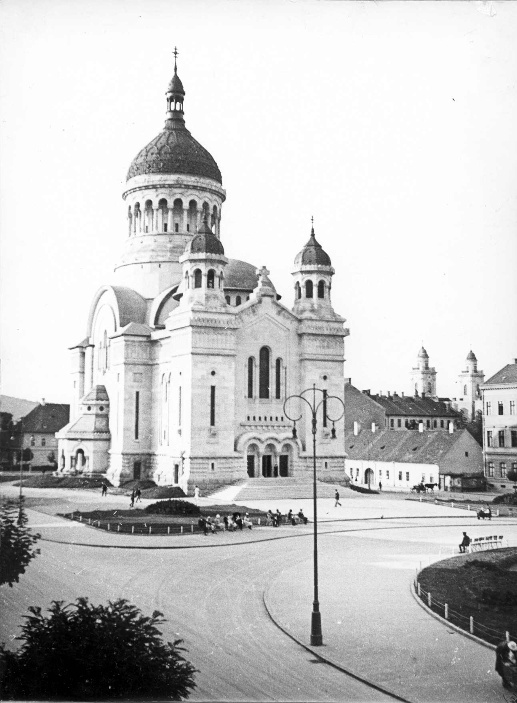
The historical photograph shows the Orthodox Cathedral in Clus Napoca, an imposing edifice with large domes and monumental architecture. The cathedral is situated in a vast square with curved walkways and people strolling or sitting on benches. Other urban buildings are visible in the background. |
Fotografia istorică prezintă Catedrala Ortodoxă din Cluj-Napoca, un edificiu impunător cu cupole mari și arhitectură monumentală. Catedrala este situată într-o piață vastă, cu alei curbate și oameni care se plimbă sau stau pe bănci. În fundal se văd alte clădiri urbane. |
|
|
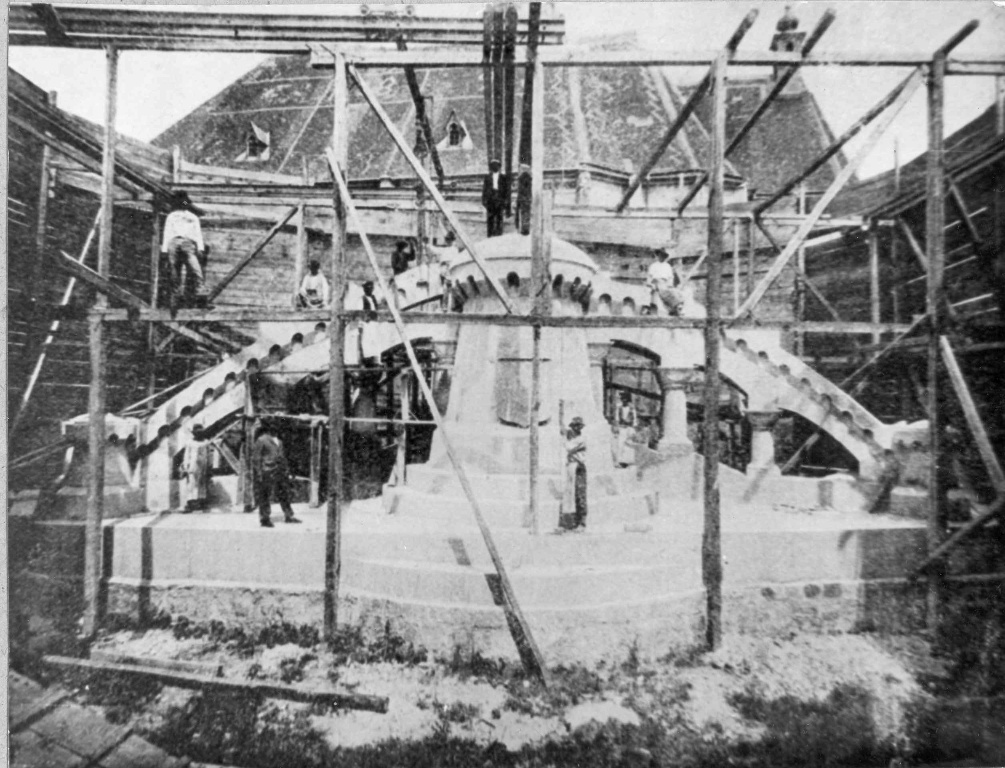
The historical photograph shows the Orthodox Cathedral in Clus Napoca during its construction. Complex wooden scaffolding covers the rising structure, and workers can be seen at various levels. The urban landscape of the city is visible in the background. |
Fotografia istorică prezintă Catedrala Ortodoxă din Cluj-Napoca în timpul construcției. Schele complexe de lemn acoperă structura înălțată, iar muncitori pot fi observați lucrând la diverse nivele. În fundal se distinge peisajul urban al orașului. |
|
|
The historical photograph shows the Dormition of the Theotokos Cathedral in Clus Napoca during its construction. The main dome and adjacent structure are surrounded by intricate wooden scaffolding. Several people are visible in the foreground, providing a sense of the monuments scale. |
Fotografia istorică prezintă Catedrala Adormirea Maicii Domnului din Cluj-Napoca în timpul construcției. Cupola principală și structura adiacentă sunt înconjurate de schele complexe de lemn. Câțiva oameni sunt vizibili în prim-plan, oferind o perspectivă asupra scării monumentului. |