| --- |
| pipeline_tag: image-segmentation |
| license: cc-by-4.0 |
| tags: |
| - medical |
| - ct |
| - body-composition |
| - 3d-segmentation |
| - nnunet |
| - residual-encoder |
| --- |
| |
| # BodyCompositionCT-ResEncM |
|
|
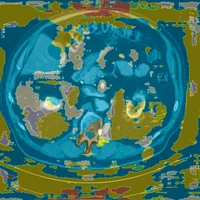
| BodyCompositionCT-ResEncM is a 3D nnU-Net v2 model for segmenting native |
| body-composition compartments and supporting anatomical structures in CT. This |
| is a single-checkpoint ResEnc M model trained on the complete training set. For |
| five-fold ResEnc L ensemble inference, see |
| [BodyCompositionCT-ResEncL](https://huggingface.co/fhofmann/BodyCompositionCT-ResEncL). |
|
|
| ## Model overview |
|
|
| | Property | Value | |
| | --- | --- | |
| | Task | Mutually exclusive 3D semantic segmentation | |
| | Input | One CT volume | |
| | Architecture | nnU-Net v2, `3d_fullres`, ResEnc M | |
| | Checkpoint | One `fold_all` model trained on all training cases | |
| | Training set | 1,656 CT scans | |
| | Native output | Background plus seven foreground labels | |
| | License | CC BY 4.0 | |
|
|
| ## Native output labels |
|
|
| | ID | Label | Description | |
| | ---: | --- | --- | |
| | 0 | Background | | |
| | 1 | Muscle | Muscle compartment | |
| | 2 | Bone | Bone | |
| | 3 | Subcutaneous | Subcutaneous compartment | |
| | 4 | Abdominal | Abdominal compartment, with organs and larger vessels excluded | |
| | 5 | Thoracic | Thoracic compartment, with organs and larger vessels excluded | |
| | 6 | Heart | Heart | |
| | 7 | Lungs | Lungs | |
|
|
| Labels 1, 3, 4, and 5 denote anatomical compartments rather than final |
| attenuation-defined tissue masks. The muscle compartment can contain inter- and |
| intramuscular connective tissue, smaller vessels, and larger fat-attenuation |
| regions. IMAT is not a separate model class; CT-visible IMAT can be derived |
| downstream within label 1 using HU-thresholding. All downstream tissue |
| measurements should state their HU range, cleanup rules, and source compartment. |
|
|
| The machine-readable mapping is stored in |
| [dataset.json](nnUNetTrainer__nnUNetResEncUNetMPlans__3d_fullres/dataset.json). |
|
|
| ## Training data and target construction |
|
|
| The training set contains 750 CT scans from |
| [SAROS](https://doi.org/10.1038/s41597-024-03337-6) and 906 from the |
| [TotalSegmentator v2 dataset](https://doi.org/10.5281/zenodo.10047292). |
| Another 332 cases (150 SAROS and 182 TotalSegmentator) were reserved and were |
| not used for training. |
|
|
| Targets were constructed from dense |
| [BOA](https://doi.org/10.1097/RLI.0000000000001040) Task542 body-region |
| predictions, sparse expert-reviewed SAROS labels, and TotalSegmentator-derived |
| anatomical masks. Reviewed SAROS labels replaced predictions on annotated |
| slices. TotalSegmentator muscle, bone, lung, tracheal, body-trunk, organ, |
| vessel, and neural masks supplied corrections and exclusions. HU-guided |
| candidate selection, morphological cleanup, model-assisted completion, and |
| manual review produced the final seven foreground labels. |
|
|
| Only the open TotalSegmentator `total` and `body` tasks were used for target |
| construction; the separately licensed `tissue_types` and `vertebrae_body` |
| tasks were not used. |
|
|
| Training logs, plans, a configuration snapshot, and the training progress plot |
| are included with the model. |
|
|
| ## Inference |
|
|
| The model uses the standard nnU-Net v2 results layout. The commands below were |
| tested with nnU-Net v2 2.5.2. Input files must be unwindowed CT NIfTI volumes |
| containing Hounsfield-unit values and named `<case>_0000.nii.gz`. Do not |
| normalize or resample them manually; nnU-Net applies the preprocessing stored |
| in the plans. |
|
|
| For integration with preprocessing and downstream tissue derivation, see the |
| [BodyComposition pipeline](https://github.com/fohofmann/BodyComposition). |
|
|
| Set the nnU-Net results directory and download the model: |
|
|
| ```bash |
| export nnUNet_results="/path/to/nnUNet_results" |
| |
| hf download fhofmann/BodyCompositionCT-ResEncM \ |
| --local-dir "${nnUNet_results}/Dataset611_Tissue" |
| ``` |
|
|
| Optionally verify the model artifacts: |
|
|
| ```bash |
| cd "${nnUNet_results}/Dataset611_Tissue" |
| sha256sum -c MODEL_ARTIFACTS.sha256 |
| ``` |
|
|
| Run inference: |
|
|
| ```bash |
| nnUNetv2_predict \ |
| -d Dataset611_Tissue \ |
| -i INPUT_FOLDER \ |
| -o OUTPUT_FOLDER \ |
| -f all \ |
| -tr nnUNetTrainer \ |
| -c 3d_fullres \ |
| -p nnUNetResEncUNetMPlans |
| ``` |
|
|
| No independent nnU-Net postprocessing configuration was selected for this |
| `fold_all` model. HU-based tissue derivation remains a separate downstream |
| step. |
|
|
| The checkpoint is a serialized PyTorch artifact. Load it only from a trusted |
| copy of this repository. |
|
|
| ## Evaluation status |
|
|
| The `fold_all` checkpoint was trained on all 1,656 training cases and therefore |
| has no held-out training fold. Values in the training logs are optimization |
| diagnostics, not independent performance estimates. |
|
|
| ## Intended use and limitations |
|
|
| The model is intended to provide compartment masks for research pipelines, |
| including downstream body-composition measurements derived with CT attenuation thresholds. |
|
|
| - It is not intended for diagnosis, treatment decisions, or stand-alone |
| clinical measurement. |
| - Training targets combine automated segmentations, deterministic corrections, |
| and manual review; residual source-model and labeling errors can remain. |
| - Performance may vary across populations, scanners, acquisition protocols, |
| contrast phases, artifacts, implants, and uncommon anatomy. |
| - The targets focus on the body trunk; extremity use is out of scope. |
| - External validation is required for each intended population and |
| measurement definition. |
|
|
| ## License and attribution |
|
|
| The trained weights, model documentation, metadata, and included training |
| records are released under |
| [CC BY 4.0](https://creativecommons.org/licenses/by/4.0/). Reuse requires |
| appropriate credit, a link to the license, and an indication of changes. See |
| [LICENSE](LICENSE) for the attribution format. |
|
|
| Training source data, source annotations, upstream checkpoints, and |
| third-party software are not redistributed and retain their original terms: |
|
|
| | Upstream material | Role | Terms | |
| | --- | --- | --- | |
| | SAROS labels and split metadata | Sparse reviewed labels | CC BY 4.0 | |
| | SAROS source CT scans | Training images | Collection-specific TCIA terms, including restricted, CC BY, and CC BY-NC collections | |
| | BOA Task542 weights | Dense initial body-region predictions | MIT | |
| | TotalSegmentator v2 dataset | Training CT scans and anatomical labels | CC BY 4.0 | |
| | TotalSegmentator `total` and `body` tasks | Corrections and exclusions | Apache-2.0 | |
| | nnU-Net v2 | Training framework and architecture | Apache-2.0 | |
|
|
| See [THIRD_PARTY_NOTICES.md](THIRD_PARTY_NOTICES.md) for source links and the |
| complete provenance and license summary. |
|
|
| ## References |
|
|
| - Hofmann FO et al. *Validation of body composition parameters extracted via |
| deep learning-based segmentation from routine computed tomographies.* |
| Scientific Reports (2025). |
| https://doi.org/10.1038/s41598-025-96238-6 |
| - Haubold J et al. *SAROS: A dataset for whole-body region and organ |
| segmentation in CT imaging.* Scientific Data (2024). |
| https://doi.org/10.1038/s41597-024-03337-6 |
| - Haubold J et al. *BOA: A CT-Based Body and Organ Analysis for Radiologists at |
| the Point of Care.* Investigative Radiology (2023). |
| https://doi.org/10.1097/RLI.0000000000001040 |
| - Wasserthal J et al. *TotalSegmentator: Robust Segmentation of 104 Anatomic |
| Structures in CT Images.* Radiology: Artificial Intelligence (2023). |
| https://doi.org/10.1148/ryai.230024 |
| - Isensee F et al. *nnU-Net: a self-configuring method for deep |
| learning-based biomedical image segmentation.* Nature Methods (2021). |
| https://doi.org/10.1038/s41592-020-01008-z |
| - Isensee F et al. *nnU-Net Revisited: A Call for Rigorous Validation in 3D |
| Medical Image Segmentation.* arXiv (2024). |
| https://doi.org/10.48550/arXiv.2404.09556 |
|
|
| Questions and feedback are welcome in the repository's |
| [Community](https://huggingface.co/fhofmann/BodyCompositionCT-ResEncM/discussions) |
| section. |
|
|