| --- |
| license: mit |
| library_name: boltz |
| tags: |
| - biology |
| - protein-structure-prediction |
| - cofolding |
| - protein-ligand |
| - flow-matching |
| - diffusion-distillation |
| --- |
| |
| # DeCAF-Boltz: Denoiser Cofolding All-atom Flowmap Model |
|
|
| **Distilling Boltz: Flow Maps for Fast All-Atom Cofolding** |
|
|
| [](https://arxiv.org/abs/2606.08375) |
| [](https://www.genesis.ml/news/genesis-model-distillation) |
| [](https://github.com/genesistherapeutics/decaf) |
| [](https://huggingface.co/genesisml/decaf) |
|
|
| This repository hosts the **DeCAF-Boltz checkpoint** (`decaf_ckpt.ckpt`). The |
| inference/evaluation code lives in the |
| [genesistherapeutics/decaf](https://github.com/genesistherapeutics/decaf) GitHub repository. |
|
|
| ## Overview |
|
|
| DeCAF is the first flow map model for all-atom cofolding. Instead of taking many steps along the denoising trajectory, a flow map learns to jump directly from one point on the trajectory to another, potentially traversing the entire generation process in just a handful of steps. |
|
|
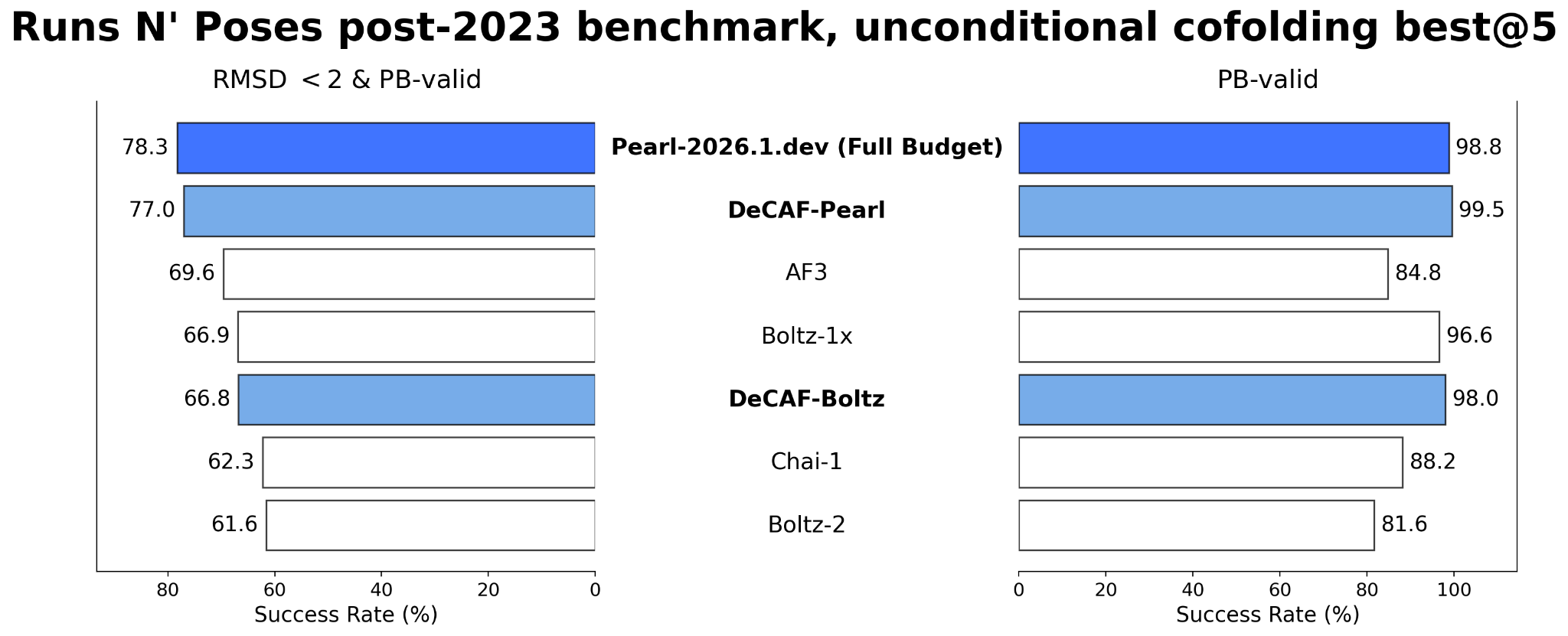
| DeCAF-Boltz distills the [Boltz-1](https://github.com/jwohlwend/boltz) cofolding model into a fast few-step generator, achieving a **5x inference speedup** with near-parity in structure prediction quality. Using over 5x fewer compute steps, DeCAF-Boltz exceeds AlphaFold 3, Chai-1, Boltz-1x, and Boltz-2 on the Runs N' Poses benchmark success rate by 3 to 15 percentage points. |
|
|
|  |
|
|
| *Runs N' Poses (post-2023) success rate, best@5: DeCAF-Boltz nearly matches its full-budget teacher while outperforming AF3, Boltz-1x, Chai-1, and Boltz-2.* |
|
|
| ## Usage |
|
|
| Download the checkpoint and run the bundled end-to-end example from the |
| [code repository](https://github.com/genesistherapeutics/decaf): |
|
|
| ```bash |
| # 1. get the checkpoint (requires `pip install huggingface_hub`) |
| hf download genesisml/decaf decaf_ckpt.ckpt --local-dir . |
| |
| # 2. run few-step DeCAF inference on the bundled example |
| bash scripts/run_decaf_example.sh ./decaf_ckpt.ckpt |
| ``` |
|
|
| Or call the predictor directly: |
|
|
| ```bash |
| python -m boltz.main predict <input.yaml> \ |
| --checkpoint ./decaf_ckpt.ckpt \ |
| --model boltz1 \ |
| --sampling_steps 10 \ |
| --diffusion_samples 5 \ |
| --recycling_steps 3 \ |
| --accelerator gpu \ |
| --out_dir ./out \ |
| --no_kernels |
| ``` |
|
|
| The code auto-detects this checkpoint and switches to the few-step DecafSampler |
| (`Detected Decaf checkpoint — using DecafSampler for inference.`). See the |
| repository's `docs/decaf_prediction.md` for full prediction and evaluation instructions. |
|
|
| ## Confidence outputs |
|
|
| Two checkpoints are provided: |
|
|
| - **`decaf_ckpt.ckpt`** — the DeCAF-Boltz few-step sampler (no confidence head). Structure only. |
| - **`decaf_conf_ckpt.ckpt`** — the same DeCAF head fused with the Boltz-1 confidence module. Because DeCAF shares the Boltz-1 trunk, the confidence head scores DeCAF poses in the *same* trunk pass, so pLDDT / ipTM / PAE come at essentially no extra cost. |
| |
| Use the fused checkpoint exactly like the plain one — the CLI auto-detects the confidence module and writes real pLDDT into the B-factor column plus a `confidence_*.json`: |
| |
| ```bash |
| hf download genesisml/decaf decaf_conf_ckpt.ckpt --local-dir . |
| bash scripts/run_decaf_example.sh ./decaf_conf_ckpt.ckpt |
| ``` |
| |
| You can also build the fused checkpoint yourself from a plain DeCAF checkpoint and `boltz1_conf.ckpt` with `scripts/merge_decaf_confidence.py` in the code repo. |
| |
| ## Citation |
| |
| ```bibtex |
| @misc{scarpellini2026fewstepcofoldingallatomflow, |
| title={Few-step Cofolding with All-Atom Flow Maps}, |
| author={Gianluca Scarpellini and Ron Shprints and Peter Holderrieth and Juno Nam and Pranav Murugan and Rafael Gómez-Bombarelli and Tommi Jaakola and Maruan Al-Shedivat and Nicholas Matthew Boffi and Avishek Joey Bose}, |
| year={2026}, |
| eprint={2606.08375}, |
| archivePrefix={arXiv}, |
| primaryClass={cs.LG}, |
| url={https://arxiv.org/abs/2606.08375}, |
| } |
| ``` |
| |
| ## License |
| |
| Released under the MIT License (Copyright (c) 2026 Genesis Molecular AI). The code |
| extends the open-source [Boltz](https://github.com/jwohlwend/boltz) project (Apache 2.0). |
| |
| ## Acknowledgments |
| |
| The research team at Genesis is grateful to our collaborators from Massachusetts Institute of Technology: Ron Shprints, Peter Holderrieth, Juno Nam, Rafael Gomez-Bombarelli and Tommi Jaakola; Carnegie Mellon University: Nicholas Matthew Boffi, and Joey Bose from Imperial College London and Mila. |
| |


